Analysis of Decarbonisation and Energy Efficiency Improvement Through Mycelium, Hygromorphic Wood and Hemp
 ,
,  , and
, and
Abstract
1. Introduction
2. State of the Art
3. Materials and Methods
4. Results and Discussion
5. Future Applications and Design Opportunities
6. Conclusions
Author Contributions
Funding
Data Availability Statement
Acknowledgments
Conflicts of Interest
References
- Cheng, T.; Tahouni, Y.; Sahin, E.S.; Ulrich, K.; Lajewski, S.; Bonten, C.; Wood, D.; Rühe, J.; Speck, T.; Menges, A. Weather-responsive adaptive shading through biobased and bioinspired hygromorphic 4D-printing. Nat. Commun. 2024, 15, 10366. [Google Scholar] [CrossRef] [Scilit] [PubMed]
- Alaux, N.; Vašatko, H.; Maierhofer, D.; Mendes Saade, M.R.; Stavric, M.; Passer, A. Environmental potential of fungal insulation: A prospective life cycle assessment of mycelium-based composites. Int. J. Life Cycle Assess. 2024, 29, 255–272. [Google Scholar] [CrossRef] [Scilit]
- Hurst, L.J.; O’Donovan, T.S. Embodied impacts of key materials for UK decarbonised domestic retrofit: Differences between sources of embodied carbon and embodied energy data. Energy Build. 2024, 319, 114515. [Google Scholar] [CrossRef] [Scilit]
- Alaneme, K.K.; Anaele, J.U.; Oke, T.M.; Kareem, S.A.; Adediran, M.; Ajibuwa, O.A.; Anabaranze, Y.O. Mycelium based composites: A review of their bio-fabrication procedures, material properties and potential for green building and construction applications. Alex. Eng. J. 2023, 83, 234–250. [Google Scholar] [CrossRef] [Scilit]
- Candido, A.; Amiri, A.; Junnila, S.; Pittau, F. Mycelium-wood composites as a circular material for building insulation. Front. Sustain. Cities 2024, 6, 1412247. [Google Scholar] [CrossRef] [Scilit]
- Tong, W.; Memari, A.M. State of the Art Review on Hempcrete as a Sustainable Substitute for Traditional Construction Materials for Home Building. Buildings 2025, 15, 1988. [Google Scholar]
- Reichert, S.; Menges, A.; Correa, D. Meteorosensitive architecture: Biomimetic building skins based on materially embedded and hygroscopically enabled responsiveness. Comput.-Aided Des. 2015, 60, 50–69. [Google Scholar] [CrossRef] [Scilit]
- Peng, H.; Liu, Z.; Zhu, J.; Jiang, J.; Lyu, J.; Zhan, T. Bending responses of self-shaping wood bilayers: Comparison between adsorption and desorption processes. J. Wood Sci. 2023, 69, 29. [Google Scholar] [CrossRef] [Scilit]
- Volk, R.; Schröter, M.; Saeidi, N.; Steffl, S.; Javadian, A.; Hebel, D.E.; Schultmann, F. Life cycle assessment of mycelium-based composite materials. Resour. Conserv. Recycl. 2024, 205, 107579. [Google Scholar] [CrossRef] [Scilit]
- Bošković, I.; Radivojević, A. Life cycle greenhouse gas emissions of hemp-lime concrete wall constructions in Serbia: The impact of carbon sequestration, transport, waste production and end of life biogenic carbon emission. J. Build. Eng. 2023, 66, 105908. [Google Scholar] [CrossRef] [Scilit]
- Livne, A.; Pearlmutter, D.; Gal, E.; Wösten, H.A.B. Increased CO2 fixation and reduced embodied energy of mycelium bio-composite materials grown on a mixed substrate over diurnal temperature cycles. Constr. Build. Mater. 2024, 421, 135566. [Google Scholar] [CrossRef] [Scilit]
- Wood, D.; Vailati, C.; Menges, A.; Rüggeberg, M. Hygroscopically actuated wood elements for weather responsive and self-forming building parts—Facilitating upscaling and complex shape changes. Constr. Build. Mater. 2018, 165, 782–791. [Google Scholar] [CrossRef] [Scilit]
- Grönquist, P.; Wood, D.; Hassani, M.M.; Wittel, F.K.; Menges, A.; Rüggeberg, M. Analysis of hygroscopic self-shaping wood at large scale for curved mass timber structures. Sci. Adv. 2019, 5, eaax1311. [Google Scholar] [CrossRef] [Scilit] [PubMed]
- Memari, A.M.; Mirzai, N.; Hashemi, M.; Lu, X.; Gracie-Griffin, C.; Yi, H.; Lowe, S.K. In-situ measurement of residential buildings with hempcrete walls: A case study. Front. Sustain. 2025, 5, 1508940. [Google Scholar] [CrossRef] [Scilit]
- Rivas-Aybar, D.; John, M.; Biswas, W. Environmental Life Cycle Assessment of a Novel Hemp-Based Building Material. Materials 2023, 16, 7208. [Google Scholar] [CrossRef] [Scilit] [PubMed]
- Jin, Q.; Zhang, Z.; Chen, J. A study on the thermal performance of Pleurotus Ostreatus/Straw mycelium composites and its application in building envelopes. J. Build. Eng. 2024, 92, 109646. [Google Scholar] [CrossRef] [Scilit]
- Nasr, Y.; El Zakhem, H.; Hamami, A.E.A.; El Bachawati, M.; Belarbi, R. Comprehensive Review of Innovative Materials for Sustainable Buildings’ Energy Performance. Energies 2023, 16, 7440. [Google Scholar] [CrossRef] [Scilit]
- Martins, C.; Santos, P.; Simões da Silva, L. Lightweight steel-framed thermal bridges mitigation strategies: A parametric study. J. Build. Phys. 2016, 39, 342–372. [Google Scholar]
- Almpani-Lekka, D.; Pfeiffer, S.; Schmidts, C.; Seo, S.-I. A review on architecture with fungal biomaterials: The desired and the feasible. Fungal Biol. Biotechnol. 2021, 8, 17. [Google Scholar] [CrossRef] [Scilit] [PubMed]
- Özdemir, E.; Rossi, A.; Eversmann, P. MycoCurva: Stay-in-place fabric formworks for curved veneer-reinforced mycelium building components. Archit. Struct. Constr. 2025, 5, 16. [Google Scholar] [CrossRef] [Scilit]

| Bounding Comparison/Functional Assumption | Sensitivity Range/Interpretation |
|---|---|
| Hemp λ = 0.061–0.12 W/m·K; U = 0.20 W/m2·K | Required thickness ≈ 0.305–0.600 m; this supports envelope/infill use, not structural substitution. |
| Hempcrete GWP = −40 to −80 kg CO2-eq/m3 | For the above thickness range, indicative climate balance ≈ −12 to −48 kg CO2-eq/m2, before boundary-specific corrections. |
| Mycelium λ = 0.026–0.12 W/m·K; U = 0.20 W/m2·K | Required thickness ≈ 0.130–0.600 m; variability is dominated by substrate, density and processing. |
| Mycelium GWP = 0.3668–2.13 kg CO2-eq/kg; density = 51–280 kg/m3 | Broad indicative envelope range ≈ 2.4–358 kg CO2-eq/m2 if extreme values are combined; this should be read as a sensitivity envelope rather than a product claim. |
| Wood–mycelium composite, λ ≈ 0.06 W/m·K, density 167.5 kg/m3, GWP = 0.66–2.13 kg CO2-eq/kg | At U = 0.20 W/m2·K, indicative impact ≈ 33–107 kg CO2-eq/m2; renewable electricity materially improves the lower bound. |
| Synthetic insulation λ ≈ 0.032 W/m·K; density ≈ 35.7 kg/m3; GWP ≈ 4.39 kg CO2-eq/kg | At U = 0.20 W/m2·K, thickness ≈ 0.160 m and indicative impact ≈ 25 kg CO2-eq/m2. |
| Mineral wool λ ≈ 0.04 W/m·K; density ≈ 78.3 kg/m3; GWP ≈ 1.09 kg CO2-eq/kg | At U = 0.20 W/m2·K, thickness ≈ 0.200 m and indicative impact ≈ 17 kg CO2-eq/m2. |
| Concrete λ = 1.7–2.0 W/m·K; U = 0.20 W/m2·K | Required thickness ≈ 8.5–10.0 m; this confirms that concrete is not a functional insulation comparator. |
| Fixed-temperature vs. ambient/diurnal mycelium growth | >70% lower production energy is process-specific and cannot be generalised without electricity-mix and boundary data. |
| Material | Representative Density | Thermal Conductivity λ | Dominant Mechanical Performance | Technical-Construction Interpretation |
|---|---|---|---|---|
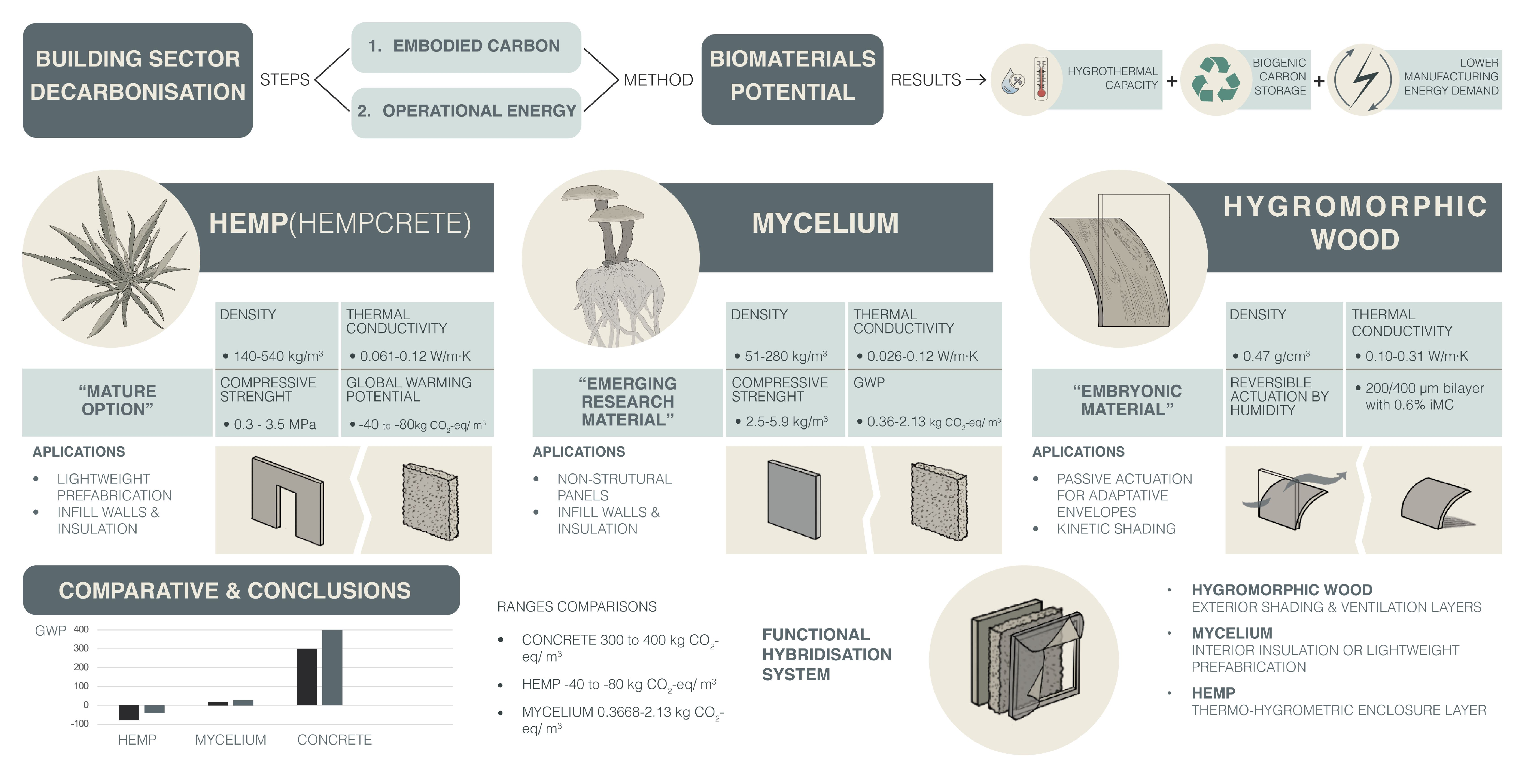
| Mycelium | 51–280 kg/m3; 167.5 kg/m3 in wood–mycelium composite | 0.026–0.081 W/m·K; 0.06 W/m·K in comparative design; 0.12 W/m·K in Pleurotus/straw system | Up to 2.5–5.9 MPa in hot-pressed formulations | Suitable for insulation, lightweight panels, infills, sandwiches and non-load-bearing moulded pieces |
| Hygromorphic wood | 0.47 g/cm3 in Scots pine bilayers | 0.10–0.31 W/m·K for wood depending on species/direction | Reversible actuation by humidity; greater sensitivity in 200/400 μm bilayer with 0.6% iMC | Suitable for shading, passive ventilation, kinetic panels and self-shaping of curved pieces |
| Hemp | 140–540 kg/m3 in reviewed formulations; 250–500 kg/m3 as a frequent use range | 0.061–0.12 W/m·K; 0.05–0.15 W/m·K in general review | 0.3–3.5 MPa as a typical non-load-bearing block | Suitable for infill walls, linings, prefabricated elements, roofs and vapour-open envelopes |
| Conventional Material | Density | λ | Mechanical/Functional Performance | Comparative Comment Against Biomaterials |
|---|---|---|---|---|
| Structural concrete | 2200–2400 kg/m3 | 1.7–2.0 W/m·K | 20–40 MPa | Much better in load-bearing capacity, much poorer in insulation and notably worse in GWP compared with hemp |
| Structural steel | 7850 kg/m3 | 44.5–54.7 W/m·K | 200–300 MPa typical yield strength | Excellent structurally, critical in thermal bridges |
| Ceramic/fired brick | ~1980 kg/m3 | ~0.41 W/m·K | 3–10 MPa in masonry/compared prisms | Better inertia than insulation; clearly denser than hemp and mycelium |
| Synthetic insulation | ~35.7 kg/m3 | ~0.032 W/m·K | Insulating function, non-structural | Better λ than mycelium and hemp, but more fossil-based and less biodegradable |
| Mineral wool | ~78.3 kg/m3 | ~0.04 W/m·K | Insulating function, non-structural | Direct competitor of mycelium in envelope use |
| Environmental Indicator | Mycelium | Hygromorphic Wood | Hemp | Conventional Materials |
|---|---|---|---|---|
| Emissions/GWP | 0.3668 kg CO2-eq/kg in lightweight MBC; 0.66–2.13 kg CO2-eq/kg in wood–mycelium depending on electricity mix | Insufficient comparable quantitative LCA evidence in the studies retrieved; potential advantage lies in wood base and actuator-free operation, not yet in a quantified product-level LCA | −40 to −80 kg CO2-eq/m3 in hempcrete; −9.696 to +10.165 kg CO2-eq depending on scenario; −2.30 to −6.07 kg CO2-eq/m2 in hemp board | Concrete: +300 to +400 kg CO2-eq/m3; synthetic insulators: 4.39 kg CO2-eq/kg; mineral wool: 1.09 kg CO2-eq/kg |
| Electricity as hotspot | Very high relevance | Not applicable in an analogous way | High in board processing and binders | High in intensive industrial materials |
| Recyclability/end of life | Reusable, compostable or recoverable; sensitive to LCA standards | Reusable; bio-based; low technical complexity | Recyclable, biodegradable and potentially reusable as biogenic aggregate | Lower biodegradability; variable recycling |
| Biodegradability | High | High | High | Low or none in plastics and cementitious materials |
| Material Line | Case/Evidence | Application Type | Relative Maturity Level |
|---|---|---|---|
| Mycelium | Hy-Fi; Growing Pavilion; MycoTree | Pavilions, façade panels, spatial compression | Medium–low: Convincing demonstration, standardisation still limited |
| Hygromorphic wood | HygroSkin; self-shaped curved structures; bioinspired façade monitored >1 year | Shading, ventilation, kinetic panels, CLT or curved lamellae | Medium: High functional innovation, still with limited overall energy quantification |
| Hemp | Refurbished dwelling with in situ measurement; prefabricated blocks; hemp–lime walls | Walls, linings, roofs, lightweight prefabrication | Medium–high: Real applications and more robust field data |
Disclaimer/Publisher’s Note: The statements, opinions and data contained in all publications are solely those of the individual author(s) and contributor(s) and not of MDPI and/or the editor(s). MDPI and/or the editor(s) disclaim responsibility for any injury to people or property resulting from any ideas, methods, instructions or products referred to in the content. |
© 2026 by the authors. Licensee MDPI, Basel, Switzerland. This article is an open access article distributed under the terms and conditions of the Creative Commons Attribution (CC BY) license.
Share and Cite
Angulo-Ibáñez, Q.; Cárcel-Carrasco, J.; Colmenero-Fonseca, F.; Ros-Agulló, A. Analysis of Decarbonisation and Energy Efficiency Improvement Through Mycelium, Hygromorphic Wood and Hemp. Buildings 2026, 16, 2701. https://doi.org/10.3390/buildings16132701
Angulo-Ibáñez Q, Cárcel-Carrasco J, Colmenero-Fonseca F, Ros-Agulló A. Analysis of Decarbonisation and Energy Efficiency Improvement Through Mycelium, Hygromorphic Wood and Hemp. Buildings. 2026; 16(13):2701. https://doi.org/10.3390/buildings16132701
Chicago/Turabian StyleAngulo-Ibáñez, Quiteria, Javier Cárcel-Carrasco, Fabiola Colmenero-Fonseca, and Ana Ros-Agulló. 2026. "Analysis of Decarbonisation and Energy Efficiency Improvement Through Mycelium, Hygromorphic Wood and Hemp" Buildings 16, no. 13: 2701. https://doi.org/10.3390/buildings16132701
APA StyleAngulo-Ibáñez, Q., Cárcel-Carrasco, J., Colmenero-Fonseca, F., & Ros-Agulló, A. (2026). Analysis of Decarbonisation and Energy Efficiency Improvement Through Mycelium, Hygromorphic Wood and Hemp. Buildings, 16(13), 2701. https://doi.org/10.3390/buildings16132701