Physics-Informed Neural Networks for Urban and Building Thermal Environment Modeling: A Review of Evolution, Workflows, and Prospects

 ,
,  ,
,
Abstract
1. Introduction
- At the data level, they heavily depend on large-scale, high-quality samples. Due to the lack of standardized datasets in the urban thermal domain, model training often relies on costly numerical simulations to generate samples, ranging from dozens [15,16,17] to thousands [15,18,19], which significantly undermines their expected efficiency advantage.
- At the model level, the absence of physical guidance makes it difficult to establish an inherent connection between the model structure and the real physical mechanisms [20]. Essentially, these models perform function fitting within the data distribution space rather than solving or approximating the governing equations.
- SciML (Scientific Machine Learning): The broadest term, covering all methods that integrate machine learning into scientific computing.
- PIML (Physics-Informed Machine Learning): A subset of SciML, emphasizing the integration of physical knowledge into machine learning processes.
- PINN (Physics-Informed Neural Network): A representative approach within PIML, specifically referring to methods that embed physical constraints (e.g., PDE residuals) as loss terms into neural network training.
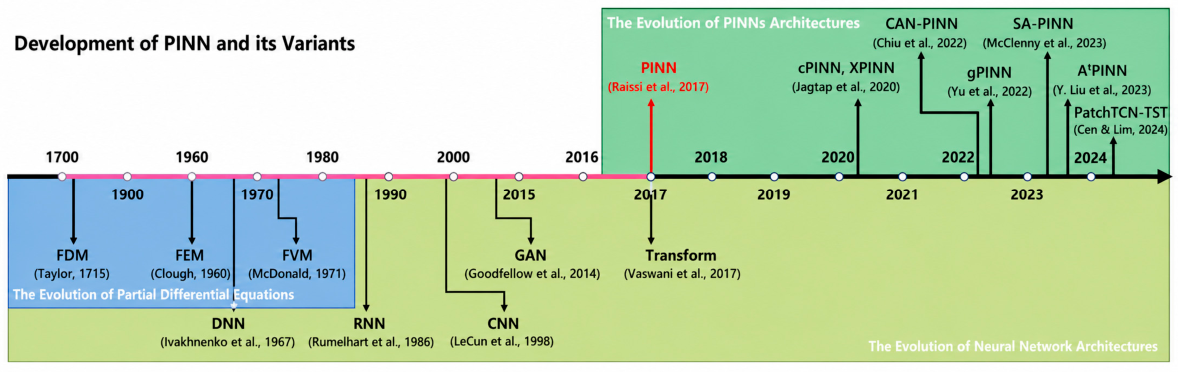
- PINNs (Physics-Informed Neural Networks, the plural form of PINN): A general term for methods that share the core idea of embedding physical priors into neural network training. This usage follows the common practice in the field as an umbrella term for PINN and its generalized paradigms [27,28]. For simplicity, “PINNs” is used throughout as a general term for this class of methods, and its scope is essentially equivalent to Physics-Informed Machine Learning (PIML) in this paper, including vanilla PINN and its variants (e.g., PCNN, PGNN).
- Systematic classification: based on the evolutionary trajectory of urban thermal modeling, extant PINN methods are systematically classified according to where physical priors are introduced into the modeling pipeline. This clarifies the modeling characteristics and applicable scenarios of each approach (Section 3);
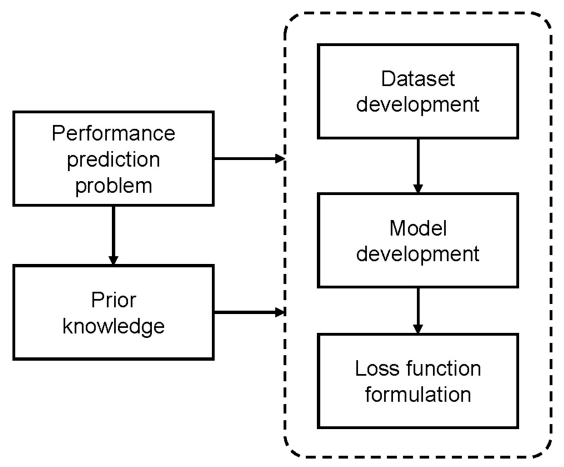
- Workflow synthesis: common development patterns in dataset construction, network design, and loss function formulation are distilled, providing a reference methodological framework for future studies (Section 4);
- Summary and prospects: the main limitations of current physical prior integration are summarized, and future directions toward multi-stage, multi-dimensional physical fusion are proposed (Section 5).
2. Methodology
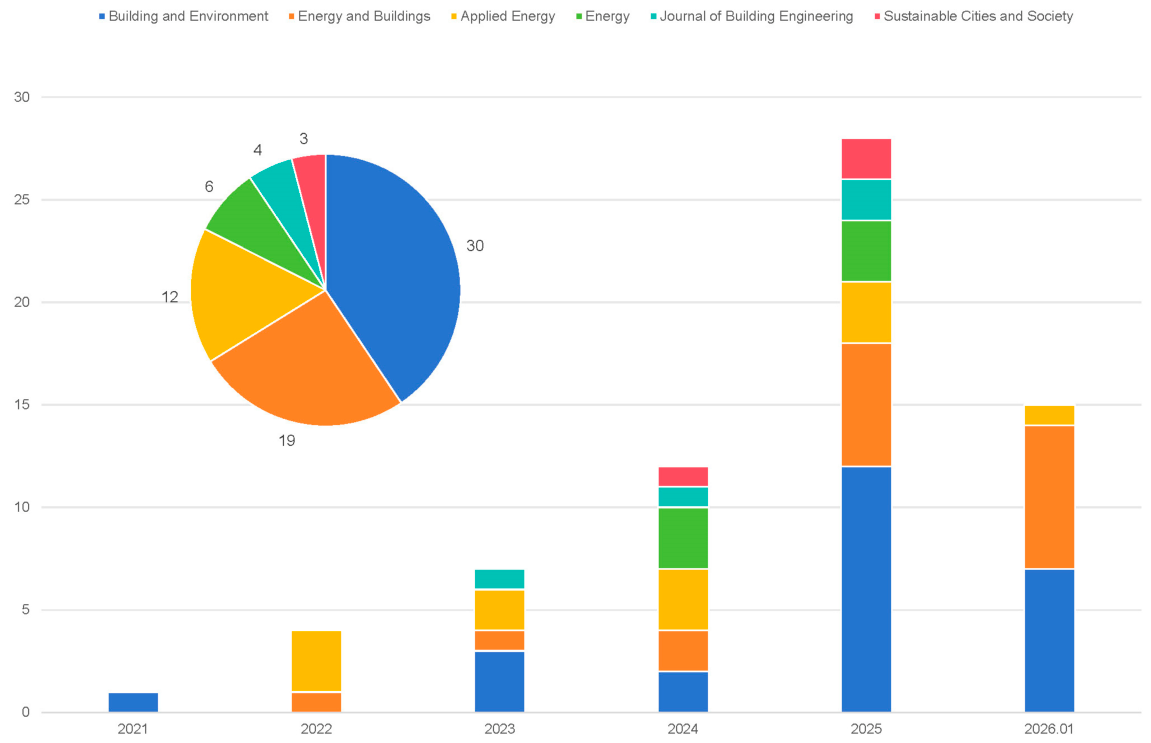
- The keyword string was: (“physics-informed” OR “physics-guided” OR “physically consistent” OR “scientific machine learning” OR “PINN”) AND (“urban” OR “building” OR “indoor” OR “microclimate”) AND (“neural network*” OR “deep learning” OR “machine learning”). This search returned 628 papers in the Web of Science Core Collection.
- The search results were restricted to Web of Science categories relevant to this study, including: Engineering Civil, Construction Building Technology, Energy Fuels, Engineering Environmental, Mechanics, Environmental Sciences, Thermodynamics, and Meteorology Atmospheric Sciences. After this restriction, 211 papers remained.
- The screening was performed by the first author based on titles, abstracts, and keywords, and the final set of 94 papers was reviewed and discussed with a co-author.
3. Evolution
3.1. Numerical Simulation Stage
3.2. Data-Driven Stage
3.2.1. Index-Type Surrogate
3.2.2. Spatial-Field Surrogate
3.3. Hybrid-Driven Stage
3.4. Representative Hybrid-Driven Methods
3.4.1. Vanilla PINN Principles
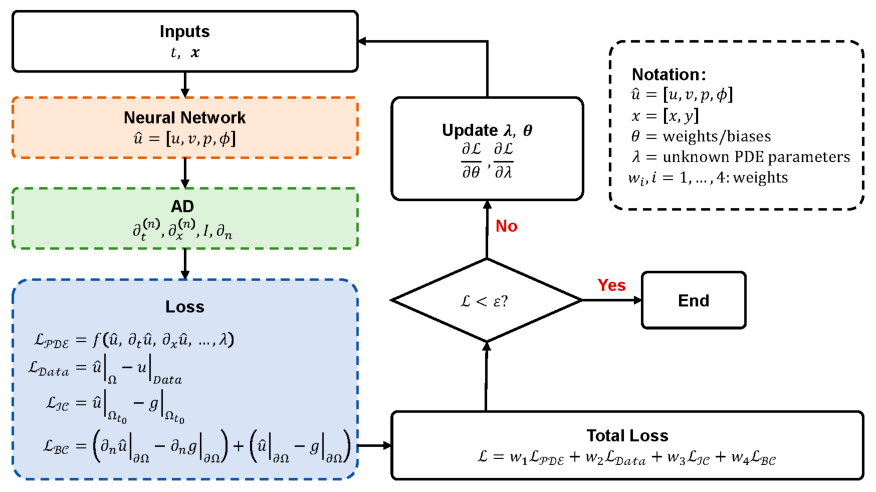
- Neural network and data feedback. In the PINN framework [86], the neural network is usually a fully connected backpropagation neural network. The network input typically receives spatiotemporal coordinates (x, t), and the model output is the solution u(x, t) of the physical field. The neural network can compute derivatives through automatic differentiation (AD) to obtain the partial derivative terms required for the physics loss function. During training, the loss function is fed back to the optimizer to guide the neural network model optimization. The optimizer is typically the adaptive algorithm Adam [90], and backpropagation is used to find the optimal solution. When the loss function value reaches the preset tolerance ε, the training process ends, and the network parameters and PDE parameters are considered to have reached their optimal values.
- Physical information constraints. The neural network solution process transforms the optimization of neural network hyperparameters into an optimization problem, i.e., minimizing the model loss function . Therefore, the loss function is the key function in the model training process, typically expressed as Equation (1).
3.4.2. PINN Variants
3.4.3. Applications of PINNs in Urban Thermal Environments
4. Workflows
4.1. Types of Prior Knowledge
4.2. Workflow for Integrating Prior Knowledge
4.2.1. Dataset Development
4.2.2. Model Construction
- Basic Architectures
- Physically Guided Architectures
- Feature Engineering
- Evaluation and Interpretability
- Multi-Task and Transfer Learning
4.2.3. Loss Function Formulation
5. Conclusions and Prospects
5.1. Conclusions
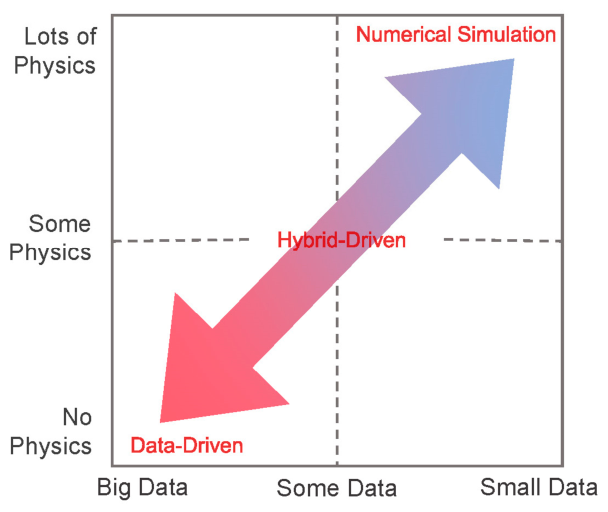
- Evolution perspective: Urban thermal environment modeling has undergone a paradigm shift from numerical simulation (high cost, high accuracy) to data-driven surrogate models (high efficiency, weak physics) and then to hybrid-driven models (balancing efficiency and physical consistency). PINNs, represented by the vanilla PINN, embed physical constraints such as governing equations into neural network training, providing an effective path to address the insufficient generalization and lack of physical consistency of pure data-driven models.
- From a method classification standpoint: PINNs have continuously innovated in dataset utilization, model construction, and loss function formulation. At the three scales of indoor environment, outdoor environment, and building system, problem characteristics (data sparsity, geometric complexity, control orientation) determine the types of physical priors and their integration approaches. Indoor environments mainly use loss function constraints; outdoor environments have driven architectural and strategic innovations; building systems show a trend from soft constraints to hard constraints.
- Regarding the development workflow: Physical priors can be integrated on demand into three stages: dataset development (sampling strategies, data augmentation), model construction (architecture selection, feature engineering, physically guided design), and loss function formulation. Current research is highly concentrated on physical constraints at the loss function level, while systematic integration in data augmentation, network architecture design, and model interpretability evaluation remains insufficient, limiting the application potential of models in complex urban scenarios.
5.2. Prospects
5.2.1. Key Challenges and Open Issues
5.2.2. Future Research Directions
Author Contributions
Funding
Data Availability Statement
Conflicts of Interest
Abbreviations
| PINN | Physics-Informed Neural Network |
| PDE | Partial Differential Equation |
| CFD | Computational Fluid Dynamics |
| GNN | Graph Neural Network |
| GAN | Generative Adversarial Network |
| CNN | Convolutional Neural Network |
| RNN | Recurrent Neural Network |
| MPC | Model Predictive Control |
| ANN | Artificial Neural Network |
| MLP | Multilayer Perceptron |
| FVM | Finite Volume Method |
| FEM | Finite Element Method |
| FDM | Finite Difference Method |
| LHS | Latin Hypercube Sampling |
| SDF | Signed Distance Function |
| MSE | Mean Squared Error |
| RMSE | Root Mean Squared Error |
| SSIM | Structural Similarity Index |
| FID | Fréchet Inception Distance |
References
- Zhao, Y.; Xiong, C.; Luo, Z.; Hussein, T.; Zhao, T. The Impact of Human-Induced Turbulence on Indoor Thermal Environment and Pollutant Diffusion. Build. Simul. 2025, 18, 473–497. [Google Scholar] [CrossRef]
- Li, J.; Zhang, J.; Ge, W.; Liu, X. Multi-Scale Methodology for Complex Systems. Chem. Eng. Sci. 2004, 59, 1687–1700. [Google Scholar] [CrossRef]
- Ni, W.; Areal, A.T.; Lechner, K.; Breitner, S.; Zhang, S.; Woeckel, M.; Slesinski, S.C.; Nikolaou, N.; Dallavalle, M.; Schikowski, T.; et al. Low and High Air Temperature and Cardiovascular Risk. Atherosclerosis 2025, 406, 119238. [Google Scholar] [CrossRef] [PubMed]
- Li, L.; Yu, L.; Li, R.; Zhou, X.; Zhang, N.; Meng, Q. Carbon Emission Accounting and Carbon Neutrality Strategies at Universities: A Case Study from Guangzhou, China. Build. Environ. 2025, 281, 113210. [Google Scholar] [CrossRef]
- Xu, G.; Li, J.; Shi, Y.; Feng, X.; Zhang, Y. Improvements, Extensions, and Validation of the Urban Weather Generator (UWG) for Performance-Oriented Neighborhood Planning. Urban Clim. 2022, 45, 101247. [Google Scholar] [CrossRef]
- Zou, J.; Lu, H.; Shu, C.; Ji, L.; Gaur, A.; Wang, L.L. Multiscale Numerical Assessment of Urban Overheating under Climate Projections: A Review. Urban Clim. 2023, 49, 101551. [Google Scholar] [CrossRef]
- Zhou, X.; Cui, Y.; Fan, C.; Liao, Y.; Zhu, X. How Does Anthropogenic Heat Emissions from Buildings Affect Urban Heat Island Intensity? Based on Neighborhood Scale and Urban Scale Analysis. Urban Clim. 2025, 62, 102525. [Google Scholar] [CrossRef]
- Farahani, A.V.; Leinonen, M.; Ruotsalainen, L.; Jokisalo, J.; Kosonen, R. Predicting Summer Indoor Temperatures in Nordic Apartments Considering Heatwaves Forecasts. Energy Build. 2025, 336, 115630. [Google Scholar] [CrossRef]
- Pan, Y.; Zhu, M.; Lv, Y.; Yang, Y.; Liang, Y.; Yin, R.; Yang, Y.; Jia, X.; Wang, X.; Zeng, F.; et al. Building Energy Simulation and Its Application for Building Performance Optimization: A Review of Methods, Tools, and Case Studies. Adv. Appl. Energy 2023, 10, 100135. [Google Scholar] [CrossRef]
- Chen, T.; Li, R.; Hu, X.; Zhang, B.; Liu, Y.; Wang, L.; Gao, N. Machine Learning as CFD Surrogate Models for Rapid Prediction of Building-Related Physical Fields: A Review of Methods and State-of-the-Art. Build. Environ. 2025, 285, 113667. [Google Scholar] [CrossRef]
- Guo, X.; Li, W.; Iorio, F. Convolutional Neural Networks for Steady Flow Approximation. In Proceedings of the 22nd ACM SIGKDD International Conference on Knowledge Discovery and Data Mining, San Francisco, CA, USA, 13–17 August 2016; pp. 481–490. [Google Scholar]
- Xu, X.; Gao, Z.; Zhang, M. A Review of Simplified Numerical Approaches for Fast Urban Airflow Simulation. Build. Environ. 2023, 234, 110200. [Google Scholar] [CrossRef]
- Zhao, R.; Liu, S.; Liu, J.; Jiang, N.; Chen, Q. A Two-Stage CFD-GNN Approach for Efficient Steady-State Prediction of Urban Airflow and Airborne Contaminant Dispersion. Sustain. Cities Soc. 2024, 112, 105607. [Google Scholar] [CrossRef]
- Shao, X.; Liu, Z.; Zhang, S.; Zhao, Z.; Hu, C. PIGNN-CFD: A Physics-Informed Graph Neural Network for Rapid Predicting Urban Wind Field Defined on Unstructured Mesh. Build. Environ. 2023, 232, 110056. [Google Scholar]
- Lin, X.; Fu, Y.; Peng, D.Z.; Liu, C.-H.; Chu, M.; Chen, Z.; Yang, F.; Tse, T.K.; Li, C.Y.; Feng, X. CFD-and BPNN-Based Investigation and Prediction of Air Pollutant Dispersion in Urban Environment. Sustain. Cities Soc. 2024, 100, 105029. [Google Scholar]
- Tian, X.; Cheng, Y.; Lin, Z. Modelling Indoor Environment Indicators Using Artificial Neural Network in the Stratified Environments. Build. Environ. 2022, 208, 108581. [Google Scholar] [CrossRef]
- Li, L.; He, Y.; Zhang, H.; Fung, J.C.; Lau, A.K. Enhancing IAQ, Thermal Comfort, and Energy Efficiency through an Adaptive Multi-Objective Particle Swarm Optimizer-Grey Wolf Optimization Algorithm for Smart Environmental Control. Build. Environ. 2023, 235, 110235. [Google Scholar] [CrossRef]
- Hodges, J.L.; Lattimer, B.Y.; Luxbacher, K.D. Compartment Fire Predictions Using Transpose Convolutional Neural Networks. Fire Saf. J. 2019, 108, 106394. [Google Scholar] [CrossRef]
- Ding, C.; Lam, K.P. Data-Driven Model for Cross Ventilation Potential in High-Density Cities Based on Coupled CFD Simulation and Machine Learning. Build. Environ. 2019, 165, 106394. [Google Scholar]
- Lu, C.; Li, S.; Lu, Z. Building Energy Prediction Using Artificial Neural Networks: A Literature Survey. Energy Build. 2022, 262, 111718. [Google Scholar] [CrossRef]
- Calzolari, G.; Liu, W. Deep learning to replace, improve, or aid CFD analysis in built environment applications: A review. Build. Environ. 2021, 206, 108315. [Google Scholar] [CrossRef]
- Karniadakis, G.E.; Kevrekidis, I.G.; Lu, L.; Perdikaris, P.; Wang, S.; Yang, L. Physics-Informed Machine Learning. Nat. Rev. Phys. 2021, 3, 422–440. [Google Scholar] [CrossRef]
- Wei, C.; Ooka, R.; Zhou, Q. Performance Comparison Using Different Multilayer Perceptron Input–Output Formats to Predict Unsteady Indoor Temperature Distribution. Jpn. Archit. Rev. 2022, 5, 661–671. [Google Scholar] [CrossRef]
- Pedro Souza de Oliveira, J.; Victor Barbosa Alves, J.; Neuenschwander Escosteguy Carneiro, J.; de Andrade Medronho, R.; Fernando Lopes Rodrigues Silva, L. Coupling a Neural Network Technique with CFD Simulations for Predicting 2-D Atmospheric Dispersion Analyzing Wind and Composition Effects. J. Loss Prev. Process Ind. 2022, 80, 104930. [Google Scholar] [CrossRef]
- Jurado, X.; Reiminger, N.; Benmoussa, M.; Vazquez, J.; Wemmert, C. Deep Learning Methods Evaluation to Predict Air Quality Based on Computational Fluid Dynamics. Expert Syst. Appl. 2022, 203, 117294. [Google Scholar] [CrossRef]
- Peng, W.; Qin, S.; Yang, S.; Wang, J.; Liu, X.; Wang, L.L. Fourier Neural Operator for Real-Time Simulation of 3D Dynamic Urban Microclimate. Build. Environ. 2024, 248, 111063. [Google Scholar] [CrossRef]
- Penwarden, M.; Zhe, S.; Narayan, A.; Kirby, R.M. A Metalearning Approach for Physics-Informed Neural Networks (PINNs): Application to Parameterized PDEs. J. Comput. Phys. 2023, 477, 111912. [Google Scholar] [CrossRef]
- Cai, S.; Mao, Z.; Wang, Z.; Yin, M.; Karniadakis, G.E. Physics-Informed Neural Networks (PINNs) for Fluid Mechanics: A Review. Acta Mech. Sin. 2021, 37, 1727–1738. [Google Scholar] [CrossRef]
- Raissi, M.; Wang, Z.; Triantafyllou, M.S.; Karniadakis, G.E. Deep Learning of Vortex-Induced Vibrations. J. Fluid Mech. 2019, 861, 119–137. [Google Scholar] [CrossRef]
- Raissi, M.; Perdikaris, P.; Karniadakis, G.E. Physics Informed Deep Learning (Part I): Data-Driven Solutions of Nonlinear Partial Differential Equations. arXiv 2017, arXiv:1711.10561. [Google Scholar]
- Raissi, M.; Perdikaris, P.; Karniadakis, G.E. Physics Informed Deep Learning (Part II): Data-Driven Discovery of Nonlinear Partial Differential Equations. arXiv 2017, arXiv:1711.10566. [Google Scholar]
- Hao, Z.; Liu, S.; Zhang, Y.; Ying, C.; Feng, Y.; Su, H.; Zhu, J. Physics-Informed Machine Learning: A Survey on Problems, Methods and Applications. arXiv 2022, arXiv:2211.08064. [Google Scholar] [CrossRef]
- Liu, Y.; Liu, W.; Yan, X.; Guo, S.; Zhang, C. Adaptive Transfer Learning for PINN. J. Comput. Phys. 2023, 490, 112291. [Google Scholar] [CrossRef]
- Vaswani, A.; Shazeer, N.; Parmar, N.; Uszkoreit, J.; Jones, L.; Gomez, A.N.; Kaiser, Ł.; Polosukhin, I. Attention Is All You Need. Adv. Neural Inf. Process. Syst. 2017, 30. [Google Scholar]
- Chiu, P.-H.; Wong, J.C.; Ooi, C.; Dao, M.H.; Ong, Y.-S. CAN-PINN: A Fast Physics-Informed Neural Network Based on Coupled-Automatic–Numerical Differentiation Method. Comput. Methods Appl. Mech. Eng. 2022, 395, 114909. [Google Scholar]
- Ivakhnenko, A.G.; Lapa, V.G. Cybernetics and Forecasting Techniques; America Elsevier Publishing Company: New York, NY, USA, 1967. [Google Scholar]
- Jagtap, A.D.; Karniadakis, G.E. Extended Physics-Informed Neural Networks (XPINNs): A Generalized Space-Time Domain Decomposition Based Deep Learning Framework for Nonlinear Partial Differential Equations. Commun. Comput. Phys. 2020, 28. [Google Scholar]
- LeCun, Y.; Bottou, L.; Bengio, Y.; Haffner, P. Gradient-Based Learning Applied to Document Recognition. Proc. IEEE 1998, 86, 2278–2324. [Google Scholar] [CrossRef]
- Yu, J.; Lu, L.; Meng, X.; Karniadakis, G.E. Gradient-Enhanced Physics-Informed Neural Networks for Forward and Inverse PDE Problems. Comput. Methods Appl. Mech. Eng. 2022, 393, 114823. [Google Scholar]
- Goodfellow, I.J.; Pouget-Abadie, J.; Mirza, M.; Xu, B.; Warde-Farley, D.; Ozair, S.; Courville, A.; Bengio, Y. Generative Adversarial Nets. Adv. Neural Inf. Process. Syst. 2014, 27. [Google Scholar]
- Rumelhart, D.E.; Hinton, G.E.; Williams, R.J. Learning Representations by Back-Propagating Errors. Nature 1986, 323, 533–536. [Google Scholar] [CrossRef]
- Taylor, B. Methodus Incrementorum Directa; 1715. [Google Scholar]
- Cen, S.; Lim, C.G. Multi-Task Learning of the PatchTCN-TST Model for Short-Term Multi-Load Energy Forecasting Considering Indoor Environments in a Smart Building. IEEE Access 2024, 12, 19553–19568. [Google Scholar]
- McClenny, L.D.; Braga-Neto, U.M. Self-Adaptive Physics-Informed Neural Networks. J. Comput. Phys. 2023, 474, 111722. [Google Scholar]
- McDonald, P.W. The Computation of Transonic Flow Through Two-Dimensional Gas Turbine Cascades; American Society of Mechanical Engineers: New York, NY, USA, 1971; Volume 79825. [Google Scholar]
- Clough, R.W. The Finite Element Method in Plane Stress Analysis; American Society of Civil Engineers: Reston, VA, USA, 1960. [Google Scholar]
- Yao, R.; Luo, Q.; Li, B. A Simplified Mathematical Model for Urban Microclimate Simulation. Build. Environ. 2011, 46, 253–265. [Google Scholar] [CrossRef]
- Jin, M.; Zuo, W.; Chen, Q. Simulating Natural Ventilation in and around Buildings by Fast Fluid Dynamics. Numer. Heat Transf. Part A Appl. 2013, 64, 273–289. [Google Scholar] [CrossRef]
- Zuo, W.; Chen, Q. Fast and Informative Flow Simulations in a Building by Using Fast Fluid Dynamics Model on Graphics Processing Unit. Build. Environ. 2010, 45, 747–757. [Google Scholar] [CrossRef]
- Katal, A.; Mortezazadeh, M.; Wang, L.L. Modeling Building Resilience against Extreme Weather by Integrated CityFFD and CityBEM Simulations. Appl. Energy 2019, 250, 1402–1417. [Google Scholar]
- Stam, J. Stable Fluids. In Seminal Graphics Papers: Pushing the Boundaries, Volume 2; Association for Computing Machinery: New York, NY, USA, 2023; ISBN 979-8-4007-0897-8. [Google Scholar]
- Liu, W.; Jin, M.; Chen, C.; You, R.; Chen, Q. Implementation of a Fast Fluid Dynamics Model in OpenFOAM for Simulating Indoor Airflow. Numer. Heat Transf. Part A Appl. 2016, 69, 748–762. [Google Scholar] [CrossRef]
- Hang, J.; Li, Y. Wind Conditions in Idealized Building Clusters: Macroscopic Simulations Using a Porous Turbulence Model. Bound.-Layer Meteorol. 2010, 136, 129–159. [Google Scholar] [CrossRef]
- Getachew, D.; Minkowycz, W.; Lage, J. A Modified Form of the κ–ε Model for Turbulent Flows of an Incompressible Fluid in Porous Media. Int. J. Heat Mass Transf. 2000, 43, 2909–2915. [Google Scholar] [CrossRef]
- Obrecht, C.; Kuznik, F.; Merlier, L.; Roux, J.-J.; Tourancheau, B. Towards Aeraulic Simulations at Urban Scale Using the Lattice Boltzmann Method. Environ. Fluid Mech. 2015, 15, 753–770. [Google Scholar]
- Chen, S.; Doolen, G.D. Lattice Boltzmann Method for Fluid Flows. Annu. Rev. Fluid Mech. 1998, 30, 329–364. [Google Scholar] [CrossRef]
- Wu, R.; Fang, X.; Liu, S.; Li, Q.; Brown, R.; Yan, J. A Workflow for Rapid Assessment of Complex Courtyard Wind Environment Based on Parallel Lattice Boltzmann Method. Build. Environ. 2023, 233, 110112. [Google Scholar] [CrossRef]
- Wang, H.; Zhai, Z. Application of Coarse-Grid Computational Fluid Dynamics on Indoor Environment Modeling: Optimizing the Trade-off between Grid Resolution and Simulation Accuracy. HVACR Res. 2012, 18, 915–933. [Google Scholar] [CrossRef]
- Yang, M.; Oh, G.; Xu, T.; Kim, J.; Kang, J.-H.; Choi, J.-I. Multi-GPU-Based Real-Time Large-Eddy Simulations for Urban Microclimate. Build. Environ. 2023, 245, 110856. [Google Scholar]
- Brunton, S.L.; Noack, B.R.; Koumoutsakos, P. Machine Learning for Fluid Mechanics. Annu. Rev. Fluid Mech. 2020, 52, 477–508. [Google Scholar] [CrossRef]
- Westermann, P.; Evins, R. Surrogate Modelling for Sustainable Building Design—A Review. Energy Build. 2019, 198, 170–186. [Google Scholar]
- Caron, C.; Lauret, P.; Bastide, A. Machine Learning to Speed up Computational Fluid Dynamics Engineering Simulations for Built Environments: A Review. Build. Environ. 2025, 267, 112229. [Google Scholar] [CrossRef]
- Shen, X.; Cao, Z.; Liu, H.; Cong, B.; Zhou, F.; Ma, Y.; Zou, X.; Wei, S. Inverse Tracing of Fire Source in a Single Room Based on CFD Simulation and Deep Learning. J. Build. Eng. 2023, 76, 107069. [Google Scholar] [CrossRef]
- Wai, K.-M.; Yu, P.K. Application of a Machine Learning Method for Prediction of Urban Neighborhood-Scale Air Pollution. Int. J. Environ. Res. Public Health 2023, 20, 2412. [Google Scholar] [CrossRef] [PubMed]
- Higgins, S.; Stathopoulos, T. Application of Artificial Intelligence to Urban Wind Energy. Build. Environ. 2021, 197, 107848. [Google Scholar] [CrossRef]
- Zhou, Q.; Ooka, R. Influence of Data Preprocessing on Neural Network Performance for Reproducing CFD Simulations of Non-Isothermal Indoor Airflow Distribution. Energy Build. 2021, 230, 110525. [Google Scholar] [CrossRef]
- Zhang, L.; Plathottam, S.; Reyna, J.; Merket, N.; Sayers, K.; Yang, X.; Reynolds, M.; Parker, A.; Wilson, E.; Fontanini, A.; et al. High-Resolution Hourly Surrogate Modeling Framework for Physics-Based Large-Scale Building Stock Modeling. Sustain. Cities Soc. 2021, 75, 103292. [Google Scholar] [CrossRef]
- He, Y.; Liu, X.-H.; Zhang, H.-L.; Zheng, W.; Zhao, F.-Y.; Schnabel, M.A.; Mei, Y. Hybrid Framework for Rapid Evaluation of Wind Environment around Buildings through Parametric Design, CFD Simulation, Image Processing and Machine Learning. Sustain. Cities Soc. 2021, 73, 103092. [Google Scholar] [CrossRef]
- Mortezazadeh, M.; Zou, J.; Hosseini, M.; Yang, S.; Wang, L. Estimating Urban Wind Speeds and Wind Power Potentials Based on Machine Learning with City Fast Fluid Dynamics Training Data. Atmosphere 2022, 13, 214. [Google Scholar] [CrossRef]
- Gan, V.J.L.; Wang, B.; Chan, C.M.; Weerasuriya, A.U.; Cheng, J.C.P. Physics-Based, Data-Driven Approach for Predicting Natural Ventilation of Residential High-Rise Buildings. Build. Simul. 2022, 15, 129–148. [Google Scholar] [CrossRef]
- Kastner, P.; Dogan, T. A GAN-Based Surrogate Model for Instantaneous Urban Wind Flow Prediction. Build. Environ. 2023, 242, 110384. [Google Scholar] [CrossRef]
- Tanaka, H.; Matsuoka, Y.; Kawakami, T.; Azegami, Y.; Yamamoto, M.; Ohtake, K.; Sone, T. Optimization Calculations and Machine Learning Aimed at Reduction of Wind Forces Acting on Tall Buildings and Mitigation of Wind Environment. Int. J. High-Rise Build. 2019, 8, 291–302. [Google Scholar] [CrossRef]
- Duering, S.; Chronis, A.; Koenig, R. Optimizing Urban Systems: Integrated Optimization of Spatial Configurations. In Proceedings of the 11th Annual Symposium on Simulation for Architecture and Urban Design, Virtual, 25–27 May 2020; p. 7. [Google Scholar]
- Mokhtar, S.; Sojka, A.; Davila, C.C. Conditional Generative Adversarial Networks for Pedestrian Wind Flow Approximation. In Proceedings of the 11th Annual Symposium on Simulation for Architecture and Urban Design, Virtual, 25–27 May 2020; pp. 469–476. [Google Scholar]
- Huang, C.; Zhang, G.; Yao, J.; Wang, X.; Calautit, J.K.; Zhao, C.; An, N.; Peng, X. Accelerated Environmental Performance-Driven Urban Design with Generative Adversarial Network. Build. Environ. 2022, 224, 109575. [Google Scholar] [CrossRef]
- Milla-Val, J.; Montañés, C.; Fueyo, N. Adversarial Image-to-Image Model to Obtain Highly Detailed Wind Fields from Mesoscale Simulations in Urban Environments. Build. Environ. 2024, 266, 112123. [Google Scholar]
- Li, J.; Guo, F.; Chen, H. A Study on Urban Block Design Strategies for Improving Pedestrian-Level Wind Conditions: CFD-Based Optimization and Generative Adversarial Networks. Energy Build. 2024, 304, 113863. [Google Scholar]
- Shin, S.; Baek, K.; So, H. Rapid Monitoring of Indoor Air Quality for Efficient HVAC Systems Using Fully Convolutional Network Deep Learning Model. Build. Environ. 2023, 234, 110191. [Google Scholar] [CrossRef]
- Kim, N.K.; Kang, D.H.; Kim, B.W.; Kang, H.W. Optimal Location and Performance Prediction of Portable Air Cleaner in Composite Room Shapes Using Convolutional Neural Network. Build. Environ. 2023, 242, 110500. [Google Scholar] [CrossRef]
- Zhou, Q.; Ooka, R. Neural Network for Indoor Airflow Prediction with CFD Database. In Proceedings of the Journal of Physics: Conference Series; IOP Publishing: Philadelphia, PA, USA, 2021; Volume 2069, p. 012154. [Google Scholar]
- Wei, C.; Ooka, R. Indoor Airflow Field Reconstruction Using Physics-Informed Neural Network. Build. Environ. 2023, 242, 110563. [Google Scholar] [CrossRef]
- Quang, T.V.; Doan, D.T.; Phuong, N.L.; Yun, G.Y. Data-Driven Prediction of Indoor Airflow Distribution in Naturally Ventilated Residential Buildings Using Combined CFD Simulation and Machine Learning (ML) Approach. J. Build. Phys. 2024, 47, 439–471. [Google Scholar] [CrossRef]
- Javanroodi, K.; Nik, V.M.; Giometto, M.G.; Scartezzini, J.-L. Combining Computational Fluid Dynamics and Neural Networks to Characterize Microclimate Extremes: Learning the Complex Interactions between Meso-Climate and Urban Morphology. Sci. Total Environ. 2022, 829, 154223. [Google Scholar] [CrossRef] [PubMed]
- Faroughi, S.A.; Pawar, N.M.; Fernandes, C.; Raissi, M.; Das, S.; Kalantari, N.K.; Kourosh Mahjour, S. Physics-Guided, Physics-Informed, and Physics-Encoded Neural Networks and Operators in Scientific Computing: Fluid and Solid Mechanics. J. Comput. Inf. Sci. Eng. 2024, 24, 040802. [Google Scholar]
- Cuomo, S.; Di Cola, V.S.; Giampaolo, F.; Rozza, G.; Raissi, M.; Piccialli, F. Scientific Machine Learning Through Physics–Informed Neural Networks: Where We Are and What’s Next. J. Sci. Comput. 2022, 92, 88. [Google Scholar] [CrossRef]
- Raissi, M.; Perdikaris, P.; Karniadakis, G.E. Physics-Informed Neural Networks: A Deep Learning Framework for Solving Forward and Inverse Problems Involving Nonlinear Partial Differential Equations. J. Comput. Phys. 2019, 378, 686–707. [Google Scholar] [CrossRef]
- Dissanayake, M.W.M.G.; Phan-Thien, N. Neural-Network-Based Approximations for Solving Partial Differential Equations. Commun. Numer. Methods Eng. 1994, 10, 195–201. [Google Scholar] [CrossRef]
- Lagaris, I.E.; Likas, A.; Fotiadis, D.I. Artificial Neural Networks for Solving Ordinary and Partial Differential Equations. IEEE Trans. Neural Netw. 1998, 9, 987–1000. [Google Scholar] [CrossRef] [PubMed]
- Toscano, J.D.; Oommen, V.; Varghese, A.J.; Zou, Z.; Daryakenari, N.A.; Wu, C.; Karniadakis, G.E. From PINNs to PIKANs: Recent Advances in Physics-Informed Machine Learning. Mach. Learn. Comput. Sci. Eng. 2025, 1, 15. [Google Scholar] [CrossRef] [PubMed]
- Kingma, D.P.; Ba, J. Adam: A Method for Stochastic Optimization. arXiv 2014, arXiv:1412.6980. [Google Scholar]
- Jing, G.; Ning, C.; Qin, J.; Ding, X.; Duan, P.; Liu, H.; Sang, H. Physics-Guided Framework of Neural Network for Fast Full-Field Temperature Prediction of Indoor Environment. J. Build. Eng. 2023, 68, 106054. [Google Scholar] [CrossRef]
- Chen, D.; Guo, H.; Gu, X.; Wang, J.; Liu, Y.; Li, Y.; Wu, Y. Physical-Guided Transfer Deep Neural Network for High-Resolution AOD Retrieval. Remote Sens. 2025, 17, 3606. [Google Scholar] [CrossRef]
- Mei, D.; Mo, Z.; Zhou, K.; Liu, C.-H. Traffic Assignment Optimization to Improve Urban Air Quality with the Unified Finite-Volume Physics-Informed Neural Network. Sustain. Cities Soc. 2024, 114, 105750. [Google Scholar] [CrossRef]
- Di Natale, L.; Svetozarevic, B.; Heer, P.; Jones, C.N. Physically Consistent Neural Networks for Building Thermal Modeling: Theory and Analysis. Appl. Energy 2022, 325, 119806. [Google Scholar] [CrossRef]
- Henkel, P.; Ross, S.; Ratz, M.; Muller, D. Monotonic Physics-Constrained Neural Networks for Model Predictive Control of Building Energy Systems. Build. Environ. 2025, 285, 113640. [Google Scholar] [CrossRef]
- Mun, J.; Jo, H.-G.; Park, C.S. Toward Scalable Prediction of Indoor Thermal Dynamics: Neural-Network-Implanted State-Space (NNiSS) Model. Energy Build. 2025, 331, 115359. [Google Scholar] [CrossRef]
- Montazeri, M.; Remlinger, C.; Haro, B.B.; Heer, P. Fully Data-Driven and Modular Building Thermal Control with Physically Consistent Modeling. Appl. Energy 2025, 390, 125770. [Google Scholar] [CrossRef]
- Jing, G.; Wang, H.; Jiu, Y.; Li, X.; Wang, G. Physics-Informed Neural Network-Based Reynolds-Averaged Navier-Stokes Approach with Limited Observations for Indoor Airflow Field Reconstruction. Build. Environ. 2026, 290, 114107. [Google Scholar] [CrossRef]
- Jing, G.; Wang, H.; Li, X.; Wang, G.; Yang, Y. An Airflow Velocity Field Reconstruction Method with Sparse or Incomplete Data Using Physics-Informed Neural Network. J. Build. Eng. 2024, 88, 109231. [Google Scholar] [CrossRef]
- Kim, J.; Son, J.; Koo, J. Dynamic Estimation of PM2.5 Penetration and Removal Rates Using Physics-Informed Neural Networks for Indoor Air Quality Management. Build. Environ. 2025, 278, 113038. [Google Scholar] [CrossRef]
- Rui, E.-Z.; Chen, Z.-W.; Ni, Y.-Q.; Yuan, L.; Zeng, G.-Z. Reconstruction of 3D Flow Field around a Building Model in Wind Tunnel: A Novel Physics-Informed Neural Network Framework Adopting Dynamic Prioritization Self-Adaptive Loss Balance Strategy. Eng. Appl. Comput. Fluid Mech. 2023, 17, 2238849. [Google Scholar] [CrossRef]
- Wu, Y.; Cao, Z.; Lei, Y.; Han, Y.; Yuan, M.; Wang, L.; Zhou, X. Multi-Constraint Physics-Informed Generative Adversarial Networks (PIGAN) Enable Small-Data Learning for Urban Wind Field Prediction. Build. Environ. 2026, 290, 114202. [Google Scholar] [CrossRef]
- Saeed, M.H.; Kazmi, H.; Deconinck, G. Dyna-PINN: Physics-Informed Deep Dyna-q Reinforcement Learning for Intelligent Control of Building Heating System in Low-Diversity Training Data Regimes. Energy Build. 2024, 324, 114879. [Google Scholar] [CrossRef]
- Sun, Y.; Zhang, J.; Guo, C.; Yuan, H.; Liu, Y.; Chai, J.; Sun, L. A Physics-Informed Seq2seq Neural Network-Based Control Strategy for Improving the Energy Flexibility of Building-Integrated Thermal Storage Heat Pump Systems. Energy 2025, 341, 139409. [Google Scholar] [CrossRef]
- Wang, Y.; Zhang, B.; Kikumoto, H. Two-Step High-Resolution Reconstruction of Mean Flow Field and Reynolds Stress Distributions Using Physics-Informed Neural Networks in a Two-Dimensional Street Canyon. Build. Environ. 2026, 288, 113958. [Google Scholar] [CrossRef]
- Guo, H.; He, K.; Xu, Y.; Lei, Y. A Co-Simulation Methodology for Integrating Data-Driven Termal Sensation Models with Building Energy Control. Energy Build. 2026, 353, 116745. [Google Scholar] [CrossRef]
- Guo, H.; He, K.; Luo, Y.; Chang, Y. Physics-Informed Neural Networks for Robust Thermal Comfort Prediction: Overcoming Data Quality Limitations through Physiological Constraints. Build. Environ. 2025, 285, 113588. [Google Scholar] [CrossRef]
- Kim, J.; Kim, G.; Bang, J.-I.; Choi, A.; Sung, M. CO2 Concentration Prediction in Office Spaces Using Physics-Informed Neural Network Based on Number of Occupants and IoT Sensor Data. Build. Environ. 2026, 288, 114035. [Google Scholar] [CrossRef]
- Wang, Z.; Han, R. Deep Learning for 3D Reconstruction and Trajectory Prediction of Dust and Polluted Aerosols in Educational Environments. Front. Environ. Sci. 2025, 13, 1582806. [Google Scholar] [CrossRef]
- Gao, H.; Hu, G.; Zhang, D.; Jiang, W.; Tse, K.T.; Kwok, K.C.S.; Kareem, A. Urban Wind Field Prediction Based on Sparse Sensors and Physics-Informed Graph-Assisted Auto-Encoder. Comput.-Aided Civ. Infrastruct. Eng. 2024, 39, 1409–1430. [Google Scholar] [CrossRef]
- Dong, K.; Guo, Z.; Yu, Q.; Xu, J.; Yan, J. Data-Driven Prediction of Fine-Grained Facade Solar Irradiance for Urban PV Potential Assessment. Appl. Energy 2026, 403, 127009. [Google Scholar] [CrossRef]
- Di Natale, L.; Svetozarevic, B.; Heer, P.; Jones, C.N. Towards Scalable Physically Consistent Neural Networks: An Application to Data-Driven Multi-Zone Thermal Building Models. Appl. Energy 2023, 340, 121071. [Google Scholar] [CrossRef]
- Wang, X.; Wang, X.; Kang, X.; Dong, B.; Yan, D. Physics-Consistent Input Convex Neural Network-Driven Reinforcement Learning Control for Multi-Zone Radiant Ceiling Heating and Cooling Systems: An Experimental Study. Energy Build. 2025, 327, 115105. [Google Scholar] [CrossRef]
- Semeraro, S.; Vecchi, F.; Stasi, R.; Berardi, U. Physics-Informed Neural Networks for Predicting Indoor Temperature and Cooling Demand in Historic Buildings. J. Build. Eng. 2025, 115, 114392. [Google Scholar] [CrossRef]
- Yerlikaya-Özkurt, F.; Özbey, M.F.; Turhan, C. Modeling the Mood State on Thermal Sensation with a Data Mining Algorithm and Testing the Accuracy of Mood State Correction Factor. New Ideas Psychol. 2025, 76, 101124. [Google Scholar]
- Turhan, C.; Özbey, M.F.; Lotfi, B.; Akkurt, G.G. Integration of Psychological Parameters into a Thermal Sensation Prediction Model for Intelligent Control of the HVAC Systems. Energy Build. 2023, 296, 113404. [Google Scholar] [CrossRef]
- Kim, S.W.; Kim, I.; Lee, J.; Lee, S. Knowledge Integration into Deep Learning in Dynamical Systems: An Overview and Taxonomy. J. Mech. Sci. Technol. 2021, 35, 1331–1342. [Google Scholar] [CrossRef]
- Farea, A.; Yli-Harja, O.; Emmert-Streib, F. Understanding Physics-Informed Neural Networks: Techniques, Applications, Trends, and Challenges. AI 2024, 5, 1534–1557. [Google Scholar] [CrossRef]
- von Rueden, L.; Mayer, S.; Beckh, K.; Georgiev, B.; Giesselbach, S.; Heese, R.; Kirsch, B.; Walczak, M.; Pfrommer, J.; Pick, A.; et al. Informed Machine Learning—A Taxonomy and Survey of Integrating Prior Knowledge into Learning Systems. IEEE Trans. Knowl. Data Eng. 2021, 35, 614–633. [Google Scholar] [CrossRef]
- Singh, M.M.; Singaravel, S.; Geyer, P. Machine Learning for Early Stage Building Energy Prediction: Increment and Enrichment. Appl. Energy 2021, 304, 117787. [Google Scholar] [CrossRef]
- Deutsch, J.L.; Deutsch, C.V. Latin Hypercube Sampling with Multidimensional Uniformity. J. Stat. Plan. Inference 2012, 142, 763–772. [Google Scholar] [CrossRef]
- Han, Y.; Shen, L.; Sun, C. Developing a Parametric Morphable Annual Daylight Prediction Model with Improved Generalization Capability for the Early Stages of Office Building Design. Build. Environ. 2021, 200, 107932. [Google Scholar] [CrossRef]
- Zhong, G.; Xu, X.; Feng, J.; Yuan, L. A Convolutional Neural Network for Steady-State Flow Approximation Trained on a Small Sample Size. Atmosphere 2023, 14, 1462. [Google Scholar] [CrossRef]
- Yang, S.; Xiao, W.; Zhang, M.; Guo, S.; Zhao, J.; Shen, F. Image Data Augmentation for Deep Learning: A Survey. arXiv 2022, arXiv:2204.08610. [Google Scholar]
- Pateras, J.; Rana, P.; Ghosh, P. A Taxonomic Survey of Physics-Informed Machine Learning. Appl. Sci. 2023, 13, 6892. [Google Scholar] [CrossRef]
- Wen, Q.; Sun, L.; Yang, F.; Song, X.; Gao, J.; Wang, X.; Xu, H. Time Series Data Augmentation for Deep Learning: A Survey. In Proceedings of the Thirtieth International Joint Conference on Artificial Intelligence, Virtual, 19–27 August 2021; pp. 4653–4660. [Google Scholar]
- Le Guennec, A.; Malinowski, S.; Tavenard, R. Data Augmentation for Time Series Classification Using Convolutional Neural Networks. In Proceedings of the ECML/PKDD Workshop on Advanced Analytics and Learning on Temporal Data, Riva del Garda, Italy, 19–23 September 2016. [Google Scholar]
- Fan, C.; Chen, M.; Tang, R.; Wang, J. A Novel Deep Generative Modeling-Based Data Augmentation Strategy for Improving Short-Term Building Energy Predictions. Build. Simul. 2022, 15, 197–211. [Google Scholar] [CrossRef]
- Daw, A.; Karpatne, A.; Watkins, W.; Read, J.; Kumar, V. Physics-Guided Neural Networks (PGNN): An Application in Lake Temperature Modeling. arXiv 2021, arXiv:1710.11431. [Google Scholar]
- Fang, Z. A High-Efficient Hybrid Physics-Informed Neural Networks Based on Convolutional Neural Network. IEEE Trans. Neural Netw. Learn. Syst. 2022, 33, 5514–5526. [Google Scholar] [CrossRef] [PubMed]
- Ren, P.; Rao, C.; Liu, Y.; Wang, J.-X.; Sun, H. PhyCRNet: Physics-Informed Convolutional-Recurrent Network for Solving Spatiotemporal PDEs. Comput. Methods Appl. Mech. Eng. 2022, 389, 114399. [Google Scholar]
- Yang, L.; Zhang, D.; Karniadakis, G.E. Physics-Informed Generative Adversarial Networks for Stochastic Differential Equations. SIAM J. Sci. Comput. 2020, 42, A292–A317. [Google Scholar] [CrossRef]
- Agga, A.; Abbou, A.; Labbadi, M.; El Houm, Y. Short-Term Self Consumption PV Plant Power Production Forecasts Based on Hybrid CNN-LSTM, ConvLSTM Models. Renew. Energy 2021, 177, 101–112. [Google Scholar] [CrossRef]
- Sun, Y.; Haghighat, F.; Fung, B.C.M. A Review of The-State-of-the-Art in Data-Driven Approaches for Building Energy Prediction. Renew. Sustain. Energy Rev. 2020, 221, 110022. [Google Scholar] [CrossRef]
- Wang, Z.; Xia, L.; Yuan, H.; Srinivasan, R.S.; Song, X. Principles, Research Status, and Prospects of Feature Engineering for Data-Driven Building Energy Prediction: A Comprehensive Review. J. Build. Eng. 2022, 58, 105028. [Google Scholar] [CrossRef]
- Wang, L.; Feng, J.; Zhong, G.; Xu, X.; Yuan, L. Investigating the Influence Ofurban Morphology Parameterson the Performance of a Convolutional Neural Network Forpredicting Pedestrian-Level Wind Environment. In Proceedings of the Net Zero Carbon Built Environment, Nottingham, UK, 3–5 June 2023. [Google Scholar]
- Zhong, G. Convolutional Neural Network Model to Predict Outdoor Comfort UTCI Microclimate Map. Atmosphere 2022, 13, 1860. [Google Scholar] [CrossRef]
- Yang, Q.; Yuan, Q.; Gao, M.; Li, T. A New Perspective to Satellite-Based Retrieval of Ground-Level Air Pollution: Simultaneous Estimation of Multiple Pollutants Based on Physics-Informed Multi-Task Learning. Sci. Total Environ. 2023, 857, 159542. [Google Scholar] [CrossRef] [PubMed]



| Scale | Specific Scenario | Core Challenge and Requirement | Representative Method | Integration Stage of Physical Priors |
|---|---|---|---|---|
| Indoor | Indoor airflow organization and ventilation efficiency assessment | Reconstruct full field from sparse point measurements; need to strictly satisfy complex wall boundary conditions | PINN-RANS-HC [98] | Model construction (R-function for hard-coded wall conditions); Loss function (RANS equation residuals) |
| Human thermal comfort and local heat exposure prediction | Couple human physiological models; handle personalized parameters and local non-uniform environments | PINN-VAE [106,107] | Dataset development (Gagge model generates physiological soft labels); Loss function (range penalty terms) | |
| Indoor pollutant transport and source identification | Reverse-identify pollution sources based on limited monitoring points; ensure local mass conservation | PINN [108,109] | Loss function (mass conservation residual regularization) | |
| Outdoor | Urban/neighborhood wind field and ventilation simulation | Handle complex real geometries; achieve efficient, moderate-accuracy wind field simulation or few-shot learning | PGI-AE [110] | Model construction (GNN-assisted autoencoder encodes geometric topology); Loss function (mass conservation residuals) |
| Urban heat island effect and land surface temperature distribution | Fuse multi-source remote sensing data with low-dimensional physical models; achieve high-resolution temperature field inversion | SolarCViT [111] | Dataset development (physics simulation generates training labels); Model construction (Transformer encodes solar geometry) | |
| Pollutant dispersion and neighborhood air quality | Simulate neighborhood-scale pollutant transport; support multi-physics coupling and joint inversion | UFV-PINN [93] | Dataset development (FVM generates training data); Model construction (multi-task architecture); Loss function (PDE residuals + inequality constraints) | |
| Building system | Multi-zone building temperature dynamics and load prediction | Ensure long-term prediction physical consistency, stability, and multi-step accuracy under data scarcity | PCNNs [112] | Model construction (positive constraints on linear physical module parameters; black-box module captures nonlinearity) |
| Building energy system modeling and optimal control (MPC) | Require differentiable, stable system surrogate models that facilitate convex optimization | PCICNN [113] | Model construction (ICNN non-negative weights + convex activation function); Loss function (monotonicity regularization terms) |
| Type | Rule | Example in Building Environmental Performance |
|---|---|---|
| Common sense and logic | Spatial invariance | Similar urban morphologies (e.g., row layouts) exhibit similar wind and thermal distribution patterns across different neighborhoods |
| Semantic knowledge | For example, the building term “insulation layer” specifies materials that provide thermal insulation functions within the building envelope | |
| Physical laws | Algebraic relations | Algebraic relationship between building material quantity and cost: cost = unit price × material quantity |
| Logical rules | Total sensible heat flux in the urban canopy equals the sum of sensible heat from individual surfaces; building energy consumption consists of cooling, heating, ventilation, etc. | |
| Physical laws | For example, the second law of thermodynamics: in an isolated system, the system tends to develop in the direction of increasing entropy | |
| Human feedback | Expert assessment | Professional judgments by senior experts on building spatial comfort, aesthetic performance, and space utilization rationality |
| Subject assessment | Occupants’ assessment of environmental thermal comfort |
| Stage | Key Actions | Integration Strategies of Priors | Representative Methods |
|---|---|---|---|
| Dataset development | Case sampling | Use existing prior knowledge to rationally plan case sampling, ensuring that the model cases cover the characteristics of the target prediction cases as much as possible, thereby improving model generalization | Latin hypercube sampling; stratified sampling; systematic sampling |
| Data augmentation | Use existing prior knowledge to analyze the characteristics and deficiencies of the sampled case set; increase case diversity to further improve model generalization | Geometric transformation; GAN-based generation; adding case data | |
| Label generation | Use existing physical models or empirical formulas to compute performance labels for urban thermal environments | Physical model computation | |
| Model construction | Architecture design | Emphasize the isomorphism between model computation and physical computation processes; use CNNs, RNNs, and GNNs to analyze spatial invariance, temporal characteristics, and topological relationships in building environment prediction | CNN; LSTM; GNN; multi-modal fusion |
| Feature engineering and model assumptions | Model inputs and outputs are basic assumptions before model construction; mapping schemes should be guided by existing prior knowledge | Feature mapping; signed distance function | |
| Model performance evaluation | Select appropriate evaluation metrics based on the distribution characteristics of model outputs | RMSE, R2, SSIM, CV | |
| Model construction | Interpretability analysis | Perform interpretability analysis on trained models to understand the working mechanisms of different model components, improving reliability and providing directions for model debugging | PDP; Grad-CAM; LIME |
| Multi-task learning | Use potential correlations among different performance models in existing prior knowledge to transfer model hyperparameters to predictions of other physical quantities through transfer learning, recombination, etc. | Parameter transfer; soft parameter sharing | |
| Loss function design | Physics-guided loss function | Use physical relationships in existing prior knowledge (e.g., mass conservation, energy conservation, logical derivation) to construct loss functions that drive neural network optimization | Physics loss function |
| Loss function design | Weight setting | Estimate loss function weights based on existing prior knowledge, or use dynamic and adaptive strategies for weight setting | Adaptive loss function |
Disclaimer/Publisher’s Note: The statements, opinions and data contained in all publications are solely those of the individual author(s) and contributor(s) and not of MDPI and/or the editor(s). MDPI and/or the editor(s) disclaim responsibility for any injury to people or property resulting from any ideas, methods, instructions or products referred to in the content. |
© 2026 by the authors. Licensee MDPI, Basel, Switzerland. This article is an open access article distributed under the terms and conditions of the Creative Commons Attribution (CC BY) license.
Share and Cite
Zhong, G.; Yuan, L.; Ye, B.; Zhao, T.; Long, D.; Xu, X. Physics-Informed Neural Networks for Urban and Building Thermal Environment Modeling: A Review of Evolution, Workflows, and Prospects. Buildings 2026, 16, 2562. https://doi.org/10.3390/buildings16132562
Zhong G, Yuan L, Ye B, Zhao T, Long D, Xu X. Physics-Informed Neural Networks for Urban and Building Thermal Environment Modeling: A Review of Evolution, Workflows, and Prospects. Buildings. 2026; 16(13):2562. https://doi.org/10.3390/buildings16132562
Chicago/Turabian StyleZhong, Guodong, Lei Yuan, Bishan Ye, Tong Zhao, Dongfeng Long, and Xuesong Xu. 2026. "Physics-Informed Neural Networks for Urban and Building Thermal Environment Modeling: A Review of Evolution, Workflows, and Prospects" Buildings 16, no. 13: 2562. https://doi.org/10.3390/buildings16132562
APA StyleZhong, G., Yuan, L., Ye, B., Zhao, T., Long, D., & Xu, X. (2026). Physics-Informed Neural Networks for Urban and Building Thermal Environment Modeling: A Review of Evolution, Workflows, and Prospects. Buildings, 16(13), 2562. https://doi.org/10.3390/buildings16132562