Knowledge Representation Method for Grotto Buddhist Niches Based on Image Semantics and Ontology

 ,
,
Abstract
1. Introduction
- A reusable knowledge representation framework. To bridge the semantic gap between low-level visual features and high-level domain semantics in grotto Buddhist niche images, this paper proposes a multi-scale descriptive model that integrates visual, spatial, and semantic dimensions. This framework provides a reusable way to organize knowledge for related research. It enables systematic representation from image features to cultural knowledge and from explicit data to implicit meanings.
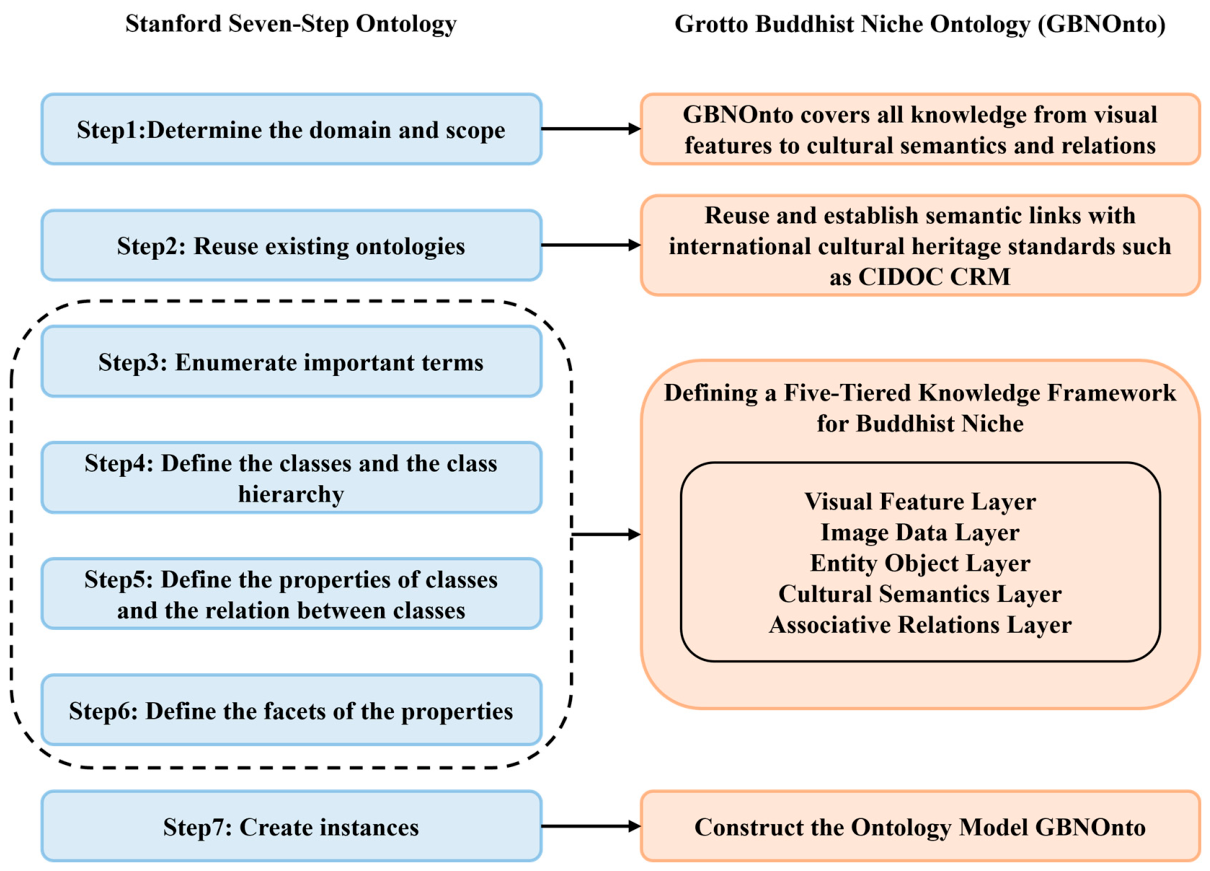
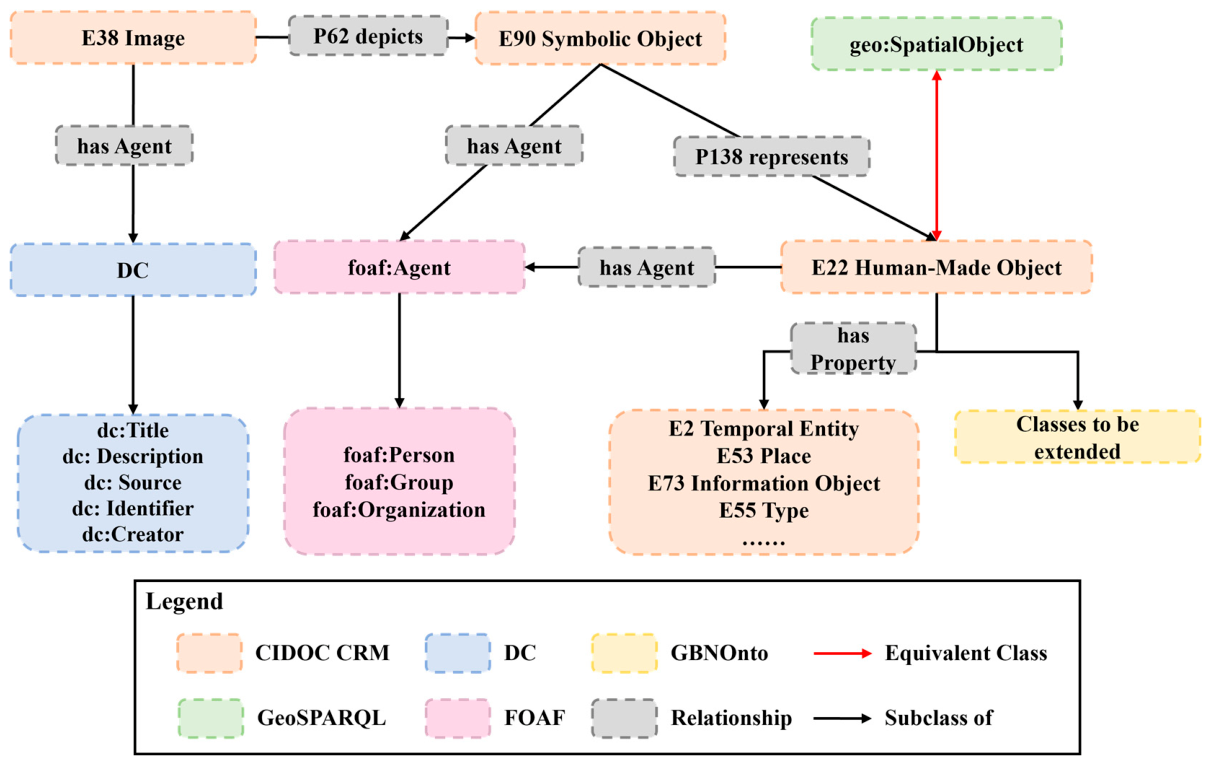
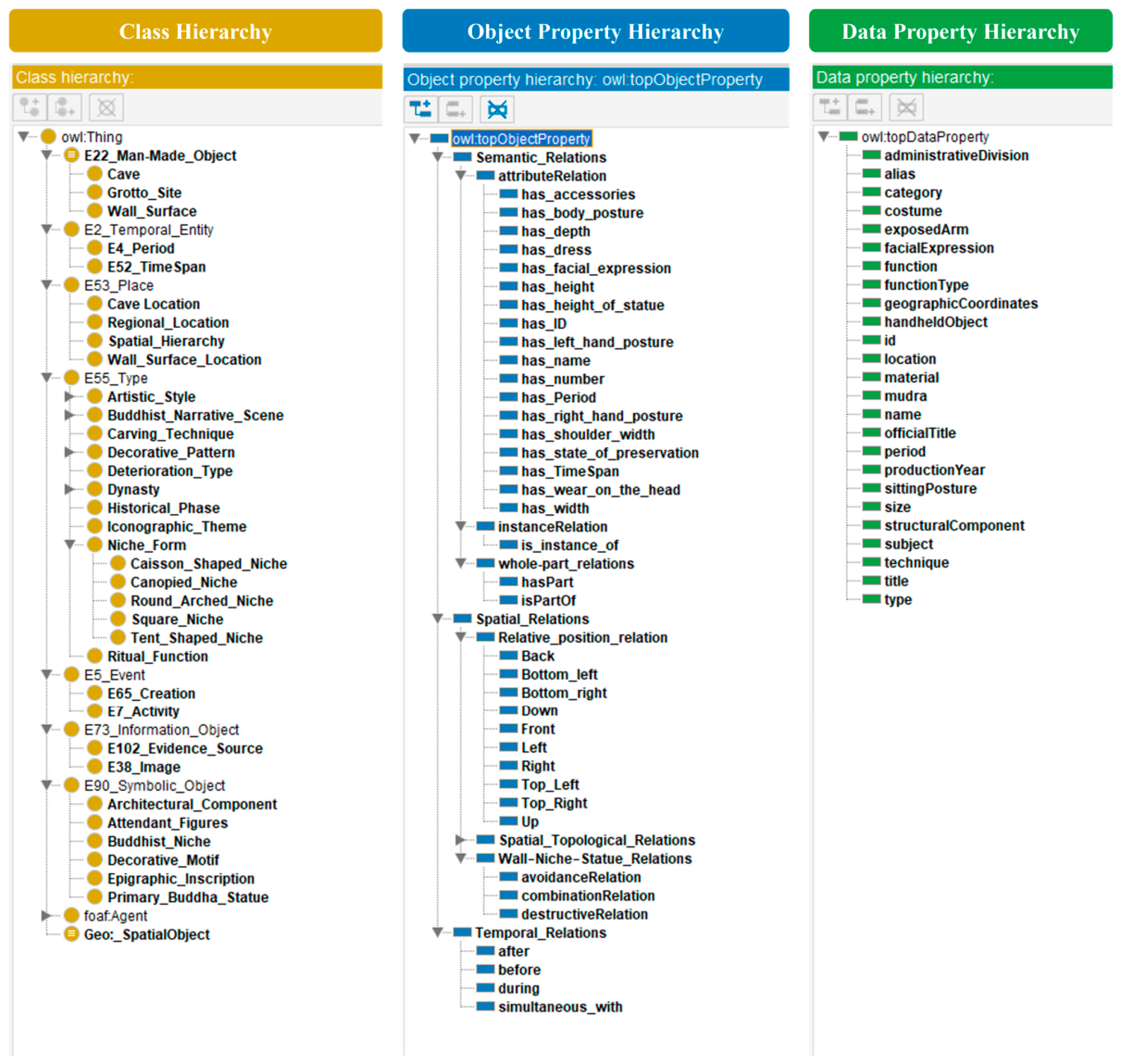
- A conceptual modeling paradigm. Using Protégé and the standard seven-step ontology engineering method, and following international standards such as CIDOC CRM, we construct a domain-specific ontology called the Grotto Buddhist Niche Ontology (GBNOnto). This ontology formalizes core concepts and logical relations for niche typology, iconographic themes, spatial configurations, and other dimensions. Our modeling approach can serve as a reference for digital knowledge modeling of other cultural heritage types, such as murals and ancient architecture, thus facilitating cross-domain information integration and sharing.
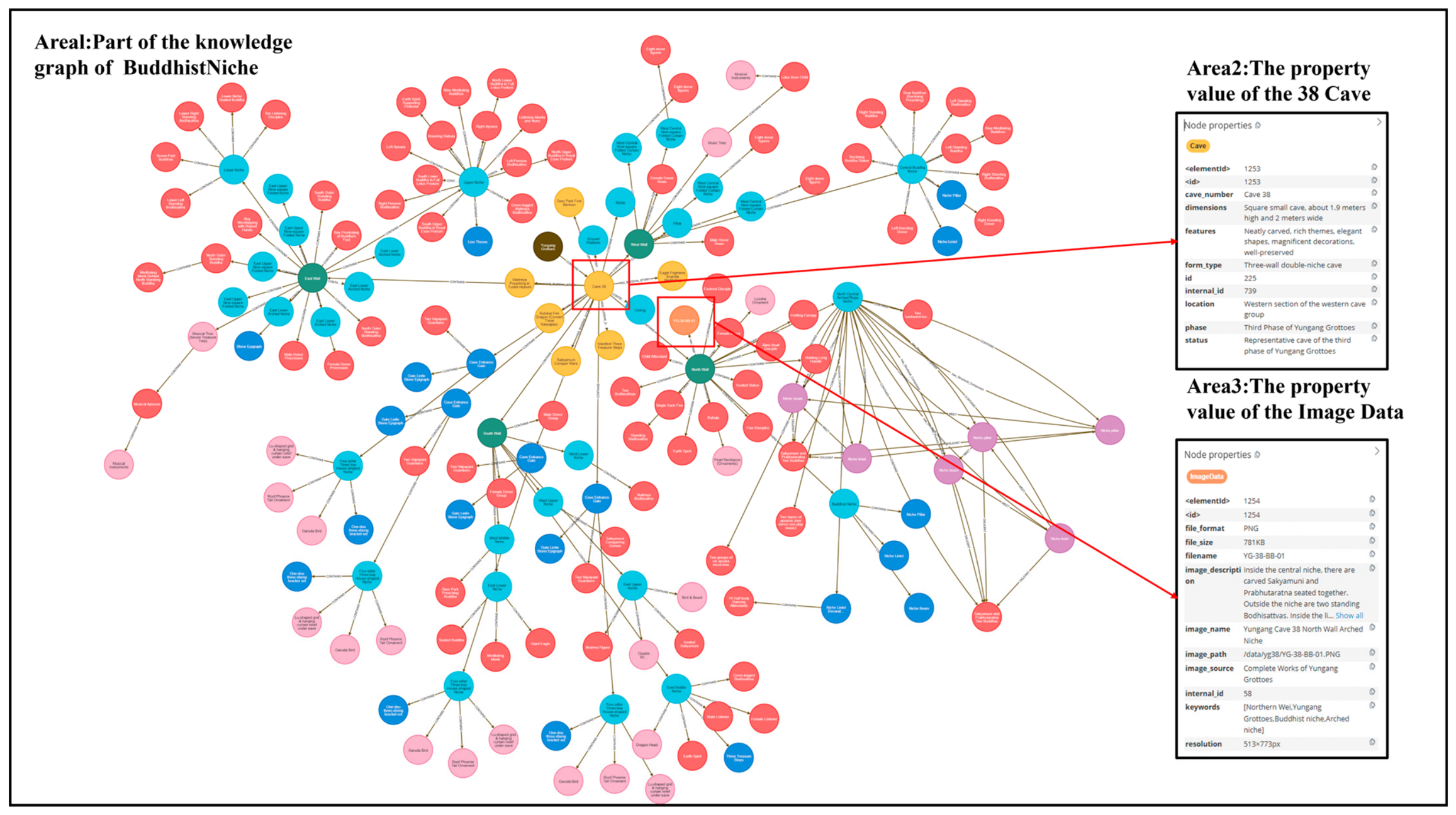
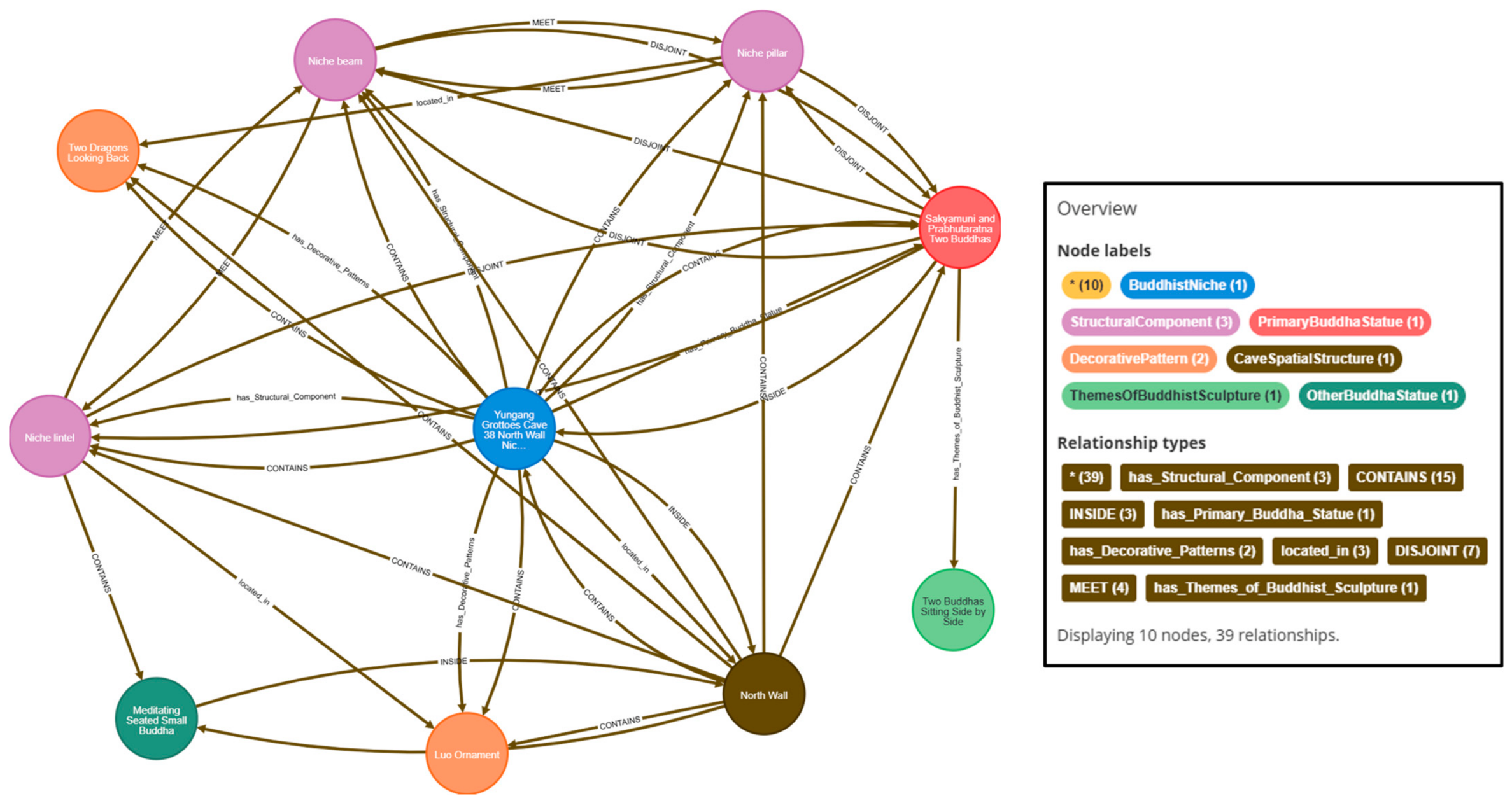
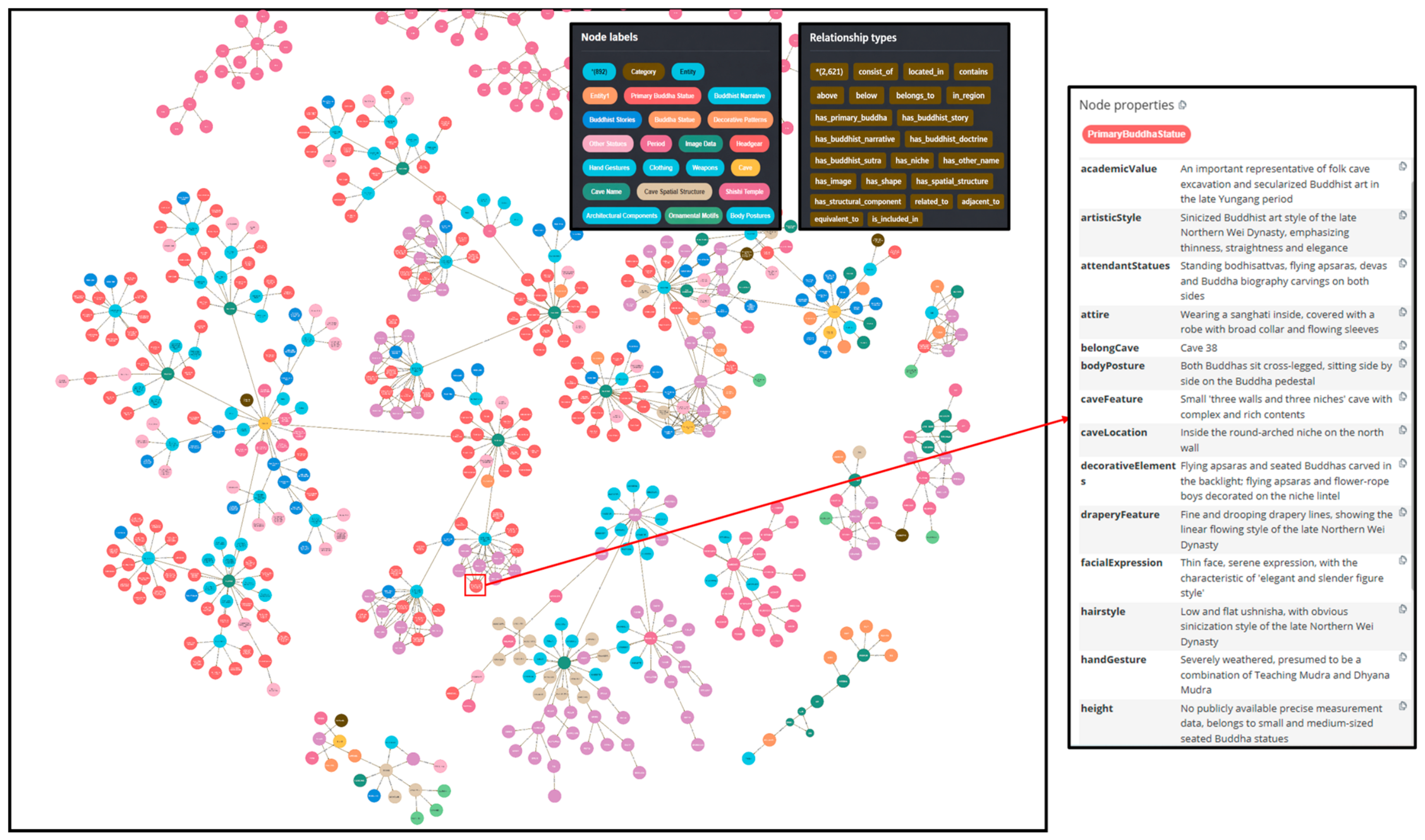
- An application-oriented knowledge graph for grotto Buddhist niche images. Based on the above models, we build a knowledge graph of Buddhist niche images from the Yungang Grottoes. This graph integrates dispersed image resources, documentary records, spatial structures, and semantic knowledge into a structured network. The resulting knowledge graph improves the standardization and interoperability of cultural heritage information, offering new ways for intelligent retrieval, deep semantic discovery, and visual knowledge exploration.
2. Methodology
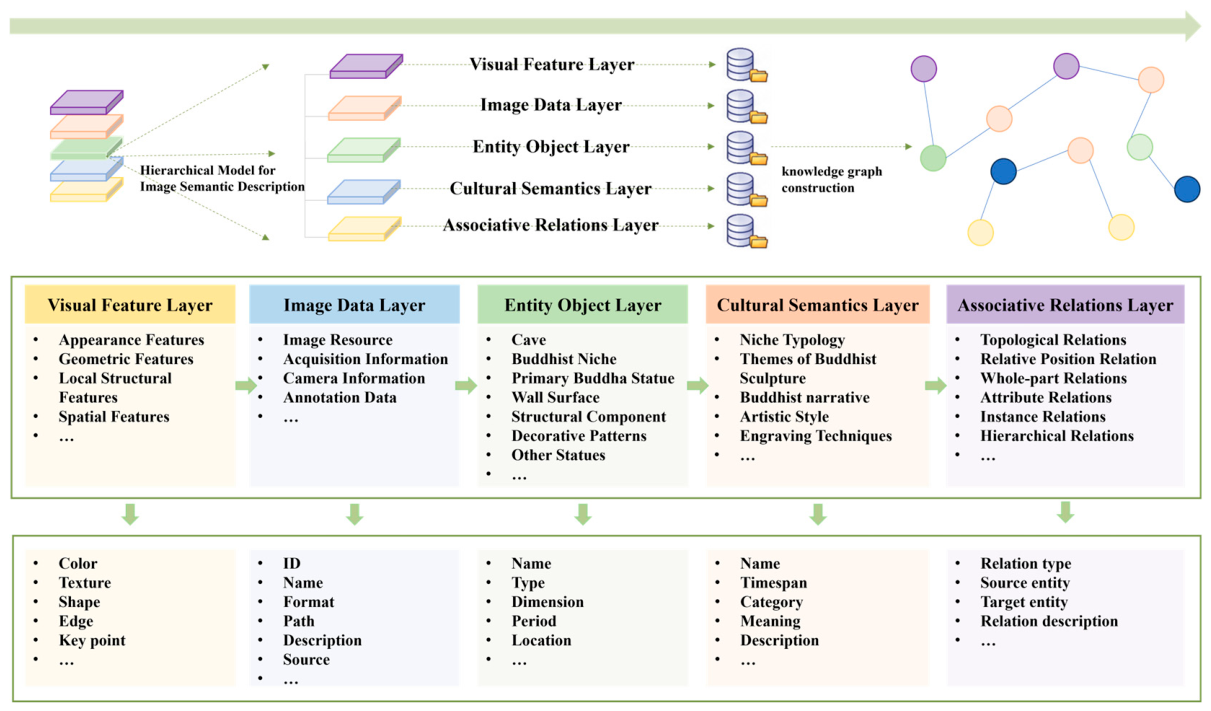
2.1. Hierarchical Model for Image Semantic Description
- (1)
- Visual Feature Layer. As the foundational layer of the GBNOnto multi-scale semantic framework, the Visual Feature Layer represents the low-level visual characteristics extracted directly from image data. It mainly includes appearance features (e.g., color and texture), geometric features (e.g., shape, contour, and edge), and local structural features (e.g., key points and feature regions). These visual descriptors provide the fundamental data basis for subsequent entity recognition, semantic interpretation, and knowledge representation. By establishing the connection between raw image perception and higher-level semantic understanding, this layer serves as the starting point of the semantic knowledge construction process. (Note that this study focuses on high-level semantic information; the extraction of low-level visual features is not explored in depth here).
- (2)
- Image Data Layer. This layer uses metadata standards to standardize image descriptions, thus building a unified digital object representation. It includes image titles, data formats, resolution, acquisition time, cave chamber identifiers, and other relevant information, turning raw pixel data into structured digital resources. This layer provides essential support for image management, retrieval, and association.
- (3)
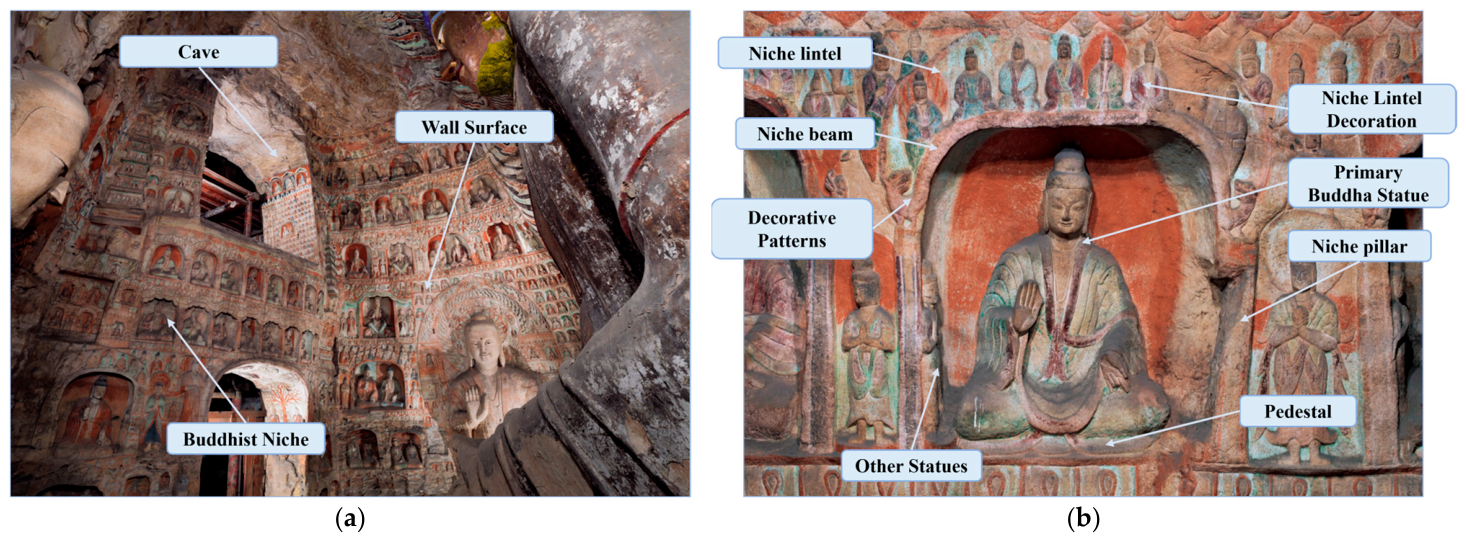
- Entity Object Layer. This layer maps visual information in an image to entity objects with clear semantic boundaries, such as the Buddhist niche body, niche lintel, principal deity statue, decorative motifs, and structural components. This transformation from low-level visual features to high-level semantic objects is a key step in building entity nodes in the knowledge graph. In addition, the entity representations defined here can provide semantic constraints for recognizing and annotating grotto Buddhist niche images.
- (4)
- Cultural Semantics Layer. This layer uses domain knowledge to classify entity objects typologically, giving them historical and artistic meanings. The semantic content includes iconographic themes, artistic styles, carving techniques, and religious backgrounds. This layer moves from “entity recognition” to “semantic understanding,” thus giving image data interpretable cultural significance.
- (5)
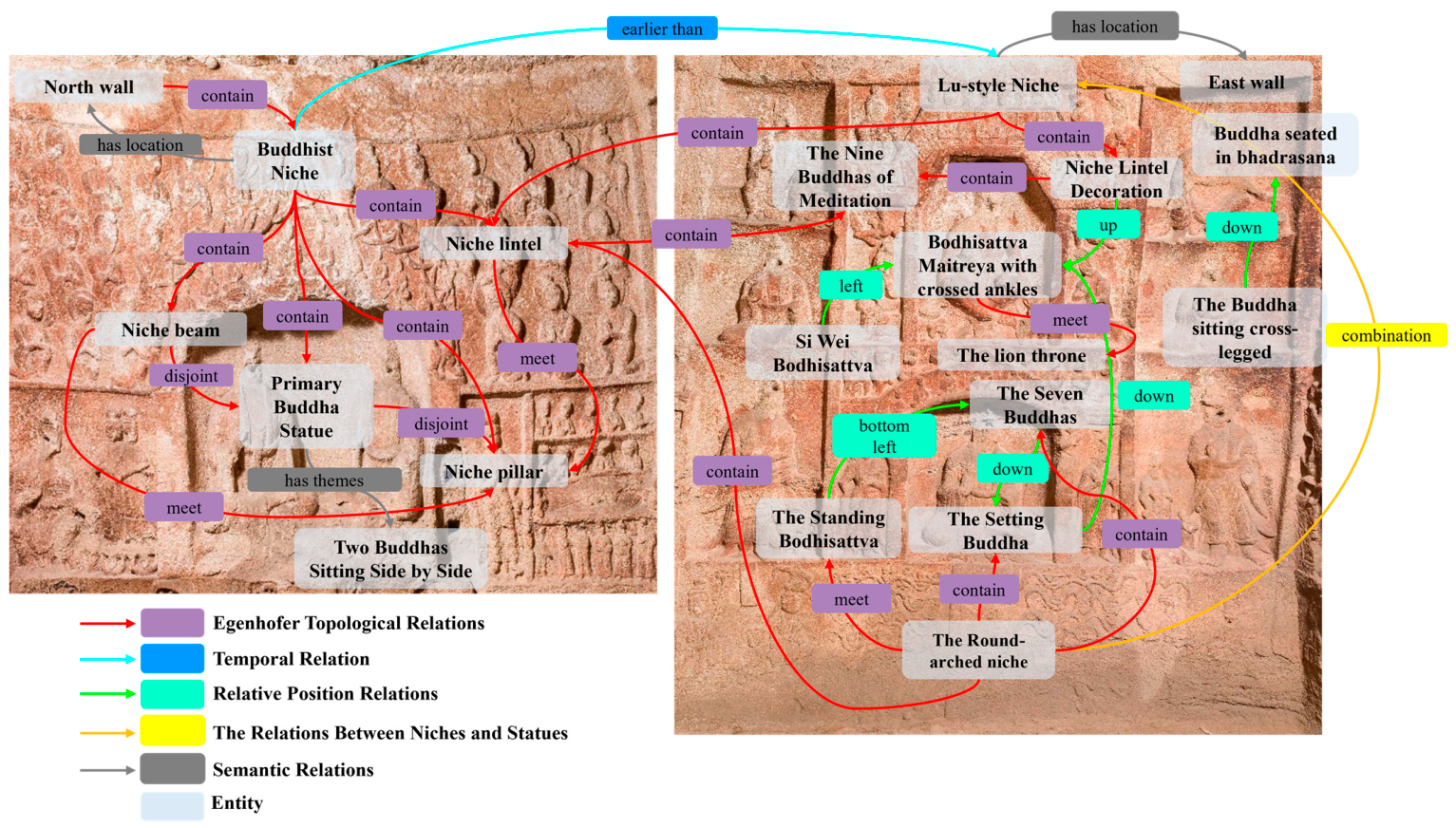
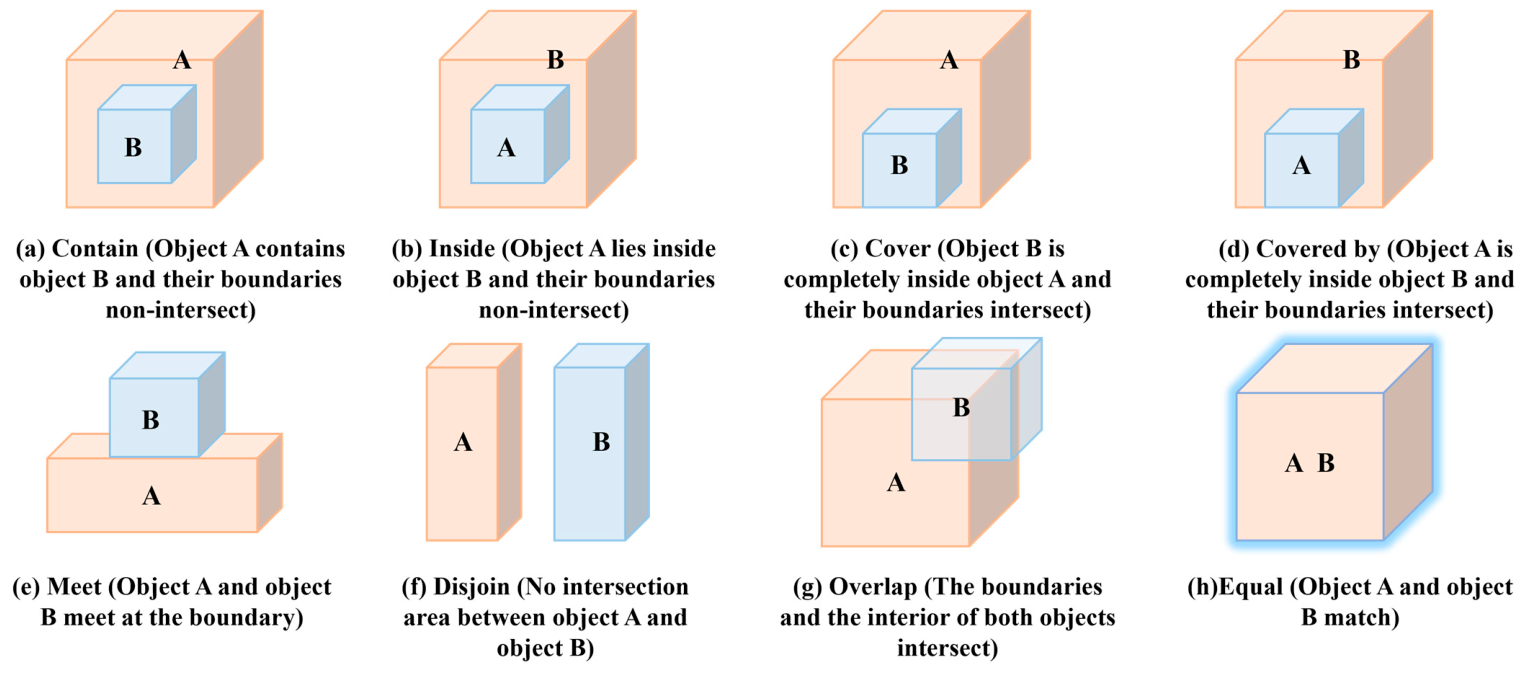
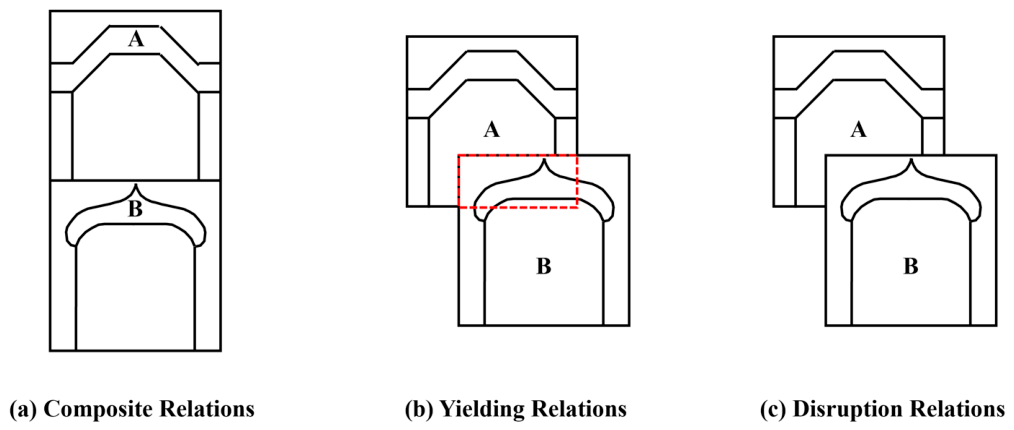
- Associative Relations Layer. Using multiple relation types, this layer links the entities and semantics from the previous layers to form a comprehensive knowledge network. The relationship types include spatial, temporal, and semantic relations, enabling unified modeling and associative representation across multi-scale information.
2.2. Ontology Design
- (1)
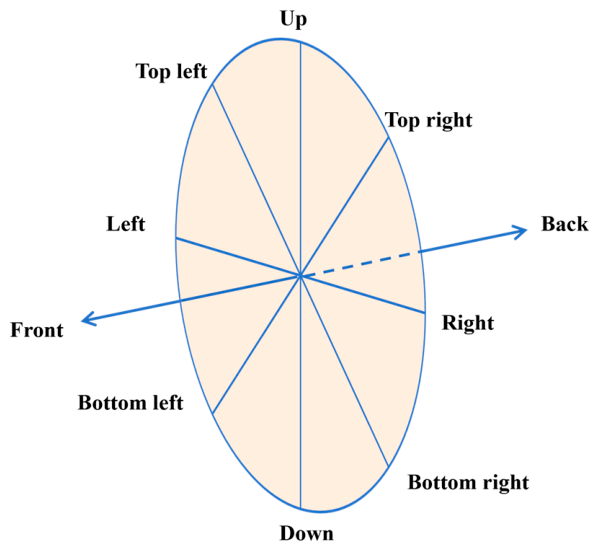
- Spatial Relations
- (2)
- Temporal Relations
- (3)
- Semantic Relations
2.3. Knowledge Acquisition
2.3.1. Knowledge Extraction
2.3.2. Entity Alignment
2.3.3. Knowledge Storage
3. Results
3.1. Data Collection
3.2. Ontology Model
3.3. Knowledge Graph Construction
3.4. Application of Knowledge Graph
4. Discussions and Conclusions
4.1. Discussions
4.2. Conclusions
Author Contributions
Funding
Data Availability Statement
Conflicts of Interest
References
- Yang, H.; Wang, Q. The Architectural Form and Structural Characteristics of Dunhuang Mogao Grottoes. J. Northwest Univ. (Nat. Sci. Ed.) 2022, 52, 199–212. [Google Scholar] [CrossRef]
- Pei, Q.; Wang, G.; Ran, W. An Analysis of the Evolution of Architectural Forms and the Variation of Decorative Arts for Grotto Niche Space. J. Dunhuang Stud. 2022, 114–136. [Google Scholar]
- Dou, J.; Qin, J.; Jin, Z.; Li, Z. Knowledge Graph Based on Domain Ontology and Natural Language Processing Technology for Chinese Intangible Cultural Heritage. J. Vis. Lang. Comput. 2018, 48, 19–28. [Google Scholar] [CrossRef]
- Siliutina, I.; Tytar, O.; Barbash, M.; Petrenko, N.; Yepyk, L. Cultural Preservation and Digital Heritage: Challenges and Opportunities. Rev. Amazon. Investig. 2024, 14, 262–273. [Google Scholar] [CrossRef]
- Buragohain, D.; Meng, Y.; Deng, C.; Li, Q.; Chaudhary, S. Digitalizing Cultural Heritage through Metaverse Applications: Challenges, Opportunities, and Strategies. Herit. Sci. 2024, 12, 295. [Google Scholar] [CrossRef]
- Wang, Y. Combinatorial Analysis of Images in the Third Period of the Yungang Grottoes. Dunhuang Res. 2020, 48–62. [Google Scholar] [CrossRef]
- Yasser, A.M.; Clawson, K.; Bowerman, C. Saving Cultural Heritage with Digital Make-Believe: Machine Learning and Digital Techniques to the Rescue. In Proceedings of the HCI 2017: Digital Make Believe—Proceedings of the 31st International BCS Human Computer Interaction Conference, HCI 2017, London, UK, 11–13 July 2017. [Google Scholar] [CrossRef]
- Li, N. A Study of Niches and Capitals in the Caves of the Northern Dynasties and Their Origins. Cave Temples Stud. 2017, 347–382. [Google Scholar]
- Hideo, O.; Xu, X.; Meng, H.; Wang, Y. Early Buddhist Statues at the Yungang Grottoes—Focusing on the Niches in the Five Tan Yao Grottoes. Acad. J. Jinyang 2023, 29–50. [Google Scholar] [CrossRef]
- Chen, T. Research on Semantic Model of Image Knowledge Reuse from the Perspective of Digital Humanities. Libr. J. 2023, 42, 106–115. [Google Scholar] [CrossRef]
- Song, L. An Overview of the Architectural Styles of the Buddha Niches at the Mogao Caves. Silk Road 2010, 11–13. [Google Scholar]
- Zhang, H. Characteristics and Layout of Cave Forms in the Yungang Grottoes. Southeast Cult. 2003, 40–43. [Google Scholar]
- Wu, Y. A Brief Analysis of the Architectural Features of the Late-Period Caves at the Yungang Grottoes. In The Proceedings of the First Shanxi Museum Youth Forum; Shanxi Museum Association: Taiyuan, China, 2023; pp. 95–106. [Google Scholar]
- Xin, Y. A Study of the Pictorial Language of Honeysuckle Ornamental Patterns in the Yungang Grottoes. New Horiz. 2024, 46–48. [Google Scholar]
- Zhao, X. A Brief Discussion of the Decorative Motifs of the Yungang Grottoes. Identif. Apprec. Cult. Relics 2022, 158–161. [Google Scholar] [CrossRef]
- Cai, Y. Inter textuality and Inter visuality: Tracing the origins of the Astagada-mahapurusa iconography in Nor thern Zhou MaijishanGrotto Cave 4. J. Nanjing Univ. Arts (Fine Arts Des.) 2025, 159–166+210. [Google Scholar]
- Liu, L. The Carving Techniques and Artistic Characteristics of Offering Bodhisattva Statues in Cave 8 of Yungang Grottoes. J. Shanxi Datong Univ. (Soc. Sci. Ed.) 2024, 38, 62–66. [Google Scholar]
- Zhang, X. The Influence of Gandhāra Art on the Stylistic Characteristics of the Yungang Grottoes. Identif. Apprec. Cult. Relics 2025, 118–121. [Google Scholar] [CrossRef]
- Huo, J. The layout of the sculptures and the architectural features of the Yungang Grottoes. Collections 2025, 28–30. [Google Scholar]
- Zhang, J.; Ren, T. A Conceptual Model for Ancient Chinese Ceramics Based on Metadata and Ontology: A Case Study of Collections in the Nankai University Museum. J. Cult. Herit. 2024, 66, 20–36. [Google Scholar] [CrossRef]
- Kwan, P.; Kameyama, K.; Gao, J.; Toraichi, K. Content-Based Image Retrieval of Cultural Heritage Symbols by Interaction of Visual Perspectives. Int. J. Pattern Recognit. Artif. Intell. 2011, 25, 643–673. [Google Scholar] [CrossRef]
- Giunchiglia, F.; Bagchi, M.; Das, S. From Knowledge Organization to Knowledge Representation and Back. Ann. Libr. Inf. Stud. 2024, 71, 137–149. [Google Scholar] [CrossRef]
- Eakins, J. Automatic Image Content Retrieval—Are We Getting Anywhere? In Proceedings of the Third International Conference on Electronic Library and Visual Information Research, Milton Keynes, UK, 30 April–20 May 1996. [Google Scholar]
- Sengupta, A. Panofsky’s Iconology. In Studies in Iconology: Humanistic Themes in the Art of the Renaissance; Routledge: Oxfordshire, UK, 1939. [Google Scholar]
- Wang, X.; Xu, L.; Li, G. Semantic Description Framework Research on Dunhuang Fresco Digital Images. J. Libr. Sci. China 2014, 40, 50–59. [Google Scholar] [CrossRef]
- Wang, X.; Song, N.; Zhang, L.; Jiang, Y. Understanding Subjects Contained in Dunhuang Mural Images for Deep Semantic Annotation. J. Doc. 2017, 74, 333–353. [Google Scholar] [CrossRef]
- Zhang, Z.; Cao, Y. Dunhuang_Faces: A Dataset Enhanced through Image Processing for Cultural Heritage and Machine Learning. Trait. Signal 2025, 42, 569–581. [Google Scholar] [CrossRef]
- Wang, X.; Gong, Y.; Myers, D.; Wang, S. Arches Dunhuang: Heritage Inventory System for Conservation of Grotto Resources on the Gansu Section of the Silk Road in China. Int. Arch. Photogramm. Remote Sens. Spat. Inf. Sci. 2021, 46, 837–843. [Google Scholar] [CrossRef]
- Zhao, S.; Hou, X. A Study on a Descriptive Framework for the Semantic Information of Thangka Images. Knowl. Manag. Forum 2015, 2015, 57–62. [Google Scholar] [CrossRef]
- Tan, G.; Hou, X.; Zhuang, W. Research on Semantic Organization of Multimedia Resources of Intangible Cultural Heritage. Res. Libr. Sci. 2017, 42–52. [Google Scholar] [CrossRef]
- Fan, T.; Wang, H. Research of Chinese Intangible Cultural Heritage Knowledge Graph Construction and Attribute Value Extraction with Graph Attention Network. Inf. Process. Manag. 2022, 59, 102753. [Google Scholar] [CrossRef]
- Fan, T.; Wang, H.; Hodel, T. CICHMKG: A Large-Scale and Comprehensive Chinese Intangible Cultural Heritage Multimodal Knowledge Graph. Herit. Sci. 2023, 11, 115. [Google Scholar] [CrossRef]
- Li, J.; Qi, J.; Han, S.C.; Holden, E.-J. MUSEKG: A Knowledge Graph Over Museum Collections. arXiv 2025, arXiv:2511.16014. [Google Scholar]
- Dai, T. A Study on Metadata Standards for Digital Images of Museum Artefacts Based on CIDOC CRM: A Case Study of the Design of the Metadata System for Artefact Images at the National Museum of China. Chin. Mus. 2020, 131–136. [Google Scholar]
- He, B.; Zhao, Y.; He, J.; Ma, Z. Ontology Modelling of Ancient Map Information Through a Cognition-Practical Model: A Case Study of the Yangshi Lei Archives. Geomat. Inf. Sci. Wuhan Univ. 2024, 49, 546–561. [Google Scholar] [CrossRef]
- Gao, J.; Fu, J. A Fine-Grained Knowledge Representation Method of Cultural Heritage Image Resources Based on Knowledge Element. Inf. Sci. 2022, 40, 16–24. [Google Scholar] [CrossRef]
- Qi, X.; Yang, H. Historical Maps Knowledge Organization: Need, Framework and Practice. J. Libr. Sci. China 2024, 50, 82–95. [Google Scholar] [CrossRef]
- Zhong, Y.; Xia, C. A Preliminary Study on the Construction of Knowledge Graph of Art Image. Libr. Trib. 2022, 42, 109–118. [Google Scholar]
- Carboni, N.; De Luca, L. An Ontological Approach to the Description of Visual and Iconographical Representations. Heritage 2019, 2, 1191–1210. [Google Scholar] [CrossRef]
- Simperl, E. Reusing Ontologies on the Semantic Web: A Feasibility Study. Data Knowl. Eng. 2009, 68, 905–925. [Google Scholar] [CrossRef]
- Lu, H.; Hu, Z. An Ontological Modelling Method for Cultural Landscape Genes of Traditional Settlements. J. Geo-Inf. Sci. 2024, 26, 1407–1425. [Google Scholar] [CrossRef]
- Gao, S. A Study of the Spatial Layout of Relief Stupa Carvings in the Yungang Grottoes. Southeast Cult. 2025, 113–123. [Google Scholar]
- Al-Moslmi, T.; Gallofré Ocaña, M.; Opdahl, A.L.; Veres, C. Named Entity Extraction for Knowledge Graphs: A Literature Overview. IEEE Access 2020, 8, 32862–32881. [Google Scholar] [CrossRef]
- Miller, J.J. Graph Database Applications and Concepts with Neo4j. In Proceedings of the Southern Association for Information Systems Conference, Atlanta, GA, USA, 23–24 March 2013. [Google Scholar]
- Gennari, J.H.; Musen, M.A.; Fergerson, R.W.; Grosso, W.E.; Crubézy, M.; Eriksson, H.; Noy, N.F.; Tu, S.W. The Evolution of Protégé: An Environment for Knowledge-Based Systems Development. Int. J. Hum.-Comput. Stud. 2003, 58, 89–123. [Google Scholar] [CrossRef]







| Class | Subclass | Description |
|---|---|---|
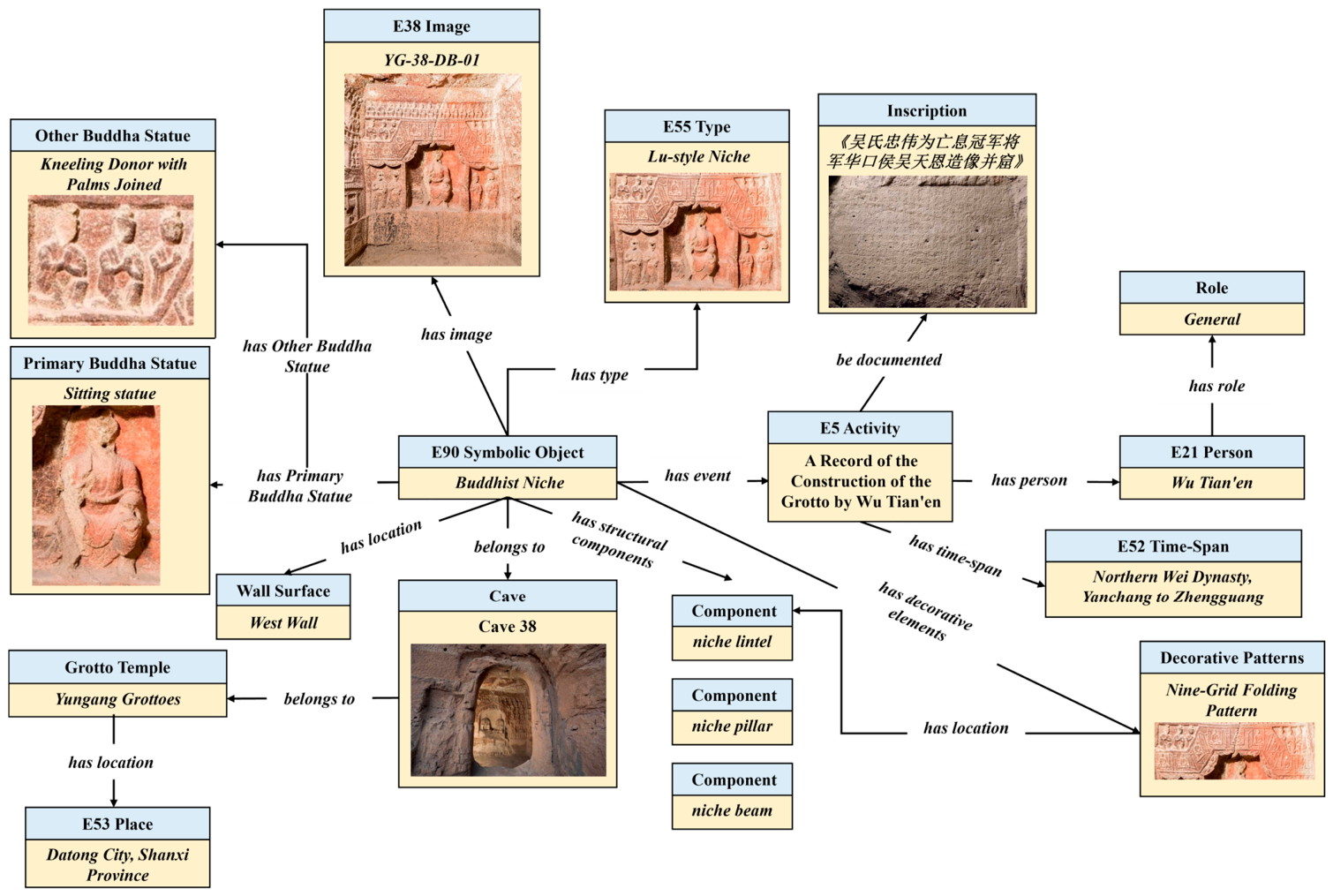
| E90 Symbolic Object | Buddhist Niche | A small rock-cut cell within a grotto, designed to house a Buddha statue, mural, and decorative components, serves as a basic unit of Buddhist worship space |
| Structural Component | Architectural components of a niche, including the niche lintel, wall surface, pedestal, pillar base, etc., used to support and decorate the niche space | |
| Primary Buddha Statue | The main Buddha statue in the center of a niche, usually representing a specific Buddhist theme, religious symbolism, and carving style | |
| Other Statues | Auxiliary Buddha or protector deity statues surrounding the principal deity, used to express relationships of protection, offering, or religious ritual | |
| Decorative Patterns | Decorative elements on the niche and wall surfaces, such as motifs, lotus petals, rosette flowers, cloud patterns, etc., reflecting artistic style and religious symbolism | |
| Inscription | Niche inscriptions, dedicatory records, signatures, and carved texts recording information about donors, carvers, and production dates | |
| foaf: Agent | Person | Historical figures, artisans, or religious persons involved in the design, carving, painting, or inscription of niches |
| Group | Teams of artisans or religious groups that collaboratively completed niche construction, mural painting, or decoration | |
| Organization | Organizational units such as temples, monastic communities, or workshops responsible for niche construction, management, and maintenance | |
| E53 Place | Location | Specific spatial position of a niche |
| Spatial Hierarchy | Dividable spatial units inside a cave or niche, e.g., upper space, lower space, etc. | |
| Wall Surface | Wall area of a cave chamber where a niche is located | |
| Cave | The cave chamber entity to which a niche belongs, used to determine spatial affiliation | |
| E5 Event | E7 Activity | Activities related to niche construction, restoration, enshrinement, and religious rituals |
| E65 Creation | Creative events such as Buddha carving, mural painting, decorative pattern engraving, and inscription writing | |
| E55 Type | Niche Typology | Classification of niche forms, e.g., round-arched niche, caisson-shaped niche, square niche, etc. |
| Decorative Patterns | Types of decorative patterns on niches and wall surfaces, including lotus motifs, cloud patterns, rosette flowers, etc. | |
| Themes of Buddhist Sculpture | Iconographic themes of niche Buddha statues, such as Shakyamuni, Maitreya, Avalokitesvara, Manjusri, etc. | |
| Buddhist narrative | Religious stories, sutra illustrations, or historical legends represented by niches and statues | |
| Artistic style | Carving or painting styles of different periods or regions, e.g., high-relief style of the late Northern Wei, realistic style of the early Tang, etc. | |
| Function Type | Religious functions of a niche, such as enshrinement, preaching, pilgrimage, or worship | |
| Engraving Techniques | Carving and engraving techniques for statues and decorations | |
| Disease Type | Types of damage, exfoliation, weathering, cracks, etc., used for recording preservation status | |
| Dynasty | Historical dynasty corresponding to a niche or statue, e.g., Northern Wei, Tang, Song, etc. | |
| E2 Temporal Entity | E52 Time Span | Time span during which a niche or statue existed, was built, or was produced |
| E4 Period | Specific historical period used to classify niche artistic styles and production contexts | |
| E73 Information Object | E38 Image | Digital image of a niche |
| E102 Evidence Source | Literature, archaeological reports, archival materials, etc., that support knowledge representation of niches | |
| Geo: SpatialObject | / | Equivalent class to E22 Human-Made Object, representing spatial entities |
| E22 Human-Made Object | Cave | Physical cave chamber inside a grotto, e.g., Cave 38, Northern Wei cave, etc. |
| Wall Surface | Wall area of a cave chamber where a niche is placed, used to place Buddha statues and decorations | |
| Grotto Temple | The overall architectural complex of cave temples, where niches are located |
| Label | Domain | Range | Example |
|---|---|---|---|
| Name | GBNOnto: Buddhist Niche | E62String | Cave 38 |
| GBNOnto: Cave | E62String | The Round-arched niche on the north wall | |
| GBNOnto: Primary Buddha Statue | E62String | Shakyamuni Buddha | |
| ID | GBNOnto: Buddhist Niche | E62String | YG-38-BB-YGK-01 |
| GBNOnto: Cave | E62String | YG-38 | |
| Alternative Name | GBNOnto: Buddhist Niche | E62String | Lu-style niche, also known as Lintel-arched niche |
| Type | GBNOnto: Buddhist Niche | E62String | Round-arched niche |
| GBNOnto: Primary Buddha Statue | E62String | Two Buddhas seated together | |
| GBNOnto: Decoration | E62String | Honeysuckle pattern | |
| Function | GBNOnto: Buddhist Niche | E62String | Ritual worship |
| Period | GBNOnto: Buddhist Niche | E62String | Early period; Late period |
| Height | GBNOnto: Buddhist Niche | E60Number | 850 cm |
| Width | GBNOnto: Buddhist Niche | E60Number | 120 cm |
| Depth | GBNOnto: Buddhist Niche | E60Number | 60 cm |
| Dress | GBNOnto: Primary Buddha Statue | E62String | Full-shoulder monastic robe |
| Hairstyle | GBNOnto: Primary Buddha Statue | E62String | High spiral uṣṇīṣa |
| Facial expression | GBNOnto: Primary Buddha Statue | E62String | Plump and rounded countenance |
| Body posture | GBNOnto: Primary Buddha Statue | E62String | The sitting posture |
| Hand posture | GBNOnto: Primary Buddha Statue | E62String | Dhyana Mudra |
| Preservation state | GBNOnto: Buddhist Niche | E62String | Weathered |
| GBNOnto: Primary Buddha Statue | E62String | Weathered |
| Name | Definition | Diagram |
|---|---|---|
| Earlier than | A occurs before B |  |
| Later than | A occurs after B |  |
| Simultaneous with | A and B occur simultaneously |  |
| During | A occurs during B |  |
| B occurs during A |  |
| Entity1 | Relation | Entity2 | Description |
|---|---|---|---|
| Cave 38 | hasDynasty | Northern Wei Dynasty | Cave 38 is located in the western section of the central grotto cluster of Yungang Grottoes and is a representative cave of the Northern Wei period, belonging to the overall Yungang Grotto system. |
| Cave 38 | hasShape | rectangular plan | Cave 38 has a rectangular floor plan with a truncated pyramid ceiling, reflecting the spatial layout and architectural form of grottoes at that time. |
| Buddhist Niche | hasPart | Niche Lintel; Niche Pillars; Niche Beam | The Buddhist niche is composed of architectural components such as the niche lintel, niche pillars, and niche beam, reflecting the structural organization and decorative framework of the niche. |
| Primary Buddha Statue | hasGesture | preaching/seated posture | The seated Buddha sits in a cross-legged posture and displays the preaching gesture, demonstrating the religious pose and function of the statue. |
| Buddhist Niche | includes | Donor Figures | Flanking the main niche are rows of donor figures, reflecting the connection between Buddhist sculpture and social belief. |
| Buddhist Niche | hasDecorativePattern | lotus motif | The niche is decorated with lotus motifs and honeysuckle patterns, enriching the aesthetic details of the space. |
| Wu Tian’en | hasRole | General | Wu Tian’en held the role of a general, as recorded in the inscription, indicating his social status and involvement in the construction activities. |
| Inscription | records | Construction Activity | Inscriptions within the niche record the creation of statues and cave excavation activities, providing direct evidence for historical verification. |
| Buddhist Niche | hasLocation | West Wall | The Buddhist niche is located on the west wall, and its sculptural layout reflects the spatial organization of the cave interior. |
| Primary Buddha Statue | hasIconography | Two Buddhas Seated Side by Side | The primary statue depicts the iconography of two Buddhas seated side by side, reflecting specific religious themes in Buddhist art. |
Disclaimer/Publisher’s Note: The statements, opinions and data contained in all publications are solely those of the individual author(s) and contributor(s) and not of MDPI and/or the editor(s). MDPI and/or the editor(s) disclaim responsibility for any injury to people or property resulting from any ideas, methods, instructions or products referred to in the content. |
© 2026 by the authors. Licensee MDPI, Basel, Switzerland. This article is an open access article distributed under the terms and conditions of the Creative Commons Attribution (CC BY) license.
Share and Cite
Wan, L.; Hou, M.; Li, J.; Zhao, B.; Yang, B.; Shi, H.; Ning, B. Knowledge Representation Method for Grotto Buddhist Niches Based on Image Semantics and Ontology. Buildings 2026, 16, 2563. https://doi.org/10.3390/buildings16132563
Wan L, Hou M, Li J, Zhao B, Yang B, Shi H, Ning B. Knowledge Representation Method for Grotto Buddhist Niches Based on Image Semantics and Ontology. Buildings. 2026; 16(13):2563. https://doi.org/10.3390/buildings16132563
Chicago/Turabian StyleWan, Li, Miaole Hou, Jinru Li, Beibei Zhao, Bingyu Yang, Haoyue Shi, and Bo Ning. 2026. "Knowledge Representation Method for Grotto Buddhist Niches Based on Image Semantics and Ontology" Buildings 16, no. 13: 2563. https://doi.org/10.3390/buildings16132563
APA StyleWan, L., Hou, M., Li, J., Zhao, B., Yang, B., Shi, H., & Ning, B. (2026). Knowledge Representation Method for Grotto Buddhist Niches Based on Image Semantics and Ontology. Buildings, 16(13), 2563. https://doi.org/10.3390/buildings16132563