Article

Coupled Effects of Pore Size and Salinity on Ionic Spatial Distribution and Transport in C-S-H Nanopores and Their Implications for Cement-Based Material Durability

1
Highway Construction and Maintenance Center of Yichang, Yichang 443000, China
2
CCCC Second Highway Consultants Co., Ltd., Wuhan 430056, China
3
School of Urban Construction, Wuhan University of Science and Technology, Wuhan 430065, China
4
State Key Laboratory of Water Resources Engineering and Management, Wuhan University, Wuhan 430072, China
5
State Key Laboratory of Precision Blasting, Jianghan University, Wuhan 430056, China
6
State Key Laboratory of Safety and Resilience of Civil Engineering in Mountain Area, Nanchang 330013, China
*
Authors to whom correspondence should be addressed.
Buildings 2026, 16(13), 2539; https://doi.org/10.3390/buildings16132539
Submission received: 28 May 2026 / Revised: 21 June 2026 / Accepted: 24 June 2026 / Published: 26 June 2026
(This article belongs to the Special Issue Advanced Research in Cement and Concrete)

Abstract

The durability of cement-based materials is strongly affected by ionic ingress and transport within calcium silicate hydrate (C-S-H) nanopores, governing their long-term degradation in saline environments. However, the coupled effects of pore size and salinity on nanoscale ionic behaviors remain insufficiently understood, limiting the mechanistic interpretation of durability evolution in cementitious systems. Existing studies have mainly considered pore size and solution salinity separately, while a systematic understanding of their coupling effects on ionic spatial distribution, transport properties and regime transitions is still lacking. In this study, molecular dynamics simulations are performed for NaCl solutions confined in C-S-H nanopores with pore sizes of 2.5–12.5 nm and salinities of 0–2 M. Results show layered water and ion structures that become increasingly confined with decreasing pore size. Increasing salinity enhances ion accumulation while suppressing water mobility due to competitive adsorption. Ion diffusion is significantly lower than that of water molecules, while transport parallel to the C-S-H surface is much higher than in the perpendicular direction, indicating strong anisotropy. Regime-dependent diffusion behaviors are observed across pore size–salinity conditions. These findings deepen the understanding of water and ionic transport and adsorption, improving durability models for cement-based materials in construction engineering.

1. Introduction

Cement-based materials are the most widely used man-made materials worldwide and are extensively applied in buildings, bridges, tunnels, marine engineering, and energy infrastructure, etc [1,2,3,4]. However, extensive engineering practice has shown that cement-based materials commonly suffer from insufficient durability, causing enormous economic losses and safety risks each year [5,6,7]. It is worth noting that cement-based material production is a typical high-energy-consumption and high-carbon-emission industry, accounting for roughly 7–8% of global CO2 emissions, while also requiring substantial consumption of natural resources [8,9]. Enhancing the durability of cement-based materials and prolonging structural service life not only reduce life-cycle maintenance costs of infrastructure, but also serve as a crucial strategy for minimizing resource consumption and promoting low-carbon development [10,11].
The durability of cement-based materials largely depends on the diffusion behavior of water and aggressive ions within their internal pore structures [12,13,14,15]. As the primary hydration product and binding phase, calcium silicate hydrate (C-S-H) typically accounts for more than 60% of the total hydration products and is a key phase governing mechanical properties and long-term durability [16,17]. C-S-H contains abundant micro- and nanoscale pores with pore sizes typically in the nanometer range, serving as the primary pathways for water and ions [18,19,20]. In marine environments, de-icing salt conditions, and high-salinity groundwater environments, the continuous ingress of Cl ions (and other aggressive ions) alters the composition of pore solution and further induces steel corrosion, microstructural degradation, and the deterioration of material properties, thereby significantly affecting the long-term performance of cement-based materials structures [11,21,22]. Therefore, understanding the spatial distribution and diffusion characteristics of water and ions in C-S-H pores is of great scientific significance for revealing the degradation mechanisms of cement-based materials durability.
C-S-H surfaces are rich in silica tetrahedrons, calcium ions, and unbalanced charges; thus, the adsorption and diffusion behaviors of water and ions in C-S-H nanopores differ significantly from those in bulk solutions or in macroscopic pores [23]. Since the pore dimensions are comparable to the size of water molecules and ionic hydration shells, the movement of water and ions is significantly constrained, leading to pronounced nanoscale confinement effects [24,25,26,27,28]. Previous studies have shown that pore size significantly affects the diffusion of confined water and ion diffusion behavior [24,25,26,29,30]. As pore size decreases, nanoscale confinement effects become stronger, and ion diffusion is more strongly inhibited. Meanwhile, changes in salinity also affect the structural and diffusion characteristics of ions. As ion concentration increases, ion–ion interactions become stronger, which may further induce ion aggregation, electrical double-layer compression, and diffusion retardation. Further studies suggest that a complex coupling effect may exist between pore size and salinity, jointly governing the spatial distribution and diffusion behavior of ions in C-S-H nanopores [22,30,31,32].
In real service environments, pore size and salinity are often not independent but vary simultaneously and are mutually coupled [28]. Therefore, whether the above monotonic trends always hold remains an open and important question. For example, under small-pore-size, low-salinity conditions, the system may be dominated by interfacial adsorption-controlled confined diffusion. In contrast, under small-pore-size, high-salinity conditions, strong confinement and high ion concentration may lead to significant changes in diffusion behaviors. In comparison, under large-pore-size, low-salinity conditions, the system is closer to bulk diffusion behavior, whereas under large-pore size, high-salinity conditions, although confinement is weakened, high ionic strength may still lead to pronounced ion correlations and local structural reorganization. Therefore, under different combinations of pore size and salinity, the system may not simply follow a monotonic trend of “smaller pores and higher salinity lead to weaker diffusion,” but may instead involve competition and transitions between different dominant mechanisms. Currently, most studies still focus on structural and diffusion characteristics under single-factor conditions, and there is a lack of systematic understanding of the relationships among ionic spatial distribution, structural evolution, and diffusion mechanisms under coupled pore size–salinity effects, particularly regarding the transition of dominant mechanisms and their synergistic regulation.
To fill the aforementioned research gap, molecular dynamics (MD) simulations are conducted to systematically study the structural distributions and diffusion behaviors of NaCl solutions in C-S-H nanopores across a range of pore sizes (2.5–12.5 nm) and salinities (0–2 M). The evolution of structures under nanoscale confinement is elucidated by analyzing the density profiles of water molecules and ions. In addition, the coupled effects of pore size and salinity on ion diffusion are systematically examined through ion adsorption layer distributions, adsorption fractions, mean square displacement, and diffusion trajectories. This study contributes to a deeper understanding of water and ion diffusion in C-S-H nanopores and provides theoretical support for cement-based materials durability prediction and the design of durable cement-based materials.

2. Simulation Method

2.1. Model Construction

The deterioration of concrete structures (see Figure 1a) exposed to saline environments is intrinsically linked to the ingress and transport of aggressive ions in C-S-H gels [33]. Slit-shaped C-S-H nanopore models with different pore sizes were constructed in this study. First, the C-S-H bulk structure was constructed as shown in Figure 1c. The C-S-H model was developed from the Tobermorite 11 Å crystal structure according to the approach proposed by Pellen et al. [34]. Specifically, a Tobermorite 11 Å orthogonal supercell without water molecules and hydroxyl groups was first used as the initial conFigureuration. Then, some SiO2 groups were randomly removed to regulate the Qn distribution and Ca/Si ratio so that they agreed with experimental observations. After the structural adjustment, energy minimization and full equilibration under the NPT ensemble at 300 K were performed to achieve a stable equilibrium structure. Subsequently, GCMC simulations were conducted on the equilibrated structure to achieve full water saturation at room temperature (300 K), followed by an additional 1000 ps equilibration in the NPT ensemble to further remove residual stress and reach a stable equilibrium state. The resulting C-S-H model possessed a chemical composition of (CaO)1.67(SiO2)(H2O)1.68 and a density of 2.44 g/cm3, showing good agreement with experimental data and previous simulations [34,35], and was therefore used for further analysis. After establishing the stable C-S-H structure, slit-shaped nanopores with specific sizes were generated by applying tensile stress along the Z direction following the method proposed by Tang et al. [12]. Compared with directly deleting or translating atoms, this method can avoid additional disturbances to the structures caused by artificial pore construction.
The Ca/Si ratio of 1.67 was adopted for the construction of the C-S-H model in this study, for it lies within the experimentally observed range of C-S-H phases in hydrated cement systems, which typically varies between 1.3 and 2.0 depending on curing conditions and synthesis pathways [34,36]. In particular, Ca/Si ratios around 1.6–1.7 have been widely used in atomistic simulations of C-S-H gels, as they provide a representative structural description of mature C-S-H phases and have been validated in previous molecular dynamics studies [37,38,39]. Therefore, the selected Ca/Si ratio is considered appropriate for capturing the realistic structural characteristics of C-S-H in cementitious materials.
The selected pore size range (2.5–12.5 nm) is representative of the mesoporous domain of C-S-H, which plays a dominant role in governing ion and water transport in cement-based materials as shown in Figure 1b. From a physical perspective, C-S-H gel pores exhibit a broad hierarchical pore structure ranging from sub-nanometer interlayer spaces to larger capillary pores. The lower bound in this study (2.5 nm) corresponds to the strong confinement regime where overlapping electrical double layers and surface adsorption dominate transport behavior, while the upper bound in this study (12.5 nm) approaches a transition toward bulk-like diffusion behavior (i.e., the limiting diffusion behavior observed in relatively large pores or in the central region of the nanopores, where the influence of the C-S-H surface becomes negligible and the local environment approaches that of an unconstrained aqueous NaCl solution). Therefore, this range allows us to systematically capture the full transition from confinement-controlled diffusion to weakly confined transport regimes within a unified framework. In addition, this pore size range is widely adopted in previous molecular dynamics studies of C-S-H systems and cementitious nanopores, ensuring consistency and comparability with the existing literature. While direct one-to-one experimental validation at the atomic scale is not feasible, the model is grounded in experimentally observed mesoporous characteristics and follows the widely accepted multiscale modeling paradigm for cementitious materials, where molecular simulations provide mechanistic insights complementary to experimental observations.
Figure 1. (a) Concrete spalling and exposed rebars corrosion of reinforced concrete structures in the marine environment [33]; (b) typical pore size distribution of cement paste [40]; (c) constructed C-S-H model; (d,e) are the solution models without ions and with ions, respectively; (fj) represent the C-S-H nanopore models filled with NaCl solution, with pore sizes of (d) 2.5 nm, (e) 5 nm, (f) 7.5 nm, (g) 10 nm, and (h) 12.5 nm, respectively. The green, pale-gold, red, white, blue, and purple spheres correspond to Ca, Si, O, H, Cl, and Na atoms, respectively.
Buildings 16 02539 g001
Afterwards, NaCl solutions with concentrations of 0, 0.1, 0.5, 1.0, and 2.0 M were filled into the constructed C-S-H nanopores (see Figure 1c–e). The water density was fixed at 1 g/cm3, while water molecules and ions were randomly distributed inside the pore space to avoid local aggregation in the initial structure as much as possible. To minimize finite-size effects, periodic boundary conditions were imposed in all three directions. The final model is illustrated in Figure 1f–j, in which C-S-H are positioned on both sides, while the confined NaCl solution is located in the central region. It should be noted that the purpose of this study is not to reproduce all possible pore solution chemistries, but to isolate and systematically examine the fundamental coupling mechanism between confinement and ionic strength under a controlled and well-defined system. NaCl was selected as a representative solution system for chloride-bearing environments, which are among the most critical aggressive species in reinforced concrete degradation. And the real cement pore solutions are more complex (including K+, OH, SO42−, Mg2+, etc.), which will be considered in future work.
It is noted that artificial correlation effects in molecular dynamics simulations under periodic boundary conditions may arise when the simulation box is insufficiently large, leading to interactions between periodic images of the system. In confined systems, this can manifest as spurious correlations in density distributions, transport properties, or structural ordering, particularly when the confinement dimension is comparable to the range of interfacial perturbations. In this study, the C-S-H nanopore model consists of two solid walls separated by sufficiently large pore spaces along the confinement direction. The pore length and solid slab thickness were constructed to ensure that there is no direct interaction between periodic images of the solid surfaces or confined fluid regions along the confinement direction. As a result, the system does not fall into the typical regime where artificial self-interaction between periodic replicas would significantly affect the calculated structural or dynamical properties. Similar modeling strategies have been widely adopted in previous molecular dynamics studies of confined water and ion transport in cementitious nanopores and similar systems, where comparable pore sizes and periodic boundary condition setups have been shown to reliably capture interfacial and transport behavior without introducing significant periodic artifacts.

2.2. Force Fields

The parameters derived from two classical force fields [25], CSHFF and ClayFF [41,42], were employed to describe the interactions among atoms in the C-S-H. These parameters have been widely applied in simulations of cement-based materials, particularly C-S-H systems, and their validity and reliability have been extensively verified in previous studies [13,14,38,39,43]. Water molecules were modeled using the SPC/E model, which can reasonably reproduce key physical properties of water, such as density, diffusion coefficient, and dielectric properties, while maintaining a good balance between computational efficiency and simulation accuracy [44,45]. For Na+ and Cl ions, mature ion parameters validated in previous studies were adopted [42].
We note that several more advanced water models, such as TIP4P/2005, have been developed and are known to provide improved accuracy in reproducing bulk water properties. However, in the present study, the SPC/E water model was adopted due to its well-established compatibility with the ClayFF-based force field framework used to describe C-S-H and ion interactions. This combination has been widely employed in atomistic simulations of hydrated cementitious materials, as it ensures a consistent description of electrostatic interactions and interfacial hydration structures in confined environments. In particular, maintaining force field consistency among water molecules, ions, and the C-S-H substrate is essential for accurately capturing ion adsorption and transport behavior. Therefore, the SPC/E model was selected to ensure methodological consistency and reliability within the adopted simulation framework.
Overall, the interactions considered in this work can be categorized into bonded and non-bonded interactions. The bonded interactions include bond stretching and angle bending terms (Equations (1) and (2)), while the non-bonded interactions consist of an vder Waals interactions and Coulombic electrostatic interactions (Equations (3) and (4)). In addition, the interaction parameters between different atomic species were determined according to the Lorentz–Berthelot mixing rules (Equation (5)). The main force field parameters used in this study are listed in Table 1. These force fields and parameter settings have been extensively adopted for investigating the adsorption, structural evolution, and diffusion behavior of water and ions in C-S-H nanopores, and can provide reliable and physically reasonable simulation results.
E bond = bonds k r ( r r 0 ) 2
E angle = angles k θ ( θ θ 0 ) 2
where k r represents the bond force constant, r is the instantaneous bond length, and r 0 is the equilibrium bond length. k θ is the angle force constant, θ is the instantaneous bond angle, and θ 0 is the equilibrium angle.
E vdW = i < j 4 ε i j σ i j r i j 12 σ i j r i j 6
E coul = i < j 1 4 π ε 0 q i q j r i j
where ε i j denotes the depth of the potential well, σ i j is the characteristic distance parameter, and r i j is the interatomic separation. qi and q j are the partial charges of atoms i and j , r i j is the interatomic distance, and ε 0 is the vacuum permittivity.
σ i j = σ i + σ j 2 , ε i j = ε i ε j

2.3. Simulation Details

All MD simulations were performed using the open-source software package LAMMPS [46]. Coulombic interactions were calculated using the PPPM (Particle–Particle Particle–Mesh) method to efficiently account for long-range electrostatics, while a cutoff distance of 1.0 nm was applied for short-range non-bonded interactions. The system dynamics were integrated using the velocity Verlet (leap-frog) algorithm (timestep = 1 fs) to ensure numerical stability and energy conservation [47]. The initial configurations were first subjected to energy minimization to eliminate unrealistic atomic overlaps and locally high-energy structures, thereby obtaining a mechanically reasonable starting state. The systems were then pre-equilibrated in the NVT ensemble to allow water molecules and ions to sufficiently relax and gradually approach a thermally equilibrated distribution. On this basis, further equilibration was carried out under the NPT ensemble (300 K, 1 atm) until both structural stability and density convergence were achieved [48].
After equilibration, production simulations were performed to obtain statistical information on structural characteristics and dynamic properties. The production runs were conducted at 300 K, with temperature regulated using a Nosé–Hoover thermostat to ensure stable fluctuations around the target value [12]. To ensure statistical reliability and convergence, the production simulation lasted 1 ns, with system trajectories and thermodynamic data recorded every 1 ps for subsequent analyses, including density distributions, adsorption behavior, and diffusion coefficients [35].

2.4. Analysis Methods

To quantitatively characterize the structural features and diffusion behaviors of water molecules and ions in C-S-H nanopores, the density profiles of water and ions, the adsorption ratio of ions on the C-S-H surface, as well as the mean square displacement (MSD) and diffusion coefficient (D) were calculated [20,49]. The density profile (Equation (6)) is used to describe the spatial distribution of species under confinement.
ρ i ( z ) = 1 A Δ z N i ( z , z + Δ z )
where ρ i z represents the number density distribution of species i along the Zdirection; A is the cross-sectional area of the C-S-H nanopore in the XY plane; Δ z is the bin width; N i ( z , z + Δ z ) is the number of particles located within the interval z , z + Δ z ; and denotes time or ensemble averaging.
The adsorption ratio of ions on the C-S-H surface is defined as the fraction of ions located in the adsorption layer relative to the total number of ions in the system, which is used to quantify ion enrichment at the interface region. It is expressed as Equation (7):
R ads = N ads N total
where R ads is the adsorption ratio, N ads is the number of ions in the adsorption layer, and N total is the total number of ions in the system.
The MSD and D are calculated according to Equations (8) and (9), respectively:
MSD ( t ) = | r i ( t ) r i ( 0 ) 2
D = lim t 1 6 t MSD ( t )
where r i ( t ) is the position of particle i at time t , and r i ( 0 ) is its initial position. The MSD describes the average displacement of particles, while the diffusion coefficient characterizes their long-time diffusion behavior.
It should be noted that the MSD and diffusion coefficients obtained from Equations (8) and (9) represent overall averaged values over all spatial directions. To further resolve anisotropic diffusion behavior, such as diffusion parallel to the C-S-H surface (XY plane) or perpendicular to it (Z direction), the corresponding directional components can be calculated by considering the respective coordinate contributions in the MSD evaluation. Specifically, the following expressions are used, thereby enabling a quantitative description of anisotropic diffusion behavior.
MSD x y ( t ) = x ( t ) x 0 2 + y ( t ) y 0 2
D x y = lim t 1 4 t MSD x y ( t )
MSD z ( t ) = z ( t ) z 0 2
D z = lim t 1 2 t MSD z ( t )
The statistical reliability of both diffusion coefficients and structural/adsorption-related properties was ensured using a block-averaging approach. That is, the production trajectories were divided into multiple non-overlapping time segments, and all quantities were calculated within each segment and subsequently averaged over all blocks. For diffusion coefficients, the linear regression of the MSD was performed within the linear diffusion regime in each block. This procedure reduces statistical fluctuations and ensures the robustness and reproducibility of the reported results.

3. Results and Discussion

3.1. Spatial Distribution

As shown in Figure 2, water molecules form a pronounced high-density layer near the C-S-H surfaces. This behavior mainly originates from the abundant silicate tetrahedral, Ca-related active sites, and unbalanced charge distributions on the C-S-H surfaces, which generate strong electrostatic adsorption and hydrogen-bond constraints on water molecules, thereby promoting the formation of relatively ordered layered water structures in the interfacial regions. From the perspective of pore size, the overall layering behavior of water molecules remains generally similar under different pore sizes, all exhibiting characteristic interfacial high-density layers and relatively low-density regions in the pore center.
However, with increasing salinity, the density peaks of the interfacial water layers gradually decrease and may even disappear under certain conditions. This phenomenon can be attributed to increasing ion concentration, where adsorption sites originally occupied by water molecules are progressively replaced by Na+ and Cl ions, thereby weakening the enrichment of water molecules near the interface. Meanwhile, this effect becomes more pronounced under large-pore and high-salinity conditions. On the one hand, larger pores provide more accessible spatial regions for ion distribution; on the other hand, higher salinity significantly increases the number of ions in the system. These two factors jointly enhance ion accumulation near the interface, further compressing the adsorption space available for water molecules. Overall, pore size mainly affects the relative proportion between interfacial and bulk-like regions, whereas salinity primarily governs the competitive adsorption behavior between water molecules and ions near the interface.
Compared with water molecules, Na+ and Cl ions exhibit much more pronounced layered distributions within the C-S-H nanopores, as shown in Figure 3. This is mainly because the C-S-H surfaces contain abundant exposed Ca2+ sites and silicate tetrahedral structures, which can serve as potential adsorption sites for ions. Driven by strong Coulombic interactions, Na+ and Cl ions preferentially accumulate near the C-S-H surfaces. From the salinity perspective, under low-salinity conditions, the adsorption effect of the C-S-H surfaces on ions is particularly significant, with most ions distributed within the interfacial adsorption layers and only a small number of ions located in the pore center. As salinity increases, the total number of ions inside the nanopores continuously rises, and the ion concentration in the pore center gradually increases as well. This indicates that interfacial adsorption progressively approaches saturation under high-concentration conditions, causing part of the ions to distribute within the central pore regions.
The influence of pore size on the spatial distribution of Na+/Cl ions exhibits a dual effect. On the one hand, increasing pore size enlarges the accessible solution volume inside the nanopores, thereby increasing the total number of ions at the same salinity. Consequently, the absolute number of ions adsorbed on the C-S-H surfaces also increases, leading to enhanced density peaks in the interfacial layers. On the other hand, larger pores simultaneously provide greater diffusion space for ions, allowing some ions to desorb from the interfacial adsorption layers and migrate toward the pore center. Therefore, although the absolute number of adsorbed ions increases, the proportion of adsorbed ions relative to the total ion population decreases. These results suggest that the restricting effect of the C-S-H nanopore on ion diffusion gradually weakens with increasing pore size, and the diffusion mechanism progressively shifts from interface-dominated diffusion toward bulk-like diffusion.
As shown in Figure 4, the Ca2+ density profiles under different pore sizes and salinity conditions are generally symmetric, and almost no Ca2+ ions are observed in the pore center regions. This result indicates that no obvious Ca2+ dissolution occurs under the conditions considered in this study, suggesting that the C-S-H skeleton maintains good structural stability. It should be noted that the distribution characteristics of Ca2+ are highly dependent on the adopted force field. Previous studies using the original ClayFF force field reported certain degrees of Ca2+ dissolution, mainly because the relatively small Ca-related charges in the original parameter set tend to underestimate the binding strength between Ca2+ and the C-S-H skeleton [12,20,38]. In contrast, this issue has been significantly improved in the modified ClayFF force field. For example, Honorio et al. also found that Ca2+ dissolution was substantially suppressed or even eliminated when the modified force field was employed [25]. Since the modified ClayFF force field was adopted in the present study, the absence of obvious Ca2+ dissolution is considered physically reasonable. Nevertheless, it should also be acknowledged that the development of more advanced and reactive force fields remains necessary for accurately describing the stability and dissolution behavior of Ca2+.
Importantly, even when using the original ClayFF force field, Ca2+ dissolution in C-S-H is generally not significant, with only limited Ca2+ migration observed [12]. This is consistent with the physical stability of C-S-H, since extensive Ca2+ leaching would lead to severe degradation of the mechanical integrity of cementitious materials, which is not typically observed under normal conditions. From an experimental perspective, Ca2+ leaching from C-S-H is generally limited under neutral aqueous and saline conditions, while pronounced dissolution mainly occurs under aggressive environments (e.g., acidic conditions), which are beyond the scope of the present study. Therefore, the absence of obvious Ca2+ dissolution in this study is physically reasonable and consistent with both simulation-based understanding and experimental observations under relevant conditions.

3.2. Adsorption Behaviors

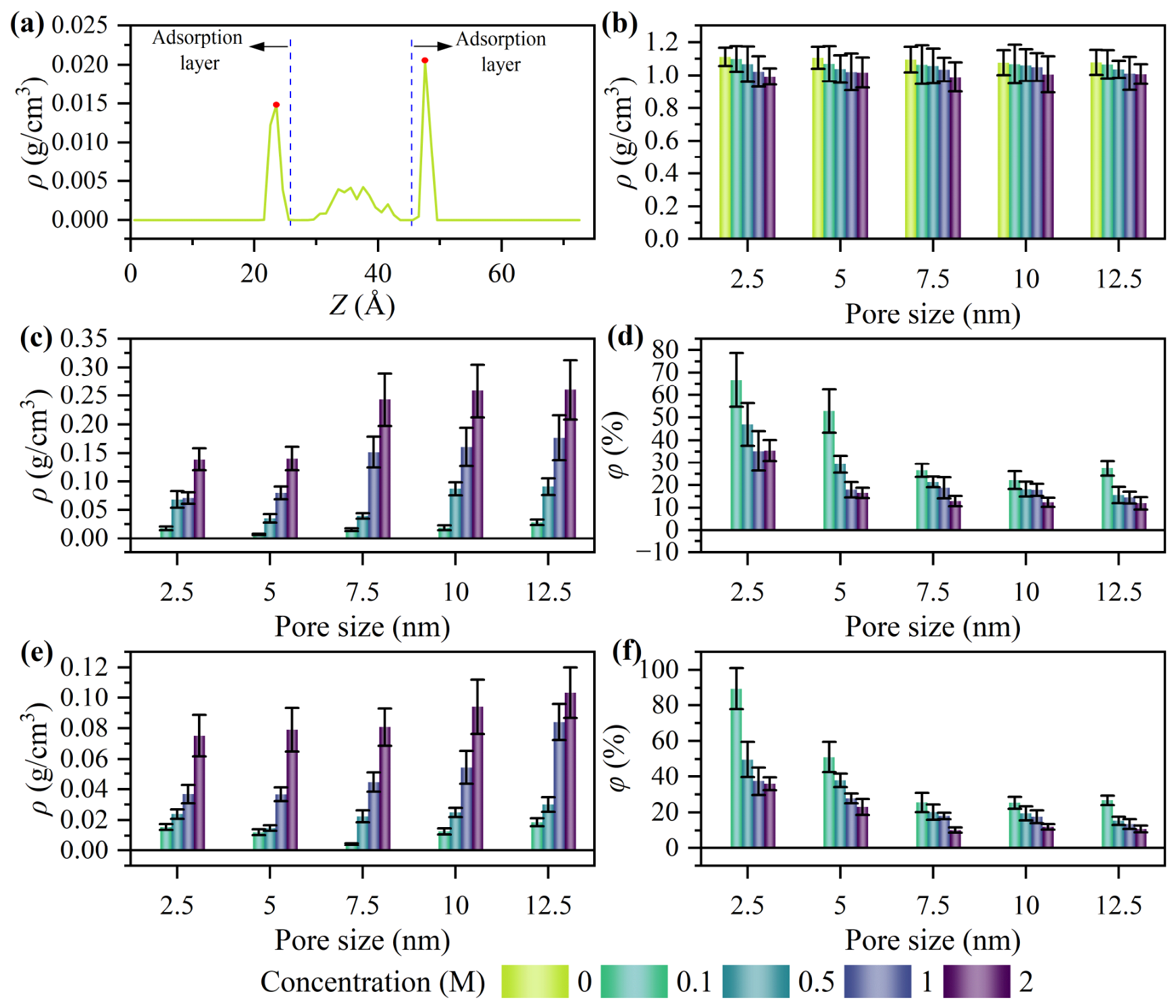
To quantitatively characterize the adsorption behavior of water molecules and ions in C-S-H nanopores, two descriptors were employed, i.e., the maximum density and the adsorption ratio. The former reflects the degree of species enrichment at the C-S-H surface, while the latter quantifies the fraction of ions residing within the adsorption layer. Figure 5a illustrates the definition of the maximum density and adsorption ratio using a representative system with a pore size of 2.5 nm and a 0.5 M NaCl solution. Specifically, the adsorption layer is defined as the region extending from the C-S-H surface to the first minimum of the density profile, while the maximum density corresponds to the peak value of the first distribution peak.
Such a definition of adsorption layer is physically grounded in the fact that both water molecules and ions exhibit a clearly enhanced or depleted density near the C-S-H surface, forming a distinct interfacial adsorption region that is significantly different from the relatively uniform density observed in the pore center. This density-based criterion is widely used in the molecular dynamics studies of C-S-H–water/solution and other solid–fluid interfaces, as it provides a simple, physically meaningful, and highly reproducible way to distinguish interfacial and bulk-like regions without introducing arbitrary geometric assumptions. Therefore, it has become a standard approach for quantifying adsorption behavior in nanoporous systems. In contrast, alternative definitions that rely on more complex or case-specific criteria are less commonly adopted, as they often introduce additional ambiguity while not necessarily improving physical interpretability or reproducibility. Within this context, the present definition ensures both computational simplicity and consistency with the majority of the existing literature on adsorption in cementitious and confined aqueous systems.
Figure 5b shows the variation in the maximum density of water molecules under different pore sizes and salinities. The results indicate that both pore size and salinity affect water accumulation at the interface, whereas salinity plays a more dominant role. As salinity increases from 0 to 2 M, the maximum water density decreases noticeably (by ~0.1 g/cm3), suggesting that Na+ and Cl progressively replace water molecules at interfacial adsorption sites, thereby weakening water enrichment at the C-S-H surface. In contrast, reducing pore size leads to a slight increase in interfacial water density. However, this effect remains secondary compared with salinity, indicating that interfacial competition is primarily governed by ion concentration.
Figure 5c,d presents the maximum density and adsorption ratio of Cl as functions of pore size and salinity. The maximum density of Cl generally increases with decreasing pore size and increasing salinity, indicating that both stronger confinement and higher ionic strength promote Cl accumulation near the C-S-H surface. When the pore size exceeds ~7.5 nm, the influence of pore size becomes less pronounced, whereas salinity continues to play a dominant role. In contrast, the adsorption ratio of Cl decreases monotonically with increasing pore size and salinity. Under low-salinity and small-pore conditions, the adsorption ratio reaches up to ~70% (pore size = 2.5 nm, salinity = 0.1 M), while it drops to ~10% (pore size = 12.5 nm, salinity = 2 M), indicating that adsorption gradually approaches saturation under high salinity and large pore sizes, accompanied by an increasing fraction of mobile ions in the pore interior.
Figure 5e,f shows the corresponding results for Na+, which follow similar trends but with consistently comparable interfacial affinity. The interfacial maximum density of Na+ increases with decreasing pore size and increasing salinity, while the effect of pore size becomes negligible beyond ~7.5 nm, with salinity remaining as the dominant controlling factor. Likewise, the adsorption ratio of Na+ decreases with increasing pore size and salinity, but remains higher than that of Cl across all conditions. Under small-pore and low-salinity conditions, the adsorption ratio of Na+ reaches up to ~85% (pore size = 2.5 nm, salinity = 0.1 M), whereas it decreases to below 10% (pore size = 12.5 nm, salinity = 2 M). This indicates a strong electrostatic attraction and coordination affinity between Na+ and the C-S-H surface, leading to a high residence probability of Na+.
Although Na+ and Cl exhibit some differences in adsorption ratios under certain conditions, their overall trends across different pore sizes and salinities are quite similar, and the magnitude of the differences is relatively modest according to Figure 5c–f. The adsorption behavior in C-S-H nanopores arises from a complex interplay of multiple factors, including ion–surface interactions with the C-S-H framework, ion–ion interactions, ion–water interactions, and water–surface interactions. In addition, the system is constructed with equimolar Na+ and Cl concentrations, with both carrying single positive charge or negative charge, respectively, which further contributes to a balanced overall ionic distribution in the confined region. As a result, the observed adsorption characteristics reflect a collective outcome of these coupled interactions rather than a single dominant mechanism, which naturally leads to comparable adsorption levels between different ionic species in certain regimes.
The observed ion layering and confinement-enhanced adsorption are consistent with previous MD studies on confined solutions in C-S-H systems, where strong electrostatic interactions between ions and charged C-S-H surfaces lead to the formation of well-defined interfacial adsorption layers. The present results further indicate that the extent of ion layering and adsorption is jointly affected by pore confinement and salinity, highlighting the coupled role of structural and chemical factors in governing interfacial ion distributions.

3.3. Two-Dimensional Diffusion Coefficient Map

To quantitatively characterize the diffusion behavior of water molecules and ions, the MSD and D, and representative ion diffusion trajectories were extracted to analyze their migration behavior. As shown in Figure 6a–c, the MSD curves of water molecules, Cl, and Na+ along different directions (XY, Z, and XYZ) are presented for the system with a pore size of 5 nm and a salinity of 0.5 M. All MSD curves increase approximately linearly with time, indicating that the systems have reached a stable diffusion regime within the current simulation timescale.
Meanwhile, pronounced anisotropic diffusion behavior can be observed, with the MSD values in the XY direction consistently larger than those in the Z direction. That is, both water molecules and ions diffuse more readily parallel to the C-S-H surface, whereas their perpendicular migration is significantly restricted. Such anisotropy mainly originates from the slit-shaped geometry of the C-S-H nanopores, i.e., relatively continuous diffusion pathways exist along the XY direction, while the Z direction is strongly constrained by the dual effects of nanoconfinement and interfacial adsorption layers. Further comparison shows that the MSD values of water molecules are significantly larger than those of Cl and Na+, indicating that water possesses substantially higher mobility than ions. This is mainly because ion migration is not only influenced by the attractions from C-S-H surface, but also constrained by the need to maintain the stability of their hydration shells. In contrast, water molecules interact more weakly with the C-S-H surface and therefore exhibit higher migration freedom and stronger diffusivity.
To further reveal the actual migration patterns of ions, Figure 6d,e presents the diffusion trajectories of Cl and Na+ within 500 ps. It can be observed that the ion trajectories are not uniformly distributed throughout the nanopores, but instead exhibit obvious localized clustering behavior, especially near the C-S-H surfaces. In some regions, relatively isolated trajectory clusters can even be identified, indicating that certain ions remain trapped within local interfacial regions for extended periods without effectively migrating into other parts of the pore space. These results demonstrate that interfacial adsorption not only restricts the diffusion range of ions, but also significantly prolongs their residence time near the interface. Combined with the MSD analysis, the diffusion trajectories clearly indicate that ion diffusion within C-S-H nanopores does not follow conventional homogeneous bulk diffusion, but is jointly governed by interfacial adsorption, nanoscale confinement, and ion–surface interactions. As the confinement effect becomes stronger, ion migration gradually transitions from continuous random diffusion to localized restricted diffusion, thereby significantly reducing the overall diffusion capability of the system.
To further elucidate the coupled effects of pore size and salinity on diffusion behavior, two-dimensional diffusion coefficient maps as a function of pore size and salinity were constructed for water molecules, Cl and Na+, as shown in Figure 7. These maps provide a comprehensive quantification of diffusion behavior under different conditions. As shown in Figure 7a–c, the diffusion coefficient maps of water molecules exhibit two distinct evolution regimes. When the pore size is smaller than approximately 5 nm (Regime I), the contour lines are nearly aligned along the salinity direction, and the normal direction of the contours (i.e., the direction corresponding to the fastest increase in diffusion coefficient) is nearly parallel to the direction of increasing pore size. This indicates that under strong confinement conditions, water diffusion is primarily governed by pore size, while the influence of salinity remains secondary. As the pore size further increases (Regime II), the direction of the fastest diffusion increase gradually shifts toward the coupled direction of increasing pore size and decreasing salinity, indicating that larger pores and lower salinity jointly enhance water mobility. This suggests that as confinement weakens, the inhibitory effect of salinity on water diffusion becomes increasingly important, which is consistent with the previously observed structural distribution and adsorption behavior [30,31].
Compared with water molecules, the evolution of Cl and Na+ diffusion behavior is considerably more complex. As shown in Figure 7d–f, the diffusion coefficient maps of Cl can be roughly divided into four distinct regimes. In Regime I, where both pore size and salinity are relatively low, the direction of the fastest diffusion increase points toward simultaneously increasing pore size and salinity. This indicates that under dilute conditions, a moderate increase in ion concentration may partially weaken interfacial adsorption constraints and thus promote ion migration. In Regime II, characterized by small pore sizes and high salinity, the direction of the fastest diffusion increase becomes nearly parallel to the pore-size direction, suggesting that pore size becomes the dominant factor controlling ion diffusion under the combined effects of strong confinement and high ionic concentration. In Regime III, corresponding to large pore sizes and low salinity, the fastest diffusion increase direction becomes more aligned with increasing salinity, indicating that the system gradually approaches bulk-like diffusion behavior and that salinity plays a more significant role in controlling ion diffusion. In Regime IV, where both pore size and salinity are high, the contour lines exhibit an approximately “C”-shaped distribution, suggesting the existence of more complex competing mechanisms. Under these conditions, diffusion increases most rapidly with pore size at intermediate salinity, whereas excessively high salinity again suppresses diffusion due to enhanced ion association and local structural crowding.
The diffusion coefficient maps of Na+ (see Figure 7g–i) exhibit evolution trends generally similar to those of Cl and can likewise be divided into four characteristic regimes. The directions corresponding to the fastest diffusion increase are also largely consistent, although slight differences exist in specific values and regional boundaries. These results indicate that although Na+ and Cl differ in interfacial adsorption strength and local coordination structure, their diffusion behaviors are both jointly governed by nanoscale confinement and salinity effects. Overall, the diffusion coefficient maps not only reveal the non-monotonic coupled influence of pore size and salinity on ion diffusion behavior, but also demonstrate that the dominant diffusion mechanism changes significantly under different conditions, gradually transitioning from interfacial adsorption-controlled diffusion to diffusion jointly governed by bulk diffusion and ion association effects.
The diffusion regimes presented in Figure 7 are not defined based on arbitrary or purely visual segmentation, but are instead grounded in consistent physical crossovers observed in multiple transport-related descriptors. In principle, the limits of these regimes can be defined quantitatively by identifying crossover regions in key observables, including the slope variation in the mean square displacement, changes in diffusion coefficients, and corresponding variations in interfacial adsorption and structural confinement indicators as functions of pore size and salinity. These quantities collectively provide a multi-dimensional description of transport behavior in C-S-H nanopores.
However, it is important to emphasize that the transitions observed in this system are gradual rather than abrupt, reflecting continuous evolution from strongly confined to weakly confined and eventually bulk-like transport regimes. As a result, the regime boundaries do not correspond to a single universal numerical threshold, but rather to transition regions where multiple physical observables change in a correlated manner. Therefore, in this study, we adopt a physically interpretable regime framework based on these consistent crossovers, rather than enforcing a strict mathematical partition. This approach can be widely used in molecular simulations of confined fluids, where transport regimes are typically identified based on continuous changes in dynamical and structural descriptors.
Another important issue concerns the determination of the critical pore sizes at which regime transitions occur. In the present study, these transition pore sizes are approxiately 2 nm, 5 nm, and 7.5 nm. It should be emphasized, however, that these values are not universal constants but are specific to the simulation systems and force field framework employed. Nevertheless, the underlying physical mechanism (namely, the confinement-induced transition from adsorption-dominated transport to diffusion-dominated transport) is expected to be generally applicable to cementitious nanoporous systems and other similar confined systems. Although the exact transition pore sizes may vary depending on factors such as pore structure, surface chemistry, and simulation conditions, the existence of such transport regime transitions is anticipated to be a robust and universal feature of nanoscale-confined transport processes.
Compared with previous studies that mainly investigated pore confinement effects or salinity effects separately, the present results confirm several commonly reported transport characteristics in C-S-H nanopores, including interfacial ion accumulation, layered density distributions, and diffusion anisotropy. Nevertheless, the current study further demonstrates that these behaviors are strongly modulated by the coupled effects of pore size and salinity. Through a systematic parametric investigation, a regime-dependent transport framework is established, showing that the dominant transport mechanism evolves from adsorption-controlled diffusion under strong confinement to bulk-like diffusion under weak confinement. Such coupled transport transitions have not been comprehensively evaluated in previous studies and provide a more complete understanding of ion transport processes in cementitious nanopores.

3.4. Discussion and Implications

Compared with previous studies that primarily focused on either pore confinement effects or solution chemistry independently, the present study systematically investigates the coupled effects of pore size and salinity on ion adsorption and diffusion in C-S-H nanopores. As summarized in Table 2, most previous studies considered these factors separately and therefore could not fully capture their synergistic influence on transport behavior [10,11,12,13,14,15,17,20,21,22,24,25,28,30,31,32,38]. The present results demonstrate that ion transport cannot be adequately described by either parameter alone, and distinct regime transitions emerge from their combined effects. Furthermore, the construction of two-dimensional diffusion coefficient maps enables a comprehensive visualization of transport responses over a broad range of pore size–salinity conditions.
More specifically, the diffusion behaviors of water and ions in C-S-H nanopores are not governed solely by pore size or salinity. Instead, distinct diffusion mechanisms emerge under different pore size–salinity combinations. Under large-pore and low-salinity conditions, the system still retains pronounced bulk-like diffusion characteristics, allowing water molecules and ions to migrate relatively freely within the pore channel. As the pore size decreases, interfacial adsorption layers gradually occupy a larger fraction of the confined space, and ion diffusion progressively shifts from free diffusion to localized diffusion dominated by interfacial adsorption. When small pore sizes are further coupled with high salinity, the combined effects of strong confinement, high ionic concentration, and ion correlation lead to the formation of a highly structured water–ion network within the nanopores, significantly restricting ion mobility and resulting in the lowest diffusion capability. In contrast, under large-pore and high-salinity conditions, although the geometric confinement effect becomes weaker, strong ion–ion and ion–surface interactions still drive the system away from ideal bulk diffusion behavior, giving rise to pronounced non-ideal diffusion characteristics.
Pore size mainly controls the relative proportion of interfacial and bulk-like regions, whereas salinity primarily governs competitive ion adsorption, hydration structure stability, and ion aggregation behavior. Consequently, their coupling not only affects the magnitude of diffusion coefficients, but also alters ion migration pathways and diffusion modes. These findings suggest that diffusion behavior in porous media can be selectively regulated through tailoring pore structures, ionic environments, and surface chemical properties. For example, optimizing pore size distribution and pore connectivity may enable a transition from bulk-dominated diffusion to interface-controlled confined diffusion, while adjusting ion concentration or surface charge characteristics can further tune interfacial adsorption strength and ion mobility.
In addition to the density profiles, adsorption statistics, and diffusion analyses employed in this work, other microscopic descriptors such as radial distribution functions (RDFs) [38], coordination numbers [26], hydrogen-bond networks [12], and ion clustering metrics [17] could also be introduced to provide more detailed structural information. These quantities are valuable for resolving ion-specific hydration structures and local association behaviors in confined systems. However, the objective of the present study is to focus on the coupled effects of pore size and salinity on transport regimes and interfacial behavior in C-S-H nanopores. The selected descriptors are sufficient to capture the dominant spatial distribution and transport characteristics under confinement. More detailed structural analyses can be effectively utilized in future studies targeting ion-specific hydration, clustering mechanisms, or reaction-related processes.
Temperature is another key factor affecting ion and water transport in nanopores, as it influences spatial distribution, diffusion coefficients, water viscosity, and hydrogen-bond dynamics, thereby affecting the absolute mobility and structuring of confined ions and fluids [31]. In this study, 300 K was selected as a representative ambient condition with clear experimental relevance. More importantly, maintaining a constant temperature allows us to isolate the dominant pore size–salinity coupling effects without introducing additional thermodynamic variables. The influence of temperature on the coupled transport behavior is therefore not explicitly addressed here but represents an important extension for future investigations.
Although molecular dynamics simulations are not intended to directly reproduce macroscopic chloride penetration depths or diffusion coefficients, they are widely used to uncover the atomistic mechanisms governing ion transport in cementitious nanopores. In this study, the simulations are employed to elucidate confinement effects, ion–surface interactions, and salinity-dependent structural modulation in C-S-H gel pores. The key findings are consistent with established experimental observations, which show that chloride transport in cement-based materials is strongly controlled by pore structure refinement, tortuosity, and interfacial adsorption [28]. In particular, the observed reduction in ion mobility with decreasing pore size and the pronounced influence of salinity align well with experimentally reported trends in chloride ingress behavior.
From a mechanistic perspective, these governing factors are not specific to the particular simulation parameters but arise from fundamental physical interactions in confined ionic systems. Therefore, the identified transport mechanisms are expected to be broadly applicable to cementitious nanoporous materials. In this sense, the present results provide atomistic-level insight that complements experimental observations and offers a physically grounded basis for improving continuum-scale chloride transport models.
Overall, while no direct quantitative comparison with experimental chloride diffusion coefficients is attempted, the simulation results are consistent with known experimental trends and demonstrate good transferability in terms of underlying transport mechanisms relevant to engineering-scale durability assessment.

4. Conclusions

In this study, MD simulations were performed to systematically investigate the structural evolution and diffusion behavior of NaCl solutions confined within C-S-H nanopores under different pore size and salinity conditions. Key characteristics, including spatial distributions, adsorption behaviors, MSD and diffusion coefficients, were quantitatively analyzed. Furthermore, the coupled effects of pore size and salinity were comprehensively revealed and discussed. The main findings are summarized as follows:
(1) Water molecules and ions exhibit pronounced layered distributions near the C-S-H surface. As the pore size decreases, the layered structures formed on both sides of the pore gradually overlap, and the system progressively evolves from a bulk-like fluid state to a strongly confined state. Increasing salinity weakens the enrichment of water molecules while promoting the accumulation of ions, mainly due to the competitive occupation of adsorption sites by water molecules and ions.
(2) The maximum density of water molecules near the C-S-H surface decreases noticeably with increasing salinity, while the influence of pore size is relatively limited. In contrast, the maximum densities of ions increase with decreasing pore size and increasing salinity. However, their adsorption ratios gradually decrease under large-pore and high-salinity conditions due to the increasing proportion of free ions in the pore center region.
(3) The diffusion capability of both water molecules and ions within C-S-H nanopores exhibits pronounced anisotropy. Diffusion in the direction parallel to the C-S-H surface is significantly stronger than that in the perpendicular direction due to the confinement imposed by the slit-shaped nanopore structure. In addition, water molecules exhibit substantially higher diffusion capability than ions, and ion diffusion is more strongly restricted under nanoscale confinement.
(4) Distinct regime-dependent diffusion behaviors of water molecules and ions are identified under different pore size–salinity conditions. For water molecules, two characteristic regimes can be identified; in the small-pore regime, diffusion is predominantly controlled by pore size, whereas in the large-pore regime, diffusion is jointly regulated by both pore size and salinity. In contrast, ions exhibit more complex, multi-regime behavior that can be broadly divided into four distinct regimes, where the direction of the fastest diffusion increase varies markedly with the combined changes in pore size and salinity.
The findings obtained in this study provide valuable insights into ionic ingress and transport in cement-based materials from an atomistic perspective. The identified coupling effects of pore size and salinity, together with the observed diffusion anisotropy and regime-dependent transport behavior, contribute to a more mechanistic understanding of ion ingress and durability degradation in saline and marine environments. These results can support the development of physically based ion transport models and provide guidance for the microstructure-oriented design and optimization of cementitious materials with enhanced durability. More broadly, the present study establishes a link between nanoscale transport mechanisms and macroscopic durability performance, offering useful references for the service-life assessment and durability design of cement-based structures.

Author Contributions

Conceptualization, Y.L.; Methodology, L.X.; Software, H.A.; Formal analysis, Y.L.; Investigation, L.X. and H.A.; Writing—original draft, Y.L., L.X. and H.A.; Writing—review & editing, S.L. (Shaoyan Liu) and S.L. (Sulan Li); Visualization, H.A. and S.L. (Shaoyan Liu); Funding acquisition, S.L. (Shaoyan Liu) and S.L. (Sulan Li). All authors have read and agreed to the published version of the manuscript.

Funding

This research was funded by Department of Science and Technology of Hubei Province, China (2026AFB334); Wuhan Municipal Bureau of Natural Resources and Urban–Rural Development Science and Technology Program Projects (202547); State Key Laboratory of Safety and Resilience of Civil Engineering in Mountainous Areas Open Fund (SQQZ2025410); Doctoral Scientific Research Foundation of Jianghan University of China (PBSKL-2024-QD-06); Doctoral Scientific Research Foundation of Jianghan University of China (PBSKL-2024-QD-05); The Joint Funds of Hubei Provincial Natural Science Foundation of China (2025AFD749).

Data Availability Statement

The original contributions presented in this study are included in the article. Further inquiries can be directed to the corresponding author.

Acknowledgments

The authors have reviewed and edited the output and take full responsibility for the content of this publication. This project is supported by the Intelligent Computing Center of Jianghan University.

Conflicts of Interest

Author Lei Xing was employed by the company CCCC Second Highway Consultants Co., Ltd. The remaining authors declare that the research was conducted in the absence of any commercial or financial relationships that could be construed as a potential conflict of interest.

Abbreviations

The following abbreviations are used in this manuscript:
C-S-HCalcium silicate hydrates
MSDMean squared displacement
MDMolecular dynamics
PPPMParticle–Particle Particle–Mesh
DDiffusion coefficient

References

  1. Xiao, J.; Zou, S.; Poon, C.S.; Sham, M.L.; Li, Z.; Shah, S.P. How to make concrete sustainable. Nature 2025, 638, 888–890. [Google Scholar] [PubMed]
  2. Liu, W.-H.; Kai, M.-F.; Zhang, P.; Yu, T.; Dai, J.-G. Three-dimensional finite element modeling of debonding failure of skew FRP-bonded concrete joints. Eng. Struct. 2024, 303, 117537. [Google Scholar] [CrossRef] [Scilit]
  3. Luo, D.; Wang, K.; Wang, D.; Sharma, A.; Li, W.; Choi, I.H. Artificial intelligence in the design, optimization, and performance prediction of concrete materials: A comprehensive review. npj Mater. Sustain. 2025, 3, 14. [Google Scholar] [CrossRef] [Scilit]
  4. Özkılıç’, Y.O.; Beskopylny, A.N.; Stel’MAkh, S.A.; Shcherban’, E.M.; Mailyan, L.R.; Meskhi, B.; Chernil’NIk, A.; Ananova, O.; Aksoylu, C.; Madenci, E. Lightweight expanded-clay fiber concrete with improved characteristics reinforced with short natural fibers. Case Stud. Constr. Mater. 2023, 19, e02367. [Google Scholar] [CrossRef] [Scilit]
  5. Wu, F.; Zhang, Q.; Dong, S.; Cai, Y.; Yang, S.; Xu, F.; Luo, P.; Jiang, J. Biochar modification enhances mechanical and durability properties of cement-based materials. Sci. Rep. 2025, 15, 22174. [Google Scholar] [CrossRef] [Scilit] [PubMed]
  6. Chen, X.; Gu, X.; Xia, X.; Li, X.; Zhang, Q. A Chemical-Transport-Mechanics Numerical Model for Concrete under Sulfate Attack. Materials 2021, 14, 7710. [Google Scholar] [CrossRef] [Scilit] [PubMed]
  7. Çelik, A.İ.; Karalar, M.; Aksoylu, C.; Mydin, M.A.O.; Althaqafi, E.; Yılmaz, F.; Umiye, O.A.; Özkılıç, Y.O. Effect of GBFS ratio and recycled steel tire wire on the mechanical and microstructural properties of geopolymer concrete under ambient and oven curing conditions. Case Stud. Constr. Mater. 2024, 21, e03890. [Google Scholar] [CrossRef] [Scilit]
  8. Xu, W.; Zhang, Y.; Li, M.; Qu, F.; Poon, C.S.; Zhu, X.; Tsang, D.C.W. Durability and micromechanical properties of biochar in biochar-cement composites under marine environment. J. Clean. Prod. 2024, 450, 141842. [Google Scholar] [CrossRef] [Scilit]
  9. Özkılıç, Y.O.; Althaqafi, E.; Karalar, M.; Aksoylu, C. Shear and flexural performance of reinforced concrete beams with recycled concrete aggregates. Rev. Adv. Mater. Sci. 2025, 64, 20250140. [Google Scholar] [CrossRef] [Scilit]
  10. Tu, Y.; Cao, J.; Wen, R.; Shi, P.; Yuan, L.; Ji, Y.; Das, O.; Försth, M.; Sas, G.; Elfgren, L. Molecular dynamics simulation study of the transport of pairwise coupled ions confined in C-S-H gel nanopores. Constr. Build. Mater. 2022, 318, 126172. [Google Scholar]
  11. Wen, R.; Chen, Y.; Guo, T.; Yuan, L.; Wang, T.; Yu, Q.; Tu, Y.; Sas, G.; Elfgren, L. Effects of temperature on ion transport in C–A–S–H gel nanopores: Insights from molecular dynamics simulations. J. Mater. Sci. 2022, 57, 18437–18455. [Google Scholar]
  12. Tang, S.; Hubao, A.; Chen, J.; Yu, W.; Yu, P.; Chen, E.; Deng, H.; He, Z. The interactions between water molecules and C-S-H surfaces in loads-induced nanopores: A molecular dynamics study. Appl. Surf. Sci. 2019, 496, 143744. [Google Scholar]
  13. Yu, J.; Gao, S.; Hou, D.; Wang, P.; Sun, G. Water transport mechanisms of poly (acrylic acid), poly (vinyl alcohol), and poly (ethylene glycol) in C-S-H nanochannels: A molecular dynamics study. J. Phys. Chem. B 2020, 124, 6095–6104. [Google Scholar] [CrossRef] [Scilit] [PubMed]
  14. Ihaddadene, T.; Claverie, J.; Bignonnet, F.; Amiri, O. Diffusion and physicochemical behavior of chloride and sodium ions in C-S-H gel pores: A molecular dynamics investigation. Cem. Concr. Res. 2026, 199, 108053. [Google Scholar]
  15. Chen, W.; Gong, K. Insights into ionic diffusion in C–S–H gel pore from molecular dynamics simulations: Spatial distributions, energy barriers, and structural descriptor. J. Phys. Chem. B 2025, 129, 10550–10567. [Google Scholar] [PubMed]
  16. Tang, S.; Wang, Y.; Geng, Z.; Xu, X.; Yu, W.; A, H.; Chen, J. Structure, fractality, mechanics and durability of calcium silicate hydrates. Fractal Fract. 2021, 5, 47. [Google Scholar] [CrossRef] [Scilit]
  17. Liu, Z.; Wang, Y.; Xu, D.; Zang, C.; Zhang, Y.; Jiang, J. Multiple ions transport and interaction in calcium silicate hydrate gel nanopores: Effects of saturation and tortuosity. Constr. Build. Mater. 2021, 283, 122638. [Google Scholar] [CrossRef] [Scilit]
  18. Ioannidou, K.; Krakowiak, K.J.; Bauchy, M.; Hoover, C.G.; Masoero, E.; Yip, S.; Ulm, F.J.; Levitz, P.; Pellenq, R.J.; Del Gado, E. Mesoscale texture of cement hydrates. Proc. Natl. Acad. Sci. USA 2016, 113, 2029–2034. [Google Scholar] [CrossRef] [Scilit] [PubMed]
  19. Zhou, T.; Ioannidou, K.; Ulm, F.J.; Bazant, M.Z.; Pellenq, R.J. Multiscale poromechanics of wet cement paste. Proc. Natl. Acad. Sci. USA 2019, 116, 10652–10657. [Google Scholar] [CrossRef] [Scilit] [PubMed]
  20. Cao, Q.; Xu, Y.; Fang, J.; Song, Y.; Wang, Y.; You, W. Influence of pore size and fatigue loading on NaCl transport properties in C-S-H nanopores: A molecular dynamics simulation. Materials 2020, 13, 700. [Google Scholar] [PubMed]
  21. Hou, D.S.; Jia, Y.T.; Yu, J.; Wang, P.G.; Liu, Q.F. Transport Properties of Sulfate and Chloride Ions Confined between Calcium Silicate Hydrate Surfaces: A Molecular Dynamics Study. J. Phys. Chem. C 2018, 122, 28021–28032. [Google Scholar] [CrossRef] [Scilit]
  22. Zehtab, B.; Tarighat, A. Molecular dynamics simulation to assess the effect of temperature on diffusion coefficients of different ions and water molecules in C-S-H. Mech. Time-Depend. Mater. 2017, 22, 483–497. [Google Scholar] [CrossRef] [Scilit]
  23. Kai, M.-F.; Sanchez, F.; Hou, D.-S.; Dai, J.-G. Nanoscale insights into the interfacial characteristics between calcium silicate hydrate and silica. Appl. Surf. Sci. 2023, 616, 156478. [Google Scholar] [CrossRef] [Scilit]
  24. Honorio, T. Permeability of C-S-H. Cem. Concr. Res. 2024, 176, 107408. [Google Scholar]
  25. Honorio, T.; Carasek, H.; Cascudo, O. Water self-diffusion in C-S-H: Effect of confinement and temperature studied by molecular dynamics. Cem. Concr. Res. 2022, 155, 106775. [Google Scholar] [CrossRef] [Scilit]
  26. Kai, M.; Zhang, L.; Liew, K. Atomistic insights into structure evolution and mechanical property of calcium silicate hydrates influenced by nuclear waste caesium. J. Hazard. Mater. 2021, 411, 125033. [Google Scholar] [CrossRef] [Scilit] [PubMed]
  27. Persson, I. Structure and size of complete hydration shells of metal ions and inorganic anions in aqueous solution. Dalton Trans. 2024, 53, 15517–15538. [Google Scholar] [CrossRef] [Scilit] [PubMed]
  28. Sakai, Y. Relationship between pore structure and chloride diffusion in cementitious materials. Constr. Build. Mater. 2019, 229, 116868. [Google Scholar] [CrossRef] [Scilit]
  29. Kai, M.; Hou, D.; Sanchez, F.; Poon, C.; Dai, J. Nanoscale insights into the influence of seawater (NaCl) on the behavior of calcium silicate hydrate. J. Phys. Chem. C 2023, 127, 8735–8750. [Google Scholar] [CrossRef] [Scilit]
  30. Liu, S.; Hubao, A.; Tang, S.; Kai, M.-f.; Yang, Z. Molecular insights into structural and dynamic properties of water molecules in calcium silicate hydrate nanopores: The roles of pore size and temperature. Capillarity 2023, 8, 23–33. [Google Scholar] [CrossRef] [Scilit]
  31. Hayat, U.; Kai, M.; Hu-Bao, A.; Liew, J.; Dai, J. Atomic-level investigation into the transport of NaCl solution in porous cement paste: The effects of pore size and temperature. J. Build. Eng. 2024, 86, 108976. [Google Scholar] [CrossRef] [Scilit]
  32. Yang, J.; Hou, D.S.; Ding, Q.J. Ionic hydration structure, dynamics and adsorption mechanism of sulfate and sodium ions in the surface of calcium silicate hydrate gel: A molecular dynamics study. Appl. Surf. Sci. 2018, 448, 559–570. [Google Scholar] [CrossRef] [Scilit]
  33. Srinivasan, S.; Gibb, I.; Khan, E. Climate Resilient Reinforced Concrete Structures in Coastal Environments: Bangladesh Case Study. In Proceedings of the 2nd International Conference on Transport and Road Research (iTRARR), Mombasa, Kenya, 11–14 June 2018. [Google Scholar]
  34. Pellenq, R.J.-M.; Kushima, A.; Shahsavari, R.; Van Vlietd, K.J.; Buehler, M.J.; Yip, S.; Ulm, F.-J. A realistic molecular model of cement hydrates. Proc. Natl. Acad. Sci. USA 2009, 106, 16102–16107. [Google Scholar] [CrossRef] [Scilit] [PubMed]
  35. Hubao, A.; Yang, Z.; Chen, Y.; Hu, R.; Wood, C.D.; Kang, Q.; Chen, Y.-F. H2 diffusion in cement nanopores and its implication for underground hydrogen storage. J. Energy Storage 2024, 102, 113926. [Google Scholar] [CrossRef] [Scilit]
  36. Hou, D.; Zheng, H.; Wang, P.; Wan, X.; Wang, M.; Wang, H. Molecular insight in the wetting behavior of nanoscale water droplet on CSH surface: Effects of Ca/Si ratio. Appl. Surf. Sci. 2022, 587, 152811. [Google Scholar] [CrossRef] [Scilit]
  37. Yu, J.; Li, M.; Jin, Z. Exploration of saturated transport of ion concentration differences in C–S–H channels. Mater. Struct. 2023, 57, 8. [Google Scholar] [CrossRef] [Scilit]
  38. Hou, D.; Wang, K.; Yu, J.; Niu, D.; Xu, F.; Xiang, Y.; Shen, P.; Chen, X.; Wang, P. Nanoconfined ion exchange mechanisms: The interactive process between aggressive ions and C-S-H Gel pore solution. Constr. Build. Mater. 2025, 484, 141856. [Google Scholar]
  39. Duque-Redondo, E.; Bonnaud, P.A.; Manzano, H. A comprehensive review of C-S-H empirical and computational models, their applications, and practical aspects. Cem. Concr. Res. 2022, 156, 106784. [Google Scholar]
  40. Shah, V.; Scrivener, K.; Bhattacharjee, B.; Bishnoi, S. Changes in microstructure characteristics of cement paste on carbonation. Cem. Concr. Res. 2018, 109, 184–197. [Google Scholar] [CrossRef] [Scilit]
  41. Youssef, M.; Pellenq, R.J.-M.; Yildiz, B. Glassy nature of water in an ultraconfining disordered material: The case of calcium-silicate-hydrate. J. Am. Chem. Soc. 2011, 133, 2499–2510. [Google Scholar] [CrossRef] [Scilit] [PubMed]
  42. Cygan, R.T.; Liang, J.-J.; Kalinichev, A.G. Molecular models of hydroxide, oxyhydroxide, and clay phases and the development of a general force field. J. Phys. Chem. B 2004, 108, 1255–1266. [Google Scholar] [CrossRef] [Scilit]
  43. Gartner, E.; Maruyama, I.; Chen, J. A new model for the C-S-H phase formed during the hydration of Portland cements. Cem. Concr. Res. 2017, 97, 95–106. [Google Scholar]
  44. Dančová, P.; Vinš, V.; Celný, D.; Planková, B.; Němec, T.; Duška, M.; Hrubý, J.; Veselý, M. Molecular Simulations of the Vapor–Liquid Phase Interfaces of Pure Water Modeled with the SPC/E and the TIP4P/2005 Molecular Models. EPJ Web Conf. 2016, 114, 02136. [Google Scholar]
  45. Hubao, A.; Yang, Z.; Chen, Y.; Hu, R.; Wood, C.D.; Ahmed, S.; Chen, Y.-F. Nanoscale spontaneous imbibition the roles of dynamic contact angle, contact line advancement and altered fluid properties. Int. J. Heat Mass Transf. 2026, 256, 128110. [Google Scholar] [CrossRef] [Scilit]
  46. Thompson, A.P.; Aktulga, H.M.; Berger, R.; Bolintineanu, D.S.; Brown, W.M.; Crozier, P.S.; in ‘t Veld, P.J.; Kohlmeyer, A.; Moore, S.G.; Nguyen, T.D.; et al. LAMMPS-a flexible simulation tool for particle-based materials modeling at the atomic, meso, and continuum scales. Comput. Phys. Commun. 2022, 271, 108171. [Google Scholar] [CrossRef] [Scilit]
  47. Hubao, A.; Yang, Z.; Hu, R.; Chen, Y. Molecular origin of wetting characteristics on mineral surfaces. Langmuir 2023, 39, 2932–2942. [Google Scholar] [CrossRef] [Scilit]
  48. Hubao, A.; Yang, Z.; Hu, R.; Chen, Y.; Yang, L. Effect of solid–liquid interactions on substrate wettability and dynamic spreading of nanodroplets: A molecular dynamics study. J. Phys. Chem. C 2020, 124, 23260–23269. [Google Scholar] [CrossRef] [Scilit]
  49. Hou, D.S.; Li, D.K.; Yu, J.; Zhang, P. Insights on capillary adsorption of aqueous sodium chloride solution in the nanometer calcium silicate channel: A molecular dynamics study. J. Phys. Chem. C 2017, 121, 13786–13797. [Google Scholar] [CrossRef] [Scilit]
Figure 2. Density distribution of water molecules in C-S-H nanopores filled with NaCl solutions at different salinities, with pore sizes of (a) 2.5 nm, (b) 5 nm, (c) 7.5 nm, (d) 10 nm, and (e) 12.5 nm, respectively.
Buildings 16 02539 g002
Figure 3. Density distributions of Cl and Na+ ions in C-S-H nanopores filled with NaCl solutions at different salinities, with pore sizes of (a) 2.5 nm, (b) 5 nm, (c) 7.5 nm, (d) 10 nm, and (e) 12.5 nm, respectively. The left y-axis represents the density of Cl ions, while the right y-axis represents the density of Na+ ions.
Buildings 16 02539 g003
Figure 4. Density distributions of Ca2+ on the C-S-H surfaces under different salinities, with pore sizes of (a) 2.5 nm, (b) 5 nm, (c) 7.5 nm, (d) 10 nm, and (e) 12.5 nm, respectively.
Buildings 16 02539 g004
Figure 5. (a) Schematic illustration of the maximum density and adsorption layer at the C-S-H surface, using Cl as an example for a 2.5 nm pore size and 0.5 M salinity. The red dots indicate the peak positions of the density profiles. (b) Maximum density of water molecules at the C-S-H surface under different conditions. (c,d) Maximum density and adsorption ratio of Cl under different conditions, respectively. (e,f) Maximum density and adsorption ratio of Na+ under different conditions, respectively.
Buildings 16 02539 g005
Figure 6. MSD curves of (a) water molecules, (b) Cl, and (c) Na+ along different directions (XY, Z, and XYZ) for the system with a pore size of 5 nm and a salinity of 0.5 M. (d,e) are the diffusion trajectories of Cl and Na+ within 500 ps of the system with a pore size of 5 nm and a salinity of 0.5 M, respectively.
Buildings 16 02539 g006
Figure 7. Two-dimensional diffusion coefficient maps as a function of pore size and salinity for water molecules alone; (a) XY, (b) Z, and (c) XYZ directions. Two-dimensional diffusion coefficient maps as a function of pore size and salinity for Cl alone; (d) XY, (e) Z, and (f) XYZ directions. Two-dimensional diffusion coefficient maps as a function of pore size and salinity for Na+ alone; (g) XY, (h) Z, and (i) XYZ directions. I–IV represent four different diffusion regimes of water molecules and ions, red doted lines are the boundaries between these regimes.
Buildings 16 02539 g007
Table 1. Nonbond potential parameters used in the simulations.
Species and SymbolPartial Charge [e]ε [kJ/mol]σ [Å]
silicon (tetr.), Si2.17.701 × 10−63.302
calcium (intra), Ca1.052.104 × 10−55.567
calcium (inter), CaW2.002.104 × 10−52.872
oxygen, O−1.1640.6503.166
water hydrogen, Hw0.423800
water oxygen, Ow−0.84760.6503.166
chloride ion, Cl−10.4194.400
sodium ion, Na10.5442.350
Table 2. Comparison between this study and representative previous studies on ion distribution and diffusion in C-S-H nanopores.
StudyPore Size EffectSalinity EffectCoupled EffectsRegime-Dependent
Transport Analysis
Ref. [10]NoYesNoNo
Ref. [11]NoYesNoNo
Ref. [12]NoNoNoNo
Ref. [13]NoNoNoNo
Ref. [14]YesYesLimitedNo
Ref. [15]NoNoNoNo
Ref. [17]NoYesNoNo
Ref. [20]YesNoNoNo
Ref. [21]NoYesNoNo
Ref. [22]NoNoNoNo
Ref. [24]YesNoNoNo
Ref. [25]YesNoNoNo
Ref. [28]YesYesLimitedNo
Ref. [30]YesNoNoNo
Ref. [31]YesNoNoNo
Ref. [32]NoNoNoNo
Ref. [38]NoYesNoNo
This studyYesYesYesYes
Disclaimer/Publisher’s Note: The statements, opinions and data contained in all publications are solely those of the individual author(s) and contributor(s) and not of MDPI and/or the editor(s). MDPI and/or the editor(s) disclaim responsibility for any injury to people or property resulting from any ideas, methods, instructions or products referred to in the content.