1. Introduction
Under the growing demand for global sustainable development and energy-resource constraints [
1], carbon peaking and carbon neutrality have become central policy pathways for low-carbon development [
2,
3]. The building sector plays a critical role in this transition, as buildings and construction account for approximately one-third of global final energy use and energy-related CO
2 emissions [
4]. Improving building energy efficiency is therefore essential for reducing urban carbon emissions and achieving sustainable development goals [
5,
6].
Urban residential buildings constitute a major component of building-sector energy use. According to the Report on Carbon Emissions in China’s Urban–Rural Construction Sector (2025) [
7], urban residential buildings in China consumed approximately 0.50 billion tons of standard coal equivalent, with associated CO
2 emissions of 0.97 billion tons, levels comparable to those of public buildings. Meanwhile, China’s building-sector development has shifted from rapid expansion through new construction toward the renewal and performance improvement of the existing building stock [
8]. Old residential buildings, because of their large scale, wide distribution, outdated standards, and substantial improvement potential, have become key targets for low-carbon urban renewal [
9,
10]. Integrating energy-efficiency retrofits into the renewal of old communities is therefore a strategic priority [
11,
12].
Retrofit decision-making for existing buildings generally involves three interrelated tasks: selecting technically appropriate measures, estimating their expected performance, and determining intervention priorities. Passive retrofit strategies mainly reduce heating and cooling loads by improving envelope performance through wall and roof insulation, airtightness enhancement, high-performance window replacement, solar-shading optimization, and improved daylight use [
13]. Active strategies focus on increasing the efficiency of building systems and energy supply through HVAC upgrades [
14], replacement of inefficient appliances and lighting [
15], improved operational controls, renewable-energy integration [
16], and smart energy-management systems [
17]. In practice, passive and active measures are often combined because envelope improvements reduce building loads, while efficient systems and controls further lower operational energy use [
18,
19]. Building energy simulation [
20], model calibration [
21], and cost–benefit analysis [
22] are commonly used to compare these measures and evaluate their energy-saving potential, economic feasibility, carbon-reduction benefits, and effects on thermal comfort [
23]. These approaches are indispensable for determining what can be improved and how much benefit may be achieved. However, detailed modeling and calibration usually require extensive information on weather, envelope properties, equipment, operation schedules, and occupant behavior, making large-scale application costly and time-consuming [
24].
To improve the efficiency of building-stock assessment, archetype-based approaches have been widely adopted [
25]. The core logic of this approach is to support large-scale retrofit implementation by balancing the diversity of individual buildings with the common characteristics of building stocks [
26,
27]. By defining representative “prototype buildings”, building typology enables the extrapolation of findings from typical cases to broader building groups, thereby improving the efficiency of retrofit assessment and decision-making [
28]. Specifically, the National Observatory of Athens established 24 residential building prototypes in Greece and systematically evaluated the energy-saving potential of 18 retrofit measures [
29,
30]. Streicher et al. developed a database of 54 residential building archetypes in Switzerland and revealed the techno-economic boundaries of large-scale energy retrofits [
31]. In China, Huang et al. identified 24 residential building prototypes in Chongqing using a decision-tree classification method [
8], while Wu et al. quantified the carbon reduction potential of 57 typical buildings in Haikou [
32]. Song et al. integrated GIS data, K-means clustering, satellite imagery, and deep learning to classify 539,119 buildings in Shanghai into 63 archetypes based on building type and vintage [
33]. These studies generally follow a technical pathway that extracts key influencing factors, defines prototype buildings, constructs physical models, and predicts energy-saving potential [
34,
35]. Energy-consumption benchmarks are commonly incorporated into this process to compare actual energy use with reference or limit values and identify buildings with potential retrofit needs [
24]. This combination of typology and benchmarking provides an efficient basis for large-scale screening and preliminary decision-making [
36].
Although the typological approach improves the efficiency of large-scale retrofit assessment through prototype-based simplification [
37], it may overlook the heterogeneity of building users and household energy-use patterns in the pursuit of standardized retrofit solutions [
24]. Buildings within the same prototype category are often assumed to have similar performance and retrofit needs, even though their actual household energy-use patterns may differ substantially. This limitation is particularly important in old residential communities, where energy consumption is not only determined by building morphology and envelope performance [
24], but also shaped by household income [
38], occupancy schedules [
39], equipment ownership [
40], thermal comfort demand, and adaptive behaviors. In other words, buildings with similar physical characteristics may still exhibit substantially different energy-consumption patterns due to user-side heterogeneity [
41]. Physical similarity, consequently, does not necessarily imply similar retrofit urgency or appropriate intervention strategies [
42].
This limitation affects retrofit prioritization in two ways. First, average or median benchmarks indicate the overall energy-use level but cannot reveal its internal distribution. Two building groups with the same median EUI may have very different household-level patterns: one may be relatively uniform, whereas the other may contain both extremely low- and high-consumption households. Second, conventional decision logic often treats high consumption as evidence of high retrofit urgency and low consumption as evidence of satisfactory performance. Yet high aggregate consumption may be concentrated among only part of the building group, while low consumption may reflect affordability constraints, restricted equipment uses, inadequate thermal comfort, or behavioral adaptation rather than high efficiency. Under such conditions, a uniform deep retrofit may yield limited marginal savings, produce poor cost-effectiveness, or fail to address the actual needs of low-consuming households.
Household-level energy-use distribution is therefore particularly valuable for the prioritization stage of large residential retrofit projects. It does not replace envelope assessment, energy simulation, or economic evaluation. Instead, it complements them by providing information that aggregate benchmarks cannot adequately capture. Technical assessment helps determine what can be improved and how alternative measures may perform. Distributional analysis, in turn, helps identify where intervention should be prioritized, which buildings or households can reasonably be treated as comparable groups, and whether whole-building, localized, household-targeted, or combined measures are more appropriate. Groups with similar energy-use characteristics may be assigned comparable retrofit targets and technical packages, whereas groups with substantial internal differences require more differentiated intervention scales and objectives. In this way, distributional analysis supports the transition from standardized, broad-based retrofit implementation toward refined diagnosis and targeted implementation.
In China, this challenge is reflected in the gap between aggregate efficiency assessment and household-level energy-use differences, as well as between technology-oriented retrofit pathways and social-equity objectives [
43]. National policies emphasize “targeted measures” and “classified implementation” for old-community renewal, yet current technical pathways remain largely standardized [
8,
44]. Overlooking household-level energy-use differences may lead to misidentified priorities, inappropriate intervention scales, inefficient resource allocation, and increased financial burdens on vulnerable households [
45,
46].
To address these gaps, this study develops a dual-benchmark diagnostic framework by integrating median EUI as the energy-consumption benchmark, with Dagum Gini coefficients as distributional-fairness indicators. Using monitored electricity consumption data from 1024 households in four representative old residential building prototypes in Chongqing, this study quantifies energy-use imbalance, identifies its sources at different analytical scales, and examines whether conventional energy benchmarks adequately reflect distributional fairness. Based on the empirical findings, an equity-oriented retrofit decision-making framework and a refined pathway are proposed to link energy-use diagnosis with retrofit-object identification, intervention-scale selection, and differentiated strategy development. The study aims to answer three questions: (1) How does energy-consumption imbalance vary across old residential building prototypes and seasons? (2) Can energy-consumption benchmarks adequately reflect energy-use distributional fairness? (3) How can retrofit priorities and intervention strategies be determined by jointly considering energy-use levels and distributional imbalance?
2. Study Area
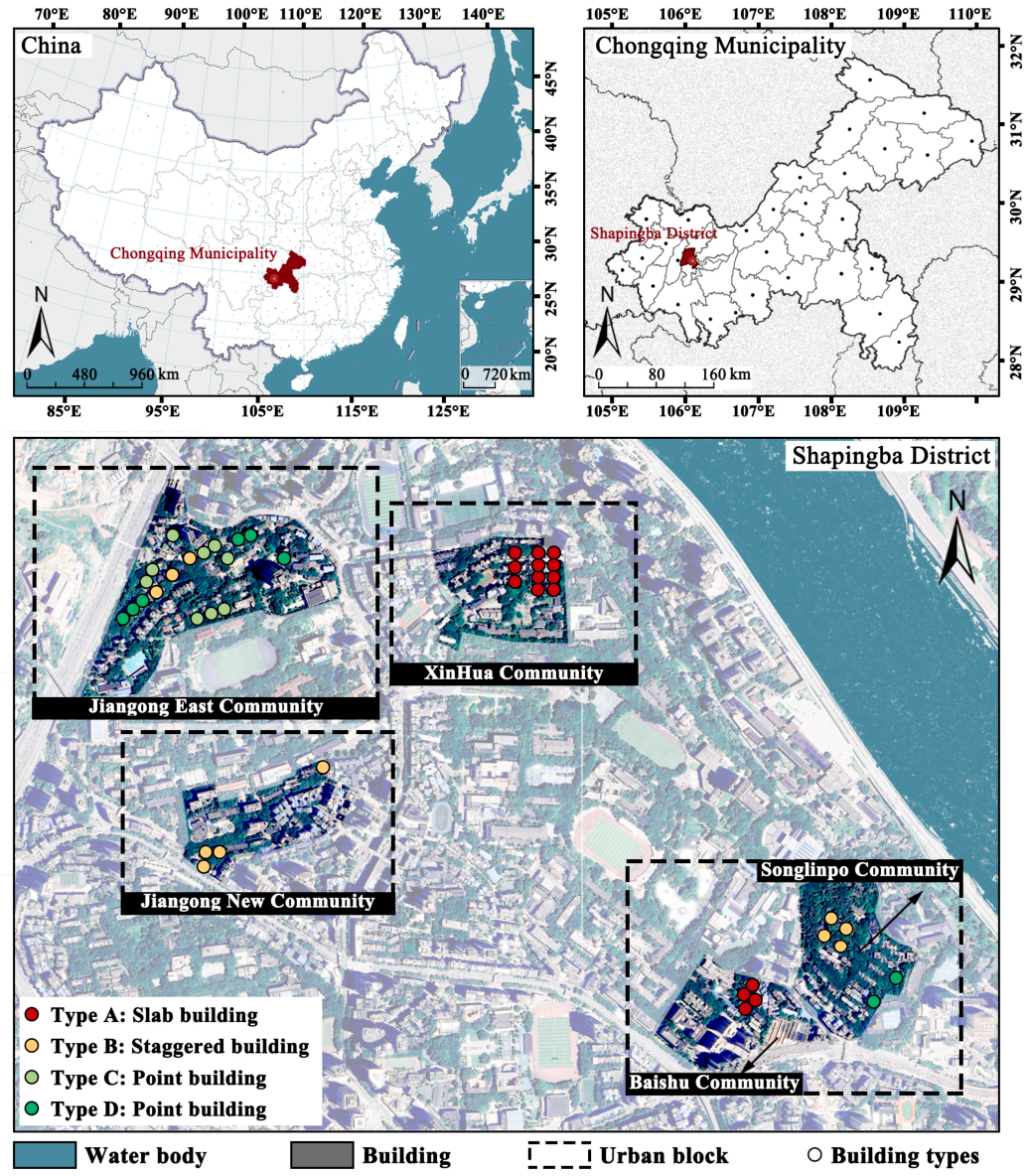
Chongqing, the largest municipality directly under the central government in China, is located between 105°11′ E–110°11′ E and 28°10′ N–32°13′ N. It is a representative city in China’s hot-summer and cold-winter climate zone (
Figure 1), where residents rely heavily on air-conditioning during both summer and winter, with relatively long operating periods [
47]. In 2024, household electricity consumption in Chongqing reached 31.962 billion kWh, accounting for approximately 19.8% of the city’s total electricity consumption. For comparison, electricity consumption reached 86.348 billion kWh in the industrial sector, 12.326 billion kWh in commercial services, and 22.462 billion kWh in public institutions and other service sectors [
48] (
Table A1). This substantial share indicates that residential energy use is an important component of Chongqing’s urban energy system and highlights the need to improve the energy performance of the existing residential building stock.
Chongqing experienced rapid urbanization and large-scale residential construction during the second half of the twentieth century, resulting in a substantial stock of old residential buildings. According to data from the seventh national population census, the recorded floor area of residential buildings constructed before 2000 in urban areas and towns reached approximately 14.21 million m
2 in 2020, accounting for about 20.0% of the total recorded residential floor area in these areas (
Table 1). Buildings constructed during 1990~1999 alone accounted for approximately 10.46 million m
2, representing the largest share of the pre-2000 residential stock.
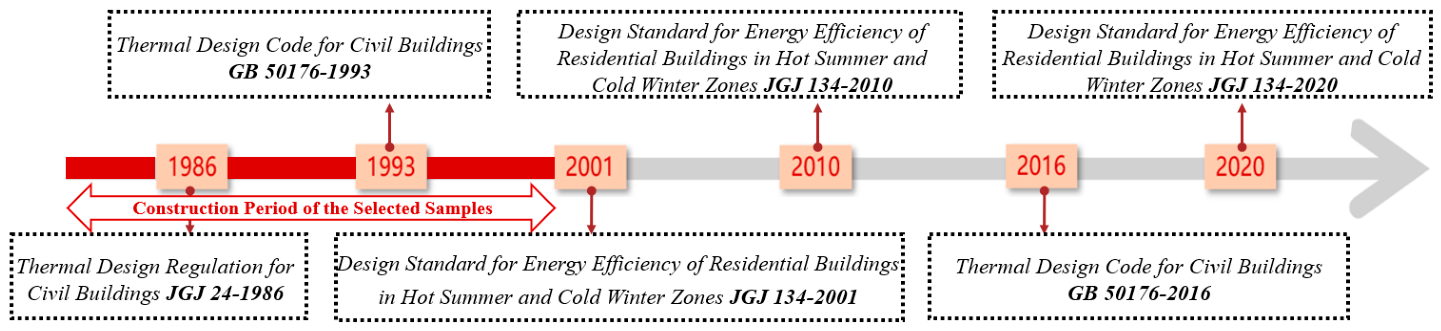
The evolution of residential thermal-design and energy-efficiency standards in China’s hot-summer and cold-winter zone is presented in
Figure 2. Although general thermal-design codes had been introduced since the 1980s, including
GB 50176-1986 [
49] and its 1993 revision [
50], residential buildings in this region generally lacked systematic and dedicated energy-efficiency requirements before the
JGJ 134-2001 Design Standard for Energy Efficiency of Residential Buildings in Hot Summer and Cold Winter Areas [
51]. The sampled buildings were all constructed before the implementation of
JGJ 134-2001 and therefore belong to the pre-standard stage of residential energy-efficiency design in this climate zone. Their limited envelope insulation, aging windows and building components, and relatively weak thermal performance, together with Chongqing’s substantial seasonal cooling and heating demand, indicate considerable potential for energy-efficiency improvement.
Table 1.
Floor area of residential buildings in Chongqing by construction period in 2020 [
52].
Table 1.
Floor area of residential buildings in Chongqing by construction period in 2020 [
52].
| Construction Period | Urban Areas (m2) | Towns (m2) |
|---|
| Before 1949 | 23,600 | 67,544 |
| 1949~1959 | 29,108 | 54,514 |
| 1960~1969 | 81,821 | 107,254 |
| 1970~1979 | 293,029 | 281,838 |
| 1980~1989 | 1,701,060 | 1,108,635 |
| 1990~1999 | 6,592,575 | 3,872,125 |
| 2000~2009 | 19,406,901 | 8,450,716 |
| 2010 and later | 21,414,365 | 7,747,281 |
Figure 2.
Evolution of residential thermal-design and energy-efficiency standards in China’s hot-summer and cold-winter zone. Since the 1980s, the regulatory framework for residential thermal design and energy efficiency in China’s hot-summer and cold-winter zone has undergone several stages of development. Relevant standards include the
Thermal Design Code for Civil Buildings (GB 50176-1986); the revised
Thermal Design Code for Civil Buildings (GB 50176-1993); the
Design Standard for Energy Efficiency of Residential Buildings in Hot Summer and Cold Winter Zones (JGJ 134-2001); and its subsequent revision,
JGJ 134-2010 [
49,
50,
51,
53]. According to the regulatory management practice of the Ministry of Housing and Urban–Rural Development of the People’s Republic of China, newly issued or revised standards generally supersede earlier standards of the same category [
54,
55]. These regulatory changes reflect the gradual strengthening of residential energy-efficiency requirements in the region.
Figure 2.
Evolution of residential thermal-design and energy-efficiency standards in China’s hot-summer and cold-winter zone. Since the 1980s, the regulatory framework for residential thermal design and energy efficiency in China’s hot-summer and cold-winter zone has undergone several stages of development. Relevant standards include the
Thermal Design Code for Civil Buildings (GB 50176-1986); the revised
Thermal Design Code for Civil Buildings (GB 50176-1993); the
Design Standard for Energy Efficiency of Residential Buildings in Hot Summer and Cold Winter Zones (JGJ 134-2001); and its subsequent revision,
JGJ 134-2010 [
49,
50,
51,
53]. According to the regulatory management practice of the Ministry of Housing and Urban–Rural Development of the People’s Republic of China, newly issued or revised standards generally supersede earlier standards of the same category [
54,
55]. These regulatory changes reflect the gradual strengthening of residential energy-efficiency requirements in the region.

In response to the large stock of pre-standard old residential buildings, the State Council’s 2020 task for the renovation of old urban residential communities explicitly identified communities built before the end of 2000 as key retrofit targets [
56]. The 14th Five-Year Action Plan for Urban Renewal and Improvement in Chongqing further proposed a target of renovating 100 million m
2 of old urban residential communities and emphasized green and low-carbon transformation [
57]. Subsequently, in 2023, the Ministry of Housing and Urban–Rural Development and other departments identified energy-efficiency retrofits of existing buildings as a key priority.
Against this policy background and practical demand, this study selected five old residential communities of Chongqing University: Jiangong East Village, Xinhua Village, Jiangong West Village, Songlinpo, and Baishu Village. All sampled residential buildings were constructed before 2000 and are located in close proximity, thereby sharing similar local climatic conditions. Most occupants are university staff, and the sampled buildings have relatively high occupancy rates, which improves the continuity and comparability of the monitored household electricity data.
3. Materials and Methods
3.1. Research Framework
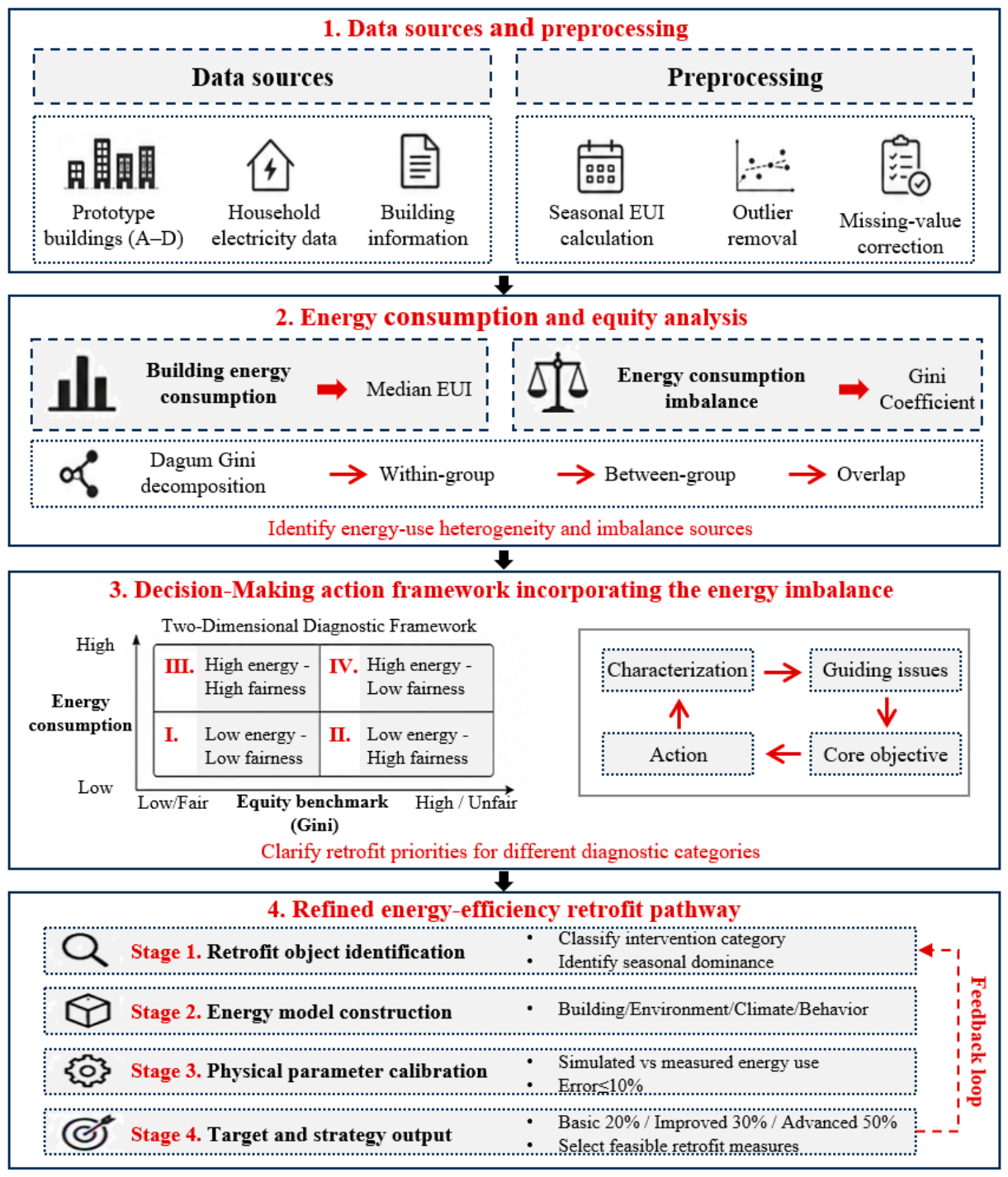
The research framework consists of four steps (
Figure 3). Step 1: Data sources and preprocessing. Four representative old residential building prototypes were selected as the research objects. Household electricity consumption data and basic building information were collected to calculate seasonal EUI. Invalid records, such as negative values, duplicate entries, missing household identifiers, and missing floor-area information, were removed to ensure data reliability while preserving valid household-level energy-use heterogeneity. Step 2: Energy consumption and equity analysis. The median EUI was adopted as the energy-consumption benchmark to characterize the overall energy-use level of each building type. The Gini coefficient was introduced as a distributional-fairness benchmark to measure the distributional balance of household energy consumption. Dagum Gini decomposition was further applied to distinguish within-group disparity, between-group disparity, and distributional overlap. Step 3: Integrated diagnostic framework. By combining energy-consumption benchmarks and equity benchmarks, old residential buildings were classified into four diagnostic categories: low energy–high fairness, low energy–low fairness, high energy–high fairness, and high energy–low fairness. This classification clarifies whether the main retrofit concern is energy-saving potential, distributional imbalance, or both. Step 4: Refined retrofit pathway. Based on the diagnostic results, a refined retrofit pathway was developed, including retrofit-object identification, energy-model construction, physical-parameter calibration, energy-saving target setting, and retrofit strategy development. Through this framework, the assessment logic is shifted from benchmark-driven efficiency evaluation to equity-oriented retrofit diagnosis.
3.2. Data Sources and Processing
To enable a more comprehensive comparative analysis, four representative building types were selected from the residential prototype system established in our previous study on existing residential buildings in Chongqing [
8]. That study systematically classified Chongqing’s residential buildings according to their morphological and construction characteristics and developed corresponding energy benchmarks. From this established system, the present study selected the four prototype categories that were represented in the study communities and for which sufficiently complete building information and household-level electricity records were available. The final sample comprised 43 buildings and 85 building units (
Table 2): Type A—slab buildings with four households per floor (15 buildings); Type B—staggered buildings with four households per floor (11 buildings); Type C—rectangular point buildings with two households per floor (9 buildings); and Type D—square point buildings with four households per floor (8 buildings). These four types were therefore selected as an analytically comparable sample of common pre-2000 residential forms in Chongqing rather than on a random basis.
The original administrative dataset contained household-level electricity, water, and gas-consumption records collected through the university’s energy-management system. This study used electricity data because electricity is the principal energy source for residential cooling and heating in China’s hot-summer and cold-winter climate zone. The records, provided by the Energy Conservation Office of Chongqing University, represent total metered electricity consumption within each dwelling, including space heating and cooling, lighting, plug loads, household appliances, and electric domestic hot-water use where applicable. Water consumption, gas consumption, and separately metered common-area electricity were excluded from the EUI calculation. Accordingly, the EUI represents total household electricity-use intensity rather than end-use-specific heating or cooling electricity consumption.
Basic building information, including building type, construction year, household floor area, and envelope characteristics, was provided by the Infrastructure Department of Chongqing University. After matching the electricity records with household identifiers and floor-area information, 1024 valid households from the 43 sampled residential buildings were retained for analysis. All sampled buildings are located within the same university residential area, share similar local climatic conditions and occupant composition, and were constructed before 2000. In addition, the selected prototypes have comparable historical construction conditions and relatively similar exterior-wall materials, as shown in
Table 2. These characteristics improve comparability across building types.
The data-processing procedure was designed to improve data reliability while preserving actual household-level energy-use heterogeneity. Records with clear data errors, including negative electricity-consumption values, duplicate entries, missing household identifiers, or missing floor-area information, were excluded. Valid high- and low-consumption records were retained because they may represent genuine differences in occupancy, appliance use, thermal-comfort demand, affordability, and energy-saving behavior [
58].
The prototype-based comparison follows the common logic of building-energy benchmarking studies, in which buildings with similar form and construction characteristics are grouped to examine their energy-use patterns. In this study, however, the purpose is not to attribute all energy-use differences solely to building prototype. Rather, the prototype classification provides a basis for evaluating whether energy-consumption imbalance exists both between different building types and within the same building type.
Household energy use is inevitably affected by occupant behavior, appliance use, envelope conditions, and potential retrofits. Detailed household-level socio-economic and behavioral information, such as age, income, family size, occupancy schedules, and appliance-use habits, was unavailable in the administrative energy dataset. Complete apartment-level spatial attributes, including floor level, orientation, corner- or middle-unit position, and exposure to roofs or external walls, were also unavailable. These socio-economic, behavioral, and spatial variables were therefore not included as controlled explanatory factors in the Gini analysis. Their combined influence is reflected in the observed household-level energy-use distribution rather than being attributed solely to building type. Such household-level heterogeneity is therefore not treated as noise to be fully eliminated, but as an important feature to be measured. To improve comparability, electricity use intensity (EUI, kWh/m
2) was used rather than total electricity consumption [
59], thereby reducing the influence of dwelling-size differences. The Dagum Gini decomposition method was then applied to distinguish within-group disparity, between-group net disparity, and distributional overlap, supporting the joint evaluation of prototype-based energy benchmarks and distributional-fairness indicators.
Residents mainly use heating and cooling during two three-month periods [
60]. Accordingly, household electricity data from June to August were used to calculate summer EUI, data from December to February were used to calculate winter EUI, and data from March to May and October to November were used to calculate transition-season EUI.
For each household, seasonal EUI was calculated using the average monthly total household electricity consumption per unit floor area:
where
denotes the seasonal EUI of household
in season
(kWh/m
2 per month),
is the total metered electricity consumption of household
in month
(kWh),
is the floor area of household
(m
2), and
is the number of months included in season
. This treatment preserves actual household-level heterogeneity and provides a reliable basis for measuring energy-consumption imbalance in old residential buildings.
3.3. Measurement and Decomposition of Energy-Use Imbalance
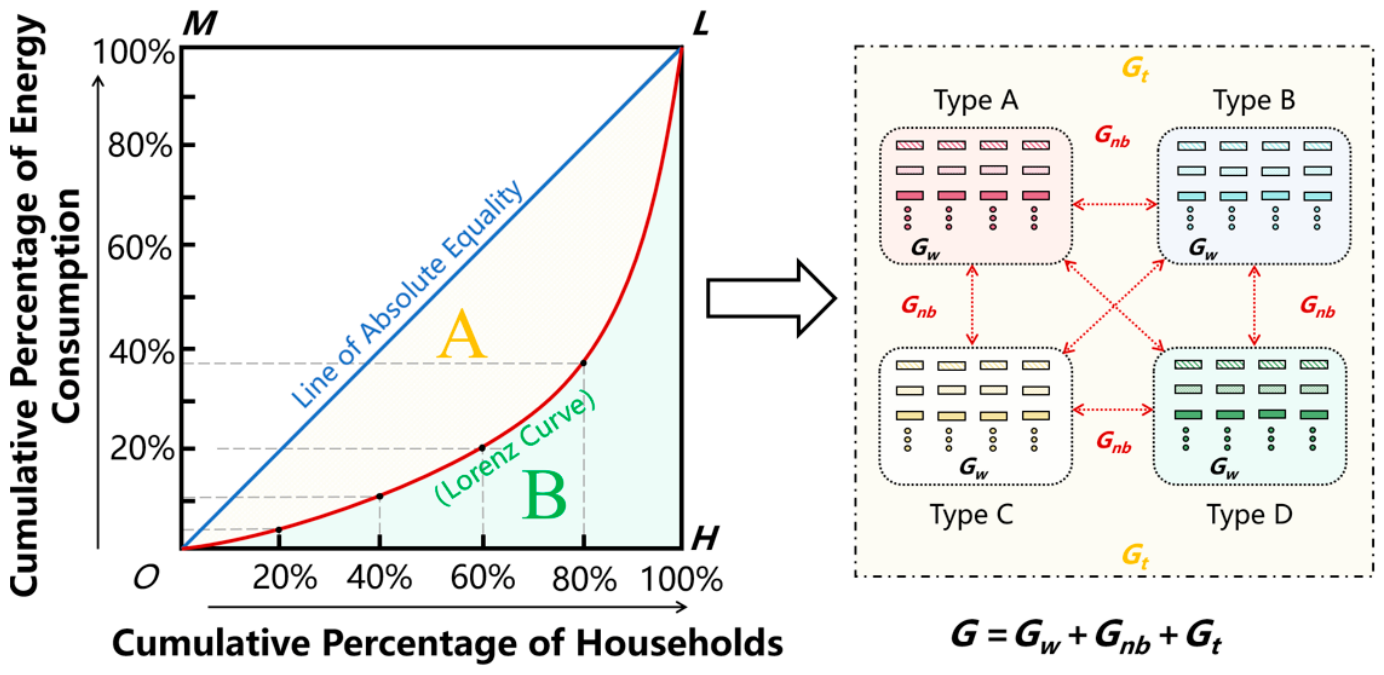
To evaluate and decompose household energy-use imbalance across different building prototypes, this study adopted the Dagum Gini coefficient decomposition method (
Figure 4). Compared with the conventional Gini coefficient, the Dagum method can further decompose the overall disparity into intra-group disparity, inter-group net disparity, and transvariation density [
61]. Therefore, it is suitable for identifying whether energy-consumption imbalance mainly originates from differences within the same prototype building type, differences among different prototype building types, or overlapping distributions between groups. The measurement process consists of four main steps.
Step 1: Classification of building prototypes and household energy-use samples.
All household samples were classified into four prototype building types according to their morphological and construction characteristics. Each prototype building type was regarded as one subgroup in the Dagum Gini decomposition framework. The household energy-consumption value of the -th household in prototype building type is denoted as , where = 1, 2, …, , and represents the number of prototype building types. This step provides the basic grouping structure for comparing energy-consumption differences within and among prototype building types.
Step 2: Calculation of overall energy-use imbalance.
The overall Dagum Gini coefficient was calculated to measure the overall degree of energy-use imbalance across all household samples. The overall Gini coefficient is expressed as follows:
where
denotes the overall Gini coefficient;
and
represent the household energy-consumption values in prototype building types
and
, respectively;
is the mean household energy consumption of all samples;
is the total sample size; and
and
are the numbers of samples in prototype building types
and
, respectively.
The value of
ranges from 0 to 1. A larger value indicates a higher degree of energy-consumption imbalance, whereas a smaller value indicates a more balanced energy-consumption distribution [
62].
Step 3: Decomposition of intra-group, inter-group, and overlapping disparities.
The overall Gini coefficient was decomposed into three components: intra-group disparity, inter-group net disparity, and transvariation density. The decomposition relationship is given by the following:
where
denotes the intra-group disparity,
denotes the inter-group net disparity, and
denotes the transvariation density.
The intra-group disparity reflects the energy-consumption differences among households within the same prototype building type. It is calculated as follows:
where
represents the Gini coefficient within prototype building type
;
is the sample share of prototype building type
;
is the energyconsumption share of prototype building type
; and
is the average household energy consumption of prototype building type
.
The inter-group Gini coefficient between prototype building types
and
is calculated as follows:
where
represents the energy-consumption disparity between prototype building types
and
, and
and
are the average household energy-consumption values of the two prototype building types.
To distinguish the net difference between groups from the overlapping effect of their distributions, the relative influence coefficient,
, is introduced:
where
represents the relative influence between the energy-consumption distributions of prototype building types
and
;
denotes the mathematical expectation of all positive differences between the two groups;
denotes the mathematical expectation of all reverse differences caused by distributional overlap; and
and
are the cumulative distribution functions of prototype building types
and
, respectively.
Based on
, the inter-group net disparity and the transvariation density are calculated as follows:
The inter-group net disparity, , reflects systematic differences in energy consumption among different prototype building types, while the transvariation density, , captures the overlapping effects of energy-consumption distributions between groups. A higher transvariation density indicates that the energy-consumption distributions of different prototype buildings are highly mixed, suggesting that building type alone cannot fully explain energy-consumption imbalance.
Step 4: Identification of imbalance sources and retrofit implications.
The contribution rate of each component to the overall Gini coefficient was calculated to identify the dominant source of energy-consumption imbalance:
where
denotes the contribution rate of component
to the overall Gini coefficient; and
represents one of the three decomposed components, namely intra-group disparity (
), inter-group net disparity (
), and transvariation density (
).
4. Results
Section 4 is organized into four subsections. The first subsection characterizes the seasonal distribution of household EUI across the four prototype buildings. The second subsection examines energy-consumption imbalance within the same prototype building type and decomposes its sources. The third subsection compares energy-consumption imbalance among different prototype building types and identifies the dominant target groups for retrofit intervention. The final subsection further analyzes the relationship between energy-consumption benchmarks and Gini coefficients to clarify whether benchmark-based assessment can sufficiently represent energy-use distributional fairness.
4.1. Energy-Consumption Distribution of the Four Prototype Buildings
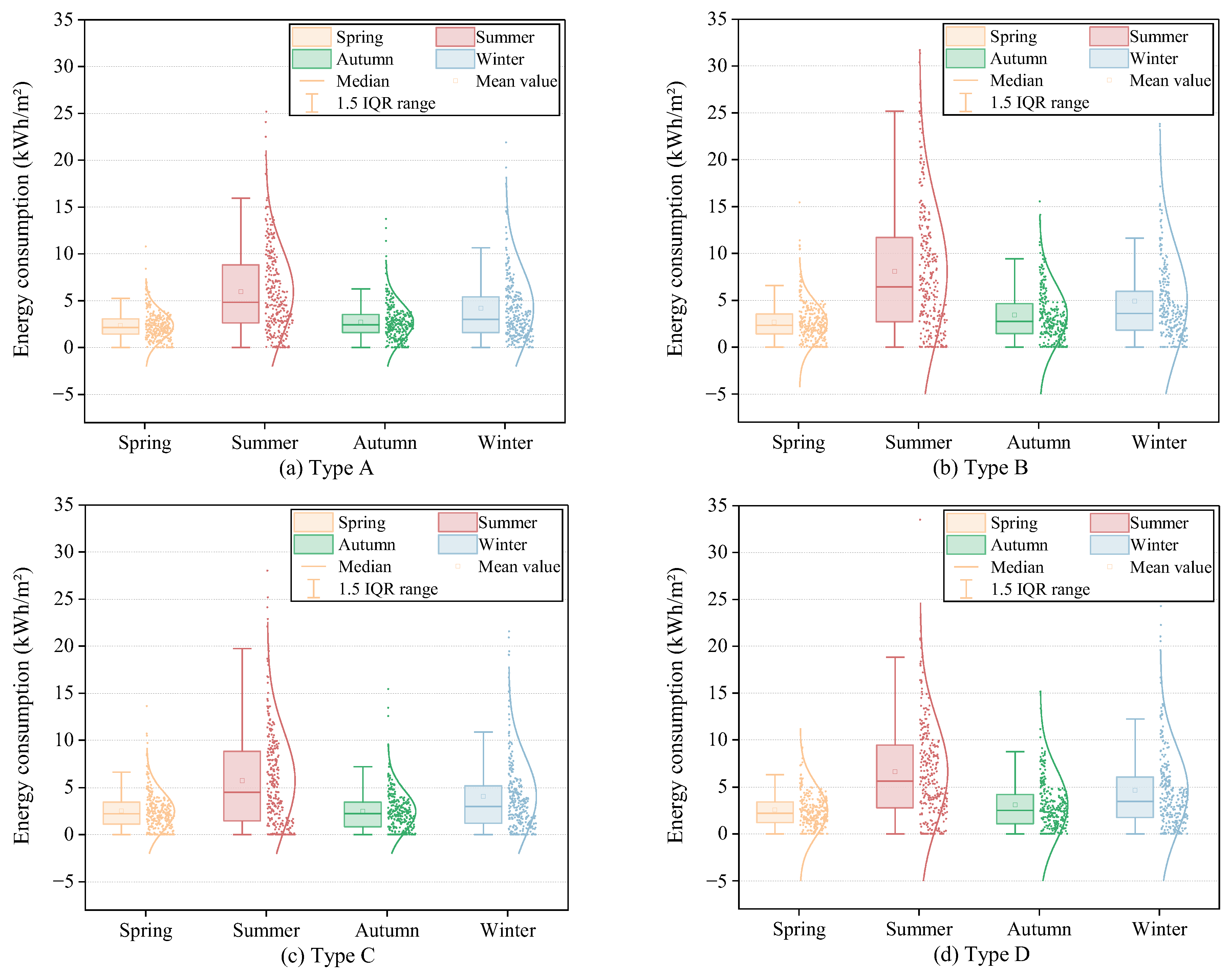
Figure 5 shows the distribution of household EUI for building Types A, B, C, and D, respectively. Across all four prototype buildings, summer records the highest mean, median, and maximum EUI, followed by winter, while the transition seasons show the lowest values. This seasonal pattern is consistent with the climatic characteristics of the hot-summer and cold-winter zone. In Chongqing, the average temperature in the hottest summer month reaches 36.4 °C, which substantially increases cooling demand and results in higher summer energy consumption than in other seasons. This consistency supports the climatic plausibility of the monitored energy-use patterns.
EUI also varies considerably within the same prototype building type, especially in summer and winter. For Type A buildings, the EUI ranges are 24.06 kWh/m2 in summer and 21.90 kWh/m2 in winter. Notably, high EUI is still observed in some households during the transition seasons. For example, the maximum transition-season EUI of Type A buildings is 13.73 kWh/m2, more than twice its mean summer value of 6.37 kWh/m2. This indicates that household-level energy consumption cannot be fully explained by seasonal cooling or heating demand alone.
Marked differences are also observed among building types. For instance, the summer EUI range of Type B buildings reaches 49.63 kWh/m2, far exceeding that of Type C buildings, which is 25.57 kWh/m2. These results suggest that household EUI exhibits pronounced heterogeneity both within the same prototype building type and among different prototype building types.
4.2. Comparison of Energy-Consumption Imbalance Within the Same Building Type
To examine energy-consumption imbalance within the same prototype building type, each building type was treated as a population, and each individual building was regarded as an independent subgroup.
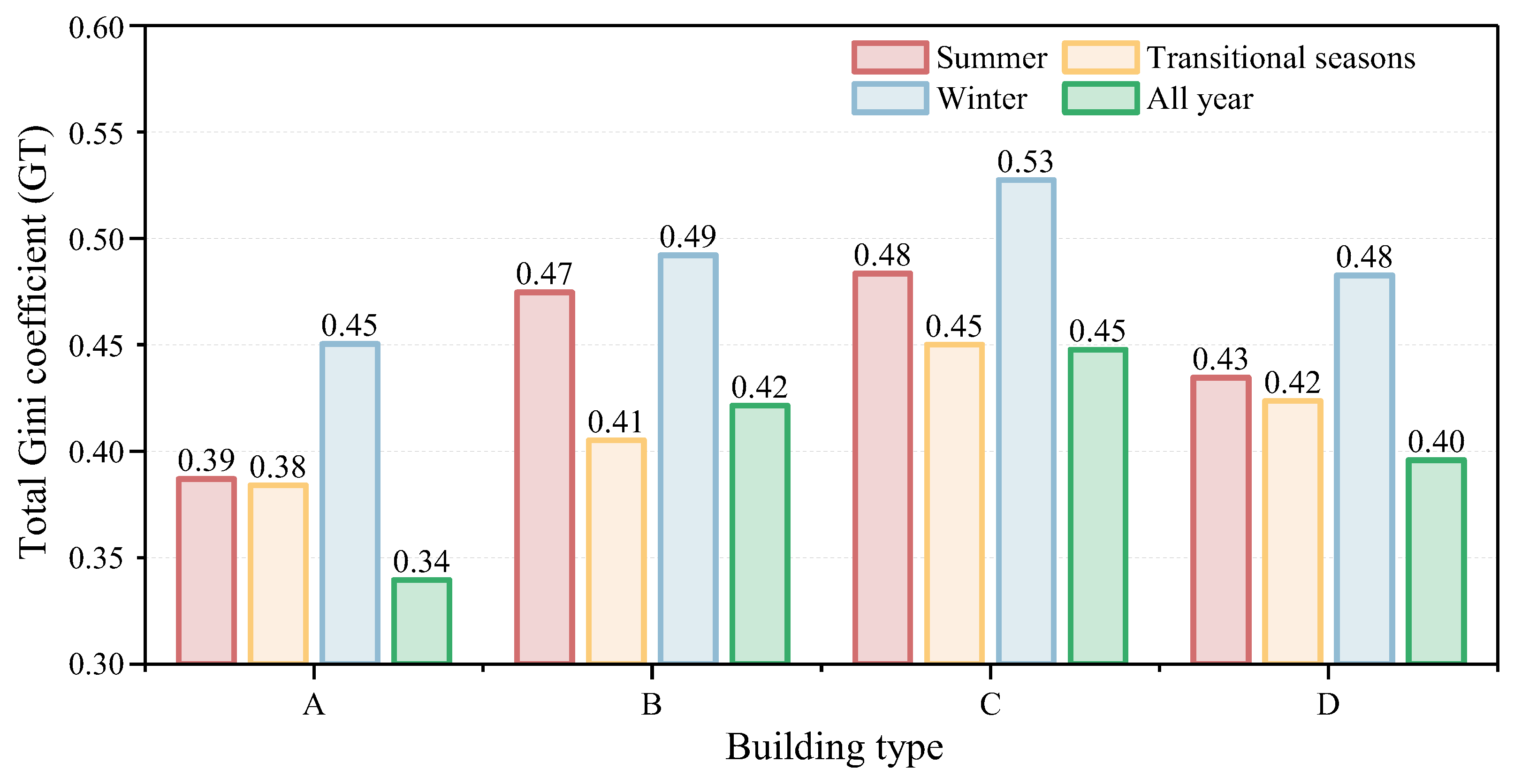
Figure 6 presents the overall Gini coefficients of Types A, B, C, and D across different seasons. From a temporal perspective, the degree of imbalance follows a generally consistent order across all building types: winter > summer > transition seasons > annual average.
This result is noteworthy because the mean value and distribution range of EUI are higher in summer than in winter. The higher winter Gini coefficient may be explained by greater behavioral differentiation in winter energy use. During extremely hot summers, most households tend to use cooling equipment because high temperatures pose direct risks to thermal comfort, health, and safety. In contrast, winter heating demand is more discretionary. Although the average temperature in the coldest month is approximately 3 °C, households may respond differently: some use air conditioning to improve indoor thermal comfort, while others rely on adaptive behaviors such as wearing more clothes or using thicker bedding. As a result, winter energy use shows stronger household-level differentiation. During the transition seasons, energy use is less dominated by space cooling or heating and is more closely related to daily lifestyle and appliance-use habits, leading to a lower level of imbalance.
To further identify the sources of imbalance within each building type, the overall Gini coefficients of Types A, B, C, and D were decomposed.
Table 3 reports the contribution rates of intra-group disparity, inter-group net disparity, and transvariation density. Across all building types and periods, the within-building contribution GwG_wGw is relatively small, whereas the combined contributions of inter-building net disparity and distributional overlap are substantially larger. This indicates that energy-use imbalance within each prototype category is associated more strongly with differences and overlapping distributions among individual buildings than with household-level disparities within the same building.
This pattern is particularly evident for Type B buildings, for which the contribution of inter-group net disparity reaches 50.15% in summer and 49.20% annually. Type C buildings also show high inter-group contributions during the transition seasons and winter. These results imply that even when buildings belong to the same prototype category, building-level characteristics, such as orientation, microclimatic exposure, envelope condition, floor composition, and occupancy structure, may still generate significant energy-consumption disparities. Therefore, retrofit strategies based solely on prototype classification may overlook important differences among individual buildings within the same category.
4.3. Comparison of Energy-Consumption Imbalance Among Different Building Types
To examine energy-consumption imbalance among different prototype building types, all 1024 households were treated as one population, and each prototype building type was regarded as one subgroup.
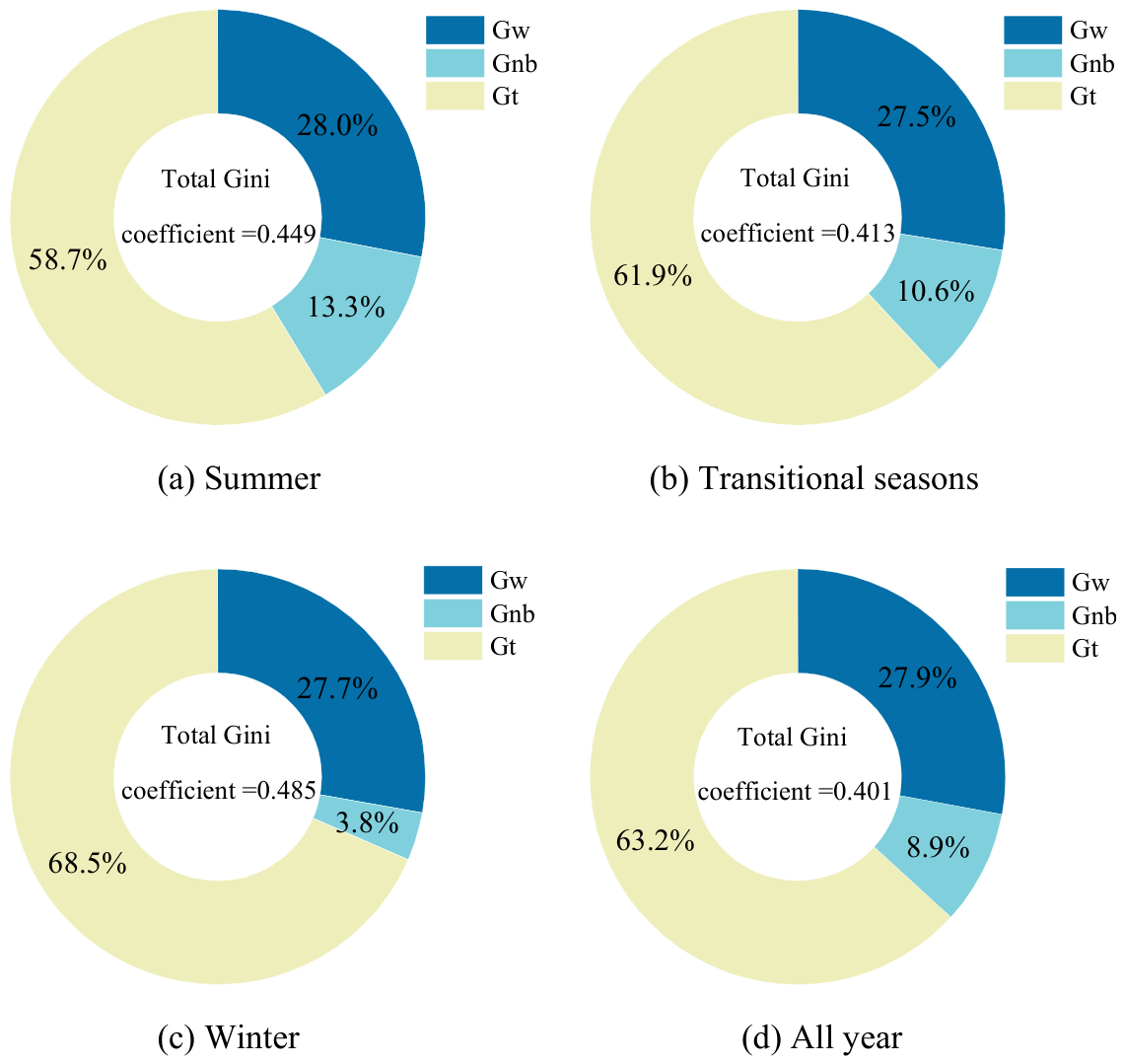
Figure 7 presents the decomposition of the overall Gini coefficient for all samples. The overall Gini coefficients are 0.449 in summer, 0.413 in the transition seasons, 0.485 in winter, and 0.401 on an annual basis. The imbalance level follows the order of winter > summer > transition seasons > annual average, consistent with the within-type analysis.
However, the source of imbalance changes when all building types are considered together. In this case, intra-group disparity exceeds inter-group disparity, indicating that EUI varies more strongly within the same prototype building type than among different prototype building types. This finding suggests that prototype classification can explain part of the energy-consumption variation, but it cannot fully capture the internal heterogeneity of household energy use. In other words, the same prototype building type may still contain households with substantially different energy-use patterns.
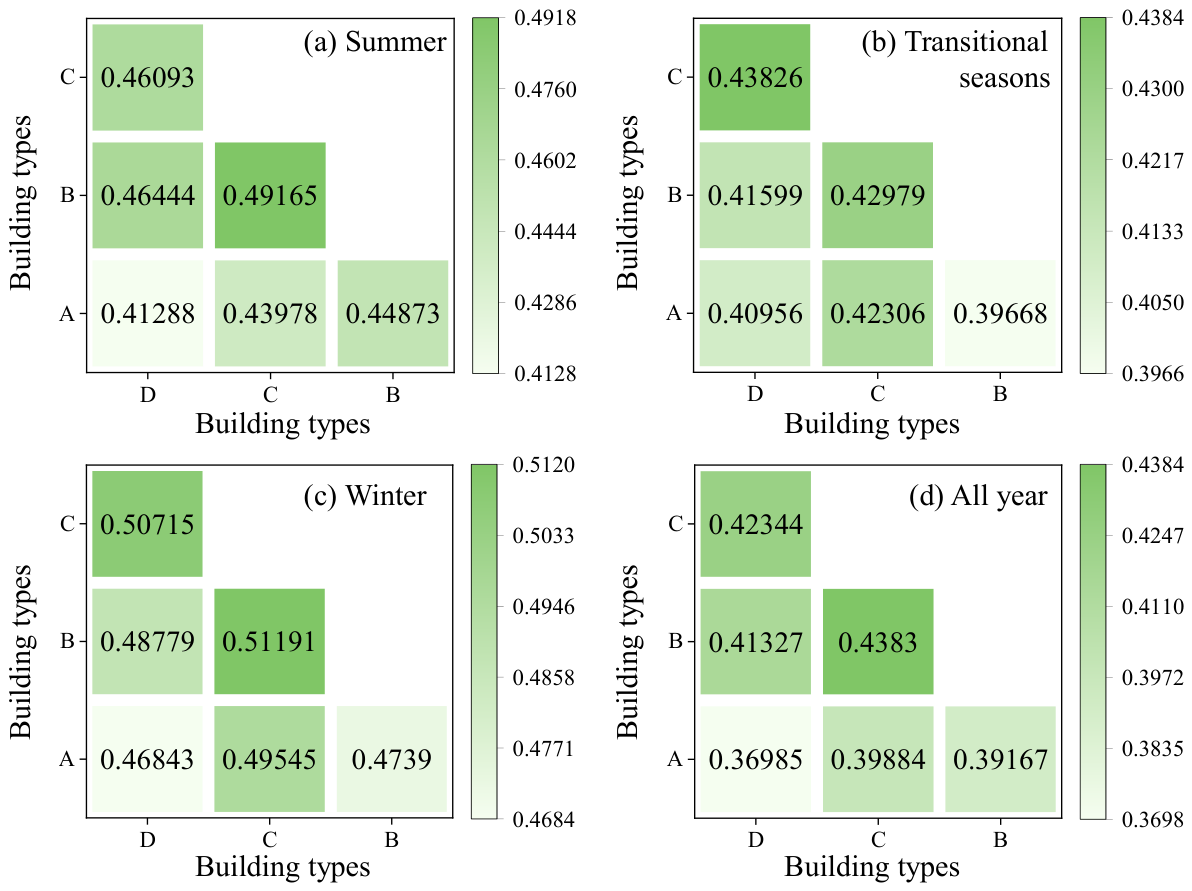
Figure 8 further compares the pairwise disparities in EUI among different prototype building types. During the transition seasons, the largest disparity occurs between Type D and Type C buildings. In summer, winter, and the annual period, the largest disparities occur between Type B and Type C buildings, with Gini coefficients of 0.49, 0.51, and 0.44, respectively. These results identify the Type B–Type C pair as a key source of between-type disparity and suggest that these categories warrant particular attention in subsequent retrofit diagnosis.
The pairwise results also show that disparities among building types are more pronounced in winter and summer than in the transition seasons. This reflects the stronger influence of space heating and cooling demand on energy-use differentiation. Nevertheless, the dominant building-type pairs may vary across cities due to differences in climate, building stock composition, household behavior, and socio-economic conditions. Therefore, improving energy-consumption balance among prototype buildings requires the prior identification of key building types and dominant disparity sources in each local context.
4.4. Relationship Between Energy-Consumption Benchmark and Gini Coefficient
Previous studies have commonly used median energy consumption to define energy-consumption benchmarks for prototype buildings across different temporal periods. Such benchmarks provide a useful reference for evaluating building energy performance and identifying retrofit potential. However, benchmark-based assessment mainly reflects the central tendency of energy consumption and does not necessarily capture the distributional fairness of energy use.
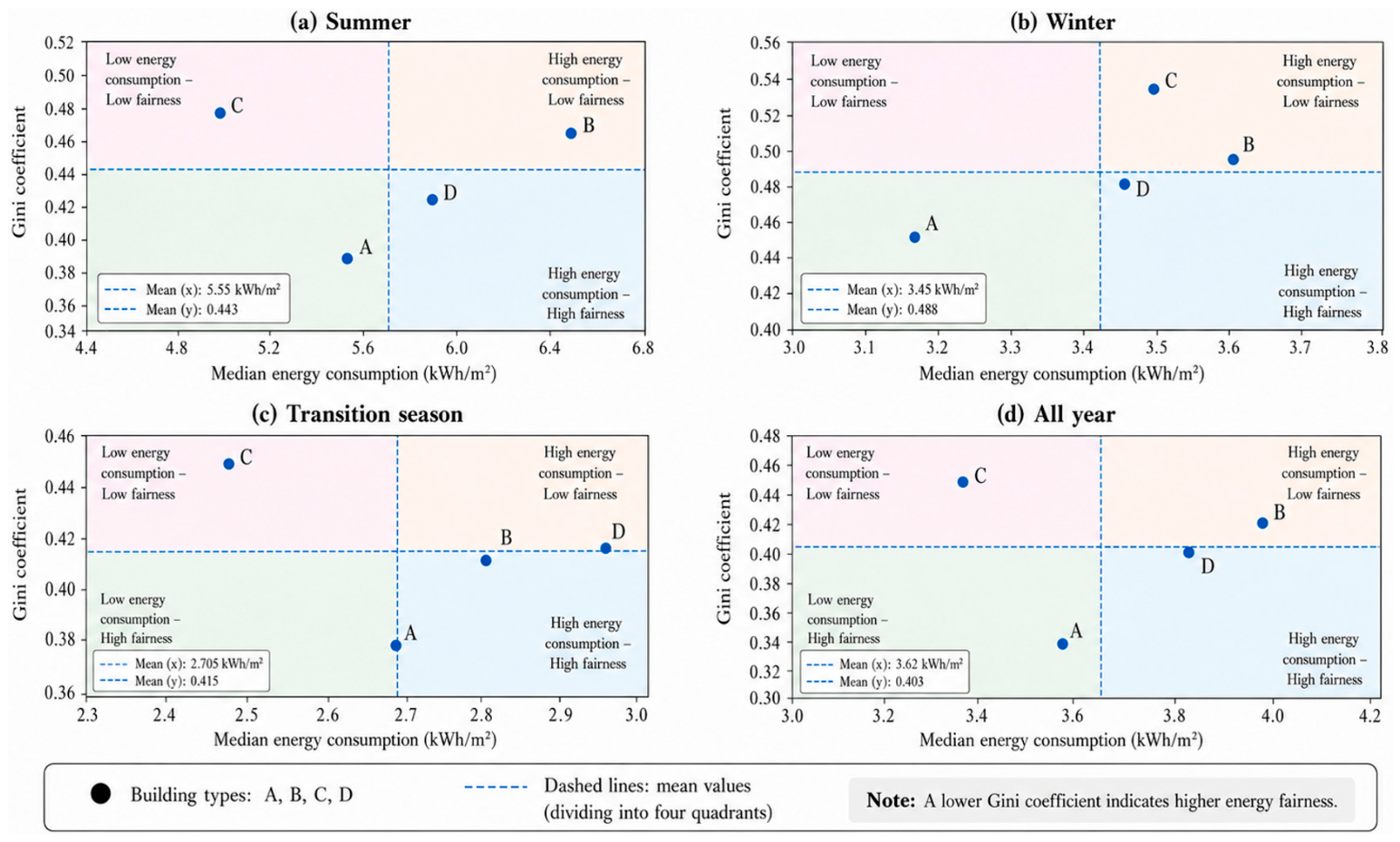
To examine this limitation, this study compares the median EUI and Gini coefficients of Types A, B, C, and D across summer, winter, the transition season, and the whole year. The results are presented in
Figure 9. The findings show that the building type with the highest median EUI does not necessarily have the highest Gini coefficient. For example, Type B buildings have the highest annual median EUI among the four types, at 3.89 kWh/m
2, but their Gini coefficient is not the highest. In contrast, Type C buildings have the lowest annual median EUI, at 3.28 kWh/m
2, while their Gini coefficient reaches 0.45, the highest among all building types.
A similar pattern is observed in summer. Type B and Type C buildings have the highest and lowest median EUI, at 6.45 kWh/m2 and 4.75 kWh/m2, respectively. However, their Gini coefficients are very close, at 0.47 and 0.48. In winter, Type C also shows the highest Gini coefficient, while Type B records the highest median EUI. These results indicate that high benchmark energy consumption and high internal imbalance do not necessarily occur in the same building type.
The transition-season results further support this finding. Although transition-season EUI is generally lower than summer and winter EUI, evident differences in energy-use fairness remain. Type C still falls into the low-energy-consumption but low-fairness quadrant, with the highest Gini coefficient among the four types. Type B and Type D show relatively higher median EUI, whereas Type A remains in the low-energy-consumption and high-fairness quadrant. This indicates that household-level energy-use imbalance is not limited to peak cooling or heating periods; it also exists during seasons with relatively low overall energy demand.
Overall, the mismatch between median EUI and Gini coefficient indicates that energy-consumption benchmarks alone cannot adequately represent energy-consumption imbalance. A building type with a relatively low benchmark may still contain highly unequal household energy-use patterns, while a building type with a high benchmark may not necessarily exhibit the greatest internal imbalance. These findings highlight the need to integrate energy-consumption benchmarks with distributional-fairness indicators.
5. Discussion
5.1. Necessity of Incorporating Energy-Use Balance Analysis
Advancing “cognitive innovation” is essential for building climate-adaptive societies [
63], in which accurate assessment constitutes a key component in formulating targeted management strategies [
64]. The mismatch between median EUI and Gini coefficients indicates that energy-consumption benchmarks alone are insufficient for diagnosing the retrofit needs of old residential buildings. Median EUI captures the central tendency of energy use but does not reveal how consumption is distributed among households or whether the distribution is balanced within and across building prototypes. Type B buildings had the highest annual median EUI but not the greatest imbalance, whereas Type C buildings had the lowest median EUI and the highest Gini coefficient. Thus, a high energy benchmark does not necessarily indicate severe distributional inequality, and a low benchmark does not guarantee a balanced energy-use distribution.
This finding is particularly relevant for old residential communities, where observed energy consumption may reflect not only building performance but also household affordability, comfort expectations, occupancy patterns, and adaptive behavior. Previous research on energy poverty and indoor thermal comfort has shown that insufficient household energy use may reflect affordability constraints, inadequate energy services, or poor indoor environmental conditions, rather than high building efficiency alone [
65,
66]. Conversely, high energy use may be associated with poor envelope performance, but it may also reflect longer occupancy duration, higher comfort expectations, or greater appliance ownership. Therefore, directly equating low consumption with efficiency and high consumption with inefficiency may lead to inappropriate retrofit prioritization. Occupant-related characteristics, including age, income, family size, occupancy schedules, appliance ownership, and heating or cooling habits, may also contribute to the observed differences in household energy use. These factors were not independently quantified in the present study and should therefore be further examined through household surveys and time-use investigations in future research.
Energy-consumption balance analysis provides an important supplement to benchmark-based assessment by shifting the diagnostic focus from “how much energy is consumed” to “how energy consumption is distributed”. The Dagum Gini decomposition further identifies whether imbalance mainly originates from within-group disparity, between-group disparity, or distributional overlap. When within-group disparity dominates, building- or household-level heterogeneity should be considered; when between-group disparity is more important, interventions at the prototype or building-group level may be more appropriate. Therefore, incorporating distributional fairness into building energy assessment is not merely a methodological extension, but a necessary step toward more precise, equitable, and socially responsive retrofit prioritization. This argument is consistent with recent studies emphasizing that residential retrofits should address not only energy waste but also affordability, comfort, and social equity [
67].
5.2. Dual-Benchmark Diagnostic Framework for Retrofit Prioritization
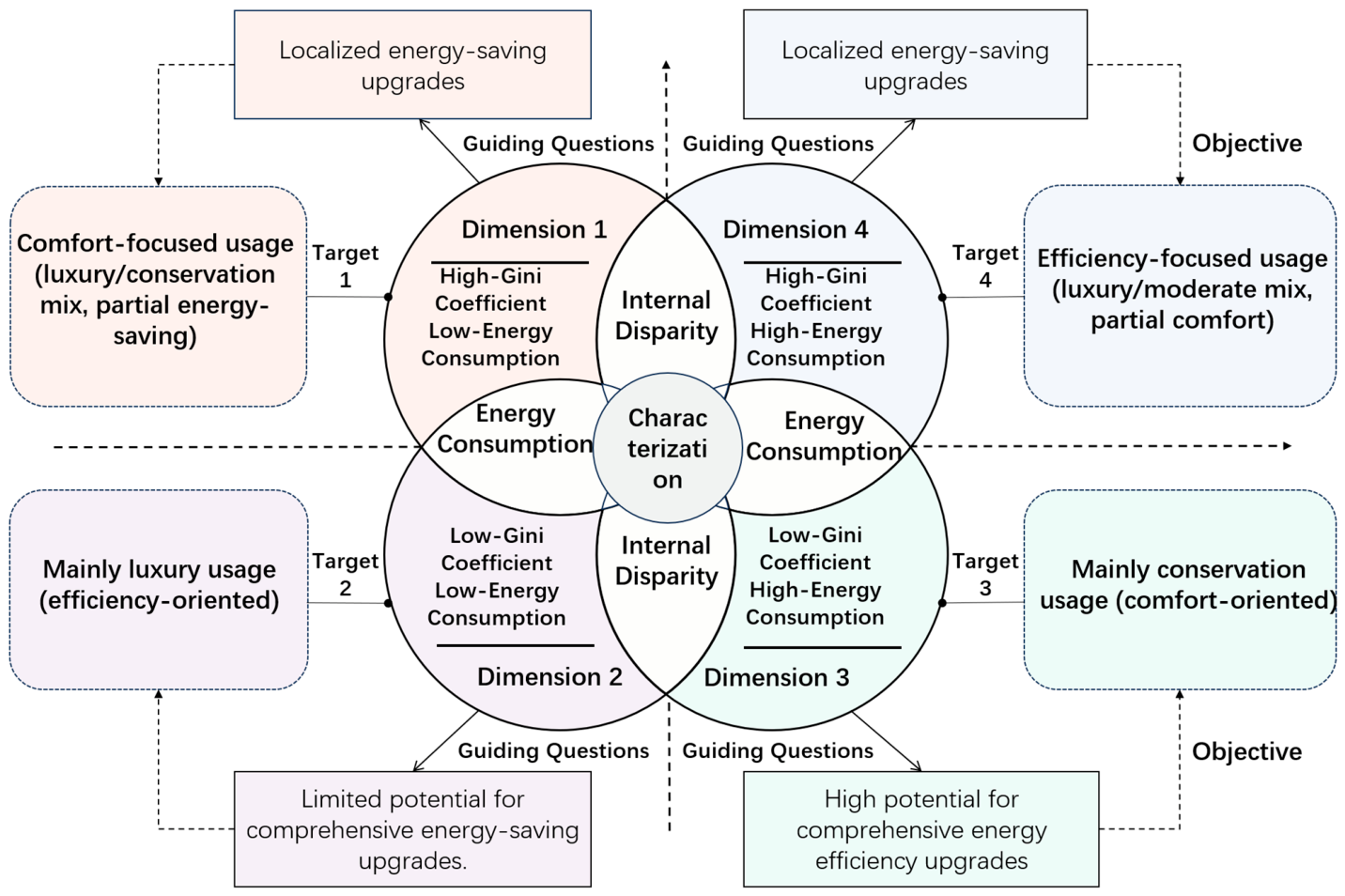
Based on these findings, this study proposes a dual-benchmark diagnostic framework integrating the energy-consumption benchmark with the distributional-fairness benchmark. The former describes the overall energy-use level, whereas the latter reflects how evenly energy use is distributed among households. Their integration enables retrofit decision-making to move from single-index screening toward diagnosis-oriented classification (
Figure 10).
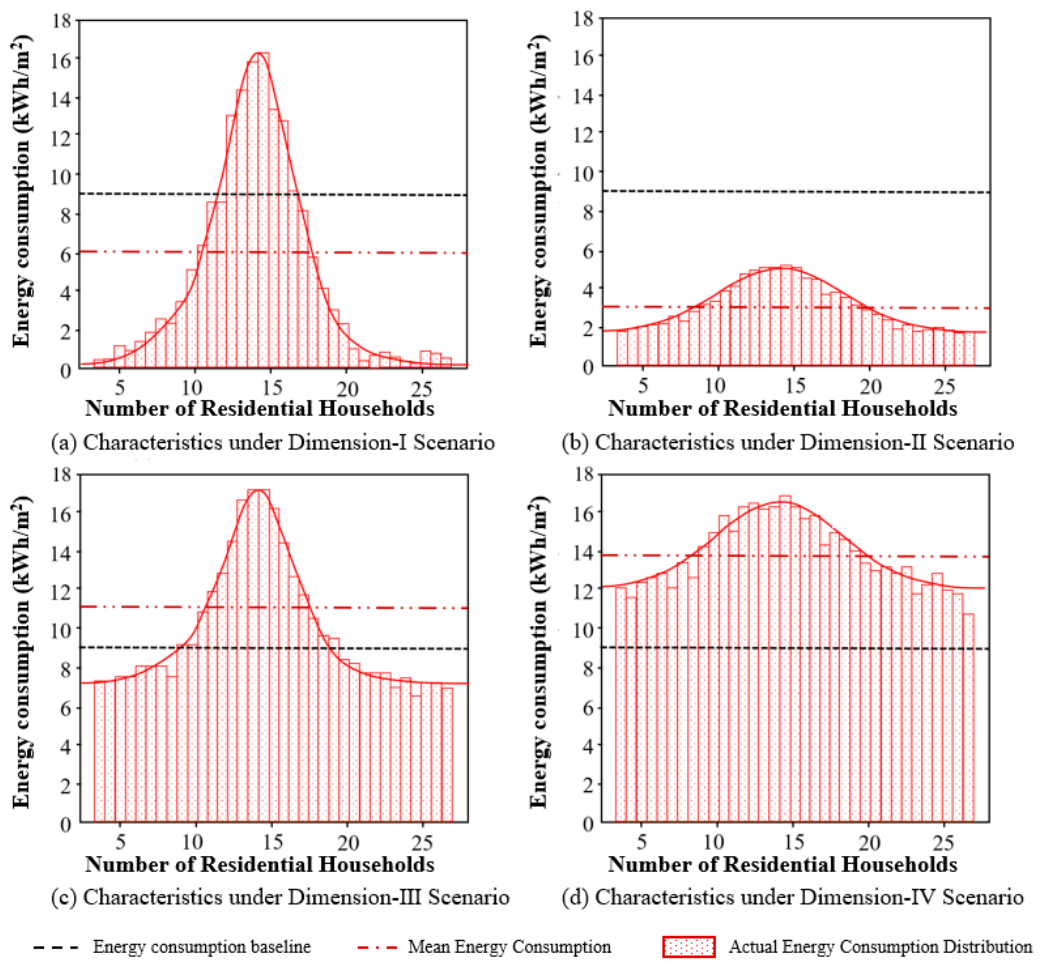
Four diagnostic categories are identified (
Figure 11). Dimension I represents low energy consumption and low fairness. These buildings should not be excluded from retrofit consideration solely because of their low benchmark values; localized and differentiated interventions may be required to address both extremely low-consumption households and localized high-consumption households [
68]. Dimension II represents low consumption and high fairness. Uniformly low consumption may indicate good performance, but it may also reflect shared under-consumption or adaptation to inadequate indoor conditions. Comfort verification, household visits, and welfare-oriented support may therefore be more appropriate than large-scale energy-saving retrofits [
69,
70].
Dimension III represents high consumption and high fairness, indicating a relatively systematic building-level efficiency problem. Whole-building measures, such as envelope insulation, window replacement or upgrading, roof insulation, equipment upgrading, and operational guidance, should therefore be prioritized [
71]. Dimension IV represents high consumption and low fairness, where high overall use coexists with substantial internal disparity. This condition requires a combined strategy integrating whole-building measures with targeted household- or unit-level interventions [
72].
The framework does not imply that whole-building envelope upgrades are technically ineffective or universally unnecessary. Rather, it distinguishes technical feasibility from retrofit urgency, expected marginal benefit, and intervention scale. Buildings or household groups with similar energy-use characteristics may be assigned common targets and retrofit packages, whereas substantial internal differences indicate that standardized measures should be supplemented by localized, household-targeted, or comfort-oriented interventions.
Particular caution is required for persistently low-consumption groups. If low consumption reflects satisfactory performance, extensive retrofit may provide limited additional savings. If it reflects suppressed demand, affordability constraints, or inadequate thermal comfort, further reductions in energy use may be an inappropriate objective. In such cases, basic-performance improvement, comfort verification, or welfare-oriented support may be more suitable than advanced energy-saving measures.
The dual-benchmark framework therefore prevents low-consumption buildings from being automatically classified as efficient, and high-consumption buildings from being treated as the only retrofit priority. It clarifies whether the principal concern is high overall consumption, internal imbalance, or their coexistence, supporting a transition from efficiency-only assessment toward equitable and sustainable renewal [
73,
74,
75].
5.3. Refined Energy-Efficiency Retrofit Pathway
Building on the dual-benchmark framework, the refined retrofit pathway translates equity-oriented diagnosis into an implementable retrofit process. Conventional retrofit practices often identify high-consumption buildings, apply standardized measure packages, and estimate expected savings. Although efficient for large-scale implementation, this approach assumes that buildings of the same type have similar retrofit potential and respond similarly to the same measures.
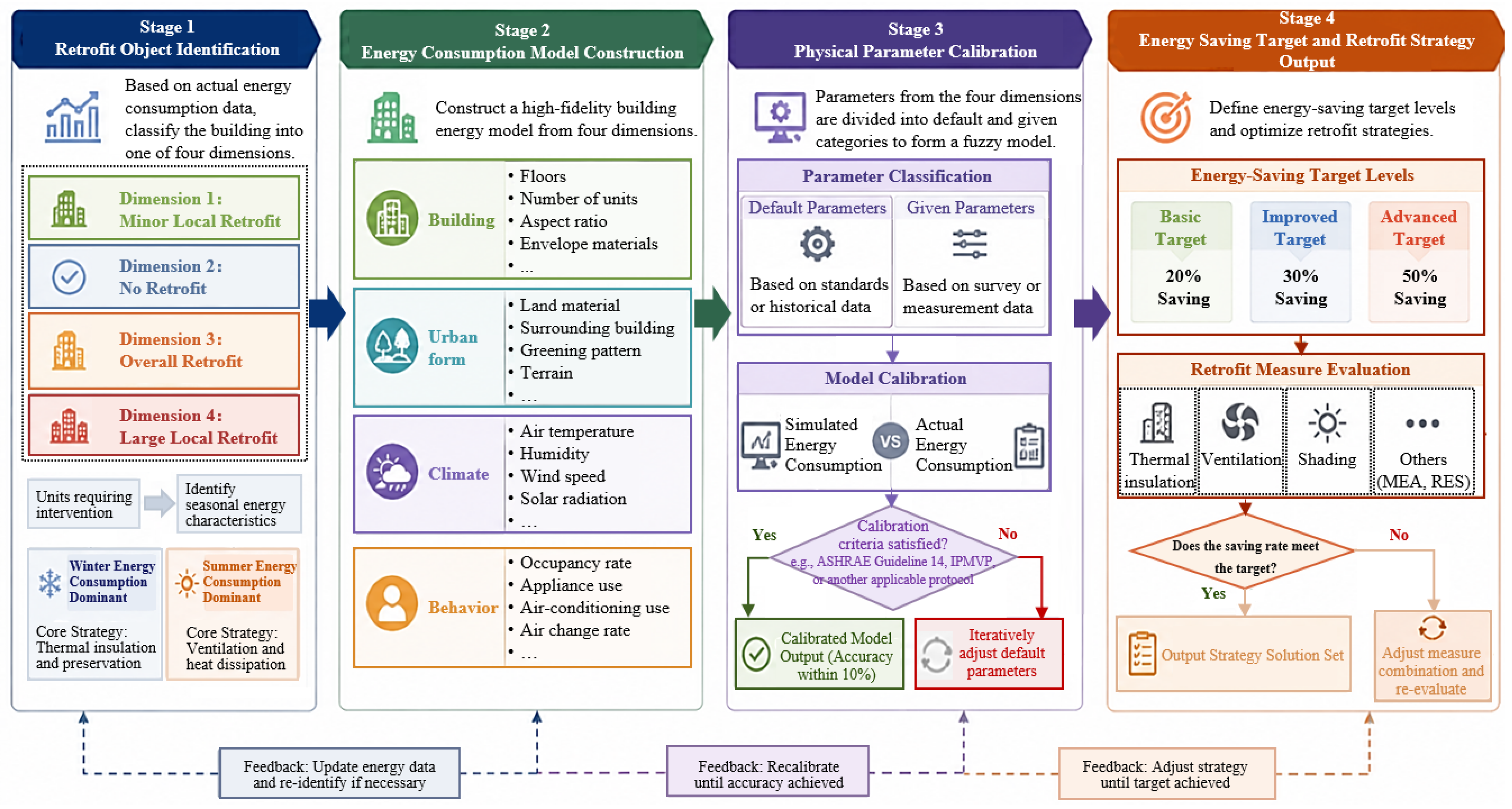
Standardized packages remain appropriate where buildings or households exhibit sufficiently similar energy-use characteristics and retrofit needs. However, the observed intra-type imbalance and overlapping energy-use distributions indicate that some old residential buildings cannot be treated as homogeneous retrofit objects. Pronounced internal differences require further subdivision of retrofit objects and differentiated intervention targets. The proposed pathway therefore begins with retrofit-object identification rather than direct measure selection (
Figure 12).
Based on actual energy-consumption data and the dual-benchmark diagnosis, buildings are first classified into four intervention categories: minor local retrofit, no large-scale retrofit, overall retrofit, and large-area local retrofit. These categories reflect both the overall energy-use level and the degree of internal imbalance, enabling the intervention scale to be matched to actual conditions. Apartment location should also inform measure selection. Concentrated high energy use in top-floor, ground-floor, corner, or otherwise highly exposed units may justify localized measures, whereas broadly distributed high consumption may indicate the need for whole-building retrofit. Seasonal characteristics then refine the technical direction: winter-dominated buildings should prioritize heat preservation and envelope insulation, whereas summer-dominated buildings should focus on ventilation, solar shading, heat dissipation, and cooling-load reduction.
After the retrofit object is identified, the pathway proceeds to refined energy-model construction and calibration. Model calibration is an integral component of the proposed pathway, although it was not implemented for specific buildings in the present empirical analysis. Its implementation requires fine-grained electricity data, indoor temperature and humidity measurements, building-envelope information, equipment characteristics, and occupancy and operation schedules. Unlike generalized archetype models, which may simplify microclimatic exposure, envelope degradation, operational patterns, and occupant behavior [
76,
77], the proposed model integrates building, environmental, climatic, and behavioral parameters. Known parameters are obtained from drawings, surveys, monitoring records, or field measurements, whereas uncertain parameters are iteratively adjusted to reduce discrepancies between simulated and measured energy use and indoor environmental conditions. Calibration quality should be evaluated using the statistical indicators and acceptance criteria specified in ASHRAE Guideline 14, IPMVP, or another applicable protocol. If the selected criteria are not satisfied, the uncertain parameters should be further adjusted; once the criteria are satisfied, the calibrated model should be validated using an independent monitoring period before retrofit scenarios are evaluated. This protocol-based approach allows the calibration criteria to be adapted to different data resolutions, building conditions, and project objectives while maintaining a consistent calibration and validation process. This process converts a generalized prototype model into a more building-specific representation and reduces the risk of overestimating energy savings or selecting measures inconsistent with actual operating conditions [
78,
79].
The final stage is energy-saving target setting and retrofit strategy development. Here, the pathway should not be understood as a pursuit of the maximum possible energy-saving rate. Aggressive retrofit targets may increase costs, reduce affordability, or fail to address households with suppressed energy demand. Instead, the calibrated model is used to test different retrofit scenarios, such as basic, intermediate, and advanced performance targets, and to evaluate single or combined measures, including envelope insulation, roof improvement, window replacement, solar shading, natural ventilation optimization, equipment upgrading, and operational management. If a strategy fails to meet the selected target, the measure combination is adjusted and re-evaluated; if it meets the target, it enters the feasible strategy set. More importantly, the final decision should balance energy-saving potential, comfort improvement, economic feasibility, implementation difficulty, and distributional impact. This logic is consistent with recent studies emphasizing that retrofit prioritization should integrate energy performance, affordability, comfort, and equity considerations rather than relying solely on technical energy-saving potential [
73,
74]. In this sense, the refined pathway forms a closed loop of diagnosis–modeling–calibration–strategy optimization. It extends the dual-benchmark framework from the diagnosis of energy-use imbalance to the formulation of targeted retrofit actions, and supports a transition from standardized energy-saving packages to adaptive, evidence-based, and equity-oriented retrofit strategies for old residential communities.
5.4. Limitations and Future Developments
Several limitations should be acknowledged. First, this study focuses on diagnosing energy-consumption imbalance and supporting retrofit prioritization, whereas the energy-saving potential of specific retrofit measures has not yet been quantitatively evaluated. Future studies should combine calibrated simulation, life-cycle assessment, and cost–benefit analysis to assess the carbon-reduction potential, economic feasibility, comfort improvement, and distributional effects of different retrofit strategies.
Second, although the relatively stable occupational composition of the sampled communities improves comparability across building types, the predominance of university staff limits the socio-economic representativeness of the dataset. The findings should therefore be interpreted as evidence of energy-use distributional imbalance within a relatively controlled residential sample rather than as representative of the broader residential population of Chongqing. Future studies should test the framework in communities with more diverse occupations, income levels, family structures, and affordability conditions.
Third, detailed occupant characteristics, behavioral variables, energy-affordability indicators, and apartment-level spatial information were unavailable in the administrative dataset. The present analysis therefore identifies the extent and structure of energy-use imbalance but cannot isolate the independent effects of apartment location, occupant behavior, socio-economic conditions, or their interactions. The proposed distributional-fairness benchmark should consequently be understood as an indicator of energy-use distribution rather than a comprehensive measure of energy justice. Future work should integrate household surveys, apartment-level spatial attributes, socio-economic data, and indoor environmental monitoring to clarify the spatial, behavioral, and affordability-related mechanisms that underlie energy-use imbalance.
6. Conclusions
This study used monitored electricity-consumption data from 1024 households across four representative old residential building types in Chongqing. Median energy use intensity was adopted as the energy-consumption benchmark, while Dagum Gini coefficient decomposition was applied to assess energy-use imbalance and identify its sources. The results show that energy-consumption benchmarks alone are insufficient for determining retrofit priorities because they reflect overall energy-use levels but not how energy consumption is distributed among households. Energy-use imbalance varied across building types and seasons, and its sources differed across analytical scales, revealing substantial building- and household-level heterogeneity.
More importantly, energy-use levels were not directly aligned with distributional fairness. Type B had the highest annual median EUI, at 3.89 kWh/m2, but did not exhibit the highest Gini coefficient. In contrast, Type C had the lowest annual median EUI, at 3.28 kWh/m2, but the highest Gini coefficient, at 0.45. This mismatch indicates that high energy consumption does not necessarily correspond to severe distributional imbalance, while relatively low consumption does not always indicate a balanced energy-use distribution or satisfactory energy performance. Retrofit priorities should therefore not be determined solely by conventional energy-consumption benchmarks.
Based on these findings, this study developed a dual-benchmark diagnostic framework that integrates energy-use levels with distributional fairness. The framework distinguishes whether the primary retrofit concern is high overall consumption, internal imbalance, or the coexistence of both, thereby supporting differentiated retrofit strategies. It also extends conventional prototype-based assessment by demonstrating that buildings within the same prototype category should not automatically be treated as homogeneous retrofit objects.
For local government decision-making, retrofit prioritization should move beyond a single energy-consumption benchmark and incorporate both building-level and household-level energy-use distributions. Local authorities should establish more detailed energy-monitoring databases, apply differentiated diagnostic criteria, and avoid uniform retrofit packages. Buildings characterized by high consumption and low fairness should receive priority for combined whole-building and targeted household interventions, whereas low-consumption but highly unequal buildings should first undergo household surveys and thermal-comfort assessments to identify possible suppressed demand. Retrofit funding and technical measures should therefore be allocated according to the identified diagnostic categories, supporting more precise, equitable, and sustainable renewal of old residential communities.