Article

Analysis of Older Adults’ Recognition of Information Signs Based on a Questionnaire and Eye-Tracking Experiment—Focusing on Older Adults Living in Public Rental Apartment Complexes


by
Seungyeon Park
and
Seokjin Kang
*
School of Architecture, Gyeongsang National University, 501, Jinju-daero, Jinju 52828, Gyeongsangnam-do, Republic of Korea
*
Author to whom correspondence should be addressed.
Buildings 2026, 16(12), 2434; https://doi.org/10.3390/buildings16122434
Submission received: 17 April 2026 / Revised: 11 June 2026 / Accepted: 16 June 2026 / Published: 18 June 2026
(This article belongs to the Special Issue Age-Friendly Built Environment and Sustainable Architectural Design)

Abstract

This study examined how older adults living in public rental apartment complexes perceive and interpret information signs related to wayfinding, facility use, and safety. A questionnaire survey was conducted with 80 residents aged 65 years and older in two public rental apartment complexes in Nowon-gu, Seoul, and 12 participants with varying levels of cognitive function were selected for an eye-tracking experiment. The survey identified small sign and font sizes, insufficient color contrast and clarity, and inappropriate installation locations as the main problems. Time to First Fixation (TTFF) and dwell time were analyzed. Signs with clearer contrast against the background and increased sign size tended to elicit more favorable visual responses, whereas adjusting font size alone had limited effects. Heat map and scan path analyses also showed that the cognitively impaired group had more widely dispersed visual exploration patterns. Due to the limited sample size, statistical significance could not be sufficiently verified, and the findings cannot be generalized. Nevertheless, older adults’ subjective perceptions did not always correspond to the objective experimental results. Information sign improvements should therefore consider both rapid detection and ease of reading.

1. Introduction

The 2025 survey data reported that the population aged 65 years and older in South Korea exceeded 20.3% of the total population, surpassing 10 million people, thereby suggesting that the country had entered a super-aged society according to the United Nations classification [1]. Older adults generally show a decline in spatial cognition and physical ability and are also susceptible to economic difficulties [2,3]. Therefore, there has been a trend toward continuing to live in a safe, familiar environment as part of the aging in place (AIP) paradigm [4,5,6]. To improve the residential stability of socially vulnerable groups, the government has been implementing policies to increase the supply of public rental apartments, which allow long-term residence [7].
The quality of life of older adults is closely related to the safety of residential spaces, the level of amenities, and the degree of interaction with neighbors [8,9,10,11]. In Korea, public rental apartment complexes are equipped with safety elements such as CCTV, security systems, and security personnel. They also include outdoor spaces for walking, exercise, and rest, as well as social welfare centers that provide welfare services, making them an important housing type for economically vulnerable older adults [12]. However, for older adults with declining physical or cognitive function, their daily activity range may be limited to the public rental apartment complex itself [13]. As the scale of the complex increases or circulation routes become more complicated, access to daily amenities and outdoor spaces may be restricted, and the clarity of information may decline, which can negatively affect residential satisfaction [14].
People perceive and use spaces and facilities based on cues from the environment and their personal experiences, and information signs function as important media for conveying them. In particular, information signs installed in the outdoor spaces of public rental apartment complexes support residents’ movement, spatial cognition, and facility use. By providing information on directions, buildings, amenities, and crime-prevention facilities such as CCTV and emergency bells, these signs can also be used to support walking activities and responses to emergency situations [15].
Because the efficiency with which information signs convey information varies depending on font size, color contrast, information content, and installation location, older adults whose visual perception and information-processing abilities have declined with age may perceive and respond to information signs differently from the general population [16]. Therefore, inappropriate information signs in older public rental apartment complexes may not sufficiently reflect the psychological and behavioral characteristics of older adults, while the surrounding environments may also be inadequately maintained, potentially causing inconvenience or safety problems [17,18]. In particular, when older adults have difficulty recognizing information signs or experience increased cognitive load during the process of reading, they may repeatedly revise their movement routes or spend unnecessary time lingering [19]. This may lead to an increased risk of safety accidents or anxiety in places such as stairs, entrances, and blind spots [20].
To analyze the causes of these problems and explore improvement strategies, an increasing number of studies have used eye-tracking and VR experiments to quantitatively analyze human visual perception and information-processing characteristics [21,22,23,24]. Eye-tracking has the advantage of objectively measuring aspects that are difficult to capture through questionnaires, such as how quickly participants detect information signs (initial detection) and how long their gaze remains on the information signs or their content (sustained attention and reading). It can also continuously record the natural flow of participants’ gaze [25]. This approach allows continuous recording of natural gaze movements while minimizing participant burden [25]. In particular, older adults may experience difficulties in recognizing and reading information due to declines in visual perception and slower information-processing speed. Therefore, eye-tracking, which can directly examine these characteristics, is a valid research method for studies involving older adults [26].
Accordingly, this study aims to identify problems in information signs and explore improvement strategies by comparing older residents’ perceptions of information signs in public rental apartment complexes, obtained through a questionnaire survey, with their information recognition and judgment processes examined through an eye-tracking experiment. The questionnaire survey collected subjective data, including sign-use experience, satisfaction, and perceived problems, while the eye-tracking experiment provided objective data, including initial detection, sustained attention, and information reading.
This exploratory study highlights the value of examining the relationship, as well as potential discrepancies, between older adults’ subjective questionnaire responses regarding what is “easy to perceive” and their objective eye-tracking data. The findings may provide basic data for planning information signs that older adults can detect quickly and read easily in public rental apartment complexes, directly contributing to the advancement of Sustainable Development Goal 11 (Sustainable Cities and Communities) by fostering inclusive, age-friendly living environments. To reflect these objectives, the following research questions were formulated:
(Q1) How do older adults residing in public rental apartment complexes perceive and evaluate (satisfaction and problems) information signs of various types?
(Q2) Do older adults show differences in time to first fixation and total gaze time for specific design elements of information signs?
(Q3) Are there discrepancies between the results of the questionnaire survey for information signs (qualitative assessment) and the eye-tracking experiment (quantitative assessment)?

2. Materials and Methods

2.1. Questionnaire Survey

2.1.1. Survey Setting and Participants

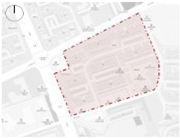
The research sites were two public rental apartment complexes in Nowon-gu, Seoul, that were completed more than 30 years ago. Among the 25 autonomous districts of Seoul, Nowon-gu was considered an appropriate study area because it has a particularly high proportion of apartment-dwelling residents aged 65 years and older, exceeding 90%, as well as a high proportion of older adults living in public rental apartment complexes [27]. The selected complexes consist of multiple residential blocks, diverse outdoor spaces, and a social welfare center; accordingly, information signs play a particularly important role in supporting residents’ movement and use of facilities within the complex. The questionnaire survey was conducted with 80 older adult residents aged 65 years and older (40 from each complex) who regularly used the social welfare center and outdoor spaces. In Korea, social welfare centers are installed in public rental apartment complexes above a certain size in accordance with the public housing operational guidelines and function as facilities providing customized welfare services for low-income residents, older adults, and persons with disabilities. Accordingly, older adults with limited activity ranges often spend a substantial portion of their daytime in these centers. With the cooperation of the welfare center administrators, participants for both the questionnaire survey and the eye-tracking experiment were recruited in accordance with the relevant procedures. As these participants had accumulated residential experience within the complex, they were considered capable of providing meaningful perceptions and evaluations of the information signs.
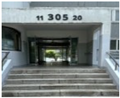
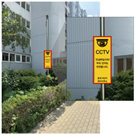
The characteristics of information signs at the study sites were examined in field surveys and are summarized in Table 1. In Complex A, the building/unit number information signs are a similar color to the entrance canopy and are severely damaged, making them difficult to perceive. The direction information signs had problems with content size and the height of installation. The CCTV information signs showed appropriate visibility and information legibility but were installed at inconsistent heights in different locations. In Complex B, the color of the building/unit number signs was strongly contrasted with the entrance canopy colors, meaning that they could be clearly perceived. The direction information signs showed good visibility, as the color was contrasted with the surrounding environment, but the signs themselves were too small. The CCTV information signs were installed 1.5–1.7 m above ground level and used text colors that contrasted with the surrounding environment, ensuring easy identification.

2.1.2. Questionnaire Content and Procedure

The questionnaire survey was conducted between 19 July and 23 July 2025, by three surveyors, through 1:1 interviews with older adults at the social welfare center or in outdoor spaces (walking paths, rest spaces, playgrounds, etc.) at each complex. To select the questionnaire survey participants, potential participants were first informed of the study objectives, questionnaire content, the voluntary nature of participation, and the ability to withdraw at any time, and only persons who consented were included in the survey.
The questionnaire items assessed perception experience, satisfaction, and perceived problems for each type of information sign: building/unit number signs, directional signs, and CCTV signs. Recognition experience was measured using items designed to identify how often respondents had encountered each sign in their daily lives, based on a three-point scale: “never seen,” “sometimes seen,” and “often seen.” Satisfaction was measured for four elements—content, color, form, and placement—using a five-point scale ranging from “very dissatisfied” to “very satisfied.” The perceived problems of information signs were examined through multiple-choice questions intended to identify elements requiring improvement, such as font size, color contrast, installation height, and number of signs.
Additionally, descriptive statistical analysis and cross-tabulation analysis were conducted using SPSS Statistics (IBM Corp., Armonk, NY, USA) to identify satisfaction levels and perceived problems for each type of information sign and to derive design elements to be examined in the eye-tracking experiment.

2.2. Eye-Tracking Experiment

2.2.1. Experimental Setting and Participants

The participants in the eye-tracking experiment were 12 older adults selected from among 14 questionnaire respondents who agreed to participate in the experiment and were judged to be able to respond appropriately to the experimental stimuli. To select the final participants, images of each type of information sign in each apartment complex were presented to the 14 participants, and the functions and contents of the signs were explained before conducting the eye-tracking experiment. During the calibration process of the eye-tracking device, participants were asked to visually track circular target points sequentially presented on the screen. This procedure was used to determine whether each participant’s gaze could stably follow the target points. However, two participants’ gaze did not sufficiently follow the target points, or excessive tracking loss occurred due to factors such as blinking, making it impossible to extract reliable gaze data. Accordingly, the final experimental sample consisted of 12 participants, with one participant from each remaining category, totaling six participants from each apartment complex, including three men and nine women.
The experiment was conducted in an isolated space inside the social welfare centers, and illumination and indoor environmental conditions were kept constant to minimize interference by external visual stimuli. For the experimental apparatus, a monitor-mounted eye-tracker (Lite 120, EyeLogic GmbH, Berlin, Germany; 120 Hz) and analytical software (InsightLab, EyeLogic GmbH, Berlin, Germany) were used.
Additionally, before the main experiment, a simple visual acuity check was conducted to confirm whether participants could read the experimental stimuli, namely the information sign images, at a viewing distance of approximately 40–50 cm from the monitor screen. This was an important prerequisite for ensuring the quality of the experimental data because frequent blinking may increase the likelihood of missing data in optical eye-tracking and thereby affect data analysis [28].

2.2.2. Experiment Contents and Protocol

The experiment was conducted in the social welfare center of each apartment complex from 14 to 15 October 2025. Prior to the experiment, participants were informed of the study purpose, experimental procedures, the policy for the collection and use of personal information, and compensation, and written informed consent was obtained. The study was conducted following approval from the Institutional Review Board (IRB approval no.: GIRB-B25-NY-0109). Participants’ basic information, including age and sex, was collected, and cognitive function was assessed using the Korean version of the Mini-Mental State Examination for Dementia Screening (MMSE-DS). The MMSE-DS has a maximum score of 30, with scores of 24–30 classified as no cognitive impairment, 18–23 as mild cognitive impairment, and 0–17 as severe cognitive impairment [29,30,31].
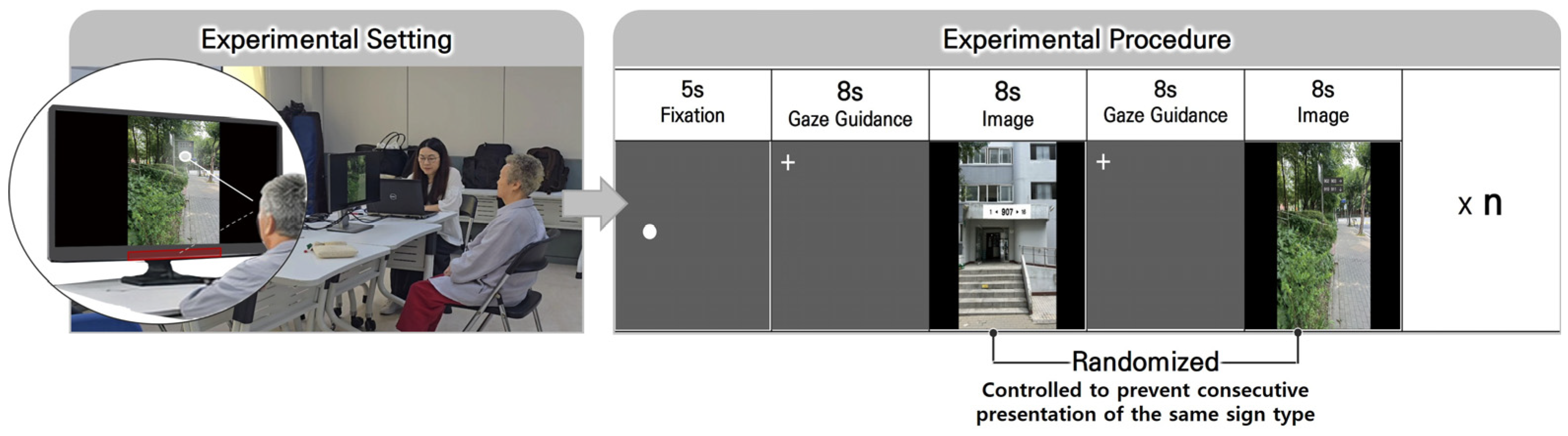
The experiment simulated a viewing distance of 5 m, and a total of 17 images were presented on the monitor. Before the experiment, participants were instructed to minimize head movement. Each experimental image was presented for 8 s, and the average experimental time per participant was approximately 15–20 min. In particular, between experimental images, a fixation point or neutral screen was presented for 8 s to allow gaze realignment and to reduce afterimages and carryover effects of the previous stimulus [25].
To reduce order effects in the experiment, the images were presented in a randomized order. However, because a completely random arrangement could result in the same type of information sign being presented consecutively, this study applied a restricted randomization method. Specifically, the images were arranged so that the same type of information sign was not presented consecutively, and the order was adjusted to prevent any particular type of information sign from being disproportionately presented at the beginning or end of the experiment. This procedure was intended to minimize the influence of previous stimuli as well as learning or fatigue effects associated with specific sign types.
After the experiment, a questionnaire survey and brief interview were conducted to assess the difficulty of recognizing the information sign images and identify elements requiring improvement. The experimental setting and protocol are shown in Figure 1.

2.2.3. AOI Setting and Interpretation of Gaze Metrics

In this study, the information sign area within each experimental image was defined as the Area of Interest (AOI). The AOI was set to include the outer boundary of the area where sign information was presented, and a consistent rectangular shape was applied to enable comparisons across the different image conditions [31]. Gaze data were extracted and organized using InsightLab (EyeLogic GmbH, Berlin, Germany; https://www.eyelogicsolutions.com/products/eye-tracking-software/insightlab/, accessed on 7 April 2025), and data with poor calibration quality or excessive tracking loss were excluded from the analysis.
The main indicators used in the experiment were TTFF and dwell time for each image. TTFF refers to the time required for the gaze to first enter the AOI after the stimulus is presented, and it is used to analyze initial image recognition and the efficiency of visual exploration [32,33].
Dwell time refers to the total amount of time that the gaze remained within the AOI during the period in which the information was presented. It is used to analyze the maintenance of participants’ attention and the process of information confirmation [25]. In this study, a shorter TTFF was interpreted as suggesting that the information sign was detected relatively quickly, whereas a longer dwell time was interpreted as suggesting that the process of information confirmation within the AOI continued for a relatively longer period [32]. However, a longer dwell time alone cannot be regarded as evidence that the corresponding information sign was more effective or appropriate. An increase in dwell time may indicate sustained information reading, but it may also result from a complex information structure or delayed visual understanding. Because TTFF and dwell time reflect different stages of cognitive processing, they must be interpreted carefully. Therefore, rather than interpreting TTFF and dwell time separately, this study examined how rapid initial detection was related to subsequent information confirmation. Additionally, the visual cognitive characteristics of information signs were interpreted by considering the results of the post-experiment questionnaire survey and brief interview.
Furthermore, heat map and scan path analyses were conducted to supplement the interpretation of visual exploration tendencies by group. However, because the experimental sample was small and statistical significance testing was limited, these analyses were used only to illustrate supplementary visual tendencies, and not to imply broader group differences beyond exploratory patterns.
Finally, data analysis was conducted by first examining the descriptive statistical results for each type of information sign and its detailed design elements. Differences were then examined using paired-sample t-tests or nonparametric tests, taking into account the repeated-measures structure of the experiment. Subsequently, the post-experiment questionnaire results were comprehensively interpreted together with the experimental results to examine the degree of correspondence between subjective perceptions and eye-tracking indicators.

3. Results

3.1. Questionnaire Survey Results

3.1.1. Survey Sites and Participant Characteristics

Of the 80 questionnaire respondents, females (66 respondents, 82.5%) outnumbered males (14 respondents, 17.5%). The largest age group was 75–85 years (43 respondents, 53.8%), and 57 respondents (71.3%) had lived in the complexes for 15 years or longer, indicating a high proportion of long-term residents. Many long-term residents had sufficient experience with and repeated exposure to information signs within the apartment complexes, making them a veritable real-world setting to see how everyday familiarity affects their subjective judgments and visual habits. The demographic characteristics of the questionnaire respondents are summarized in Table 2.

3.1.2. Perception Experience and Major Problems for the Different Information Sign Types

In cross-tabulation analysis comparing information sign perception experiences between the complexes, there were statistically significant differences for the building/unit number and CCTV information signs (p < 0.01). Differences in perception may reflect factors such as sign location, design characteristics, and maintenance conditions, but the causes cannot be determined based on the questionnaire results alone. The weekly experiences of information sign perception in each complex are presented in Table 3.
Information sign satisfaction and problem areas were analyzed among respondents who had perceived the information signs (participants who reported never having perceived the signs were excluded). Independent-samples t-tests were used to compare the mean satisfaction scores for the four information sign elements (content, color, form, placement) between the two complexes, and differences in problem areas were identified using cross-tabulation analysis of multiple responses (multiple-choice items in the questionnaire). The mean satisfaction scores for the different elements of information signs are presented in Table 4.
First, for building/unit number signs, satisfaction scores for all four elements were higher in Complex B than in Complex A (p < 0.05). Complex A showed low satisfaction scores for color (M = 2.34), form (M = 2.71), and placement (M = 2.79), indicating a need for improvements. Problem area analysis also showed significant differences between the complexes in color and placement. Conversely, Complex B showed high satisfaction scores for color (M = 3.64), placement (M = 3.51), content (M = 3.49), and form (M = 3.41). For color problems in Complex A building/unit number signs, the most frequent responses were “difficult to distinguish sign from background” (23 respondents, 43.4%) and “color is faint or faded” (17 respondents, 32.1%), whereas the most common response in Complex B was “no problems” (26 respondents, 63.4%). For placement, the most common problems in Complex A were “placed too high or too low” (16 respondents, 32.7%) and “too few” (13 respondents, 26.5%), while the most frequent response in Complex B was “no problems” (25 respondents, 51.0%). There were no significant differences between the two complexes in content or form, but the most common problems were “small font” (Complex A: 19 respondents, 45.2%; Complex B: 15 respondents, 38.5%) and “too small” (Complex A: 21 respondents, 60.0%; Complex B: 18 respondents, 46.2%). The detailed problems with the elements of building/unit number signs are summarized in Table 5.
For the direction information signs, content was the only element that showed significantly higher satisfaction scores in Complex A (M = 3.58) than in Complex B (M = 2.68; t = 2.763, p = 0.008). The difference in color satisfaction approached significance (t = 2.015, p = 0.051). There were no significant differences between the two complexes in satisfaction scores for form or placement. Despite the large differences in satisfaction scores for direction information sign content, the most commonly reported problem in both complexes was “small font” (Complex A: 12 respondents, 66.7%; Complex B: 19 respondents, 67.9%). The detailed problems with the elements of direction information signs are summarized in Table 6.
Finally, the satisfaction scores for CCTV information signs showed no significant differences between the two complexes for any elements, but there was a significant difference in color-related problems (χ2 = 24.922, p < 0.001). In Complex A, the most frequently reported color issues were “color is faint or faded” (10 respondents, 41.7%) and “difficult to distinguish sign from background” (4 respondents, 16.7%), whereas the most common response in Complex B was “no problems” (19 respondents, 86.4%). For placement, the most reported problems in Complex A were “placed too high or low” (7 respondents, 26.9%) and “too few” (7 respondents, 26.9%), while the most common responses in Complex B were “no problems” (10 respondents, 38.5%) and “too few” (10 respondents, 38.5%).
Although content, form, and placement showed no significant differences between the two complexes, “small font” (Complex A: 7 respondents, 30.4%; Complex B: 10 respondents, 45.5%) and “too small” (Complex A: 12 respondents, 57.1%; Complex B: 7 respondents, 35.0%) were identified as problem areas in both complexes. The detailed problems with the elements of CCTV information signs are summarized in Table 7.

3.2. Stimulus Preparation for Eye-Tracking

The images in the eye-tracking experiment were developed based on relevant domestic and international prior studies, age-friendly and universal design guidelines, and the problems identified through the questionnaire survey. These images were designed to analyze how the design elements of each type of information sign influence older adults’ initial detection, sustained attention, and information reading. The operating standards used for each element of the information signs are summarized in Table 8.
The experimental images consisted of information signs examined in the questionnaire survey, including building/unit number signs, directional signs, and CCTV information signs. For the experiment, original images representing actual site conditions and manipulated images in which content, color, form, and location were adjusted step by step were prepared with the same size and resolution. In particular, to control the conditions of the experimental stimuli, all images were developed based on photographs taken from a distance of approximately 5 m [41].
In the manipulated images, the content was changed to a serif-free, Gothic-type font to improve legibility, the font size was increased, and the information structure was simplified. Additionally, pictograms were created using simple and intuitive elements to reflect the international standard for graphical symbols (KS S ISO 7001) [43].
Color was adjusted to increase the contrast between the background color and information color to improve legibility. For form, the size and compositional elements were adjusted to enable rapid perception at a given distance. For placement, information signs were moved to unobscured positions (e.g., by foliage, walls, or pillars), and height was adjusted based on a previous study reporting an ideal height of 1.0–1.1 m for older adults [44]. The height of the information signs was adjusted to a level that reflected older adults’ eye-level range, with reference to a previous study [44] and Korean anthropometric data [45]. However, because detailed anthropometric data for adults aged 70 years and older are limited, the available values for older adults aged 60–69 years (mean eye-level height: 154 cm for males and 142 cm for females) were used only as reference values.
Although the criteria for developing the experimental images were established as described above, the results should be interpreted with caution because multiple design elements were manipulated simultaneously in some images. Therefore, the experimental results in this study were not interpreted as the independent effect of a specific element, but rather as exploratory gaze responses to composite improvement alternatives. The manipulation details of the experimental images by sign type are presented in Table 9.

3.3. Eye-Tracking Experiment Results

Of the 12 participants, 9 were female (75.0%) and 3 were male (25.0%). By age group, 5 participants were aged 65–75 years (41.7%), 5 were aged 75–85 years (41.7%), and 2 were aged 85 years or older (16.7%). In terms of length of residence, the largest group had lived in the complexes for 15 years or longer (6 participants, 50.0%), followed by 5 years or less (4 participants, 33.3%) and 6–10 years (2 participants, 16.7%). The fact that most participants were long-term residents suggests that they had accumulated sufficient awareness of and experience with the residential environment and information signs within the complexes. Regarding cognitive function level, the participants were evenly divided into two groups: six participants with mild cognitive impairment (50.0%) and six participants without cognitive impairment (50.0%).
The eye-tracking experiment was conducted in a repeated-observation format, in which the same participants viewed multiple information sign images. However, the sample size was limited to 12 participants, and valid gaze data were missing under some image conditions. Therefore, this study did not interpret the eye-tracking results as definitive evidence for statistical generalization. Instead, they were used as exploratory data to complement the problems with information signs identified through the questionnaire survey.
In particular, the differences in TTFF and dwell time by information sign image, which are related to Research Question 2, were interpreted mainly based on descriptive statistics and visualization materials such as heat maps and scan paths. Rather than generalizing the effect of specific design elements, the results are presented as basic data for understanding and explaining older adults’ visual exploration tendencies. Because TTFF and dwell time reflect different stages of cognitive processing, their relationship was interpreted carefully alongside participants’ subjective evaluations. The demographic characteristics of the participants in the eye-tracking experiment are summarized in Table 10.
Because the experimental sample size was small and some conditions made it difficult to satisfy the assumption of normality, differences in TTFF and dwell time were examined using nonparametric tests. Additionally, considering that the same participants repeatedly observed multiple image conditions, the Friedman test was applied to examine the differences among image conditions for each type of information sign. When necessary, the Wilcoxon signed-rank test was used as a supplementary test. Differences between groups according to cognitive function level were examined using the Mann–Whitney U test.
The analysis showed that, in both Complex A and Complex B, differences in gaze metrics for building/unit number signs, directional signs, and CCTV signs were not statistically significant (p > 0.05). Differences according to cognitive function level were also not significant in the Mann–Whitney U test (p > 0.05). Additionally, statistical testing was limited for some items due to missing data or an insufficient number of valid samples.
Therefore, in this study, the results of the Friedman test, Wilcoxon signed-rank test, and Mann–Whitney U test were used only to examine whether statistical differences existed. The results for TTFF, dwell time, mean fixation duration, heat maps, scan paths, and the post-experiment questionnaire survey and interview were used as supplementary data to explain visual exploration tendencies according to the type of information sign. Accordingly, the results of this experiment were interpreted only as exploratory findings for understanding older adults’ cognitive characteristics in relation to information signs, rather than as definitive evidence of the effects of specific design manipulations. The Friedman test results for each information sign type are presented in Table 11.
In particular, in the cognitively impaired group, greater variability in attentional focus was observed, and some cases showed no observation of certain AOIs. Considering the small sample size, this may have limited the statistical significance of the results [25].
Therefore, as mentioned above, this study presents heat maps and scan paths as supporting visual evidence to examine visual exploration characteristics related to cognitive impairment status.
Heat maps visualize the distribution of attention by using different colors according to the density of the recorded gaze data [46]. Red areas indicate regions where gaze was maintained for a relatively longer time, whereas blue areas indicate regions with a shorter gaze duration. In Table 12, the red rectangle shown in the experimental image on the left indicates the AOI of the information sign, while the heat map in the cell on the right represents the visual responses, or visual exploration patterns, of the participants while viewing the monitor.
The heat map analysis of the CCTV information signs showed that the cognitively normal group tended to concentrate their gaze around the information signs, whereas the cognitively impaired group showed a tendency toward a more widely dispersed gaze pattern, extending not only to the information signs but also to surrounding environmental elements. In addition, some gaze data were observed even on the black screen outside the experimental image. Taken together, these findings may support the idea that the cognitively impaired group may have had relatively weaker attentional focus on the target information. However, because statistical significance was not verified in this experiment, the results cannot be generalized.
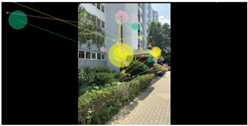
A scan path represents the sequence and pattern of gaze movement by displaying fixations as circles and saccades as lines [47,48]. Smaller circles indicate that fixation at a given point was relatively weaker or shorter in duration [47,48].
As shown in Table 13, the scan path analysis of the CCTV information signs indicated that the cognitively normal group showed a tendency to form relatively short and concentrated gaze paths around the information signs and adjacent information areas. Even in the manipulated images, participants’ gaze paths were observed to return to the vicinity of the information signs after passing through surrounding areas, which may reflect that target information-centered visual exploration was relatively stable.
In contrast, the cognitively impaired group showed a tendency toward gaze movements that were not limited to the areas around the information signs but extended to the upper part of the screen and surrounding background areas. The movements between fixation points also appeared relatively dispersed. This suggests that the process of exploring target information among older adults with cognitive impairment may be relatively nonlinear and dispersed.
However, because statistical significance was not established, these results should be treated as supporting visual evidence for inferring group-level visual exploration tendencies or interpreting visual characteristics.
Therefore, in the subsequent analysis, the relative tendencies observed in the AOI-based indicators of the information signs, including rapid detection and sustained attention, were examined, and the extent to which these tendencies corresponded to the subjective evaluation results obtained from the post-experiment questionnaire survey was reviewed.

3.3.1. Gaze Behavior Characteristics and Post-Test Evaluation for Building/Unit Number Information Signs in Complex A

  • AOI-based gaze behavior characteristics
Regarding the experimental images, the TTFF was fast for Image 3 (568 ms) and Image 2 (662 ms) and slow for Image 1 (1860 ms) and Image 4 (1645 ms). Dwell time was long for Image 3 (3626 ms), Image 1 (3593 ms), and Image 4 (3575 ms), suggesting that participants maintained attention within the AOI for a long time. Conversely, dwell time was short for Image 2 (2535 ms) and Image 5 (2262 ms), suggesting that the information signs in these images did not hold the participants’ attention. In summary, compared with the other image conditions, Image 3 recorded a shorter TTFF and a longer dwell time, indicating that participants showed a tendency to detect the information sign promptly and then continue checking the information. However, rather than definitively concluding that Image 3 was effective, this result should be interpreted as a case that showed a relatively favorable response during the visual exploration process. The building/unit number information sign images and eye-tracking results for Complex A are presented in Table 14.
Image 5 was prepared by increasing only the font size while maintaining the gray color in order to address the problem of “small font size” identified in the preliminary questionnaire survey. However, its dwell time was relatively short, suggesting that font size alone may not be a direct factor affecting information interpretation by older adults. In other words, it can be inferred that the participants’ process of identifying and understanding the information was affected by multiple conditions, including font size, color contrast, and visual separation from the background.
In Image 4, the contrast was strengthened using white and black, but TTFF remained slow, suggesting that contrast does not contribute strongly to immediate perception of information signs. Image 4 also showed the longest mean fixation duration (812 ms), suggesting that once participants noticed the image, they continued interpreting the information while maintaining fixation for a long time.
2.
Comparison with subjective evaluation via the post-test questionnaire
After the eye-tracking experiment, participants completed a questionnaire survey in which they selected the information signs they perceived most and second most easily. The most frequent choice for the top image was Image 4 (4 persons, 33.3%), and Image 3 was most frequently selected as the second-best image (4 persons, 33.3%). Although Image 3 had a short TTFF and long dwell time, it was not selected as the easiest image to perceive, likely because the post-test questionnaire required participants to compare and select from several image types simultaneously.

3.3.2. Gaze Behavior Characteristics and Post-Test Evaluation for Direction Information Signs in Complex A

  • AOI-based gaze behavior characteristics
Image 5 (538 ms) showed the fastest TTFF, while Image 4 (774 ms) and Image 6 (845 ms) were also perceived relatively quickly. In contrast, Image 1 (2710 ms) and Image 3 (2263 ms) showed a slow TTFF, indicating poor initial exploration efficiency. Dwell time was longest for Image 5 (5298 ms), suggesting that attention was maintained within the AOI for a long time. Dwell time was low overall for Images 1–4 and Image 6, and Image 4 in particular did not show a large increase in dwell time despite the short TTFF, demonstrating that “fast perception” does not necessarily result in “sustained attention.” The supplementary metric of mean fixation duration was also longest for Image 5 (883 ms), indicating rapid perception followed by relatively stable gaze fixation during the interpretation process. In summary, compared with Condition 4, in which color contrast was increased, Condition 5, in which form and size were emphasized, showed a shorter TTFF and the longest dwell time. This suggests a trend where adjusting the form of directional signs may support older adults’ initial detection and sustained attention. This result can be interpreted as showing that modifying the form of an information sign alone may produce noticeable differences in capturing older adults’ initial attention. However, because this result was based on a limited sample and descriptive statistics, it was interpreted only as an exploratory finding that may appear under specific design manipulation conditions. The direction information sign images and eye-tracking results for Complex A are presented in Table 15.
2.
Comparison with subjective evaluation via the post-test questionnaire
In the questionnaire, the most frequently selected image for ease of perception of the information sign was Image 6 (3 participants, 50.0%), followed by Images 1, 3, and 5 (each 1 participant, 16.7%). The most frequent choice for the second most easily perceived was Image 5 (2 participants, 33.3%), followed by Images 3, 4, and 6 (each 1 participant, 16.7%). Although Image 5 was the most quickly perceived and sustained attention for the longest in the eye-tracking results, this differed from the questionnaire findings, where Image 6 was selected as the easiest to perceive.

3.3.3. Gaze Behavior Characteristics and Post-Test Evaluation for CCTV Information Signs in Complex A

  • AOI-based gaze behavior characteristics
In the AOI-based analysis, the TTFF was fastest for Image 5 (794 ms), while Image 1 (4120 ms), Image 2 (4082 ms), and Image 3 (4123 ms) all showed TTFFs of over 4 s, demonstrating poor initial exploration efficiency. Dwell time was also longest for Image 5 (2938 ms), suggesting that attention was maintained within the AOI for the longest period. Image 1 (945 ms) and Image 6 (1267 ms) showed low dwell times, and Image 6 in particular was rapidly perceived but did not sustain attention.
In summary, Condition 5 showed a shorter TTFF and longer dwell time than the other image conditions, indicating that information confirmation tended to be sustained after initial detection. In contrast, Conditions 1–3 showed longer TTFF values, suggesting a potential trend toward a delay in initial visual exploration. As mentioned in the previous analysis, these differences were interpreted only as relative tendencies in gaze responses to the image conditions, rather than as statistically verified effects. The CCTV information sign images and eye-tracking results for Complex A are presented in Table 16.
2.
Comparison with subjective evaluation via the post-test questionnaire
In the questionnaire, the most selected image for ease of perception of the information sign was Image 6 (3 participants, 50.0%), followed by Image 4 (2 participants, 33.3%) and Image 3 (1 participant, 16.7%). The most frequent choices for the second most easily perceived were Images 4 and 6 (2 participants each, 33.3%), while 1 person each (16.7%) chose Image 1 or 2. In other words, participants evaluated Images 6 and 4 as highly visible information signs, whereas Image 5 was not selected as either the first- or second-ranked option. This indicates a discrepancy between the subjective evaluation and the AOI-based analysis results.

3.3.4. Gaze Behavior Characteristics and Post-Test Evaluation for Building/Unit Number Information Signs in Complex B

  • AOI-based gaze behavior characteristics
In the AOI-based analysis, TTFF was fastest for Image 5 (568 ms), while it took over 2 s to fixate on Image 2 (2295 ms), indicating poor initial exploration efficiency. Dwell time was longest for Image 5 (4096 ms), suggesting that attention was maintained within the AOI for the longest period.
However, for the building/unit number signs in Complex B, Condition 5 showed a shorter TTFF and longer dwell time than the other image conditions, indicating a relatively favorable gaze response. This differs from the results for Complex A. In Complex B, the original condition had a clear contrast between the color of the information sign and that of the entrance canopy, which may have allowed the sign to be clearly recognized through the manipulation of form and size alone. In contrast, in Complex A, the color contrast was relatively weaker, which may have led to differences even under the same image condition. The building/unit number information sign images and eye-tracking results for Complex B are presented in Table 17.
2.
Comparison with subjective evaluation via the post-test questionnaire
In the post-experiment questionnaire survey, Condition 4 was most frequently selected as the first-ranked “most visible information sign” by all six participants (100%), while Condition 5 was most frequently selected as the second-ranked option by five participants (83.3%). In the objective eye-tracking experiment, Condition 5 showed the shortest TTFF and the longest dwell time; however, it was not selected as the first-ranked option in the subjective questionnaire survey. This result is similar to the findings for the building/unit number signs in Complex A, suggesting that quantitative eye-tracking indicators and subjective evaluations based on human perception may not always correspond. Meanwhile, the longer dwell time for Condition 5 may indicate sustained attention for confirming the information on the sign. However, it may also reflect an increase in participants’ cognitive effort to examine the information structure or visual conditions. Therefore, because dwell time cannot be interpreted as a positive indicator on its own, multiple possibilities should be considered by comprehensively examining TTFF, mean fixation duration, and the results of the post-experiment questionnaire survey and interview.

3.3.5. Gaze Behavior Characteristics and Post-Test Evaluation for Direction Information Signs in Complex B

  • AOI-based gaze behavior characteristics
In the AOI-based analysis, TTFF was fastest for Image 4 (693 ms), while it took over 4 s to fixate on Image 3 (4306 ms), indicating poor initial exploration efficiency. Dwell time was longest for Image 5 (3020 ms), indicating sustained attention within the AOI. In summary, although Condition 4 showed a short TTFF, its dwell time was relatively short, suggesting that there may have been limitations in the process of reading the information content. When TTFF and dwell time are considered together, Condition 5 can be interpreted as showing relatively favorable responses in terms of participants’ sign detection and sustained attention. However, this interpretation is limited because it is based on a small sample and descriptive statistics.
2.
Comparison with subjective evaluation via the post-test questionnaire
In the questionnaire, the most frequently selected image for ease of perception of the information sign was Image 4 (4 participants, 66.7%), and the second-most frequently selected image was Image 3 or 5 (2 participants, 33.3%). This aligned with the interview responses, such as “the information sign is clearly visible because it is white”, and with the eye-tracking results of Image 4 showing a short TTFF. However, Image 5 showed the longest dwell time, indicating sustained information interpretation. Yet, it was selected only as the second-most easily perceived image in the post-test questionnaire. The direction information sign images and eye-tracking results for Complex B are presented in Table 18.

3.3.6. Gaze Behavior Characteristics and Post-Test Evaluation for CCTV Information Signs in Complex B

  • AOI-based gaze behavior characteristics
The TTFF was fastest for Image 6 (851 ms) and was longest for Image 4 (3509 ms) and Image 5 (3941 ms). Dwell time was long for Image 4 (3004 ms), suggesting that attention was maintained within the AOI for a long time, while Image 1 (1244 ms) showed a short dwell time, indicating limited sustained attention. These results differ from those for Image 5 (yellow pole and dark gray information sign) for CCTV information signs in Complex A. In summary, Image 4 showed a long dwell time, suggesting sustained attention during the interpretation phase, but its slow TTFF was a limitation. In contrast, Condition 6 showed a shorter TTFF and relatively longer dwell time than the other image conditions. This suggests that, in the case of directional signs, modifying the content, color, and form may improve initial sign detection and information confirmation.
2.
Comparison with subjective evaluation via the post-test questionnaire
In the questionnaire, the most frequently selected images for ease of perception of the information sign were Images 5 and 6 (two participants each, 33.3%), and the second-most frequently selected images were Images 4 and 5 (two participants each, 33.3%). This is consistent with the eye-tracking experiment findings, where Image 6 showed a strong visual response. In interviews, some participants reported that Image 1 was “easy to find because it was the original image, making it familiar,” and Image 6 was “easy to see because it was visually distinct from the background (including the pole).” These responses show that the result of Image 6 not being selected as the top choice was supported by the questionnaire and eye-tracking experiment, and that older adults’ subjective evaluations were influenced by the color contrast of the information sign itself, familiarity, and visual separation. The CCTV information sign images and eye-tracking results for Complex B are presented in Table 19.

4. Discussion

In this study, an eye-tracking experiment and questionnaire survey were performed in parallel to identify cognitive characteristics of information signs perceived by older adults living in public rental apartments. Below, we discuss the main interpretations and implications.
First, in the eye-tracking experiment, although statistical significance was limited due to the small sample size, when the AOI-based metrics were compared, “information signs that are perceived most rapidly” and “information signs that hold attention for the longest” repeatedly showed a tendency to be differentiated. Additionally, dwell time (attention and interpretation) appeared more critical than TTFF during initial encounters. These findings suggest that, rather than pursuing only “good visibility,” complex standards should address both rapid perception in the exploration stage and efficient understanding and information processing in the interpretation stage [49].
Recognition of information signs cannot be explained by font size alone; rather, it is influenced by a combination of factors, including typeface, viewing distance, information layout, color, lighting, installation location, contrast with the surrounding environment, and user characteristics. Rodrigues et al. (2019) [50] argued that effective information sign planning requires the consideration of text format, information hierarchy, pictograms, color, installation location, lighting, visibility and legibility, and user characteristics. More recently, Deng et al. (2024) [51] found that older adults consider elements such as graphics, text, and color in information signs to be important, and that these elements affect the legibility and comprehensibility of the signs.
Therefore, the findings of this study should not be interpreted as confirming the effects of specific design elements. Rather, they should be understood as exploratory findings that examine how older adults recognize information signs in the actual residential environment of older public rental apartment complexes, and how their subjective judgments correspond to or differ from their actual gaze behavior.
For Research Question 1 (“How do older adults residing in public rental apartment complexes perceive and evaluate (including satisfaction and problems) information signs of various types?”), according to the questionnaire results, older adults showed differences in how they perceived different types of information signs (good visibility, poor visibility), but small information sign size, small font size, insufficient color contrast and clarity, and inappropriate placement were consistently highlighted as problem areas. This was thought to be because the public rental apartment complexes were old, meaning that the overall environment was deteriorated, and information signs and the surrounding environment in particular were poorly equipped (confounded with the background, elements impeding vision, etc.). In other words, older adults’ perception of information signs was affected by visibility (ability to explore the information sign) and legibility (ability to interpret the information displayed on the information sign).
For Research Question 2 (“Do older adults show differences in TTFF and total gaze time for specific design elements of information signs?”), participants showed a faster TTFF and longer dwell time for some information signs with certain modified elements. This differed between types depending on the characteristics of the information signs. For example, for building/unit number information signs, rather than only increasing the font size, improving the contrast between the text and the background showed a more favorable descriptive trend in visibility. This is different from a previous report by Zhang et al. [33], in which increasing the size of information signs improved accuracy and response time in a low-visual-acuity group, but is consistent with discussions by Arthur & Passini [52] that the contrast between an object and background affects people’s perception.
This tendency is also connected to the experimental results for the directional signs. For the directional signs in Complex A, the original condition, representing the actual sign, showed the longest TTFF at 2710 ms, whereas the condition in which only the form was adjusted showed the shortest TTFF at 538 ms. This suggests that modifying the form of information signs may help capture older adults’ initial attention more effectively. However, because this result is based on a limited sample and descriptive statistics, it should not be interpreted as definitive evidence of the effect of a specific design manipulation. Rather, it should be understood as indicating that form may be an influential factor when interpreting older adults’ visual exploration process for information signs.
In Kim [53], the combination of a white background and black text or pictograms showed high visibility, but legibility for older adults was reduced due to an illusion effect where the information elements appeared to be blurred.
In this study, CCTV information signs showed favorable responses in terms of initial detection and information reading when colors that contrasted with the surrounding environment, such as yellow, were applied. This finding is consistent with Park (2019) [54], who reported that older adults more easily recognize bright and highly saturated colors, such as yellow, orange, and red. It is also consistent with Kim (2008) [53], who found that a yellow background with black text was perceived as the most appropriate color combination for older adults. Therefore, in the case of CCTV information signs, increasing color contrast and applying highly legible colors may support older adults’ recognition.
However, not all manipulated conditions produced positive results. Some conditions showed an insufficient dwell time despite a short TTFF, whereas others showed an increased dwell time without a corresponding reduction in TTFF [28,55]. This suggests that the manipulated elements could act selectively in certain stages, such as the perception stage (placement, contrast, etc.) and the interpretation stage (size, information structure, etc.).
Therefore, future information sign planning or improvements should aim to identify bottlenecks in the continuous process from perception to interpretation and should aim to improve performance in that stage.
Regarding Research Question 3, which examined whether there was correspondence or discrepancy between the questionnaire-based subjective evaluations and eye-tracking indicators, the results of the questionnaire survey and experiment corresponded under some conditions but differed under others. For example, participants’ subjective judgment that a sign was “highly visible” did not always correspond to the performance indicated by the eye-tracking metrics, such as TTFF and dwell time.
The finding that older adults’ subjective evaluations and objective eye-tracking indicators did not always correspond is one of the important findings of this study. This suggests that subjective perception and actual visual exploration responses may provide different dimensions of information when evaluating information signs. Such discrepancies may be attributable to the fundamental differences between questionnaire surveys and eye-tracking experiments, namely differences in the methods used to measure individual perception. The comparison between the eye-tracking experiment indices and the post-test questionnaire results is summarized in Table 20.
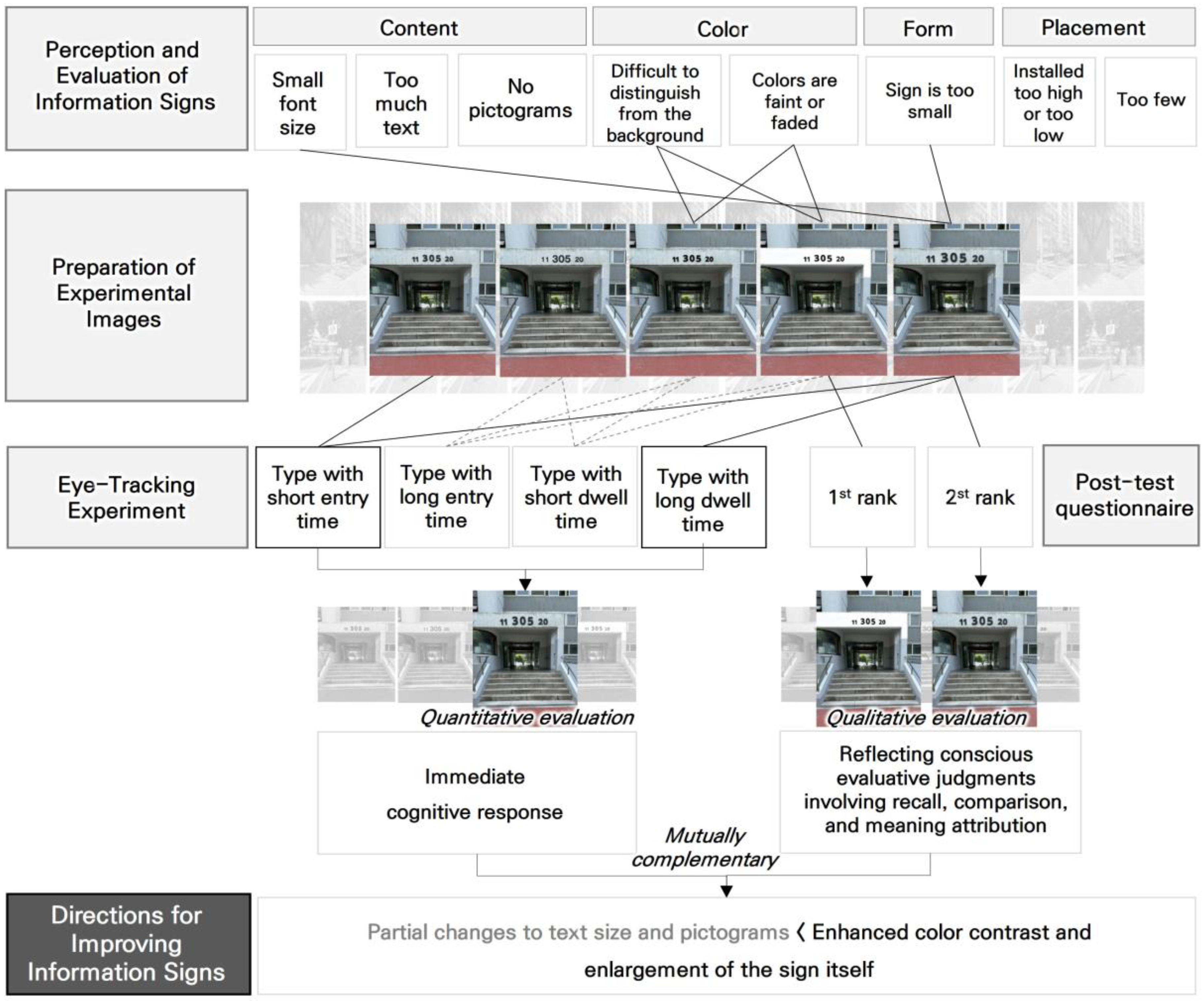
The questionnaire reflects conscious judgments, including personal recollection, comparisons, and meaning [56], while the eye-tracking experiment reflects immediate reactions and attitudes when presented with an image. For example, for CCTV information signs, alongside the response of “yellow is more visible,” the interview content also included the response “it looks safe.” This suggests that the questionnaire evaluations reflected not only simple judgments of visibility but also the symbolic meaning (e.g., safety/warning) invoked by the colors [56]. Additionally, familiarity formed through long-term residency can affect preferences for certain types and the evaluation of “more easily perceivable,” and this could act in ways that differ from the immediate response in actual exploratory activities [57,58]. Therefore, unlike their immediate responses during the experiment, such as initial detection, participants may have responded in the post-experiment questionnaire based on subjective judgments formed through the comparison process [59].
Meanwhile, subjective evaluations may have reflected a combination of environmental conditions, including color contrast, design elements such as sign size and information composition, and the installation context of each apartment complex, such as wall color and the presence and height of trees [60,61]. In contrast, eye-tracking indicators have the advantage of directly capturing visual detection and sustained attention at the moment when a specific image is presented. Therefore, questionnaire surveys and eye-tracking experiments should not be understood as methods in which one replaces the other. Rather, they should be understood as complementary approaches that explain older adults’ cognitive characteristics in relation to information signs from different perspectives [62]. In this regard, the significance of this study lies in demonstrating that what older adults perceive as “highly visible” may not necessarily correspond to what they actually detect quickly and attend to continuously, and in suggesting the need to use both methods together. The directions for improving information signs based on older adults’ perceptions are summarized in Figure 2.

5. Conclusions

The questionnaire survey results showed that the main problems with information signs were related to size, color contrast and clarity, and installation location. This suggests that visibility, legibility, installation location, and visual separation from the surrounding environment should be considered together when improving information signs for older adults in public rental apartment complexes [63].
The eye-tracking experiment, conducted as an exploratory component to examine visual exploration tendencies across differences in cognitive function, showed that perceived ease of recognition did not always correspond to TTFF, dwell time, or visual exploration patterns. Therefore, in the planning and evaluation of information signs for age-friendly residential environments, it is necessary to examine not only the subjective judgment that an information sign is “highly visible,” but also how quickly older adults detect the sign and whether they can sufficiently read its content. However, because the sample was limited to 12 participants and missing data occurred under some conditions, the generalizability of the results is limited. Accordingly, rather than serving as a basis for definitive design prescriptions, the eye-tracking findings should be interpreted as supplementary evidence that helps contextualize and extend the questionnaire results.
Further studies are needed to objectively verify the improvement directions for information signs proposed in this study. First, studies with larger samples should be conducted to determine whether the problems with information signs are similar to those identified in this study or whether additional problems exist. In this process, differences in cognitive function, as well as gender and familiarity with the residential environment, may also be considered. In addition, to identify behavioral characteristics of older adults that cannot be fully examined through eye-tracking experiments, actual movement patterns in real spaces should be analyzed. For this purpose, behavioral observation studies should be conducted, or realistic experimental environments using virtual reality (VR) should be developed to measure responses under various conditions.
As the older adult population continues to increase and convenient and safe aging in place (AIP) becomes increasingly important, these studies may provide basic data for improving the information environment and residential quality of older public rental apartment complexes.

Author Contributions

Conceptualization, S.P. and S.K.; methodology, S.P. and S.K.; investigation, S.P.; data curation, S.P.; formal analysis, S.P.; visualization, S.P.; writing—original draft preparation, S.P.; writing—review and editing, S.P. and S.K.; supervision, S.K. All authors have read and agreed to the published version of the manuscript.

Funding

This research was supported by the National Research Foundation of Korea (NRF) grant funded by the Korean government (MSIT) (No. RS-2024-00359723).

Data Availability Statement

The data presented in this study are not publicly available due to privacy and ethical restrictions related to human participant data, but are available from the corresponding author upon reasonable request.

Acknowledgments

The authors would like to thank all participants and the staff of the social welfare centers for their cooperation in this study.

Conflicts of Interest

The authors declare no conflicts of interest.

Abbreviations

The following abbreviations are used in this manuscript:
AOIArea of Interest
TTFFTime to First Fixation
AIPAging in place

References

  1. Ministry of Data and Statistics. 2025 Older Statistics. Available online: https://mods.go.kr/board.es?mid=a10301060500&bid=10820&act=view&list_no=438832 (accessed on 8 November 2025).
  2. Jang, M.-S.; Yun, J.-H.; Kim, M.-G. A study on the development of support programs considering aging in place of senior residents in public rental housing. Korean J. Hum. Ecol. 2024, 33, 587–598. [Google Scholar] [CrossRef]
  3. Yoon, S.-M.; Jeon, S.-Y.; Hwang, Y.-S. Signage system evaluation of subway station considering the visual perception characteristics of the elderly. J. Korean Inst. Inter. Des. 2021, 30, 77–85. [Google Scholar] [CrossRef]
  4. Wiles, J.L.; Leibing, A.; Guberman, N.; Reeve, J.; Allen, R.E. The meaning of “aging in place” to older people. Gerontologist 2012, 52, 357–366. [Google Scholar] [CrossRef] [PubMed]
  5. Kwon, H.J.; Oh, J.; Zorigoo, M.; Choi, Y. A study on the future housing plans and needs of older adults living in old permanent rental housing. J. Korean Hous. Assoc. 2025, 36, 91–103. [Google Scholar] [CrossRef]
  6. Barati, F.; Khoddam, H.; Modanloo, M. Concept development of “aging in place”: Application of hybrid model. J. Fam. Med. Prim. Care 2022, 11, 6646–6653. [Google Scholar] [CrossRef] [PubMed]
  7. National Planning Committee. Available online: http://webarchives.pa.go.kr/19th/www.pcpp.go.kr/national/national_03Page.do (accessed on 22 October 2025).
  8. Park, J.H.; Kang, S.W. Social interaction and life satisfaction among older adults by age group. Healthcare 2023, 11, 2951. [Google Scholar] [CrossRef] [PubMed]
  9. Al-Homoud, M. Older adult supportive environment at home—A case study in Jordan: Overall sense of control associated with home modification. Front. Public Health 2024, 12, 1329315. [Google Scholar] [CrossRef] [PubMed]
  10. Shin, S.; Byun, G.; Ha, M. Environmental planning measures to support aging in place (AIP) for the elderly—Focusing on potential areas for naturally occurring retirement communities (NORCs). J. Archit. Inst. Korea 2025, 41, 193–204. [Google Scholar]
  11. Hao, J.; Chen, H. The impact of neighborhood cohesion and social isolation on the mental health of older adults: Mediating effects of subjective well-being. Acta Psychol. 2025, 259, 105395. [Google Scholar] [CrossRef] [PubMed]
  12. Soh, J.-Y. A study on the spatial features by types of multipurpose senior centers in Seoul. J. Korean Inst. Inter Des. 2006, 15, 209–220. [Google Scholar]
  13. Lee, J.Y.; Kang, J.E. Analysis of activity space patterns and characteristics of the elderly population using big data: Focusing on the comparison with the young population. J. Korea Plan. Assoc. 2022, 57, 161–173. [Google Scholar] [CrossRef]
  14. Whang, S.W.; Park, K.S.; Kwon, C. Influence of aesthetic design elements on residential satisfaction in apartment based on Seoul apartment complex. J. Asian Archit. Build. Eng. 2024, 23, 1381–1392. [Google Scholar] [CrossRef]
  15. Mishler, A.D.; Neider, M.B. Improving wayfinding for older users with selective attention deficits. Ergon. Des. 2017, 25, 11–16. [Google Scholar] [CrossRef] [PubMed]
  16. Ishihara, K.; Ishihara, S.; Nagamachi, M.; Hiramatsu, S.; Osaki, H. Age-related decline in color perception and difficulties with daily activities—Measurement, questionnaire, optical and computer-graphics simulation studies. Int. J. Ind. Ergon. 2001, 28, 153–163. [Google Scholar] [CrossRef]
  17. Passini, R.; Pigot, H.; Rainville, C.; Tétreault, M.-H. Wayfinding in a nursing home for advanced dementia of the Alzheimer’s type. Environ. Behav. 2000, 32, 684–710. [Google Scholar] [CrossRef]
  18. Kim, M.J.; Park, J.K. A study on the visual hierarchy of signage system for dementia. J. Korean Soc. Des. Cult. 2018, 24, 29–38. [Google Scholar] [CrossRef]
  19. Mitchell, L.; Burton, E.; Raman, S. Dementia friendly cities: Designing intelligible neighbourhoods for life. J. Urban Des. 2004, 9, 89–101. [Google Scholar] [CrossRef]
  20. Wang, X.; Ma, Y.; Wang, J.; Han, P.; Dong, R.; Kang, L.; Zhang, W.; Shen, S.; Wang, J.; Li, D.; et al. Mobility and muscle strength together are more strongly correlated with falls in suburb-dwelling older Chinese. Sci. Rep. 2016, 6, 25420. [Google Scholar] [CrossRef] [PubMed]
  21. Davis, R.; Ohaman, J. Wayfinding in ageing and Alzheimer’s disease within a virtual senior residence: Study protocol. J. Adv. Nurs. 2016, 72, 1677–1688. [Google Scholar] [CrossRef] [PubMed]
  22. Ford, P.; Fisher, J.; Paxman-Clarke, L.; Minichiello, M. Effective wayfinding adaptation in an older National Health Service hospital in the United Kingdom: Insights from mobile eye-tracking. Des. Health 2020, 4, 105–121. [Google Scholar] [CrossRef]
  23. Ghamari, H.; Golshany, N. Visual attributes of wayfinding in care facilities by individuals with mild cognitive impairment (MCI). HERD 2025, 18, 97–114. [Google Scholar] [CrossRef] [PubMed]
  24. Yuan, L.; Yang, Z.; Wang, X.; Bai, C.; Wen, F. A systematic review of research on urban streets and parks based on eye-tracking technology. Appl. Sci. 2025, 15, 9305. [Google Scholar] [CrossRef]
  25. Wang, Z.Y.; Cho, J.Y. Older adults’ response to color visibility in indoor residential environment using eye-tracking technology. Sensors 2022, 22, 8766. [Google Scholar] [CrossRef] [PubMed]
  26. Kim, J.-H. Characteristics of attentional focus in visual perception during eye-tracking experiments in older adults. Korean Inst. Inter. Des. J. 2020, 29, 35–44. [Google Scholar] [CrossRef]
  27. Choi, B.; Park, J. Characteristics of the physical housing environments of the potential naturally occurring retirement communities. J. Korean Hous. Assoc. 2017, 28, 33–40. [Google Scholar] [CrossRef]
  28. Shoenfelt, A.; Isaacowitz, D.M.; Ebner, N.C. Eye tracking in aging: Challenges, best practices, and novel frontiers. ACM Trans. Appl. Percept. 2025; accepted. [CrossRef]
  29. Han, M. Cognitive function prediction model for the elderly using decision tree analysis. J. Korea Acad.-Ind. Coop. Soc. 2022, 23, 462–475. [Google Scholar] [CrossRef]
  30. Moon, B.-G.; Kim, J.-Y. A study on the trends of visual perception and the direction of spatial research through eye-tracking. J. Korea Inst. Spat. Des. 2019, 14, 429–438. [Google Scholar] [CrossRef]
  31. Mahanama, B.; Jayawardana, Y.; Rengarajan, S.; Jayawardena, G.; Chukoskie, L.; Snider, J.; Jayarathna, S. Eye movement and pupil measures: A review. Front. Comput. Sci. 2022, 3, 733531. [Google Scholar] [CrossRef]
  32. Jin, K.; Zhang, Y.; Chen, J. Optimizing urban visual identity: Eye-tracking insights for outdoor advertising management. Buildings 2025, 15, 2128. [Google Scholar] [CrossRef]
  33. Zhang, E.; Zhao, W.; Mei, Z.; Yang, Z.; Chen, F.; Xia, Y.; Wang, Y. Experimental Study on the Universal Design of Signage Size and Brightness Contrast for Low Vision Individuals. Buildings 2024, 14, 2063. [Google Scholar] [CrossRef]
  34. Seoul Metropolitan Government. 2016 Public Facilities Standard Type Design Manual; Seoul Metropolitan Government: Seoul, Republic of Korea, 2016. Available online: https://news.seoul.go.kr/culture/archives/77734 (accessed on 4 April 2025).
  35. Seoul Metropolitan Government Design Policy Division. Pedestrian Cognitive Wayfinding System Universal Design Guide Book; Seoul Metropolitan Government Design Policy Division: Seoul, Republic of Korea, 2022. Available online: https://news.seoul.go.kr/culture/files/2024/08/66b98a948d9ae1.47115668.pdf (accessed on 7 April 2025).
  36. Seoul Metropolitan Government. Seoul Universal Design Guidelines; Seoul Metropolitan Government: Seoul, Republic of Korea, 2022. Available online: https://news.seoul.go.kr/culture/archives/522959 (accessed on 7 April 2025).
  37. Seoul Metropolitan Government. Residential Environment Improvement Project Universal Design Guide Book; Seoul Metropolitan Government: Seoul, Republic of Korea, 2019.
  38. Jun, E.J. Color universal design guideline for the elderly. J. Korea Soc. Color Stud. 2015, 29, 39–48. [Google Scholar]
  39. Seoul Metropolitan Government. Senior Center Universal Design Guide Book; Seoul Metropolitan Government: Seoul, Republic of Korea, 2019. Available online: https://news.seoul.go.kr/culture/files/2024/08/66b98a813b4ca0.75974605.pdf (accessed on 7 April 2025).
  40. Seoul Metropolitan Government. Seoul Universal Design Guidelines—Public Housing; Seoul Metropolitan Government: Seoul, Republic of Korea, 2023. Available online: https://news.seoul.go.kr/culture/archives/525076 (accessed on 18 May 2025).
  41. Wolffsohn, J.S.; Davies, L.N. Presbyopia: Effectiveness of Correction Strategies. Prog. Retin. Eye Res. 2019, 68, 124–143. [Google Scholar] [CrossRef] [PubMed]
  42. Seoul Metropolitan Government. Seoul-Type Cognitive Health Dementia Care Room Guide Book; Seoul Metropolitan Government: Seoul, Republic of Korea, 2020. Available online: https://news.seoul.go.kr/culture/archives/515096 (accessed on 28 July 2025).
  43. KS S ISO 7001:2023; Graphical Symbols—Registered Public Information Symbols. Korean Agency for Technology and Standards: Eumseong-gun, Republic of Korea, 2023.
  44. Chung, M.-R.; Kim, D.-N. The sign system of private spaces in nursing homes. J. Archit. Inst. Korea Plan. Des. 2010, 26, 45–54. [Google Scholar]
  45. Ministry of Data and Statistics. User Information Statistical Report for the Korean Anthropometric Survey (2022). 2022. Available online: https://mods.go.kr/board.es?mid=a10409070000&bid=12030&act=view&list_no=422680&tag=&nPage=1&ref_bid= (accessed on 22 April 2025).
  46. Sundstedt, V.; Garro, V. A systematic review of visualization techniques and analysis tools for eye-tracking in 3D environments. Front. Neuroergon. 2022, 3, 910019. [Google Scholar] [CrossRef] [PubMed]
  47. Ho, U.-W. UX Evaluation of the National Museum of Korea Website Based on Eye-Tracking. Master’s Thesis, Konkuk University Graduate School, Seoul, Republic of Korea, 2025. [Google Scholar]
  48. Blascheck, T.; Kurzhals, K.; Raschke, M.; Burch, M.; Weiskopf, D.; Ertl, T. State-of-the-Art of Visualization for Eye Tracking Data; The Eurographics Association: Eindhoven, The Netherlands, 2014. [Google Scholar] [CrossRef]
  49. Kim, S.; Ko, Y. Analysis and case study for the application of universal design of road information signs. J. Integr. Des. Res. 2019, 18, 91–107. [Google Scholar] [CrossRef]
  50. Rodrigues, R.; Coelho, R.; Tavares, J.M.R.S. Healthcare signage design: A review on recommendations for effective signing systems. Health Environ. Res. Des. J. 2019, 12, 45–65. [Google Scholar] [CrossRef] [PubMed]
  51. Deng, L.; Zhang, B.; Shi, G.; Zhang, C. Elderly users’ perceptions of signage systems from tertiary hospitals in Guangzhou. Heliyon 2024, 10, e25003. [Google Scholar] [CrossRef] [PubMed]
  52. Arthur, P.; Passini, R. Wayfinding: People, Signs, and Architecture; McGraw-Hill: New York, NY, USA, 1992; p. 179. [Google Scholar]
  53. Kim, Y.-S. A study on sign system design according to the visual characteristics of the senior citizen. J. Brand Des. Assoc. Korea 2008, 6, 135–146. [Google Scholar]
  54. Park, J.-B. A study on the effect of color on user environment in design. J. Korea Soc. Typogr. 2019, 22, 155–162. [Google Scholar] [CrossRef]
  55. Ha, S.; Lee, E.; Yoo, I.J.; Park, D.-H. A study on the mechanism of social robot attitude formation through consumer gaze analysis: Focusing on the robot’s face. J. Intell. Inf. Syst. 2022, 28, 243–262. [Google Scholar] [CrossRef]
  56. Vraga, E.; Bode, L.; Troller-Renfree, S. Beyond self-reports: Using eye tracking to measure topic and style differences in attention to social media content. Commun. Methods Meas. 2016, 10, 149–164. [Google Scholar] [CrossRef]
  57. Hu, K.; De Rosa, E.; Anderson, A.K. Yellow is for safety: Perceptual and affective perspectives. Psychol. Res. 2020, 84, 1912–1919. [Google Scholar] [CrossRef] [PubMed]
  58. Duran, I.E. The Influence of Familiarity and Signage on Wayfinding in Academic Libraries. Master’s Thesis, Bilkent Universitesi, Ankara, Turkey, 2016. [Google Scholar]
  59. Schweiker, M.; Andersen, R.K.; Carlucci, S.; Chinazzo, G.; Hodder, S.; Mahdavi, A.; Palella, B.I.; Pisello, A.L.; Alfano, F.R.D.A.; Vellei, M. Ten questions concerning the usage of subjective assessment scales in research on indoor environmental quality. Build. Environ. 2025, 283, 113393. [Google Scholar] [CrossRef]
  60. Park, W.; Kim, H.; Paik, J. A study on the visibility and legibility of traffic safety signs. J. Integr. Des. Res. 2009, 8, 97–112. [Google Scholar]
  61. Kim, K.-M.; Lee, J.-G. A study on the color of sign design for apartment exterior pedestrian space. J. Korea Inst. Spat. Des. 2010, 5, 75–84. [Google Scholar] [CrossRef]
  62. Sun, H.; Wang, W.; Liu, X.; Zhu, B.; Huang, Y.; Leng, X.; Jia, L. Comparison of self-report questionnaire and eye tracking method in visual preference study. Foods 2022, 11, 505. [Google Scholar] [CrossRef] [PubMed]
  63. Lomperski, T.J. Enhancing interior building sign readability for older adults: Lighting color and sign color contrast. J. Inter. Des. 1997, 23, 17–27. [Google Scholar] [CrossRef]
Figure 1. Experimental setting and protocol.
Buildings 16 02434 g001
Figure 2. Directions for improving information signs based on older adults’ perceptions.
Buildings 16 02434 g002
Table 1. Summary of study site and state of information signs.
Complex A (1982)Complex B (1991)
Buildings 16 02434 i001Total area: 44,100 m2Buildings 16 02434 i002Total area: 25,780 m2
Number of housing units: 2634 unitsNumber of housing units: 1325 units
Number of blocks: 11 blocksNumber of blocks: 5 blocks
Number of storeys: 15 storeysNumber of storeys: 15 storeys
Ratio of residents aged ≥ 60 years old:
1170 persons (28.6%)
Ratio of residents aged ≥ 60 years old:
904 persons (31.3%)
Building/
unit number sign
Directional signCCTV signBuilding/
unit number sign
Directional signCCTV sign
Buildings 16 02434 i003Buildings 16 02434 i004Buildings 16 02434 i005Buildings 16 02434 i006Buildings 16 02434 i007Buildings 16 02434 i008
Table 2. Demographic characteristics in each complex (units: persons, %).
SexComplexFemaleMaleTotal
A32 (80.0)8 (20.0)40 (100)
B34 (85.0)6 (15.0)40 (100)
Subtotal66 (82.5)14 (17.5)80 (100)
AgeComplex65–75 Years Old75–85 Years Old≥85 Years OldTotal
A19 (47.5)19 (47.5)2 (5.0)40 (100)
B9 (22.5)24 (60.0)7 (17.5)40 (100)
Subtotal28 (35.0)43 (53.8)9 (11.3)80 (100)
Length of residencyComplex≤5 Years6–10 Years≥More than 15 YearsTotal
A6 (15.0)9 (22.5)25 (62.5)40 (100)
B4 (10.0)4 (10.0)32 (80.0)40 (100)
Subtotal10 (12.5)13 (16.3)57 (71.3)80 (100)
Table 3. Weekly experiences of information sign perception in each complex (units: persons, %).
ClassificationNeverSometimesOftenTotalX2
Building/unit
number
signs
Complex A0 (0.0)15 (37.5)25 (62.5)40 (100)13.925 **
Complex B2 (5.0)2 (5.0)36 (90.0)40 (100)
Subtotal2 (2.5)17 (21.2)61 (76.3)80 (100)
Direction
signs
Complex A17 (42.5)8 (20.0)15 (37.5)40 (100)2.458
Complex B15 (37.5)4 (10.0)21 (52.5)40 (100)
Subtotal32 (40.0)12 (15.0)36 (45.0)80 (100)
CCTV
signs
Complex A27 (67.5)8 (20.0)5 (12.5)40 (100)9.861 **
Complex B20 (50.0)3 (7.5)17 (42.5)40 (100)
Subtotal47 (58.8)11 (13.7)22 (27.5)80 (100)
** p < 0.01.
Table 4. Mean satisfaction in different elements of information signs (1 point: Very dissatisfied, 5 points: Very satisfied).
TypeElementComplex AComplex Btp
Building/unit number
signs
Content2.953.49−2.1910.032 *
Color2.343.64−6.0970.000 ***
Form2.713.41−2.7760.007 **
Placement2.793.51−2.9980.004 **
Direction
information sign
Content3.582.682.7630.008 **
Color3.352.642.0150.051
Form3.193.040.4260.674
Placement3.083.16−0.2170.831
CCTV
information sign
Content3.403.240.5670.574
Color3.253.62−1.4270.161
Form3.253.190.2010.842
Placement3.152.950.6130.543
* p < 0.05, ** p < 0.01, *** p < 0.001.
Table 5. Problems with elements of building/unit number signs (duplicate choices, persons/%).
Content1234TotalX2
A19 (45.2)3 (7.1)4 (9.5)16 (38.1)42 (100)8.671
B15 (38.5)1 (2.6)0 (0.0)23 (59.0)39 (100)
Subtotal34 (42.0)4 (4.9)4 (4.9)39 (48.1)81 (100)
1. Small font size, 2. Too much text, 3. No pictograms, 4. No problems
Color1234TotalX2
A23 (43.4)17 (32.1)3 (5.7)10 (18.9)53 (100)36.122 ***
B7 (17.1)7 (17.1)1 (2.4)26 (63.4)41 (100)
Subtotal30 (31.9)24 (25.5)4 (4.3)36 (38.3)94 (100)
1. Difficult to distinguish sign from background, 2. Color is faint or faded, 3. “Warning” or “attention” are not in appropriate colors, 4. No problems
Form123TotalX2
A21 (60.0)1 (2.9)13 (37.1)35 (100)4.721
B18 (46.2)0 (0.0)21 (53.8)39 (100)
Subtotal39 (52.7)1 (1.4)34 (45.9)74 (100)
1. The sign size is too small, 2. The sign design is visually complex, 3. No problems
Placement123456TotalX2
A16 (32.7)1 (2.0)2 (4.1)1 (2.0)13 (26.5)16 (32.7)49 (100)15.066 *
B7 (17.1)0 (0.0)0 (0.0)0 (0.0)8 (19.5)26 (63.4)41 (100)
Subtotal23 (25.6)1 (1.1)2 (2.2)1 (1.1)21 (23.3)42 (46.7)90 (100)
1. Placed too high or low, 2. In a place with little footfall, 3. In a location that is not clearly visible, such as behind a wall or pillar, 4. Located far from the facilities, 5. Too few, 6. No problems
* p < 0.05, *** p < 0.001. Because multiple responses were allowed, the total number of responses may exceed the sample size (n = 80). Conversely, a total lower than the sample size indicates that fewer participants selected the corresponding item.
Table 6. Problems with elements of direction information signs (duplicate choices, persons/%).
Content1234TotalX2
A12 (40.0)3 (10.0)1 (3.3)14 (46.7)30 (100)10.509 *
B19 (67.9)3 (10.7)0 (0.0)6 (21.4)28 (100)
Subtotal31 (53.4)6 (10.3)1 (1.7)20 (34.5)58 (100)
1. Small font size, 2. Too much text, 3. No pictograms, 4. No problems
Color1234TotalX2
A9 (26.5)9 (26.5)1 (2.9)15 (44.1)34 (100)17.393 **
B15 (37.5)15 (37.5)5 (12.5)5 (12.5)40 (100)
Subtotal24 (32.4)24 (32.4)6 (8.1)20 (27.0)74 (100)
1. Difficult to distinguish sign from background, 2. Color is faint or faded, 3. “Warning” or “attention” are not in appropriate colors, 4. No problems
Form123TotalX2
A12 (46.2)0 (0.0)14 (53.8)26 (100)1.962
B15 (60.0)0 (0.0)10 (40.0)25 (100)
Subtotal27 (52.9)0 (0.0)24 (47.1)51 (100)
1. The sign size is too small, 2. The sign design is visually complex, 3. No problems
Placement123456TotalX2
A8 (21.6)5 (13.5)2 (5.4)2 (5.4)7 (18.9)13 (35.1)37 (100)1.206
B7 (20.6)5 (14.7)2 (5.9)2 (5.9)8 (23.5)10 (29.4)34 (100)
Subtotal15 (21.1)10 (14.1)4 (5.6)4 (5.6)15 (21.1)23 (32.4)71 (100)
1. Placed too high or low, 2. In a place with little footfall, 3. In a location that is not clearly visible, such as behind a wall or pillar, 4. Located far from the facilities, 5. Too few, 6. No problems
* p < 0.05, ** p < 0.01. Because multiple responses were allowed, the total number of responses may exceed the sample size (n = 80). Conversely, a total lower than the sample size indicates that fewer participants selected the corresponding item.
Table 7. Problems with elements of CCTV information signs (duplicate choices, persons/%).
Content1234TotalX2
A7 (30.4)3 (13.0)4 (17.4)9 (39.1)23 (100)6.798
B10 (45.5)1 (4.5)0 (0.0)11 (50.0)22 (100)
Subtotal17 (37.8)4 (8.9)4 (8.9)20 (44.4)45 (100)
1. Small font size, 2. Too much text, 3. No pictograms, 4. No problems
Color1234TotalX2
A4 (16.7)10 (41.7)2 (8.3)8 (33.3)24 (100)24.922 ***
B1 (4.5)1 (4.5)1 (4.5)19 (86.4)22 (100)
Subtotal5 (10.9)11 (23.9)3 (6.5)27 (58.7)46 (100)
1. Difficult to distinguish sign from background, 2. Color is faint or faded, 3. “Warning” or “attention” are not in appropriate colors, 4. No problems
Form123TotalX2
A12 (57.1)0 (0.0)9 (42.9)21 (100)4.040
B7 (35.0)0 (0.0)13 (65.0)20 (100)
Subtotal19 (46.3)0 (0.0)22 (53.7)41 (100)
1. The sign size is too small, 2. The sign design is visually complex, 3. No problems
Placement123456TotalX2
A7 (26.9)1 (3.8)2 (7.7)1 (3.8)7 (26.9)8 (30.8)26 (100)8.301
B1 (3.8)1 (3.8)1 (3.8)3 (11.5)10 (38.5)10 (38.5)26 (100)
Subtotal8 (15.4)2 (3.8)3 (5.8)4 (7.7)17 (32.7)18 (34.6)52 (100)
1. Placed too high or low, 2. In a place with little footfall, 3. In a location that is not clearly visible, such as behind a wall or pillar, 4. Located far from the facilities, 5. Too few, 6. No problems
*** p < 0.001. Because multiple responses were allowed, the total number of responses may exceed the sample size (n = 80). Conversely, a total lower than the sample size indicates that fewer participants selected the corresponding item.
Table 8. Operating standards for each element of information signs.
ElementOperating Standard
ContentUse of simple, serif-free, Gothic-type fonts [34]
Increase the font size to alleviate the cognitive burden of information processing [35,36]
Pictograms should implement the international standard for graphical symbols (KS S ISO 7001) and be constructed from simple, intuitive elements [34,37]
ColorUse color combinations with sufficient contrast between the background color and the information color [34,35,38,39,40]
FormIncrease size until identifiable from a distance of 5–6 m [41]
Simplify compositional elements so that the information can be easily understood when viewed from a given distance [36]
PlacementConsidering the field of view, adjust the important information to be at eye level [34,42]
Ensure legibility and accessibility based on the height of the center of the information (approximately 1.35 m) [42]
Avoid elements that block the field of view (e.g., trees, walls, pillars), and place at a point connected with walking routes [40]
Table 9. Manipulation details of experimental images by sign type.
Sign TypeImage VersionManipulation Details
Building/unit number information sign1Original image
2Font modification
3Background–foreground color contrast adjustment
4Luminance contrast enhancement
5Enlargement of the existing sign size
Direction information sign1Original image
2Font modification
3Pictogram modification
4Enhancement of luminance contrast
5Enlargement of the existing sign size
6Integrated modification of content, color, and form
CCTV
sign
1Original image
2Pole color modification: dark gray
3Pole color modification: yellow
4Maintaining the original pole color, with composite adjustment of sign content, color, form, and position
5Pole color modification: yellow, with composite modification of sign content, color, form, and position
6Pole color modification: dark gray, with composite modification of sign content, color, form, and position
Table 10. Demographic characteristics of participants in the eye-tracking experiment (units: persons, %).
SexComplexMaleFemaleTotal
A2 (33.3)4 (66.7)6 (100)
B1 (16.7)5 (83.3)6 (100)
Subtotal3 (25.0)9 (75.0)12 (100)
AgeComplex65–75 Years Old75–85 Years Old≥85 Years OldTotal
A3 (50.0)2 (33.3)1 (16.7)6 (100)
B2 (33.3)3 (50.0)1 (16.7)6 (100)
Subtotal5 (41.7)5 (41.7)2 (16.7)12 (100)
Length of residencyComplex≤5 Years6–10 Years≥More than 15 YearsTotal
A4 (66.7)0 (0.0)2 (33.3)6 (100)
B0 (0.0)2 (33.3)4 (66.7)6 (100)
Subtotal4 (33.3)2 (16.7)6 (50.0)12 (100)
MMSE-DS
classification
ComplexSevere Cognitive
Impairment
Mild Cognitive
Impairment
No Cognitive
Impairment
Total
A0 (0.0)2 (33.3)4 (66.7)6 (100)
B0 (0.0)4 (66.7)2 (33.3)6 (100)
Subtotal0 (0.0)6 (50.0)6 (50.0)12 (100)
Table 11. Results of the Friedman test for each information sign type (time to first fixation [TTFF], dwell time).
Information
Sign
Gaze
Index
k
(n)
Complex AComplex B
χ2/dfpKendall’s Wχ2/dfpKendall’s W
Building/
unit number
TTFF53.000 (4)0.5580.063Insufficient N--
Dwell time5 >0.05 Insufficient N--
DirectionTTFF62.714 (5)0.7440.0457.429 (5)0.1910.743
Dwell time6 >0.05 6.857 (5)0.2310.686
CCTVTTFF6 >0.05 1.429 (5)0.9210.143
Dwell time6 >0.05 1.143 (5)0.9500.114
k indicates the number of image conditions presented for each type of information sign. In the case of the building/unit number signs in Complex B, valid gaze data were missing for some image conditions, resulting in a limited number of valid samples for the Friedman test.
Table 12. Comparison of heat maps for CCTV signs by cognitive function level.
Experimental ImagesCognitively Normal GroupCognitively Impaired Group
1Buildings 16 02434 i009Buildings 16 02434 i010Buildings 16 02434 i011
2Buildings 16 02434 i012Buildings 16 02434 i013Buildings 16 02434 i014
3Buildings 16 02434 i015Buildings 16 02434 i016Buildings 16 02434 i017
4Buildings 16 02434 i018Buildings 16 02434 i019Buildings 16 02434 i020
5Buildings 16 02434 i021Buildings 16 02434 i022Buildings 16 02434 i023
6Buildings 16 02434 i024Buildings 16 02434 i025Buildings 16 02434 i026
The analysis focused on the AOI of the CCTV sign, which was indicated by a red rectangle in the experimental image. Image 1 indicates the original condition, and Images 2–6 indicate the manipulated conditions. The red areas represent regions of high gaze density or longer dwell times, while blue areas signify shorter gaze durations or shorter visual concentration.
Table 13. Comparison of scan paths for CCTV signs by cognitive function level.
Experimental ImagesCognitively Normal GroupCognitively Impaired Group
1Buildings 16 02434 i027Buildings 16 02434 i028Buildings 16 02434 i029
2Buildings 16 02434 i030Buildings 16 02434 i031Buildings 16 02434 i032
3Buildings 16 02434 i033Buildings 16 02434 i034Buildings 16 02434 i035
4Buildings 16 02434 i036Buildings 16 02434 i037Buildings 16 02434 i038
5Buildings 16 02434 i039Buildings 16 02434 i040Buildings 16 02434 i041
6Buildings 16 02434 i042Buildings 16 02434 i043Buildings 16 02434 i044
The analysis focused on the AOI of the CCTV sign, which was indicated by a red rectangle in the experimental image. Image 1 indicates the original condition, and Images 2–6 indicate the manipulated conditions. The diameter of each fixation circle corresponds to the duration of gaze fixation at that specific point. Smaller circles indicate shorter fixation durations or lower focus intensity. Furthermore, fixations for each participant are color-coded to clearly distinguish their individual scan paths.
Table 14. Building/unit number information sign images and eye-tracking results Complex A (ms: millisecond, 10−3 s).
ImageImage 1Image 2Image 3Image 4Image 5
Buildings 16 02434 i045Buildings 16 02434 i046Buildings 16 02434 i047Buildings 16 02434 i048Buildings 16 02434 i049
ClassificationOriginal imageContent manipulationColor manipulationColor manipulationForm manipulation
-Font changeFont color changed to blackIncreased luminance contrastIncreased sign size
1860 ms662 ms568 ms1645 ms990 ms
3593 ms [45%]2535 ms [31%]3626 ms [45%]3575 ms [45%]2262 ms [33%]
561 ms437 ms567 ms812 ms512 ms
55555
① TTFF (Entry Time, ms) ② Dwell Time (ms, %) ③ Avg. Fixation Duration (ms) ④ Valid Participants (n).
Table 15. Direction information sign images and eye-tracking results Complex A (ms: millisecond, 10−3 s).
ImageImage 1Image 2Image 3Image 4Image 5Image 6
Buildings 16 02434 i050Buildings 16 02434 i051Buildings 16 02434 i052Buildings 16 02434 i053Buildings 16 02434 i054Buildings 16 02434 i055
ClassificationOriginal imageContent manipulationColor manipulationForm manipulationContent, color, and form manipulation
-Font changePictogram changeIncreased luminance contrastIncreased sign sizeFont, pictogram, color contrast, and size changes
2710 ms1993 ms2263 ms774 ms538 ms845 ms
2321 ms [29%]2166 ms [27%]1883 ms [23%]2371 ms [30%]5298 ms [66%]2843 ms [35%]
484 ms510 ms565 ms527 ms883 ms547 ms
543445
① TTFF (Entry Time, ms) ② Dwell Time (ms, %) ③ Avg. Fixation Duration (ms) ④ Valid Participants (n).
Table 16. CCTV information sign images and eye-tracking results Complex A (ms: millisecond, 10−3 s).
ImageImage 1Image 2Image 3Image 4Image 5Image 6
Buildings 16 02434 i056Buildings 16 02434 i057Buildings 16 02434 i058Buildings 16 02434 i059Buildings 16 02434 i060Buildings 16 02434 i061
ClassificationOriginal imageColor manipulationContent, color, form, and location manipulation
-Pole color changeGuideline-based sign applicationGuideline-based sign application and pole color change
4120 ms4082 ms4123 ms2757 ms794 ms1749 ms
945 ms [12%]2056 ms [26%]1650 ms [21%]1663 ms [21%]2938 ms [37%]1276 ms [16%]
630 ms617 ms1237 ms443 ms904 ms580 ms
233445
① TTFF (Entry Time, ms) ② Dwell Time (ms, %) ③ Avg. Fixation Duration (ms) ④ Valid Participants (n).
Table 17. Building/unit number information sign images and eye-tracking results Complex B (ms: millisecond, 10−3 s).
ImageImage 1Image 2Image 3Image 4Image 5
Buildings 16 02434 i062Buildings 16 02434 i063Buildings 16 02434 i064Buildings 16 02434 i065Buildings 16 02434 i066
ClassificationOriginal imageContent manipulationColor manipulationColor manipulationForm manipulation
-Font changeFont color changed to blackIncreased luminance contrastIncreased sign size
940 ms2295 ms1070 ms1696 ms568 ms
2300 ms [29%]1488 ms [19%]1653 ms [21%]1505 ms [19%]4096 ms [51%]
307 ms310 ms735 ms334 ms910 ms
25442
① TTFF (Entry Time, ms) ② Dwell Time (ms, %) ③ Avg. Fixation Duration (ms) ④ Valid Participants (n).
Table 18. Direction information sign images and eye-tracking results Complex B (ms: millisecond, 10−3 s).
ImageImage 1Image 2Image 3Image 4Image 5Image 6
Buildings 16 02434 i067Buildings 16 02434 i068Buildings 16 02434 i069Buildings 16 02434 i070Buildings 16 02434 i071Buildings 16 02434 i072
ClassificationOriginal imageContent manipulationColor manipulationForm manipulationContent, color, and form manipulation
-Font changePictogram changeIncreased luminance contrastIncreased sign sizeFont, pictogram, color contrast, and size changes
1884 ms1259 ms4306 ms693 ms859 ms2732 ms
1074 ms [13%]1215 ms [15%]669 ms [8%]1792 ms [22%]3020 ms [38%]937 ms [12%]
358 ms521 ms267 ms358 ms416 ms375 ms
434544
① TTFF (Entry Time, ms) ② Dwell Time (ms, %) ③ Avg. Fixation Duration (ms) ④ Valid Participants (n).
Table 19. CCTV information sign images and eye-tracking results Complex B (ms: millisecond, 10−3 s).
ImageImage 1Image 2Image 3Image 4Image 5Image 6
Buildings 16 02434 i073Buildings 16 02434 i074Buildings 16 02434 i075Buildings 16 02434 i076Buildings 16 02434 i077Buildings 16 02434 i078
ClassificationOriginal imageColor manipulationContent, color, form, and location manipulation
-Pole color changeGuideline-based sign applicationGuideline-based sign application and pole color change
1941 ms2270 ms2682 ms3509 ms3941 ms851 ms
1244 ms [15%]1932 ms [24%]1962 ms [24%]3004 ms [37%]1950 ms [24%]2291 ms [29%]
267 ms703 ms981 ms432 ms557 ms529 ms
343443
① TTFF (Entry Time, ms) ② Dwell Time (ms, %) ③ Avg. Fixation Duration (ms) ④ Valid Participants (n).
Table 20. Eye-tracking experiment indices and comparison with post-test questionnaire results.
Complex ABuilding/Unit Number Information SignsDirection Information SignsCCTV Information Signs
Eye-trackingImage 3Image 5Image 5
QuestionnaireRank 1: Image 4Rank 1: Image 6Rank 1: Image 6
Rank 2: Image 3Rank 2: Image 5-
Complex BBuilding/Unit Number Information SignsDirection Information SignsCCTV Information Signs
Eye-trackingImage 5Entry: Image 4,
Dwell: Image 5
Image 6
QuestionnaireRank 1: Image 4Rank 1: Image 4Rank 1: Image 6
Rank 2: Image 5Rank 2: Image 5-
Disclaimer/Publisher’s Note: The statements, opinions and data contained in all publications are solely those of the individual author(s) and contributor(s) and not of MDPI and/or the editor(s). MDPI and/or the editor(s) disclaim responsibility for any injury to people or property resulting from any ideas, methods, instructions or products referred to in the content.