Article

Acceptance Criteria for Beams in Reinforced Concrete Frame Structures Under Accidental Design Conditions


by
Sergei Y. Savin
1,*,
Vitaly I. Kolchunov
1 and
Tatiana A. Iliushchenko
2
1
Department of Reinforced Concrete and Masonry Structures, Institute of Civil Engineering, National Research Moscow State University of Civil Engineering, 129337 Moscow, Russia
2
Department of Industrial and Civil Engineering, Kursk State University, 305000 Kursk, Russia
*
Author to whom correspondence should be addressed.
Buildings 2026, 16(12), 2378; https://doi.org/10.3390/buildings16122378 (registering DOI)
Submission received: 22 May 2026 / Revised: 9 June 2026 / Accepted: 12 June 2026 / Published: 14 June 2026
(This article belongs to the Section Building Structures)

Abstract

Localized failures of structural components can lead to serious social, economic, and environmental consequences, such as the collapse of an entire structure or part of it. Therefore, it is important to thoroughly investigate and justify the acceptance criteria for these components, taking into account their performance in extreme conditions. However, the scientific literature lacks a systematic analysis of how various factors can affect the resistance of structures and influence acceptance criteria under extreme conditions. Therefore, this study investigates the typical substructures of reinforced concrete frame buildings in areas that are potentially prone to local collapse. To assess their resistance and structural robustness, an analytical model has been developed. The results of 22 tests on typical substructures of monolithic and precast frames, reported in various research studies, were used to validate this model. Further, this analytical model was used to conduct a parametric study on the impact of various factors on the performance of substructures under extreme conditions. These factors included the depth-to-span ratio of the beam, the strength of the bond between the steel reinforcement and the concrete, the stiffness of the horizontal bracing within the substructure, and the proportion of the effective depth to the total depth of the beam section. It has been found that the ultimate rotation angle in the plastic hinge of beams increases as the ratio of the beam’s cross-sectional depth to the span increases. An increase in the bond strength between the reinforcement and concrete leads to a decrease in the ultimate rotation angles in the plastic hinge at the flexural and arch stages of resistance and, in some cases, to reinforcement rupture without transitioning to the catenary stage of resistance. A decrease in the ratio of the effective depth of the beam section to its overall depth leads to an increase in the load-bearing capacity at the catenary stage of 19%.

1. Introduction

An analysis of the consequences of damage to buildings and structures with reinforced concrete frames under various natural and man-made hazards [1,2] highlights the continued relevance of improving approaches to ensuring the reliability, structural robustness, and safety of these structures. New types of man-made threats, such as attacks on civilian structures by missiles and other combat unmanned aerial vehicles, demonstrate the need to find a balance between the costs of structural measures to prevent disproportionate collapse, on the one hand, and the costs of mitigating the consequences, restoring, and strengthening damaged structures, as well as covering costs associated with human casualties, health damage, economic losses, and other factors [2,3,4,5].
Localized failures of structural components can lead to serious social, economic, and environmental consequences, such as the collapse of an entire structure or part of it. Therefore, it is important to thoroughly investigate and justify the acceptance criteria for these components, taking into account their performance in extreme conditions [6]. Amendment No. 4 to the UFC-4-023-03-2009 code [7] introduced deformation-based acceptance criteria for various types of load-bearing members, borrowed from the design codes for earthquake-resistant structures. For flexural reinforced concrete members, these criteria are defined as the ultimate rotation angles at plastic hinges. They take into account the reinforcement ratios in the tension and compression zones, as well as the magnitude of the relative shear force. However, the tabulated values of these criteria [7] do not account for the presence of compressive arch forces arising in the elements due to constrained deformation within the substructure. Also, they do not account for the unloading effect from second-order moments resulting from the action of axial forces during large deflections. In this regard, a parametric study on the impact of these and other factors on the values of the ultimate rotation angles at a plastic hinge is noteworthy.
The study [8] and Russian standards SP 385.132580 [9] consider ultimate strains in concrete and steel reinforcement as criteria for the ultimate limit state of beams during a robustness check. In addition, these documents provide limitations on the relative deflection of flexural members: 1/30 and 1/50 of the span for non-prestressed and prestressed members, respectively. Ultimate strains have demonstrated their effectiveness in verifying the ultimate states of load-bearing capacity under normal operating conditions, where it is permissible to use the Bernoulli hypothesis, and deflections are small compared to the characteristic dimensions of the cross-sections. This allows calculations to be performed that ignore second-order effects for members in bending.
However, a more complete use of structural resistance reserves requires consideration of performance levels where deflections are comparable to or exceed the typical cross-sectional dimension and where the steel reinforcement operates in the plastic phase. Additionally, the bond strength between the steel reinforcement and concrete is significantly reduced within the length of the plastic hinge. It should be noted that the ultimate relative deflections [8] are derived from an analysis of a limited number of tests and do not account for some peculiarities, such as the reinforcement ratio, asymmetrical spans, the ratio of the member’s cross-section depth to span, etc.
An analysis of a broader range of experimental studies [10,11,12,13,14] indicates that deflections may exceed these values, which is accompanied by the activation of compressive arch action and subsequent tensile catenary action. However, steel reinforcement may fail without a transition to catenary action, which results in structural collapse [15,16]. The studies [17,18,19] examined the resistance of partially restrained frame substructures that represent fragments of the structural frame at facility corners. It was shown that, as a result of the low stiffness of the joint, the deflections of the beams increase, and a loss of load-bearing capacity in the unbraced columns is possible. If the horizontal bracing of the substructure is insufficient, which is typical for a corner column loss, the arch and catenary actions do not occur.
Therefore, the objective of this study was to evaluate the deformation acceptance criteria for typical substructures of reinforced concrete frames in the zone of potential local collapse and to identify patterns in their behavior under various design parameters. The novelty of this study lies in the consideration of the influence of bracing stiffness of the substructure and the analysis of the degree of influence of the following factors: the beam depth-to-span ratio, the bond strength between the reinforcement and the concrete, and the effective depth to overall depth ratio. Although studies [20,21,22,23] have presented the results of analyses of certain factors, a comprehensive study of these factors in the scientific literature appears to be lacking.

2. Analytical Model and Research Methods

2.1. Experimental Basis for Development of Analytical Model of Reinforced Concrete Frame Typical Substructure

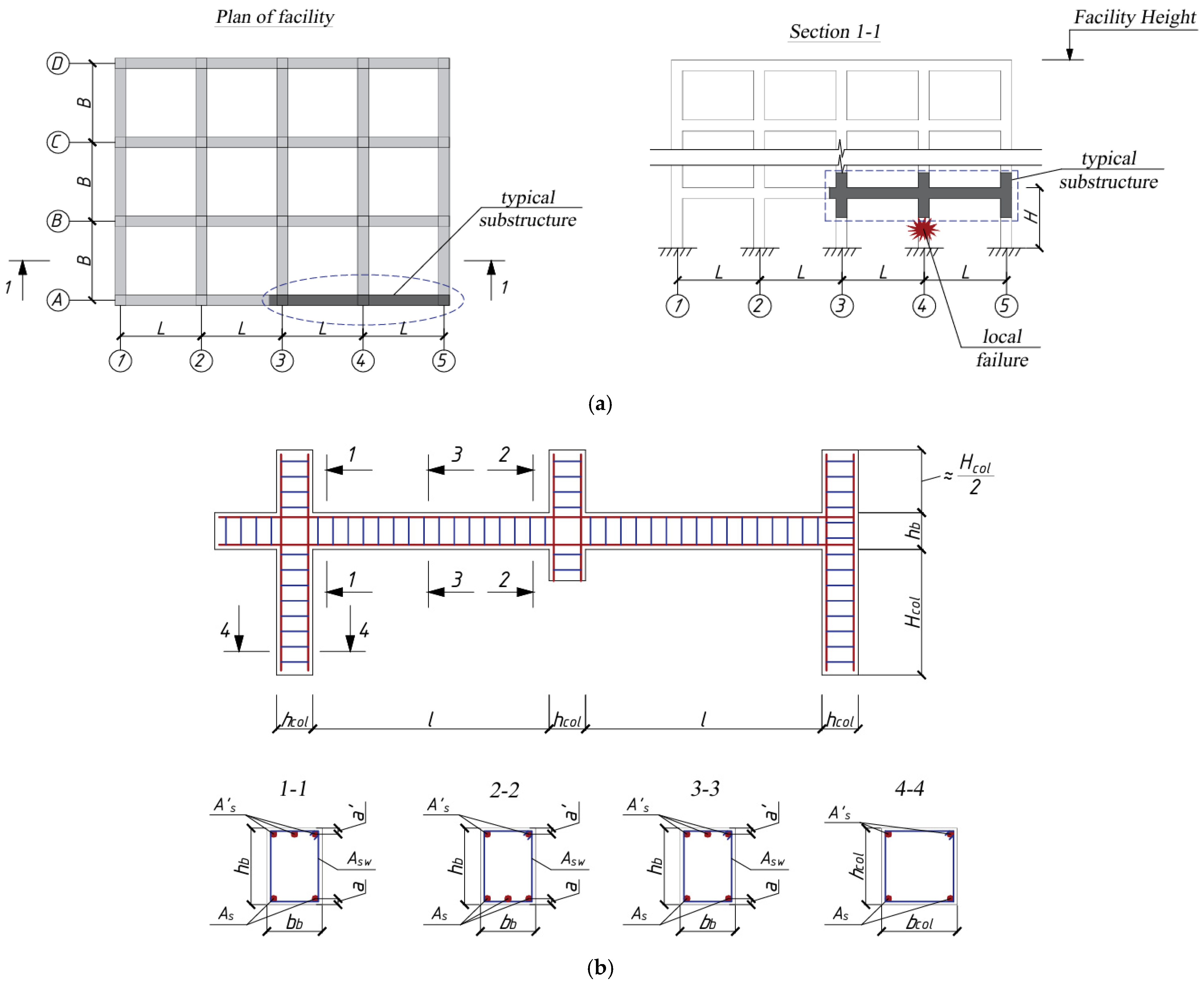
Consider a typical substructure of a reinforced concrete frame of a building in an area prone to local collapse, as shown in Figure 1. As in previous studies [24], assume that, if the failure process can be halted within this area, the collapse of the structural block containing the initial local failure will not occur.
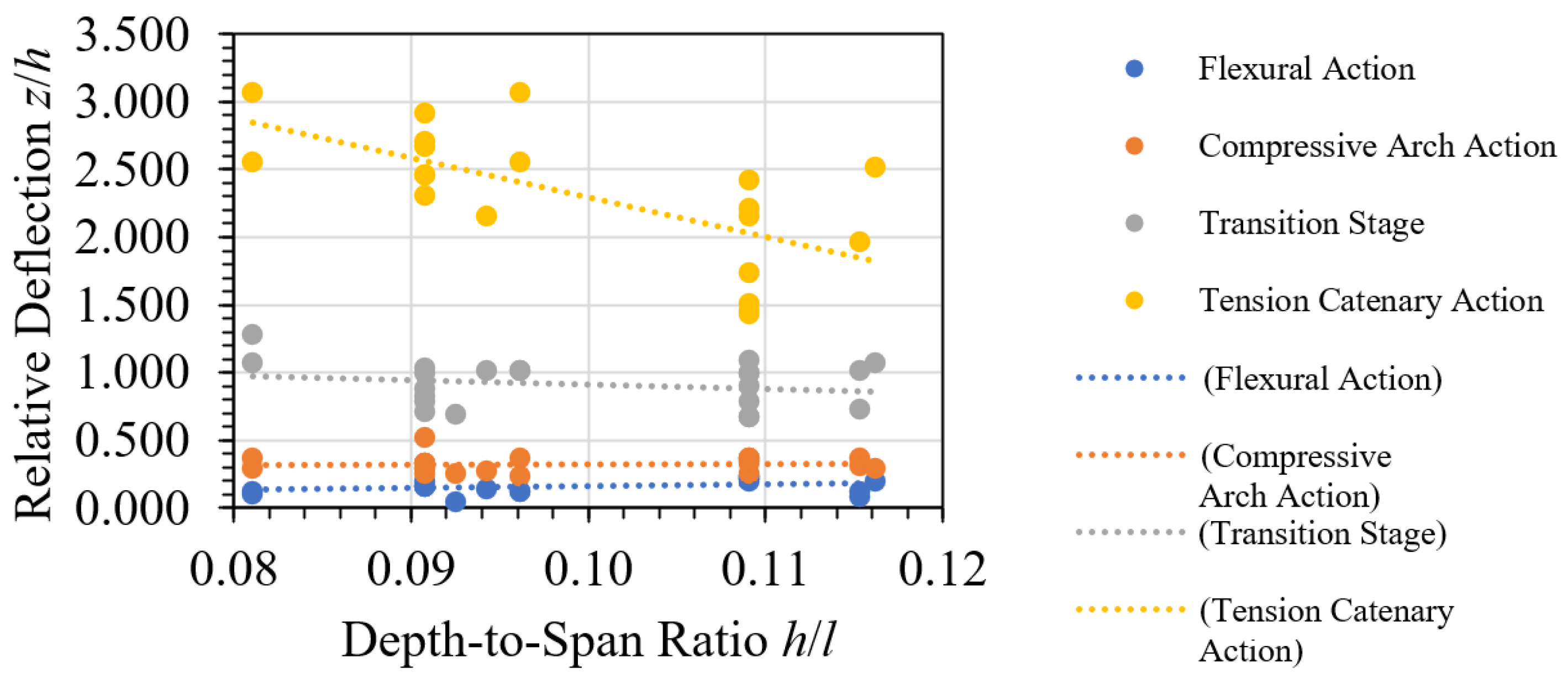
According to experimental studies by Pham et al. [17], Tao Y. et al. [16], Feng F.-F. [15], Lew et al. [25], Yu & Tan [26,27], Savin [24], and Kang & Tan [28,29], the following performance stages of frame substructures under accidental conditions can be identified: flexural action (FA), compressive arch action (CAA), and tensile catenary action (TCA). Figure 2 shows the experimental data of maximum relative deflections of the beams (z/h) at various stages of their performance, where h is the depth of the beam’s cross-section.
Until yielding occurs in the tensile reinforcement, the deflections of the beam are small compared to the cross-sectional dimensions. They lie in the range, on average, from 0.1 to 0.2 of the cross-sectional depth, as presented in Figure 2. Thus, the deformed state does not have a significant effect on the stressed state of the members in bending. Consequently, the flexural action stage of the beam’s performance is characterized by satisfactory compliance with the Bernoulli hypothesis and the small-deformation hypothesis. This allows the structural analysis of members in bending at this stage to be performed using the undeformed design scheme.
If there are restrictions on the horizontal displacement of the beam’s support sections, as shown in Figure 2, a thrust develops as the deflection of the beam increases under confined deformation conditions. This generates second-order moments of opposite sign relative to the support first-order bending moments caused by the lateral load. Although a small thrust arises as early as the flexural action stage, its effect becomes noticeable only as deflections increase, reaching a maximum at deflections averaging 0.3 to 0.4 times the depth of the beam’s cross-section, as shown in Figure 2. After this, the compressed concrete in the beam’s support sections crushes, which results in a transitional deformation stage between CAA and TCA. Tensile catenary action begins when the beam deflection is in the range of 0.8 to 1 times the cross-sectional depth, as can be seen in Figure 2. Figure 2 shows the ratios of deflections to the cross-sectional depth of the substructures at the moments when the ultimate load-bearing capacity is reached for the considered resistance stages of the substructure. The data in the figure can be used as a first approximation to determine the deflections corresponding to the attainment of the ultimate load-bearing capacity at each resistance stage within the considered range of h/L values.
In experimental studies with a deformation-controlled action, a relatively smooth descending branch of the load–displacement curve was obtained. However, for real building frames subjected to gravitational loads, the transition stage is characterized by an abrupt drop with dynamic effects regardless of the nature of the initial local failure (brittle or plastic). This is because, from the moment the maximum load-bearing capacity is reached in the compressive arch action until equilibrium is achieved in the tensile catenary action, the floor structures are practically in a state of free fall. In the experimental study by Pham and Tan [17], the dynamic load increase factor during tensile catenary action exceeds 2.0.
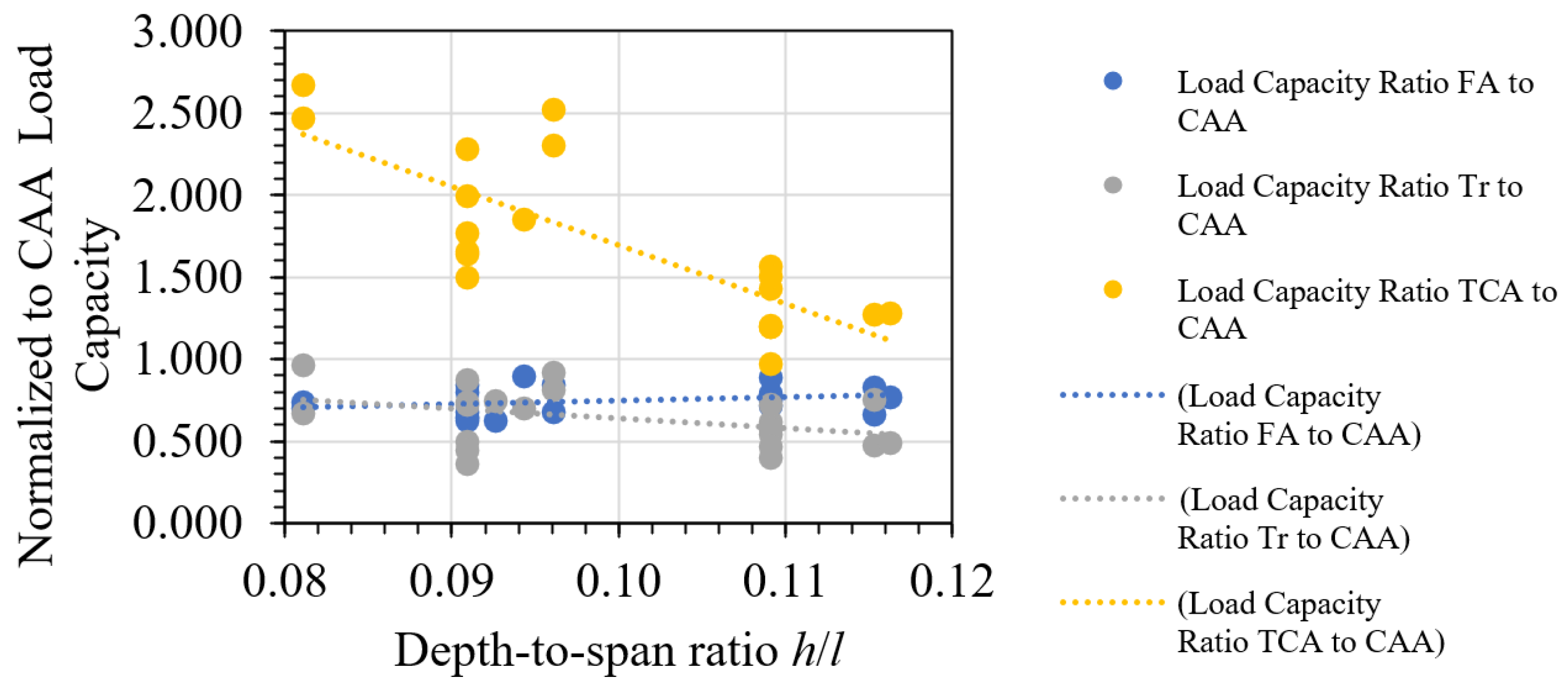
Figure 3 shows the relative changes in the load-bearing capacity of typical frame substructures at various stages of performance, based on experimental studies by Pham et al. [17], Tao Y. et al. [16], Feng F.-F. [15], Lew et al. [25], Yu & Tan [26,27], and Kang & Tan [28,29]. The results presented in the figure are normalized to the load-bearing capacity at the compressive arch action stage. As the depth-to-span ratio of the beams, h/L, increases, a decrease in the load-bearing capacity at the tensile catenary action stage is observed. A slightly less noticeable decrease in the load-bearing capacity is observed in the transitional stage of beam performance as the depth-to-span ratio h/L increases.
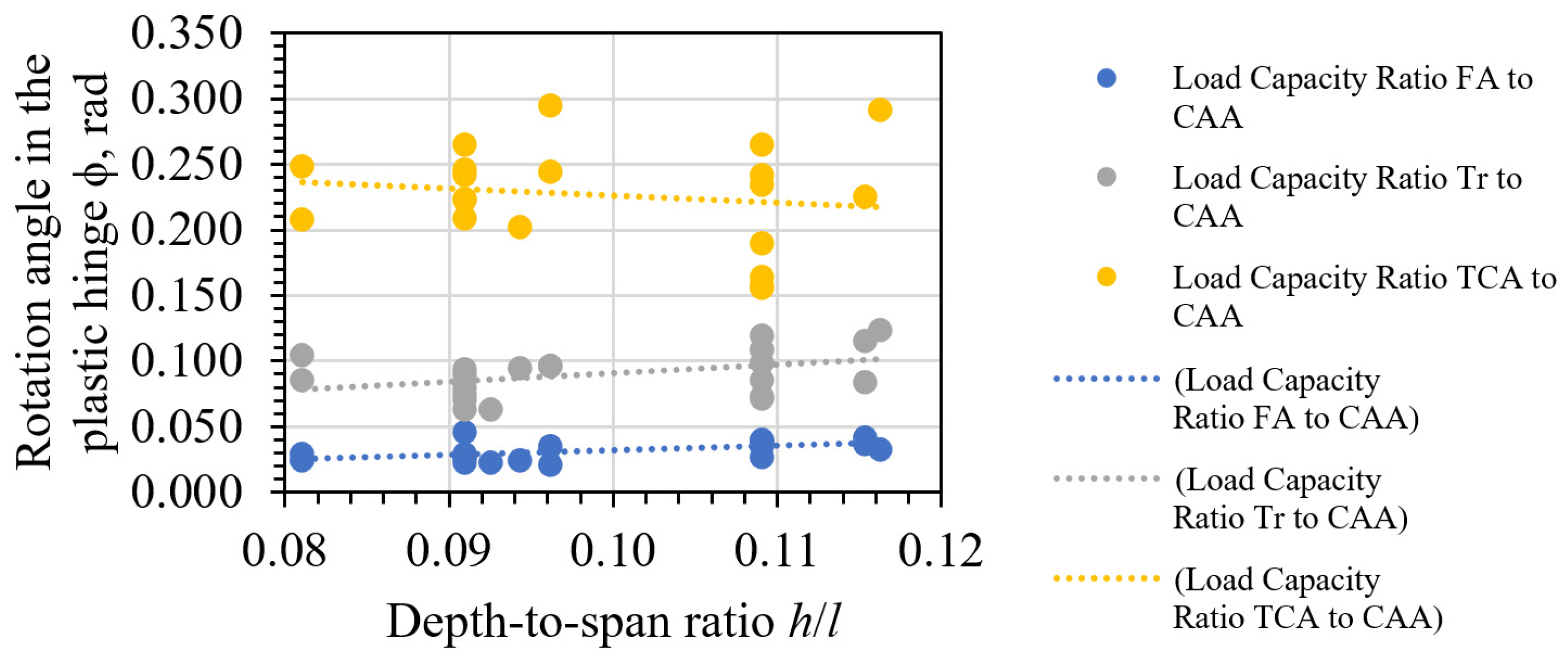
Figure 4 presents the values of the rotation angles in plastic hinges corresponding to the ultimate load-bearing capacity of the substructure at various resistance stages under an accidental design situation. The average values of the plastic hinge rotation angle were 0.03 rad for the arch resistance stage, 0.09 rad for the transition stage, and 0.23 rad for the catenary resistance stage.
According to experimental studies, the relative deflection at maximum load-bearing capacity was found to range from 1/91 to 1/43 of the beam span during the compressive arch action stage, from 1/31 to 1/16 during the transition stage, and from 1/13 to 1/7 during the tensile catenary stage. Thus, the relative deflection criterion of 1/30, established in SP 385.132580 for flexural members with non-prestressed reinforcement, is a conservative assessment of the resistance during the transitional stage of frame substructure performance when the compressive arch action transitions to the tensile catenary action. In fact, it does not account for the ultimate load-bearing capacity during the tensile catenary action of the frame substructure. However, such a restriction can be considered reasonable in the absence of adequate and sufficiently simple models for performing engineering calculations of structures in the tensile catenary action stage, as well as due to the lack of specified acceptance criteria for performance stages under extraordinary conditions. It is also reasonable to note that, in a number of the tests considered, failure occurred due to reinforcement rupture before the implementation of the tensile catenary action stage [15,16].

2.2. Analytical Model of a Reinforced Concrete Frame Substructure Under an Accidental Design Situation

The analytical models of a frame substructure developed in previous studies [6] and experimentally validated through tests on scaled frames of multi-story buildings [24] were adopted to analyze how structural design and detailing affect the load-bearing and deformation capacities of such substructures under accidental conditions. The parameters assigned to these models have been refined based on the experimental results from Pham et al. [17], Tao et al. [16], Feng [15], Lew et al. [25], Yu & Tan [26,27], and Kang & Tan [28,29], as discussed in the previous section.
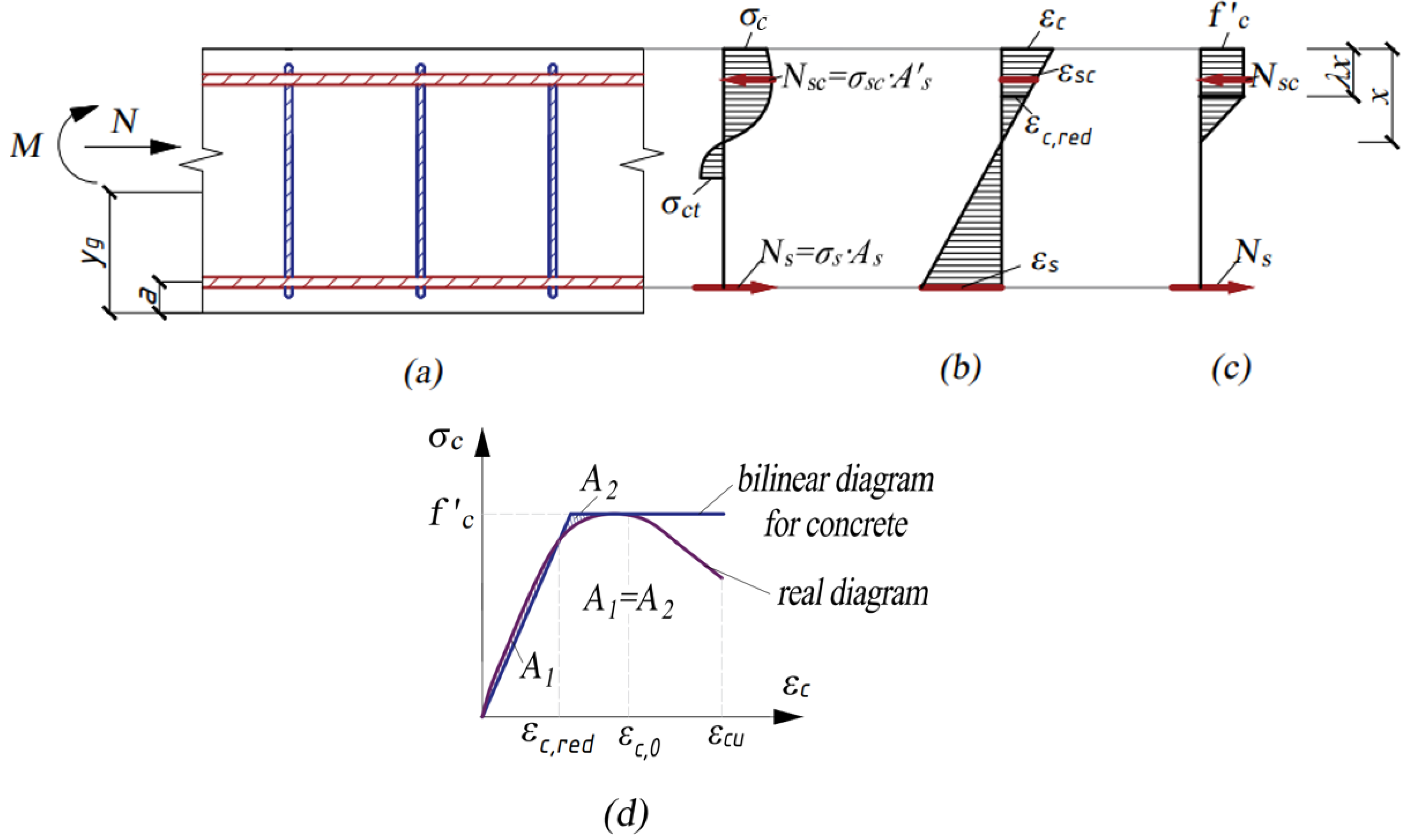
The frame substructure shown in Figure 1b illustrates a situation where, as a result of sudden column loss, the area of the tension reinforcement in one of the beam’s support sections becomes smaller than that of the compression reinforcement due to a change in the sign of the moment. To determine the ultimate bending moment in such a section, one uses a bilinear concrete strain diagram and assumes a trapezoidal stress distribution in compressed concrete, as presented in Figure 5. Assume that, by the time the ultimate bending capacity is reached during the flexural or compressive arch action, strains in the compressive concrete and tensile steel reinforcement have reached εcu and εs,el, respectively. The ultimate bending moment at the flexural action is as follows:
M u , F A = f c b λ x h 0 λ x 2 + f c b 1 λ 2 x h 0 2 λ + 1 3 x + ε s c E s A s h 0 a ;
where λ is the ratio of the depth of the compression zone over which the concrete is in the plastic region to the total depth of the compression zone, as follows from Equation (2):
λ = λ u = x p l , u x = 1 ε c , r e d ε c u = 1 0.0015 0.0035 = 0.571 ,
Compressive reinforcement strain εsc based on the Bernoulli assumption for composite cross-sections:
ε s c = ε c u + ε s , e l h 0 x a = ϕ b a l x a ,
where, for standard heavy-duty concrete with strength classes up to and including B60:
x = ε c u + ε s , e l h 0 a E s A s + f y A s f c b 1 + λ 2 + ε c u + ε s , e l h 0 E s A s = ϕ b a l a E s A s + f y A s 0.786 f c b + ϕ b a l E s A s ,
in which ϕ b a l is the curvature of the cross-section at which the strains of the extreme compression fiber of the concrete and the tensile reinforcement are equal to εcu and εs,el, respectively.
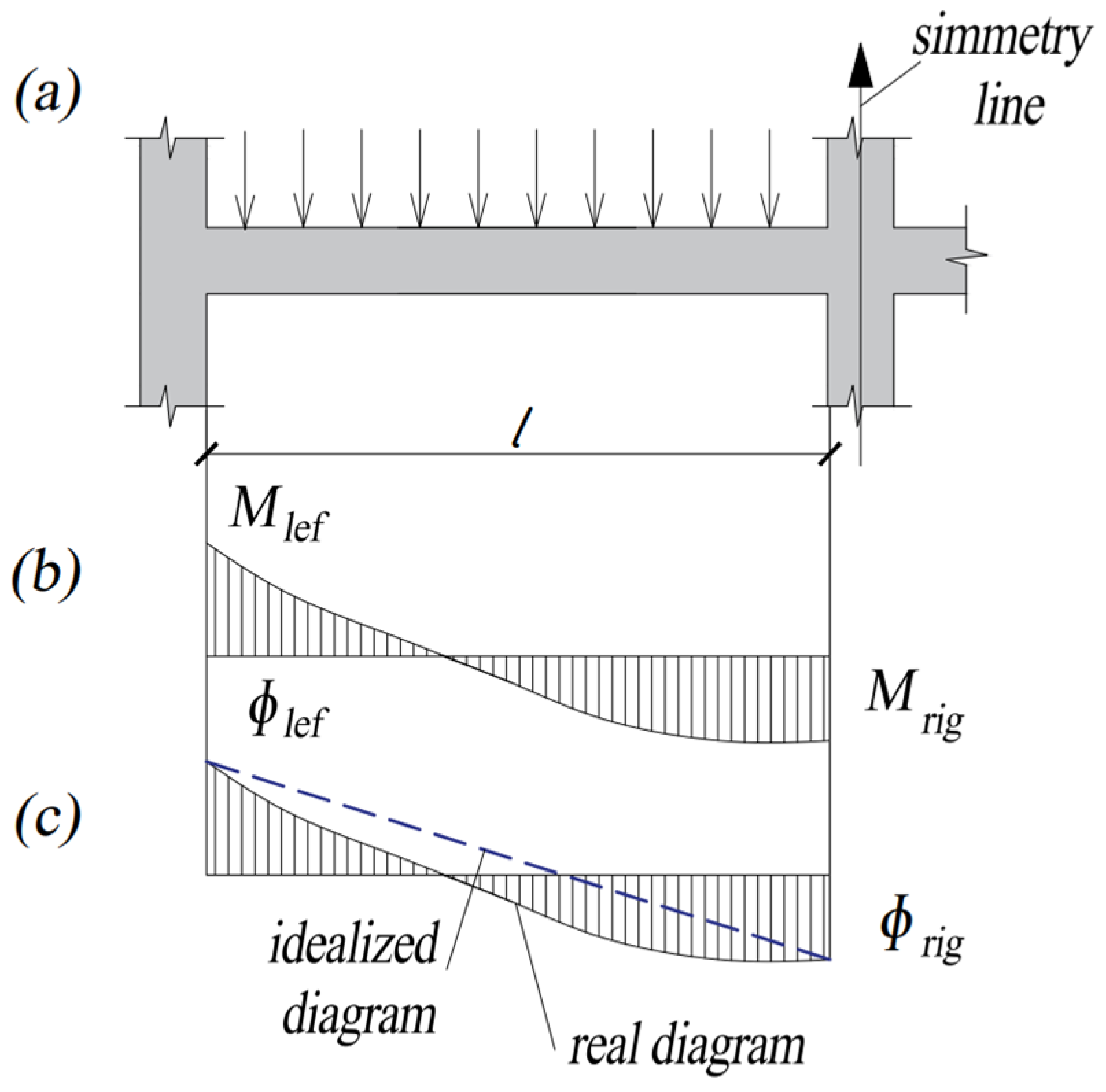
The ultimate load and deflection at the flexural action stage are determined from Equations (5) and (6) according to diagrams in Figure 6.
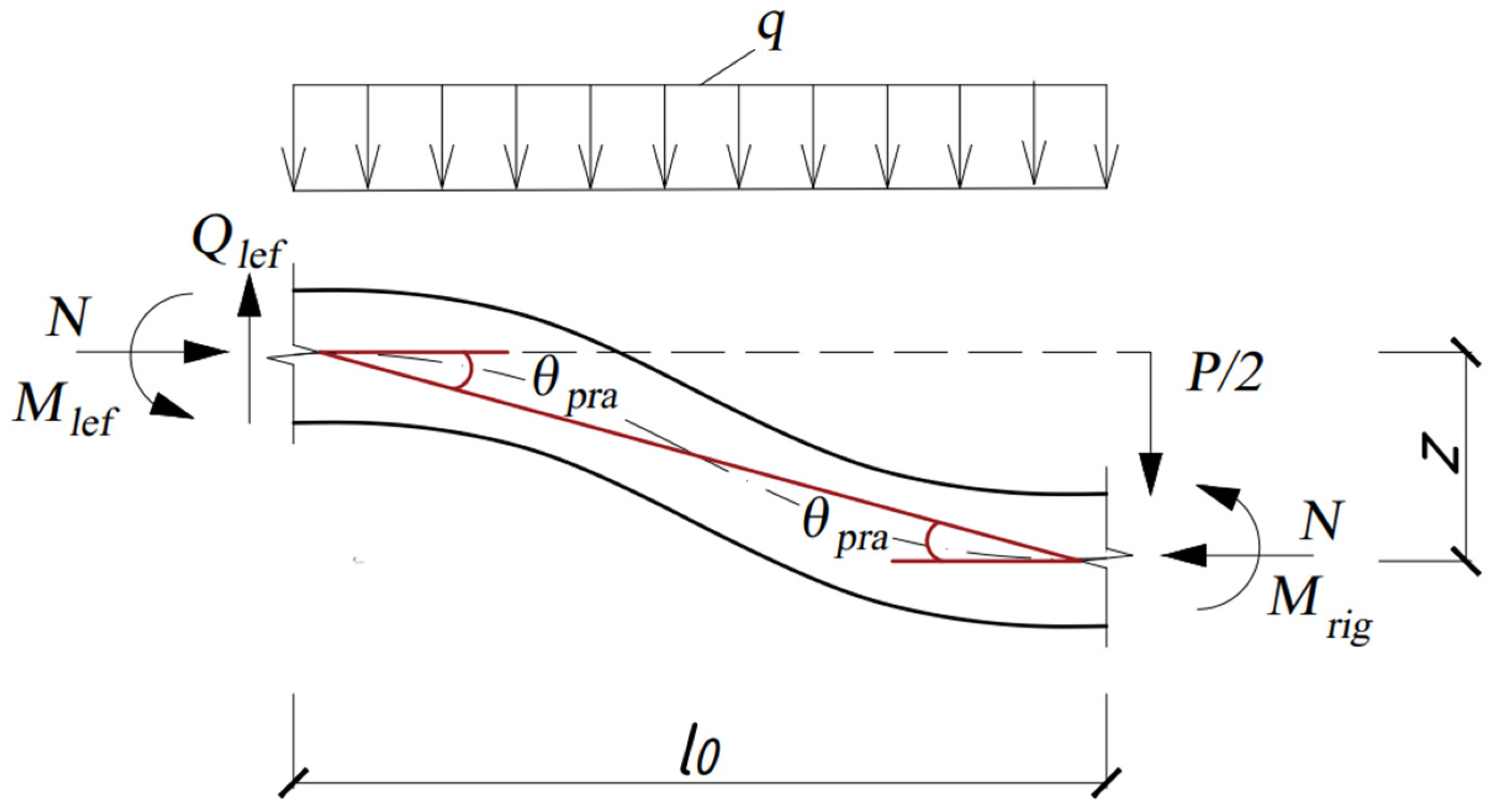
P F A = 2 M l e f + M r i g l q l ,
z F A = 0 l 1 r l 2 x d x .
The deformed state of the element is determined by the strains in the cracked region or, for high-strength concrete, in the region adjacent to the critical crack. As a first approximation and for analytical convenience, we assume that the total length of the cracked sections equals the sum of the plastic hinge lengths at the support sections. The ultimate rotation angle at the flexural stage is then given by Equation (7):
θ y 2 L p l 1 r c r c .
In Equation (7), the curvature over the length Lpl is assumed constant and is determined from the average strains in the concrete and reinforcement in either the section between adjacent cracks or the transfer length over which forces are transferred from the reinforcement to the concrete (for isolated cracks in high-strength concrete):
1 r c r c = ε s m ε b m h 0 = M u , F A 0.8 M c r c E s A s z s h 0 + 0.9 M u , F A E b , r e d A b z s h 0 .
where zs and Ab are the lever arm of the internal force couple and the compressive concrete area, respectively, determined from ultimate force equilibrium under flexural action.
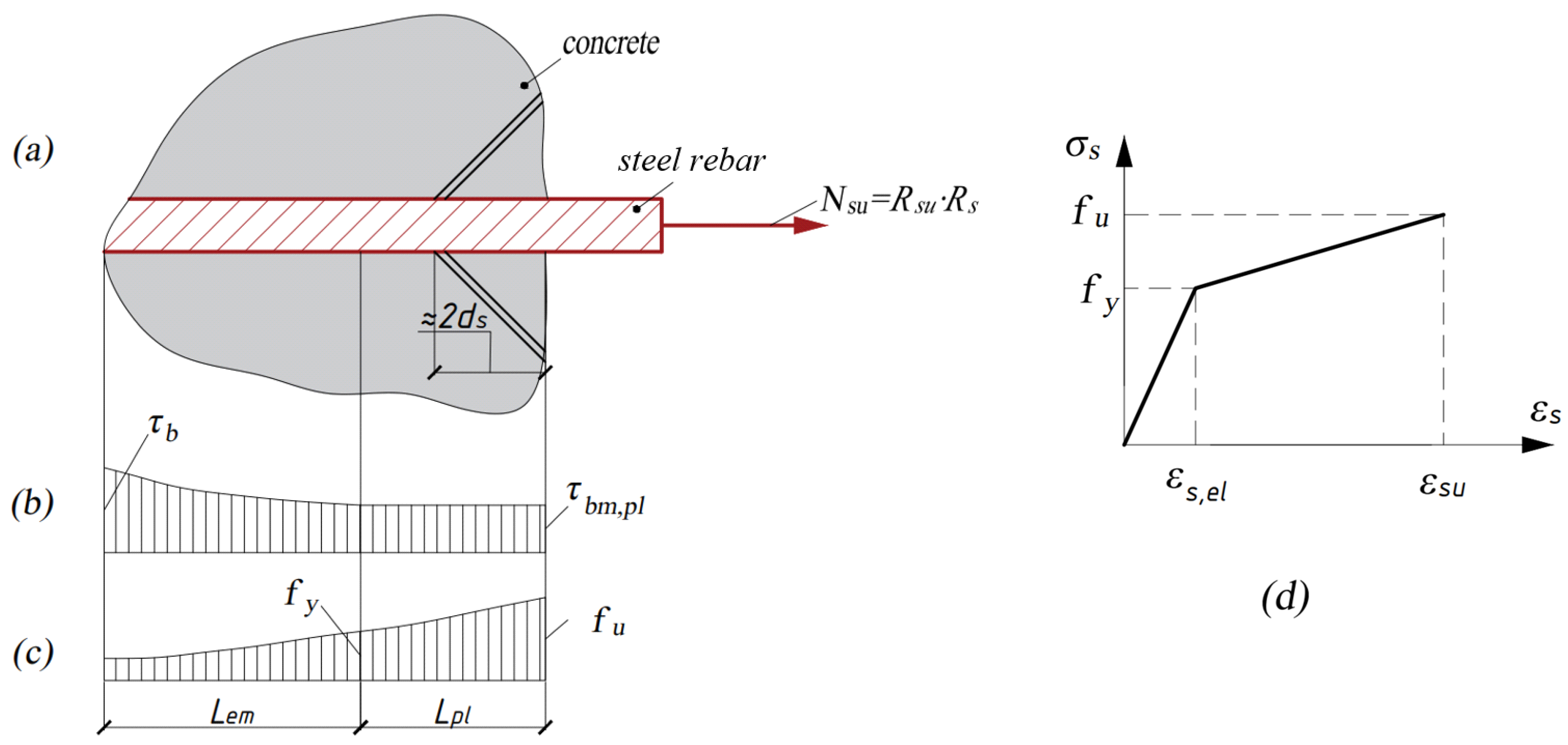
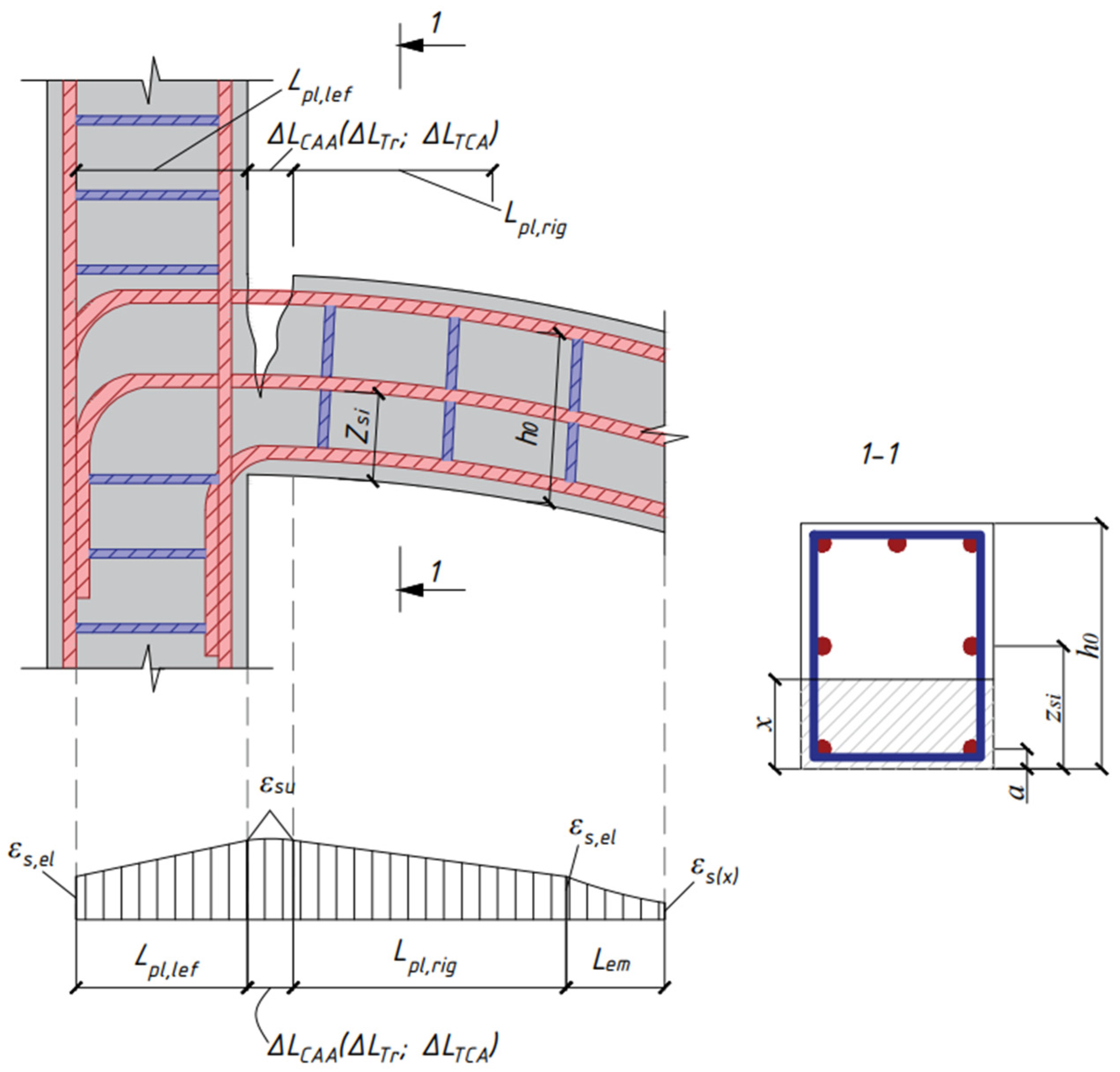
Lpl is the ultimate plastic hinge length, determined according to [6,30] as follows (see Figure 7):
L p l = f u f y τ b m , p l d s 4 ,
where τbm,pl = 0.27τb,max is the average bond stress in the plastic stage of the reinforcing bar;
ds is the diameter of the longitudinal tension reinforcing bar in the beam support section (if bars of different diameters are present, the smallest value is taken);
and fu is the ultimate tensile strength of the steel reinforcement at rupture.
For the compressive arch action stage, the ultimate bending moment equals:
M u , C A A = f c b λ x h 0 λ x 2 + f c b 1 λ 2 x h 0 λ x 2 λ + 1 3 x + + ε s c E s A s h 0 a N z y g a ;
where, the depth of the compression zone is determined by accounting for the axial force N(z) and using the trapezoidal stress distribution in the concrete compression zone, as shown in Figure 5:
x = ϕ b a l a E s A s + f y A s + N z 0.786 f c b + ϕ b a l E s A s
In Equation (11), the axial force N(z) is calculated based on the deflection of the two-span beam using the following formula:
N z = Δ L C 1 C 2 C 1 + C 2 = l 1 2 + 2 h 0 a z z 2 1 2 l 1 C 1 C 2 C 1 + C 2 ,
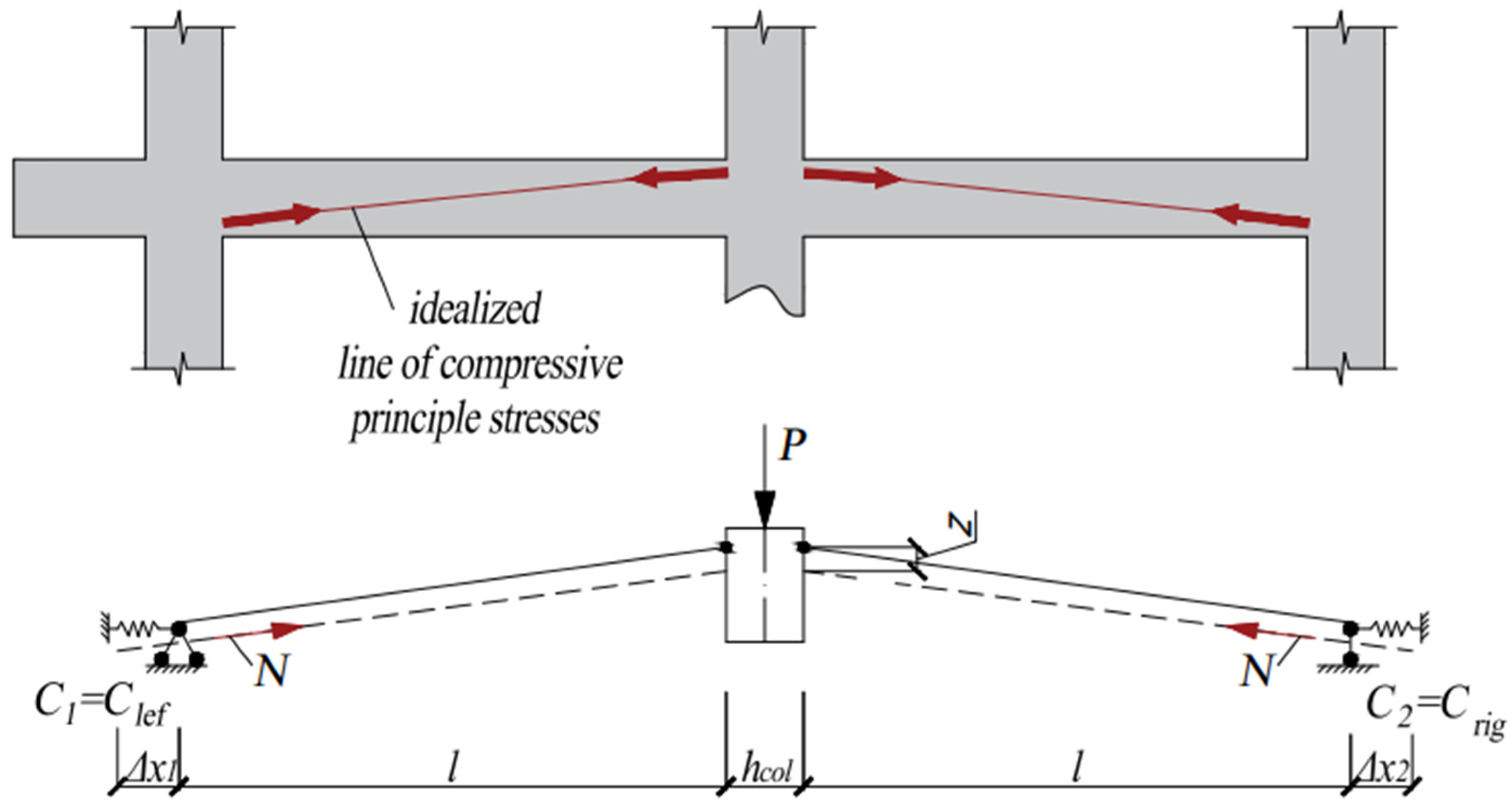
where C1 and C2 are the horizontal displacement stiffnesses of the left and right support sections of the hypothetical arch respectively, as shown in Figure 8.
In the case of C1, the stiffnesses under horizontal displacements of the supports are determined from Equation (13):
C 1 1 = i = 0 n 1 C 1 , b , i + 1 j = 0 m C 1 , c o l , j + 1 k = 0 p C 1 , s w , k ,
where C1,b,i is the conventional stiffness of the frame substructure associated with beam longitudinal compression during the compressive arch action stage (upon transition to the tensile catenary action stage, this stiffness must account for crack opening effects);
C1,col,j is the conventional stiffness of the frame substructure associated with interstory drift of the vertical load-bearing elements;
and C1,sw,k is the conventional stiffness of the frame substructure associated with interstory drift of the shear walls.
The ultimate load and deflection in the compressive arch action stage are determined, according to Figure 9, from Equation (14):
P C A A = 2 M l e f + M r i g l q l N z z C A A ,
where ZCAA is equal to the minimum value of the deflection z at which P(z) reaches an extremum, i.e., condition (15) fulfills:
d P d z = 0 z C A A
Then, the rotation angle in the plastic hinge for the compressive arch action stage is as follows:
θ p r a , C A A = z C A A l θ y .
where ZCAA/L is the complete angle of rotation, as shown in Figure 9.
Assuming ZCAA,ult = h as a first approximation for the transition stage from compressive arch action to tensile catenary action [6], we obtain the following:
P T r = h i = 1 n σ s i A s i l 1 Δ x 1 + j = 1 m σ s j A s j l 2 Δ x 2 .
Here, l1 and l2 are the design spans of the beams to the left and right of the removed vertical element (see Figure 2). Δx1 and Δx2 are the horizontal displacements of the beam support sections due to the thrust action (see Figure 8). In the case of a corner column removal, only one term remains in the parentheses in expression (16).
σs1 and σs2 can be determined according to [31] as follows:
σ s i , max = 2.39 τ b , max E s d s Δ L T r 1.4 f y .
where τb,max is the maximum bond stress corresponding to elastic behavior of the reinforcement; ds is the diameter of the longitudinal reinforcing bar; and ΔLTr is the maximum elongation of the beam face during the transition from the arch action to the catenary action, determined by the following formula:
Δ L T r = l 2 + h 0 2 l .
Hence, the ultimate rotation angle in the plastic hinge θ p r a , T r is:
θ p r a , T r = h l θ y
where the beam deflection at the transition stage is ZTr = h.
The assumption regarding the magnitude of the deflection in the transition state is based on an analysis of the experimental data presented in Figure 2. A similar assumption follows from the analysis of the static equilibrium of the calculation scheme shown in Figure 8. As long as the deflection is smaller than the characteristic section height, the external load induces compressive forces in the virtual arch. However, once the deflection exceeds the dimensions of the characteristic section, tensile forces must act in the beams according to the static equilibrium condition. The transition from the arching stage to the catenary stage involves a transient process during which the static equilibrium conditions may be violated until a new equilibrium state is reached in the catenary stage. Analysis of the experimental data presented in Section 2.1 shows that, in dynamic tests, the deflection magnitude in the transition stage is closer to the section size than in static tests, where the deflection may exceed the section size when the sign changes. The presence of compressive force in static tests when the section size is exceeded may be associated with friction forces in the near-joint zones of the beams. Analysis of Formula (17) shows that reducing the deflection used for the analytical analysis of the transition stage leads to a decrease in the calculated value of the load-carrying capacity in this stage.
If reinforcing bars are placed in several rows along the beam section height, as shown in Figure 10, for longitudinal bars located at a distance Zsi from the compressed face of the section, elongation at the level of each reinforcing bar ΔLsi is as follows:
Δ L s i = Δ L T r h 0 z s i .
Substituting ΔLsi for ΔLTr in Formula (19), we find the stresses σsi in all longitudinal reinforcing bars placed in several rows along the section depth.
If the condition σs < Rsu is satisfied for the deformed state of the structure at the transition stage (PTr, ZTr), the ultimate deflection ZTCA at the moment when the most tensioned reinforcing bars rupture in one of the support sections at the catenary stage of resistance can be found according to [6] by taking σs = fu:
z T C A = l + Δ L T C A 2 l Δ x 2 ,
Δ L T C A = f u f y τ b m , p l d s 4 ε s u 2 + f y E s 2 d s + 0.288 d s f y 2 τ b , max E s 0.714 .
The ultimate load-bearing capacity at tensile catenary action stage PTCA is calculated using Formula (17), with ZTCA substituted for h:
P T C A = z T C A i = 1 n σ s i A s i l 1 Δ x 1 + j = 1 m σ s j A s j l 2 Δ x 2 .
In (24), the stress in the tension reinforcement working in the elastoplastic phase is determined by Formula (25):
σ s i , max = f y + f u f y ε s u ε s , max ε s u ,
in which
ε s , max = 8 τ b m , p l ε s u d s f u f y Δ L T C A 0.288 d s f y 2 τ b , max E s 0.714 2 d s f y E s + ε s u 2 0.5 ,
The rotation angle in the plastic hinge at the tensile catenary action stage of beam performance is:
θ p r a , T C A = z T C A l θ y ,
The validation basis for the considered analytical models is provided by the test results of typical monolithic and precast frame substructures presented in the studies by Pham et al. [17], Tao Y. et al. [16], Feng F.-F. [15], Lew et al. [25], Yu & Tan [26,27], and Kang & Tan [28,29]. The main design parameters of the specimens used in the calculations are summarized in Table 1.

3. Results and Discussion

3.1. Validation of the Analytical Models of Frame Substructures

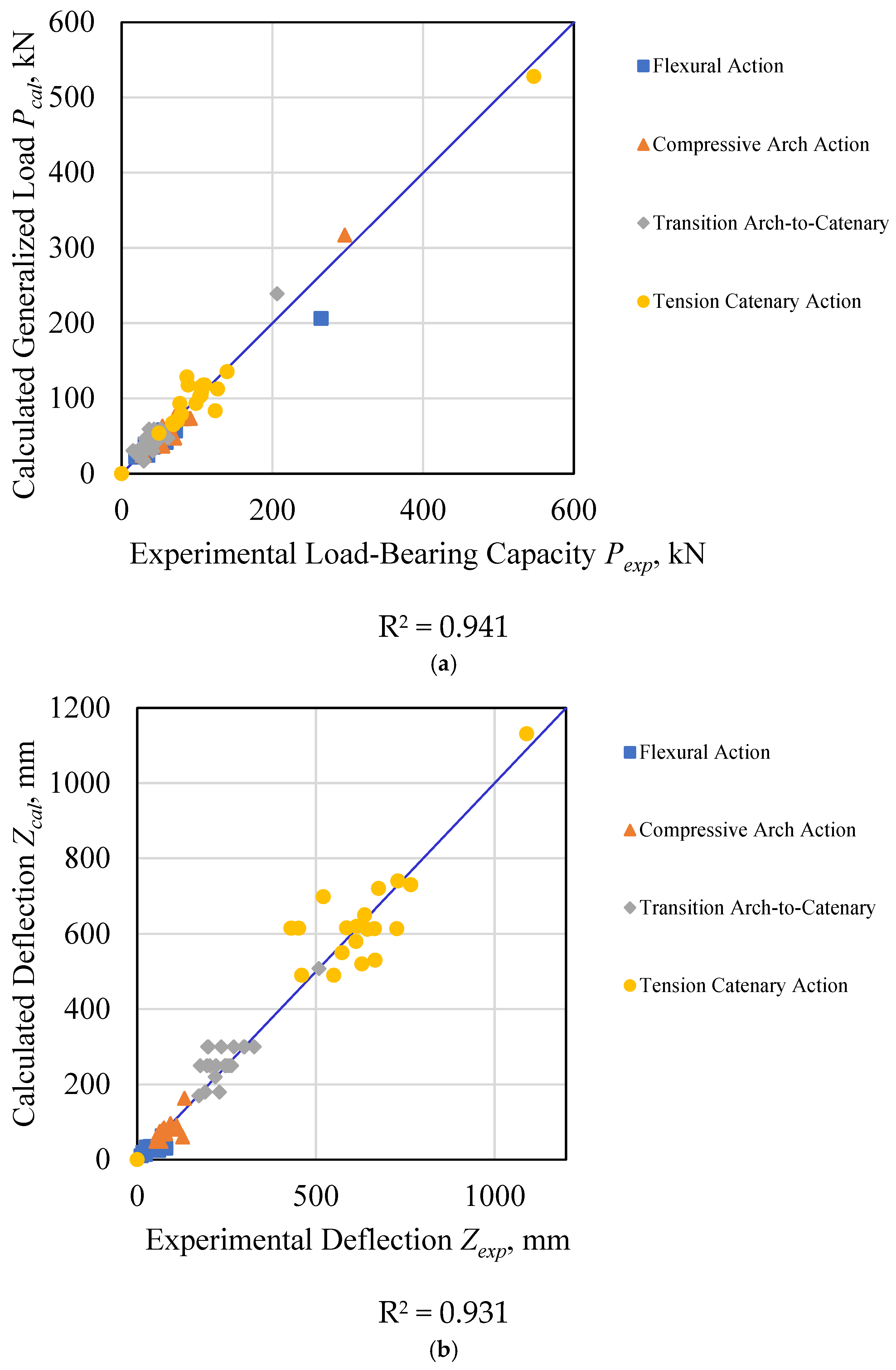
The calculation results obtained with the proposed analytical model of frame substructure for the stages of performance under extreme conditions are presented in Table 2 and Table 3. A comparison of the experimental and calculated data is shown in Figure 11. For both the ultimate loads and the ultimate deflections of the typical frame substructure in the region of potential local collapse, the coefficients of determination R2 were 0.941 and 0.931, respectively, indicating satisfactory accuracy of the proposed analytical model.
The coefficient of determination R2 was calculated using the following formula:
R 2 = 1 i = 1 n y c a l y exp 2 i = 1 n y c a l y m 2
where ycal are the calculated values of the load-bearing capacity or deflection of the substructure at various resistance stages, determined for load-bearing capacity using Formulas (5), (14), (17), (24), and for deflection using Formulas (6), (15), (22), or taken as equal to the section height h at the transition stage;
yexp are the experimental values of the load-bearing capacity or deflection of the substructure at various resistance stages;
and ym is the mean experimental value of the load-bearing capacity or deflection of the substructure at various resistance stages.
Despite the high overall coefficient of determination R2, the discrepancies between individual test results and analytical predictions in Table 2 and Table 3 are substantial for several cases. For specimen S1, the deviation in the transition stage exceeds 100%. For the catenary action stage of specimen S3, the deviation is 33%. Elevated deviations were also identified for some specimens of the MJ and EMJ series during the transition stage. Therefore, consider the design features of these specimens and possible reasons for the deviations.
In specimen S1 [27], the transverse reinforcement in the joint regions was assigned according to seismic design provisions, unlike the other specimens in series S. The spacing of transverse reinforcement in the near-joint zones was half that in the span. The deviation for this specimen may be attributed to the compliance of the structural joints in the tests. This is noted by Yu and Tan [27], whose numerical study obtained a similar discrepancy between experimental data and analytical results when using a rigid joint model that does not allow rotation or distortion. When a component-based joint model was used in their numerical study, the discrepancy decreased. On the other hand, in our opinion, the difference may be due to the non-simultaneous engagement of all longitudinal rebars across the section depth when transitioning to the catenary action stage. Supporting this view is the fact that if the forces in the longitudinal rebars in the compression zone of the section are set to zero, the deviation does not exceed 30%, whereas if compressive forces in the same bars are accounted for, the deviation does not exceed 5% for specimen S1. However, for simplicity, the model proposed in this study assumes that, in the transitional state, the substructure already behaves as a catenary mechanism. It is worth noting that, in dynamic tests [17] in which the catenary action stage was identified, the transition to this stage occurred more abruptly and at smaller deflection values than in static tests with a deformation-controlled loading regime. Accordingly, in dynamic tests, all longitudinal rebars across the section depth are engaged in tension catenary action at smaller deflection values than in static tests.
For specimen S3, a lap splice was used for the bottom longitudinal reinforcement in the middle joint. Lap splices or mechanical couplers are widely used in real structures. Therefore, the effect of the compliance of such splices on the load-carrying capacity and deformation capacity of frame substructures warrants in-depth investigation.
The specimens of series MJ [28] and EMJ [29] were precast, which influenced their behavior in the arching and catenary stages as well as in the transition stage. Such specimens exhibited greater deformation capacity in the arching action stage. It should also be noted that, in the experimental studies considered, for each design variant [15,16,17,26,27,28,29] or loading regime, only one specimen was tested. This does not allow a full statistical analysis of the results for each specific specimen type or test regime to assess the influence of random factors on the outcome. To evaluate the degree of influence of the random nature of the input parameters, a parametric study is presented below.
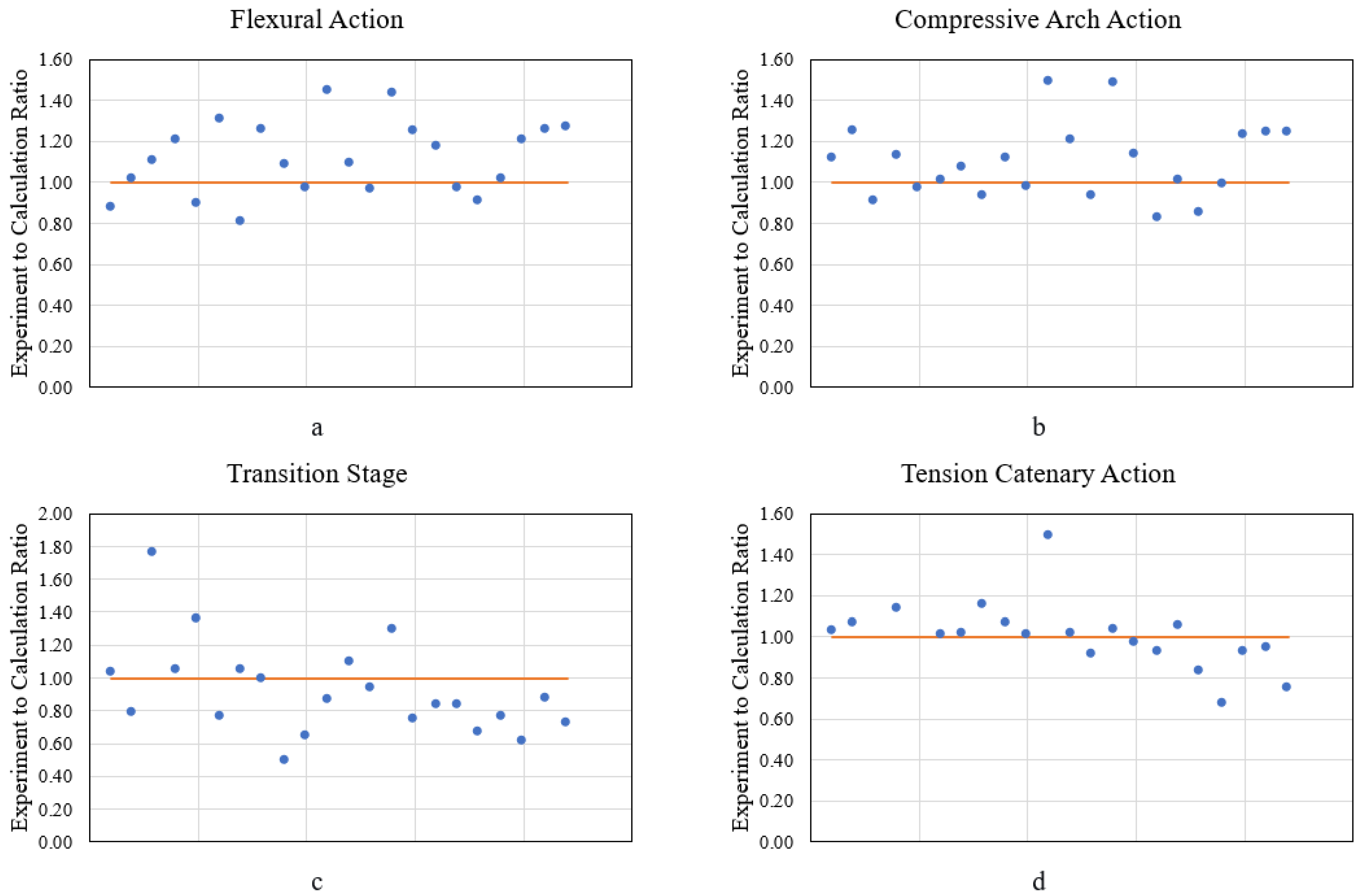
In addition to the overall diagrams in Figure 11, Figure 12 below presents diagrams for each stage individually, showing the reserve of load-carrying capacity when using the proposed analytical model. In these diagrams, values less than one indicate an overestimation of the load-carrying capacity in the corresponding calculations using the proposed model. Thus, the minimum value for the flexural stage is 0.80; for the arching stage—0.82; for the transition stage—0.50; and for the catenary stage—0.67. Moreover, the following minimum overestimation values of the load-carrying capacity were obtained with 95% probability: for the flexural stage—0.88; for the arching stage—0.85; for the transition stage—0.61; and for the catenary stage—0.75.
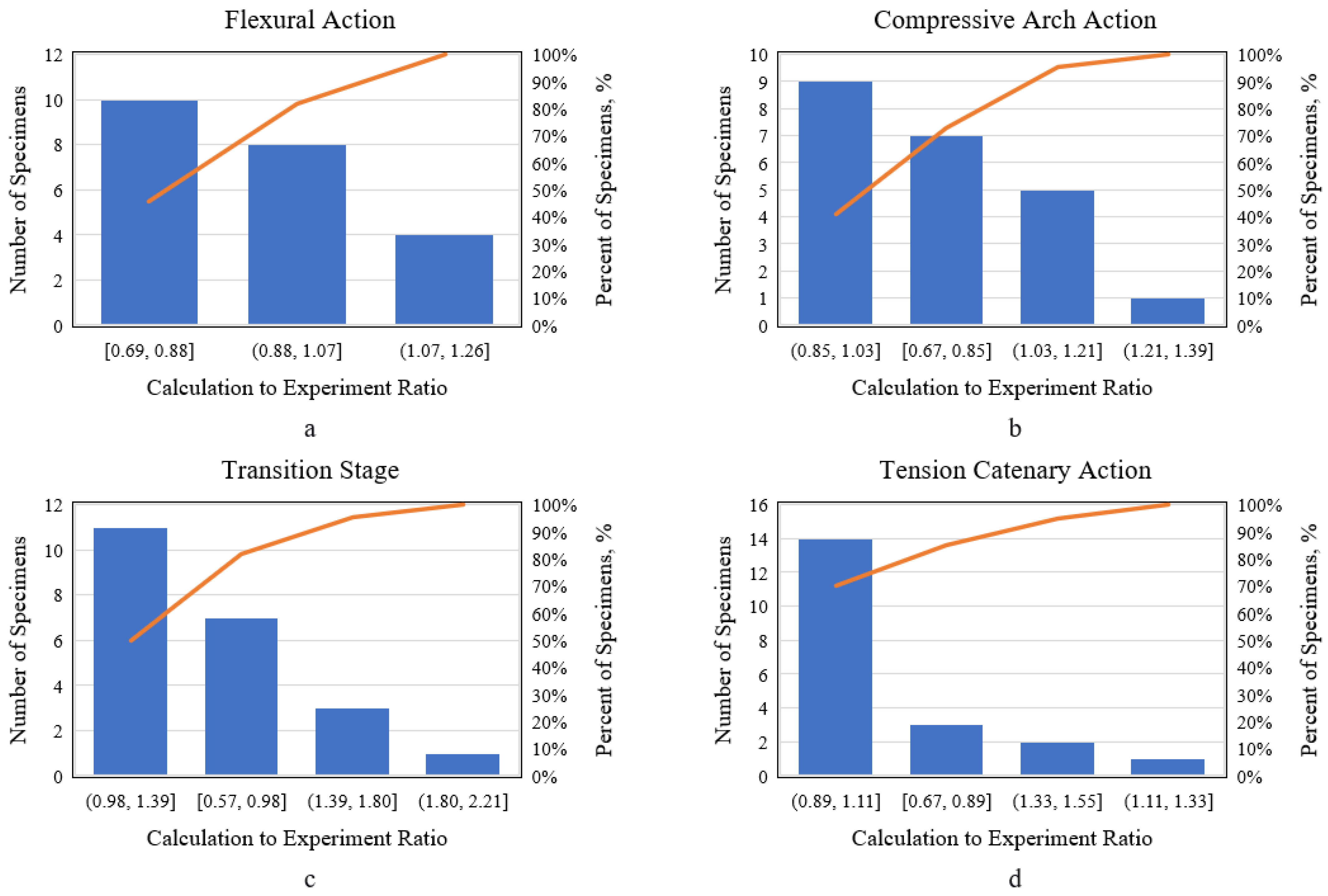
Furthermore, Figure 13 shows Pareto diagrams for each stage of resistance of the frame substructures. These diagrams allow evaluation of the distribution of deviations of the calculation results obtained with the proposed model relative to the experimental data and identification of the most likely deviation intervals. Thus, for the flexural stage, 80% of cases lie in the interval [0.69, 1.03]; for the arching stage, 72% lie in the interval [0.69, 1.07]; for the transition stage, 78% lie in the interval [0.57, 1.39]; and for the catenary stage, 88% lie in the interval [0.69, 1.11]. The model has the least predictive capability for the transition stage. It is worth noting that the analytical model for this stage is the most sensitive to the loading regime and the model parameters.
Based on the analysis of the presented graphs, service condition factors for each stage can be recommended as a first approximation. It should be noted here that several model parameters, such as the stiffness of the horizontal restraint of the substructure and the bond between reinforcing bars and concrete, were assigned based on indirect evidence. Therefore, it is necessary to perform a sensitivity assessment of the model to these parameters. A more reliable evaluation of the safety of design solutions developed using the proposed model requires probabilistic modeling that accounts for the random nature of the parameters of loading, concrete and steel strengths, as well as the bond between them. Such probabilistic modeling with systematic risk analysis is one of the priority directions for future research.
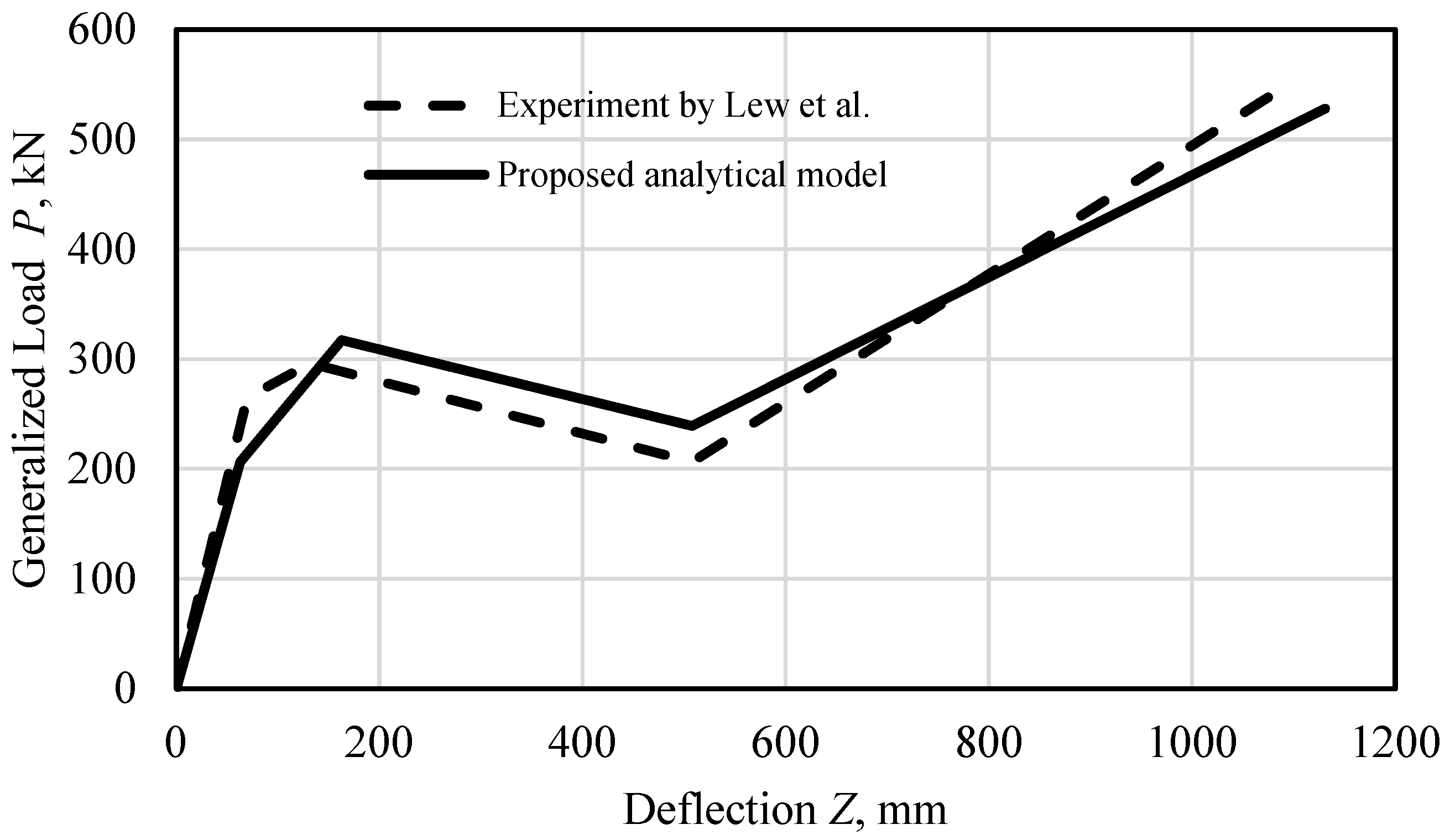
For the subsequent parametric studies, the typical frame substructure IMF tested by Lew et al. [25] was adopted. Unlike the other experimental specimens listed in Table 1, the IMF substructure was full scale, thus eliminating scale effects on the test results. Figure 14 shows the load–deflection diagram of the IMF specimen according to the test results and according to the calculation.
The following subsections present the results of parametric studies obtained by varying the relevant parameters of the original experimental configuration: beam depth-to-span ratio; bond strength between reinforcement and concrete; stiffness of horizontal support restraints; ratio of effective depth to total depth of the beam section.

3.2. Beam Depth-to-Span Ratio

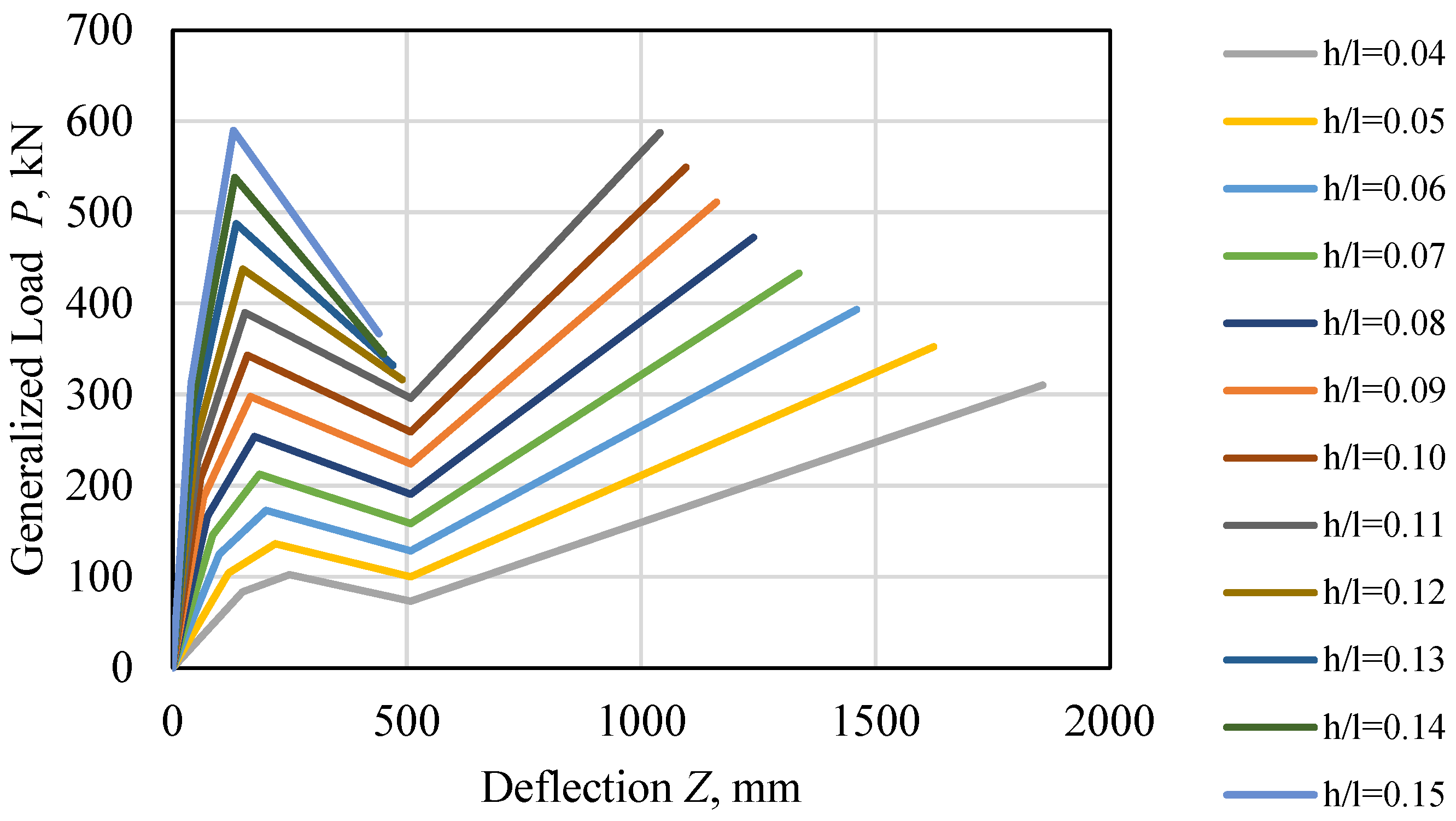
Consider the influence of the ratio of the beam cross-sectional depth to its span h/L on the resistance parameters and deformation acceptance criteria of the structural robustness. This study uses the typical IMF frame substructure (see Table 1) tested by Lew et al. [25]. For research purposes, the beam span was varied so that the depth-to-span ratio h/L took values from 0.04 (1/25) to 0.15 (1/7) in increments of 0.01. Figure 15 presents the load–deflection diagrams of the considered typical frame substructures. As the span decreases, the load-carrying capacity increases at all performance stages of the typical substructure, which follows from the analysis of the analytical expressions (5), (14), (17) and (24) for the respective performance stages.
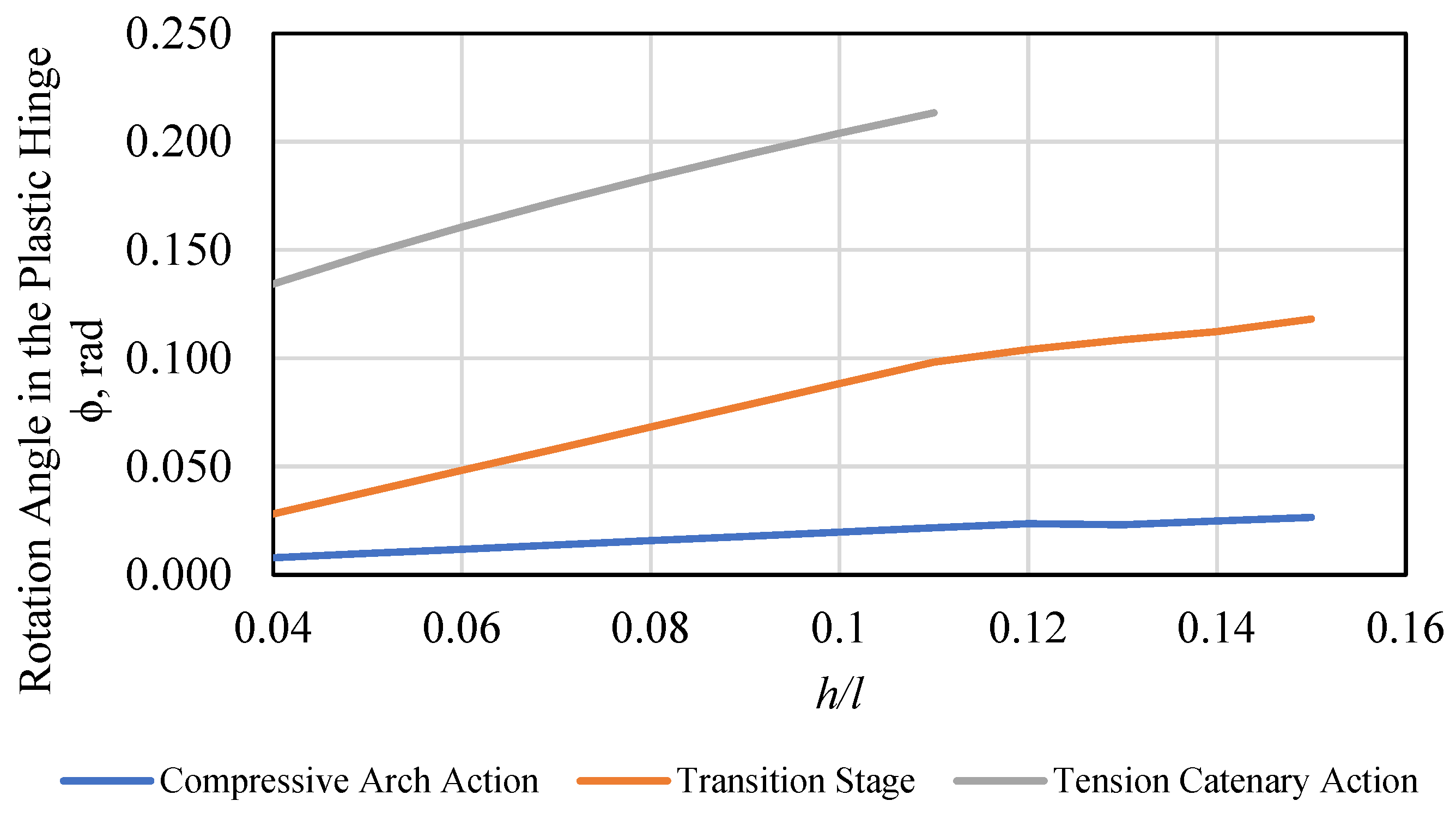
Figure 16 shows the ultimate rotation angles in the plastic hinge for various performance stages of the considered typical frame substructures in the region of potential local collapse if varying the beam span. For the adopted reinforcement and bond parameters, the deformation capacity of the beams increases with increasing beam depth-to-span ratio h/L from 0.008 to 0.027 rad at the compressive arch action; from 0.028 to 0.118 rad at the transition stage; and from 0.13 to 0.21 rad at the tensile catenary action. For comparison, UFC 4 023 03 2009, Amendment No. 4 [7] provides the following values of plastic hinge rotation angles for sections where the area of compression reinforcement exceeds that of tension reinforcement: for the flexural and compressive arch action stages, in the presence of additional detailing measures to improve bond within the plastic hinge length (e.g., reinforcement spacing ≤ 0.3 h0)—from 0.05 to 0.063 rad; for the transition stage (maximum deformation capacity at the compressive arch action stage)—from 0.08 to 0.10 rad; in the absence of such additional detailing measures—from 0.025 to 0.05 rad for the flexural and compressive arch action stages and from 0.03 to 0.08 rad for the transition stage, respectively.
If the beam depth-to-span ratio reaches h/L = 0.11, for the adopted longitudinal and transverse reinforcement parameters (for transverse reinforcement—regarding its indirect effect on bond resistance), the catenary action stage is not achieved. This is because, as the cross-sectional depth increases, the same plastic hinge rotation angle of the beam leads to a larger pull out of the tension longitudinal bars located near the most tensioned face of the member and, consequently, to larger forces in those bars. This may cause rupture of these bars during the transition stage.

3.3. Bond Between Steel Reinforcement and Concrete

The Model Code [31] provides bond slip diagrams for deformed reinforcing bars depending on the cover thickness, clear spacing between the bars of the main reinforcement, and parameters of transverse or indirect reinforcement that create a confining effect within the linear plastic hinge region of the beam. Some of the distinctions are qualitative, without adequate quantitative criteria. For example, bond resistance under concrete splitting (the most typical case for structural members) is divided into cases of “good bond conditions” and “all other conditions.” However, clear criteria for applying these categories are lacking. At the same time, UFC 4 023 03 2009, Amendment No. 4 [7] distinguishes applicability criteria for beam plastic hinge rotation angles based on whether the transverse reinforcement details satisfy the requirements for seismic design (conforming or nonconforming). Given that transverse and indirect reinforcement affect bond strength, it is of interest to investigate their influence on the resistance stages under extreme conditions. As in the previous case, the typical IMF frame substructure (see Table 1) tested by Lew et al. [25] is considered. For the original experimental specimen, “all other bond conditions” are assumed.
The bond strength is determined according to Model Code [31] using the following formulas:
-
for the pull-out mechanism under good bond conditions:
τ max = 2.5 f c k ,
-
for the pull-out mechanism under all other bond conditions:
τ max = 1.25 f c k ,
-
for the splitting mechanism under good bond conditions and in the absence of lateral concrete confinement:
τ max = 7 f c k 20 0.25 ,
-
for the splitting mechanism under good bond conditions with lateral concrete confinement:
τ max = 8 f c k 20 0.25 ,
-
for the splitting mechanism under all other bond conditions and in the absence of lateral concrete confinement:
τ max = 5 f c k 20 0.25
-
for the splitting mechanism under all other bond conditions with lateral concrete confinement:
τ max = 5.5 f c k 20 0.25
Here, fck is the characteristic strength of cylinder specimens. Good bond conditions are achieved for ribbed rebars, whereas for plain rebars, “all other bond conditions” should be used.
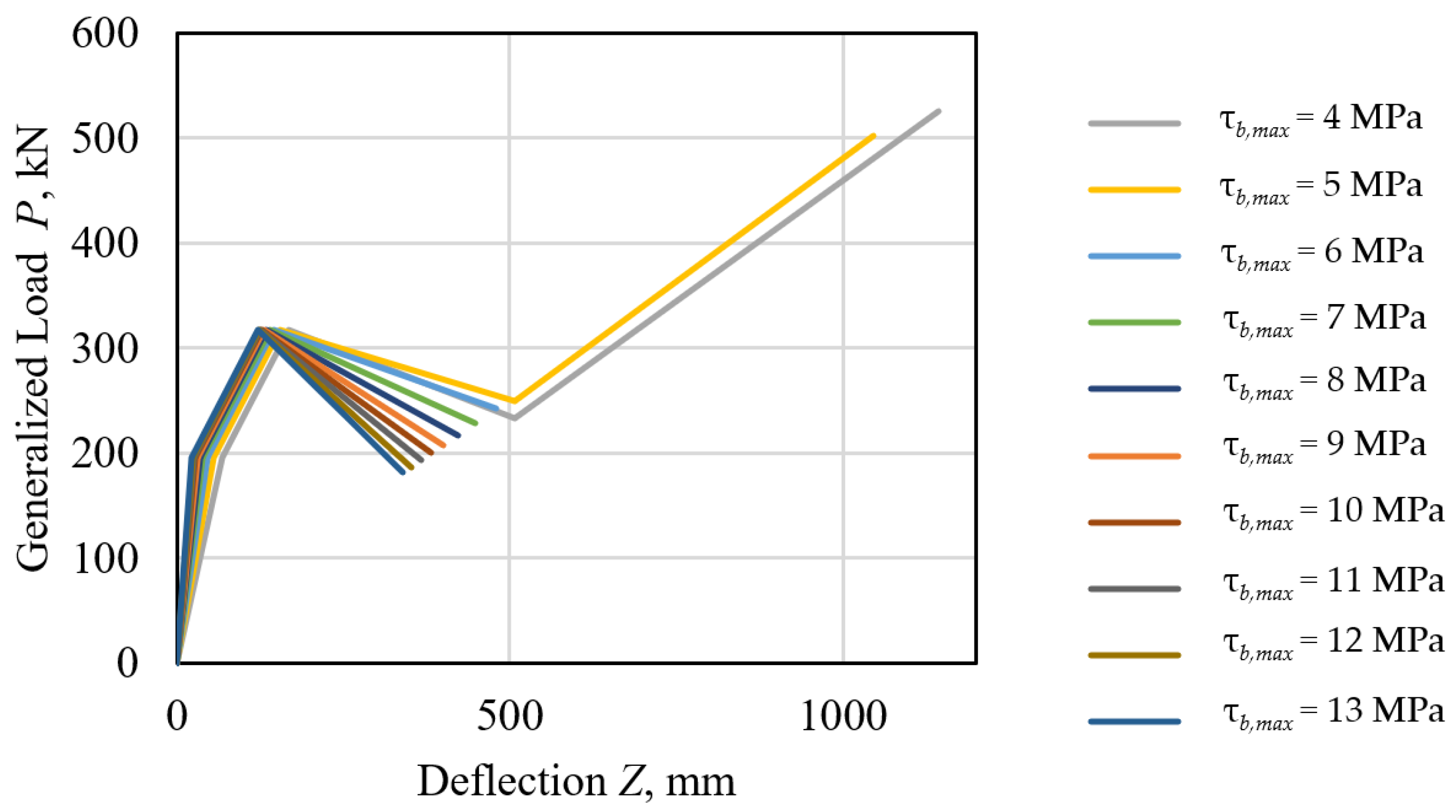
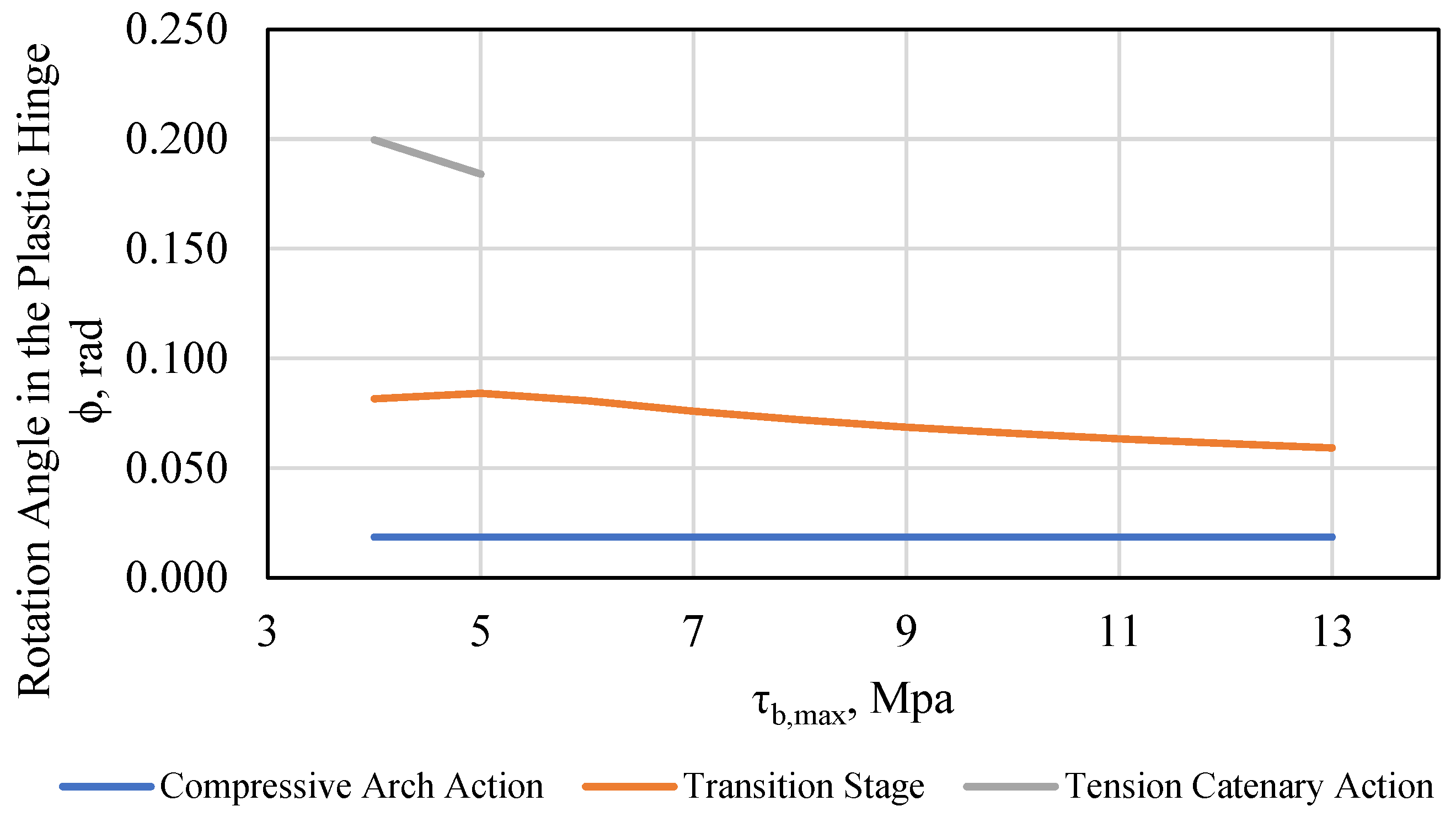
In the parametric study, the bond strength varies from 4 MPa for the worst bond conditions according to Formula (33) to 13 MPa for the best bond conditions according to Formula (29), given an average concrete strength fc = 32.4 MPa. Figure 17 and Figure 18 show the load–deflection diagrams of typical substructures for different bond strengths and the plastic hinge rotation angles at various extreme resistance stages, respectively.
Increasing the bond strength reduces crack widths, which leads to smaller deflections at the flexural and arch action stages (see Figure 17). However, at the same time, smaller slip of the reinforcement corresponds to larger forces in the bars, which ultimately reduces the deformation capacity of the structures (decreased deflections and ultimate plastic hinge rotation angles—see Figure 17 and Figure 18, respectively). This leads, in some cases, to rupture of the tension reinforcement without the structure transitioning to catenary action. It is worth noting that, in the calculations, the bond stress over the plastic hinge length is taken as τbm,pl = 0.27τb,max in accordance with [30]. It appears that this value needs refinement to account for various detailing parameters of the load-bearing members, as well as the effect of axial compression (for segments of reinforcing bars inside joints).
According to studies by Mander, Priestley, and Park [32], a certain spacing of transverse reinforcement creates a confined concrete effect (hoop action), thereby increasing its strength and deformability. The strength of concrete confined by transverse hoops is determined by the following formula:
f c c = f c o + 4.1 k e ρ h f y h
where:
f′co is the strength of unconfined concrete under uniaxial compression;
fyh is the yield strength of the transverse reinforcement;
ke is the confinement effectiveness coefficient, which accounts for non-uniform confinement in non-circular cross-sections and is taken according to Mander, Priestley, and Park [32];
ρh is the volumetric transverse reinforcement ratio.
The strength of the cover concrete is taken without considering the effect of lateral deformation confinement.
Since bond strength depends on the compressive strength of concrete, an increase is expected when using special detailing measures, such as reducing the spacing of transverse reinforcement or using mesh indirect reinforcement. However, in practical cases, the strengthening effect from reduced transverse reinforcement spacing may be insignificant, as in the tests of specimen S1 [27]. On the other hand, an increase in bond strength generally reduces the deformation capacity of the substructure, whereas to sustain a vertical load exceeding the ultimate PCAA value for the arching stage, the catenary stage requires large deflections on the order of 1/10 of the span.
Furthermore, there are cases when reinforced concrete frames of buildings and facilities are exposed to high-temperature effects as a result of fires [33,34]. High temperatures cause a loss of concrete strength: at 500–600 °C, up to 50% of the original strength. There is also a softening of the reinforcement, which becomes particularly noticeable at temperatures above 400 °C. As a result of thermal deformations, cracking occurs, and the bond between reinforcement and concrete is impaired.
Many studies in this area have been performed on specimens in the form of prisms or cylinders that were loaded after exposure to fire. Such tests did not account for the presence of mechanical cracks in reinforced concrete elements behaving in the arching or catenary stage. Thus, under high-temperature fire effects, in addition to bond, the direct local thermal effect on the reinforcement inside the crack will also affect the load-carrying and deformation capacity. This circumstance requires further in-depth investigation in the future.

3.4. Influence of Horizontal Restraints

To assess the influence of support restraint stiffness against horizontal displacements, the stiffness parameter of the left support C1 was varied while keeping the right support stiffness constant.
When assessing the influence of horizontal restraint stiffness on the force and deformation parameters of the resistance stages of the substructure, it was assumed that the beams are incompressible in the longitudinal direction and that no stiffening diaphragms are present. Therefore, the stiffness of the horizontal restraint is taken as the sum of the stiffnesses of the columns C1,col,j. For a column fixed at both ends, the nominal stiffness for a unit displacement of one of the support sections is determined by the following formula:
C 1 , c o l , j 12 0.3 E c I c l c o l 3 = 3.6 E c I c l c o l 3 ,
for a column pinned at one end and fixed at the other:
C 1 , c o l , j 3 0.3 E c I c l c o l 3 = 0.9 E c I c l c o l 3 ,
where Ec and Ic are the initial modulus of elasticity of concrete and the moment of inertia of the concrete section; 0.3 is a factor accounting for stiffness reduction due to cracking and plastic behavior of the structural member.
In this study, the following column parameters were adopted for stiffness calculation: cross-section dimensions 0.7 × 0.7 m, column clear height lcol = 3 m, initial modulus of elasticity of concrete 30,000 MPa.
The horizontal bracing stiffness values C1 and C2 adopted for the parametric study, along with their corresponding frame schemes, are given in Table 4.
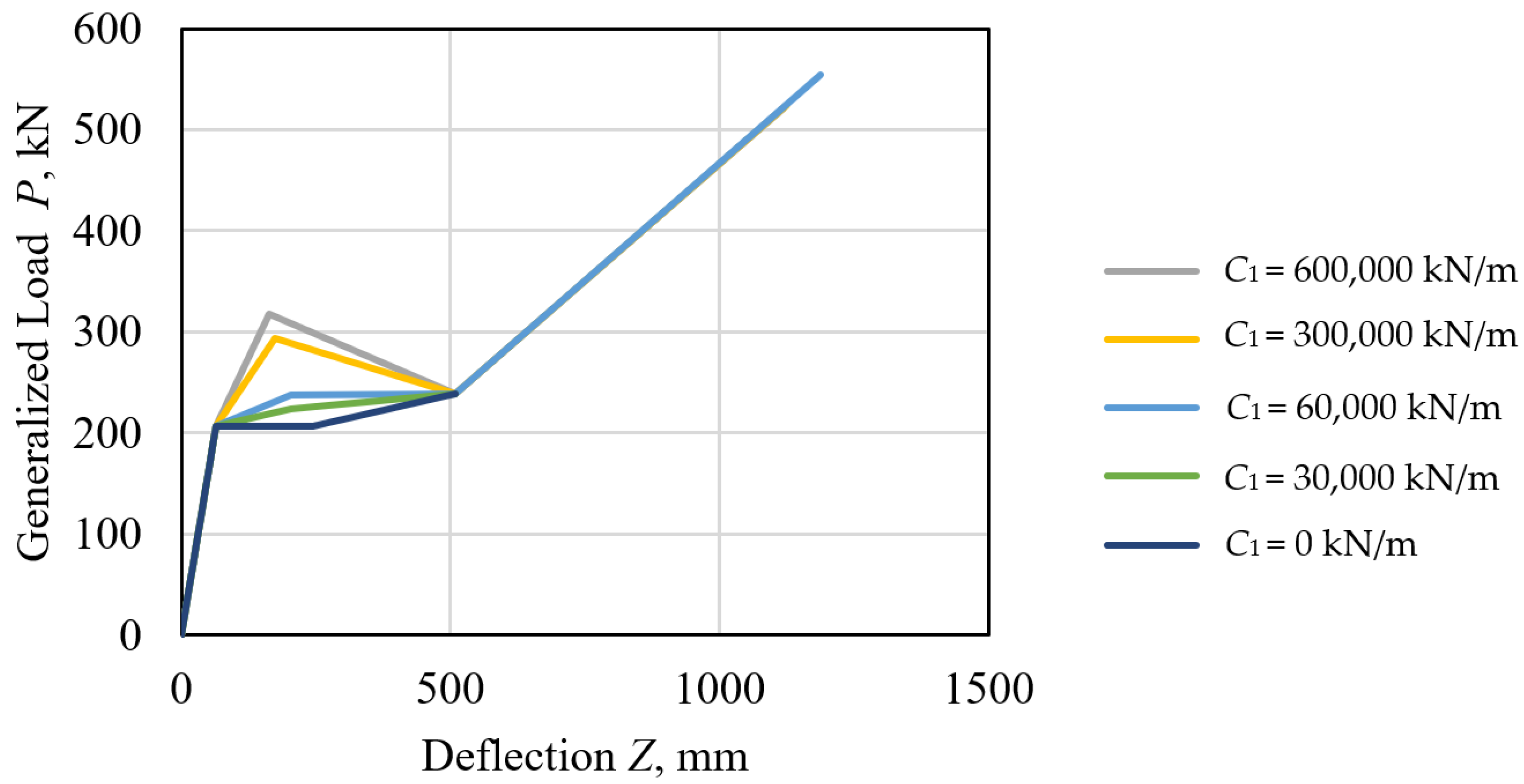
To evaluate the influence of support stiffness under horizontal displacements, the stiffness parameter of the left support C1 was varied while keeping the stiffness of the right support C2 constant. Thus, this section considers the following characteristic cases:
Full horizontal restraint: C1 = C2 = 600,000 kN/m;
Partial restraint: C1 = 300,000 kN/m, C2 = 600,000 kN/m;
No restraint when removing a corner column on the lower story of the frame: C1 = 60,000 kN/m, C2 = 600,000 kN/m;
No restraint when removing a corner column on the middle story of the frame with reduced column cross-section sizes along the height: C1 = 30,000 kN/m, C2 = 600,000 kN/m;
No restraint when removing a corner column on the upper story of the frame: C1 = 0 kN/m, C2 = 600,000 kN/m.
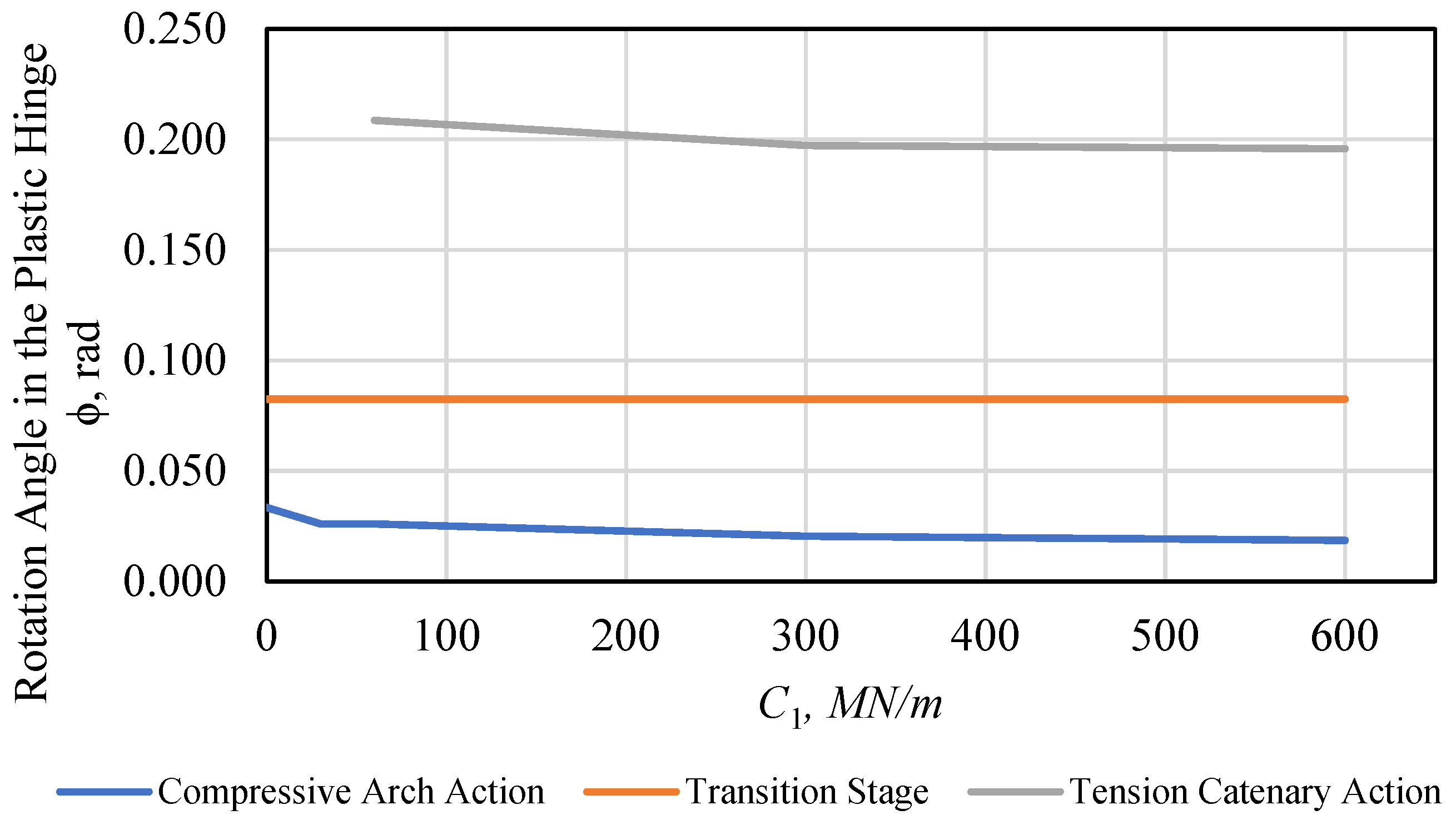
Load–deflection diagrams of the typical frame substructures and the ultimate plastic hinge rotation angles at various resistance stages are shown in Figure 19 and Figure 20, respectively. With partial horizontal restraint of the typical substructure, the beam deflection at the compressive arch and tensile catenary action stages is slightly larger than with full restraint. However, the stiffness of the horizontal restraints had a greater effect on the ultimate load-carrying capacity at the compressive arch action stage compared to the case of full restraint. From the graphs in Figure 18, it can be seen that the stiffness of the horizontal restraints did not significantly affect the ultimate plastic hinge rotation angles. For the maximum load-carrying capacity at the compressive arch action stage, the average plastic hinge rotation angle was 0.025 rad; for the transition stage—0.082 rad; and for the tensile catenary stage (with full or partial restraint on both sides)—0.2 rad.

3.5. Influence of the Ratio of Effective Depth to Total Depth

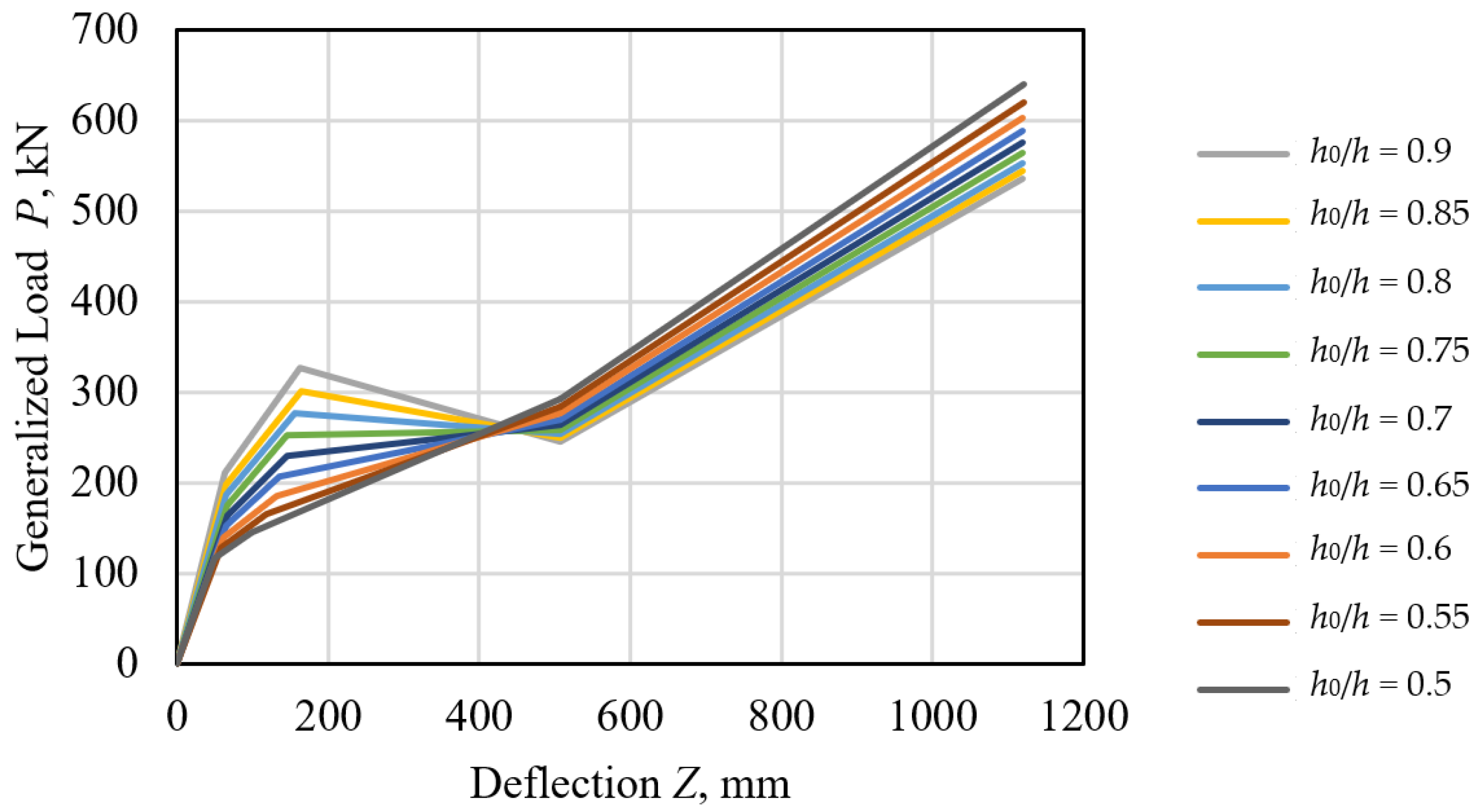
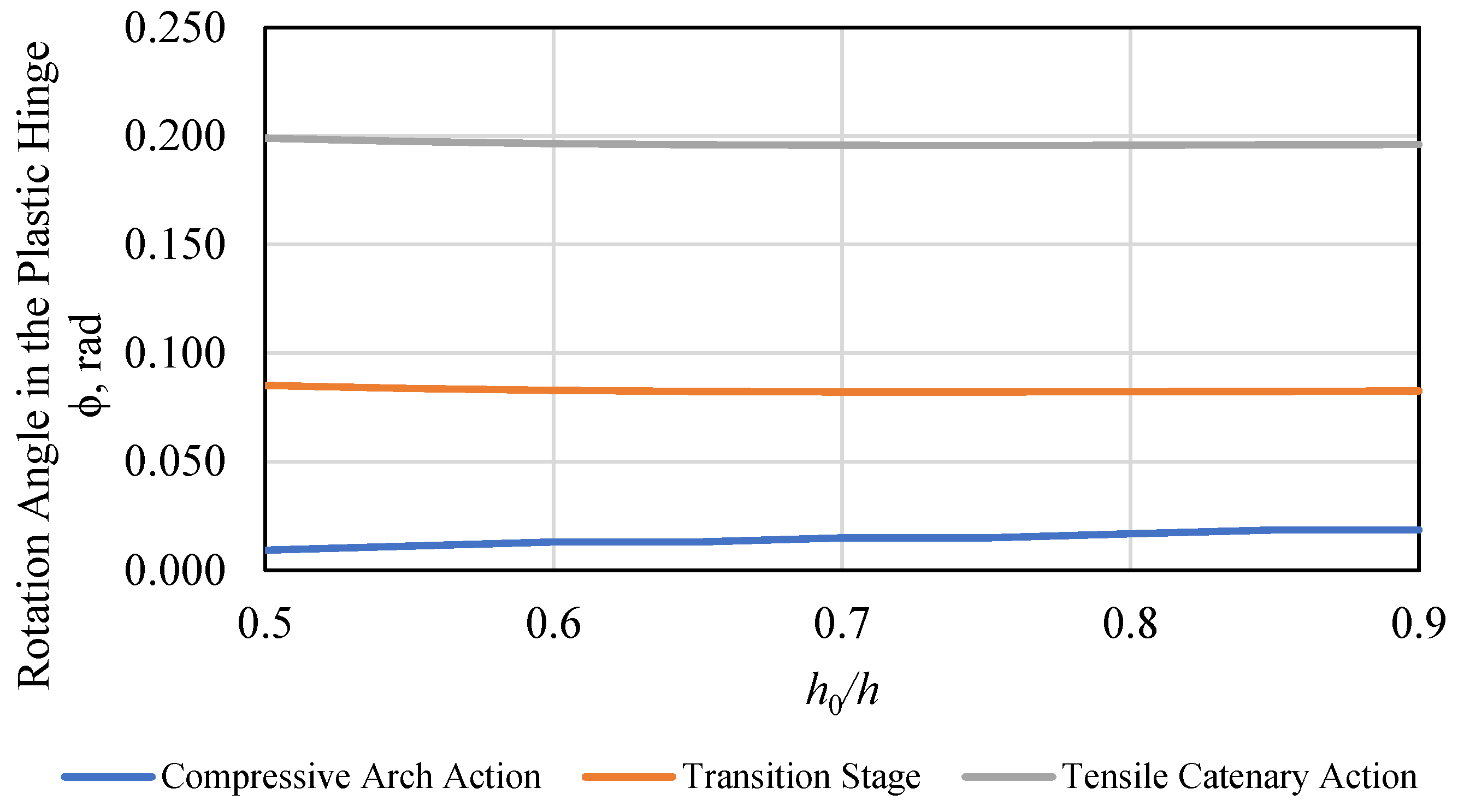
To evaluate the influence of the location of the longitudinal reinforcing bars along the section depth on the parameters of extreme resistance stages, the ratio of the effective depth of the beam section to the total section depth, h0/h, was varied from 0.5 to 0.9 in steps of 0.05 h. Load–deflection diagrams of the typical frame substructures and the ultimate plastic hinge rotation angles at various resistance stages are shown in Figure 21 and Figure 22, respectively.
From the graphs in Figure 21, it can be seen that reducing the ratio of effective depth to total section depth to h0/h = 0.5 leads to a significant decrease in the maximum load-carrying capacity at the flexural and arch action stages; however, at the catenary action stage, the load-carrying capacity increases by 19% compared to that at h0/h = 0.9. Therefore, as an additional measure to increase the load-carrying and deformation capacity of beams at the catenary action stage, it may be recommended to place additional longitudinal reinforcing bars near the mid-height of the cross-section of the members. Such reinforcement will only be activated when the members transition to the catenary action stage. In this case, the increase in load-carrying capacity is also achieved because, as the deflection grows, the ratio between the horizontal and vertical support reactions shifts in favor of the latter. The reduction in horizontal support reaction, in turn, has a positive effect on the resistance of vertical members. The length of such additional reinforcing bars should be determined based on the need to provide the required development length accounting for plastic behavior.
From Figure 22, it can be seen that, regardless of the h0/h ratio, the ultimate plastic hinge rotation angles at various resistance stages change as follows. For the maximum load-carrying capacity at the compressive arch action stage, the plastic hinge rotation angle ranges from 0.009 rad at h0/h = 0.5 to 0.019 rad at h0/h = 0.9; for the transition stage, the plastic hinge rotation angle remained almost constant and averaged 0.083 rad; and for the tensile catenary stage—0.2 rad.

4. Conclusions

  • Analytical resistance models have been developed for typical reinforced concrete building frame substructures in the region of potential local failure for various extreme resistance stages. Validation of the proposed model was performed by comparison with experimental data for 22 specimens tested by various researchers. The coefficients of determination R2 obtained for the calculated force and deformation parameters of the resistance stages were 0.941 and 0.931, respectively. Using the proposed analytical models, a parametric study was carried out on the influence of the following factors on the extreme resistance: beam depth-to-span ratio, bond strength between reinforcement and concrete, horizontal restraint stiffness of the typical substructure, and the ratio of effective depth to total depth of the beam section.
  • It has been established that, for the adopted reinforcement and bond parameters, the ultimate plastic hinge rotation angle of the beams increases with increasing beam depth-to-span ratio h/L from 0.04 to 0.15: from 0.008 rad to 0.027 rad at the arch action stage; from 0.028 rad to 0.118 rad at the transition stage; and from 0.13 rad to 0.21 rad at the catenary action stage.
  • It was demonstrated that increasing the bond strength between reinforcement and concrete leads to a reduction in the ultimate plastic hinge rotation angles at the flexural and arch action stages and, in some cases considered in this work, to rupture of the reinforcement without transitioning to the catenary action stage. Moreover, when the catenary action stage is achieved, the load-carrying capacity is inversely proportional to the bond strength.
  • It was shown that the stiffness of the horizontal restraints did not significantly affect the ultimate plastic hinge rotation angles. For the maximum load-carrying capacity at the arch action stage, the average plastic hinge rotation angle was 0.025 rad; for the transition stage—0.082 rad; for the catenary stage (with full or partial restraint on both sides)—0.2 rad.
  • It was found that reducing the ratio of the effective depth of the beam section to its total depth increases the load-carrying capacity at the catenary stage by 19%. Therefore, as an additional measure to increase the load-carrying and deformation capacity of beams at the catenary action stage, it may be recommended to place additional longitudinal reinforcing bars near the neutral axis of the members at the support sections. Such reinforcement will be activated only when the members transition to the catenary action stage, including at the moment of rupture of the bars located near the most tensioned face of the member.
The presented model applies to cases of initial local failure caused by mechanical actions and does not account for the combined effect of loads and aggressive environments or high temperatures. The obtained research results can be used as recommendations for the design and detailing of reinforced concrete frames within the framework of the Alternative Load Path Method.
Analysis of the results presented in this paper allows the formulation of the following directions for future research:
  • Investigation of the resistance stages in the post-yield behavior of deep beams;
  • Investigation of the resistance stages considering corrosion damage to reinforcement and concrete and reduction in bond strength during the service life considering wear and corrosion damage;
  • Investigation of the resistance stages considering the combined effect of loads and high temperatures that cause a reduction in the strength of concrete and reinforcement and in bond strength;
  • Investigation of the parameters of resistance stages of structures in post-yield states with the formation of complex plastic hinges under the combined action of bending and torsional moments, as well as axial compressive or tensile forces.

Author Contributions

This study was designed, directed, and coordinated by S.Y.S. and V.I.K.; S.Y.S. and T.A.I. planned and performed the numerical study of the RC frame substructures’ behavior under column removal scenarios and analyzed the resulting data. The manuscript was written by S.Y.S., V.I.K. and T.A.I. All authors have read and agreed to the published version of the manuscript.

Funding

This work was supported by the Russian Science Foundation grant No. 24-49-10010, https://rscf.ru//project/24-49-10010/ (accessed on 9 June 2026).

Data Availability Statement

The data presented in this research are available and can be obtained from the corresponding author on request.

Conflicts of Interest

The authors declare no conflicts of interest.

References

  1. Caredda, G.; Makoond, N.; Buitrago, M.; Sagaseta, J.; Chryssanthopoulos, M.; Adam, J.M. Learning from the Progressive Collapse of Buildings. Dev. Built Environ. 2023, 15, 100194. [Google Scholar] [CrossRef]
  2. Kolchunov, V.I.; Iliushchenko, T.A.; Fedorova, N.V.; Savin, S.Y.; Tur, V.V.; Lizahub, A.A. Structural robustness: An analytical review. Build. Reconstr. 2024, 113, 31–71. [Google Scholar] [CrossRef]
  3. Lizahub, A.A.; Tur, A.V.; Tur, V.V. Probabilistic approach for assessing the robustness of structural systems made of precast and monolithic reinforced concrete. Build. Reconstr. 2023, 108, 93–105. [Google Scholar] [CrossRef]
  4. Fedorova, N.V.; Savin, S.Y. Progressive collapse resistance of facilities experienced to localized structural damage—An analytical review. Build. Reconstr. 2021, 95, 76–108. [Google Scholar] [CrossRef]
  5. Elkady, N.; Augusthus Nelson, L.; Weekes, L.; Makoond, N.; Buitrago, M. Progressive Collapse: Past, Present, Future and Beyond. Structures 2024, 62, 106131. [Google Scholar] [CrossRef]
  6. Savin, S.Y. Stages of resistance of reinforced concrete frames in accidental design situation. Struct. Mech. Eng. Constr. Build. 2025, 21, 321–333. [Google Scholar] [CrossRef]
  7. UFC 4-023-03; Design of Buildings to Resist Progressive Collapse. UFC: Washington, DC, USA, 2016.
  8. Trekin, N.N.; Kodysh, E.N. Special limit condition of reinforced concrete structures and its normalization. Ind. Civ. Eng. 2020, 5, 4–9. [Google Scholar] [CrossRef]
  9. SP 385.1325800.2018; Protection of Buildings and Structures Against Progressive Collapse. Design Code. Basic statements. Minstroy of RF: Moscow, Russia, 2018.
  10. Xi, Z.; Zhang, Z.; Qin, W.; Zhang, P. Experiments and a Reverse-Curved Compressive Arch Model for the Progressive Collapse Resistance of Reinforced Concrete Frames. Eng. Fail. Anal. 2022, 135, 106054. [Google Scholar] [CrossRef]
  11. Zheng, Y.; Xiong, J.; Wu, Z.; He, Y. Experimental Study on Progressive Collapse Resistance of Reinforced Concrete Frame Structures. Appl. Mech. Mater. 2011, 71–78, 871–875. [Google Scholar]
  12. Yi, W.J.; He, Q.F.; Xiao, Y.; Kunnath, S.K. Experimental Study on Progressive Collapse-Resistant Behavior of Reinforced Concrete Frame Structures. ACI Struct. J. 2008, 105, 433–439. [Google Scholar] [CrossRef] [PubMed]
  13. Lim, N.S.; Tan, K.H.; Lee, C.K. Experimental Studies of 3D RC Substructures under Exterior and Corner Column Removal Scenarios. Eng. Struct. 2017, 150, 409–427. [Google Scholar] [CrossRef]
  14. Qian, K.; Li, B. Experimental and Analytical Assessment on RC Interior Beam-Column Subassemblages for Progressive Collapse. J. Perform. Constr. Facil. 2012, 26, 576–589. [Google Scholar] [CrossRef]
  15. Feng, F.-F.; Hwang, H.-J.; Yi, W.-J. Static and Dynamic Loading Tests for Precast Concrete Moment Frames under Progressive Collapse. Eng. Struct. 2020, 213, 110612. [Google Scholar] [CrossRef]
  16. Tao, Y.; Huang, Y.; Yi, W. Analytical Model for Compressive Arch Action in Unbonded Prestressed Concrete Beam-Column Subassemblages under a Column-Loss Scenario. Eng. Struct. 2022, 273, 115090. [Google Scholar] [CrossRef]
  17. Pham, A.T.; Tan, K.H. Experimental Study on Dynamic Responses of Reinforced Concrete Frames under Sudden Column Removal Applying Concentrated Loading. Eng. Struct. 2017, 139, 31–45. [Google Scholar] [CrossRef]
  18. Pham, A.T.; Brenneis, C.; Roller, C.; Tan, K.H. Blast-Induced Dynamic Responses of Reinforced Concrete Structures under Progressive Collapse. Mag. Concr. Res. 2022, 74, 850–863. [Google Scholar] [CrossRef]
  19. Kolchunov, V.I.; Fedorova, N.V.; Savin, S.Y.; Kaydas, P.A. Progressive Collapse Behavior of a Precast Reinforced Concrete Frame System with Layered Beams. Buildings 2024, 14, 1776. [Google Scholar] [CrossRef]
  20. Lu, X.; Lin, K.; Li, C.; Li, Y. New Analytical Calculation Models for Compressive Arch Action in Reinforced Concrete Structures. Eng. Struct. 2018, 168, 721–735. [Google Scholar] [CrossRef]
  21. Abbasnia, R.; Mohajery Nav, F. A theoretical method for calculating the compressive arch capacity of RC beams against progressive collapse. Struct. Concr. 2016, 17, 21–31. [Google Scholar] [CrossRef]
  22. Yu, J.; Tan, K.H. Analytical Model for the Capacity of Compressive Arch Action of Reinforced Concrete Sub-Assemblages. Mag. Concr. Res. 2014, 66, 109–126. [Google Scholar] [CrossRef]
  23. Bao, Y.; Tan, K.H. Analytical Approach and Design Method for Evaluation of Compressive Arch Action of Precast Concrete Beams. Eng. Struct. 2023, 280, 115603. [Google Scholar] [CrossRef]
  24. Savin, S. Levels of stress-strain state of reinforced concrete frame structures under accidental impacts. News High. Educ. Inst. Constr. 2025, 798, 5–21. [Google Scholar] [CrossRef]
  25. Lew, H.S.; Bao, Y.; Sadek, F.; Main, J.A.; Pujol, S.; Sozen, M.A. An Experimental and Computational Study of Reinforced Concrete Assemblies Under a Column Removal Scenario; National Institute of Standards and Technology: Gaithersburg, MD, USA, 2011. [Google Scholar]
  26. Yu, J.; Tan, K.-H. Experimental and Numerical Investigation on Progressive Collapse Resistance of Reinforced Concrete Beam Column Sub-Assemblages. Eng. Struct. 2013, 55, 90–106. [Google Scholar] [CrossRef]
  27. Yu, J.; Tan, K.H. Structural Behavior of RC Beam-Column Subassemblages under a Middle Column Removal Scenario. J. Struct. Eng. 2013, 139, 233–250. [Google Scholar] [CrossRef]
  28. Kang, S.-B.; Tan, K.H. Behaviour of Precast Concrete Beam–Column Sub-Assemblages Subject to Column Removal. Eng. Struct. 2015, 93, 85–96. [Google Scholar] [CrossRef]
  29. Kang, S.B.; Tan, K.H.; Yang, E.H. Progressive Collapse Resistance of Precast Beam-Column Sub-Assemblages with Engineered Cementitious Composites. Eng. Struct. 2015, 98, 186–200. [Google Scholar] [CrossRef]
  30. Tur, V.V.; Tur, A.V.; Lizahub, A.A. Checking of the robustness of precast structural systems based on the energy balance method. Vestn. MGSU 2021, 8, 1015–1033. [Google Scholar] [CrossRef]
  31. MC 2010 FIB Model Code 2010; CEB: Paris, France; FIP: Slough, UK, 2011.
  32. Mander, J.B.; Priestley, J.N.; Park, R. Theoretical Stress-Strain Model for Confined Concrete. J. Struct. Eng. 1989, 116, 1804–1825. [Google Scholar] [CrossRef]
  33. Tamrazyan, A.; Matseevich, T. The Criteria for Assessing the Safety of Buildings with a Reinforced Concrete Frame during an Earthquake after a Fire. Buildings 2022, 12, 1662. [Google Scholar] [CrossRef]
  34. Tamrazyan, A.; Kabantsev, O.; Matseevich, T.; Chernik, V. Estimation of the Reduction Coefficient When Calculating the Seismic Resistance of a Reinforced Concrete Frame Building after a Fire. Buildings 2024, 14, 2421. [Google Scholar] [CrossRef]
Figure 1. Reinforced concrete frame (a) and typical substructure of a reinforced concrete frame of a building in an area prone to local collapse (b).
Buildings 16 02378 g001
Figure 2. Relationship between relative deflection and depth-to-span ratio of a typical frame substructure at various stages of performance under accidental conditions.
Buildings 16 02378 g002
Figure 3. Normalized to CAA load capacity of a typical frame substructure at various stages of performance under accidental conditions.
Buildings 16 02378 g003
Figure 4. Rotation angles in the plastic hinges of beams of a typical frame substructure in a potential local collapse area.
Buildings 16 02378 g004
Figure 5. Stress state of a beam support section (a), adopted strain distribution (b) and stress distribution (c), and the concrete bilinear constitutive law (d).
Buildings 16 02378 g005
Figure 6. Diagrams for determining deflection at the flexural stage: frame substructure (a); bending moments (b); curvatures (c).
Buildings 16 02378 g006
Figure 7. Determination of the plastic hinge length: a section of a reinforced concrete element near a crack (a); distribution of bond stresses (b); stress distribution in the reinforcing bar (c); bilinear constitutive law for steel reinforcement (d).
Buildings 16 02378 g007
Figure 8. Diagram for determining the axial force in beams of the frame substructure caused by horizontal support displacement.
Buildings 16 02378 g008
Figure 9. Diagram for determining load-bearing capacity under compressive arch action.
Buildings 16 02378 g009
Figure 10. Typical beam–column joint and distribution of strains in the reinforcement within the plastic hinge length.
Buildings 16 02378 g010
Figure 11. Comparison of experimental and calculated values: (a) ultimate generalized load; (b) ultimate deflections for the stages of structural performance under extreme conditions.
Buildings 16 02378 g011
Figure 12. Experiment-to-calculation ratio: flexural action (a), compressive arch action (b), transition stage (c), tension catenary action (d).
Buildings 16 02378 g012
Figure 13. Pareto diagrams for calculation-to-experiment ratio: flexural action (a), compressive arch action (b), transition stage (c), tension catenary action (d).
Buildings 16 02378 g013
Figure 14. Calculated and experimental load–deflection diagrams of the IMF specimen tested by Lew et al. [25].
Buildings 16 02378 g014
Figure 15. Load–deflection diagrams of typical frame substructures in the region of potential local collapse when varying the beam span.
Buildings 16 02378 g015
Figure 16. Ultimate plastic hinge rotation angles for various resistance stages of typical frame substructures in the region of potential local failure when varying the beam span.
Buildings 16 02378 g016
Figure 17. Load–deflection diagrams of typical frame substructures in the region of potential local collapse when varying the bond strength between reinforcement and concrete.
Buildings 16 02378 g017
Figure 18. Ultimate plastic hinge rotation angles for various resistance stages of typical frame substructures in the region of potential local collapse when varying the bond strength between reinforcement and concrete.
Buildings 16 02378 g018
Figure 19. Load–deflection diagrams of typical frame substructures in the region of potential local collapse when varying the horizontal restraint stiffness of one support.
Buildings 16 02378 g019
Figure 20. Ultimate plastic hinge rotation angles for various resistance stages of typical frame substructures in the region of potential local collapse when varying the horizontal restraint stiffness of one support.
Buildings 16 02378 g020
Figure 21. Load–deflection diagrams of typical frame substructures in the region of potential local collapse when varying the ratio of effective depth to total depth of the beam section.
Buildings 16 02378 g021
Figure 22. Ultimate plastic hinge rotation angles for various resistance stages of typical frame substructures in the region of potential local collapse when varying the ratio of effective depth to total depth of the beam section.
Buildings 16 02378 g022
Table 1. Design parameters of the specimens used in the calculations.
SourceSpecimenCross-Section DimensionsBeam Span (Before Initial Localized Failure), mmLongitudinal Reinforcement at Support SectionMaterials’ Properties
Depth, mmWidth, mmTopBottomf’c, MPafy, MPafu, MPa
Pham et al. [17]FR18010022203Ø102Ø1035554653
FD2-F/3418010022203Ø102Ø1035554653
Tao Y. et al. [16]RC25015027003Ø102Ø1054.8445545
Feng F.-F. [15]PCF-125015026002Ø162Ø1231.6485600
PCF-230018026004Ø101Ø10 + 2Ø830554649
PCF-330018026004Ø101Ø10 + 2Ø832.1554649
PCF-425015026002Ø162Ø1232.1542659
Lew et al. [25]IMF50871153854Ø25.42Ø28.632.4476648
Yu & Tan [26]S125015027501Ø13 + 2Ø102Ø1031.2518688
S225015027503Ø102Ø1031.2511731
Yu & Tan [27]S325015027503Ø132Ø1038.2494593
S425015027503Ø132Ø1338.2494593
S525015027503Ø133Ø1338.2494593
S625015027503Ø162Ø1338.2513612
S725015021503Ø132Ø1338.2494593
Kang & Tan [28]MJ-L-0.52/0.35S30015027503Ø102Ø1027.9462553
MJ-B-0.88/0.59R30015027503Ø132Ø1327.9471568
MJ-L-0.88/0.59R30015027503Ø132Ø1327.9471568
MJ-L-1.19/0.59R30015027502Ø16 + 1Ø132Ø1327.9513679
Kang & Tan [29]MJ-B-1.19/0.59 30015027502Ø16 + 1Ø132Ø1340.5567679
EMJ-B1.19/0.5930015027502Ø16 + 1Ø132Ø1340.5567679
EMJ-L1.19/0.5930015027502Ø16 + 1Ø132Ø1340.5567679
Table 2. Comparison of experimental data and calculation results obtained with the proposed model for the flexural and arch action stages of typical frame substructures in the region of potential local failure (substructure parameters are given in Table 1).
SpecimenFlexural ActionCompressive Arch Action
Zexp, mmZcal, mmZcal/ZexpPexp, kNPcal, kNPcal/PexpZexp, mmZcal, mmZcal/ZexpPexp, kNPcal, kNPcal/Pexp
FR20190.9501921.61.13766490.7422724.070.891
FD2-F/3416191.1882221.60.98252490.9423024.070.802
RC11.3100.88524.622.30.90761.9701.13139.443.51.104
PCF-129250.86242.335.20.83257651.14050.544.80.887
PCF-223130.56535.539.81.121108830.7695455.671.031
PCF-334260.7655239.90.76793961.03262.561.80.989
PCF-426331.26931.339.11.24990830.92245.842.70.932
IMF70620.886264.7211.10.7981321721.303296358.11.210
S140280.70027250.92673680.93241.6437.20.893
S237350.9462424.71.02963751.19038.3839.31.024
S339320.82134.924.10.69179720.91154.4736.50.670
S439290.74443.239.80.92179.5690.86863.2252.50.830
S545310.68955.8581.03972811.12570.3375.71.076
S680300.37559.241.20.696127600.47270.3347.40.674
S746300.65263.550.90.80269701.01482.8272.80.879
MJ-L-0.52/0.35S60240.40032.327.60.85475841.12041.3650.381.218
MJ-B-0.88/0.59R59310.52544.946.41.03398810.82763.2863.140.998
MJ-L-0.88/0.59R68310.45641.846.41.110102810.79453.8563.141.173
MJ-L-1.19/0.59R68510.75050.950.30.988110910.82757.3758.21.014
MJ-B-1.19/0.59 65330.50867.856.40.832105830.79090.473.30.811
EMJ-B1.19/0.5962330.5327156.40.794109830.76191.173.30.805
EMJ-L1.19/0.5962330.53271.656.40.788104830.79891.173.30.805
Table 3. Comparison of experimental data and calculation results obtained with the proposed model for the transition and catenary action stages of typical frame substructures in the region of potential local failure (substructure parameters are given in Table 1).
SpecimenTransition StageTensile Catenary Action
Zexp, mmZcal, mmZcal/ZexpPexp, kNPcal, kNPcal/PexpZexp, mmZcal, mmZcal/ZexpPexp, kNPcal, kNPcal/Pexp
FR2301800.7832625.40.9775504900.8917269.90.971
FD2-F/341901800.9472025.41.2704604901.0657469.90.945
RC1721700.98829.416.750.570000000
PCF-12502501.0004138.980.951765.57300.954127.4112.50.883
PCF-22182201.0094130.280.739000000
PCF-33003001.0003039.561.3195866161.05179.378.80.994
PCF-42502501.0004240.10.955636.76501.021105.4104.10.988
IMF5085081.000206.3207.51.006109011701.073547473.10.865
S12452501.0201530.492.0335735500.96068.91650.943
S22572500.9731929.41.5476125800.94867.63670.991
S31952501.28224.428.31.160729.37401.015124.3783.50.671
S41762501.42045.741.70.912614.36201.009103.68102.20.986
S52202501.1365255.961.076665.95300.796105.07114.91.094
S62032501.23261.447.30.770675.37201.066139.9135.40.968
S72642500.94740.553.941.332628.55200.827105.99108.91.027
MJ-L-0.52/0.35S3273000.91722.526.981.199644.46120.95049.553.51.081
MJ-B-0.88/0.59R2983001.00738.846.81.206726.26140.84598.5593.20.946
MJ-L-0.88/0.59R2983001.00731.446.81.490663.86140.92577.2493.21.207
MJ-L-1.19/0.59R2703001.11141.855.11.318520.96981.34086.6128.41.483
MJ-B-1.19/0.592353001.27736.359.21.6314526151.361108.2117.61.087
EMJ-B1.19/0.591993001.50851.859.21.143430.26151.430110.3117.61.066
EMJ-L1.19/0.591973001.52342.959.21.380431.26151.42688.3117.61.332
Table 4. Horizontal restraint stiffness values adopted for the parametric study.
Restraint
Conditions
Scheme of the Frame Under Column Loss ScenarioStiffness of the Left Restraint C1, kN/mStiffness of the Right Restraint C2, kN/m
Full RestraintBuildings 16 02378 i001600,000600,000
Partial RestraintBuildings 16 02378 i002300,000600,000
No RestraintBuildings 16 02378 i00360,000600,000
No RestraintBuildings 16 02378 i00430,000600,000
No RestraintBuildings 16 02378 i0050600,000
Disclaimer/Publisher’s Note: The statements, opinions and data contained in all publications are solely those of the individual author(s) and contributor(s) and not of MDPI and/or the editor(s). MDPI and/or the editor(s) disclaim responsibility for any injury to people or property resulting from any ideas, methods, instructions or products referred to in the content.