1. Introduction
Construction is a high-risk industry characterized by various hazards, requiring systematic safety and health management practices to prevent on-site accidents [
1,
2,
3]. Effective safety management depends not only on identifying hazards and implementing preventive measures but also on accurately documenting these measures and linking them to applicable legal and regulatory requirements. Safety and health documents serve as formal records that demonstrate compliance with statutory obligations, support regulatory inspections, and provide evidence for accident investigations and liability assessments [
4,
5]. These activities should also be systematically documented and managed through safety and health records, which help ensure site safety and establish legal and administrative validity [
5].
Clearly referencing the legal standards underpinning each action allows safety and health documents to serve as key tools for ensuring their credibility and enforceability within construction safety management systems [
6,
7]. In particular, documents prepared without legal reference may result in ambiguous or incomplete communication of site actions [
8]. This may cause issues such as workflow disruptions, project delays, and insufficient safety measures [
8]. In addition, safety and health measures become effective and valid when linked to applicable laws and regulations, which also provides an important basis for future regulatory reviews and liability determinations in the event of an accident [
9]. Therefore, incorporating relevant legal standards into safety and health documents is essential to ensure both field-level enforceability and legal legitimacy and is increasingly recognized as a critical component of regulatory compliance in construction safety management [
9,
10,
11].
However, in practice, the authors of safety and health documents are typically non-legal professionals [
7,
12]. As a result, they face difficulties manually navigating extensive statutory texts and identifying provisions relevant to specific risks [
6,
13]. To find the desired statute, typically, keyword-based searches or exact word matching are used to locate relevant statutes [
13,
14]. However, this approach is limited in that slight differences in wording or mismatches between statutory language and technical terminology can hinder the identification of relevant provisions [
15,
16]. Previous studies on legal information retrieval have shown that keyword-based approaches often struggle to identify conceptually related provisions when different terminologies are used, resulting in reduced retrieval accuracy and incomplete legal coverage [
15,
16,
17,
18]. In particular, basic search methods fail to capture the semantic context of risks, making it challenging to link document content to semantically appropriate statutory provisions [
15,
16,
17,
18].
To empirically examine these issues, this study focuses on the Design for Safety (DfS) report, a representative safety and health document prepared during the design phase, as an example [
19,
20,
21]. The DfS report was selected because it represents one of the earliest and most influential safety documents generated during a construction project’s lifecycle. Unlike safety inspection reports, which primarily document compliance after work has commenced, or construction method statements, which focus on specific construction activities, DfS reports require designers to proactively identify hazards, evaluate risks, and recommend preventive measures before construction begins. As a result, DfS reports contain rich descriptions of hazards, risk factors, and mitigation strategies that must often be supported by appropriate legal provisions, making them an ideal test case for legislation recommendation systems [
8,
19,
20,
21]. DfS is a safety and health concept aimed at preventing accidents by enabling designers to proactively identify potential hazards during the pre-construction phase and integrate preventive measures into the design [
20]. The DfS report outlines these principles and documents both physical and human-related hazards, along with corresponding safety measures [
20,
22]. It also serves as a key reference for ensuring safety throughout subsequent construction processes [
22,
23]. To ensure the report’s effectiveness, it is essential to clearly specify the legal basis for each action item [
24]. However, legal applicability is often interpreted based on the author’s subjective judgment [
19,
23], resulting in inconsistencies and inaccuracies in selecting and applying appropriate statutes for specific risks [
25]. These characteristics make DfS reports particularly suitable for evaluating whether an intelligent recommendation system can improve the consistency and accuracy of legal referencing during document preparation.
To address these issues, this study proposes a recommendation system that suggests relevant laws and regulations for safety and health documents by integrating a deep learning model with a domain-specific safety ontology. It takes the risks and keywords described in the DfS report as inputs and automatically identifies semantically relevant statutory provisions. The system is designed to enhance both the accuracy and efficiency of report generation.
Recent advances in deep learning-based language models in natural language processing (NLP) have enabled the automatic identification and alignment of semantic associations within unstructured text [
26,
27,
28]. These models offer the advantage of contextual understanding and semantic linkage between relevant information [
29]. They have also gained attention as effective alternatives to traditional keyword-based methods, which often suffer from interpretative limitations [
27,
30,
31]. Therefore, this study seeks to offer a practical solution for improving the consistency and accuracy of legal application in the preparation of safety and health documents during the design phase.
This study aimed to develop a practical tool that assists non-experts in easily referencing appropriate legislation when drafting safety and health documents and to validate its effectiveness using DfS reports. To this end, a deep learning-based language model was used to train a semantic legislation recommendation system, and a construction safety-specific ontology was developed to enhance semantic connections between reports and legal texts. The system’s practical applicability was demonstrated through the implementation of a user-friendly web application based on the trained model.
The main contributions of this study are summarized as follows: (1) A deep learning model was developed to achieve high accuracy in semantic matching. (2) An ontology was constructed based on actual DfS reports and legislative data to reflect domain-specific lexical relationships. (3) A web-based application was implemented to enable effective utilization of the trained model. (4) The study demonstrates how semantic legislation recommendations can improve legal referencing during the preparation of design phase safety documentation. The DfS report, as a representative safety and health document from the design phase, was used to empirically verify the applicability and effectiveness of the proposed system.
This study aims to overcome the inefficiencies in identifying applicable legislation during the design phase of safety documentation. Ultimately, by providing an environment that facilitates the use of legal references, this study aims to improve the quality of safety and health documents and promote the practical application of relevant laws and regulations.
2. Literature Review
2.1. Research on Legislation Recommendation and Document Matching
Recent advances in NLP have led to active research on automatic legislation recommendation and document matching based on semantic similarity [
32,
33,
34,
35,
36,
37]. In particular, various approaches have adopted BERT-based models and deep learning classifiers [
32,
34,
35,
37]. Previous studies have aimed to improve recommendation accuracy by enhancing semantic relationships between sentences [
32,
34,
35].
Hong et al. proposed LFESM, a BERT-based semantic matching network that incorporates legal-specific vocabulary to match similar legal cases [
32]. The model takes text pairs from similar legal documents and assesses case similarity using legal domain-specific embeddings [
32]. Legal feature vectors were employed to enhance semantic connections between sentences [
32]. Liu et al. introduced a three-phase prediction (TPP) system that recommends statutes based on keywords extracted from relevant sections of a given law [
33]. It employs an incremental filtering approach—case classification, candidate generation, and statute reordering—to enhance recommendation accuracy [
33]. They also developed a rule-based algorithm for statute matching, whose reliability was validated through expert evaluation [
33]. Feng et al. proposed a two-level neural network framework to capture complex associations between laws and cases and recommend relevant statutes accordingly [
34]. The model consists of two stages: candidate statute generation and semantic similarity learning between cases and statutes to produce the final recommendation [
34]. Li et al. quantified case–statute relationships using handcrafted features and proposed a collaborative filtering-based recommendation system [
35]. They demonstrated superior performance compared to BERT and LSTM-based models, achieving higher recall values [
35]. Zou et al. developed an NLP-based system for retrieving similar risk cases in real time, using historical accident data for construction risk management [
36]. They further enhanced search performance by combining the vector space model with WordNet to expand query semantics [
36]. Fan et al. proposed an ensemble framework combining contrastive representation learning and binary interaction classification to assess similarity between legal documents [
37]. Additionally, they jointly trained an ELECTRA-based embedding structure and subnetworks to precisely measure sentence-level semantic similarity [
37].
2.2. Research on Linking Legislation and Knowledge-Based Systems in Construction Safety
In the construction industry, research linking legislation with knowledge-based systems has primarily focused on accident prevention and risk management, particularly through the analysis of semantic relationships between documents [
38,
39,
40]. Moreover, the potential of NLP and deep learning technologies in construction safety management is increasingly recognized [
41,
42,
43]. As a result, automated systems that recommend legislation or extract relevant cases for incident case retrieval and contract management are actively being explored [
38,
39].
Fan and Li developed a system for the automatic search of similar past construction site accidents [
38]. Their method applies text mining techniques to analyze document similarity and identify event relationships [
38]. Kim and Chi proposed a system for efficient retrieval and analysis of construction accident data [
39]. The system uses NLP techniques to categorize incidents and automatically recommend similar cases [
39]. Additionally, Word2Vec was applied to expand user queries and improve the efficiency of semantic search [
39]. Zhong et al. developed a system to automatically classify and analyze contract-related disputes in construction projects [
40]. The system employs deep learning-based text mining to analyze legal documents and automatically match relevant statutes [
40]. Furthermore, previous studies have shown that AI and machine learning significantly enhance construction efficiency and play a key role in safety management and process control [
41,
42,
43]. In particular, Akinosho et al. highlighted the importance of deep learning for enhancing construction safety and enabling future innovations [
41].
2.3. Research Gap
While several studies have proposed legislation recommendations and document matching systems, two key limitations remain.
The first limitation lies in keyword-based systems. Prior studies have proposed methods that match statutes to cases or categorize them using keyword matching. However, these systems struggle to capture complex semantic relationships and contextual nuances between documents. Specifically, they rely on surface-level word matching, which makes it difficult to account for subtle semantic variations and complex contextual information.
The second limitation is the scarcity of deep learning-based approaches for matching documents and statutes in the construction domain. Although some studies have applied text mining techniques for legislation recommendation or incident case retrieval [
38,
39,
40], most relied on simple keyword or word matching techniques. This limits the ability to perform deep semantic analysis or deliver context-aware recommendations.
Furthermore, recent construction safety NLP studies have primarily focused on defect classification, defect monitoring, hazard identification, or safety information retrieval. For example, transformer- and graph neural network-based studies have been developed to classify fire-door defects from Korean construction texts [
44,
45]. While these approaches effectively categorize construction-related information, they do not address the recommendation of legally applicable statutory provisions for construction safety documents. Similarly, existing DfS-related recommendation studies have focused on hazard identification and safety measure recommendations rather than supporting statutory compliance through legislation matching [
19].
To address these gaps, this study proposes a deep learning-based legislation recommendation system that learns semantic relationships between construction safety documents and statutory provisions. Unlike previous studies that focus on document classification or safety information extraction, the proposed system integrates a construction safety ontology with Korean pretrained language models to recommend relevant legislation based on DfS risk descriptions. This approach contributes to the construction safety field by supporting statutory compliance and improving the accuracy and efficiency of legislation recommendations during safety document preparation.
3. Materials and Methods
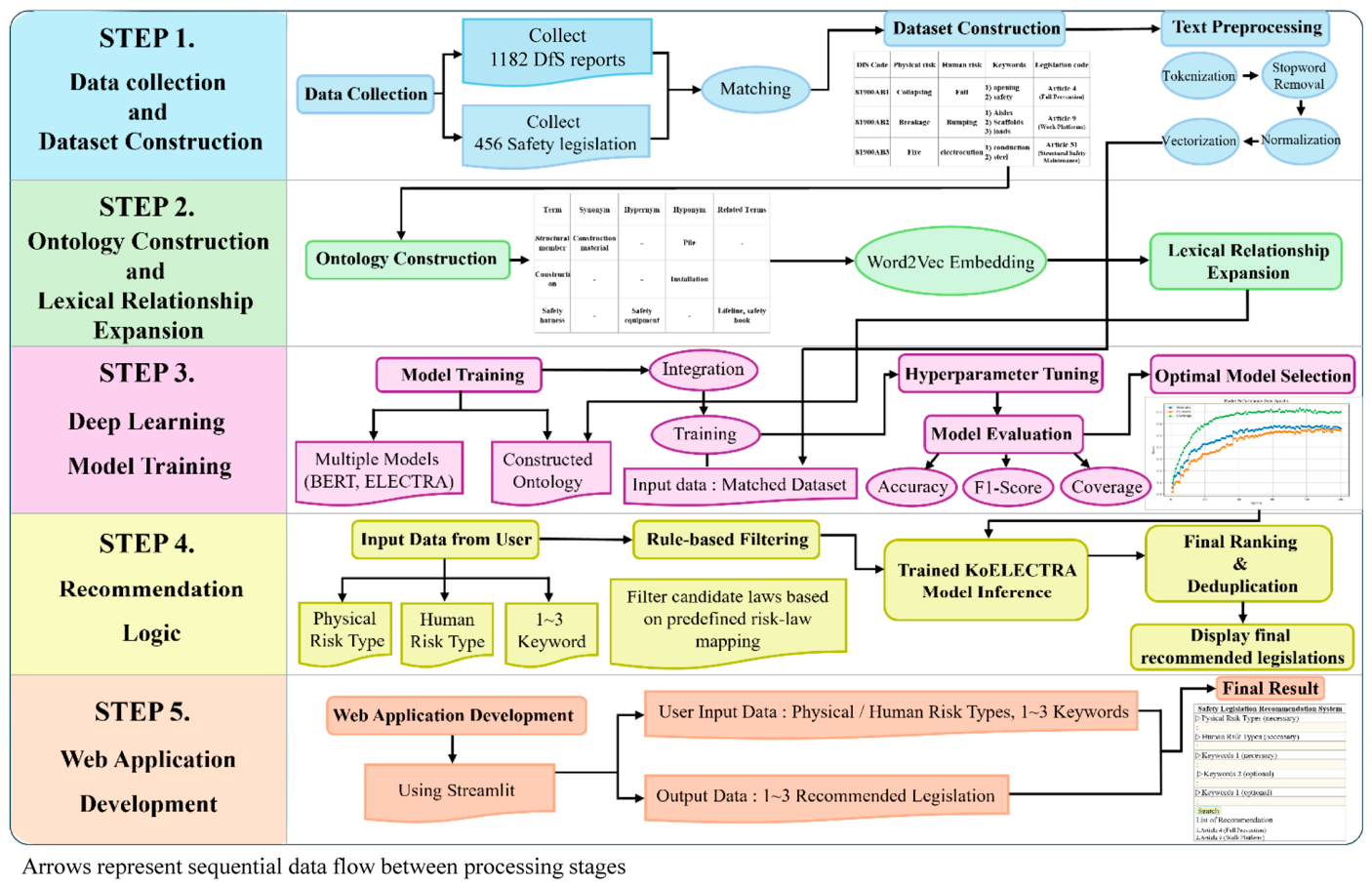
Figure 1 depicts the research framework, illustrating the steps from data collection to web application implementation. This study was conducted in five phases: (1) data collection and dataset construction, (2) ontology construction and lexical relationship expansion, (3) deep learning model training, (4) recommendation logic, and (5) web application development.
3.1. Data Collection and Dataset Construction
This study collected relevant data and built a dataset to learn the semantic relationships between DfS reports produced during the design phase of construction projects and the statutory provisions related to those reports. A total of 1355 DfS reports were collected from various construction companies, as provided by the Korea Authority of Land and Infrastructure Safety [
46]. The dataset was obtained from KALIS through its national Design for Safety (DfS) implementation program and consists of reports submitted by construction projects across different sectors. Each report included descriptions of physical risks, human-related risks, and corresponding safety measures.
Additionally, 356 construction-related legal provisions were extracted from the Rules on Occupational Safety and Health Standards published by the Korean Ministry of Justice. Each provision was categorized according to its relevance to physical or human risks, serving as the primary filtering criterion for the recommendation system. Although the DfS reports were collected in 2018, all statutory provisions were reviewed and cross-checked against the latest version of the Rules on Occupational Safety and Health Standards available at the time of this study. Legislative provisions that had been amended, repealed, or reorganized were updated to reflect the current regulatory framework. Therefore, while the project-specific risk descriptions originated from historical DfS reports, the legislation database used for training and recommendation represents the current legal environment. Furthermore, the fundamental hazard categories contained in DfS reports (e.g., falls, struck-by incidents, collapse, and equipment-related hazards) remain consistent with contemporary construction safety practices, supporting the continued relevance of the dataset.
Semantic matching for the training dataset was conducted through one-to-one manual linking between DfS reports and statutory provisions, with input from domain experts. The matching process involved three experts with professional experience in construction safety management, DfS implementation, and occupational safety regulation. Each expert independently reviewed the risk descriptions and associated keywords contained in the DfS reports and selected the most appropriate statutory provision. Disagreements were subsequently resolved through consensus meetings to establish the final ground-truth label. Label data were created by selecting the most relevant statutory provisions based on the risks and keywords described in each report. Consequently, the final dataset represents a consensus-based mapping between DfS risk descriptions and statutory provisions, thereby improving the reliability of the training labels.
Table 1 presents a sample of the dataset, showing matched DfS reports and statutory provisions based on identified physical and human risks and keywords.
Finally, a structured dataset was constructed, comprising DfS reports, corresponding statutory provisions, risk typologies, and one-to-one matching pairs between reports and legislation, as shown in
Table 2.
Data Preprocessing
The input data for model training were derived from
Table 1, which includes matched pairs of DfS reports and statutory provisions. Text from the “physical risk,” “human risk,” and “keywords 1–3” columns was combined into a single input sentence for each report. The combined sentences underwent text preprocessing. The KoNLPy library was used, considering the morphological and syntactic characteristics of the Korean language [
47]. The main preprocessing steps were (1) tokenization, (2) stop word removal, (3) normalization, and (4) vectorization.
First, the Open Korean Text (Okt) morpheme analyzer in KoNLPy was used to segment the combined sentences into morphemes. Unlike clause-based approaches, it tokenizes based on semantic units, improving the effectiveness of stop word removal and vectorization.
Next, stop words irrelevant to the analysis, such as conjunctions, common adverbs, and interrogatives, were removed. The stop word list was refined using a standard Korean stop word dictionary. Noise was also reduced by removing non-lexical items from Okt-tokenized outputs.
Third, general normalization was applied, including case unification, removal of special characters, and standardization of numbers and repeated terms. This step ensured consistent representation of concepts and reduced variance during model training.
Finally, the preprocessed text was converted into numerical vectors suitable for machine learning. CountVectorizer from the Scikit-learn library was used to represent text as word frequency vectors. These vectors were further preprocessed prior to being fed into the pretrained language model.
These four preprocessing stages decomposed input sentences into semantic units, reduced noise, and improved data quality by emphasizing key information for model training.
3.2. Ontology Construction and Lexical Relationship Expansion
In this study, an ontology was manually constructed to enhance the accuracy of legislation recommendations by incorporating lexical relationships specific to the construction safety domain. Existing general vocabulary resources, such as WordNet and KorLex, primarily consist of everyday language and lack adequate coverage of construction safety and legal terminology [
48,
49,
50]. Therefore, DfS reports and legislative texts were used as a corpus to manually construct a domain-specific lexical relation network.
Ontology development was conducted through a four-step process. First, candidate terms were extracted from the 1355 DfS reports and 356 statutory provisions using frequency analysis and expert review. Terms that frequently appeared in risk descriptions, safety measures, equipment specifications, and legal provisions were retained as ontology candidates. Second, synonymous expressions commonly used by practitioners were identified and grouped into unified concepts. For example, different expressions referring to the same construction equipment or safety measure were standardized to reduce vocabulary inconsistency. Third, hierarchical relationships were established by defining hypernyms and hyponyms based on construction safety classifications and regulatory terminology. Finally, related terms were identified through co-occurrence analysis of the corpus and subsequently validated by domain experts. The ontology was reviewed by three construction safety experts with experience in DfS implementation and construction safety management to ensure that the selected terms adequately represented major hazards, safety measures, equipment types, and legal concepts frequently encountered in DfS reports and construction safety legislation. The resulting ontology was reviewed by domain experts to ensure that the selected terms adequately represented major hazards, safety measures, equipment types, and legal concepts frequently encountered in DfS reports and construction safety legislation. The resulting ontology includes synonyms, hypernyms, hyponyms, and related terms for each entry, as shown in
Table 3. This structure was used to enhance semantic connections in DfS reports and to resolve inconsistencies between practitioners’ terminology and that found in legislation.
Although ontologies effectively define conceptual relationships, they are limited in capturing subtle contextual nuances and variations in real-world usage [
51]. To address this, the constructed ontology was integrated into the training of a Word2Vec model. Word2Vec is a neural embedding model that captures semantic similarity based on word co-occurrence patterns [
52]. However, in technical and legal texts, semantically similar words often do not co-occur within the same context [
53,
54]. To overcome this limitation, the explicit lexical relationships from the ontology were embedded into the Word2Vec vector space. Specifically, words with defined relationships (e.g., synonyms, hypernyms, hyponyms, related terms) were adjusted to occupy similar positions within the Word2Vec vector space. Ontology-expanded vocabulary terms were appended to the training corpus prior to Word2Vec training, thereby strengthening semantic associations among construction safety concepts. The resulting ontology-enhanced Word2Vec embeddings were subsequently incorporated into the deep learning pipeline. During preprocessing, input texts extracted from DfS reports were enriched using ontology-derived terms and semantic neighbors identified through the trained Word2Vec model. The expanded textual representations were then tokenized and provided as inputs to the KoBERT and KoELECTRA models. This process enabled the transformer models to capture both contextual information from the original text and additional semantic knowledge derived from the ontology. As a result, the system improved its ability to recognize semantically related hazards, safety measures, and legislative concepts even when different terminology was used across DfS reports and legal provisions. This approach combines structured lexical relationships from the ontology with contextual semantics from Word2Vec, enabling more sophisticated vocabulary expansion during legislation recommendation.
3.3. Deep Learning Model Development
3.3.1. Model Training
This study aimed to develop a system that automatically recommends relevant legal provisions by learning semantic relationships between Korean DfS reports and construction safety regulations. To this end, a deep learning model was trained using the previously constructed dataset.
KoBERT and KoELECTRA, pretrained language models optimized for Korean, were used for training [
55,
56]. KoBERT is based on BERT architecture, employing masked language modeling and next sentence prediction to learn context [
55]. KoELECTRA adopts replaced token detection, offering improved efficiency and training speed [
56]. Its lightweight architecture further improves performance during training and inference [
56,
57].
The input comprised a single sentence combining physical risks, human-related risks, and 1–3 keywords extracted from each DfS report. The output was set as a multi-class classification problem that recommends a top-K list of laws related to the report. Training was conducted using PyTorch (version 2.9.0) within the Google Colab environment. The extended lexical data constructed in
Section 3.2 were also incorporated to enhance vocabulary relations.
To ensure a robust and reproducible evaluation, the dataset was divided into training (70%), validation (15%), and test (15%) subsets. Stratified sampling was employed to preserve the distribution of legislation classes across all subsets, thereby reducing potential bias caused by class imbalance. Furthermore, a fixed random seed of 42 was used during dataset partitioning, model initialization, and training to ensure reproducibility of the experimental results. The validation set was used for hyperparameter tuning and early stopping, whereas the independent test set was reserved exclusively for final model evaluation.
CrossEntropyLoss with class weighting was used to address class imbalance. The class weights were automatically calculated based on the inverse frequency of each legislation class, allowing greater emphasis to be placed on underrepresented statutory provisions during model training. Specifically, the weight assigned to each class was inversely proportional to the number of samples belonging to that class in the training dataset. Additionally, sampling techniques were applied to balance the training data. Random oversampling was performed for minority classes to reduce the disparity between frequently and infrequently occurring legislation classes. The oversampling process increased minority-class samples until a minimum representation ratio equivalent to approximately 50% of the majority-class frequency was achieved. This strategy improved the balance of the training dataset while avoiding excessive duplication of minority samples. These methods improved the training accuracy for underrepresented classes (statutory provisions) and enhanced the model’s generalization performance. By combining class-weighted loss and oversampling, the model was better able to learn semantic relationships associated with rarely occurring legislation articles, thereby reducing prediction bias toward majority classes and improving overall recommendation performance.
3.3.2. Hyperparameter Tuning
To optimize model performance, key hyperparameters, including learning rate, number of epochs, and batch size, were tuned through iterative experiments. Performance was evaluated using validation loss and F1 score. In particular, validation loss was continuously monitored, and early stopping was applied to prevent overfitting. The hyperparameter tuning process identified the best-performing configuration for each model, as summarized in
Table 4. These configurations were used to establish a model suited to the characteristics of the dataset and the legislation recommendation task.
3.3.3. Model Evaluation
A quantitative evaluation was conducted to identify the most effective model for legislation recommendation. Evaluation metrics included accuracy, F1-score, and coverage (top-3 accuracy), as defined in Equations (1)–(3). In particular, top-K accuracies (top-1 and top-3) were measured to reflect performance in practical scenarios. Additional metrics, including inference speed and memory efficiency, were considered to ensure suitability for real-time recommendation. Based on the comprehensive evaluation results, the optimal model was selected for system implementation.
where
is True Positives,
is True Negatives,
is False Positives,
is False Negatives,
is the total number of instances,
is the true label for the i-th instance, and
is the set of predicted labels for the i-th instance.
3.4. Recommendation Logic
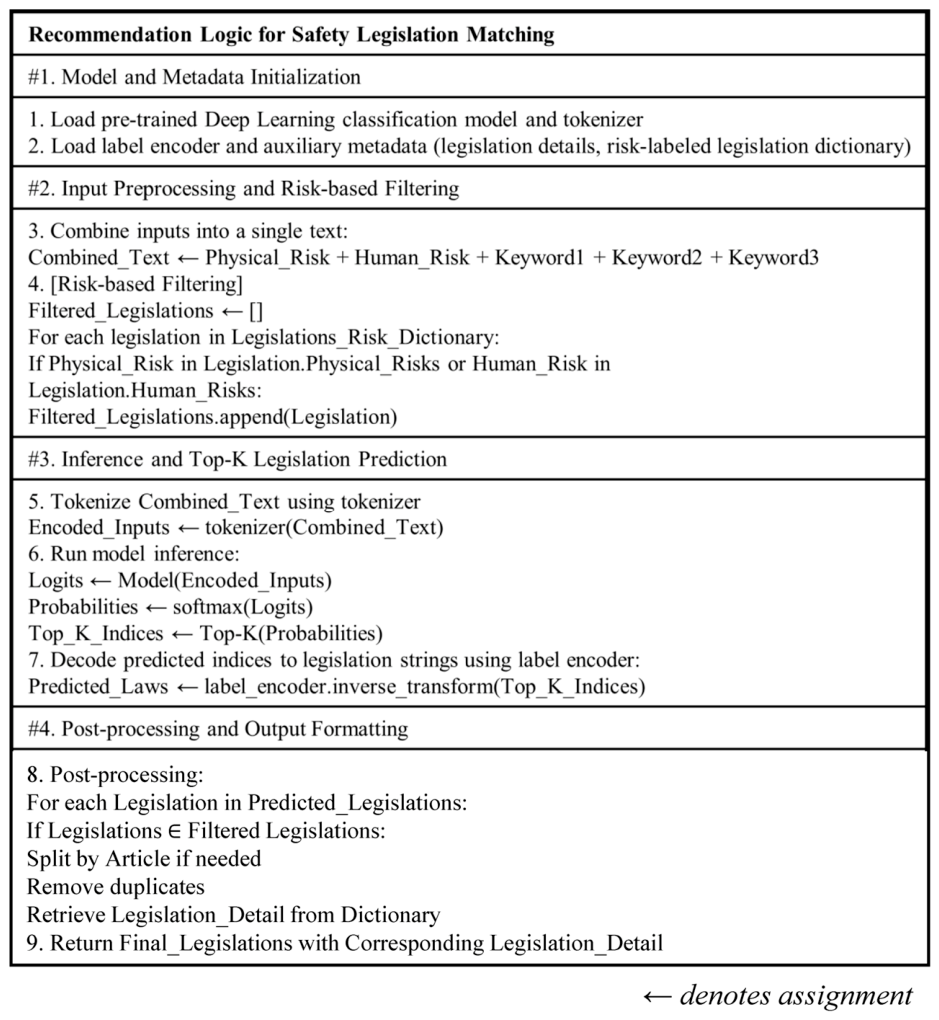
The recommendation system operates through a three-stage logic combining a pretrained deep learning classification model with auxiliary metadata (e.g., statute–risk mappings and statute descriptions). This system recommends relevant safety and health statutes based on physical and human hazards and up to three user-provided keywords. The entire recommendation process is shown in
Figure 2.
First, physical and human risks, along with the input keywords, are concatenated into a single input text. A primary risk-based filtering step is then applied using pre-constructed statute–risk mappings to retain only statutes relevant to the input risks. This step improves recommendation accuracy by eliminating irrelevant statute candidates in advance.
Second, the preprocessed input is passed to a pretrained classification model, which outputs a probability distribution over statute classes. Using the Softmax function, the model assigns probabilities to each statute class and selects the top-K candidates with the highest scores. A label encoder, constructed during training, is used to map model output indices to actual statute names.
Third, post-processing is applied to the list of recommended statutes. Statute names are parsed into clauses, and duplicates are removed to avoid redundant recommendations. Finally, detailed statute descriptions are retrieved and presented to the user along with the recommendations.
3.5. Web Application Development
A web application with a user-friendly interface was developed to facilitate access to the optimized classification model and recommendation logic. The application was implemented using Streamlit (version 1.52.0), a Python (version 3.10.15)-based web framework that supports model loading, input processing, and output display of legislation recommendation results [
58].
Users can input physical and human risks, along with one to three keywords, through the web interface. The system then recommends up to three relevant statutes, each accompanied by a detailed description. To enhance precision, pre-filtering was implemented using a pre-built risk–statute matching dataset to eliminate irrelevant candidates, and post-processing was added to remove duplicate recommendations. The application features an intuitive input–output interface, tailored for practical use in construction safety report preparation. The model requires no complex configuration, enhancing accessibility for field practitioners.
4. Results
4.1. Performance of the Deep Learning Model
The performances of two pretrained language models, KoBERT and KoELECTRA, were compared for recommending relevant legislation based on risk factors and keywords in DfS reports. Both models were trained using the same input configuration, risks, and up to three keywords, applying the CrossEntropyLoss function with class weighting to address class imbalance.
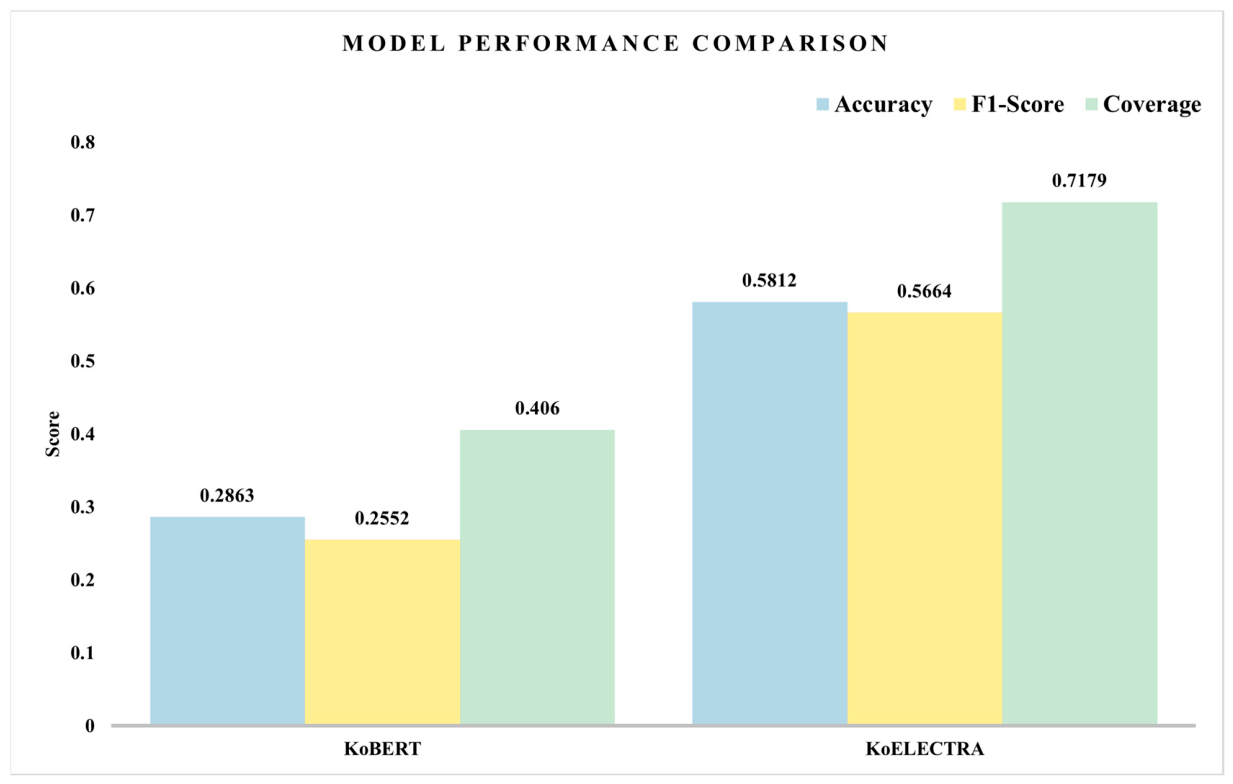
To determine the more suitable model for legislation recommendation, performance was compared using multiple evaluation metrics. KoBERT achieved an accuracy of 0.2863, F1-score of 0.2552, and coverage of 0.4060, while KoELECTRA achieved an accuracy of 0.5812, F1-score of 0.5664, and coverage of 0.7179. Considering that the recommendation task involves 356 statutory provision classes, the classification problem is highly complex and substantially more challenging than conventional text classification tasks with a limited number of categories. Therefore, although the absolute accuracy values may appear moderate, the results demonstrate a meaningful ability to distinguish among a large set of semantically similar legal provisions. In particular, the top-3 coverage of 71.79% indicates that the correct legislation was included among the model’s top recommendations in most cases, which is important for practical decision-support applications where multiple legislative provisions may be applicable to a single safety scenario.
As shown in
Figure 3, KoELECTRA demonstrated superior overall performance compared to KoBERT. The substantial improvement in performance can be attributed to differences in the pretraining objectives of the two models. KoBERT is based on the BERT architecture, which relies on masked language modeling (MLM) to predict randomly masked tokens. In contrast, KoELECTRA employs a replaced token detection (RTD) mechanism that learns to distinguish original tokens from artificially generated replacements. This discriminative training strategy enables KoELECTRA to utilize information from all input tokens during pretraining, resulting in more efficient representation learning. Consequently, KoELECTRA is better able to capture subtle semantic distinctions among construction safety risks, keywords, and legislative provisions. Given the highly imbalanced multi-class nature of the legislation recommendation task involving 356 statutory provision classes, KoELECTRA’s enhanced contextual understanding contributed to its substantially higher F1-score and overall predictive performance.
As summarized in
Table 5, KoELECTRA is lightweight, with a model size of 429.80 MB, GPU memory usage of 1740.49 MB, and an inference time of 0.83 s for 100 samples (0.0036 s per sample), enabling efficient inferencing. The model also demonstrated a favorable balance between prediction accuracy and computational efficiency. Despite handling a large number of legislation classes, KoELECTRA maintained low memory consumption and rapid inference speed, making it suitable for practical deployment in construction safety documentation systems where real-time recommendations are desirable. Based on its superior predictive performance and inference efficiency, KoELECTRA was adopted as the final model for the recommendation system.
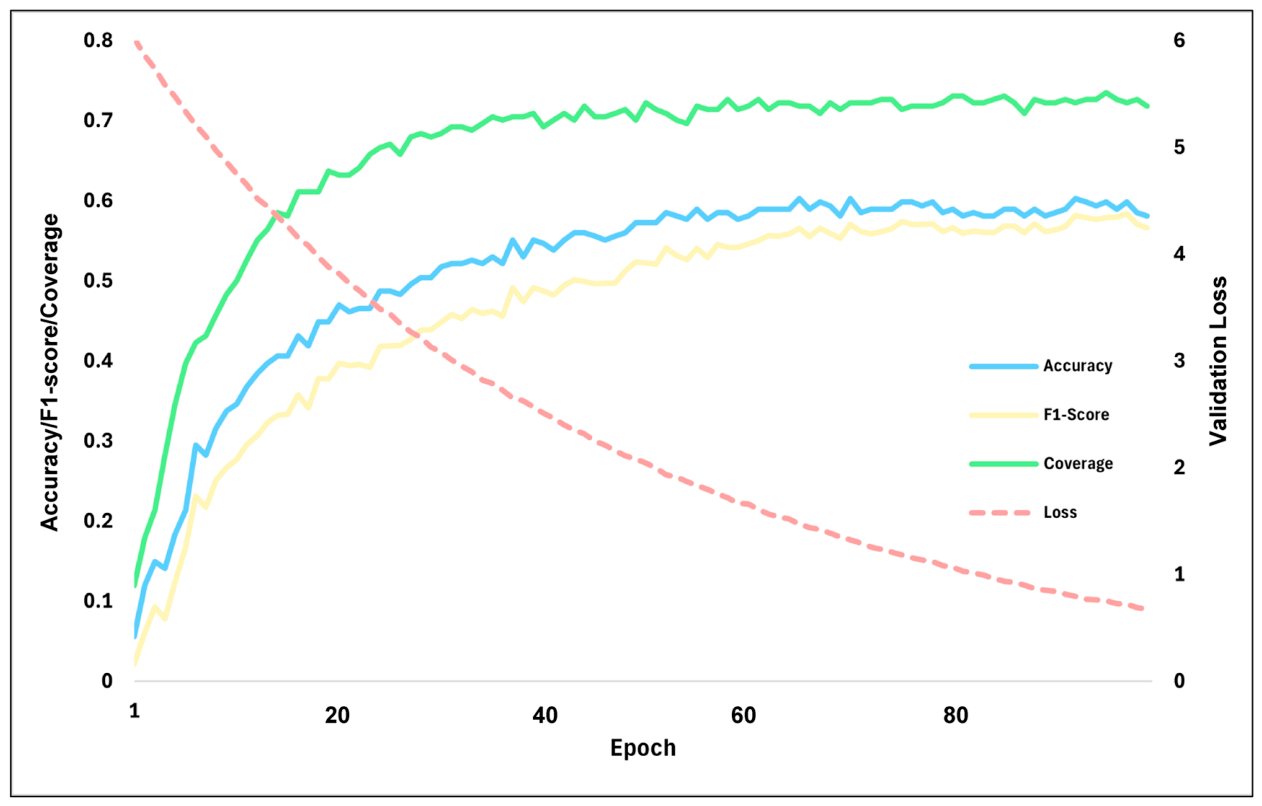
The training process of KoELECTRA was analyzed to evaluate model convergence and training stability. As shown in
Figure 4, the validation loss gradually decreased with each epoch, while accuracy, F1-score, and coverage steadily increased. At epoch 100, the validation loss reached 0.6758, indicating stable convergence of the model. The simultaneous reduction in loss and increase in evaluation metrics suggests that the model effectively learned meaningful semantic relationships between DfS report contents and legislative provisions without exhibiting significant signs of overfitting. Furthermore, the convergence trends stabilized after approximately 60 epochs, indicating that the selected hyperparameter configuration enabled consistent learning and generalization throughout training.
In addition to quantitative evaluation, the model’s effectiveness was verified in real-world scenarios. To this end, KoELECTRA’s top-3 recommendations were compared with manually mapped statutes from a sample of the test set. As shown in
Table 6, KoELECTRA’s recommendations matched the manually mapped statutes in most cases. Additionally, KoELECTRA automatically recommended other statutes relevant to the report content. These results indicate that the model not only reproduced expert-assigned legislation but also identified additional contextually relevant provisions, demonstrating its capability to support comprehensive legal referencing during DfS report preparation.
4.2. Application of Legislation Recommendation System to DfS Reports
This study aimed to validate the practical applicability of the legislation recommendation model and demonstrate its utility in the preparation of the DfS report. Accordingly, a web application was implemented using the KoELECTRA-based deep learning model to recommend relevant legislation. The system automatically recommends appropriate health and safety legislation based on the input risks.
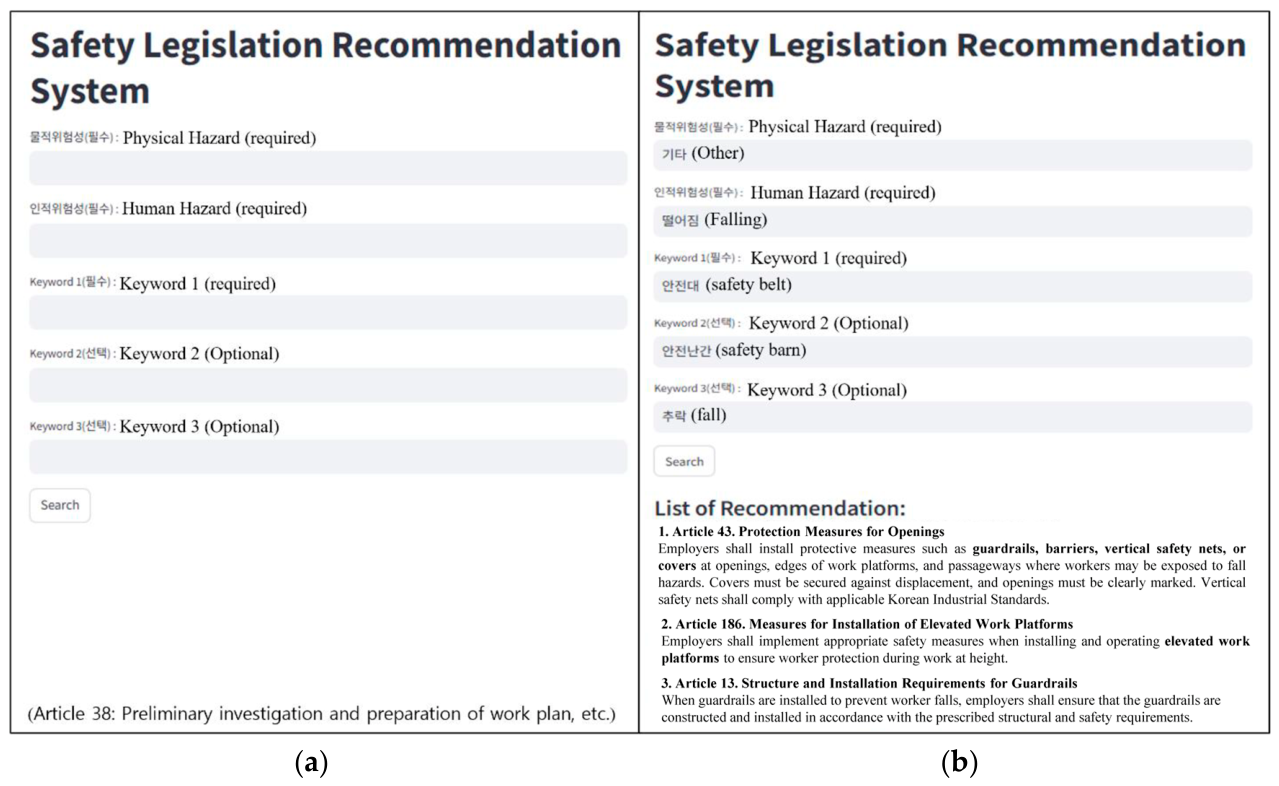
The user interface is designed for convenience and intuitiveness, featuring input fields for physical risks, human risks, and up to three keywords.
Figure 5 shows the overall interface structure of the web system.
Figure 5 presents the interface structure of the web system, including (
Figure 5a) the initial input screen and (
Figure 5b) the result screen displaying the list of recommended statutes based on user input. Up to three recommended statutes are displayed, each accompanied by its title and key provisions for quick reference.
The recommendation process first uses pre-built risk-to-legislation mapping data to generate an initial shortlist of relevant statutes based on the input keywords. The deep learning-based classification model then refines this shortlist to produce the final recommendation list. The KoELECTRA-based model used in this system is pretrained to process risk descriptions and up to three keywords as input. It assigns a probability score to each candidate statute and outputs a top-3 ranked list based on these scores. Finally, the top-3 recommended statutes are automatically displayed on the interface.
To evaluate the feasibility of practical deployment, the inference performance of the developed system was also considered. As shown in
Table 5, the KoELECTRA model required approximately 0.0036 s per sample and 0.83 s to process 100 samples, demonstrating rapid response capability for real-time legislation recommendation. Because the recommendation process involves lightweight text preprocessing and a pretrained inference model, the system can efficiently handle multiple user requests within a web-based environment. The Streamlit-based architecture supports concurrent user sessions, allowing several practitioners to access the recommendation service simultaneously. These characteristics indicate that the proposed system is suitable for deployment in real construction project environments, where safety personnel, designers, and project managers may require immediate legislative guidance during the preparation and review of DfS reports.
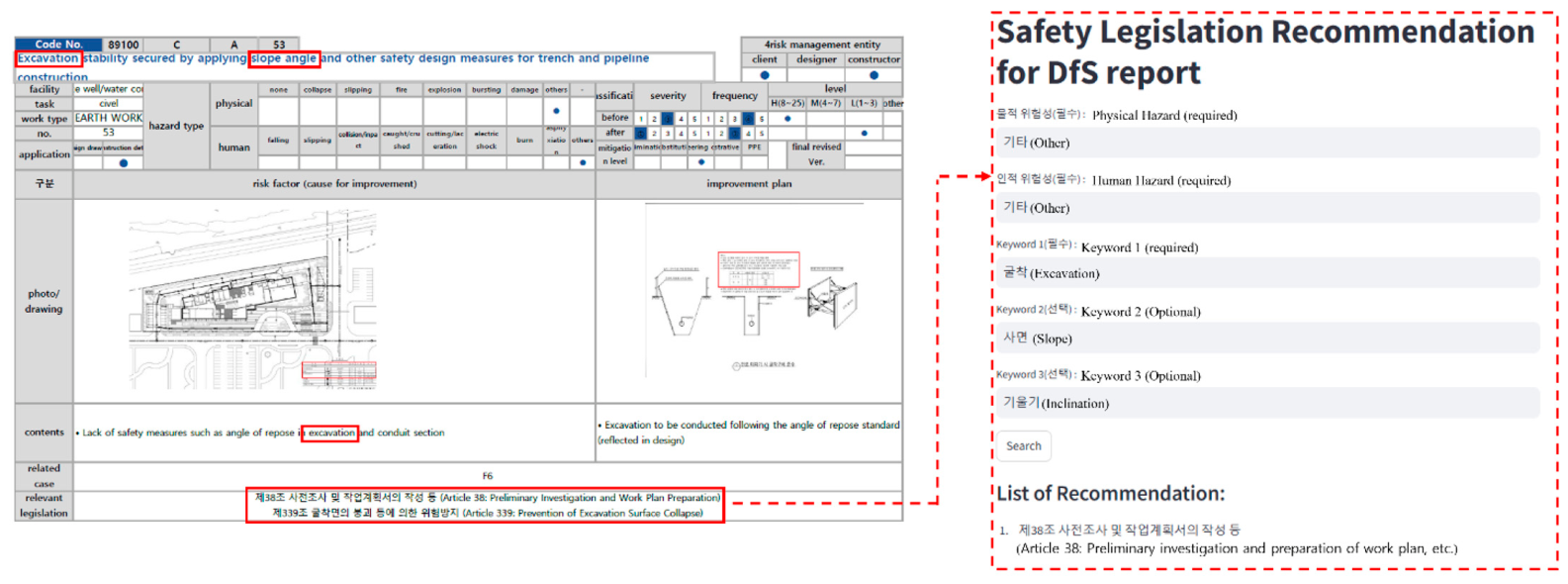
Figure 6 illustrates an example of the system’s application to a DfS report. On the left side of the screen, physical and human risks, along with keywords such as “excavation,” “slope,” and “inclination,” are extracted from the risk descriptions. These elements are used as input for the system. Based on this input, the system first generates an initial set of candidate statutes using the legislation-to-risk mapping data. The KoELECTRA model is subsequently applied to generate the final statute recommendations. The results are displayed on the right side of
Figure 6, where statutes highly relevant to the identified risk factors, such as “Article 38: Preliminary Investigation and Preparation of Work Plan”, are automatically recommended.
5. Discussion
This study developed a system that automatically recommends relevant laws and regulations for safety and health documents by combining a deep learning-based semantic matching model with ontology-based vocabulary expansion. To empirically validate the system’s effectiveness and applicability, a case study was conducted using the DfS report, a representative safety and health document produced during the design phase. The significance of the proposed system lies not only in its technical implementation but also in its practical applicability to construction sites and its potential for extension to other safety documentation.
The academic and practical contributions of this study can be summarized in four key aspects.
First, the proposed system significantly improves the efficiency of report preparation by automating the repetitive and time-consuming process of identifying relevant legislation. It enables automatic recommendation of statutes corresponding to the identified risks, even when the report author lacks legal expertise, thereby enhancing both the legal validity and practical effectiveness of the document. The system’s intuitive interface supports usability by various stakeholders, including architects, supervisors, and clients. Accordingly, its applicability extends beyond DfS reports to other safety-related documentation.
Second, a key contribution of this study lies in the integration of domain-specific ontologies with Word2Vec-based lexical expansion. While previous studies have typically relied on pretrained language models or a single embedding method, this study manually constructed a lexical relation dictionary comprising core terms, subwords, synonyms, and related vocabulary specific to construction safety. These structured relationships were embedded using Word2Vec to reflect context-based semantic similarities, thereby enabling more accurate matching beyond simple keyword alignment. This approach improves the system’s ability to capture the diverse and contextual nature of lexical expressions in legal recommendations.
Third, although this study focused on a limited set of statutes and targeted DfS reports, the proposed system has high extensibility. By constructing additional training datasets for other types of legislation and safety documents, the model can be retrained to support broader applications. This indicates the potential for the system to evolve into a generalized legislation support tool applicable across various domains and document types.
Fourth, this study offers substantial practical value by not only developing an optimized deep learning model but also implementing a fully functional web-based interface. The application enables users to input physical and human risks along with relevant keywords and then automatically recommends up to three statutes based on the trained model. While quantitative user experience evaluation was not conducted, the interface design was informed by consideration of actual field usage. This provides a foundation for future system improvements and user-centered enhancements based on real-world feedback. Importantly, the proposed system is intended as a decision-support tool rather than a substitute for professional legal interpretation or regulatory review. The system assists users in identifying potentially relevant legislative provisions; however, the final responsibility for selecting, interpreting, and applying statutory requirements remains with project stakeholders, including designers, safety managers, contractors, and employers. Consequently, recommendations generated by the system should be reviewed and validated by qualified personnel before implementation. This role boundary is particularly important in the context of accident investigations and legal liability determinations, where compliance decisions must ultimately be based on professional judgment and applicable regulatory requirements rather than solely on automated recommendations.
An important limitation of this study is that the training dataset was constructed using a one-to-one matching approach between DfS reports and statutory provisions. In practice, however, a single safety risk described in a DfS report may be associated with multiple applicable legislation articles. Although the expert reviewers selected the most relevant statutory provision for each report to create a consistent supervised learning dataset, this approach may not fully capture the complexity of real-world regulatory interpretation. Consequently, some recommendations generated by the model may be legally relevant even when they do not exactly match the assigned ground-truth label. This limitation should be considered when interpreting the reported accuracy and F1-score values, as the evaluation framework assumes a single correct answer despite the possibility of multiple valid legislative references. Future studies should investigate multi-label legislation recommendation approaches that allow several statutory provisions to be associated with a single DfS report, thereby better reflecting practical safety compliance requirements.
Although the model’s quantitative performance may appear lower than that of typical classification models, it should be interpreted differently due to the nature of semantic-based multi-answer recommendations, where no single correct answer exists. In this study, the evaluation relied on a manually curated answer set, which does not fully capture all valid alternatives. As a result, the model often recommended statutes that were not included in the reference set but were semantically relevant or potentially applicable. In several real-world test cases, the model generated legislative recommendations that were absent from the labeled answers. However, these recommendations aligned closely with the contextual meaning of the corresponding DfS reports. This demonstrates the model’s ability to capture contextual similarity beyond simple keyword matching. Similar issues have been noted in previous research, underscoring the need for evaluation frameworks that incorporate semantic similarity-based metrics [
59,
60]. Therefore, the performance outcomes in this study should be interpreted in light of these constraints and may be considered adequate for practical applications. Furthermore, because legislation recommendation systems operate in a regulatory environment where legal accountability remains with human decision-makers, the effectiveness of such systems should be evaluated not only in terms of predictive performance but also in terms of their ability to support informed decision-making while maintaining appropriate human oversight. Future work should aim to adopt more comprehensive evaluation approaches that include user-centered metrics and semantic similarity analysis to more accurately assess system effectiveness.
6. Conclusions
This study proposed a semantic-based legislation recommendation system to assist non-experts in efficiently identifying and referencing relevant statutes during the preparation of safety and health documents. To evaluate the effectiveness and applicability of the system, an empirical analysis was conducted using the Design for Safety (DfS) report, a representative document prepared in the design phase of construction projects.
To build the system, DfS reports and relevant statutory provisions were collected and manually matched to form a labeled dataset. A domain-specific ontology was then constructed, and lexical relationships were further enhanced using Word2Vec embeddings. Based on the constructed dataset, various deep learning models were trained and evaluated. The best-performing model was integrated into a user-oriented web application that recommends relevant legislation based on user-inputted risk factors and keywords.
Among the models tested, KoELECTRA achieved the highest performance with 58% top-1 accuracy, 57% F1-score, and 72% coverage. Although the top-1 accuracy indicates that the model does not always identify the exact legislation assigned by experts, the high top-3 coverage demonstrates that relevant legislation is included among the recommended alternatives in most cases. Considering that construction safety scenarios may be associated with multiple applicable legal provisions and that legislation recommendation is inherently a semantic and context-dependent task, these results suggest that the system is suitable as a decision-support tool for assisting users in identifying potentially relevant legislation rather than as a fully autonomous legal decision-making system. Therefore, professional review and user judgment remain essential when selecting and applying recommended statutory provisions in practice. Consequently, the KoELECTRA-based system was adopted for deployment in the web application.
This study makes several key contributions. First, it demonstrates a method to enhance the linkage between safety documentation and legal provisions by integrating a construction safety-specific ontology with a deep learning model. This provides a practical tool to support the legal grounding of safety documentation in real-world contexts. Second, the system enables non-expert users to effectively reference statutory provisions, highlighting its practical value in field applications.
Nonetheless, the study has certain limitations. The model’s accuracy, while reasonable, requires further improvement to enhance the reliability of recommendations. Additionally, the usability of the web application was not quantitatively evaluated. As a result, the effectiveness of the system from the perspective of end users, including designers, safety managers, and construction practitioners, remains to be systematically assessed. Furthermore, this study primarily compared deep learning architectures and did not include conventional retrieval-based baselines, such as TF-IDF or BM25, which could provide additional benchmarking for assessing the relative benefits of semantic language models.
Future research will focus on expanding the training dataset with diverse safety documents and statutory texts to improve the model’s generalization capability. Moreover, the system will be refined based on user feedback and usability evaluations to enhance its practical effectiveness in field environments. A pilot implementation study is also planned in collaboration with construction practitioners to evaluate the system under actual project conditions. Such a study will enable the assessment of recommendation quality, user satisfaction, decision-making support, and the potential impact of the system on the efficiency and consistency of safety documentation practices. In addition, future research should incorporate conventional information retrieval and machine learning baselines, such as TF-IDF- and BM25-based recommendation methods, to provide a more comprehensive comparative evaluation of the proposed deep learning approach and to further quantify its advantages in capturing semantic relationships between safety reports and legislative provisions.