Article

Numerical Modeling of Environmental Vibration Induced by Millisecond Delayed Blasting of Tunnel Adjacent to Historical Building

1
School of Civil Engineering and Architecture, Jiangsu Open University, Nanjing 210036, China
2
Institute of Geotechnical Engineering, Nanjing Tech University, Nanjing 210037, China
*
Author to whom correspondence should be addressed.
Buildings 2026, 16(12), 2364; https://doi.org/10.3390/buildings16122364 (registering DOI)
Submission received: 15 May 2026 / Revised: 3 June 2026 / Accepted: 10 June 2026 / Published: 12 June 2026
(This article belongs to the Section Building Structures)

Abstract

The blasting-induced environmental impact of tunneling is a major concern in drill and blast excavation practice, particularly in urban areas. The present paper carries out comprehensive numerical modeling to study the vibration attenuation at the soil surface away from the blasting source as well as the resulting interactions between a historical structure and the surrounding soil, with particular attention to the effects of a millisecond delay. Special attention is given to the interpretation of the role of the local site effects in terms of the frequency-dependent changes of the vibration attenuation mechanism and the response of the historical structure. The velocity responses along the ground surface generally exhibit higher-frequency suppression and low-frequency amplification for both instantaneous blasting and millisecond delay blasting cases in the layered soil–rock site. The millisecond delay blasting can effectively avoid excessive vibration velocity and thus reduce the vibration amplitude at the ground surface by 60–70% (compared with instantaneous blasting), with the predominant frequency mainly concentrated in the high frequence band of 400–500 Hz. The empirical formulae for predicting the vibration attenuation along the scale distance in a soil–rock site has been proposed for both instantaneous blasting and millisecond delay blasting. Through the HHT spectral analyses of the velocity response of the historical structure, it is seen that the difference of structure properties between the wood-frame tower and the base masonry structure has a remarkable influence on the structural vibration. The numerical results can provide a reliable reference for the practical blasting scheme and the systematic study of the dynamic responses of historical structures subjected to blasting-induced vibrations.

1. Introduction

The blasting-induced environmental impact of tunneling is a major concern in drill and blast excavation practice, particularly in urban areas. The blasting operations in tunnel excavations generate annoying environmental vibrations and may damage structural components when excessive explosives are used [1,2,3,4,5]. Millisecond delay blasting technology has proven to be an effective method to mitigate environmental vibrations and ensure the serviceability of vulnerable structures [6,7]. Recent studies have further explored the optimal delay time selection and vibration reduction mechanisms. For instance, Zhao et al. [8] found that millisecond delay blasting not only reduces peak particle velocity but shifts the dominant frequency away from the natural frequencies of adjacent buildings. Zhu et al. [9] systematically investigated the PPV variation with delay time using electronic detonators, while Gou et al. [10] revealed the underlying mechanisms through double-hole experiments and theoretical analysis. With increasing regulatory and legal constraints on allowable environmental disturbances induced by tunnel blasting, there is a high demand for controlled blasting that considers both the geological conditions and the surrounding environment. Therefore, it is vital for engineers and researchers involved in the design of drill and blast excavation under unfavorable geological conditions to gain a thorough understanding of blasting-induced ground vibration mechanisms and the resulting response of adjacent structures.
The blasting-induced vibration of adjacent structures (i.e., superficial and underground structures) results from a combination of the blasting source mechanism (blasting technology and control parameters), the complexity of the surrounding geological medium, and intensive soil–structure interactions. Recent developments in numerical modeling, combined with field and laboratory studies, have improved the understanding of the physics behind environmental vibrations induced by blasting construction [11,12,13,14,15,16,17,18]. Accurate modeling of the blasting-induced vibration of adjacent historical structures and detailed interpretation of numerical results can provide an integrated understanding, physical insight, and guidance on how to extrapolate and what countermeasures to take for complex engineering problems caused by urban tunnel blasting. Although the numerical modeling of blasting-induced ground vibration in rocks is fairly common, only a few studies have focused on the influence of local soil conditions at layered rock–soil sites (site effects) on vibration attenuation and induced soil–structure interactions, such as the study by Yu et al. [19]. Yu et al. carried out systematic field monitoring and numerical simulation to evaluate the safety of a tunnel under blasting vibration during diaphragm wall construction in soft soils. In contrast to homogeneous rock or soft soil sites, a layered soil–rock site exhibits sharp contrasts in wave impedance between the soil layer and the underlying rock, leading to complex wave reflections, refractions, and frequency-dependent filtering effects that cannot be captured by simplified single-layer or pure rock models. Moreover, the dynamic response under millisecond delay blasting is particularly sensitive to such layering because the interference patterns of delayed wave trains are significantly modified by the stratified propagation medium. The influence of layered geological conditions on blast vibration propagation has recently attracted increasing attention. Meng et al. [20] analyzed stress wave propagation characteristics across rock–soil interfaces, revealing that such interfaces cause wave polarization and create zones of enhanced or attenuated vibration. Zhao et al. [21] examined the dynamic response of layered slopes under blast loading considering non-homogeneity, demonstrating that joint dip angles significantly affect ground motion amplification. However, to the authors’ best knowledge, no numerical investigations are available in the literature on the site effect caused by millisecond delay blasting at layered soil–rock sites. Therefore, it is of great interest to perform systematic studies on millisecond delay blasting-induced environmental vibration in layered soil–rock sites when considering the effects of geological layers [12]. More recently, advanced numerical models have been developed to capture the spatial response of blast-induced vibration in deep tunnels [22] and the propagation laws in layered geological settings [23]. Chen et al. [24] optimized millisecond delay times for tunnel blasting using interference vibration reduction. Li and Ma [25] examined soft interlayer dip angle effects on blast vibration in rock slopes, while Wang et al. [26] developed a coupled Eulerian–Lagrangian model for soil–pipeline interactions under blast loading. These studies have highlighted the need for a systematic investigation of layered soil–rock sites, which is the focus of this work.
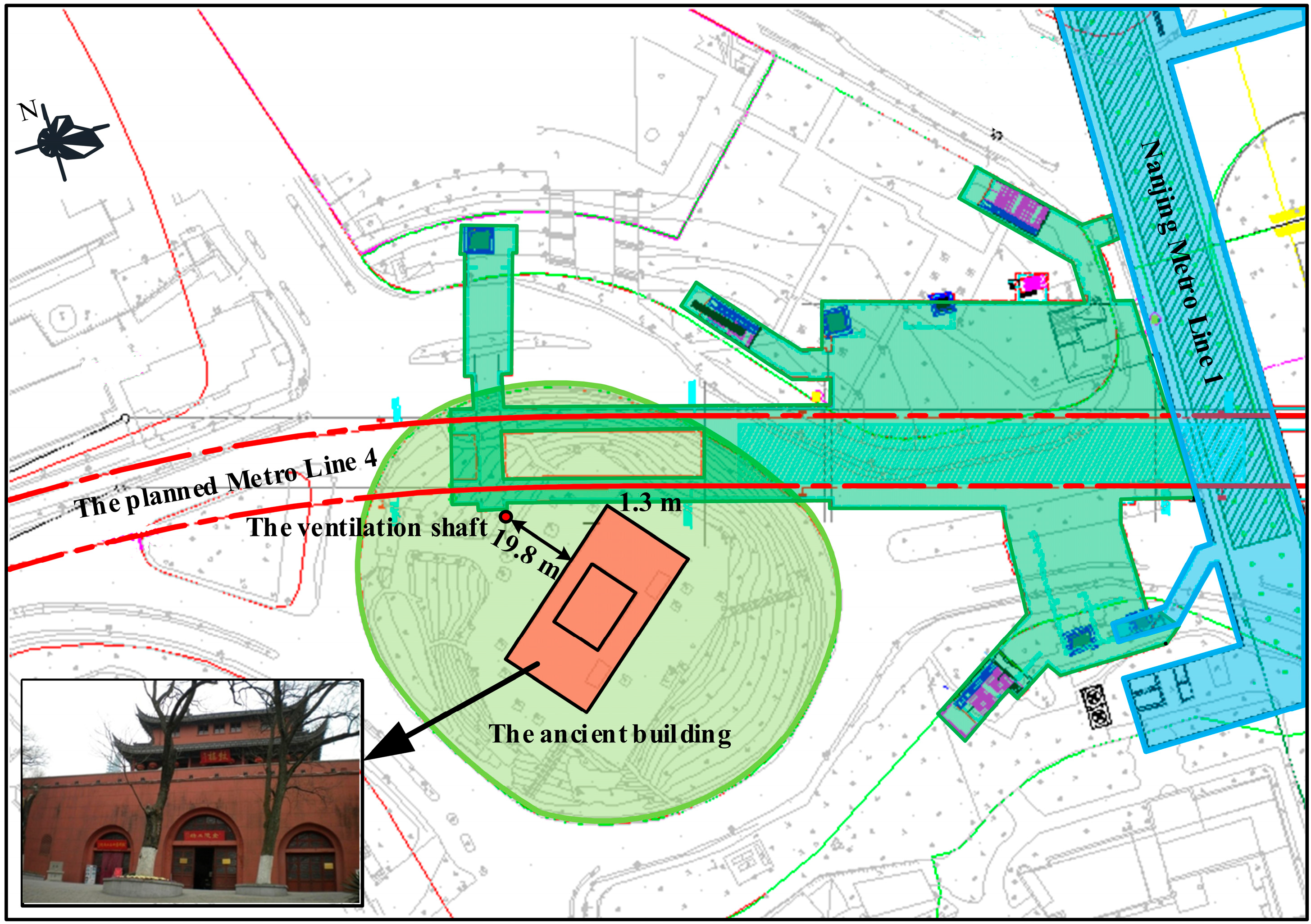
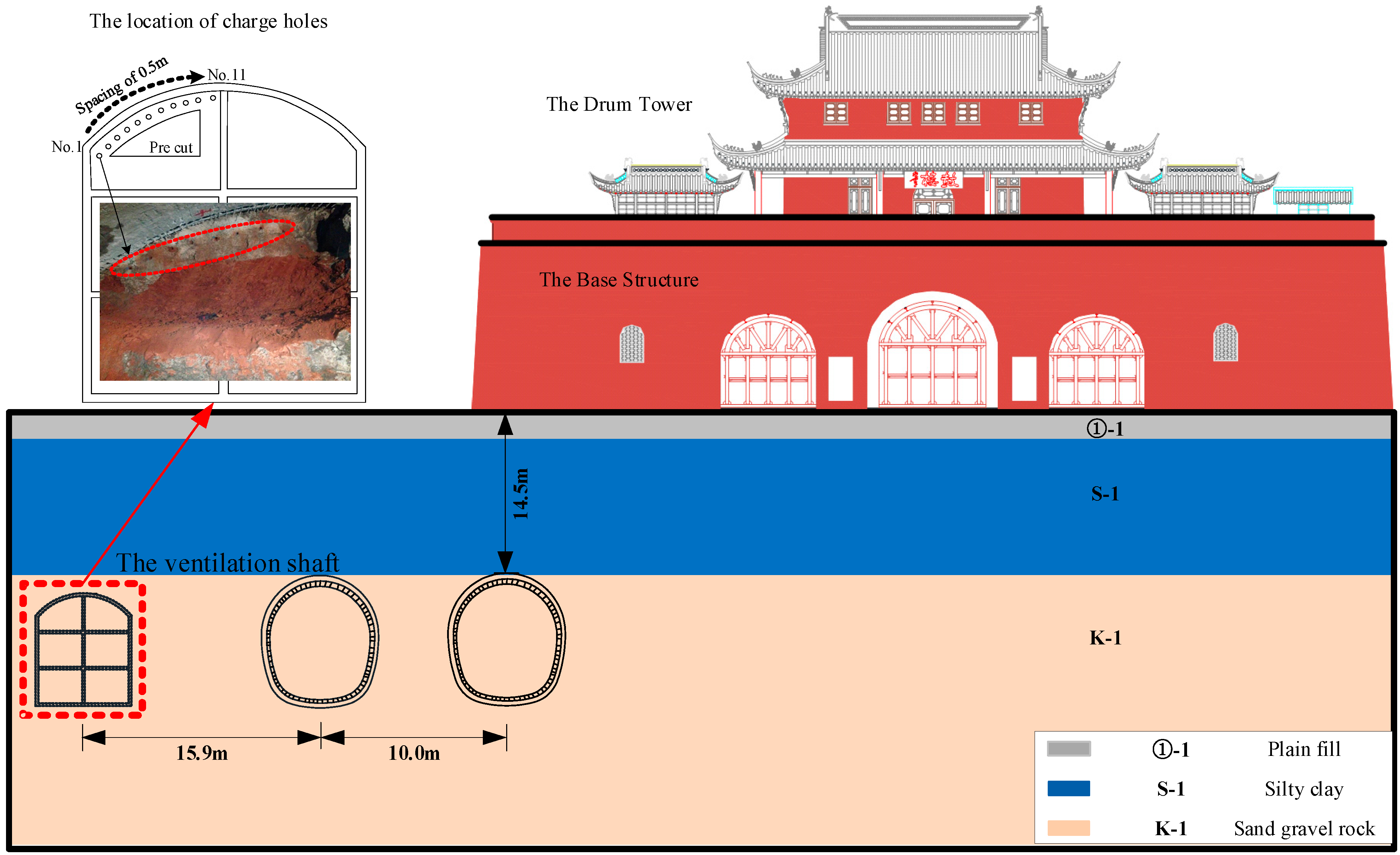
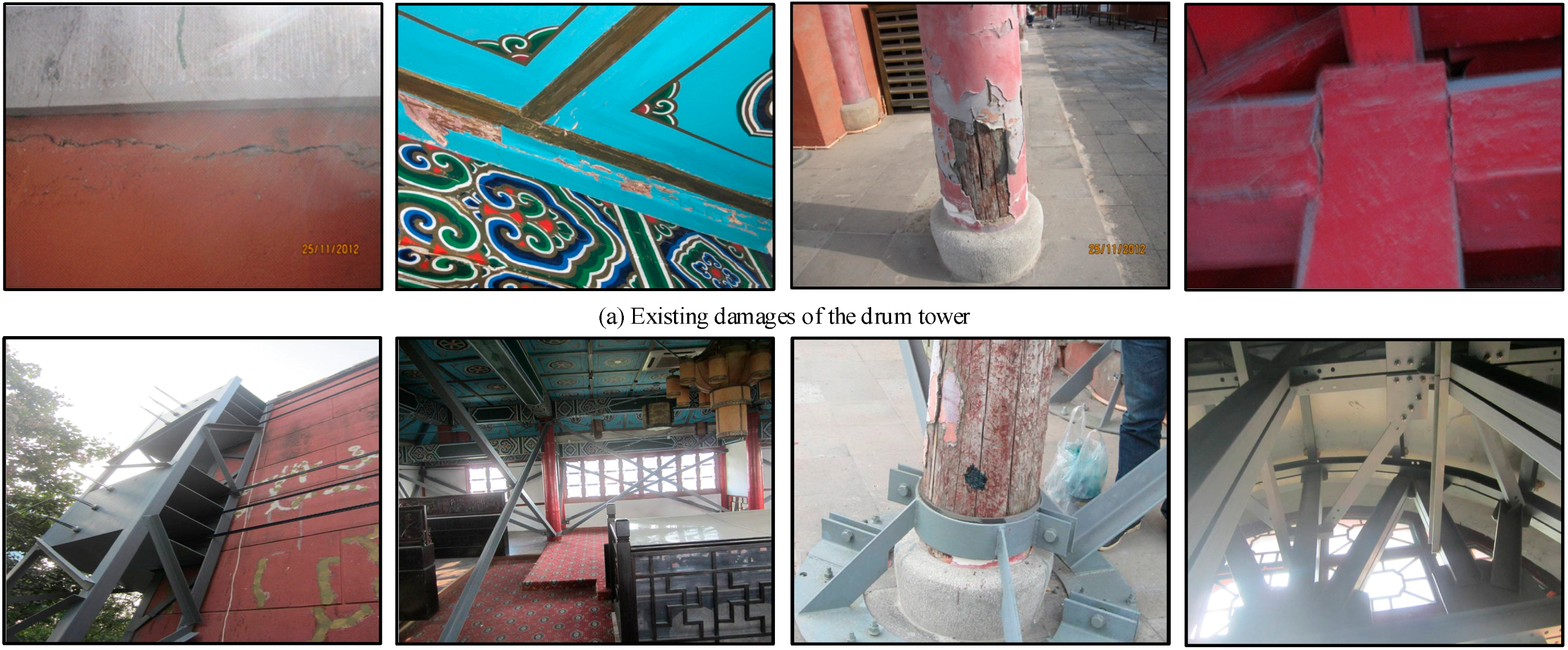
The reference project for this study is a 660 m long rock tunnel (with a 6 m section diameter) in Nanjing, China, which is an important link of the planned city rail transit Line 4, as shown in Figure 1. The ground encountered is medium-hard and consists mainly of a moderately weathered gravel rock mass, which is hard and abrasive. The geological strata at the tunnel site consist of soil–rock layers, as shown in Figure 2, including plain fill, highly weathered sandstone (V), moderately weathered sandstone (II–IV), and moderately weathered glutenite (II–III). Furthermore, boulders with diameters ranging from 0.2 m to 1.2 m exist in the weathered rocks, which could be unfavorable for the tunnel boring machine used in other excavation sections of Metro Line 4. Given these extreme geological conditions, the drill and blast method was chosen to excavate the tunnel rather than a mechanized excavation method. The principal technical issue to be overcome is the blast-induced vibration affecting adjacent structures. Underground structures and public pipelines are present around the construction site. In particular, an ancient drum tower with historical and cultural features sensitive to even low levels of vibration is located extremely close to the reference tunnel, at a horizontal distance of 1.3 m and a vertical distance of 14.5 m. The relative position between the tunnel and the ancient building is shown in Figure 1. Several cracks have already appeared on the structural components of the wood-frame drum tower, e.g., on selected beams and columns, as shown in Figure 3a. Thus, the structure was systematically reinforced prior to excavation to lessen any potential damage (see Figure 3b). The vulnerability of historical structures to blast-induced vibrations has been documented in several recent studies. Ren et al. [27] conducted field blasting tests near a historical building to characterize its structural vibration response, while Pan et al. [28] analyzed the dynamic characteristics of buildings under blast loading through multi-story response spectra. Nevertheless, given the small spatial distance between the tunnel and the ancient building, blasting-induced vibrations remain a high potential threat to the safety of this highly distressed tower. Therefore, it is highly demanding to perform a detailed risk assessment to fully understand the attenuation of blasting-induced vibrations along the ground surface and the dynamic response of the drum tower, which can serve as a useful reference for the conventional excavation design of the planned tunnel.
The present paper carries out comprehensive numerical modeling (involving instantaneous blasting and millisecond delay blasting) to study vibration attenuation on the soil surface away from the blasting source as well as the resulting interactions between a historical building and the surrounding soil in a layered soil–rock site. Special attention is given to the interpretation of the role of local site effects in terms of frequency-dependent changes in the vibration attenuation mechanism and the response of the historical structure [29]. The numerical modeling method, including model construction, simulation of rock blasting, and the dynamic constitutive model, is presented to fully satisfy the requirements of the International Society of Explosives Engineers (ISEE) (Section 2). Based on the numerical results, the blasting-induced wave propagation along the ground surface (Section 3) and the dynamic response of the historical basement–tower structure (Section 4) are obtained and analyzed.

2. Simulation Method

2.1. Model Construction

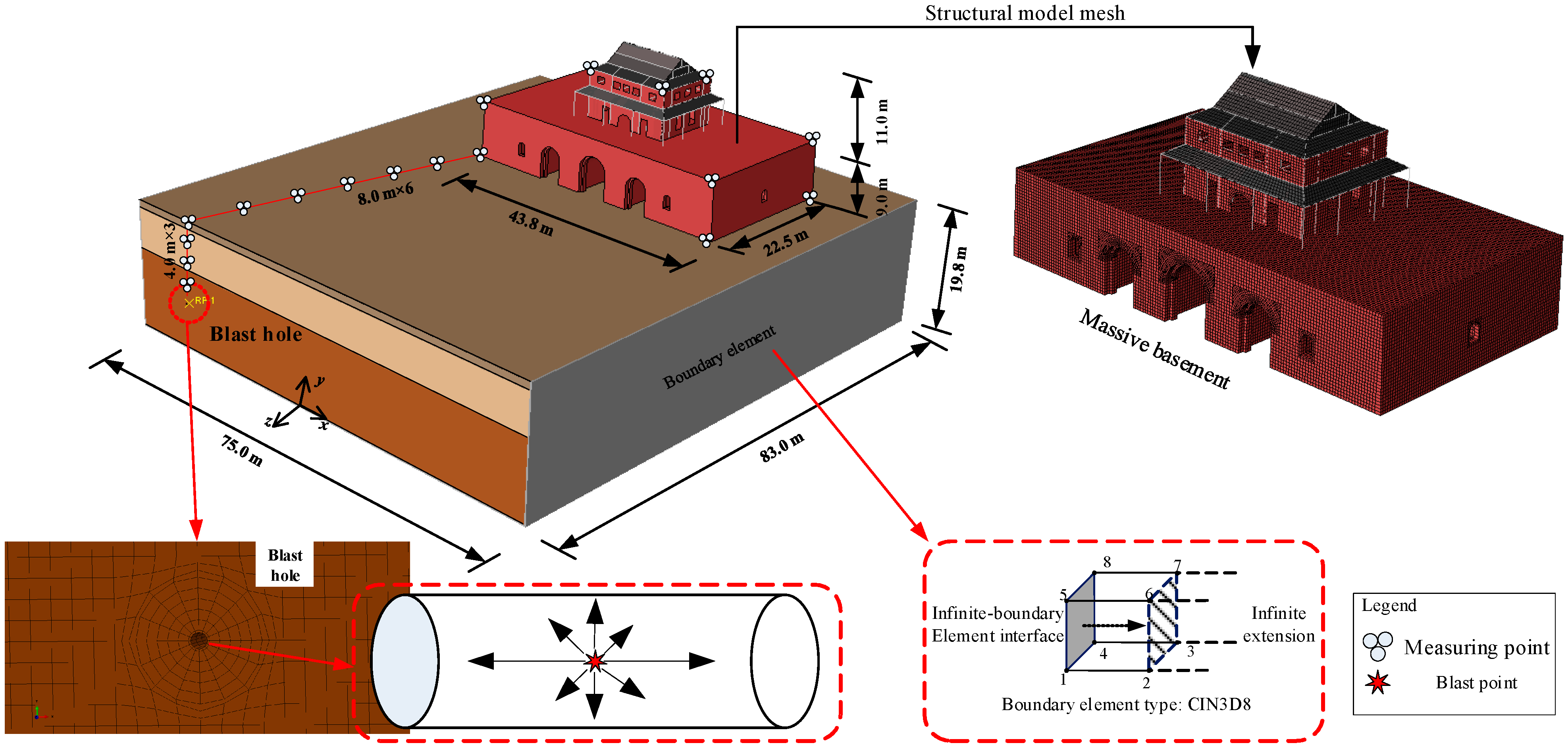
A refined three-dimensional model is constructed using ABAQUS (version 2021; Dassault Systèmes, Providence, RI, USA) considering the spatial distribution between the cylindrical blasthole and the historical structure (the base masonry structure and the wood-frame drum tower). The calculation area is 75 m × 83 m × 20 m. The model boundary uses the finite element–infinite element coupling method to consider the transmission and reflection of the blasting seismic wave at the boundary. The model is set to an infinite element except for the blasthole surface. According to the actual blasting charge length of 1 m and the actual hole diameter of 0.25 m, the blasting dynamic load is applied to the inner wall and the bottom of the cylindrical blasthole. The model mesh size and structure are simulated according to the structural entity. The geometric parameters and element types of the 3D model are shown in Table 1 and Table 2, the total number of model elements is 8,009,728, and the model is shown in Figure 4.

2.2. Millisecond Delayed Blasting Simulation

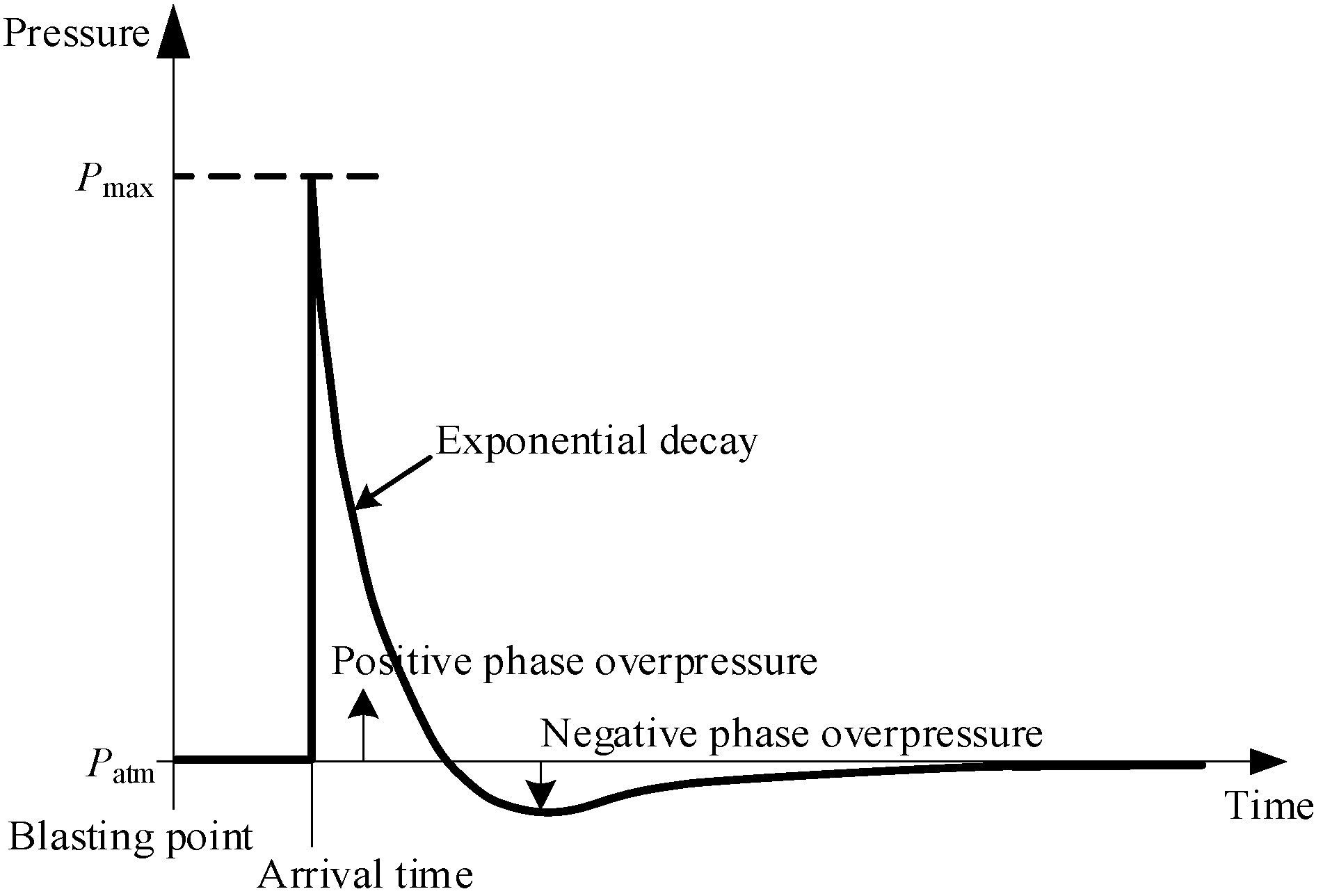
The propagation law of the blast wave p(t) generated by the explosion is represented by the modified Friedlander equation, the attenuation factors can be calculated according to the Formula (2), the schematic diagram of the blast time history can be seen in the Figure 5. The equations can be expressed as follows:
p ( t ) = ( p max p atm ) [ 1 t t a t d ] e a ( t t a ) t d
I = t a t a + t d p ( t ) d t
where Patm is the ambient pressure, (Pmax − Patm) is the overpressure, ta is the time when the wave front reaches the surface of the structure, td is the duration of the positive overpressure, a is the attenuation factor, and I is the given position blasting impulse. Among them, the parameters ta, td, and I are related to the defined parameters of the CONWEP model, according to (Pmax − Patm).
When the incident blast wave acts on the surface of the blasthole, reflection will occur, resulting in an increase in the pressure and impulse of the blast wave. At this time, the surface pressure p(t) of the blasthole is the coupling effect of the incident wave and the reflected wave, and is related to the incident angle of the blast wave to the surface of the blasthole.
Assuming that the incident angle (θ) is the angle between the outer normal and the surface point wired with the blast source p(t), and assuming the incident wave pressure pi(t) and the reflected wave pressure pr(t) satisfy the following empirical relationship, we can then determine the following:
(1) when c o s ( θ ) 0 ,
p ( t ) = p i ( t ) [ 1 + c o s ( θ ) 2 c o s 2 ( θ ) ] + p r ( t ) c o s 2 ( θ )
(2) when c o s ( θ ) < 0 ,
p ( t ) = p i ( t )
Comparing the time history curve loading method of triangular wave loading, the improved Friedlander equation increases the dimension of space.

2.3. Dynamic Constitutive Model

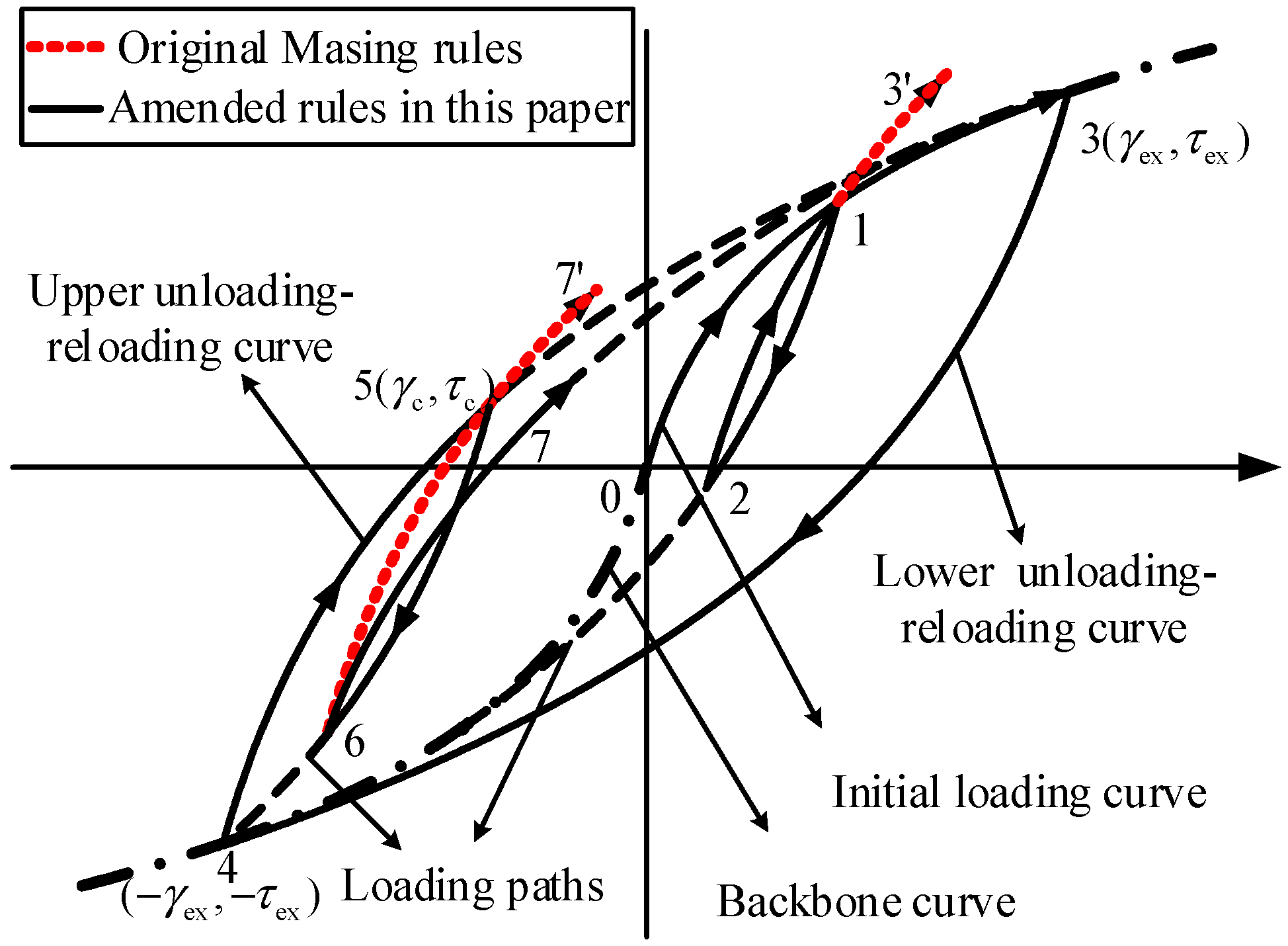
The nonlinear and hysteretic behavior of the soil in the blasting analysis is described by the skeleton curve along with a set of rules that control the shear stress–strain paths. To simplify the geometric feature of the strain paths and to better capture the hysteretic behavior for irregular loading sequences, a new set of non-Masing rules are stated below [30] (see Figure 6), as follows:
(1) Under the initial loading, the skeleton equation describing the shear stress and strain relationship is given by the following equations:
τ = F sk ( γ ) = G 0 γ 1 H γ
H γ = γ / γ r 2 B 1 + γ / γ r 2 B A
where G0 is the initial shear modulus, γr is the reference shear strain, A and B are dimensionless constants for the soil in question, and Fsk(γ) is the generalized hyperbolic skeleton curve as a function of the shear strain (γ).
(2) If the strain reverses, the strain path subsequently follows the curve with Equation (7) from the current strain reversal point to the last strain extreme point during the previous irregular loading cycles, which can be expressed as follows:
τ τ c = G 0 γ γ c 1 H γ γ c 2 n c
2 n c γ r 2 B = γ ex ± γ c 2 B 1 R R
R = 1 τ ex ± τ c G 0 ( γ ex ± γ c ) 1 A
where nc is the hysteresis scale factor, τc and γc are the shear stress and strain of the current reversal point, respectively, τex and γex are the shear stress and strain of the last strain extreme point, respectively, and the sign “±” is negative for reloading and positive for unloading, respectively.
(3) If the irregular loading–unloading–reloading shear strain path overlaps the skeleton curve, it moves sequentially along the skeleton curve to the next strain reversal point.
The nonlinear shear modulus Gt for the initial skeleton in Equation (5) is expressed as follows:
G t = τ γ
the Gt for the unloading–reloading in Equation (7) is expressed as follows:
G t = ( τ τ c ) ( γ γ c )
where the superscript t refers to the start of an increment time in an explicit dynamic analysis.
Given Gt and the Poisson ratio, the tensor of the elastic modulus C i j k l t can be updated. Then, the incremental stress–strain relation is written in the following form, as follows:
d σ i j t = C i j k l t d ε k l t
where d σ i j t and d ε k l t are the tensors of the stress and strain increments at time t.

2.4. Numerical Simulaiton

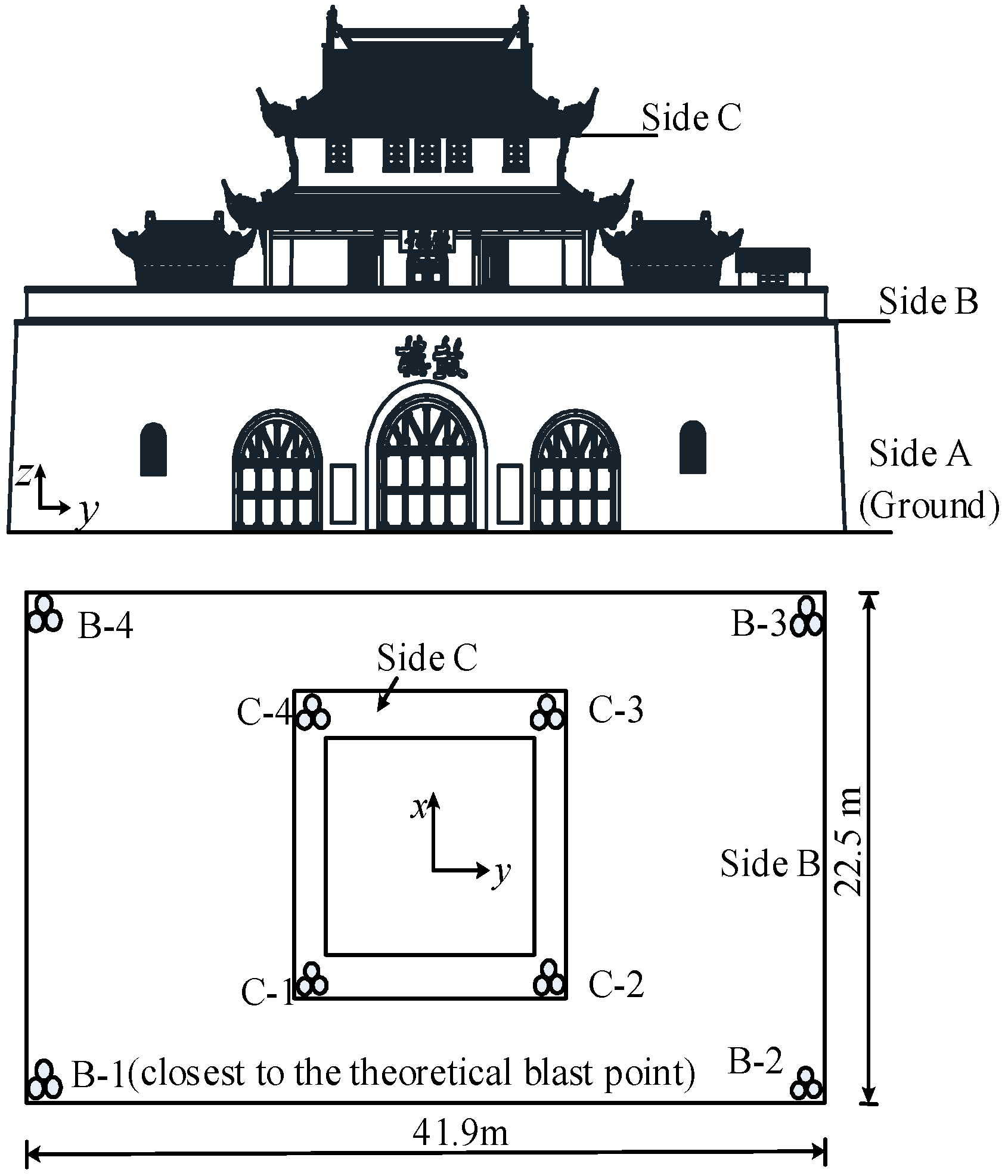
Two different simulation schemes were set up, i.e., instantaneous blasting and millisecond delay blasting. The instantaneous blasting simulation involved five cases, while the millisecond delay blasting simulation of six charge holes at different delayed time formed another five cases. The specific simulation cases performed are listed in Table 3. The time interval of each adjacent blasting was determined according to the specifications of the International Society of Explosives Engineers (ISEE). Monitoring points were established on the Drum Tower and the base structure according to the specifications of the International Society of Explosives Engineers (ISEE). The layout of the monitoring points is shown in Figure 7.

2.5. Model Verification

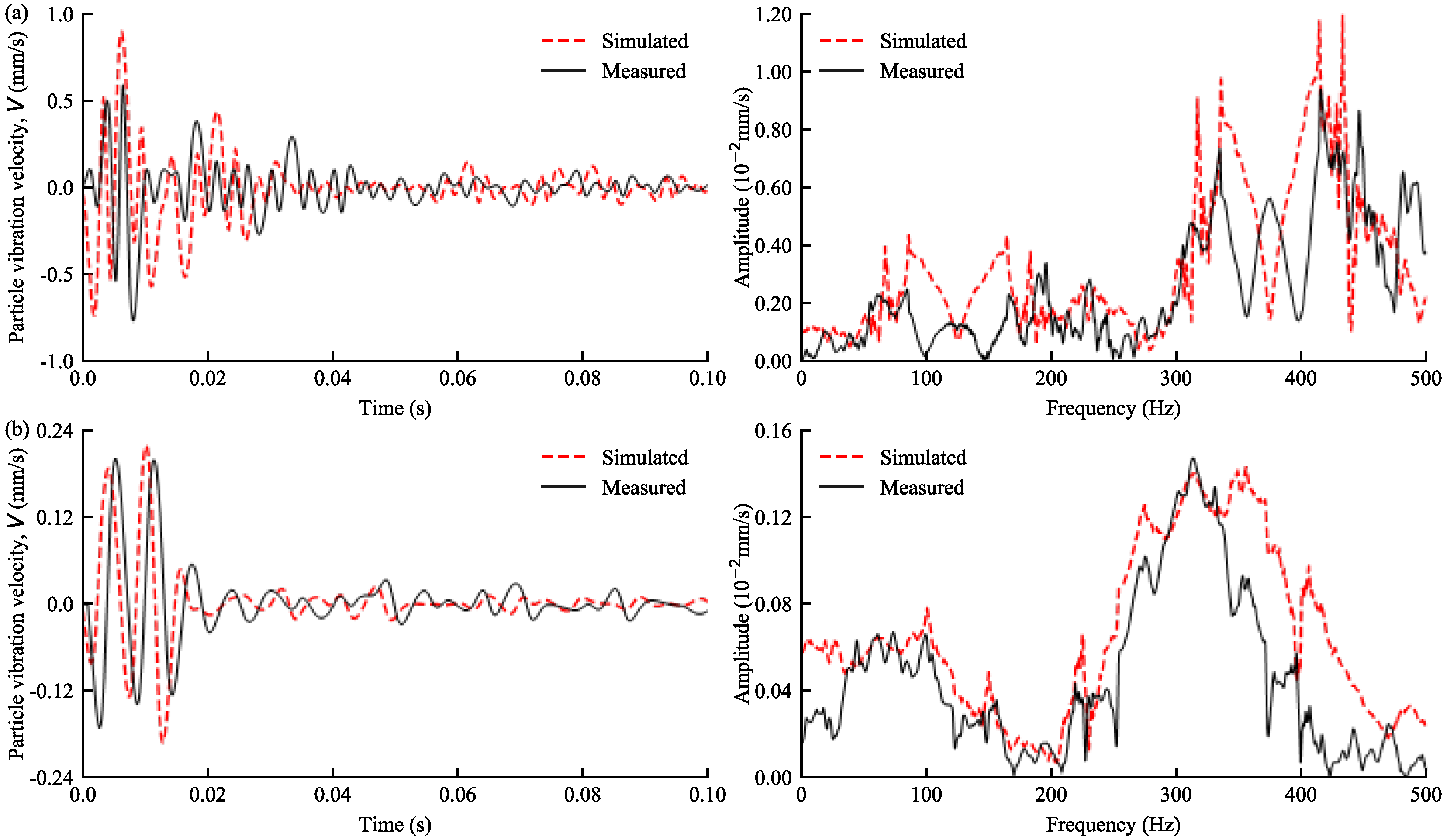
The large-scale field testing provides quality data under controlled conditions for the validation of the numerical models. In this section, we calibrate the proposed methodology by simulating the blasting-induced vibration at the ground surface and the dynamic response of the historic structure against the monitoring data in the field test.
Figure 8 calibrates the proposed framework for modeling the blasting process, the induced ground vibration, and the dynamic response of the historical structure against the field monitoring data. Specifically, Figure 8a presents the comparison between the simulated and the measured vibration velocity at the ground surface, while Figure 8b corresponds to the vibration velocity at the Drum Tower structure. The simulated velocity waveforms generally coincide well with the records. Quantitatively, the coefficient of determination (R2) for the ground surface validation is 0.94, and for the Drum Tower validation it is 0.89, indicating a good fit. The recorded peak velocities and their temporal locations are reproduced excellently. Notably, the blasting-induced energy is concentrated in the high-frequency range, and the numerical simulation captures the overall frequency spectrum characteristics of the millisecond delay blasting. However, a slight discrepancy exists in the high-frequency components (above 400 Hz), where the simulated amplitudes are somewhat lower than the measured ones, likely due to idealized soil damping assumptions. Nonetheless, the model demonstrates a satisfactory predictive capability for engineering purposes.

3. Results and Discussion

3.1. Characteristics of the Blasting Waveform

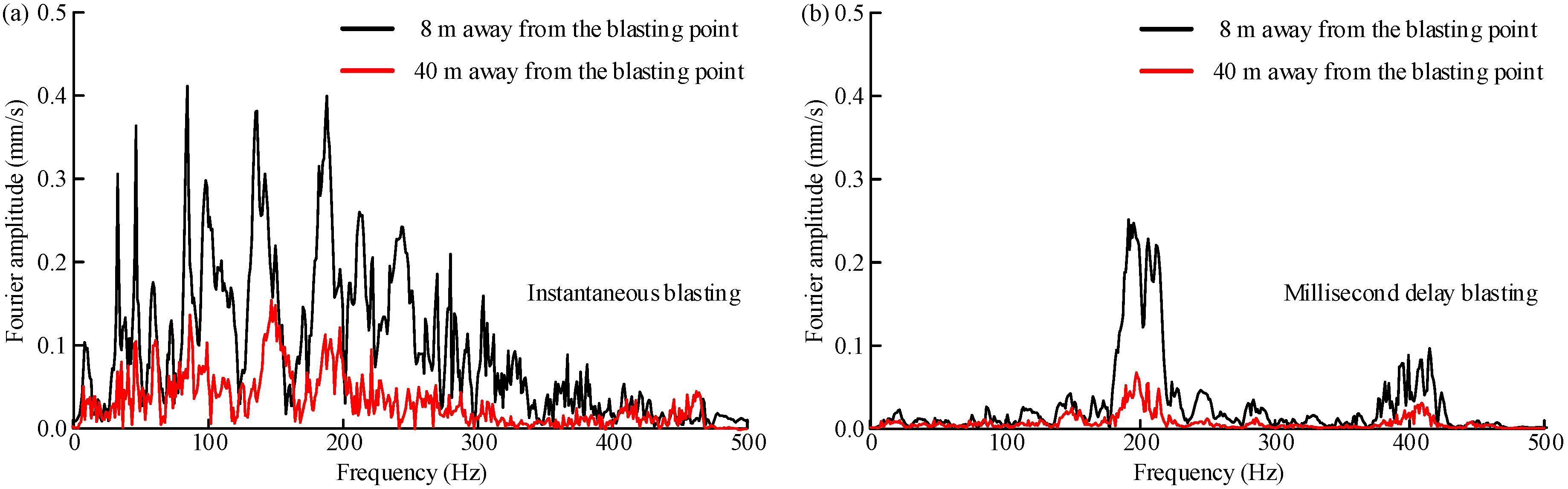
To study the amplitude and frequency contents, Figure 9 gives the Fourier spectra of the vibration velocity response at the distances of 8 m and 40 m away from the blasting source induced by the millisecond delay blasting and the instantaneous blasting, respectively. It is clear that the peak velocity response for the case using the millisecond delay blasting technology is significantly lower, compared with that using the instantaneous blasting technology. A remarkable spike is shown for the velocity time–history of the instantaneous blasting, while the waveform of time–history for the millisecond delay blasting is relatively smooth. This indicates that the millisecond delay blasting can effectively avoid excessive vibration velocity and thus reduce the vibration amplitude. When comparing the Fourier spectra with the instantaneous blasting, in which the frequency covers 100~500 Hz and the range is relatively wide, the millisecond delay blasting significantly changes the characteristics of the Fourier spectra. The predominant frequency for the millisecond delay blasting is mainly concentrated in the band of 400~500 Hz. Therefore, it is less possible for the millisecond delay blasting to coincide with the natural frequency range (i.e., 1–10 Hz) of the historical structure.

3.2. The Attenuation of Blasting-Induced Vibration

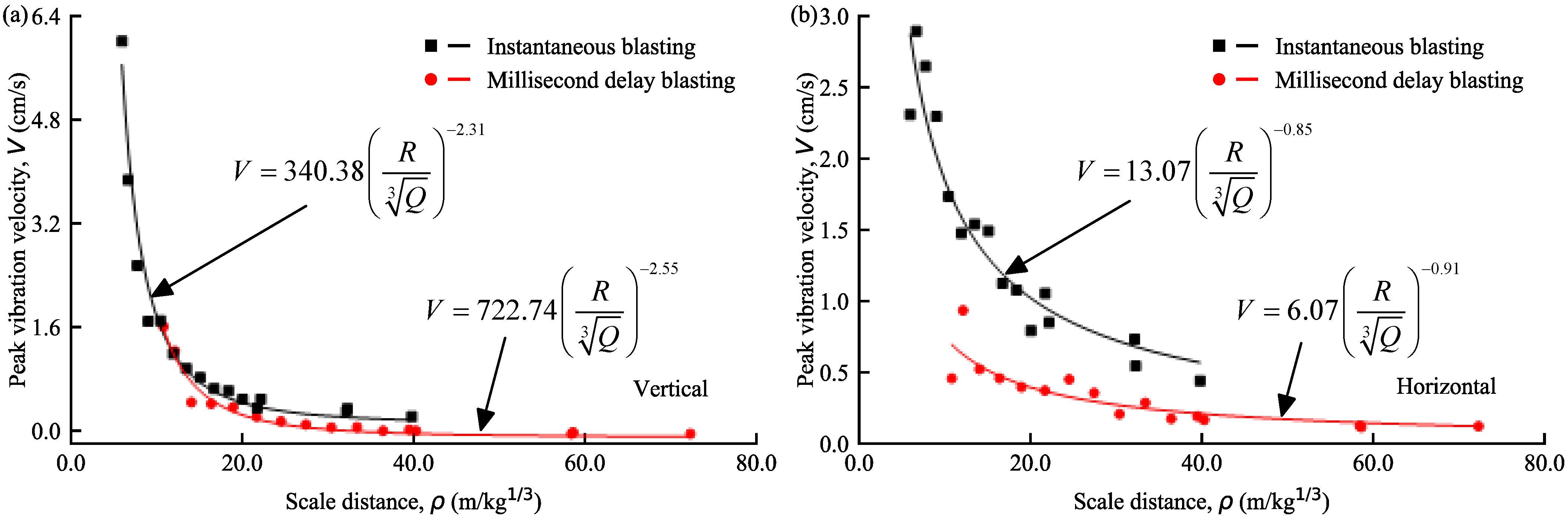
Figure 10 plots the attenuation trends of ground vibration in horizontal and vertical directions with respect to the scale distance. Scale the distance from the explosion source by a power of the explosive charge to eliminate the influence of different charge amounts, thereby enabling the vibration data generated by different explosions to be compared and predicted on a unified scale. The exponential relationship between the scale distance and the peak vibration velocity was established by backfitting the observation data, as follows:
V = K ( ρ ) α         ρ = R Q 3
where V denotes the maximum particle vibration velocity (measured in cm/s), Q is charge weight (g), ρ is scale distance (m/kg1/3), R is the distance between the blasting source and the monitoring point (m), and K and α are the model coefficients related to the geological and topographical conditions which can be calibrated through the regression analysis of the observed data. In particular, the coefficient K quantifies the seismic energy intensity transferred into the ground and propagated away from the blasting source. It highly depends on confinement, explosive density, and energy. The slope term α is related to the geological and topographical conditions through which the seismic wave passes and governs the attenuation rate of the velocity intensities within distance. It can be seen that the peak velocity response in the vertical direction is greater than that in the horizontal direction, which indicates that the blasting energy is transferred mainly along the vertical direction.

3.3. Analysis of Millisecond Delay Blasting Parameters

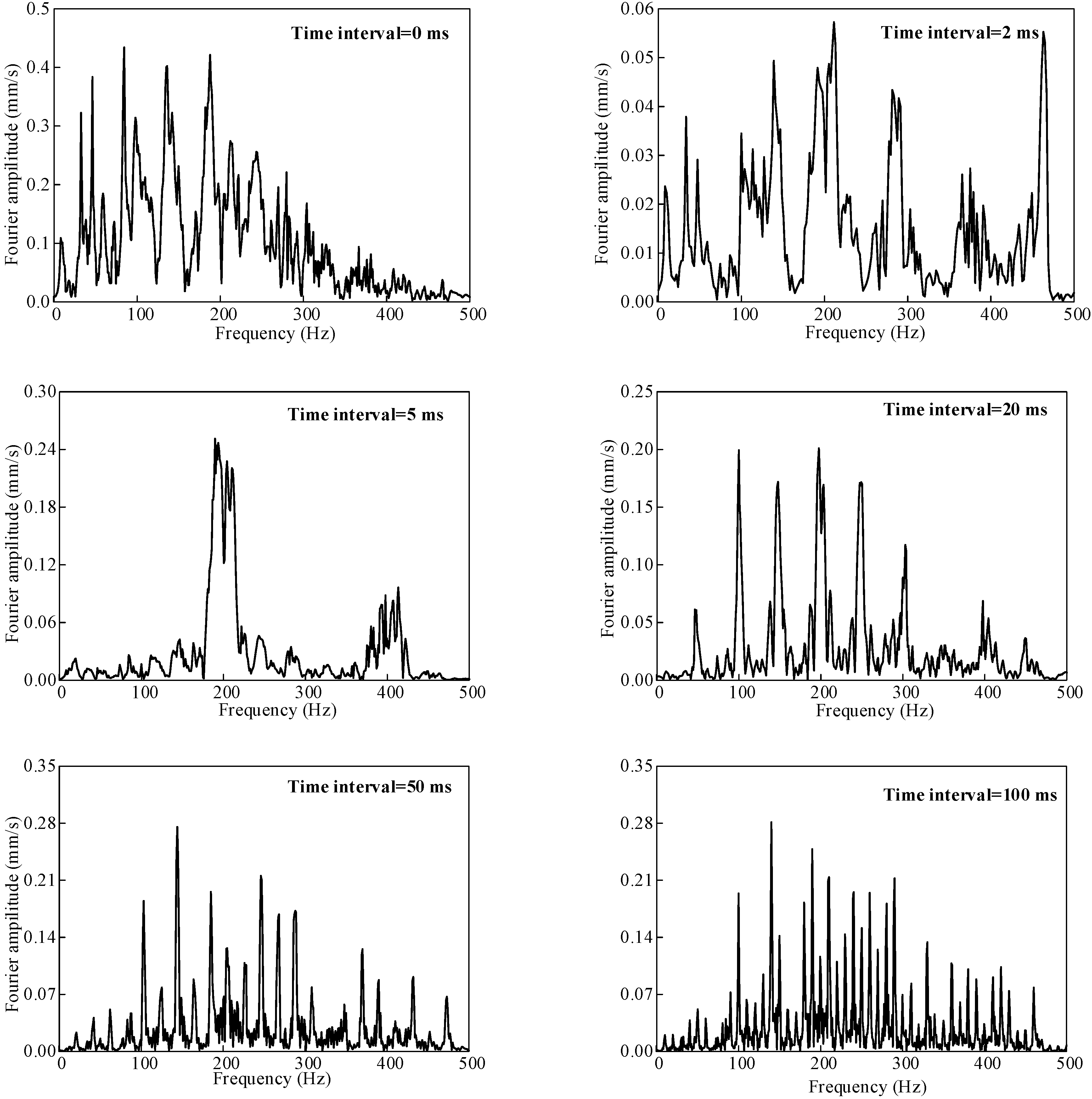
Determining a reasonable millisecond delay interval in blasting engineering plays an important role in improving blasting quality and reducing vibration effects. Figure 11 shows the influence of the millisecond delay interval on the Fourier spectrum of the induced ground motion at a distance of 8 m. One can see that the spectrum of the millisecond delay blasting exhibits multi-peak characteristics, and the peak values vary significantly. When the time interval exceeds 2 ms, the dominant frequency is concentrated in the high-frequency band. Notably, when the delay interval is 5 ms, the peak of the Fourier spectrum is the lowest.
The underlying physical mechanism can be explained as follows: In a layered soil–rock site, seismic waves generated by each blasthole propagate upward and undergo reflections and refractions at layer interfaces. When the delay interval matches the travel time of waves from adjacent holes to a given point (accounting for the wave propagation velocity and the path differences through the stratified media), the wave trains from successive blasts can interfere destructively. For the specific geology of this study, a 5 ms delay corresponds approximately to the time required for the primary wave to travel between adjacent boreholes plus the differential time for the reflected waves to reach the observation point. This timing causes the peak of one wave train to coincide with the trough of the preceding wave train, leading to partial cancellation and thus the lowest spectral energy. Conversely, when the delay interval is too short (e.g., <2 ms), the wave trains overlap constructively, amplifying the response; when it is too long (e.g., 50 ms), the wave trains separate completely, and the blastholes behave as independent single-hole blasts without interference, resulting in a spectrum similar to that of an instantaneous blast but with reduced overall amplitude due to temporal separation.
In addition, when the time interval is increased to a certain extent (in this case, 50 ms), the Fourier spectrum at the measuring point remains almost unchanged, and the blasthole is equivalent to a single-hole independent blast, with no wave overlap. It can be seen that when the delay time is reasonably selected, millisecond delay blasting can effectively modify the blasting effect, and structural resonance can be avoided by ensuring that the blasting wave frequency does not approach the natural frequency of the structure, thereby guaranteeing structural safety and stability.

3.4. Limitations and Practical Implications

Although the numerical model captures the essential features of blast-induced wave propagation and soil–structure interaction in layered soil–rock sites, several simplifications should be acknowledged. The soil parameters are assumed to be homogeneous within each layer, neglecting the spatial variability and nonlinear degradation under repeated blasting. The structural connections between the wood-frame tower and the masonry base are idealized as perfect bonding, whereas, in reality, joints may exhibit loosening or energy dissipation. Moreover, the cumulative damage effects under multiple blasting sequences are not considered, which may lead to an underestimation of the long-term structural vulnerability, especially for historical buildings with existing cracks.
Regarding practical application of the optimal delay time (5 ms identified in this study), certain field constraints may affect its direct implementation. Drilling inaccuracies can alter the actual distance between blastholes, thereby modifying the wave travel time and the required delay for destructive interference. Detonator timing errors (scatter) inherent in conventional blasting systems may deviate from the nominal 5 ms interval, reducing the vibration mitigation efficiency. Additionally, changes in geological conditions along the tunnel alignment—such as varying layer thicknesses or unexpected boulders—may shift the optimal delay. Therefore, site-specific calibration using trial blasts with electronic detonators (which offer precise timing control) is recommended before applying the proposed delay value in production blasting. These limitations do not invalidate the conclusions but highlight the need for cautious engineering judgment and adaptive strategies when transferring numerical findings to the field.

3.5. Comparison with Previous Studies and Novelty of This Work

To better highlight the scientific and applied contributions of this study, Table 4 summarizes the key features of the representative previous investigations on blast-induced vibrations and compares them with the present work.
The comparison clearly demonstrates the originality and scientific contributions of this work. While previous studies have either focused on homogeneous rock/soft soil sites (Yu et al. [19], Zhu et al. [9]), or addressed only wave propagation without considering millisecond delay blasting (Meng et al. [20]; Zhao et al. [21]), or examined structural response in isolation (Ren et al. [27]; Pan et al. [28]), the present study uniquely integrates the following three aspects: (i) layered soil–rock site effects on frequency-dependent vibration attenuation, (ii) millisecond delay blasting with a physical explanation of the optimal delay (5 ms) based on wave interference in stratified media, and (iii) dynamic interaction between a wood-frame tower and its masonry base using the HHT spectral analysis.

4. Dynamic Response of the Adjacent Historical Structure

In order to facilitate the interpretation of the dynamic response of the historical structure, the natural frequency of the wooden-frame Drum Tower and the base masonry structure were tested respectively. The results are as presented in Table 5.

4.1. Hilbert Energy Spectral Analysis of the Adjacent Structure

The dynamic response of a structure subjected to blasting-induced vibration is highly related to the amplitude, frequency, and duration of the ground-borne vibrations, as well as the dynamic characteristics of the structure. To further investigate the influence of charge weight and blasting method on the dynamic response of the Drum Tower, a spectral analysis of the velocity response was conducted through the Hilbert–Huang Transform method (HHT). With the HHT analysis, the target signal can be decomposed into several intrinsic mode functions (IMFs). The extraction of IMFs from the signal entails a repeated “sifting” procedure called empirical mode decomposition (EMD). Performing the Hilbert transform on the jth IMF(Ij(t)), the corresponding analytical signal can be expressed as follows:
Z j ( t ) = I j ( t ) + i H [ I j ( t ) ] = a j ( t ) e i θ j ( t )
where the time functions a j ( t ) and θ j ( t ) are the instantaneous amplitude and the instantaneous phase functions, respectively, and i2 = −1. The instantaneous frequency of the jth IMF is given by the following equation:
ω j ( t ) = d θ j ( t ) d t
In Equation (15), a j 2 ( t ) and ω j ( t ) define the energy distribution with respect to time and frequency, called the Hilbert energy spectrum. The local energy and the instantaneous frequency derived from the IMFs through the Hilbert transform can give a full picture of the energy–frequency–time distribution of the data.
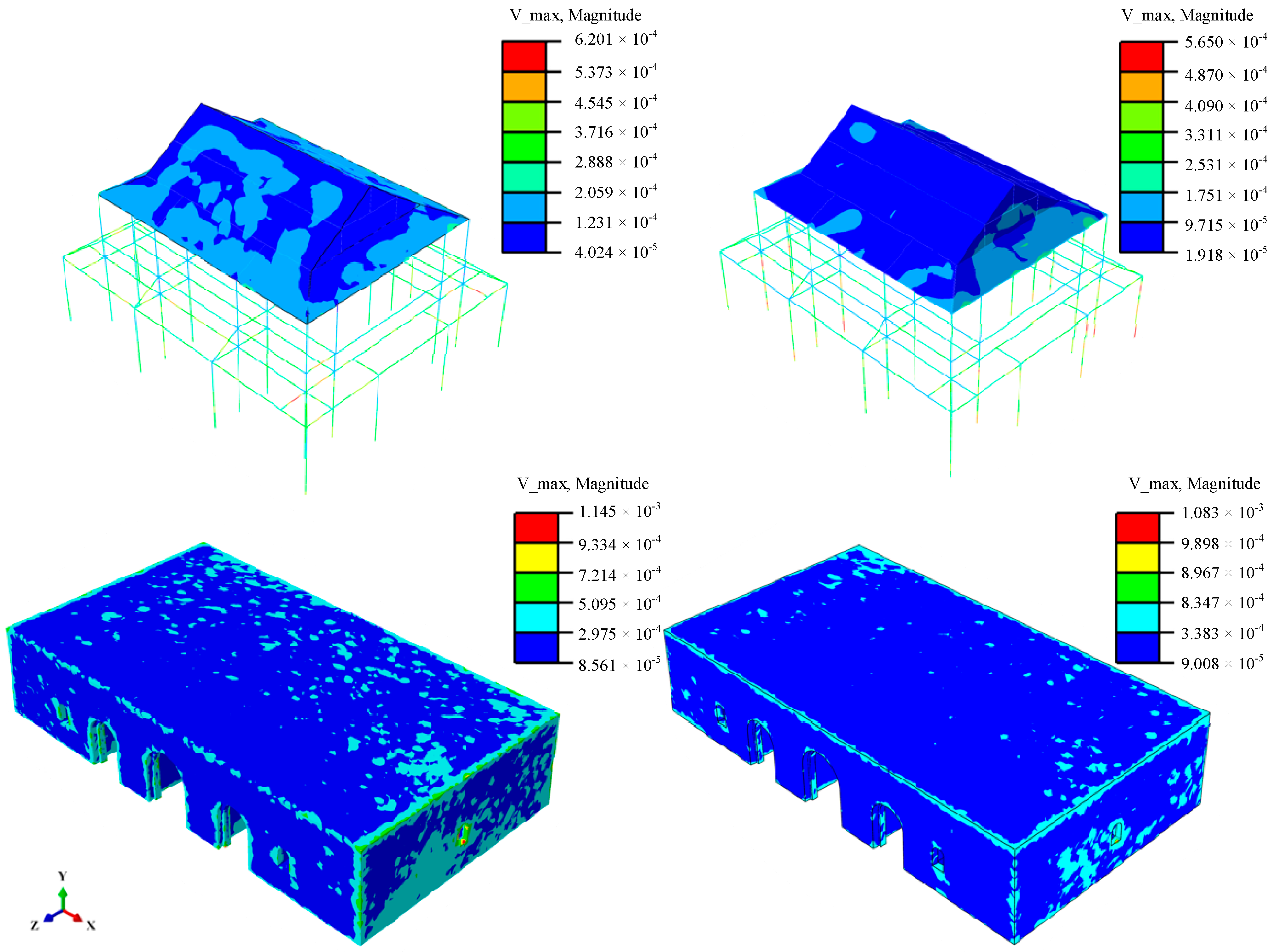
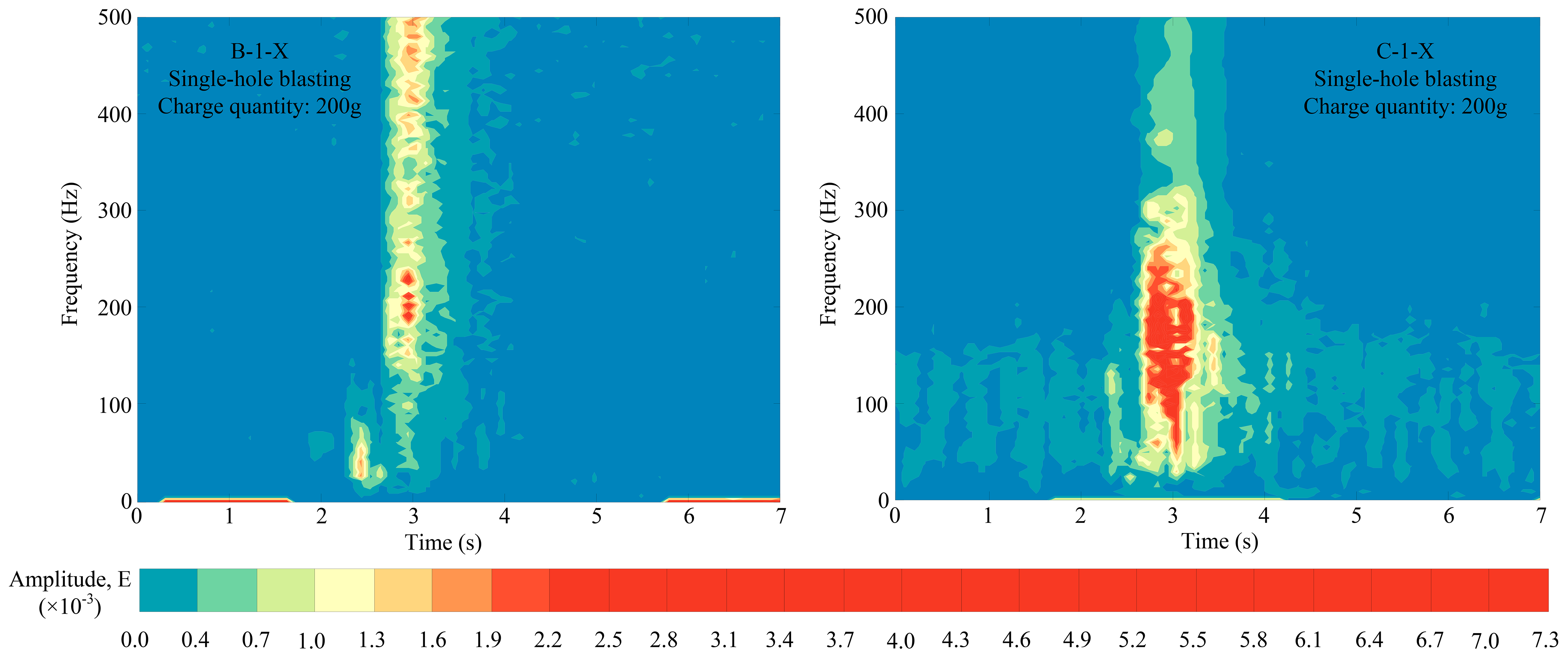
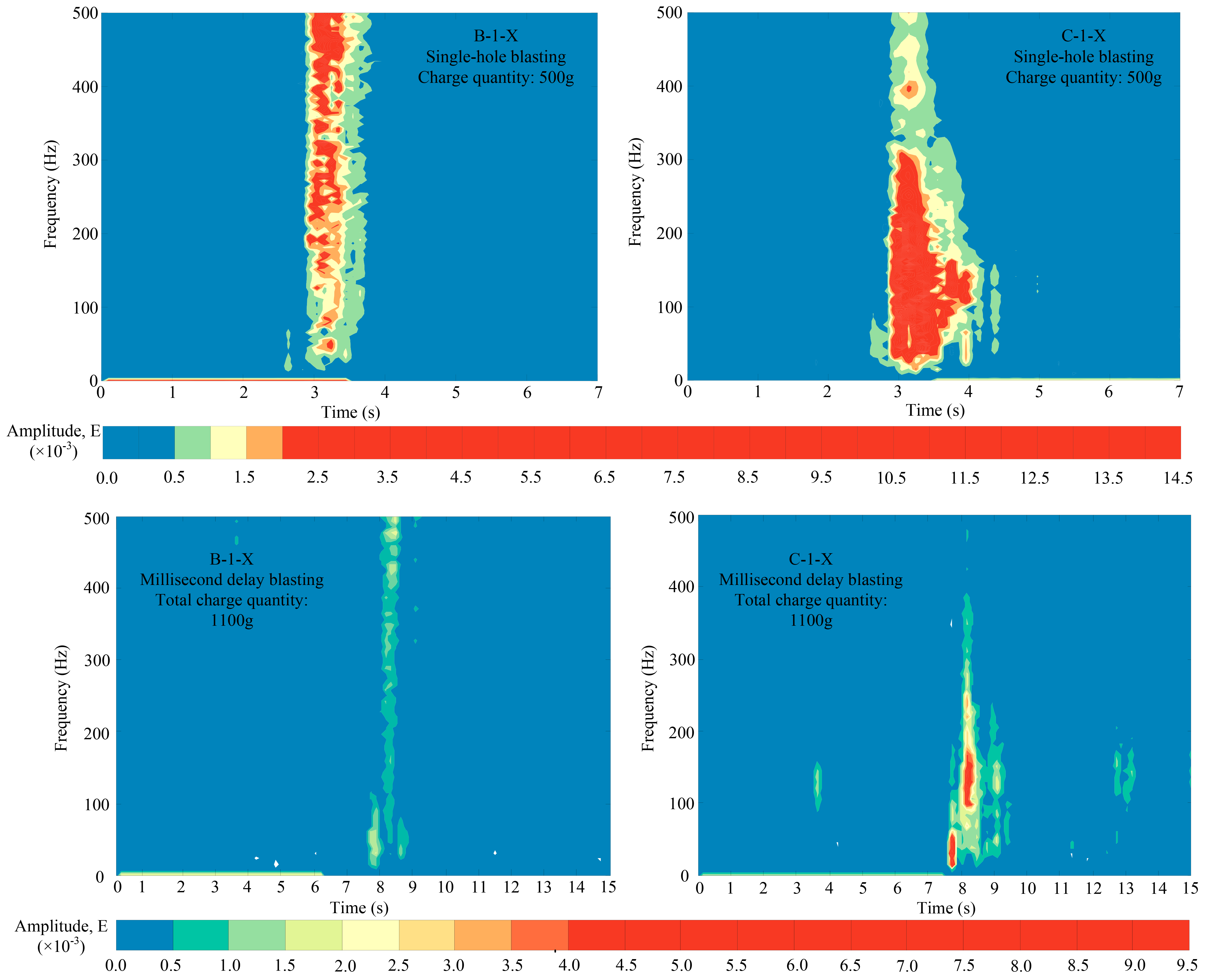
Due to the fact that the frame structure is more sensitive to the horizontal component as compared to the vertical component of ground vibration, this section focuses on the responses in the transverse direction, as shown in Figure 12. Figure 13 presents the Hilbert energy spectra of the velocity responses at the B-1 and C-1 measuring points for Cases IBM-200, IBM-400, IBM-500, and MDBM-200-50, respectively. Two blasting schemes are considered: the instantaneous blasting method (IBM) and the millisecond delay blasting method (MDBM). Note that the monitoring point B-1 was set on the top of the base masonry structure, while C-1 was on the top story of the Drum Tower. It can be observed from the figure that the difference of structure properties between the wood-frame tower and the base masonry structure has a remarkable influence on the structural response. In general, the vibration energy at the base structure is lower than that at the wood-frame tower. Comparing the results in all the cases, the vibration energy in the MDBM-200-50 case is the lowest, which means that the millisecond delay blasting method can dramatically reduce the impact of blasting-induced vibrations on the structures. For the base structure, the frequency band of the velocity response, which the vibration energy covers, is relatively wide and distributes in the range of 100~500 Hz. By contrast, the vibration energy at the tower mainly concentrates in the band of 0~300 Hz. Moreover, from the perspective of time, the duration of the velocity response for the tower is larger than that for the base structure. The frequency content of the vibration response of the Drum Tower varies with time significantly, which reflects the vibration attenuation in the Drum Tower. However, the frequency content of the velocity response of the basement hardly changes. This can be traced back to the fact that the base structure exhibits higher stiffness and thus its frequency changes mildly during the vibration, while the ductility and the ability of energy dissipation of the wood-frame tower are better.
Noteworthy, in the case of the instantaneous blasting with charge weight of 500 g, the frequency range of the velocity response at the masonry basement is the widest, and thus waves with different frequencies can transmit to the Drum Tower. However, in the other cases (IBM-200, IBM-500 and MDBM-200-50), the frequency bands where major vibration energy lies at the base structure and the Drum Tower hardly coincide with each other, and thus only limited waves could propagate through the Drum Tower. Therefore, the more energy carried by the velocity response at the base structure in the sensitive frequency band of the Drum Tower, the stronger the vibration response at the Drum Tower.

4.2. Amplification Analysis of the Adjacent Historical Structure

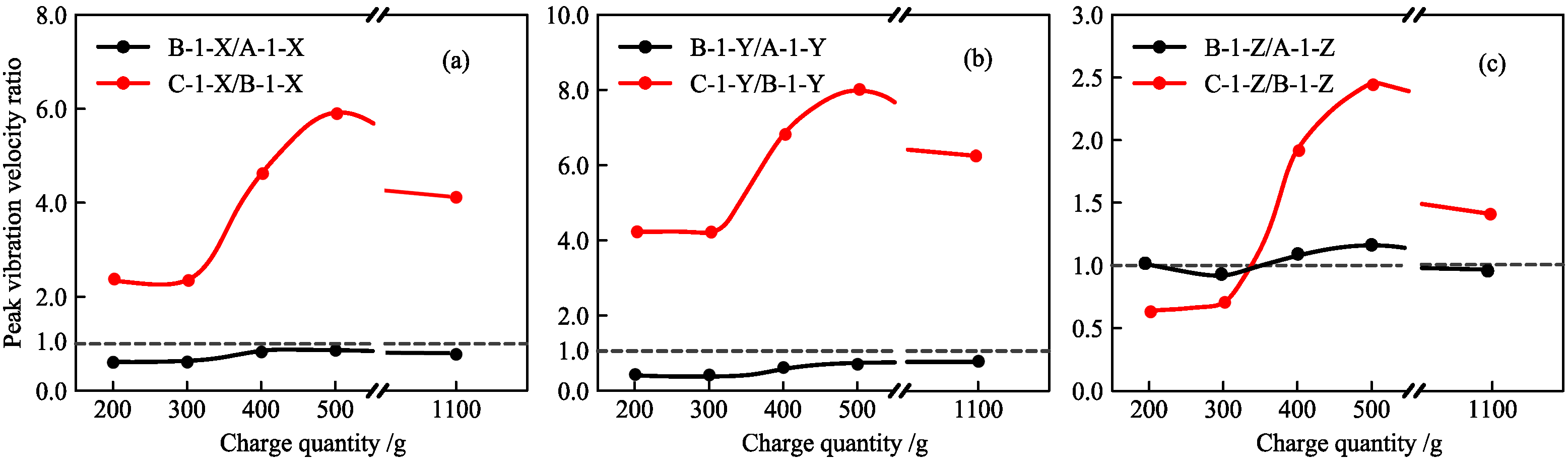
Figure 14 shows the amplified ratio of peak vibration velocity on the base structure to that on the ground surface, as well as the amplified ratio of peak vibration velocity on the Drum Tower to that on the base structure, with respect to the weight of explosives. In this figure, B-1-T denotes the peak vibration velocity at B-1 in the transverse direction, and the other symbols in the legends are defined in a similar manner. The figure demonstrates that, for both instantaneous and millisecond delay blasting cases, the amplified ratio of the peak vibration velocity on the base structure to that on the ground surface is generally less than unity. However, when the charge weight is set to 200 g or 400 g, the ratio of the vertical peak vibration velocity is slightly greater than unity. Note that the ratio of the peak vibration velocity on the Drum Tower to that on the base structure is always greater than unity, reaching up to 7.3 when the charge weight is set to 400 g (IBM-400). It is indicated that the first-order natural frequency of the base structure is significantly greater than that of the wooden-frame tower, which impacts the dynamic response of this ancient building to blasting-induced vibration.

5. Conclusions

The present paper carries out comprehensive numerical modeling (involving instantaneous blasting and millisecond delay blasting) to study the vibration attenuation at the soil surface away from the blasting source as well as the resulting interactions between a historical structure and the surrounding soil, with consideration of the geological conditions of the site, the blasting method, and the parameters. The numerical results can provide a reliable reference for the practical blasting scheme and the systematic study of the vibration characteristics of the Drum Tower. The main conclusions of this study can be summarized as follows:
(1) Compared with instantaneous blasting, millisecond delay blasting exhibits significant advantages in reducing the vibration peaks and shifting the dominant frequency (Objectives 1 and 2). From the waveforms and Fourier amplitude spectra of the response time histories, millisecond delay blasting effectively avoids excessive vibration velocity and thus reduces the ground surface vibration amplitude (peak reduction). Its predominant frequency is concentrated in the high-frequency band of 400–500 Hz, which is far from the natural frequency range of the historical structure (frequency shift), thereby avoiding the risk of resonance.
(2) The proposed attenuation formulae and their parameters are of great significance for blast design and vibration prediction. Empirical formulae for predicting velocity attenuation along the scale distance in a soil–rock site are proposed for both instantaneous blasting and millisecond delay blasting. The model parameters are highly dependent on the blasting method. Compared with instantaneous blasting, the velocity intensity decays faster with distance under millisecond delay blasting. These formulae can be used to rapidly predict the peak particle velocity (PPV) in similar soil–rock sites, providing a quantitative basis for blast design.
(3) The amplification mechanism of soil–structure and inter-structure interactions on the vibration response is revealed. The HHT spectral analysis shows that the difference in structural properties between the wood-frame tower and the masonry base has a remarkable influence on the structural vibration: the more energy carried by the base structure within the sensitive frequency band of the tower, the stronger the vibration response of the tower. This amplification mechanism indicates that reinforcement efforts should strengthen the connection between the tower and its base, and isolation measures should be implemented around the foundation.
(4) When conducting tunnel blasting construction near vibration-sensitive areas, such as historical buildings, millisecond delay blasting should be prioritized, and the delay time should be reasonably selected according to the site-specific wave velocity (e.g., 5 ms in this study).
(5) The empirical formulae proposed in this paper can be extensively validated and calibrated using field monitoring data, and machine learning methods can be introduced to establish multi-factor prediction models.

Author Contributions

Conceptualization, C.H.; Methodology, C.H. and Q.W.; Software, C.H. and Q.W.; Validation, Y.M.; Formal analysis, L.S. and Y.M.; Investigation, Q.W. and Y.M.; Resources, L.S., Q.W., and Y.M.; Data curation, Y.M.; Writing—original draft preparation, C.H., Q.W., and Y.M.; Writing—review and editing, C.H., Q.W., and Y.M.; Visualization, L.S., Q.W., and Y.M.; Supervision, L.S. and Q.W.; Project administration, L.S. and Y.M. All authors have read and agreed to the published version of the manuscript.

Funding

The authors are grateful for the Natural Science Foundation of Nantong Municipality (Grant Nos. JC2023026).

Data Availability Statement

The data presented in this study are available upon request from the corresponding author.

Acknowledgments

The authors sincerely grateful to the High Performance Computing Center of Nanjing Tech University for supporting the computational resources. The authors also sincerely thank the anonymous reviewers for their insightful comments and suggestions.

Conflicts of Interest

The authors declare no conflicts of interest.

References

  1. Dowding, C.H. Suggested method for blast vibration monitoring. Int. J. Rock Mech. Min. Sci. 1992, 29, 145–156. [Google Scholar] [CrossRef]
  2. Siskind, D.E. Vibrations from Blasting; International Society of Explosives Engineers: Cleveland, OH, USA, 2000. [Google Scholar]
  3. Grad, E.F.; Wilson, J.L.; Moore, A.J.; Richards, A.B. Effects of mine blasting on residential structures. J. Perform. Constr. Facil. 2005, 19, 222–228. [Google Scholar] [CrossRef]
  4. Ozer, U. Environmental impacts of ground vibration induced by blasting at different rock units on the Kadikoy–Kartal metro tunnel. Eng. Geol. 2008, 100, 82–90. [Google Scholar] [CrossRef]
  5. Singh, P.K.; Roy, M.P. Damage to surface structures due to blast vibration. Int. J. Rock Mech. Min. Sci. 2010, 47, 949–961. [Google Scholar] [CrossRef]
  6. Blair, D.P. Blast vibration dependence on charge length, velocity of detonation and layered media. Int. J. Rock Mech. Min. Sci. 2014, 65, 29–39. [Google Scholar] [CrossRef]
  7. Gou, Y.G.; Shi, X.Z.; Qiu, X.Y.; Huo, X.F.; Yu, Z. Assessment of induced vibrations derived from the wave superposition in time-delay blasts. Int. J. Rock Mech. Min. Sci. 2021, 144, 104814. [Google Scholar] [CrossRef]
  8. Zhao, K.; Wang, H.; Chen, X. Environmental vibration characteristics of millisecond delay blasting in subway tunnel. Explos. Shock Waves 2020, 40, 102201. [Google Scholar]
  9. Zhu, J.; Li, X.D.; Yang, J.H. Experimental investigations of the effect of millisecond-delay time on the blast vibration reduction with electronic detonators. Int. J. Rock Mech. Min. Sci. 2023, 168, 105417. [Google Scholar]
  10. Gou, Y.F.; Shi, X.Z.; Qiu, X.Y. Vibrations induced by time-delayed double blastholes in underground rocks: Experimental study and theoretical analysis. J. Rock Mech. Geotech. Eng. 2026, 18, 1108–1125. [Google Scholar] [CrossRef]
  11. Hao, H.; Wu, C. Scaled-distance relationships for chamber blast accidents in underground storage of explosives. Fragblast Int. J. Blasting Fragm. 2001, 5, 57–90. [Google Scholar] [CrossRef]
  12. Wu, C.; Hao, H.; Lu, Y.; Zhou, Y.X. Characteristics of wave recorded in small scale field blast tests in a layered rock-soil medium. Géotechnique 2003, 53, 587–599. [Google Scholar] [CrossRef]
  13. Wu, C.; Lu, Y.; Hao, H. Numerical prediction of blast-induced stress wave from large-scale underground explosion. Int. J. Numer. Anal. Methods Geomech. 2004, 28, 93–109. [Google Scholar] [CrossRef]
  14. Jiang, N.; Zhou, C.B. Blasting vibration safety criterion for a tunnel liner structure. Tunn. Undergr. Space Technol. 2012, 32, 52–57. [Google Scholar] [CrossRef]
  15. Kumar, R.; Choudhury, D.; Bhargava, K. Determination of blast-induced ground vibration equations for rocks using mechanical and geological properties. J. Rock Mech. Geotech. Eng. 2016, 8, 341–349. [Google Scholar] [CrossRef]
  16. Bao, X.; Li, S.T.; Liu, J.B. 3D multiscale analysis method for explosion problems based on the substructure of the explosion source. Eng. Struct. 2022, 252, 113633. [Google Scholar] [CrossRef]
  17. Garai, D.; Agrawal, H.; Mishra, A.K. Impact of orientation of blast initiation on ground vibrations. J. Rock Mech. Geotech. Eng. 2022, 15, 255–268. [Google Scholar] [CrossRef]
  18. Wang, X.; Li, J.; Zhao, X.; Liang, Y. Propagation characteristics and prediction of blast-induced vibration on closely spaced rock tunnels. Tunn. Undergr. Space Technol. 2022, 123, 104416. [Google Scholar] [CrossRef]
  19. Yu, H.T.; Yuan, Y.; Yu, G.X.; Liu, X. Evaluation of influence of vibrations generated by blasting construction on an existing tunnel in soft soils. Tunn. Undergr. Space Technol. 2014, 43, 59–66. [Google Scholar] [CrossRef]
  20. Meng, F.Q.; Gao, W.; Pu, C.Z. Propagation characteristics of stress waves induced by underground blasting under the influence of rock-soil interfaces. Rock Mech. Rock Eng. 2025, 58, 323–338. [Google Scholar] [CrossRef]
  21. Zhao, Y.; Wang, S.R.; Liu, H. Research on the dynamic response patterns of layered slopes considering non-homogeneity under blast-induced vibration effects. Appl. Sci. 2025, 15, 1162. [Google Scholar] [CrossRef]
  22. Xu, Q.; Huang, Y.; Zhou, J. Spatial response and prediction model for blasting-induced vibration in a deep double-line tunnel. Tunn. Undergr. Space Technol. 2025, 152, 106131. [Google Scholar]
  23. Bao, X.; Liu, J.B.; Li, S.T. Blast-induced ground vibration propagation and prediction in a sandstone slope with soft mudstone interlayer. Int. J. Prot. Struct. 2025, 16, 88–106. [Google Scholar] [CrossRef]
  24. Chen, Y.; Zhang, Z.; Liu, T. Determination and application study of optimal delay time for tunnel millisecond blasting based on interference vibration reduction method. J. Vib. Control 2024, 30, 1123–1135. [Google Scholar]
  25. Li, P.; Ma, G.W. Effect of soft interlayer dip angle on the attenuation and prediction of blast-induced vibrations in rock slopes: An experimental study. Appl. Sci. 2025, 15, 6683. [Google Scholar] [CrossRef]
  26. Wang, L.; Ding, Y.; Sun, J. Coupled Eulerian-Lagrangian numerical modeling of soil-pipeline interaction under blast loading. Soil Dyn. Earthq. Eng. 2025, 180, 108758. [Google Scholar]
  27. Ren, B.; Chen, S.R.; Zhao, X. Structural vibration characteristics of a historical building in a nearby blasting test. Front. Earth Sci. 2024, 11, 126543. [Google Scholar] [CrossRef]
  28. Pan, J.L.; Zhang, Y.; Li, H. Experimental study on dynamic response characteristics of rural residential buildings subjected to blast-induced vibrations. Buildings 2025, 14, 2511. [Google Scholar] [CrossRef]
  29. Jordan, J.W.; Sutcliffe, D.J.; Mullard, J.A. Blast Vibration Effects on Historical Buildings. Aust. J. Struct. Eng. 2009, 10, 75–78. [Google Scholar] [CrossRef]
  30. Chen, G.; Ruan, B.; Zhao, K.; Chen, W.; Zhuang, H.; Du, X.; Khoshnevisan, S.; Juang, C.H. Nonlinear Response Characteristics of Undersea Shield Tunnel Subjected to Strong Earthquake Motions. J. Earthq. Eng. 2020, 24, 351–380. [Google Scholar] [CrossRef]
Figure 1. Site configuration of the planned Metro tunnel and the ancient building.
Buildings 16 02364 g001
Figure 2. Geological profile at the site.
Buildings 16 02364 g002
Figure 3. Structural damages and reinforcement of the drum tower.
Buildings 16 02364 g003
Figure 4. 3D numerical modeling.
Buildings 16 02364 g004
Figure 5. Time history of blasting-induced over-pressure at a given location.
Buildings 16 02364 g005
Figure 6. Stress–strain curves of irregular loading and unloading for the Davidenkov backbone model.
Buildings 16 02364 g006
Figure 7. Layout of the monitoring points.
Buildings 16 02364 g007
Figure 8. Model validation against the experimental results: (a) Vibration velocity at the ground surface; (b) Vibration velocity at the Drum Tower structure.
Buildings 16 02364 g008
Figure 9. Spectral comparison of different measuring points under different blasting modes: (a) Instantaneous blasting; and (b) Millisecond delay blasting.
Buildings 16 02364 g009
Figure 10. The attenuation of the blasting-induced vibration on ground surface: (a) at the vertical direction; and (b) at the transverse direction.
Buildings 16 02364 g010
Figure 11. Spectrum of measuring points under different blasting time intervals at 8 m away from the blasting point.
Buildings 16 02364 g011
Figure 12. The velocity response contour of the historical building in the MDBM-200-50 case at horizontal direction (left) and at the vertical direction (right).
Buildings 16 02364 g012
Figure 13. Hilbert energy spectra of the velocity response.
Buildings 16 02364 g013aBuildings 16 02364 g013b
Figure 14. The amplification ratio of peak vibration velocity in: (a) transverse direction; (b) longitudinal direction; (c) vertical direction.
Buildings 16 02364 g014
Table 1. Geometric parameters and element types of ancient building structures.
MaterialElastic Modulus (Mpa)Density
(kg/m3)
Poisson’s RatioElement Type
Stele building top83025000.25Shell element
Stele building floor slab19,613.34200.30Shell element
Stele building wall20,90018700.33Shell element
Stele building beam8304200.25Beam element
Stele building column8304200.25Beam element
City gate tower20.918700.33Solid element
Table 2. Soil profile and parameters of the Davidenkov model.
Soil LayerThickness (m)Unit Weight (kN/m3)Shear Wave Velocity (m/s)Davidenkov Parameters
A2Bγ0
Plain fill1.318.5139.51.050.840.00055
Silty clay6.320.2250.41.090.820.00062
Glutenite12.222.6558.31.300.400.00210
Table 3. Simulation scheme.
Instantaneous Blasting Method (IBM)Millisecond Delay Blasting Method (MDBM)
Simulation IDCharge Weight (g)Simulation IDDelayed TimeCharge Weight (g)
IBM-100100 gMDBM-200-022 ms200 g for each blasting hole with fixed delayed time (1200 g in total)
IBM-200200 gMDBM-200-055 ms
IBM-300300 gMDBM-200-2020 ms
IBM-400400 gMDBM-200-5050 ms
IBM-500500 gMDBM-200-100100 ms
Table 4. Comparison of the present study with selected previous research on blast-induced ground vibration and structural response.
ReferenceSite/MediumBlasting MethodFocusKey FindingsGap Addressed by the Study
Yu et al. [19]Soft soilInstantaneousTunnel safety under blastingField monitoring and numerical simulation in soft soilsNo consideration of layered soil–rock site or millisecond delay
Zhao et al. [8]GeneralMillisecond delayEnvironmental vibrationReduced PPV and frequency shiftNo layered site effects; no historical structure interaction
Zhu et al. [9]RockElectronic detonatorsOptimal delay timePPV variation with delayHomogeneous rock; no soil layering
Gou et al. [10]Underground rockDouble-hole delayVibration mechanismDestructive interference theoryLaboratory scale; no field-scale layered site
Meng et al. [20]Rock–soil interface Stress wave propagationWave polarization at interfaceNo blasting source; no structural response
Zhao et al. [21]Layered slope Dynamic responseEffect of joint dip angleNo millisecond delay; no historical building
This studyLayered soil–rockInstantaneous and millisecond delaySite effects and historical structure(1) Frequency-dependent attenuation: high-frequency suppression, low-frequency amplification; (2) PPV reduction of 60–70% and frequency shift to 400–500 Hz; (3) Optimal delay of 5 ms with physical mechanism explained; (4) Empirical attenuation formulae for both blasting methods; (5) HHT-based quantification of wood–masonry interaction: base energy in sensitive band amplifies tower responseFirst numerical investigation of millisecond-delay site effects in layered soil–rock sites; combined analysis of ground attenuation and historical building response
Table 5. Results of the natural frequency test.
StructureDirectionThe Order of Modal
1st2nd
The Base StructureTransverse/Hz4.205.03
Longitudinal/Hz4.646.11
The Drum TowerTransverse/Hz1.372.79
Longitudinal/Hz2.002.98
Disclaimer/Publisher’s Note: The statements, opinions and data contained in all publications are solely those of the individual author(s) and contributor(s) and not of MDPI and/or the editor(s). MDPI and/or the editor(s) disclaim responsibility for any injury to people or property resulting from any ideas, methods, instructions or products referred to in the content.