Article

Indoor Environmental Quality as an Incremental Signal in Residential Valuation Using Hedonic Modeling

by
Shahrzad Sasani Babak
1,
Saeed Malaekeh
2,*,
Shadi Atalla
3,
Amjad Gawanmeh
3 and
Saed Tarapiah
4
1
School of Information Technology Management, Tehran North Branch, Islamic Azad University, Tehran P.O. Box 1651153311, Iran
2
School of Civil Engineering, Iran University of Science and Technology, Narmak, Tehran P.O. Box 16765-163, Iran
3
College of Engineering and Information Technology, University of Dubai, Dubai 14143, United Arab Emirates
4
Department of Telecommunication Engineering, Faculty of Engineering and Information Technology, An-Najah National University, Nablus P.O. Box 7, Palestine
*
Author to whom correspondence should be addressed.
Buildings 2026, 16(12), 2365; https://doi.org/10.3390/buildings16122365 (registering DOI)
Submission received: 5 April 2026 / Revised: 18 April 2026 / Accepted: 28 April 2026 / Published: 13 June 2026
(This article belongs to the Section Architectural Design, Urban Science, and Real Estate)

Abstract

This study presents an Indoor Environmental Quality (IEQ)-aware framework for residential valuation by integrating low-cost IoT sensing, transparent scoring, and hedonic price modeling. The analysis uses a dataset of 244 apartments across 12 districts in Tehran. It combines indicators of thermal comfort, particulate exposure, lighting, acoustics, stability, exceedance, and uncertainty with conventional housing covariates (area, age, bedrooms, floor level, renovation status, amenities, and accessibility proxies). Results show that pooled IEQ–price relationships are weak and confounded, whereas controlled specifications produce modest but consistent improvements in explanatory fit after IEQ features are introduced. Conventional location and structural attributes remain the dominant determinants of price per square meter. Still, IEQ contributes a non-redundant information layer that improves within-segment differentiation and interpretability for inspection and listing workflows. Methodologically, the framework extends beyond average comfort metrics by incorporating volatility, threshold exceedance duration, and sensor uncertainty, enabling uncertainty-aware reporting rather than single-point scoring. In practice, the workflow supports portable sensing, reproducible analytics, and privacy-preserving edge aggregation, suitable for PropTech deployment. The findings support a cautious but actionable conclusion: IEQ should be treated as an incremental valuation signal rather than a standalone pricing determinant. In this context, IEQ is conceptualized as a supplementary attribute block that may add explanatory value beyond conventional housing covariates rather than as a standalone pricing determinant.

1. Introduction

Residential property valuation usually emphasizes visible and static attributes (location, size, age, rooms, parking, finishes), while the lived quality of a home depends heavily on dynamic and less visible indoor conditions—air quality, thermal comfort, lighting, and acoustics—collectively referred to as Indoor Environmental Quality (IEQ). Although IEQ clearly affects daily well-being, health, and household productivity, it is rarely integrated into residential pricing because it is difficult to measure consistently and communicate in a practical format for listings and inspections. At the same time, rapid PropTech adoption has created a strong opportunity to close this gap: low-cost IoT sensing can generate continuous comfort evidence and reduce information asymmetry between sellers and buyers, who otherwise rely on short visits and incomplete impressions of indoor livability.
IEQ has been studied extensively in building science, typically focusing on offices, schools, and healthcare facilities, where performance and health outcomes can be tied to measured environmental conditions. In such contexts, IEQ is often organized into four interrelated domains: thermal environment (temperature, humidity, radiant temperature, air speed), indoor air quality (particulate matter, CO2, volatile organic compounds, combustion products), lighting (illuminance, glare, spectral properties), and acoustics (sound pressure levels and psychoacoustic comfort). Standards and guidelines such as ASHRAE Standard 55 [1], (thermal comfort) and ASHRAE Standards 62.1/62.2 [2,3], (ventilation and acceptable indoor air quality) provide consensus-based methods and minimum requirements for design and operation, while the WHO air quality guidelines support health-oriented pollutant thresholds. European frameworks such as EN 16798-1 [4], and its predecessors similarly define input parameters for assessing indoor environments.
Despite mature research in building performance, IEQ is not routinely integrated into residential valuation. Traditional housing valuation relies on comparable sales and hedonic pricing models that interpret price as the sum of implicit prices for different attributes. These models often include location variables (district, accessibility, amenities), structural variables (floor area, age, number of rooms), and occasionally energy performance labels. Incorporating IEQ into such models requires (i) scalable and cost-effective measurement, (ii) robust feature engineering to summarize time-varying indoor conditions, and (iii) governance and privacy practices that make data collection acceptable in occupied homes.
In this study, the term incremental signal refers to information that explains additional variation in residential price per square meter after conventional hedonic determinants have already been accounted for. In other words, IEQ is not treated as a replacement for location, size, age, or amenity variables; rather, it is tested as a supplementary attribute block that may improve within-segment differentiation among otherwise comparable dwellings. This framing is consistent with hedonic pricing logic, in which housing prices reflect bundles of attributes, but it differs from conventional models by focusing on dynamic, experience-based indoor conditions rather than only static structural or locational characteristics.
This study presents a portable low-cost sensing framework with transparent scoring bands and weights, supported by pilot evidence, and defines the methodological rigor required for publishable valuation claims. Specifically, it proposes moving from raw sensor streams to reproducible IEQ features and then testing their economic relevance with controlled hedonic models that account for confounders, alongside stability/exposure metrics, uncertainty-aware calibration, and privacy-preserving edge reporting. The central contribution is conceptual and methodological: it positions objectively measured indoor comfort as a potential economic housing attribute and provides a scalable pathway to make that claim scientifically defensible and practically usable for agents, buyers, sellers, and policy stakeholders. Accordingly, the study’s contribution is not to claim that IEQ is a dominant market driver, but to test whether it operates as a non-redundant residual information layer within controlled hedonic valuation.

Background and Related Work

The conceptual foundations of the Internet of Things (IoT) and its early articulation in the RFID community motivate connecting physical sensors to digital services [5]; international telecommunication discussions also helped formalize the IoT framing and terminology [6].
Network-traffic analysis shows that device presence and behavior can sometimes be inferred even when payloads are encrypted, which reinforces the need for privacy-by-design choices such as data minimization, voice-control safeguards, and edge aggregation in residential monitoring [7]. Public-policy discussions further frame the societal risks of ubiquitous listening and support privacy-preserving deployment in indoor sensing systems [8].
Within the real estate domain, research on intelligent real estate management highlights the growing role of data and analytics in property decision-making [9]. Smart-city surveys connect enabling technologies and security to urban services that shape housing environments [10], while corporate real estate sustainability work emphasizes that environmental performance can become part of real estate management objectives [11].
PropTech and digital disruption in real estate have been systematically reviewed, clarifying both drivers and barriers to adoption of new platforms and technologies [12]. Online community behavior and channel effects have been linked to local sales outcomes in the real estate industry, showing that digital information can affect purchasing behavior [13]. Organizational culture and service-delivery standards also influence customer orientation in real estate practice, shaping how new evidence (such as IEQ reports) may be communicated and trusted [14]. Macroeconomic factors such as government deficit and land finance can interact with real estate markets, reminding us that pricing is influenced by both micro-attributes and broader context [15]. Brokerage studies on education, immigration, and mobility show that real estate transactions are embedded in social assemblages—another reason why new comfort metrics must be interpretable to diverse stakeholders [16].
For indoor environmental measurements, structured investigation guidance provides practical protocols for diagnosing indoor air quality and interpreting evidence [17]. Composite index work in urban studies illustrates how different weighting schemes can change the resulting rankings and conclusions, which is directly relevant when defining IEQ weights and comfort bands [18]. Empirical studies of indoor built environments in multi-room residential contexts (e.g., modular student housing) show how room-to-room variability can matter for interpretation and reporting [19]. Big-data approaches in property management further reinforce the role of richer data layers in operational decision-making, providing a parallel motivation for including comfort data in real estate practice [20].
Because the device described in this research relies on low-cost sensing, general reviews of sensors used in everyday applications provide a broad foundation for technology selection and expected limitations [21]. Beyond housing, BIM- and IoT-driven digital transformation research in construction demonstrates how sensing can be integrated into building information workflows [22]. When environmental datasets become valuable, real estate data marketplaces raise governance and ethical questions—highly relevant if IEQ data is attached to listings and shared among parties [23]. Sustainability research also positions IoT as an enabling technology toward smart readiness indicators for university buildings, supporting the broader framing of comfort as measurable performance in building portfolios [24]. IoT research trend analyses in construction further contextualize where sensing is heading and which applications are maturing [25]. Finally, the development of an indoor environmental quality index using a low-cost monitoring platform provides direct precedent for score-based IEQ summarization that is comparable in spirit to the approach taken in this research [26].
PropTech’s impact on industry growth has been discussed in the real estate literature [27], and the relevance of IoT to real estate professional practice has also been addressed explicitly [28]. More targeted sensing-for-valuation examples include IoT-based real estate evaluation using thermal diffusivity measurements [29] and IoT sensor approaches for measuring and evaluating apartment comfort levels [30]. At the information-integration layer, open-standards frameworks for linking BIM and IoT provide a basis for connecting sensor evidence to digital building representations [31]. Adoption-focused research also proposes structured ways to analyze drivers and barriers of construction technology adoption, which can inform dissemination and uptake strategies for IEQ inspection tools [32].
Alternative indoor monitoring modalities and connectivity options continue to develop. For example, camera-image-sensor-based visible light communication (VLC) has been used to propose electromagnetic-interference-free indoor environment monitoring [33]. Low-power wide-area connectivity (e.g., LoRaWAN) has been evaluated in large-scale smart-city demonstrators, informing future scalable sensing networks [34]. At the business level, the broader impact of IoT on value creation and organizational change is often emphasized, reinforcing the PropTech motivation for measured comfort evidence [35].
Smart-home reviews summarize common challenges (interoperability, security, privacy) and outline solution approaches that matter for residential deployments [36]. More detailed architectural work proposes multi-layer cloud models and ontology-based security service frameworks for IoT smart homes [37]. Early home-automation systems demonstrate how monitoring and control loops can be built on IoT platforms [38]. Comfort-aware control has also been studied in energy-saving device control methods that aim to minimize comfort degradation [39], while classic discomfort-index work provides a simple historical example of translating thermal variables into a single interpretable score [40].
A key scientific challenge for low-cost IEQ tools is measurement validity. Multiple studies have evaluated consumer or low-cost particulate monitors, providing evidence on bias, precision, and stability under different indoor conditions [41]. Longer-term evaluation of low-cost PM2.5 monitors adds insight into drift and year-scale behavior [42]. Residential-source tests further examine how consumer and research-grade monitors respond to indoor particle events [43], while specific performance assessments for PM2.5 and PM10 help clarify where low-cost devices are reliable and where caution is needed [44]. Design-oriented work on low-cost portable IEQ devices provides implementation context similar to the present system [45], and broader performance assessment under variable indoor air quality and thermal conditions strengthens the case for uncertainty-aware scoring [46].
Open-source building science sensor platforms demonstrate how long-term indoor environmental data can be collected cost-effectively, supporting reproducible field studies [47]. Continuous IEQ monitoring system development clarifies practical context and design choices for persistent deployment [48]. Automated mobile sensing approaches push toward higher granularity and agile indoor monitoring [49], and Arduino-based data acquisition systems show how continuous monitoring can be implemented with accessible hardware [50].
IEQ sensing also appears in domain-specific applications. For example, automotive HVAC modifications to control cabin CO2 concentration illustrate comfort-oriented sensing and control logic in mobile environments [51]. Occupancy estimation using IoT sensors and CO2-based machine-learning models further demonstrates how indoor signals can be transformed into actionable building intelligence [52]. Distributed sensing approaches for monitoring IEQ in buildings provide additional context for scalable deployments [53].
At the systems level, systematic literature reviews of wireless sensor networks and IoT frameworks in Industry 4.0 highlight architectural patterns that support reliable sensing pipelines [54], and broader reviews of IoT-based wireless sensor networks summarize common design choices and limitations that are relevant for selecting communication protocols and ensuring robustness [55].
Finally, policy and health-oriented guidance provide context for interpreting IEQ evidence. OSHA policy statements reinforce the importance of structured indoor air quality management [56]. Classic studies on indirect health effects of relative humidity motivate careful interpretation of humidity bands [57], and controlled experiments comparing responses to atmospheric humidity at comfortable air temperatures provide additional evidence on perceived comfort sensitivity [58]. Ambient air quality standards for particulate matter provide an authoritative framing for PM thresholds and risk communication [59]. Very volatile organic compounds (VVOCs) are also highlighted as an understudied class of indoor pollutants, supporting future extensions of the sensing platform beyond particulate matter [60].
Despite the breadth of prior work, three gaps remain. First, most IEQ studies focus on health, comfort, or building performance outcomes rather than on residential valuation relevance. Second, existing low-cost sensing studies typically emphasize device feasibility or score construction, but they less often test whether engineered IEQ features add explanatory value after controlling for standard housing covariates. Third, the literature rarely distinguishes between average indoor conditions and the more valuation-relevant notions of stability, exceedance burden, and measurement uncertainty. The present study addresses these gaps by linking portable IEQ sensing to a controlled hedonic framework and by testing whether dynamic indoor-condition descriptors contribute incremental valuation information. Accordingly, the study’s contribution is not to claim that IEQ is a dominant market driver, but to test whether it operates as a non-redundant residual information layer within controlled hedonic valuation.
This study is positioned at the intersection of building science (IEQ measurement and scoring) and PropTech (valuation and decision support). The novelty is not merely sensing—many devices sense indoor air. The novelty is the end-to-end proposition that converts low-cost sensing into an interpretable comfort index, tests the index in a valuation-relevant pilot, and provides a rigorous extension blueprint to integrate IEQ into hedonic pricing and listing workflows. In other words, the device and index are treated as an economic information product that can reduce uncertainty in real estate transactions.


2. Materials and Methods

2.1. Methodology Overview and Study Pipeline

In PropTech, there is a growing interest in data-enhanced inspections, digital twins of buildings, and occupant-centric services. While many smart-home products focus on convenience, a valuation-focused IEQ approach must be different: it needs traceability (how scores are computed), comparability across units (consistent measurement windows), and deployment practicality (battery life, low maintenance). The research contributes to these aspects by proposing a portable unit that can run from a rechargeable battery, display real-time feedback via OLED, and transmit data to cloud storage for later analysis.
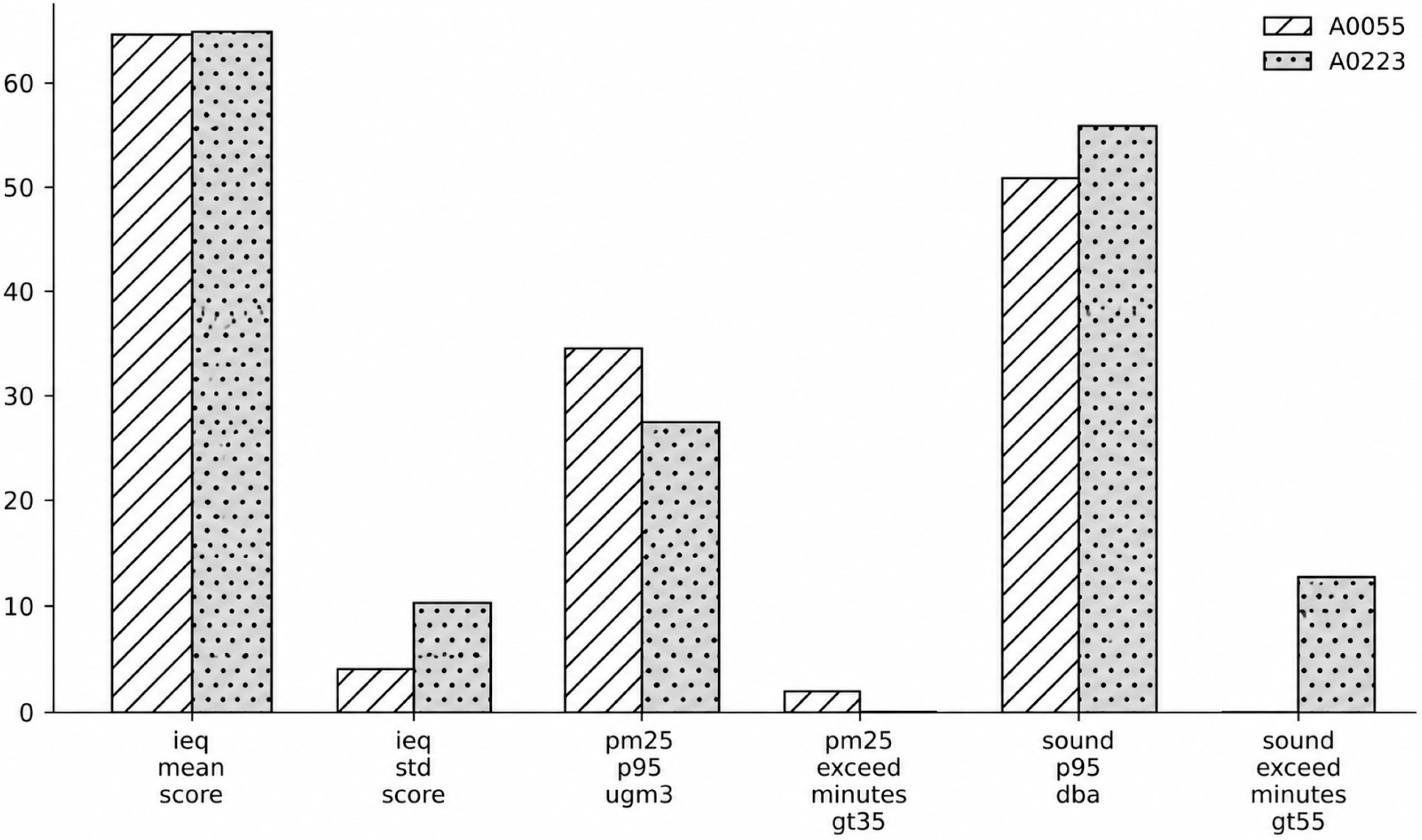
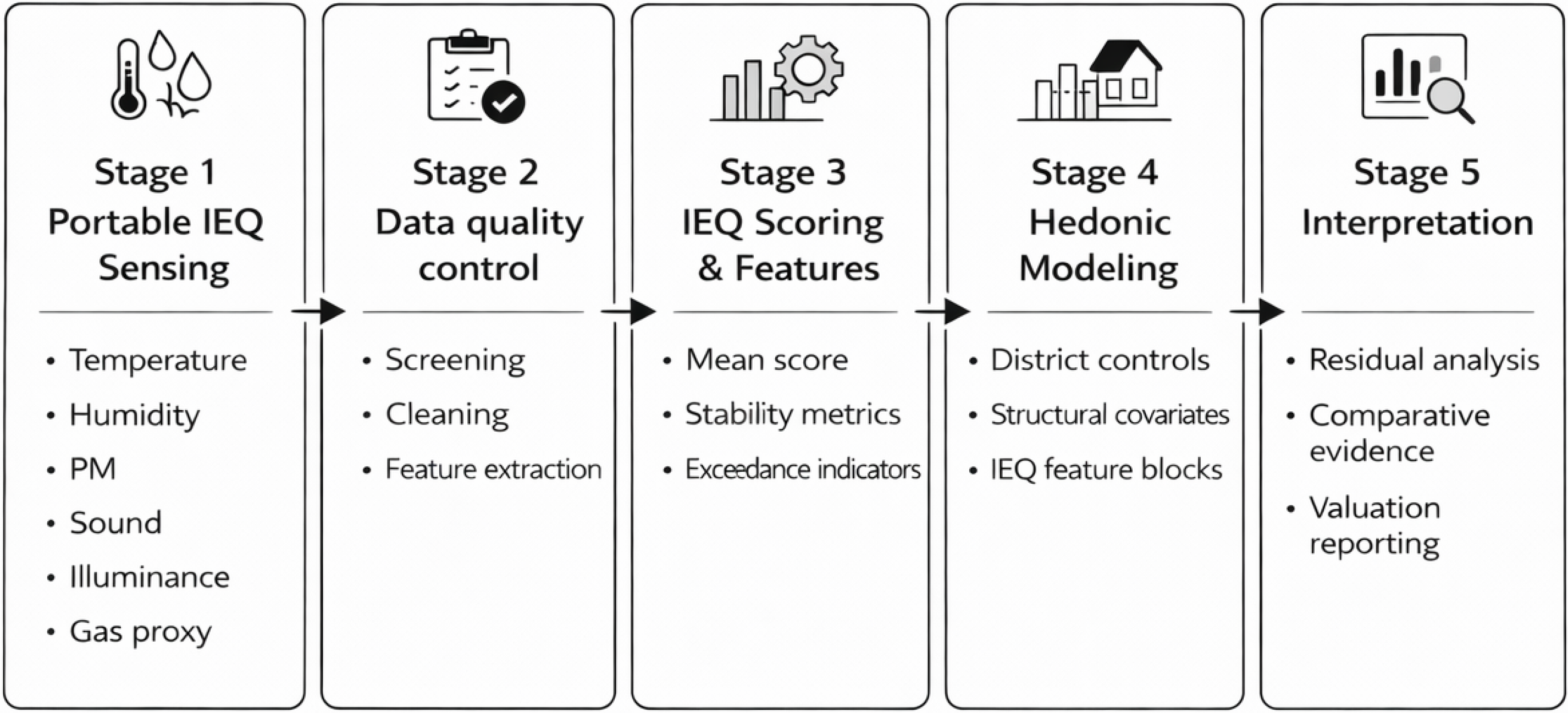
Figure 1 summarizes the sensing-to-valuation workflow. Sensor time series are quality-checked and converted into interpretable IEQ features (mean, stability, and exceedance metrics), then combined with standard listing covariates in a controlled hedonic Model, diagnostics, and a certificate-style report supports scientific validity and practical PropTech deployment.
The methodology is structured as a four-stage pipeline: (1) device design and assembly; (2) deployment and data collection; (3) Python 3.9.6-based data processing, feature engineering, and scoring; and (4) interpretation of the comfort–price relationship and managerial implications. Each stage is documented with reproducibility details, quality assurance steps, uncertainty handling, and a hedonic-pricing modeling plan that separates IEQ effects from location and standard housing attributes.

2.2. Study Design, Sampling, and Dataset Structure

The final analytical sample includes 244 apartments across 12 districts (District_01–District_12). For each apartment, the dataset includes standard listing covariates (district, floor area, bedrooms, bathrooms, building age, floor level, elevator/parking, renovation status, orientation, amenities, distance to major road, and metro/transit) and IEQ-derived features. IEQ measurements cover thermal comfort (temperature, relative humidity), particulate pollution (PM2.5 and PM summaries such as P95 and exceedance duration), lighting (illuminance), acoustics (sound level), and a qualitative gas/IAQ proxy.
The analytical sample was compiled as a district-stratified pilot dataset rather than as a statistically representative survey of the full Tehran housing market. The objective was to capture heterogeneity in price, location, and indoor conditions across multiple districts while retaining a consistent set of listing covariates and IEQ measurement outputs for modeling. Inclusion in the final sample required complete core housing attributes, a valid IEQ observation window, and sufficient data quality for feature engineering. Accordingly, the sample should be interpreted as an exploratory valuation-oriented dataset rather than a probability-based representation of the broader market. Potential sources of bias include non-random unit selection, unequal district representation, listing-market segmentation, and possible differences between apartments with complete measurement records and the wider residential stock. The adopted window captures short-term indoor conditions but does not represent seasonal variation; this limitation is addressed explicitly in the Discussion.
A key measurement design choice is the aggregation window. A 100-min window was used to balance responsiveness with stability; this work retains that concept and extends it with additional features that are not captured by means alone (e.g., stability and exposure duration). In addition to mean values, the dataset includes: percent time in comfort bands (good/mid/poor), day vs. night score splits, exceedance minutes above PM2.5 and sound thresholds, and uncertainty intervals for the IEQ score.
The 100-min measurement window was selected as a practical compromise between portability and signal stability for pilot inspections; however, it does not capture full temporal dynamics associated with weekday/weekend routines, seasonal changes, or longer occupancy cycles, and this limitation is acknowledged explicitly in the discussion.

2.3. IoT IEQ Monitoring System and Sensing Concept

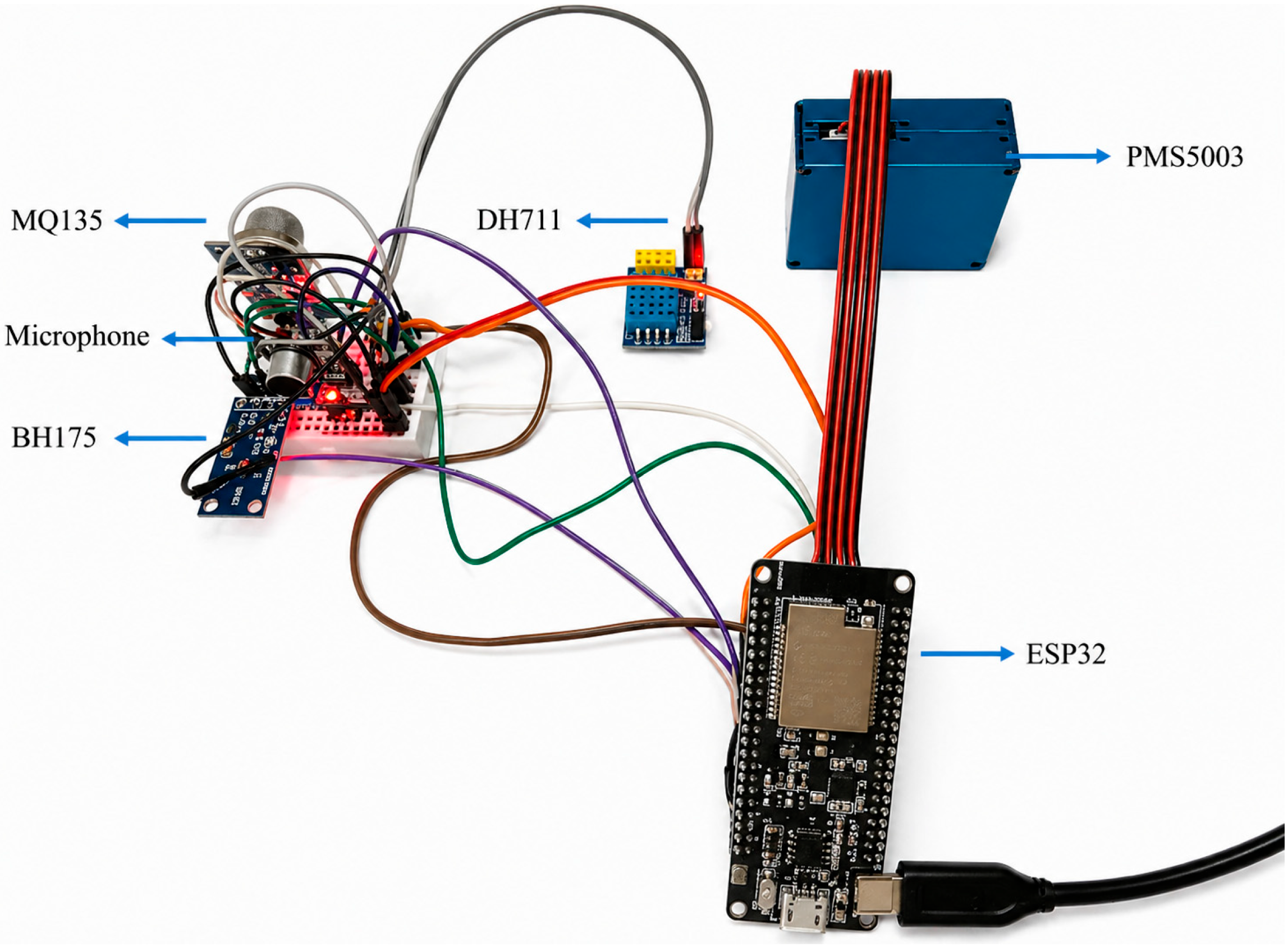
The device design goal is a rechargeable, portable unit that measures indoor pollutants and comfort variables using low-cost modules and an ESP32-class microcontroller board for signal processing and status determination. Figure 2 shows the assembled IEQ prototype used for portable sensing and data acquisition. Raw data are designed to be stored in the cloud for later processing. The concept maps directly to a PropTech inspection workflow: move the device between homes, collect evidence under a standardized protocol, and convert it into a simple, interpretable comfort score.
The core sensor list is reproduced below to keep traceability with the device specification. The device captures: (i) temperature and humidity, (ii) particulate matter size fractions, (iii) illuminance, (iv) sound intensity, and (v) a qualitative gas/smoke indicator responsive to multiple species. Table 1 summarizes the sensor modules, measured parameters, and operating principles used in the prototype.
The measurement ranges and nominal accuracies are retained for traceability. Table 2 reports the nominal measurement ranges and accuracies of the sensors used in the prototype; preserve the printed values and clarify the intended mapping in the narrative (RH typically spans 0–100% with a few percent accuracy; temperature spans −40 to 125 °C with sub-degree accuracy).
Portability is essential for residential inspection and for comparing units under similar conditions. The device operates via either a standard outlet or a battery power bank, supporting portable deployment across different apartment contexts. The maximum load is reported at ~138 mA, and battery life is estimated using a 0.7 derating factor to account for practical inefficiencies. The realistic operating time can be lower due to minimum voltage constraints on some boards (USB supply dropping below 5 V during discharge). Observed operation across several days supports the feasibility for repeated, standardized inspection windows and larger-scale measurement campaigns.

2.4. Data Pipeline, UI, and Reproducibility Model

A hybrid interface was used: immediate on-device feedback and cloud storage for analytics. Values are shown on an OLED display. The IoT configuration transmits sensor readings to a remote server (ThingSpeak) for visualization and storage, and a mobile HMI (Virtuino) provides rapid prototyping and near-real-time monitoring. These design choices address the adoption problem in PropTech: stakeholders require an intuitive display to trust measurement evidence.
The dataset variables (Table 3) document the feature set used for reproducible analysis. The analysis workflow reads the dataset (CSV), enforces data types, reports dataset summaries (shape, dtypes, missingness), and generates exploratory plots (distributions, scatter plots, and diagnostic plots). Feature scores are computed by comparing measurements against operational bands, applying weights, and aggregating into an overall IEQ score. The workflow includes sensitivity checks, uncertainty reporting, and modeling with covariates (hedonic pricing) rather than relying on uncontrolled correlations.
Prior to modelling, the analytical dataset was screened for data completeness, type consistency, and implausible values. Variables were checked for missingness, range violations, and distributional irregularities. Records with incomplete core variables required for the hedonic specification were excluded from the final modelling sample, while summary diagnostics were used to identify unusually extreme observations. Because housing data naturally contain heavy tails and market segmentation, extreme values were not removed mechanically; instead, the modelling strategy relied on log transformation of price per square meter, diagnostic plots, and cautious interpretation of residual-tail behavior. This preprocessing approach was intended to reduce instability while preserving economically meaningful heterogeneity.
Because the study uses a portable screening-oriented IEQ framework, the adopted bands should be interpreted as operational thresholds for valuation-oriented comparison, not as direct one-to-one substitutes for full building-performance compliance assessment. Table 4 maps the study’s IEQ indicators and operational thresholds to external benchmark frameworks to clarify their interpretive context.
A reproducible data model is recommended for replication and scaling. Each record should contain: timestamp (UTC/local), apartment identifier, sensor readings (T, RH, PM, lux, sound, gas proxy), device status (battery voltage, Wi-Fi signal), and metadata (room type, placement height, proximity to windows/kitchen, and distance to vents). In the expanded dataset, the modeling table also includes listing covariates (district, area, rooms, age, floor, amenities, renovation status, and distances to road and metro) and engineered IEQ features (means, volatility, exceedance minutes, band occupancy, and uncertainty intervals).

2.5. Calibration and Quality Assurance

Low-cost sensors require calibration and baseline tests, especially when the objective is comparing homes and translating scores into valuation-relevant evidence. A suitable baseline protocol involves calibration in a controlled chamber (closed enclosure ~220 × 180 × 280 mm; ~11 L volume) using a zero-air generator that produces synthetic carrier air with low hydrocarbon content (<~0.1 ppm) at 500 mL/min. Under such baseline conditions, some parameters remain stable (temperature, light, sound), while particles, humidity, and CO2 show predictable declining trends. Close agreement between temperature, humidity, and CO2 readings and a reference instrument (CO210) in the calibration setting supports the feasibility of this approach.
This study also reports informative behavior for multiple TVOC sensors: different baseline values under the same environment, including a non-zero floor (~125 ppb) for one sensor and an inconsistent baseline (~240 ppb) for another. This motivates uncertainty-aware scoring and careful calibration protocols for gas/VOC indicators.
A practical two-level strategy is: (i) baseline tests (zero air; controlled temperature/humidity) to characterize offsets and stability, and (ii) side-by-side comparisons with reference instruments (PM monitor, sound meter, lux meter) in representative home conditions for 24–72 h. Measurement bias and variability should be propagated into the IEQ score to produce confidence intervals rather than a single point score. A practical implementation is Monte-Carlo propagation: sample plausible true values from sensor error models and recompute the IEQ score repeatedly to obtain a score distribution and a 95% interval. This uncertainty layer supports transparent interpretation and robust decision-making.
The calibration protocol in this study should be interpreted as a pilot validation procedure rather than a complete life-cycle sensor-certification framework. The zero-air baseline tests and short-term side-by-side comparisons were intended to identify gross offsets, stability issues, and approximate agreement under controlled conditions. However, the study did not implement long-term drift correction, repeated field recalibration across multiple environmental regimes, or full multi-scenario accuracy benchmarking. For this reason, the uncertainty-aware IEQ layer was designed to partially account for measurement imperfection at the scoring stage, but it should not be interpreted as a substitute for long-horizon sensor characterization. Future work should include repeated recalibration, drift-tracking schedules, and more formal propagation of sensor-specific error models into the engineered IEQ features and downstream valuation estimates.

2.6. IEQ Scoring, Bands, Weights, and Engineered Features

A transparent scoring system that maps heterogeneous sensor readings into a single percentage score with qualitative bands. The scoring starts from 100% and subtracts penalties based on whether parameters are outside the “good” band. Interpretability rules are provided: all “good” → 100%, all “average” → ~80%, all “weak” → ~50%, all “bad” → ~0%. This simplicity supports adoption in real-estate contexts where black-box indices may be rejected by practitioners.
The operational “environmental” ranges and “risk” ranges for each parameter are summarized in Table 5. The parameter weights used in the composite IEQ score are listed in Table 6, and the corresponding qualitative score labels are defined in Table 7. These bands and weights are prototype thresholds intended for valuation-oriented IEQ screening rather than universal medical limits. Inequality formatting issues are clarified here as “outside the target band.”
Mean IEQ is informative but incomplete. Two apartments can share the same mean score while offering different lived experiences due to spiky PM events, intermittent ventilation, or periodic traffic noise. Therefore, the feature set includes: (i) IEQ volatility (standard deviation), (ii) band occupancy (% time good/mid/poor), (iii) peak exposure (PM2.5 P95; sound P95), (iv) persistence of exceedance (minutes above thresholds), and (v) day vs. night splits. These features are computed directly from the same measurement basis and can be incorporated into valuation modeling and richer inspection reports.
The economic rationale for these engineered features is that households do not experience indoor conditions purely as time averages. Repeated pollutant spikes, intermittent acoustic disturbance, and unstable comfort conditions may reduce perceived livability, predictability, and willingness to pay even when mean conditions appear acceptable. From a hedonic perspective, such metrics may therefore capture aspects of residential utility that are closer to perceived nuisance, reliability, and exposure risk than simple averages alone. Volatility reflects the consistency of experience, while exceedance duration reflects the frequency and persistence of undesirable indoor states; both are plausible channels through which IEQ can influence valuation judgments.
To isolate IEQ effects from confounders (especially location), valuation is modeled using hedonic pricing with a log-linear specification:
log(price_per_m2) ~ district + structural attributes + accessibility + IEQ features.
Modeling proceeds in stages:
  • Baseline: district + area + rooms + building age + floor + elevator/parking + amenities + renovation + orientation + distances to road/metro.
  • IEQ mean: adds IEQ mean score.
  • Stability/exposure: adds IEQ volatility and exceedance metrics (PM2.5 and sound exceedance minutes).
  • Uncertainty: adds IEQ uncertainty (sigma) to reflect measurement confidence
The log-linear hedonic specification was selected as the primary baseline because it provides interpretable proportional effects and is widely used in housing research. However, it is not the only plausible functional form for heterogeneous real-estate markets. Nonlinear, semiparametric, quantile, or interaction-based models may reveal price-segment-specific IEQ effects that are not captured by a single global linear specification. These alternatives are identified as important directions for future model comparison rather than fully developed components of the present pilot study.

3. Results

3.1. Sample Characteristics and Distributional Overview

Section 3 presents the results in a stepwise manner, moving from dataset structure to controlled valuation inference. It first summarizes the 244-apartment sample and key variable distributions, and then examines district-level heterogeneity to separate location effects from indoor comfort signals. Next, it reports exploratory bivariate patterns and exposure plausibility checks, followed by the core hedonic model comparison (baseline vs. IEQ-augmented) to test whether IEQ contributes incremental explanatory value after standard controls. The section concludes with uncertainty and diagnostic results and a practical reporting output, so findings are interpreted not only statistically but also in terms of decision use in real-estate workflows.
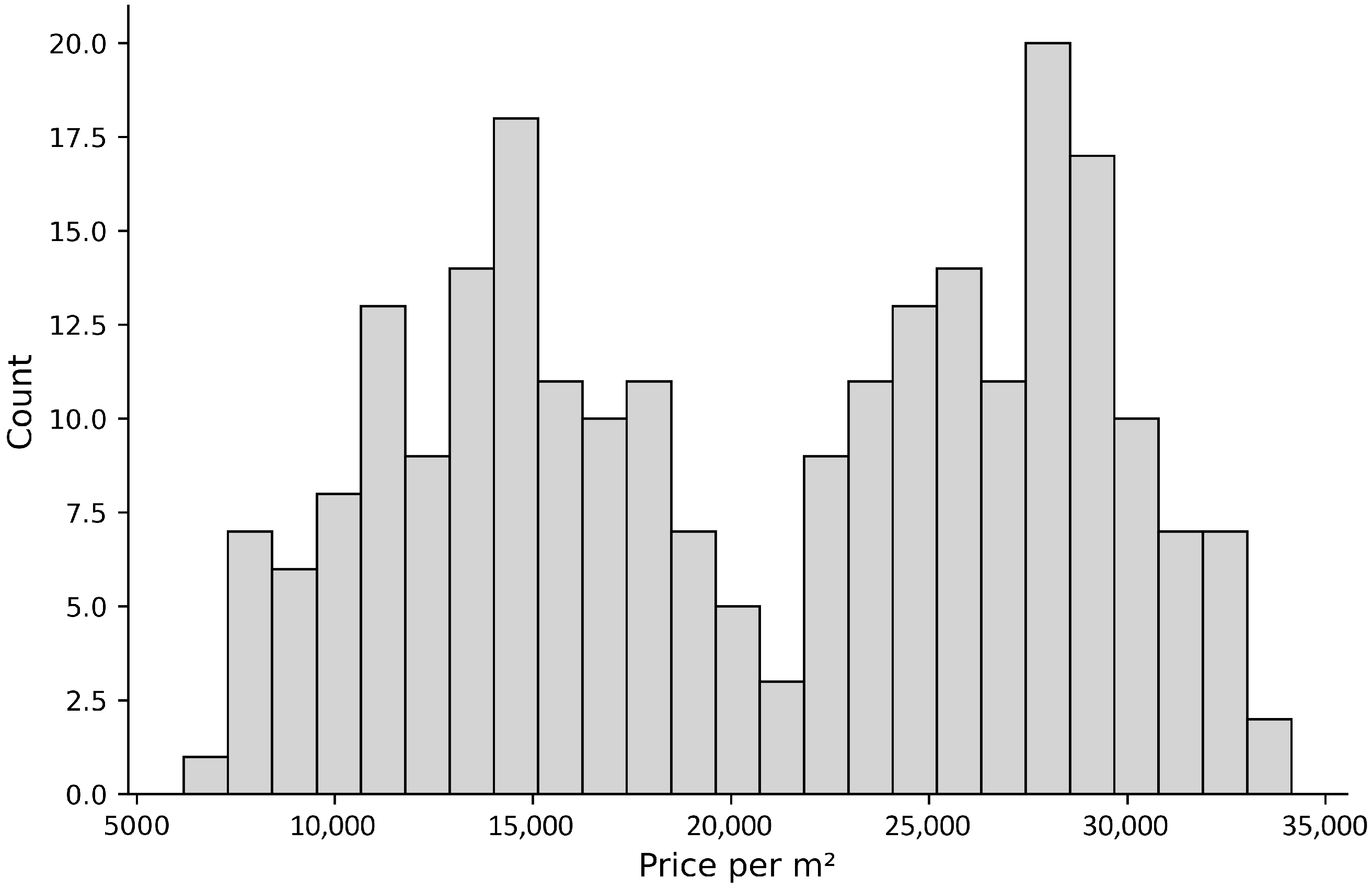
Figure 3 indicates a wide and non-normal price-per-m2 distribution, with visible clustering that suggests segmented submarkets rather than a single homogeneous market. The broad spread implies strong cross-neighborhood and structural heterogeneity in valuation conditions. This supports treating location and housing attributes as primary controls before evaluating IEQ effects. The right-tailed pattern also motivates using log (price per m2) to improve model stability and reduce tail leverage. Accordingly, subsequent analyses estimate IEQ effects within a controlled hedonic framework, not from pooled bivariate patterns.
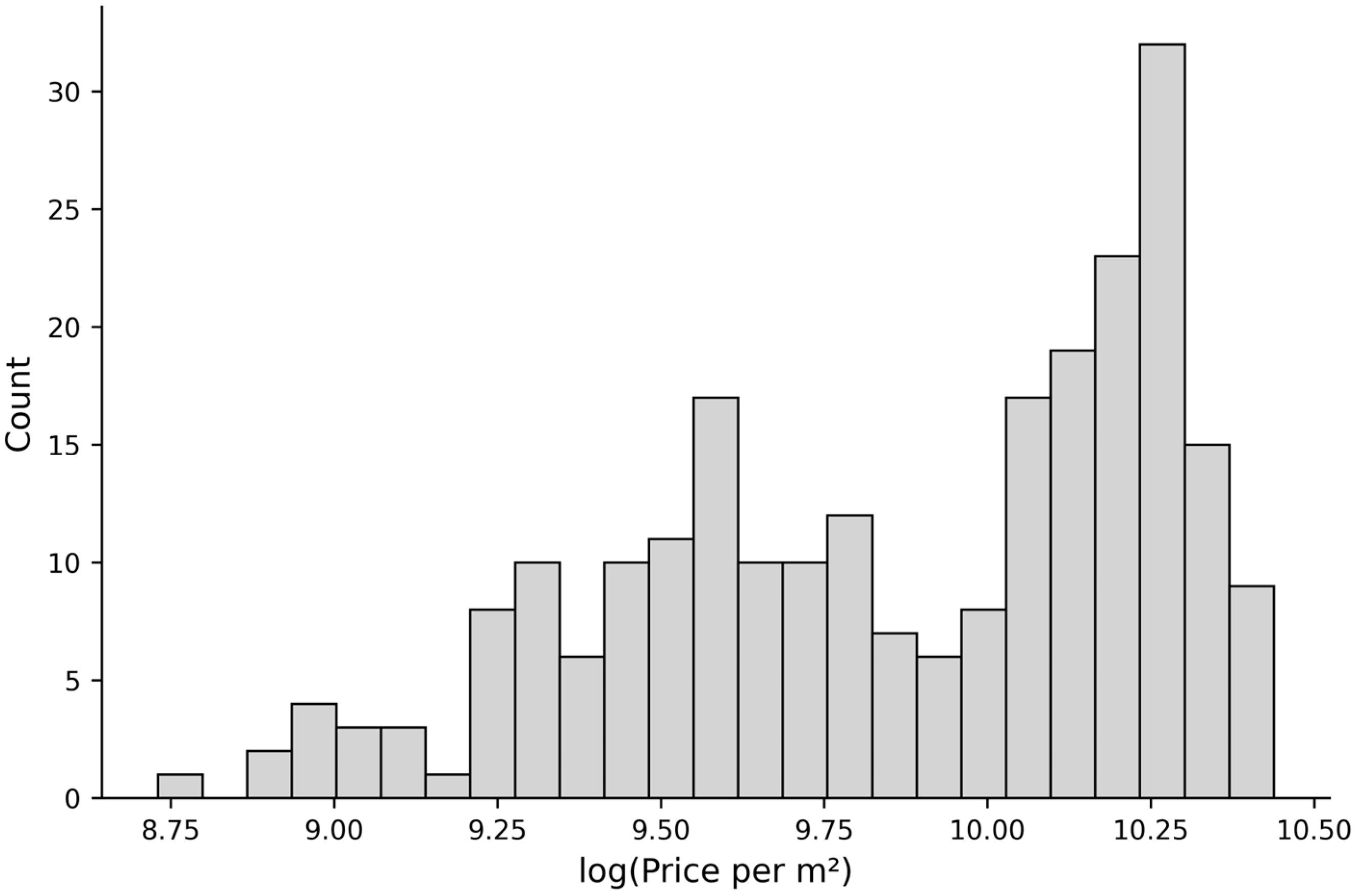
Figure 4 shows the same variable after logarithmic transformation. The log scale compresses the upper tail and reduces dispersion imbalance between lower- and higher-price segments, yielding a distribution that is more regular for regression modeling. This supports the use of a log-linear hedonic specification for three reasons: (i) improved variance stability, (ii) reduced leverage from very high-price observations, and (iii) coefficient interpretation in proportional terms. Therefore, subsequent inference is based on controlled models with district and structural covariates, while Figure 3 and Figure 4 serve as diagnostic evidence for functional-form choice rather than standalone valuation conclusions.
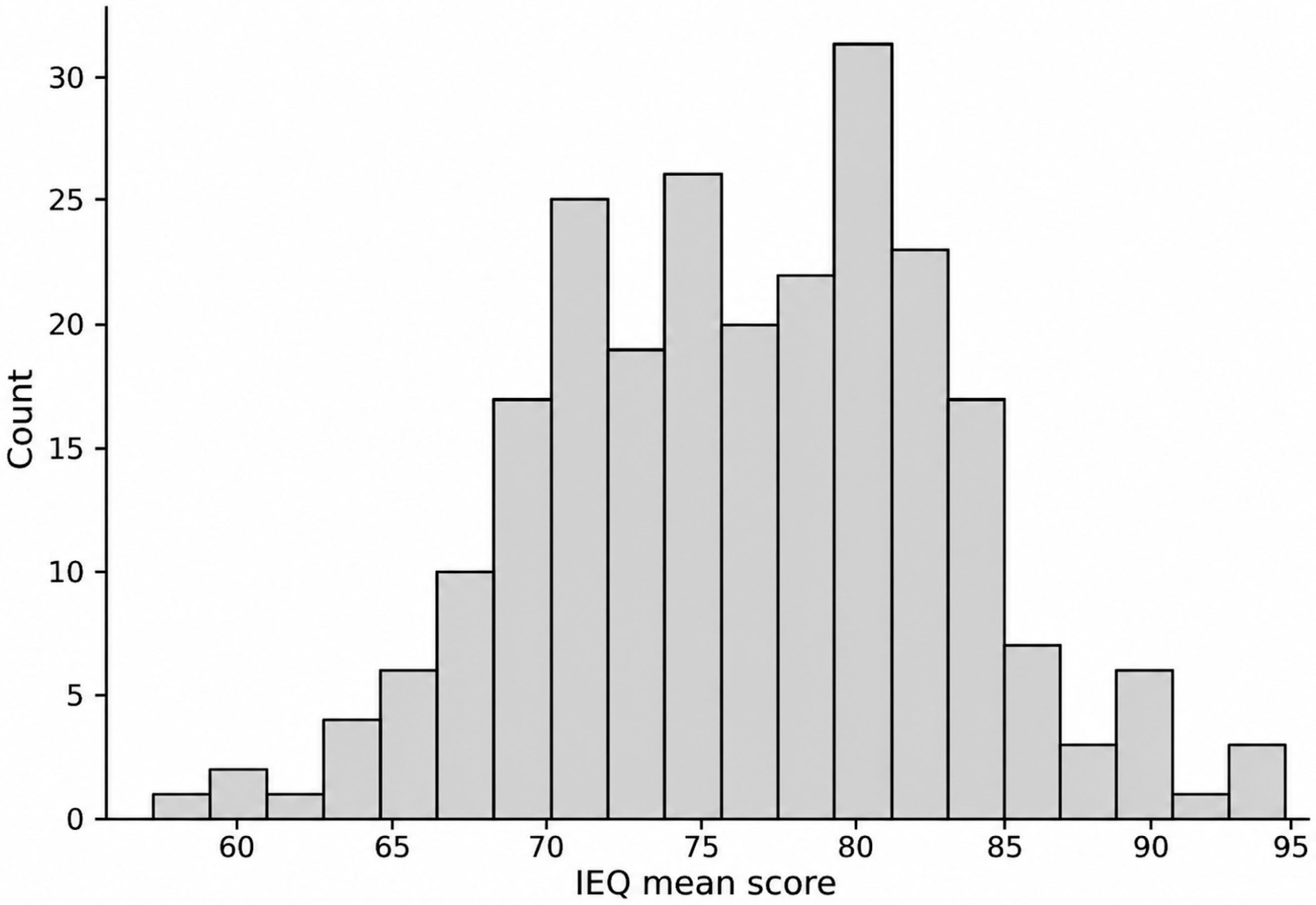
Figure 5 indicates that IEQ mean values are concentrated in the mid-to-high range (roughly around the 70s to low 80s), with thinner tails at very low and very high scores. This pattern suggests two important points for the valuation analysis. First, the dataset contains meaningful comfort variation, but not extreme polarization, which is realistic for occupied urban apartments where minimum livability standards are often met, but quality still differs materially. Second, because most observations cluster in a relatively narrow central band, small score differences should be interpreted cautiously unless supported by uncertainty intervals and controlled models.
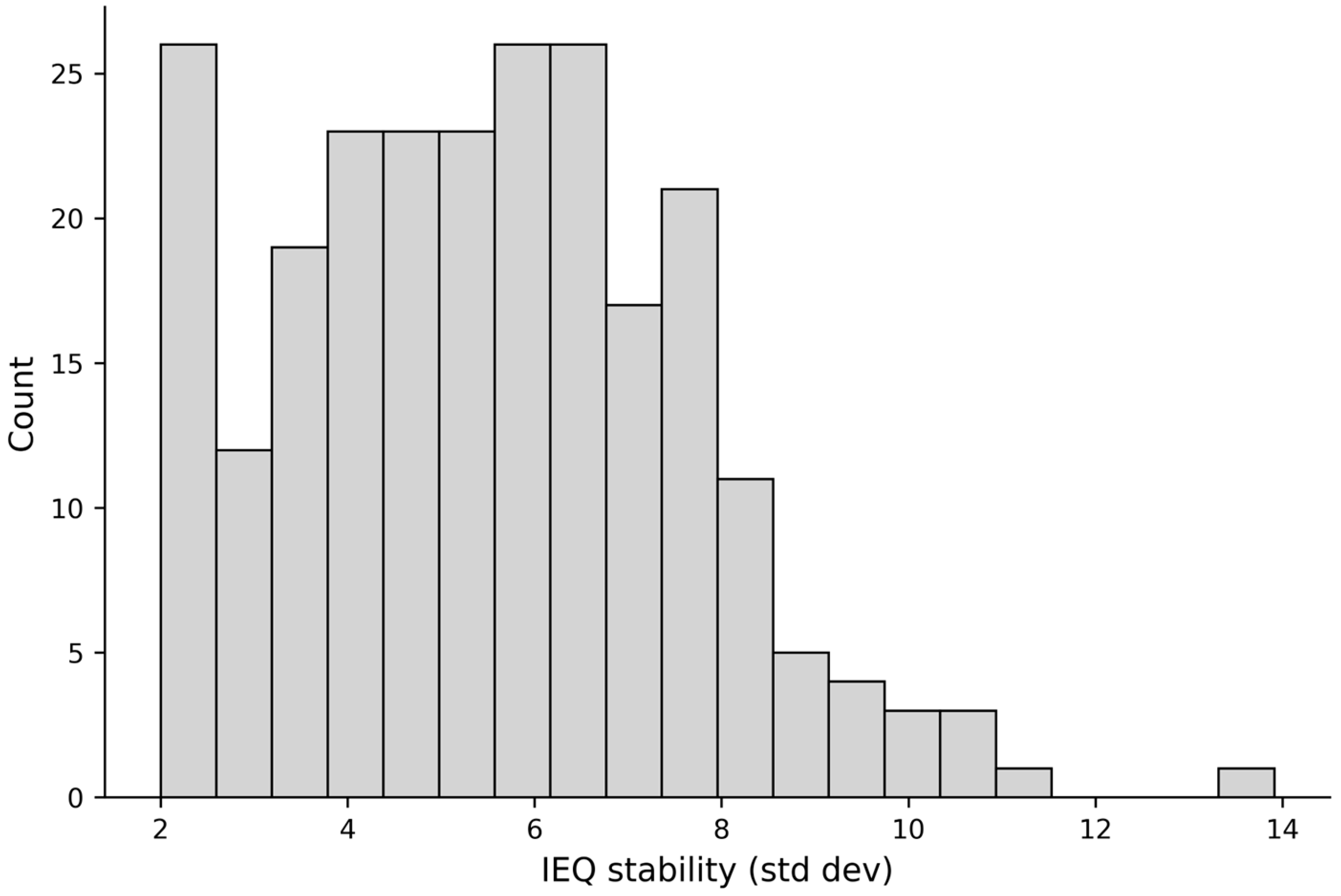
Methodologically, this distribution supports treating the IEQ mean as an informative but moderate-signal predictor rather than a dominant standalone driver of price. It also motivates adding complementary IEQ dimensions, stability, exceedance duration, and uncertainty, since homes with similar mean scores may still differ in lived comfort and perceived value. In short, Figure 5 and Figure 6 motivate using both mean IEQ and stability features: mean captures overall comfort level, while stability captures temporal consistency that averages alone can miss.
The final analytical sample includes 244 apartments across 12 districts (District_01–District_12), with both structural/location covariates and engineered IEQ features. Descriptive statistics show substantial heterogeneity in housing attributes and indoor conditions, which supports model identification and reduces the risk of trivial findings from narrow sampling. Price per m2 shows a wide spread, while IEQ mean scores also vary meaningfully, indicating non-trivial comfort variation across units.

3.2. Spatial Heterogeneity: District-Level Price and IEQ Patterns

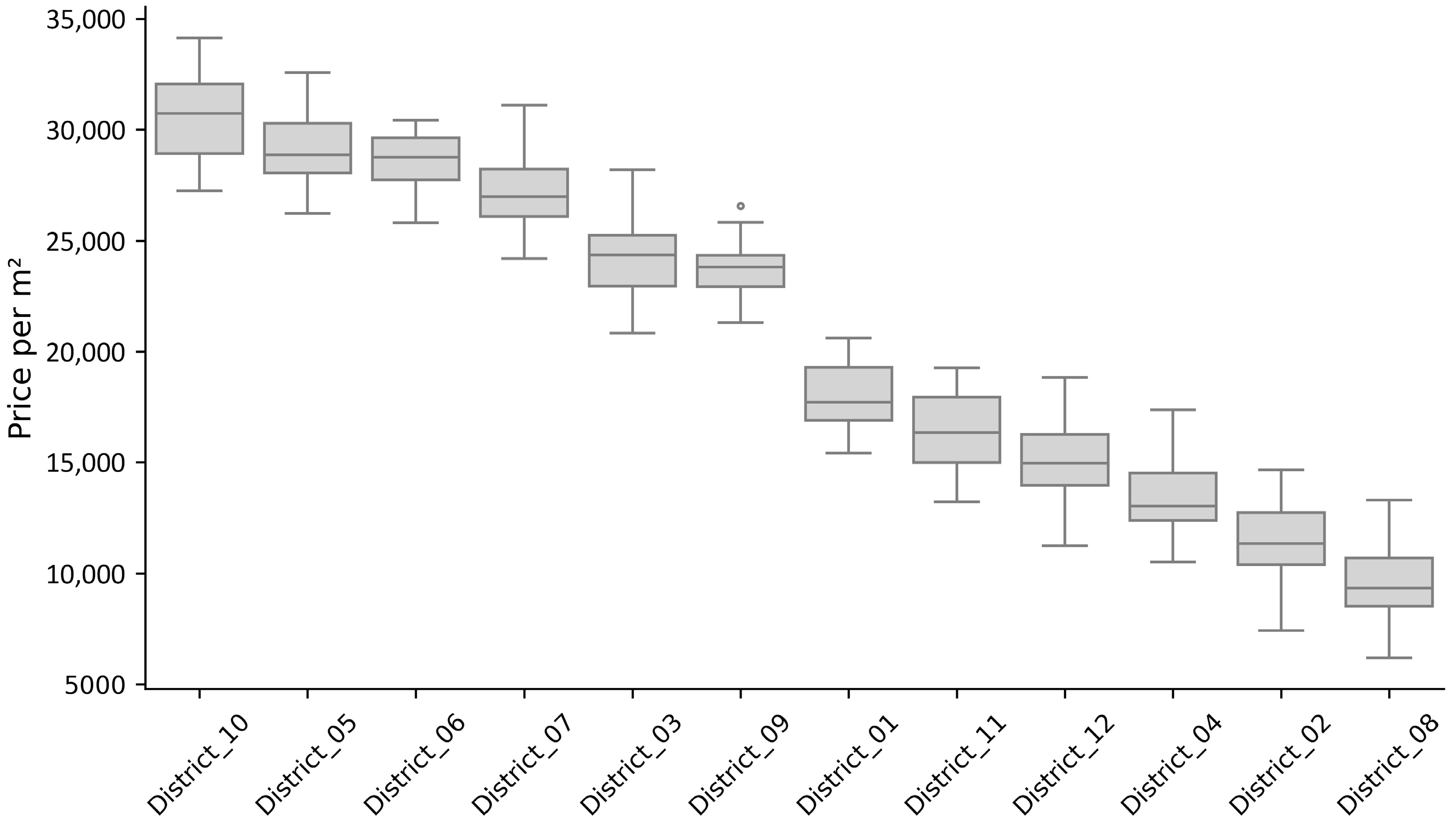
Figure 7 shows a clear district hierarchy in housing values, with median prices decreasing systematically from top-tier to lower-tier districts. This confirms that location is the dominant first-order determinant of price per m2 in the sample. The separation of medians and interquartile ranges across districts indicates strong between-district heterogeneity, while the within-district spread indicates that meaningful variation remains even among units sharing the same district label.
For model design, this figure has two implications. First, district controls (or fixed effects) are mandatory; without them, any pooled IEQ–price association would be structurally confounded and potentially misleading. Second, the remaining within-district dispersion is exactly where incremental features such as IEQ can add value: IEQ is not expected to replace location effects, but to explain residual differences among otherwise comparable units. Therefore, Figure 7 supports the research’s identification strategy estimate IEQ effects conditionally (within a controlled hedonic framework), rather than interpreting unconditional correlations as valuation evidence.
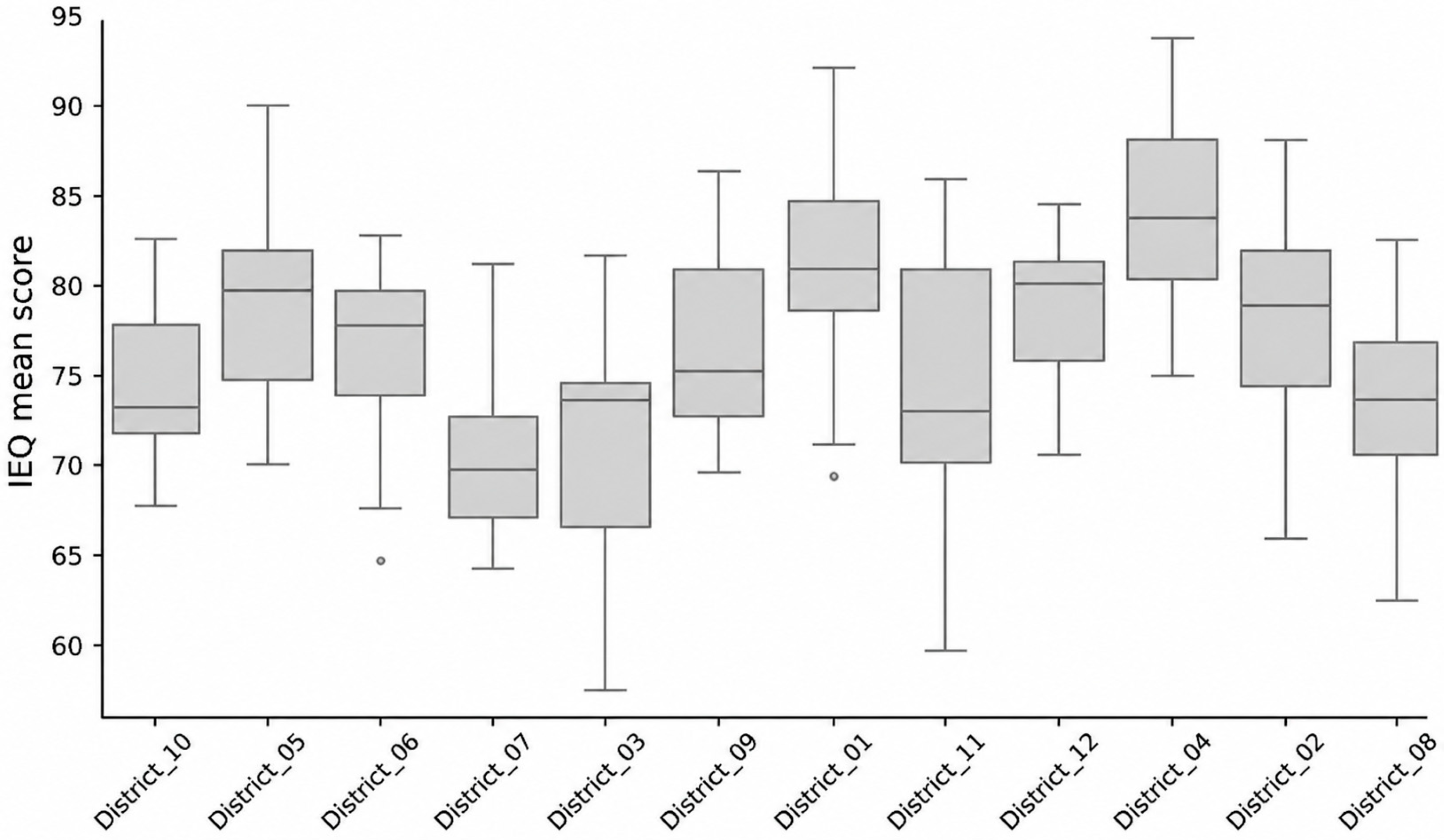
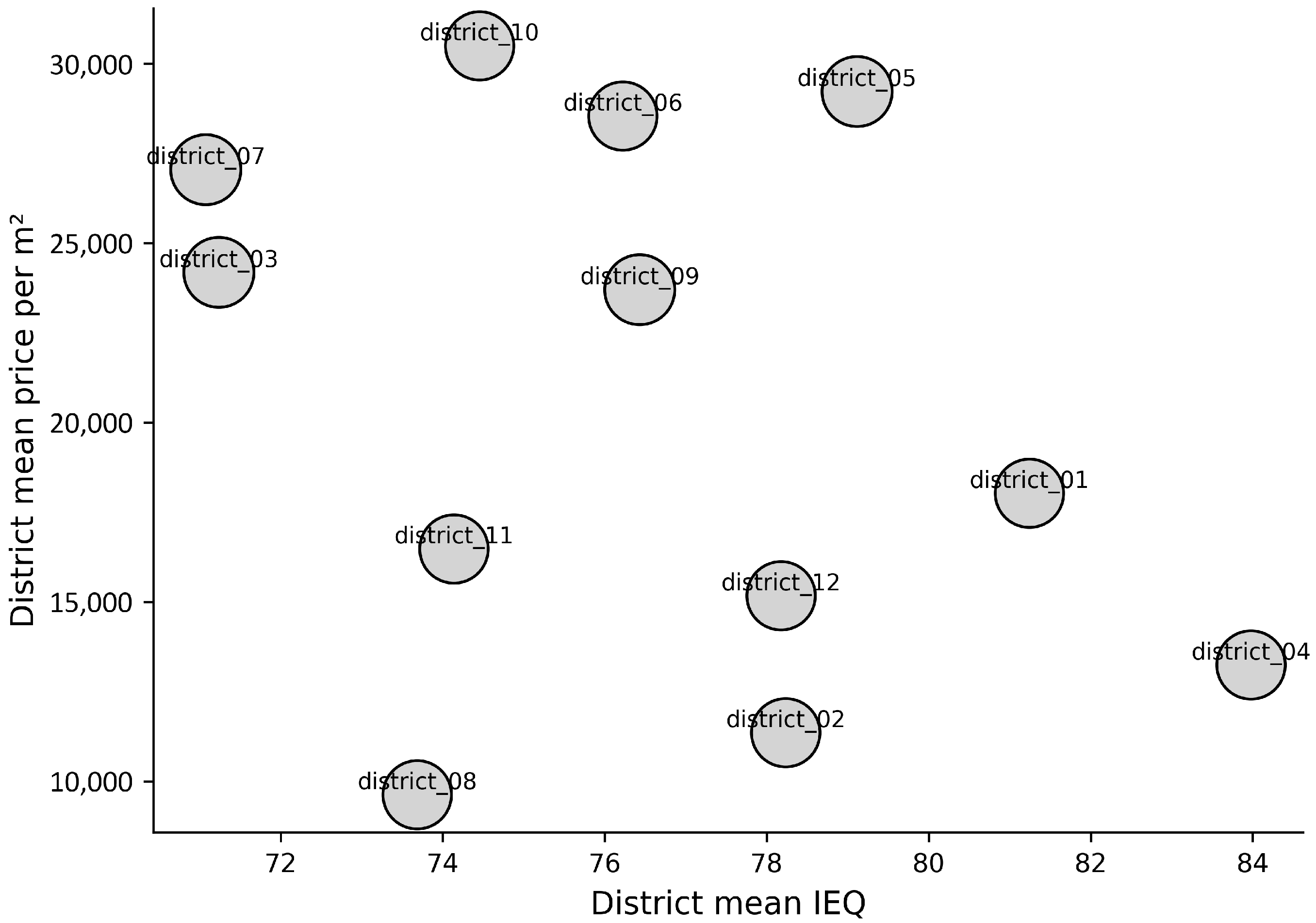
Figure 8 and Figure 9 jointly show that IEQ and price vary across districts but do not move in a strictly one-to-one manner. The district boxplots indicate meaningful within-district dispersion in IEQ (different comfort conditions among homes in the same location), while the district-level bubble plot shows that high-IEQ districts are not always the highest-price districts, and some lower-IEQ districts still command relatively high prices. This non-monotonic pattern is important: it confirms that location and market status remain dominant pricing drivers, but IEQ provides an additional, non-redundant layer of information rather than a simple proxy for district prestige. Methodologically, these two figures justify the modeling strategy used in the research—district controls to absorb location effects, plus IEQ terms to explain residual value differences within and across districts.

3.3. Uncontrolled Association Is Not Sufficient Evidence

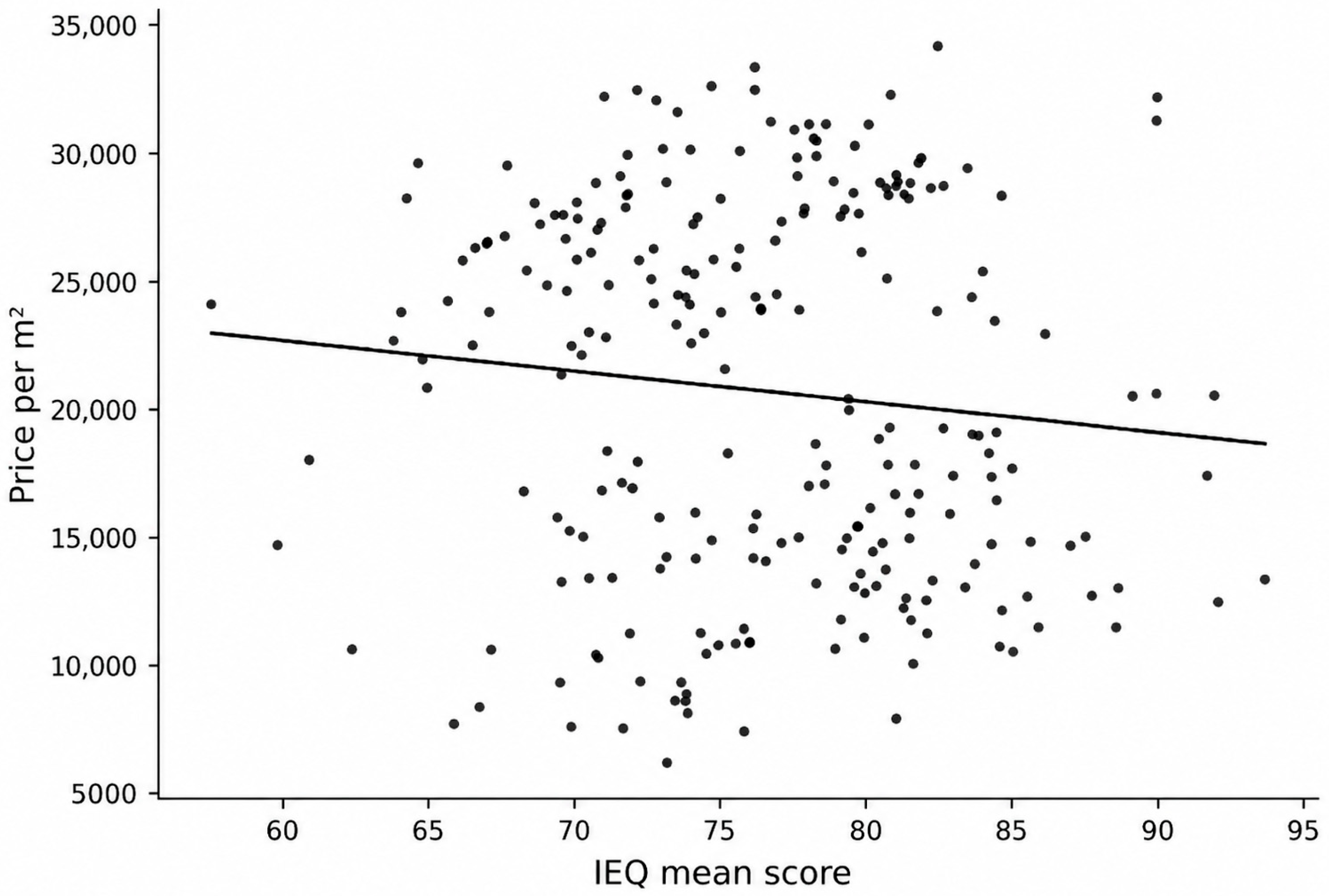
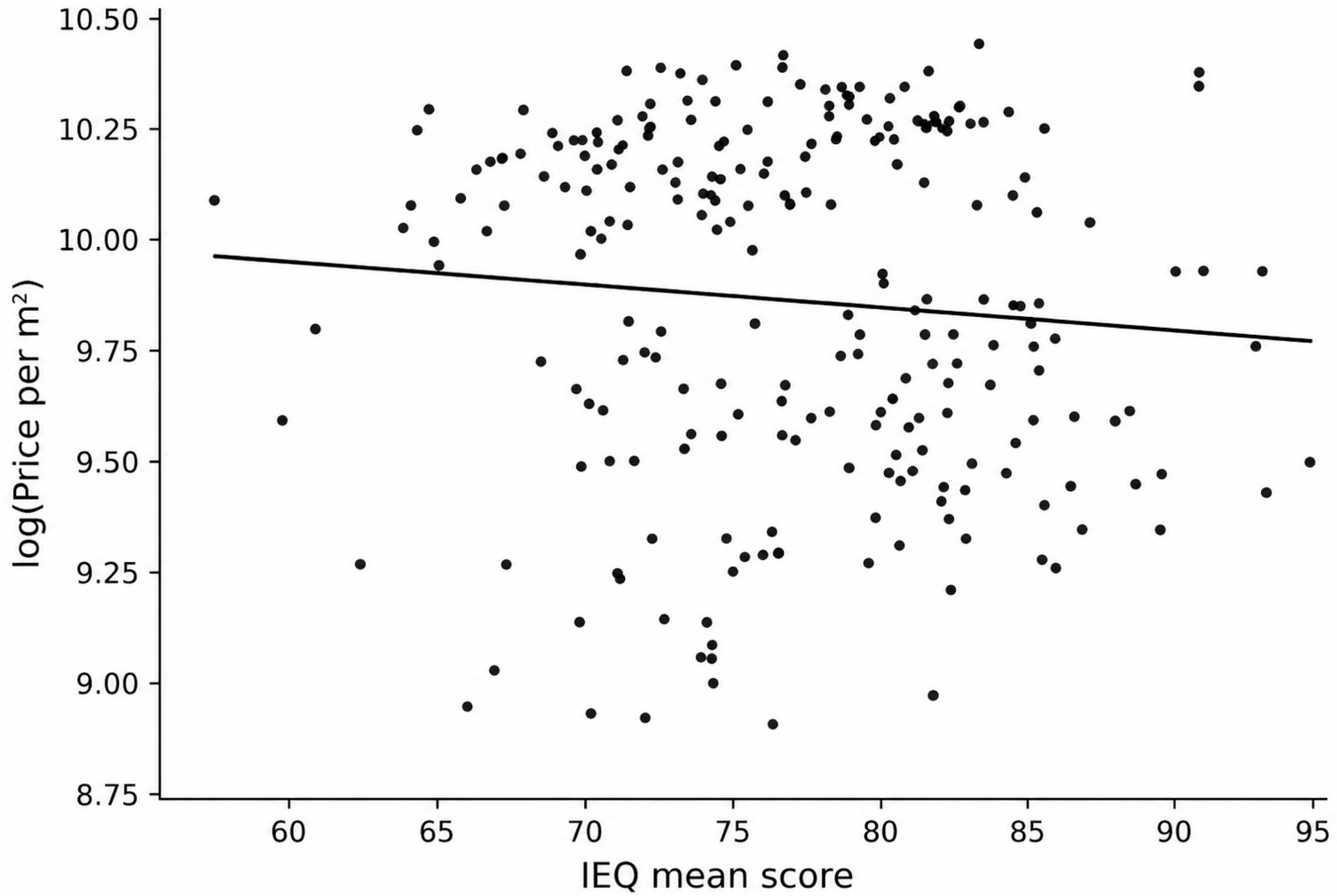
Figure 10 and Figure 11 show that, in pooled data, the unconditional IEQ–price relationship is weak and slightly negative in both level and log-price forms; however, this should be interpreted as a confounded descriptive pattern rather than evidence against the valuation hypothesis. The broad vertical spread at nearly every IEQ value indicates that major determinants of price (district, building characteristics, and amenity structure) are driving most between-unit differences, while IEQ likely operates as a secondary marginal factor. The persistence of a mild negative slope after log transformation indicates that functional-form correction alone does not remove omitted-variable bias. Therefore, these figures justify the core econometric strategy of the research: estimate IEQ effects only in controlled hedonic models with district and structural covariates, and interpret pooled scatterplots as diagnostic context, not as causal or policy-relevant inference.

3.4. Environmental Plausibility of Exposure Features

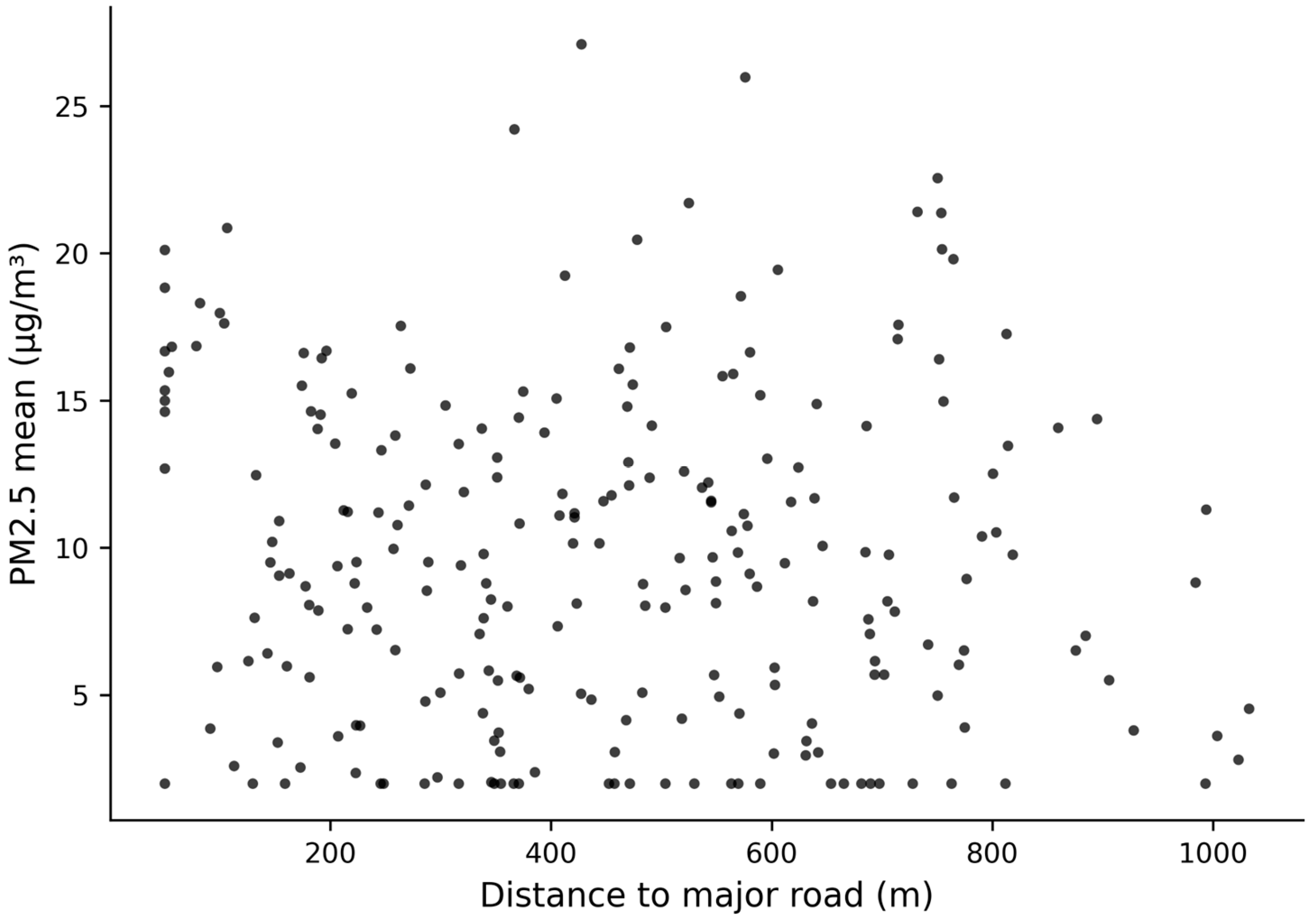
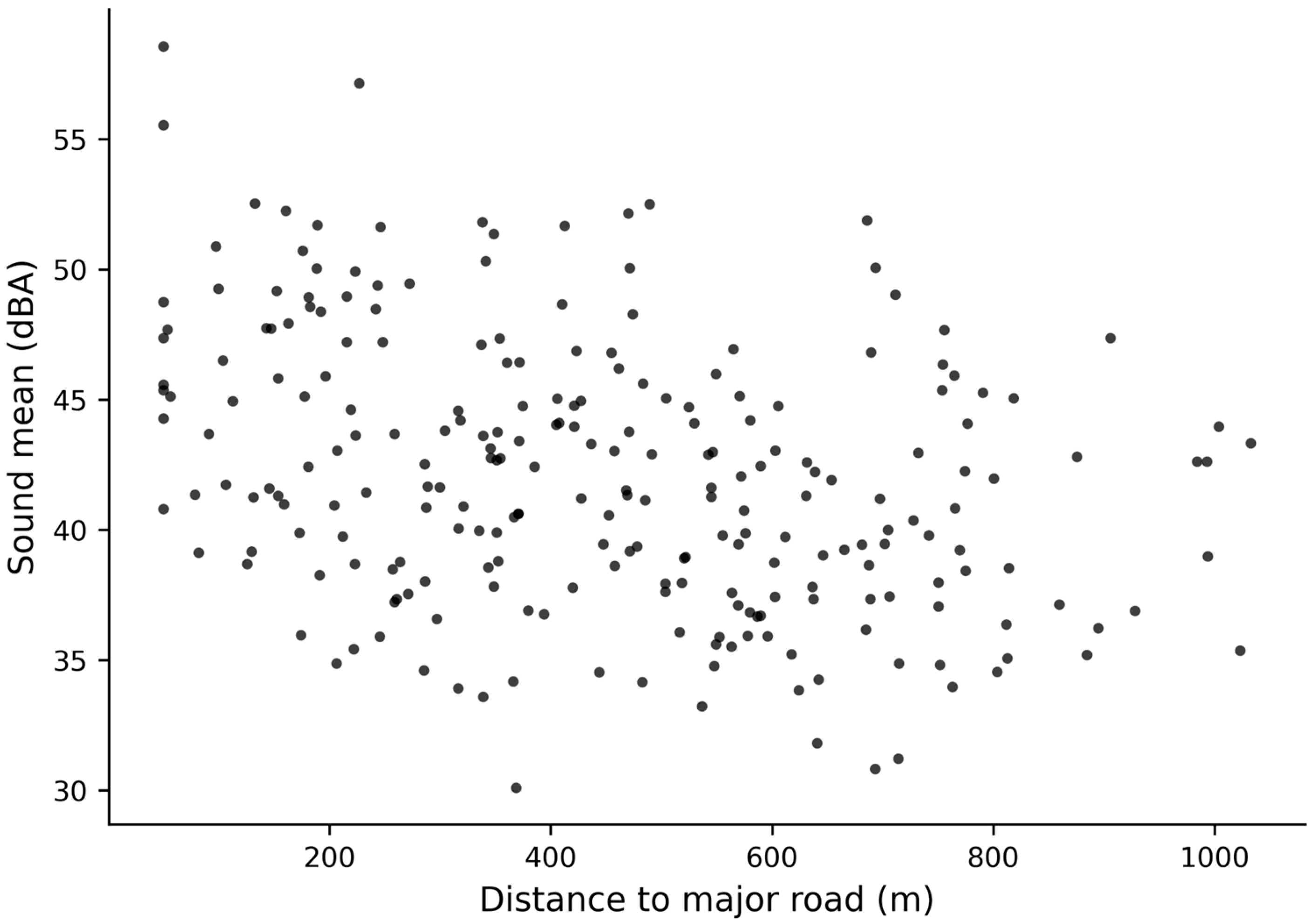
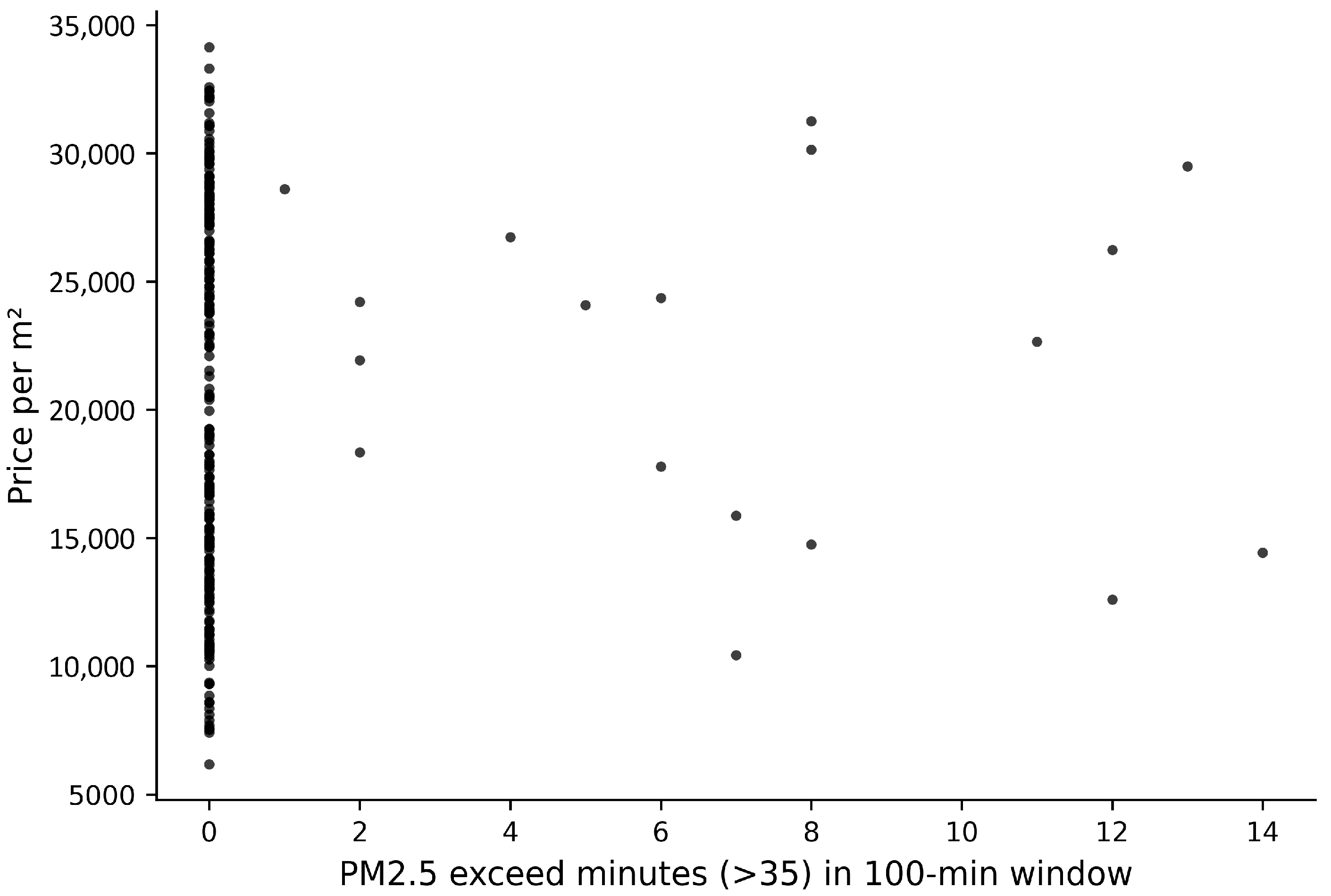
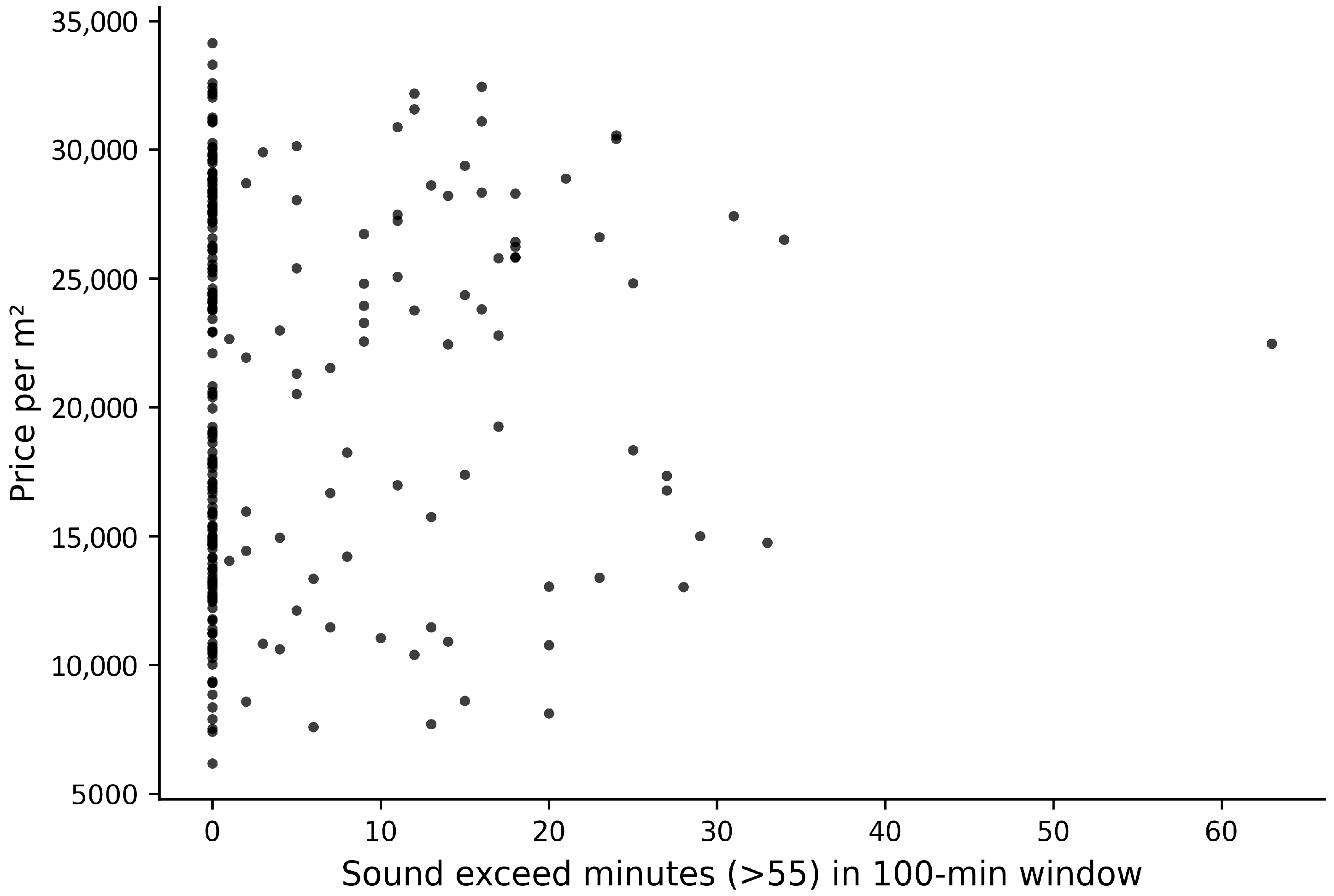
Figure 12, Figure 13, Figure 14 and Figure 15 collectively validate the environmental logic of the engineered IEQ features and explain why exposure/stability metrics are necessary beyond simple averages. The PM2.5–road-distance and sound–road-distance plots (12, 13) show expected spatial behavior—units closer to major roads tend to experience higher pollutant and acoustic burden—supporting construct validity of the sensing pipeline. The price-versus-exceedance plots (14, 15) are highly zero-inflated, with many observations at zero exceedance minutes and a smaller tail of high-exceedance cases; this indicates threshold events are relatively infrequent but potentially consequential, and that exceedance duration should be modeled as a non-linear or semi-discrete feature rather than a purely linear continuous regressor. Figure 16 then provides the key methodological insight: two units can have similar IEQ mean scores yet materially different volatility, high-percentile peaks, and exceedance durations, implying different lived risk profiles despite comparable averages. Together, these figures justify the research’s feature strategy and interpretation framework: IEQ mean captures baseline comfort, while exceedance and stability variables capture reliability and episodic exposure burden that are more behaviorally and valuation-relevant in real housing decisions.

3.5. Uncertainty and Diagnostic Adequacy

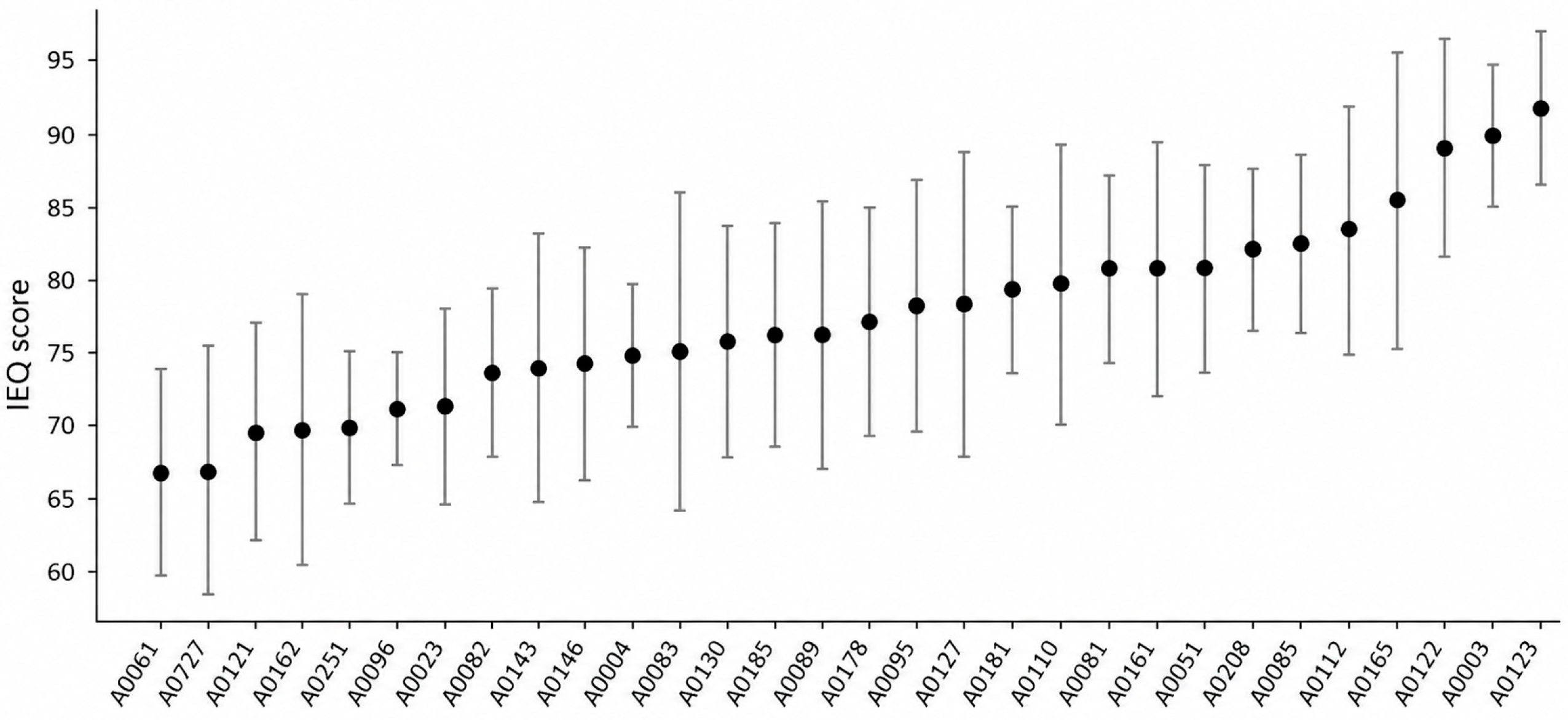
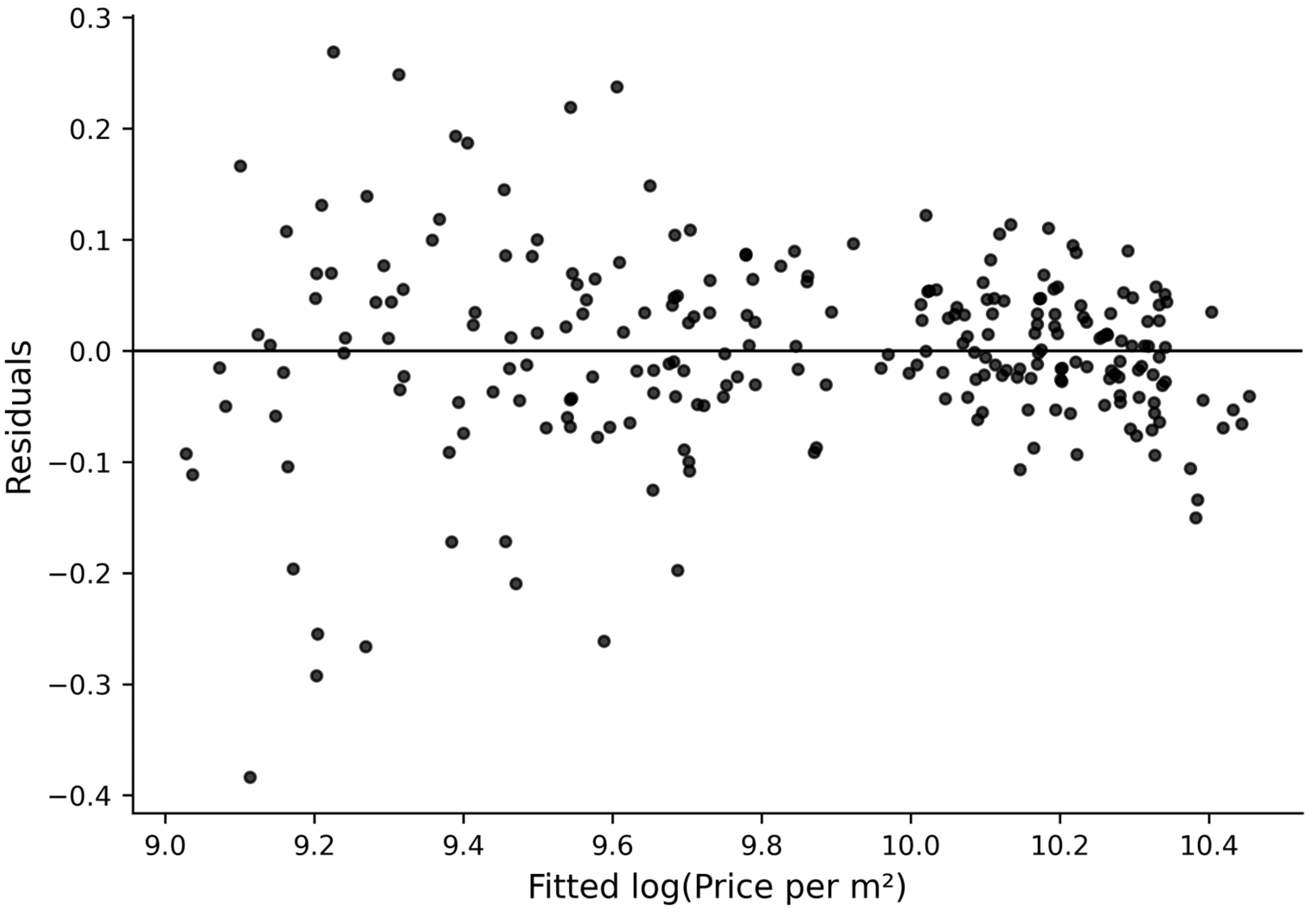
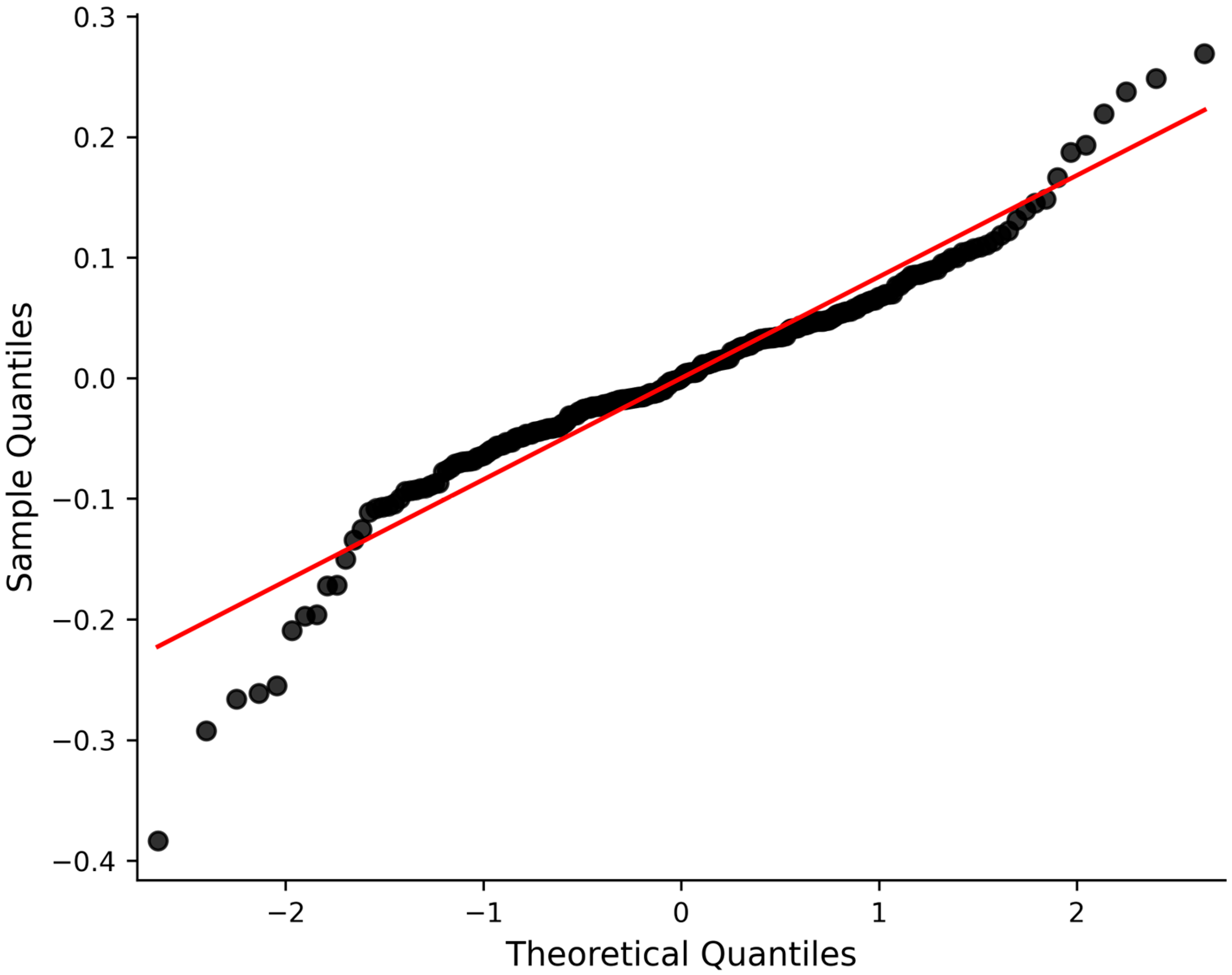
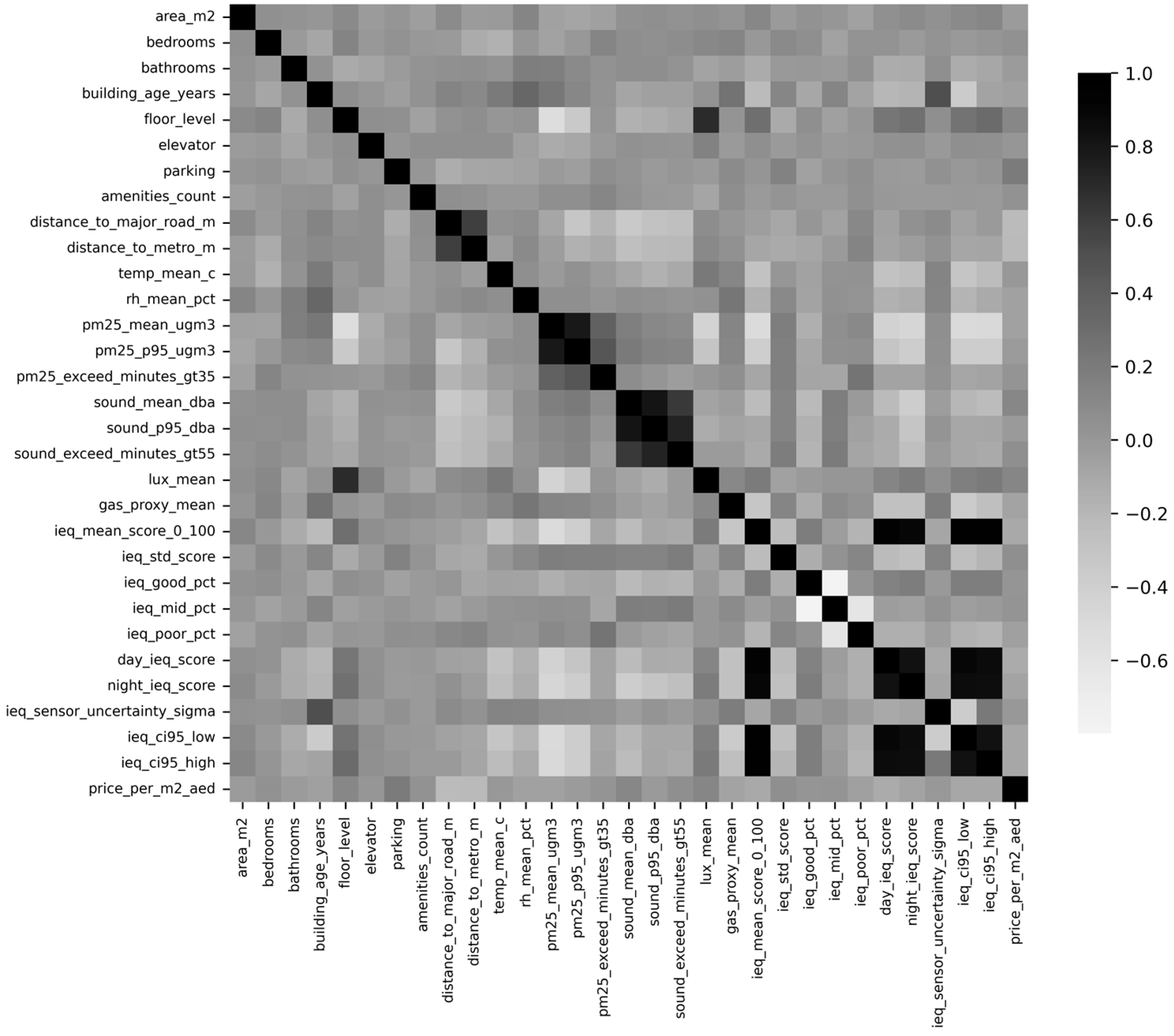
Figure 17, Figure 18, Figure 19 and Figure 20 together support model reliability and interpretation discipline rather than headline effect claims. The IEQ uncertainty-interval plot (Figure 17) shows that score differences across units are not equally precise, so ranking homes by point estimates alone can be misleading; uncertainty-aware reporting is therefore essential for fair comparison and certificate design. The residuals-versus-fitted plot (Figure 18) suggests no severe structural misspecification, though variance is somewhat uneven across fitted ranges, which is typical in housing data and supports robust standard errors. The QQ plot (Figure 19) shows approximate central normality with noticeable tail departures, indicating that inference should emphasize coefficient stability and robustness checks rather than strict Gaussian assumptions. Finally, the correlation heatmap (Figure 20) confirms coherent feature blocks (size/amenity/location and IEQ-related constructs) while also flagging predictable collinearity among derived IEQ components, justifying careful variable selection and regularized/parsimonious specifications in the full hedonic model.
The residual and QQ diagnostics suggest that tail deviations remain, which is expected in housing data and reinforces the need for robustness checks in future extensions.

3.6. Results Synthesis

Table 8, Table 9 and Table 10 jointly summarize the core findings. Table 8 reports the main regression drivers and shows that traditional controls (renovation, amenities, floor level, metro distance) dominate statistical significance, while IEQ terms are directionally consistent but weaker individually. Table 9 provides representative high-IEQ apartment profiles, illustrating that strong IEQ can appear across different price tiers. Table 10 compares model variants and shows modest in-sample fit gains (R2/AIC/BIC) when IEQ layers are added; however, cross-validated prediction gains are limited, indicating IEQ adds explanatory structure more than large out-of-sample forecasting improvement.

4. Discussion

The findings indicate that pooled, bivariate IEQ–price relationships are not sufficient to evaluate comfort-aware valuation in urban housing markets. In the present dataset, district and structural housing characteristics account for a large share of price variation, and these factors can be correlated with indoor environmental conditions in non-uniform ways. Consequently, interpretation should prioritize controlled hedonic specifications rather than raw scatter patterns. Under covariate and district controls, IEQ-related terms provide a directional incremental signal; however, this signal is modest and should be interpreted cautiously given mixed out-of-sample behavior and non-significant coefficients for some IEQ terms. This pattern suggests that IEQ is not a dominant price driver, but a secondary and non-redundant attribute that can improve differentiation among otherwise comparable units.
A second contribution is methodological: valuation relevance appears stronger when IEQ is represented not only by mean comfort, but also by stability, exceedance, and uncertainty descriptors. These features better reflect lived experience (e.g., episodic PM and noise burdens) and produce more defensible reporting than single-point scores. In valuation terms, they may proxy the difference between an apartment that is “acceptable on average” and one that is “reliably comfortable,” which is more likely to matter in buyer perception and market differentiation. From an implementation perspective, the proposed workflow—portable sensing, transparent scoring, and privacy-preserving edge aggregation—offers practical PropTech utility for inspection and listing contexts. Key limitations remain, including cross-sectional design, potential unobserved confounders, window representativeness, and low-cost sensor drift. Future work should prioritize transaction-linked longitudinal data, seasonal repetition, robustness diagnostics, and intervention-based designs to estimate where IEQ contributes materially to market outcomes.
The residential relevance of IEQ may also have increased in the post-pandemic period, when home environments became more multifunctional spaces for work, study, care, and prolonged daily occupancy. Under these conditions, indoor comfort and exposure quality are less likely to be perceived as secondary amenities and more likely to affect everyday utility, productivity, and housing preference. Recent work on human-centric urban activity patterns has similarly shown that shifts in daily routines, remote work, and time allocation can reshape expectations of residential comfort and neighborhood utility [61]. This broader context helps explain why IEQ may matter even if it remains weaker than location and structural variables in formal pricing models: as time spent at home increases, buyers may assign greater value to stable ventilation, low noise burden, and predictable comfort conditions.
Several limitations should therefore be interpreted explicitly. First, the sample is an exploratory district-stratified pilot dataset rather than a probability-based representation of the full Tehran housing market, so external generalization should be made cautiously. Second, IEQ is inherently dynamic not only within the day but also across seasons due to changing outdoor air quality, occupancy patterns, thermal behavior, and ventilation practices. Although the study incorporates day/night splits and short-window temporal descriptors, these do not substitute for repeated measurement across different seasons. The present results should therefore be interpreted as cross-sectional evidence under a limited temporal frame rather than as seasonally stable estimates of comfort-related valuation effects. Future work should prioritize transaction-linked longitudinal datasets, multi-season repeated measurement, and household-segment analysis to test whether IEQ-related price sensitivity strengthens under different occupancy and lifestyle conditions.
A further methodological limitation is that long-term sensor drift and multi-scenario recalibration were not modeled explicitly, so the uncertainty framework should be interpreted as partial rather than exhaustive error propagation.
Another limitation is that the analysis focuses on a log-linear hedonic model and does not yet test quantile, nonlinear, or semiparametric alternatives. As a result, the study identifies average conditional relationships but cannot determine whether IEQ carries stronger or weaker importance at different points of the price distribution.
Although the model includes district, structural, accessibility, and amenity variables, it does not fully capture all potentially relevant confounders. Unobserved neighborhood-quality dimensions, property-management quality, micro-location prestige, building-service conditions, and surrounding urban facilities may still influence price and may correlate with indoor conditions. Therefore, the results should be interpreted as conditional evidence under an incomplete but practically relevant control set, not as fully causal identification.
This worked example (Table 11) translates model coefficients into a practical market interpretation. Holding all baseline controls constant, Apartment B (higher IEQ mean, lower IEQ volatility, and lower IEQ uncertainty) is predicted to have a 4.31% higher price per m2 than Apartment A (approximately +862/m2 at a 20,000/m2 baseline). This controlled example supports the interpretation that IEQ provides incremental valuation signal beyond standard structural and location factors. Predictive-performance improvement for the model itself is evaluated separately in Table 10 using R2, AIC/BIC, and cross-validated RMSE metrics.

5. Conclusions

This study developed an IEQ-aware residential valuation framework that integrates low-cost IoT sensing, transparent feature engineering, and controlled hedonic modeling for 244 apartments across 12 districts in Tehran. The evidence indicates that raw pooled IEQ–price associations are weak and confounded by location and structural housing attributes. After introducing standard controls, IEQ variables provide a positive directional and incremental explanatory signal, particularly through mean comfort, stability, and uncertainty-related features. However, these effects are not consistently statistically significant across specifications, and out-of-sample prediction gains are limited relative to in-sample fit improvements.
Accordingly, IEQ should be interpreted as a secondary but non-redundant value layer rather than a dominant forecasting driver in residential pricing. The practical contribution is a deployable PropTech workflow—portable sensing, interpretable scoring, and privacy-preserving aggregation—that can improve transparency in inspection and listing contexts. Given the cross-sectional observational design, causal claims are not made. Future work should prioritize larger transaction-linked datasets, longitudinal/seasonal measurement, non-linear exceedance modeling, and intervention-based validation to estimate when and where IEQ materially affects market outcomes.

Author Contributions

Conceptualization, S.S.B. and S.M.; methodology, S.M. and S.S.B.; software, S.M.; formal analysis, S.M.; investigation, S.S.B.; data curation, S.M.; writing—original draft preparation, S.S.B. and S.M.; writing—review and editing, S.M., S.A., A.G. and S.T.; supervision, S.A. and A.G. All authors have read and agreed to the published version of the manuscript.

Funding

This research received no external funding.

Data Availability Statement

The data are available from the corresponding author upon reasonable request.

Conflicts of Interest

The authors declare that they have no conflict of interest.

Abbreviations

The following abbreviations are used in this manuscript:
AICAkaike Information Criterion
ASHRAEAmerican Society of Heating, Refrigerating and Air-Conditioning Engineers
BH1750Digital illuminance (lux) sensor module
BICBayesian Information Criterion
BIMBuilding Information Modeling
CO2Carbon dioxide
CO210Reference CO2 instrument (as cited in calibration description)
CSVComma-Separated Values
DHT22Digital temperature and relative humidity sensor
ENEuropean Norm (European standard)
ESP32Espressif 32-bit microcontroller family
HMIHuman–Machine Interface
HVACHeating, Ventilation, and Air Conditioning
IAQIndoor Air Quality
IEQIndoor Environmental Quality
IoTInternet of Things
MQ135MOS gas sensor used as a qualitative IAQ proxy
OLEDOrganic Light-Emitting Diode (display)
OSHAOccupational Safety and Health Administration
OTMOSHA Technical Manual
P9595th percentile
PMParticulate Matter
PM1Particulate matter with aerodynamic diameter ≤ 1 μm
PM2.5Particulate matter with aerodynamic diameter ≤ 2.5 μm
PM10Particulate matter with aerodynamic diameter ≤ 10 μm
PMS5003Plantower particulate matter sensor module
QQQuantile–Quantile (plot)
RHRelative Humidity
RFIDRadio-Frequency Identification
RMSERoot Mean Squared Error
R2Coefficient of determination
TVOCTotal Volatile Organic Compounds
UIUser Interface
USBUniversal Serial Bus
UTCCoordinated Universal Time
VLCVisible Light Communication
VOCVolatile Organic Compounds
WHOWorld Health Organization

References

  1. ASHRAE Standard 55-2023; Thermal Environmental Conditions for Human Occupancy. ASHRAE: Peachtree Corners, GA, USA, 2023.
  2. ANSI/ASHRAE Standard 62.1-2022; Ventilation and Acceptable Indoor Air Quality. ASHRAE: Peachtree Corners, GA, USA, 2022.
  3. ANSI/ASHRAE Standard 62.2-2022; Ventilation and Acceptable Indoor Air Quality in Residential Buildings. ASHRAE: Peachtree Corners, GA, USA, 2022.
  4. EN 16798-1:2019; Energy Performance of Buildings—Ventilation for Buildings—Part 1: Indoor Environmental Input Parameters for Design and Assessment of Energy Performance of Buildings Addressing Indoor Air Quality, Thermal Environment, Lighting and Acoustics—Module M1-6. European Committee for Standardization (CEN): Brussels, Belgium, 2019.
  5. Ashton, K. That ‘internet of things’ thing. RFID J. 2009, 22, 97–114. [Google Scholar]
  6. Union, I.T. Internet of Things: IoT Day Special; LexInnova Technologies, LLC: Houston, TX, USA, 2005; Volume 7. [Google Scholar]
  7. Sivanathan, A.; Gharakheili, H.H.; Loi, F.; Radford, A.; Wijenayake, C.; Vishwanath, A.; Sivaraman, V. Classifying IoT devices in smart environments using network traffic characteristics. IEEE Trans. Mob. Comput. 2018, 18, 1745–1759. [Google Scholar] [CrossRef]
  8. Hui, J.Y.; Leong, D. The era of ubiquitous listening: Living in a world of speech-activated devices. Asian J. Public Aff. 2017, 10, e5. [Google Scholar] [CrossRef]
  9. Grabovyy, P.G.; Volkov, R.V.; Volgin, V.V. Intelligent real estate management. Real Estate Econ. Manag. 2023, 1, 16–20. [Google Scholar] [CrossRef]
  10. Gharaibeh, A.; Salahuddin, M.A.; Hussini, S.J.; Khreishah, A.; Khalil, I.; Guizani, M.; Al-Fuqaha, A. Smart cities: A survey on data management, security, and enabling technologies. IEEE Commun. Surv. Tutor. 2017, 19, 2456–2501. [Google Scholar] [CrossRef]
  11. Fauzi, N.S.; Zainuddin, A.; Chuweni, N.N.; Johari, N.; Nawawi, A.H. The bridge of corporate real estate sustainable management. Int. J. Acad. Res. Bus. Soc. Sci. 2021, 11, 986–993. [Google Scholar] [CrossRef]
  12. Ullah, F.; Sepasgozar, S.M.E.; Wang, C. A systematic review of smart real estate technology: Drivers of, and barriers to, the use of digital disruptive technologies and online platforms. Sustainability 2018, 10, 3142. [Google Scholar] [CrossRef]
  13. Li, Q.; Wang, Q.; Lin, Z. Effects of consumer visit to online community and product channel on local sales of large consumer goods: Evidence from real estate industry. J. Strateg. Inf. Syst. 2018, 27, 191–204. [Google Scholar] [CrossRef]
  14. Gountas, S.; Gountas, J.; Mavondo, F.T. Exploring the associations between standards for service delivery (organisational culture), co-worker support, self-efficacy, job satisfaction and customer orientation in the real estate industry. Aust. J. Manag. 2014, 39, 107–126. [Google Scholar] [CrossRef]
  15. Pan, J.-N.; Huang, J.-T.; Chiang, T.-F. Empirical study of the local government deficit, land finance and real estate markets in China. China Econ. Rev. 2015, 32, 57–67. [Google Scholar] [CrossRef]
  16. Robertson, S.; Rogers, D. Education, real estate, immigration: Brokerage assemblages and Asian mobilities. J. Ethn. Migr. Stud. 2017, 43, 2393–2407. [Google Scholar] [CrossRef]
  17. OSHA. OSHA Technical Manual (OTM) Section III: Chapter 2 Indoor Air Quality Investigation; OSHA: Washington, DC, USA, 1996. [Google Scholar]
  18. Bovkir, R.; Ustaoglu, E.; Aydinoglu, A.C. Assessment of Urban Quality of Life Index at Local Scale with Different Weighting Approaches. Soc. Indic. Res. 2023, 165, 655–678. [Google Scholar] [CrossRef]
  19. Hou, H.C.; Zhang, D.; Lai, J.H. Qualitative and quantitative investigation into the indoor built environment of modular student housing: A multiple-room case study. Energy Build. 2023, 280, 112734. [Google Scholar]
  20. Stoyanova, M.; Vasilev, J.; Cristescu, M. Big data in property management. In AIP Conference Proceedings; AIP Publishing: Melville, NY, USA, 2021. [Google Scholar]
  21. Javaid, M.; Haleem, A.; Rab, S.; Singh, R.P.; Suman, R. Sensors for daily life: A review. Sens. Int. 2021, 2, 100121. [Google Scholar] [CrossRef]
  22. Honcharenko, T.; Kyivska, K.; Serpinska, O.; Savenko, V.; Kysliuk, D.; Orlyk, Y. Digital Transformation of the Construction Design Based on the Building Information Modeling and Internet of Things. In Proceedings of the ITTAP’ 2021: 1nd International Workshop on Information Technologies: Theoretical and Applied Problems, Ternopil, Ukraine, 16–18 November 2021. [Google Scholar]
  23. Treleaven, P.; Barnett, J.; Knight, A.; Serrano, W. Real estate data marketplace. AI Ethics 2021, 1, 445–462. [Google Scholar] [CrossRef]
  24. Martínez, I.; Zalba, B.; Trillo-Lado, R.; Blanco, T.; Cambra, D.; Casas, R. Internet of things (Iot) as sustainable development goals (sdg) enabling technology towards smart readiness indicators (sri) for university buildings. Sustainability 2021, 13, 7647. [Google Scholar] [CrossRef]
  25. Ghosh, A.; Edwards, D.J.; Hosseini, M.R. Patterns and trends in Internet of Things (IoT) research: Future applications in the construction industry. Eng. Constr. Archit. Manag. 2021, 28, 457–481. [Google Scholar] [CrossRef]
  26. Mujan, I.; Licina, D.; Kljajić, M.; Čulić, A.; Anđelković, A.S. Development of indoor environmental quality index using a low-cost monitoring platform. J. Clean. Prod. 2021, 312, 127846. [Google Scholar] [CrossRef]
  27. Siniak, N.; Kauko, T.; Shavrov, S.; Marina, N. The impact of proptech on real estate industry growth. In IOP Conference Series: Materials Science and Engineering; IOP Publishing: Bristol, UK, 2020. [Google Scholar]
  28. Akindele, N.A.; Ogundile, O.P.; Ogunniyi, P.O. The relevance of the internet of things to the real estate profession. J. Phys. Conf. Ser. 2021, 1734, 012013. [Google Scholar] [CrossRef]
  29. Lin, Y.; Obuchi, Y.; Wang, X.; Yamasaki, T.; Kitagaki, R.; Toriumi, S.; Hayashi, M.; Sakai, A.; Haga, N.; Nomura, S.; et al. Real estate evaluation on thermal diffusivity with IoT sensors. In Proceedings of the 2019 IEEE 8th Global Conference on Consumer Electronics (GCCE), Osaka, Japan, 15–18 October 2019; IEEE: New York, NY, USA, 2019. [Google Scholar]
  30. Obuchi, Y.; Yamasaki, T.; Aizawa, K.; Toriumi, S.; Hayashi, M. Measurement and evaluation of comfort levels of apartments using IoT sensors. In Proceedings of the 2018 IEEE International Conference on Consumer Electronics (ICCE), Las Vegas, NV, USA, 12–14 January 2018; IEEE: New York, NY, USA, 2018. [Google Scholar]
  31. Dave, B.; Buda, A.; Nurminen, A.; Främling, K. A framework for integrating BIM and IoT through open standards. Autom. Constr. 2018, 95, 35–45. [Google Scholar] [CrossRef]
  32. Sepasgozar, S.M.; Davis, S. Construction technology adoption cube: An investigation on process, factors, barriers, drivers and decision makers using NVivo and AHP analysis. Buildings 2018, 8, 74. [Google Scholar] [CrossRef]
  33. Ong, Z.; Rachim, V.P.; Chung, W.-Y. Novel electromagnetic-interference-free indoor environment monitoring system by mobile camera-image-sensor-based VLC. IEEE Photonics J. 2017, 9, 7907111. [Google Scholar] [CrossRef]
  34. Loriot, M.; Aljer, A.; Shahrour, I. Analysis of the use of LoRaWan technology in a large-scale smart city demonstrator. In Proceedings of the 2017 Sensors Networks Smart and Emerging Technologies (SENSET), Beiriut, Lebanon, 12–14 September 2017; IEEE: New York, NY, USA, 2017. [Google Scholar]
  35. Angelova, N.; Kiryakova, G.; Yordanova, L. The great impact of internet of things on business. Trakia J. Sci. 2017, 15, 406–412. [Google Scholar] [CrossRef]
  36. Stojkoska, B.L.R.; Trivodaliev, K.V. A review of Internet of Things for smart home: Challenges and solutions. J. Clean. Prod. 2017, 140, 1454–1464. [Google Scholar] [CrossRef]
  37. Tao, M.; Zuo, J.; Liu, Z.; Castiglione, A.; Palmieri, F. Multi-layer cloud architectural model and ontology-based security service framework for IoT-based smart homes. Future Gener. Comput. Syst. 2018, 78, 1040–1051. [Google Scholar] [CrossRef]
  38. Pavithra, D.; Balakrishnan, R. IoT based monitoring and control system for home automation. In Proceedings of the 2015 Global Conference on Communication Technologies (GCCT), Thuckalay, India, 23–24 April 2015; IEEE: New York, NY, USA, 2015. [Google Scholar]
  39. Yasumoto, K.; Ogura, K.; Yamamoto, S.; Ito, M. Device Control Method for Energy-Saving with Minimal Degradation of Users’ Comfort Level. IPSJ SIG Tech. Rep. 2011, 2011, 1–8. [Google Scholar]
  40. Thom, E.C. The discomfort index. Weatherwise 1959, 12, 57–61. [Google Scholar] [CrossRef]
  41. Sousan, S.; Koehler, K.; Hallett, L.; Peters, T.M. Evaluation of consumer monitors to measure particulate matter. J. Aerosol Sci. 2017, 107, 123–133. [Google Scholar] [CrossRef]
  42. Zamora, M.L.; Rice, J.; Koehler, K. One year evaluation of three low-cost PM2.5 monitors. Atmos. Environ. 2020, 235, 117615. [Google Scholar] [CrossRef]
  43. Singer, B.C.; Delp, W.W. Response of consumer and research grade indoor air quality monitors to residential sources of fine particles. Indoor Air 2018, 28, 624–639. [Google Scholar] [CrossRef]
  44. Wang, Z.; Delp, W.W.; Singer, B.C. Performance of low-cost indoor air quality monitors for PM2.5 and PM10 from residential sources. Build. Environ. 2020, 171, 106654. [Google Scholar] [CrossRef]
  45. Tiele, A.; Esfahani, S.; Covington, J. Design and development of a low-cost, portable monitoring device for indoor environment quality. J. Sens. 2018, 2018, 5353816. [Google Scholar] [CrossRef]
  46. Demanega, I.; Mujan, I.; Singer, B.C.; Anđelković, A.S.; Babich, F.; Licina, D. Performance assessment of low-cost environmental monitors and single sensors under variable indoor air quality and thermal conditions. Build. Environ. 2021, 187, 107415. [Google Scholar] [CrossRef]
  47. Ali, A.S.; Zanzinger, Z.; Debose, D.; Stephens, B. Open Source Building Science Sensors (OSBSS): A low-cost Arduino-based platform for long-term indoor environmental data collection. Build. Environ. 2016, 100, 114–126. [Google Scholar] [CrossRef]
  48. Parkinson, T.; Parkinson, A.; de Dear, R. Continuous IEQ monitoring system: Context and development. Build. Environ. 2019, 149, 15–25. [Google Scholar] [CrossRef]
  49. Jin, M.; Liu, S.; Schiavon, S.; Spanos, C. Automated mobile sensing: Towards high-granularity agile indoor environmental quality monitoring. Build. Environ. 2018, 127, 268–276. [Google Scholar] [CrossRef]
  50. Karami, M.; McMorrow, G.V.; Wang, L. Continuous monitoring of indoor environmental quality using an Arduino-based data acquisition system. J. Build. Eng. 2018, 19, 412–419. [Google Scholar] [CrossRef]
  51. Sabhapandit, E.; Prarthana, P.; Suresh, S.; Jindal, S.K. Modification of Automotive HVAC Systems to Automatically Control Vehicular Cabin CO2 Concentration. In Proceedings of Second International Conference on Computational Electronics for Wireless Communications: ICCWC 2022; Springer: Singapore, 2023. [Google Scholar]
  52. Kim, J.; Bang, J.; Choi, A.; Moon, H.J.; Sung, M. Estimation of occupancy using IoT sensors and a carbon dioxide-based machine learning model with ventilation system and differential pressure data. Sensors 2023, 23, 585. [Google Scholar] [CrossRef]
  53. Vasudevan, J.; Coakley, D.; Angelopoulos, C.; Rastogi, P.; Sobek, O.N.; Jephson, G.; Eftekhari, M.; Dimitriou, V. Monitoring Indoor Environmental Quality (IEQ) in Buildings with Distributed Sensing. In Proceedings of IAQ 2020: Indoor Environmental Quality Performance Approaches, Athens, Greece, 4–6 May 2022; Available online: https://www.aivc.org/resource/monitoring-indoor-environmental-quality-ieq-buildings-distributed-sensing (accessed on 27 April 2026).
  54. Majid, M.; Habib, S.; Javed, A.R.; Rizwan, M.; Srivastava, G.; Gadekallu, T.R.; Lin, J.C.-W. Applications of wireless sensor networks and internet of things frameworks in the industry revolution 4.0: A systematic literature review. Sensors 2022, 22, 2087. [Google Scholar] [CrossRef]
  55. Nourildean, S.W.; Hassib, M.D.; Mohammed, Y.A. Internet of things based wireless sensor network: A review. Indones. J. Electr. Eng. Comput. Sci. 2022, 27, 246–261. [Google Scholar] [CrossRef]
  56. OSHA. Reiteration of Existing OSHA Policy on Indoor Air Quality; OSHA: Washington, DC, USA, 2003. [Google Scholar]
  57. Arundel, A.V.; Sterling, E.M.; Biggin, J.H.; Sterling, T.D. Indirect health effects of relative humidity in indoor environments. Environ. Health Perspect. 1986, 65, 351–361. [Google Scholar]
  58. McIntyre, D. Response to atmospheric humidity at comfortable air temperature: A comparison of three experiments. Ann. Occup. Hyg. 1978, 21, 177–190. [Google Scholar] [CrossRef]
  59. EPA. National Ambient Air Quality Standards (NAAQS) for PM; EPA: Washington, DC, USA, 2023. [Google Scholar]
  60. Salthammer, T. Very volatile organic compounds: An understudied class of indoor air pollutants. Indoor Air 2016, 26, 25–38. [Google Scholar] [CrossRef]
  61. Wang, Q.-C.; He, P.; Li, Y.; Hou, Y.; Jian, Y.I.; Liu, X. Towards a human-centric city emergency response: Modelling activity patterns of urban population. Dev. Built Environ. 2025, 21, 100633. [Google Scholar] [CrossRef]
Figure 1. End-to-end study pipeline from sensing to hedonic valuation and reporting.
Buildings 16 02365 g001
Figure 2. Assembled IEQ prototype using ESP32 and multi-sensor modules (PMS5003, MQ135, DHT22, BH1750, microphone).
Buildings 16 02365 g002
Figure 3. Distribution of (price per m2).
Buildings 16 02365 g003
Figure 4. Distribution of log (price per m2).
Buildings 16 02365 g004
Figure 5. Distribution of IEQ mean score (0–100).
Buildings 16 02365 g005
Figure 6. Distribution of the IEQ stability metric.
Buildings 16 02365 g006
Figure 7. Price per m2 by district (boxplot). Boxes show the interquartile range with the median indicated by the central line; whiskers indicate the non-outlier range, and circles indicate outliers.
Buildings 16 02365 g007
Figure 8. IEQ mean by district (boxplot). Boxes show the interquartile range with the median indicated by the central line; whiskers indicate the non-outlier range, and circles indicate outliers.
Buildings 16 02365 g008
Figure 9. District-level mean price vs. district-level mean IEQ.
Buildings 16 02365 g009
Figure 10. Price per m2 vs. IEQ mean (pooled, uncontrolled). Dots represent individual apartment observations, and the solid line indicates the fitted linear trend.
Buildings 16 02365 g010
Figure 11. log (price per m2) vs. IEQ mean (pooled, uncontrolled). Dots represent individual apartment observations, and the solid line indicates the fitted linear trend.
Buildings 16 02365 g011
Figure 12. PM2.5 mean vs. distance to major road.
Buildings 16 02365 g012
Figure 13. Sound mean vs. distance to major road.
Buildings 16 02365 g013
Figure 14. Price per m2 vs. PM2.5 exceedance minutes.
Buildings 16 02365 g014
Figure 15. Price per m2 vs. sound exceedance minutes.
Buildings 16 02365 g015
Figure 16. Similar IEQ mean, different stability/exposure profiles.
Buildings 16 02365 g016
Figure 17. IEQ uncertainty intervals. Dots indicate the central IEQ score estimate for each unit, and vertical lines indicate the corresponding uncertainty interval.
Buildings 16 02365 g017
Figure 18. Residuals vs. fitted values (full model).
Buildings 16 02365 g018
Figure 19. QQ plot of residuals (full model). Dots represent the ordered residual quantiles, and the red line indicates the normal-reference line used to assess departure from normality.
Buildings 16 02365 g019
Figure 20. Correlation heatmap (numeric variables).
Buildings 16 02365 g020
Table 1. Sensor modules and measured parameters.
Sensor ModuleManufacturer (as Reported)Measured Parameter (s)Operating Principle (as Described)
DHT22 (AM2302)AosongTemperature; Relative humidityCapacitive RH + NTC temperature element
PMS5003PlantowerParticulate matter: PM1.0; PM2.5; PM10Laser-scattering particle sensor
BH1750ROHM SemiconductorIlluminance (lux)Photodiode-based light sensing (lux)
MQ135WinsenGas/IAQ indicator (NH3, sulfur compounds, benzene, CO2 proxy, other gases; smoke)Metal-oxide gas sensor with multi-gas sensitivity (qualitative IAQ proxy)
Adafruit #1063AdafruitSound level (dB proxy)Electret microphone module (sound intensity proxy)
Table 2. Measurement ranges and nominal accuracies.
Measurement TypeRange (as Printed)Accuracy (as Printed)
Relative humidity0–100% RH±2% RH
Temperature−40 to 125 °C±0.3 °C
PM2.5/PM100–1000 µg/m3±15%
Illuminance (light)0–17,000 lux±5 lux
Microphone (sound)0–80 dB±5 dB
Table 3. Dataset variable definitions (listing covariates and engineered IEQ features).
VariableDefinition
Apartment idUnique apartment identifier
DistrictDistrict category (location control)
Area (m2)Apartment floor area (m2)
bedroomsBedrooms (0 = studio)
bathroomsBathrooms
Building age yearsBuilding age (years)
floor_levelFloor level
ElevatorElevator available (0/1)
ParkingParking available (0/1)
Amenities countCount of amenities
Renovation statusRenovation status (categorical)
OrientationOrientation (categorical)
Distance to major road (m)Distance to major road (m)
Road proximity (cat)Road proximity category (Near/Medium/Far)
Distance to metro (m)Distance to metro/transit (m)
Temp mean cTemperature mean (°C)
Rh mean pctRelative humidity mean (%)
pm25 mean (µg/m3)PM2.5 mean (µg/m3)
pm25 p95 (µg/m3)PM2.5 95th percentile (µg/m3)
pm25 exceed minutes (gt35)Minutes above PM2.5 > 35 µg/m3 (100-min window)
Sound mean (dba)Sound mean (dBA)
Sound p95 (dba)Sound 95th percentile (dBA)
Sound exceed minutes (gt55)Minutes above sound > 55 dBA (100-min window)
Lux meanIlluminance mean (lux)
Gas proxy meanGas/IAQ proxy (sensor units)
Ieq mean score (0–100)Composite IEQ mean score (0–100)
Ieq std scoreIEQ stability (std dev)
Ieq good (pct)Proportion of time in ‘good’ band
Ieq mid (pct)Proportion of time in ‘mid’ band
Ieq poor (pct)Proportion of time in ‘poor’ band
Day ieq (score)Daytime IEQ score
Night ieq (score)Nighttime IEQ score
Ieq sensor uncertainty (sigma)Estimated IEQ uncertainty (sigma)
Ieq ci95 lowLower 95% CI for IEQ
Ieq ci95 highUpper 95% CI for IEQ
Price per (m2)Outcome: price per m2
Ieq pct (sum)Check: good + mid + poor proportion sum
Table 4. Alignment of study IEQ indicators with external benchmark frameworks.
IEQ IndicatorStudy Metric/Threshold UsedExternal Benchmark ContextRelationship to Benchmark
Temperature16–24 °C operational bandASHRAE 55 thermal comfort frameworkA simplified fixed operational band used for portable screening rather than a full PMV/PPD comfort model.
Relative humidity40–70% RHASHRAE/indoor comfort guidanceUsed as a practical comfort and screening range for residential comparison.
PM2.5Exceedance > 35 µg/m3WHO air-quality guidance/health-based particulate framingUsed as an operational exceedance indicator rather than a direct compliance judgment.
PM10Exceedance > 150 µg/m3WHO/ambient particulate-health framingUsed as an operational exceedance indicator for valuation-oriented reporting.
Sound0–70 dB good band; >80 dB health-risk bandWHO noise-health contextImplemented as a simplified residential screening threshold for repeated indoor exposure.
Table 5. IEQ bands used for scoring.
IEQ ParameterEnvironmental Band Health-Risk Band
Relative humidity40–70% RHOutside 40–70% RH (<40% or >70%)
Temperature16–24 °COutside 16–24 °C (<16 °C or >24 °C)
PM2.5<35 µg/m3>35 µg/m3
PM10<150 µg/m3>150 µg/m3
Illuminance200–500 lux<100 lux
Sound levels0–70 dB>80 dB
Table 6. IEQ parameter weights.
ParameterWeight in IEQ (%)IEQ Sub-Domain
Relative humidity10Thermal comfort; indoor air quality
Temperature20Thermal comfort; indoor air quality
PM2.515Indoor air quality
PM1015Indoor air quality
Illuminance20Indoor lighting quality
Sound level20Acoustic comfort
Table 7. IEQ qualitative labels.
IEQ Score Range (%)Qualitative Label (as Printed)
0–40Bad
40–60Poor
60–70Below average
70–80Average
80–90Above average
90–100Good
Table 8. Top model drivers.
TermCoeftp
Intercept9.7254660.413490.0
C (renovation status)
[T.Original]
−0.08039−4.027186 × 10⁻⁵
Amenities count0.010623.425660.00061
Floor level0.002722.925520.00344
Distance to metro (m)−4 × 10⁻⁵−2.456130.01404
C (renovation status)
[T.Partially Renovated]
−0.04977−2.364610.01805
Ieq sensor uncertainty sigma−0.0146−1.861480.06268
Ieq std score−0.00671−1.652390.09846
Building age years−0.00231−1.611870.10699
bedrooms−0.00825−1.345430.17848
Ieq mean score (0_100)0.002441.326090.18481
C (orientation) [T.N]0.023661.093680.2741
C (orientation) [T.NW]−0.02123−0.843280.39907
Distance to major road (m)−3 × 10⁻⁵−0.820390.41199
C (orientation) [T.SE]−0.02033−0.714920.47466
pm25 exceed minutes (gt35)0.001350.501940.61571
Sound exceed minutes (gt55)−9 × 10⁻⁵−0.128630.89765
Table 9. Representative high-IEQ apartments (top sample rows).
Apartment_IdDistrictPrice (per m2)Ieq Mean Score (0_100)Ieq Std (Score)Ieq ci95 (Low)Ieq ci95 (High)pm25 p95 (µg/m3)pm25 Exceed Minutes (gt35)Sound p95 (dba)Sound Exceed Minutes (gt55)Temp Mean (c)Rh Mean (pct)Lux Mean
A0167District_0413,34893.686.5387.4599.908.63050.24624.8151.7275.2
A0174District_0412,46392.064.1181.92100.0019.63050.08023.7450.1196.7
A0123District_0120,51891.932.2186.5897.288.59055.46524.2252.0268.1
A0172District_0417,37791.703.6181.87100.0021.35057.681524.2143.4241.3
A0003District_0532,15189.994.2985.0894.9020.16051.28024.0544.6157.0
A0002District_0531,24689.953.4082.7097.2129.53851.97024.1046.4379.5
A0120District_0120,60789.948.0182.3497.5410.62041.29024.9050.6422.0
A0122District_0120,50489.142.0081.5696.7210.65040.12024.6353.6384.3
Table 10. Hedonic model comparison metrics.
ModelR2Adj. R2AICBICCV RMSE (log)CV RMSE (Price/m2)
Baseline controls0.95270.9461−438.8751−330.46290.09851626.2720
IEQ mean0.95340.9466−440.4225−328.51320.09851643.1367
Stability + exposure0.95470.9474−441.4062−319.00530.09791665.5893
Uncertainty (full)0.95550.9480−443.7458−317.84780.09791677.9666
Table 11. Controlled Two-Apartment Comparison Under the Full IEQ Hedonic Model.
ComponentApartment AApartment BΔ (B − A)Coefficient (β)Contribution to Δln(Price) = β × Δ
IEQ mean score (0–100)76.0086.00+10.00+0.00244+0.02440
IEQ stability (IEQ std)7.005.00−2.00−0.00671+0.01342
IEQ uncertainty (sigma)1.100.80−0.30−0.01460+0.00438
Total effect Δln(Price) = 0.04220
Price multiplier exp(0.04220) = 1.04310
Baseline predicted price (same controls)20,000.00/m2
Predicted price for Apartment B 20,862.00/m2
Predicted difference (B − A) +862.00/m2 +4.31%
Note: In this illustrative comparison, all baseline control variables are held constant across both apartments, including district fixed effects, area, bedrooms, bathrooms, building age, floor level, elevator, parking, renovation status, amenities count, distance to metro, distance to major road, and orientation. Therefore, the estimated price difference reflects only IEQ-related terms (mean IEQ, IEQ stability, and IEQ uncertainty) from the full model.
Disclaimer/Publisher’s Note: The statements, opinions and data contained in all publications are solely those of the individual author(s) and contributor(s) and not of MDPI and/or the editor(s). MDPI and/or the editor(s) disclaim responsibility for any injury to people or property resulting from any ideas, methods, instructions or products referred to in the content.