Next-Generation Seismic Resilience of Urban Infrastructure: A Critical Review and “3C Framework” Roadmap Under Near-Fault Ground Motions


Abstract
1. Introduction
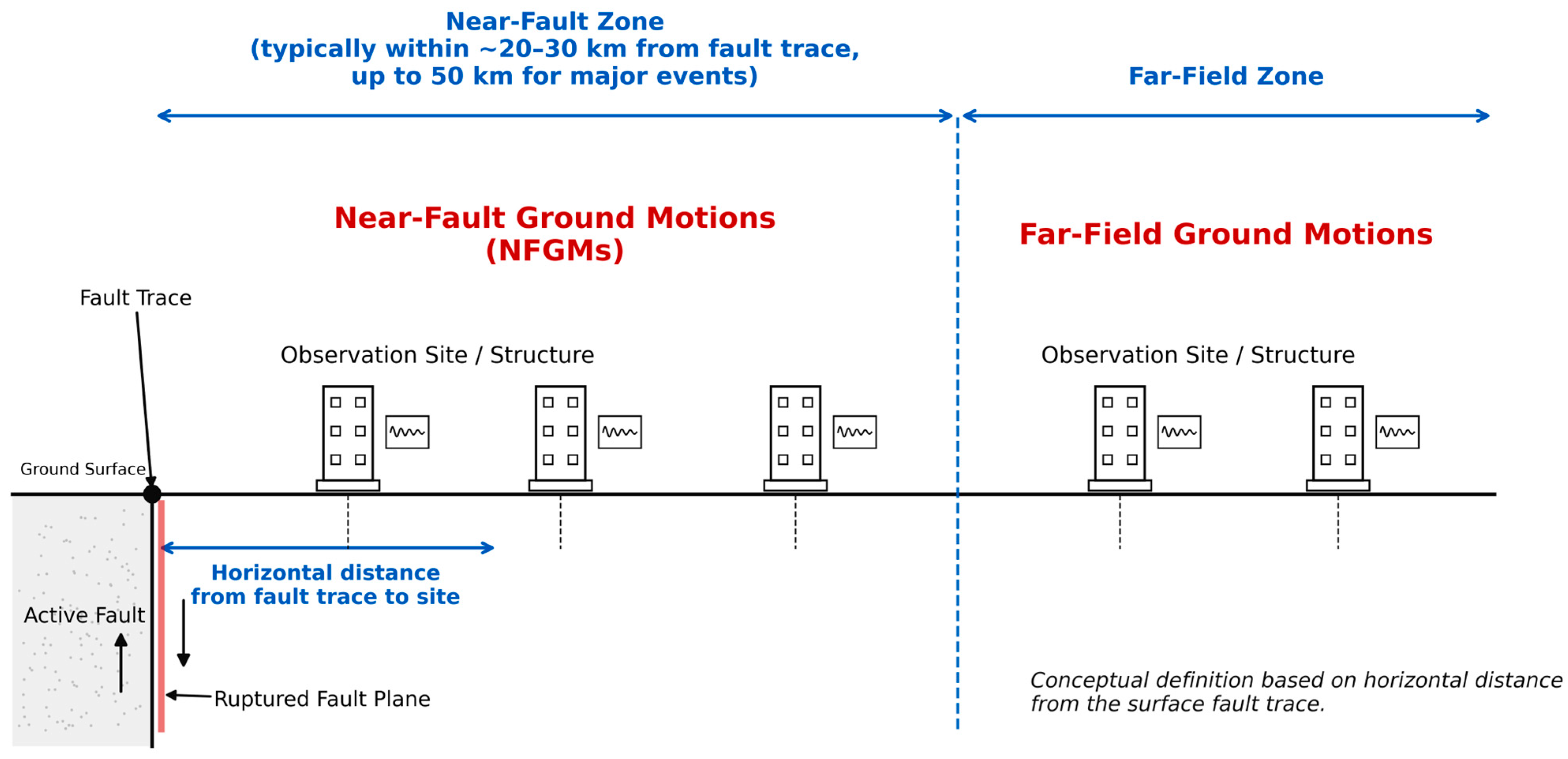
1.1. Background and Motivation
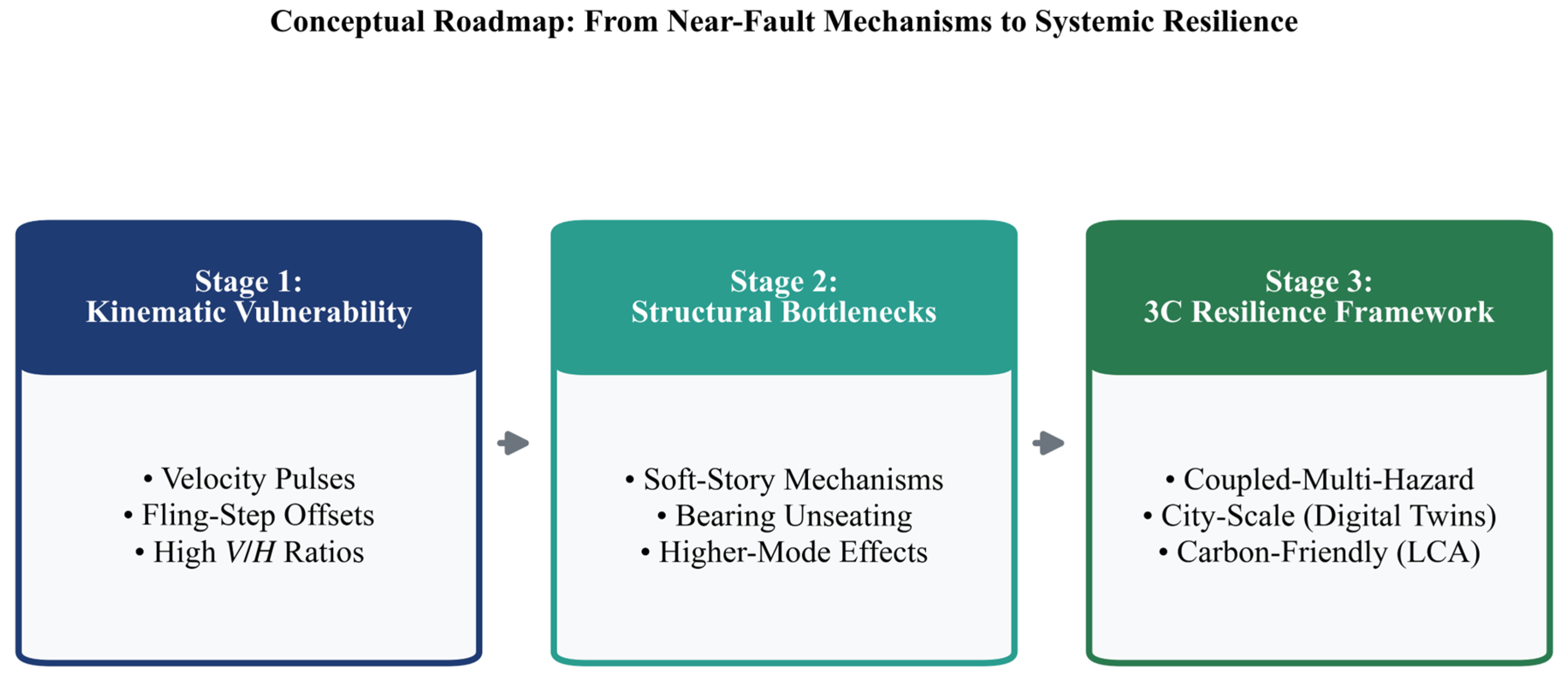
1.2. Scope and Objectives
2. Response Bottlenecks and Resilience Enhancement Strategies for Engineering Structures Under NFGMs
2.1. Industrial and Lifeline Infrastructure: Equipment-Structure Interaction
2.2. Flexible Structural Systems: Bridges, Towers, and Civil Buildings
2.2.1. Bridges
2.2.2. Wind Turbine Towers
2.2.3. Civil Buildings
2.3. Underground Structures and Soil–Structure Interaction
3. Future Perspectives: The “3C” Integrated Framework
3.1. Coupled-Multi-Hazard and City-Scale Interdependencies
3.2. Carbon-Friendly Design and Life-Cycle Assessment
4. Regulatory Evolutions and Computational Enablers
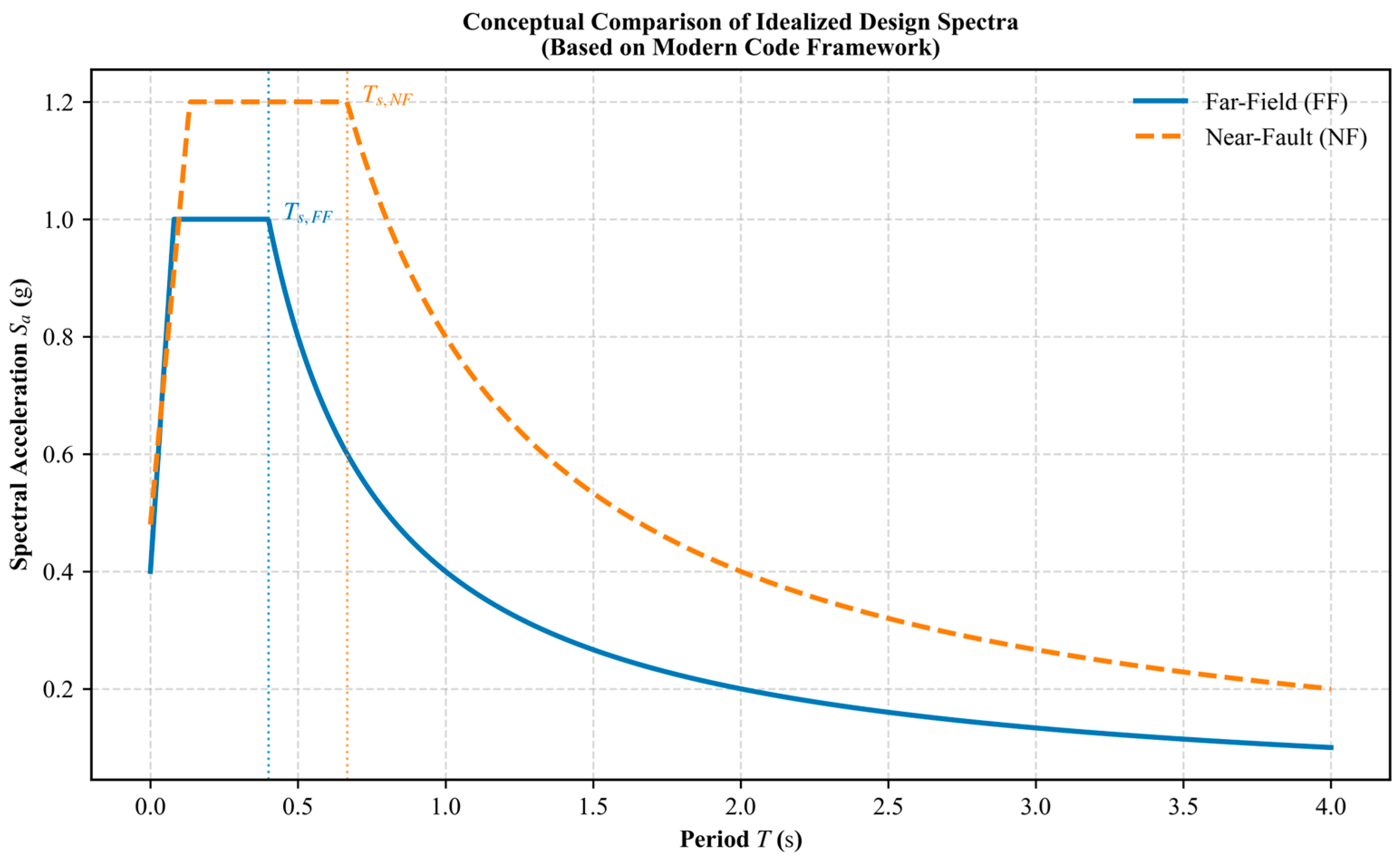
4.1. Scrutiny of ASCE 7-22 and Eurocode 8 Spectral Evolutions
4.2. Surrogate Modeling and Digital Twins
4.3. Illustrative Benchmark Synthesis of the 3C Roadmap
4.4. Future Research Priorities
- (1)
- Material Scalability: Advancing the metallurgical processing and low-cost scalable production of Iron-based SMAs (Fe-SMAs) to replace expensive Ni-Ti alloys in mainstream structural applications.
- (2)
- Physics-Data Fusion Standardization: Developing standardized training protocols for Physics-Informed Neural Networks (PINNs) operating on sparse, incomplete empirical datasets typical of extreme near-fault ruptures.
- (3)
- Cross-Domain Lifeline Interdependency: Formulating unified multi-hazard simulation platforms capable of capturing the dynamic cascading feedback loops between physical structural degradation and socio-economic network functionality.
5. Conclusions and Future Roadmaps
- (1)
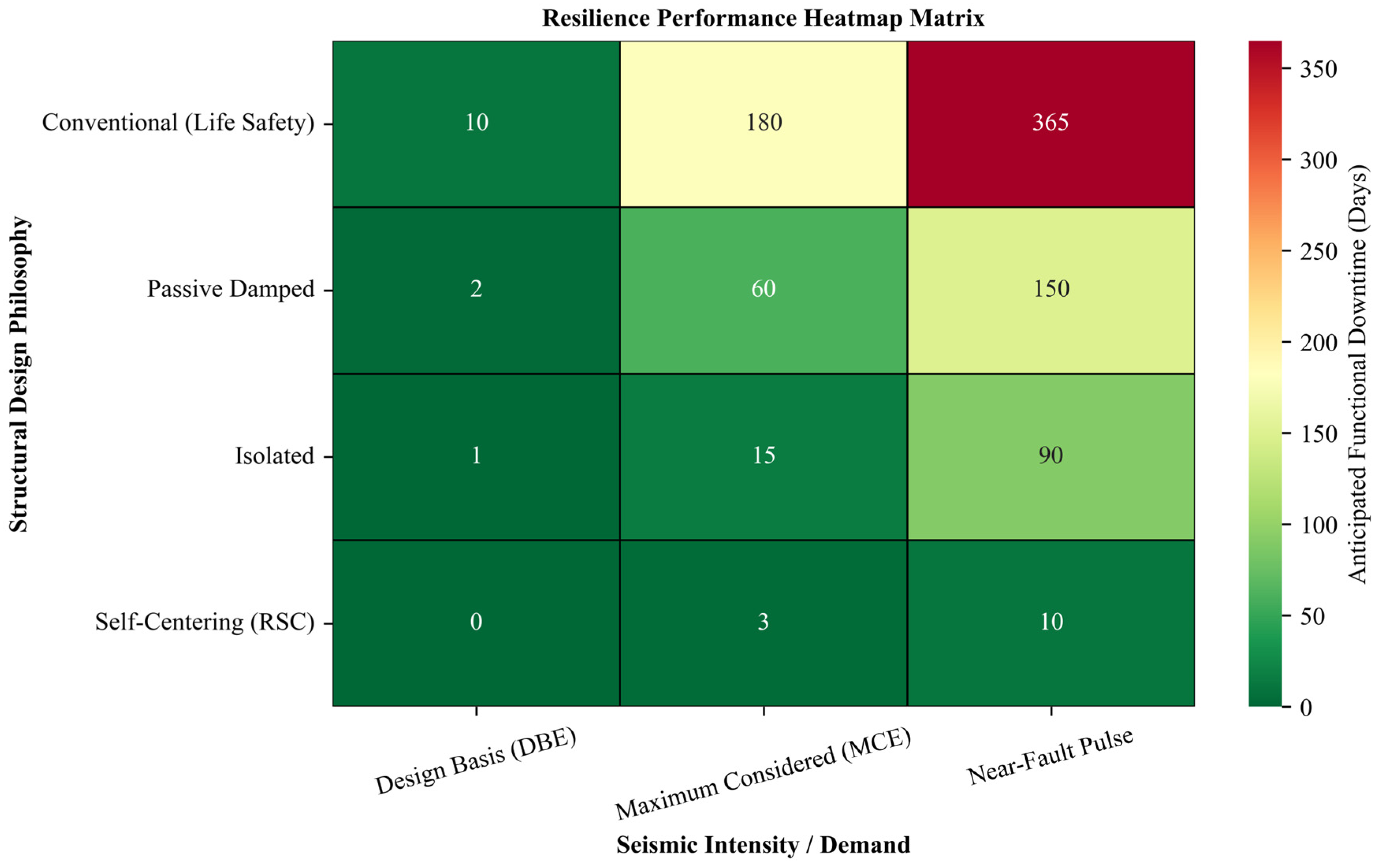
- The high-energy velocity pulses and pronounced vertical fluctuations inherent in NFGMs impose severe kinematic incompatibility on conventional structural systems. Across diverse archetypes—from civil buildings to wind towers and bridge systems—the instantaneous kinetic energy frequently overwhelms traditional hysteretic capacities. This exposes an acute kinematic vulnerability, underscoring that relying on widespread plasticity inevitably leads to severe, often irreparable residual drifts and prohibitive functional downtime.
- (2)
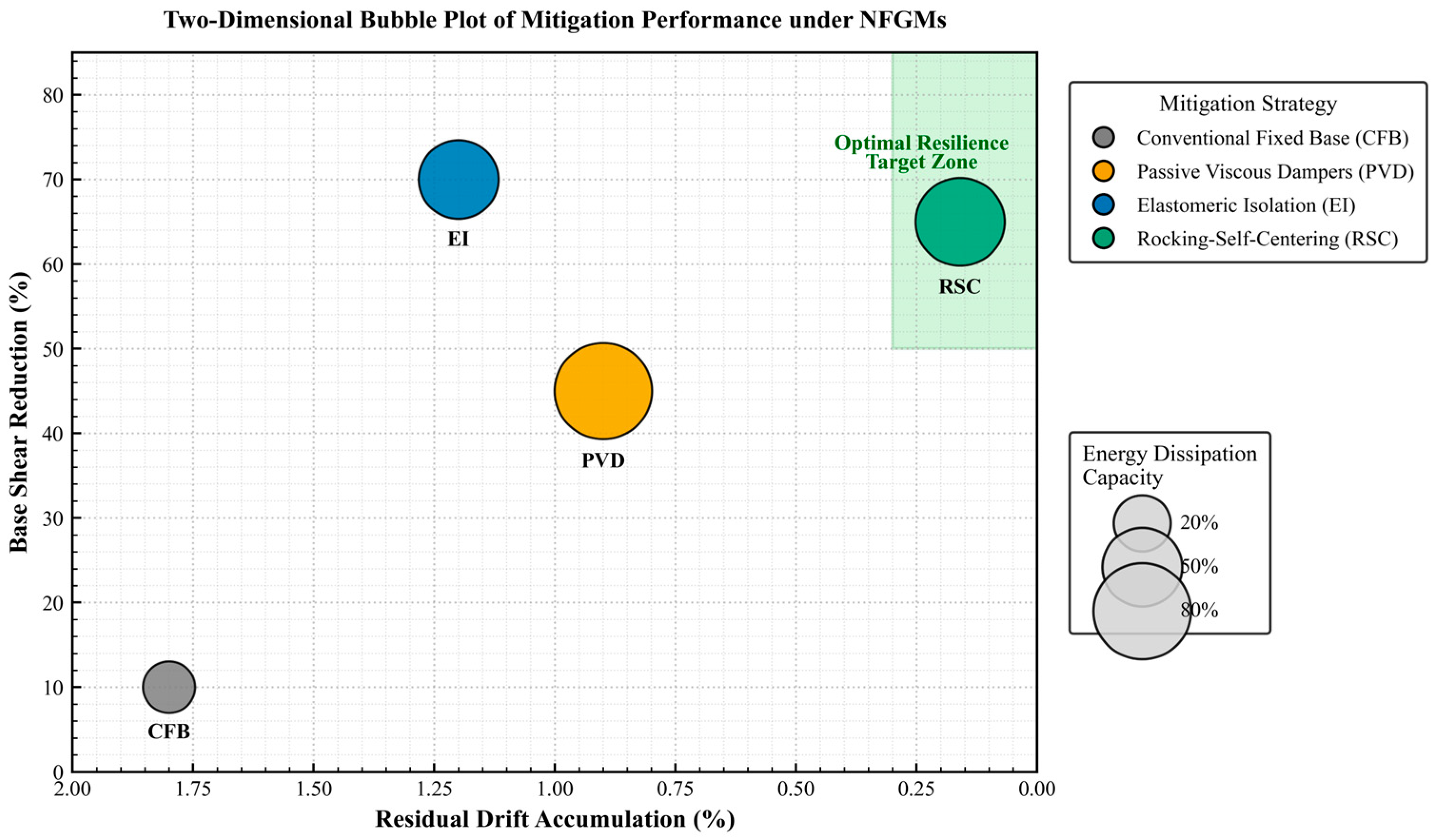
- To effectively resolve these extreme near-fault demands, structural hardware design must evolve beyond simple passive energy dissipation toward advanced kinematic decoupling and self-centering paradigms. Technologies such as rocking-self-centering (RSC) mechanisms, dynamic decoupling interfaces, and shape memory alloy (SMA) structural fuses are increasingly recognized as essential configurations. By mechanically decoupling the primary structural skeleton from sacrificial energy dissipators, these systems physically constrain post-earthquake residual drifts, fulfilling the fundamental prerequisite for rapid functional recovery.
- (3)
- Mitigating isolated structural vulnerabilities is intrinsically insufficient against the spatially correlated, multi-hazard nature of NFGMs. The proposed “3C” (Coupled-multi-hazard, City-scale, Carbon-friendly) integrated taxonomy bridges this gap. This paradigm dictates that cascading network failures must be arrested through intelligent structural decoupling, regional evaluations must be upscaled via urban digital twins, and Life-Cycle Assessment (LCA) must be leveraged to balance initial smart-material carbon investments with long-term disaster sustainability—directly supporting global mandates like SDG 9 and SDG 11.
- (4)
- To operationalize this resilience roadmap, overhauls of international seismic design standards are essential. Future regulatory frameworks must transcend “Life Safety,” incorporating explicit long-period spectral lower-bound constraints (as observed in the evolutionary trajectories of ASCE 7-22 and Eurocode 8) and quantitative limits on residual drifts as primary compliance metrics. Concurrently, advancing Physics-Informed Neural Networks (PINNs) and surrogate models will provide the computational engines required to translate localized pulse mechanics into city-scale network topology optimization, ultimately actualizing the 3C framework in mainstream engineering practice.
Author Contributions
Funding
Data Availability Statement
Conflicts of Interest
References
- Turan, A.I.; Celik, A.; Kumbasaroglu, A.; Yalciner, H. Assessment of reinforced concrete building damages following the Kahramanmaraş earthquakes in Malatya, Turkey (6 February 2023). Eng. Sci. Technol. Int. J. 2024, 54, 101718. [Google Scholar] [CrossRef]
- Somerville, P. Characterizing near fault ground motion for the design and evaluation of bridges. In Proceedings of the Third National Seismic Conference and Workshop on Bridges and Highways, Portland, OR, USA, 28 April–1 May 2002; Volume 1, pp. 137–148. [Google Scholar]
- Bray, J.D.; Rodriguez-Marek, A. Characterization of forward-directivity ground motions in the near-fault region. Soil Dyn. Earthq. Eng. 2004, 24, 815–828. [Google Scholar] [CrossRef]
- Hall, J.F.; Heaton, T.H.; Halling, M.W.; Wald, D.J. Near-source ground motion and its effects on flexible buildings. Earthq. Spectra 1995, 11, 569–605. [Google Scholar] [CrossRef]
- Goda, K.; Mori, N.; Miyashita, T.; De Risi, R.; Chang, Z. Near-fault ground motions and regional shaking damage assessment of the 2024 Noto Peninsula earthquake in Japan. Bull. Earthq. Eng. 2025, 23, 1829–1858. [Google Scholar] [CrossRef]
- Chen, G.; Liu, Y.; Ma, Z.; Yang, J.; Beer, M.; Chian, S.C.; Wei, S. Assessing extent of building damage following an earthquake: Case study of the 2023 Türkiye-Syria doublet. npj Nat. Hazards 2025, 2, 51. [Google Scholar] [CrossRef]
- Somerville, P.G.; Smith, N.F.; Graves, R.W.; Abrahamson, N.A. Modification of empirical strong ground motion attenuation relations to include the amplitude and duration effects of rupture directivity. Seismol. Res. Lett. 1997, 68, 199–222. [Google Scholar] [CrossRef]
- Mavroeidis, G.P.; Papageorgiou, A.S. A mathematical representation of near-fault ground motions. Bull. Seismol. Soc. Am. 2003, 93, 1099–1131. [Google Scholar] [CrossRef]
- Shahi, S.K.; Baker, J.W. An empirically calibrated framework for including the effects of near-fault directivity in probabilistic seismic hazard analysis. Bull. Seismol. Soc. Am. 2011, 101, 742–755. [Google Scholar] [CrossRef]
- Zhai, C.; Chang, Z.; Li, S.; Chen, Z.; Xie, L. Quantitative identification of near-fault pulse-like ground motions based on energy. Bull. Seismol. Soc. Am. 2013, 103, 2591–2603. [Google Scholar] [CrossRef]
- Chopra, A.K.; Chintanapakdee, C. Comparing response of SDF systems to near-fault and far-fault earthquake motions in the context of spectral regions. Earthq. Eng. Struct. Dyn. 2001, 30, 1769–1789. [Google Scholar] [CrossRef]
- Alavi, B.; Krawinkler, H. Behavior of moment-resisting frame structures subjected to near-fault ground motions. Earthq. Eng. Struct. Dyn. 2004, 33, 687–706. [Google Scholar] [CrossRef]
- Baker, J.W. Quantitative classification of near-fault ground motions using wavelet analysis. Bull. Seismol. Soc. Am. 2007, 97, 1486–1501. [Google Scholar] [CrossRef]
- Shahi, S.K.; Baker, J.W. An efficient algorithm to identify strong velocity pulses in multicomponent ground motions. Bull. Seismol. Soc. Am. 2014, 104, 2456–2466. [Google Scholar] [CrossRef]
- Zhao, X.F.; Wen, Z.P. Review of the identification of near-fault velocity pulse-like strong ground motions. Rev. Geophys. Planet. Phys. 2023, 54, 532–540. (In Chinese) [Google Scholar]
- Iervolino, I.; Cornell, C.A. Probability of occurrence of velocity pulses at near-source sites. Bull. Seismol. Soc. Am. 2008, 98, 2262–2277. [Google Scholar] [CrossRef]
- Hayden, C.P.; Bray, J.D.; Abrahamson, N.A. Selection of near-fault pulse motions. J. Geotech. Geoenviron. Eng. 2014, 140, 04014030. [Google Scholar] [CrossRef]
- Champion, C.; Liel, A. The effect of near-fault directivity on building seismic collapse risk. Earthq. Eng. Struct. Dyn. 2012, 41, 1391–1409. [Google Scholar] [CrossRef]
- Tzimas, A.S.; Kamaris, G.S.; Karavasilis, T.L.; Galasso, C. Collapse risk and residual drift performance of steel buildings using post-tensioned MRFs and viscous dampers in near-fault regions. Bull. Earthq. Eng. 2016, 14, 1643–1662. [Google Scholar] [CrossRef]
- Bozorgnia, Y.; Campbell, K.W. The vertical-to-horizontal response spectral ratio and tentative procedures for developing simplified V/H and vertical design spectra. J. Earthq. Eng. 2004, 8, 175–207. [Google Scholar] [CrossRef]
- Elnashai, A.S.; Papazoglou, A.J. Procedure and spectra for analysis of RC structures subjected to strong vertical earthquake loads. J. Earthq. Eng. 1997, 1, 121–155. [Google Scholar] [CrossRef]
- Kunnath, S.K.; Erduran, E.; Chai, Y.H.; Yashinsky, M. Effect of near-fault vertical ground motions on seismic response of highway overcrossings. J. Bridge Eng. 2008, 13, 282–290. [Google Scholar] [CrossRef]
- Inagaki, N.; Nishida, Y.; Mikami, T.; Nakamura, R.; Nistor, I.; Soltanpour, M.; Goseberg, N.; Shibayama, T. Field survey of the 2024 Noto Peninsula earthquake and tsunami in Japan: Characteristics of damage patterns to coastal communities. Ocean Eng. 2025, 316, 119765. [Google Scholar] [CrossRef]
- Anderson, J.C.; Bertero, V.V.; Bertero, R.D. Performance improvement of long period building structures subjected to severe pulse-type ground motions. Bull. N. Z. Soc. Earthq. Eng. 1999, 32, 47–73. [Google Scholar]
- EN 1998-1:2004; Eurocode 8: Design of Structures for Earthquake Resistance—Part 1: General Rules, Seismic Actions and Rules for Buildings. European Committee for Standardization: Brussels, Belgium, 2004.
- GB 50011-2010; Code for Seismic Design of Buildings. Ministry of Housing and Urban-Rural Development, China Architecture & Building Press: Beijing, China, 2016.
- ASCE/SEI 7-22; Minimum Design Loads and Associated Criteria for Buildings and Other Structures. American Society of Civil Engineers: Reston, VA, USA, 2022. [CrossRef]
- Bruneau, M.; Chang, S.E.; Eguchi, R.T.; Lee, G.C.; O’Rourke, T.D.; Reinhorn, A.M.; Shinozuka, M.; Tierney, K.; Wallace, W.A.; Von Winterfeldt, D. A framework to quantitatively assess and enhance the seismic resilience of communities. Earthq. Spectra 2003, 19, 733–752. [Google Scholar] [CrossRef]
- Cimellaro, G.P.; Reinhorn, A.M.; Bruneau, M. Framework for analytical quantification of disaster resilience. Eng. Struct. 2010, 32, 3639–3649. [Google Scholar] [CrossRef]
- Li, S.; Xie, L.L. Progress and trend on near-field problems in civil engineering. Acta Seismol. Sin. 2007, 20, 105–114. [Google Scholar] [CrossRef]
- Jia, J.F.; Du, X.L.; Han, Q. A state-of-the-art review of near-fault earthquake ground motion characteristics and effects on engineering structures. J. Build. Struct. 2015, 36, 1–12. (In Chinese) [Google Scholar]
- Shen, L.; Tian, S.; Li, X. Self-centering eccentrically braced steel frames: A comprehensive review on post-tensioning, SMA, and energy-dissipating technologies. Structures 2025, 79, 109425. [Google Scholar] [CrossRef]
- Bocchini, P.; Frangopol, D.M.; Ummenhofer, T.; Zinke, T. Resilience and sustainability of civil infrastructure: Toward a unified approach. J. Infrastruct. Syst. 2014, 20, A4014004. [Google Scholar] [CrossRef]
- United Nations. Transforming Our World: The 2030 Agenda for Sustainable Development; General Assembly Resolution A/RES/70/1; United Nations: New York, NY, USA, 2015. [Google Scholar]
- Bertero, V.V.; Mahin, S.A.; Herrera, R.A. Problems in prescribing reliable design earthquakes. In Proceedings of the Sixth World Conference on Earthquake Engineering, New Delhi, India, 10–14 January 1977; Volume 2, pp. 1741–1746. [Google Scholar]
- Baker, J.W.; Cornell, C.A. Spectral shape, epsilon and record selection. Earthq. Eng. Struct. Dyn. 2006, 35, 1077–1095. [Google Scholar] [CrossRef]
- Mieler, M.W.; Stojadinovic, B.; Budnitz, R.J.; Comerio, M.; Mahin, S. A framework for linking community resilience goals to specific performance targets for the built environment. Earthq. Spectra 2015, 31, 1267–1284. [Google Scholar] [CrossRef]
- Kalkan, E.; Graizer, V. Multi-component ground motion response spectra for coupled horizontal, vertical, angular accelerations, and tilt. ISET J. Earthq. Technol. 2007, 44, 259–284. [Google Scholar] [CrossRef]
- Di Sarno, L.; Karagiannakis, G. On the seismic fragility of pipe rack-piping systems considering soil-structure interaction. Bull. Earthq. Eng. 2020, 18, 2723–2757. [Google Scholar] [CrossRef]
- Farhan, M.; Bousias, S. Seismic fragility analysis of LNG sub-plant accounting for component dynamic interaction. Bull. Earthq. Eng. 2020, 18, 5063–5085. [Google Scholar] [CrossRef]
- Kazantzi, A.K.; Karaferis, N.D.; Melissianos, V.E.; Vamvatsikos, D. Acceleration-sensitive ancillary elements in industrial facilities: Alternative seismic design approaches in the new Eurocode. Bull. Earthq. Eng. 2024, 22, 109–132. [Google Scholar] [CrossRef]
- Kelly, J.M. Earthquake-Resistant Design with Rubber; Springer: London, UK, 1997. [Google Scholar]
- Naeim, F.; Kelly, J.M. Design of Seismic Isolated Structures: From Theory to Practice; John Wiley & Sons: New York, NY, USA, 1999. [Google Scholar]
- Jangid, R.S.; Kelly, J.M. Base isolation for near-fault motions. Earthq. Eng. Struct. Dyn. 2001, 30, 691–707. [Google Scholar] [CrossRef]
- Ikago, K.; Saito, K.; Inoue, N. Seismic control of single-degree-of-freedom structure using tuned viscous mass damper. Earthq. Eng. Struct. Dyn. 2012, 41, 453–474. [Google Scholar] [CrossRef]
- Zhang, L.; Han, J.; Li, D.; Shang, J. Investigation on the optimal mass ratio of tuned viscous mass dampers under near-field and far-field ground motions. KSCE J. Civ. Eng. 2025, 29, 100158. [Google Scholar] [CrossRef]
- Kiggins, S.; Uang, C.M. Reducing residual drift of buckling-restrained braced frames as a dual system. Eng. Struct. 2006, 28, 1525–1532. [Google Scholar] [CrossRef]
- Maley, T.J.; Sullivan, T.J.; Della Corte, G. Development of a displacement-based design method for steel dual systems with buckling-restrained braces and moment-resisting frames. J. Earthq. Eng. 2010, 14, 106–140. [Google Scholar] [CrossRef]
- De Domenico, D.; Ricciardi, G. An enhanced base isolation system equipped with optimal tuned mass damper inerter (TMDI). Earthq. Eng. Struct. Dyn. 2018, 47, 1169–1192. [Google Scholar] [CrossRef]
- Brown, J.; Kunnath, S.K. Low-cycle fatigue failure of reinforcing steel bars. ACI Mater. J. 2004, 101, 457–466. [Google Scholar] [CrossRef]
- Rodriguez-Marek, A.; Cofer, W. Dynamic Response of Bridges to Near-Fault, Forward Directivity Ground Motions; Washington State Department of Transportation Research Report WA-RD 689.1; WSDOT: Olympia, WA, USA, 2007.
- Zhang, F.; Li, S.; Wang, J.; Zhang, J. Effects of fault rupture on seismic responses of fault-crossing simply-supported highway bridges. Eng. Struct. 2020, 206, 110104. [Google Scholar] [CrossRef]
- Gu, Y.; Guo, J.; Dang, X.; Yuan, W. Seismic performance of a cable-stayed bridge crossing strike-slip faults. Structures 2022, 35, 289–302. [Google Scholar] [CrossRef]
- Lin, Y.; Zong, Z.; Lin, J.; Li, Y.; Chen, Y. Across-fault ground motions and their effects on some bridges in the 1999 Chi-Chi earthquake. Adv. Bridge Eng. 2021, 2, 8. [Google Scholar] [CrossRef]
- Kim, S.J.; Holub, C.J.; Elnashai, A.S. Analytical assessment of the effect of vertical earthquake motion on RC bridge piers. J. Struct. Eng. 2011, 137, 252–260. [Google Scholar] [CrossRef]
- Providakis, C.P. Effect of LRB isolators and supplemental viscous dampers on seismic isolated buildings under near-fault excitations. Eng. Struct. 2008, 30, 1184–1198. [Google Scholar] [CrossRef]
- Marriott, D.; Pampanin, S.; Palermo, A. Quasi-static and pseudo-dynamic testing of unbonded post-tensioned rocking bridge piers with external replaceable dissipaters. Earthq. Eng. Struct. Dyn. 2009, 38, 331–354. [Google Scholar] [CrossRef]
- Han, Q.; Jia, Z.; Xu, K.; Zhou, Y.; Du, X. Hysteretic behavior investigation of self-centering double-column rocking piers for seismic resilience. Eng. Struct. 2019, 188, 218–232. [Google Scholar] [CrossRef]
- Wang, Z.; Wang, J.Q.; Liu, T.X. Axial compression ratio limit for self-centering precast segmental hollow piers. Struct. Concr. 2017, 18, 668–679. [Google Scholar] [CrossRef]
- Shen, Y.; Freddi, F.; Li, Y.; Li, J. Parametric experimental investigation of unbonded post-tensioned reinforced concrete bridge piers under cyclic loading. Earthq. Eng. Struct. Dyn. 2022, 51, 3479–3504. [Google Scholar] [CrossRef]
- Dong, H.; Du, X.; Han, Q.; Hao, H.; Bi, K.; Wang, X. Performance of an innovative self-centering buckling restrained brace for mitigating seismic responses of bridge structures with double-column piers. Eng. Struct. 2017, 148, 47–62. [Google Scholar] [CrossRef]
- Pang, Y.; He, W.; Zhong, J. Risk-based design and optimization of shape memory alloy restrained sliding bearings for highway bridges under near-fault ground motions. Eng. Struct. 2021, 241, 112421. [Google Scholar] [CrossRef]
- Li, X.; Unjoh, S. Experimental study on seismic performance of post-tensioned precast segmental piers designed with multiple joint openings. Eng. Struct. 2024, 318, 118664. [Google Scholar] [CrossRef]
- Ali, A.; De Risi, R.; Sextos, A.; Goda, K.; Chang, Z. Seismic vulnerability of offshore wind turbines to pulse and non-pulse records. Earthq. Eng. Struct. Dyn. 2020, 49, 24–50. [Google Scholar] [CrossRef]
- Ma, B.; Zhou, A.; Lin, K.; Jeng, D.S. Seismic performance of monopile-supported offshore wind turbines in operation under near-field and far-field ground motions considering soil-structure interaction. Ocean Eng. 2026, 350, 124294. [Google Scholar] [CrossRef]
- Sigurdsson, G.O.; Rupakhety, R.; Rahimi, S.E.; Olafsson, S. Effect of pulse-like near-fault ground motions on utility-scale land-based wind turbines. Bull. Earthq. Eng. 2020, 18, 953–968. [Google Scholar] [CrossRef]
- Dai, K.S.; Hu, H.; Mei, Z.; Liu, Y. Seismic response analysis of wind power tower under long period ground motions. Eng. Mech. 2021, 38, 213–221. (In Chinese) [Google Scholar]
- Ren, Q.; Xu, Y.; Zhang, H.; Yu, J. Seismic performance of a wind turbine tower under near-field vertical earthquake excitation. Struct. Infrastruct. Eng. 2023, 19, 1334–1348. [Google Scholar] [CrossRef]
- Mo, R.; Cao, R.; Liu, M.; Li, M.; Huang, Y. Seismic fragility analysis of monopile offshore wind turbines considering ground motion directionality. Ocean Eng. 2021, 235, 109414. [Google Scholar] [CrossRef]
- Xu, Y.; Duan, J. Dynamic response analysis of offshore single pile wind turbine under near-field ground motion. J. Vib. Shock 2022, 41, 230–240. (In Chinese) [Google Scholar]
- Zuo, H.; Bi, K.; Hao, H. Using multiple tuned mass dampers to control offshore wind turbine vibrations under multiple hazards. Eng. Struct. 2017, 141, 303–315. [Google Scholar] [CrossRef]
- Lackner, M.A.; Rotea, M.A. Passive structural control of offshore wind turbines. Wind Energy 2011, 14, 373–388. [Google Scholar] [CrossRef]
- Ozbulut, O.E.; Hurlebaus, S.; DesRoches, R. Seismic response control using shape memory alloys: A review. J. Intell. Mater. Syst. Struct. 2011, 22, 1531–1549. [Google Scholar] [CrossRef]
- Niu, J.; Yan, S.; Chang, H. Seismic vibration control analysis of wind turbine tower structures based on SMA-SMPD system. J. Shenyang Jianzhu Univ. (Nat. Sci.) 2020, 36, 969–978. (In Chinese) [Google Scholar]
- Zuo, H.; Bi, K.; Hao, H.; Li, C. Numerical study of using shape memory alloy-based tuned mass dampers to control seismic responses of wind turbine tower. Eng. Struct. 2022, 250, 113452. [Google Scholar] [CrossRef]
- Song, G.; Ma, N.; Li, H.N. Applications of shape memory alloys in civil structures. Eng. Struct. 2006, 28, 1266–1274. [Google Scholar] [CrossRef]
- Akkar, S.; Yazgan, U.; Gülkan, P. Drift estimates in frame buildings subjected to near-fault ground motions. J. Struct. Eng. 2005, 131, 1014–1024. [Google Scholar] [CrossRef]
- Sehhati, R.; Rodriguez-Marek, A.; ElGawady, M.; Cofer, W.F. Effects of near-fault ground motions and equivalent pulses on multi-story structures. Eng. Struct. 2011, 33, 767–779. [Google Scholar] [CrossRef]
- Li, C.; Kunnath, S.; Zuo, Z.; Peng, W.; Zhai, C. Effects of early-arriving pulse-like ground motions on seismic demands in RC frame structures. Soil Dyn. Earthq. Eng. 2020, 130, 105997. [Google Scholar] [CrossRef]
- Ruiz-Garcia, J.; Miranda, E. Residual displacement ratios for assessment of existing structures. Earthq. Eng. Struct. Dyn. 2006, 35, 315–336. [Google Scholar] [CrossRef]
- Ramirez, C.M.; Liel, A.B.; Mitrani-Reiser, J.; Haselton, C.B.; Spear, A.D.; Steiner, J.; Deierlein, G.G.; Miranda, E. Expected earthquake damage and repair costs in reinforced concrete frame buildings. Earthq. Eng. Struct. Dyn. 2012, 41, 1455–1475. [Google Scholar] [CrossRef]
- Fahnestock, L.A.; Ricles, J.M.; Sause, R. Seismic response and performance of buckling-restrained braced frames. J. Struct. Eng. 2007, 133, 1195–1204. [Google Scholar] [CrossRef]
- Erochko, J.; Christopoulos, C.; Tremblay, R.; Choi, H. Residual drift response of SMRFs and BRB frames in steel buildings designed according to ASCE 7-05. J. Struct. Eng. 2011, 137, 589–599. [Google Scholar] [CrossRef]
- Hu, G.; Wang, Y.; Huang, W.; Li, B.; Luo, B. Seismic mitigation performance of structures with viscous dampers under near-fault pulse-type earthquakes. Eng. Struct. 2020, 203, 109878. [Google Scholar] [CrossRef]
- DesRoches, R.; Smith, B. Shape memory alloys in seismic resistant design and retrofit: A critical review of their potential and limitations. J. Earthq. Eng. 2004, 8, 415–429. [Google Scholar] [CrossRef]
- Alam, M.S.; Youssef, M.A.; Nehdi, M.L. Analytical prediction of the seismic behaviour of superelastic shape memory alloy reinforced concrete elements. Eng. Struct. 2008, 30, 3399–3411. [Google Scholar] [CrossRef]
- Chen, J.; Fang, C.; Wang, W.; Liu, Y. Variable-friction self-centering energy-dissipation braces (VF-SCEDBs) with NiTi SMA cables for seismic resilience. J. Constr. Steel Res. 2020, 175, 106318. [Google Scholar] [CrossRef]
- Pollino, M.; Bruneau, M. Seismic retrofit of bridge steel truss piers using a controlled rocking approach. J. Bridge Eng. 2007, 12, 600–610. [Google Scholar] [CrossRef]
- Wiebe, L.; Christopoulos, C. Mitigation of higher mode effects in base-rocking systems by using multiple rocking sections. J. Earthq. Eng. 2009, 13, 83–108. [Google Scholar] [CrossRef]
- Chancellor, N.B.; Eatherton, M.R.; Roke, D.A.; Akbas, T. Self-centering seismic lateral force resisting systems: High performance structures for the city of tomorrow. Buildings 2014, 4, 520–548. [Google Scholar] [CrossRef]
- Eatherton, M.R.; Ma, X.; Krawinkler, H.; Mar, D.; Billington, S.; Hajjar, J.F.; Deierlein, G.G. Design concepts for controlled rocking of self-centering steel-braced frames. J. Struct. Eng. 2014, 140, 0401402. [Google Scholar] [CrossRef]
- McCormick, J.; Aburano, H.; Ikenaga, M.; Nakashima, M. Permissible residual deformation levels for building structures considering both safety and human elements. In Proceedings of the 14th World Conference on Earthquake Engineering, Beijing, China, 12–17 October 2008. Paper No. 05-06-0071. [Google Scholar]
- Qiu, C.; Zhu, S. Performance-based seismic design of self-centering steel frames with SMA-based braces. Eng. Struct. 2017, 130, 67–82. [Google Scholar] [CrossRef]
- Eatherton, M.R.; Hajjar, J.F. Residual drifts of self-centering systems including effects of ambient building resistance. Earthq. Spectra 2011, 27, 719–744. [Google Scholar] [CrossRef]
- Shahverdi, M.; Michels, J.; Czaderski, C.; Motavalli, M. Iron-based shape memory alloy strips for strengthening RC members: Material behavior and characterization. Constr. Build. Mater. 2018, 173, 586–599. [Google Scholar] [CrossRef]
- Hashash, Y.M.A.; Hook, J.J.; Schmidt, B.; Yao, J.I.-C. Seismic design and analysis of underground structures. Tunn. Undergr. Space Technol. 2001, 16, 247–293. [Google Scholar] [CrossRef]
- Pitilakis, K.; Tsinidis, G. Performance and seismic design of underground structures. In Earthquake Geotechnical Engineering Design; Springer: Cham, Switzerland, 2014; pp. 279–340. [Google Scholar] [CrossRef]
- Hashash, Y.M.A.; Park, D.; Yao, J.I.-C. Ovaling deformations of circular tunnels under seismic loading, an update on seismic design and analysis of underground structures. Tunn. Undergr. Space Technol. 2005, 20, 435–441. [Google Scholar] [CrossRef]
- Bobet, A.; Fernandez, G.; Huo, H.; Ramirez, J. A practical iterative procedure to estimate seismic-induced deformations of shallow rectangular structures. Can. Geotech. J. 2008, 45, 923–938. [Google Scholar] [CrossRef]
- Yu, H.; Yuan, Y.; Bobet, A. Seismic analysis of long tunnels: A review of simplified and unified methods. Undergr. Space 2017, 2, 73–87. [Google Scholar] [CrossRef]
- Kishi, N.; Sonoda, K.; Komuro, M.; Kawarai, T. Numerical simulation of the Daikai station subway structure collapse due to sudden uplift during earthquake. J. Eng. Mech. 2021, 147, 04020152. [Google Scholar] [CrossRef]
- Zhang, S.; Yang, Y.; Yuan, Y.; Li, C.; Qiu, J. Experimental investigation of seismic performance of shield tunnel under near-field ground motion. Structures 2022, 43, 1407–1421. [Google Scholar] [CrossRef]
- Han, W.; Jiang, Y.; Wang, G.; Liu, C.; Koga, D.; Luan, H. Review of health inspection and reinforcement design for typical tunnel quality defects of voids and insufficient lining thickness. Tunn. Undergr. Space Technol. 2023, 137, 105110. [Google Scholar] [CrossRef]
- Sedarat, H.; Kozak, A.; Hashash, Y.M.; Shamsabadi, A.; Krimotat, A. Contact interface in seismic analysis of circular tunnels. Tunn. Undergr. Space Technol. 2009, 24, 482–490. [Google Scholar] [CrossRef]
- Tsang, H.-H.; Tran, D.-P.; Hung, W.-Y.; Gad, E.F. Geotechnical seismic isolation based on high-damping polyurethane: Centrifuge modelling. Bull. Earthq. Eng. 2024, 22, 2001–2023. [Google Scholar] [CrossRef]
- Xin, C.L.; Wang, Z.Z.; Zhou, J.M.; Gao, B. Shaking table tests on seismic behavior of polypropylene fiber reinforced concrete tunnel lining. Tunn. Undergr. Space Technol. 2019, 88, 1–15. [Google Scholar] [CrossRef]
- Ding, Z.; Wen, J.; Li, X.; Fu, J.; Ji, X. Mechanical behaviour of polyvinyl alcohol-engineered cementitious composites (PVA-ECC) tunnel linings subjected to vertical load. Tunn. Undergr. Space Technol. 2020, 95, 103151. [Google Scholar] [CrossRef]
- Wang, Q.; Geng, P.; Wang, L.; He, D.; Shen, H. Machine learning-driven feature importance appraisal of seismic parameters on tunnel damage and seismic fragility prediction. Eng. Appl. Artif. Intell. 2024, 137, 109101. [Google Scholar] [CrossRef]
- Tsinidis, G.; de Silva, F.; Anastasopoulos, I.; Bilotta, E.; Bobet, A.; Hashash, Y.M.; He, C.; Kampas, G.; Knappett, J.; Madabhushi, G.; et al. Seismic behaviour of tunnels: From experiments to analysis. Tunn. Undergr. Space Technol. 2020, 99, 103334. [Google Scholar] [CrossRef]
- You, T.; Wang, W.; Chen, Y. A framework to link community long-term resilience goals to seismic performance of individual buildings using network-based recovery modeling method. Soil Dyn. Earthq. Eng. 2021, 147, 106788. [Google Scholar] [CrossRef]
- Molina Hutt, C.; Hulsey, A.M.; Kakoty, P.; Deierlein, G.G.; Eksir Monfared, A.; Yen, W.Y.; Hooper, J.D. Toward functional recovery performance in the seismic design of modern tall buildings. Earthq. Spectra 2022, 38, 283–309. [Google Scholar] [CrossRef]
- Bird, J.F.; Bommer, J.J. Earthquake losses due to ground failure. Eng. Geol. 2004, 75, 147–179. [Google Scholar] [CrossRef]
- O’Rourke, T.D. Critical infrastructure, interdependencies, and resilience. Bridge 2007, 37, 22–29. [Google Scholar]
- Draft prEN 1998-1-1; Eurocode 8: Design of Structures for Earthquake Resistance. European Committee for Standardization: Brussels, Belgium, 1998.
- Liu, Q.C.; Yue, M.G.; Wang, D.S. Longitudinal response of power transmission tower-cable system to traveling wave. In Proceedings of the 14th World Conference on Earthquake Engineering, Beijing, China, 12–17 October 2008. Paper No. 05-01-0025. [Google Scholar]
- Yang, F.; Yang, J.; Zhang, Z. Unbalanced tension analysis for UHV transmission towers in heavy icing areas. Cold Reg. Sci. Technol. 2012, 70, 132–140. [Google Scholar] [CrossRef]
- Tian, L.; Pan, H.; Ma, R.; Qiu, C. Collapse simulations of a long span transmission tower-line system subjected to near-fault ground motions. Earthq. Struct. 2017, 13, 211–220. [Google Scholar] [CrossRef]
- Sutlovic, E.; Ramljak, I.; Majstrovic, M. Analysis of conductor clashing experiments. Electr. Eng. 2019, 101, 467–476. [Google Scholar] [CrossRef]
- Dikshit, S.; Dobson, I.; Alipour, A. Cascading structural failures of towers in an electric power transmission line due to straight line winds. Reliab. Eng. Syst. Saf. 2024, 250, 110304. [Google Scholar] [CrossRef]
- Goldbeck, N.; Angeloudis, P.; Ochieng, W.Y. Resilience assessment for interdependent urban infrastructure systems using dynamic network flow models. Reliab. Eng. Syst. Saf. 2019, 188, 62–79. [Google Scholar] [CrossRef]
- Owolabi, T.A.; Sajjad, M. A global outlook on multi-hazard risk analysis: A systematic and scientometric review. Int. J. Disaster Risk Reduct. 2023, 92, 103727. [Google Scholar] [CrossRef]
- Panteli, M.; Mancarella, P. Influence of extreme weather and climate change on the resilience of power systems: Impacts and possible mitigation strategies. Electr. Power Syst. Res. 2015, 127, 259–270. [Google Scholar] [CrossRef]
- Somerville, P.G. Magnitude scaling of the near fault rupture directivity pulse. Phys. Earth Planet. Inter. 2003, 137, 201–212. [Google Scholar] [CrossRef]
- Jayaram, N.; Baker, J.W. Correlation model for spatially distributed ground-motion intensities. Earthq. Eng. Struct. Dyn. 2009, 38, 1687–1708. [Google Scholar] [CrossRef]
- Argyroudis, S.A.; Mitoulis, S.A.; Winter, M.G.; Kaynia, A.M. Fragility of transport assets exposed to multiple hazards: State-of-the-art review toward infrastructural resilience. Reliab. Eng. Syst. Saf. 2019, 191, 106567. [Google Scholar] [CrossRef]
- Xiong, C.; Lu, X.; Guan, H.; Xu, Z. A nonlinear computational model for regional seismic simulation of tall buildings. Bull. Earthq. Eng. 2016, 14, 1047–1069. [Google Scholar] [CrossRef]
- Burton, H.V.; Deierlein, G.G.; Lallemant, D.; Lin, T. Framework for incorporating probabilistic building performance in the assessment of community seismic resilience. J. Struct. Eng. 2016, 142, C4015007. [Google Scholar] [CrossRef]
- Sadrykia, M.; Delavar, M.R.; Zare, M. A GIS-based fuzzy decision making model for seismic vulnerability assessment in areas with incomplete data. ISPRS Int. J. Geo-Inf. 2017, 6, 119. [Google Scholar] [CrossRef]
- Welsh-Huggins, S.J.; Liel, A.B. Evaluating multiobjective outcomes for hazard resilience and sustainability from enhanced building seismic design decisions. J. Struct. Eng. 2018, 144, 04018108. [Google Scholar] [CrossRef]
- Arroyo, D.; Ordaz, M.; Teran-Gilmore, A. Seismic loss estimation and environmental issues. Earthq. Spectra 2015, 31, 1285–1308. [Google Scholar] [CrossRef]
- Belleri, A.; Marini, A. Does seismic risk affect the environmental impact of existing buildings? Energy Build. 2016, 110, 149–158. [Google Scholar] [CrossRef]
- Menna, C.; Asprone, D.; Jalayer, F.; Prota, A.; Manfredi, G. Assessment of ecological sustainability of a building subjected to potential seismic events during its lifetime. Int. J. Life Cycle Assess. 2013, 18, 504–515. [Google Scholar] [CrossRef]
- Dong, Y.; Frangopol, D.M. Performance-based seismic assessment of conventional and base-isolated steel buildings including environmental impact and resilience. Earthq. Eng. Struct. Dyn. 2016, 45, 739–756. [Google Scholar] [CrossRef]
- Lounis, Z.; McAllister, T.P. Risk-based decision making for sustainable and resilient infrastructure systems. J. Struct. Eng. 2016, 142, F4016005. [Google Scholar] [CrossRef]
- Zani, G.; Pepe, M.; Rampini, M.C.; Michels, J.; Martinelli, E. Numerical modelling of innovative deconstructable shallow beams made of recycled aggregate concrete and shape memory steel reinforcement. In Building for the Future: Durable, Sustainable, Resilient (fib Symposium 2023); Springer: Cham, Switzerland, 2023; pp. 685–694. [Google Scholar]
- Ouyang, M. Review on modeling and simulation of interdependent critical infrastructure systems. Reliab. Eng. Syst. Saf. 2014, 121, 43–160. [Google Scholar] [CrossRef]
- Mangalathu, S.; Sun, H.; Nweke, C.C.; Yi, Z.; Burton, H.V. Classifying earthquake damage to buildings using machine learning. Earthq. Spectra 2020, 36, 183–208. [Google Scholar] [CrossRef]
- Sun, H.; Burton, H.V.; Huang, H. Machine learning applications for building structural design and performance assessment: State-of-the-art review. J. Build. Eng. 2021, 33, 101816. [Google Scholar] [CrossRef]
- Mosalam, K.M. Toward building resilience through reconnaissance: Artificial intelligence approaches for structural health monitoring. In Proceedings of the 2nd International Conference on Advances in Civil Infrastructure and Construction Materials (CICM 2023); Springer: Cham, Switzerland, 2024; Volume 1, pp. 15–23. [Google Scholar]
- Raissi, M.; Perdikaris, P.; Karniadakis, G.E. Physics-informed neural networks: A deep learning framework for solving forward and inverse problems involving nonlinear partial differential equations. J. Comput. Phys. 2019, 378, 686–707. [Google Scholar] [CrossRef]
- Qi, J.; Du, K.; Luo, H.; Wang, Z.; Wen, R. Physics-informed neural networks for structural dynamic response analysis: Theoretical and numerical verification. Int. J. Struct. Stab. Dyn. 2026, 2650294. [Google Scholar] [CrossRef]
- Torzoni, M.; Manzoni, A.; Mariani, S. A multi-fidelity surrogate model for structural health monitoring exploiting model order reduction and artificial neural networks. Mech. Syst. Signal Process. 2023, 197, 110376. [Google Scholar] [CrossRef]
- Liu, T.; Meidani, H. Graph neural network surrogate for seismic reliability analysis of highway bridge systems. J. Infrastruct. Syst. 2024, 30, 05024004. [Google Scholar] [CrossRef]
- Pei, S.; Zhai, C.; Hu, J. Surrogate model-assisted seismic resilience assessment of the interdependent transportation and healthcare system considering a two-stage recovery strategy. Reliab. Eng. Syst. Saf. 2024, 244, 109941. [Google Scholar] [CrossRef]
- Lazaridis, P.C.; Kavvadias, I.E.; Demertzis, K.; Iliadis, L.; Vasiliadis, L.K. Interpretable Machine Learning for Assessing the Cumulative Damage of a Reinforced Concrete Frame Induced by Seismic Sequences. Sustainability 2023, 15, 12768. [Google Scholar] [CrossRef]
- Luk, S.H. Machine Learning-Based Methods for the Seismic Damage Classification of RC Buildings. Buildings 2025, 15, 2395. [Google Scholar] [CrossRef]
- Ayyub, B.M. Systems resilience for multihazard environments: Definition, metrics, and valuation for decision making. Risk Anal. 2014, 34, 340–355. [Google Scholar] [CrossRef]
- Cimellaro, G.P. Urban Resilience for Emergency Response and Recovery: Fundamental Concepts and Applications; Springer International Publishing: Cham, Switzerland, 2016. [Google Scholar] [CrossRef]
- Chakraborty, S.; Adhikari, S.; Ganguli, R. The role of surrogate models in the development of digital twins of dynamic systems. Appl. Math. Model. 2021, 90, 662–681. [Google Scholar] [CrossRef]
- Zhou, Y.; Meng, S.; Lou, Y.; Kong, Q. Physics-informed deep learning-based real-time structural response prediction method. Engineering 2024, 35, 140–157. [Google Scholar] [CrossRef]



| Kinematic Signatures | Physical Mechanism | Structural Failure Mode |
|---|---|---|
| Forward-directivity | Instantaneous high-energy velocity pulse input | Concentrated plastic deformations in weak stories, excessive residual drifts |
| Fling-step | Permanent tectonic displacement offsets | Unseating of bridge bearings, rupture of expansion joints |
| High V/H ratio | High-frequency transient axial load fluctuations | Degradation of column shear capacity, core concrete crushing |
| Archetype Category | Specific Archetypes | Kinematic Bottlenecks | Resilience-Based Mitigation Strategy |
|---|---|---|---|
| Rigid/Coupled Systems | Industrial facilities; Above-ground lifeline components (e.g., power grids, substations) | Equipment-structure interaction; High-frequency sensitivity; Component decoupling | Flexible connectors; Kinematic uncoupling; Multi-modal dampening |
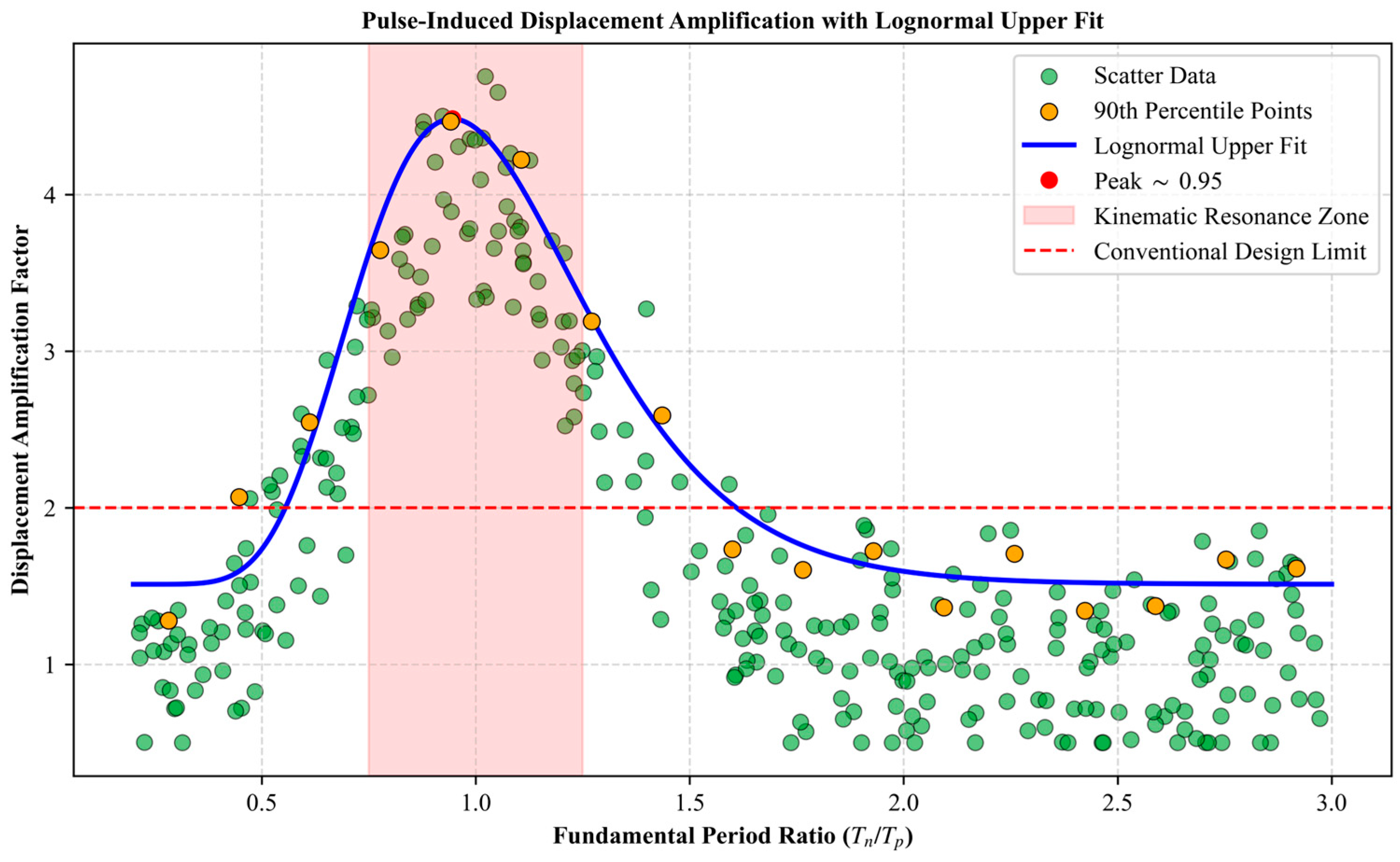
| Flexible Systems | Bridges; Wind towers; Civil buildings | Kinematic resonance (Tn/Tp ≈ 1); Excessive residual drifts; Higher-mode effects | Rocking-self-centering (RSC); Base isolation; Adaptive stiffness |
| Medium-Constrained Systems | Underground structures; Buried pipelines and lifeline tunnels | Soil–structure interaction (SSI); Interface kinematic strains; Discontinuous deformation | Distributed compliance; Flexible jointing; Grouting optimization |
| “3C” Resilience Dimension | Primary Near-Fault Challenge | Enabling Technologies & Methodologies | Ultimate Objective |
|---|---|---|---|
| Coupled-Multi-Hazard | Cascading cross-domain failures and asynchronous excitations (e.g., “domino effect” in power grids). | Mechanical structural fuses; advanced kinematic decoupling; intelligent network re-routing algorithms. | Mitigate propagation of localized structural collapse; maintain network-level functional stability. |
| City-Scale | Computational prohibitiveness, spatial correlation of pulse energy, and severe urban data scarcity. | Urban digital twins; BIM/GIS integration; Physics-Informed Neural Networks (PINNs). | Facilitate rapid, near-real-time regional vulnerability mapping and dynamic network topology optimization. |
| Carbon-Friendly | Massive embodied carbon penalty from post-earthquake demolition and total reconstruction. | Quantitative Life-Cycle Assessment (LCA); low-carbon Iron-based SMAs; targeted resilient hardware allocation. | Minimize the necessity for complete reconstruction; balance initial carbon investments with long-term disaster sustainability. |
Disclaimer/Publisher’s Note: The statements, opinions and data contained in all publications are solely those of the individual author(s) and contributor(s) and not of MDPI and/or the editor(s). MDPI and/or the editor(s) disclaim responsibility for any injury to people or property resulting from any ideas, methods, instructions or products referred to in the content. |
© 2026 by the authors. Licensee MDPI, Basel, Switzerland. This article is an open access article distributed under the terms and conditions of the Creative Commons Attribution (CC BY) license.
Share and Cite
Zhao, G.; Ding, J.; Zhang, M. Next-Generation Seismic Resilience of Urban Infrastructure: A Critical Review and “3C Framework” Roadmap Under Near-Fault Ground Motions. Buildings 2026, 16, 2314. https://doi.org/10.3390/buildings16122314
Zhao G, Ding J, Zhang M. Next-Generation Seismic Resilience of Urban Infrastructure: A Critical Review and “3C Framework” Roadmap Under Near-Fault Ground Motions. Buildings. 2026; 16(12):2314. https://doi.org/10.3390/buildings16122314
Chicago/Turabian StyleZhao, Guifeng, Jie Ding, and Meng Zhang. 2026. "Next-Generation Seismic Resilience of Urban Infrastructure: A Critical Review and “3C Framework” Roadmap Under Near-Fault Ground Motions" Buildings 16, no. 12: 2314. https://doi.org/10.3390/buildings16122314
APA StyleZhao, G., Ding, J., & Zhang, M. (2026). Next-Generation Seismic Resilience of Urban Infrastructure: A Critical Review and “3C Framework” Roadmap Under Near-Fault Ground Motions. Buildings, 16(12), 2314. https://doi.org/10.3390/buildings16122314