Damage Attention-Aware Dense Layered Framework for Surface Crack Classification

Abstract
1. Introduction
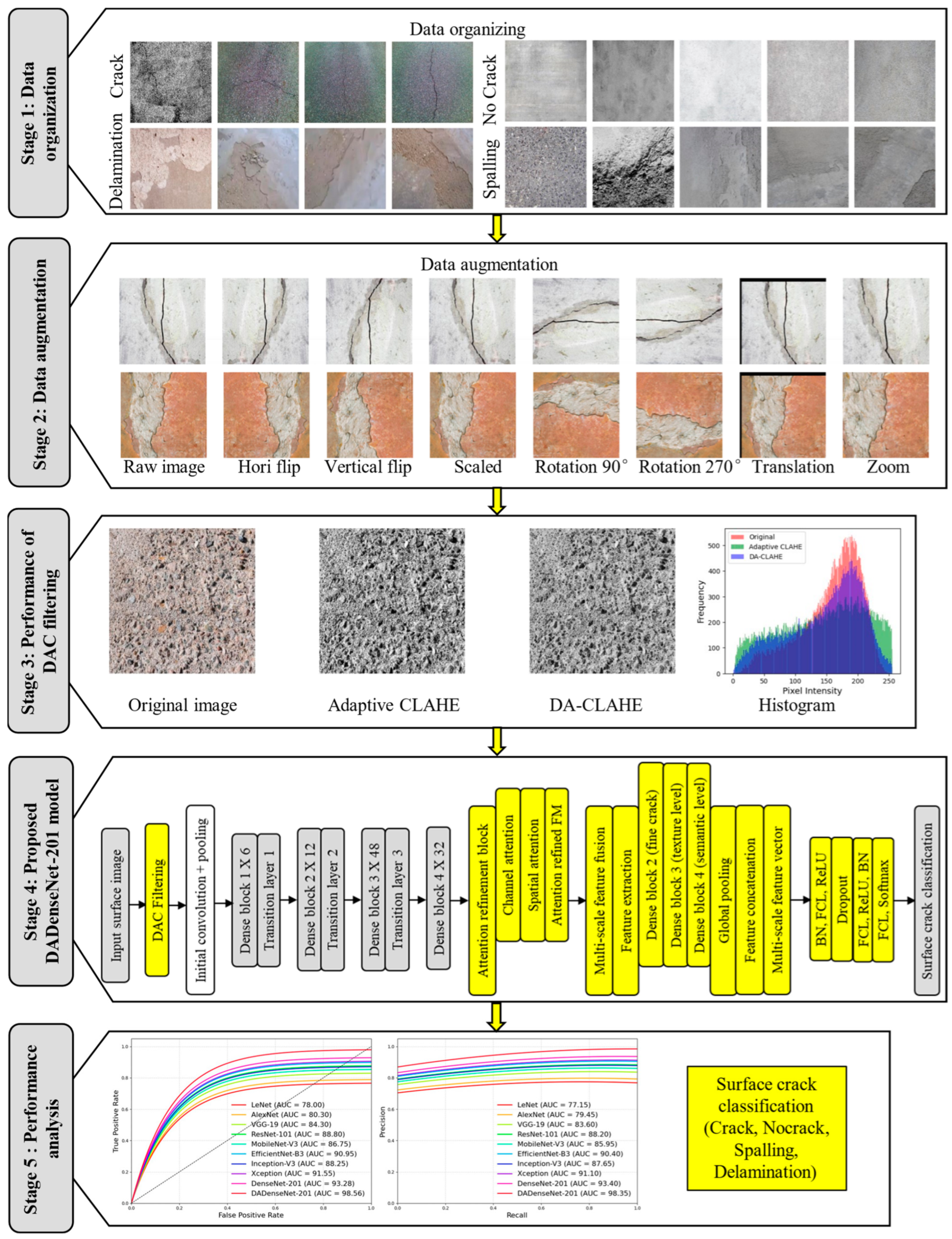
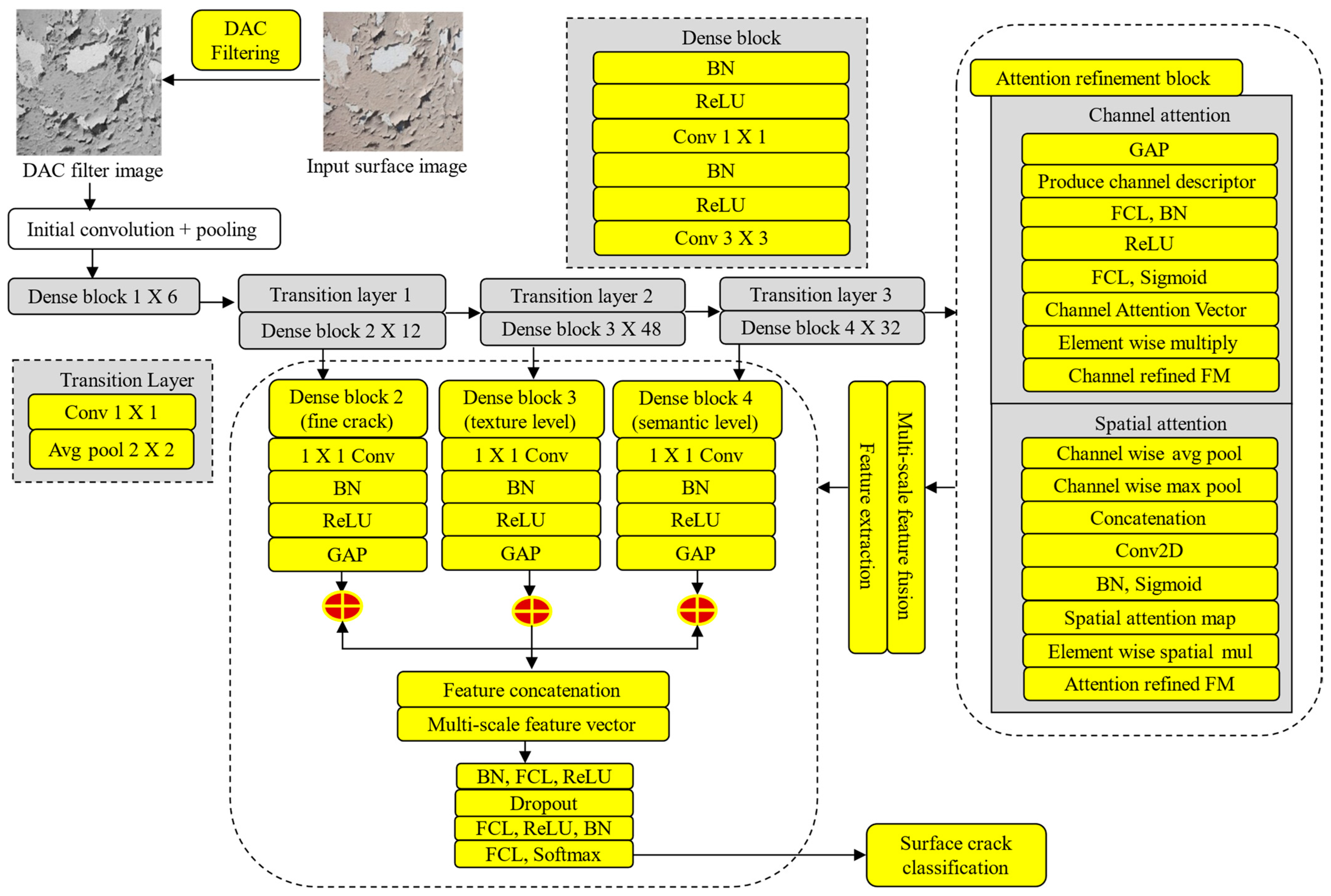
- A novel damage-aware adaptive contrast-limited adaptive histogram equalisation (CLAHE) filtering mechanism (DAC) is introduced before feature extraction to enhance crack edges, spalling and delamination boundaries selectively while preserving background integrity.
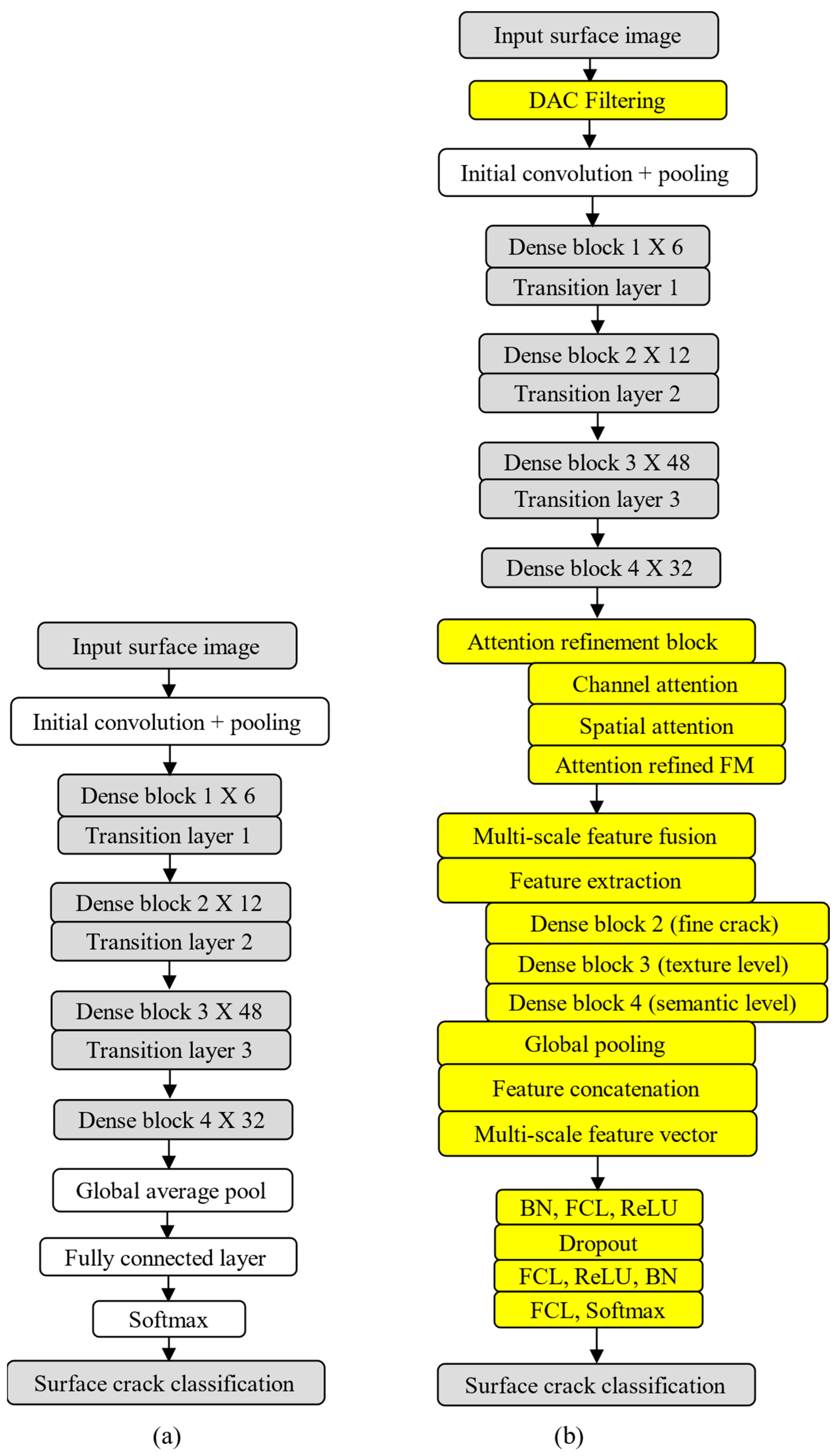
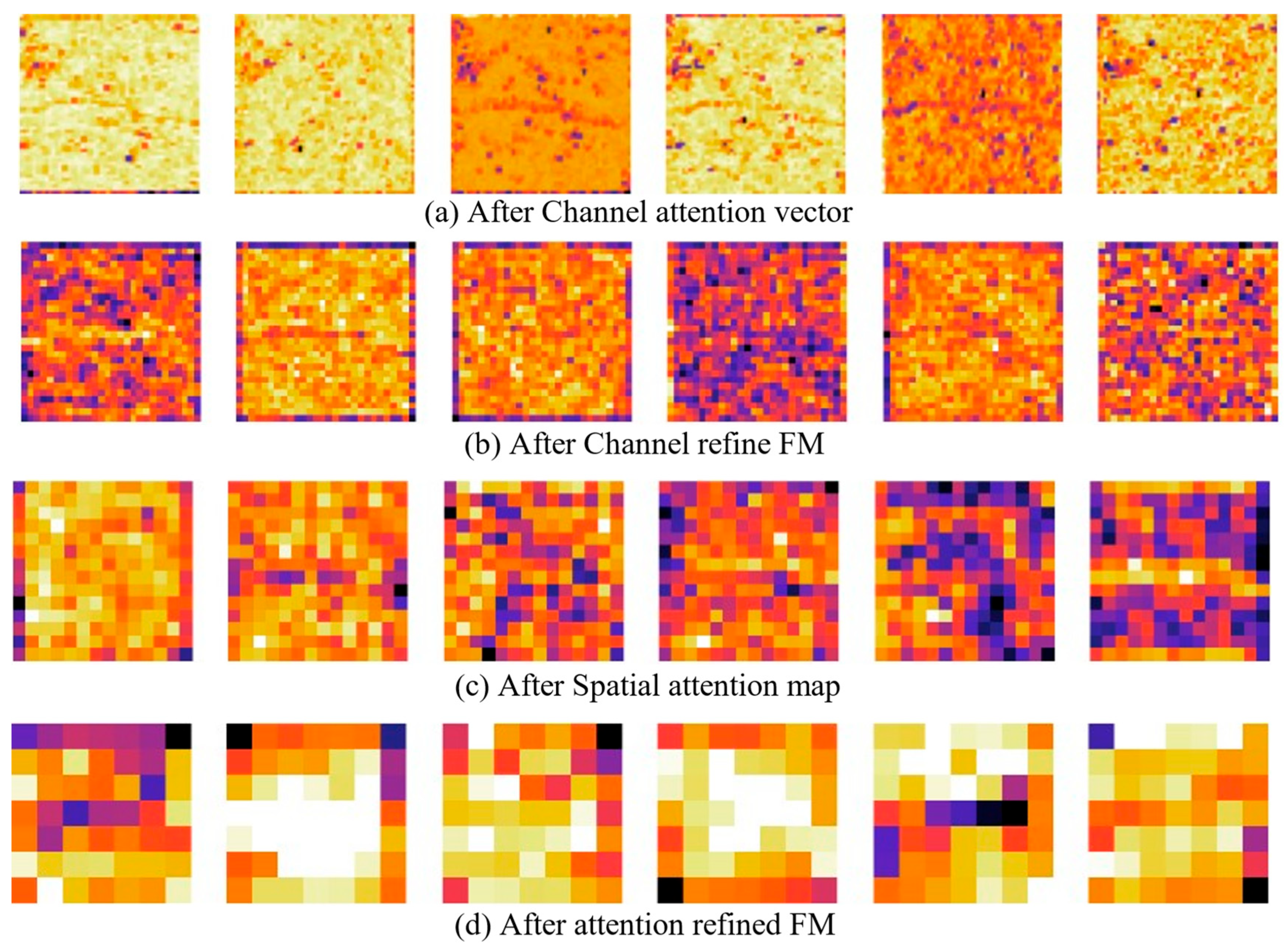
- To guide the network toward defect-relevant information, an attention refinement block is incorporated into the DenseNet-201 backbone. This block combines channel attention, emphasising what damage-related features are important, and spatial attention, indicating where the damage regions are located. The attention-guided feature refinement enables the model to suppress irrelevant background responses and concentrate on critical surface defect regions.
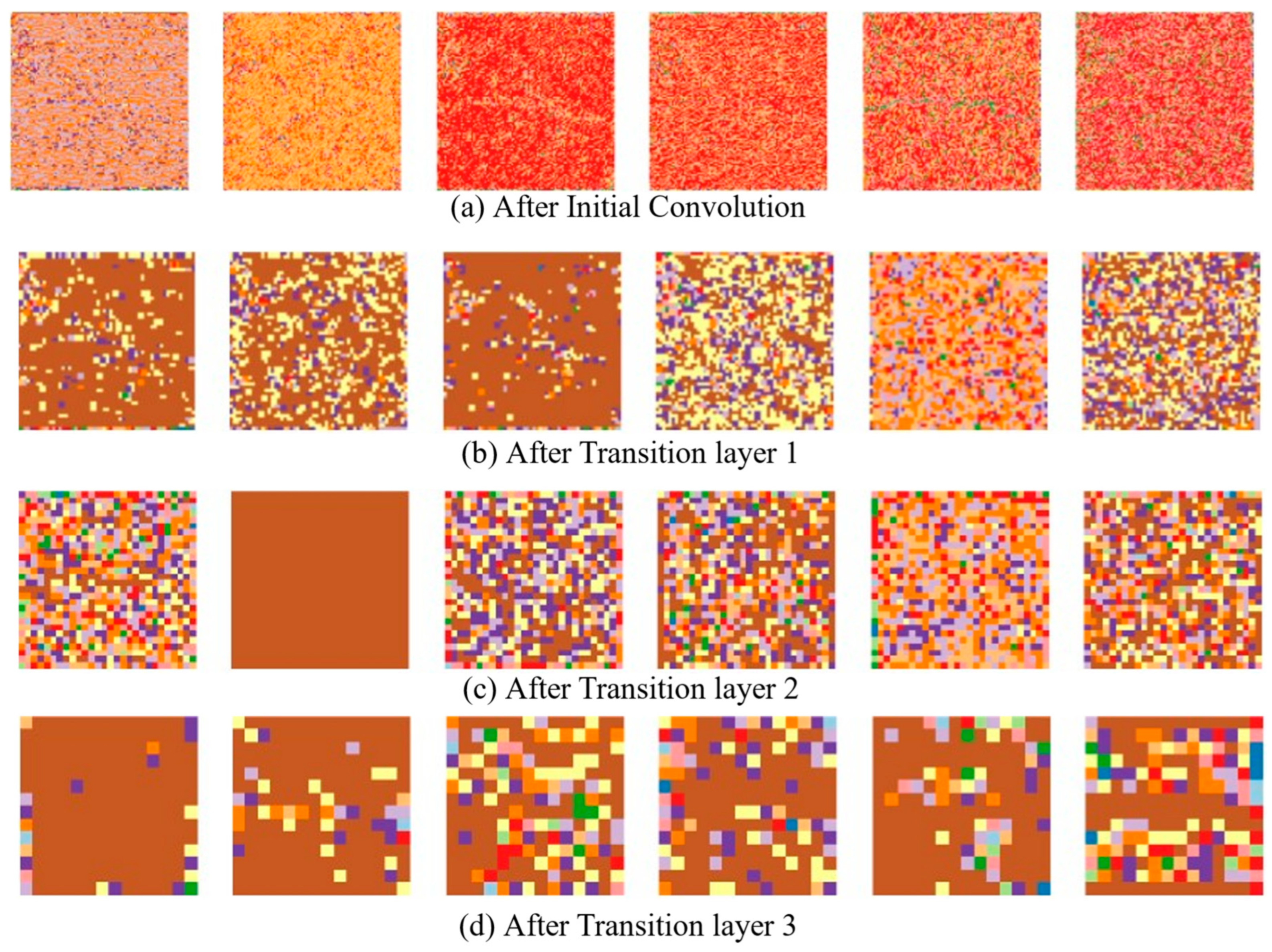
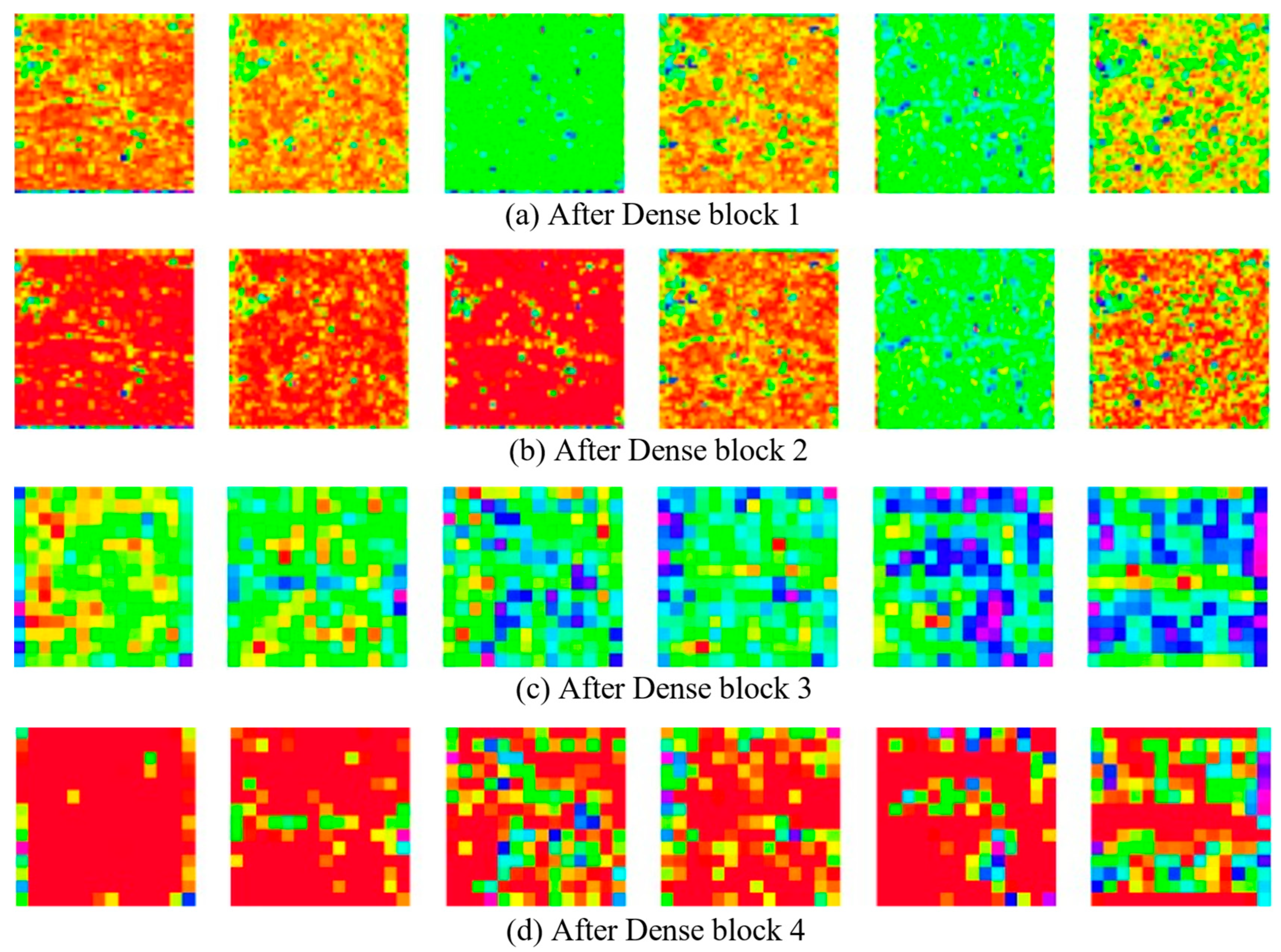
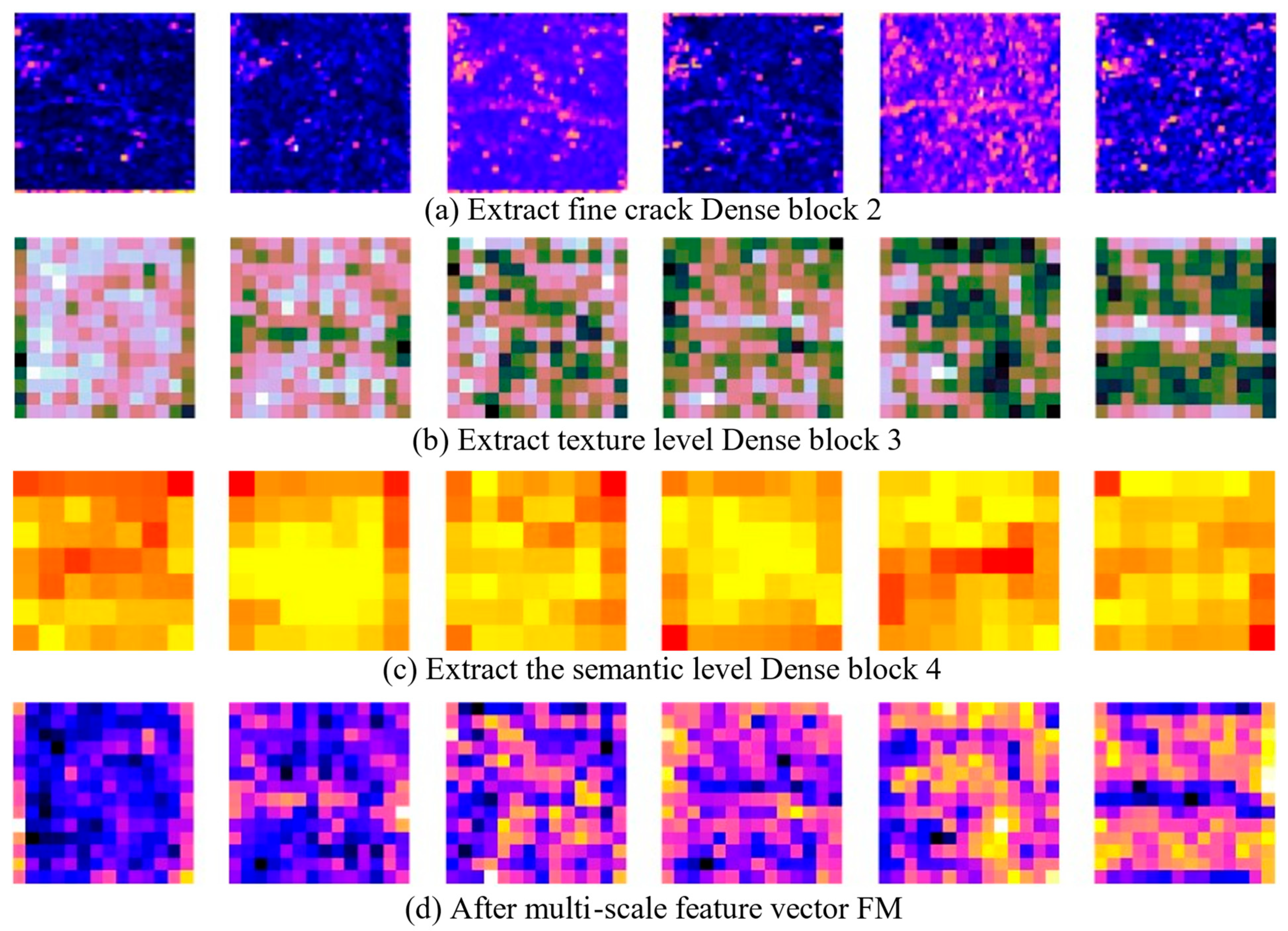
- A dedicated multiscale feature fusion strategy is introduced by aggregating feature maps from dense Blocks 2, 3 and 4, enabling the model to learn fine-scale crack patterns, texture-level surface degradation and high-level semantic damage cues simultaneously.
- A lightweight, regularised classification head is designed by extending DenseNet-201 using batch normalisation (BN), multiple fully connected layers and dropout regularisation. This lightweight head improves feature abstraction, reduces overfitting and enhances generalisation performance, especially under limited or imbalanced training data scenarios.
2. Background Study
2.1. Surface Crack Models Based on Image Processing
2.2. Machine Learning-Based Surface Crack Models
2.3. Deep Learning-Based Fracture Classification Models
2.4. Deep Learning Approaches for Post-Fire Concrete Damage Assessment
2.5. Research Gap and Motivation
3. Materials and Methods
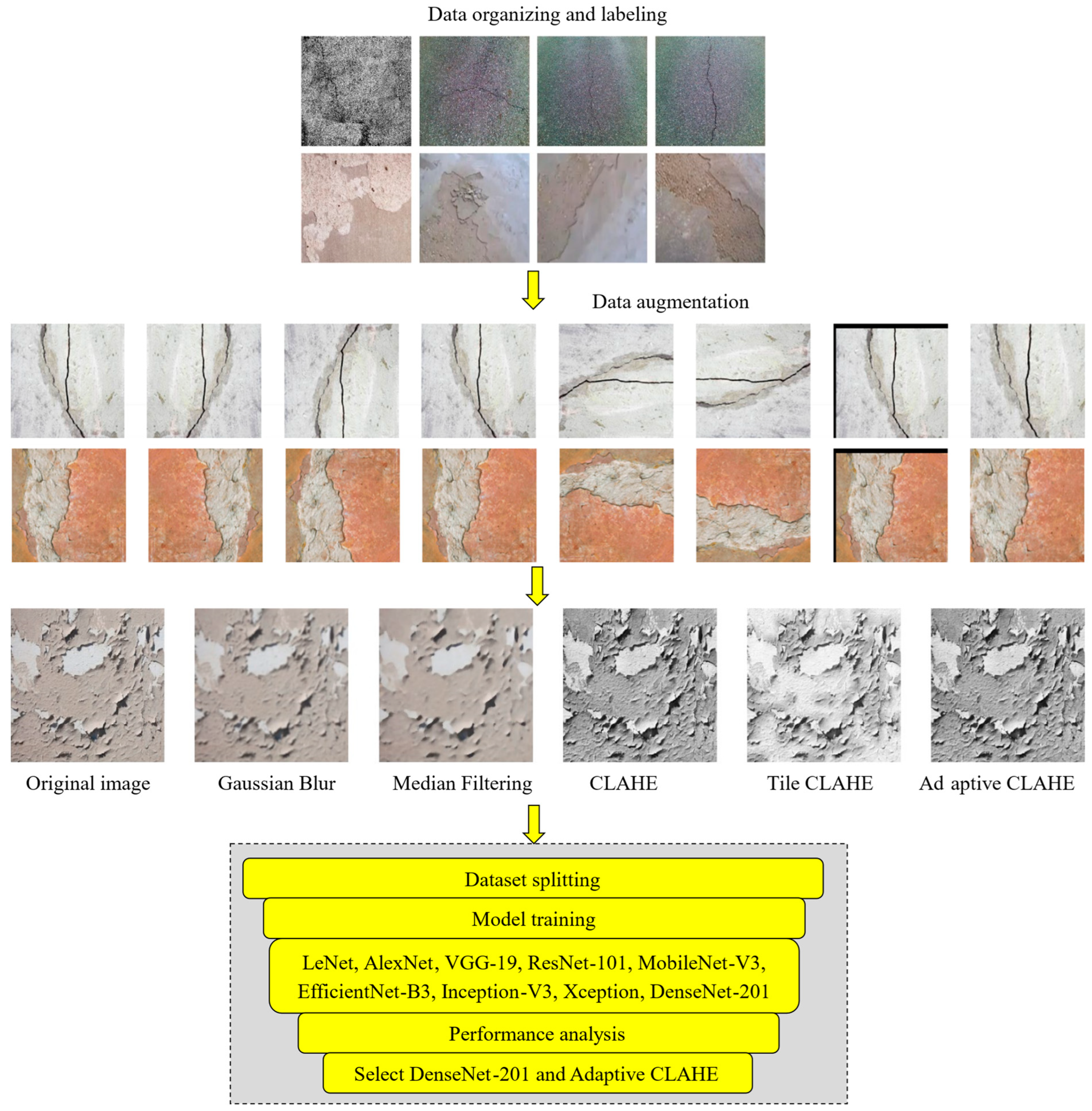
3.1. Research Methodology
3.2. Architectural Innovation of DA-DenseNet-201
3.3. Dataset Collection and Augmentation
3.4. Selection Rationale of DenseNet-201
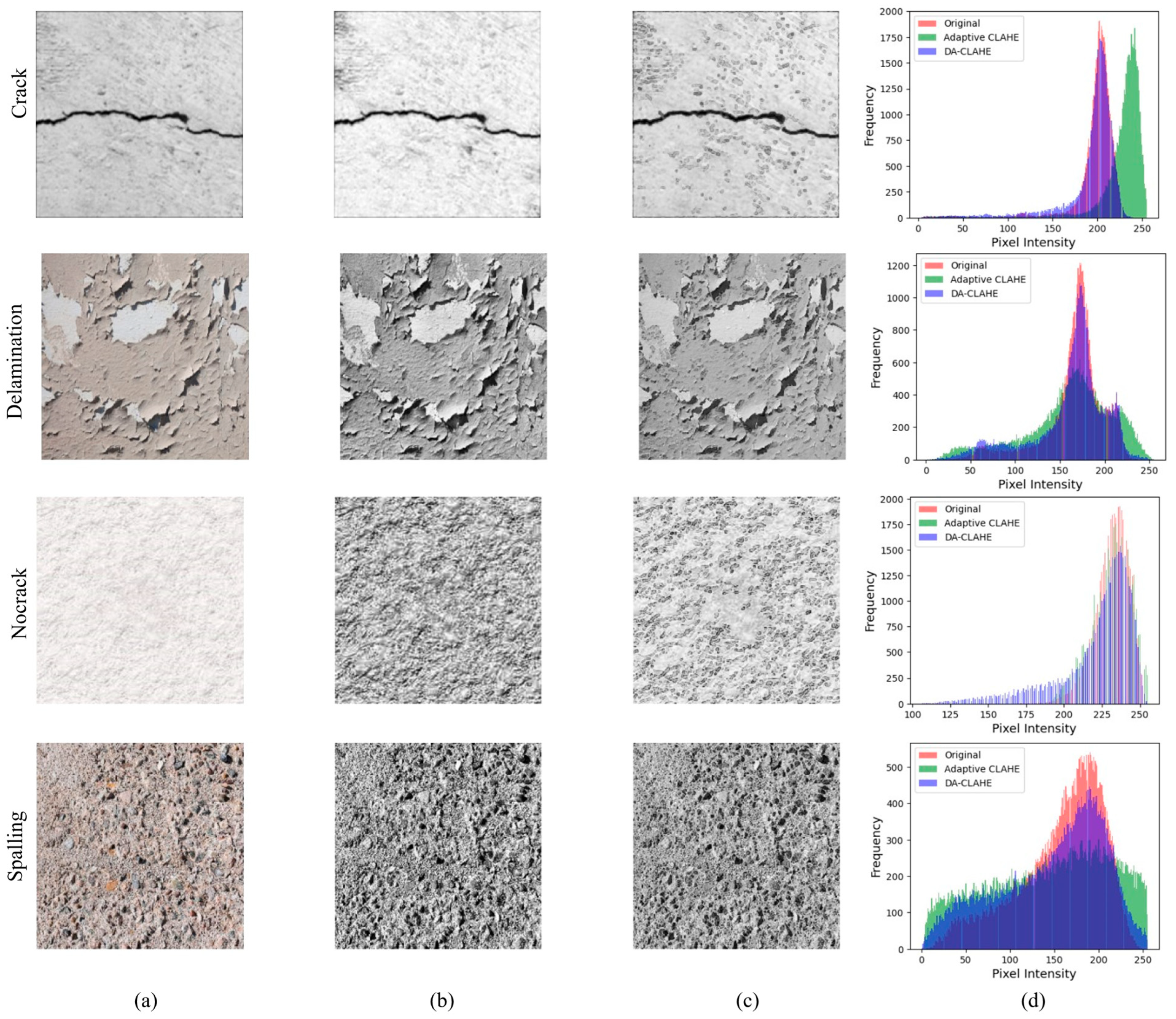
3.5. DAC Filtering
| Algorithm 1: DAC Filter |
| Input: Red, Green, Blue (RGB) surface damage image I Output: Damage-aware adaptive CLAHE-enhanced image IDA
|
3.6. Attention and Multiscale Feature Fusion in DA-DenseNet-201
| Algorithm 2: DA-DenseNet-201 |
| Input: Surface images Output: Classified surface defect labels
|
4. Results and Discussion
4.1. Implementation Setup
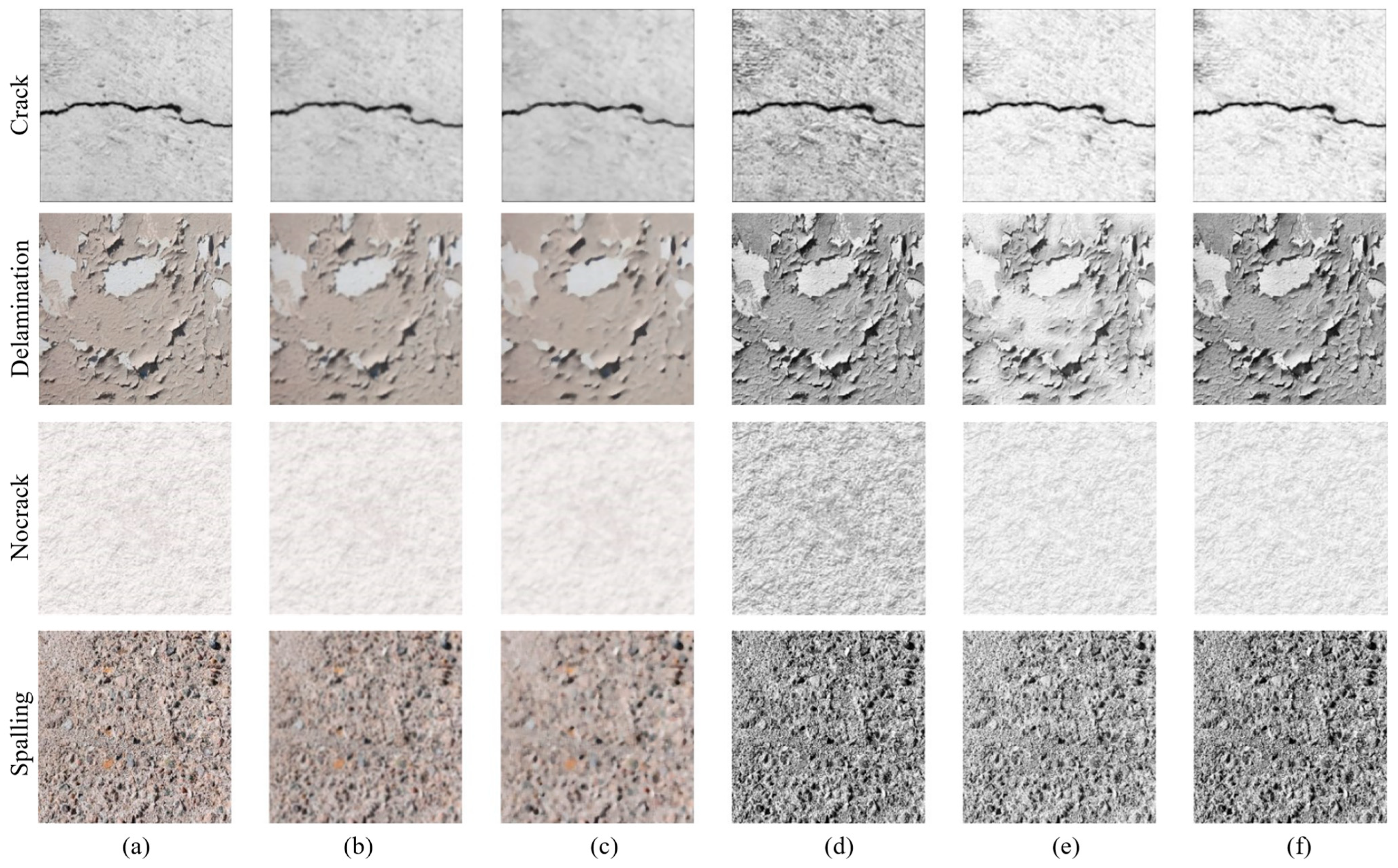
4.2. Inferences and Performance Analysis of DAC Images
4.3. Performance Analysis of DA-DenseNet-201 Model
4.4. Confusion Matrix of DA-DenseNet-201
4.5. Feature Map Inferences of DA-DenseNet-201
5. DA-DenseNet-201 Generalization Performance
6. Ablation Study on DA-DenseNet-201
7. Computational Complexity and Edge Inference Analysis
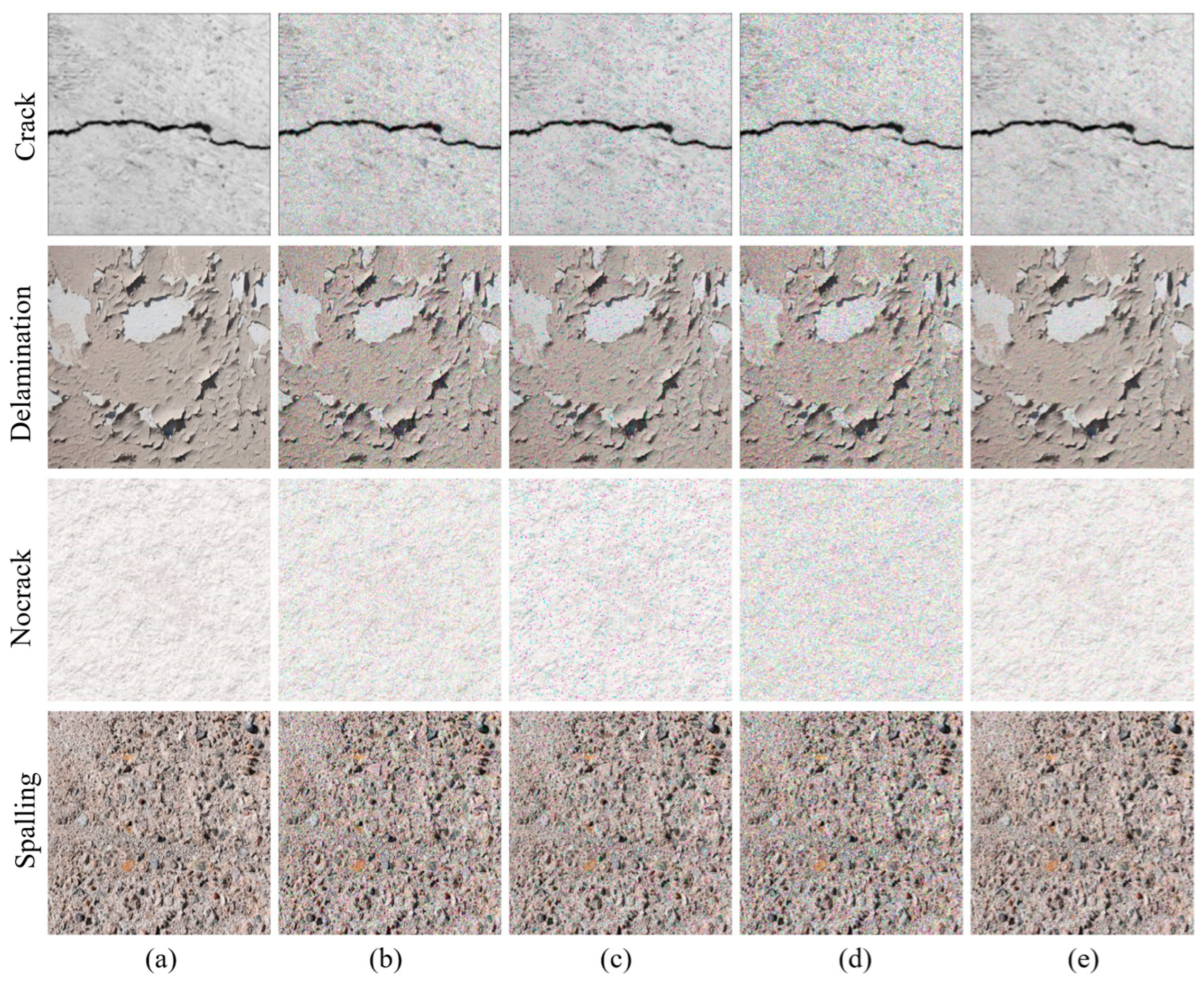
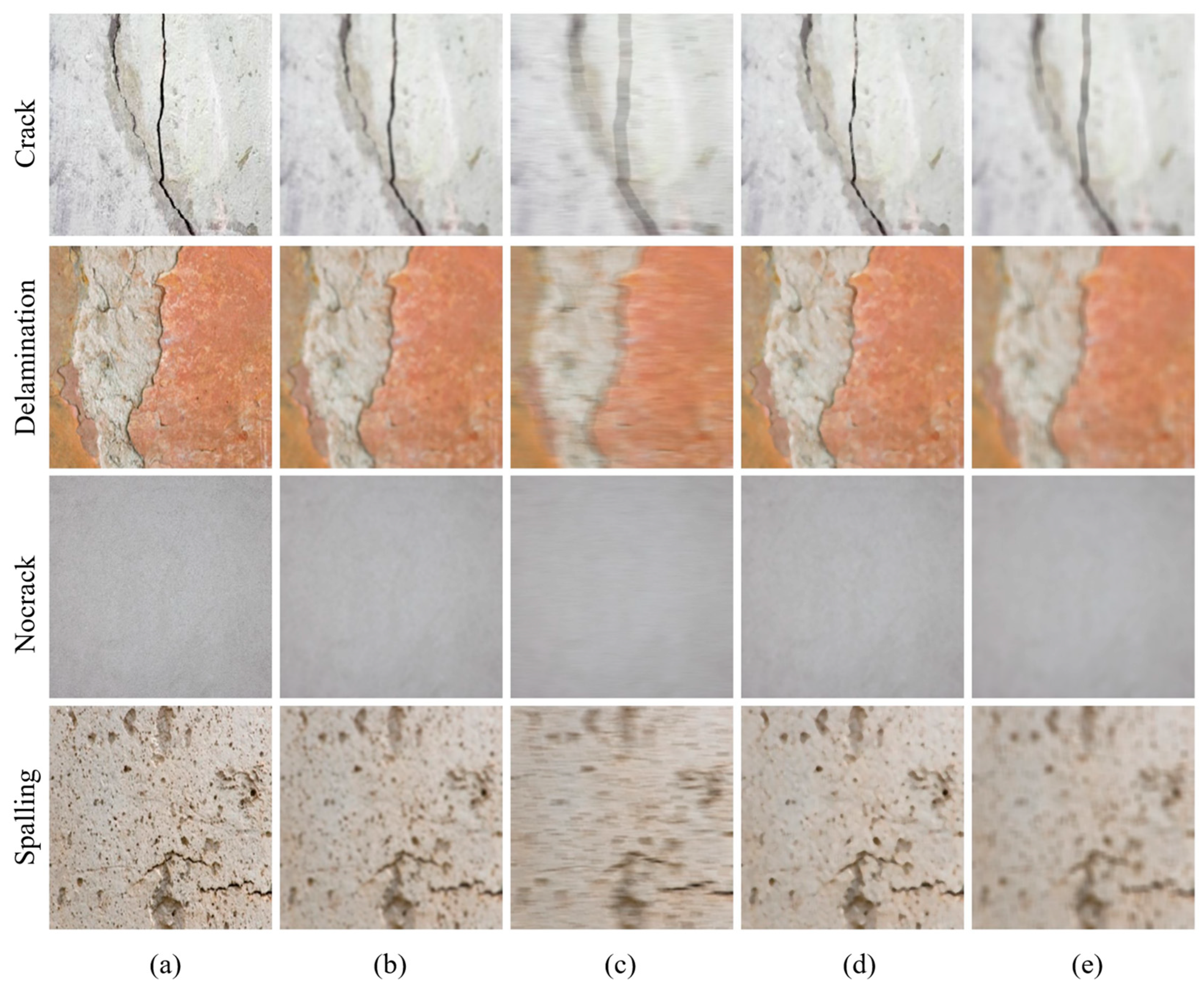
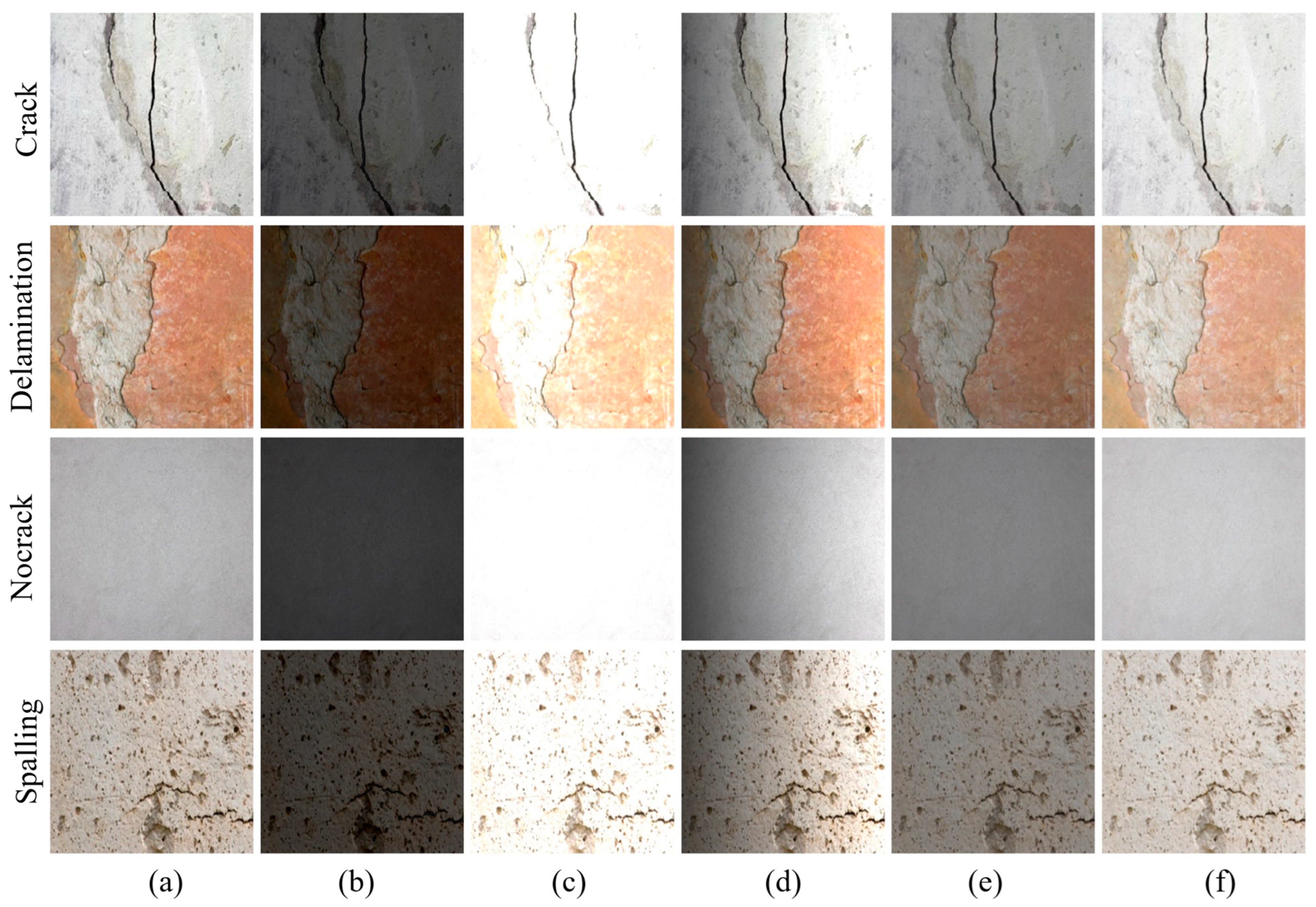
8. Dataset Distortion Diversity Analysis of DA-DenseNet-201
9. Conclusions
Author Contributions
Funding
Data Availability Statement
Conflicts of Interest
References
- Fan, C.; Ding, Y.; Liu, X.; Yang, K. A review of crack research in concrete structures based on data-driven and intelligent algorithms. Structures 2025, 75, 108800. [Google Scholar] [CrossRef]
- Zhang, J.; Zheng, Z.; Ling, T. Transformer in civil engineering defect detection: A survey. J. Traffic Transp. Eng. (Engl. Ed.) 2025, 12, 1330–1359. [Google Scholar] [CrossRef]
- Chen, Y.; Li, H.; Zhu, H.; Ren, T.; Cao, Z. Concrete Bridge Crack Detection Using Unmanned Aerial Vehicles and Image Segmentation. Infrastructures 2025, 10, 161. [Google Scholar] [CrossRef]
- Song, F.; Liu, B.; Yuan, G. Pixel-Level Crack Identification for Bridge Concrete Structures Using Unmanned Aerial Vehicle Photography and Deep Learning. Struct. Control Health Monit. 2024, 2024, 1299095. [Google Scholar] [CrossRef]
- Zhang, J.; Qian, S.; Tan, C. Automated bridge surface crack detection and segmentation using computer vision-based deep learning model. Eng. Appl. Artif. Intell. 2022, 115, 105225. [Google Scholar] [CrossRef]
- Khan, S.; Jan, A.; Seo, S. Structural crack detection using deep learning: An in-depth review. Korean J. Remote Sens. 2023, 39, 371–393. [Google Scholar] [CrossRef]
- Xu, Z.; Qian, S.; Ran, X.; Zhou, J. Application of deep convolution neural network in crack identification. Appl. Artif. Intell. 2022, 36, 2014188. [Google Scholar] [CrossRef]
- Mayya, A.M.; Alkayem, N.F. Enhance the Concrete Crack Classification Based on a Novel Multi-Stage YOLOV10-ViT Framework. Sensors 2024, 24, 8095. [Google Scholar] [CrossRef]
- Ye, G.; Dai, W.; Tao, J.; Qu, J.; Zhu, L.; Jin, Q. An improved transformer-based concrete crack classification method. Sci. Rep. 2024, 14, 6226. [Google Scholar] [CrossRef]
- Hoła, J.; Schabowicz, K. State-of-the-art non-destructive methods for diagnostic testing of building structures—Anticipated development trends. Arch. Civ. Mech. Eng. 2010, 10, 5–18. [Google Scholar] [CrossRef]
- Dwivedi, S.K.; Vishwakarma, M.; Soni, A. Advances and researches on non destructive testing: A review. Mater. Today Proc. 2018, 5, 3690–3698. [Google Scholar] [CrossRef]
- Zhao, Z. Review of non-destructive testing methods for defect detection of ceramics. Ceram. Int. 2021, 47, 4389–4397. [Google Scholar] [CrossRef]
- Razi, P.; Esmaeel, R.A.; Taheri, F. Application of a robust vibration-based non-destructive method for detection of fatigue cracks in structures. Smart Mater. Struct. 2011, 20, 115017. [Google Scholar] [CrossRef]
- Fu, R.; Xu, H.; Wang, Z.; Shen, L.; Cao, M.; Liu, T.; Novak, D. Enhanced intelligent identification of concrete cracks using multi-layered image preprocessing-aided convolutional neural networks. Sensors 2020, 20, 2021. [Google Scholar] [CrossRef]
- Lv, Z.; Tian, J.; Zhu, Y.; Li, Y. Automatic crack detection of dam concrete structures based on deep learning. Comput. Concr. 2023, 32, 615. [Google Scholar] [CrossRef]
- Liu, D.; Xu, M.; Li, Z.; He, Y.; Zheng, L.; Xue, P.; Wu, X. A multi-scale residual encoding network for concrete crack segmentation. J. Intell. Fuzzy Syst. 2024, 46, 1379–1392. [Google Scholar] [CrossRef]
- Liu, C.; Tian, L.; Wang, P.; Wang, X.; Miao, J. Automatic damage detection and evaluation of post-fire reinforced concrete structures using deep learning. Autom. Constr. 2025, 177, 106376. [Google Scholar] [CrossRef]
- Zhang, X.; Wen, K.; Liu, L.; Cao, J.; Zheng, Z.; Chen, Z.; Xiang, P. Distributed Fiber Optic Sensing Integrating TCN-Transformer for Damage Evolution Analysis of Asphalt Concrete under Freeze–Thaw Cycles. J. Transp. Eng. Part B Pavements 2026, 152, 04026018. [Google Scholar] [CrossRef]
- Wen, X.; Li, S.; Yu, H.; He, Y. Multi-scale context feature and cross-attention network-enabled system and software-based for pavement crack detection. Eng. Appl. Artif. Intell. 2024, 127, 107328. [Google Scholar] [CrossRef]
- Yang, L.; Bai, S.; Liu, Y.; Yu, H. Multi-scale triple-attention network for pixelwise crack segmentation. Autom. Constr. 2023, 150, 104853. [Google Scholar] [CrossRef]
- Liu, G.; Wu, X.; Dai, F.; Liu, G.; Li, L.; Huang, B. Crack-MsCGA: A Deep Learning Network with Multi-Scale Attention for Pavement Crack Detection. Sensors 2025, 25, 2446. [Google Scholar] [CrossRef]
- Azouz, Z.; Honarvar Shakibaei Asli, B.; Khan, M. Evolution of crack analysis in structures using image processing technique: A review. Electronics 2023, 12, 3862. [Google Scholar] [CrossRef]
- Pham, M.V.; Ha, Y.S.; Kim, Y.T. Automatic detection and measurement of ground crack propagation using deep learning networks and an image processing technique. Measurement 2023, 215, 112832. [Google Scholar] [CrossRef]
- Kirthiga, R.; Elavenil, S. A survey on crack detection in concrete surface using image processing and machine learning. J. Build. Pathol. Rehabil. 2024, 9, 15. [Google Scholar] [CrossRef]
- Dwivedi, D.; Babu, K.V.S.M.; Yemula, P.K.; Chakraborty, P.; Pal, M. Identification of surface defects on solar pv panels and wind turbine blades using attention based deep learning model. Eng. Appl. Artif. Intell. 2024, 131, 107836. [Google Scholar] [CrossRef]
- Wu, Z.; Tang, Y.; Hong, B.; Liang, B.; Liu, Y. Enhanced precision in dam crack width measurement: Leveraging advanced lightweight network identification for pixel-level accuracy. Int. J. Intell. Syst. 2023, 2023, 9940881. [Google Scholar] [CrossRef]
- Tumrate, C.S.; Saini, D.K.; Gupta, P.; Mishra, D. Evolutionary computation modelling for structural health monitoring of critical infrastructure. Arch. Comput. Methods Eng. 2023, 30, 1479–1493. [Google Scholar] [CrossRef]
- Dai, Q.; Ishfaque, M.; Khan, S.U.R.; Luo, Y.L.; Lei, Y.; Zhang, B.; Zhou, W. Image classification for sub-surface crack identification in concrete dam based on borehole CCTV images using deep dense hybrid model. Stoch. Environ. Res. Risk Assess. 2024, 39, 4637–4654. [Google Scholar] [CrossRef]
- Nguyen, L.N.; Le, T.H.; Nguyen, L.Q.; Tran, V.Q. Machine learning approaches for predicting Cracking Tolerance Index (CTIndex) of asphalt concrete containing reclaimed asphalt pavement. PLoS ONE 2023, 18, e0287255. [Google Scholar] [CrossRef]
- Srivastava, V.; Basu, B.; Prabhu, N. Application of Machine Learning (ML)-based multi-classifications to identify corrosion fatigue cracking phenomena in Naval steel weldments. Mater. Today Commun. 2024, 39, 108591. [Google Scholar] [CrossRef]
- Xu, L.; Yang, J.; Ge, M.; Su, Z. Three-dimensional fatigue crack quantification using densely connected convolutional network-assisted ultrasonic guided waves. Int. J. Fatigue 2024, 180, 108094. [Google Scholar] [CrossRef]
- Silva, W.R.L.D.; Lucena, D.S.D. Concrete cracks detection based on deep learning image classification. Proceedings 2018, 2, 489. [Google Scholar] [CrossRef]
- Flah, M.; Suleiman, A.R.; Nehdi, M.L. Classification and quantification of cracks in concrete structures using deep learning image-based techniques. Cem. Concr. Compos. 2020, 114, 103781. [Google Scholar] [CrossRef]
- Hu, G.X.; Hu, B.L.; Yang, Z.; Huang, L.; Li, P. Pavement crack detection method based on deep learning models. Wirel. Commun. Mob. Comput. 2021, 2021, 5573590. [Google Scholar] [CrossRef]
- Arbaoui, A.; Ouahabi, A.; Jacques, S.; Hamiane, M. Concrete cracks detection and monitoring using deep learning-based multiresolution analysis. Electronics 2021, 10, 1772. [Google Scholar] [CrossRef]
- Dang, L.M.; Wang, H.; Li, Y.; Nguyen, L.Q.; Nguyen, T.N.; Song, H.K.; Moon, H. Deep learning-based masonry crack segmentation and real-life crack length measurement. Constr. Build. Mater. 2022, 359, 129438. [Google Scholar] [CrossRef]
- Rosenberger, J.; Tlatlik, J.; Münstermann, S. Deep learning based initial crack size measurements utilizing macroscale fracture surface segmentation. Eng. Fract. Mech. 2023, 293, 109686. [Google Scholar] [CrossRef]
- Li, D.; Chen, Q.; Wang, H.; Shen, P.; Li, Z.; He, W. Deep learning-based acoustic emission data clustering for crack evaluation of welded joints in field bridges. Autom. Constr. 2024, 165, 105540. [Google Scholar] [CrossRef]
- Morita, D.; Kawarazaki, A.; Soufi, M.; Otake, Y.; Sato, Y.; Numajiri, T. Automatic detection of midfacial fractures in facial bone CT images using deep learning-based object detection models. J. Stomatol. Oral Maxillofac. Surg. 2024, 125, 101914. [Google Scholar] [CrossRef]
- Hamishebahar, Y.; Guan, H.; So, S.; Jo, J. A comprehensive review of deep learning-based crack detection approaches. Appl. Sci. 2022, 12, 1374. [Google Scholar] [CrossRef]
- Satpathy, R.P.K.; Kumar, K.; Hirwani, C.K.; Kumar, V.; Kumar, E.K.; Panda, S.K. Computational deep learning algorithm (vision/frequency response)-based damage detection in engineering structure. Acta Mech. 2023, 234, 5919–5935. [Google Scholar] [CrossRef]
- Le, T.T.; Nguyen, V.H.; Le, M.V. Development of deep learning model for the recognition of cracks on concrete surfaces. Appl. Comput. Intell. Soft Comput. 2021, 2021, 8858545. [Google Scholar] [CrossRef]
- Zhang, H.; Shen, Z.; Lin, Z.; Quan, L.; Sun, L. Deep learning-based automatic classification of three-level surface information in bridge inspection. Comput.-Aided Civ. Infrastruct. Eng. 2024, 39, 1431–1451. [Google Scholar] [CrossRef]
- Feng, X.; Xiao, L.; Li, W.; Pei, L.; Sun, Z.; Ma, Z.; Shen, H.; Ju, H. Pavement crack detection and segmentation method based on improved deep learning fusion model. Math. Probl. Eng. 2020, 2020, 8515213. [Google Scholar] [CrossRef]
- Pandey, V.; Mishra, S.S. A review of image-based deep learning methods for crack detection. Multimed. Tools Appl. 2025, 84, 35469–35511. [Google Scholar] [CrossRef]
- Li, Q.; Zhang, G.; Yang, P. CL-YOLOv8: Crack detection algorithm for fair-faced walls based on deep learning. Appl. Sci. 2024, 14, 9421. [Google Scholar] [CrossRef]
- Geetha, G.K.; Sim, S.H. Fast identification of concrete cracks using 1D deep learning and explainable artificial intelligence-based analysis. Autom. Constr. 2022, 143, 104572. [Google Scholar] [CrossRef]
- Zheng, J.; Qian, K.; Liu, X.; Pang, Z.; Yang, Z.; Sun, J.; Zhang, D. An improved automatic image labeling and classification algorithm for multi-mode damage quantification of 2.5 D woven composites based on deep learning strategy. Compos. Sci. Technol. 2025, 259, 110932. [Google Scholar] [CrossRef]
- Daimari, E.; Ratna, S.; Mouli, P.C.; Madhurima, V. A Comprehensive study on the different types of soil desiccation cracks and their implications for soil identification using deep learning techniques. Eur. Phys. J. E 2024, 47, 57. [Google Scholar] [CrossRef]
- Golding, V.P.; Gharineiat, Z.; Munawar, H.S.; Ullah, F. Crack detection in concrete structures using deep learning. Sustainability 2022, 14, 8117. [Google Scholar] [CrossRef]
- Wang, P.; Liu, C.; Wang, X.; Tian, L.; Miao, J.; Liu, Y. Multicategory fire damage detection of post-fire reinforced concrete structural components. Comput.-Aided Civ. Infrastruct. Eng. 2025, 40, 91–112. [Google Scholar] [CrossRef]
- Ibrahim, E.A.; Goff, D.; Keyvanfar, A.; Jonaidi, M. Assessing post-fire damage in concrete structures: A comprehensive review. Buildings 2025, 15, 485. [Google Scholar] [CrossRef]
- Jovanović, B.; Caspeele, R.; Lombaert, G.; Reynders, E.; Van Coile, R. State-of-the-art review on the post-fire assessment of concrete structures. Struct. Concr. 2023, 24, 5370–5387. [Google Scholar] [CrossRef]
- Andrushia, A.D.; Anand, N.; Neebha, T.M.; Naser, M.Z.; Lubloy, E. Autonomous detection of concrete damage under fire conditions. Autom. Constr. 2022, 140, 104364. [Google Scholar] [CrossRef]
- Choudhary, G.K.; Dey, S. Crack detection in concrete surfaces using image processing, fuzzy logic, and neural networks. In 2012 IEEE Fifth International Conference on Advanced Computational Intelligence (ICACI); IEEE: Piscataway, NJ, USA, 2012; pp. 404–411. [Google Scholar] [CrossRef]
- Lins, R.G.; Givigi, S.N. Automatic crack detection and measurement based on image analysis. IEEE Trans. Instrum. Meas. 2016, 65, 583–590. [Google Scholar] [CrossRef]
- Akagic, A.; Buza, E.; Omanovic, S.; Karabegovic, A. Pavement crack detection using Otsu thresholding for image segmentation. In 2018 41st International Convention on Information and Communication Technology, Electronics and Microelectronics (MIPRO); IEEE: Piscataway, NJ, USA, 2018; pp. 1092–1097. [Google Scholar] [CrossRef]
- Safaei, N.; Smadi, O.; Masoud, A.; Safaei, B. An automatic image processing algorithm based on crack pixel density for pavement crack detection and classification. Int. J. Pavement Res. Technol. 2022, 15, 159–172. [Google Scholar] [CrossRef]
- Hsieh, Y.A.; Tsai, Y. Automated asphalt pavement raveling detection and classification using convolutional neural network and macrotexture analysis. Transp. Res. Rec. 2021, 2675, 984–994. [Google Scholar] [CrossRef]
- Taj, M.N.A.B.G.; Alruwais, N.; Alshahrani, H.M.; Vijayalakshmi, J.; Shanmugapriya, N.; Jayaprakash, S. Precision crack analysis in concrete structures using CNN, SVM, and KNN: A machine learning approach. Matéria 2024, 29, e20240551. [Google Scholar] [CrossRef]
- Fakhri, D.; Khodayari, A.; Mahmoodzadeh, A.; Hosseini, M.; Ibrahim, H.H.; Mohammed, A.H. Prediction of Mixed-mode I and II effective fracture toughness of several types of concrete using the extreme gradient boosting method and metaheuristic optimization algorithms. Eng. Fract. Mech. 2022, 276, 108916. [Google Scholar] [CrossRef]
- Mir, B.A.; Sasaki, T.; Nakao, K.; Nagae, K.; Nakada, K.; Mitani, M.; Tsukada, T.; Osada, N.; Terabayashi, K.; Jindai, M. Machine learning-based evaluation of the damage caused by cracks on concrete structures. Precis. Eng. 2022, 76, 314–327. [Google Scholar] [CrossRef]
- Cha, Y.J.; Choi, W.; Büyüköztürk, O. Deep learning-based crack damage detection using convolutional neural networks. Comput.-Aided Civ. Infrastruct. Eng. 2017, 32, 361–378. [Google Scholar] [CrossRef]
- Liu, J.; Yang, X.; Lau, S.; Wang, X.; Luo, S.; Lee, V.C.S.; Ding, L. Automated pavement crack detection and segmentation based on two-step convolutional neural network. Comput.-Aided Civ. Infrastruct. Eng. 2020, 35, 1291–1305. [Google Scholar] [CrossRef]
- Dung, C.V. Autonomous concrete crack detection using deep fully convolutional neural network. Autom. Constr. 2019, 99, 52–58. [Google Scholar] [CrossRef]
- Yang, L.; Huang, H.; Kong, S.; Liu, Y. A deep segmentation network for crack detection with progressive and hierarchical context fusion. J. Build. Eng. 2023, 75, 106886. [Google Scholar] [CrossRef]
- Ali, R.; Chuah, J.H.; Talip, M.S.A.; Mokhtar, N.; Shoaib, M.A. Structural crack detection using deep convolutional neural networks. Autom. Constr. 2022, 133, 103989. [Google Scholar] [CrossRef]
- Liu, C.; Tian, L.; Wang, P.; Yu, Q.Q.; Zhong, X.; Miao, J. Knowledge-driven 3D damage mapping and decision support for fire-damaged reinforced concrete structures using enhanced deep learning and multi-modal sensing. Adv. Eng. Inform. 2025, 68, 103715. [Google Scholar] [CrossRef]
- Zhao, L.; Xu, T. Multimodal perception-guided intelligent pavement crack detection approach: A novel combining vision and semantic supervision framework. Measurement 2025, 258, 119333. [Google Scholar] [CrossRef]
- Rizia, M.M.; Reyes-Munoz, J.A.; Ortega, A.G.; Choudhuri, A.; Flores-Abad, A. Intelligent Crack Detection in Infrastructure Using Computer Vision at the Edge. Expert Syst. 2025, 42, e13784. [Google Scholar] [CrossRef]
- Ghosh Mondal, T.; Jahanshahi, M.R.; Wu, R.T.; Wu, Z.Y. Deep learning-based multi-class damage detection for autonomous post-disaster reconnaissance. Struct. Control Health Monit. 2020, 27, e2507. [Google Scholar] [CrossRef]
- Wang, J.; Qin, Q.; Zhao, J.; Ye, X.; Feng, X.; Qin, X.; Yang, X. Knowledge-based detection and assessment of damaged roads using post-disaster high-resolution remote sensing image. Remote Sens. 2015, 7, 4948–4967. [Google Scholar] [CrossRef]
- Hu, K.; Chen, Z.; Kang, H.; Tang, Y. 3D vision technologies for a self-developed structural external crack damage recognition robot. Autom. Constr. 2024, 159, 105262. [Google Scholar] [CrossRef]
- Concrete Structural Defect Imaging Dataset: High-Quality Multi-Defect Concrete Images for Detection and Rehabilitation. Kaggle Dataset. 2025. Available online: https://www.kaggle.com/datasets/programmer3/concrete-structural-defect-imaging-dataset (accessed on 1 November 2025).
- NEU Surface Defect Database. Kaggle Dataset. 2025. Available online: https://www.kaggle.com/datasets/kaustubhdikshit/neu-surface-defect-database (accessed on 1 November 2025).



| Representative Studies | Inference and Advantages | Limitations | |
|---|---|---|---|
| ML models |
|
| |
| IP models |
|
| |
| DL models |
|
| |
| Advanced DL, 3D damage localization models |
|
|
|
| Defect Class | Data Distribution | ||||||
|---|---|---|---|---|---|---|---|
| Original | Testing | Actual | Augment | Total | Training | Validation | |
| Crack | 250 | 50 | 200 | 1400 | 1600 | 1280 | 320 |
| Delamination | 250 | 50 | 200 | 1400 | 1600 | 1280 | 320 |
| Spalling | 250 | 50 | 200 | 1400 | 1600 | 1280 | 320 |
| No crack | 250 | 50 | 200 | 1400 | 1600 | 1280 | 320 |
| Total | 1000 | 200 | 800 | 5600 | 6400 | 5120 | 1280 |
| Augmentation Technique | Purpose | Expected Influence on Fracture Detection Accuracy |
|---|---|---|
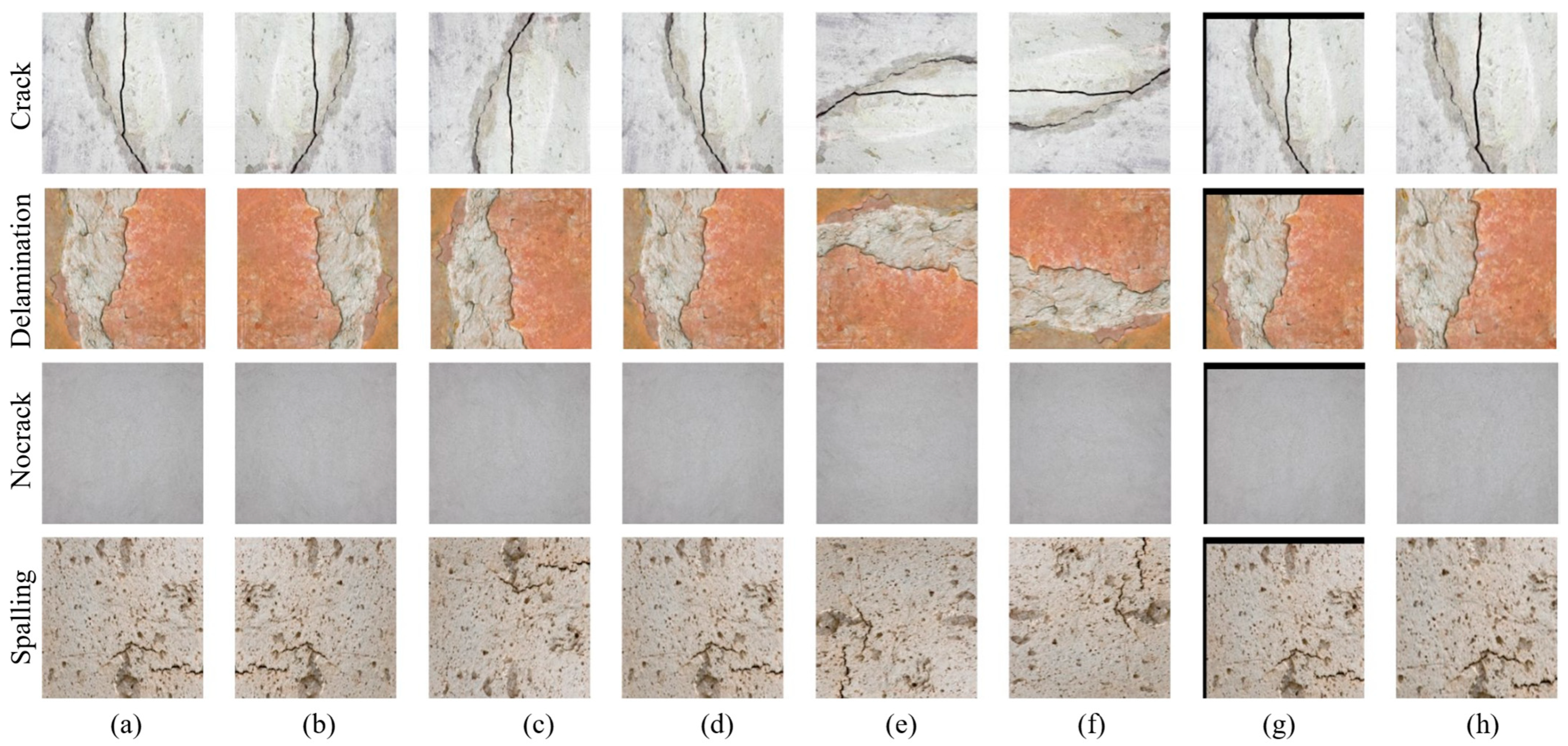
| Horizontal flip | Mirrors the surface to simulate cracks and patterns across structural orientations. | Improves robustness against directional bias irrespective of orientation. |
| Vertical flip | Flips images top-to-bottom to expose the model to inverted surface conditions. | Reduces sensitivity to the acquisition viewpoint and improves generalisation. |
| Scaling | Resizes surface damage regions to simulate variations in camera distance. | Enhances scale invariance, allowing the accurate detection of fine cracks. |
| Rotation (90°, 270°) | Introduces orthogonal rotational variations common in field-acquired surface images. | Prevents misclassification due to rotated crack patterns and improves orientation-independent feature learning. |
| Translation | Shifts images spatially to simulate off-centre damage regions. | Improves localisation and reduces dependence on damage position. |
| Zoom | Simulates closer and farther inspection of surface defects by cropping and resizing. | Enhances detection of subtle cracks and edges while preserving the global context. |
| Model | Accuracy (%) | |||||
|---|---|---|---|---|---|---|
| Raw Images | Gaussian Blur | Median Filtering | CLAHE | Tile-Based CLAHE | Adaptive CLAHE | |
| LeNet | 72.00 | 73.10 | 73.85 | 74.60 | 75.20 | 76.00 |
| AlexNet | 75.40 | 76.55 | 77.30 | 78.40 | 79.10 | 80.20 |
| VGG-19 | 78.90 | 80.10 | 81.25 | 82.60 | 83.40 | 84.30 |
| ResNet-101 | 82.40 | 83.95 | 85.10 | 86.50 | 87.35 | 88.60 |
| MobileNet-V3 | 80.30 | 81.60 | 82.55 | 83.90 | 84.70 | 85.80 |
| EfficientNet-B3 | 84.60 | 86.10 | 87.40 | 88.95 | 89.80 | 90.70 |
| Inception-V3 | 83.20 | 84.60 | 85.75 | 87.10 | 87.95 | 88.90 |
| Xception | 83.90 | 85.40 | 86.60 | 88.20 | 89.10 | 90.10 |
| DenseNet-201 | 85.30 | 87.10 | 88.55 | 90.10 | 90.85 | 91.25 |
| Model | Adaptive CLAHE Surface Images (%) | ||||||
|---|---|---|---|---|---|---|---|
| Accuracy | Sensitivity | Specificity | Precision | Recall | F1-Score | IoU | |
| LeNet | 76.00 | 73.40 | 78.10 | 74.20 | 73.40 | 73.80 | 58.50 |
| AlexNet | 80.20 | 77.60 | 82.40 | 78.10 | 77.60 | 77.85 | 63.60 |
| VGG-19 | 84.30 | 82.10 | 86.50 | 83.00 | 82.10 | 82.55 | 69.30 |
| ResNet-101 | 88.60 | 86.40 | 90.20 | 87.10 | 86.40 | 86.75 | 76.40 |
| MobileNet-V3 | 85.80 | 83.30 | 87.90 | 84.10 | 83.30 | 83.70 | 71.80 |
| EfficientNet-B3 | 90.70 | 88.90 | 92.10 | 89.40 | 88.90 | 89.15 | 79.50 |
| Inception-V3 | 88.90 | 86.80 | 90.40 | 87.30 | 86.80 | 87.05 | 76.80 |
| Xception | 90.10 | 88.20 | 91.70 | 88.80 | 88.20 | 88.50 | 78.90 |
| DenseNet-201 | 91.25 | 89.60 | 92.80 | 90.10 | 89.60 | 89.85 | 81.20 |
| Model | Hyperparameter | Configuration | Description |
|---|---|---|---|
| Base network | Backbone architecture | DenseNet-201 | Pretrained CNN for feature extraction |
| Pretrained weights | ImageNet | Enables transfer learning and faster convergence | |
| Include the top layer | False | Removes ImageNet classifier head | |
| Input image size | 224 × 224 × 3 | RGB surface damage images | |
| DenseNet-201 backbone | Total layers | 201 | Deep feature extraction capacity |
| Growth rate | 32 | Feature map growth per dense layer | |
| Dense blocks | 4 | Progressive hierarchical feature learning | |
| Transition layers | 3 | Feature compression and down-sampling | |
| Activation function | ReLU | Nonlinear transformation | |
| Normalisation | BN | Stabilises and accelerates training | |
| Multiscale feature extraction | Feature layers | conv3_block12_concat | Fine-grained crack-level features |
| conv4_block24_concat | Texture-level features | ||
| DenseNet output | Semantic-level features | ||
| Pooling method | Global average pooling | Converts feature maps to vectors | |
| Feature fusion | Concatenation | Combines multiscale descriptors | |
| Fusion normalisation | Batch normalisation | Balances fused features | |
| Classification head | Dense Layer 1 | 512 neurons, ReLU | High-level feature refinement |
| Dropout Rate 1 | 0.5 | Prevents overfitting | |
| Dense Layer 2 | 256 neurons, ReLU | Compact discriminative learning | |
| Dropout Rate 2 | 0.4 | Regularisation | |
| Output layer | Class = 4, softmax | Multiclass damage classification | |
| Training configuration | Loss function | Categorical cross-entropy | Multiclass classification objective |
| Optimiser | Adam | Adaptive learning rate optimisation | |
| Learning rate | 0.001 | Stable convergence | |
| Batch size | 32 | Stable mini-batch optimisation | |
| Training epochs | 150 | Sufficient convergence for DA-DenseNet-201 | |
| Frozen layer policy | DenseNet-201 backbone frozen initially | Transfer learning-based feature extraction | |
| Early stopping | Patience = 15 | Prevents overfitting | |
| Learning-rate scheduling | ReduceLROnPlateau | Adaptive learning-rate reduction | |
| LR reduction factor | 0.5 | Gradual convergence improvement | |
| Minimum learning rate | 1.00 × 10⁻⁶ | Prevents excessive LR decay | |
| Random seed | 42 | Ensures reproducibility | |
| Regularisation | Dropout | 0.5, 0.4 | Reduces model overfitting |
| Data augmentation | Applied to training data only | Improves generalisation |
| Filter Image | Sharpness | Entropy | SSIM | Contrast | Edge Density |
|---|---|---|---|---|---|
| Original image | 0.41 | 5.12 | 1.000 | 0.38 | 0.21 |
| Gaussian blur | 0.28 | 4.60 | 0.75 | 0.25 | 0.14 |
| Median filtering | 0.33 | 4.85 | 0.78 | 0.30 | 0.18 |
| CLAHE | 0.56 | 5.78 | 0.81 | 0.54 | 0.39 |
| Tile-based CLAHE | 0.62 | 5.95 | 0.82 | 0.59 | 0.44 |
| Adaptive CLAHE | 0.68 | 6.12 | 0.89 | 0.65 | 0.49 |
| Proposed DAC filter | 0.75 | 6.48 | 0.96 | 0.72 | 0.57 |
| Model | DAC Surface Images | ||||||
|---|---|---|---|---|---|---|---|
| Accuracy (%) | Sensitivity (%) | Specificity (%) | Precision (%) | Recall (%) | F1-Score (%) | IoU (%) | |
| LeNet | 79.20 | 76.80 | 81.40 | 77.50 | 76.80 | 77.15 | 62.80 |
| AlexNet | 81.50 | 79.10 | 83.60 | 79.80 | 79.10 | 79.45 | 65.90 |
| VGG-19 | 85.40 | 83.20 | 87.10 | 84.00 | 83.20 | 83.60 | 70.80 |
| ResNet-101 | 89.70 | 87.90 | 91.20 | 88.50 | 87.90 | 88.20 | 77.40 |
| MobileNet-V3 | 87.90 | 85.60 | 89.80 | 86.30 | 85.60 | 85.95 | 73.60 |
| EfficientNet-B3 | 91.80 | 90.10 | 93.20 | 90.70 | 90.10 | 90.40 | 80.90 |
| Inception-V3 | 89.20 | 87.30 | 90.80 | 88.00 | 87.30 | 87.65 | 76.90 |
| Xception | 92.30 | 90.80 | 93.80 | 91.40 | 90.80 | 91.10 | 82.40 |
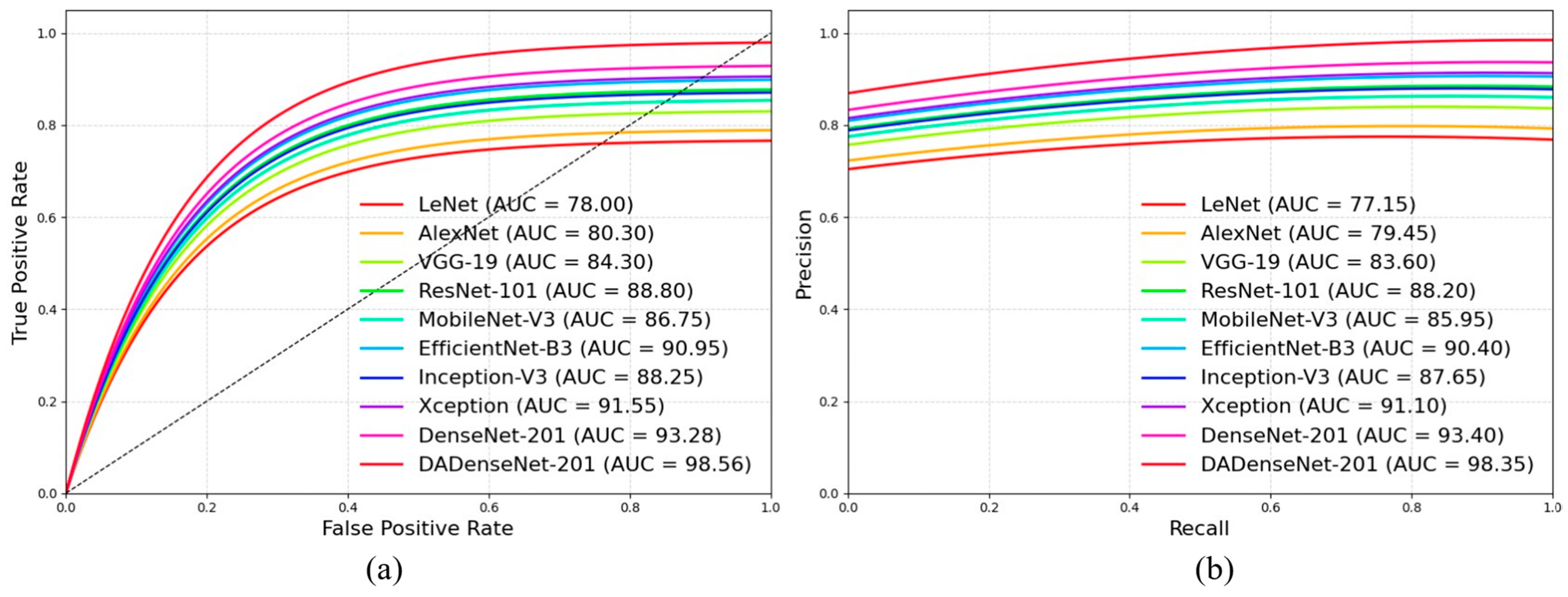
| DenseNet-201 | 93.45 | 93.10 | 93.60 | 93.70 | 93.10 | 93.40 | 85.60 |
| DA-DenseNet-201 | 98.93 | 98.20 | 99.40 | 98.50 | 98.20 | 98.35 | 94.10 |
| Defect Class | Concrete Structural Defect Imaging Dataset Distribution | ||||||
|---|---|---|---|---|---|---|---|
| Original | Testing | Actual | Augment | Total | Training | Validation | |
| Crack | 350 | 70 | 280 | 1960 | 2240 | 1792 | 448 |
| Delamination | 350 | 70 | 280 | 1960 | 2240 | 1792 | 448 |
| Spalling | 350 | 70 | 280 | 1960 | 2240 | 1792 | 448 |
| No crack | 350 | 70 | 280 | 1960 | 2240 | 1792 | 448 |
| Total | 1400 | 280 | 1120 | 7840 | 8960 | 7168 | 1792 |
| Defect class | NEU surface defect dataset distribution | ||||||
| Original | Testing | Actual | Augment | Total | Training | Validation | |
| Crack | 240 | 48 | 192 | 1344 | 1536 | 1229 | 307 |
| Delamination | 240 | 48 | 192 | 1344 | 1536 | 1229 | 307 |
| Spalling | 240 | 48 | 192 | 1344 | 1536 | 1229 | 307 |
| No crack | 240 | 48 | 192 | 1344 | 1536 | 1229 | 307 |
| Total | 960 | 192 | 768 | 5376 | 6144 | 4915 | 1229 |
| Model | Concrete Structural Defect Imaging Dataset DAC Images | ||||||
|---|---|---|---|---|---|---|---|
| Accuracy (%) | Sensitivity (%) | Specificity (%) | Precision (%) | Recall (%) | F1-Score (%) | IoU (%) | |
| LeNet | 77.80 | 75.40 | 80.10 | 76.20 | 75.40 | 75.80 | 60.50 |
| AlexNet | 80.60 | 78.30 | 82.70 | 79.10 | 78.30 | 78.70 | 65.10 |
| VGG-19 | 84.10 | 81.90 | 86.20 | 82.70 | 81.90 | 82.30 | 69.90 |
| ResNet-101 | 88.20 | 86.10 | 90.00 | 86.90 | 86.10 | 86.50 | 76.20 |
| MobileNet-V3 | 86.40 | 84.00 | 88.10 | 84.70 | 84.00 | 84.35 | 72.50 |
| EfficientNet-B3 | 90.60 | 88.70 | 92.10 | 89.30 | 88.70 | 89.00 | 80.30 |
| Inception-V3 | 88.50 | 86.40 | 90.20 | 87.00 | 86.40 | 86.70 | 76.60 |
| Xception | 91.20 | 89.60 | 92.80 | 90.20 | 89.60 | 89.90 | 81.90 |
| DenseNet-201 | 93.10 | 91.70 | 94.10 | 92.20 | 91.70 | 91.95 | 84.80 |
| DA-DenseNet-201 | 97.85 | 97.10 | 98.50 | 97.40 | 97.10 | 97.25 | 92.90 |
| Model | NEU surface defect dataset DAC images | ||||||
| Accuracy (%) | Sensitivity (%) | Specificity (%) | Precision (%) | Recall (%) | F1-Score (%) | IoU (%) | |
| LeNet | 76.40 | 73.80 | 78.60 | 74.50 | 73.80 | 74.15 | 58.60 |
| AlexNet | 79.30 | 76.60 | 81.20 | 77.30 | 76.60 | 76.95 | 63.20 |
| VGG-19 | 82.90 | 80.50 | 84.60 | 81.20 | 80.50 | 80.85 | 68.20 |
| ResNet-101 | 87.10 | 85.00 | 88.70 | 85.70 | 85.00 | 85.35 | 74.90 |
| MobileNet-V3 | 85.20 | 82.70 | 86.90 | 83.40 | 82.70 | 83.05 | 71.20 |
| EfficientNet-B3 | 89.30 | 87.30 | 90.80 | 87.90 | 87.30 | 87.60 | 78.80 |
| Inception-V3 | 87.40 | 85.30 | 88.90 | 85.80 | 85.30 | 85.55 | 75.20 |
| Xception | 90.10 | 88.40 | 91.60 | 88.90 | 88.40 | 88.65 | 80.40 |
| DenseNet-201 | 92.20 | 90.60 | 93.40 | 91.10 | 90.60 | 90.85 | 83.30 |
| DA-DenseNet-201 | 96.94 | 96.20 | 97.70 | 96.50 | 96.20 | 96.35 | 90.80 |
| Model | Accuracy (%) | Sensitivity (%) | Specificity (%) | Precision (%) | Recall (%) | F1-Score (%) | IoU (%) |
|---|---|---|---|---|---|---|---|
| DenseNet-201 (Raw images) | 85.30 | 83.20 | 86.90 | 84.10 | 83.20 | 83.65 | 71.40 |
| DenseNet-201 + Adaptive CLAHE | 91.25 | 89.60 | 92.80 | 90.10 | 89.60 | 89.85 | 81.20 |
| DenseNet-201 + DAC | 94.10 | 92.80 | 95.20 | 93.20 | 92.80 | 93.00 | 85.90 |
| DenseNet-201 + DAC + Attention Refinement Block | 96.40 | 95.30 | 97.10 | 95.80 | 95.30 | 95.55 | 90.10 |
| DenseNet-201 + DAC + Multi-Scale Feature Fusion | 97.20 | 96.10 | 98.00 | 96.50 | 96.10 | 96.30 | 91.80 |
| DA-DenseNet-201 | 98.93 | 98.20 | 99.40 | 98.50 | 98.20 | 98.35 | 94.10 |
| Model | Parameters (M) | FLOPs (G) | Model Size (MB) | Inference Time (ms/Image) | Accuracy (%) |
|---|---|---|---|---|---|
| LeNet | 0.06 | 0.01 | 2.1 | 3.2 | 79.2 |
| AlexNet | 61 | 0.72 | 233 | 6.8 | 81.5 |
| VGG-19 | 143.7 | 19.6 | 548 | 18.4 | 85.4 |
| ResNet-101 | 44.5 | 7.8 | 170 | 14.6 | 89.7 |
| MobileNet-V3 | 5.4 | 0.23 | 21 | 5.1 | 87.9 |
| EfficientNet-B3 | 12 | 1.8 | 47 | 8.4 | 91.8 |
| Inception-V3 | 23.8 | 5.7 | 92 | 11.2 | 89.2 |
| Xception | 22.9 | 8.4 | 88 | 12.5 | 92.3 |
| DenseNet-201 | 20.2 | 4.3 | 77 | 10.8 | 93.45 |
| DA-DenseNet-201 | 23.6 | 5.1 | 89 | 12.1 | 98.93 |
| Defect | Original | Noise | Blur | Brightness | Actual |
|---|---|---|---|---|---|
| Crack | 250 | 1000 | 1000 | 1250 | 3500 |
| Delamination | 250 | 1000 | 1000 | 1250 | 3500 |
| Spalling | 250 | 1000 | 1000 | 1250 | 3500 |
| No crack | 250 | 1000 | 1000 | 1250 | 3500 |
| Total | 1000 | 4000 | 4000 | 5000 | 14,000 |
| Defect Class | Actual | Testing | Actual | Training | Validation |
|---|---|---|---|---|---|
| Crack | 3500 | 700 | 2800 | 2240 | 560 |
| Delamination | 3500 | 700 | 2800 | 2240 | 560 |
| Spalling | 3500 | 700 | 2800 | 2240 | 560 |
| No crack | 3500 | 700 | 2800 | 2240 | 560 |
| Total | 14,000 | 2800 | 11,200 | 8960 | 2240 |
| Model | Distortion Diversity Dataset DAC Images | ||||||
|---|---|---|---|---|---|---|---|
| Accuracy (%) | Sensitivity (%) | Specificity (%) | Precision (%) | Recall (%) | F1-Score (%) | IoU (%) | |
| LeNet | 74.60 | 72.10 | 76.80 | 73.00 | 72.10 | 72.55 | 57.40 |
| AlexNet | 77.90 | 75.80 | 79.50 | 76.20 | 75.80 | 76.00 | 61.80 |
| VGG-19 | 82.50 | 80.60 | 84.30 | 81.10 | 80.60 | 80.85 | 67.90 |
| ResNet-101 | 87.10 | 85.40 | 88.80 | 86.20 | 85.40 | 85.80 | 74.60 |
| MobileNet-V3 | 85.60 | 83.20 | 87.10 | 84.00 | 83.20 | 83.60 | 71.50 |
| EfficientNet-B3 | 90.20 | 88.60 | 91.80 | 89.10 | 88.60 | 88.85 | 79.20 |
| Inception-V3 | 87.80 | 85.90 | 89.40 | 86.50 | 85.90 | 86.20 | 75.30 |
| Xception | 91.10 | 89.70 | 92.60 | 90.20 | 89.70 | 89.95 | 80.80 |
| DenseNet-201 | 92.60 | 91.80 | 93.20 | 92.10 | 91.80 | 91.95 | 84.10 |
| DA-DenseNet-201 | 98.94 | 98.10 | 98.30 | 98.40 | 989.10 | 98.25 | 93.20 |
Disclaimer/Publisher’s Note: The statements, opinions and data contained in all publications are solely those of the individual author(s) and contributor(s) and not of MDPI and/or the editor(s). MDPI and/or the editor(s) disclaim responsibility for any injury to people or property resulting from any ideas, methods, instructions or products referred to in the content. |
© 2026 by the authors. Licensee MDPI, Basel, Switzerland. This article is an open access article distributed under the terms and conditions of the Creative Commons Attribution (CC BY) license.
Share and Cite
Maruthi, M.; Devi, M.S.; Choi, Y.; Yi, C.-Y. Damage Attention-Aware Dense Layered Framework for Surface Crack Classification. Buildings 2026, 16, 2313. https://doi.org/10.3390/buildings16122313
Maruthi M, Devi MS, Choi Y, Yi C-Y. Damage Attention-Aware Dense Layered Framework for Surface Crack Classification. Buildings. 2026; 16(12):2313. https://doi.org/10.3390/buildings16122313
Chicago/Turabian StyleMaruthi, Molaka, Munisamy Shyamala Devi, Young Choi, and Chang-Yong Yi. 2026. "Damage Attention-Aware Dense Layered Framework for Surface Crack Classification" Buildings 16, no. 12: 2313. https://doi.org/10.3390/buildings16122313
APA StyleMaruthi, M., Devi, M. S., Choi, Y., & Yi, C.-Y. (2026). Damage Attention-Aware Dense Layered Framework for Surface Crack Classification. Buildings, 16(12), 2313. https://doi.org/10.3390/buildings16122313