Review

Next-Generation Seismic Resilience of Urban Infrastructure: A Critical Review and “3C Framework” Roadmap Under Near-Fault Ground Motions


School of Civil Engineering, Zhengzhou University, Zhengzhou 450001, China
*
Author to whom correspondence should be addressed.
Buildings 2026, 16(12), 2314; https://doi.org/10.3390/buildings16122314 (registering DOI)
Submission received: 19 May 2026 / Revised: 5 June 2026 / Accepted: 7 June 2026 / Published: 9 June 2026
(This article belongs to the Special Issue Multi-Hazard Resilience for Sustainable Building Structure)

Abstract

Near-fault ground motions (NFGMs), characterized by forward-directivity velocity pulses, impose severe kinematic demands that challenge conventional structural systems. As modern civil engineering pivots toward rapid functional recovery, a critical paradigm shift is required: moving from component-centric kinematic vulnerability diagnostics to network-level systemic resilience optimization. This comprehensive review elucidates this transition, conceptualizing an integrated “3C Resilience Framework”—encompassing Coupled-multi-hazard, City-scale, and Carbon-friendly dimensions—as a strategic roadmap for next-generation seismic design. A pivotal focus is the physical evaluation of contemporary regulatory evolutions, specifically the multi-point spectral lower-bound constraints in American Society of Civil Engineers Standard 7-22 (ASCE 7-22) and the site-specific scaling factors in Eurocode 8. We demonstrate that these spectral floors are physically essential for flexible and isolated structures to constrain long-period kinetic energy, thereby mitigating the underestimation of residual drifts that fundamentally dictate repairability. Furthermore, this review explicitly aligns structural performance with the UN Sustainable Development Goals (SDG 9 & 11). By synthesizing advanced mitigation topologies with surrogate-assisted computational paradigms, this roadmap bridges the micro-to-macro scale gap between physical structural degradation and regional functional restoration, providing an actionable blueprint for sustainable urban networks.

1. Introduction

1.1. Background and Motivation

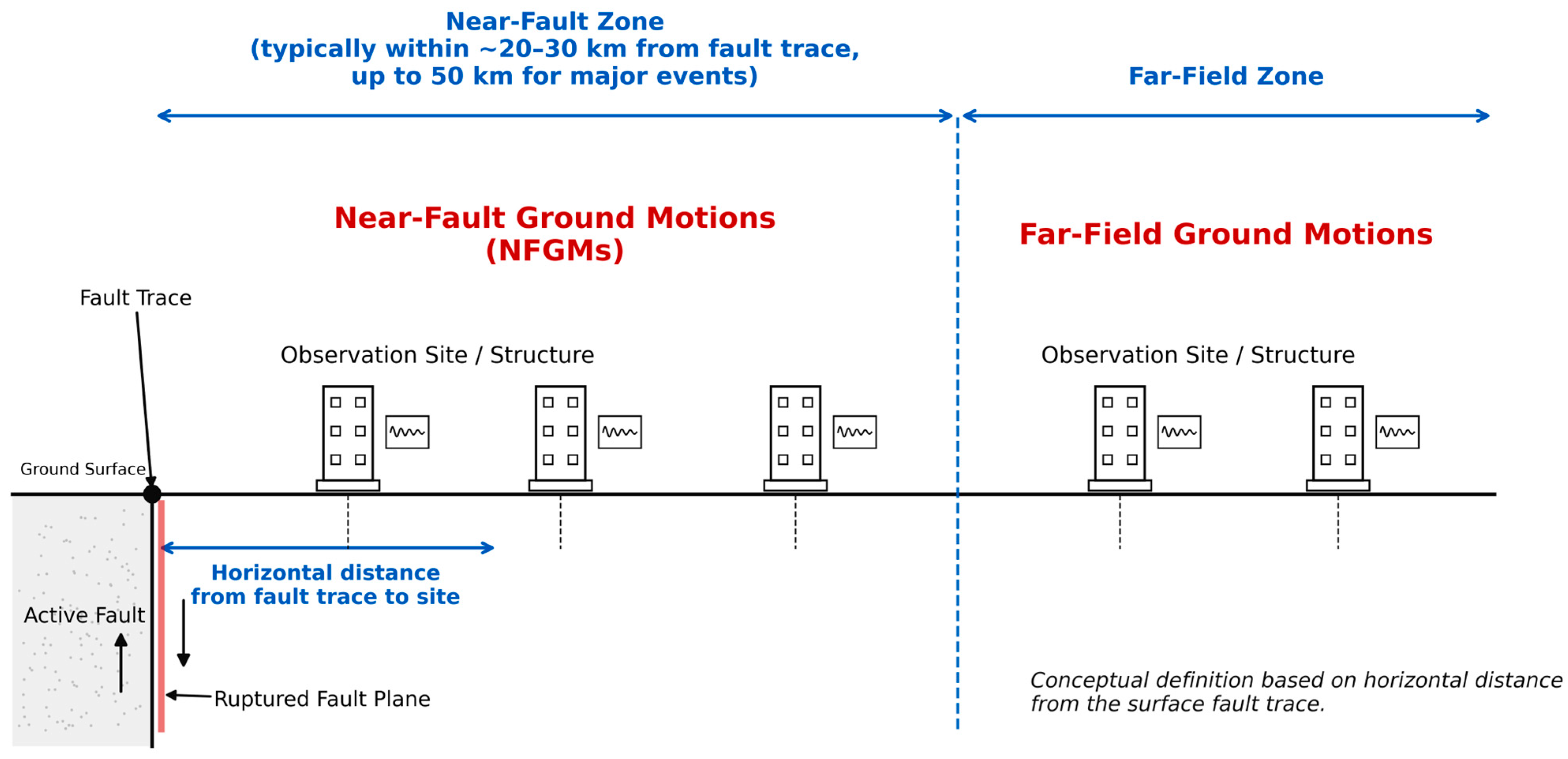
Earthquakes remain one of the most catastrophic natural hazards, posing severe threats to the safety of built environments. Recent seismic events, such as the 2023 Kahramanmaraş earthquakes in Türkiye, which induced substantial structural and regional functional losses, underscore the practical necessity and protective contributions of comprehensive pre-earthquake vulnerability studies [1]. Within earthquake engineering, near-fault ground motions (NFGMs)—typically defined as seismic events occurring within a limited distance (e.g., 20 to 60 km) from the ruptured fault [2,3,4]—have garnered increasing scrutiny. Post-earthquake reconnaissance from events such as the 2023 Türkiye-Syria and 2024 Noto Peninsula earthquakes consistently reveals non-uniform and disproportionate damage patterns in near-fault zones [5,6]. Physically, NFGMs represent a localized corridor where the velocity of the fault rupture propagation approaches the shear-wave velocity of the geological medium, creating a cumulative constructive interference phenomenon known as forward-directivity. This results in distinct kinematic signatures, notably severe long-period velocity pulses characterized by a high peak ground velocity (PGV) and pulse period (Tp), alongside irreversible fling-step tectonic displacement offsets [7,8,9,10], as schematically illustrated in Figure 1.
Unlike far-field (FF) ground motions, which typically induce structural degradation through cyclic cumulative damage, the velocity pulses inherent in NFGMs act as high-energy impulses. These impulses impart substantial kinetic energy into a structure within a short duration, which frequently challenges the instantaneous hysteretic energy dissipation capacity of conventional lateral force-resisting systems [11,12]. To quantitatively classify these pulse-like motions, various signal processing techniques have been evaluated to enhance the precision of seismic hazard assessments [13,14,15].
This pulse phenomenon fundamentally alters the structural demand. When the fundamental period of a structure approaches the predominant pulse period, a resonance-like condition emerges, imposing extreme transient displacement and ductility demands [16,17]. Consequently, this mechanism precipitates highly concentrated plastic deformations and severe residual inter-story drifts, markedly increasing the risk of global instability [18,19]. Furthermore, NFGMs are frequently accompanied by pronounced vertical acceleration components characterized by high vertical-to-horizontal acceleration ratios (V/H ratios) [20]. These high-frequency vertical fluctuations can substantially affect the transient axial load demands on critical load-bearing elements, potentially curtailing their shear capacity and ductility [21,22]. Recent catastrophic events, such as the aforementioned 2023 Türkiye-Syria doublet and the 2024 Noto Peninsula earthquake, have provided stark, real-world validation of these theoretical vulnerabilities. Extensive post-earthquake reconnaissance and structural damage assessments conducted throughout 2025 and 2026 consistently reveal that standard design spectra exhibit limitations in capturing the destructive potential of near-fault velocity pulses [5,23]. The intense, highly concentrated kinematic demands generated by these pulses inevitably result in severe ‘kinematic incompatibility’ between the massive energy input and the limited deformability of conventional gravity frames. These contemporary disasters underscore that the systemic loss of urban infrastructure resilience is primarily driven by this unresolved mechanical mismatch, highlighting the necessity for a paradigm shift.
While the explicit incorporation of near-fault amplification factors into global design codes (e.g., the 1997 Uniform Building Code, Eurocode 8, and the updated ASCE 7-22) marked a significant milestone in ensuring structural safety [24,25,26,27], the structural engineering community is currently experiencing a transition in design philosophy. The framework is progressively shifting from traditional “life-safety” and “collapse prevention” objectives toward “resilience-based design” and functional recoverability [28,29]. Previous comprehensive reviews have laid a solid foundation by focusing on the seismological characterization of NFGMs or the isolated dynamic responses of specific structural archetypes [30,31,32]. However, translating component-level kinematic vulnerability—such as concentrated plastic deformations and excessive residual drifts—into network-level systemic resilience remains fundamentally challenging. There remains a critical need for a systematic synthesis that explicitly maps fundamental kinematic vulnerabilities to actionable, resilience-enhancing mitigation strategies. Furthermore, contemporary infrastructure systems in near-fault zones face complex, cross-domain multi-hazard scenarios, highlighting the limitations of relying solely on isolated, component-level analyzes for updating future design codes [33].
Concurrently, the regulatory landscape is evolving to address these specific near-fault kinematic demands. For instance, contemporary frameworks—such as the multi-point spectral lower-bound constraints in ASCE 7-22 and the targeted near-fault amplification protocols in the evolving Eurocode 8 framework—explicitly confront these extreme demands. Evaluating how such international regulatory shifts influence the design of flexible and base-isolated structures is critical, as mitigating the potential underestimation of post-earthquake residual drifts is essential for ensuring structural repairability.
Although existing reviews have provided valuable insights into the seismological characterization of near-fault ground motions and the dynamic response of individual structural systems, a clear research gap remains in translating component-level kinematic damage into regional-scale functional recovery. In particular, the mechanical pathway from near-fault velocity pulses to concentrated plastic deformations, residual drift accumulation, lifeline interruption, demolition risk, and long-term socioeconomic and carbon burdens have not been systematically synthesized. This review addresses this gap by establishing a mechanistic bridge between near-fault kinematic vulnerabilities, resilience-oriented structural mitigation strategies, evolving international design codes, and the proposed 3C framework for systemic urban infrastructure recovery.

1.2. Scope and Objectives

This review covers and synthesizes representative literature published from 1995 to 2026, with particular emphasis on recent advances after 2020 in near-fault ground-motion characterization, resilience-based structural mitigation, structural health monitoring, machine learning-assisted regional assessment, and international code development. Building on this evidence base, and to address the critical gaps identified above and clarify the physical mechanisms driving structural failure, Table 1 summarizes the fundamental kinematic signatures of NFGMs and their direct mapping to structural vulnerability modes.
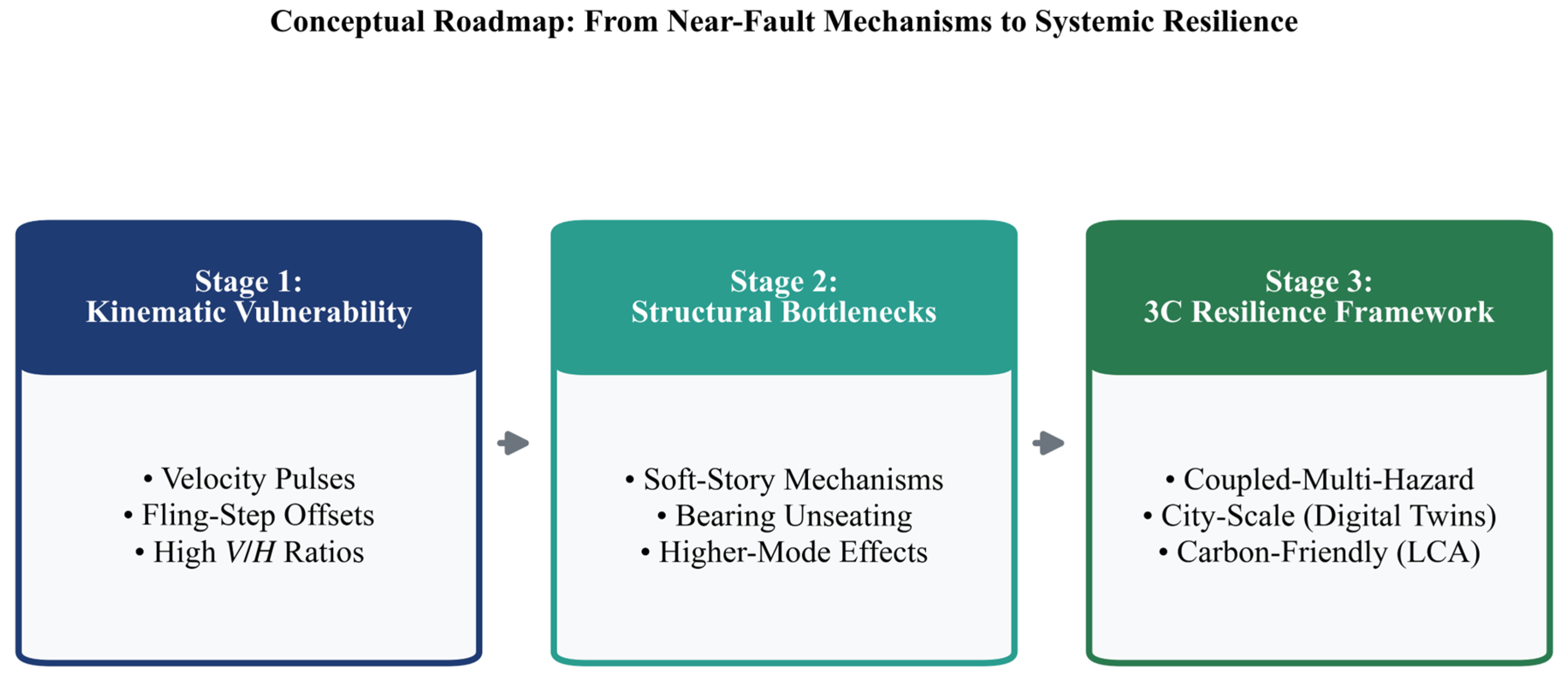
While this localized kinematic damage characterization is foundational, it remains significantly decoupled from macro-scale socioeconomic recovery trajectories. To bridge this divide, this review conceptualizes a rigorous taxonomy embodied in the “3C Resilience Framework”: Coupled-multi-hazard, City-scale, and Carbon-friendly. By establishing a mechanistic mapping from kinematic pulse-response bottlenecks to regional functional recoverability, this framework provides an actionable roadmap that directly aligns seismic engineering objectives with the United Nations Sustainable Development Goals (SDGs), specifically SDG 9 (Industry, Innovation, and Infrastructure) and SDG 11 (Sustainable Cities and Communities) [34]. The holistic pathway from these localized kinematic characteristics to network-level functional recovery is conceptually mapped out in Figure 2. As visually articulated in this framework, the remainder of this review is organized as follows: Section 2 synthesizes the kinematic vulnerability and structural bottlenecks of diverse infrastructure under pulse-like excitations, while evaluating advanced mitigation strategies. Section 3 critically examines the proposed 3C framework, exploring the role of surrogate-assisted optimization and digital twins in tracking dynamic recovery trajectories. Finally, Section 4 draws primary conclusions, offering a systematic roadmap for advancing from static vulnerability assessments to the realization of true systemic resilience in near-fault regions.

2. Response Bottlenecks and Resilience Enhancement Strategies for Engineering Structures Under NFGMs

The distinct kinematic signatures of NFGMs—particularly high-energy velocity pulses, fling-step offsets, and pronounced vertical effects—impose complex dynamic demands that vary significantly across different structural archetypes [35]. Transitioning from conventional collapse-prevention paradigms toward resilience-based design requires an objective mechanical evaluation of these structure-specific vulnerabilities [36]. This section synthesizes the response bottlenecks across five major infrastructure categories and critically evaluates the engineering practicality of advanced mitigation strategies. A specific emphasis is placed on their capacity to decouple inertial forces, control residual deformations, and facilitate rapid post-earthquake functional recovery [37].
To provide a macroscopic overview of these diverse vulnerability-mitigation mechanisms, Table 2 summarizes the primary kinematic bottlenecks, the limitations of conventional countermeasures, and the recommended resilience-oriented hardware strategies for each structural category.

2.1. Industrial and Lifeline Infrastructure: Equipment-Structure Interaction

Industrial facilities (e.g., petrochemical complexes) and above-ground lifeline infrastructures (e.g., high-voltage substations and power distribution networks) are fundamentally characterized by inherent mass and stiffness eccentricities, substantial height-to-width ratios, and the integration of massive floor-mounted or suspended equipment. Under NFGMs, the multi-component kinematic demands (particularly concurrent vertical pulses and torsional excitations) can significantly exacerbate these non-uniform dynamic properties [38]. During severe velocity pulses, the dynamic equipment-structure interaction (ESI) often induces pronounced phase-lag effects. This interaction amplifies torsional coupling and concentrates transient shear stresses at the anchorage interfaces connecting the equipment (such as heavy pressure vessels or substation transformers) to the primary lateral force-resisting system. Such intense dynamic coupling not only compromises global structural stability but also increases the risk of brittle rupture in critical pipelines and highly sensitive electrical transmission components, potentially triggering cascading environmental or economic secondary disasters [39,40,41].
To systematically enhance the seismic resilience of these critical facilities, engineering design must transition toward dynamically decoupling the macroscopic structural displacement from localized equipment acceleration demands. While conventional base isolation technologies (e.g., lead rubber bearings and friction pendulum systems) effectively filter high-frequency accelerations to protect internal components [42,43], they may encounter kinematic incompatibility when subjected to the extreme displacement demands and transient overturning moments induced by near-fault pulses [44]. Consequently, contemporary structural design is pivoting toward hybrid kinematic decoupling strategies. The strategic integration of tuned viscous mass dampers (TVMDs)—when rigorously calibrated to the predominant period of the anticipated near-fault pulse—can demonstrate substantial efficacy in suppressing transient displacement overshoots across the isolation plane while simultaneously regulating floor spectral accelerations [45,46]. Furthermore, adopting dual-system architectural configurations, which mechanically couple a highly stiff primary bracing system with a flexible secondary moment-resisting frame (MRF), provides a robust structural fuse mechanism. By designing the secondary MRF to remain strictly elastic post-yield of the primary braces, this configuration delivers a reliable restoring force that physically constrains permanent residual deformations, thereby preserving a stable operational environment for heavy industrial and lifeline infrastructure under severe impulsive loading [47,48].
Despite the proven efficacy of these kinematic decoupling strategies, their engineering practicality in these highly coupled applications is challenged by specific operational constraints. For instance, the optimal performance of TVMDs relies heavily on precise frequency tuning. In environments where equipment mass frequently changes due to operational upgrades, or when the primary structure undergoes inelastic yielding during an initial near-fault pulse, the system is highly susceptible to “detuning” effects. This detuning can substantially degrade the damper’s energy dissipation efficiency and, in some cases, potentially amplify equipment accelerations [49]. Consequently, developing robust, adaptive-stiffness inerter systems that can autonomously tune themselves to evolving structural states remains a critical research frontier for maintaining the systemic resilience of these coupled infrastructures.

2.2. Flexible Structural Systems: Bridges, Towers, and Civil Buildings

This section scrutinizes flexible structural systems—including bridges, towers, and civil buildings—which share common kinematic vulnerabilities due to their long-period characteristics.

2.2.1. Bridges

Bridges are among the most sensitive infrastructures to pulse-like NFGMs, where excessive relative displacements often lead to catastrophic unseating and pounding failures. Bridge structures—particularly multi-span continuous and cable-supported configurations—exhibit pronounced vulnerability to the extreme kinematic demands of NFGMs. To establish a rigorous resilience framework, it is critical to physically differentiate the specific damage mechanisms induced by distinct near-fault phenomena. Forward-directivity velocity pulses impose massive, sudden inertial shear demands that can rapidly degrade the low-cycle fatigue capacity of pier plastic hinges [50,51]. Conversely, fling-step surface ruptures subject the superstructure to permanent tectonic offsets [52,53]. This irrecoverable kinematic displacement frequently exceeds the ultimate shear strain capacity of standard elastomeric bearings and the displacement thresholds of expansion joints, significantly increasing the risk of unseating and cascading span collapses [54]. Furthermore, the pronounced vertical acceleration pulses inherent in near-fault excitations substantially alter the transient axial load demands on bridge piers. This dynamic fluctuation can curtail the pier’s shear capacity, elevating the susceptibility to sudden, brittle failures at the column-foundation interface—a localized damage mechanism well-documented in high-intensity events [22,55].
To mitigate these extreme displacement demands, conventional seismic isolation techniques (e.g., standard lead rubber bearings) are frequently employed. However, under asymmetric near-fault pulses, these conventional systems often encounter challenges in balancing optimal base shear reduction with the excessively large residual displacements they sustain [44,56]. Consequently, contemporary bridge engineering is witnessing a paradigm shift toward rocking-self-centering (RSC) technologies and hybrid isolation systems. RSC piers permit controlled, rigid-body lifting at the foundation interface, acting as an effective mechanical fuse to limit the transmitted inertial forces and mitigate severe plastic hinge formation within the primary pier body [57,58].
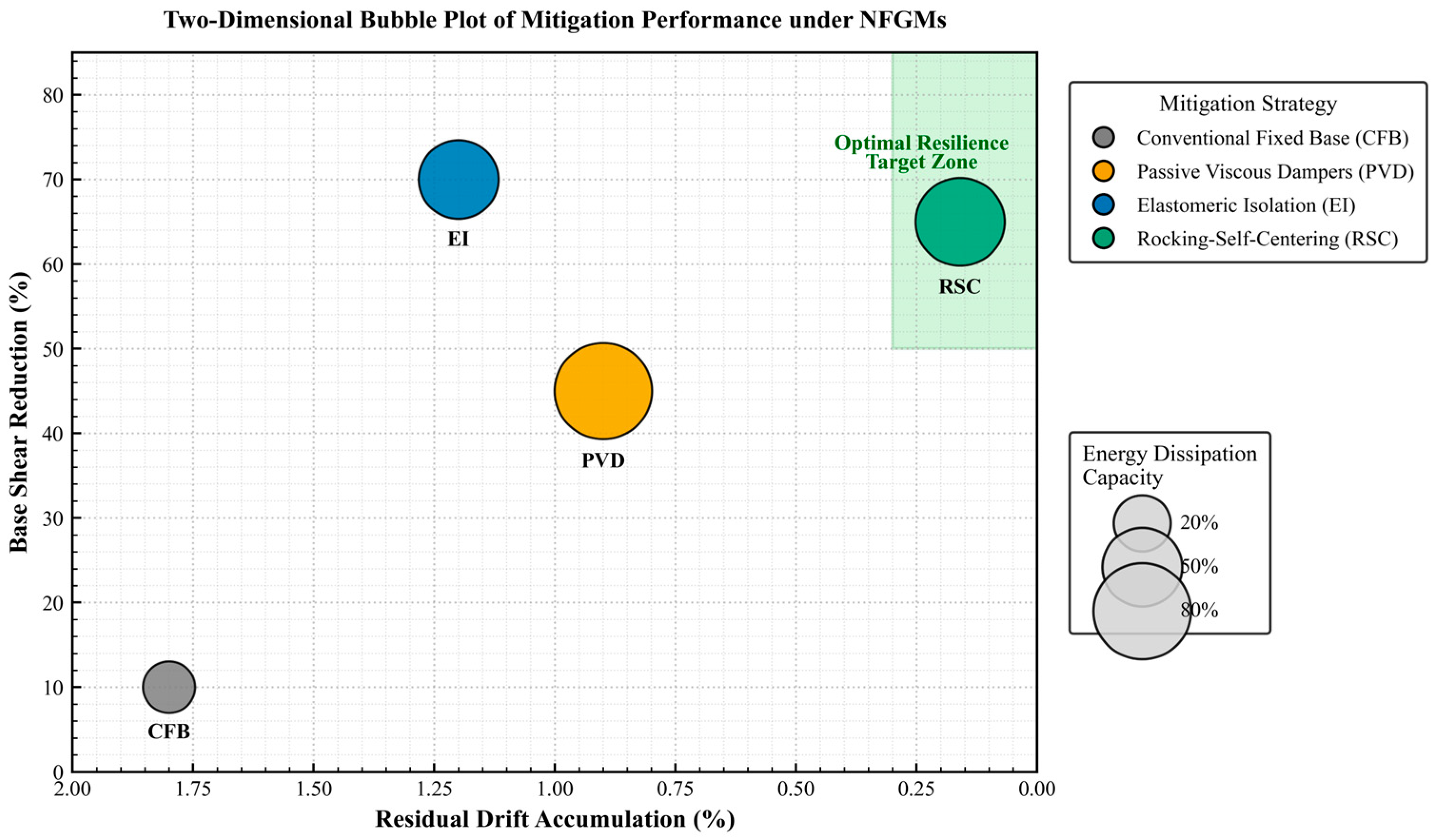
From a practical design perspective, achieving near-zero residual displacement in RSC bridge piers depends on a critical engineering balance: the post-tensioned (PT) tendon reinforcement ratio versus the energy-dissipating fuse strength ratio. This parameter requires meticulous calibration; if the strength of the energy-dissipating fuses is disproportionately high, the PT tendons may not provide sufficient restoring force to pull the massive pier back to its plumb position, potentially leading to permanent drifts. Conversely, if the fuses are too weak, the system may lack the capacity to dissipate the immense kinetic energy of a near-fault pulse. Additionally, the initial post-tensioning force must be carefully regulated to help prevent premature compressive crushing of the concrete at the rocking toe during peak rotational excursions [59,60]. For bearing systems, hybrid solutions integrating self-centering buckling-restrained braces (SC-BRBs) or shape memory alloys (SMAs) systematically decouple base shear reduction from residual displacement control, offering an optimal resilience framework for critical near-fault bridges [61,62]. To systematically illustrate the comparative performance of these advanced resilience-oriented designs against conventional isolation systems, Figure 3 presents a multidimensional conceptual analysis of their seismic mitigation capabilities.
Although the integration of RSC piers and smart hybrid bearings is designed to minimize permanent residual drifts, translating these systems into large-scale bridge engineering introduces complex structural and life-cycle durability challenges. The dynamic rocking action of massive bridge piers can induce high-frequency impact forces at the foundation interface, which significantly amplifies localized stress concentrations and may trigger secondary vertical vibrations in the superstructure. Furthermore, over the bridge’s extended life cycle, the unbonded PT tendons are susceptible to long-term stress relaxation and creep. This gradual loss of prestress can substantially diminish the system’s self-centering capacity, potentially increasing the bridge’s vulnerability to unexpected residual drifts during a subsequent earthquake. Consequently, developing robust impact-buffering interfaces and implementing reliable pre-stress monitoring technologies remain crucial steps for the widespread adoption of self-centering bridge systems [63].

2.2.2. Wind Turbine Towers

Extending the concern of long-period sensitivity, wind turbine towers—as quintessential flexible towers—exhibit distinct higher-mode amplifications under pulse-like excitations that challenge conventional strength-based designs. Utility-scale wind turbine towers—characterized by extreme slenderness, long fundamental periods (frequently exceeding 2.0 s), and a massive top-heavy nacelle-rotor assembly—exhibit pronounced kinematic vulnerability to the long-period energy content of near-fault velocity pulses [64]. When subjected to NFGMs, the sudden energy injection from velocity pulses often encompasses the frequency range of both the tower’s fundamental and critical higher-order modes [65]. This spectral overlap excites significant higher-mode participation, substantially amplifying transient accelerations at the nacelle level and inducing severe localized bending moments at the tower base [66]. Furthermore, the pronounced high-frequency vertical accelerations inherent in near-fault regions induce severe transient fluctuations in the tower’s axial load. This rapid load variation not only exacerbates second-order P-Δ effects but also significantly increases the susceptibility of the thin-walled tubular steel shell to localized flexural buckling [67,68].
Assessing the seismic resilience of wind turbines is inherently a multi-hazard challenge, complicated by the stochastic superimposition of wind-induced aerodynamic loads. While operational aerodynamic damping can occasionally dissipate a fraction of the seismic input energy, the concurrent action of extreme aerodynamic thrust and near-fault impulsive loads often governs the ultimate limit state design [69,70]. To safeguard these critical renewable energy assets without violating the strict spatial constraints within the tubular cross-section, high-efficiency supplemental damping systems are increasingly recognized as essential. Traditional passive mechanisms, including tuned liquid dampers (TLDs) and suspended mass pendulum dampers (SMPDs), have been extensively deployed to suppress multi-directional vibrations [71,72]. However, to confront the massive, instantaneous kinetic energy of near-fault pulses, contemporary engineering designs are pivoting toward smart materials [73]. The integration of SMAs into pendulum systems—creating advanced SMA-SMPD configurations—provides a highly resilient dual-defense mechanism. Leveraging the superelasticity and robust damping capacity of SMAs, these hybrid systems efficiently accommodate sudden, large-stroke displacement demands [74]. Crucially, this configuration helps mitigate the cyclic fatigue degradation endemic to conventional metallic dampers and enhances the self-centering capability of the supplemental mass, thereby effectively constraining nacelle acceleration overshoots and minimizing post-earthquake operational downtime [75].
Despite the promising attributes of SMA-enhanced pendulum systems, their widespread deployment in utility-scale wind turbines is often constrained by specific environmental and spatial challenges. Specifically, the superelastic behavior and energy dissipation capacity of conventional Ni-Ti SMAs are highly dependent on ambient temperatures due to their martensitic phase transformation characteristics. In offshore or high-altitude wind farms, where turbines are exposed to extreme thermal fluctuations, this temperature sensitivity can induce significant deviations in the damper’s intended restoring force and hysteretic damping, potentially compromising its reliability during a severe seismic event. Furthermore, accommodating the large displacement strokes required to dissipate massive near-fault kinetic energy within the extremely confined interior space of a turbine nacelle remains structurally challenging. Consequently, developing wide-temperature-window smart materials and ultra-compact rotational inerter dampers are critical prerequisites for transitioning these advanced control systems into ubiquitous industrial applications [76].

2.2.3. Civil Buildings

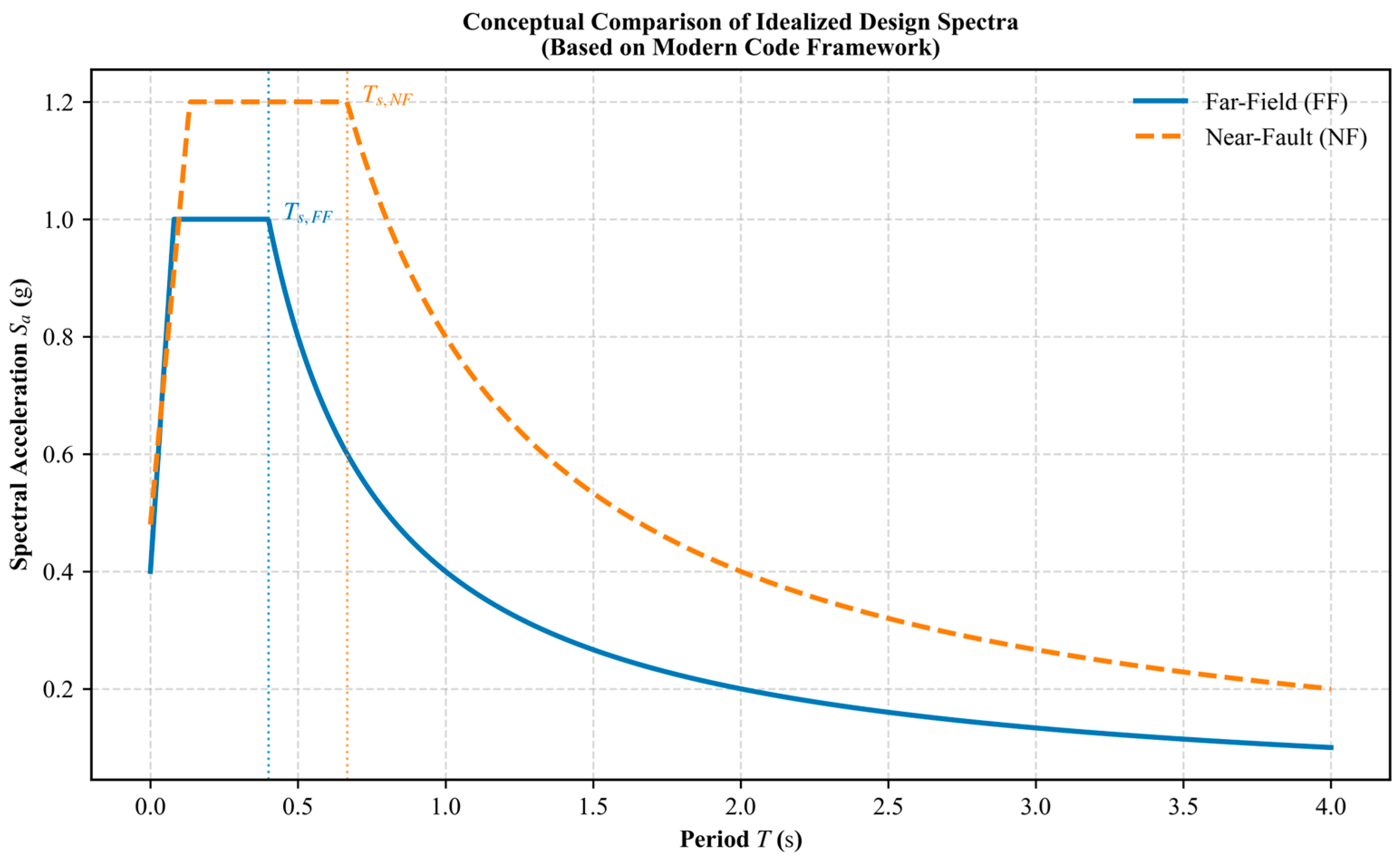
While bridges and towers focus on specific geometric vulnerabilities, civil buildings represent a broader class of flexible systems where the integration of rocking and self-centering technologies is pivotal for achieving seismic resilience. Civil building systems, encompassing both reinforced concrete and steel moment-resisting frames (SMRFs), exhibit pronounced kinematic vulnerability to the severe, long-period velocity pulses inherent in NFGMs. Unlike far-field earthquakes that typically induce structural degradation through cyclic cumulative fatigue, these velocity pulses can act as high-energy impulses, often driving the structure into large inelastic excursions within a single half-cycle. To quantitatively illustrate this shift in structural demand, Figure 4 compares the idealized design response spectra for near-fault and far-field ground motions, highlighting a distinct pulse-induced spectral amplification in the medium-to-long period range.
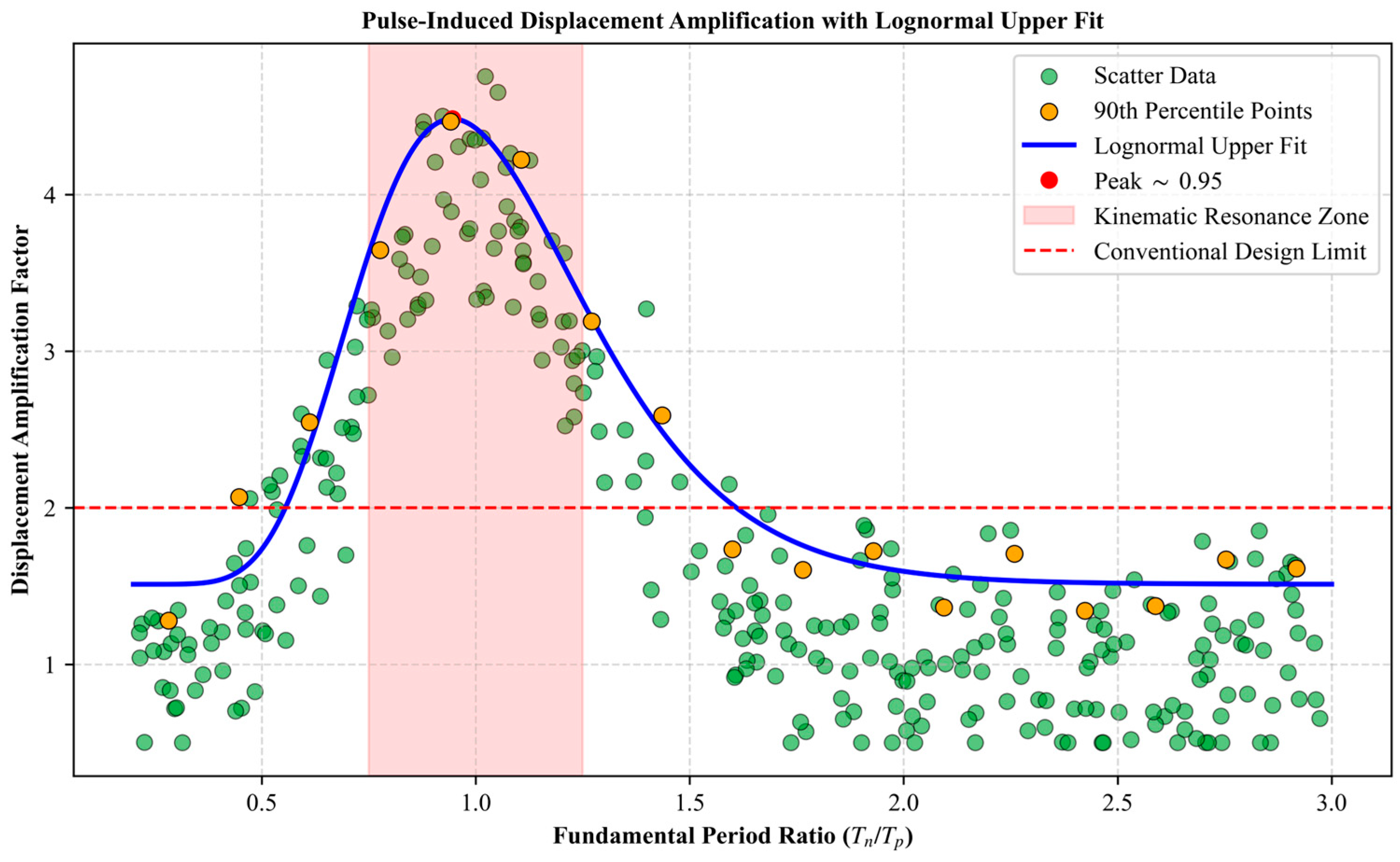
Driven by this amplified spectral energy, a resonance-like condition is frequently observed when the fundamental period of the structure (Tn) approaches the predominant pulse period (Tp), typically delineated within the critical frequency band of 0.5 ≤ Tn/Tp ≤ 1.5 [77,78].
To prevent catastrophic soft-story mechanisms under these high-energy impulses, component-level ductility providers act as the critical frontline defense. Modern design paradigms rely heavily on strict capacity design principles (e.g., strong columns and weak beams), ensuring that the shear capacity of critical load-bearing elements systematically exceeds the shear demand corresponding to the potential maximum developed bending moments. At the member level, local ductility boosters—predominantly high-density, well-anchored stirrups—are imperative to supply robust core concrete confinement and prevent the premature buckling of longitudinal steel reinforcement bars. Furthermore, historical reconnaissance shows that the brittle behavior of beam-column joints was frequently ignored in early code generations. Contemporary regulatory frameworks have thus incorporated mandatory joint shear sizing and strict mechanical anchorage details within the core zone, transforming historically vulnerable connections into highly dissipative nodes capable of accommodating severe pulse-induced kinematic demands.
Under such impulsive demands, the instantaneous input energy can rapidly exceed the hysteretic dissipation capacity of conventional lateral force-resisting frames. Consequently, plastic deformations tend to localize disproportionately in the lower or weaker stories, substantially increasing the likelihood of a “soft-story” collapse mechanism. This strain localization generates concentrated inter-story drifts that systematically exceed the design limits prescribed by far-field-calibrated codes [79].
To quantitatively visualize this phenomenon at the structural level, Figure 5 illustrates the relationship between the period ratio and the displacement amplification under pulse-like excitations, delineating the kinematic resonance vulnerability zone where structural demands significantly outpace conventional expectations.
Beyond peak transient responses, the sudden kinetic energy transfer characteristic of velocity pulses often leaves structural systems with severe permanent deformations. Post-earthquake reconnaissance and incremental dynamic analyses establish that residual drift ratios exceeding the 0.5% threshold generally render civil structures economically and technically irreparable, leading to prohibitive post-disaster downtime and severe environmental burdens associated with demolition [80,81]. To mitigate these vulnerabilities, contemporary seismic design codes have gradually adopted supplemental energy dissipation. However, while conventional passive devices such as buckling-restrained braces (BRBs) and fluid viscous dampers (FVDs) exhibit robust hysteretic energy dissipation, the absence of inherent restoring forces can render them susceptible to non-negligible permanent deformations under the high-intensity, asymmetric impulsive actions of NFGMs [82,83,84].
Consequently, achieving true structural resilience necessitates a paradigm shift toward rocking-self-centering (RSC) mechanisms and smart materials, notably shape memory alloys (SMAs). Advanced devices utilizing SMAs offer a rigorously engineered dual-defense mechanism: delivering high-efficiency energy dissipation during the initial pulse peak while ensuring a “flag-shaped” hysteretic recovery to physically constrain residual drifts to near-zero levels [85,86,87]. Furthermore, modern rocking structural systems—including rocking braced frames and post-tensioned (PT) connections—operationalize the concept of “replaceable structural fuses” [88,89,90,91]. From an engineering practicality perspective, these systems are detailed to completely decouple the primary gravity-load-carrying structural skeleton from the sacrificial seismic energy dissipators. By confining severe plasticity strictly to easily replaceable fuse elements (e.g., yielding plates or friction pads) and utilizing unbonded PT tendons to provide the requisite re-centering force, these self-centering configurations facilitate rapid post-earthquake functional recovery, effectively addressing the kinematic incompatibility imposed by NFGMs [61,92,93].
Ultimately, the strategic implementation of self-centering hardware and rocking mechanisms transcends mere peak displacement control. It represents a fundamental mechanical intervention to resolve the kinematic incompatibility between high-energy near-fault pulse inputs and the inherently limited deformation capacity of conventional gravity-load-carrying skeletons. By reconciling this mismatch, these technologies ensure that structural degradation remains within repairable limits, fulfilling the physical prerequisite for systemic resilience. Despite the theoretical superiority of self-centering frames, their engineering practicality in full-scale civil buildings remains constrained by strict design parameter sensitivities. Specifically, to ensure a complete return to the plumb position after a near-fault pulse, the energy dissipation capacity of the structural fuses must not overpower the restoring force provided by the PT tendons or gravity loads. This delicate balance is governed by the energy dissipation ratio (β), which typically must be strictly constrained (e.g., β < 1.0) [91,94]. If the fuses are excessively robust, the system risks “locking out” and sustaining permanent drifts. Furthermore, the widespread adoption of Ni-Ti based SMAs is currently hindered by prohibitive material and machining costs for large-scale structural members. Consequently, transitioning from expensive Ni-Ti alloys to more economically scalable Iron-based SMAs (Fe-SMAs), and developing highly reliable, low-friction sliding nodes, represent critical next steps for translating these resilient technologies from laboratory prototypes into mainstream engineering practice [95].

2.3. Underground Structures and Soil–Structure Interaction

Unlike above-ground superstructures, the dynamic behavior of embedded underground facilities—such as subway stations and extensive lifeline tunnels (e.g., utility corridors)—is intrinsically dictated by kinematic soil–structure interaction (KSSI) [96,97]. Under NFGMs, the severe velocity pulses and irreversible fling-step ground displacements impose massive shear strains upon the surrounding geological continuum. Because the structural stiffness of the embedded facility typically differs significantly from the displaced soil, these massive free-field strains frequently drive the lining to undergo severe, inhomogeneous kinematic deformations. This predominantly manifests as extreme racking distortions in rectangular stations or ovaling deformations in circular tunnels [98,99]. Furthermore, the high-frequency vertical acceleration pulses inherent in near-fault excitations can substantially amplify the transient axial load fluctuations on central supporting columns. This dynamic loading can rapidly degrade the concrete’s core confinement, significantly increasing the susceptibility to sudden, brittle shear or compression failures—a specific media-coupling failure mechanism evidenced by the collapse of the Daikai subway station [100,101].
To mitigate these media-coupled vulnerabilities, conventional design philosophies relying exclusively on rigid structural strengthening (e.g., heavily thickening the concrete lining) often face significant limitations when confronting the substantial macroscopic tectonic strains imposed by near-fault ruptures [102,103]. To resolve this fundamental kinematic incompatibility, cutting-edge resilience paradigms are systematically shifting toward structural compliance and seismic isolation. The strategic deployment of flexible seismic isolation boundary layers—such as engineered rubber-sand mixtures or viscoelastic geomaterials introduced at the soil–structure interface—acts as a distributed compliance mechanism [104,105]. This isolation layer helps decouple the rigid primary lining from the surrounding ground deformation, dissipating incident seismic energy and substantially mitigating the transmission of excessive shear forces and bending moments. To further fortify the structural boundary against pulse-induced cracking, the integration of advanced cementitious composites, particularly polypropylene fiber-reinforced concrete (PFRC), can significantly enhance the ultimate tensile strain capacity and post-peak ductility of the tunnel lining under impulsive loads [106,107]. Finally, augmenting these physical mitigation strategies with modern machine learning-driven surrogate models facilitates the rapid, data-informed optimization of these flexible isolation parameters, establishing a robust theoretical foundation for resilient underground infrastructure design in complex fault-rupture zones [108].
While the deployment of distributed compliance layers and advanced PFRC linings theoretically enhances underground resilience, their implementation in real-world engineering remains challenged by long-term durability and constructability constraints. In deep subterranean environments, isolation materials such as rubber–sand mixtures are continuously subjected to immense lithostatic pressures, groundwater chemical attacks, and potential biological degradation, which may alter their mechanical impedance over the structure’s lifespan. Furthermore, executing a uniform, dual-layer compliant boundary within the spatial constraints of a deep excavation or shield-driven tunnel substantially elevates construction complexity and project capital costs. Therefore, developing high-durability, self-compacting isolation geomaterials and advancing mechanized installation techniques are imperative steps to bridge the gap between theoretical media-decoupling and practical, life-cycle resilient underground infrastructure [109].

3. Future Perspectives: The “3C” Integrated Framework

While the deployment of self-centering mechanisms and structural fuses effectively mitigates component-level kinematic vulnerabilities, the evolving philosophy of earthquake engineering suggests a necessary systemic paradigm shift. Traditional code-based methodologies are predominantly calibrated for isolated, single-hazard scenarios and single-building life-safety objectives. However, these deterministic frameworks may be limited in addressing the complex, network-level vulnerabilities exposed by the extensive spatial demands of severe NFGMs [110,111]. To transition from localized damage control toward holistic post-earthquake functional recoverability, structural engineering must transcend conventional boundaries. Beyond these component-level advancements, this review conceptualizes the “3C Resilience Framework” not merely as a multi-dimensional synthesis, but as a systematic taxonomy for next-generation resilient design. By delineating the interlinked boundaries of coupled hazards, city-scale interdependencies, and carbon-friendly trajectories, this taxonomy provides a structured theoretical foundation. It redefines the objective of seismic engineering from isolated component stability to a systemic demarcation of regional functional recoverability, thereby establishing the prerequisite logic for the next iteration of resilience-based design codes.
Consequently, this review proposes a theoretical roadmap embodied in a novel “3C” integrated design framework: Coupled-multi-hazard, City-scale, and Carbon-friendly. Underpinned by a data-model-decision closed-loop methodology, this framework establishes the prerequisite cross-disciplinary logic to advance future resilience-based design codes for near-fault urban infrastructure [33]. As delineated in Table 3, each dimension of the proposed framework addresses a specific facet of systemic resilience, integrating advanced computational tools with sustainable engineering practices. To transition this framework from a conceptual taxonomy into an operational engineering tool, the 3C framework can be mathematically formulated as a multi-criteria systemic resilience vector:
R sys = C up , S cl , C rb T
where Cup represents the coupled-multi-hazard boundary function, Scl is the city-scale topology matrix, and Crb denotes the carbon-friendly life-cycle index. The computational architecture coordinates these elements into a closed-loop data-model-decision matrix, dynamically tracking system functionality over time. Crucially, these three dimensions form a synergistic feedback loop: the implementation of Carbon-friendly structural targets physically constrains residual deformations, which secures structural repairability and directly accelerates City-scale network functional restoration under complex Coupled-multi-hazard environments.

3.1. Coupled-Multi-Hazard and City-Scale Interdependencies

Current resilience assessments predominantly evaluate the impact of NFGMs as isolated dynamic events. However, near-fault earthquakes are intrinsically multi-hazard phenomena, frequently accompanied by significant secondary geological demands such as liquefaction-induced lateral spreading, landslides, and permanent fault-rupture offsets [112,113]. This multi-hazard coupling imposes concurrent kinematic and inertial loads, creating a demanding environment that can precipitate cascading failures across the built environment, where the degradation of a single structural node may trigger a sequence of failures in interconnected lifeline infrastructures.
Crucially, the imperative for maintaining such city-scale functional continuity serves as the fundamental mechanical motivation behind latest international regulatory evolutions—most notably the mandatory multi-point spectral lower-bound constraints in ASCE 7-22 [27] and the targeted near-fault amplification protocols in Eurocode 8 [25,114]. These regulatory shifts aim to strictly constrain the long-period kinetic energy inputs that drive excessive residual displacements, which would otherwise paralyze the socio-economic recovery of the entire urban grid.
This coupled vulnerability is exceptionally acute for spatially distributed lifeline systems, such as power transmission and distribution networks. Conventional design protocols often assume synchronous seismic excitations across all support structures. However, the physical rupture length of a near-fault event frequently extends across expansive geographical distances, generating pronounced asynchronous excitations (traveling-wave effects) across the network. This phase delay in the arrival of pulse-like motions can severely amplify the relative displacements between adjacent towers, potentially leading to an underestimation of the dynamic “pull-out” forces exerted by the conductors [115].
Under these impulsive actions and high-frequency vertical fluctuations, individual supporting structures may sustain localized base shear failures. Crucially, such localized structural damage can trigger a sudden release of conductor tension, which may convert into unbalanced longitudinal dynamic forces acting on adjacent intact towers. This transient mechanical unbalance can propagate along the transmission corridor, potentially leading to the progressive collapse of the network—a phenomenon characterized as the “domino effect” in overhead line systems [116,117]. More critically, this cascading structural degradation often transcends the physical domain to initiate cross-domain lifeline paralysis. The mechanical failure of towers and the subsequent clashing of conductors can directly trigger high-impedance electrical faults and extensive power outages, thereby paralyzing post-disaster emergency response efforts [118,119].
Therefore, to establish robust urban resilience, future evaluation models should pivot from isolated structural capacity analyzes toward multi-hazard, cross-domain network evaluations [120,121]. Developing adaptive network mitigation mechanisms—such as deploying advanced structural decoupling hardware (e.g., slip-type mechanical cable clamps acting as tension fuses) or intelligent electrical re-routing algorithms—represents a critical frontier for preserving the overarching functional stability of the macro-network during extreme near-fault events [122].
Beyond interconnecting lifeline networks, the evaluation of seismic resilience must also transition from the scale of individual structural assets to the macro-scale of entire urban portfolios. When a near-fault rupture occurs, the highly directional energy propagation—characterized by forward-directivity and intense velocity pulses—imposes a spatially correlated damage footprint across the urban environment [123,124]. Conventional building-by-building vulnerability assessments, typically anchored in the “Life Safety” limit state, may be limited in scope for capturing the cascading socioeconomic disruptions that paralyze urban functionality. Under severe near-fault pulses, a structure may successfully avoid collapse, yet sustain excessive residual inter-story drifts that necessitate eventual demolition, resulting in potentially extensive post-disaster downtime and regional supply-chain interruptions [125].
To ensure consistency in the following performance discussion, the key resilience indicators used in this review are defined as follows. The residual drift ratio refers to the ratio between the permanent lateral displacement after earthquake excitation and the corresponding story height, and it is used as a primary indicator of structural repairability. Functional downtime denotes the time required for a structure or infrastructure network to recover to a predefined serviceability level after seismic disruption. The system functionality index represents the ratio of post-earthquake service capacity to the pre-earthquake baseline capacity, thereby describing the recovery trajectory of an urban infrastructure system over time. Repairability is evaluated by whether the residual deformation, damage concentration, and replacement cost remain within technically and economically acceptable limits. In addition to these immediate performance indicators, durability is considered as a long-term degradation metric, reflecting stiffness deterioration, low-cycle fatigue accumulation, corrosion-induced strength loss, material aging, and the performance decay of replaceable energy-dissipating components under repeated seismic and environmental actions.
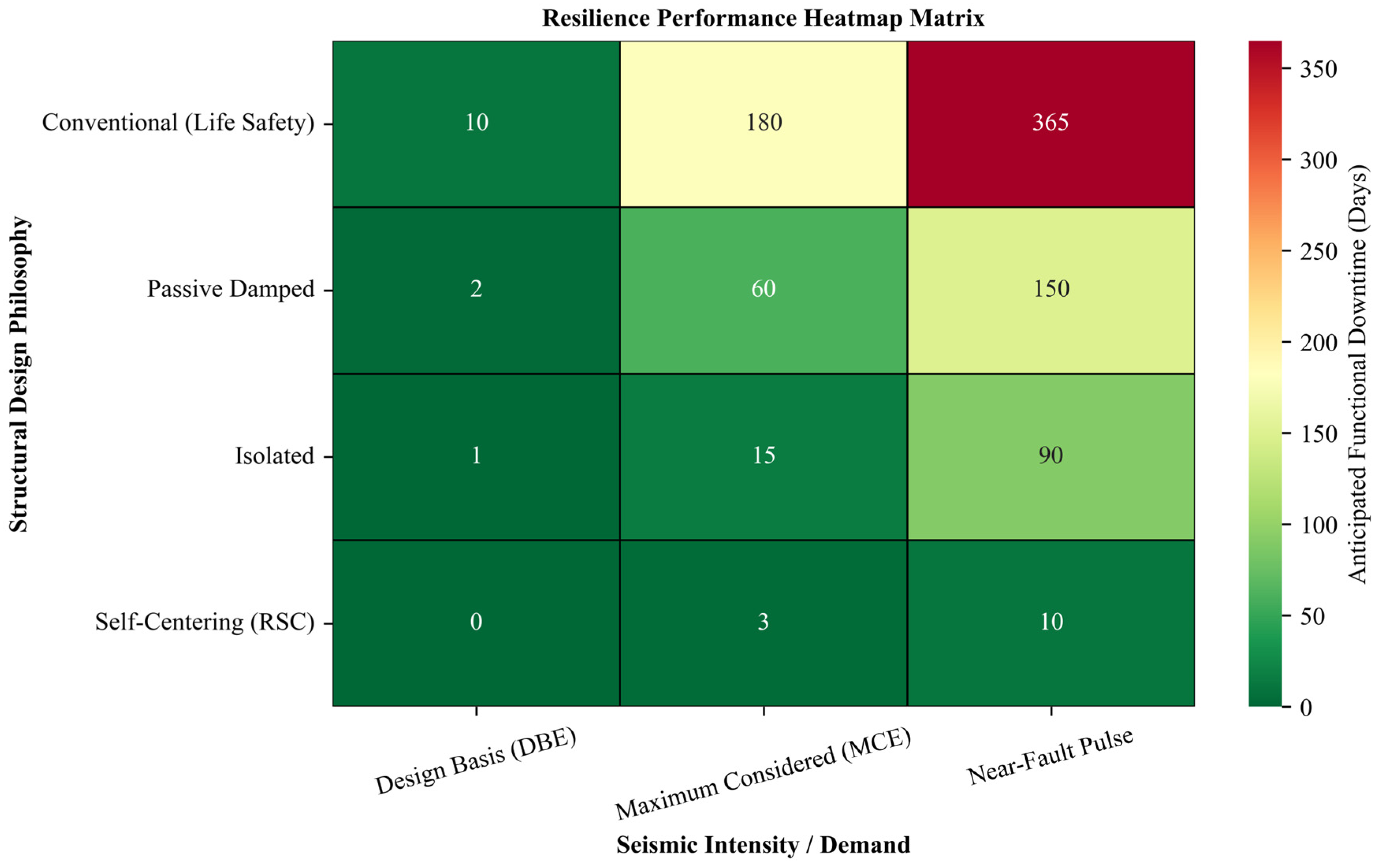
To quantitatively benchmark this paradigm shift from mere survival to rapid functional recoverability, Figure 6 presents a comprehensive resilience performance heatmap matrix. This heatmap provides a literature-based synthesis following the logic of the Federal Emergency Management Agency (FEMA) P-58-style performance-based loss estimation and residual-drift-based repairability assessment. The downtime values shown in the heatmap are illustrative comparative estimates derived from reported residual drift thresholds, post-earthquake repairability criteria, and representative performance trends of conventional, passive-damped, isolated, and self-centering structural systems under increasing seismic demands. In particular, excessive residual inter-story drift is treated as the governing parameter that shifts a structure from a repairable state to an economically or technically irreparable state. Therefore, Figure 6 is used as a comparative visualization tool to illustrate how different design philosophies influence residual drift accumulation, functional downtime, and post-earthquake recovery under increasing near-fault seismic demands.
This multidimensional matrix correlates local seismic intensity with anticipated functional downtime and residual drift ratios. Crucially, the heatmap illustrates the performance gaps of traditional code-compliant structures under severe pulse-like motions. To provide a rigorous theoretical basis for these downtime estimations, the quantitative thresholds are not arbitrarily assumed but rather logically extrapolated from the performance-based evaluation framework of FEMA P-58, corroborated by post-earthquake statistical observations of near-fault frame structures [80,81]. Specifically, the non-linear transition in functional downtime is governed by the mechanical criticality of residual drift. Statistical data indicate that when the residual inter-story drift ratio exceeds the 0.5% threshold, a structural system rapidly enters a state of technical and economic irreparability. Beyond this boundary, the cost of repair frequently surpasses the replacement cost, and the extreme technical complexity of re-centering a damaged gravity-carrying skeleton renders mitigation practically infeasible. Consequently, the anticipated downtime exhibits a sharp escalation—from manageable repair periods of several weeks to demolition and reconstruction phases lasting a year or more. It is this sudden escalation that visually delineates the boundaries where unmitigated residual drifts translate into acceptable regional downtime, ultimately highlighting the imperative to mandate self-centering mechanisms and strict residual drift limits for critical infrastructure within near-fault zones.
Extrapolating this performance-based matrix to a city-scale requires advanced computational frameworks. Modern engineering paradigms are increasingly leveraging physics-based regional seismic simulations and urban digital twins to assess systemic vulnerabilities. By integrating Building Information Modeling (BIM) with Geographic Information Systems (GIS), researchers can simulate the nonlinear time-history response of diverse structural portfolios simultaneously [126]. This approach provides a high-fidelity mapping of post-earthquake functional loss across the urban grid, enabling policymakers to identify critical nodes where excessive downtime might trigger cascading network failures [127].
Despite the rapid advancements in regional simulation methodologies, their practical execution by municipal authorities often faces challenges due to data scarcity and inherent modeling uncertainties. Compiling high-fidelity building inventory databases—detailing precise structural typologies, material degradation, and retrofit histories—can be economically and logistically demanding for sprawling metropolises. Moreover, the profound uncertainties associated with near-surface geological variations and localized site-city interaction effects can influence the predicted pulse amplifications. Therefore, developing robust, uncertainty-quantified regional assessment platforms that can operate reliably on sparse or incomplete urban datasets is increasingly recognized as essential for transitioning city-scale resilience from a theoretical paradigm into an actionable municipal planning tool [128].

3.2. Carbon-Friendly Design and Life-Cycle Assessment

The global imperative to achieve carbon neutrality has introduced a critical new dimension to earthquake engineering. Historically, structural design has often evaluated seismic safety and environmental sustainability as isolated objectives. Conventional “green building” initiatives primarily focus on minimizing initial embodied carbon through material optimization and enhancing operational energy efficiency. However, this narrow focus may overlook the massive environmental penalty exacted by severe near-fault seismic events [129]. When conventional structures sustain severe pulse-induced residual drifts and extensive plastic damage, they frequently face inevitable demolition. The subsequent disposal of concrete debris, coupled with the massive carbon emissions generated by extracting, manufacturing, and transporting new materials for complete reconstruction, constitutes a substantial surge in the structure’s post-disaster environmental footprint [130,131].
To reconcile resilience with sustainability, the “3C” framework advocates for the integration of quantitative Life-Cycle Assessment (LCA) into performance-based seismic design. From an LCA perspective, deploying advanced resilience technologies—such as RSC frames equipped with SMA fuses—presents a complex carbon trade-off. While the extraction and metallurgical processing of high-performance SMAs or the precision fabrication of post-tensioned self-centering nodes may incur a higher initial embodied carbon penalty compared to standard structural steel [132], their long-term benefits should be carefully weighed. Under the severe kinematic demands of NFGMs, these smart structural systems physically constrain residual deformations and restrict yielding strictly to easily replaceable fuse elements. By potentially preserving the integrity of the primary gravity-load-carrying skeleton and minimizing the necessity for whole-building demolition, these resilience strategies could drastically curtail the lifetime carbon emissions of the infrastructure [133,134].
To bridge the gap between initial investment and long-term disaster sustainability, future design codes could incentivize the targeted allocation of resilient hardware. Rather than applying costly SMA devices uniformly throughout a structure, topology optimization can concentrate these materials exclusively within critical, pulse-sensitive substructures. Furthermore, advancing the metallurgical development of low-carbon, Iron-based SMAs (Fe-SMAs) and integrating them with recycled aggregate concretes represents a promising trajectory for achieving truly sustainable, high-resilience urban infrastructure [135].

4. Regulatory Evolutions and Computational Enablers

4.1. Scrutiny of ASCE 7-22 and Eurocode 8 Spectral Evolutions

From a regulatory perspective, addressing the extreme kinematic demands of NFGMs has prompted critical code evolutions. The transition to the contemporary ASCE 7-22 serves as a hallmark case study for the progression of international seismic codes, representing a physical necessity rather than a mere regulatory adjustment [27]. Specifically, given a prescribed long-period design parameter such as SD1 > 0.8, the corresponding S1 typically exceeds the 0.6 g threshold, triggering the mandatory multi-point response spectrum requirement per ASCE 7-22.
For the flexible structural systems discussed in Section 2 (such as bridges, wind towers, and civil buildings) with fundamental periods exceeding 1.0 s, the traditional two-point approximation tends to unconservatively truncate the spectral acceleration. This truncation occurs precisely in the long-period range where near-fault velocity pulses concentrate their energy. By enforcing this multi-point “spectral lower-bound floor,” the code effectively constrains kinematic energy inputs and ensures that the kinematic vulnerability assessment accurately accounts for the “spectral hump” characteristic of pulse-like motions.
From the perspective of structural performance, the influence of code-based design spectra on regular reinforced concrete (RC) frames can be interpreted through the target displacement demand of an equivalent single-degree-of-freedom (SDOF) system. For a frame with an effective vibration period (Teff), the elastic spectral displacement can be expressed as:
S d T eff = S a T eff T eff 2 4 π 2
where Sa(Teff) is the code-defined spectral acceleration. The inelastic target displacement may then be approximated as:
δ t = C R S d T eff
where CR represents the inelastic displacement ratio associated with ductility demand and equivalent damping. Therefore, any modification of the long-period design spectrum directly affects the target displacement demand of regular RC frames. In ASCE 7-22, the multi-point spectral lower-bound requirement prevents unconservative truncation of long-period spectral ordinates, thereby increasing the estimated displacement demand under pulse-like near-fault motions. Similarly, the site-specific amplification provisions in Eurocode 8 enlarge the displacement-sensitive portion of the design spectrum for near-source sites. Consequently, comparative code evaluation should not be limited to base shear demand, but should also consider target displacement, residual drift potential, and post-earthquake repairability.
Crucially, this regulatory paradigm shift reflects a broader international consensus. In parallel with ASCE 7-22, the evolutionary trajectory of the European seismic code, Eurocode 8 (EC8), explicitly confronts these severe kinematic demands [25,114]. While ASCE 7-22 captures pulse energy through deterministic “spectral floor” constraints, the updated EC8 framework addresses near-fault directivity by introducing site-specific amplification factors and shifting the control periods (i.e., extending the constant velocity and displacement ranges) to directly inflate the long-period design envelope for near-source sites. Despite differing methodological pathways—ASCE’s multi-point lower-bound floors versus EC8’s spectral shape elongations—both international frameworks converge on the same fundamental mechanical imperative: compensating for the instantaneous kinetic energy injected by velocity pulses. Ultimately, implementing these long-period spectral corrections is increasingly recognized as a fundamental necessity for seismic resilience, as it mitigates the systematic underestimation of post-earthquake residual displacements—a parameter that dictates the technical and economic feasibility of structural repair and functional recovery.
From a socio-economic perspective, the implementation of stricter long-period spectral lower-bound constraints inevitably introduces a trade-off between short-term initial capital cost and long-term disaster sustainability. For some regions, particularly developing economies or rapidly urbanizing areas, elevated spectral demands may increase the upfront cost of structural design, materials, and resilient hardware deployment. However, this initial investment should be evaluated against the avoided losses associated with excessive residual drifts, prolonged downtime, demolition, and complete reconstruction after near-fault earthquakes. By reducing the probability of irreparable damage, stringent spectral floors can preserve the primary structural skeleton and substantially decrease life-cycle carbon emissions, which is consistent with the broader objectives of sustainable infrastructure and the United Nations Sustainable Development Goals. Therefore, modern seismic design should not treat enhanced near-fault spectral requirements merely as a cost burden, but as a long-term resilience investment that balances economic affordability, functional recovery, and carbon reduction.

4.2. Surrogate Modeling and Digital Twins

To fully actualize the macroscopic “3C” integrated framework, relying solely on traditional physics-based finite element modeling may prove computationally prohibitive. Scaling resilience assessments from isolated structural components to complex, regional network topologies under stochastic near-fault excitations generates an insurmountable computational burden [136,137,138]. Consequently, advancing structural resilience necessitates a paradigm shift toward a data-driven, closed-loop methodology. This modern paradigm integrates structural health monitoring (SHM) data [139], physics-informed machine learning (ML), and dynamic network topology optimization.
To bridge the gap between high-fidelity kinematic vulnerability analysis and large-scale resilience quantification, advanced computational paradigms have shifted toward surrogate-assisted decision-making. However, purely data-driven machine learning models often struggle with extrapolation in highly nonlinear, extreme damage states due to the scarcity of collapse-level empirical data. To overcome this computational bottleneck, Physics-Informed Neural Networks (PINNs) [140,141] and multi-fidelity surrogate models [142] are emerging as efficient computational enablers. By embedding governing differential equations of structural dynamics into the training process, these tools ensure predictions remain bound by physical laws, enabling rapid approximation of structural degradation without the prohibitive cost of nonlinear time-history simulations. For instance, Liu and Meidani [143] utilized Graph Neural Networks (GNNs) to capture the topological failure fragilities of bridge networks, while Pei et al. [144] proposed a surrogate-assisted two-stage recovery framework that prioritizes critical nodes for functional restoration under data-scarce conditions. Additionally, data-driven frameworks have demonstrated substantial efficacy in classifying cumulative structural damage states and executing real-time diagnostics under stochastic dynamic sequences [145,146]. Across the reviewed literature, the open-source framework OpenSees constitutes the dominant computational engine for structural reliability evaluation, frequently coupled with commercial finite element software such as ABAQUS and ANSYS for localized mechanical validation, and MATLAB or Python environments for neural network execution.
These advancements signify a critical transition: from characterizing “how a structure fails” (kinematic vulnerability) to optimizing “how a system recovers” (systemic resilience) [147,148], providing an efficient calculation engine for the 3C framework [149]. Within this virtual ecosystem, engineers can simulate stochastic near-fault pulse scenarios to identify topological bottlenecks. This forms a “Data-Model-Decision” closed loop where empirical data calibrates the surrogate models, and optimization algorithms subsequently dictate where resilient hardware should be strategically deployed [150]. Ultimately, empowering network-topology optimization through this data-driven methodology ensures that limited engineering budgets and carbon investments are allocated to the most critical nodes, maximizing the global resilience of urban infrastructure against unpredictable near-fault ruptures.
In conclusion, the integration of PINNs and GNNs signifies more than a leap in computational efficiency. By embedding deterministic governing equations into the learning architecture, these enablers provide physically interpretable predictions even in data scarcity scenarios typical of extreme near-fault ruptures. This synergy effectively transforms sparse empirical data into a robust, law-abiding computational engine, actualizing the transition from characterizing isolated failure modes to optimizing the dynamic recovery trajectories of complex urban networks.

4.3. Illustrative Benchmark Synthesis of the 3C Roadmap

To substantiate the viability of the proposed 3C framework, this section presents a comparative performance synthesis based on representative benchmark archetypes rather than an isolated simulation. Consider a 10-story reinforced concrete moment-resisting frame archetype situated 5 km from an active fault. The structural configurations and pulse characteristics are adopted from the standardized benchmark frames frequently utilized in seismic resilience studies [19,91], ensuring the generalizability of the comparative results.
Under the traditional design philosophy (Scenario A), the structure is dimensioned using standard two-parameter design spectra, which systematically truncate the long-period spectral acceleration. Consequently, the design fails to adequately account for the severe kinematic demands imposed by forward-directivity velocity pulses. Extrapolating from literature-based nonlinear dynamic analyzes under near-fault excitations, such conventional frames typically experience severe kinematic resonance. This results in a peak residual inter-story drift of approximately 0.75%, which represents a typical median response recorded in the literature [77]. According to contemporary resilience metrics, this structural state is deemed “irreparable,” potentially rendering the asset a total loss from a functional standpoint and resulting in a functional downtime exceeding 18 months.
Conversely, Scenario B evaluates the archetype through the lens of the 3C-integrated design roadmap. By enforcing the mandatory multi-point spectral lower-bound constraints (spectral floor) per ASCE 7-22, the design physically constrains the long-period kinetic energy input, successfully enveloping the pulse-induced spectral humps. Coupled with the deployment of self-centering hardware from the 3C framework (e.g., shape memory alloy dampers) to actively resolve kinematic incompatibility, the structural response is altered into a flag-shaped hysteretic loop. Under identical near-fault excitations, the residual drift is strictly controlled to less than 0.1%, which serves as a validated performance target established in rigorous RSC/SMA research. This hardware–software synergy transforms a severe structural loss into a state of immediate occupancy, effectively shifting the post-earthquake downtime from years to mere days. This comparative synthesis provides evidence supporting the 3C framework as a mechanical pathway for rapid urban functional recovery.

4.4. Future Research Priorities

To fully actualize the proposed 3C framework in mainstream engineering practice, future research should prioritize the following directions:
(1)
Material Scalability: Advancing the metallurgical processing and low-cost scalable production of Iron-based SMAs (Fe-SMAs) to replace expensive Ni-Ti alloys in mainstream structural applications.
(2)
Physics-Data Fusion Standardization: Developing standardized training protocols for Physics-Informed Neural Networks (PINNs) operating on sparse, incomplete empirical datasets typical of extreme near-fault ruptures.
(3)
Cross-Domain Lifeline Interdependency: Formulating unified multi-hazard simulation platforms capable of capturing the dynamic cascading feedback loops between physical structural degradation and socio-economic network functionality.

5. Conclusions and Future Roadmaps

The lessons from recent global seismic events up to 2026 confirm that traditional, component-based life-safety design codes are limited in terms of specific performance objectives for near-fault environments. The profound kinematic incompatibility induced by velocity pulses—leading to irreparable residual drifts—necessitates a paradigm shift. Moving beyond isolated mitigation, this treatise provides a mechanical synthesis and an actionable roadmap for transitioning structural archetypes from isolated damage control into resilient, networked entities under NFGMs. Through the conceptualized “3C Resilience Framework,” this review demonstrates that systemic resilience is not merely an extension of conventional collapse prevention, but a re-engineering of physical degradation into regional functional recoverability. By establishing a mechanistic mapping from kinematic pulse-response bottlenecks to regional functional restoration, this roadmap serves as a strategic blueprint for the next iteration of seismic design codes and urban planning strategies. The primary conclusions and future trajectories are summarized as follows:
(1)
The high-energy velocity pulses and pronounced vertical fluctuations inherent in NFGMs impose severe kinematic incompatibility on conventional structural systems. Across diverse archetypes—from civil buildings to wind towers and bridge systems—the instantaneous kinetic energy frequently overwhelms traditional hysteretic capacities. This exposes an acute kinematic vulnerability, underscoring that relying on widespread plasticity inevitably leads to severe, often irreparable residual drifts and prohibitive functional downtime.
(2)
To effectively resolve these extreme near-fault demands, structural hardware design must evolve beyond simple passive energy dissipation toward advanced kinematic decoupling and self-centering paradigms. Technologies such as rocking-self-centering (RSC) mechanisms, dynamic decoupling interfaces, and shape memory alloy (SMA) structural fuses are increasingly recognized as essential configurations. By mechanically decoupling the primary structural skeleton from sacrificial energy dissipators, these systems physically constrain post-earthquake residual drifts, fulfilling the fundamental prerequisite for rapid functional recovery.
(3)
Mitigating isolated structural vulnerabilities is intrinsically insufficient against the spatially correlated, multi-hazard nature of NFGMs. The proposed “3C” (Coupled-multi-hazard, City-scale, Carbon-friendly) integrated taxonomy bridges this gap. This paradigm dictates that cascading network failures must be arrested through intelligent structural decoupling, regional evaluations must be upscaled via urban digital twins, and Life-Cycle Assessment (LCA) must be leveraged to balance initial smart-material carbon investments with long-term disaster sustainability—directly supporting global mandates like SDG 9 and SDG 11.
(4)
To operationalize this resilience roadmap, overhauls of international seismic design standards are essential. Future regulatory frameworks must transcend “Life Safety,” incorporating explicit long-period spectral lower-bound constraints (as observed in the evolutionary trajectories of ASCE 7-22 and Eurocode 8) and quantitative limits on residual drifts as primary compliance metrics. Concurrently, advancing Physics-Informed Neural Networks (PINNs) and surrogate models will provide the computational engines required to translate localized pulse mechanics into city-scale network topology optimization, ultimately actualizing the 3C framework in mainstream engineering practice.

Author Contributions

Conceptualization, G.Z., J.D. and M.Z.; methodology, G.Z. and J.D.; formal analysis, G.Z. and J.D.; investigation: J.D. and M.Z.; writing—original draft preparation: G.Z. and J.D.; writing—review and editing: J.D. and M.Z.; funding acquisition: G.Z. and M.Z.; supervision: M.Z. All authors have read and agreed to the published version of the manuscript.

Funding

This work was supported by the National Key R&D Program of China under Grant 2024YFC3015100; and the Science and Technology Project of the China Southern Power Grid under Grant YNKJXM20250086.

Data Availability Statement

The original contributions presented in this study are included in the article. Further inquiries can be directed to the corresponding author.

Conflicts of Interest

The authors declare no conflicts of interest.

References

  1. Turan, A.I.; Celik, A.; Kumbasaroglu, A.; Yalciner, H. Assessment of reinforced concrete building damages following the Kahramanmaraş earthquakes in Malatya, Turkey (6 February 2023). Eng. Sci. Technol. Int. J. 2024, 54, 101718. [Google Scholar] [CrossRef]
  2. Somerville, P. Characterizing near fault ground motion for the design and evaluation of bridges. In Proceedings of the Third National Seismic Conference and Workshop on Bridges and Highways, Portland, OR, USA, 28 April–1 May 2002; Volume 1, pp. 137–148. [Google Scholar]
  3. Bray, J.D.; Rodriguez-Marek, A. Characterization of forward-directivity ground motions in the near-fault region. Soil Dyn. Earthq. Eng. 2004, 24, 815–828. [Google Scholar] [CrossRef]
  4. Hall, J.F.; Heaton, T.H.; Halling, M.W.; Wald, D.J. Near-source ground motion and its effects on flexible buildings. Earthq. Spectra 1995, 11, 569–605. [Google Scholar] [CrossRef]
  5. Goda, K.; Mori, N.; Miyashita, T.; De Risi, R.; Chang, Z. Near-fault ground motions and regional shaking damage assessment of the 2024 Noto Peninsula earthquake in Japan. Bull. Earthq. Eng. 2025, 23, 1829–1858. [Google Scholar] [CrossRef]
  6. Chen, G.; Liu, Y.; Ma, Z.; Yang, J.; Beer, M.; Chian, S.C.; Wei, S. Assessing extent of building damage following an earthquake: Case study of the 2023 Türkiye-Syria doublet. npj Nat. Hazards 2025, 2, 51. [Google Scholar] [CrossRef]
  7. Somerville, P.G.; Smith, N.F.; Graves, R.W.; Abrahamson, N.A. Modification of empirical strong ground motion attenuation relations to include the amplitude and duration effects of rupture directivity. Seismol. Res. Lett. 1997, 68, 199–222. [Google Scholar] [CrossRef]
  8. Mavroeidis, G.P.; Papageorgiou, A.S. A mathematical representation of near-fault ground motions. Bull. Seismol. Soc. Am. 2003, 93, 1099–1131. [Google Scholar] [CrossRef]
  9. Shahi, S.K.; Baker, J.W. An empirically calibrated framework for including the effects of near-fault directivity in probabilistic seismic hazard analysis. Bull. Seismol. Soc. Am. 2011, 101, 742–755. [Google Scholar] [CrossRef]
  10. Zhai, C.; Chang, Z.; Li, S.; Chen, Z.; Xie, L. Quantitative identification of near-fault pulse-like ground motions based on energy. Bull. Seismol. Soc. Am. 2013, 103, 2591–2603. [Google Scholar] [CrossRef]
  11. Chopra, A.K.; Chintanapakdee, C. Comparing response of SDF systems to near-fault and far-fault earthquake motions in the context of spectral regions. Earthq. Eng. Struct. Dyn. 2001, 30, 1769–1789. [Google Scholar] [CrossRef]
  12. Alavi, B.; Krawinkler, H. Behavior of moment-resisting frame structures subjected to near-fault ground motions. Earthq. Eng. Struct. Dyn. 2004, 33, 687–706. [Google Scholar] [CrossRef]
  13. Baker, J.W. Quantitative classification of near-fault ground motions using wavelet analysis. Bull. Seismol. Soc. Am. 2007, 97, 1486–1501. [Google Scholar] [CrossRef]
  14. Shahi, S.K.; Baker, J.W. An efficient algorithm to identify strong velocity pulses in multicomponent ground motions. Bull. Seismol. Soc. Am. 2014, 104, 2456–2466. [Google Scholar] [CrossRef]
  15. Zhao, X.F.; Wen, Z.P. Review of the identification of near-fault velocity pulse-like strong ground motions. Rev. Geophys. Planet. Phys. 2023, 54, 532–540. (In Chinese) [Google Scholar]
  16. Iervolino, I.; Cornell, C.A. Probability of occurrence of velocity pulses at near-source sites. Bull. Seismol. Soc. Am. 2008, 98, 2262–2277. [Google Scholar] [CrossRef]
  17. Hayden, C.P.; Bray, J.D.; Abrahamson, N.A. Selection of near-fault pulse motions. J. Geotech. Geoenviron. Eng. 2014, 140, 04014030. [Google Scholar] [CrossRef]
  18. Champion, C.; Liel, A. The effect of near-fault directivity on building seismic collapse risk. Earthq. Eng. Struct. Dyn. 2012, 41, 1391–1409. [Google Scholar] [CrossRef]
  19. Tzimas, A.S.; Kamaris, G.S.; Karavasilis, T.L.; Galasso, C. Collapse risk and residual drift performance of steel buildings using post-tensioned MRFs and viscous dampers in near-fault regions. Bull. Earthq. Eng. 2016, 14, 1643–1662. [Google Scholar] [CrossRef]
  20. Bozorgnia, Y.; Campbell, K.W. The vertical-to-horizontal response spectral ratio and tentative procedures for developing simplified V/H and vertical design spectra. J. Earthq. Eng. 2004, 8, 175–207. [Google Scholar] [CrossRef]
  21. Elnashai, A.S.; Papazoglou, A.J. Procedure and spectra for analysis of RC structures subjected to strong vertical earthquake loads. J. Earthq. Eng. 1997, 1, 121–155. [Google Scholar] [CrossRef]
  22. Kunnath, S.K.; Erduran, E.; Chai, Y.H.; Yashinsky, M. Effect of near-fault vertical ground motions on seismic response of highway overcrossings. J. Bridge Eng. 2008, 13, 282–290. [Google Scholar] [CrossRef]
  23. Inagaki, N.; Nishida, Y.; Mikami, T.; Nakamura, R.; Nistor, I.; Soltanpour, M.; Goseberg, N.; Shibayama, T. Field survey of the 2024 Noto Peninsula earthquake and tsunami in Japan: Characteristics of damage patterns to coastal communities. Ocean Eng. 2025, 316, 119765. [Google Scholar] [CrossRef]
  24. Anderson, J.C.; Bertero, V.V.; Bertero, R.D. Performance improvement of long period building structures subjected to severe pulse-type ground motions. Bull. N. Z. Soc. Earthq. Eng. 1999, 32, 47–73. [Google Scholar]
  25. EN 1998-1:2004; Eurocode 8: Design of Structures for Earthquake Resistance—Part 1: General Rules, Seismic Actions and Rules for Buildings. European Committee for Standardization: Brussels, Belgium, 2004.
  26. GB 50011-2010; Code for Seismic Design of Buildings. Ministry of Housing and Urban-Rural Development, China Architecture & Building Press: Beijing, China, 2016.
  27. ASCE/SEI 7-22; Minimum Design Loads and Associated Criteria for Buildings and Other Structures. American Society of Civil Engineers: Reston, VA, USA, 2022. [CrossRef]
  28. Bruneau, M.; Chang, S.E.; Eguchi, R.T.; Lee, G.C.; O’Rourke, T.D.; Reinhorn, A.M.; Shinozuka, M.; Tierney, K.; Wallace, W.A.; Von Winterfeldt, D. A framework to quantitatively assess and enhance the seismic resilience of communities. Earthq. Spectra 2003, 19, 733–752. [Google Scholar] [CrossRef]
  29. Cimellaro, G.P.; Reinhorn, A.M.; Bruneau, M. Framework for analytical quantification of disaster resilience. Eng. Struct. 2010, 32, 3639–3649. [Google Scholar] [CrossRef]
  30. Li, S.; Xie, L.L. Progress and trend on near-field problems in civil engineering. Acta Seismol. Sin. 2007, 20, 105–114. [Google Scholar] [CrossRef]
  31. Jia, J.F.; Du, X.L.; Han, Q. A state-of-the-art review of near-fault earthquake ground motion characteristics and effects on engineering structures. J. Build. Struct. 2015, 36, 1–12. (In Chinese) [Google Scholar]
  32. Shen, L.; Tian, S.; Li, X. Self-centering eccentrically braced steel frames: A comprehensive review on post-tensioning, SMA, and energy-dissipating technologies. Structures 2025, 79, 109425. [Google Scholar] [CrossRef]
  33. Bocchini, P.; Frangopol, D.M.; Ummenhofer, T.; Zinke, T. Resilience and sustainability of civil infrastructure: Toward a unified approach. J. Infrastruct. Syst. 2014, 20, A4014004. [Google Scholar] [CrossRef]
  34. United Nations. Transforming Our World: The 2030 Agenda for Sustainable Development; General Assembly Resolution A/RES/70/1; United Nations: New York, NY, USA, 2015. [Google Scholar]
  35. Bertero, V.V.; Mahin, S.A.; Herrera, R.A. Problems in prescribing reliable design earthquakes. In Proceedings of the Sixth World Conference on Earthquake Engineering, New Delhi, India, 10–14 January 1977; Volume 2, pp. 1741–1746. [Google Scholar]
  36. Baker, J.W.; Cornell, C.A. Spectral shape, epsilon and record selection. Earthq. Eng. Struct. Dyn. 2006, 35, 1077–1095. [Google Scholar] [CrossRef]
  37. Mieler, M.W.; Stojadinovic, B.; Budnitz, R.J.; Comerio, M.; Mahin, S. A framework for linking community resilience goals to specific performance targets for the built environment. Earthq. Spectra 2015, 31, 1267–1284. [Google Scholar] [CrossRef]
  38. Kalkan, E.; Graizer, V. Multi-component ground motion response spectra for coupled horizontal, vertical, angular accelerations, and tilt. ISET J. Earthq. Technol. 2007, 44, 259–284. [Google Scholar] [CrossRef]
  39. Di Sarno, L.; Karagiannakis, G. On the seismic fragility of pipe rack-piping systems considering soil-structure interaction. Bull. Earthq. Eng. 2020, 18, 2723–2757. [Google Scholar] [CrossRef]
  40. Farhan, M.; Bousias, S. Seismic fragility analysis of LNG sub-plant accounting for component dynamic interaction. Bull. Earthq. Eng. 2020, 18, 5063–5085. [Google Scholar] [CrossRef]
  41. Kazantzi, A.K.; Karaferis, N.D.; Melissianos, V.E.; Vamvatsikos, D. Acceleration-sensitive ancillary elements in industrial facilities: Alternative seismic design approaches in the new Eurocode. Bull. Earthq. Eng. 2024, 22, 109–132. [Google Scholar] [CrossRef]
  42. Kelly, J.M. Earthquake-Resistant Design with Rubber; Springer: London, UK, 1997. [Google Scholar]
  43. Naeim, F.; Kelly, J.M. Design of Seismic Isolated Structures: From Theory to Practice; John Wiley & Sons: New York, NY, USA, 1999. [Google Scholar]
  44. Jangid, R.S.; Kelly, J.M. Base isolation for near-fault motions. Earthq. Eng. Struct. Dyn. 2001, 30, 691–707. [Google Scholar] [CrossRef]
  45. Ikago, K.; Saito, K.; Inoue, N. Seismic control of single-degree-of-freedom structure using tuned viscous mass damper. Earthq. Eng. Struct. Dyn. 2012, 41, 453–474. [Google Scholar] [CrossRef]
  46. Zhang, L.; Han, J.; Li, D.; Shang, J. Investigation on the optimal mass ratio of tuned viscous mass dampers under near-field and far-field ground motions. KSCE J. Civ. Eng. 2025, 29, 100158. [Google Scholar] [CrossRef]
  47. Kiggins, S.; Uang, C.M. Reducing residual drift of buckling-restrained braced frames as a dual system. Eng. Struct. 2006, 28, 1525–1532. [Google Scholar] [CrossRef]
  48. Maley, T.J.; Sullivan, T.J.; Della Corte, G. Development of a displacement-based design method for steel dual systems with buckling-restrained braces and moment-resisting frames. J. Earthq. Eng. 2010, 14, 106–140. [Google Scholar] [CrossRef]
  49. De Domenico, D.; Ricciardi, G. An enhanced base isolation system equipped with optimal tuned mass damper inerter (TMDI). Earthq. Eng. Struct. Dyn. 2018, 47, 1169–1192. [Google Scholar] [CrossRef]
  50. Brown, J.; Kunnath, S.K. Low-cycle fatigue failure of reinforcing steel bars. ACI Mater. J. 2004, 101, 457–466. [Google Scholar] [CrossRef]
  51. Rodriguez-Marek, A.; Cofer, W. Dynamic Response of Bridges to Near-Fault, Forward Directivity Ground Motions; Washington State Department of Transportation Research Report WA-RD 689.1; WSDOT: Olympia, WA, USA, 2007.
  52. Zhang, F.; Li, S.; Wang, J.; Zhang, J. Effects of fault rupture on seismic responses of fault-crossing simply-supported highway bridges. Eng. Struct. 2020, 206, 110104. [Google Scholar] [CrossRef]
  53. Gu, Y.; Guo, J.; Dang, X.; Yuan, W. Seismic performance of a cable-stayed bridge crossing strike-slip faults. Structures 2022, 35, 289–302. [Google Scholar] [CrossRef]
  54. Lin, Y.; Zong, Z.; Lin, J.; Li, Y.; Chen, Y. Across-fault ground motions and their effects on some bridges in the 1999 Chi-Chi earthquake. Adv. Bridge Eng. 2021, 2, 8. [Google Scholar] [CrossRef]
  55. Kim, S.J.; Holub, C.J.; Elnashai, A.S. Analytical assessment of the effect of vertical earthquake motion on RC bridge piers. J. Struct. Eng. 2011, 137, 252–260. [Google Scholar] [CrossRef]
  56. Providakis, C.P. Effect of LRB isolators and supplemental viscous dampers on seismic isolated buildings under near-fault excitations. Eng. Struct. 2008, 30, 1184–1198. [Google Scholar] [CrossRef]
  57. Marriott, D.; Pampanin, S.; Palermo, A. Quasi-static and pseudo-dynamic testing of unbonded post-tensioned rocking bridge piers with external replaceable dissipaters. Earthq. Eng. Struct. Dyn. 2009, 38, 331–354. [Google Scholar] [CrossRef]
  58. Han, Q.; Jia, Z.; Xu, K.; Zhou, Y.; Du, X. Hysteretic behavior investigation of self-centering double-column rocking piers for seismic resilience. Eng. Struct. 2019, 188, 218–232. [Google Scholar] [CrossRef]
  59. Wang, Z.; Wang, J.Q.; Liu, T.X. Axial compression ratio limit for self-centering precast segmental hollow piers. Struct. Concr. 2017, 18, 668–679. [Google Scholar] [CrossRef]
  60. Shen, Y.; Freddi, F.; Li, Y.; Li, J. Parametric experimental investigation of unbonded post-tensioned reinforced concrete bridge piers under cyclic loading. Earthq. Eng. Struct. Dyn. 2022, 51, 3479–3504. [Google Scholar] [CrossRef]
  61. Dong, H.; Du, X.; Han, Q.; Hao, H.; Bi, K.; Wang, X. Performance of an innovative self-centering buckling restrained brace for mitigating seismic responses of bridge structures with double-column piers. Eng. Struct. 2017, 148, 47–62. [Google Scholar] [CrossRef]
  62. Pang, Y.; He, W.; Zhong, J. Risk-based design and optimization of shape memory alloy restrained sliding bearings for highway bridges under near-fault ground motions. Eng. Struct. 2021, 241, 112421. [Google Scholar] [CrossRef]
  63. Li, X.; Unjoh, S. Experimental study on seismic performance of post-tensioned precast segmental piers designed with multiple joint openings. Eng. Struct. 2024, 318, 118664. [Google Scholar] [CrossRef]
  64. Ali, A.; De Risi, R.; Sextos, A.; Goda, K.; Chang, Z. Seismic vulnerability of offshore wind turbines to pulse and non-pulse records. Earthq. Eng. Struct. Dyn. 2020, 49, 24–50. [Google Scholar] [CrossRef]
  65. Ma, B.; Zhou, A.; Lin, K.; Jeng, D.S. Seismic performance of monopile-supported offshore wind turbines in operation under near-field and far-field ground motions considering soil-structure interaction. Ocean Eng. 2026, 350, 124294. [Google Scholar] [CrossRef]
  66. Sigurdsson, G.O.; Rupakhety, R.; Rahimi, S.E.; Olafsson, S. Effect of pulse-like near-fault ground motions on utility-scale land-based wind turbines. Bull. Earthq. Eng. 2020, 18, 953–968. [Google Scholar] [CrossRef]
  67. Dai, K.S.; Hu, H.; Mei, Z.; Liu, Y. Seismic response analysis of wind power tower under long period ground motions. Eng. Mech. 2021, 38, 213–221. (In Chinese) [Google Scholar]
  68. Ren, Q.; Xu, Y.; Zhang, H.; Yu, J. Seismic performance of a wind turbine tower under near-field vertical earthquake excitation. Struct. Infrastruct. Eng. 2023, 19, 1334–1348. [Google Scholar] [CrossRef]
  69. Mo, R.; Cao, R.; Liu, M.; Li, M.; Huang, Y. Seismic fragility analysis of monopile offshore wind turbines considering ground motion directionality. Ocean Eng. 2021, 235, 109414. [Google Scholar] [CrossRef]
  70. Xu, Y.; Duan, J. Dynamic response analysis of offshore single pile wind turbine under near-field ground motion. J. Vib. Shock 2022, 41, 230–240. (In Chinese) [Google Scholar]
  71. Zuo, H.; Bi, K.; Hao, H. Using multiple tuned mass dampers to control offshore wind turbine vibrations under multiple hazards. Eng. Struct. 2017, 141, 303–315. [Google Scholar] [CrossRef]
  72. Lackner, M.A.; Rotea, M.A. Passive structural control of offshore wind turbines. Wind Energy 2011, 14, 373–388. [Google Scholar] [CrossRef]
  73. Ozbulut, O.E.; Hurlebaus, S.; DesRoches, R. Seismic response control using shape memory alloys: A review. J. Intell. Mater. Syst. Struct. 2011, 22, 1531–1549. [Google Scholar] [CrossRef]
  74. Niu, J.; Yan, S.; Chang, H. Seismic vibration control analysis of wind turbine tower structures based on SMA-SMPD system. J. Shenyang Jianzhu Univ. (Nat. Sci.) 2020, 36, 969–978. (In Chinese) [Google Scholar]
  75. Zuo, H.; Bi, K.; Hao, H.; Li, C. Numerical study of using shape memory alloy-based tuned mass dampers to control seismic responses of wind turbine tower. Eng. Struct. 2022, 250, 113452. [Google Scholar] [CrossRef]
  76. Song, G.; Ma, N.; Li, H.N. Applications of shape memory alloys in civil structures. Eng. Struct. 2006, 28, 1266–1274. [Google Scholar] [CrossRef]
  77. Akkar, S.; Yazgan, U.; Gülkan, P. Drift estimates in frame buildings subjected to near-fault ground motions. J. Struct. Eng. 2005, 131, 1014–1024. [Google Scholar] [CrossRef]
  78. Sehhati, R.; Rodriguez-Marek, A.; ElGawady, M.; Cofer, W.F. Effects of near-fault ground motions and equivalent pulses on multi-story structures. Eng. Struct. 2011, 33, 767–779. [Google Scholar] [CrossRef]
  79. Li, C.; Kunnath, S.; Zuo, Z.; Peng, W.; Zhai, C. Effects of early-arriving pulse-like ground motions on seismic demands in RC frame structures. Soil Dyn. Earthq. Eng. 2020, 130, 105997. [Google Scholar] [CrossRef]
  80. Ruiz-Garcia, J.; Miranda, E. Residual displacement ratios for assessment of existing structures. Earthq. Eng. Struct. Dyn. 2006, 35, 315–336. [Google Scholar] [CrossRef]
  81. Ramirez, C.M.; Liel, A.B.; Mitrani-Reiser, J.; Haselton, C.B.; Spear, A.D.; Steiner, J.; Deierlein, G.G.; Miranda, E. Expected earthquake damage and repair costs in reinforced concrete frame buildings. Earthq. Eng. Struct. Dyn. 2012, 41, 1455–1475. [Google Scholar] [CrossRef]
  82. Fahnestock, L.A.; Ricles, J.M.; Sause, R. Seismic response and performance of buckling-restrained braced frames. J. Struct. Eng. 2007, 133, 1195–1204. [Google Scholar] [CrossRef]
  83. Erochko, J.; Christopoulos, C.; Tremblay, R.; Choi, H. Residual drift response of SMRFs and BRB frames in steel buildings designed according to ASCE 7-05. J. Struct. Eng. 2011, 137, 589–599. [Google Scholar] [CrossRef]
  84. Hu, G.; Wang, Y.; Huang, W.; Li, B.; Luo, B. Seismic mitigation performance of structures with viscous dampers under near-fault pulse-type earthquakes. Eng. Struct. 2020, 203, 109878. [Google Scholar] [CrossRef]
  85. DesRoches, R.; Smith, B. Shape memory alloys in seismic resistant design and retrofit: A critical review of their potential and limitations. J. Earthq. Eng. 2004, 8, 415–429. [Google Scholar] [CrossRef]
  86. Alam, M.S.; Youssef, M.A.; Nehdi, M.L. Analytical prediction of the seismic behaviour of superelastic shape memory alloy reinforced concrete elements. Eng. Struct. 2008, 30, 3399–3411. [Google Scholar] [CrossRef]
  87. Chen, J.; Fang, C.; Wang, W.; Liu, Y. Variable-friction self-centering energy-dissipation braces (VF-SCEDBs) with NiTi SMA cables for seismic resilience. J. Constr. Steel Res. 2020, 175, 106318. [Google Scholar] [CrossRef]
  88. Pollino, M.; Bruneau, M. Seismic retrofit of bridge steel truss piers using a controlled rocking approach. J. Bridge Eng. 2007, 12, 600–610. [Google Scholar] [CrossRef]
  89. Wiebe, L.; Christopoulos, C. Mitigation of higher mode effects in base-rocking systems by using multiple rocking sections. J. Earthq. Eng. 2009, 13, 83–108. [Google Scholar] [CrossRef]
  90. Chancellor, N.B.; Eatherton, M.R.; Roke, D.A.; Akbas, T. Self-centering seismic lateral force resisting systems: High performance structures for the city of tomorrow. Buildings 2014, 4, 520–548. [Google Scholar] [CrossRef]
  91. Eatherton, M.R.; Ma, X.; Krawinkler, H.; Mar, D.; Billington, S.; Hajjar, J.F.; Deierlein, G.G. Design concepts for controlled rocking of self-centering steel-braced frames. J. Struct. Eng. 2014, 140, 0401402. [Google Scholar] [CrossRef]
  92. McCormick, J.; Aburano, H.; Ikenaga, M.; Nakashima, M. Permissible residual deformation levels for building structures considering both safety and human elements. In Proceedings of the 14th World Conference on Earthquake Engineering, Beijing, China, 12–17 October 2008. Paper No. 05-06-0071. [Google Scholar]
  93. Qiu, C.; Zhu, S. Performance-based seismic design of self-centering steel frames with SMA-based braces. Eng. Struct. 2017, 130, 67–82. [Google Scholar] [CrossRef]
  94. Eatherton, M.R.; Hajjar, J.F. Residual drifts of self-centering systems including effects of ambient building resistance. Earthq. Spectra 2011, 27, 719–744. [Google Scholar] [CrossRef]
  95. Shahverdi, M.; Michels, J.; Czaderski, C.; Motavalli, M. Iron-based shape memory alloy strips for strengthening RC members: Material behavior and characterization. Constr. Build. Mater. 2018, 173, 586–599. [Google Scholar] [CrossRef]
  96. Hashash, Y.M.A.; Hook, J.J.; Schmidt, B.; Yao, J.I.-C. Seismic design and analysis of underground structures. Tunn. Undergr. Space Technol. 2001, 16, 247–293. [Google Scholar] [CrossRef]
  97. Pitilakis, K.; Tsinidis, G. Performance and seismic design of underground structures. In Earthquake Geotechnical Engineering Design; Springer: Cham, Switzerland, 2014; pp. 279–340. [Google Scholar] [CrossRef]
  98. Hashash, Y.M.A.; Park, D.; Yao, J.I.-C. Ovaling deformations of circular tunnels under seismic loading, an update on seismic design and analysis of underground structures. Tunn. Undergr. Space Technol. 2005, 20, 435–441. [Google Scholar] [CrossRef]
  99. Bobet, A.; Fernandez, G.; Huo, H.; Ramirez, J. A practical iterative procedure to estimate seismic-induced deformations of shallow rectangular structures. Can. Geotech. J. 2008, 45, 923–938. [Google Scholar] [CrossRef]
  100. Yu, H.; Yuan, Y.; Bobet, A. Seismic analysis of long tunnels: A review of simplified and unified methods. Undergr. Space 2017, 2, 73–87. [Google Scholar] [CrossRef]
  101. Kishi, N.; Sonoda, K.; Komuro, M.; Kawarai, T. Numerical simulation of the Daikai station subway structure collapse due to sudden uplift during earthquake. J. Eng. Mech. 2021, 147, 04020152. [Google Scholar] [CrossRef]
  102. Zhang, S.; Yang, Y.; Yuan, Y.; Li, C.; Qiu, J. Experimental investigation of seismic performance of shield tunnel under near-field ground motion. Structures 2022, 43, 1407–1421. [Google Scholar] [CrossRef]
  103. Han, W.; Jiang, Y.; Wang, G.; Liu, C.; Koga, D.; Luan, H. Review of health inspection and reinforcement design for typical tunnel quality defects of voids and insufficient lining thickness. Tunn. Undergr. Space Technol. 2023, 137, 105110. [Google Scholar] [CrossRef]
  104. Sedarat, H.; Kozak, A.; Hashash, Y.M.; Shamsabadi, A.; Krimotat, A. Contact interface in seismic analysis of circular tunnels. Tunn. Undergr. Space Technol. 2009, 24, 482–490. [Google Scholar] [CrossRef]
  105. Tsang, H.-H.; Tran, D.-P.; Hung, W.-Y.; Gad, E.F. Geotechnical seismic isolation based on high-damping polyurethane: Centrifuge modelling. Bull. Earthq. Eng. 2024, 22, 2001–2023. [Google Scholar] [CrossRef]
  106. Xin, C.L.; Wang, Z.Z.; Zhou, J.M.; Gao, B. Shaking table tests on seismic behavior of polypropylene fiber reinforced concrete tunnel lining. Tunn. Undergr. Space Technol. 2019, 88, 1–15. [Google Scholar] [CrossRef]
  107. Ding, Z.; Wen, J.; Li, X.; Fu, J.; Ji, X. Mechanical behaviour of polyvinyl alcohol-engineered cementitious composites (PVA-ECC) tunnel linings subjected to vertical load. Tunn. Undergr. Space Technol. 2020, 95, 103151. [Google Scholar] [CrossRef]
  108. Wang, Q.; Geng, P.; Wang, L.; He, D.; Shen, H. Machine learning-driven feature importance appraisal of seismic parameters on tunnel damage and seismic fragility prediction. Eng. Appl. Artif. Intell. 2024, 137, 109101. [Google Scholar] [CrossRef]
  109. Tsinidis, G.; de Silva, F.; Anastasopoulos, I.; Bilotta, E.; Bobet, A.; Hashash, Y.M.; He, C.; Kampas, G.; Knappett, J.; Madabhushi, G.; et al. Seismic behaviour of tunnels: From experiments to analysis. Tunn. Undergr. Space Technol. 2020, 99, 103334. [Google Scholar] [CrossRef]
  110. You, T.; Wang, W.; Chen, Y. A framework to link community long-term resilience goals to seismic performance of individual buildings using network-based recovery modeling method. Soil Dyn. Earthq. Eng. 2021, 147, 106788. [Google Scholar] [CrossRef]
  111. Molina Hutt, C.; Hulsey, A.M.; Kakoty, P.; Deierlein, G.G.; Eksir Monfared, A.; Yen, W.Y.; Hooper, J.D. Toward functional recovery performance in the seismic design of modern tall buildings. Earthq. Spectra 2022, 38, 283–309. [Google Scholar] [CrossRef]
  112. Bird, J.F.; Bommer, J.J. Earthquake losses due to ground failure. Eng. Geol. 2004, 75, 147–179. [Google Scholar] [CrossRef]
  113. O’Rourke, T.D. Critical infrastructure, interdependencies, and resilience. Bridge 2007, 37, 22–29. [Google Scholar]
  114. Draft prEN 1998-1-1; Eurocode 8: Design of Structures for Earthquake Resistance. European Committee for Standardization: Brussels, Belgium, 1998.
  115. Liu, Q.C.; Yue, M.G.; Wang, D.S. Longitudinal response of power transmission tower-cable system to traveling wave. In Proceedings of the 14th World Conference on Earthquake Engineering, Beijing, China, 12–17 October 2008. Paper No. 05-01-0025. [Google Scholar]
  116. Yang, F.; Yang, J.; Zhang, Z. Unbalanced tension analysis for UHV transmission towers in heavy icing areas. Cold Reg. Sci. Technol. 2012, 70, 132–140. [Google Scholar] [CrossRef]
  117. Tian, L.; Pan, H.; Ma, R.; Qiu, C. Collapse simulations of a long span transmission tower-line system subjected to near-fault ground motions. Earthq. Struct. 2017, 13, 211–220. [Google Scholar] [CrossRef]
  118. Sutlovic, E.; Ramljak, I.; Majstrovic, M. Analysis of conductor clashing experiments. Electr. Eng. 2019, 101, 467–476. [Google Scholar] [CrossRef]
  119. Dikshit, S.; Dobson, I.; Alipour, A. Cascading structural failures of towers in an electric power transmission line due to straight line winds. Reliab. Eng. Syst. Saf. 2024, 250, 110304. [Google Scholar] [CrossRef]
  120. Goldbeck, N.; Angeloudis, P.; Ochieng, W.Y. Resilience assessment for interdependent urban infrastructure systems using dynamic network flow models. Reliab. Eng. Syst. Saf. 2019, 188, 62–79. [Google Scholar] [CrossRef]
  121. Owolabi, T.A.; Sajjad, M. A global outlook on multi-hazard risk analysis: A systematic and scientometric review. Int. J. Disaster Risk Reduct. 2023, 92, 103727. [Google Scholar] [CrossRef]
  122. Panteli, M.; Mancarella, P. Influence of extreme weather and climate change on the resilience of power systems: Impacts and possible mitigation strategies. Electr. Power Syst. Res. 2015, 127, 259–270. [Google Scholar] [CrossRef]
  123. Somerville, P.G. Magnitude scaling of the near fault rupture directivity pulse. Phys. Earth Planet. Inter. 2003, 137, 201–212. [Google Scholar] [CrossRef]
  124. Jayaram, N.; Baker, J.W. Correlation model for spatially distributed ground-motion intensities. Earthq. Eng. Struct. Dyn. 2009, 38, 1687–1708. [Google Scholar] [CrossRef]
  125. Argyroudis, S.A.; Mitoulis, S.A.; Winter, M.G.; Kaynia, A.M. Fragility of transport assets exposed to multiple hazards: State-of-the-art review toward infrastructural resilience. Reliab. Eng. Syst. Saf. 2019, 191, 106567. [Google Scholar] [CrossRef]
  126. Xiong, C.; Lu, X.; Guan, H.; Xu, Z. A nonlinear computational model for regional seismic simulation of tall buildings. Bull. Earthq. Eng. 2016, 14, 1047–1069. [Google Scholar] [CrossRef]
  127. Burton, H.V.; Deierlein, G.G.; Lallemant, D.; Lin, T. Framework for incorporating probabilistic building performance in the assessment of community seismic resilience. J. Struct. Eng. 2016, 142, C4015007. [Google Scholar] [CrossRef]
  128. Sadrykia, M.; Delavar, M.R.; Zare, M. A GIS-based fuzzy decision making model for seismic vulnerability assessment in areas with incomplete data. ISPRS Int. J. Geo-Inf. 2017, 6, 119. [Google Scholar] [CrossRef]
  129. Welsh-Huggins, S.J.; Liel, A.B. Evaluating multiobjective outcomes for hazard resilience and sustainability from enhanced building seismic design decisions. J. Struct. Eng. 2018, 144, 04018108. [Google Scholar] [CrossRef]
  130. Arroyo, D.; Ordaz, M.; Teran-Gilmore, A. Seismic loss estimation and environmental issues. Earthq. Spectra 2015, 31, 1285–1308. [Google Scholar] [CrossRef]
  131. Belleri, A.; Marini, A. Does seismic risk affect the environmental impact of existing buildings? Energy Build. 2016, 110, 149–158. [Google Scholar] [CrossRef]
  132. Menna, C.; Asprone, D.; Jalayer, F.; Prota, A.; Manfredi, G. Assessment of ecological sustainability of a building subjected to potential seismic events during its lifetime. Int. J. Life Cycle Assess. 2013, 18, 504–515. [Google Scholar] [CrossRef]
  133. Dong, Y.; Frangopol, D.M. Performance-based seismic assessment of conventional and base-isolated steel buildings including environmental impact and resilience. Earthq. Eng. Struct. Dyn. 2016, 45, 739–756. [Google Scholar] [CrossRef]
  134. Lounis, Z.; McAllister, T.P. Risk-based decision making for sustainable and resilient infrastructure systems. J. Struct. Eng. 2016, 142, F4016005. [Google Scholar] [CrossRef]
  135. Zani, G.; Pepe, M.; Rampini, M.C.; Michels, J.; Martinelli, E. Numerical modelling of innovative deconstructable shallow beams made of recycled aggregate concrete and shape memory steel reinforcement. In Building for the Future: Durable, Sustainable, Resilient (fib Symposium 2023); Springer: Cham, Switzerland, 2023; pp. 685–694. [Google Scholar]
  136. Ouyang, M. Review on modeling and simulation of interdependent critical infrastructure systems. Reliab. Eng. Syst. Saf. 2014, 121, 43–160. [Google Scholar] [CrossRef]
  137. Mangalathu, S.; Sun, H.; Nweke, C.C.; Yi, Z.; Burton, H.V. Classifying earthquake damage to buildings using machine learning. Earthq. Spectra 2020, 36, 183–208. [Google Scholar] [CrossRef]
  138. Sun, H.; Burton, H.V.; Huang, H. Machine learning applications for building structural design and performance assessment: State-of-the-art review. J. Build. Eng. 2021, 33, 101816. [Google Scholar] [CrossRef]
  139. Mosalam, K.M. Toward building resilience through reconnaissance: Artificial intelligence approaches for structural health monitoring. In Proceedings of the 2nd International Conference on Advances in Civil Infrastructure and Construction Materials (CICM 2023); Springer: Cham, Switzerland, 2024; Volume 1, pp. 15–23. [Google Scholar]
  140. Raissi, M.; Perdikaris, P.; Karniadakis, G.E. Physics-informed neural networks: A deep learning framework for solving forward and inverse problems involving nonlinear partial differential equations. J. Comput. Phys. 2019, 378, 686–707. [Google Scholar] [CrossRef]
  141. Qi, J.; Du, K.; Luo, H.; Wang, Z.; Wen, R. Physics-informed neural networks for structural dynamic response analysis: Theoretical and numerical verification. Int. J. Struct. Stab. Dyn. 2026, 2650294. [Google Scholar] [CrossRef]
  142. Torzoni, M.; Manzoni, A.; Mariani, S. A multi-fidelity surrogate model for structural health monitoring exploiting model order reduction and artificial neural networks. Mech. Syst. Signal Process. 2023, 197, 110376. [Google Scholar] [CrossRef]
  143. Liu, T.; Meidani, H. Graph neural network surrogate for seismic reliability analysis of highway bridge systems. J. Infrastruct. Syst. 2024, 30, 05024004. [Google Scholar] [CrossRef]
  144. Pei, S.; Zhai, C.; Hu, J. Surrogate model-assisted seismic resilience assessment of the interdependent transportation and healthcare system considering a two-stage recovery strategy. Reliab. Eng. Syst. Saf. 2024, 244, 109941. [Google Scholar] [CrossRef]
  145. Lazaridis, P.C.; Kavvadias, I.E.; Demertzis, K.; Iliadis, L.; Vasiliadis, L.K. Interpretable Machine Learning for Assessing the Cumulative Damage of a Reinforced Concrete Frame Induced by Seismic Sequences. Sustainability 2023, 15, 12768. [Google Scholar] [CrossRef]
  146. Luk, S.H. Machine Learning-Based Methods for the Seismic Damage Classification of RC Buildings. Buildings 2025, 15, 2395. [Google Scholar] [CrossRef]
  147. Ayyub, B.M. Systems resilience for multihazard environments: Definition, metrics, and valuation for decision making. Risk Anal. 2014, 34, 340–355. [Google Scholar] [CrossRef]
  148. Cimellaro, G.P. Urban Resilience for Emergency Response and Recovery: Fundamental Concepts and Applications; Springer International Publishing: Cham, Switzerland, 2016. [Google Scholar] [CrossRef]
  149. Chakraborty, S.; Adhikari, S.; Ganguli, R. The role of surrogate models in the development of digital twins of dynamic systems. Appl. Math. Model. 2021, 90, 662–681. [Google Scholar] [CrossRef]
  150. Zhou, Y.; Meng, S.; Lou, Y.; Kong, Q. Physics-informed deep learning-based real-time structural response prediction method. Engineering 2024, 35, 140–157. [Google Scholar] [CrossRef]
Figure 1. Schematic definition of the near-fault zone boundary, qualitatively illustrating the regional geographical demarcation relative to the surface fault trace and the conceptual propagation of ground motion waveforms.
Buildings 16 02314 g001
Figure 2. Conceptual roadmap linking near-fault kinematic characteristics, structural response bottlenecks, and the proposed 3C resilience framework for systemic urban infrastructure recovery.
Buildings 16 02314 g002
Figure 3. Multidimensional comparative analysis of advanced mitigation devices highlighting the superiority of self-centering systems in uncoupling base shear reduction from residual drift. The horizontal axis denotes residual drift accumulation, the vertical axis represents base shear reduction, and the bubble size indicates energy dissipation capacity.
Buildings 16 02314 g003
Figure 4. Comparison of idealized design response spectra illustrating the pulse-induced spectral amplification in the medium-to-long period range under near-fault motions.
Buildings 16 02314 g004
Figure 5. Scatter plot of fundamental period ratio versus displacement amplification factor. The shaded region denotes the kinematic resonance vulnerability zone where structural displacement demand may be significantly amplified.
Buildings 16 02314 g005
Figure 6. Proposed resilience performance heatmap matrix correlating local seismic intensity with anticipated functional downtime and residual drift ratios.
Buildings 16 02314 g006
Table 1. Kinematic Signatures of NFGMs and their Physical Mapping to Structural Responses.
Kinematic SignaturesPhysical MechanismStructural Failure Mode
Forward-directivityInstantaneous high-energy velocity pulse inputConcentrated plastic deformations in weak stories, excessive residual drifts
Fling-stepPermanent tectonic displacement offsetsUnseating of bridge bearings, rupture of expansion joints
High V/H ratioHigh-frequency transient axial load fluctuationsDegradation of column shear capacity, core concrete crushing
Table 2. Mechanistic synthesis of kinematic bottlenecks and resilience-based mitigation strategies for infrastructure archetypes under near-fault motions.
Archetype CategorySpecific ArchetypesKinematic BottlenecksResilience-Based Mitigation
Strategy
Rigid/Coupled
Systems
Industrial facilities; Above-ground lifeline components (e.g., power grids, substations)Equipment-structure interaction; High-frequency sensitivity; Component decouplingFlexible connectors; Kinematic uncoupling; Multi-modal dampening
Flexible SystemsBridges; Wind towers; Civil buildingsKinematic resonance (Tn/Tp ≈ 1); Excessive residual drifts; Higher-mode effectsRocking-self-centering (RSC); Base isolation; Adaptive stiffness
Medium-Constrained SystemsUnderground structures; Buried pipelines and lifeline tunnelsSoil–structure interaction (SSI); Interface kinematic strains; Discontinuous deformationDistributed compliance; Flexible jointing; Grouting optimization
Table 3. Core Components and Implementation Pathways of the Proposed “3C” Integrated Resilience Framework.
“3C” Resilience DimensionPrimary Near-Fault ChallengeEnabling Technologies & MethodologiesUltimate Objective
Coupled-Multi-HazardCascading cross-domain failures and asynchronous excitations (e.g., “domino effect” in power grids).Mechanical structural fuses; advanced kinematic decoupling; intelligent network re-routing algorithms.Mitigate propagation of localized structural collapse; maintain network-level functional stability.
City-ScaleComputational prohibitiveness, spatial correlation of pulse energy, and severe urban data scarcity.Urban digital twins; BIM/GIS integration; Physics-Informed Neural Networks (PINNs).Facilitate rapid, near-real-time regional vulnerability mapping and dynamic network topology optimization.
Carbon-FriendlyMassive embodied carbon penalty from post-earthquake demolition and total reconstruction.Quantitative Life-Cycle Assessment (LCA); low-carbon Iron-based SMAs; targeted resilient hardware allocation.Minimize the necessity for complete reconstruction; balance initial carbon investments with long-term disaster sustainability.
Disclaimer/Publisher’s Note: The statements, opinions and data contained in all publications are solely those of the individual author(s) and contributor(s) and not of MDPI and/or the editor(s). MDPI and/or the editor(s) disclaim responsibility for any injury to people or property resulting from any ideas, methods, instructions or products referred to in the content.