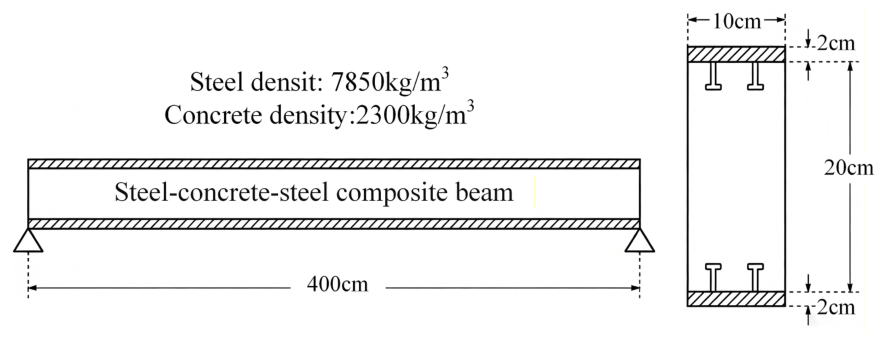
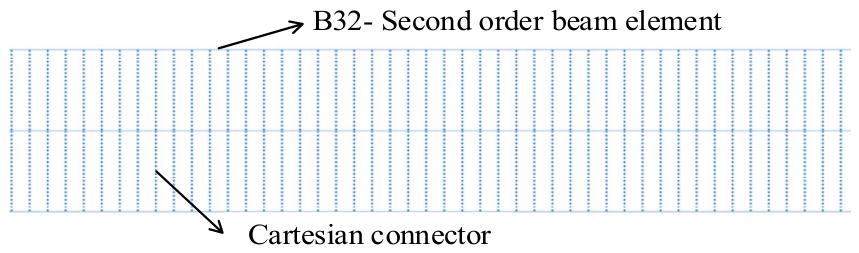
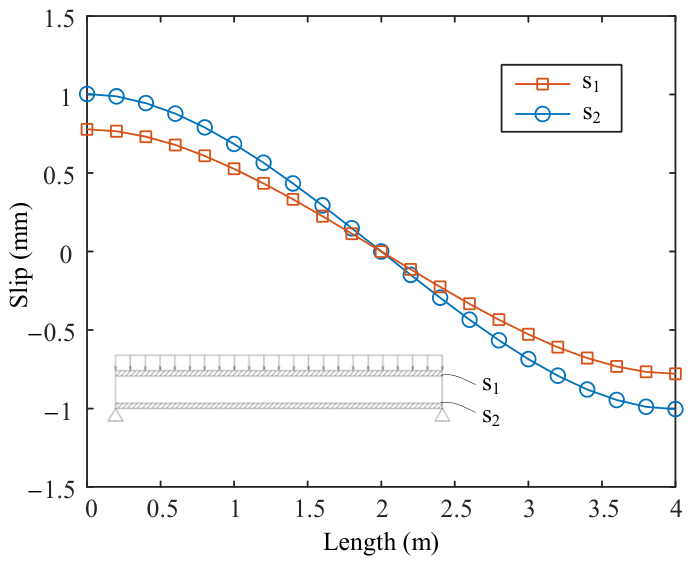
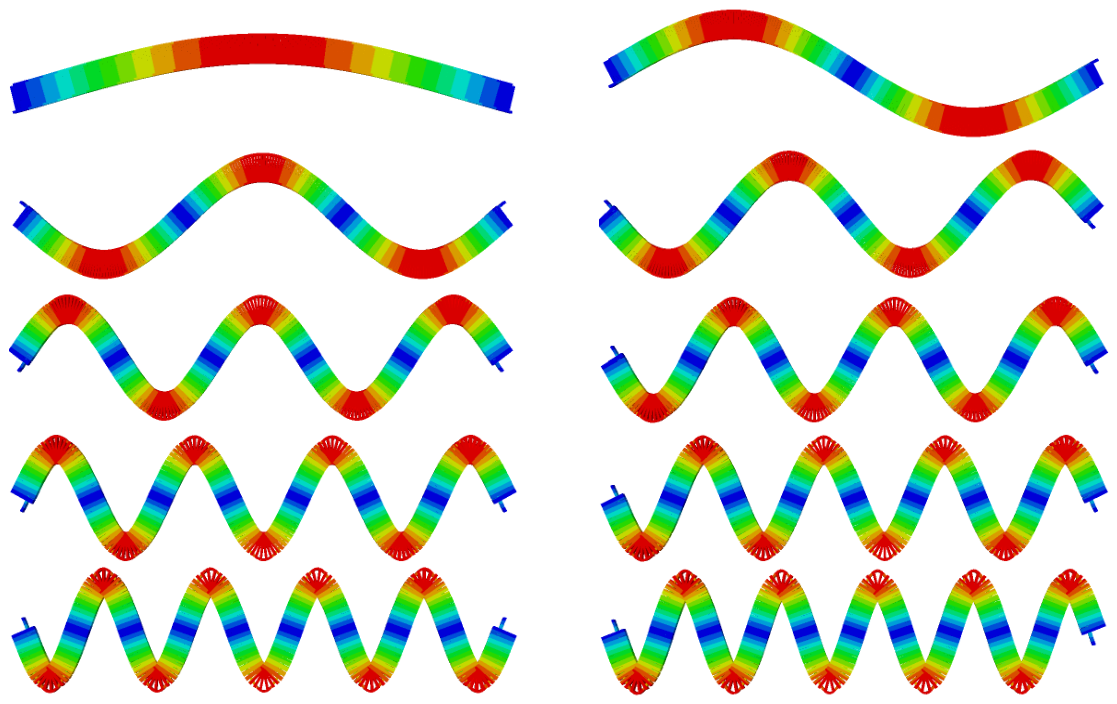
1. Introduction
Composite beams are structural members in which different materials and cross sections are connected by shear connectors so that they act together and make full use of the mechanical properties of each material. Compared with single component members, composite beams have higher load carrying capacity and stiffness and are widely used and studied. In general, connectors are required between the individual components so that they behave as an integral member. In practice, however, the components cannot be fully bonded. Tangential relative slip usually occurs along the interfaces between layers, and its magnitude depends on the stiffness of the connectors [
1]. Interlayer slip causes the overall composite cross section to violate the plane section assumption, which complicates the structural response and has a significant influence on the mechanical performance of composite members.
Research on composite members with interlayer slip can be traced back to the 1950s. Newmark et al. [
2]. developed a calculation theory for composite beams with interlayer slip based on Euler–Bernoulli beam theory. Viest [
3,
4] investigated the basic mechanical behavior of composite beams. Goodman [
5] studied laminated timber structures in which interlayer slip was taken into account. Girhammar et al. [
6,
7,
8,
9] derived analytical expressions for composite beams with interlayer slip on the basis of Euler–Bernoulli beam theory. Xu and Wu [
10] examined the static and dynamic behavior of composite beams with interlayer slip using Timoshenko beam theory. Based on a plane stress model, Xu and Wu [
11,
12] also derived the state-space equations for composite beams with interlayer slip, established a plane stress analysis model for two-layer composite beams, and carried out static and dynamic analyses. Shen et al. [
13]. used the state-space method to derive the governing equations for the free vibration of composite beams with interlayer slip and studied the influence of axial force. Monetto [
14] analyzed the bending equilibrium of three-layer beams with interlayer slip using Timoshenko beam theory. In addition to these theoretical formulations, many researchers have performed experimental studies [
15,
16,
17,
18], and finite element methods have also been applied effectively to the analysis of composite members with interlayer slip [
19,
20,
21].
Most existing studies have focused on two-layer composite members, and research on the static and dynamic characteristics of three-layer and multilayer composite members remains relatively limited. In engineering practice, however, multilayer composite members are also widely used, such as steel–concrete–steel sandwich composite beams [
22,
23,
24,
25], laminated timber beams [
26,
27,
28], sandwich beams [
29,
30,
31], glass composite beams [
32,
33,
34] and laminated beams strengthened with FRP [
35,
36]. For such multilayer composite members, some related investigations have been carried out. Ferdous et al. [
37]. conducted experimental studies on the flexural shear behavior of laminated timber beams. Zhao et al. [
38]. and Lacroix et al. [
39]. experimentally investigated the mechanical response of steel–concrete–steel sandwich plates and FRP strengthened laminated timber beams under blast loading. Guo et al. [
40]. studied experimentally the bending capacity of steel–concrete–steel composite beams. Chalak et al. [
41]. analyzed the dynamic behavior of sandwich composite beams with a soft core based on zig zag theory. Magnucki [
42] examined the bending response of sandwich beams using zig zag theory. Sayyad and Avhad [
43] used higher order shear deformation theory to study the free vibration of curved sandwich beams. Li et al. [
44] proposed a unified higher order shear deformation theory for the bending, free-vibration and buckling analysis of composite plates. However, studies based on Zig-zag theory or higher order shear deformation theory usually assume that the interfaces transmit only shear forces and that no slip occurs [
45,
46,
47,
48], which is not consistent with actual engineering practice.
Sousa and Silva [
49,
50] derived finite element formulations for multilayer composite members based on Euler–Bernoulli beam theory and Timoshenko beam theory. Monetto [
14] obtained analytical solutions for three-layer composite beams with interlayer slip using Euler–Bernoulli beam theory. Keo et al. [
51] developed finite element formulations for multilayer composite beams with interlayer slip on the basis of Timoshenko beam theory. These finite element formulations for multilayer composite members, derived from Euler–Bernoulli and Timoshenko beam theories, are prone to shear locking [
52,
53,
54]. This indicates that further work is needed.
Dynamic analysis of composite members with interlayer slip has long been an important topic. Most existing studies have concentrated on two-layer composite beams [
10,
55,
56,
57,
58,
59], while relatively few have examined the dynamic behavior of three-layer and multilayer composite beams. Atashipour et al. [
60] investigated the buckling stability of three-layer composite beams with interlayer slip using Timoshenko beam theory. Lin et al. [
54] derived a finite element for three-layer composite beams with interlayer slip based on the variational principle and Timoshenko beam theory, and carried out dynamic analysis. For composite members with more than three layers, interlayer slip effects are usually not considered. In addition, the governing equations or finite element formulations in most existing work are derived from classical beam theory, so their applicability is restricted by the plane section assumption and the slenderness ratio.
The computational method in this paper is obtained by extending the dynamic analysis method of Xu and Wu [
12] for steel concrete composite beams and a previously proposed plane stress static model [
61] for multilayer composite beams. First, the dynamic plane stress state-space formulation is generalized from a two-layer configuration to a multilayer composite beam with an arbitrary number of layers. Second, slip compatibility and interaction-force conditions are introduced at every interface, so that different slip stiffness values can be assigned independently to different interfaces. Third, layer-wise density terms are incorporated into the state equations, which allows free-vibration analysis of multilayer composite beams with interlayer slip. Fourth, the initial axial stress is included in the dynamic formulation, leading to a characteristic equation that can be used for both natural-frequency and buckling-load analyses. Finally, a transfer-matrix-based computational procedure is implemented for multilayer systems, in which the layer transfer matrices and interface matrices are assembled sequentially.
In this study, a new plane stress model is used to analyze multilayer composite members with interlayer slip, and the state-space method is adopted to solve the resulting plane stress problem. First, the procedure for transforming the cross section of a multilayer composite beam with interlayer slip into an equivalent plane stress dynamic analysis model is described. The state-space equations of this plane stress dynamic model are then derived. By expanding the state variables in Fourier series, these equations are solved. Finally, typical examples reported in the literature are analyzed, and comparison with published results is used to verify the accuracy of the proposed computational method. This method does not rely on the plane section assumption and can describe cross-sectional deformation in an equivalent plane stress field. Moreover, since it does not employ low-order beam element interpolation functions, it avoids the problem of shear locking. It should be noted that the present model does not account for significant shear lag effects. However, when shear lag is significant, this transformation may not be suitable. The study of shear lag is out of the scope of this work.
2. Establishment of Plane Stress Model
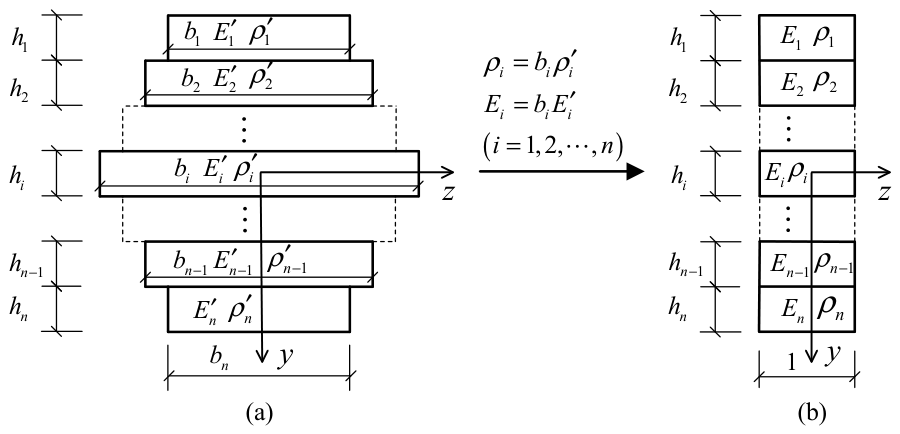
For the multilayer composite beam cross section shown in
Figure 1a, an equivalent transformation can be performed so that it becomes the unit width cross section shown in
Figure 1b, and the problem can then be treated as a plane stress problem. To make these two planes equivalent, the axial stiffness
EA and the bending stiffness
EI of each layer must remain unchanged before and after the transformation. To achieve this, the original elastic modulus
is converted into an equivalent modulus
, while the height of each layer is kept unchanged so that each layer retains the same bending stiffness. In a similar way, the corresponding expression for
and
can be obtained. For dynamic analysis, the density of the cross section must also be taken into account, and the actual material density
needs to be converted into an equivalent density
. In this way, the cross sections in
Figure 1a,b are equivalent in the sense of one-dimensional beam theory. Such a transformation of the cross section may not be suitable when significant shear lag effects are present, but that case is beyond the scope of the present work.
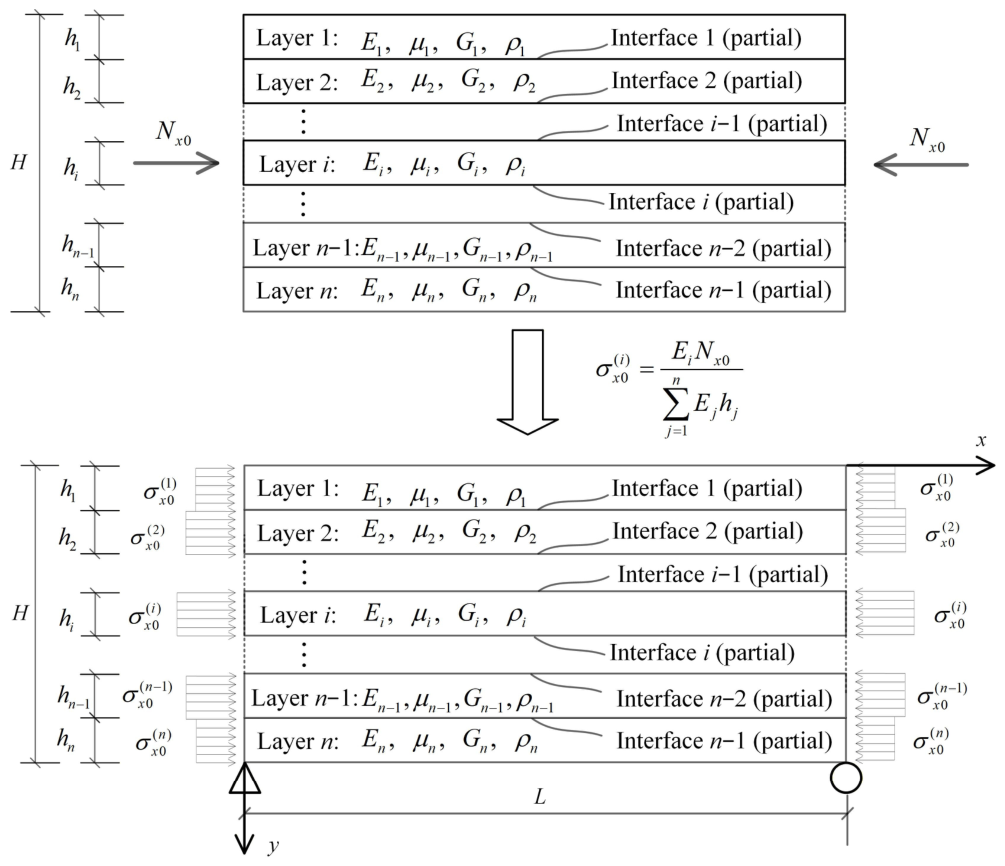
The initial axial force
applied at both ends of the multilayer composite beam can be converted, according to Saint Venant’s principle, into equivalent initial axial stresses
in each layer of the plane stress model. Finally, the dynamic problem of the multilayer composite beam subjected to end tensile forces is transformed into a two-dimensional plane stress dynamic analysis model, as shown in
Figure 2. Where
represents tension and
represents compression. The model consists of n layers. The symbols
,
,
,
, and
denote the elastic modulus, Poisson’s ratio, shear modulus, density and layer height of the
i-th layer, respectively. Slip is allowed at every interface between adjacent layers, and the slip stiffness is denoted by
. The relationship between the interlayer slip and the interaction force at interface
i has been given in previous work [
61]. In this study, the conventional assumption for steel concrete composite beams is adopted, namely that the interlayer interaction force is proportional to the interlayer slip.