Article

Chemo-Mechanical Modeling of Cohesion in Structural Mortar for 3D Printing Based on the Degree of Hydration


by
Kristiano Cavalcante Vasconcellos de Mendonça
1,*,
Eduardo de Moraes Rego Fairbairn
1,
Magno Teixeira Mota
1,2 and
Oscar Aurelio Mendoza Reales
1
1
Civil Engineering Department, Institute for Graduate Studies and Research in Engineering (COPPE), Universidade Federal do Rio de Janeiro, Rio de Janeiro 21941-598, RJ, Brazil
2
National Institute for Space Research (INPE), São José dos Campos 12227-010, SP, Brazil
*
Author to whom correspondence should be addressed.
Buildings 2026, 16(11), 2273; https://doi.org/10.3390/buildings16112273
Submission received: 16 April 2026 / Revised: 22 May 2026 / Accepted: 26 May 2026 / Published: 4 June 2026
(This article belongs to the Section Building Materials, and Repair & Renovation)

Abstract

Cementitious materials in the fresh state are commonly regarded as viscoplastic. That is, below a given yield stress, they exhibit solid-like behavior, whereas above this threshold, they behave as fluids. In this context, the shear strength of such materials has traditionally been analyzed from a rheological standpoint, considering them as fluids and using time as the primary state variable. From a structural perspective, however, relatively few studies have treated the material as a solid. With the advent of 3D printing technology, this trend has persisted. Within this framework, the present research aims to evaluate the shear strength of a structural mortar for 3D printing in its solid-like regime, by applying the Mohr–Coulomb failure criterion. Furthermore, in a novel approach, the degree of hydration of Portland cement is proposed as a state variable to replace time, enabling a more comprehensive and objective description of the material’s mechanical evolution. Thus, addressing this gap in the state of the art, a chemo-mechanical coupling is developed. To obtain the necessary data, direct shear, uniaxial compression, and isothermal calorimetry tests are performed. The results indicate that the friction angle remains constant, at approximately 33°, and that cohesion, the parameter governing strength gain, exhibits the same linear rate of increase with hydration in both mechanical tests, indicating an intrinsic relationship within the material.

1. Introduction

The application of 3D printing in Civil Engineering is already a reality. This technology is primarily based on additive manufacturing, i.e., the deposition of successive layers until an object or structure is formed, enabling a high degree of automation and geometrical flexibility in construction processes [1]. The material most commonly used for this purpose is Portland cement-based structural mortar [2]. Therefore, an understanding of the hydration reactions of this hydraulic binder is essential, as well as the adoption of a chemo-mechanical coupling approach.
In the fresh state, structural mortar, like other cementitious materials, can be considered viscoplastic and is often described by Bingham or Herschel–Bulkley models. Prior to setting, it behaves as a pseudo-solid; that is, until a stress sufficient to induce flow—known as the yield stress—is applied, the material responds as a solid. This dual behavior is precisely what enables its use in 3D printing processes: the material must flow through the printer system during extrusion and subsequently sustain the stresses induced by the weight of successive layers once deposited [3,4].
In this context, ensuring such duality requires appropriate mix design. This essentially empirical procedure must provide the printable mortar with viscoelastic properties under elongational flow conditions and elastoplastic behavior once at rest. From that point onward, the printed material must maintain both local and global structural stability. To this end, it must withstand shear stresses induced by normal stresses arising from gravitational forces [5,6,7].
These stresses, originating from tangential forces acting along material surfaces, may lead to structural collapse. When at rest, even in the fresh state, structural mortar can be regarded as a cohesive solid whose mechanical strength evolves with the progression of cement hydration, exhibiting a transition from ductile to brittle behavior [8]. However, due to the viscoplastic nature of fresh cementitious materials, the onset of irreversible deformation is governed by a yield stress rather than a classical failure condition.
Accordingly, the Mohr–Coulomb model is adopted herein as a yield criterion, rather than strictly as a failure criterion, to describe the stress states associated with the onset of plasticity. This approach is consistent with the cohesive-frictional nature of the material and has been widely employed in the literature as a suitable phenomenological framework to represent the evolution of shear strength in cementitious systems [6,8,9,10].
The envelope obtained from this model allows, through linear fitting, the determination of two important and less frequently reported physical parameters: the friction angle and cohesion. This is because fresh cementitious materials are more commonly analyzed from a rheological perspective, in which the most frequently investigated parameters are yield stress and plastic viscosity [3,5,11].
Cohesion is, by definition, the component of shear strength in the absence of normal stress. In this context, established rheological tests and models allow this resistance to be assessed as equivalent to cohesion, by analogy with the Mohr–Coulomb model. However, in order to evaluate the material not only as a cohesive medium but also as a granular system, it is essential to perform tests that represent actual printing conditions, such as direct shear and uniaxial compression tests [6,10].
The former evaluates the contribution of particle interlocking at contact surfaces, which provides resistance to relative motion along a preferential plane, thus contributing to the understanding of both material flow initiation and interlayer behavior [6,8]. The latter examines the material response under normal stress without confinement, allowing for biaxial deformation [10].
Furthermore, a review of the state-of-the-art reveals that previous studies have predominantly considered time as the governing state variable [2,6,9,11]. The evolution of shear strength in cementitious materials has not yet been investigated as a function of the degree of hydration, including in the context of 3D printing. This gap in the literature motivates the present study.
To address this issue, isothermal calorimetry tests are also conducted at two temperatures, namely, 25 °C and 45 °C. These tests enable the determination of an experimental function describing the evolution of the degree of hydration over time, modeled according to Arrhenius law. This model captures the effects of thermal activation on the kinetics of hydration reactions [12,13].
Finally, the cohesion obtained from both mechanical tests is experimentally modeled as a function of the degree of hydration. The use of this state variable enables a more objective and meaningful comparative analysis between materials with different mix designs and thermal conditions, as it is mechanically grounded in the strength development associated with the fraction of Portland cement available for chemical reaction with water.

2. Materials and Methods

First, the materials and mix design adopted for the structural mortar used in the present study are presented. Next, the procedures for the mechanical tests—namely, uniaxial compression and direct shear tests—are described, along with the methodology employed to determine the shear strength parameters based on the Mohr–Coulomb model. Subsequently, the isothermal calorimetry test and the modeling of hydration using Arrhenius law are detailed. Finally, the chemo-mechanical coupling is described through the modeling of cohesion, obtained from both mechanical tests, as a function of the degree of hydration.
It is important to emphasize that the experimental program was intentionally restricted to the initial 90 min interval, corresponding to the typical printable time window of extrusion-based cementitious materials. Beyond this period, the mortar progressively loses its extrudability and buildability capacity due to the rapid increase in structural build-up and hydration degree. Therefore, the present study focuses specifically on the early-age regime relevant to the 3D printing process.

2.1. Materials and Mix Design for the Structural Mortar

The materials used are listed in Table 1. The balance among the components, such as cement, aggregates, admixtures, and water, must be carefully studied and controlled. It should be noted that the mix proportions were defined by mass (kg/m3), with the following components used: Brazilian ordinary Portland cement (OPC) with high early strength, classified as CP V-ARI (equivalent to Type III cement according to [14]); mineral aggregate: natural sand with a maximum particle size of 600 µm; chemical admixture: modified polycarboxylate ether (PCE)-based dispersant.
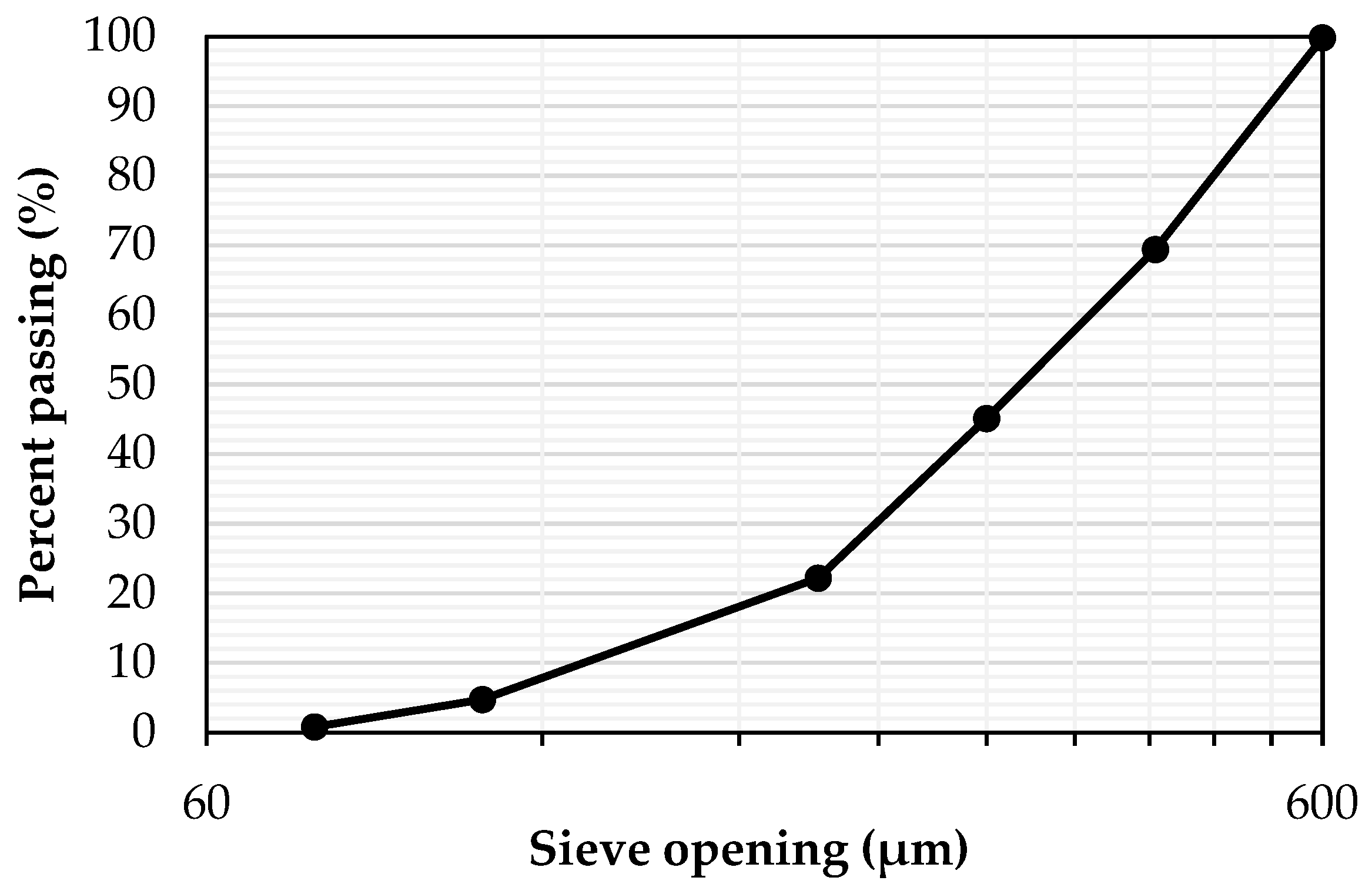
In order to provide a more complete characterization of the aggregate, the particle size distribution of the natural sand obtained from sieve analysis is presented in Figure 1. The adopted sand presents a relatively fine grading compatible with extrusion-based cementitious materials.

2.2. Mechanical Characterization Tests

At early ages, cementitious materials do not exhibit a well-defined failure, but rather a transition from viscoplastic to solid-like behavior associated with the onset of irreversible deformations [5,8,11]. In this study, the stress levels applied in direct shear tests were selected below the compressive yield stress obtained from uniaxial tests, ensuring that the investigated states remain within the pre-failure regime [6,8,10].
Thus, the obtained envelope should be interpreted as a yield envelope rather than a classical failure envelope. Although the Mohr–Coulomb criterion is traditionally associated with failure, it is used here as a convenient framework to represent stress states at yielding and to extract cohesion and friction angle parameters in this context. All mechanical tests were conducted at a controlled temperature of 25 °C.

2.2.1. Uniaxial Compression Test

In the fresh-state compression test, a hydraulic testing machine, more precisely, an MTS Tabletop Bionix model 370.02, is used, operating at a constant vertical displacement rate of 0.1 mm/s until a displacement of 20 mm is reached. During this process, the applied load is continuously recorded as a function of vertical displacement. Prior to testing, the specimens are prepared and placed in acrylic molds with removable side walls, which are carefully filled with the material [15].
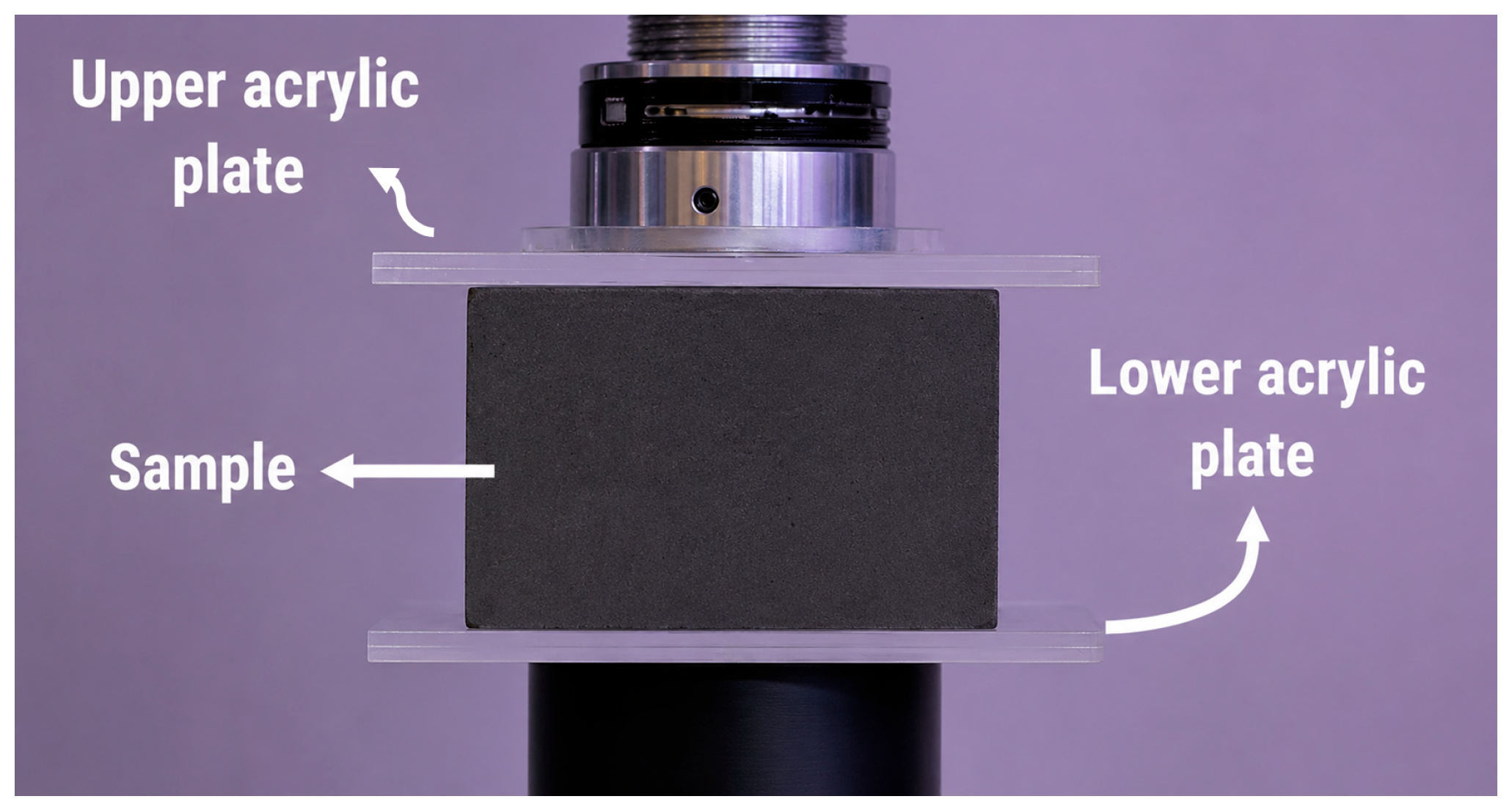
After remaining at rest for the prescribed experimental intervals of 30, 60, and 90 min, the side walls are removed, resulting in prismatic specimens with a square cross-section of 100 × 100 mm and a height of 50 mm. Together with the acrylic base, the specimen is then centrally positioned in the testing machine, after which the upper plate is placed, allowing the test to begin, as illustrated in Figure 2. It should be noted that the plates were made of acrylic to reduce friction during both the removal of the mold sides and the execution of the test, thereby simulating a free-slip boundary condition [15].
Determination of Yield Stress
The determination of the yield stress value ( τ 0 ), corresponding to the static yield stress ( τ y , s t ) , is carried out following the same guidelines proposed by [15]. This is a graphical method based on the load value obtained from the intersection of two extrapolated lines: one best fitting the elastic deformation regime and the other the plastic regime [16]. The yield stress is then calculated by dividing this load by the corrected area of the specimen, resulting in more reliable values.
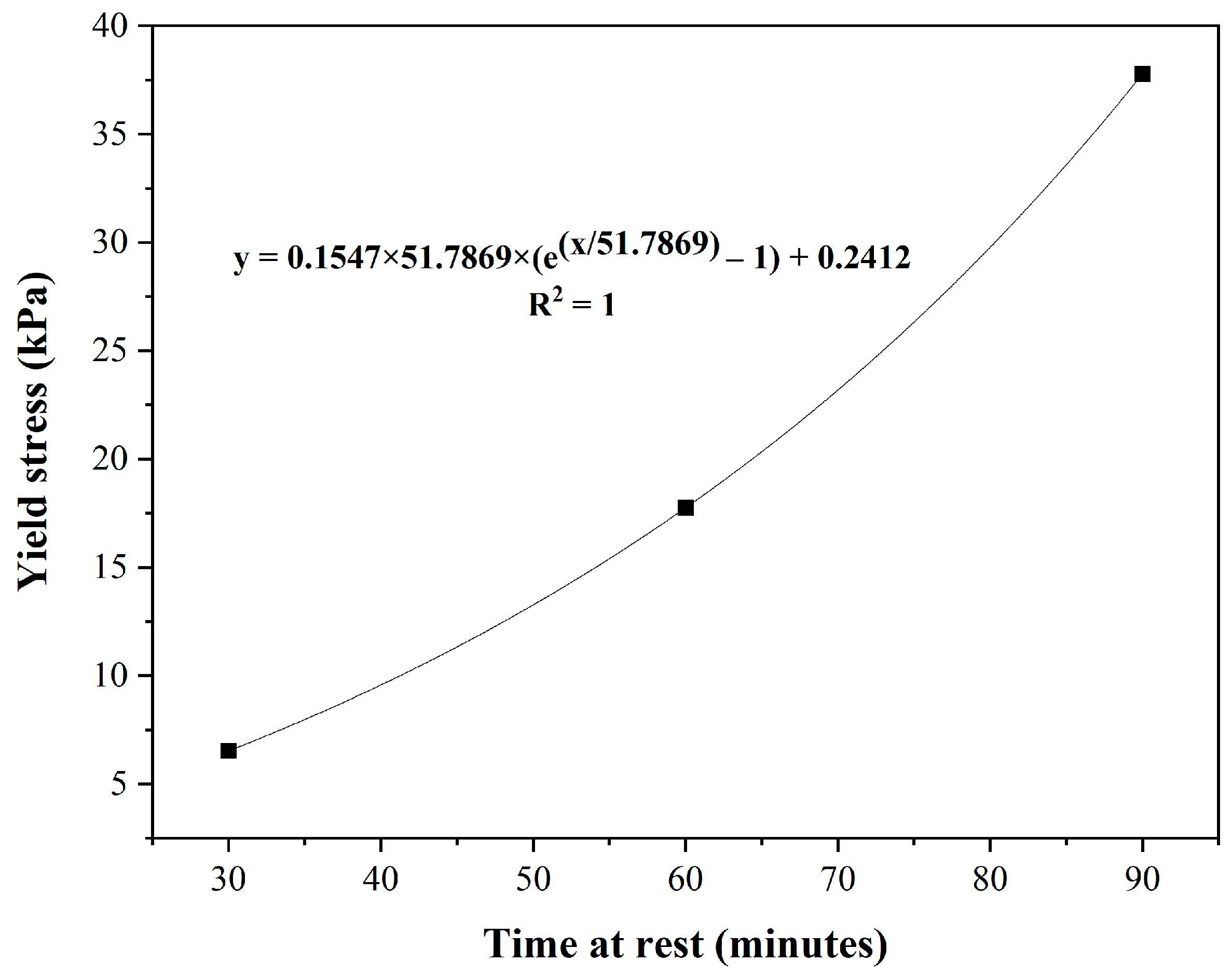
In general, the time evolution of yield stress is often analyzed according to the structuration model proposed by [11], which is based on thixotropic build-up and is described by Equation (1). In this context, the experimental data obtained for τ 0 at the curing times considered in this study (30, 60, and 90 min) are modeled accordingly.
τ 0 t = A t h i x   .   t c . e t r e s t t c 1 + τ 0 , 0
where τ 0 = yield stress; A t h i x = thixotropic build-up; t c = critical time, corresponding to the value that best fits the experimental data; t r e s t = resting time; and τ 0 , 0 = initial yield stress (without resting time).
At very early ages, the increase in yield stress is mainly governed by reversible flocculation mechanisms caused by attractive interparticle forces, resulting in an approximately linear evolution of yield stress with time. In this regime, the structuration rate is nearly constant and is represented by the parameter A t h i x , which corresponds to the initial thixotropic build-up rate [11].
As hydration progresses, irreversible contributions associated with the precipitation and growth of hydration products progressively become dominant, leading to an acceleration of the structuration kinetics. This behavior is represented in Equation (1) by the exponential term e t r e s t t c , while t c may be interpreted as a characteristic transition time associated with the gradual shift between the initial flocculation-dominated regime and the later hydration-controlled regime [11].
It should be noted that, although this model is based on thixotropic gain, i.e., the reversible component of strength development, the separation between reversible and irreversible contributions within this time interval is not straightforward. Therefore, the increase in strength may be interpreted indistinctly through the evolution of cohesion as obtained from the Mohr–Coulomb model.
Determination of Cohesion Using Mohr–Coulomb Model
In compression, cohesion can be determined through the application of the Mohr–Coulomb equation expressed in terms of principal stresses. It should be noted that this approach requires prior knowledge of the material’s friction angle; otherwise, it becomes ineffective, as observed by [10]. Thus, considering the boundary conditions of the test, where the major principal stress is given by the applied compressive stress and the minor principal stress is null due to the absence of lateral confinement, cohesion is given by Equation (2).
c = σ c 2 . t g 45 ° + ϕ 2
where c = effective cohesion; σ c = effective compression stress on the yield plane; ϕ = effective internal friction angle.

2.2.2. Direct Shear Test

The direct shear test was performed under constant normal stress and strain-controlled conditions. A Digidshear apparatus by Wykeham Farrance was used. The tests were conducted under consolidated drained conditions, following the procedures established by [17]. However, it should be noted that, as this test was originally developed within the field of geotechnical engineering, there is no standardized procedure for its application to cementitious materials. Therefore, an adaptation was introduced, consisting primarily of the specimen preparation.
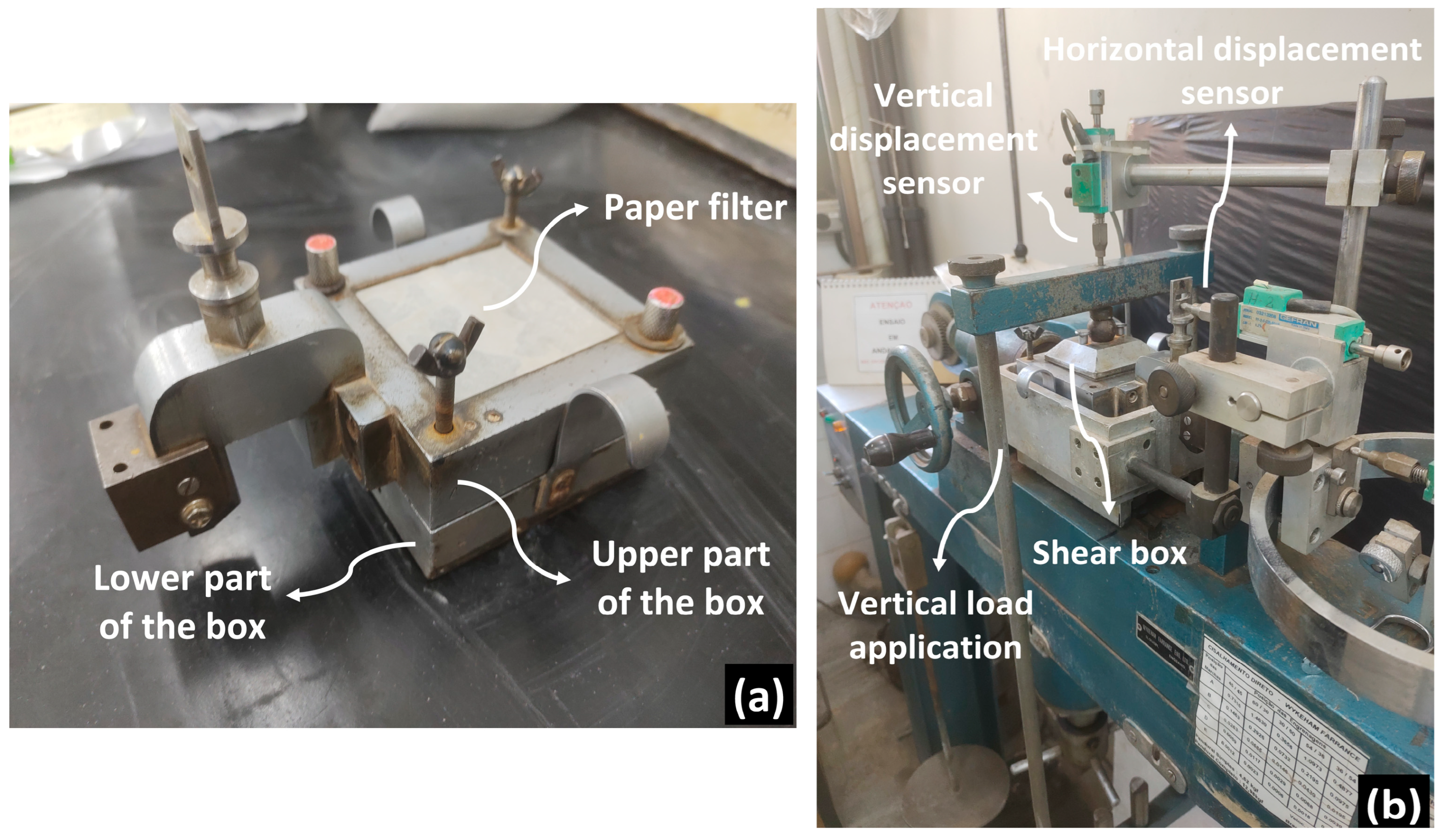
Instead of using disturbed or undisturbed samples, as prescribed by the standard for soils, a different procedure was adopted for the structural mortar. After mixing, the material was placed into the shear box, which has a square cross-section with standardized dimensions of 60 × 60 × 37 mm, such that the interface between the two halves corresponds to the potential failure plane. It is worth noting that paper filters were positioned above and below the specimen to allow drainage during the test, as shown in Figure 3a.
It is important to note that the adopted specimen height (37 mm) is approximately 62 times greater than the maximum particle size of the sand (0.6 mm). Therefore, the specimen dimensions were considered sufficient to ensure representative volumetric behavior of the structural mortar within the direct shear apparatus.
Following this preparation, which takes approximately 3 min, the mortar was kept at rest inside the shear box for the curing intervals considered in this study, for 30, 60, and 90 min, allowing flocculation and internal restructuring to occur. Subsequently, the shear box was positioned in the testing device, sealed, and the vertical load was applied to the specimen, as illustrated in Figure 3b. Finally, relative movement between the two halves of the shear box was initiated at a constant rate of 0.48 mm/min. This corresponds to the maximum shear rate permitted by the testing machine and was adopted to minimize the effects of structural build-up during the test.
Although the tested material is a fresh cementitious mortar rather than a saturated soil, the direct shear test was conducted under conditions intended to minimize pore pressure accumulation during shearing, including the use of paper filters above and below the specimen. Therefore, the stress transfer mechanism is assumed to be predominantly governed by the interparticle contact network and structural interactions within the material. In this context, the Mohr–Coulomb framework and the corresponding notation (c′ and ϕ′) are adopted in a phenomenological manner.
Determination of Mohr–Coulomb Envelope
The shear stress is determined by dividing the maximum shear force recorded for each applied normal stress by the resisting area of the specimen. It should be noted that horizontal displacement leads to a reduction in the effective contact area between the two halves of the shear box. Therefore, to minimize potential errors in the determination of shear stress, this area is corrected according to Equation (3) [18,19].
τ δ h = F ( δ h ) A δ h = F ( δ h ) ( A 0 δ h )   A 0
where τ δ h = shear stress; F δ h = applied shear force; A δ h = corrected area; δ h = horizontal displacement; A 0 = initial area.
For the construction of the envelope, tests are performed using four distinct values of normal stress for each curing time considered, totaling 12 tested specimens. In order to evaluate the strength provided by the cement paste, normal stresses lower than the yield stress obtained from uniaxial compression tests are applied, more precisely 0.25 τ y , s t , 0.5 τ y , s t , and 0.75 τ y , s t , with an additional intermediate value also considered.
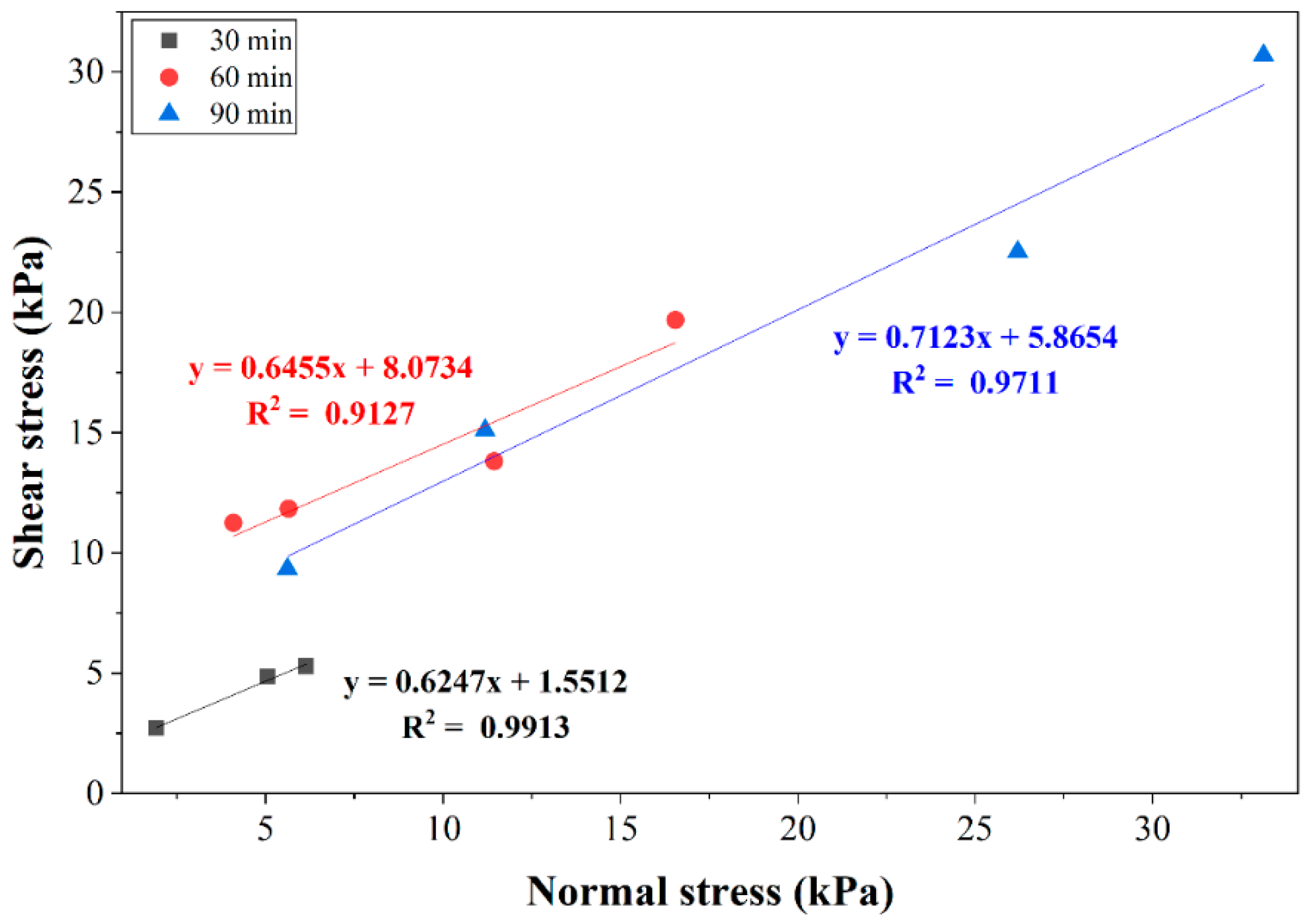
Based on these four points, the Mohr–Coulomb linear relationship, given by Equation (4), is fitted, allowing the determination of the yield envelope for each of the 3 curing intervals. Furthermore, since the tests are conducted under consolidated drained conditions, the strength parameters of the structural mortar for 3D printing are obtained in terms of effective stresses, namely c and ϕ [18,19].
τ = c + σ . t g ( ϕ )
where τ = effective shear stress; c = effective cohesive intercept; σ = effective normal stress on the yield plane; ϕ = effective internal friction angle.

2.3. Isothermal Calorimetry Test

The isothermal calorimetry test was performed to analyze the enthalpy changes of the material. In other words, it enables the direct measurement of heat and heat release rate as a function of hydration time, being a widely used technique for cementitious materials [12]. The experimental procedure was based on [20].
Structural mortar samples with masses ranging from approximately 4 to 5 g were tested. The experiments were conducted at two different temperatures, namely 25 °C and 45 °C, in order to determine the activation energy. The equipment used was a TAM Air isothermal calorimeter (TA Instruments), in which 3 samples were tested for each temperature over a total period of 165 h, resulting in 6 specimens in total.

Hydration Modeling Based on Arrhenius Law

Based on the obtained data, the heat release rate curve as a function of time ( d q / d t ) is constructed. By calculating the area under each curve, the cumulative heat released up to a given time is determined for each temperature, as expressed by Equation (5).
Q t = 0 t d q d t d t
where Q t = cumulative heat at a given time, t = time, q = released heat.
The degree of hydration is obtained by normalizing the cumulative heat at a given time by the total cumulative heat. That is, the degree of hydration, denoted by ξ and ranging from 0 to 1, is a dimensionless variable that measures the progress of the hydration reaction. Since the present study focuses on very early ages, the degree of hydration is assumed to be well approximated by the degree of heat development, ξ Q t , as defined by [21].
ξ t ξ Q t = Q t Q m a x = T a d t T a d , m a x
In Equation (6), Q ( t ) and Δ T a d ( t ) represent, respectively, the heat of hydration released and the adiabatic temperature rise at time t . The quantity Q m a x is the total heat of hydration measured in the calorimetric test, while Δ T a d , m a x is the corresponding maximum adiabatic temperature rise attained when variations in Δ T a d ( t ) are no longer detectable within the sensitivity limits of the measurement equipment.
Considering that the present study aims to model the evolution of the degree of hydration as a function not only of time but also of temperature, due to thermo-activation, the well-established Arrhenius model is adopted. Thus, in order to explicitly account for the thermal influence on reaction kinetics, the evolution of the degree of hydration is expressed by Equation (7), which may be locally approximated within the investigated interval by Equation (8), considering the initial condition ξ = 0 at t = 0 .
d ξ d t = Ã ( ξ ) . e E a R T
  ξ t , T = Ã ( ξ ) . e E a R T . t
where ξ = degree of hydration, Ã = normalized affinity, E a = activation energy, R = universal gas constant (8314 J.mol−1.K−1), T = absolute temperature.
It is important to note that, in order to express the degree of hydration at any temperature, the thermal effect on affinity must be removed through normalization. This leads to the normalized chemical affinity function, given by Equation (9). This parameter is obtained by applying the boundary conditions of the isothermal calorimetry test to the thermo-chemo-mechanical coupling model proposed by [13]. It should be noted that à ( ξ ) is expressed in s−1 in order to ensure dimensional consistency of the Arrhenius formulation.
  Ã ( ξ ) = 1 Q d q d t e   E a R . T c
where Q = total cumulative heat, and T c = temperature of isothermal calorimetry test.
Obtaining an analytical expression capable of adequately describing the à ( ξ ) curve is not straightforward. For the results presented in this paper, both the normalized affinity function and the activation energy were obtained from isothermal calorimetric tests conducted at two distinct temperatures. For this purpose, an in-house software tool was used to fit the parameters of the Arrhenius equation to the experimental data. Appendix A presents a schematic overview of the main steps of the adopted numerical procedure.

2.4. Chemo-Mechanical Modeling of Cohesion

The cohesion value is obtained from the intercept of the linear relationship between shear stress and normal stress (Equation (4)). Physically, it is associated with the internal bonding forces within the material, including physico-chemical interactions and structural effects, which enable the material to withstand stresses even in the absence of confinement [9,10].
It is important to emphasize that, in this context, cohesion does not explicitly distinguish between reversible contributions, associated with temporary structural effects such as thixotropy, and irreversible contributions related to the hydration process [5,11]. Thus, the experimentally obtained cohesion represents a global measure of the material’s strength at a given instant, encompassing both contributions simultaneously and indistinguishably.
Furthermore, due to thermo-activation effects, the use of time, traditionally adopted as the state variable to describe the evolution of mechanical properties in cementitious materials, may not be the most appropriate choice. In this context, the degree of hydration is adopted as a physically based state variable for describing the evolution of cohesion.
This more comprehensive variable accounts not only for temporal evolution but also for the thermal conditions to which the material is subjected. Accordingly, the degree of hydration is adopted as a unifying variable capable of describing the evolution of cohesion, regardless of the relative predominance of reversible and irreversible mechanisms at different stages.
The chemo-mechanical coupling of cohesion is established in a semi-empirical manner. First, the degree of hydration is described through a constitutive relationship based on Arrhenius law and calibrated experimentally. Subsequently, the evolution of the cohesive component of shear strength is expressed, in a first-order approximation, by a linear relationship with zero intercept, considering that c = 0 when ξ = 0 , as given by Equation (10), whose solution is presented in Equation (11).
d c d ξ = a
c ξ = a .   ξ
where c = effective cohesion as a function of the degree of hydration ( ξ ); a = cohesion generated per unit degree of hydration.
It is assumed herein that the relationship between cohesion and degree of hydration is intrinsic to the material and, therefore, depends indirectly on time and temperature, which can be interpreted as secondary variables. It is emphasized that the influence of temperature variation is incorporated into the hydration kinetics modeled by Arrhenius law. Therefore, this approach may provide a more comprehensive and objective comparative analysis among different materials subjected to distinct thermal conditions.

3. Results and Discussion

3.1. Yield Stress

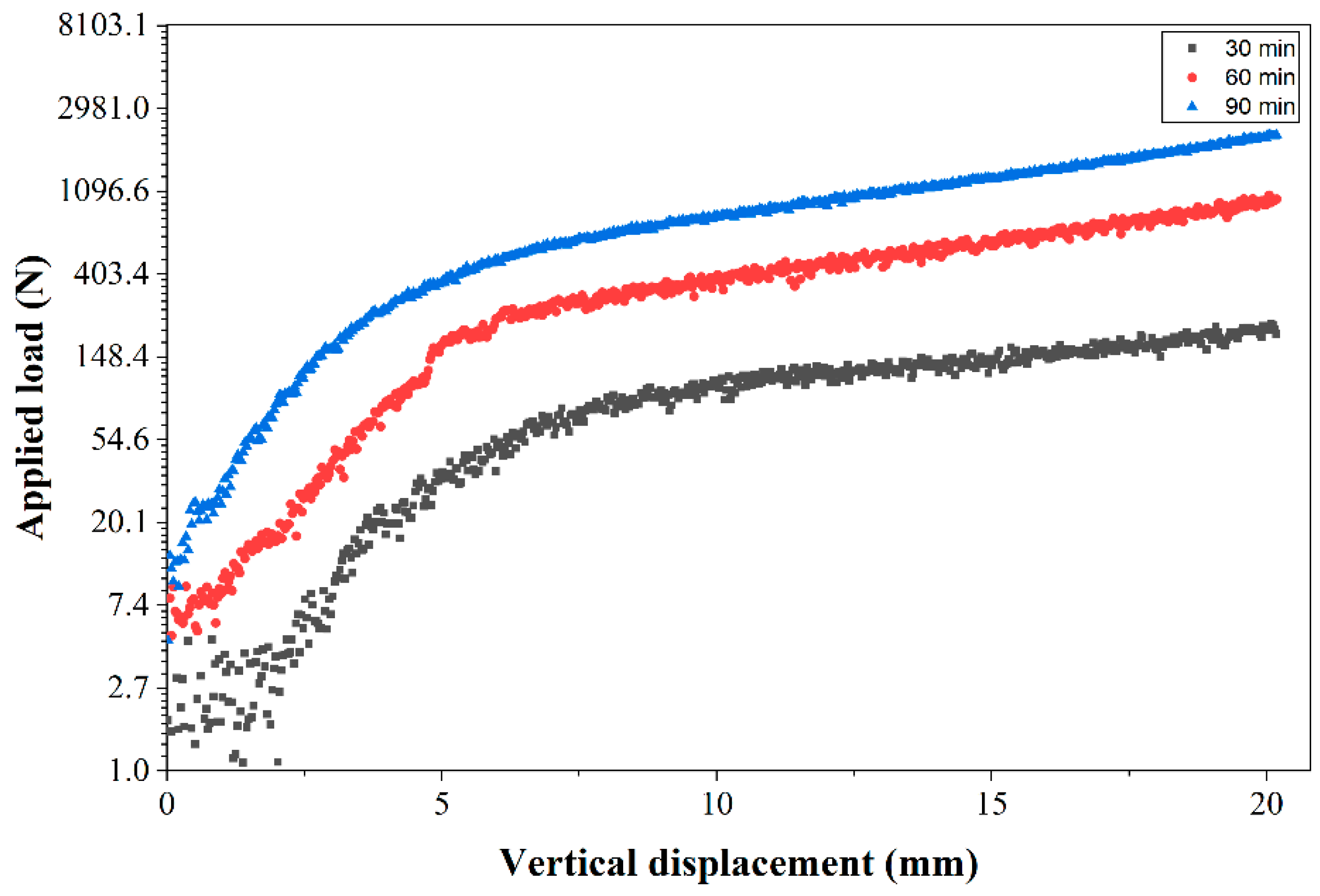
From the compression test, load-displacement curves were obtained for the structural mortar in the fresh state at curing times of 30, 60, and 90 min, as shown in Figure 4. It is worth noting that, for better data visualization, the load is presented on a natural logarithmic scale. Furthermore, a higher incidence of experimental noise can be observed at the initial stages of displacement due to material accommodation, particularly at earlier ages.
Through graphical analysis, the inflection point marking the transition between the elastic and plastic regimes of the material was identified. The yield stress values obtained for each interval are summarized in Table 2. It is observed that the area correction resulted in a significant variation in τ 0 , exceeding 10% in all cases. Therefore, the more conservative values, i.e., the corrected ones, were adopted.
Based on the obtained τ 0 values over time, the data were fitted using the thixotropic build-up model proposed by [11], as shown in Figure 5. This model assumes that the restructuring of the material at rest occurs through an exponential increase in τ 0 , i.e., in shear strength. This empirical interpolation of the data, within the interval of 30, 60, and 90 min, allowed the estimation of τ 0 , 0 , A t h i x and t c , which were found to be approximately 0.24 kPa, 0.15 kPa/min, and 51.8 min, respectively.
It should be noted that the fitting procedure was performed using three experimental points and three fitting parameters. Therefore, the reported coefficient of determination mainly reflects the limited degrees of freedom of the fitting procedure within the investigated interval.
Furthermore, based on these results, an expression describing the restructuring of the structural mortar for 3D printing used in this research, from a thixotropic perspective, is defined by Equation (12). The exponential model [11] provides a more physically consistent extrapolation of the initial yield stress than linear models, such as that proposed by [4]. Similar structural build-up behavior in printable cementitious materials has also been discussed by [22]. That approach avoids inconsistencies such as obtaining negative values of τ 0 , 0 . Furthermore, τ 0,0 can be interpreted as the material strength at the onset of the application of normal stress.
τ 0 t r e s t = 8.01 e t r e s t 51.8 1 + 0.24

3.2. Yield Envelope Based on the Mohr–Coulomb Model

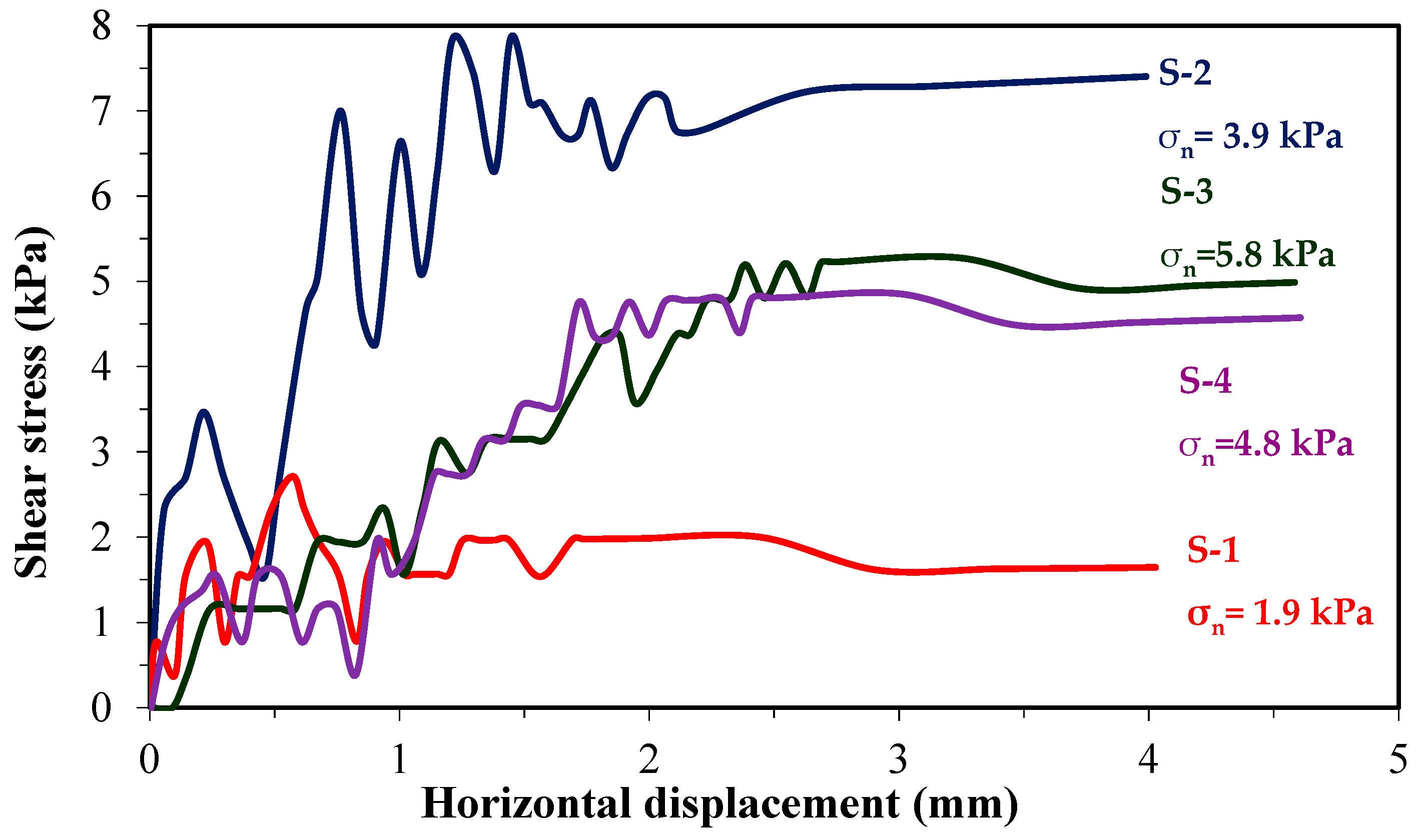
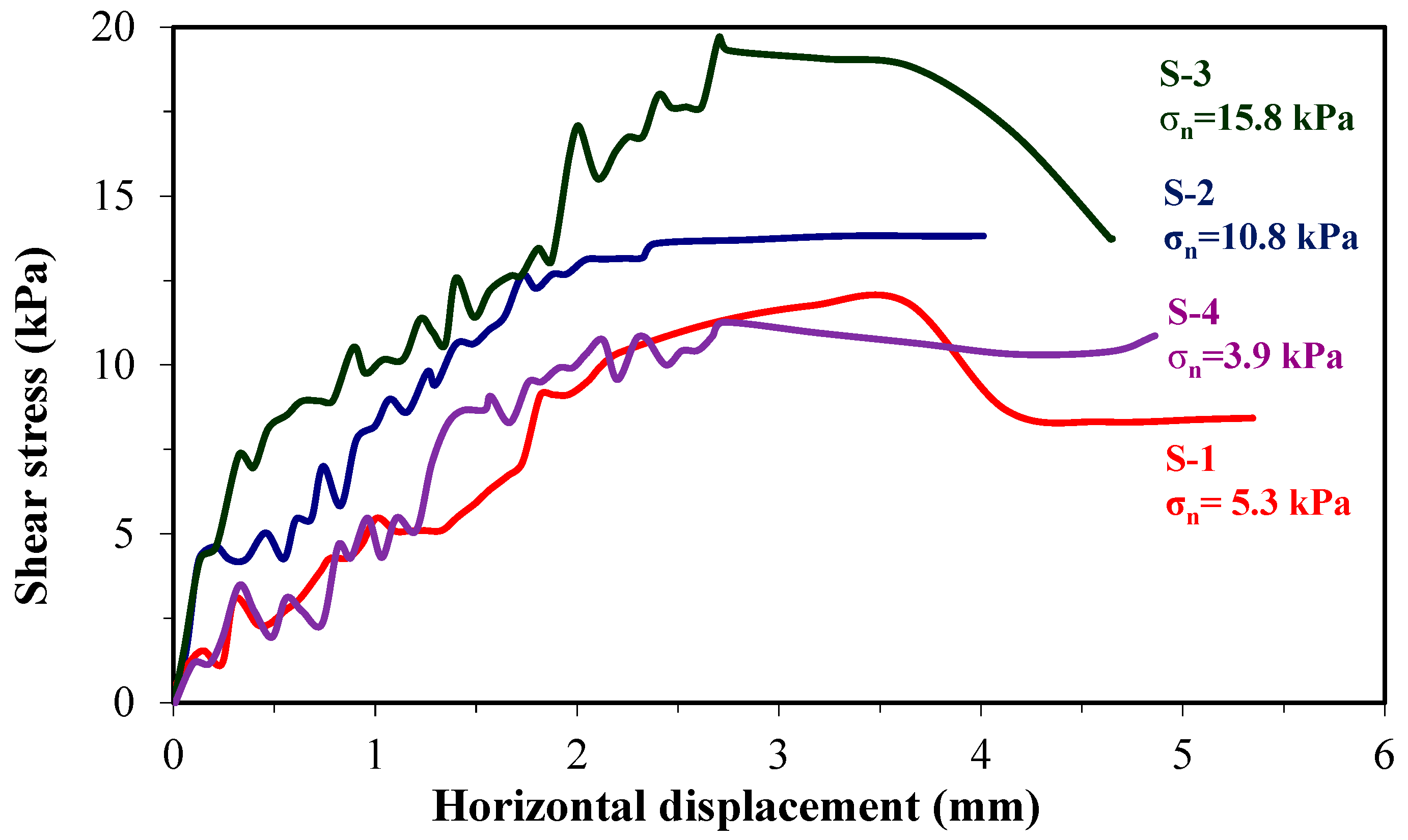
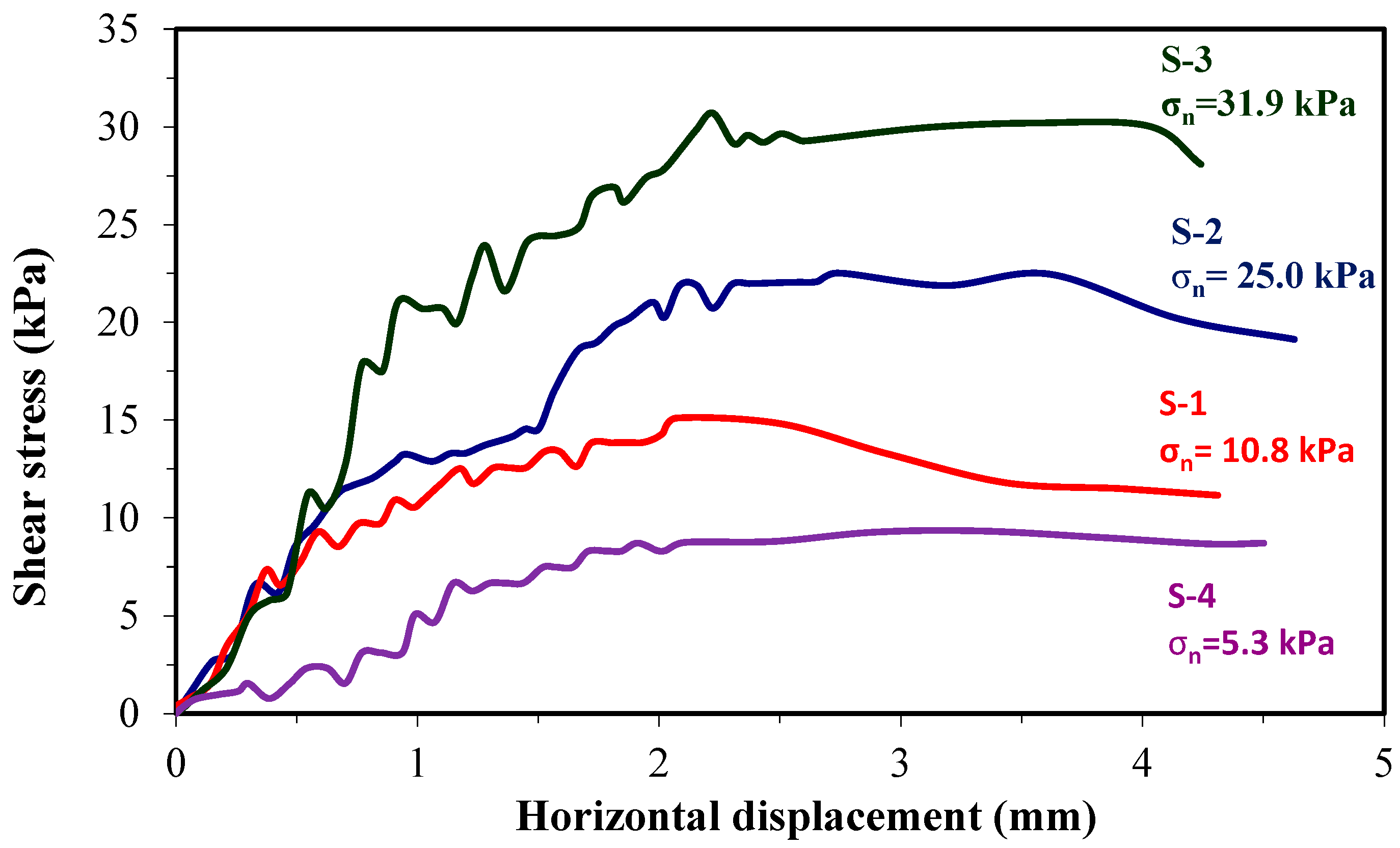
Based on the obtained data, shear stress versus horizontal displacement curves were constructed for the three curing times, as shown in Figure 6, Figure 7 and Figure 8. For each case, four tests were performed under different normal stresses, all defined based on their respective yield stresses, namely approximately 25%, 50%, and 75% of each τ 0 . A fourth intermediate value was selected to enhance the robustness of the data analysis.
At the 30 min interval, when the material is in its freshest state, specimen 2 (S-2) exhibited higher shear stresses than S-3 and S-4, despite being tested under a lower normal stress. This observation contradicts theoretical expectations and, due to this inconsistency, the data point was disregarded in the analysis. No formal statistical outlier rejection criterion was adopted due to the limited number of specimens. Therefore, the exclusion of specimen S-2 was based on the identification of an isolated, physically inconsistent response relative to the remaining experimental trend. Another observation is the reduction in experimental noise as the material stiffens over time.
From each of these curves (Figure 6, Figure 7 and Figure 8), yield envelopes were constructed using the Mohr–Coulomb model for the three curing intervals considered, as shown in Figure 9. Furthermore, from these linear fits, the values of effective cohesion ( c ) and effective friction angle ( ϕ ) were determined.
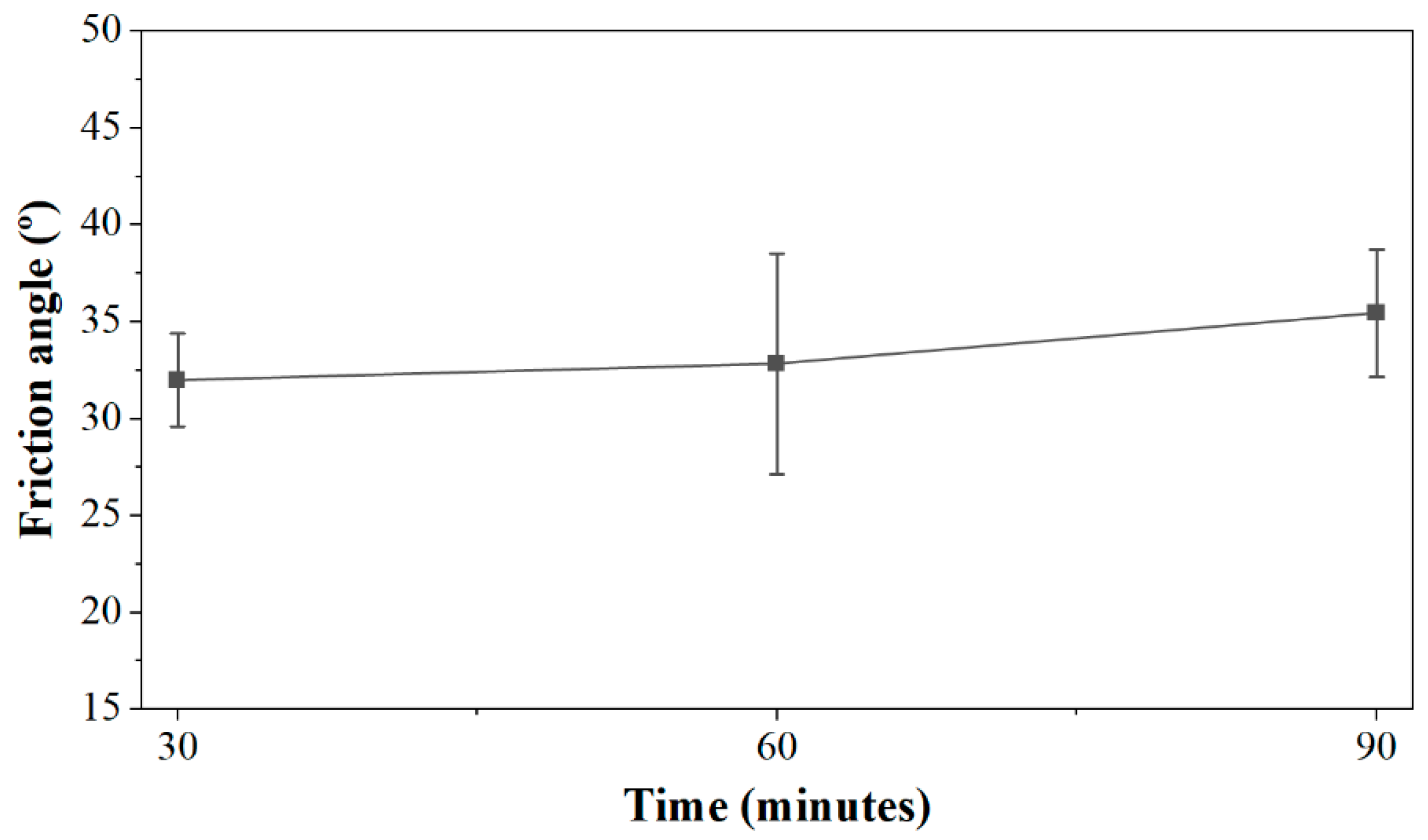
According to Figure 10, the effective friction angle values at 30, 60, and 90 min are approximately 32°, 32.8°, and 35°, respectively. Although slight variations in the friction angle were observed, these differences remain within the experimental uncertainty indicated by the error bars and may be interpreted as an apparent effect of the fitting procedure, since this parameter is obtained indirectly and is highly sensitive to experimental noise. Therefore, the observed variation is interpreted as a fitting-related fluctuation rather than as a true material evolution trend, and the friction angle can be considered approximately constant, in agreement with the findings of [6,9]. Accordingly, a mean value of approximately 33° is adopted for ϕ′.
In this study, the cohesive intercept is treated as cohesion. It represents the component of shear strength associated with physico-chemical interactions and structural build-up of the material in the fresh state. As shown in Figure 9, the values obtained at curing times of 30, 60, and 90 min are 1.55 kPa, 8.07 kPa, and 5.86 kPa, respectively. Although a global increase in cohesion with hydration is expected, the value obtained at 90 min was slightly lower than that at 60 min. Since cohesion is indirectly determined from the intercept of the Mohr–Coulomb fitting, this parameter is highly sensitive to experimental scatter, particularly at early ages. Thus, this reduction is interpreted as an experimental fluctuation rather than as a true decrease in the intrinsic cohesion of the material.

3.3. Arrhenius-Based Model for the Degree of Hydration

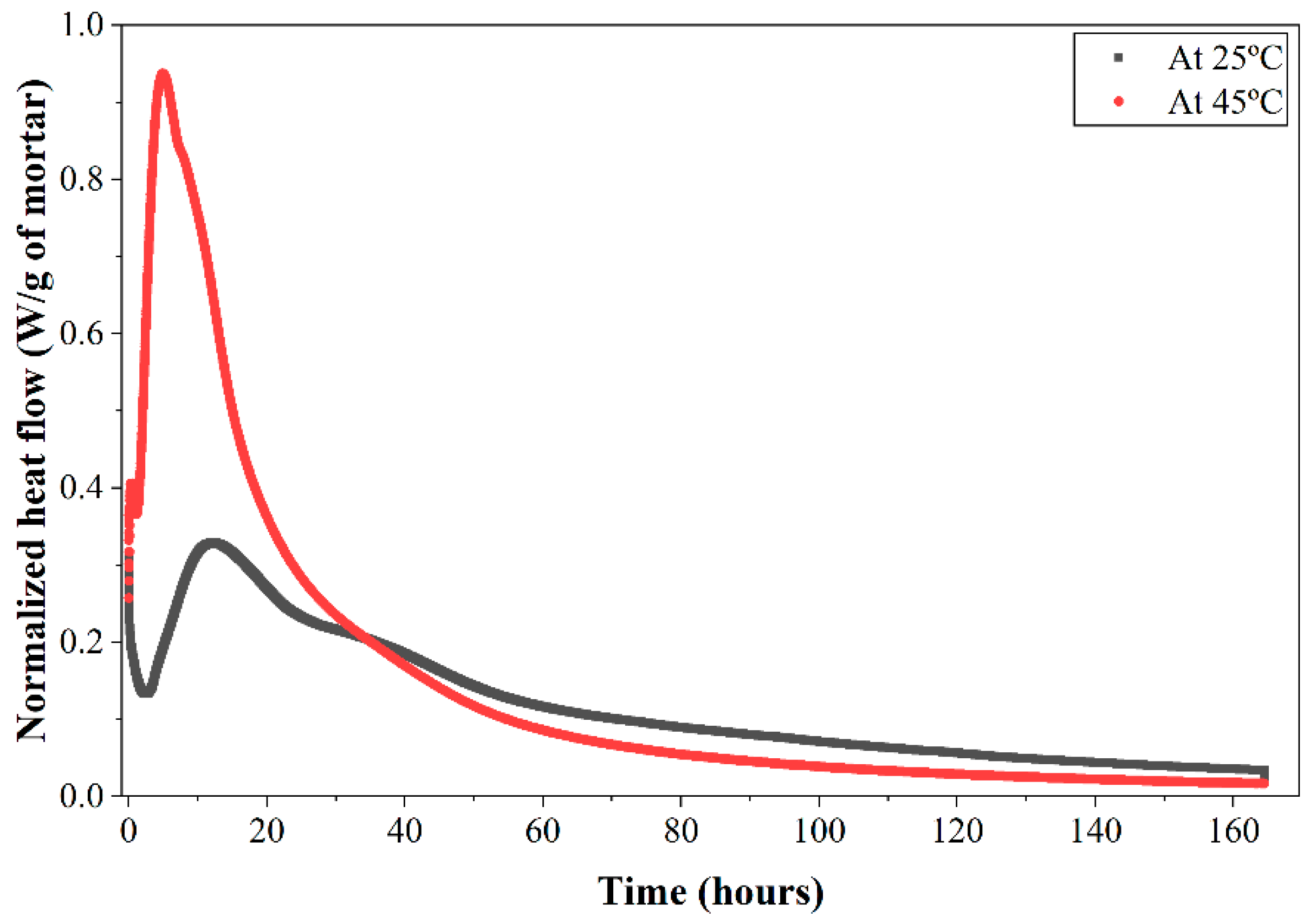
Isothermal calorimetry tests of the structural mortar were conducted at two distinct temperatures, namely 25 °C and 45 °C, over a total period of approximately 165 h. From the obtained data, two curves representing the temporal evolution of the heat release rate ( d q / d t ) were generated, one for each temperature, as shown in Figure 11. As expected, an increase in temperature leads to a significant acceleration of hydration kinetics. Evidence of this is the higher magnitude of the main heat release peak at 45 °C, which occurs over a shorter time interval compared to that at 25 °C.
In the 45 °C curve, the heat release peak reaches 0.93 W/g of mortar at 6.3 h, whereas at 25 °C it reaches 0.33 W/g of mortar at 11.3 h. This difference is a direct result of thermo-activation. A higher rate indicates a more intense reaction, associated with faster: (i) dissolution of cement phases and (ii) precipitation of hydration products.
The total cumulative heat values obtained were 86.95 J/g and 69.92 J/g of mortar at 45 °C and 25 °C, respectively. This discrepancy is related to the fact that the material did not reach the same hydration state within the analyzed period of approximately 165 h. Nevertheless, both values, corresponding to the total test duration, are used to normalize the data and obtain the degree of hydration at each temperature.
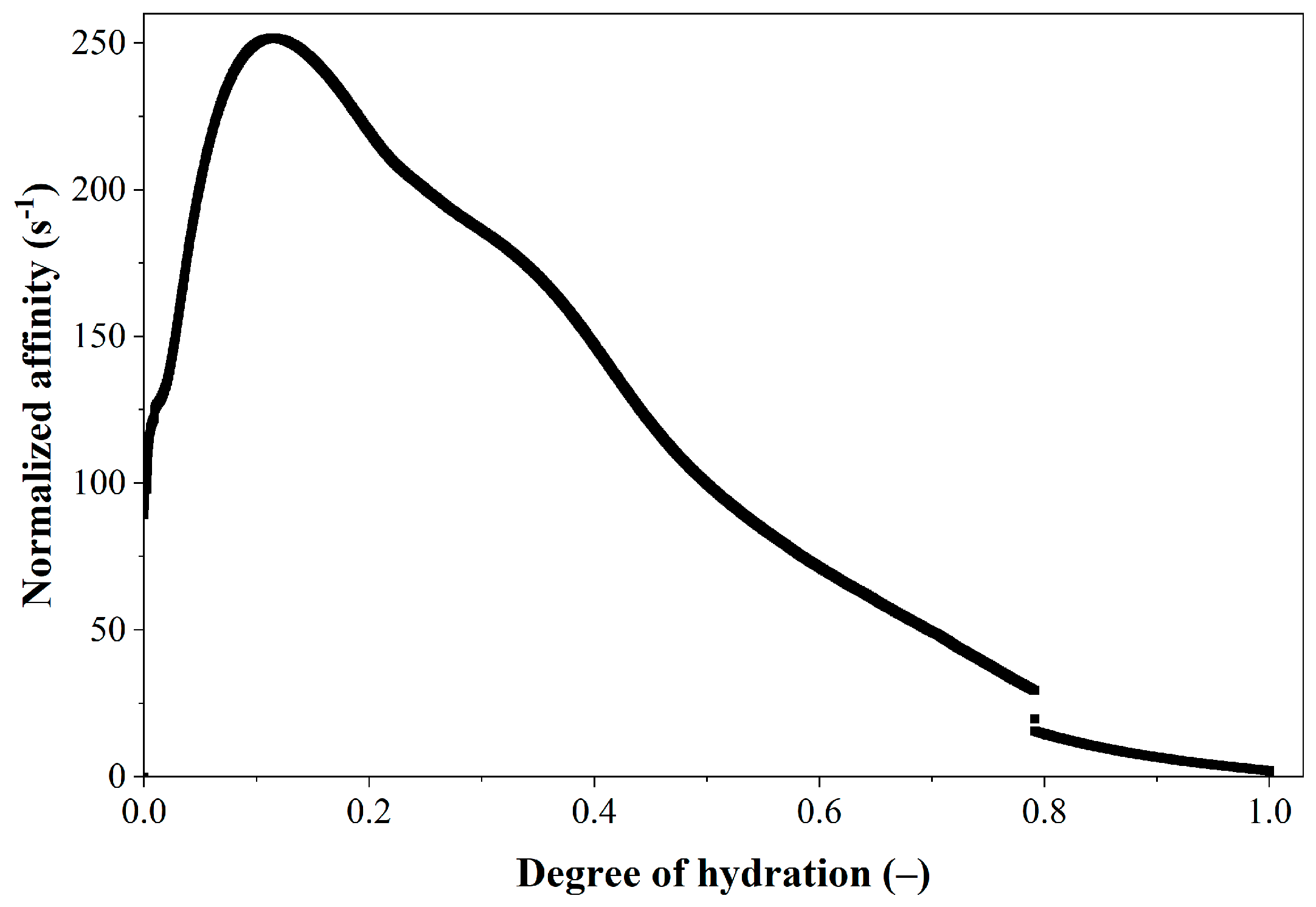
In order to establish ξ as a fundamental state variable for modeling the cohesive behavior of the material, both temporal and thermal variations must be considered, such that ξ ( t , T ) , as expressed in Equation (8). Using the previously mentioned algorithm, the following Arrhenius parameters were obtained: (i) the activation energy ( E a ) equal to 44,754.26 J/mol and, consequently, the constant E a / R is equal to 5383 K; and (ii) the values of the normalized affinity as a function of the degree of hydration à ( ξ ) , as shown in the curve in Figure 12.
It is noted that obtaining a function capable of adequately describing the global behavior of à ( ξ ) is not straightforward, particularly because it must be integrable in order to allow for an analytical solution of Equation (7). However, it should be emphasized that the present study focuses only on the initial 90 min interval, which falls within a typical time window for 3D printing applications. Therefore, the problem is treated in a numerical and localized manner, i.e., by adopting the values of à ( ξ ) within the maximum hydration interval considered.
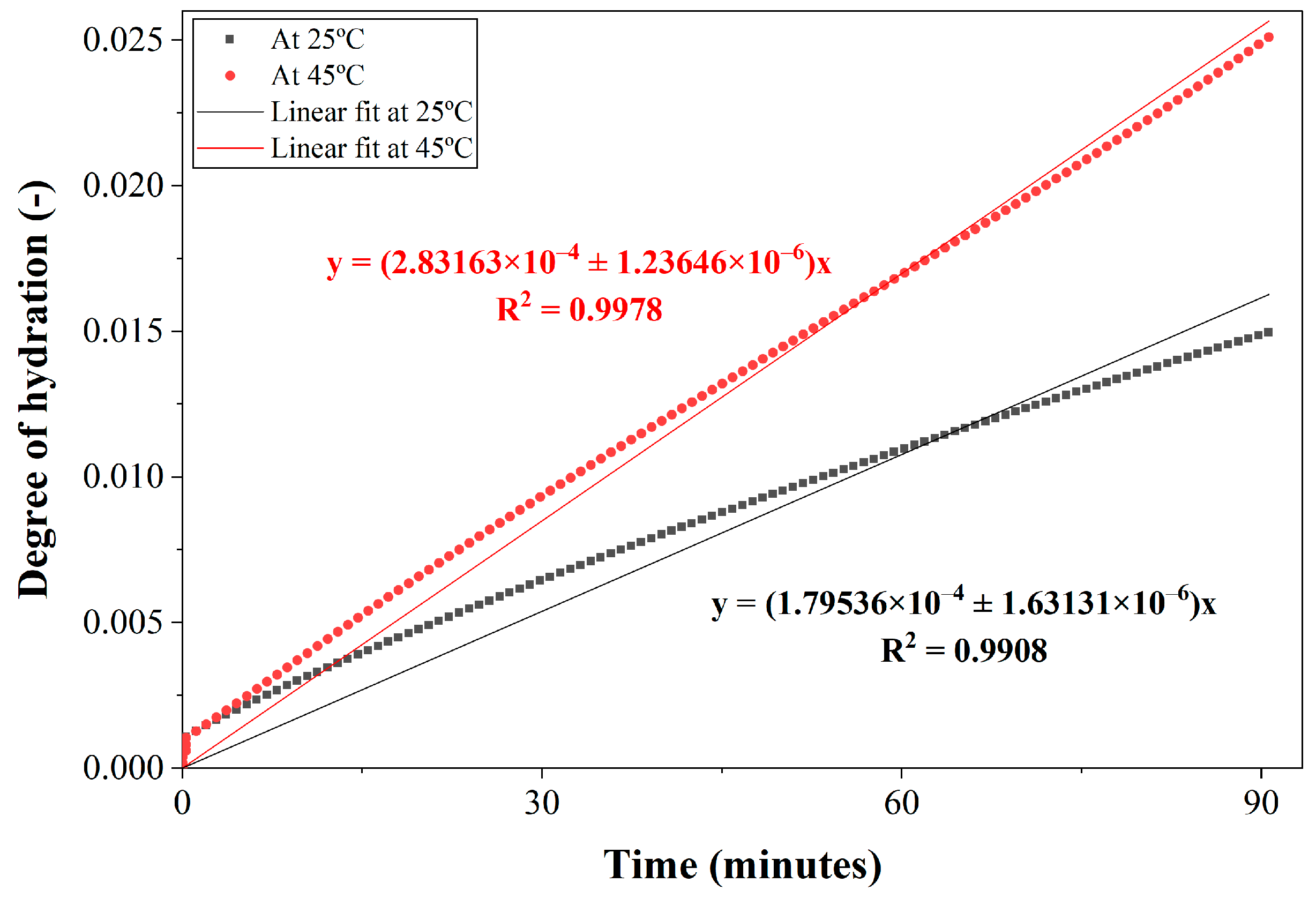
Within this interval, the fitting of the degree of hydration as a function of time, for both temperatures, is presented in Figure 13. A well-defined linear trend can be observed for both isothermal curves, which exhibit different slopes, with the higher slope corresponding to the higher temperature. It is worth noting that the slope coefficient corresponds to the Arrhenius kinetic constant k T = A ~ ξ . e   E a R T .
Therefore, it is observed that ξ ( t , T ) , which ranges from 0 to 1, evolves differently under the two thermal conditions over time. This behavior is primarily attributed to differences in the reaction kinetics, which are influenced by thermo-activation. Indeed, at 90 min, the approximate values obtained were 0.025 at 45 °C and 0.015 at 25 °C. This discrepancy motivates the chemo-mechanical modeling of cohesion.

3.4. Chemo-Mechanical Coupling of the Cohesion

As previously stated, it is assumed that the relationship between cohesion and the degree of hydration is intrinsic to the material. Therefore, the semi-empirical coupling is applied to the data obtained from both mechanical tests performed. In this context, the initial yield stress, obtained from the fitting using the model proposed in [11], is considered conceptually equivalent to cohesion at time zero, such that C 0 = τ 0 , 0 .
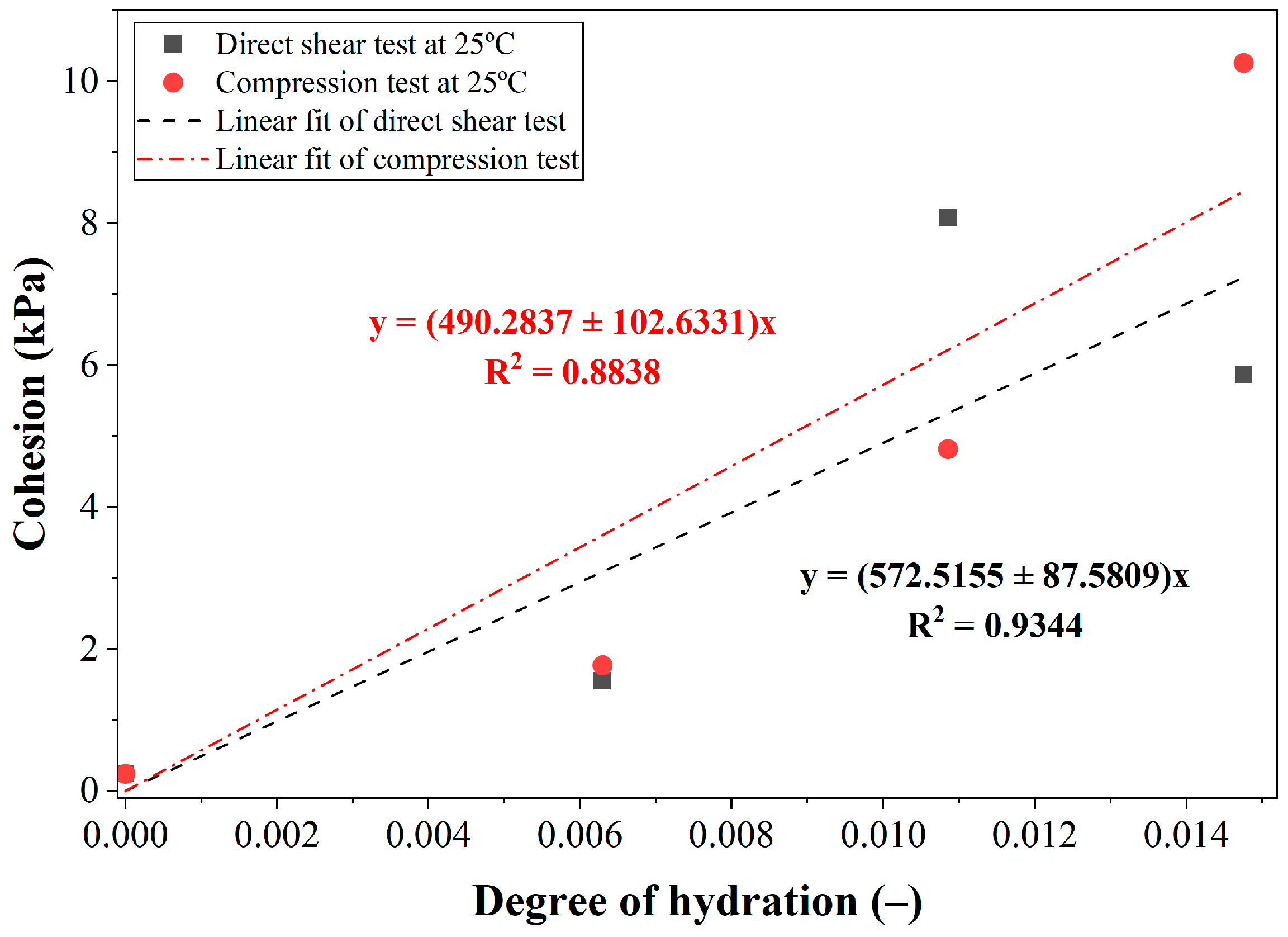
By performing a local analysis restricted to the initial 90 min interval, it is observed that the cohesion increases linearly with time, as also reported in [6,8,10,23]. Accordingly, the evolution of cohesion as a function of the degree of hydration is constructed for the time instants of 0, 30, 60, and 90 min, as shown in Figure 14. It is worth noting that these values correspond to the experimentally obtained data at a temperature of 25 °C.
By analyzing the fits presented in Figure 14, it can be observed that the slopes obtained from both tests may be considered approximately equal, despite the different boundary conditions to which the material is subjected in each case. This can be justified by the magnitude of the uncertainties associated with both approximations. It is worth noting that, in the direct shear test, the greater uncertainty in the rate d c / d ξ arises from the fact that cohesion is an indirectly obtained parameter, derived from the linear fitting of the Mohr–Coulomb model.
Furthermore, the experimental observation that the slopes of the fitted lines are effectively equal supports the assumption that the relationship between cohesion and the degree of hydration is governed primarily by the hydration state of the material. Therefore, as a first-order approximation valid within the investigated early-age interval, an average value of a =   530 kPa. ξ 1 is adopted for the structural mortar for 3D printing analyzed in this study. Accordingly, the expression for cohesion as a function of the degree of hydration for this material is given by Equation (13).
c ξ = 530 . ξ
Finally, it can be stated that adopting the degree of hydration as a state variable was effective in accounting for the effect of thermo-activation on the cohesion of the studied material. This is evidenced by the fact that, within the initial 90 min interval, degrees of hydration of 0.015 at 25 °C and 0.025 at 45 °C corresponded to cohesion values of 7.95 kPa and 13.25 kPa, respectively.
Although Equation (13) presents a simple linear form, the main contribution of the proposed approach lies in the adoption of the degree of hydration as a physically based state variable governing the evolution of cohesion. Unlike purely time-dependent approaches, the hydration-based description explicitly incorporates thermo-activation effects through Arrhenius kinetics, allowing the mechanical behavior to be directly associated with the progression of cement hydration under different temperature conditions rather than with elapsed time alone. This aspect becomes particularly relevant in practical additive manufacturing scenarios involving variable environmental temperatures or accelerated curing conditions. It should be emphasized that the proposed linear relationship represents a first-order approximation valid within the investigated early-age interval, since cement hydration kinetics are inherently nonlinear over broader time scales.
This aspect becomes particularly relevant in practical additive manufacturing scenarios involving variable environmental temperatures or accelerated curing conditions. For instance, within the same 90 min interval, the increase in curing temperature from 25 °C to 45 °C resulted in significantly different hydration degrees and corresponding cohesion values, highlighting the limitations of purely time-dependent descriptions under variable thermal conditions. Thus, it should be emphasized that the proposed linear relationship represents a first-order approximation valid within the investigated early-age interval, since cement hydration kinetics are inherently nonlinear over broader time scales.

4. Conclusions

The main established findings based on the results obtained in this study were as follows:
  • Cohesion constitutes a global measure of the paste strength, i.e., of structural build-up at early ages. This is because no distinction is made between reversible contributions (associated with temporary structural effects, such as thixotropy) and irreversible contributions (associated with microstructure) arising from the hydration process.
  • The direct shear test, when performed under stresses below the yield stress, is capable, through the application of the Mohr–Coulomb model, of providing a yield envelope rather than a classical failure envelope.
  • The initial yield stress ( τ 0 , 0 ), obtained from the exponential thixotropic build-up model, corresponds conceptually, within the Mohr–Coulomb framework, to the initial cohesion of the material.
  • The internal friction angle was found to be approximately constant, with a value close to 33°. This indicates that the yield stress exhibits a significant dependence on normal stress. Therefore, the shear strength of the material is not purely cohesive, but rather dependent on the stress state.
  • In contrast to the friction angle, the results show that cohesion evolves linearly with both time and the degree of hydration.
  • At the end of the 90 min interval, the degree of hydration was 0.015 at 25 °C and 0.025 at 45 °C. It is thus evident that time alone is not sufficient to describe the structural state of the material, since hydration kinetics are significantly influenced by thermo-activation.
  • Despite the relatively small variation observed in the degree of hydration, this parameter should not be interpreted as a direct measure of the microstructure, but rather as a global state variable associated with the level of material structuration.
  • The chemo-mechanical coupling of cohesion with the degree of hydration enables a more comprehensive and objective comparison of that parameter among different materials, accounting not only for temporal variation but also for thermal conditions.
  • By assuming that cohesion originates from hydration reactions, the linear fit of the chemo-mechanical coupling does not admit negative values for the initial cohesion, which would constitute a physical inconsistency.
  • Even under different boundary conditions in both tests, the chemo-mechanical coupling showed that the rate d c / d ξ was approximately the same, supporting the assumption that the relationship between cohesion and hydration is intrinsic to the material.

Author Contributions

Conceptualization, K.C.V.d.M.; methodology, K.C.V.d.M.; data curation, K.C.V.d.M.; formal analysis, K.C.V.d.M.; investigation, K.C.V.d.M.; writing, K.C.V.d.M.; reviewing and editing, K.C.V.d.M., E.d.M.R.F. and O.A.M.R.; supervision, O.A.M.R. and E.d.M.R.F.; project administration, supervision, reviewing, O.A.M.R. and E.d.M.R.F.; resources (calorimetric analysis), M.T.M. All authors have read and agreed to the published version of the manuscript.

Funding

This research was funded by Brazilian funding agencies FAPERJ (Fundação Carlos Chagas Filho de Amparo à Pesquisa do Estado do Rio de Janeiro) through the Mestrado Nota 10 Program, grant number 203.072/2023 and CAPES (Coordenação de Aperfeiçoamento de Pessoal de Nível Superior—Brasil)—Finance Code 001.

Data Availability Statement

All of the study’s data are contained in this article.

Acknowledgments

This study was financed by Brazilian scientific agencies, namely the Conselho Nacional de Desenvolvimento Científico e Tecnológico (CNPq) and the Coordenação de Aperfeiçoamento de Pessoal de Nível Superior (CAPES)—Finance Code 001. The authors also acknowledge FAPERJ, the Research Support Foundation of the State of Rio de Janeiro, for supporting the present research.

Conflicts of Interest

The authors declare no conflicts of interest. The funders had no role in the design of the study, in the collection, analysis, or interpretation of the data, in the writing of the manuscript, or in the decision to publish the results.

Appendix A. Basic Structure of the Algorithm Used to Obtain E a and à ( ξ )

The procedure is based on the isothermal calorimetry data of the mortar at two different temperatures. Initially, the following input data are required:
  • heat flow curves obtained during the isothermal calorimetry test of the paste at two different temperatures, denoted as ϕ v T A , t and ϕ v ( T B , t ) ;
  • lower and upper bounds of the search domain E a r i , E a r f ;
  • number of divisions of the search domain n d i v .
Subsequently, these data are introduced into a computational code, whose basic operating procedure is described below.
1.
Read  ϕ v ( T A , t ) ; // experimental curve A, obtained at temperature  T A
2.
Read  ϕ v ( T B , t ) ; // experimental curve B, obtained at temperature  T B
3.
Read the lower and upper bounds of the search domain ( E a r i , E a r f );
4.
Read the number of divisions of the search domain ( n d i v );
5.
Δ E a r = ( E a r f E a r i ) / n d i v ; // step size in the search domain
6.
Obtain  ϕ v f A ; // value of  ϕ v  at the last point of the curve defined by  ϕ v ( T A , t )
7.
Obtain  ϕ v f B ; // value of  ϕ v  at the last point of the curve defined by  ϕ v ( T B , t )
8.
Calculate  Q A ; // area under the curve  ϕ v ( T A , t )
9.
Calculate  Q B ; // area under the curve  ϕ v ( T B , t )
10.
if ( ϕ v f A 0  and  ϕ v f B = 0  ) then  Q B Q A ,   Q p o t = Q B ,   T 1 = T A  and  T 2 = T B ;
11.
if ( ϕ v f A = 0  and  ϕ v f B 0  ) then  Q A Q B , Q p o t = Q A , T 1 = T B  and  T 2 = T A ;
12.
if ( ϕ v f A = 0  and  ϕ v f B = 0 e Q B Q A  ) then  Q p o t = Q B , T 1 = T A  and  T 2 = T B ;
13.
if ( ϕ v f A = 0  and  ϕ v f B = 0 e Q A > Q B ) then  Q p o t = Q A , T 1 = T B  and  T 2 = T A ;
14.
Calculate ξ ( T 1 , t ) and ξ ( T 2 , t ) ;
15.
Calculate ξ ˙ ( T 1 , ξ ) using ξ T 1 , t ;
16.
Calculate ξ ˙ ( T 2 , ξ ) using ξ ( T 2 , t ) ;
17.
Obtain ξ m a x 1 ; // value of ξ at the last point of the curve ξ ( T 1 , t )
18.
k = 0 ; // search-domain point identifier
19.
k s = 0 ; // solution identifier
20.
Do (while k n d i v )
21.
k = k + 1 ;
22.
E a r k = E a r i + k 1 Δ E a r ; // value of E a r to be examined
23.
A ~ 1 ( ξ , k ) = ξ ˙ ( T 1 , ξ )   e x p   E a r ( k ) T 1 ;
24.
A ~ 2 ( ξ , k ) = ξ ˙ ( T 2 , ξ )   e x p E a r ( k ) T 2 ;
25.
Ψ k = A ~ 1 ξ , k A ~ 2 ξ , k ; // residual: Euclidean norm up to ξ = ξ m a x 1
26.
if ( k = 1 ) then  Ψ m i n = Ψ k and k s = k ;
27.
if ( k > 1 and Ψ k < Ψ m i n  ) then  Ψ m i n = Ψ k and k s = k ;
28.
Write the values of k , E a r k and Ψ k ; // report
29.
end
30.
Write the values of k s , E a r k s and Ψ m i n ; // solution
31.
Write A ~ 2 ξ , k s ; // normalized affinity curve associated with the solution

References

  1. Mechtcherine, V.; Nerella, V.N.; Will, F.; Näther, M.; Otto, J.; Krause, M. Large-scale digital concrete construction—CONPrint3D concept for on-site, monolithic 3D-printing. Autom. Constr. 2019, 107, 102933. [Google Scholar] [CrossRef]
  2. Roussel, N.; Lowke, D. Digital Fabrication with Cement-Based Materials: State-of-the-Art Report of the RILEM TC-276-DFC; State-of-the-Art Report; Springer: Cham, Switzerland, 2022; Volume 36, 244p, Available online: https://link.springer.com/book/10.1007/978-3-030-90535-4 (accessed on 18 March 2026).
  3. Wangler, T.; Lloret, E.; Reiter, L.; Hack, N.; Gramazio, F.; Kohler, M.; Bernhard, M.; Dillenburger, B.; Buchli, J.; Roussel, N.; et al. Digital Concrete: Opportunities and Challenges. RILEM Tech. Lett. 2016, 1, 67–75. [Google Scholar] [CrossRef]
  4. Roussel, N. A thixotropy model for fresh fluid concretes: Theory, validation and applications. Cem. Concr. Res. 2006, 36, 1797–1806. [Google Scholar] [CrossRef]
  5. Roussel, N. Rheological requirements for printable concretes. Cem. Concr. Res. 2018, 112, 76–85. [Google Scholar] [CrossRef]
  6. Wolfs, R.J.M.; Bos, F.P.; Salet, T.A.M. Early age mechanical behaviour of 3D printed concrete: Numerical modelling and experimental testing. Cem. Concr. Res. 2018, 106, 103–116. [Google Scholar] [CrossRef]
  7. Suiker, A. Mechanical performance of wall structures in 3D printing processes: Theory, design tools and experiments. Int. J. Mech. Sci. 2018, 137, 145–170. [Google Scholar] [CrossRef]
  8. Mettler, L.K.; Wittel, F.K.; Flatt, R.J.; Herrmann, H.J. Evolution of strength and failure of SCC during early hydration. Cem. Concr. Res. 2016, 89, 288–296. [Google Scholar] [CrossRef]
  9. Alexandridis, A.; Gardner, N.J. Mechanical behaviour of fresh concrete. Cem. Concr. Res. 1981, 11, 323–339. [Google Scholar] [CrossRef]
  10. Liu, Z.; Li, M.; Quah, T.K.N.; Wong, T.N.; Tan, M.J. Comprehensive investigations on the relationship between the 3D concrete printing failure criterion and properties of fresh-state cementitious materials. Addit. Manuf. 2023, 76, 103787. [Google Scholar] [CrossRef]
  11. Perrot, A.; Rangeard, D.; Pierre, A. Structural built-up of cement-based materials used for 3D-printing extrusion techniques. Mater. Struct. 2015, 49, 1213–1220. [Google Scholar] [CrossRef]
  12. Wadsö, L.; Winnefeld, F.; Riding, K.; Sandberg, P. Calorimetry. In A Practical Guide to Microstructural Analysis of Cementitious Materials, 1st ed.; Scrivener, K., Snellings, R., Lothenbach, B., Eds.; CRC Press: Boca Raton, Florida, USA, 2016; pp. 1–35. [Google Scholar]
  13. Ulm, F.J.; Coussy, O. Modeling of thermo-chemo-mechanical couplings of concrete at early ages. J. Eng. Mech. (ASCE) 1995, 121, 785–794. [Google Scholar] [CrossRef]
  14. ASTM C150/C150M-24; Standard Specification for Portland Cement. American Society for Testing Materials (ASTM): West Conshohocken, PA, USA, 2024.
  15. Cavalcante, T.C.; Fernandez, L.I.C.; Filho, R.D.T.; Reales, O.A.M. 3D printable mortars with different recycled concrete powders as fillers. In Proceedings of the 4th RILEM International Conference on Concrete and Digital Fabrication, Munich, Germany, 4–6 September 2024. [Google Scholar] [CrossRef]
  16. Cardoso, F.A.; Pileggi, R.G.; John, V.M. Squeeze-flow aplicado a argamassas de revestimento: Manual de utilização. Bol. Técnico Esc. Politécnica USP 2010, 1, 1–29. [Google Scholar]
  17. ISO 17892-10:2018; Geotechnical Investigation and Testing—Laboratory Testing of Soil—Part 10: Direct Shear Tests. International Organization for Standardization (ISO): Geneva, Switzerland, 2018.
  18. Das, B.M. Principles of Geotechnical Engineering; Cengage Learning: Stamford, Connecticut, USA, 2012. [Google Scholar]
  19. Head, K.H.; Epps, R.J. Manual of Soil Laboratory Testing, 3rd ed.; Whittles Publishing: Dunbeath, UK, 2011; Volume 2. [Google Scholar]
  20. ASTM C1679/C1679-22; Standard Practice for Measuring Hydration Kinetics of Hydraulic Cementitious Mixtures Using Isothermal Calorimetry. American Society for Testing Materials (ASTM): West Conshohocken, PA, USA, 2022.
  21. Fairbairn, E.; Azenha, M. Thermal Cracking of Massive Concrete Structures; RILEM State-of-the-Art Reports; Springer, International Publishing: Cham, Switzerland, 2019; Volume 27. [Google Scholar]
  22. Kruger, J.; Zeranka, S.; van Zijl, G. An ab initio approach for thixotropy characterisation of (nanoclay-modified) 3D printable concrete. Constr. Build. Mater. 2019, 224, 372–386. [Google Scholar] [CrossRef]
  23. Wolfs, R.J.M.; Bos, F.P.; Salet, T.A.M. Triaxial compression testing on early age concrete for numerical analysis of 3D concrete printing. Cem. Concr. Compos. 2019, 104, 103344. [Google Scholar] [CrossRef]
Figure 1. Particle size distribution curve of the natural sand used in the structural mortar.
Buildings 16 02273 g001
Figure 2. Initial setup of the uniaxial compression test.
Buildings 16 02273 g002
Figure 3. Preparation for the direct shear test. (a) assembly and filling of the shear box, followed by the placement of paper filters; (b) positioning of the shear box in the testing apparatus and proper instrumentation for the start of the test.
Buildings 16 02273 g003
Figure 4. Load-displacement curves of the structural mortar over time.
Buildings 16 02273 g004
Figure 5. Thixotropic build-up curve of the structural mortar at 25 °C.
Buildings 16 02273 g005
Figure 6. Shear stress–displacement curves of the structural mortar at 30 min of curing.
Buildings 16 02273 g006
Figure 7. Shear stress–displacement curves of the structural mortar at 60 min of curing.
Buildings 16 02273 g007
Figure 8. Shear stress–displacement curves of the structural mortar at 90 min of curing.
Buildings 16 02273 g008
Figure 9. Yield envelopes for curing times of 30, 60, and 90 min.
Buildings 16 02273 g009
Figure 10. Friction angle for curing times of 30, 60 and 90 min.
Buildings 16 02273 g010
Figure 11. Hydration stages obtained from isothermal calorimetry at 25 °C and 45 °C.
Buildings 16 02273 g011
Figure 12. Normalized affinity curve à ( ξ ) of the structural mortar.
Buildings 16 02273 g012
Figure 13. Degree of hydration over time at 25 °C and 45 °C.
Buildings 16 02273 g013
Figure 14. Cohesion as a function of the degree of hydration.
Buildings 16 02273 g014
Table 1. Materials and mix proportions.
MaterialProportionQuantity (kg/m3)SpecificationSupplier/
Manufacturer
Portland cement1814CPV-ARILafarge Holcim
(Zug, Switzerland)
Sand1.251017.5Natural sand
(maximum particle size of 600)
Local supplier
(Rio de Janeiro, Brazil)
Superplasticizer0.00282.28Glenium® 51BASF
(Ludwigshafen, Germany)
Water0.43350Supplied by the local water utilityÁguas do Rio
(Rio de Janeiro, Brazil)
Table 2. Parameters related to the determination of yield stress over time.
ParametersCuring Time (min)
306090
GeometricalVertical displacement (mm)7.625.625.55
Instantaneous height (mm)42.3844.3844.45
Corrected area (mm2)11,797.6111,267.5411,249.14
MechanicalForce (N)77.02200.00424.96
t0 without correction (KPa)7.7020.0042.50
t0 with correction (KPa)6.5317.7537.78
Variation in t0 (%)15.2211.2511.11
Disclaimer/Publisher’s Note: The statements, opinions and data contained in all publications are solely those of the individual author(s) and contributor(s) and not of MDPI and/or the editor(s). MDPI and/or the editor(s) disclaim responsibility for any injury to people or property resulting from any ideas, methods, instructions or products referred to in the content.