Effects of Key Lighting Parameters on Visual Fatigue Among Secondary School Students in VDT-Equipped Multimedia Classrooms


Abstract
1. Introduction
2. Materials and Methods
2.1. Environmental Settings
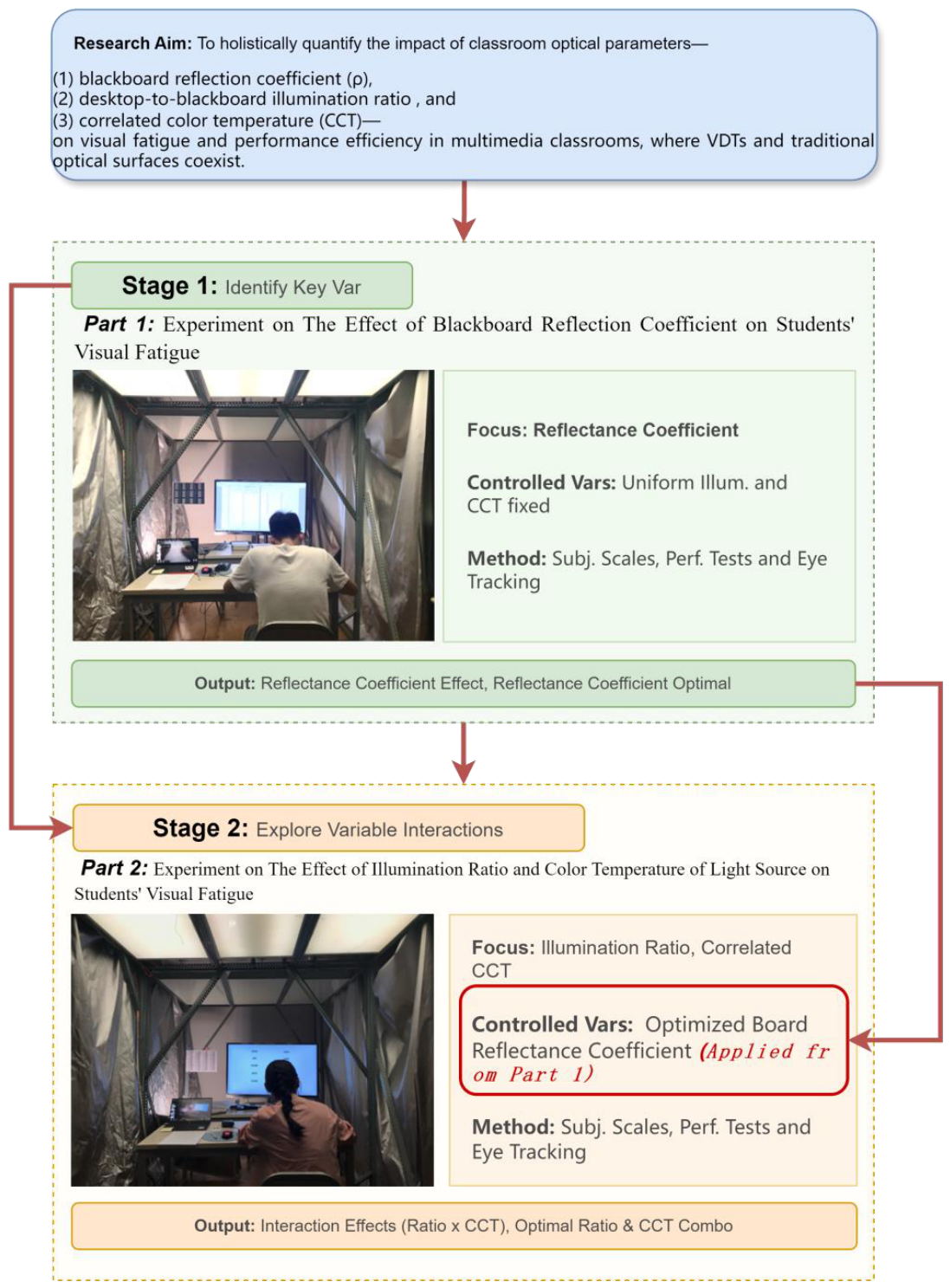
2.1.1. Part 1: Experiment on the Effect of Blackboard Reflection Coefficient on Students’ Visual Fatigue
2.1.2. Part 2: Experiment on the Effect of Illumination Ratio and Color Temperature of Light Source on Students’ Visual Fatigue
2.2. Subjects
2.3. Data Acquisition Method
2.3.1. Subjective Methodology
2.3.2. Physiological Methodology
2.3.3. Index of Mental Capability
2.3.4. Equipment
2.4. Experimental Materials
2.4.1. Subjective Fatigue Scale
- VFS-10 (Visual Fatigue Scale)
2.4.2. Task Test
- Landolt Ring Visual Acuity Test
- Anfimov’s Chart Task
2.5. Experimental Procedure
2.5.1. Experimental Procedure of Part 1
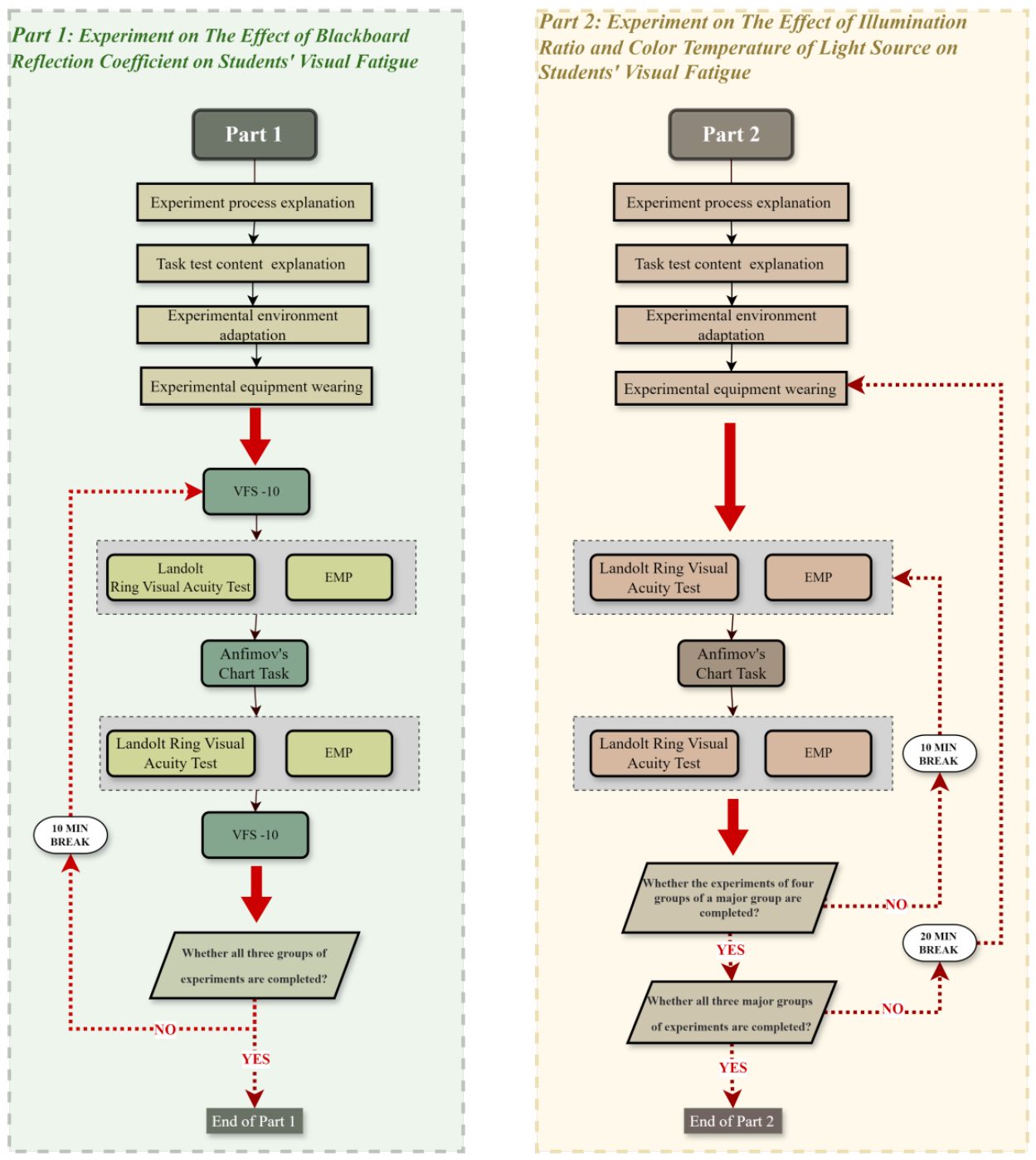
- Step 1: Orientation and Initial Assessment. Participants received comprehensive briefing regarding experimental protocols and task requirements, followed by completion of preliminary assessment scales.
- Step 2: Eye tracking Device Setup. Participants were fitted with the Tobii Pro Glasses 2 eye tracking device, and calibration was performed to ensure accurate tracking of visual focus.
- Step 3: Baseline Visual Fatigue Assessment. Participants completed the VFS-10 to assess their initial levels of visual fatigue and sleepiness before the experiment. (5 min)
- Step 4: Landolt ring visual acuity test. Participants engaged in a visual acuity task requiring identification of aperture orientations in the Landolt C checklist by locating specific visual markers on the printed board. (1 min)
- Step 5: Anfimov’s Chart Task. Participants were required to identify matches between target words displayed on a VDT and their corresponding serial numbers on the printed board, sequentially recording these identifications on a designated record sheet until all 40 words were processed. (5 min)
- Step 6: Post Task Visual Acuity Test. The visual acuity test was repeated to assess any changes in participants’ ability to identify the coordinate positions of visual markers. (1 min)
- Step 7: Post Experimental Visual Fatigue Assessment. Participants retook the VFS-10 to measure changes in visual fatigue after each task.
2.5.2. Experimental Procedure of Part 2
- Steps 1 and 2: These initial steps replicated the procedures outlined in Part 1, thereby ensuring methodological consistency.
- Steps 3 to 5: These steps were analogous to steps 4 to 6 in Part 1, maintaining continuity across experimental conditions.
- Steps 6: Intermediate Rest Period. Following the completion of the first subordinate session, a rest period of 5 min was provided to alleviate immediate fatigue.
- Steps 7: Repetition of Subordinate Sessions. Steps 3 to 6 were repeated three times to complete the first primary group. A break of 20 min was subsequently provided for comprehensive recovery.
- Steps 8: Completion of Remaining Groups. Participants repeated steps 2 through 7 for the remaining two primary groups, culminating in the completion of all experimental sessions.
2.5.3. Methodological Controls for Experimental Errors
3. Results
3.1. Subjective Scale Analysis
3.2. Eye Movement
3.2.1. Results of Part 1 Experiment
3.2.2. Results of Part 2 Experiment
- Under the same color temperature and different illumination ratios
- Under the same illumination ratio and different color temperatures
3.3. Index of Mental Capability
3.3.1. Results of Part 1 Experiment
3.3.2. Results of Part 2 Experiment
- Under the same color temperature and different illumination ratios
- Under the same illumination ratio and different color temperatures
4. Discussion
4.1. Main Findings
4.2. Interrelation Between Experiments
4.3. Further Analysis: Exploratory Analysis of Age Effects and Physiological Mechanisms Underlying CCT Responses
4.4. Strengths
4.5. Limitations and Future Directions
4.5.1. Sample Size and Statistical Considerations
4.5.2. Reflection Coefficient Range
4.5.3. Illumination and CCT Settings
4.5.4. Environmental Conditions
4.5.5. Flicker Consideration
4.5.6. Practical Recommendations for Classroom Lighting
5. Conclusions
Supplementary Materials
Author Contributions
Funding
Institutional Review Board Statement
Informed Consent Statement
Data Availability Statement
Conflicts of Interest
Abbreviations
| VDT | Visual Display Terminal |
| CCT | Correlated Color Temperature |
| IMC | Index of Mental Capacity |
| VFS-10 | Visual Fatigue Scale |
| CQS | Color Quality Scale |
References
- Ministry of Education of the People’s Republic of China. Implementation Plan for Comprehensive Prevention and Control of Myopia in Children and Adolescents. 2018. Available online: http://www.moe.gov.cn/srcsite/A17/moe_943/s3285/201808/t20180830_346672.html (accessed on 2 February 2026).
- Nie, Y.; Roccetti, M. Application of Multimodal Multimedia Information and Big Data Technology in Teaching Chinese as a Foreign Language Course. Int. J. Digit. Multimed. Broadcast. 2023, 2023, 2257863. [Google Scholar] [CrossRef] [Scilit]
- Qiao, F.; Wang, H. Mobile Interactive Translation Teaching Model Based on “Internet plus “. EURASIA J. Math. Sci. Technol. Educ. 2017, 13, 6705–6714. [Google Scholar] [CrossRef] [Scilit]
- Wang, J. A Review of the Development of the Integration Strategy of Information Technology and Education in the Four Countries of the United States, Britain, China, and Singapore. Sci. Insights Educ. Front. 2021, 9, 1283–1303. [Google Scholar] [CrossRef] [Scilit]
- Wang, Y. Report on Smart Education in China. In Smart Education in China and Central & Eastern European Countries; Springer: Berlin/Heidelberg, Germany, 2023; pp. 11–50. [Google Scholar] [CrossRef] [Scilit]
- Wang, Y.; Liu, X.; Zhang, Z. An overview of e-learning in China: History, challenges and opportunities. Res. Comp. Int. Educ. 2018, 13, 195–210. [Google Scholar] [CrossRef] [Scilit]
- Zhan, Z.; Wu, Q.; He, W.; Cheng, S.; Lu, J.; Han, Y. K12 teacher-student interaction patterns in the smart classrooms. Int. J. Innov. Learn. 2021, 29, 267–286. [Google Scholar] [CrossRef] [Scilit]
- The State Council Information Office of the People’s Republic of China. China’s Comprehensive National Development. 2021. Available online: http://www.gov.cn/zhengce/2021-09/28/content_5639778.htm (accessed on 2 February 2026).
- Qu, J. Theory and Methods in Optometry and Vision Science; People’s Medical Publishing House: Beijing, China, 2018; ISBN 9787117146029. [Google Scholar]
- Cao, X. Study on Optimization of Lighting Environment of Multimedia Classrooms in Primary and Secondary Schools Using Electronic White Board. Master’s Thesis, Chongqing University, Chongqing, China, 2021. [Google Scholar] [CrossRef]
- National Internet Information Office. Digital China Development Report (2020); National Internet Information Office: Beijing, China, 2021. Available online: https://www.cac.gov.cn/2021-06/28/c_1626464503226700.htm (accessed on 2 February 2026).
- Ministry of Education of the People’s Republic of China. Results of the Eighth National Survey on Student Physical Fitness and Health Released. Chin. J. Sch. Health 2021, 42, 1281–1282. [Google Scholar] [CrossRef]
- Sun, H.P.; Li, A.; Xu, Y.; Pan, C.W. Secular Trends of Reduced Visual Acuity From 1985 to 2010 and Disease Burden Projection for 2020 and 2030 Among Primary and Secondary School Students in China. JAMA Ophthalmol. 2015, 133, 262–268. [Google Scholar] [CrossRef] [Scilit]
- Chung, M.S.; Seomun, G. Health issues with learning to use smart devices in the digital age: Using a grounded theory approach. Int. J. Environ. Res. Public Health 2021, 18, 7062. [Google Scholar] [CrossRef] [Scilit]
- Bowling, E. Dry eye in the digital age. Optom. Times 2020, 12, 12–33. [Google Scholar]
- Latini, N.; Bråten, I.; Salmerón, L. Does reading medium affect processing and integration of textual and pictorial information? A multimedia eye tracking study. Contemp. Educ. Psychol. 2020, 62, 101870. [Google Scholar] [CrossRef] [Scilit]
- Carpenter, R.; Alloway, T. Computer versus paper-based testing: Are they equivalent when it comes to working memory? J. Psychoeduc. Assess. 2019, 37, 382–394. [Google Scholar] [CrossRef] [Scilit]
- Singer, L.M.; Alexander, P.A. Reading across mediums: Effects of reading digital and print texts on comprehension and calibration. J. Exp. Educ. 2017, 85, 155–172. [Google Scholar] [CrossRef] [Scilit]
- Cheng, P.Y.; Su, Y.N.; Chien, Y.C.; Wu, T.T.; Huang, Y.M. An investigation of visual fatigue in Elementary School students resulting from reading e-books. J. Internet Technol. 2018, 19, 1285–1292. [Google Scholar]
- Jeong, Y.J.; Gweon, G. Advantages of print reading over screen reading: A comparison of visual patterns, reading performance, and reading attitudes across paper, computers, and tablets. Int. J. Hum.–Comput. Interact. 2021, 37, 1674–1684. [Google Scholar] [CrossRef] [Scilit]
- Seomun, G.; Lee, Y. Potential Adverse Health Outcomes of Digital Textbook Use: Teachers’ Perspectives. Res. Theory Nurs. Pract. 2018, 32, 9–22. [Google Scholar] [PubMed]
- Oner, M. Measure of visual fatigue as a link between visual environment and visual and non-visual functions of VDT users: A review on what we have and what we need. In Proceedings of the 2018 IEEE International Conference on Environment and Electrical Engineering and 2018 IEEE Industrial and Commercial Power Systems Europe (EEEIC/I&CPS Europe), Palermo, Italy, 12–15 June 2018; IEEE: Piscataway, NJ, USA, 2018; pp. 1–6. [Google Scholar]
- Dainoff, M.J.; Happ, A.; Crane, P. Visual fatigue and occupational stress in VDT operators. Hum. Factors 1981, 23, 421–437. [Google Scholar] [CrossRef] [Scilit] [PubMed]
- Shi, X.; Qu, X.; Mi, W.; Chang, D. Study on index of visual fatigue of VDT work. In Proceedings of the 2011 IEEE 2nd International Conference on Computing, Control and Industrial Engineering, Wuhan, China, 20–21 August 2011; IEEE: Piscataway, NJ, USA, 2011. [Google Scholar]
- Shigeishi, H. Association of temporomandibular disorder with occupational visual display terminal use. Biomed. Rep. 2016, 5, 7–10. [Google Scholar] [CrossRef] [Scilit]
- Smith, M.J. Psychosocial aspects of working with video display terminals (VDTs) and employee physical and mental health. Ergonomics 1997, 40, 1002–1015. [Google Scholar] [CrossRef] [Scilit]
- Ye, Z.; Honda, S.; Abe, Y.; Kusano, Y.; Takamura, N.; Imamura, Y.; Eida, K.; Takemoto, T.I.; Aoyagi, K. Influence of work duration or physical symptoms on mental health among Japanese visual display terminal users. Ind. Health 2007, 45, 328–333. [Google Scholar] [CrossRef] [Scilit]
- Saito, S.; Sotoyama, M.; Saito, S.; Taptagaporn, S. Physiological Indices of Visual Fatigue due to VDT Operation: Pupillary Reflexes and Accommodative Responses. Ind. Health 1994, 32, 57–66. [Google Scholar] [CrossRef] [Scilit] [PubMed]
- Higuchi, S.; Motohashi, Y.; Liu, Y.; Ahara, M.; Kaneko, Y. Effects of VDT tasks with a bright display at night on melatonin, core temperature, heart rate, and sleepiness. J. Appl. Physiol. 2003, 94, 1773–1776. [Google Scholar] [CrossRef] [Scilit]
- Hanyuda, A.; Sawada, N.; Uchino, M.; Kawashima, M.; Yuki, K.; Tsubota, K.; Yamagishi, K.; Iso, H.; Yasuda, N.; Saito, I.; et al. Physical inactivity, prolonged sedentary behaviors, and use of visual display terminals as potential risk factors for dry eye disease: JPHC-NEXT study. Ocul. Surf. 2020, 18, 56–63. [Google Scholar] [CrossRef] [Scilit]
- Uchino, M.; Uchino, Y.; Dogru, M.; Kawashima, M.; Yokoi, N.; Komuro, A.; Sonomura, Y.; Kato, H.; Kinoshita, S.; Schaumberg, D.A.; et al. Dry eye disease and work productivity loss in visual display users: The Osaka study. Am. J. Ophthalmol. 2014, 157, 294–300. [Google Scholar] [CrossRef] [Scilit]
- Lee, J.W.; Cho, H.G.; Moon, B.Y.; Kim, S.Y.; Yu, D.S. Effects of prolonged continuous computer gaming on physical and ocular symptoms and binocular vision functions in young healthy individuals. PeerJ 2019, 7, e7050. [Google Scholar] [CrossRef] [Scilit] [PubMed]
- Neti, N.; Prabhasawat, P.; Chirapapaisan, C.; Ngowyutagon, P. Provocation of dry eye disease symptoms during COVID-19 lockdown. Sci. Rep. 2021, 11, 24434. [Google Scholar] [CrossRef] [Scilit] [PubMed]
- Tsou, M.T. Influence of Prolonged Visual Display Terminal Use on Physical and Mental Conditions among Health Care Workers at Tertiary Hospitals, Taiwan. Int. J. Environ. Res. Public Health 2022, 19, 3770. [Google Scholar] [CrossRef] [Scilit]
- Mao, W.H.; Ma, X.Y.; Zhou, H.Y. Light Environment Measurement and Visual Experiment of Multimedia Classroom in College. Huazhong Archit. 2021, 30, 49–51. [Google Scholar] [CrossRef]
- Cai, X.Y. A study on classroom lighting environment measured and lighting optimization method. In Proceedings of the 2017 Lighting Technology Forum of the Four Municipalities Directly Under the Central Government, Beijing, China, 20 October 2017. [Google Scholar]
- Li, T.; Zhang, S. An Investigation on Luminous Environment of Multimedia Classroom. China Illum. Eng. J. 2009, 20, 46–50. [Google Scholar] [CrossRef]
- Lin, D.; Hao, L. Experimental research on relationship between vision health and luminous environment for the primary and middle school students. China Illum. Eng. J. 2007, 18, 38–42. [Google Scholar] [CrossRef]
- Huang, H.J. Study on The Classroom Lighting in University on Cirtopic. Ph.D. Thesis, Chongqing University, Chongqing, China, 2010. [Google Scholar]
- Guerry, E.; Zissis, G.; Caumon, C.; Canale, L.; Bécheras, E. Design and survey of lighting and color ambiance for a suitable elderly’s environment. Light Eng. 2020, 28, 79–89. [Google Scholar] [CrossRef] [Scilit]
- Chen, Y.; Ma, T.; Ye, Z.; Li, Z. Effect of illuminance and colour temperature of LED lighting on asthenopia during reading. Ophthalmic Physiol. Opt. 2022, 43, 73–82. [Google Scholar] [CrossRef] [Scilit] [PubMed]
- Bao, J.Y.; Zhang, Y.T.; Ge, L.Y.; Liu, A.M.; Yao, J.Y. Effect of full spectrum indoor lighting on myopia progression in school-aged children: A prospective cohort study. Graefe’s Arch. Clin. Exp. Ophthalmol. 2026. [Google Scholar] [CrossRef] [Scilit] [PubMed]
- Xu, J.L.; Gao, Y.Q.; Xu, H.; Hao, L.X. Long-term effects of classroom daylighting performance on primary and secondary school students’ health perception: A longitudinal field study. World Archit. 2026, accepted. [Google Scholar] [CrossRef]
- Wang, Y.; Hou, D.D.; Lin, Y.D. A Study on the Effects of Classroom Light Conditions and Educational Stress on the Development of Myopia and Predictive Models. J. Light. Eng. 2024, 35, 1–8. [Google Scholar] [CrossRef]
- Rechichi, C.; Scullica, L. Asthenopia and monitor characteristics. J. Fr. Ophtalmol. 1990, 13, 456–460. [Google Scholar] [PubMed]
- Scott, A.B.; Collins, C.C. Division of labor in human extraocular muscle. Arch. Ophthalmol. 1973, 90, 319–322. [Google Scholar] [CrossRef] [Scilit]
- Harezlak, K.; Kasprowski, P. Understanding eye movement signal characteristics based on their dynamical and fractal features. Sensors 2019, 19, 626. [Google Scholar] [CrossRef] [Scilit]
- Kim, D.; Choi, S.; Choi, J.; Shin, H.; Sohn, K. Visual fatigue monitoring system based on eye-movement and eye-blink detection. In Stereoscopic Displays and Applications XXII; SPIE: Bellingham, WA, USA, 2011. [Google Scholar] [CrossRef] [Scilit]
- Li, S.; Yang, C.; Li, J. Experimental Scheme Exploration on Visual Fatigue in Multimedia Classroom Light Environment. China Illum. Eng. J. 2019, 30, 43–47. [Google Scholar] [CrossRef]
- Wei, H.; Yang, C.; Li, S. Investigation and Research on Brightness Contrast Value and Subjective Evaluation of Multimedia Classroom. China Illum. Eng. J. 2021, 32, 39–42. [Google Scholar] [CrossRef]
- GB/T 50034-2024; Standard for Lighting Design of Buildings. Ministry of Housing and Urban-Rural Development: Beijing, China, 2024.
- IEEE 1789-2015; IEEE Recommended Practices for Modulating Current in High-Brightness LEDs for Mitigating Health Risks to Viewers. IEEE: New York, NY, USA, 2015.
- Schleicher, R.; Galley, N.; Briest, S.; Galley, L. Blinks and saccades as indicators of fatigue in sleepiness warnings: Looking tired? Ergonomics 2008, 51, 982–1010. [Google Scholar] [CrossRef] [Scilit]
- Cazzoli, D.; Antoniades, C.A.; Kennard, C.; Nyffeler, T.; Bassetti, C.L.; Müri, R.M. Eye movements discriminate fatigue due to chronotypical factors and time spent on task–a double dissociation. PLoS ONE 2014, 9, e87146. [Google Scholar] [CrossRef] [Scilit]
- Van Orden, K.F.; Jung, T.P.; Makeig, S. Combined eye activity measures accurately estimate changes in sustained visual task performance. Biol. Psychol. 2000, 52, 221–240. [Google Scholar] [CrossRef] [Scilit]
- Wu, D.; Shu, H. The Application of Eye Movement Technique in Reading Research. Xin Li Xue Dong Tai 2001, 9, 319–324. [Google Scholar]
- Zhang, L.; Ren, J.; Xu, L.; Zhao, J. An Experimental Study on Evaluating Visual Fatigue Induced by Stereoscopic Display Videos Using an Eye Tracker. Ophthalmol. China 2014, 23, 37–42. [Google Scholar] [CrossRef]
- App, E.; Debus, G. Saccadic velocity and activation: Development of a diagnostic tool for assessing energy regulation. Ergonomics 1998, 41, 689–697. [Google Scholar] [CrossRef] [Scilit]
- Weng, J.; Zhang, X.; Cao, X. Effect of Background Reflectance of Visual Task Surface on Visual Fatigue in Visual Display Terminal Environment. J. Illum. Eng. 2022, 33, 27–34. [Google Scholar] [CrossRef]
- Hao, X.; Huang, S.; Qin, H.; Nie, Y.; Lu, C.; Qing, F. Analysis of Mental Work Capacity Characteristics of Myopic Students in a University. Chin. J. Sch. Health 2008, 29, 950. [Google Scholar]
- Hao, X.; Huang, S.; Qin, H.; Nie, Y.; Lu, C.; Qing, F. Characteristics of Mental Work Capacity in Myopic Students. Chin. J. Sch. Dr. 2008, 22, 514–515. [Google Scholar]
- Boyce, P.R. Human Factors in Lighting, 3rd ed.; CRC Press: Boca Raton, FL, USA, 2014. [Google Scholar] [CrossRef] [Scilit]
- Owsley, C. Aging and vision. Vis. Res. 2011, 51, 1610–1622. [Google Scholar] [CrossRef] [Scilit]
- Ackerman, P.L. 100 years without resting. In Cognitive Fatigue: Multidisciplinary Perspectives on Current Research and Future Applications; American Psychological Association: Washington, DC, USA, 2011; pp. 11–45. [Google Scholar]
- Hartstein, L.E.; LeBourgeois, M.K.; Berthier, N.E. Light correlated color temperature and task switching performance in preschool-age children: Preliminary insights. PLoS ONE 2018, 13, e0202973. [Google Scholar] [CrossRef] [Scilit]
- Küller, R. Physiological and psychological effects of illumination and colour in the interior environment. J. Light Vis. Environ. 1986, 10, 2_1–2_5. [Google Scholar] [CrossRef] [Scilit]
- Küller, R. Non-Visual Effects of Light and Colour. Annotaded Bibliography; Swedish Council for Building Research: Stockholm, Sweden, 1981. [Google Scholar]
- Zhang, J.; Li, Z.; Ren, J.; Wang, W.; Dai, J.; Li, C.; Huang, X.; Sun, X.; Liu, L.; Wang, C. Prevalence of myopia: A large-scale population-based study among children and adolescents in weifang, china. Front. Public Health 2022, 10, 924566. [Google Scholar] [CrossRef] [Scilit] [PubMed]
- Alexander, K.R.; McAnany, J.J. Determinants of Contrast Sensitivity for the Tumbling E and Landolt C. Optom. Vis. Sci. 2010, 87, 28–36. [Google Scholar] [CrossRef] [Scilit] [PubMed]
- McAnany, J.J.; Alexander, K.R. Spatial frequencies used in Landolt C orientation judgments: Relation to inferred magnocellular and parvocellular pathways. Vis. Res. 2008, 48, 2615–2624. [Google Scholar] [CrossRef] [Scilit]





| Parameter | Real Environment Dimensions | Simulated Environment Dimensions |
|---|---|---|
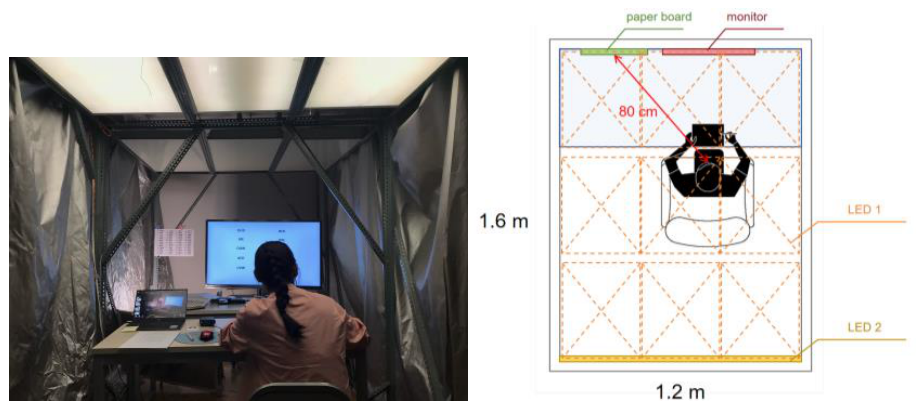
| Classroom Length | 9.6 m | 1.6 m |
| Classroom Width | 7.2 m | 1.2 m |
| Blackboard Length | 2.0 m | 0.333 m (33.3 cm) |
| Blackboard Width | 1.2 m | 0.2 m (20.0 cm) |
| Viewing Distance (Participant to Blackboard) | 4.8 m | 0.8 m (80.0 cm) |
| Light Source | Luminance | CCT | Ra | CQS |
|---|---|---|---|---|
| Monitor | 345.66 cd/m2 | 8835 K | 84.8 | 85.8 |
| Led Fixture (Desktop) | 4003 K | 89.2 | 86.5 | |
| Led Fixture (Paperboard) | 4003 K | 89.2 | 86.5 |
| Paperboard Color | Reflection Coefficients |
|---|---|
| white | 0.61 |
| green | 0.16 |
| black | 0.09 |
| Illumination Ratio | ||||
|---|---|---|---|---|
| CCT | 300 lx × 500 lx | 300 lx × 750 lx | 500 lx × 500 lx | 500 lx × 750 lx |
| 3300 K | 3300 × 300 × 500 | 3300 × 300 × 750 | 3300 × 500 × 500 | 3300 × 500 × 750 |
| 4000 K | 4000 × 300 × 500 | 4000 × 300 × 750 | 4000 × 500 × 500 | 4000 × 500 × 750 |
| 4700 K | 4700 × 300 × 500 | 4700 × 300 × 750 | 4700 × 500 × 500 | 4700 × 500 × 750 |
| Evaluation Methods | Visual Fatigue Scale (VFS-10) | Eye Movement Parameters (EMPs) | Index of Mental Capability (IMC) |
|---|---|---|---|
| Nature of Assessment | Subjective Assessment | Objective Measurement | Cognitive Performance |
| Dimension Captured | Self-reported Symptom Intensity | Neuromuscular Regulation (Retinal Level) | Central Coordination Fatigue & Information Processing Capacity |
| Primary Data Source | Participant Self-reports | Quantification of Biomarkers (via eye-tracker) | Task Performance Degradation |
| Primary Focus | Perceived severity of symptoms | Physiological control mechanisms | Efficiency of higher cognitive function |
| Complementary Relationship | The three methods are mutually complementary, capturing three distinct but critical dimensions of visual fatigue: subjective perception, physiological mechanisms, and central cognition. Together, they form a comprehensive assessment framework. | ||
| Integrated Value | This enables cross validation. A multiple dimensional approach overcomes the inherent limitations of any single method assessment, such as bias in subjective reports or objective metrics that do not fully capture subjective experience. This leads to more accurate and reliable diagnosis. | ||
| Common Goal | To comprehensively and accurately evaluate the pathophysiological dimensions of visual fatigue for research, diagnosis, and intervention. | ||
| Paperboard Type | Mean of Subjective Visual Fatigue (I) | Paperboard Type | Mean of Subjective Visual Fatigue (I) | Subjective Visual Fatigue Mean Difference (I−J) | Significance | 95% Confidence Interval | |
|---|---|---|---|---|---|---|---|
| Lower Limit | Upper Limit | ||||||
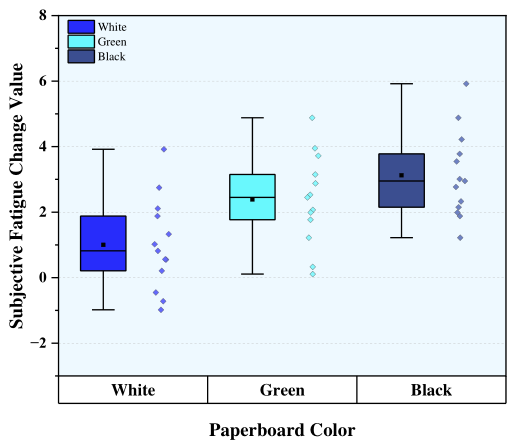
| White Paperboard | 1.0000 | White Paperboard | 2.3077 | −1.30769 * | 0.040 | −2.5492 | −0.0662 |
| Green Paperboard | 2.9231 | Green Paperboard | 1.0000 | 1.92308 * | 0.003 | 0.6815 | 3.1646 |
| Black Paperboard | 2.3077 | Black Paperboard | 2.9231 | −0.61538 | 0.321 | −1.8569 | 0.6262 |
Disclaimer/Publisher’s Note: The statements, opinions and data contained in all publications are solely those of the individual author(s) and contributor(s) and not of MDPI and/or the editor(s). MDPI and/or the editor(s) disclaim responsibility for any injury to people or property resulting from any ideas, methods, instructions or products referred to in the content. |
© 2026 by the authors. Licensee MDPI, Basel, Switzerland. This article is an open access article distributed under the terms and conditions of the Creative Commons Attribution (CC BY) license.
Share and Cite
Bai, W.; Weng, J.; Cai, X.; Zhang, X.; Cao, X. Effects of Key Lighting Parameters on Visual Fatigue Among Secondary School Students in VDT-Equipped Multimedia Classrooms. Buildings 2026, 16, 2272. https://doi.org/10.3390/buildings16112272
Bai W, Weng J, Cai X, Zhang X, Cao X. Effects of Key Lighting Parameters on Visual Fatigue Among Secondary School Students in VDT-Equipped Multimedia Classrooms. Buildings. 2026; 16(11):2272. https://doi.org/10.3390/buildings16112272
Chicago/Turabian StyleBai, Wenshu, Ji Weng, Xianyun Cai, Xiao Zhang, and Xin Cao. 2026. "Effects of Key Lighting Parameters on Visual Fatigue Among Secondary School Students in VDT-Equipped Multimedia Classrooms" Buildings 16, no. 11: 2272. https://doi.org/10.3390/buildings16112272
APA StyleBai, W., Weng, J., Cai, X., Zhang, X., & Cao, X. (2026). Effects of Key Lighting Parameters on Visual Fatigue Among Secondary School Students in VDT-Equipped Multimedia Classrooms. Buildings, 16(11), 2272. https://doi.org/10.3390/buildings16112272