Review

Converging Functional Layers in Bridge Digital Twin Research: A Scientometric Analysis of Intellectual Structures

1
Department of Civil and Environmental Engineering, Yonsei University, Seoul 03722, Republic of Korea
2
R&D Lab, Taesung SNI, Yeoksam-ro 8-gil 15, Seoul 06253, Republic of Korea
*
Author to whom correspondence should be addressed.
Buildings 2026, 16(11), 2271; https://doi.org/10.3390/buildings16112271

Submission received: 31 March 2026 / Revised: 1 June 2026 / Accepted: 2 June 2026 / Published: 4 June 2026

Abstract

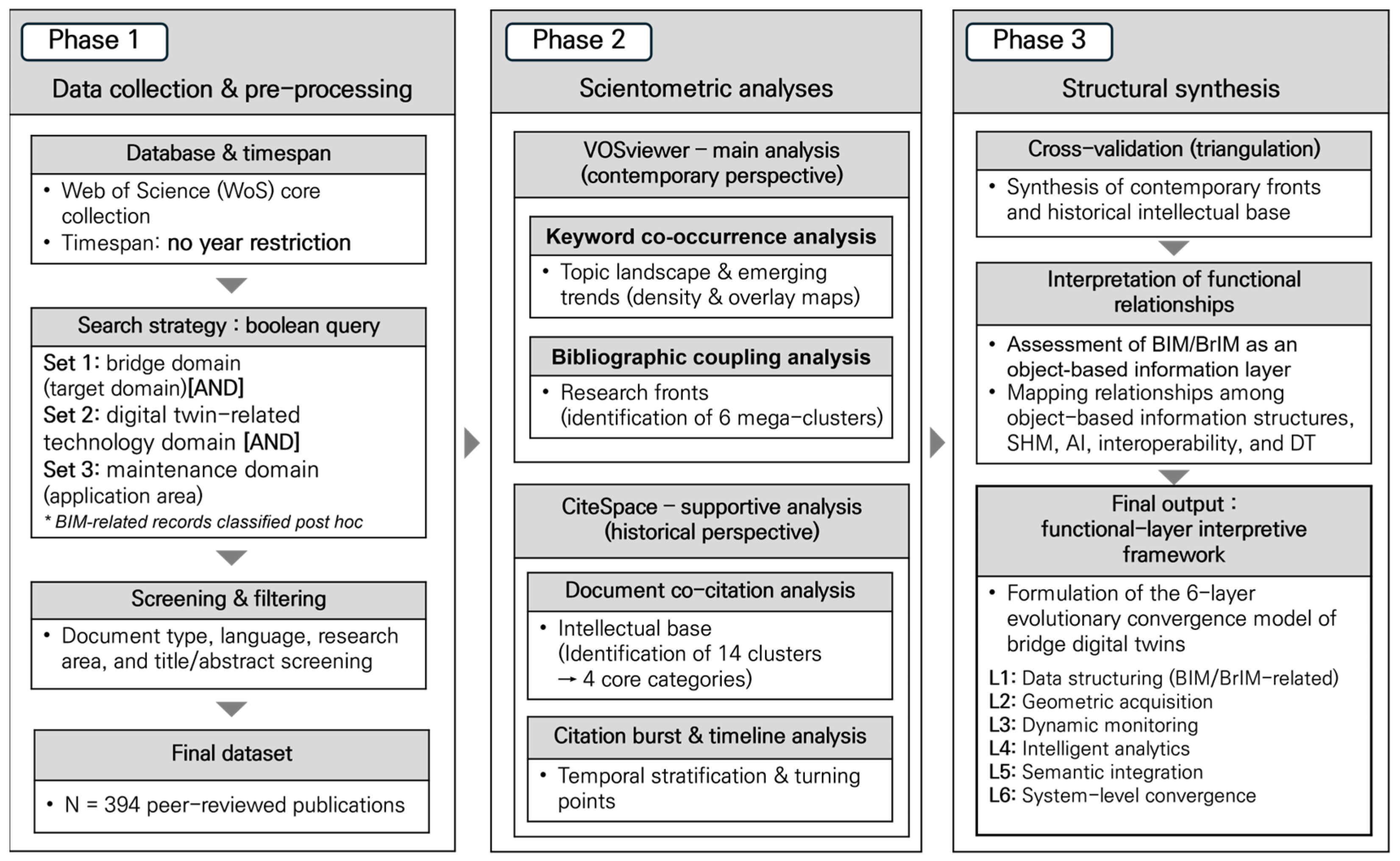
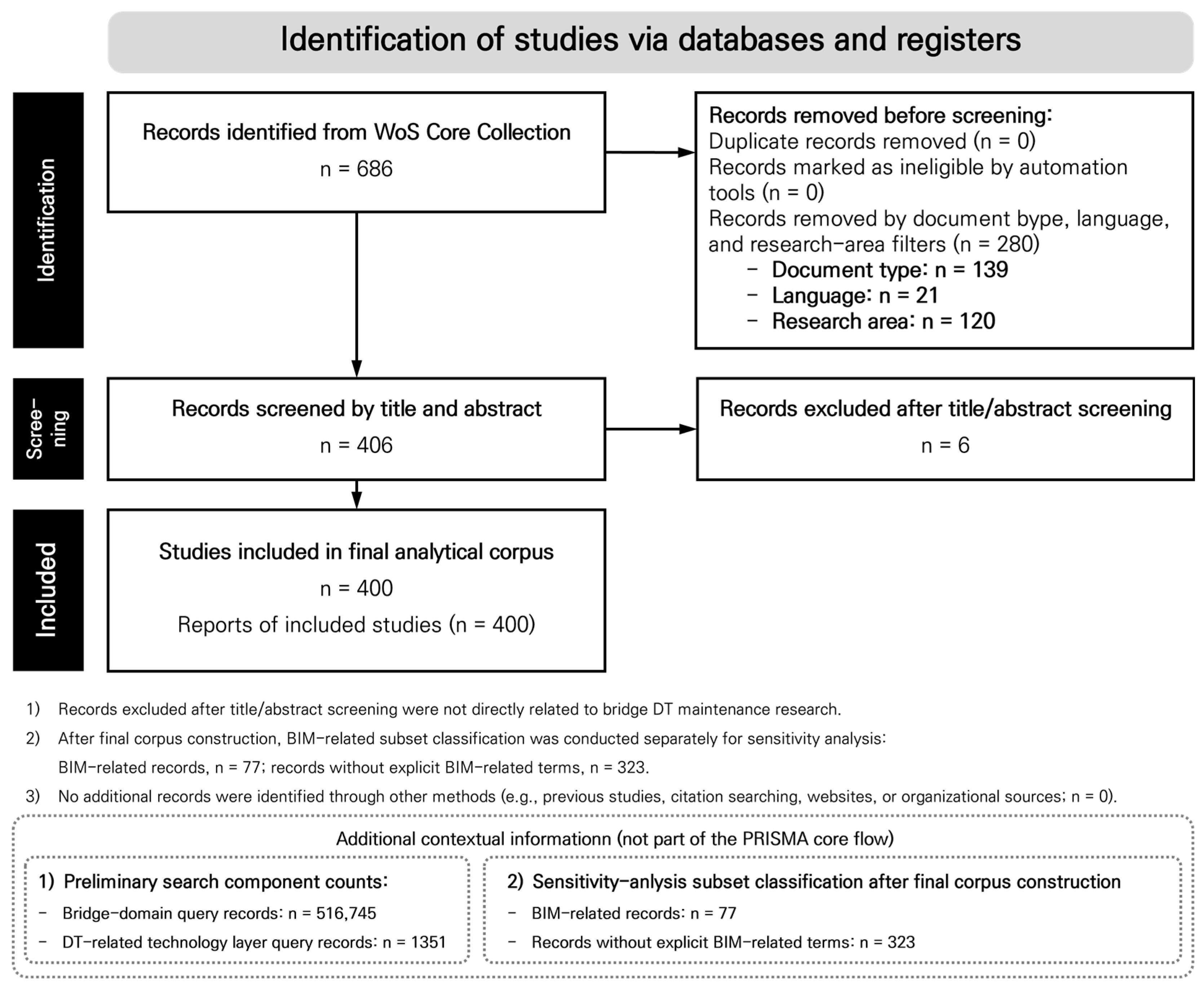
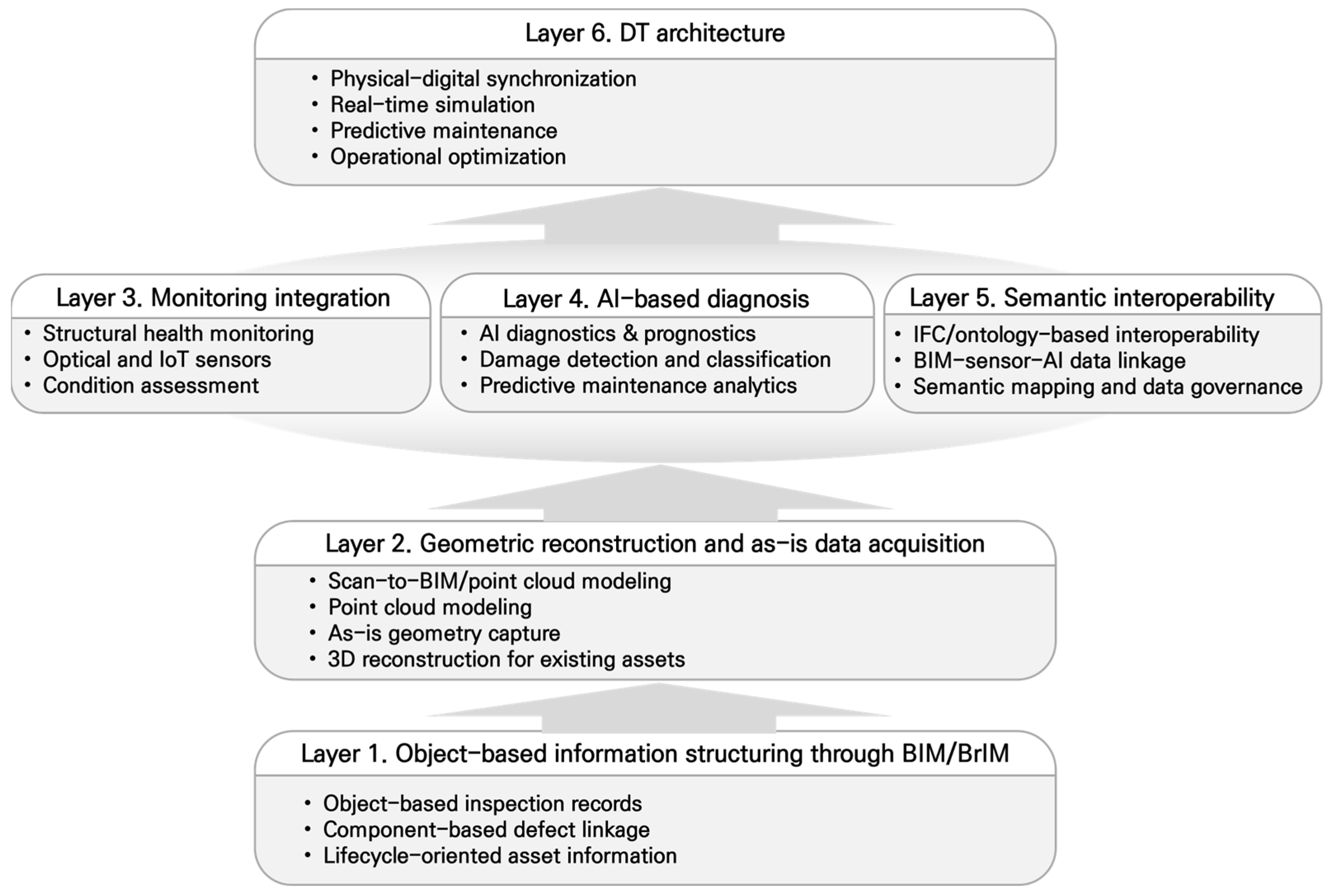
Bridge maintenance research has increasingly expanded toward Digital Twin (DT), Structural Health Monitoring (SHM), Artificial Intelligence (AI), sensing technologies, and object-based information management. As maintenance paradigms shift from reactive to preventive and prescriptive approaches, digital twins have gained attention as a means of integrating fragmented technological components. However, the growing emphasis on AI- and DT-based analytics raises questions about how object-based information structures, sensing systems, SHM, AI-based analytics, and interoperability mechanisms are thematically connected and structurally associated. This study conducted a scientometric analysis of publications retrieved from the Web of Science (WoS) database without year restrictions. To avoid predetermining the importance of any single information-modeling technology, the main search query excluded BIM-related terms and combined the bridge domain, DT-related technology layer, and maintenance domain. After applying document type, language, and research-area filters, 406 records were screened by title and abstract. Six records that were not directly related to bridge DT maintenance research were excluded, resulting in a final analytical corpus of 400 records. Among these, 77 records were identified as the BIM-related subset for sensitivity analysis. Using VOSviewer-based bibliographic coupling as the core method, supported by keyword co-occurrence, density and overlay visualization, and CiteSpace analysis, this study examined contemporary research structures and historical intellectual bases. The results show that bridge DT development is not detached from existing technological foundations but reflects the cumulative convergence of object-based information modeling, sensing, SHM, AI-based analytics, and interoperability mechanisms within integrated DT architectures.
Keywords: bridge maintenance; digital twin; functional layers; Building Information Modeling (BIM); Artificial Intelligence (AI); scientometric analysis; cumulative expansion bridge maintenance; digital twin; functional layers; Building Information Modeling (BIM); Artificial Intelligence (AI); scientometric analysis; cumulative expansion