1. Introduction
Bridge infrastructure is a core asset of national transportation systems, and its long-term performance and safety are directly linked to public safety, economic resilience, and the sustainable operation of civil infrastructure. In particular, as aging bridges continue to increase worldwide, the importance of periodic inspection, condition assessment, deterioration prediction, and lifecycle-based maintenance decision-making has become increasingly pronounced. However, conventional bridge maintenance systems have largely relied on the accumulation of inspection records and attribute information in separate databases. As a result, they have shown clear limitations in managing changes in asset condition, spatial location, structural components, and historical records within an integrated environment [
1]. These limitations become even more apparent because bridge maintenance is not merely a matter of record keeping, but a domain that requires the joint management of structured asset information and time-dependent condition data. In this sense, the digital transformation of bridge maintenance has evolved from the need not only to digitize asset information but also to establish a system capable of structurally integrating asset information and condition data.
As a key transitional element for overcoming these limitations, Building Information Modeling (BIM) has been introduced into the field of bridge maintenance. BIM provides an information modeling system that can structure geometric shapes, material information, attribute data, and maintenance histories at the object level, thereby providing a foundation for transforming conventional document- or 2D drawing-based management systems into a more systematic digital asset environment [
2]. In the bridge domain, in particular, attempts to directly link inspection information and defect attributes to structural components have expanded through Bridge Information Modeling (BrIM), substantially improving the traceability, consistency, and visualization of maintenance data [
3]. In other words, BIM has begun to function in bridge maintenance not merely as a three-dimensional modeling tool, but as an information backbone that structures asset information and enables its accumulation and management from a lifecycle perspective [
4]. In this context, this study defines BIM not as a specific software package or visualization technology, but as an information-centered approach that integrates and links asset elements, facility attribute information, inspection histories, and maintenance data based on object-oriented information structures.
Meanwhile, structural health monitoring (SHM), optical sensing, computer vision, and AI-based damage diagnosis technologies have also developed rapidly in parallel with BIM [
5,
6]. Sensor networks and signal analysis techniques have enabled the real-time or near-real-time identification of dynamic responses and abnormal conditions in bridges. More recently, the introduction of deep learning-based crack detection, damage classification, and deterioration prediction technologies has further enhanced the level of automation in diagnosis. Despite these technological advances, however, SHM and AI-based analysis systems have often been operated on independent platforms separated from BIM-based asset models, and semantic links between analytical results and asset objects have frequently remained insufficient [
7]. Consequently, although the digitalization of bridge maintenance has progressed rapidly, the actual research landscape has often exhibited a fragmented structure in which structured BIM models, sensor-based monitoring, AI-based diagnosis, and interoperability technologies are only partially connected [
8]. This suggests that, beyond the advancement of individual technologies, integrating them into a coherent information structure remains a key challenge in the digital transformation of bridge maintenance.
Recently, digital twin (DT) has rapidly emerged as a concept for integrating these dispersed technological streams [
9,
10,
11]. Brighenti et al. [
9] reviewed bridge management systems (BMSs) in the era of digitalization and summarized the transition from conventional inspection- and record-oriented BMSs toward systems combined with data-driven management, condition diagnosis, prediction, and maintenance decision-support functions. Costin et al. [
10] proposed a DT framework for bridge structural health monitoring (SHM) and presented a conceptual structure and application scenarios for enhancing bridge management, operation, and maintenance by utilizing existing technologies such as BIM, SHM, geographic information systems (GIS), and intelligent transportation systems (ITS). Nasim et al. [
11] demonstrated the applicability of a DT framework to instrumented bridge infrastructure, showing how digital representations, monitoring data, and analytical functions can be connected for SHM and decision support.
Although these studies adopt different approaches, including reviews, conceptual framework development, and case-based applications and demonstrations, they commonly treat DT as a next-generation data integration environment and emphasize functions such as situational awareness, predictive maintenance, simulation-based decision-making, and operational optimization support. In particular, BIM-based object information structures are positioned as prerequisites for enabling DT-based integration, linkage among SHM and monitoring data, synchronization, predictive analytics, and decision support. However, these studies do not treat the role of BIM-based object information structures and data governance as independent objects of analysis. In this respect, even when BIM or object-based information structures are not the primary focus of DT-oriented research, they can be understood as foundational conditions for strengthening connectivity among heterogeneous data and ensuring semantic consistency in bridge DT implementation.
This raises an important academic question. It is necessary to examine whether the recent growth of bridge DT research signifies a transformation in the role of BIM-based information governance, or whether it represents a process in which BIM-based object information structures, sensing and condition monitoring, AI-based analysis, and interoperability technologies have developed as parallel functional layers and have become combined and converged within digital twin architectures [
12]. To date, related review studies have often analyzed BIM-based maintenance, AI-based damage detection, or DT applications as separate technological domains [
9,
13]. For example, Brighenti et al. [
9] examined current practices and development directions of BMSs in the context of digitalization and summarized the transformation of bridge management systems around data management, diagnosis, prediction, and decision-making functions. While this study is meaningful in explaining the functional advancement and practical transition of BMSs, it does not directly analyze the knowledge-structural relationships among BIM-based object information structures, SHM, AI-based analysis, interoperability, and DT concepts within bridge DT research.
Relatively few studies have provided an integrated explanation of how these technological streams have formed structural relationships over time and become combined within bridge maintenance research. In particular, there has been insufficient empirical examination of whether DT represents a transition with an independent origin, or whether it constitutes a convergent architecture that internalizes BIM-based data governance and object-centered information structures while integrating sensing, SHM, AI, and interoperability layers [
14,
15]. In addition, from the perspective of long-term knowledge structures, only a limited number of studies have traced the digital transformation of bridge maintenance while simultaneously explaining the relationship between contemporary research clusters and past intellectual foundations.
Considering this gap, this study addresses the following research questions:
RQ1. What position does the object-based information structure occupy in recent bridge DT research, where AI-based technologies are increasingly expanding?
RQ2. As AI-driven bridge DT research increases, what relationships do BIM-related concepts form with sensing, SHM, AI-based analysis, and interoperability concepts?
RQ3. Does recent AI-oriented bridge DT research indicate the emergence of a completely new data architecture, or is it evolving into a data governance structure that can converge with BIM or BIM-like object-based information management approaches?
This study examines whether the development of bridge digital twins can be interpreted not as a replacement of existing BIM-based information structures, but as a process in which BIM-based object information, sensing, SHM-based condition data, AI-based analysis, and interoperability technologies develop as functional layers and converge within digital twin architectures. In other words, this study differs from previous review papers in that it understands BIM not merely as a modeling tool, but as an information management tool that supports the structuring of asset information, data linkage, semantic integration, and strengthened history management for maintenance. The core of this study is to analyze, based on scientometric evidence, the role of robust BIM-based data governance and interoperable information structures as prerequisites for the successful implementation of bridge DTs.
The contributions of this study are as follows. First, it presents an analytical perspective that interprets the development of bridge DTs not as the replacement of one technology by another or as a linear stage-based progression, but as a structure in which multiple functional layers converge within DT architectures. Second, by structuring contemporary research groups through VOSviewer-based bibliographic coupling and combining this with keyword co-occurrence, density visualization, overlay visualization, and supplementary CiteSpace analysis, this study examines the relationship between research fronts and knowledge bases beyond the scope of individual technology reviews. Third, based on these analyses, the study discusses why data governance, interoperability, and object-based information structures remain important prerequisites for the digital transformation of bridge maintenance from both theoretical and practical perspectives. Accordingly, this study contributes to reorganizing the relationships among BIM, SHM, AI, sensing, and DT in bridge maintenance research from the perspective of functional layers and to establishing priorities for future infrastructure DT implementation strategies.
2. Background and Related Work
The digital transformation of bridge maintenance did not begin abruptly with the emergence of a single technology; rather, different technological streams have developed in a parallel and distributed manner, each based on distinct problem orientations and solution pathways. Over the past two decades, technologies related to BIM, SHM, optical sensing, AI, and DT have evolved based on their respective research questions and methodologies. More recently, these technologies have been discussed together as key components of an integrated digital environment for bridge maintenance. Previous studies have also noted that these research streams did not develop within a single integrated framework but instead followed relatively independent trajectories. As a result, BIM-based information modeling, SHM-based condition monitoring, AI-based damage diagnosis, and DT architectures have evolved in a distributed manner [
16,
17]. To understand this development, it is necessary not merely to arrange these technologies as sequential stages, but to examine what functional roles they perform and how they are connected.
This series of technological extensions does not merely imply the addition of new functions. Each technological domain has promoted the digitalization of bridge maintenance; at the same time, however, it has left unresolved the challenge of integrating asset information structuring, continuous linkage of monitoring data, semantic interpretation of analytical algorithms, and system-level decision support within a coherent framework. In particular, as noted in previous studies, semantic connectivity and interoperability among BIM-based asset models, sensor-based data, and AI-based diagnostic algorithms have not yet been sufficiently secured. Therefore, the recent rise in bridge DT research needs to be understood as an attempt to integrate technological elements that have been accumulated in a fragmented manner into a unified structure.
From this perspective, this chapter examines the functional roles that BIM-based object information structures, SHM- and sensing-based situational awareness, AI-based analysis, and interoperability technologies have each played in the digital transformation of bridge maintenance, and how these elements can be interconnected within DT research in the bridge domain.
2.1. Information Backbone for BIM-Based Bridge Maintenance
Even before BIM became widely adopted in bridge maintenance, the need for digitalization and early responses to it had already appeared in various forms. In early research and practice, attempts were made to digitize bridge information through fragmented approaches such as digital drawings, three-dimensional representations, computerized inspection records, and asset attribute databases. Although these approaches did not yet constitute fully integrated information models by today’s standards, they provided an important foundation for recognizing that bridge maintenance data should not remain as simple records, but should connect spatial location, structural components, condition information, and historical records.
The most important contribution of BIM to bridge maintenance lies not merely in three-dimensional geometric representation, but in its provision of an information environment that can structure asset components, attribute information, inspection histories, damage locations, and repair histories at the object level [
18,
19,
20,
21]. Conventional bridge management systems have stored and managed inspection results and asset information, but their data structures have generally been based on tables or fragmented databases, limiting their ability to intuitively and consistently represent relationships between structural components and condition information [
22,
23]. By contrast, BIM provides object-based models that integrate asset information and spatial information, thereby establishing a foundation for improving the traceability and reusability of maintenance data [
3]. In this sense, the digital transformation of bridge maintenance acquired a more systematic information integration structure through BIM, and BIM can therefore be understood not merely as a representation technology, but as a core mediator of this transformation.
This trajectory has been further extended through studies on BrIM or bridge-oriented BIM applications [
2,
16]. BIM-based maintenance research has developed toward directly linking damage and inspection information to model objects, structuring inspection histories and asset attributes, and supporting maintenance tasks within a more visual and integrated environment [
4,
19]. Previous reviews on BIM-based bridge maintenance have also emphasized that BIM is effective as an information model for integrating inspection, repair, condition assessment, and asset management processes [
16,
24].
However, the introduction of BIM did not immediately imply the establishment of a fully operational maintenance system. BIM-based models provide structured representations of assets, but their connections with real-time condition data, sensor signals, and predictive algorithms were limited in the early stages [
25,
26]. In other words, BIM served as the starting point and information backbone of bridge maintenance digitalization, but by itself, it was insufficient to complete an operational DT that encompasses dynamic condition awareness and predictive analytics. Nevertheless, the role of this information backbone remains important because it has continued to persist in the subsequent integration of SHM, AI, and DT research [
13]. Therefore, in this study, BIM is understood not as a specific modeling tool, but as a representative example of an object-based information structure that can accommodate subsequent technological extensions.
2.2. Expansion of Condition Awareness Through SHM and Optical Sensing
If BIM has been responsible for the structured storage and representation of asset information, SHM and optical sensing technologies have expanded the function of continuously perceiving and measuring bridge conditions [
24,
27,
28]. SHM has developed as a system for monitoring structural health based on various measurement signals, including acceleration, strain, vibration response, and temperature. This has played an important role in shifting bridge maintenance from post-event inspection toward a more continuous and predictive framework [
9,
29,
30].
More recently, optical sensing technologies such as UAV-based imaging, LiDAR, photogrammetry, and image-based deformation measurement have been added, leading to active research on collecting high-resolution information on the external condition and geometric changes in bridges [
31]. Studies on image-based deformation monitoring, UAV-LiDAR, 3D laser scanning-based DTs, and Scan-to-BIM are included in this stream [
32,
33,
34,
35,
36,
37], indicating that the automation of geometric information acquisition and condition awareness is rapidly advancing in bridge maintenance [
21,
38,
39].
However, these SHM and optical sensing technologies have long been developed as streams separate from asset information models. In other words, although condition measurement became possible, the relationship between measured conditions and asset objects, as well as the information structure through which they could be linked to maintenance decision-making, remained separate issues [
40,
41]. For this reason, a gap existed in bridge digitalization research between the stream that “measures condition” and the stream that “structures information” [
27]. This gap became one of the major backgrounds for the later emergence of the DT concept [
13]. In other words, SHM and optical sensing can be understood as extension layers that add temporality and real-world condition data to object-based structured asset information.
2.3. Advancements in AI-Driven Damage Detection and Prognostics
One of the fastest-growing areas in recent bridge maintenance research is AI-based damage detection and predictive analytics. In particular, advances in computer vision and deep learning have rapidly increased studies that automatically identify and classify various types of damage, such as cracks, spalling, corrosion, and leakage [
42,
43].
AI has expanded beyond simple image interpretation into a broader analytical intelligence layer, including condition assessment, deterioration prediction, risk-based maintenance planning, and anomaly detection. For example, existing studies include the integration of BIM-based SHM alarm systems with LSTM, PHM systems, and hybrid monitoring frameworks, suggesting that AI functions as an analytical layer that connects sensor data with model-based maintenance [
7,
13,
44].
Nevertheless, improved AI performance does not directly imply the completion of an operational DT. AI models depend heavily on the structure, quality, and semantic consistency of input data. In particular, for long-term operational assets such as bridges, analytical results generate practical management value only when they are linked beyond the level of individual damage images to asset objects, locations, histories, and maintenance actions [
21,
45,
46]. Thus, although AI is a core element of maintenance intelligence, it cannot by itself serve as an independent foundation for asset operation and ultimately needs to function on top of a structured information architecture.
Therefore, this study understands AI as an analytical layer that transforms object-based asset information and condition data collected through SHM into a form that can be used for maintenance decision-making.
2.4. Rise in DT Technology and the Shift Toward Unified Frameworks
The DT was originally proposed in the manufacturing and aerospace sectors as a concept based on continuous data exchange and synchronization between physical assets and their virtual representations. It has since evolved around characteristics such as lifecycle integration, real-time synchronization, predictive simulation, and operational optimization [
47,
48].
In the field of bridge maintenance, the DT has been understood as a concept that integrates BIM-based models, SHM data, AI-based analytics, simulation, and decision support into a unified environment [
10,
49]. Previous studies have extended the DT concept to condition monitoring, fatigue life management, risk-based maintenance, vulnerability assessment, demolition strategies, and long-term asset management during the operational phase of bridges [
40,
50,
51,
52,
53].
However, the key point is that DT in the bridge domain did not emerge from an entirely new technological genealogy. Rather, DT is closer to a concept that redefines the dispersed streams of information modeling, condition monitoring, analytical intelligence, and system integration from an architectural perspective. For example, BIM and BrIM studies have provided a foundation for structuring asset objects and attribute information, while SHM and sensing studies have advanced the capability to collect condition data that changes over time. In addition, AI-based analysis studies have enhanced damage detection and predictive analytics, while studies related to data interoperability, such as BMS and GIS, have developed toward integrating heterogeneous data and connecting systems. In this respect, DT can be interpreted as a higher-level integrated framework formed through the combination of object-based information structures, SHM, sensing, AI-based analysis, and interoperability technologies.
2.5. Limitations of Prior Research and the Conceptual Perspective of This Study
Previous related studies have made considerable progress in separately examining BIM-based maintenance, SHM, AI-based damage detection, and DT applications. However, studies that systematically and integratively explain how these technological streams have formed structural relationships over time and contributed to the evolution of bridge maintenance research remain limited.
This study understands bridge DT research not as the “linear development of a single technology,” but as a research domain in which object-based information structures, situational awareness through SHM and optical sensing, AI-based analysis, and interoperability technologies are interconnected while performing different functional roles. This perspective does not deny the recent increase in the visibility of AI and DT in the literature; rather, it re-examines the structural foundations underlying this development. In other words, this study is differentiated by clarifying how asset information structures, data linkage, analytical intelligence, and system integration have been interconnected and accumulated, rather than explaining the evolution of bridge DT merely as the emergence of a new technology.
Therefore, the following chapter does not simply present the quantitative distribution and trends of research topics. Instead, it scientometrically examines how object-based information structures have formed relationships with SHM, AI, and interoperability technologies as digital transformation has become increasingly structured.
3. Materials and Methods
This study adopted a scientometric research design to empirically analyze what kind of knowledge structure and functional convergence pathway DT-related research has formed in the field of bridge maintenance. Although conventional narrative reviews are useful for qualitatively summarizing major studies, they have limitations in systematically revealing structural relationships among topics, directions of knowledge accumulation, and interactions between research fronts and intellectual foundations in a rapidly expanding research field [
34,
54]. Accordingly, this study adopted a science mapping approach that quantitatively analyzes citation relationships and conceptual networks embedded in a large-scale bibliographic dataset [
55,
56]. This approach provides more structured empirical evidence for the core question of this study: whether the recent growth of bridge DT research represents a disruptive transition disconnected from existing BIM/BrIM-based object information structures, or whether it reflects a process in which object-based information structures, sensing- and SHM-based condition data, AI-based analysis, interoperability, and related technologies have developed as functional layers and converged within digital twin architectures.
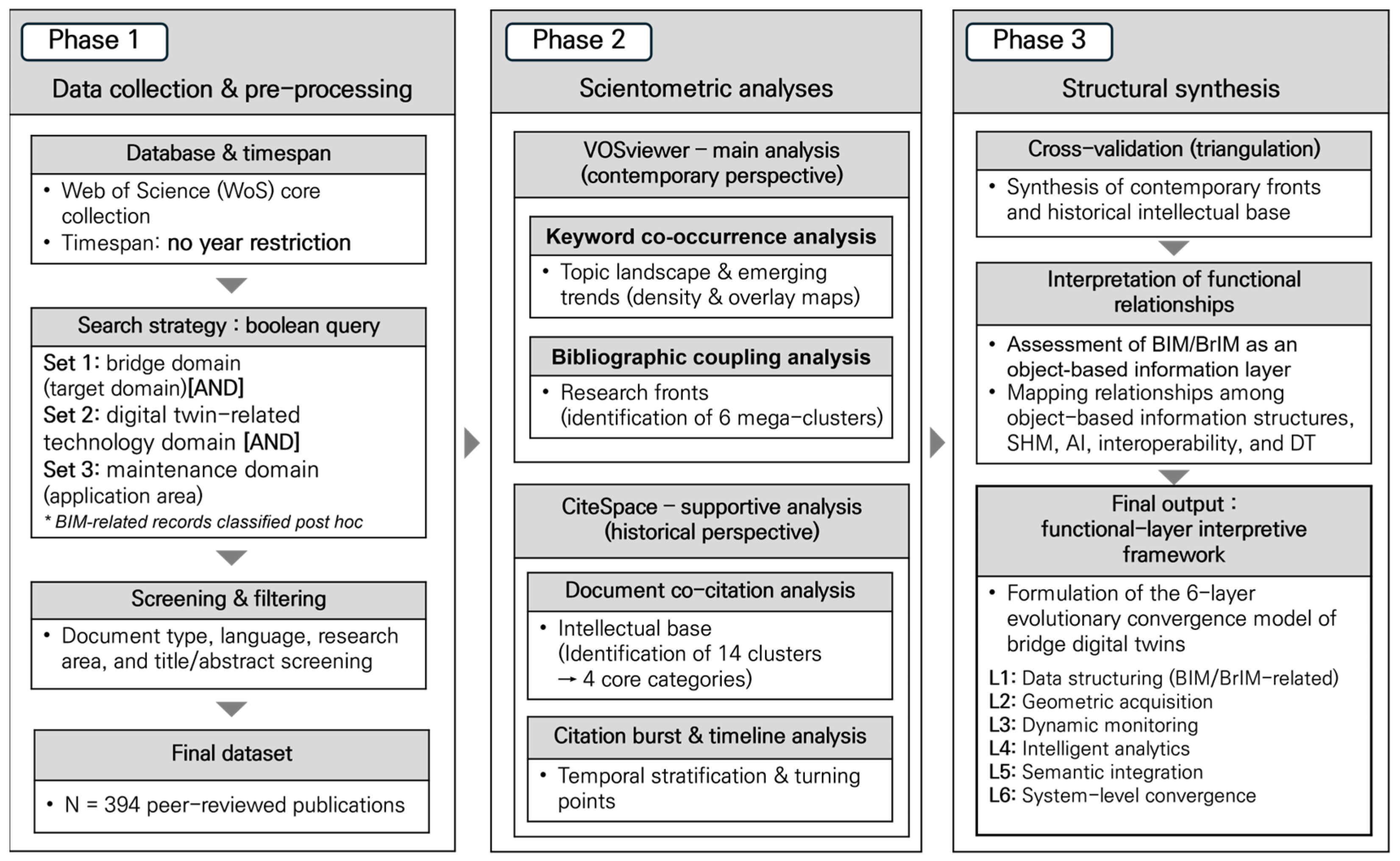
The analytical framework of this study consists of three stages: data collection and screening, scientometric mapping, and structural synthesis (
Figure 1). However, these stages are presented as an analytical workflow rather than as a strict chronological sequence. This is because, in bridge DT research, multiple technological layers have not developed only in a sequential manner; rather, layers with different functional roles have evolved in parallel and converged within DT architectures.
First, the analytical dataset was constructed using the WoS Core Collection. Second, contemporary research groups were structured primarily through VOSviewer-based bibliographic coupling analysis, while keyword co-occurrence, density visualization, and overlay visualization were used to complementarily analyze relationships among major concepts and their temporal changes. CiteSpace was also employed as a supplementary analytical tool to examine the historical intellectual base and research trajectories. Third, these results were interpreted in an integrated manner to derive the structure through which technology-specific functional layers combine and converge in bridge DT research.
3.1. Data Source and Search Strategy
WoS is regarded as a standard data source widely used in citation-based network analysis and science mapping studies because it provides comprehensive coverage of peer-reviewed scholarly literature and a relatively stable citation indexing structure. Since this study conducts analyses in which the consistency of reference linkage structures is important, such as co-citation and bibliographic coupling, WoS was selected as the single data source to minimize distortions caused by differences in bibliographic formats across databases.
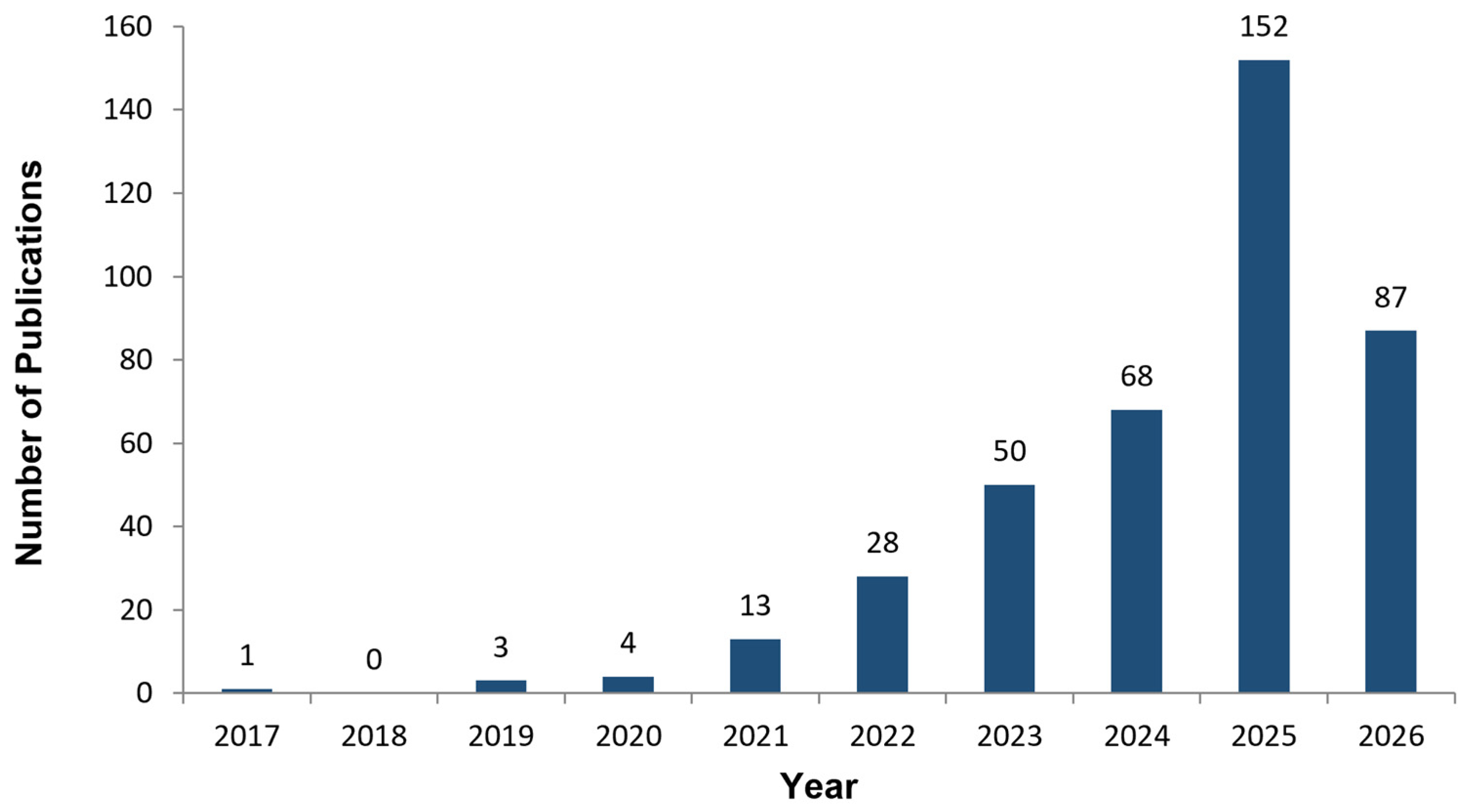
The literature search for this study was conducted in the WoS Core Collection on 30 May 2026, without any restriction on publication year. The earliest publication year was not used as a search condition; rather, it was identified after the final corpus had been constructed. Publications from 2026 do not represent the full annual publication volume for that year. Therefore, in interpreting annual publication trends, the 2026 records were treated as partial-year data. In the main text, the 2026 figures were not directly compared with those of previous years to draw conclusions about an increase or decrease on a full-year basis.
The search formula was structured around three axes: the bridge domain, digital twin-related technological layers, and the maintenance domain. To avoid predetermining the centrality of BIM-related literature at the search stage, this study did not include BIM-related terms as mandatory conditions in the main search formula. Instead, after constructing the full analytical corpus, BIM-related literature was identified as a separate subset and used for sensitivity analysis.
The main search query was constructed as follows.
[Bridge domain]
TS = (“bridge*” OR “bridge infrastructure*” OR “bridge structure*” OR “bridge asset*”)
AND
[Technology layer]
TS= (“digital twin*” OR “digital shadow*” OR “digital replica*” OR “digital counterpart*” OR “virtual twin*” OR “virtual replica*” OR “predictive twin*” OR “digital representation*” OR “virtual representation*”)
AND
[Maintenance domain]
TS = (maintenance OR inspection OR monitoring OR “asset management” OR “lifecycle management” OR “life cycle management” OR “condition assessment” OR “damage detection” OR “predictive maintenance”)
The number of records obtained after applying the search query described above, the filtering results, the title- and abstract-based exclusion process, and the confirmation of the final analytical corpus are presented in the following section as part of the PRISMA 2020-style screening procedure.
3.2. PRISMA 2020-Style Screening Procedure
Recently, the use of the PRISMA 2020 flow diagram has increased in construction, infrastructure, DT, and bridge maintenance studies to ensure transparency, traceability, and reproducibility in the literature selection process. Although this study is a scientometric review rather than a meta-analysis or intervention-oriented evidence synthesis, the nature of a large-scale bibliographic dataset requires the literature collection and exclusion processes to be clearly reported.
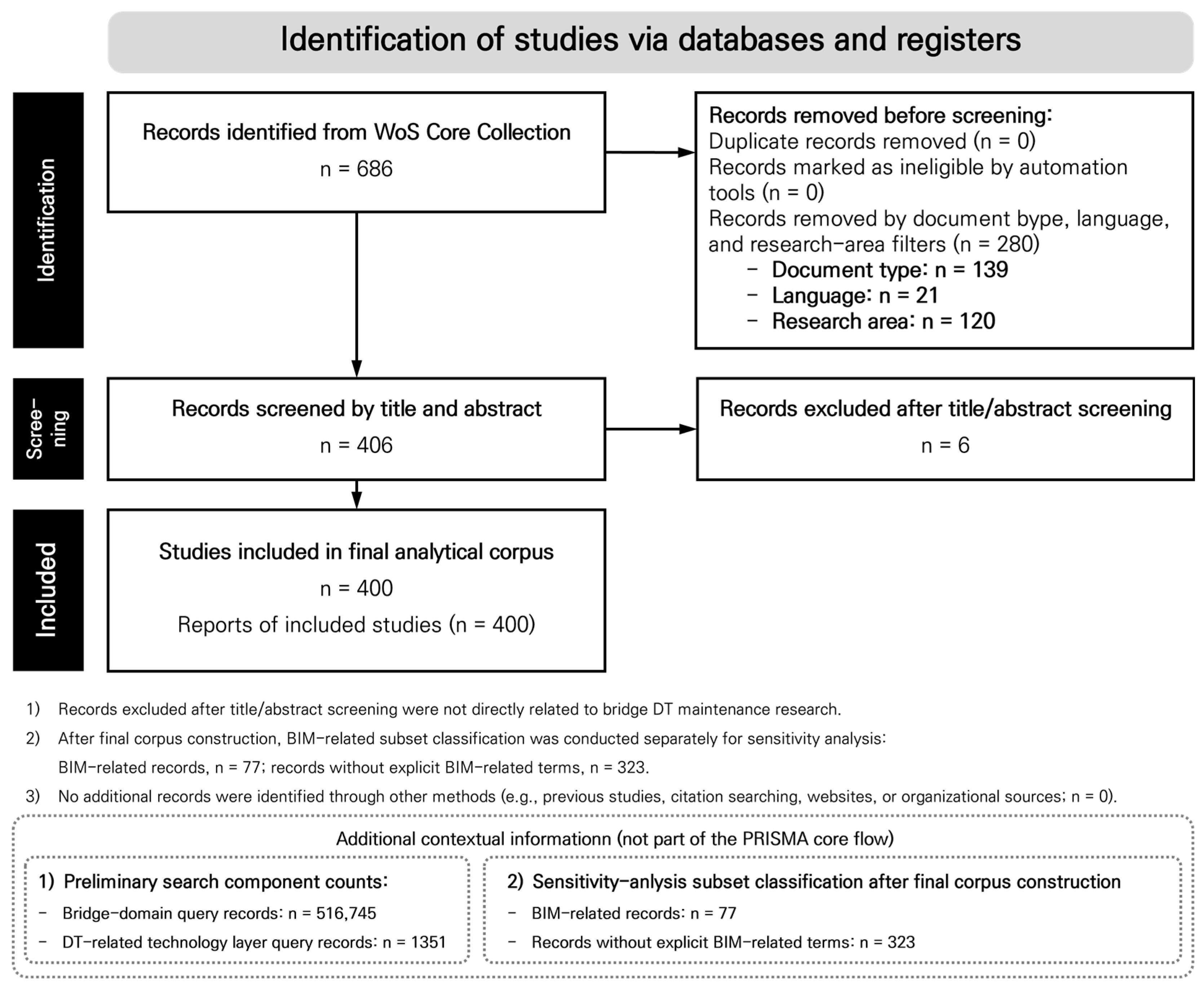
Accordingly, this study adapted a PRISMA 2020-style flow diagram to transparently report the literature identification, screening, exclusion, and inclusion process (
Figure 2). The main flow of
Figure 2 distinguishes the records identified from the WoS Core Collection, the records removed before screening through document type, language, and research-area filters, the records assessed through title- and abstract-based screening, the records excluded with explicit reasons, and the final analytical corpus included in the scientometric analysis. Specifically, 686 records were identified through the main WoS search query, and 280 records were removed before screening through the document type, language, and research-area filters. As a result, 406 records were assessed through title and abstract screening, of which six records were excluded because they were not directly related to bridge DT maintenance research. Consequently, the final analytical corpus of this study was confirmed as 400 records.
In addition to the core PRISMA flow,
Figure 2 separately presents supplementary information to facilitate understanding of the literature selection process. The bridge-domain search results and DT-related technology-layer search results are presented as preliminary search scales to explain the construction of the search strategy and were not regarded as independent records directly entering the PRISMA screening flow. In addition, the distinction between the BIM-related subset and the non-BIM subset was a post hoc classification procedure conducted for sensitivity analysis after the final corpus had been established and therefore was not treated as an exclusion or inclusion step. Meanwhile, the “other methods” pathway presented in PRISMA 2020, namely the identification of additional records through previous studies, citation searching, websites, or organizational sources, was not used in this study; accordingly, no additional records were identified through other methods.
The inclusion criteria for literature screening were as follows. First, the analysis was limited to publications directly related to bridges or bridge infrastructure. Second, publications were included if they contained technological concepts related to the digital representation or synchronization of bridge assets, such as DT, digital shadow, and virtual representation. Third, studies related to the maintenance phase, including maintenance, inspection, monitoring, asset management, condition assessment, damage detection, and predictive maintenance, were included. Fourth, to ensure academic verifiability, only articles and review articles were included.
The exclusion criteria were as follows. First, publications dealing only with non-bridge facilities, such as buildings, tunnels, roads, or general railway facilities, were excluded. Second, studies on design, construction, or materials that were not directly related to maintenance, inspection, monitoring, condition assessment, or asset management were excluded. Third, publications that were not substantially related to DT or similar digital representation concepts were excluded. Fourth, non-regular scholarly documents, such as conference proceedings, editorials, book chapters, and corrections, were excluded because they could reduce the comparability of citation networks. Fifth, publications judged through title and abstract screening to make a limited direct contribution to the analysis of the knowledge structure of bridge DT research were excluded.
This procedure was intended to clearly indicate which publications were excluded and for what reasons during the screening process, and to ensure reproducibility so that subsequent researchers can reconstruct the analytical dataset using the same search query and filtering criteria.
The results of literature identification and screening in this study are summarized as follows (
Table 1). First, the search for the bridge domain returned 516,745 records, while the search for DT-related technological layers returned 1351 records. Subsequently, 686 records were identified by applying the main search formula that combined the bridge domain, DT-related technological layers, and the maintenance domain. After applying this main search formula, combining the three domains, filters for document type, language, and research area were sequentially applied. Document types were limited to articles and review articles, and the language was restricted to English. In addition, research areas were limited to fields directly relevant to bridge maintenance and digital twin research, such as engineering, construction and building technology, and transportation. Through this filtering procedure, 406 records were obtained.
Additional topical relevance screening was subsequently conducted based on the titles and abstracts. Through this screening process, six records were excluded because they were not directly aligned with the scope of bridge digital twin maintenance research. These excluded records comprised four publications on turbine thermal analysis model construction, including two published in 2025 and two in 2024; one 2025 publication focusing on predictive maintenance of urban assets and city information modeling; and one 2020 case study addressing digital twins at the building and city scales.
Accordingly, the final analytical corpus was confirmed as 400 records. To separately examine the influence of BIM-related publications, records containing terms such as BIM, Building Information Model, BrIM, Bridge Information Model, Civil Information Model, and Construction Information Model were identified within the final corpus of 400 records. As a result, the BIM-related subset consisted of 77 records, while the subset that did not explicitly include BIM-related terms consisted of 323 records. In
Table 1, the asterisk (*) used in the search query denotes the WoS wildcard symbol, which was employed to include singular, plural, and derivative expressions. Terms without an asterisk correspond either to commonly used terms or to cases in which applying a wildcard could excessively broaden the search scope.
3.3. Data Cleaning and Word Normalization
In scientometric analysis, when the same concept is expressed using different terms, keyword occurrence frequencies and network linkage structures may become dispersed, potentially distorting the analytical results. For example, although “BIM,” “Building Information Modeling,” and “Building Information Model” differ in expression, this study regarded them as belonging to the same conceptual group, referring to an object-based asset information management system. Therefore, before interpreting the results of keyword co-occurrence analysis, bibliographic coupling analysis, and co-citation analysis, this study organized variations in the notation of major terms and integrated similar concepts under representative terms.
Table 2 summarizes these word normalization criteria. This word normalization was conducted as a preprocessing step to ensure analytical consistency, as identical or highly similar concepts may appear in dispersed forms due to differences in terminology.
3.4. BIM-Related Subset and Sensitivity Analysis
This study examines the role of BIM-related concepts; however, BIM-related terms were not used as mandatory search conditions during the construction of the main dataset. This was intended to reduce the possibility of circular reasoning, in which the centrality of BIM could be interpreted as an artifact of the search strategy if BIM-related terms were directly included in the search query. Therefore, after the overall bridge DT maintenance corpus was constructed, BIM-related publications were identified as a subset using a separate supplementary search query.
The supplementary search query used to identify the BIM-related subset was as follows.
TS = (BIM* OR “Building Information Model*” OR BrIM* OR “Bridge Information Model*”)
This search query was designed to identify publications related to object-based information modeling within the fully filtered corpus, including BIM, Building Information Model/Modeling, BrIM, and Bridge Information Model/Modeling. As a result, a total of 77 BIM-related records were identified. The remaining 323 records were classified as a subset that did not explicitly include BIM-related terms, referred to as the “non-BIM subset.” These two subsets were used to compare the thematic and knowledge structures of BIM-related publications and DT-related publications that did not explicitly include BIM.
The non-BIM subset does not indicate a group of records in which object-based information structures are absent. Rather, it refers to records that do not explicitly include BIM-related terms such as BIM*, Building Information Model*, BrIM*, or Bridge Information Model* in their bibliographic information. Therefore, the distinction between BIM-related and non-BIM subsets was not intended to establish a binary distinction between the presence and absence of BIM, but to support a sensitivity analysis of whether records that explicitly foreground BIM-related concepts differ from those that do not in their thematic emphasis and knowledge structures. BIM-related records are expected to be more directly associated with object-based information structuring, asset management, information linkage, and interoperability, whereas non-BIM records may more strongly foreground dynamic and analytical DT functions such as SHM, sensing, AI-based analytics, predictive maintenance, and operational decision support. This comparison provides a complementary basis for examining how BIM-related concepts are positioned within the overall knowledge structure of bridge DT research without being predetermined by the main search query.
This sensitivity analysis served as a complementary procedure to examine the core interpretation of this study, namely, whether BIM-related information structures continue to function as an important knowledge base in bridge DT research, while separating this interpretation from potential search-query bias. Therefore, the role of BIM in this study was not predetermined by the search query but was examined retrospectively within the overall DT-centered corpus.
3.5. Scientometric Analysis and Interpretation
This study employed a scientometric research design using VOSviewer and CiteSpace to systematically examine the multilayered knowledge structure of bridge digital twin research. In particular, VOSviewer-based bibliographic coupling analysis was adopted as the principal analytical method to identify the extent to which recent bridge digital twin studies share common reference bases and thereby form contemporary research fronts. Keyword co-occurrence analysis, density visualization, and overlay visualization were further conducted to examine the conceptual associations among major research themes and their temporal patterns of visibility.
CiteSpace was used as a complementary analytical tool to trace the intellectual foundations and evolutionary trajectories underlying the contemporary research fronts identified through the VOSviewer analysis. The time span for the CiteSpace analysis was set to 2017–2026, corresponding to the actual publication-year range of the final corpus, and years per slice was set to 1, as 2017 was the earliest publication year observed in the final analytical corpus. This setting therefore reflects the actual publication-year coverage of the final dataset and should not be interpreted as an additional year-based restriction imposed during the literature retrieval process.
To ensure analytical reproducibility, the tools, analytical items, and major parameter settings used in this study are summarized in
Table 3. This table aims to specify reproducible procedures and conditions for future researchers who may apply the same analytical methods.
Bibliographic coupling is a method for identifying the structural proximity between recent publications based on the extent to which they share the same references. It is therefore suitable for analyzing what kinds of knowledge are commonly shared by currently active studies and how they form contemporary research groups. The central question of this study is whether recent AI-based bridge DT research is becoming detached from BIM-based information structures, or whether it is converging into DT architectures while internalizing BIM-based data governance and object-centered information structures alongside other functional layers. Accordingly, bibliographic coupling was selected as the core analysis because it can identify contemporary research fronts.
However, clusters derived from bibliographic coupling do not necessarily indicate that the publications within each cluster address a single identical topic. Since bibliographic coupling calculates link strength based on the extent to which publications share references, each cluster represents the structural proximity of publications that share a common knowledge base and research concerns. Therefore, rather than interpreting bibliographic coupling clusters as fixed technological categories, this study reinterpreted them as higher-level research streams converging toward DT architectures by jointly examining representative publications, major keywords, average publication years, and research contexts.
CiteSpace analysis was used to supplementally examine the historical knowledge bases underlying the contemporary research groups identified through VOSviewer-based bibliographic coupling [
55,
57]. Co-citation analysis was employed to identify past core publications and theoretical foundations based on relationships among publications that are jointly cited by subsequent studies. Citation burst and timeline analyses were used to examine publications that rapidly gained attention during specific periods and to assess the temporal continuity of major research trajectories.
In this study, the results of each scientometric analysis were not merely presented separately. Instead, a qualitative complementary interpretation was conducted for the algorithmically derived clusters by jointly examining representative publications, core keywords, average publication years, and thematic foci. Through this integrated interpretive strategy, this study examined whether bridge digital twin research can be understood not as a linear development process driven by a single technology, but as a structure in which multiple functional layers are combined and converge within digital twin architectures.
4. Results
This chapter empirically presents the knowledge structure and functional convergence patterns of bridge digital twin research based on 400 scholarly publications collected from the WoS Core Collection and finalized through document type, language, and research area filtering, as well as title- and abstract-based screening. To this end, publication trends are first examined to identify the growth pattern of the research field, and keyword co-occurrence analysis is then conducted to identify relationships among major concepts and emerging topics. Bibliographic coupling analysis is subsequently used to identify contemporary research fronts, while co-citation, citation burst, and timeline analyses are employed as supplementary approaches to examine the intellectual foundations and research trajectories of the field.
Based on these results, this chapter demonstrates that bridge digital twin research should be understood not as a linear technological development process driven by a single technology, but as the integration of multiple technological layers. In particular, the analytical results empirically show whether BIM-based object information structures, SHM- and sensing-based condition data, AI-based analysis, and interoperability technologies have developed as distinct functional layers and can be interpreted as being combined and converged within digital twin architectures.
4.1. Publication Trends and Document Types
Before analyzing the structural evolution of bridge DT research, publication trends from 2017 to 2026 were examined (
Figure 3). BIM-based digitalization and DT-related research in the field of bridge maintenance have shown a clear growth trend over the past decade and have continued to expand [
16,
24,
58,
59]. In particular, the number of publications increased relatively gradually during the early period from 2017 to 2019, which can be interpreted as an exploratory phase in which BIM-based asset modeling and the digitalization of inspection information were progressively introduced [
34,
60]. Research during this period mainly focused on asset information structuring using BrIM and the development of BIM-based maintenance frameworks [
1,
3].
In contrast, research activity increased markedly after 2020, with the pace of publication growth accelerating further after 2022 [
14]. This indicates the rapid expansion of interest in data-driven maintenance and DT concepts in the field of bridge maintenance [
61,
62]. This growth trend does not suggest that BIM-based asset models, IoT- and SHM-based monitoring data, and AI-based analytics have developed as mutually substitutive stages. Rather, it reflects the increasing activation of research aimed at connecting different functional layers within a single operational environment [
63]. In other words, the recent quantitative growth indicates not merely an increase in the number of studies, but a shift in bridge maintenance digitalization from the adoption of individual technologies toward a more integrated DT architecture [
62,
64].
However, the 2026 data include only records indexed up to the search date of 30 May 2026. Therefore, the 2026 count cannot be directly compared with previous full-year counts or interpreted as indicating an annual increase or decrease. Accordingly, this study used the 2026 data only as a partial indicator for identifying recent research directions.
To ensure analytical consistency and the comparability of citation networks, this study included only articles and review articles in the final corpus. Therefore, conference proceedings, editorials, book chapters, and other document types were excluded from the analysis, and document type distribution was not interpreted as a separate result. The screening criteria and exclusion process for the final corpus follow the PRISMA procedure described earlier.
Thus, the publication trend analysis shows that bridge DT research has expanded rapidly in recent years and that the field is becoming increasingly integrative in nature. This growth pattern is examined in greater detail in the following sections through keyword co-occurrence analysis and bibliographic coupling analysis.
4.2. Topic Landscape and Emerging Trends (Keyword Co-Occurrence)
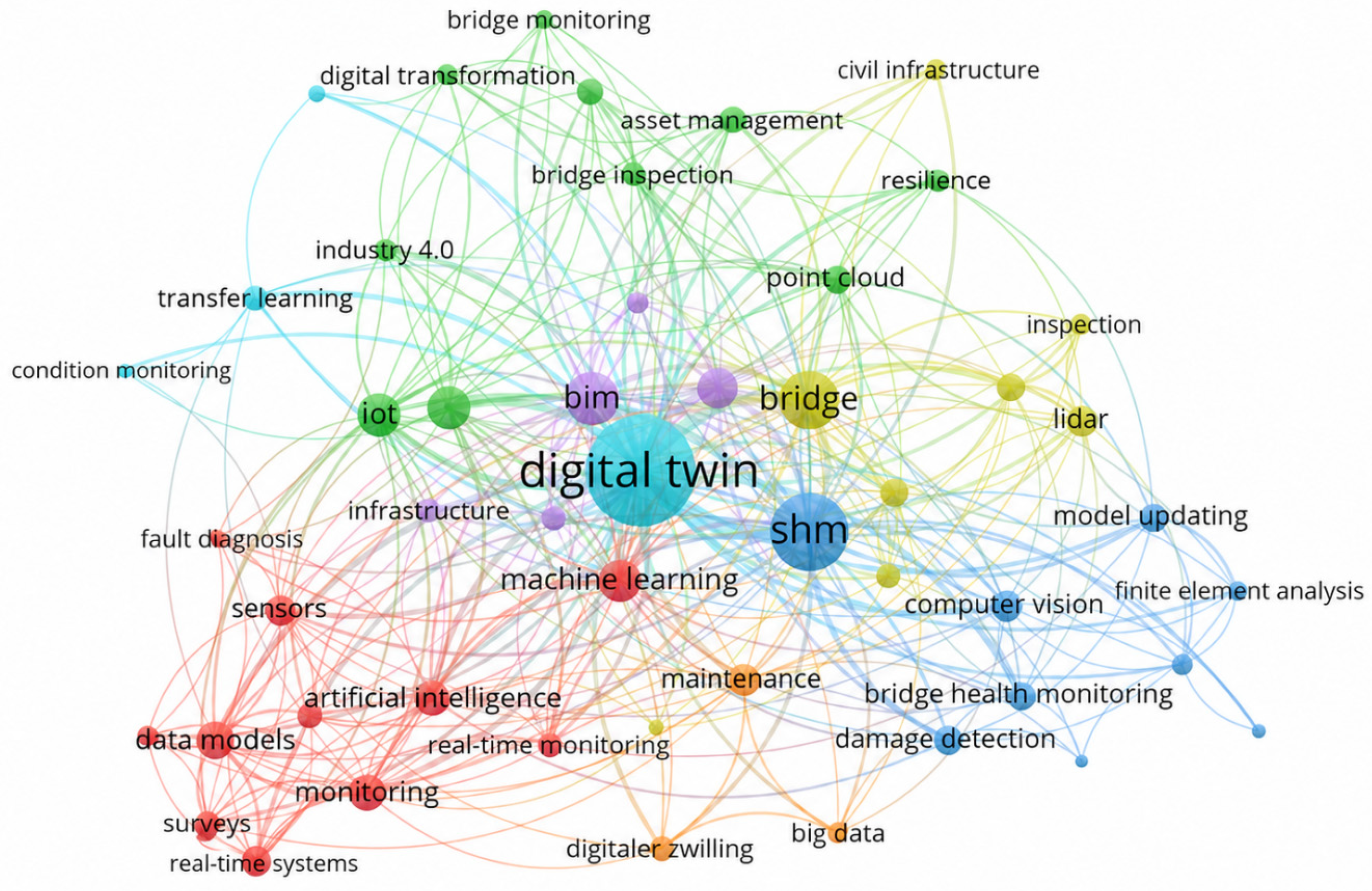
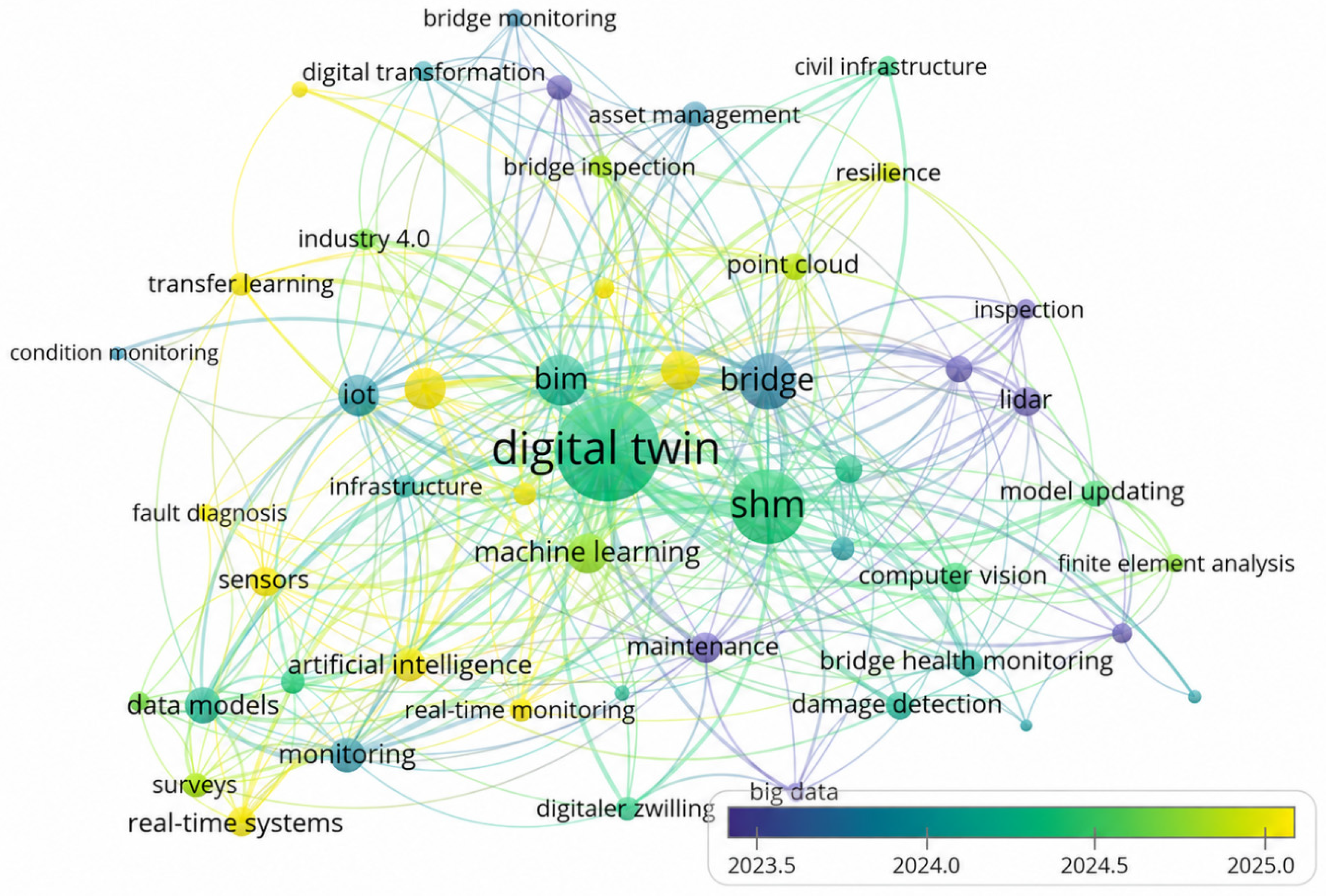
Keyword co-occurrence analysis was conducted to identify the major thematic areas and conceptual relationships formed within bridge DT research. In this study, a network was constructed using VOSviewer based on author keywords and major terms extracted from titles and abstracts, and the results are presented in
Figure 4. In the network visualization, nodes represent individual keywords, while links indicate the frequency with which two keywords appear together in the same publication. The size of each node reflects the frequency of keyword occurrence, and cluster colors indicate closely related thematic areas [
56].
The results show that bridge maintenance digitalization research forms a highly interconnected conceptual network centered on key terms such as “digital twin,” “BIM,” “structural health monitoring,” “bridge inspection,” and “damage detection.” In particular, BIM appears as a central node connected to various research topics, suggesting that BIM-based information models continue to function as a conceptual hub in bridge maintenance digitalization research. At the same time, DT is positioned in connection with BIM, monitoring, and AI-based diagnosis, indicating its emergence as a higher-level concept that integrates previously separate research streams [
14,
34,
64,
65,
66,
67,
68,
69,
70,
71]. In other words, at the keyword network level, DT can be interpreted not as an independent and isolated technological category, but as an integrative concept that strengthens connectivity among existing research streams.
A closer examination of the network structure reveals several major thematic clusters. The first cluster consists of studies related to BIM-based information modeling and asset management, including keywords such as “BIM,” “bridge information modeling,” “asset management,” and “lifecycle management.” This research stream has developed around approaches aimed at structuring bridge asset information into object-based digital models and systematically managing maintenance data [
4,
16,
22,
49,
72,
73,
74,
75,
76,
77].
The second cluster includes studies related to SHM and sensor-based data acquisition. Through keywords such as “structural health monitoring,” “sensor,” “monitoring,” and “vibration analysis,” this cluster represents a research stream focused on continuously observing bridge structural responses and analyzing changes in condition [
5,
29,
32,
78,
79,
80,
81,
82,
83].
The third major cluster is associated with AI-based damage diagnosis and computer vision-based inspection technologies, reflecting recent research on automated condition assessment centered on keywords such as “deep learning,” “machine learning,” “crack detection,” “damage detection,” and “computer vision” [
37,
42,
43,
45,
84,
85,
86,
87,
88].
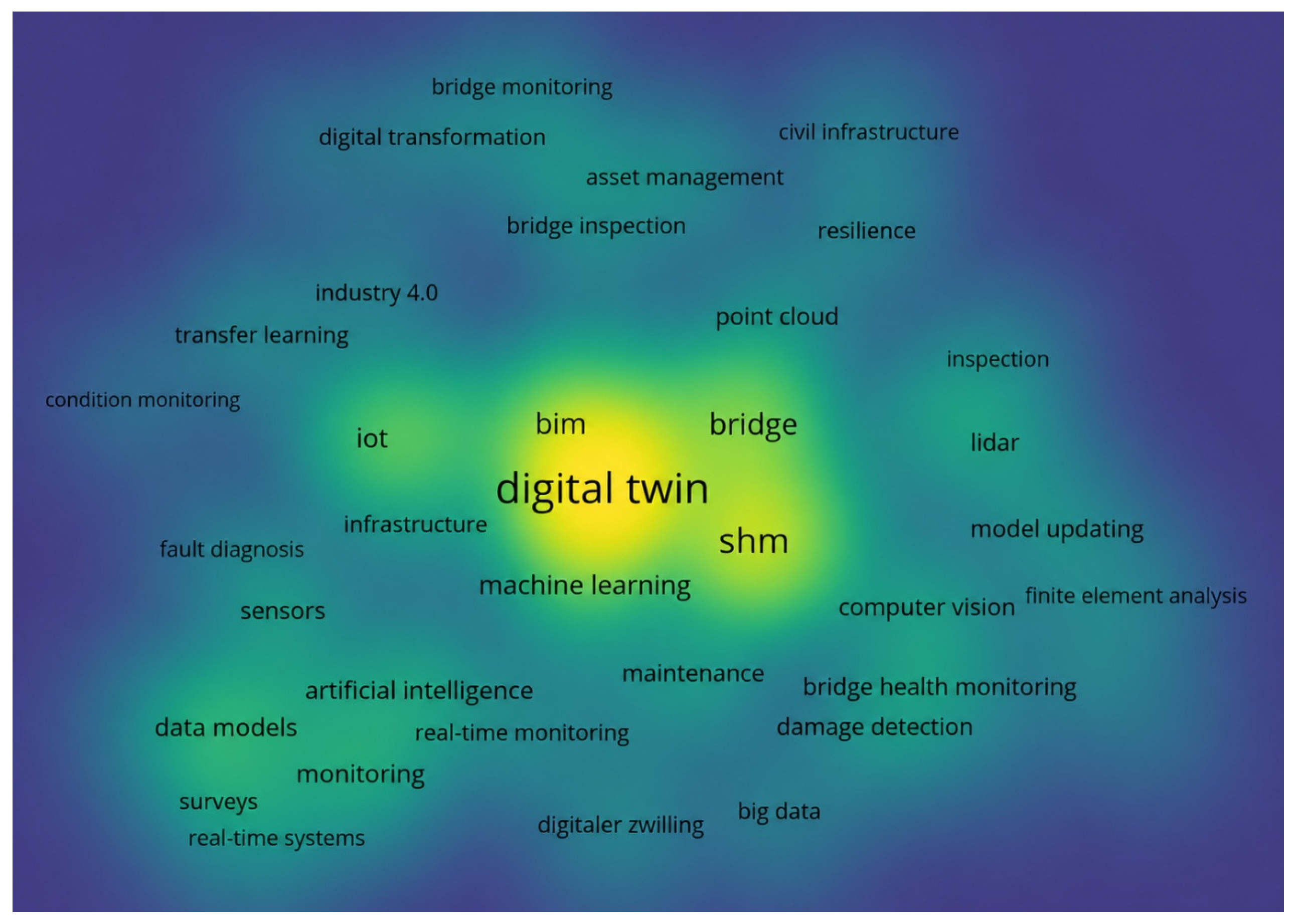
In addition, the density visualization (
Figure 5) more clearly shows that BIM and DT constitute core areas of high conceptual concentration within the research network. In particular, these two concepts form dense regions while remaining closely connected with terms related to SHM, AI, and monitoring, suggesting that bridge DT research has not grown as an isolated technological cluster, but rather as a field in which various technological layers have become functionally integrated around existing information modeling and maintenance research. In other words, the density visualization indicates that the conceptual structure of the field is closer to an integrated structure in which multiple technological layers are connected around BIM-based object information structures and the DT concept, rather than a fragmented parallel structure.
In addition, the temporal changes were analyzed using overlay visualization (
Figure 6). The results show that keywords related to BIM-based information modeling, sensing- and SHM-based condition awareness, AI-based analytics, and DT architectures did not appear as disconnected stages. Rather, they exhibited different levels of relative visibility over time while remaining interconnected within bridge maintenance research. Early studies mainly focused on BIM-based information modeling and inspection data management, whereas subsequent research expanded toward sensor-based monitoring and data analytics. More recently, AI-based damage diagnosis and DT-based integrated maintenance systems have emerged as major research topics. This temporal shift does not indicate the disappearance or replacement of BIM-based research. Instead, it suggests that BIM-based object information structures have become internalized within subsequent DT research as a foundation for asset information structuring and data linkage, while SHM, sensing, AI, and interoperability layers have become functionally integrated within this structure.
In summary, the keyword co-occurrence analysis shows that bridge DT research maintains object-based information modeling as a conceptual core, while SHM-based monitoring, sensing, AI-based diagnosis, interoperability, and DT concepts are structurally combined. This conceptual structure suggests that bridge DT research should be understood not as the disruptive emergence of an entirely new technological paradigm, but as a process in which functional layers that have developed in parallel converge within DT architectures. These findings are further examined in the following section from the perspective of contemporary research front structures through bibliographic coupling analysis.
4.3. Bibliographic Coupling Clusters
Bibliographic coupling analysis was conducted to examine the structural relationships among contemporary publications. Bibliographic coupling identifies structural similarities among research topics based on links formed when two publications share the same references [
89]. While co-citation analysis reflects the historical intellectual base of a research field, bibliographic coupling is effective for identifying the contemporary research front by analyzing relationships among recent publications [
56]. Therefore, this section aims to structurally show how current bridge DT research is organized into subdomains and which research streams occupy central positions. In particular, this section examines, at the level of contemporary research groups, how BIM-based object information structures, SHM- and sensing-based condition awareness, AI-based analytics, and interoperability technologies are combined within DT architectures.
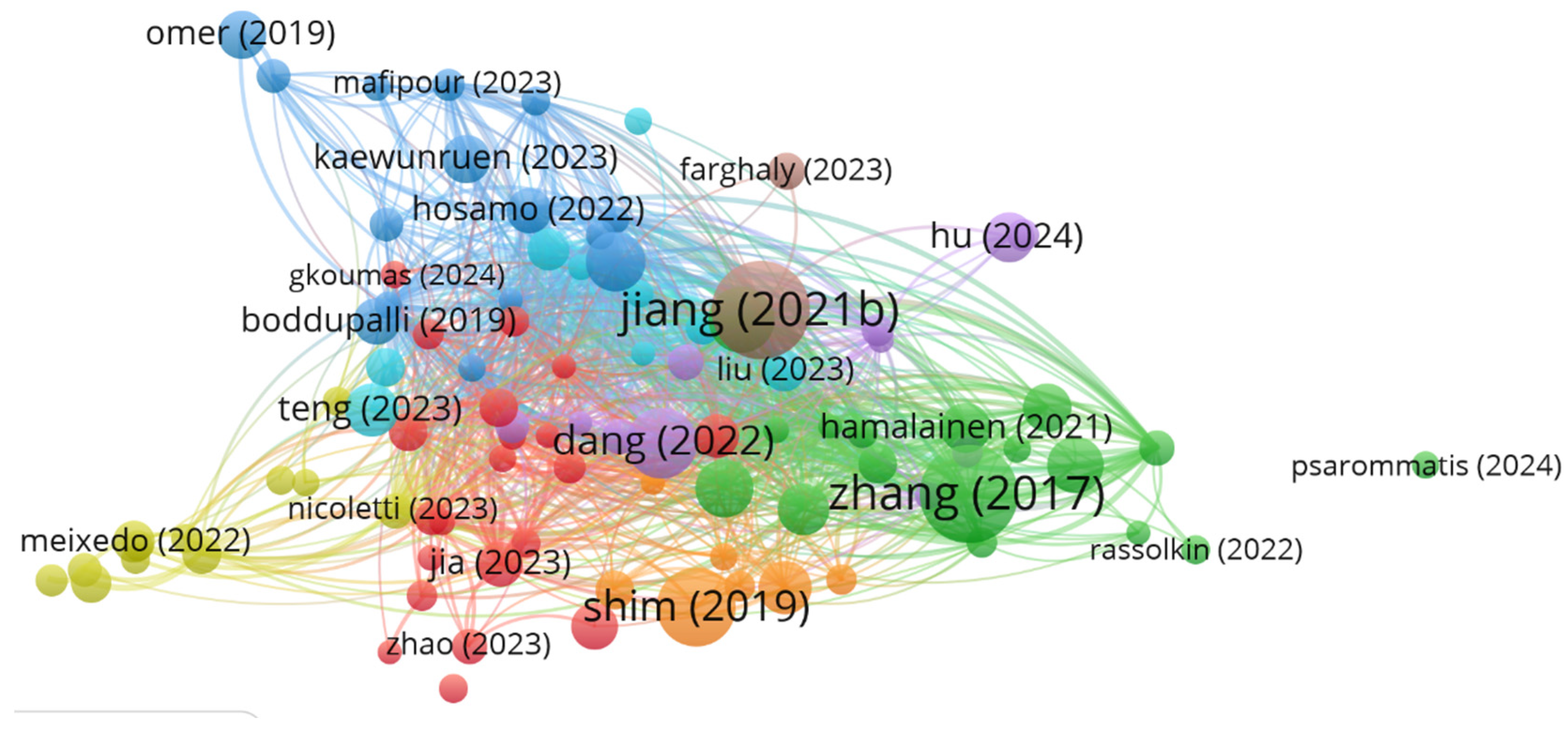
Using VOSviewer, the bibliographic coupling network showed that bridge DT publications were divided into 14 detailed research clusters. These detailed clusters formed different research streams according to their topics, methodologies, and knowledge dependencies based on shared references. However, by considering the conceptual proximity and functional roles among individual clusters, they can be structurally reinterpreted and organized into six higher-level mega-clusters, or consolidated research groups (
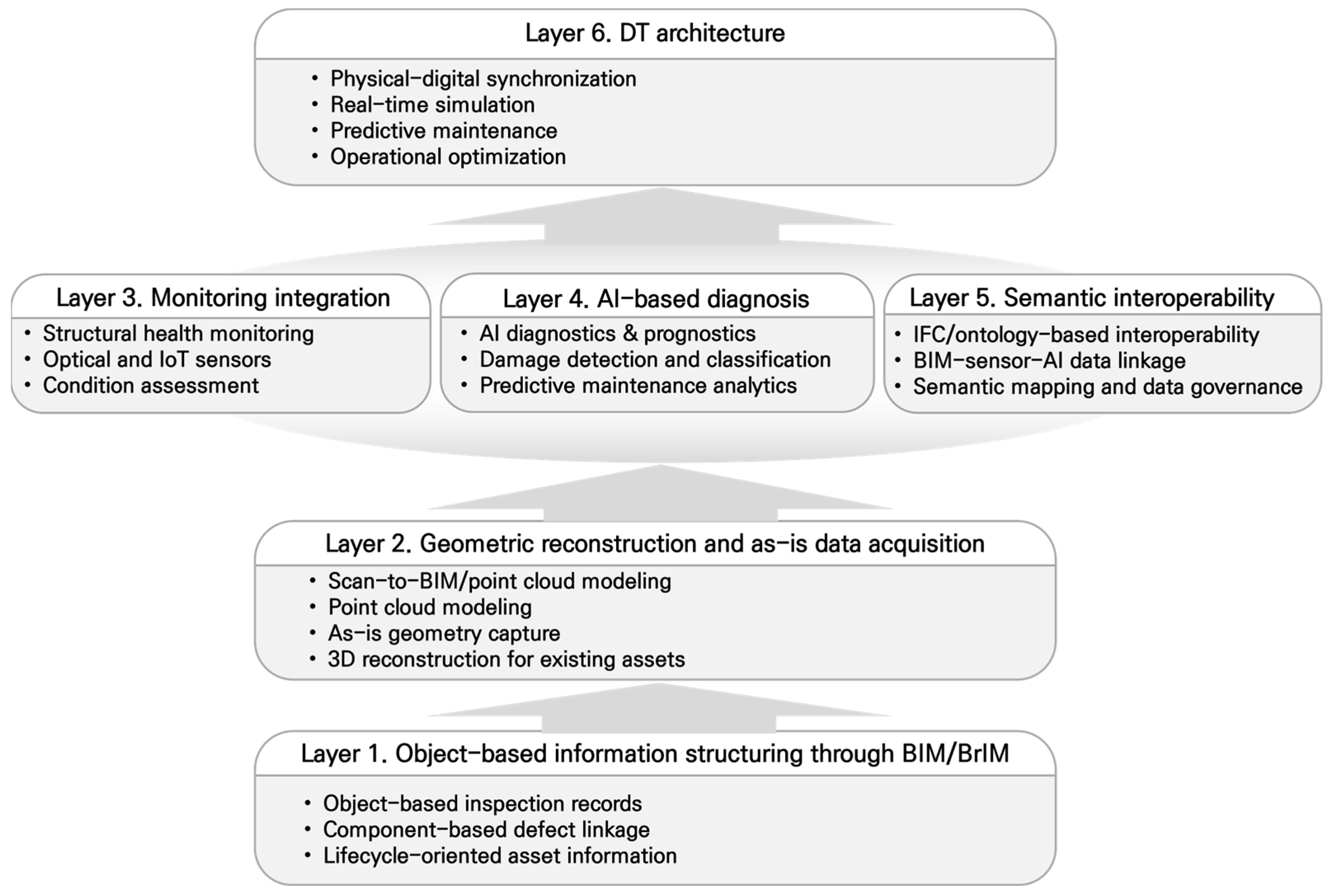
Figure 7). This reorganization is intended not simply to list segmented technological domains in parallel, but to understand the overall structure of contemporary bridge DT research at a higher level. In this sense, the six consolidated research groups should be interpreted not as temporal stages, but as functional layers that constitute DT architectures.
It is important to note that clusters derived from bibliographic coupling do not mean that the publications within each cluster address a single, identical topic. Bibliographic coupling clusters represent the structural proximity of publications that share common references; therefore, each cluster should be interpreted as a research group sharing similar knowledge bases and research concerns rather than as a fixed technological category. Accordingly, this study did not treat each cluster as a rigid technical classification. Instead, it reinterpreted the clusters in terms of their functional roles within DT architectures by jointly examining representative publications, major keywords, average publication periods, and research contexts.
In
Table 4, the first consolidated research group, or mega-cluster, corresponds to BIM-based inspection and lifecycle modeling. This group includes studies that structure bridge asset information as BIM-based object models and integrate inspection data and lifecycle information to support maintenance decision-making [
3,
51,
53,
58,
74]. Studies that link inspection data to three-dimensional component models through BrIM, as well as studies on BIM-based information structures for systematically managing asset lifecycle information, belong to this group [
1,
76,
90,
91]. This research group indicates that BIM-based object information structures continue to function as an important information management foundation within contemporary research fronts.
The second consolidated research group is geometric reconstruction and as-is modeling. This group includes studies that reproduce the actual geometry of existing bridge structures in digital environments using laser scanning, UAV photogrammetry, and point cloud-based modeling technologies. It provides the geometric foundation for digital asset models used in maintenance and inspection, and functions as a physical representation base to which subsequent condition assessment and analytical layers can be connected [
15,
31,
33,
34,
74,
92,
93,
94,
95].
The third consolidated research group is monitoring integration, which includes studies that continuously assess bridge conditions through SHM systems and sensor-based data acquisition. This group can be understood as a condition awareness layer that adds temporality and dynamic condition data to static asset information models, thereby strengthening the real-time capability and continuity of data-driven maintenance [
41,
79,
94,
96,
97,
98,
99,
100].
The fourth consolidated research group is AI-based diagnosis and prediction, which includes studies related to computer vision-based crack detection, image-based damage classification, and machine learning-based deterioration prediction. This research stream can be regarded as an analytical intelligence layer that advances inspection automation and predictive maintenance strategies, converting sensing and SHM data into information that can be used for maintenance decision-making [
6,
23,
42,
43,
45,
101,
102,
103].
The fifth consolidated research group is semantic and data integration. This group includes studies that seek to ensure interoperability between BIM-based information models and various data platforms by connecting IFC, ontology, sensor platforms, GIS, and related systems [
14,
104,
105,
106,
107,
108]. It functions as a data linkage layer that connects data from different formats and sources and ensures semantic consistency among asset objects, sensor data, analytical results, and maintenance decision-making.
The sixth consolidated research group is DT architecture. This group includes studies that propose system-level DT frameworks that integrate BIM-based asset models, sensor-based monitoring data, and AI-based analytical technologies to support condition synchronization and maintenance decision-making [
64,
109,
110,
111,
112,
113]. This research group shows that the preceding functional layers do not exist merely as separate components, but can be combined within a single operational architecture.
4.4. Co-Citation Intellectual Structure
To identify the historical intellectual base of bridge DT research, a co-citation network analysis was conducted. Co-citation analysis identifies the core knowledge structure of a research field based on the frequency with which two publications are cited together by subsequent studies. It is therefore effective for examining the prior research traditions on which a specific field has been formed. Accordingly, while bibliographic coupling analysis reveals the contemporary research front, co-citation analysis can be understood as revealing the historical foundations and theoretical accumulation structures that support that research front. In this study, co-citation analysis was used as a complementary method to support the bibliographic coupling analysis presented in
Section 4.3, by identifying the past knowledge bases on which contemporary research groups have been formed.
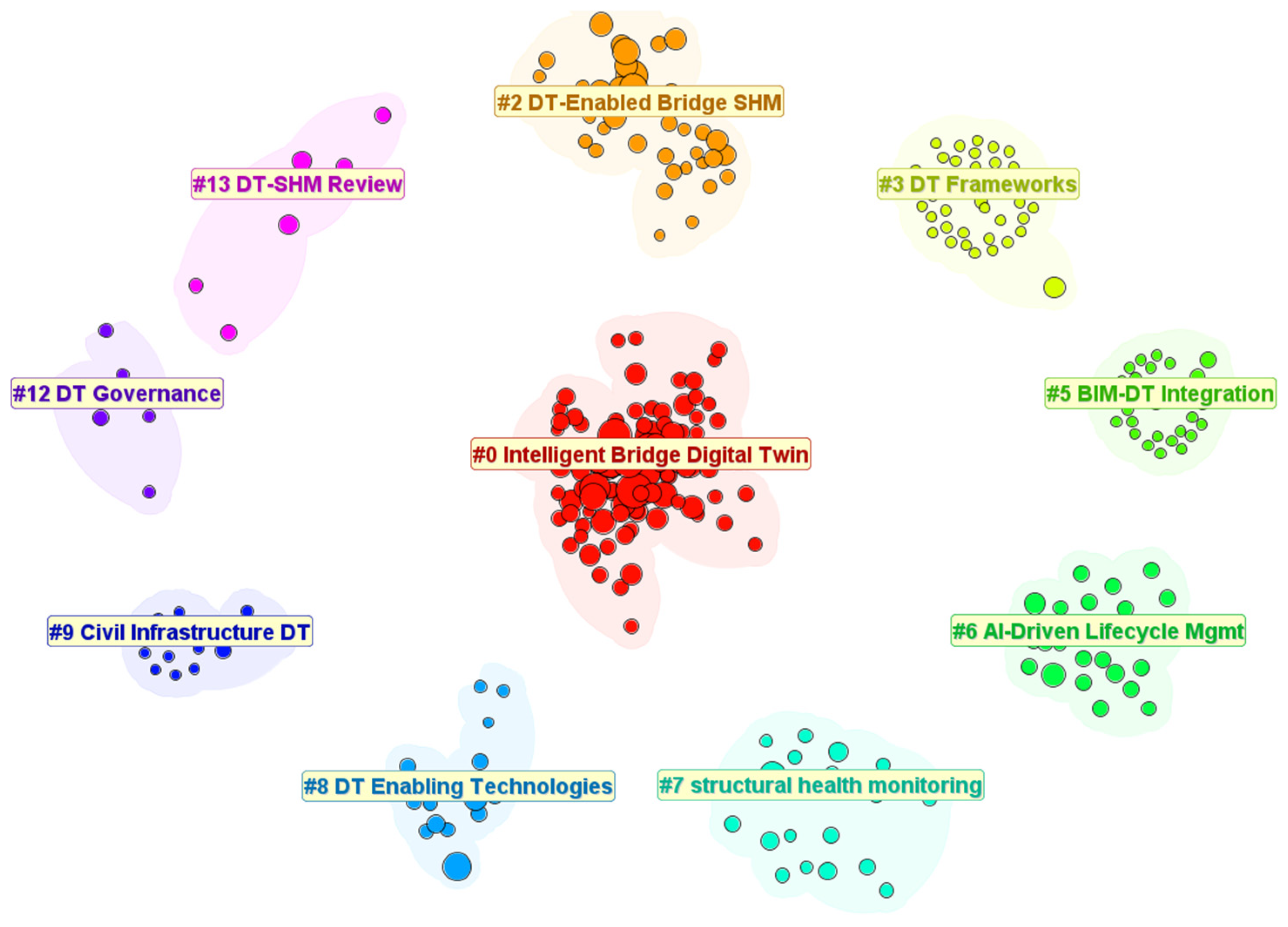
The co-citation network constructed using CiteSpace showed that the intellectual base of bridge DT research consists of 14 detailed clusters. The cluster numbers shown in
Figure 8 are CiteSpace-assigned identifiers and do not indicate importance, hierarchy, or chronological order.
Table 5 therefore provides an interpretive synthesis of major co-citation clusters into broader knowledge domains rather than a ranking of cluster importance.
Each cluster is formed around core publications related to specific research topics and reflects the theoretical foundations and methodological traditions shared by the field. By reorganizing these detailed clusters at a higher level, the intellectual base of bridge DT research was classified into four higher-level knowledge domains (
Figure 8,
Table 5). In this classification, the cluster labels and representative papers were interpreted together rather than relying only on cluster numbers. In particular, #2 “DT-Enabled Bridge SHM,” #7 “Signal-Based SHM,” and #13 “DT-SHM Review” were grouped under Physical Sensing and Monitoring because they commonly address DT-enabled monitoring, structural response interpretation, condition assessment, and SHM-oriented review studies. Although #13 includes broader discussions of AI integration, predictive maintenance, synchronization methods, and future research directions, its primary focus is the synthesis of DT-enabled SHM and condition-monitoring research. Therefore, it was interpreted as part of the physical-state data foundation of bridge DT research.
This reorganization was intended to provide a clearer interpretation of the foundational knowledge on which the current research front is built. In other words, these four higher-level knowledge domains should be interpreted not as temporal stages, but as the historical foundations of the functional layers that constitute current bridge DT research.
The first knowledge domain is “System Architecture and Governance”, which includes studies related to intelligent bridge digital twins, DT frameworks, civil infrastructure DT, DT enabling technologies, DT governance, and system-level integration. This domain provides the structural framework for digital asset management and the system-level logic of integration, serving as a critical foundation for the subsequent development of the DT concept. In particular, studies on BIM-based data structures and lifecycle information management are significant in that they structured asset information at the object level and established an information governance basis for long-term maintenance decision-making. In addition, studies that proposed conceptual frameworks for DTs institutionalized the concept of bidirectional synchronization between physical systems and digital models, thereby providing higher-level architectural logic for subsequent research [
47,
48,
114]. Therefore, this domain shows that BIM-based object information structures and data governance have persisted not merely as early-stage technologies, but as structural foundations for integrated architectures in bridge DT research.
The second knowledge domain is “Physical Sensing and Monitoring”, which consists of publications related to DT-enabled bridge SHM, signal-based SHM, SHM-oriented review studies, bridge inspection, load testing, and sensor-based diagnostics. This domain provides the physical data acquisition basis for measuring and interpreting bridge conditions and forms a key prerequisite for synchronization and condition awareness in subsequent DTs [
5,
115,
116]. In other words, this knowledge domain should be understood not merely as the accumulation of measurement technologies, but as a physical foundation that enables actual condition information to be linked to digital asset models [
96,
117,
118]. In this respect, Physical Sensing and Monitoring is not a stream that replaces BIM-based object information structures, but rather the intellectual foundation of a condition data layer that adds temporality and real-world condition data to those information structures.
The third knowledge domain is “AI-based Damage and Lifecycle Intelligence”, which includes AI-driven lifecycle management, predictive maintenance, automated diagnosis, decision-support intelligence, and AI-based damage diagnosis [
119,
120]. With the rapid expansion of deep learning and computer vision technologies in recent bridge inspection research, this domain has emerged as an important knowledge axis enabling automation and predictive decision-making in bridge maintenance. In particular, studies on UAV-based visual data acquisition, CNN-based defect detection, and image-based damage classification have contributed to transforming bridge condition assessment into a more machine-readable process. However, the significance of this domain should be interpreted not as the rise of a standalone technology, but as the integration of an analytical intelligence layer on top of existing monitoring and information modeling foundations [
86,
121,
122]. In other words, AI-based damage and lifecycle intelligence functions not as an independent replacement paradigm, but as the intellectual foundation of an analytical layer that interprets sensing- and SHM-based condition data and links them to maintenance decision-making.
The fourth knowledge area is “Information Modeling and Visualization”, which encompasses research on BIM–DT integration, BIM/BrIM-based object modeling, BIM–GIS integration, point cloud–based geometric reconstruction, XR/VR environments, and digital infrastructure visualization [
31,
111,
123,
124]. This domain provides the technical basis for representing actual bridge structures in digital environments, visually communicating asset information, and enabling interoperability across multiple platforms. In particular, studies on point clouds, UAV-based photogrammetry, and BIM-based modeling play an important role in aligning the as-is condition of bridges with digital environments and forming the visualization and information representation layer of DT systems. This domain shows how BIM-based object information structures, geometric reconstruction, and visualization technologies have been combined to construct digital representations of physical assets within DTs.
Although these four knowledge domains initially emerged as independent technological categories, they do not exist separately in current bridge DT research. Rather, they form a complementary relationship: System Architecture and Governance provides the structural framework for integration, Physical Sensing and Monitoring supplies real-world condition data, “AI-based Damage and Lifecycle Intelligence” transforms such data into analytical and decision-support intelligence, and Information Modeling and Visualization structures and communicates them within digital environments. Therefore, the co-citation analysis indicates that current bridge DT research is not an independent research stream detached from past knowledge bases, but the result of the long-term accumulation and interconnection of knowledge related to information modeling, condition monitoring, AI-based analytics, visualization, and interoperability. This historical knowledge structure is connected to the contemporary research front identified through the preceding bibliographic coupling analysis, and its evolutionary pathway can be examined in greater detail through the time-based analysis in the following section.
4.5. Temporal Stratification and Evolutionary Consolidation
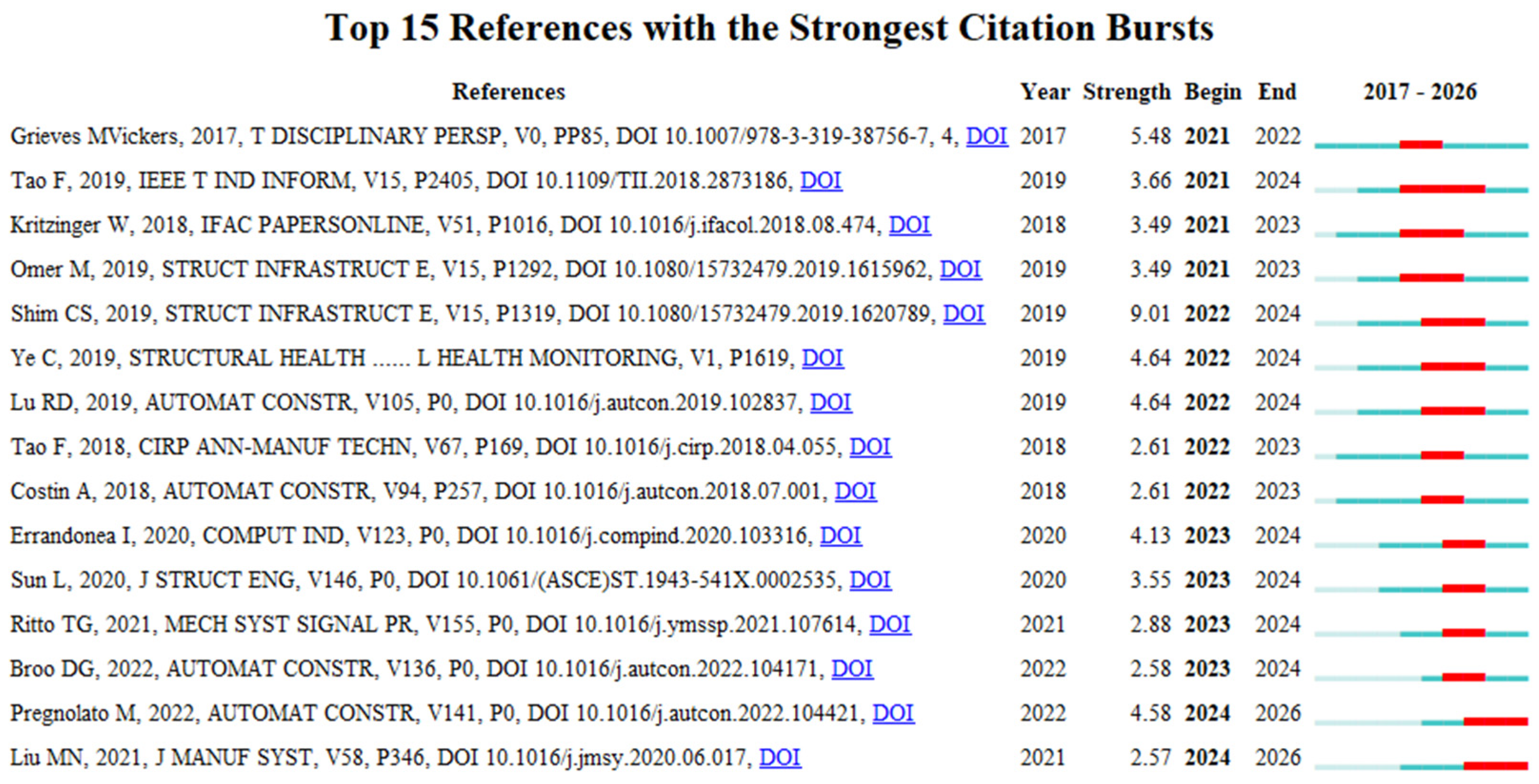
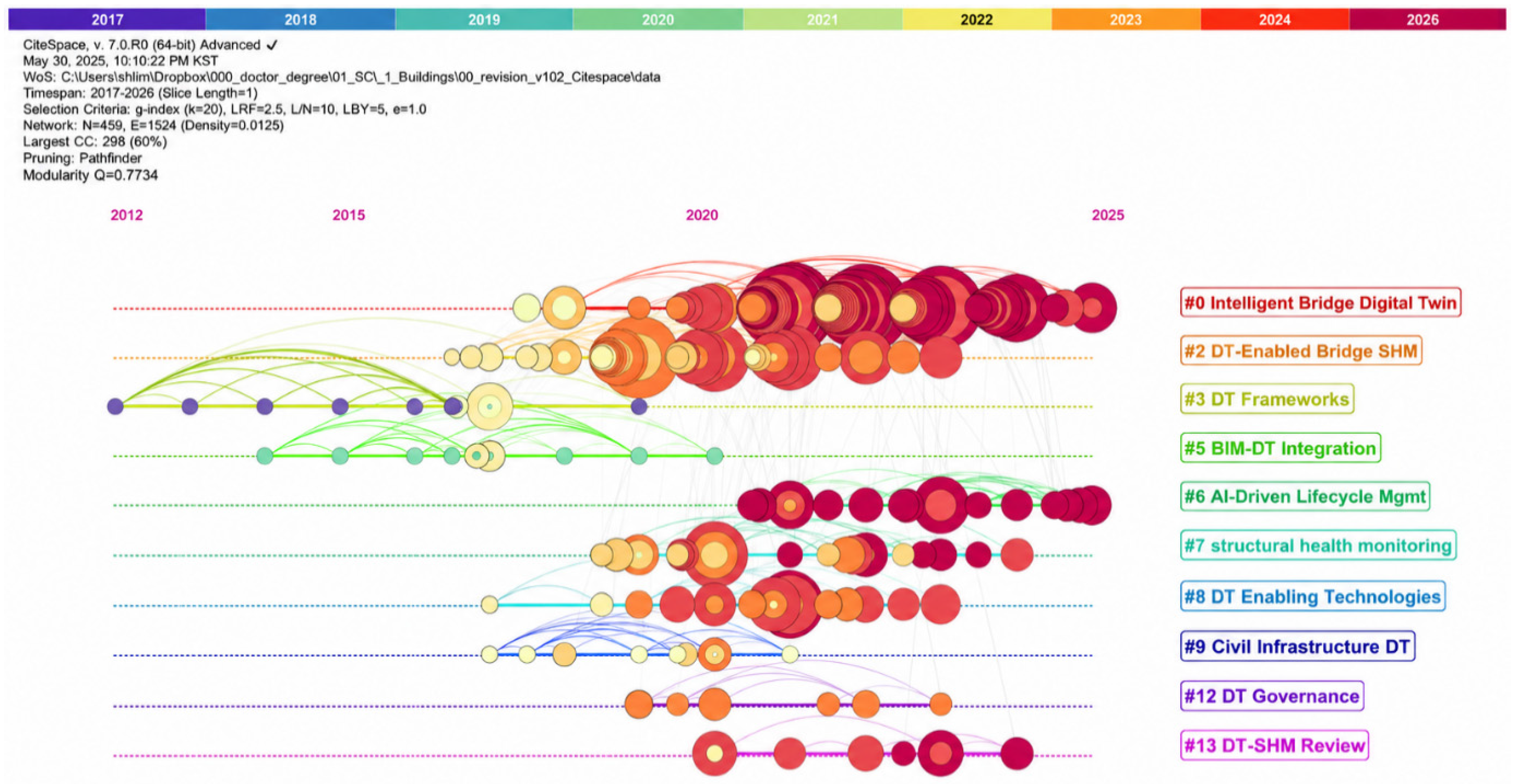
To examine how the knowledge structures identified in the preceding sections have accumulated and evolved over time, citation burst analysis and timeline visualization were conducted.
Figure 9 shows the core publications that received rapidly increasing attention during specific periods, while
Figure 10 presents the formation, persistence, and changes in the evolutionary intensity of major research clusters over time. This time-based analysis provides important evidence for determining whether bridge DT research has emerged through a disruptive transition, or whether different functional layers have combined and converged over time with varying levels of visibility on the basis of existing research traditions.
In the initial stage, studies related to BIM-based information structuring and inspection-oriented information modeling received strong attention. This suggests that early research was centered on structuring bridge asset information in an object-based manner and linking inspection and maintenance data to digital environments. This initial trajectory can be observed in representative studies that laid the foundation for the digitalization of bridge maintenance [
2,
3,
76,
134,
135,
136]. In this period, strong visibility was also observed in studies that presented the basic concept of DT and the distinction among digital model, digital shadow, and digital twin. This indicates that early bridge DT research borrowed conceptual foundations from manufacturing and general DT studies, while also extending discussions on BIM/BrIM-based asset information structuring and data governance into the context of bridge maintenance.
In the intermediate stage, the visibility of studies related to geometric reconstruction, SHM, and monitoring integration expanded. This indicates that real-world measurement data and condition-awareness functions began to be integrated with static asset information models. In other words, this period can be interpreted as the stage in which as-is geometric representation of bridges, sensor-based condition monitoring, and dynamic data linkage were incorporated into the research front. This trend is clearly reflected in representative studies addressing geometric reconstruction, SHM, and BIM-based monitoring integration [
48,
74,
80,
93,
106,
107,
137,
138,
139,
140]. The shift during this period shows that the functional scope of bridge maintenance research expanded as BIM/BrIM-based information structures were combined with reality capture, sensing- and SHM-based condition data, and data management technologies.
In the most recent expansion stage, strong citation bursts are observed in studies related to AI-based damage diagnosis, predictive analytics, and digital twin architecture. This indicates that the focus of bridge maintenance research has moved beyond information structuring and data collection toward automated condition diagnosis and system-level integration. This recent research trajectory can be observed in representative studies addressing AI-based defect recognition, predictive analytics, and digital twin frameworks [
1,
36,
49,
124,
125,
126,
141,
142]. However, this trajectory does not imply that AI-based analytical layers or digital twin architectures emerged discontinuously from prior research streams. Rather, it shows that the research scope has expanded toward the integration of AI-based analysis and DT architectures with BIM-based object information structures, SHM and sensing data, and interoperability technologies. Furthermore, this trajectory has extended toward discussions on existing infrastructure management, Civil Engineering 4.0, and lifecycle-oriented DT workflows.
Therefore, the citation burst results support the interpretation of this study that bridge DT research has evolved through the cumulative recombination of conceptual DT foundations, BIM/BrIM-based information structures, SHM data, AI-based analysis, and infrastructure lifecycle management.
In particular, the timeline visualization (
Figure 10) shows that bridge DT research has not been abruptly reorganized by a single technological transition. Rather, different research topics have developed in parallel with varying levels of visibility over time and have gradually converged within DT architectures. In the early period, information modeling and inspection-oriented research formed an important foundation, while subsequent studies expanded toward SHM, data integration, and DT-enabled monitoring. More recently, AI-based damage diagnosis, lifecycle management, DT frameworks, and intelligent bridge DT have emerged as prominent research topics.
This temporal development does not indicate that BIM-related research disappeared or was replaced by AI- or DT-oriented studies. Instead, it suggests that BIM-related knowledge has become less visible as an independent topic while being incorporated into broader DT-oriented clusters, particularly through information integration, lifecycle data management, and BIM-DT integration. Thus, the evolution of bridge maintenance research can be understood as a process in which information modeling, condition monitoring, analytical intelligence, interoperability, and system-level integration have developed with different temporal emphases and converged within DT architectures. Together with the preceding structural analyses, these results provide important evidence for understanding the developmental pathway of bridge DT research from a temporal perspective.
5. Discussion: Evolutionary Convergence of Bridge DTs
The scientometric analyses presented in the preceding chapter showed that bridge DT research has not been shaped by the abrupt emergence of a single technology. Rather, it has developed through the combination and convergence of research streams related to information modeling, condition monitoring, analytical intelligence, and system integration, each evolving as a distinct functional layer within DT architectures. In particular, the findings of this study suggest that BIM has functioned as an important information structure in bridge DT research. Although BIM-based approaches have strengths in object-level asset information management and the accumulation of maintenance histories, they also entail several limitations in actual operational settings. First, a high dependence on specific software ecosystems may lead to vendor lock-in. Second, if modeling standards and attribute information schemas differ across organizations, interoperability issues may arise during data exchange. Third, if sensor data or AI analytical results are not semantically linked to BIM objects, BIM may remain merely a visualization model and may not be effectively extended into an operational DT.
Some recent research streams also suggest the possibility of AI-centered or sensor-centered DTs that differ from object-based information-structural approaches such as BIM. For example, large-scale sensor data, image-based damage detection, and real-time monitoring platforms may not necessarily require a highly detailed BIM model as a prerequisite. Such approaches have advantages in terms of rapid deployment and automation; however, they may have clear limitations in linking analytical results to asset objects, locations, histories, and repair actions required for long-term maintenance. Therefore, the conclusion of this study is not that BIM replaces other technologies, but that the operational feasibility of bridge DTs increases when BIM-based information management is complementarily combined with AI- and sensing-based analytical technologies.
These findings suggest the need to reconsider simplified interpretations that understand bridge DT research as a disruptive technological innovation. Accordingly, based on the preceding analytical results, this chapter reinterprets the development of bridge DT research as a process of evolutionary convergence and discusses the significance of BIM-based information structures as well as their structural relationship with sensing and AI technologies. It also summarizes the theoretical and practical implications of this interpretation for bridge maintenance research and digital infrastructure management strategies.
5.1. Reframing DT Development: Evolution Rather than Disruption
Recent discourses on infrastructure management and construction digitalization often present digital twin (DT) as a next-generation integrated platform that goes beyond existing asset management systems or BIM-based information models [
34,
143,
144]. For example, Grieves and Vickers [
48] conceptualized DT as a linkage between a physical asset and its digital representation, thereby providing a general conceptual foundation for subsequent DT research. Kritzinger et al. [
125] proposed a distinction among digital model, digital shadow, and digital twin, offering a criterion for explaining different levels of physical–digital linkage. Moshood et al. [
144] presented infrastructure DT as a new paradigm for the future construction industry, while Chacón et al. [
143] proposed a DT tool for bridge management that integrates measurement, simulation, analysis, and geospatial information. In addition, Shim et al. [
49] and Ye et al. [
126] demonstrated early application directions in which BIM/BrIM, monitoring data, and DT frameworks are combined in the context of bridge maintenance and SHM.
These discussions are significant in that they emphasize the integrative, real-time, and predictive analytical capabilities of DT. However, if misinterpreted, they may lead to an understanding of DT as a disruptive transition that replaces existing BIM-based information structures. Such an interpretation, however, does not sufficiently explain the actual knowledge structure and evolutionary pathway through which bridge digital twin research has been formed.
This interpretation is also supported by the data structure of this study. Although the main search formula did not include BIM-related terms as mandatory conditions, 77 publications among the final corpus of 400 records were identified ex post as the BIM-related subset. This indicates that BIM-related concepts were not forced by the search formula but still appeared as a visible research stream within the DT-centered bridge maintenance research corpus. In addition, in the keyword co-occurrence analysis, a network was constructed using 50 keywords that met the minimum occurrence threshold among a total of 1497 keywords. Within this network, BIM occupied a conceptual position connected to terms related to DT, SHM, monitoring, asset management, and interoperability. These results suggest that bridge DT research does not represent a simple replacement trajectory from BIM to AI. Rather, it reflects a structure in which BIM/BrIM-based information structures, SHM, AI analysis, interoperability, and operational platforms are connected as distinct functional layers.
These findings suggest that it is more appropriate to understand the bridge digital twin not as a new paradigm that replaces existing technologies, but as a higher-level system concept that integrates existing research traditions. In other words, a digital twin can be interpreted not as a separate technological system that emerged independently after BIM, but as the result of evolutionary convergence, in which BIM-based information structures, sensing and condition monitoring, analytical intelligence, and interoperability-based system integration have developed as different functional layers and converged within a single operational architecture. In this context, BIM functions not merely as an initial modeling tool but as an object-based information management foundation that connects subsequent technological layers and data.
Taken together, the analytical results of this study can be conceptualized as a six-layer functional-layer interpretive framework, as presented in
Table 6 and
Figure 11. L1 represents an object-based information layer that structures asset objects, spatial locations, attribute information, and inspection and maintenance histories through BIM/BrIM. L2 updates the digital representation of actual bridge conditions through geometric and sensing data acquisition. L3, L4, and L5 are not arranged in a sequential hierarchy, but as parallel functional layers. L3 generates time-dependent condition data through SHM and sensing, while L4 transforms such data into damage detection, prediction, and decision-support information through AI-based analysis. L5 connects BIM/BrIM object information in L1, monitoring data in L3, and analytical results in L4 across different systems and data formats through semantic interoperability and data governance. Finally, L6 corresponds to the DT architecture stage, in which these functional layers operate in an integrated manner within actual maintenance decision-making environments.
Figure 11 presents a functional-layer interpretive framework for bridge DT research. The six layers do not represent a strict hierarchical structure based on technological importance or maturity. Rather, they distinguish the functional components required for bridge DT implementation. L1 is an information foundation layer that structures asset information in an object-based manner through BIM/BrIM; L2 represents geometric and sensing data acquisition; L3 refers to SHM-based condition monitoring; L4 denotes AI-based analysis; and L5 represents semantic interoperability and data governance. L3–L5 are positioned as parallel functional layers responsible for condition data generation, analytical intelligence, and information linkage, respectively. Finally, L6 is a platform-level DT integration layer that connects these functional layers within actual maintenance decision-making environments. Therefore, this framework does not describe a structure that removes BIM. Instead, it provides an interpretive framework for explaining how monitoring, analysis, interoperability, and operational platforms are combined around BIM/BrIM-based object information structures.
The six-layer framework proposed in this study is not a hierarchical classification based on technological importance or maturity, but an interpretive distinction based on the functional roles required for bridge DT implementation. Therefore, each layer should be understood not as an upper or lower stage, but as a parallel component responsible for a distinct function. For example, L3 generates time-dependent condition data of bridges through SHM and sensing, while L4 transforms such condition data into damage detection, prediction, and decision-support information through AI-based analysis. L5 provides semantic interoperability and data-linkage structures that enable object-based information structures, condition data, and analytical results to be connected across different systems and data formats. Thus, L3, L4, and L5 are not positioned as sequentially ranked stages, but as equivalent functional layers within the bridge DT architecture, responsible for condition awareness, analytical intelligence, and information linkage.
The six-layer framework proposed in this study is not a maturity model empirically validated in actual bridge projects. Rather, it is an interpretive framework derived by integrating the scientometric clusters of the analyzed literature with qualitative interpretation. Therefore, this framework should be understood as a conceptual tool for explaining the knowledge structure of bridge digital twin research. Future studies need to validate the empirical applicability of this framework by jointly examining actual bridge maintenance cases, owner-side data management systems, sensor deployment environments, BIM model quality, and the outcomes of AI applications.
This reinterpretation also provides important implications for DT implementation strategies. If DT is understood as a disruptive innovation, research and practice are likely to prioritize the adoption of individual AI functions or new platforms. However, the findings of this study show that the practical implementation of bridge DTs cannot be achieved through the adoption of a single technology alone. Rather, it requires a long-term information architecture that can connect object-based asset information, interoperable data structures, condition monitoring systems, and analytical results. In other words, the success of DTs depends less on the introduction of new technologies themselves than on how existing information structures can be maintained and integrated in an extensible manner.
5.2. BIM/BrIM-Based Object Information Structures in Bridge DT Development
One of the key implications of this study is that sensing, AI-based diagnosis, and BIM-based information structures in bridge DT research are not independent technological layers but are structurally interdependent. Recent bridge maintenance research has seen rapid advances in deep learning-based computer vision, IoT-based sensor networks, and data-driven predictive analytics. However, these technologies generate practical maintenance value only when condition data and analytical results can be linked to asset information within an object-based digital environment. In other words, the core of a bridge DT lies not in the parallel adoption of individual advanced technologies, but in the establishment of an information foundation capable of structurally connecting heterogeneous data and functions.
In particular, large-scale time-series data generated by monitoring systems and AI-based prediction and diagnosis results must be linked to structural components, inspection histories, location information, and lifecycle management data in order to be directly used for maintenance decision-making. In this regard, BIM-based information models function not merely as geometric modeling tools but as information integration platforms that connect sensor data and analytical results with asset management systems. However, BIM in this context should be understood not as a specific software platform itself, but as an object-based information management system that structurally links asset objects, attribute information, inspection histories, condition data, and maintenance actions. A key element enabling such integration is data interoperability. Without mechanisms such as IFC extensions, ontology-based mapping, and BIM–GIS integration, even advanced AI algorithms are likely to remain as isolated analytical outputs.
These findings also provide clear practical implications. The implementation of bridge DTs cannot be achieved solely through the adoption of a single platform or individual AI functions. Instead, BIM-based asset information management systems, condition monitoring systems, data standardization, interoperable information structures, and operational frameworks capable of linking analytical results to maintenance decision-making must be established in advance. Therefore, priority should be placed not on simply adding new technologies, but on developing information architectures and data governance systems through which diverse technological layers can be interconnected. This indicates that, even as AI-based analytical functions continue to expand, object-based information structures and data governance remain essential prerequisites for implementing bridge DTs.
5.3. Challenges and Future Research Directions
This study systematically examined the structural development pathway of bridge DT research through scientometric analysis; however, several limitations and future research directions remain. First, because this study focused on scholarly publications indexed in the WoS Core Collection, practice-oriented materials such as conference papers, technical reports, and industrial demonstration cases may not have been sufficiently reflected. In particular, in technology-oriented fields such as DTs, important developments often occur through industrial projects and practical reports. Therefore, future research should conduct a more expanded literature analysis.
Second, the scientometric methods used in this study are useful for identifying the knowledge structure and developmental trends of a research field from a macroscopic perspective, but they have limitations in deeply analyzing the technical content or methodological differences in individual studies. For example, keyword co-occurrence and bibliographic coupling analyses are effective for identifying relationships among topics and the structure of research communities, but they do not directly explain detailed technical differences such as algorithm performance, model implementation methods, data quality, or system operation contexts in actual studies. Therefore, future research should conduct in-depth technical analyses or case-based comparative studies on the major research clusters identified in this study.
Third, this study analyzed the developmental structure of DT research with a focus on bridge maintenance. However, DT technologies are simultaneously developing across various fields, including buildings, railways, energy, plants, and urban infrastructure, and research streams across these fields influence one another. Therefore, future research should identify both common developmental patterns and domain-specific differences in DT technologies through cross-domain comparative analyses that include diverse infrastructure sectors.
6. Conclusions
This study conducted a scientometric analysis of WoS-indexed scholarly publications to examine the structural relationships and evolutionary pathways among BIM, SHM, AI-based analytical technologies, and DT-related research in the field of bridge maintenance. In particular, BIM-related terms were not included as mandatory conditions in the main search query, thereby preventing BIM centrality from being predetermined by the search strategy. BIM-related publications were instead identified as a separate subset within the final corpus and used for sensitivity analysis.
The results show that bridge DT research has not been newly formed through a single technological innovation. Rather, it has developed as a structure in which BIM-based information modeling, geometric reconstruction, condition monitoring, AI-based diagnosis, and system integration research have evolved over an extended period as distinct functional layers and have become combined and converged under the concept of the DT. In particular, object-based information structures such as BIM function as a core foundation for connecting subsequently developed sensor technologies, data analytics technologies, and digital twin architectures. Recent digital twin and AI research can therefore be more appropriately understood as integrated layers extended upon this structure.
Based on these findings, this study interprets the development of bridge DTs not as a disruptive technological transition disconnected from object-based information structures, but as a process of evolutionary convergence or cumulative expansion, in which new technological layers are progressively combined within an integrated and interoperable information architecture. This suggests that the successful implementation of DTs cannot be achieved solely through individual AI functions or a single platform. Rather, it depends on the establishment of a long-term information architecture that connects object-based asset information, interoperable data structures, condition monitoring systems, and analytical results to maintenance practices.
From a practical perspective, this study indicates that the implementation of bridge DTs requires more than the adoption of individual AI algorithms. Successful bridge DT environments require data governance, object schemas, sensor data integration, AI training data quality, interoperability standards, and information delivery policies required by clients.
Nevertheless, because this study was conducted primarily using WoS-indexed scholarly publications, it could not fully reflect industrial documents, standards, patents, or real-world project cases. In addition, the proposed six-layer framework is a conceptual interpretive framework based on scientometric analysis and therefore requires further validation through actual bridge maintenance projects. Future research should integrate scholarly publications with industrial materials and verify the interpretive structure proposed in this study using real-world bridge DT cases.