Empowerment or Depletion? Unpacking the Asymmetrical Pathways from Perceived Autonomy to Human–AI Trust




Abstract
1. Introduction
2. Theoretical Background and Hypotheses Development
2.1. Human–AI Trust
2.2. Self-Determination Theory
2.3. Stereotype Content Model
2.4. Perceived Autonomy and Human–AI Trust
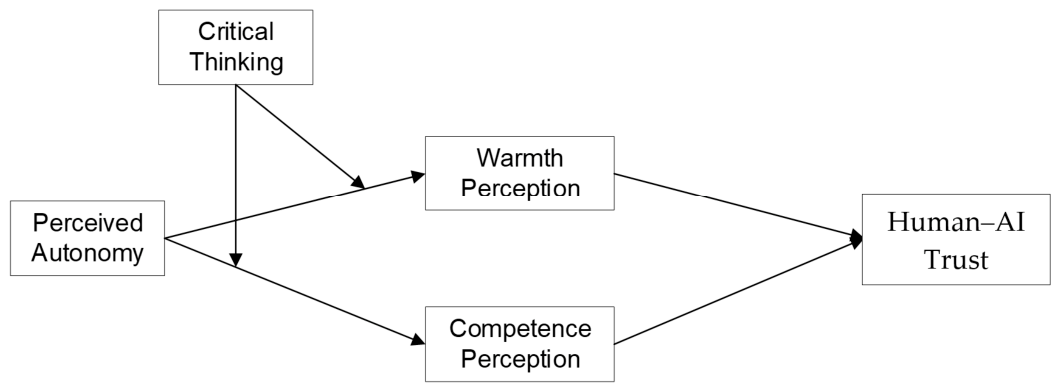
2.5. The Mediating Roles of Warmth Perception and Competence Perception
2.6. Moderation Role of Critical Thinking
3. Methodology
3.1. Measures
3.2. Sample and Data
4. Results
4.1. Common Method Bias
4.2. Confirmatory Factor Analysis
4.3. Hypothesis Test
5. Discussion
5.1. Research Findings
5.2. Theoretical Contribution
5.3. Practical Implication
6. Limitation and Further Research
Supplementary Materials
Author Contributions
Funding
Institutional Review Board Statement
Informed Consent Statement
Data Availability Statement
Acknowledgments
Conflicts of Interest
Appendix A

| Constructs | Items | Reference | |
|---|---|---|---|
| Perceived autonomy | PA1 | The intelligent system provides choices based on my actual workflow needs. | [39] |
| PA2 | The intelligent system allows me to complete tasks in my own professional way. | ||
| PA3 | The intelligent system supports me in proactively exploring desired engineering solutions, rather than passively following dictates. | ||
| PA4 | I am in full control of my work process when using this intelligent system. | ||
| PA5 | The intelligent system assists me in making independent engineering decisions. | ||
| Critical thinking | CT1 | I consider why the intelligent system generates specific analytical or design outputs. | [56] |
| CT2 | I evaluate whether the intelligent system’s outputs are actually useful for my specific projects. | ||
| CT3 | I think about the underlying logic of the intelligent system’s algorithms and their potential limitations. | ||
| Warmth perception | WP1 | I perceive this intelligent system as kind. | [55] |
| WP2 | I perceive this intelligent system as helpful. | ||
| WP3 | I perceive this intelligent system as cooperative. | ||
| WP4 | I perceive this intelligent system as considerate. | ||
| WP5 | I perceive this intelligent system as empathetic. | ||
| WP6 | I perceive this intelligent system as supportive. | ||
| Competence perception | CP1 | I perceive this intelligent system as intelligent. | [55] |
| CP2 | I perceive this intelligent system as organized. | ||
| CP3 | I perceive this intelligent system as logical. | ||
| CP4 | I perceive this intelligent system as innovative. | ||
| CP5 | I perceive this intelligent system as creative. | ||
| CP6 | I perceive this intelligent system as clever. | ||
| Human–AI trust | TRU1 | I have confidence in using this intelligent system in my engineering tasks. | [54] |
| TRU2 | I believe this intelligent system can efficiently handle routine and tedious engineering tasks through automation. | ||
| TRU3 | I believe my organization can operate these intelligent systems reliably, consistently, and without major failures. | ||
| TRU4 | I believe the intelligent system will consistently provide efficient and accurate results across complex engineering lifecycles. | ||
| TRU5 | I believe adopting intelligent systems will create new professional roles and job value within our industry. | ||
| TRU6 | I have a very positive attitude toward the comprehensive adoption of intelligent systems in the engineering consulting industry. | ||
| TRU7 | I believe this intelligent system can help me acquire new skills, thereby empowering my career development. | ||
| TRU8 | I am highly optimistic about the positive impact of intelligent systems on internal collaboration and business operations. | ||
| TRU9 | I believe intelligent systems will positively improve the interaction and collaboration dynamics among employees within the organization. | ||
| TRU10 | Adopting intelligent systems will not diminish, but rather highlight core human skills, such as my creativity in engineering design. | ||
| TRU11 | I firmly believe that adopting intelligent systems will significantly enhance the quality of my final engineering deliverables. | ||
References
- Raisch, S.; Krakowski, S. Artificial intelligence and management: The automation–augmentation paradox. Acad. Manag. Rev. 2021, 46, 192–210. [Google Scholar] [CrossRef] [Scilit]
- Regona, M.; Yigitcanlar, T.; Xia, B.; Li, R.Y.M. Opportunities and adoption challenges of AI in the construction industry: A PRISMA review. J. Open Innov. Technol. Mark. Complex. 2022, 8, 45. [Google Scholar] [CrossRef] [Scilit]
- Pan, Y.; Zhang, L. Roles of artificial intelligence in construction engineering and management: A critical review and future trends. Autom. Constr. 2021, 122, 103517. [Google Scholar] [CrossRef] [Scilit]
- Wang, S. Development of an automated transformer-based text analysis framework for monitoring fire door defects in buildings. Sci. Rep. 2025, 15, 43910. [Google Scholar] [CrossRef] [Scilit] [PubMed]
- Wang, S.; Hae, H.; Kim, J. Development of easily accessible electricity consumption model using open data and GA-SVR. Energies 2018, 11, 373. [Google Scholar] [CrossRef] [Scilit]
- Gondia, A.; Siam, A.; El-Dakhakhni, W.; Nassar, A.H. Machine learning algorithms for construction projects delay risk prediction. J. Constr. Eng. Manag. 2020, 146, 04019085. [Google Scholar] [CrossRef] [Scilit]
- Oraee, M.; Hosseini, M.R.; Papadonikolaki, E.; Palliyaguru, R.; Arashpour, M. Collaboration in BIM-based construction networks: A bibliometric-qualitative literature review. Int. J. Proj. Manag. 2017, 35, 1288–1301. [Google Scholar] [CrossRef] [Scilit]
- Zhang, J.; Jiang, S. Review of artificial intelligence applications in construction management over the last five years. Eng. Constr. Archit. Manag. 2026, 33, 361–379. [Google Scholar] [CrossRef] [Scilit]
- Davis, F.D. Perceived usefulness, perceived ease of use, and user acceptance of information technology. MIS Q. 1989, 13, 319–340. [Google Scholar] [CrossRef] [Scilit] [PubMed]
- Park, S.; Yu, H.; Menassa, C.C.; Kamat, V.R. A comprehensive evaluation of factors influencing acceptance of robotic assistants in field construction work. J. Manag. Eng. 2023, 39, 04023010. [Google Scholar] [CrossRef] [Scilit]
- Chang, W.-C.; Hasanzadeh, S. Toward a framework for trust building between humans and robots in the construction industry: A systematic review of current research and future directions. J. Comput. Civ. Eng. 2024, 38, 03124001. [Google Scholar] [CrossRef] [Scilit]
- Chauhan, H.; Jang, Y.; Jeong, I. Predicting human trust in human-robot collaborations using machine learning and psychophysiological responses. Adv. Eng. Inform. 2024, 62, 102720. [Google Scholar] [CrossRef] [Scilit]
- Abioye, S.O.; Oyedele, L.O.; Akanbi, L.; Ajayi, A.; Delgado, J.M.D.; Bilal, M.; Akinade, O.O.; Ahmed, A. Artificial intelligence in the construction industry: A review of present status, opportunities and future challenges. J. Build. Eng. 2021, 44, 103299. [Google Scholar] [CrossRef] [Scilit]
- Loosemore, M.; Richard, J. Valuing innovation in construction and infrastructure: Getting clients past a lowest price mentality. Eng. Constr. Archit. Manag. 2015, 22, 38–53. [Google Scholar] [CrossRef] [Scilit]
- Baird, A.; Maruping, L.M. The next generation of research on IS use: A theoretical framework of delegation to and from agentic IS artifacts. MIS Q. 2021, 45, 315–341. [Google Scholar] [CrossRef] [Scilit]
- Lebovitz, S.; Lifshitz-Assaf, H.; Levina, N. To engage or not to engage with AI for critical judgments: How professionals deal with opacity when using AI for medical diagnosis. Organ. Sci. 2022, 33, 126–148. [Google Scholar] [CrossRef] [Scilit]
- Glikson, E.; Woolley, A.W. Human trust in artificial intelligence: Review of empirical research. Acad. Manag. Ann. 2020, 14, 627–660. [Google Scholar] [CrossRef] [Scilit]
- Hoff, K.A.; Bashir, M. Trust in automation: Integrating empirical evidence on factors that influence trust. Hum. Factors 2015, 57, 407–434. [Google Scholar] [CrossRef] [Scilit]
- Mayer, R.C.; Davis, J.H.; Schoorman, F.D. An integrative model of organizational trust. Acad. Manag. Rev. 1995, 20, 709–734. [Google Scholar] [CrossRef] [Scilit]
- Komiak, S.Y.; Benbasat, I. The Effects of Personalization and Familiarity on Trust and Adoption of Recommendation Agents. MIS Q. 2006, 30, 941–960. [Google Scholar] [CrossRef] [Scilit]
- Hancock, P.A.; Billings, D.R.; Schaefer, K.E.; Chen, J.Y.; De Visser, E.J.; Parasuraman, R. A meta-analysis of factors affecting trust in human-robot interaction. Hum. Factors 2011, 53, 517–527. [Google Scholar] [CrossRef] [Scilit] [PubMed]
- Ryan, R.M.; Deci, E.L. Self-determination theory and the facilitation of intrinsic motivation, social development, and well-being. Am. Psychol. 2000, 55, 68. [Google Scholar] [CrossRef]
- Fiske, S.T.; Cuddy, A.J.; Glick, P.; Xu, J. A model of (often mixed) stereotype content: Competence and warmth respectively follow from perceived status and competition. In Social Cognition; Routledge: London, UK, 2018; pp. 162–214. [Google Scholar]
- Parasuraman, R.; Riley, V. Humans and automation: Use, misuse, disuse, abuse. Hum. Factors 1997, 39, 230–253. [Google Scholar] [CrossRef] [Scilit]
- Buçinca, Z.; Malaya, M.B.; Gajos, K.Z. To trust or to think: Cognitive forcing functions can reduce overreliance on AI in AI-assisted decision-making. Proc. ACM Hum.-Comput. Interact. 2021, 5, 1–21. [Google Scholar] [CrossRef] [Scilit]
- Lee, J.D.; See, K.A. Trust in automation: Designing for appropriate reliance. Hum. Factors 2004, 46, 50–80. [Google Scholar] [CrossRef] [Scilit]
- Facione, P. Critical Thinking: A Statement of Expert Consensus for Purposes of Educational Assessment and Instruction (The Delphi Report); California State University, Fullerton: Fullerton, CA, USA, 1990. [Google Scholar]
- Logg, J.M.; Minson, J.A.; Moore, D.A. Algorithm appreciation: People prefer algorithmic to human judgment. Organ. Behav. Hum. Decis. Process. 2019, 151, 90–103. [Google Scholar] [CrossRef] [Scilit]
- Dietvorst, B.J.; Simmons, J.P.; Massey, C. Algorithm aversion: People erroneously avoid algorithms after seeing them err. J. Exp. Psychol. Gen. 2015, 144, 114. [Google Scholar] [CrossRef] [Scilit]
- Fiske, S.T. Stereotype content: Warmth and competence endure. Curr. Dir. Psychol. Sci. 2018, 27, 67–73. [Google Scholar] [CrossRef] [Scilit]
- Gefen, D.; Benbasat, I.; Pavlou, P. A research agenda for trust in online environments. J. Manag. Inf. Syst. 2008, 24, 275–286. [Google Scholar] [CrossRef] [Scilit]
- Mcknight, D.H.; Carter, M.; Thatcher, J.B.; Clay, P.F. Trust in a specific technology: An investigation of its components and measures. ACM Trans. Manag. Inf. Syst. (TMIS) 2011, 2, 1–25. [Google Scholar] [CrossRef] [Scilit]
- Deci, E.L.; Ryan, R.M. The “what” and “why” of goal pursuits: Human needs and the self-determination of behavior. Psychol. Inq. 2000, 11, 227–268. [Google Scholar] [CrossRef] [Scilit]
- Ryan, R.M.; Deci, E.L. Self-regulation and the problem of human autonomy: Does psychology need choice, self-determination, and will? J. Personal. 2006, 74, 1557–1586. [Google Scholar] [CrossRef] [Scilit]
- Cuddy, A.J.; Fiske, S.T.; Glick, P. Warmth and competence as universal dimensions of social perception: The stereotype content model and the BIAS map. Adv. Exp. Soc. Psychol. 2008, 40, 61–149. [Google Scholar]
- Christoforakos, L.; Gallucci, A.; Surmava-Große, T.; Ullrich, D.; Diefenbach, S. Can robots earn our trust the same way humans do? A systematic exploration of competence, warmth, and anthropomorphism as determinants of trust development in HRI. Front. Robot. AI 2021, 8, 640444. [Google Scholar] [CrossRef] [Scilit] [PubMed]
- Dietvorst, B.J.; Simmons, J.P.; Massey, C. Overcoming algorithm aversion: People will use imperfect algorithms if they can (even slightly) modify them. Manag. Sci. 2018, 64, 1155–1170. [Google Scholar] [CrossRef] [Scilit]
- Kizilcec, R.F. How much information? Effects of transparency on trust in an algorithmic interface. In Proceedings of the 2016 CHI Conference on Human Factors in Computing Systems; Association for Computing Machinery: New York, NY, USA, 2016; pp. 2390–2395. [Google Scholar]
- Sankaran, S.; Zhang, C.; Aarts, H.; Markopoulos, P. Exploring peoples’ perception of autonomy and reactance in everyday ai interactions. Front. Psychol. 2021, 12, 713074. [Google Scholar] [CrossRef] [Scilit] [PubMed]
- Jarrahi, M.H. Artificial intelligence and the future of work: Human-AI symbiosis in organizational decision making. Bus. Horiz. 2018, 61, 577–586. [Google Scholar] [CrossRef] [Scilit]
- Langer, M.; Landers, R.N. The future of artificial intelligence at work: A review on effects of decision automation and augmentation on workers targeted by algorithms and third-party observers. Comput. Hum. Behav. 2021, 123, 106878. [Google Scholar] [CrossRef] [Scilit]
- McKee, K.R.; Bai, X.; Fiske, S.T. Humans perceive warmth and competence in artificial intelligence. iScience 2023, 26, 107256. [Google Scholar] [CrossRef] [Scilit]
- Durante, F.; Fiske, S.T.; Kervyn, N.; Cuddy, A.J.; Akande, A.D.; Adetoun, B.E.; Adewuyi, M.F.; Tserere, M.M.; Al Ramiah, A.; Mastor, K.A. Nations’ income inequality predicts ambivalence in stereotype content: How societies mind the gap. In Social Cognition; Routledge: London, UK, 2018; pp. 246–268. [Google Scholar]
- Sundar, S.S. Rise of machine agency: A framework for studying the psychology of human–AI interaction (HAII). J. Comput.-Mediat. Commun. 2020, 25, 74–88. [Google Scholar] [CrossRef] [Scilit]
- Seeber, I.; Bittner, E.; Briggs, R.O.; De Vreede, T.; De Vreede, G.-J.; Elkins, A.; Maier, R.; Merz, A.B.; Oeste-Reiß, S.; Randrup, N.; et al. Machines as teammates: A research agenda on AI in team collaboration. Inf. Manag. 2020, 57, 103174. [Google Scholar] [CrossRef] [Scilit]
- Weiner, B. An attributional theory of achievement motivation and emotion. Psychol. Rev. 1985, 92, 548. [Google Scholar] [CrossRef] [PubMed]
- Dzindolet, M.T.; Peterson, S.A.; Pomranky, R.A.; Pierce, L.G.; Beck, H.P. The role of trust in automation reliance. Int. J. Hum.-Comput. Stud. 2003, 58, 697–718. [Google Scholar] [CrossRef] [Scilit]
- Cantucci, F.; Marini, M.; Falcone, R. The Role of Robot Competence, Autonomy, and Personality on Trust Formation in Human–Robot Interaction. ACM Trans. Hum.-Robot Interact. 2026, 15, 1–27. [Google Scholar] [CrossRef] [Scilit]
- Dwyer, C.P.; Hogan, M.J.; Stewart, I. An integrated critical thinking framework for the 21st century. Think. Ski. Creat. 2014, 12, 43–52. [Google Scholar] [CrossRef] [Scilit]
- Evans, J.S.B. Dual-processing accounts of reasoning, judgment, and social cognition. Annu. Rev. Psychol. 2008, 59, 255–278. [Google Scholar] [CrossRef] [Scilit]
- Locke, E.A. Self-efficacy: The exercise of control. Pers. Psychol. 1997, 50, 801. [Google Scholar]
- Gonsalves, C. Generative AI’s impact on critical thinking: Revisiting Bloom’s taxonomy. J. Mark. Educ. 2026, 48, 4–19. [Google Scholar] [CrossRef] [Scilit]
- Küper, A.; Krämer, N. Psychological traits and appropriate reliance: Factors shaping trust in AI. Int. J. Human–Comput. Interact. 2025, 41, 4115–4131. [Google Scholar] [CrossRef] [Scilit]
- Chowdhury, S.; Budhwar, P.; Dey, P.K.; Joel-Edgar, S.; Abadie, A. AI-employee collaboration and business performance: Integrating knowledge-based view, socio-technical systems and organisational socialisation framework. J. Bus. Res. 2022, 144, 31–49. [Google Scholar] [CrossRef] [Scilit]
- Kong, D.T.; Park, S.; Peng, J. Appraising and reacting to perceived pay for performance: Leader competence and warmth as critical contingencies. Acad. Manag. J. 2023, 66, 402–431. [Google Scholar] [CrossRef] [Scilit]
- Yamamoto, M.; Xu, S.; Kee, K.F.; Li, W. Testing a dynamic model of trust in AI: How trust develops and affects critical thinking in the American workforce. J. Trust Res. 2025, 15, 12–31. [Google Scholar] [CrossRef] [Scilit]
- Brislin, R. Translation and content analysis of oral and written material. In Handbook of Crosscultural Psychology; Allyn and Bacon: Boston, MA, USA, 1980; Volume 2. [Google Scholar]
- Pan, S.-Y.; Lin, Y.; Wong, J.W.C. The dark side of robot usage for hotel employees: An uncertainty management perspective. Tour. Manag. 2025, 106, 104994. [Google Scholar] [CrossRef] [Scilit]
- Wang, X.; Qiu, X. The positive effect of artificial intelligence technology transparency on digital endorsers: Based on the theory of mind perception. J. Retail. Consum. Serv. 2024, 78, 103777. [Google Scholar] [CrossRef] [Scilit]
- You, S.; Robert, L. Trusting and working with robots: A relational demography theory of preference for robotic over human co-workers. MIS Q. 2024, 48, 1297–1330. [Google Scholar] [CrossRef] [Scilit]
- Podsakoff, P.M.; MacKenzie, S.B.; Podsakoff, N.P. Sources of method bias in social science research and recommendations on how to control it. Annu. Rev. Psychol. 2012, 63, 539–569. [Google Scholar] [CrossRef] [Scilit]
- Goodman, J.S.; Blum, T.C. Assessing the non-random sampling effects of subject attrition in longitudinal research. J. Manag. 1996, 22, 627–652. [Google Scholar] [CrossRef]
- Liu, D.; Liao, H.; Loi, R. The dark side of leadership: A three-level investigation of the cascading effect of abusive supervision on employee creativity. Acad. Manag. J. 2012, 55, 1187–1212. [Google Scholar] [CrossRef] [Scilit]
- Williams, L.J.; McGonagle, A.K. Four research designs and a comprehensive analysis strategy for investigating common method variance with self-report measures using latent variables. J. Bus. Psychol. 2016, 31, 339–359. [Google Scholar] [CrossRef] [Scilit]
- Liu, S.; He, Q.; Lin, Z.; O’Regan, N.; Zhong, Z. When do environmental regulations lead to green practices? The role of resource commitment and corporate entrepreneurship. Bus. Strategy Environ. 2025, 34, 9892–9907. [Google Scholar] [CrossRef] [Scilit]
- Hair, J.F., Jr.; Black, W.C.; Babin, B.J.; Anderson, R.E. Multivariate data analysis. In Multivariate Data Analysis; Prentice Hall: Englewood Cliffs, NJ, USA, 2010; p. 785. [Google Scholar]
- Fornell, C.; Larcker, D.F. Evaluating structural equation models with unobservable variables and measurement error. J. Mark. Res. 1981, 18, 39–50. [Google Scholar] [CrossRef] [Scilit]
- Becker, T.E. Potential problems in the statistical control of variables in organizational research: A qualitative analysis with recommendations. Organ. Res. Methods 2005, 8, 274–289. [Google Scholar] [CrossRef] [Scilit]
- Bernerth, J.B.; Aguinis, H. A critical review and best-practice recommendations for control variable usage. Pers. Psychol. 2016, 69, 229–283. [Google Scholar] [CrossRef] [Scilit]
- Biernat, M. Toward a broader view of social stereotyping. Am. Psychol. 2003, 58, 1019. [Google Scholar] [CrossRef] [Scilit]
- Hancock, P.A.; Kessler, T.T.; Kaplan, A.D.; Brill, J.C.; Szalma, J.L. Evolving trust in robots: Specification through sequential and comparative meta-analyses. Hum. Factors 2021, 63, 1196–1229. [Google Scholar] [CrossRef] [Scilit]
- Shneiderman, B. Human-centered artificial intelligence: Reliable, safe & trustworthy. Int. J. Hum.–Comput. Interact. 2020, 36, 495–504. [Google Scholar]
- De Visser, E.J.; Peeters, M.M.; Jung, M.F.; Kohn, S.; Shaw, T.H.; Pak, R.; Neerincx, M.A. Towards a theory of longitudinal trust calibration in human–robot teams. Int. J. Soc. Robot. 2020, 12, 459–478. [Google Scholar] [CrossRef] [Scilit]
- Fiske, S.T.; Cuddy, A.J.; Glick, P. Universal dimensions of social cognition: Warmth and competence. Trends Cogn. Sci. 2007, 11, 77–83. [Google Scholar] [CrossRef] [Scilit]
- Abele, A.E.; Ellemers, N.; Fiske, S.T.; Koch, A.; Yzerbyt, V. Navigating the social world: Toward an integrated framework for evaluating self, individuals, and groups. Psychol. Rev. 2021, 128, 290. [Google Scholar] [CrossRef] [Scilit]
- Willis, J.; Todorov, A. First impressions: Making up your mind after a 100-ms exposure to a face. Psychol. Sci. 2006, 17, 592–598. [Google Scholar] [CrossRef] [Scilit]
- Brehm, S.S.; Brehm, J.W. Psychological Reactance: A Theory of Freedom and Control; Academic Press: Cambridge, MA, USA, 2013. [Google Scholar]
- Han, B.; Deng, X.; Fan, H. Partners or opponents? How mindset shapes consumers’ attitude toward anthropomorphic artificial intelligence service robots. J. Serv. Res. 2023, 26, 441–458. [Google Scholar] [CrossRef] [Scilit]
- Gunning, D.; Stefik, M.; Choi, J.; Miller, T.; Stumpf, S.; Yang, G.-Z. XAI—Explainable artificial intelligence. Sci. Robot. 2019, 4, eaay7120. [Google Scholar] [CrossRef] [Scilit] [PubMed]
- Yuan, B. The Influence of Consumer’s Lay Rationalism on Electronic Entrepreneur-Related Word of Mouth. J. Consum. Behav. 2025, 24, 906–918. [Google Scholar] [CrossRef] [Scilit]
- Mo, Z.; Liu, M.T.; Chark, R.; Zeng, S.; Song, X. How AI adoption in human resource management practices can enhance tourism employees’ organizational commitment. J. Hosp. Tour. Manag. 2025, 63, 54–67. [Google Scholar] [CrossRef] [Scilit]


| Variable | Item | Number | Percentage |
|---|---|---|---|
| Gender | Male | 189 | 51.4% |
| Female | 179 | 48.6% | |
| Age | 18–30 | 85 | 23.1% |
| 31–40 | 88 | 23.9% | |
| 41–50 | 89 | 24.2% | |
| >51 | 106 | 28.8% | |
| Education | Undergraduate degree or below | 87 | 23.6% |
| Bachelor | 93 | 25.3% | |
| Master | 108 | 29.3% | |
| Doctor | 80 | 21.7% | |
| Work experience | <3 years | 89 | 24.2% |
| 3–10 years | 95 | 25.8% | |
| 11–20 years | 93 | 25.3% | |
| >20 years | 91 | 24.7% |
| Variables | 1 | 2 | 3 | 4 | 5 | 6 | 7 | 8 | 9 |
|---|---|---|---|---|---|---|---|---|---|
| 1 Gender | - | ||||||||
| 2 Age | −0.057 | - | |||||||
| 3 Education | −0.01 | 0.015 | - | ||||||
| 4 Experience | 0.012 | 0.017 | −0.081 | - | |||||
| 5 PA | 0.017 | 0.084 | 0.016 | −0.008 | - | ||||
| 6 CT | 0.000 | 0.062 | 0.01 | −0.056 | 0.054 | - | |||
| 7 WP | −0.04 | 0.102 * | 0.048 | 0.009 | 0.542 ** | 0.185 ** | - | ||
| 8 CP | −0.012 | 0.021 | 0.026 | 0.051 | −0.297 ** | 0.053 | −0.105 * | - | |
| 9 TRU | −0.042 | 0.126 * | 0.013 | 0.037 | 0.424 ** | 0.100 | 0.501 ** | 0.161 ** | - |
| Mean | 0.510 | 2.590 | 2.490 | 2.510 | 4.067 | 3.947 | 4.015 | 4.012 | 3.992 |
| SD | 0.500 | 1.133 | 1.077 | 1.110 | 1.116 | 1.153 | 1.134 | 1.116 | 1.102 |
| Constructs | Items | Factor Loadings | Composite Reliability | Convergent Validity | Discriminant Validity | ||||
|---|---|---|---|---|---|---|---|---|---|
| CR | AVE | PA | WP | CP | CT | TRU | |||
| Perceived Autonomy | PA1–PA5 | 0.803–0.842 | 0.913 | 0.677 | 0.823 | ||||
| Warmth Perception | WP1–WP6 | 0.798–0.840 | 0.933 | 0.700 | 0.584 | 0.837 | |||
| Competence Perception | CP1–CP6 | 0.808–0.874 | 0.929 | 0.686 | −0.324 | −0.107 | 0.828 | ||
| Critical Thinking | CT1–CT3 | 0.809–0.852 | 0.864 | 0.679 | 0.063 | 0.210 | 0.058 | 0.824 | |
| Human–AI Trust | TRU1–TRU11 | 0.732–0.856 | 0.958 | 0.675 | 0.454 | 0.532 | 0.174 | 0.110 | 0.822 |
| Model | Model Structure | χ2 | df | χ2/df | CFI | TLI | RMSEA | SRMR |
|---|---|---|---|---|---|---|---|---|
| 5 Factors | PA, WP, CP, CT, TRU | 474.917 | 424 | 1.1 | 0.994 | 0.994 | 0.018 | 0.028 |
| 4 Factors | PA + CT, WP, CP, TRU | 1009.274 | 428 | 2.4 | 0.934 | 0.928 | 0.061 | 0.063 |
| 3 Factors | PA + CT, WP + CP, TRU | 2653.514 | 431 | 6.2 | 0.746 | 0.726 | 0.118 | 0.148 |
| 2 Factors | PA + CT + TRU, WP + CP | 3661.687 | 433 | 8.5 | 0.631 | 0.604 | 0.142 | 0.171 |
| 1 Factor | PA + CT + TRU + WP + CP | 4833.788 | 434 | 11.1 | 0.497 | 0.462 | 0.166 | 0.182 |
| Path | Estimate | S.E. | Z Value | 95% Percentile Confidence Interval | |
|---|---|---|---|---|---|
| Lower | Upper | ||||
| Direct Effect | |||||
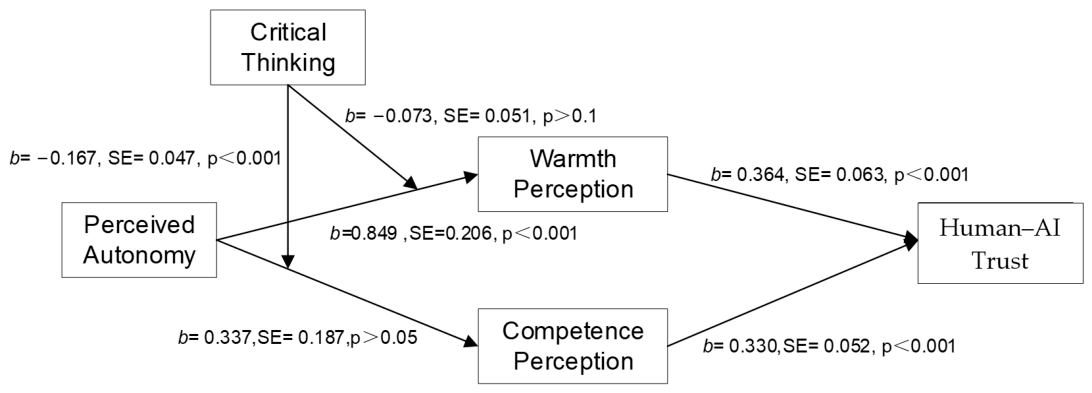
| PA → TRU | 0.343 | 0.062 | 5.571 | 0.216 | 0.470 |
| Indirect Effect | |||||
| PA → WP → TRU (Path WP) | 0.204 | 0.039 | 5.294 | 0.132 | 0.289 |
| PA → CP → TRU (Path CP) | −0.107 | 0.023 | −4.606 | −0.154 | −0.066 |
| Total Indirect Effect | 0.097 | 0.048 | 2.041 | 0.004 | 0.198 |
| Contrast | |||||
| Path WP vs. Path CP | 0.311 | 0.042 | 7.394 | 0.233 | 0.399 |
| Mediator | Critical Thinking | Indirect Effect | S.E. | 95% Percentile Confidence Interval | |
|---|---|---|---|---|---|
| Lower | Upper | ||||
| Warmth Perception | Low critical thinking (−1 sd) | 0.231 | 0.047 | 0.140 | 0.323 |
| High critical thinking (+1 sd) | 0.175 | 0.041 | 0.094 | 0.256 | |
| Between difference | −0.027 | 0.019 | −0.064 | 0.011 | |
| Index of Moderated Mediation | −0.027 | 0.019 | −0.064 | 0.011 | |
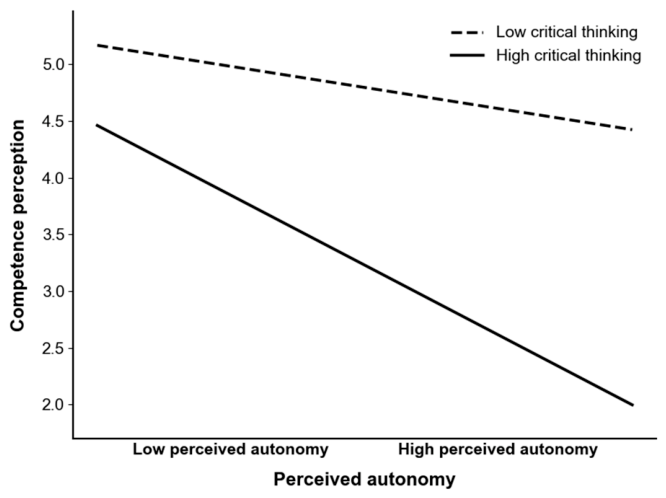
| Competence Perception | Low critical thinking (−1 sd) | −0.050 | 0.026 | −0.100 | 0.001 |
| High critical thinking (+1 sd) | −0.166 | 0.032 | −0.228 | −0.104 | |
| Between difference | −0.055 | 0.016 | −0.086 | −0.025 | |
| Index of Moderated Mediation | −0.055 | 0.016 | −0.086 | −0.025 | |
Disclaimer/Publisher’s Note: The statements, opinions and data contained in all publications are solely those of the individual author(s) and contributor(s) and not of MDPI and/or the editor(s). MDPI and/or the editor(s) disclaim responsibility for any injury to people or property resulting from any ideas, methods, instructions or products referred to in the content. |
© 2026 by the authors. Licensee MDPI, Basel, Switzerland. This article is an open access article distributed under the terms and conditions of the Creative Commons Attribution (CC BY) license.
Share and Cite
Cui, Z.; Xu, S.; Gao, J.; Geng, L.; Zhou, Y. Empowerment or Depletion? Unpacking the Asymmetrical Pathways from Perceived Autonomy to Human–AI Trust. Buildings 2026, 16, 2264. https://doi.org/10.3390/buildings16112264
Cui Z, Xu S, Gao J, Geng L, Zhou Y. Empowerment or Depletion? Unpacking the Asymmetrical Pathways from Perceived Autonomy to Human–AI Trust. Buildings. 2026; 16(11):2264. https://doi.org/10.3390/buildings16112264
Chicago/Turabian StyleCui, Zhipeng, Shuai Xu, Jiong Gao, Linna Geng, and Yuening Zhou. 2026. "Empowerment or Depletion? Unpacking the Asymmetrical Pathways from Perceived Autonomy to Human–AI Trust" Buildings 16, no. 11: 2264. https://doi.org/10.3390/buildings16112264
APA StyleCui, Z., Xu, S., Gao, J., Geng, L., & Zhou, Y. (2026). Empowerment or Depletion? Unpacking the Asymmetrical Pathways from Perceived Autonomy to Human–AI Trust. Buildings, 16(11), 2264. https://doi.org/10.3390/buildings16112264