The Randomness Analysis of Shrinkage and Creep Mechanical Behavior in Continuous Rigid-Frame Bridges with Ultra-High Piers

Abstract
1. Introduction
2. Random Analysis Method for Shrinkage and Creep
2.1. Probabilistic Modeling of Creep Random Variables
2.2. Response Surface Fitting Technique
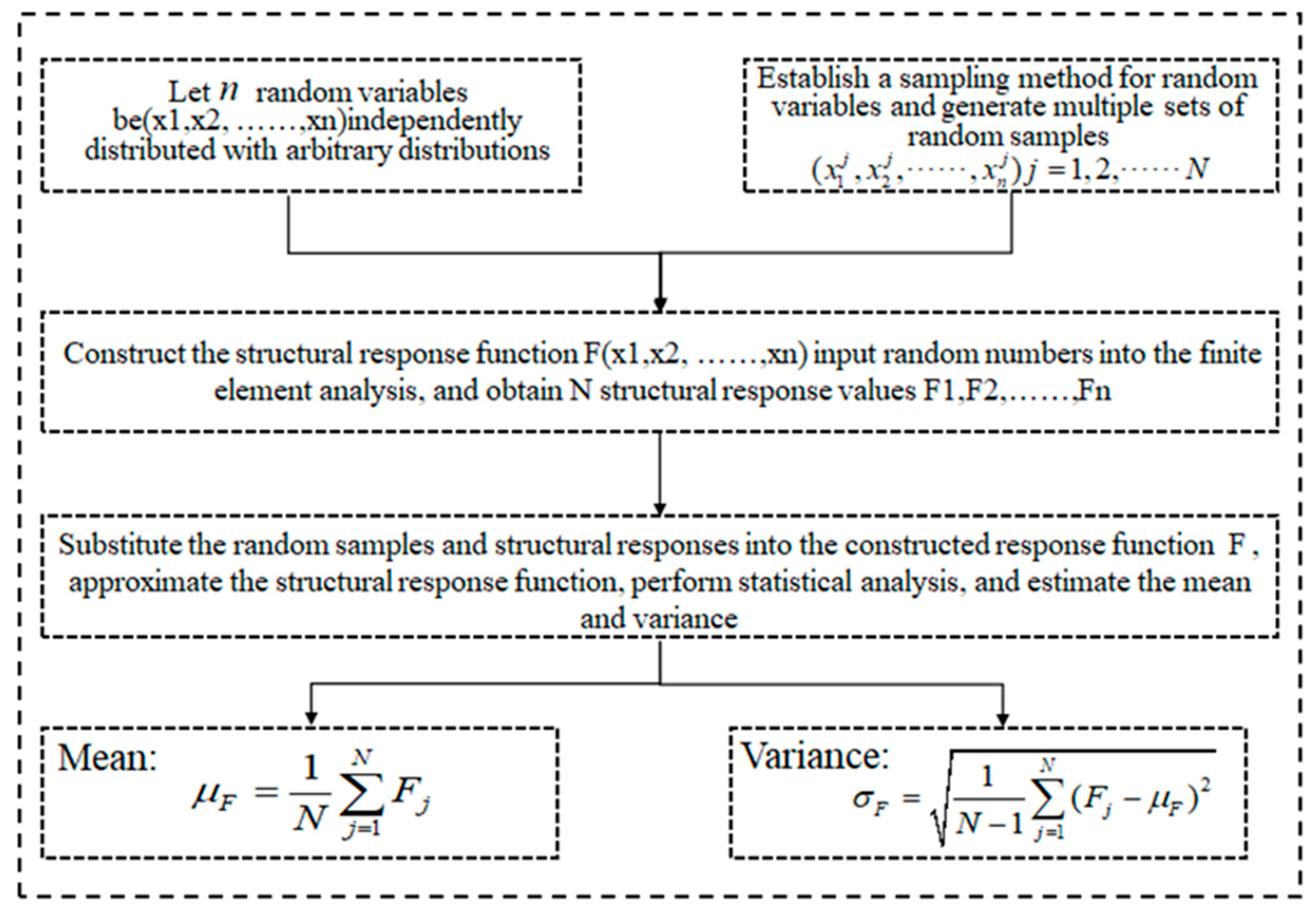
2.3. MCS Random Analysis Method
2.4. Random Analysis Method for Creep Response Based on Response Surface and MCS
2.4.1. Response Surface Method Based on Monte Carlo Sampling
2.4.2. Random Factor Sampling Points
2.4.3. Sensitivity of Random Variables
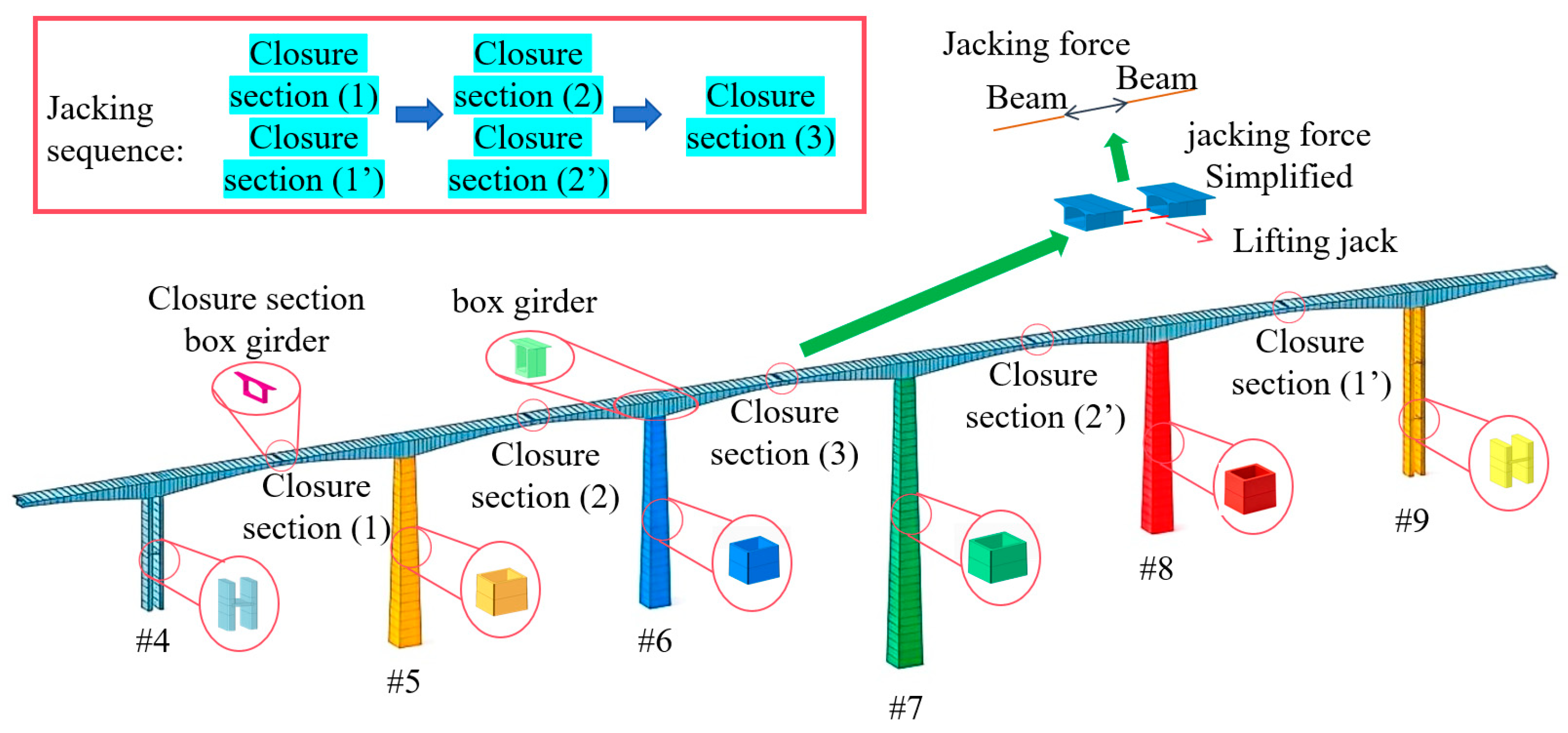
3. Engineering Background and Finite Element Model
4. Results and Discussion
4.1. Random Response Analysis of Bridge Shrinkage and Creep
4.1.1. Response Surface Fitting
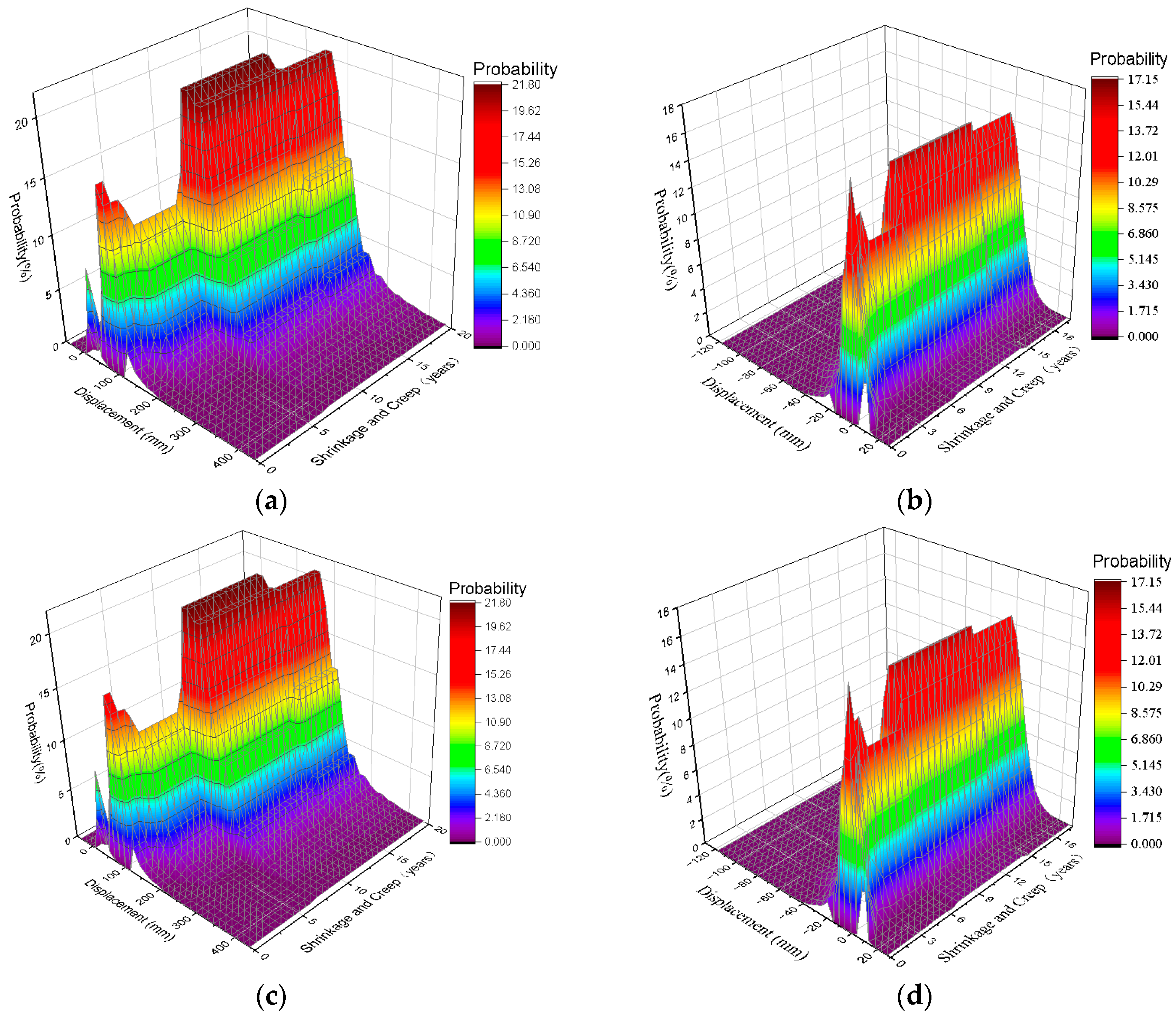
4.1.2. Long-Term Behavior Prediction of Bridge Responses
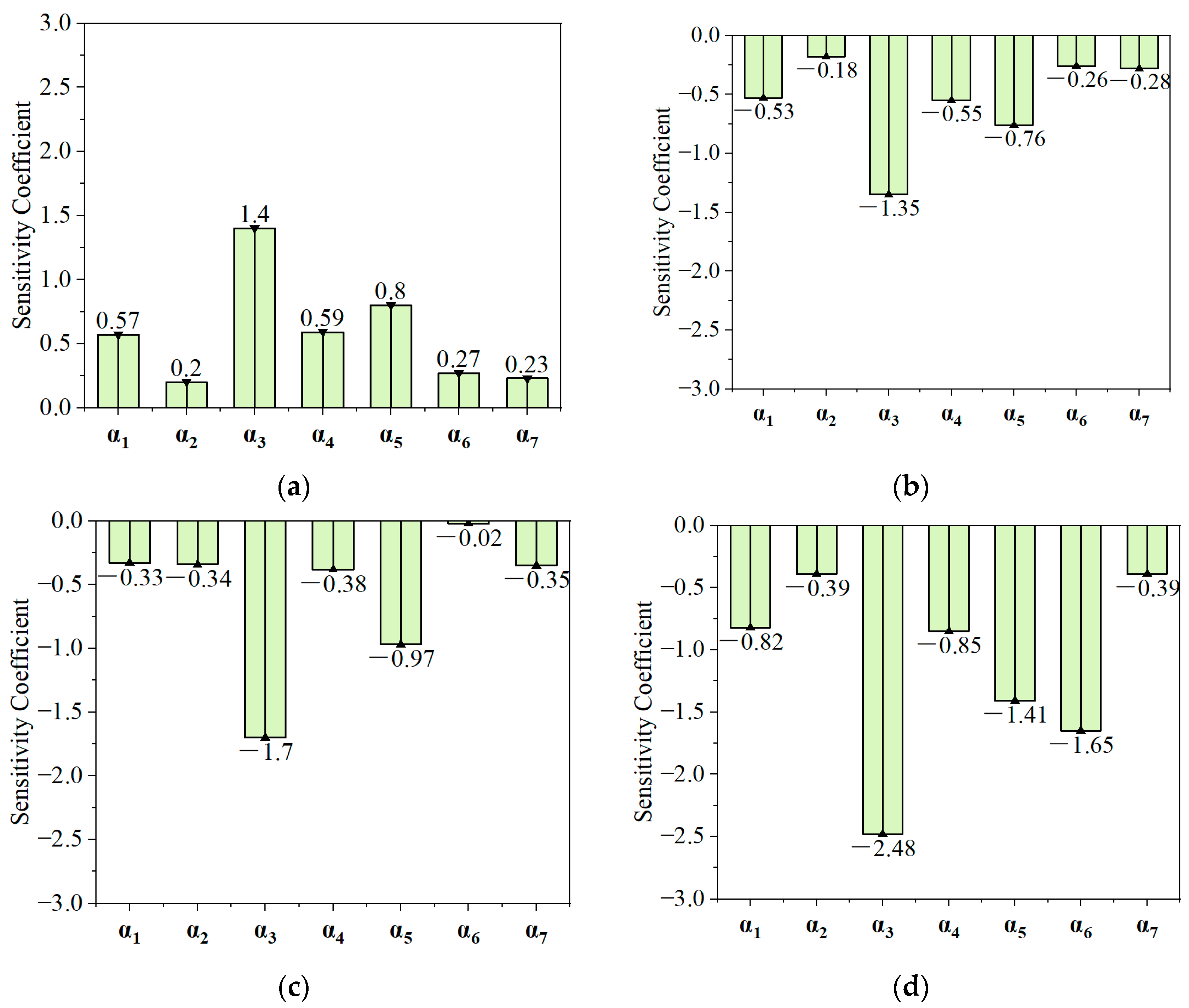
4.2. Sensitivity Analysis of Creep Parameters
4.3. Analysis of the Impact of Creep Randomness on Pushing Force
4.3.1. Determination of Pushing Stiffness and Calculation of Pier Top Displacement
4.3.2. Analysis of the Impact of Creep Randomness on Pushing Force
4.4. Comparison Between Linear and Nonlinear Analysis Results of the Main Girder Flange
5. Conclusions
- (1)
- For continuous rigid-frame bridges featuring ultra-high piers, structural nonlinearity exhibits a considerable influence on the mechanical performance and internal force distribution. Therefore, nonlinear effects should be rigorously considered in both structural analysis and design procedures.
- (2)
- The uncertainty of the concrete shrinkage and creep model leads to significant randomness in the mid-span displacement, pier base moment, and longitudinal horizontal displacement at the top of the piers during operation. Deterministic analysis based on code-specified shrinkage and creep models is insufficient to guarantee the safety and reliability of structural design. Therefore, the influence of randomness on structural response should be systematically considered in the calculation and design of pushing forces.
- (3)
- The creep model, concrete compressive strength, and elastic modulus of concrete are identified as key random variables that govern time-dependent stress. Additionally, the randomness of environmental humidity cannot be neglected. By contrast, the random factor associated with the shrinkage model has a relatively minor influence on the long-term deformation of long-span continuous rigid-frame bridges with high piers.
- (4)
- The probability density functions of mid-span section deflection and pier-base stress approximately follow a symmetric normal distribution. The horizontal longitudinal displacement at the top of the piers exhibits a significant asymmetric distribution and approximately follows a log-normal distribution. The Monte Carlo method based on the response surface can obtain the 2.28% and 97.72% percentiles of the structural response, which are used as the range of structural response values. The pushing force calculated at the value with the maximum probability distribution differs from the deterministically obtained pushing force by a factor of 1.16, and its influence cannot be ignored.
- (5)
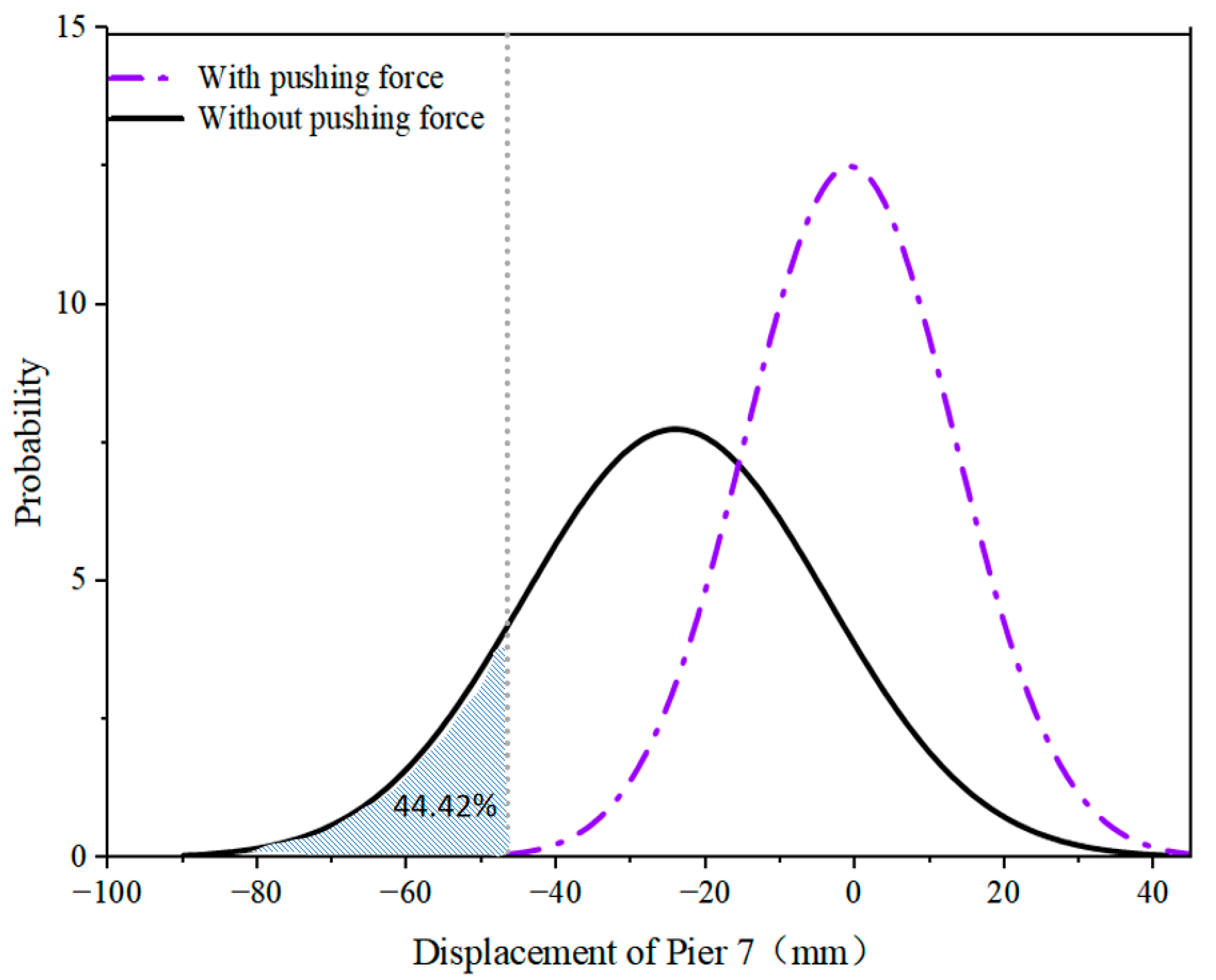
- The longitudinal displacement at the top of the piers obtained after pushing with the calculated pushing force is more favorable than that without the pushing force. This indicates that the randomness of concrete shrinkage and creep has a significant influence on the pushing force of continuous rigid-frame bridges with ultra-high piers. Therefore, it is essential to account for the randomness of concrete shrinkage and creep in determining a reasonable pushing force.
Author Contributions
Funding
Data Availability Statement
Conflicts of Interest
References
- Zhao, R.; Yuan, Y.; Wei, X.; Shen, R.; Zheng, K.; Qian, Y.; Pu, Q.; Zhang, Q.; Liao, H.; Li, X.; et al. Correction to: Review of annual progress of bridge engineering in 2019. Adv. Bridge Eng. 2020, 1, 12. [Google Scholar] [CrossRef]
- Zhang, G.; Wu, C. Discussion on the design of pushing force for the closure segment of continuous rigid-frame bridges. China Foreign Highw. 2011, 31, 119–123. [Google Scholar]
- Yao, G.; Song, W.; Zhou, Z. Optimization of horizontal pushing force and closure sequence of multi-span continuous rigid-frame bridges. Highw. Automot. Transp. 2008, 1, 91–93. [Google Scholar]
- Luan, K.; Zhang, X.; Gao, H. Optimization calculation method for closure pushing force of continuous rigid-frame bridges. J. Ludong Univ. Nat. Sci. Ed. 2011, 27, 92–96. [Google Scholar]
- ACI Committee 209. Prediction of Creep, Shrinkage, and Temperature Effects in Concrete Structures; American Concrete Institute: Detroit, MI, USA, 1992. [Google Scholar]
- Comité Euro-International du Béton. CEB-FIP Model Code 1990: Design Code; Thomas Telford Publishing: Lausanne, Switzerland, 1993. [Google Scholar]
- Gardner, N.; Lockman, M. Design Provisions Creep and Shrinkage of Normal Strength Concrete. ACI Mater. J. 2001, 98, 159–167. [Google Scholar]
- American Association of State and Highway Transportation Officials. LRFD Bridge Design Specifications, 8th ed.; AASHTO: Washington, DC, USA, 2017. [Google Scholar]
- Bažant, Z.P.; Jirasek, M.; Hubler, M.H.; Carol, I. RILEM draft recommendation: TC-242-MDC multi-decade creep and shrinkage of concrete: Material model and structural analysis. Mater. Struct. 2015, 48, 753–770. [Google Scholar]
- Joost, W.; Bigaj, A. The 2010 fib Model Code for Concrete Structures: A new approach to structural engineering. Struct. Concr. J. FIB 2011, 12, 139–147. [Google Scholar]
- Bažant, Z.P.; Liu, K.L. Random creep and shrinkage in structures: Ambling. J. Struct. Eng. 1985, 111, 1113–1134. [Google Scholar] [CrossRef]
- Diamantidis, D.; Madsen, H.O.; Rackwitz, R. On the variability of the creep coefficient of structural concrete. Matériaux Constr. 1984, 17, 321–328. [Google Scholar] [CrossRef]
- Liu, H.; Hu, B.; Zhang, R.; Yang, X. Analysis of closure pushing force for high-pier large-span continuous rigid-frame bridges. Heilongjiang Transp. Sci. Technol. 2022, 45, 66–68. [Google Scholar]
- Wang, C. A stochastic process model for resistance deterioration of aging bridges. Adv. Bridge Eng. 2020, 1, 1600–1621. [Google Scholar] [CrossRef]
- Xiang, T.; Yang, C.; Zhao, G. Stochastic creep and shrinkage effect of steel-concrete composite beam. Adv. Struct. Eng. 2015, 18, 1129–1140. [Google Scholar] [CrossRef]
- Criel, P.; Reybrouck, N.; Caspeele, R.; Matthys, S. Uncertainty quantification of creep in concrete by Taylor expansion. Eng. Struct. 2017, 153, 334–341. [Google Scholar] [CrossRef]
- Jia, S.; Akiyama, M.; Han, B.; Frangopol, D.M. Probabilistic structural identification and condition assessment of prestressed concrete bridges based on Bayesian inference using deflection measurements. Struct. Infrastruct. Eng. 2024, 20, 131–147. [Google Scholar] [CrossRef]
- Tonelli, D.; Beltempo, A.; Cappello, C.; Bursi, O.S.; Zonta, D. Reliability analysis of complex structures based on Bayesian inference. Struct. Health Monit.-Int. J. 2023, 22, 3481–3497. [Google Scholar] [CrossRef]
- Zemed, N.; Abdelali, H.M.; Cherradi, T.; Bouyahyaoui, A.; Mouzoun, K. Time-Dependent Reliability and Sensitivity Analysis of Reinforced Concrete Bridges Considering Creep, Shrinkage, and Evolving Traffic Using Active Learning. J. Bridge Eng. 2026, 31, 04025093. [Google Scholar] [CrossRef]
- Tong, T.; Li, X.; Wu, S.; Wang, H.; Wu, D. Surrogate modeling for the long-term behavior of PC bridges via FEM analyses and long short-term neural networks. Structures 2024, 63, 106309. [Google Scholar] [CrossRef]
- Yan, X.; Jia, S.; Jia, S.; Gao, J.; Peng, J. Bayesian Inference and Condition Assessment Based on the Deflection of Aging Reinforced Concrete Hollow Slab Bridges. Buildings 2024, 14, 2920. [Google Scholar] [CrossRef]
- Pishro, A.A.; Tsavdaridis, K.D.; Liu, Y.; Zhang, S. Strengthening Structural Dynamics for Upcoming Eurocode 8 Seismic Standards Using Physics-Informed Machine Learning. Buildings 2025, 15, 3960. [Google Scholar] [CrossRef]
- Tong, T.; Li, X.; Wu, S.; Wu, D.; Wang, H. Bayesian inference for long-term reliability analysis of large-scale PC bridges utilizing a neural network surrogate model enhanced with asymptotic control. Structures 2025, 80, 109452. [Google Scholar] [CrossRef]
- Yang, I.H. Uncertainty and sensitivity analysis of time-dependent effects in concrete structures. Eng. Struct. 2007, 29, 1366–1374. [Google Scholar] [CrossRef]
- Zhang, Y.; Meng, S. Long-term deformation prediction of large-span continuous rigid-frame bridges based on response surface method. J. China Civ. Eng. Soc. 2011, 44, 102–106. [Google Scholar]
- Madsen, H.O.; Bažant, Z.P. Uncertainty analysis of creep and shrinkage effects in concrete structures. ACI J. 1983, 80, 116–127. [Google Scholar]
- Bažant, Z.P.; Li, G.H. Unbiased statistical comparison of creep and shrinkage prediction models. ACI Mater. J. 2008, 105, 610–621. [Google Scholar] [CrossRef]
- Lin, P.; Zhou, S. Study on shear lag effect of box girder based on shear deformation theory. J. Railw. Acad. 2011, 33, 100–104. [Google Scholar]
- Bucher, C.G.; Bourgund, U. A fast and efficient response surface approach for structural reliability problems. Struct. Saf. 1990, 7, 57–66. [Google Scholar] [CrossRef]
- Zhong, Z.; Li, L.; Zhang, Z.; Wang, G. Discussion on the closure technology of high-pier multi-spa continuous rigid-frame bridges. Highw. Transp. Technol. 2023, 39, 48–56. [Google Scholar]
- Pan, Z.; Fu, C.C.; Jiang, Y. Uncertainty Analysis of Creep and Shrinkage Effects in Long-Span Continuous Rigid Frame of Sutong Bridge. J. Bridge Eng. 2011, 16, 248–258. [Google Scholar] [CrossRef]
- Fang, Z.L.; Yu, M.L. Stochastic Finite Element Analysis for Shrinkage and Creep of a Concrete Bridge Based on LHS. Adv. Mater. Res. 2010, 163–167, 1744–1748. [Google Scholar] [CrossRef]
- Hu, Z.J.; Wang, Z.K.; Li, Y.S. Optimization of Closure Jacking Scheme for Multi-span Continuous Rigid-frame Bridges. J. Highw. Transp. Res. Dev. 2024, 41, 137–145. [Google Scholar]
- Qiu, H.F.; Liu, K.; Wang, C.; Chen, J. Study on Influence of Mid-span Closure Jacking on Long-term Deflection of High-pier Long-span Continuous Rigid-frame Bridges. Constr. Des. Eng. 2025, 22, 68–70. [Google Scholar]
- Zhang, Z.Y.; Zhao, R.D.; Xu, T.F. Long-term Deformation Prediction of Concrete Structures Based on Modified Variable Distribution. Chin. J. Comput. Mech. 2016, 33, 418–423. [Google Scholar]





| Description | Symbol | Distribution Type | Mean | Coefficient of Variation |
|---|---|---|---|---|
| Randomness in Creep Model [6] | α1 | Normal Distribution | 1.0 | 0.35 |
| Randomness in Shrinkage Model [6] | α2 | Normal Distribution | 1.0 | 0.46 |
| Randomness in Compressive Strength [25] | α3 | Normal Distribution | 1.0 | 0.1 |
| Randomness in Elastic Modulus [26] | α4 | Normal Distribution | 1.0 | 0.2 |
| Randomness in Environmental Humidity [27] | α5 | Normal Distribution | 1.0 | 0.16 |
| Randomness in Loading Age [26] | α6 | Uniform Distribution | 1.0 | 0.11 |
| Randomness in Self-weight Load [26] | α7 | Normal Distribution | 1.0 | 0.05 |
| Case | a1 | a2 | a3 | a4 | a5 | a6 | a7 |
|---|---|---|---|---|---|---|---|
| 1 | 1.0 | 1.0 | 1.0 | 1.0 | 1.0 | 1.0 | 1.0 |
| 2 | 0.65 | 1.0 | 1.0 | 1.0 | 1.0 | 1.0 | 1.0 |
| 3 | 1.35 | 1.0 | 1.0 | 1.0 | 1.0 | 1.0 | 1.0 |
| 4 | 1.0 | 0.54 | 1.0 | 1.0 | 1.0 | 1.0 | 1.0 |
| 5 | 1.0 | 1.46 | 1.0 | 1.0 | 1.0 | 1.0 | 1.0 |
| 6 | 1.0 | 1.0 | 0.9 | 1.0 | 1.0 | 1.0 | 1.0 |
| 7 | 1.0 | 1.0 | 1.1 | 1.0 | 1.0 | 1.0 | 1.0 |
| 8 | 1.0 | 1.0 | 1.0 | 0.8 | 1.0 | 1.0 | 1.0 |
| 9 | 1.0 | 1.0 | 1.0 | 1.2 | 1.0 | 1.0 | 1.0 |
| 10 | 1.0 | 1.0 | 1.0 | 1.0 | 0.84 | 1.0 | 1.0 |
| 11 | 1.0 | 1.0 | 1.0 | 1.0 | 1.16 | 1.0 | 1.0 |
| 12 | 1.0 | 1.0 | 1.0 | 1.0 | 1.0 | 0.89 | 1.0 |
| 13 | 1.0 | 1.0 | 1.0 | 1.0 | 1.0 | 1.11 | 1.0 |
| 14 | 1.0 | 1.0 | 1.0 | 1.0 | 1.0 | 1.0 | 0.95 |
| 15 | 1.0 | 1.0 | 1.0 | 1.0 | 1.0 | 1.0 | 1.05 |
| Symbol | Bending Moment at Pier Base (103 kN) | Mid-Span Displacement (mm) | Horizontal Longitudinal Displacement at the Pier Top (mm) | |||||
|---|---|---|---|---|---|---|---|---|
| Pier #4 | Pier #5 | Pier #6 | Pier #7 | Pier #8 | Pier #9 | |||
| a | −667.02 | −120.51 | 1271.02 | 645.20 | 128.87 | 355.69 | −856.77 | 1535.34 |
| b1 | −12.92 | −8.09 | 85.48 | 40.99 | 5.92 | −20.07 | −55.70 | −101.15 |
| b2 | −15.85 | −2.21 | 25.52 | 13.70 | 3.04 | −7.53 | −17.81 | −30.33 |
| b3 | 1054.72 | 201.89 | 2143.59 | 1100.39 | 220.43 | 599.39 | 1455.80 | 2580.52 |
| b4 | 82.68 | 18.39 | −210.22 | −102.88 | −13.98 | 45.18 | 136.52 | 246.24 |
| b5 | −48.00 | −3.53 | 40.82 | 23.37 | 6.81 | −14.87 | −29.87 | −49.29 |
| b6 | 28.96 | −23.79 | 271.54 | 115.73 | −5.97 | −17.42 | −159.37 | −295.23 |
| b7 | 18.40 | 3.65 | −34.30 | −10.46 | −2.12 | 8.72 | 16.19 | 43.32 |
| c1 | −1.36 | 0.80 | −6.62 | −2.93 | −0.52 | 2.04 | 4.37 | 8.13 |
| c2 | 0.00 | 0.00 | 0.00 | 0.00 | 0.00 | 0.00 | 0.00 | 0.00 |
| c3 | −486.61 | −92.71 | 982.20 | 504.37 | 101.44 | 275.55 | −667.32 | 1183.24 |
| c4 | −32.19 | −5.86 | 67.79 | 33.29 | 4.48 | −14.36 | −44.00 | −79.28 |
| c5 | 47.23 | 6.41 | −72.02 | −38.03 | −8.24 | 21.02 | 49.81 | 85.95 |
| c6 | −15.06 | 13.47 | −152.96 | −65.38 | 3.08 | 10.30 | 89.97 | 166.60 |
| c7 | −0.91 | −0.11 | 2.80 | 1.38 | 0.38 | −0.54 | −1.56 | −4.02 |
| Construction Stage | Parameter | Bending Moment at Pier Base | Mid-Span Displacement (mm) | Horizontal Longitudinal Displacement at the Pier Top (mm) | |||||
|---|---|---|---|---|---|---|---|---|---|
| Pier #4 | Pier #5 | Pier #6 | Pier #7 | Pier #8 | Pier #9 | ||||
| Completion Stage | R2 | 0.99 | 0.96 | 0.97 | 0.97 | 0.93 | 1.00 | 0.99 | 0.95 |
| MSE | 1.30 | 0.03 | 0.09 | 0.07 | 0.01 | 0.00 | 0.00 | 0.02 | |
| Shrinkage and Creep 1 Year | R2 | 0.98 | 0.94 | 0.98 | 0.98 | 0.97 | 0.93 | 0.96 | 0.97 |
| MSE | 1.49 | 0.14 | 1.09 | 1.00 | 0.25 | 0.01 | 0.07 | 0.44 | |
| Shrinkage and Creep 2 Year | R2 | 0.99 | 0.93 | 0.98 | 0.98 | 0.97 | 0.95 | 0.96 | 0.97 |
| MSE | 1.40 | 0.19 | 1.45 | 1.23 | 0.39 | 0.01 | 0.11 | 0.69 | |
| Shrinkage and Creep 3 Year | R2 | 0.99 | 0.92 | 0.98 | 0.98 | 0.97 | 0.96 | 0.97 | 0.97 |
| MSE | 1.38 | 0.23 | 1.45 | 1.40 | 0.71 | 0.13 | 0.38 | 0.94 | |
| Shrinkage and Creep 10 Year | R2 | 0.99 | 0.89 | 0.98 | 0.98 | 0.98 | 0.97 | 0.97 | 0.98 |
| MSE | 1.50 | 0.36 | 1.24 | 1.79 | 0.92 | 0.18 | 0.49 | 1.21 | |
| Shrinkage and Creep 20 Year | R2 | 0.96 | 0.86 | 0.98 | 0.98 | 0.98 | 0.97 | 0.98 | 0.98 |
| MSE | 1.32 | 0.44 | 1.48 | 1.32 | 0.99 | 0.20 | 0.54 | 1.31 | |
| Construction Stage | Parameter | Bending Moment at Pier Base (103 kN) | Mid-Span Displacement (mm) | Probability Distribution of Displacement at the Top of Pier #7 (mm) |
|---|---|---|---|---|
| Completion Stage | Mean | 14.92 | −3.82 | 9.38 |
| Variance | 4.42 | 0.71 | 1.38 | |
| Shrinkage and Creep 1 Year | Mean | −26.32 | −8.5 | −5.98 |
| Variance | 16.41 | 2.67 | 6.88 | |
| Shrinkage and Creep 2 Year | Mean | −33.54 | −10.19 | −11.34 |
| Variance | 17.13 | 3.35 | 8.84 | |
| Shrinkage and Creep 3 Year | Mean | −40.77 | −11.31 | −15.21 |
| Variance | 19.3 | 3.86 | 10.31 | |
| Shrinkage and Creep 10 Year | Mean | −58.12 | −14.14 | −25.14 |
| Variance | 22.86 | 4.7 | 13.83 | |
| Shrinkage and Creep 20 Year | Mean | −84.13 | −15.44 | −29.30 |
| Variance | 30.61 | 5.28 | 15.45 |
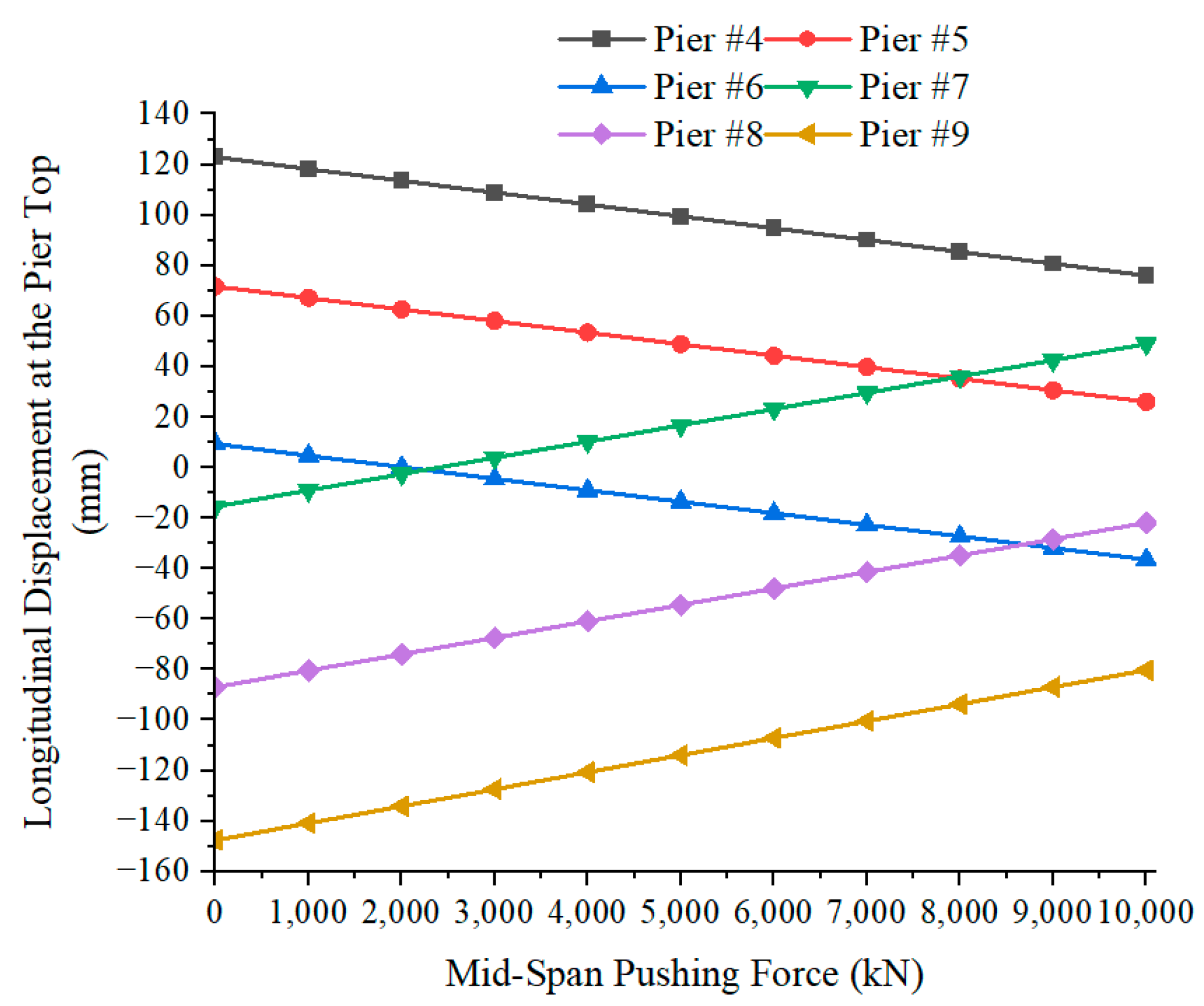
| Push Force (103 kN) | 0 | 1 | 2 | 3 | 4 | 5 | 6 | 7 | 8 | 9 | 10 |
| Pier #4 | 122.99 | 118.3 | 113.61 | 108.92 | 104.23 | 99.54 | 94.85 | 90.16 | 85.47 | 80.78 | 76.09 |
| Pier #5 | 71.78 | 67.21 | 62.64 | 58.07 | 53.5 | 48.93 | 44.36 | 39.79 | 35.22 | 30.65 | 26.08 |
| Pier #6 | 9.38 | 4.8 | 0.22 | −4.36 | −8.94 | −13.52 | −18.1 | −22.68 | −27.26 | −31.84 | −36.42 |
| Pier #7 | −15.43 | −8.99 | −2.55 | 3.89 | 10.33 | 16.77 | 23.21 | 29.65 | 36.09 | 42.53 | 48.97 |
| Pier #8 | −86.91 | −80.4 | −73.89 | −67.38 | −60.87 | −54.36 | −47.85 | −41.34 | −34.83 | −28.32 | −21.81 |
| Pier #9 | −147.59 | −140.85 | −134.11 | −127.37 | −120.63 | −113.89 | −107.15 | −100.41 | −93.67 | −86.93 | −80.19 |
| Parameter | Pier #4 | Pier #5 | Pier #6 | Pier #7 | Pier #8 | Pier #9 |
|---|---|---|---|---|---|---|
| 26.35 | 8.10 | −5.82 | 6.22 | −12.81 | −27.35 | |
| 0.7 × Standard | 75.00 | 33.55 | 0.86 | −10.19 | −46.53 | −86.22 |
| 0.7 × max | 183.75 | 61.25 | 3.85 | −26.25 | −98 | 161 |
Disclaimer/Publisher’s Note: The statements, opinions and data contained in all publications are solely those of the individual author(s) and contributor(s) and not of MDPI and/or the editor(s). MDPI and/or the editor(s) disclaim responsibility for any injury to people or property resulting from any ideas, methods, instructions or products referred to in the content. |
© 2026 by the authors. Licensee MDPI, Basel, Switzerland. This article is an open access article distributed under the terms and conditions of the Creative Commons Attribution (CC BY) license.
Share and Cite
Jiang, H.; An, F.; Xiang, H.; Feng, T.; Li, B.; Shao, J. The Randomness Analysis of Shrinkage and Creep Mechanical Behavior in Continuous Rigid-Frame Bridges with Ultra-High Piers. Buildings 2026, 16, 2228. https://doi.org/10.3390/buildings16112228
Jiang H, An F, Xiang H, Feng T, Li B, Shao J. The Randomness Analysis of Shrinkage and Creep Mechanical Behavior in Continuous Rigid-Frame Bridges with Ultra-High Piers. Buildings. 2026; 16(11):2228. https://doi.org/10.3390/buildings16112228
Chicago/Turabian StyleJiang, Haijun, Fulin An, Hui Xiang, Tao Feng, Binghui Li, and Junhu Shao. 2026. "The Randomness Analysis of Shrinkage and Creep Mechanical Behavior in Continuous Rigid-Frame Bridges with Ultra-High Piers" Buildings 16, no. 11: 2228. https://doi.org/10.3390/buildings16112228
APA StyleJiang, H., An, F., Xiang, H., Feng, T., Li, B., & Shao, J. (2026). The Randomness Analysis of Shrinkage and Creep Mechanical Behavior in Continuous Rigid-Frame Bridges with Ultra-High Piers. Buildings, 16(11), 2228. https://doi.org/10.3390/buildings16112228