Correlation Between Neighborhood Environment and Mental Well-Being of Older Adults: A Perspective Based on the Old Urban Residential Communities †

Abstract
1. Introduction
2. Literature Review and Conceptual Framework
2.1. Neighborhood Environment and Individual Health
2.2. Neighborhood Environment and Mental Well-Being of Older Adults
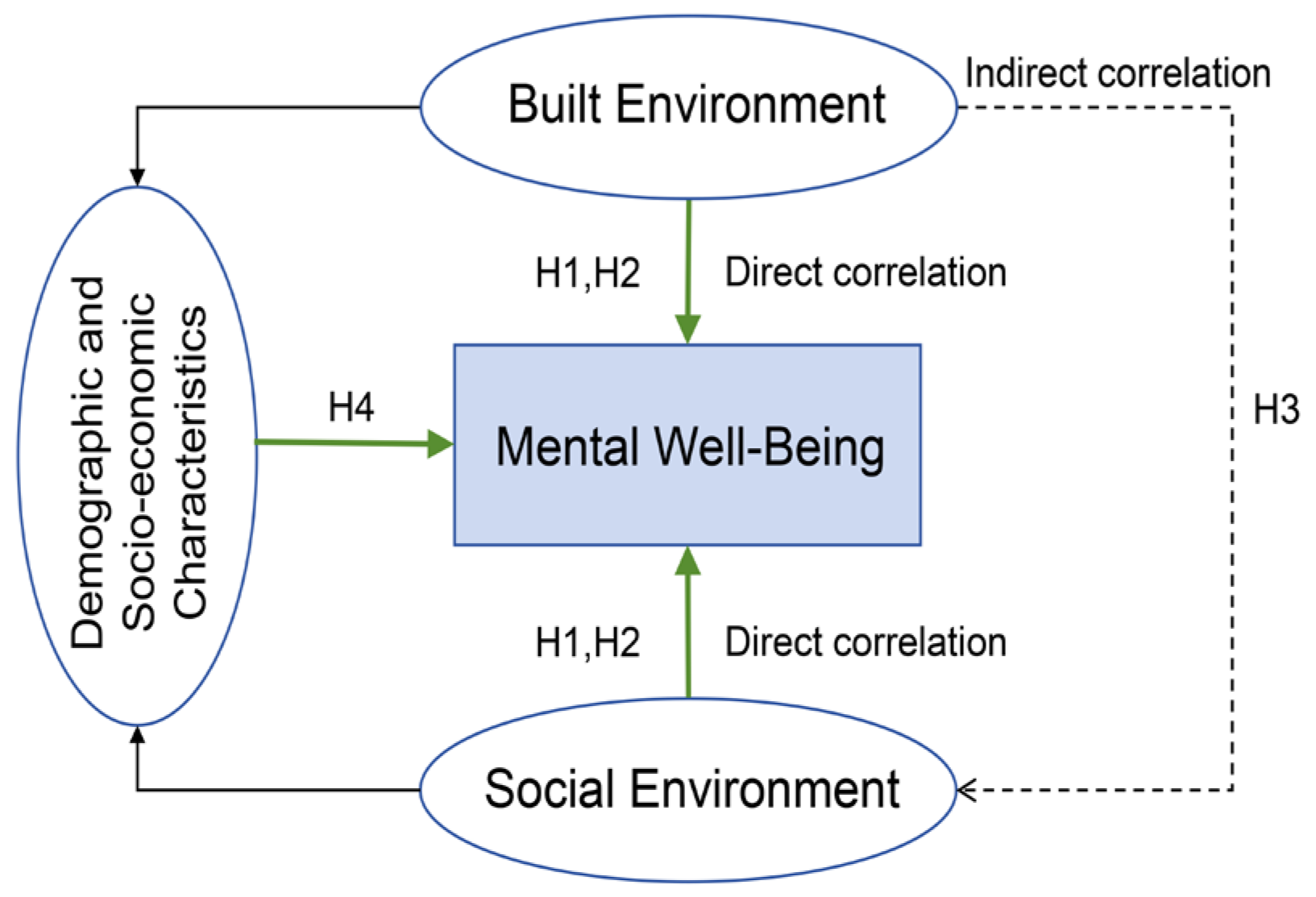
2.3. Conceptual Framework
3. Materials and Methods
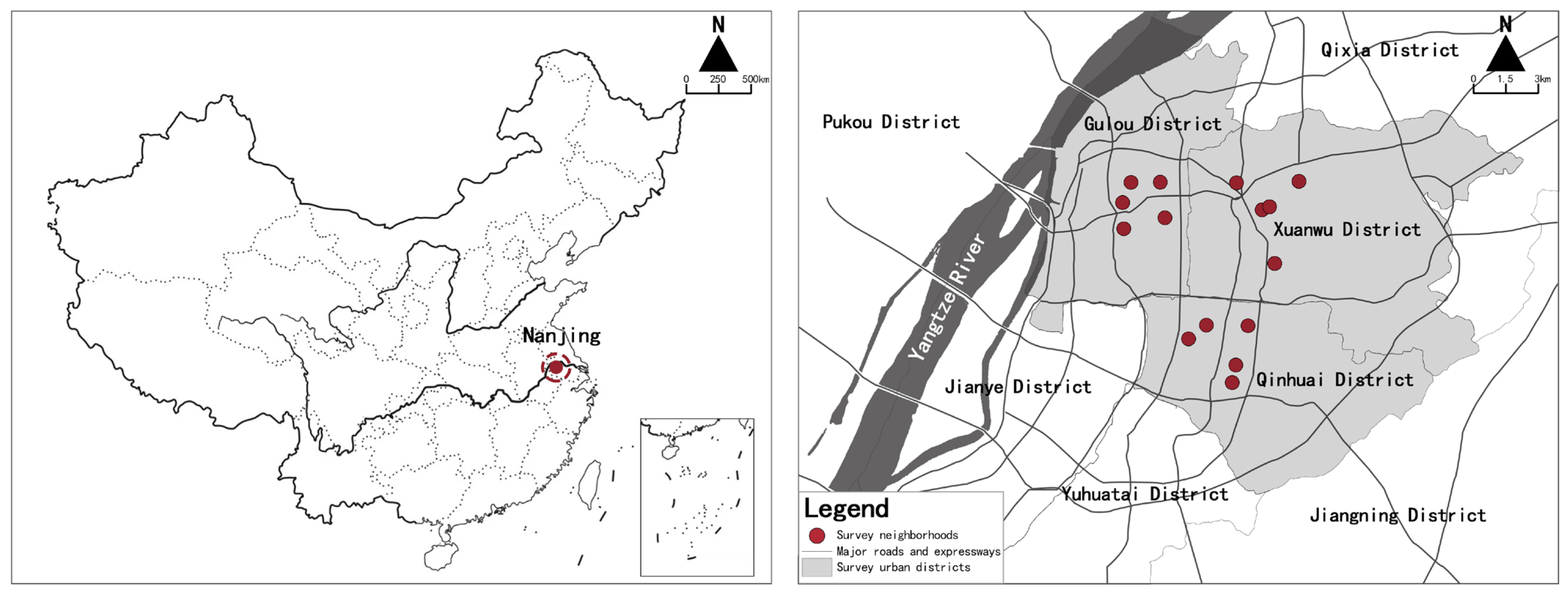
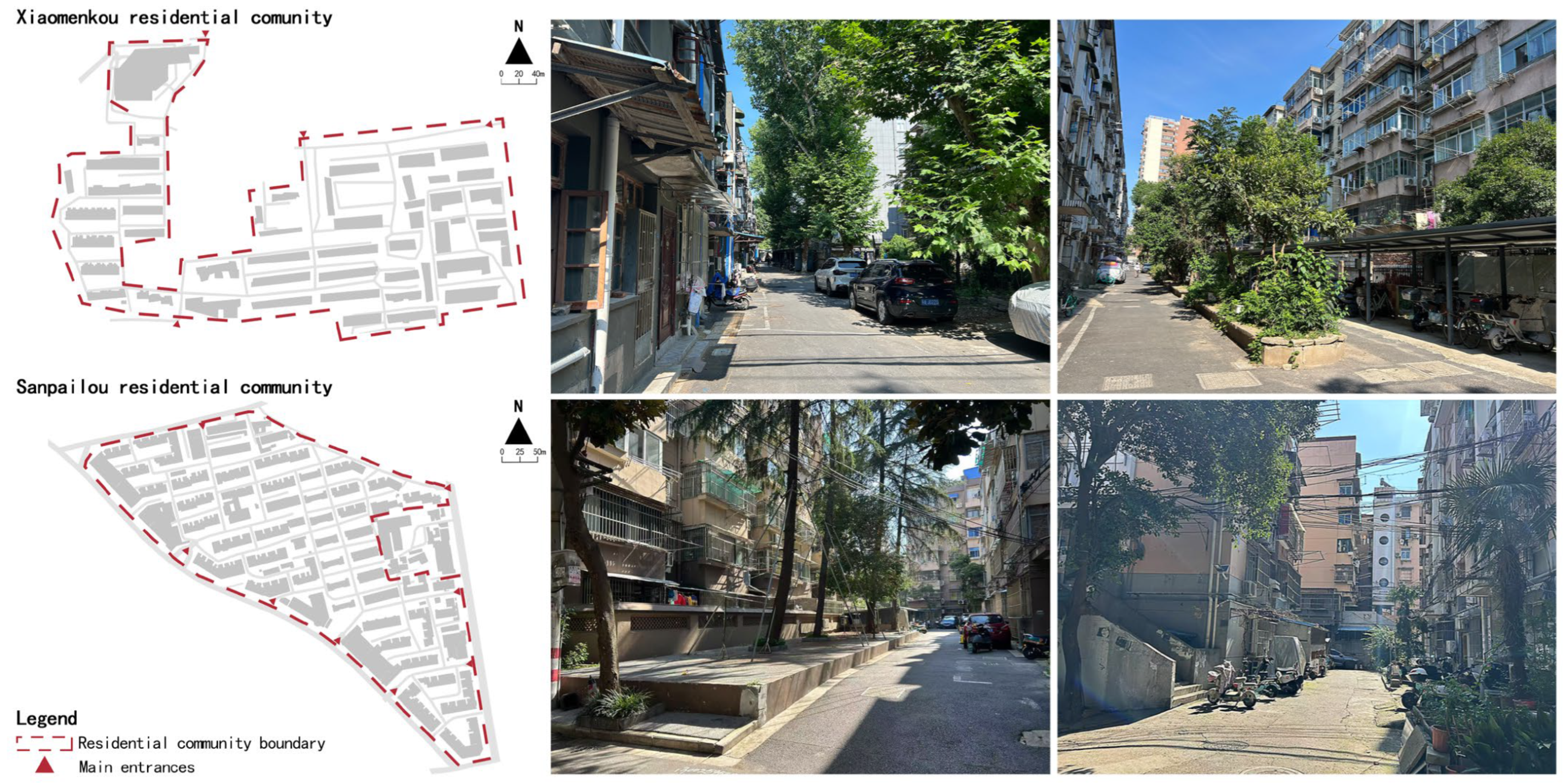
3.1. Study Area and Data Collection
3.2. Variable Measurement
3.3. Data Analysis
4. Results
4.1. Descriptive Statistics Results
4.2. Analysis of the Correlation of the Neighborhood Environment with the MW of Older Adults
4.3. Moderating Effects of Demographic and Socioeconomic Factors
4.4. Analysis of the Correlation of Neighborhood Environment Factors with the MW of Older Adults
5. Discussion
6. Conclusions
Supplementary Materials
Author Contributions
Funding
Institutional Review Board Statement
Informed Consent Statement
Data Availability Statement
Acknowledgments
Conflicts of Interest
Abbreviations
References
- WHO. Ageing and Health. 2022. Available online: https://www.who.int/news-room/fact-sheets/detail/ageing-and-health (accessed on 20 April 2025).
- Hu, T.; Zhao, X.; Wu, M.; Li, Z.; Luo, L.; Yang, C.; Yang, F. Prevalence of depression in older adults: A systematic review and meta-analysis. Psychiatry Res. 2022, 311, 114511. [Google Scholar] [CrossRef]
- Han, Y.; He, Y.; Lyu, J.; Yu, C.; Bian, M.; Lee, L. Aging in China: Perspectives on public health. Glob. Health J. 2020, 4, 11–17. [Google Scholar] [CrossRef]
- Tian, X. The Older Adult Population Will Account for About One-Third of China’s Population. Xinhua Net, 19 July 2018. Available online: http://www.xinhuanet.com/politics/2018-07/19/c_1123151410.htm (accessed on 12 January 2023).
- China Health and Retirement Longitudinal Study (CHARLS). China Health and Retirement Report. 2019. Available online: https://charls.pku.edu.cn/zhongguojiankangyuyanglaobaogao.pdf (accessed on 2 January 2024).
- Peng, S.; Maing, M. Influential factors of age-friendly neighborhood open space under high-density high-rise housing context in hot weather: A case study of public housing in Hong Kong. Cities 2021, 115, 103231. [Google Scholar] [CrossRef]
- Phillips, D.R.; Feng, Z. Challenges for the ageing family in the People’s Republic of China. Can. J. Aging 2015, 34, 290–304. [Google Scholar] [CrossRef] [PubMed]
- Liu, L.J.; Guo, Q. Life satisfaction in a sample of empty-nest elderly: A survey in the rural area of a mountainous county in China. Qual. Life Res. 2008, 17, 823–830. [Google Scholar] [CrossRef]
- Burton, E.J.; Mitchell, L.; Stride, C.B. Good places for ageing in place: Development of objective built environment measures for investigating links with older people’s wellbeing. BMC Public Health 2011, 11, 839. [Google Scholar] [CrossRef]
- Cagney, K.A.; Browning, C.R.; Wen, M. Racial and ethnic disparities in mobility and physical activity in older adults: The role of the built environment. J. Aging Health 2013, 25, 1033–1053. [Google Scholar]
- Kitchen, P.; Williams, A.; Chowhan, J. Sense of community belonging and health in Canada: A regional analysis. Soc. Indic. Res. 2012, 107, 103–126. [Google Scholar] [CrossRef]
- Liang, C.; Li, C. Practices and reflections on comprehensive renovation of old residential areas in Beijing. Constr. Sci. Technol. 2016, 9, 20–23. [Google Scholar] [CrossRef]
- General Office of the State Council of China. The Guidance of the General Office of the State Council Comprehensively on Promoting the Transformation of Old Urban Communities. 2020. Available online: http://www.gov.cn/zhengce/content/2020-07/20/content_5528320.htm?trs=1 (accessed on 5 March 2025).
- Kou, H.; Du, P. The logic, strategies and pathways of ageing adaptation in older communities. Soc. Sci. 2023, 7, 118–127. [Google Scholar] [CrossRef]
- Xiao, J.; Liu, H.; Wu, J. The status quos and causes of concentrated elderly populations in old urban communities in China. Sustainability 2022, 14, 12612. [Google Scholar] [CrossRef]
- Courgeau, D. Interaction between spatial mobility, family and career life-cycle: A French survey. Eur. Sociol. Rev. 1985, 1, 139–162. [Google Scholar] [CrossRef]
- Litwak, E.; Longino, C.F. Migration patterns among the elderly: A developmental perspective. Gerontologist 1987, 27, 266–272. [Google Scholar] [CrossRef] [PubMed]
- Hu, X.; Zhang, L.; Jin, G. Breaking and bridging: An empirical research on the neighborhood relationship among urban residents in Nanjing. Urban Insight 2020, 1, 153–164. [Google Scholar]
- Besser, L.M.; McDonald, N.C.; Song, Y.; Kukull, W.A.; Rodriguez, D.A. Neighborhood environment and cognition in older adults: A systematic review. Am. J. Prev. Med. 2017, 53, 241–251. [Google Scholar] [CrossRef] [PubMed]
- Liu, P.C.; Wang, J.; Wang, X.J.; Nie, W.J.; Zhen, F.F. Measuring the association of self-perceived physical and social neighborhood environment with health of Chinese rural residents. Int. J. Environ. Res. Public Health 2021, 18, 8380. [Google Scholar] [CrossRef]
- Liu, J.; Luo, Y.; Haller, W.; Vander Mey, B.; Granberg, E. Neighborhood environments and self-rated health in Mainland China, Japan and South Korea. PLoS ONE 2018, 13, e0204910. [Google Scholar] [CrossRef]
- Ma, L.; Kent, J.; Mulley, C. Transport disadvantage, social exclusion, and subjective well-being: The role of the neighborhood environment—Evidence from Sydney, Australia. J. Transp. Land Use 2018, 11, 31–47. [Google Scholar] [CrossRef]
- Barnett, A.; Van Dyck, D.; Van Cauwenberg, J.; Zhang, C.J.P.; Lai, P.C.; Cerin, E. Objective neighbourhood attributes as correlates of neighbourhood dissatisfaction and the mediating role of neighbourhood perceptions in older adults from culturally and physically diverse urban environments. Cities 2020, 107, 102879. [Google Scholar] [CrossRef]
- Severance, J.H.; Zinnah, S.L. Community-based perceptions of neighborhood health in urban neighborhoods. J. Community Health Nurs. 2009, 26, 14–23. [Google Scholar] [CrossRef]
- Fong, P.; Cruwys, T.; Haslam, C.; Haslam, S.A. Neighbourhood identification and mental health: How social identification moderates the relationship between socioeconomic disadvantage and health. J. Environ. Psychol. 2019, 61, 101–114. [Google Scholar] [CrossRef]
- Wen, M.; Fan, J.; Jin, L.; Wang, G. Neighborhood effects on health among migrants and natives in Shanghai, China. Health Place 2010, 16, 452–460. [Google Scholar] [CrossRef]
- Liu, Y.; Dijst, M.; Faber, J.; Geertman, S.; Cui, C. Healthy urban living: Residential environment and health of older adults in Shanghai. Health Place 2017, 47, 80–89. [Google Scholar] [CrossRef] [PubMed]
- Arias-Fernandez, L.; Carcedo-Arguelles, L.; Martin-Payo, R.; Lopez-Garcia, E.; Rodriguez-Artalejo, F.; Lana, A. Association between neighborhood physical characteristics and mental health among older adults in Spain. Geriatr. Nurs. 2023, 49, 170–177. [Google Scholar] [CrossRef]
- Stephens, C.; Szabo, A.; Allen, J.; Alpass, F. A capabilities approach to unequal trajectories of healthy aging: The importance of the environment. J. Aging Health 2019, 31, 1527–1548. [Google Scholar] [CrossRef] [PubMed]
- Gan, D.R.Y.; Fung, J.C.; Cho, I.S. Neighborhood atmosphere modifies the eudaimonic impact of cohesion and friendship among older adults: A multilevel mixed-methods study. Soc. Sci. Med. 2021, 270, 113682. [Google Scholar] [CrossRef]
- Berkman, L.F. Which influences cognitive function: Living alone or being alone? Lancet 2000, 355, 1291–1292. [Google Scholar] [CrossRef]
- Cornwell, E.Y.; Waite, L.J. Social disconnectedness, perceived isolation, and health among older adults. J. Health Soc. Behav. 2009, 50, 31–48. [Google Scholar] [CrossRef]
- Fiori, K.L.; Antonucci, T.C.; Cortina, K.S. Social network typologies and mental health among older adults. J. Gerontol. B Psychol. Sci. Soc. Sci. 2006, 61, 25–32. [Google Scholar] [CrossRef]
- Muennig, P. What China’s experiment in community building can tell us about tackling health disparities: Community building and mental health in mid-life and older life: Evidence from China. Soc. Sci. Med. 2014, 107, 217–220. [Google Scholar] [CrossRef] [PubMed]
- Liu, J.; Yin, C.; Sun, B. Associations between neighborhood environments and health status among Chinese older people during the pandemic: Exploring mediation effects of physical activity. J. Transp. Health 2024, 35, 101757. [Google Scholar] [CrossRef]
- Morrow-Howell, N.; Galucia, N.; Swinford, E. Recovering from the COVID-19 pandemic: A focus on older adults. J. Aging Soc. Policy 2020, 32, 526–535. [Google Scholar] [CrossRef] [PubMed]
- Gu, M.; Tang, S.; Feng, J. Exploring the impact of neighborhood environment on the mental health of rural migrant women: A case study in Nanjing, China. Cities 2024, 155, 105434. [Google Scholar] [CrossRef]
- Kwan, M.-P. The limits of the neighborhood effect: Contextual uncertainties in geographic, environmental health, and social science research. Ann. Am. Assoc. Geogr. 2018, 108, 1482–1490. [Google Scholar] [CrossRef]
- Liu, K.; Liao, C. Examining the importance of neighborhood natural, and built environment factors in predicting older adults’ mental well-being: An XGBoost-SHAP approach. Environ. Res. 2024, 262, 119929. [Google Scholar] [CrossRef]
- Macintyre, A.; Ferris, D.; Gonçalves, B.; Quinn, N. What has economics got to do with it? The impact of socioeconomic factors on mental health and the case for collective action. Palgrave Commun. 2018, 4, 10. [Google Scholar] [CrossRef]
- Huguet, N.; Kaplan, M.; Feeny, D. Socioeconomic status and health-related quality of life among elderly people: Results from the Joint Canada/United States Survey of Health. Soc. Sci. Med. 2008, 66, 803–810. [Google Scholar] [CrossRef]
- Dunn, J.R.; Halapy, E.; Moineddin, R.; Young, M. Short-term impact of a neighbourhood-based intervention on mental health and self-rated health in Hamilton, Ontario, Canada. Health Place 2023, 83, 103052. [Google Scholar] [CrossRef]
- Thompson, C.W.; Roe, J.; Aspinall, P. Woodland improvements in deprived urban communities: What impact do they have on people’s activities and quality of life? Landsc. Urban Plan. 2013, 118, 79–89. [Google Scholar] [CrossRef]
- Walsemann, K.M.; Gee, G.C.; Ro, A. Educational attainment in the context of social inequality: New directions for research on education and health. Am. Behav. Sci. 2013, 57, 1082–1104. [Google Scholar] [CrossRef]
- Ho, S.C.; Woo, J.; Lau, J.; Chan, S.G.; Yuen, Y.K.; Chan, Y.K.; Chi, I. Life Satisfaction and Associated Factors in Older Hong Kong Chinese. J. Am. Geriatr. Soc. 1995, 43, 252–255. [Google Scholar] [CrossRef] [PubMed]
- Dening, T.R.; Chi, L.Y.; Brayne, C.; Huppert, F.A.; Paykel, E.S.; O’Connor, D.W. Changes in self-rated health, disability and contact with services in a very elderly cohort: A 6-year follow-up study. Age Ageing 1998, 27, 23–33. [Google Scholar] [CrossRef] [PubMed]
- Stahl, S.T.; Beach, S.R.; Musa, D.; Schulz, R. Living alone and depression: The modifying role of the perceived neighborhood environment. Aging Ment. Health 2017, 21, 1065–1071. [Google Scholar] [CrossRef]
- Ye, X. The impact of living arrangement on the mental health of widowed older adults in China: Based on the follow-up data from CHARLS 2015. Popul. Dev. 2018, 24, 113–121. [Google Scholar]
- Gao, M.; Ahern, J.; Koshland, C.P. Perceived built environment and health-related quality of life in four types of neighborhoods in Xi’an, China. Health Place 2016, 39, 110–115. [Google Scholar] [CrossRef]
- Long, C.; Yang, W.; Chan, C.H.; Glaser, K. Social support, cognition, and mental health among older people in China: A longitudinal life course study. Soc. Sci. Med. 2025, 381, 118279. [Google Scholar] [CrossRef]
- Tao, Y.; Ma, J.; Shen, Y.; Chai, Y. Neighborhood effects on health: A multilevel analysis of neighborhood environment, physical activity and public health in suburban Shanghai. Cities 2022, 129, 103847. [Google Scholar] [CrossRef]
- Bloemsma, L.D.; Wijga, A.H.; Klompmaker, J.O.; Hoek, G.; Janssen, N.A.H.; Lebret, E.; Gehring, U. Green space, air pollution, traffic noise and mental wellbeing throughout adolescence: Findings from the PIAMA study. Environ. Int. 2022, 163, 107197. [Google Scholar] [CrossRef]
- Klompmaker, J.O.; Hoek, G.; Bloemsma, L.D.; Wijga, A.H.; Van Den Brink, C.; Brunekreef, B.; Janssen, N.A.H. Associations of combined exposures to surrounding green, air pollution and traffic noise on mental health. Environ. Int. 2019, 129, 525–537. [Google Scholar] [CrossRef]
- Lee, N. Third place and psychological well-being: The psychological benefits of eating and drinking places for university students in Southern California, USA. Cities 2022, 131, 104049. [Google Scholar] [CrossRef]
- Yue, Y.; Yang, D.; Owen, N.; Van Dyck, D. The built environment and mental health among older adults in Dalian: The mediating role of perceived environmental attributes. Soc. Sci. Med. 2022, 311, 115333. [Google Scholar] [CrossRef]
- Cai, Y.; Yang, X.; Li, D. “Micro-transformation”: The renewal method of old urban community. Urban Dev. Stud. 2017, 24, 29–34. [Google Scholar]
- Zhang, C.J.P.; Barnett, A.; Sit, C.H.P.; Lai, P.C.; Johnston, J.M.; Lee, R.S.Y.; Cerin, E. Cross-sectional associations of objectively-assessed neighbourhood attributes with depressive symptoms in older adults of an ultra-dense urban environment: The Hong Kong ALECS study. BMJ Open 2018, 8, e020480. [Google Scholar] [CrossRef] [PubMed]
- Nanjing Civil Affairs Bureau. 2023 Nanjing City Report on the Information of the Elderly Population and the Development of the Elderly Care Industry. 2024. Available online: https://www.nanjing.gov.cn/njxx/202406/t20240604_4682297.html (accessed on 10 February 2025).
- Yang, S.T.; Li, Z.Y.; Gao, J.L. Association between community social network and mental health among middle-aged and elderly adults in Shanghai. Chin. J. Chronic Dis. Prev. Control 2024, 32, 752–755+761. [Google Scholar] [CrossRef]
- Ou, A.H.; Hao, Y.T.; Liang, Z.H.; Deng, B.; Lao, Y.R.; Zhou, L.J.; Wen, L.Q.; Zhou, H.; Shi, Q.R. Study on the Mental Health Index Questionnaire for Elder People. Chin. J. Health Stat. 2009, 26, 128–130. [Google Scholar] [CrossRef]
- Prins, R.G.; Oenema, A.; van der Horst, K.; Brug, J. Objective and perceived availability of physical activity opportunities: Differences in associations with physical activity behavior among urban adolescents. Int. J. Behav. Nutr. Phys. Act. 2009, 6, 70. [Google Scholar] [CrossRef]
- Gebel, K.; Bauman, A.E.; Sugiyama, T.; Owen, N. Mismatch between perceived and objectively assessed neighborhood walkability attributes: Prospective relationships with walking and weight gain. Health Place 2011, 17, 519–524. [Google Scholar] [CrossRef]
- Kerr, J.; Rosenberg, D.; Frank, L. The role of the built environment in healthy aging: Community design, physical activity, and health among older adults. J. Plan. Lit. 2012, 27, 43–60. [Google Scholar] [CrossRef]
- Weden, M.M.; Carpiano, R.M.; Robert, S.A. Subjective and objective neighborhood characteristics and adult health. Soc. Sci. Med. 2008, 66, 1256–1270. [Google Scholar] [CrossRef]
- Oshio, T.; Urakawa, K. Neighbourhood satisfaction, self-rated health, and psychological attributes: A multilevel analysis in Japan. J. Environ. Psychol. 2012, 32, 410–417. [Google Scholar] [CrossRef]
- Toma, A.; Hamer, M.; Shankar, A. Associations between neighborhood perceptions and mental well-being among older adults. Health Place 2015, 34, 46–53. [Google Scholar] [CrossRef] [PubMed]
- Astell-Burt, T.; Feng, X.; Kolt, G.S. Mental health benefits of neighbourhood green space are stronger among physically active adults in middle-to-older age: Evidence from 260,061 Australians. Prev. Med. 2013, 57, 601–606. [Google Scholar] [CrossRef]
- Lewicka, M. On the varieties of people’s relationships with places: Environment and behavior. Environ. Behav. 2011, 43, 676–709. [Google Scholar] [CrossRef]
- Tang, D.; Mair, C.A.; Hu, Q. Widowhood, social networks, and mental health among Chinese older adults: The moderating effects of gender. Front. Psychol. 2023, 14, 1142036. [Google Scholar] [CrossRef] [PubMed]
- Pearson, A.L.; Clevenger, K.A.; Horton, T.H.; Gardiner, J.C.; Asana, V.; Dougherty, B.V.; Pfeiffer, K.A. Feelings of safety during daytime walking: Associations with mental health, physical activity and cardiometabolic health in high vacancy, low-income neighborhoods in Detroit, Michigan. Int. J. Health Geogr. 2021, 20, 19. [Google Scholar] [CrossRef]
- Hair, J.F.; Hult, G.T.M.; Ringle, C.M.; Sarstedt, M. A Primer on Partial Least Squares Structural Equation Modeling (PLS-SEM); SAGE Publications: Thousand Oaks, CA, USA, 2014. [Google Scholar]
- Kock, N. Harman’s single factor test in PLS-SEM: Checking for common method bias. Data Anal. Perspect. J. 2020, 2, 1–6. [Google Scholar]
- Fornell, C.; Larcker, D.F. Evaluating structural equation models with unobservable variables and measurement error. J. Mark. Res. 1981, 18, 39–50. [Google Scholar] [CrossRef]
- Ahmad, S.; Zulkurnain, N.; Khairushalimi, F. Assessing the validity and reliability of a measurement model in Structural Equation Modeling (SEM). Br. J. Math. Comput. Sci. 2016, 15, 1–8. [Google Scholar] [CrossRef] [PubMed]
- Hamid, M.R.A.; Sami, W.; Sidek, M.H.M. Discriminant validity assessment: Use of Fornell & Larcker criterion versus HTMT criterion. J. Phys. Conf. Ser. 2017, 890, 012163. [Google Scholar] [CrossRef]
- Singh, R. Does my structural model represent the real phenomenon?: A review of the appropriate use of structural equation modeling (SEM) model fit indices. Mark. Rev. 2009, 9, 199–212. [Google Scholar] [CrossRef]
- Barnard-Brak, L.; Sulak, T.; Tate, A.; Lechtenberger, D. Measuring college students’ attitudes toward requesting accommodations: A national multi-institutional study. Assess. Eff. Interv. 2010, 35, 141–147. [Google Scholar] [CrossRef]
- Nock, N.L.; Li, L.; Larkin, E.K.; Patel, S.R.; Redline, S. Empirical evidence for “syndrome Z”: A hierarchical 5-factor model of the metabolic syndrome incorporating sleep disturbance measures. Sleep 2009, 32, 615–622. [Google Scholar] [CrossRef]
- Bentler, P.M. Comparative fit indexes in structural models. Psychol. Bull. 1990, 107, 238–246. [Google Scholar] [CrossRef] [PubMed]
- Hoe, S.L. Issues and procedures in adopting structural equation modelling technique. J. Quant. Methods 2008, 3, 76. [Google Scholar]
- Alamer, A. Exploratory structural equation modeling (ESEM) and bifactor ESEM for construct validation purposes: Guidelines and applied example. Front. Res. Methods Appl. Linguist. 2022, 1, 100005. [Google Scholar] [CrossRef]
- Wang, W.; Li, Y.; Li, L.; Wang, R.; Wang, Y. Study on thermal comfort of elderly in community parks: An exploration from the perspectives of different activities and ages. Build. Environ. 2023, 246, 111001. [Google Scholar] [CrossRef]
- Toivonen, K.; Charalambous, A.; Suhonen, R. A caring and living environment that supports the spirituality of older people with dementia: A hermeneutic phenomenological study. Int. J. Nurs. Stud. 2023, 138, 104414. [Google Scholar] [CrossRef]
- Li, R. The low-income aged group in big cities. Popul. Econ. 2000, 119, 35–39. [Google Scholar]
- Wu, F.; Logan, J. Do rural migrants ‘float’ in urban China? Neighbouring and neighbourhood sentiment in Beijing. Urban Stud. 2016, 53, 2973–2990. [Google Scholar] [CrossRef]
- Palacios, J.; Eichholtz, P.; Kok, N.; Aydin, E. The impact of housing conditions on health outcomes. Real Estate Econ. 2021, 49, 1172–1200. [Google Scholar] [CrossRef]
- Wang, Y.; Ma, R.; Sun, D.; Wang, N.; Li, Z.; Yan, H. Shopping behavior and its spatial characteristics of the urban elderly in Ningbo. Econ. Geogr. 2015, 35, 120–126. [Google Scholar] [CrossRef]
- Yang, D.; Sui, H. Identifying elements and improvement strategies in the residential environment to social support of the elderly: An exploration using the perception survey. Urban Dev. Stud. 2021, 28, 123–132. [Google Scholar]
- Liu, S.; Ouyang, Z.; Wang, H. An overview of the research on social relations of the elderly: A convoy model perspective. Popul. Dev. 2016, 22, 90–97. [Google Scholar]
- Chen, C.; Zhang, N.; Yu, L. The social interaction level of the elderly and the reconstruction of community built environment. Urban Dev. Stud. 2020, 27, 30–36,42. [Google Scholar]
- Kim, Y.; Kang, J.; Kim, M. The relationships among family and social interaction, loneliness, mall shopping motivation, and mall spending of older consumers. Psychol. Mark. 2005, 22, 995–1015. [Google Scholar] [CrossRef]
- Pérez-Sousa, M.Á.; Pozo-Cruz, J.D.; Cano-Gutiérrez, C.A.; Izquierdo, M.; Ramírez-Vélez, R. High prevalence of probable sarcopenia in a representative sample from Colombia: Implications for geriatrics in Latin America. J. Am. Med. Dir. Assoc. 2020, 22, 859–864. [Google Scholar] [CrossRef]
- Guo, J.; Ling, W. The relationship between the mental health status and social support of the lonely elderly with government participation in the Internet context. Front. Public Health 2022, 10, 1013069. [Google Scholar] [CrossRef] [PubMed]
- Bauer, H.; Emeny, R.T.; Baumert, J.; Ladwig, K.H. Resilience moderates the association between chronic pain and depressive symptoms in the elderly. Eur. J. Pain. 2016, 20, 1253–1265. [Google Scholar] [CrossRef]
- Ghorbanzadeh, M.; Kim, K.; Ozguven, E.E.; Horner, M.W. A comparative analysis of transportation-based accessibility to mental health services. Transp. Res. Part D 2020, 81, 102278. [Google Scholar] [CrossRef]
- Lei, P.; Wu, Y.; Li, L.; Wang, Q.; Ye, R.; Gao, J.; Li, L.; Zhou, H. The analysis of impact factors of depression among middle-aged and older chronic diseases patients in China based on health ecological aspect. Mod. Prev. Med. 2021, 48, 1253–1258. [Google Scholar] [CrossRef]
- Gehl, J. Life Between Buildings: Using Public Space; Island Press: Washington, DC, USA, 2011. [Google Scholar]
- Alexander, C. A Pattern Language: Towns, Buildings, Construction; Oxford University Press: New York, NY, USA, 1977. [Google Scholar]
- Wu, Y.; You, Y.; Zhou, W.; Lan, S. Nonlinear relationship between the elderly’s perception of green spaces and their activity characteristics. Landsc. Archit. 2025, 32, 96–104. [Google Scholar]
- Zhang, X.; Dupre, M.E.; Qiu, L.; Zhou, W.; Zhao, Y.; Gu, D. Urban-rural differences in the association between access to healthcare and health outcomes among older adults in China. BMC Geriatr. 2017, 17, 151. [Google Scholar] [CrossRef] [PubMed]
- Yan, S.; Shi, L.; Wang, L. Influence of the urban built environment on physical and mental health of the elderly under the background of big data. Comput. Intell. Neurosci. 2022, 2022, 4266723. [Google Scholar] [CrossRef]
- Mowen, A.J.; Rung, A.L. Park-based social capital: Are there variations across visitors with different socio-demographic characteristics and behaviours? Leis. Loisir 2016, 40, 297–324. [Google Scholar] [CrossRef]
- Zhang, Y.; Yao, E. Exploring elderly people’s daily time-use patterns in the living environment of Beijing, China. Cities 2022, 129, 103838. [Google Scholar] [CrossRef]
- Szinovacz, M.E.; Davey, A. Effects of retirement and grandchild care on depressive symptoms. Int. J. Aging Hum. Dev. 2006, 62, 1–20. [Google Scholar] [CrossRef] [PubMed]
- Lo, M.; Liu, Y. Quality of life among older grandparent caregivers: A pilot study. J. Adv. Nurs. 2009, 65, 1475–1484. [Google Scholar] [CrossRef] [PubMed]



| Latent Variable | Observed Variable | Code | Variable Types and Assignment | Explanation |
|---|---|---|---|---|
| BE | Housing quality | A1 | Ordered variables, 1 (very dissatisfied) to 5 (very satisfied) | Evaluation of satisfaction with factors of BE |
| Transportation accessibility | A2 | Ordered variables, 1 (very dissatisfied) to 5 (very satisfied) | ||
| Medical facilities | A3 | Ordered variables, 1 (very dissatisfied) to 5 (very satisfied) | ||
| Shopping convenience | A4 | Ordered variables, 1 (very dissatisfied) to 5 (very satisfied) | ||
| Sanitary conditions | A5 | Ordered variables, 1 (very dissatisfied) to 5 (very satisfied) | ||
| Fitness facilities | A6 | Ordered variables, 1 (very dissatisfied) to 5 (very satisfied) | ||
| Neighborhood greening | A7 | Ordered variables, 1 (very dissatisfied) to 5 (very satisfied) | ||
| Outdoor noise | A8 | Ordered variables, 1 (very dissatisfied) to 5 (very satisfied) | ||
| SE | Neighborhood friends and relatives | B1 | Category variables, 0 = 1, 1–3 = 2, 4–6 = 3, 6 and above = 4 | Number of relatives and friends in the neighborhood |
| Neighborhood interaction | B2 | Ordered variables, 1 (never exchanged) to 5 (exchanged weekly) | Frequency of interaction with neighbors | |
| Neighborhood trust | B3 | Ordered variables, 1 (cannot be trusted at all) to 5 (can be trusted at all) | Level of trust in surrounding neighbors | |
| Community activities | B4 | Ordered variables, 1 (almost none) to 4 (every week) | Frequency of participation in community activities | |
| Community services | B5 | Ordered variables, 1 (very dissatisfied) to 5 (very satisfied) | Satisfaction assessment with community service efforts | |
| Neighborhood safety | B6 | Ordered variables, 1 (very dissatisfied) to 5 (very satisfied) | Satisfaction assessment with community policing | |
| Neighborhood relations | B7 | Ordered variables, 1 (very dissatisfied) to 5 (very satisfied) | Quality of relationships with community residents | |
| MW | I have felt cheerful and in good spirits | C1 | Ordered variables, 0 (At no time) to 5 (All of the time) | MW in the past two weeks |
| I have felt calm and relaxed | C2 | Ordered variables, 0 (At no time) to 5 (All of the time) | ||
| I have felt active and vigorous | C3 | Ordered variables, 0 (At no time) to 5 (All of the time) | ||
| I woke up feeling fresh and rested | C4 | Ordered variables, 0 (At no time) to 5 (All of the time) | ||
| My daily life has been filled with things that interest me | C5 | Ordered variables, 0 (At no time) to 5 (All of the time) |
| Category of Indicator | Name of Indicator | Adaptation Criteria | Test Results | Acceptability |
|---|---|---|---|---|
| Absolute fit index | GFI | >0.8 | 0.919 | Acceptance |
| AGFI | >0.8 | 0.904 | Acceptance | |
| RMSEA | <0.08 | 0.050 | Acceptance | |
| Incremental fit index | NFI | >0.9 | 0.901 | Acceptance |
| IFI | >0.9 | 0.930 | Acceptance | |
| CFI | >0.9 | 0.930 | Acceptance | |
| Parsimonious fit index | CMIN/df | <5 | 3.113 | Acceptance |
| PGFI | >0.5 | 0.775 | Acceptance |
| Category | Options | Frequency | Percentage |
|---|---|---|---|
| Sex | Male | 391 | 46.77% |
| Female | 445 | 53.23% | |
| Age | 60–69 | 273 | 32.66% |
| 70–79 | 349 | 41.75% | |
| 80 and above | 214 | 25.60% | |
| Educational level | None | 154 | 18.42% |
| Elementary school | 175 | 20.93% | |
| Junior high school | 241 | 28.83% | |
| Senior high school (including technical secondary school) | 151 | 18.06% | |
| College and above | 115 | 13.76% | |
| Residence type | Living alone | 197 | 23.56% |
| Living with spouse only | 372 | 44.50% | |
| Living with children only | 147 | 17.58% | |
| Living with spouse and children | 104 | 12.44% | |
| Other | 18 | 2.15% | |
| Health status | Very poor | 5 | 0.60% |
| Poor | 55 | 6.58% | |
| Fair | 253 | 30.26% | |
| Good | 409 | 48.92% | |
| Very good | 114 | 13.64% | |
| Monthly average income (RMB) | <3000 | 338 | 40.43% |
| 3000–5000 | 265 | 31.70% | |
| 5000–8000 | 137 | 16.39% | |
| >8000 | 96 | 11.48% | |
| Total | 836 | 100.00% |
| Pathway | Estimate | SE. | CR. | p | ||
|---|---|---|---|---|---|---|
| BE | → | MW | 0.402 | 0.052 | 10.921 | 0.000 |
| SE | → | MW | 0.304 | 0.059 | 8.533 | 0.000 |
| BE | → | SE | 0.291 | 0.035 | 7.279 | 0.000 |
| Pathway | Parameter | Estimate | Lower | Upper | p |
|---|---|---|---|---|---|
| BE → SE → MW | Direct correlation | 0.402 | 0.333 | 0.472 | 0.000 |
| Indirect correlation | 0.089 | 0.064 | 0.119 | 0.000 | |
| Total correlation | 0.490 | 0.428 | 0.551 | 0.000 |
| Variable | Assignment |
|---|---|
| Sex | Male = (1, 0); Female = (0, 1) |
| Age | 60–69 = 1; 70–79 = 2; 80 and above = 3 |
| Educational level | None = 1; Elementary school = 2; Junior high school = 3; Senior high school (including technical secondary school) = 4; College and above = 5 |
| Residence type | Living alone = (1, 0, 0, 0, 0); Living with spouse only = (0, 1, 0, 0, 0); Living with children only = (0, 0, 1, 0, 0); Living with spouse and children = (0, 0, 0, 1, 0); Other = (0, 0, 0, 0, 1) |
| Health status | Very poor = 1; Poor = 2; Fair = 3; Good = 4; Very good = 5 |
| Monthly average income (RMB) | Below 3000 = 1; 3000–5000 = 2; 5000–8000 = 3; above 8000 = 4 |
| Pathway | B | Standard Error | t | p | R2 | F | |
|---|---|---|---|---|---|---|---|
| Sex | BE → MW | 0.085 | 0.071 | 1.210 | 0.227 | 0.208 | 72.732 |
| SE → MW | 0.117 | 0.067 | 1.745 | 0.081 | 0.148 | 48.225 | |
| Age | BE → MW | −0.119 | 0.046 | −2.582 | 0.010 ** | 0.213 | 74.843 |
| SE → MW | −0.138 | 0.044 | −3.114 | 0.002 ** | 0.155 | 50.778 | |
| Educational level | BE → MW | 0.013 | 0.026 | 0.498 | 0.619 | 0.207 | 72.319 |
| SE → MW | 0.03 | 0.027 | 1.125 | 0.261 | 0.146 | 47.472 | |
| Residence type (Living with spouse and children) | BE → MW | 0.316 | 0.115 | 2.743 | 0.006 ** | 0.223 | 26.269 |
| SE → MW | 0.375 | 0.117 | 3.204 | 0.001 ** | 0.160 | 17.479 | |
| Health status | BE → MW | −0.016 | 0.039 | −0.412 | 0.681 | 0.207 | 72.361 |
| SE → MW | –0.052 | 0.04 | −1.314 | 0.189 | 0.147 | 47.645 | |
| Monthly average income | BE → MW | −0.071 | 0.033 | −2.175 | 0.030 * | 0.238 | 86.852 |
| SE → MW | −0.116 | 0.034 | −3.413 | 0.001 ** | 0.195 | 67.231 |
| Unstandardized Coefficients | Standardized Coefficients | T | Sig. | Collinearity Statistics | |||
|---|---|---|---|---|---|---|---|
| B | Std. Error | Beta | Tolerance | VIF | |||
| (Constant) | 1.082 | 0.216 | 5.004 | 0.000 | |||
| Housing quality | 0.170 | 0.033 | 0.217 | 5.116 | 0.000 | 0.446 | 2.244 |
| Transportation accessibility | 0.076 | 0.039 | 0.080 | 1.949 | 0.052 | 0.474 | 2.108 |
| Medical facilities | 0.016 | 0.038 | 0.018 | 0.419 | 0.675 | 0.452 | 2.212 |
| Shopping convenience | 0.132 | 0.036 | 0.150 | 3.633 | 0.000 | 0.468 | 2.136 |
| Sanitary conditions | 0.018 | 0.039 | 0.019 | 0.454 | 0.650 | 0.449 | 2.229 |
| Fitness facilities | 0.003 | 0.037 | 0.003 | 0.074 | 0.941 | 0.470 | 2.126 |
| Neighborhood greening | 0.001 | 0.037 | 0.001 | 0.020 | 0.984 | 0.478 | 2.094 |
| Outdoor noise | −0.015 | 0.034 | −0.017 | −0.450 | 0.653 | 0.541 | 1.848 |
| Neighborhood friends and Relatives | 0.075 | 0.039 | 0.075 | 1.953 | 0.051 | 0.548 | 1.823 |
| Neighborhood interaction | 0.062 | 0.031 | 0.090 | 2.008 | 0.045 | 0.402 | 2.489 |
| Neighborhood trust | −0.014 | 0.036 | −0.016 | −0.386 | 0.700 | 0.453 | 2.210 |
| Community activities | 0.036 | 0.029 | 0.048 | 1.240 | 0.215 | 0.543 | 1.841 |
| Community services | 0.085 | 0.032 | 0.104 | 2.609 | 0.009 | 0.507 | 1.974 |
| Neighborhood safety | 0.039 | 0.033 | 0.047 | 1.162 | 0.246 | 0.492 | 2.031 |
| Neighborhood relations | 0.021 | 0.034 | 0.026 | 0.622 | 0.534 | 0.451 | 2.219 |
| Sex (Female) | −0.045 | 0.054 | −0.025 | −0.829 | 0.407 | 0.912 | 1.097 |
| Age | 0.055 | 0.035 | 0.046 | 1.567 | 0.118 | 0.927 | 1.078 |
| Educational level | 0.085 | 0.023 | 0.121 | 3.721 | 0.000 | 0.759 | 1.318 |
| Residence type (Living with spouse only) | −0.099 | 0.068 | −0.055 | −1.471 | 0.142 | 0.580 | 1.724 |
| Residence type (Living with children only) | −0.072 | 0.083 | −0.030 | −0.866 | 0.387 | 0.661 | 1.513 |
| Residence type (Living with spouse and children) | −0.002 | 0.092 | −0.001 | −0.026 | 0.979 | 0.702 | 1.424 |
| Residence type (Other) | 0.110 | 0.184 | 0.018 | 0.599 | 0.550 | 0.917 | 1.090 |
| Health status | −0.011 | 0.032 | −0.010 | −0.350 | 0.726 | 0.965 | 1.036 |
| Monthly aver-age income | −0.223 | 0.029 | −0.250 | −7.563 | 0.000 | 0.732 | 1.365 |
| R square | 0.351 | ||||||
| Adjusted R square | 0.331 | ||||||
| F | 18.251 (p = 0.000) | ||||||
| Dependent variable: MW | |||||||
Disclaimer/Publisher’s Note: The statements, opinions and data contained in all publications are solely those of the individual author(s) and contributor(s) and not of MDPI and/or the editor(s). MDPI and/or the editor(s) disclaim responsibility for any injury to people or property resulting from any ideas, methods, instructions or products referred to in the content. |
© 2026 by the authors. Licensee MDPI, Basel, Switzerland. This article is an open access article distributed under the terms and conditions of the Creative Commons Attribution (CC BY) license.
Share and Cite
Zhang, J.; Tan, Z.; Chen, Y. Correlation Between Neighborhood Environment and Mental Well-Being of Older Adults: A Perspective Based on the Old Urban Residential Communities. Buildings 2026, 16, 2227. https://doi.org/10.3390/buildings16112227
Zhang J, Tan Z, Chen Y. Correlation Between Neighborhood Environment and Mental Well-Being of Older Adults: A Perspective Based on the Old Urban Residential Communities. Buildings. 2026; 16(11):2227. https://doi.org/10.3390/buildings16112227
Chicago/Turabian StyleZhang, Jianjian, Ziyi Tan, and Yingqi Chen. 2026. "Correlation Between Neighborhood Environment and Mental Well-Being of Older Adults: A Perspective Based on the Old Urban Residential Communities" Buildings 16, no. 11: 2227. https://doi.org/10.3390/buildings16112227
APA StyleZhang, J., Tan, Z., & Chen, Y. (2026). Correlation Between Neighborhood Environment and Mental Well-Being of Older Adults: A Perspective Based on the Old Urban Residential Communities. Buildings, 16(11), 2227. https://doi.org/10.3390/buildings16112227