Experimental Study on the Withdrawal Resistance of Self-Tapping Screws in Cross-Laminated Timber Considering Material Aging Effects

Abstract
1. Introduction
2. Comparative Study on the Withdrawal Performance of Self-Tapping Screws in Glulam Under Two Aging Methods
2.1. Research Plan
2.2. Aging Protocols
2.3. Glulam Withdrawal Tests
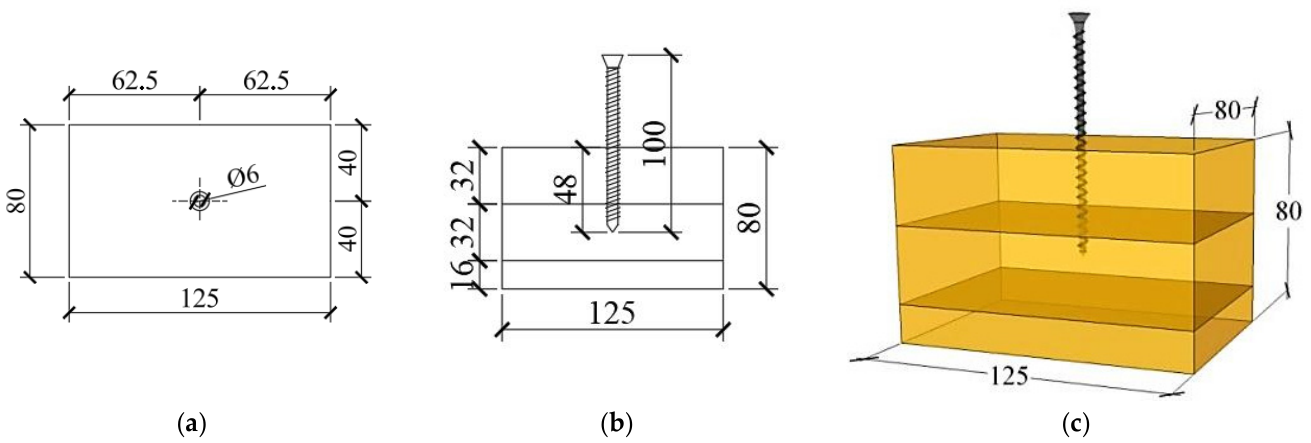
2.3.1. Specimen Design for Glulam Withdrawal Tests
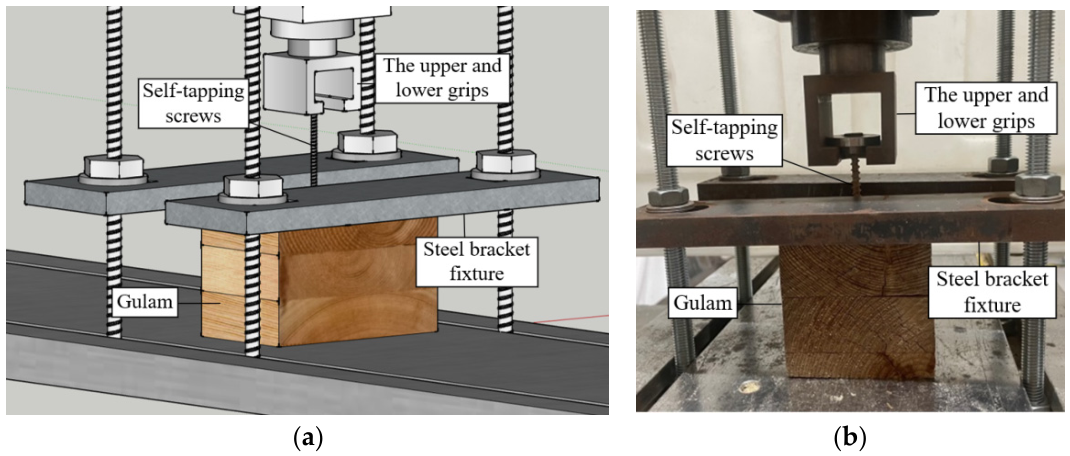
2.3.2. Loading Procedure for Glulam Withdrawal Tests
2.4. CLT Withdrawal Tests
2.4.1. Accelerated Aging Procedure for CLT Specimens
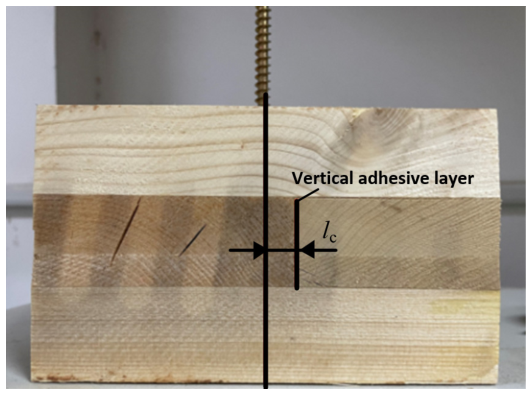
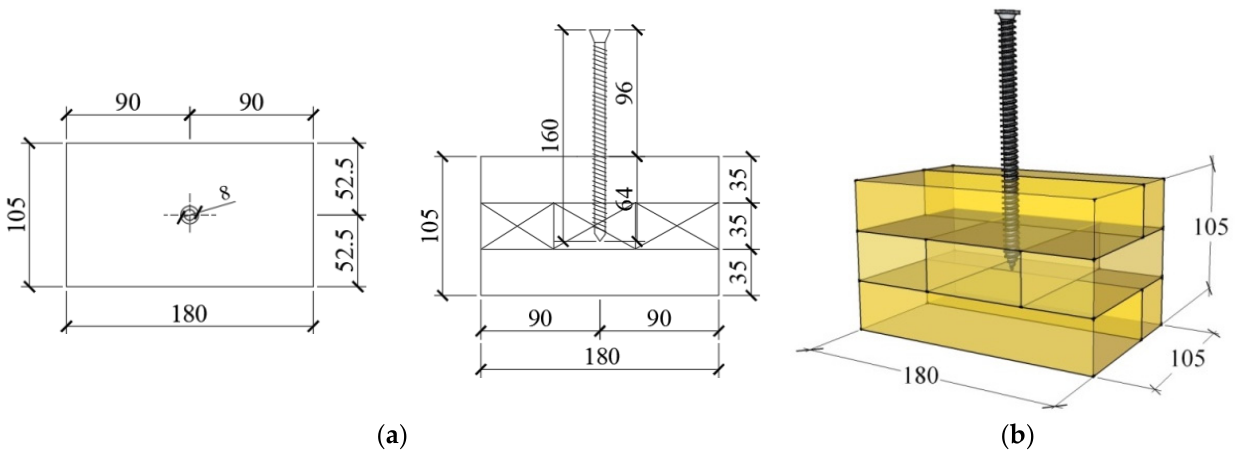
2.4.2. Specimen Design for CLT Withdrawal Tests
2.4.3. Loading Procedure for CLT Withdrawal Tests
2.5. Statistical Analysis
3. Results
3.1. Comparison of Aging Effects on Glulam Withdrawal Specimens
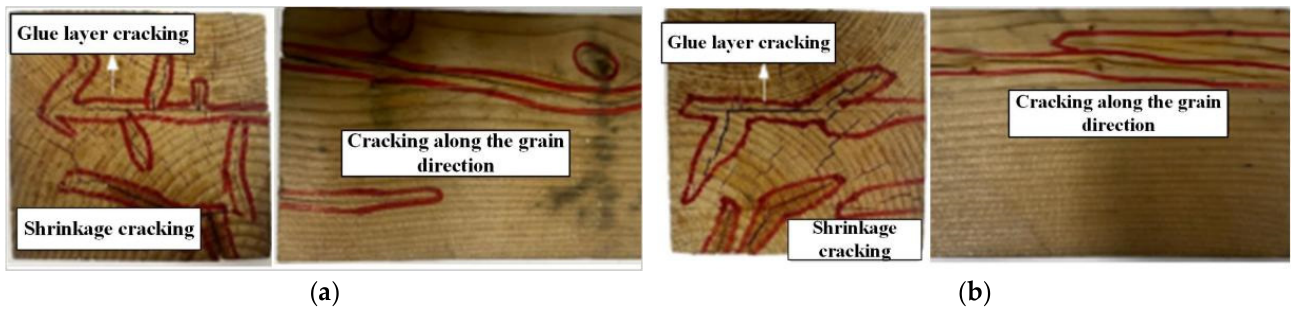
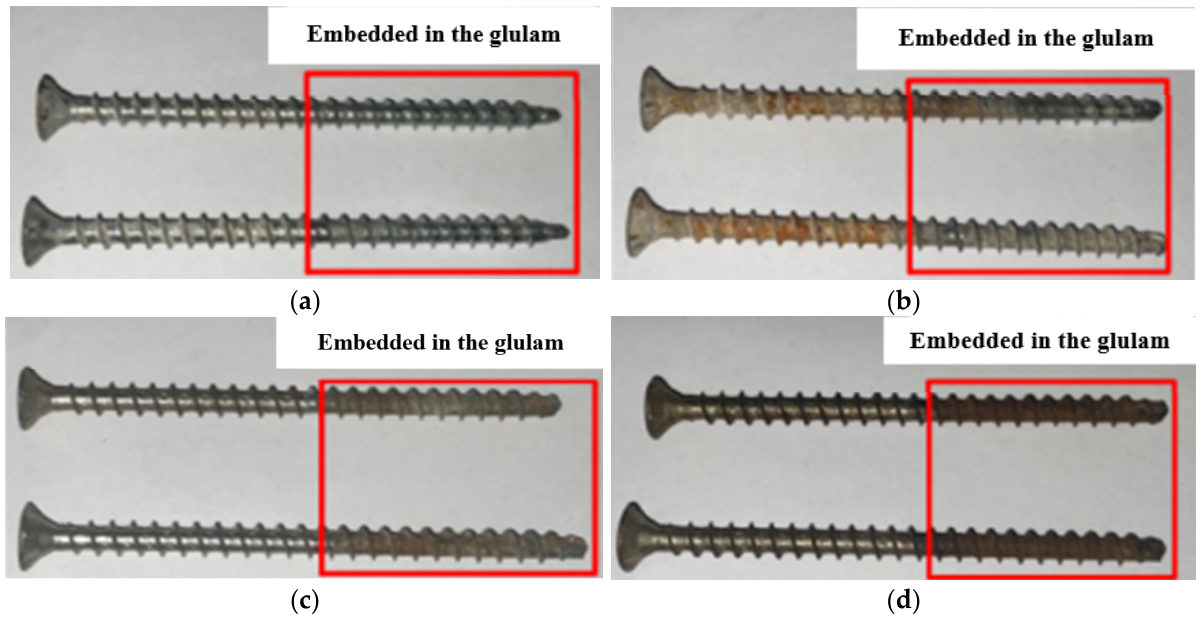
3.1.1. Aging Characteristics
3.1.2. Density of Glulam Specimens
3.1.3. Failure Mode of Glulam Withdrawal Specimens
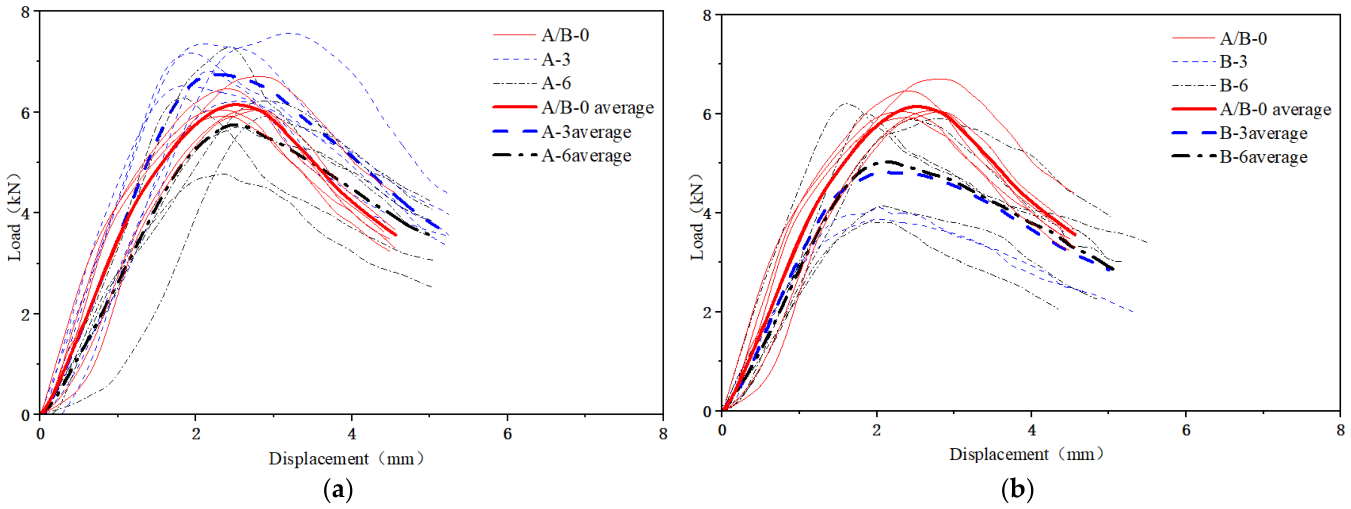
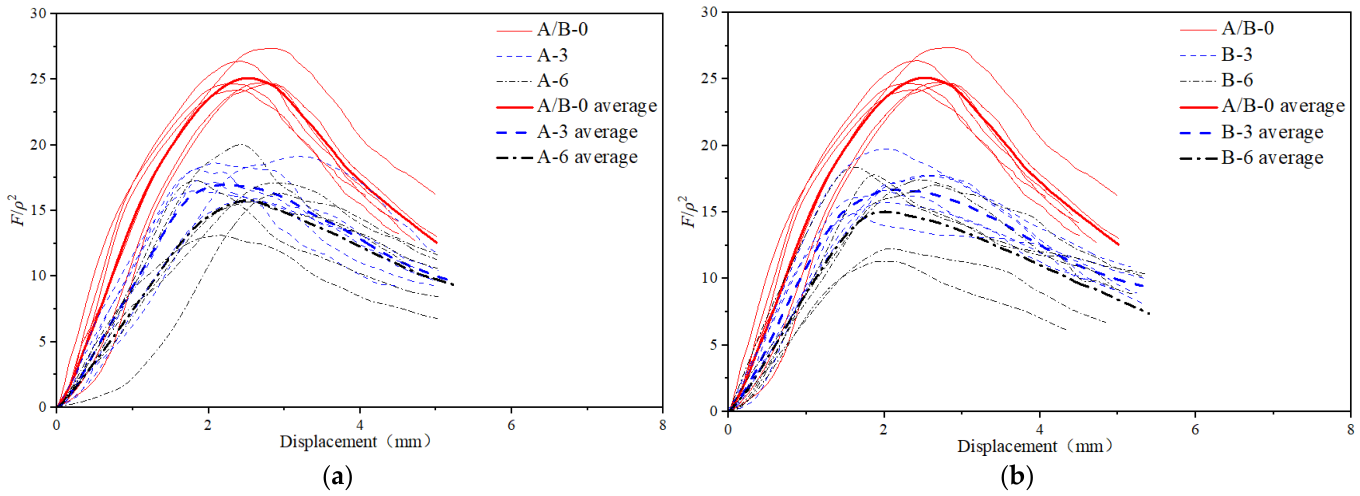
3.1.4. Load–Displacement Curves of Glulam Specimens
3.1.5. Analysis of Withdrawal Capacity and Stiffness
3.2. Withdrawal Performance of STSs in CLT After Accelerated Aging
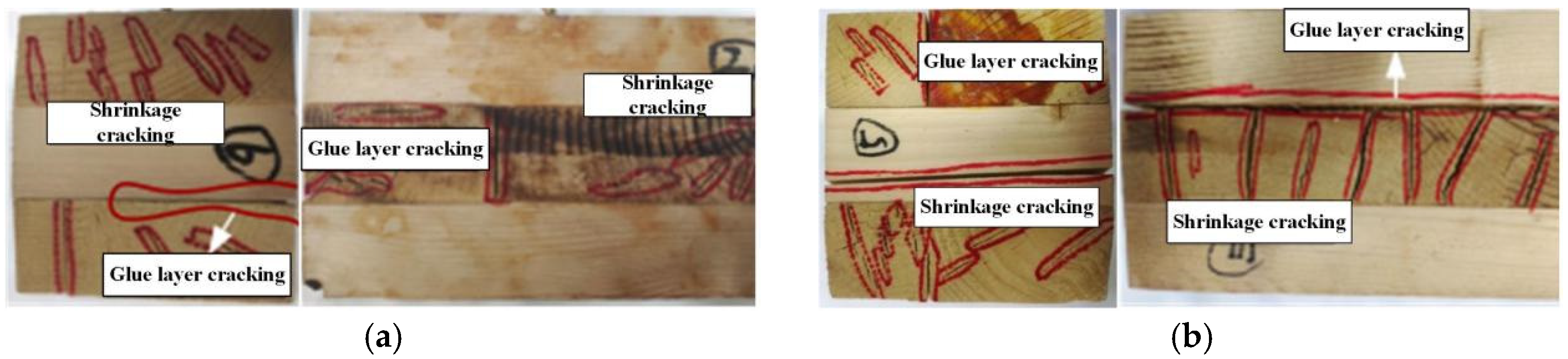
3.2.1. Aging Characterization
3.2.2. Density of CLT Specimens
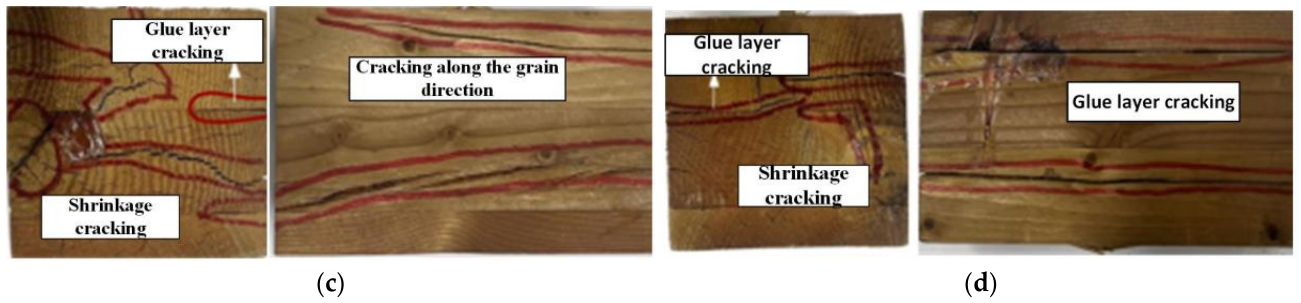
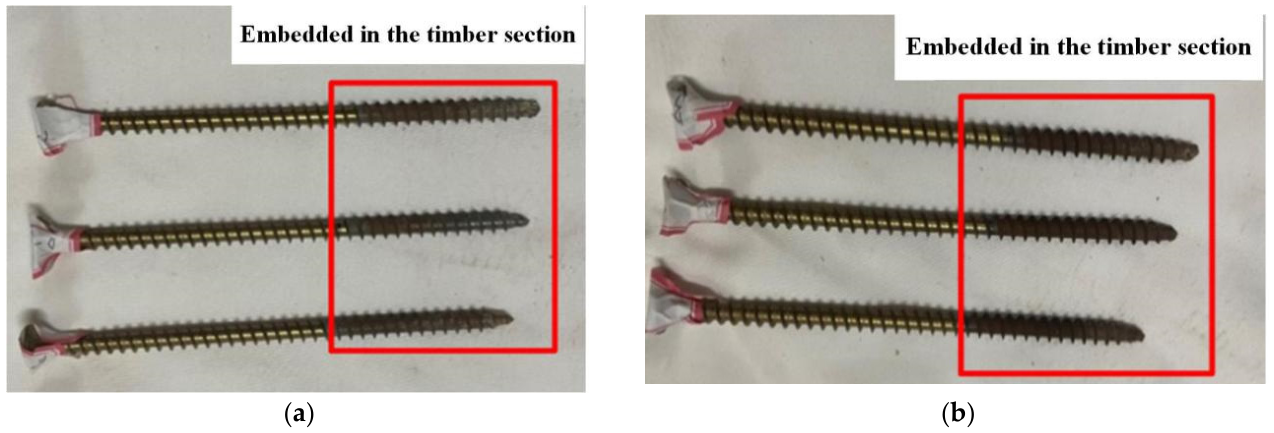
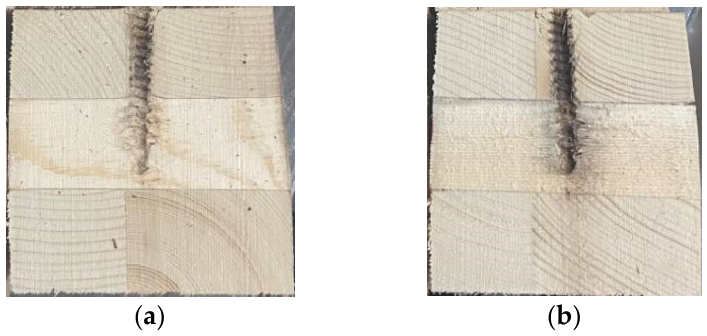
3.2.3. Failure Mode of CLT Withdrawal Specimens
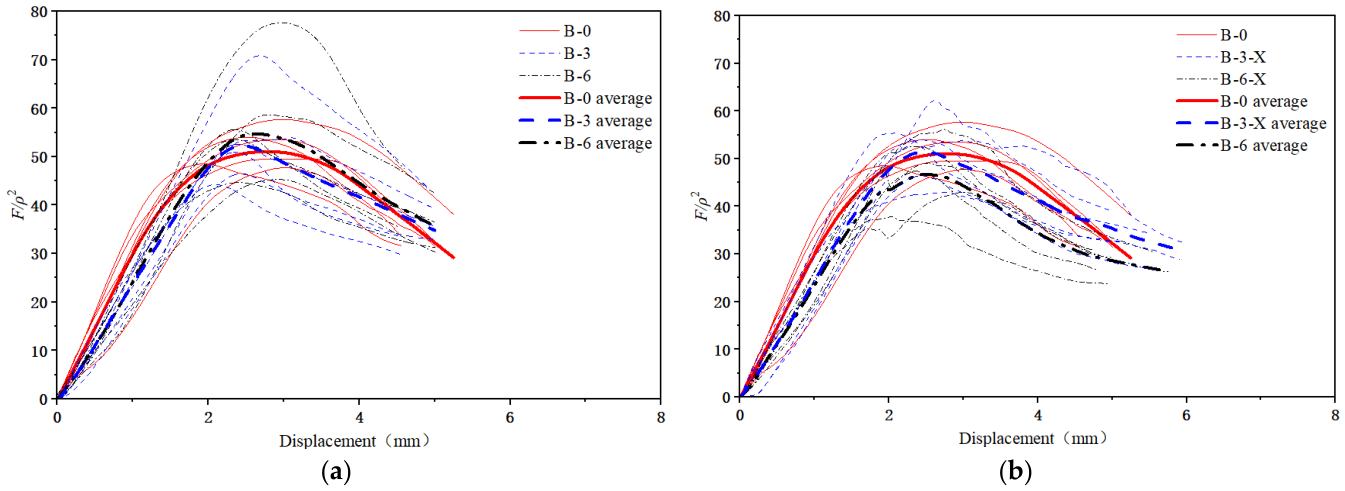
3.2.4. Load–Displacement Curves of CLT Specimens
3.2.5. Withdrawal Resistance and Stiffness
4. Discussion
5. Conclusions
- (1)
- The withdrawal test results of glulam specimens were compared between method A and method B. The relative error of withdrawal capacity retention rates for three and six aging cycles between method A and B is 2.38% and 2.92%, respectively. The results indicated that the effects were similar for both methods. This confirms the feasibility of method B for investigating the withdrawal resistance of self-tapping screws in CLT after aging.
- (2)
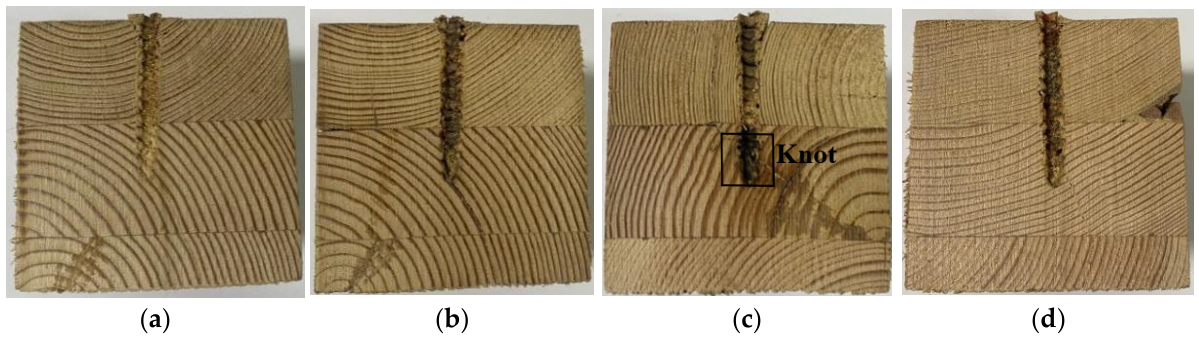
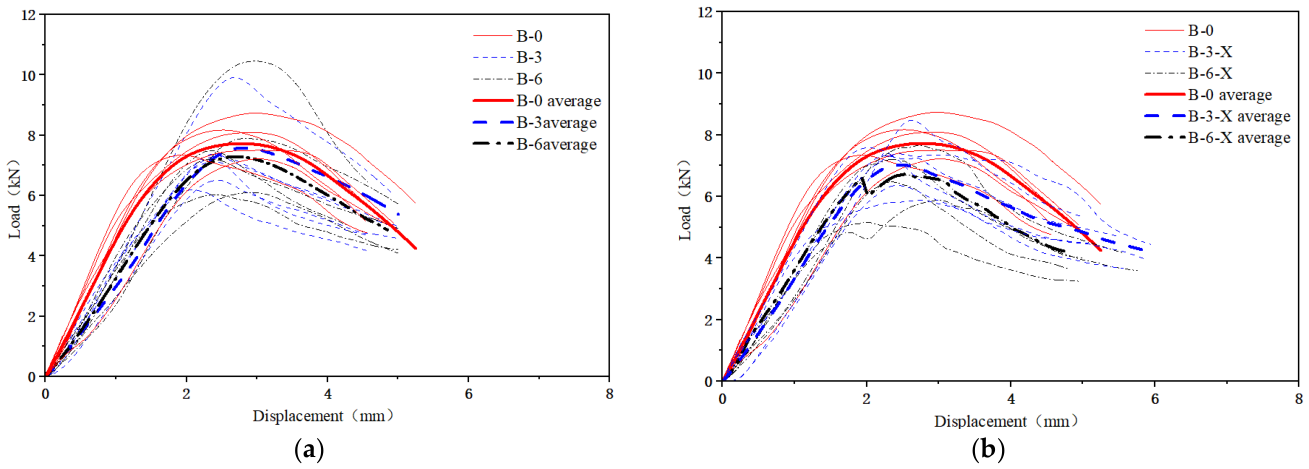
- After aging treatment, the failure mode of CLT with STSs was all pull-out of self-tapping screws. As the number of aging cycles increased, the incidence of wood fiber tearing became more pronounced. A decrease in the ratio of the counterpart load to the ultimate load was observed. After three and six aging cycles, the normalized withdrawal capacity retention rates were 104.98% and 95.36%, respectively, and the normalized stiffness retention rates were 85.60% and 80.94%, respectively. The measurement uncertainty, local material changes, and screw–wood interface changes may lead to the retention rate exceeding 100% after three aging cycles. This differential response indicates that stiffness is significantly more sensitive to environmental aging than withdrawal capacity.
- (3)
- Cracking of the vertical glue layer significantly influenced the withdrawal performance of STSs in CLT specimens. In the comparative experiment, two groups of specimens, with the same distance from the screw to the adhesive layer, exhibited consistent changes. This suggests that experimental designs may benefit from accounting for density effects and maintaining a consistent distance from the screw to the adhesive layer. In addition, when the screw is positioned closer to the vertical adhesive layer, aging-induced cracking or delamination tends to occur along the glue line, weakening the surrounding wood and reducing the long-term anchorage effectiveness of the screw. To facilitate practical implementation, this finding may be worth considering in relation to existing spacing requirements for STSs in CLT. Current timber design provisions, such as Eurocode 5, mainly specify screw spacing, end distance, and edge distance, but the distance between the screw and the internal vertical glue layer in CLT is not explicitly considered. The current study indicates that such a distance criterion is warranted and should be considered for integration into future code revisions. Further tests are still needed to establish a quantitative minimum design distance.
Author Contributions
Funding
Data Availability Statement
Conflicts of Interest
References
- Yusoh, A.S.; Tahir, P.M. Effect of wood species, clamping pressure and glue spread rate on the bonding properties of cross-laminated timber (CLT) manufactured from tropical hardwoods. Constr. Build. Mater. 2021, 273, 121721. [Google Scholar] [CrossRef] [Scilit]
- Younis, A.; Dodoo, A. Cross-laminated timber for building construction: A life-cycle-assessment overview. J. Build. Eng. 2022, 52, 104482. [Google Scholar] [CrossRef] [Scilit]
- Ilgin, H.E.; Karjalainen, M.; Mikkola, P. Views of Cross-Laminated timber (CLT) manufacturer representatives around the world on CLT practices and its future outlook. Buildings 2023, 13, 2912. [Google Scholar] [CrossRef] [Scilit]
- Udele, K.E.; Morrell, J.J.; Sinha, A. Biological durability of cross-laminated timber—The state of things. For. Prod. J. 2021, 71, 124–132. [Google Scholar] [CrossRef] [Scilit]
- Liu, W.; Yang, H. Research progress on modern timber structures. J. Build. Struct. 2019, 40, 16–43. (In Chinese) [Google Scholar]
- Izzi, M.; Casagrande, D. Seismic behaviour of Cross-Laminated Timber structures: A state-of-the-art review. Eng. Struct. 2018, 170, 42–52. [Google Scholar] [CrossRef] [Scilit]
- Fitzgerald, D. Axial slip-friction connections for cross-laminated timber. Eng. Struct. 2021, 228, 111478. [Google Scholar] [CrossRef] [Scilit]
- Silva, C.; Branco, J.M.; Mehdipour, Z. Strain variation analysis of cross-laminated timber elements under cyclic moisture. J. Build. Eng. 2021, 41, 102373. [Google Scholar] [CrossRef] [Scilit]
- Zheng, X.; He, M.; Li, Z.; Luo, Q. Long-term performance of post-tensioned cross-laminated timber (CLT) shear walls: Hygro-mechanical model validation and parametric analysis. Arch. Civ. Mech. Eng. 2022, 22, 68. [Google Scholar] [CrossRef] [Scilit]
- Lima, D.F.; Duarte, S.; Branco, J.M.; Nunes, L. Mass Timber Buildings: The associated risks of rainwater exposure during construction in the Portuguese climate. J. Build. Eng. 2024, 98, 111110. [Google Scholar] [CrossRef] [Scilit]
- Morrell, I.; Udele, K.E.; Morrell, J.J.; Sinha, A. Effect of Biodeterioration on Modeling Parameters of Code-Compliant Cross-Laminated Timber Lateral Connections. For. Prod. J. 2024, 74, 130–142. [Google Scholar] [CrossRef] [Scilit]
- Ayanleye, S. Durability and protection of mass timber structures: A review. J. Build. Eng. 2022, 46, 103731. [Google Scholar] [CrossRef] [Scilit]
- Shi, X.; Yue, K.; Jiao, X. Experimental investigation into lateral performance of cross-laminated timber shear walls made from fast-growing poplar wood. Wood Mater. Sci. Eng. 2023, 18, 1212–1227. [Google Scholar] [CrossRef] [Scilit]
- Silva, C.; Branco, J.M. The influences of moisture content variation, number and width of gaps on the withdrawal resistance of self tapping screws inserted in cross laminated timber. Constr. Build. Mater. 2016, 125, 1205–1215. [Google Scholar] [CrossRef] [Scilit]
- Toumpanaki, E.; Gawne, A.; Humphreys, R.; Vojnovic, L. Effect of moisture and rate of loading in the withdrawal capacity of screws in Cross Laminated Timber (CLT). Structures 2024, 69, 107530. [Google Scholar] [CrossRef] [Scilit]
- Tran, D.K.; Jeong, G.Y. Withdrawal capacity and strength of self-tapping screws on cross-laminated timber. Structures 2022, 37, 772–786. [Google Scholar]
- Lee, I.H.; Lee, S.M.; Kim, K.H. Improved design of self-tapping screw (STS) for Korean larch and red pine cross laminated timber (CLT). BioResources 2024, 19, 3353–3361. [Google Scholar] [CrossRef] [Scilit]
- Udele, K.E.; Morrell, J.J.; Cappellazzi, J.; Sinha, A. Characterizing properties of fungal-decayed cross laminated timber (CLT) connection assemblies. Constr. Build. Mater. 2023, 409, 134080. [Google Scholar] [CrossRef] [Scilit]
- Udele, K.E.; Morrell, I.; Morrell, J.J.; Sinha, A. Biological durability of cross laminated timber connections. Data Brief 2024, 55, 110698. [Google Scholar] [CrossRef] [Scilit]
- BS EN 1087-1:1995; Particleboards—Determination of Moisture Resistance—Part 1: Boil Test. British Standards Institution: London, UK, 1995.
- EN 927-6:2018; Paints and Varnishes—Coating Materials and Coating Systems for Exterior Wood—Part 6: Exposure of Wood Coatings to Artificial Weathering Using Fluorescent UV Lamps and Water. European Committee for Standardization: Brussels, Belgium, 2018.
- ASTM D1037; Standard Test Methods for Evaluating Properties of Wood-Base Fiber and Particle Panel Materials. ASTM International: West Consecutive Hawke, PA, USA, 2012.
- Kojima, Y.; Suzuki, S. Evaluating the durability of wood-based panels using internal bond strength results from accelerated aging treatments. J. Wood Sci. 2011, 57, 7–13. [Google Scholar] [CrossRef] [Scilit]
- Wang, R. Mechanical properties of aged glue laminated bamboo for structural members. Ind. Crops Prod. 2024, 209, 118017. [Google Scholar] [CrossRef] [Scilit]
- Petrillo, M.; Sandak, J.; Grossi, P.; Sandak, A. Chemical and appearance changes of wood due to artificial weathering–dose–response model. J. Near Infrared Spectrosc. 2019, 27, 26–37. [Google Scholar] [CrossRef] [Scilit]
- EN 1995-1-1: 2004+A1: 2008; Design of Timber Structures-Part 1-1: General-Common Rules and Rules for Buildings. European Committee for Standardization: Brussels, Belgium, 2004.
- Gao, Y.W. The Degeneration on Mechanical Properties of Aged Woodand Corresponding Damage Constitutive Model. Master’s Thesis, Yangzhou University, Yangzhou, China, 2016. (In Chinese) [Google Scholar]
- Ringhofer, A.; Brandner, R.; Schickhofer, G. Withdrawal resistance of self-tapping screws in unidirectional and orthogonal layered timber products. Mater. Struct. 2015, 48, 1435–1447. [Google Scholar] [CrossRef] [Scilit]
- Liu, Y.; Yao, Z.; Wang, F.; Huang, H.; Que, Z. Effect of arrangement distances on stiffness of shear-tension mode in timber-to-timber connections with inclined screws. Constr. Build. Mater. 2022, 314, 125592. [Google Scholar] [CrossRef] [Scilit]
- Abdoli, F.; Rashidi, M.; Rostampour-Haftkhani, A.; Layeghi, M.; Ebrahimi, G. Effects of fastener type, end distance, layer arrangement, and panel strength direction on lateral resistance of single shear lap joints in cross-laminated timber (CLT). Case Stud. Constr. Mater. 2023, 18, e01727. [Google Scholar] [CrossRef] [Scilit]
- McNatt, J.D.; Link, C.L. Analysis of ASTM D1037 accelerated-aging test. For. Prod. J. 1989, 39, 51–57. [Google Scholar]
- GB/T 1927.5-2021; Test Methods for Physical and Mechanical Properties of Small Clear Wood Specimens—Part 5: Determination of Density. China Standards Press: Beijing, China, 2021. (In Chinese)
- Brandner, R.; Flatscher, G.; Ringhofer, A. Cross laminated timber (CLT): Overview and development. Eur. J. Wood Wood Prod. 2016, 74, 331–351. [Google Scholar] [CrossRef] [Scilit]
- Shanghai Moregood Hardware Co., Ltd. Moregood Connection System Technical Handbook; Shanghai Moregood Hardware Co., Ltd.: Shanghai, China, 2019. [Google Scholar]
- LY/T 3219-2020; Self-Tapping Screws for Timber Structures. China Standards Press: Beijing, China, 2020. (In Chinese)
- Lee, D.K.; In, J.; Lee, S. Standard deviation and standard error of the mean. Korean J. Anesthesiol. 2015, 68, 220–223. [Google Scholar] [CrossRef] [Scilit]
- DIN 1052:2010; Design Calculation and Dimensioning of Timber Structures—General Rules and Rules for Building Construction. Deutsches Institut für Normung: Berlin, Germany, 2010.
- CCMC. Evaluation Report CCMC 13677-R: SWG ASSY and VG Plus and SWG ASSY 3.0 Self-Tapping Wood Screws; Canadian Construction Material Center: Ottawa, ON, Canada, 2013. [Google Scholar]
- EN 26891:1991; Timber Structures-Joints Made with Mechanical Fasteners-General Principles for the Determination of Strength and Deformation Characteristics. British Standards Institution: London, UK, 1991.
- Li, H.; Qiu, H.; Wang, Z.; Lu, Y. Withdrawal resistance of the self-tapping screws in engineered bamboo scrimber. Constr. Build. Mater. 2021, 311, 125315. [Google Scholar] [CrossRef] [Scilit]








| Diameter d (mm) | Length l (mm) | Minimum Breaking Torque (N·m) | Tensile Strength (MPa) | Yielding Strength (MPa) | Shearing Strength (MPa) |
|---|---|---|---|---|---|
| 6 | 100 | 1.5 | 500 | 300 | 300 |
| Specimen Group | a × b × h (mm) | lp (mm) | Aging Program | Number of Cycles | Number of Specimens |
|---|---|---|---|---|---|
| A/B-0 | 80 × 80 × 125 | 48 | — | 0 | 6 |
| A-3 | 80 × 80 × 125 | 48 | A | 3 | 6 |
| A-6 | 80 × 80 × 125 | 48 | A | 6 | 6 |
| B-3 | 80 × 80 × 125 | 48 | B | 3 | 6 |
| B-6 | 80 × 80 × 125 | 48 | B | 6 | 6 |
| Diameter d (mm) | Length l (mm) | Minimum Breaking Torque (N·m) | Tensile Strength (MPa) | Yielding Strength (MPa) | Shearing Strength (MPa) |
|---|---|---|---|---|---|
| 8 | 160 | 2.8 | 600 | 400 | 400 |
| Specimen Group | a × b × h (mm) | lp (mm) | lc (mm) | Aging Program | Number of Cycles | Number of Specimens |
|---|---|---|---|---|---|---|
| B-0 | 105 × 105 × 180 | 64 | 15 | / | 0 | 6 |
| B-3 | 105 × 105 × 180 | 64 | 25 | B | 3 | 6 |
| B-6 | 105 × 105 × 180 | 64 | 25 | B | 6 | 6 |
| B-3-X | 105 × 105 × 180 | 64 | 15 | B | 3 | 6 |
| B-6-X | 105 × 105 × 180 | 64 | 15 | B | 6 | 6 |
| Specimen Group | Average Density Before Aging (g/cm3) | Average Density After Aging (g/cm3) | Retention Rate (%) |
|---|---|---|---|
| A/B-0 | 0.540 ± 0.015 (2.72%) | — | — |
| A-3 | 0.650 ± 0.023 (3.51%) | 0.629 ± 0.028 (4.44%) | 96.77 |
| A-6 | 0.628 ± 0.018 (2.79%) | 0.603 ± 0.028 (4.68%) | 96.02 |
| B-3 | 0.603 | 0.574 | 95.19 |
| B-6 | 0.622 | 0.580 | 93.25 |
| Specimen Number | P1 (kN) | RSE-P1 (%) | K1 (kN/mm) | RSE-K1 (%) | P1/ρ2 | K1/ρ2 | c1 (%) | c2 (%) |
|---|---|---|---|---|---|---|---|---|
| A/B-0 | 6.21 ± 0.32 (4.95%) | 2.02 | 4.52 ± 0.70 (14.65%) | 5.98 | 24.87 ± 0.69 (2.65%) | 18.62 ± 3.22 (16.49%) | — | — |
| A-3 | 6.98 ± 0.55 (7.45%) | 3.04 | 4.53 ± 1.06 (22.37%) | 9.13 | 17.68 ± 1.48 (8.00%) | 12.08 ± 4.25 (33.54%) | 71.09 | 64.88 |
| A-6 | 6.04 ± 0.86 (13.56%) | 5.54 | 3.65 ± 1.07 (27.89%) | 11.39 | 16.19 ± 2.16 (12.71%) | 9.08 ± 1.37 (14.40%) | 65.10 | 48.76 |
| B-3 | 4.98 ± 1.20 (22.94%) | 9.37 | 3.81 ± 0.94 (23.48%) | 9. 59 | 17.27 ± 2.41 (13.32%) | 12.82 ± 2.19 (16.24%) | 69.44 | 68.85 |
| B-6 | 5.35 ± 1.11 (19.84%) | 8.10 | 3.39 ± 0.77 (21.63%) | 8.83 | 15.73 ± 2.28 (13.78%) | 10.00 ± 2.59 (24.67%) | 63.25 | 53.71 |
| Specimen Group | Cross-Section | Average Deformation Rate (%) | ||
|---|---|---|---|---|
| Lengths | Widths | Heights | ||
| B-3 | Cross-section | −0.19 | −2.26 | −1.01 |
| Diameter/Chordal section | 0.29 | 0.16 | ||
| B-6 | Cross-section | −0.65 | −2.31 | −1.13 |
| Diameter/Chordal section | 0.04 | −0.09 | ||
| Specimen Group | Crack Type | Maximum Width (mm) | Maximum Width (mm) |
|---|---|---|---|
| B-3 | gelatinous layer cracking | 1.71 | 51.85 |
| shrinkage and cracking | 2.01 | 86.33 | |
| B-6 | gelatinous layer cracking | 3.26 | 179.12 |
| shrinkage and cracking | 4.19 | 161.84 |
| Specimen Group | Average Density Before Aging (g/cm3) | Average Density After Aging (g/cm3) | Retention Rate (%) |
|---|---|---|---|
| B-0 | 0.42 (4.88%) | — | — |
| B-3 | 0.42 (2.47%) | 0.374 (2.58%) | 89.05 |
| B-6 | 0.42 (3.49%) | 0.367 (9.43%) | 87.38 |
| Specimen Number | P2 (kN) | RSE-P2 (%) | K2 (kN/mm) | RSE-K2 (%) | P2/ρ2 | K2/ρ2 | c3 (%) | c4 (%) |
|---|---|---|---|---|---|---|---|---|
| B-0 | 7.88 ± 0.60 (7.23%) | 2.95 | 4.74 ± 1.01 (20.25%) | 8.27 | 50.04 | 30.70 | — | — |
| B-3 | 7.49 ± 1.29 (16.42%) | 6.70 | 3.63 ± 0.54 (14.05%) | 5.74 | 53.52 | 25.93 | 106.95 | 84.46 |
| B-6 | 7.55 ± 1.56 (19.74%) | 8.06 | 3.38 ± 0.55 (15.38%) | 6.28 | 45.99 | 20.61 | 91.91 | 67.13 |
| B-3-X | 7.19 ± 0.99 (13.08%) | 5.34 | 3.60 ± 0.61 (16.11%) | 6.58 | 52.53 | 26.28 | 104.98 | 85.60 |
| B-6-X | 6.51 ± 0.95 (13.85%) | 5.65 | 3.38 ± 0.42 (11.83%) | 4.83 | 47.72 | 24.85 | 95.36 | 80.94 |
Disclaimer/Publisher’s Note: The statements, opinions and data contained in all publications are solely those of the individual author(s) and contributor(s) and not of MDPI and/or the editor(s). MDPI and/or the editor(s) disclaim responsibility for any injury to people or property resulting from any ideas, methods, instructions or products referred to in the content. |
© 2026 by the authors. Licensee MDPI, Basel, Switzerland. This article is an open access article distributed under the terms and conditions of the Creative Commons Attribution (CC BY) license.
Share and Cite
Li, H.; Gao, Z.; Wang, P.; Wang, Z.; Zhou, J.; Zhu, Y. Experimental Study on the Withdrawal Resistance of Self-Tapping Screws in Cross-Laminated Timber Considering Material Aging Effects. Buildings 2026, 16, 2208. https://doi.org/10.3390/buildings16112208
Li H, Gao Z, Wang P, Wang Z, Zhou J, Zhu Y. Experimental Study on the Withdrawal Resistance of Self-Tapping Screws in Cross-Laminated Timber Considering Material Aging Effects. Buildings. 2026; 16(11):2208. https://doi.org/10.3390/buildings16112208
Chicago/Turabian StyleLi, Hongmin, Zhuangzhuang Gao, Peilin Wang, Zhiqiang Wang, Jingfei Zhou, and Yixin Zhu. 2026. "Experimental Study on the Withdrawal Resistance of Self-Tapping Screws in Cross-Laminated Timber Considering Material Aging Effects" Buildings 16, no. 11: 2208. https://doi.org/10.3390/buildings16112208
APA StyleLi, H., Gao, Z., Wang, P., Wang, Z., Zhou, J., & Zhu, Y. (2026). Experimental Study on the Withdrawal Resistance of Self-Tapping Screws in Cross-Laminated Timber Considering Material Aging Effects. Buildings, 16(11), 2208. https://doi.org/10.3390/buildings16112208