Reshaping Commercial Parking Space: A SEM–ANN Evaluation Based on Integrated IS Success and UTAUT2




Abstract
1. Introduction
- (1)
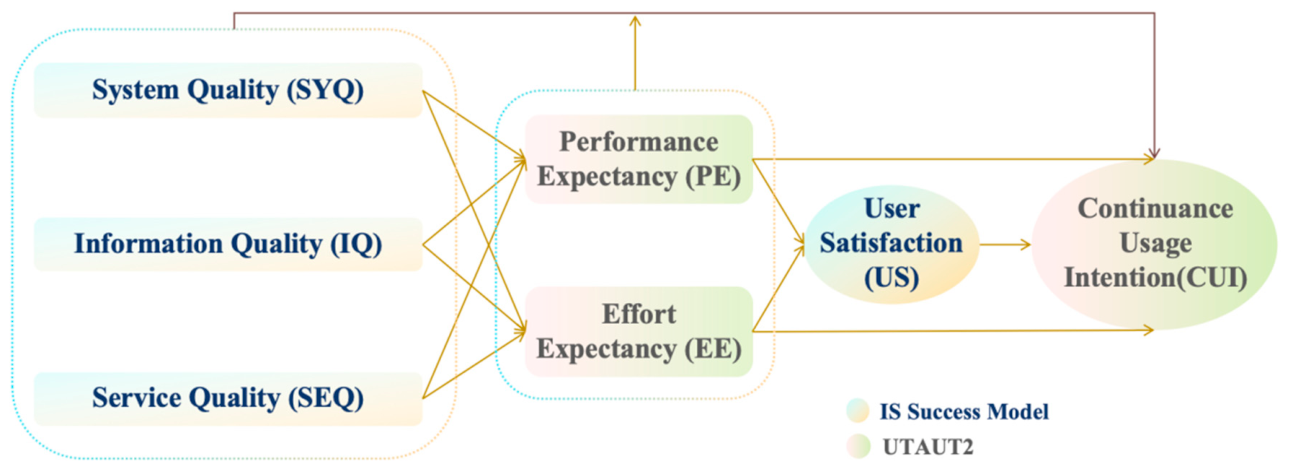
- Which infrastructure quality dimensions most strongly shape users’ performance expectancy and effort expectancy in intelligent commercial parking space, and how do their relative effects differ?
- (2)
- Through what cognitive and affective mediating mechanisms do these quality dimensions transmit their effects on continuance usage intention?
- (3)
- What is the relative non-linear predictive importance of each construct in determining continuance usage intention?
2. Literature Review and Hypothesis Development
2.1. Theoretical Framework Integration
2.2. Variable Definitions and Hypothesis Development
2.2.1. System Quality
2.2.2. Information Quality
2.2.3. Service Quality
2.2.4. Performance Expectancy
2.2.5. Effort Expectancy
2.2.6. User Satisfaction
3. Research Methodology
3.1. Questionnaire Design and Data Collection
3.2. Data Collection and General Demographics
3.3. Data Analysis Methods
4. Data Analysis
4.1. Common Method Bias
4.2. PLS-SEM Analysis
4.2.1. Assessment of Measurement Model
4.2.2. Assessment of Structural Model
4.2.3. Assessment of Mediating Path
4.2.4. Measurement Invariance and Multi-Group Analysis
4.3. ANN Analysis
5. Discussion
5.1. Quality Antecedents and Cognitive Evaluations
5.2. Cognitive Mediators and Satisfaction
5.3. Satisfaction, Continuance, and Built-Environment Implications
6. Conclusions
Author Contributions
Funding
Informed Consent Statement
Data Availability Statement
Conflicts of Interest
References
- Croeser, T.; Garrard, G.E.; Visintin, C.; Kirk, H.; Ossola, A.; Furlong, C.; Clements, R.; Butt, A.; Taylor, E.; Bekessy, S.A. Finding space for nature in cities: The considerable potential of redundant car parking. npj Urban Sustain. 2022, 2, 27. [Google Scholar] [CrossRef]
- Ghizzawi, F.; Galal, A.; Roorda, M.J. Modelling parking behaviour of commercial vehicles: A scoping review. Transp. Rev. 2024, 44, 743–765. [Google Scholar] [CrossRef]
- Mirjalili, S.M.A.; Aslani, A.; Zahedi, R. Towards sustainable commercial-office buildings: Harnessing the power of solar panels, electric vehicles, and smart charging for enhanced energy efficiency and environmental responsibility. Case Stud. Therm. Eng. 2023, 52, 103696. [Google Scholar] [CrossRef]
- Lee, C.H.; Wang, Y.H.; Trappey, A.J. Service design for intelligent parking based on theory of inventive problem solving and service blueprint. Adv. Eng. Inform. 2015, 29, 295–306. [Google Scholar] [CrossRef]
- Shimi, A.; Dishabi, M.R.E.; Azgomi, M.A. An intelligent parking management system using RFID technology based on user preferences. Soft Comput. 2022, 26, 13869–13884. [Google Scholar] [CrossRef]
- Jia, M.; Komeily, A.; Wang, Y.; Srinivasan, R.S. Adopting Internet of Things for the development of smart buildings: A review of enabling technologies and applications. Autom. Constr. 2019, 101, 111–126. [Google Scholar] [CrossRef]
- Kianpisheh, A.; Mustaffa, N.; Limtrairut, P.; Keikhosrokiani, P. Smart parking system (SPS) architecture using ultrasonic detector. Int. J. Softw. Eng. Its Appl. 2012, 6, 55–58. [Google Scholar]
- Xiao, X.; Peng, Z.; Lin, Y.; Jin, Z.; Shao, W.; Chen, R.; Mao, G. Parking prediction in smart cities: A survey. IEEE Trans. Intell. Transp. Syst. 2023, 24, 10302–10326. [Google Scholar] [CrossRef]
- Habib, S.; Aghakhani, S.; Nejati, M.G.; Azimian, M.; Jia, Y.; Ahmed, E.M. Energy management of an intelligent parking lot equipped with hydrogen storage systems and renewable energy sources using the stochastic p-robust optimization approach. Energy 2023, 278, 127844. [Google Scholar] [CrossRef]
- Shaterabadi, M.; Mehrjerdi, H.; Jirdehi, M.A. How INVELOX can affect the perspective of renewable energy exploitation: Demand response and multilateral structure planning outlook. Sustain. Cities Soc. 2023, 91, 104421. [Google Scholar] [CrossRef]
- Alkhudhayr, H. Internet of things based parking slot detection and occupancy classification for smart city traffic management. Eng. Appl. Artif. Intell. 2025, 152, 110802. [Google Scholar] [CrossRef]
- Channamallu, S.S.; Kermanshachi, S.; Rosenberger, J.M.; Pamidimukkala, A.; Hladik, G. Determinants of user satisfaction in smart parking applications. Transp. Econ. Manag. 2025, 3, 214–221. [Google Scholar] [CrossRef]
- Goetting, K.; Liebe, U.; Becker, S. From parking place to public space: A factorial survey experiment on public acceptability of parking space reallocation in Germany. Clim. Policy 2025, 1–19. [Google Scholar] [CrossRef]
- Bhattacherjee, A. Understanding information systems continuance: An expectation-confirmation model. MIS Q. 2001, 25, 351–370. [Google Scholar] [CrossRef]
- Liang, J.K.; Eccarius, T.; Lu, C.C. Investigating factors that affect the intention to use shared parking: A case study of Taipei City. Transp. Res. Part A Policy Pract. 2019, 130, 799–812. [Google Scholar] [CrossRef]
- Thong, J.Y.L.; Hong, S.J.; Tam, K.Y. The effects of post-adoption beliefs on the expectation-confirmation model for information technology continuance. Int. J. Hum.-Comput. Stud. 2006, 64, 799–810. [Google Scholar] [CrossRef]
- Alam, R.; Saha, S.; Bostami, B.; Islam, S.; Aadeeb, S.; Islam, A.K.M.M. A survey on IoT driven smart parking management system: Approaches, limitations and future research agenda. IEEE Access 2023, 11, 119523–119543. [Google Scholar] [CrossRef]
- Moertl, P.; Santuccio, E.; Solmaz, S.; Kabbani, T.; Hartavi, A.E.; Katrakazas, C.; Sekadakis, M.; Zhang, H.; Letina, S. Trustworthy automated driving through increased predictability: A field-test for integrating road infrastructure, vehicle, and the human driver. Transp. Res. Procedia 2023, 72, 650–657. [Google Scholar] [CrossRef]
- Liang, L.; Feng, Z.; Xu, Y.; Chen, Z.; Liang, L. A Parallel Scheme of Friction Dampers and Viscous Dampers for Girder-End Longitudinal Displacement Control of a Long-Span Suspension Bridge under Operational and Seismic Conditions. Buildings 2023, 13, 412. [Google Scholar] [CrossRef]
- DeLone, W.H.; McLean, E.R. Information systems success: The quest for the dependent variable. Inf. Syst. Res. 1992, 3, 60–95. [Google Scholar] [CrossRef]
- Delone, W.H.; McLean, E.R. The DeLone and McLean model of information systems success: A ten-year update. J. Manag. Inf. Syst. 2003, 19, 9–30. [Google Scholar] [CrossRef]
- Venkatesh, V.; Thong, J.Y.L.; Xu, X. Consumer acceptance and use of information technology: Extending the unified theory of acceptance and use of technology. MIS Q. 2012, 36, 157–178. [Google Scholar] [CrossRef]
- Jena, R.K. Exploring antecedents of peoples’ intentions to use smart services in a smart city environment: An extended UTAUT model. J. Inf. Syst. 2022, 36, 133–149. [Google Scholar] [CrossRef]
- Huang, W.; Ong, W.C.; Wong, M.K.F.; Ng, E.Y.K.; Koh, T.; Chandramouli, C.; Tromp, J. Applying the UTAUT2 framework to patients’ attitudes toward healthcare task shifting with artificial intelligence. BMC Health Serv. Res. 2024, 24, 455. [Google Scholar] [CrossRef]
- Tostado-Véliz, M.; Jordehi, A.R.; Mansouri, S.A.; Jurado, F. A two-stage IGDT-stochastic model for optimal scheduling of energy communities with intelligent parking lots. Energy 2023, 263, 126018. [Google Scholar] [CrossRef]
- Liu, J.; Chen, J. Chatbot-aided product purchases among Generation Z: The role of personality traits. Front. Psychol. 2025, 16, 1454197. [Google Scholar] [CrossRef]
- Petter, S.; DeLone, W.; McLean, E. Measuring information systems success: Models, dimensions, measures, and interrelationships. Eur. J. Inf. Syst. 2008, 17, 236–263. [Google Scholar] [CrossRef]
- Wang, Y.S.; Liao, Y.W. Assessing eGovernment systems success: A validation of the DeLone and McLean model of information systems success. Gov. Inf. Q. 2008, 25, 717–733. [Google Scholar] [CrossRef]
- Wang, S.; Gong, J.; Li, X.; Peng, Y.; Du, C.; Nah, K. Integrated Office Applications Promote the Sustainable Development of E-Commerce Enterprises: A Study Based on the TPB-TAM-IS Success Model. J. Theor. Appl. Electron. Commer. Res. 2025, 20, 324. [Google Scholar] [CrossRef]
- Venkatesh, V.; Morris, M.G.; Davis, G.B.; Davis, F.D. User acceptance of information technology: Toward a unified view. MIS Q. 2003, 27, 425–478. [Google Scholar] [CrossRef]
- Alalwan, A.A.; Dwivedi, Y.K.; Rana, N.P. Factors influencing adoption of mobile banking by Jordanian bank customers: Extending UTAUT2 with trust. Int. J. Inf. Manag. 2017, 37, 99–110. [Google Scholar] [CrossRef]
- Tamilmani, K.; Rana, N.P.; Wamba, S.F.; Dwivedi, R. The extended unified theory of acceptance and use of technology (UTAUT2): A systematic meta-analytic review. J. Assoc. Inf. Syst. 2021, 22, 5–50. [Google Scholar] [CrossRef]
- Li, Z.; Ma, J.; Tan, Y.; Guo, C.; Li, X. Combining physical approaches with deep learning techniques for urban building energy modeling: A comprehensive review and future research prospects. Build. Environ. 2023, 246, 110960. [Google Scholar] [CrossRef]
- Limayem, M.; Hirt, S.G.; Cheung, C.M.K. How habit limits the predictive power of intention: The case of information systems continuance. MIS Q. 2007, 31, 705–737. [Google Scholar] [CrossRef]
- Wang, K.; Guo, F.; Zhang, C.; Hao, J.; Wang, Z. Unlocking determinants of smart construction: An integrated model of UTAUT2, TTF, and perceived risk for IoT acceptance in AEC industry. Eng. Constr. Archit. Manag. 2025, 32, 5394–5428. [Google Scholar] [CrossRef]
- Sohn, K.; Kwon, O. Technology acceptance theories and factors influencing artificial intelligence-based intelligent products. Telemat. Inform. 2020, 47, 101324. [Google Scholar] [CrossRef]
- Hong, X.; Li, S.; Chen, T.; Ji, X.; Song, X. Spatial performance evaluation and optimization of integrated aboveground and underground spaces in urban commercial complexes. J. Asian Archit. Build. Eng. 2025, 24, 623–649. [Google Scholar] [CrossRef]
- Buckman, A.; Mayfield, M.; Beck, S.B.M. What is a smart building? Smart Sustain. Built Environ. 2014, 3, 92–109. [Google Scholar] [CrossRef]
- Wong, J.K.W.; Li, H.; Wang, S.W. Intelligent building research: A review. Autom. Constr. 2005, 14, 143–159. [Google Scholar] [CrossRef]
- Wixom, B.H.; Todd, P.A. A theoretical integration of user satisfaction and technology acceptance. Inf. Syst. Res. 2005, 16, 85–102. [Google Scholar] [CrossRef]
- Knauer, T.; Nikiforow, N.; Wagener, S. Determinants of information system quality and data quality in management accounting. J. Manag. Control. 2020, 31, 97–121. [Google Scholar] [CrossRef]
- Hong, J.-C.; Lin, P.-H.; Hsieh, P.-C. The effect of consumer innovativeness on perceived value and continuance intention to use smartwatch. Comput. Hum. Behav. 2017, 67, 264–272. [Google Scholar] [CrossRef]
- Frontczak, M.; Wargocki, P. Literature survey on how different factors influence human comfort in indoor environments. Build. Environ. 2011, 46, 922–937. [Google Scholar] [CrossRef]
- Nelson, R.R.; Todd, P.A.; Wixom, B.H. Antecedents of information and system quality: An empirical examination within the context of data warehousing. J. Manag. Inf. Syst. 2005, 21, 199–235. [Google Scholar] [CrossRef]
- Parasuraman, A.; Zeithaml, V.A.; Berry, L.L. SERVQUAL: A multiple-item scale for measuring consumer perceptions of service quality. J. Retail. 1988, 64, 12–40. [Google Scholar]
- Davis, F.D. Perceived usefulness, perceived ease of use, and user acceptance of information technology. MIS Q. 1989, 13, 319–340. [Google Scholar] [CrossRef]
- Lin, C.S.; Wu, S.; Tsai, R.J. Integrating perceived playfulness into expectation-confirmation model for web portal context. Inf. Manag. 2005, 42, 683–693. [Google Scholar] [CrossRef]
- Hayes, A.F. Introduction to Mediation, Moderation, and Conditional Process Analysis: A Regression-Based Approach, 2nd ed.; Guilford Press: New York, NY, USA, 2018. [Google Scholar]
- Baptista, G.; Oliveira, T. Understanding mobile banking: The unified theory of acceptance and use of technology combined with cultural moderators. Comput. Hum. Behav. 2015, 50, 418–430. [Google Scholar] [CrossRef]
- Brislin, R.W. Translation and content analysis of oral and written material. In Handbook of Cross-Cultural Psychology; Triandis, H.C., Berry, J.W., Eds.; Allyn & Bacon: Boston, MA, USA, 1980; Volume 2, pp. 389–444. [Google Scholar]
- Wang, S.; Yang, W.; Xia, Y.; Yan, W.; Cai, Z. Analysis of dating app classification and predictors of dating app addiction based on user experience factors. Humanit. Soc. Sci. Commun. 2025, 13, 50. [Google Scholar] [CrossRef]
- Bibri, S.E.; Krogstie, J.; Kaboli, A.; Alahi, A. Smarter eco-cities and their leading-edge artificial intelligence of things solutions for environmental sustainability: A comprehensive systematic review. Environ. Sci. Ecotechnol. 2024, 19, 100330. [Google Scholar] [CrossRef]
- Kline, R.B. Principles and Practice of Structural Equation Modeling; Guilford Publications: New York, NY, USA, 2023. [Google Scholar]
- Tenenhaus, M.; Vinzi, V.E.; Chatelin, Y.M.; Lauro, C. PLS path modeling. Comput. Stat. Data Anal. 2005, 48, 159–205. [Google Scholar] [CrossRef]
- Hair, J.F.; Hult, G.T.M.; Ringle, C.M.; Sarstedt, M. A Primer on Partial Least Squares Structural Equation Modeling (PLS-SEM), 2nd ed.; SAGE Publications: Thousand Oaks, CA, USA, 2017. [Google Scholar]
- Henseler, J.; Dijkstra, T.K.; Sarstedt, M.; Ringle, C.M.; Diamantopoulos, A.; Straub, D.W.; Ketchen, D.J.; Hair, J.F.; Hult, G.T.M.; Calantone, R.J. Common beliefs and reality about PLS: Comments on Rönkkö and Evermann (2013). Organ. Res. Methods 2014, 17, 182–209. [Google Scholar] [CrossRef]
- Wang, S.; Bao, Q.; Yu, J. Large language model self-efficacy and metacognition as bridges in cross-linguistic self-efficacy transfer. Asia-Pac. Educ. Res. 2026, 1–18. [Google Scholar] [CrossRef]
- Loh, X.K.; Lee, V.H.; Loh, X.M.; Tan, G.W.H.; Ooi, K.B.; Dwivedi, Y.K. The dark side of mobile learning via smartphone: Does technological addiction lead to digital stress? Behav. Inf. Technol. 2022, 41, 552–570. [Google Scholar]
- Yu, J.; Yan, W.; Gong, J.; Wang, S.; Nah, K.; Cheng, W. Motivation of University Students to Use LLMs to Assist with Online Consumption of Sustainable Products: An Analysis Based on a Hybrid SEM–ANN Approach. Appl. Sci. 2025, 15, 8088. [Google Scholar] [CrossRef]
- Fuller, C.M.; Simmering, M.J.; Atinc, G.; Atinc, Y.; Babin, B.J. Common methods variance detection in business research. J. Bus. Res. 2016, 69, 3192–3198. [Google Scholar] [CrossRef]
- Chen, J.; Wang, S.; Ke, W. Wise sage or goofy performer: The double-edged sword effect of chatbots using Chinese Xiehouyu on prosocial consumer behavior. J. Retail. Consum. Serv. 2026, 92, 104840. [Google Scholar] [CrossRef]
- Hair, J.F.; Hult, G.T.M.; Ringle, C.M.; Sarstedt, M.; Danks, N.P.; Ray, S. Partial Least Squares Structural Equation Modeling (PLS-SEM) Using R: A Workbook; Springer International Publishing: Cham, Switzerland, 2021. [Google Scholar]
- Fornell, C.; Larcker, D.F. Evaluating structural equation models with unobservable variables and measurement error. J. Mark. Res. 1981, 18, 39–50. [Google Scholar] [CrossRef]
- Yao, Z.; Zhang, Y.; Chen, S.; Huang, Q.; Liu, T. The transmission effect of threshold experiences: A study on the influence of psychological cognition and subjective experience on the consumption intentions of smart sports venues. Buildings 2025, 15, 3629. [Google Scholar] [CrossRef]
- Taneja, A.; Arora, A. Modeling user preferences using neural networks and tensor factorization model. Int. J. Inf. Manag. 2019, 45, 132–148. [Google Scholar] [CrossRef]
- Leong, L.; Hew, T.; Ooi, K.; Chong, A.Y. Predicting the antecedents of trust in social commerce: A hybrid structural equation modeling with neural network approach. J. Bus. Res. 2020, 110, 24–40. [Google Scholar] [CrossRef]
- Hyndman, R.J.; Koehler, A.B. Another look at measures of forecast accuracy. Int. J. Forecast. 2006, 22, 679–688. [Google Scholar] [CrossRef]
- Caicedo, F. Real-time parking information management to reduce search time, vehicle displacement and emissions. Transp. Res. Part D Transp. Environ. 2010, 15, 228–234. [Google Scholar] [CrossRef]
- Lin, T.; Rivano, H.; Le Mouël, F. A survey of smart parking solutions. IEEE Trans. Intell. Transp. Syst. 2017, 18, 3229–3253. [Google Scholar] [CrossRef]
- Paidi, V.; Fleyeh, H.; Håkansson, J.; Nyberg, R.G. Smart parking sensors, technologies and applications for open parking lots: A review. IET Intell. Transp. Syst. 2018, 12, 735–741. [Google Scholar] [CrossRef]
- Ulvi, H.; Arslan Selçuk, S.; Satoğlu, G. Smart Parking Systems as Data-Oriented Architectural Spaces: A Conceptual Framework for Sustainable Urban Mobility. Sustainability 2026, 18, 3229. [Google Scholar] [CrossRef]
- Rahi, S.; Mansour, M.M.O.; Alghizzawi, M.; Alnaser, F.M. Integration of UTAUT model in internet banking adoption context: The mediating role of performance expectancy and effort expectancy. J. Res. Interact. Mark. 2019, 13, 411–435. [Google Scholar] [CrossRef]
- Becerik-Gerber, B.; Jazizadeh, F.; Li, N.; Calis, G. Application areas and data requirements for BIM-enabled facilities management. J. Constr. Eng. Manag. 2012, 138, 431–442. [Google Scholar] [CrossRef]
- Al-Emran, M.; Arpaci, I.; Salloum, S.A. An empirical examination of continuous intention to use m-learning: An integrated model. Educ. Inf. Technol. 2020, 25, 2899–2918. [Google Scholar] [CrossRef]
- Chopdar, P.K.; Korfiatis, N.; Sivakumar, V.; Lytras, M.D. Mobile shopping apps adoption and perceived risks: A cross-country perspective utilizing the Unified Theory of Acceptance and Use of Technology. Comput. Hum. Behav. 2018, 86, 109–128. [Google Scholar] [CrossRef]
- Oghuma, A.P.; Libaque-Saenz, C.F.; Wong, S.F.; Chang, Y. An expectation-confirmation model of continuance intention to use mobile instant messaging. Telemat. Inform. 2016, 33, 34–47. [Google Scholar] [CrossRef]
- Kaur, P.; Dhir, A.; Bodhi, R.; Singh, T.; Almotairi, M. Why do people use and recommend m-wallets? J. Retail. Consum. Serv. 2020, 56, 102091. [Google Scholar] [CrossRef]
- Göçer, Ö.; Hua, Y.; Göçer, K. Completing the missing link in building design process: Enhancing post-occupancy evaluation method for effective feedback for building performance. Build. Environ. 2015, 89, 14–27. [Google Scholar] [CrossRef]
- Park, J.; Loftness, V.; Aziz, A. Post-occupancy evaluation and IEQ measurements from 64 office buildings: Critical factors and thresholds for user satisfaction on thermal quality. Buildings 2018, 8, 156. [Google Scholar] [CrossRef]



| Measure | Scale Items | Factor Loading | Sources | |
|---|---|---|---|---|
| System Quality (SYQ) | SYQ1 | The intelligent parking space operates reliably without unexpected failures or errors. | 0.838 | DeLone & McLean [21]; Petter et al. [27] |
| SYQ2 | The intelligent parking space responds quickly to my requests and commands. | 0.829 | ||
| SYQ3 | The intelligent parking space is easy to access whenever I need to use it. | 0.785 | ||
| SYQ4 | The automated functions of the parking space (e.g., space detection, guidance) work accurately and consistently. | 0.788 | ||
| SYQ5 | The overall technical performance of the intelligent parking space meets my expectations. | 0.847 | ||
| Information Quality (IQ) | IQ1 | The parking space provides real-time space availability information that is accurate and up to date. | 0.855 | DeLone & McLean [21]; Wixom & Todd [40]; Wang & Liao [28] |
| IQ2 | The navigation and guidance information provided by the parking space is clear and easy to follow. | 0.799 | ||
| IQ3 | The parking space provides complete information that I need to make parking decisions (e.g., pricing, availability, directions). | 0.834 | ||
| IQ4 | The information provided by the parking space is presented in a format that is easy to understand. | 0.840 | ||
| IQ5 | The parking space delivers information that is relevant and useful to my parking needs. | 0.856 | ||
| Service Quality (SEQ) | SEQ1 | The support services associated with the intelligent parking space respond promptly to my requests or problems. | 0.870 | Parasuraman et al. [45]; DeLone & McLean [21] |
| SEQ2 | The parking space’s support infrastructure reliably resolves issues when they occur. | 0.854 | ||
| SEQ3 | The staff or automated support associated with the parking space are knowledgeable and competent. | 0.795 | ||
| SEQ4 | The service provided through the parking space’s support channels (e.g., app help, on-site assistance) is of high quality. | 0.901 | ||
| SEQ5 | I feel confident that any problems I encounter with the parking space will be effectively addressed. | 0.810 | ||
| Performance Expectancy (PE) | PE1 | Using the intelligent parking space helps me find a parking space more quickly. | 0.894 | Venkatesh et al. [22]; Davis [46]; Limayem et al. [34] |
| PE2 | Using the intelligent parking space improves my overall parking efficiency. | 0.908 | ||
| PE3 | Using the intelligent parking space reduces the time and effort I spend on parking-related tasks (e.g., navigation, payment). | 0.863 | ||
| PE4 | I find the intelligent parking space useful in enhancing my parking experience. | 0.843 | ||
| PE5 | Using the intelligent parking space enables me to accomplish my parking goals more effectively than conventional methods. | 0.856 | ||
| Effort Expectancy (EE) | EE1 | Learning how to use the intelligent parking space is easy for me. | 0.841 | Venkatesh et al. [22]; Baptista & Oliveira [49] |
| EE2 | My interaction with the intelligent parking space is clear and understandable. | 0.872 | ||
| EE3 | I find the intelligent parking space easy to use. | 0.816 | ||
| EE4 | Completing parking tasks (e.g., finding a space, making payment) through the system requires minimal effort. | 0.794 | ||
| EE5 | It is easy for me to become proficient at using the intelligent parking space. | 0.873 | ||
| User Satisfaction (US) | US1 | Overall, I am satisfied with the intelligent parking space. | 0.854 | DeLone & McLean [21]; Lin et al. [47] |
| US2 | The intelligent parking space meets my expectations in terms of functionality and reliability. | 0.918 | ||
| US3 | I am satisfied with the quality of information the parking space provides. | 0.838 | ||
| US4 | I am satisfied with the service support associated with the intelligent parking space. | 0.917 | ||
| US5 | The intelligent parking space delivers a better experience than I expected. | 0.834 | ||
| US6 | Using the intelligent parking space is a pleasant experience. | 0.860 | ||
| US7 | I am satisfied with my overall experience of using the intelligent parking space. | 0.853 | ||
| Continuance Usage Intention (CUI) | CUI1 | I intend to continue using the intelligent commercial parking space in the future. | 0.747 | Venkatesh et al. [22]; Tamilmani et al. [32] |
| CUI2 | I plan to keep using the intelligent parking space on a regular basis. | 0.774 | ||
| CUI3 | I will continue to use the intelligent parking space rather than switching to a conventional parking space. | 0.755 | ||
| CUI4 | I expect my use of the intelligent parking space to continue in the long term. | 0.810 | ||
| CUI5 | I would recommend the intelligent parking space to others based on my continued use experience. | 0.840 | ||
| CUI6 | I am motivated to continue using the intelligent parking space because it meets my parking needs. | 0.784 | ||
| CUI7 | If the intelligent parking space is available, I will choose to use it consistently. | 0.791 | ||
| Variables | Cronbach’s Alpha (α) | CR | AVE |
|---|---|---|---|
| CUI | 0.919 | 0.920 | 0.673 |
| EE | 0.905 | 0.906 | 0.724 |
| IQ | 0.913 | 0.916 | 0.745 |
| PE | 0.908 | 0.909 | 0.731 |
| SEQ | 0.905 | 0.911 | 0.726 |
| SYQ | 0.912 | 0.918 | 0.741 |
| US | 0.897 | 0.900 | 0.618 |
| CUI | EE | IQ | PE | SEQ | SYQ | US | |
|---|---|---|---|---|---|---|---|
| CUI | 0.821 | 0.508 | 0.452 | 0.540 | 0.377 | 0.339 | 0.624 |
| EE | 0.556 | 0.851 | 0.515 | 0.377 | 0.460 | 0.336 | 0.524 |
| IQ | 0.492 | 0.566 | 0.863 | 0.562 | 0.397 | 0.456 | 0.474 |
| PE | 0.589 | 0.414 | 0.617 | 0.855 | 0.541 | 0.480 | 0.577 |
| SEQ | 0.411 | 0.505 | 0.435 | 0.596 | 0.852 | 0.383 | 0.413 |
| SYQ | 0.366 | 0.368 | 0.499 | 0.525 | 0.421 | 0.861 | 0.389 |
| US | 0.684 | 0.580 | 0.520 | 0.636 | 0.455 | 0.428 | 0.786 |
| Path | Original Sample (β) | Standard Deviation | T Statistics | p Values | Support | VIF | f-Square |
|---|---|---|---|---|---|---|---|
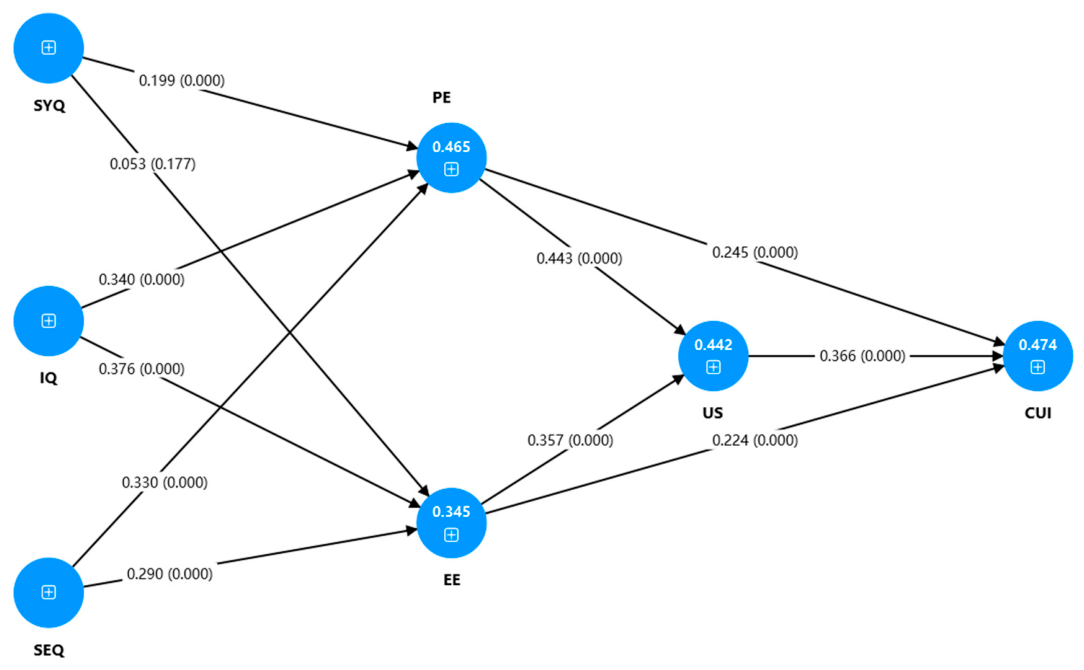
| EE -> CUI | 0.224 | 0.038 | 5.956 | 0.000 | Yes | 1.394 | 0.069 |
| EE -> US | 0.357 | 0.033 | 10.706 | 0.000 | Yes | 1.166 | 0.196 |
| IQ -> EE | 0.376 | 0.038 | 9.830 | 0.000 | Yes | 1.362 | 0.158 |
| IQ -> PE | 0.340 | 0.030 | 11.412 | 0.000 | Yes | 1.362 | 0.159 |
| PE -> CUI | 0.245 | 0.039 | 6.198 | 0.000 | Yes | 1.517 | 0.075 |
| PE -> US | 0.443 | 0.031 | 14.394 | 0.000 | Yes | 1.166 | 0.301 |
| SEQ -> EE | 0.290 | 0.038 | 7.669 | 0.000 | Yes | 1.265 | 0.102 |
| SEQ -> PE | 0.330 | 0.031 | 10.705 | 0.000 | Yes | 1.265 | 0.161 |
| SYQ -> EE | 0.053 | 0.039 | 1.351 | 0.177 | No | 1.344 | 0.003 |
| SYQ -> PE | 0.199 | 0.036 | 5.583 | 0.000 | Yes | 1.344 | 0.055 |
| US -> CUI | 0.366 | 0.042 | 8.625 | 0.000 | Yes | 1.793 | 0.142 |
| Path | Original Sample | Standard Deviation | T Statistics | p Values |
|---|---|---|---|---|
| IQ -> EE -> CUI | 0.084 | 0.017 | 5.058 | 0.000 |
| IQ -> PE -> CUI | 0.083 | 0.016 | 5.229 | 0.000 |
| SEQ -> PE -> CUI | 0.081 | 0.016 | 5.196 | 0.000 |
| SYQ -> PE -> CUI | 0.049 | 0.011 | 4.292 | 0.000 |
| SEQ -> EE -> CUI | 0.065 | 0.014 | 4.620 | 0.000 |
| SYQ -> EE -> CUI | 0.012 | 0.009 | 1.296 | 0.195 |
| Construct | Original Correlation | Correlation Permutation Mean | 5.0% | p Value |
|---|---|---|---|---|
| CUI | 1.000 | 1.000 | 1.000 | 0.662 |
| EE | 1.000 | 1.000 | 1.000 | 0.840 |
| IQ | 1.000 | 1.000 | 1.000 | 0.568 |
| PE | 1.000 | 1.000 | 1.000 | 0.343 |
| SEQ | 1.000 | 1.000 | 0.999 | 0.429 |
| SYQ | 1.000 | 1.000 | 0.999 | 0.230 |
| US | 0.999 | 1.000 | 0.999 | 0.058 |
| Composite Means | Original Difference | Permutation Mean Difference | 2.5% | 97.5% | p Value |
|---|---|---|---|---|---|
| CUI | 0.055 | −0.000 | −0.162 | 0.157 | 0.513 |
| EE | −0.047 | 0.002 | −0.161 | 0.163 | 0.564 |
| IQ | 0.010 | 0.002 | −0.158 | 0.164 | 0.902 |
| PE | 0.039 | 0.001 | −0.159 | 0.160 | 0.628 |
| SEQ | 0.009 | 0.001 | −0.152 | 0.163 | 0.910 |
| SYQ | 0.156 | 0.000 | −0.158 | 0.161 | 0.055 |
| US | −0.019 | 0.001 | −0.157 | 0.165 | 0.827 |
| Composite Variances | Original Difference | Permutation Mean Difference | 2.5% | 97.5% | p Value |
| CUI | −0.036 | −0.001 | −0.229 | 0.235 | 0.752 |
| EE | 0.001 | −0.000 | −0.211 | 0.218 | 0.988 |
| IQ | −0.022 | −0.003 | −0.266 | 0.255 | 0.869 |
| PE | −0.098 | −0.000 | −0.257 | 0.253 | 0.454 |
| SEQ | 0.155 | −0.000 | −0.235 | 0.240 | 0.187 |
| SYQ | −0.137 | −0.002 | −0.193 | 0.195 | 0.171 |
| US | −0.027 | 0.000 | −0.199 | 0.203 | 0.791 |
| Difference (Group_1–Group_2) | 2-Tailed (Group_1 vs. Group_2) p Value | |
|---|---|---|
| EE -> CUI | −0.141 | 0.061 |
| EE -> US | 0.028 | 0.669 |
| IQ -> EE | 0.023 | 0.763 |
| IQ -> PE | −0.028 | 0.631 |
| PE -> CUI | −0.010 | 0.904 |
| PE -> US | −0.088 | 0.151 |
| SEQ -> EE | 0.073 | 0.341 |
| SEQ -> PE | −0.016 | 0.792 |
| SYQ -> EE | 0.020 | 0.805 |
| SYQ -> PE | −0.014 | 0.841 |
| US -> CUI | 0.120 | 0.143 |
| Specific Indirect Effects | Difference (Group_1–Group_2) | 2-Tailed (Group_1 vs. Group_2) p Value |
|---|---|---|
| IQ -> EE -> CUI | −0.048 | 0.161 |
| SEQ -> PE -> CUI | −0.007 | 0.809 |
| SYQ -> PE -> CUI | −0.005 | 0.807 |
| SEQ -> EE -> CUI | −0.025 | 0.407 |
| SYQ -> EE -> CUI | −0.003 | 0.838 |
| IQ -> PE -> US | −0.042 | 0.215 |
| IQ -> EE -> US | 0.019 | 0.619 |
| SEQ -> PE -> US | −0.036 | 0.287 |
| SYQ -> EE -> US -> CUI | 0.006 | 0.626 |
| SYQ -> PE -> US | −0.024 | 0.476 |
| SEQ -> EE -> US | 0.034 | 0.311 |
| SYQ -> EE -> US | 0.009 | 0.770 |
| SYQ -> PE -> US -> CUI | 0.002 | 0.913 |
| IQ -> PE -> US -> CUI | 0.002 | 0.896 |
| IQ -> EE -> US -> CUI | 0.023 | 0.198 |
| SEQ -> PE -> US -> CUI | 0.004 | 0.820 |
| SEQ -> EE -> US -> CUI | 0.025 | 0.091 |
| EE -> US -> CUI | 0.053 | 0.154 |
| PE -> US -> CUI | 0.021 | 0.646 |
| IQ -> PE -> CUI | −0.010 | 0.742 |
| Total indirect effects | Difference (Group_1–Group_2) | 2-tailed (Group_1 vs. Group_2) p value |
| EE -> CUI | 0.053 | 0.154 |
| IQ -> CUI | −0.033 | 0.448 |
| IQ -> US | −0.023 | 0.590 |
| PE -> CUI | 0.021 | 0.646 |
| SEQ -> CUI | −0.003 | 0.947 |
| SEQ -> US | −0.002 | 0.960 |
| SYQ -> CUI | −0.001 | 0.970 |
| SYQ -> US | −0.015 | 0.716 |
| Mode | Model 1 | Model 2 | Model 3 | Model 4 |
|---|---|---|---|---|
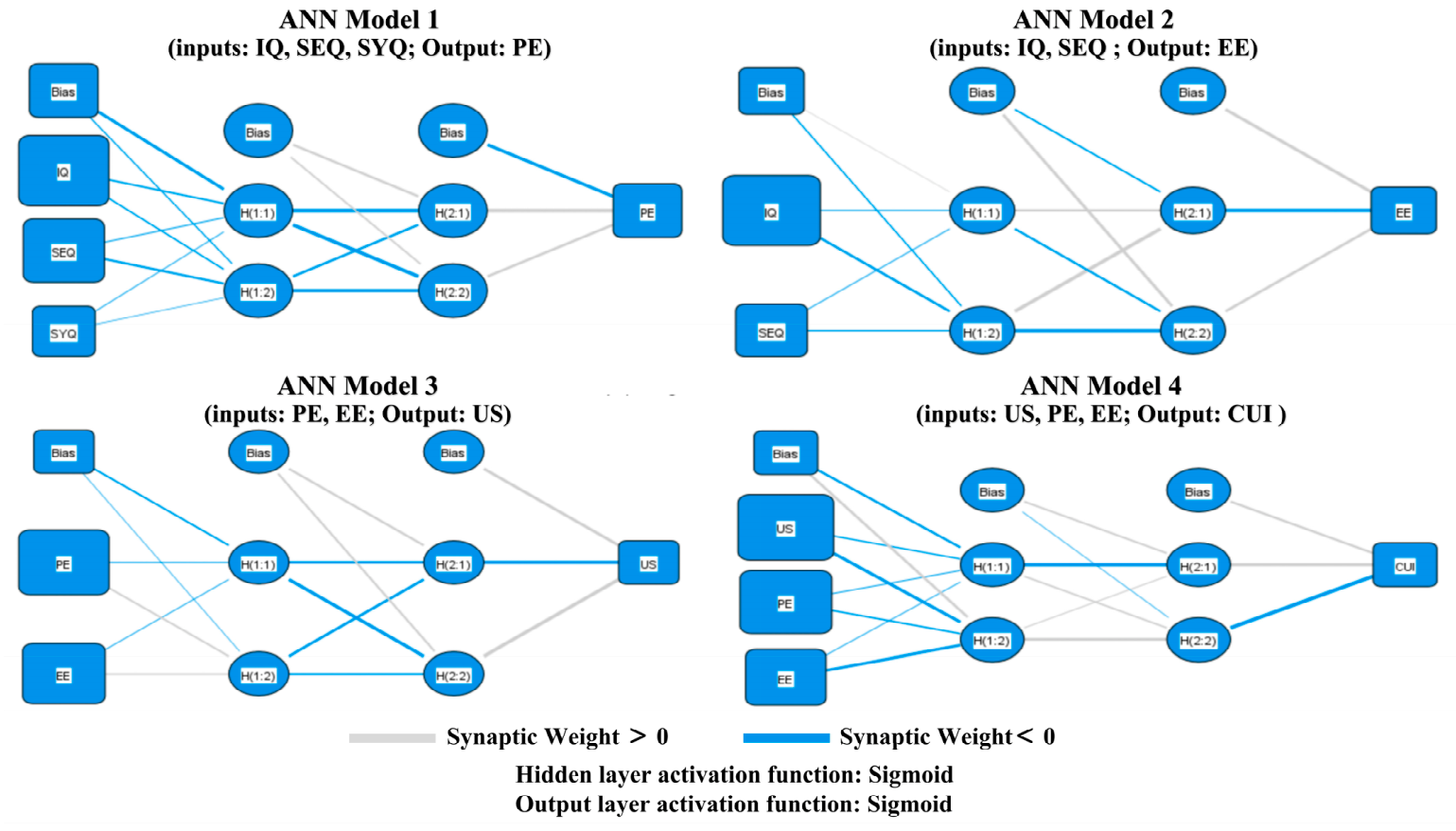
| Input → Output | IQ, SEQ, SYQ → PE | IQ, SEQ → EE | PE, EE → US | US, PE, EE → CUI |
| Training RMSE (Mean) | 0.113 | 0.126 | 0.135 | 0.116 |
| Training RMSE (SD) | 0.001 | 0.002 | 0.003 | 0.001 |
| Testing RMSE (Mean) | 0.115 | 0.126 | 0.121 | 0.112 |
| Testing RMSE (SD) | 0.011 | 0.007 | 0.011 | 0.008 |
| Neural Network | Model 1 (Output: PE) | Model 2 (Output: EE) | Model 3 (Output: US) | Model 4 (Output: CUI) | ||||||
|---|---|---|---|---|---|---|---|---|---|---|
| Inputs | IQ | SEQ | SYQ | IQ | SEQ | PE | EE | US | PE | EE |
| ANN1 | 0.464 | 0.367 | 0.169 | 0.625 | 0.375 | 0.535 | 0.465 | 0.370 | 0.348 | 0.281 |
| ANN2 | 0.487 | 0.330 | 0.183 | 0.571 | 0.429 | 0.519 | 0.481 | 0.400 | 0.343 | 0.257 |
| ANN3 | 0.466 | 0.358 | 0.176 | 0.548 | 0.452 | 0.545 | 0.455 | 0.421 | 0.332 | 0.247 |
| ANN4 | 0.427 | 0.343 | 0.230 | 0.538 | 0.462 | 0.562 | 0.438 | 0.383 | 0.321 | 0.295 |
| ANN5 | 0.401 | 0.370 | 0.229 | 0.544 | 0.456 | 0.552 | 0.448 | 0.357 | 0.339 | 0.304 |
| ANN6 | 0.420 | 0.379 | 0.201 | 0.546 | 0.454 | 0.530 | 0.470 | 0.388 | 0.345 | 0.267 |
| ANN7 | 0.452 | 0.344 | 0.204 | 0.687 | 0.313 | 0.675 | 0.325 | 0.388 | 0.352 | 0.260 |
| ANN8 | 0.455 | 0.322 | 0.223 | 0.638 | 0.362 | 0.550 | 0.450 | 0.404 | 0.335 | 0.262 |
| ANN9 | 0.434 | 0.345 | 0.222 | 0.629 | 0.371 | 0.552 | 0.448 | 0.381 | 0.341 | 0.279 |
| ANN10 | 0.435 | 0.379 | 0.187 | 0.592 | 0.408 | 0.543 | 0.457 | 0.387 | 0.346 | 0.267 |
| Average RI | 0.444 | 0.354 | 0.202 | 0.592 | 0.408 | 0.556 | 0.444 | 0.388 | 0.340 | 0.272 |
| Normalised RI (%) | 100.0 | 80.0 | 45.9 | 100.0 | 70.1 | 100.0 | 80.6 | 100.0 | 87.9 | 70.4 |
| Ranking | 1 | 2 | 3 | 1 | 2 | 1 | 2 | 1 | 2 | 3 |
| Model | PLS-SEM Path | PLS-SEM Path Coefficient | ANN Normalised RI (%) | Ranking (PLS-SEM) | Ranking (ANN) | Remark |
|---|---|---|---|---|---|---|
| Model 1 (Output: PE) | IQ → PE | 0.340 | 100.0 | 1 | 1 | Match |
| SEQ → PE | 0.330 | 80.0 | 2 | 2 | Match | |
| SYQ → PE | 0.199 | 45.9 | 3 | 3 | Match | |
| Model 2 (Output: EE) | IQ → EE | 0.376 | 100.0 | 1 | 1 | Match |
| SEQ → EE | 0.290 | 70.1 | 2 | 2 | Match | |
| SYQ → EE | 0.053 (n.s.) | — | — | — | Not supported; excluded from ANN | |
| Model 3 (Output: US) | PE → US | 0.443 | 100.0 | 1 | 1 | Match |
| EE → US | 0.357 | 80.6 | 2 | 2 | Match | |
| Model 4 (Output: CUI) | US → CUI | 0.366 | 100.0 | 1 | 1 | Match |
| PE → CUI | 0.245 | 87.9 | 2 | 2 | Match | |
| EE → CUI | 0.224 | 70.4 | 3 | 3 | Match |
Disclaimer/Publisher’s Note: The statements, opinions and data contained in all publications are solely those of the individual author(s) and contributor(s) and not of MDPI and/or the editor(s). MDPI and/or the editor(s) disclaim responsibility for any injury to people or property resulting from any ideas, methods, instructions or products referred to in the content. |
© 2026 by the authors. Licensee MDPI, Basel, Switzerland. This article is an open access article distributed under the terms and conditions of the Creative Commons Attribution (CC BY) license.
Share and Cite
Huang, Z.; Wang, S.; Hou, B.; Yin, H.; Nah, K. Reshaping Commercial Parking Space: A SEM–ANN Evaluation Based on Integrated IS Success and UTAUT2. Buildings 2026, 16, 2188. https://doi.org/10.3390/buildings16112188
Huang Z, Wang S, Hou B, Yin H, Nah K. Reshaping Commercial Parking Space: A SEM–ANN Evaluation Based on Integrated IS Success and UTAUT2. Buildings. 2026; 16(11):2188. https://doi.org/10.3390/buildings16112188
Chicago/Turabian StyleHuang, Zeqi, Siqin Wang, Boteng Hou, Haowen Yin, and Ken Nah. 2026. "Reshaping Commercial Parking Space: A SEM–ANN Evaluation Based on Integrated IS Success and UTAUT2" Buildings 16, no. 11: 2188. https://doi.org/10.3390/buildings16112188
APA StyleHuang, Z., Wang, S., Hou, B., Yin, H., & Nah, K. (2026). Reshaping Commercial Parking Space: A SEM–ANN Evaluation Based on Integrated IS Success and UTAUT2. Buildings, 16(11), 2188. https://doi.org/10.3390/buildings16112188