1. Introduction
Buildings represent a major share of global energy demand and therefore occupy a central position in strategies aimed at reducing greenhouse gas emissions associated with the built environment [
1]. Current estimates indicate that the building sector accounts for roughly 30% of global final energy consumption and a significant share of electricity use worldwide [
1,
2]. Within this sector, residential buildings represent the dominant component of operational energy demand, accounting for approximately 70% of total building energy consumption globally [
3].
A substantial body of research has demonstrated that decisions made during the early stages of architectural design exert a long-term influence on building energy performance. Among these decisions, the building envelope, which includes walls, glazing systems, and roof assemblies, plays a fundamental role, regulating heat transfer between indoor and outdoor environments. Envelope characteristics such as the window-to-wall ratio, glazing type, insulation levels, and roof construction directly affect cooling demand, particularly in climates where solar radiation and ambient temperatures are high. Previous studies have demonstrated that early-stage design decisions significantly influence building energy performance [
4,
5,
6].
The existing research on building energy performance can be grouped into three main strands. The first focuses on passive design strategies, emphasizing how envelope configurations can reduce solar heat gains and improve thermal performance. Studies on climate-responsive and vernacular design highlight the role of façade design, glazing systems, and insulation in minimizing cooling loads [
7]. The second strand consists of sensitivity and parametric analyses, which evaluate the influence of individual design variables on building energy consumption. These studies consistently identify the glazing ratio, insulation levels, and material properties as key drivers of performance [
8,
9,
10]. The third strand involves simulation-based optimization methods, which use computational algorithms to explore large design spaces and identify high-performance configurations. Such approaches have gained increasing attention as tools for performance-driven architectural design [
4,
5].
Despite these advances, a key limitation persists in the literature: most studies investigate building performance within a single climatic context or focus on specific geographic regions. As a result, the generalizability of their findings remains limited, and it is unclear whether envelope strategies identified as optimal in one climate can be effectively transferred to others. This limitation is particularly important in warm and coastal climates, where environmental conditions are complex and highly variable.
Warm–humid coastal climates are characterized by high air temperatures, strong solar radiation, and elevated humidity levels, which together result in persistent cooling demand throughout the year [
9,
10]. Within this broader category, different climate subtypes exhibit distinct environmental characteristics. Tropical humid climates (Köppen Af), such as Singapore, experience consistently high humidity and minimal seasonal variation, while subtropical humid climates (Köppen Aw), represented by Miami and Rio de Janeiro, combine high temperatures with seasonal variability in precipitation and humidity. In contrast, hot–arid coastal climates (Köppen BWh), such as Jeddah, are characterized by high solar radiation, elevated temperatures, and lower humidity levels, although coastal proximity can introduce localized moisture effects. These differences influence both sensible and latent cooling loads, thereby affecting building energy performance and the effectiveness of envelope design strategies.
In addition to climatic variability, building typology plays an important role in determining energy performance. In this study, we focus specifically on mid-rise residential buildings, which represent a dominant form of urban housing and contribute significantly to operational energy consumption. Residential buildings differ from commercial and institutional buildings in terms of occupancy patterns, internal heat gains, and operational schedules, all of which influence cooling demand. By focusing on a single building typology, this study isolates the effects of envelope design variables and climatic conditions while maintaining comparability across locations.
Given these considerations, a clear research gap emerges. While previous studies have explored passive design strategies, conducted sensitivity analyses, and applied optimization techniques across multiple climatic contexts, including multi-city comparisons, there remains limited evidence on whether high-performing envelope strategies remain consistent specifically across warm–humid and coastal hot–arid climates under a unified simulation framework. In particular, it remains unclear whether similar envelope strategies can achieve high performance across tropical humid, subtropical humid, and hot–arid coastal environments, or whether climate-specific adaptations are required. To address this gap, we develop a simulation-based evolutionary optimization framework in the present study to evaluate envelope design strategies for residential buildings across different climatic contexts. Our methodology integrates dynamic building energy simulation using DesignBuilder (Version 7.3.1.003), utilizing the EnergyPlus 9.4 calculation engine [
11], and applies an evolutionary optimization approach based on the Non-Dominated Sorting Genetic Algorithm II [
12]. Our analysis considers key envelope and operational variables, including the window-to-wall ratio, glazing type, wall and roof construction, cooling setpoint temperature, and HVAC system configuration.
Our framework is applied to four representative coastal cities: Singapore, Miami, Rio de Janeiro, and Jeddah. These cities were selected to capture variations in temperature, humidity, and solar radiation within warm–humid and hot–arid coastal climates. By systematically comparing optimization results across these locations, our study investigates whether common envelope design strategies emerge and evaluates the extent to which high-performing solutions within the tested range show consistent or climate-dependent patterns under different environmental conditions.
Through this approach, our study contributes to the development of climate-responsive design strategies for residential buildings and provides insights into how envelope optimization can support reductions in both energy consumption and operational carbon emissions across diverse climatic contexts.
1.1. Structure of the Article
The remainder of the paper presents our Methodology, Results, Discussion, and Conclusion.
Section 2 reviews the theoretical background,
Section 3 explains the simulation and optimization framework,
Section 4,
Section 5 and
Section 6 present the baseline and optimized results,
Section 7 discusses the findings, and the Conclusion summarizes implications, limitations, and future research directions.
1.2. Research Contributions
The present study contributes to the literature in three ways:
It develops a simulation-based evolutionary search framework integrating dynamic building energy simulation with NSGA-II to systematically explore high-performing residential design configurations.
It provides a cross-climate comparison of high-performing residential envelope strategies identified through evolutionary search.
It identifies cross-climate consistency and variation patterns in envelope design parameters, distinguishing between universally effective strategies and climate-dependent configurations.
3. Methodology
3.1. Research Framework
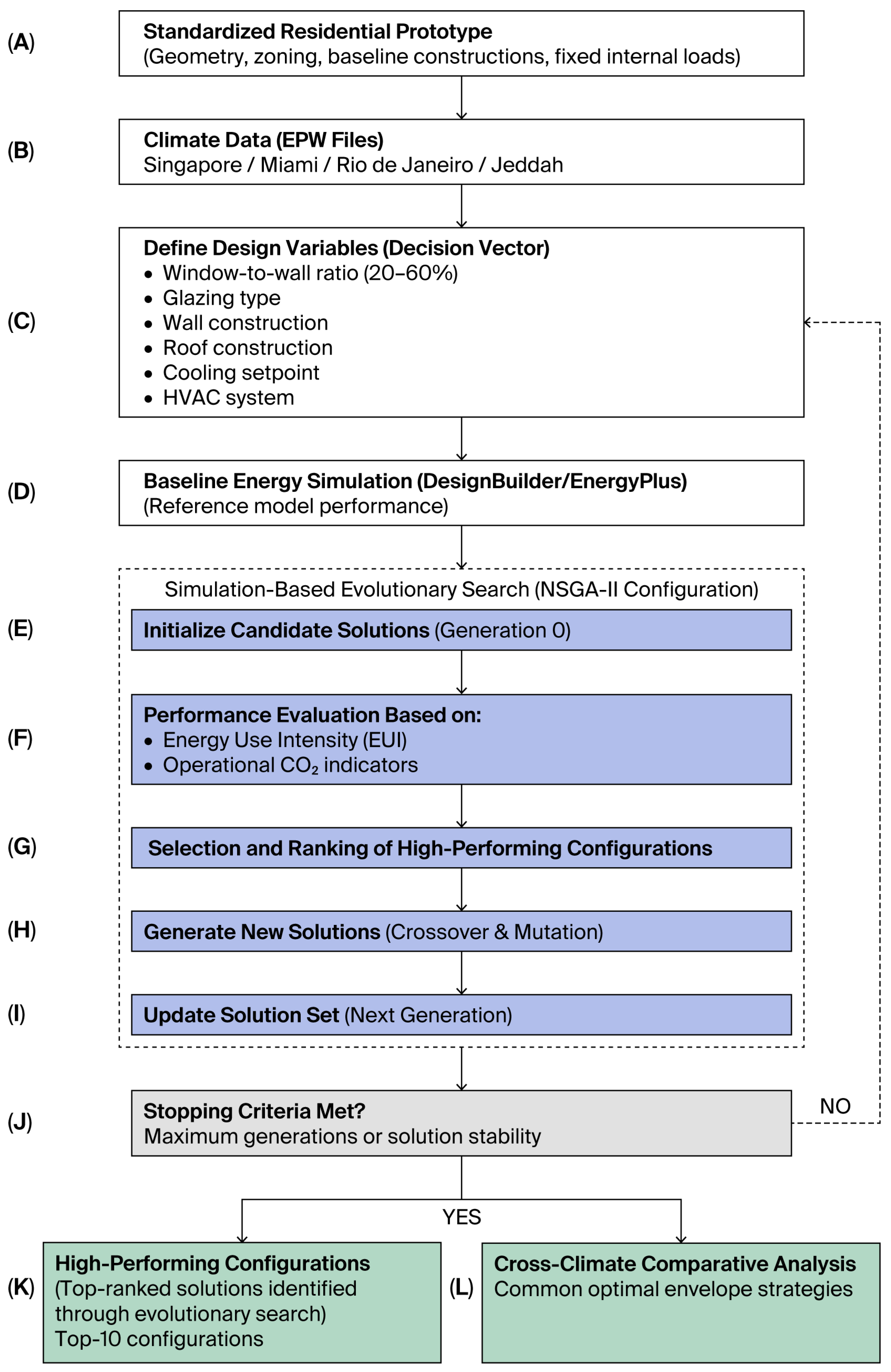
In this study, we adopt a simulation-supported optimization framework to examine envelope design strategies for residential buildings located in warm–humid and hot–arid coastal climates. The methodology integrates dynamic building energy simulation with evolutionary optimization in order to explore a large number of design alternatives while accounting for interactions between climate conditions, envelope characteristics, and operational behavior. Our workflow follows a sequential process. A prototype residential building was first modeled and simulated using the dynamic building energy simulation software DesignBuilder (Version 7.3.1.003; DesignBuilder Software Ltd., Stroud, UK), utilizing the EnergyPlus 9.4 calculation engine (U.S. Department of Energy, Washington, DC, USA) to establish a reference case. Baseline energy performance was then evaluated across four coastal climates selected for comparison. Envelope characteristics and operational parameters were subsequently defined as adjustable variables in order to construct the parametric design space.
The final stage involved the application of the Non-Dominated Sorting Genetic Algorithm II, which searches the design space to identify configurations that improve building performance as evaluated through energy use intensity and operational carbon indicators. The overall methodological workflow adopted in this research is illustrated in
Figure 1. Simulation-supported optimization has become increasingly relevant in sustainable building design because it enables the systematic exploration of design alternatives while accounting for interactions between climatic conditions, building envelopes, and mechanical systems [
4,
5].
In addition to evolutionary optimization, computational post-processing methods were applied during the post-processing stage to analyze optimization outcomes. Specifically, pattern recognition and clustering analyses were used to identify recurring design configurations among high-performing solutions. This computational analysis step enabled the detection of consistent selection trends across different climatic contexts, supporting the interpretation of dominant envelope strategies beyond individual high-performing solutions within the tested range.
3.2. Prototype Building Model
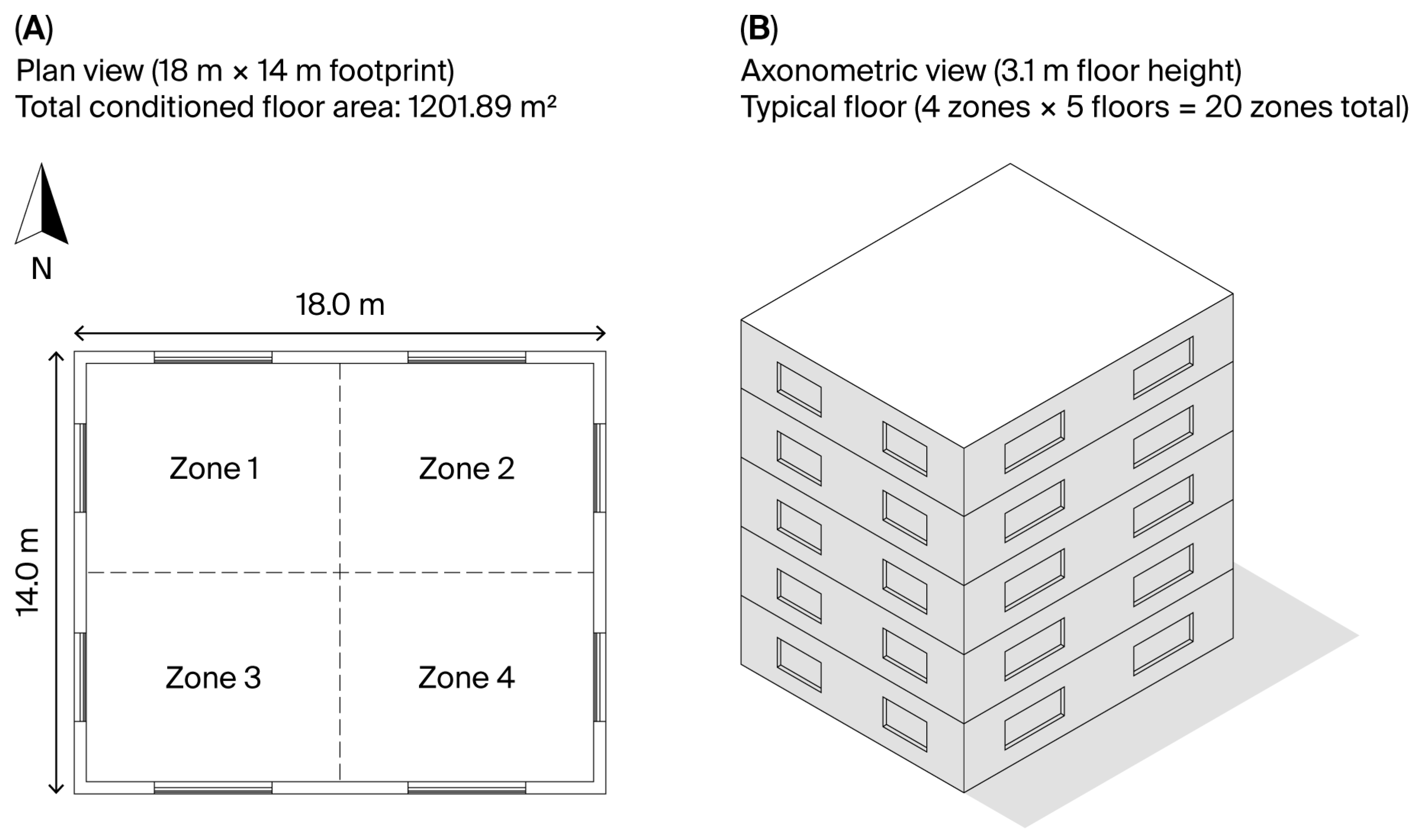
A prototype residential building model was developed to enable a controlled comparison of envelope design strategies across multiple climatic scenarios. Prototype models allow geometric characteristics, internal loads, and operational schedules to remain unchanged, ensuring that performance differences arise primarily from climate conditions and envelope design variables. The prototype represents a multi-zone residential structure divided into twenty thermal zones. This subdivision allows the simulation to capture variations in solar exposure, orientation, and internal heat gains, enabling heat transfer processes and cooling demand to differ across building zones.
Internal conditions were maintained constant in all simulations. Occupancy schedules, lighting density, and equipment loads were therefore kept identical throughout the analysis. This approach ensures that differences in energy performance are attributable to climate conditions and envelope variables rather than variations in building operation. Simulations were conducted using DesignBuilder, which employs the EnergyPlus dynamic simulation engine to calculate hourly building energy performance. EnergyPlus is widely used in building performance research because it models heat transfer through building envelopes together with solar radiation effects, mechanical systems, and internal heat gains [
11]. The prototype building model used in the simulations is illustrated in
Figure 2.
The objective of the prototype model is comparative rather than predictive. The model is not intended to reproduce the exact energy performance of a specific existing building. Instead, it represents a typical residential building configuration used as a controlled experimental platform for evaluating envelope design alternatives under different climatic conditions. Maintaining identical geometry, internal loads, and operational schedules across all simulations ensures that the performance differences observed in the results arise primarily from climate conditions and envelope variables rather than variations in building operation. This prototype-based approach is commonly used in building performance research to enable systematic comparison of design strategies across multiple climates.
3.3. Climate Locations and Weather Data
To evaluate the robustness of passive design strategies across different climatic conditions, the study analyzed four representative coastal cities:
Singapore;
Miami;
Rio de Janeiro;
Jeddah.
The selection follows a controlled comparative approach aimed at capturing variation within cooling-dominated climates while maintaining a consistent environmental baseline.
These locations represent a range of warm and hot coastal climates characterized by high cooling demand and strong solar radiation. Singapore represents a tropical humid climate (Köppen Af), while Miami and Rio de Janeiro correspond to subtropical humid climates (Köppen Aw). Jeddah represents a hot–arid coastal climate (Köppen BWh), characterized by high solar radiation and extreme summer temperatures.
Weather data for each location were obtained from EnergyPlus Weather (EPW) files derived from standardized datasets provided by the American Society of Heating, Refrigerating and Air-Conditioning Engineers (ASHRAE). Specifically, International Weather for Energy Calculations (IWEC) data were used for Singapore, Typical Meteorological Year version 3 (TMY3) data for Miami, Solar and Wind Energy Resource Assessment (SWERA) data for Rio de Janeiro, and EnergyPlus Typical Meteorological Year (ETMY) data for Jeddah. The use of standardized weather datasets ensures consistency and reliability in building energy simulations and allows for direct comparison across locations.
Table 1 provides a structured overview of the climatic characteristics of the studied locations, establishing the environmental context for the comparative simulation framework.
Although Singapore, Miami, and Rio de Janeiro are all classified as ASHRAE Climate Zone 1A (warm–humid), they exhibit variations in humidity profiles, solar radiation levels, and seasonal patterns, which influence both latent and sensible cooling loads. In contrast, Jeddah (Zone 1B) represents a hot–arid coastal climate with significantly higher peak temperatures and solar exposure, leading predominantly to sensible cooling demand.
The inclusion of both humid and arid coastal climates enables the study to examine how environmental drivers, including humidity, solar radiation, and temperature extremes, affect building energy performance. This controlled variation allows for the evaluation of whether optimal envelope design strategies remain consistent across different climatic conditions within cooling-dominated regions or require climate-specific adaptation.
This approach improves the transferability of the findings by ensuring that conclusions are not limited to a single climatic context.
3.4. Simulation Platform
All simulations were performed using DesignBuilder software, which utilizes the EnergyPlus dynamic simulation engine for detailed building energy modeling. EnergyPlus calculates hourly heating and cooling loads by solving heat balance equations that account for the following:
Because of its ability to simulate complex interactions between building components and environmental conditions, EnergyPlus has become one of the most widely used building energy simulation engines in both academic and professional research [
11]. Simulation outputs include hourly and annual energy consumption values, which were used to calculate annual energy use intensity (EUI) and operational carbon emissions.
3.5. Optimization Variables
The optimization process considered several envelope and operational parameters known to significantly influence cooling loads in warm climates. These variables represent architectural decisions typically defined during early design stages.
Table 2 summarizes the key envelope and operational variables incorporated into the optimization framework, establishing the parametric design space explored by NSGA-II.
These parameters were selected based on previous research identifying envelope characteristics and operational settings as critical factors affecting building energy performance in warm climates [
8,
16].
In order to establish a consistent reference scenario, a baseline configuration was defined using typical residential construction characteristics commonly applied in warm coastal climates. The baseline model includes a 20% window-to-wall ratio, double clear glazing with a 13 mm air cavity, a standard brick cavity wall assembly, and a typical lightweight roof construction. The cooling setpoint temperature was set to 24.5 °C, and the HVAC system was modeled using a unitary cooling system. These parameters serve as the reference configuration from which the parametric variations defined in
Table 2 are explored during the optimization process.
3.6. Evolutionary Optimization Algorithm
The optimization process employed the Non-Dominated Sorting Genetic Algorithm II (NSGA-II), one of the most widely used algorithms for solving multi-criteria optimization problems in engineering and building design [
12]. Genetic algorithms simulate evolutionary processes through iterative population-based search mechanisms, while candidate solutions evolve through operations such as selection, crossover, and mutation, gradually improving performance across successive generations.
NSGA-II was configured with a crossover probability of 0.9 and a mutation probability of 0.1, ensuring a balance between the exploration of the design space and identification of high-performing solutions within the defined parameter ranges.
Although NSGA-II is commonly applied to multi-objective optimization problems, in the present study, it was used primarily as an evolutionary search strategy to systematically explore the multidimensional design space and identify recurring high-performing configurations. Because operational carbon emissions are calculated directly from energy use intensity using fixed electricity emission factors, the evaluated indicators are strongly correlated within each climate context and therefore do not represent strongly conflicting optimization objectives in the classical Pareto sense. Under these conditions, non-dominated sorting primarily supports systematic organization and diversity preservation of candidate solutions during evolutionary search rather than resolving strongly conflicting objective trade-offs. Accordingly, the results should be interpreted as a structured evolutionary search outcome aimed at identifying high-performing configurations within the defined parameter ranges rather than as a classical Pareto trade-off analysis.
Although energy use intensity and operational carbon emissions are strongly correlated within each climate context, multiple high-performing configurations may still emerge because different combinations of discrete envelope and system variables can produce closely comparable performance outcomes. In this context, NSGA-II preserves solution diversity during evolutionary search, resulting in a ranked set of near-equivalent high-performing configurations rather than a single unique optimum.
Evolutionary optimization methods have nevertheless been widely applied in building performance analysis because of their ability to efficiently explore complex nonlinear design spaces [
22,
23].
NSGA-II was selected because it is widely used for population-based evolutionary search, supports the exploration of discrete and continuous design variables, and uses non-dominated sorting and crowding-distance mechanisms to organize candidate solutions during the search process.
Previous studies of evolutionary algorithms have shown the applicability of NSGA-II-type approaches in complex energy system optimization problems involving multiple performance indicators [
12].
In this study, the NSGA-II optimization was configured with a population size of 40 individuals and 30 generations, resulting in approximately 1200 evaluated design configurations for each climate location. Candidate solutions were generated through crossover and mutation operators, enabling an exploration of the parametric design space defined in
Table 2. Each generated design configuration was evaluated using dynamic energy simulation in DesignBuilder/EnergyPlus, and the resulting performance indicators were returned to the optimization algorithm. The optimization procedure was executed independently for each climate location in order to account for differences in climatic conditions and electricity emission factors. Although optimization was conducted using fixed algorithm parameters, the repeated identification of similar high-performing configurations across climate runs indicates stable search behavior within the defined parameter ranges.
3.7. Performance Metrics
The optimization framework evaluates building performance using two performance indicators: energy use intensity (EUI) and operational carbon emissions. EUI was calculated from EnergyPlus simulation outputs as the total annual building energy consumption normalized by the conditioned floor area. Operational carbon emissions were estimated by multiplying annual electricity consumption by location-specific electricity emission factors. Considering both energy consumption and carbon emissions allows the optimization process to account for environmental impacts associated with electricity generation [
28]. Both indicators were evaluated jointly during the NSGA-II optimization process to identify high-performing building configurations within the defined parameter ranges.
3.8. Operational Carbon Calculation
Operational carbon emissions were calculated from the simulated building energy consumption using location-specific electricity grid emission factors. Because the prototype building is fully electrically conditioned, operational carbon emissions are directly proportional to electricity consumption. Annual operational carbon intensity was therefore estimated by multiplying simulated energy use intensity (EUI) by the electricity emission factor associated with each city.
where
= annual operational carbon intensity (kgCO2/m2·yr);
= annual energy use intensity (kWh/m2·yr);
= grid electricity emission factor (kgCO2/kWh).
This approach is widely used in operational carbon assessment for electrically conditioned buildings, where energy consumption is dominated by grid electricity [
1,
3].
Emission factors were obtained from internationally recognized electricity carbon intensity datasets, including the International Energy Agency (IEA) electricity statistics and national electricity generation reports. These datasets provide average grid emission factors reflecting the electricity generation mix of each country. Using location-specific emission factors ensures that operational carbon estimates reflect regional differences in electricity production and associated greenhouse gas emissions. Since electricity generation mixes vary significantly across regions, each climate location was assigned a specific emission factor to ensure realistic carbon estimates. The grid emission factors applied in the operational carbon calculations for each city are summarized in
Table 3.
Country-specific emission factors were extracted from the IEA Emissions Factors database [
29] and cross-validated with global electricity carbon intensity datasets, including Our World in Data [
30].
It should be noted that, within each climate, operational carbon emissions are linearly proportional to energy use intensity due to the use of fixed emission factors. Therefore, optimization does not represent a strictly conflicting multi-objective problem but rather a dual-indicator evaluation of energy and carbon performance.
5. Baseline Performance Results
5.1. Baseline Simulation Overview
Before applying the optimization framework, the prototype building was simulated using the baseline envelope and operational parameters defined in
Section 4. The purpose of the baseline simulations is to establish a reference performance level against which the optimization improvements can be evaluated. The same building model was simulated across the four selected climate locations: Singapore, Miami, Rio de Janeiro, and Jeddah. Identical internal loads, schedules, HVAC configurations, and envelope characteristics were maintained across all simulations. This approach ensures that differences in energy performance arise exclusively from climatic conditions rather than design variations, enabling meaningful cross-climate comparison.
The baseline configuration represents a conventional residential building envelope prior to optimization, with a window-to-wall ratio of 20%, double clear glazing, a lightweight reference wall, and lightweight roof construction.
5.2. Baseline Energy Performance Across Climates
Table 5 summarizes the baseline simulation results for the four climate locations. The results include energy use intensity, total site energy consumption, operational carbon emissions, cooling energy demand, and thermal comfort performance.
The relatively high baseline EUI values are primarily attributable to the conservative modeling assumptions, including a low-efficiency HVAC system (COP = 2.5), fully conditioned operation, and fixed internal loads. In addition, warm–humid climates impose significant sensible and latent cooling demands. These conditions are characteristic of simulation-based reference scenarios and typically result in higher energy intensities compared to measured building performance.
The baseline results reveal a substantial variation in building energy performance across the studied climates. The reported energy use intensity (EUI) values in residential buildings vary significantly depending on climatic conditions, building characteristics, and modeling assumptions, with simulation-based studies often reporting higher energy intensities under controlled assumptions for unoptimized or reference configurations [
5,
6,
10]. Singapore exhibits the highest energy use intensity, reaching 325.64 kWh/m
2·yr, primarily due to the persistent high humidity and year-round cooling demand typical of equatorial climates. In contrast, Miami shows the lowest baseline EUI, with 270.34 kWh/m
2·yr, reflecting comparatively lower latent cooling loads and slightly milder climatic conditions. The baseline values represent a conservative reference scenario and are not intended to replicate measured building performance, but rather provide a consistent comparative framework for evaluating relative improvements across different climatic conditions.
Accordingly, the baseline model serves as a controlled reference case for evaluating relative performance improvements rather than representing calibrated real-world conditions.
Rio de Janeiro presents an intermediate energy demand, with an EUI of 280.77 kWh/m2·yr, while Jeddah records 275.30 kWh/m2·yr, where cooling demand is strongly influenced by the intense solar radiation and high outdoor temperatures characteristic of hot–arid coastal climates.
5.3. Cooling Demand and Thermal Comfort
Cooling energy represents the dominant component of building energy consumption across all four locations. The baseline simulations indicate that cooling loads account for the majority of annual site energy consumption, particularly in the equatorial climate of Singapore, where cooling demand exceeds 319,000 kWh per year. Thermal comfort results further illustrate the climatic challenges associated with these regions. Singapore and Jeddah show relatively high values of annual hours outside comfort conditions, reflecting the difficulty of maintaining indoor thermal stability under extreme humidity or high outdoor temperatures. In contrast, Miami exhibits almost no unmet comfort hours under the baseline configuration, indicating more moderate climatic conditions. These findings are consistent with previous studies demonstrating that cooling demand dominates building energy consumption in tropical and hot climates, where solar radiation and humidity significantly increase HVAC system runtime [
7,
9].
It should be noted that thermal comfort was not evaluated using adaptive comfort procedures within ANSI/ASHRAE Standard 55 [
31]. The reported discomfort hours are derived from simulation outputs under fixed operational assumptions and therefore do not account for adaptive occupant behavior.
5.4. Carbon Emission Implications
Operational carbon emissions vary substantially across the four climates due to differences in electricity grid emission factors. Although Singapore and Miami show similar energy demand levels, their carbon emissions differ because of the carbon intensity of the electricity supply. Jeddah exhibits the highest operational carbon emissions, reaching 193 kgCO2/m2·yr, primarily due to the relatively high emission factor of the regional electricity grid. In contrast, Rio de Janeiro shows significantly lower carbon emissions despite its comparable energy demand, reflecting Brazil’s electricity mix, which includes a high proportion of renewable energy sources. This observation highlights the importance of considering both energy consumption and carbon intensity when evaluating building sustainability performance.
5.5. Baseline Performance Implications for Optimization
The baseline results demonstrate that the prototype building exhibits relatively high energy consumption across all studied climates, confirming the need for improved envelope strategies and operational control. The dominance of cooling loads indicates that optimization efforts should primarily target solar heat gain reduction, envelope thermal resistance, and cooling system efficiency. These baseline results therefore provide a reference point for evaluating the performance improvements achieved through the NSGA-II optimization framework, which is presented in the following section.
6. Optimization Results
6.1. Singapore Optimization Results
Singapore represents a humid equatorial climate where building cooling demand is strongly influenced by persistent high humidity and latent cooling loads. Under such climatic conditions, envelope performance plays a critical role in limiting solar heat gains and maintaining indoor thermal stability. The optimization process produced solutions that consistently combine moderate glazing ratios with improved envelope insulation and efficient cooling configurations. The highest-performing configuration identified within the tested parameter range achieved an energy use intensity (EUI) of 119.95 kWh/m
2·yr and operational carbon emissions of 48.22 kgCO
2/m
2·yr, demonstrating substantial performance improvements relative to the baseline model. The optimization results are presented separately for each climate to facilitate a direct comparison of design configurations under different environmental conditions.
Table 6 summarizes the ten highest-performing design configurations identified by the NSGA-II optimization process for the Singapore climate. External wall constructions are coded as CW-1, CW-2, and CW-3, representing increasing levels of thermal insulation corresponding to uninsulated, partially insulated, and fully insulated cavity wall assemblies.
The results show a strong tendency for the optimization process to select boundary values for key variables. In particular, the window-to-wall ratio was repeatedly identified near the minimum tested value, while cooling setpoints approached the upper bound of the defined range. This behavior reflects the influence of parameter constraints rather than unconstrained optimal design solutions.
6.2. Miami Optimization Results
Miami represents a warm–humid coastal climate (ASHRAE Climate Zone 1A) characterized by high solar radiation, significant humidity levels, and long cooling seasons. Under these climatic conditions, building energy demand is dominated by cooling loads driven by solar heat gains and latent moisture removal. Consequently, envelope design and operational temperature settings play a critical role in limiting cooling demand and improving building energy performance.
The optimization results show a clear tendency toward similar envelope configurations with reduced glazing ratios and insulated cavity wall assemblies. The highest-performing configuration identified within the tested parameter range achieved an energy use intensity (EUI) of 75.08 kWh/m
2·yr and operational carbon emissions of 27.55 kgCO
2/m
2·yr. Most high-performing solutions adopt window-to-wall ratios around 20%, double low-emissivity glazing, and lightweight insulated roof systems. Cooling setpoints close to 26 °C also appear consistently across high-performing configurations, indicating the importance of operational temperature control in reducing cooling demand in warm–humid climates. The ten highest-performing configurations identified by the optimization process are presented in
Table 7.
6.3. Rio de Janeiro Optimization Results
Rio de Janeiro represents a warm–humid coastal climate characterized by high relative humidity, strong solar exposure, and significant latent cooling loads throughout the year. Under these climatic conditions, buildings require continuous cooling, making envelope design particularly important for limiting solar heat gains and reducing internal cooling demand.
The optimization results show consistent selection of similar envelope configurations with reduced glazing ratios and insulated cavity masonry walls. The highest-performing configuration identified within the tested parameter range achieved an annual energy use intensity (EUI) of 122.11 kWh/m
2·yr and operational carbon emissions of 6.72 kgCO
2/m
2·yr. Most high-performing solutions adopt window-to-wall ratios near 20%, double low-emissivity glazing, and lightweight insulated roof systems. Cooling setpoints close to 26 °C also appear consistently across high-performing solutions within the tested range, indicating the influence of operational temperature control in reducing cooling demand in humid climates. The ten highest-performing configurations identified by the optimization process are presented in
Table 8.
6.4. Jeddah Optimization Results
The optimization results for Jeddah indicate a similar selection pattern observed toward envelope configurations characterized by reduced glazing ratios and insulated cavity wall constructions. The highest-performing configuration identified within the tested parameter range achieved an energy use intensity of 110.37 kWh/m
2·yr and operational carbon emissions of 77.59 kgCO
2/m
2·yr, demonstrating a substantial improvement compared with the baseline model. The high-performing solutions within the tested range consistently combine moderate glazing ratios with improved envelope insulation and efficient HVAC configurations, indicating the importance of controlling solar heat gains in hot–arid coastal climates.
Table 9 presents the ten highest-performing design configurations identified by the NSGA-II optimization process for the Jeddah climate.
6.5. Cross-Climate Performance Comparison
To understand how climatic context influences high-performing building configurations, the results obtained from the optimization process were compared across the four studied locations: Singapore, Miami, Rio de Janeiro, and Jeddah. These cities represent different warm–humid and hot–arid coastal climate conditions characterized by high cooling demand, significant solar exposure, and extended cooling seasons.
The high-performing solutions within the tested range obtained through NSGA-II optimization demonstrate clear differences in energy demand between the studied climates. Among the four cities, Miami achieved the lowest EUI among the high-performing configurations, with a value of 75.08 kWh/m2·yr, while Rio de Janeiro and Singapore exhibited higher energy consumption levels, with EUI values among the high-performing configurations of 122.11 kWh/m2·yr and 119.95 kWh/m2·yr, respectively. Jeddah showed intermediate performance, with an EUI value of 110.37 kWh/m2·yr among the high-performing configurations.
Operational carbon emissions follow a slightly different pattern due to differences in electricity grid emission factors. Although Rio de Janeiro exhibits an energy demand comparable to Singapore, its operational carbon emissions are significantly lower because the Brazilian electricity grid is dominated by hydroelectric power generation. In contrast, Jeddah and Singapore show higher carbon intensities due to electricity systems with a greater reliance on fossil fuel generation. Overall, these results demonstrate that, while building energy demand is primarily governed by climatic conditions and envelope performance, operational carbon emissions depend strongly on regional electricity generation mixes. The distribution of high-performing solutions indicates a strong clustering effect, suggesting that a limited subset of design variables governs performance across climates.
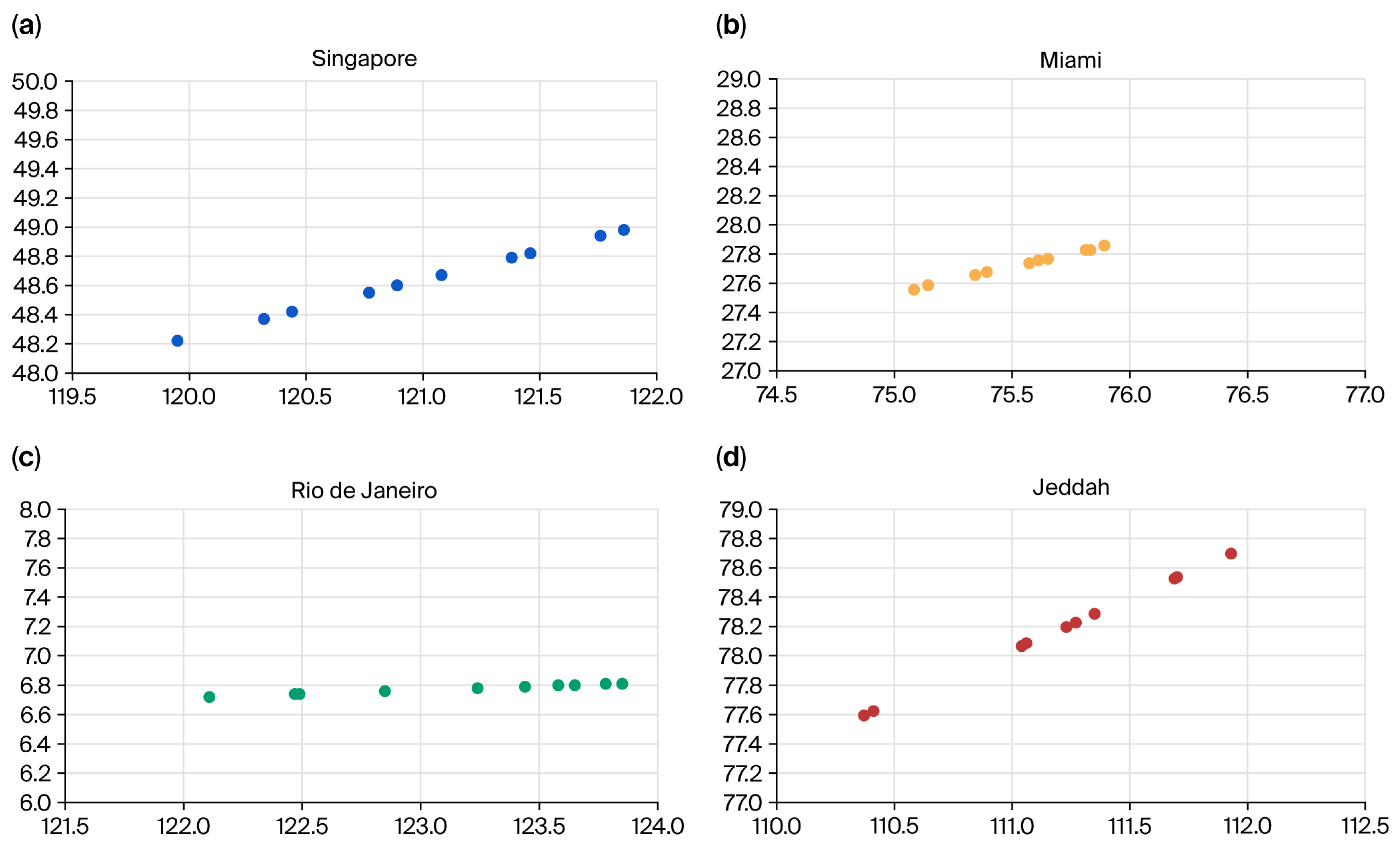
To visualize the distribution of optimization results, the evaluated design solutions were plotted in the energy–carbon performance space. To complement the combined energy–carbon plot,
Figure 3 presents city-specific distributions of the optimized solutions. Each subplot illustrates the relationship between energy use intensity (EUI) and operational carbon emissions within a single climatic context. The near-linear patterns observed in all cities reflect the proportional relationship between energy consumption and carbon emissions under a fixed electricity emission factor. Differences in slope across the subplots highlight the influence of regional grid carbon intensity rather than variations in building design alone.
Because operational carbon emissions were calculated directly from simulated electricity consumption using fixed location-specific electricity emission factors, the strong linear relationship observed in
Figure 3 is expected. Under these conditions, the distributions should be interpreted as reflecting the performance of high-performing configurations identified through evolutionary search rather than representing strongly conflicting optimization objectives.
Because operational carbon emissions were calculated directly from simulated electricity consumption using fixed location-specific electricity emission factors, the near-linear distributions shown in
Figure 3 are expected. The multiple points represent near-equivalent high-performing configurations generated from different combinations of discrete and continuous design variables during evolutionary search.
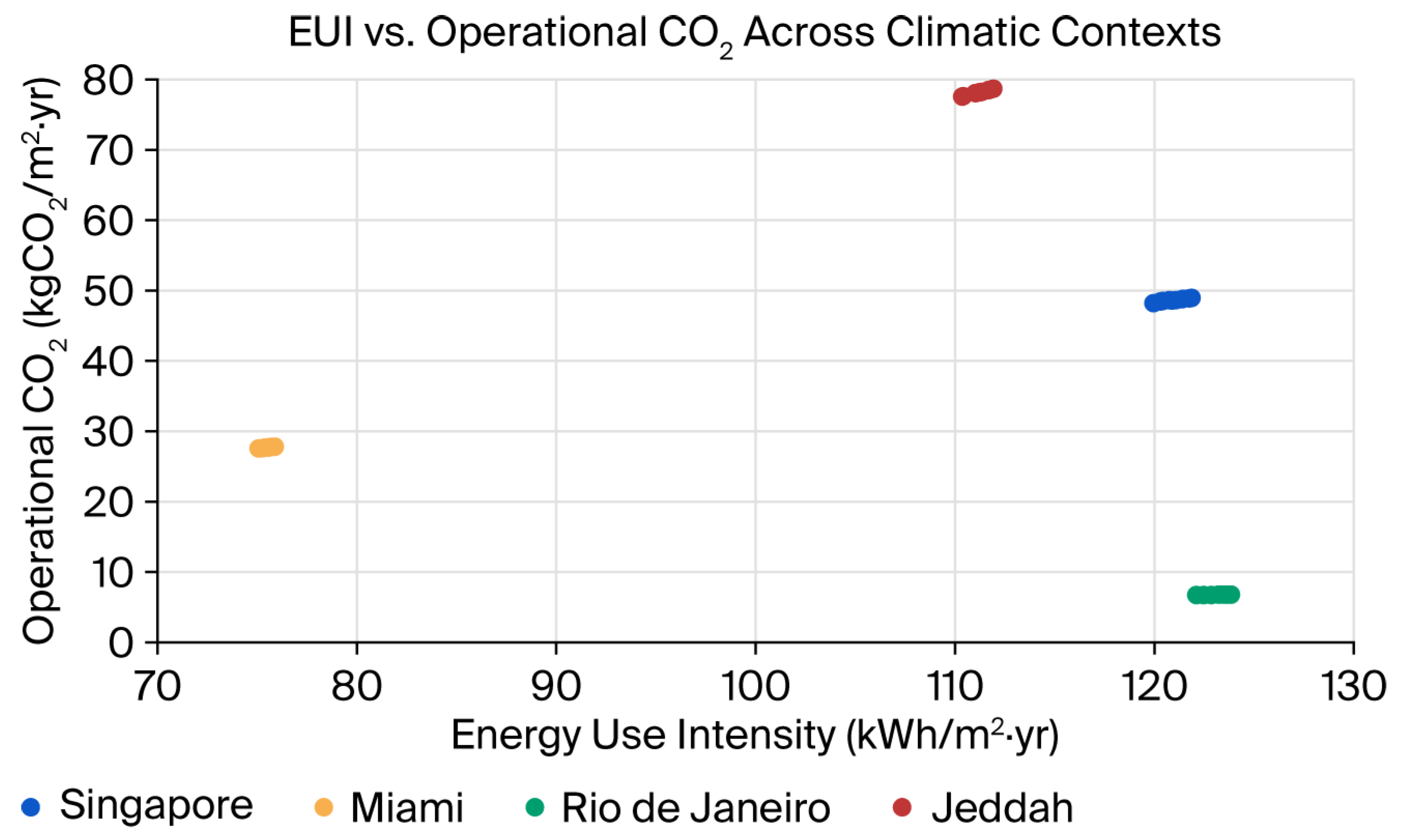
To enable cross-climate comparison, the optimized solutions from all cities were projected into a unified energy–carbon performance space.
Figure 4 presents the relationship between energy use intensity (EUI) and operational carbon emissions across all climatic contexts.
Because operational carbon emissions are directly proportional to energy use intensity within each climate, the observed distributions primarily reflect differences in regional electricity emission factors rather than strongly conflicting optimization behavior.
The observed clustering confirms that operational carbon emissions are strongly influenced by regional grid characteristics, while energy use intensity remains primarily governed by building design and climatic conditions.
The cross-climate comparison indicates that high-performing solutions within the tested range show recurring parameter selection patterns while diverging in carbon outcomes. Across all cities, low WWR values near 20%, low-emissivity glazing, and cooling setpoints close to 26 °C recur among the highest-performing solutions within the tested range. However, the carbon implications differ substantially because of regional grid emission factors. Rio de Janeiro shows low operational CO2 despite a relatively high EUI, while Jeddah shows high operational CO2 despite an improved energy performance. This demonstrates that envelope optimization alone cannot determine carbon outcomes without considering the regional electricity mix.
To further clarify cross-climate consistency,
Table 10 summarizes the selection patterns of key design parameters among the top-performing solutions across all studied locations.
The results indicate consistent selection patterns across climates, with several key parameters reaching boundary values within the defined ranges rather than representing unconstrained optimal solutions.
6.6. Baseline vs. Optimized Performance
To evaluate the effectiveness of the optimization process, the optimized solutions were compared with the baseline building performance obtained from the reference model simulations. The baseline building represents a conventional residential configuration without the optimization of envelope parameters or operational settings.
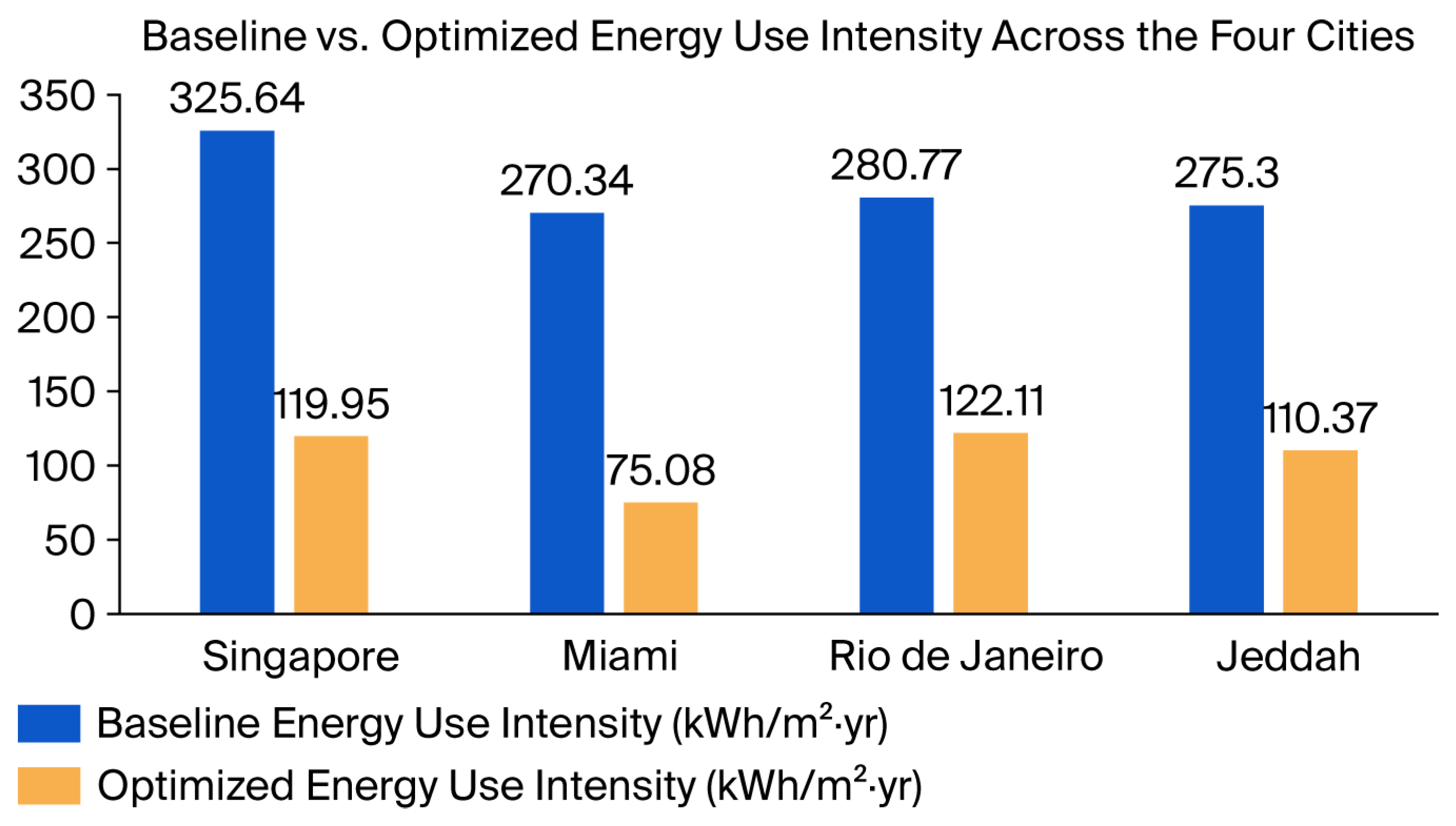
Across all climates, the optimization process achieved substantial reductions in energy consumption. The most significant improvement was observed in Singapore, where the EUI decreased from 325.64 kWh/m
2·yr in the baseline model to 119.95 kWh/m
2·yr in the optimized configuration, corresponding to a reduction of approximately 63%. Similar improvements were observed in the other locations, including Miami (72% reduction), Rio de Janeiro (56% reduction), and Jeddah (60% reduction).
Table 11 presents a comparative summary of baseline and optimized building performance across the four studied climates, highlighting the magnitude of energy use intensity reductions achieved through the NSGA-II optimization process.
These reductions demonstrate the combined influence of envelope configuration, HVAC system efficiency, and operational setpoint adjustments on cooling energy demand in warm climates. By systematically exploring combinations of design parameters through evolutionary search, NSGA-II identified recurring high-performing configurations capable of substantially improving performance as evaluated through energy and carbon indicators.
The optimization results show a consistent preference for higher-efficiency HVAC configurations, particularly the unitary heat pump system, across most climates. This indicates that, although envelope design and operational setpoints remain the dominant factors influencing overall performance, system efficiency plays an important role.
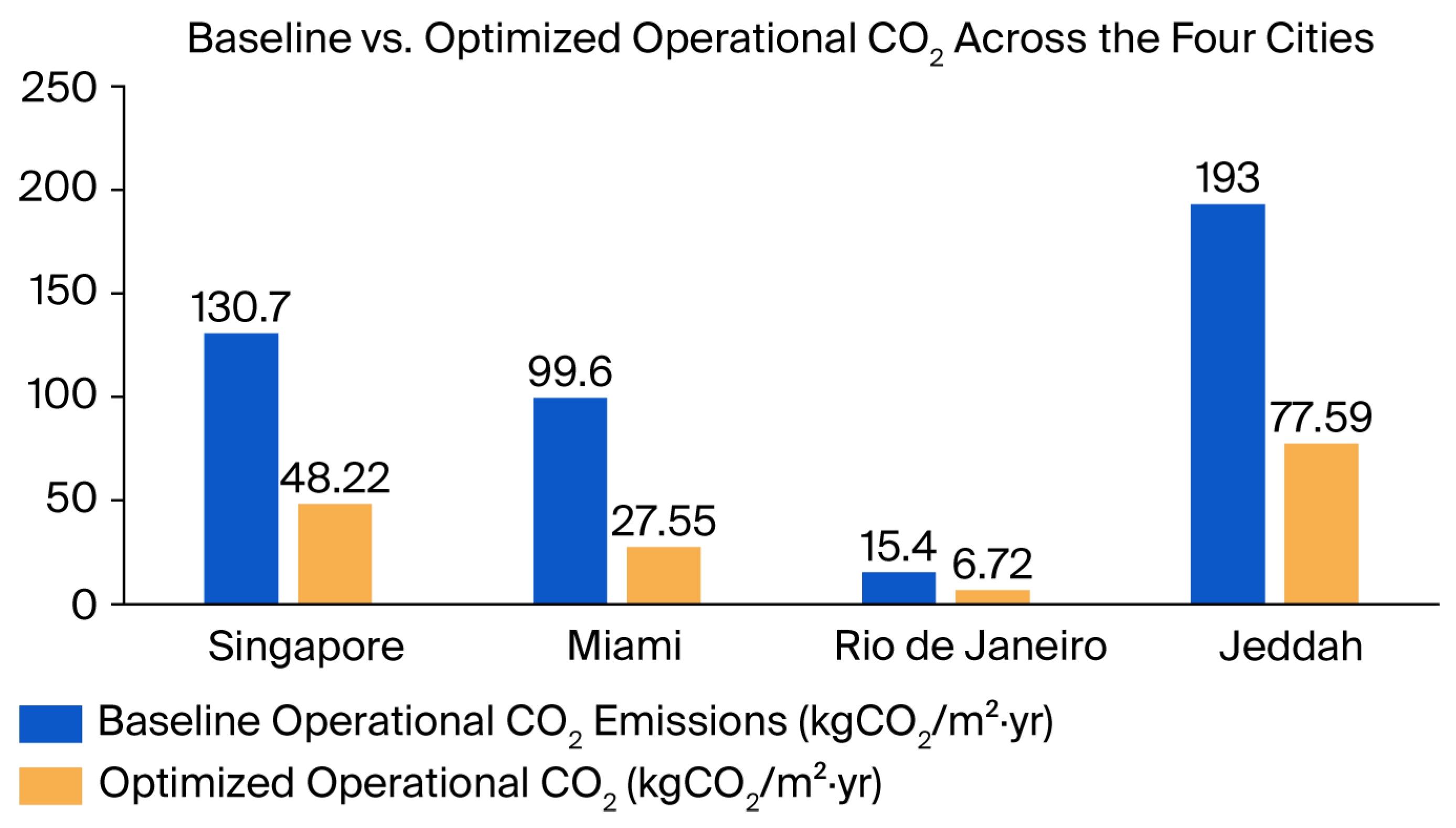
The impact of the evolutionary search process on building performance is illustrated in
Figure 5 and
Figure 6.
Figure 5 compares baseline energy use intensity with energy use intensity among the high-performing configurations across the four studied climates, demonstrating substantial reductions in annual energy demand. These improvements translate directly into lower operational carbon emissions, as shown in
Figure 6, where the high-performing configurations substantially reduce CO
2 emissions across all cities.
6.7. Cross-Climate Design Implications
The results indicate that, despite differences in climatic conditions, the evolutionary search process consistently identified recurring envelope configurations among the high-performing solutions within the defined parameter ranges that improved energy performance. This consistent pattern suggests that similar design strategies, including envelope configuration, HVAC system selection, and operational control, may be transferable across warm–humid and hot–arid coastal climates to reduce cooling demand.
The findings highlight the importance of controlling solar heat gains through careful envelope design. In all four climates, configurations with reduced glazing ratios and improved envelope insulation were favored by the optimization algorithm. These strategies reduce solar heat gains entering the building envelope and improve thermal resistance, thereby lowering cooling loads.
Operational temperature control also plays an important role in improving building performance. The consistent appearance of cooling setpoints near 26 °C among high-performing solutions within the tested range suggests that modest increases in indoor temperature setpoints may substantially reduce cooling demand while remaining broadly consistent with adaptive thermal comfort limits. Together, these results demonstrate the potential of simulation-based evolutionary optimization to support integrated building design strategies combining envelope performance, system efficiency, and operational control and to guide decision-making during early architectural design stages.
6.8. Summary of Recurring High-Performing Design Characteristics
Analysis of the highest-performing solutions across the four climatic contexts indicates a consistent tendency of the optimization process to select boundary values within the defined parameter ranges. In particular, window-to-wall ratios were repeatedly identified near the minimum tested value (20%), reflecting the strong influence of solar heat gains on cooling demand. Similarly, cooling setpoints consistently approach the upper bound of the defined range (26 °C), indicating the importance of operational temperature control.
While reduced glazing ratios contribute to lower cooling energy consumption, such configurations also represent a potential trade-off with daylight availability and visual comfort, and therefore should be interpreted as lower-bound energy-driven solutions rather than universally optimal design recommendations. The recurrence of these parameter selections reflects the constraints of the defined simulation range rather than unconstrained optimal design outcomes.
7. Discussion
7.1. Tendency Toward Low Window-to-Wall Ratios
One of the most consistent outcomes of the optimization process is the identification of high-performing solutions with window-to-wall ratios (WWRs) close to the lower boundary of the tested range (20%) across all four climates. Most high-performing configurations identified by NSGA-II adopted WWR values between 20% and 22%, regardless of climate location.
This result highlights the strong influence of solar heat gains through glazing on cooling demand in warm climates. Larger glazing areas increase solar radiation entering the building envelope, which directly increases cooling loads. Even when high-performance glazing systems are used, solar gains remain a major contributor to energy consumption.
Previous studies on building energy performance in tropical climates have similarly identified low glazing ratios as an effective passive strategy for reducing cooling demand. Research by Albatayneh (2021) demonstrated that reducing glazing areas significantly lowers cooling loads in warm regions [
8]. Similarly, Magnier and Haghighat (2010) reported that envelope optimization processes frequently identify reduced glazing ratios in cooling-dominated climates [
22]. The results of the present study reinforce these findings and suggest that controlling solar exposure through glazing design remains one of the most effective passive strategies for minimizing cooling demand in warm and hot climates.
The optimization process consistently identified the lowest tested WWR values, indicating a strong sensitivity of cooling demand to solar heat gains within the defined parameter range. Because the parametric analysis limited WWR values to a minimum of 20%, configurations with lower glazing ratios were not evaluated. The observed tendency toward lower WWR values should therefore be interpreted as an energy-driven outcome within the defined simulation constraints rather than a universally optimal façade design recommendation. While reduced glazing ratios contribute to lower cooling demand, they may also limit daylight availability and visual comfort in residential buildings. Future research should therefore investigate a broader range of façade glazing ratios while simultaneously evaluating daylight performance and visual comfort to identify more balanced façade design strategies.
7.2. Influence of Cooling Setpoint Temperature
Another consistent pattern observed across the optimization results is the tendency of cooling setpoints to approach the upper bound of the tested range (26 °C). Most of the high-performing solutions identified within the defined parameter space used cooling setpoint temperatures between 25.8 °C and 26 °C. Higher cooling setpoints reduce energy consumption by decreasing the temperature difference between indoor and outdoor conditions, thereby lowering the cooling loads required to maintain indoor comfort conditions.
In tropical and warm climates, adaptive thermal comfort models suggest that occupants can tolerate slightly higher indoor temperatures when buildings provide adequate air movement and humidity control. Studies based on adaptive comfort theory indicate that indoor temperatures between 25 °C and 27 °C can still maintain acceptable thermal comfort conditions in warm climates [
32].
The observed tendency toward a 26 °C cooling setpoint therefore reflects the influence of the upper boundary of the tested parameter range and the role of operational temperature control in reducing cooling demand, rather than representing an unconstrained optimal setpoint recommendation. Within the tested conditions, modest relaxation of indoor temperature targets contributed to significant reductions in cooling energy demand while remaining consistent with adaptive comfort limits.
7.3. Role of Envelope Insulation and Wall Assemblies
The optimization results also demonstrate a strong preference for insulated cavity masonry walls, particularly those incorporating mineral insulation layers. These wall systems appear frequently among the top-performing configurations in most climates, particularly Singapore, Miami, and Jeddah, while Rio de Janeiro exhibits a different pattern, with a preference for lower-insulation wall assemblies. Insulated cavity walls improve building performance by reducing conductive heat transfer through the envelope. In cooling-dominated climates, this reduces the amount of external heat entering the building during daytime hours. Although insulation is often emphasized in cold climates, several studies have shown that envelope insulation can also significantly reduce cooling demand in hot climates by limiting heat gains through walls and roofs [
33,
34]. The present study confirms that insulated wall assemblies remain an important design strategy even in warm–humid and hot–arid coastal climates.
7.4. Differences Between Warm–Humid and Hot–Arid Coastal Climates
Despite similarities in high-performing design strategies, differences in energy consumption after evolutionary search were observed across the studied climates. Miami achieved the lowest EUI among high-performing configurations (75.08 kWh/m2·yr) among the four locations. This result reflects the relatively moderate climatic conditions of Miami compared with equatorial or desert environments. In contrast, Singapore and Rio de Janeiro exhibited higher energy consumption after evolutionary search, with EUI values exceeding 119 kWh/m2·yr. These results are consistent with the climatic characteristics of tropical environments, where high humidity levels increase latent cooling loads and limit the effectiveness of passive cooling strategies. Jeddah presented intermediate performance levels. Although the desert climate is characterized by extremely high summer temperatures, the lower humidity levels reduce latent cooling loads, allowing high-performing envelope strategies to achieve relatively strong performance.
These results highlight the importance of considering both temperature and humidity conditions when evaluating cooling demand in different climates. In humid tropical climates such as Singapore and Rio de Janeiro, the high latent loads associated with moisture removal increase cooling energy demand. In contrast, desert climates such as Jeddah exhibit lower humidity levels, which reduce latent cooling requirements despite higher dry-bulb temperatures.
7.5. Implications for Passive Design Strategies
The results of this study provide several implications for the design of energy-efficient residential buildings in warm climates. First, glazing control, HVAC system efficiency, and operational temperature settings should be jointly considered during early design stages, as window size and glazing performance significantly influence cooling demand. Second, moderate cooling setpoints around 26 °C can provide a balance between comfort and energy efficiency. Finally, insulated envelope assemblies remain important even in hot climates, as they help reduce conductive heat gains. Together, these findings demonstrate the effectiveness of combining envelope design strategies, HVAC system efficiency, and operational control parameters in order to minimize building energy consumption.
7.6. Interpretation of Optimization Results
The consistent identification of high-performing solutions within the tested range toward similar envelope configurations across different climatic contexts raises an important interpretative question. While this consistent pattern suggests the robustness of certain passive design strategies, it may also reflect the constraints imposed by the defined parametric design space. In particular, the lower bound of the window-to-wall ratio and the limited range of envelope configurations may guide the optimization process toward similar regions of the solution space. Therefore, the identified patterns should be interpreted as a performance-driven tendency within the defined design boundaries rather than a universal optimal condition. Expanding the design space to include additional variables such as shading systems, façade articulation, and natural ventilation strategies may reveal alternative high-performance solutions.
8. Conclusions
In this study, we investigated the potential of a simulation-based evolutionary optimization framework for identifying high-performing configurations of residential buildings in warm–humid and hot–arid coastal climates. By integrating dynamic building simulation (EnergyPlus via DesignBuilder) with an NSGA-II-based evolutionary search framework, our research explored a wide range of envelope and operational design configurations across four representative climates: Singapore, Miami, Rio de Janeiro, and Jeddah.
It is important to note that the observed performance improvements result from the combined influence of envelope configuration, HVAC system efficiency, and operational setpoint adjustments, rather than envelope design alone.
Our results demonstrate that simulation-based evolutionary search can support the identification of high-performing building configurations in cooling-dominated climates. Across all four locations, the high-performing configurations identified through the evolutionary search process consistently outperformed the baseline building configuration, producing substantial improvements in building performance as evaluated through energy use intensity and operational carbon indicators. The analysis revealed several consistent patterns within the tested parameter ranges. First, the optimization process consistently identified window-to-wall ratios close to the minimum tested value (20%), highlighting the strong influence of solar heat gains on cooling demand in warm climates. However, these results should be interpreted as energy-driven outcomes within the defined simulation constraints rather than universally optimal façade design recommendations, since lower glazing ratios may also affect daylight availability and visual comfort.
Second, many high-performing solutions within the tested parameter range used cooling setpoints approaching the upper bound of the defined range (26 °C), reflecting the influence of operational temperature control on cooling demand. Within the tested conditions, moderate relaxation of indoor temperature targets contributed to reductions in cooling energy demand while remaining consistent with adaptive comfort limits.
Third, insulated cavity wall systems and lightweight insulated roof assemblies were frequently associated with improved energy performance across multiple climates.
Although similar design patterns emerged across the four climates, the overall energy performance differed between locations. Among the studied cities, Miami exhibited the lowest energy demand among the high-performing configurations, achieving an energy use intensity of 75.08 kWh/m2·yr, while Singapore and Rio de Janeiro showed higher high-performing values within the tested range, exceeding 119 kWh/m2·yr, due to persistent humidity and associated latent cooling loads. Jeddah presented intermediate performance levels, reflecting the balance between high solar radiation and relatively lower humidity conditions characteristic of hot–arid coastal climates. These findings highlight the importance of climate-sensitive envelope design when developing energy-efficient buildings in warm regions. Strategies that reduce solar heat gains, improve envelope insulation, and optimize operational setpoints can substantially decrease cooling energy demand.
From a methodological perspective, this study demonstrates the effectiveness of combining building performance simulation with evolutionary search algorithms. This approach allows designers to systematically explore large design spaces and identify high-performance configurations that would be difficult to discover using conventional trial-and-error methods. Despite these contributions, several limitations should be acknowledged. This study relied on a prototype residential building model, which may not fully capture the diversity of real-world building typologies. In addition, the analysis focused primarily on envelope parameters and operational setpoints, while other factors such as shading devices, natural ventilation strategies, and occupant behavior were not explicitly examined.
Future research may extend the present framework by integrating reinforcement learning-based control algorithms, such as those implemented in BuildingGym [
35], to enable real-time adaptive optimization of building operation. While the current study focuses on design-stage optimization, reinforcement learning approaches offer the potential to address operational-stage control strategies, further enhancing energy efficiency and carbon reduction performance.
An important finding of this study is the consistent selection of similar envelope configurations across climates with fundamentally different environmental conditions. Despite differences in humidity, solar radiation, and temperature profiles, the optimization results consistently favor reduced glazing ratios, moderate cooling setpoints, and insulated envelope assemblies. This suggests that several passive design strategies remain robust across diverse coastal climates, providing practical guidance for architects and engineers designing energy-efficient residential buildings in cooling-dominated regions.
These patterns reflect the constraints of the defined parameter ranges, with several variables reaching their lower or upper bounds, rather than representing unconstrained optimal design solutions.
Overall, our results demonstrate that simulation-based evolutionary search methods provide an effective approach for identifying high-performing building configurations and supporting the design of low-carbon buildings in warm climates. By systematically identifying high-performance design solutions, such methods can contribute to reducing energy consumption and greenhouse gas emissions in the building sector.