Research on Construction Quality Risk Management of Urban Expressway Projects


Abstract
1. Introduction
2. Methodology
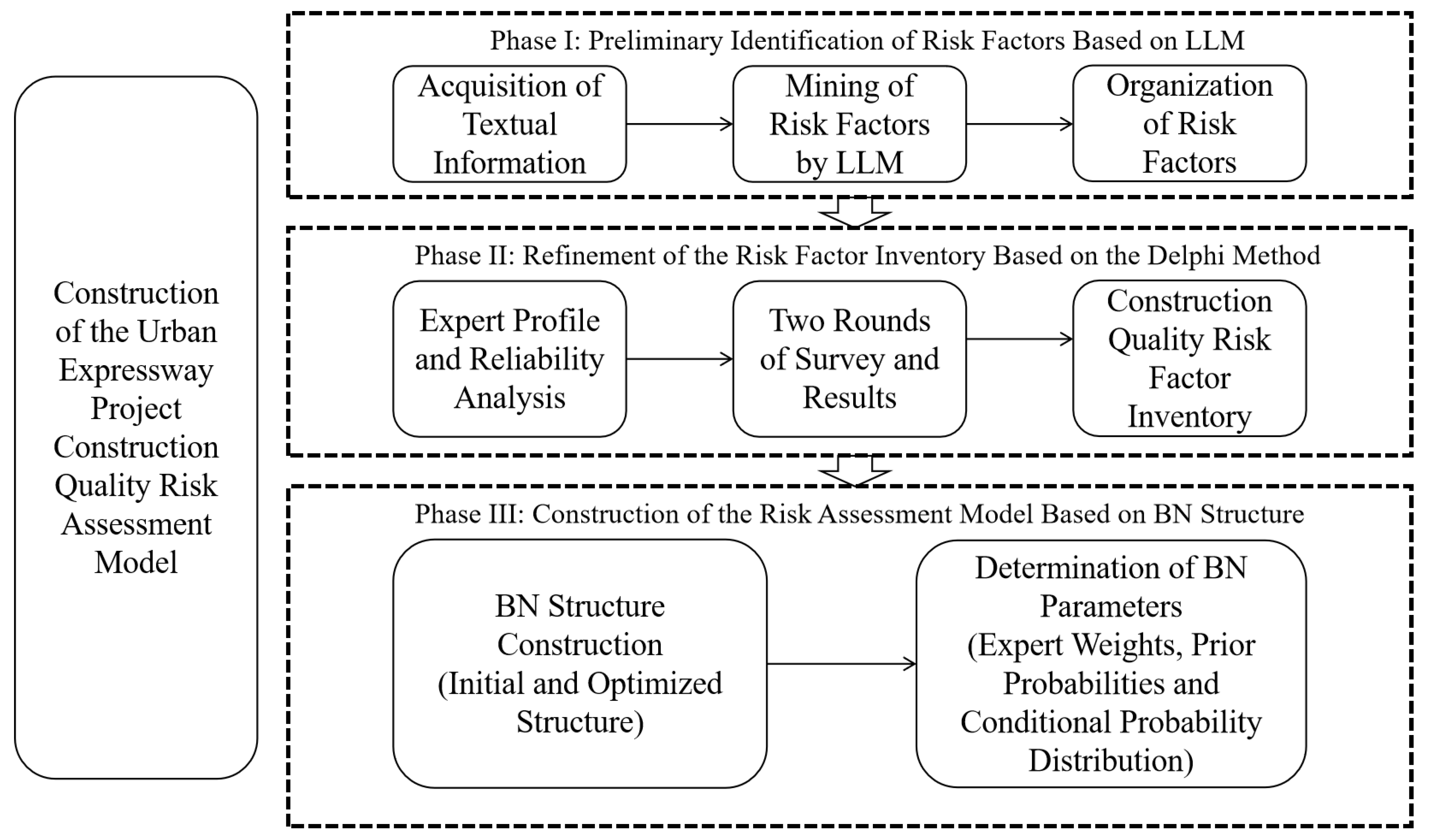
2.1. Construction of the Urban Expressway Project Construction Quality Risk Assessment Model
2.2. Phase I: Preliminary Identification of Risk Factors Based on LLM
2.2.1. Acquisition of Textual Information
- Industry norms and standards. Relevant norms for expressway construction issued by the state, Hangzhou city, and the industry, such as construction and quality acceptance norms, and engineering technical specifications, were collected. These norms define the acceptable standards and mandatory provisions for construction quality, possessing strong reference value. A total of 10 relevant documents were collected, with a total of about 221.5 thousand words.
- Materials and reports of Hangzhou expressway projects. Construction summaries and acceptance reports of expressway projects within Hangzhou in recent years were obtained through relevant companies. These texts record focal points related to construction quality, providing practical textual evidence. A total of five relevant documents were collected, with a total of about 28.5 thousand words.
- Relevant academic papers. Using databases such as CNKI and Wanfang Data, core journal and degree papers from the past decade were retrieved using keywords like “Hangzhou”, “urban expressway”, and “construction quality” to reflect the influencing factors of construction quality drawn from the research of other scholars. The above literature was organized to ultimately form the initial text corpus, providing an adequate data reserve for the LLM input. A total of 10 relevant documents were collected, with a total of about 144.7 thousand words.
2.2.2. Mining of Risk Factors
- Construction of Prompt Engineering. To ensure the accuracy of the LLM in identifying risk factors and to avoid “hallucinations”, strict prompt engineering must be established. The LLM’s role is set as a “senior quality management expert for urban expressway projects,” and the goal is defined as “extracting influencing factors of construction quality risks for urban expressway projects,” identifying potential causes of quality defects from the input text paragraphs. Strict screening logic is set in the prompt, requiring the model to distinguish between “phenomena” (e.g., pavement cracks) and “risk factors” (e.g., loose control of the mix ratio), ensuring the mined content represents “risk factors” rather than “phenomena”. The detailed prompt words are shown in Appendix A.
- Text Preprocessing and Corpus Segmentation. Prior to LLM processing, raw texts underwent cleaning to remove HTML tags, headers, footers, and noise. Long documents were segmented into chunks of 500–800 words based on semantic integrity, with a 100-word overlap maintained between adjacent segments to prevent the loss of cross-contextual risk correlations.
- Semantic Scanning and Feature Identification. The preprocessed text is input into the LLM, leveraging its attention mechanism to capture negative quality descriptions related to “4M1E” (Man, Machine, Material, Method, Environment) within the text, and fix the temperature to 0 and Top_p to 0.9. Through semantic association, the model automatically identifies non-compliant behaviors, environmental mutations, and material failures during the construction process.
- Preliminary Clustering of Risk Items. Based on the extracted feature values, the LLM conducts preliminary merging and logical classification of scattered risk descriptions. The model automatically maps hundreds of identified risk data to the preset preliminary framework, forming an original mining list containing risk names, descriptions, and corresponding corpus sources. The risk factor categories are classified into five mutually independent and comprehensively covering dimensions, possessing broad universality: personnel, machinery, material, process method, and environment [17]. To mitigate the occurrence of hallucinations, a manual verification process was conducted by the researchers. Any risk factors not substantiated by the raw corpus were strictly excluded, ensuring that every identified factor is traceable and grounded in the original engineering documentation. The final compiled mining results consisted of 156 items. Some mining results are shown in Table 1.
2.2.3. Organization of Risk Factors
2.3. Phase II: Refinement of the Risk Factor Inventory Based on the Delphi Method
2.3.1. Expert Profile and Reliability Analysis
- (1)
- Basic Information of Experts
- (2)
- Expert Reliability Analysis
- Expert Enthusiasm Coefficient
- 2.
- Expert Subjective Reliability
- 3.
- Expert Opinion Coordination Degree
2.3.2. First Round of Survey and Results
- (1)
- R1 was modified to “Insufficient qualifications, experience, and practical capabilities of key personnel”;
- (2)
- R11 was modified to “Loss of control over mixture production, transportation, and construction temperatures”;
- (3)
- R12 was modified to “Poor on-site storage of finished products, semi-finished products, and hazardous materials”;
- (4)
- Added “Logical errors or improper connection of construction procedures” under “Method Risk”;
- (5)
- Added “Leakage hazards at key waterproof parts such as welds and construction joints” under “Method Risk”;
- (6)
- Added “Defects in traffic organization and diversion plans during construction” under “Environment Risk”. A new risk inventory was formed based on these adjustments.
2.3.3. Second Round of Survey and Results
2.3.4. Construction Quality Risk Factor Inventory for Hangzhou Expressway Projects
2.4. Phase III: Construction of the Risk Assessment Model Based on BN Structure
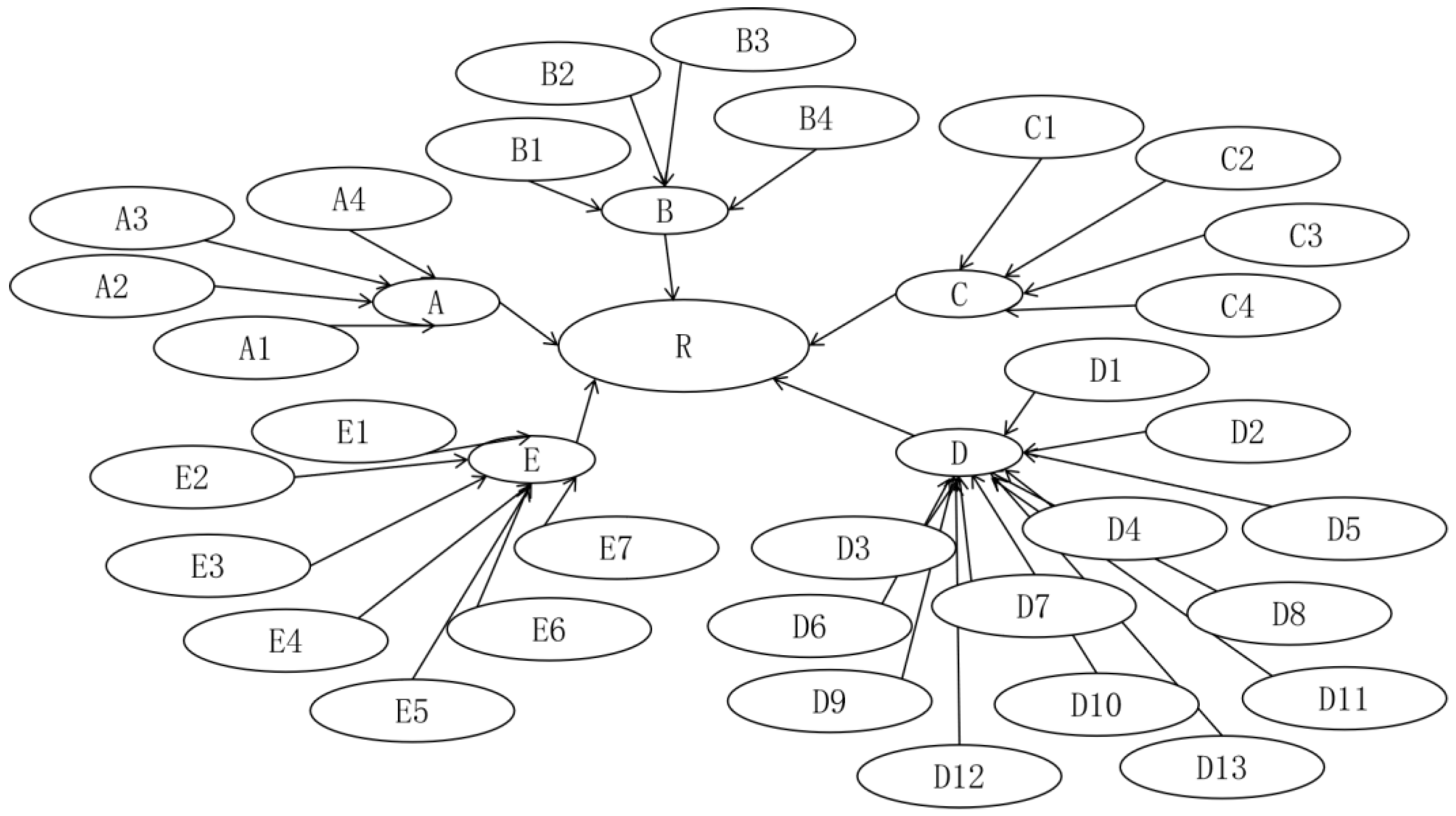
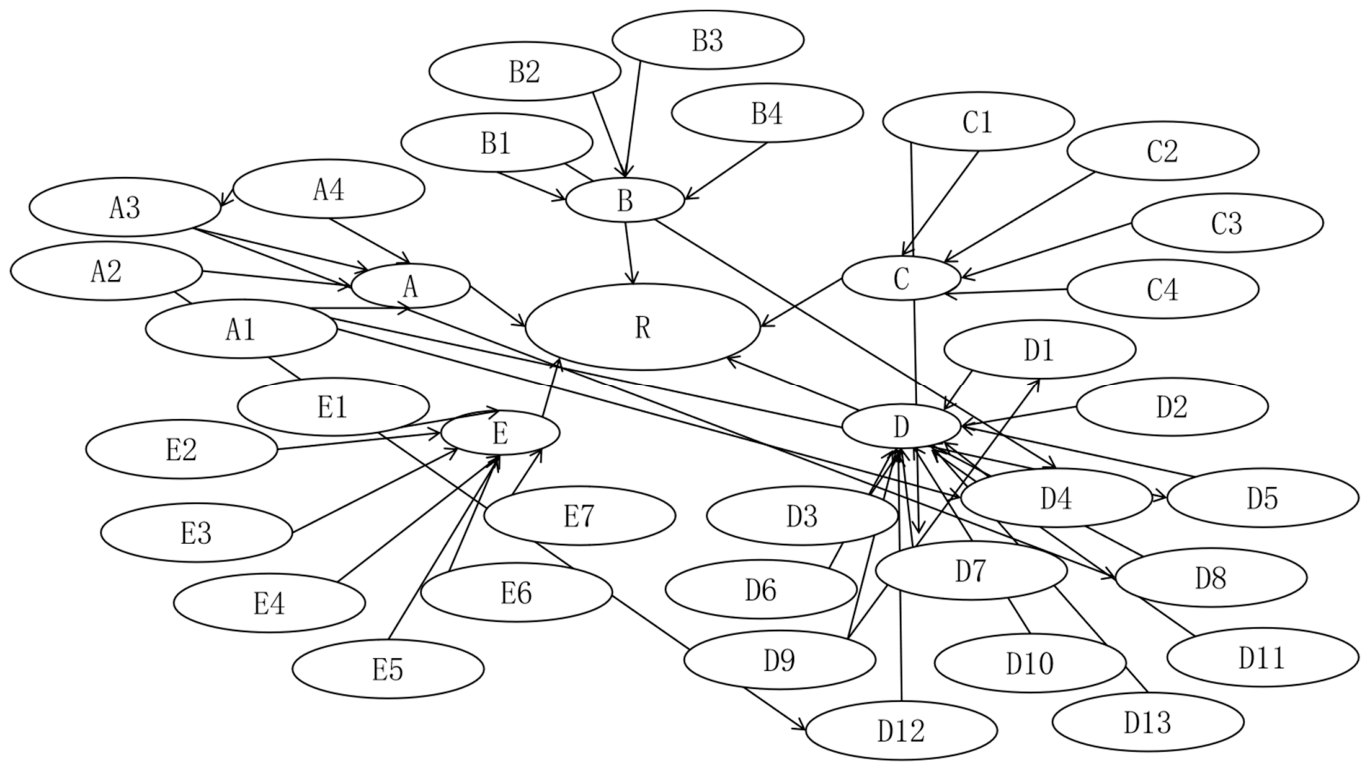
2.4.1. BN Structure Construction
- (1)
- Initial Structure Construction
- (2)
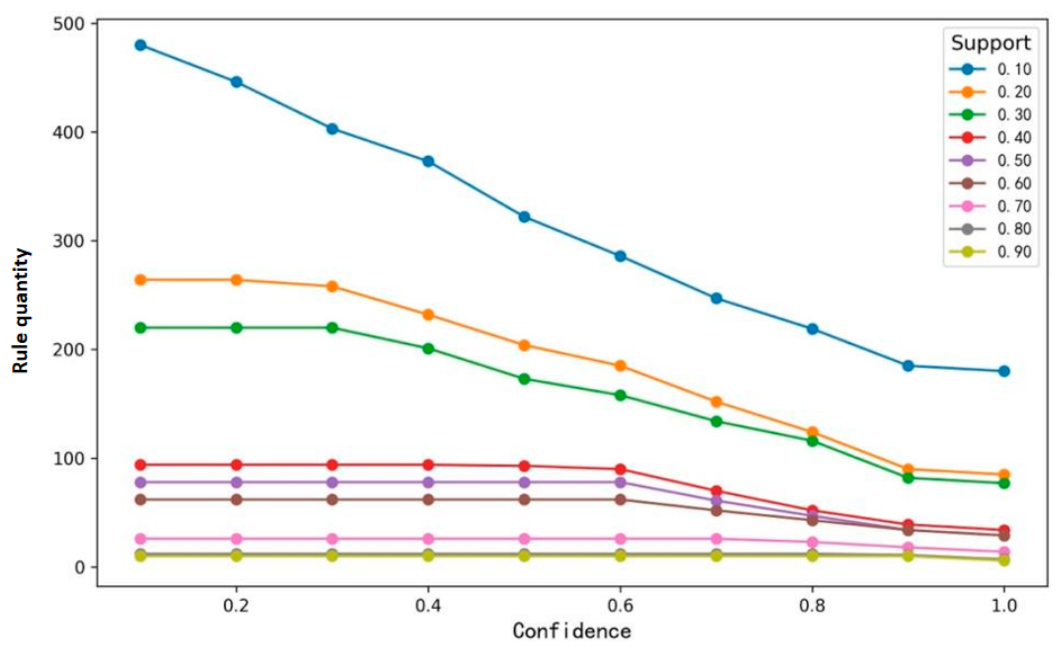
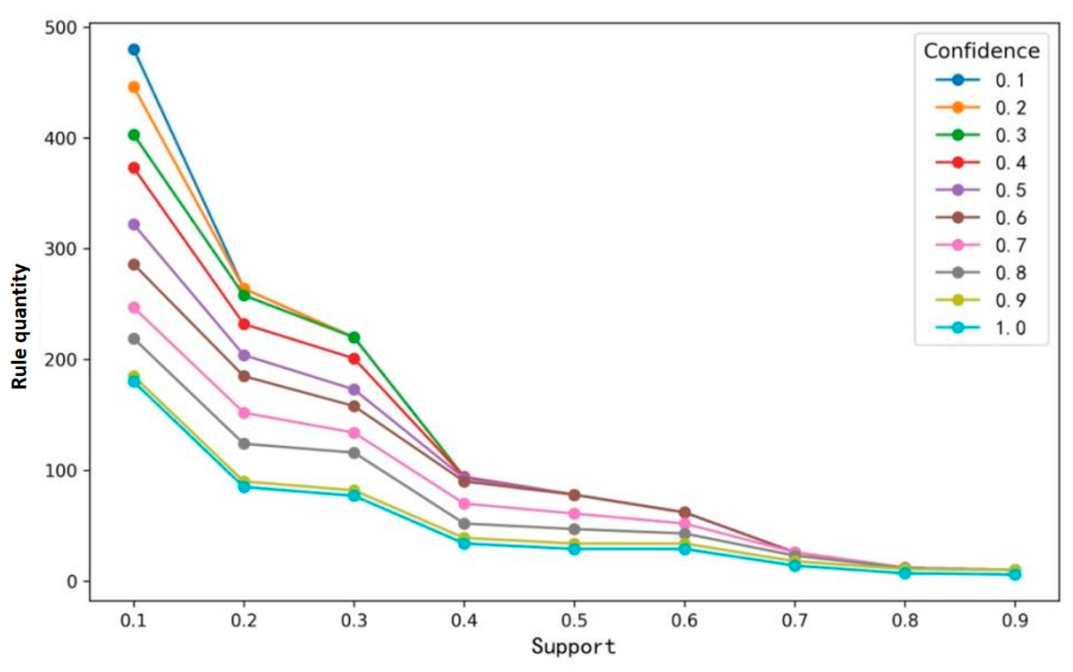
- Structure Optimization
2.4.2. Determination of BN Parameters
- (1)
- Quantifying Expert Evaluations
- (2)
- Acquiring Subjective Expert Weights
- (3)
- Acquiring Objective Expert Weights
- (1)
- Acquiring Comprehensive Expert Weights
- (2)
- Determination of Prior Probabilities
- (3)
- Determination of Conditional Probability Distribution
3. Empirical Analysis
3.1. Determination of Prior Probabilities for Root Nodes
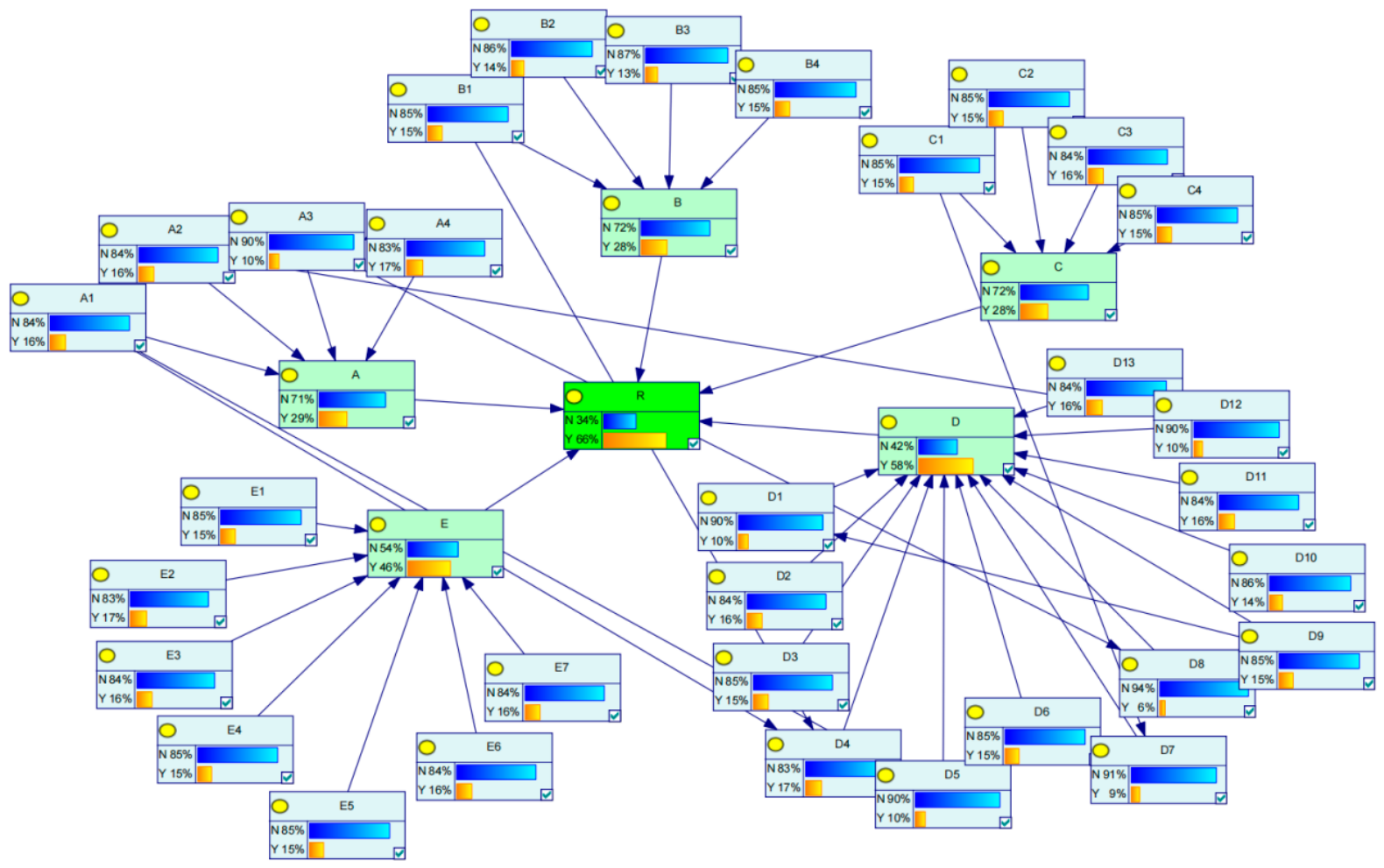
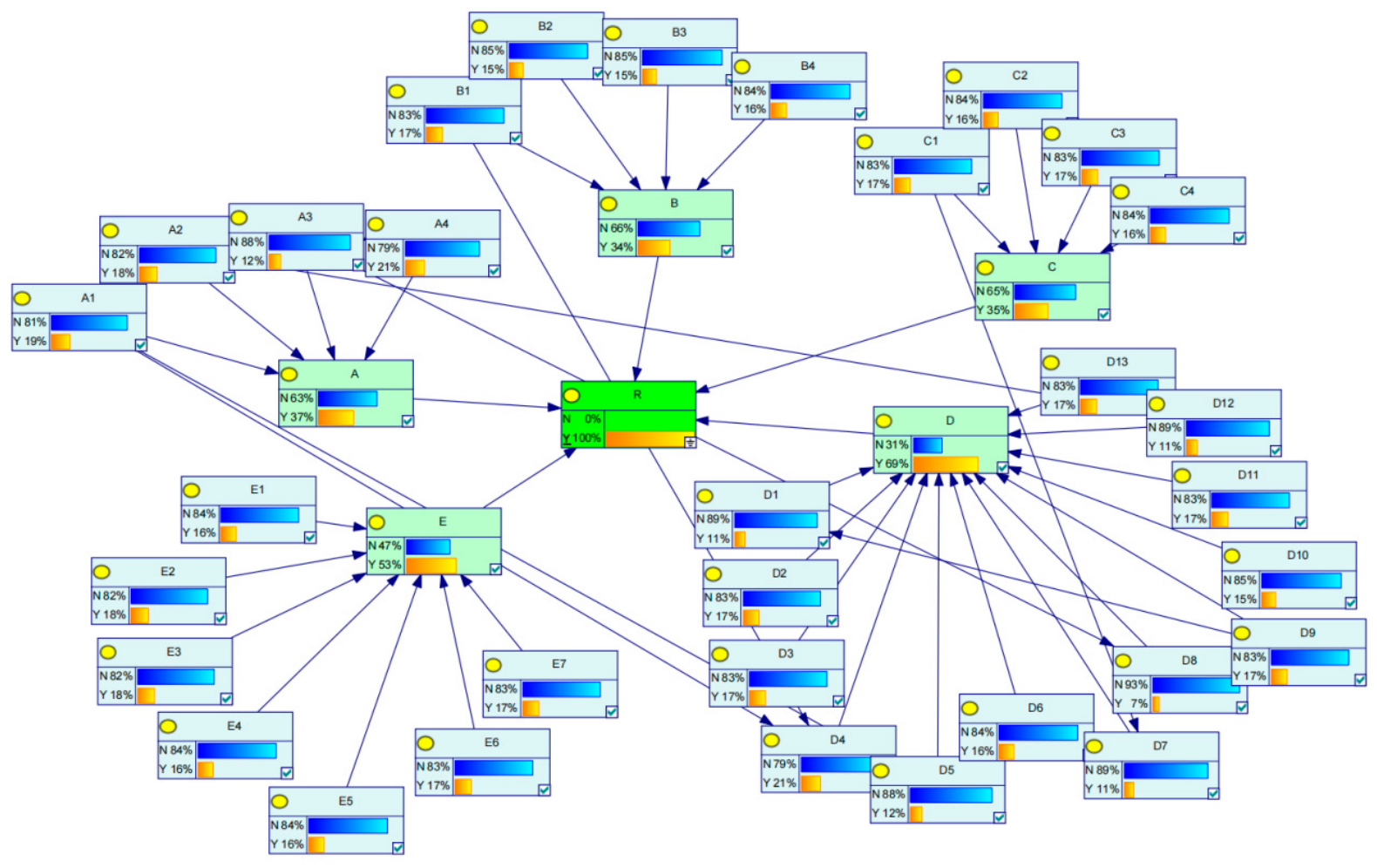
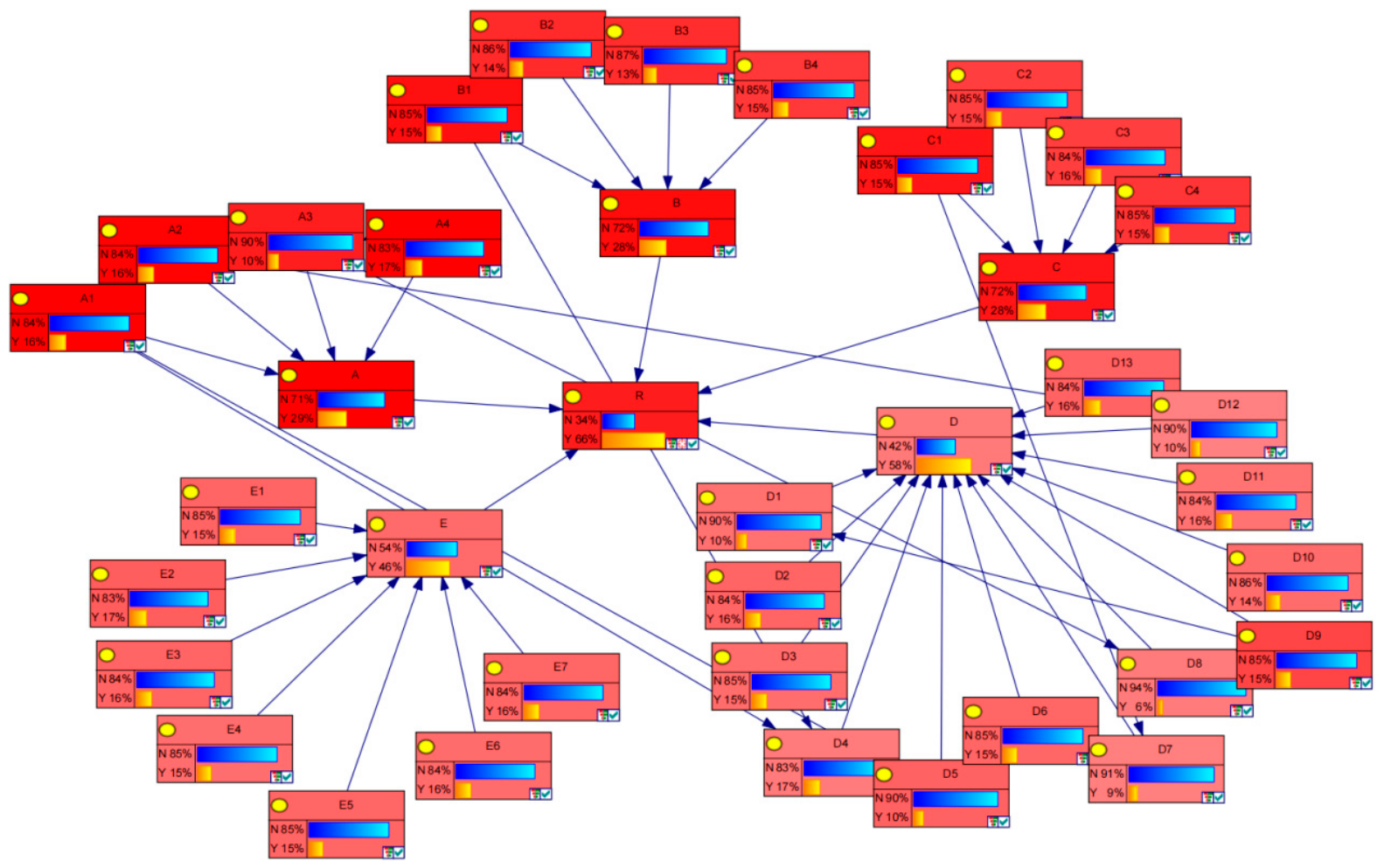
3.2. Inference and Analysis of the BN Model
- (1)
- Forward Causal Reasoning
- (2)
- Backward Diagnostic Reasoning
- (3)
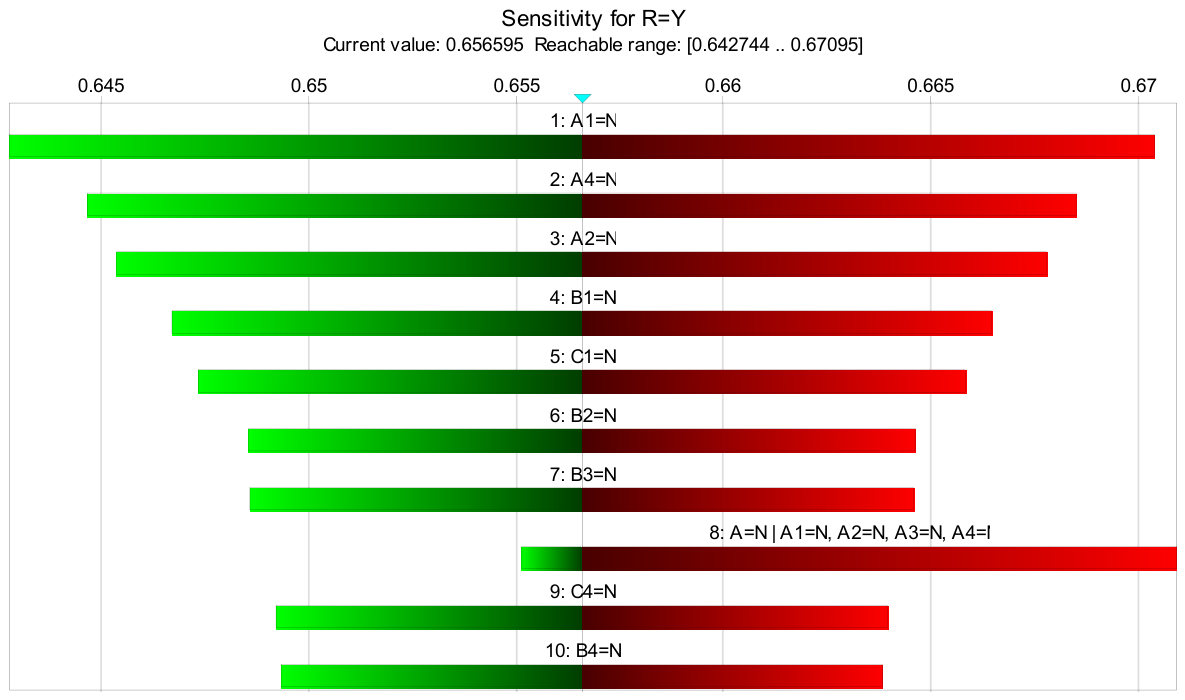
- Sensitivity Analysis
4. Risk Prevention Suggestions and Implementation Effects
4.1. Risk Prevention Suggestions
- (1)
- Personnel Management: Enforce strict access and dynamic assessment for key personnel, ensuring team stability and operative technical disclosures.
- (2)
- Machinery Equipment: Strengthen entrance inspections, standard lifting operations, and daily maintenance.
- (3)
- Material Control: Strictly control material acceptance, storage, and mixture temperature during transportation.
- (4)
- Environmental Response: Establish systematic mechanisms, optimize site layouts, and improve traffic diversion plans.
- (5)
- Method Optimization: Deepen special plans and strengthen concealed works acceptance.
4.2. Implementation Effects
4.3. Discussion and Value Analysis
5. Conclusions and Discussion
5.1. Conclusions
- (1)
- A localized construction quality risk inventory comprising five primary categories—personnel, machinery, material, method, and environment—and 32 discrete risk factors was successfully established. Deviating from traditional manual extraction, this study implemented a dual-stage filtering mechanism: a preliminary semantic mining utilizing a Large Language Model (LLM) over a localized corpus of industry specifications, engineering reports, and the academic literature, followed by Delphi-based consensus refinement. The resulting inventory provides a standardized ontological framework, minimizing human cognitive biases and serving as a foundational benchmark for quality control in high-density urban infrastructure projects.
- (2)
- A robust risk assessment model was established by mapping the text-derived risk factors into a parameterized BN topology. To resolve the “black box” challenge inherent in network structure definitions, the Apriori association rule algorithm was introduced to optimize directional edges based on statistical co-occurrences, thereby ensuring structural traceability. Root node prior probabilities and non-root conditional probabilities were subsequently quantified by integrating fuzzy set theory and combinatorial weighting with expert knowledge. This synthesis effectively captures the dynamic, non-linear correlations among intertwined risks, transforming qualitative textual logic into a rigorous probabilistic diagnostic tool.
- (3)
- The empirical diagnosis of Project T verified the practical scalability of the integrated framework. Through forward probability updating, backward diagnostic inference, and critical sensitivity analysis, the model isolated key risk drivers—such as mixture temperature loss—from background operational noise. Rather than yielding purely descriptive outputs, the model generated targeted risk response strategies across five dimensions: dynamic credential audits for personnel management, preventive maintenance for machinery, precise thermal tracking for material control, rapid response protocols for environmental shifts, and operational workflow optimization. These empirical findings demonstrate that the model provides precise, data-informed decision support, enabling project managers to shift from experience-driven reactive troubleshooting to proactive, resource-optimized risk mitigation in complex urban environments.
5.2. Future Outlook
- (1)
- The depth and breadth of risk factor identification need to be expanded. This study primarily conducts risk factor mining based on textual materials such as industry specifications, project reports, and academic papers related to Hangzhou expressway projects. Although the combination of LLM and the Delphi method ensures the comprehensiveness of the risk inventory to a certain extent, omissions may still exist. Future research could further expand the scope of the corpus to include more diverse cases of expressway projects. Simultaneously, combining methods such as field investigations and in-depth interviews can continuously enrich and refine the risk factor inventory, thereby enhancing the universality of the research conclusions.
- (2)
- The diversification of research perspectives remains to be explored. This study primarily conducts research on the construction quality risk management of Hangzhou expressway projects from the perspective of the constructor. However, the construction of Hangzhou expressway projects involves multiple stakeholders, including owners, designers, constructors, supervisors, and material suppliers. There are differences among these parties regarding their cognition of quality risks, boundaries of responsibility, and management and control capabilities. Future research could attempt to introduce theories such as multi-party game theory and collaborative governance to construct a mechanism for shared risk bearing and collaborative management of construction quality risks in urban expressway projects with the participation of multiple subjects.
Author Contributions
Funding
Data Availability Statement
Acknowledgments
Conflicts of Interest
Abbreviations
| BN | Bayesian Network |
| LLM | Large Language Model |
| AHP | Analytic Hierarchy Process |
| TFN | Triangular Fuzzy Number |
| DUOWA | Dependent Uncertain Ordered Weighted Aggregation |
| CNKI | China National Knowledge Infrastructure |
| Project T | T Expressway Project |
| 4M1E | Man, Machine, Material, Method, Environment |
| LOOCV | Leave-One-Out Cross-Validation |
Appendix A
- [System Role] You are an expert project manager and risk management specialist specializing in urban expressway construction.
- [Task] Based on the provided literature and documents, please identify and extract risk factors related to “Urban Expressway Construction Quality.”
- [Operational Requirements]
- Granularity: Provide highly specific descriptions. Avoid generic terms like “management risk”; instead, use technical specifics such as “excessive welding current leading to structural deformation” or “insufficient fastening of lifting shackles.”
- Structural Framework: Categorize all identified risks according to the 4M1E framework (Man, Machine, Material, Method, and Environment).
- Output Specification: The output must be formatted as a table with the following columns:
- Primary Category | Secondary Risk Factor | Description & Consequence | Frequency of Occurrence | Source Literature (Full Filename) |
- [Output Example]

| Primary Category | Secondary Risk Factor | Description & Consequence | Frequency | Source |
|---|---|---|---|---|
| Method Risk | Improper welding temperature control | High temperatures caused thermal deformation of steel plates, affecting deck smoothness. | 2 | Zhang et al. (2022) |
| Personnel Risk | Uncertified special operations | Welders lacked proper certification, resulting in failed ultrasonic testing of welds. | 3 | Li et al. (2023) |
- [Objective] Below is a compiled list of all identified risk factors. Please perform de-duplication and standardization.
- [Procedure] The processing steps are as follows:
- 1. Merge semantically redundant risks (e.g., combining ‘welding deformation’ and ‘thermal deformation’).
- 2. Rename the factors using professional engineering terminology.
- 3. Generate a streamlined table of core risk factors, categorized according to the ‘4M1E’ (Man, Machine, Material, Method, and Environment) framework.
- [Output Example]
| Risk Factor Category | ID | Risk Factor |
|---|---|---|
| Method Risk | R1 | Improper welding temperature control |
| Personnel Risk | R2 | Uncertified special operations |
| Stage | Content |
|---|---|
| Prompt Structure (System) | You are an experienced urban expressway project manager and risk management expert … (Consistent with the prompt described above) |
| Input Segment (Sample) | The construction site shall develop a staffing plan for skilled workers based on project characteristics and contractual agreements. The proportion of intermediate-level workers and above must comply with local site construction staffing standards. The staffing plan shall be submitted to the supervision unit for review before implementation. All management and field personnel must undergo quality training and pass the assessment. Training records must be maintained, and a dynamic management system for personnel education and training should be implemented. |
| LLM Output (Raw) | Special equipment operators (welders, crane operators, surveyors) lacking required certifications or sufficient skills. |
| Validation | Expert Verification: The extracted result is substantiated by the original source and is therefore retained. |
| LLM Systematic Integration | Upon inputting the integration prompt, “Special equipment operators lacking certifications or skills” was merged with other similar items into a unified factor: “R1 Insufficient qualifications and capabilities of key personnel.” Upon manual review, the description was judged to be sufficiently professional and was added directly to the risk inventory. |
Appendix B
- Part I: Basic Information
- 1. What is your current type of institution?
- [ ] Owner
- [ ] Supervisor
- [ ] Contractor
- [ ] Designer
- [ ] Other (Please specify: ____________)
- 2. What are your current position and professional title?
- Position: ____________
- Professional Title: ____________
- 3. Years of professional experience in the industry:
- [ ] 0–5 years
- [ ] 5–10 years
- [ ] 10–15 years
- [ ] 15–20 years
- [ ] 20 years and above
- 4. How many urban expressway projects in Hangzhou have you participated in?
- [ ] 1
- [ ] 2
- [ ] 3
- [ ] 4
- [ ] 5 and above
- 5. How familiar are you with the content of this survey (Construction Quality Risk for Urban Expressway Projects)?
- [ ] Very familiar
- [ ] Familiar
- [ ] Neutral
- [ ] Unfamiliar
- [ ] Very unfamiliar
- Part II: Evaluation of Risk Factors
- Below are 32 preliminary construction quality risk factors identified for urban expressway projects in H City. Please evaluate the rationality and scientific validity of these factors using a 5-point Likert scale:
- 5—Very Rational; 4—Rational; 3—Neutral; 2—Irrational; 1—Very Irrational.
| Risk Category | Category ID | Risk Factor | Rationality Score (1–5) |
|---|---|---|---|
| Personnel Risk | R1 | Insufficient qualifications and capabilities of key personnel | |
| R2 | Lax implementation of standards by construction and quality inspection personnel | ||
| R3 | Inadequate quality and safety technical disclosures | ||
| R4 | Dereliction of duty in on-site quality supervision and control | ||
| R5 | Insufficient capability or stability of the core project management team | ||
| Machinery Risk | R6 | Poor condition of key construction machinery and equipment | |
| R7 | Safety hazards in lifting equipment and rigging | ||
| R8 | Inaccurate measurement and test monitoring equipment | ||
| R9 | Lack of maintenance and calibration management for construction equipment | ||
| Material Risk | R10 | Out of control inspection and acceptance of raw materials entering the site | |
| R11 | Loss of control over mixture production and construction temperatures | ||
| R12 | Poor on-site storage of finished products, semi-finished products, and materials | ||
| R13 | Unqualified mixture proportions and material gradations | ||
| R14 | Improper management and use of connection and protective materials | ||
| Method Risk | R15 | Improper processing techniques for foundation and special parts | |
| R16 | Defects in subgrade and pavement compaction process control | ||
| R17 | Defects in pavement paving and joint construction processes | ||
| R18 | Construction defects throughout the entire concrete engineering process | ||
| R19 | Missing welding process control and quality inspection | ||
| R20 | Defects in prestressing system construction technology | ||
| R21 | Defects in pile foundation piling construction technology | ||
| R22 | Defects in steel structure installation and coating processes | ||
| R23 | Missing acceptance of concealed works and key procedures | ||
| R24 | Insufficient preparation and argumentation of special construction plans | ||
| R25 | Out of control third-party testing and experimental management | ||
| Environment Risk | R26 | Poor control of structural alignment and geometric dimensions | |
| R27 | Forced construction under adverse weather conditions | ||
| R28 | Inadequate response to complex geological condition risks | ||
| R29 | Confined construction sites and cross-operation interference | ||
| R30 | Construction risks adjacent to existing facilities | ||
| R31 | Inadequate control of special operational environments | ||
| R32 | Lack of management for construction environmental protection and civilized construction |
- Part III: Suggestions on Modification of Risk Factors
- 1. In the table above, do you think the expression of each risk factor is accurate and complete? If adjustment is required, please provide specific modification suggestions, such as “the expression of R1 is modified to XX” or “R2 and R3 are combined to XX”, etc. ______________________
- 2. Based on your experience, what other factors do you think need to be considered for the construction quality risk of the H City Expressway Project (i.e., what risk factors need to be increased)? ______________________
References
- Zheng, S.J. Practice and suggestions on construction quality management of urban bridge expressways. Urban Roads Bridges Flood Control 2015, 17–18+174–176. (In Chinese) [Google Scholar]
- Shi, K.S. Research on the Evaluation System of Vehicle Speed Control for Urban Expressways. Master’s Thesis, Zhejiang University, Hangzhou, China, 2018. (In Chinese) [Google Scholar]
- Zhan, C.X. Research on the Rationality of Construction Period for Urban Expressway Projects. Master’s Thesis, Huaqiao University, Quanzhou, China, 2019. (In Chinese) [Google Scholar]
- Salawu, R.A.; Abdullah, F. Review of risk assessment models for highway construction projects. Int. J. Eng. Res. 2014, 3, 826–831. [Google Scholar]
- Shin, D.W.; Shin, Y.; Kim, G.H. Comparison of risk assessment for a nuclear power plant construction project based on analytic hierarchy process and fuzzy analytic hierarchy process. J. Build. Constr. Plan. Res. 2016, 4, 157–171. [Google Scholar] [CrossRef]
- Boamah, F.A.; Jin, X.; Senaratne, S.; Perera, S. AI-driven risk identification model for infrastructure project: Utilising past project data. Expert Syst. Appl. 2025, 283, 127891. [Google Scholar] [CrossRef]
- Khalid, J.; Chuanmin, M.; Altaf, F.; Shafqat, M.M.; Khan, S.K.; Ashraf, M.U. AI-driven risk management and sustainable decision-making: Role of perceived environmental responsibility. Sustainability 2024, 16, 6799. [Google Scholar] [CrossRef]
- Shi, R.; Chen, T.; Lu, C.; Shang, D.; Luo, J.; Hui, X.; Li, H.; He, H. Dynamic assessment and early warning of cross-border pipeline risks based on knowledge graph. In Proceedings of the 2025 8th International Conference on Advanced Electronic Materials, Computers and Software Engineering (AEMCSE); IEEE: Wuhan, China, 2025; pp. 374–377. [Google Scholar]
- Lu, C.; Luo, J.; Shang, D.; Shang, D.; Luo, J.; Hui, X.; Li, H.; He, H. Knowledge graph reasoning and security assurance decision-making based on online retrieval augment generation. In Proceedings of the 2024 4th International Symposium on Artificial Intelligence and Intelligent Manufacturing (AIIM); IEEE: Hangzhou, China, 2024; pp. 1007–1010. [Google Scholar]
- Chen, G.; Jaselskis, E.J.; Tamer, A.; Folz, A. Using an LLM-powered framework for automatic risk identification and mitigation from past claims and supplemental agreements. J. Comput. Civ. Eng. 2026, 40, 04025151. [Google Scholar] [CrossRef]
- Wong, S.; Zheng, C.; Su, X.; Tang, Y. Construction contract risk identification based on knowledge-augmented language models. Comput. Ind. 2024, 157, 104082. [Google Scholar] [CrossRef]
- Madihi, M.H.; Shirzadi Javid, A.A.; Nasirzadeh, F. Enhancing risk assessment: An improved Bayesian network approach for analyzing interactions among risks. Eng. Constr. Archit. Manag. 2025, 32, 2022–2043. [Google Scholar] [CrossRef]
- Fu, S.; Zhang, Y.; Zhang, M.; Han, B.; Wu, Z. An object-oriented Bayesian network model for the quantitative risk assessment of navigational accidents in ice-covered Arctic waters. Reliab. Eng. Syst. Saf. 2023, 238, 109459. [Google Scholar] [CrossRef]
- Sun, X.; Hu, Y.; Qin, Y.; Zhang, Y. Risk assessment of unmanned aerial vehicle accidents based on data-driven Bayesian networks. Reliab. Eng. Syst. Saf. 2024, 248, 110185. [Google Scholar] [CrossRef]
- Qian, C.; Tang, H.Y.; Yang, Z.R.; Hu, X.L.; Sheng, X.; Feng, S.X.; Cheng, K.S.; Wang, Z.P.; Ren, R.F.; Liu, Y. Application research of large language models in graph attribute prediction tasks. Sci. Technol. Bull. 2026, 1–11. (In Chinese) [Google Scholar] [CrossRef]
- Cai, H.L.; Peng, X.L. Research on multi-modal AI reconstruction of smart supply chain based on DeepSeek technology innovation and practice path. Supply Chain Manag. 2025, 6, 5–14. (In Chinese) [Google Scholar]
- Chen, G.Y.; Zeng, W.; Zhang, K.Y. Influence and control of “Man-Machine-Material-Method-Environment” factors in enterprise safety management. Hubei Emerg. Manag. 2023, 10, 62–65. (In Chinese) [Google Scholar]
- Xiong, J.X.; Song, X.Q.; Bai, Y.M. Construction of the evaluation index system for sustainable development of medical alliances—Based on the Delphi method. Health Econ. Res. 2021, 38, 59–62. (In Chinese) [Google Scholar]
- Li, X.Y.; Zou, J.H.; Hu, Q.Y.; Xu, L.Y.; Gao, J.; Zhao, L.; Tao, R. Construction of an index system for health poverty vulnerability risk in rural elderly patients with chronic diseases. J. Nurs. Sci. 2024, 39, 99–103. (In Chinese) [Google Scholar]
- Zheng, Y.T. Research on Risk Response of General Contractors in Housing Construction EPC Projects Based on Engineering Insurance. Master’s Thesis, Zhejiang University, Hangzhou, China, 2024. (In Chinese) [Google Scholar]
- Chen, X.L.; Lin, W.D.; Huang, X.D.; Yang, F.Q. Fire risk assessment of super high-rise buildings based on fuzzy Bayesian network. Saf. Environ. Eng. 2023, 30, 40–47. (In Chinese) [Google Scholar]
- Wang, H.P.; Zhang, W.F. Research on quality risk association rules of prefabricated buildings based on improved Apriori algorithm. Ind. Eng. Manag. 2024, 29, 85–93. (In Chinese) [Google Scholar]
- Ju, C.H.; Bao, F.G.; Wang, Z.G. Research on the improvement of evaluation methods and measurement framework of association rules. J. Inf. Resour. Manag. 2013, 32, 584–592. (In Chinese) [Google Scholar]
- Hikmawati, E.; Maulidevi, N.U.; Surendro, K. Minimum threshold determination method based on dataset characteristics in association rule mining. J. Big Data 2021, 8, 146. [Google Scholar] [CrossRef]
- Luo, Q.Q. Research on Self-Classification Model and Risk Pre-Control of Production Safety Accidents Based on Text Data. Ph.D. Thesis, China University of Mining and Technology, Xuzhou, China, 2024. (In Chinese) [Google Scholar]
- Liu, C.H.; He, S.W. Research on association rules of railway traffic operation accident causes based on improved Apriori algorithm. Railw. Transp. Econ. 2023, 45, 120–126. (In Chinese) [Google Scholar]
- Wang, J.J.; Yao, D.H. Simulation of Naive Bayes classification structure optimization for association rules. Comput. Knowl. Technol. 2017, 13, 241–245. (In Chinese) [Google Scholar]
- Taheri, S.; Mammadov, M. Learning the naive Bayes classifier with optimization models. Int. J. Appl. Math. Comput. Sci. 2013, 23, 787–795. [Google Scholar] [CrossRef]
- Ye, Y.J.; Zhang, X.Y.; Zhang, Y.P. Association rule mining and Bayesian modeling analysis of tower crane operation accidents. J. Saf. Environ. 2024, 24, 610–616. (In Chinese) [Google Scholar]
- Ma, D.Z.; Zhou, Z.; Yu, X.Y.; Fan, S.C.; Xing, W.W.; Guo, Z.S. Reliability analysis of multi-state Bayesian network based on fuzzy probability. Syst. Eng. Electron. 2012, 34, 2607–2611. (In Chinese) [Google Scholar]
- Yao, Z.Q.; Ren, Y.B.; Deng, B.; Han, Y.; Gao, J.D.; Tang, B. Research on risk assessment of low-temperature wind tunnel based on game theory-fuzzy Bayesian network. China Saf. Sci. J. 2024, 20, 177–183. (In Chinese) [Google Scholar]
- Shyama, A.K.L.; Pal, M. Triangular fuzzy matrices. Iran. J. Fuzzy Syst. 2007, 4, 75–87. [Google Scholar]
- Libório, M.P.; Karagiannis, R.; Diniz, A.M.A.; Ekel, P.I.; Vieira, D.A.G.; Ribeiro, L.C. The use of information entropy and expert opinion in maximizing the discriminating power of composite indicators. Entropy 2024, 26, 143. [Google Scholar] [CrossRef]
- Ayan, B.; Abacıoğlu, S.; Basilio, M.P. A comprehensive review of the novel weighting methods for multi-criteria decision-making. Information 2023, 14, 285. [Google Scholar] [CrossRef]
- Xu, Z. Dependent uncertain ordered weighted aggregation operators. Inf. Fusion 2008, 9, 310–316. [Google Scholar] [CrossRef]
- Zhang, Z.; Li, J.T.; Bi, S.Q.; Xu, X.Y.; Lin, R.; Ouyang, J.X. Comprehensive evaluation method for offshore wind power system planning based on improved CRITIC-Entropy combination weighting method. New Technol. Electr. Eng. 2024, 43, 1–10. (In Chinese) [Google Scholar]
- Feng, X.; Jiang, J.; Wang, W. Gas pipeline failure evaluation method based on a Noisy-OR gate Bayesian network. J. Loss Prev. Process Ind. 2020, 66, 104175. [Google Scholar] [CrossRef]
- Liu, M.; Jin, Y.; Li, K.; Duo, Y.L.; Sun, T. Risk analysis of gasifier feeding system based on Bayesian network. China Saf. Sci. J. 2020, 16, 87–92. (In Chinese) [Google Scholar]
- Zhao, C.; Lang, K. Risk assessment of fresh logistics based on Bayesian network. J. Syst. Sci. Math. Sci. 2020, 40, 2108–2124. (In Chinese) [Google Scholar]
- Chen, Y.; Jin, R.; Zha, Y.C. Research on schedule delay risk of large-scale public projects based on Bayesian network. J. Zhengzhou Univ. (Eng. Sci.) 2022, 43, 91–97. (In Chinese) [Google Scholar]


| Risk Factor Category | Risk Factor | Risk Description/Consequence | Frequency |
|---|---|---|---|
| Personnel Risk | Special operation personnel (welders, riggers, surveyors) without certificates or insufficient skills | The quality of key processes (welding, hoisting and measurement) is out of control, such as unqualified welds, hoisting accidents and linear deviation. | 2 |
| Personnel Risk | The quality responsibility of the construction management personnel is not implemented, and the quality planning and disclosure are not effectively carried out | The quality management system is in vain, the quality control points are omitted, the construction personnel are not clear about the standards and risks, and the process is out of control. | 3 |
| …… | …… | …… | …… |
| Environment Risk | Interference between underground pipelines and existing buildings | In the urban environment, the underground pipelines are disordered, close to existing buildings; the survey before construction is unclear or the protection is not effective, which may lead to the obstruction of excavation, the risk of foundation construction, and even affect the safety of surrounding facilities. | 1 |
| Risk Factor Category | ID | Risk Factor |
|---|---|---|
| Personnel Risk | R1 | Insufficient qualifications and capabilities of key personnel |
| Personnel Risk | R2 | Lax implementation of standards by construction and quality inspection personnel |
| Personnel Risk | R3 | Inadequate quality and safety technical disclosures |
| Personnel Risk | R4 | Dereliction of duty in on-site quality supervision and control |
| Personnel Risk | R5 | Insufficient capability or stability of the core project management team |
| Machinery Risk | R6 | Poor condition of key construction machinery and equipment |
| Machinery Risk | R7 | Safety hazards in lifting equipment and rigging |
| Machinery Risk | R8 | Inaccurate measurement and test monitoring equipment |
| Machinery Risk | R9 | Lack of maintenance and calibration management for construction equipment |
| Material Risk | R10 | Out of control inspection and acceptance of raw materials entering the site |
| Material Risk | R11 | Loss of control over mixture production and construction temperatures |
| Material Risk | R12 | Poor on-site storage of finished products, semi-finished products, and materials |
| Material Risk | R13 | Unqualified mixture proportions and material gradations |
| Material Risk | R14 | Improper management and use of connection and protective materials |
| Method Risk | R15 | Improper processing techniques for foundation and special parts |
| Method Risk | R16 | Defects in subgrade and pavement compaction process control |
| Method Risk | R17 | Defects in pavement paving and joint construction processes |
| Method Risk | R18 | Construction defects throughout the entire concrete engineering process |
| Method Risk | R19 | Missing welding process control and quality inspection |
| Method Risk | R20 | Defects in prestressing system construction technology |
| Method Risk | R21 | Defects in pile foundation piling construction technology |
| Method Risk | R22 | Defects in steel structure installation and coating processes |
| Method Risk | R23 | Missing acceptance of concealed works and key procedures |
| Method Risk | R24 | Insufficient preparation and argumentation of special construction plans |
| Method Risk | R25 | Out of control third-party testing and experimental management |
| Method Risk | R26 | Poor control of structural alignment and geometric dimensions |
| Environment Risk | R27 | Forced construction under adverse weather conditions |
| Environment Risk | R28 | Inadequate response to complex geological condition risks |
| Environment Risk | R29 | Confined construction sites and cross-operation interference |
| Environment Risk | R30 | Construction risks adjacent to existing facilities |
| Environment Risk | R31 | Inadequate control of special operational environments |
| Environment Risk | R32 | Lack of management for construction environmental protection and civilized construction |
| Information | Category | Number | Percentage (%) |
|---|---|---|---|
| Type of employer | Owner | 8 | 31 |
| Supervisor | 6 | 23 | |
| Contractor | 6 | 23 | |
| Designer | 6 | 23 | |
| Professional title | Senior Engineer | 15 | 58 |
| Engineer | 9 | 35 | |
| Other | 2 | 8 | |
| Years of experience | 0–10 years | 3 | 12 |
| 10–15 years | 12 | 46 | |
| 15–20 years | 8 | 31 | |
| 20 years and above | 3 | 12 | |
| Number of Hangzhou expressway projects participated in | 1–2 | 16 | 62 |
| 3–4 | 7 | 27 | |
| 5 and above | 3 | 12 | |
| Familiarity with survey content | Very familiar | 10 | 38 |
| Relatively familiar | 14 | 54 | |
| Generally familiar | 2 | 8 |
| Very Familiar | Relatively Familiar | Generally Familiar | Relatively Unfamiliar | Very Unfamiliar |
|---|---|---|---|---|
| 5 | 4 | 3 | 2 | 1 |
| Expert Subjective Reliability | Mean | Standard Deviation |
|---|---|---|
| Round 1 | 4.308 | 0.618 |
| Round 2 | 4.577 | 0.504 |
| Expert Opinion Coordination Degree | Concordance Coefficient (Wa) | Chi-Square (χ2) | Significance (P) |
|---|---|---|---|
| Round 1 | 0.258 | 208.240 | 0.000 |
| Round 2 | 0.291 | 234.802 | 0.000 |
| Risk Factor | Mean | Coefficient of Variation (%) |
|---|---|---|
| Insufficient qualifications and capabilities of key personnel | 4.615 | 18.46 |
| Lax implementation of standards by construction and quality inspection personnel | 4.308 | 25.23 |
| Inadequate quality and safety technical disclosures | 4.500 | 20.12 |
| Dereliction of duty in on-site quality supervision and control | 4.423 | 18.28 |
| Insufficient capability or stability of the core project management team | 4.385 | 20.48 |
| Poor condition of key construction machinery and equipment | 4.385 | 22.42 |
| Safety hazards in lifting equipment and rigging | 4.345 | 21.53 |
| Inaccurate measurement and test monitoring equipment | 4.269 | 22.52 |
| Lack of maintenance and calibration management for construction equipment | 4.346 | 21.53 |
| Out of control inspection and acceptance of raw materials entering the site | 4.538 | 18.93 |
| Loss of control over mixture production and construction temperatures | 4.500 | 18.05 |
| Poor on-site storage of finished products, semi-finished products, and materials | 4.308 | 20.52 |
| Unqualified mixture proportions and material gradations | 4.385 | 25.87 |
| Improper management and use of connection and protective materials | 4.385 | 21.47 |
| Improper processing techniques for foundation and special parts | 4.615 | 19.45 |
| Defects in subgrade and pavement compaction process control | 4.500 | 20.12 |
| Defects in pavement paving and joint construction processes | 4.385 | 19.43 |
| Construction defects throughout the entire concrete engineering process | 4.385 | 25.05 |
| Missing welding process control and quality inspection | 4.462 | 21.25 |
| Defects in prestressing system construction technology | 4.385 | 22.42 |
| Defects in pile foundation piling construction technology | 4.500 | 21.08 |
| Defects in steel structure installation and coating processes | 4.346 | 21.53 |
| Missing acceptance of concealed works and key procedures | 4.385 | 22.42 |
| Insufficient preparation and argumentation of special construction plans | 4.462 | 21.25 |
| Out of control third-party testing and experimental management | 4.308 | 24.36 |
| Poor control of structural alignment and geometric dimensions | 4.346 | 20.52 |
| Forced construction under adverse weather conditions | 4.615 | 17.42 |
| Inadequate response to complex geological condition risks | 4.423 | 24.07 |
| Confined construction sites and cross-operation interference | 4.231 | 24.39 |
| Construction risks adjacent to existing facilities | 4.385 | 23.33 |
| Inadequate control of special operational environments | 4.423 | 20.40 |
| Lack of management for construction environmental protection and civilized construction | 4.192 | 21.36 |
| Risk Factor | Mean | Coefficient of Variation (%) |
|---|---|---|
| Insufficient qualifications, experience, and practical capabilities of key personnel | 4.731 | 9.56 |
| Inadequate quality and safety technical disclosures | 4.654 | 10.43 |
| Dereliction of duty in on-site quality supervision and control | 4.346 | 15.86 |
| Insufficient capability or stability of the core project management team | 4.308 | 18.30 |
| Poor condition of key construction machinery and equipment | 4.769 | 10.79 |
| Safety hazards in lifting equipment and rigging | 4.385 | 15.90 |
| Inaccurate measurement and test monitoring equipment | 4.615 | 13.81 |
| Lack of maintenance and calibration management for construction equipment | 4.385 | 19.43 |
| Out of control inspection and acceptance of raw materials entering the site | 4.500 | 15.71 |
| Loss of control over mixture production, transportation, and construction temperatures | 4.615 | 16.30 |
| Poor on-site storage of finished products, semi-finished products, and hazardous materials | 4.154 | 21.20 |
| Improper management and use of connection and protective materials | 4.231 | 20.40 |
| Improper processing techniques for foundation and special parts | 4.731 | 11.28 |
| Defects in subgrade and pavement compaction process control | 4.308 | 20.52 |
| Defects in pavement paving and joint construction processes | 4.577 | 15.35 |
| Missing welding process control and quality inspection | 4.615 | 12.37 |
| Defects in prestressing system construction technology | 4.808 | 10.22 |
| Defects in pile foundation piling construction technology | 4.654 | 13.51 |
| Defects in steel structure installation and coating processes | 4.731 | 9.56 |
| Missing acceptance of concealed works and key procedures | 4.538 | 16.76 |
| Insufficient preparation and argumentation of special construction plans | 4.462 | 18.19 |
| Out of control third-party testing and experimental management | 4.615 | 16.30 |
| Poor control of structural alignment and geometric dimensions | 4.654 | 16.01 |
| Logical errors or improper connection of construction procedures | 4.769 | 10.79 |
| Leakage hazards at key waterproof parts such as welds and construction joints | 4.423 | 18.28 |
| Forced construction under adverse weather conditions | 4.731 | 11.28 |
| Inadequate response to complex geological condition risks | 4.615 | 12.37 |
| Confined construction sites and cross-operation interference | 4.500 | 14.40 |
| Construction risks adjacent to existing facilities | 4.808 | 10.22 |
| Inadequate control of special operational environments | 4.654 | 13.51 |
| Lack of management for construction environmental protection and civilized construction | 4.654 | 12.07 |
| Defects in traffic organization and diversion plans during construction | 4.769 | 9.01 |
| Category ID | Risk Factor Category | Risk Factor ID | Risk Factor |
|---|---|---|---|
| A | Personnel Risk | A1 | Insufficient qualifications, experience, and practical capabilities of key personnel |
| A2 | Inadequate quality and safety technical disclosures | ||
| A3 | Dereliction of duty in on-site quality supervision and control | ||
| A4 | Insufficient capability or stability of the core project management team | ||
| B | Machinery Risk | B1 | Poor condition of key construction machinery and equipment |
| B2 | Safety hazards in lifting equipment and rigging | ||
| B3 | Inaccurate measurement and test monitoring equipment | ||
| B4 | Lack of maintenance and calibration management for construction equipment | ||
| C | Material Risk | C1 | Out of control inspection and acceptance of raw materials entering the site |
| C2 | Loss of control over mixture production, transportation, and construction temperatures | ||
| C3 | Poor on-site storage of finished products, semi-finished products, and hazardous materials | ||
| C4 | Improper management and use of connection and protective materials | ||
| D | Method Risk | D1 | Improper processing techniques for foundation and special parts |
| D2 | Defects in subgrade and pavement compaction process control | ||
| D3 | Defects in pavement paving and joint construction processes | ||
| D4 | Missing welding process control and quality inspection | ||
| D5 | Defects in prestressing system construction technology | ||
| D6 | Defects in pile foundation piling construction technology | ||
| D7 | Defects in steel structure installation and coating processes | ||
| D8 | Missing acceptance of concealed works and key procedures | ||
| D9 | Insufficient preparation and argumentation of special construction plans | ||
| D10 | Out of control third-party testing and experimental management | ||
| D11 | Poor control of structural alignment and geometric dimensions | ||
| D12 | Logical errors or improper connection of construction procedures | ||
| D13 | Leakage hazards at key waterproof parts such as welds and construction joints | ||
| E | Environment Risk | E1 | Forced construction under adverse weather conditions |
| E2 | Inadequate response to complex geological condition risks | ||
| E3 | Confined construction sites and cross-operation interference | ||
| E4 | Construction risks adjacent to existing facilities | ||
| E5 | Inadequate control of special operational environments | ||
| E6 | Lack of management for construction environmental protection and civilized construction | ||
| E7 | Defects in traffic organization and diversion plans during construction |
| No. | Antecedent Risk Factor | Consequent Risk Factor | Support | Confidence | Lift |
|---|---|---|---|---|---|
| 1 | A1 Insufficient qualifications, experience, and practical capabilities of key personnel | D4 Missing welding process control and quality inspection | 0.65 | 0.92 | 1.28 |
| 2 | A1 Insufficient qualifications, experience, and practical capabilities of key personnel | D5 Defects in prestressing system construction technology | 0.58 | 0.88 | 1.15 |
| 3 | A2 Inadequate quality and safety technical disclosures | D12 Logical errors or improper connection of construction procedures | 0.73 | 0.91 | 1.35 |
| 4 | A3 Dereliction of duty in on-site quality supervision and control | D8 Missing acceptance of concealed works and key procedures | 0.69 | 0.89 | 1.24 |
| 5 | A4 Insufficient capability or stability of the core project management team | A3 Dereliction of duty in on-site quality supervision and control | 0.55 | 0.81 | 1.10 |
| 6 | B1 Poor condition of key construction machinery and equipment | D4 Missing welding process control and quality inspection | 0.54 | 0.85 | 1.12 |
| 7 | C1 Out of control inspection and acceptance of raw materials entering the site | D7 Defects in steel structure installation and coating processes | 0.51 | 0.82 | 1.08 |
| 8 | D9 Insufficient preparation and argumentation of special construction plans | D1 Improper processing techniques for foundation and special parts | 0.62 | 0.86 | 1.19 |
| Fuzzy Linguistic Grade | Triangular Fuzzy Number |
|---|---|
| Extremely low | (0, 0.005, 0.01) |
| Low | (0.01, 0.025, 0.05) |
| Relatively low | (0.05, 0.1, 0.15) |
| Medium | (0.15, 0.2, 0.25) |
| Relatively high | (0.25, 0.35, 0.45) |
| High | (0.45, 0.6, 0.75) |
| Extremely high | (0.75, 0.875, 0.99) |
| Information | Category | Score |
|---|---|---|
| Professional title | Professor-level Senior Engineer | 10 |
| Senior Engineer | 8 | |
| Engineer | 6 | |
| Assistant Engineer | 4 | |
| Technician | 2 | |
| Years of experience | 20 years and above | 10 |
| 15–20 years | 8 | |
| 10–15 years | 6 | |
| 5–10 years | 4 | |
| 0–5 years | 2 | |
| Familiarity with survey content | Very familiar | 10 |
| Relatively familiar | 8 | |
| Generally familiar | 6 | |
| Relatively unfamiliar | 4 | |
| Very unfamiliar | 2 |
| A | B | C | D | E | P(R = N) | P(R = Y) |
|---|---|---|---|---|---|---|
| N | N | N | N | N | 0.99 | 0.01 |
| N | N | N | N | Y | 0.547006220 | 0.452993780 |
| N | N | N | Y | N | 0.495120081 | 0.504879919 |
| N | N | N | Y | Y | 0.273569458 | 0.726430542 |
| N | N | Y | N | N | 0.476566651 | 0.523433349 |
| N | N | Y | N | Y | 0.263318103 | 0.736681897 |
| N | N | Y | Y | N | 0.238341130 | 0.761658870 |
| N | N | Y | Y | Y | 0.131690991 | 0.868309009 |
| N | Y | N | N | N | 0.466294191 | 0.533705809 |
| N | Y | N | N | Y | 0.257642245 | 0.742357755 |
| N | Y | N | Y | N | 0.233203654 | 0.766796346 |
| N | Y | N | Y | Y | 0.128852373 | 0.871147627 |
| N | Y | Y | N | N | 0.224464910 | 0.775535090 |
| N | Y | Y | N | Y | 0.124023941 | 0.875976059 |
| N | Y | Y | Y | N | 0.112259681 | 0.887740319 |
| N | Y | Y | Y | Y | 0.062027014 | 0.937972986 |
| Y | N | N | N | N | 0.411731621 | 0.588268379 |
| Y | N | N | N | Y | 0.227494704 | 0.772505296 |
| Y | N | N | Y | N | 0.205915751 | 0.794084249 |
| Y | N | N | Y | Y | 0.113774946 | 0.886225054 |
| Y | N | Y | N | N | 0.198199555 | 0.801800445 |
| Y | N | Y | N | Y | 0.109511505 | 0.890488495 |
| Y | N | Y | Y | N | 0.099123818 | 0.900876182 |
| Y | N | Y | Y | Y | 0.054769035 | 0.945230965 |
| Y | Y | N | N | N | 0.193927336 | 0.806072664 |
| Y | Y | N | N | Y | 0.107150969 | 0.892849031 |
| Y | Y | N | Y | N | 0.096987190 | 0.903012810 |
| Y | Y | N | Y | Y | 0.053588481 | 0.946411519 |
| Y | Y | Y | N | N | 0.093352830 | 0.906647170 |
| Y | Y | Y | N | Y | 0.051580382 | 0.948419618 |
| Y | Y | Y | Y | N | 0.046687738 | 0.953312262 |
| Y | Y | Y | Y | Y | 0.025796447 | 0.974203553 |
| No. | Subjective Weight | Objective Weight | Comprehensive Weight |
|---|---|---|---|
| Expert 1 | 0.056074766 | 0.052945141 | 0.054549336 |
| Expert 2 | 0.042056075 | 0.055209976 | 0.048467500 |
| Expert 3 | 0.051401869 | 0.052576713 | 0.051974507 |
| Expert 4 | 0.051401869 | 0.052185437 | 0.051783793 |
| Expert 5 | 0.051401869 | 0.055209976 | 0.053258002 |
| Expert 6 | 0.056074766 | 0.052945141 | 0.054549336 |
| Expert 7 | 0.060747664 | 0.052945141 | 0.056944587 |
| Expert 8 | 0.051401869 | 0.052185437 | 0.051783793 |
| Expert 9 | 0.046728972 | 0.052576713 | 0.049579256 |
| Expert 10 | 0.051401869 | 0.052945141 | 0.052154085 |
| Expert 11 | 0.046728972 | 0.047692896 | 0.047198804 |
| Expert 12 | 0.060747664 | 0.055209976 | 0.058048504 |
| Expert 13 | 0.060747664 | 0.052576713 | 0.056765010 |
| Expert 14 | 0.046728972 | 0.052185437 | 0.049388541 |
| Expert 15 | 0.051401869 | 0.052576713 | 0.051974507 |
| Expert 16 | 0.060747664 | 0.052185437 | 0.056574295 |
| Expert 17 | 0.051401869 | 0.055209976 | 0.053258002 |
| Expert 18 | 0.046728972 | 0.052945141 | 0.049758834 |
| Expert 19 | 0.056074766 | 0.047692896 | 0.051989307 |
| Root Node ID | Risk Factor | Y | N |
|---|---|---|---|
| A1 | Insufficient qualifications, experience, and practical capabilities of key personnel | 0.106494143 | 0.893505857 |
| A2 | Inadequate quality and safety technical disclosures | 0.112128472 | 0.887871528 |
| A4 | Insufficient capability or stability of the core project management team | 0.120255803 | 0.879744197 |
| B1 | Poor condition of key construction machinery and equipment | 0.099581983 | 0.900418017 |
| B2 | Safety hazards in lifting equipment and rigging | 0.110134512 | 0.889865488 |
| B3 | Inaccurate measurement and test monitoring equipment | 0.097059264 | 0.902940736 |
| B4 | Lack of maintenance and calibration management for construction equipment | 0.106122142 | 0.893877858 |
| C1 | Out of control inspection and acceptance of raw materials entering the site | 0.112407822 | 0.887592178 |
| C2 | Loss of control over mixture production, transportation, and construction temperatures | 0.106027254 | 0.893972746 |
| C3 | Poor on-site storage of finished products, semi-finished products, and hazardous materials | 0.112498823 | 0.887501177 |
| C4 | Improper management and use of connection and protective materials | 0.114793280 | 0.885206720 |
| D2 | Defects in subgrade and pavement compaction process control | 0.112606426 | 0.887393574 |
| D3 | Defects in pavement paving and joint construction processes | 0.120186871 | 0.879813129 |
| D6 | Defects in pile foundation piling construction technology | 0.107505933 | 0.892494067 |
| D9 | Insufficient preparation and argumentation of special construction plans | 0.112407822 | 0.887592178 |
| D10 | Out of control third-party testing and experimental management | 0.100604735 | 0.899395265 |
| D11 | Poor control of structural alignment and geometric dimensions | 0.111090464 | 0.888909536 |
| D13 | Leakage hazards at key waterproof parts such as welds and construction joints | 0.103193727 | 0.896806273 |
| E1 | Forced construction under adverse weather conditions | 0.104158053 | 0.895841947 |
| E2 | Inadequate response to complex geological condition risks | 0.116697067 | 0.883302933 |
| E3 | Confined construction sites and cross-operation interference | 0.123071250 | 0.876928750 |
| E4 | Construction risks adjacent to existing facilities | 0.104050658 | 0.895949342 |
| E5 | Inadequate control of special operational environments | 0.106387370 | 0.893612630 |
| E6 | Lack of management for construction environmental protection and civilized construction | 0.109000627 | 0.890999373 |
| E7 | Defects in traffic organization and diversion plans during construction | 0.098146047 | 0.901853953 |
| Root Node | Risk Factor | Posterior Probability |
|---|---|---|
| A4 | Insufficient capability or stability of the core project management team | 0.174904 |
| E2 | Inadequate response to complex geological condition risks | 0.167554 |
| E3 | Confined construction sites and cross-operation interference | 0.164696 |
| E7 | Defects in traffic organization and diversion plans during construction | 0.161848 |
| D2 | Defects in subgrade and pavement compaction process control | 0.158674 |
| D11 | Poor control of structural alignment and geometric dimensions | 0.158344 |
| A1 | Insufficient qualifications, experience, and practical capabilities of key personnel | 0.158189 |
| C3 | Poor on-site storage of finished products, semi-finished products, and hazardous materials | 0.157949 |
| D13 | Leakage hazards at key waterproof parts such as welds and construction joints | 0.157621 |
| A2 | Inadequate quality and safety technical disclosures | 0.157272 |
| E6 | Lack of management for construction environmental protection and civilized construction | 0.156922 |
| D3 | Defects in pavement paving and joint construction processes | 0.154836 |
| E1 | Forced construction under adverse weather conditions | 0.152606 |
| C1 | Out of control inspection and acceptance of raw materials entering the site | 0.152125 |
| D9 | Insufficient preparation and argumentation of special construction plans | 0.152125 |
| E4 | Construction risks adjacent to existing facilities | 0.151886 |
| D6 | Defects in pile foundation piling construction technology | 0.149602 |
| B1 | Poor condition of key construction machinery and equipment | 0.147569 |
| E5 | Inadequate control of special operational environments | 0.146329 |
| C2 | Loss of control over mixture production, transportation, and construction temperatures | 0.146090 |
| C4 | Improper management and use of connection and protective materials | 0.145769 |
| B4 | Lack of maintenance and calibration management for construction equipment | 0.145518 |
| B2 | Safety hazards in lifting equipment and rigging | 0.137065 |
| D10 | Out of control third-party testing and experimental management | 0.136635 |
| B3 | Inaccurate measurement and test monitoring equipment | 0.129800 |
| Root Node | Risk Factor | Sensitivity |
|---|---|---|
| A1 | Insufficient qualifications, experience, and practical capabilities of key personnel | 0.1645420 |
| A4 | Insufficient capability or stability of the core project management team | 0.1447970 |
| A2 | Inadequate quality and safety technical disclosures | 0.1333410 |
| B1 | Poor condition of key construction machinery and equipment | 0.1160250 |
| C1 | Out of control inspection and acceptance of raw materials entering the site | 0.1095980 |
| B2 | Safety hazards in lifting equipment and rigging | 0.0936718 |
| B3 | Inaccurate measurement and test monitoring equipment | 0.0922844 |
| C4 | Improper management and use of connection and protective materials | 0.0867231 |
| B4 | Lack of maintenance and calibration management for construction equipment | 0.0850531 |
| C2 | Loss of control over mixture production, transportation, and construction temperatures | 0.0810476 |
| C3 | Poor on-site storage of finished products, semi-finished products, and hazardous materials | 0.0809737 |
| D9 | Insufficient preparation and argumentation of special construction plans | 0.0776911 |
| E2 | Inadequate response to complex geological condition risks | 0.0645270 |
| D13 | Leakage hazards at key waterproof parts such as welds and construction joints | 0.0615199 |
| E3 | Confined construction sites and cross-operation interference | 0.0607362 |
| D2 | Defects in subgrade and pavement compaction process control | 0.0606976 |
| E1 | Forced construction under adverse weather conditions | 0.0605541 |
| E5 | Inadequate control of special operational environments | 0.0601408 |
| D6 | Defects in pile foundation piling construction technology | 0.0600416 |
| E7 | Defects in traffic organization and diversion plans during construction | 0.0599606 |
| E6 | Lack of management for construction environmental protection and civilized construction | 0.0574572 |
| D10 | Out of control third-party testing and experimental management | 0.0573131 |
| D3 | Defects in pavement paving and joint construction processes | 0.0565326 |
| E4 | Construction risks adjacent to existing facilities | 0.0563028 |
| D11 | Poor control of structural alignment and geometric dimensions | 0.0540964 |
Disclaimer/Publisher’s Note: The statements, opinions and data contained in all publications are solely those of the individual author(s) and contributor(s) and not of MDPI and/or the editor(s). MDPI and/or the editor(s) disclaim responsibility for any injury to people or property resulting from any ideas, methods, instructions or products referred to in the content. |
© 2026 by the authors. Licensee MDPI, Basel, Switzerland. This article is an open access article distributed under the terms and conditions of the Creative Commons Attribution (CC BY) license.
Share and Cite
Yu, H.; Wang, Z.; Cui, J.; Yao, J. Research on Construction Quality Risk Management of Urban Expressway Projects. Buildings 2026, 16, 2109. https://doi.org/10.3390/buildings16112109
Yu H, Wang Z, Cui J, Yao J. Research on Construction Quality Risk Management of Urban Expressway Projects. Buildings. 2026; 16(11):2109. https://doi.org/10.3390/buildings16112109
Chicago/Turabian StyleYu, Hongliang, Zhe Wang, Jian Cui, and Jieya Yao. 2026. "Research on Construction Quality Risk Management of Urban Expressway Projects" Buildings 16, no. 11: 2109. https://doi.org/10.3390/buildings16112109
APA StyleYu, H., Wang, Z., Cui, J., & Yao, J. (2026). Research on Construction Quality Risk Management of Urban Expressway Projects. Buildings, 16(11), 2109. https://doi.org/10.3390/buildings16112109