Article

Numerical Investigation of Failure Modes of Reinforced Concrete Beams Under Eccentric Near-Field Air Blast Loading with Experimental Validation

1
School of Civil & Environmental Engineering and Geography Science, Ningbo University, Ningbo 315211, China
2
Key Laboratory of Impact and Safety Engineering, Ningbo University, Ministry of Education, Ningbo 315211, China
3
State Key Laboratory of Precision Blasting, Jianghan University, Wuhan 430056, China
*
Author to whom correspondence should be addressed.
Buildings 2026, 16(11), 2054; https://doi.org/10.3390/buildings16112054
Submission received: 27 April 2026 / Revised: 15 May 2026 / Accepted: 20 May 2026 / Published: 22 May 2026
(This article belongs to the Section Building Structures)

Abstract

As primary structural components, the damage characteristics and failure modes of reinforced concrete (RC) beams under near-field blast loads are essential for blast-resistant design and vulnerability analysis. To address the research gap regarding the failure modes and blast performance of RC beams under eccentric explosions, this study systematically investigates the effects of charge mass and eccentric distance on structural damage. This was achieved through three near-field air blast tests with varying charge masses and explosion locations, supplemented by LS-DYNA numerical simulations. The experiments utilized 1/2-scale RC beam specimens, and the numerical simulations were conducted using the ALE fluid–structure interaction (FSI) algorithm. A classification criterion for beam failure modes was established using a deformation decoupling method, based on the shear deformation ratio (δ). Results indicate that under eccentric explosions that do not trigger significant local damage, the beams primarily exhibit global deformation. Under a charge mass of 2 kg TNT, as the eccentric distance (e) increases from 0 (mid-span) to 0.90 m, the maximum vertical displacement of the RC beam decreases from 3.50 cm to 1.37 cm (a reduction of approximately 60%). The shear deformation ratio δ at the point of maximum displacement first decreases from 0.3117 at mid-span to a minimum of 0.0670 at e = 0.90 m, then rises to 0.2635 at e = 1.05 m, exhibiting a clear “V-shaped” trend. Increasing the charge mass from 2 kg to 2.5 kg for mid-span explosions raises the maximum displacement from 3.50 cm to 8.22 cm (an increase of 135%) and causes δ to increase from 0.3117 (flexural-shear failure) to 0.4428 (shear-like failure). The inflection point of the “V-shaped” δ curve shifts inward from e = 0.90 m (2 kg) to approximately e = 0.45 m (2.5 kg), indicating a transition toward shear-dominated failure modes with increasing charge mass. As the equivalent increases, the failure mode gradually shifts toward a shear-dominated mode, and the inflection point of the deformation ratio shifts toward the mid-span. These findings provide a theoretical foundation and technical support for the damage assessment and blast-resistant design of RC structures.

1. Introduction

In recent years, the escalating frequency of global terrorist activities has posed a severe threat to societal security. In particular, explosive attacks targeting landmark edifices and critical infrastructure—both military and civilian—have underscored the imperative to bolster structural resilience against blast and impact loading [1,2]. As fundamental load-bearing elements in reinforced concrete (RC) structures, the blast performance [3,4,5,6,7,8] and blast-resistant design [9,10,11,12,13] of RC beams have been extensively investigated through experimental, numerical, and theoretical approaches.
Extensive research has been conducted globally on the failure mechanisms of RC beams subjected to explosive loads. Tang [14] proposed a method to predict the punching shear failure of RC beams by combining near-field blast tests with an equivalent single-degree-of-freedom (SDOF) model and critical shear crack theory, validating the method’s effectiveness. Tang [15] focused on the flexural performance of high-strength RC beams. Xu [16] investigated the cumulative effects of close-range sequential explosions. Lin [17] conducted blast tests on 1/6-scale RC beam specimens and analyzed their dynamic response characteristics through numerical simulations. Using LS-DYNA, Wang [18] quantified the damage zone length on the blast-facing surface and reinforcement deformation under contact explosions, revealing the sensitivity of damage parameters to the charge mass. Zhou [19] identified that as the shear-span ratio increases, the failure mode of RC beams transitions from shear to flexural failure. Qu [20] employed numerical methods to evaluate the blast resistance of RC T-beams strengthened with different steel plate configurations. Tran [21] compared the blast performance of precast segmental concrete beams (PSCB) with monolithic beams using LS-DYNA simulations. Mohammed [22] studied the dynamic response of steel-concrete composite (SCC) beams under combined blast-impact loading. Shi [23] improved the SDOF-based blast analysis method by proposing criteria for combined direct shear and flexural-shear failure. Gangolu [24] applied probabilistic demand models and Bayesian methods to analyze the blast resistance of RC columns and beams. Yao [25] analyzed the influence of stirrup ratios on blast performance. Wang [26] investigated damage criteria for RC beams by observing failure patterns under varying charge amounts. Fang [27] developed a nonlinear layered Timoshenko beam finite element method incorporating material nonlinearity and strain-rate effects, which was experimentally verified to accurately predict the flexural and shear failure modes of reinforced concrete beams under short-pulse blast loading. Employing LS-DYNA, Chen [28] systematically investigated the effects of prestressing levels and concrete strength on the blast performance of simply supported prestressed concrete beams, demonstrating that prestressing significantly enhances load-carrying capacity and mitigates dynamic deformation. Notably, Li [29] proposed a failure mode criterion for CFST columns by decoupling flexural and shear deformations and calculating the shear deformation ratio. Khatir [30] tests NSM-CFRP/GFRP RC beams and uses PSO/GA-optimized GB models to predict concrete strain, addressing static bond-slip and dynamic vibration-frequency gaps. Magagnini [31] presents full-scale vibration tests on a basalt-FRP-strengthened, damaged RC beam-column joint, monitoring frequency and FRF changes across three stages to assess structural integrity. Rahmani [32] introduces a deep neural network with an enhanced whale optimization algorithm (chaotic initialization and adaptive leader) that accurately predicts deflection of functionally graded plates under sinusoidal loading, outperforming conventional models. Khatir [33] analyzes ML/DL (ANN, CNN, DNN) for SHM across learning paradigms, discussing their pros, cons, and challenges to highlight current trends and future directions. Amel [34] uses the autonivelant (AN) coefficient to develop self-leveling sand concrete (SLSC) with enhanced fluidity, strength, and high compactness, providing excellent resistance to carbonation and chloride penetration. Cheng [35] reveals that RC beams under explosive loadings exhibit a significant size effect—smaller beams have higher load capacity and less damage than larger ones—due to tensile strain-rate effects of concrete. Zhao [36] combines full-scale beam tests and RHT-based numerical simulation to propose equations for load distribution and damaged area of RC beams under rectangular-contact explosion, enabling accurate local damage evaluation for 1–6 kg TNT. Shen [37] shows that for RC columns under eccentric blast and axial load, a near-base explosion and axial compression both promote shear failure; an empirical formula predicts maximum support rotation. Yang [38] establishes a semi-empirical equation for the damage zone span of RC beams under contact explosion via dimensional analysis, revealing gravity’s influence and a saturation value dependent solely on structural and material parameters. Jin [39] shows that enhanced metaconcrete beams with engineered aggregates that match stress wave bandgaps show less damage and better blast resistance than normal concrete under near-field explosions. Xu [40] used experiments and FSI-based simulations on RC beams under close-in blasts to show that cross-sectional size affects local damage and structural responses, with peak reaction force saturating at 93.5 kN beyond a scaled distance of 0.5 m/kg1/3. Zhu [41] conducted explosion tests on steel-reinforced concrete beams, showing that structural steel reduces compressive and tensile stress in protected concrete, preventing damage beneath steel flanges and lessening side/bottom spalling compared to RC beams, with larger steel enhancing the effect. Yang [42] developed an analytical model that predicts local damage zone size and shape in RC beams under contact explosion, accounting for rebar effects to assess residual capacity. Yang [43] shows that rubber particles in RC beams under near-field blasts reduce cracks and vibration amplitude; an improved SDOF method predicts dynamic deflection. Li [44], using the QMU method and Monte Carlo sampling, assesses safety margins and failure probability of RC beams under methane-air explosions based on key uncertainty parameters.
Despite these advancements, the inherent complexity of the problem means that most existing studies on RC beam failure modes are limited to central explosions, leaving the failure mechanisms under eccentric explosive loads largely unexplored. From a scientific perspective, the coupled global-local deformation behavior of RC beams subjected to near-field eccentric blasts remains poorly understood; specifically, the quantitative relationship between shear and flexural deformation components and the associated transition of failure modes has yet to be established, and the deformation decoupling method has previously been applied only to columns rather than beams. From an applied standpoint, real-world terrorist attacks or accidental explosions often involve stochastic blast locations that can be significantly eccentric relative to the structural mid-span, whereas current blast-resistant design guidelines (e.g., UFC 3-340-02) are primarily based on central explosion scenarios, potentially leading to non-conservative assessments for eccentric cases. To address these scientific and applied gaps, this paper focuses on the failure modes of RC beams under eccentric explosions. Three independent near-field blast tests are conducted with varying charge masses and eccentric distances, supplemented by LS-DYNA numerical simulations using the ALE fluid–structure interaction algorithm. By adopting a deformation decoupling approach, the shear deformation ratio (δ) is introduced to quantitatively classify failure modes into five levels (flexural, flexural-like, flexural-shear, shear-like, and shear failure). The study systematically analyses the effects of eccentric distance and charge mass on the maximum displacement and δ, revealing the “lag effect” of the maximum response position and the “V-shaped” trend of δ. The findings provide a theoretical foundation and technical support for the blast-resistant design, vulnerability analysis, and global damage assessment of RC structures under eccentric explosions.

2. Failure Mode Determination Method

To determine the failure modes of the beams, this study adopts the evaluation method proposed by Li et al. [29], which is based on the shear deformation ratio (δ). Li postulated that the lateral deformation of a structural member (originally columns) is a coupled result of flexural and shear deformations. By decoupling these components, the ratio of shear deformation to total deformation (δ) can be calculated to quantitatively classify the failure modes, thereby establishing a robust failure criterion.
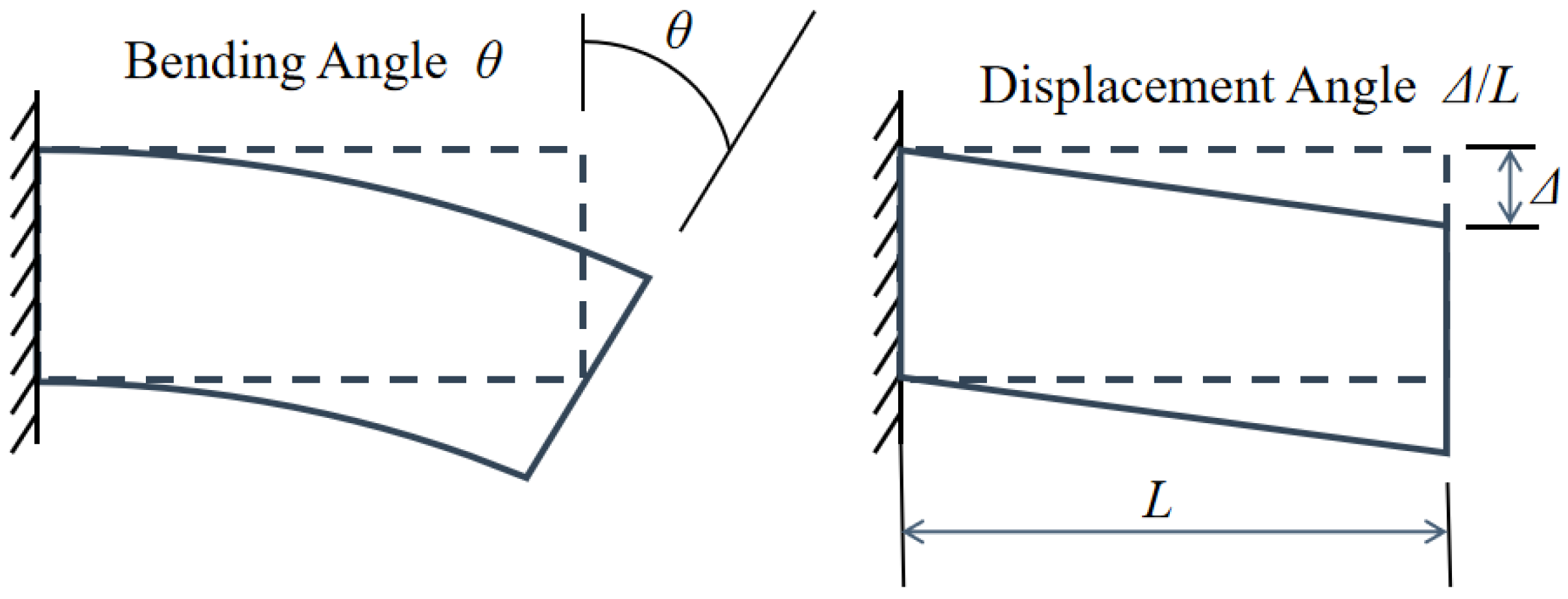
As noted in the literature [29], within specific scaled distances, RC beams exhibit negligible local damage and are dominated by global deformation. In such cases, the total deformation is composed exclusively of flexural and shear components (Figure 1). Flexural deformation refers to the rotational deformation of the cross-section resulting from the curvature induced by bending moments, whereas shear deformation represents the relative transverse displacement of the cross-section caused by shear stresses. Consequently, the following assumptions are adopted for the deformation decoupling process: (1) the beam cross-section remains plane after deformation (the plane-section remains plane hypothesis); and (2) local deformation effects are neglected.
The proposed failure mode classification is intended for scenarios where global deformation dominates (Z ≥ 0.32 m/kg1/3), and for closer or larger charges, the method should be supplemented with local damage criteria.
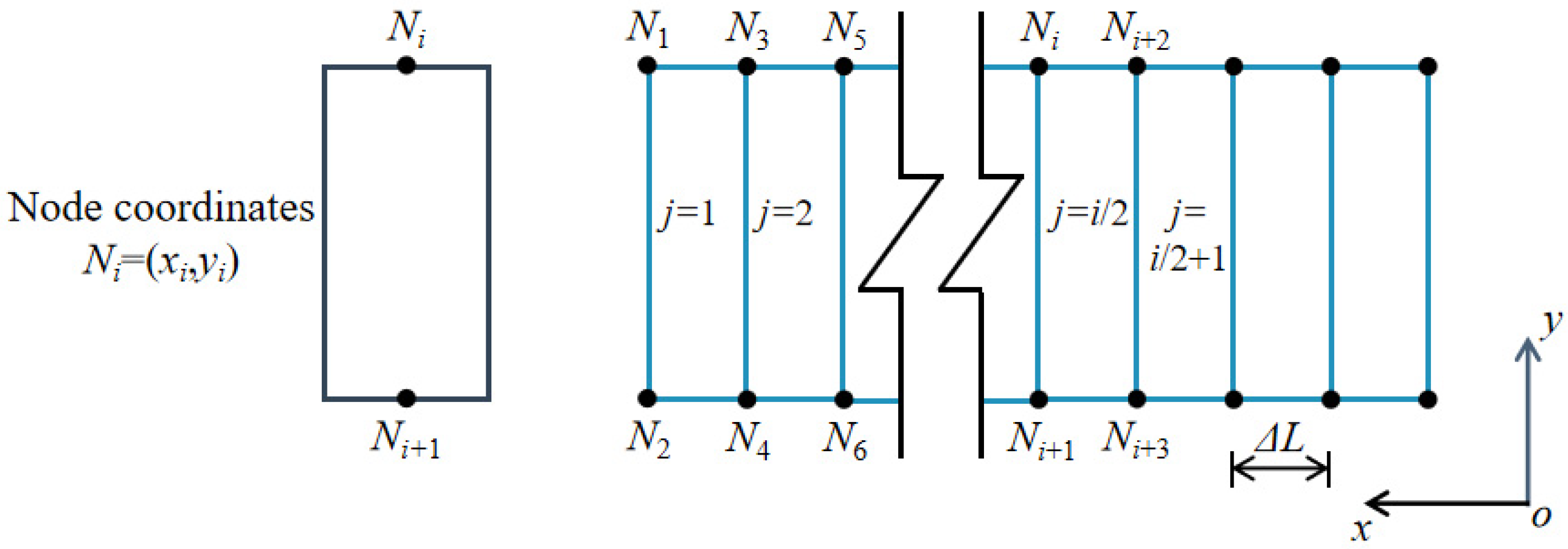
The flexural deformation curve of the beam is derived by calculating the relative rotation angles of the cross-sections at various heights. To determine these relative rotations for each measurement segment, the finite element (FE) model is discretized into n intervals along the span upon the conclusion of the blast response. According to the sensitivity tests in the literature [29], partitioning structural members with spans under 6000 mm into 25 segments ensures the precision of the curves obtained through deformation decoupling. Accordingly, the beam in this study, which has a clear span of 2700 mm, is divided into 27 segments with a length of 100 mm each. The segmentation scheme for the deformation decoupling analysis is illustrated in Figure 2, where the x-axis and y-axis represent the horizontal and vertical deformations of the beam, respectively.
The coordinates of each node within the measurement segments, denoted as Ni(xi,yi), are recorded. The position vectors for the cross-sections of each segment can be expressed as follows:
v i , i + 1 = ( x i + 1 x i ,   y i + 1 y i ) ( i = 1 , 2 , 3 , , 56 )
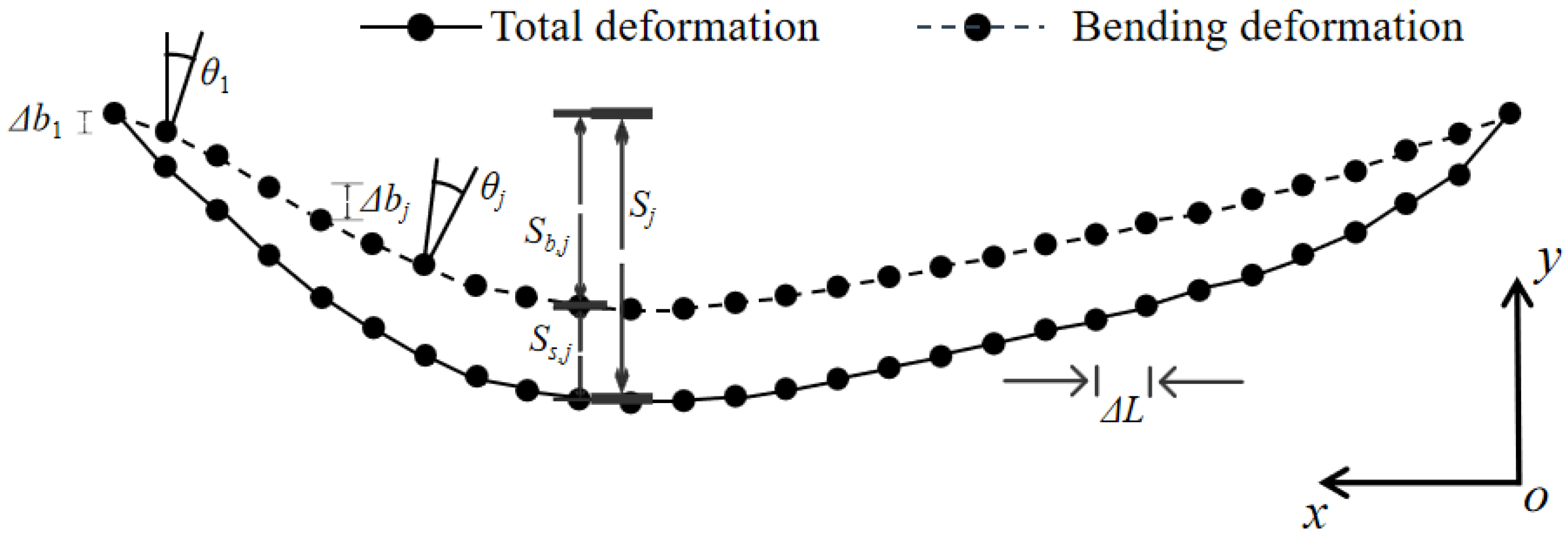
The vertical deformation of the beam under blast loading is illustrated in Figure 3. The angle θj between the vectors of the left and right plane sections for each measurement segment is calculated as:
θ 1 = cos 1 v 1 , 2 v 3 , 4 | v 1 , 2 | | v 3 , 4 | θ j = cos 1 v 2 j 1 , 2 j v 2 j + 1 , 2 j + 2 | v 2 j 1 , 2 j | | v 2 j + 1 , 2 j + 2 | ( j = 2 , 3 , 4 , , 27 )
The relative flexural deformation of each segment is given by:
Δ b 1 = Δ l / tan ( π 2 θ 1 2 ) Δ b j = Δ l / tan ( π 2 θ 1 2 i = 2 j θ j ) ( j = 2 , 3 , 4 , , 27 )
where Δl represents the length of the segment.
The vertical deformation components of the beam are then determined by:
S j = ( x 2 j 1 + x 2 j ) / 2
S b , j = i = 1 j Δ b j
S s , j = S j S b , j
δ = S s , j S j ( j = 1 , 2 , 3 , , 28 )
where sj and sb,j denote the total vertical deformation and the flexural deformation component at the corresponding span, respectively. The term ss,j represents the shear deformation component, which is defined as the residual difference between the total deformation and the flexural component.
The failure modes of RC beams are classified based on the shear deformation ratio δ at the location of maximum displacement. Based on the numerical classification of column failure modes presented in Reference [29], the established classification criteria of the beam are summarized in Table 1. Although no prior study has explicitly defined the 20% and 35% thresholds for RC beams under eccentric blast, similar values appear in related fields. For instance, in the classification of RC column damage under seismic loading, the boundary between moderate and severe damage is often taken around 20–30% of a relevant deformation ratio. In blast analysis of beams, Wang [26] defined damage levels where the transition from flexural to shear failure occurs at a residual displacement ratio that corresponds approximately to δ = 20–30% after decoupling.
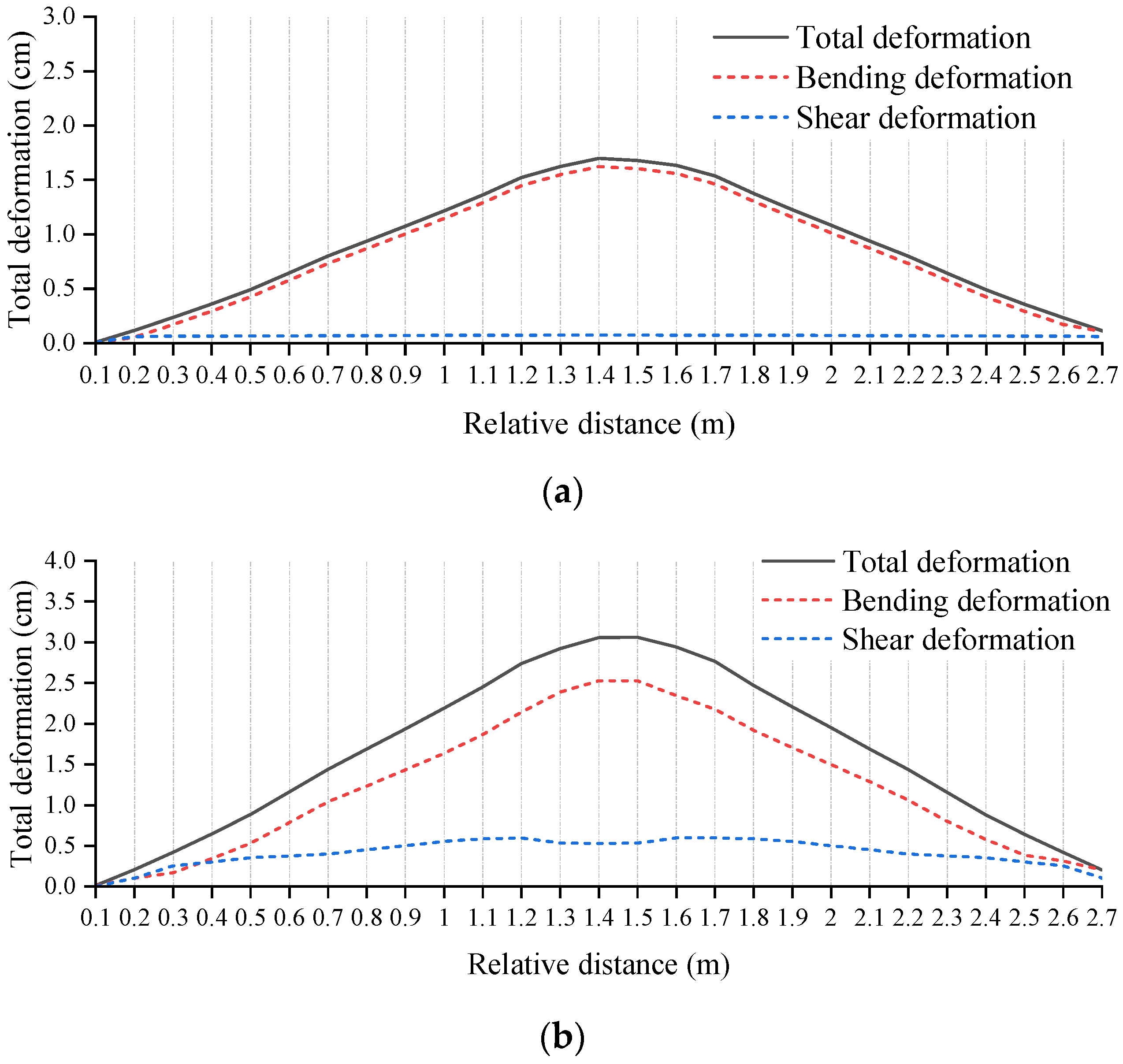
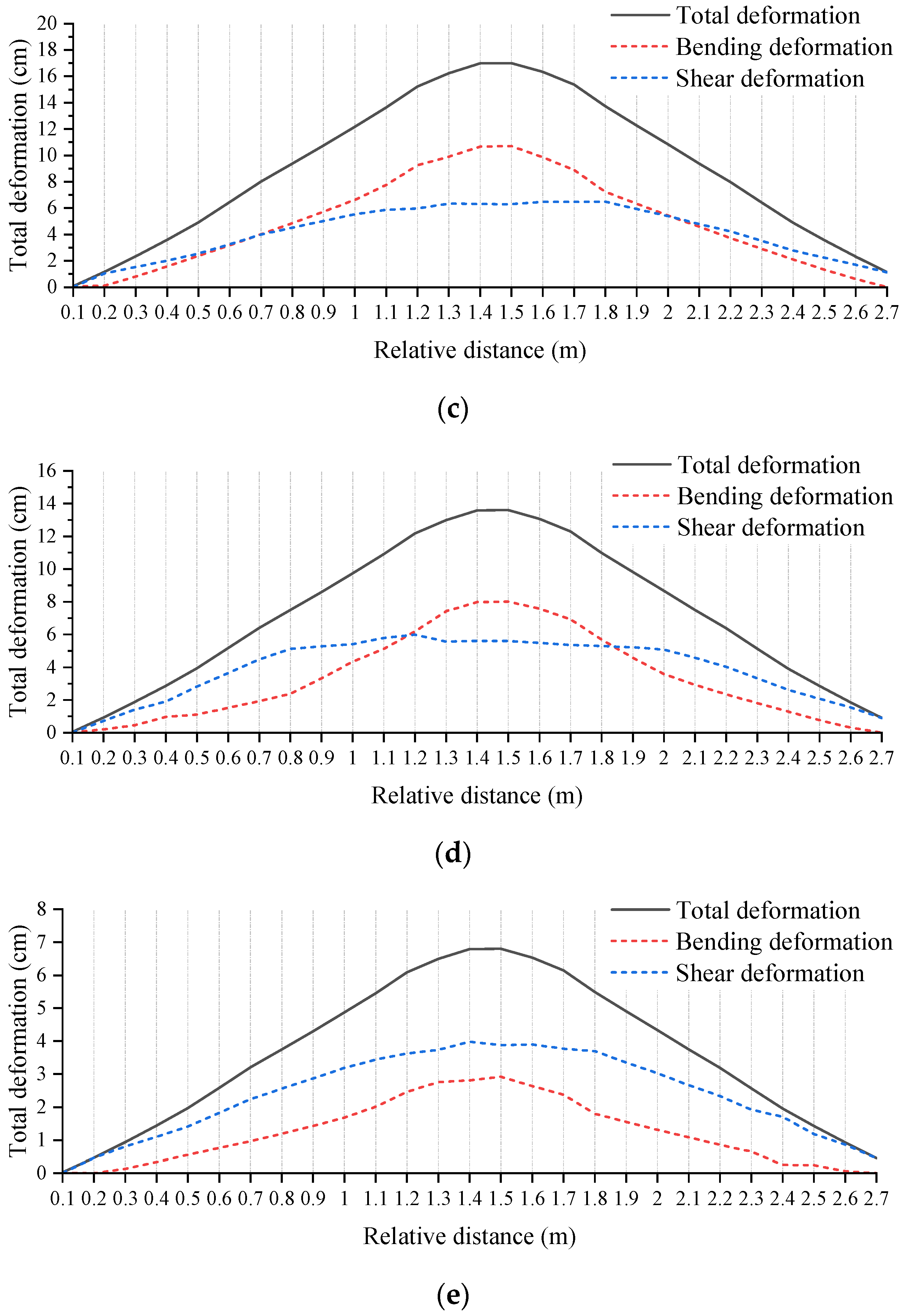
Figure 4 illustrates the vertical deformation profiles for five distinct failure modes, showcasing the total transverse deformation curves alongside the curves of decoupled flexural and shear components.
It should be noted that the deformation decoupling method adopted herein was originally developed for reinforced concrete columns under close-in blast loading [29]. Its direct application to RC beams, particularly under asymmetric eccentric explosions that may induce combined bending, torsion, and shear, requires careful justification. In the present study, theoretical reasoning and numerical validation (see Section 4 and Section 5) demonstrate that the shear deformation ratio δ retains a clear physical meaning for beams: it quantifies the proportion of shear-induced vertical displacement to the total vertical displacement, as the calculation uses only in-plane nodal coordinates and excludes out-of-plane torsional warping. However, under extreme eccentricities or for beams with very low torsional stiffness, torsional effects may non-negligibly influence the vertical deflection profile. Within the tested parameter range, such influences are minor. Future studies should extend the validation to beams with higher slenderness ratios or under pure torsional blast loading. Nevertheless, for the practical scenarios investigated in this paper, the δ-based criterion provides a robust and physically meaningful classification of failure modes for RC beams under near-field eccentric air blasts.

3. Reinforced Concrete Beam Near-Field Air Blast Test

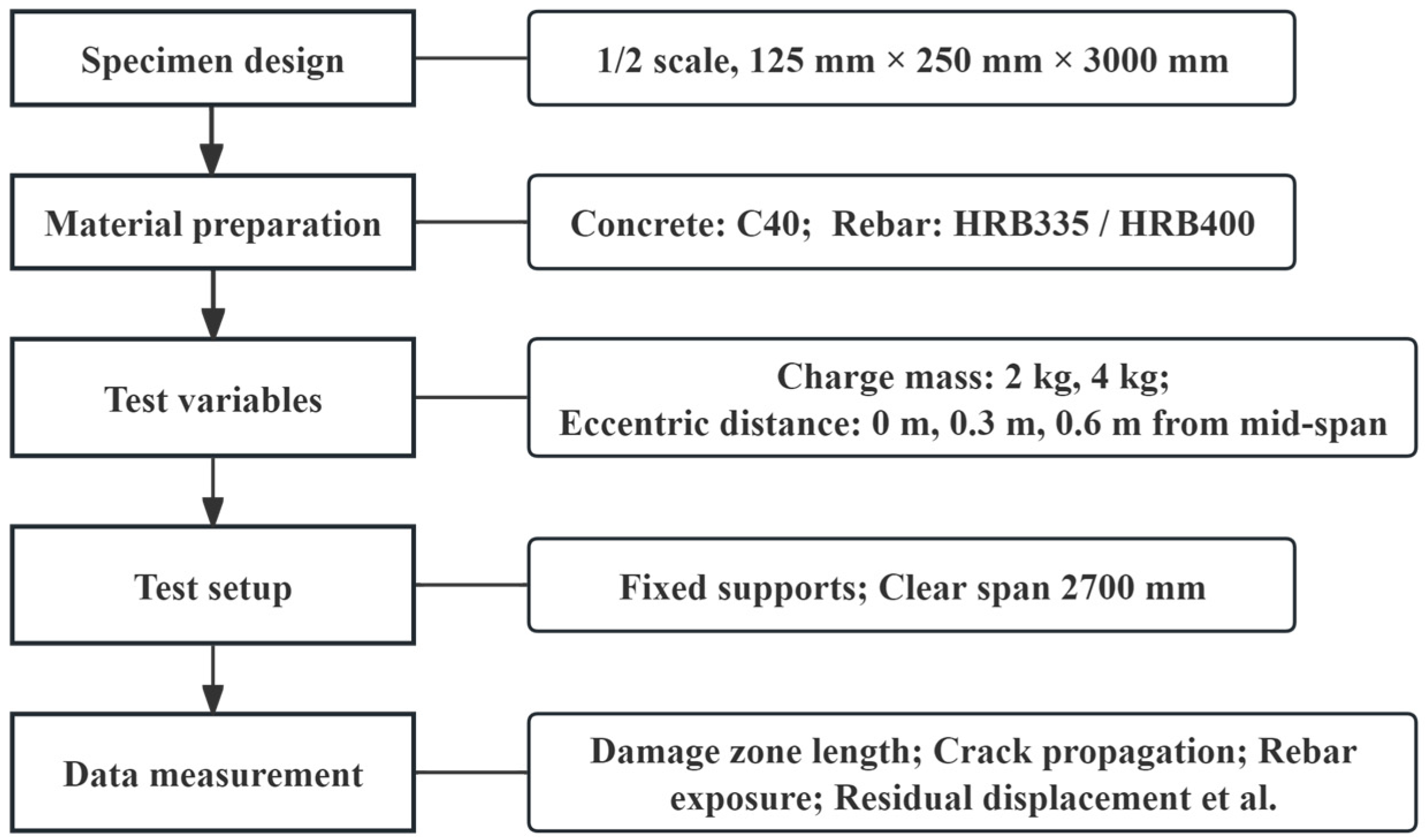
To establish failure mode criteria for RC beams, specimens were designed and fabricated based on engineering structural scales. Near-field air blast tests were conducted with varying charge mass and explosion positions to analyze the damage characteristics and failure modes of the RC beams. The process of the experimental part is shown in Figure 5.

3.1. Component Design

Conduct 1/2 scale tests using RC beams modeled after prototypes from civil building frame structures. The design parameters followed the Chinese Code for Design of Concrete Structures (GB/T 50010-2010) [45] and the Code for Seismic Design of Buildings (GB50011-2010) [46].
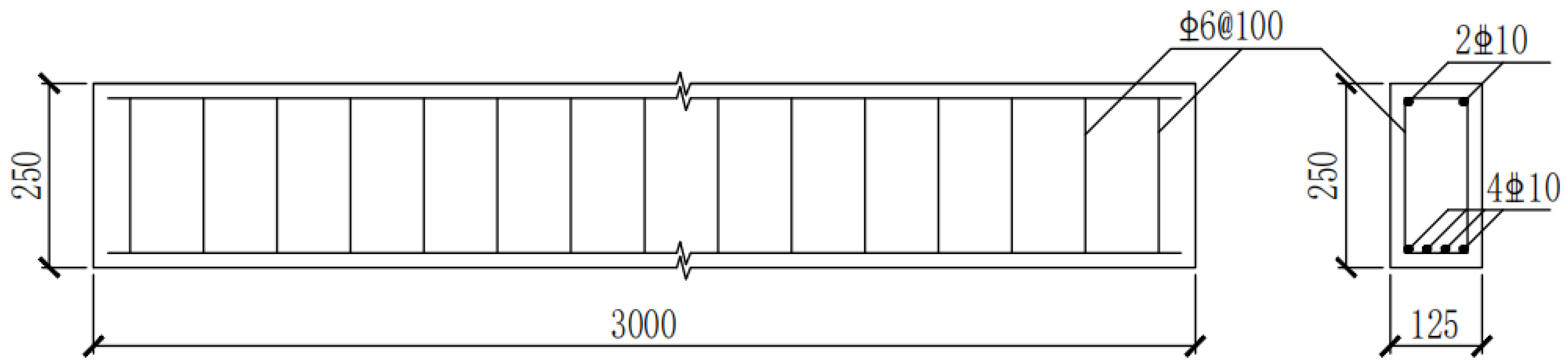
The test specimens featured a cross-section of 125 mm × 250 mm and a span of 3000 mm. The fabrication tolerance of the specimens is ±5 mm. C40 concrete was utilized, with HRB335 and HRB400 rebars serving as reinforcement. With a reinforcement ratio of 1.5%, the top and bottom reinforcements were configured as 2C10 and 4C10, respectively, while the stirrups were set at B6@100. Both longitudinal and stirrup reinforcements satisfied the required reinforcement ratios, as illustrated in Figure 6.
During concrete casting, three 150 mm × 150 mm × 150 mm cubic concrete blocks were reserved. The compressive strength of the specimens was tested using a hydraulic pressure testing machine, yielding three results of 40.2 MPa, 41.1 MPa, and 40.3 MPa, with an average strength of 40.5 MPa, which meets the concrete strength requirements. The same reinforcement bars were also subjected to material property tests, and they likewise met the requirements.

3.2. Test Arrangement

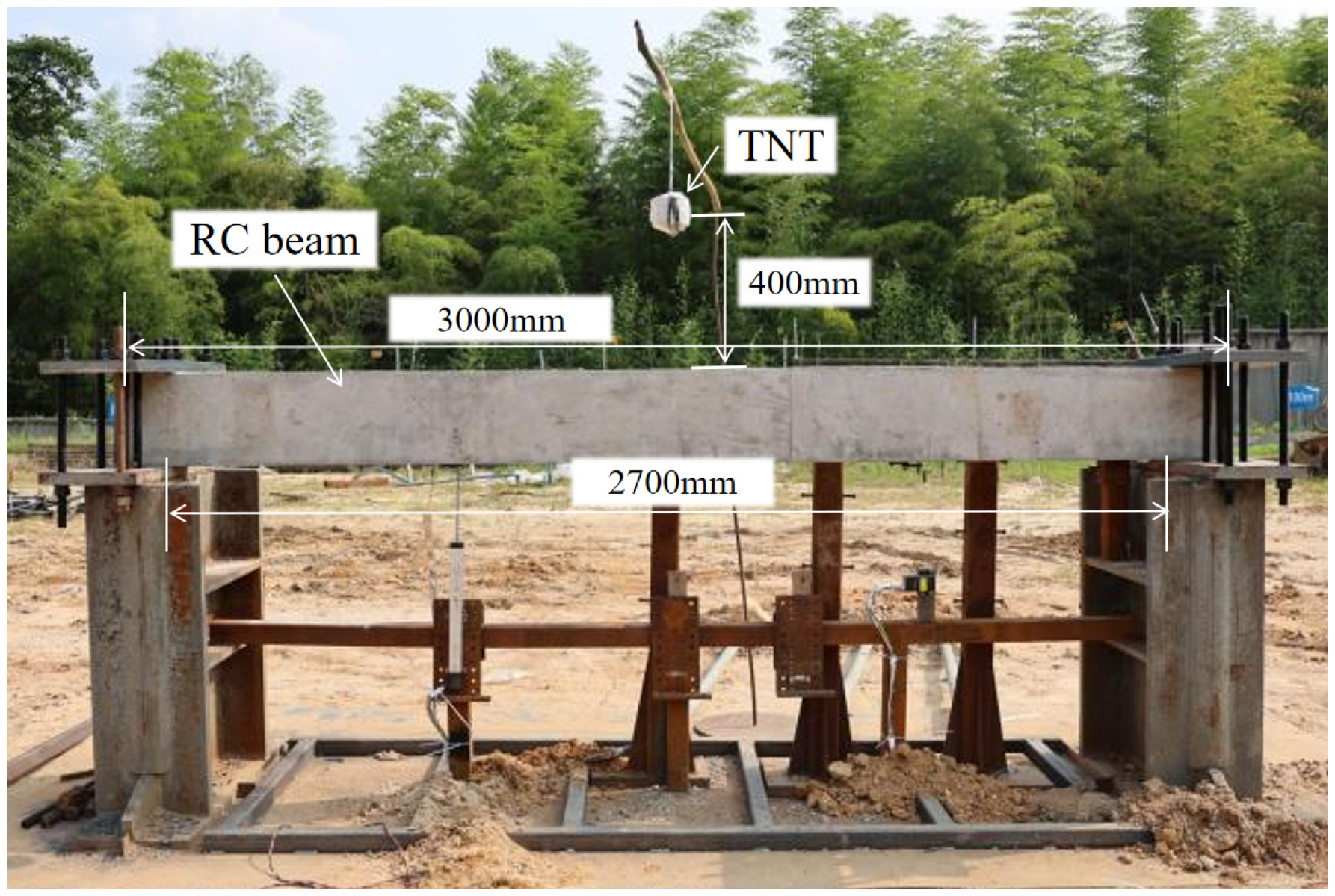
The tests were conducted at an outdoor field range. During the experimental process, the RC beam was placed on prefabricated rigid supports. A 150 mm segment at each end of the beam was secured using steel plates and bolts to establish fixed-end constraints, resulting in a clear span of 2700 mm. Although actual frame beams possess semi-rigid end connections, the present tests adopt fixed ends to provide a repeatable, conservative boundary condition. The primary findings regarding the effects of eccentricity on damage patterns remain valid. Future work will incorporate more realistic joint models.
TNT charges were suspended at predetermined positions and heights above the beam. The experimental setup is illustrated in Figure 7.

3.3. Test Condition Settings

To investigate the failure modes of RC beams under general blast loads, three RC beam specimens were tested under varying charge masses and explosion positions. The experimental conditions are summarized in Table 2.

3.4. Test Results

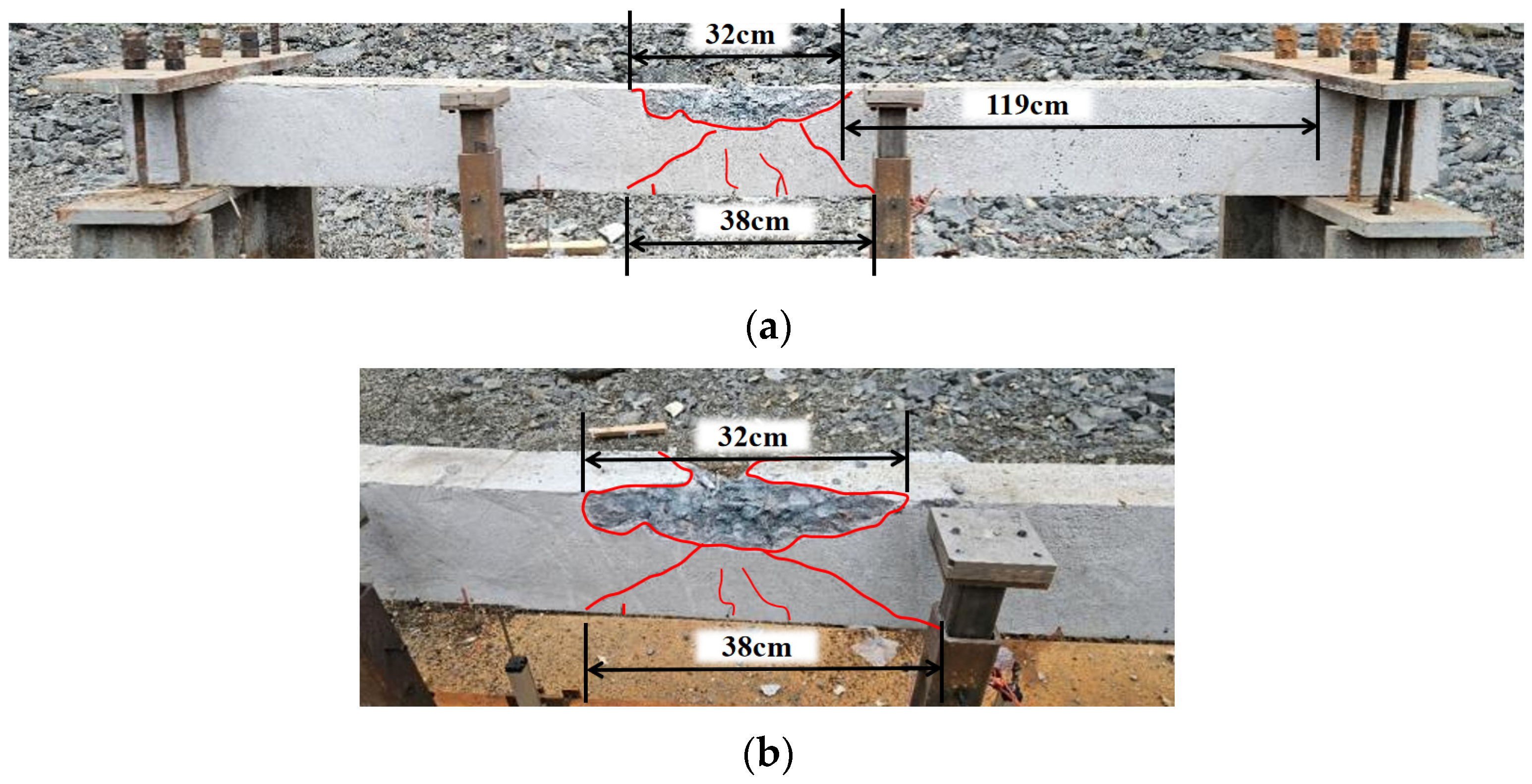
The results of the L1 test (charge mass 2 kg, explosion distance 0.4 m, symmetric mid-span) are shown in Figure 8. The overall damage level of the RC beam is classified as a light damage level [26], with the structural integrity well-maintained. On the front face, the concrete exhibits fragmentation and spalling, with a lateral spalling zone 32 cm long and 10 cm deep; the spalling at the top extends across the entire beam width. Multiple conical cracks appear on the beam sides, spanning a propagation area of 38 cm. No significant flexural or fracture cracks are observed on the back face. Two longitudinal bars on the front face are exposed over a length of 18 cm, along with two stirrups. Despite the exposure, the rebar shows no obvious bending deformation, and the core concrete confined by the rebar cage remains largely intact. The residual displacement of the beam after the test is 0.74 cm. The damage zone measurement error is ±5 mm, and the displacement measurement error is ±1 mm.
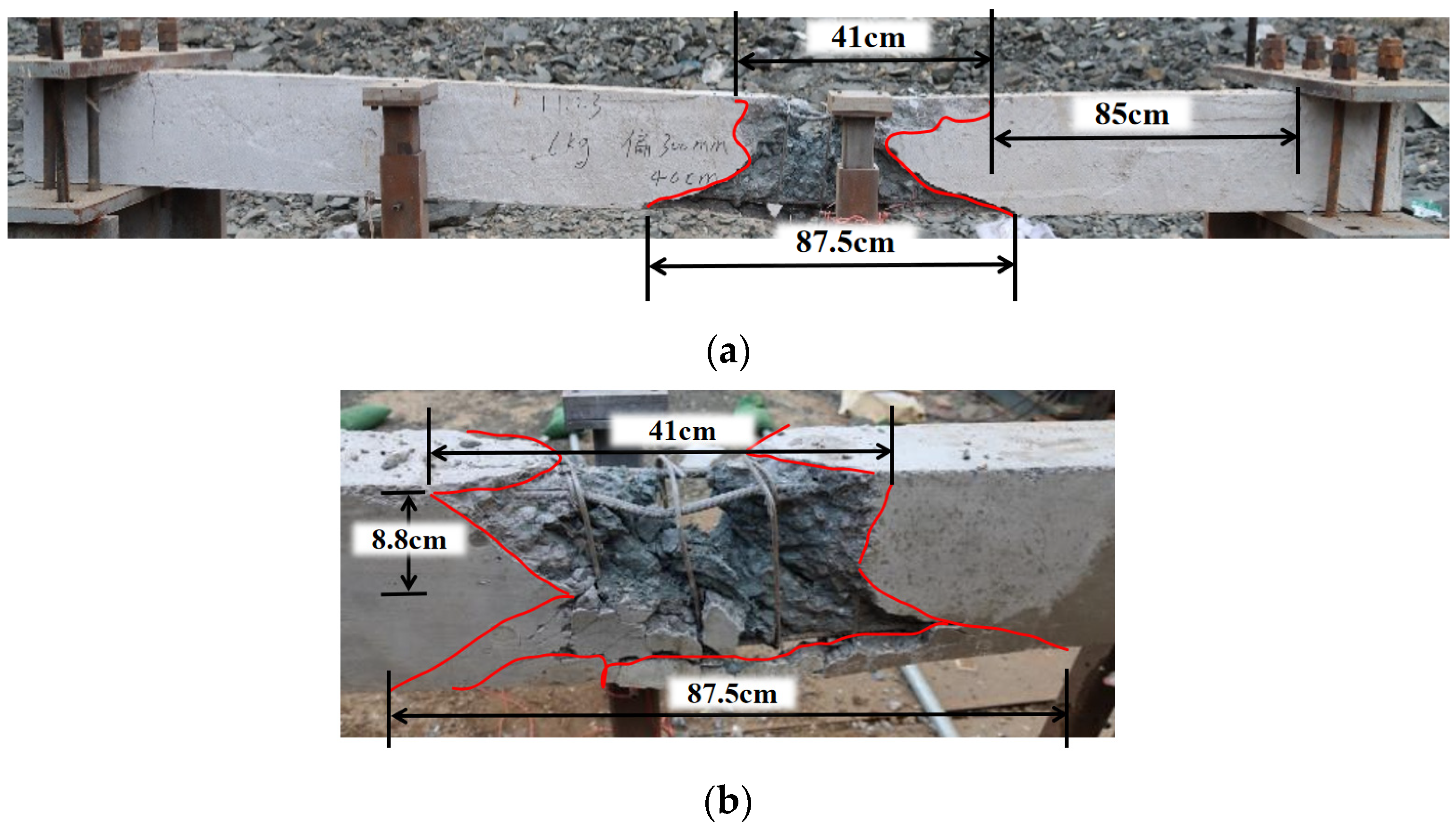
The results of the L2 test (charge mass 4 kg, explosion distance 0.4 m, eccentric distance 0.3 m) are shown in Figure 9. The RC beam reaches a severe damage level [26], with significant localized structural damage. While the overall damage is asymmetric, the local damage remains relatively symmetric. Notable flexural crushing occurs at the mid-span corresponding to the detonation position, with a damage zone 41 cm long. The front face shows triangular compression damage and a spalling depth of 8.8 cm. Multiple conical cracks and concrete spalling appear on the sides, covering a range of 87.5 cm, with the spalling also exhibiting a conical pattern. The back face displays multiple flexural-fracture cracks accompanied by large-scale spalling. Two longitudinal bars on the front face are exposed (29 cm long), and three stirrups are visible, both showing significant bending deformation. On the back face, four longitudinal bars are exposed (56 cm long) along with five stirrups. The core concrete is severely damaged, forming a cavity with a diameter of 8.5 cm.
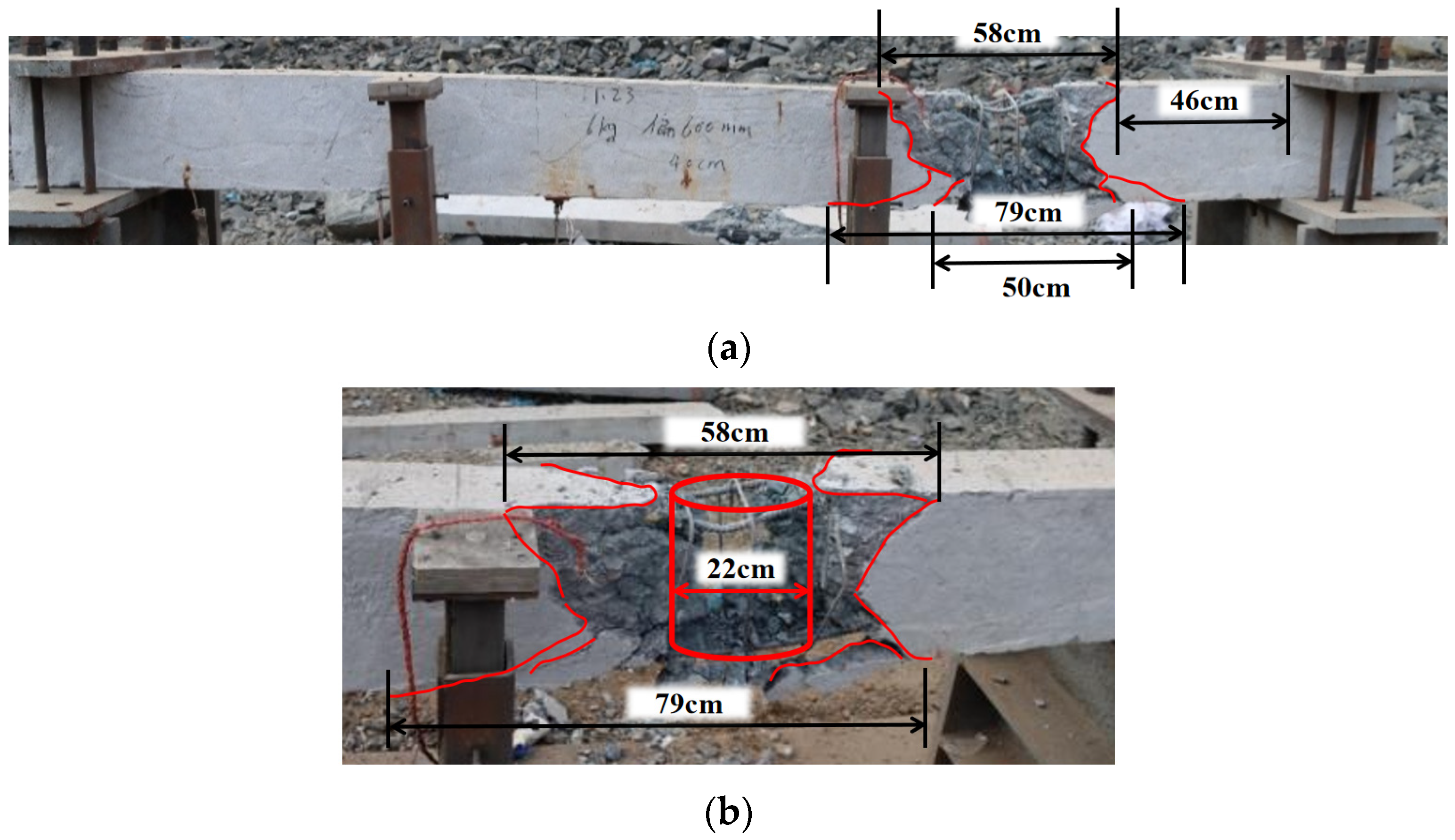
The results of the L3 test (charge mass 4 kg, explosion distance 0.4 m, eccentric distance 0.6 m) are shown in Figure 10. The RC beam suffers complete damage level [26], characterized by perforation damage, total concrete spalling, and full exposure of the rebar. Significant concrete perforation occurs at the detonation position on the front face, with a damage length of 22 cm. Beyond the perforation zone, the front face exhibits evident flexural crushing over a length of 58 cm. Conical cracks and spalling on the sides span 79 cm, while the back face experiences extensive spalling over a length of 50 cm. Two longitudinal bars (24 cm exposed) and three stirrups on the front face show significant bending, with two stirrups having fractured or spread apart. On the back face, four longitudinal bars (46 cm exposed) and four stirrups are visible. The core concrete is completely destroyed, leaving a perforated cavity 20 cm in diameter.
In summary, the results of L1, L2, and L3 demonstrate that the charge mass and detonation position significantly affect both the global and local damage of RC beams. As the charge mass increases, both global and local damage intensify, and the failure mode transitions from flexural-like failure to shear-like failure. Similarly, as the eccentric distance increases, the local damage effect is enhanced, leading to aggravated concrete damage on one side and progressive rebar exposure and deformation; the failure mode subsequently shifts from flexural-like failure to shear-like failure.

4. Finite Element Numerical Simulation

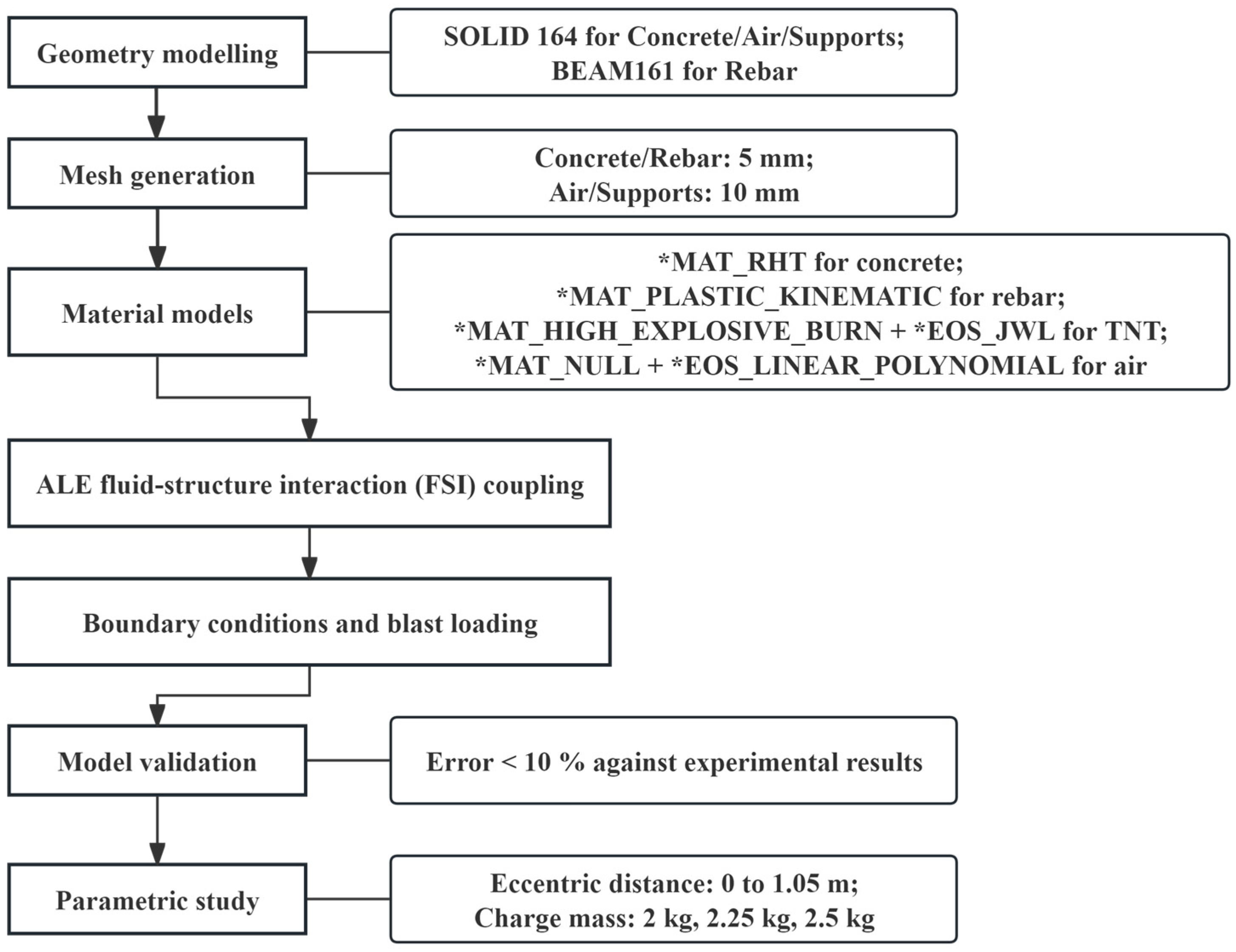
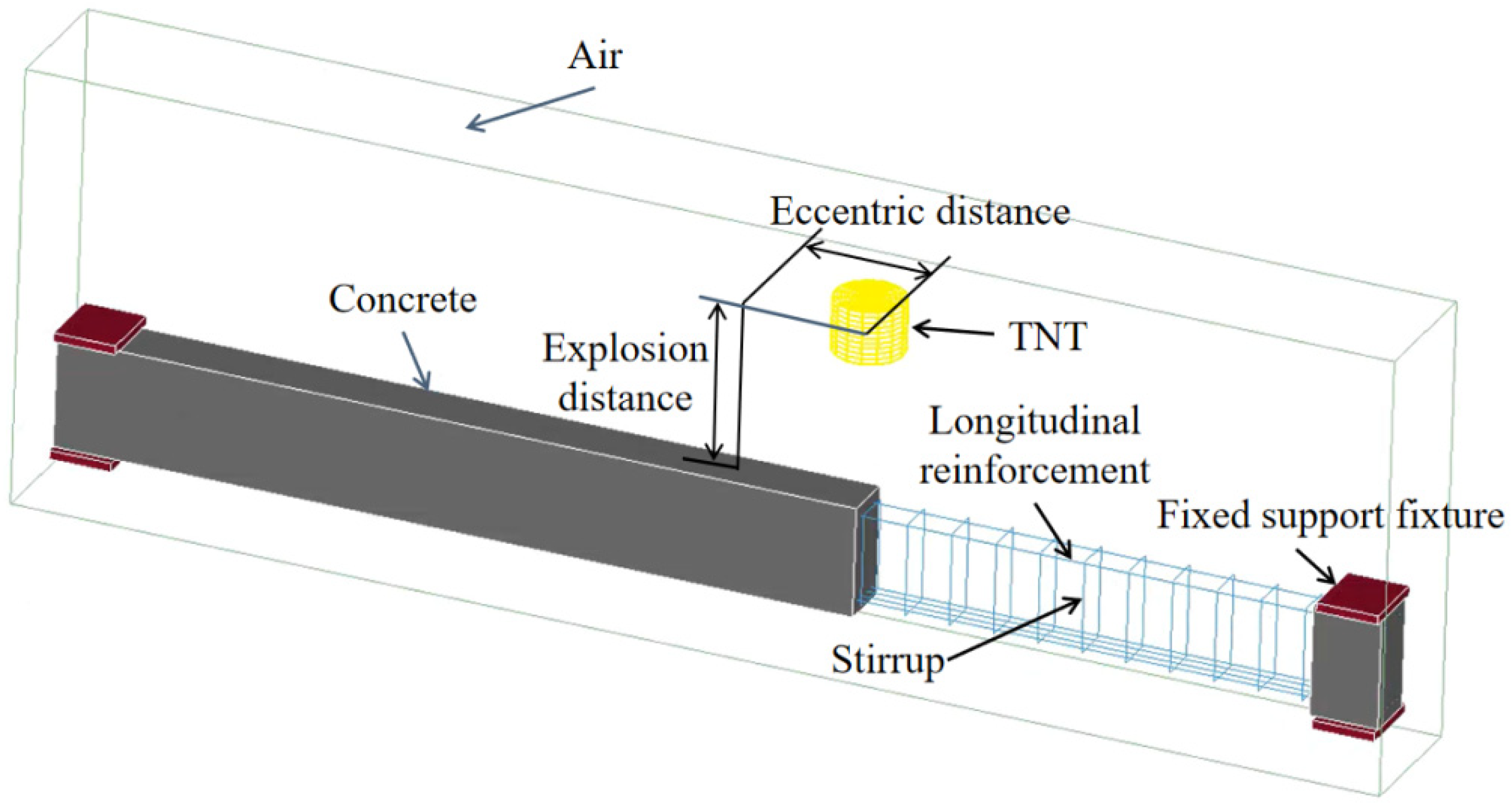
To establish failure-mode criteria for RC beams, a finite element model was developed based on the experimental configuration. Numerical simulations were conducted with varying charge mass and eccentric distances to analyze the damage characteristics and failure modes of the RC beams under near-field blast loads. The process of the Simulation part is shown in Figure 11.

4.1. Material Model

4.1.1. Concrete

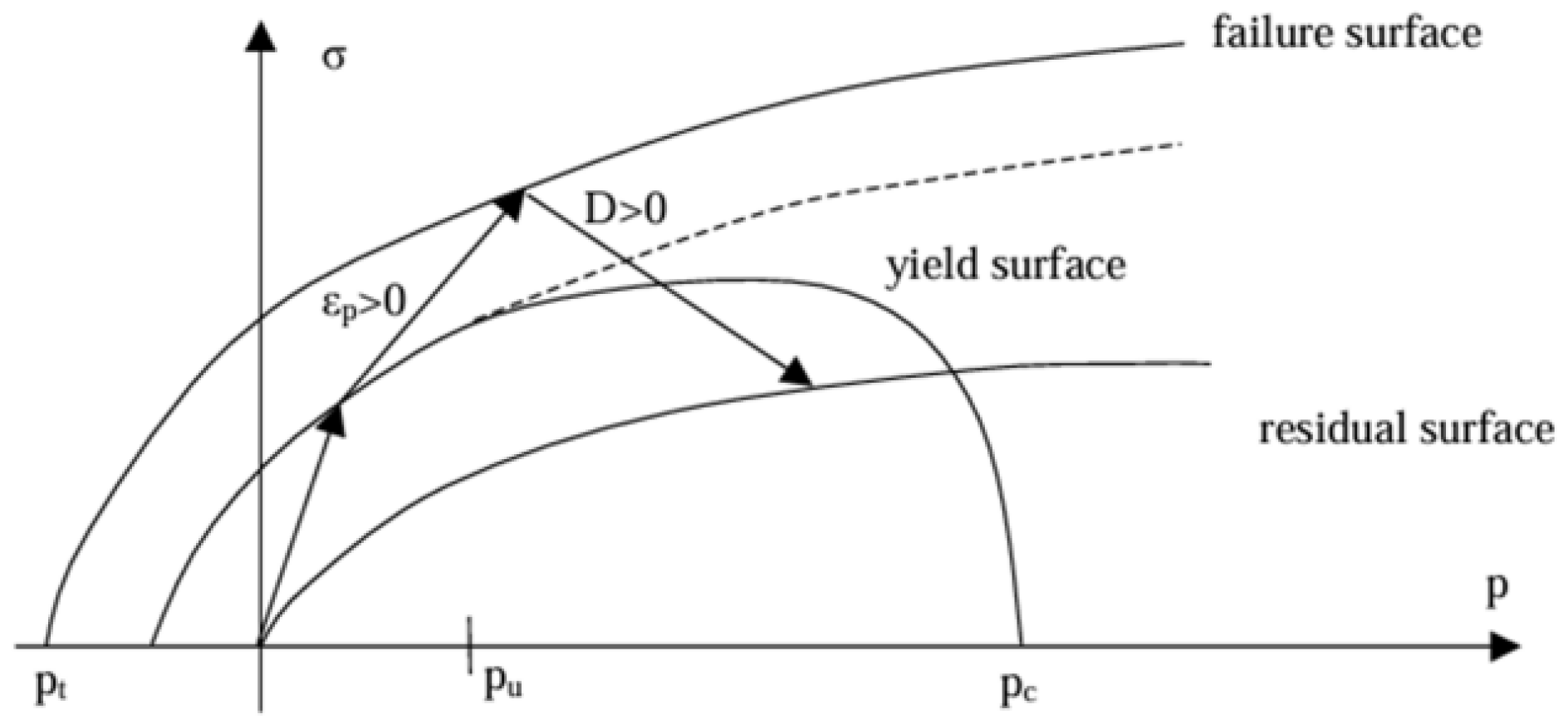
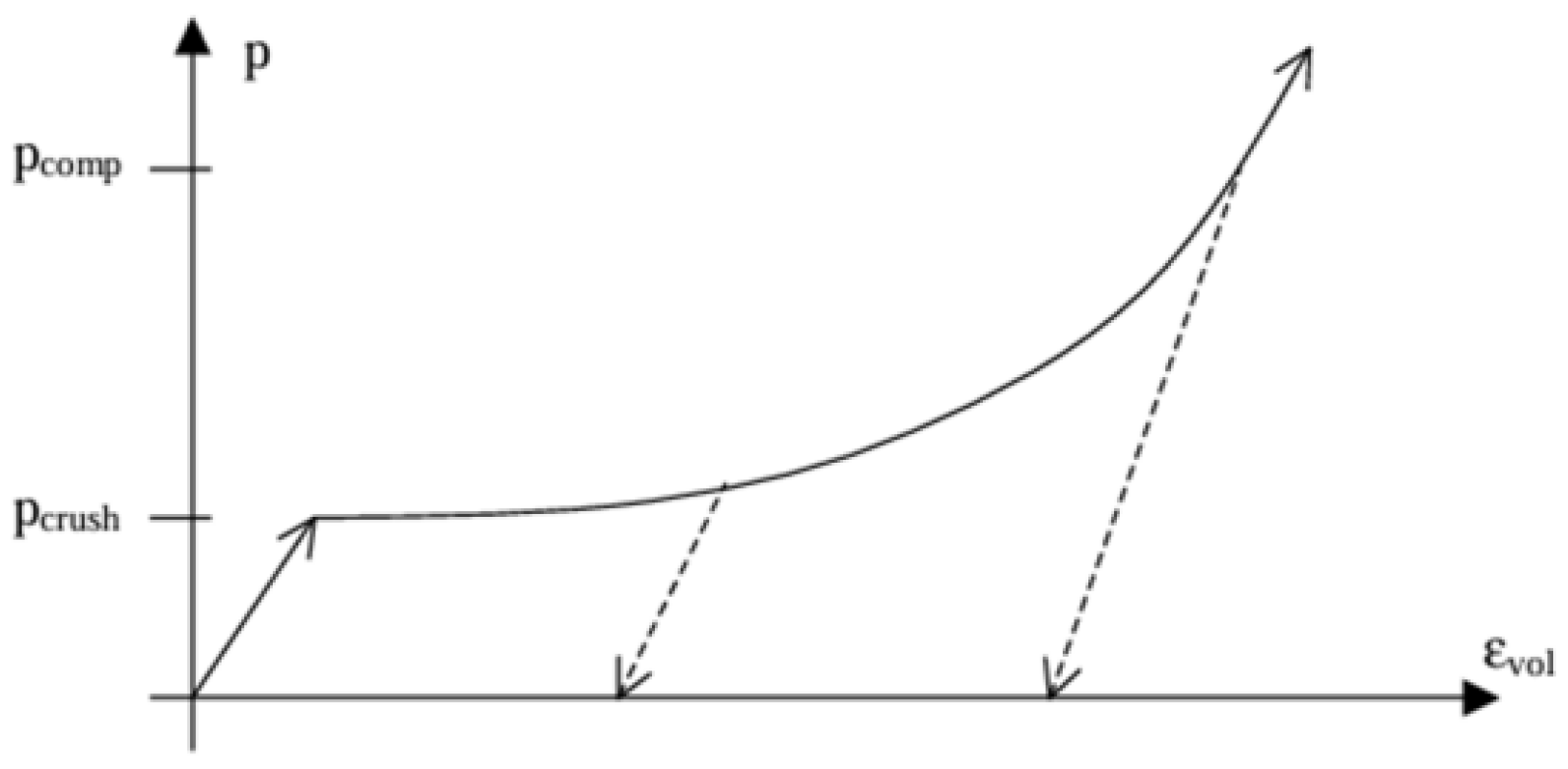
In this study, the *MAT_RHT model (*MAT_272) in LS-DYNA is employed for the concrete material. This model effectively captures the damage characteristics of concrete under high strain rates and pressures, and its reliability under blast loading has been extensively validated [47]. The RHT strength model characterizes the mechanical response of the material through three characteristic stress limit surfaces: the initial elastic yield surface, the failure surface, and the residual friction surface (Figure 12. Regarding the equation of state (EOS), the model utilizes the Mie-Grüneisen framework combined with polynomial Hugoniot curves and P-α pore compaction relationships (Figure 13). The material parameters are adopted from literature [47] and are summarized in Table 3.

4.1.2. Reinforcement

The *MAT_PLASTIC_KINEMATIC(*MAT_003) model in LS-DYNA is employed for the rebar. This model enables switching between kinematic and isotropic hardening mechanisms through parameter configuration. Material fracture is characterized by the failure principal strain criterion, and the strain rate effect of steel is incorporated using the Cowper-Symonds constitutive equation:
f y = 1 + ( ε ˙ d / C ) 1 / P
where f y is the yield strength of the rebar; C and P are strain-rate-related parameters, which are set to 40 and 5, respectively, in this study.
The material parameters for the rebar are summarized in Table 4.

4.1.3. Explosives and Air

The explosive is modeled using *MAT_HIGH_EXPLOSIVE_BURN in conjunction with the*EOS_JWL. The *MAT_HIGH_EXPLOSIVE_BURN material model is specifically designed for modeling the detonation of high explosives. It defines the burn fraction and released chemical energy, and it works seamlessly with the JWL equation of state. The JWL equation of state is one of the most widely used and validated EOS models for describing the pressure-volume-energy relationship of gaseous detonation products. The JWL EOS is expressed as:
P a = A ( 1 ω R 1 V ) e R 1 V + B ( 1 ω R 2 V ) e R 2 V + ω E 0 V
where Pa is the detonation pressure; V is the relative volume; E0 is the initial internal energy density; and A, B, R1, R2 and ω are the EOS parameters. The material and EOS parameters for TNT are detailed in Table 5.
Similarly, air is defined using the *MAT_NULL model combined with the *EOS_LINEAR_POLYNOMIAL, which is expressed as:
P b = C 0 + C 1 μ + C 2 μ 2 + C 3 μ 3 + ( C 4 + C 5 μ + C 6 μ 2 ) E
where Pb is the air pressure; μ is the volumetric parameter defined as μ = (1/V) − 1; C0C6 are the EOS coefficients; E is the internal energy density. The specific material and EOS parameters for air are summarized in Table 6.

4.2. Model Establishment

To accurately replicate the damage and failure modes of the RC beam observed in the blast test, the Arbitrary Lagrangian-Eulerian (ALE) fluid–structure interaction (FSI) algorithm is adopted in this study. The concrete, air, and fixed supports are discretized using SOLID164 solid elements, while the rebar is modeled with BEAM161 elements.
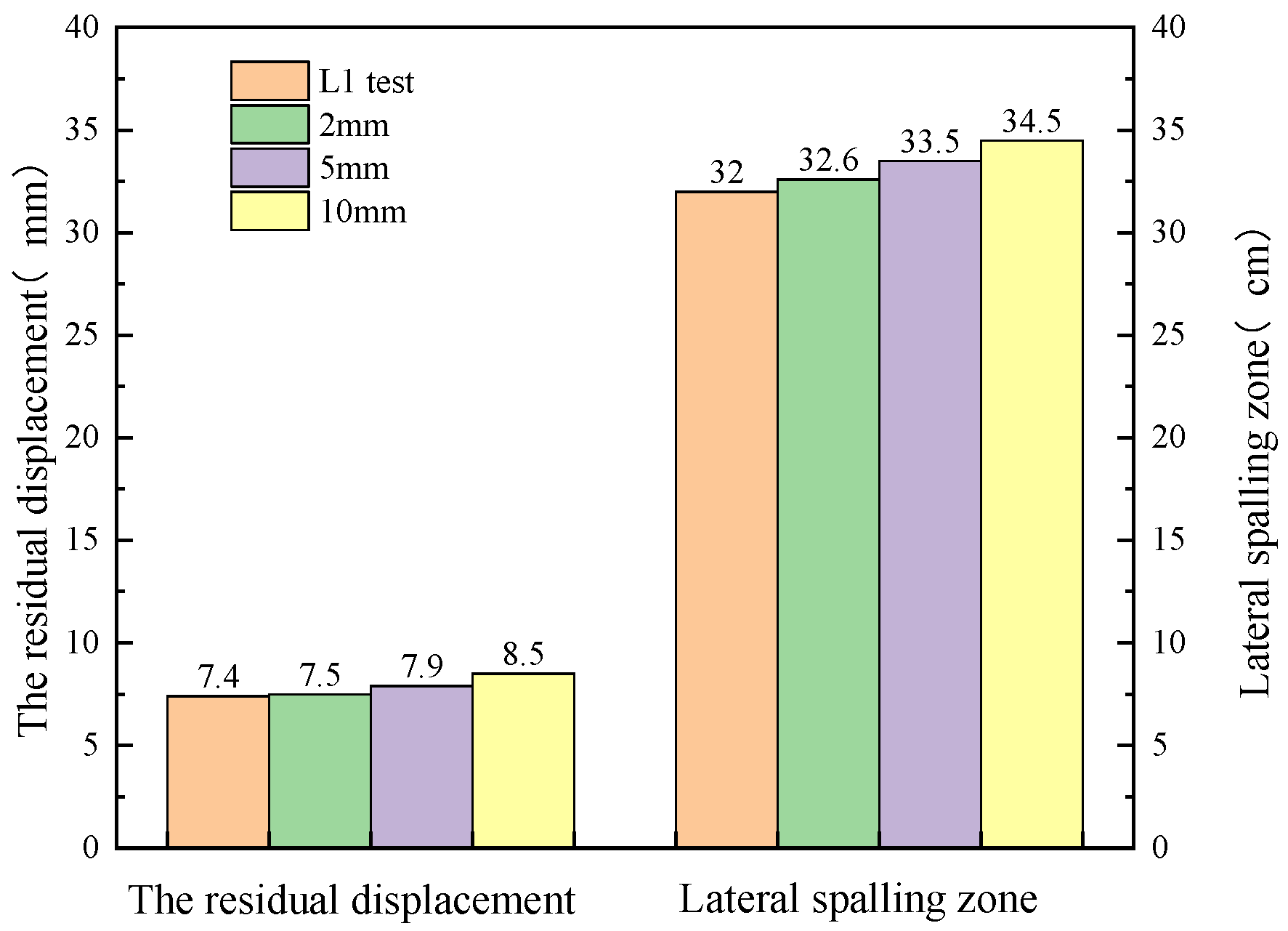
A mesh convergence analysis was carried out with mesh sizes of 2 mm, 5 mm, and 10 mm, as shown in Figure 14. Compared with L1 test data (mid-span residual displacement and lateral spalling zone length), all three mesh sizes yielded errors below 15%, with the 2 mm mesh giving the smallest error. Balancing accuracy and computational cost, a mesh size of 5 mm is assigned to the concrete and rebar, while a 10 mm mesh is utilized for the air and fixed supports.
The support steel plates are treated as rigid materials defined by *MAT_RIGID. To prevent numerical penetration, the coupling between the rebar (including stirrups and longitudinal bars) and the concrete solid elements is implemented via *CONSTRAINED_BEAM_IN_SOLID. The FSI between the RC beam and air is governed by *CONSTRAINED_LAGRANGE_IN_SOLID, and the contact between the RC beam and the rigid supports is defined using *CONTACT_AUTOMATIC_SURFACE_TO_SURFACE. The explosive is initialized using the initial volume fraction method via the keyword *INITIAL_VOLUME_FRACTION_GEOMETRY. Furthermore, the erosion algorithm for concrete elements is defined using *MAT_ADD_EROSION, where the maximum principal strain threshold (MXEPS) is a critical parameter. Based on literature research, MXEPS is set to 0.1; specifically, an element is identified as failed and removed from the computational domain when its maximum principal strain reaches 0.1. The established FE model is shown in Figure 15.

4.3. Model Validation

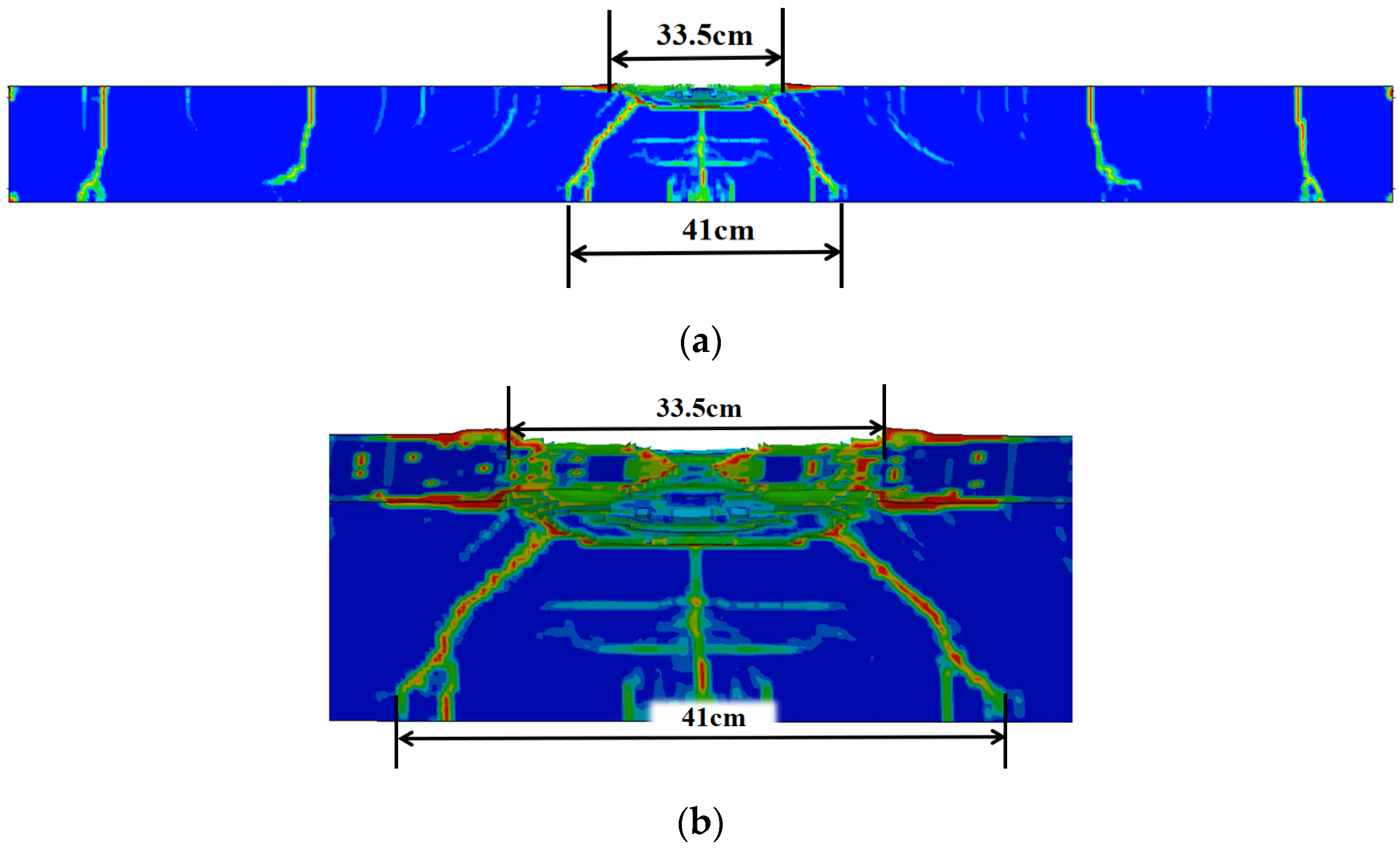
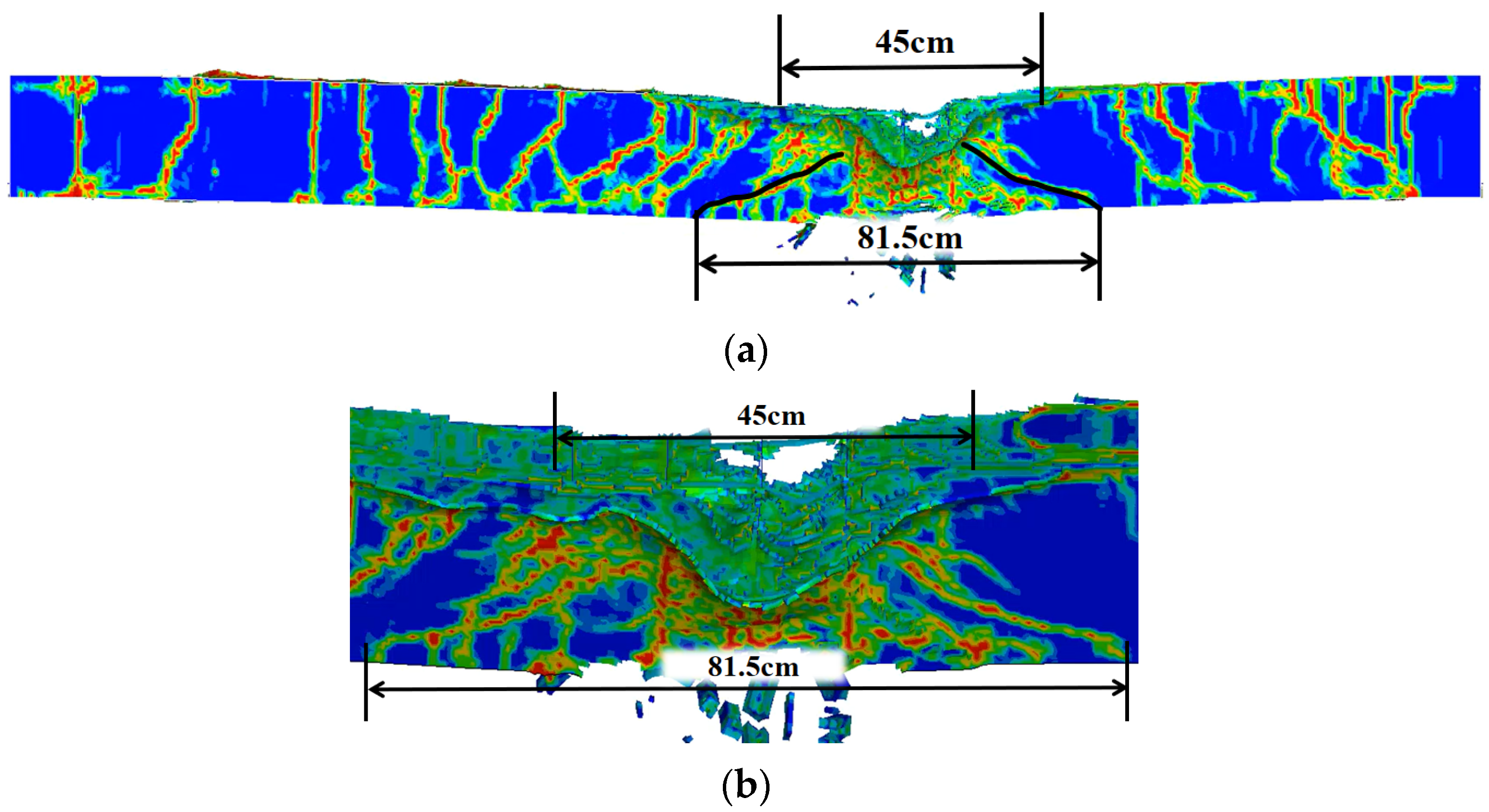
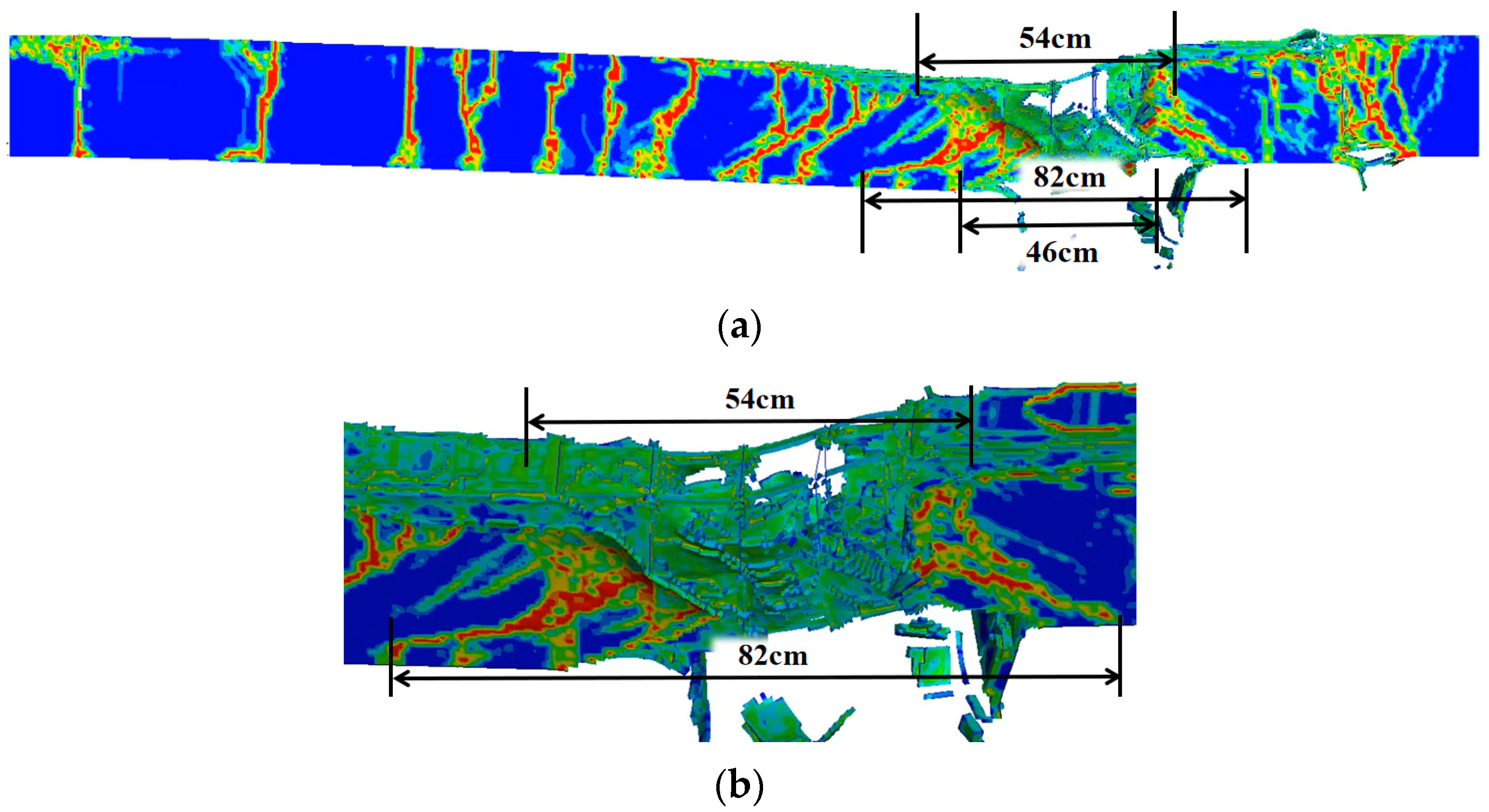
The numerical damage maps of the RC beams are presented in Figure 16, Figure 17 and Figure 18. The region directly facing the explosive is the first to be subjected to the blast shock wave, resulting in the most severe concrete damage, characterized by fragmentation on the front face and edge spalling. Furthermore, Figure 16, Figure 17 and Figure 18 illustrate the comparison of damage patterns between the experimental and numerical RC beams. For the L1 numerical model, the length of the local damage zone on the front face is 33.5 cm, representing a 4.69% error compared to the experimental result. The crack propagation length on the back face is 41 cm, with an error of 7.31%. For the L2 model, the damage length on the front face is 45 cm (9.76% error), and the crack propagation length on the back face is 81.5 cm (6.86% error). For the L3 model, these values are 54 cm (6.90% error) and 82 cm (3.80% error), respectively. The crack patterns observed in simulations qualitatively match the experimental spalling and crack distributions.
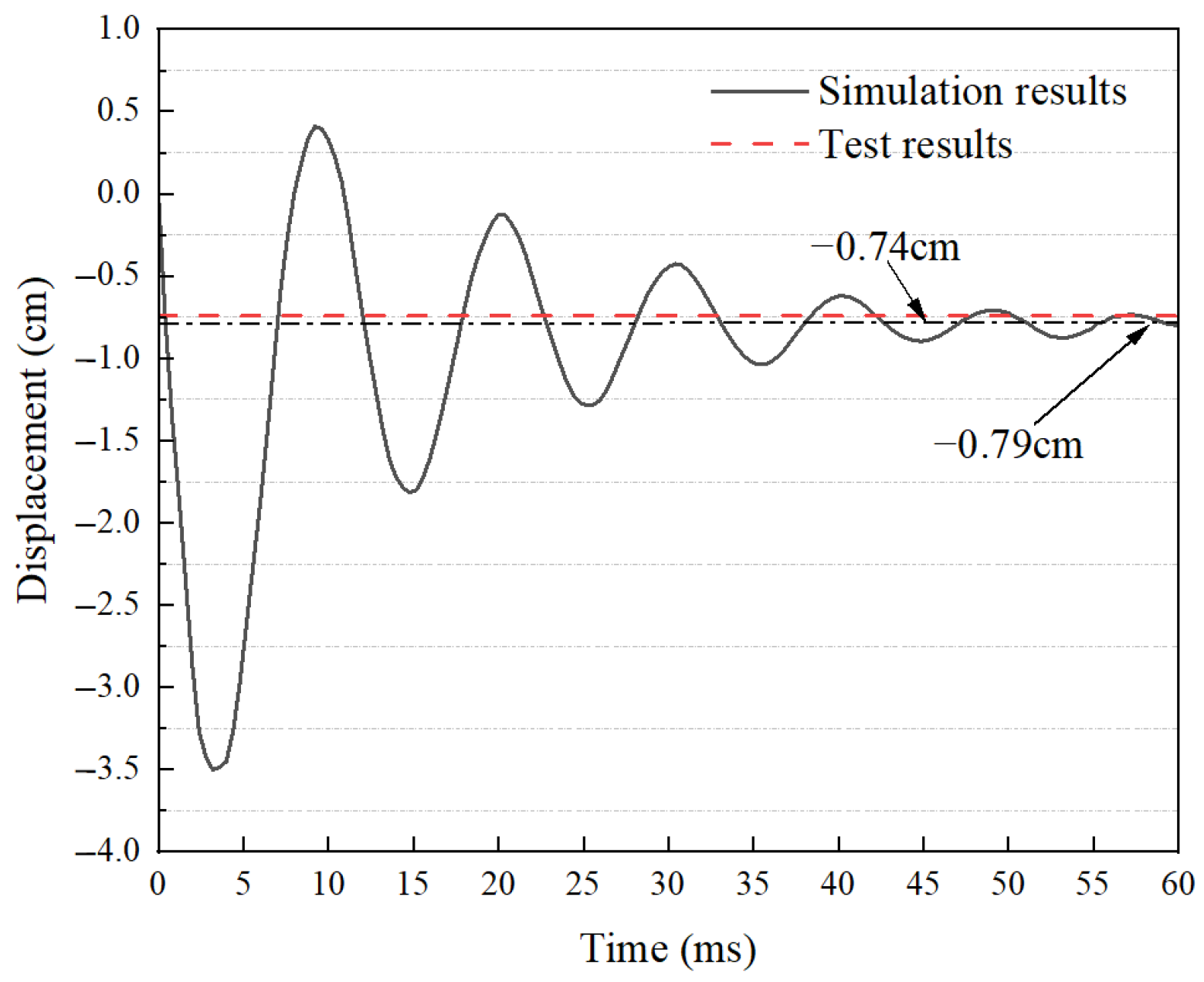
The maximum deflection time-history curves of the RC beams are illustrated in Figure 19. The mid-span residual displacement obtained from the L1 numerical analysis is 0.79 cm, yielding a 6.76% error compared to the experimental data. Due to the absence of displacement data for the L2 and L3 tests, no comparison is performed for these cases. The detailed error analysis between the numerical and experimental results is summarized in Table 7.
In summary, the numerical results show good agreement with the experimental observations, demonstrating that the numerical model reproduces the key global response characteristics (residual displacement and damage zone length) with acceptable engineering accuracy, and captures the main damage patterns observed in the experiments. The established FE analysis framework—encompassing element types, mesh sizes, material models and parameters, and numerical algorithms—is validated for subsequent numerical investigations of RC beams subjected to blast effects.
Additional experiments with varying reinforcement ratios, charge masses, and eccentricities are planned to further validate and refine the numerical model.

5. Failure Mode Analysis

The present study focuses on identifying and quantifying the failure modes and parametric trends. A deeper investigation of the underlying physical mechanisms (e.g., stress wave propagation, interaction between flexural and shear waves, and the evolution of the plastic hinge zone) is beyond the current scope and will be pursued in our subsequent research.
The aforementioned deformation decoupling method and numerical model are employed to further investigate the failure modes of RC beams. Given that charge mass and eccentric distance significantly influence these failure modes, the following cases are designed to analyze the damage characteristics of RC beams under various parametric configurations. The specific parameters for the numerical simulations are summarized in Table 8.

5.1. Eccentric Distance

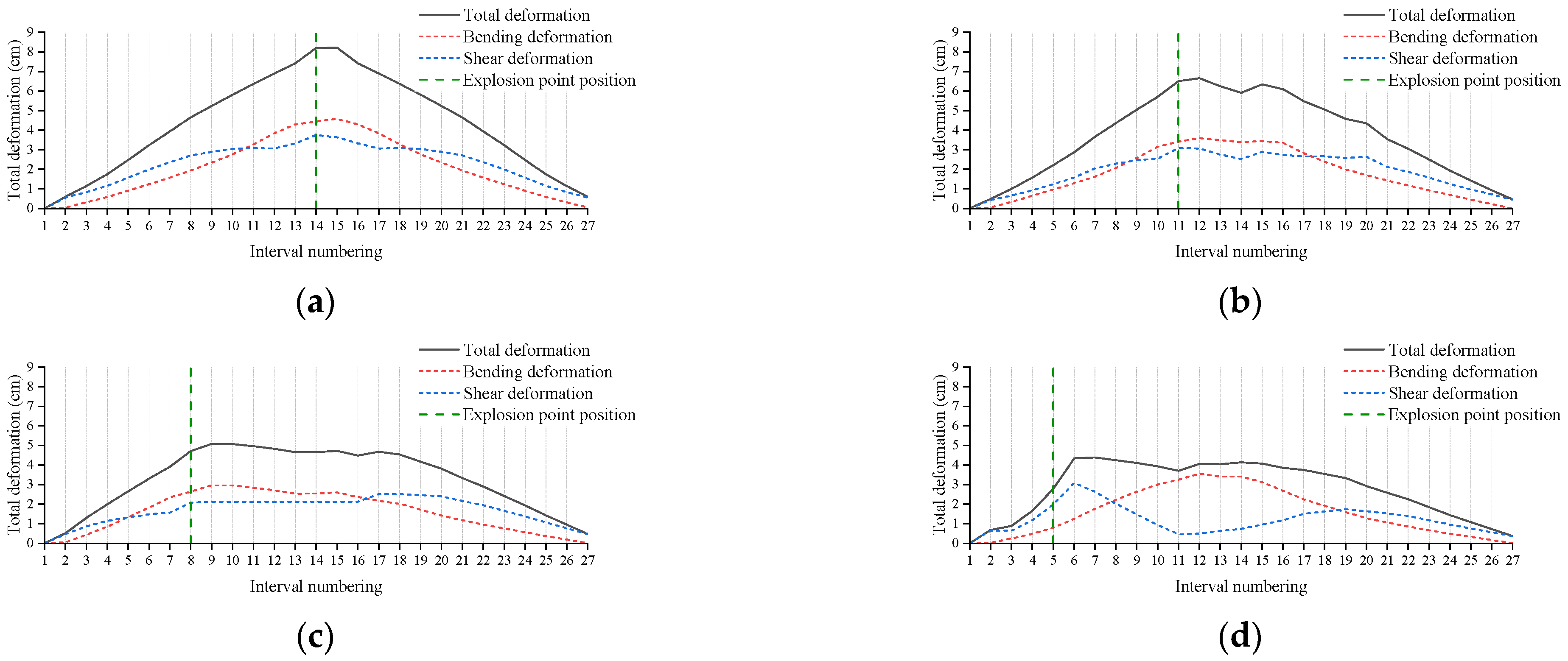
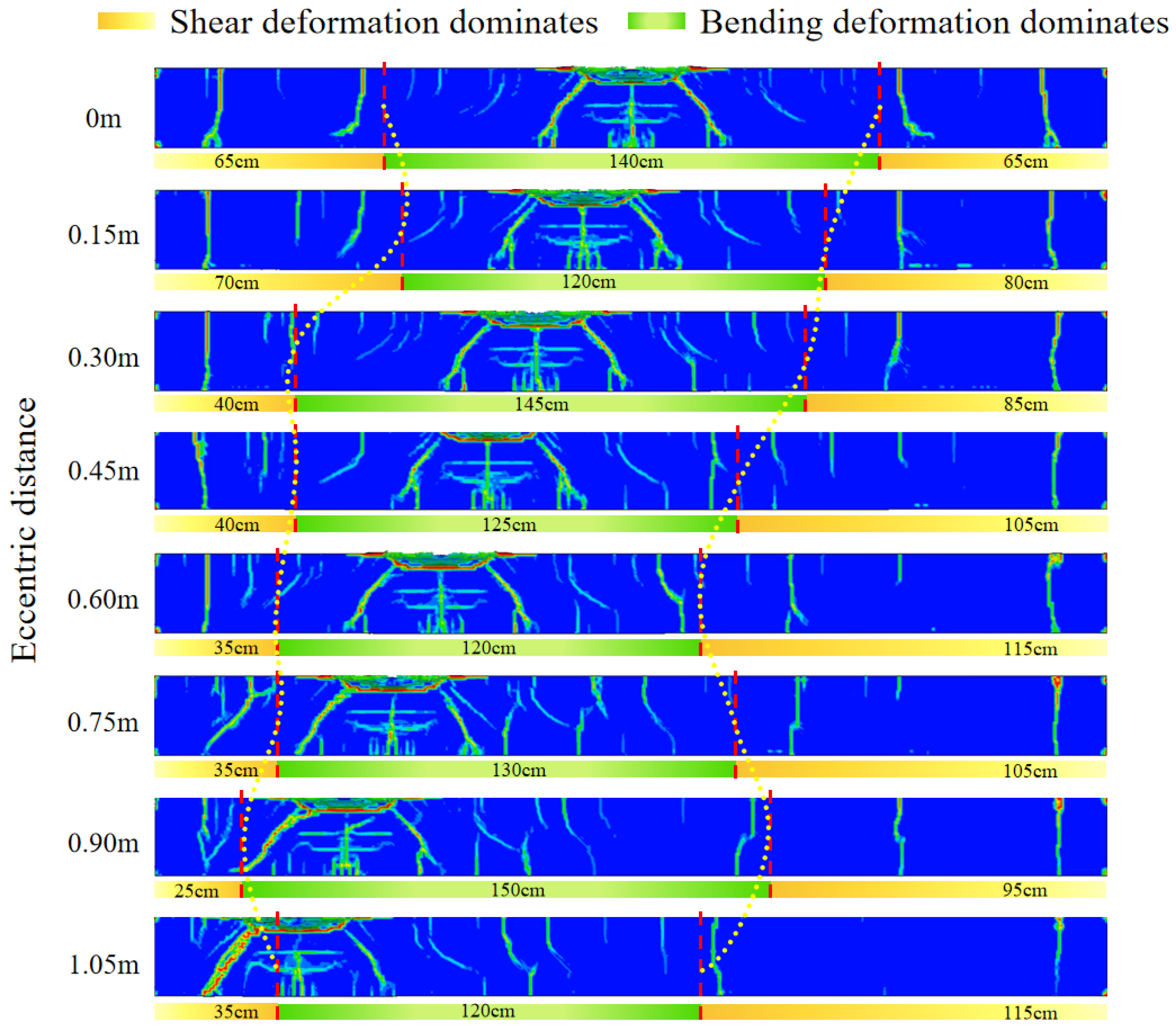
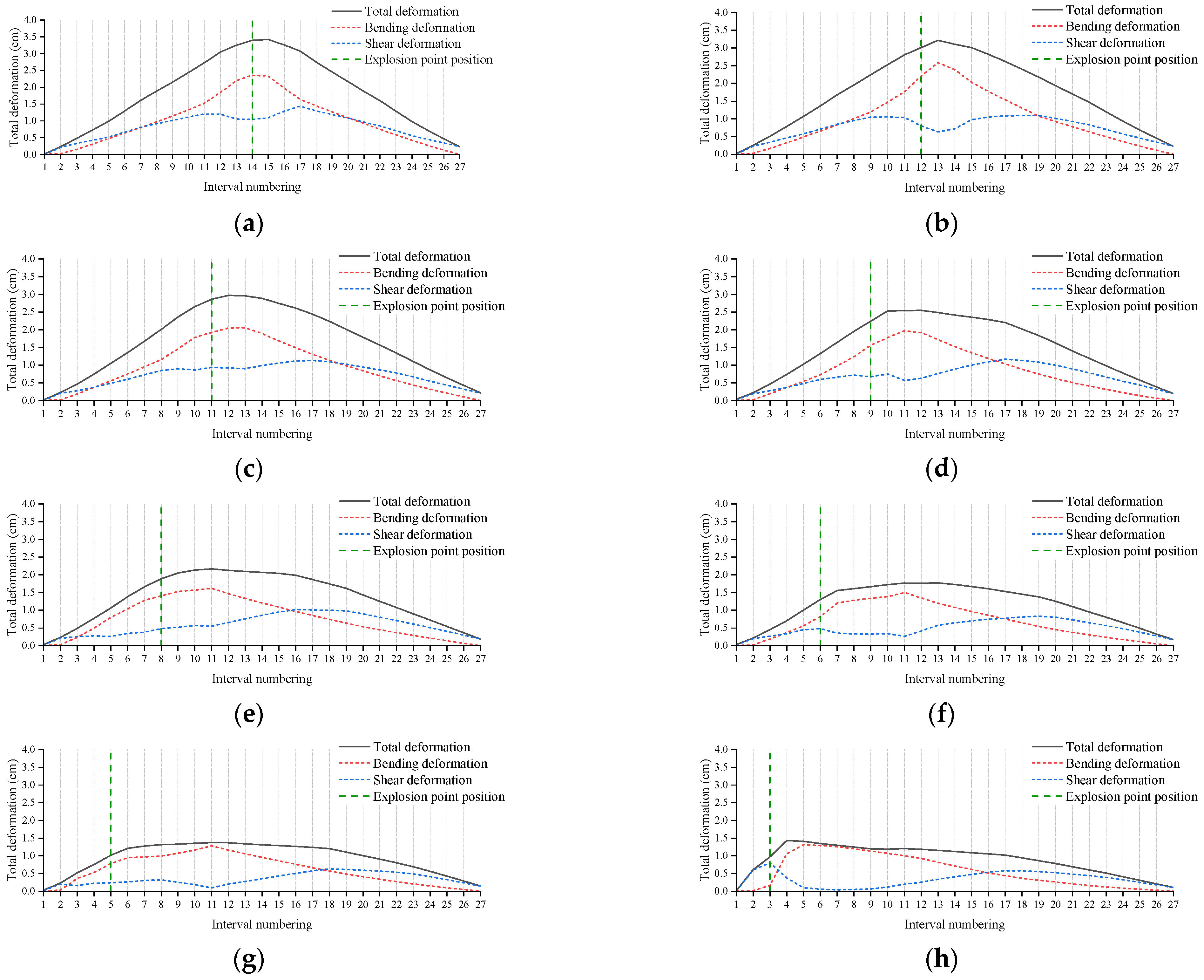
The numerical damage results are illustrated in Figure 20. Based on the recorded simulation data, the aforementioned deformation decoupling method is employed to calculate the decoupled deformations of the RC beams under various cases. The specific decoupling results for the 2 kg charge mass are presented in Figure 21 and Figure 22 and Table 9.
Figure 21 presents the deformation decoupling curves of reinforced concrete beams under various working conditions. Table 9 records the corresponding results for each working condition shown in Figure 21. From the data analysis of Figure 21 and Table 9, it can be seen that:
Attenuation characteristics and non-monotonic variation in the global displacement response. As the eccentric distance (e) increases, the maximum vertical displacement of the RC beam generally exhibits an attenuating trend. Specifically, the displacement decreases from 3.50 cm at the center explosion (e = 0, TL1) to 1.37 cm at e = 0.90 m (TL7), representing a reduction of approximately 60%. This phenomenon indicates that load eccentric distance significantly weakens the impulse acting in the primary load-bearing direction. Notably, a slight rebound in maximum displacement is observed at e = 1.05 m (TL8), suggesting a transition in the structural response mechanism under large eccentric distance, where nonlinear or local effects become dominant. This occurs because an eccentric explosion simultaneously generates a translational impulse (P) and a torsional moment (M) about the vertical axis. As e increases, the proportion of translational impulse diminishes while the torsional effect strengthens. The continuous decline in displacement from TL1 to TL7 is primarily driven by the reduction in translational impulse, whereas the rebound at TL8 is attributed to excessive torsion, which induces deformations such as “lifting” or “warping” near the fixed ends of the RC beam.
Lag phenomenon of the maximum response position. Under eccentric cases (TL2–TL7), the location of the maximum displacement generally lags behind the projection of the charge center. This indicates that the peak dynamic response does not occur at the loading point; instead, it is formed in a “dynamic amplification zone” resulting from the propagation, reflection, and superposition of blast-induced stress waves. This pattern remains relatively stable for e ≤ 0.75 m. However, at e = 1.05 m (TL8), the maximum response position essentially coincides with the loading point, indicating highly localized load characteristics. This is because the shock waves propagate as stress waves; under eccentric loading, the wavefront reaches the cross-section asynchronously, inducing complex bending and shear waves. These waves propagate toward the boundaries and reflect, potentially undergoing in-phase superposition with subsequent waves or inherent vibration modes to form dynamic amplification zones. At extreme eccentric distances, the load is highly concentrated, and stress waves attenuate significantly before reaching distal regions, causing energy dissipation to concentrate near the loading point and eliminating the lag phenomenon.
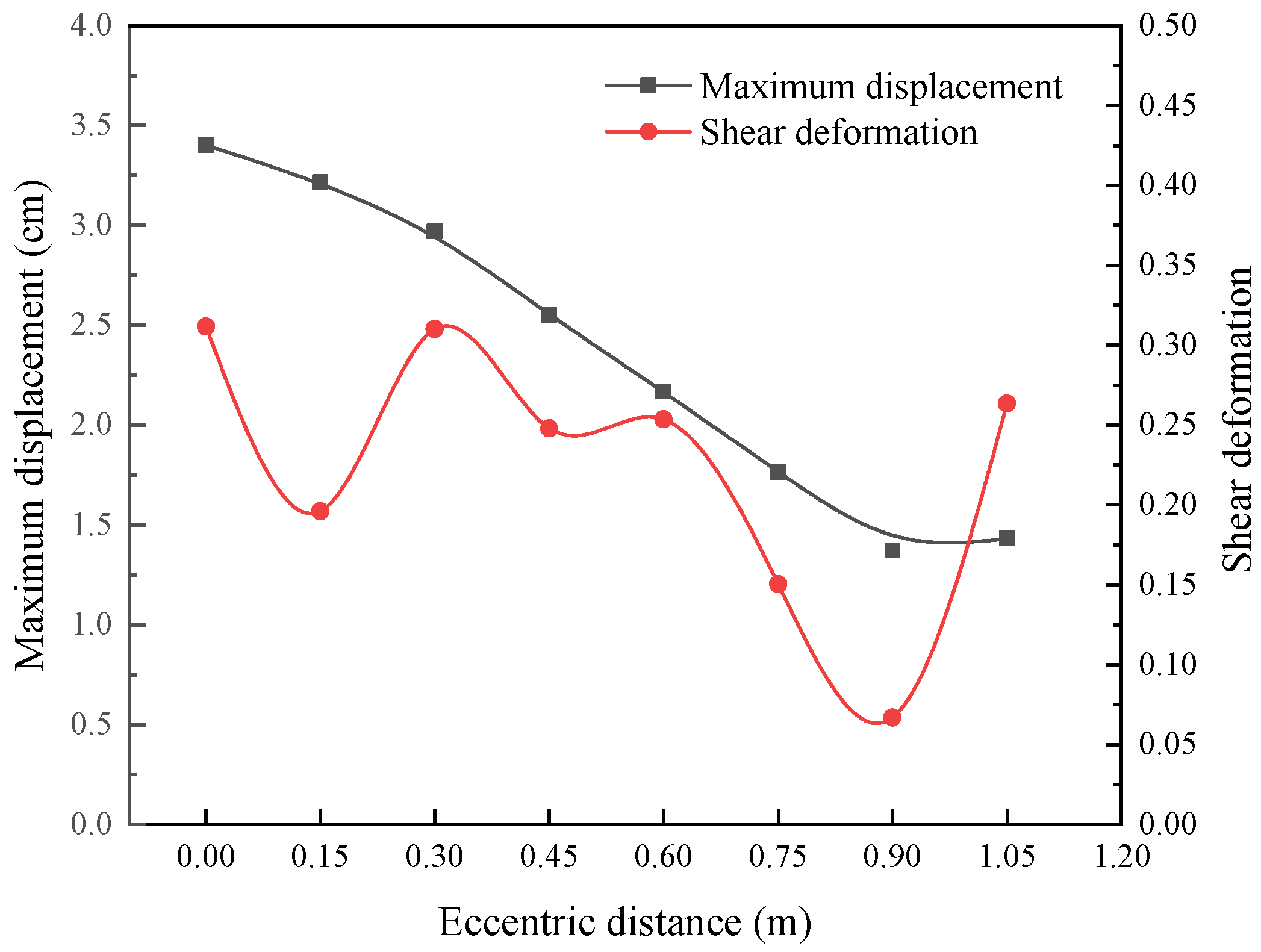
Based on the maximum displacement and shear deformation ratio (δ) for each working condition listed in Table 9, Figure 22 is presented. Analysis of the data from Table 9 and Figure 22 reveals that:
“V-shaped” variation trend of the deformation ratio (δ) at the maximum displacement. The deformation ratio (δ) at the position of maximum displacement exhibits a non-monotonic, “V”-shaped trend—first decreasing and then increasing—with respect to eccentric distance. The value of δ is 0.3117 for the center explosion, reaches a minimum of 0.0670 at e = 0.90 m (TL7), and rises to 0.2635 at e = 1.05 m (TL8). This result demonstrates that eccentric distance not only redistributes the load magnitude but also alters the vibration modes and energy dissipation mechanisms, leading to a nonlinear relationship between local deformation and global displacement. The high impulse density associated with large eccentric distance may drive the material near the loading point into a plastic state, forming local plastic hinges or large deformations. Such local damage consumes substantial energy and modifies the structural stiffness distribution. Consequently, the maximum displacement ceases to decline and may even increase due to stiffness softening, accompanied by a sharp rise in the local deformation ratio.

5.2. Charge Mass

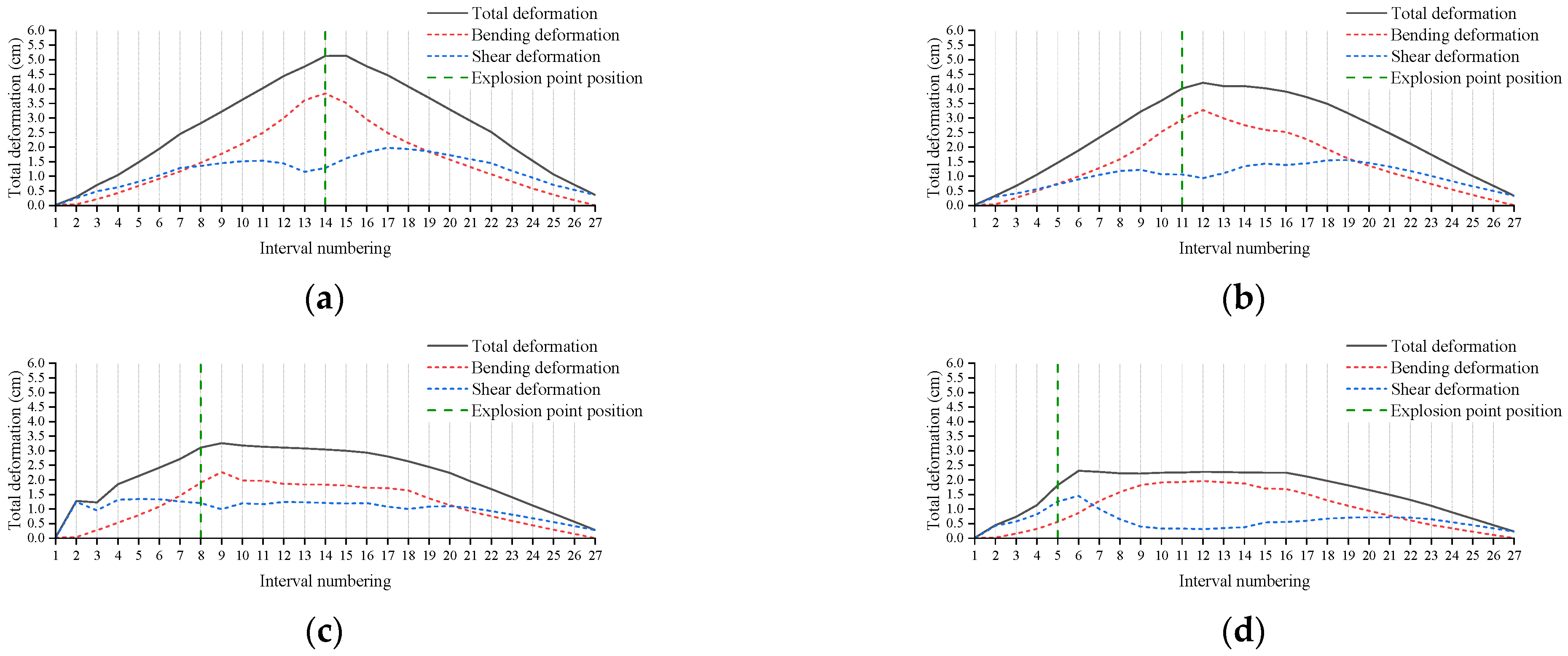
Based on the recorded numerical simulation data, the aforementioned deformation decoupling method is employed to calculate the decoupled deformations of the RC beams under various cases. The specific decoupling results for different charge masses are illustrated in Figure 23 and Figure 24 and Table 10.
Figure 23 and Figure 24, respectively, present the deformation decoupling curves of reinforced concrete beams under different eccentric distances corresponding to TNT charge weights of 2.25 kg and 2.5 kg. Table 10 records the results for each working condition shown in Figure 23 and Figure 24. From the data analysis of Figure 23 and Figure 24, and Table 9 and Table 10, it can be seen that:
Significant monotonic increase in maximum displacement. As the charge mass increases, the maximum vertical displacement of the RC beam exhibits a pronounced upward trend. In the mid-span explosion cases, when the charge mass increases from 2 kg (TL1) to 2.25 kg (TL9), the maximum displacement rises from 3.50 cm to 5.13 cm, an increment of approximately 46.57%. At a charge mass of 2.5 kg (TL13), the displacement reaches 8.22 cm, representing a substantial increase of 134.77% compared to the 2 kg case. This pattern remains consistent across various eccentric distances (e). For instance, at e = 0.3 m, the maximum displacements for 2 kg (TL3), 2.25 kg (TL10), and 2.5 kg (TL14) are 2.97 cm, 4.21 cm, and 6.66 cm, respectively, showing a significant stepwise escalation. This is because the charge mass directly determines the magnitude of energy release; a higher mass results in increased peak pressure and impulse of the blast shock waves acting on the RC beam, forcing the structure to absorb more energy and undergo greater plastic deformation.
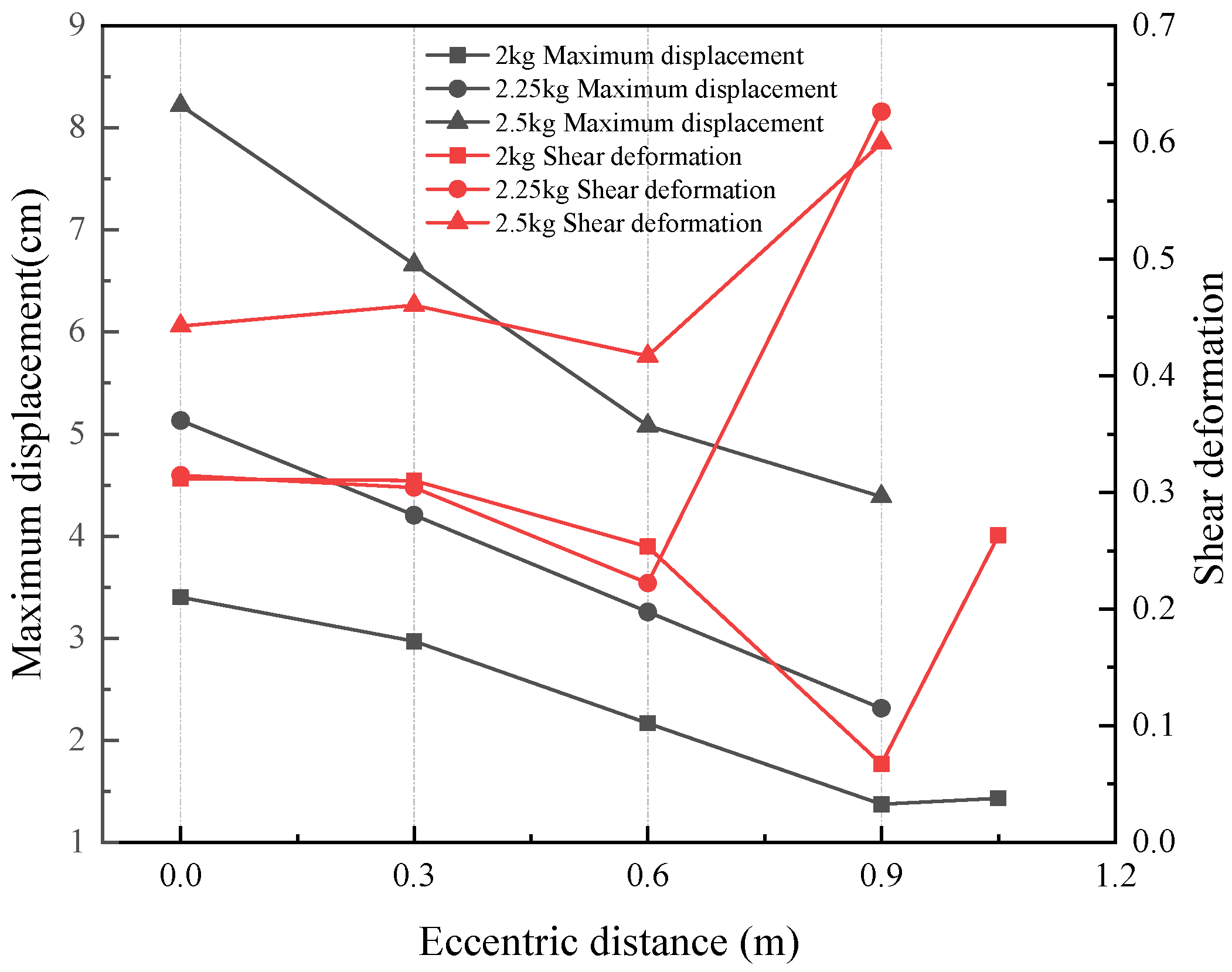
Based on the maximum displacement and shear deformation ratio(δ) for each working condition presented in Table 9 and Table 10, Figure 25 is constructed. Analysis of the data from Table 9 and Table 10, and Figure 25 reveals that:
Overall upward trend and localized mutation of the deformation ratio(δ). Generally, the deformation ratio(δ) at the maximum displacement increases with the charge mass, indicating that the proportion of shear deformation gradually rises and the failure mode tends to shift toward a shear-dominated type. For mid-span explosions, δ is 0.3117 (flexural-shear failure) at 2 kg, 0.3147 (flexural-shear failure) at 2.25 kg, and increases to 0.4428 (shear-like failure) at 2.5 kg. Notably, at e = 0.9 m, δ sharply rises from 0.0670 (flexural-like failure) at 2 kg to 0.6263 (shear failure) at 2.25 kg, and is 0.5994 at 2.5 kg. This is attributed to the intense shock waves from high-charge masses, which exacerbate localized stress concentration and significantly enhance shear effects. The mutation of δ at e = 0.9 m suggests that the specific combination of charge mass and eccentric distance drives the RC beam into a strong nonlinear response regime, where the formation of local plastic hinges and shear failure leads to a precipitous increase in the shear deformation component.
Inward migration of the inflection point in the deformation ratio curve. In the “V-shaped” trend of δ (decreasing and then increasing), the inflection point gradually migrates toward the mid-span as the charge mass increases. For the 2 kg charge, the inflection point occurs near e = 0.9 m (TL7); for 2.25 kg, it shifts to e = 0.6 m (TL11); and for 2.5 kg, it further moves to approximately e = 0.45 m (between TL14 and TL15). This phenomenon indicates that the broader energy propagation and stronger impact of larger explosions cause the response-sensitive zone of the RC beam to contract toward the core load-bearing region at the mid-span. Under smaller charge masses, distal regions of the beam can still produce effective responses, placing the inflection point further outward. Conversely, under larger charge masses, the mid-span region becomes the dominant zone for deformation and damage due to intense combined flexural-shear stresses, resulting in the inward migration of the inflection point.

5.3. Comparison with Existing Studies

Shi [23] demonstrated that RC beam-type members subjected to blast loading may exhibit multiple failure modes, predominantly flexural failure, direct shear failure, and combined flexural-shear failure. Shi [23] improved the direct shear single-degree-of-freedom (SDOF) method for blast analysis of RC beams based on the equivalent SDOF model theory. They established criteria for identifying direct shear failure and combined flexural-shear failure, and proposed computational procedures for the dynamic response of RC beams under these two failure modes. Furthermore, incorporating flexural failure, direct shear failure, and combined flexural-shear failure of RC beams under blast loading, they developed an improved equivalent SDOF method for blast analysis of RC beam-type members, along with a step-by-step analytical procedure. This method enables direct assessment of the failure mode of RC beam-type members under blast loading and the calculation of their dynamic response.
The experimental and numerical results of this study are compared with those obtained from Shi’s method, and the comparison results are presented in Table 11.
Comparing the failure modes identified by the shear deformation ratio (δ) criterion proposed in this study with those predicted by Shi [23] improved equivalent single-degree-of-freedom (SDOF) method (Table 10) reveals a high degree of consistency between the two approaches. Both methods classify the predominantly flexural cases (e.g., TL6, TL7) as flexural or flexural-dominated failure, identify the flexural-shear coupled cases (e.g., TL1–TL5, TL8–TL11, TL13, TL15) as combined flexural-shear failure, and recognize the shear-dominant cases (e.g., TL12, TL14, TL16) as direct shear or shear failure. Although minor discrepancies are observed in a few borderline conditions (e.g., TL13, TL15), the overall trend and categorization of failure modes are in close agreement. This comparison not only validates the reliability of the δ-based failure criterion for RC beams under near-field eccentric blasts but also demonstrates that different analytical frameworks can yield mutually consistent assessments of failure mode transitions.

6. Conclusions

This study conducted three near-field air blast tests with varying charge masses and explosion positions, integrated LS-DYNA numerical simulations, and extended the deformation decoupling method (originally proposed for columns) to RC beams to establish a quantitative failure mode criterion based on the shear deformation ratio (δ). The main conclusions are drawn as follows.
  • Scientific conclusions
(1) A five-level quantitative failure mode criterion for RC beams under eccentric explosions is established based on δ: flexural failure (δ ≤ 5%), flexural-like failure (5% < δ ≤ 20%), flexural-shear failure (20% < δ ≤ 35%), shear-like failure (35% < δ ≤ 50%), and shear failure (δ ≥ 50%). This is the first application of the deformation decoupling method to beam structures.
(2) Under eccentric blasts without significant local damage, RC beams exhibit primarily global coupled deformation. The maximum displacement demonstrates a “lag effect” (shifting toward the mid-span region rather than occurring directly beneath the explosion center). The shear deformation ratio δ follows a “V-shaped” trend with respect to eccentric distance (e): it first decreases and then increases, reaching a minimum near e = 0.90 m for a 2 kg charge.
(3) Increasing charge mass monotonically increases the maximum displacement. For mid-span explosions, raising the charge from 2 kg to 2.5 kg increases the maximum displacement from 3.50 cm to 8.22 cm and raises δ from 0.3117 (flexural-shear failure) to 0.4428 (shear-like failure). The inflection point of the V-shaped δ curve migrates inward (toward mid-span) as charge mass increases–from e ≈ 0.90 m at 2 kg to e ≈ 0.45 m at 2.5 kg–indicating a contraction of the response-sensitive zone.
(4) The constructed LS-DYNA numerical model (using ALE fluid–structure interaction, RHT concrete, *MAT_PLASTIC_KINEMATIC for rebar, and JWL for TNT) reproduces the experimental damage characteristics with an error below 10%, providing a validated framework for parametric studies of RC beams under eccentric blasts.
  • Applied conclusions
(1) Eccentric blast locations must be considered in design. Current guidelines focus on central explosions, but this study shows that eccentricities > 0.9 m with a charge mass ≥ 2.25 kg lead to shear failure (δ ≥ 50%). For critical structures, eccentricities up to 1.0 m should be evaluated.
(2) Enhance shear reinforcement in mid-span adjacent zones and use δ as a design index. The “V-shaped” δ trend with an inward-shifting inflection point indicates that the region 0.45–0.90 m from mid-span is shear-prone. Reduce stirrup spacing over at least 1.0 m around mid-span. If δ > 35%, increase shear capacity; if δ > 50%, revise the section.
(3) Apply the lag effect for damage inspection and adopt δ for performance-based assessment. Maximum displacement lags behind the blast center towards mid-span. Post-blast inspections should target the mid-span area. Use δ as a performance indicator to rapidly predict failure modes via simulation or simplified methods.
  • Future prospects
(1) Investigating the influence of different boundary conditions and beam slenderness ratios.
(2) Conduct a mechanistic investigation into why δ exhibits a “V-shaped” trend and when the transition occurs.
(3) Developing simplified empirical formulae based on δ for rapid post-blast damage evaluation and δ-based damage detection indicators, monitoring strategies, and simplified field tools for rapid failure mode assessment.

Author Contributions

Conceptualization, Y.G., R.Z. and C.Y.; Methodology, Y.G., W.W. and C.Y.; Software, Y.G. and Y.Z.; Validation, Y.G. and Y.Z.; Formal analysis, Y.G.; Investigation, Y.G. and C.Y.; Data curation, Y.G.; Writing—original draft, Y.G.; Writing—review and editing, R.Z., W.W., C.Y. and Y.Z.; Visualization, Y.G. All authors have read and agreed to the published version of the manuscript.

Funding

This research received no external funding.

Data Availability Statement

Data are contained within the article.

Conflicts of Interest

The authors declare no conflicts of interest.

References

  1. Lange, D. A Review of Blast Loading and Explosions in the Context of Multifunctional Buildings; Fire Technology SP Technical Research Institute of Sweden: Boras, Sweden, 2013. [Google Scholar]
  2. Anas, S.M.; Alam, M.; Umair, M. Experimental and numerical investigations on performance of reinforced concrete slabs under explosive-induced air-blast loading: A state-of-the-art review. Structures 2021, 31, 428–461. [Google Scholar] [CrossRef]
  3. Li, Z.; Liu, Y.; Yan, J.; Yu, W.; Huang, F. Experimental investigation of p-section concrete beams under contact explosion and close-in explosion conditions. Def. Technol. 2018, 14, 540–549. [Google Scholar] [CrossRef]
  4. Liu, Y.; Yan, J.; Huang, F. Behavior of reinforced concrete beams and columns subjected to blast loading. Def. Technol. 2018, 14, 550–559. [Google Scholar] [CrossRef]
  5. Liu, Y.; Yan, J.; Li, Z.; Huang, F. Improved SDOF and numerical approach to study the dynamic response of reinforced concrete columns subjected to close-in blast loading. Structures 2019, 22, 341–365. [Google Scholar] [CrossRef]
  6. Wei, W.; Zhang, Y.; Su, J.; Liu, Y.; Huang, F. Modification of SDOF model for reinforced concrete beams under close-in explosion. Def. Technol. 2023, 20, 162–186. [Google Scholar] [CrossRef]
  7. Stochino, F. RC beams under blast load: Reliability and sensitivity analysis. Eng. Fail. Anal. 2016, 66, 544–565. [Google Scholar] [CrossRef]
  8. Carta, G.; Stochino, F. Theoretical models to predict the flexural failure of reinforced concrete beams under blast loads. Eng. Struct. 2013, 49, 306–315. [Google Scholar] [CrossRef]
  9. UFC 3-340-01; Design and Analysis of Hardened Structures to Conventional Weapons Effects. US DoD (US Department of Defence): Washington, DC, USA, 2002.
  10. UFC-3-340-02; Structures to Resist the Effects of Accidental Explosions. US DoD (US Department of Defence): Washington, DC, USA, 2008.
  11. 5-1300/NAVFAC P-397/AFR 88-22; Structures to Resist the Effects of Accidental Explosions. Departments of the Army, Navy, and Air Force: Washington, DC, USA, 1991.
  12. Acosta, P.F. Overview of UFC 3-340-02 structures to resist the effects of accidental explosions. In Proceedings of the Structures Congress 2011, Las Vegas, NY, USA, 14–16 April 2011; American Society of Civil Engineers: Reston, VA, USA, 2011; pp. 1454–1469. [Google Scholar] [CrossRef]
  13. Goswami, A.; Ganesh, T.; Adhikary, S.D. RC structures subjected to combined blast and fragment impact loading: A state-of-the-art review on the present and the future outlook. Int. J. Impact Eng. 2022, 170, 104355. [Google Scholar] [CrossRef]
  14. Tang, H.; Zhai, H.; Su, J.; Fu, T. Research on damage effect of reinforced concrete beam under close-in explosion. J. Ordnance Equip. Eng. 2022, 43, 196–201. [Google Scholar]
  15. Tang, D.; Liao, Z.; Xue, Y.; Zheng, R. Research for flexural behavior of concrete beams with high-strength reinforcements under blast loading. J. Huazhong Univ. Sci. Technol. Nat. Sci. Ed. 2017, 45, 122–126. (In Chinese) [Google Scholar]
  16. Xu, Y.; Huang, F.; Liu, Y.; Yan, J.; Bai, F.; Yu, H.; Wang, B.; Wang, J. Effect of close-in successive explosions on the blast behaviors of reinforced concrete beams: An experimental study. Structures 2023, 53, 29–46. [Google Scholar] [CrossRef]
  17. Lin, S.C.; Li, D.; Yang, B. Experimental study and numerical simulation on damage assessment of reinforced concrete beams. Int. J. Impact Eng. 2019, 132, 103323. [Google Scholar] [CrossRef]
  18. Wang, J.; Lv, L.; Shang, W.; Huang, Z. Study of damage characteristics of reinforced concrete beams under contact explosion load. Prot. Eng. 2020, 42, 22–27. [Google Scholar]
  19. Zhou, Q.; Niu, N.; Liu, H.; Zhang, X. Effects of anti-explosion performance and failure form under blast load due to shear span ratio. J. Water Resour. Archit. Eng. 2017, 15, 219–224+237. (In Chinese) [Google Scholar]
  20. Qu, Y.; Liu, W.; Gwarzo, M.; Zhang, W.; Zhai, C.; Kong, X. Parametric study of anti-explosion performance of reinforced concrete T-shaped beam strengthened with steel plates. Constr. Build. Mater. 2017, 156, 692–707. [Google Scholar] [CrossRef]
  21. Tran, D.T.; Pham, T.M.; Hao, H.; Do, T.V.; Tran, T.T. Blast behaviour of precast segmental vs monolithic concrete beams prestressed with unbonded tendons: A numerical investigation. Int. J. Impact Eng. 2023, 173, 104434. [Google Scholar] [CrossRef]
  22. Mohammed, T.A.; Abebe, S. Numerical investigation of steel-concrete composite (SCC) beam subjected to combined blast-impact loading. Heliyon 2022, 8, e10672. [Google Scholar] [CrossRef]
  23. Shi, Y.; Zhang, H.; Li, Z. Improved equivalent single degree of freedom method for blast analysis of RC beams. J. Build. Struct. 2019, 40, 8–16. [Google Scholar]
  24. Gangolu, J.; Kishore, K.B.; Sharma, H. Probabilistic demand models and reliability based code calibration for reinforced concrete column and beam subjected to blast loading. Reliab. Eng. Syst. Saf. 2023, 240, 109577. [Google Scholar] [CrossRef]
  25. Yao, S.; Zhang, D.; Lu, F.; Wang, W.; Chen, X. Damage features and dynamic response of RC beams under blast. Eng. Fail. Anal. 2016, 62, 103–111. [Google Scholar] [CrossRef]
  26. Wang, W.; Liu, R.; Wu, B.; Li, L.; Huang, J.; Wu, X. Damage Criteria of Reinforced Concrete Beams under Blast Loading. Acta Armamentarii 2016, 37, 1421–1429. (In Chinese) [Google Scholar]
  27. Fang, Q.; Liu, J.C.; Zhang, Y.D.; Qian, Q. Finite element analysis of failure modes of blast loaded RC beams. Eng. Mech. 2001, 18, 1–8. (In Chinese) [Google Scholar]
  28. Chen, W.; Hao, H.; Chen, S. Numerical analysis of prestressed reinforced concrete beam subjected to blast loading. Mater. Des. 2015, 65, 662–674. [Google Scholar] [CrossRef]
  29. Li, Z.; Zhao, W.; Cui, J.; Shi, Y.; Ding, Y. Research on damage assessment and performance-based design method for CFST columns under close-in blast loading. J. Build. Struct. 2025, 46, 190–200. (In Chinese) [Google Scholar]
  30. Khatir, A.; Capozucca, R.; Khatir, S.; Magagnini, E.; Benaissa, B.; Cuong-Le, T. An efficient improved Gradient Boosting for strain prediction in Near-Surface Mounted fiber-reinforced polymer strengthened reinforced concrete beam. Front. Struct. Civ. Eng. 2024, 18, 1148–1168. [Google Scholar] [CrossRef]
  31. Magagnini, E.; Khatir, A.; Capozucca, R. Experimental Free Vibration of Damaged RC Beam-Column Joints. In Proceedings of the 11th International Conference on Experimental Vibration Analysis for Civil Engineering Structures—EVACES, Porto, Portugal, 2–4 July 2025; pp. 392–401. [Google Scholar]
  32. Rahmani, M.C.; Khatir, A.; Azad, M.M.; Kim, H.S.; Firouzi, N.; Kumar, R.; Khatir, S.; Cuong, L.-T. Mechanics-based deep learning framework for predicting deflection of functionally graded composite plates using an enhanced whale optimization algorithm. Math. Mech. Solids 2026. [Google Scholar] [CrossRef]
  33. Khatir, A.; Capozucca, R.; Khatir, S.; Magagnini, E.; Le Thanh, C.; Riahi, M.K. Advancements and emerging trends in integrating machine learning and deep learning for SHM in mechanical and civil engineering: A comprehensive review. J. Braz. Soc. Mech. Sci. Eng. 2025, 47, 419. [Google Scholar] [CrossRef]
  34. Bouabdallah, A.; Benaissa, A.; Bouabdallah, M.A.; Malab, S.; Khatir, A. Development and performance evaluation of self-leveling sand concrete: Enhanced fluidity, mechanical strength, durability, and non-destructive analysis. Constr. Build. Mater. 2025, 468, 140463. [Google Scholar] [CrossRef]
  35. Cheng, J.S.; Wen, H.M.; Cu, S.T.; Zhang, Y. Size effect of reinforced concrete beams under explosive loadings-An experimental and numerical study. Int. J. Impact Eng. 2025, 198, 105207. [Google Scholar] [CrossRef]
  36. Zhao, L.; Hao, Y.; Wang, Q.; Yang, C.; Yao, H.; Jia, X. Damage Zone of the Reinforced Concrete Beam under Rectangular Explosive Contact Explosions. Buildings 2023, 13, 1403. [Google Scholar] [CrossRef]
  37. Shen, S.; Zheng, R.; Wang, W.; Ye, C. Effect of Charge Eccentric Position on the Response of Reinforced Concrete Columns Under Blast Loading. Buildings 2025, 15, 1898. [Google Scholar] [CrossRef]
  38. Yang, C.; Jia, X.; Huang, Z.; Zhao, L.; Shang, W. Damage of full-scale reinforced concrete beams under contact explosion. Int. J. Impact Eng. 2022, 163, 104180. [Google Scholar] [CrossRef]
  39. Jin, H.; Hao, H.; Xu, C.; Huang, Z.; Chen, W. Dynamic Response of Metaconcrete Beam Under Blast Load. Int. J. Struct. Stab. Dyn. 2023, 23, 15. [Google Scholar] [CrossRef]
  40. Xu, Y.; Liu, Y.; Huang, F.; Yan, J. Close-in blast performance of RC beams with varying cross-sectional sizes and damage assessment based on the dynamic load carrying capacity. Eng. Fail. Anal. 2024, 161, 108305. [Google Scholar] [CrossRef]
  41. Zhu, W.; Yang, C.; Yin, T.; Jia, J.; Yu, J.; Song, J. Blast resistant performance and damage mechanism of steel reinforced concrete beams under contact explosion. Eng. Struct. 2024, 315, 118472. [Google Scholar] [CrossRef]
  42. Yang, C.; Huang, Z.; Jia, X.; Shang, W.; Chen, T. Analytical model for predicting localized damage in RC beams under contact explosion. Int. J. Impact Eng. 2024, 185, 104870. [Google Scholar] [CrossRef]
  43. Yang, F.; Ke, Z.; Feng, W.; Li, X.; Chen, S.; Li, H. Effects of crumb rubber particles on the dynamic response of reinforced concrete beams subjected to blast loads. Eng. Struct. 2024, 300, 117181. [Google Scholar] [CrossRef]
  44. Li, S.; Rong, X.; Hu, J.; Wang, M.; Qu, Q.; Huang, J.; Guo, X. Risk assessment method of gas explosion based on quantification of margins and uncertainties (QMU): A case study on beam structures in buildings. Structures 2023, 50, 52–62. [Google Scholar] [CrossRef]
  45. GB50010-2010; Code for Design of Concrete Structures. The Ministry of Housing and Urban-Rural Development of the People’s Republic of China (MOHURD): Beijing, China, 2010.
  46. GB50011-2010; Code for Seismic Design of Buildings. The Ministry of Housing and Urban-Rural Development of the People’s Republic of China (MOHURD): Beijing, China, 2010.
  47. Li, J.; Li, X.; Peng, J.; Wu, X.; Sun, Y.; Zhou, F. Experimental and numerical investigations of single-hole blast-induced cracks in concrete based on a calibrated RHT model. Struct. Concr. 2025, 27, 127–142. [Google Scholar] [CrossRef]
Figure 1. Characteristics of flexural and shear deformations.
Buildings 16 02054 g001
Figure 2. Schematic of section division for beam deformation decoupling analysis.
Buildings 16 02054 g002
Figure 3. Schematic diagram of total and flexural deformations of the beam.
Buildings 16 02054 g003
Figure 4. Vertical deformation of RC beams under different failure modes. (a) Flexural failure; (b) Flexural-like failure; (c) Flexural-shear failure; (d) Shear-like Failure; (e) Shear failure.
Buildings 16 02054 g004aBuildings 16 02054 g004b
Figure 5. Flowchart of reinforced concrete beam near-field air blast test.
Buildings 16 02054 g005
Figure 6. Reinforcement layout of the RC beam.
Buildings 16 02054 g006
Figure 7. On-Site Arrangement Diagram.
Buildings 16 02054 g007
Figure 8. L1 test results. (a) Overall damage of L1 test beam; (b) Local damage of L1 test beam.
Buildings 16 02054 g008
Figure 9. L2 test results. (a) Overall damage of L2 test beam; (b) Local damage of L2 test beam.
Buildings 16 02054 g009
Figure 10. L3 test results. (a) Overall damage of L3 test beam; (b) Local damage of L3 test beam.
Buildings 16 02054 g010
Figure 11. Flowchart of finite element numerical simulation.
Buildings 16 02054 g011
Figure 12. Schematic of the failure surface.
Buildings 16 02054 g012
Figure 13. Schematic of the P-α equation of state.
Buildings 16 02054 g013
Figure 14. Mesh convergence analysis.
Buildings 16 02054 g014
Figure 15. Finite element model.
Buildings 16 02054 g015
Figure 16. L1 numerical simulation results. (a) Overall damage of L1 numerical simulation beam; (b) Local damage of L1 numerical simulation beam.
Buildings 16 02054 g016
Figure 17. L2 numerical simulation results. (a) Overall damage of L2 numerical simulation beam; (b) Local damage of L2 numerical simulation beam.
Buildings 16 02054 g017
Figure 18. L3 numerical simulation results. (a) Overall damage of L3 numerical simulation beam; (b) Local damage of L3 numerical simulation beam.
Buildings 16 02054 g018
Figure 19. Residual displacement comparison for L1.
Buildings 16 02054 g019
Figure 20. Damage and deformation ratio δ = 0.5 critical threshold for 2 kg TNT at various explosion positions.
Buildings 16 02054 g020
Figure 21. Deformation of the RC beam for 2 kg TNT at various explosion positions. (a) TL1 (Mid-span); (b) TL2 (eccentric distance 0.15 m); (c) TL3 (eccentric distance 0.30 m); (d) TL4 (eccentric distance 0.45 m); (e) TL5 (eccentric distance 0.60 m); (f) TL6 (eccentric distance 0.75 m); (g) TL7 (eccentric distance 0.90 m); (h) TL8 (eccentric distance 1.05 m).
Buildings 16 02054 g021
Figure 22. Maximum displacement and deformation ratio (δ) for 2 kg TNT at various explosion positions.
Buildings 16 02054 g022
Figure 23. Deformation diagrams of 2.25 kg TNT at different explosion positions. (a) TL9 (2.25 kg, mid-span); (b) TL10 (2.25 kg, eccentric 0.30 m); (c) TL11 (2.25 kg, eccentric distance 0.60 m); (d) TL12 (2.25 kg, eccentric distance 0.90 m).
Buildings 16 02054 g023
Figure 24. Deformation diagrams of 2.5 kg TNT at different explosion positions. (a) TL13 (2.5 kg, mid-span); (b) TL14 (2.5 kg, eccentric distance 0.30 m); (c) TL15 (2.5 kg, eccentric distance 0.60 m); (d) TL16 (2.5 kg, eccentric distance 0.90 m).
Buildings 16 02054 g024
Figure 25. Maximum displacement and deformation ratio (δ) under various charge masses and explosion positions.
Buildings 16 02054 g025
Table 1. Failure mode judgment criteria for RC beams.
Parameter RangeFailure Mode
δ ≤ 5%flexural failure
5% < δ ≤ 20%flexural-like failure
20% < δ ≤ 35%flexural-shear failure
35% < δ ≤ 50%Shear-like Failure
δ ≥ 50%Shear failure
Table 2. Experimental cases table.
Test NumberComponent Dimensions/mmCharge Masses/kgHeight of Charge/mPosition of Charge
L1125 × 250 × 300020.4Mid-span
L240.40.3 m from the mid-span
L340.40.6 m from the mid-span
Table 3. RHT Concrete Material Parameters.
ρ/(kg·m−3)G/Mpafc/Mpaεfb0
232020704021.22
b1t1/MPaanfs *
1.2235001.60.610.48
ft *q0bt2
0.070.68050.01050
Table 4. HRB335 Rebar Material Parameters.
Typeρ/(kg∙m−3)E/GPaνσ/MPa
HRB33578002000.3335
HRB40078002000.3400
Table 5. Explosive Materials and State Equation Parameters.
ρ/(kg·m−3)D/(m·s−1)PCJ/MPaA/MPaB/MPaR1R2ωE0/MPaV
163069302.1 × 1043.712 × 1053.23 × 1034.150.950.327 × 1031
Table 6. Air Material and State Equation Parameters.
ρ/(kg·m−3)C0/MPaC1,C2,C3C4,C5C6E0/MPaV
1.29−0.100.400.251
Table 7. Result comparison error table.
NumberLength of the Damaged Area on the Front FaceLength of the Crack Propagation Area on the Back FaceResidual Displacement
Test Value/cmSimulated Value/cmErrorTest Value/cmSimulated Value/cmErrorTest Value/cmSimulated Value/cmError
L13233.54.69%38417.31%0.740.796.76%
L241459.76%87.581.56.86%---
L358546.90%79823.80%---
Table 8. Numerical Simulation Analysis Parameters.
ObjectParameterValue
Reinforced Concrete BeamComponent Size/mm125 × 250 × 3000
Clear Span/mm2700
Explosion LoadExplosion Distance/m0.4
Charge Mass/kg2, 2.25, 2.5
Eccentric Distance/m0, 0.15, 0.30, 0.45, 0.60, 0.75, 0.90, 1.05
Table 9. Numerical simulation cases (TL1–TL8) and the recorded data table.
NumberCharge Mass
w/kg
Eccentric Distance
e/m
Explosion Point Interval NumberMaximum Displacement Segment NumberMaximum Displacement
u/cm
Deformation Ratio
δ
Failure Mode
TL12014143.50150.3117Flexural-shear failure
TL220.1512133.21780.1960Flexural-like failure
TL320.3011122.96980.3101Flexural-shear failure
TL420.459122.55030.2479Flexural-shear failure
TL520.608112.16740.2536Flexural-shear failure
TL620.756111.76560.1505Flexural-like failure
TL720.905111.37320.0670Flexural failure
TL821.05341.43160.2635Flexural-shear failure
Table 10. Numerical simulation cases (TL9–TL16) and the recorded data table.
NumberCharge Mass
w/kg
Eccentric Distance
e/m
Explosion Point Interval NumberMaximum Displacement Segment NumberMaximum Displacement
u/cm
Deformation Ratio
δ
Failure Mode
TL92.25014145.13170.3147Flexural-shear failure
TL102.250.3011124.20510.3042Flexural-shear failure
TL112.250.60893.25710.2222Flexural-shear failure
TL122.250.90562.31360.6263Shear failure
TL132.5014148.21950.4428Shear-like Failure
TL142.50.3011126.66050.4603Shear-like Failure
TL152.50.60895.0820.417Shear-like Failure
TL162.50.90574.3890.5994Shear failure
Table 11. Compared results with those of other existing studies.
NumberThis StudyShi’s Method [23]
Deformation Ratio
δ
Failure ModeMaximum Direct Shear Slip
smax/mm
Failure Mode
TL10.3117Flexural-shear failure0.53Combined flexural-shear failure
TL20.1960Flexural-like failure0.31Combined flexural-shear failure
TL30.3101Flexural-shear failure0.46Combined flexural-shear failure
TL40.2479Flexural-shear failure0.32Combined flexural-shear failure
TL50.2536Flexural-shear failure0.27Combined flexural-shear failure
TL60.1505Flexural-like failure0.08Flexural failure
TL70.0670Flexural failure0.04Flexural failure
TL80.2635Flexural-shear failure0.18Combined flexural-shear failure
TL90.3147Flexural-shear failure0.54Combined flexural-shear failure
TL100.3042Flexural-shear failure0.46Combined flexural-shear failure
TL110.2222Flexural-shear failure0.29Combined flexural-shear failure
TL120.6263Shear failure0.6Direct shear failure
TL130.4428Shear-like Failure0.59Combined flexural-shear failure
TL140.4603Shear-like Failure0.6Direct shear failure
TL150.417Shear-like Failure0.57Combined flexural-shear failure
TL160.5994Shear failure0.6Direct shear failure
Disclaimer/Publisher’s Note: The statements, opinions and data contained in all publications are solely those of the individual author(s) and contributor(s) and not of MDPI and/or the editor(s). MDPI and/or the editor(s) disclaim responsibility for any injury to people or property resulting from any ideas, methods, instructions or products referred to in the content.