1. Introduction
The built environment exerts substantial pressure on natural resources, accounting for approximately 40% of global raw material use, 34% of greenhouse gas emissions, and 35% of total waste generated [
1,
2]. Critically, the global circularity gap stood at only 6.9% in 2025, meaning that more than 70% of materials flowing through the global economy are ultimately wasted rather than recovered [
3]. In response, the transition towards a circular economy (CE) has emerged as a strategic priority for the architecture, engineering, and construction (AEC) sector [
2]. This transition promotes the reuse, repurposing, and recycling of materials, extends the service life of building components, and reduces environmental impacts [
1]. Digitalisation is increasingly recognised as a key enabler of this shift, providing tools for transparency, traceability, and data-driven decision-making throughout the lifecycle of built assets [
4].
Recent studies highlight the role of digital technologies, such as Material Passports (MPs), Building Information Modelling (BIM), and Artificial Intelligence (AI), in accelerating the transition towards a circular built environment [
5]. MPs support resource efficiency by improving reuse and recycling practices, enhancing traceability, and fostering collaboration among stakeholders [
6,
7,
8]. However, most existing MPs are statically managed and manually updated, which limits their scalability and operational value [
9]. AI offers the potential to overcome these limitations by enabling automated data extraction, real-time updates, and advanced interoperability across heterogeneous data sources, including BIM models, product databases, and Internet of Things (IoT) sensors [
5,
10]. MPs represent a promising mechanism for embedding circularity principles into building design, construction, and management [
7]. An MP is a structured digital profile containing technical, environmental, and operational information about building materials and components, allowing accurate tracking from production to end-of-life [
11]. When integrated with BIM and Digital Twin platforms, MPs can evolve from static repositories into dynamic systems that support maintenance, selective disassembly, high-value recycling, and performance optimisation [
12]. Their contribution spans transparency, circularity, and operational efficiency across the building life cycle [
11,
13]. Systematic mapping studies have confirmed that BIM-based applications support performance analysis at all stages of the building life cycle, with open interoperability standards identified as the most promising pathway for long-term tool integration [
14]. International initiatives, such as Madaster in the Netherlands [
15] and Circularise in Europe [
16], demonstrate how MPs can transform buildings into material banks rather than future waste streams [
17].
The regulatory landscape has intensified markedly since 2024, transforming what was once a prospective research topic into an immediate operational requirement [
18]. The European Union has adopted two complementary instruments that create legally binding obligations for MP/DPP adoption. Regulation (EU) 2024/1781, the Ecodesign for Sustainable Products Regulation (ESPR), entered into force in July 2024 and launched its first product groups in April 2025, covering textiles, furniture, and intermediate materials, including aluminium, iron, and steel, with mandatory DPP infrastructure expected by 2026–2027 [
19]. Regulation (EU) 2024/3110, the revised Construction Products Regulation (CPR), was formally adopted on 18 December 2024, entered into force on 7 January 2025, and was applied to most construction products starting from January 2026, with full sustainability reporting, including comprehensive environmental indicators, required by 2032 [
20]. A central EU DPP registry is expected to be established by July 2026. Commercial platforms such as Upcyclea [
21], Madaster [
15], and Circuland [
22] already offer AI-enhanced solutions that process real-time data and integrate with BIM and Digital Twins [
23]. Despite these advances, adoption remains uneven and practical implementation challenges persist, particularly for AI-to-passport pipelines.
Material Passports are also directly relevant to Building Renovation Passports (BRPs), introduced under the recast Energy Performance of Buildings Directive (EPBD, Directive 2024/1275/EU). The EPBD requires Member States to establish national BRP schemes by 2026, providing a building-level digital record of energy performance, renovation history, and material composition. MPs constitute a key data layer for BRPs: the material-level traceability and lifecycle data that MPs capture feed directly into the BRP’s scope for documenting the environmental footprint of renovation works and enabling circular material reuse across renovation cycles. This complementarity reinforces the urgency of AI-enabled, interoperable MP infrastructure as a foundational component of the EU’s digital renovation ecosystem.
Key barriers include the lack of harmonised methodologies for MP creation and exchange, fragmented regulatory frameworks, and economic uncertainties related to implementation costs and value creation [
1,
2,
4,
5,
6]. From an environmental perspective, incomplete or unreliable data can compromise lifecycle assessments, while limited stakeholder engagement and fragmented workflows reduce social and organisational impact [
9]. Although emerging frameworks, such as Waterman’s Materials Passports Framework [
24], propose structured data hierarchies integrated through BIM, significant gaps remain between conceptual models and operational deployment [
25]. The EU push for DPPs underscores the urgency of addressing these gaps through standardisation and interoperability.
In this context, integrating AI with MPs offers a pathway toward dynamic, interoperable, and decision-oriented platforms that can support design, construction, operation, and end-of-life processes in the built environment [
26]. This integration is further shaped by two emerging AI capabilities that were not prominent in earlier reviews of this field. First, Large Language Models (LLMs), including multimodal variants, are rapidly demonstrating the capacity to automatically extract structured passport fields from unstructured sources such as Environmental Product Declarations (EPDs), Bills of Quantities, and manufacturer datasheets [
27]. Second, blockchain technology is consolidating as a foundational trust infrastructure for DPPs, providing data immutability, decentralised consensus, and auditable provenance across multi-stakeholder supply chains [
28]. These developments substantially expand the AI task landscape beyond the computer vision and classical NLP methods that dominated earlier literature.
Several systematic reviews and bibliometric analyses have recently addressed adjacent aspects of this field and serve as important comparators for the present work. Veliz Reyes et al. [
29] conducted a scoping review of digital MP prototypes in the AEC industry, identifying unclear adoption pathways across diverse data architectures and regulatory jurisdictions. Aftab and Agliata [
30] published a bibliometric and thematic analysis of material passports for digital and circular construction, noting that research remains primarily focused on development and initial applications, with economic, regulatory, and social dimensions underexplored. A comprehensive review of DPP technical architecture was published in Renewable and Sustainable Energy Reviews [
10] and identified blockchain as the dominant trust technology and semantic interoperability as a key enabling challenge across 186 publications. The present review distinguishes itself from these concurrent contributions by adopting a primary AI task-family lens, explicitly mapping how specific AI methods (computer vision, NLP/LLMs, knowledge graphs, predictive ML, digital twin/IoT) are distributed across lifecycle phases and circularity functions within MP/DPP systems. This perspective allows a more precise identification of where AI capabilities are mature, where they remain nascent, and what benchmarks are needed to close the remaining gaps, including EoL decision support.
This study addresses these research needs through a systematic literature review on the role of AI in advancing MP/DPPs within the built environment. The objectives are to: (i) map existing research linking AI applications with MP/DPP under a circular economy framework; (ii) identify dominant themes, methodological limitations, and research gaps across lifecycle stages and circularity functions; and (iii) synthesise future research directions and framework elements needed to move from traceability-oriented passports toward actionable circular decision-making.
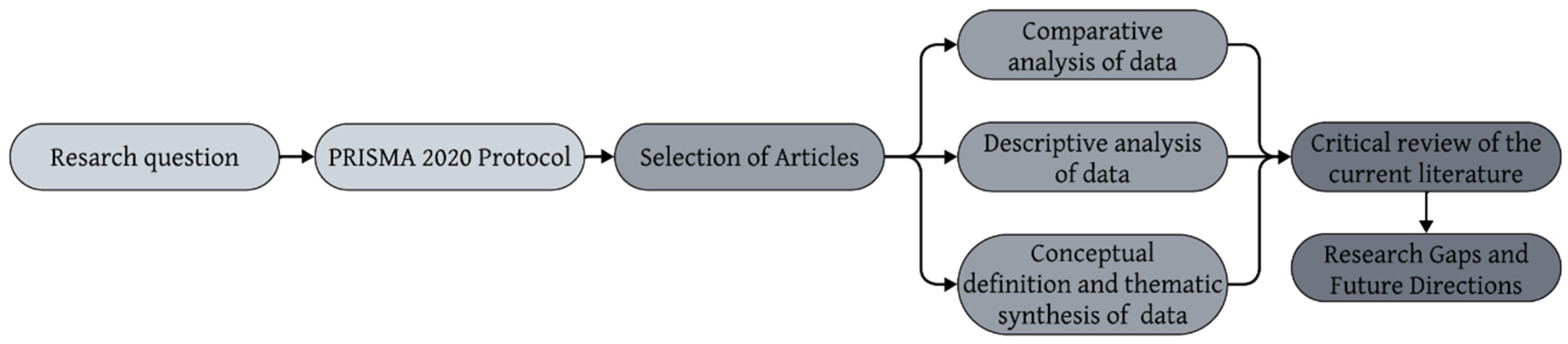
Figure 1 presents the article workflow structured according to the PRISMA 2020 protocol.
To guide the review, the study addresses the following research questions:
RQ1: How is Artificial Intelligence currently applied to support Material and Digital Product Passports in the built environment within a circular economy context?
RQ2: Which AI task families are most frequently associated with different lifecycle stages and circularity functions of MP/DPPs?
RQ3: What methodological limitations, research gaps, and implementation challenges exist in current AI-enabled MP/DPP studies?
RQ4: What future research directions and framework elements are required to move MPs from traceability-oriented tools toward actionable circular recovery decision-making?
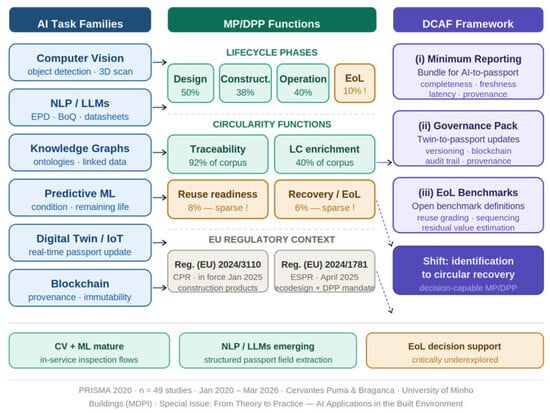
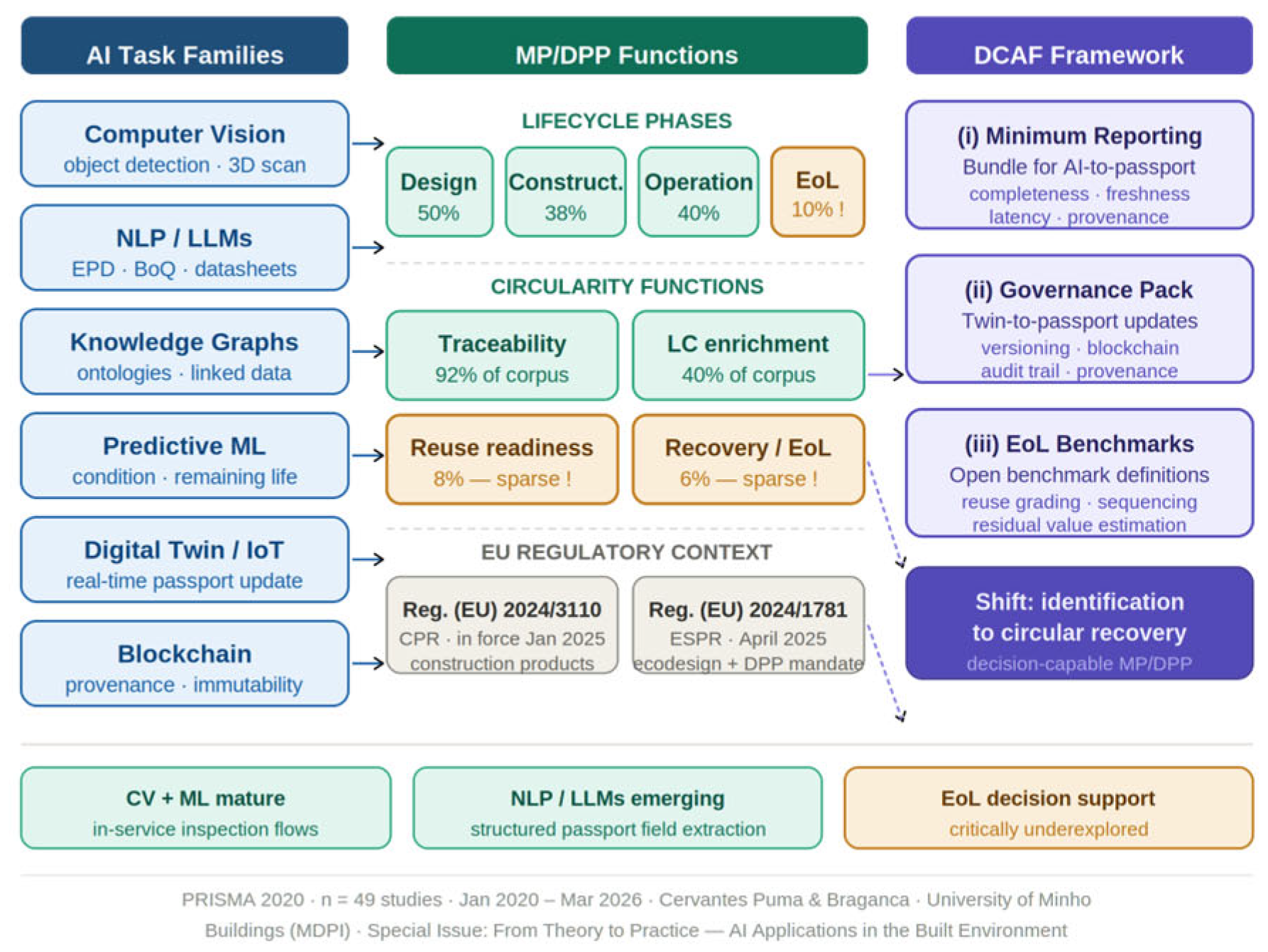
Beyond mapping and synthesising the existing literature, this study contributes a structured operational perspective on how Artificial Intelligence can be systematically integrated into MP/DPP systems. Specifically, it formalises a Digital Circularity AI Framework (DCAF), which translates dispersed evidence into three actionable components: (i) a minimum reporting bundle for AI-to-passport pipelines, (ii) a governance pack for twin-to-passport update mechanisms, and (iii) benchmark definitions for end-of-life decision support. This framework is designed to bridge the gap between data-centric implementations and decision-oriented circularity outcomes, providing a reference structure for both research and practice.
This paper is structured as follows.
Section 2 describes the methodology, including the PRISMA 2020 protocol, corpus re-audit, and analytical framework.
Section 3 presents the results of the descriptive, comparative, and thematic analyses.
Section 4 discusses the implications of the findings for practice, policy, and research.
Section 5 concludes with the main contributions, the formalised DCAF, and directions for future work.
2. Methodology
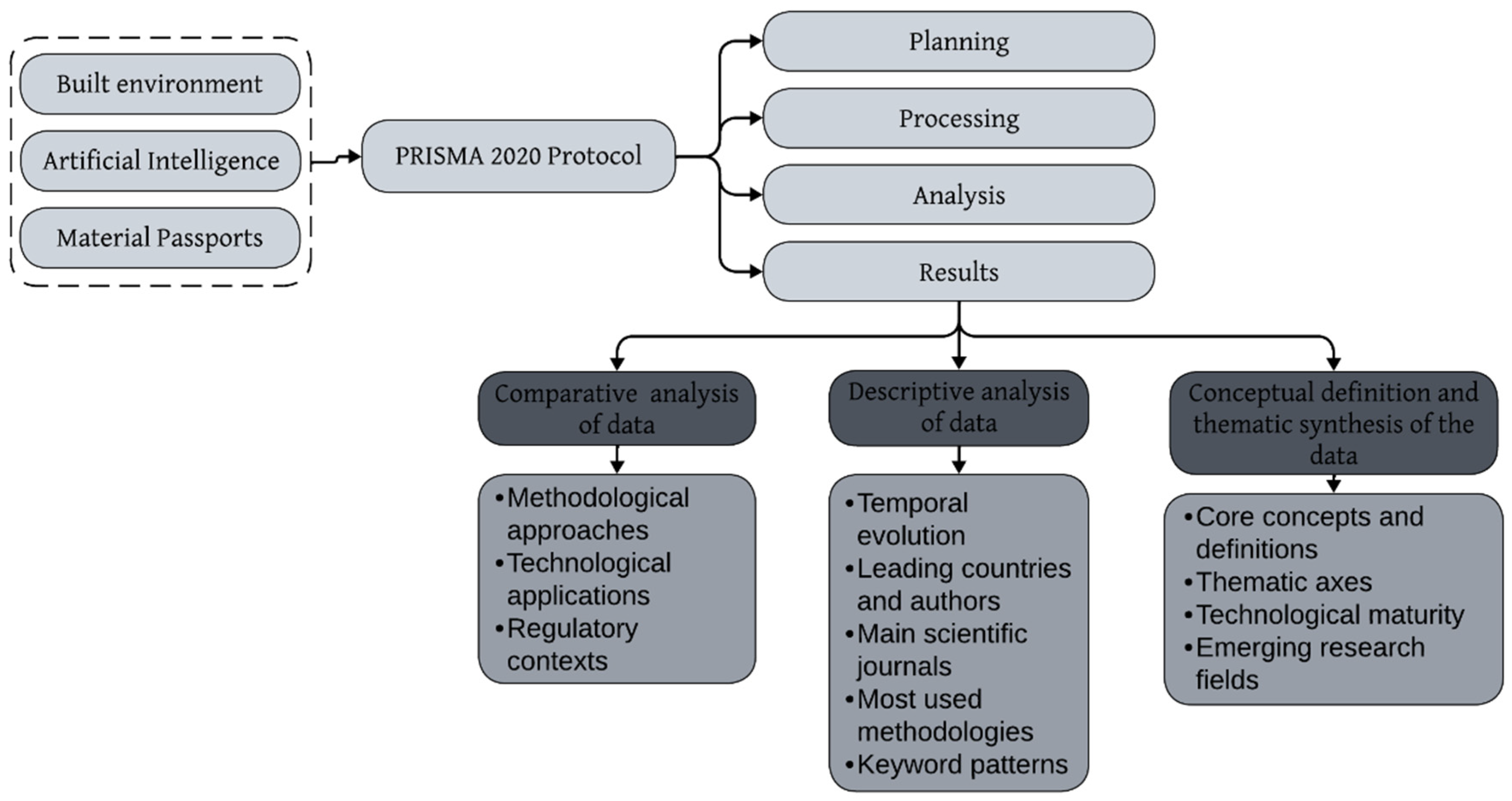
The methodological approach consists of a qualitative, descriptive SLR combining descriptive, comparative, and thematic analyses, as summarised in
Figure 2. The review does not perform a formal critical appraisal or risk-of-bias assessment; however, a light-touch quality assessment was conducted, and critical insights were derived through a systematic comparison of research objectives, methodological approaches, data sources, and reported limitations across the reviewed studies. Systematic literature reviews are widely recognised as an appropriate method for mapping, synthesising, and assessing existing literature to consolidate knowledge within a research field, facilitating the identification of research gaps and the development of new research agendas.
The systematic literature review followed the Preferred Reporting Items for Systematic Reviews and Meta-Analyses (PRISMA 2020) guidelines [
31], which provides a structured and transparent process for identifying, screening, and including relevant studies. The completed PRISMA checklist is provided as
Supplementary Material. All stages, including record identification, screening, eligibility assessment, and final inclusion, are reported within this Methods section. The primary corpus constitutes the exclusive analytical dataset for all subsequent synthesis and analysis.
2.1. Planning
The planning phase established the conceptual scope and methodological structure of the review. The research was situated at the intersection of the built environment, MPs, AI, and digital circularity. The central research question was defined as follows: How is AI applied to MP/DPP, with which data and metrics, and what gaps and benchmarks remain to operationalise it? An SLR protocol was developed following PRISMA 2020 guidelines [
31], defining the research objectives, databases, search strings, inclusion and exclusion criteria, and quality assessment procedures. The review was not registered in a public repository prior to commencement. Prospective registration was not pursued, given that PROSPERO is restricted to health-related systematic reviews; the appropriate platforms for engineering SLRs, such as OSF (Open Science Framework) and INPLASY, were identified after the search protocol had been finalised. All protocol elements, including objectives, databases, search strings, inclusion and exclusion criteria, and quality assessment procedures, are reported in full within this section to ensure methodological transparency.
Three databases were selected for complementary coverage: Web of Science (Clarivate Analytics), for its indexed journals with Journal Citation Reports (JCR) impact factors; ScienceDirect (Elsevier), for its multidisciplinary scope; and Scopus (Elsevier), for its breadth of peer-reviewed content. The database searches were conducted across these three databases using identical search strings, and were last run in March 2026 to incorporate the most recent publications. Primary queries targeted studies explicitly linking AI with passports: (i) “Artificial Intelligence” AND “material passport”; (ii) “Artificial Intelligence” AND “digital product passport”; and (iii) “Artificial Intelligence” AND “built environment”. The third query, while broader, was retained to capture AI methodologies applicable to MP/DPP workflows even where explicit passport terminology is not used; however, its inclusion required strict double-criterion screening (explicit AI–MP/DPP linkage AND at least one circularity function).
The inclusion criteria, as specified in
Table 1, comprise peer-reviewed journal articles and review articles written in English, with full text available, and explicitly addressing MPs, AI applications, or their integration in the built environment, published between 2020 and March 2026. The full-text availability requirement was adopted to ensure methodological transparency and equitable verifiability of the analytical corpus. It is acknowledged that this criterion may introduce a selection bias towards open-access venues, potentially over-representing MDPI journals. This limitation is discussed in
Section 4.7. Exclusion criteria removed unrelated studies, inaccessible full texts, non-peer-reviewed sources, and studies failing the double-criterion eligibility requirement.
While the search strategy prioritised explicit keyword combinations linking AI and MP/DPP, this design intentionally favoured conceptual precision over maximal breadth. The resulting corpus should be interpreted as a conceptually bounded analytical sample rather than a statistically exhaustive representation of all AI applications potentially relevant to the circular economy in the built environment. This scope definition reflects a deliberate methodological positioning aimed at reducing thematic drift and strengthening interpretative consistency.
2.2. Processing
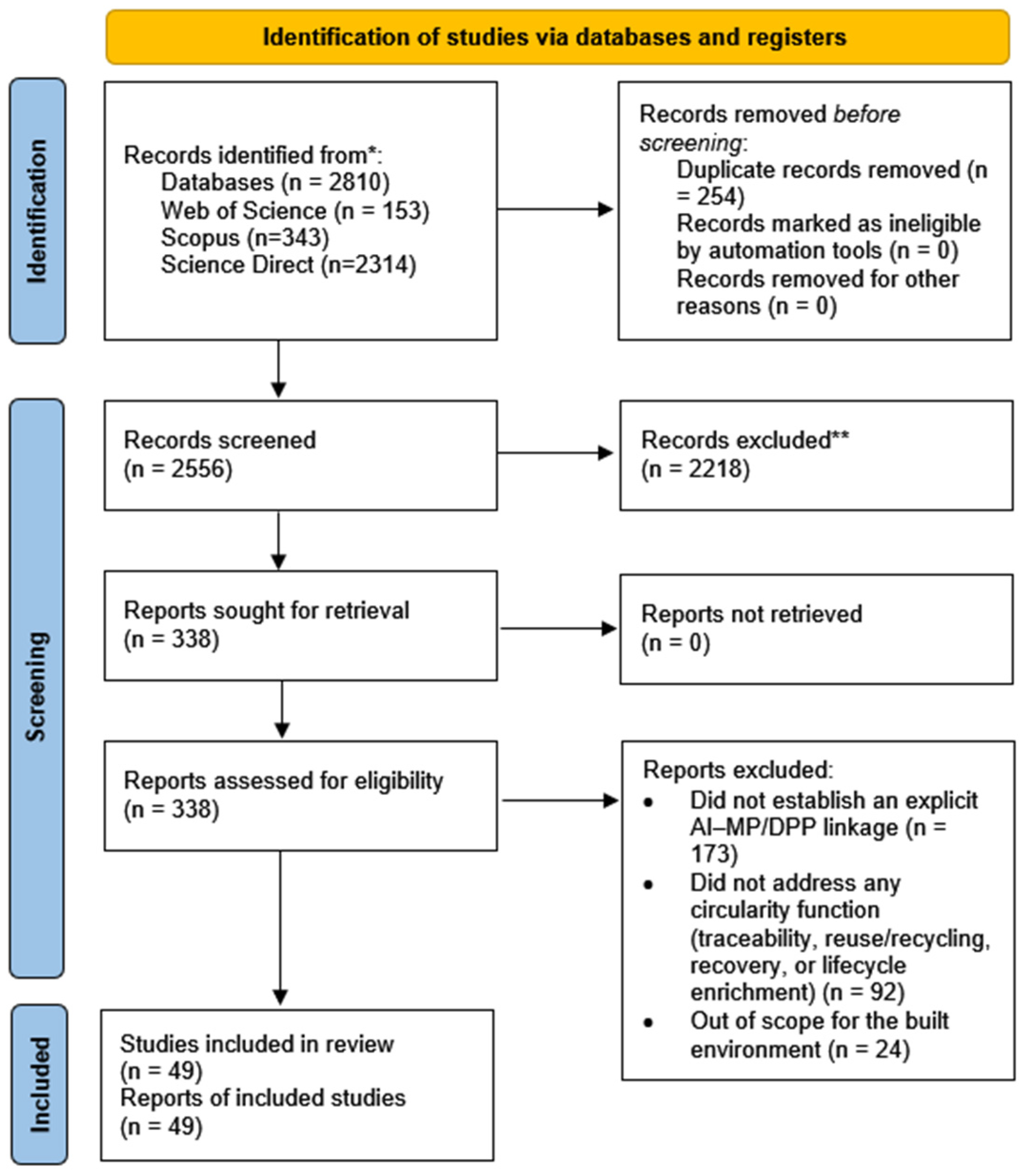
The processing phase applied the predefined search protocol across the selected databases, targeting title, abstract, and keyword fields. The initial search identified 2810 records. After removing 254 duplicates, 2556 unique records were screened at the title and abstract level.
Following this initial screen, 2218 records were excluded as not directly related to the topic. Of the remaining 338 abstracts assessed for eligibility, 289 were excluded because they failed the double-criterion test (explicit AI–MP/DPP link AND at least one circularity function). A primary corpus of 49 peer-reviewed studies was included in the review.
Figure 3 presents the complete updated PRISMA flow.
Title/abstract screening and full-text eligibility assessment were conducted independently by two reviewers (G.C.C.P. and L.B.). The database searches were last run in March 2026. Discrepancies were resolved through discussion until consensus was reached. Given the qualitative and thematic nature of the review, no inter-rater agreement metric was calculated; however, consensus-based validation was applied uniformly throughout to ensure methodological coherence.
2.3. Data Extraction
Data extraction and analytical procedures were treated as two distinct methodological steps. Data extraction defines what information was systematically collected from each study, while the analytical approach defines how this information was examined and synthesised. Data extraction followed a standardised form aligned with three analytical perspectives: (i) AI task (computer vision, NLP including LLMs, predictive ML, knowledge graphs, digital twin/IoT), (ii) lifecycle phase (design, construction, operation, end-of-life), and (iii) circularity function (traceability, reuse/recycling readiness, recovery/EoL planning, lifecycle data enrichment).
To ensure methodological transparency, the analysis criteria applied to selected articles are summarised in
Table 2, organised into three structural dimensions, bibliometric data, research methodologies, and thematic axis, each linked to a specific analytical perspective.
To strengthen the methodological robustness of the review, a light-touch quality appraisal was conducted across the included studies. Rather than applying a formal risk-of-bias tool, each study was assessed against three criteria: (i) level of field validation (conceptual, simulated, or real-world deployment), (ii) transparency of data and methodological reporting, and (iii) clarity of linkage between AI application and MP/DPP circularity functions. This appraisal was used to support the comparative and thematic synthesis by identifying recurring methodological strengths and limitations across the corpus, rather than to exclude studies. The results informed the interpretation of evidence maturity, particularly in distinguishing well-validated pipelines from conceptual or early-stage contributions.
2.4. Analytical Approach
The analytical framework was structured around three complementary perspectives: comparative, descriptive, and conceptual/thematic. All analyses were conducted exclusively on the primary corpus of 49 peer-reviewed journal articles satisfying both predefined inclusion criteria. Comparative analysis examined relationships among AI task families, lifecycle phases, and circularity functions. Descriptive analysis provided a bibliometric mapping of the corpus. Conceptual/thematic synthesis organised the corpus into interpretative axes based on dominant research emphasis. No additional studies beyond this predefined corpus were considered at any stage of the synthesis.
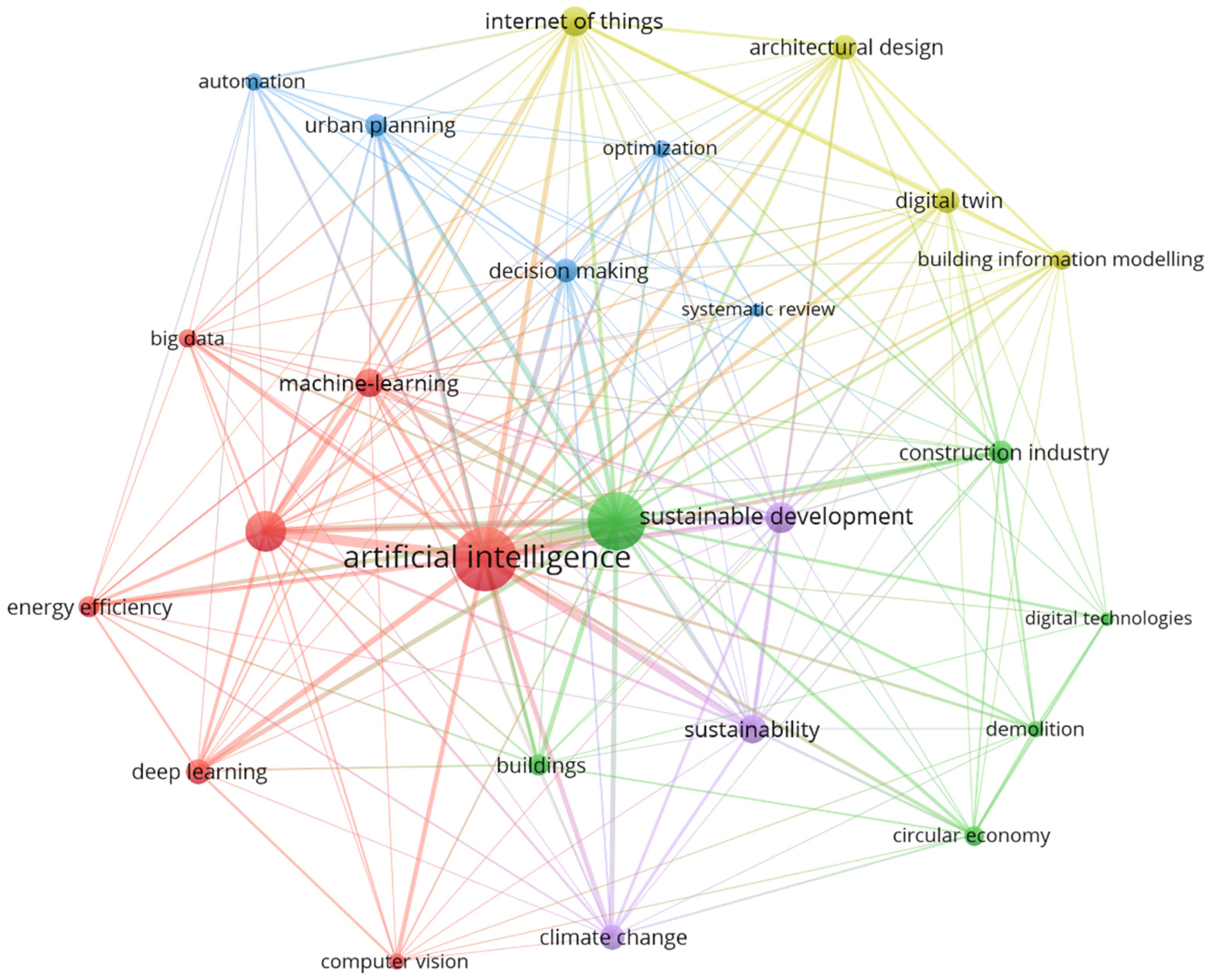
In addition to the three analytical perspectives above, a keyword co-occurrence analysis was conducted using VOSviewer (version 1.6.20) to map the corpus’s thematic landscape. All keywords extracted from the 49 included studies were compiled and processed with a minimum co-occurrence threshold of 2, yielding a network of 42 terms organised into 5 clusters. No external thesaurus was applied; synonymous terms identified during screening (e.g., “machine learning” and “ML”) were manually harmonised prior to visualisation. This analysis, presented in Figure 7, complements the thematic synthesis in
Section 3.4 by providing a visual representation of the field’s conceptual structure.
4. Discussion
The synthesis and interpretation are based exclusively on the primary MP/DPP corpus and are reported using descriptive counts and comparative mappings rather than inferential statistics. This review synthesises 49 peer-reviewed studies that explicitly apply AI to MP/DPP under a circular economy lens (searches extended to March 2026). The discussion is presented in seven parts.
4.1. Connecting the Descriptive and Comparative Findings
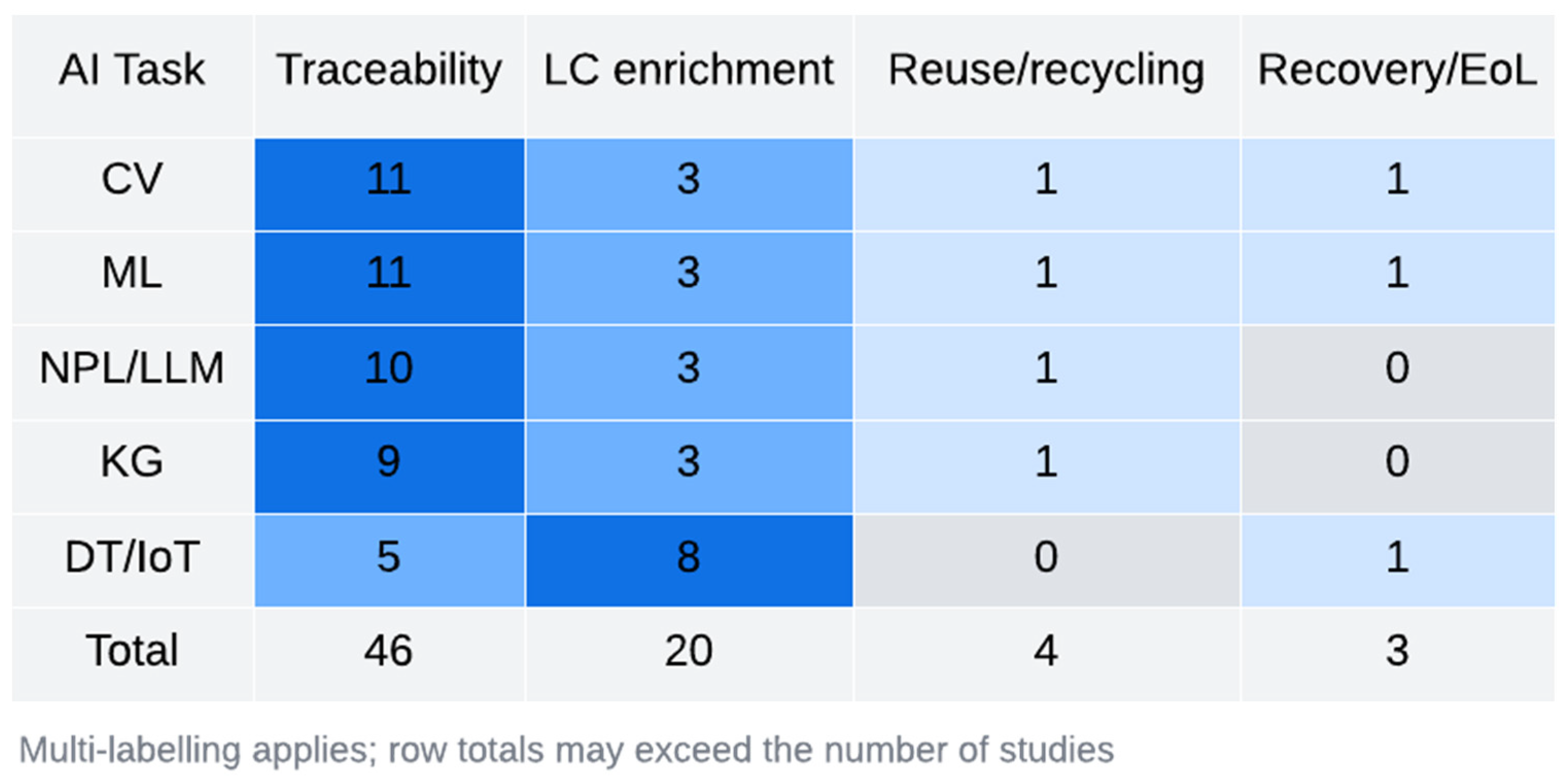
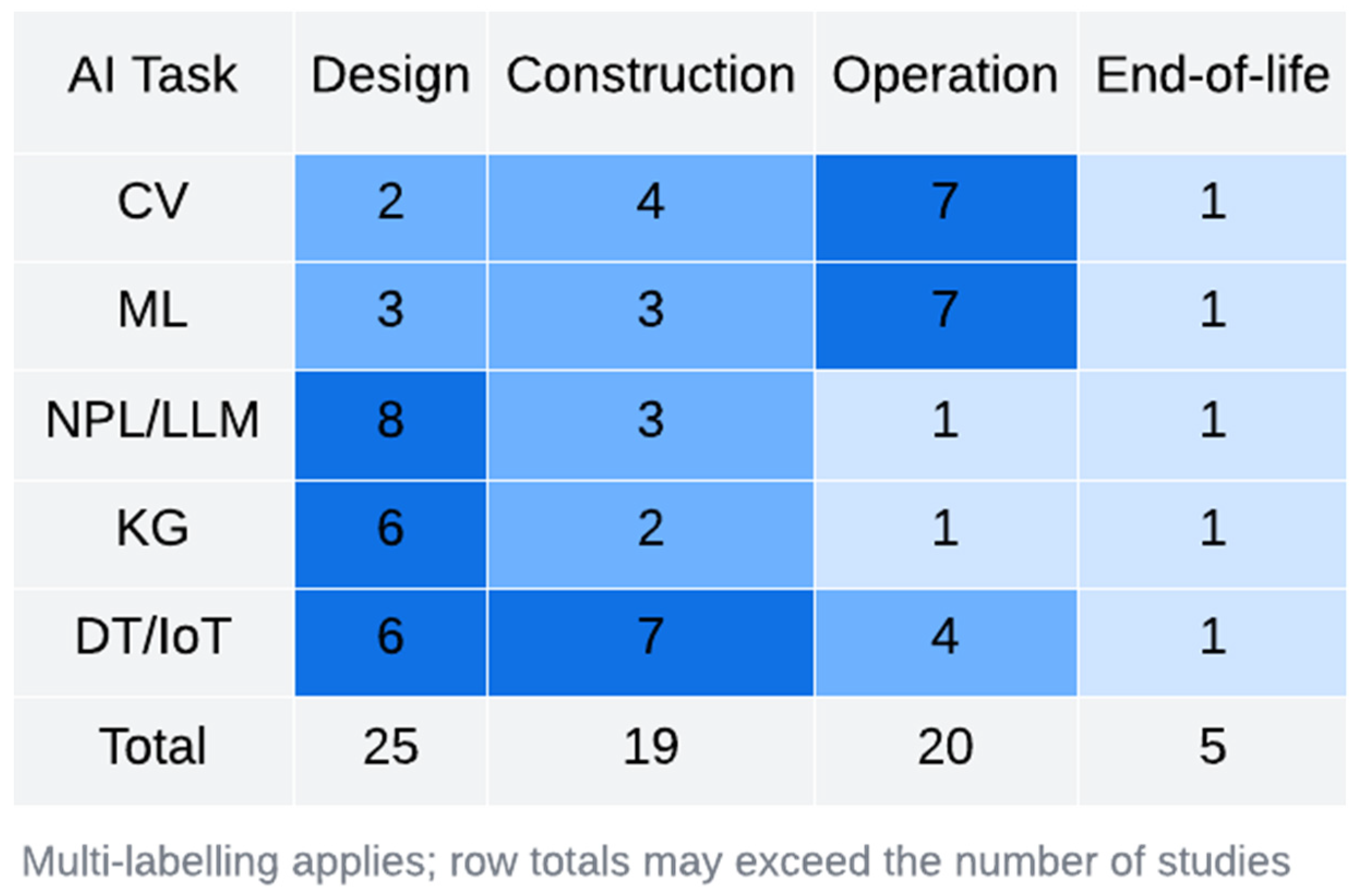
Three patterns emerge from the comparative maps and the descriptive scan, producing evidence on how AI is currently applied to support MP/DPP in the built environment (RQ1). First, AI tasks show pronounced lifecycle affinities, documenting which task families are most frequently associated with particular lifecycle stages (RQ2). CV and non-NLP ML clusters are in Operation, underpinning in-service condition mapping (defect detection, component recognition, anomaly and degradation tracking) and predictive support (remaining useful life, risk flags) [
41,
44,
47]. By contrast, NLP/LLM and KG concentrate on Design and handover, enabling document parsing and schema alignment across specifications, BoQs, EPDs, and as-built records, and supporting ontology-level harmonisation of passport fields [
27,
53,
63]. DT/IoT pipelines bridge Design and Operation by streaming sensor data into digital twins and pushing versioned updates into passports, closing the loop between planned and observed performance [
12,
13,
54,
55]. Across all tasks, EoL remains persistently underrepresented, reflecting both data scarcity and institutional frictions, namely limited incentives, safety and liability constraints during deconstruction. This imbalance helps explain why current pipelines excel at issuing and maintaining passports, yet remain comparatively immature in late-life decision support, such as selective dismantling, reuse grading, and recovery logistics.
Second, circularity functions are strongly skewed. Traceability dominates, as workflows reliably attach identities, provenance, and chain of custody to components [
5,
45,
50,
51]. Lifecycle data enrichment follows, where AI fills in missing attributes [
37,
52,
54], normalises formats, and fuses multimodal evidence into coherent passport entries. In contrast, reuse/recycling readiness and recovery/EoL planning are only sporadically addressed. The practical implication is that many prototypes optimise ingestion and update quality rather than actionability for circular outcomes. Put differently, the field has prioritised understanding what it is and where it came from over determining whether it can be safely recovered, repurposed, and at what cost or benefit.
Third, descriptive signals reinforce this picture of uneven maturity. Venue concentration and geographic imbalance mean that a large share of studies originates in a small number of regions and journals, limiting cross-context comparability. The keyword clusters reveal a tool- and data-centric orientation, with fewer studies reporting field deployments at scale. Together, these signals describe a rapidly expanding field whose core strengths lie in traceable data pipelines and schema alignment, and whose gaps centre on interoperable twin-to-passport governance and EoL-aware decision support generalising across regulatory regimes.
A critical caveat is that improved data pipelines do not automatically translate into improved circular economy outcomes. Traceability and enrichment are necessary enablers, but not sufficient conditions for reuse, recycling, or recovery at scale. Circular outcomes depend on downstream market demand, liability and warranty regimes, deconstruction and sorting capacity, reverse logistics infrastructure, and procurement incentives that reward the uptake of secondary materials. The observed imbalance in the literature is therefore not only a technical maturity issue; it also reflects structural barriers that can prevent even high-quality passports from triggering action. This implies that AI-enabled MP/DPP research must evaluate not only information performance (accuracy, completeness, freshness) but also decision uptake and system outcomes (reuse rate, diversion from landfill, residual value realised, carbon avoided) where feasible.
4.2. What the Patterns Imply for Operationalising MP/DPP with AI
Current AI–passport pipelines are optimised for populating and maintaining passport fields, but are comparatively weak on late-life decision support, a methodological limitation that is central to RQ3. Institutional and market constraints help explain why late-lifecycle support remains thin even when traceability is strong. Liability and compliance uncertainty discourage decision-makers from acting on reuse recommendations [
30,
58]. Fragmented incentives mean that actors bearing the cost of data capture are not always those who capture EoL value. Reverse supply chains are uneven: deconstruction expertise, sorting facilities, and secondary marketplaces are not uniformly available [
56,
59]. Procurement practices frequently privilege virgin-material standards [
30,
58], constraining the adoption of reuse even when passports provide evidence of reuse. These constraints suggest that AI-to-passport advances should be paired with governance, procurement, and assurance mechanisms that reduce risk and make reuse decisions bankable.
CV and non-NLP ML are mature for inspection-to-passport flows, detecting components and defects, quantifying conditions [
41,
44,
47], and supporting predictive operations. Yet most studies still report only model-centric metrics, omitting passport-level service KPIs such as field completeness at required and observed levels [
37,
44,
52], data freshness, end-to-end latency, and provenance integrity. Immediate practice should therefore (a) report a minimal KPI bundle alongside F1, mAP, RMSE, and AUC and (b) document data freshness and latency at the event level, from capture to a validated passport update, so that operators can reason about timeliness and backlog risk.
NLP and KG effectively normalise documentation (specifications, BoQs, EPDs, as-built records) into passport fields and align them to schemas and ontologies. The emergence of Large Language Models (LLMs) represents a step change in this task subfamily. LLM-based frameworks can now retrieve and structure Life Cycle Inventory (LCI) data from scientific literature and product datasheets at scale [
27], and automated knowledge graph construction from unstructured sources is being demonstrated in circular economy contexts [
63]. Multimodal LLMs further promise to handle heterogeneous input formats (PDF, image, tabular, IFC) without requiring domain-specific pre-processing pipelines. However, interoperability with BIM and Digital Twins remains uneven, restricting downstream analytics for reuse and deconstruction [
2,
29,
55]. Two steps would close this gap: (a) publishing machine-checkable mappings so that passport fields can be round-tripped to BIM and twin contexts without lossy transforms; (b) making extraction pipelines provenance-aware, enabling auditable updates and trustable handovers at Design and commissioning.
DT/IoT stacks can keep passports current by streaming condition and performance signals into digital twins [
12,
37,
54] and pushing versioned updates into passports. Evidence of robust twin-to-passport governance remains scarce, though few studies specify versioning strategies, signed updates, conflict resolution, or audit trails. Critically, blockchain technology is consolidating as a foundational trust infrastructure for this layer [
23,
28]. Blockchain provides traceability (secure shared data storage), transparency (digitally signed transactions), immutability (hash-chained blocks), performance enhancements through smart contracts, and decentralised consensus, all of which are essential properties for governed, multi-stakeholder DPP update chains [
28]. For operational readiness, pipelines should (a) treat the twin as a governed source of record with explicit sync policies; (b) sign update bundles using blockchain-anchored or comparable cryptographic mechanisms and retain human-readable diffs; and (c) expose per-update latency and failure modes. This converts continuous sensing into accountable and auditable passport maintenance.
Datasets, task definitions, and benchmarks for reuse grading, selective dismantling, and recovery planning are the thinnest part of the landscape [
42,
57,
58], even though they determine circular outcomes. Progress requires (a) open datasets with EoL-relevant labels covering component class, material grade, connection type, contamination, damage state, and extraction risk; (b) benchmark tasks linking condition to actionable decisions such as reuse class, deconstruction sequence, and residual value; and (c) cost and effort reporting to make comparisons meaningful across projects and regions. Until such assets exist, pipelines will remain skewed towards identification and traceability rather than recovery.
4.3. The Digital Circularity AI Framework (DCAF)
The findings converge on three co-dependent framework elements that, when operationalised together, shift MP/DPP systems from traceability-first tools to decision-capable instruments for circular recovery, addressing the methodological gaps and implementation challenges identified across the corpus (RQ3). These elements collectively constitute the framework contribution required to move MPs from traceability-oriented tools towards actionable circular recovery decision-making (RQ4) [
2,
29,
30]. These elements are collectively formalised here in
Table 12 as the Digital Circularity AI Framework (DCAF).
The DCAF is not prescriptive of specific algorithms or platforms; it is prescriptive of the information and governance commitments that any AI-enabled MP/DPP pipeline must satisfy to be considered fit for circular decision-making. Element (i) addresses the current reporting gap by making passport-level service quality visible alongside model performance. Element (ii) addresses the trust and continuity gap by specifying how twin-generated evidence is governed and auditable through passport entries. Element (iii) addresses the EoL gap by providing a concrete target for dataset and benchmark development, without which the field will remain locked in traceability-oriented maturity.
4.4. Implications
The findings have implications for practice, policy, and research. For industry adopters, the most immediate value creation lies in inspection-to-passport and documentation-to-passport workflows [
41,
44,
47,
52], particularly through CV and ML for in-service condition capture, and through NLP/LLM and KG for field extraction and schema alignment [
27,
53,
63]. Evaluating these pipelines solely on model-centric performance metrics is insufficient; practitioners should assess effectiveness using the passport-level service indicators defined in DCAF element (i). Organisations seeking to enable reuse and recovery should prioritise DT/IoT and blockchain-enabled governance mechanisms [
23,
28,
55] as specified in DCAF element (ii), and contribute to EoL benchmark development as defined in element (iii).
From a policy and standardisation perspective, the entry into force of Regulation (EU) 2024/3110 and Regulation (EU) 2024/1781 [
19,
20] transforms DPP adoption from a research aspiration into a regulatory obligation. The findings indicate that regulatory impact will depend not only on mandating data availability but on specifying interoperability requirements, provenance rules, and minimum reporting bundles that allow passport data to be operationally integrated into lifecycle workflows. The DCAF elements, particularly the governance pack and the minimum reporting bundle, provide concrete guidance on what such specifications should contain. For a construction firm complying with EU Regulation 2024/3110, the DCAF minimum reporting bundle implies that a CV-based inspection pipeline should report not only mAP@0.5 for defect detection but also the median latency from image capture to passport field update, for example, under two hours, and the percentage of entries with signed provenance, for example, above 95%. Without such provisions, MP/DPPs risk functioning primarily as compliance artefacts rather than enablers of circular decision-making.
For the academic community, this study contributes a structured evidence map [
10,
29,
30] distinguishing areas of maturity (traceability and lifecycle data enrichment) from domains that remain underexplored (reuse readiness and recovery planning), thereby supporting a research agenda focused on benchmarked, provenance-aware AI pipelines and outcome-oriented evaluation protocols linking AI outputs to measurable circular economy performance.
4.5. Methodological Lessons
The literature is dominated by modelling and simulation studies and conceptual frameworks, with comparatively few field-validated deployments [
32,
33,
34]. Even when validation is present, it tends to prioritise model-centric metrics (F1, mAP, RMSE/MAE, AUC) over passport-centric service indicators. This asymmetry limits comparability, external validity, and technology transfer.
Beyond this core imbalance, several methodological issues recur. Many studies lack strong baselines, ablation studies, or sensitivity analyses [
44,
60,
61,
64], making it challenging to attribute gains to specific pipeline components. Code, data splits, random seeds, and compute budgets are infrequently reported [
47,
65,
66], and negative results are rarely documented, hindering replication. Training data are often small, geographically concentrated, or captured under controlled conditions [
40,
50,
62], which may not reflect in-service variability or market heterogeneity. Pipelines often lack round-trip fidelity between MP/DPP, BIM, and Digital Twins [
2,
11,
29] (e.g., lossy transforms, missing provenance), constraining downstream analytics. Reporting seldom includes operator time, equipment demands, or integration overhead, thereby reducing its practical usefulness to adopters. Together, these limitations suggest the need for benchmarked, provenance-aware pipelines that report both model performance and passport-level service quality, validated across diverse assets and contexts.
4.6. Research Priorities (RQ4): Future Research Directions
The most urgent near-term needs (1–3 year horizon) concern benchmarking, interoperability, and minimum reporting standards, addressing the future research directions required by RQ4. First, the field requires open benchmark datasets with end-of-life (EoL)-relevant labels covering component class, material grade, connection type, contamination, damage state, and extraction risk [
42,
57,
58]. Without such assets, reuse grading, deconstruction sequencing, and residual value estimation will remain conceptual proposals. The development of these datasets should follow the practices established in adjacent computer vision benchmarks, with clear split protocols, versioning, and permissive licensing for research use.
Second, interoperability between MP/DPP systems, BIM models, and Digital Twins should be formalised through machine-checkable schema mappings and documented ETL workflows that preserve provenance and support bidirectional updates [
2,
11,
29]. Several studies in the corpus demonstrate partial BIM-to-MP integration [
5,
45,
54], but none report a full round-trip validation; this gap should be addressed in controlled deployment studies with at least two regulatory jurisdictions represented.
Third, the minimum reporting bundle proposed in DCAF element (i) should be adopted as a standard alongside model-centric metrics (F1, mAP, RMSE, AUC). Reporting passport-level KPIs, including field completeness, data freshness, end-to-end latency, and provenance integrity, would substantially improve the comparability and practical relevance of published results [
37,
44,
52]. Journal editors and reviewers in the AI-for-construction domain are encouraged to make these indicators a standard requirement in author guidelines.
Over a 3–5-year horizon, the critical challenges shift towards regulatory integration, governance at scale, and multi-context external validity. The entry into force of Regulation (EU) 2024/3110 (CPR) and the active roll-out of Regulation (EU) 2024/1781 (ESPR) create a live regulatory infrastructure against which AI-to-passport pipelines can now be evaluated in production conditions [
19,
20]. Pilot deployments aligned with the EU Digital Product Passport registry, expected by July 2026, offer a natural testbed for validating the governance pack in DCAF element (ii).
Blockchain-anchored twin-to-passport update chains should be tested for scalability and cost-efficiency in real construction supply chains [
23,
28]. Current evidence is limited to proof-of-concept studies; multi-stakeholder field deployments involving contractors, material suppliers, demolition firms, and asset managers are needed to assess operational readiness and the distribution of governance responsibilities.
Finally, external validity should be strengthened through systematic replication across climatic zones, regulatory regimes, and supply-chain configurations. The corpus is geographically concentrated [
40,
68], and findings from Northern European or East Asian urban contexts may not generalise to the Global South or to regions with weaker deconstruction infrastructure. Multi-context studies reporting transparent data on operator time, integration effort, and costs will be essential for informing adoption decisions at scale.
4.7. Relationship to Concurrent Reviews and Limitations
This review was conducted contemporaneously with several related systematic analyses that merit explicit positioning. Veliz Reyes et al. [
29] addressed the spectrum of MP data architectures and regulatory contexts in AEC without a specific AI task-family lens, focusing on adoption pathways and industrialised construction. Aftab and Agliata [
30] offered a bibliometric and thematic analysis of material passports for circular construction, identifying economic and social dimensions as underexplored. Zhang, Z. et al. [
10], in a review published in Renewable and Sustainable Energy Reviews, analysed DPP technical architectures across 186 publications, with a focus on enabling technologies, identifying blockchain and semantic interoperability as central. The present review contributes a complementary dimension: by mapping AI task families (CV, NLP/LLM, KG, ML, DT/IoT) against both lifecycle phases and circularity functions, it identifies with greater precision where AI maturity supports circular outcomes and where benchmarking gaps prevent progress.
Seven main limitations apply to this review. First, no meta-analysis was conducted because outcomes, datasets, and reporting practices are highly heterogeneous; synthesis relies on descriptive counts and thematic interpretation rather than effect sizes. Second, the scope (2020–March 2026), English-only filtering, exclusion of conference papers, and reliance on explicit keyword combinations may introduce selection bias and may underrepresent emerging technical advances that often first appear in conference proceedings. The exclusion of conference papers is a particular limitation, given that several blockchain and LLM-based DPP contributions appeared in conference venues before journal publication. Third, the full-text availability requirement may over-represent open-access venues. Fourth, multi-labelling inflates row totals beyond n = 49, limiting direct comparability with single-label reviews. Fifth, variability in methodological reporting across studies restricts the assessment of reproducibility and external validity.
Sixth, the review’s focus on explicit keyword combinations linking ‘Artificial Intelligence’ and ‘passport’ may exclude studies that develop AI methods highly relevant to MP/DPP, such as object detection for deconstruction or NLP for EPD parsing, but that do not explicitly use the term ‘passport’. The scope was deliberately bounded to ensure conceptual precision, but readers should be aware that relevant technical advances may exist outside this keyword boundary. Seventh, the rapid evolution of LLMs and blockchain technologies between 2024 and 2026 means that some findings, particularly those related to governance and trust infrastructure, may require updating as these technologies mature.
5. Conclusions
This systematic literature review mapped 49 peer-reviewed studies at the intersection of Artificial Intelligence and Material/Digital Product Passports (MP/DPP) within a circular economy framework for the built environment (January 2020–March 2026). By linking descriptive trends with comparative mappings across AI tasks, lifecycle phases, and circularity functions, the review shows a field that has matured around traceability and lifecycle data enrichment. CV and ML are predominantly applied during Operation, NLP/LLM and KG concentrate on Design and handover, and DT/IoT pipelines bridge these stages through continuous updating. EoL applications remain persistently underrepresented, and methodological fragmentation limits comparability and transferability.
The four research questions are answered as follows: AI is currently applied to MP/DPP primarily to automate data extraction, structuring, and updating across Design and Operation phases, with LLMs emerging as a new capability frontier for NLP-based field population (RQ1). CV and ML dominate in-service inspection and condition assessment, NLP/LLM and KG support document parsing and schema alignment, and DT/IoT enables continuous lifecycle data enrichment (RQ2). The literature is dominated by modelling approaches with limited field validation, weak interoperability reporting, absent passport-level service indicators, and EoL decision support significantly underrepresented (RQ3). Addressing these gaps requires the DCAF elements, namely a minimum reporting bundle, a governance pack with blockchain-trust provisions, and open EoL benchmark definitions, which together convert better material data into accountable and actionable circular decisions (RQ4).
The regulatory context has intensified substantially since the original search. The entry into force of Regulation (EU) 2024/3110 (CPR) in January 2025 and the active deployment of Regulation (EU) 2024/1781 (ESPR) in 2025–2026 transform MP/DPP from a prospective research topic into an immediate operational requirement for the European construction sector. The establishment of a central EU DPP registry by July 2026 will create a live infrastructure against which the quality of the AI-to-passport pipeline can be evaluated. The DCAF minimum reporting bundle, governance pack, and EoL benchmarks proposed here are directly relevant to the technical specifications that will need to accompany these regulatory instruments.
The primary contribution of this study lies in the formalisation of the Digital Circularity AI Framework (DCAF) as an operational bridge between AI-enabled data pipelines and circular decision-making in the built environment. By consolidating evidence across AI tasks, lifecycle phases, and circularity functions, the framework provides a structured basis for evaluating and designing MP/DPP systems beyond traceability, enabling a shift towards actionable reuse, recovery, and value-retention strategies. In this sense, DCAF is not only a synthesis of the current state of the art but also a forward-oriented reference for aligning technological development with emerging regulatory and market requirements.
Two emerging technologies distinguish the 2025–2026 horizon from earlier literature. Large Language Models, including multimodal variants, substantially lower the barrier to automated extraction of structured passport fields from unstructured EPDs, BoQs, and specification documents. Blockchain technology provides the trust and immutability infrastructure needed for governed, multi-stakeholder passport update chains. Neither technology alone is sufficient; their integration within AI-to-passport pipelines, evaluated against passport-level service indicators, is the key research and implementation challenge for the next horizon.
Overall, the transition from static, manually curated passports to dynamic, AI-enabled MP/DPP ecosystems is clearly underway. Achieving circular outcomes at scale in the built environment will require pairing accurate identification and enrichment with interoperable governance frameworks and EoL-aware analytics, converting better material data into accountable, auditable, and actionable decisions for circular recovery.