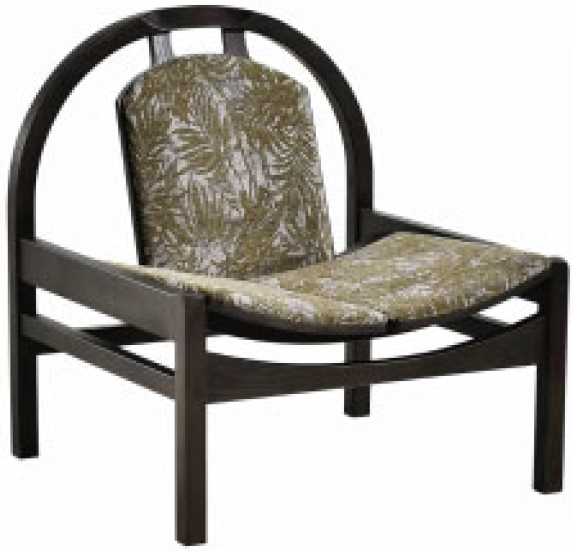
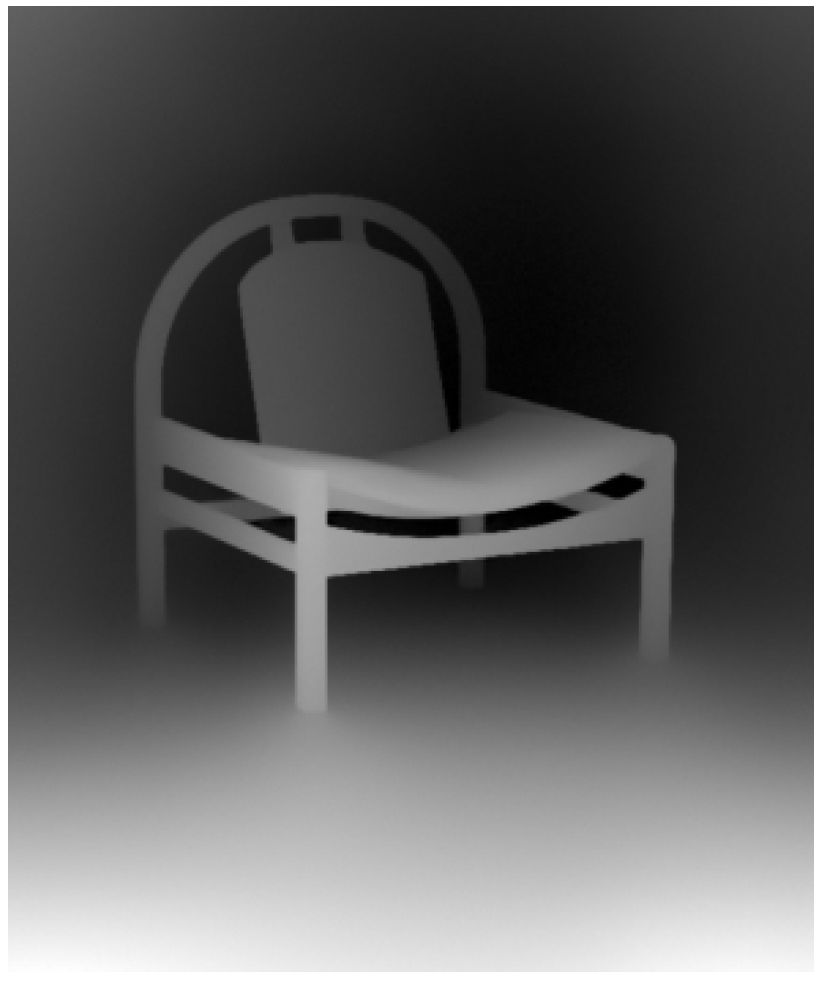
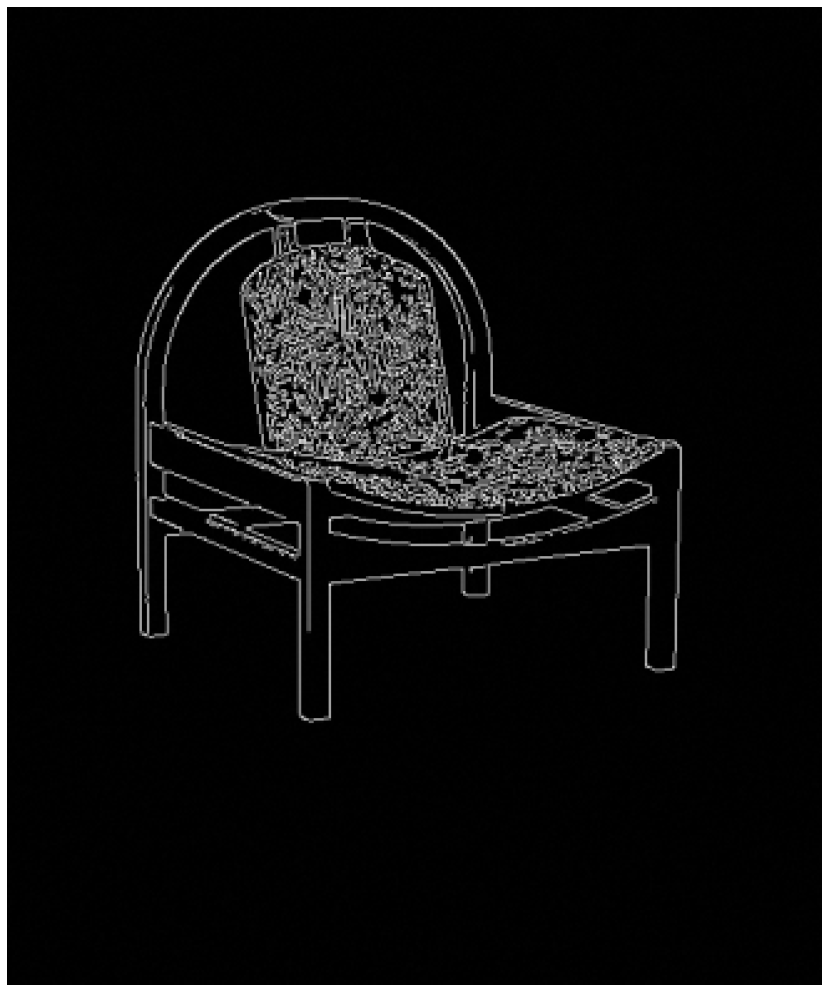
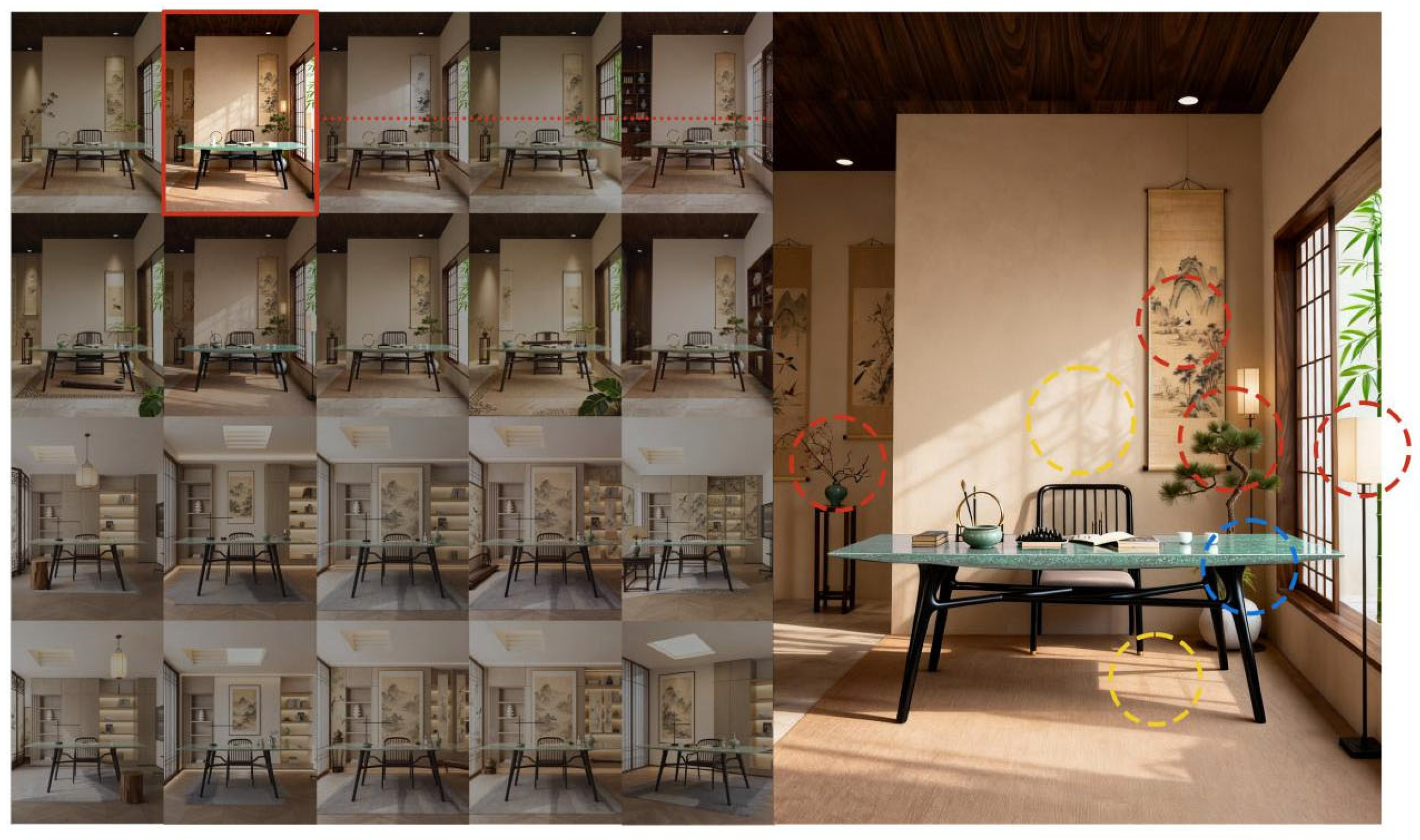
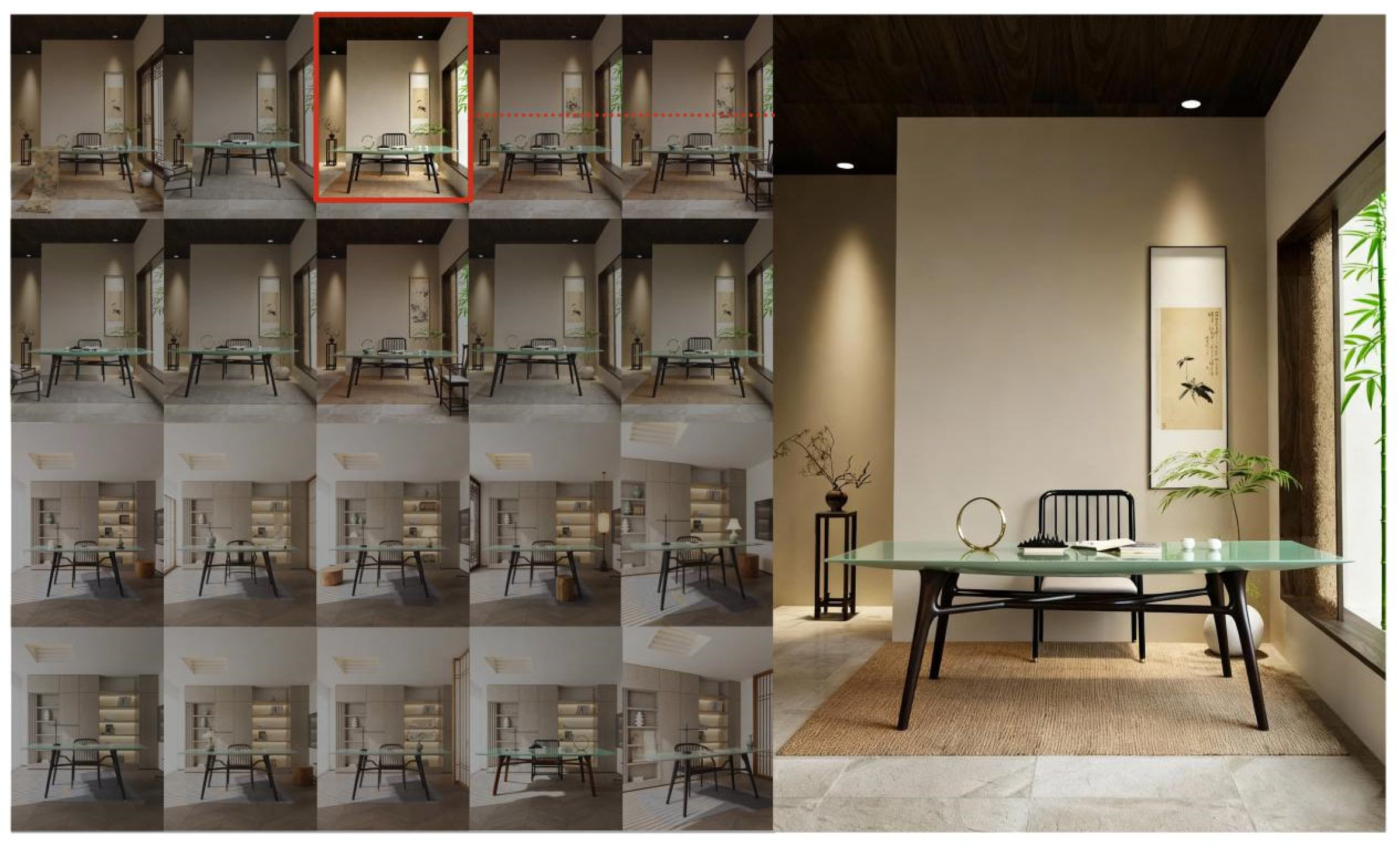
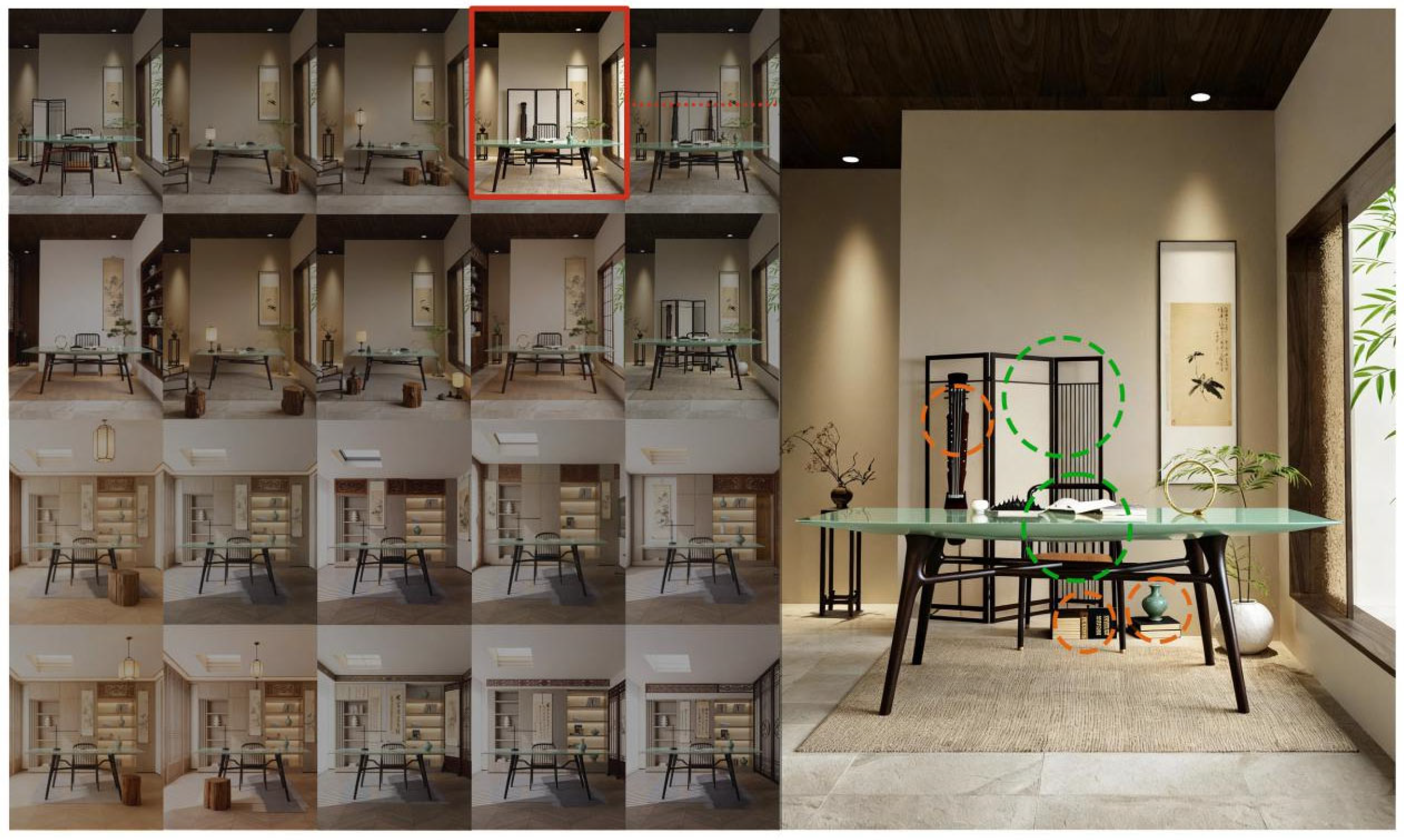
Context-Adaptive Image Generation of Intangible Cultural Heritage Furniture for Architectural Interiors: A ComfyUI-Based AIGC Virtual Studio


Abstract
1. Introduction
2. Core Issues and Theoretical Foundation
2.1. The Value and the “Heritage, Yet Contemporary” Dilemma of ICH Furniture in Architectural Interiors
2.2. Mechanisms of Communication Failure in ICH Furniture
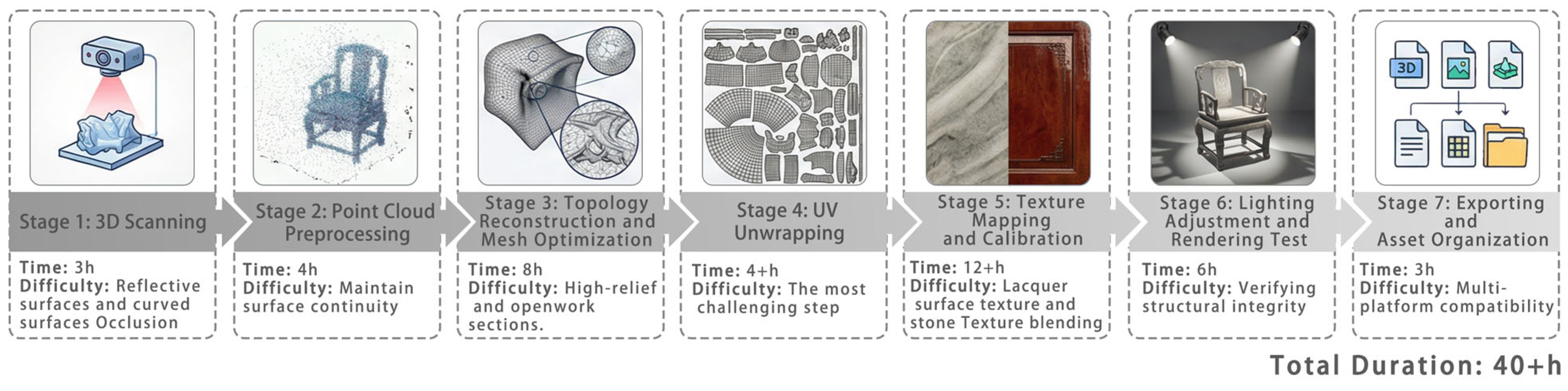
2.2.1. Efficiency Bottleneck: Traditional Image Production Cannot Meet Market Demands for Diversity and Frequency
2.2.2. Semantic Failure: Lack of Spatial Context Disconnects Cultural Value from Audience Perception
2.3. Generative AI and a New Design Pathway via ComfyUI
3. Research Methods and Process
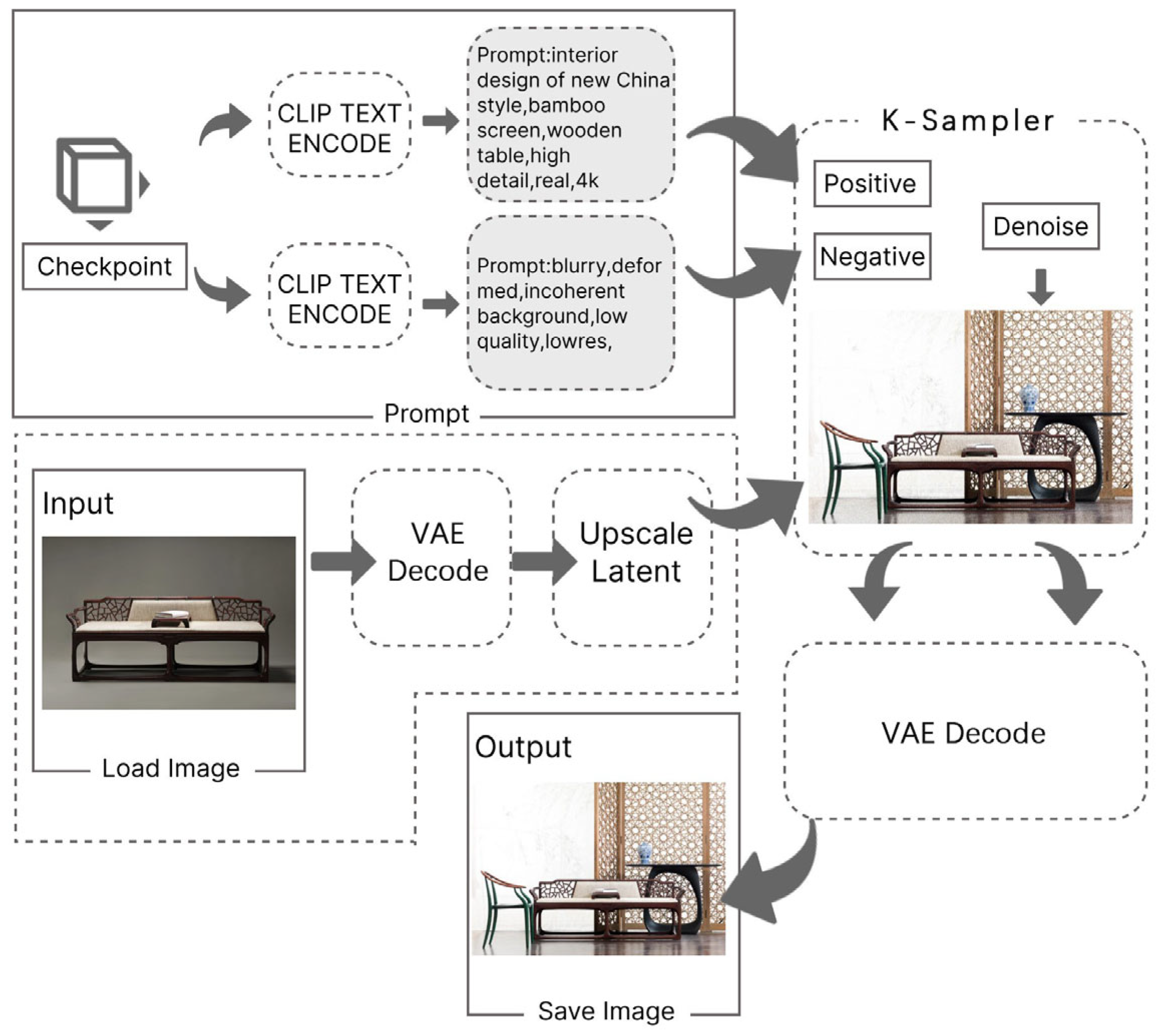
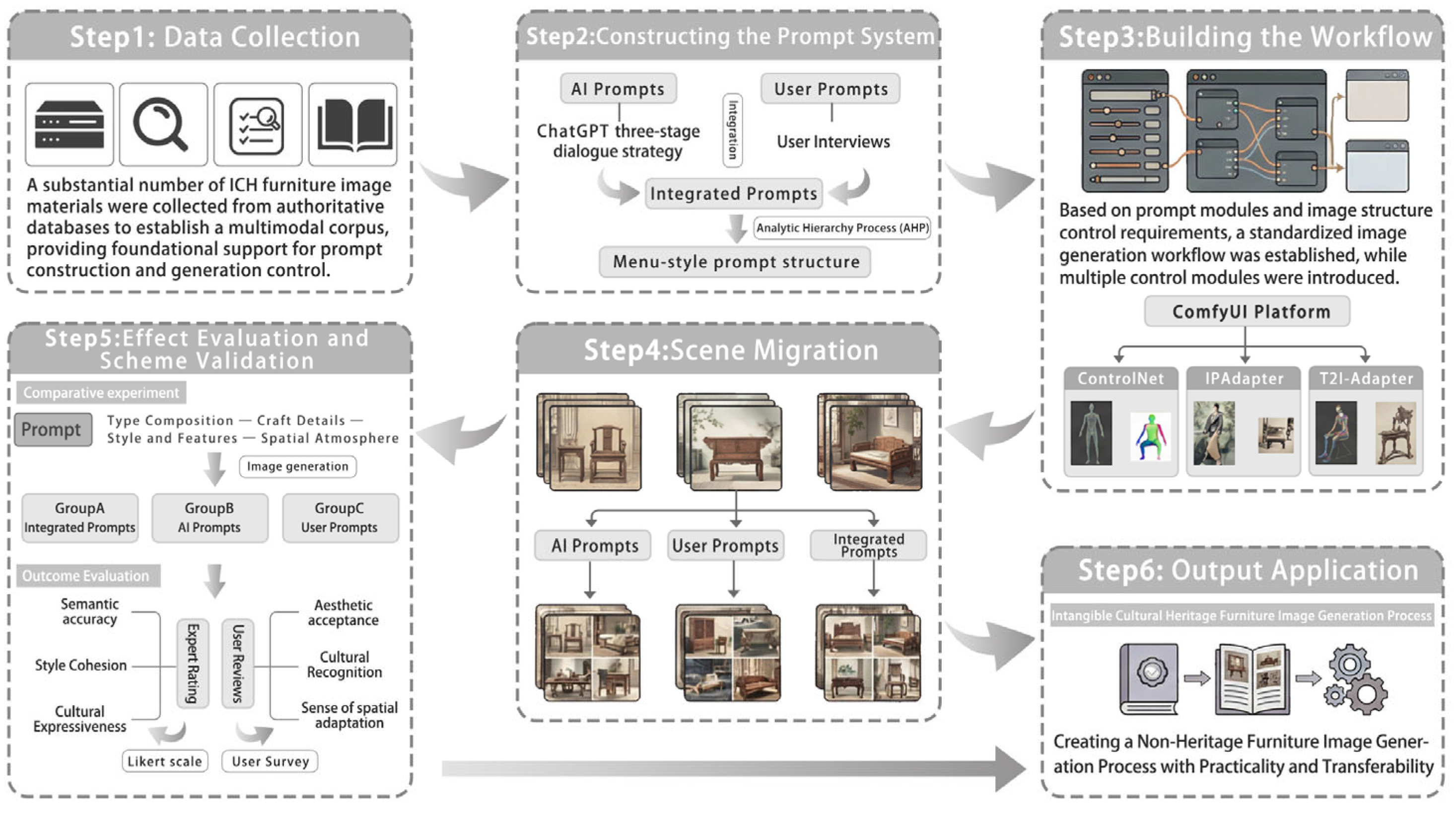
3.1. Design Concept and Generation Framework Analysis
3.2. Constructing the Prompt System
- (1)
- Construction of the Hierarchical Structure Model for ICH Furniture: The decision-making problem is divided into three levels—the goal level, the criterion level, and the alternative level—to form a clear hierarchical decision structure.
- (2)
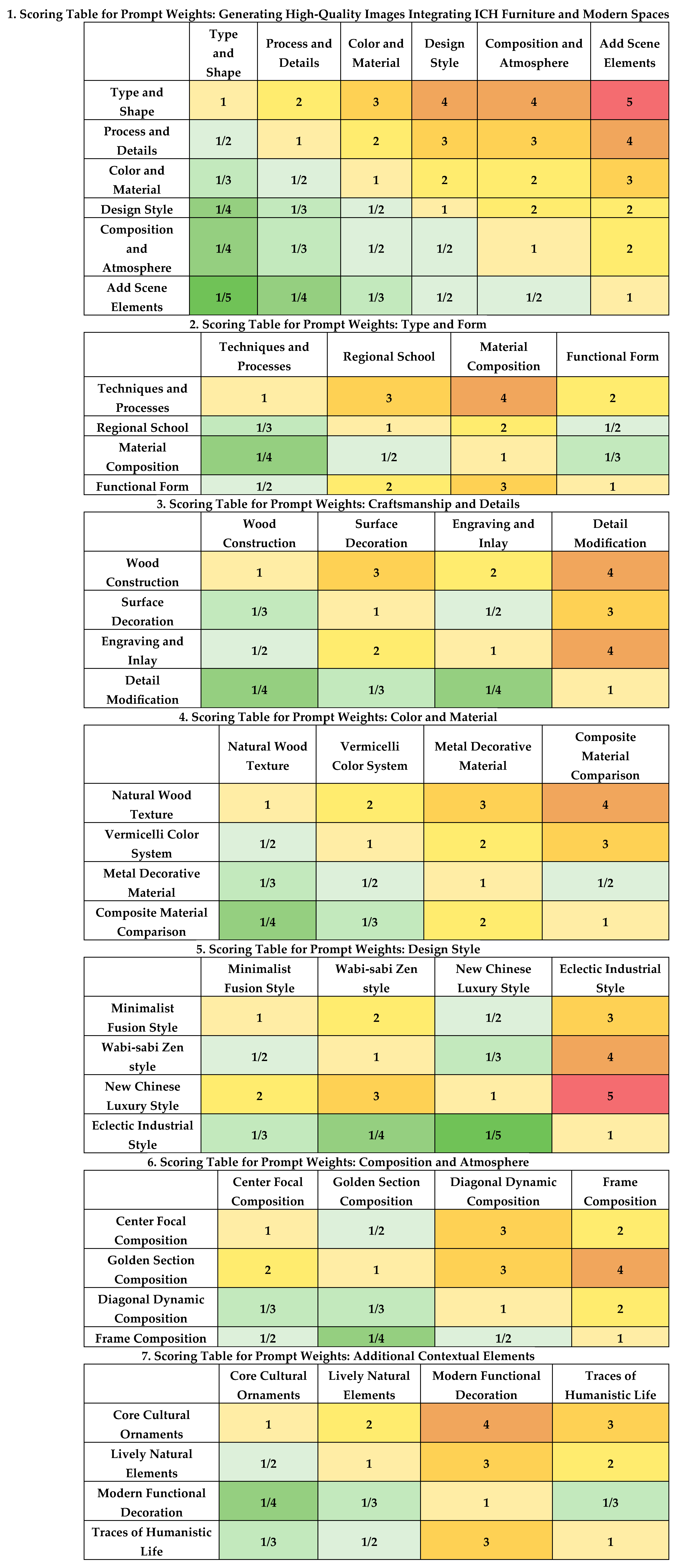
- Construction of the Judgment Matrix: An expert panel from relevant fields such as AIGC design, ICH cultural communication, and user experience is invited to perform pairwise comparisons of various factors within the same level, establishing judgment matrices based on the standard AHP 1–9 scale method. The comparison scales for elements in the judgment matrix are shown in Table 3.
- (3)
- Weight Calculation and Consistency Check: After normalizing the judgment matrix by columns and averaging the results, the weight of each judgment criterion is obtained. The formula for weight calculation is shown in Equation (1).Subsequently, the Consistency Index (CI) and the Consistency Ratio (CR) are calculated. The Consistency Ratio (CR) is obtained by dividing the Consistency Index (CI) by the Random Consistency Index (RI). This ensures the judgment matrix meets the consistency requirement (CR < 0.1), guaranteeing the rationality of expert scores and the reliability of the results. If the CR value reaches or exceeds 0.1, experts must re-evaluate and modify the judgment matrix until the CR value falls below 0.1. The formula for CR is shown in Equation (2).The formula for CI is shown in Equation (3).
- (4)
- Integrated Prompt Weighted Scoring and Output: Each prompt scheme is scored based on its performance under the criteria level. These scores are then combined with the respective weights for weighted calculation, yielding a comprehensive score for each scheme. The prompt combination with the highest score is identified as the optimal integrated prompt scheme, which serves as the standard input for the subsequent image generation workflow.
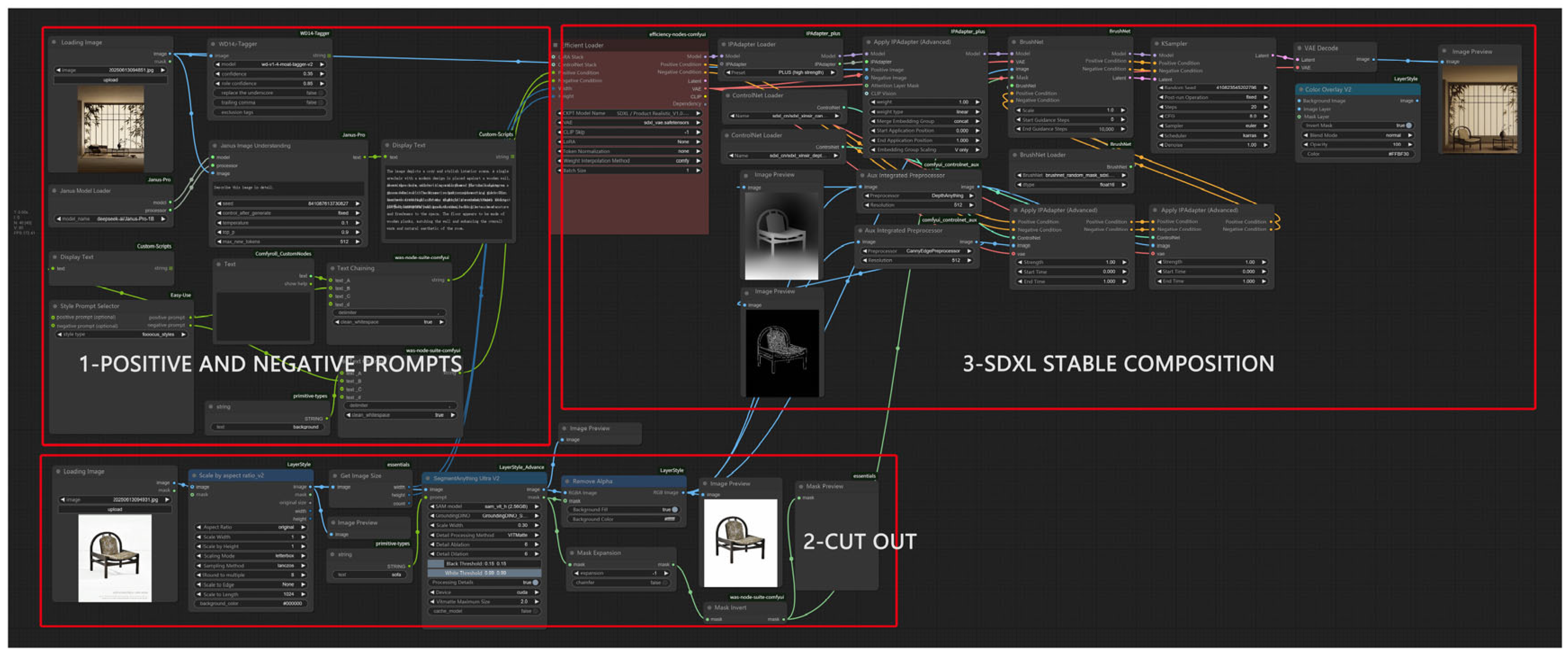
3.3. Construction of the ComfyUI Scene Migration System Based on Key Nodes: Prompt Control, Structure Stability, and Style Transfer
4. Scene Migration System and Design Generation for ICH Furniture
4.1. Data Collection
4.2. Study on the Integrated Prompt Framework
4.2.1. Acquisition of AI Prompts
4.2.2. Acquisition of User Prompts
4.2.3. Expert Scoring
4.2.4. Calculation Results
4.3. ComfyUI Scene Migration System for Lacquer Furniture
4.4. Experimental Design
5. Discussion
5.1. Results Evaluation
5.2. Theoretical Explanation and Mechanistic Analysis of the Results
6. Conclusions
6.1. Principal Findings
6.2. Limitations and Future Work
Author Contributions
Funding
Data Availability Statement
Acknowledgments
Conflicts of Interest
References
- Chen, J.; Xia, H.; Yu, S. Integration of Intangible Cultural Heritage Elements into Furniture Design Based on Symbolic Semantics and AHP: A Case Study of Qianci. BioResources 2025, 20, 3714–3732. [Google Scholar] [CrossRef] [Scilit]
- Xu, L.; Wei, R.; Liu, X. Bridging Time: A Dual Path Analysis of Chinese Furniture Culture from Diplomatic Exchange to Digital Narratives. BioResources 2025, 20, 9008–9019. [Google Scholar] [CrossRef] [Scilit]
- Rombach, R.; Blattmann, A.; Lorenz, D.; Esser, P.; Ommer, B. High-Resolution Image Synthesis with Latent Diffusion Models. In Proceedings of the IEEE/CVF Conference on Computer Vision and Pattern Recognition (CVPR), New Orleans, LA, USA, 18–24 June 2022; pp. 10684–10695. [Google Scholar] [CrossRef] [Scilit]
- Chen, J.; Shao, Z.; Hu, B. Generating Interior Design from Text: A New Diffusion Model-Based Method for Efficient Creative Design. Buildings 2023, 13, 1861. [Google Scholar] [CrossRef] [Scilit]
- Yun, T.; Zhang, D.; Park, J.; Pan, L. Learning to Sample Effective and Diverse Prompts for Text-to-Image Generation. In Proceedings of the IEEE/CVF Conference on Computer Vision and Pattern Recognition (CVPR), Nashville, TN, USA, 11–17 June 2025; pp. 23625–23635. [Google Scholar] [CrossRef] [Scilit]
- Zhang, L.; Agrawala, M. Adding Conditional Control to Text-to-Image Diffusion Models. In Proceedings of the IEEE/CVF International Conference on Computer Vision (ICCV), Paris, France, 1–6 October 2023. [Google Scholar] [CrossRef] [Scilit]
- Liang, Q.; Chen, Z.; Zhou, Y.; Huang, H. SPG: Style-Prompting Guidance for Style-Specific Content Creation. Comput. Graph. Forum 2025, 44, e70251. [Google Scholar] [CrossRef] [Scilit]
- Yang, Y.; Zou, S.; Cao, G.; Liu, X.; Liu, X. From user needs to sustainable innovation: An integrated NLP–grounded theory–Kano–AHP–QFD approach to the modern design of Yi ethnic lacquerware chairs. BioResources 2026, 21, 4375–4407. [Google Scholar] [CrossRef] [Scilit]
- Li, M.; Wang, L.; Li, L. Research on narrative design of handicraft intangible cultural heritage creative products based on AHP-TOPSIS method. Heliyon 2024, 10, e33027. [Google Scholar] [CrossRef] [Scilit]
- Rahmoun, A.; Bozkurt, A.N. Enhancing Efficiency and Creativity in Interior Design Through Diffusion Models. Eur. J. Nat. Sci. 2025, 9, 309–320. [Google Scholar] [CrossRef]
- Hu, W.; Zhou, J. Symbiosis of “Form, Meaning, and Use”: The Transferred Expression of Intangible Cultural Heritage Symbols in Furniture Design. Des. Art Res. 2025, 15, 20–24. (In Chinese) [Google Scholar] [CrossRef]
- Yang, X.; Luo, W.; Chen, H.; Lin, J.-F.; Wang, M.; Zhu, H.; Kang, L.; Zhou, J.-M.; Sun, Y.-H.; Ge, L. Innovative Protection, Inheritance, and Utilization of Intangible Cultural Heritage in the New Era: System, Pathways, and Challenges. J. Nat. Resour. 2025, 40, 2297–2315. (In Chinese) [Google Scholar] [CrossRef] [Scilit]
- Meng, F. Research on the Communication of Digital “Activation” and “Regeneration” of Intangible Cultural Heritage—A Review of The Frontier of Intangible Cultural Heritage Display and Communication. Media 2024, 15, 104. (In Chinese) [Google Scholar]
- Buschgens, M.; Figueiredo, B.; Blijlevens, J. Heritage yet contemporary: An aesthetic cultural precept explaining diasporic consumer aesthetic appreciation for package design. J. Prod. Brand Manag. 2024, 34, 158–172. [Google Scholar] [CrossRef] [Scilit]
- Aroni, G. Semiotics in architecture and spatial design. In Bloomsbury Semiotics Volume 2: Semiotics in the Natural and Technical Sciences; Bloomsbury Publishing: London, UK, 2023; pp. 277–296. [Google Scholar] [CrossRef] [Scilit]
- Preziosi, D. Architecture, Language, and Meaning: The Origins of the Built World and Its Semiotic Organization; Mouton: The Hague, The Netherlands, 1979. [Google Scholar]
- Wang, X.; Chen, Z.; Wang, Z. Study on the Sustainable Development of Jingzuo Hardwood Furniture. In Proceedings of the 2022 4th International Conference on Literature, Art and Human Development (ICLAHD 2022); Springer Nature: Berlin/Heidelberg, Germany, 2023. [Google Scholar] [CrossRef] [Scilit]
- Xue, G.; Chen, J.; Lin, Z. Cultural Sustainable Development Strategies of Chinese Traditional Furniture: Taking Ming-Style Furniture for Example. Sustainability 2024, 16, 7443. [Google Scholar] [CrossRef] [Scilit]
- Yang, Q.; Jia, F. Research on Exhibition Design of Intangible Cultural Heritage Handicrafts Driven by Digitalization: A Case Study of Huizhou Bamboo Weaving. Design 2024, 37, 60–64. (In Chinese) [Google Scholar] [CrossRef]
- Xia, M.; Lü, Y. Research on the Practice of Virtual Exhibition of Cultural Relics in the Digital Age: A Case Study of Sanxingdui Artifacts. Orient. Collect. 2023, 3, 116–119. (In Chinese) [Google Scholar]
- Wu, B. Annual Market and Outlook of Chinese Hongmu (Rosewood) Furniture. Renrendoc 2023. Available online: https://www.renrendoc.com/paper/273844742.html (accessed on 25 April 2026). (In Chinese)
- Weiss, T.; Yildiz, I.; Agarwal, N.; Ataer-Cansizoglu, E.; Choi, J.-W. Image-Driven Furniture Style for Interactive 3D Scene Modeling. arXiv 2020, arXiv:2010.10557. [Google Scholar] [CrossRef] [Scilit]
- Milani, S. Franco Purini: The Drawing of Architecture and the Architecture of Drawing; Delft University of Technology: Delft, The Netherlands, 2026. [Google Scholar] [CrossRef]
- Broadbent, G.; Bunt, R.; Jencks, C. (Eds.) Signs, Symbols, and Architecture; John Wiley & Sons: Chichester, UK, 1980. [Google Scholar]
- Wang, W.; Zhao, J.; Wang, X.; Zheng, Q. Research on Innovative Furniture Design Methods Combining Huizhou Window Grilles with Digital Technology. Sci. Rep. 2026, 16, 11207. [Google Scholar] [CrossRef] [Scilit] [PubMed]
- Siswanto, T.; Sari, S.; Hartini; Teruri, S. The Influence of Artificial Intelligence on Furniture Design Creativity: A Systematic Literature Review. Int. J. Adv. Sci. Eng. Inf. Technol. 2025, 15, 791–798. [Google Scholar] [CrossRef]
- Li, J.; Zhang, S. Research on the Inheritance and Innovation of Guangdong Embroidery Intangible Cultural Heritage from the Perspective of AIGC. J. Humanit. Soc. Sci. 2025, 1, 98–103. (In Chinese) [Google Scholar] [CrossRef] [Scilit]
- Wang, R.; Miao, Y. Inheritance and Innovation of Chinese Traditional Furniture in the Context of Digitalization. Furniture 2025, 46, 8–12. (In Chinese) [Google Scholar] [CrossRef]
- Wan, Y.; Wang, W.; Zhang, M.; Peng, W.; Tang, H. Advancing a Vision Foundation Model for Ming-Style Furniture Image Segmentation: A New Dataset and Method. Sensors 2025, 25, 96. [Google Scholar] [CrossRef] [Scilit]
- Zhu, L.; Xiang, N. A Sustainable Intelligent Design Framework: Integrating AIGC with AHP-QFD-TRIZ for Product Development. Sustainability 2025, 17, 9260. [Google Scholar] [CrossRef] [Scilit]
- Rowles, C.; Vainer, S.; De Nigris, D.; Elizarov, S.; Kutsy, K.; Donné, S. IPAdapter-Instruct: Resolving Ambiguity in Image-based Conditioning using Instruct Prompts. arXiv 2024, arXiv:2408.03209. [Google Scholar] [CrossRef] [Scilit]
- Rinon Gal, A.; Haviv, A.; Alaluf, Y.; Bermano, A.H.; Cohen-Or, D.; Chechik, G. ComfyGen: Prompt-Adaptive Workflows for Text-to-Image Generation. arXiv 2024, arXiv:2410.01731. [Google Scholar] [CrossRef] [Scilit]
- Bansal, P. Prompt Engineering Importance and Applicability with Generative AI. J. Comput. Commun. 2024, 12, 14–23. [Google Scholar] [CrossRef]
- Chen, J.; Peng, J.; Guo, Y.; Mo, Z.; Wang, B. Research on Auxiliary Design Based on Stylized Images of Huayao Cross-Stitch Patterns. Packag. Eng. 2022, 43, 246–253. (In Chinese) [Google Scholar] [CrossRef]
- Chen, F.; Mohamad, D.; Xia, X. The Research on a Sustainable Outdoor Furniture Design Model Based on AHP-GRA and AI Image Generation. Int. J. Sustain. Des. 2025, 7, 450–461. [Google Scholar] [CrossRef]
- Radford, A.; Kim, J.W.; Hallacy, C.; Ramesh, A.; Goh, G.; Agarwal, S.; Sastry, G.; Askell, A.; Mishkin, P.; Clark, J.; et al. Learning Transferable Visual Models From Natural Language Supervision. arXiv 2021, arXiv:2103.00020. [Google Scholar] [CrossRef] [Scilit]
- Kirillov, A.; Mintun, E.; Ravi, N.; Mao, H.; Rolland, C.; Gustafson, L.; Xiao, T.; Whitehead, S.; Berg, A.C.; Lo, W.-Y.; et al. Segment Anything. arXiv 2023, arXiv:2304.02643. [Google Scholar] [CrossRef] [Scilit]
- Hridoy, M.B.; Mustaquim, S.M. Data-Driven Modeling of Seasonal Dengue Dynamics in Bangladesh: A Bayesian-Stochastic Approach, Statistics. arXiv 2024, arXiv:2410.00947. [Google Scholar] [CrossRef] [Scilit]
- Maragatham, G.; Amutha, A.L.; Kaza, B.; Maurya, A.; Mahariba, J. ICIP: An Integrated Approach for AI Image Generation Using Stable Diffusion. In Advanced Deep Learning and Large Language Models for Multidisciplinary Applications; Taylor & Francis: Abingdon, UK, 2026; pp. 241–264. [Google Scholar] [CrossRef] [Scilit]
- Wang, X.; Xie, L.; Dong, C.; Shan, Y. Real-ESRGAN: Training Real-World Blind Super-Resolution With Pure Synthetic Data. In Proceedings of the IEEE/CVF International Conference on Computer Vision (ICCV) Workshops, Montreal, QC, Canada, 10–17 October 2021; pp. 1905–1914. [Google Scholar] [CrossRef] [Scilit]
- Meng, J.; Fang, X.; Xu, J.; Zhang, Z. Research on the Innovative Application of Song Dynasty Boundary Painting in Interior Soft Decoration Design Based on AIGC. Buildings 2025, 15, 1067. [Google Scholar] [CrossRef] [Scilit]
- Saaty, T.L. Decision Making with the Analytic Hierarchy Process. Int. J. Serv. Sci. 2008, 1, 83–98. [Google Scholar] [CrossRef] [Scilit]
- Tripp, E. The analytic hierarchy process: A note on an approach to sensitivity which preserves rank order. Comput. Oper. Res. 2000, 27, 997–1001. [Google Scholar] [CrossRef] [Scilit]
- Mo, W.; Zhang, T.; Bai, Y.; Su, B.; Wen, J.-R.; Yang, Q. Dynamic Prompt Optimizing for Text-to-Image Generation. arXiv 2024, arXiv:2404.04095. [Google Scholar] [CrossRef] [Scilit]
- Zhang, F.; Sun, Z.; Chen, Q. Research on Interior Intelligent Design System Based On Image Generation Technology. Procedia Comput. Sci. 2024, 243, 690–699. [Google Scholar] [CrossRef] [Scilit]
- Yue, Q.; Jie, L.; Wei, Y.; Lu, G. An AI-driven framework for furniture design integrating NLP and multi-criteria decision making based on online user reviews. Expert Syst. Appl. 2026, 320, 132164. [Google Scholar] [CrossRef] [Scilit]










| Research Gap | Research Questions (RQs) | Core Hypotheses (Hs) | Research Objectives |
|---|---|---|---|
| RQ1: How to build an AHP-weighted prompt framework combining AI and user language to precisely control cultural semantics? RQ2: How to design a ComfyUI-based workflow integrating prompt control, structure preservation, and style transfer while maintaining morphological fidelity? RQ3: Do AHP-weighted integrated prompts produce images with better cultural expressiveness and aesthetic adaptability than pure AI or user prompts? | H1: A tripartite workflow (prompt control—structure preservation—style transfer) effectively transfers ICH furniture to multi-scene contexts. H2: AHP-weighted integrated prompts generate images significantly superior to unweighted controls in cultural expressiveness and aesthetic adaptability. |
|
| Name | Lacquer Furniture | Mortise-and-Tenon Furniture | Carving Craft Furniture | Weaving Structure Furniture | Inlay Craft Furniture | Craft Composite Furniture |
| Model |  |  |  |  |  |  |
| Class | Intangible cultural heritage crafts | Intangible cultural heritage crafts | Intangible cultural heritage crafts | Intangible cultural heritage crafts | Intangible cultural heritage crafts | Intangible cultural heritage crafts |
| Feature | The lacquered surface is as smooth as jade | requiring no nails or rivets, with a rigorous structure | It features diverse themes and luxurious styles | crafted through hand weaving for a light and delicate form | Embedded in wooden objects, it creates an exquisite effect | Integrating multiple techniques, it is extremely intricate. |
| Main Display Mode | Staged photographs, traditional static exhibitions | Demo video and technical diagram | Physical exhibits in the gallery, close-up photos | Natural Wind Home Space Coordination | Detail GIFs, Macro Space Renderings | Digital exhibitions with high-definition details |
| Name | Suzhou-style Furniture | Jin-style Furniture | Guang-style Furniture | Jing-style Furniture | Desks | Chairs |
| Model |  |  |  |  |  |  |
| Class | Regional cultural schools | Regional cultural schools | Regional cultural schools | Regional cultural schools | Function and Purpose | Function and Purpose |
| Feature | elegant style and well-proportioned | Sturdy and unadorned in form | Southern School Style, intricate carvings | Courtly style, dignified structure | Scholar’s desk furniture | Emphasizing posture and status symbol |
| Main Display Mode | Filming in an antique-style setting | Rural scene photography | Exhibition of court style and dynamic video presentation | The exhibition in the Palace Museum displays both scene and real scene | Complementing the Four Treasures of the Study decor | Chinese-style space rendering |
| Name | Bedding | Cabinet | Ritual and Religious Furniture | Traditional Replica Furniture | Innovative Design Furniture | Cross-border Fusion Furniture |
| Model |  |  |  |  |  |  |
| Class | Function and Purpose | Function and Purpose | Function and Purpose | Degree of Inheritance and Innovation | Degree of Inheritance and Innovation | Degree of Inheritance and Innovation |
| Feature | Exquisitely carved with rich layers | Pay attention to the layout and visual beauty | Functional, dignified in design, and meticulously crafted in materials | Highly faithful to ancient traditions, emphasizing historical authenticity | Preserving traditional elements through modern techniques | China-fashion, IP collaborations, and youthful forms |
| Main Display Mode | static physical display | Scene images and feature detail videos | Cultural and Folklore Performances, Physical Exhibitions | Photo of the object with a white background, along with a cultural commentary video | Modern home scene | Social media short videos |
| Scale | Meaning |
|---|---|
| 1 | Equally important |
| 3 | Slightly important |
| 5 | Significantly important |
| 7 | Highly important |
| 9 | Extremely important |
| 2, 4, 6, 8 | The median of the two adjacent judgments |
| Count backwards | When comparing A and B on a 3-point scale, the ratio is 1/3. |
| Dialogue | Answer Questions with ChatGPT Messages |
|---|---|
| Dialogue 1 | Q: You are a senior intangible cultural heritage (ICH) furniture designer. Please elaborate on the characteristics of ICH furniture. |
| A: As a senior ICH furniture designer, I will systematically elaborate on the distinctive characteristics of ICH furniture from four dimensions: craftsmanship, materials, cultural connotation, and functional form. I. Craftsmanship Characteristics 1. Mortise and tenon joinery as the core. 2. Hand-carving and embellishment. 3. Unique surface treatment techniques. II. Material Characteristics 1. Selection of precious and fine woods. 2. The material philosophy of “working in harmony with the wood’s natural properties.” III. Cultural and Aesthetic Characteristics 1. Embodiment of Eastern philosophical thought. 2. Carrier of the core cultural essence of ICH. 3. Auspicious symbolism and emphasis on symmetry. IV. Functional Form Characteristics 1. Early application of ergonomic principles. 2. Rigorous proportions and scales. 3. Unity of function and form. | |
| Dialogue 2 | Q: Please naturally integrate the characteristics of the intangible cultural heritage furniture mentioned in the previous step into modern spatial settings and provide supplementary details. |
| A: Certainly. The following is supplementary content that further adapts the aforementioned characteristic prompts of ICH furniture to modern-style spaces. It unfolds across four aspects: the integration of craftsmanship, material contrasts, the translation of form and function, and the creation of an artistic atmosphere reflecting cultural connotation. This aims to embody its design expressiveness and Eastern sensibility within contemporary settings: I. Integration of Craftsmanship 1. Structural Aestheticization of Mortise and Tenon: Featuring deconstructed or suspended mortise and tenon joints as design elements. 2. Implantation of the “Warmth” from Handcrafted Traces: Preserving marks of hand-planing, carving tool textures, and the unique patterns formed by the natural flow of lacquer. II. Material Contrasts 1. Fusion of Precious Wood and Modern Materials: Combining a warm sandalwood or rosewood tea table with sleek, copper-plated stainless steel legs; or placing a substantial solid wood slab atop an acrylic or floating metal base. 2. Contrast in Texture and Color: Using neutral-colored background spaces to accentuate ICH furniture in natural wood tones or lacquer red/black hues. Employing soft furnishings made of cotton, linen, or wool to echo the natural feel of wood, while incorporating small accents of vibrant color to activate the space. III. Translation of Form and Function 1. “Invisible Inheritance” of Ergonomics: The inheritance lies not in rigid external forms but in the inherent(scientific nature) and comfort at its core. 2. Flexible Aesthetics of “One Object, Multiple Uses”: Exploring the “modular” and “multi-functional” potential inherent in ICH furniture. IV. Creation of an Artistic Atmosphere Reflecting Cultural Connotation 1. Suggestive Rather than Literal: By “translating” traditional cultural symbols into modern design language, creating an “Eastern artistic conception” that can be sensed rather than explicitly described. 2. Creating “Spiritual Nooks”: Cultivating tranquil, introspective corners that provide inhabitants with a spiritual haven to detach from the hustle and bustle and return to their inner selves. | |
| Dialogue 3 | Q: Please integrate the prompts from the above two stages into precise ComfyUI prompts. |
| A: Below are the precise ComfyUI prompts resulting from the integration of the two stages: “Characteristics of ICH Furniture Itself” and “Descriptions of Modern Spatial Adaptation Scenarios.” The content is divided into three parts: a prompt format template, prompt categories, and an example. Prompt Format Template: [Subject + Craftsmanship + Color & Material + Spatial Type + Lighting & Atmosphere + Composition & Shot + Scene Details + Style Orientation + Output Quality] Prompt Categories: 1. Furniture Type & Form: Ming-style round-back armchair, Official’s hat armchair, Zen meditation chair, Lacquer altar table, Rectangular table (Tiao’an), Closed-door cupboard (Menhu chu), Elegant and simple form, Sculptural silhouette, Flowing lines, Massive and imposing structure. 2. Core Craftsmanship & Details: Natural raw lacquer, Gold tracing, Mother-of-pearl inlay, Gold coating (Zhaojin), Lacquer relief (Duilun), Polished sheen, Traditional lacquer decoration techniques, Mortise and tenon structure, Floating panel structure, Interlocking joinery, Hand-carved cloud and floral motifs, Fine openwork carving, Plain, unadorned surface, Beeswax polish highlighting wood grain, Traditional lacquer gloss, Warm patina from years of use. 3. Spatial Type: Modern minimalist space, Contemporary Oriental interior, New Chinese-style living room, Grey-toned bedroom, Wabi-sabi tea room, Loft dining area, Art space, Serene study, Modern loft, Tea room nook, Hotel-style lobby, Wabi-sabi aesthetic. 4. Lighting Environment: Soft diffused light, Linear lighting, Natural light streaming in, Dappled light and shadow, Warm grey background, Concrete wall, Localized spotlighting, Tranquil Eastern ambiance. 5. Color & Texture: Vermilion red, Profound black, Ochre, Gold trim, Low-saturation reddish brown, Warm-toned rosewood, Amber hue of huanghuali wood, Near-black rosewood, Earthy tone of aged oak, Satin-smooth wood surface, Tactile carved texture, Semi-matte finish, Mirror-like lacquer sheen, Stone texture, Linen fabric, Metal lines, Blank white walls, Raw wood backdrop. 6. Display Method: Freestanding placement, Artistic display, Geometric symmetry, Asymmetrical arrangement, Spatial emptiness (negative space), Focused arrangement. 7. Additional Scene Elements: Floor-to-ceiling windows, Modern pendant lamp, Ink wash painting, Ceramic flower vase, Indoor plants, Sheer curtains, Linear LED light strips. Example: Prompt: “(masterpiece, best quality, 8 k, photorealistic, detailed interior photography), A single Ming-style official’s hat armchair, elegant and minimalist form, (pronounced mortise and tenon joinery: 1.3), (smooth, undecorated surface: 1.1), (natural wood grain emphasized by beeswax polish: 1.4), warm, rich tones of rosewood, in a (serene study with wabi-sabi aesthetic: 1.3), with a textured plaster wall, placed on a natural jute rug, (a polished concrete side table: 1.1) nearby, (placed as a solitary focal point: 1.5) in the center of the room, eye-level shot, asymmetrical balance, (soft morning light streaming through a paper lantern: 1.5), creating gentle shadows that accentuate the chair’s form, a sense of serene tranquility and mindful contemplation, a stack of ancient-style books on the side table, a pot of delicate orchid on the floor, shallow depth of field.” Negative: “plastic-looking, cartoon style, low detail, sci-fi interior, messy composition” |
| Number | Interview Questions |
|---|---|
| 1 | What keywords or images come to mind when you hear about intangible cultural heritage furniture? |
| 2 | What kind of space do you think is best suited for intangible cultural heritage furniture? Please describe the style and atmosphere of this space in detail. |
| 3 | If an image of an intangible cultural heritage (ICH) furniture product appears in social media, live streaming backgrounds, or digital exhibition halls, what visual features do you think would make it more appealing? |
| 4 | Do you prefer scenes that are “embedded in living spaces” over cold white backgrounds? Why? |
| 5 | Here are some reference images. Which one do you think best represents your expectation of “combining modernity with tradition”? Please explain why. |
| Target Layer (A) | Criterion Layer (B) | Scheme Layer (C) | Vocabulary Explanation |
|---|---|---|---|
| Creating High-quality Images of Intangible Cultural Heritage Furniture and Modern Space | Type and Shape | Techniques and Processes | The traditional handcrafts used in intangible cultural heritage furniture, such as mortise and tenon, carving and polishing, reflect the precision of craftsmanship and the spirit of craftsmanship. |
| Regional School | The furniture style system formed in different regions, such as Suzhou, Guangzhou and Beijing, has its own unique structure layout and decoration style. | ||
| Material Composition | The composition of materials used in furniture, such as wood, metal, lacquer, and wicker, is designed to reflect the overall texture and visual tone. | ||
| Functional Form | The functional use and structural design of furniture, such as the size ratio, usage method and functional adaptability of chairs, desks, tables and cabinets. | ||
| Process and Details | Wood Construction | Traditional wooden construction methods, including mortise-and-tenon joints, frame connections, and panel assembly, demonstrate both structural rationality and artistic craftsmanship. | |
| Surface Decoration | Decorative treatments on furniture surfaces, such as varnishing, polishing, topcoating, and waxing, are employed to enhance color, texture, and protective properties. | ||
| Engraving and Inlay | The decorative details, including relief, openwork, inlay, and metal ornaments, enhance the artistic and cultural value of the furniture. | ||
| Detail Modification | The artistic treatment of the details such as the edge, leg, foot, drawer, etc. | ||
| Color and Material | Natural Wood Texture | The natural wood grain, color, and texture convey a warm, natural visual and tactile experience. | |
| Vermicelli Color System | The traditional color expression system with lacquer as the core includes black lacquer, vermilion, purple sauce, eggshell white and other Oriental visual languages. | ||
| Metal Decorative Material | The furniture incorporates localized metal accents—such as copper fittings, wrought iron, silver inlays, and corner cladding—to heighten its decorative appeal and material contrast. | ||
| Composite Material Comparison | The layered expression of multi-material combinations and their visual contrast effects, such as wood + stone, wood + lacquer, and wood + metal. | ||
| Design Style | Minimalist Fusion Style | By abstracting traditional elements and integrating them with modern minimalist spatial design, the approach emphasizes negative space, balance, and structural simplification. | |
| Wabi-sabi Zen style | The design style influenced by Japanese and Eastern philosophy emphasizes natural, simple, quiet and sense of time. | ||
| New Chinese Luxury Style | The design style blends traditional Chinese elements with modern premium materials, highlighting the fusion of cultural essence and spatial texture. | ||
| Eclectic Industrial Style | The industrial components (metal, concrete, rivets, etc.) are fused with traditional furniture in a cross-stylistic manner, highlighting the raw and conflicting aesthetic. | ||
| Composition and Atmosphere | Center Focal Composition | Place the main furniture in the center of the picture to form a strong visual focus and highlight the core content. | |
| Golden Section Composition | The image layout is based on the “golden ratio” to enhance the stability and aesthetic harmony of the image. | ||
| Diagonal Dynamic Composition | The furniture layout or background structure presents a distinct diagonal orientation, emphasizing visual tension and dynamic momentum. | ||
| Frame Composition | The visual “boundary” is formed by door frame, window frame, corridor column and other elements, which highlights the context atmosphere of the main furniture. | ||
| Add Scene Elements | Core Cultural Ornaments | Small decorative objects such as incense burners, vases, and pen holders, which echo the theme of intangible cultural heritage furniture, serve as cultural highlights. | |
| Lively Natural Elements | Natural symbols such as plants, stone, water patterns, and light effects are used to enhance the spatial ambiance and embody the Eastern aesthetic of nature. | ||
| Modern Functional Decoration | Functional or decorative elements that meet modern lifestyle needs, such as light strips, storage compartments, and power outlets. | ||
| Traces of Humanistic Life | Furniture spaces reflect elements of daily use and life atmosphere, such as books, tea sets, cushions, and other scene fragments. |
| Sublayer Name | Eigenvector | Weight | λmax | CI | RI | CR |
|---|---|---|---|---|---|---|
| Type and Shape | 0.4796 | 0.3706 | 6.1573 | 0.0315 | 1.26 | 0.025 < 0.1 The consistency checkpasses |
| Process and Details | 1.4357 | 0.2393 | ||||
| Color and Material | 0.8924 | 0.1487 | ||||
| Design Style | 0.6613 | 0.1102 | ||||
| Composition and Atmosphere | 0.4796 | 0.0799 | ||||
| Add Scene Elements | 0.3073 | 0.0512 |
| Sublayer Name | Eigenvector | Weight | λmax | CI | RI | CR |
|---|---|---|---|---|---|---|
| Techniques and Processes | 1.8633 | 0.4658 | 4.031 | 0.0103 | 0.89 | 0.0116 < 0.1 The consistency checkpasses |
| Regional School | 0.6443 | 0.1611 | ||||
| Material Composition | 0.3839 | 0.096 | ||||
| Functional Form | 1.1086 | 0.2771 |
| Sublayer Name | Eigenvector | Weight | λmax | CI | RI | CR |
|---|---|---|---|---|---|---|
| Wood Construction | 1.8204 | 0.4551 | 4.088 | 0.0293 | 0.89 | 0.033 < 0.1 The consistency checkpasses |
| Surface Decoration | 0.7012 | 0.1753 | ||||
| Engraving and Inlay | 1.1558 | 0.2889 | ||||
| Detail Modification | 0.3226 | 0.0807 |
| Sublayer Name | Eigenvector | Weight | λmax | CI | RI | CR |
|---|---|---|---|---|---|---|
| Natural Wood Texture | 1.8473 | 0.4618 | 4.1574 | 0.0525 | 0.89 | 0.059 < 0.1 The consistency checkpasses |
| Vermicelli Color System | 1.1038 | 0.276 | ||||
| Metal Decorative Material | 0.4742 | 0.1186 | ||||
| Composite Material Comparison | 0.5746 | 0.1436 |
| Sublayer Name | Eigenvector | Weight | λmax | CI | RI | CR |
|---|---|---|---|---|---|---|
| Minimalist Fusion Style | 1.0575 | 0.2644 | 4.1189 | 0.0396 | 0.89 | 0.0445 < 0.1 The consistency checkpasses |
| Wabi-sabi Zen style | 0.762 | 0.1905 | ||||
| New Chinese Luxury Style | 1.8782 | 0.4695 | ||||
| Eclectic Industrial Style | 0.3022 | 0.0756 |
| Sublayer Name | Eigenvector | Weight | λmax | CI | RI | CR |
|---|---|---|---|---|---|---|
| Center Focal Composition | 1.1231 | 0.2808 | 4.1185 | 0.0395 | 0.89 | 0.0444 < 0.1 The consistency checkpasses |
| Golden Section Composition | 1.8462 | 0.4615 | ||||
| Diagonal Dynamic Composition | 0.6025 | 0.1506 | ||||
| Frame Composition | 0.4282 | 0.1071 |
| Sublayer Name | Eigenvector | Weight | λmax | CI | RI | CR |
|---|---|---|---|---|---|---|
| Core Cultural Ornaments | 1.8391 | 0.4598 | 4.0884 | 0.0295 | 0.89 | 0.0331 < 0.1 The consistency checkpasses |
| Lively Natural Elements | 1.0894 | 0.2723 | ||||
| Modern Functional Decoration | 0.3505 | 0.0876 | ||||
| Traces of Humanistic Life | 0.721 | 0.1803 |
| Target Layer (A) | Criterion Layer (B) | Weight | Scheme Layer (C) | Weight | Composite Weight | CR | Sort |
|---|---|---|---|---|---|---|---|
| Creating High-quality Images of Intangible Cultural Heritage Furniture and Modern Space | Type and Shape | 0.3691 | Material Composition | 0.102 | 0.0376 | 0.0824 | 9 |
| Regional School | 0.1638 | 0.0605 | 6 | ||||
| Techniques and Processes | 0.4953 | 0.1828 | 1 | ||||
| Functional Form | 0.2388 | 0.0881 | 3 | ||||
| Process and Details | 0.24 | Surface Decoration | 0.1749 | 0.0420 | 0.0296 | 8 | |
| Engraving and Inlay | 0.2411 | 0.0579 | 7 | ||||
| Wood Construction | 0.5048 | 0.1212 | 2 | ||||
| Detail Modification | 0.0793 | 0.0190 | 17 | ||||
| Color and Material | 0.1343 | Vermicelli Color System | 0.2402 | 0.0323 | 0.0668 | 10 | |
| Composite Material Comparison | 0.1421 | 0.0191 | 16 | ||||
| Metal Decorative Material | 0.098 | 0.0132 | 18 | ||||
| Natural Wood Texture | 0.5197 | 0.0698 | 4 | ||||
| Design Style | 0.1294 | Wabi-sabi Zen style | 0.1986 | 0.0257 | 0.0464 | 14 | |
| Minimalist Fusion Style | 0.2176 | 0.0282 | 12 | ||||
| New Chinese Luxury Style | 0.5132 | 0.0664 | 5 | ||||
| Eclectic Industrial Style | 0.0706 | 0.0091 | 22 | ||||
| Composition and Atmosphere | 0.0775 | Diagonal Dynamic Composition | 0.1611 | 0.0125 | 0.0251 | 19 | |
| Golden Section Composition | 0.4038 | 0.0313 | 11 | ||||
| Frame Composition | 0.0922 | 0.0071 | 23 | ||||
| Center Focal Composition | 0.3429 | 0.0266 | 13 | ||||
| Add Scene Elements | 0.0497 | Core Cultural Ornaments | 0.499 | 0.0248 | 0.0218 | 15 | |
| Lively Natural Elements | 0.1967 | 0.0098 | 21 | ||||
| Traces of Humanistic Life | 0.2209 | 0.0110 | 20 | ||||
| Modern Functional Decoration | 0.0834 | 0.0041 | 24 |
| Scheme Layer Indicator | Type and Shape + 10% | Rank | Type and Shape − 10% | Rank | Craftsmanship and Details + 10% | Rank | Craftsmanship and Details − 10% | Rank |
|---|---|---|---|---|---|---|---|---|
| Craft Technique | 0.2011 | 1 | 0.1645 | 1 | 0.1828 | 1 | 0.1828 | 1 |
| Wood Construction | 0.1141 | 2 | 0.1284 | 2 | 0.1333 | 2 | 0.1091 | 2 |
| Functional Form | 0.0969 | 3 | 0.0793 | 3 | 0.0881 | 3 | 0.0881 | 3 |
| Natural Wood Texture | 0.0657 | 4 | 0.0739 | 4 | 0.0698 | 4 | 0.0698 | 4 |
| New Chinese Luxury Style | 0.0625 | 5 | 0.0703 | 5 | 0.0664 | 5 | 0.0664 | 5 |
| Regional School | 0.0666 | 6 | 0.0544 | 6 | 0.0605 | 6 | 0.0605 | 6 |
| Engraving and Inlay | 0.0545 | 7 | 0.0613 | 7 | 0.0637 | 7 | 0.0521 | 7 |
| Surface Decoration | 0.0395 | 8 | 0.0445 | 8 | 0.0462 | 8 | 0.0378 | 8 |
| Material Composition | 0.0414 | 9 | 0.0338 | 9 | 0.0376 | 9 | 0.0376 | 9 |
| Vermicelli Color System | 0.0304 | 10 | 0.0342 | 10 | 0.0323 | 10 | 0.0323 | 10 |
| Golden Section Composition | 0.0295 | 11 | 0.0332 | 11 | 0.0313 | 11 | 0.0313 | 11 |
| Software | Prompt Type | Mean Semantic Accuracy | Average Degree of Style Fusion | Average Value of Cultural Expressiveness | Composite Average |
|---|---|---|---|---|---|
| ComfyUI | Integrated Prompts (Group A) | 3.6 | 4.1 | 3.8 | 3.8 |
| AI Prompts (Groups B) | 3.1 | 3.2 | 2.9 | 3.1 | |
| User Prompts (Group C) | 3.3 | 3.1 | 3.4 | 3.3 |
| Evaluation Type | Dimension | Test Method | Test Statistic | p-Value | Effect Size | Post Hoc Comparison (Bonferroni Corrected) |
|---|---|---|---|---|---|---|
| Expert evaluation (n = 7) | Semantic accuracy | Friedman test | χ2 = 8.86 | 0.012 | — | A > B, C (p < 0.01); B vs. C n.s. |
| Style fusion | Friedman test | χ2 = 10.57 | 0.005 | — | A > B, C (p < 0.01); B vs. C n.s. | |
| Cultural expressiveness | Friedman test | χ2 = 7.14 | 0.028 | — | A > B, C (p < 0.01); B vs. C n.s. | |
| User evaluation (n = 30) | Overall rating | One-way repeated measures ANOVA | F (2, 58) = 15.32 | <0.001 | partial η2 = 0.35 | A > B, C (p < 0.01); B vs. C n.s. |
Disclaimer/Publisher’s Note: The statements, opinions and data contained in all publications are solely those of the individual author(s) and contributor(s) and not of MDPI and/or the editor(s). MDPI and/or the editor(s) disclaim responsibility for any injury to people or property resulting from any ideas, methods, instructions or products referred to in the content. |
© 2026 by the authors. Licensee MDPI, Basel, Switzerland. This article is an open access article distributed under the terms and conditions of the Creative Commons Attribution (CC BY) license.
Share and Cite
Meng, J.; Chen, J.; Zhang, Z.; Chen, S. Context-Adaptive Image Generation of Intangible Cultural Heritage Furniture for Architectural Interiors: A ComfyUI-Based AIGC Virtual Studio. Buildings 2026, 16, 1868. https://doi.org/10.3390/buildings16101868
Meng J, Chen J, Zhang Z, Chen S. Context-Adaptive Image Generation of Intangible Cultural Heritage Furniture for Architectural Interiors: A ComfyUI-Based AIGC Virtual Studio. Buildings. 2026; 16(10):1868. https://doi.org/10.3390/buildings16101868
Chicago/Turabian StyleMeng, Jingting, Jie Chen, Ziqi Zhang, and Shaoyu Chen. 2026. "Context-Adaptive Image Generation of Intangible Cultural Heritage Furniture for Architectural Interiors: A ComfyUI-Based AIGC Virtual Studio" Buildings 16, no. 10: 1868. https://doi.org/10.3390/buildings16101868
APA StyleMeng, J., Chen, J., Zhang, Z., & Chen, S. (2026). Context-Adaptive Image Generation of Intangible Cultural Heritage Furniture for Architectural Interiors: A ComfyUI-Based AIGC Virtual Studio. Buildings, 16(10), 1868. https://doi.org/10.3390/buildings16101868