1. Introduction
Over the past few decades, Autism Spectrum Disorder (ASD) has experienced a sustained increase worldwide, affecting approximately 1 in every 160 children and adolescents, with a prevalence ranging between 1% and 3% [
1]. This expansion is not merely statistical; it represents a concrete and growing public health burden. The Global Burden of Disease (GBD) study estimated that in 2021, ASD generated 11.5 million disability-adjusted life years (DALYs) worldwide, with an age-standardized prevalence that increased by 1.95% between 1990 and 2021, particularly in middle- and low-income countries [
2]. Behind these figures are students who face sensory, social, behavioral, and health difficulties that directly affect their school experience and cognitive development [
3], and whose care demands responses that extend well beyond the clinical setting. Within this context, multisensory architecture emerges as a design strategy aimed at creating educational environments that promote sensory regulation, inclusion, and effective learning for this population [
4].
The application of this approach cannot be understood in isolation from the cultural, geographic, and contextual variations that shape both its design and its effectiveness. Projects implemented in Jordan and Abu Dhabi demonstrated that the success of these interventions lies precisely in adapting multisensory principles to the specific realities and needs of each community [
5,
6]. The adaptations achieved in those contexts produced significant improvements not only in the behavior of students with ASD but also in the overall perception of school environment quality. The accumulated experience in European and North American countries reveals both the magnitude of the problem and the potential of the architectural response. In the United Kingdom, 1 in every 100 children has received an ASD diagnosis; in the United States, 1 in 68; in England, the rate reaches 1.76%; and in Poland, it ranges between 32 and 38 children per 10,000 [
7]. Faced with this reality, traditional classrooms in those countries proved chaotic, overstimulating, and unsafe for students with ASD [
7], which drove interventions whose effectiveness was confirmed in numerous schools: measurable improvements in the school environment and in student behavior [
4].
Table 1 synthesizes this global landscape.
This contrast between the available evidence and the installed capacity to apply it is even more pronounced in contexts such as Japan and Republic of Korea, where ASD prevalence stands at 0.36% but a marked absence of clear architectural guidelines for the design of therapeutic spaces in specialized schools persists [
8], reflecting a gap that remains even in educational systems with high documented prevalence of the disorder. In empirical terms, the distance between that gap and design capacity is considerable. Acoustic control obtained through specific architectural interventions reduced noise levels from 65.5 to 52.5 dB and decreased echo from 96% to 57%, while appropriately designed lighting was associated with increases of up to 20% in concentration capacity [
9]. In environments conceived under multisensory criteria, the frequency of stereotyped and aggressive behaviors was reduced by an average of 30% [
10]. The ASPECTSS model, systematized by Mostafa [
11] around seven design criteria, including sensory zoning, transition spaces, escape areas, and acoustic control, provides the conceptual scaffolding on which many of these interventions rest, with post-occupancy evaluations documenting measurable improvements in concentration, self-regulation, and spatial legibility [
4]. Moreover, evidence on indoor environmental quality indicates that when lighting, acoustics, air quality, and thermal comfort are not controlled, they are associated with increases in internalizing and externalizing behaviors, with measurable effects on the academic performance and development of students with ASD [
12].
Beyond Mostafa’s seminal model, in recent years the field has consolidated two systematic reviews that update and expand his framework. On the one hand, Tola et al., drawing on a scoping review of 21 studies, organized spatial criteria into three groups anchored in the DSM-5 diagnostic criteria: sensory quality, intelligibility of the environment, and visual supports for orientation, in addition to three transversal requirements referring to location, safety, and flexibility [
13]. On the other hand, Keramati and Zakeri, through a PRISMA-based systematic review of 25 articles selected from an initial pool of 2512, expanded the framework to 21 sensory design principles grouped into three interdependent categories: design problems, proposed spaces, and architectural components [
14]. Both reviews converge in finding that acoustics, lighting, and color are the criteria with the greatest coverage in the literature, while architectural components and dedicated spaces remain comparatively less explored, an imbalance that motivates the search for additional empirical evidence.
This gap between design capacity and current educational provision is particularly acute in Latin America. The standardized prevalence of ASD in the region followed the same upward global trend, with the most pronounced increases concentrated precisely in middle- and low-income countries [
2]. Colombia estimated 18.7 cases per 10,000 children in 2019, with a growing demand for health services [
15]; Mexico reported a prevalence of 0.87% [
16]; Argentina documented the absence of standardized tools to assess the functioning and disability of children with ASD [
17]; and Chile faced delayed diagnosis and delays in access to treatment [
18]. In Peru, the public sector served 12,325 people with ASD in 2021, 78% of them children between 1 and 12 years of age [
19], within an infrastructure that, according to research in applied neuroarchitecture in Lima, still lacks the sensory design criteria necessary to address the cognitive needs of this population [
20].
Table 2 synthesizes this situation.
This regional situation is closely linked to a set of technical gaps that the specialized literature has identified. The first is methodological: most studies on multisensory integration in ASD have measured only a single combination of sensory modalities, predominantly the audiovisual, leaving other pathways and populations with less represented profiles within the spectrum unexplored [
21]. The second concerns the inclusion of complex profiles: architecture for people with ASD and challenging behaviors must address at least five dimensions, namely the interaction with space, the intelligibility of the environment, the modulation of social interaction, the balance between well-being and safety, and sensory difficulties with their adapted facilities [
22]; when design disregards these profiles, it generalizes findings that are not applicable to the entire autistic population. The third relates to the heterogeneity of sensory assessment instruments: their variety and uneven psychometric properties make it difficult to identify which are most appropriate for each group, complicating the translation of findings into design criteria [
23]. The fourth is the gap between the clinical recognition of ASD and the architectural response: the physical and architectural factors of care centers are significantly associated with the quality of services received by children with ASD, yet that relationship is rarely translated into systematized design criteria [
24].
A further gap, particularly evident in Metropolitan Lima, is the lack of adaptation of sensory architecture principles to specific urban and cultural contexts is associated with limitations in the creation of truly effective educational spaces [
25]. Studies that have begun to document associations between the built environment and the well-being of users with ASD in the city have focused primarily on therapeutic centers [
26,
27], without specifically examining how the dimensions of multisensory design relate to the cognitive development of students in Special Basic Education Centers (CEBE). This gap frames the research question guiding the present study: How is multisensory architecture associated with the cognitive development of students with ASD at a CEBE in Metropolitan Lima in 2025? The general objective is to analyze that association based on the perceptions of family members as proxy informants, with three specific objectives related to the physical-spatial, environmental, and functional conditions of the built environment, and a general hypothesis proposing a positive and significant association between both variables, disaggregated into three specific hypotheses oriented toward the empirical hierarchization of design dimensions. Unlike prior studies in this research line [
26,
27], the present study incorporates cognitive development as a differentiated dependent variable disaggregated into concentration, self-regulation, and accessibility, offering an empirical reference for prioritizing design decisions in urban contexts with limited infrastructure, in alignment with SDG 3 (Good Health and Well-Being) and SDG 11 (Sustainable Cities and Communities) [
25].
Building on this framing, the present study positions itself as an original contribution to the research line on architecture and neurodiversity in Latin American urban contexts. Its novelty is articulated through three differentiated contributions. First, on the thematic level, it constitutes the first study conducted at a CEBE in Metropolitan Lima that specifically examines the association between multisensory architecture and cognitive development in students with ASD, broadening a research line that had so far concentrated on therapeutic centers and on emotional well-being as the dependent variable [
26,
27]. Second, on the methodological level, it introduces a procedure for the empirical hierarchization of spatial dimensions based on the differentiated magnitude of the correlation coefficients between the conditions of the built environment and the components of cognitive development, transforming the quantitative findings into a scale of priorities for design that can be replicated in other contexts. Third, on the applied level, it translates this hierarchization into design guidelines transferable to other CEBE with analogous conditions, without claiming to constitute an architectural project evaluated post-construction, but rather a reference framework useful for architects, educational administrators, and therapeutic teams operating under constraints of specialized infrastructure.
3. Methodological Design of the Study
The methodological design of the present study is structured around two articulated components. The first corresponds to the research approach and design, which defines how the association between variables is analyzed. The second encompasses the procedures for data collection, validation, and analysis, including the ethical considerations that frame the study.
3.1. Research Approach, Type, and Scope
The study adopted a quantitative approach with a non-experimental, cross-sectional, and correlational design, aimed at analyzing the association between multisensory architecture and the cognitive development of students with ASD in a specific urban context, without manipulating variables or establishing causal inferences. Its scope is associative, in that it seeks to identify relational patterns between the conditions of the built environment and the cognitive dimensions of students, based on the perceptions of proxy informants. The unit of analysis consisted of students with ASD attending a Special Basic Education Center (CEBE) in the district of San Miguel, Metropolitan Lima. Given that a significant proportion of this population presents limitations for verbal self-reporting, data collection was conducted through proxy informants, specifically immediate family members with daily and sustained contact with the students. The use of proxy informants is a methodologically recognized strategy in studies where self-reporting may be affected by cognitive, communicative, or functional limitations [
35]. Prior research indicates that family members can provide reliable contextual assessments of the individual’s interaction with their environment [
36,
37], and that their reports show substantial agreement with self-report in observable domains of daily functioning [
38,
39].
Beyond this general foundation, the proxy informants of the present study were immediate family members of the students with ASD, with a level of contact with the educational environment built through four converging channels. First, the model of attention of the CEBE in the Peruvian educational system is grounded in family accompaniment, which includes periodic psychopedagogical meetings, orientation sessions, family workshops, and formal delivery of progress reports, all of which ensure a recurrent presence of the family member at the premises of the center. Second, family members of students with ASD habitually accompany the child during entry to and exit from the classroom, unlike large-scale school transportation arrangements, which provides them with direct contact with the everyday physical spaces of the center. Third, a portion of the therapeutic and behavioral follow-up sessions includes the presence or participation of the family member, broadening their exposure to the specialized care environments. Fourth, students with ASD, although they may present limitations for formal verbal reporting, express within the domestic context behavioral cues (calmness, frustration, self-regulation, or dysregulation) that the family member interprets as indirect indicators of the student’s experience with the educational environment. This convergence does not make the family member a technical evaluator of the built environment, but it does position them as a contextually situated observer, capable of reporting grounded perceptions about the relationship between the educational space and the observable cognitive performance of the student with ASD, which is precisely the object of measurement of the present study.
While this methodological validity is recognized, the study design additionally incorporated seven measures aimed at minimizing the biases typically associated with the use of proxy informants. Four of these measures corresponded to instrument design. First, the items were worded in observable and behavioral terms referring to concrete situations of the educational environment, avoiding inferences about the student’s internal states and thereby reducing projection bias. Second, the items were uniformly worded in a positive direction to avoid the negative wording effect and the variance attributable to the method. Third, the content of the instrument was validated through expert judgment by three architecture specialists, which reinforced both construct and content validity. Fourth, the eligibility criteria for the informants were restricted to immediate family members with sustained daily contact, ensuring an adequate observational basis for reporting. The three remaining measures corresponded to application and verification. The questionnaire was self-administered through a QR code linked to the QuestionPro platform, without the presence of the research team, which reduced social desirability bias and the interviewer effect; the instrument was answered fully anonymously, with no collection of identifying information or IP addresses, reinforcing the sincerity of the responses; and, finally, a post hoc statistical verification of common method bias was performed through Harman’s single-factor test, the result of which is reported in
Section 3.4 [
40].
3.2. Population, Sample, and Data Collection Strategy
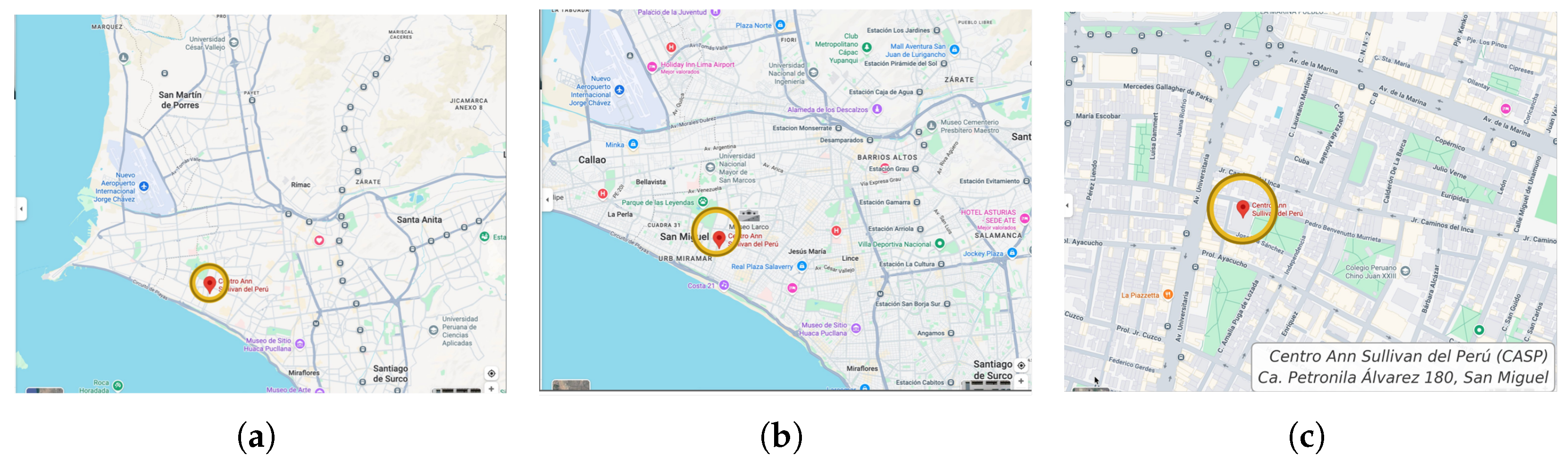
The study was conducted at the Centro Ann Sullivan del Perú (CASP), a specialized educational institution located at Calle Petronila Álvarez 180, Pando 5ta Etapa neighborhood, district of San Miguel, Metropolitan Lima, Peru. The district of San Miguel is located in the western sector of Metropolitan Lima, facing the Pacific Ocean, and is bordered by the districts of Callao to the northwest, Pueblo Libre to the east, and Magdalena del Mar to the southeast. It is a consolidated urban district, characterized by a mix of residential and commercial zones with limited specialized infrastructure for the ASD population, a condition that makes it representative of the Latin American urban contexts to which the study is projected.
Figure 1 presents the location of the CASP at three levels of detail: (a) Metropolitan Lima, (b) district of San Miguel, and (c) immediate urban context of the educational center.
The reference population comprised the immediate family members of students with ASD attending the CASP. Participant selection was conducted through non-probabilistic convenience sampling, a strategy appropriate for studies focused on a single educational center and oriented to capturing contextually situated perceptions, where statistical generalization is not the primary analytical objective [
26,
27]. Three eligibility criteria were established: being an immediate family member of a student with ASD enrolled at the CEBE, maintaining daily and sustained contact with the student in both the domestic and educational environments, and granting informed consent for voluntary participation. To support the adequacy of the sample size, standard statistical criteria for correlational studies were applied: a significance level of
= 0.05, a statistical power of 0.80, and an expected medium effect size (
r = 0.30), in accordance with Cohen’s reference parameters [
41]. Under these parameters, the minimum required threshold was 85 observations, a condition amply satisfied by the final sample of 101 proxy informants, which ensured sufficient statistical power for both the descriptive and inferential analyses and allowed the planned recruitment procedure to be carried out in its entirety.
This procedure was carried out during October 2025 and was structured in three successive stages: institutional authorization, contact with family members, and autonomous administration of the questionnaire. In the first stage, the CEBE granted authorization for the research team to access its premises, a condition that ensured supervised entry to the field and institutional traceability of the study. In the second stage, family members of the students were contacted in person at the educational center, where they received clear information about the academic purpose of the study, the voluntary nature of participation, and the guarantees of anonymity. In the third stage, each family member was provided with a physical QR code linked to the questionnaire hosted on the QuestionPro platform, which enabled each participant to access the instrument from their own mobile device and respond autonomously, without the presence of the research team, thereby reducing social desirability bias and ensuring independence between responses. The platform did not record any identifying information or IP addresses associated with the participants, consistent with the anonymous nature of the study. The proxy informants fell within an approximate age range of 30 to 50 years, all of them being immediate family members with sustained daily contact with the student, which supports their suitability for reporting perceptions of the educational environment and of the observable cognitive performance of the students with ASD.
Table 3 synthesizes the characteristics of the proxy informants and of the data collection procedure. Given the anonymized nature of the design, adopted as a deliberate ethical decision to protect the privacy of family members of students with ASD, no individual demographic identifiers were collected (specific age, exact type of relationship, gender, or duration of student attendance at the CEBE). The level of detail reported corresponds to the maximum that the anonymous design allowed.
3.3. Data Collection Instrument
The instrument consisted of a structured questionnaire of 24 items rated on a five-category Likert scale, where 1 corresponded to “strongly disagree” and 5 to “strongly agree”. All items were worded positively to avoid reverse recoding procedures. The instrument was organized around the two study variables. The independent variable, multisensory architecture, was operationalized through three dimensions of four items each: functional conditions (items 1 to 4), environmental conditions (items 5 to 8), and physical-spatial conditions (items 9 to 12). The dependent variable, cognitive development, was operationalized through the dimensions of concentration (items 13 to 16), self-regulation (items 17 to 20), and accessibility (items 21 to 24), also with four items per dimension. By way of illustration, the functional conditions dimension included items such as “Spaces with good natural and artificial lighting promote concentration in children with ASD” and “A clear spatial layout facilitates orientation in children with ASD”; the environmental conditions dimension included items such as “Environments with good acoustic comfort promote calmness in children with ASD” and “Adequate lighting in classrooms improves learning in students with ASD”; and the concentration dimension included items such as “Organized study areas promote concentration in students with ASD” and “Adequate ventilation and temperature in classrooms improves concentration in children with ASD”. The use of a single instrument to operationalize multiple analytical variables is consistent with prior methodological approaches that employ aggregated Likert scales to examine associations between perceptual constructs [
42,
43].
The construction process of the instrument was developed in three stages. In the first stage, the items were derived from the seven criteria of the ASPECTSS framework on architecture for people with ASD, complemented by the dimensions of indoor environmental quality and of the cognitive processes associated with the built environment reported in the specialized literature. In the second stage, each item was deductively assigned to one of the six operational dimensions of the study (D1 to D6), ensuring a balanced distribution of four items per dimension and maintaining the structural symmetry between the independent variable and the dependent variable. In the third stage, the complete set of 24 items was subjected to content validation through expert judgment by three architecture specialists, who evaluated sufficiency, clarity, coherence, and relevance, and approved all items without observations. The complete questionnaire, together with the detailed assignment of each item to its corresponding dimension and to the specific indicator it measures, is presented in
Table S5 of the additional Supplementary Material.
3.4. Validity, Reliability, and Statistical Analysis
Content validity of the instrument was established through expert judgment: three architecture specialists evaluated the items in terms of their sufficiency, clarity, coherence, and relevance to the study constructs, and all items were approved without observations. The construct validity of the instrument was assessed through an exploratory factor analysis (EFA) with a verificatory purpose, aimed at corroborating the factorial adequacy of the data and the coherence of the latent structure of the instrument. Sampling adequacy was verified through the Kaiser–Meyer–Olkin index (KMO = 0.888, classified as meritorious) and Bartlett’s sphericity test (
= 1747.875, df = 276,
p < 0.001), which confirmed the existence of significant correlations among items and the appropriateness of EFA. Principal Axis Factoring (PAF) was used as the extraction method, appropriate when the analytical interest is centered on the common variance among items rather than on mere data reduction [
44]. Oblimin oblique rotation was applied, consistent with the theoretically correlated nature of the dimensions of the instrument, rather than an orthogonal rotation that would assume independence among factors [
44]. The first eigenvalue (11.045) evidenced a solid common latent structure, accounting for 46% of the total variance of the instrument. This proportion also functions as Harman’s single-factor test: by falling below the conventional 50% threshold, it indicates that common method bias does not severely affect the data [
40]. Given the correlational purpose of the study, the six dimensions theoretically defined on the basis of the ASPECTSS framework [
30] were retained as conceptual subscales of the instrument. The complete matrix of factor loadings and item communalities is provided as
Supplementary Material (Table S1). The internal consistency of each subscale is examined below. Reliability was assessed using Cronbach’s alpha coefficient, yielding
= 0.944 for the complete instrument,
= 0.886 for the independent variable, and
= 0.930 for the dependent variable. At the disaggregated level, the alpha coefficients per subscale ranged between 0.718 and 0.854 (D1 = 0.718; D2 = 0.742; D3 = 0.737; D4 = 0.854; D5 = 0.850; D6 = 0.830), all above the conventional threshold of 0.70 [
45], indicating acceptable to excellent internal consistency across all levels of the instrument; the disaggregated detail is presented in
Table S4 of the Supplementary Material.
For statistical analysis, Shapiro–Wilk normality tests were applied to all variables and dimensions. Results indicated that the data did not follow a normal distribution (
p < 0.05) in any case; consequently, Spearman’s rho correlation coefficient (
) was used to examine associations between variables, as the appropriate nonparametric statistic for ordinal-scale data without normal distribution. To accompany each coefficient with an estimation of its precision, 95% confidence intervals were computed through nonparametric bootstrap with 5000 replications, a procedure suitable for distributions that do not meet parametric assumptions. The substantive magnitude of each association was interpreted in accordance with Cohen’s reference criteria for correlation coefficients: small (0.10 to 0.30), medium (0.30 to 0.50), and large (≥0.50) [
41]. Data processing was performed using IBM SPSS Statistics software, version 25.
3.5. Ethical Considerations
The study was conducted in accordance with the ethical principles applicable to research involving human beings, with particular attention to the fact that, although the immediate participants of the study were competent adults, the unit of analysis relates to a population regarded as vulnerable, namely students with ASD. This consideration guided the entirety of the design decisions from the planning phase. Under the institutional guidelines of Universidad Tecnológica del Perú, observational non-experimental studies that (i) do not collect data directly from minors, persons with disabilities, or any other vulnerable population, (ii) do not involve any intervention on the participants, and (iii) gather information exclusively from competent adults who provide informed consent, do not require formal review by an institutional ethics committee. The present study fulfills the three conditions: data collection was carried out exclusively with adult immediate family members of the students, no intervention was applied either on the children or on the educational environment, and all participants provided informed consent. Although formal approval was not required, five safeguards were adopted as a deliberate ethical decision that reinforced the protection of both the proxy informants and, indirectly, of the students with ASD: the questionnaire was fully anonymous, with no collection of personal identifiers or IP addresses; informed consent was obtained prior to the administration of the instrument; eligibility criteria were restricted to immediate family members with sustained daily contact; data confidentiality was guaranteed throughout the processing; and the collected information was used exclusively for academic and research purposes. These safeguards, derived from the principle of ethical prudence rather than from formal requirements, constitute the operative framework under which the study was conducted.
4. Empirical Results and Hierarchization of Multisensory Design Criteria for Cognitive Development
4.1. Sample Characterization and Variable Distribution
The sample comprised 101 proxy informants, immediate family members of students with ASD attending the CEBE in the district of San Miguel, Metropolitan Lima. Their responses do not represent abstract perceptions but rather indirect records of everyday practices associated with the use of the educational space and with the students’ performance across their cognitive dimensions. Descriptive analysis revealed that 31.7% of proxy informants perceived adequate multisensory architecture conditions at the CEBE and associated adequate levels of cognitive development in their children; 30.7% reported partially adequate conditions in both variables; and 37.6% perceived inadequate environmental conditions, also associated with low levels of cognitive development. This distribution pattern, in which the greatest concentration of cases coincides along the concordance diagonal between the categories of both variables, is consistent with the profile of the analyzed center and establishes an adequate empirical basis for examining the associative patterns between multisensory architecture and cognitive development.
To complement this categorical characterization,
Table 4 presents the descriptive statistics of the six dimensions and the two aggregated variables, considering that the rejection of normality subsequently confirmed through the Shapiro–Wilk test makes it advisable to report parametric measures (mean, standard deviation) jointly with nonparametric measures (median, first and third quartiles, interquartile range).
4.2. Global Association Between Multisensory Architecture and Cognitive Development
Prior to inferential analysis, the normality assumption was evaluated using the Shapiro–Wilk test. None of the study variables or dimensions followed a normal distribution: W coefficients ranged from 0.854 to 0.947, with p values below 0.001 in all cases. Given that the null hypothesis of normality was rejected across all analyzed distributions, the use of Spearman’s rho correlation coefficient () for inferential analysis is justified, as it constitutes the appropriate nonparametric statistic for ordinal-scale data without normal distribution.
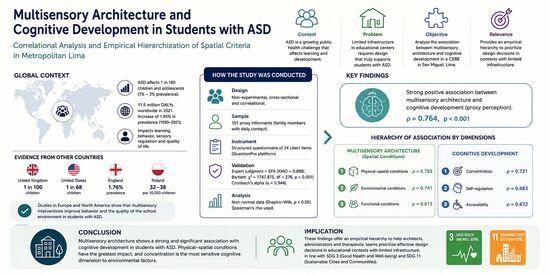
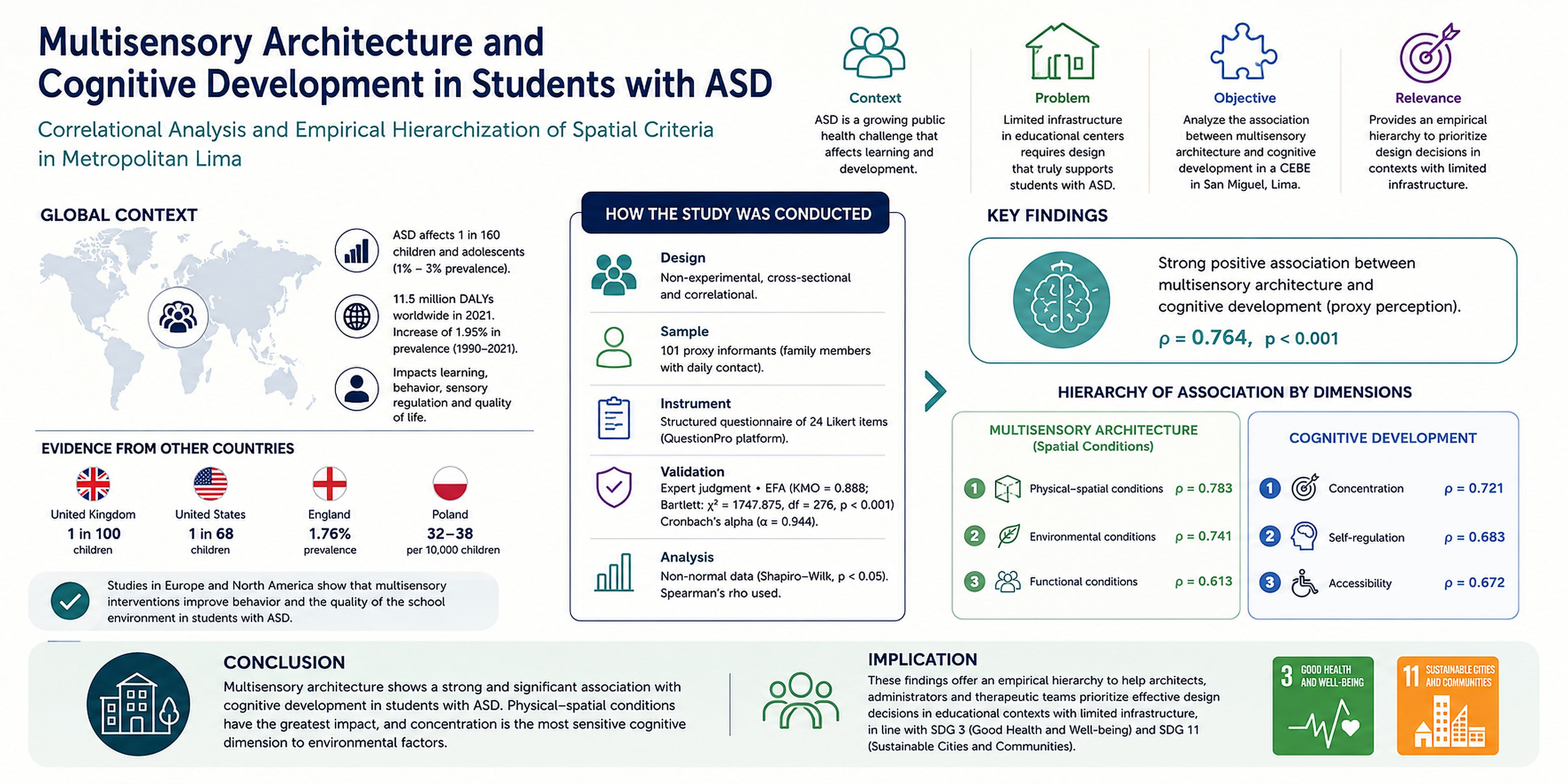
Correlational analysis revealed a positive and statistically significant association between multisensory architecture and the cognitive development of students with ASD ( = 0.764, 95% CI [0.627, 0.863], p < 0.001, n = 101), of large magnitude according to Cohen’s criteria. More favorable perceptions of the sensory and spatial conditions of the educational environment are thus associated with higher levels of cognitive development reported by proxy informants. Given the non-experimental and cross-sectional design of the study, this finding is interpreted as a statistically significant relational pattern of high magnitude, without implying a causal relationship between the variables. The magnitude of the coefficient positions multisensory architecture as a component of the built environment consistently associated with cognitive development in the analyzed context, supporting the relevance of a disaggregated dimensional analysis to identify which spatial conditions exhibit the strongest associations and thereby guide the hierarchization of design criteria.
4.3. Hierarchization of Spatial Conditions as Design Criteria
Dimensional analysis made it possible to establish an empirical hierarchization of the three spatial conditions of multisensory architecture according to the magnitude of their association with overall cognitive development. This hierarchization is expressed in ordinal terms, first, second, and third, to reflect the relative priority of each condition as a design intervention criterion: the greater the association magnitude, the stronger the empirical evidence supporting the prioritization of that condition in design decisions. All coefficients were statistically significant (p < 0.001).
Physical-spatial conditions (D3) occupied the first hierarchical level with the greatest association magnitude (
= 0.783), indicating that the spatial distribution, materiality, furniture, and zoning of the educational environment constitute the architectural design component most consistently associated with cognitive development in the analyzed context. Environmental conditions (D2) occupied the second level (
= 0.741), reflecting that the control of lighting, acoustics, temperature, and air quality constitutes a high-weight sensory modulation system that complements and reinforces the association observed for physical-spatial conditions. Functional conditions (D1) occupied the third level (
= 0.613), with a moderate-high association magnitude reflecting the role of functional spatial organization, accessibility, and circulation flows as structuring components of the architectural program.
Table 5 synthesizes this hierarchization and includes the derived design role for each level.
4.4. Differential Weight of Cognitive Development Dimensions in the Configuration of the Educational Environment
The complementary analysis of correlations between global multisensory architecture and each dimension of cognitive development identified a differentiated association pattern that informs design from the perspective of the cognitive processes the environment must address as a priority. Unlike the hierarchization of the independent variable, which is expressed in ordinal terms of intervention priority, the hierarchization of cognitive development dimensions is described through functional labels: integrative axis, priority, behavioral support, and relational support. This distinction reflects the fact that cognitive dimensions differ not only in their magnitude of association with the environment but also in the type of function they fulfill in the learning process of students with ASD, which shapes the specific character of the design decisions they guide.
Concentration (D4) occupied the first level with the greatest association magnitude (
= 0.721), being the cognitive development dimension most sensitive to the conditions of the educational environment. This indicates that the capacity for sustained attention, comprehension of instructions, and spatial orientation of students with ASD responds with greater intensity to the characteristics of the space, consistent with evidence documenting that the reduction in distracting stimuli and spatial legibility are associated with cognitive processes in this population [
9,
12]. Self-regulation (D5) presented the second level of association (
= 0.683), reflecting that the sensory conditions of the environment are also associated with the student’s capacity to regulate behavior and participate adaptively in learning activities. Accessibility (D6) recorded the third level (
= 0.672), indicating that the spatial conditions of the environment are associated with the student’s capacity to move, orient themselves, and functionally integrate into the educational environment.
Table 6 synthesizes this hierarchization with the functional labels corresponding to each dimension.
4.5. Empirical Synthesis: From Correlational Findings to Hierarchized Design Criteria
The results of the correlational analysis allow tracing a coherent empirical hierarchization of architectural design criteria for the cognitive development of students with ASD. The global association between multisensory architecture and cognitive development ( = 0.764) confirms the general hypothesis of the study and indicates that the built environment operates as an active component in the cognitive processes of students, not as a neutral container. When the analysis is disaggregated by dimensions of the independent variable, physical-spatial conditions emerge as the design criterion with the greatest associative weight, followed by environmental and functional conditions. This hierarchical pattern has a theoretically coherent reading: in students with ASD, the physical organization of the space, its materiality, and its zoning constitute the most directly perceived and processed design layer, before environmental and functional conditions can show their complementary association. From the perspective of cognitive development dimensions, concentration is the most sensitive, followed by self-regulation and accessibility, suggesting that the educational environment shows its strongest association with attentional processes before behavioral and relational ones. This hierarchical configuration, interpreted without assuming causality but as a priority structure derived from associative patterns observed in the specific context of the study, constitutes the empirical input that guides the discussion developed in the following section.
5. From Empirical Evidence to Multisensory Design Criteria
The preceding section established the empirical hierarchization of the spatial conditions of multisensory architecture and of the cognitive development dimensions according to the magnitude of their reciprocal associations. Building on that hierarchization, the present section develops the analytical translation process through which the statistical results are formulated as design implications derived from the observed quantitative associations and from the specialized literature, and not as directly tested design solutions, deliberately avoiding the derivation of closed formal solutions or unique technical specifications. This methodological decision reflects the non-experimental and correlational nature of the study, whose aim is not to prescribe specific spatial configurations but to establish environmental performance principles that guide design decision-making in an informed, replicable, and adaptable manner across different educational contexts.
5.1. Analytical Translation Process: From Coefficients to Design Principles
The translation process was structured around three sequential levels that articulate quantitative analysis with architectural formulation. At the first level, statistically significant associations between multisensory architecture and cognitive development were identified, both globally and dimensionally, based on Spearman’s rho coefficients obtained. The differentiated magnitude of those coefficients made it possible to establish a hierarchical order among the spatial conditions of the independent variable (D3 > D2 > D1) and among the cognitive dimensions of the dependent variable (D4 > D5 > D6), on the assumption that those with a greater coefficient represent components with greater relative weight in the cognitive development of students with ASD within the analyzed context.
At the second level, the obtained coefficients were interpreted not in causal terms but as indicators of functional relevance, understood as empirical signals of the degree to which certain conditions of the built environment are consistently associated with observable dimensions of cognitive development. This interpretation made it possible to distinguish between conditions with a structuring, strategic support, and programmatic role in the independent variable, and between dimensions with a priority, behavioral support, and relational support role in the dependent variable, according to their hierarchical position and their relative contribution to the student’s environmental experience. In this sense, the hierarchization does not express a causal relationship between space and cognitive development, but rather a priority structure derived from associative patterns observed in the specific context of the analyzed CEBE.
At the third level, the empirical hierarchization was translated into architectural design criteria, understood as technical principles that guide spatial, sensory, and organizational decision-making. These criteria do not describe specific formal configurations or particular constructive solutions, but rather establish environmental performance conditions that the educational environment must satisfy in order to be favorably associated with the cognitive development of students with ASD. In this way, the analytical translation operates as a methodological bridge between quantitative analysis and the field of design, ensuring coherence between the empirical evidence and the derived criteria, while maintaining its transferable and adaptable character across different urban educational contexts with specialized infrastructure limitations, such as the district of San Miguel.
5.2. Design Criteria Derived from the Empirical Hierarchization
Based on the empirical hierarchization presented in
Table 5 and
Table 6, six architectural design criteria were formulated, organized into two blocks: the first corresponds to the spatial conditions of multisensory architecture and the second to the dimensions of cognitive development. The direct correspondence between the rows of the tables and the formulated criteria ensures traceability between the quantitative evidence and the design guidelines. The criteria do not constitute a sequential application hierarchy but a prioritization guide that reflects the relative weight of each dimension within the analyzed environmental system.
The first criterion corresponds to physical-spatial conditions as a structuring criterion ( = 0.783). Its greater association magnitude with cognitive development establishes that the spatial distribution, materiality, furniture, and zoning of the CEBE are the design components with the greatest empirical evidence for guiding the cognitive development of students with ASD. In the context of San Miguel, where CEBE facilities frequently operate under area restrictions and high usage density, this criterion is especially relevant: the physical-spatial coherence of the environment does not depend on the size of the space but on the consistency among its organizational components, making it applicable even under conditions of limited infrastructure.
The second criterion corresponds to environmental conditions as a strategic support criterion ( = 0.741). This criterion guides design decisions toward the deliberate control of lighting, acoustics, temperature, and air quality as a sensory modulation system that complements and reinforces the association observed for physical-spatial conditions. In dense urban environments such as the district of San Miguel, where external noise and uncontrolled lighting can generate overstimulation, this criterion signals the priority of designing environments with active environmental control that protect the student’s cognitive capacity during educational activities.
The third criterion corresponds to functional conditions as a programmatic criterion ( = 0.613). This criterion guides design toward the clear functional organization of the educational space, including accessibility, circulation flows, and zone differentiation according to activity type, as conditions that structure the architectural program and facilitate orientation and routine for students with ASD. Although it presents the smallest association magnitude among the spatial conditions, its programmatic role makes it the component that organizes the student’s overall spatial experience and upon which physical-spatial and environmental conditions are articulated.
The fourth criterion corresponds to multisensory architecture as the integrative axis of cognitive development ( = 0.764). This criterion establishes the need to conceive the educational environment as a coherent sensory system in which spatial, material, and environmental decisions are not addressed in isolation but as an articulated whole oriented toward cognitive development. It operates as the guiding principle that gives unity to the design system: when physical-spatial, environmental, and functional conditions act in a coherent and synergistic manner, their joint association with cognitive development operates in an articulated way, orienting the design system as a coherent whole rather than as isolated decisions.
The fifth criterion corresponds to concentration as the priority dimension ( = 0.721). Given its greater sensitivity to environmental conditions, this criterion guides design decisions toward the control of sensory stimuli, spatial legibility, and distractor reduction as conditions that sustain sustained attention, comprehension of instructions, and spatial orientation of students with ASD. In practical terms, this criterion prioritizes the creation of predictable environments, with clear spatial sequences, absence of unnecessary visual complexity, and differentiated zones according to the level of stimulation required by each educational activity.
The sixth criterion integrates self-regulation ( = 0.683) and accessibility ( = 0.672) as complementary support dimensions. The proximity of their coefficients reflects that both dimensions respond with similar intensity to environmental conditions and act in a functionally interdependent manner: an environment that promotes behavioral self-regulation creates the conditions for the student to move, orient themselves, and integrate autonomously, and vice versa. In design terms, self-regulation guides material selection, acoustic and lighting control, and the configuration of calm environments, while accessibility informs the arrangement of circulation paths, access points, and equitable spatial distribution. Taken together, these six criteria constitute a technical reference framework that translates the empirical hierarchization into operative principles for the design of CEBE in urban contexts with limited specialized infrastructure.
6. Design Implications for CEBE in Urban Contexts with Limited Infrastructure
That the educational space is closely related to learning is an intuition shared by architects and educators for decades; what this study adds to that conviction is its quantification and hierarchization. The data obtained make it possible to identify with statistical precision which environmental conditions are most strongly associated with the cognitive development of students with ASD and in what order they should be prioritized when resources are limited, converting intuition into a technical reference. The design implications presented below are derived from the observed statistical associations and from the specialized literature, and do not constitute design solutions that have been directly tested in experimental interventions. These implications are grounded in the obtained coefficients and offer architects, administrators, and therapeutic teams environmental performance orientations organized according to the hierarchy established by the data, transferable to different urban educational contexts with limited specialized infrastructure.
6.1. Physical-Spatial Organization and Cognitive Concentration
Physical-spatial conditions presented the greatest association with overall cognitive development (
= 0.783) and concentration proved to be the cognitive dimension most sensitive to environmental conditions (
= 0.721). The convergence of both results at the first levels of their respective hierarchizations has a direct implication for design: the physical-spatial organization of the CEBE, i.e., the arrangement of spaces, the clarity of circulation paths, the materiality, and the zoning, constitutes the architectural component with the greatest empirical evidence for sustaining the sustained attention, comprehension of instructions, and spatial orientation of students with ASD in the context of Metropolitan Lima. This finding positions these decisions as a first-order priority, backed by statistical evidence with a magnitude that exceeds that of environmental and functional conditions, orienting design teams to treat them as key variables rather than secondary program attributes [
9,
12].
Translated to the operational level, this orientation entails structuring the CEBE through anticipatable spatial sequences that reduce environmental uncertainty for students with ASD, given that when the environment can be read and anticipated, the cognitive resources available for learning increase substantially. Zoning must clearly differentiate individual work, interaction, and rest areas, establishing progressive transitions between stimulation levels; circulation paths must favor unambiguous routes; and materials must reinforce spatial legibility through tactile and chromatic consistency. In the context of San Miguel, where CEBE facilities frequently operate in adapted premises of reduced dimensions, this guideline is especially valuable because reorganizing the existing space coherently, differentiating zones and simplifying circulation paths, can be associated with substantial improvements in student concentration at a considerably lower investment than a structural renovation.
6.2. Environmental Conditions and Self-Regulation
Environmental conditions occupied the second hierarchical level in the association with cognitive development (
= 0.741) and self-regulation presented the second level among cognitive dimensions (
= 0.683). The proximity of these coefficients to the first level indicates that the statistical difference between both conditions is small, reinforcing the advisability of addressing them simultaneously when resources allow; when constraints require establishing an order, the empirical hierarchy grants precedence to physical-spatial conditions, with environmental conditions acting as the second-layer system that regulates the student’s perceptual load and sustains their capacity for behavioral self-regulation. Lighting, acoustics, temperature, and air quality operate in an integrated manner, and when that environmental system is under control, students with ASD can direct their cognitive resources toward learning rather than consuming them in continuous adaptation to an unpredictable environment [
10,
12].
The practical orientation of this guideline is that the environmental control of the CEBE must be conceived as an active design variable, with sensory gradients that accompany the progression of educational activities rather than abrupt contrasts that may produce overload. Lighting must be adjustable according to the type of activity, promoting calm in individual work zones and greater dynamism in interaction zones; acoustics must reduce reverberation and isolate exterior noise; temperature and ventilation must be kept stable to prevent fluctuations that activate sensory stress responses. In the district of San Miguel, where exterior urban noise frequently filters into educational premises, the study data offer a concrete empirical argument for prioritizing acoustic control as a demonstrated cognitive performance condition, a distinction that converts the finding into a technical input for design and institutional management decision-making.
6.3. Functional Conditions and Accessibility
Functional conditions presented the third level of association with cognitive development (
= 0.613) and accessibility the third level among cognitive dimensions (
= 0.672); both coefficients correspond to moderate-high magnitude associations, statistically significant (
p < 0.001), that in other research contexts would be considered results of substantial relevance. Their position at the third level establishes their relative priority within the system, while defining their specific role: functional conditions and accessibility are the layer most closely associated with whether the student can inhabit autonomously an environment that has already been organizationally coherent and environmentally controlled, thereby completing the design system that the two preceding subsections began to build. The proximity of their coefficients, in turn, reflects that the functional organization of the space and the student’s cognitive accessibility are interdependent processes: an environment with clear functional distribution creates the conditions for students with ASD to move, orient themselves, and integrate autonomously, and that autonomy in turn reinforces the functional routine that sustains learning [
4,
30].
The orientation that follows from this finding is that the functionality and accessibility of the CEBE must be designed from the perspective of students with ASD, which entails signage comprehensible to this population, access points and circulation paths consistent with the overall zoning, and spaces with recognizable purposes that reinforce learning routines. Cognitive accessibility, understood as the capacity of the space to be understood, anticipated, and used autonomously, is as relevant as physical accessibility, and the study data support it empirically. In the context of San Miguel, where the demand for specialized educational environments exceeds the available infrastructure, these orientations offer high-relevance, low-cost interventions: reorganizing signage, simplifying circulation flows, and clearly differentiating functional zones are decisions that transform the student’s experience without requiring structural renovations. Taken together, the three guidelines of this section constitute an integrated system of design decisions that operationalizes the empirical hierarchization of the study, grounding the architect’s professional judgment in data and converting the statistical evidence into a priority guide for the design of educational environments oriented toward the cognitive development of students with ASD.
8. Limitations and Future Research
The non-experimental, cross-sectional, and correlational design adopted in this study made it possible to identify associative patterns between multisensory architecture and the cognitive development of students with ASD under real-world conditions, without intervention on the environment or manipulation of variables. This design delimits the inferential scope of the results in two respects: the correlational nature prevents the establishment of causal relationships between spatial conditions and cognitive development, and the cross-sectional approach captures associations at a single point in time without offering information on how they are maintained, intensified, or transformed throughout the student’s development. This delimitation constitutes, at the same time, the natural starting point for more complex research: future studies could advance toward controlled or quasi-experimental architectural intervention designs, in which the effect of specific sensory or spatial adjustments on the concentration, self-regulation, and accessibility of students with ASD is directly evaluated, strengthening the link between empirical research, architectural practice, and the assessment of functional outcomes.
The use of proxy informants introduces a perceptual mediation inherent to the design: the data reflect the family member’s observation of the student’s performance in the educational environment, not the student’s direct experience. Although this strategy is methodologically justified by the cognitive, communicative, and sensory profile of ASD [
35], and has demonstrated its robustness in prior studies within the same research line in Metropolitan Lima [
26,
27], this perceptual mediation must be considered when interpreting the results. Beyond this, by measuring both variables through the same questionnaire administered to the same proxy informants, the results may be exposed to common method bias. As reported in
Section 3.4, the diagnostic verification performed through Harman’s single-factor test yielded a value below the conventional 50% threshold, suggesting that this potential bias is not severe; nevertheless, the perceptual mediation inherent to the design must be considered when interpreting the results [
40].
Additionally, the instrument collected perceptions about the conditions of the educational environment without incorporating objective measurements of environmental variables such as acoustic levels, luminous intensity, or temperature. Future research could enrich the analysis by triangulating proxy informant reports with direct systematic observation and objective measurements of the physical environment, broadening the understanding of the relationship between multisensory architecture and cognitive development from a multi-method perspective.
The study was conducted at a single CEBE in the district of San Miguel, Metropolitan Lima, using non-probabilistic convenience sampling. The empirical hierarchization obtained is valid within the analyzed context and coherent with its specific socio-spatial conditions, although it cannot be statistically generalized to other CEBE with different urban and institutional profiles. This contextual delimitation does not weaken the methodological approach; rather, it reinforces the need to interpret it through a reading sensitive to local particularities, and projects a highly relevant comparative line: future studies could replicate the model in other CEBE in Metropolitan Lima and in Latin American contexts with comparable socio-spatial characteristics, analyzing the stability of the identified hierarchization in the face of variations in infrastructure type, socioeconomic context, and the urban conditions of the immediate environment. Extending the approach to other educational and therapeutic typologies serving populations with specific sensory needs would contribute to consolidating evidence-based design as a systematic and replicable strategy for the development of inclusive educational infrastructure in the region.
9. Conclusions
The results of the study confirm that multisensory architecture is positively and statistically significantly associated, based on proxy informant perceptions, with the cognitive development of students with ASD at the analyzed CEBE ( = 0.764, p < 0.001), providing quantitative evidence consistent with the reading of the educational environment as an active mediator of cognitive processes and not as a neutral container of learning activities. This association presents a differentiated structure according to the spatial condition and cognitive dimension considered, which goes beyond the homogeneous reading of multisensoriality implicit in many prior normative approaches and reaffirms the relevance of addressing educational environment design from an evidence-based hierarchical logic. When the analysis is disaggregated by spatial conditions, physical-spatial conditions emerge as the design criterion with the greatest associative weight, followed by environmental and functional conditions, confirming that the spatial distribution, materiality, and zoning of the educational environment constitute the primary architectural intervention priority for promoting the cognitive development of students with ASD in urban contexts with limited infrastructure. From the perspective of cognitive dimensions, concentration emerges as the priority cognitive criterion, followed by self-regulation and accessibility, whose close magnitudes evidence their functionally interdependent character and their simultaneous mediation by the built environment.
Taken together, these findings articulate two differentiated contributions. On the theoretical level, the study provides quantitative evidence that the dimensions of the built environment have differentiated associative weights on cognitive development in students with ASD, which qualifies the prevailing homogeneous discourse on multisensory architecture and proposes an empirically grounded hierarchical scheme, replicable in other analogous contexts. This differentiation of weights extends the ASPECTSS framework by introducing an empirical layer of hierarchization among principles traditionally presented as equivalent. On the practical level, the results offer architects, educational administrators, and therapeutic teams operating at CEBE under infrastructure constraints an empirically grounded reference for prioritizing design interventions on physical-spatial conditions and on concentration processes, articulating architectural decisions with the cognitive processes that are effectively sensitive to the environment, and consolidating a replicable approach that systematically links quantitative evidence with the design criteria of the educational environment, in alignment with SDG 3 and SDG 11.
These contributions should be interpreted in light of the limitations inherent to the correlational and cross-sectional design of the study, the perceptual mediation associated with the use of proxy informants, the absence of objective measurements of the physical environment, and the circumscription to a single CEBE in Metropolitan Lima, aspects discussed in detail in
Section 8. Along the same line, the results open three directions for future research: advancing toward quasi-experimental designs that directly evaluate the effect of specific spatial adjustments, triangulating proxy informant reports with systematic observation and objective measurements of the physical environment, and replicating the model at other CEBE in Metropolitan Lima and in analogous Latin American contexts in order to examine the stability of the empirical hierarchization obtained in light of variations in infrastructure, socioeconomic context, and urban environment.