1. Introduction
To facilitate the optimal distribution of power resources, China has continuously promoted the West-to-East and North-to-South Power Transmission projects, establishing a robust backbone power grid. By the end of 2023, the total length of transmission lines with voltage levels of 220 kV and above in China had reached approximately 920,000 km, according to statistics published by the China Electric Power Planning and Engineering Institute (EPPEI) [
1]. As critical components of the power grid, transmission towers must maintain structural reliability to ensure the safe and stable transmission of electricity. However, under extreme environmental conditions, such as ice accretion and strong winds, transmission towers become increasingly vulnerable due to the combined effects of multiple deterioration mechanisms, including corrosion and bolt loosening [
2,
3,
4,
5]. The deployment of intelligent sensors at strategic locations is an effective approach to monitoring the structural health of transmission towers. Nevertheless, as transmission towers are complex spatial structures, they exhibit multiple vibration modes and failure patterns under various loading conditions. Therefore, optimizing the placement of a limited number of sensors to effectively capture key modal parameters, such as mode shapes and natural frequencies, remains a critical challenge.
Optimal sensor placement (OSP) serves as a fundamental prerequisite for developing effective sensor networks, as it directly influences the measurement quality and sampling accuracy of structural health monitoring (SHM) systems [
6]. The objective of OSP is to determine the optimal sensor configuration based on specific evaluation criteria, thereby enhancing the acquisition of reliable data for modal identification, state estimation, and damage detection [
7]. Previous OSP studies have primarily focused on simple structures or simplified structural models. Based on the modal superposition theory (MST), Kammer [
8] proposed the Effective Independence (EFI) method as an efficient approach for maximizing linear independence, in which candidate sensor locations are eliminated or added according to rankings derived from the determinant of the Fisher Information Matrix (FIM). Kim et al. [
9] proposed a stochastic EFI method for sensor location selection based on optimal energy usage and demonstrated that it outperforms existing methods under system uncertainty. Bakir [
10] presented six OSP schemes for buildings and concluded that the EFI method was the most effective. Vergara et al. [
11] investigated sensor placement for transmission towers and transmission tower-line systems, comparing the results with those obtained using the EFI method. Zhou et al. [
12] combined the EFI method with the Modal Assurance Criterion (MAC) to determine both the minimum number of sensors and their optimal locations. Raphael and Jadhav [
13] evaluated a sensor placement methodology for transmission line towers based on entropy and model falsification. Existing literature indicates that the EFI method and its variants serve as the primary and most widely adopted strategies for OSP in large-scale complex spatial structures such as transmission towers.
Various quantitative criteria are commonly employed to assess the efficacy and performance of OSP methods, ensuring reliable and actionable outcomes [
14]. The modal kinetic energy (MKE) criterion was proposed by Salama et al. [
15] in 1987 to enhance the signal-to-noise ratio (SNR) of monitoring signals. It quantifies the resilience of a configuration to sensor noise. The Fisher Information Matrix (FIM), proposed by Kammer [
8] based on modal superposition theory, has been proven to be an important parameter for evaluating the influence of model parameters on model predictions. The maximized FIM is widely used as a criterion for OSP to ensure accurate model identification. Carne and Dohrmann [
16] proposed the MAC as an index for measuring the similarity between modal vectors and facilitating the distinction of vibration modes. While the MAC indicates the consistency between the actual structural mode shapes and the identified ones, a practical issue arises when the maximum off-diagonal term fails to decrease monotonically as the sensor count increases. The singular value decomposition (SVD) ratio, defined as the ratio between the maximum and minimum singular values of the eigenvector matrix, can also serve as an evaluation criterion for verifying OSP schemes [
17]. It reflects the requirements of modal orthogonality, modal expansion, and modal observability of the sensor locations. Different evaluation criteria emphasize different aspects, and thus yield different sensor configurations using the same OSP method. Therefore, the compatibility between evaluation criteria and optimization methods should be investigated to achieve an optimal sensor placement.
Inspired by advances in intelligent optimization algorithms, recent studies have applied these methods to address sensor placement problems in transmission towers. Chow et al. [
18] demonstrated under laboratory conditions that genetic algorithms (GA) are effective for placing a specified number of sensors on large-scale transmission towers to achieve an entropy-optimal configuration. Hu et al. [
19] incorporated a linearly decreasing inertia weight into an improved particle swarm optimization (IPSO) algorithm to optimize the balance between global exploration and local exploitation when solving the OSP problem for cat-head-type transmission towers. Dong et al. [
20] verified the applicability of the Dung Beetle Optimizer (DBO) for the optimal sensor placement of a double-circuit corner tower. Feng et al. [
21] proposed a method known as the siege ant colony algorithm (SACA) and compared its performance against conventional approaches using the Hanjiang transmission tower as a case study. These studies demonstrate that intelligent optimization algorithms can significantly enhance the efficiency and effectiveness of sensor placement design.
The Marine Predators Algorithm (MPA) is one of the meta-heuristic algorithms (MAs) used for solving numerous optimization problems [
22]. Benefiting from its simple framework, flexible implementation and limited adjustable parameters, several researchers have conducted in-depth studies to investigate and modify MPA for various practical applications [
23,
24,
25,
26,
27,
28]. And it has been confirmed that the MPA delivers prominent advantages in convergence rate and solution accuracy over other MAs [
29,
30,
31,
32]. Motivated by these advantages, this paper proposes a novel framework for sensor placement in transmission towers based on MPA. Because the selection of the fitness function significantly alters the spatial distribution of sensors—thereby directly impacting mode identifiability metrics—four different fitness functions are integrated with the MPA. The performance of these fitness functions in solving large-scale discrete OSP problems for lattice structures is systematically compared and analyzed.
2. Methodology for OSP Using MPA
The number and placement of sensors determine the precision of monitoring measurements and the accuracy of structural health assessments for transmission towers. To ensure reliable modal identification, this study proposes a combined optimization strategy integrating the Fisher Information Matrix (FIM), the Modal Assurance Criterion (MAC), and the Marine Predators Algorithm (MPA) for sensor placement design in transmission towers. The proposed hybrid optimization procedure consists of the following steps:
Constructing the finite element model of the transmission tower;
Performing modal analysis;
Determining the number of modes to be considered using the 2-norm method of the FIM;
Determining the number of sensors according to the maximum Modal Assurance Criterion (maxMAC);
Optimizing sensor deployment locations using the MPA.
The methods used in this study to determine the target modal order, the number of sensors, and their locations are briefly reviewed below.
2.1. Marine Predators Algorithm
The Marine Predators Algorithm (MPA) is a metaheuristic optimization algorithm inspired by the foraging behavior of marine predators. Its design is based on several biological and ecological mechanisms, including optimal encounter rate strategies, group aggregation behavior, eddy current effects, and memory characteristics. The MPA models predator–prey interactions through a dynamic velocity ratio, and the optimization process is divided into three stages. Two fundamental search patterns, namely Lévy flight and Brownian motion, are incorporated into these stages to balance global exploration and local exploitation [
22].
In the Brownian motion stochastic model, the probability distribution of the step sizes used for local search follows a normal distribution with zero mean
and unit variance
. The probability density function (PDF) at point
is given by Equation (1).
The random walk for global exploration is described by Lévy flight. The step sizes are random variables that follow a heavy-tailed distribution and are generated according to Equation (2).
where α denotes an exponential distribution ranging from 0 to 2;
and
are normally distributed random variables, as given in Equation (3).
and
are defined by Equation (4).
In Equation (4),
Γ represents the Gamma function, which is defined in Equation (5).
The initial prey positions are generated from a uniform distribution over the search space, as expressed in Equation (6).
where
and
denote the lower and upper bounds of the variables, respectively, and
is a random vector within the interval [0, 1].
According to the survival-of-the-fittest principle, the best solution is regarded as the top predator and is stored in a matrix referred to as the Elite matrix, as defined in Equation (7).
where
is multiplied
times to construct the Elite matrix, standing for the top predator vector.
denotes the number of search agents, and
represents the dimensionality of the Elite matrix. A prey matrix is then introduced to update the positions of the predators, as expressed in Equation (8).
represents the th dimension of the th prey individual. The entire optimization procedure is carried out based on these two matrices.
The optimization process of MPA is divided into three phases according to the relative velocities of the predators and prey [
23,
29].
Phase 1: Exploration phase.
While
1/3
where
is a random vector representing Brownian motion with a standard normal distribution.
= 0.5, and
is a vector of uniformly distributed random numbers in the interval [0, 1].
Phase 2: Transition phase.
While 1/32/3
The first half of the population is updated according to Equation (10).
where
denotes Lévy motion generated from the Lévy distribution.
The second half of the population is updated according to Equation (11).
is an adaptive parameter to adjust the step size of the predator,
.
Phase 3: Exploitation phase.
While
2/3
:
is again used to simulate the predator motion in the Lévy strategy.
To prevent the MPA from being trapped in a local search region, Fish Aggregating Devices (FADs) are incorporated into the algorithm and modeled by Equation (13).
where
refers to the
effect.
is a random vector with arrays including 0 and 1.
is uniform random number in [0, 1].
and
subscripts represent the random indices of the prey matrix.
Marine predators are assumed to possess the ability to remember and identify historically resource-rich areas. At the end of each iteration, the algorithm compares the fitness of the current solution with that of the historical best solution stored in the Elite matrix. If the current solution is better, the corresponding solution in the Elite matrix is replaced.
2.2. Evaluation Criteria of OSP
Various evaluation criteria have been developed to assess the effectiveness of sensor layout schemes based on specific monitoring objectives [
14]. The application of distinct evaluation criteria inherently leads to different sensor placement configurations, as each criterion reflects a distinct perspective on structural response and modal information [
7]. In this study, four OSP evaluation criteria are adopted as fitness functions for the MPA to assess the performance of sensor placement schemes.
2.2.1. Modal Assurance Criterion (MAC)
The MAC matrix serves as an evaluation criterion for measuring the discreteness of resulting vectors and the linear independence of modal vectors. The MAC matrix is defined by Equation (14) [
33].
In Equation (14), denotes the element in the row and column of the MAC matrix. The off-diagonal elements represent the correlations between modal vectors of different orders. A larger value of indicates a higher degree of correlation between the corresponding modal vectors. When = 1, the and modal vectors are perfectly correlated.
The maximum off-diagonal element is defined by Equation (15).
2.2.2. Singular Value Decomposition Ratio (SVDR)
The SVDR is an important indicator for evaluating the orthogonality and observability of structural vibrations, and its magnitude has clear physical significance in the selection of optimization parameters. It is defined as the ratio of the maximum to the minimum singular value of the modal matrix, as expressed in Equation (16) [
17].
where
and
are the maximum and minimum singular values of the modal matrix, respectively. The SVDR value close to unity is a strong indicator that the OSP strategy is effectively capturing the target mode shapes with high fidelity.
2.2.3. 2-Norm of FIM
FIM proposed by Kammer [
8] is based on the modal superposition theory and has developed into an efficient approach for maximizing the linear independence. The structural response can be expressed as Equation (17).
In Equation (17),
is the mode shape matrix, and the subscript
denotes the
column vector of the model matrix.
The rate of change (ROC) of the FIM 2-norm, denoted as
, is defined as the ratio of the difference between the FIM matrix 2-norms of
th and
th order to the 2-norm of
th order. It can be calculated using Equation (18).
in which
is the FIM 2-norm. The
value gradually approaches zero with the increase in mode number
.
2.2.4. Modal Kinetic Energy (MKE)
The modal kinetic energy (MKE) distribution at each position describes the structure dynamic behavior and the signal-to-noise ratio (SNR) of the collected data at measurement points. It is defined by Equation (19).
where
is the number of modal orders.
is the
row and
column of modal matrix.
is the
row and
column of the mass matrix.
3. Application in a Transmission Tower
In this section, the proposed OSP method is applied to a Y-shaped transmission tower to evaluate its feasibility and effectiveness.
3.1. Model Introduction
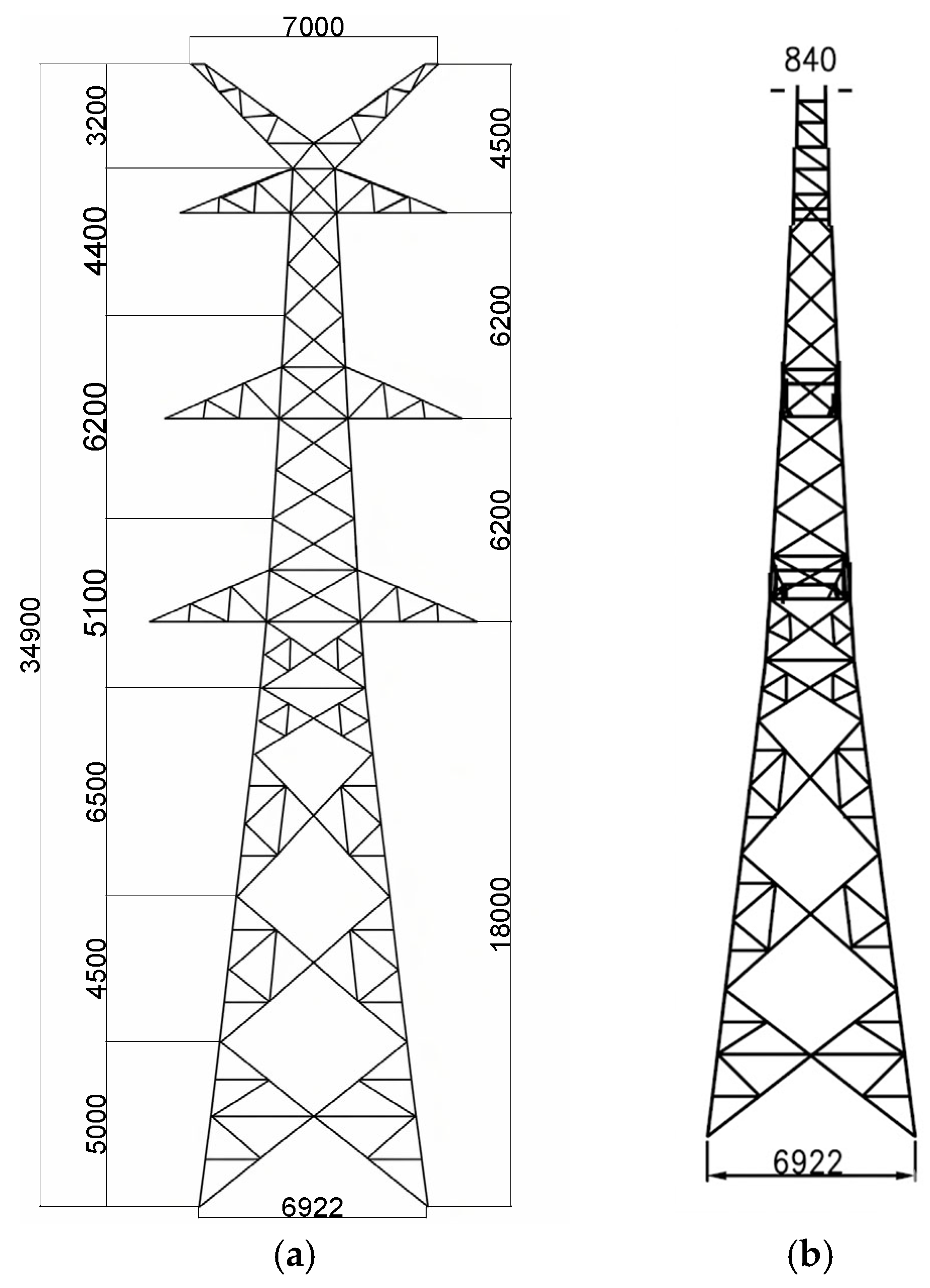
The ±220 kV Y-shaped transmission tower investigated in this study is an A-type tower primarily subjected to conductor weight and wind loads. As illustrated in
Figure 1, the overall height of the tower is 34.9 m. The tower is constructed from galvanized 16 Mn angle steel. The steel material is assumed to be linear elastic, with an elastic modulus of
= 200 GPa and a density of
= 7800 kg/m
3. The main members feature L-shaped cross-sections with dimensions of 160 mm × 14 mm. The cross-sectional dimensions of the bracing members decrease progressively from 160 mm × 14 mm to 45 mm × 4 mm along the height of the transmission tower. The structural components are eccentrically connected by bolts.
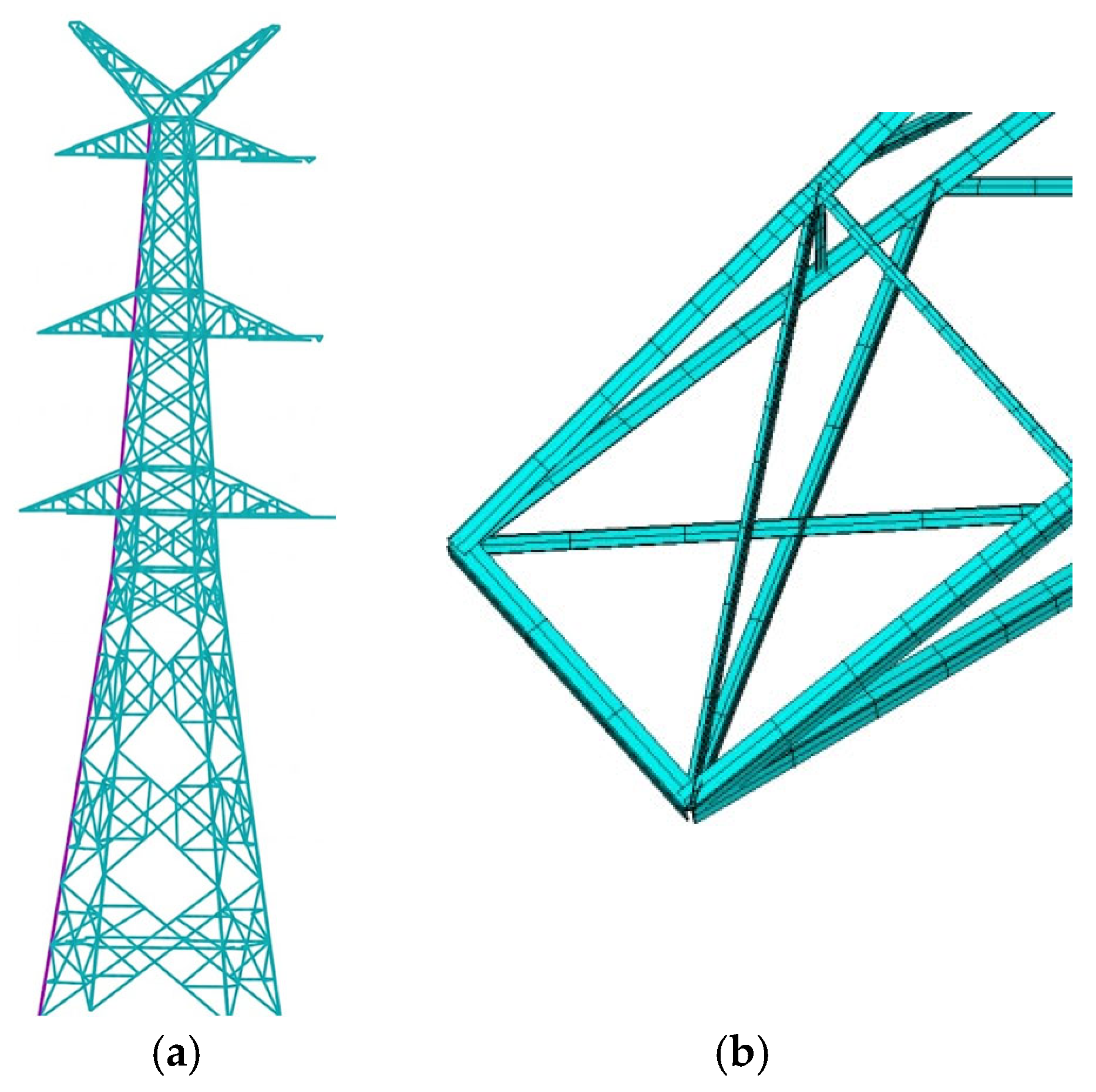
A finite element model of the Y-shaped transmission tower was established using beam elements, as illustrated in
Figure 2. The model consists of 15,939 nodes and 8295 elements and the maximum element length of 0.5 m. A rigorous mesh convergence analysis was performed to ensure that the numerical results are stable and mesh-independent for the first 50 vibration modes. The tower base was assumed to be rigidly connected to the foundation, and fixed-support boundary conditions were simulated by constraining all degrees of freedom at the tower-leg support locations. Connection details between members were simplified as rigid joints.
3.2. Finite Element Modal Analysis
Modal analysis was conducted to identify the natural vibration characteristics of the transmission tower and to obtain the mode shape matrix
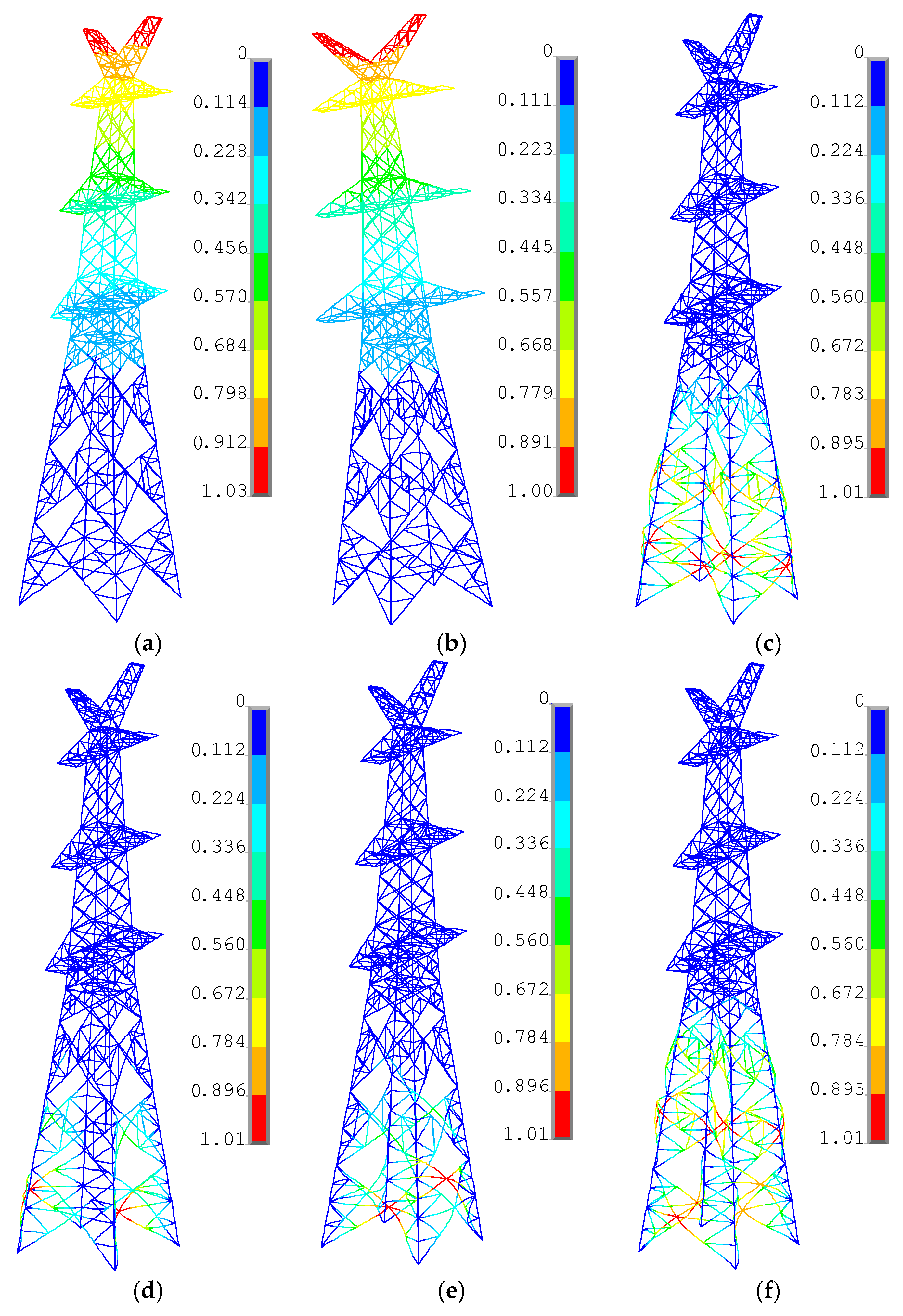
. By examining the vibration behavior at various natural frequencies, the structural deformation characteristics can be clearly understood. The Block Lanczos method was employed for eigenvalue extraction, and the first six mode shapes are presented in
Figure 3. This analysis was performed under ideal conditions without external loads (wind, ice, etc.) or measurement noise, which is a common and reasonable simplification for identifying inherent dynamic characteristics. Under actual service conditions, wind loads, ice accretion, and environmental noise will indeed affect tower dynamic responses. Specifically, wind loads may induce additional vibration and slight changes in modal frequencies, while ice coating increases structural mass and stiffness, typically leading to a decrease in natural frequencies. However, such influences primarily affect vibration amplitudes and response fluctuations, rather than significantly altering the global mode shapes and natural frequencies investigated in this study.
Based on the modal analysis results, the first and second mode shapes correspond to bending modes in the longitudinal and transverse directions, with natural frequencies of 4.04 Hz and 4.07 Hz, respectively. The modal displacement generally increases with height. Higher-order mode shapes are characterized by local vibration patterns concentrated in the inclined members, auxiliary members of the tower legs, and the lower part of the tower body.
Previous hurricane damage investigations and numerical studies [
34,
35,
36] have shown that, under wind or earthquake excitation, the vulnerable components of transmission towers are primarily the main members and diagonal bracing members located in the upper and middle parts of the structure. Because the main members are the primary load-bearing components, their structural condition has a critical influence on the overall safety and stability of transmission towers. Variations in the modal parameters of these main members can effectively reflect the operational state of the tower. Therefore, to avoid convergence stagnation during the later stages of sensor configuration optimization, sensors are preliminarily arranged on the main load-bearing members of the transmission tower. In this study, all nodes on one side of the main load-bearing members are selected as candidate sensor locations. Consequently, the total number of candidate degrees of freedom available for sensor installation on these main members is 112. A schematic of the selected main members is shown in
Figure 2a marked with blue color.
3.3. Determination of the Target Modal Orders
For transmission towers subjected to environmental excitation, only a limited number of modal orders are critical to structural safety. Higher-order modes are difficult to excite and have minimal influence on the global dynamic response of the structure. Therefore, sensor configuration optimization can focus on capturing the dynamic responses of these dominant modes. To enhance the accuracy of identifying the dynamic characteristics of transmission towers from monitoring data, the FIM is adopted in this study to determine the target maximum modal order.
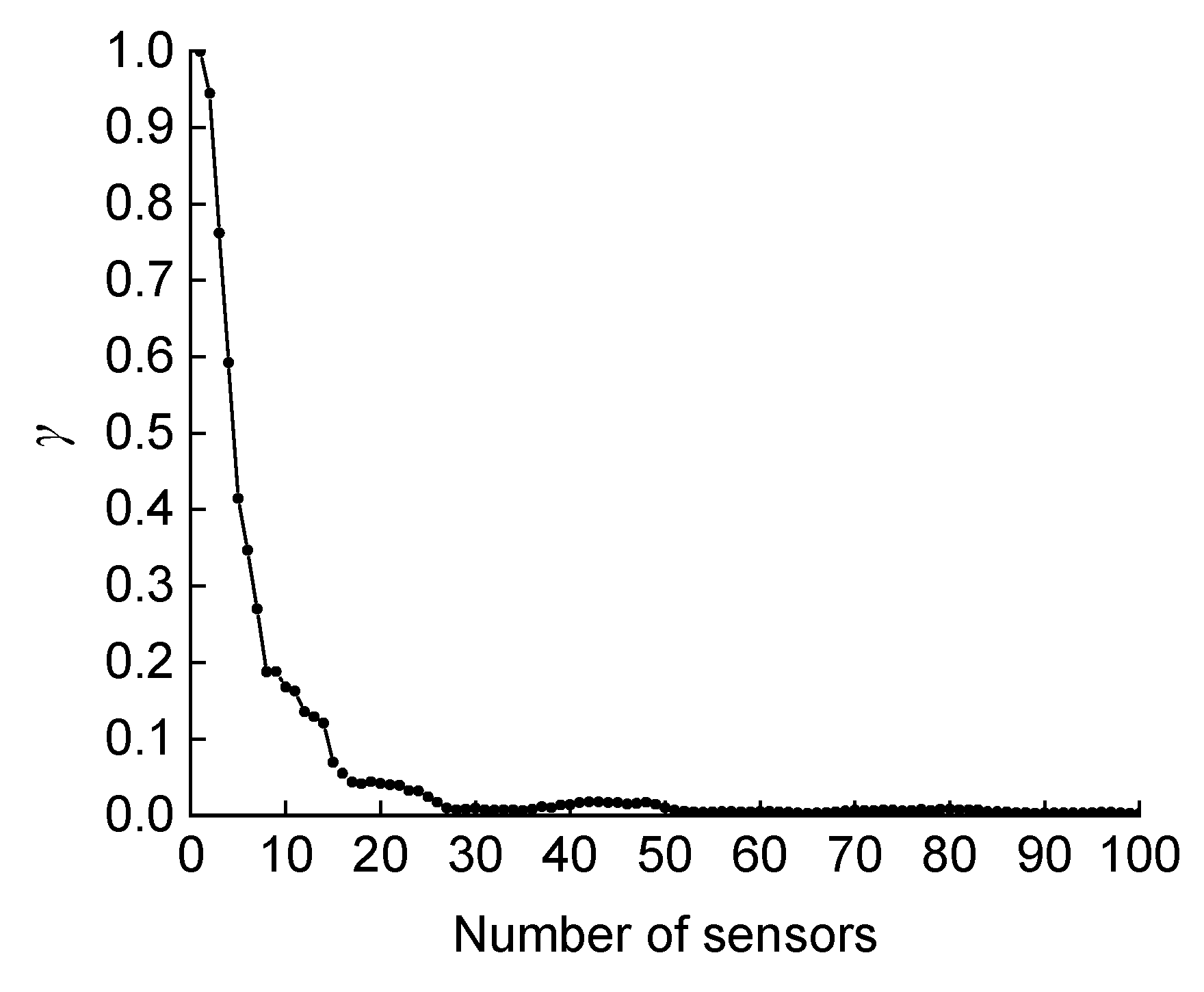
The
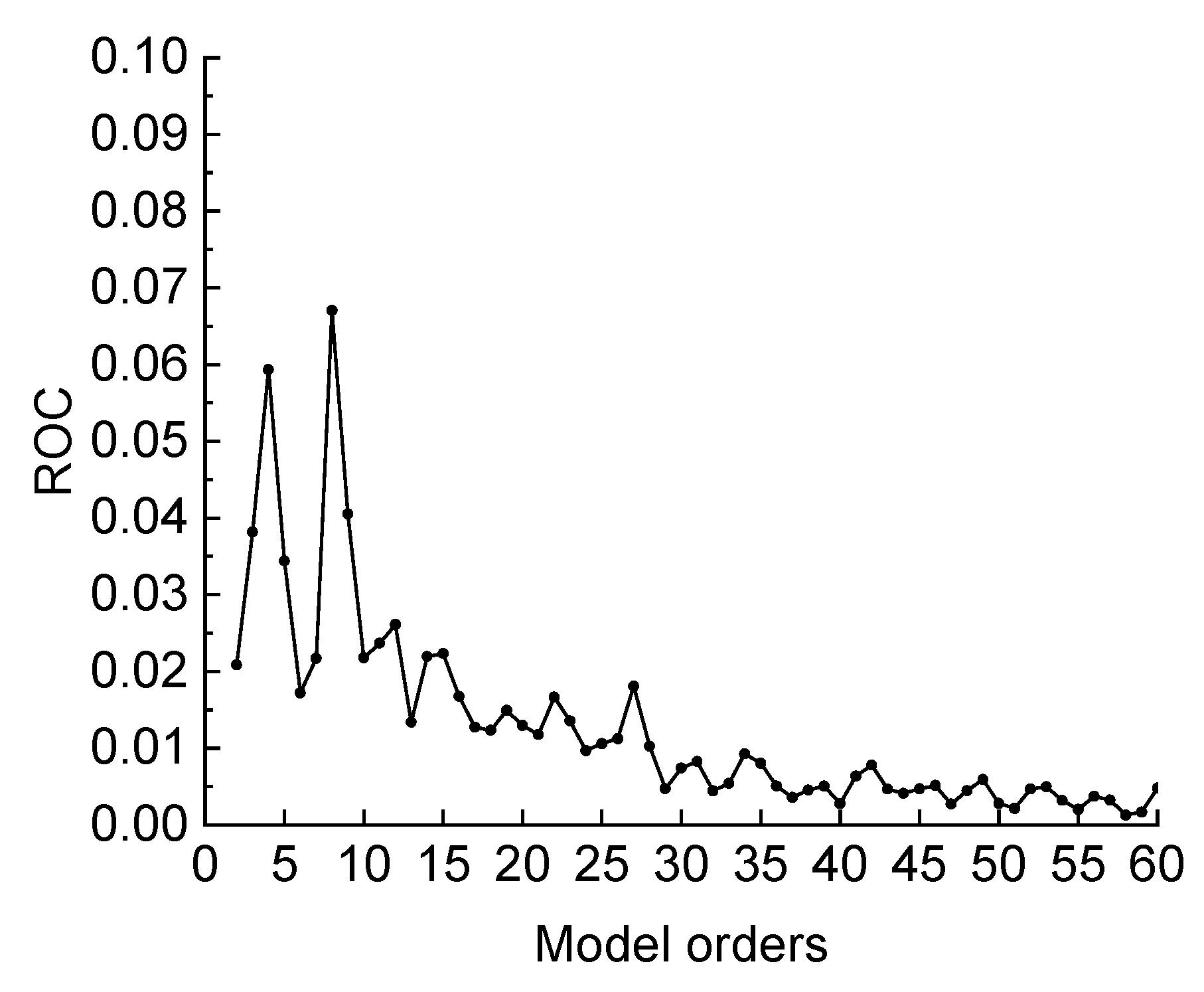
variation curve for the main members of the transmission tower is shown in
Figure 4. As illustrated, the
value becomes nearly constant when the modal order exceeds 30. Therefore, to preserve the completeness of the modal information, the first 30 modes are selected as the target modes for OSP. It is evident from the curve that the
value changes only slightly when the modal order reaches 30 and subsequently gradually stabilizes, with no significant variation thereafter. These results indicate that the first 30 modal orders are the dominant modes relevant to structural safety. Accordingly, the target modal number
is set to 30.
3.4. Determination of the Minimum Number of Sensors
For the structural health monitoring of transmission towers, the objective of sensor optimization is not to maximize the number of sensors, but to determine the minimum number required to reduce the number of non-separable modes to a level that satisfies engineering requirements. This objective can be achieved by combining the EFI method with the MAC, as proposed by Zhou et al. [
12]. According to the improved EFI-based method, the minimum number of sensors can be determined from the variation curve of the maximum off-diagonal element of the MAC matrix using the following procedure:
Set the initial number of sensors m to 2;
Employ the EFI method to obtain the sensor placement scheme;
Extract the mode shape matrix Φ from the modal analysis results, with dimensions of ;
Calculate the values and record the maximum off-diagonal element ;
Increase the number of sensors m and repeat steps 2–4;
Plot the variation curve of the maxMAC with respect to the number of sensors, and determine the minimum number of sensors for OSP.
Figure 5 illustrates the variation in the maxMAC
with respect to the number of sensors. The maxMAC
decreases rapidly as the number of sensors increases from 0 to 15. After the sensor count reaches 15, the curve gradually stabilizes, and the maximum off-diagonal element of the Gram matrix changes by only 0.001–0.01 for each additional sensor. This indicates that further increasing the number of sensors yields only marginal improvement in reducing the maximum off-diagonal element, that is, in improving modal orthogonality. By balancing monitoring performance and economic cost, and considering previous studies suggesting that the threshold of the maximum off-diagonal element can be set to 0.25, the optimal number of sensors for the transmission tower monitoring system is determined to be 10.
3.5. Optimal Sensor Placement Adopting MPA Method
In the process of determining the sensor quantity, the initial placement schemes were first obtained using the EFI method. The MPA was then employed for further optimization of sensor locations, with the population size set to 50, the maximum number of iterations set to 300, the probability set to 0.2, and the search domain restricted to the main load-bearing members of the transmission tower. The MPA was executed three times with different random seeds. A small standard deviation confirms the robustness and repeatability of the optimization results. The algorithm converges smoothly within the maximum number of iterations. Four indicators were adopted as the fitness functions for the MPA, namely the FIM 2-norm, the maximum off-diagonal element of the MAC matrix, the SDVR of the mode shape matrix, and the proportion of MKE, as described in the previous section.
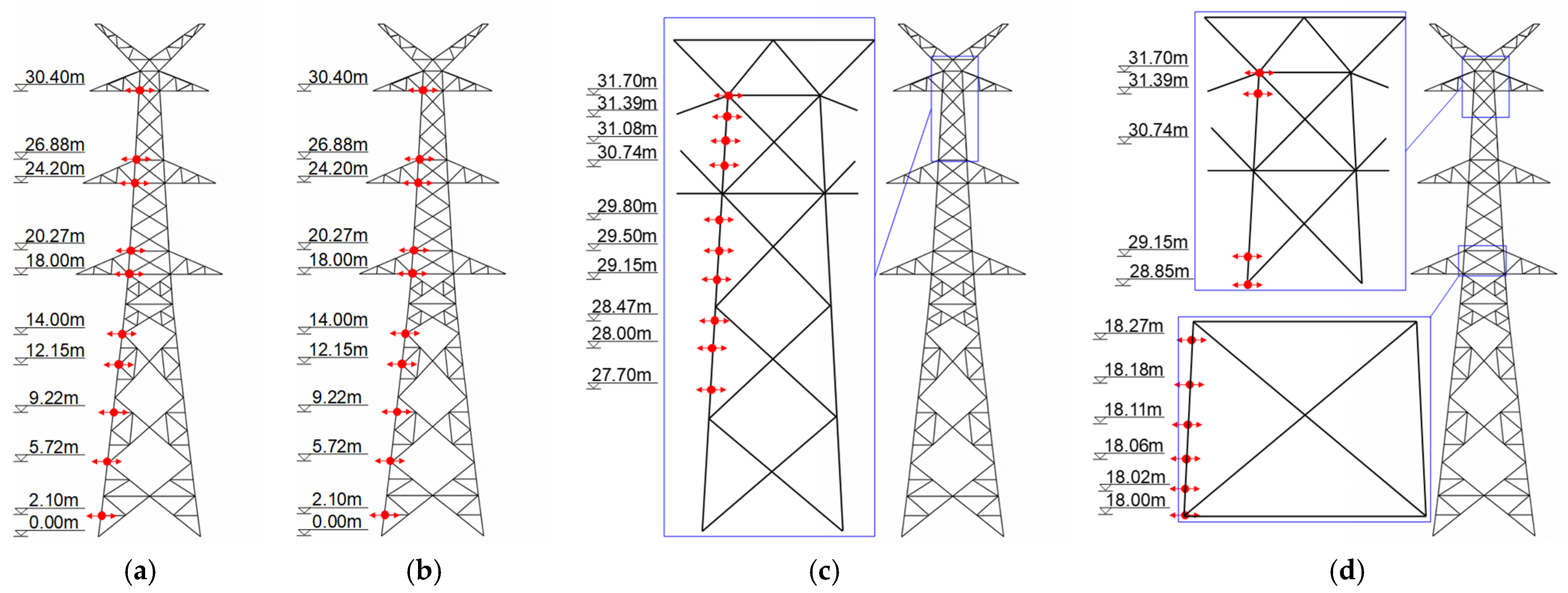
The sensor layout schemes obtained using different fitness functions are presented in
Figure 6, and the corresponding fitness values and sensor locations are listed in
Table 1. When the optimization objective is to minimize the off-diagonal elements of the MAC matrix, the sensors are distributed relatively uniformly over the key structural regions of the transmission tower after MPA optimization. This distribution reduces modal coupling and improves the accuracy of modal identification. Under this layout scheme, the SVDR of the mode shape matrix is 1.71, indicating a relatively low level of identifiability uniformity. However, the values of the FIM 2-norm and the proportion of MKE remain low, suggesting that the overall modal identifiability of the transmission tower and the sensitivity to its dominant vibration modes are still insufficient. When the FIM 2-norm and the MKE are used as the fitness functions, the sensors tend to cluster in local regions of the transmission tower, as shown in
Figure 6c,d. The corresponding SVDR values are markedly inferior and differ from those of the other optimization schemes by several orders of magnitude. Consequently, these layout schemes fail to capture the overall vibration response of the transmission tower adequately and substantially reduce the reliability of modal parameter identification based on monitoring data.
4. Discussion
In sensor placement optimization, different fitness functions lead to fundamentally distinct optimization trends. This discrepancy arises from the unique constraints and preferences imposed by each indicator on the extraction of modal information within the analytical framework. The optimization results obtained in this study validate this observation. As a complex spatial structure, a transmission tower exhibits substantial variation in its optimal sensor placement scheme when different optimization objectives are employed.
From a linear algebraic standpoint, optimization based on the MAC and SVDR is equivalent to achieving optimal sampling of the structural mode shape matrix in its column space. These mathematical properties require the sensor positions to capture the orthogonality characteristics of different modal vectors. Specifically, the MAC drives sensors to be distributed at spatial locations that can effectively distinguish different modal orders by minimizing the maximum correlation between modal vectors; in contrast, SVDR essentially requires the sensor layout to enhance the independence of the modal matrix column space by maximizing the singular value ratio of the modal matrix. Both metrics implicitly require sensors to comprehensively cover the nodal and antinodal regions of different mode shapes in physical space, thereby promoting a relatively uniform spatial distribution. Therefore, when the maximum off-diagonal element of the MAC matrix and SVDR are utilized as fitness functions, the MPA can achieve near-global optimal sampling of the modal matrix column space by balancing exploration and exploitation. As a result, the sensor locations are distributed relatively uniformly over the key structural regions of the transmission tower. Such arrangements are more effective for reconstructing the global mode shapes of the transmission tower using a limited number of measurement points, while preserving both modal orthogonality and modal-order distinguishability.
Optimization based on the FIM and MKE is essentially a single-objective convex optimization process, in which the extreme points of the objective function in Hilbert space often correspond to regions with the highest local energy or information density. Because such formulations lack explicit constraints on modal orthogonality and spatial coverage, the resulting sensor layouts are prone to converging into local optima and generating redundant information. The trace maximization of the FIM is, in essence, equivalent to maximizing the lower bound of parameter estimation accuracy. Its mathematical form can be decomposed into a weighted quadratic form of the derivatives of the modal vectors at the sensor locations. This process prioritizes regions that are highly sensitive to the parameters. However, because structural parameter sensitivity is often spatially aggregated, the sensors tend to cluster in a few highly sensitive regions. Similarly, the MKE index is directly related to the spatial distribution of modal kinetic energy, and its optimization process tends to select locations where the modal displacement amplitude is maximal. However, the kinetic energy peaks of higher-order modes are usually concentrated in specific areas, such as structural connections or regions near boundary constraints, making it difficult for the sensor layout to effectively cover other modal feature regions.
It should be noted that the OSP results presented here were obtained from deterministic finite-element modal analysis and therefore represent baseline sensor placement schemes under nominal structural conditions. In practical applications, environmental effects such as wind loading, ice accretion, and measurement noise may influence the identified modal parameters, which can in turn affect the absolute values of the fitness functions and the ranking of candidate sensor locations. Under extreme loading conditions, the occurrence of local or global instability, localized or distributed plastic deformation, and more general geometric and material nonlinear effects may alter modal frequencies, and geometric characteristics of mode shapes. Therefore, the spatial distribution of structural modal deformation can evolve markedly during and after critical events, which further influences sensor layout arrangement and monitoring performance [
37]. Given that a significant number of damage localization methods explicitly rely on changes in mode-shape features, some scholars have conducted in-depth explorations in these aspects and obtained fruitful research results [
38,
39,
40,
41]. Future work should incorporate environmental variability, model uncertainty, and measurement noise into a robust or data-updated OSP formulation.
5. Conclusions
To address the sensor placement problem for complex spatial transmission tower structures, this study proposes an MPA-based optimal sensor placement method integrating different fitness functions to satisfy the diverse performance requirements of structural health monitoring. Given its unique mechanism inspired by the foraging behavior of marine predators, the MPA offers notable advantages in balancing exploration and exploitation while escaping local optima. Consequently, it effectively avoids premature convergence and low solution accuracy, while successfully adapting to the discrete and constrained characteristics of transmission tower sensor optimization. When the MAC and SVDR are adopted as the fitness functions, the sensors are distributed relatively uniformly over the key structural regions of the transmission tower. In contrast, optimization based on the FIM and MKE leads to sensor clustering in a few highly sensitive regions of the structure.
The results further indicate that single-objective optimization is inadequate to accommodate the structural complexity and multiple performance requirements of transmission towers. Pursuing only modal orthogonality, as represented by the MAC and SVDR, can promote a relatively uniform sensor distribution for capturing global mode shapes, but may overlook fine-scale features in locally sensitive regions. Conversely, relying solely on information- or energy-density-based criteria, such as the FIM and MKE, can lead to excessive sensor concentration. Although this improves local monitoring capabilities, it compromises the completeness of modal coverage and adversely affects the reconstruction of higher-order modes. Therefore, future research should develop a weighted multi-objective optimization method that integrates multiple key indicators to balance conflicting optimization objectives and achieve a more comprehensive sensor placement scheme for practical transmission tower structural health monitoring.