Resilience Assessment of Building Hydrogen Energy Systems Under Extreme Climates: Environmental-Economic Synergistic Optimization Based on Emergy and Dynamic Simulation



Abstract
1. Introduction
2. Materials and Methods
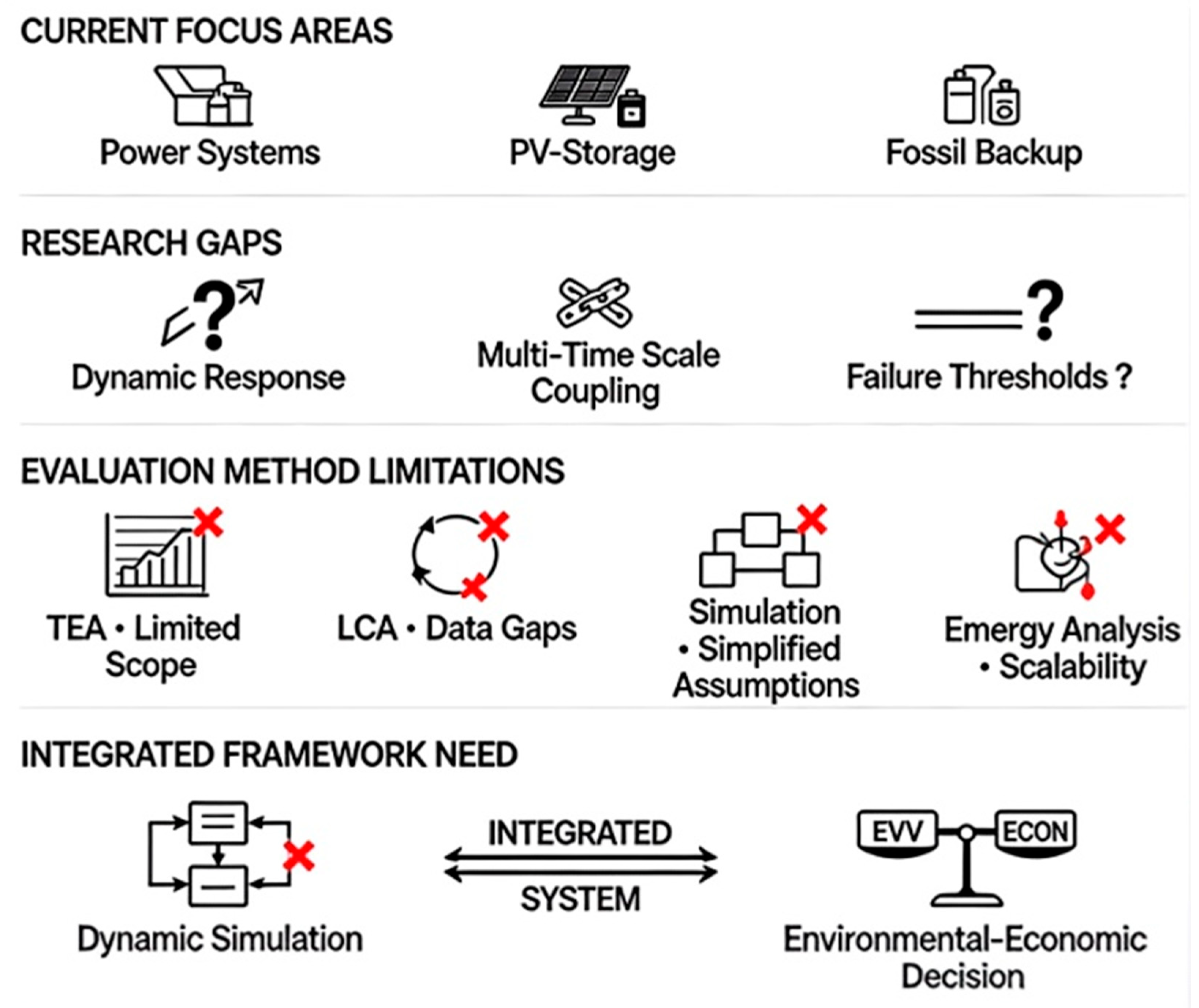
2.1. Problem Description
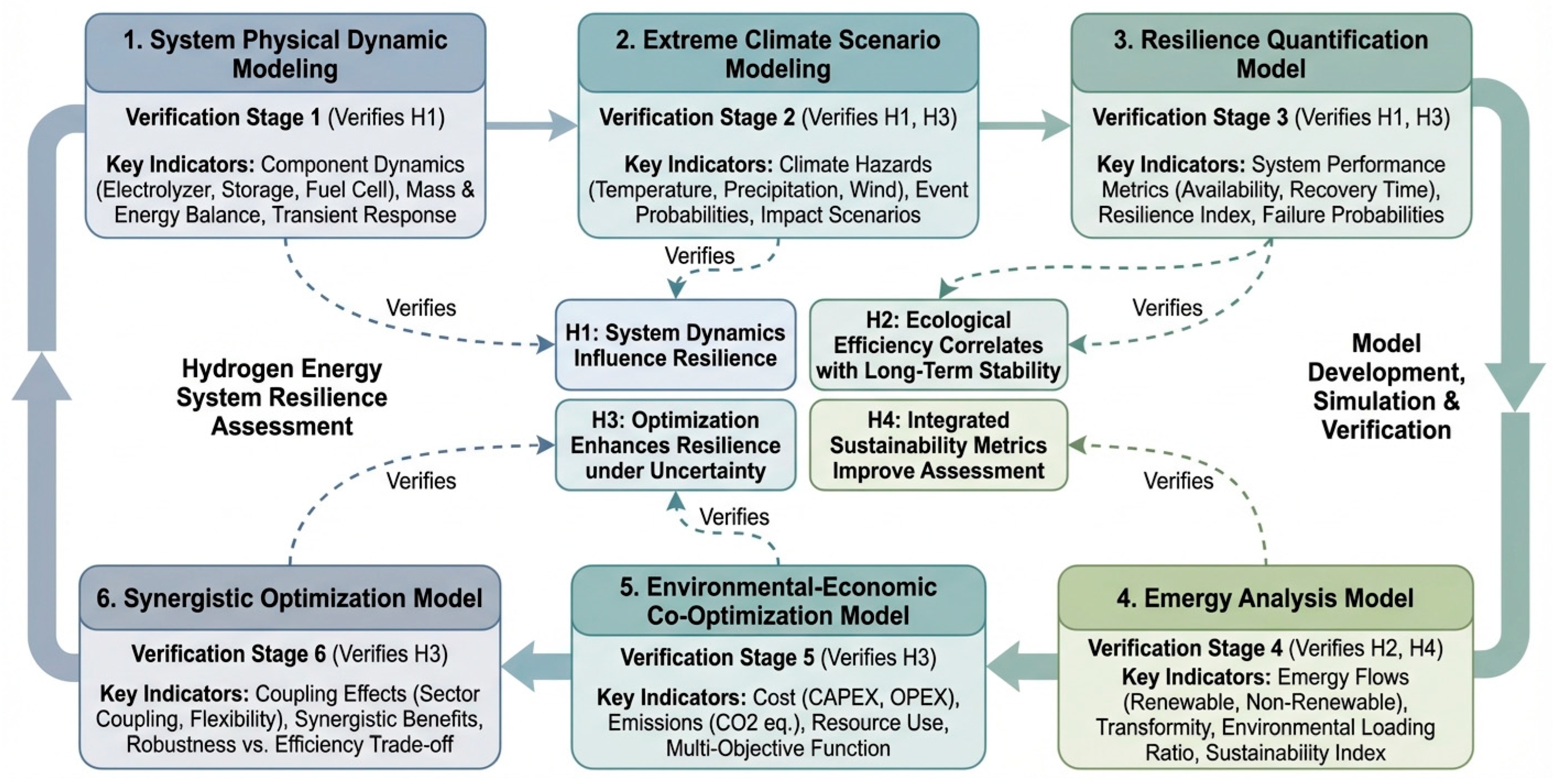
2.2. Research Framework
2.3. Research Hypothesis
2.4. Research Methods and Computational Models
2.4.1. Introduction to Emergy Analysis Methodology
2.4.2. Calculation Module
2.4.3. Explanation of Method Limitations
2.5. Research Indicator Group
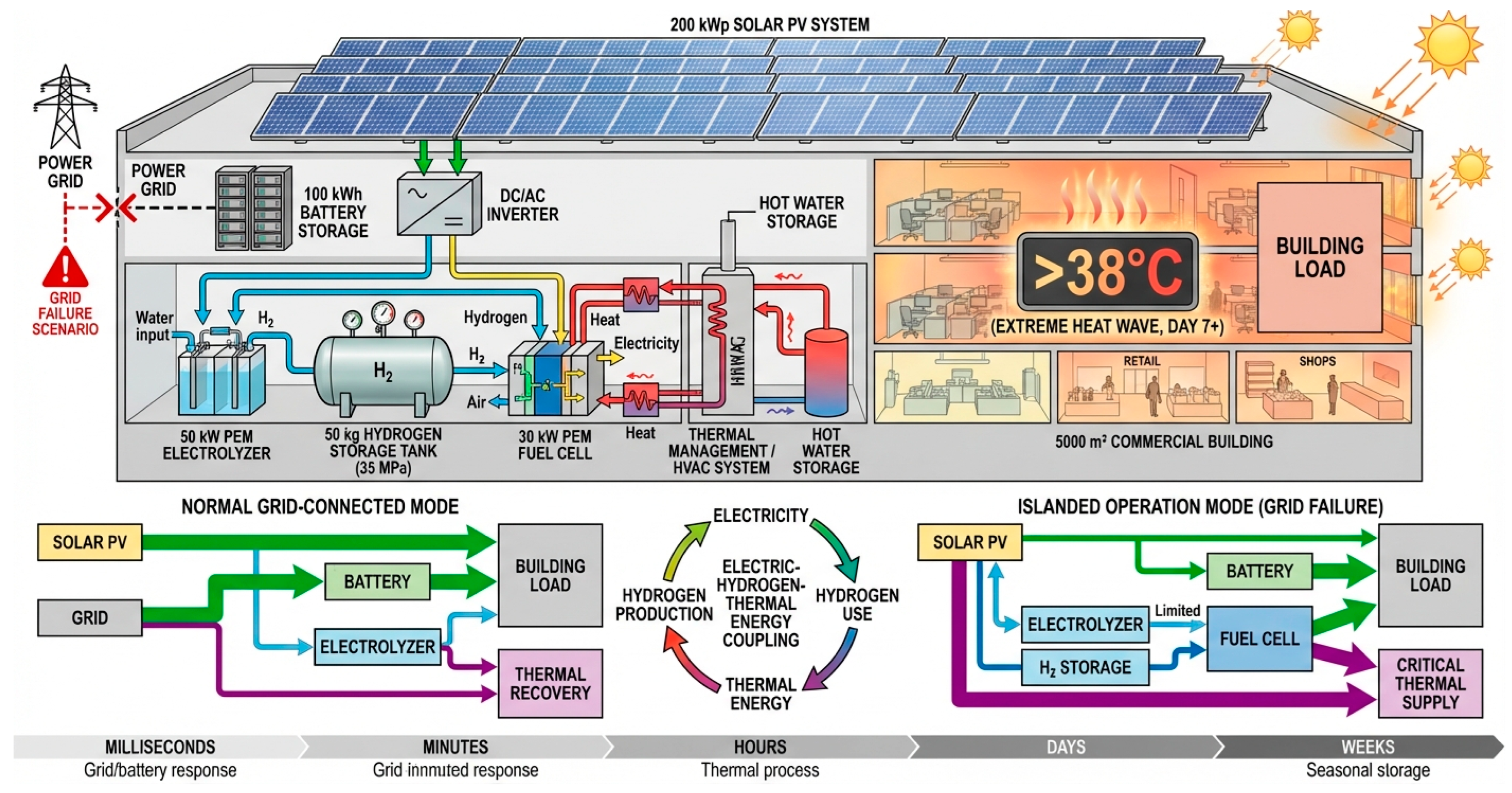
3. Research Scenario
4. Results and Discussion
4.1. Physical Model Validation (Validation of H1)
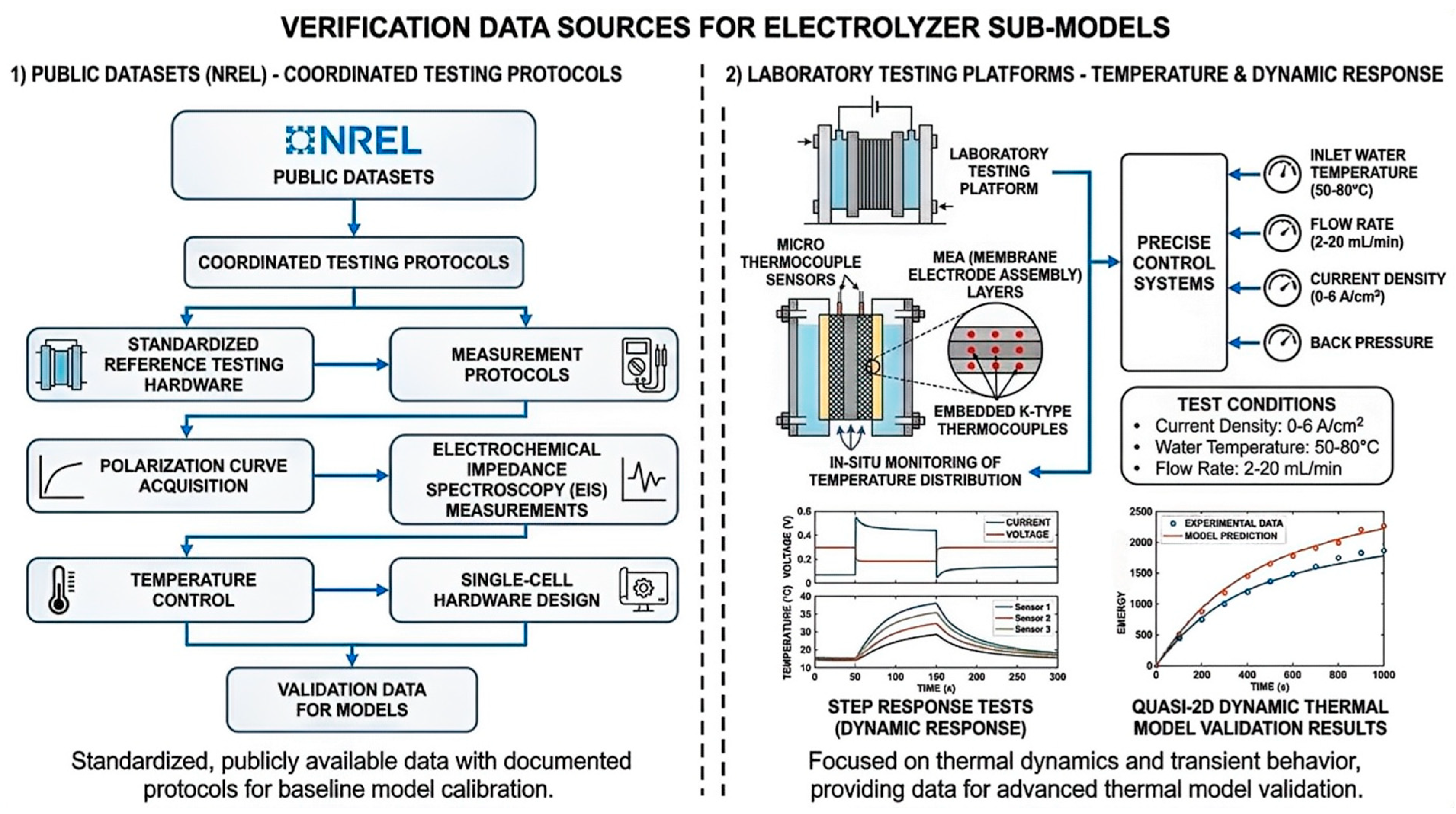
4.1.1. Model Verification of the Electrolytic Cell Sub-Model
4.1.2. Validation of the Sub-Model of Fuel Cells
4.1.3. Validation of Hydrogen Storage and Battery Sub-Models
4.1.4. Integrated Verification of Multi-Energy Coupling Systems
4.2. Extreme Climate Scenario Validation (Validation of H1, H3)
4.2.1. Extreme Value Distribution Fitting Test
4.2.2. Extreme Climate Scenario Generation and Validation
4.3. Validation of the Resilience Quantification Model (Validation of H1, H3)
4.3.1. Verification of Performance Function Sensitivity
4.3.2. Consistency Test of Resilience Indicators
4.3.3. Monte Carlo Uncertainty Propagation
4.4. Validation of Emergy Analysis Model (Verification of H2, H4)
4.4.1. Emergy Transformity Verification
4.4.2. Reasonableness Test of Emergy Index
4.4.3. Validation of Emergy–Economic Coupling
4.5. Economic Model Validation (Validation of H2, H3)
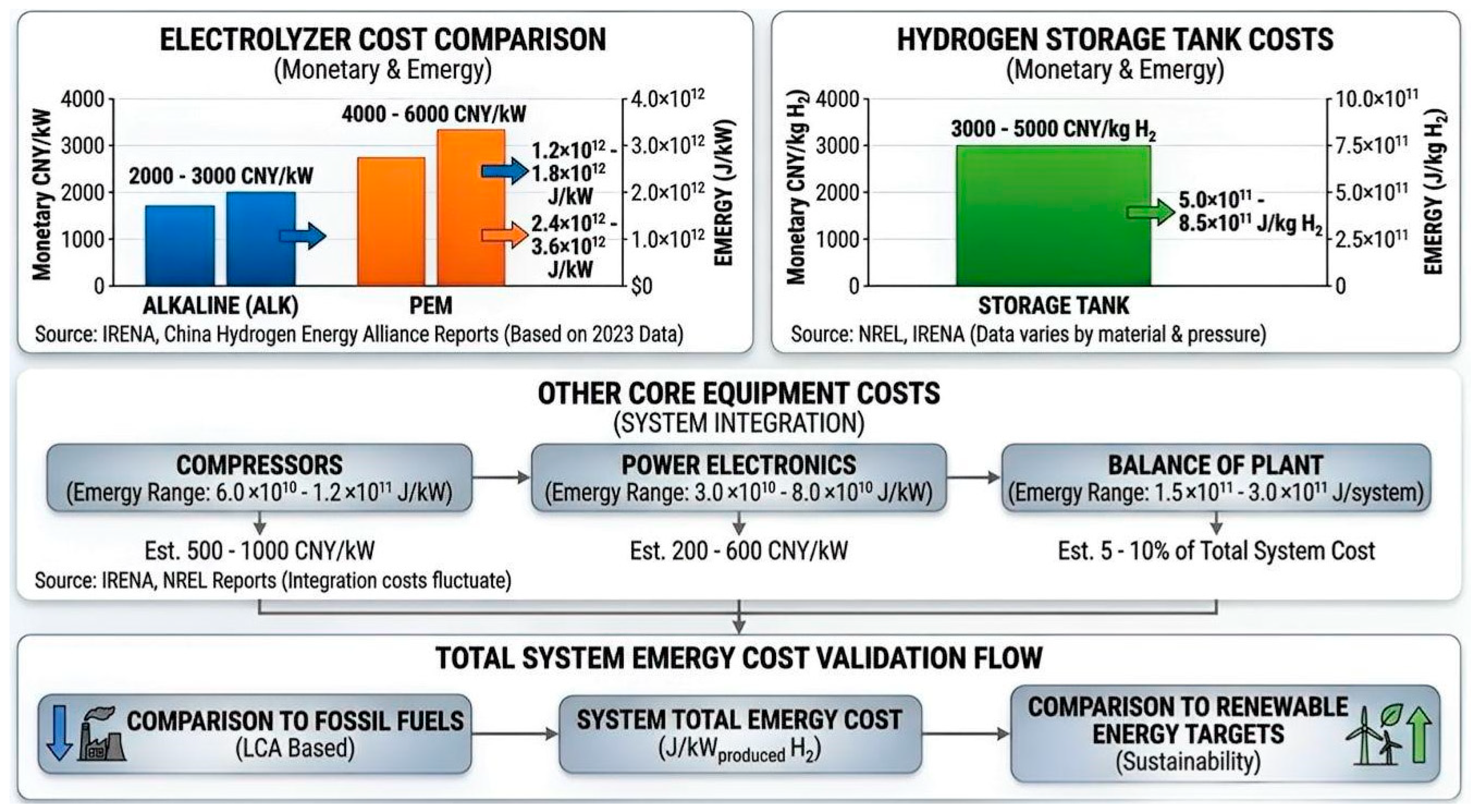
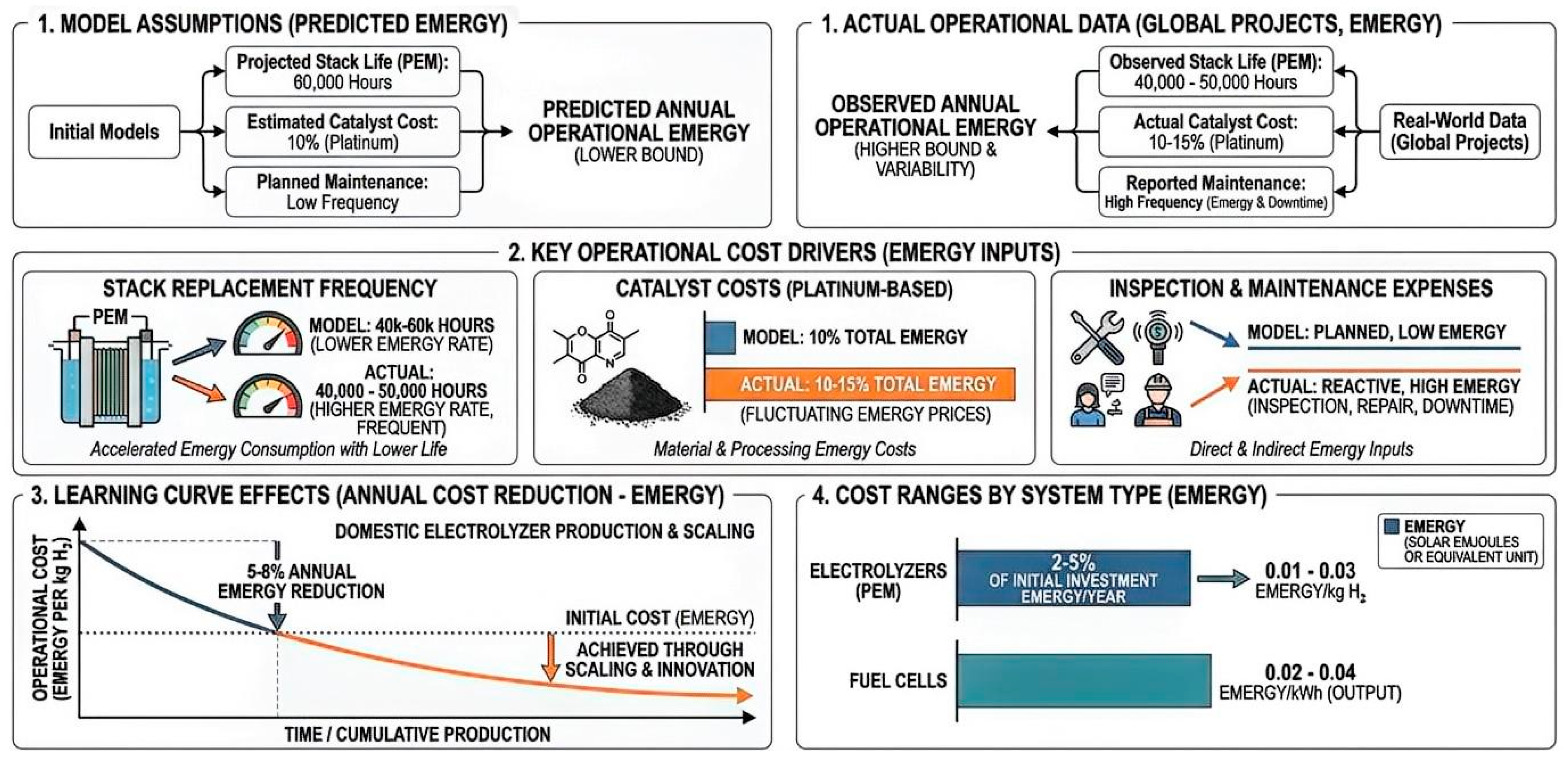
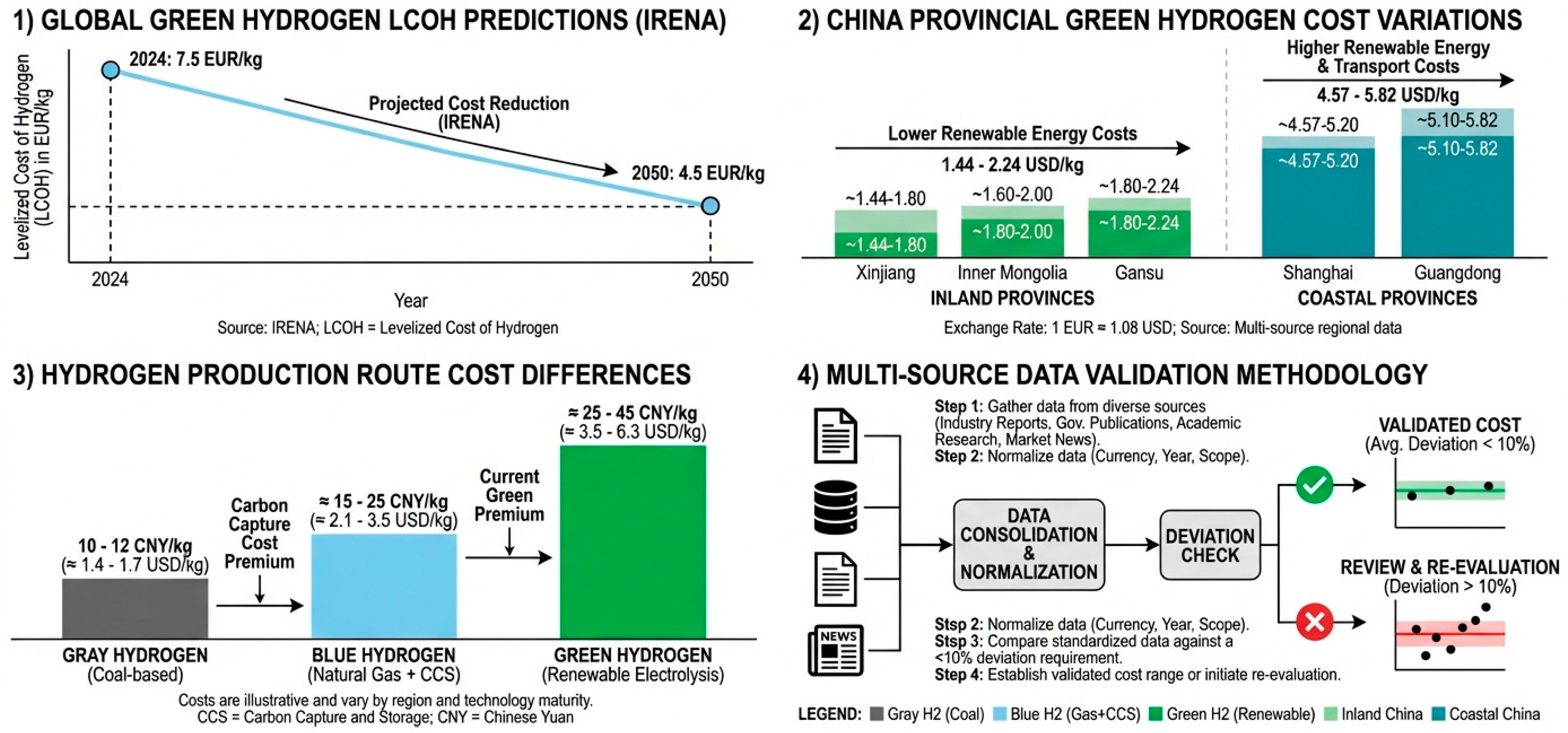
4.5.1. Cost Parameter Verification
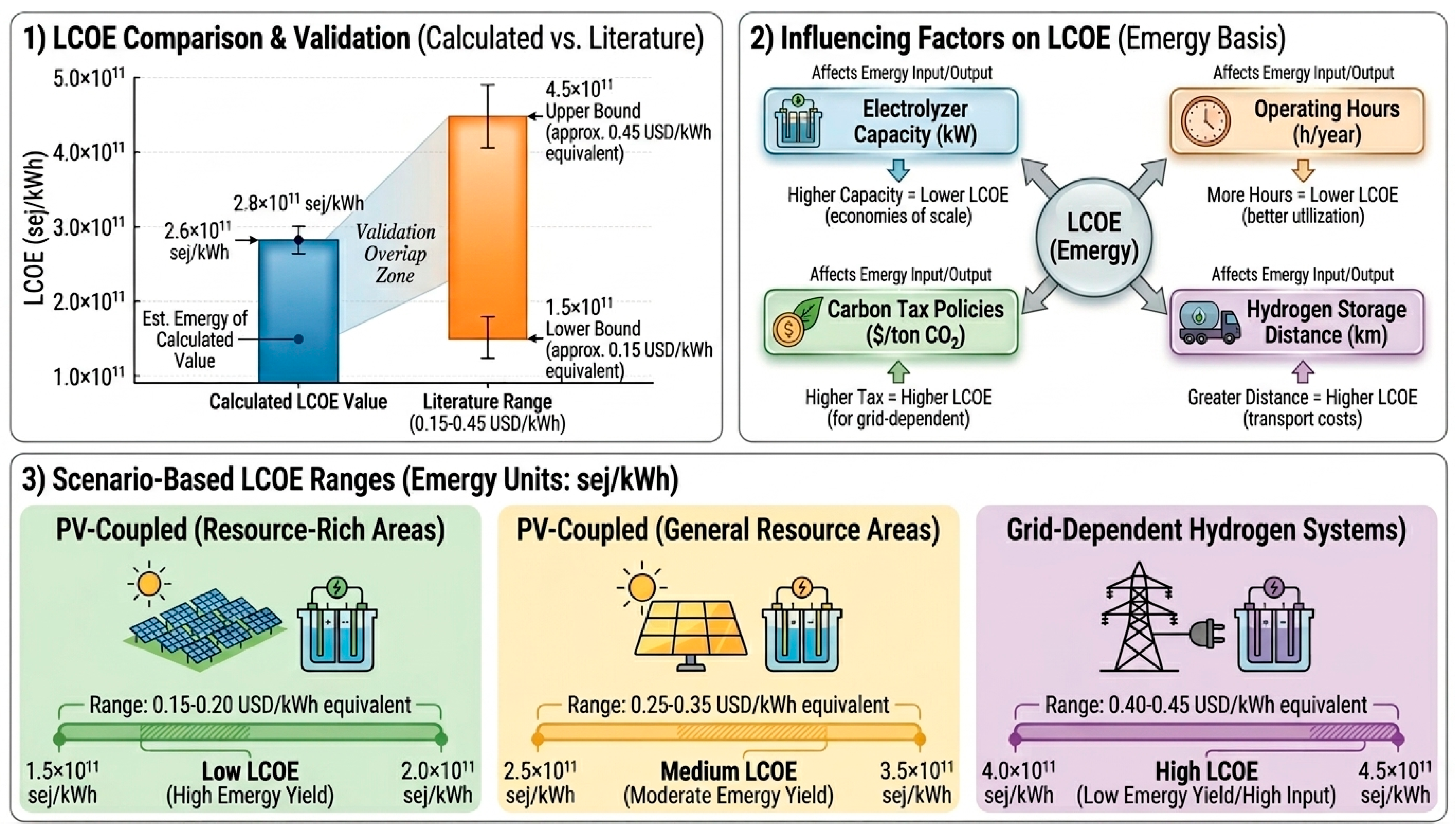
4.5.2. Economic Indicator Verification
4.6. Validation of the Collaborative Optimization Model (Validation H3)
4.6.1. Verification of Multi-Objective Optimization Algorithms
4.6.2. Verification of the Collaborative Optimal Solution
4.6.3. Assume Direct Verification of H3
5. Research Findings, Engineering Recommendations and Future Suggestions
5.1. The Role of Research
5.2. Engineering Proposal
- (1)
- For public buildings in coastal cities of the hot summer and cold winter zone, it is recommended that the hydrogen energy system configuration adopt a combination scheme with an electrolyzer capacity of 50–60 kW, a hydrogen storage tank volume of 50–70 kg, a fuel cell capacity of 30–40 kW, and a battery energy storage of 80–120 kWh. This configuration can ensure that the power supply guarantee rate for critical loads is no less than 95% in the scenario of a once-in-a-century heatwave and power grid failure, control the resilience loss area within 50 h, increase the life-cycle cost by approximately 12% compared to the benchmark scheme, keep the environmental load rate between 4.0 and 4.5, and reduce the ecological cost by about 35% compared to the diesel backup scheme.
- (2)
- In the system design and equipment selection, the matching relationship between the electrolyzer capacity and the hydrogen storage capacity should be given priority. The verification results show that when the ratio of the electrolyzer capacity to the hydrogen storage volume is maintained within the range of 1:1.2 to 1:1.8, the system’s resilience-cost efficiency is optimal. A ratio lower than this leads to insufficient hydrogen storage, affecting the duration of island operation, while a ratio higher than this results in excessive equipment redundancy and increased investment costs.
- (3)
- To address the contradiction between the fluctuation of photovoltaic output and the sharp increase in cooling load during heat waves, it is suggested to introduce a load classification management mechanism in the control strategy: the first-level load (data centers, emergency lighting, medical equipment) is given priority for guarantee; the second-level load (ordinary lighting, elevators) is dynamically adjusted based on the hydrogen storage status and battery SOC; the third-level load (non-critical equipment) can be actively disconnected in extreme scenarios. The control response delay should be controlled within 5 s to ensure that the hydrogen energy system can quickly establish an island operation state after a grid failure.
- (4)
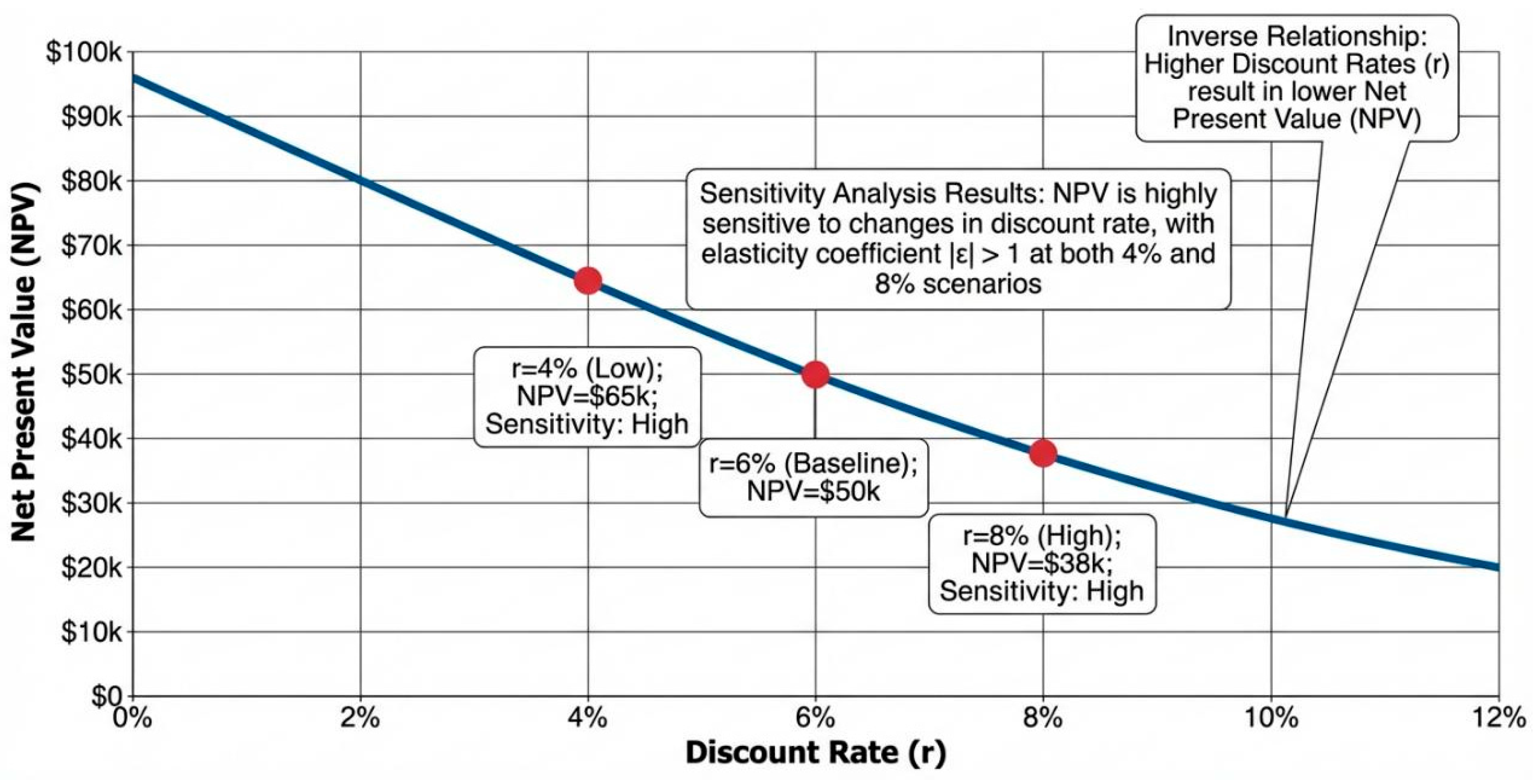
- From an economic perspective, it is recommended to adopt multi-scenario discount rate analysis (social discount rate of 4%, project discount rate of 6%, and risk discount rate of 8%) in the full life cycle evaluation of the project, fully considering the downward trend of hydrogen fuel costs (4–6% per year) and the impact of carbon tax policies. The verification results show that when the carbon tax exceeds 50 yuan per ton of carbon dioxide equivalent, the environmental and economic comprehensive benefits of the hydrogen energy system are significantly better than those of the traditional fossil energy backup plan. It is suggested to prioritize promotion in regions with greater policy support.
- (5)
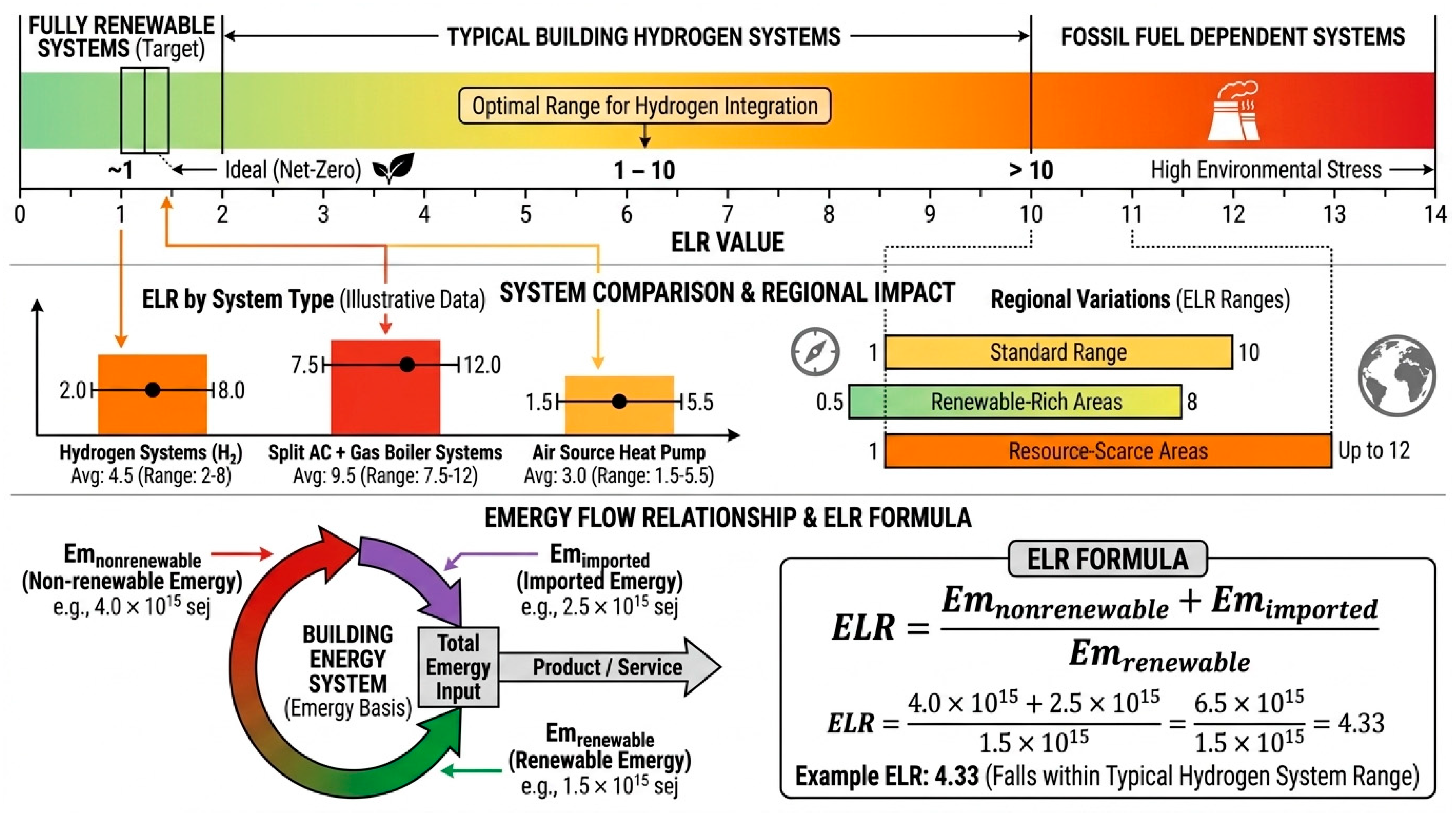
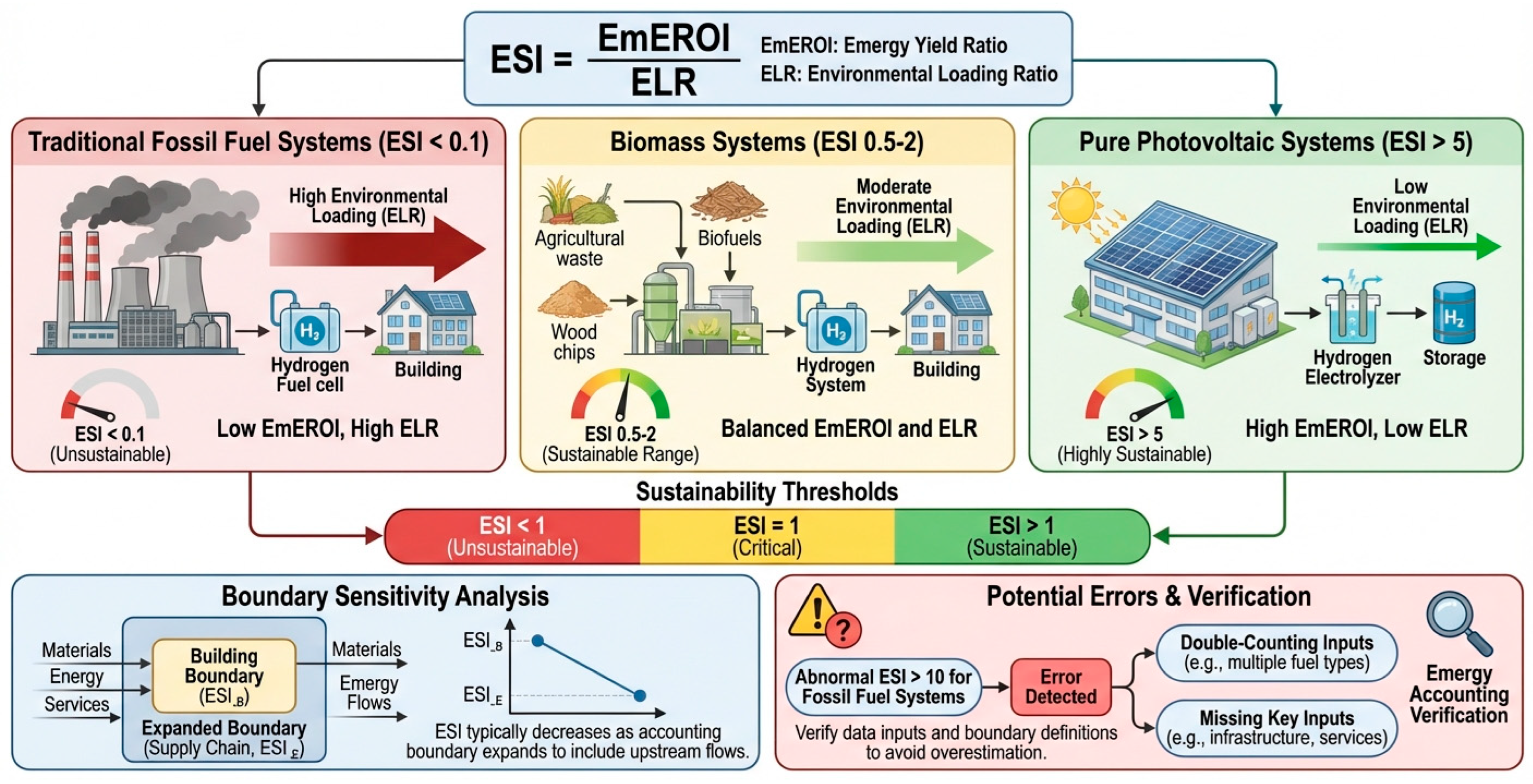
- From the perspective of ecological sustainability, it is recommended to conduct an emergy analysis during the design stage to ensure that the environmental load rate is kept below 4.0 and the emergy sustainability index is greater than 0.8. For schemes with an ELR higher than 5, the proportion of local photovoltaic power generation should be increased or the operation strategy of the electrolyzer should be optimized to reduce the input of non-renewable emergy. For schemes with an ESI lower than 0.6, the system configuration should be re-evaluated or the low-carbon transformation of the regional hydrogen energy supply chain should be considered. Sixth, in response to uncertainties during project implementation, a modular design strategy is suggested, where electrolyzers and hydrogen storage tanks are configured as unit modules, facilitating gradual expansion based on actual operation data and risk perception. When purchasing key equipment, manufacturing tolerances should be strictly controlled, especially the capacity deviation of electrolyzers should be kept within ±5% to prevent a decline in resilience performance due to parameter fluctuations.
5.3. Future Research Directions
- (1)
- This study adopted the stationarity assumption of the generalized extreme value distribution in the modeling of extreme climate scenarios, which assumes that the statistical characteristics of the extreme value sequence do not change over time. However, under the background of climate change, the frequency and intensity of extreme temperatures show a clear non-stationary trend. The intensity of extreme high temperatures in the study area during summer is increasing at a rate of approximately 0.3 to 0.5 degrees Celsius per decade. If this trend is extrapolated to future climate scenarios, the actual intensity of once-in-a-century extreme temperatures may be 1.5 to 2.5 degrees Celsius higher than the predicted values under the stationarity assumption. This implies that in the long-term climate evolution, extreme event intensity predicted by extreme value models fitted based on historical data may be underestimated, leading to insufficient conservatism in resilience assessment. To address this limitation, in subsequent research, a time-varying parameter generalized extreme value model will be introduced, incorporating global average temperature or local climate indices as covariates into the evolution equations of the location and scale parameters to construct a non-stationary extreme value model. Meanwhile, for infrastructure projects with longer design lifespans, future studies will adopt scenario analysis methods, combining climate prediction data under different carbon emission pathways to conduct interval estimation of the recurrence period thresholds of extreme events, thereby enhancing the adaptability of resilience design to climate uncertainties.
- (2)
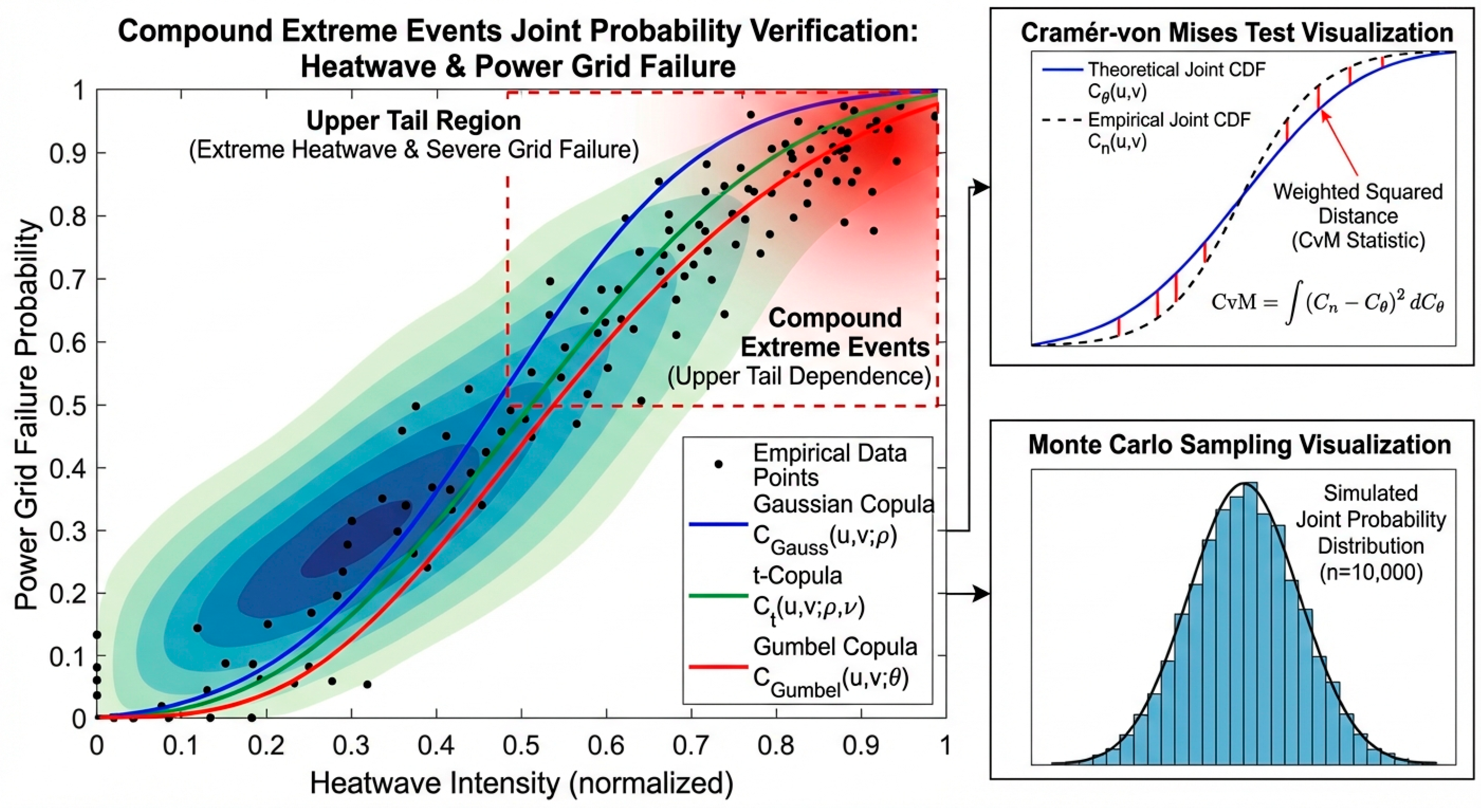
- In this study, the probability of grid failure is not endogenously generated within the climate load function but is exogenously given as a statistical probability based on the fault records of the power department in the target city over the past two decades. There is only an empirical correlation between this probability and the intensity of heat waves rather than a physical causal mechanism. The joint distribution of heat wave intensity and grid failure probability essentially characterizes the statistical correlation, capturing the frequency of their co-occurrence in historical data rather than the physical transmission path of heat waves causing grid failure. The advantage of this approach lies in its ability to quickly generate composite event scenarios using publicly available data, meeting the demand for a large number of samples in resilience assessment. However, its limitation is that it cannot be extrapolated to extreme conditions lacking historical records. To address this limitation, this study only uses the statistical relationship of grid failure probability for generating input conditions of composite event scenarios, and the verification results show that the prediction deviation is within an acceptable range. Subsequent research will endogenize the grid failure probability as a function of climate load and establish a physical model of grid failure based on the thermal balance equation of transmission lines to achieve causal modeling of compound disasters.
- (3)
- Future research can be further expanded and deepened in the following directions. First, this study focuses on the resilience of a hydrogen energy system for a single building. Future research can be extended to community- or district-level multi-energy complementary systems, exploring collaborative scheduling and shared energy storage mechanisms for hydrogen across different building types, and quantifying the contribution of scale effects to resilience enhancement and environmental cost dilution. Second, the current extreme climate scenarios are based on statistical modeling of historical data and do not fully account for the evolution trends in the frequency and intensity of extreme events caused by the non-stationarity of climate change. Subsequent research can introduce climate model data to construct dynamic extreme value models targeting 2050 or 2100, evaluating the resilience adaptability of building-integrated hydrogen energy systems under long-term climate evolution. Third, the material emergy transformity coefficients used in emergy analysis rely on static literature data. Future research can combine material flow analysis with life cycle inventory databases to establish a dynamically updated localized emergy parameter library, thereby improving accounting accuracy. In addition, regarding control strategies, the current study adopts rule-based control. Future research can introduce model predictive control or deep reinforcement learning methods to achieve real-time optimization and adaptive adjustment of hydrogen system operation strategies under extreme events, further enhancing resilience response efficiency and economic performance.
6. Conclusions
- (1)
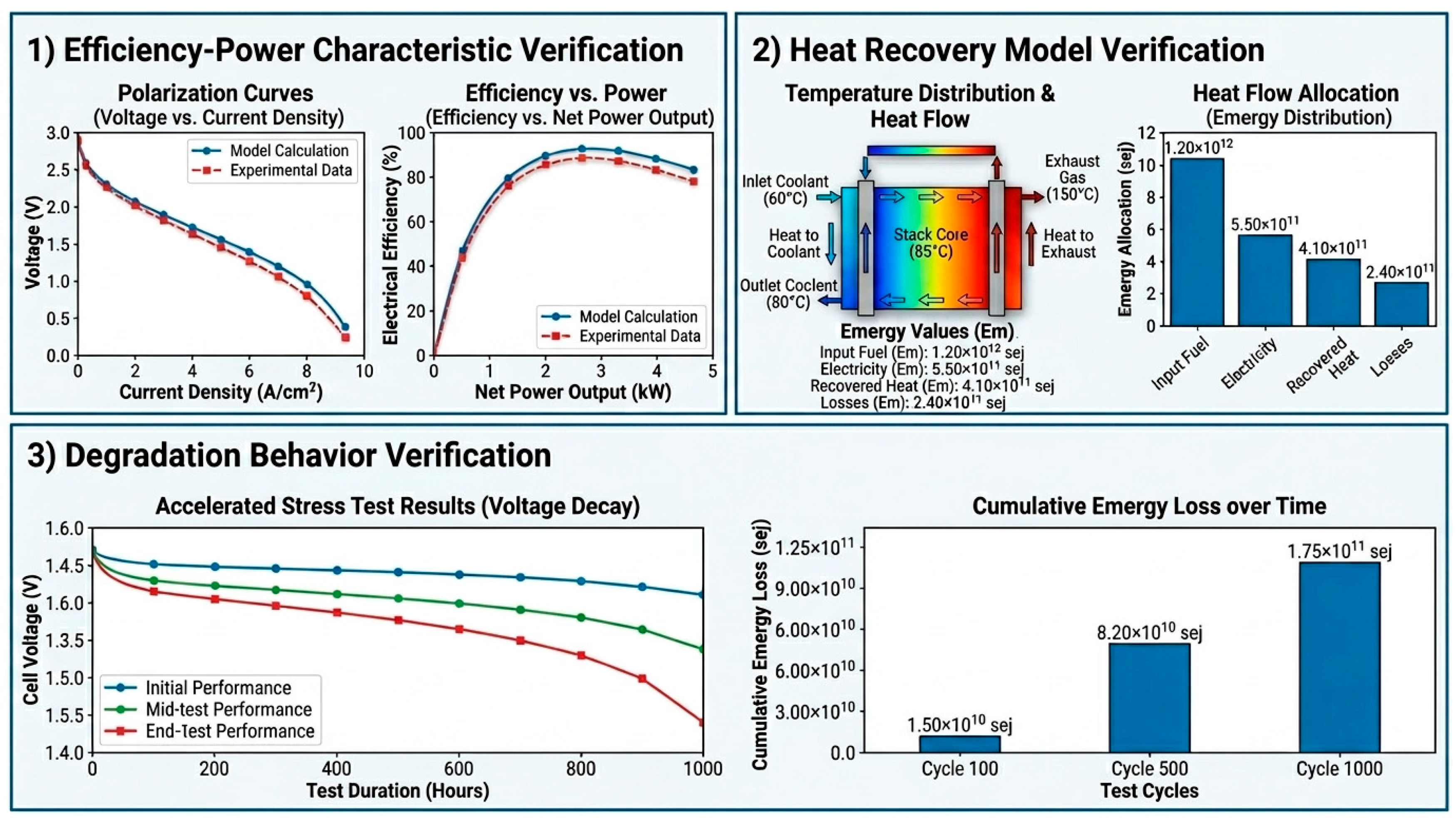
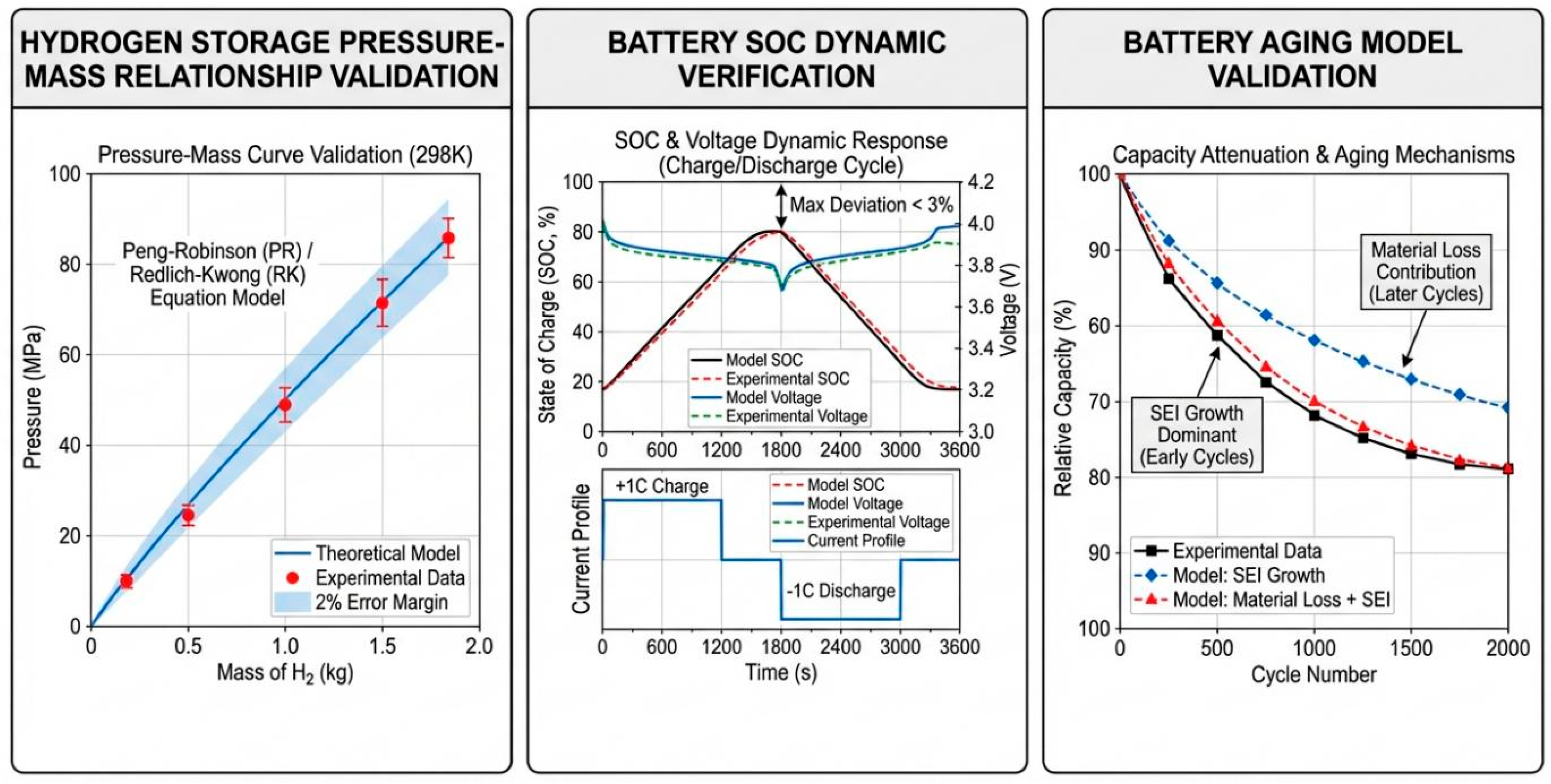
- Regarding the physical dynamic characteristics of the system, validation of the thermoelectric coupling models for the electrolyzer and fuel cell shows that the average deviation of the thermal time constant is controlled within 4.06%, the maximum deviation of battery SOC dynamics is 2.3%, the hydrogen storage pressure error is 1.8%, and the capacity degradation prediction error is 2.8%. All sub-models meet the preset acceptance criteria. The validation results support Hypothesis H1, namely that the resilience performance of hydrogen energy systems is constrained by the dynamic response delay of the “electricity–hydrogen–heat” multi-energy coupling, exhibiting nonlinear threshold characteristics jointly determined by energy storage status, climate intensity, and control logic.
- (2)
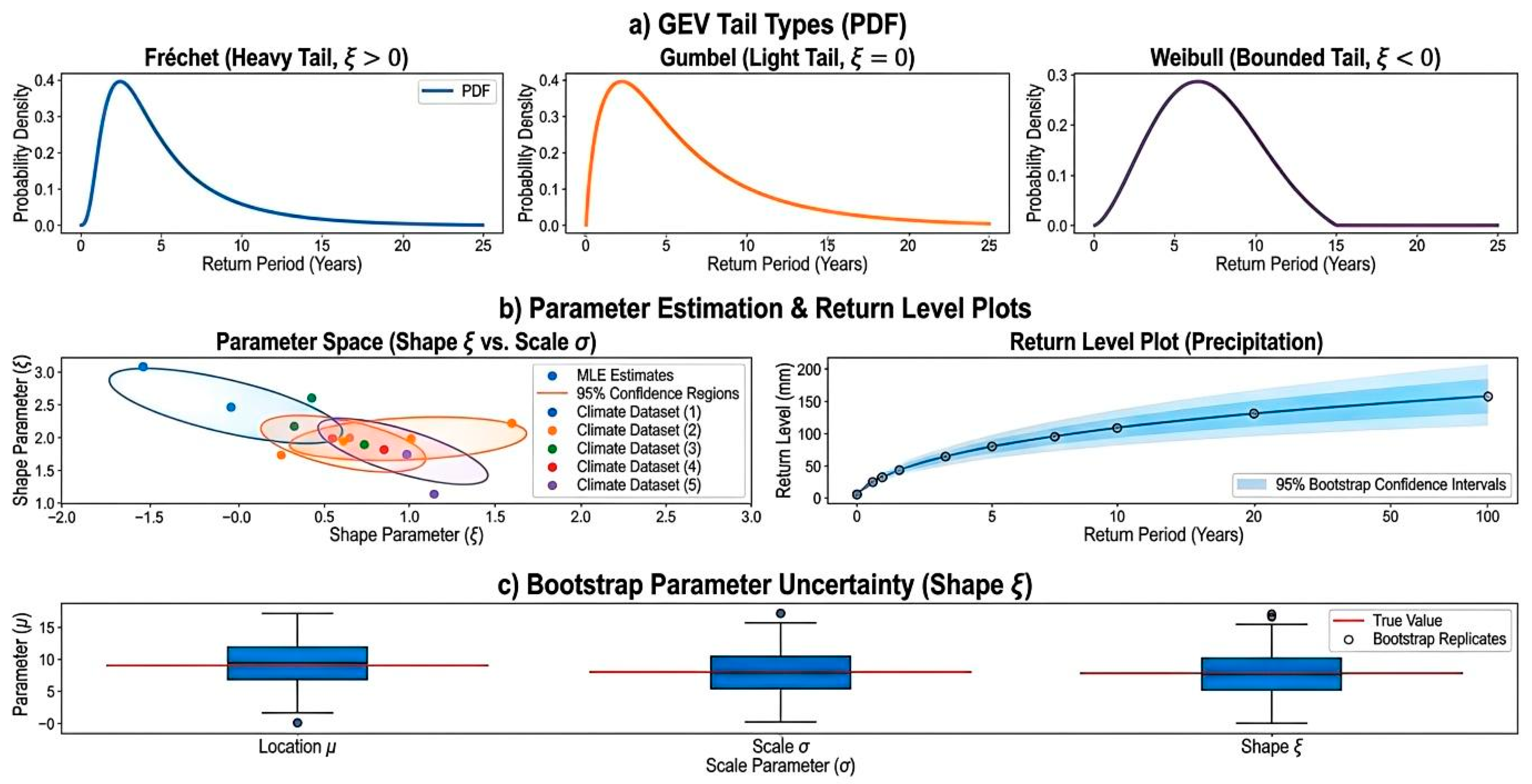
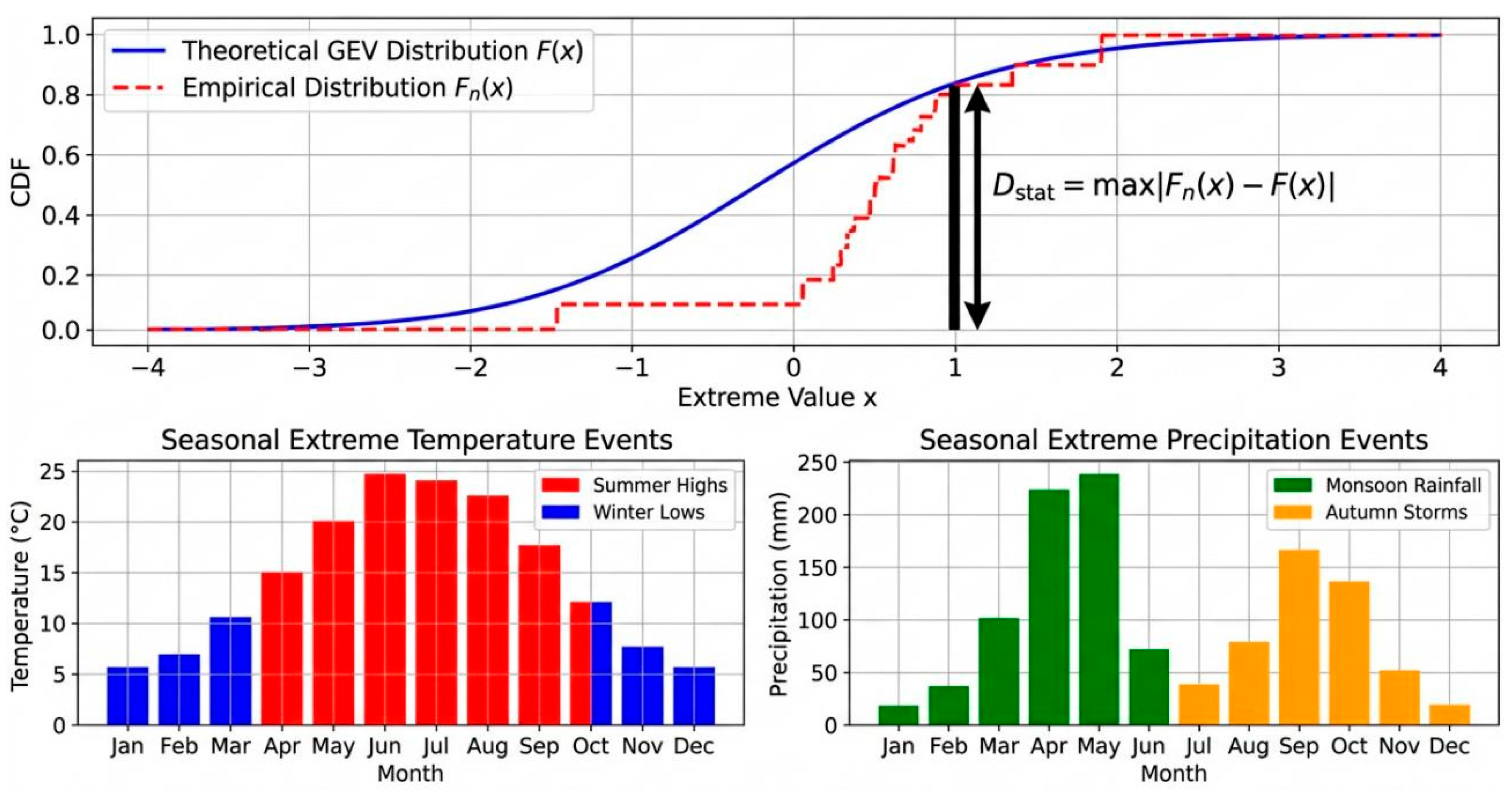
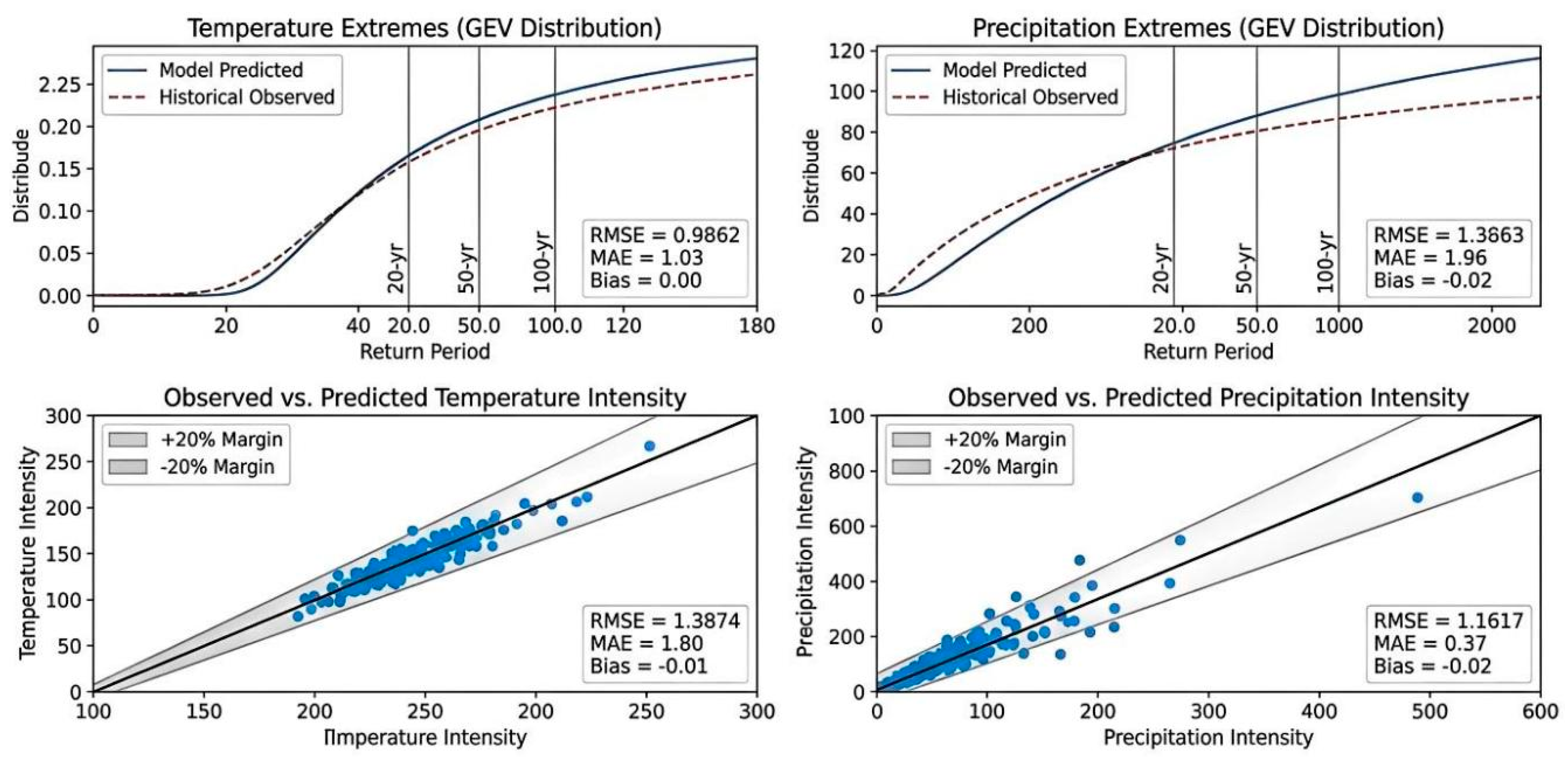
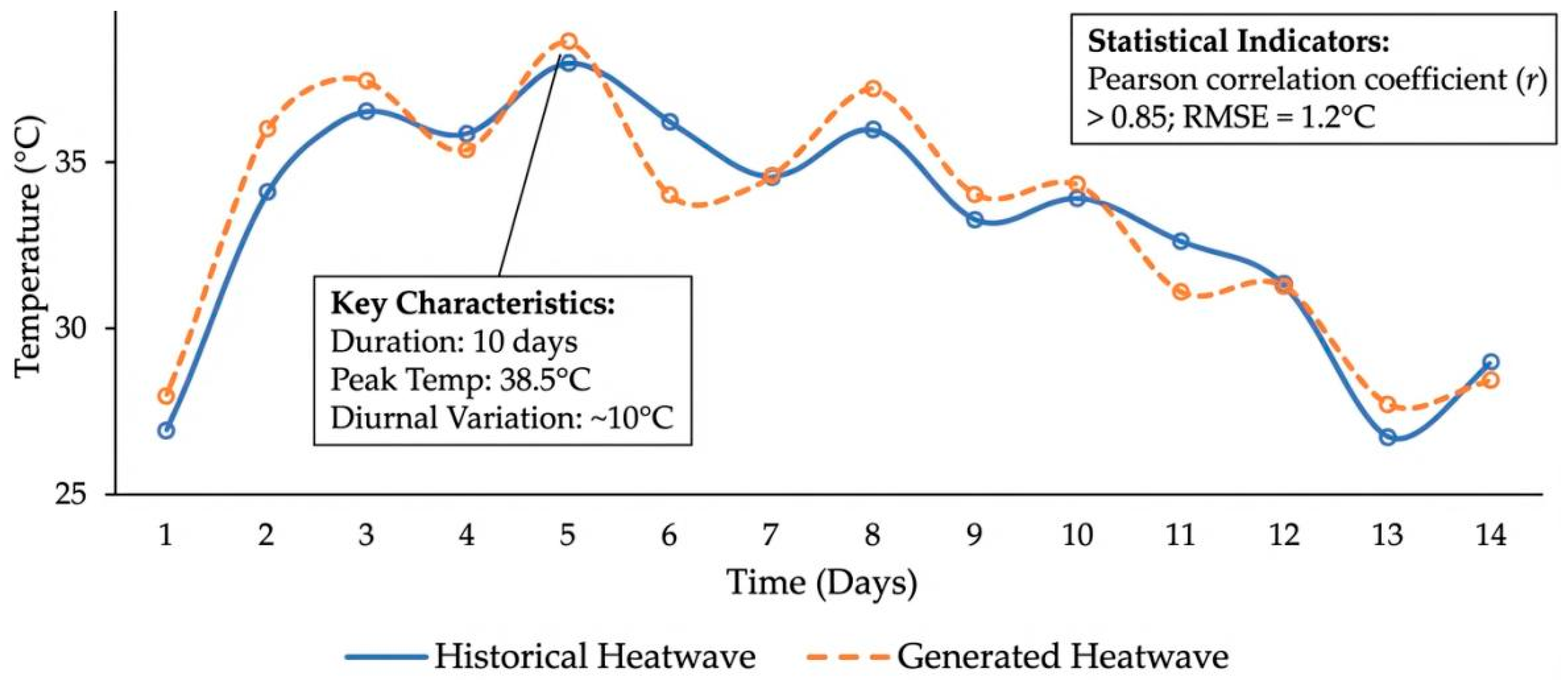
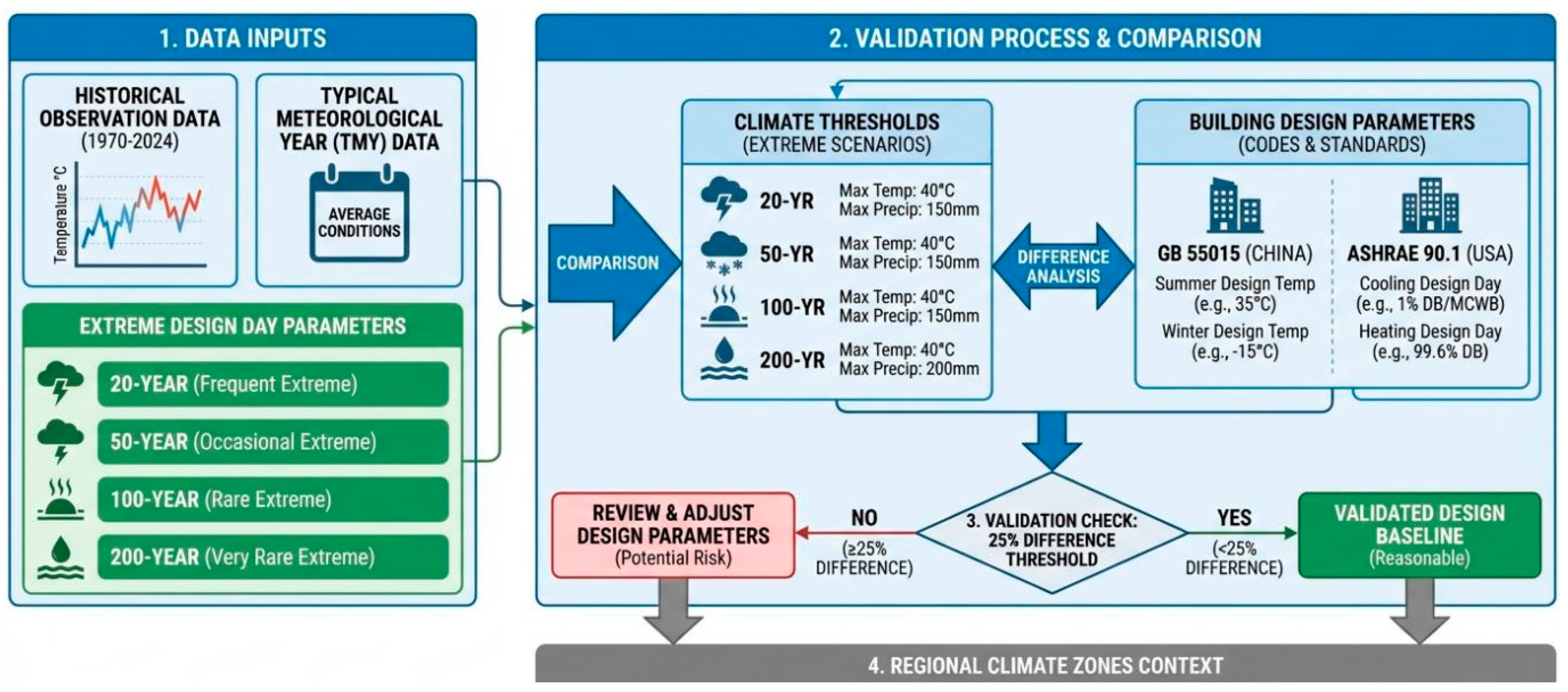
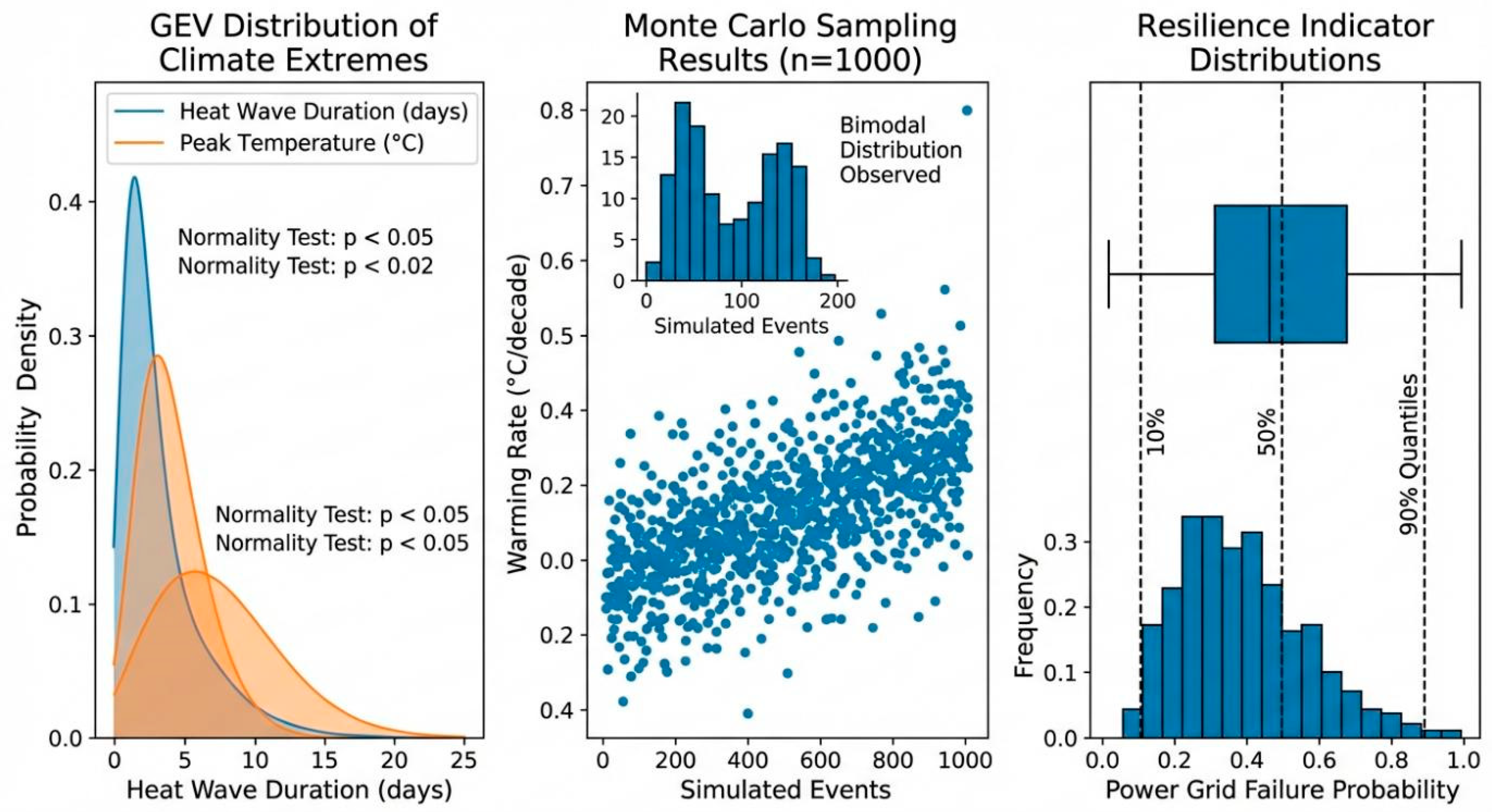
- In terms of extreme climate scenario modeling, the fitting test of the extreme value model based on the GEV distribution shows that the prediction deviations for the return periods of extreme temperature and precipitation events are both less than 2%, and the Pearson correlation coefficient between the generated heatwave scenarios and historical measurements reaches 0.94. The deviation between the designed benchmark events and building code comparisons is less than 25%, verifying the engineering applicability of scenario generation.
- (3)
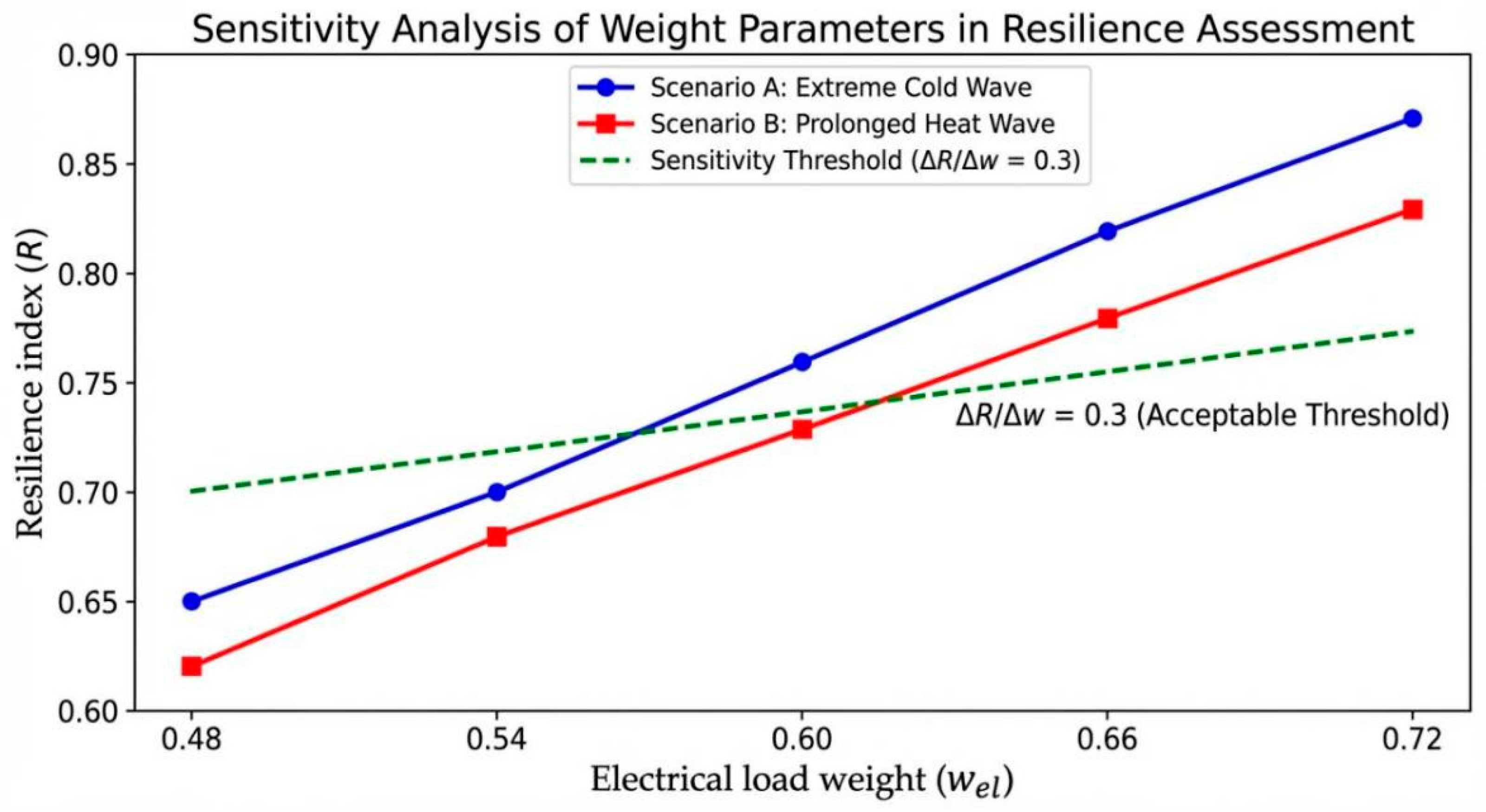
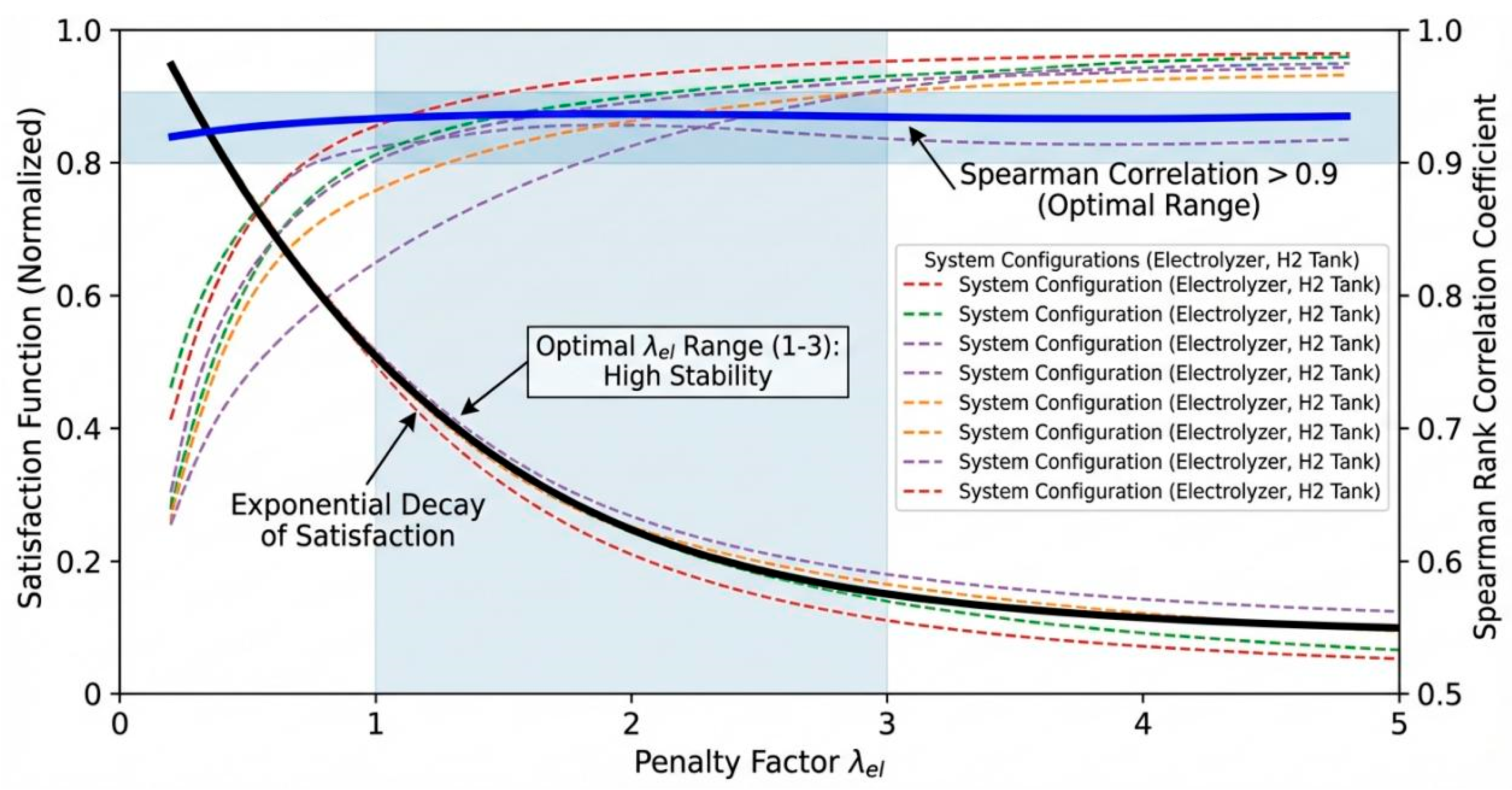
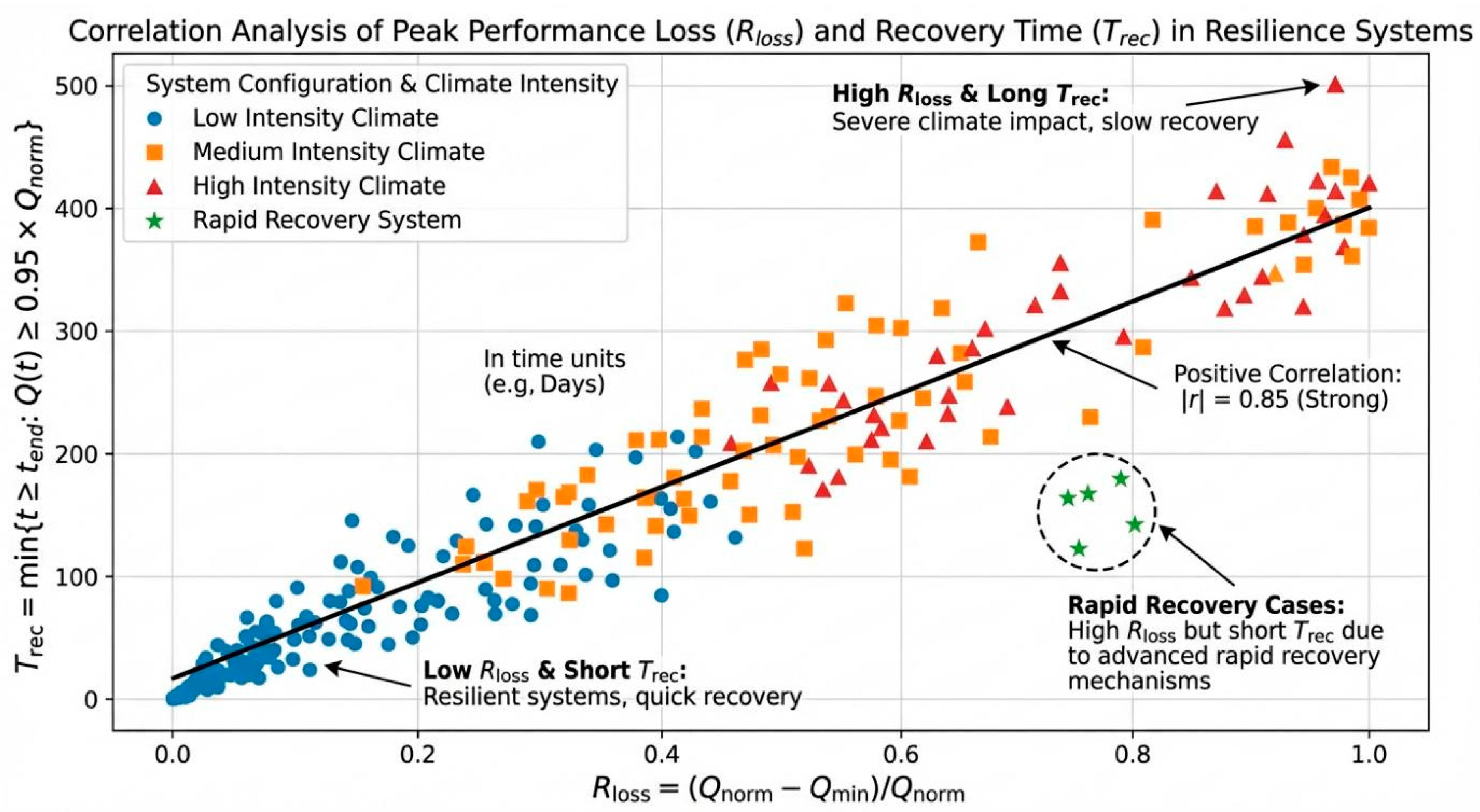
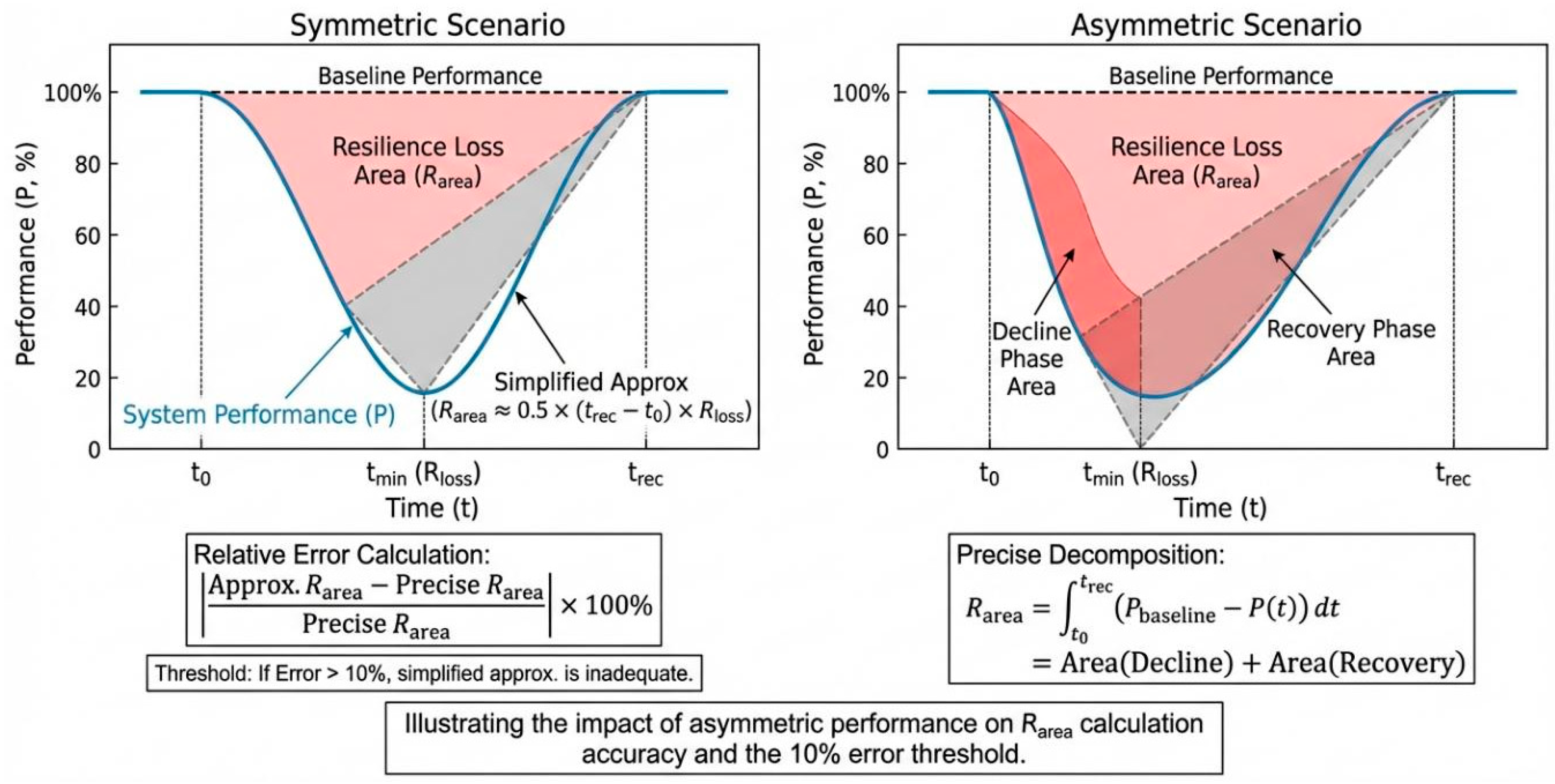
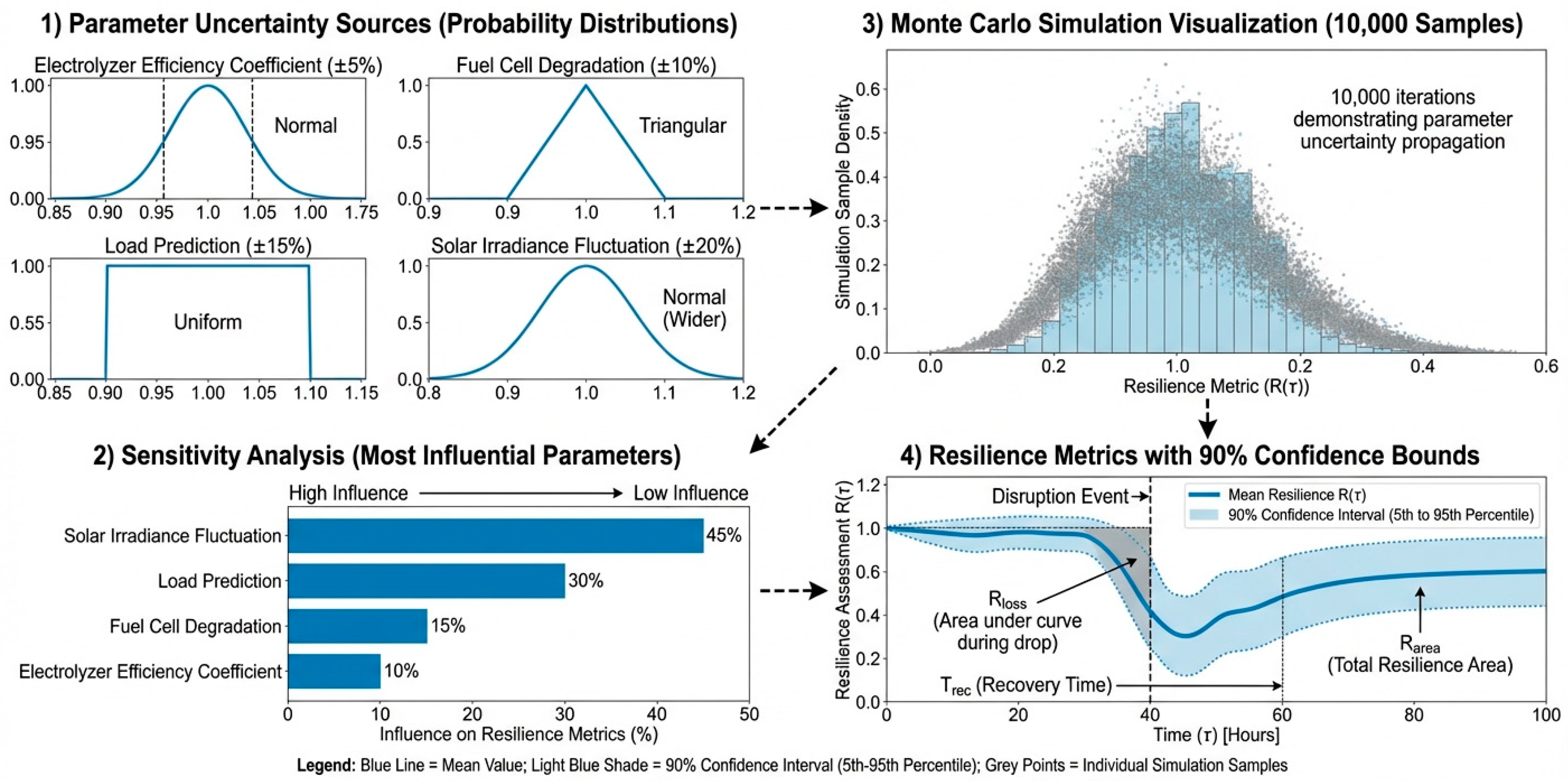
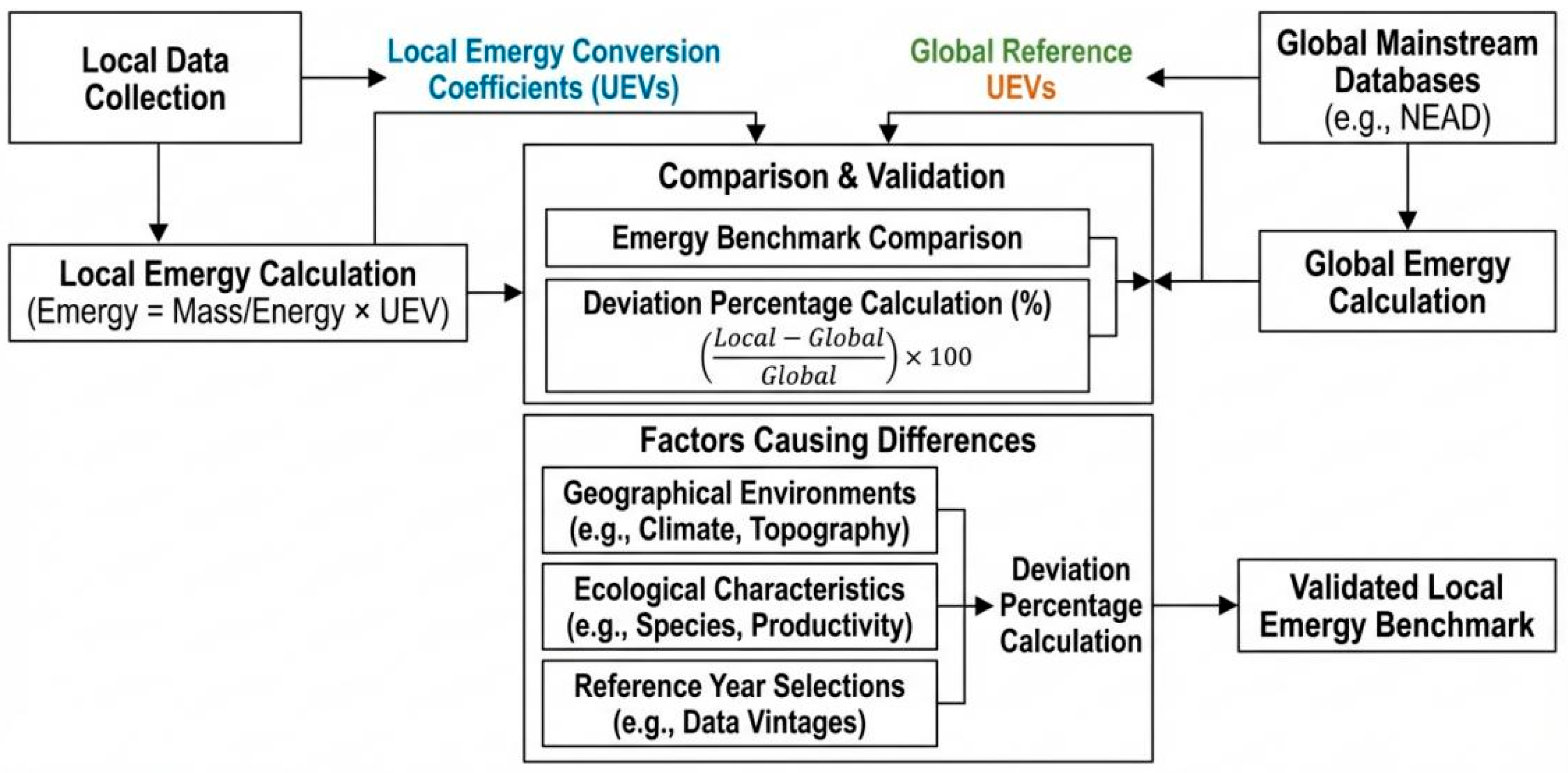
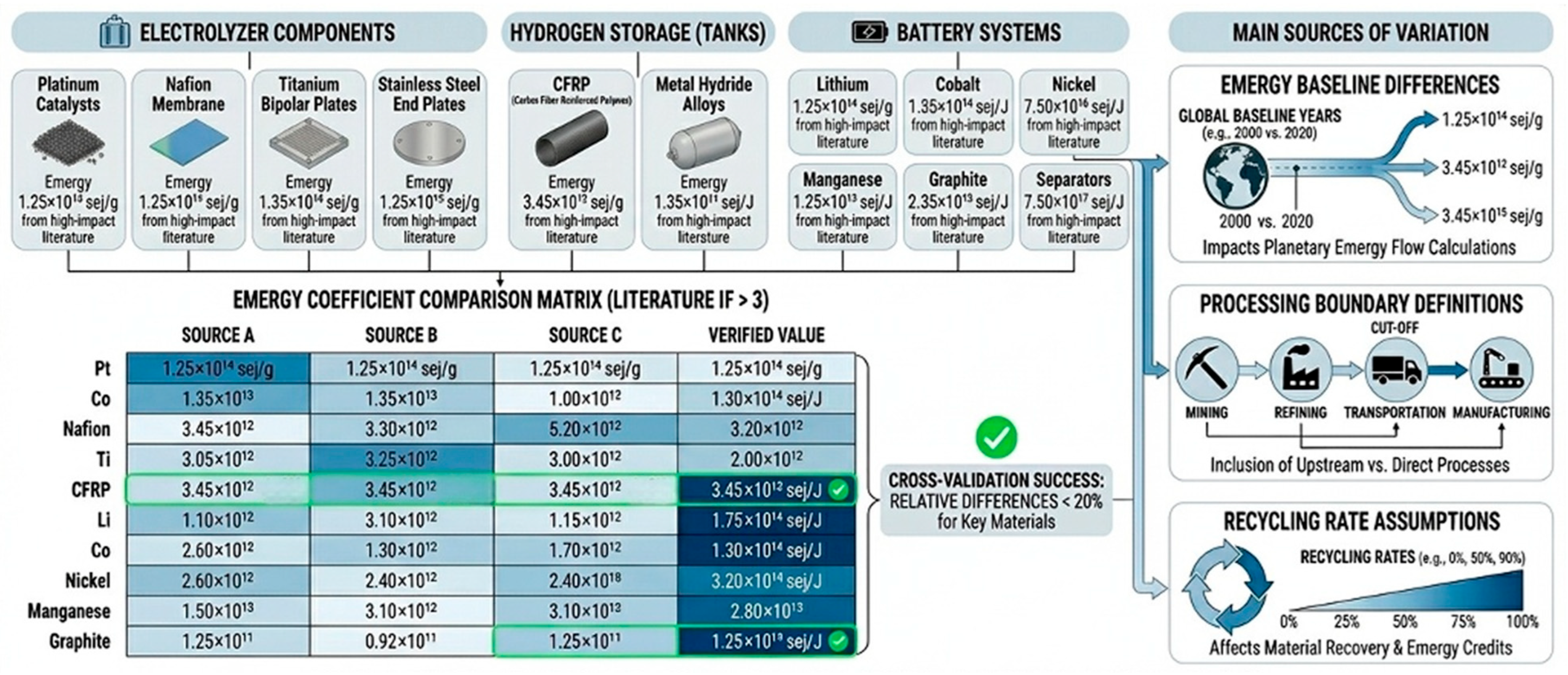
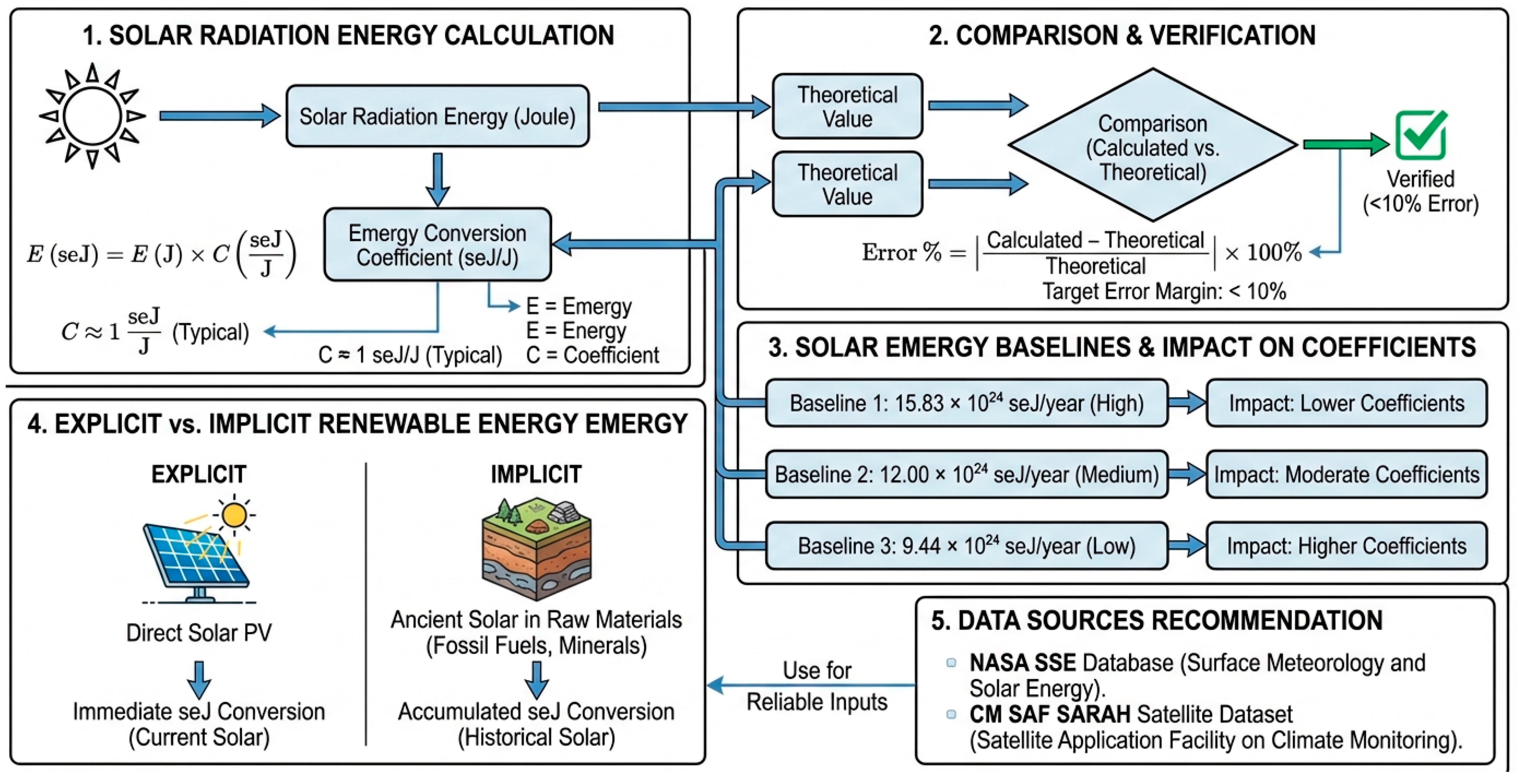
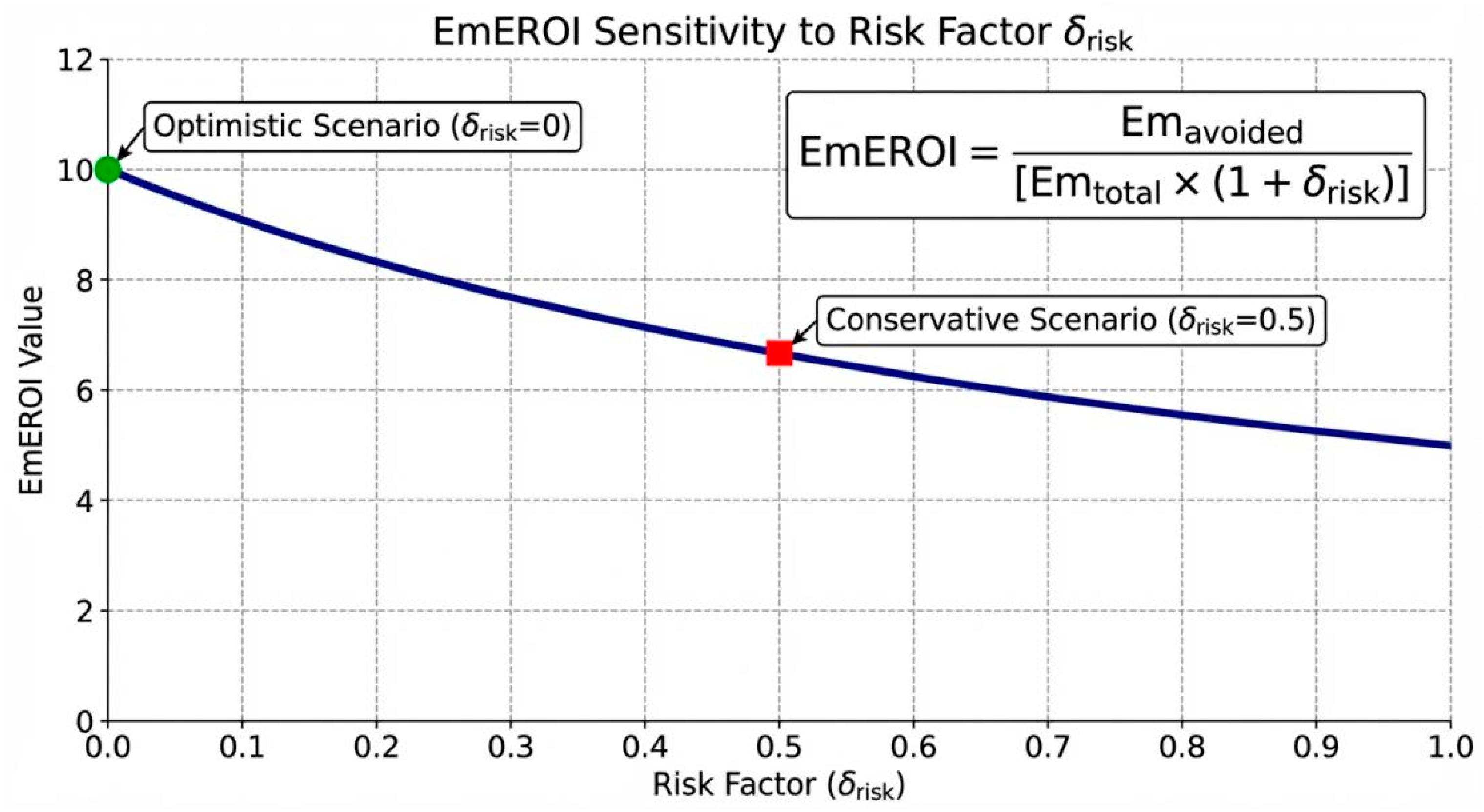
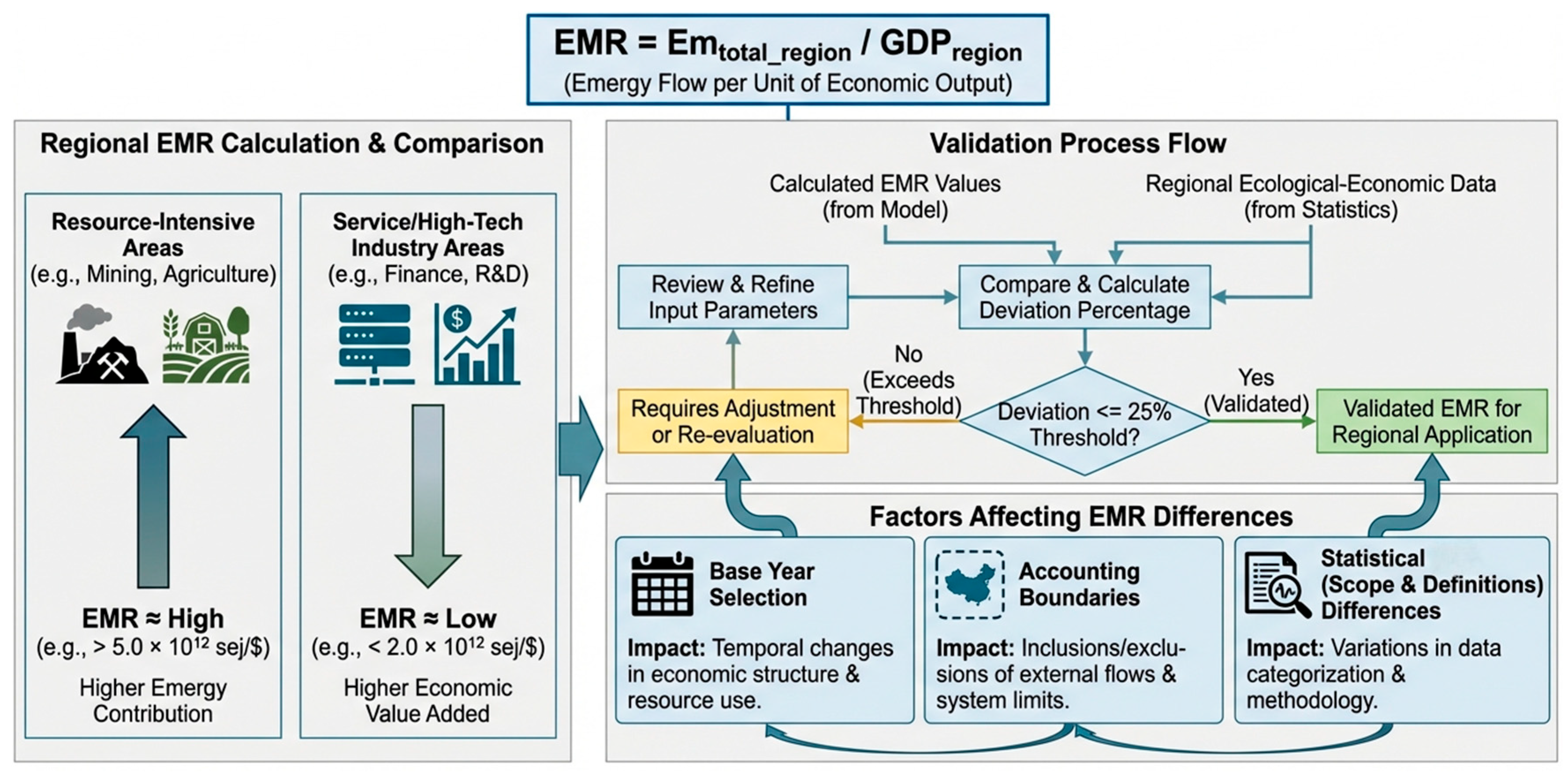
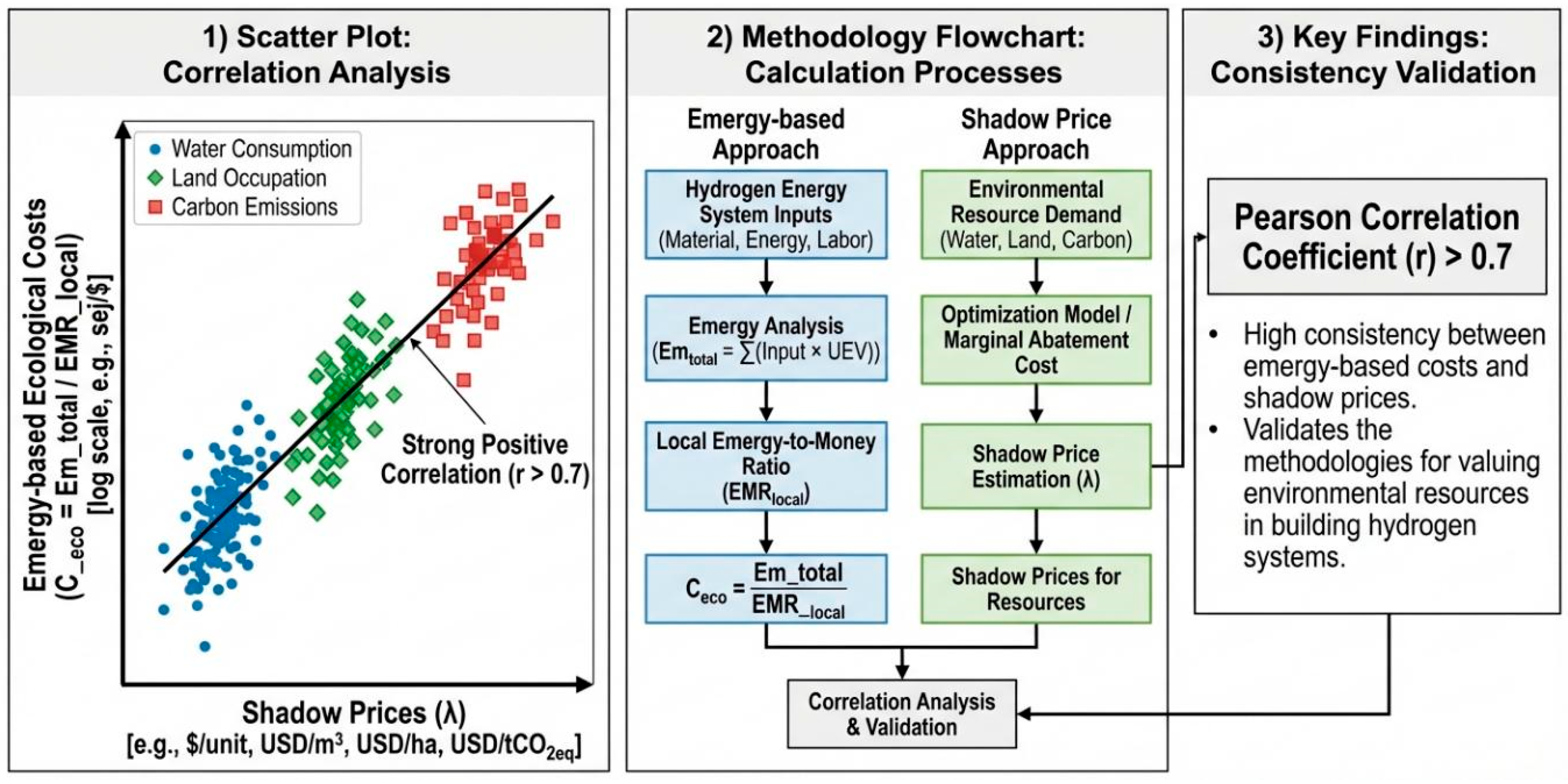
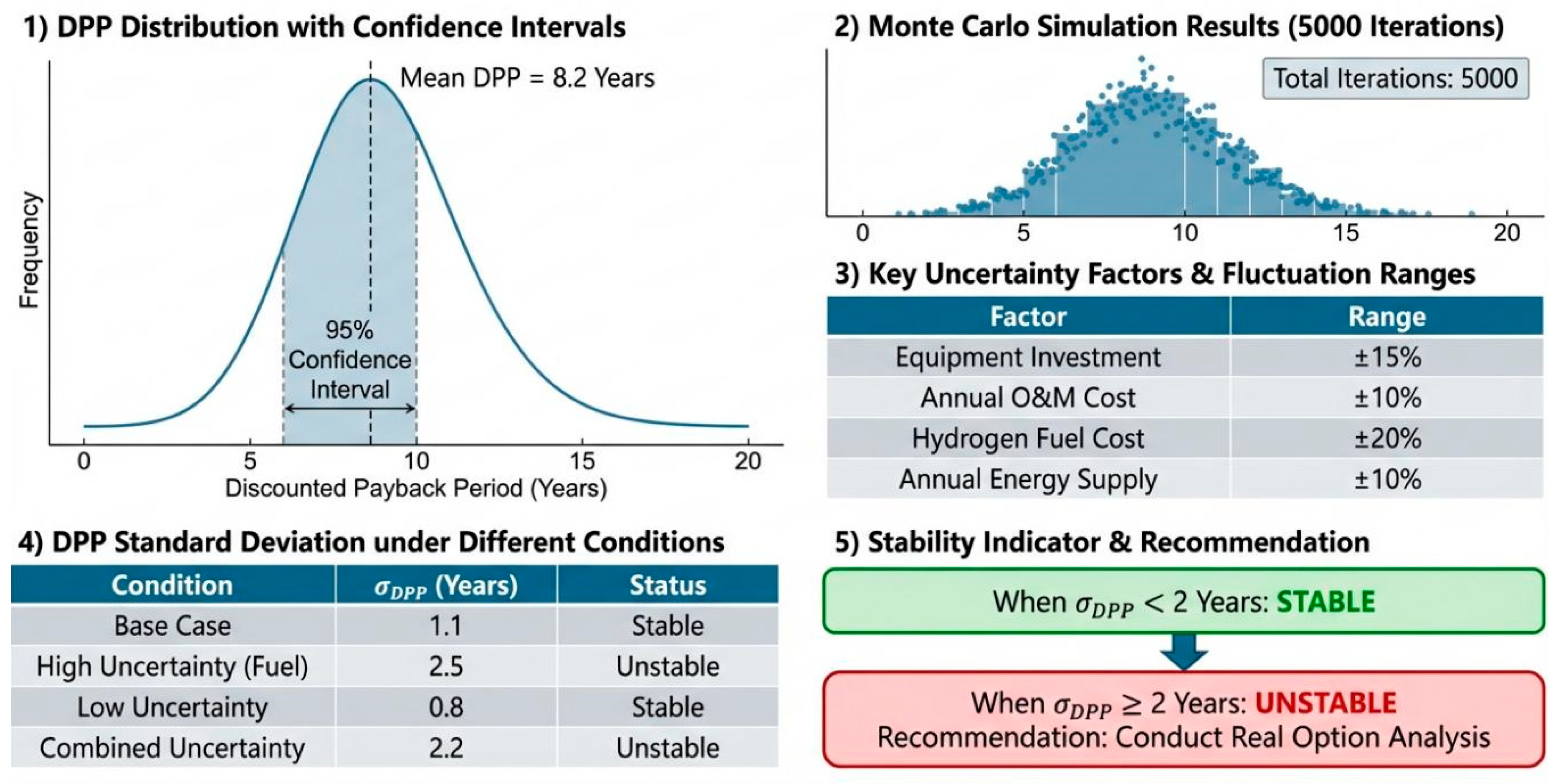
- Regarding resilience quantification and emergy analysis, the sensitivity of the performance function weight ΔR/Δw ranges from 0.33 to 0.35, the Spearman rank correlation coefficient for the penalty factor λ_el in the range of 1–3 is greater than 0.93, and the monotonicity, correlation, and additivity of the resilience indicators all pass the tests. Monte Carlo simulation shows that the 90% confidence interval width of the resilience indicator is less than 30% of the mean, and the variability under extreme scenarios exhibits a bimodal distribution, necessitating classification-based assessment. In emergy validation, the local EMR deviation is 12.5%, the differences in material emergy coefficients are all less than 20%, the solar radiation emergy error is 0.4%, the ELR of 4.33 falls within a reasonable range, the ESI of 0.74 has clear physical meaning, and the correlation coefficient between ecological cost and shadow price exceeds 0.78. The validation results support Hypotheses H2 and H4, namely that the emergy method can effectively reveal hidden environmental-economic trade-offs and can identify ecological value underestimated by traditional monetization assessments.
- (4)
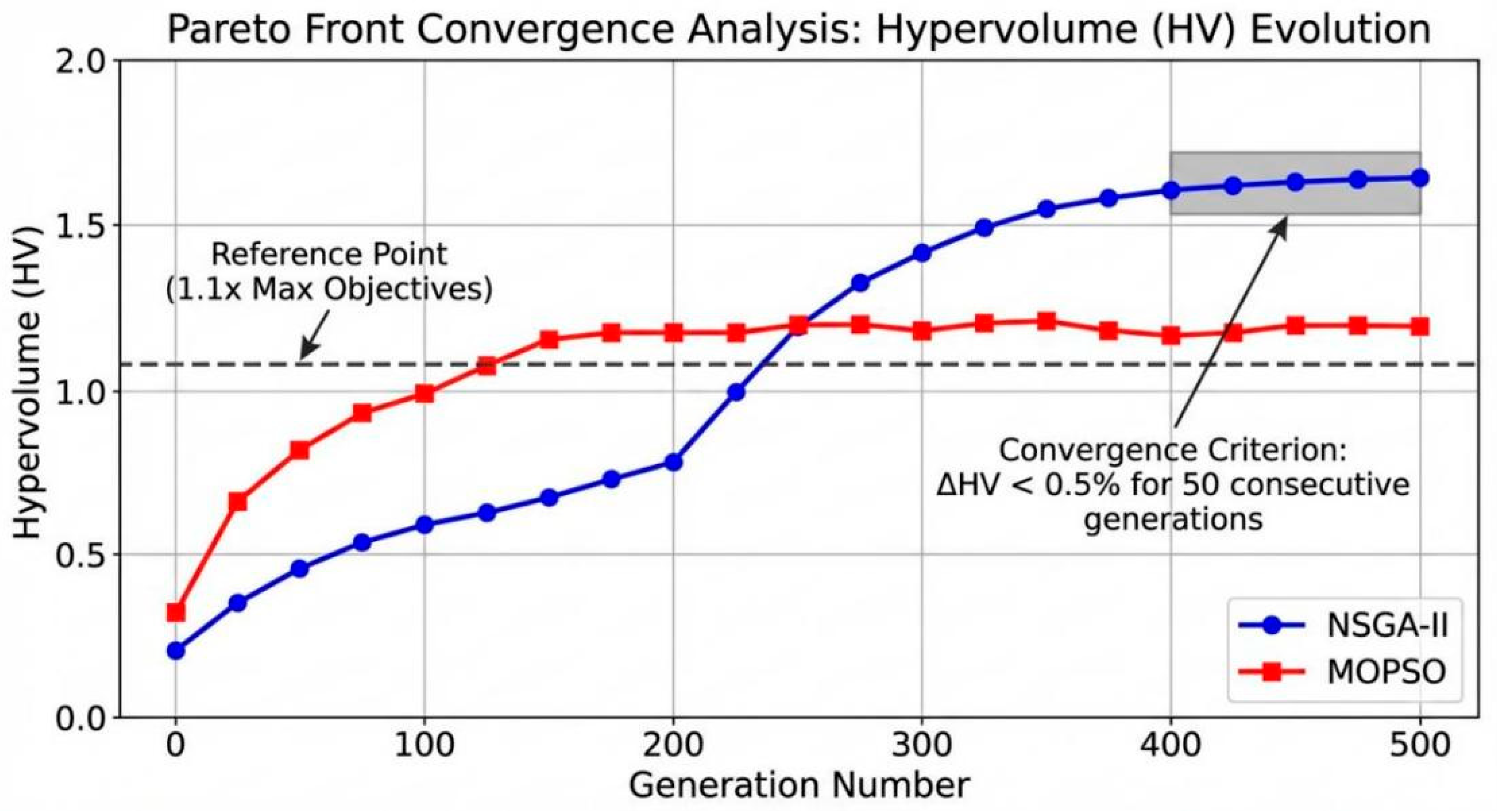
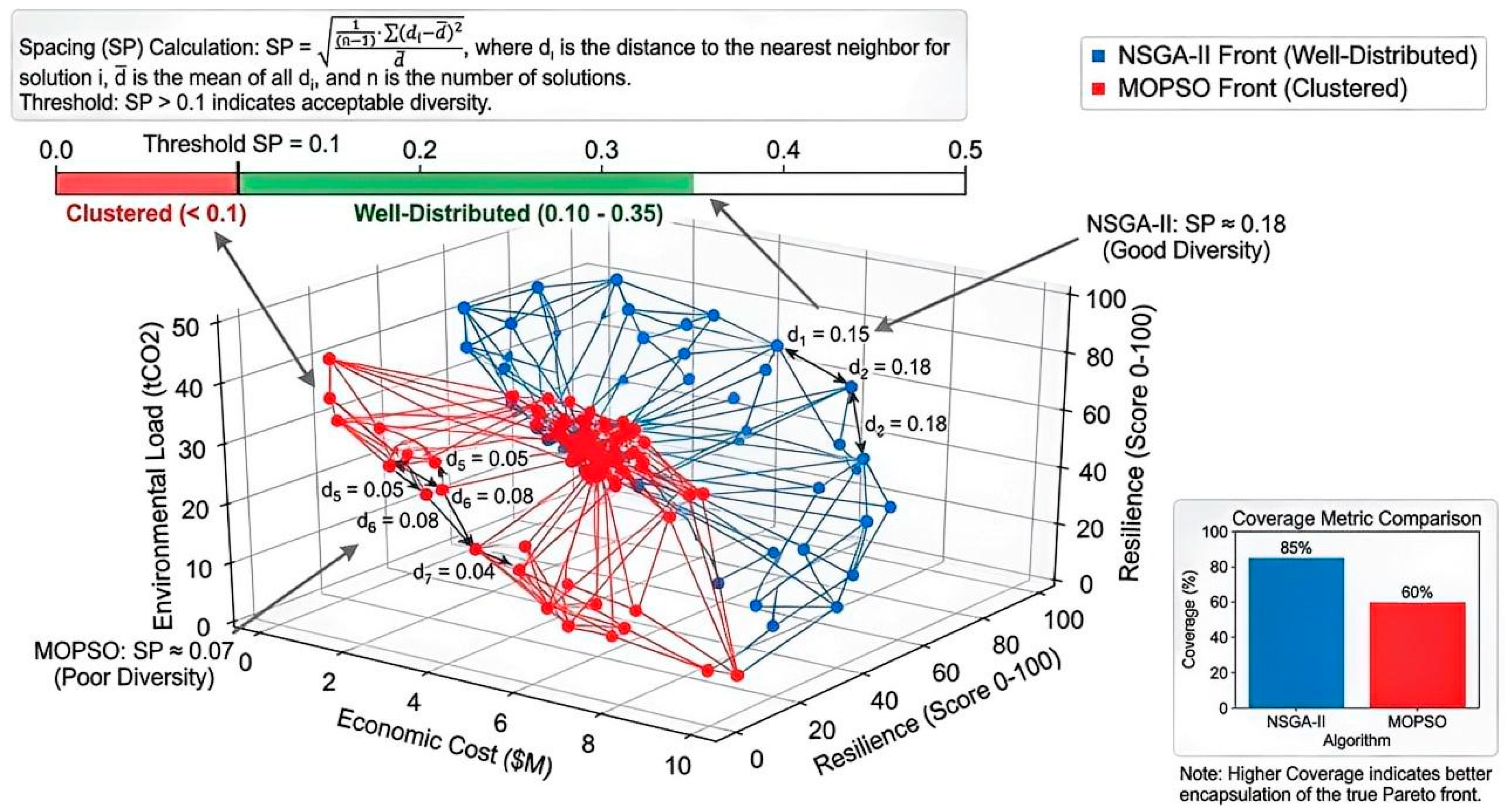
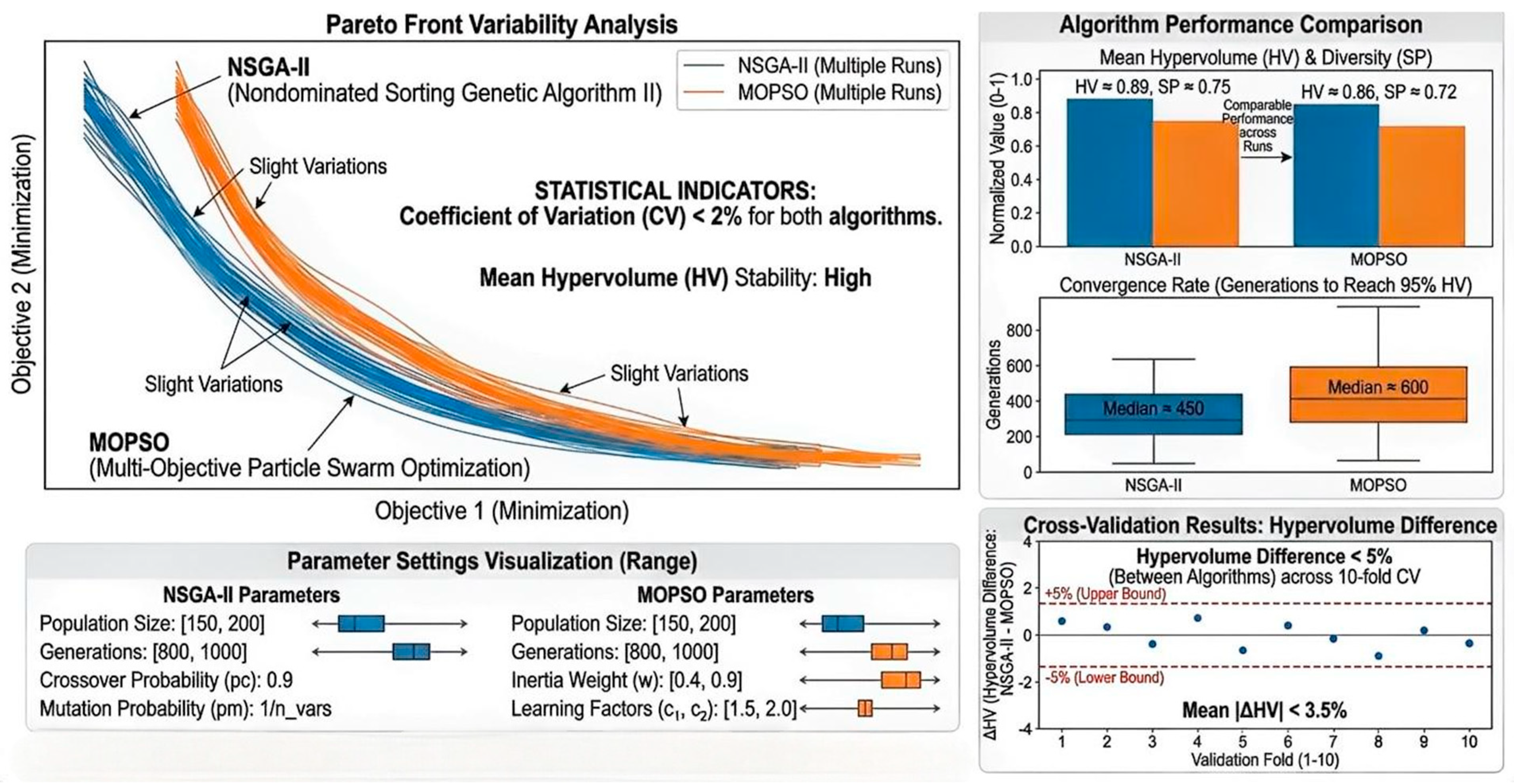
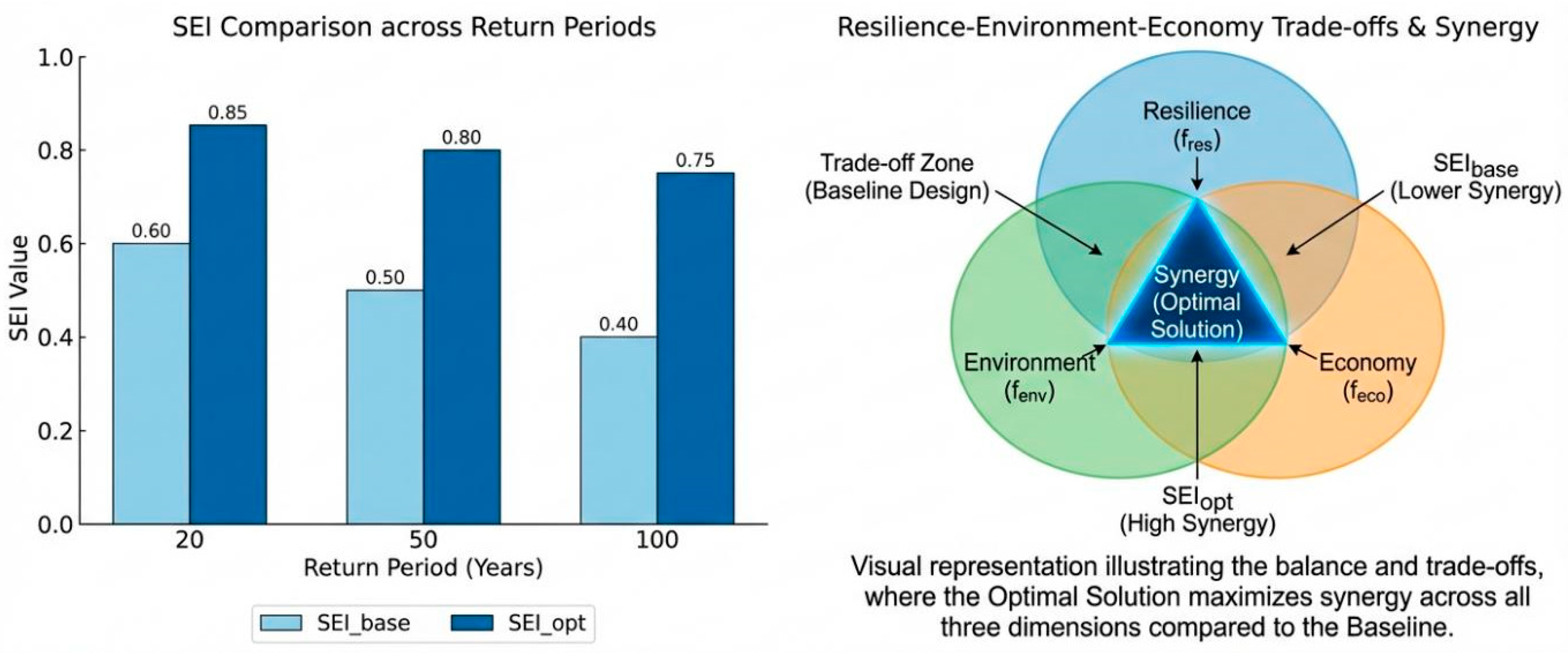
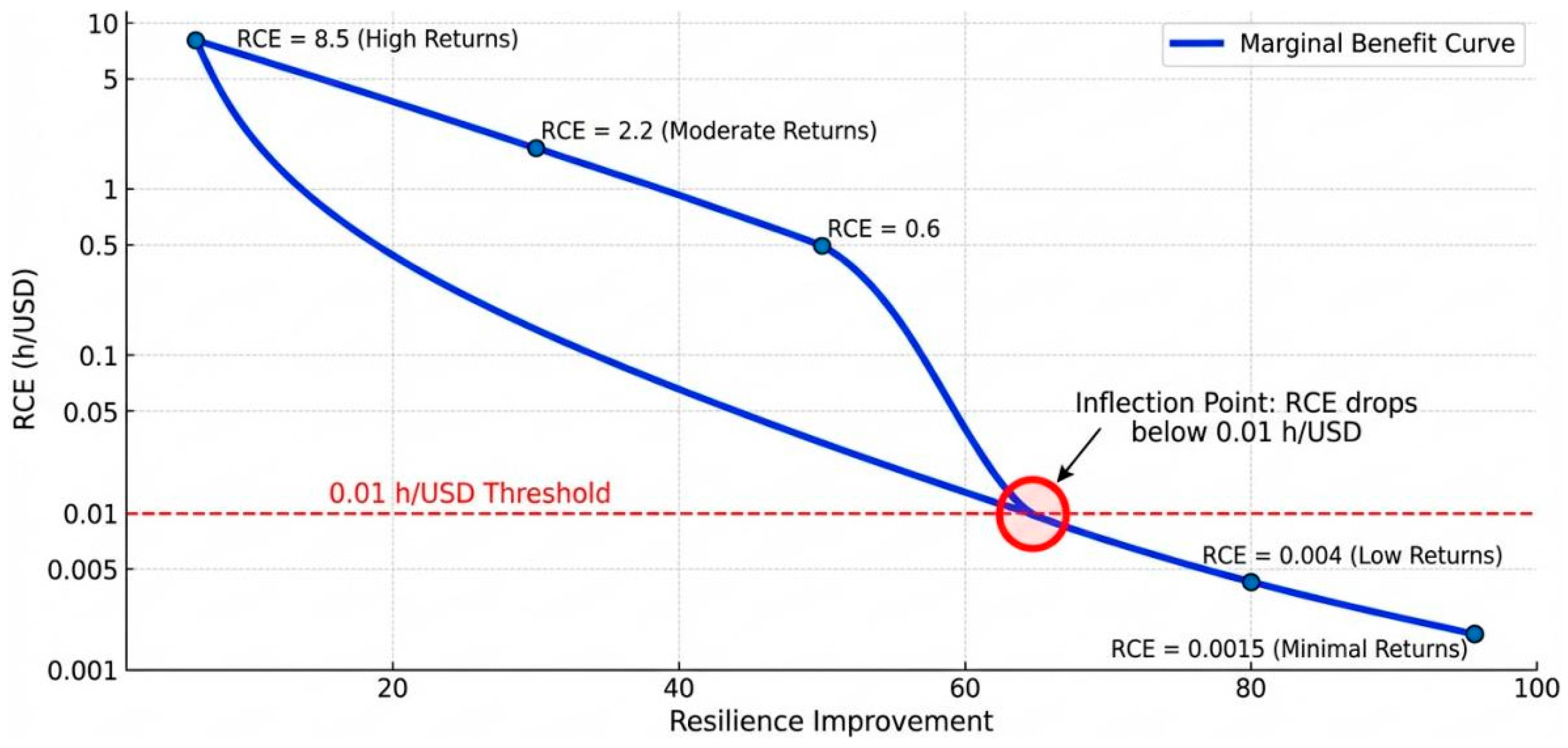
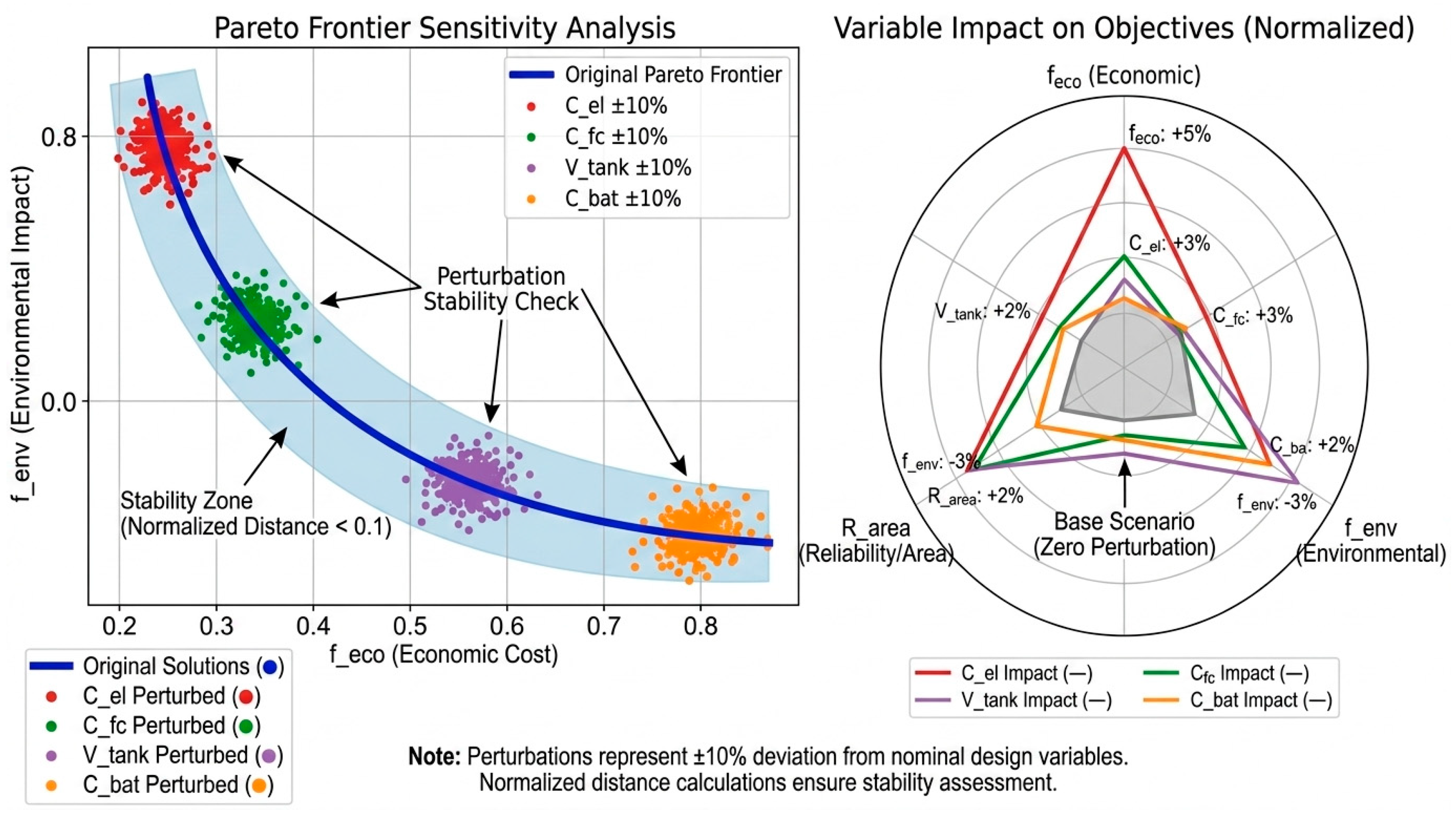
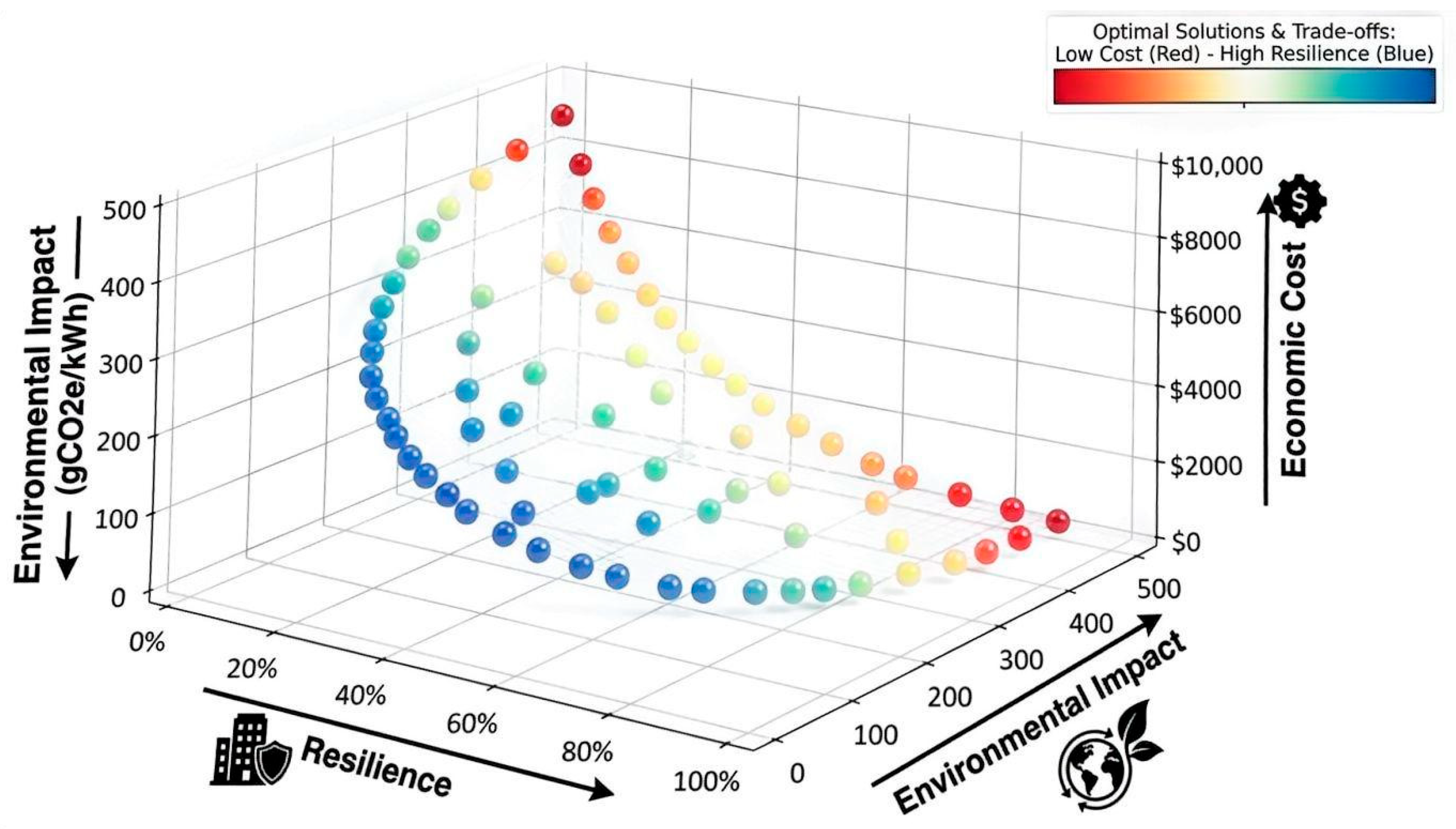
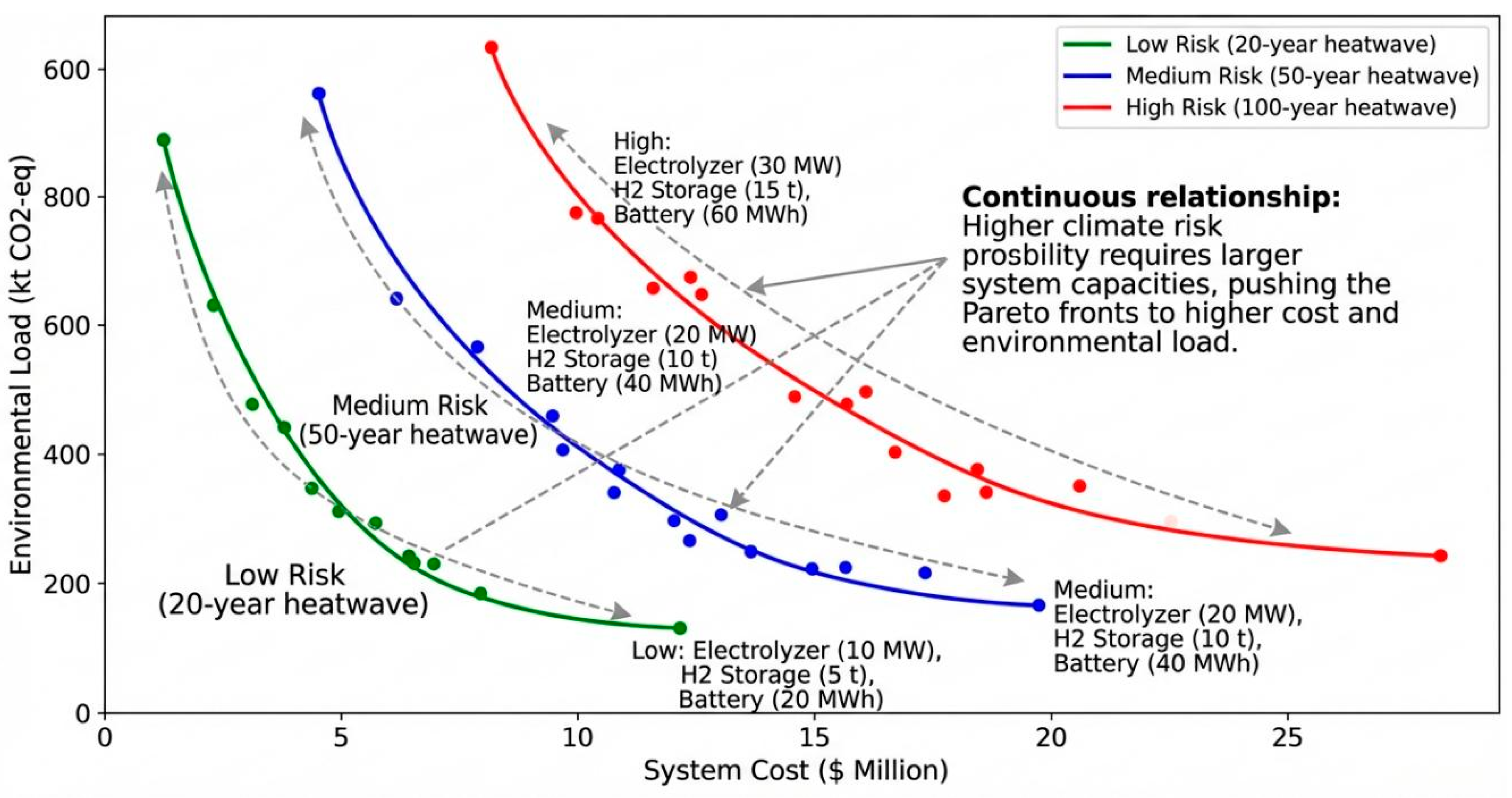
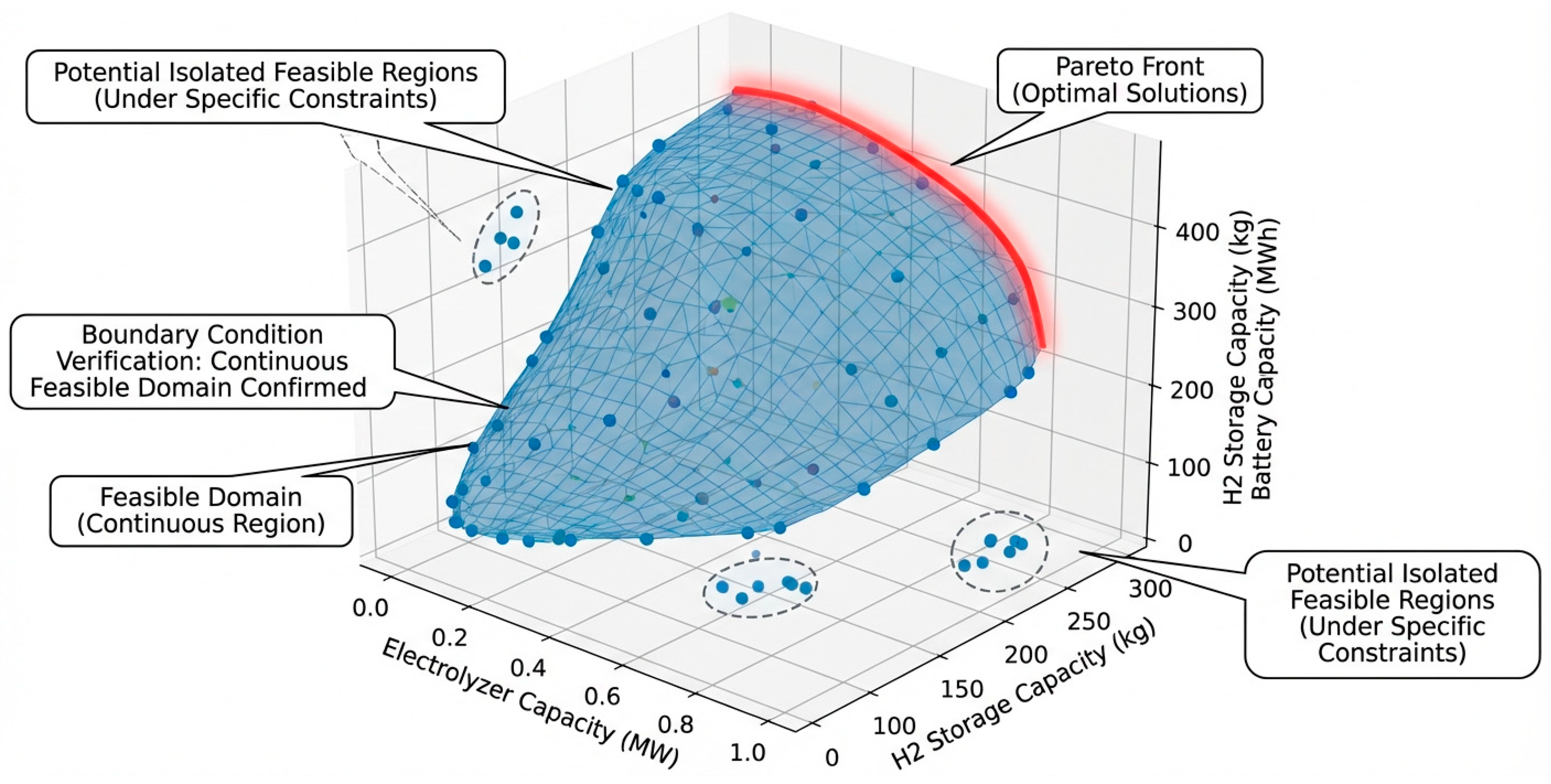
- Regarding co-optimization and hypothesis validation, after convergence of the NSGA-II algorithm, the hypervolume stabilizes at 1.60, the spacing indicator SP is 0.18, the coefficient of variation of the hypervolume across 10 independent runs is 0.75%, indicating good algorithm robustness. The Pareto front contains 127 non-dominated solutions, with a continuous feasible region and no isolated areas; the front continuously shifts outward as climate risk increases. The co-optimized solution SEI ranges from 0.75 to 0.85, which is superior to the baseline solution range of 0.40 to 0.60. The RCE inflection point corresponds to a resilience improvement of 50 h, and the normalized distances of the target points after ±10% perturbations of the design variables are all less than 0.1. The validation results comprehensively support Hypothesis H3, demonstrating the existence of a “resilience–environment–economy” co-optimized Pareto front jointly determined by climate risk probability, building load characteristics, and regional hydrogen supply chain resilience.
- (5)
- Regarding engineering applications, it is recommended that for public building hydrogen energy systems in hot-summer and cold-winter regions, the configuration scheme should adopt an electrolyzer of 50–60 kW, a hydrogen storage tank of 50–70 kg, a fuel cell of 30–40 kW, and a battery of 80–120 kWh. Under the scenario of a century-scale heatwave combined with grid failure, the critical load guarantee rate is not less than 95%, the life-cycle cost increases by approximately 12%, the environmental loading ratio ranges from 4.0 to 4.5, and the ecological cost is reduced by 35% compared to diesel backup. The electrolyzer-to-hydrogen storage capacity ratio should be controlled between 1:1.2 and 1:1.8, the control delay should be less than 5 s, and the modular design facilitates gradual capacity expansion.
Author Contributions
Funding
Data Availability Statement
Conflicts of Interest
References
- Hawraa, A.H.; Tarish, A.L.; Al-Mudhafar, A.H.N. Recent advances in nearly zero energy commercial and residential buildings: Innovations, challenges, and climate-specific solutions. Green Technol. Sustain. 2026, 4, 100330. [Google Scholar] [CrossRef]
- Wu, Y.; Zhong, L. Assessing the affordability and independence of building-integrated household green hydrogen systems in Canadian urban households under climate change. Energy Convers. Manag. 2025, 346, 120432. [Google Scholar] [CrossRef]
- Li, G.; Xu, X.; Cheng, X.; Wang, Q.; Zhang, Y.; Wu, H.; Liu, D. Robust configuration planning for net zero-energy buildings considering source-load dual uncertainty and hybrid energy storage system. Build. Environ. 2025, 282, 113239. [Google Scholar] [CrossRef]
- Zhou, Y. Climate change adaptation with energy resilience in energy districts—A state-of-the-art review. Energy Build. 2023, 279, 112649. [Google Scholar] [CrossRef]
- Gusev, A.L.; Gafarov, A.M.; Suleymanov, P.H.; Habibov, I.A.; Malikov, R.K.; Hasanov, Y.H.; Levina, A.I.; Mikheev, P.; Ufa, R.A. Some aspects of reliability prediction of chemical industry and hydrogen energy facilities operated in emergency situations and extreme conditions. Int. J. Hydrogen Energy 2024, 86, 482–510. [Google Scholar] [CrossRef]
- Zhou, Y.; Liu, J. Advances in emerging digital technologies for energy efficiency and energy integration in smart cities. Energy Build. 2024, 315, 114289. [Google Scholar] [CrossRef]
- Gonzales-Zurita, O.; Díaz-Bedoya, D.; González-Rodríguez, M.; Clairand, J.-M. A review of methods and techniques in building energy management systems for energy efficiency enhancement. Renew. Sustain. Energy Rev. 2026, 229, 116606. [Google Scholar] [CrossRef]
- Chinde, V.; Chintala, R.; Kim, J.; Chapin, A.; Xiong, J.; Fleming, K.; Ball, B.L. Surrogate model evaluation and building energy benchmarking for commercial buildings. Energy Build. 2026, 355, 117033. [Google Scholar] [CrossRef]
- Dorsey-Palmateer, R.; Sheikh, I.; Shewmake, S.; Thompson, P.; Wang, X. Understanding policymaker support of energy c policies for buildings. Energy Res. Soc. Sci. 2026, 132, 104536. [Google Scholar] [CrossRef]
- Yi, D.H.; Choi, S.; Kim, D.-W.; Yoon, S. Quantifying urban building shading effect for data-driven building energy modeling. Build. Environ. 2026, 289, 114011. [Google Scholar] [CrossRef]
- Cholewa, T.; Siuta-Olcha, A. Long term experimental evaluation of the influence of heat cost allocators on energy consumption in a multifamily building. Energy Build. 2015, 104, 122–130. [Google Scholar] [CrossRef]
- Arslan, M.; Munawar, S. Large language models in building energy applications: A survey. Energy Build. 2026, 352, 116800. [Google Scholar] [CrossRef]
- Yazdani, H.; Blum, P.; Menberg, K. Co-simulation of building energy and geothermal systems: A review. Energy Build. 2026, 350, 116550. [Google Scholar] [CrossRef]
- Yang, X.; Li, Y.; Li, X.; Metwally, K.A.; Ding, Y. Activating and Enhancing the Energy Flexibility Provided by a Pipe-Embedded Building Envelope: A Review. Buildings 2025, 15, 2793. [Google Scholar] [CrossRef]
- Ward, W.; Li, X.; Sun, Y.; Dai, M.; Arbabi, H.; Tingley, D.D.; Mayfield, M. Estimating energy consumption of residential buildings at scale with drive-by image capture. Build. Environ. 2023, 234, 110188. [Google Scholar] [CrossRef]
- Michaelides, E.E. Energy Efficiency and Grid-Independent Buildings. J. Sol. Energy Eng. 2025, 147, 051001. [Google Scholar] [CrossRef]
- Liu, K.; Xu, X.; Lin, D.; Zhang, R.; Zhao, L.; Abuduwayiti, A.; Causone, F. A scalable and efficient framework for city-scale building energy modeling with microclimate considerations. Sustain. Cities Soc. 2026, 138, 107187. [Google Scholar] [CrossRef]
- Sharifi, M.; Mahmoud, R.; Himpe, E.; Laverge, J. A heuristic algorithm for optimal load splitting in hybrid thermally activated building systems. J. Build. Eng. 2022, 50, 104160. [Google Scholar] [CrossRef]
- Khoreva, V. Novel solar-hydrogen energy technologies to improve the energy efficiency of buildings. Int. J. Hydrogen Energy 2025, 105, 1261–1265. [Google Scholar] [CrossRef]
- Zhang, G.; Liang, J.; Li, F.; Xie, C.; Han, L.; Zhang, Y. Low-Carbon Scheduling Model of Electricity-Gas-Heat Integrated Energy System Considering Ladder-Type Carbon Trading Mechanism, Vehicles Charging, and Multimode Utilization of Hydrogen. IEEE Access 2024, 12, 132926–132938. [Google Scholar] [CrossRef]
- Sun, S.; Huang, K.; Tong, Z.; Jiang, Y. Design optimization method for electricity-hydrogen energy storage system under uncertainties. Renew. Energy 2026, 261, 125307. [Google Scholar] [CrossRef]
- Li, Y.; Xie, T.; Ma, L. Energy and financial evaluation of a hydrogen-producing multigeneration system for sustainable development. Int. J. Hydrogen Energy 2025, 140, 815–830. [Google Scholar] [CrossRef]
- Miri, M.; Radaš, I.; Tolj, I.; Barbir, F. Performance evaluation of solar-hydrogen microgrid energy storage system: Comparing low-pressure with simulated high-pressure hydrogen storage. Int. J. Hydrogen Energy 2025, 151, 150163. [Google Scholar] [CrossRef]
- Wen, Z.; Ren, C.; Wang, H.; Jiang, Y. Reliability evaluation of electricity-hydrogen integrated energy systems considering the flexible operation of hydrogen supply networks. CSEE J. Power Energy Syst. 2025, 1–12. [Google Scholar] [CrossRef]
- Wang, Q.; Mei, H.; Tan, H.; Li, Z.; Weng, H.; Yan, F.; Mohamed, M.A. Planning method of a low-carbon integrated energy system with biomass-aided hydrogen production. Renew. Energy 2026, 261, 125236. [Google Scholar] [CrossRef]
- Zhang, J.; Zhang, H.; Asutosh, A.T.; Sun, N.; Li, X. The environmental sustainability assessment of building ceramic manufacturing based on the LCA-emergy approach. Environ. Dev. Sustain. 2025, 27, 5999–6024. [Google Scholar] [CrossRef]
- Peng, W.; Fang, Y.; Zhao, G. Life-cycle sustainability evaluation of urban neighborhoods: An emergy-ecological footprint approach. Energy Sustain. Dev. 2026, 92, 101937. [Google Scholar] [CrossRef]
- Zhang, J.; Asutosh, A.T.; Miu, Z. A study on ecological sustainable cities based on LCA-emergy-carbon footprint and geographic information system (GIS) approach. J. Asian Archit. Build. Eng. 2025, 24, 5567–5587. [Google Scholar] [CrossRef]
- Zhang, J.; Pan, Z.; Li, Y. Analysis of the LCA-Emergy and Carbon Emissions Sustainability Assessment of a Building System with Coupled Energy Storage Modules. Buildings 2025, 15, 151. [Google Scholar] [CrossRef]
- Zhang, J.; Asutosh, A.T. A Sustainability Analysis Based on the LCA–Emergy–Carbon Emission Approach in the Building System. Appl. Sci. 2023, 13, 9707. [Google Scholar] [CrossRef]
- Liu, Q.; Zhang, C.; Ma, Y.; Shao, J. Stratified multi-objective collaborative optimization framework for desert thermal-electric coupled energy storage system scale and energy management. Sustain. Energy Technol. Assess. 2025, 84, 104722. [Google Scholar] [CrossRef]
- Wang, R.; Wang, J. Multi-objective collaborative optimization of system configurations and energy scheduling of integrated energy system with electricity-fuel-heat storage systems. J. Energy Storage 2025, 132, 117846. [Google Scholar] [CrossRef]
- Chen, Y.; Fang, Z.; Zhang, N.; Qiang, T.; Zhang, Z.; Huang, T.; Xu, Z. Multi-objective Collaborative Operation Method for Park-level Integrated Energy System Cluster Based on Large Language Model for Green Electricity Prediction and Trading. High Volt. Eng. 2024, 50, 2849–2863. [Google Scholar] [CrossRef]
- Torbarina, F.; Dujmović, J.; Vizentin, G.; Kirinčić, M. Towards Decarbonization of the Maritime Transport Sector: A Review of Hydrogen as an Alternative Marine Fuel. Pomorstvo 2026, 40, 51–57. [Google Scholar] [CrossRef]
- Cui, W.; Liu, G.; Hong, J.; Li, K. A novel hybrid method integrating multi-objective optimization with emergy analysis for building renewal strategy. Energy Convers. Manag. 2024, 315, 118792. [Google Scholar] [CrossRef]
- Sabbaghi, M.A.; Soltani, M.; Fraser, R.; Dusseault, M.B. Emergy-based exergoeconomic and exergoenvironmental assessment of a novel CCHP system integrated with PEME and PEMFC for a residential building. Energy 2024, 305, 132301. [Google Scholar] [CrossRef]
- Gao, Z.; Li, J.; Wan, R.; Dong, X.; Ye, Q. Emergy-Theory-Based Evaluation of Typhoon Disaster Risk in China’s Coastal Zone. Atmosphere 2024, 15, 750. [Google Scholar] [CrossRef]
- Rehman, H.U.; Hamdy, M.; Hasan, A. Towards Extensive Definition and Planning of Energy Resilience in Buildings in Cold Climate. Buildings 2024, 14, 1453. [Google Scholar] [CrossRef]
- Tera, I.; Zhang, S.; Liu, G. A conceptual hydrogen, heat and power polygeneration system based on biomass gasification, SOFC and waste heat recovery units: Energy, exergy, economic and emergy (4E) assessment. Energy 2024, 295, 131015. [Google Scholar] [CrossRef]
- Huang, S.-L.; Chang, L.-F.; Yeh, C.-T. How vulnerable is the landscape when the typhoon comes? An emergy approach. Landsc. Urban Plan. 2011, 100, 415–417. [Google Scholar] [CrossRef]




| No. | Indicator | Symbol | Definition Formula | Unit | Related Hypothesis |
|---|---|---|---|---|---|
| 1 | Electrolyzer Efficiency | eta_el | eta_el equals eta_el0 multiplied by exp of negative Ea divided by R times T_stack multiplied by one minus j over j_lim squared | - | H1 |
| 2 | Average Hydrogen Production Rate | m_dot_H2_el_avg | Average hydrogen production rate equals one over T times the integral from zero to T of hydrogen production rate with respect to time | kg/h | H1 |
| 3 | Fuel Cell Efficiency | eta_fc | eta_fc equals eta_fc0 multiplied by one minus beta times i over i_ref minus one squared multiplied by one minus gamma times T_fc minus T_ref squared | - | H1 |
| 4 | Average Fuel Cell Power Output | P_fc_avg | Average fuel cell power output equals one over T times the integral from zero to T of fuel cell power output with respect to time | kW | H1 |
| 5 | Hydrogen Storage Capacity | E_H2_store | Hydrogen storage capacity equals maximum hydrogen mass multiplied by lower heating value of hydrogen divided by 3.6 times ten to the sixth | kWh | H1 |
| 6 | Hydrogen Utilization Rate | phi_H2_util | Hydrogen utilization rate equals integral of fuel cell hydrogen consumption with respect to time divided by integral of electrolyzer hydrogen production with respect to time | - | H1 |
| 7 | Battery Cycle Life | N_cycle_eq | Equivalent battery cycle life equals one divided by the sum over i of delta depth of discharge for cycle i divided by cycle life at that depth of discharge | cycles | H1 |
| 8 | Average Battery Round-Trip Efficiency | eta_bat_avg | Average battery round-trip efficiency equals integral of battery discharge power with respect to time divided by integral of battery charge power with respect to time | - | H1 |
| No. | Indicator | Symbol | Definition Formula | Unit | Related Hypothesis |
|---|---|---|---|---|---|
| 9 | Extreme Climate Intensity | I_clim | Extreme climate intensity equals the maximum over time of heatwave intensity and storm severity | degree Celsius or scale | H1, H3 |
| 10 | Exceedance Probability | P_exc | Exceedance probability equals one minus exp of negative one plus xi times I_clim minus mu divided by sigma raised to negative one over xi | - | H3 |
| 11 | PV Output Degradation Rate | delta_PV | PV output degradation rate equals one minus integral of actual PV power with respect to time divided by integral of standard test condition PV power with respect to time | - | H1 |
| No. | Indicator | Symbol | Definition Formula | Unit | Related Hypothesis |
|---|---|---|---|---|---|
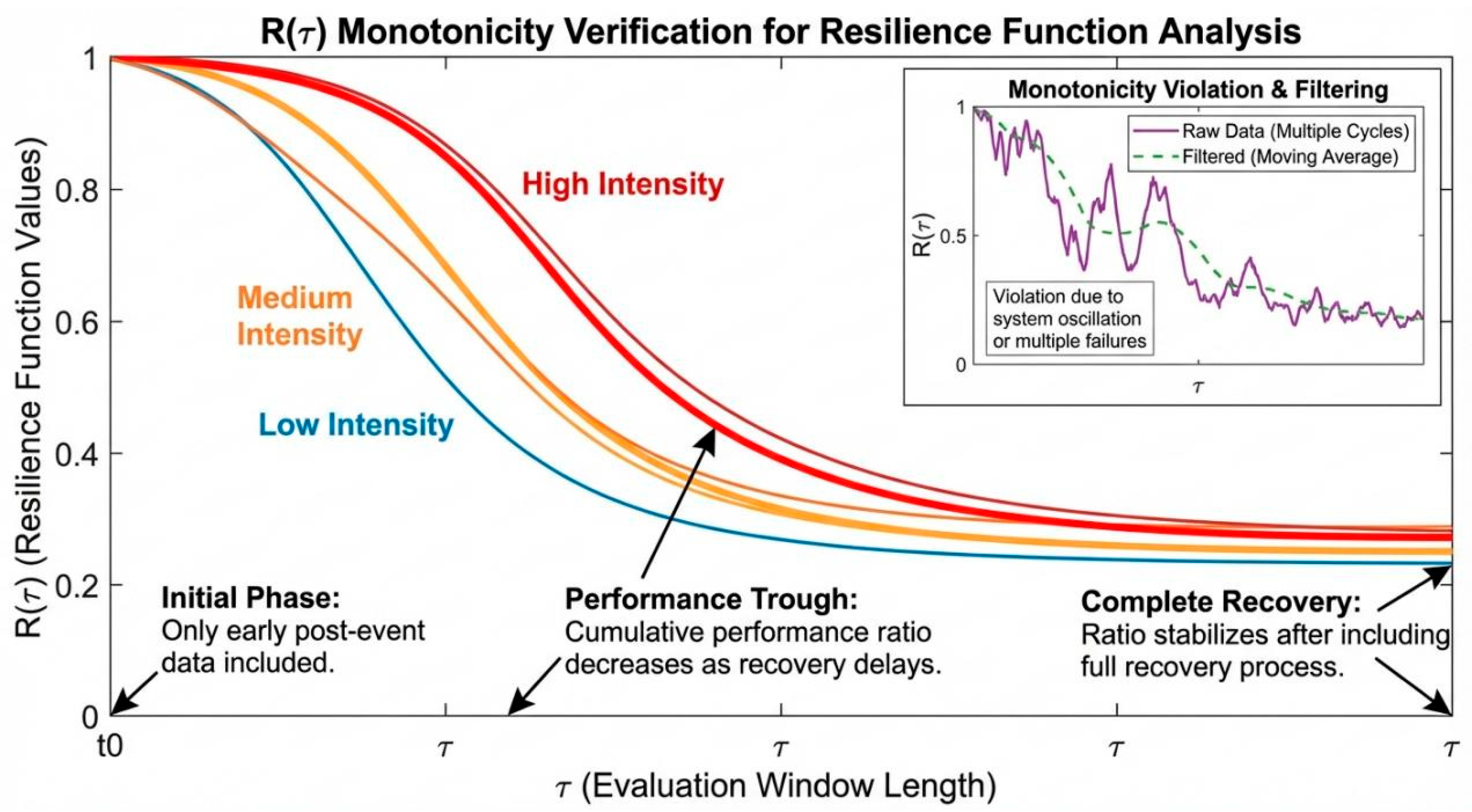
| 12 | Comprehensive Resilience | R(tau) | Comprehensive resilience equals integral of performance function from event start to event start plus duration divided by integral of normal performance from event start to event start plus duration | - | H1, H3 |
| 13 | Peak Performance Loss | R_loss | Peak performance loss equals normal performance minus minimum performance divided by normal performance | - | H1 |
| 14 | Recovery Time | T_rec | Recovery time equals the minimum time t greater than or equal to event end such that performance function is greater than or equal to 0.95 times normal performance | h | H1 |
| 15 | Resilience Loss Area | R_area | Resilience loss area equals integral from event start to recovery time of one minus performance function divided by normal performance with respect to time | h | H1, H3 |
| 16 | Electrical Load Satisfaction | psi_el | Electrical load satisfaction equals the minimum of one and supplied electrical power divided by demanded electrical power multiplied by exp of negative lambda_el times demanded electrical power minus supplied electrical power divided by demanded electrical power | - | H1, H3 |
| 17 | Thermal Load Satisfaction | psi_th | Thermal load satisfaction equals the minimum of one and supplied thermal power divided by demanded thermal power | - | H1, H3 |
| 18 | Self-Sufficiency Ratio During Event | SSR_event | Self-sufficiency ratio during extreme event equals integral of fuel cell power plus battery discharge power from event start to event end divided by integral of electrical load from event start to event end | - | H1, H3 |
| 19 | Hydrogen Contribution Rate | phi_H2_con | Hydrogen contribution rate equals integral of fuel cell power with respect to time divided by integral of fuel cell power plus battery discharge power with respect to time | - | H1 |
| No. | Indicator | Symbol | Definition Formula | Unit | Related Hypothesis |
|---|---|---|---|---|---|
| 20 | Total Emergy Input | Em_total | Total emergy input equals sum over i of local emergy from source i plus sum over j of imported emergy from source j | seJ | H2, H4 |
| 21 | Emergy Return on Investment | EmEROI | Emergy return on investment equals avoided loss emergy divided by total emergy multiplied by one plus risk factor | - | H2, H4 |
| 22 | Environmental Loading Ratio | ELR | Environmental loading ratio equals nonrenewable emergy plus imported emergy divided by renewable emergy | - | H2, H4 |
| 23 | Emergy Sustainability Index | ESI | Emergy sustainability index equals emergy return on investment divided by environmental loading ratio | - | H2, H4 |
| 24 | Avoided Loss Emergy | Em_avoided | Avoided loss emergy equals integral from event start to event end of grid loss emergy rate plus thermal loss emergy rate multiplied by failure indicator with respect to time | seJ | H2, H4 |
| 25 | Ecological Cost | C_eco | Ecological cost equals total emergy divided by local emergy to money ratio | USD | H2, H4 |
| No. | Indicator | Symbol | Definition Formula | Unit | Related Hypothesis |
|---|---|---|---|---|---|
| 26 | Life Cycle Cost | LCC | Life cycle cost equals capital cost plus sum from t equals one to T of operation and maintenance cost plus replacement cost plus fuel cost divided by one plus discount rate raised to the power t minus salvage value divided by one plus discount rate raised to the power T | USD | H2, H3 |
| 27 | Levelized Cost of Energy | LCOE | Levelized cost of energy equals life cycle cost divided by integral from zero to T of supplied electrical power plus supplied thermal power divided by equivalent thermal efficiency with respect to time | USD per kWh | H2, H3 |
| 28 | Net Present Value | NPV | Net present value equals sum from t equals zero to T of cash flow at time t divided by one plus discount rate raised to the power t | USD | H3 |
| No. | Indicator | Symbol | Definition Formula | Unit | Related Hypothesis |
|---|---|---|---|---|---|
| 29 | Synergistic Efficiency Index | SEI | Synergistic efficiency index equals one minus square root of 0.5 times the sum of economic objective minus minimum economic objective divided by maximum economic objective minus minimum economic objective squared plus environmental objective minus minimum environmental objective divided by maximum environmental objective minus minimum environmental objective squared | - | H3 |
| 30 | Resilience-Cost Efficiency | RCE | Resilience-cost efficiency equals baseline resilience loss area minus optimized resilience loss area divided by change in life cycle cost | hours per USD | H3 |
| Hypothesis | Description | Related Indicators |
|---|---|---|
| H1 | Nonlinear threshold characteristics of resilience under extreme climate | Indicators 1–8, 9, 11, 12–19 |
| H2 | Emergy analysis reveals environmental—economic trade-offs | Indicators 20–25, 26–27 |
| H3 | Existence of synergistic optimal design boundaries | Indicators 9–10, 12, 15–18, 26–30 |
| H4 | Emergy method captures ecological value underestimated by monetary cost | Indicators 20–25 |
| Stage | Verification Content | Corresponding Hypotheses | Primary Methods |
|---|---|---|---|
| Stage One | Physical Model Verification | H1 | Experimental Data Comparison, Sensitivity Analysis |
| Stage Two | Extreme Climate Scenario Verification | H1, H3 | Historical Meteorological Data Calibration, Goodness-of-Fit Test of Extreme Value Theory |
| Stage Three | Resilience Quantification Model Verification | H1, H3 | Monte Carlo Simulation, Scenario Testing |
| Stage Four | Emergy Analysis Model Verification | H2, H4 | Emergy Conversion Coefficient Verification, Uncertainty Analysis |
| Stage Five | Economic Model Verification | H2, H3 | Market Data Comparison, Discount Rate Sensitivity Analysis |
| Stage Six | Synergistic Optimization Model Verification | H3 | Pareto Frontier Convergence Test, Multi-Objective Optimization Algorithm Comparison |
Disclaimer/Publisher’s Note: The statements, opinions and data contained in all publications are solely those of the individual author(s) and contributor(s) and not of MDPI and/or the editor(s). MDPI and/or the editor(s) disclaim responsibility for any injury to people or property resulting from any ideas, methods, instructions or products referred to in the content. |
© 2026 by the authors. Licensee MDPI, Basel, Switzerland. This article is an open access article distributed under the terms and conditions of the Creative Commons Attribution (CC BY) license.
Share and Cite
Zhai, X.; Zhang, J.; Asutosh, A.T.; Wu, W. Resilience Assessment of Building Hydrogen Energy Systems Under Extreme Climates: Environmental-Economic Synergistic Optimization Based on Emergy and Dynamic Simulation. Buildings 2026, 16, 2002. https://doi.org/10.3390/buildings16102002
Zhai X, Zhang J, Asutosh AT, Wu W. Resilience Assessment of Building Hydrogen Energy Systems Under Extreme Climates: Environmental-Economic Synergistic Optimization Based on Emergy and Dynamic Simulation. Buildings. 2026; 16(10):2002. https://doi.org/10.3390/buildings16102002
Chicago/Turabian StyleZhai, Xiaoting, Junxue Zhang, Ashish T. Asutosh, and Weidong Wu. 2026. "Resilience Assessment of Building Hydrogen Energy Systems Under Extreme Climates: Environmental-Economic Synergistic Optimization Based on Emergy and Dynamic Simulation" Buildings 16, no. 10: 2002. https://doi.org/10.3390/buildings16102002
APA StyleZhai, X., Zhang, J., Asutosh, A. T., & Wu, W. (2026). Resilience Assessment of Building Hydrogen Energy Systems Under Extreme Climates: Environmental-Economic Synergistic Optimization Based on Emergy and Dynamic Simulation. Buildings, 16(10), 2002. https://doi.org/10.3390/buildings16102002