1. Introduction
Plastic design represents a fundamental structural design philosophy that aims to fully utilize material capacity through controlled inelastic deformation and redistribution of internal forces beyond the first yield. Unlike elastic design approaches, in which the internal force distribution is strictly governed by stiffness compatibility within the linear range, plastic design permits limited yielding while maintaining global equilibrium. This capability enhances structural robustness, redundancy, and efficiency under extreme loading conditions [
1,
2,
3,
4]. The theoretical basis of plastic design lies in limit analysis, which establishes that structural collapse is governed by the formation of kinematically admissible mechanisms rather than elastic stress limits. The upper- and lower-bound theorems of plasticity provide a rigorous framework for estimating the ultimate load capacity independently of elastic stiffness assumptions, thereby enabling the direct identification of collapse states and governing mechanisms [
2,
5,
6]. Accordingly, the central challenge addressed in this review is to extend and integrate classical plasticity theory with modern damage-based modeling, reliability assessment, and computational optimization strategies to enable deformation-governed, sustainable design of reinforced concrete structures [
1,
5,
7,
8,
9,
10,
11,
12,
13].
These principles were first successfully implemented in steel structures, where material homogeneity, well-defined yield behavior, and stable post-yield ductility facilitate reliable plastic hinge formation and predictable global collapse mechanisms. Building on the classical limit analysis, plastic design has evolved into mechanism-based seismic design philosophies that explicitly regulate plastic hinge locations and failure modes. The theory of plastic mechanism control formalized the objective of enforcing global ductile mechanisms while preventing undesirable local or brittle failures [
14,
15]. Subsequently, performance-based plastic design (PBPD) frameworks incorporated energy-balance concepts and target drift limits, enabling a direct link between plastic mechanism formation and global seismic performance objectives [
16,
17]. Collectively, these developments have established plastic design as a mature and reliable methodology for seismic-resistant steel frame systems. The successful application of plastic design in steel systems has motivated its extension to reinforced concrete (RC) structures [
15,
18]. However, RC exhibits fundamentally different mechanical behavior owing to its heterogeneous composite nature [
19,
20,
21]. Nonlinear responses may develop prior to reinforcement yielding because of tensile cracking, tension stiffening, stiffness degradation, confinement dependency, and progressive damage accumulation. Consequently, the plastic behavior in RC systems arises from the coupled interaction between steel yielding and concrete degradation, rendering the direct application of rigid–plastic assumptions inappropriate [
19,
21,
22].
Experimental and analytical investigations have demonstrated that the redistribution capacity of statically indeterminate RC structures is governed not only by flexural strength but predominantly by deformation-related parameters. The plastic hinge length, curvature ductility, transverse confinement, reinforcement detailing, axial load ratio, and shear–flexure interaction collectively control the rotational capacity and determine whether redistribution remains stable or is terminated by premature strength degradation [
20,
23,
24,
25]. These findings clearly indicate that the plastic design of RC structures must be treated as a deformation-governed process rather than a purely strength-based collapse assessment [
20,
21,
23]. To address these complexities, modern plastic design approaches increasingly rely on nonlinear analysis techniques that incorporate elasto-plasticity and damage mechanics. Distributed plasticity models and nonlinear finite element formulations enable the simulation of cracking evolution, stiffness degradation, cyclic deterioration, and internal force redistribution throughout the loading history [
4,
5,
10,
11,
26].
Recent studies have further demonstrated that, when combined with optimization frameworks and damage-based constitutive models, such formulations enable the development of a controlled plastic mechanism in CFRP-strengthened RC members and slabs [
27,
28,
29,
30,
31]. In this context, the concrete damaged plasticity (CDP) formulation has emerged as one of the most widely adopted constitutive frameworks for modeling reinforced concrete behavior. The CDP formulation provides a unified representation of tensile cracking, compressive crushing, stiffness degradation, and irreversible deformation through a combined plasticity–damage theory [
5,
6,
10,
11]. Ongoing research has refined CDP calibration procedures and enhanced numerical robustness through improved parameter identification, mesoscale modeling, and advanced constitutive formulations [
6,
10,
11,
26,
31,
32,
33]. More recently, CDP has been extensively employed in optimal plastic design studies of reinforced concrete members and slabs, demonstrating strong capability in capturing plastic hinge development, strength–ductility trade-offs, failure mode transitions, and redistribution behavior in CFRP-strengthened systems [
26,
31,
32].
In parallel with developments in constitutive modeling, strengthening, and material-based strategies, controlled plastic behavior in RC structures has become substantially more feasible [
27,
28,
29,
30,
34]. Fiber-reinforced polymer (FRP) systems, implemented through externally bonded laminates or near-surface-mounted reinforcement, have demonstrated significant potential to enhance flexural and shear capacity, delay stiffness degradation, and improve plastic rotation capacity when appropriate anchorage and debonding control measures are employed [
35,
36]. More recent studies indicate that carbon fiber-reinforced polymer (CFRP) systems can be explicitly designed within optimal plastic design frameworks to regulate plastic hinge formation, control residual deformation demand, and balance strength enhancement against ductility reduction through deformation- and reliability-based criteria [
27,
29,
34,
37]. Complementary advances in understanding the influence of plastic rotation variability and cyclic degradation on moment redistribution have further contributed to performance-based evaluation and retrofit strategies [
19,
20,
23].
Recent decades have also witnessed rapid growth in computational optimization techniques supporting plastic design [
12,
38,
39,
40,
41]. Topology optimization enables the objective identification of rational force-transfer mechanisms and strut-and-tie layouts consistent with plastic flow theory, thereby reducing dependence on designer intuition [
38,
39]. Metaheuristic algorithms and surrogate-based machine learning models have been introduced to efficiently handle discrete reinforcement variables, highly nonlinear constraints, and computationally intensive nonlinear analyses [
12,
40,
41]. More recently, these optimization strategies have been extended to the optimal plastic design of reinforced concrete structures strengthened with carbon fiber reinforced polymers (CFRPs), enabling the explicit regulation of plastic hinge formation and redistribution behavior within deformation-based design frameworks [
27,
29].
Plastic design of reinforced concrete structures is inherently sensitive to uncertainty because it operates near ultimate capacity and relies on deformation-based performance indicators [
42,
43,
44]. Variability in material properties, geometric imperfections, loading characteristics, and constitutive modeling parameters, particularly those governing plastic hinge length and rotational capacity, can significantly influence predicted collapse mechanisms [
9,
23,
43,
44,
45]. Consequently, reliability-based plastic design frameworks incorporating probabilistic methods, such as FORM, SORM, and Monte Carlo simulation, have been developed to explicitly quantify failure probability and ensure consistent deformation under uncertainty [
8,
9,
43,
45,
46].
Reliability-based formulations have also been successfully combined with optimal plastic design, demonstrating improved control of deformation uncertainty and failure probability compared with deterministic approaches [
13,
44]. More recently, plastic design concepts have been extended to sustainability-oriented objectives [
13,
47,
48,
49]. The integration of embodied carbon assessment, life-cycle optimization, and resource-efficiency metrics within structural optimization frameworks enables the identification of design solutions that satisfy ultimate limit state requirements while minimizing environmental impact [
47,
48,
49].
Despite significant advances in nonlinear modeling, strengthening technologies, and computational optimization, research on the plastic design of reinforced concrete structures remains fragmented across several partially connected domains. Classical plastic limit analysis often neglects cyclic degradation and damage evolution; strengthening studies frequently prioritize strength enhancement over explicit control of the plastic mechanism; optimization approaches rarely incorporate probabilistic performance constraints; and sustainability considerations are often treated as post-design evaluations rather than as intrinsic design objectives [
1,
9,
10,
11,
12,
34,
48].
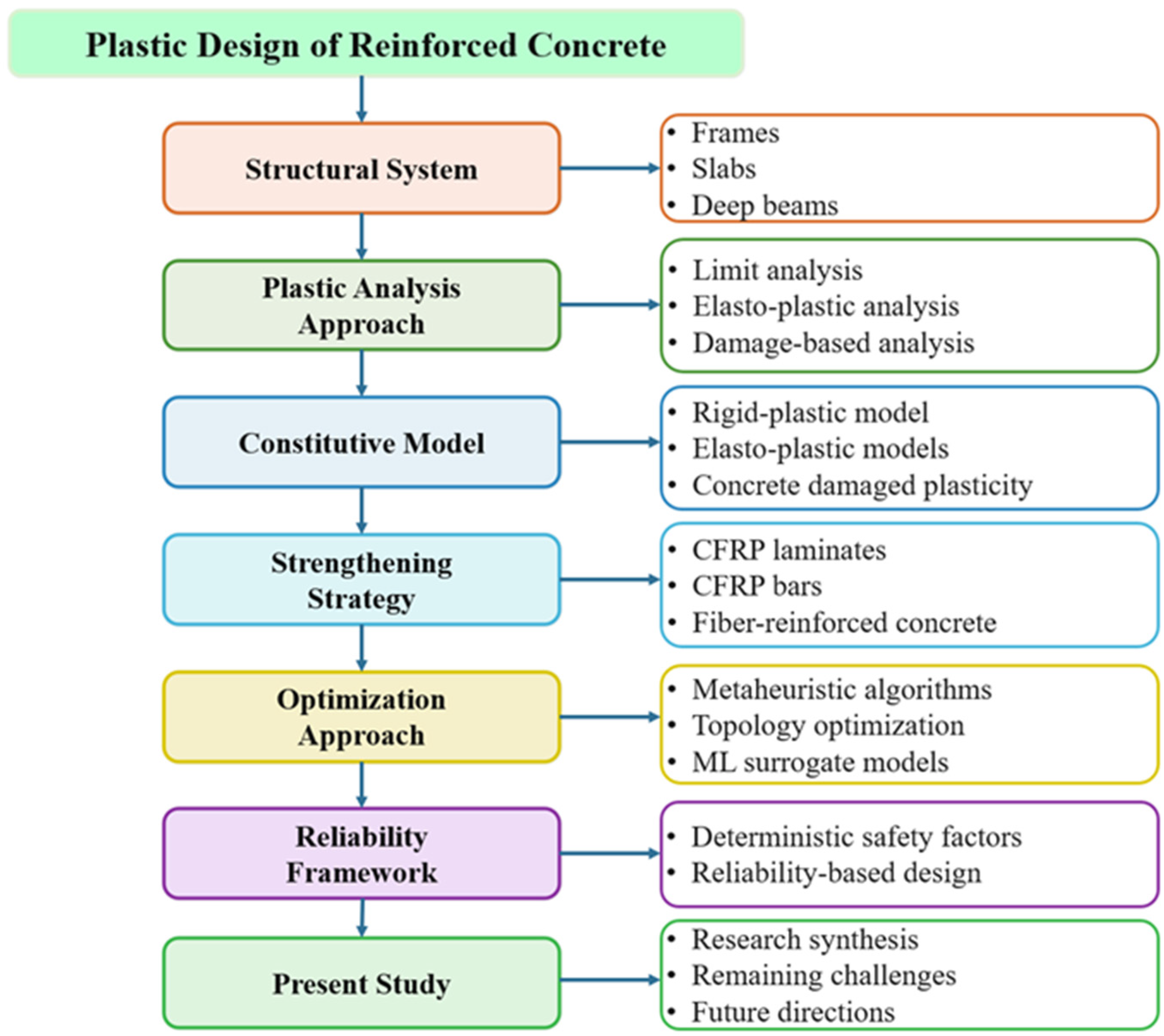
In response to these limitations, this paper presents a comprehensive state-of-the-art review of optimal plastic design for reinforced concrete structures, tracing its evolution from classical steel plasticity to modern reinforced concrete applications incorporating damage-based constitutive modeling, reliability-oriented design, computational optimization, artificial intelligence, and sustainability-driven objectives. The reviewed literature is systematically classified according to structural system type, plastic analysis approach, constitutive modeling strategy, strengthening methodology, optimization framework, and treatment of uncertainty. The overall aim is to provide a unified perspective on the theoretical, experimental, and computational foundations of deformation-governed plastic design in reinforced concrete structures.
Unlike prior studies that typically address these themes separately, the present review integrates them within a single framework centered on the control of plastic mechanisms and deformation capacity. Its main contributions are as follows: (i) a structured classification of the literature according to the structural system, plastic analysis approach, constitutive modeling strategy, strengthening methodology, optimization framework, and uncertainty treatment; (ii) a critical comparison of major methodological families and their applicability to reinforced concrete plastic design; (iii) identification of unresolved challenges related to deformation-capacity prediction, CDP calibration, reliability–optimization coupling, and practical implementation; and (iv) a research roadmap toward the low-carbon, resilient, and computationally efficient plastic design of RC structures. In the context of this review, the term “optimal plastic design” is used in a broader sense than conventional strength-based optimization. It does not refer only to maximizing the ultimate load capacity or minimizing the amount of reinforcement. Rather, it describes a performance-balanced design framework in which plastic mechanism formation, deformation capacity, safety, material efficiency, and environmental impact are considered simultaneously. In such a framework, the design variables may include reinforcement amount and layout, bar diameter and spacing, member dimensions, strengthening configuration, fiber content, or topology-related parameters. The objective function may be defined in terms of minimizing reinforcement mass, structural cost, embodied carbon, residual deformation, or a weighted combination of structural and sustainability indicators. These objectives must be satisfied together with constraints related to ultimate load capacity, plastic rotation capacity, ductility demand, crack control, serviceability, constructability, code requirements, and reliability targets. Therefore, optimal plastic design is understood here as a multi-criteria and deformation-governed design strategy that links classical plastic mechanism control with modern computational optimization, reliability assessment, and sustainability-oriented decision-making [
7,
12,
27,
28,
29,
38,
39,
41,
45,
46,
47,
48].
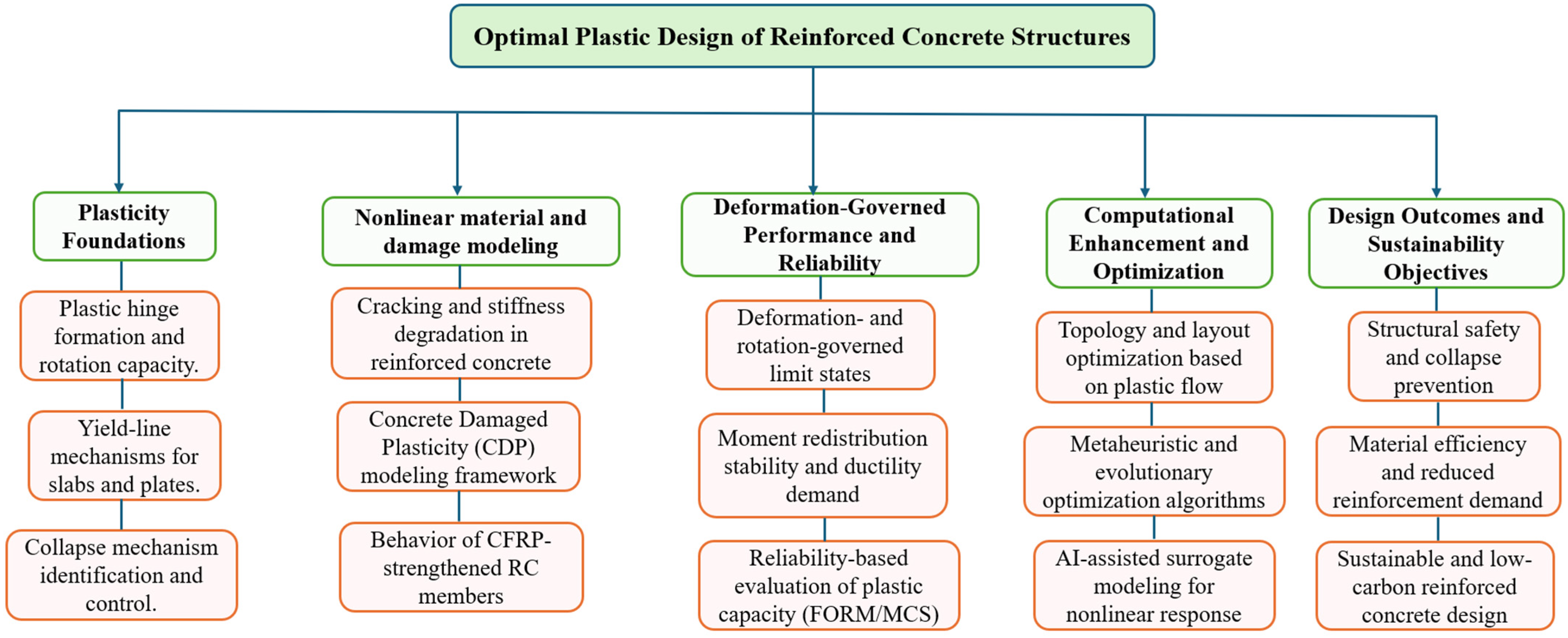
To visually articulate this integrative perspective and clarify the scope and structure of the present review, a conceptual synthesis framework is introduced in
Figure 1. The figure provides a high-level overview of plasticity-based structural modeling, damage-driven material behavior, deformation-governed performance and reliability assessment, computational optimization strategies, and sustainability objectives that are interconnected within the context of the optimal plastic design of reinforced concrete structures.
2. Review Methodology
This study adopts a structured critical review methodology to systematically identify, screen, classify, and synthesize the literature on the optimal plastic design of reinforced concrete structures. Rather than providing a purely descriptive summary of previous work, the review emphasizes the comparative interpretation of theoretical developments, constitutive modeling approaches, deformation-governed design concepts, strengthening strategies, computational methods, and emerging interdisciplinary directions within a unified analytical framework. This framework serves as a guide for organizing the subsequent review sections and comparative assessment. Based on this integrative perspective,
Table 1 summarizes representative studies on the optimal plastic design of reinforced concrete structures, highlighting their primary methodologies, key findings, and remaining limitations.
A literature survey was conducted using three major scientific databases: Scopus, Web of Science, and ScienceDirect. These sources were selected because of their broad coverage of peer-reviewed research in structural engineering, computational mechanics, and construction materials. Search strings were constructed from combinations of keywords related to plastic analysis and reinforced concrete behavior, including plastic design, plastic limit analysis, reinforced concrete, plastic hinges, moment redistribution, damaged plasticity concrete, damage–plasticity modeling, cyclic degradation, carbon fiber reinforced polymer strengthening, fiber-reinforced concrete, topology optimization, reliability-based design, probabilistic analysis, and machine-learning-assisted structural engineering. To ensure quality and relevance, only peer-reviewed journal articles published in English were considered. Studies addressing ultimate or near-collapse behavior through experimental investigation, analytical modeling, nonlinear numerical simulation, or hybrid analytical–computational approaches were prioritized. Studies restricted to linear-elastic analysis, conference papers without substantially extended journal versions, publications lacking adequate validation, and works focused exclusively on serviceability-level response were excluded.
The initial database search yielded approximately 300 records. After duplicate removal and sequential screening of titles, abstracts, and full texts, the dataset was reduced to approximately 90–100 technically relevant journal articles published between 1990 and 2025. From this refined pool, a core subset of approximately 60 studies was selected for detailed comparative assessment based on methodological originality, citation influence, and direct relevance to the deformation-governed plastic design of reinforced concrete systems. Recent application-oriented studies were retained when they provided clear contributions to plastic mechanism control, deformation-capacity assessment, reliability-based optimization, or sustainability-oriented design. To support structured synthesis and comparative evaluation, the selected studies were classified according to several complementary dimensions: structural system type, plastic analysis approach, constitutive modeling strategy, strengthening or material-enhancement technique, computational and optimization framework, uncertainty and reliability treatment, and primary design objective [
7,
51]. Constitutive modeling strategies included phenomenological plasticity, concrete damaged plasticity (CDP), and hybrid damage–plasticity formulations. This multi-level classification enables a consistent comparison across diverse research contributions, facilitates the identification of dominant methodological trends and interdependencies, and highlights persistent research gaps related to plastic hinge modeling, deformation-capacity uncertainty, mechanism-based optimization, and sustainability-oriented design, as summarized in
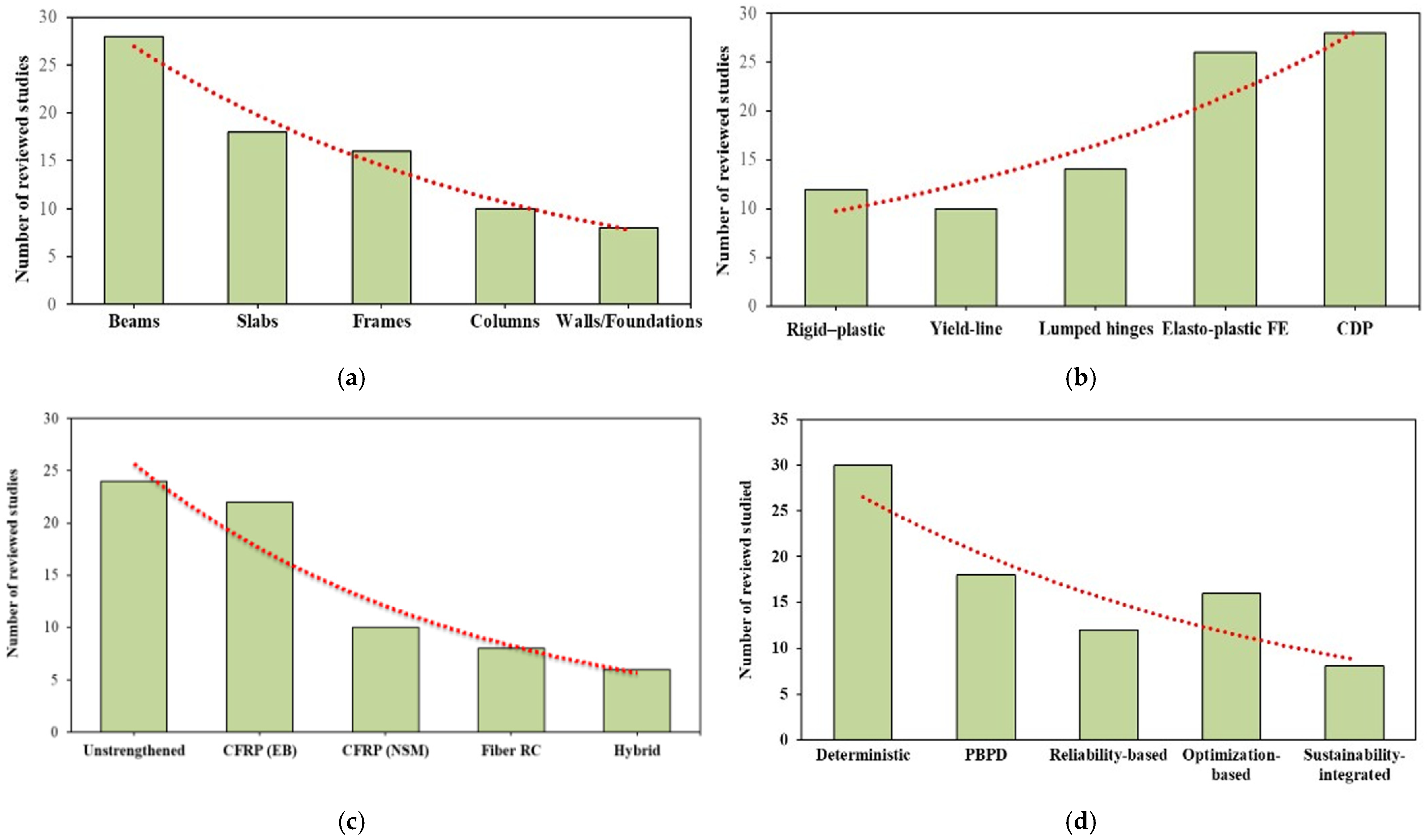
Figure 2.
Figure 2 presents the quantitative distribution of the reviewed studies according to structural system type, adopted plastic analysis approach, strengthening strategy, and overall design framework. The distribution indicates that most existing studies focus on beam- and slab-level applications, whereas distributed elasto-plastic and damage–plasticity finite-element approaches have become increasingly dominant in recent years. CFRP-based strengthening strategies have emerged as the most frequently investigated intervention technique, whereas reliability-based and sustainability-integrated plastic design frameworks remain comparatively limited. This imbalance highlights important opportunities for future research, particularly in integrating uncertainty quantification with low-carbon design objectives within deformation-governed plastic design of reinforced concrete structures.
The classification framework summarized in
Figure 3 provides the methodological backbone of the present review and supports a coherent assessment of the evolution of plastic design from classical steel plasticity to contemporary reinforced concrete applications, incorporating damage-based modeling, reliability-oriented design, advanced optimization strategies, artificial intelligence, and low-carbon objectives.
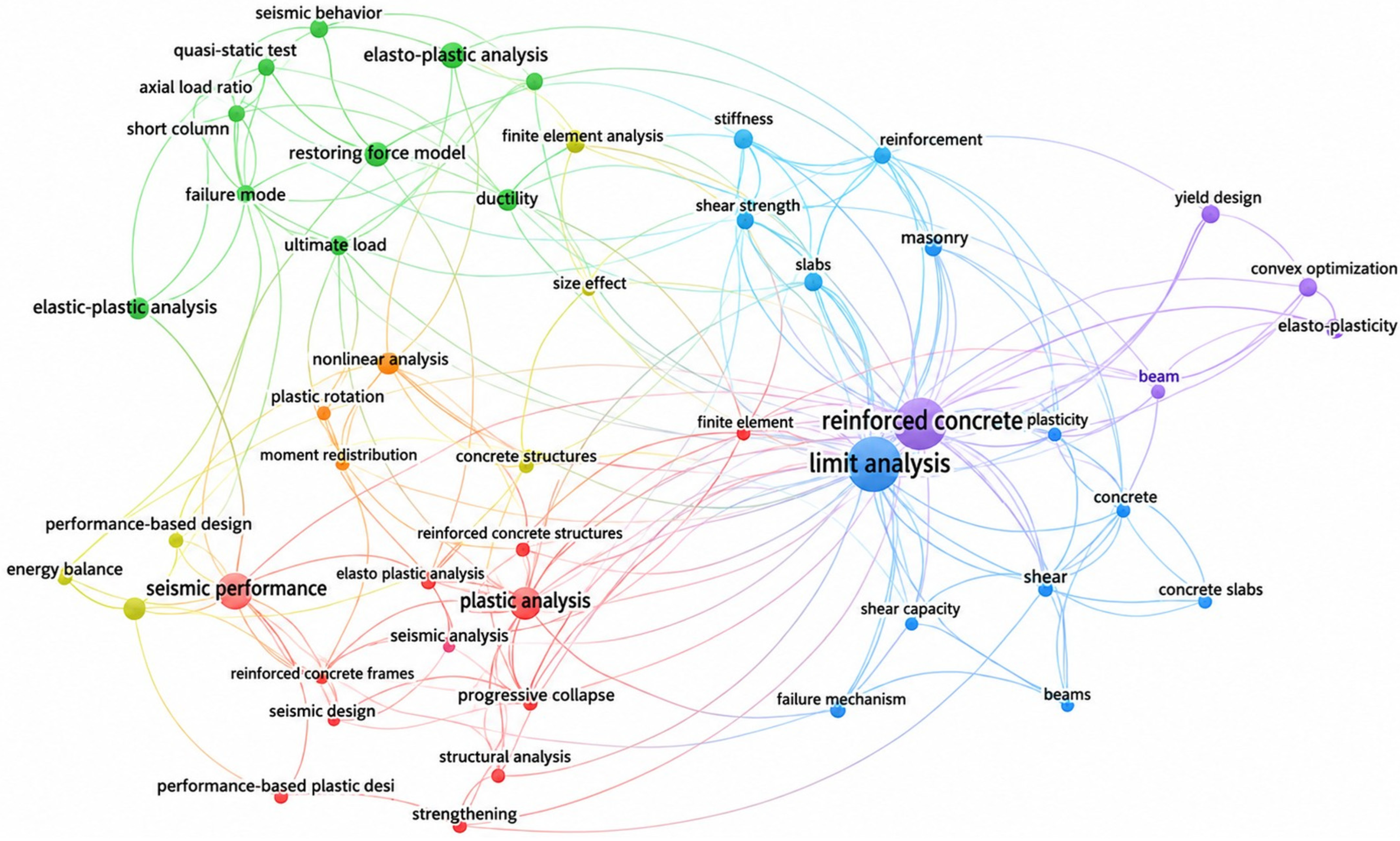
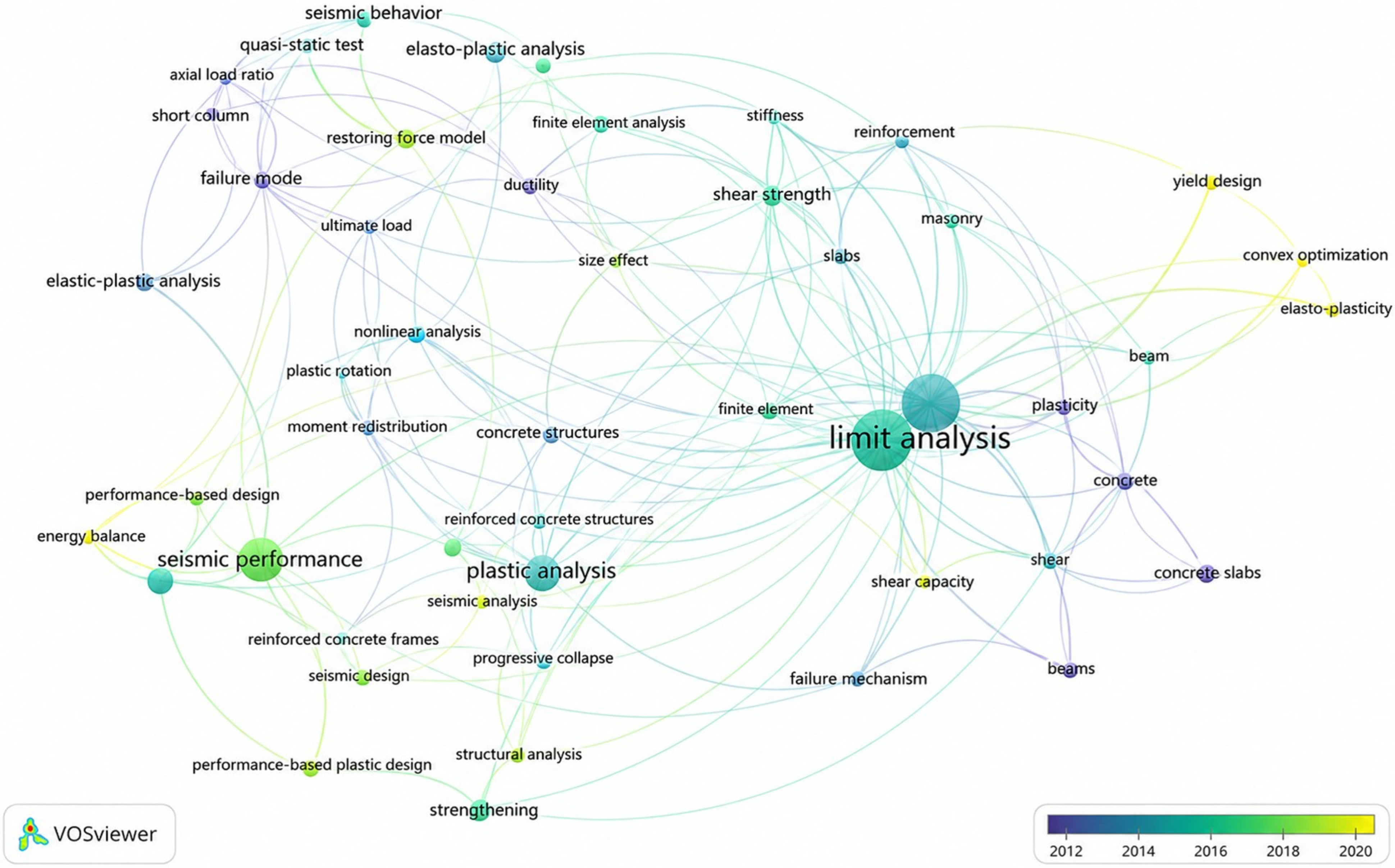
To complement the qualitative synthesis with an objective mapping of research trends, a bibliometric analysis was performed using VOSviewer (version 1.6.20). Keyword co-occurrence analysis was used to identify dominant research themes, conceptual relationships, and emerging directions within the field of plastic design of reinforced concrete structures. The analysis was based on author- and index-level keywords extracted from the final dataset of selected journal articles, with low-frequency terms filtered to improve clarity and interpretability. The resulting co-occurrence map, presented in
Figure 4, reveals the principal thematic clusters and their interconnections, highlighting the central role of limit analysis and its strong links to seismic performance, nonlinear modeling, and optimization-related research themes.
3. Evolution of Plastic Design from Steel Structures to Reinforced Concrete
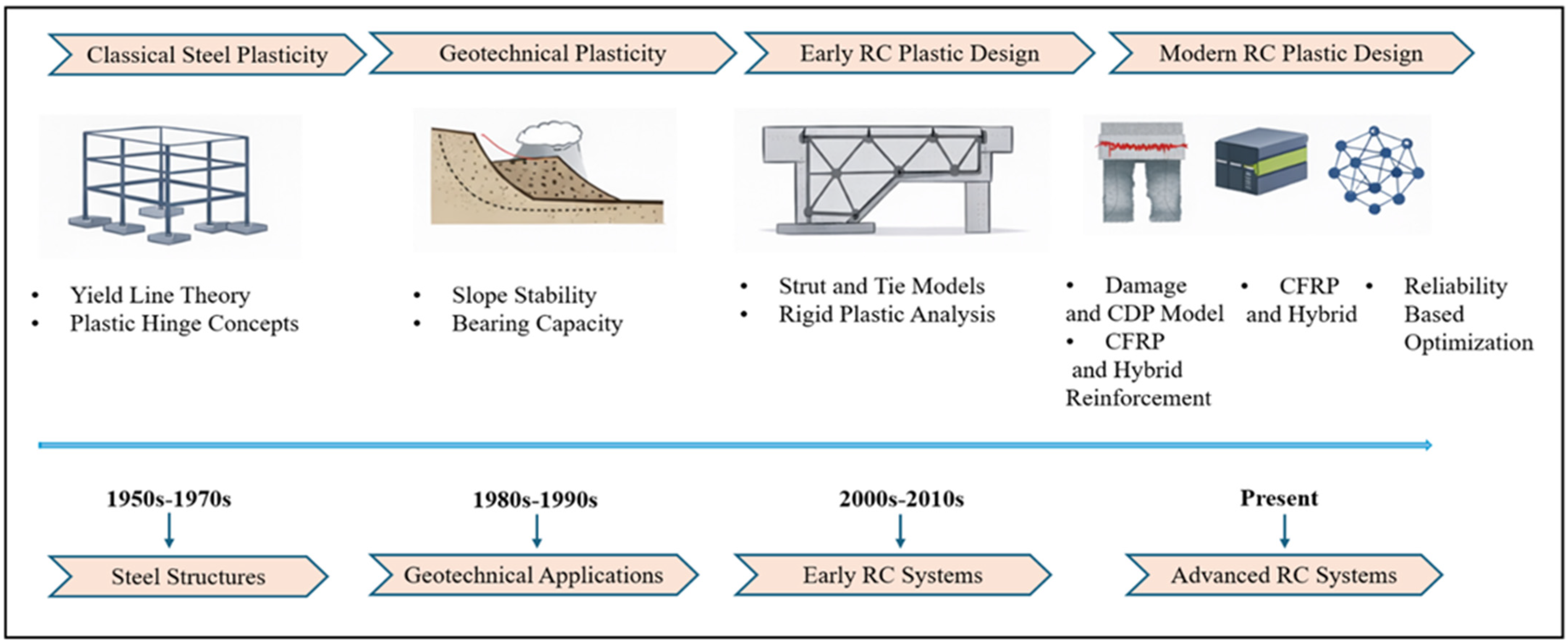
Plastic design theory has evolved from its original development for steel structures to increasingly sophisticated applications in reinforced concrete (RC) systems. This progression reflects the need to move beyond idealized rigid–plastic assumptions and to incorporate material nonlinearity, deformation capacity, cyclic degradation, and damage accumulation into structural analysis and design. The principal milestones and research trends associated with this transition are summarized in
Figure 5 and
Figure 6.
Plastic design was originally formulated for steel structures, where material homogeneity, clearly defined yielding, and stable post-yield ductility allow for the reliable formation of plastic hinges and predictable collapse mechanisms. These characteristics enabled early researchers to idealize steel members using rigid–plastic assumptions, which served as the basis for identifying collapse mechanisms and evaluating ultimate loads. Through the upper- and lower-bound theorems of plasticity, the ultimate load capacity can be estimated without explicit dependence on elastic stiffness, thereby establishing the foundations of modern limit analysis [
2,
14]. Within this framework, structural safety was assessed in terms of collapse mechanisms rather than elastic stress limits, allowing the redistribution of internal forces after the first yield while preserving global equilibrium. This represented a major advance in structural efficiency, redundancy, and robustness, particularly under extreme loading, such as seismic actions [
14,
15,
16,
18].
Subsequent developments extended classical limit analysis to mechanism-based seismic design philosophies. Plastic mechanism control theory introduced explicit regulation of plastic hinge locations and collapse modes, with the objective of enforcing global ductile mechanisms while preventing undesirable local or brittle failures [
15]. Building on this concept, performance-based plastic design (PBPD) incorporated energy-balance formulations and target drift limits, thereby linking plastic mechanism formation directly to global seismic performance objectives [
16,
17,
18]. These developments established plastic design as a mature design philosophy for steel frame systems and provided an important conceptual foundation for later extensions to reinforced concrete structures [
17].
The successful implementation of plastic design in steel structures has encouraged its extension to reinforced concrete systems, wherein the stability of collapse mechanisms is governed primarily by deformation capacity rather than strength alone. However, the direct transfer of steel-based plasticity concepts to reinforced concrete is not straightforward. Unlike steel, reinforced concrete exhibits a nonlinear response before reinforcement yielding owing to tensile cracking, stiffness degradation, bond–slip effects, confinement dependency, and progressive material damage. Therefore, the plastic response in reinforced concrete arises from the coupled interaction between steel yielding and concrete degradation, rendering classical rigid–plastic assumptions insufficient for realistic structural assessment. Experimental and analytical studies have demonstrated that the redistribution capacity in statically indeterminate RC members is strongly dependent on deformation-related parameters, including plastic rotation capacity, confinement effectiveness, reinforcement detailing, axial load ratio, and shear–flexure interaction [
19,
20,
21,
23]. These findings indicate that plastic design in RC must be treated as a deformation-governed problem rather than a purely strength-based collapse formulation.
This distinction is fundamental because reinforced concrete plasticity cannot be considered a direct extension of classical steel plasticity. In steel structures, plastic redistribution is mainly governed by yielding of a relatively homogeneous and ductile material, whereas in reinforced concrete the inelastic response results from the coupled interaction of concrete cracking, reinforcement yielding, bond transfer, aggregate interlock, confinement effects, compression softening, and progressive stiffness degradation. Tensile cracking may occur long before reinforcement yielding, and under increasing deformation demand, localized crushing, shear degradation, bond deterioration, or premature debonding of strengthening systems may interrupt the development of a stable plastic mechanism. Therefore, moment redistribution in reinforced concrete is conditional on sufficient rotational capacity and prevention of brittle failure modes. This means that RC plastic design requires deformation-based limit states, damage-informed constitutive modeling, and reliability-informed assessment rather than a direct transfer of steel-based plastic design rules [
1,
10,
11,
19,
20,
21,
23].
Early applications of plastic concepts to reinforced concrete relied mainly on ultimate-strength and mechanism-based approaches. Although these methods provided useful estimates of the collapse load, they could not account for stiffness degradation, post-peak softening, and cyclic deterioration [
50]. Consequently, their applicability to deformation-based and performance-oriented assessments remained limited [
2,
4,
33,
52]. A major milestone in adapting plasticity theory to reinforced concrete was the development of continuum damage–plasticity constitutive models. By combining plastic flow theory with damage mechanics, these formulations enabled a unified representation of tensile cracking, compressive crushing, stiffness degradation, and irreversible deformation [
4,
5,
10,
11]. Subsequent developments improved damage evolution laws, calibration procedures, and numerical implementation, thereby enhancing the predictive capability of nonlinear simulations for reinforced concrete systems [
4,
5,
6,
10,
11,
31,
33,
50]. More importantly, these models shifted the plastic design of RC from simplified mechanism-based strength estimation toward a constitutively informed assessment of deformation capacity and failure progression.
Among these formulations, the concrete damaged plasticity (CDP) model has emerged as one of the most widely adopted constitutive frameworks for nonlinear analysis of reinforced concrete behavior. The CDP model enables the simulation of tensile cracking, compressive degradation, stiffness loss, plastic hinge development, and redistribution mechanisms in reinforced concrete members and structural systems. Its widespread use reflects its ability to capture not only the ultimate strength response but also the strength–ductility interaction and possible failure-mode transitions. This makes CDP particularly relevant for optimal plastic design studies of RC members and slabs, especially in carbon fiber reinforced polymer (CFRP)-strengthened systems, where deformation capacity and redistribution behavior must be evaluated explicitly [
4,
5,
6,
10,
11,
26,
32]. Nevertheless, the use of CDP does not automatically guarantee reliable prediction of RC plastic behavior. Its accuracy is highly dependent on the selected dilation angle, flow potential eccentricity, biaxial-to-uniaxial strength ratio, viscosity parameter, tensile softening law, compressive hardening/softening response, damage variables, and mesh regularization strategy. Different calibration choices may lead to significantly different predictions of cracking localization, plastic hinge length, post-peak response, and ultimate deformation capacity. Therefore, CDP should be treated as a powerful but calibration-sensitive framework that requires experimental validation and sensitivity analysis before being used in deformation-governed plastic design [
6,
31,
33,
50,
53].
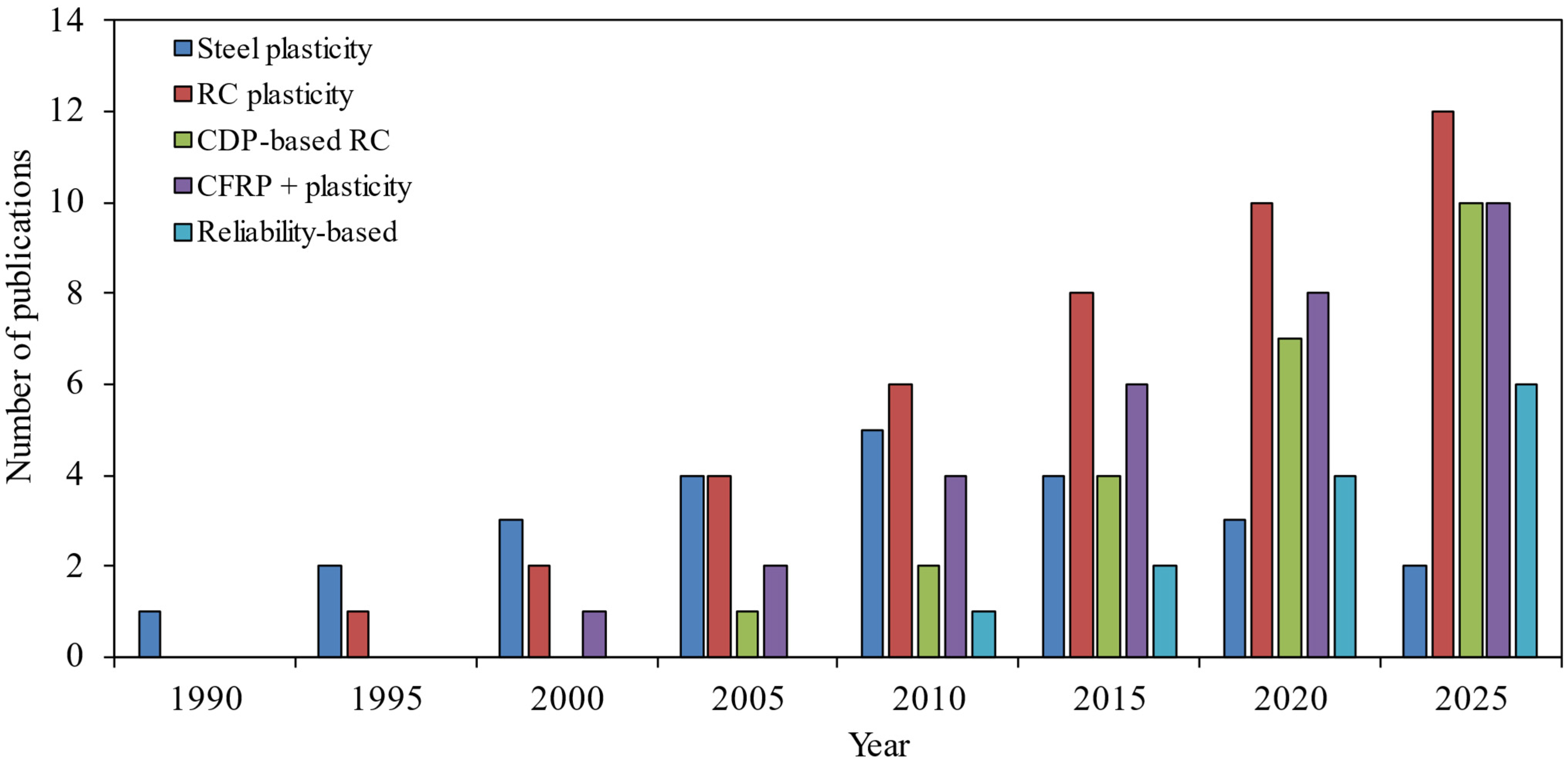
The growing emphasis on damage-based modeling, optimization methods, and reliability considerations in reinforced concrete plastic design is reflected in the temporal evolution of research themes, as shown in
Figure 7. The figure highlights a clear shift from classical strength-based formulations toward deformation-, damage-, and performance-oriented frameworks. Nevertheless, the prediction of deformation capacity remains highly sensitive to constitutive assumptions and parameter calibration, which continues to limit the reliability and transferability of advanced plastic design methodologies [
8]. This limitation underscores the need for reliability-informed and optimization-integrated design frameworks.
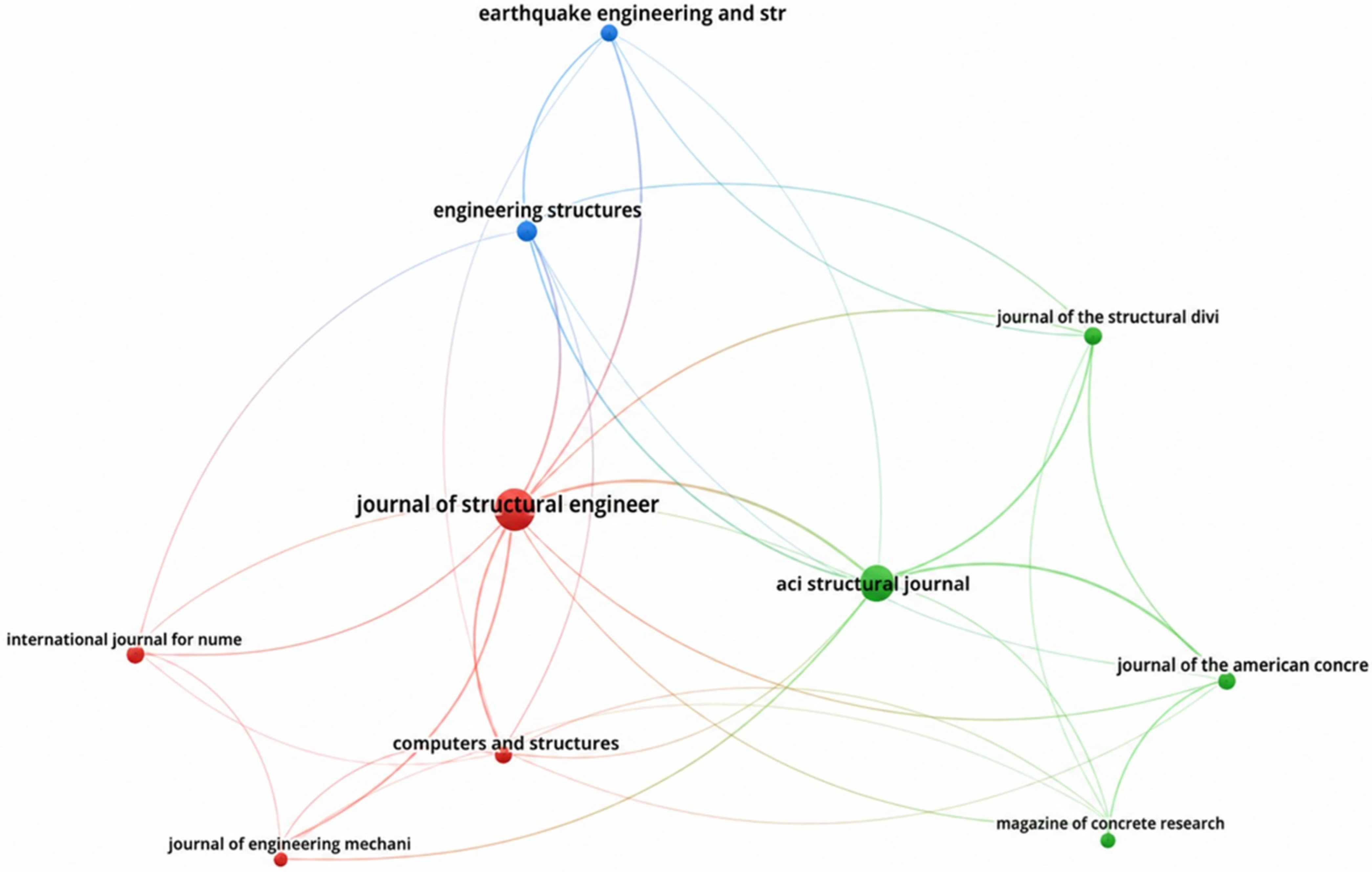
To further identify the publication venues that have strongly influenced the development of plastic design research, a source co-citation analysis was performed. The resulting network, presented in
Figure 8, highlights the dominant role of journals in structural engineering, reinforced concrete behavior, earthquake engineering, computational mechanics, and nonlinear structural analysis. This pattern confirms that modern plastic design research is inherently multidisciplinary and increasingly shaped by the interaction between structural mechanics, constitutive modeling, and computational design methodologies.
To summarize the historical development discussed in this section, the principal plastic design approaches reported in the literature are summarized in
Table 2. The table compares their core characteristics, original fields of application, subsequent adaptation to reinforced concrete systems, and representative references. Taken together, these approaches illustrate the gradual evolution of plastic design from classical rigid–plastic formulations toward deformation-governed, damage-informed, reliability-oriented, and optimization-assisted frameworks.
Building upon this historical evolution, the subsequent sections examine the key enabling technologies and methodological developments that have facilitated the systematic implementation of plastic design principles in reinforced concrete systems, beginning with carbon fiber reinforced polymer (CFRP) and fiber-reinforced strategies for plasticity control.
4. CFRP and Fiber-Reinforced Strategies for Plasticity Control in Reinforced Concrete Structures
The development of stable plastic mechanisms in reinforced concrete (RC) structures is fundamentally limited by the low tensile strength of concrete and its brittle cracking behavior. In the absence of adequate confinement and crack-bridging mechanisms, damage may localize prematurely, preventing reliable plastic hinge formation and reducing the moment redistribution capacity. Experimental and numerical studies consistently show that insufficient deformation capacity in critical regions leads to early strength degradation and an unstable post-yield response, particularly under cyclic loading [
56]. Consequently, strengthening and ductility-enhancement strategies have become essential components of modern plastic design frameworks for RC systems.
Among the available strengthening approaches, fiber-based systems, including carbon fiber-reinforced polymers (CFRP) and fiber-reinforced concrete, have shown significant potential to improve deformation capacity, delay stiffness degradation, and enhance energy dissipation under monotonic and cyclic loading. These materials modify the post-cracking response of reinforced concrete by stabilizing crack propagation and providing residual tensile resistance, thereby delaying localization and improving post-yield performance [
3,
57,
58,
59]. Recent studies have further demonstrated that such systems can be integrated into optimal plastic design frameworks to regulate plastic hinge formation, control strength–ductility trade-offs, and reduce residual deformation demand when combined with nonlinear damage–plasticity modeling and computational optimization techniques [
27,
28,
29,
60].
4.1. CFRP Strengthening Systems
Externally bonded CFRP laminates are among the most widely used techniques for flexural and shear strengthening of reinforced concrete members because of their high strength-to-weight ratio, corrosion resistance, and ease of installation. Experimental studies have shown that properly designed CFRP laminates can significantly increase flexural resistance and stiffness while preserving a stable post-yield response, provided that premature debonding is prevented through adequate anchorage [
35,
36,
57]. From a plastic design perspective, CFRP contributes not only to strength enhancement but also to the regulation of plastic hinge development. Appropriately designed CFRP layouts can delay reinforcement yielding, reduce crack localization, and promote more gradual stiffness degradation, thereby increasing the plastic rotation capacity and improving collapse resistance [
21,
23,
27,
28].
Recent numerical and optimization-based studies have further indicated that the CFRP layout, strip orientation, and reinforcement ratio can be systematically optimized to control plastic hinge formation and redistribution behavior under the ultimate loading. When nonlinear finite element models incorporating damage–plasticity constitutive laws are employed, these effects can be evaluated with greater realism. Simulations based on the concrete damaged plasticity (CDP) framework capture the interaction between CFRP reinforcement and concrete cracking, allowing for a more reliable prediction of the strength–ductility interaction and failure-mode transition [
27,
28,
29,
60].
4.2. Near-Surface Mounted and Internal CFRP Reinforcement
Near-surface mounted (NSM) CFRP reinforcement provides improved bond behavior and anchorage efficiency compared with externally bonded laminates. Experimental and analytical studies have shown that NSM systems achieve superior stress transfer and lower susceptibility to premature debonding, resulting in enhanced deformation capacity and more stable plastic hinge behavior under cyclic loading [
36,
61]. These characteristics make NSM CFRP particularly attractive for strengthening applications, in which plastic rotation demand governs structural performance [
62].
CFRP bars have also been explored as alternatives to internal reinforcement, particularly in aggressive environmental conditions. Although CFRP reinforcement remains linearly elastic up to rupture, hybrid steel–CFRP reinforcement systems can still provide favorable plastic performance when steel governs yielding, and CFRP contributes to stiffness enhancement and crack-width control. Numerical studies indicate that the deformation capacity and post-yield response of FRP-reinforced concrete members are strongly influenced by the constitutive assumptions, bond representation, and calibration of damage–plasticity parameters [
60]. Optimization-oriented studies further suggest that such hybrid systems can be tuned to balance stiffness enhancement against ductility preservation within deformation-governed plastic design frameworks [
27,
28].
4.3. Fiber-Reinforced Concrete for Plasticity Enhancement
The incorporation of discrete fibers into the concrete matrix provides an effective strategy for improving the tensile resistance, post-cracking toughness, and energy dissipation capacity. Steel fibers, polypropylene fibers, and hybrid fiber systems have been widely investigated for their crack-bridging capability and their ability to delay damage localization in critical structural regions [
58,
59,
63]. Fiber reinforcement increases residual tensile strength after cracking, resulting in smoother post-peak softening and greater deformation capacity than conventional concrete. Hybrid fiber-reinforced concrete systems appear particularly effective in plastic hinge regions, where improved confinement, reduced crack opening, and a more stable cyclic response can significantly increase the rotational capacity. These characteristics support deformation-governed plastic design and improved moment redistribution under seismic loading [
64,
65].
4.4. Integration with Plastic Analysis Frameworks
The effectiveness of fiber-based strengthening strategies is maximized when they are explicitly incorporated into plastic analysis and nonlinear finite element frameworks. Advanced simulations combining carbon fiber reinforced polymer (CFRP) materials with damage-based constitutive formulations, particularly the concrete damaged plasticity model, enable a realistic representation of cracking evolution, confinement effects, stiffness degradation, and progressive failure [
4,
5,
6,
50,
66]. However, recent numerical investigations have also shown that the predictive accuracy of damage–plasticity models remains highly sensitive to parameter selection and calibration. Therefore, careful validation against experimental evidence and analytical plastic solutions is essential for reliable deformation-based design predictions [
31,
50,
53].
Within such integrated frameworks, strengthening materials are treated as active contributors to plastic resistance rather than passive strength enhancers [
67]. This perspective enables optimization- and reliability-based algorithms to identify strengthening layouts, reinforcement ratios, and fiber contents based on deformation limits, plastic hinge regulations, and probabilistic performance constraints. Consequently, strengthening design is directly linked to plastic mechanism control, which is a key step toward deformation-governed and reliability-informed structural design [
7,
13,
27,
28,
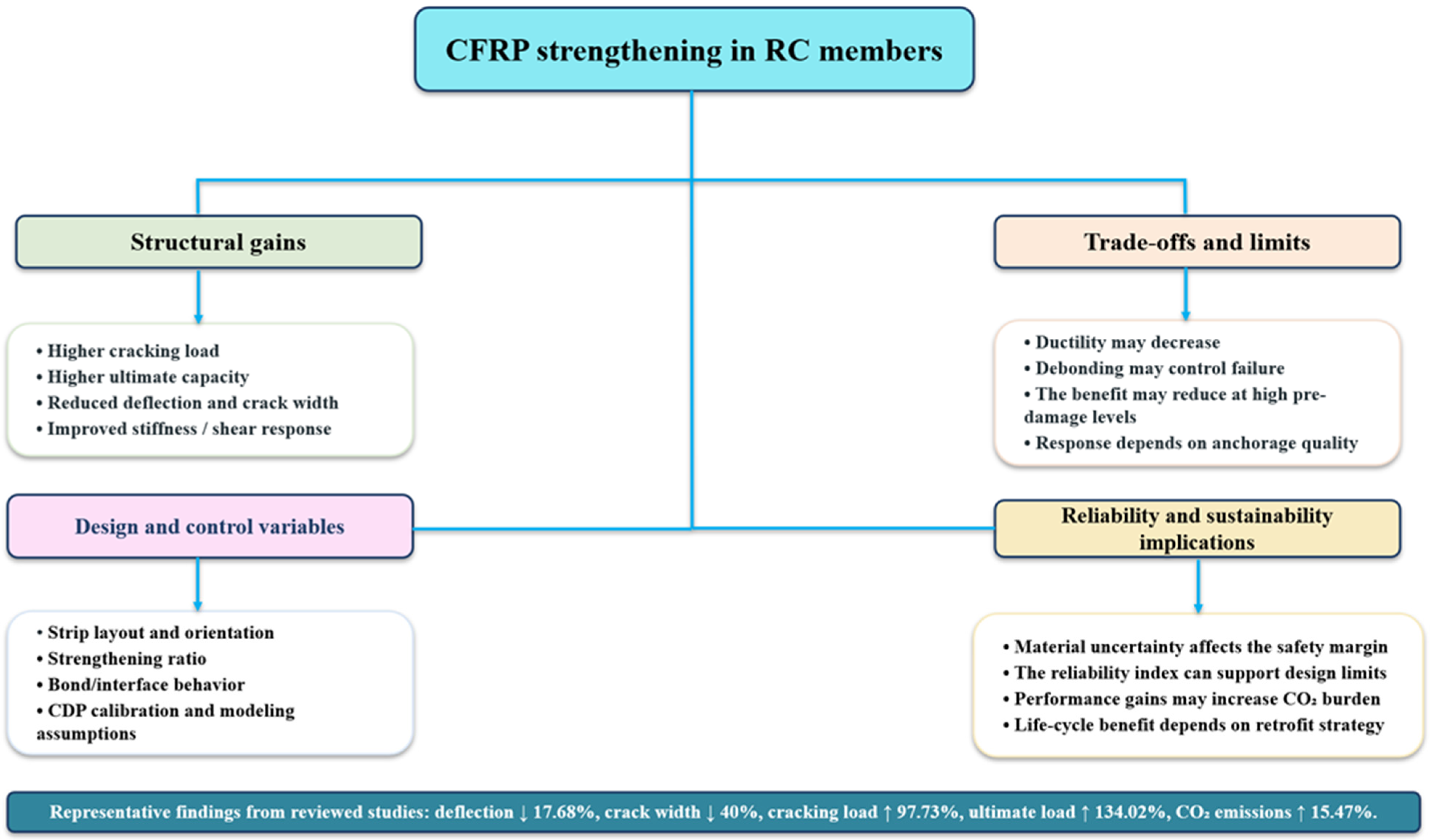
29]. The principal structural effects, design variables, trade-offs, and broader reliability and sustainability implications of CFRP strengthening in reinforced concrete members are shown in
Figure 9.
4.5. Sustainability Considerations
Strengthening and retrofitting strategies using carbon fiber reinforced polymer (CFRP) and other fiber-reinforced materials also contribute to sustainable structural design by extending service life, delaying demolition, and reducing the demand for new construction materials.
In addition to mechanical strengthening efficiency, the long-term durability of fiber-based strengthening systems must be considered when they are used within plasticity-based retrofit strategies. Recent durability-focused research on glass fabric-reinforced cementitious matrix (FRCM)-confined concrete has shown that environmental exposure, particularly alkaline conditions, can influence the confinement efficiency, mechanical integrity, and long-term performance of cementitious composite strengthening systems [
68]. This finding is important for optimal plastic design because a strengthening system that improves short-term deformation capacity may not provide the same level of plasticity control over the full service life if environmental degradation is not considered. Therefore, durability effects, exposure conditions, and service-life performance should be integrated into sustainability-oriented plastic design and retrofit frameworks [
48,
49,
68,
69].
When integrated with deformation-based plastic design, these approaches improve material efficiency and reduce embodied environmental impact by promoting controlled inelastic behavior, reliable plastic hinge formation, and stable internal force redistribution. Recent studies indicate that the sustainability performance of reinforced concrete structures is strongly influenced by the nonlinear response, deformation capacity, and damage evolution under extreme loading. These findings reinforce the need to integrate life-cycle assessment and environmental criteria into plastic and performance-based structural design methodologies [
47,
48,
49,
69,
70,
71].
4.6. Section Summary
The reviewed literature demonstrates that CFRP strengthening systems, fiber-reinforced concrete, and hybrid reinforcement strategies play a central role in enabling stable plastic mechanisms in reinforced concrete structures. By improving the deformation capacity, controlling crack localization, and delaying stiffness and strength degradation, these techniques support reliable plastic hinge formation and a more favorable redistribution of internal forces beyond the first yield [
72]. When explicitly integrated into deformation-based plastic design frameworks and advanced damage–plasticity constitutive models, particularly concrete damaged plasticity formulations, fiber-based strengthening strategies can significantly enhance ductility, plastic rotation capacity, collapse resistance, and post-yield stability under monotonic and cyclic loading. A comparative summary of the main CFRP and fiber based strengthening strategies and their relevance to plasticity control in reinforced concrete structures is presented in
Table 3.
Recent numerical and experimental studies further show that combining carbon fiber reinforced polymer (CFRP) strengthening with optimization- and reliability-based design methodologies enables more rational control of the strength–ductility trade-off and deformation demand [
7,
41]. Considering these developments, mechanism-controlled, resilient, and sustainable reinforced concrete structures capable of achieving both structural safety and long-term performance efficiency can be realized.
5. Reliability-Based Plastic Design of Reinforced Concrete Structures
The plastic design of reinforced concrete (RC) structures is inherently sensitive to uncertainty because it operates near the ultimate capacity and relies on deformation-governed limit states rather than purely strength-based criteria. Unlike elastic design approaches, which rely mainly on partial safety factors calibrated for near-linear behavior, plastic design must ensure the reliable development of plastic mechanisms, control the redistribution of internal forces, and prevent collapse under extreme loading. For this reason, uncertainty must be treated explicitly to achieve consistent safety levels within deformation-based design frameworks [
42,
43].
Material uncertainty arises from variability in concrete compressive strength, tensile cracking response, post-peak softening behavior, reinforcement yield strength, strain-hardening characteristics, and bond–slip mechanisms. Geometric uncertainty stems from construction tolerances, deviations in reinforcement placement, and variability in member dimensions, all of which can significantly affect plastic hinge formation and available deformation capacity. These uncertainties are particularly critical in RC systems, where relatively small changes in confinement effectiveness or detailing quality may lead to large differences in rotational capacity and post-yield stability [
56,
73].
Modeling uncertainty also plays a central role in predicting the plastic response of reinforced concrete structures. Parameters, such as plastic hinge length, ultimate compressive strain, confinement effectiveness, stiffness degradation rate, and damage-evolution coefficients, directly influence the predicted rotation capacity and the development of the collapse mechanism. Reliability-based studies have shown that alternative empirical formulations, system-level modeling assumptions, and spatial variability can produce substantial dispersion in the predicted lateral resistance and deformation capacity. This sensitivity highlights that the reliability of the plastic design depends not only on material and geometric variability but also on the robustness of the constitutive and analytical models used to represent the structural response [
74,
75,
76].
Conventional plastic design approaches for reinforced concrete have historically relied on deterministic formulations in which collapse mechanisms are predefined, and structural verification is performed using characteristic material properties. Although such approaches offer conceptual simplicity and computational efficiency, they do not provide explicit quantification of failure probability or consistent control of deformation-based performance. Consequently, deterministic plastic design may lead to nonuniform safety margins, particularly in systems with limited ductility, pronounced degradation sensitivity, or strengthening-induced changes in failure mode [
4,
6].
Reliability-based plastic design frameworks address these limitations by directly incorporating uncertainty into the structural assessment process. In these approaches, structural safety is evaluated using probabilistic limit-state functions defined in terms of plastic rotation demand, deformation capacity, residual drift, or collapse-prevention criteria. Therefore, failure probability becomes a unified measure of structural performance, enabling the consistent treatment of both strength- and deformation-related uncertainties in different RC structural systems [
43,
74].
Several probabilistic techniques have been applied to the reliability assessment of plastic design problems. The first-order and second-order reliability methods (FORM and SORM) provide computationally efficient estimates of failure probability by approximating the limit-state surface at the most probable point of failure. These methods are particularly attractive for deformation-based limit states when the nonlinear structural response can be represented by simplified analytical models or surrogate functions [
45,
74]. In contrast, the Monte Carlo simulation provides a more complete representation of uncertainty by directly sampling material, geometric, and loading variables. However, its high computational cost often limits its routine use in nonlinear finite element-based plastic analysis and optimization.
Moment redistribution is one of the most practically important manifestations of plastic behavior in reinforced concrete design. Although redistribution improves material efficiency and structural redundancy, it critically depends on the available rotational capacity in the plastic hinge regions. Probabilistic studies have shown substantial dispersion in the rotation capacity and damage development owing to variability in confinement conditions, reinforcement detailing, axial load ratio, concrete strength, and loading directionality. These findings suggest that simplified deterministic redistribution limits may become unconservative when applied to members with limited ductility or degradation-sensitive behavior [
20,
54,
56,
73,
77].
Performance-based plastic design (PBPD) provides a natural platform for integrating reliability concepts because it is inherently deformation-driven and mechanism-controlled. Reliability-enhanced PBPD formulations incorporate uncertainty in the hysteretic response, energy dissipation capacity, and seismic demand, thereby allowing probabilistic drift limits and collapse-probability constraints to be explicitly imposed. Applications of reinforced concrete moment-resisting frames have demonstrated greater consistency in achieving target performance levels than deterministic plastic design methods. Nevertheless, extending these approaches to irregular structural configurations and degradation-sensitive RC components remains an important unresolved challenge [
16,
20].
Recent developments have combined reliability analysis with structural optimization to establish reliability-based optimal plastic design frameworks for reinforced concrete structures. In these approaches, reinforcement ratios, member dimensions, and strengthening layouts are optimized subject to probabilistic constraints on deformation capacity, residual drift, or collapse probability. CFRP-strengthened RC members have emerged as a particularly promising application area because uncertainty in material behavior, bond performance, and damage evolution can be explicitly incorporated into reliability-constrained optimization formulations [
27,
29]. In parallel, metaheuristic optimization algorithms, surrogate models, and machine-learning-assisted predictors have improved computational efficiency while maintaining acceptable accuracy in nonlinear plastic response estimation [
40,
45].
Overall, the reviewed literature shows that reliability-based plastic design provides a rational and quantitatively consistent framework for controlling the deformation capacity, plastic hinge development, and collapse probability in reinforced concrete systems. By explicitly incorporating uncertainty into constitutive modeling, structural assessment, and optimization procedures, reliability-informed plastic design overcomes the key limitations of deterministic approaches. However, its broader practical adoption still depends on improved model calibration, efficient uncertainty propagation, and stronger integration with computational design tools. Nevertheless, it provides a clear pathway toward resilient, performance-controlled, and sustainable reinforced concrete structures.
6. Optimization and Artificial Intelligence Techniques in Plastic Design of Reinforced Concrete Structures
The optimal plastic design of reinforced concrete (RC) structures involves pronounced material and geometric nonlinearities arising from cracking, reinforcement yielding, stiffness degradation, and progressive damage accumulation. These mechanisms generate highly nonconvex and deformation-governed response surfaces. When deformation-based performance objectives, predefined collapse mechanisms, and reliability constraints are imposed simultaneously, conventional trial-and-error procedures become inefficient and often impractical. Optimization methods have therefore become essential for identifying efficient structural configurations that satisfy plastic design requirements while minimizing material use, enhancing ductility, and improving overall structural performance [
38,
78].
In this review, the term “optimal plastic design” is used to describe plasticity-based design formulations in which structural performance is improved through the explicit definition of design variables, objective functions, and constraints. In reinforced concrete applications, the design variables may include reinforcement ratios, bar diameters and spacing, member dimensions, CFRP or FRCM strengthening layouts, fiber contents, or topology-related parameters. The objective function may be formulated to minimize steel weight, total material cost, embodied carbon, residual deformation, or a weighted combination of structural and environmental indicators. These objectives are usually constrained by ultimate load capacity, plastic rotation capacity, ductility demand, crack control, serviceability limits, collapse-prevention requirements, code-based detailing limits, and reliability targets. Therefore, the “optimal” aspect of plastic design does not refer only to achieving the maximum collapse load, but to identifying a balanced design that satisfies strength, deformation capacity, reliability, constructability, and sustainability requirements simultaneously.
Early optimization studies in plastic design relied primarily on gradient-based mathematical programming combined with rigid–plastic limit analysis. These methods enabled the efficient optimization of continuous variables, such as member dimensions and reinforcement ratios, under simplified constitutive assumptions, and provided valuable insights into the relationship between collapse mechanisms and structural efficiency [
79]. However, their applicability to reinforced concrete (RC) has remained limited because RC design typically involves discrete reinforcement arrangements, highly nonconvex response surfaces, and strong nonlinearities associated with cracking, damage evolution, and cyclic degradation.
To overcome these limitations, metaheuristic optimization algorithms have been widely adopted in plastic design research. Population-based methods, such as genetic algorithms, multi-objective evolutionary algorithms, particle swarm optimization, and differential evolution, are well-suited for handling discrete design variables, nonlinear constraints, and irregular collapse-response surfaces. These algorithms have been successfully applied to the optimization of reinforcement layouts, plastic hinge distributions, carbon fiber reinforced polymer (CFRP) strengthening configurations, and deformation-constrained design variables under highly nonlinear limit state conditions. Recent studies have shown that such metaheuristic frameworks can be combined effectively with nonlinear damage–plasticity constitutive models, particularly the concrete damaged plasticity (CDP) formulation, to regulate plastic hinge development, control strength–ductility trade-offs, and enforce reliability-constrained deformation capacity in CFRP-strengthened RC members and slabs [
27,
28,
29]. Several investigations have reported significant reductions in material usage while maintaining prescribed deformation capacity and collapse-prevention criteria [
48].
Topology optimization has emerged as another influential computational tool for identifying rational force-transfer mechanisms consistent with plastic flow theory. Continuum-based density methods and discrete truss layout optimization techniques allow the objective determination of load paths, plastic hinge locations, and stress trajectories without requiring strong a priori assumptions about the structural topology [
38,
39]. In reinforced concrete applications, topology optimization has been used extensively to generate mechanically consistent strut-and-tie models for discontinuity regions, thereby reducing designer subjectivity and improving the robustness of plastic design solutions under multiple loading scenarios [
46,
48,
78,
80]. More recently, topology optimization has been incorporated into deformation-governed plastic design frameworks to support mechanism-controlled RC layouts and CFRP-assisted strengthening under nonlinear material constraints [
27,
28,
29].
Recent advances in artificial intelligence have further expanded the computational capabilities of plastic design frameworks. Machine-learning-based surrogate modeling techniques, including polynomial chaos expansions, response surface models, Gaussian process regression, and neural networks, have been developed to approximate nonlinear load–deformation responses, plastic rotation capacity, and collapse probability in reinforced concrete structures [
40,
45,
81]. These surrogate models significantly reduce the computational cost associated with nonlinear finite element analysis and Monte Carlo-based reliability assessment, thereby enabling efficient exploration of large design spaces and facilitating multi-objective optimization under uncertainty.
In the context of optimal plastic design, surrogate-assisted frameworks have been successfully combined with CFRP strengthening optimization and reliability-based constraints to provide tractable solution strategies for highly nonlinear RC systems [
27,
29]. However, the reliability of AI-assisted and machine-learning-based models is strongly dependent on the size, quality, diversity, and physical consistency of the training datasets. This issue is particularly critical in reinforced concrete plastic design because experimental datasets are often limited, expensive to generate, and highly heterogeneous. Available data may include specimens with different geometries, reinforcement ratios, concrete strengths, boundary conditions, loading histories, confinement levels, strengthening systems, and failure modes. If these differences are not properly represented, AI models may achieve high apparent accuracy within the training domain but provide unreliable predictions when applied to new structural configurations or deformation states outside the sampled range.
This limitation is especially important for damage-dominated RC behavior, where cracking localization, post-peak softening, cyclic degradation, and failure-mode transitions are difficult to generalize from small datasets. Therefore, data-driven models should not be treated as independent black-box design tools. Instead, they should be combined with mechanics-based constraints, nonlinear finite element simulations, experimental validation, uncertainty quantification, and explainability measures to ensure physically meaningful predictions. Future AI-assisted plastic design frameworks should prioritize open benchmark datasets, standardized feature definitions, transparent validation protocols, physics-informed surrogate models, and hybrid data–mechanics approaches that embed constitutive knowledge, such as damage–plasticity laws and plastic hinge mechanics, within machine-learning architectures to improve robustness and generalization [
12,
40,
45,
81].
Current research trends increasingly focus on integrated optimization–reliability–plasticity frameworks. In these approaches, objective functions may include the minimization of material quantity, structural cost, or embodied carbon, whereas probabilistic constraints are imposed on deformation limits, plastic rotation capacity, residual drift, or collapse probability. Surrogate-assisted reliability-based optimization has proven particularly promising for CFRP-strengthened RC plastic design problems because it enables rational trade-offs among safety, ductility, robustness, and sustainability without prohibitive computational expense [
47,
48].
Collectively, optimization methods and AI-assisted modeling have transformed plastic design from a largely mechanism-based prescriptive methodology into an integrated computational decision-making framework. Metaheuristic algorithms enable the systematic exploration of discrete and nonlinear design spaces, topology optimization supports the objective identification of rational force-transfer mechanisms, and surrogate models accelerate the evaluation of nonlinear and probabilistic responses. When combined with damage-based constitutive modeling, reliability assessment, and advanced strengthening strategies, these tools provide a powerful platform for next-generation reinforced concrete design. However, their wider practical adoption still depends on improved interpretability, reliable calibration, and stronger integration between computational efficiency and physical realism.
7. Sustainability and Environmental Implications of Plastic Design
Plastic design offers an important pathway for improving the sustainability performance of reinforced concrete (RC) structures by enabling a more efficient use of structural materials through controlled inelastic deformation and redistribution of internal forces beyond the elastic range. By allowing structural systems to mobilize reserve strength prior to collapse, plastic design can reduce unnecessary concrete volume, optimize reinforcement demand, and improve overall material utilization compared with conventional elastic design approaches [
14,
48]. These features directly contribute to lower embodied material demand and reduced environmental impact.
A major sustainability advantage of plastic design is its ability to promote system-level redistribution of moments and internal forces, rather than relying on conservative member-by-member strength verification. When combined with deformation-based performance criteria, plastic design can satisfy safety requirements with less reinforcement congestion and reduced structural overdesign, leading to a more uniform utilization of the material capacity throughout the system [
73,
82,
83]. In this sense, plastic design differs fundamentally from stiffness-controlled elastic design philosophies and provides a more rational basis for material-efficient structural solutions.
Strengthening and retrofitting strategies grounded in plasticity principles further enhance sustainability outcomes, particularly for existing RC infrastructure. Fiber-based systems, including carbon fiber-reinforced polymer (CFRP) laminates and fiber-reinforced concrete, can increase the deformation capacity, delay stiffness degradation, and stabilize the redistribution behavior under ultimate and cyclic loading. Such interventions may significantly extend the service life, thereby postponing demolition and reducing the demand for new construction materials and associated greenhouse-gas emissions [
34]. Recent studies have also shown that CFRP strengthening can be explicitly incorporated into optimal plastic design frameworks to balance strength enhancement, ductility preservation, and material efficiency, resulting in simultaneous improvements in structural and environmental performance [
27,
28,
29].
From a life-cycle perspective, rehabilitation of existing structures through plasticity-based strengthening offers clear environmental benefits by preserving embodied materials and avoiding energy-intensive processes such as demolition and reconstruction. Life-cycle assessments of reinforced concrete infrastructure indicate that rehabilitation strategies based on high-performance or fiber-reinforced concretes can substantially reduce global warming potential relative to full replacement, particularly when extended service life and improved material efficiency are considered [
47,
49,
71,
84].
Recent research has increasingly focused on integrating sustainability indicators directly into structural design and optimization frameworks. Metrics such as material intensity, embodied carbon, durability-related service-life measures, and resource efficiency are now being considered as explicit objectives or constraints alongside deformation capacity, collapse-prevention criteria, and reliability requirements [
38,
48]. When embedded within optimal plastic design methodologies, these formulations enable the identification of structural solutions that satisfy deformation-controlled safety requirements while minimizing environmental burden.
The integration of sustainability considerations becomes particularly powerful when plastic design is coupled with reliability-based assessment and advanced optimization methods. Unified frameworks combining plasticity-based analysis, strengthening strategies, probabilistic performance constraints, and life-cycle environmental metrics enable rational trade-offs among safety, ductility, robustness, and embodied carbon under uncertainty. Recent studies have demonstrated the technical feasibility of such integrated approaches for designing resilient, resource-efficient, and low-carbon reinforced concrete structures without sacrificing deformation-governed safety performance [
28,
48,
71]. However, wider implementation still depends on the availability of reliable life-cycle data, consistent environmental indicators, and computationally efficient methods for combining sustainability, uncertainty, and nonlinear structural response within a single design framework.
8. Comparative Assessment of Plastic Design Approaches in Reinforced Concrete Structures
To provide a clearer evaluative framework for comparing the major plastic design methodologies used in reinforced concrete structures,
Table 4 summarizes their assumptions, strengths, limitations, and domains of applicability. This comparison highlights that the suitability of each method depends on the required level of deformation accuracy, computational cost, uncertainty treatment, and ability to represent cracking, damage localization, and failure-mode transitions.
The comparison shows that classical plastic design methods remain valuable because of their simplicity and clear mechanical interpretation [
1,
2,
14]. However, their use in reinforced concrete is conditional on adequate ductility and prevention of brittle failure modes [
19,
20,
21,
23]. Methods such as yield-line theory, strut-and-tie modeling, and simplified plastic hinge formulations are useful for preliminary design and practical assessment, but they do not fully capture the coupled effects of cracking, stiffness degradation, bond deterioration, confinement, and cyclic damage [
4,
5,
6,
11,
33,
50]. In contrast, nonlinear finite element models with damage–plasticity formulations provide a more realistic representation of RC behavior, but they introduce higher computational cost and significant sensitivity to constitutive calibration [
6,
31,
33,
50]. Therefore, modern optimal plastic design should not rely on a single method; rather, it should combine mechanism-based interpretation, damage-informed modeling, reliability assessment, and optimization algorithms according to the required design objective and level of accuracy [
8,
12,
27,
28,
29,
43,
44,
45,
46].
8.1. Limit Analysis Versus Elasto-Plastic Finite Element Approaches
Classical plastic limit analysis methods, including rigid–plastic formulations and yield-line theory, provide computationally efficient tools for estimating the ultimate load capacity and identifying collapse mechanisms [
1,
2,
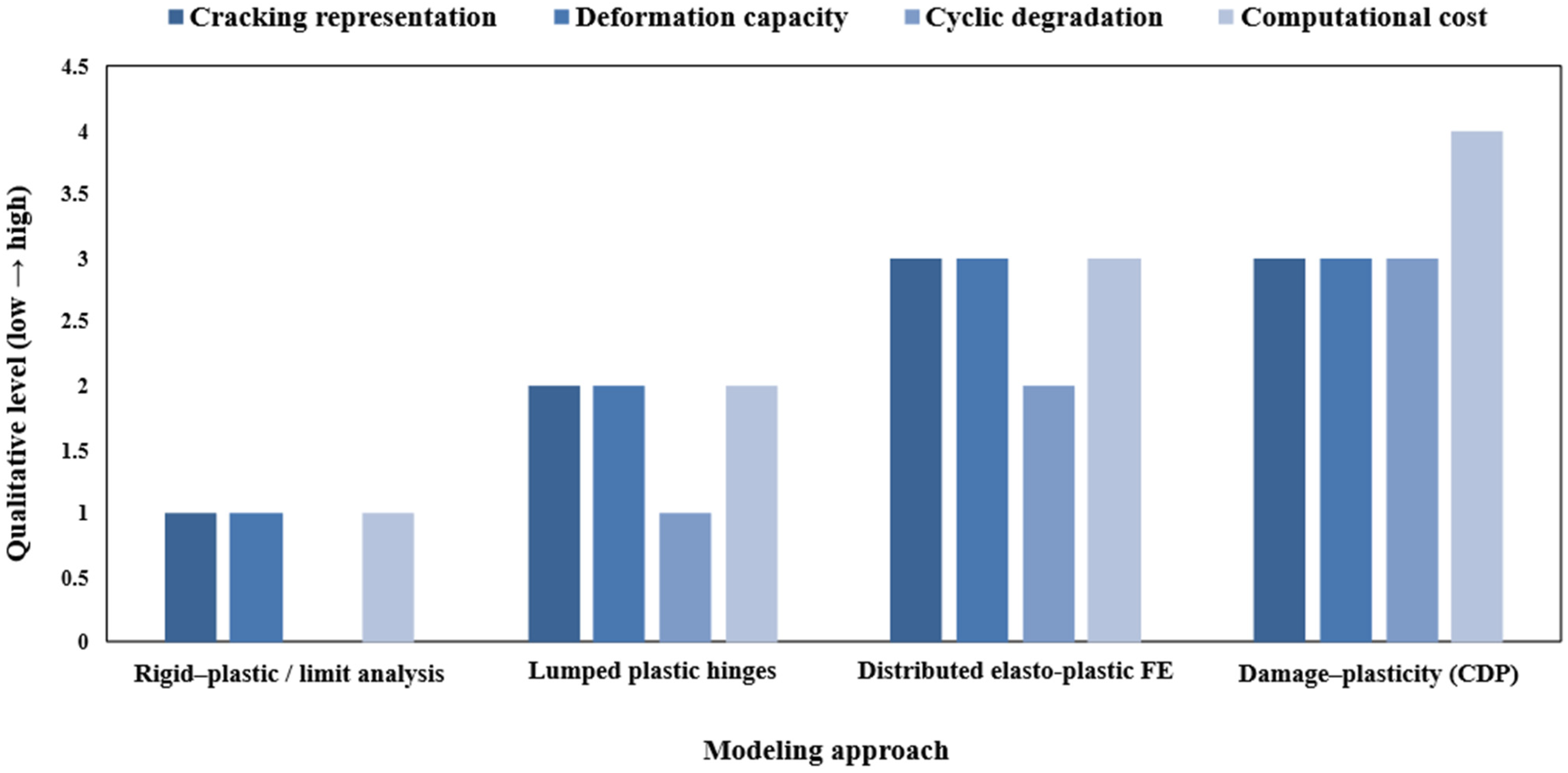
14]. These approaches are particularly useful for conceptual design, preliminary assessment, and slab systems, where failure mechanisms can be idealized with reasonable confidence. Their principal advantage lies in their simplicity and direct relationship to the upper- and lower-bound theorems of plasticity, which allows for a transparent interpretation of collapse behavior and rapid evaluation of structural efficiency, as illustrated in
Figure 10.
However, limit analysis neglects several features critical to reinforced concrete behavior, including stiffness degradation, cracking evolution, cyclic deterioration, and post-peak softening. Because these phenomena strongly affect the deformation capacity and redistribution stability, classical limit analysis cannot reliably predict the plastic rotation demand or post-yield response, particularly under cyclic or seismic loading [
4,
5,
10,
11,
26].
In contrast, elasto-plastic finite element (FE) approaches with distributed plasticity and nonlinear material models provide a much richer representation of reinforced concrete responses [
10,
11,
26,
50]. These models allow the explicit simulation of cracking, damage accumulation, and internal force redistribution throughout the loading history. Consequently, nonlinear FE modeling enables the direct evaluation of deformation-governed indicators, such as plastic hinge rotation capacity, residual drift, and failure-mode transition, which are central to modern performance-based plastic design. The essential trade-off is between conceptual transparency and predictive fidelity: limit analysis remains valuable for mechanism identification and preliminary assessment, whereas nonlinear FE approaches become indispensable when deformation capacity and damage evolution govern structural performance.
8.2. Damage-Based Constitutive Models Versus Simplified Plastic Hinge Representations
Simplified or concentrated plastic hinge models, typically implemented via lumped-plasticity formulations with empirical expressions for hinge length and rotation capacity, are widely used in engineering practice because of their computational efficiency and ease of implementation [
20,
21,
23]. These formulations are often referred to as concentrated or lumped plastic hinge models because nonlinear deformation is localized at predefined member ends or critical regions rather than distributed continuously along the member. These models are well-suited for system-level analysis of large structural assemblies and naturally integrate with performance-based seismic design procedures. However, their predictive capability depends significantly on empirical calibration [
21,
23,
56]. Considerable uncertainty remains in hinge-length expressions, ultimate strain limits, and degradation parameters, all of which can significantly influence the predicted deformation capacity and the development of the collapse mechanism.
Damage-based constitutive models, particularly the concrete damaged plasticity (CDP) formulation, provide a more physically grounded representation of reinforced concrete behavior by explicitly capturing tensile cracking, compressive crushing, stiffness degradation, and irreversible deformation [
4,
5,
6,
10,
11]. When properly calibrated, such models can reproduce plastic hinge development, strength–ductility interaction, redistribution behavior, and failure-mode transitions in both conventional and carbon fiber reinforced polymer (CFRP)-strengthened RC members. Their main disadvantage is increased modeling complexity and parameter sensitivity. Reliable application requires experimental validation, careful calibration, and appropriate regularization strategies to avoid mesh-dependent localization effects [
31,
33,
53]. In practical terms, simplified plastic hinge models remain suitable for large-scale structural assessment and preliminary design, whereas damage-based formulations are preferable for deformation-critical analysis, optimization-driven plastic design, and research applications requiring higher predictive realism.
8.3. Deterministic Versus Reliability-Based Plastic Design
The traditional plastic design of reinforced concrete structures has largely relied on deterministic formulations based on characteristic material properties and predefined collapse mechanisms. Although these approaches provide conceptual clarity and computational simplicity, they do not explicitly account for uncertainty in deformation capacity, plastic hinge behavior, or redistribution potential. Reliability studies consistently indicate that deformation-related parameters, such as plastic rotation capacity, degradation rate, and damage progression, exhibit substantially greater variability than conventional strength-based indicators [
8,
9,
43,
45]. Consequently, deterministic plastic design may produce nonuniform and, in some cases, unconservative safety margins in degradation-sensitive reinforced concrete systems.
Reliability-based plastic design addresses this limitation by directly incorporating uncertainty into probabilistic limit-state formulations. Structural safety is quantified through measures such as failure probability or the reliability index, enabling a more consistent treatment of both strength- and deformation-related uncertainties [
8,
13,
42]. These frameworks are particularly valuable for deformation-governed limit states, including plastic rotation capacity, residual drift, and collapse-prevention criteria.
The principal drawback of reliability-based plastic design is its computational demand, particularly when combined with nonlinear finite element analysis and simulation-based uncertainty propagation. Nevertheless, recent advances using FORM/SORM methods and surrogate-assisted probabilistic analysis have significantly improved tractability [
8,
45,
46]. Taken together, these developments indicate that reliability-based plastic design is not merely an optional refinement but an important methodological evolution for reinforced concrete systems operating near the ultimate limit states.
8.4. Optimization-Based Versus Rule-Based Strengthening Strategies
The design of reinforced concrete structures has traditionally relied on rule-based guidelines aimed primarily at increasing the strength or stiffness. Although these methods remain effective for many practical applications, they usually do not explicitly regulate plastic mechanism formation, redistribution behavior, or deformation capacity.
Optimization-based strengthening strategies provide a more systematic alternative by identifying strengthening layouts that directly control plastic hinge development, balance strength–ductility interaction, and minimize material consumption [
12,
38,
41]. Techniques such as topology optimization and metaheuristic algorithms have proven particularly effective for identifying rational force-transfer mechanisms and optimal CFRP strengthening configurations consistent with plastic flow theory [
30,
38,
39]. When combined with nonlinear damage-based modeling and reliability constraints, optimization-driven approaches allow explicit control of the deformation demand and collapse probability [
7,
13,
29].
Their advantages over rule-based strengthening are, therefore, substantial, particularly in performance-controlled and resource-efficient designs. However, broader implementation in engineering practice remains constrained by computational cost, the lack of standardized benchmark problems, and limited incorporation into current design codes.
8.5. Synthesis and Implications for Practice and Research
The comparative assessment presented in this section shows that no single plastic design methodology is universally superior. Rather, each approach offers distinct advantages depending on the performance objective, acceptable level of uncertainty, and available computational resources. Limit analysis provides conceptual transparency and rapid mechanism identification; nonlinear elasto-plastic and damage-based finite element models provide deformation-resolved performance prediction; reliability-based frameworks ensure probabilistic consistency in deformation-governed limit states; and optimization-driven strategies support material-efficient and mechanism-controlled design.
Therefore, the most promising direction for future research is not the replacement of one methodology with another, but the development of hybrid frameworks that combine their complementary strengths. In particular, future work should aim to integrate the interpretability of mechanism-based plastic design, the predictive realism of damage-informed modeling, the probabilistic robustness of reliability-based assessment, and the computational efficiency of modern optimization and surrogate techniques. Such integration is essential if plastic design is to evolve into a practical, performance-controlled, and environmentally responsible framework for reinforced concrete structures.
9. Discussion and Research Gaps
The reviewed literature shows that plastic design has evolved from its classical formulation in steel structures toward increasingly sophisticated applications in reinforced concrete (RC) systems supported by damage-informed modeling, performance-based concepts, and computational optimization [
2,
14]. Nevertheless, several critical limitations continue to restrict its broader reliability, reproducibility, and practical implementation in RC design. These limitations arise primarily from uncertainty in deformation-capacity prediction, sensitivity of damage-based constitutive models, limited system-level applicability, and incomplete integration of optimization, reliability, and sustainability objectives [
4,
5,
10,
11,
19,
20,
21,
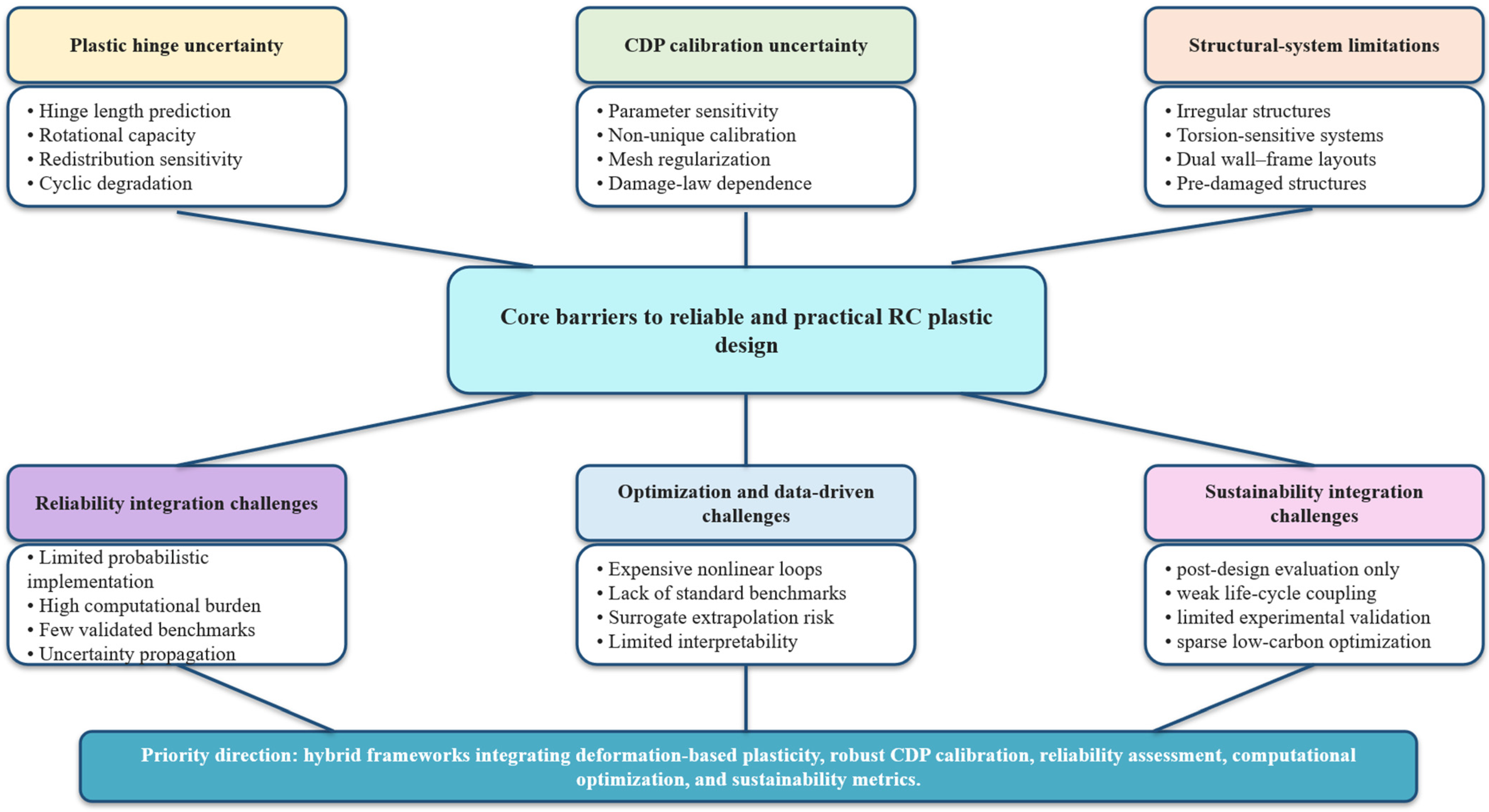
23]. The principal unresolved challenges identified in the reviewed literature can be grouped into six interconnected themes, as summarized in
Figure 11: (i) coupling of collapse mechanisms, moment redistribution, and ductility requirements; (ii) prediction of plastic hinge length and rotational capacity; (iii) calibration uncertainty in damage-based constitutive models; (iv) system-level applicability and long-term degradation; (v) computational and AI-related challenges in optimization; and (vi) incomplete integration of sustainability objectives into plastic design frameworks.
A central gap in the reviewed literature is that collapse mechanisms, moment redistribution, and ductility requirements are often discussed separately rather than as coupled components of RC plastic design. In reinforced concrete structures, redistribution cannot be evaluated only from flexural strength or ultimate load capacity; it depends on the ability of critical regions to develop sufficient plastic rotation without premature shear failure, bond deterioration, compression crushing, or cyclic degradation. Therefore, a plastic design method that predicts collapse load but does not verify deformation capacity may lead to unsafe or misleading conclusions. Future RC plastic design frameworks should explicitly link collapse-mechanism formation with ductility demand, plastic hinge length, curvature capacity, confinement effectiveness, and failure-mode control [
19,
20,
21,
23,
55,
74,
77].
One of the most important unresolved issues concerns the prediction of the plastic hinge length and rotational capacity. These parameters govern the deformation capacity, moment redistribution, and formation of the collapse mechanism; however, they remain highly sensitive to empirical assumptions regarding confinement effectiveness, reinforcement detailing, axial load, and post-yield degradation. Experimental and analytical studies have shown that deformation-related indicators exhibit substantially greater variability than strength-based measures, resulting in significant dispersion in the predicted drift capacity and collapse behavior [
23,
56,
73]. This uncertainty undermines the robustness of deterministic plastic design and remains a major obstacle, even in advanced reliability-based formulations.
Recent reliability-based and optimization-driven studies, particularly those addressing CFRP-strengthened RC members, have improved the control of the deformation demand and plastic mechanism development under uncertainty [
27,
28,
29,
44]. However, uncertainty in plastic hinge modeling and rotation-capacity prediction remains a dominant unresolved source of variability, even within reliability-constrained design frameworks.
Further major research gaps concern the modeling of uncertainty associated with damage-based constitutive formulations. Advanced damage plasticity models, particularly the concrete damaged plasticity (CDP) framework, have significantly enhanced the simulation of cracking, crushing, stiffness degradation, and cyclic deterioration in RC structures [
4,
5,
10,
11,
26,
33,
50]. However, the predictive accuracy remains strongly dependent on parameter calibration, mesh regularization strategies, and adopted damage evolution laws, particularly when the deformation capacity under multiaxial stress states and confinement is governed by the selected hardening formulation [
33,
50,
66]. Comparative numerical investigations demonstrate that different calibration choices may lead to markedly different predictions of plastic hinge formation, post-peak response, and redistribution behavior [
6,
32,
50,
53,
60]. The absence of standardized calibration procedures applicable across different structural typologies, confinement conditions, and loading histories continues to hinder reproducibility and limit the routine implementation of damage-based plastic design in engineering practice.
From a structural system perspective, much of the existing literature focuses on regular structural configurations and idealized boundary conditions. Applications to irregular systems, torsion-sensitive layouts, dual-wall–frame systems, and previously damaged existing structures are comparatively limited. In addition, long-term degradation mechanisms, such as aging-related stiffness loss and service-life deterioration, are rarely incorporated into plastic design frameworks, despite their known influence on deformation capacity and redistribution potential [
49,
71]. Only a limited number of probabilistic studies have begun to address these effects at the system level [
74,
77].
Despite rapid advances in computational methods, optimization- and artificial intelligence-based plastic design approaches present unresolved challenges. Metaheuristic optimization algorithms, when coupled with nonlinear finite element analysis and probabilistic assessment, often entail high computational costs. Meanwhile, machine-learning-based surrogate models remain sensitive to the quality of the training data, extrapolation range, and physical interpretability of damage-driven RC responses [
12,
40,
45]. Furthermore, the lack of standardized benchmark problems and unified performance metrics complicates the objective comparison and validation of competing optimization strategies for the plastic design of reinforced concrete systems.
Sustainability is another major area of incomplete integration. Although environmental considerations have gained increasing importance in structural engineering research, rigorously validated multi-objective frameworks that simultaneously combine plasticity theory, deformation-based performance criteria, probabilistic reliability constraints, nonlinear optimization, and life-cycle environmental metrics are still rare [
47,
48]. In many studies, sustainability is treated as a post-design evaluation rather than an intrinsic design objective. Moreover, most sustainability-oriented plastic design frameworks lack experimental validation under cyclic or collapse-level loading [
27,
28], which limits confidence in their predictive robustness and practical relevance. As a result, a significant gap persists between conceptual integration and experimentally supported, reliability-consistent, sustainability-oriented plastic design methodologies for reinforced concrete systems.
Another important limitation is the incomplete integration of modern material systems and data-driven modeling into plastic design frameworks. High-performance concrete, ultra-high-performance concrete, fiber-reinforced concrete, recycled aggregate concrete, and hybrid reinforcement systems can significantly modify cracking behavior, post-peak softening, confinement response, and plastic rotation capacity. However, their effects are rarely incorporated into unified plastic design formulations. Similarly, artificial intelligence and surrogate modeling have shown promise for accelerating nonlinear analysis and optimization, but their reliability remains constrained by limited experimental datasets, inconsistent feature definitions, poor extrapolation capability, and insufficient physical interpretability. This indicates the need for hybrid physics-informed approaches in which machine learning is constrained by mechanics-based principles, experimentally validated nonlinear finite element simulations, and probabilistic performance criteria [
12,
31,
40,
45,
47,
48,
49,
50,
59,
81].
Overall, the identified research gaps indicate that future progress in reinforced concrete plastic design depends on advances in four closely connected areas: (i) more reliable prediction of plastic hinge length and rotational capacity, (ii) reproducible calibration of damage-based constitutive models, (iii) stronger integration of uncertainty quantification with optimization and system-level assessment, and (iv) incorporation of sustainability objectives as intrinsic components of deformation-controlled design. Addressing these issues is essential for transforming plastic design from a powerful analytical concept into a fully integrated, performance-controlled, and sustainability-oriented design framework for next-generation reinforced concrete systems under quantified uncertainty.
10. Conclusions
This review has shown that the evolution of plastic design from classical steel plasticity to modern reinforced concrete applications requires a unified framework that is deformation-governed, damage-informed, reliability-oriented, and computationally supported. Although fundamental plasticity concepts, such as collapse mechanism control, energy balance, and redistribution of internal forces, remain theoretically valid, their reliable implementation in reinforced concrete systems demands explicit consideration of material nonlinearity, cracking behavior, confinement effects, stiffness degradation, and cyclic damage accumulation.
Major advances in constitutive modeling, particularly the development of coupled plastic–damage formulations and the concrete damaged plasticity (CDP) framework, have substantially improved the ability of nonlinear analysis to represent plastic hinge development, redistribution behavior, and failure-mode transition in reinforced concrete structures. Strengthening strategies based on carbon fiber–reinforced polymers, fiber-reinforced concrete, and hybrid reinforcement systems have demonstrated strong potential to improve deformation capacity, stabilize plastic mechanisms, and extend structural service life. When integrated into deformation-based plastic design frameworks, these approaches contribute to enhanced structural safety, improved material efficiency, and sustainability.
The review further shows that reliability-based plastic design provides a rational basis for incorporating uncertainty in deformation capacity, plastic hinge behavior, and redistribution mechanisms, thereby overcoming the key limitations of deterministic plastic design. Concurrently, computational optimization techniques and artificial intelligence-assisted tools have transformed plastic design from a largely prescriptive, mechanism-driven methodology into an integrated decision-making framework capable of addressing multiple and often competing objectives, including safety, ductility, robustness, cost efficiency, and environmental impact.
Despite this progress, several critical challenges remain unresolved. Among the most important are the reliable prediction of the plastic hinge length and rotational capacity, reproducible calibration of damage-based constitutive models, extension of plastic design frameworks to irregular and degradation-sensitive structural systems, and practical integration of reliability, optimization, and life-cycle sustainability criteria within a single validated framework. These challenges define the main frontiers of future research.
Overall, the available evidence indicates that the future of reinforced concrete plastic design lies in hybrid methodologies that combine the conceptual transparency of mechanism-based plasticity, the predictive realism of damage-informed nonlinear analysis, the probabilistic consistency of reliability-based assessment, and the efficiency of modern optimization and surrogate modeling techniques. The development of such unified frameworks is essential for advancing reinforced concrete design toward resilient, resource-efficient, and low-carbon structural systems under quantified uncertainty.
11. Future Research Directions
Despite substantial recent advances, several critical challenges remain unresolved in the optimal plastic design of reinforced concrete structures. The accurate prediction and experimental calibration of deformation-based parameters, particularly plastic hinge length, curvature ductility, rotational capacity, and post-yield degradation, remain major sources of uncertainty. These parameters directly control moment redistribution, collapse-mechanism stability, and ductility demand. Future studies should therefore prioritize large-scale experimental and numerical investigations under monotonic, cyclic, and extreme loading conditions to establish more reliable deformation-capacity models for different structural systems, reinforcement details, confinement conditions, and strengthening configurations.
A second important research direction concerns the development of robust and reproducible damage-informed constitutive models. Although concrete damaged plasticity and related damage–plasticity formulations have significantly improved nonlinear simulation capability, their predictions remain highly sensitive to calibration assumptions, tensile softening laws, compressive hardening/softening responses, damage variables, viscosity parameters, and mesh regularization. Future work should focus on standardized calibration procedures, benchmark examples, sensitivity studies, and validation protocols that allow different models to be compared objectively across beams, slabs, columns, walls, joints, and strengthened systems.
Future research should also strengthen the integration of plastic design with reliability-based and optimization-based frameworks. Deterministic plastic design methods are insufficient for RC systems because deformation capacity, plastic hinge behavior, material properties, loading conditions, and modeling parameters are uncertain. Therefore, future methodologies should combine nonlinear damage-based analysis with FORM/SORM, Monte Carlo simulation, surrogate modeling, and reliability-based optimization. Such frameworks would allow reinforcement layouts, member dimensions, strengthening systems, and topology configurations to be optimized while explicitly controlling failure probability, ductility demand, residual deformation, and collapse-prevention performance.
Artificial intelligence and machine-learning-assisted approaches represent another promising but still immature direction. Future AI-based plastic design frameworks should move beyond black-box prediction and incorporate mechanics-based constraints, damage–plasticity theory, plastic hinge mechanics, and uncertainty quantification. Large, reliable, and diverse benchmark datasets are needed to train models that can generalize across different geometries, reinforcement ratios, material strengths, loading histories, boundary conditions, and failure modes. Physics-informed machine learning, FE-generated synthetic datasets calibrated against experiments, and explainable surrogate models are particularly promising for accelerating nonlinear analysis and reliability-based optimization.
Sustainability should also become an intrinsic part of optimal plastic design rather than a post-design evaluation. Future studies should integrate embodied carbon, material efficiency, durability, service-life extension, repairability, and life-cycle assessment directly into multi-objective plastic design formulations. This is especially important for strengthened and retrofitted RC structures, where CFRP, FRCM, fiber-reinforced concrete, and hybrid reinforcement systems can extend service life and reduce demolition-related environmental impacts. However, their long-term durability, environmental exposure sensitivity, and influence on deformation capacity must be incorporated into plastic design models more rigorously [
68].
Overall, future progress in reinforced concrete plastic design requires hybrid frameworks that combine mechanism-based plasticity, damage-informed nonlinear analysis, reliability assessment, optimization algorithms, artificial intelligence, and sustainability metrics. Such integrated methodologies would support the development of resilient, deformation-controlled, resource-efficient, and low-carbon reinforced concrete structures under quantified uncertainty.