Comparison of Operative Temperature Distribution in Radiator- and Floor-Heated Rooms

Abstract
1. Introduction
2. Research Methods
3. Results
- -
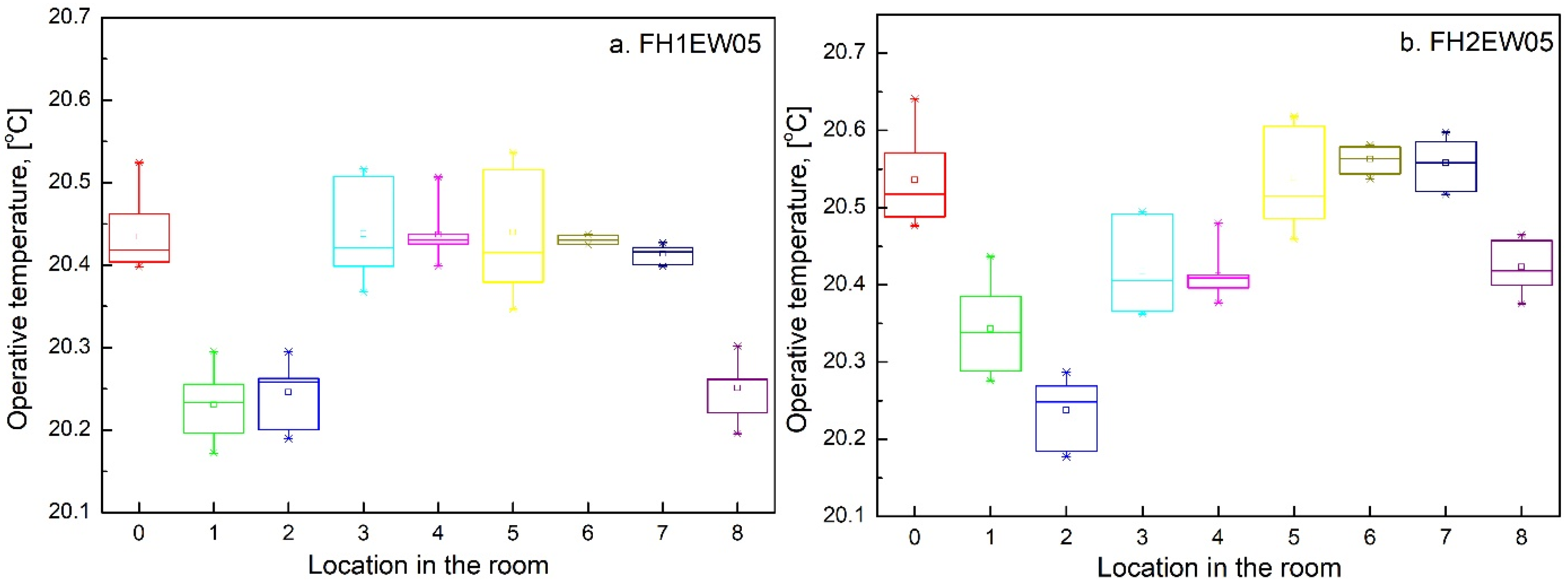
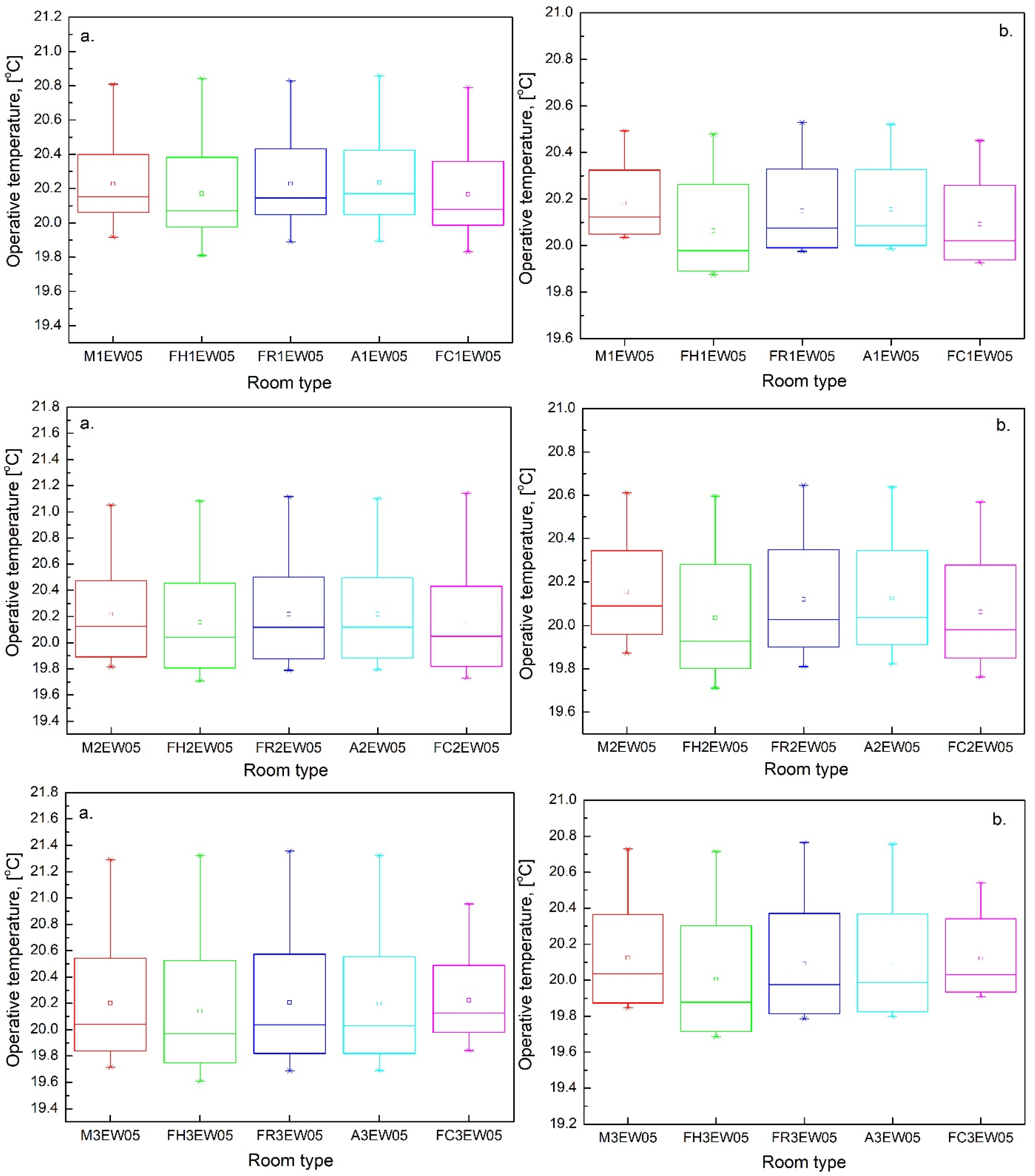
- If the U-value decreases, the minimum and mean operative temperatures increase, while the maximum temperature decreases.
- -
- Increasing the size of the room decreases the mean and maximum operative temperatures, while the minimum temperature increases.
- -
- If the room has only one external wall, the minimum and mean operative temperatures increase, while the maximum operative temperature decreases. If the room has three external walls, the maximum values increase, while the minimum and mean values decrease.
- -
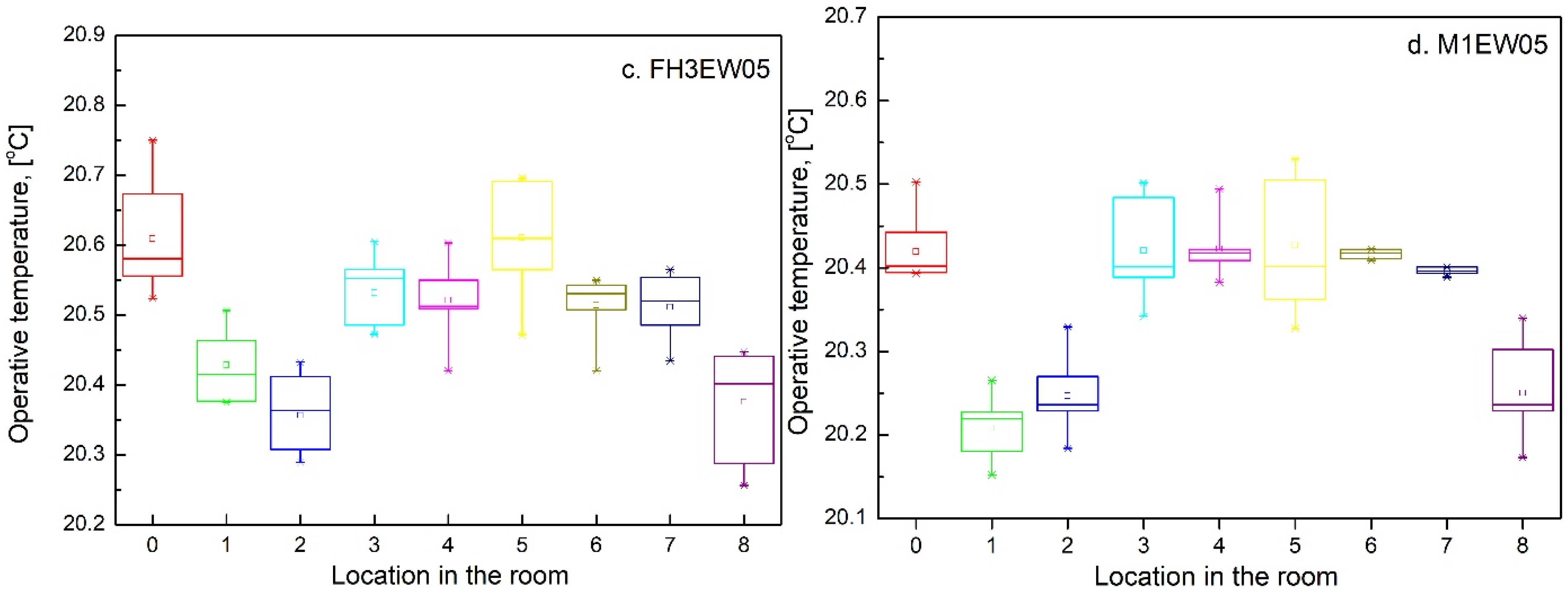
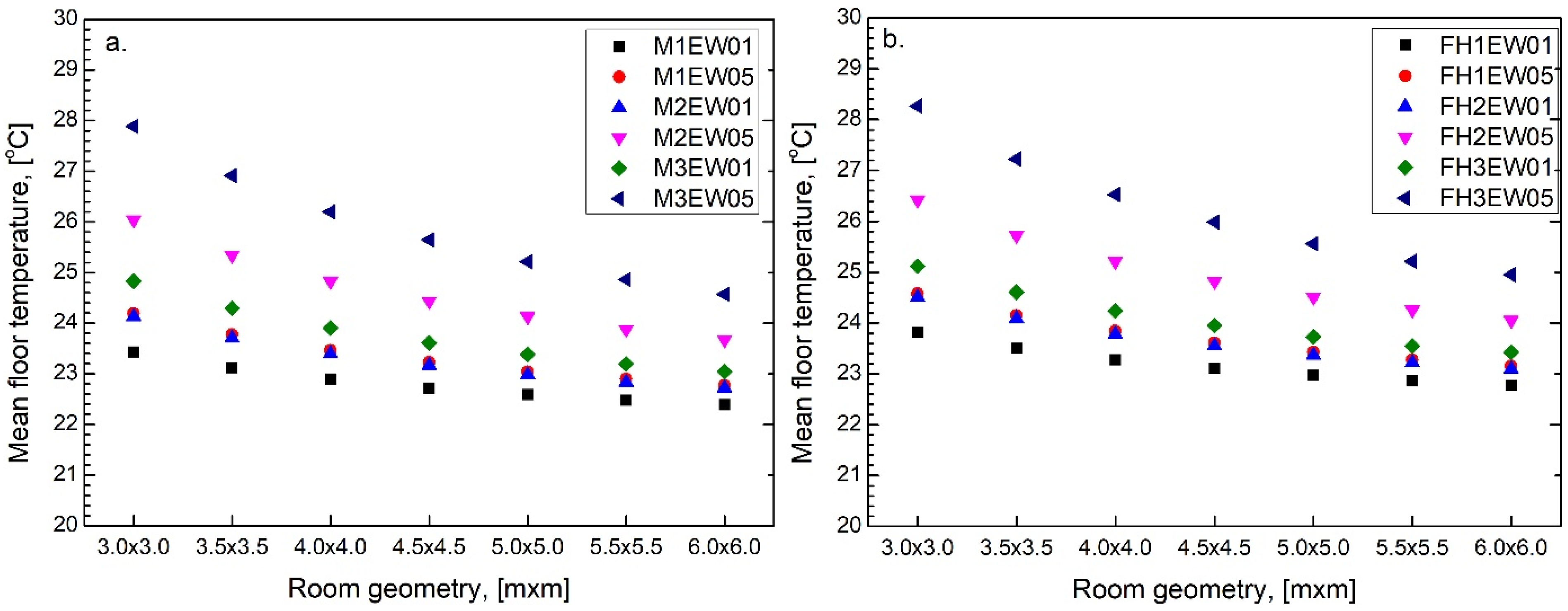
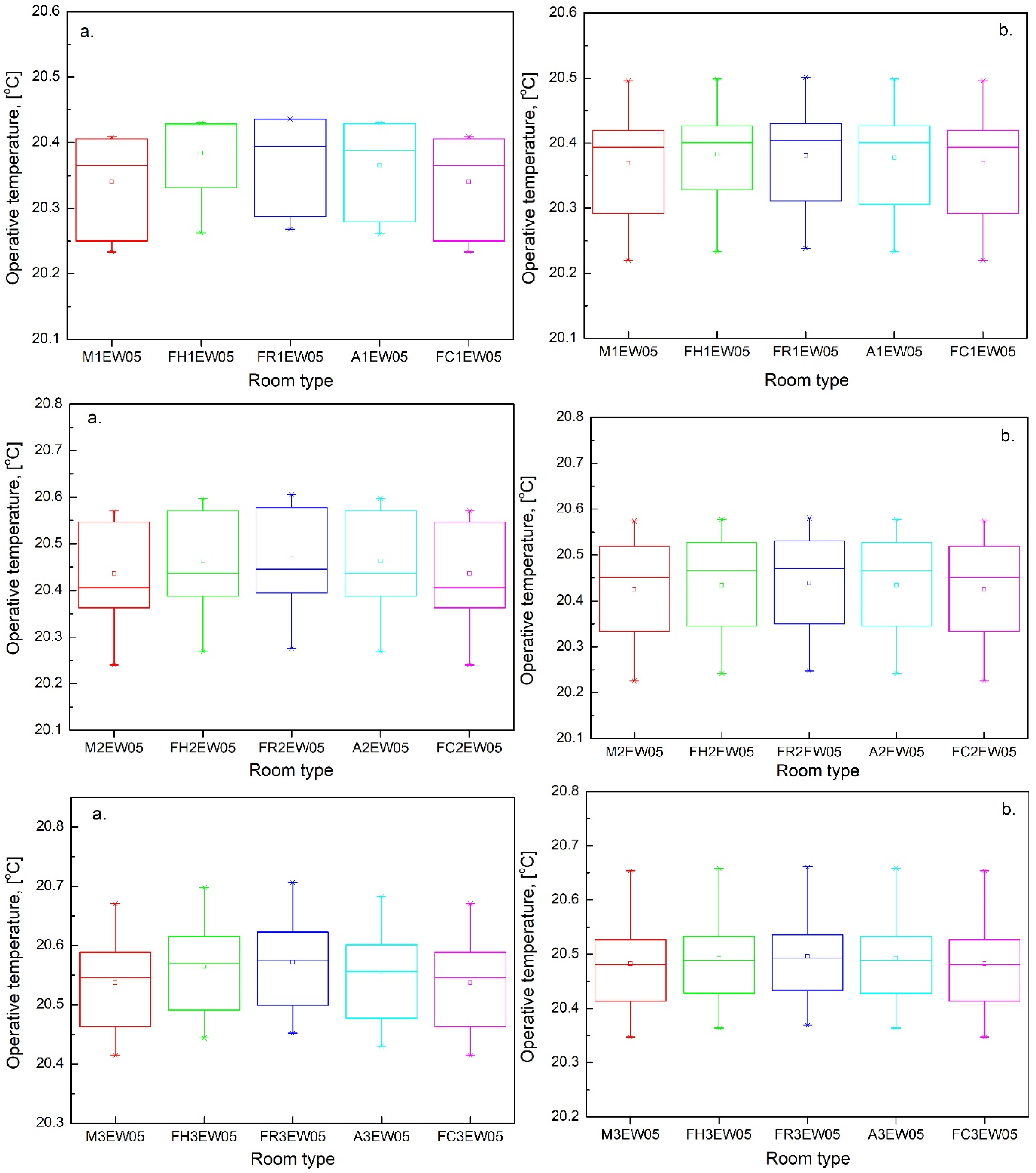
- If the U-value of the external walls decreases, the mean and maximum operative temperatures decrease, and the minimum temperatures increase;
- -
- As the room size increases, the mean and maximum operative temperatures decrease, while the minimum operative temperatures increase.
- -
- If the room has only one external wall, the minimum, mean, and maximum operative temperatures decrease. On the contrary, if the room has three external walls, the minimum, mean, and maximum operative temperatures increase.
4. Discussion
5. Conclusions
- -
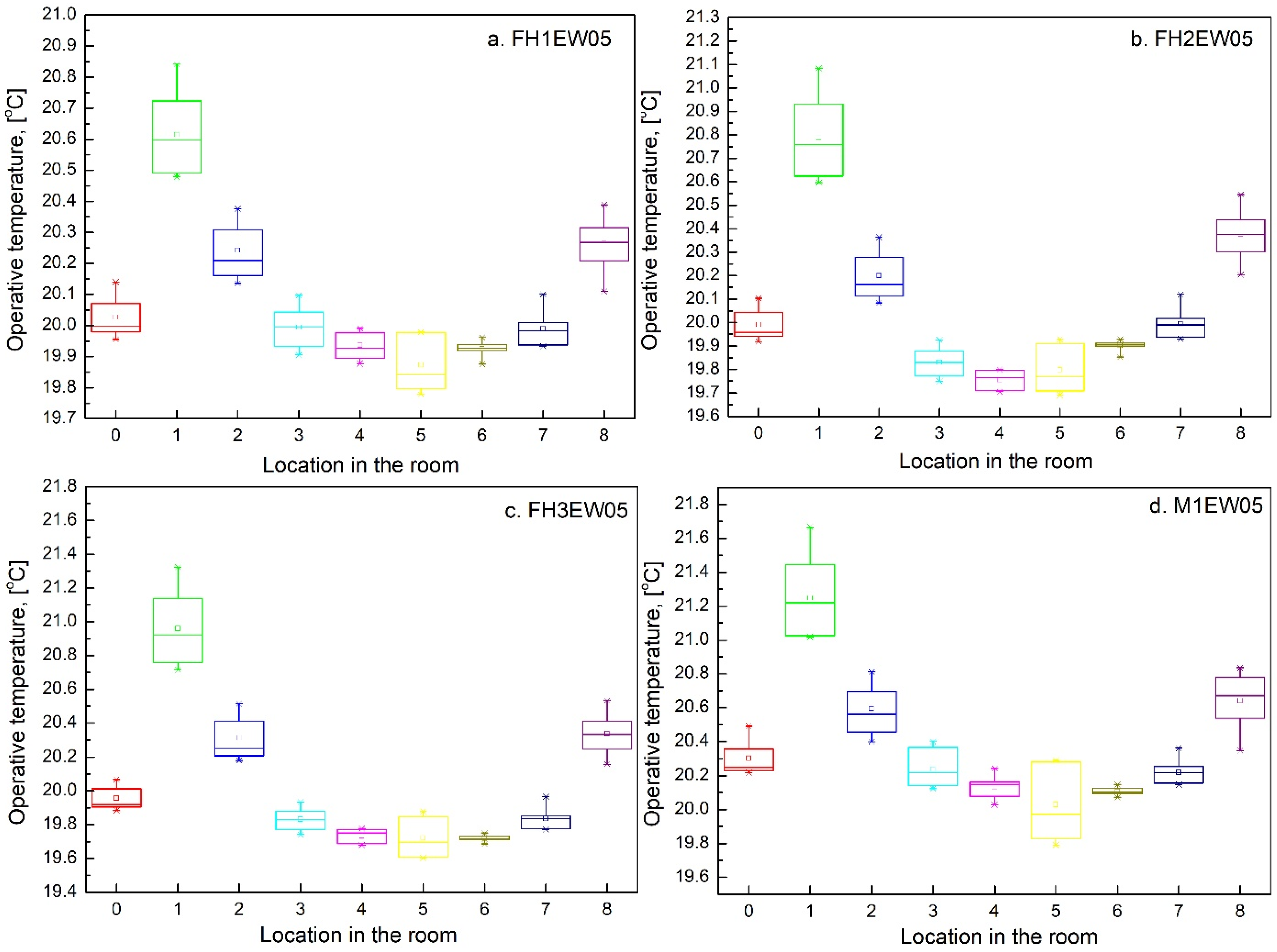
- The differences in operative temperatures across different locations in a radiator-heated room are significant.
- -
- The differences in operative temperatures across different locations in a floor-heated room are significant.
- -
- The number of external walls (one, two or three) has a significant effect on the operative temperatures in a heated room.
- -
- The differences between the operative temperatures at the same location in a heated room with different dimensions can be significant.
- -
- The differences in mean operative temperatures in a room (radiator-heated or floor-heated) are not significant across different positions in a multilevel building (ground floor, intermediate level, or top level).
- -
- Using statistics is misleading, because no significant difference between the mean operative temperatures in rooms with different positions or geometries can be detected, regardless of the heating method used. The operative temperatures in two rooms can differ significantly in most locations, even when they are identical at the centre of each room. Moreover, the thermal comfort in two rooms can differ across most locations, even when their mean operative temperatures are identical.
Limitations and Further Work
Author Contributions
Funding
Data Availability Statement
Acknowledgments
Conflicts of Interest
Nomenclature
| PMV | predicted mean vote |
| U | overall heat transfer coefficient, [W/m2K] |
| FH | room in a family house |
| FC | room with floor slab above unheated ceiling |
| FR | room below a flat roof |
| A | room below unheated attic |
| M | room at mid-level of a multifamily building |
| tln0 | nominal logarithmic temperature difference, [K] |
| tln | logarithmic temperature difference, [K] |
| Qrad | the heat delivered by radiator (equal to the demand of the analysed room), [W] |
| Qrado | the heat delivered by the radiator under nominal conditions (given in the design catalogue), [W] |
| tsupply | supply temperature of the central heating system, [°C] |
| treturn | return temperature of the central heating system, [°C] |
| ti | indoor set point temperature, [°C] |
| n | the radiator exponent |
| the difference between supply and return temperatures, [K] | |
| correction factor | |
| tradiator | mean radiator temperature, [°C] |
| tfloor | mean floor temperature, [°C] |
| Qfloor | the heat delivered by floor heating, [W] |
| Afloor | the net floor area of the analysed room, [m2] |
| htot | the total heat transfer coefficient [W/m2K] |
| the mean radiant temperature in the room, [°C] | |
| tcl | mean temperature of clothing surface and human body non covered with clothing, [°C] |
| to | operative temperature, [°C] |
| hc | convective heat transfer coefficient of the human body, [W/m2K] |
| hr | radiant heat transfer coefficient of the human body, [W/m2K] |
| Ar | the effective radiant surface of the human body, [m2] |
| ADu | Du Bois surface of the human body, [m2] |
| ε | emission coefficient of clothing surface and human body uncovered by clothing |
Appendix A
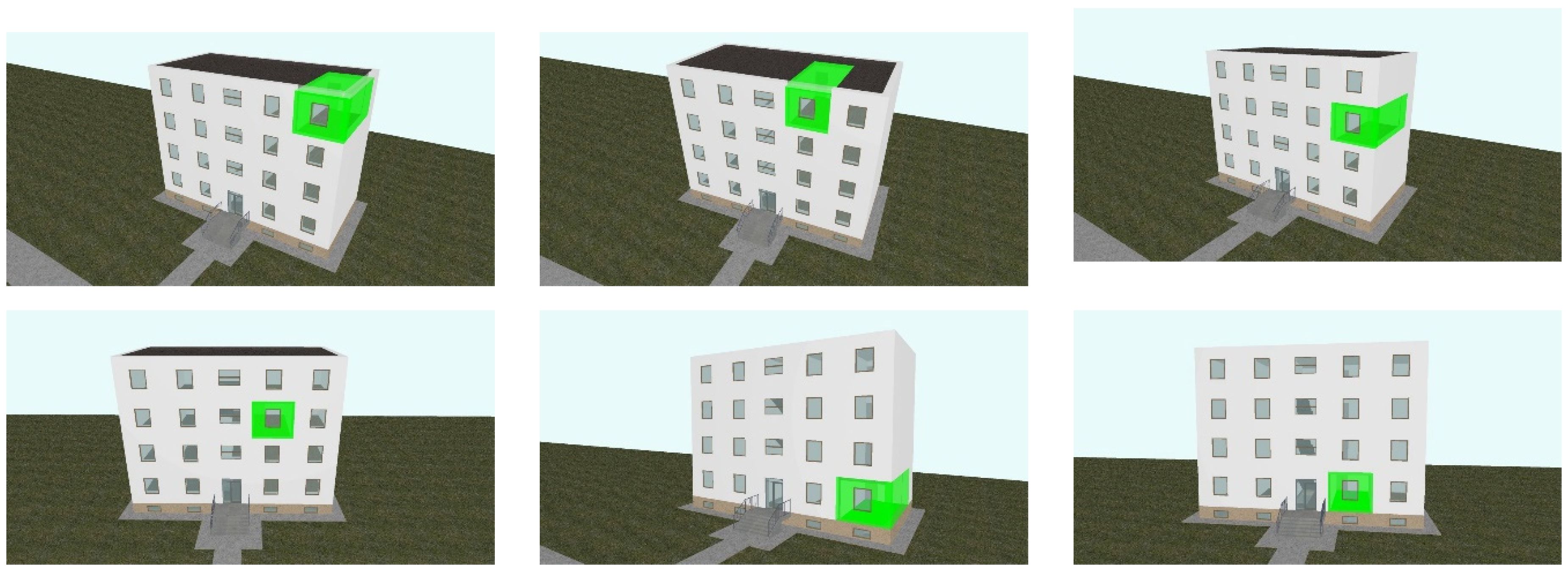
- The analysed room can be placed either in a single-family house or in a multilevel apartment building. In the latter case, the room can be placed on the ground floor (with a slab above the cellar), mid-level, or top level (with a flat roof or a slab under the attic).
| Single house | FH |
| Ground floor of a multi-story building | FC |
| Mid-level of a multi-story building | M |
| Top level of a multi-story building with a slab under the attic | A |
| Top level of a multi-story building with flat roof | FR |
- b.
- The room can have one, two or three external walls. The codes are:
| One external wall | 1EW |
| Two external walls | 2EW |
| Three external walls | 3EW |
- c.
- The U-value of external walls can be either 0.1 W/m2K; 0.2 W/m2K; 0.3 W/m2K; 0.4 W/m2K; or 0.5 W/m2K. The codes are:
| U = 0.1 W/m2K | 01 |
| U = 0.2 W/m2K | 02 |
| U = 0.3 W/m2K | 03 |
| U = 0.4 W/m2K | 04 |
| U = 0.5 W/m2K | 05 |
References
- Directive 2002/91/EC of the European Parliament and of the Council of 16 December 2002 on the Energy Performance of Buildings. Official Journal of the European Communities, 4 January 2003.
- Directive (EU) 2024/1275 of the European Parliament and of the Council of 24 April 2024 on the Energy Performance of Buildings. Official Journal of the European Union, 8 May 2024.
- Ürge-Vorsatz, D.; Cabeza, L.F.; Serrano, S.; Barreneche, C.; Petrichenko, K. Heating and cooling energy trends and drivers in buildings. Renew. Sustain. Energy Rev. 2015, 41, 85–98. [Google Scholar] [CrossRef] [Scilit]
- González-Torres, M.; Pérez-Lombard, L.; Coronel, J.F.; Maestre, I.R.; Yan, D. A review on buildings energy information: Trends, end-uses, fuels and drivers. Energy Rep. 2022, 8, 626–637. [Google Scholar] [CrossRef] [Scilit]
- Wang, C.; Song, J.; Shi, D.; Reyna, J.L.; Horsey, H.; Feron, S.; Zhou, Y.; Ouyang, Z.; Li, Y. Impacts of climate change, population growth, and power sector decarbonization on urban building energy use. Nat. Commun. 2023, 14, 6434. [Google Scholar] [CrossRef] [Scilit] [PubMed]
- Laskari, M.; de Masi, R.F.; Karatasou, S.; Santamouris, M.; Assimakopoulos, M.N. On the impact of user behaviour on heating energy consumption and indoor temperature in residential buildings. Energy Build. 2022, 255, 111657. [Google Scholar] [CrossRef] [Scilit]
- Yang, K.; Chai, Y.; Du, N.; Li, J.; Huo, Z.; Chen, Y. Conventional exergy and advanced exergy analysis of an innovative combined cooling, heating, and power system coupling solar-powered hydrogen production with fuel cell integration. Energy Convers. Manag. 2025, 346, 120440. [Google Scholar] [CrossRef] [Scilit]
- Said, M.A.; Aljibori, H.S.S.; Abed, A.M.; Togun, H.; Mohammed, H.I.; Mahdi, J.M.; Rahbari, A.; Sadeq, A.M.; Talebizadehsardari, P. Innovative pipe profile configurations for fast charging of phase change material in compact thermal storage systems for building heating applications. Case Stud. Therm. Eng. 2025, 69, 106036. [Google Scholar] [CrossRef] [Scilit]
- Jiang, L.; Sun, K.; Shen, X.; Bo, Y.; Liu, X.; Liu, H.; Zhang, Y.; Lei, H. An Innovative Rural Heating System Utilizing Coupled Cascade Thermal Storage: A Performance Analysis. Energy Sci. Eng. 2026, 14, 2307–2317. [Google Scholar] [CrossRef] [Scilit]
- Olympios, A.V.; Kourougianni, F.; Arsalis, A.; Papanastasiou, P.; Pantaleo, A.M.; Markides, C.N.; Georghiou, G.E. A holistic framework for the optimal design and operation of electricity, heating, cooling and hydrogen technologies in buildings. Appl. Energy 2024, 370, 123612. [Google Scholar] [CrossRef] [Scilit]
- Zhang, C.; Xie, Y.; Zhang, H.; Gu, Y.; Zhang, X. Optimal design and performance assessment for a solar powered electricity, heating and hydrogen integrated energy system. Energy 2023, 262, 125453. [Google Scholar]
- Lu, S.; Jia, Y.; Liang, B.; Wang, R.; Lin, Q.; He, Z. Optimal design and thermal performance study of a two-stage latent heat thermal energy storage technology for heating systems. Appl. Therm. Eng. 2023, 232, 121073. [Google Scholar] [CrossRef] [Scilit]
- Yang, X.; Pan, L.; Guan, W.; Tian, Z.; Wang, J.; Zhang, C. Optimization of the configuration and flexible operation of the pipe-embedded floor heating with low-temperature district heating. Energy Build. 2022, 269, 112245. [Google Scholar] [CrossRef] [Scilit]
- Zdravkovic, M.; Ciric, I.; Ignjatovic, M. Explainable heat demand forecasting for the novel control strategies of district heating systems. Annu. Rev. Control 2022, 53, 405–413. [Google Scholar] [CrossRef] [Scilit]
- Sun, T.; Wu, Y.; Qian, X.; Wang, B. Interval optimal scheduling method of integrated energy system with ground source heat pump based on quantum derivative algorithm. Energy Rep. 2025, 13, 4151–4161. [Google Scholar] [CrossRef] [Scilit]
- Csontos, M.; Csík, A.; Lakatos, A. Analysis of the thermal properties of sprayed polyurethane foams with and without aerogel incorporation. Int. Commun. Heat Mass Transf. 2026, 174, 110947. [Google Scholar] [CrossRef] [Scilit]
- Kalmár, F.; Bodó, B.; Li, B.; Kalmár, T. Decarbonization Potential of Energy Used in Detached Houses—Case Study. Buildings 2024, 14, 1824. [Google Scholar] [CrossRef] [Scilit]
- Martinopoulos, G.; Papakostas, K.T.; Papadopoulos, A.M. A comparative review of heating systems in EU countries, based on efficiency and fuel cost. Renew. Sustain. Energy Rev. 2018, 90, 687–699. [Google Scholar] [CrossRef] [Scilit]
- Martinopoulos, G.; Papakostas, K.T.; Papadopoulos, A.M. Comparative analysis of various heating systems for residential buildings in Mediterranean climate. Energy Build. 2016, 124, 79–87. [Google Scholar] [CrossRef] [Scilit]
- Obyn, S.; van Moeseke, G. Comparison and discussion of heating systems for single-family homes in the framework of a renovation. Energy Convers. Manag. 2014, 88, 153–167. [Google Scholar] [CrossRef] [Scilit]
- Ovchinnikov, P.; Borodinecs, A.; Strelets, K. Utilization potential of low temperature hydronic space heating systems: A comparative review. Build. Environ. 2017, 112, 88–98. [Google Scholar] [CrossRef] [Scilit]
- Oravec, J.; Sikula, O.; Krajcík, M.; Arici, M.; Mohapl, M. A comparative study on the applicability of six radiant floor, wall, and ceiling heating systems based on thermal performance analysis. J. Build. Eng. 2021, 36, 102133. [Google Scholar] [CrossRef] [Scilit]
- Bojic, M.; Cvetkovic, D.; Marjanovic, V.; Blagojevic, M.; Djordjevic, Z. Performances of low temperature radiant heating systems. Energy Build. 2013, 61, 233–238. [Google Scholar] [CrossRef] [Scilit]
- Pineau, D.; Rivière, P.; Stabat, P.; Hoang, P.; Archambault, V. Performance analysis of heating systems for low energy houses. Energy Build. 2013, 65, 45–54. [Google Scholar] [CrossRef] [Scilit]
- Wang, Z.; Luo, M.; Geng, Y.; Lin, B.; Zhu, Y. A model to compare convective and radiant heating systems for intermittent space heating. Appl. Energy 2018, 215, 211–226. [Google Scholar] [CrossRef] [Scilit]
- Vadiee, A.; Dodoo, A.; Jalilzadehazhari, E. Heat Supply Comparison in a Single-Family House with Radiator and Floor Heating Systems. Buildings 2020, 10, 5. [Google Scholar] [CrossRef] [Scilit]
- Sarbu, I.; Sebarchievici, C. A study of the performances of low-temperature heating systems. Energy Effic. 2015, 8, 609–627. [Google Scholar] [CrossRef] [Scilit]
- Wu, X.; Fang, L.; Olesen, B.W.; Zhao, J.; Wan, F. Comparison of indoor air distribution and thermal environment for different combinations of radiant heating systems with mechanical ventilation systems. Build. Serv. Eng. Res. Technol. 2018, 39, 81–97. [Google Scholar] [CrossRef] [Scilit]
- Kalmar, T.; Bodo, B.; Han, S.; Li, B.; Kalmar, F. Comparative analysis of energy demand at an equal operative temperature in the case of radiator and low-temperature radiant heating. J. Build. Eng. 2025, 100, 111792. [Google Scholar] [CrossRef] [Scilit]
- Yang, L.; Zmeureanu, R.; Rivard, H. Comparison of environmental impacts of two residential heating systems. Build. Environ. 2008, 43, 1072–1081. [Google Scholar] [CrossRef] [Scilit]
- Chen, C.; Zhang, Y.; Ma, L. Assessment for central heating systems with different heat sources: A case study. Energy Build. 2012, 48, 168–174. [Google Scholar] [CrossRef] [Scilit]
- Tassou, S.A.; Marquand, C.J.; Wilson, D.R. Energy and Economic Comparisons of Domestic Heat, Pumps and Conventional Heating Systems in the British Climate. Appl. Energy 1986, 24, 127–138. [Google Scholar] [CrossRef] [Scilit]
- Mahmoud, M.; Ramadan, M.; Naher, S.; Pullen, K.; Olabi, A.G. The impacts of different heating systems on the environment: A review. Sci. Total Environ. 2021, 766, 142625. [Google Scholar] [CrossRef] [Scilit]
- Self, S.J.; Reddy, B.V.; Rosen, M.A. Geothermal heat pump systems: Status review and comparison with other heating options. Appl. Energy 2013, 101, 341–348. [Google Scholar] [CrossRef] [Scilit]
- Kazanci, O.B.; Shukuya, M.; Olesen, B.W. Exergy performance of different space heating systems: A theoretical study. Build. Environ. 2016, 99, 119–129. [Google Scholar] [CrossRef] [Scilit]
- MSZ EN 12831-1:2017; Energy Performance of Buildings—Method for Calculation of the Design Heat Load—Part 1: Space Heating Load, Module M3-3. Hungarian Committee of Standardisation: Budapest, Hungary, 2017.
- Shinoda, J.; Kazanci, O.B.; Tanabe, S.; Olesen, B.W. A review of the surface heat transfer coefficients of radiant heating and cooling systems. Build. Environ. 2019, 159, 106156. [Google Scholar] [CrossRef] [Scilit]
- Fanger, P.O. Thermal Comfort: Analysis and Applications in Environmental Engineering; Danish Technical Press: Copenhagen, Denmark, 1970. [Google Scholar]
- ANSI/ASHRAE Standard 55-2017; Thermal Environmental Conditions for Human Occupancy. American National Standards Institute: Washington, DC, USA, 2017.
- Kalmár, T.; Bodó, B.; Kalmár, F. Heat losses of low-temperature radiant heating systems. Energy Rep. 2023, 10, 1982–1995. [Google Scholar] [CrossRef] [Scilit]
- Shin, M.S.; Rhee, K.N.; Ryu, S.R.; Yeo, M.S.; Kim, K.W. Design of radiant floor heating panel in view of floor surface temperatures. Build. Environ. 2015, 92, 559–577. [Google Scholar] [CrossRef] [Scilit]
- Krajcík, M.; Šimko, M.; Šikula, O.; Szabó, D.; Petráš, D. Thermal performance of a radiant wall heating and cooling system with pipes attached to thermally insulating bricks. Energy Build. 2021, 246, 111122. [Google Scholar] [CrossRef] [Scilit]







| External Building Element | U, [W/m2K] |
|---|---|
| External walls | 0.1 |
| 0.2 | |
| 0.3 | |
| 0.4 | |
| 0.5 | |
| Window | 1.0 |
| Slab above cellar | 0.25 |
| Slab below unheated attic | 0.15 |
| Flat roof | 0.15 |
| Room Type | to, [°C] (Radiator Heating) | to, [°C] (Floor Heating) | ||||
|---|---|---|---|---|---|---|
| Mean | Min | Max | Mean | Min | Max | |
| M | 20.21 | 19.81 | 21.05 | 20.44 | 20.24 | 20.57 |
| FH | 20.16 | 19.71 | 21.08 | 20.46 | 20.27 | 20.60 |
| FR | 20.22 | 19.79 | 20.91 | 20.47 | 20.27 | 20.60 |
| A | 20.22 | 19.80 | 21.10 | 20.46 | 20.26 | 20.60 |
| FC | 20.20 | 19.73 | 21.04 | 20.44 | 20.24 | 20.57 |
Disclaimer/Publisher’s Note: The statements, opinions and data contained in all publications are solely those of the individual author(s) and contributor(s) and not of MDPI and/or the editor(s). MDPI and/or the editor(s) disclaim responsibility for any injury to people or property resulting from any ideas, methods, instructions or products referred to in the content. |
© 2026 by the authors. Licensee MDPI, Basel, Switzerland. This article is an open access article distributed under the terms and conditions of the Creative Commons Attribution (CC BY) license.
Share and Cite
Kalmár, F.; Hámori, S.; Kalmár, T. Comparison of Operative Temperature Distribution in Radiator- and Floor-Heated Rooms. Buildings 2026, 16, 1953. https://doi.org/10.3390/buildings16101953
Kalmár F, Hámori S, Kalmár T. Comparison of Operative Temperature Distribution in Radiator- and Floor-Heated Rooms. Buildings. 2026; 16(10):1953. https://doi.org/10.3390/buildings16101953
Chicago/Turabian StyleKalmár, Ferenc, Sándor Hámori, and Tünde Kalmár. 2026. "Comparison of Operative Temperature Distribution in Radiator- and Floor-Heated Rooms" Buildings 16, no. 10: 1953. https://doi.org/10.3390/buildings16101953
APA StyleKalmár, F., Hámori, S., & Kalmár, T. (2026). Comparison of Operative Temperature Distribution in Radiator- and Floor-Heated Rooms. Buildings, 16(10), 1953. https://doi.org/10.3390/buildings16101953