


Abstract
Fireproofing spray work at construction sites is still performed manually, making consistent spray quality difficult to maintain and exposing workers to dust and fall hazards during elevated work. This study applied Quality Function Deployment (QFD) to the design of a fireproofing spray robot by translating field requirements into technical characteristics and identifying five major design conflicts: reach capability vs. stability, spray module flexibility vs. stability, sensor protection vs. sensing visibility, material supply reliability vs. stability, and material supply reliability vs. working range. Based on these conflicts, four designs were then proposed: sensor cover design, material supply continuity design, extended reach and stabilization design, and adaptive nozzle positioning design. A customer requirement-weighted evaluation showed that extended reach and stabilization design received the highest score because it most directly addressed accessibility to target surfaces at various heights, working range per setup, and stable operation at elevated positions. The other designs mainly addressed sensing reliability, material supply continuity, and nozzle adaptability to different member geometries and surface orientations. Accordingly, this study provides a QFD-based design for a fireproofing spray robot intended to address broader field requirements than previous systems developed for specific operating conditions.
1. Introduction
Fireproofing spray work is a critical construction process for maintaining the strength of steel structures during a fire [1]. However, at construction sites, fireproofing spray work is still largely performed manually, which makes it difficult to maintain consistent application quality under varying site conditions. In addition, workers are exposed to dust generated during construction activities and to fall hazards during elevated work [2,3,4]. These conditions have increased the need for automated systems that can improve both construction quality and work safety.
To meet these demands, fireproofing spray robots have been developed to automate spraying. Recent studies have adopted different operational strategies depending on site constraints. Ikeda et al. [5] proposed a fireproofing spray robot composed of traveling, lifting, and traversing devices and a robot arm. However, under dusty spraying conditions, the system relied on spraying work data for each beam size rather than real-time perception, reflecting an operating strategy centered on predefined beam conditions. Takagi et al. [6] developed a fireproofing spray robot equipped with a robot arm for beam spraying. The system used portable 3D scanning, point cloud-based geometry calculation, automatic spray path generation, and LiDAR/depth camera localization. However, the reported sprayable span for a single spray was only about 1 m. Roughly half of the robot operating time was spent on vehicle movement. This indicates that work coverage per setup remained limited. Samsung C&T [7] developed a fireproofing spray automation system consisting of a mobile elevating unit, a rail-guided spray robot with a robot arm, and a separate material supply unit. However, the operating sequence still involved remote control, teaching input, and spray trial operation. This system shows supervised programmed automation rather than fully autonomous field deployment. More recently, Ueda et al. [8] improved localization by using markers and enhanced beam recognition using a laser range finder. However, the system required marker installation in the field for localization, and its target application was still limited to beams.
Although these studies demonstrated the feasibility of fireproofing spray robots, the existing systems still show limitations in scope and working conditions for practical field operation. Representative fireproofing spray robot studies have mainly focused on beam-oriented operation, typically relying on preset work data or target beam geometry [5,6,7,8]. Consequently, their applicability to various structural members, such as columns, remains limited, and access to members installed at elevated positions is still constrained.
These limitations are also consistent with broader findings in recent construction robotics research. Recent studies suggest that, although autonomous mobile construction robots are being explored for a growing range of applications in the construction environment, real-world deployment continues to be constrained by site complexity and system integration demands [9,10].
In the context of fireproofing spray robots, these difficulties suggest that practical deployment depends on applicability to various structural members, accessibility to target surfaces at height, sufficient working range per setup, operational stability during elevated work, reliable operation under dusty and spray-contaminated conditions, and reliable material supply during operation [5,6,7,8,11].
Previous fireproofing spray robot studies have mainly focused on specific operating strategies or robot configurations for automated spraying under given site conditions. In parallel, previous QFD-based design studies have mainly used House of Quality (HOQ) to identify customer requirements and prioritize technical characteristics [12,13,14]. More recent studies have extended QFD toward alternative selection or the development of evaluation indicators [15,16]. However, relatively less attention has been given to how HOQ-derived tradeoffs are connected to the subsequent comparison of proposed designs.
Therefore, this study aims to propose a systematic QFD-based design process for a fireproofing spray robot by translating field requirements arising from diverse site conditions into technical characteristics, identifying major tradeoffs among those technical characteristics, and comparing proposed designs.
2. QFD-Based Design Process
The fireproofing spray robot considered in this study had to address multiple practical requirements arising from field operation, including applicability to various structural members, accessibility to elevated target surfaces, sufficient working range per setup, stability during elevated spraying, reliable operation under spray-contaminated conditions, and continuity of material supply.
Therefore, a systematic design approach was needed to translate these field requirements into technical characteristics and to examine their relative importance and tradeoffs in an integrated manner. For this reason, this study applied QFD as the main design method. In the QFD process, the practical requirements arising from field operation were organized as customer requirements. The HOQ was then used to analyze the relationships between customer requirements and technical characteristics, prioritize the technical characteristics, and identify major tradeoffs that guided the subsequent design development and evaluation.
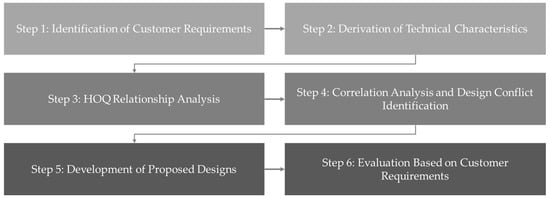
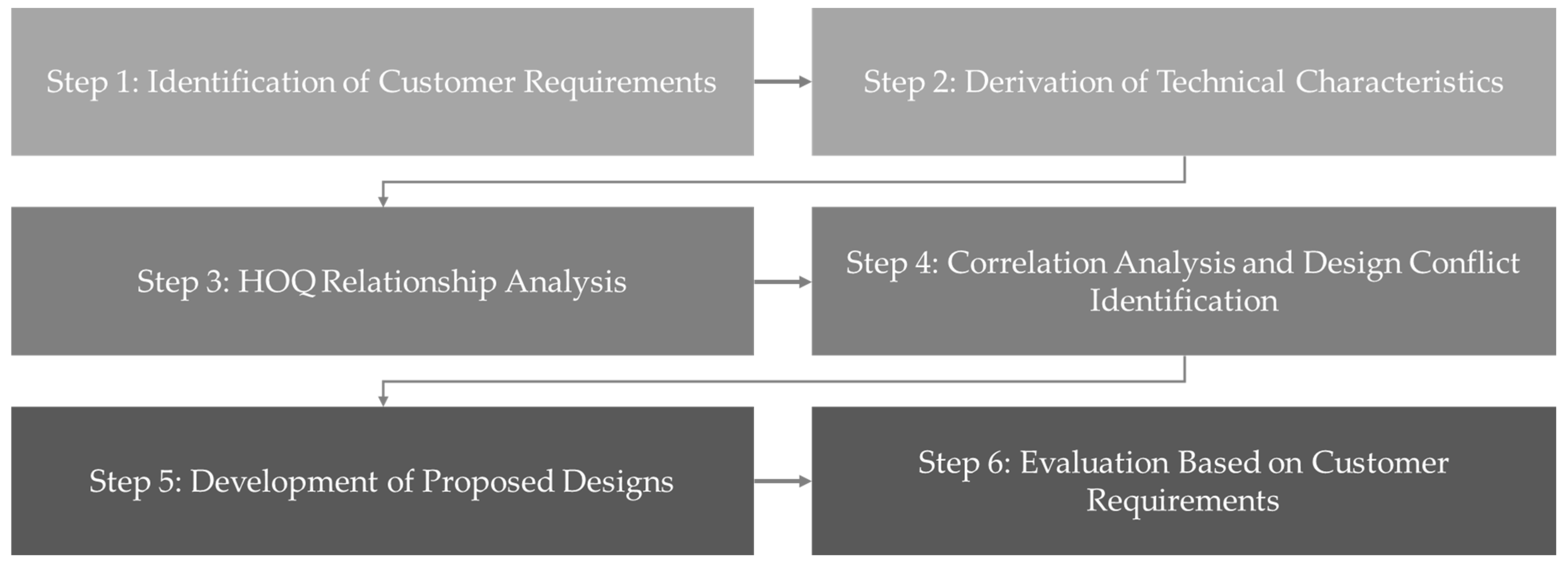
The overall QFD-based design process is summarized in Figure 1. The flowchart outlines the main steps of the process, including customer requirement identification, technical characteristic derivation, HOQ analysis, design conflict identification, proposed design development, and evaluation using criteria and weights derived from customer requirements. The following subsections explain each step in detail.
Figure 1.
Flowchart of the QFD-based design process for the fireproofing spray robot.
2.1. Identification of Customer Requirements and Importance Ratings
Customer requirements for the fireproofing spray robot were identified from users involved in fireproofing work, including practitioners with experience in spray equipment operation and site management. The requirements were derived through interviews, task analysis, a literature review, and expert workshops and technical discussions conducted within the research project.
The literature review was conducted to identify information relevant to the design of the robot, including previous fireproofing spray robot systems and the operational and environmental constraints of fireproofing spray work, as well as QFD-based studies relevant to requirement translation and technical prioritization [5,6,7,8,9,10,11,12,13,14,15,16]. Because studies directly addressing fireproofing spray robots are limited, the review was expanded to include not only prior fireproofing spray robot studies but also related studies on construction robotics and QFD-based design.
The literature was selected when it provided information relevant to practical field constraints, major functional requirements, or requirement translation and technical prioritization for design. The reviewed literature was used to support the identification of customer requirements and the establishment of technical characteristics for the fireproofing spray robot.
The task analysis focused on practical requirements arising from member geometry, target surface height, work orientation, spray contamination, and continuity of material supply during operation. A questionnaire survey was then conducted to determine the relative importance of the identified customer requirements. The respondent characteristics are summarized in Table 1.
Table 1.
Information on survey respondents.
The importance of each customer requirement was evaluated using a 100-point scale.
2.2. Derivation of Technical Characteristics
Technical characteristics were derived from the identified customer requirements to represent the main functional and operational aspects of the fireproofing spray robot. In this study, emphasis was placed on characteristics that could directly affect applicability to various structural members, accessibility to elevated target surfaces, working range during operation, stability at height, resistance to spray contamination, and continuity of material supply. The technical characteristics were organized across the major subsystems of the robot, including the mobile base, lifting mechanism, spray module, sensing system, and material supply system. The final set of technical characteristics was established through iterative discussions among experts participating in the research project so that the selected characteristics reflected the practical requirements of fireproofing spray work.
2.3. Relationship Analysis Between Customer Requirements and Technical Characteristics
The relationships between customer requirements and technical characteristics were analyzed in the HOQ matrix so that the technical characteristics could be prioritized based on their weighted contribution to the identified customer requirements. This analysis was conducted using a three-level scale of 1, 3, and 9, representing weak, moderate, and strong relationships, respectively. The priority of each technical characteristic was then quantified using the Absolute Weight (AW) and Relative Weight (RW), calculated as follows:
After the technical characteristics were prioritized, correlations among them were examined. Positive correlations indicated that improvement in one characteristic may support improvement in another, whereas negative correlations indicated that improvement in one characteristic may adversely affect another.
In this study, negative correlations among technical characteristics were interpreted as design conflicts, defined as tradeoff relationships in which improvement of one technical characteristic tends to degrade another related technical characteristic. Key design conflicts were selected when the negative correlation involved relatively high-priority technical characteristics and had direct relevance to practical fireproofing spray operation.
2.4. Evaluation of Proposed Designs
The identified design conflicts were used as the basis for subsequent design development. Proposed designs were developed to address the dominant conflicts while reflecting the prioritized customer requirements. Several identified design conflicts were closely related. Therefore, the designs were developed to address different requirement groups rather than as independent final robot systems. For this reason, the four designs were evaluated separately, although they may later function as complementary elements of an integrated system.
For evaluation, the seven customer requirements identified through the QFD process were used directly as evaluation criteria. The weight of each criterion was calculated from the importance rating of the corresponding customer requirement as follows:
where is the importance rating of customer requirement i.
The proposed designs were then evaluated against the seven criteria using a five-point scale. The evaluation was conducted by an expert group. Each evaluator first assigned preliminary scores independently, and the final score for each design and criterion was then determined through discussion and consensus within the team. Accordingly, the reported values represent consensus-based design scores rather than experimentally validated field performance.
The weighted score for each design was calculated as follows:
where is the weight of criterion i and is the final consensus score assigned to design j for criterion i.
The evaluation was intended as a comparison of the proposed designs, not as a prototype performance validation.
3. Design Development of the Fireproofing Spray Robot
3.1. Customer Requirements and Importance Ratings
Table 2 presents the importance ratings and ranks of the identified customer requirements.
Table 2.
Importance ratings and ranks of customer requirements.
Among the identified customer requirements, CR4 (stable operation at elevated positions) received the highest importance rating because fireproofing spray work is performed at height, where insufficient stability can increase safety risk and make it difficult to maintain a consistent nozzle position and spray quality during operation.
CR1 (adaptability to various structural members) was also ranked highly because fireproofing targets in practice are not limited to beams, but also include columns and other steel structure members with different cross-sectional geometries and access conditions, so limited adaptability directly reduces the practical applicability of the robot in field operations. CR2 (accessibility to target surfaces at various heights) was identified as an essential requirement because spray targets are distributed across different elevations in construction environments, requiring reliable access to elevated surfaces during operation.
CR3 (wide accessible working range per setup) also received a relatively high rating because limited working range forces frequent base repositioning and repeated re-adjustment of the upper spraying system. This increases non-spraying time associated with relocation, releveling, and nozzle realignment, thereby reducing overall productivity and interrupting continuous spraying operation. In addition, CR5 (reliable operation under dusty and spray-contaminated conditions) was considered important because dust and splashed spray material can adhere to sensor windows, exposed joints, and other critical interfaces, degrading sensing reliability and interfering with functions such as work area recognition near the spraying zone. This can increase maintenance demand and reduce the stability of continuous system operation.
CR6 (reliable material supply during operation) was also identified as important because stable spraying requires continuous material delivery at an appropriate flow rate and pressure. Interruptions caused by material replenishment, feeder delay, or unstable supply can disturb spray continuity, increase idle time, and lead to local variation in deposited material thickness during operation. CR7 (accessibility to target surfaces with different orientations) was included because fireproofing targets may include web surfaces, column faces, and lower flange surfaces with different orientations. These conditions require an appropriate nozzle direction and standoff distance to maintain deposition efficiency and consistent spray quality across different target surfaces.
These results indicate that the main design priorities of the fireproofing spray robot are stable operation at elevated positions, applicability to various structural members, reliable access to target surfaces at height, sufficient working range per setup, robust operation under spray-contaminated conditions, continuous material supply, and adaptability to different target surface orientations.
3.2. Technical Characteristics and HOQ Prioritization Results
Table 3 summarizes the ten technical characteristics identified for the fireproofing spray robot.
Table 3.
Technical characteristics.
Table 4 presents the relationship matrix between the customer requirements and the technical characteristics, together with the resulting AW, RW, and rank values.
Table 4.
Relationships between customer requirements and technical characteristics.
As shown in Table 4, the highest ranked technical characteristics were TC6, TC2, and TC5, indicating that spray module flexibility, accessibility to elevated target surfaces, and stable operation at height are the primary technical priorities in the design of the fireproofing spray robot.
3.3. Design Conflicts Identified from the HOQ
Table 5 summarizes the correlations among the technical characteristics.
Table 5.
Correlations among technical characteristics.
Positive correlations were mainly observed among TC2 (lifting mechanism type), TC3 (working height capability), and TC4 (working range capability), indicating that these characteristics are closely related in expanding the accessible work envelope of the robot. A positive correlation was also identified between TC6 (spray module degrees of freedom) and TC7 (nozzle standoff adjustment capability), because both characteristics are associated with the ability of the spray module to respond to different target surface conditions.
Negative correlations were identified among several prioritized technical characteristics and were interpreted as design conflicts. In particular, characteristics related to increasing reach and flexibility tended to conflict with TC5 (stabilization method at elevated positions). In addition, TC8 (sensor protection method under spray contamination) showed a negative correlation with TC9 (sensor placement), indicating a tradeoff between sensor protection and sensing visibility. TC10 (material supply method) also showed negative correlations with TC4 and TC5, indicating that reliable material supply may constrain effective working range or reduce stability during elevated operation.
Table 6 summarizes the five key design conflicts identified from the HOQ.
Table 6.
Key design conflicts identified from the HOQ.
3.3.1. C1: Reach Capability vs. Stability
C1 arises from the relationship between TC2 (lifting mechanism type), TC3 (working height capability), TC4 (working range capability per setup), and TC5 (stabilization method at elevated positions). A lifting mechanism with a greater working height and wider range can improve accessibility to elevated target surfaces and reduce repeated repositioning during operation. However, as the boom extends to increase the robot’s reach, the moment acting on the base also increases because the load is applied farther from the support region of the robot. At the same time, the center of gravity shifts outward, and uneven ground conditions at construction sites can further reduce effective support stability. Under these conditions, even small structural deflections or platform vibrations can produce larger positional deviations at the nozzle because the extended moment arm of the upper system amplifies the effect of small disturbances. This can make it more difficult to maintain a stable nozzle position and spraying direction during elevated operation. Therefore, improving accessibility and work coverage may adversely affect stable operation during spraying, particularly when long reach and elevated work must be achieved simultaneously.
3.3.2. C2: Spray Module Flexibility vs. Stability
C2 represents the tradeoff between TC6 (spray module degrees of freedom), TC7 (nozzle standoff adjustment capability), and TC5 (stabilization method at elevated positions). Greater flexibility of the spray module can improve the robot’s ability to respond to different target surface conditions, including variations in geometry and orientation. However, additional degrees of freedom, joints and standoff adjustment mechanisms can increase the mass, inertia, and structural compliance of the upper spraying unit. These changes can reduce the stiffness of the spray module and increase its sensitivity to vibration or oscillation during elevated operation. In addition, as the local adjustment capability increases, the control load required to maintain a stable nozzle pose also becomes greater because the nozzle position, orientation, and standoff distance must be coordinated simultaneously. Under elevated spraying conditions, these effects can amplify positional deviation at the nozzle and make it more difficult to maintain a consistent spray angle and spray distance. Therefore, improving local adaptability of the spray module may negatively affect overall spraying stability unless sufficient structural support and stabilization are secured.
3.3.3. C3: Sensor Protection vs. Sensing Visibility
C3 arises from the negative correlation between TC8 (sensor protection method under spray contamination) and TC9 (sensor placement). In fireproofing spray work, sensors positioned near the spraying area are exposed not only to airborne dust but also to splashed fireproofing material. Unlike ordinary dust, fireproofing spray material is a high-viscosity granular substance that tends to adhere persistently to sensor surfaces and form residues that are difficult to remove by ordinary wiping or washing. This is the main reason why the conflict between protection and visibility becomes more critical in this scenario than in many other industrial environments. A stronger protection method can reduce contamination risk, but it may also obstruct the sensor field of view or reduce sensing effectiveness for functions such as work area recognition near the spraying zone. In addition, the maintenance burden can vary depending on the selected protection method. For example, liquid-based cleaning methods may help restore sensor visibility, but they require additional functions for spraying and wiping the cleaning agent, increase system complexity, and require periodic replenishment of the cleaning material. By contrast, more passive protection methods may reduce the need for active cleaning but can further constrain sensor placement or visibility. On the other hand, sensor placement that improves visibility may increase direct exposure to spray contamination and lead to more frequent cleaning, replacement, or maintenance intervention. Therefore, this conflict reflects a practical tradeoff among sensing visibility, contamination protection, and maintenance burden during fireproofing spray work.
3.3.4. C4: Material Supply Reliability vs. Stability
C4 is related to the relationship between TC10 (material supply method) and TC5 (stabilization method at elevated positions). A material supply method that improves the continuity and reliability of supply can support stable spraying over time. However, both onboard and external supply methods may introduce conditions that reduce stability during elevated operation. In an onboard supply method, the additional supply unit or stored material increases the payload carried by the robot and can raise the center of gravity of the overall system. In addition, the payload condition may vary over time as the amount of supplied material changes during operation, which can alter the load distribution acting on the robot. In an external supply method, hose tension, dragging force, or interaction with auxiliary supply components can generate external disturbance forces on the robot, especially when the upper system is elevated or extended. These effects can disturb robot balance, increase structural sway, and reduce the positional stability of the spraying unit. Therefore, a material supply method that improves operational continuity may also reduce stability unless the effect of payload variation and external supply interaction is sufficiently controlled.
3.3.5. C5: Material Supply Reliability vs. Working Range
C5 reflects the tradeoff between TC10 (material supply method) and TC4 (working range capability per setup). A material supply method designed to provide continuous material during operation can support long-duration spraying. However, as the working range increases, the internal hose path or external hose routing must also accommodate the extended motion of the spraying system. In an onboard supply method, a wider working motion may require longer internal routing paths, additional hose handling mechanisms, or more complex routing through moving joints, which can increase hardware complexity, accelerate hose wear, and make maintenance more difficult. In an external supply method, hose length, feeder position, and routing direction can directly constrain the robot’s accessible area during spraying. Insufficient hose allowance can limit the reachable range, whereas excessive hose slack can create interference with robot motion or surrounding site elements. In addition, longer flow paths may make supply management more difficult during continuous spraying. Therefore, improving material supply reliability does not always lead to a wider effective working range, because the supply method itself can restrict reachable motion and increase operational constraints.
These results show that the major design conflicts of the fireproofing spray robot arise from tradeoffs among reach, stability, sensing visibility, and material supply during operation.
3.4. Proposed Design
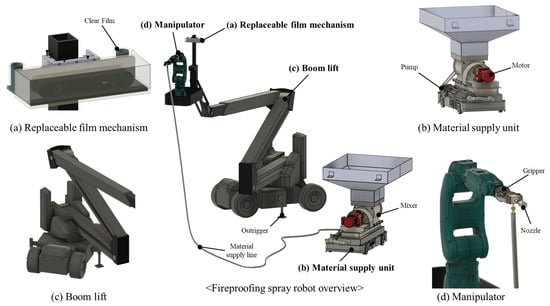
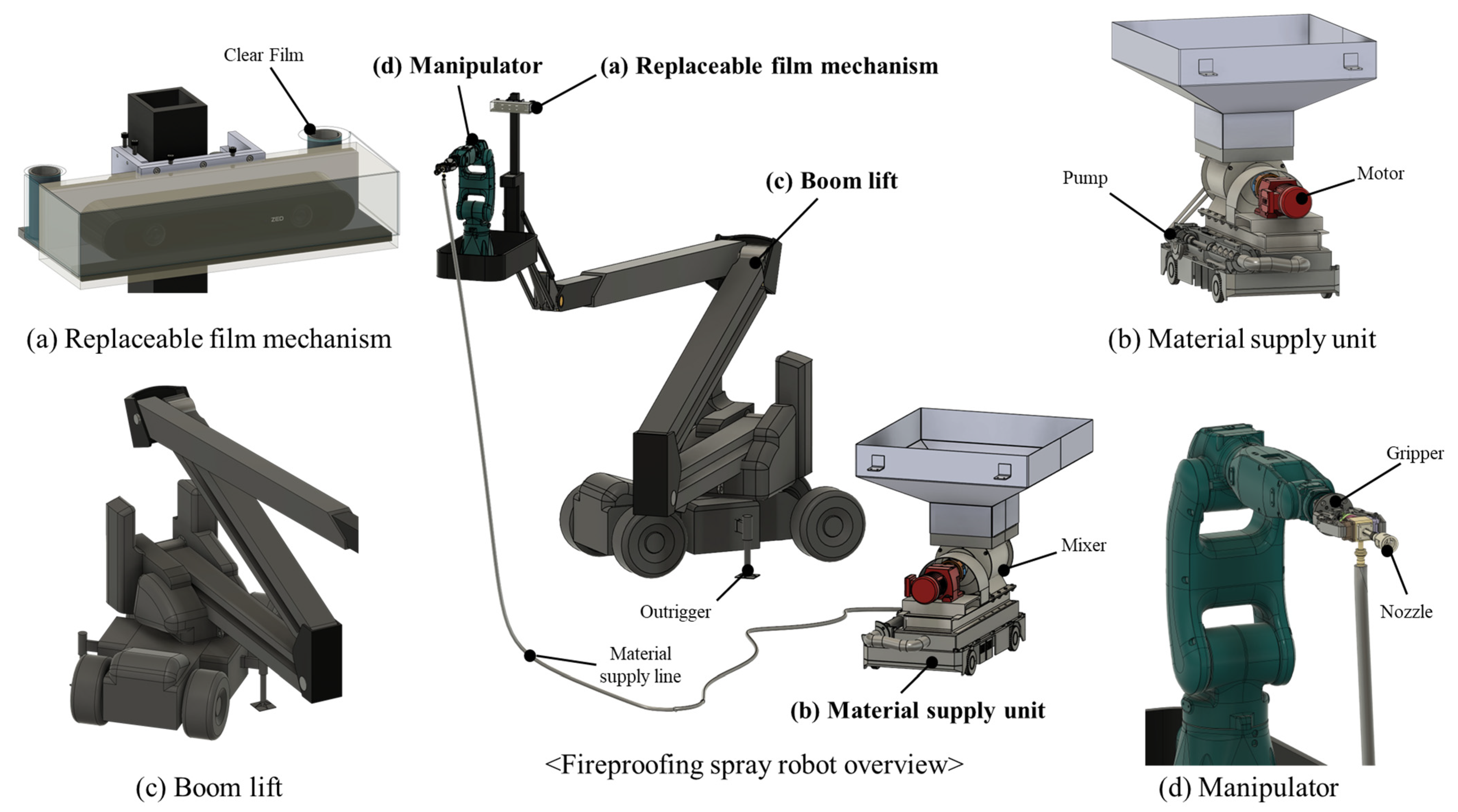
Based on the identified design conflicts, four designs were developed to address the dominant tradeoffs while reflecting the prioritized customer requirements. Because several conflicts were closely related, the proposed designs were formulated at the design level rather than as independent final robot models. Figure 2 presents an integrated overview of the four proposed designs.
Figure 2.
Overview of the proposed designs: (a) replaceable film mechanism for sensor visibility, (b) modular follower robot for material supply, (c) articulating boom lift with deployable outriggers, and (d) manipulator-based spray module with a gripper-type end effector.
3.4.1. Sensor Cover Design: Replaceable Film Mechanism for Sensor Visibility
The sensor cover design was developed to address C3 (sensor protection vs. sensing visibility). In fireproofing spray work, sensors positioned near the spraying area are exposed not only to airborne dust but also to splashed fireproofing material, which can obstruct the field of view and degrade sensing performance for functions such as work area recognition near the spraying zone. At the same time, relocating the sensor farther from the target area can reduce direct contamination, but may also reduce visibility of the target surface. This tradeoff is more critical in fireproofing spray work than in many other industrial environments because the sprayed material is highly viscous and contains relatively large particles that tend to adhere persistently to sensor surfaces and leave residues that are difficult to remove. Although active cleaning methods using liquid agents may help restore visibility, they require additional functions for spraying and wiping the cleaning material, increase system complexity, and introduce maintenance demand such as periodic replenishment of the cleaning agent. To address this problem, a replaceable film mechanism was proposed. Instead of cleaning the contaminated sensor surface directly, the mechanism maintains a clear optical path by continuously replacing a thin protective film after contamination occurs. This design mainly supports CR5 (reliable operation under dusty and spray-contaminated conditions) by reducing sensing degradation during spraying while avoiding the additional complexity associated with active cleaning systems. Although the protective film must still be replenished after use, the mechanism provides a simpler way to maintain sensor visibility near the spraying zone during field operation.
3.4.2. Material Supply Continuity Design: Modular Follower Robot for Material Supply
The material supply continuity design was developed to address C4 (material supply reliability vs. stability) and C5 (material supply reliability vs. working range). In fireproofing spray work, stable spraying requires continuous material delivery at an appropriate flow rate and pressure during operation. However, mounting the material feeder directly on the main robot can increase the payload carried by the system and cause time-varying load conditions as the stored material is consumed. Under elevated working conditions, this can change the load distribution acting on the robot and reduce positional stability of the upper spraying system.
An external supply configuration can reduce this payload burden on the main robot, but it may also introduce other constraints. If the feeder remains fixed at a separate location, hose length, routing direction, and drag force can restrict robot movement and reduce the effective working range during spraying. In addition, hose tension or interaction with surrounding site elements can disturb the motion of the robot and make stable operation more difficult.
To address these tradeoffs, a modular follower robot was proposed to separate the supply function from the main spraying robot while maintaining continuous material delivery. By moving together with the main robot, the follower unit can reduce the hose length and routing constraints that would arise in a fixed external supply configuration, while also preventing the payload increase associated with an onboard feeder. The modular configuration also allows the supply unit to be replaced independently in the event of malfunction or material depletion, which helps maintain operational continuity. This design mainly supports CR6 (reliable material supply during operation) and also contributes to CR4 (stable operation at elevated positions) and CR3 (wide accessible working range per setup) by reducing payload variation on the main robot and mitigating movement constraints caused by external supply connections.
3.4.3. Extended Reach and Stabilization Design: Articulating Boom Lift with Deployable Outriggers
The extended reach and stabilization design was developed primarily to address C1 (reach capability vs. stability) and partially C2 (spray module flexibility vs. stability). In fireproofing spray work, sufficient vertical and horizontal reach is required to access target surfaces at various heights and to reduce repeated repositioning during operation. For this reason, an articulating boom lift was adopted because, unlike a vertical lift that mainly provides straight upward motion, it can expand the accessible work envelope more effectively and improve access to beams, columns, and other target surfaces located at different heights and orientations. This wider work envelope can reduce the need for repeated base repositioning and thereby improve work coverage per setup.
However, increasing working height and horizontal reach through an articulated lifting structure also increases the moment acting on the base because the load is applied farther from the support region of the robot. As the boom extends, the center of gravity shifts outward, and uneven ground conditions at construction sites can further reduce effective support stability. In addition, greater flexibility of the upper system can reduce structural stiffness and amplify vibration or positional deviation at the nozzle during elevated spraying. These effects make it more difficult to maintain stable nozzle position, spray direction, and standoff distance under extended reach conditions.
To address these tradeoffs, deployable outriggers were introduced as an additional stabilization measure. By increasing the effective support width and moment resistance of the robot during spraying, the outriggers help reduce overturning risk and improve positional stability under elevated and extended working conditions. This design mainly supports CR2 (accessibility to target surfaces at various heights), CR3 (wide accessible working range per setup), and CR4 (stable operation at elevated positions) by improving accessibility and work coverage while mitigating the stability limitations associated with elevated operation.
3.4.4. Adaptive Nozzle Positioning Design: Manipulator Based Spray Module with a Gripper Type End Effector
The adaptive nozzle positioning design was developed to address C2 (spray module flexibility vs. stability). In fireproofing spray work, the spray module should respond to target surfaces with different orientations while maintaining an appropriate nozzle direction and standoff distance. This requirement is important because the local nozzle pose directly affects material deposition behavior, including the spray angle, coverage, and thickness consistency near the target surface. Because TC6 (spray module degrees of freedom) was identified as the highest priority technical characteristic in the HOQ, a dedicated manipulation mechanism was required in the upper spraying module rather than relying only on the lifting mechanism or a simple fixed spray head. The boom lift mainly determines the global position of the upper unit, but it cannot sufficiently provide the local motion needed to align the nozzle with different member geometries, surface orientations, and local access conditions near the spraying point.
To address this requirement, a manipulator-based spray module with a gripper-type end effector was proposed. In this configuration, the manipulator serves as the main mechanism for controlling the position and orientation of the spray nozzle relative to the target surface, while the gripper-type end effector functions as a compact terminal interface for holding and adjusting the spray head. This allows the spray module to respond more effectively to variations in member geometry, surface orientation, and local access conditions than a fixed spray head or an end effector-only configuration. In addition, the compact end effector configuration helps limit the increase in terminal mass and inertia at the tip of the upper spraying system, which is important because excessive distal load can further reduce stability during elevated operation.
In fireproofing spray work, maintaining an appropriate standoff distance is important for stable material deposition and consistent spray quality. The manipulator enables the nozzle to approach the target surface with a more appropriate pose, while end effector-level adjustment helps maintain the required nozzle direction and distance under local geometric changes. Accordingly, this design mainly reflects CR1 (adaptability to different structural members) and CR7 (accessibility to target surfaces with different orientations), while also providing a more practical means of local nozzle control under variable field conditions.
Together, the four designs address different subsets of the identified design conflicts and customer requirements and form the basis for the evaluation presented in the following section.
3.5. Evaluation Results of the Proposed Designs
Table 7 lists the criterion weights used in the evaluation, Table 8 summarizes the main requirement groups associated with each design, and Table 9 presents the final weighted evaluation results.
Table 7.
Evaluation criteria and derived weights.
Table 8.
Main customer requirements addressed by each design.
Table 9.
Weighted evaluation results of the four designs.
The weighted evaluation results show distinct performance patterns across the four designs. The extended reach and stabilization design showed the highest total weighted score (3.065), followed by the adaptive nozzle positioning design (2.431), material supply continuity design (2.114), and sensor cover design (1.560). These results indicate that the four designs contribute to different prioritized requirement groups rather than showing uniform performance across all criteria.
4. Discussions
Previous fireproofing spray robots have mainly focused on robot development for specific operating conditions, such as beam-oriented spraying, spraying work data for each beam size, target beam geometry, marker installation for localization, limited sprayable span per setup, or supervised programmed automation. Although these systems demonstrated the feasibility of automated spraying, their design scope remained relatively limited to predefined work conditions. The contribution of this study is the consideration of field applicability by deriving robot design requirements from diverse site conditions, including structural member variability, elevated target surfaces, working range, stability, sensing reliability, material supply continuity, and nozzle adaptability.
The proposed designs in this study are also consistent with the limitations discussed in previous fireproofing spray robot studies. Ikeda et al. [5] reduced dependence on real-time perception under dusty spraying conditions, which reflects the practical difficulty of sensing near the spray region and is related to C3, the tradeoff between sensor protection and sensing visibility. Takagi et al. [6] demonstrated the technical feasibility of manipulator-based spraying, but their reported sprayable range from a single robot setup remained limited, which indicates that local spray capability alone does not solve the problem of work coverage per setup and is related to C1, the tradeoff between reach capability and stability. Samsung C&T [7] adopted a separated material supply configuration, showing that material delivery is closely related to both stability and operational continuity. This material supply issue is related to C4 and C5. These examples show that the design conflicts identified in this study are related to practical limitations that have appeared in previous fireproofing spray robot systems.
Some technical issues remain for subsequent development. Specific sensor selection was not fixed in this study because the detailed sensing architecture depends on the final arrangement of the spray module, protective housing, and target sensing task. Similarly, load curve analysis, detailed geometric parameter assessment, and structural stability verification require a more fixed integrated configuration of the lifting system, spray module, and material supply system. These issues should be examined because sensing reliability is related to target surface recognition near the spray region, while structural stability is related to nozzle positioning and stable operation during elevated spraying. Future research should determine appropriate sensor types and sensing specifications, examine structural stability through load curve analysis and geometric parameter assessment, and verify the integrated robot configuration under fireproofing spray conditions. To support practical field application, compliance with applicable technical and safety standards should also be reviewed once the detailed configuration is fixed.
5. Conclusions
This study proposed a design for a fireproofing spray robot by formulating practical field requirements as customer requirements, translating them into technical characteristics, identifying design conflicts, and developing robot designs within a single process. The customer requirements were identified and prioritized, technical characteristics were derived for the fireproofing spray robot, and the HOQ was then used to analyze the relationships between customer requirements and technical characteristics, prioritize the technical characteristics, and identify five major design conflicts relevant to practical fireproofing spray work. On this basis, four designs were proposed and evaluated against criteria derived from the customer requirements.
The results showed that each design reflected different requirements. The extended reach and stabilization design showed the highest weighted score because it addressed accessibility to target surfaces at height, working range per setup, and stable operation during elevated work. The adaptive nozzle positioning design mainly responded to adaptability to various structural members and target surface orientations, whereas the sensor cover design and material supply continuity design mainly supported sensing reliability under spray-contaminated conditions and continuity of material supply, respectively. These findings indicate that the design of a fireproofing spray robot should be approached not as the selection of a single isolated design option, but as the coordination of multiple designs within an integrated system.
The contribution of this study lies in applying QFD to the design of a fireproofing spray robot intended to address a broader range of field requirements than previous systems developed for specific operating conditions. By translating customer requirements into technical characteristics, identifying major design conflicts, and evaluating the proposed designs using criteria and weights derived from customer requirements, this study provides a structured basis for subsequent fireproofing spray robot design.
The evaluation of the proposed designs has a limitation because the final scores were determined by expert group assessment. Therefore, the weighted evaluation results should be interpreted as assessments of how well each design addresses the prioritized customer requirements, not as verified field performance. Future research should develop a prototype and conduct field tests under fireproofing spray conditions to verify coordinated performance in accessibility, stability, nozzle positioning, sensing reliability, and material supply continuity.
Author Contributions
Conceptualization, K.B. and M.C.; Methodology, K.B. and M.C.; Software, K.B., S.Y. and S.L.; Validation, K.B. and S.Y.; Resources, S.L.; Data Curation, K.B., S.Y., S.L. and H.K.; Writing—Original Draft, K.B.; Writing—Review and Editing, H.K. and T.K.; Visualization, M.C.; Supervision, H.K. and T.K.; Project Administration, T.K. All authors have read and agreed to the published version of the manuscript.
Funding
This research was funded by the Korea Agency for Infrastructure Technology Advancement (KAIA) grant funded by the Ministry of Land, Infrastructure and Transport (Grant No. RS-2025-11802969), and the Korea Agency for Infrastructure Technology Advancement (KAIA) grant funded by the Ministry of Land, Infrastructure and Transport (Grant No. RS-2022-00143493).
Data Availability Statement
The original contributions presented in this study are included in the article. Further inquiries can be directed to the corresponding author.
Conflicts of Interest
The authors declare no conflicts of interest.
References
- Cote, A.E.; Hall, J.R.; Powell, P.A.; Grant, C.C.; Solomon, R.E. Fire Protection Handbook; National Fire Protection Association: Quincy, MA, USA, 2008. [Google Scholar]
- Wang, M.; Yao, G.; Sun, Y.; Yang, Y.; Deng, R. Exposure to construction dust and health impacts: A review. Chemosphere 2023, 311, 136990. [Google Scholar] [CrossRef] [Scilit] [PubMed]
- Pereira, F.; González García, M.N.; Martins, J.P. An evaluation of the technologies used for the real time monitoring of the risk of falling from height in construction: Systematic review. Buildings 2024, 14, 2879. [Google Scholar] [CrossRef] [Scilit]
- Nadhim, E.A.; Hon, C.; Xia, B.; Stewart, I.; Fang, D. Falls from height in the construction industry: A critical review of the scientific literature. Int. J. Environ. Res. Public Health 2016, 13, 638. [Google Scholar] [CrossRef] [Scilit]
- Ikeda, Y.; Segawa, H.; Yabuki, N. Development and application of a fire resistive covering spraying robot to building construction site. In Proceedings of the 37th International Symposium on Automation and Robotics in Construction (ISARC), Kitakyushu, Japan, 27–28 October 2020. [Google Scholar] [CrossRef] [Scilit]
- Takagi, R.; Ishida, T.; Matsuda, R. Development of a Manipulator-Type Fireproofing Spray Robot for Construction Sites. In Proceedings of the Construction Execution and Construction Machinery Symposium, Tokyo, Japan, 26–27 November 2025; Japan Construction Mechanization Association (JCMA): Tokyo, Japan, 2025; pp. 151–156. Available online: https://jcmanet.or.jp/bunken/symposium/2025/ronbun34.pdf (accessed on 24 February 2026).
- Song, J.-E.; Yoo, Y.-G.; Cha, M.-G.; Lee, S.-H.; Kim, D.-S.; Kang, S.-J.; Kim, D.-G. Automatic System for Spraying Fireproofing Composition. KR Patent KR20220147806A, 4 November 2022. [Google Scholar]
- Ueda, K.; Sakagami, H.; Segawa, H.; Ikeda, Y. Upgrading fireproof coating spraying robots. In Report of Obayashi Corporation Technologyl Research Institute; Obayashi Corporation: Tokyo, Japan, 2025; p. 89. Available online: https://www.obayashi.co.jp/technology/shoho/089/2025_089_35_en.pdf (accessed on 24 February 2026).
- Zeng, L.; Guo, S.; Wu, J.; Markert, B. Autonomous mobile construction robots in built environment: A comprehensive review. Dev. Built Environ. 2024, 19, 100484. [Google Scholar] [CrossRef] [Scilit]
- Kim, H.; Hong, J.; Song, E.; Hong, T.; Choi, J.K. A multi-dimensional failure factor affecting the on-site adoption of construction robots. Dev. Built Environ. 2026, 25, 100841. [Google Scholar] [CrossRef] [Scilit]
- Weber, A.M.; Gambao, E.; Brunete, A. A survey on autonomous offline path generation for robot assisted spraying applications. Actuators 2023, 12, 403. [Google Scholar] [CrossRef] [Scilit]
- Raharjo, H.; Brombacher, A.C.; Xie, M. Dealing with subjectivity in early product design phase: A systematic approach to exploit QFD potentials. Comput. Ind. Eng. 2008, 55, 253–278. [Google Scholar] [CrossRef] [Scilit]
- Carnevalli, J.A.; Miguel, P.C. Review, analysis and classification of the literature on QFD: Types of research, difficulties and benefits. Int. J. Prod. Econ. 2008, 114, 737–754. [Google Scholar] [CrossRef] [Scilit]
- Olewnik, A.; Lewis, K. Limitations of the House of Quality to provide quantitative design information. Int. J. Qual. Reliab. Manag. 2008, 25, 125–146. [Google Scholar] [CrossRef] [Scilit]
- Wang, Z.Q.; Chen, Z.S.; Garg, H.; Pu, Y.; Chin, K.S. An integrated quality function deployment and stochastic dominance based decision making approach for prioritizing product concept alternatives. Complex Intell. Syst. 2022, 8, 2541–2556. [Google Scholar] [CrossRef] [Scilit]
- Lv, M.; Xiao, I.; Mentenich, C.; Jia, Z.; Xie, N.; Zhang, W.; Bretz, L. Quality Function Deployment (QFD) for human robot collaboration (HRC): Systematic selection of key performance indicators in HRC. Procedia CIRP 2024, 130, 830–836. [Google Scholar] [CrossRef] [Scilit]

Disclaimer/Publisher’s Note: The statements, opinions and data contained in all publications are solely those of the individual author(s) and contributor(s) and not of MDPI and/or the editor(s). MDPI and/or the editor(s) disclaim responsibility for any injury to people or property resulting from any ideas, methods, instructions or products referred to in the content. |
© 2026 by the authors. Licensee MDPI, Basel, Switzerland. This article is an open access article distributed under the terms and conditions of the Creative Commons Attribution (CC BY) license.