1. Introduction
Suspension bridges have long been recognized as one of the most effective solutions for crossing wide rivers, deep valleys, and other challenging terrains, due to their structural efficiency, economic feasibility, and aesthetic appeal [
1,
2]. Driven by the advances in high-performance materials and construction techniques, the development of suspension bridges has entered a period of rapid growth, stepping into the 2000-m era [
3].
However, as span lengths reach these unprecedented levels, the vertical stiffness design faces a fundamental challenge. The structural stiffness of a suspension bridge is primarily derived from its gravity-induced geometric stiffness [
4,
5,
6]. Under external loading, the entire cable-girder system must undergo significant deformation to reach a new equilibrium state. As spans reach the 2000-m threshold, this adaptive deformation no longer follows a linear path but instead grows nonlinearly. This pronounced nonlinearity results in disproportionate kinematic responses, leading to serviceability issues that traditional linear-based stiffness indices may fail to capture, especially when local geometric disturbances become significant.
The assessment of such stiffness problems is fundamentally rooted in the management of bridge deflections and accelerations, as these kinematic responses directly dictate human perception of safety and comfort [
7,
8,
9,
10,
11]. Consequently, the development of robust static and dynamic calculation methods serves as the essential theoretical prerequisite for any stiffness evaluation. Historically, this theoretical pursuit began with early elastic theories [
12,
13] and Melan’s deflection theory [
14,
15], which established the foundational understanding of the nonlinear interaction between cable tension and girder deformation. In the modern era, the Finite Element Method (FEM) has become the global standard [
16], utilizing elastic catenary elements [
17,
18,
19] to handle the “form-finding” challenges of ultra-long spans. Building upon these static and dynamic foundations, Vehicle-Bridge Interaction (VBI) analysis has emerged as a critical tool for capturing the transient responses that govern serviceability [
20,
21,
22,
23,
24,
25,
26]. Early analytical studies often relied on simplified continuum models or linearized multi-modal analysis to predict fundamental dynamic characteristics. However, the pronounced geometric nonlinearity and extreme flexibility of 2300-m bridges necessitate high-fidelity three-dimensional formulations to accurately capture complex vehicle-bridge interactions [
27,
28,
29]. To bridge this gap, modern VBI research has moved beyond simplified analytical approaches toward sophisticated multi-car and stochastic traffic flow models [
30,
31]. These models, when integrated into robust nonlinear finite element (FE) frameworks, enable the precise simulation of traffic-induced accelerations and girder-end rotations [
24,
32].
Despite the abundance of high-fidelity dynamic data, a significant gap remains in translating these complex responses into practical stiffness criteria. This disconnect stems from a long-standing reliance on linear design philosophies, where global metrics like the mid-span deflection-to-span ratio (
) are assumed to govern all aspects of serviceability. While established standards like ISO 2631 [
33,
34] provide general limits for vertical acceleration, they offer little guidance on the unique geometric disturbances of ultra-long spans, such as the abrupt changes in slope at girder ends. Current design codes, both in China [
7] and abroad [
7,
8,
9,
10,
11], still rely heavily on the mid-span deflection-to-span ratio (
) as the primary stiffness metric. However, for a 2300-m span, a conventional limit
allows a deflection of 9.2 m, which, while structurally safe, may induce local rotations and curvatures that severely compromise passenger comfort. This indicates that existing comfort-related studies remain fragmented, often focusing either on vibration or on global deformation, without systematically incorporating local kinematic parameters into a unified vertical stiffness evaluation framework for next-generation suspension bridges.
In summary, despite significant progress in stiffness theories, VBI analysis, and comfort research, several issues still merit further study. First, previous theoretical studies have mainly focused on deformation and response calculation, while serviceability-oriented stiffness indices and their permissible limits remain less explicitly discussed. Second, although VBI analysis has provided increasingly rich dynamic response information, its integration into vertical stiffness evaluation frameworks for ultra-long-span suspension bridges remains limited. Third, comfort-related studies have offered important insight into vibration and ride quality, yet the role of local kinematic quantities in stiffness control has not been sufficiently clarified. Fourth, current design practice still relies predominantly on global deflection criteria, with comparatively less attention to the coordinated roles of deflection, curvature, and girder-end rotation in serviceability assessment.
To address these issues, this paper proposes an integrated vertical stiffness evaluation framework for super-span suspension bridges that combines safety and comfort considerations. The framework spans from initial configuration determination and nonlinear finite element modeling to stochastic-traffic-based vehicle–bridge interaction analysis, parametric investigation, and indicator correlation analysis. Using the Zhangjinggao Bridge, with a 2300 m main span, as the representative case, the study aims to identify a rational serviceability-oriented stiffness indicator and its corresponding permissible limit, with particular emphasis on clarifying the relationship between local dynamic comfort and girder-end rotation.
2. Methodology: Vertical Stiffness Evaluation Framework
In the conventional design process of long-span suspension bridges, vertical stiffness is typically verified against empirical deflection-to-span ratios [
7,
8,
9,
10,
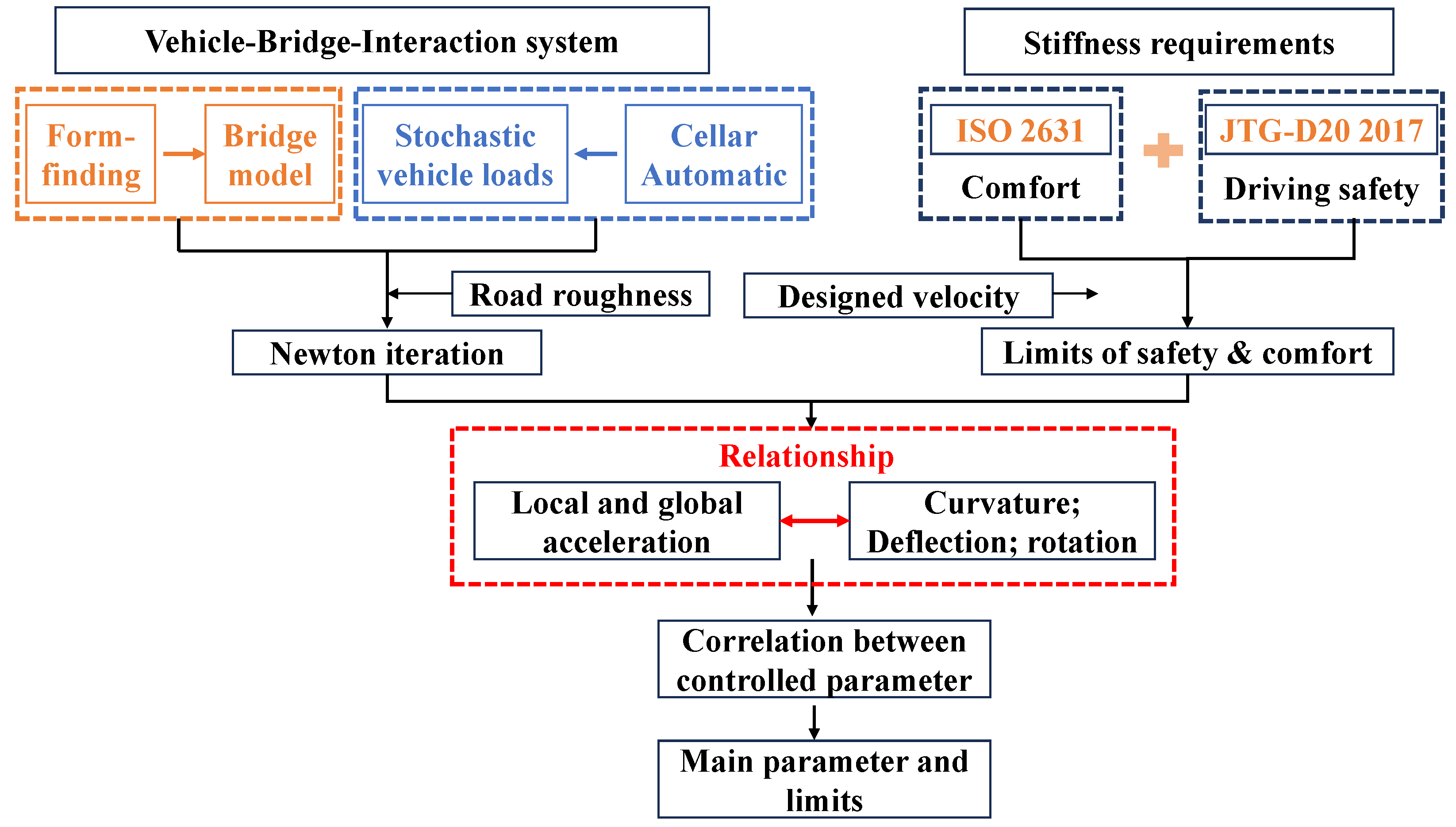
11]. However, as span lengths increase, the absolute vertical rigidity is increasingly dominated by gravity-induced geometric stiffness, rendering conventional global deflection-to-span ratios non-governing in the design process. Consequently, these simplified static indices fail to characterize the localized kinematic perturbations—such as slope discontinuities at the girder ends—that are amplified in ultra-flexible, 2000-m class systems. To address these limitations, the framework presented here evaluates vertical stiffness by integrating advanced structural mechanics with rigorous human comfort and traffic safety standards. The methodology is implemented through the following three-stage approach (see
Figure 1):
First, a high-fidelity Finite Element (FE) model is established. The initial geometric configuration and pre-stress state of the cable system are analytically derived based on multi-catenary theory, providing a precise physical foundation for subsequent static and dynamic analyses.
Subsequently, dynamic serviceability indicators are introduced to define the performance boundaries. Vertical acceleration limits are established according to ISO 2631 to ensure passenger comfort, while angular and curvature constraints are derived from traffic safety codes JTG-D-20 2017 to guarantee smooth vehicle transition and mitigate excessive local rotations of the bridge deck.
Finally, by mapping the functional correlations (e.g., deformation vs. acceleration and rotation vs. curvature), this methodology enables the analytical derivation of optimized stiffness design limits. This systematic approach ensures that the resulting bridge design is both structurally efficient and operationally safe under diverse service conditions.
2.1. Initial Configuration and Pre-Stress State
The vertical stiffness of a suspension bridge is highly dependent on its initial equilibrium state, which defines the geometric stiffness component. Prior to FE discretization, the initial shape is analytically derived using multi-catenary theory [
35,
36,
37]. By treating the cable as a series of catenary segments partitioned by discrete hanger loads
, the state of each segment
j is governed by:
where
. This analytical step ensures that the subsequent FE model starts from a zero-displacement equilibrium under dead loads, with the internal tension
T providing the necessary initial stress vector
.
The determination of the core parameters, namely the horizontal tension H and the initial slope parameter , is treated as a boundary value problem. By enforcing vertical equilibrium at each hanger, the slope parameters for all subsequent segments are determined recursively through . To close the system, these parameters must simultaneously satisfy the global span boundary conditions (total elevation drop) and the target mid-span sag constraint. This nonlinear system of transcendental equations is solved using the Newton-Raphson method, ensuring that the resulting analytical configuration strictly adheres to the bridge’s design geometry before being mapped onto the FE mesh.
Compared with the traditional parabolic theory, the multi-catenary formulation can represent the cable profile more accurately in ultra-long-span suspension bridges, where the sag is large and the geometric nonlinearity is significant. In addition, unlike simplified elastic catenary approaches that treat the cable as a more uniform continuous system, the multi-catenary method is better suited to handling the discrete hanger forces that characterize real suspension bridge configurations. This feature is particularly important for super-long-span bridges, in which the discrete cable–hanger–girder interaction has a non-negligible influence on the completed bridge shape and internal force distribution. Furthermore, the multi-catenary theory provides a mechanically consistent way to determine the completed bridge configuration, which can then be accurately transferred to the subsequent finite element model as the zero-initial-displacement state. This ensures consistency between the theoretical initial configuration and the numerical model used for the following static and dynamic analyses.
2.2. Finite Element Modeling
The analytically derived equilibrium state is mapped onto a refined 3D Finite Element (FE) model to evaluate the structural response under traffic loads. The bridge components are discretized based on their distinct mechanical roles: Cables and hangers are modeled as 3D truss elements, where the total stiffness incorporates both material elasticity and the geometric stiffness matrix
. This geometric component, derived from the pre-tension
T calculated in
Section 2.1, is the primary source of vertical stability in the suspension system. Meanwhile, the towers and stiffening girder are represented by 3D beam elements using Hermitian shape functions, ensuring the high-order displacement continuity required to accurately extract the local curvature
. The global dynamic behavior of the coupled vehicle-bridge system is governed by the second-order differential equation:
where
is the global displacement vector, and
are the assembled mass, damping, and stiffness matrices, respectively. The load side includes the time-varying vehicle force
, the initial internal force vector
, and the nodal gravity vector
, ensuring the simulation initiates from the rigorous analytical equilibrium. This discrete framework enables the precise extraction of nodal accelerations (
) and elemental curvatures (
), providing the necessary physical inputs for the serviceability limits defined in the following section.
2.3. Vehicle-Bridge-Interaction (VBI) Dynamic Formulation
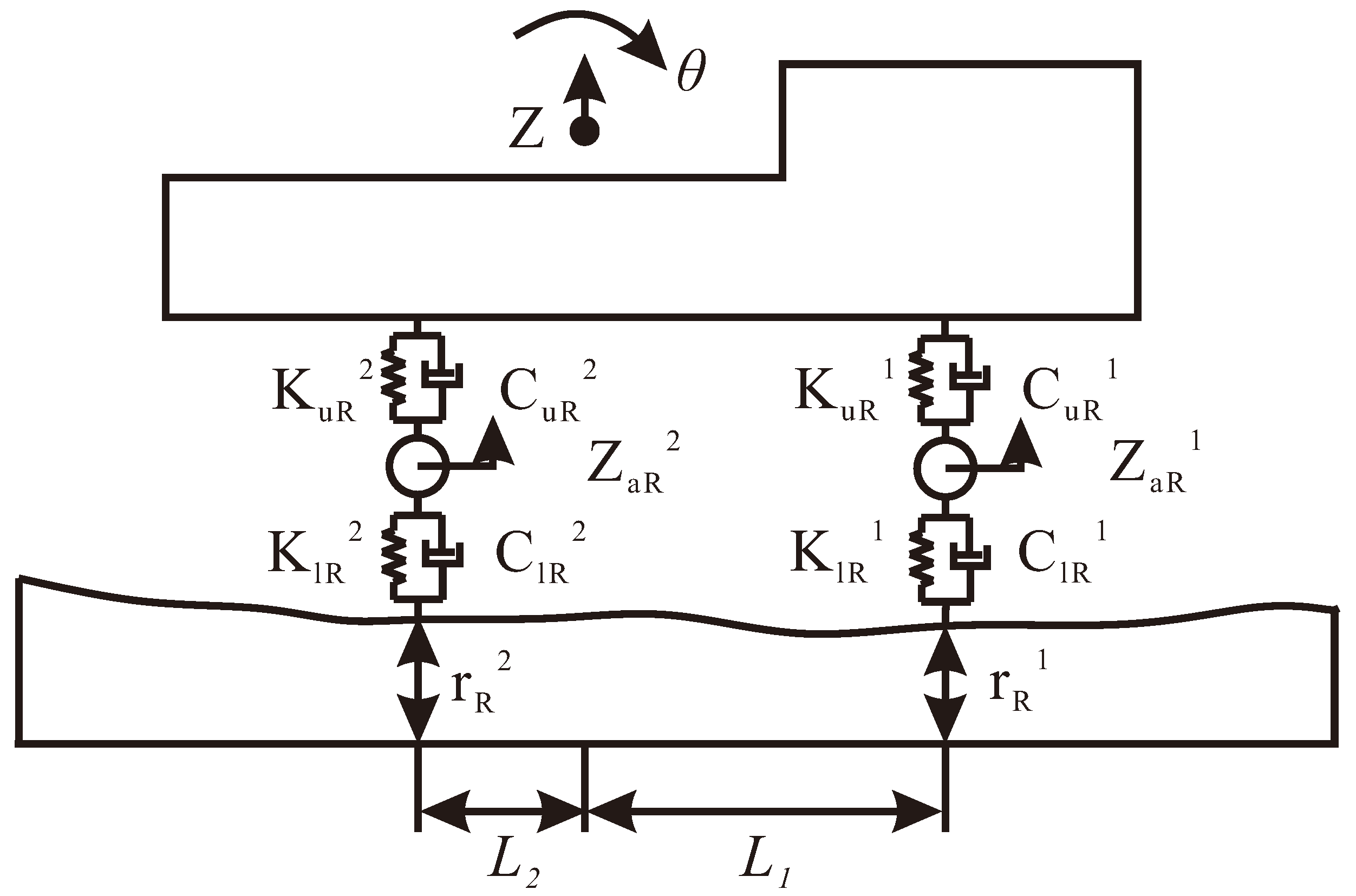
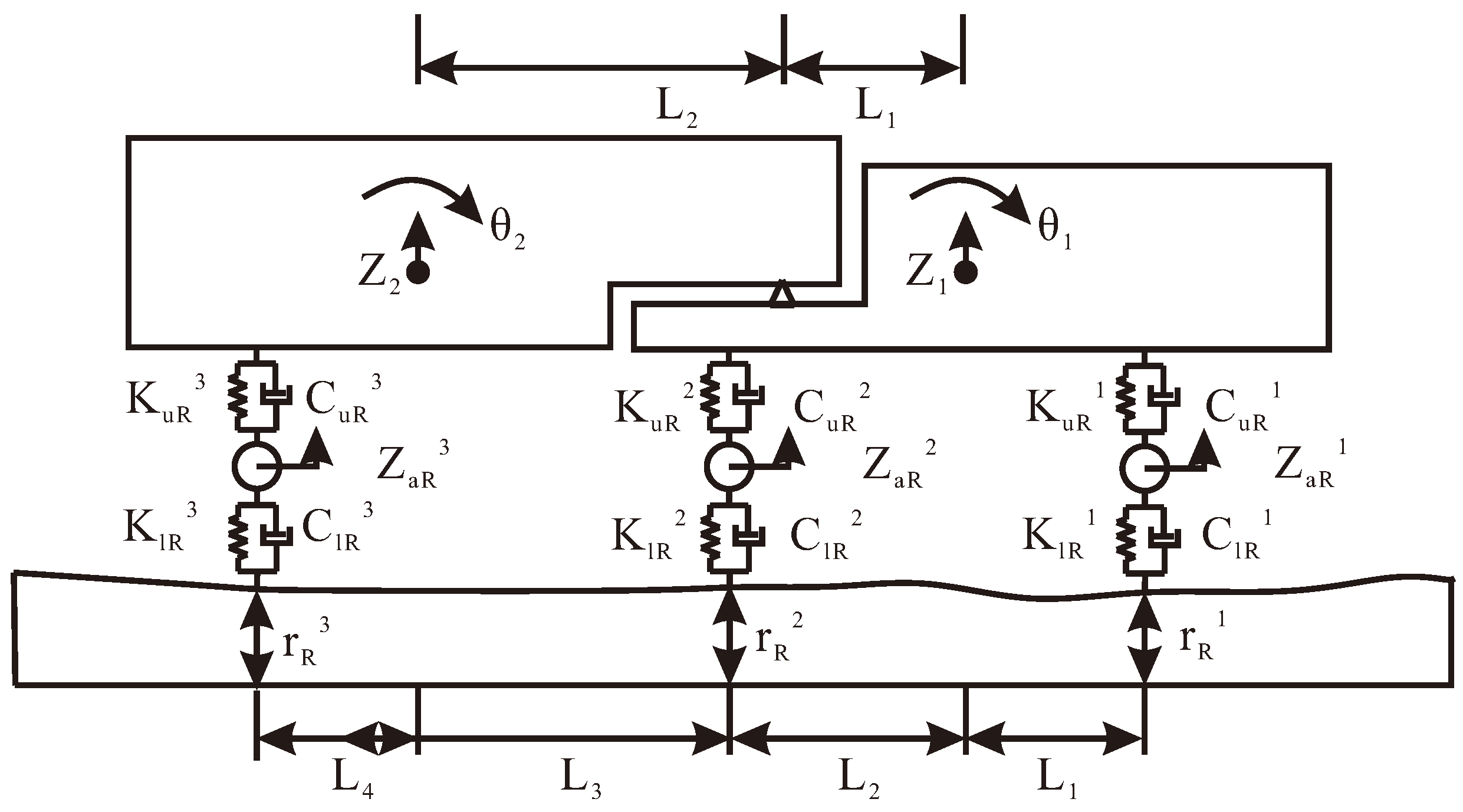
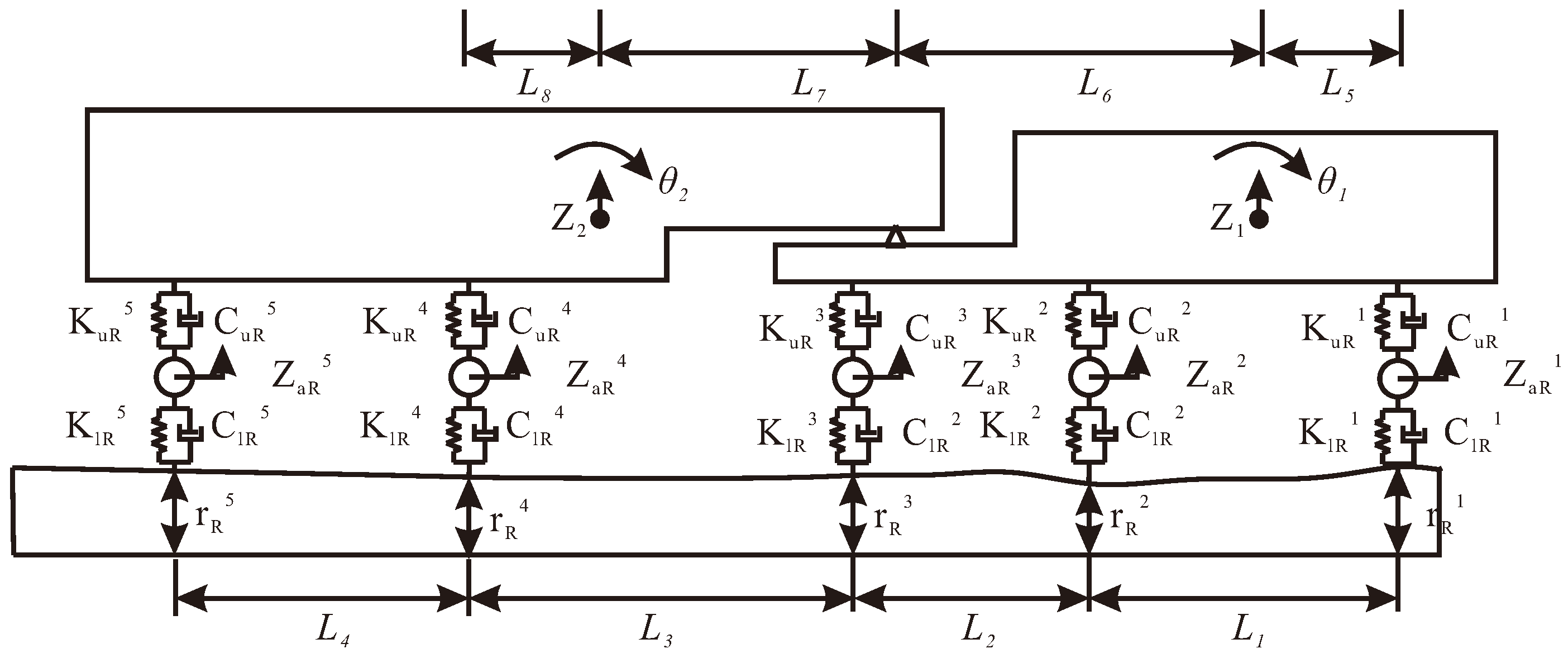
To evaluate the bridge’s dynamic response under diverse traffic scenarios, four representative vehicle types are modeled: a two-axle car, a two-axle van, a three-axle truck, and a five-axle semi-trailer. These models represent a wide spectrum of GVW (Gross Vehicle Weight) and frequency characteristics, ensuring a comprehensive assessment of vertical stiffness. As illustrated in
Figure 2,
Figure 3 and
Figure 4, each vehicle is idealized as a two-dimensional half-vehicle system consisting of a rigid body supported by multiple suspension and wheel assemblies, where Z represents the displacement of the mass element. The structural configuration is represented by an equivalent beam–mass–spring–damper system, and its dynamic equilibrium is governed by:
where
is the displacement vector comprising vertical translation and pitching rotation of the vehicle body, and the vertical motions of each axle. The interaction force
is the coupling term that links the vehicle DOFs with the bridge nodal displacements
. All geometric and mechanical parameters—including axle spacing (
), body mass (
), suspension stiffness (
), and damping (
)—are derived from calibrated specifications [
32] and are summarized in
Table 1,
Table 2,
Table 3 and
Table 4.
The bridge system and vehicle system are coupled through the contact forces at the tire–bridge interfaces. Unlike the traditional moving-load approach, which treats vehicles as externally applied static forces, the vehicle–bridge interaction (VBI) framework captures the bidirectional feedback between the two subsystems. This interaction is particularly important for long-span and super-span suspension bridges, where significant vertical deformations may occur.
In compact form, the coupled governing equations can be expressed as
where
and
are the displacement vectors of the bridge and vehicle subsystems,
,
, and
denote the mass, damping, and stiffness matrices, and
is the tire–bridge contact force that depends on both the bridge deformation at the contact points and the dynamic response of the vehicle suspension and wheels.
The coupled equations are integrated in time using the implicit Newmark–
method (typically
,
for unconditional stability). At each time step, the resulting nonlinear algebraic system is solved by Newton iteration:
until convergence is achieved. This combination of Newmark integration and Newton iteration ensures stable and accurate solutions for the VBI system.
The high-fidelity coupling ensures that the extracted vertical accelerations of the vehicle body and the bridge girder account for the dynamic amplification effects, providing a reliable basis for the subsequent serviceability assessment.
2.4. Serviceability Criteria (Safety & Comfort)
The dynamic responses extracted from the VBI system, primarily vertical acceleration and deck deformation, must be evaluated against serviceability standards to define the bridge’s stiffness envelopes. This evaluation framework focuses on two critical dimensions: local geometric safety and human vibration exposure.
Local deformation characteristics, such as girder-end rotation and curvature change, significantly influence vehicle stability during entry and exit. According to the Highway Route Design Specification (JTG D20-2017) [
34], the vertical alignment of the deformed bridge deck must maintain a minimum radius of curvature (
) to ensure sufficient sight distance and moderate impacting forces. For a design speed of 100 km/h, the safety thresholds for the equivalent radius are summarized in
Table 5. These geometric constraints effectively limit localized “kinks” at joints and expansion gaps, serving as the primary indicators for local stiffness requirements.
Simultaneously, the overall vertical vibration of the suspension system must be constrained to ensure the biological comfort of passengers. In accordance with ISO 2631-1 [
33], the comfort level is quantified by the frequency-weighted root-mean-square (RMS) acceleration,
:
where
is the acceleration filtered by the weighting function
. For vertical vibration (
z-axis),
accounts for the human body’s varying sensitivity:
The perception thresholds defined by ISO 2631 are presented in
Table 6. In this study, the “Not Uncomfortable” limit (
m/s
2) is adopted as the primary criterion for vertical stiffness design. By mapping these criteria against structural parameters, the methodology derives optimized stiffness limits ensuring both efficiency and safety.
3. Case Study: The Zhangjinggao Bridge
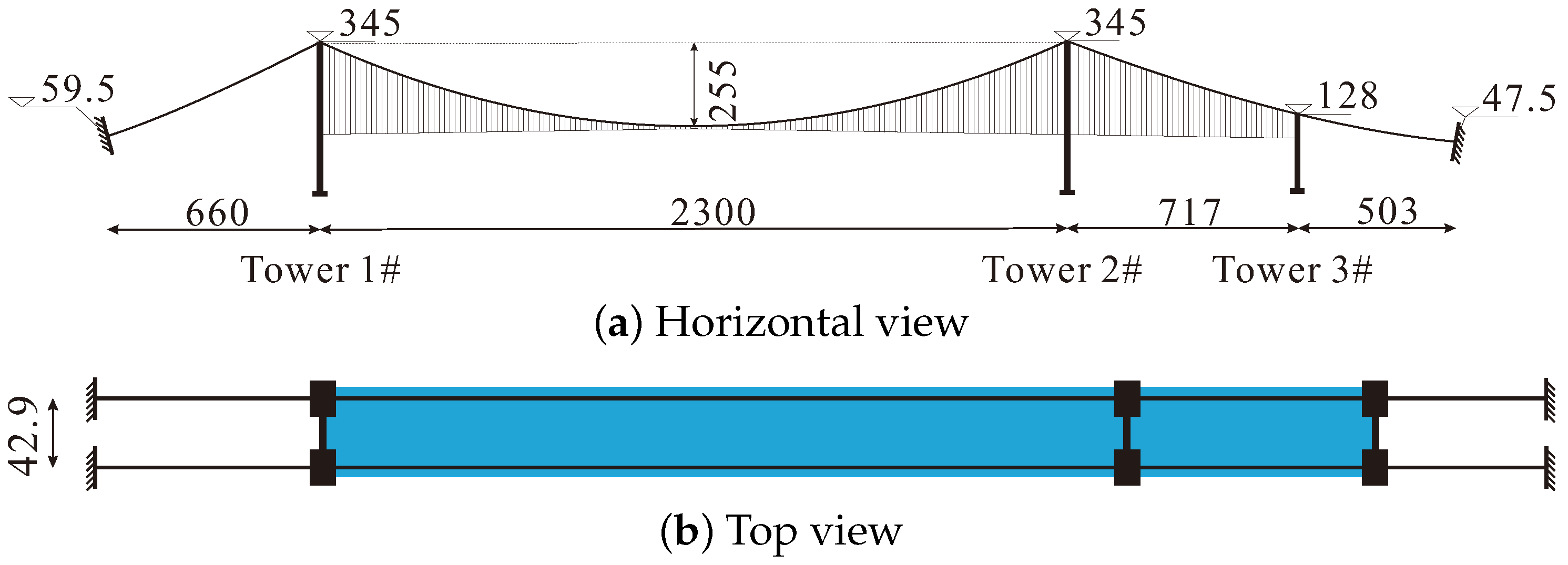
The Zhangjinggao Bridge, a record-breaking super-long span structure in Jiangsu Province, China, is selected to demonstrate the proposed evaluation framework. Designed by the China Communication Construction Company (CCCC) Highway Consultants, this bridge connects the cities of Rugao and Zhangjiagang. The structural configuration features a three-tower, four-span steel box girder suspension system with a span layout of
m (see
Figure 5). The main span-to-sag ratio (
) is 1/9. Upon completion, its 2300-m main span will make it the longest suspension bridge in the world.
The suspension system comprises 142 pairs of hangers in the main span and 42 pairs in the side spans. In the horizontal direction, the main span hanger spacing is defined as
, while the side span spacing is
. For numerical simplification, the girder design elevation is assumed to be a constant horizontal line at 66.111 m. The material and sectional properties of the primary components are summarized in
Table 7.
3.1. Numerical Implementation and Road Roughness Modeling
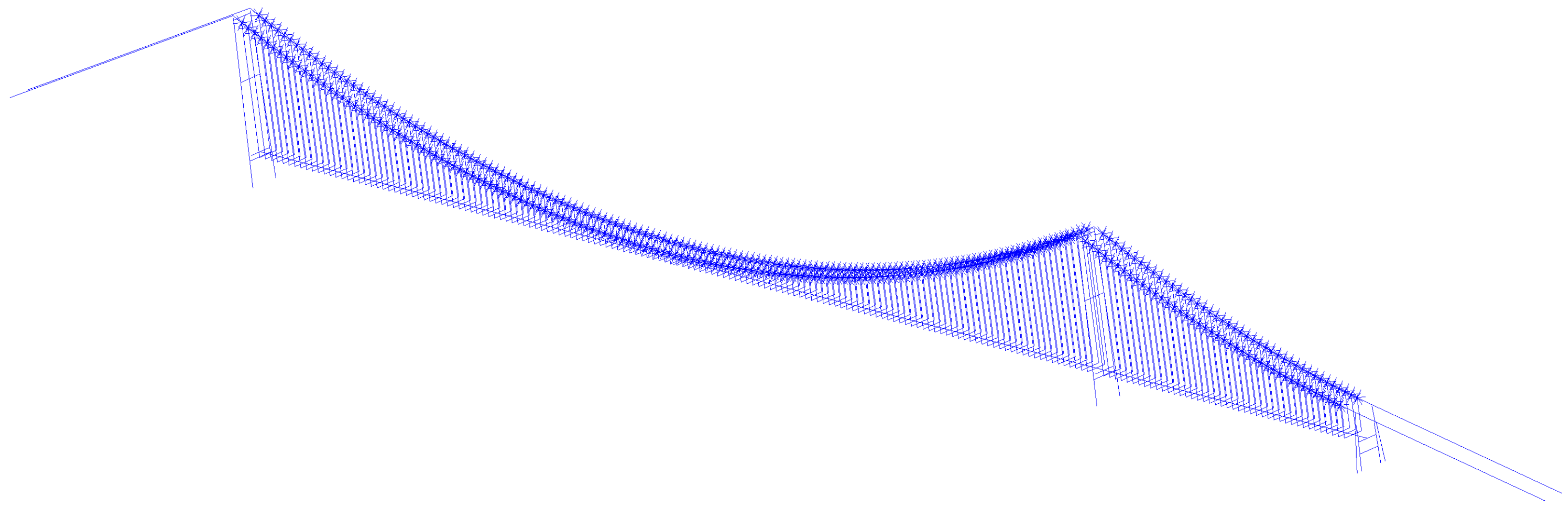
A high-fidelity FE model was developed using ANSYS 16.0 (see
Figure 6). Main cables and hangers were discretized using LINK10 elements (bilinear stiffness with initial strain), while the towers and girder were modeled with BEAM44 elements. The initial state of the structure was established through the methodology described in
Section 2. The initial tension in the hangers was determined via the rigid-support continuous beam method, while the cable’s unstressed length and initial strain were precisely calculated using the analytical multi-catenary theory. This shape-finding process ensures the model achieves equilibrium under dead loads with zero displacement. The interaction between the vehicle and the bridge is therefore not treated as a conventional surface-to-surface contact problem. Instead, a two-point coupling scheme is adopted. The front and rear wheel points of the vehicle are coupled with the corresponding positions on the bridge deck. At each time step, the wheel positions are updated according to the vehicle speed and wheelbase, and the bridge displacements at these two positions are used to calculate the tire deformations together with the road roughness excitation. The resulting tire forces are then applied back to the bridge as moving interaction forces. The validity of the finite element model was verified by comparison with the design documents, including the completed bridge configuration, the initial internal forces of the main cables, the hanger forces, and the natural frequencies.
Upon constructing the vehicle and bridge models and defining the aforementioned constraint equations, the global governing equations for the coupled system are formulated. The nonlinear dynamic system is solved using the transient dynamic analysis method in ANSYS, which employs an implicit integration scheme to accurately obtain the time-history responses of both the bridge and the vehicles.
According to ISO/TC 108/SC 2/N67 [
38] and GB/T 7031-2005 [
39], road surface roughness is characterized as a stationary stochastic process, typically described by its displacement power spectral density (DPSD). The DPSD function,
, can be calculated using the following power-law relationship:
where
n is the spatial frequency,
is the reference spatial frequency (usually 0.1 cycles/m),
is the roughness coefficient at the reference frequency, and
w is the power spectral exponent.
Based on GB/T 7031-2005, road surface quality is classified into eight grades, ranging from Level A (Excellent) to Level H (Extremely Poor). This classification method assumes that the velocity power spectral density remains constant, which corresponds to an exponent of
in Equation (
8). The specific roughness parameters for representative road grades are summarized in
Table 8.
To facilitate dynamic bridge analysis, the spatial roughness spectrum in Equation (
8) is converted into a time-domain excitation function
using the spectral representation method. The temporal road profile is simulated as a summation of a series of harmonic waves based on the DPSD function
, formulated as follows:
where
is the DPSD at the center frequency of the
i-th interval,
is the frequency increment, and
represents a random phase angle uniformly distributed in the interval
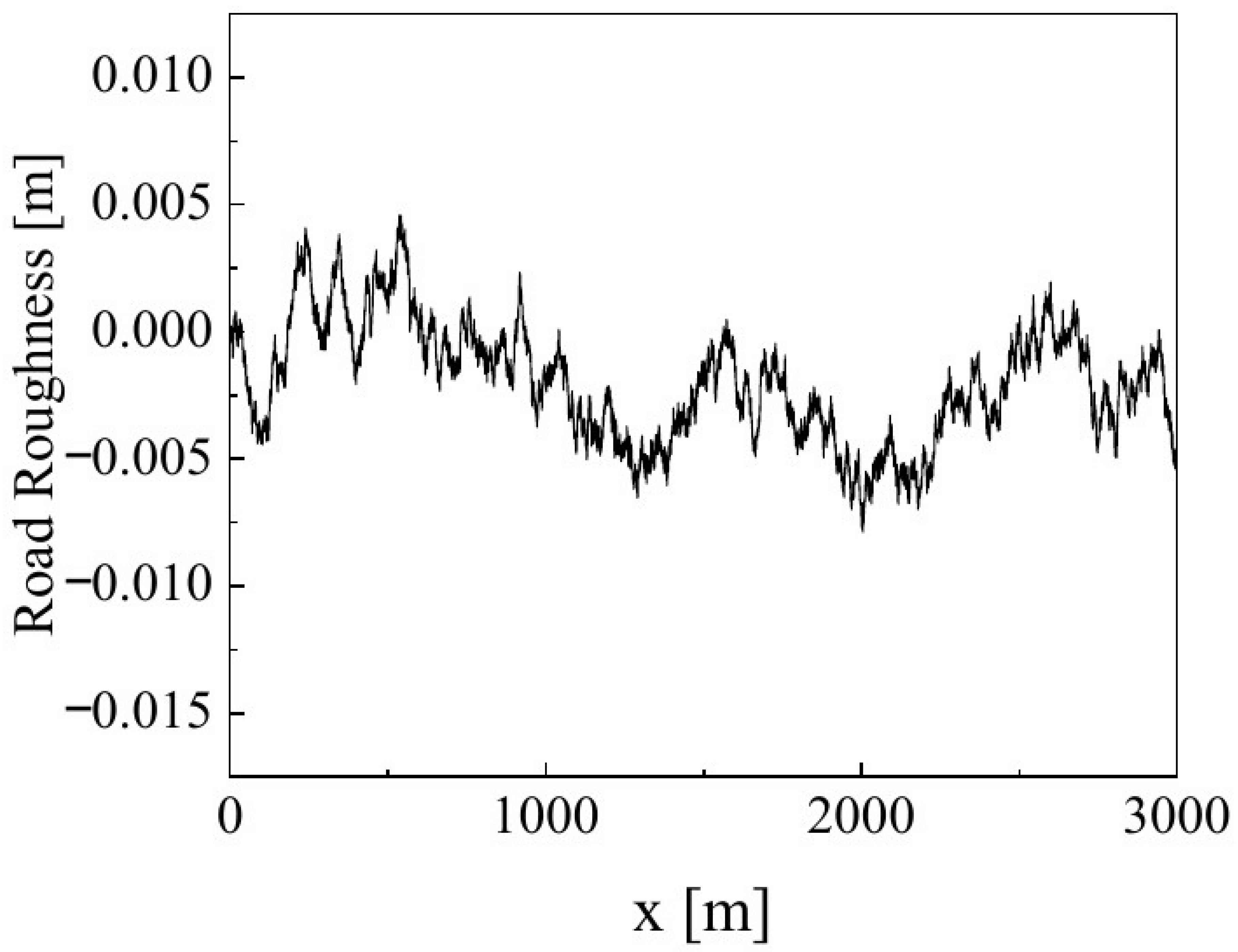
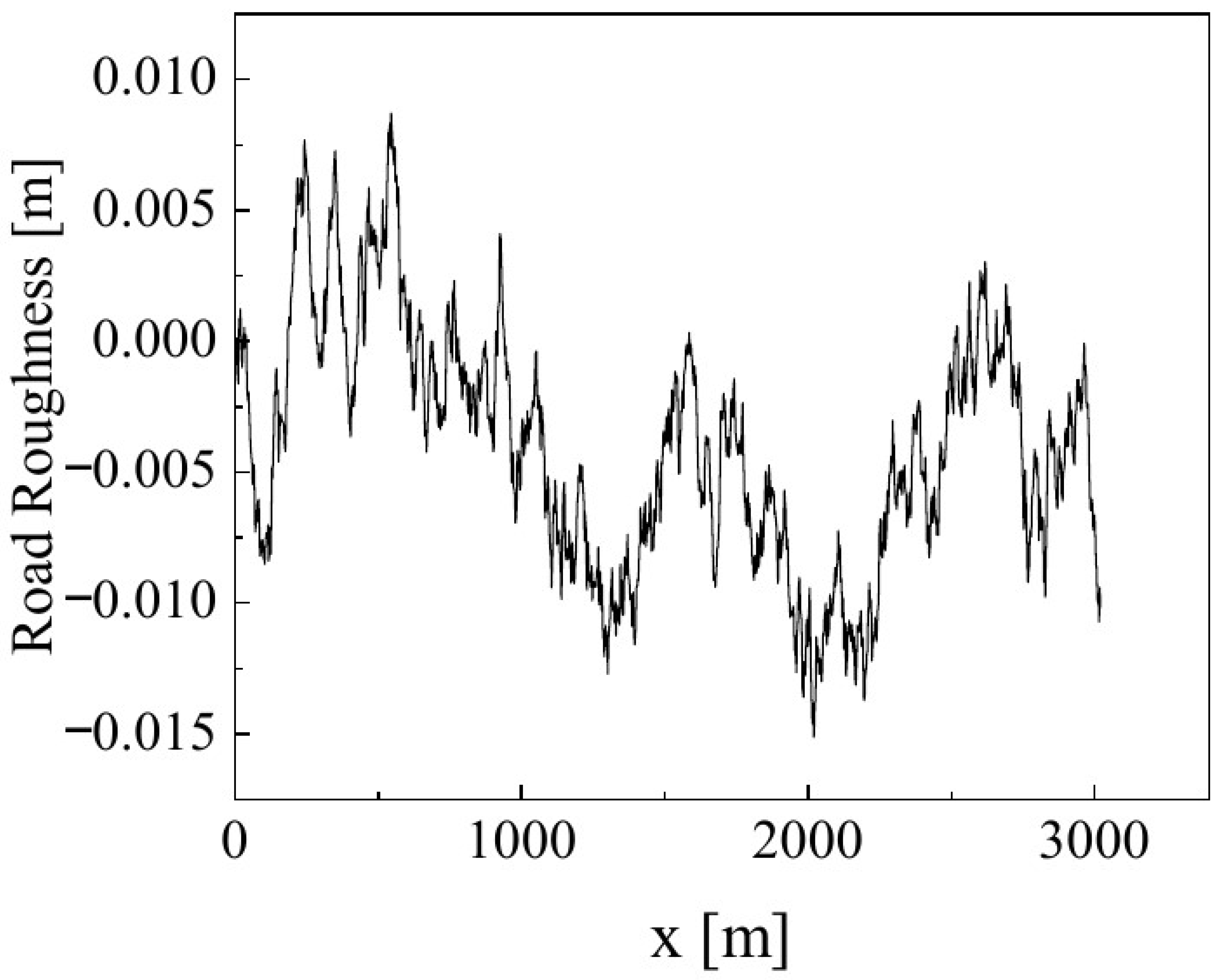
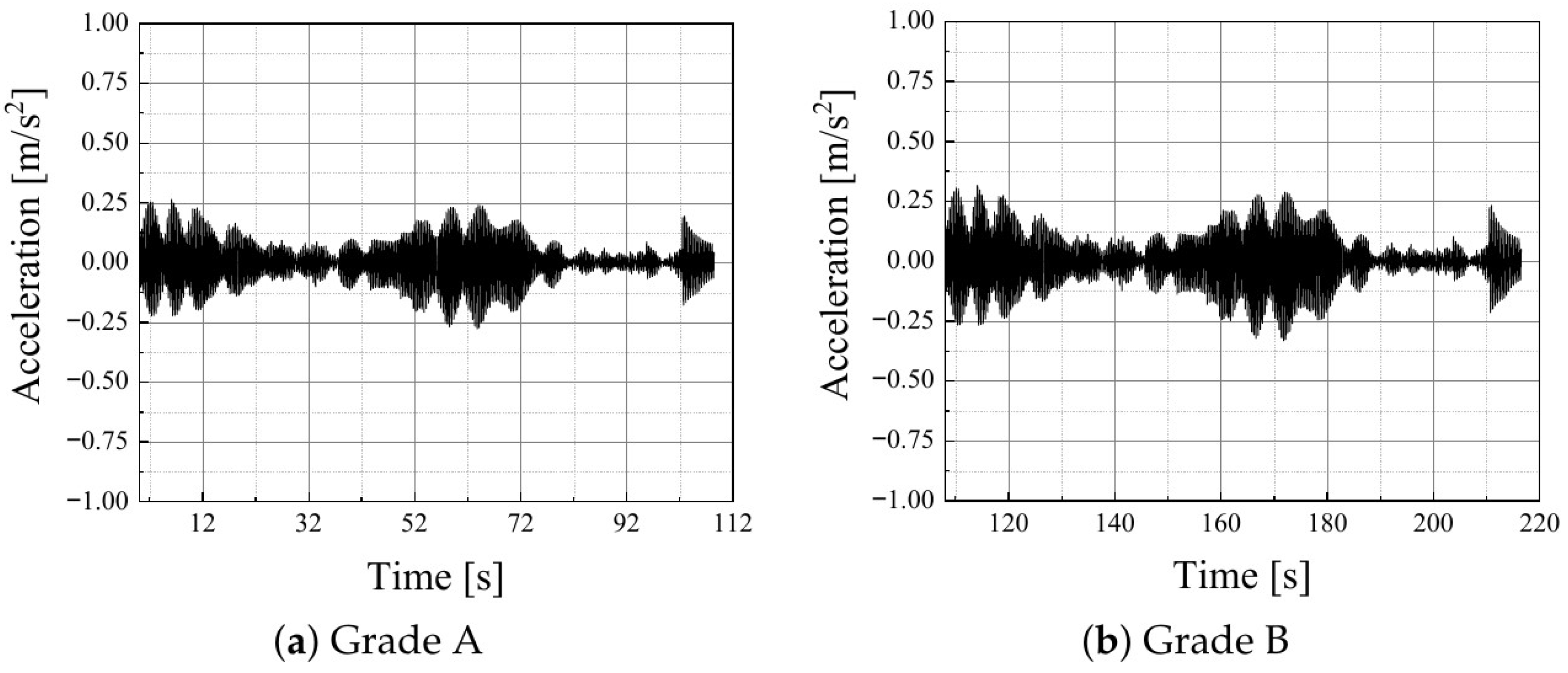
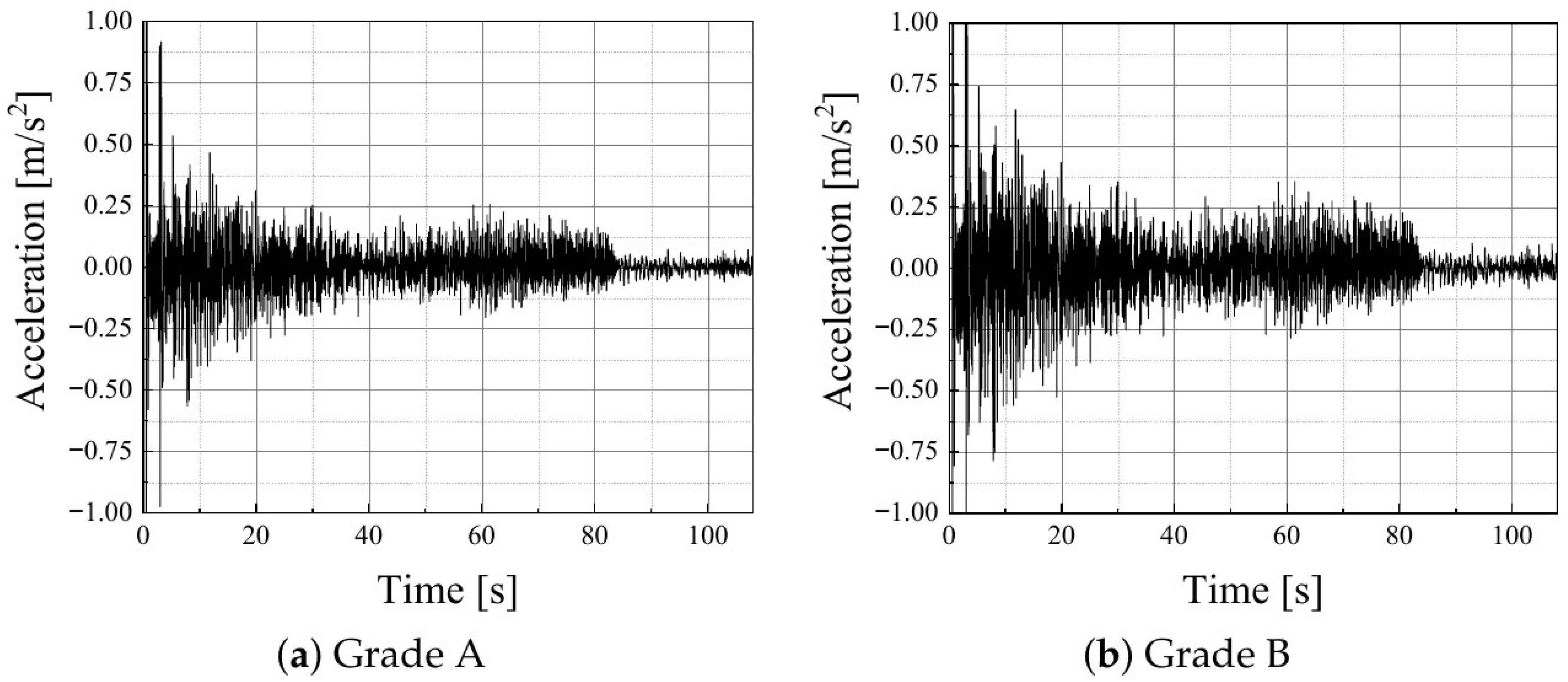
. The generated power spectrum of the road roughness aligns with the standards specified in GB/T 7031-2005. The road roughness profiles for Grades A and B, generated using Equation (
9), are shown in
Figure 7 and
Figure 8.
The transient analysis was conducted with a sufficiently small integration time step (0.02 s), selected by considering both numerical stability and solution accuracy. Additional calculations with refined time-step settings were used to verify that the key dynamic response quantities did not change significantly. Structural damping was represented by the Rayleigh damping model; a damping ratio of 0.03 was adopted for the bridge structure in the present dynamic analysis. To incorporate the influence of road surface roughness, a displacement compatibility condition is enforced at the contact points, as expressed in Equation (
10):
where:
is the vertical coordinate of the vehicle’s tire at the contact point;
is the vertical coordinate of the bridge deck directly beneath the tire;
r denotes the localized road surface roughness, as determined by the spectral representation method in Equation (
9).
3.2. Stochastic Traffic Flow Simulation
Traffic flow in real life is affected by the types, numbers, and sparsity of vehicles passing on bridges that vary based on the dates, times, and lane distributions. To evaluate the comfort and safety of drivers, it is crucial to conduct a dynamic analysis of the VBI system under random traffic flow. This section generates random traffic flows through the cellular automata (CA) model, a dynamic grid system with discrete time, space, and state. By converting the lanes into several cells and creating the changing rules of individual cells, the CA was able to simulate complex systems using its microscopic operating mechanisms. For random traffic flows, vehicles can be identified as either single cells or adjacent cells. Car-following actions could be viewed as modifying rules in both time and space domains. In this way, the velocity of each vehicle passing the suspension bridge and the spacing of adjacent vehicles could be obtained. Another two important parameters of the random traffic flow simulation in CA are the proportion of different types of vehicles and traffic density.
Since the Zhangjinggao Bridge is still under construction, long-term site-specific traffic data are not yet available. Therefore, the CA model parameters adopted in this study were determined with reference to long-term monitoring data from the Runyang Yangtze River Bridge, which is the closest comparable long-span suspension bridge [
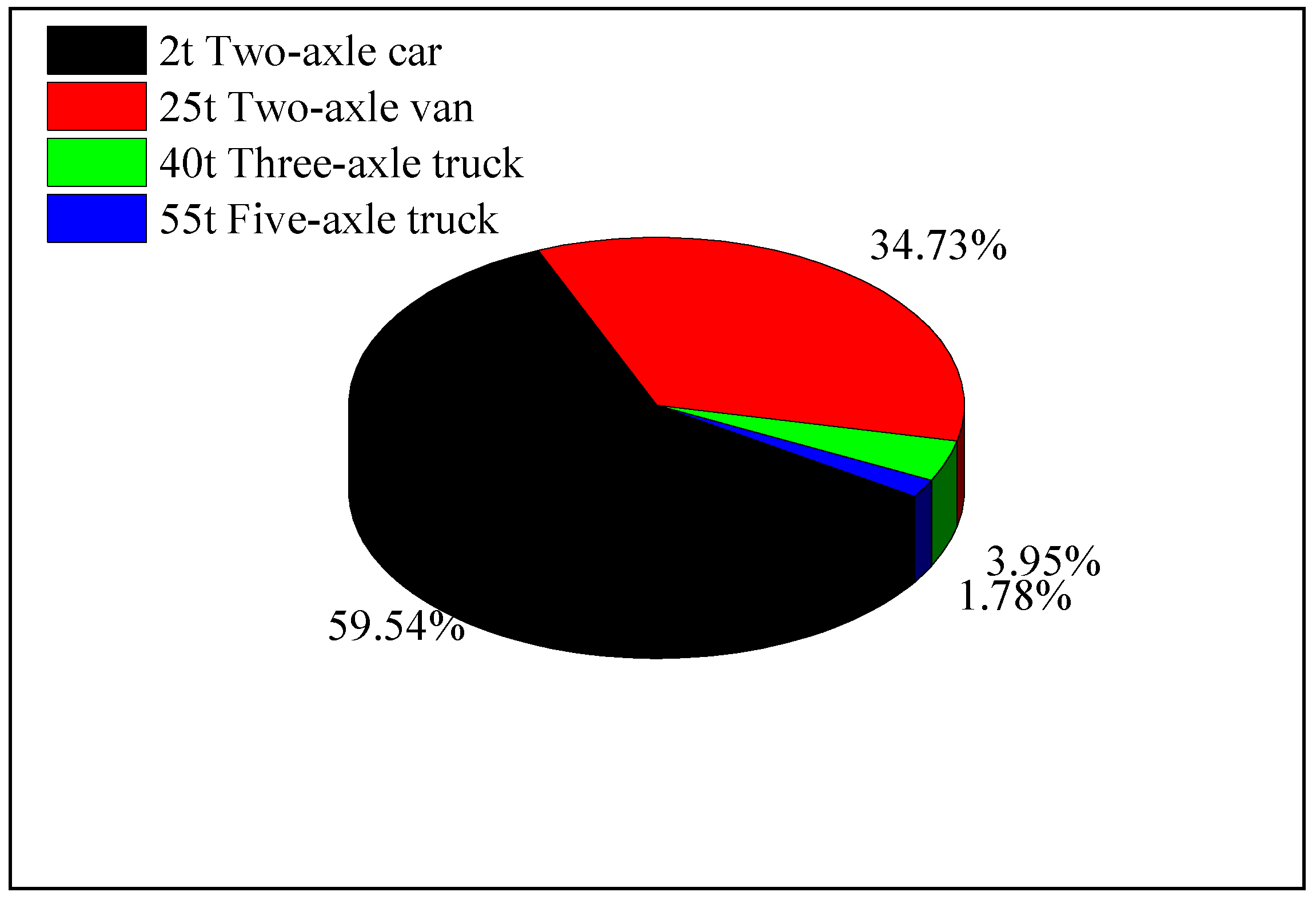
40]. The long-term statistic traffic data are reclassified into four types according to
Table 1,
Table 2,
Table 3 and
Table 4, which is illustrated in
Figure 9. On this basis, the traffic flow was further extended to the eight-lane configuration of the Zhangjinggao Bridge. The adopted parameters, including traffic density and vehicle composition, were selected to represent typical traffic operating conditions for a super-long-span highway suspension bridge. It should be noted that the present stochastic traffic simulation is simplified in nature: lane-changing behavior is not considered, and vehicles are generated under the assumption of constant speed. Although these simplifications may affect the detailed representation of complex traffic states, the adopted model is considered sufficiently representative for the serviceability-oriented vehicle–bridge interaction analysis in this study.
In the generative model of random traffic flow, the cell length is selected as 2.5 m, where 2 t two-axle car (V1) and 25 t two-axle van (V2) occupy one cell, 40 t three-axle truck (V3) occupies two cells, 55 t five-axle truck (V4) occupies six cells. When the cell state is zero, it means no car is in the cell, and when the cell state is larger than zero, it means that a car exists in the cell. The traffic density of each lane is assumed to be 0.3. The cell states of 0.1, 0.2, 0.3, and 0.4 represent the V1, V2, V3, and V4 vehicles, respectively.
3.3. Dynamic Response Under Service Loads
To evaluate the serviceability of the Zhangjinggao Bridge under realistic operating conditions, dynamic simulations were performed using the stochastic traffic flow generated by the CA model. According to the existing references on vehicle–bridge interaction in road engineering, the main working conditions focus on two aspects, i.e., (1) comfort analysis during the entire process of passing the girder, and (2) comfort analysis in the local process of passing the end of the girder [
41,
42]. Referring to the comfort analysis method in ISO 2631, the same weighted filtering function was applied for each corresponding working condition to calculate the weighted acceleration root-mean-square (RMS), which was adopted as the comfort characterization index.
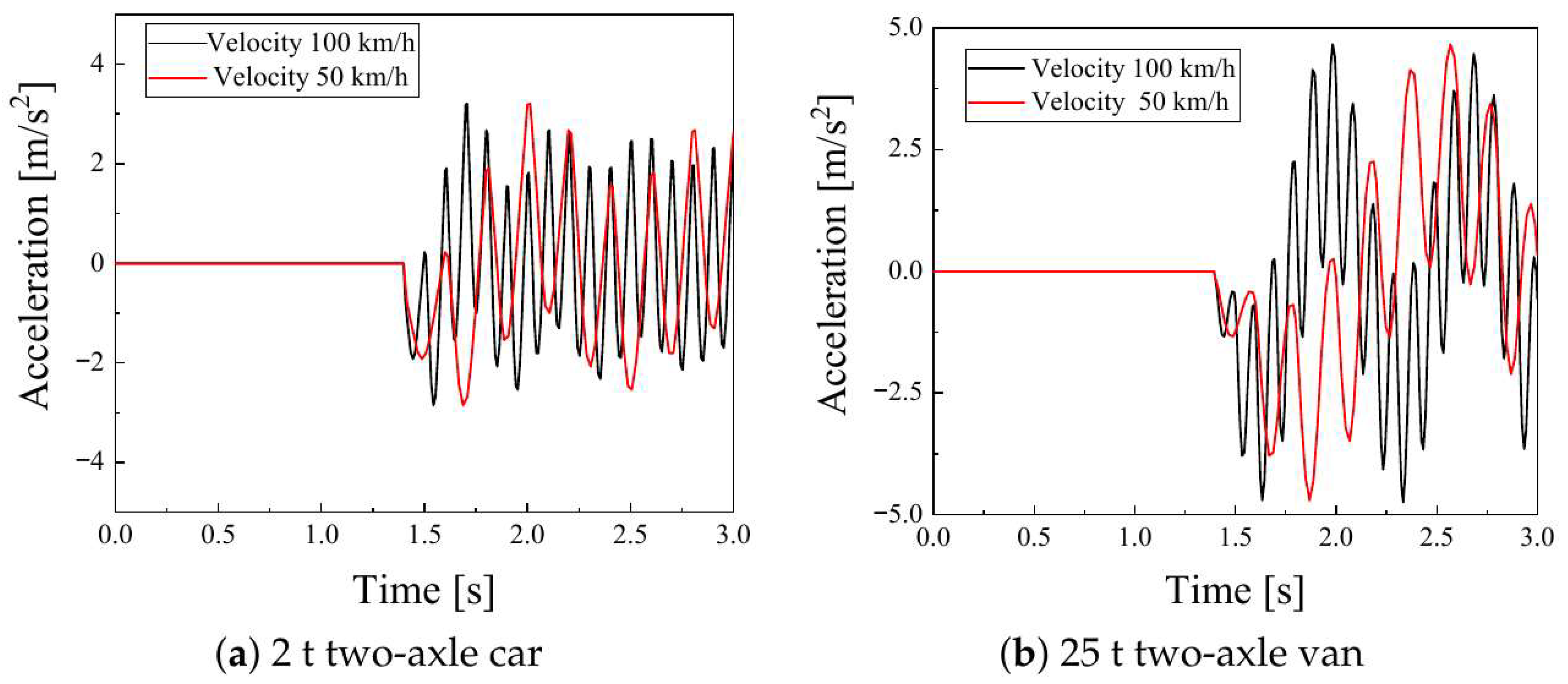
Figure 10 and
Figure 11 illustrate the acceleration time-history curves for a 2-t car and a 25-t van, respectively, sampled from the stochastic flow under different road roughness levels. Under Grade A conditions, the bridge maintains a relatively stable dynamic environment. However, as road quality degrades to Grade B, the vertical accelerations exhibit a marked increase in both frequency and amplitude. This phenomenon underscores the high sensitivity of super-flexible suspension systems to surface-induced excitations. Even without structural parameter variations, the inherent flexibility of the 2300-m span allows for significant dynamic amplification when subjected to heavy, multi-axle vehicle sequences.
The most critical observations occur at the girder-end transition zones. As shown in
Figure 12, when vehicles enter or exit the main span, the abrupt change in local slope (the “kink” effect) triggers a sharp pulse in vertical acceleration. For the 25-t heavy vehicle, the transient peak acceleration at the girder end reaches approximately 1.0 m/s
2, which is more than three times the “Not Uncomfortable” threshold (0.315 m/s
2) defined by ISO 2631.
These results demonstrate that for next-generation super-long spans, the serviceability limit state is governed by local kinematic disturbances rather than global stiffness. The stochastic nature of the traffic flow—characterized by varying vehicle spacings and weight combinations—further compounds these local effects, making a unified vertical stiffness framework based on local rotation and curvature an urgent necessity.
4. Parameter Sensitivity and Stiffness Limits
To identify the primary factors governing the vertical stiffness of the Zhangjinggao Bridge, a comprehensive parametric study was conducted under static vehicle loads. The investigation focused on the mechanical contributions of three principal structural components: the stiffening girder, the main towers, and the cables. For numerical efficiency, the stiffnesses of these components were adjusted by varying their cross-sectional properties, as detailed in
Table 9.
Notably, the sag-to-span ratio was maintained as a constant and excluded from the parametric variables for the following reasons: (i) Multivariate Coupling: A modification in the sag-to-span ratio necessitates a concurrent redesign of the tower and cable geometries to satisfy constraints regarding structural stability, fatigue performance, and allowable stress. Thus, it is impractical to isolate the sag-to-span ratio as an independent variable in this context. (ii) Gravity Stiffness Lower Bound: The current design of the 2300-m Zhangjinggao Bridge adopts a ratio of 1/9, which represents the lower bound for vertical stiffness as specified in JTG/T D65-05-2015. Consequently, the bridge operates at its minimum theoretical gravity-induced stiffness boundary, making further reductions unnecessary for a safety-oriented evaluation.
The primary objective of this section is to identify the dominant structural parameters influencing the vertical deflection and serviceability performance of the suspension bridge.
4.1. Influences of Vertical Stiffness of the Bridge Deck
To investigate the influence of girder stiffness on vertical deformation, seven finite element (FE) models were developed, with the vertical bending stiffness (
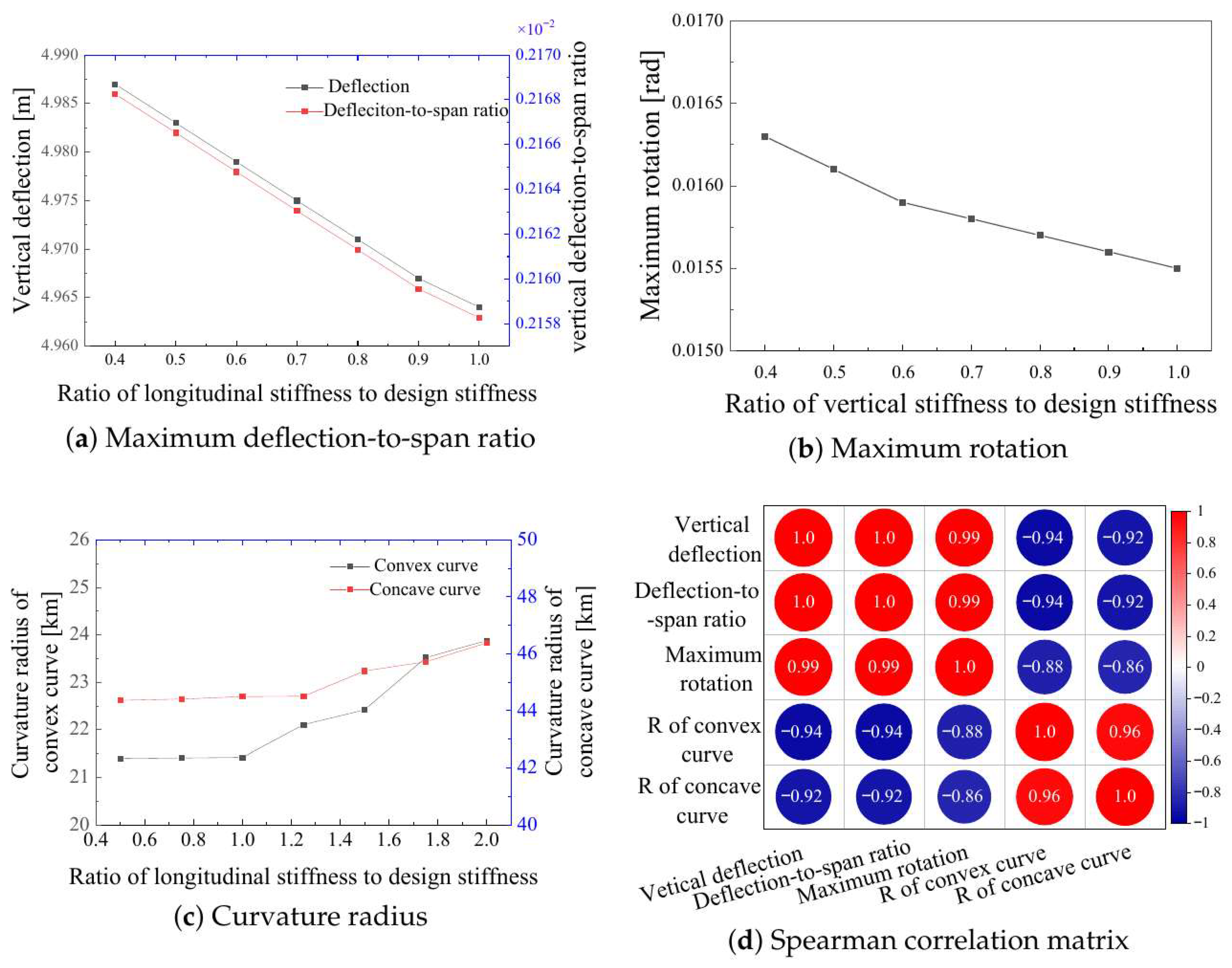
) ranging from 0.5 to 2.0 times the design value. The resulting vertical deflection-to-span ratios, girder-end rotations, and curvatures are collected and compared in
Figure 13a–c. Furthermore,
Figure 13d presents the Spearman correlation coefficients
among these parameters, calculated as follows:
where
and
represent the stiffness parameter and the corresponding structural response, respectively, while
and
denote their mean values. The Spearman coefficient ranges from −1 to 1. An absolute value approaching 1 indicates a strong monotonic relationship between the parameters, whereas a value near 0 suggests a weak correlation.
As illustrated in
Figure 13a,b, both the vertical deflection and the maximum girder-end rotation exhibit a continuous decreasing trend as the stiffness ratio increases. However, the sensitivity of these indices to girder stiffness is relatively low. For instance, quadrupling the stiffness (from 0.5 to 2.0
) only leads to a marginal reduction in vertical deflection (from 4.987 m to 4.964 m). This phenomenon confirms that for ultra-long span suspension bridges like the Zhangjinggao Bridge, the global vertical deformation is primarily dominated by the gravity-induced geometric stiffness of the main cables rather than the structural bending stiffness of the girder.
In terms of local deformation,
Figure 13c demonstrates that the curvature radii of both convex and concave curves increase significantly as the girder is stiffened. This indicates that while increasing girder stiffness has a negligible effect on global deflection, it effectively alleviates local sharp curvatures, thereby potentially enhancing driving comfort. The Spearman correlation heat map in
Figure 13d further confirms this, with correlation coefficients between most indices exceeding 0.90, signifying a highly synchronized response between global and local kinematic parameters. Although the girder stiffness significantly influences the local curvature radius, the absolute values remain well within the permissible limits across the
to
range, indicating that girder stiffness is also a secondary factor compared to the cable’s geometric stiffness.
4.2. Influence of Tower Stiffness
To evaluate the influence of tower stiffness on the bridge’s vertical response, 14 additional finite element models were developed. The longitudinal bending stiffness (
) of the three towers was varied from 0.4 to 2.0 times the design value. Preliminary analysis and comparison indicated that the stiffness variation of tower #2 (from left to right in
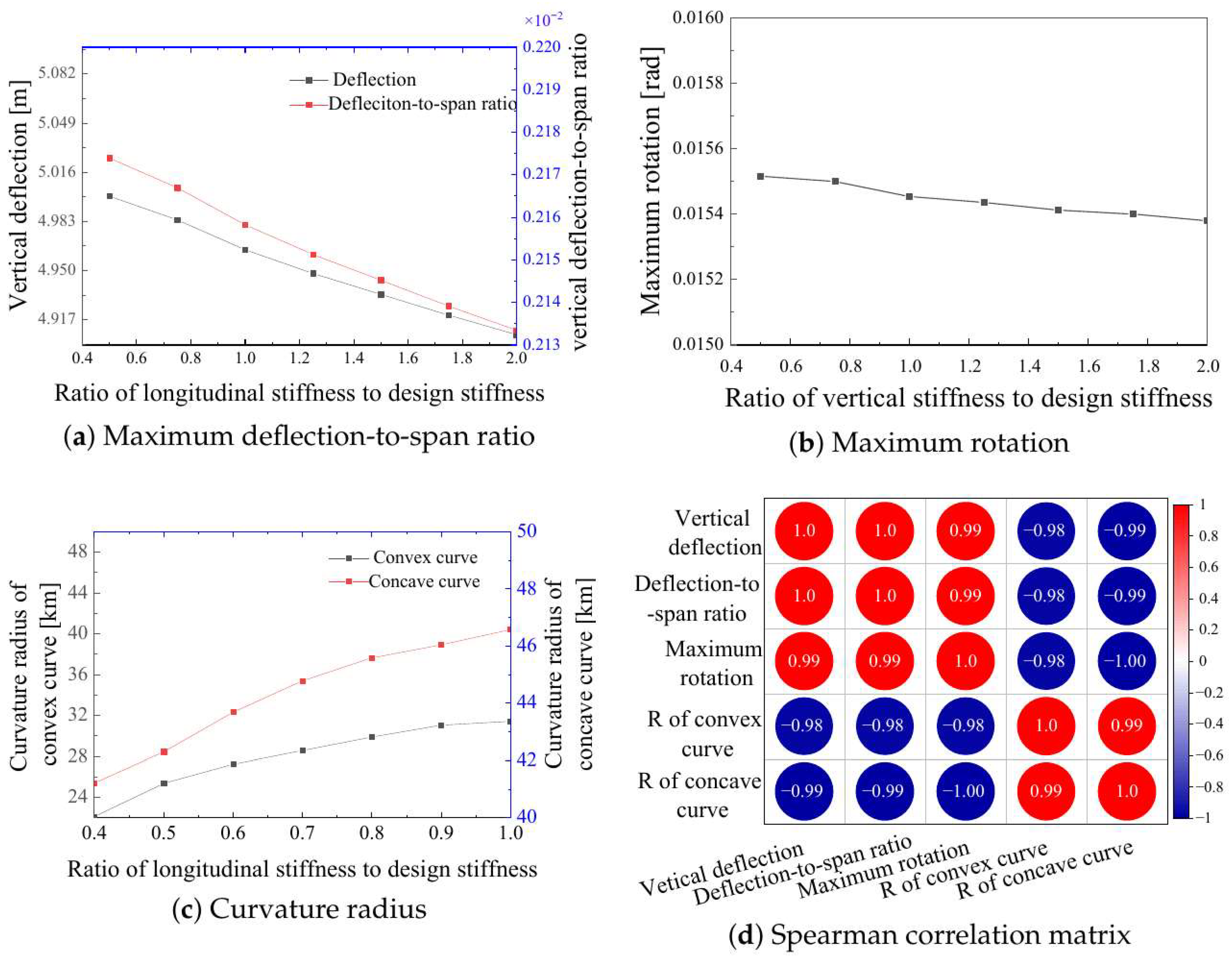
Figure 5, the northern tower) has a more pronounced impact on the overall vertical response compared to tower #1 and #3. Therefore, to ensure a conservative and focused evaluation, the vertical deflection-to-span ratios, rotations, and curvature radii corresponding to the longitudinal stiffness variations of tower #2 are presented in
Figure 14.
As illustrated in
Figure 14a,b, the vertical deflection and girder-end rotation exhibit a continuous decreasing trend as the tower stiffness increases. When the longitudinal stiffness is reduced to 0.4
, the vertical deflection increases to approximately 5.006 m, representing an increase in the deflection-to-span ratio of about 1% (from 1/461 to 1/463). Simultaneously, the maximum rotation increases by 0.4%, and the curvature radius of the concave curve increases by 12% (approximately 2.46 km), as shown in
Figure 14c.
The Spearman correlation matrix in
Figure 14d confirms a highly synchronized relationship between tower stiffness and structural response, with absolute correlation coefficients exceeding 0.98. Notably, while the tower stiffness influence is statistically significant, the absolute variation in deflection (approx. 23 mm) remains marginal relative to the total 2300 m span. This confirms that even for the most sensitive tower, the vertical stiffness of such a super-span suspension bridge is primarily governed by the geometric stiffness of the cable system rather than the individual flexural rigidity of the towers. Consequently, tower stiffness can be considered a non-governing factor for the serviceability-driven design of the 2300-m Zhangjinggao Bridge.
4.3. Influence of Cable Stiffness
To investigate the impact of the main cable on vertical rigidity, seven additional finite element models were conducted. The axial stiffness (
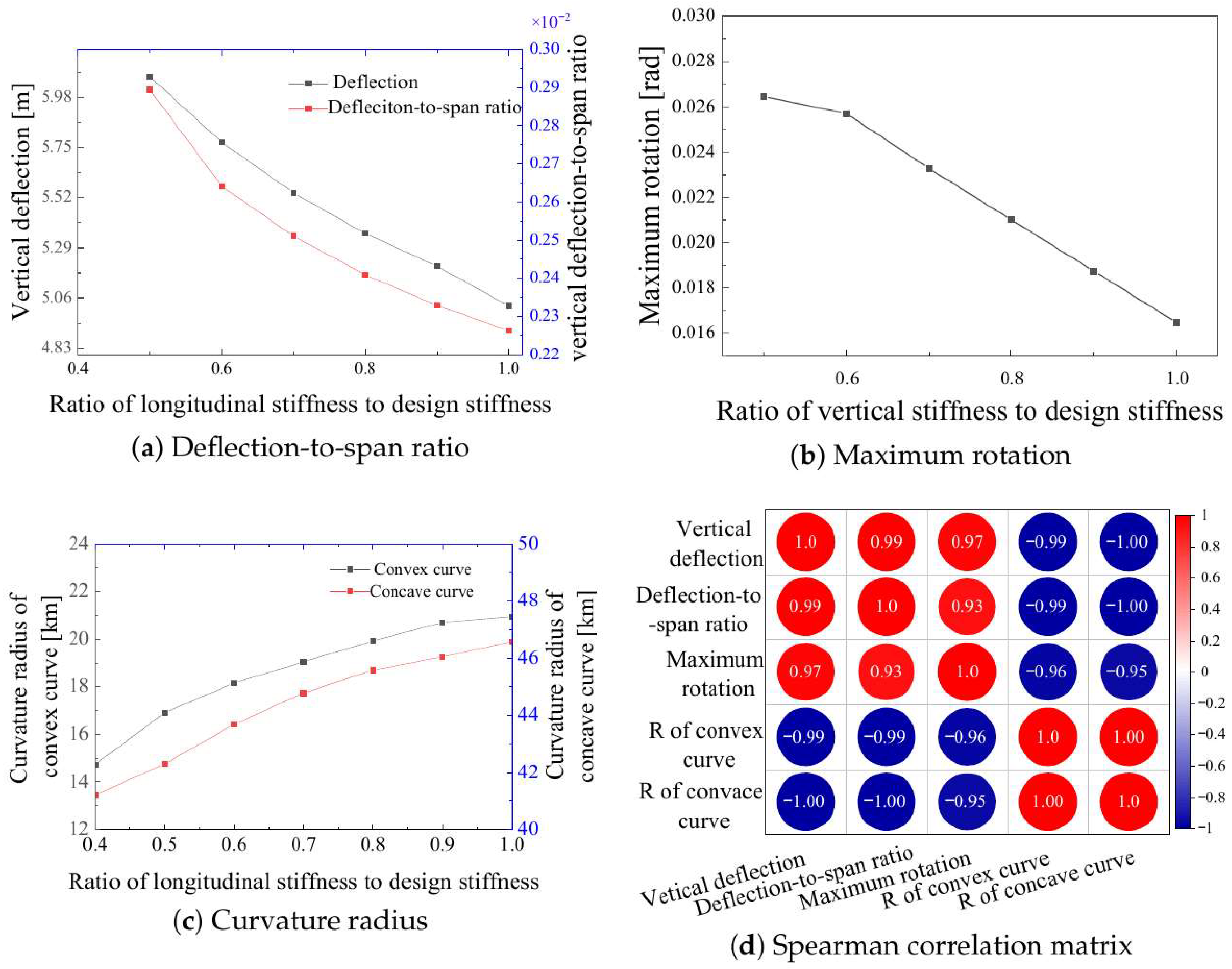
) of the main cables was varied from 0.4 to 1.0 times the design value. The resulting kinematic indices and their correlations are illustrated in
Figure 15.
As shown in
Figure 15a,b, compared to the influence of the girder and tower, the reduction in cable stiffness leads to a much more substantial increase in structural deformation. When the cable stiffness is reduced to 0.4
, the vertical deflection increases dramatically from approximately 4.98 m to 6.08 m, and the maximum rotation nearly doubles, reaching 0.026 rad. Similarly,
Figure 15c indicates a sharp decline in the curvature radius as cable stiffness decreases, suggesting a rapid deterioration of the bridge deck’s geometric profile.
The Spearman correlation heat map in
Figure 15d exhibits nearly perfect correlation coefficients (approaching 1.00) between the cable stiffness and all deformation indices. These results highlight that the main cable is the primary load-carrying component and the most significant contributor to the vertical stiffness of the 2300-m span suspension bridge. While the girder and tower stiffnesses provide localized stability, the global serviceability and kinematic responses are predominantly governed by the axial tension and stiffness of the main cable system.
4.4. Stiffness Limit Analysis
The analysis above shows that the major factor influencing the vertical deflection of the suspension bridge is the axial stiffness of the cable. The correlation between rotation, deflection-to-span ratio, and curvature radius exhibits increasing nonlinearity as the deflection grows. Thus, in the following dynamic calculation, the axial stiffness of the cable was varied to study the relationships among dynamic deflection, rotation, curvature radius, and comfort [
43].
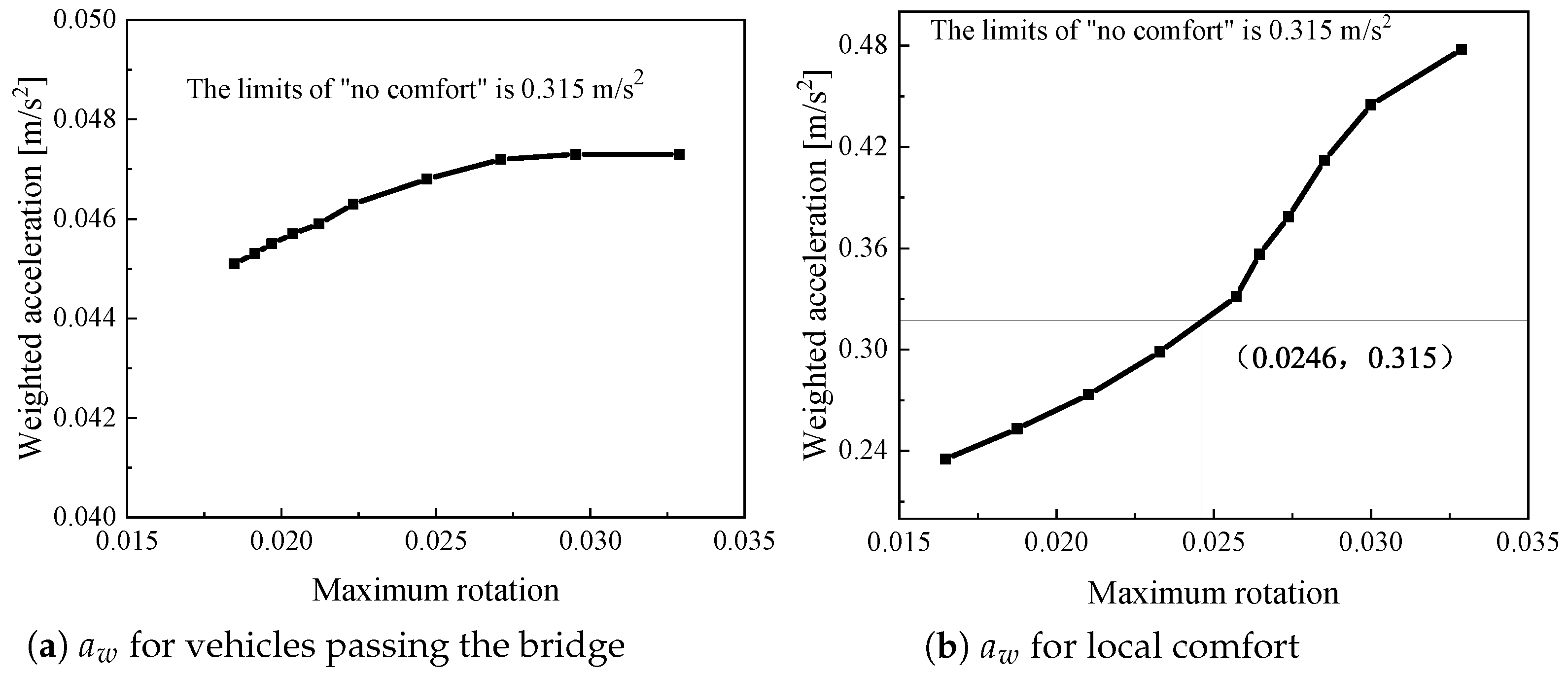
The local comfort calculation results at the girder end and those for the whole bridge-crossing process were evaluated using the weighted root mean square acceleration. The duration considered for the whole bridge-crossing process was 108 s, whereas the duration for passing the end of the girder was 1 s, taking into account the vehicle crossing the expansion joint. The comfort levels in both the driver’s cab and the passenger cabin were extracted for different vehicle models. It can be seen that, with an increase of the rotation angle at the girder ends, the weighted acceleration of vehicles also increases. The peak acceleration of the 25 t two-axle vehicle is greater than that of the other vehicles, including the two-axle car, the three-axle vehicle, and the 55 t five-axle vehicle. The weighted accelerations corresponding to the full bridge-crossing process and the local process of passing the girder end are summarized in
Figure 16.
The results indicate that the comfort response over the whole bridge-crossing process does not govern the stiffness design, whereas the local comfort response at the girder end is much more critical. This difference explains why girder-end rotation is selected as the primary serviceability control indicator in the present study. Compared with global indicators such as the deflection-to-span ratio, girder-end rotation is more directly associated with the local kinematic disturbance experienced by vehicles when passing the bridge end, and is therefore more relevant to the critical comfort demand identified in the analysis.
The relationship between the weighted root mean square acceleration under stochastic traffic flow and the corresponding serviceability indicators at different levels of main cable stiffness is shown in
Figure 16b. As the main cable stiffness decreases, the weighted root mean square acceleration increases, indicating that ride comfort deteriorates with the reduction in bridge stiffness. In particular, when the main cable stiffness is reduced to 0.1 times its original design value, the weighted root mean square acceleration reaches 0.469 m/s
2, which exceeds the “no discomfort” limit of 0.315 m/s
2 specified in
Table 3. Taking 0.315 m/s
2 as the comfort threshold, the corresponding critical vertical rotation angle at the girder end can be identified from
Figure 16b as 0.025 rad.
It should also be noted that the high correlation among girder-end rotation, deflection-to-span ratio, and curvature radius does not imply strict equivalence among these indicators. Although their correlations are strong within the investigated parameter range, the relationship between rotation and global deflection remains nonlinear and depends on the load position as well as the time-dependent vehicle–bridge interaction process. Therefore, the present correlation analysis is not sufficient to conclude that controlling only one global indicator would always guarantee the control of the others. Instead, girder-end rotation is adopted here as the most relevant leading indicator because it governs the critical local comfort response while still reflecting the coordinated variation of the other serviceability-related quantities.
5. Conclusions
To evaluate the serviceability of 2000-m-class suspension bridges, this study established an integrated vertical stiffness assessment framework that combines initial configuration determination, vehicle–bridge interaction (VBI) analysis, and kinematic safety evaluation. Using the 2300-m Zhangjinggao Bridge as a representative case, the following main conclusions are drawn:
- (1)
For the investigated ultra-long-span suspension bridge, the deflection-to-span ratio, girder-end rotation, and localized curvature are identified as the key response parameters related to passenger comfort and driving safety.
- (2)
Within the investigated stiffness range, global deflection and local kinematic responses (rotation and curvature) exhibit strong monotonic correlation, with Spearman coefficients exceeding 0.92. However, their sensitivities differ significantly. Global indices such as the ratio become increasingly insensitive to stiffness enhancement in 2000-m-class bridges, whereas local indicators remain more responsive. This indicates that global-only criteria are insufficient for refined serviceability evaluation of ultra-long-span suspension bridges.
- (3)
For the 2300-m Zhangjinggao Bridge considered in this study, local dynamic comfort demand at the girder ends provides a more stringent serviceability constraint than global structural response measures. This result highlights the importance of incorporating local kinematic quantities into the vertical stiffness assessment of ultra-long-span suspension bridges.
- (4)
Among the investigated indicators, the maximum girder-end rotation provides the most effective descriptor for linking structural response with both safety and comfort requirements. Based on the present framework and the analyzed 2300-m bridge case, a girder-end rotation limit of 0.025 rad is identified as a rational serviceability control value. This result provides a quantitative reference for the serviceability-oriented stiffness design of super-long-span suspension bridges, while its broader applicability to other bridge configurations requires further study.
- (5)
It should be noted that the proposed girder-end rotation limit of 0.025 rad is derived from the present 2300 m Zhangjinggao Bridge case and should therefore be regarded as a case-based serviceability control value rather than a universally applicable limit. A more explicit span-dependent relationship for such a limit would require further analytical or semi-analytical investigation.
6. Study Limitations and Future Work
Although the present study establishes an integrated framework for the serviceability-oriented vertical stiffness evaluation of super-long-span suspension bridges, several limitations should be acknowledged.
First, the proposed girder-end rotation limit of 0.025 rad is derived from the specific 2300 m Zhangjinggao Bridge case studied herein. Therefore, it should be regarded as a case-based reference rather than a universally applicable value. To establish a more explicit relationship between span length and the corresponding serviceability limit, further theoretical development is still needed, especially analytical or semi-analytical solutions capable of revealing the underlying scaling laws.
Second, the present comfort assessment is still limited in scope. In essence, bridge-driving comfort is a three-dimensional problem, and a more complete evaluation framework should simultaneously consider vertical, lateral, and torsional responses. The present study focuses mainly on the vertical dimension and the associated local kinematic disturbance, while the combined influence of multi-directional bridge motion on user comfort deserves further investigation.
Third, direct validation against field measurements is not yet available, because the Zhangjinggao Bridge is still under construction. Although the adopted numerical framework is established on a mechanical basis and representative traffic assumptions, further validation through measurement-based studies will be necessary once field data become available.
Fourth, the current vehicle–bridge interaction model still relies on a mesh-based framework, and some complex traffic behaviors cannot yet be represented with high fidelity. In particular, deceleration, lane-changing, and detailed car-following interactions cannot be modeled precisely in the present framework. These simplifications may affect the description of complicated transient traffic scenarios and should be improved in future work through more refined traffic-flow and vehicle-behavior modeling.
Future research will therefore focus on extending the proposed framework in the above aspects, including the derivation of more general span-dependent serviceability limits, the incorporation of multi-directional comfort evaluation, the validation of the framework using field measurements, and the development of more realistic traffic and vehicle–bridge interaction models.
Author Contributions
Conceptualization, Y.F. and S.L.; methodology, Y.F.; software, L.G.; validation, Y.F., S.L. and L.G.; formal analysis, Y.F.; investigation, L.G.; resources, S.L.; data curation, S.L.; writing—original draft preparation, Y.F.; writing—review and editing, S.L.; visualization, Y.F.; supervision, J.W.; project administration, J.W.; funding acquisition, S.L. and J.W. All authors have read and agreed to the published version of the manuscript.
Funding
The study was supported by the Basic Science (Natural Science) Research Project of Higher Education Institutions in Jiangsu Province (Grant No. 23KJA560006), the National Natural Science Foundation of China (Grant No. 52278151), and Excellent Youth Fund Project of Jiangsu Province (BK20230087). Their supports are gratefully acknowledged.
Data Availability Statement
All data, models, and code generated or used during the study appear in the submitted article.
Conflicts of Interest
The authors declare no conflicts of interest.
References
- Zhou, X.H.; Zhang, X.G. Thoughts on the development of bridge technology in China. Engineering 2019, 5, 1120–1130. [Google Scholar] [CrossRef]
- Zhang, X.G.; Liu, G.; Ma, J.H.; Wu, H.B.; Fu, B.Y.; Gao, Y. The Current Situation and Prospects of Bridge Technology in China. China Highw. 2017, 61, 415. (In Chinese) [Google Scholar]
- Wang, R. Design innovation of the South Channel Bridge of Zhangjinggao Yangtze River Bridge. J. S. Univ. (Nat. Sci. Ed.) 2023, 53, 979–987. (In Chinese) [Google Scholar]
- Pugsley, A. The gravity stiffness of a suspension-bridge cable. Q. J. Mech. Appl. Math. 1952, 5, 385–394. [Google Scholar] [CrossRef]
- Xu, J.L.; Xiang, Z.F. Discussing gravity stiffness of suspension bridge. J. Chongqing Jiaotong Inst. 2000, 19, 71–74. (In Chinese) [Google Scholar]
- Liu, Z.; Liu, H.J. New arithmetic for cable deflection and gravity stiffness of suspension bridges. Eng. Mech. 2009, 26, 127–132. (In Chinese) [Google Scholar]
- JTG/T D65-05-2015; Specifications for Design of Highway Suspension Bridge. China Communication Press: Beijing, China, 2015.
- AASHTO LRFDUS-2017; AASHTO LRFD Bridge Design Specifications. American Association of State Highway and Transportation Officials: Washington, DC, USA, 2017.
- BS EN 1990-2002; Eurocode-Basis of Structural Design. European Committee for Standardization: Brussels, Belgium, 2002.
- Japan Road Association. Road and Bridge Instructions; Japan Road Association: Tokyo, Japan, 1980. [Google Scholar]
- Eurocode 3. Design of Steel Structures; European Committee for Standardization: Brussels, Belgium, 2006. [Google Scholar]
- Navier, C.L.M.H. Rapport à Monsieur Becquey, Conseiller d’État, Directeur Général des Ponts et Chaussées et des Mines; Et Mémoire sur les Ponts Suspendus; Imprimérie Royal: Paris, France, 1823. (In French) [Google Scholar]
- Rankine, W.J.M. A Manual of Applied Mechanics, 5th ed.; Charles Griffin and Co.: London, UK, 1869. [Google Scholar]
- Melan, J. Theorie der Eisernen Bogenbrücken und der Hängebrücken; Wilhelm Engelmann: Leipzig, Germany, 1888. (In German) [Google Scholar]
- Melan, J. Theory of Arches and Suspension Bridges; Steinman, D.B., Trans.; Myron C. Clark: Chicago, IL, USA, 1913. [Google Scholar]
- Semper, B. Finite element methods for suspension bridge models. Comput. Math. Appl. 1993, 26, 77–91. [Google Scholar] [CrossRef]
- Zhou, Y.; Chen, S. Iterative nonlinear cable shape and force finding technique of suspension bridges using elastic catenary configuration. J. Eng. Mech. 2019, 145, 04019031. [Google Scholar] [CrossRef]
- Kim, K.S.; Lee, H.S. Analysis of target configurations under dead loads for cable-supported bridges. Comput. Struct. 2001, 79, 2681–2692. [Google Scholar] [CrossRef]
- Jung, M.R.; Min, D.J.; Kim, M.Y. Nonlinear analysis methods based on the unstrained element length for determining initial shaping of suspension bridges under dead loads. Comput. Struct. 2013, 128, 272–285. [Google Scholar] [CrossRef]
- Irvine, H.M.; Caughey, T.K. The linear theory of free vibrations of a suspended cable. Proc. R. Soc. Lond. A 1974, 341, 299–315. [Google Scholar] [CrossRef]
- Abdel-Ghaffar, A.M.; Rubin, L.I. Vertical seismic behaviour of suspension bridges. Earthq. Eng. Struct. Dyn. 1983, 11, 1–19. [Google Scholar] [CrossRef]
- Hayashikawa, T.; Watanabe, N. Vertical vibration in Timoshenko beam suspension bridges. J. Eng. Mech. 1984, 110, 341–356. [Google Scholar] [CrossRef]
- Liu, M.F.; Chang, T.P.; Zeng, D.Y. The interactive vibration behavior in a suspension bridge system under moving vehicle loads and vertical seismic excitations. Appl. Math. Model. 2011, 35, 398–411. [Google Scholar] [CrossRef]
- Xiong, Z.; Zhu, J.; Wu, M.; Zheng, K.; Li, Y. Influence of Vehicle Inertia Force on Vertical Vibration of Long-Span Suspension Bridge under Wind and Traffic Loads. J. Bridge Eng. 2022, 27, 04021111. [Google Scholar] [CrossRef]
- Kim, M.Y.; Kwon, S.D.; Kim, N.I. Analytical and numerical study on free vertical vibration of shear-flexible suspension bridges. J. Sound Vib. 2000, 238, 65–84. [Google Scholar] [CrossRef]
- Turmo, J.; Luco, J.E. Effect of hanger flexibility on dynamic response of suspension bridges. J. Eng. Mech. 2010, 136, 1444–1459. [Google Scholar] [CrossRef]
- Fei, H.; Dan, D. Free vibration of the complex cable system—An exact method using symbolic computation. Mech. Syst. Signal Pr. 2020, 139, 106636. [Google Scholar] [CrossRef]
- Wang, Z.; Kang, H.; Sun, C.; Zhao, Y.; Yi, Z. Modeling and parameter analysis of in-plane dynamics of a suspension bridge with transfer matrix method. Acta Mech. 2014, 225, 3423–3435. [Google Scholar] [CrossRef]
- Ricciardi, G.; Saitta, F. A continuous vibration analysis model for cables with sag and bending stiffness. Eng. Struct. 2008, 30, 1459–1472. [Google Scholar] [CrossRef]
- Deng, L.; Cai, C.S. Identification of parameters of vehicles moving on bridges. Eng. Struct. 2009, 31, 2474–2485. [Google Scholar] [CrossRef]
- Deng, L.; Cai, C.S. Identification of dynamic vehicular axle loads. J. Vib. Control 2011, 17, 183–195. [Google Scholar] [CrossRef]
- Cai, C.S.; Deng, L. Highway Vehicle-Bridge Coupled Vibration: Numerical Simulations and Applications; Higher Education Press: Beijing, China, 2020. [Google Scholar]
- ISO 2631; Mechanical Vibration and Shock—Evaluation of Human Exposure to Whole-Body Vibration. ISO: Geneva, Switzerland, 1997.
- JTG D20-2017; Design Specification for Road Alignment. China Communication Press: Beijing, China, 2019.
- Zhang, W.M.; Zhang, Z.H.; Tian, G.M.; Chang, J.Q. Determining the reasonable completed bridge state of the self-anchored suspension bridge with spatial cable system. J. Bridge Eng. 2023, 28, 04023018. [Google Scholar] [CrossRef]
- Zhang, W.M.; Zhang, X.Y.; Tian, G.M. Analytical shape-finding of the three-dimensional wind-resistant rope system of a suspension bridge. J. Bridge Eng. 2022, 27, 04022086. [Google Scholar] [CrossRef]
- Irvine, M.H. Cable Structures; The MIT Press: Cambridge, MA, USA, 1981. [Google Scholar]
- Choi, S.K.; Jun, O.S. ISO/TC/108/SC1 CD 7475 (Mechanical Vibration). In Proceedings of the Korean Society for Noise and Vibration Engineering Conference, Cheonan, Republic of Korea, 16–17 November 2000; pp. 212–217. [Google Scholar]
- GB/T 7031-2005; Mechanical Vibration—Road Surface Profile—Reporting of Measurement Data. Standards Press of China: Beijing, China, 2006.
- Shao, Y.; Miao, C.; Brownjohn, J.M.W.; Ding, Y. Vehicle-bridge interaction system for long-span suspension bridge under random traffic distribution. Structures 2022, 44, 1070–1080. [Google Scholar] [CrossRef]
- Xu, W.B.; Wang, B.; Wang, J.; Chen, Y.J.; Liu, J.H.; Li, J.L.; Huang, X.M. Vehicle-bridge coupling vibration analysis method considering vehicle passing expansion joint. J. S. Univ. Nat. Sci. Ed. 2022, 52, 212–221. (In Chinese) [Google Scholar]
- Hou, J.L.; Xu, W.B.; Wang, J. Study on vehicle-bridge coupling vibration analysis method considering vehicle seam. Vib. Impact 2021, 40, 151–160. (In Chinese) [Google Scholar]
- Ou, C.Y.; Feng, Y.; Wang, M.Q.; Li, S.; Wang, J.Q. Study on the Multi-dimension and Multi-index Stiffness System of 2300m-span Suspension Bridge. Highway 2023, 68, 52–57. (In Chinese) [Google Scholar]
Figure 1.
Workflow of the vertical stiffness evaluation framework.
Figure 1.
Workflow of the vertical stiffness evaluation framework.
Figure 3.
Three-axle truck.
Figure 3.
Three-axle truck.
Figure 4.
Five-axle truck.
Figure 4.
Five-axle truck.
Figure 5.
Configuration and span layout of the Zhangjinggao Bridge.
Figure 5.
Configuration and span layout of the Zhangjinggao Bridge.
Figure 6.
FE model of the Zhangjinggao Bridge.
Figure 6.
FE model of the Zhangjinggao Bridge.
Figure 9.
Proportion of vehicles according to long-term statistical data of Runyang Bridge.
Figure 9.
Proportion of vehicles according to long-term statistical data of Runyang Bridge.
Figure 10.
Time-history responses of 2 t two-axle vehicles under different road roughness levels: (a) Grade A; (b) Grade B.
Figure 10.
Time-history responses of 2 t two-axle vehicles under different road roughness levels: (a) Grade A; (b) Grade B.
Figure 11.
Time-history responses of 25 t two-axle vehicles under different road roughness levels: (a) Grade A; (b) Grade B.
Figure 11.
Time-history responses of 25 t two-axle vehicles under different road roughness levels: (a) Grade A; (b) Grade B.
Figure 12.
Time-history responses of two-axle vehicles under different road roughness levels: (a) 2 ton; (b) 25 ton.
Figure 12.
Time-history responses of two-axle vehicles under different road roughness levels: (a) 2 ton; (b) 25 ton.
Figure 13.
Sensitivity of structural response indices to girder vertical bending stiffness ().
Figure 13.
Sensitivity of structural response indices to girder vertical bending stiffness ().
Figure 14.
Sensitivity of structural vertical responses to the longitudinal stiffness of Tower #2.
Figure 14.
Sensitivity of structural vertical responses to the longitudinal stiffness of Tower #2.
Figure 15.
Sensitivity of structural vertical responses to the cross-sectional area of the main cable.
Figure 15.
Sensitivity of structural vertical responses to the cross-sectional area of the main cable.
Figure 16.
Maximum rotation v.s. .
Figure 16.
Maximum rotation v.s. .
Table 1.
Parameters of two-axle car.
Table 1.
Parameters of two-axle car.
| Parameter Type | Parameters | Value |
|---|
| | L | 4.5 m |
| Geometric dimensions | | 1.48 m |
| | | 1.14 m |
| | M | 1235 kg |
| Mass | ∼ | 200 kg |
| | ∼ | 150 kg |
| | ∼ | 300 kN/m |
| | ∼ | 302 kN/m |
| Stiffness and damping | ∼ | 6.228 kN·s/m |
| | ∼ | 1.210 kN·s/m |
| | | 1000 kg·m2 |
Table 2.
Parameters of two-axle van.
Table 2.
Parameters of two-axle van.
| Parameter Type | Parameters | Value |
|---|
| | L | 5.0 m |
| Geometric dimensions | | 1.35 m |
| | | 2.65 m |
| | M | 18,400 kg |
| Mass | ∼ | 400 kg |
| | ∼ | 4000 kg |
| | ∼ | 300 kN/m |
| | ∼ | 302 kN/m |
| Stiffness and damping | ∼ | 6.228 kN·s/m |
| | ∼ | 1.210 kN·s/m |
| | | 3000 kg·m2 |
Table 3.
Parameters of three-axle truck.
Table 3.
Parameters of three-axle truck.
| Parameter Type | Parameter | Value |
|---|
| Geometric dimensions | | 1.7 m |
| 2.57 m |
| 1.98 m |
| 2.28 m |
| 2.22 m |
| 3.2 m |
| Masses | | 2611.8 kg |
| 26,113 kg |
| 245 kg |
| 243 kg |
| 405 kg |
| 2022 kg·m2 |
| 33,153 kg·m2 |
| Stiffnesses and damping | | 243 kN/m |
| 1903.17 kN/m |
| 1969.03 kN/m |
| 2.19 kN·s/m |
| 7.88 kN·s/m |
| 7.18 kN·s/m |
| 875.08 kN/m |
| 3503.31 kN/m |
| 3507.43 kN/m |
| 2 kN·s/m |
| 2 kN·s/m |
| 2 kN·s/m |
Table 4.
Parameters of five-axle truck.
Table 4.
Parameters of five-axle truck.
| Parameter Type | Parameter | Value |
|---|
| Geometric dimensions | | 3.0 m |
| , | 1.4 m |
| 7.0 m |
| , | 2.7 m |
| 4.5 m |
| 3.2 m |
| Masses | | 2276.5 kg |
| 2189.2 kg |
| 350 kg |
| , | 500 kg |
| , | 400 kg |
| 20,196 kg·m2 |
| 45,246 kg·m2 |
| Stiffnesses and damping | | 300 kN/m |
| 1000 kN/m |
| 1250 kN/m |
| 10 kN·s/m |
| 53 kN·s/m |
| 53 kN·s/m |
| 1500 kN/m |
| 3000 kN/m |
| 1250 kN/m |
| 3 kN·s/m |
| 3 kN·s/m |
| 3 kN·s/m |
Table 5.
Safety demands of alignment in JTG-D20-2017 ( km/h).
Table 5.
Safety demands of alignment in JTG-D20-2017 ( km/h).
| No. | Safety Demands | Characteristic Index | Limit Value (Min. Radius R) |
|---|
| 1 | Driving sight distance | Curvature (Alignment) | Concave: 16 km; Convex: 10 km |
| 2 | Moderate impacting force | Curvature (Alignment) | Concave: 10 km; Convex: 4.5 km |
| 3 | Climbing capacity | Suggested Slope | 4% |
Table 6.
Comfort levels based on weighted acceleration (ISO 2631-1).
Table 6.
Comfort levels based on weighted acceleration (ISO 2631-1).
| Weighted Acceleration (m/s2) | Human Perception |
|---|
| <0.315 | Not uncomfortable |
| 0.315–0.63 | A little uncomfortable |
| 0.5–1.0 | Fairly uncomfortable |
| 0.8–1.6 | Uncomfortable |
| 1.25–2.5 | Very uncomfortable |
| >2.0 | Extremely uncomfortable |
Table 7.
Material and sectional properties of bridge components.
Table 7.
Material and sectional properties of bridge components.
| Component | E (GPa) | A (m2) | I (m4) | | Linear Weight (kN/m) |
|---|
| Main Cable | 195 | 0.8321 | 0.0551 | 0.3 | 65.24 |
| Hanger | 200 | 0.00428 | – | 0.3 | 0.31 |
| Girder | 206 | 1.8749 | 8.002 | 0.3 | 320.0 |
Table 8.
Road surface roughness parameters for various grades (GB/T 7031-2005) [
39].
Table 8.
Road surface roughness parameters for various grades (GB/T 7031-2005) [
39].
| Grade | Roughness m3 |
|---|
| Lower Boundary | Average | Upper Boundary |
|---|
| A | — | 16 | 32 |
| B | 32 | 64 | 128 |
| C | 128 | 256 | 512 |
| D | 512 | 1024 | 2048 |
Table 9.
Design parameters and variation ranges for the parametric analysis.
Table 9.
Design parameters and variation ranges for the parametric analysis.
| No. | Component | Mechanical Parameter | Variation Range (Proportional) |
|---|
| 1 | Girder | Vertical stiffness, | 0.5–2.0 (Step: 0.25) |
| 2 | Left tower | Longitudinal stiffness, | 0.5–2.0 (Step: 0.25) |
| 3 | Right tower | Longitudinal stiffness, | 0.5–2.0 (Step: 0.25) |
| 4 | Main cable | Axial stiffness, | 0.4–1.0 (Step: 0.10) |
| Disclaimer/Publisher’s Note: The statements, opinions and data contained in all publications are solely those of the individual author(s) and contributor(s) and not of MDPI and/or the editor(s). MDPI and/or the editor(s) disclaim responsibility for any injury to people or property resulting from any ideas, methods, instructions or products referred to in the content. |