Article

Seismic Deformation Capacity Prediction of Steel-Reinforced Concrete (SRC) Columns Based on Test Database and Machine Learning

China Academy of Building Research Co., Ltd., Beijing 100013, China
*
Authors to whom correspondence should be addressed.
Buildings 2026, 16(10), 1891; https://doi.org/10.3390/buildings16101891
Submission received: 6 April 2026 / Revised: 30 April 2026 / Accepted: 6 May 2026 / Published: 10 May 2026
(This article belongs to the Special Issue Seismic Performance of Steel and Composite Structures)

Abstract

Seismic resilience assessment of high-rise buildings heavily relies on the deformation limits and fragility data of structural components, yet such data is still lacking for steel-reinforced concrete (SRC) columns, which are widely used in high-rise structures. To address this gap, this study establishes a test database consisting of 312 SRC column specimens, including 17 input parameters and three key experimental results, i.e., failure mode, yielding drift ratio θy, and ultimate drift ratio θu. Two machine learning (ML) frameworks are proposed and four ML models are trained and compared. It is found that the two-stage framework incorporating a failure mode classification shows only a slight improvement in the model performance. Thus, an end-to-end framework is recommended due to its simplicity and avoidance of error propagation, and RF and XGBoost models are adopted and tuned for θy and θu prediction for their optimal performance. Model interpretation is carried out using permutation importance (PI) and SHAP analyses to verify consistency with domain knowledge, with the key influencing factors identified as longitudinal reinforcement strength (fyl) and axial load ratio (nt) for deformation capacity, and shear-span ratio (λ) for failure mode classification. The performance of ML models is compared with conventional data-fitting approaches, and it is proven that ML models outperform conventional formulas, with the R2 for predicting θy and θu improved by 26.5% and 32.9%, the RMSE reduced by 30.0% and 30.4%, and the MAPE reduced by 18.5% and 48.4%, respectively, thus providing a powerful data-driven tool for the seismic resilience assessment of SRC columns and expanding the fragility data of composite components.

1. Introduction

Seismic design is one of the most important aspects in the design of high-rise buildings. Various theories and technologies have been put forward to improve the seismic performance of high-rise buildings, e.g., conceptual design and performance-based design method [1], the application of energy dissipation devices [2], steel–concrete composite structures [3], etc. At the same time, the assessment of the seismic performance of the design outcome is of equal importance, as it serves as a criterion to judge whether the design target can be achieved under specific seismic scenarios.
The next-generation seismic performance assessment method was published by the US Federal Emergency Management and Agency (FEMA) as FEMA P-58 [4] in 2012. This methodology incorporates the probabilistic approach to characterize the performance at the component level, considering both structural and non-structural components, and the seismic performance of the whole structure is quantified with economic and social losses such as repair cost, repair time, injuries and casualties through the loss functions of component damage. Following the FEMA P-58 methodology, several assessment standards were developed, including the REDi Rating System by ARUP [5], the USRC Rating System by US Resiliency Council [6], and the Chinese Standard for seismic resilience assessment of buildings (GB/T 38591-2020) [7]. These standards enable detailed analyses of the consequences of earthquakes, and provide useful tools for risk management in designing new buildings or renovating existing buildings [8].
It is noted that in the current seismic resilience assessment systems, the determination of damage states of structural components and the corresponding losses primarily relies on their deformation under seismic actions. Consequently, establishing the deformation limits and developing the fragility curves for components under different damage states are essential for this procedure [9]. In FEMA P-58 and GB/T 38591-2020, the values for reinforced concrete components and steel components have been provided, based on a collection of experimental results. A methodology for developing such parameters using a test database is presented in FEMA P-58.
The methods for predicting deformation capacity of reinforced concrete (RC) members date back to the 1950s, known as the plastic hinge analogy [10], which is still used in the New Zealand Engineering Assessment Guidelines [11]. Then, regression-based empirical formulas were proposed by Pujol et al. [12], Haselton [13], etc. These mechanics-based or empirical formulas generally exhibit significant scatter when predicting the drift ratio [14]. Moreover, for steel–concrete composite columns (with steel section encased in concrete) widely used in high-rise structures, such data is still lacking.
Earlier research has employed a parametric regression approach to study this problem, based on either a large-scale parametric finite element analysis or a collection of test databases. For example, Hu [15] established a database of 6379 concrete-filled steel plate composite shear walls by finite element analysis and derived simplified formulas for calculating the ultimate curvature with data regression; Cui [16] established a database of 103 RC beams, 469 RC columns and 236 RC shear walls, and developed failure mode classification and deformation capacity regression formulas based on data-fitting. Fu [17] investigated the deformation capacity of SRC members by establishing a database including 246 SRC columns. However, due to the complex and high-dimensional coupling effects of the structural parameters, these semi-empirical models often lead to a compromise between physical simplicity and predictive accuracy.
Machine learning (ML) algorithms are capable at multi-dimensional nonlinear classification and fitting problems, providing a powerful tool for analysis of the highly complex and stochastic experimental results in civil engineering. In recent years, ML methods have been extensively investigated for multiple purposes, including failure mode classification [18,19,20,21], strength prediction [22,23,24], deformation capacity prediction [25,26], backbone curve prediction [27,28], analysis of full loading process [29,30,31], etc. It has been proven that ML models not only offer higher predictive accuracy, but also provide deep insights into the underlying failure mechanisms, effectively bridging the gap between data-driven black-box models and structural mechanics.
To facilitate the seismic resilience assessment of steel–concrete composite structures, this paper investigates the failure mode classification and lateral deformation capacity prediction of the most widely used type of composite component, i.e., steel-reinforced concrete columns. In this study, a comprehensive experimental database of SRC columns is established, covering a wide range of design parameters such as axial load ratio, encased steel ratio, and confinement configurations. Two ML frameworks and four mainstream ML models are developed to handle the complex nonlinear mappings between structural features and deformation at critical characteristic points. Statistical analysis, feature selection and hyperparameter optimization are conducted to ensure the predictive accuracy and robustness of models. Furthermore, the SHapley Additive exPlanations (SHAP) and feature importance analysis are employed to investigate the governing factors across different loading stages. This research offers a rich dataset of experimental results concerning the deformation capacity of SRC columns and a robust and reliable tool for the seismic resilience evaluation of high-rise composite structures.

2. Database of Seismic Tests on SRC Columns

2.1. Description of Test Database

The results of seismic tests on SRC columns are extracted from existing literature to establish the test database. The database includes data from 312 test specimens derived from 38 published articles in the literature [32,33,34,35,36,37,38,39,40,41,42,43,44,45,46,47,48,49,50,51,52,53,54,55,56,57,58,59,60,61,62,63,64,65,66,67,68,69], spanning the research period from 1994 to 2023. All the SRC columns were subjected to cyclic lateral loading under constant axial force, and the lateral force versus lateral displacement hysteretic curves were recorded.
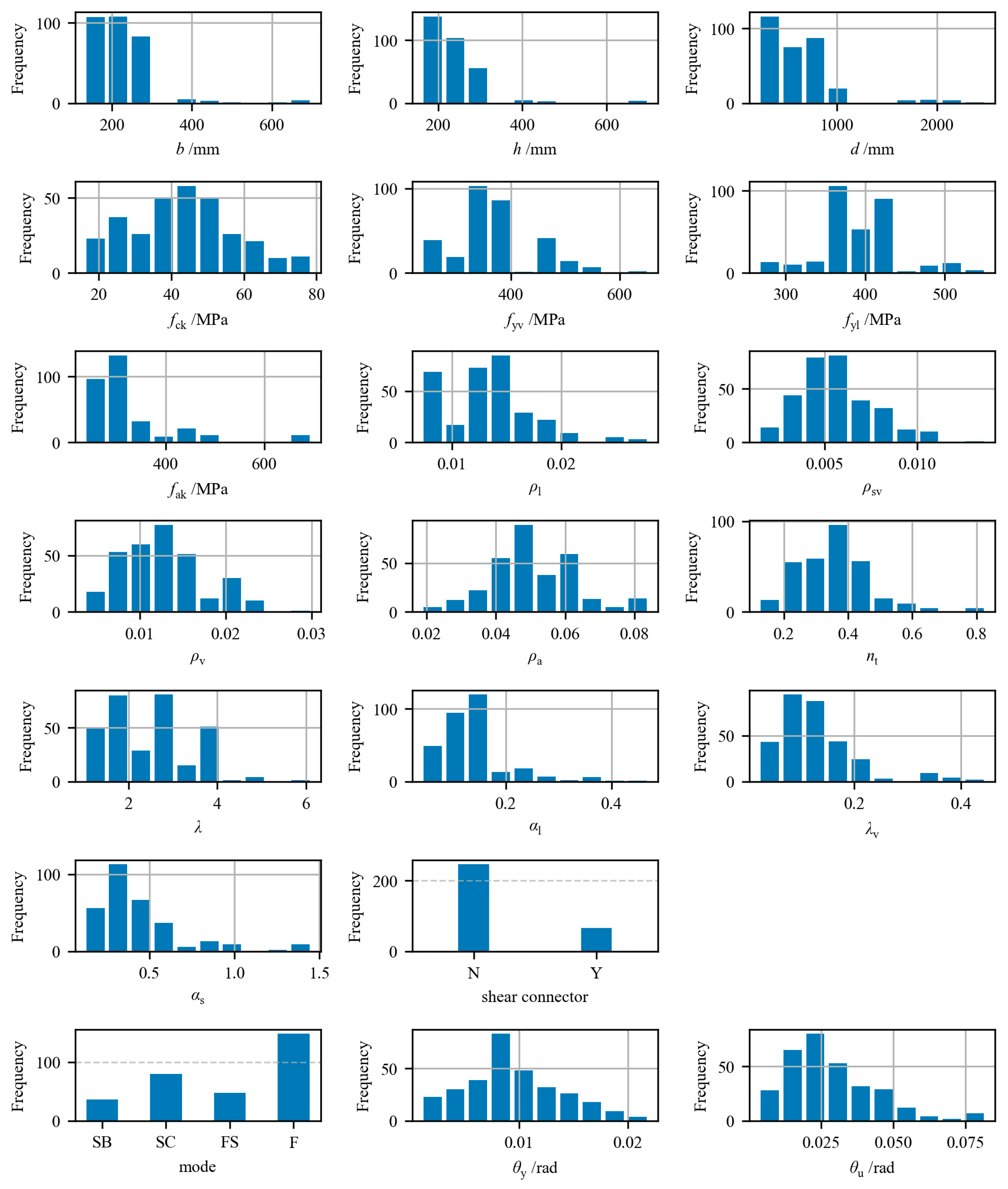
The data for each specimen includes 17 design parameters (categorized into geometric dimensions, material properties, reinforcement/steel ratios, loading conditions, some composite parameters, detailing, etc.) and three experimental result parameters (including failure modes and deformation values at yielding and failure point on the skeleton curve obtained from tests, etc.). The collected parameters for each specimen are listed in Table 1. The distribution of the parameters of the collected test specimens is illustrated in Figure 1. As observed, the parameters of the collected specimens essentially cover the ranges commonly used in engineering practice, and the specimens’ failure modes comprise the four typical patterns (detailed classification criterion is provided in Section 2.2.1): shear-bond failure, shear-compression failure, flexural-shear failure, and flexural failure.

2.2. Definition of Failure Modes and Damage States of SRC Columns

2.2.1. Failure Modes

The failure modes reflect the damage mechanisms of the SRC column specimens and can potentially aid in predicting their deformation capacity. Therefore, the test database established in this study also includes the failure modes of the test specimens. This section briefly describes the classification principles for failure modes of SRC column specimens.
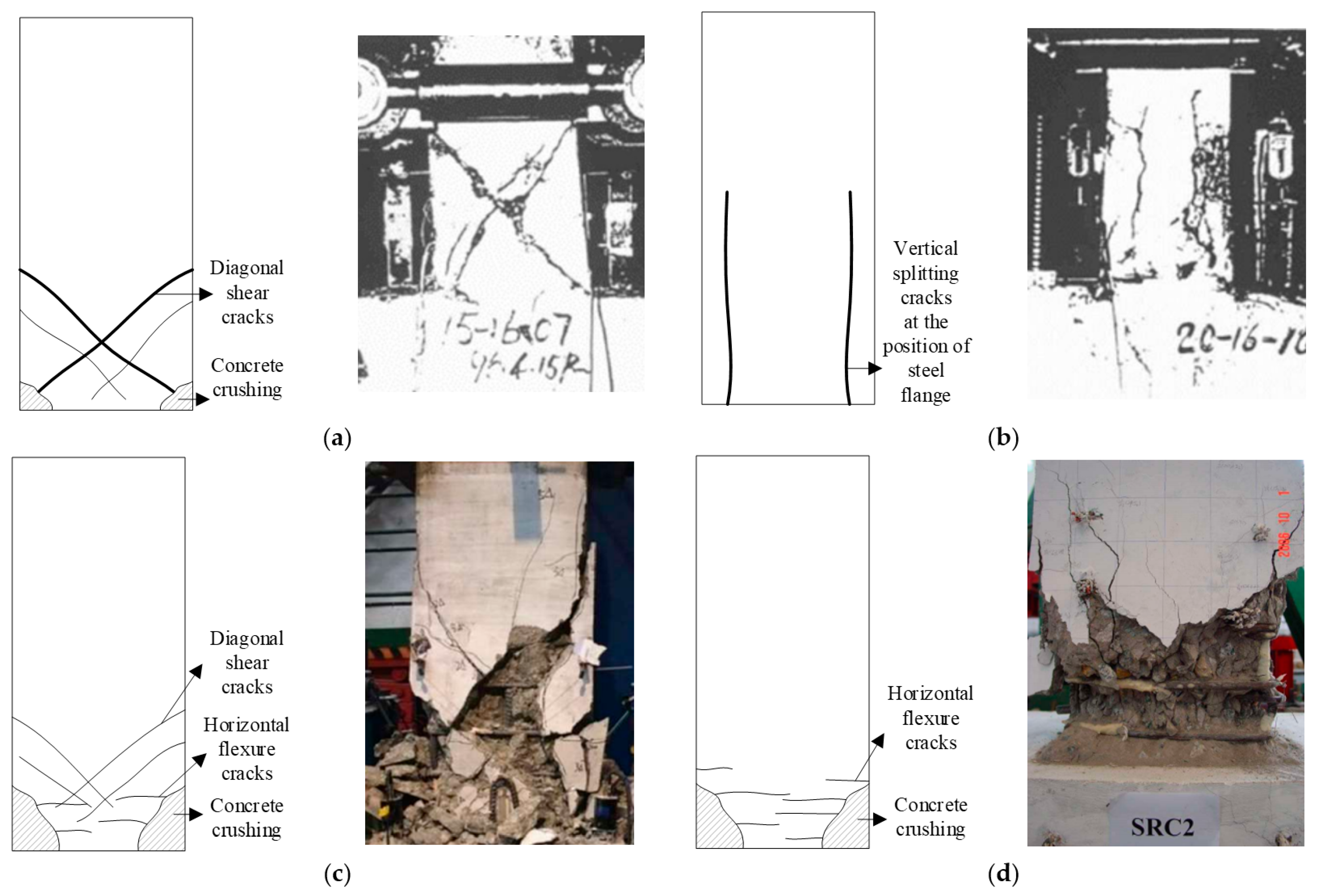
Based on experimental observations reported in the literature, the failure modes of SRC columns under axial compression and lateral cyclic loading are mainly classified into three types: shear failure, shear-flexural failure, and flexural failure. Among these, shear failure can be further categorized into two types: shear-compression (diagonal compression) and shear-bond failure. These failure modes can be distinguished by the crack patterns and strain development in both reinforcing bars and steel sections, as described in Table 2. And the typical characteristics of these failure modes are illustrated in Figure 2.
To ensure the accuracy of failure mode classification, this study carefully re-evaluated the failure modes of the specimens from source documents using the above-mentioned criterion, incorporating the descriptions of crack, strain development during testing, and phenomena at specimen failure. Meanwhile, the failure mode classifications judged by the original researchers are also considered as a reference.

2.2.2. Damage States and the Corresponding Deformation Limits

With the development of seismic performance assessment methods in recent decades, various codes have defined several limit states for structures under seismic action, serving as the objectives of seismic design. In seismic performance assessment methodologies, these damage states of structural components correspond to relatively distinct damage phenomena and are used to map structural response to seismic-induced economic losses and repair costs.
Some widely recognized damage states include Immediate Occupancy (IO), Life Safety (LS), and Collapse Prevention (CP) as proposed in ASCE/SEI 41-17 [70], and Damage Limitation (DL), Significant Damage (SD), and Near Collapse (NC) defined in Eurocode 8-3 [71], etc. Both codes adopt deformation or force as damage assessment indicators for each damage state of reinforced concrete members, depending on whether the failure mode is flexure-dominated (ductile failure) or shear-dominated (brittle failure). However, SRC columns exhibit considerable ductility even under shear failure, due to the encased steel section. Moreover, in the Chinese Standard for seismic resilience assessment of buildings [7], for members failing in shear, deformation can also be adopted as an assessment indicator for damage states. Therefore, this study adopts deformation limits as the criterion for determining damage states and performs machine-learning regression analysis on the collected experimental data.
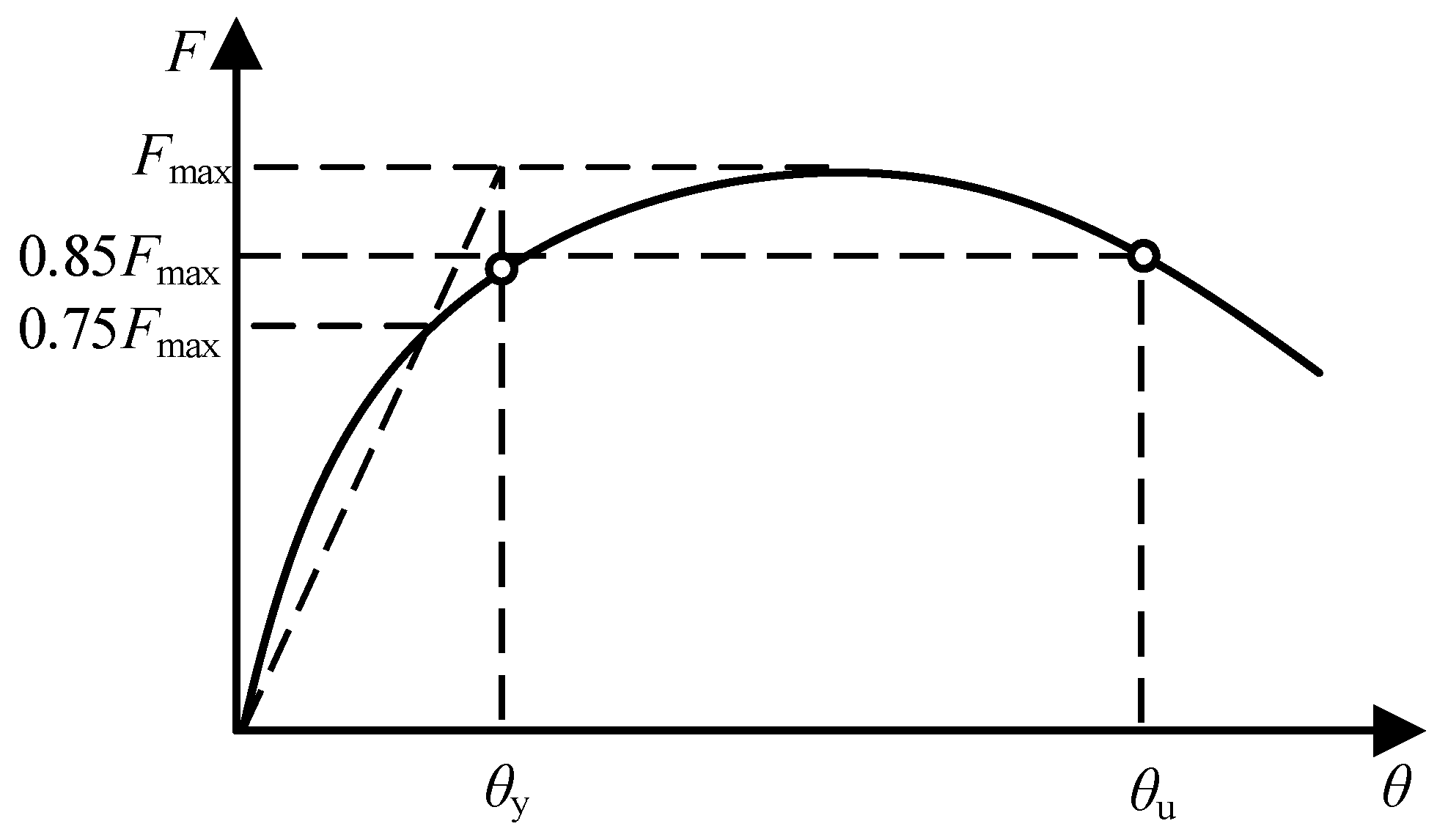
This study focuses on the prediction of the deformation limits for yielding and ultimate states, which are determined based on the skeleton curves of the test specimens. The yield point refers to the equivalent yield point of the SRC column determined by Park’s method [72], where visible cracking has already appeared on the concrete surface, and the reinforcement or steel section begins to yield. This condition approximately aligns with the IO level defined in ASCE 41. The ultimate point corresponds to the state when the member’s load-bearing capacity drops to 85% of its peak strength, which approximately aligns with the CP level in ASCE 41. Other damage states can be considered as intermediate states between yielding and ultimate points, and their deformation limits can be obtained through linear interpolation [73]. The determination of the two limit states is illustrated in Figure 3.

3. Preliminary Analysis of Inter-Variable Correlation

3.1. Pearson’s Correlation Analysis

To preliminarily assess the interrelationships among various parameters in the database and the influence of input parameters on output parameters, the Pearson correlation coefficients between all parameter pairs were calculated with Equation (1):
ρ X , Y = cov X , Y σ X σ Y = E X μ X Y μ Y σ X σ Y
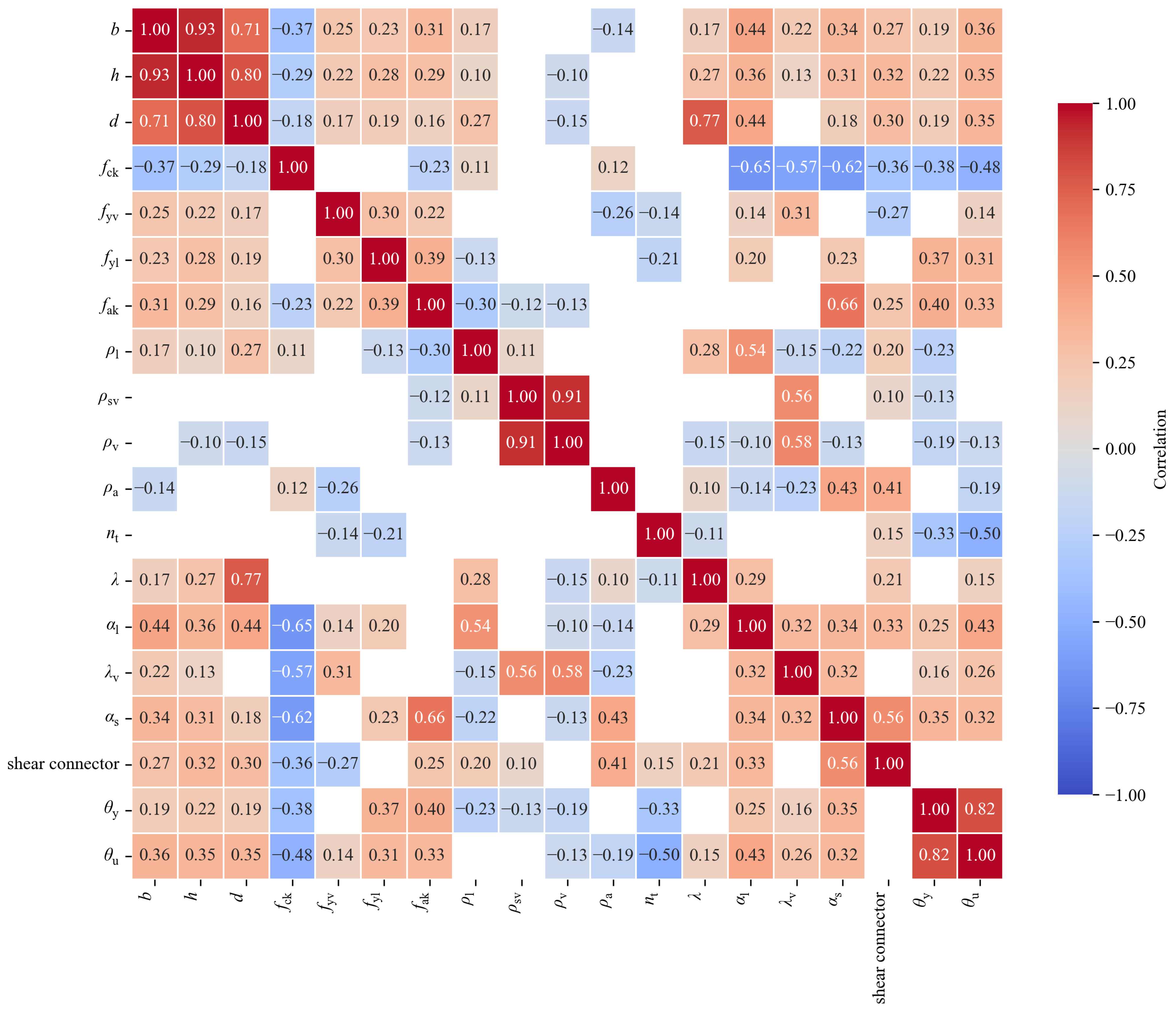
where X and Y are the two parameters under consideration, cov(X,Y) denotes their covariance, σX and σY are the standard deviations of X and Y, respectively, μX and μY are the means of X and Y, and E represents the expectation operator. The Pearson coefficients are presented in the heatmap in Figure 4 to highlight significant parameter interactions (only variable pairs with absolute Pearson coefficients greater than 0.1 are displayed). A larger absolute value indicates a stronger linear correlation between two parameters, where positive and negative values represent positive and negative linear relationships respectively.
From the Pearson correlation coefficients, both the deformation limits for both yielding and ultimate points (θy and θu) increase with the strength of encased steel and longitudinal reinforcement (fak and fyl), while decreasing with higher concrete strength and axial compression ratios (fck and nt); moreover, enlarging cross-sectional dimensions (b and h) and increasing stirrup confinement (λv) are beneficial for improving the ultimate deformation capacity of SRC columns. These observations align with widely accepted domain knowledge, indicating that the experimental data collected from different literature sources can reflect a consistent influence pattern of input parameters on deformation capacity.
On the other hand, it is observed that the composite parameters formed by combining multiple input parameters often exhibit high correlation with their constituent parameters, and both composite and individual parameters may significantly influence output parameters. For example, the Pearson coefficients between αl and its constituent parameters (ρl, fyk and fck) are notably high, as αl is mathematically derived from these three parameters. Meanwhile, similar to its constituent parameters, αl also exhibits high correlation with deformation limits of both yielding and ultimate point. This phenomenon is known as multicollinearity in ML, where highly correlated features introduce redundancy in the training process of models, often adversely affecting model performance. To mitigate this issue, feature selection techniques must be employed for dimensionality reduction, as detailed in Section 4.2.

3.2. Statistical Analysis of the Influence of Failure Modes on Deformation Limits: Pearson’s Correlation Analysis

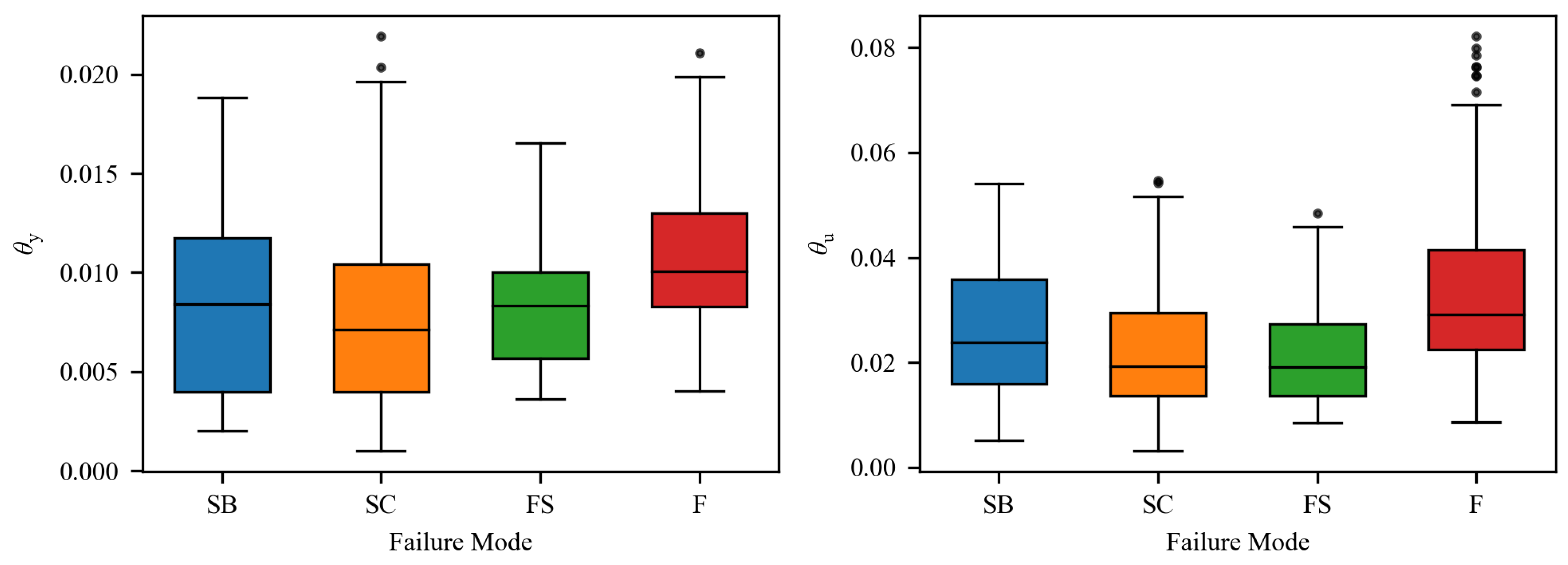
Since the failure mode is a categorical parameter rather than a numerical parameter, it cannot be directly used to calculate Pearson correlation coefficients. Therefore, this section separately analyzes the influence of failure modes on deformation limits. The boxplots of deformation limits of the specimens at yielding and ultimate points, categorized by failure modes, are plotted in Figure 5. It is observed that the deformation limits of shear-bond failure, shear-compression failure, and flexural-shear failure show minor differences, while the deformation limits of flexural failure exhibit significantly greater variation compared to the other three failure modes. Notably, the deformation limits of flexural-shear failure at yielding and ultimate points do not fall between those of shear failure and flexural failure, but instead are close to the values of shear failure; this is primarily because the encased steel section effectively enhances the shear capacity and energy dissipation capability of SRC columns, mitigating the brittle failure characteristics typically associated with shear-dominated failure modes.
Furthermore, quantitative analysis of the differences in deformation limits among various failure modes is conducted using analysis of variance (ANOVA) followed by Tukey’s honestly significant difference (HSD) post hoc test.
ANOVA is a parametric statistical procedure to compare means across three or more independent groups. By partitioning total variance into between-group and within-group components, the test statistic F is calculated as the ratio of between-group mean squares (MSB) to within-group mean squares (MSW), i.e.,
M S B = S S B d f b e t w e e n ,   where   S S B = i = 1 k n i X i ¯ X ¯ 2
M S W = S S W d f w i t h i n ,   where   S S W = i = 1 k j = 1 n i X i j X i ¯ 2
F = M S B M S W
in which SSB is the sum of squares between groups, dfbetween is the degree of freedom between groups (dfbetween = k − 1, where k is the number of groups), ni is the sample size of group i, X i ¯ is the mean of group i and X ¯ is the mean of all data; SSW is the sum of squares within group, dfwithin is the degree of freedom within group (dfwithin = Nk, where N is the total sample size), and Xij is the j-th sample in group i. A significantly large F-value (typically for p < 0.05) indicates rejection of the null hypothesis (H0: μ1 = μ2 = … = μₖ) in favor of the alternative (H1: at least one mean differs).
When ANOVA indicates significant differences among the means of different failure modes, Tukey’s HSD test is employed to conduct pairwise comparisons of group means. The critical HSD value is calculated by
H S D = q α , k , N k M S W n
where qα,k,Nk is the critical value from the studentized range distribution (depends on the number of group k, degrees of freedom df = Nk and significance level α; n is the sample size per group (harmonic mean is used if the sizes of the groups under comparison are unequal). If the absolute difference between the means of two failure modes exceeds the critical HSD value ( X i ¯ X j ¯ > H S D ), the difference is statistically significant (p < α).
The results of the above analysis are presented in Table 3. The results of ANOVA indicate that at least one failure mode exhibits significantly different deformation limits for both yielding and ultimate points, compared to other failure modes. Furthermore, Tukey’s HSD test reveals that the deformation limits of flexural failure show statistically significant differences from those of shear-compression failure and flexural-shear failure, for both yielding and ultimate points. This result suggests that distinguishing failure modes may be beneficial for predicting deformation limits, especially for specimens exhibiting a flexural failure mode. For the other failure modes, although their deformation limits are relatively close, the fact that different failure modes reflect distinct failure mechanisms leads to the necessity to predict each failure mode for the classification model.

3.3. Integrated Analysis on the Influence of Input Parameters and Failure Modes on Deformation Capacity and Implications on the Prediction Procedure

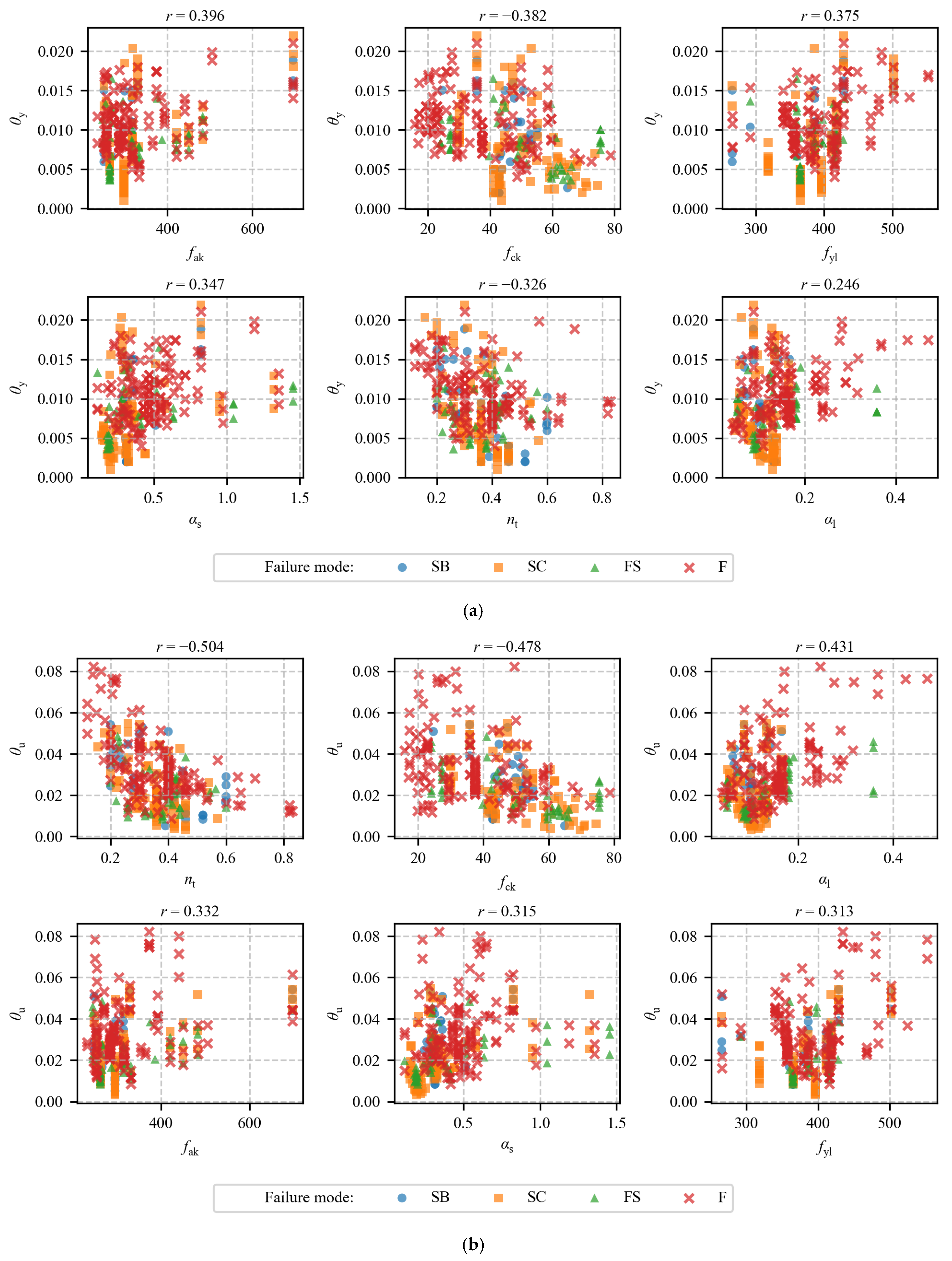
To visualize the effects of input parameters and failure modes on the deformation capacity, the scatter plots of θy and θu with some of their highly correlated parameters are shown in Figure 6, in which the data points of different failure modes are distinguished by different markers. The Pearson correlation coefficient r between each input parameter and the target parameter is also displayed above each figure.
From Figure 6, it can be observed that, without distinguishing failure modes, although the data exhibit a certain degree of dispersion, the general variation trends of θy and θu with respect to the input parameters are relatively clear, reflecting the influence mechanisms of these variables on θy and θu.
On the other hand, however, it can be seen from each figure that distinctions of data points from different failure modes are comparatively minor, indicating that the influence of a single input parameter on deformation capacity seems weakly dependent on the failure mode, which is inconsistent with the conclusions drawn in the preceding section. Therefore, it is necessary to further discuss the importance of distinguishing failure modes when predicting deformation capacity.
Summarizing the results of preliminary statistical analysis in this section, two ML framework will be discussed in this study: the first is a two-stage framework, which predicts the failure mode of SRC columns using classification algorithms and then predicts deformation limits using regression algorithms, taking the predicted failure mode as an additional input; the second framework is an end-to-end framework which predicts the deformation limits directly from input parameters, skipping the failure mode classification step.

4. Machine Learning Framework

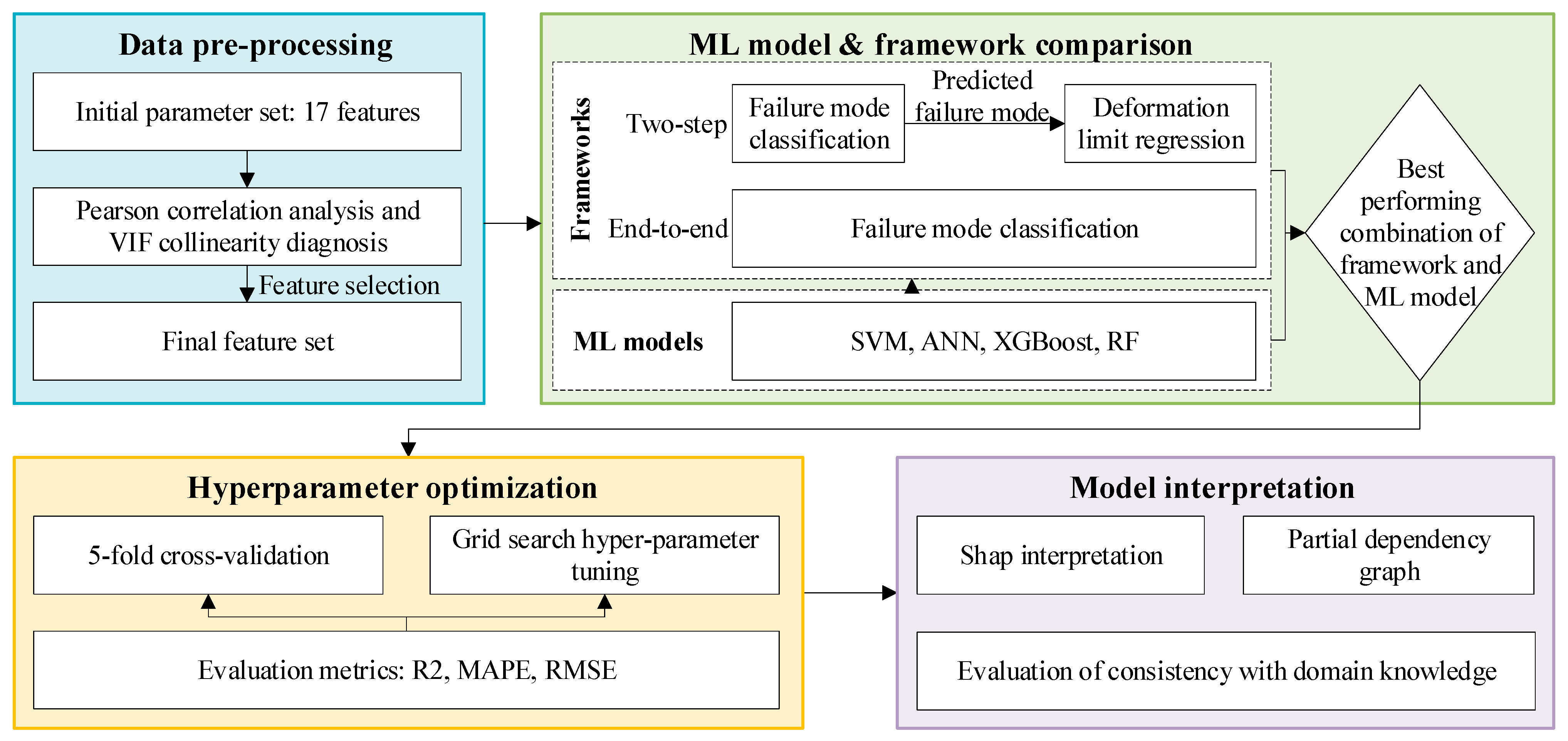
The flowchart of the ML framework implemented in this study is shown in Figure 7. First, feature selection is executed to eliminate redundant variables and prevent overfitting induced by multicollinearity. Then, different predicting procedures and ML models are evaluated to determine the best-performing configuration. Afterwards, the hyperparameters of the chosen model are optimized using grid search with five-fold cross-validation to improve its accuracy and stability. Finally, model interpretation is performed to verify the consistency of the data-driven predictions with domain knowledge.

4.1. Introduction to the Machine Learning Models and Performance Metrics

Considering the relatively small data volume (around 300 SRC column test specimens), numerous input parameters (17 input parameters, including both individual and composite ones) and ambiguous nonlinear relationships among variables (test results shows great dispersion due to coupled parameter interactions), four ML models, i.e., Support Vector Machine (SVM), Artificial Neural Network (ANN), eXtreme Gradient Boosting (XGBoost) and Random Forest (RF), are implemented in this study. The technical backgrounds of the models used in this study can be found extensively in ML-related research works and thus are not detailed here; only the main reasons for choosing the four typical models are listed:
  • SVM [74] is a supervised learning algorithm for classification and regression, which tries to find an optimal hyperplane to maximize the margin between classes. It is efficient in dealing with high-dimensional small-scale datasets and can deal with nonlinear problems via kernel tricks.
  • ANN [75] is included due to its capacity for modeling complex nonlinear relationships through layered architectures, which is suitable for automatically capturing the nonlinear relationships among various input parameters of SRC columns to predict the output variables.
  • XGBoost [76] and RF [77] represent two main branches of ensemble learning, which seeks to improve the accuracy and generalization capability of models by combining multiple simple base learners. XGBoost is an optimized gradient boosting algorithm that sequentially trains decision trees to correct errors from previous models, thus improving the precision of prediction, while RF trains parallel decision trees independently via bootstrap sampling (random subsets of data with replacement), aggregating their predictions through voting or averaging to enhance robustness and reduce overfitting.
To compare the performance of the aforementioned models, the evaluation metrics shown in Table 4 are employed.

4.2. Feature Selection

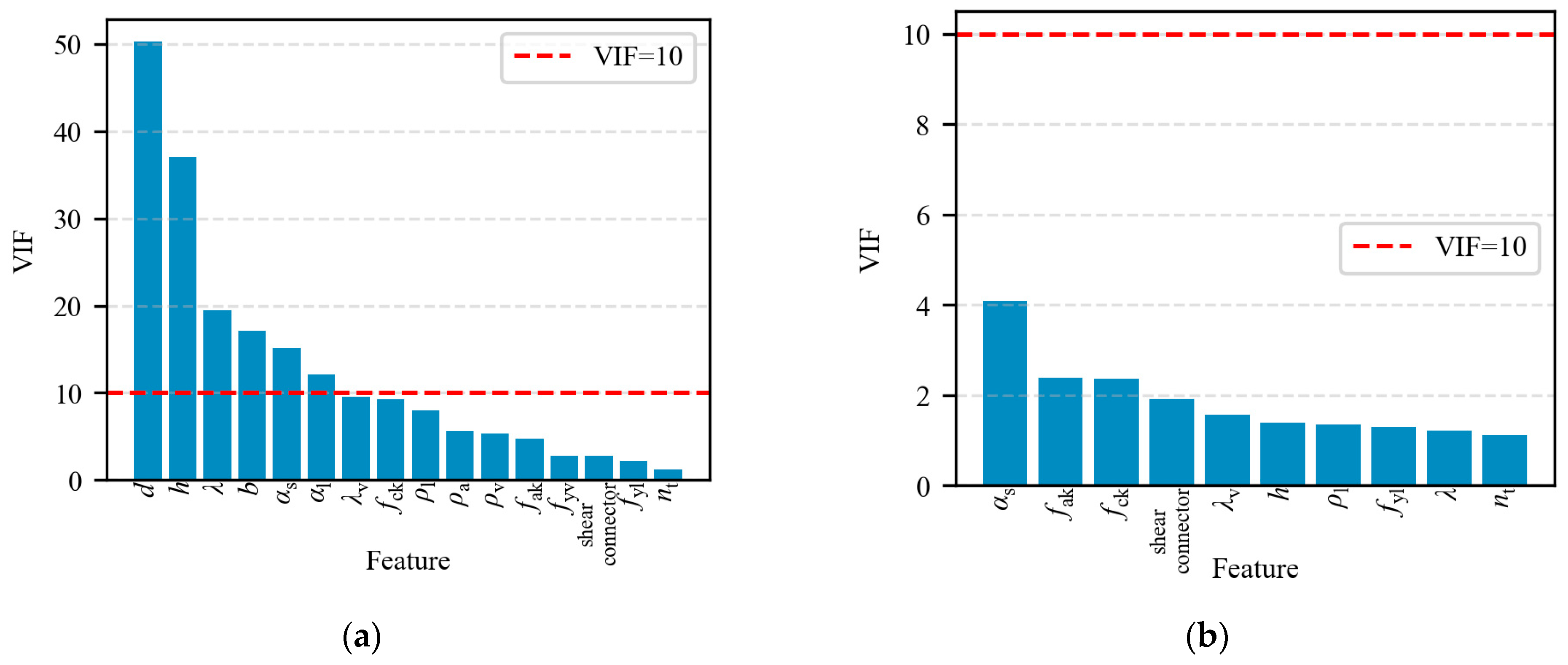
As mentioned in Section 3.1, since the original input parameter set of the collected experimental data includes both single features and composite features, in order to avoid a reduction in model accuracy caused by multicollinearity, feature selection combining Pearson correlation coefficients and variance inflation factor (VIF) is conducted.
Based on the Pearson correlation coefficients shown in Figure 4, pairwise selection is conducted. For any pair of features exhibiting correlation coefficients exceeding a predefined threshold (0.85 is used in this study), only the feature with the higher correlation coefficient with the target parameter is retained. This step aimed to identify information redundancy pairwise, where two variables provide nearly identical information. Then, VIF is calculated for the remaining features to detect complex redundancy. The VIF is calculated with the following steps: for the considered input feature Xi, supposing it can be fitted by a linear combination of the rest of the input features, the coefficient of determination of this linear combination R i 2 is calculated, and then VIF is obtained by
V I F = 1 1 R i 2
Features exhibiting a high VIF can be considered to be largely explainable by linear combinations of other features, thereby constituting redundant information. Removing such features is therefore a reasonable strategy. This strategy can be applied iteratively to obtain a more concise feature set. Figure 8a shows the VIF of all input features before selection.
Combining the information from Figure 4 and Figure 8a, a systematic feature selection is conducted. Although d, h and b provide complete geometric information, d and b are excluded due to their excessive VIF (>10), which indicates redundant geometric information. Similarly, ρsv and αl are excluded, as their physical roles were effectively represented by ρv and the combination of ρl and fyl, respectively. The final feature set prioritizes dimensionless mechanical indices (e.g., nt and λ), ensuring the model is both statistically robust and physically consistent. After feature selection, 10 input features are left to train the ML classification and regression model. These features are listed in Table 5. The VIF of the remaining features is shown in Figure 8b. It is observed that the VIF values for all the parameters have been reduced to below 5.0, indicating negligible multicollinearity.

4.3. Training and Results of Machine Learning Models

4.3.1. Failure Mode Classification

In this study, the ML models are implemented with Scikit-learn (sklearn) [78], a robust and comprehensive open-source framework for predictive data analysis. For the classification models, the hyperparameters listed in Table 6 are initially used, and the rest are kept at the default value of the program.
It is noted that the distribution of failure modes in the test database is highly imbalanced (Figure 1), with nearly half of the specimens exhibiting flexural failure, while the number of specimens exhibiting shear-bond failure and flexure-shear failure is relatively small. This is consistent with the actual proportion in engineering practice, where engineers prefer flexural failure with good ductility. To address this problem, the Synthetic Minority Over-sampling Technique (SMOTE) is employed on the training set. This technique generates new instances of minority classes (e.g., SB and FS) between a real minority sample and one of its nearest neighbors by linear interpolation, thereby filling the feature space of the minority class, so that the classifier can learn a more robust decision boundary.
For the SVM and ANN algorithms, distance calculations or gradient-based optimization is conducted in model training. Therefore, these models are dependent on the geometry of the feature space, and standardization on the input and output features is necessary to prevent the features with larger numerical scales from dominating the loss function or causing gradient saturation. Z-score standardization is conducted with the StandardScaler function provided in the sklearn package to transform the data of each parameter to have a zero mean and unit variance, i.e., Z = x μ / σ where Z and x are the data after and before standardization, μ and σ are the mean and variance of the data before standardization.
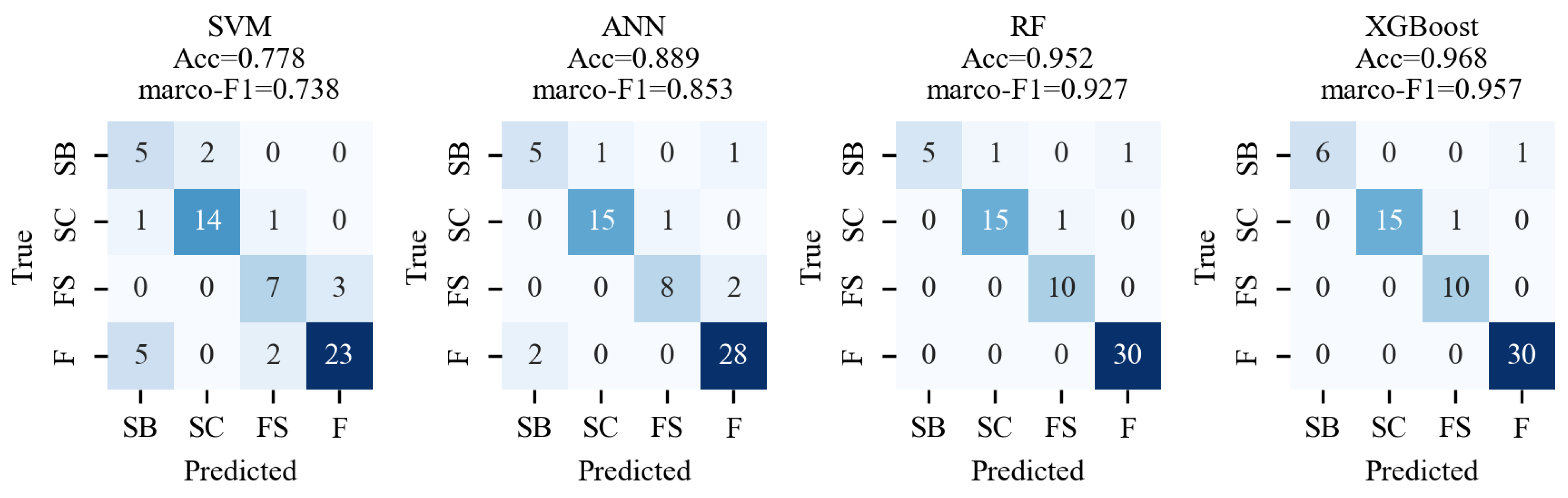
The test database is randomly partitioned into a training set and a testing set with a ratio of 8:2. The ML models are trained using the training set (249 samples), while the remaining 20% of the data (63 samples), previously unseen by the models, is utilized to independently validate the models’ performance. The confusion matrices of four models on the testing set are shown in Figure 9, with the accuracy and macro-F1 score marked on top of each matrix.
From Figure 9, it is observed that all four models can reach a relatively high global accuracy and micro-F1 score, indicating that ML models can effectively distinguish the failure modes of SRC columns with the selected input features. Notably, the XGBoost model demonstrated the best predictive capability, achieving the highest classification accuracy of 0.968 and a macro-F1 score of 0.957. Specifically, the ensemble models (XGBoost and RF) exhibited exceptional precision in identifying ductile failure (F), with a 100% accuracy. For the brittle failure modes (SB and SC), the XGBoost model outperformed others, accurately capturing the minority class features facilitated by the SMOTE algorithm. The trained XGBoost model is therefore used in the two-stage framework, whose prediction result will be used as an additional input feature in the regression models of the second step.

4.3.2. Deformation Limit Prediction

For the regression models, the hyperparameters listed in Table 7 are used. The standardization process for both input and output features, and the random partition ratio of training and testing sets, are identical to those of the classification step.
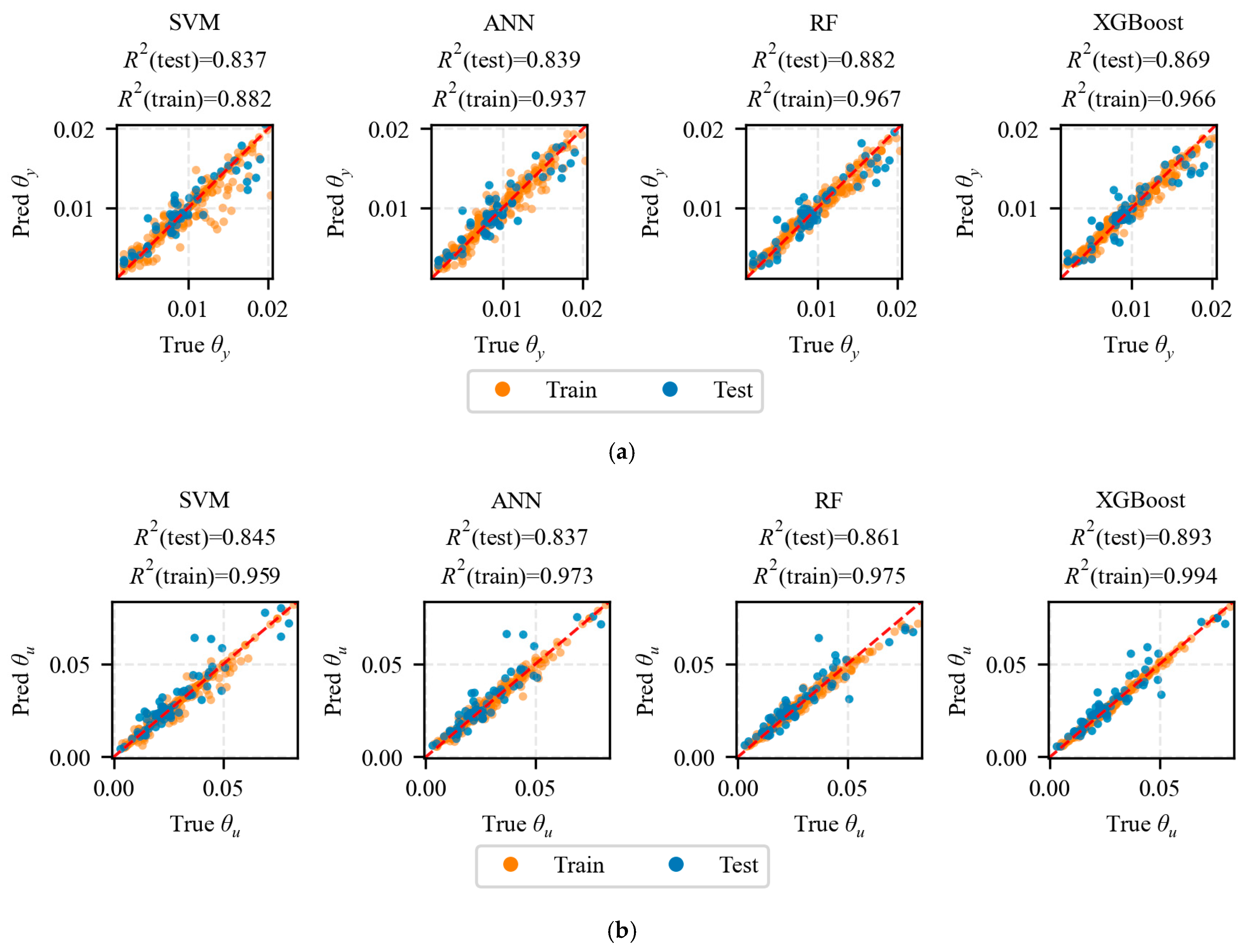
Figure 10 and Table 8 show the regression results of θy and θu generated with the four models in the two-stage framework. The red dashed line in the figure represents where the predicted values are equal to the experimental values. Overall, the proposed two-stage framework exhibits high predictive performance, with the majority of data points located closely around the equality line (y = x). For θy, all four models achieve R2 values on testing set ranging from 0.837 to 0.882, and RF model outperforms others with the highest R2 of 0.882 and lowest RMSE of 0.00150; for θu, the models also show high predictive capacity, with R2 values on testing set exceeding 0.837 across all the models, and XGBoost model can reach R2 of 0.893 and MAPE of 16.40%, providing a highly reliable tool for ultimate deformation capacity analysis.
The robustness of the two optimal models is further evaluated by analyzing the R2 degradation between the training and testing sets. For θy, the RF model exhibited an R2 degradation of 0.085, and for θu, the XGBoost model exhibited an R2 degradation of only 0.101; both show satisfactory robustness. Together with the high testing performance (R2 near 0.9), it is confirmed that the model has effectively captured the mechanical laws governing the yielding and ultimate limit of SRC columns rather than overfitting to specific training samples.

4.3.3. End-to-End Framework

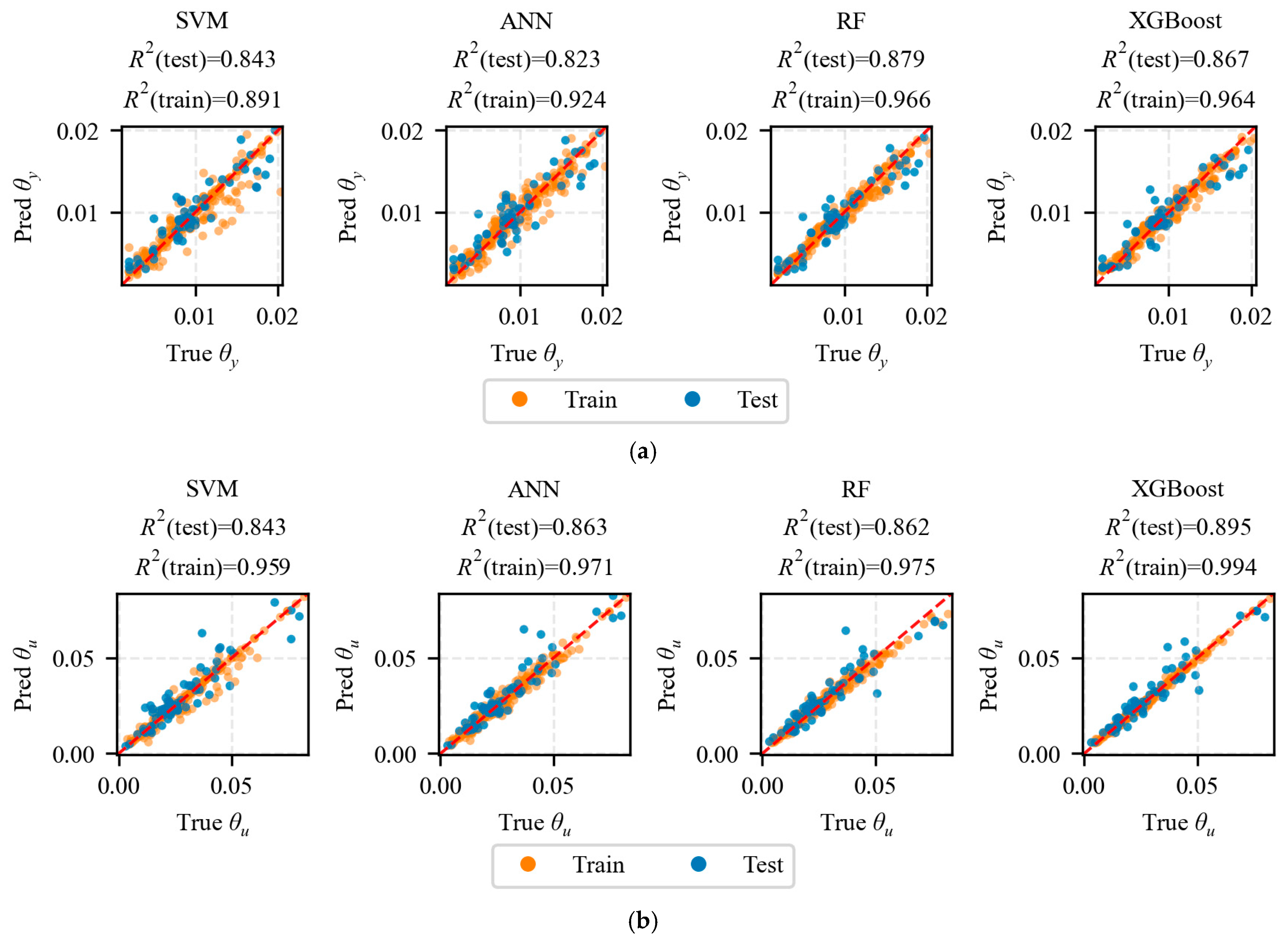
This study also proposes an end-to-end framework to directly predict the deformation capacity of SRC columns from input parameters, and the results are shown in Figure 11 and Table 9. Again, the models showed high predictive accuracy and satisfactory robustness. Similar to the case of the two-stage framework, the RF and XGBoost models are the optimal models for θy and θu with R2 values on the testing set of 0.879 and 0.895, respectively.

4.4. Comparison of the Two Frameworks

The performance of optimal models in two-stage and end-to-end frameworks is compared in Table 10. In contrast to the existing literature where a two-stage framework often yields significant accuracy improvement, it is observed that only a slight improvement occurs in the two-stage framework in this study. This can be explained by the fact that the existence of encased steel sections largely enhances the deformation capacity under shear failure, thereby blurring the boundary between brittle and ductile failure modes. On the other hand, an end-to-end framework avoids the error propagation from the classification to the regression stage, and is also capable of implicitly capturing the underlying mechanism of deformation, thus giving highly accurate and robust predictive results. Therefore, the end-to-end framework developed in this study is recommended for the prediction of the deformation capacity of SRC columns, and is discussed in the following part.

4.5. Hyperparameter Optimization

To ensure the predictive stability and to mitigate the risk of overfitting, the hyperparameter optimization process is conducted on the optimal machine learning models determined in the end-to-end framework, i.e., the RF model for θy and the XGBoost model for θu prediction. The tuning strategy employs a combination of five-fold cross-validation (CV) and grid search.
For each model, a multi-dimensional search space (grid) is defined, including key hyperparameters such as learning rates, tree depths, and regularization coefficients. During the five-fold CV process, the training dataset is partitioned into five subsets; for each combination of hyperparameter, four subsets are used for model fitting while the remaining subset serves as a validation set. This procedure is repeated five times for every parameter combination to obtain a stable average performance metric (R2 is used in this study as the target of optimization). Finally, the hyperparameters leading to better performance are used to train a regression model using the whole training set. The search space and finally chosen hyperparameter for the two models are listed in Table 11.
The performance of models with tuned hyperparameters is compared with that of initial hyperparameters (baseline model) and the main results are listed in Table 12. It is found that the tuned model yields a higher R2 in CV, and a slight degradation in predictive accuracy on the testing set (e.g., decrease in R2 and increase in RMSE). In fact, the reduction in the R2 observed on the testing set (e.g., from 0.878 to 0.856 for θy) indicates a successful mitigation of initial overfitting. The narrowing gap between CV and testing performance suggests that the tuned models are more robust against the inherent stochasticity of the SRC experimental database. With a MAPE remaining consistently below 17%, the tuned models demonstrate a high level of predictive accuracy. Therefore, the tuned models are finally used to predict the seismic deformation capacity of SRC columns.
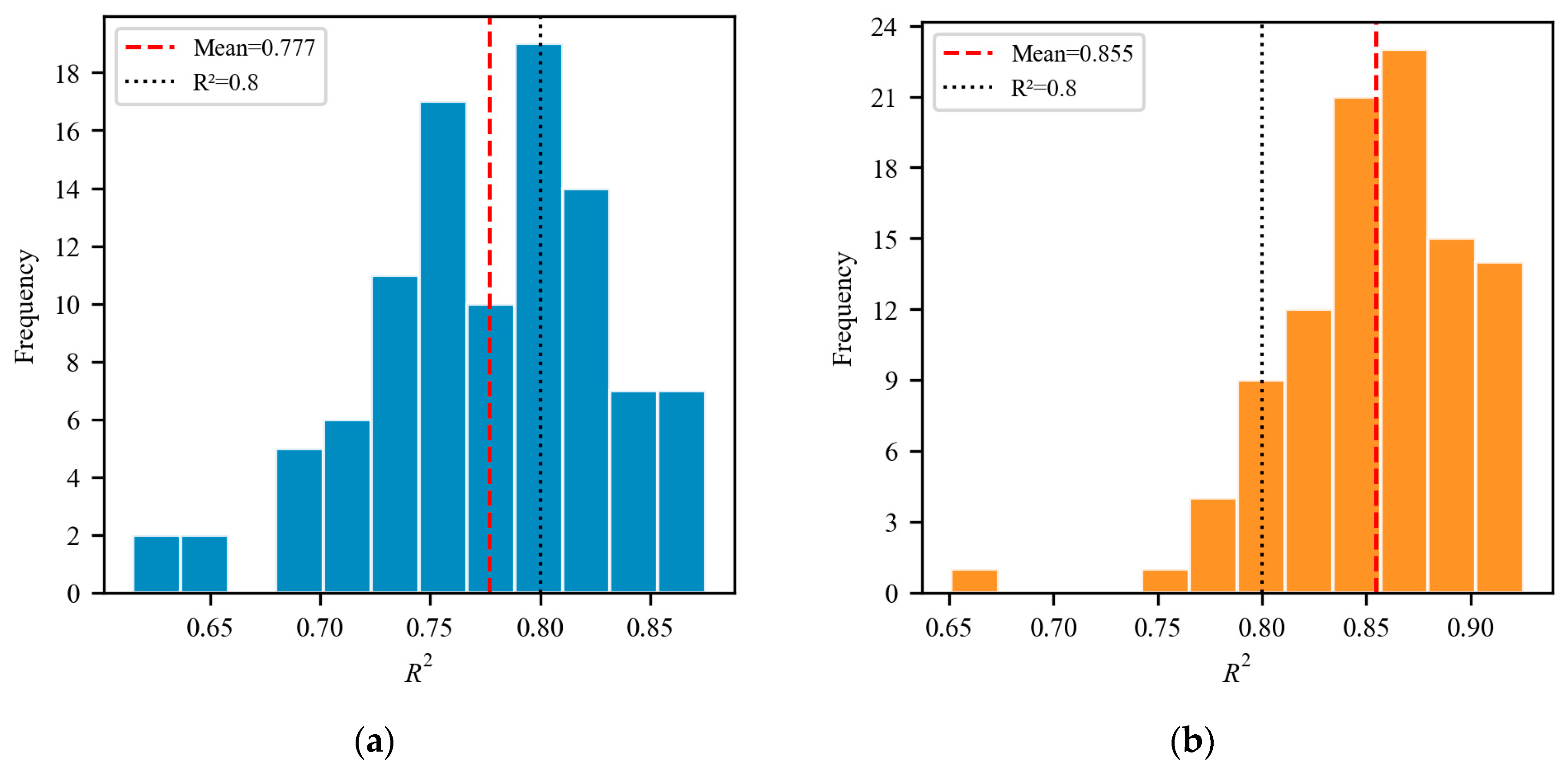
Moreover, from Table 12, it is also observed that both the RF and XGBoost models can achieve a higher R2 on the independent testing set compared to the average R2 obtained during the five-fold CV on the training set. This typically suggests that some of the models trained in a five-fold partition may have been adversely affected by experimental outliers, thereby the average CV score is penalized, i.e., the evaluation remains sensitive to the specific data split. To mitigate the bias introduced by a single K-fold partition and provide a thorough assessment of the model’s stability, ShuffleSplit CV is subsequently implemented. By executing 100 independent random shuffles and splits of testing sets, ShuffleSplit provides a sufficiently large sample size to observe the probability distribution of the model’s performance on diverse data combinations.
The results of ShuffleSplit are shown in Figure 12. The RF and XGBoost models show satisfactory predictive accuracy, with a mean R2 of 0.777 and 0.855, respectively. Especially for the tuned XGBoost model for θu, while occasional unfavorable data partitions yield R2 values as low as 0.65, the majority of the 100 iterations are concentrated within the 0.82 to 0.90 range, indicating a high accuracy and generalization capacity. For the RF model for θy, the wider distribution of R2 indicates that the prediction of yielding drift is more sensitive to noise in data.

5. Discussion on the Machine Learning Results

5.1. Model Interpretation

5.1.1. Feature Importance

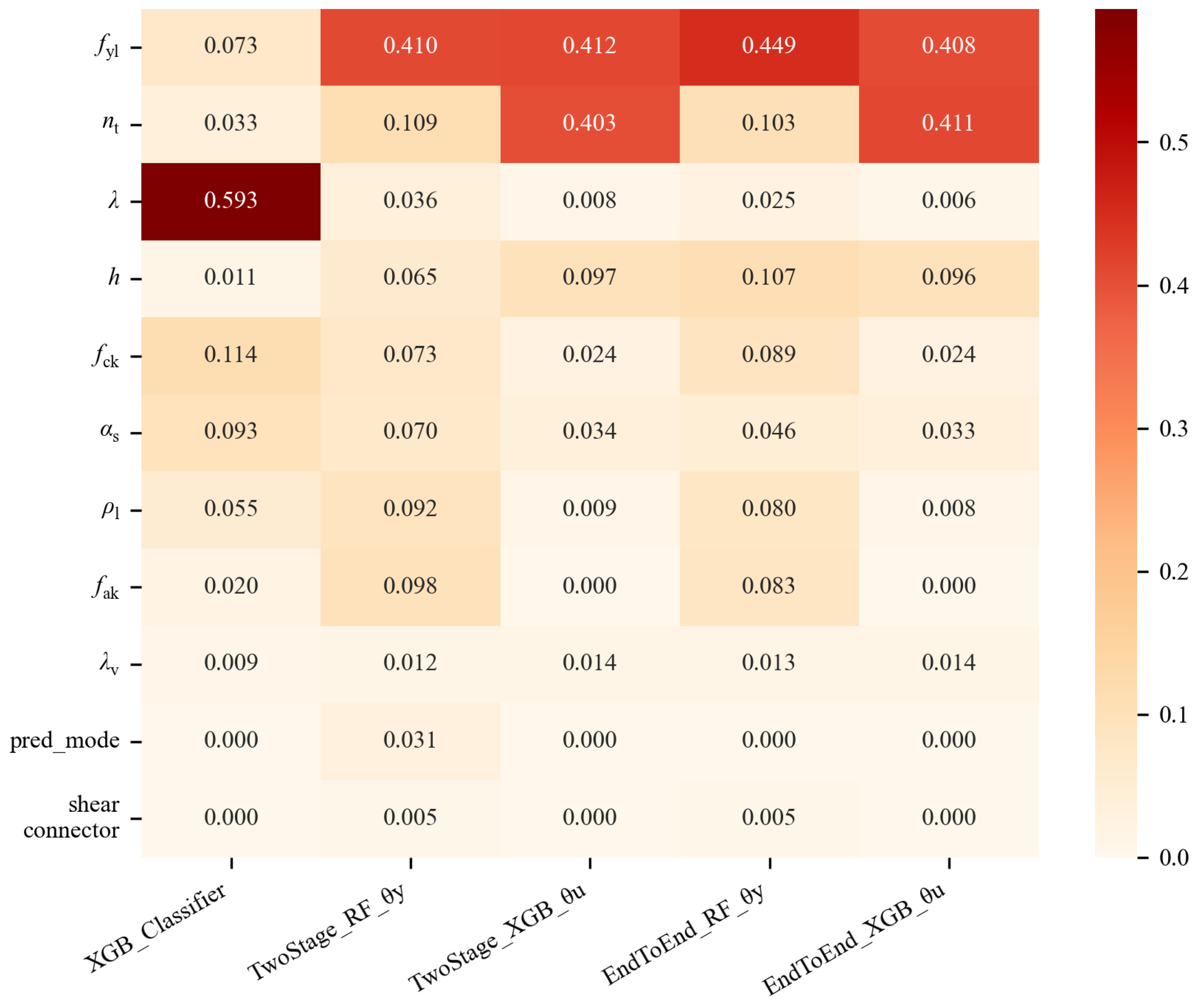
To quantitatively assess the contribution of each input parameter to the model’s predictive performance, the permutation importance (PI) method is employed. PI is a model-agnostic technique that evaluates feature importance by measuring the decrease in a model’s performance score when the values of a single feature are randomly shuffled. The results of the PI analysis are shown in Figure 13.
The comparison of two-stage and end-to-end frameworks is explained here with the feature importance. A significant divergence between the classification task and the regression tasks is observed: for the XGBoost model in classification, the shear span ratio (λ) dominates the contribution (0.593), indicating its role as the primary determinant of failure mode transitions (e.g., from shear to flexural failure); in contrast, the regression models, both within the two-stage and end-to-end frameworks, show highly consistent reliance on material strength (fyl) and axial load ratio (nt). This observation indicates that while λ governs the type of failure, the deformation capacity is predominantly controlled by material properties and loading conditions. Moreover, the high similarity between two-stage and end-to-end regression rankings and the low importance of predicted failure mode in the regression model of the two-stage framework further explain the negligible improvement of the two-stage approach: high-performance regressors like XGBoost inherently capture the categorical boundaries within their decision structures, rendering explicit classification guidance less important for accuracy.

5.1.2. SHAP Analysis

To move beyond the “black-box” nature of ML models and ensure the physical consistency of the developed models, SHAP (SHapley Additive exPlanations) is utilized for post hoc interpretation. Grounded in cooperative game theory, SHAP provides a mathematically rigorous framework to attribute the contribution of each input feature to the final prediction. By calculating the SHAP value for each input feature, the method quantifies the change in the model output when a specific feature is observed versus when it is absent.
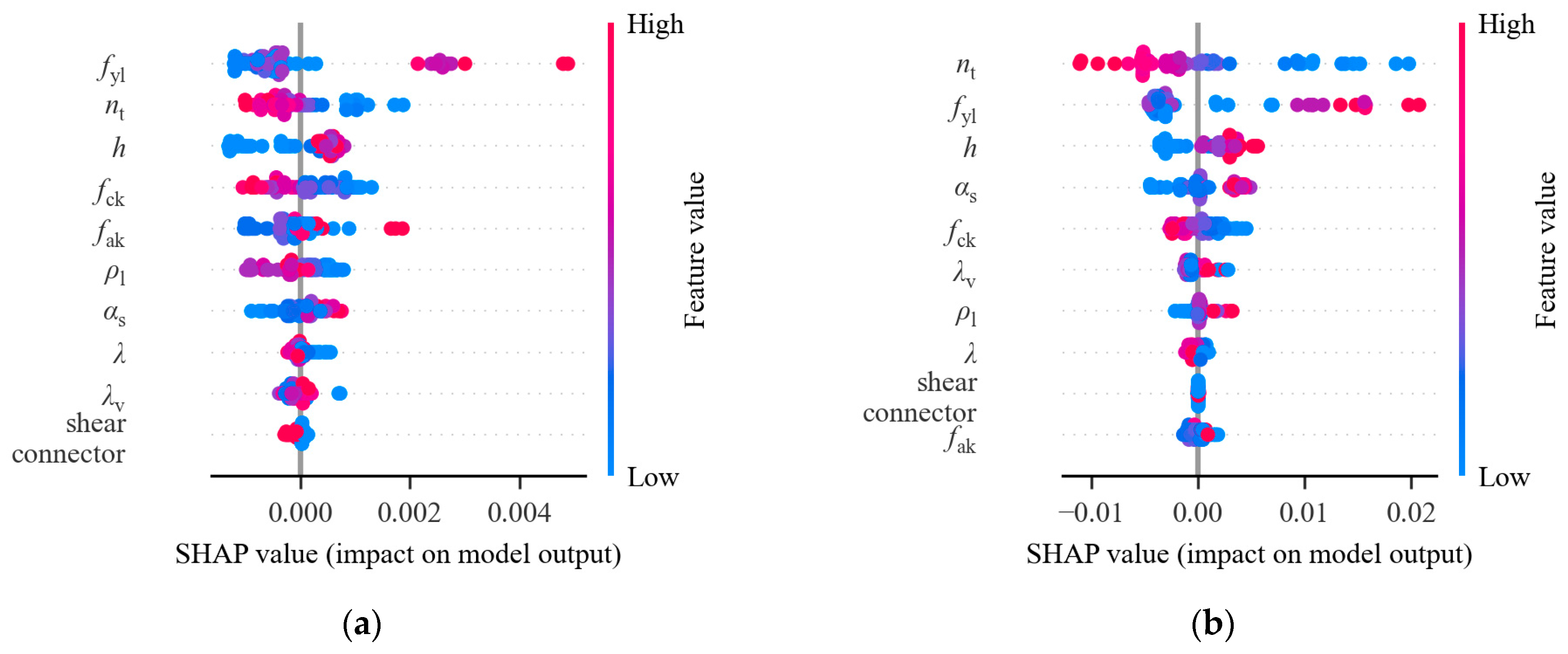
The SHAP plots for the two regressors are visualized in Figure 14. It is found that θy is predominantly governed by the strength of longitudinal reinforcement fyl, which could be explained by the fact that the yielding of longitudinal reinforcement leads to the stiffness beginning of significant stiffness degradation; θu is primarily controlled by the axial compression ratio nt, as the ultimate deformation capacity is mainly controlled by concrete crushing, which tends to happen at lower drift level for columns under higher axial compression; concrete compressive strength fck has a negative influence on both θy and θu, indicating that although columns with high-strength concrete (HSC) may behave higher capacity, their deformation capacity may be compromised because of the brittleness of HSC. These observations are generally consistent with engineering knowledge and prove that the ML models have effectively learned the underlying mechanisms of the deformation capacity of SRC columns.

5.1.3. Partial Dependence Plots

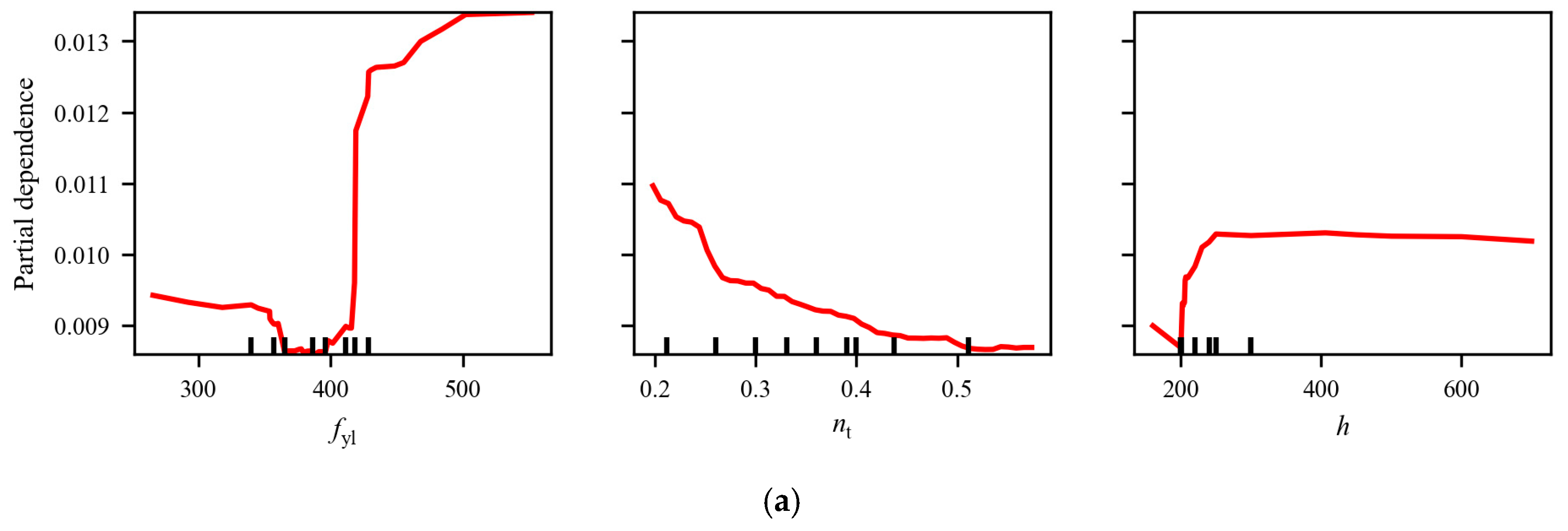
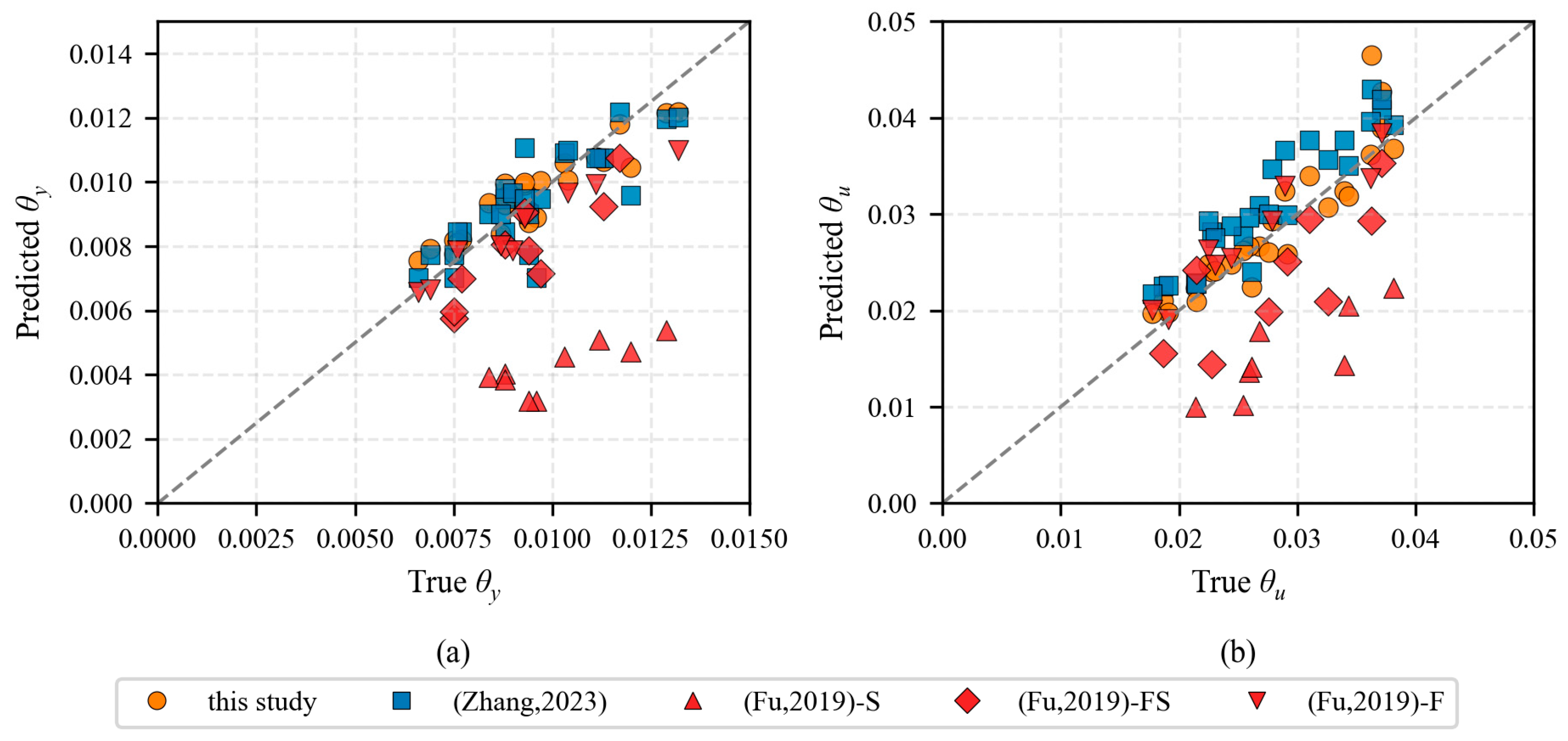
Partial dependence is also plotted in Figure 15 for θy and θu against three input parameters with the highest permutation importance. The same phenomenon as shown in SHAP analysis is observed: θy primarily increases with fyl, which governs the onset of plasticity, and the ultimate drift θu decreases with the axial load ratio nt, reflecting how high compression accelerates P-Δ effects and structural collapse. Additionally, both θy and θu show a threshold effect for section height h, where deformation capacity stabilizes once the member size is sufficient to mitigate localized instability.

5.2. Comparison with Conventional Approaches

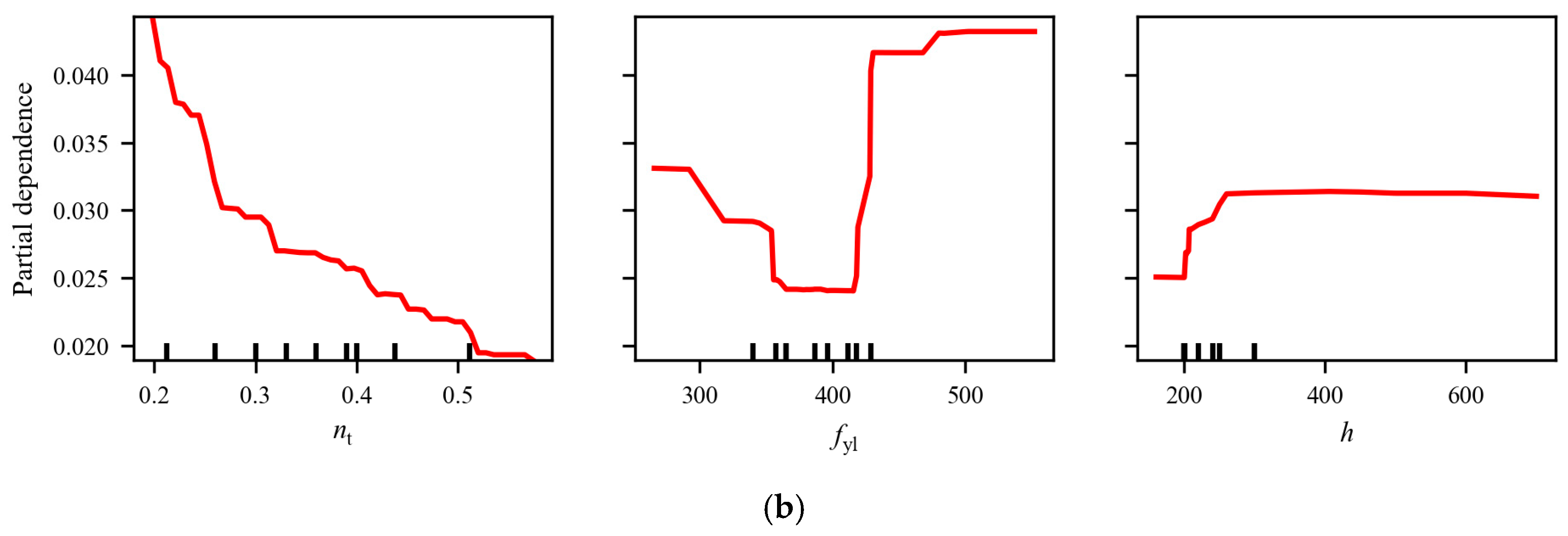
The ML-based deformation capacity prediction models developed in this study are compared with the conventional data-fitting-based model results reported in the literature. The conventional models include both end-to-end models [73] and two-stage models [17], i.e., failure mode classification and deformation capacity regression, and detailed formulas can be found in the corresponding literature. Since both studies provided methods for calculating the drift ratio at 80% of the peak load in the post-peak stage, the ultimate deformation limit defined in this study is derived by linearly interpolating between the drift at the peak load and the drift at 80% of the peak load. Test results from [73] are used for the comparison.
Figure 16 and Table 13 show the results of the comparison. It is observed that the ML models proposed in this study achieve the best performance in both θy and θu prediction, followed by conventional end-to-end formulas, while the traditional two-stage model significantly underestimates the deformation capacity of SRC columns in shear failure modes, yielding the poorest fit.

5.3. Uncertainty Evaluation

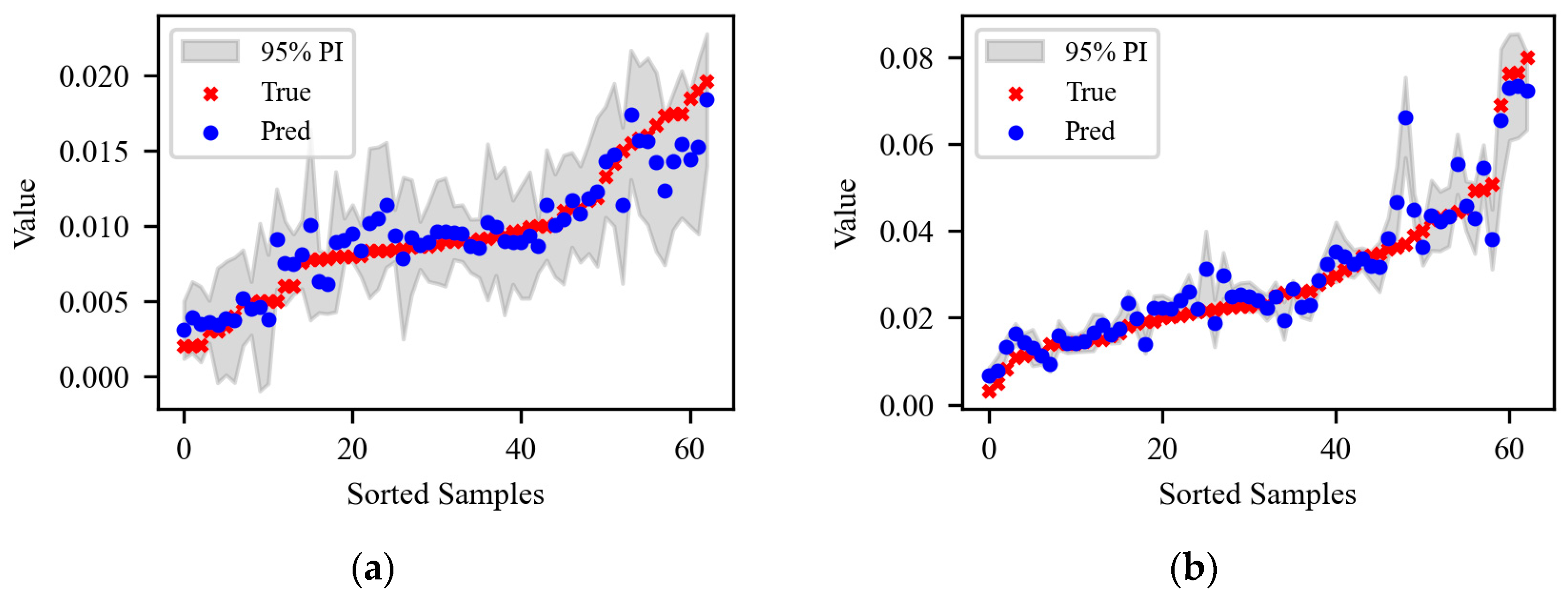
When constructing fragility curves, in addition to accurately predicting the deformation capacity of components, it is also necessary to assess the uncertainty of the predictions. Therefore, the proposed framework should provide not only deterministic point predictions but also quantified uncertainty. This is achieved by the following: (1) for the RF model, the variance across individual decision trees is used; (2) for the XGBoost model, the variance of prediction is obtained through a bootstrapping approach with 100 iterations.
Figure 17 shows the comparison of the predicted values in the testing set, together with 95% prediction intervals (PIs), compared with the true value. It is found that the majority of true values fall in the 95% prediction interval, demonstrating the reliability of the model for stochastic resilience assessment.
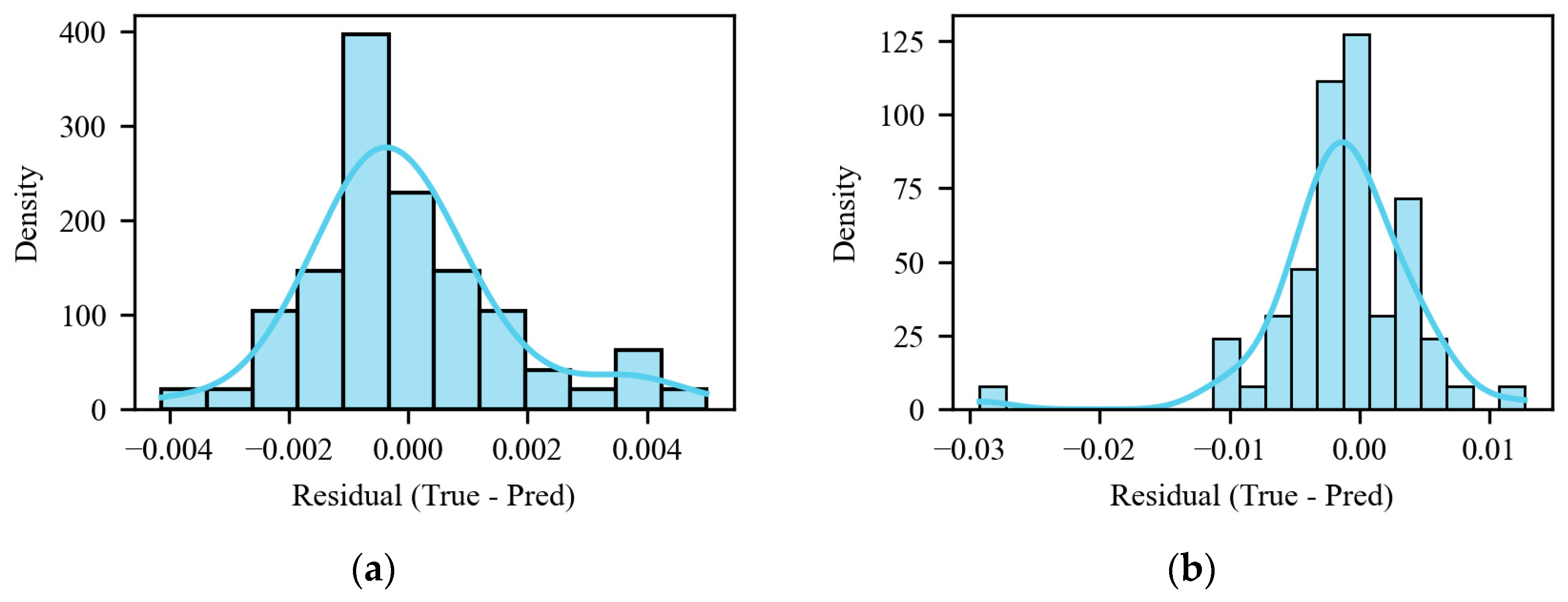
Figure 18 displays the distribution of residuals. It is observed that most of the residuals are centered around zero, and their distribution is approximately normal, indicating reliable and stable prediction performance.

6. Conclusions

In this paper, an ML-based framework is proposed for the prediction of the deformation capacity of SRC columns, based on a comprehensive experimental database. The main conclusions are as follows:
  • A test database of 312 SRC column specimens is constructed; the failure modes and range of parameters cover the four typical failure modes and the common range of engineering practice, providing a solid data foundation for ML modeling.
  • Feature selection combining Pearson correlation analysis and VIF effectively eliminates redundant variables and mitigates multicollinearity among initial parameters. A final set of 10 core features is identified, ensuring physical interpretability and significantly enhancing models’ accuracy and generalization capability.
  • Four ML models (SVM, ANN, XGBoost and RF) and two frameworks (two-stage and end-to-end) are compared. It is found that the performance improvement in the two-stage framework is insignificant; thus, the end-to-end framework is finally adopted to avoid classification error propagation. RF for θy and XGBoost for θu prediction demonstrated optimal overall performance, reaching an R2 of 0.856 and 0.885 respectively. Hyperparameter optimization and ShuffleSplit cross-validation confirmed the model’s robustness and generalization ability, effectively avoiding overfitting.
  • Model interpretation is conducted with the PI and SHAP analyses, revealing that the models’ decision logic aligns with engineering principles. Shear span ratio λ is the key factor determining failure modes, while longitudinal reinforcement strength fyl and axial load ratio nt dominate the deformation capacity. This confirms that the ML models are capable of capturing the underlying mechanical mechanisms.
  • Compared with conventional data-fitting formulas (both end-to-end and two-stage) from the literature, the proposed ML models show significantly improved prediction accuracy. The R2 values for predicting θy and θu are improved by 26.5% and 32.9%, the RMSE is reduced by 30.0% and 30.4%, and the MAPE is reduced by 18.5% and 48.4%, respectively, highlighting the power of data-driven approaches in handling complex nonlinear problems.
  • The proposed model is applicable to practical engineering, as the parameters cover geometric and mechanical parameters commonly used in actual SRC columns. However, for parameters that are beyond the range of this database, the applicability of the trained model still needs further validation.

Author Contributions

Conceptualization, M.C., C.W. and C.C.; methodology, M.C., C.W., C.C. and H.Q.; software, M.C.; validation, M.C.; formal analysis, M.C.; investigation, M.C. and B.W.; data curation, M.C., H.Q. and B.W.; writing—original draft, M.C., H.Q. and B.W.; writing—review and editing, M.C. and C.C.; visualization, M.C.; supervision, C.W., C.C. and Y.P.; project administration, C.C. and Y.P.; funding acquisition, C.C. All authors have read and agreed to the published version of the manuscript.

Funding

This research was funded by the Youth Scientific Research Foundation of China Academy of Building Research Co., Ltd. (Grant No. 20231902371030011) and R&D Project on Critical Generic Technologies of China Academy of Building Research Co., Ltd. (Grant No. 2025-0102110103002-003 and 20251902970730016).

Data Availability Statement

The original contributions presented in this study are included in the article. Further inquiries can be directed to the corresponding authors.

Conflicts of Interest

Authors Mingzhe Cui, Cuikun Wang, Caihua Chen, Huahua Qiu, Yuhua Pan, and Baixiang Wang were employed by the company China Academy of Building Research Co., Ltd. The authors declare that the research was conducted in the absence of any commercial or financial relationships that could be construed as a potential conflict of interest.

References

  1. Priestley, M.J.N. Performance based seismic design. Bull. N. Z. Soc. Earthq. Eng. 2000, 33, 325–346. [Google Scholar] [CrossRef]
  2. Jiang, H.; Li, S.; Zhu, Y. Seismic performance of high-rise buildings with energy-dissipation outriggers. J. Constr. Steel Res. 2017, 134, 80–91. [Google Scholar] [CrossRef]
  3. Wu, Y.T.; Kang, D.Y.; Yang, Y.B. Seismic performance of steel and concrete composite shear walls with embedded steel truss for use in high-rise buildings. Eng. Struct. 2016, 125, 39–53. [Google Scholar] [CrossRef]
  4. Hamburger, R.O.; Rojahn, C.; Heintz, J.; Mahoney, M.G. FEMA P58: Next-generation building seismic performance assessment methodology. In Proceedings of the 15th World Conference on Earthquake Engineering, Lisbon, Portugal, 24–28 September 2012. [Google Scholar]
  5. Paul, N.; Almufti, I.; Mieler, M.; Lee, J.S. Estimation of post-earthquake recovery on a university campus using REDi methodology. In Proceedings of the 11th US National Conference on Earthquake Engineering, Los Angeles, CA, USA, 25–29 June 2018. [Google Scholar]
  6. Mayes, R.L.; Reis, E. The US Resiliency Council (USRC) and the building rating system. In Improving the Seismic Performance of Existing Buildings and Other Structures 2015; American Society of Civil Engineers: Reston, VA, USA, 2015; pp. 754–764. [Google Scholar]
  7. GB/T 38591-2020; Standard for Seismic Resilience Assessment of Buildings. China Architecture & Building Press: Beijing, China, 2020. (In Chinese)
  8. Xu, Z.; Zhang, H.; Lu, X.; Xu, Y.; Zhang, Z.; Li, Y. A prediction method of building seismic loss based on BIM and FEMA P-58. Autom. Constr. 2019, 102, 245–257. [Google Scholar] [CrossRef]
  9. Kohns, J.; Stempniewski, L.; Stark, A. Fragility functions for reinforced concrete structures based on multiscale approach for earthquake damage criteria. Buildings 2022, 12, 1253. [Google Scholar] [CrossRef]
  10. Gaston, J.R.; Siess, C.P.; Newmark, N.M. An Investigation of the Load Deformation Characteristics of Reinforced Concrete Beams up to the Point of Failure; Civil Engineering Studies SRS-040; University of Illinois at Urbana Champaign: Champaign, IL, USA, 1959. [Google Scholar]
  11. NZSEE. The Seismic Assessment of Existing Buildings Section C5: Concrete Buildings. 2017. Available online: https://www.building.govt.nz/assets/Uploads/building-code-compliance/b-stability/b1-structure/seismic-assessment/c5-concrete-buildings.pdf (accessed on 30 April 2026).
  12. Pujol, S.; Ramfrez, J.A.; Sozen, M.A. Drift Capacity of Reinforced Concrete Columns Subjected to Cyclic Shear Reversals; Seismic Response of Bridges, SP-187; American Concrete Institute: Farmington Hills, MI, USA, 1999; pp. 255–274. [Google Scholar]
  13. Haselton, C.B.; Liel, A.B.; Taylor-Lange, S.C.; Deierlein, G.G. Calibration of model to simulate response of reinforced concrete beam-columns to collapse. ACI Struct. J. 2016, 113, 1141–1152. [Google Scholar] [CrossRef]
  14. Pledger, L.; Pujol, S.; Chandramohan, R. Estimating Drift Capacity of Reinforced Concrete Columns Using Machine Learning. ACI Struct. J. 2026, 123, 73–86. [Google Scholar] [CrossRef]
  15. Hu, H.S.; Nie, J.G.; Eatherton, M.R. Deformation capacity of concrete-filled steel plate composite shear walls. J. Constr. Steel Res. 2014, 103, 148–158. [Google Scholar] [CrossRef]
  16. Cui, J.D. Research and Experimental Verification of Deformation Index Limits of RC Beams, Columns and Shear Walls. Ph.D. Thesis, South China University of Technology, Guangzhou, China, 2017. Available online: https://cdmd.cnki.com.cn/Article/CDMD-10561-1017734127.htm (accessed on 30 April 2026). (In Chinese)
  17. Fu, D.L. Research on Deformation Index Limits of SRC Members Based on Experimental Database. Master’s Thesis, South China University of Technology, Guangzhou, China, 2019. (In Chinese) [Google Scholar] [CrossRef]
  18. Kim, S.; Hwang, H.; Oh, K.; Shin, J. A machine-learning-based failure mode classification model for reinforced concrete columns using simple structural information. Appl. Sci. 2024, 14, 1243. [Google Scholar] [CrossRef]
  19. Naderpour, H.; Mirrashid, M.; Parsa, P. Failure mode prediction of reinforced concrete columns using machine learning methods. Eng. Struct. 2021, 248, 113263. [Google Scholar] [CrossRef]
  20. Mangalathu, S.; Jang, H.; Hwang, S.H.; Jeon, J.S. Data-driven machine-learning-based seismic failure mode identification of reinforced concrete shear walls. Eng. Struct. 2020, 208, 110331. [Google Scholar] [CrossRef]
  21. Mangalathu, S.; Jeon, J.S. Machine learning–based failure mode recognition of circular reinforced concrete bridge columns: Comparative study. J. Struct. Eng. 2019, 145, 04019104. [Google Scholar] [CrossRef]
  22. Kang, M.C.; Yoo, D.Y.; Gupta, R. Machine learning-based prediction for compressive and flexural strengths of steel fiber-reinforced concrete. Constr. Build. Mater. 2021, 266, 121117. [Google Scholar] [CrossRef]
  23. Cakiroglu, C.; Islam, K.; Bekdaş, G.; Isikdag, U.; Mangalathu, S. Explainable machine learning models for predicting the axial compression capacity of concrete filled steel tubular columns. Constr. Build. Mater. 2022, 356, 129227. [Google Scholar] [CrossRef]
  24. Wang, S.; Xu, J.; Wang, Y.; Pan, C. Machine learning-based prediction of shear strength of steel reinforced concrete columns subjected to axial compressive load and seismic lateral load. Structures 2023, 56, 104968. [Google Scholar] [CrossRef]
  25. Ma, C.; Chi, J.W.; Kong, F.C.; Zhou, S.H.; Lu, D.C.; Liao, W.Z. Prediction on the seismic performance limits of reinforced concrete columns based on machine learning method. Soil Dyn. Earthq. Eng. 2024, 177, 108423. [Google Scholar] [CrossRef]
  26. Zhang, J.; Luo, J.; Jing, Y.; Chen, S.; Li, H. Prediction of maximum impact displacement of reinforced concrete columns based on interpretable machine learning. Eng. Appl. Artif. Intell. 2026, 166, 113620. [Google Scholar] [CrossRef]
  27. Luo, H.; Paal, S.G. Machine learning–based backbone curve model of reinforced concrete columns subjected to cyclic loading reversals. J. Comput. Civ. Eng. 2018, 32, 04018042. [Google Scholar] [CrossRef]
  28. Roy, D.; Muntasir Billah, A.H.M. Backbone Curve Development for Shear-Dominated Nonductile Circular Bridge Piers: An Explainable Machine Learning Approach. J. Bridge Eng. 2026, 31, 04026022. [Google Scholar] [CrossRef]
  29. Wang, C.; Song, L.H.; Fan, J.S. End-to-End Structural analysis in civil engineering based on deep learning. Autom. Constr. 2022, 138, 104255. [Google Scholar] [CrossRef]
  30. Hu, S.; Guo, T.; Alam, M.S.; Koetaka, Y.; Ghafoori, E.; Karavasilis, T.L. Machine learning in earthquake engineering: A review on recent progress and future trends in seismic performance evaluation and design. Eng. Struct. 2025, 340, 120721. [Google Scholar] [CrossRef]
  31. Sheikhi, M.; Dolatshahi, K.M.; Asjodi, A.H. Physics-Guided Nonlinear Response Prediction of RC Columns Using Partial Simulation Data and Machine Learning. Results Eng. 2026, 29, 109208. [Google Scholar] [CrossRef]
  32. Ricles, J.M.; Paboojian, S.D. Seismic performance of steel-encased composite columns. J. Struct. Eng. 1994, 120, 2474–2494. [Google Scholar] [CrossRef]
  33. Liang, S.T.; Ding, D.J.; Lu, Q. Experimental Study on the Seismic Performance of RC Columns Hinges with Embedded I-Shaped Steel. Build. Struct. 1994, 2, 23–28. (In Chinese) [Google Scholar] [CrossRef]
  34. Zhou, Z.H. Experimental Investigation of Seismic-Resistance of Steel High-Strength Reinforced Concrete Columns. Master’s Thesis, Tsinghua University, Beijing, China, 1997. Available online: https://newetds.lib.tsinghua.edu.cn/qh/paper/summary?dbCode=ETDQH&sysId=19116 (accessed on 30 April 2026). (In Chinese)
  35. Cheng, W.R.; Chen, Z.F.; Jiang, D.; Xu, M.; Yu, Y.; Hou, S.M.; Zuo, J. Experiment and Study of Limit Values of Axial Compression Ratio for SRC Columns. J. Build. Struct. 1999, 20, 51–59. (In Chinese) [Google Scholar] [CrossRef]
  36. Li, X.M.; Zhang, Y.; Chen, Z.L. Axial Compression Ratio Limit for High-Strength Steel Reinforced Concrete Columns. Build. Struct. 1999, 7, 10–13. (In Chinese) [Google Scholar] [CrossRef]
  37. Jia, J.Q. The Research of SRHC Short Columns and High-Strength Concrete Short Columns on Mechanics Performance. Ph.D. Thesis, Dalian University of Technology, Dalian, China, 2000. (In Chinese) Available online: https://d.wanfangdata.com.cn/thesis/W005870 (accessed on 30 April 2026).
  38. Jiang, D.H. Research on Mechanical Behavior and Seismic Performance of High-Strength Concrete-Encased Steel Frame Columns. Ph.D. Thesis, Northeastern University, Shenyang, China, 2001. (In Chinese) [Google Scholar] [CrossRef]
  39. Wang, H.L. Experimental Research on The Strength and Ductility of Steel Reinforced Concrete Column and Its Numerical Analysis. Ph.D. Thesis, Tsinghua University, Beijing, China, 2002. Available online: https://d.wanfangdata.com.cn/thesis/Y815947 (accessed on 30 April 2026). (In Chinese)
  40. Xu, J. Experimental Study on Aseismatic Behavior of SREHC Short Columns. Master’s Thesis, Dalian University of Technology, Dalian, China, 2004. (In Chinese) [Google Scholar] [CrossRef]
  41. Sun, C.B. The Study of Seismic Behavior on Steel High-Strength Reinforced Concrete Columns. Master’s Thesis, Xi’an University of Architecture and Technology, Xi’an, China, 2004. (In Chinese) [Google Scholar] [CrossRef]
  42. Hou, T. The Experimental Research of Steel Reinforced Super-High-Strength Concrete Columns on Mechanics Performance. Master’s Thesis, Dalian University of Technology, Dalian, China, 2005. (In Chinese) [Google Scholar] [CrossRef]
  43. Liu, W. Study on Limited Value of Axial Compression Ratio of Steel Reinforced High Strength Concrete Column. Master’s Thesis, Chongqing University, Chongqing, China, 2007. (In Chinese) [Google Scholar] [CrossRef]
  44. Zhang, Z.W. Experiment Study on Deformation Performance and Hysteretic Characteristic of SRC Columns. Master’s Thesis, Huaqiao University, Quanzhou, China, 2007. (In Chinese) [Google Scholar] [CrossRef]
  45. Xu, S.L.; Jiang, R.; Jia, J.Q.; Sun, G.Q.; Hou, T. Experimental research on steel reinforced ultra high-strength concrete short columns in seismic performance. J. Dalian Univ. Technol. 2007, 47, 699–706. (In Chinese) [Google Scholar] [CrossRef]
  46. Peng, C.H. Experimental Study and Theory Analysis on Limit Value of Axial Compression for SRHSHPC columns. Master’s Thesis, Xi’an University of Architecture and Technology, Xi’an, China, 2008. (In Chinese) [Google Scholar] [CrossRef]
  47. Chen, Z.; Duan, X.Y. Research on Limit Values of Axial Compression Ratio for Steel Reinforced High Strength Concrete Column. J. Chongqing Jiaotong Univ. (Nat. Sci.) 2009, 28, 436–439. (In Chinese) [Google Scholar]
  48. Chen, X.G.; Mu, Z.G.; Zhang, J.B.; Wang, C.K.; Chen, C.H.; Sun, H.Z. Experimental study on the seismic behavior of steel reinforced concrete columns. J. Univ. Sci. Technol. Beijing 2009, 31, 1516–1525. (In Chinese) [Google Scholar] [CrossRef]
  49. Guo, Z.X.; Lin, H.; Liu, Y. Experimental study on seismic behavior of SRC columns with different stirrup configuration. J. Build. Struct. 2010, 31, 110–115. (In Chinese) [Google Scholar] [CrossRef]
  50. Wang, B. Research on Seismic Damage of Steel Reinforced High Strength and High Performance Concrete Members and Frame Structures. Ph.D. Thesis, Xi’an University of Architecture and Technology, Xi’an, China, 2010. (In Chinese) [Google Scholar] [CrossRef]
  51. Zhang, L. Research on Mechanical Behaviors and Design Theory of Steel Reinforced High Strength and High Performance Concrete Columns. Ph.D. Thesis, Xi’an University of Architecture and Technology, Xi’an, China, 2011. (In Chinese) [Google Scholar] [CrossRef]
  52. Zheng, S.S.; Lou, H.J.; Wang, X.F.; Li, Z.Q. Study on displacement ductility coefficient of steel reinforced high-strength concrete column. Adv. Mater. Res. 2012, 368, 1097–1100. [Google Scholar] [CrossRef]
  53. Ma, H.; Xue, J.; Zhang, X.; Luo, D. Seismic performance of steel-reinforced recycled concrete columns under low cyclic loads. Constr. Build. Mater. 2013, 48, 229–237. [Google Scholar] [CrossRef]
  54. Zhang, S.A. Seismic Behavior of Steel Reinforced High Strength Concrete Corner Columns Under High Axial Compressive Force. Master’s Thesis, Tsinghua University, Beijing, China, 2013. Available online: https://cdmd.cnki.com.cn/article/cdmd-10003-1014020643.htm (accessed on 30 April 2026). (In Chinese)
  55. Feng, H. Study on Seismic Behavior of HSRC Frame Column. Ph.D. Thesis, Chongqing University, Chongqing, China, 2013. (In Chinese) [Google Scholar] [CrossRef]
  56. Chen, C.; Wang, C.; Sun, H. Experimental study on seismic behavior of full encased steel-concrete composite columns. J. Struct. Eng. 2014, 140, 04014024. [Google Scholar] [CrossRef]
  57. Zheng, L. Analysis on Seismic Performance of Steel Reinforced Ultra-High-Strength Concrete Columns. Master’s Thesis, Dalian University of Technology, Dalian, China, 2014. Available online: https://d.wanfangdata.com.cn/thesis/Y2592395 (accessed on 30 April 2026). (In Chinese)
  58. Ma, H.; Xue, J.; Liu, Y.; Zhang, X. Cyclic loading tests and shear strength of steel reinforced recycled concrete short columns. Eng. Struct. 2015, 92, 55–68. [Google Scholar] [CrossRef]
  59. Chen, Z.P.; Ke, X.J.; Chen, Y.L. Experimental study on seismic behavior of steel reinforced high-strength concrete columns confined by square spiral stirrups. China Civ. Eng. J. 2015, 48, 41–49. (In Chinese) [Google Scholar] [CrossRef]
  60. Wang, Q.; Shi, Q.; Tao, Y. Experimental and numerical studies on the seismic behavior of steel reinforced concrete compression-bending members with new-type section steel. Adv. Struct. Eng. 2016, 19, 255–269. [Google Scholar] [CrossRef]
  61. Chen, C.C.; Chen, C.C.; Hoang, T.T. Role of concrete confinement of wide-flange structural steel shape in steel reinforced concrete columns under cyclic loading. Eng. Struct. 2016, 110, 79–87. [Google Scholar] [CrossRef]
  62. Ding, W. Experimental Study on Seismic Performance of Steel Reinforced High Strength Concrete Columns. Master’s Thesis, Anhui University of Technology, Ma’anshan, China, 2017. Available online: https://cdmd.cnki.com.cn/Article/CDMD-10360-1018254037.htm (accessed on 30 April 2026). (In Chinese)
  63. Cao, W.L.; Guo, Y.L.; Qiao, Q.Y. Experimental study on seismic behavior of steel reinforced recycled concrete columns with high axial compression ratio. J. Harbin Inst. Technol. 2018, 50, 47–55. (In Chinese) [Google Scholar] [CrossRef]
  64. Jiang, L.J.; Bai, G.L.; Gao, L.; Luo, H.Y.; Zhu, H.; Lang, Y. Experimental Study on Seismic Behavior of Steel Reinforced Concrete Columns Under Different Loading Systems. Ind. Constr. 2020, 50, 112–118. (In Chinese) [Google Scholar] [CrossRef]
  65. Gautham, A.S.D.R.; Sahoo, D.R. Behavior of steel-reinforced composite concrete columns under combined axial and lateral cyclic loading. J. Build. Eng. 2021, 39, 102305. [Google Scholar] [CrossRef]
  66. Yin, F.; Wang, R.W.; Cao, W.L.; Zhao, Y.; Song, Y. Experimental and analytical research on steel reinforced high-strength concrete columns with different steel sections. Structures 2021, 34, 4350–4363. [Google Scholar] [CrossRef]
  67. Elbably, A.; Ramadan, O.; Akl, A.; Zenhom, N. Behavior of encased steel-high strength concrete columns against axial and cyclic loading. J. Constr. Steel Res. 2022, 191, 107161. [Google Scholar] [CrossRef]
  68. Wang, J.; Yi, X.; Liu, Q.; Fang, X. Seismic performance of steel-reinforced concrete columns with Q690 high-strength steel. Materials 2022, 15, 2979. [Google Scholar] [CrossRef] [PubMed]
  69. Zhang, L. Research on Deformation Limits and Restoring Force Models of Steel Reinforced Concrete Columns and Shear Walls. Ph.D. Thesis, South China University of Technology, Guangzhou, China, 2023. Available online: https://cdmd.cnki.com.cn/Article/CDMD-10561-1023946085.htm (accessed on 30 April 2026). (In Chinese)
  70. ASCE 41-17; Seismic Evaluation and Retrofit of Existing Buildings. American Society of Civil Engineers: Reston, VA, USA, 2017.
  71. EN 1998-3; Eurocode 8: Design of Structures for Earthquake Resistance—Part 3: Assessment and Retrofitting of Buildings. European Committee for Standardization: Brussels, Belgium, 2005.
  72. Park, R. Ductility evaluation from laboratory and analytical testing. In Proceedings of the 9th World Conference on Earthquake Engineering, Tokyo-Kyoto, Japan, 2–9 August 1988. [Google Scholar]
  73. Zhang, L.; Han, X.; Ji, J.; Lin, H. Experimental Investigation on the Performance Levels and Drift Capacity of SRC Columns. KSCE J. Civ. Eng. 2023, 27, 1585–1600. [Google Scholar] [CrossRef]
  74. Cortes, C.; Vapnik, V. Support-vector networks. Mach. Learn. 1995, 20, 273–297. [Google Scholar] [CrossRef]
  75. Wu, Y.C.; Feng, J.W. Development and application of artificial neural network. Wirel. Pers. Commun. 2018, 102, 1645–1656. [Google Scholar] [CrossRef]
  76. Chen, T.; Guestrin, C. Xgboost: A scalable tree boosting system. In Proceedings of the 22nd ACM SIGKDD International Conference on Knowledge Discovery and Data Mining, San Francisco, CA, USA, 13–17 August 2016. [Google Scholar]
  77. Ho, T.K. Random decision forests. In Proceedings of the 3rd International Conference on Document Analysis and Recognition, Montreal, QC, Canada, 14–16 August 1995. [Google Scholar]
  78. Pedregosa, F.; Varoquaux, G.; Gramfort, A.; Michel, V.; Thirion, B.; Grisel, O.; Blondel, M.; Prettenhofer, P.; Weiss, R.; Dubourg, V.; et al. Scikit-learn: Machine learning in Python. J. Mach. Learn. Res. 2011, 12, 2825–2830. [Google Scholar]
Figure 1. Distribution of parameters of collected test specimens.
Buildings 16 01891 g001
Figure 2. Photo and illustration of typical failure modes of SRC columns: (a) shear-compression failure [37]; (b) shear-bond failure [37]; (c) flexural-shear failure [44]; (d) flexural failure [16].
Buildings 16 01891 g002
Figure 3. Determination of the drift ratio at yielding and ultimate point.
Buildings 16 01891 g003
Figure 4. Pearson correlation factors among parameters.
Buildings 16 01891 g004
Figure 5. Boxplots of deformation limits at yielding and ultimate points for different failure modes.
Buildings 16 01891 g005
Figure 6. Scatter of θy and θu with their highly correlated parameters: (a) θy; (b) θu.
Buildings 16 01891 g006
Figure 7. Technical flowchart.
Buildings 16 01891 g007
Figure 8. VIF of input features: (a) before selection; (b) after selection.
Buildings 16 01891 g008
Figure 9. Confusion matrices of the four classifiers.
Buildings 16 01891 g009
Figure 10. Results of deformation limit regression models in two-stage framework: (a) θy; (b) θu.
Buildings 16 01891 g010
Figure 11. Results of deformation limit regression models in end-to-end framework: (a) θy; (b) θu.
Buildings 16 01891 g011
Figure 12. Results of ShuffleSplit: (a) RF model for θy; (b) XGBoost model for θu.
Buildings 16 01891 g012
Figure 13. Comparison of permutation importance across models. Note: XGB_Classifier denotes the XGBoost model in the classification task; TwoStage_RF_θy and TwoStage_XGB_θu are the RF and XGBoost models for θy and θu regression in the two-stage framework; EndToEnd_RF_θy and EndToEnd_XGB_θu are the RF and XGBoost models for θy and θu regression in the end-to-end framework.
Buildings 16 01891 g013
Figure 14. Result of SHAP analysis: (a) RF model for θy; (b) XGBoost model for θu.
Buildings 16 01891 g014
Figure 15. Partial dependency plots: (a) θy; (b) θu.
Buildings 16 01891 g015aBuildings 16 01891 g015b
Figure 16. Comparison with conventional approaches: (a) θy; (b) θu [17,73].
Buildings 16 01891 g016
Figure 17. Prediction intervals: (a) θy; (b) θu.
Buildings 16 01891 g017
Figure 18. Distribution of residuals of prediction: (a) θy; (b) θu.
Buildings 16 01891 g018
Table 1. Parameters collected for each specimen in the database.
NotationExplanationCategory
bWidth of the section (perpendicular to the lateral loading direction)Geometric dimensions
hDepth of the section (parallel to the lateral loading direction)
dLength of the shear span
fckMeasured compressive strength of concreteMaterial properties
fyvMeasured yielding strength of transverse reinforcement
fylMeasured yielding strength of longitudinal reinforcement
fakMeasured yielding strength of encased steel (if the strengths of different plates differ, the average value of the steel section is taken)
ρlRatio of longitudinal reinforcementReinforcement or steel ratio
ρsvArea ratio of transverse reinforcement
ρvVolumetric ratio of transverse reinforcement
ρaArea ratio of the encased steel section
ntTest axial load ratio, calculated as N/(fckAc + fakAa), where N is the applied axial force, Ac and Aa are areas of the concrete section and encased steel sectionLoading conditions
λShear-span-to-depth ratio, calculated as d/hComposite parameters
αlCharacteristic value of longitudinal reinforcement, calculated as ρlfyl/fck
λvCharacteristic value of transverse reinforcement, calculated as ρvfyv/fck
αsCharacteristic value of encased steel, calculated as ρafya/fck
Shear connectorWhether shear connector exists between steel section and concreteDetailing
modeFailure mode, including shear-bond, shear-compression, flexural-shear failure and flexural failure, noted as SB, SC, FS and F, respectivelyTest results
θyDrift ratio at yielding point
θuDrift ratio at failure point
Table 2. Key characteristics of the failure modes of SRC columns.
Failure ModeCrack PatternYielding StatesOther Failure Phenomenon
Shear-compression failureWide diagonal cracksTransverse rebar/steel web yield before longitudinal rebar/steel flanges.
Shear-bond failureVertical splitting cracksNo typical yielding characteristics.Mainly occurred in specimens without shear connectors between steel section and concrete.
Flexural-shear failureHorizontal and diagonal cracksBoth longitudinal rebar/steel flanges and transverse rebar/steel web can reach yielding stress.Intermediate mode between flexural and shear-compression failure, exhibiting characteristics of both failure modes.
Flexural failureHorizontal cracksLongitudinal rebar/steel flanges yield at either tension or compression or both sides, and transverse rebar/steel web generally cannot reach yielding stress.Plastic hinge forms at near the root of the column, accompanied by buckling of longitudinal rebars and/or steel flanges.
Table 3. Results of ANOVA and Tukey’s HSD test.
Test StepFailure Modes Comparedθyθu
ANOVA/p= 0.000004 < 0.05p= 0.000000 < 0.05
Tukey’s HSDSB vs. SCp = 1 > 0.05p = 1 > 0.05
SB vs. FSp = 1 > 0.05p = 0.77 > 0.05
SB vs. Fp= 0.043 < 0.05p = 0.084 > 0.05
SC vs. FSp = 1 > 0.05p = 1 > 0.05
SC vs. Fp= 0.000081 < 0.05p= 0.000004 < 0.05
FS vs. Fp= 0.0029 < 0.05p= 0.000008 < 0.05
Note: bold signifies for p values inferior than 0.05 (which indicate significant difference between the two groups compared).
Table 4. Evaluation metrics of classification and regression tasks.
TaskEvaluation MetricsSymbolsFormula
ClassificationAccuracyAcc A c c = T P n
PrecisionP P = T P T P + F P
RecallR R = T P T P + F N
Macro F1-ScoreMacro-F1 macro- F 1 = 1 N class i = 1 N class 2 × P i × R i P i + R i
RegressionCoefficient of determinationR2 R 2 = 1 i = 1 n y i y i ^ 2 i = 1 n y i y ¯ 2
Root mean square errorRMSE R M S E = 1 n i = 1 n y i y i ^ 2
Mean absolute percentage errorMAPE M A P E = 1 n i = 1 n y i y i ^ y i ^
Note: for multi-class classification, TP denotes the number of correct classifications, FP and FN denotes the number of false positive (predicting the specimen failed in other modes as the mode under consideration) and false negative (predicting the specimen failed in the mode under consideration as other modes); the precision and recall are calculated for each class, and Macro-F1 score is the harmonic mean of F1 scores of each class; Nclass denotes the total number of classes. For the regression task, y i , y i ^ and y ¯ denote the true value, the predicted value of the i-th sample, and the average of all true values. n denotes the number of samples.
Table 5. Input feature set after selection.
CategoryFeatures
Geometric dimensionh
Material propertiesfck, fyl, fak
Reinforcement or steel ratioρl
Loading conditionsnt
Composite parametersλ, αs, λv
DetailingShear connector
Table 6. Hyperparameters of models for classification.
ModelHyperparameter
SVMkernel = ‘rbf’, probability = True
ANNhidden_layer_sizes = (100, 50), max_iter = 1000
XGBoostn_estimators = 200, learning_rate = 0.05, max_depth = 6
RFn_estimators = 200
Table 7. Hyperparameters of models for regression.
ModelHyperparameter
SVMkernel = ‘rbf’, C = 10, gamma = ‘scale’, epsilon = 0.01
ANNhidden_layer_sizes = (100, 50), max_iter = 200
XGBoostn_estimators = 200, learning_rate = 0.05, max_depth = 6
RFn_estimators = 200
Table 8. Evaluation metrics of the regression models in two-stage framework (testing set).
Modelθyθu
R2RMSEMAPER2RMSEMAPE
SVM0.8370.0017614.83%0.8450.0065517.93%
ANN0.8390.0017517.07%0.8370.0067218.64%
XGBoost0.8690.0015815.85%0.8930.0054416.05%
RF0.8820.0015015.85%0.8610.0062018.42%
Table 9. Evaluation metrics of the regression models in end-to-end framework (testing set).
Modelθyθu
R2RMSEMAPER2RMSEMAPE
SVM0.8430.0017316.44%0.8430.0065918.32%
ANN0.8230.0018319.01%0.8630.0061616.90%
XGBoost0.8670.0015915.80%0.8950.0053915.86%
RF0.8790.0015216.01%0.8620.0061718.28%
Table 10. Comparison of optimal model performance between two frameworks.
Modelθy Prediction with RFθu Prediction with XGBoost
R2RMSEMAPER2 DegradationR2RMSEMAPER2 Degradation
Two-stage0.8820.0015015.85%0.0850.8930.0054416.05%0.101
End-to-end0.8790.0015216.01%0.0870.8950.0053915.86%0.099
Difference−0.34%1.33%1.01%2.35%0.22%−0.92%−1.18%−1.98%
Table 11. Combination of hyperparameters for grid search.
ModelHyperparameterValues of Grid SearchValue of Optimal Model in 5-Fold CVValue of Initial Model
RF for θy predictionn_estimators100, 200, 300100200
max_depth3, 5, 8, NoneNoneNone
min_samples_split5, 1052
min_samples_leaf1, 4, 611
max_features‘sqrt’, ‘log2’, ‘auto’‘sqrt’‘auto’
XGBoost for θu predictionn_estimators100, 200, 300200200
max_depth3, 6, 1036
learning_rate0.03, 0.05, 0.10.050.05
subsample0.8, 10.81.0
colsample_bytree0.8, 111.0
min_child_weight1, 3, 5, None1None
reg_lambda1, 5, None1None
Table 12. Comparison of performance between baseline and tuned models.
RF Model for θyPerformance in CVPerformance on Testing Set
Average R2R2RMSEMAPE
Baseline0.7110.8780.0015216.04%
Tuned0.7310.8560.0016515.78%
Difference2.81%−2.51%8.55%−1.62%
XGBoost Model for θuPerformance in CVPerformance on Testing Set
Average R2R2RMSEMAPE
Baseline0.7750.8950.0053915.86%
Tuned0.8220.8850.0056416.67%
Difference6.06%−1.12%4.64%5.11%
Table 13. Statistics of performance of different models.
Modelθyθu
R2RMSEMAPER2RMSEMAPE
This study0.8340.00076.82%0.8240.00327.52%
[73]0.6590.00108.37%0.6200.004614.57%
[17]−3.4450.003626.87%−1.0050.008723.99%
Disclaimer/Publisher’s Note: The statements, opinions and data contained in all publications are solely those of the individual author(s) and contributor(s) and not of MDPI and/or the editor(s). MDPI and/or the editor(s) disclaim responsibility for any injury to people or property resulting from any ideas, methods, instructions or products referred to in the content.