1. Introduction
Masonry vaults represent one of the most widespread structural typologies in both Western and Eastern historical architecture. As a key subset of this typology, masonry bridges constitute a crucial element of transportation infrastructure. In general, masonry structures are characterised by notable longevity and robustness [
1,
2,
3] compared to structures made of other materials. Consequently, many historical bridges continue to perform their original function. However, these structures are continuously exposed to degrading atmospheric agents—such as humidity, freeze–thaw cycles and hydrodynamic scouring—as well as severe earthquakes. These factors can promote damage that may eventually compromise their structural safety.
Recent seismic events in central Italy have highlighted the necessity for simplified and reliable procedures for the structural analysis of masonry vaults—independently of their geometrical complexity—to ensure their proper conservation [
4,
5,
6]. Furthermore, masonry bridge foundations are susceptible to a critical deterioration mechanism triggered by differential settlement, which induces complex fracture patterns [
7,
8,
9].
Many numerical models are proposed in the literature to simplify the load-bearing capacity assessment of curved masonry structures [
10,
11,
12]. Owing to their ease of application, these methods are often chosen by practising professionals. A common example is limit analysis applied to curved masonry. This approach is often based on Heyman’s hypothesis, which idealises the structure as an assemblage of infinitely resistant blocks. Key assumptions include: (i) infinite compressive strength, (ii) zero tensile strength, and (iii) no sliding between blocks. In particular, since the mid-17th century, limit analysis has served as a powerful tool for collapse load estimation through both its static and kinematic approaches [
1,
2,
3,
12]. The first, extended more recently in 3D by means of Thrust Network Limit Analysis (TNLA) [
13].
However, this approach neglects several aspects critical to a complete structural assessment, such as the mapping of crack formation and propagation, the inclusion of material post-peak softening behaviour, the identification of plastic hinge formation sequences, the information regarding displacements—a crucial aspect when dealing with displacement-based design, and finally, it is also unable to incorporate pre-existing cracks or, with few exceptions, settlement effects.
All the aforementioned constraints can be overcome through nonlinear Finite Element (FE) approaches, which represent one of the most reliable methods to capture complex structural behaviour. In this regard, while heterogeneous micro-modelling offers high accuracy [
7], it remains computationally prohibitive for large-scale irregular structures. To cope with such a latter need, new automated modelling strategies have emerged. In 2017, Chiozzi et al. [
14] developed a novel NURBS-based approach combined with a Genetic Algorithm for Limit Analysis. NURBS (Non-Uniform Rational B-Splines) enable the accurate description of complex geometries and are widely implemented in many commercial software packages [
15]. A recent straightforward and effective method for mesh generation from NURBS-defined surfaces is PoliBrick: a parametric and user-friendly modelling tool, developed by two of the authors, available for Rhino that operates within Grasshopper [
16]. This technique can reproduce any geometry and brick pattern, including those on double-curved surfaces. Moreover, PoliBrick can be integrated into FE workflows to rapidly generate custom 2D or 3D models, substantially reducing the pre-processing effort.
However, detailed information on brick arrangements in existing vaults is often unavailable. Additionally, the total number of nodes directly influences the computational time required for nonlinear analysis.
In light of this, reducing computational cost is essential for masonry curved structures, where multiple simulations are often required to optimise material properties or evaluate various loading scenarios. Simplified macro-modelling approaches can be implemented to enhance numerical stability and reduce solution times. Homogenization techniques have been applied across a range of applications—from limit analysis of vault archetypes [
17] to the assessment of settlement-induced structural behaviour [
7].
Considering all the aforementioned statements, this paper proposes an advanced methodology for preliminary structural analysis of complex structures subject to foundation settlement. Benchmarked on the paradigmatic case study of Trepponti di Comacchio (Ferrara) [
18], a structure noted in the literature for its highly complex geometry, this approach addresses the challenges of such intricate forms. Built in 1658, the masonry bridge features a central vault formed by the interconnection of five double-curvature irregular surfaces. Custom-built-in tools were employed to reduce the computational burden by significantly speeding up mesh generation, allowing the model to be imported into commercial FE software.
The pervasive discontinuities and sheer scale of the case study rendered heterogeneous micro-modelling unfeasible. Consequently, a macro-modelling approach was adopted to balance accuracy with computational efficiency.
Within the Grasshopper environment, PoliBrick components are integrated into a custom, multi-step parametric script. This script generates a continuous quadrilateral mesh for the central vault and peripheral arches. The PoliBrick plugin generates mesh configurations with embedded properties compatible with a finite element software equipped with a nonlinear solver (e.g., Straus7). For this case, additional features were implemented to resolve mesh interconnection issues arising from different curved surfaces with high geometric complexity. Following further mesh refinement—where the shell elements of the bridge were integrated with three-dimensional elements to discretise peripheral arches, spandrel walls, and backfill—multiple nonlinear FE analyses were performed to capture the structural behaviour of the entire vault.
The numerical model was thus used to rigorously investigate the consequences of foundation settlement, providing a basis for preliminary assessment of the degradation observed during field surveys. The proposed methodology constitutes a reliable framework applicable to complex masonry structures, offering a rapid and efficient method to gather critical information and plan future advanced analyses.
2. A Paradigmatic Case Study
Comacchio (FE) is a historical centre in Northern Italy on the Adriatic coast. Its strategic position and rich natural resources granted it significance disproportionate to its size, as it served as the hub for salt trade across Northern Italy. Efficient commercial distribution was facilitated by a developed hydrological system—a network of canals shaping a lagoon region—directly connected to the Po River.
Intersected by the historical Canale Pallotta, the urban core of Comacchio is characterised by notable architectural landmarks, primarily constructed during the Pontifical State era (17th century), including the Loggia del Grano, the Antica Pescheria (Ancient Fish Market), and the Basilica of San Cassiano [
19]. A comprehensive renovation of the urban circulation network was undertaken during this period, initiating the construction of a new set of bridges to interconnect the islands. These bridges can be classified into multiple categories, such as single-arch bridges, T-shaped bridges (typically crossing two orthogonal canals), and structurally complex bridges [
19].
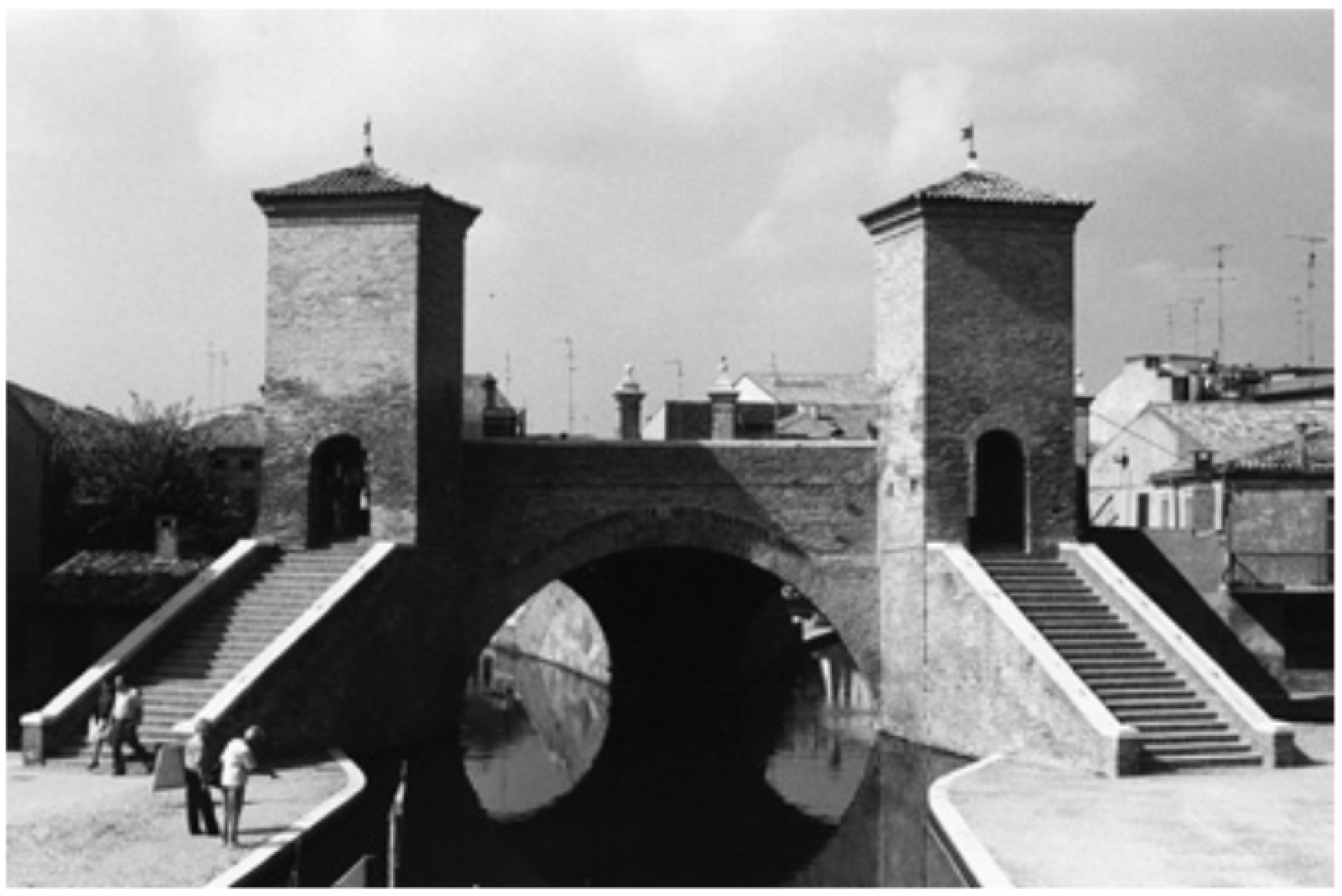
In 1638, Cardinal Legate Giovanni Battista Pallotta commissioned a new bridge to connect three canal banks. Originally designed by the architect Luca Danese of Ravenna as a pentarco due to its five arches, the Trepponti masonry bridge is the most famous representative of the third category, requiring a highly sophisticated geometry to provide access from all necessary sides. The result is a highly articulated spatial and structural configuration, as shown in
Figure 1.
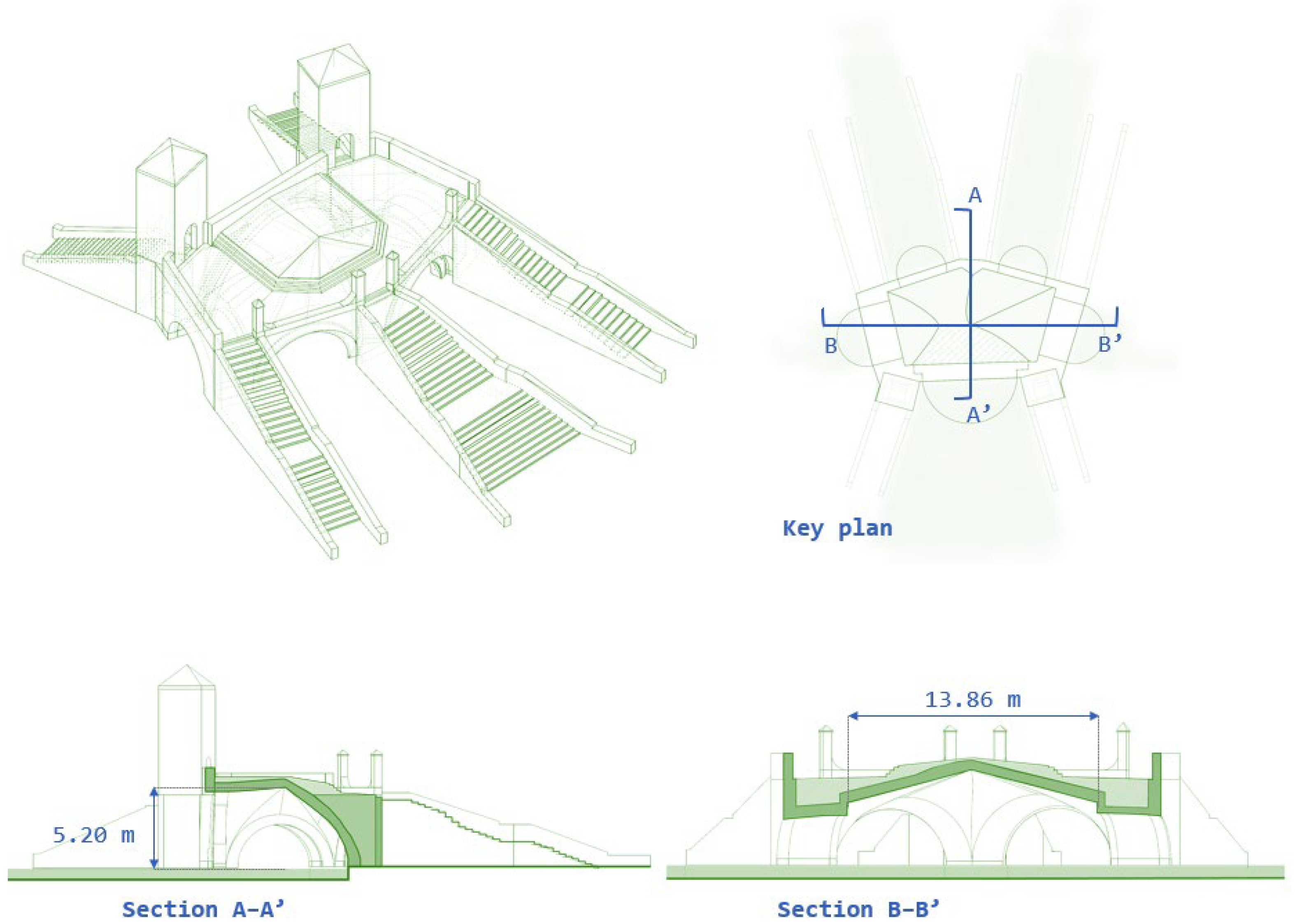
Five peripheral arches arise from their foundation piers, which, when connected, define the irregular pentagonal shape of the bridge. From this plan layout, a network of interconnected vaults is arranged, with their springing points placed either at the peripheral arches or directly from the pier sides. Spandrel walls enclose the system, stiffening the structural layout by retaining the backfill. Staircases on each canal bank connect the two pedestrian levels, enabling circulation from the ground level to the bridge extrados.
The Trepponti bridge has undergone several modifications since its initial completion. In 1695, two towers were added facing the Pallotta Canal, and the side walls of the staircases were raised. Structurally, the load-bearing system consists of angular masonry piers that support the vault network, while the staircases and the towers are independent. The architectural and geometrical survey, as shown in
Figure 2, clearly illustrates the position of the towers, which lie outside the peripheral arches.
3. Methodology
Research on the structural response of complex masonry case studies has traditionally focused on simplified geometries prevalent in historical architecture, such as groin vaults. Advanced methodologies have proposed the use of numerical methods, including macro- and micro-modelling FE approaches combined with Concrete Damage Plasticity (CDP) [
20,
21], the Elastic Body and Spring Method [
5], the Discrete Element Method (DEM) [
22], and, finally, limit analysis in both static and kinematic formulations adopting NURBS-based approaches [
22]. In all these analysis methods applied to double-curvature masonry structures, it is essential to account for arch-fill interaction and soil settlement. Both factors significantly influence the structural response, as the backfill contributes importantly to the load-bearing capacity of the vault [
4,
23,
24], and soil settlement represents a challenge for researchers dealing with historic curved masonry as it can induce consequential failure [
7,
8,
25,
26,
27,
28].
Accurate geometric discretisation is essential to correctly capture failure mechanisms and collapse load, since it is well known that arch-based structures primarily carry through their geometry [
29]. While numerous methodologies capable of precisely analysing “regular vaults” (e.g., barrel, skew, and groin vaults) exist in the literature, a comprehensive approach for the assessment of highly complex, discontinuous vaults remains unexplored. Therefore, accurate discretisation remains essential and can be achieved employing regular quadrilateral or hexahedral elements, while ensuring nodal continuity to avoid stability issues in the numerical model that could compromise the results.
To cope with the aforementioned needs, this research proposes a novel methodology applied to Trepponti—but replicable for similar structures—for its preliminary structural assessment, accurately capturing failure mechanisms by imposing pier settlements. A fully integrated parametric mesh generation process forms the basis for the FE nonlinear numerical model. Given the case study complexity, masonry is modelled as a continuum via homogenization, while maintaining computational efficiency.
3.1. Parametric Geometry Generation
The modelling process begins with PoliBrick-generated discretisation in the Grasshopper environment [
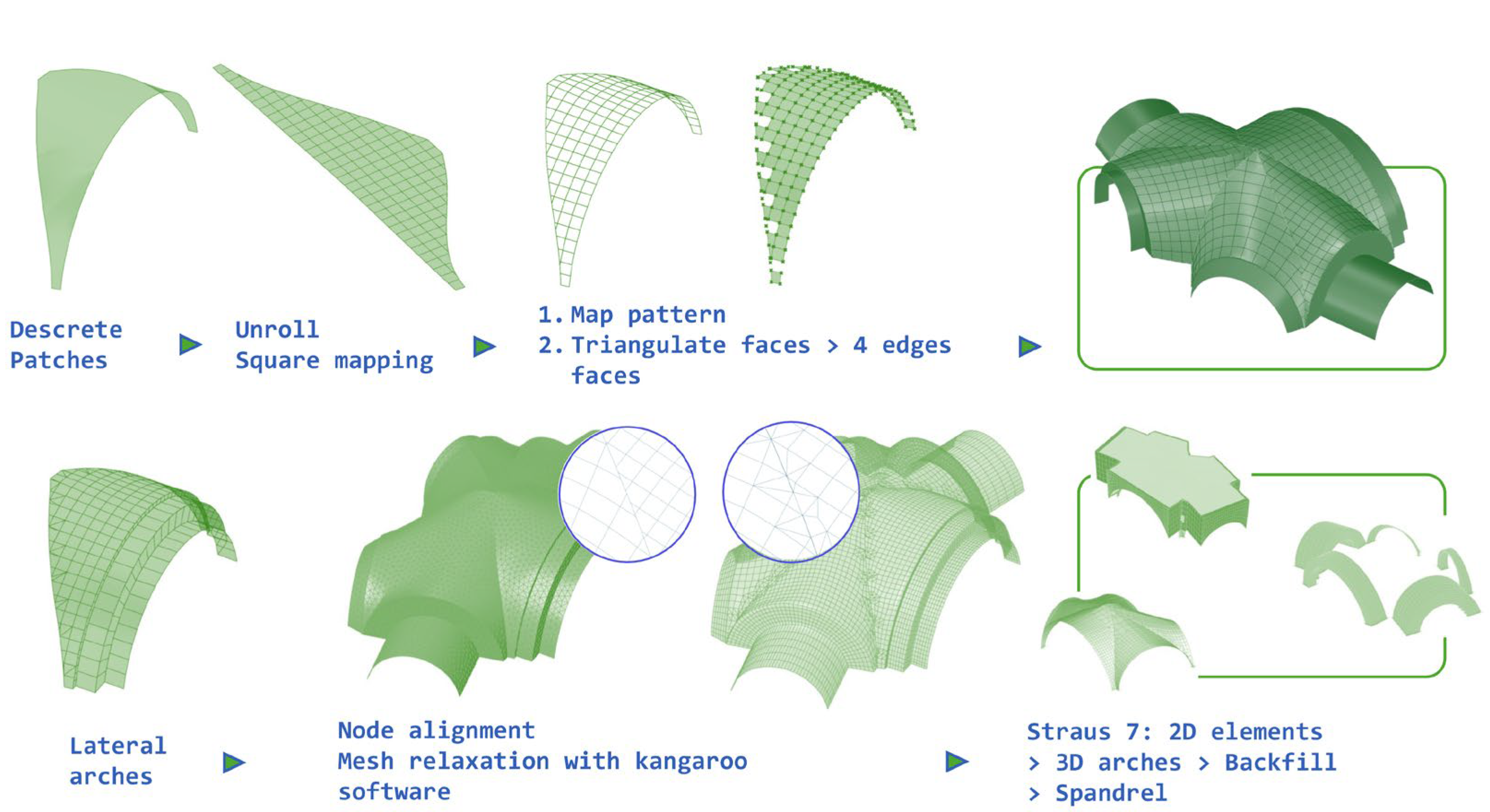
16]. PoliBrick was employed to leverage its dedicated meshing capabilities for translating complex vault geometries into a regularised quadrilateral pattern, suitable for subsequent structural analysis. Beginning from the vault system reference surfaces, a projection and remapping strategy was adopted to define a regular grid over a simplified perimeter profile. This planar arrangement was then reprojected onto the original curved geometry, yielding a mesh composed primarily of regular quadrilaterals, with localised triangulation applied only where geometric constraints precluded the base pattern.
Figure 3 illustrates the key steps, from the base vault surfaces to the final 3D mesh used in the numerical model. The Grasshopper workflow comprises two distinct phases: first, defining discretisation patches on individual surfaces, and then resolving inter-patch discontinuities with a separate script.
Peripheral arches were incorporated after the preliminary discretisation was completed. The differential mesh generation resulted in discontinuities at the interlocking curves, necessitating further refinement to achieve a continuous quadrilateral mesh. The nodal points of the vault components were mapped within the domain of each corresponding peripheral arch. The subsequent solution strategy involved identifying closely spaced points to adjust these discontinuities.
This complex task was implemented using the Kangaroo Physics solver within Grasshopper, a tool often employed for physics-based form-finding. Within this solver environment, point manipulation was applied to enhance discretisation precision through a relaxation procedure, the specific logic of which is detailed in Algorithm 1. The algorithm utilises a multi-objective optimisation strategy where geometric fidelity is balanced against mesh regularity. For this purpose, the “OnMesh” goal compares the preliminary quadrilateral mesh against a highly precise triangular reference mesh to maintain close adherence to the original geometry. Anchor points fix the springing nodes to maintain boundary conditions, while “EdgeLength”, “EqualLength”, and “Smooth” constraints regularise the mesh pattern to prevent distortion during the projection process. The solver iterates until the system’s kinetic energy falls below a convergence threshold of
. In Kangaroo [
30], this metric serves as a proxy for residual motion, indicating that a global equilibrium state has been reached. Following relaxation, the peripheral arches and adjacent regions underwent topological refinement (remeshing) to ensure alignment with the refined vault geometry, followed by the unification of all parts into a single continuous mesh.
| Algorithm 1. Parametric Mesh Regularization and Topological Refinement |
| 1: PARAMETERS |
| 2: Minput: Preliminary discontinuous mesh generated by PoliBrick |
| 3: (Avg. element size: 25.5 × 25.5 cm; Total elements: 3264) |
| 4: Sref: Reference NURBS geometry for the vault |
| 5: ε: Convergence threshold for kinetic energy (1 × 10⁻¹⁵) |
| 6: Damp: Solver damping factor (0.99) |
| 7: Lfactor: Target edge length factor (0.7) |
| 8: W: Set of weighting factors for optimization goals |
| 9: Wgeom ← 1.0 (OnMesh Strength) |
| 10: Wedge ← 1.0 (EdgeLength Strength) |
| 11: Wsmooth ← 1.0 (Smooth Strength) |
| 12: Wequal ← 1.0 (EqualLength Strength) |
| 13: Wanchor ← 1.0 (Anchor Strength) |
| 14: END PARAMETERS |
| |
| 15: function KANGAROO RELAXATION (Mraw, Sref, W) |
| 16: Extract Vertices V ← Mraw.vertices |
| 17: Extract Edges E ← Mraw.edges |
| 18: ▷ Identify boundary nodes closer than tolerance to reference curves |
| 19: Cb ← GetBoundaryCurves(Sref) |
| 20: Vb ← {v ∈ V | Distance (v, Cb) < Tolerance} |
| 21: Goals ← ∅ |
| 22: ▷ Define Physical Goals based on Grasshopper Script |
| 23: Goals ← Goals ∪ OnMesh(V, Sref, Strength = Wgeom) |
| 24: Goals ← Goals ∪ EdgeLength(E, Factor = Lfactor, Strength = Wedge) |
| 25: Goals ← Goals ∪ Smooth (V, Strength = Wsmooth) |
| 26: Goals ← Goals ∪ EqualLength(E, Strength = Wequal) |
| 27: Goals ← Goals ∪ Anchor (Vb, Strength = Wanchor) |
| 28: Initialize solver state Sphys |
| 29: while KineticEnergy(Sphys) > ε do |
| 30: Vnew ← BouncySolverStep(Sphys, Goals, Damping = Damp) |
| 31: end while |
| 32: Mrelaxed ← ConstructMesh(Vnew, Mraw.topology) |
| 33: return Mrelaxed |
| 34: end function |
| |
| 35: function TOPOLOGICALREFINEMENT(M) |
| 36: ▷ Stitching independent vault patches into a continuum |
| 37: Mjoined ← MeshJoin(M) |
| 38: ▷ Removing duplicate nodes at seams |
| 39: Mwelded ← WeldVertices (Mjoined, Tolerance = 10−3 m) |
| 40: ▷ Densification for Finite Element Analysis convergence |
| 41: Mrefined ← Refine (Mwelded, Level = 1) |
| 42: return Mrefined |
| 43: end function |
| |
| 44: MAIN EXECUTION |
| 45: Mrelaxed ← KANGAROORELAXATION(Minput, Sref, W) |
| 46: Mfinal ← TOPOLOGICALREFINEMENT(Mrelaxed) |
| 47: return Mfinal |
3.2. Finite Element Discretisation
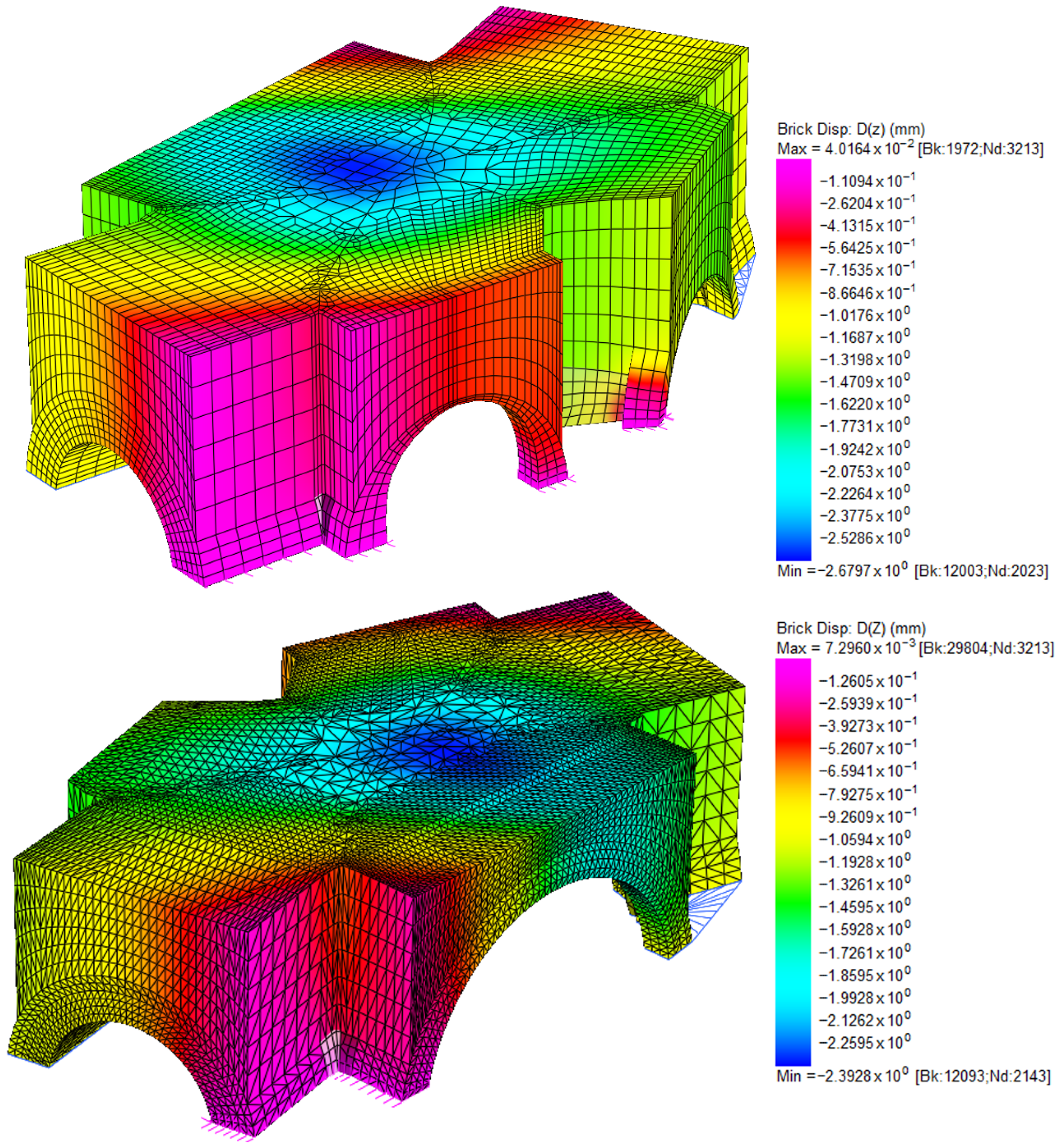
Once the geometric validity was confirmed, the discretisation strategy was defined based on a balance between accuracy and computational cost. To tune the suitable size of an FE model before nonlinear analysis, it is convenient to perform a mesh sensitivity study in the linear range. To cope with such a task, the standard mesh used for the nonlinear computations (19,966 solid elements, consisting of 198,418-node hexahedral elements and 1256-node wedge elements, as well as 182,54-node and 2063-node plate and shell elements) is compared with a refined model (119,421 tetrahedron 4-node elements and 385,63-node plate and shell elements), as illustrated in
Figure 4. The analysis indicated a 12% discrepancy in maximum vertical displacement under linear static conditions. While the refined mesh reduces discretisation error, the computational burden for performing non-linear analysis to identify plastic hinge formation becomes prohibitive. The observed convergence behaviour in the linear range confirms that the standard mesh is sufficiently refined to capture the structure’s global stiffness and geometric response. Therefore, the standard discretisation was retained to ensure computational feasibility while maintaining sufficient accuracy to predict the relevant collapse mechanisms.
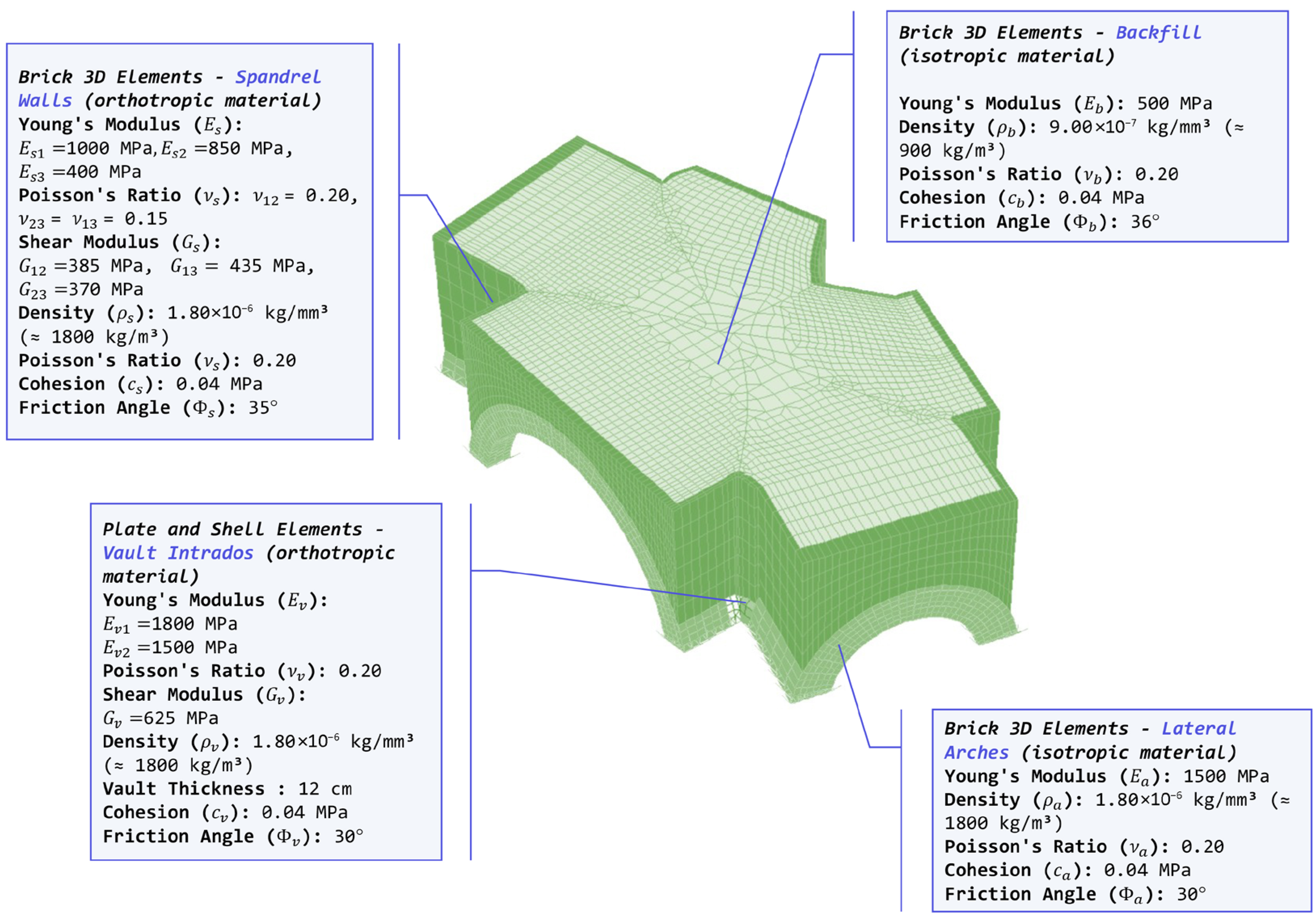
Then, a conventional modelling approach was adopted to generate a complete 3D mesh suitable for finite element analysis in Straus7. The continuous mesh was imported and converted into a three-dimensional discretisation. Here, the vault was represented as shell elements, while the peripheral arches and backfill were modelled as solid elements. The backfill was extruded from the vault and arches up to a reference plane approximating the walkway level, thereby representing the additional structural mass and load effects. Element sizes were controlled to maintain uniform proportions, and geometric grouping enabled the assignment of distinct mechanical properties to each structural component, in accordance with relevant standards. The final model, along with its associated material properties, is shown in
Figure 5.
Within the numerical model, four key structural components were identified: vault, perimeter arches, spandrel walls, and backfill. Isotropic material properties, derived from national structural code provisions, were assigned to each component. The nonlinear response was modelled using a Mohr-Coulomb failure criterion, with parameters—including elastic modulus, density, Poisson’s ratio, cohesion, and friction angle—defined for each material, for which the values are reported in
Figure 5.
3.3. Material Constitutive Model
The selection of a homogeneous macro-modelling strategy was driven by the massive scale of the Trepponti bridge and the extensive geometric irregularities of the vault system. While micro-modelling offers superior detail for small-scale components, applying it to the entire bridge would entail prohibitive computational costs and rely on unverified assumptions regarding the interface properties of the internal rubble fill. Consequently, masonry was modelled as an equivalent continuum. This approach aligns with the “Level of Knowledge 1” (LC1) protocols stipulated by the Italian Building Code (NTC 2018) for the preliminary assessment of existing masonry structures. The adoption of conservative mechanical parameters associated with LC1 ensures that the global stiffness degradation is captured with a suitable safety margin.
Masonry non-linear behaviour was simulated using a Mohr-Coulomb failure criterion. It is acknowledged that this elastic-perfectly plastic constitutive model simplifies the post-peak behaviour of masonry, particularly by neglecting tensile fracture energy (softening). However, for settlement-induced damage, which is mainly a displacement-controlled phenomenon, the structural response is governed by the activation of mechanisms ruled by the formation of well-defined flexural hinges, forming primarily on arches, then spreading in the double curvature vault. Therefore, a Mohr-Coulomb criterion with a low cohesion approximates in a fair manner the no tension materials hypothesis, effectively identifying the location of potential plastic hinges and structural vulnerabilities. On the other hand, the Italian Guidelines for the built heritage, which are specifically conceived for the safety assessment of existing masonry structures characterised by particular cultural importance (Section 5.2.4 of Italian Guidelines), allow the utilisation of 3D FEM models where an elastic-perfectly plastic constitutive behaviour is assumed for masonry [
31].
Further, the mechanical properties of the vault have been investigated in the linear static field with a magnitude variation over the two main directions—
parallel to bed joins and
perpendicular to bed joints as expressed in
Table 1. The sensitivity analysis is performed with a ±30 per cent considering over a selected principal while the material properties in the other direction are kept unvaried.
Table 2 highlights sensitivity analysis findings that demonstrate a proportional dependency between material properties and displacement magnitude. Despite higher displacements occurring if the elastic modulus decreases, the displacement D(z) variation between the simulation case and other proposed cases is ±1–3%. This confirms that the identified vulnerability is governed by the complex geometry (form-resistant structure) rather than the specific calibration of material parameters, proving the diagnosis is robust against material uncertainty. From the elastic analysis results seems possible to state that substantial variations in the Young Modulus (±30%) are responsible for non-substantial variations in displacement field results, ±1–3%.
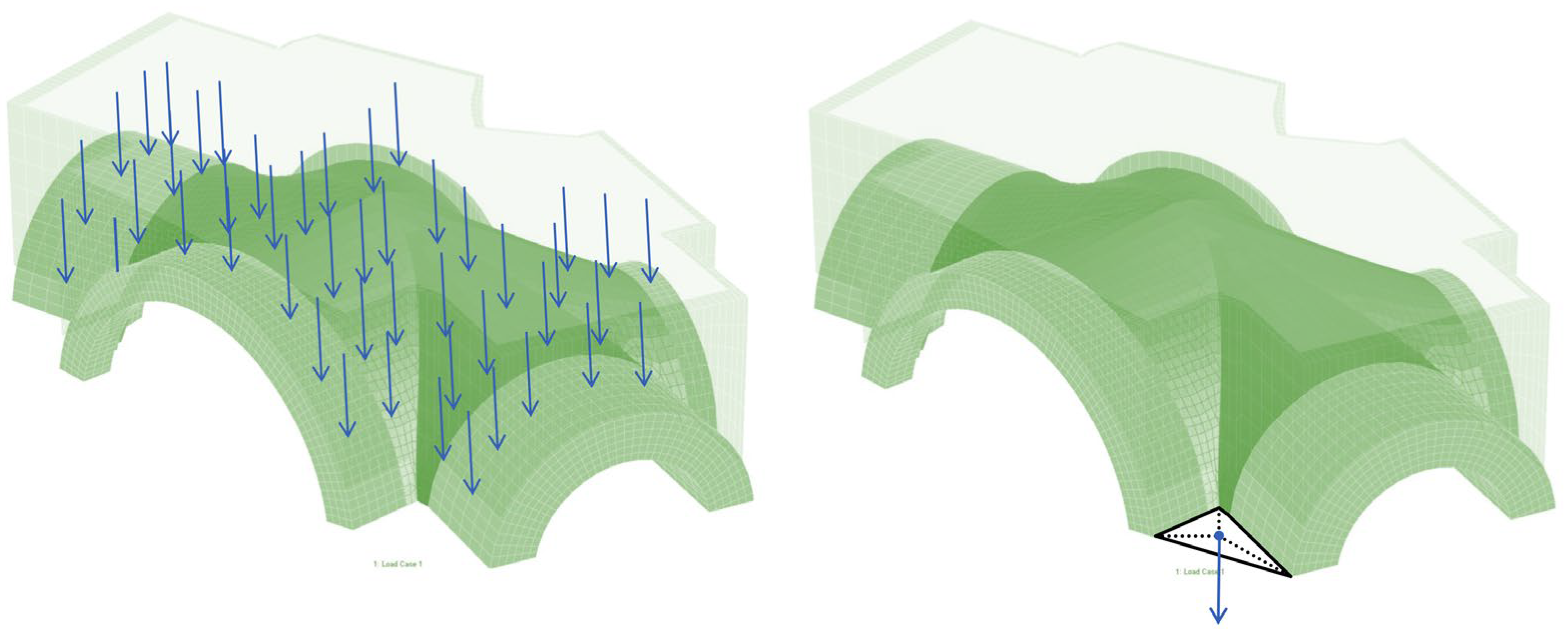
This homogeneous representation, as discussed in detail in the following section, effectively captures the global behaviour, eliminating the need to model individual blocks and mortar joints. This approach is particularly advantageous for large-scale heritage structures, where the primary objective is to assess global performance rather than localised behaviour. The nonlinear static analysis was performed using the Straus7 solver, which employs a Modified Newton-Raphson algorithm. The loads were applied based on automatically assigned material properties. Self-weight was accounted for in the initial load case (first 200 iterations), while foundation settlements were imposed as localised displacements at selected foundation pier points in a subsequent analysis step. A graphical representation of the loading scenario is provided in
Figure 6. The total element internal force vector
is balanced against the external load vector
through an iterative procedure within each load increment. To ensure numerical stability and accuracy, strict convergence criteria were enforced at the end of each load step: the solution was considered converged only when both the relative displacement norm (
) and the residual force norm (
) fell below the specified tolerance thresholds (
).
4. Discussion
To interpret the results within the broader context of masonry mechanics, the proposed methodology is positioned against established computational strategies. While Limit Analysis effectively predicts the ultimate collapse load factor, it inherently fails to capture the evolution of displacements and the progressive degradation of stiffness prior to failure. Conversely, heterogeneous micro-modelling offers a high-fidelity representation of brick-mortar interfaces but remains computationally prohibitive for global analyses. The proposed parametric macro-modelling framework, therefore, fills a specific niche: it provides a rapid, geometrically accurate tool for preliminary assessment that captures non-linear displacement fields without the excessive computational cost associated with discrete element methods.
The numerical model was validated through multiple simulation scenarios, aimed at identifying the actual loading condition of the bridge and capturing its structural behaviour via a detailed preliminary study. As noted, the nonlinear static analysis was conducted in two phases: (1) progressive application of self-weight, and (2) imposition of displacements at each abutment individually (P1–P5) to simulate foundation settlement. The investigations revealed asymmetric deformations and potential contributions to crack propagation, while also highlighting critical zones for future analysis.
Before simulating differential settlements, it is necessary to establish the structure’s baseline equilibrium. The analysis under self-weight serves as the reference state, isolating the deformations caused purely by the bridge’s mass and irregular geometry.
The analyses reveal a markedly asymmetric structural response, identifying two specific piers as critical vulnerable elements. Preliminary observations indicate that this non-uniform behaviour is not merely load-dependent but is governed by the variable stiffness of the vault geometry. Unlike the wider spans at Pier P1 (approx. 6.0 m), the arches connecting to Pier P3 feature significantly shorter spans (approx. 4.0 m) and tighter radii of curvature. This geometric configuration creates a localised “stiffness bottleneck”, attracting higher shear forces and preventing the effective redistribution of stresses. Consequently, Pier P3 acts as a hard point in the structural system, forcing the adjacent vaults to absorb the differential settlement through plastic hinging rather than elastic deformation.
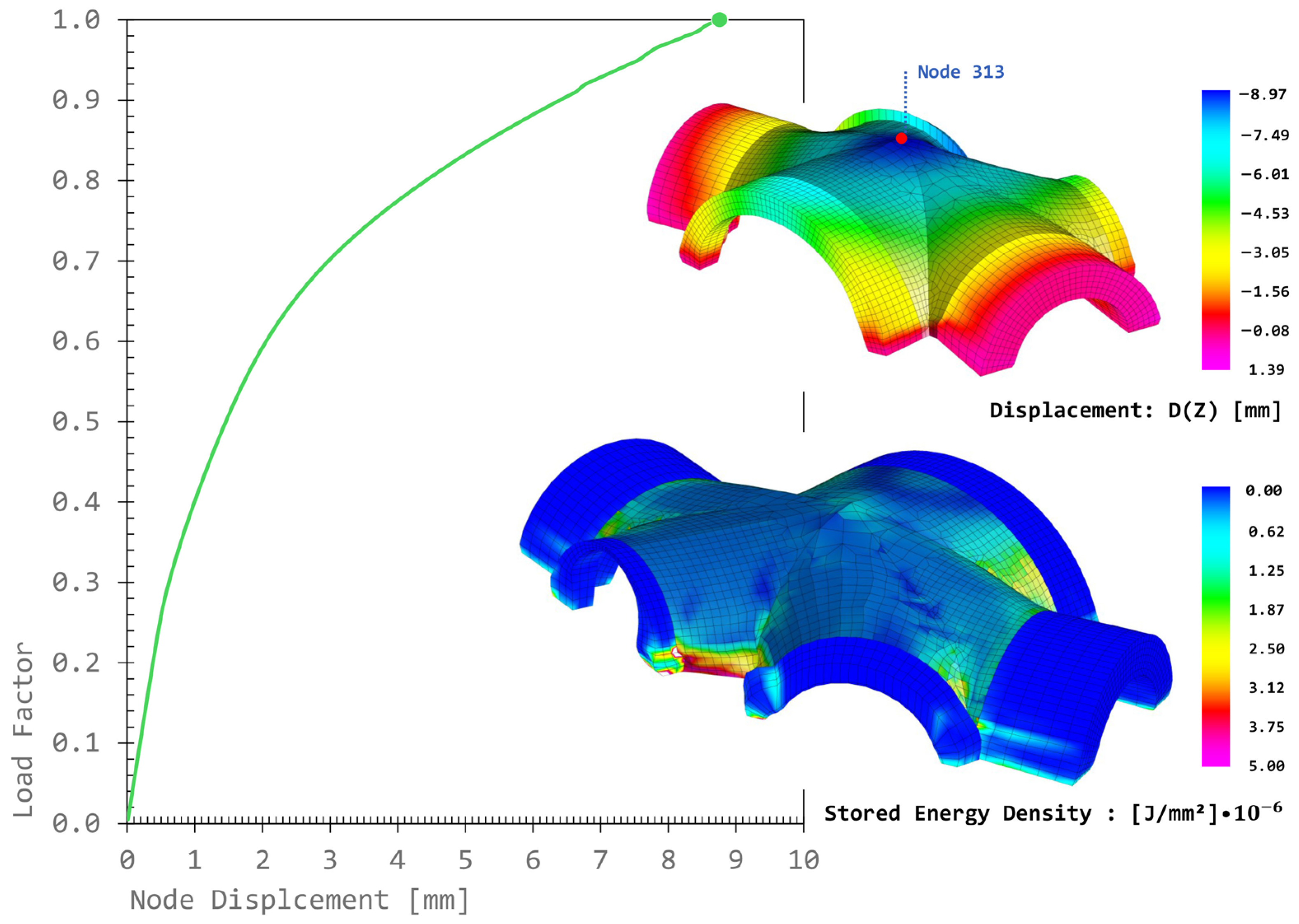
Figure 7 summarises the initial results from the nonlinear FE analysis, illustrating the Trepponti structural behaviour under self-weight. These results are essential, as they represent the baseline structural response without any asymmetric constraints and provide the reference state for all subsequent settlement analyses.
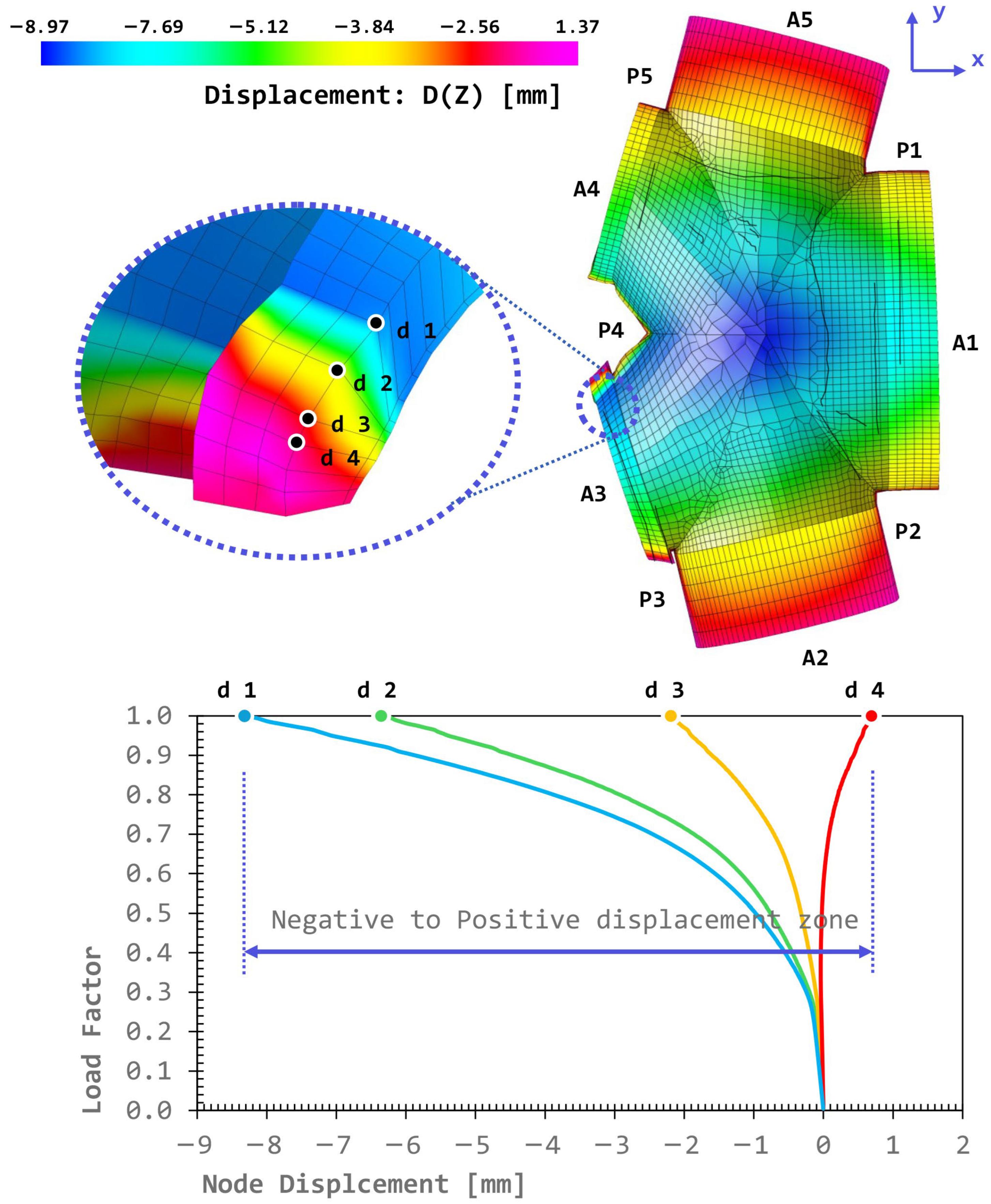
Having characterised the global response under gravity loads, the investigation proceeds to the critical settlement scenarios. The central vault’s irregular geometry produces different behaviour across its five springing zones. Consistent with the loading conditions, the maximum vertical displacement D(z) occurred at the crown (node 313), reaching −8.97 mm. The nonlinear response is evident in the push-down curve, which exhibits an asymptotic trend toward the peak. Although a uniform displacement pattern cannot be defined for all vaults, a significant reduction in deformation is observed from the crown maximum to the abutment minima. Furthermore, even at this initial stage, several critical zones and their associated failure mechanisms can be identified, as shown in
Figure 8.
Since masonry exhibits negligible tensile strength, due to low-cohesion mortar joints, it follows the Heyman thrust line principles. Here, the thrust line is approximated by a set of discrete points, allowing visualisation of a shift from negative to positive vertical displacement in a critical region. Although the present data cannot explicitly reproduce the thrust line, and nodal displacements are limited to the vertical component, this divergence may indicate tensile stresses. For instance, a local displacement difference of 9 mm—with a positive component of 0.62 mm—was observed. A similar mechanism occurred near the foundations, particularly in arch A3. Additionally, the largest span (A1) exhibited a pronounced negative displacement, approaching −8 mm.
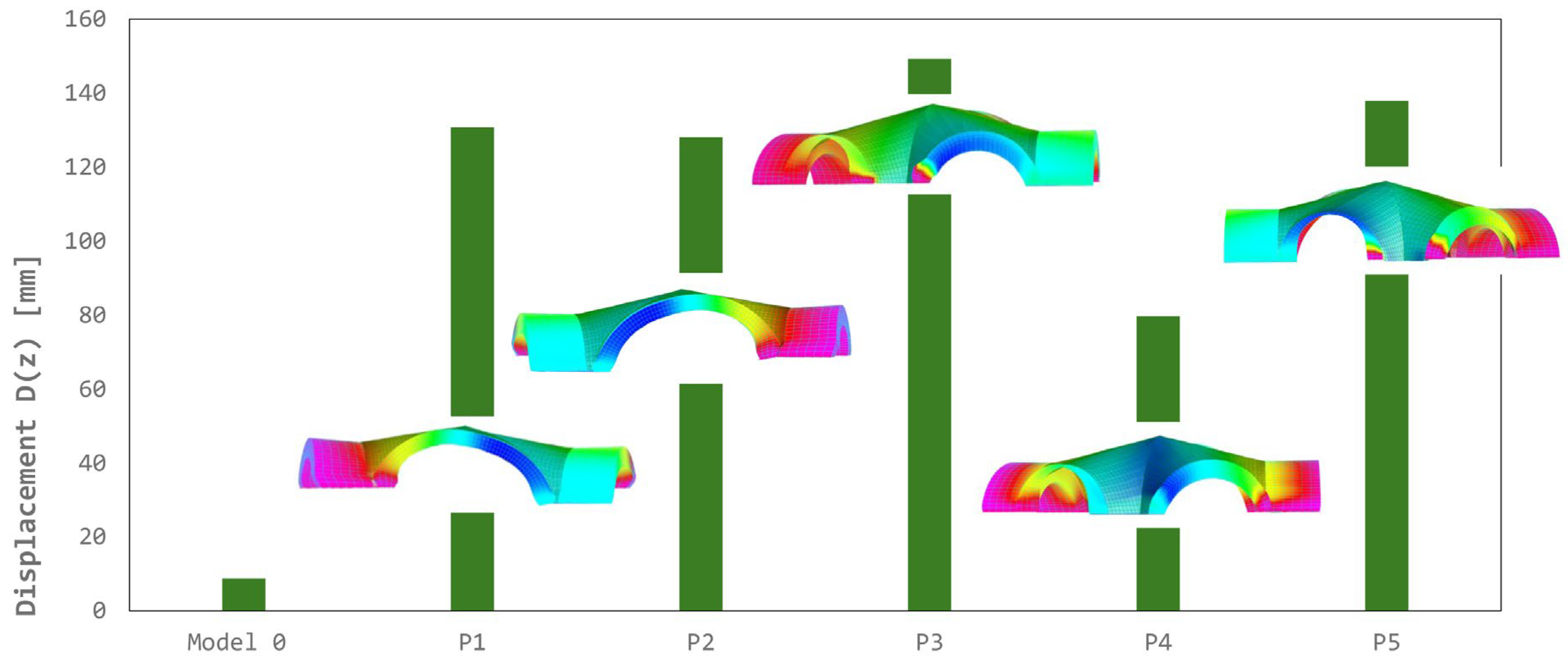
Advanced analyses were conducted for five distinct settlement scenarios, in which a vertical displacement of −10 cm was imposed on a single pier per simulation (over 100 iterations). The results are compared in
Figure 9.
The maximum negative displacement of −14.9 cm occurred at pier P3, exceeding the imposed −10 cm settlement and indicating structural instability in the triangular vault configuration. The minimum displacement was recorded at P4, with a value of −7.96 cm. Here, displacements serve primarily as quantitative metrics to establish benchmarks for evaluation. As previously stated, the study aims to capture asymmetric loading effects and accurately reproduce crack patterns observed in laser-scan surveys [
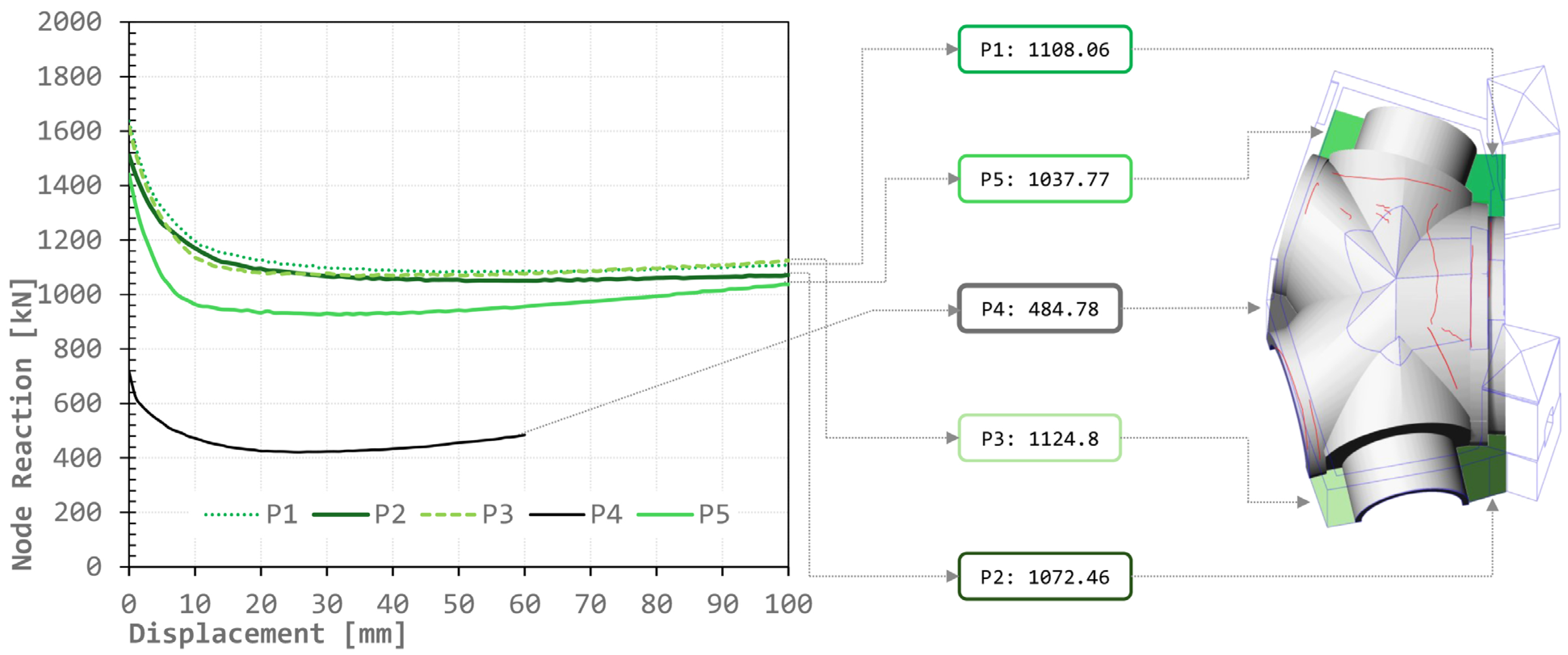
18]. Further insights were gained by examining the reactions at each pier (P1–P5), as depicted in
Figure 10.
The asymmetric load distribution is evident from the vertical reactions at the foundation nodes, as shown in
Figure 10. Among the supports, Piers P3 and P1 sustain the highest forces—approximately 1124.8 kN and 1108.06 kN, respectively. Pier P2, though carrying a comparatively lower reaction of about 1072.46 kN, occupies a pivotal position between these two highly loaded piers. This intermediate placement amplifies shear forces through its joints, heightening its structural vulnerability. Field observations, indicated by red lines in the axonometric view of
Figure 10, confirm this finding: extended cracks propagate from P1 to P2 and from P2 to P3, with nearly parallel crack clusters around P2 and adjacent piers, a pattern indicative of localised stress concentration.
Conversely, Pier P4 exhibits the smallest vertical reaction, approximately 484.78 kN. Its limited deformation implies lower immediate demand; however, evidence of plastic hinge formation points to a latent weakness that could become critical under prolonged settlement. Thus, the analysis establishes a direct link between nonuniform stress distribution and crack progression. Pier P2 emerges as particularly significant, since its role as the main load-transfer path between the most stressed piers promotes shear-induced damage. Conversely, Pier P4’s apparent stiffness reduction leaves it vulnerable, despite modest displacements. These findings demonstrate that relying solely on peak displacement for vulnerability assessment is inadequate; instead, stiffness changes and load redistribution provide deeper insight into structural behaviour.
Beyond the magnitude of displacements, the distribution of internal stresses reveals a fundamental role played by the geometric form. The asymmetry observed in the stress map is not random but stems directly from the bridge’s geometry. Specifically, the plastic strain pattern and the concentration of stress at Piers P2 and P3, can be directly attributed to the irregular pentagonal layout. The connection between Piers P2 and P3 constitutes a “stiffness bottleneck”, which means that the significantly shorter spans and tighter radii in this zone attract higher shear forces compared to the wider, more flexible arches at Pier P1. Consequently, P3 acts as a hard spot, preventing stress redistribution and forcing the adjacent masonry into the plastic range. This identifies the irregular geometry itself, rather than material degradation, as the primary driver of the structural vulnerability.
Limitations and Scope
The interpretation of the numerical results must consider three primary modelling assumptions. First, the adoption of the Mohr-Coulomb failure criterion, while effective for identifying plastic hinge formation in macro-elements, simplifies the post-peak softening behaviour typical of masonry tensile fracture. Second, the bridge was modelled as an initially uncracked continuum; therefore, the analysis predicts potential damage evolution rather than the propagation of centuries-old existing cracks. Finally, soil-structure interaction was simulated in an approximate way, imposing displacements rather than modelling the interaction between structure and soil through complex and computationally demanding 3D FE discretisation. These approximations are consistent with the LC1 knowledge level suitable for a preliminary assessment but suggest that the calculated displacement values should be viewed only as qualitative indicators of vulnerability rather than exact predictions.
5. Conclusions
This study combines parametric design tools and nonlinear finite element analysis into a unified methodology for the structural assessment of historical masonry structures with complex geometries. The research focuses primarily on methodological advancements, successfully addressing geometric complexity through semi-automated mesh generation; the macro-model effectively reproduced both global structural behaviour and localised failure modes.
Although the model provides key insights into load redistribution and damage progression under differential settlement, it cannot yield definitive conclusions or specific preservation guidelines. Further investigation of the bridge material properties, followed by experimental validation, is essential to verify the numerical results.
Various in situ investigation techniques have been proposed for direct assessment of historical structures. These include digital monitoring via sensors—such as Long-Term Dynamic Monitoring [
32,
33]—or highly detailed digital twins with existing damage incorporated [
34]. However, dynamic monitoring can be time-consuming, often requiring years for data collection and interpretation, and poses challenges for direct numerical comparison. Similarly, creating high-fidelity digital models for historical masonry remains challenging due to complex geometries and diverse structural elements like buttresses, piers, and vaults.
Alternatively, experimental testing offers a robust means of validating numerical models. This approach has been widely adopted in the literature [
35,
36,
37,
38]; moreover, complex case studies can be reproduced at a reduced scale since Heyman’s assumptions—negligible tensile strength in mortar joints—simplify potential scaling issues related to masonry cohesion. Recent advances also enable the integration of advanced parametric meshing tools like PoliBrick with 3D fabrication, expanding the potential for modelling even the most complex geometries.
The results obtained in the present study are compliant with Italian national guidelines for preservation and intervention on historical buildings [
39]. The adoption of conservative LC1 parameters ensures the model provides a safe-side representation of global stiffness.
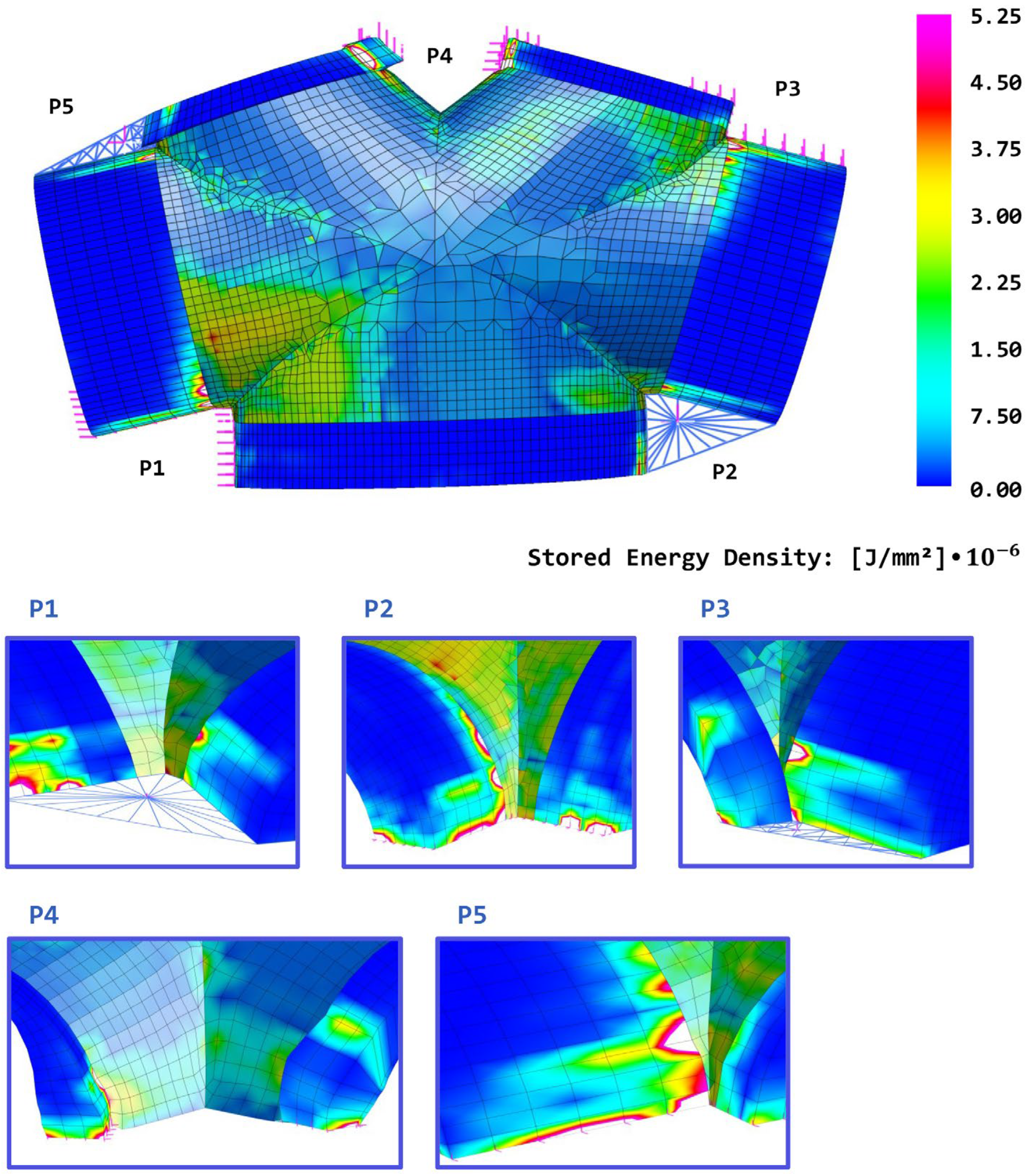
Figure 11 shows energy dissipation data, highlighting areas of stress concentration. Most of the structural demand is absorbed by the foundations, as seen in the detailed insets. In particular, Pier P4 shows potential plastic hinging zones within arches A3 and A4.
Stress is transmitted asymmetrically along the diagonal, resulting in a minimum displacement of –16.31 cm in arch A3 near the base of Pier P4—close to a critical transition zone between positive and negative displacements. Arch A1 also exhibits significant movement, reaching approximately –13.80 mm. These displacements exceed those from single-pier simulations, as the imposed settlement is doubled in this case.
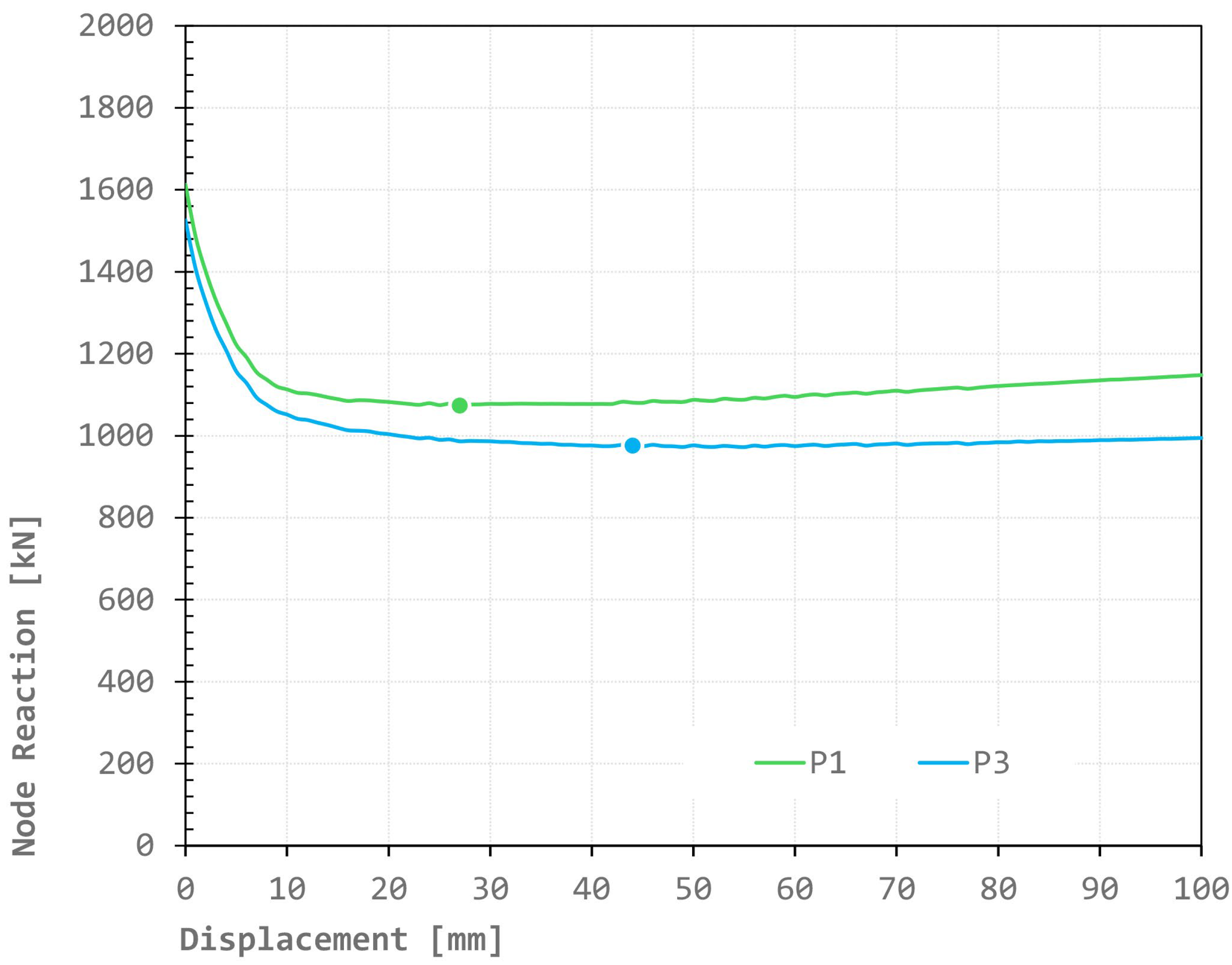
The temporal progression of vertical reaction forces at Piers P1 and P3 is presented in
Figure 12. The evident bifurcation of the reaction curves serves as a quantitative indicator of internal load redistribution, characterizing the structural shedding of load from the supports undergoing settlement.
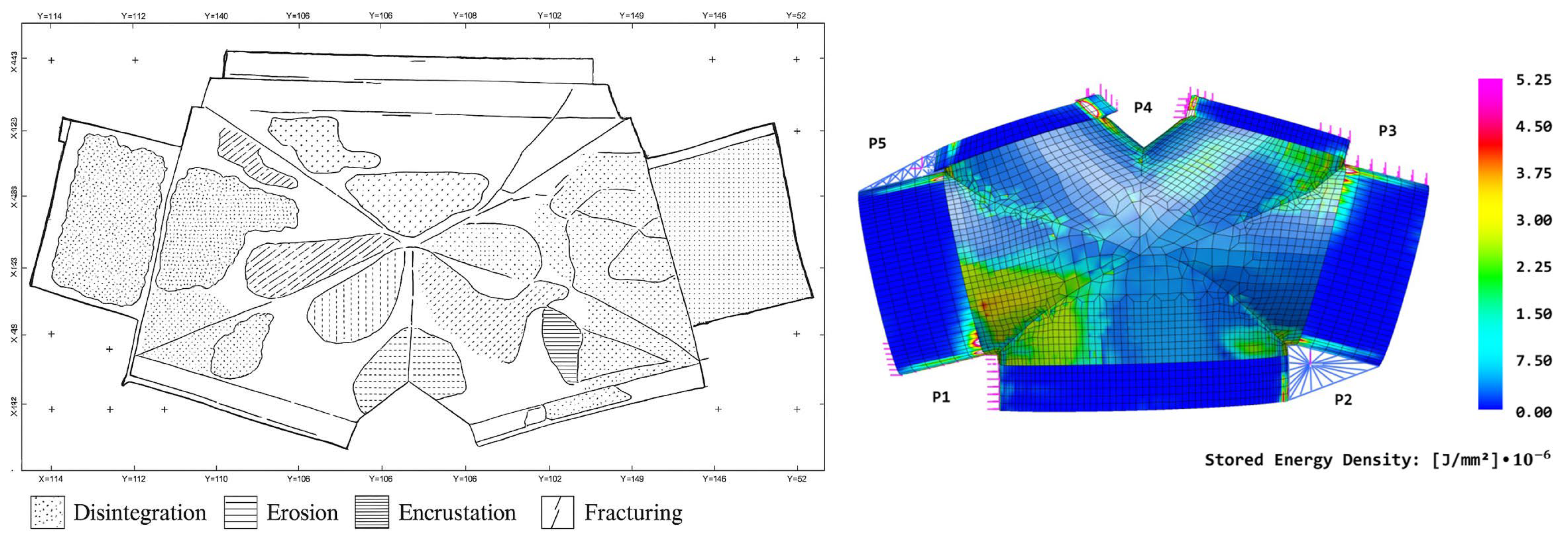
In light of the strict constraints regarding destructive testing on the heritage monument and the absence of long-term dynamic monitoring data, a qualitative validation strategy was adopted to assess the reliability of the numerical model. The predicted stress fields and displacement patterns derived from the FE analysis were cross-referenced with historical damage patterns documented in the architectural survey [
18] as well as recent laser scanning campaigns.
As depicted in
Figure 13, a significant geometric correlation is observed between the numerical predictions and the in situ damage. Specifically, the concentration of Stored Energy Density—which highlights zones of maximum strain accumulation and potential plastic hinging—aligns closely with the actual fracture patterns and degradation identified between Piers P2, P3, and P4. This alignment corroborates the model’s ability to accurately reproduce the global failure mechanism induced by the structure’s irregular geometry, thereby validating the boundary conditions and global equilibrium assumptions employed in the analysis.
Ultimately, Pier P3 exhibits a generally higher response than Pier P1, while Pier P1 shows greater energy dissipation associated with plastic hinge formation and subsequent stiffness recovery.
Given the complexity of the case study, it proves challenging—even with a PoliBrick help—to fully capture structural heterogeneity, though modelling actual cracking patterns would be highly valuable. Similarly, analysing critical arches in isolation for limit assessment would be oversimplified, as it would fail to replicate the boundary conditions integrating the vault with adjacent arches. However, this preliminary study provides a sound basis for designing targeted experimental campaigns or investigation programs aimed at the preservation of the Trepponti bridge.
While this study provides a robust preliminary assessment, certain limitations are acknowledged to contextualise the findings. Future research will address the limitations discussed in Section Limitations and Scope, specifically by integrating laser-scan-derived damage maps and employing advanced damage-plasticity constitutive models.