Article

A Study on the Distribution Mechanism of Juntun in Fujian Province During the Ming Dynasty Based on GIS and MGWR Models

1
School of Architecture, Tianjin University, Tianjin 300072, China
2
School of Architecture and Urban Planning, Tianjin Chengjian University, Tianjin 300384, China
3
Chongqing Nan’an District Housing and Urban-Rural Development Committee, Chongqing 401336, China
*
Author to whom correspondence should be addressed.
These authors contributed equally to this work.
Buildings 2026, 16(1), 45; https://doi.org/10.3390/buildings16010045
Submission received: 1 November 2025 / Revised: 12 December 2025 / Accepted: 16 December 2025 / Published: 22 December 2025

Abstract

Research on the characteristics and functions of ancient Juntun (military tillage) has paid limited attention to the distribution patterns and influencing factors of Juntun in specific regions. This study employs a comprehensive approach integrating GIS technology and the multi-scale geographically weighted regression (MGWR) model to quantitatively analyze the spatial distribution characteristics and influencing factors of Ming Dynasty Juntun in Fujian. The study reveals that Juntun were primarily located in flat areas near water systems, while exhibiting a U-shaped distribution pattern away from garrison forts, reflecting a synergy between agricultural foundations and military defense. MGWR analysis further indicates that fiscal and taxation factors had a stronger influence on their distribution than arable land resources, highlighting their non-purely agriculturally driven nature. This research provides a quantitative basis for understanding the organizational logic and spatial strategy of ancient military settlements, offering valuable insights for the conservation and study of military heritage.

1. Introduction

1.1. Research Background

Marine cultural heritage encompasses the totality of ocean-related cultural expressions and knowledge systems, reflecting the historical trajectory of human–ocean interactions while showcasing the diversity of social cultures. As a pivotal component of marine cultural heritage, China’s Ming Dynasty coastal defense system has garnered scholarly attention due to its rich historical significance and unique academic value.
The Ming Dynasty coastal defense system evolved from localized coastal fortifications into a nationwide defense network, transforming from single defensive structures into comprehensive maritime defense projects that accumulated substantial operational experience and valuable heritage. Juntun (military tillage), a critical military institution in ancient China, were designed to secure military provisions, reduce defense expenditures, and alleviate civilian burdens. The Ming Dynasty represented the apex of Juntun development, with its role becoming particularly prominent within the military framework—especially during the early Ming period, when Juntun played a crucial role in ensuring stable grain supplies for garrisoned troops. As key logistical support nodes within the Ming coastal defense system, in-depth research on these military settlements is therefore essential for understanding the dynasty’s military institutions and maritime defense architecture.

1.2. Research Review

Scholarship on Ming Dynasty coastal defense has accumulated substantial findings. The collaborative work by Fan and Yang, A History of Maritime Defense in China, is widely regarded as China’s first systematic comprehensive history of maritime defense and represents a significant academic milestone [1]. Research on coastal defense has primarily focused on Wokou (Japanese pirate) incursions, the construction of defensive installations, and administrative management. Notable examples include Fan and Tong’s A Brief History of Japanese Pirates in the Ming Dynasty [2].
Kawagoe Yasuhiro has published several studies examining Sino-Japanese maritime defense mechanisms and evolving bilateral relations [3,4]. Connolly and Antony’s article Chinese Piracy and Coastal Defense in Broad Historical Perspective explores Ming–Qing Wokou issues and the impacts of coastal defense on society, economy, and other domains [5]. Brook T. analyzed the causes of coastal defense conflicts during the mid-to-late Ming Dynasty [6].
In recent years, quantitative analyses of Ming Dynasty coastal defense from the perspective of settlement space have yielded substantial findings [7,8]. Research has expanded beyond basic distribution characteristics and site selection analyses to investigate how defensive efficiency [9] and shifts in defensive patterns [10] influenced the overall coastal defense framework of the Ming Dynasty.
However, the integration of spatial analysis and historical geography into the study of military logistics and defense systems remains underexplored. Traditional studies in military logistics often focus on tactical and operational aspects, with limited attention given to how geographical factors—such as the spatial distribution of resources and transportation networks—impact military operations. However, recent advancements in GIS technology provide a new lens for understanding these dynamics by quantifying spatial patterns, making spatial analysis a valuable tool for exploring military logistics and settlement systems. This study endeavours to examine the spatial distribution mechanisms of Juntun during the Ming Dynasty through the lens of historical geography and spatial analysis. Historical geography provides a valuable framework for understanding how geographical factors influenced the development and distribution of Juntun. Similarly, spatial analysis techniques, including GIS and MGWR, allow for the quantification of spatial patterns and their relationship with socio-economic and environmental factors.
As a key military institution in ancient China, Juntun were the focus of notable research from a historical perspective in early scholarly inquiries [11,12,13]. The Ming Dynasty Juntun system has garnered extensive regional research [14,15]. Li, et al. have carried out investigations into Yunnan Province’s Juntun [16]. Li Chen and other scholars have examined the interactions between Juntun-managed farmland in China’s southeastern coastal regions and local societies [17,18]. Gong analyzed how coastal Juntun balanced county governance relations and underwent localization after their military functions declined in the mid-to-late Ming Dynasty [19]. Yan and Zhang’s paper examines the positive impact of Juntun on social development in central Guizhou during the Ming dynasty [20]. Research from a military studies perspective holds equal significance: Tong and Liu’s paper analyses how Ming military operations against Wokou in Korea influenced the development of Juntun [21]. Moreover, scholars such as Han, Zhang, Zhou, and Gao have elucidated the objectives and pivotal role of the Juntun system from a military studies perspective, revealing its evolution from feudal state land tenure and garrison systems [22,23,24,25].
In other related research fields, Jiang et al. employed GIS spatial analysis and morphological indicators to investigate the spatial distribution patterns and influencing factors of military garrison settlements along the Ming Great Wall in the Hexi Corridor of Gansu Province [26]; Du et al. utilized GIS and spatial-temporal analysis methods to analyze the layout logic of the Ming Great Wall in relation to the geographical environment [27]; Li et al. applied a spatial interaction model to evaluate the correlation and logistical logic between the Qin-Han Zhidao and military settlements [28]; Zhao et al. used spatial statistical methods to explain the formation mechanism of traditional villages under natural contexts [29]. Recent relevant studies have shown that research on military settlements has mainly focused on the impact mechanisms of military factors on their spatial distribution patterns and layout forms, while research on traditional villages has begun to explore the formation mechanisms of settlements driven by economic factors. The aforementioned research paradigms and methodologies hold significant reference value for this study.
Nevertheless, research examining the influence of ancient Chinese socio-economic factors on the distribution of Juntun remains scarce. The above research of Juntun findings span multiple disciplinary fields, yet they have predominantly focused on historical descriptions and analyses of the Juntun system. While previous research has focused on the historical and administrative aspects of Juntun, fewer studies have employed quantitative methods to analyze their spatial relationships with geographical and socio-economic factors. This study seeks to address this gap to quantitatively analyze the spatial distribution of Juntun, with a particular focus on the interplay between geographical features, military defense needs, and socio-economic influences, aiming to address this research gap and offer a new theoretical framework and analytical perspective for Juntun studies.
By utilizing GIS and MGWR, this study not only maps the spatial distribution of Juntun but also identifies the key socio-economic and geographical factors that shaped this distribution, such as proximity to water systems, terrain suitability, and fiscal policies. This research thus contributes to a more nuanced understanding of the Ming Dynasty’s military logistics, offering valuable insights into the strategic planning of coastal defense systems and their integration with agricultural production.

1.3. Research Aims

Juntun constituted a key component of logistical supply in ancient military defense systems, and their distribution directly affected the efficiency of logistical support. This study aims to systematically identify the multiple factors influencing Juntun distribution, quantitatively analyze the correlations between these factors and Juntun locations, and explore the underlying causes shaping the spatial distribution of Juntun. Through quantitative research methods, it is possible to reduce the subjectivity in judging Juntun distribution patterns, gain a deeper understanding of ancient Juntun construction, and enhance the scientific rigor of quantitative research on ancient military logistical support systems.

2. Materials and Methods

2.1. Study Area

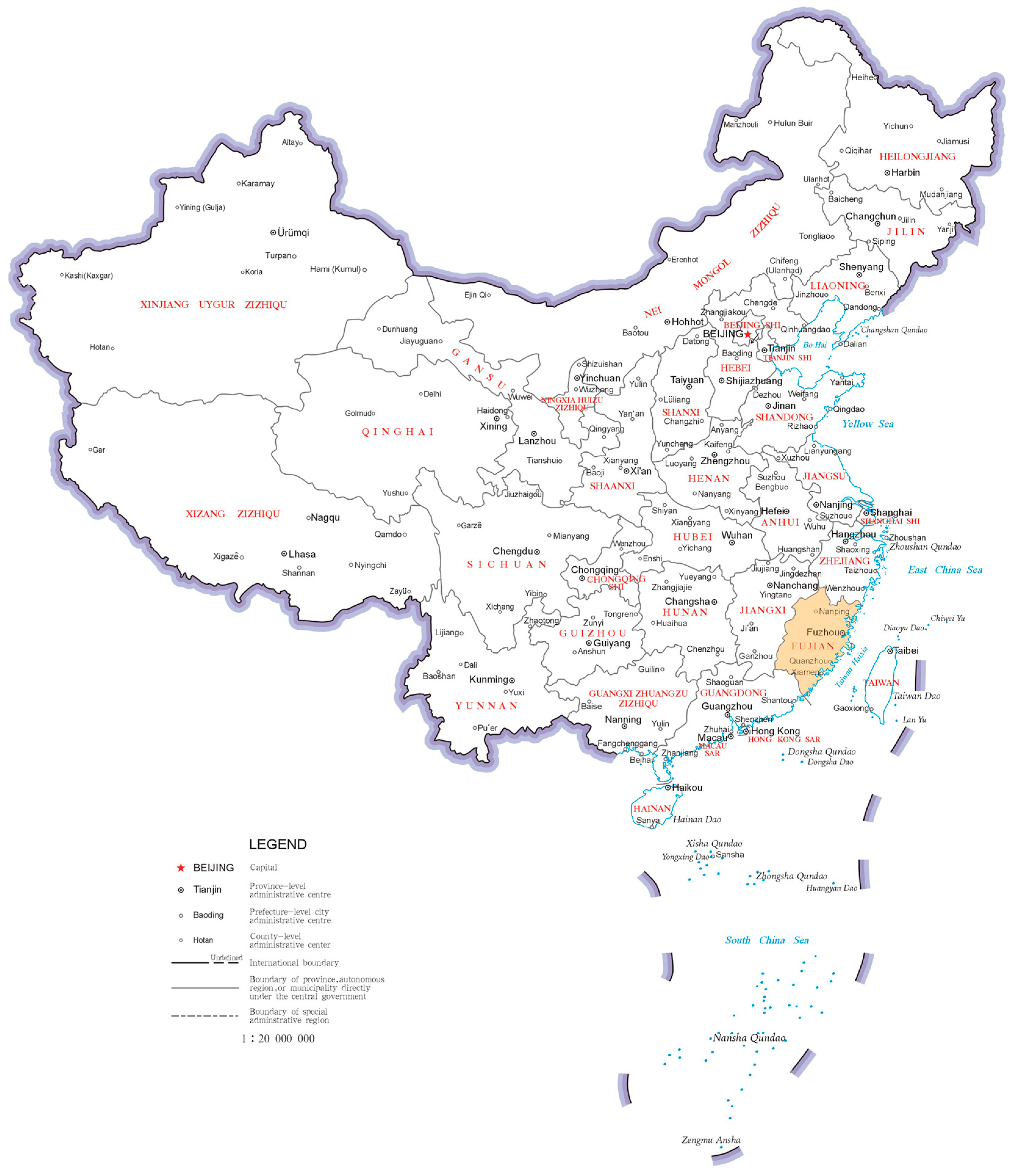
Fujian is located on China’s southeastern coast, characterized by mountainous terrain and hills. Mountainous and hilly areas account for over 80% of the province’s total area [30]. The location of Fujian within China is shown in Figure 1. The narrow plains along the eastern coastal regions and the elongated alluvial plains between high mountains and valleys constitute only 10% of the province’s area. Fujian’s topographical and environmental diversity directly impacts the distribution of Juntun. But these general descriptions alone do not adequately justify the selection of this province for the study of Juntun spatial distribution.
The Minnan Hilly Plains, as an important agricultural production area, faced dual security threats from both inland and maritime regions. Fujian’s strategic importance during the Ming Dynasty makes it an ideal case study for understanding the relationship between military defense systems and agricultural production. The military defense system of Fujian during the Ming Dynasty was divided into two major sectors: the Xing Dusi (Branch Military Commission) was primarily responsible for military defense in inland areas, while the Dusi (Military Commission) oversaw coastal defense [31].
The Wei-Suo system formed the foundation of the Ming military system. Within the four prefectures and one subprefecture along Fujian’s coast under the jurisdiction of Dusi, Wei-Suo operated relatively independently from other prefecture-governed garrisons, each with distinct defense priorities [32]. As an important component of the Ming military system, the Juntun system exhibited significant regional variations in its specific construction across different parts of Fujian.
While there has been extensive research on the role of Juntun in other parts of China, particularly in regions such as Yunnan and Guizhou, Fujian’s distinct geographical and historical context has been underexplored in terms of Juntun’s spatial distribution. Fujian’s strategic military importance, geographical diversity, and historical significance make it an appropriate and critical study area for examining the spatial distribution of Juntun and its relationship to military and agricultural logistics.

2.2. Study Object

In research on Ming Dynasty coastal defense, defensive structures such as Wei citadels, Suo citadels, and forts have already formed a well-established research framework, focusing on their defensive attributes and hierarchical relationships. However, research on the correlations between Juntun and coastal defense settlements remains scarce, lacking in-depth analysis.
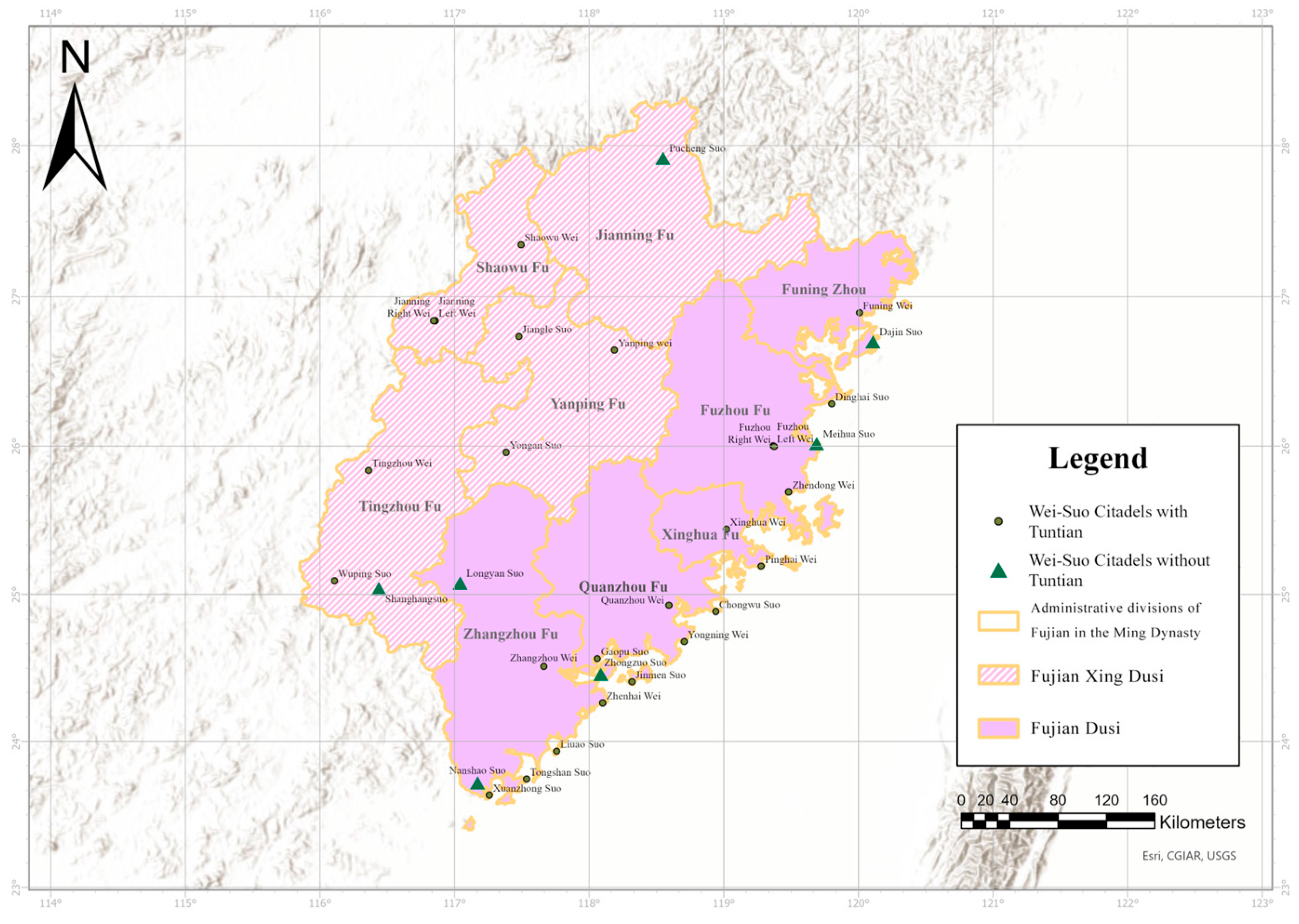
Studies on inland Dusi and Wei-Suo have developed a garrison-fort system, while research on coastal Juntun has mostly been limited to spatial descriptions from a historical perspective, lacking quantitative analysis. As a key coastal defense region in the Ming Dynasty, Fujian boasts rich resources of ancient texts, maps, and local gazetteers. Scholars have described the development of Juntun from a macro perspective and put forward empirical viewpoints, laying the foundation for subsequent quantitative analysis, the distribution of guard posts in Fujian during the Ming Dynasty is illustrated in Figure 2.
This study, however, attempts to clarify the spatial distribution patterns of Fujian’s Juntun through quantitative analysis, fill existing academic gaps, and provide a basis for future research. Specifically, it can be divided into the following points:
First, focusing on the essential nature of Juntun as agricultural production entities, this study takes physical geography as a starting point to analyze the topographic conditions of Juntun site selection, and reveals the shaping role of terrain conditions in the establishment, operation, and spatial pattern of Juntun. This study clarifies the correlation between the geographical location of Juntun and the local topography, landforms, and water systems. Second, this study explores the spatial distribution mechanism of Juntun in Fujian during the Ming Dynasty. It sorts out the influencing factors and employs quantitative methods to evaluate the correlation between each factor and the quantity of Juntun, thereby revealing the underlying causes of their spatial distribution. The multi-scale geographically weighted regression (MGWR) model is applied to analyze the factors affecting the distribution quantity of Juntun in various counties. Through visualization methods, the influence intensity of each factor on the spatial layout of Juntun is intuitively revealed.
Third, starting from military attributes, this study explores the spatial correlation between Juntun and coastal defense citadels, analyzing the military considerations in site selection and their layout logic within the defense system.

2.3. Data Sources

In this study, the DEM (horizontal accuracy of 12.5 m) was published by the Computer Network Center of the Global Academy of Sciences. The locations of Juntun are recorded in both Ba Min Tong Zhi and the county gazetteers of the counties where the Juntun were situated. Their precise locations were confirmed through field surveys. However, due to changes in administrative divisions and shifts in modern urban development, the exact locations of some Juntun sites are difficult to determine. Therefore, such sites were identified after comprehensive consideration, and there may be deviations from historical realities.
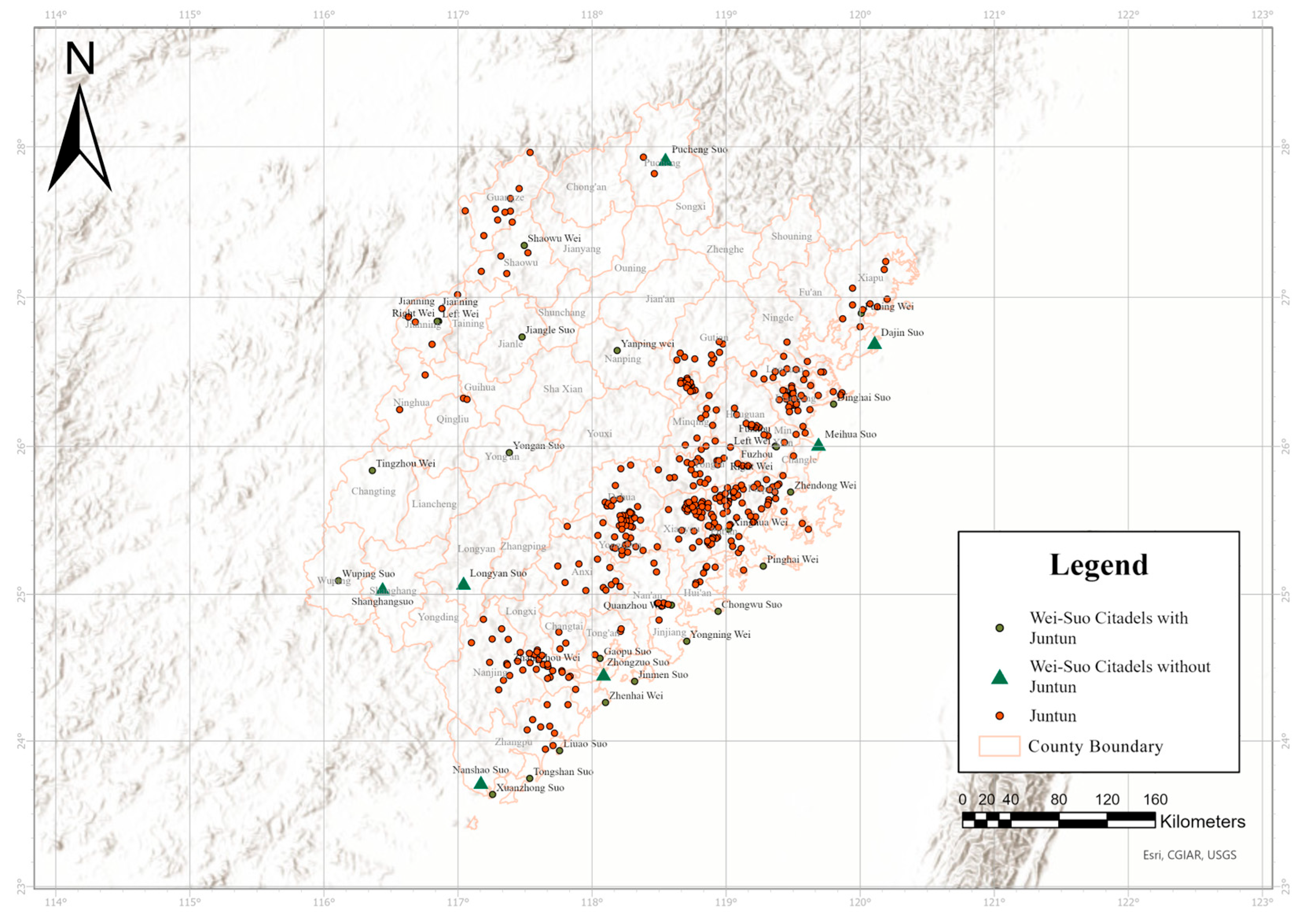
Fujian comprises a total of 54 county-level administrative divisions (with the main area of Funing Prefecture treated as one county), among which 32 counties had Juntun established, totaling 418.
Specialized ancient texts focusing on specific fields, such as Wanli Kuaiji Lu (Records of Wanli), Wu Bei Zhi (Treatise on Armaments), and Chou Hai Tu Bian [33], offer economic data of Fujian and information on the construction of Juntun.
Ba Min Tong Zhi and Min Shu (Book of Fujian) comprehensively record content related to politics, economy, culture, and geography in Fujian. Meanwhile, the gazetteers of each prefecture and county in Fujian provide specific details about the respective prefectures and counties across different periods.
County boundaries in Fujian have undergone constant changes from the Ming Dynasty to the present day—either by establishing new counties through division or merging several counties—making county boundaries difficult to determine. Regarding the changes in administrative divisions of Fujian throughout successive dynasties, the main sources of information are the newly compiled county gazetteers from the 1990s to the present. These gazetteers mostly record changes in administrative divisions across various historical periods, from the establishment of the county through the Yuan, Ming, and Qing dynasties, the Republic of China period, to the era after the founding of the People’s Republic of China.
The specific distribution is shown in the following Figure 3 and Table 1:
Data related to Fujian’s Juntun, such as the distribution of Juntun, the scale of farmland, the grain output of Juntun, and the number of garrison troops, are derived from national historical records and local gazetteers of the Ming and Qing dynasties.
National historical records include official dynastic histories compiled in biographical-annalistic style, such as Ming Shi (History of the Ming Dynasty); comprehensive compilations of administrative regulations, such as Da Ming Hui Dian (Collected Statutes of the Great Ming); and official veritable records from the reigns of various Ming emperors, including Ming Taizu Shilu (Veritable Records of Emperor Taizu of the Ming), Ming Taizong Shilu (Veritable Records of Emperor Taizong of the Ming), and Ming Xuanzong Shilu (Veritable Records of Emperor Xuanzong of the Ming). These ancient texts provide institutional records related to the Juntun under the Wei-Suo system.

2.4. Methods

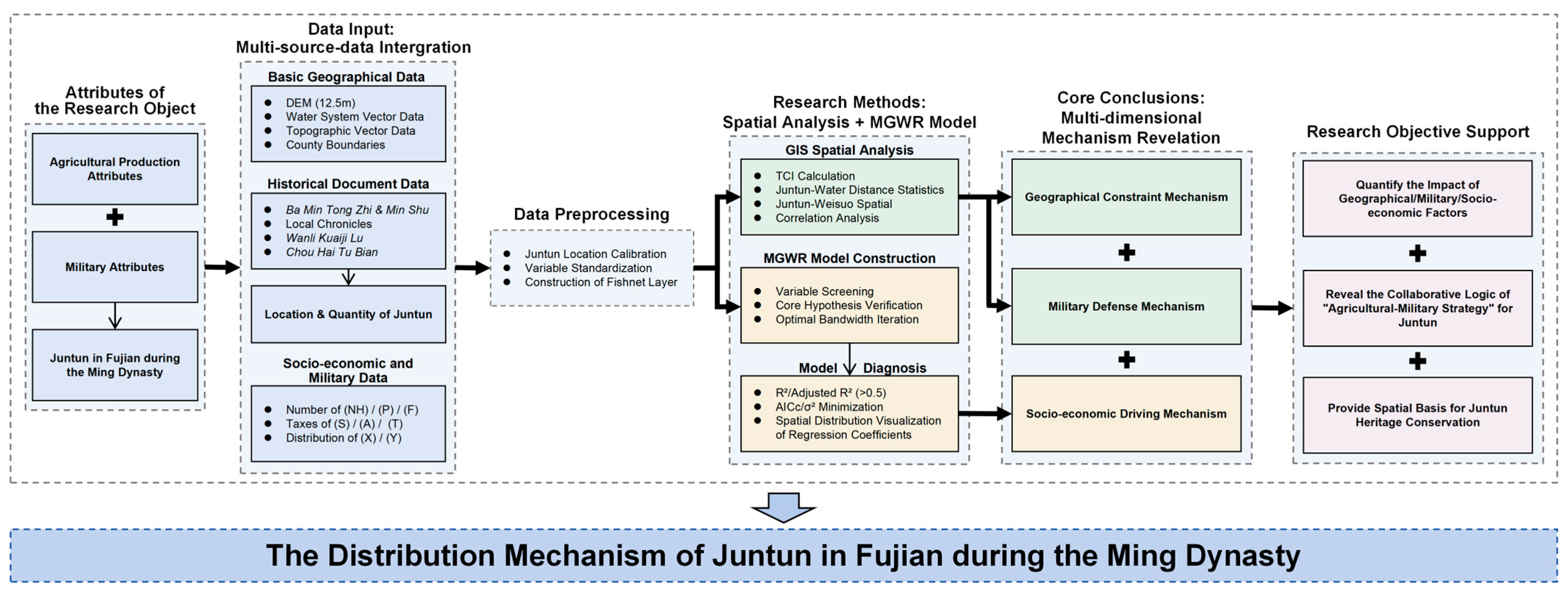
This section first presents the distribution of Fujian’s Juntun from two explicit dimensions: topography and landforms, and military factors. The specific logical framework is shown in Figure 4. These two dimensions are taken as explicit bases because cultivation must be carried out on relatively flat land—especially for state-led Juntun reclamation. Moreover, the primary service targets of Juntun are the coastal defense Wei-Suo, so their distribution is inevitably associated with coastal Wei-Suo. Then, through the MGWR model, analyze the relationship between the explanatory variables and the distribution of Juntun. The explanatory variables include the Number of Households (NH), Population (P), Farmland Area (F), Farmland Area per capita (F’), Summer-Tax-Money (S), Summer-Tax-Money per capita (S’), Autumn Grain Rice (A), Autumn Grain Rice per capita (A’), Table Salt and Rice for Households (T), Table Salt and Rice for Households per capita (T’), Yidipu (Y), Xunjiansi (X), Annual Average temperature (AAT), and Mean Annual Precipitation (MAP).

3. Layout Patterns of Fujian Juntun

Regarding the essential nature of Juntun as agricultural production entities, their distribution must take into account the constraints of natural geographical conditions. From the perspective of their function of supplying grain to Wei-Suo, the military attributes of Juntun also determine that their distribution needs to be rationally planned in terms of the convenience of logistical supply and the appropriateness of military defense. The dual factors of natural geography and military defense have jointly shaped the existing spatial layout patterns of Juntun.

4. Terrain Complexity of Juntun Distribution

Considering the agricultural production needs of Juntun, to achieve more efficient farming activities, Juntun should be located in areas with favorable agricultural conditions. Ancient texts record that the sources of Juntun are diverse, but all prioritize selecting topographical environments suitable for farming. Fujian is mountainous, and flat terrain is more conducive to agricultural production.
GIS technology allows for the efficient processing and analysis of spatial data on Juntun distribution. It directly supports the research objective of mapping and visualizing the geographic patterns of Juntun in relation to natural factors and military infrastructure. By visualizing the spatial patterns, GIS helps identify areas where Juntun are concentrated or dispersed, linking these patterns to the region’s geographical features, such as proximity to rivers and flat terrain, which are essential for agricultural production.
To more accurately and intuitively illustrate the topographic and geomorphic characteristics of Juntun distribution, this section will combine spatial analysis and statistical analysis, using terrain complexity as an indicator to measure the topographic and geomorphic features of the areas where Juntun are located. The Terrain Complexity Index (TCI) is an important parameter for measuring surface morphology and the degree of its variation [34]. It can not only reflect the overall similarity of geomorphic units at the macroscopic scale but also reveal the irregularities of the earth’s surface at the microscopic scale, thus providing important references for the field of planning and layout [35,36].
Based on Fujian’s DEM data, a rectangular neighborhood for reading regional elevation information is set to 600 × 600 m to generate a fishnet layer. This scale is relatively compatible with county-level analysis, and the data volume is not excessively large, facilitating the acquisition of topographic information based on specific Juntun locations. Seven single-factor topographic indicators are derived from the DEM: contour density, slope, curvature, roughness, terrain incision depth, coefficient of elevation variation, and relief amplitude. After aggregating these data into the fishnet layer, bivariate correlation analysis is conducted to screen out single-factor topographic indicators with low correlation. If the correlation between two factors is strong, using the entropy method for weighting may lead to the overestimation of the importance of certain factors, thereby affecting the accuracy of the overall evaluation.
Comprehensive analysis of these topographic indicators enables a more comprehensive understanding of the topographic characteristics of Fujian and provides a more scientific and reasonable basis for the planning and layout of Juntun. The results of the correlation analysis are shown in the following Table 2:
The absolute values of the correlation coefficients between curvature, coefficient of elevation variation and other factors are relatively small. Slope is an indispensable indicator in the analysis of terrain complexity; in terms of the correlation between slope and other factors, slope exhibits the lowest correlation with curvature and coefficient of elevation variation. Therefore, three factors—slope, curvature, and coefficient of elevation variation—are screened out from the seven factors for calculation using the entropy method.
The entropy method first requires determining a series of indicators, then performing a normalization process on the data of each indicator so that their values range between [0, 1], as specifically shown in Formulas (1) and (2).
For positive indicators:
Z i j = X i j X m i n X m a x X m i n
For negative indicators:
Z i j = X m a x X i j X m a x X m i n
The entropy method usually employs Formula (3) to determine the weights of each indicator:
w j = d j j = 1 m d j , j = 1 , . . . , m
Using the weights of each indicator to conduct a comprehensive evaluation of each scheme, a set of important single-factor indicators and a comprehensive index for measuring decision-making results are obtained. This is specifically shown in Formula (4), where xij represents the normalized data.
S i = j = 1 m w j x i j       j = 1 , , n
Due to the different dimensions of the three single factors, the calculation results of the entropy method after the normalization process of these three single factors are shown in Table 3.

5. Factors Influencing the Layout of Juntun in Fujian During the Ming Dynasty

Juntun were subordinate to the Wei-Suo but were not established attached to the cities of their respective Wei-Suo; instead, they were scattered across multiple counties. The final distribution pattern of Fujian’s Juntun was that multiple Wei-Suo’s Juntun gathered within the same county, and there were significant differences in the number of Juntun distributed in each county. To further explore the influencing factors of the spatial distribution of Fujian’s Juntun during the Ming Dynasty, this section uses the MGWR model for analysis.
The MGWR model is used to assess the impact of multiple explanatory variables on the spatial distribution of Juntun. This step directly supports the research objective of quantifying how different factors contribute to Juntun’s distribution across the region. The MGWR model allows us to capture spatially varying relationships between variables, making it particularly effective for addressing the research objective of understanding how both natural and socio-economic factors influence Juntun placement in different areas of Fujian. The specific core assumptions are as follows:
(1)
Spatial Heterogeneity Assumption: The factors affecting Juntun distribution within the study area exert varying effects across different regions of Fujian. By allowing spatial variations in regression coefficients, the MGWR model accurately captures this characteristic.
(2)
Variable Selection Assumption: Variables including farmland area, distance to military strongholds, and household tax burden are selected based on existing literature and historical records. These variables are assumed to be the key determinants of Juntun distribution.
(3)
Spatial Autocorrelation Assumption: Spatial data exhibit autocorrelation. The distribution of Juntun in Fujian is influenced by surrounding settlements, Wei-Suo military garrisons, and geographical factors. The MGWR model fits this spatial dependence by assigning higher weights to adjacent observations.
The specific meanings of each explanatory variable are shown in the table below. The specific data quantities are as shown in Table S1.
The Multi-scale Geographically Weighted Regression Model (MGWR) adopted in this study is developed on the basis of the Geographically Weighted Regression Model (GWR). It breaks the prerequisite in previous studies that the spatial scales of variables must be consistent, allowing regression relationships between variables to be calculated at different spatial scales, and verifies these relationships by selecting the optimal bandwidth [37]. In MGWR, the influencing factors of Juntun distribution are defined as explanatory variables. This approach not only improves the adaptability and accuracy of the model but also more truly reflects the impact of geographical spatial location on the research variables [38]. The general expression of MGWR is shown in Formula (5):
y i = β 0 ( u i , v i ) + j = 1 n β b w j ( u i , v i ) x i j + ε i
Among them, βbwj is used to calibrate the bandwidth of the j-th variable, and xij denotes the value of the j-th independent variable at the spatial centroid point of the i-th unit. The meanings of other symbols are consistent with those in the GWR formula.

6. Space Function Selection

The advantage of MGWR lies in its ability to assign geographical weights to elements in each local regression equation. Elements far from the regression point have relatively weak explanatory power for the target element, and thus carry smaller weights in the regression model. Conversely, elements close to the regression point have greater weights in the regression equation. In the process of determining weights, selecting an appropriate spatial weight function is crucial. This study adopts the bisquare function as the spatial weight function, as shown in Formula (6) below:
W ij   = 1 d ij b 2 2 if | d ij | < b , 0 otherwise .
Wij represents the weight of the influence exerted by the j-th object on the i-th object; dij denotes the distance between the two objects; and b stands for the bandwidth, i.e., the search range. The bisquare weight function assigns a weight of 1 to the regression element (i). However, as the distance between surrounding elements (j) and the regression element increases, their weights gradually become smooth and decay to 0 [39]. The bisquare weight function assumes that all element points outside the designated neighborhood have a weight of 0; therefore, points beyond the designated neighborhood will not affect the local regression of the target element.
The choice of weight function has a relatively small impact on the results, while the bandwidth (b) significantly affects model accuracy. Different bandwidths applied to the same weight function will lead to obvious differences, and the determination of bandwidth is a key step in MGWR.
Neighborhood (also referred to as bandwidth) refers to the distance range or number of adjacent elements. It is a key parameter that requires priority consideration in the regression model. Multiple value combinations are searched for each explanatory variable within the specified minimum and maximum values; through multiple iterations in this process, an optimal bandwidth is determined for each explanatory variable.
There are six parameters output by model diagnosis: R2, adjusted R2, Akaike Information Criterion corrected (AICc), Sigma-squared (σ2), Sigma-Squared Maximum Likelihood Estimate (Sigma-Squared MLE), and effective degrees of freedom.
When there are many independent variables, the adjusted R2 value can more fairly evaluate the quality of the model. This study will comprehensively consider the R2 and adjusted R2 values; an adjusted R2 > 0.5 can indicate that the model has a good fitting effect [40,41,42].
AICc is a statistic used for model selection, which is a corrected parameter of the Akaike Information Criterion (AIC). It can be used to estimate the information content of models containing categorical variables and is suitable for cases with small sample sizes.
Sigma-squared (σ2) represents the least squares estimate of residual variance, which is the normalized sum of squared residuals and used for AICc calculation. A smaller σ2 value indicates a better model fit.
Sigma-Squared Maximum Likelihood Estimate (Sigma-Squared MLE) represents the maximum likelihood estimate of residual variance. A smaller value indicates less variability in the data generation process, i.e., a more stable model.
Based on the above methods, basic combination calculations were conducted. By comparing the bandwidths of each explanatory variable across the entire Fujian and in counties with Juntun, an evaluation model that accurately reflects the extent to which Juntun are influenced by various factors was identified. Specifically, the closer the bandwidth value of each explanatory variable for the entire Fujian is to the number of counties under Fujian’s jurisdiction, the higher the matching degree of the model for all counties in Fujian under this scenario. Similarly, the closer the bandwidth value of each explanatory variable in Juntun-located counties is to the number of Juntun-located counties, the higher the matching degree of the model for Juntun-located counties in Fujian.
The better the performance of the bandwidth values of each explanatory variable across the entire Fujian, the more it serves as a prerequisite for the model to be applied in Juntun-located counties. Through multiple iterations of the model, it was finally determined that a relatively accurate evaluation model is the one that meets both of the above conditions simultaneously. The specific iterative combination scenarios are shown in Table S2.

7. Results

7.1. The Relationship Between Juntun and Terrain Complexity

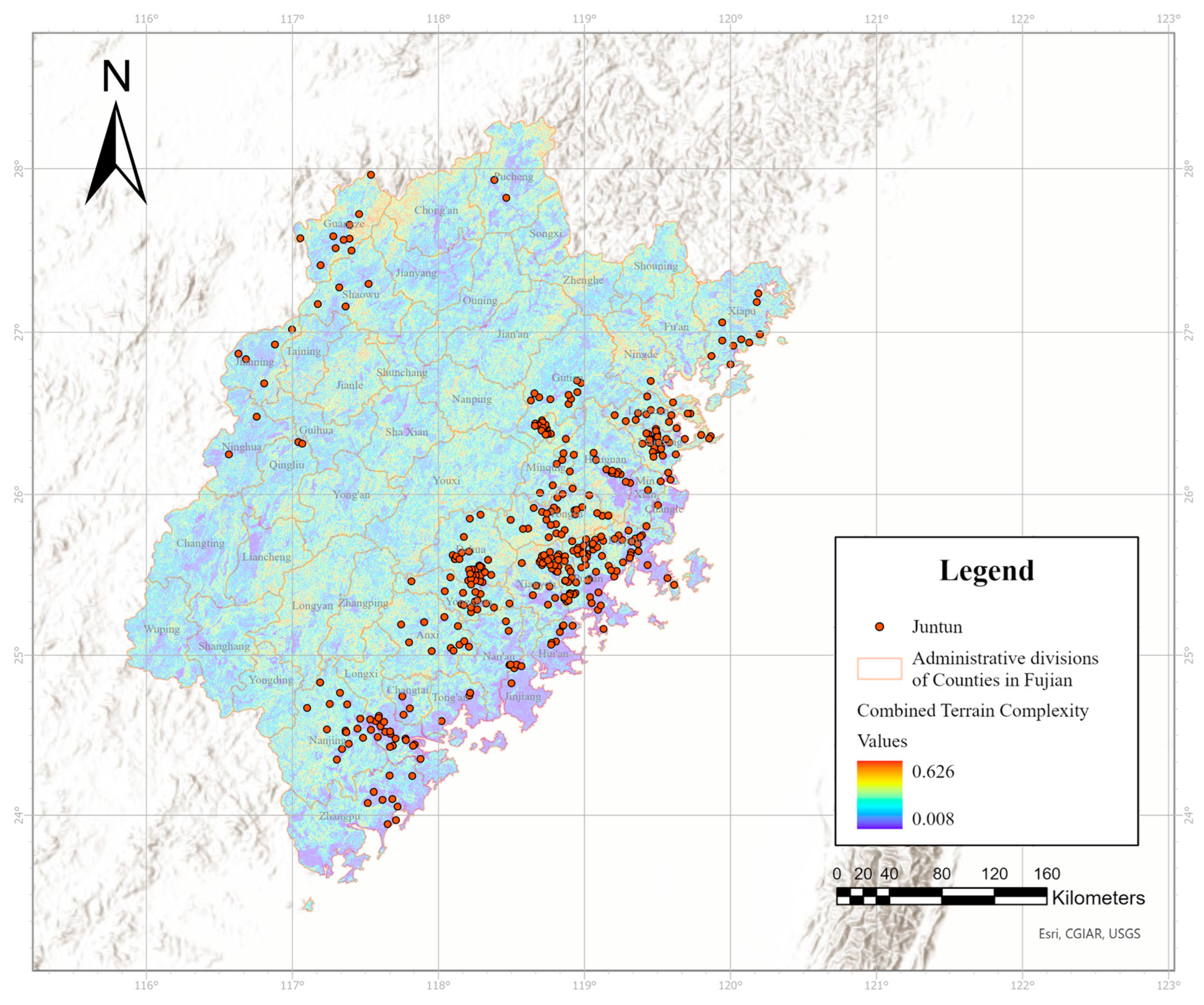
The explanatory variables involved in the subsequent MGWR model and their specific meanings are shown in Table 4. The Terrain complexity of Fujian Province is illustrated in Figure 5. Statistics were conducted separately on the terrain complexity indices corresponding to 600 × 600 m equidistant points covering the entire Fujian, township-level points in Fujian, and 124 precise Juntun locations. For the terrain complexity index across Fujian, the minimum value is 0.008 and the maximum value is 0.626. The specific statistical results are shown in Table 5.
The mean and median of the terrain complexity index across Fujian are significantly greater than those corresponding to townships and Juntun. Over 80% of the townships and Juntun locations have a terrain complexity index below 0.1, indicating that the locations of townships and Juntun are relatively flat areas within Fujian.
Comparing the terrain complexity corresponding to townships and Juntun, their mean, median, and extreme values are relatively close; however, on the whole, the terrain complexity of Juntun locations is slightly higher.
Areas with low terrain complexity are more conducive to farming activities. In Fujian’s coastal regions, the four major plains have natural topographic advantages; in inland mountainous areas, small intermountain basins and river valley plains surrounded by mountains are ideal for the formation and development of settlements.
Juntun are mostly attached to various townships, so their corresponding terrain complexity is bound to be higher than that of the flattest areas in the locality. Additionally, when plain areas are limited, reclaiming hills with gentle slopes into terrace fields is a common practice in Fujian.

7.2. The Relationship Between Juntun and Water Systems

The water system of Fujian is a relatively independent and complete system. Most of the rivers within it originate in Fujian, flow through it, and eventually empty into Fujian’s coastal waters. The Minjiang River, Jiulongjiang River, Tingjiang River, and Jinjiang River are the four most important water systems.
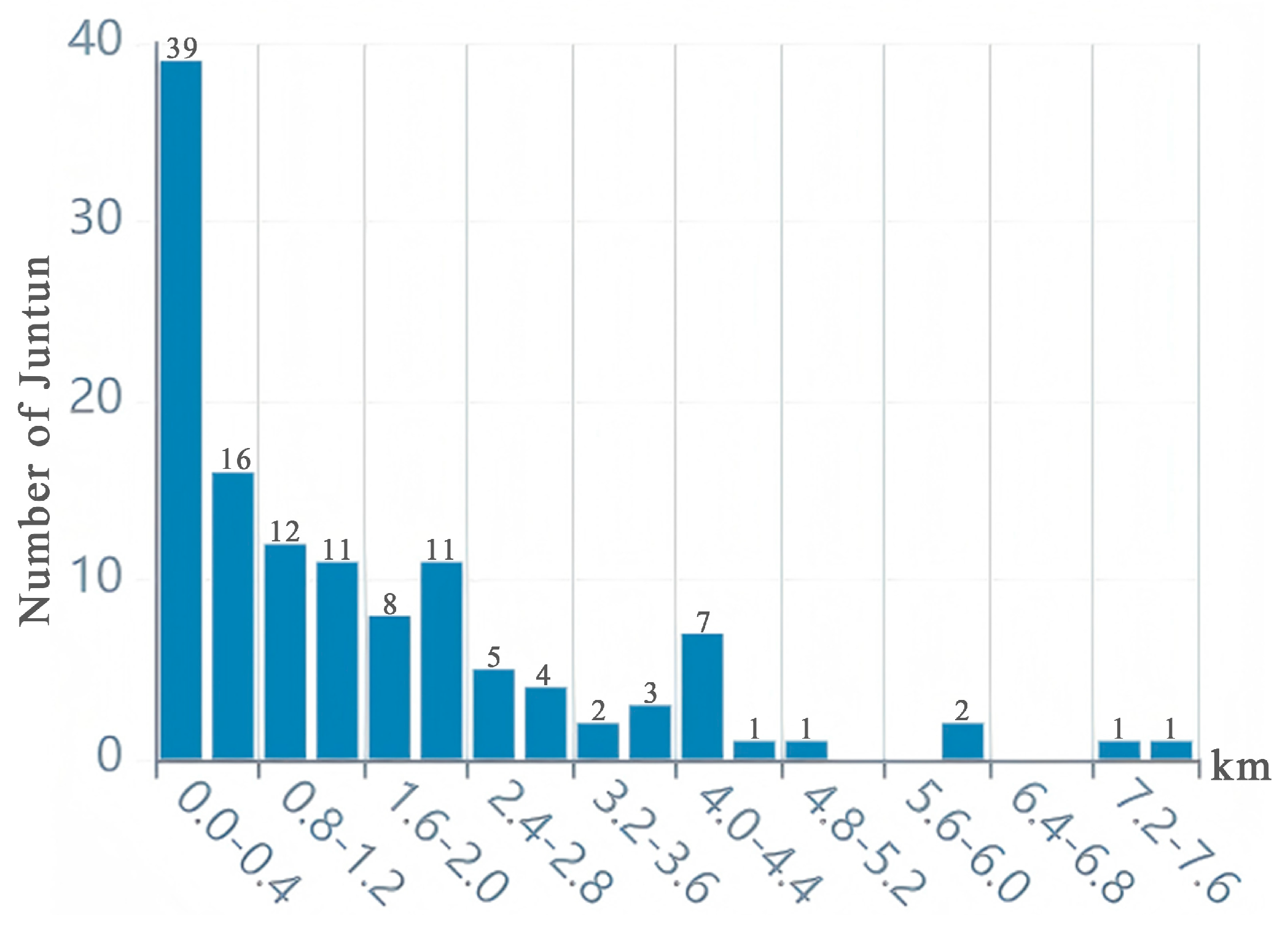
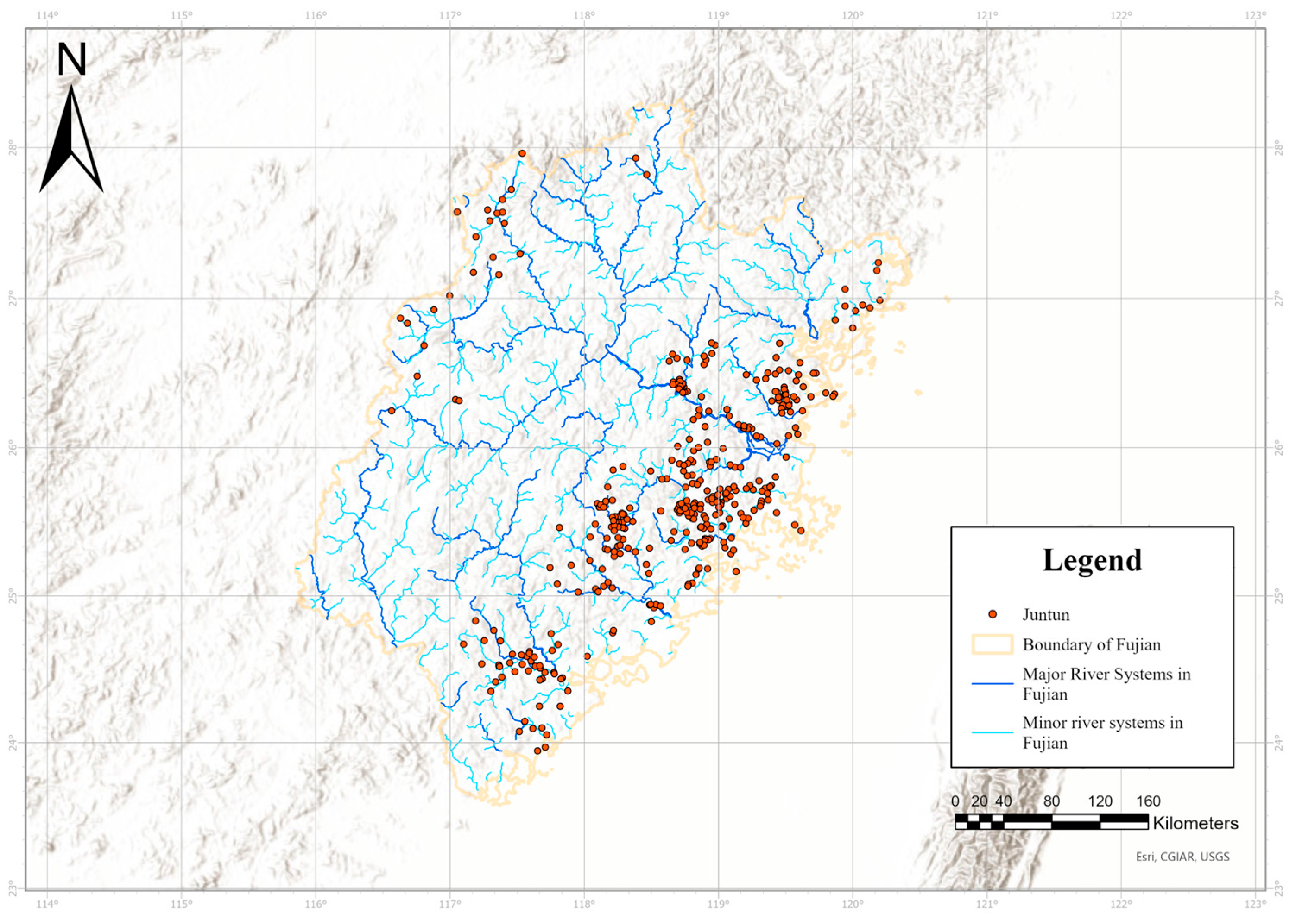
Statistics on the nearest distance between precise Juntun locations and water systems are shown in Figure 6. The nearest distance between Juntun and water systems is within 7.9 km, with an average distance of approximately 1.5 km. As can be seen from Figure 7, most Juntun are within 3 km of the nearest water system. Of the 124 Juntun, 20 are more than 3 km away from water systems, among which only 4 are 6 to 8 km away. That is, over 80% of the Juntun are within 3 km of the nearest water system.
From the above data, it can be seen that the distribution of Fujian’s Juntun exhibits the characteristic of being established along water systems. Especially in Fujian’s geographical environment with numerous mountains, leveraging water transport could improve the efficiency of resource allocation, making the importance of water systems even more prominent. Additionally, the proximity of Juntun to water sources ensured that irrigation water needed for agricultural production and water resources required for daily life could be maximally guaranteed.

7.3. MGWR Model Analysis Results

Among the model results derived from combinations of numerous variables, the absolute values of the regression coefficients for AAT and MAP are relatively small, and their performance in terms of statistical significance is also relatively weak—indicating that the impact of these two variables on the spatial distribution of Juntun is relatively minor.
In terms of socioeconomic influencing factors, NH, P, F, and F’ have a particularly significant impact on the quantity of Juntun in spatial distribution. Among these, NH exhibits a negative correlation with the quantity of Juntun’s spatial distribution, while the other three factors show a positive correlation.
For T, within specific ranges and combinations, it demonstrates a globally significant positive correlation with the quantity of Juntun’s spatial distribution. In contrast, the impact of T’ is relatively limited: it is only significant in specific regions, and its impact magnitude is less than that of NH, P, F, F’, and T.
From the results of the regression analysis, the impact of other factors on the quantity of Juntun’s spatial distribution is not significant.
The proportions of adjacent elements and significant elements of the models corresponding to No. 26 and No. 26’ (i.e., the scenario of this combination in Fujian’s Juntun-located counties) are shown in Table 6.
By comparing the optimal bandwidths of each explanatory variable in the two combinations, it can be observed that across the entire province, the bandwidth of all explanatory variables is 53—indicating that these explanatory variables exhibit weak spatial heterogeneity. Within Juntun-located counties, however, only the bandwidth of F is 28 (with a proportion of adjacent elements reaching 90%), while the bandwidths of all other explanatory variables are 31. This means that on the whole, all explanatory variables still maintain weak spatial heterogeneity.
When the research scope is narrowed down from the entire province to Juntun-located counties, the proportions of adjacent elements of the explanatory variables remain almost unchanged; only the spatial heterogeneity of F slightly but significantly increases.
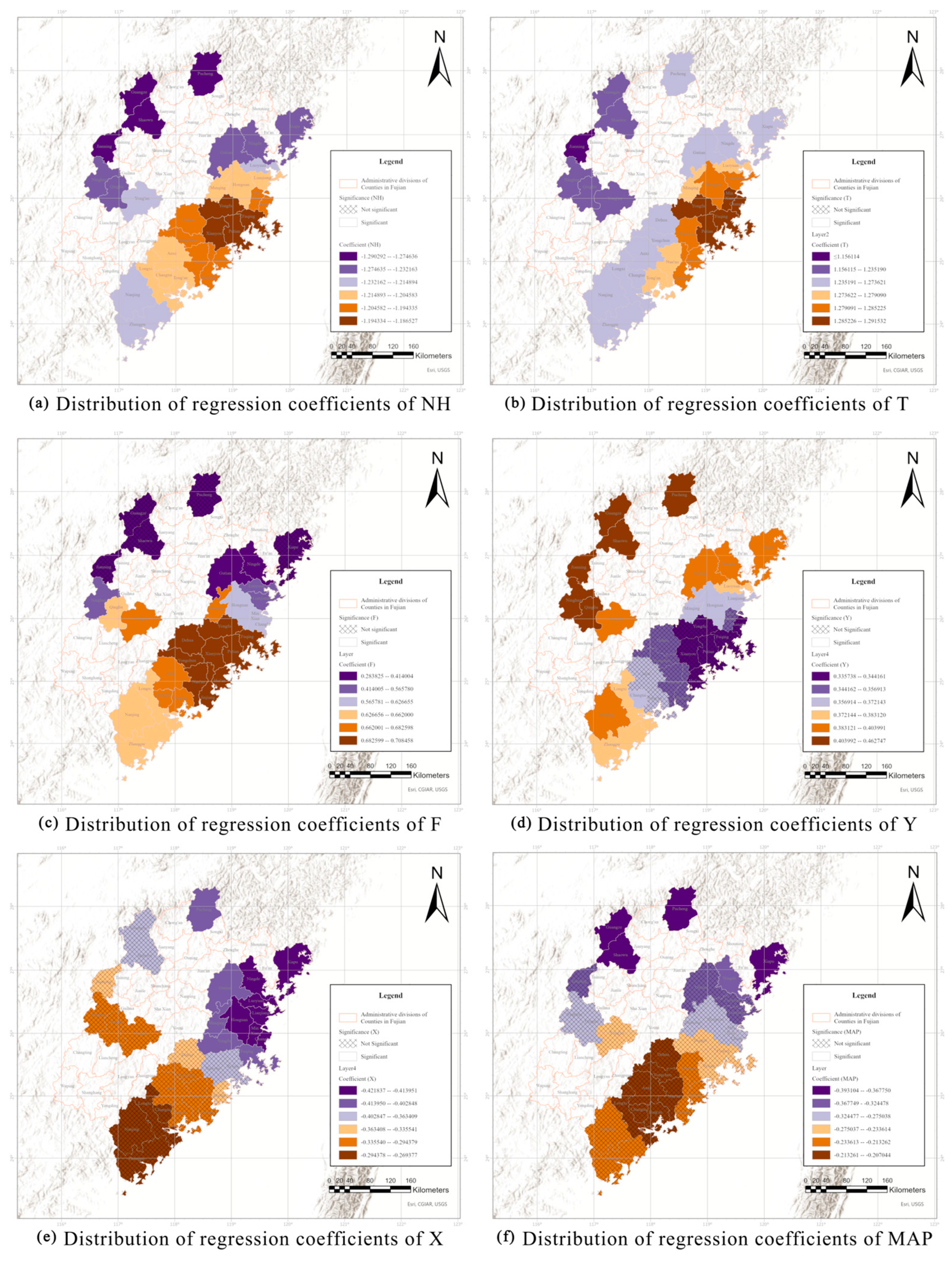
Within Juntun-located counties, there are six explanatory variables that exhibit significance in Combination 26’. Ranked in descending order of their percentage of significant elements, they are, in sequence: NH, T, F, Y, X and MAP. With reference to Table 7 and Figure 8, the specific results are as follows:
(1)
The regression coefficient of the explanatory variable NH ranges from −1.2903 to −1.1865, indicating that the impact of NH on the spatial distribution of Juntun presents a negative correlation. The standard deviation of the coefficient is 0.0293, meaning that the overall fluctuation in the degree of impact of this variable within the research scope is relatively small. NH exerts a globally significant impact on the distribution of Juntun within the research scope. As shown in Figure 8a, the degree of impact is the strongest in four counties—Pucheng, Guangze, Shaowu, and Jianning—in the northwestern inland area of Fujian, while it is the weakest in four counties—Yongfu, Xianyou, Putian, and Fuqing—in eastern Fujian. However, overall, the differences in the degree of impact among various countries are relatively small.
(2)
The regression coefficient of the explanatory variable T ranges from 1.1561 to 1.2915, indicating that the association between T and the spatial distribution of Juntun exhibits a positive correlation. The standard deviation of the coefficient is 0.0304, which means there is a certain degree of fluctuation in the intensity of this correlation across different counties. As shown in Figure 8b, T exerts a significant impact on the distribution of Juntun throughout the research area, and the intensity of this impact gradually weakens outward from counties such as Xinghua Fu, Min County of Fuzhou Fu, Changle, and Yongfu to the surrounding areas. In Jianning, the impact of T on Juntun distribution is the weakest. NH and T are relatively close in terms of regression coefficient range, coefficient mean, and standard deviation. Therefore, within the scope of Juntun-located counties, both have equally high and relatively stable impacts on the spatial distribution of Juntun.
(3)
The regression coefficient of the explanatory variable F ranges from 0.2838 to 0.7085, indicating that the association between F and the spatial distribution of Juntun also exhibits a positive correlation. The standard deviation of the coefficient is 0.1931, which is much higher than those of NH and T. This means there is significant fluctuation in the impact of F on the spatial distribution of Juntun across different regions. This variable exhibits significance in 26 counties, and the significant regions do not include the four northwestern inland counties of Fujian: Pucheng, Guangze, Shaowu, and Jianning. As shown in Figure 8c, the intensity of the impact of F is the strongest in Xinghua Fu and the bordering areas between Fuzhou Fu and Quanzhou Fu. The degree of impact decreases gradually outward from this region as the center to the surrounding areas. The average degree of impact of F within the research area is much lower than that of NH and T. This also means that among these three explanatory variables with relatively high significance proportions, F has weaker explanatory power for the spatial distribution of Juntun.
(4)
The regression coefficient of the explanatory variable Y ranges from 0.3357 to 0.4627, with a standard deviation of 0.0351. The degree of fluctuation in this coefficient is close to that of T. As shown in Figure 8d, this variable exhibits significance in 18 counties. The significant regions do not cover the entire territory of Quanzhou Fu and Xinghua Fu, nor do they include Min County, Yongfu, and Changle of Fuzhou Fu. Specifically, the positive correlation impact of post stations and courier offices on the spatial distribution of Juntun is most pronounced in several counties in northwestern Fujian that border Jiangxi Province. In contrast, Min County, Houguan, Lianjiang, and Changtai have the lowest degree of impact within the significant regions.
(5)
The regression coefficient of the explanatory variable X ranges from −0.4218 to −0.2694, with a standard deviation of 0.0526. As shown in Figure 8e, this variable exhibits significance in 12 counties. The specific regions include two counties—Yongfu and Fuqing —in eastern Fujian, the areas north of these two counties, and the inland county of Pucheng. Within this region, the regression coefficients range from −0.42 to −0.40. Thus, in terms of the significant regions, the degree of negative correlation impact of X on Juntun distribution has relatively small fluctuations.
(6)
The regression coefficient of the explanatory variable MAP ranges from −0.3931 to −0.2070, with a standard deviation of 0.0632—indicating that there is a certain degree of fluctuation in the impact of this coefficient across different regions. As shown in Figure 8f, this explanatory variable exhibits significance in only 5 counties, specifically including Funing Zhou, Ningde, Pucheng, Guangze, and Shaowu.
Therefore, the analysis results can be summarized as follows:
(1)
The Impact of Geographical Factors on Juntun Distribution
The spatial distribution of Juntun in Fujian during the Ming Dynasty is significantly influenced by geographical factors, particularly terrain and proximity to water systems. The analysis shows that 80% of Juntun are located in areas with a Terrain Complexity Index (TCI) of less than 0.1, which indicates that these settlements were primarily located in flat areas suitable for agricultural activities. This finding supports the hypothesis that terrain suitability was a crucial factor in determining Juntun locations.
In addition, nearly 80% of Juntun are located within 3 km of water systems, highlighting the importance of proximity to water sources for both agricultural irrigation and military logistics. The distribution pattern suggests that Juntun were strategically placed to optimize access to both water for agriculture and transportation routes. This result is consistent with historical records that emphasize the role of water systems in supporting both military and agricultural functions in the Ming Dynasty.
(2)
The Role of Military Defense Needs in Juntun Distribution
The results also reveal the impact of military defense needs on the spatial distribution of Juntun. One of the most striking findings is the decentralized distribution of Juntun, with 50% of Juntun located more than 35 km from their affiliated guard posts. This spatial arrangement suggests that military defense strategies played a crucial role in the placement of Juntun, as their dispersion across the region prevented the concentration of resources in a single location and thus reduced vulnerability to external threats, such as the Wokou
Further analysis shows that Juntun located closer to military garrisons tend to be fewer in number, while a larger concentration of Juntun is found farther from garrisons. This “U-shaped” distribution pattern supports the hypothesis that the placement of Juntun was influenced by military considerations aimed at creating strategic depth and minimizing the risk of large-scale attacks. The decentralized nature of these settlements also aligns with historical strategies of military dispersion in defense systems.
(3)
The Influence of Socio-economic Policies on Juntun Distribution
The analysis of socio-economic factors reveals that taxation and fiscal policies had a more significant impact on the distribution of Juntun than the availability of agricultural land. The regression analysis indicates that the variable “Household Salt Purchase Rice” (T), a proxy for socio-economic factors related to fiscal policies, has a higher correlation with Juntun distribution than “Farmland Area” (F), which challenges the assumption that agricultural resources were the primary driver of Juntun placement.
This finding suggests that the distribution of Juntun was not solely determined by agricultural suitability but also by economic policies, such as tax and resource allocation systems. These policies influenced the location of Juntun as part of the broader military and administrative strategies of the Ming Dynasty, which prioritized defense logistics and the management of resources across vast areas.
In summary, the results of this study demonstrate that the spatial distribution of Juntun in Fujian was shaped by a complex interplay of geographical, military, and socio-economic factors. Geographically, Juntun were predominantly located in flat, agriculturally suitable areas near water systems. TCI is a measure of the terrain’s ruggedness, with lower values indicating flatter, more level areas that are more suitable for agricultural activities. A TCI value of less than 0.1 suggests that the terrain is relatively flat, making it ideal for the establishment of Juntun, as it allows for efficient agricultural production and easier construction of infrastructure. This confirms the importance of terrain and water sources for agricultural production and military logistics. Militarily, the decentralized distribution of Juntun reflects strategic defense considerations, with their placement aimed at minimizing vulnerability to external threats while supporting military operations. Finally, socio-economic policies, particularly those related to taxation and resource distribution, played a significant role in the spatial organization of Juntun, challenging traditional views that agricultural resources alone dictated military settlement locations.
These findings contribute to a broader understanding of how military logistics, agriculture, and economic policies intersected to shape the spatial distribution of military settlements in the Ming Dynasty. The study offers a new analytical framework for examining historical military settlements and their role in defense systems, providing insights into the complex relationship between geography, military strategy, and socio-economic policies. These results also have implications for future studies on the distribution of military settlements in other historical contexts, where similar factors may have played a role in shaping settlement patterns.

8. Discussion

The Synergistic Effect of Physical Geography and Military Defense

This study quantitatively reveals the core mechanism underlying the distribution of Juntun in Fujian during the Ming Dynasty through GIS spatial analysis and the MGWR model: physical geographical conditions constitute the fundamental constraint, while the demand for military defense dominates spatial decision-making. Physical geography plays a foundational role in the distribution of Fujian’s Juntun: 80% of Juntun are distributed in flat areas with TCI < 0.1, and nearly 80% of Juntun are within 3 km of water systems. This result is highly consistent with historical records—for instance, the Jiajing-era Dehua County Chronicles explicitly states that “Juntun and defense mutually support each other; hold strategically dangerous locations and control key areas” [43].
However, the average TCI value of Juntun (0.057) is higher than that of villages and towns (0.054), indicating that while meeting basic agricultural conditions, Juntun would proactively sacrifice part of their farming efficiency in exchange for military defense advantages. Based on the distribution of Juntun locations and guard posts, 50% of Juntun are more than 35 km away from their affiliated guard posts, forming a decentralized layout far from the guard posts.
This phenomenon stems from dual military logics: first, the decentralized layout prevented Wokou from concentrating their efforts to destroy grain storehouses, and the garrison troops in Juntun, located in border mountainous areas, formed a deterrence network against inland bandits [44]. For example, Dehua, situated on the edge of the jurisdiction of the Fujian Dusi, had a total of 32 Juntun, which played the role of “Juntun and defense mutually support each other; hold strategically dangerous locations and control key areas.” [24] While supplying military needs, these Juntun also created strategic depth to defend Fujian’s political center and prevent raids by bandits from the mountainous areas in western Fujian.
This “policy-geography” feedback loop refers to the dynamic interaction between socio-economic policies and geographical conditions, where each influences the other. In the context of Juntun distribution, the Ming Dynasty’s fiscal policies shaped where military settlements were located. In turn, the geographical features—such as terrain suitability and proximity to water sources—impacted the effectiveness of these policies in meeting military and agricultural needs. This feedback loop emphasizes the reciprocal relationship between political decisions and the physical environment, providing a comprehensive framework for understanding the strategic layout of Juntun. It contributes to the theoretical understanding of how political and geographical factors jointly shape settlement patterns and military logistics.
Therefore, physical geography, specifically the flat terrain and proximity to water systems, played a fundamental role in the distribution of Juntun. However, the demand for military defense dictated their final spatial layout, as Juntun were often located in strategically dispersed areas to prevent enemy forces from concentrating their attacks. This result supports the hypothesis that military defense needs have a significant influence on the location of military logistics systems.

9. The Mutual Reinforcement of Policy Constraints and Geographical Environment

The Ming Dynasty policy of “not competing with the people for farmland” [45] and Fujian’s mountainous terrain jointly shaped the distribution characteristics of Juntun, with the policy leading to spatial dispersion. The “U-shaped” distribution of Juntun reflects a strategic military logic, where settlements were placed further from military garrisons to create a decentralized defense system. The proximity to coastal areas and the inland regions was designed to ensure that Juntun could serve as both a logistical support system for military forces and a defense buffer against external threats. This distribution pattern minimized the risk of a concentrated attack on military supply points, thus enhancing the defense network’s overall resilience.
The main sources of farmland for Juntun were official farmland and wasteland [46], which were mostly located on the edges of large-scale farmland areas—dispersing Juntun into small-scale units. This relationship between geographical constraints and policy decisions extends the work of previous studies on the interplay between geography and policy [47,48]. This study provides further evidence that policy decisions did not merely respond to geographic realities but were actively shaped by them, creating a unique “policy-geography” feedback loop in the distribution of military settlements.

9.1. The Discrimination and Analysis of the Main Influencing Factors on Juntun Distribution

Most previous studies argue that the distribution of Juntun depends on cultivated land resources [49,50,51]. However, the MGWR model in this study reveals that the regression coefficient of “farmland area” (F) is only 0.586, which is much lower than that of “Household Salt Purchase Rice” (T) (1.264). This indicates that the financial and tax system drives the layout of Juntun more directly than cultivated land itself.
Traditional views hold that the density of Juntun decreases as the distance from guard posts increases [52,53]. Nevertheless, this study finds that the distribution of Juntun shows a “U-shaped curve”. In the short-distance range (<10 km), there are a small number of Juntun that directly serve Wei-Suo. In the medium-distance range (10–35 km), the distribution of Juntun is relatively sparse. In the long-distance range (>35 km), there is a dense distribution of Juntun, accounting for approximately 50% of the total. This distribution pattern benefits from the supply convenience provided by post roads and water networks.
Juntun were not only agricultural production units, but also material transfer nodes connecting agricultural regions and defense systems. For instance, Lianjiang Juntun had direct access to the Fuzhou Wei-Suo via the Au River-Min River water system—this corroborates the transport efficiency advantage of the traditional pattern of “Southern regions rely on boats, northern regions on horses” [54,55].
The findings align with recent studies on the spatial distribution of military settlements in historical contexts [56,57]. They highlight the role of transportation networks in enhancing the strategic positioning of military settlements. This study extends this research by showing how both military strategy and logistics infrastructure influenced the spatial organization of Juntun.

9.2. Limitations of This Study and Future Directions

This study also has room for further improvement in data refinement and research methods.
Firstly, insufficient data refinement. The 124 precise locations of Juntun in Fujian during the Ming Dynasty account for only 29% of the total number of Juntun. The semi-precise locations (259 in total) rely on corresponding positioning based on descriptions in local gazetteers, ancient maps, modern and contemporary maps, and toponym evolution—this may lead to spatial deviations. In the future, it will be necessary to integrate cross-validation with materials such as genealogies, stone inscriptions, and archaeological artifacts to further improve the accuracy of these locations.
Furthermore, the limitations in the quantification of natural factors, such as climate, suggest the need for future studies to incorporate paleoclimatic data to better reflect the environmental conditions during the Ming Dynasty.
Additionally, the subjective decision-making of military commanders and local officials, which likely played a role in determining Juntun locations, was not considered in this study. Incorporating these factors into future analyses could provide a more comprehensive understanding of the decision-making processes behind the establishment of military settlements. By examining historical writings and documents from military leaders, future research could explore how individual preferences and political dynamics influenced the spatial organization of Juntun.

10. Conclusions

This study combines GIS with the MGWR to systematically analyse the core mechanisms underlying the spatial distribution of Juntun. The specific conclusions are outlined below:
First, through GIS, this study quantitatively analyzes the fundamental constraints of physical geography on the distribution of Juntun. Physical geographic factors delineate the fundamental boundary for Juntun distribution, and flat terrain and proximity to water are prerequisites for ensuring the feasibility of agricultural production. However, the distribution of Juntun also exhibited a strategic layout characteristic. Through a relatively decentralized layout, they not only avoided the concentrated destruction of grain storehouses by Wokou but also secured material supply with the support of transportation and transfer nodes such as post stations. Ultimately, this layout struck a balance between agricultural production and military defense.
Then, through the analysis of the impacts of socioeconomic and policy factors using MGWR, it was found that the driving mechanism of Juntun distribution exhibits a significant non-agriculturally driven nature.
On the one hand, the influence of financial–tax factors is far stronger than that of farmland availability. The financial support capacity determines the layout of Juntun more directly than cultivated land resources. On the other hand, the policies of the Ming Dynasty and Fujian’s topographic characteristic formed a mutual feedback mechanism. The main land sources for Juntun led to an obvious regional distribution imbalance, which reflects the differentiated implementation effects of policies in complex terrain.
In conclusion, the spatial distribution mechanism of Juntun in Fujian during the Ming Dynasty is the result of the joint action of three factors: physical geography, military defense, and socioeconomic factors. Future research will further refine data collection and model construction to offer more solid support for in-depth studies on the Ming Dynasty coastal defense system and the protection of Juntun heritage sites.

Supplementary Materials

The following supporting information can be downloaded at https://www.mdpi.com/article/10.3390/buildings16010045/s1. Table S1: Explanatory Variables Data Table (Number of Households, Farmland Area, and Tax Data Based on the Hongzhi Period of the Ming Dynasty); Table S2: Explanation of iterative combinations of variables.

Author Contributions

Conceptualization, Y.W. and L.T.; Methodology, L.T., C.W. and H.Y.; Software, Y.W.; Validation, Y.W. and H.Y.; Formal analysis, R.H., Y.W. and H.Y.; Investigation, Y.W., C.W. and H.Y.; Resources, L.T. and H.L.; Data curation, Y.W. and H.Y.; Writing—original draft, Y.W. and H.Y.; Writing—review and editing, Y.W., L.T., C.W., H.Y., H.L. and R.H.; Visualization, Y.W.; Supervision, Y.W.; Project administration, R.H., L.T. and H.L.; Funding acquisition, L.T. and C.W. All authors have read and agreed to the published version of the manuscript.

Funding

This research was funded by Tianjin Philosophy and Social Sciences Planning Project—Young Scholars Programme [TJJWQN02-05].

Data Availability Statement

The original contributions presented in this study are included in the article/Supplementary Material. Further inquiries can be directed to the corresponding author.

Acknowledgments

Thanks to the Liuhe Studio of the School of Architecture, Tianjin University, for providing information on the coastal defense system and Juntun of the Ming Dynasty.

Conflicts of Interest

The authors declare no conflicts of interest.

References

  1. Yang, J.S.; Fan, Z.Y. A History of Chinese Maritime Defence; Ocean Press: Beijing, China, 2005; pp. 1–23. (In Chinese) [Google Scholar]
  2. Fan, Z.Y.; Tong, X.G. A Brief History of Wokou During the Ming Dynasty; Ocean Press: Beijing, China, 2005. (In Chinese) [Google Scholar]
  3. Kawagoe, Y.E. Wako of the Ming Dynasty. Oriental 2014, 398, 35–38. (In Japanese) [Google Scholar]
  4. Kawagoe, Y. Cities and Local Communities in Mainland China: Raids on Cities and Rapes by Wako Pirates, Cities and Religion in Afro-Eurasia (Chuo University Research Institutefor Humanities Research Series; 50); Chuo University Press: Hachioji, Japan, 2010; pp. 3–62. Available online: http://id.ndl.go.jp/bib/000010829123 (accessed on 15 December 2025). (In Japanese)
  5. Connolly, P.; Antony, R.J. A Terrible Scourge: Chinese Piracy and Coastal Defence in Broad Historical Perspective. In The Maritime Defence of China; Springer: Singapore, 2017; pp. 43–58. [Google Scholar]
  6. Brook, T. Trade and Conflict in the South China Sea: Portugal and China, 1514-23. In A Global History of Trade and Conflict Since 1500; Palgrave Macmillan: London, UK, 2013; pp. 20–37. [Google Scholar]
  7. Yin, Z.K.; Zhang, Y.K.; Tan, L.F.; Liu, J. Study on Coast Defense Forts Space Layout of Ming Dynasty Based on Accessibility Theory—Taking Zhejiang Cangnan and Liaoning Dalian as Examples. Archit. Cult. 2015, 6, 111–113. (In Chinese) [Google Scholar]
  8. Yin, Z.K.; Tian, L.; Tan, L.F. Study on the Spatial Distribution Patterns of Coastal Defense Guard Post Settlements During the Ming Dynasty. China Cult. Herit. 2019, 2, 14–18. (In Chinese) [Google Scholar]
  9. Wang, Y.; Tan, L.; Zhang, Z.; Liu, H.; Liu, J.; Zhang, Y.; Mu, M. A quantitative evaluation model of ancient military defense efficiency based on spatial strength—Take Zhejiang of the Ming Dynasty as an example. Herit. Sci. 2023, 11, 246. [Google Scholar] [CrossRef]
  10. Liu, H.; Wang, Y.; Tan, L.; Zhang, R.; Zhang, F. Analysis of the spatial evolution of coastal defense patterns in the Ming Dynasty based on long-time-series Wokou invasions (Zhejiang). Herit. Sci. 2024, 12, 263. [Google Scholar] [CrossRef]
  11. Zhang, J.Y. A Study of Tuntian Across Dynasties; Commercial Press: Beijing, China, 1939. (In Chinese) [Google Scholar]
  12. Tang, Q.Y. A Study of Reclamation and Colonization Across Dynasties; Zhengzhong Book Company: Taipei, Taiwan, 1945. (In Chinese) [Google Scholar]
  13. Wang, Y.Q. Juntun in the Ming Dynasty; Zhonghua Book Company: Beijing, China, 1965. (In Chinese) [Google Scholar]
  14. Lu, Z.M. A Research on the Westland Reclamation and Cultivation in Northwest China in the Ming Dynasty. J. Chin. Hist. Geogr. 1998, 2, 20. (In Chinese) [Google Scholar]
  15. Hou, Y. Brief Discussion on the Malpractices and Enlightenment of Juntun in the Border Areas of Shaanxi During the Ming Dynasty. Dev. Res. 2004, 2, 128–129. (In Chinese) [Google Scholar]
  16. Li, J.C. Tuntian in Yunnan During the Ming Dynasty. China Ethn. Groups 1984, 8, 40–41. (In Chinese) [Google Scholar]
  17. Li, Y.X. The Military Tillage System and It’s Local Ministration System of Zhejiang Area in Ming Dynasty. Master’s Thesis, Tianjin Normal University, Tianjin, China, 2017. (In Chinese). [Google Scholar]
  18. Chen, Q.Q. Study on Military Tillage in Jiajing Period. Master’s Thesis, Fujian Normal University, Fuzhou, China, 2018. (In Chinese). [Google Scholar]
  19. Gong, L.H. Controlling the East-West: Study on Wei-Suo and Maritime Administration in Zhejiang During the Ming Dynasty; Shanghai People’s Publishing House: Shanghai, China, 2021. (In Chinese) [Google Scholar]
  20. Yan, J.H.; Zhang, S.S. Mid-Guizhou Society under the Field System in Ming. Guizhou Ethn. Stud. 2011, 32, 81–88. (In Chinese) [Google Scholar]
  21. Tong, J.; Liu, Y.L. Negotiation on Tuntian in Imjin War between Ming Dynasty and Korea. J. Liaodong Univ. (Soc. Sci. Ed.) 2025, 27, 89–94. (In Chinese) [Google Scholar]
  22. Han, G.P. The Tuntian System of Cao Wei: A Brief Account of the History of Chinese Land Systems (Part One). Res. Chin. Econ. Hist. 1982, 1, 15. (In Chinese) [Google Scholar]
  23. Zhang, Z.X. A Brief Account of Tuntian in the Eastern Jin Dynasty and the Northern and Southern Dynasties. J. Hist. Sci. 1981, 3, 8. (In Chinese) [Google Scholar]
  24. Zhou, S.L. A Brief Account of Juntun in the Jin Dynasties. Hist. Teach. Univ. Ed. 1989, 3, 9–10. (In Chinese) [Google Scholar]
  25. Gao, M. On the Historical Origins of the Cao Wei Tuntian System. Dongyue Trib. 1980, 2, 8. (In Chinese) [Google Scholar]
  26. Jiang, B.; Huang, Y.; Chen, Y.; Lu, J.; Yang, T. The Distribution Pattern and Spatial Morphological Characteristics of Military Settlements Along the Ming Great Wall in the Hexi Corridor Region. Buildings 2025, 15, 1136. [Google Scholar] [CrossRef]
  27. Du, Y.; Guo, Q.; Wu, M.; Wang, Y.; Cui, K.; Sun, M.; Li, J. GIS-based Spatial-temporal Analysis of Castle-based Military Settlements in the Ming Great Wall Defense System of Yulin Zhen, Shaanxi Province, China. J. Comput. Cult. Herit. 2025, 18, 42. [Google Scholar] [CrossRef]
  28. Li, Z.; Bevan, A. A spatial interaction model of Qin-Han Dynasty organisation on the northern frontier and the location of the Zhidao highway (China). J. Archaeol. Sci. Rep. 2024, 53, 104407. [Google Scholar] [CrossRef]
  29. Zhao, W.; Xiao, D.; Li, J.; Xu, Z.; Tao, J. Research on Traditional Village Spatial Differentiation from the Perspective of Cultural Routes: A Case Study of 338 Villages in the Miao Frontier Corridor. Sustainability 2024, 16, 5298. [Google Scholar] [CrossRef]
  30. Xing, H. Study on the Layout of the Military Settlements of Fu Jian Coastal Defense System in Ming Dynasty. Master’s Thesis, Tianjin University, Tianjin, China, 2019. (In Chinese). [Google Scholar]
  31. Yan, H. Spatial Quantitative Research into the Fujian Coastal Fort System in Ming Dynasty. Master’s Thesis, East China University of Science and Technology, Shanghai, China, 2016. (In Chinese). [Google Scholar]
  32. Zhou, X.X. A Comparative Study Under Typology on the Settlement Space Form of Fujian and Zhejiang Sea Defense Institute in Ming And Qing Dynasties. Master’s Thesis, East China University of Science and Technology, Shanghai, China, 2021. (In Chinese). [Google Scholar]
  33. Zheng, R.Z. Chou Hai Tu Bian; Zhonghua Book Company: Beijing, China, 2007. (In Chinese) [Google Scholar]
  34. Lu, H.X.; Liu, X.J.; Tang, G.A. Terrain Complexity Assessment Based on Multivariate Analysis. J. Mt. Sci. 2012, 30, 616–621. (In Chinese) [Google Scholar]
  35. Jia, T.B.; Wu, F.Q.; Zhao, L.S.; Wang, L.H. Micro-relief Slope Surface Complexity Characteristics of Sloping Farm Land Under Different Tillage Practices. J. Soil Water Conserv. 2013, 27, 152–156. (In Chinese) [Google Scholar]
  36. Long, Y.; Wu, H.H.; Zhou, T.; Tang, G. Implementation of Meta Fractal Dimension Model on Local Fractal Description of Map Objects. Geomat. Inf. Sci. Wuhan Univ. 2006, 31, 891–895. (In Chinese) [Google Scholar]
  37. Fotheringham AStewart Yang, W.; Kang, W. Multiscale geographically weighted regression (MGWR). Ann. Am. Assoc. Geogr. 2017, 107, 12471265. [Google Scholar] [CrossRef]
  38. Tu, J.; Xia, Z.G. Examining spatially varying relationships between land use and water quality using geographically weighted regression I: Model design and evaluation. Sci. Total Environ. 2008, 407, 358–378. [Google Scholar] [CrossRef]
  39. Wei, C.H.; Mei, C.L. Two step Procedure and Numerical Simulations for Semi-parametric Spatially Varying Coefficient Regression Model. Stat. Inf. Forum 2005, 20, 5. (In Chinese) [Google Scholar]
  40. Moore, S.; Notz, W.I. Statistics: Concepts and Controversies, 8th ed.; Zheng, L., Translator; CITIC Press: Beijing, China, 2003. [Google Scholar]
  41. Li, Z.H.; Du, Z.C. MedCalc Statistical Analysis Methods and Their Applications; Publishing House of Electronics Industry: Beijing, China, 2018. [Google Scholar]
  42. Zhang, C.; Yuan, J.G. Phenological Period of Grassland and Woodland in Hebei Province and Correlation Analysis with Net Primary Productivity (NPP) based on MODIS Data. Remote Sens. Technol. Appl. 2022, 37, 205–217. (In Chinese) [Google Scholar] [CrossRef]
  43. Chen, Z.; Cai, Y.; Huang, F.L. Dehua County Chronicle; Chengwen Press Co., Ltd.: Taipei, Taiwan, 1970; Volume 3. (In Chinese) [Google Scholar]
  44. Zhang, J.K. Study on Wei-Suo and Military Households in the Ming Dynasty; Thread-Binding Books Publishing House: Beijing, China, 2007; p. 232. [Google Scholar]
  45. Li, D.Y.; Zhang, J.Z.; Xu, F.; Liu, J. Great Ming Dynasty Code; Jiangsu Guangling Ancient Books Engraving and Printing House: Yangzhou, China, 1989; Volume 18. (In Chinese) [Google Scholar]
  46. Xie, Q.X. Civilian Tillage in the Ming Dynasty and Its Impacts. J. Hist. Sci. 1992, 5, 106–108. (In Chinese) [Google Scholar]
  47. Wu, Y.; Yang, Y.; Miao, M.; Wu, Y.; Zhu, H. Study on Spatial Distribution and Heritage Corridor Network of Traditional Settlements in Ancient Huizhou. Buildings 2025, 15, 1641. [Google Scholar] [CrossRef]
  48. Jia, L.; Liu, Z.; Li, Y. Spatiotemporal dynamics of rural settlement evolution in Guangdong Province, China. Sci. Rep. 2025, 15, 18244. [Google Scholar] [CrossRef]
  49. Yue, J.T.; Qi, G. Preliminary Study on the Reclamation and Cultivation Economy of the Ming Dynasty. Xianjiang Soc. Sci. Forum 1999, 2, 4. [Google Scholar]
  50. Qin, S.C. Juntun in the Ming Dynasty and the Development of Social Economy in Yunnan. J. Kunming Norm. Jr. Coll. 1989, 3, 113–119. [Google Scholar]
  51. Zhang, X. The Garrison Reclamation System in the Ming Dynasty of Guangdong and the Local Society. Master’s Thesis, Guangdong Academy of Social Sciences, Guangzhou, China, 2007. [Google Scholar]
  52. Liang, Y. Brief Discussion on the Wei-Suo and Juntun in Hebei During the Ming Dyasty. J. Hebei Norm. Univ. (Soc. Sci. Ed.) 1987, 2, 80–85. [Google Scholar]
  53. Zhou, Z.X.; Wang, N.; Feng, J.; Lv, Y. Study on the Spatial System of Weisuo Settlements in Central Guizhou: Compared with the Systems along with Great Wall and East Coast in Ming Dynasty. Urban Res. 2020, 12, 89–96. [Google Scholar]
  54. Tang, M.L.; Yao, S.M. The Relationship between Urban Development and Region. Urban Res. 2000, 2, 33–35+39–64. [Google Scholar]
  55. Huang, C.Y. The Benefits of Ships and Boats and the Rise and Fall of the Southern Song Dynasty’s National Fortune: An Investigation from the Perspective of Military History. Ideol. Front. 2016, 42, 114–121. [Google Scholar]
  56. Zeng, Z.; Shen, C.; Xu, M. Historical Insights into Sustainable Development: Analyzing the Spatiotemporal Dynamics of Ancient Trade and Settlements. Land 2024, 13, 701. [Google Scholar] [CrossRef]
  57. Wu, B.; Tan, L.; Cui, C. Exploring the regional layout characteristics of ancient Chinese postal system in coastal areas based on AHP-CRITIC evaluation approach. PLoS ONE 2025, 20, e0333348. [Google Scholar] [CrossRef]
Figure 1. The location of the study area. The map of China was provided by the Ministry of Natural Resources of China (approval number: GS(2019)1673).
Buildings 16 00045 g001
Figure 2. Distribution Map of Guard Posts in Fujian During the Ming Dynasty.
Buildings 16 00045 g002
Figure 3. Spatial distribution map of Juntun sites in Fujian.
Buildings 16 00045 g003
Figure 4. Logical framework diagram.
Buildings 16 00045 g004
Figure 5. Map of Terrain Complexity in Fujian.
Buildings 16 00045 g005
Figure 6. Statistics on the closest distance between precise Juntun and water systems.
Buildings 16 00045 g006
Figure 7. Distribution of water systems and military cantonments in Fujian (Fujian Province water system data comes from Open Street Map).
Buildings 16 00045 g007
Figure 8. Distribution chart of regression coefficients for explanatory variables in combination 26.
Buildings 16 00045 g008
Table 1. Number of Juntun in each county of Fujian during the Ming Dynasty.
CountyJuntun CountCountyJuntun CountCountyJuntun CountCountyJuntun Count
Min Xian6Houguan7Huai’an13Changle2
Lianjiang29Fuqing19Gutian28Yongfu24
Minqing9Luoyuan15Jinjiang5Nan’an4
Tong’an3Dehua32Yongchun24Anxi11
Hui’an8Longxi17Zhangpu10Changtai10
Nanjing18Putian53Xianyou33Ningde2
Funing10Pucheng2Ninghua3Qingliu1
Yong’an1Shaowu5Jianning5Guangze9
Table 2. Correlation Analysis Results.
NormContour DensityElevationCurvatureRoughnessDepth of Terrain CutElevation Coefficient of VariationDegree of Topographic Relief
Contour densityPearson Correlation10.996 **0.130 **0.961 **0.930 **−0.220 **0.955 **
Significance (two-tailed) 0.0000.0000.0000.0000.0000.000
Number of cases337,481337,481337,481337,481337,481337,481337,481
ElevationPearson Correlation0.996 **10.127 **0.946 **0.932 **−0.230 **0.957 **
Significance (two-tailed)0.000 0.0000.0000.0000.0000.000
Number of cases337,481337,481337,481337,481337,481337,481337,481
CurvaturePearson Correlation0.130 **0.127 **10.118 **0.240 **−0.067 **0.096 **
Significance (two-tailed)0.0000.000 0.0000.0000.0000.000
Number of cases337,481337,481337,481337,481337,481337,481337,481
RoughnessPearson Correlation0.961 **0.946 **0.118 **10.892 **−134 **0.917 **
Significance (two-tailed)0.0000.00000.000 0.0000.0000.000
Number of cases337,481337,481337,481337,481337,481337,481337,481
Depth of terrain cutPearson Correlation0.930 **0.932 **0.240 **0.892 **1−0.241 **0.962 **
Significance (two-tailed)0.0000.0000.0000.000 0.0000.000
Number of cases337,481337,481337,481337,481337,481337,481337,481
Elevation coefficient of variationPearson Correlation−0.220 **−0.230 **−0.067 **−0.134 **−0.241 **1−0.196 **
Significance (two-tailed)0.0000.0000.0000.0000.000 0.000
Number of cases337,481337,481337,481337,481337,481337,481337,481
Degree of topographic reliefPearson Correlation0.955 **0.957 **0.096 **0.917 **0.962 **−0.196 **1
Significance (two-tailed)0.0000.0000.0000.0000.0000.000
Number of cases337,481337,481337,481337,481337,481337,481337,481
** indicates significant correlation at the 0.01 level (two-tailed)
Table 3. Summary of entropy weight calculation results.
Topographic Single FactorInformation Entropy (e)Information Utility
Value (d)
Weighting Factor (w)
Elevation0.98840.011635.24%
Curvature0.9990.0012.95%
Elevation Coefficient of Variation0.97970.020361.81%
Table 4. Explanatory variable names and specific meanings.
NameChinese NameAbridgementExegesis
Number of Households户数NH
Population人口数P
Farmland Area田地数F
Farmland Area per capita人均田地数F’
Summer-Tax-Money夏税钞SA traditional Chinese bill used to pay taxes in summer
Summer-Tax-Money per capita人均夏税钞S’
Autumn Grain Rice秋粮米AA traditional Chinese mode used to pay taxes in autumn
Autumn Grain Rice per capita人均秋粮米A’
Table Salt and Rice for Households户口食盐米TA traditional Chinese mode used to pay taxes in autumn
Table Salt and Rice for Households per capita人均户口食盐米T’
Yidipu驿递铺YA type of material and information trans-shipment sites
Xunjiansi巡检司XA type of small military fortification
Annual Average Temperature年平均气温AAT
Mean Annual Precipitation年平均降水量MAP
Table 5. Topographic complexity index statistics.
Research ObjectAverage ValueStandard DeviationMinimum ValueMedian ValueMaximum Values
Fujian province0.0760.0390.0080.0720.43
Fujian township point0.0540.03560.0090.0440.18
Juntun sites0.0570.0380.0130.04650.18
Table 6. Summary table of the percentage of adjacent elements and the percentage of significant elements of explanatory variables.
Explanatory VariableFujian Province ScopeFujian Juntun Counties Scope
Adjacent Elements (Element Percentage)Significant (Element Percentage)Adjacent Elements (Element Percentage)Significant (Element Percentage)
Intercept11 (20.75%)12 (22.64%)11 (35.48%)6 (19.35%)
NH53 (100%)53 (100%)31 (100%)31 (100%)
F53 (100%)49 (92.45%)28 (90.32)26 (83.87%)
S53 (100%)0 (0.00%)31 (100%)0 (0.00%)
T53 (100%)10 (18.87%)31 (100%)31 (100%)
Y53 (100%)28 (52.83%)31 (100%)18 (58.06%)
X53 (100%)0 (0.00%)31 (100%)12 (38.71%)
AAT53 (100%)0 (0.00%)31 (100%)0 (0.00%)
MAP53 (100%)33 (62.26%)31 (100%)5 (16.13%)
Table 7. Summary Statistics of Regression Coefficients for Explanatory Variables in Combination 26’.
Explanatory VariableCoefficient MeanCoefficient Standard DeviationCoefficient MinimumCoefficient MedianCoefficient Maximum
Intercept0.01600.4593−0.6302−0.12480.9061
NH−1.21980.0293−1.2903−1.2093−1.1865
F0.58600.13910.28380.65530.7085
S *−0.06470.0727−0.1570−0.06430.0428
T1.26420.03041.15611.27291.2915
Y0.37880.03510.33570.37090.4627
X−0.35660.0526−0.4218−0.3634−0.2694
AAT *−0.27790.0664−0.3976−0.2614−0.1826
MAP−0.27560.0632−0.3931−0.2589−0.2070
Note: If an explanatory variable is marked with *, it indicates that the significant factor percentage of the variable is 0.
Disclaimer/Publisher’s Note: The statements, opinions and data contained in all publications are solely those of the individual author(s) and contributor(s) and not of MDPI and/or the editor(s). MDPI and/or the editor(s) disclaim responsibility for any injury to people or property resulting from any ideas, methods, instructions or products referred to in the content.