Low-Cost Gas Sensing and Machine Learning for Intelligent Refrigeration in the Built Environment

Abstract
1. Introduction
2. Materials and Methods
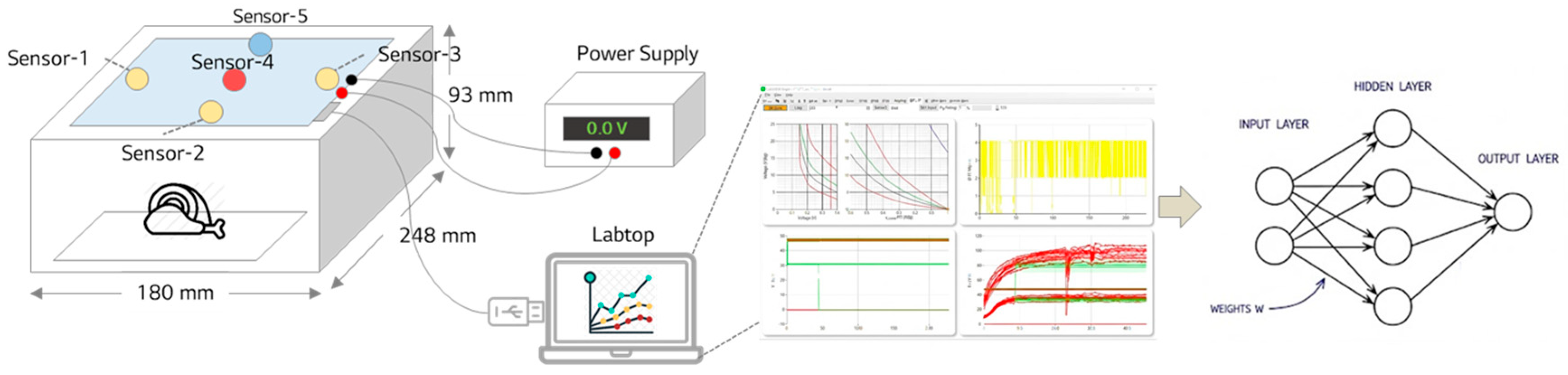
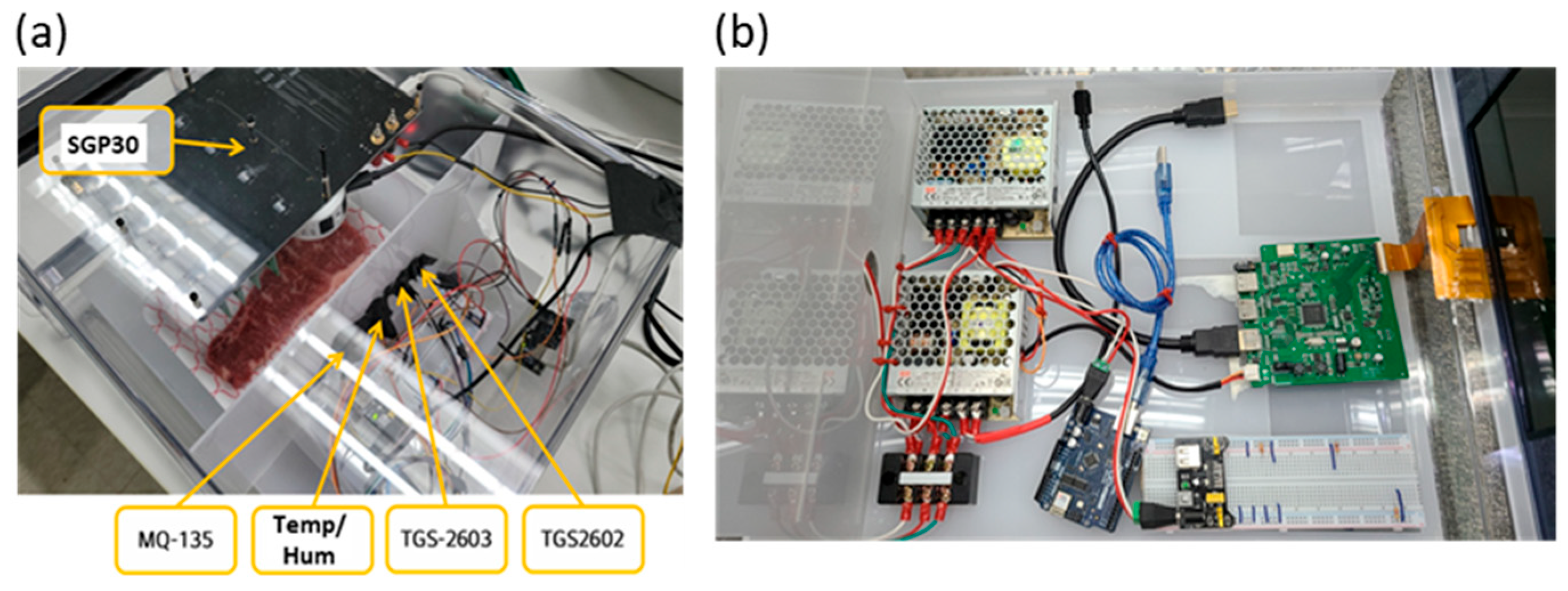
2.1. System Hardware Setup
2.2. Experimental Procedure
2.3. Data Preprocessing
2.4. Feature Construction and GPR Model Development
2.5. Evaluation Metrics
3. Result and Discussion
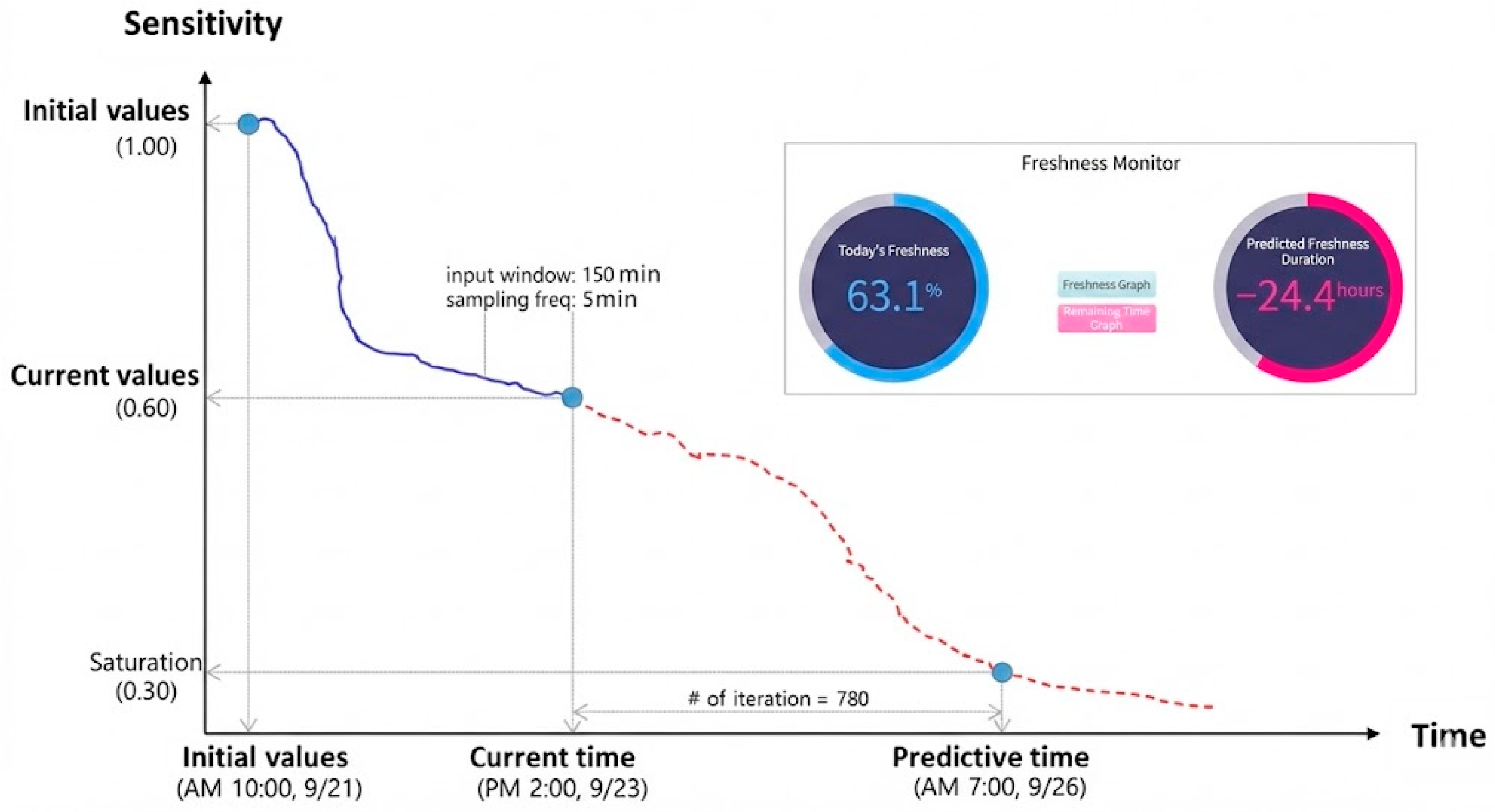
3.1. Preliminary Data Characteristics
3.2. Factor Effects and Interaction
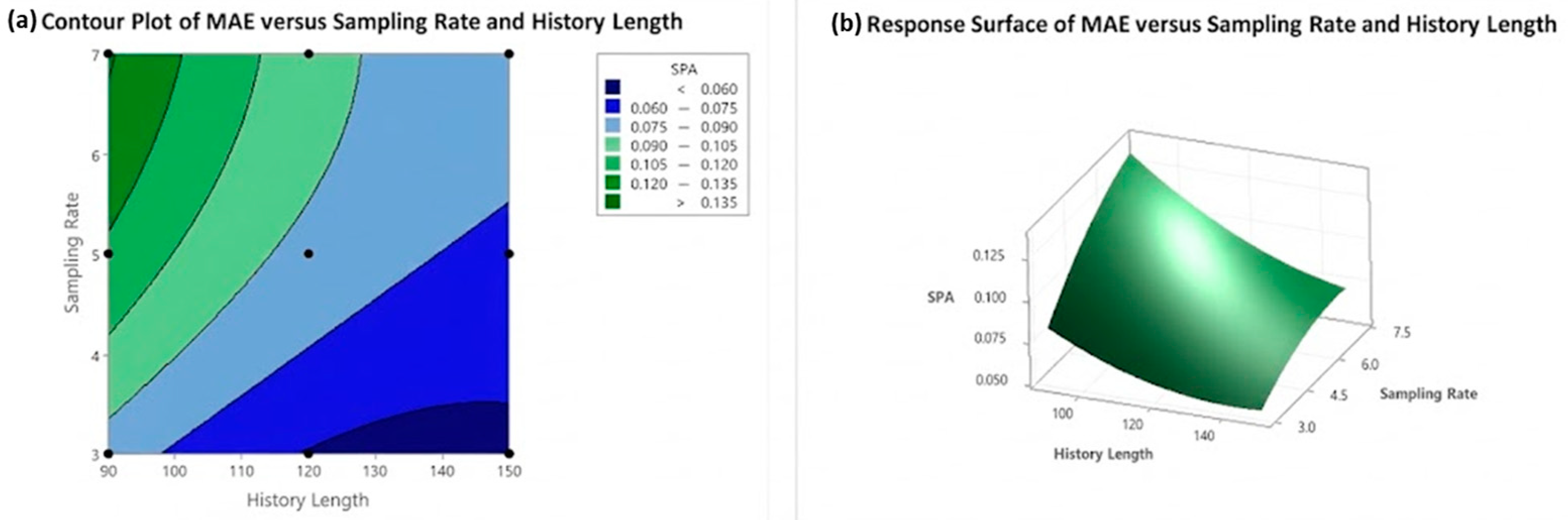
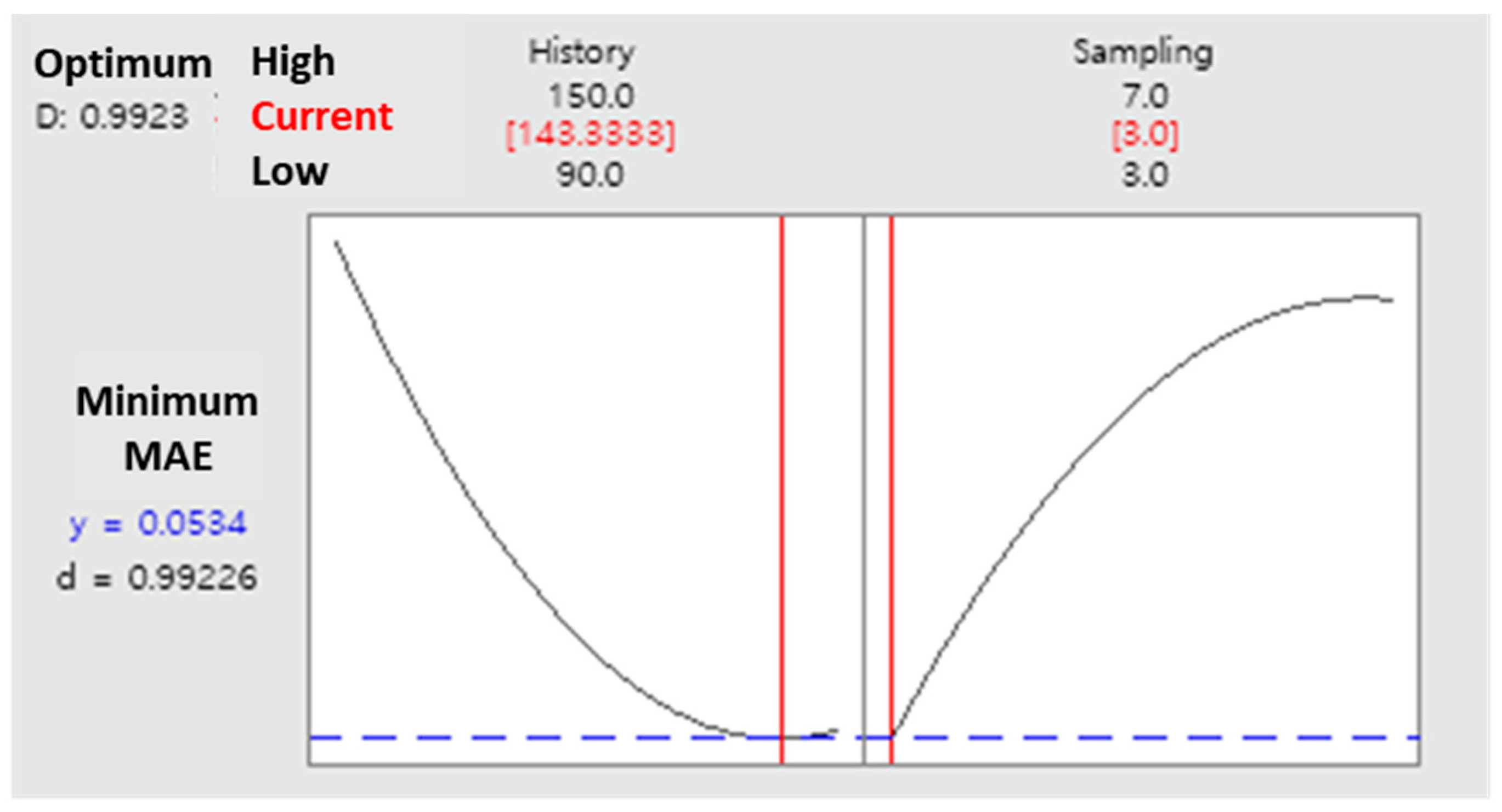
3.3. Optimization and Response Surface Analysis
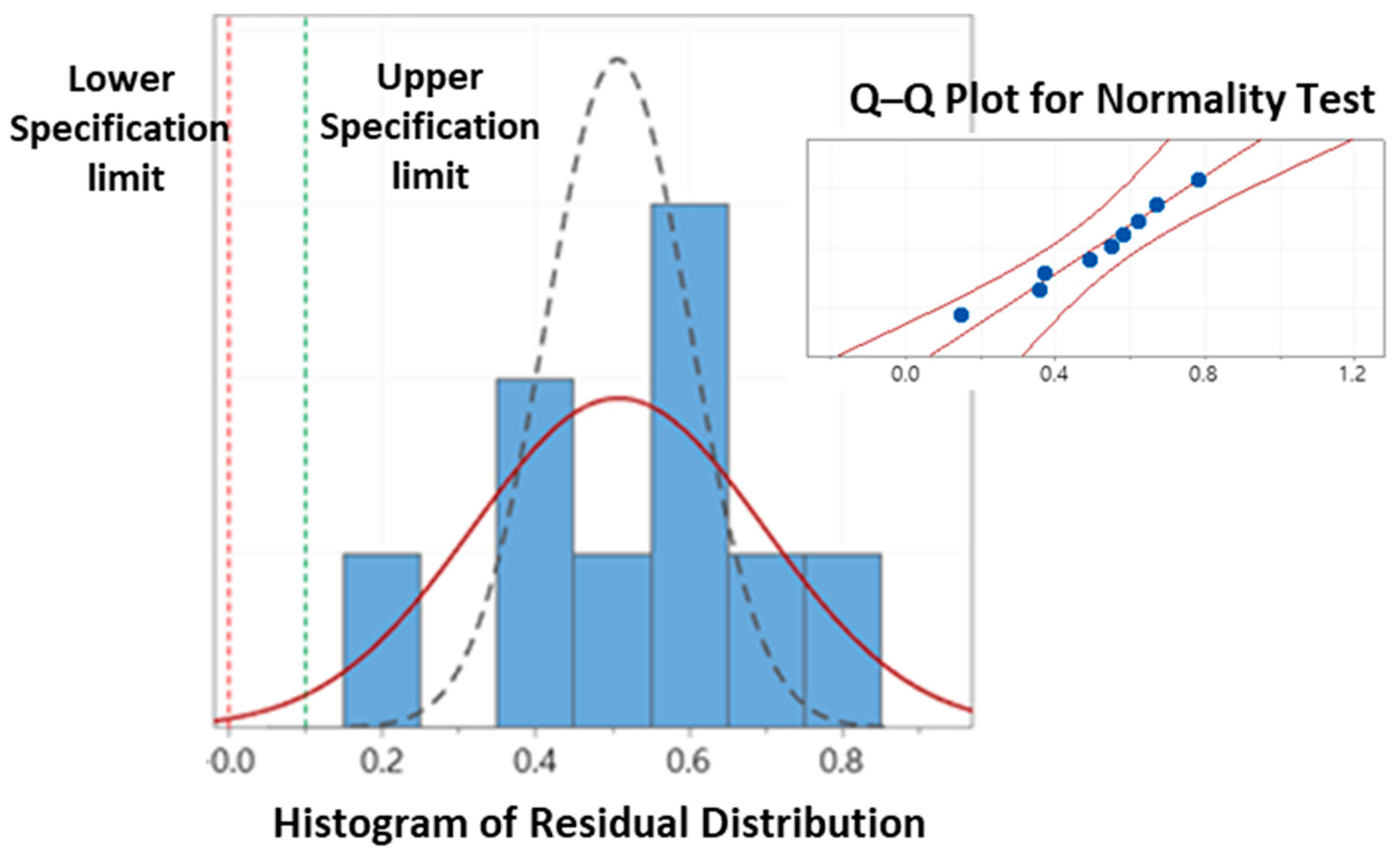
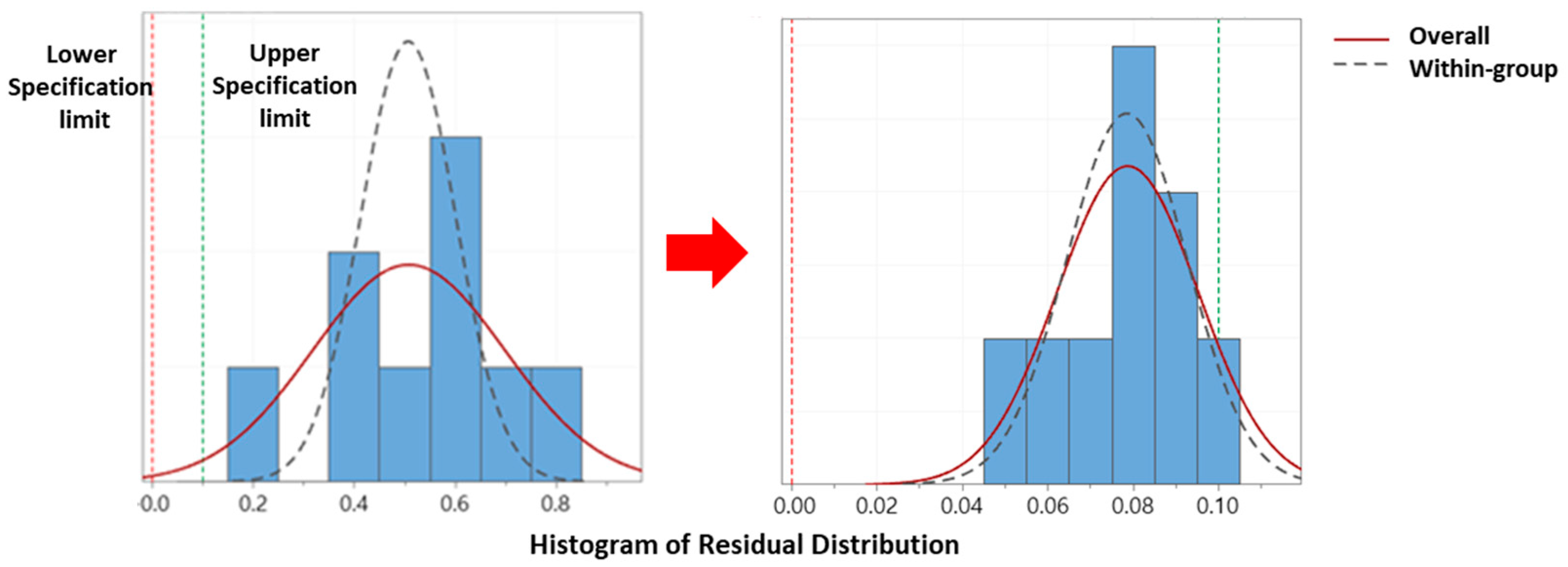
3.4. Improvement in Predictive Performance and Process Capability
3.5. Discussion
3.5.1. Interpretation of Experimental Findings
3.5.2. Practical Deployment Considerations
4. Conclusions
Funding
Data Availability Statement
Conflicts of Interest
References
- Gustavsson, J.; Cederberg, C.; Sonesson, U. Global Food Losses and Food Waste: Extent, Causes and Prevention; FAO: Rome, Italy, 2011. [Google Scholar]
- United Nations Environment Programme (UNEP). Food Waste Index Report 2021; UNEP: Nairobi, Kenya, 2021. [Google Scholar]
- Ercolini, D.; Russo, F.; Torrieri, E.; Masi, P.; Villani, F. Changes in the spoilage-related microbiota of beef during refrigerated storage under different packaging conditions. Appl. Environ. Microbiol. 2006, 72, 4663–4671. [Google Scholar] [CrossRef] [Scilit]
- Cheng, J.H.; Sun, D.W. Recent developments in methods and techniques for freshness quality determination and evaluation of fish and fish fillets: A review. Crit. Rev. Food Sci. Nutr. 2015, 55, 1012–1225. [Google Scholar] [CrossRef] [Scilit]
- Olafsdottir, G.; Nesvadba, P.; Di Natale, C.; Careche, M.; Oehlenschläger, J.; Tryggvadóttir, S.V.; Schubring, R.; Kroeger, M.; Heia, K.; Esaiassen, M.; et al. Multisensor for fish quality determination. Trends Food Sci. Technol. 2004, 15, 86–93. [Google Scholar] [CrossRef] [Scilit]
- Papadopoulou, O.S.; Panagou, E.Z.; Tassou, C.C.; Nychas, G.-J.E. Contribution of Fourier transform infrared (FTIR) spectroscopy data on the quantitative determination of minced pork meat spoilage. Food Res. Int. 2011, 44, 3264–3271. [Google Scholar] [CrossRef] [Scilit]
- Argyri, A.A.; Mallouchos, A.; Panagou, E.Z.; Nychas, G.-J.E. The dynamics of the HS/SPME-GC/MS as a tool to assess the spoilage of minced beef stored under different packaging and temperature conditions. Int. J. Food Microbiol. 2015, 193, 51–58. [Google Scholar] [CrossRef] [Scilit] [PubMed]
- Ricci, C.; Gadaleta, A.; Gerardino, A.; Didonna, A.; Ferrara, G.; Bertani, F.R. Portable optical spectroscopy and machine learning techniques for quantification of the biochemical content of raw food materials. CABI Agric. Biosci. 2024, 5, 39. [Google Scholar] [CrossRef] [Scilit]
- Korotcenkov, G. (Ed.) Handbook of Gas Sensor Materials: Volume 1—Conventional Approaches; Springer: Berlin/Heidelberg, Germany, 2014. [Google Scholar]
- Wojnowski, W.; Majchrzak, T.; Dymerski, T.; Gębicki, J.; Namieśnik, J. Electronic noses: Powerful tools in meat quality assessment. Meat Sci. 2017, 131, 119–131. [Google Scholar] [CrossRef] [Scilit]
- Xiong, Y.; Li, Y.; Wang, C.; Shi, H.; Wang, S.; Yong, C.; Gong, Y.; Zhang, W.; Zou, X. Non-Destructive Detection of Chicken Freshness Based on Electronic Nose Technology and Transfer Learning. Agriculture 2023, 13, 496. [Google Scholar] [CrossRef] [Scilit]
- Sensirion AG. SGP30 Multi-Pixel Gas Sensor Datasheet, version 1, revision 1.1; Sensirion AG: Stäfa, Switzerland, 2020. [Google Scholar]
- Oates, M.J.; Gonzalez-Teruel, J.D.; Ruiz-Abellon, M.C.; Guillamon-Frutos, A.; Ramos, J.A.; Torres-Sanchez, R. Using a low-cost components e-nose for basic detection of different foodstuffs. IEEE Sens. J. 2022, 22, 13872–13881. [Google Scholar] [CrossRef] [Scilit]
- Anisimov, D.S.; Abramov, A.A.; Gaidarzhi, V.P.; Kaplun, D.S.; Agina, E.V.; Ponomarenko, S.A. Food freshness measurements and product distinguishing by a portable electronic nose based on organic field-effect transistors. ACS Omega 2023, 8, 4649–4654. [Google Scholar] [CrossRef] [Scilit] [PubMed]
- Jia, W.; Lv, H.; Liu, Y.; Wei, J.; Yu, Y.; Yang, J.; Zhang, W. Automated detection of stale beef from electronic nose data. Food Sci. Nutr. 2024, 12, 9856–9865. [Google Scholar] [CrossRef] [Scilit]
- Feyzioglu, A.; Taspinar, Y.S. Beef quality classification with reduced e-nose data features according to beef cut types. Sensors 2023, 23, 2222. [Google Scholar] [CrossRef] [Scilit]
- Kodogiannis, V.S.; Alshejari, A. Data fusion of electronic nose and multispectral imaging for meat spoilage detection using machine learning techniques. Sensors 2025, 25, 3198. [Google Scholar] [CrossRef] [Scilit]
- Li, X.; Chen, R.; Zhang, H.; Chen, J.; Liang, B. Dynamic forecasting of beef freshness using multi-step time series analysis of electronic nose signals. Biosens. Bioelectron. 2025, 290, 117977. [Google Scholar] [CrossRef] [Scilit]
- Naik, A.; Lee, H.S.; Herrington, J.; Barandun, G.; Flock, G.; Güder, F.; Gonzalez-Macia, L. Smart packaging with disposable NFC-enabled wireless gas sensors for monitoring food spoilage. ACS Sens. 2024, 9, 6789–6799. [Google Scholar] [CrossRef] [Scilit]
- Damdam, A.N.; Ozay, L.O.; Ozcan, C.K.; Alzahrani, A.; Helabi, R.; Salama, K.N. IoT-enabled electronic nose system for beef quality monitoring and spoilage detection. Foods 2023, 12, 2227. [Google Scholar] [CrossRef] [Scilit]
- Iqbal, M.; Yousaf, J.; Khan, A.; Muhammad, T. IoT-enabled food freshness detection using multi-sensor data fusion and mobile sensing interface. ICCK Trans. Sens. Commun. Control 2025, 2, 122–131. [Google Scholar] [CrossRef] [Scilit]
- Ma, M.; Yang, X.; Ying, X.; Shi, C.; Jia, Z.; Jia, B. Applications of gas sensing in food quality detection: A review. Foods 2023, 12, 3966. [Google Scholar] [CrossRef] [Scilit] [PubMed]
- Sanislav, T.; Mois, G.D.; Zeadally, S.; Folea, S.; Radoni, T.C.; Al-Suhaimi, E.A. A comprehensive review on sensor-based electronic nose for food quality and safety. Sensors 2025, 25, 4437. [Google Scholar] [CrossRef] [Scilit] [PubMed]
- Vanaraj, R.; I.P, B.; Mayakrishnan, G.; Kim, I.S.; Kim, S.-C. A systematic review of the applications of electronic nose and electronic tongue in food quality assessment and safety. Chemosensors 2025, 13, 161. [Google Scholar] [CrossRef] [Scilit]
- Calvini, R.; Pigani, L. Toward the development of combined artificial sensing systems for food quality evaluation: A review on the application of data fusion of electronic noses, electronic tongues and electronic eyes. Sensors 2022, 22, 577. [Google Scholar] [CrossRef] [Scilit]
- Ziyatdinov, A.; Marco, S.; Chaudry, A.; Persaud, K.; Caminal, P.; Perera, A. Drift compensation of gas sensor array data by common principal component analysis. Sens. Actuators B Chem. 2010, 146, 460–465. [Google Scholar] [CrossRef] [Scilit]
- Sun, Y.; Zheng, Y.; Zhang, H.; Wang, J.; Xu, L. A method of gas sensor drift compensation based on intrinsic characteristics of response curve. Sci. Rep. 2023, 13, 16025. [Google Scholar] [CrossRef] [Scilit]
- Jayan, H.; Zhou, R.; Sun, C.; Wang, C.; Yin, L.; Zou, X.; Guo, Z. Intelligent gas sensors for food safety and quality monitoring: Advances, applications, and future directions. Foods 2025, 14, 2706. [Google Scholar] [CrossRef] [Scilit]
- Wang, P.; Mihaylova, L.; Chakraborty, R.; Munir, S.; Mayfield, M.; Alam, K.; Khokhar, M.F.; Zheng, Z.; Jiang, C.; Fang, H. A Gaussian process method with uncertainty quantification for air quality monitoring. Atmosphere 2021, 12, 1344. [Google Scholar] [CrossRef] [Scilit]
- Mohareb, F.; Al-Mulla, Z.; Green, J.H.; Brown, S.; Ray, A.; Raya, I.; Cheung, W. Ensemble-based support vector machine classifiers as an objective tool for assessing beef fillet freshness using electronic-nose data. Anal. Methods 2016, 8, 3711–3721. [Google Scholar] [CrossRef] [Scilit]
- Liu, T.; Zhang, W.; Yuwono, M.; Zhang, M.; Ueland, M.; Forbes, S.L.; Su, S.W. A data-driven meat freshness monitoring and evaluation method using rapid centroid estimation and hidden Markov models. Sens. Actuators B Chem. 2020, 311, 127868. [Google Scholar] [CrossRef] [Scilit]
- TGS2602; For the Detection of Air Contaminants (Product Information), Rev.07. Figaro Engineering Inc.: Osaka, Japan, 2015.
- TGS2603; For Detection of Odor and Air Contaminants (Product Information), Rev.02. Figaro Engineering Inc.: Osaka, Japan, 2013.
- Rasmussen, C.E.; Williams, C.K.I. Gaussian Processes for Machine Learning; MIT Press: Cambridge, MA, USA, 2006. [Google Scholar]
- Zeng, L.; Xu, Y.; Ni, S.; Xu, M.; Jia, P. A mixed gas concentration regression prediction method for electronic nose based on two-channel TCN. Sens. Actuators B Chem. 2023, 382, 133528. [Google Scholar] [CrossRef] [Scilit]
- Bishop, C.M. Pattern Recognition and Machine Learning; Springer: New York, NY, USA, 2006. [Google Scholar]



| Source | DF | Adj SS | Adj MS | F-Value | p-Value |
|---|---|---|---|---|---|
| Model | 15 | 0.04800 | 0.003200 | 2.87 | 0.022 |
| Linear | 6 | 0.02053 | 0.003422 | 5.04 | 0.004 |
| History Length (HL) | 3 | 0.01896 | 0.006319 | 5.67 | 0.008 |
| Sampling Rate (SR) | 3 | 0.01477 | 0.004924 | 4.42 | 0.019 |
| Second-order/Interaction (HL × SR) | 9 | 0.01427 | 0.001585 | 1.42 | 0.258 |
| Error | 16 | 0.01115 | 0.000697 | - | - |
| Total | 31 | 0.06584 | - | - | - |
| Metric | Description | Before Optimization | After Optimization |
|---|---|---|---|
| Z.Bench | Standardized distance from process mean to the nearest specification limit | −2.25 | 1.29 |
| Z.LSL | Lower-side sigma capability | 2.67 | 4.77 |
| Z.USL | Upper-side sigma capability | −2.14 | 1.51 |
| Cpk | Process capability index (short-term performance) | −1.43 | 0.50 |
| Ppk | Process performance index (overall performance) | −1.43 | 0.43 |
| Overall yield | % of predictions meeting MAE < 0.1 criterion | <40% | >90% |
| Method | Equipment Cost | Detection Time | Accuracy (Reported) | Power Requirement |
|---|---|---|---|---|
| Proposed System (MOS + GPR) | Low (<USD 100) | Real-time (~3 min) | MAE ≈ 0.05 | Low (duty-cycled) |
| GC–MS [7] | Very High (>USD 50,000) | Hours | High | Very high (lab) |
| TVB-N Chemical Assay [6] | Moderate | Hours | High | N/A (manual) |
| Traditional E-nose (SVM) [13] | Low–Moderate | Real-time | Moderate | Low |
| Component | Active Current (mA) | Voltage (V) | Active Time per Cycle (s) | Sleep Current (mA) | Estimated Avg. Power (mW) |
|---|---|---|---|---|---|
| TGS2602 Heater | ~56 | 5.0 | 10 | 0 | ~15.5 |
| SGP30 Sensor | ~48 | 1.8 | 10 | 0.002 | ~4.8 |
| Microcontroller | ~80 | 3.3 | 10 | ~0.1 | ~15 |
| Total System | - | - | - | - | ≈55 mW |
Disclaimer/Publisher’s Note: The statements, opinions and data contained in all publications are solely those of the individual author(s) and contributor(s) and not of MDPI and/or the editor(s). MDPI and/or the editor(s) disclaim responsibility for any injury to people or property resulting from any ideas, methods, instructions or products referred to in the content. |
© 2025 by the author. Licensee MDPI, Basel, Switzerland. This article is an open access article distributed under the terms and conditions of the Creative Commons Attribution (CC BY) license.
Share and Cite
Yoo, M. Low-Cost Gas Sensing and Machine Learning for Intelligent Refrigeration in the Built Environment. Buildings 2026, 16, 41. https://doi.org/10.3390/buildings16010041
Yoo M. Low-Cost Gas Sensing and Machine Learning for Intelligent Refrigeration in the Built Environment. Buildings. 2026; 16(1):41. https://doi.org/10.3390/buildings16010041
Chicago/Turabian StyleYoo, Mooyoung. 2026. "Low-Cost Gas Sensing and Machine Learning for Intelligent Refrigeration in the Built Environment" Buildings 16, no. 1: 41. https://doi.org/10.3390/buildings16010041
APA StyleYoo, M. (2026). Low-Cost Gas Sensing and Machine Learning for Intelligent Refrigeration in the Built Environment. Buildings, 16(1), 41. https://doi.org/10.3390/buildings16010041