Article

Relationships Between Ultrasonic-Based Elastic Modulus Loss, Mass Loss and Strength Loss in Two Hardwoods Commonly Used in Northern Chinese Timber Heritage


1
Department of Architecture, School of Human Settlements and Civil Engineering, Xi’an Jiaotong University, Xi’an 712000, China
2
Faculty of Environmental Engineering, The University of Kitakyushu, Kitakyushu 808-0135, Japan
3
Xi’an Space Engine Company Limited, Xi’an 710100, China
4
Research Institute of Wood Industry, Chinese Academy of Forestry, Beijing 100091, China
*
Author to whom correspondence should be addressed.
Buildings 2026, 16(1), 237; https://doi.org/10.3390/buildings16010237

Submission received: 25 November 2025 / Revised: 25 December 2025 / Accepted: 1 January 2026 / Published: 5 January 2026
(This article belongs to the Section Building Materials, and Repair & Renovation)

Abstract

Assessing decay-induced mechanical deterioration in hardwood components is essential for the conservation of northern Chinese timber heritage, where structural members such as the Dou and Gong have been exposed to complex environments for centuries. Within a unified experimental framework, this study systematically investigated the mechanical degradation behavior of two hardwood species commonly used in traditional timber buildings in northern China—elm (Ulmus pumila L.) and Chinese scholar tree (Styphnolobium japonicum (L.) Schott)—subjected to controlled brown-rot fungal decay (Gloeophyllum trabeum) over decay durations of 0–6 months. Four mechanical loading configurations were considered: tension, bending, compression parallel to grain and compression perpendicular to grain. Decay progression was quantitatively characterized using mass loss rate (MLR), ultrasonic elastic modulus loss rate (ELR) and strength loss ratio (SLR). The two hardwoods exhibited distinct material- and loading-dependent deterioration patterns. Elm showed faster and more variable degradation, with clearer time-dependent strength loss under tension and bending, whereas Chinese scholar tree displayed slower and more scattered strength deterioration. For both species, elastic modulus reduction generally preceded measurable mass loss, indicating that modulus-based indicators are more sensitive to decay progression under the tested conditions. Correlation analyses further indicate that ELR tends to show more stable and consistent associations with strength loss than MLR across most loading modes. Overall, the results suggest that elastic modulus–based ultrasonic indicators have potential advantages for characterizing mechanical deterioration under controlled decay conditions. However, the findings are limited to the tested materials, decay scenarios and loading configurations, and further validation on aged or naturally decayed components is required before in situ application to heritage structures can be established.

1. Introduction

Northern China preserves a large number of historic timber buildings that have been exposed for centuries to complex environmental actions, including fluctuations in relative humidity, biological attack, temperature variation and wet–dry cycles [1,2,3]. The structural safety and long-term serviceability of roof systems and bracket sets largely depend on the mechanical performance of key timber members such as Dou, Gong, beams and purlins. Once these members undergo significant deterioration, the risk of local failure or even progressive collapse under self-weight, wind or seismic actions increases considerably [4,5,6,7,8,9,10,11].
Field investigations in historic buildings in the Changzhi region of Shanxi Province (e.g., Changchun Yuhuang Temple) show that elm (Ulmus pumila L.) and Chinese scholar tree (Styphnolobium japonicum (L.) Schott) are two hardwood species commonly used in northern traditional timber architecture, especially in relatively small yet highly stressed components such as Dou and Gong. These species are characterized by high density, hardness and favorable mechanical properties. However, many original members made of these hardwoods have been in service for centuries and have suffered various degrees of fungal decay. Understanding how fungal decay affects the mechanical performance of these two hardwoods is therefore essential for safety assessment and conservation decision-making in historic timber structures.
As destructive loading tests cannot be carried out on in situ heritage components, current knowledge on wood decay processes mainly comes from laboratory studies on small clear specimens [12,13]. Such studies typically employ artificially accelerated fungal decay combined with mass and mechanical testing to reveal property degradation patterns [14,15,16,17]. Among the many decay indicators, the mass loss rate (MLR) is one of the most widely used. It is defined as the relative reduction in oven-dry mass before and after decay. However, MLR cannot be directly measured on in-service members, since its determination requires sampling, drying and weighing, which is inherently destructive. To address this limitation, ultrasonic testing and other non-destructive testing (NDT) methods have been gradually introduced into wood decay research [18,19,20,21]. Longitudinal ultrasonic wave velocity along the grain is sensitive to both density and stiffness and can be used to estimate the longitudinal dynamic modulus of elasticity. The relative reduction in dynamic modules during decay can be expressed as the elastic modulus loss rate (ELR), which reflects the reduction in internal structural integrity caused by fungal attack. ELR can be obtained from ultrasonic measurements on the surface of members without cutting samples and thus has considerable potential as a laboratory-validated indicator to support the interpretation of ultrasonic measurements in the assessment of historic timber structures. However, those studies were based on new, undecayed wood, whereas many heritage components exhibit varying levels of decay. It is therefore necessary to establish explicit relationships between ultrasonic indicators and the degree of decay.
It should be emphasized that ELR is still essentially a decay-state indicator, describing the condition of the material rather than its load-bearing capacity. In heritage conservation practice, however, the primary concern is the loss of structural capacity. Consequently, quantitative links between ultrasonic indicators and mechanical degradation must be established. In this study, a unified mechanical degradation index, the strength loss ratio (SLR), is introduced. SLR is defined by comparing the strength of an individual decayed specimen with the mean strength of the corresponding undegraded control group (same species and loading mode), thereby enabling comparisons among different loading configurations.
In summary, this study focuses on two hardwood species commonly used in northern Chinese timber heritage—elm and Chinese scholar tree. Small clear specimens were prepared from new wood for four loading modes: tension parallel to grain, static bending, compression parallel to grain and compression perpendicular to grain. Artificial accelerated decay tests were conducted under controlled temperature and humidity using the brown-rot fungus Gloeophyllum trabeum. At several decay durations, the elastic modulus loss rate (ELR) derived from ultrasonic testing, the mass loss rate (MLR) and various mechanical strength values were measured, and the strength loss ratio (SLR) was calculated.
The objectives of this study are to:
(1)
Use ELR and MLR to assess the time-dependent decay progression of elm and Chinese scholar tree when subjected to G. trabeum attack, establish quantitative relationships between ELR and MLR and compare the ability of ELR to predict mass loss in these two hardwoods;
(2)
Analyze the evolution of residual strength and strength loss ratio (SLR) with decay duration under different loading modes and establish quantitative relationships between ELR and SLR, and between MLR and SLR, in order to compare the ability of ELR and MLR to predict strength degradation;
(3)
By linking mass loss, ultrasonic-based elastic modulus loss and strength loss within a unified framework, provide a laboratory-based, non-destructive evaluation framework that supports the development of diagnostic approaches for hardwood components commonly used in northern Chinese timber heritage, especially small but critical structural members such as the Dou and Gong.
Within this context, the present study establishes a unified experimental framework to systematically examine the relationships among mass loss rate (MLR), elastic modulus loss rate (ELR) and strength loss ratio (SLR) under four fundamental mechanical loading modes, namely tension, bending, compression parallel to grain and compression perpendicular to grain. By analyzing these decay-related indicators within the same testing system, the study enables a direct comparison of their relative effectiveness under different stress conditions. In addition, by applying the same analytical framework to two timber species with distinct material characteristics, the study provides a controlled basis for evaluating how the predictive relevance of MLR and ELR to strength degradation may vary with timber type and loading mode.

2. Materials and Methods

2.1. Timber Species and Specimen Preparation

Based on field investigations, two hardwood species commonly used in northern Chinese timber heritage—elm (Ulmus pumila L.) and Chinese scholar tree (Styphnolobium japonicum (L.) Schott)—were selected as test materials. Tree logs were sourced from regions close to their natural distribution areas. Portions showing visible decay, insect damage, large knots, checks or severe spiral grain were removed. Straight-grained, homogeneous segments were selected to prepare the clear specimens.
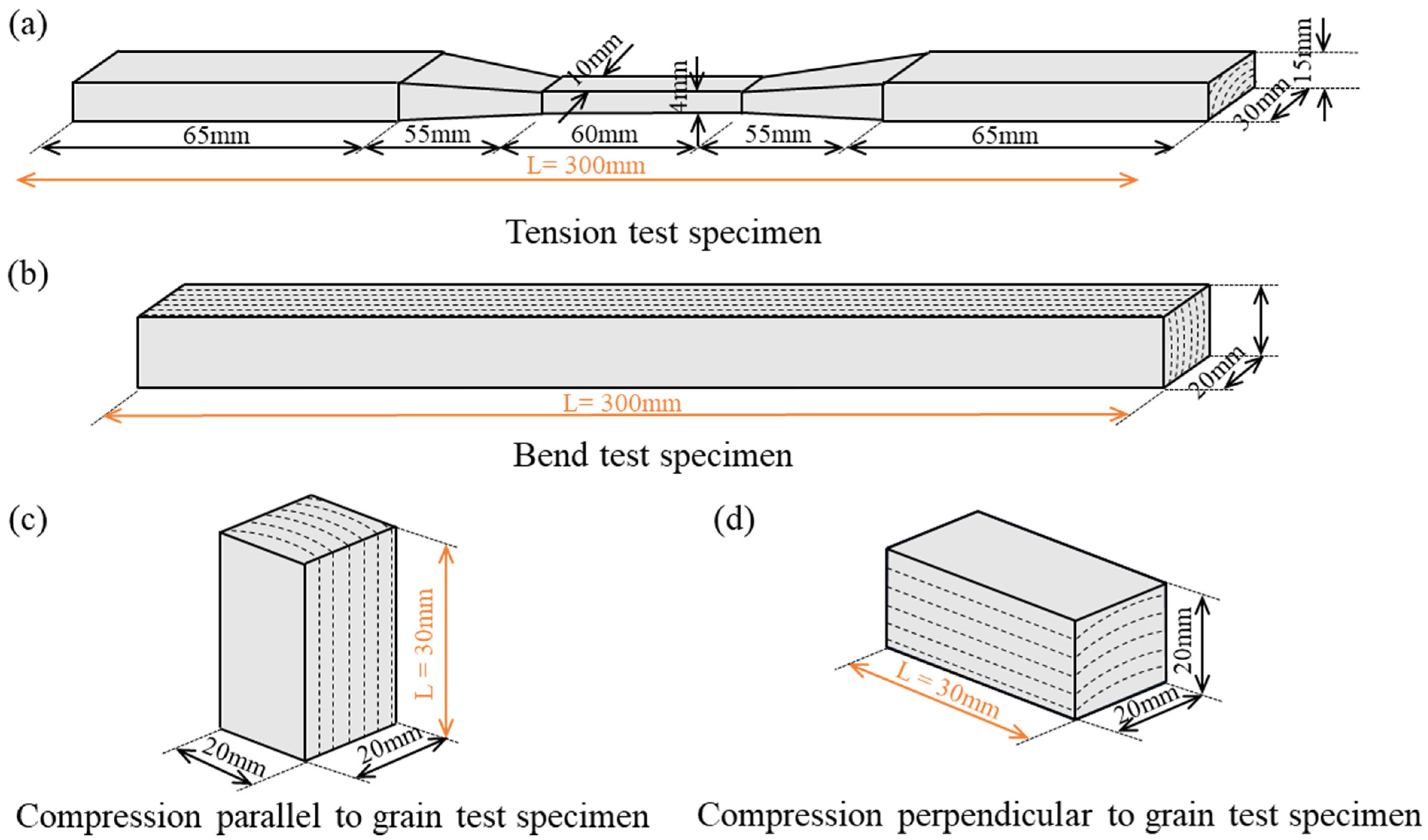
Four types of mechanical specimens, totaling 100 specimens, were prepared corresponding to different loading modes: tension parallel to grain, static bending, compression parallel to grain and compression perpendicular to grain. All specimen preparation, geometric dimensions and mechanical testing procedures were conducted in accordance with the relevant Chinese national standards for small clear wood specimens (GB/T 1927.1-2021; GB/T 1927.2-2021; GB/T 1927.9-2021; GB/T 1927.11-2022; GB/T 1927.12-2021; GB/T 1927.14-2022) [22,23,24,25,26,27]. The geometry and nominal dimensions of the specimens are illustrated in Figure 1. All specimens were conditioned at approximately 20 °C and 65% relative humidity until mass stabilization, corresponding to an equilibrium moisture content of about 12%. For each species and each mechanical group, five specimens were reserved as 0-month controls (undegraded), and the remaining specimens were randomly allocated to decay durations of 3, 4, 5 and 6 months, with five replicates per duration. The oven-dry mass and geometric dimensions of undegraded specimens were measured to determine their initial densities. Mean values and standard deviations of density, MLR and ELR for each species–mechanical group–duration combination are reported in Table 1.

2.2. Accelerated Fungal Decay Test

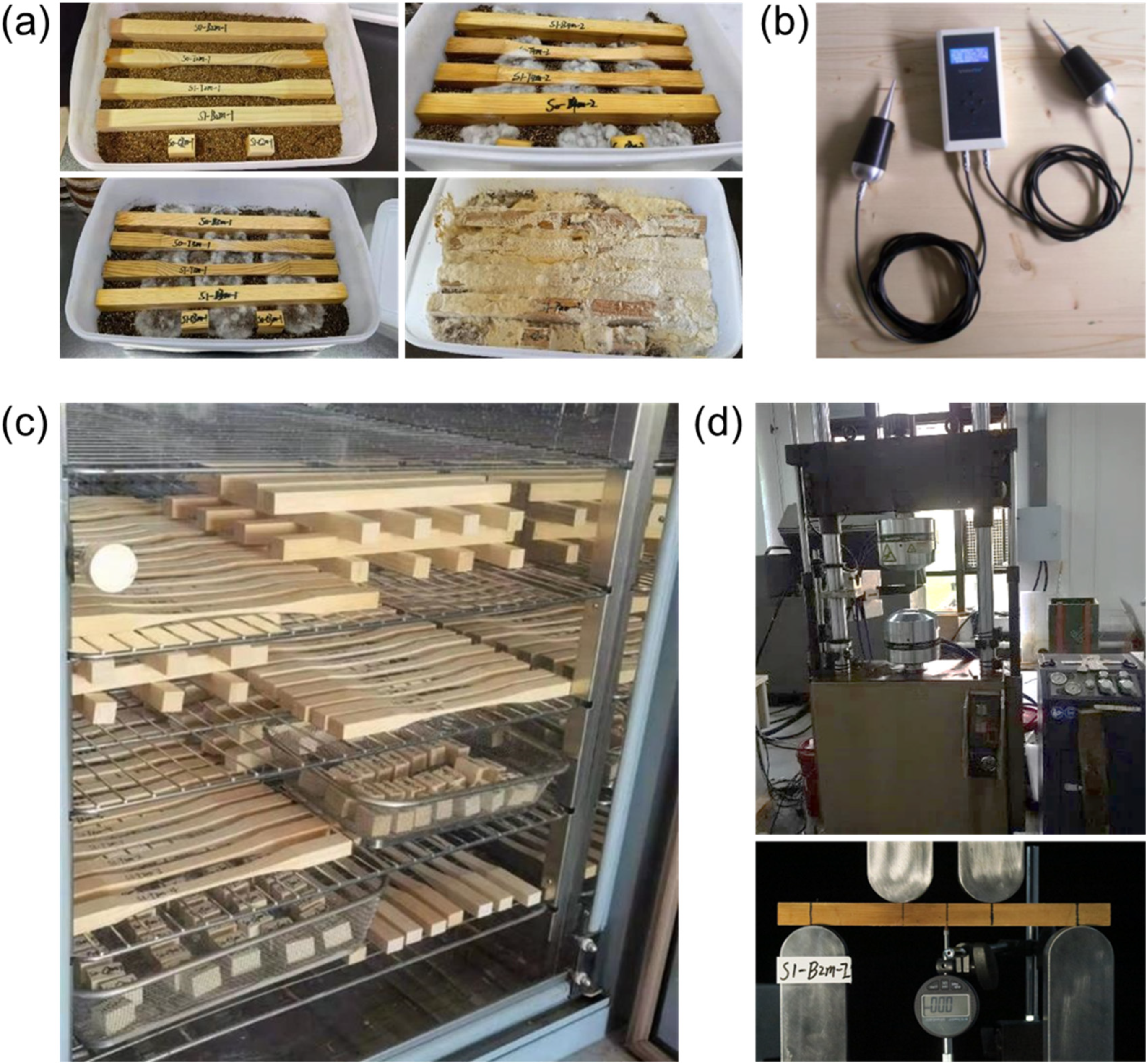
Artificial decay tests were carried out at the Research Institute of Wood Industry, Chinese Academy of Forestry. The brown-rot fungus (Gloeophyllum trabeum), a laboratory-maintained reference strain preserved at the Research Institute of Wood Industry, Chinese Academy of Forestry, widely used in wood durability research and recommended by the GB/T 13942.1 for both softwoods and hardwoods [28], was selected for the fungal test. As the wood specimens in this study were relatively long, plastic incubation boxes were used as decay containers instead of conventional glass jars (Figure 2a).
Before placing the specimens, sterilized feeder wood was laid at the bottom of each incubation box and inoculated with G. trabeum under aseptic conditions. The fungus was allowed to fully colonize the feeder layer. The test specimens were then sterilized, cooled and placed on top of the colonized feeder wood in a sterile environment. The boxes were sealed and stored in an incubation chamber under a controlled temperature of 28 ± 2 °C and a relative humidity maintained between 75% and 85%, following relevant standards and recommendations for G. trabeum.
For each species and mechanical group, specimens were divided into five decay groups with nominal durations of 0 (control), 3, 4, 5 and 6 months. At the target decay duration, the corresponding specimens were removed from the boxes, surface mycelium was gently brushed off, and the specimens were conditioned or dried as required for subsequent measurements.

2.3. Mass Loss Rate (MLR)

For each specimen, the oven-dry mass before decay ( m 0 ) and after decay ( m d ) were measured to an accuracy of 0.01 g. The mass loss rate (MLR) was computed as:
M L R = m 0 m d m 0 × 100 %
MLR is a mass-based decay indicator reflecting the net loss of cell-wall material due to fungal metabolism. As different mechanical groups have different cross-sectional dimensions and lengths, their MLR values at the same decay duration may differ. Accordingly, MLR is analyzed both at the group level (Table 1) and at the pooled species level to reveal overall decay trends.

2.4. Ultrasonic Testing and Elastic Modulus Loss Rate (ELR)

A portable ultrasonic testing device (Sylvatest Trio 3, CBS-CBT, Saint-Sulpice, Switzerland) with longitudinal transducers was used to measure the ultrasonic wave velocity v along the grain before and after decay (Figure 2b). The nominal central frequency of the transducers was 22 kHz, and measurements were conducted using an air-coupled configuration, avoiding the use of liquid or gel coupling agents. Travel time along a known propagation path with a fixed transmission length L (as illustrated in Figure 1) was recorded and converted into velocity. Combined with specimen density ρ , the longitudinal dynamic modulus of elasticity E can be estimated using the approximate relationship:
E ρ v 2
Since this study is concerned with relative changes in longitudinal dynamic modulus during decay, the elastic modulus loss rate (ELR) was defined as:
E L R = E 0 E d E 0 × 100 %
where E 0 and E d denote the longitudinal dynamic modulus values before and after decay for a given specimen. ELR is treated as a stiffness-related decay indicator derived from ultrasonic measurements. It is used both to characterize decay progression and, in later sections, to establish quantitative relationships with MLR and SLR and to evaluate its ability to indicate mass and strength degradation.

2.5. Mechanical Tests and Strength Loss Ratio (SLR)

After adjusting the moisture content, specimens were subjected to mechanical tests according to relevant national standards (Figure 2c,d). All mechanical tests were conducted under displacement-controlled loading conditions, following the relevant provisions of Chinese national standards for the corresponding loading modes [23,24,25,26,27]:
(1)
Tension parallel to grain: tensile strength was calculated using the maximum load and effective cross-sectional area (GB/T 1927.9-2021) [24];
(2)
Static bending: bending strength (modulus of rupture) was obtained from four-point bending tests (GB/T 1927.11-2022) [25];
(3)
Compression parallel to grain: compressive strength along the grain was determined based on maximum stress (GB/T 1927.14-2022) [27];
(4)
Compression perpendicular to grain: compressive strength perpendicular to grain was the proportional limit strength (GB/T 1927.12-2021) [26].
For each species and loading mode, the mean strength of the 0-month control group was denoted as f ¯ 0 , and the strength of each decayed specimen as f i . The strength loss ratio (SLR) was then defined as:
S L R = ( 1 f i f ¯ 0 ) × 100 %
SLR normalizes the strength of individual decayed specimens against the corresponding undegraded mean, resulting in a dimensionless mechanical degradation index that is comparable across decay durations and loading modes. In this study, SLR is regarded as the primary indicator of strength degradation, and its relationships with MLR and ELR are examined in detail.

3. Results and Discussion

3.1. Fungal Decay Progression Characterized by Modulus Loss Rate (ELR) and Mass Loss Rate (MLR)

3.1.1. Group-Wise Statistics of Density, Mass Loss Rate (MLR), Elastic Modulus Loss Rate (ELR) and Strength Loss Ratio (SLR)

Table 1 summarizes the group-wise mean and standard deviation of initial density (ρ), MLR, ELR and SLR for each species. The coefficients of variation of density remain consistently low (generally 3–7%) for both elm and Chinese scholar tree, indicating that specimen preparation successfully reduced intrinsic variability. This provides a stable and comparable baseline for evaluating decay-induced changes.
Across all mechanical groups, both MLR and ELR increase with decay duration from 0 to 6 months, but the rate and magnitude of deterioration differ between species. Elm generally exhibits higher MLR values, suggesting faster mass loss under fungal attack. In contrast, Chinese scholar tree shows lower MLR but, in some compression-related groups (CPA and CPE), its ELR and SLR increase markedly, indicating that internal structural degradation can be more pronounced even when mass loss remains moderate.
These trends imply species-dependent decay patterns: elm exhibits deterioration patterns in which mass loss is more closely aligned with strength and modulus changes, whereas Chinese scholar tree shows cases where elastic modulus and strength reduction become evident even when mass loss remains moderate. This distinction highlights the necessity of evaluating decay with multiple indicators rather than relying solely on MLR.

3.1.2. Decay Trends in Elastic Modulus Loss Rate (ELR) and Mass Loss Rate (MLR)

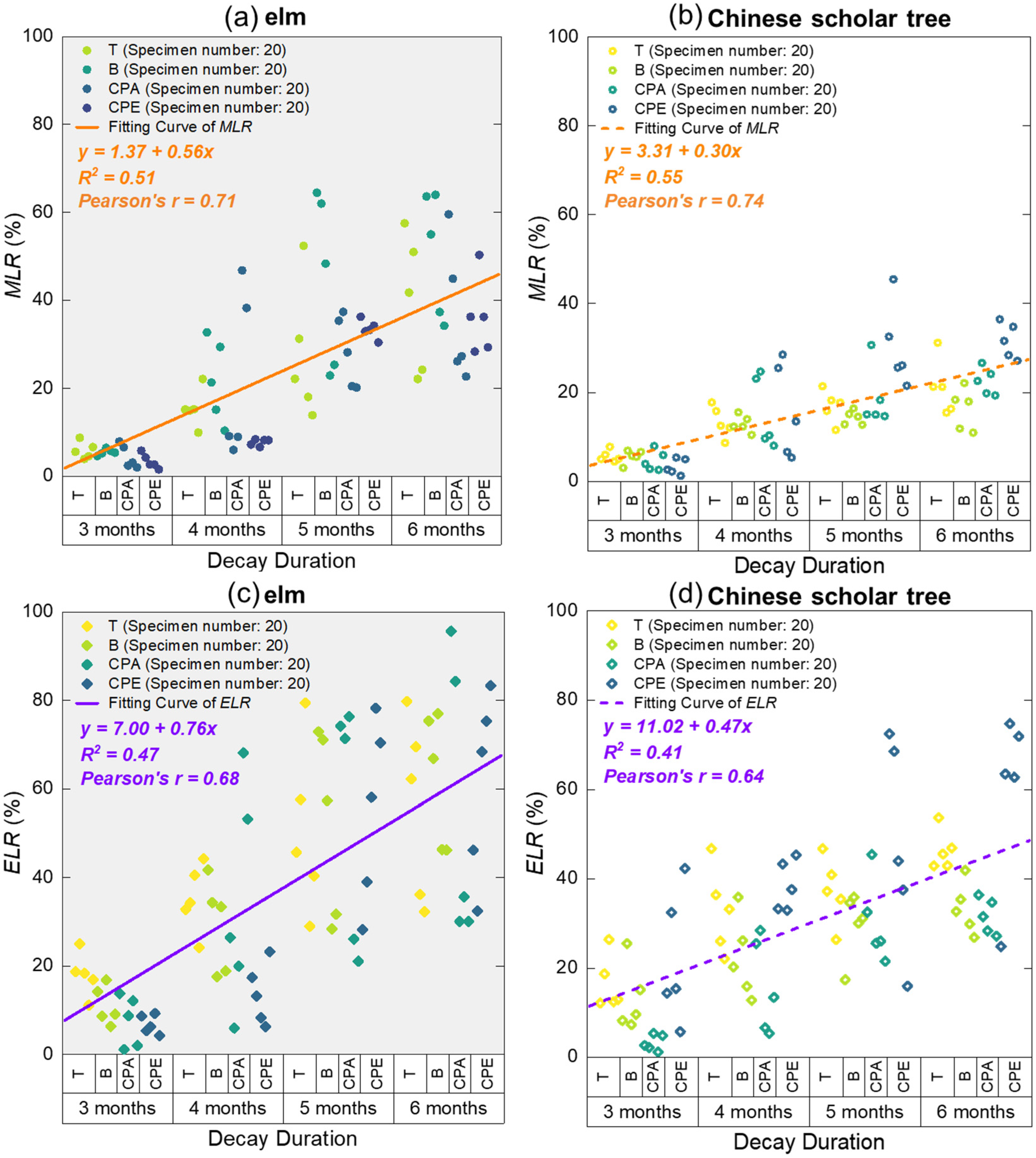
To analyze decay progression at the species level, all specimens of the same species were pooled regardless of mechanical loading group. Scatter plots of MLR and ELR against decay duration were constructed, and linear regression curves were fitted separately for elm and Chinese scholar tree (Figure 3). Both species exhibit monotonic increases in ELR and MLR from 3 to 6 months, confirming that brown-rot caused continuous degradation under the controlled fungal exposure.
However, the slopes of the fitted curves reveal clear species-dependent differences. Elm shows steeper increases in both MLR (slope = 0.56, R2 = 0.51, from 5% at 3 months to 40% at 6 months) and ELR (slope = 0.76, R2 = 0.47, from 10% at 3 months to 60% at 6 months), indicating more rapid degradation in terms of both mass loss and elastic modulus reduction. The increasing scatter observed in elm at longer decay durations suggests more heterogeneous fungal colonization and locally intensified damage.
In contrast, Chinese scholar tree displays more moderate increases in MLR (slope = 0.30, R2 = 0.55, from 5% at 3 months to 25% at 6 months) and ELR (slope = 0.47, R2 = 0.41, from 15% at 3 months to 45% at 6 months). Particularly at the early decay stage (3 months), several specimens show relatively low MLR yet already exhibit noticeable ELR. This pattern indicates that the reduction in elastic modulus is more pronounced than the mass loss. Such behavior is consistent with the well-documented early-stage decay mechanism of brown-rot fungi, which rapidly depolymerise amorphous cellulose and hemicellulose in the cell wall, leading to elastic modulus loss rate degradation prior to major weight reduction [29,30,31,32]. Additionally, previous studies have also indicated that the number and proportion of large-diameter pores in elm are higher than those in Chinese scholar tree, which results in Chinese scholar tree exhibiting superior decay resistance compared to elm [33,34].
Overall, the regression analysis highlights distinct decay progression patterns between the two hardwood species: elm undergoes a faster and more variable degradation process, whereas Chinese scholar tree shows delayed mass loss and comparatively smoother decay trajectories in both MLR and ELR.

3.1.3. Quantitative Relationships Between Elastic Modulus Loss Rate (ELR) and Mass Loss Rate (MLR)

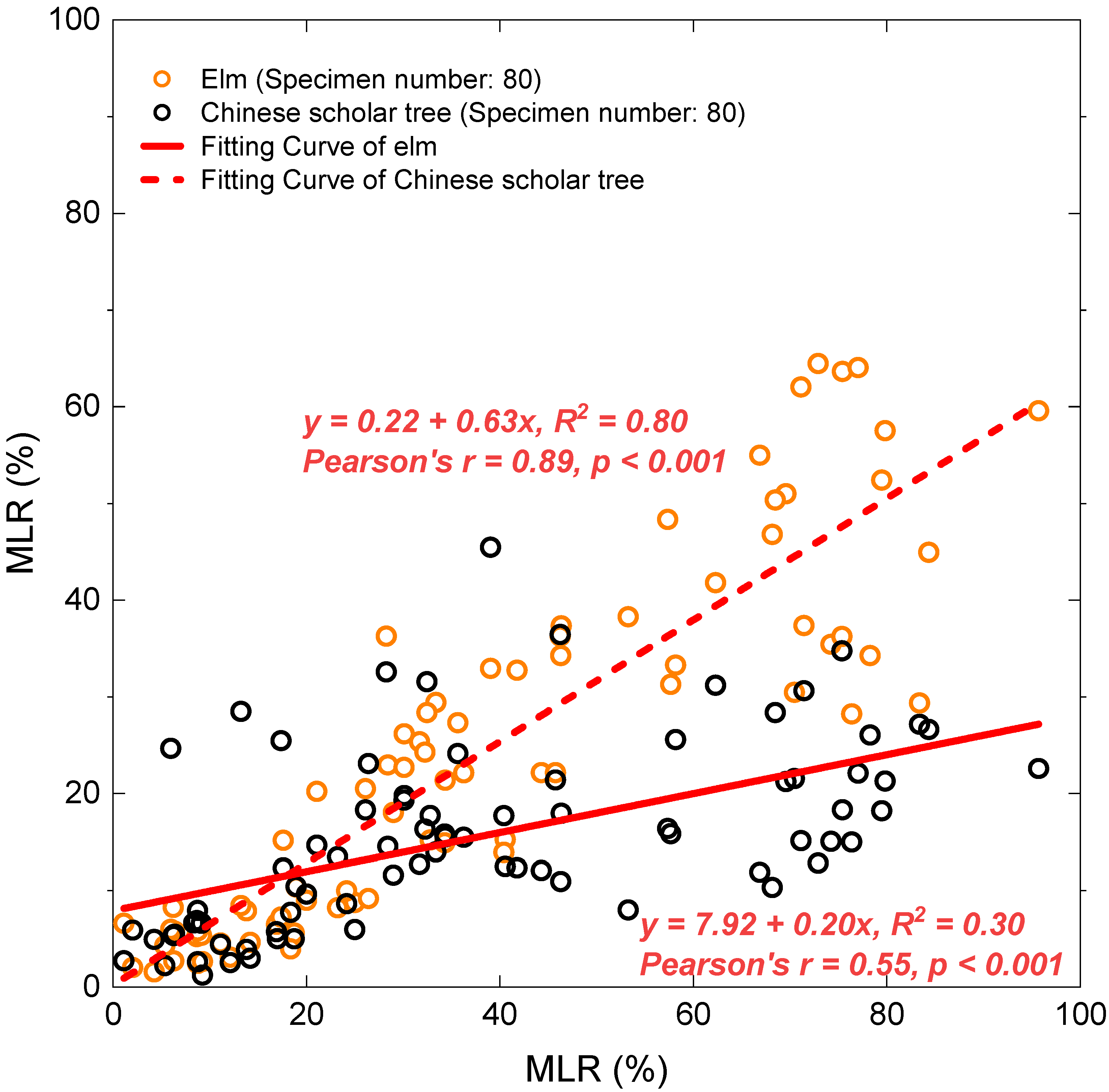
Figure 4 presents the relationships between ELR and MLR for elm and Chinese scholar tree. For each species, all specimens across decay durations and loading modes were pooled, and linear regression models were fitted. For both species, ELR shows a statistically significant positive association with MLR (elm: R2 = 0.80, r = 0.89, p < 0.001; Chinese scholar tree: R2 = 0.30, r = 0.55, p < 0.001). However, the strength of this relationship differs markedly between species. Elm exhibits a strong and well-defined ELRMLR relationship, whereas Chinese scholar tree shows a more moderate correlation with greater data scatter, indicating increased variability in the coupling between mass loss and modulus degradation.
In the low-MLR range (e.g., below about 10%), ELR tends to increase more rapidly than MLR. Many specimens already exhibit noticeable ELR while their MLR remains relatively small. This suggests that ELR is more sensitive to the onset of internal stiffness degradation and that microstructural damage reduces longitudinal dynamic modulus before significant net mass loss occurs. A similar early-stage pattern has been reported for M. incrassata–decayed Southern Yellow Pine, where over 30% stiffness loss occurred within four weeks while density loss was only about 10%, further indicating the higher sensitivity of modulus-based indicators to initial decay [35,36].
Comparing the two species, elm displays a steeper ELR–MLR relationship, meaning that for a given level of MLR, elm tends to experience larger ELR than Chinese scholar tree. This further suggests that elm is more susceptible to elastic modulus reduction under G. trabeum attack. From a practical perspective, the ELR–MLR regression curves provide a basis for estimating an “equivalent mass loss” from ultrasonic measurements in situations where direct determination of MLR is not feasible.

3.2. Strength Loss Ratio (SLR) as a Function of Decay Duration

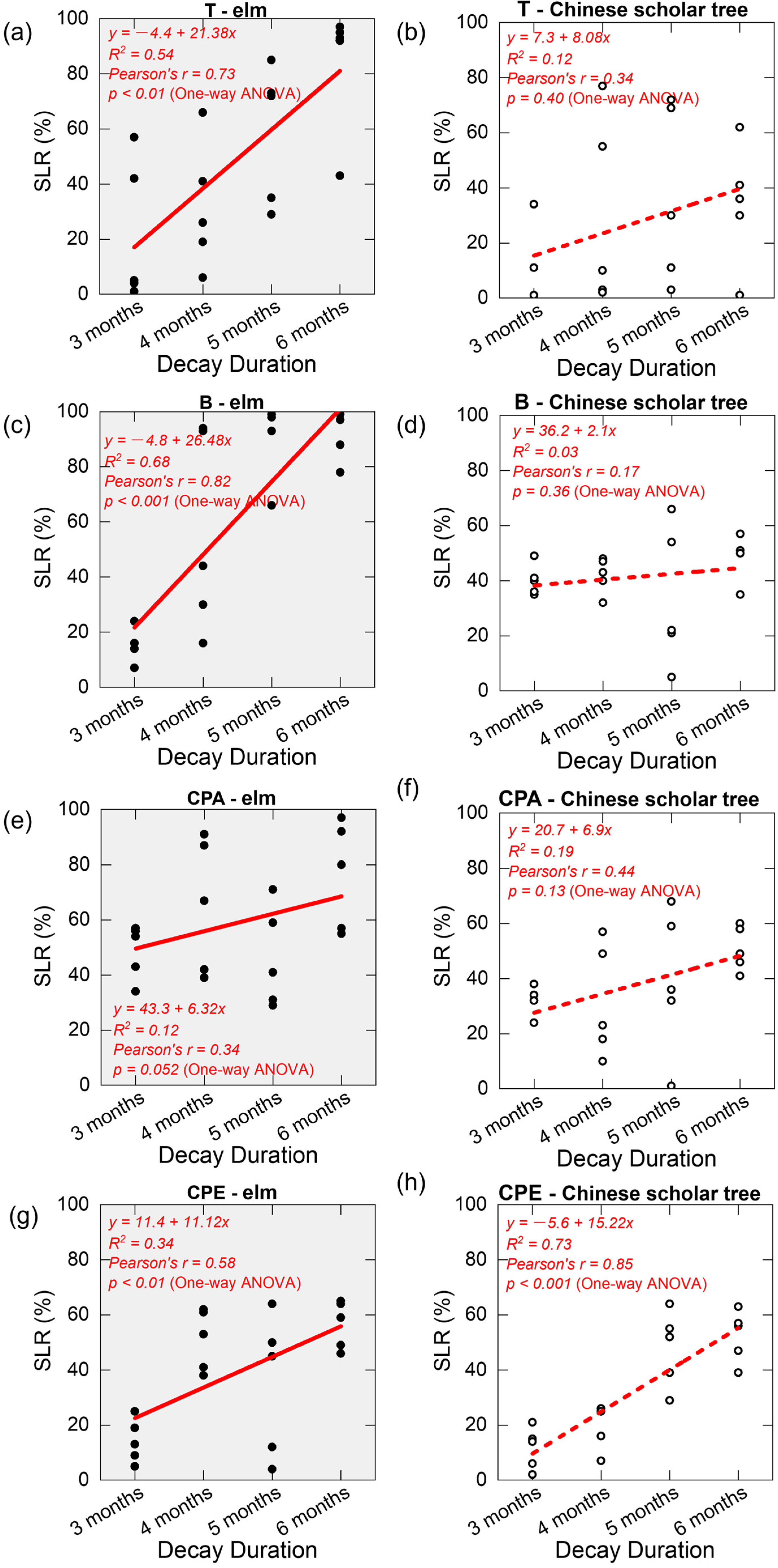
Figure 5 illustrates the variation in strength loss ratio (SLR) with decay duration for elm and Chinese scholar tree across the four mechanical loading modes (T, B, CPA, and CPE). Despite differences in slope magnitude and data dispersion among groups, all regression trends display an overall increase in SLR with longer decay duration, confirming that brown-rot fungal attack progressively weakens the mechanical strength of both hardwood species.
For elm, the SLR–time regressions demonstrate a pronounced time-dependent degradation. The bending (B) group exhibits the most distinct trend (slope = 26.48, R2 = 0.68, r = 0.82, p < 0.001), indicating that bending strength of elm declines rapidly as decay progresses. The tension (T) group also shows a clear positive trend (slope = 21.38, R2 = 0.54, r = 0.73, p < 0.01). In contrast, the slopes for compression parallel to grain (CPA) and compression perpendicular to grain (CPE) are more moderate (slope = 6.32 and 11.12, respectively), with lower coefficients of determination and significance (R2 = 0.12 and 0.34, p = 0.052 and p < 0.01). Overall, the higher R2 values and statistically significant correlations in the T and B groups suggest that strength degradation in elm is more systematic and strongly governed by decay duration in these loading configurations. This anisotropic behavior can be attributed to the inherent structural anisotropy of wood. Both bending and tension are predominantly governed by load transfer along the grain direction, with tensile response playing a critical role. The results therefore indicate that, under brown-rot fungal attack, the load-bearing components associated with tensile behavior along the grain in elm are more sensitive to decay, exhibiting more pronounced mechanical degradation than loading configurations dominated by compressive response.
For Chinese scholar tree, the increase in SLR over time is more gradual, and most regression models exhibit lower fitting accuracy (slope = 2.1–8.08, R2 = 0.03–0.19), indicating weaker temporal predictability of strength degradation. The only notable exception is the CPE group, which shows a clear linear relationship (slope = 15.22, R2 = 0.73), implying that strength deterioration under perpendicular-to-grain compression follows a more consistent time-dependent pattern.
Overall, the SLR–time relationships underscore the contrasting decay sensitivities of the two hardwoods and highlight the critical role of loading mode in interpreting time-dependent degradation behaviors.

3.3. Linking Decay Indicators (Elastic Modulus Loss Rate, Mass Loss Rate) to Strength Loss Ratio

3.3.1. Elastic Modulus Loss Rate (ELR) Versus Strength Loss Ratio (SLR)

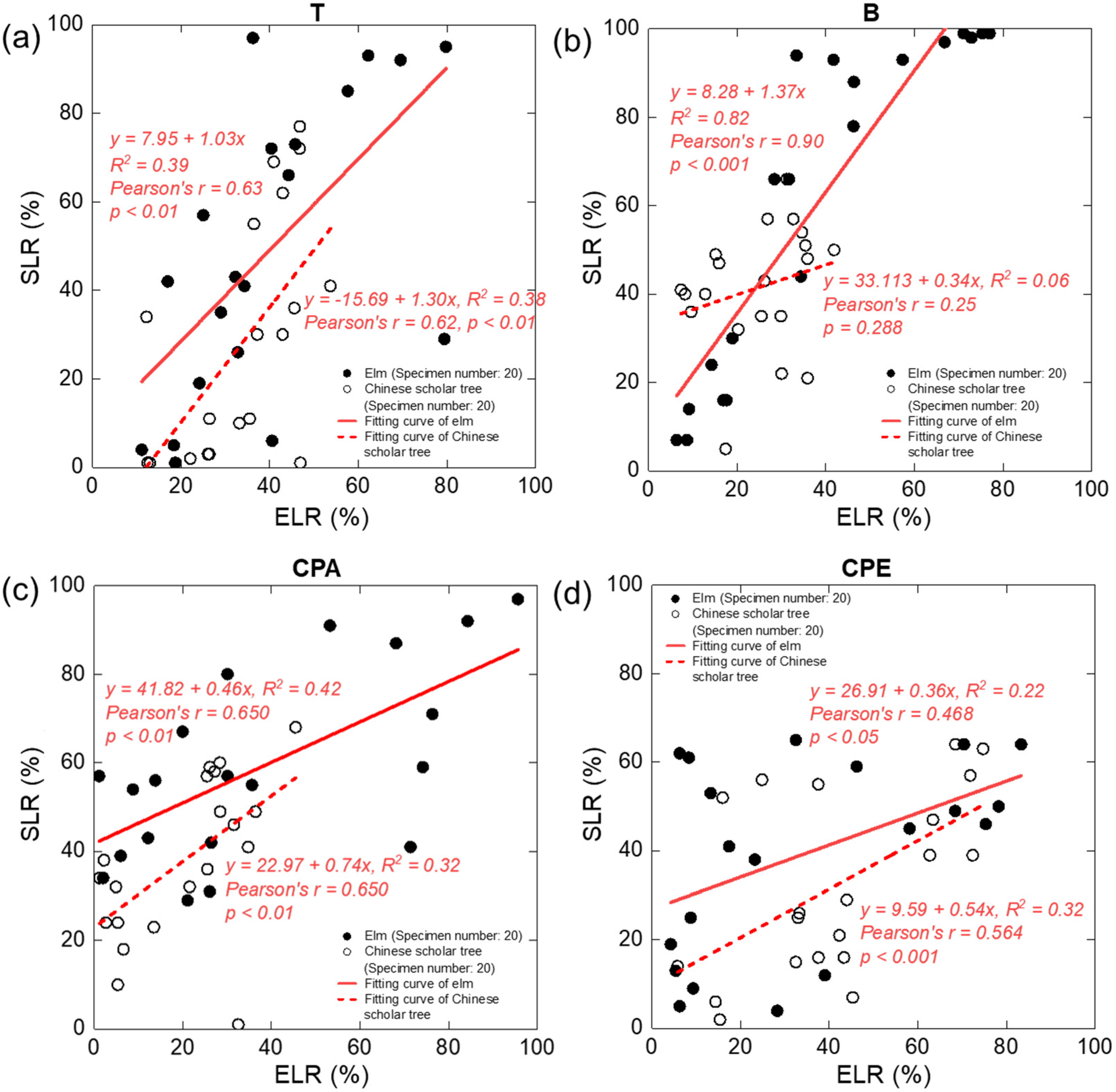
To clarify how decay-related indicators reflect mechanical deterioration, the relationships between elastic modulus loss rate (ELR) and strength loss ratio (SLR) were systematically examined for elm and Chinese scholar tree under four mechanical loading modes (T, B, CPA and CPE). Overall, ELR exhibits a clear association with SLR; however, the strength and consistency of this relationship vary depending on timber species and loading configuration (Figure 6).
For elm, elastic modulus loss rate (ELR) demonstrates a relatively stable predictive performance for tensile strength loss (SLR) across most loading modes. The tension (T) group exhibits a moderate yet statistically significant linear relationship (slope = 1.03, R2 = 0.39, p < 0.01). Among the four loading configurations, the bending (B) group shows the strongest ELRSLR association (slope = 1.37, R2 = 0.82, p < 0.001), indicating a highly consistent and statistically robust linkage between ELR and bending strength degradation. The compression parallel-to-grain (CPA) group also presents a moderate but statistically significant positive correlation (slope = 0.46, R2 = 0.42, p < 0.01). In contrast, the compression perpendicular-to-grain (CPE) group exhibits a weaker correlation (slope = 0.36, R2 = 0.22), which, although statistically significant (p < 0.05), explains only a limited proportion of the variance in strength loss.
For Chinese scholar tree, the ELRSLR relationships are generally weaker and more variable than those observed for elm. In the T, CPA and CPE groups, the correlations are statistically significant (R2 ranging from 0.32 to 0.62, all p < 0.05), indicating moderate associations between ultrasonic modulus degradation and strength loss. In contrast, the bending (B) group shows no meaningful ELRSLR relationship (R2 = 0.06, p = 0.288), suggesting that bending strength degradation in Chinese scholar tree cannot be reliably inferred from ELR under the tested conditions. Overall, these results indicate that although the predictive capability of ELR for Chinese scholar tree is weaker than that for elm, ELR still exhibits measurable predictive relevance under most loading configurations.

3.3.2. Mass Loss Rate (MLR) Versus Strength Loss Ratio (SLR)

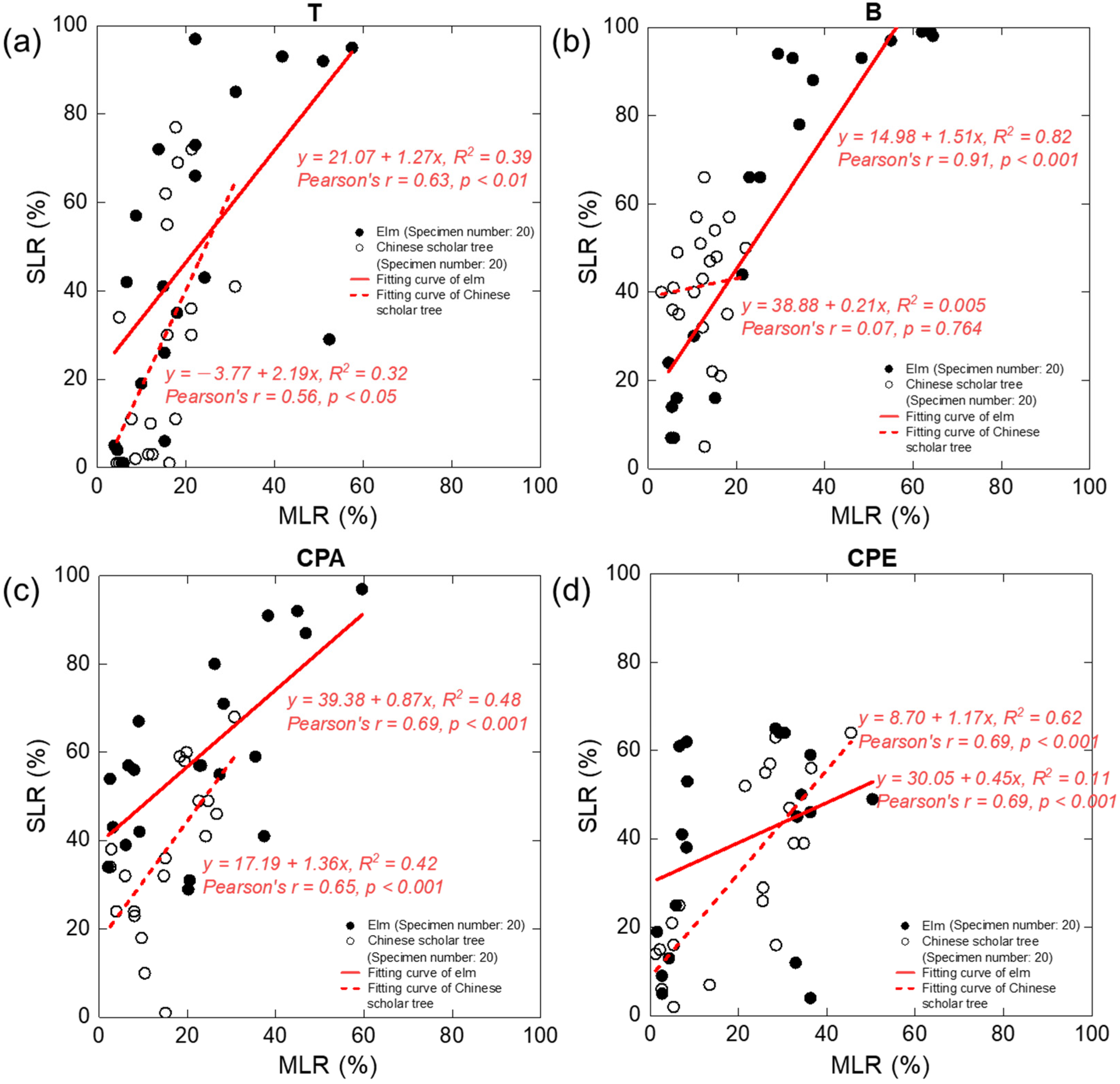
To further evaluate the effectiveness of mass-based decay indicators, the relationships between mass loss rate (MLR) and strength loss ratio (SLR) were examined for elm and Chinese scholar tree under four mechanical loading modes (T, B, CPA and CPE), as shown in Figure 7. Overall, MLR exhibits a positive association with strength degradation; however, the strength, consistency and statistical significance of this relationship are strongly dependent on both timber species and loading configuration.
For elm, MLR shows statistically significant positive correlations with SLR across all four loading modes. In the tension (T) group, a clear positive relationship is observed (slope = 1.27, R2 = 0.39, r = 0.63, p < 0.01), indicating that tensile strength loss increases proportionally with mass depletion. The bending (B) group exhibits the strongest MLRSLR relationship (slope = 1.51, R2 = 0.82, r = 0.91, p < 0.001), suggesting that bending strength degradation in elm is highly sensitive to bulk material loss. In the compression parallel-to-grain (CPA) group, MLR also demonstrates a moderate and statistically significant correlation with SLR (slope = 0.87, R2 = 0.48, r = 0.69, p < 0.001). In the compression perpendicular-to-grain (CPE) group, although the positive association remains statistically significant (slope = 0.45, r = 0.69, p < 0.001), the low coefficient of determination (R2 = 0.11) indicates that mass loss explains only a limited proportion of the observed strength degradation. Collectively, these results suggest that, for elm, MLR serves as a meaningful indicator of strength loss across multiple stress states, while its predictive capability is more limited under perpendicular-to-grain compression.
For Chinese scholar tree, the MLRSLR relationships are more heterogeneous and exhibit strong dependence on loading mode. In the tension (T) group, a moderate but statistically significant correlation is observed (slope = 2.19, R2 = 0.32, r = 0.56, p < 0.05). A similarly significant relationship is found in the compression parallel-to-grain (CPA) group (slope = 1.36, R2 = 0.42, r = 0.65, p < 0.001). However, no meaningful association is observed in the bending (B) group (slope = 0.21, R2 = 0.005, r = 0.07, p = 0.764), indicating that bending strength degradation in Chinese scholar tree cannot be reliably inferred from mass loss. By comparison, the compression perpendicular-to-grain (CPE) group shows a strong and statistically significant relationship (slope = 1.17, R2 = 0.62, r = 0.69, p < 0.001).

3.3.3. Comparative Assessment of MLR and ELR as Decay Indicators

By integrating the results presented in Section 3.3.1 and Section 3.3.2, it becomes evident that elastic modulus loss rate (ELR) and mass loss rate (MLR) exhibit complementary rather than universally hierarchical roles in reflecting strength degradation of decayed hardwoods. Their predictive performance varies systematically with timber species and loading configuration, indicating that neither indicator alone can be regarded as a universally superior predictor of mechanical deterioration.
For elm, both ELR and MLR show statistically meaningful and largely consistent relationships with strength loss ratio (SLR) across most loading modes. Under tension and bending, ELR and MLR exhibit comparable explanatory power, with particularly strong correlations observed in bending-dominated degradation. This suggests that, in elm, elastic modulus loss rate degradation and material mass loss evolve in a relatively coordinated manner during brown-rot decay. However, under compression perpendicular to grain, ELR exhibits weaker explanatory capacity than MLR, indicating that bulk material loss contributes more directly to strength degradation in this stress state.
For Chinese scholar tree, clearer contrasts emerge between the two indicators. ELR shows moderate and statistically significant correlations with SLR in most loading configurations except bending, indicating that ultrasonic modulus degradation retains predictive relevance even when mass loss remains limited. In contrast, MLR demonstrates strong predictive capability primarily under compression-dominated conditions—especially compression perpendicular to grain—while failing to capture strength degradation in bending. These results suggest that, in dense and decay-resistant hardwoods, early-stage mechanical weakening is more closely associated with microstructural degradation than with bulk mass removal, whereas mass loss becomes a more effective predictor once compression-induced structural collapse develops.
Overall, ELR provides a more stable indicator of strength degradation across varying loading modes, particularly in cases where mechanical deterioration precedes substantial mass loss. Nevertheless, MLR retains important diagnostic value under specific material–loading combinations, especially in compression-related failure mechanisms. These findings demonstrate that the applicability of decay indicators is jointly governed by wood species, dominant stress state and degradation pathway, underscoring the necessity of a multi-indicator approach when interpreting decay-induced mechanical deterioration.

3.4. Mechanical–Ultrasonic Coupling and Implications for Heritage Assessment

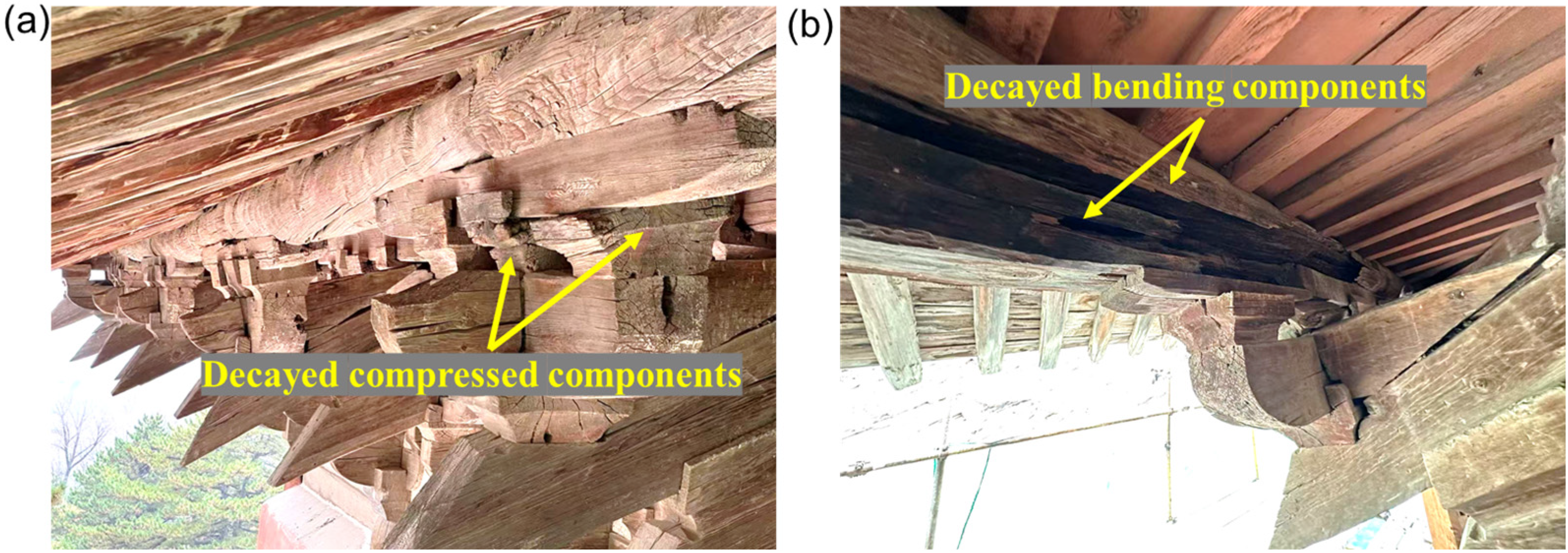
In traditional Chinese timber architecture, structural components are subjected to markedly different mechanical actions (Figure 8). For example, beams and purlins are primarily governed by bending and tension parallel to the grain, whereas components such as Dou, Gong and bearing blocks are often dominated by compression perpendicular to the grain. Owing to the non-destructive requirements of heritage conservation, direct determination of mass loss rate (MLR), which relies on material sampling, is generally impractical in real structures. In this context, the coupling between ultrasonic-based elastic modulus loss rate (ELR) and mechanical degradation provides valuable reference information for the structural assessment of traditional timber buildings (Table 2). The detailed values of mass loss ratio (MLR), ultrasonic-based elastic modulus loss ratio (ELR), and strength loss ratio (SLR) for elm and Chinese scholar tree are provided in the Supplementary Materials (Tables S1 and S2).
For elm, relatively consistent coupling between ultrasonic indicators and strength degradation is observed under bending- and tension-dominated loading conditions. These results indicate that both ELR and MLR can effectively reflect reductions in load-bearing capacity associated with fiber-direction deterioration in such components. Under compression perpendicular to the grain, however, the explanatory capability of ELR decreases, while the role of MLR becomes more pronounced. This suggests that, for compression-controlled stress states, reliance on ELR alone may be insufficient, and that mass-related indicators or complementary non-destructive methods should be incorporated when feasible to achieve a more comprehensive assessment.
Chinese scholar tree exhibits a more selective coupling behavior. In several loading modes, statistically significant relationships between ELR and strength loss are observed even when measurable mass loss remains limited, highlighting the sensitivity of ELR to early-stage microstructural damage. This characteristic is particularly relevant for dense hardwood components that appear externally intact but may have already undergone internal degradation. Under compression perpendicular to the grain—typical of components such as Dou and GongMLR demonstrates a substantially stronger predictive capability for strength loss than ELR. In these cases, assessment based solely on elastic modulus–related indicators may underestimate the degree of mechanical deterioration, and integration with mass-related information or other diagnostic parameters becomes necessary.
From a heritage conservation perspective, these findings indicate that the selection of ultrasonic decay indicators should explicitly account for both the structural function of components and their dominant stress states. Elastic modulus–based indicators are more suitable for identifying early-stage deterioration in bending- or tension-dominated members, whereas mass loss–related indicators provide greater diagnostic value in compression-controlled components. Consequently, decay assessment of traditional timber structures should not rely on a single parameter, but rather adopt a multi-indicator, integrative evaluation strategy. It should be emphasized that these interpretations are derived from small, defect-free specimens subjected to controlled brown-rot decay. Prior to direct application in in situ heritage assessment, further validation using aged or naturally decayed components under more complex environmental conditions remains necessary.

4. Conclusions

This study systematically investigated the mechanical deterioration behavior of elm (Ulmus pumila L.) and Chinese scholar tree (Styphnolobium japonicum (L.) Schott) subjected to controlled brown-rot fungal exposure (Gloeophyllum trabeum) over decay durations of 0–6 months. Four mechanical loading configurations—tension, bending, compression parallel to grain and compression perpendicular to grain—were examined. Decay progression was quantitatively evaluated using mass loss rate (MLR), ultrasonic elastic modulus loss rate (ELR) and strength loss ratio (SLR). The conclusions drawn below are strictly limited to the materials, fungal species, decay conditions and loading modes investigated in this study.
(1)
The two hardwood species exhibited distinctly different decay progression characteristics. Elm showed a faster and more variable deterioration process than Chinese scholar tree, with both MLR and ELR increasing more markedly with decay duration. For both species, reductions in elastic modulus generally preceded or exceeded measurable mass loss under many loading conditions, indicating that elastic modulus–based indicators are, in most cases, more sensitive to decay progression than mass-based indicators within the experimental framework of this study.
(2)
Strength loss accumulated with decay duration but was strongly dependent on loading mode. Elm exhibited clearer time-dependent strength degradation under bending and tension, whereas Chinese scholar tree showed a generally slower degradation process with greater scatter in strength loss. A relatively systematic decay–strength relationship for Chinese scholar tree was observed primarily under compression perpendicular to grain, indicating that the manifestation of strength deterioration is strongly influenced by the dominant stress state.
(3)
Within the tested experimental conditions, ELR provided a comparatively stable indicator of strength degradation across multiple loading configurations. Across most loading modes, ELRSLR relationships were more consistent than MLRSLR relationships, particularly for Chinese scholar tree, where elastic modulus reduction often became detectable before substantial mass loss. This behavior enhances the diagnostic relevance of ELR for capturing early or intermediate stages of mechanical deterioration, although it does not imply universal superiority across all loading conditions.
(4)
Coupling between ultrasonic indicators and mechanical degradation showed clear material- and loading-mode dependence. Elm displayed coordinated reductions in elastic modulus and strength across several loading configurations, whereas for Chinese scholar tree, clearer ultrasonic–mechanical coupling was primarily observed under compression-dominated loading modes. These results demonstrate that the applicability of decay indicators is jointly governed by material characteristics and stress conditions, and that no single indicator is universally optimal.
Overall, this study highlights the conditional potential of elastic modulus–based ultrasonic indicators for assessing early-stage mechanical deterioration of hardwoods under controlled fungal decay and loading conditions. While ELR demonstrated greater sensitivity than MLR in many cases, the applicability of these findings remains constrained by the laboratory setting, the use of two hardwood species and simplified decay and loading scenarios. Further validation using aged or naturally decayed timber components under more complex environmental conditions is required before any direct in situ application to heritage structures can be established.

Supplementary Materials

The following supporting information can be downloaded at: https://www.mdpi.com/article/10.3390/buildings16010237/s1, Table S1: Mass loss ratio (MLR), ultrasonic-based elastic modulus loss ratio (ELR), and strength loss ratio (SLR) for elm; Table S2: Mass loss ratio (MLR), ultrasonic-based elastic modulus loss ratio (ELR), and strength loss ratio (SLR) for Chinese scholar tree.

Author Contributions

Conceptualization, Y.G., S.Y.Y. and P.L.; methodology, Y.G., S.Y.Y. and P.L.; software, P.L.; validation, P.L., S.Y.Y. and Y.G.; formal analysis, P.L.; investigation, P.L. and Y.G.; resources, S.Y.Y., X.M. and H.F.; data curation, P.L.; writing—original draft preparation, P.L.; writing—review and editing, S.Y.Y.; visualization, S.Y.Y.; supervision, S.Y.Y., X.M. and H.F.; project administration, S.Y.Y.; funding acquisition, S.Y.Y. All authors have read and agreed to the published version of the manuscript.

Funding

This research was supported by the Ministry of Science and Technology of the People’s Republic of China Research Fund for International Scientists (Grant No. QN2022170001L), the NSFC Research Fund for International Excellent Young Scientists (Grant No. W2432031), and the Shaanxi Provincial Young Talent Support Program (Grant No. 050700-71240000000035). The grants were awarded to Sok Yee Yeo.

Data Availability Statement

The original contributions presented in the study are included in the article; further inquiries can be directed to the corresponding author.

Conflicts of Interest

Yijie Gao was employed by Xi’an Space Engine Company Limited. The remaining authors declare that the research was conducted in the absence of any commercial or financial relationships that could be construed as a potential conflict of interest.

Abbreviations

The following abbreviations are used in this manuscript:
ELRElastic Modulus Loss Rate
MLRMass Loss Rate
SLRStrength Loss Ratio
ρDensity

References

  1. Wang, H.X.; Miao, A.M.; Qiu, G.Q.; Qu, Z.Y.; Yang, J.M.; Lü, L.Y. Macro and micro characteristics of extreme heavy rainfall process in Jincheng of Shanxi Province on 11 July 2021. Plateau Meteorol. 2023, 42, 1232–1246. [Google Scholar] [CrossRef]
  2. Wang, H.Y.; Zhang, X.F.; Liu, H.T. Study on rainstorm damage and countermeasures of historical villages in Shanxi Province, China: Taking Ding Village as an example. Hist. Urban Disaster Prev. Essays 2022, 16, 159–164. [Google Scholar]
  3. Guo, X.; Yao, H.; Chen, X.; Li, Y. A study on the online attention of emergency events of torrential rain in Shanxi and Henan. Water 2022, 14, 2183. [Google Scholar] [CrossRef]
  4. Zhang, C.; Chun, Q.; Lin, Y.; Han, Y.; Jia, X. Quantitative assessment method of structural safety for complex timber structures with decay diseases. J. Build. Eng. 2021, 44, 103355. [Google Scholar] [CrossRef]
  5. Yeo, S.Y.; Hsu, M.F.; Komatsu, K.; Chung, Y.L.; Chang, W.S. Shaking table test of the Taiwanese traditional Dieh-Dou timber frame. Int. J. Archit. Herit. 2016, 10, 539–557. [Google Scholar] [CrossRef]
  6. Yeo, S.Y.; Komatsu, K.; Hsu, M.F.; Que, Z. Mechanical model for complex bracket systems of Taiwanese traditional Dieh-Dou timber structures. Adv. Struct. Eng. 2016, 19, 65–85. [Google Scholar] [CrossRef]
  7. Zhang, B.; Xie, Q.; Xue, J. Study on the flexural behavior evolution of timber beams with natural shrinkage cracks in historic timber structures. Structures 2025, 73, 108429. [Google Scholar] [CrossRef]
  8. Wu, Y.J.; Song, X.B. Semi-mechanism-based hysteretic model for traditional heavy timber frames with forked column foot joints and various wood panel infill. Eng. Struct. 2022, 267, 114708. [Google Scholar] [CrossRef]
  9. Song, D.; Xue, J.; Wu, C. Experimental and theoretical study on seismic behavior of Dou-Gong brackets on columns under loads in overhanging and width directions. Eng. Struct. 2024, 299, 117138. [Google Scholar] [CrossRef]
  10. Li, Z.; Kitamori, A.; Zhang, X.; Wu, Y.; Zhang, L.; Xue, J. Analytical investigation on the rotational behavior of dovetail mortise–tenon joints between beams and columns in traditional Chinese timber frames. J. Wood Sci. 2024, 70, 50. [Google Scholar] [CrossRef]
  11. Yang, N.; Jiang, Y.; Chang, P.; Wu, A. Experimental study on the compressive behaviors of traditional Tibetan three-leaf walls. Int. J. Archit. Herit. 2024, 18, 279–301. [Google Scholar] [CrossRef]
  12. Feng, J.; Li, S.; Peng, R.; Sun, T.; Xie, X.; Shi, Q. Effects of fungal decay on mechanical, chemical, and water absorption properties of wood plastic composites. J. Appl. Polym. Sci. 2021, 138, 50022. [Google Scholar] [CrossRef]
  13. Li, S.; Gao, Y.; Brunetti, M.; Macchioni, N.; Nocetti, M.; Palanti, S. Mechanical and physical properties of Cunninghamia lanceolata wood decayed by brown rot. iForest 2019, 12, 317–324. [Google Scholar] [CrossRef]
  14. Bader, T.K.; Hofstetter, K.; Alfredsen, G.; Bollmus, S. Microstructure and stiffness of Scots pine (Pinus sylvestris L.) sapwood degraded by Gloeophyllum trabeum and Trametes versicolor—Part I. Holzforschung 2012, 66, 211–220. [Google Scholar] [CrossRef]
  15. Bader, T.K.; Hofstetter, K.; Alfredsen, G.; Bollmus, S. Changes in microstructure and stiffness of Scots pine sapwood degraded by brown- and white-rot fungi—Part II. Holzforschung 2012, 66, 227–234. [Google Scholar] [CrossRef]
  16. Díaz-Rivera, E.; Montejo-Mayo, W.; Martínez-Pacheco, M.; Munro-Rojas, A.; Ambriz-Parra, E.; Velázquez-Becerra, C. Chemical–mechanical damage caused by brown-rot fungus Gloeophyllum trabeum on Pinus pseudostrobus wood. Rev. Chapingo Cienc. For. Ambient. 2021, 27, 199–214. [Google Scholar] [CrossRef]
  17. Qi, J.; Li, F.; Jia, L.; Zhang, X.; Deng, S.; Luo, B.; Zhou, Y.; Fan, M.; Xia, Y. Fungal selectivity and biodegradation effects of white- and brown-rot fungi for wood biomass pretreatment. Polymers 2023, 15, 1957. [Google Scholar] [CrossRef]
  18. Machek, L.; Edlund, M.L.; Sierra-Alvarez, R.; Militz, H. A non-destructive approach for assessing decay in preservative-treated wood. Wood Sci. Technol. 2004, 37, 411–417. [Google Scholar] [CrossRef]
  19. Liu, P.; Yeo, S.Y.; Fukuda, H. The potential application of ultrasonic testing in the in situ assessment of Dou components in Chinese timber heritage conservation. Constr. Build. Mater. 2025, 497, 143880. [Google Scholar] [CrossRef]
  20. Ma, X.; Kirker, G.T.; Clausen, C.A.; Jiang, M.; Zhou, H. Modulus of elasticity loss as a rapid indicator of rot-fungal attack on untreated and preservative-treated wood. BioResources 2017, 12, 1850–1860. [Google Scholar] [CrossRef][Green Version]
  21. Carrillo, M.; Carreón, H. Ultrasonic determination of elastic and shear modulus on aged wood. In Nondestructive Characterization and Monitoring of Advanced Materials; SPIE: Bellingham, WA, USA, 2019; Volume 10971, pp. 523–527. [Google Scholar] [CrossRef]
  22. GB/T 1927.1-2021; Test Methods for Physical and Mechanical Properties of Small Clear Wood Specimens—Part 1: Collection of Sample Tree. State Administration for Market Regulation: Beijing, China; Standardization Administration of China: Beijing, China, 2021.
  23. GB/T 1927.2-2021; Test Methods for Physical and Mechanical Properties of Small Clear Wood Specimens—Part 2. State Administration for Market Regulation: Beijing, China; Standardization Administration of China: Beijing, China, 2021.
  24. GB/T 1927.9-2021; Determination of Bending Strength. State Administration for Market Regulation: Beijing, China; Standardization Administration of China: Beijing, China, 2021.
  25. GB/T 1927.11-2022; Determination of Ultimate Stress in Compression Parallel to Grain. State Administration for Market Regulation: Beijing, China; Standardization Administration of China: Beijing, China, 2022.
  26. GB/T 1927.12-2021; Determination of Strength in Compression Perpendicular to Grain. State Administration for Market Regulation: Beijing, China; Standardization Administration of China: Beijing, China, 2021.
  27. GB/T 1927.14-2022; Determination of Tensile Strength Parallel to Grain. State Administration for Market Regulation: Beijing, China; Standardization Administration of China: Beijing, China, 2022.
  28. GB/T 13942.1-2009; Durability of Wood—Part 1: Method for Laboratory Test of Natural Decay Resistance. General Administration of Quality Supervision, Inspection and Quarantine of the People’s Republic of China: Beijing, China; Standardization Administration of China: Beijing, China, 2009.
  29. Green, F.; Highley, T.L. Mechanism of brown-rot decay: Paradigm or paradox. Int. Biodeterior. Biodegrad. 1997, 39, 113–124. [Google Scholar] [CrossRef]
  30. Curling, S.; Clausen, C.A.; Winandy, J.E. The Effect of Hemicellulose Degradation on the Mechanical Properties of Wood During Brown-Rot Decay; IRG/WP 01-20219; IRG Secretariat: Stockholm, Sweden, 2001.
  31. Eastwood, D.C.; Floudas, D.; Binder, M.; Majcherczyk, A.; Schneider, P.; Aerts, A.; Watkinson, S.C. The plant cell wall–decomposing machinery underlies the functional diversity of forest fungi. Science 2011, 333, 762–765. [Google Scholar] [CrossRef] [PubMed]
  32. Ahmad, Z.; Qureshi, M.I.; Ahmad, F.; El Ouni, M.H.; Asghar, M.Z.; Ghazouani, N. Effect of macro synthetic fiber (MSF) on the behavior of conventional concrete and concrete containing e-waste aggregates. Mater. Struct. 2025, 58, 234. [Google Scholar] [CrossRef]
  33. Schwarze, F.W.M.R.; Engels, J.; Mattheck, C. Fungal Strategies of Wood Decay in Trees; Springer: Berlin, Germany, 2013. [Google Scholar]
  34. Fang, X.; Zhang, J.; Li, J.; Xiong, Y.; Yang, S.; Ma, X. Decay resistance and preservative treatability of three hardwoods commonly used in ancient buildings. Chin. J. Wood Sci. Technol. 2024, 38, 7–14. (In Chinese) [Google Scholar]
  35. Tatum, G.; Brenkus, N. Mechanical, physical and compositional effects of Meruliporia incrassata on Southern Yellow Pine. Holzforschung 2023, 77, 838–845. [Google Scholar] [CrossRef]
  36. Ormondroyd, G.A.; Alfredsen, G.; Prabhakaran, R.D.; Curling, S.F.; Stefanowski, B.K.; Spear, M.J.; Gobakken, L.R. Assessment of the use of dynamic mechanical analysis to investigate initial onset of brown rot decay of Scots pine (Pinus sylvestris L.). Int. Biodeterior. Biodegrad. 2017, 120, 1–5. [Google Scholar] [CrossRef][Green Version]
Figure 1. Geometry and nominal dimensions of small clear specimens used for mechanical testing under four loading modes: (a) tension parallel to grain, (b) static bending, (c) compression parallel to grain and (d) compression perpendicular to grain. L: Length of ultrasonic propagation path.
Buildings 16 00237 g001
Figure 2. Overview of the experimental workflow, including fungal decay exposure, ultrasonic testing device, specimen conditioning and mechanical loading. (a) Laboratory decay exposure of elm and Chinese scholar tree specimens inoculated with brown-rot at different decay durations. (b) Ultrasonic testing setup for measuring longitudinal wave velocity prior to mechanical testing. (c) Conditioning of all specimens to constant mass in a controlled environment chamber. (d) Mechanical testing configurations, including compression, tension and bending tests for determining strength parameters.
Buildings 16 00237 g002
Figure 3. Relationships between decay duration and degradation indicators for elm and Chinese scholar tree. (a) Mass loss rate (MLR) versus decay duration for elm, with linear regression fitted across all mechanical groups (T, B, CPA, CPE). (b) MLR versus decay duration for Chinese scholar tree with fitted regression. (c) Elastic modulus loss rate (ELR) versus decay duration for elm. (d) ELR versus decay duration for Chinese scholar tree. T = tension parallel to grain; B = static bending; CPA = compression parallel to grain; CPE = compression perpendicular to grain.
Buildings 16 00237 g003
Figure 4. Relationships between elastic modulus loss ratio (ELR) and mass loss ratio (MLR) for elm and Chinese scholar tree under fungal degradation.
Buildings 16 00237 g004
Figure 5. Relationships between strength loss ratio (SLR) and decay duration for elm and Chinese scholar tree under four mechanical loading modes: tension (T), bending (B), compression parallel to grain (CPA) and compression perpendicular to grain (CPE). For each species, month and loading mode, five specimens were tested at each decay duration (n = 5).
Buildings 16 00237 g005
Figure 6. Relationships between elastic modulus loss rate (ELR) and strength loss rate (SLR) for elm and Chinese scholar tree under four mechanical loading modes: (a) tension (T), (b) bending (B), (c) compression parallel to grain (CPA) and (d) compression perpendicular to grain (CPE).
Buildings 16 00237 g006
Figure 7. Relationships between mass loss rate (MLR) and strength loss rate (SLR) for elm and Chi nese scholar tree under four mechanical loading modes: (a) tension (T), (b) bending (B), (c) compression parallel to grain (CPA) and (d) compression perpendicular to grain (CPE).
Buildings 16 00237 g007
Figure 8. Examples of decay observed in different load-bearing components of traditional Chinese timber structures: (a) decayed components primarily subjected to compression; (b) decayed components primarily subjected to bending.
Buildings 16 00237 g008
Table 1. Summary of original density, mass loss ratio (MLR), elastic modulus loss ratio (ELR) and strength loss ratio (SLR) for elm and Chinese scholar tree specimens across four mechanical groups and five decay durations.
Mechanical GroupDecayed MonthsSpecimen NumberOriginal ρ ¯ (kg/m3) M L R ¯ (%) E L R ¯ (%) S L R ¯ (%)
ElmChinese Scholar TreeElmChinese Scholar TreeElmChinese Scholar TreeElmChinese Scholar Tree
Tension
(T)
05650.22 ± 34.81798.92 ± 39.35------
35657.24 ± 32.64780.75 ± 48.595.9 ± 1.695.63 ± 1.1718.05 ± 4.4316.55 ± 5.4821.85 ± 23.269.55 ± 12.73
45694.65 ± 31.65795.89 ± 37.8515.49 ± 3.8913.34 ± 3.1635.22 ± 6.9332.93 ± 8.6131.52 ± 20.4229.48 ± 31.04
55634.07 ± 25.37799.26 ± 29.3527.56 ± 13.7016.94 ± 3.2350.46 ± 17.1937.36 ± 6.7358.94 ± 22.2536.90 ± 28.59
65675.30 ± 31.87798.24 ± 25.3139.34 ± 14.1121.09 ± 5.5956.03 ± 18.6846.43 ± 3.9584.10 ± 20.6934.18 ± 19.65
Bending
(B)
05678 ± 51.85796.16 ± 42.15------
35662.5 ± 42.67804.17 ± 45.365.50 ± 0.625.54 ± 1.3811.06 ± 3.8813.16 ± 6.7313.55 ± 6.4740.28 ± 4.93
45664.67 ± 24.04799 ± 36.8721.81 ± 8.4012.90 ± 1.7229.21 ± 9.4022.20 ± 8.2055.34 ± 32.4842.19 ± 5.64
55660.34 ± 28.09816.5 ± 33.4244.63 ± 17.6214.31 ± 1.4052.30 ± 18.9729.84 ± 6.5884.39 ± 15.0033.37 ± 22.55
65663.35 ± 13.11831.5 ± 26.2350.86 ± 12.7416.24 ± 4.2262.39 ± 13.5733.36 ± 5.1392.01 ± 8.0450.24 ± 7.97
Compression parallel to grain
(CPA)
05648.33 ± 26.56806.33 ± 31.79------
35671.67 ± 40.35798.67 ± 24.754.42 ± 2.374.59 ± 2.057.57 ± 5.1626.80 ± 20.0848.85 ± 8.8730.18 ± 5.61
45655 ± 28.19790 ± 26.0321.84 ± 17.1515.14 ± 7.1934.77 ± 22.6958.61 ± 16.6365.14 ± 21.7231.54 ± 18.53
55668.33 ± 47.84797 ± 19.0728.34 ± 7.2018.72 ± 6.1053.84 ± 24.8067.09 ± 17.0146.16 ± 16.3639.42 ± 23.47
65672.20 ± 22.43783.73 ± 29.9436.14 ± 14.0422.49 ± 2.7355.18 ± 28.7472.78 ± 15.7276.16 ± 17.1750.59 ± 7.04
Compression perpendicular to grain
(CPE)
05638.56 ± 29.04769.55 ± 31.65------
35668.58 ± 48.75771.59 ± 34.323.41 ± 1.483.27 ± 1.596.78 ± 1.9322.05 ± 13.3414.17 ± 7.2011.65 ± 7.05
45666.60 ± 36.85794.39 ± 34.217.76 ± 0.7015.88 ± 9.5213.70 ± 6.1538.51 ± 5.0950.91 ± 9.9119.71 ± 9.51
55668.91 ± 50.11800.93 ± 20.9833.44 ± 1.8930.24 ± 8.3954.83 ± 18.7647.69 ± 20.8335.03 ± 22.9747.92 ± 12.58
65647.01 ± 29.02776.63 ± 37.3436.11 ± 7.8631.65 ± 3.5661.18 ± 18.9459.54 ± 17.9656.54 ± 07.8452.39 ± 8.28
Table 2. Summary of predictive relationships between decay indicators (Time, ELR and MLR) and strength loss ratio (SLR) across mechanical groups for elm and Chinese scholar tree.
Mechanical GroupPrediction MethodR2/pPredictive Strength
ElmChinese Scholar TreeElmChinese Scholar Tree
Tension
(T)
Time → SLR0.54/***0.12/noModerateWeak
ELRSLR0.39/**0.38/**ModerateModerate
MLRSLR0.39/**0.32/**ModerateModerate
Bending
(B)
Time → SLR0.68/***0.03/noStrongWeak
ELRSLR0.82/***0.06/noStrongWeak
MLRSLR0.82/***0.005/noStrongWeak
Compression parallel to grain
(CPA)
Time → SLR0.12/no0.19/noWeakWeak
ELRSLR0.42/**0.32/**ModerateModerate
MLRSLR0.48/***0.42/***ModerateModerate
Compression perpendicular to grain
(CPE)
Time → SLR0.34/**0.73/***ModerateStrong
ELRSLR0.22/*0.32/***WeakModerate
MLRSLR0.11/***0.62/***WeakStrong
Note: Classification rules: Strong means R2 ≥ 0.60 and p < 0.05, Moderate means 0.30 ≤ R2 < 0.60 and p < 0.05 and Weak means R2 < 0.30. ***: p < 0.001, **: p < 0.01, *: p < 0.05, no: p ≥ 0.05.
Disclaimer/Publisher’s Note: The statements, opinions and data contained in all publications are solely those of the individual author(s) and contributor(s) and not of MDPI and/or the editor(s). MDPI and/or the editor(s) disclaim responsibility for any injury to people or property resulting from any ideas, methods, instructions or products referred to in the content.