Article

A Method for Studying Building Color Harmony in Coastal Historic and Cultural Districts: A Case Study of Mojiko, Japan

1
School of Art and Design, Shenyang Jianzhu University, Shenyang 110168, China
2
School of Architecture and Urban Planning, Shenyang Jianzhu University, Shenyang 110168, China
3
Faculty of Environmental Engineering, The University of Kitakyushu, Kitakyushu 808-0135, Japan
4
College of Management, Maharishi International University, Fairfield, IA 52557, USA
*
Author to whom correspondence should be addressed.
Buildings 2025, 15(9), 1496; https://doi.org/10.3390/buildings15091496

Submission received: 24 March 2025 / Revised: 9 April 2025 / Accepted: 13 April 2025 / Published: 28 April 2025
(This article belongs to the Section Architectural Design, Urban Science, and Real Estate)

Abstract

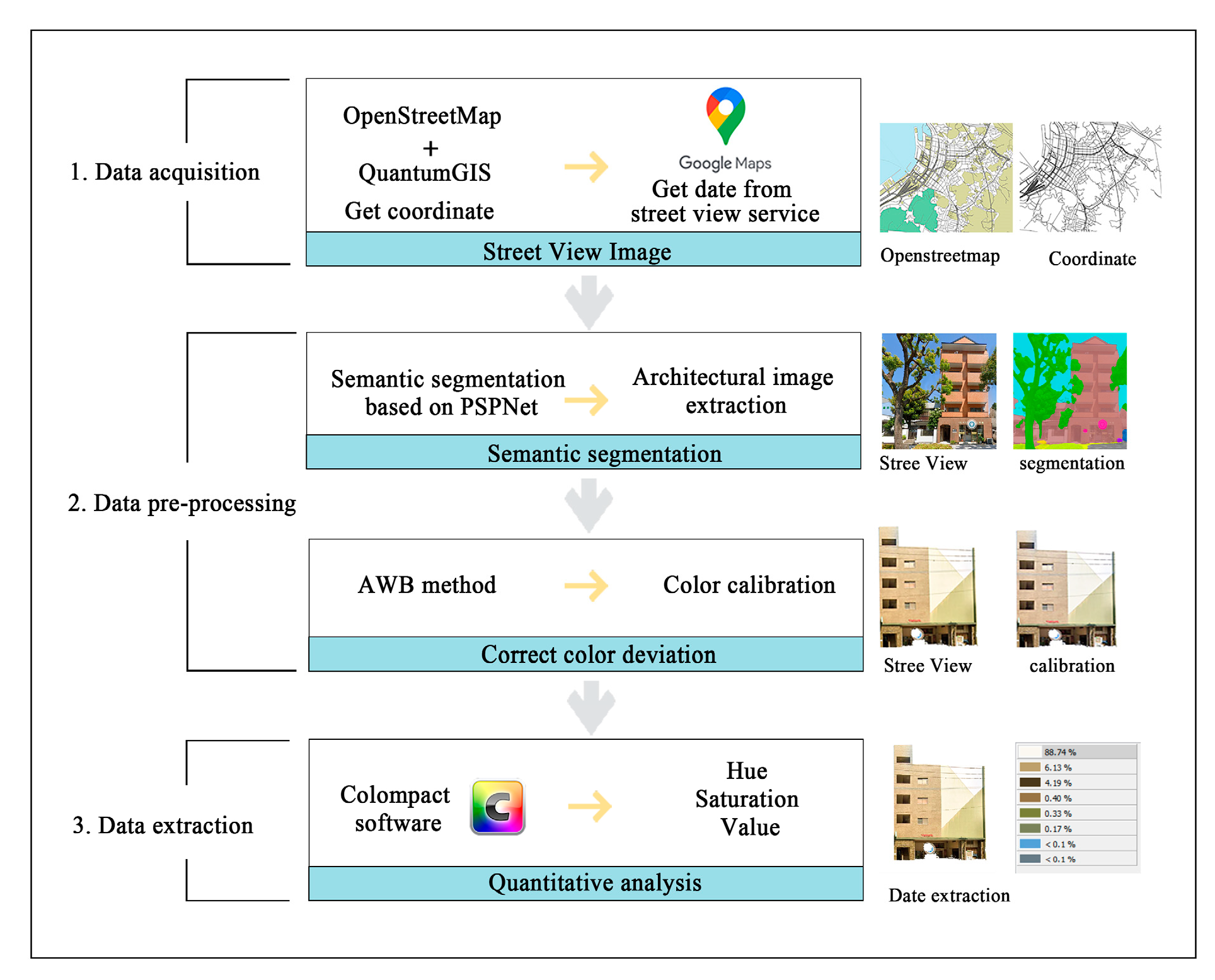
Coastal historic and cultural districts are distinctive urban public spaces which reflect the urban cultural and historical narratives. As an important symbol, coastal historic and cultural districts’ building colors play a crucial role in enhancing the historic and cultural districts’ visual quality and shaping the urban coastal landscape. Japan was one of the earliest countries to research urban color and building color regulation. This study selected Mojiko in Japan as the study site using street-view images, semantic segmentation technology, and ColorImpact4 software to collect information about the street building color. Based on the Moon–Spencer (M–S) color coordination theory and applied psychology methods, this study evaluated the building color quality and street color harmony from objective and subjective perspectives. It explored the impact of the building color on the coastal historic and cultural districts’ landscape quality. The results indicated that the building color of Mojiko generally presented a harmonious and unified characteristic. Most street buildings were soft, warm color tones, with higher color harmony and continuity. However, there were some problems, such as colors disrupting the overall street color environment, or color combinations were overly uniform. This study proposed a comprehensive method for building color analysis and evaluation, which is a reference value for guiding the color planning and construction for coastal historic and cultural districts’ landscape control.
Keywords: coastal streets; historic and cultural districts; building color; color harmony degree; M–S color coordination theory coastal streets; historic and cultural districts; building color; color harmony degree; M–S color coordination theory