1. Introduction
In the past few years, architects and urban designers have increasingly tried to balance development with cultural identity and contextual authenticity worldwide. Barcelona, Kyoto, and Marrakech have employed the strategy of heritage-based regeneration by merging conservation practices with innovation to maintain local character amid globalization. Likewise, in the Arab region, countries like Egypt, Morocco, and the United Arab Emirates have been forerunners in developing architectural prototypes that reinterpret traditional design and materials, thereby communicating cultural continuity in the new designs. Projects like Msheireb Downtown Doha and Al Seef, Dubai, are exemplary models in the Gulf region, proving the potential of this inspirational approach to urban planning to ensure sustainable reactivation while affirming communal identity. Drawing on this global and regional discourse, the present paper dwells on Saudi Arabia, where the most recent architectures—those associated with Vision 2030—reveal an emergent national attempt to reconceptualize the term ‘heritage’ within an approach that focuses on socio-cultural sustainability alongside new urban development. Saudi Arabia today stands at a point of historical reform, aimed at by ambitious national plans such as Vision 2030, which aim to diversify the economy and enhance the quality of life through widespread urbanization [
1]. In such a dynamic context of modernization, architecture itself plays a pivotal role in shaping the country’s physical and cultural landscape. The biggest challenge is balancing the prevailing development plans with the preservation and evolution of the Kingdom’s highly diversified architectural heritage [
2]. The intermix of traditional architectural precepts of the Kingdom with prevailing technology and design norms is increasingly valued as critical for documenting national identity and rendering the evolution culturally relevant and sustainable [
3]. Socio-cultural sustainability, underscoring the value of cultural heritage, community value, and community identity in the constructed environment [
4], offers a critical framework for resolving such a challenge. It posits that spaces respond to a community’s cultural and social use and evoke feelings of attachment and continuity [
5]. In the case of Saudi Arabia, this necessitates a reinterpretation of traditional architectural elements—various spatial organizations, such as courtyards (hosh), as well as specific attributes, such as intricate motifs and the use of local materials—within prevailing designs [
6]. Such an integration not only seeks to safeguard tangible heritage but also to uphold intangible cultural values and the community interaction characteristic of traditional architecture [
7].
The effort to conceive an Arab-region architecture that is modern yet culturally rooted has been driven by intellectual architects such as Rasem Badran, Abdelwahid El-Wakil, and Ali Shuaibi. Their work synthesizes indigenous culture with modern usability by employing local materials, spatial structures, and climate-responsive design strategies to enhance cultural continuity in contemporary design. Rasem Badran’s work, much of which is found in Saudi Arabia and Jordan, has been focused on contextual urbanity and people-oriented design guided by Islamic societal values. Correspondingly, Abdelwahid El-Wakil’s architecture work has restored traditional skills and traditional construction techniques from the Najd region, while Ali Shuaibi’s contributions to Saudi Arabia’s public architecture, as well as religious architecture, have shown an express intent to manifest the region’s identity through modernistic design. Their ideologies, together, have shaped the discourse on region-specific heritage-sensitive modernity, serving as the intellectual foundation for the present study on Saudi socio-cultural sustainability.
Cultural heritage’s intrinsic value for sustainable urbanism is international, and culture’s role in sustainable urbanism has been stressed by the UN Sustainable Development Goals [
8]. In the case of Saudi Arabia, that’s the King Salman Charter for Architecture and Urbanism. Issued in late 2021, the Charter provides for an improved urban environment in mutual harmony with local culture and nature, calling for an integrated framework rooted deeply in Islamic, civilizational, and social foundations [
9]. The effort, together with the emerging ‘Salmaniah Architecture’ style it embodies, marks an intentional attempt to direct current design toward solutions that are context-applicable and culture-sensitive by nature, while distancing themselves from generic global architectural fashion or superficial executions of tradition [
10]. Nonetheless, the combination of urbanization and the sustainability of cultural heritage remains a challenge, particularly for listed World Heritage Sites (WHS) and their surrounding areas [
11]. Additional insight is required into how the latest developments engage with sensitive heritage sites and foster innovation in cultural continuity and sustainable urbanism. The present paper fulfills the requirement by considering the use of socio-cultural sustainability precepts in the context of the latest architecture in Saudi Arabia. The study situates itself within the global debate on culturally integrated sustainability, where architectural identity, local knowledge, and socio-cultural agendas are perceived as critical sectors of sustainable development alongside the environment and the economy. International regulations, like those from UNESCO on the development of cultural landscapes, the Sustainable Development Goals proposed by the United Nations, and the socio-cultural elements in the latest models on sustainability, promote an architectural approach where the cultural, narrative, and communal aspects and meanings are respected. However, the Saudi Vision 2030 scenario appears to lack scientific studies conducted on application and implementation processes related to the concept of socio-cultural sustainability in real projects and developments, particularly in large-scale developments related to the protection and promotion of the site’s cultural and inherited structures. The proposed qualitative framework applied to Al Bujairi Terrace and Design Space AlUla fills a knowledge gap regarding the integration of modern and cultural aspects in modern architecture in Saudi Arabia.
The aim of the current study is to explore the expression of socio-cultural sustainability in contemporary architectural projects in Saudi Arabia and its role in establishing a contemporary Saudi architectural identity. Specifically, it analyzes the blending of traditional design elements with innovative methodologies to create architecture that honors both culture and society. The current study evaluates two significant case studies at different spatial scales: an urban-scale project (Al Bujairi Terrace, Diriyah) and a building-scale project (Design Space AlUla). Both projects are in near proximity to UNESCO World Heritage Sites: Al Bujairi Terrace in Diriyah, near the At-Turaif District, and the AlUla Design Studio in AlUla, near the Hegra site. The sites for these case studies have been selected for their proximity to internationally recognized heritage sites, enabling a specific analysis of how current architecture engages with, and arguably enhances, historically significant contexts. The analysis focuses on identifying the approaches used to balance tradition with the latest times and assessing their effectiveness in cultivating socio-cultural sustainability and enhancing Saudi identity. Based on these case study analyses, this paper seeks to provide further insight into how Saudi Arabia’s architecture can accommodate its modernization and cultural heritage. The findings provide valuable insights for architects, urban planners, and policymakers interested in the delivery of a sustainable, indigenous future for the Kingdom’s built environment. Accordingly, this study is guided by the following research question: How do contemporary architectural projects in Saudi Arabia reinterpret traditional design elements to promote socio-cultural sustainability and reinforce national identity?
2. Literature Review
The approach to protecting Saudi heritage and, at the same time, building a new architectural identity in contemporary Saudi architecture is a current priority in all Saudi Vision 2030 projects. The literature review analyzes the established body of literature regarding socio-cultural sustainability in architecture, its relevance in connection to the Saudi situation, and its influence on building the identity of Saudi architecture.
2.1. Socio-Cultural Sustainability in Architecture
Socio-cultural sustainability is an essential characteristic of sustainability, in which cultural values, personality, and the well-being of society are embedded in a resilient built environment. Socio-cultural sustainability thus includes intangible qualities such as common memory, a sense of belonging, and cultural continuity. It is set out to ensure that the evolution of the architecture conserves resources and maintains a sense of personality while bolstering the cohesion of societies in evolving urban centers [
12,
13]. The traditional concept of sustainability in architecture has overwhelmingly focused on environmental performance and resource efficiency. A more integrated notion, however, has developed, stressing social and cultural aspects [
12]. Socio-cultural sustainability refers to the potential of the built environment to contribute to and sustain cultural identity, social cohesion, community well-being, and sense of place over generations [
13]. This notion entails the provision of spaces that reflect the historical background, cultural assumptions, and occupants’ behaviors, and provide continuity and a sense of place [
14]. Realizing such an aim often necessitates the conscious use of traditional architectural components, local materials, and indigenous construction techniques in current designs, such that architecture not only meets performance requirements but also adds to cultural histories and social structures [
14]. In rapidly changing circumstances, such as in Saudi Arabia, socio-cultural sustainability assumes special urgency in balancing global forces and local culture so that development positively adds to the community’s identity and social fabric [
15].
Increasingly, the need for socio-cultural sustainability is emerging in the international arena as a fundamental aspect of comprehensive architectural design. Thus, the UNESCO Cultural Landscape Convention emphasizes the protection of cultural significations in built space, and the Sustainable Development Goals, adopted by the United Nations, specifically Goal 11, Sustainable Cities and Communities, encourage the protection of cultural heritage, the promotion of inclusiveness, and the enhancement of social cohesion. Simultaneously, the design and application of measures aimed at assessing sustainability in the international arena, such as BREEAM Communities, LEED for Neighborhood Development (LEED-ND), and the City Sustainability Index, include the application of relevant socio-cultural indicators relating to place, involvement, continuity, and accessibility. Thus, these tools globally establish architecture in terms of its cultural and social dimensions rather than its technological dimensions and accentuate the need for proper architectural design strategies to balance the modern and the deeply embedded cultural aspects. While UNESCO’s Cultural Landscape model emphasizes cultural continuity, SDG 11 and BREEAM Communities highlight social inclusivity and everyday urban experience, together forming a multidimensional understanding of socio-cultural sustainability. Despite the ongoing and developing worldwide discussion on the need and application of the concept and principle of socio-cultural sustainability, studies focusing on the implementation and application of these principles in the Saudi Vision 2030 projects in the area of cultural development remain rather limited. The present work aims to fill this gap by applying the worldwide process to the particular Saudi cases. Socio-cultural sustainability is a goal in architecture through the reinterpretation of the region’s culture, materials, and interpretations within current designs. Recent studies also argue that sustainable architecture must be culture-based to promote livability and inclusivity [
14,
16,
17]. Socio-cultural sustainability is paramount in Saudi Arabia, with rapid changes driven by Vision 2030, which is propelling modernization while preserving cultural authenticity. Construction developments like those in Diriyah, AlUla, and Riyadh regenerate ancient values through contemporary design, where built structures resonate with the community through spiritual references.
Saudi Arabia’s new ‘giga-projects’ (large-scale urban and territorial developments under Saudi Vision 2030, such as NEOM, Diriyah Gate, and the Red Sea Project) aim to blend cultural heritage and modernity. Flagship projects such as Diriyah Gate, the Red Sea Project, restoration of AlUla, and NEOM prioritize cultural sustainability [
1]. The projects highlight architectural designs that embody Saudi identity but accept new practices and global standards [
9]. A case in point is the King Abdulaziz Center for World Culture (Ithra) in Dhahran, blending traditional architecture and modern design philosophy [
9]. Socio-cultural sustainability transcends aesthetic considerations, including the impact of modern architecture on societal structures and its contribution to cultural practice [
18]. In the Saudi setting of strong community and family ties, architectural expressions need to reflect and complement social interaction, for instance, by having appropriate spaces for community meetings, such as the majlis, or by manifesting traditional notions of privacy [
19]. Contemporary architectural projects increasingly include community spaces promoting interaction and cultural events, similar to the traditional roles of souks and cities’ open spaces. There is also growing interest in rediscovering traditional construction practices and using local, natural building materials (such as adobe, stone, and plaster), not only for their cultural value but also for their environmental benefits, including reduced embodied energy and improved thermal performance [
19]. The combination of traditional environmental design practices, such as the use of wind towers (barjeel) for natural ventilation or shaded courtyards, with modern analytical methods and technologies offers potential for improving building sustainability and retaining cultural heritage [
20]. There has been an ever-growing interest in recent international studies [
21,
22,
23,
24] focusing on the relationship between cultural sustainability and architectural identity, in which the role of heritage in shaping the city has become pivotal in developing concepts of belonging, memory, and social sustainability. Studies conducted in Europe, Eastern Asia, and the developing world have examined the use of culturally rooted design and architecture to foster social and sustainable identities. Despite the growing body of work, there has been a lack of similar studies in the framework and situation of the ongoing development process in the Kingdom of Saudi Arabia, under the vision of Saudi Vision 2030 [
18,
19,
21]. Together, these models show that socio-cultural sustainability is operationalized through continuity, engagement, and contextual fit, providing the foundation for the analytical dimensions used in this research.
2.2. Saudi Architectural Identity and Traditional Elements
Saudi architectural identity is highly diversified, reflecting the Kingdom’s diverse geographical landscape, climatic regimes, and tribal histories. There have been marked regional patterns, such as Najdi architecture in the central region, Hijazi architecture on the Red Sea coast, and Asiri architecture in the southwestern mountains, each with distinct features that respond to localized conditions and socio-cultural norms [
25]. For instance, Najdi architecture is characterized by adobe construction, inward-facing courtyard houses (hosh) arranged along narrow, shaded alleys, flat roofs, and characteristic triangular perforations and crenulations [
11]. Such traditional elements and applications are used to address desert climate challenges and achieve the privacy of traditional Islamic society. Similarly, multi-story structures with wooden balconies (rawashin) were the main element in Hijazi architecture, facilitating ventilation and controlling social interaction. In contrast, Asiri architecture is famous for the use of stonework and rich decorative motifs. Such traditional characteristics extend beyond mere stylistic expressions; conventional attributes convey cultural significance, reflect social gradations, and accommodate climes [
17,
25]. Courtyards ensure family privacy and ventilation; motifs convey cultural imagery; and indigenous materials such as mud, stone, and timber facilitate adaptability [
26]. To achieve the target of cultivating Saudi national identity and preserving heritage, it is essential to understand the contemporary design features and determinants. Thus, the local context and knowledge mainly affect the sustainable paradigm-dependent generation of indigenous expertise.
The architectural identity of Saudi Arabia evolved from environmental response, social order, and cultural imagery. Vernacular buildings in the Hijazi and Najdi regions used local construction materials and packed construction to encourage warmth and conviviality. Anthony King (1984) [
27] noted that the vernacular type was not only the result of environmental need but also an expression of societal order and identity, the relationship between constructed form and cultural meaning. King’s studies of the courtyard structures, mudbrick buildings, and decorative themes provide the foundation for an interpretation of the region’s diversity within Saudi architecture [
28]. Saudi architecture is reinterpreting vernacular ideals with modern methods and materials, seeking authenticity and uniqueness. The balance between heritage preservation and modern expression is a key aspect of designs under the current provisions of the Vision 2030 and the King Salman Charter for Architecture and Urbanism, aiming to preserve cultural continuity within current development [
9,
29,
30]. Compared with traditional theories of place identity, the King Salman Charter provides a more locally contextualized framework that aligns cultural heritage with contemporary design requirements.
2.3. The Salmani Architecture and the King Salman Charter
Saudi Arabia has taken a conscious, considered approach aimed at creating a modern architectural style that reflects local tradition, responding to the challenges of urbanization, high-speed development, and the universal appeal of generic architectural styles. This special attention is on the local Najd tradition, which historically pertains to the ruling house of the Saudi dynasty and the capital city of Riyadh, where such influences strongly prevail. The Salmani Architecture is an architectural style that embodies a modern architectural ideology established with the support of King Salman bin Abdulaziz Al Saud, focusing on integrating Saudi cultural heritage with contemporary innovation. Drawing on the traditional Najdi architectural style, it advocates design concepts that reflect authenticity, a human-centered approach, and contextual coherence while incorporating contemporary materials and technologies. Officially recognized by the King Salman Charter for Architecture and Urbanism (2019), this methodology provides a national framework that guides architects in Saudi Arabia toward culturally relevant, sustainable, and identity-focused architectural practices [
29]. This architectural approach lays significant stress on traditional Najdi precepts such as incorporating a human dimension into its design, using local construction materials that reflect the region’s identity, achieving climate-sensitive designs that respond to environmental conditions, and establishing spatial relationships that are culturally well-fitted and meaningful. All these connect harmoniously with modern construction technologies and provide balance to the attempt at connecting the new and the old [
29]. The ultimate objective of the approach is to provide a modern built-up environment with a distinct hint of Saudi identity, without falling into mere superficial ‘neo-orientalism.’ The attempt seeks to capture timeless virtues inherent in local culture, so that architectural developments indeed connect with the people. The initiative was also concretized by the announcement of the King Salman Charter for Architecture and Urbanism in 2024, a significant book released by the Architecture and Design Commission [
30]. The Charter enunciates its six fundamental values inescapable for such a vision: Authenticity, Continuity, Human-Centricity, Liveability, Innovation, and Sustainability.
Essentially, the Charter offers guiding principles for architects and urban planners to design buildings that celebrate traditional architectural wisdom enshrined in Saudi Arabia’s culture and, at the same time, respond to the needs and ideals of modern times. The Charter encourages regionalism and supports region-specific solutions tailored to the unique conditions of different regions, thereby endorsing well-informed design practices that reflect and respond to the local culture and environment enshrined in the Kingdom’s regions of regional diversity [
30]. Thus, both the King Salman Charter and Salmani Architecture reflect an important policy orientation that attaches overriding importance to paying due attention to the traditional urban environment and the building context to create a distinct national identity in the built environment and to effectively implement the Vision 2030 [
30]. Salmani Architecture thus establishes a flexible, human-focused paradigm that helps steer modern Saudi architecture towards its true goals of authenticity and cultural consistency. The application of these Salmani Architecture principles in real-world scenarios will be discussed in greater detail in
Section 4, where case studies will be assessed according to this framework. International discussions on heritage urbanism focus on conservation, whereas Saudi scholarship stresses reinterpretation and adaptive reuse, revealing a contextual gap the present study addresses.
In summary, although international frameworks provide multi-layered approaches to socio-cultural sustainability, there remains limited empirical examination of how contemporary Saudi projects reinterpret traditional elements within this context, which defines the research gap addressed by this study. To synthesize the reviewed theoretical models and identify the research gap,
Table 1 summarizes the main frameworks and their relevance to this study.
3. Materials and Methods
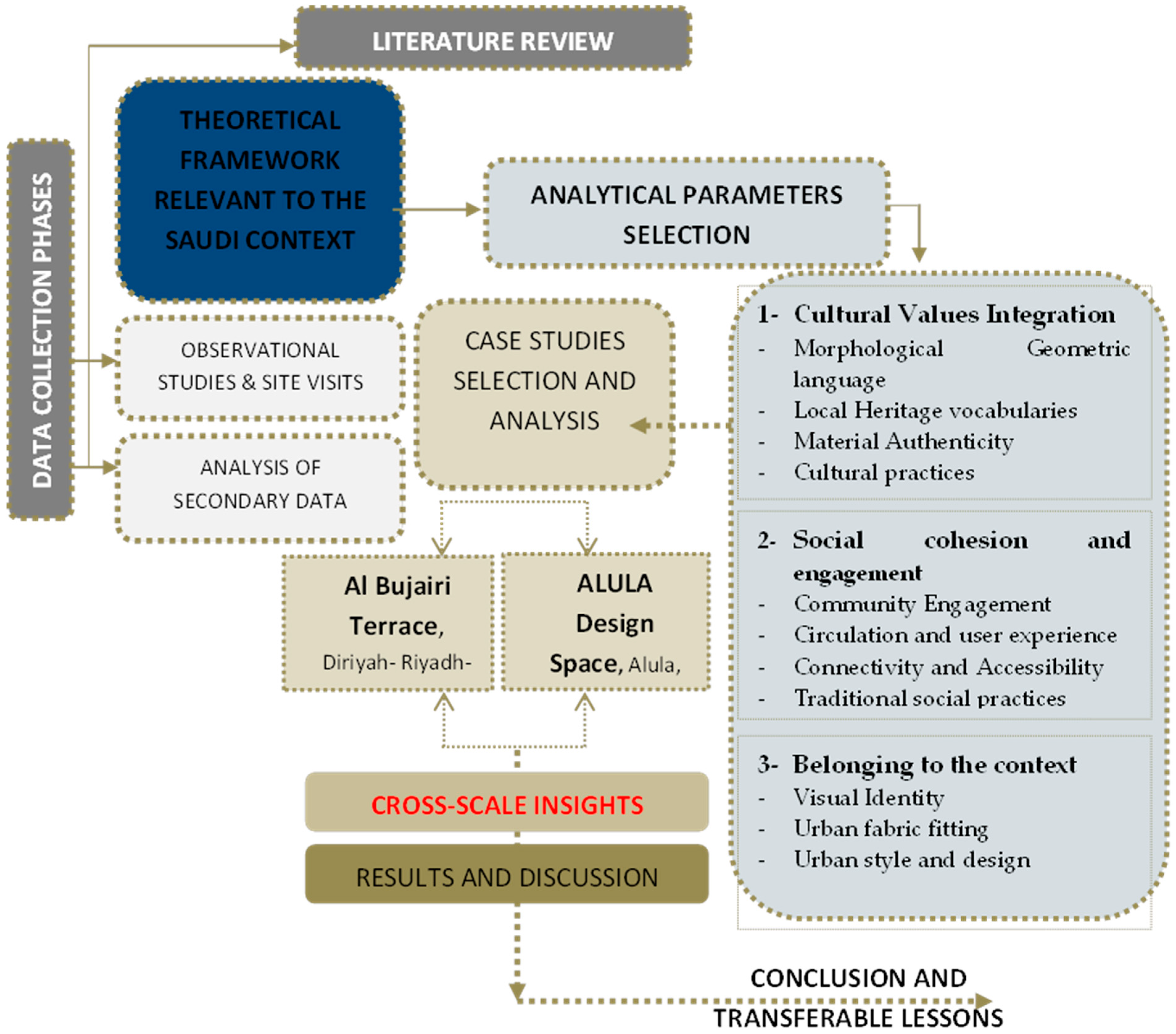
This research employs a cross-scale qualitative method grounded in the analysis of two case studies to examine the socio-cultural sustainability of contemporary architectural interventions within historical contexts in Saudi Arabia, as shown in
Figure 1. This study investigates how architectural Saudi heritage vocabularies are reinterpreted in modern designs at different spatial scales through an urban-scale project (Al Bujairi Terrace, Diriyah, Riyadh) and a building-scale project (Design Space AlUla in the AlJadidah Arts District of AlUla). The analysis includes two case studies at both macro and micro levels, showcasing the blending of traditional Saudi design fundamentals and contemporary practices, thereby demonstrating the potential for sustainable architecture that respects socio-cultural aspects. To examine the socio-cultural sustainability of contemporary architectural interventions set within historical sites in Saudi Arabia. The case studies were selected for their location near UNESCO World Heritage sites, enabling an evaluation of how these projects have added value and interacted with nearby heritage sites. The choice of these sites was due to their central roles as principal cultural heritage sites that are undergoing substantial current developments and, for this reason, offer significant opportunities to examine the interaction among current design, heritage preservation, and community engagement. The research approach integrates several data collection methods to provide a comprehensive understanding. Firstly, an extensive literature review was conducted, encompassing academic journals, conference proceedings, books, official reports from development authorities (such as the Diriyah Gate Development Authority and the Royal Commission for AlUla), and reputable architectural publications. This review established the theoretical framework concerning socio-cultural sustainability, heritage conservation principles, and place-making theories relevant to the Saudi context. Secondly, architectural and spatial analyses of the case study sites were conducted. This involved examining site plans, architectural drawings (where available), and photographic documentation collected through site visits and secondary sources. The cross-scale qualitative analysis focused on identifying key design strategies, material palettes, spatial organization, and integration with the surrounding historical fabric. Particular attention was paid to how contemporary designs respond to traditional Najdi and Hejazi architectural typologies on a different scale.
Thirdly, observational studies were conducted during site visits to Bujairi Terrace and AlUla’s AlJadidah district. Non-participant observation focused on how visitors and local communities interact with the spaces, the types of activities taking place, patterns of movement, and the overall atmosphere and sense of place generated by the architectural interventions. These observations provided insights into the lived experience of the sites beyond their design intent. Fourthly, secondary data analysis, including event programming, media coverage, and online reviews related to the case study sites, was undertaken. The cross-scale qualitative analysis synthesizes findings from case studies, identifying and evaluating the effectiveness of different strategies in achieving socio-cultural sustainability at both macro and micro levels. The analysis parameters are derived from the literature review, focusing on aspects such as respect for heritage values, community inclusivity, promotion of local culture, creation of a vibrant public realm, and contribution to a distinct sense of place. The aim is to extract lessons that might be applied to future heritage-led development initiatives in Saudi Arabia and beyond.
The study used non-participant observation to document user activity, activity distribution, and spatial movement in both facilities. Data were captured during three visits at each facility, each lasting 2 to 3 h, on both weekday and weekend days, for mixed use of the site. Observations proceeded according to a predetermined checklist based on the analytical parameters (
Table 1), and circulation, social interactions, accessibility, and comfort, among others, were observed. Field notes and photographs were also taken for later analysis. Objective description was given priority in these observations to minimize bias, and all notes were scrutinized after each session for accuracy and consistency. To add to these qualitative findings from field research, this study also applies structured tools of synthesis to aid understanding of behavior patterns and their related social implications. The field observations were carried out by means of note-taking, with primary focus on the users and their social and cultural aspects related to the conceptual framework. The application of the conceptual framework and methodology has employed the principle of triangulation, with document analysis conducted and the resulting findings cross-checked against the master plans and available project reports.
Although the scope of study is restricted to two case studies, that choice was deliberate and theoretically warranted to allow for intensive, context-specific cross-scale qualitative analysis of socio-cultural sustainability in the setting of contemporary Saudi architecture at both macro and micro levels. Al Bujairi Terrace in Diriyah (Najdi region) represents macro scale, and Design Space AlUla in the Western region of AlUla represents micro scale, due to their extremely dissimilar geographic, cultural, and architectural settings. Coupled with their mutual location near UNESCO World Heritage sites, they were chosen as locations. This deliberate sampling process enables intensive cross-scale analysis that balances the richness of regional variability with analytical stringency. Instead of aiming for statistical generalizability, the research prioritizes analytical transferability and contextual insight. The study adopts an expansive cross-scalar qualitative approach, intentionally focusing on two projects representing disparate typologies and scales. The justification is an endeavor to delve into experiential exploration, both within the urban and architectural contexts in the Kingdom of Saudi Arabia, to understand how the shared fundamentals of socio-cultural sustainability and heritage identity are felt and transmitted.
3.1. Conceptual Framework for Socio-Cultural Sustainability in Architecture
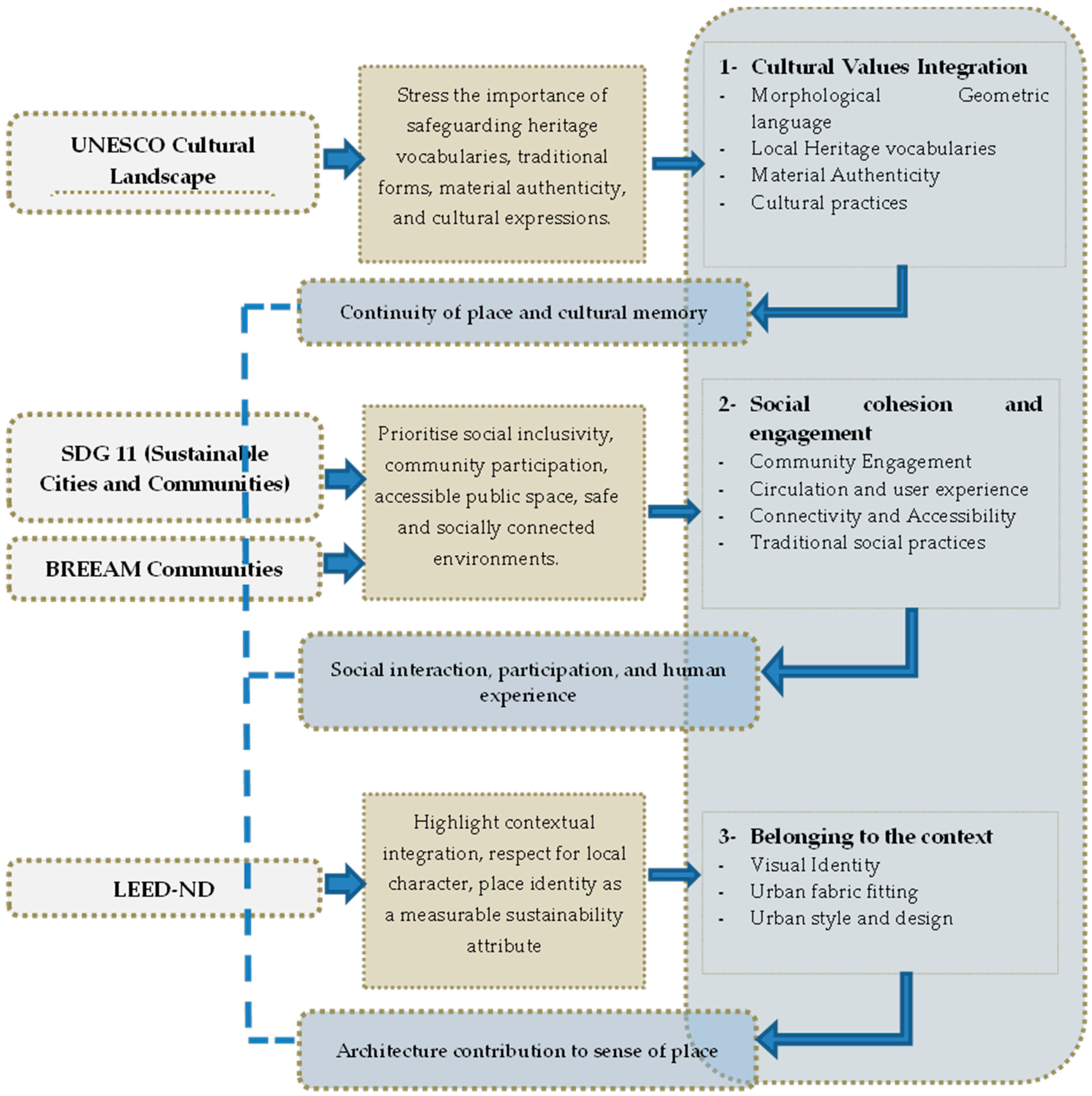
This research develops a conceptual framework that interweaves global approaches towards socio-cultural sustainability with regional architectural values relevant to the Saudi context. Global approaches include UNESCO’s Convention on the Protection and Management of Cultural Landscapes (2005), UN Sustainable Development Goal 11, BREEAM Communities, LEED-ND, or the City Sustainability Index. These approaches identify cultural continuity and social inclusiveness and regional identity in architecture as essential components in the process of sustainable architectural development by conceptualizing architecture in terms of social and cultural processes. Within this global debate, this proposed framework translates the socio-cultural aspects of sustainability through the following three interlocked themes: Cultural Values Integration; Social Cohesion and Engagement; and Belonging in Context. This framework aligns with both global best practices and regional guidelines like the King Salman Charter of Architecture and Urbanism, which center the needs of human beings in terms of contextuality and adaptation over more universal values like purity and cleanliness. By incorporating the socio-cultural sustainability theme within the parameters of this three-dimensional structure, there now exists a clear methodology by which this research can adequately address the ways in the current Saudi architectural endeavors incorporate traditional design themes in addressing the requirements of today’s functional social and cultural needs. (See
Figure 2).
3.2. Identification of Analytical Parameters
This part focuses on introducing the integrated framework that is designed with analytical parameters to evaluate the socio-cultural sustainability of contemporary architectural practices that go beyond the tangible and intangible dimensions of cultural heritage to social cohesion and contextual identity, as shown in
Table 1. This section describes parameters for critically assessing architectural projects against conventional value, social interaction, and local environmental characteristics. The parameters depend on socio-cultural sustainability conventions and stress balance among authenticity, innovation, and inclusivity. The analysis aims to demonstrate how architecture in modern Saudi Arabia supports cultural identity, community well-being, and a sustainable built environment. The parameters presented in
Table 1 served as qualitative categories, not quantitative indicators, and represented elements of socio-cultural sustainability, such as cultural values, social cohesiveness, and belongingness. A descriptive analysis of the two case studies was employed in the evaluation, in which each element was emphasized for its occurrence and role. This is systematic yet ensures depth in the interpretation of cultural significance, use behavior, and design intention in each location. The qualitative data collected through field observations, serial vision walking, and document analysis were synthesized using a structured coding process aligned with the analytical criteria in
Table 2. Each observation was categorised under themes such as identity expression, material authenticity, spatial experience, social engagement, and accessibility, enabling direct linkage between field notes and analytical parameters. A summary matrix was developed to map qualitative findings to each criterion, ensuring consistency in interpretation across the two case studies and strengthening the transparency of the analytical process.
3.3. Case Studies Determination and Description
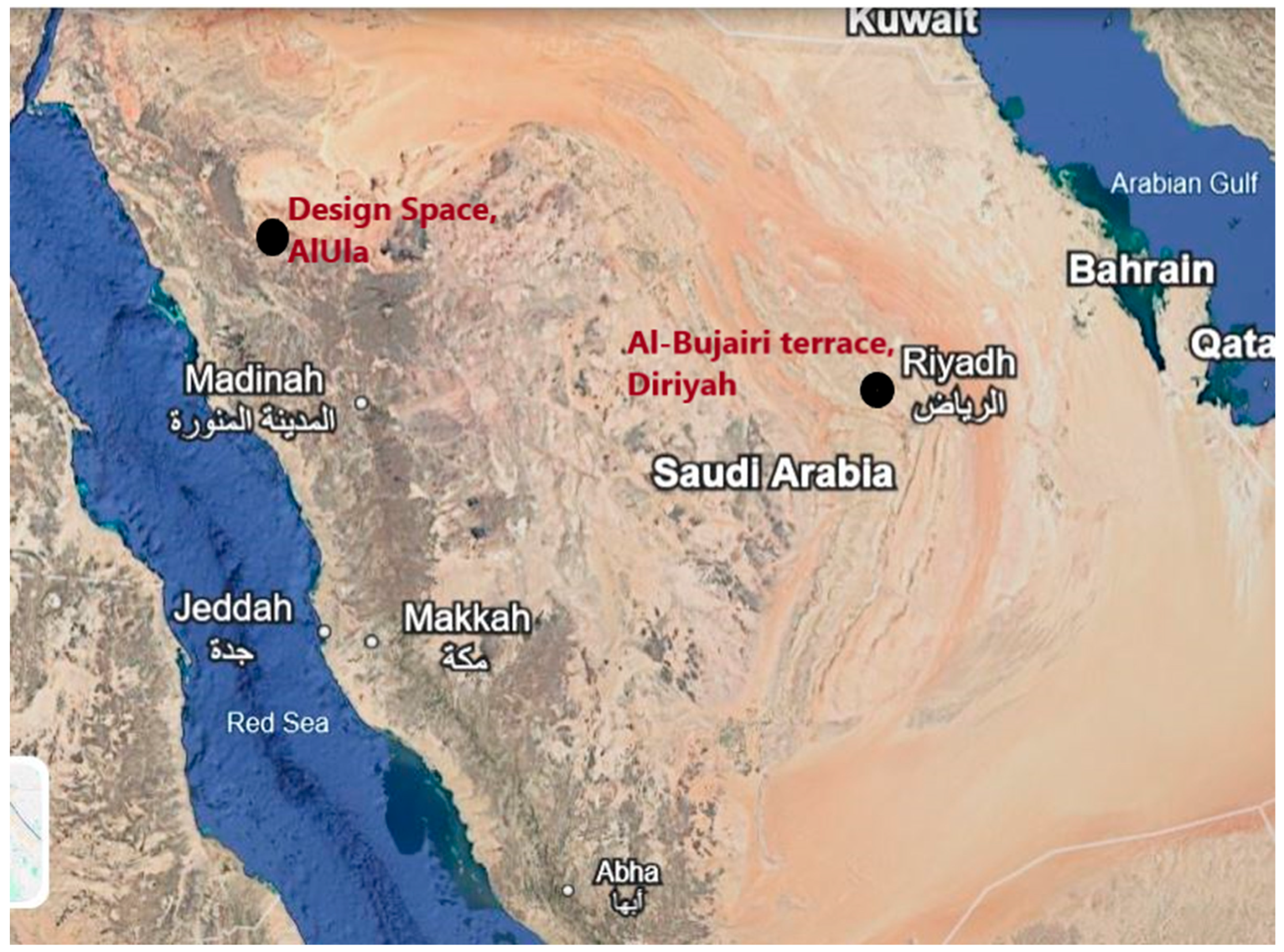
The case study sites were chosen from two different Saudi regions to show the variety in interpretations of Saudi culture across different Saudi contexts and scales (See
Figure 3). The selection of the two case studies was guided by the aim of examining how socio-cultural sustainability and Salmani architectural principles are interpreted across different spatial scales and regional contexts. However, they share some key aspects and cultural roots that have led to a shared identity. Al Bujairi Terrace in Diriyah (Najdi region) represents the macro scale, and Design Space AlUla in the Western region of AlUla represents the micro scale. This contrast constitutes a key element within the research design. It enables the research to explore how the same set of cultural values, including authenticity, identity expression, material logic, and human-scale space quality, are adapted from large-scale urban regeneration projects to small-scale architectural design interventions. This structured research framework has therefore been established to evaluate both projects using common thematic terms, so that they can be compared not on scale but on intended meaning. The reason for choosing these two case studies was their importance as flagship heritage-led developments within Saudi Arabia’s Vision 2030 framework, rather than their visibility on the tourist front. Both projects are selected for their representation of the national design paradigm, which combines elements of socio-cultural sustainability, heritage authenticity, and new architectural innovations. The support provided to both projects by prominent cultural institutions, such as the Diriyah Gate Development Authority (DGDA) and Royal Commission for AlUla (RCU), identifies them as prominent examples within current Saudi architectural practices. More importantly, these regions were chosen due to the richness of their cultural heritage, and they are both located adjacent to one of Saudi Arabia’s UNESCO World Heritage sites, the most famous and having a high rate of visitors, to check how it affects the tourism and local attraction at the sites. The selection of the two case studies—Al Bujairi Terrace in Diriyah and Design Space AlUla—was driven by the need to demonstrate diversity by scale and typology within an integrated culture-sustainability framework. Although the projects have physical dimensions and spatial coverage that differ from one another, this divergence was deliberately designed to allow for the analysis and interpretation of the ways in which socio-cultural sustainability and cultural heritage identity are reinterpreted in urban and architectural settings in contemporary Saudi Arabia. Al Bujairi Terrace is typified as an important urban regeneration development, featuring heritage-oriented public spaces, while Design Space AlUla is presented as an architectural-scale intervention grounded in authenticity and cultural reference. The qualitative study is therefore analytical rather than dimensional, focusing instead on the expression, through design scales, of common cultural values—contextual belonging, traditional morphology, and the humanization of space—and similarly examining their development. Through this approach, the study is able to give primacy to the versatility-by-design principle across varied architecture and urban settings, in line with the overall goal of Vision 2030 for Saudi Arabia and the King Salman Charter for Architecture and Urbanism.
3.3.1. Case Study 1: Al Bujairi Terrace, Diriyah, KSA
Al Bujairi Terrace is located in the Diriyah area of the Riyadh Region in central Saudi Arabia, which features a hot, arid plateau climate. Diriyah, located on the northwestern outskirts of Riyadh, holds profound historical and cultural significance as the birthplace of the first Saudi state and the original home of the Al Saud family [
32]. The At-Turaif District within Diriyah, inscribed as a UNESCO World Heritage site in 2010, stands as a testament to Najdi architecture and the region’s political history [
32]. The recent large-scale development projects, spearheaded by the Diriyah Gate Development Authority (DGDA), aim to transform the area into a global cultural and lifestyle destination, balancing heritage preservation with contemporary aspirations [
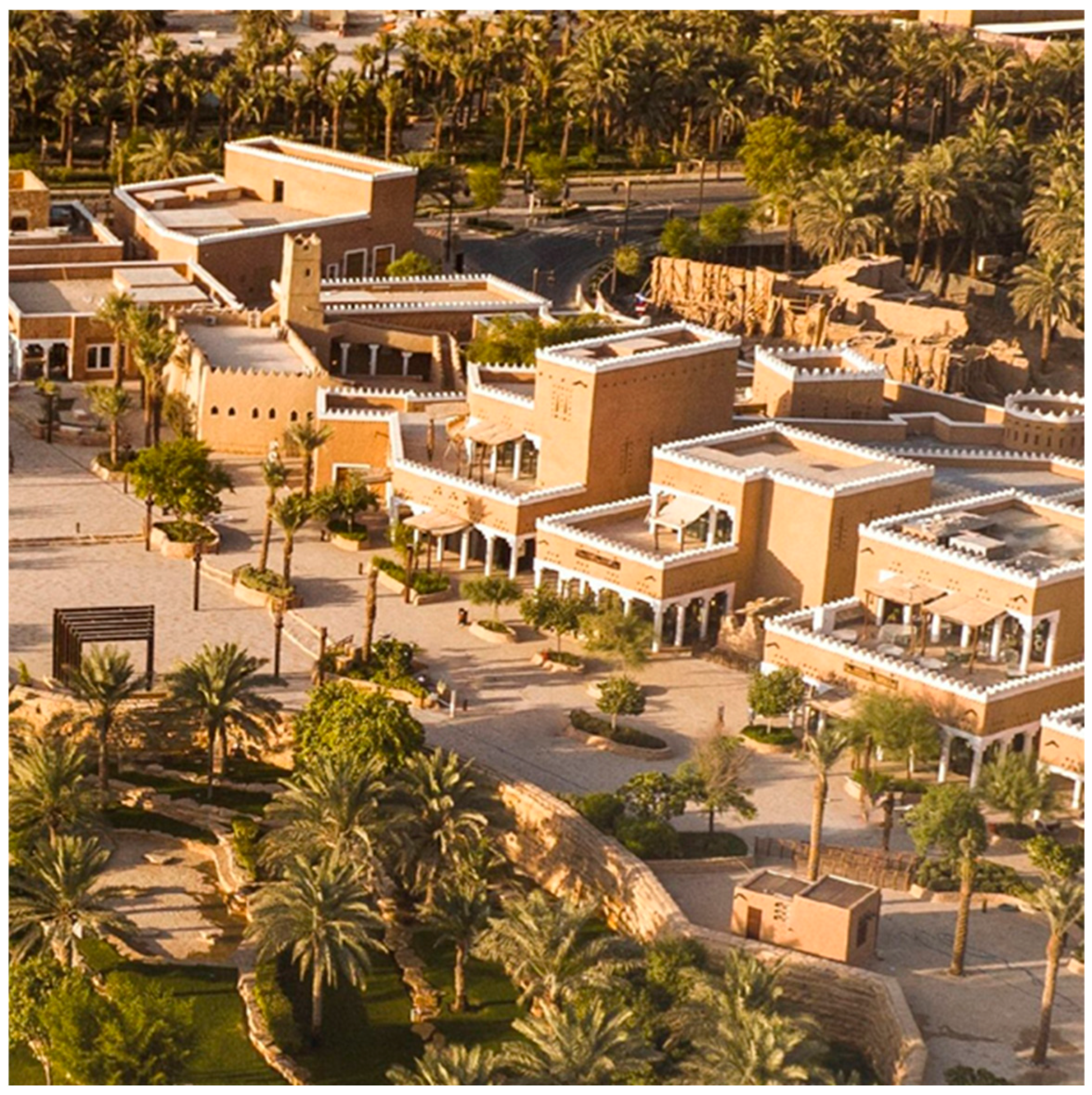
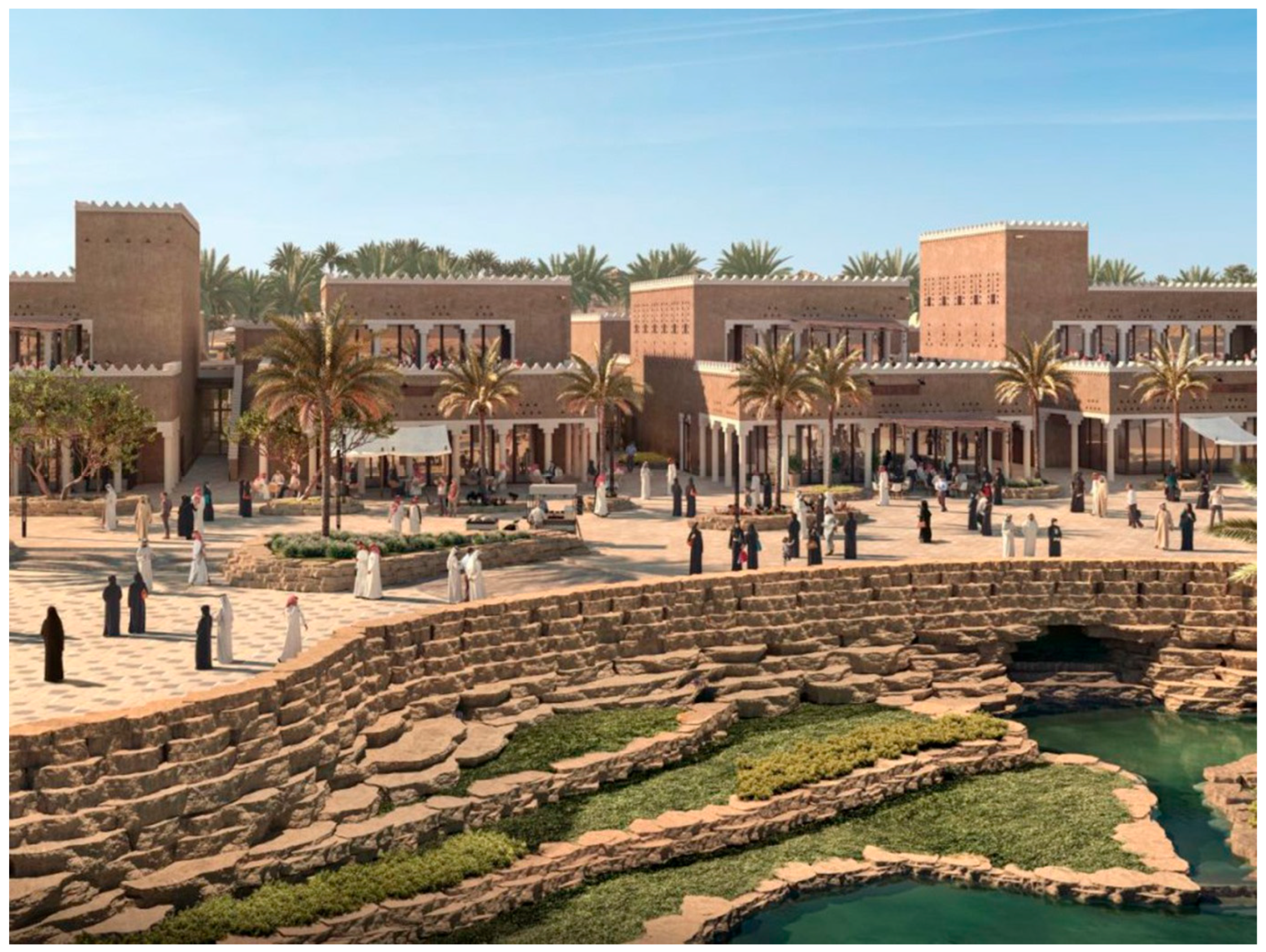
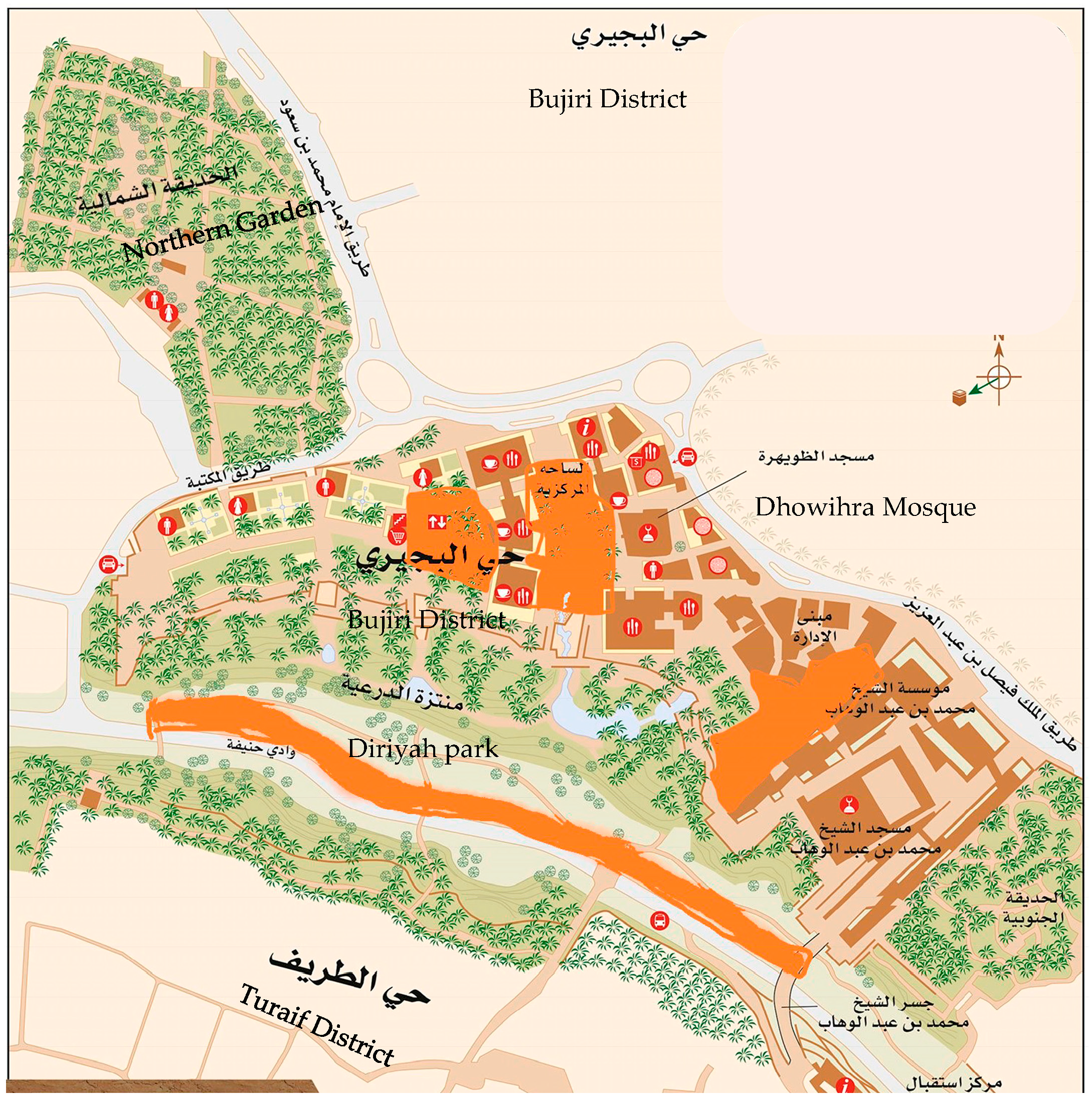
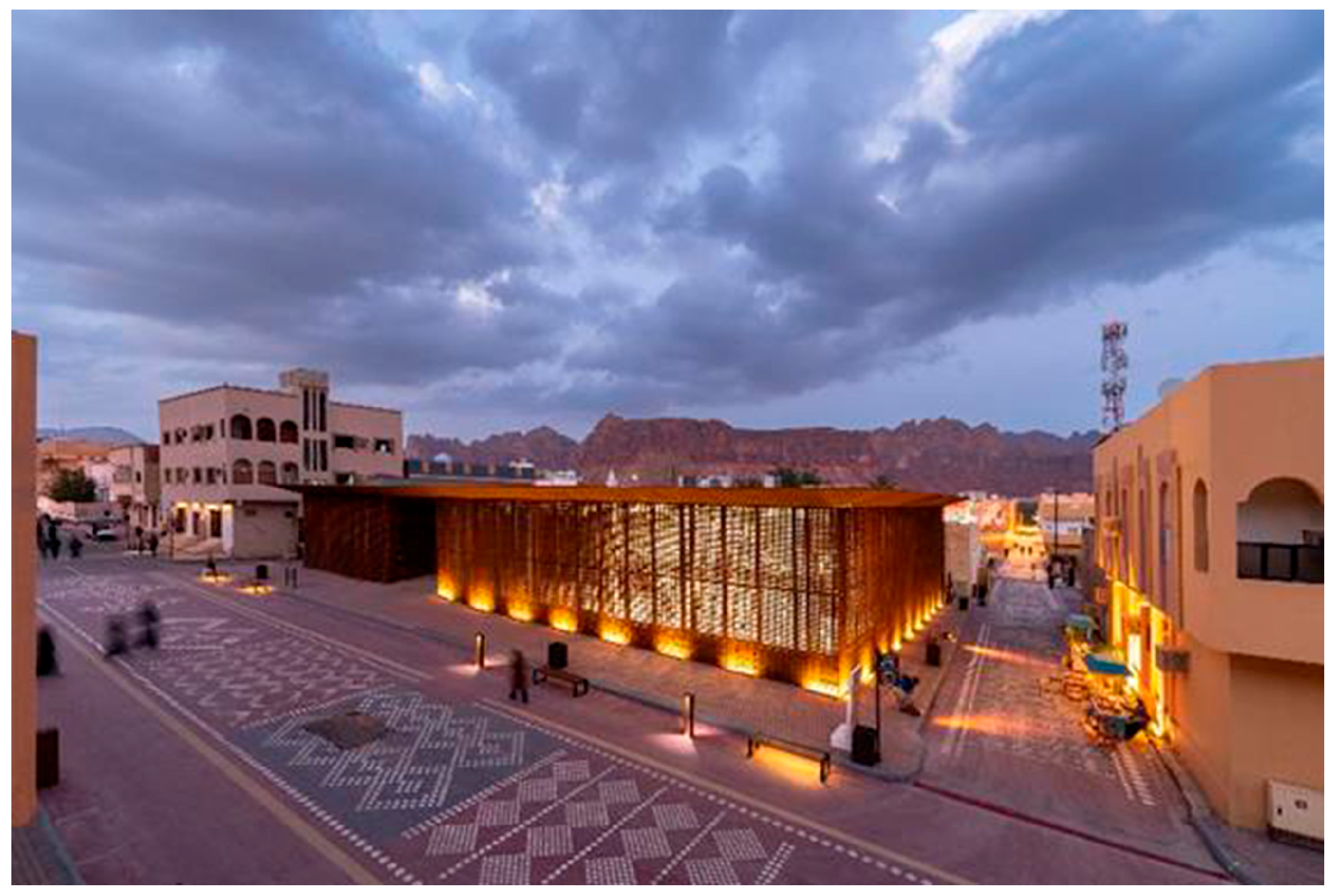
33]. Al Bujairi Terrace, situated across the Wadi Hanifah from At-Turaif, serves as the primary dining and leisure precinct within this ambitious master plan, offering visitors unparalleled views of the historic citadel (See
Figure 4).
| Typology/Description | A vibrant mixed-use retail and f&b destination for Riyadh
a vibrant mix of F&B, culture, leisure and entertainment program |
| Sector | Cultural/Heritage |
| Area | 15,000 m2 |
| Architect | Benoy’s |
| Development Authority | Diriyah Gate Development Authority (DGDA) |
| Year | 2023 |
| Location | Diriyah-Riyadh-Central Saudi Arabia-KSA |
| Recognition | Al Bujairi Terrace site is set in a unique location, adjacent to the UNESCO World Heritage site of At-Turaif. Won Riyadh Region Creativity Award in Architecture, Urban Development. Al Bujairi Terrace attracted over one million visitors in its first six months of operation, according to SPA. |
3.3.2. Case Study 2: Design Space AlUla, AlJadidah Arts District
The design Space AlUla lies in the northwestern AlUla governorate, defined by rocky desert formations and moderate temperature variations. The Design Space AlUla presents a distinct architectural statement within AlJadidah. AlUla, located in the northwest of Saudi Arabia, is a region of extraordinary natural beauty and profound historical depth, encompassing millennia of human history, including the Nabataean kingdom centered at Hegra (Mada’in Salih), another UNESCO World Heritage site [
34]. The Royal Commission for AlUla (RCU) is undertaking a vast and sensitive development program to transform AlUla into a leading global destination for cultural and natural heritage tourism, guided by principles of sustainability and community engagement [
35]. Within this framework, the AlJadidah Arts District has emerged as a vibrant hub adjacent to AlUla Old Town, designed to foster creativity, cultural exchange, and community life [
35]. The Design Space AlUla, situated prominently within this district, serves as a focal point for showcasing design initiatives, hosting exhibitions, and facilitating workshops related to AlUla’s ongoing development (See
Figure 5).
| Typology/Description | Gallery, exhibition, workshop and archive space |
| Sector | Cultural and Event Building |
| Area | 600 m2 |
| Architect | Giò Forma Studio and Black Engineering |
| Development Authority | Royal Commission for AlUla (RCU) |
| Year | 2022 |
| Location | AlJadidah Arts District, Alula, Northwestern Saudi Arabia, KSA
adjacent to the UNESCO World Heritage site of Hegra. |
| Recognition | the region’s first permanent contemporary gallery space |
4. Results
In this part the study focuses on the deep critical analysis for the case studies using the analytical criteria.
4.1. Case Study 1: Al Bujairi Terrace, Diriyah, Riyadh, Saudi Arabia
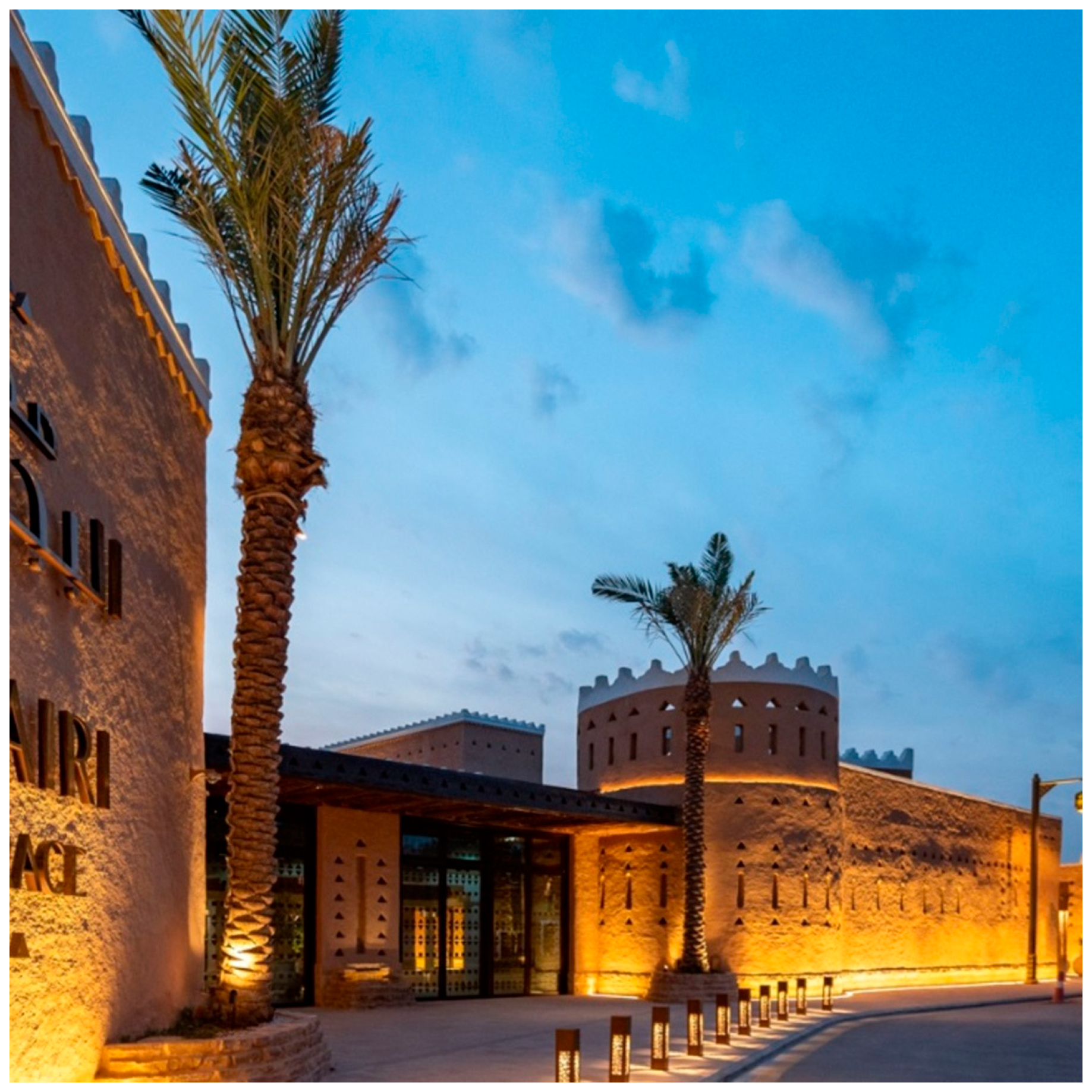
The Bujairi Terrace’s Diriyah Gate project is an exemplar of the integration of tradition and contemporaneity in Saudi architecture in the modern era. In the historic Al-Bujairi district, a Najdi agricultural community that has preserved centuries-old vernacular architectural heritage, the project interprets this heritage as a culture and entertainment hub. Its proximity to the UNESCO World Heritage Site At-Turaif also enhances its symbolic significance, offering guests stunning views of one of the Kingdom’s key historical landmarks. Spanning more than 15,000 m
2, the Bujairi Terraces host more than 20 internationally recognized restaurants and cafes, handpicked to satisfy the project’s vision of reimagining Diriyah as “The City of Earth,” a city that reflects cultural authenticity with innovative harmony [
37]. In addition to its role as a luxury dining destination, the project is also a strategic element of the Diriyah Master Plan that aims to establish Diriyah as an international hub for culture, entertainment, and learning. The master plan supports Vision 2030’s vision of cultural preservation, economic diversification, and tourism growth. The Bujairi Terraces architectural vision has been internationally recognized, winning the Riyadh Municipality Award for Architectural and Urban Creativity. This award emphasizes the project’s ability to incorporate Najdi architectural identity—local material adoption, pedestrian spatial arrangement, and cultural symbols—into modern construction practices and environmental standards. In addition to architecture, the project is an expression of urban and cultural transformation. By injecting cultural narratives into its architecture and software—such as integrating Saudi and Middle Eastern cuisine into its upscale dining restaurants—Bujairi Terraces enhances Diriyah’s positioning as a crossroads of civilizations while simultaneously serving as a contemporary-day fun and tourism icon. The sheer growth in visitors, which exceeded one million in the first six months, is a testament to its ability to blend heritage values and modern-day hospitality experiences [
38].
4.1.1. Cultural Values Integration
Morphological Geometric Language
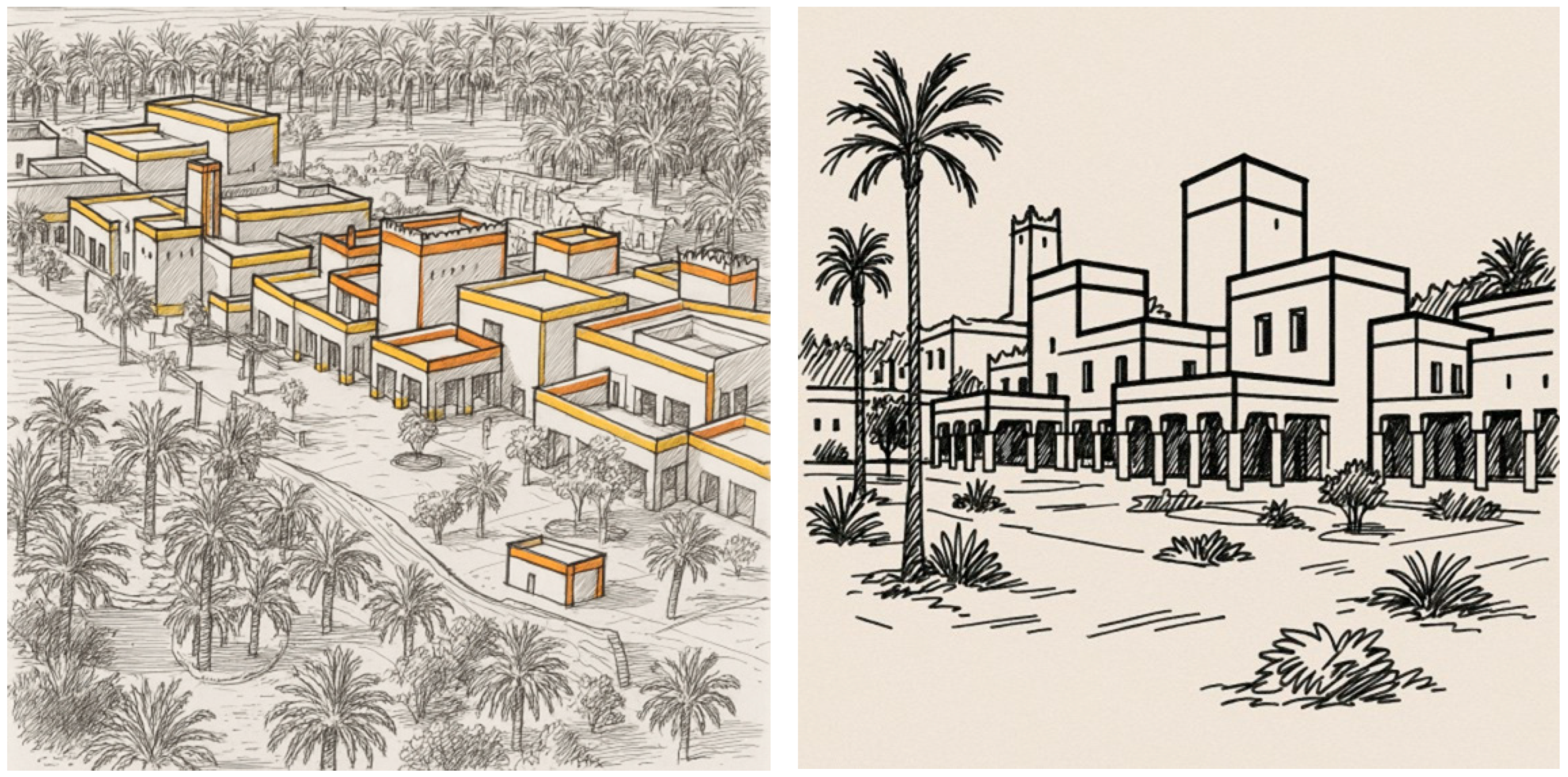
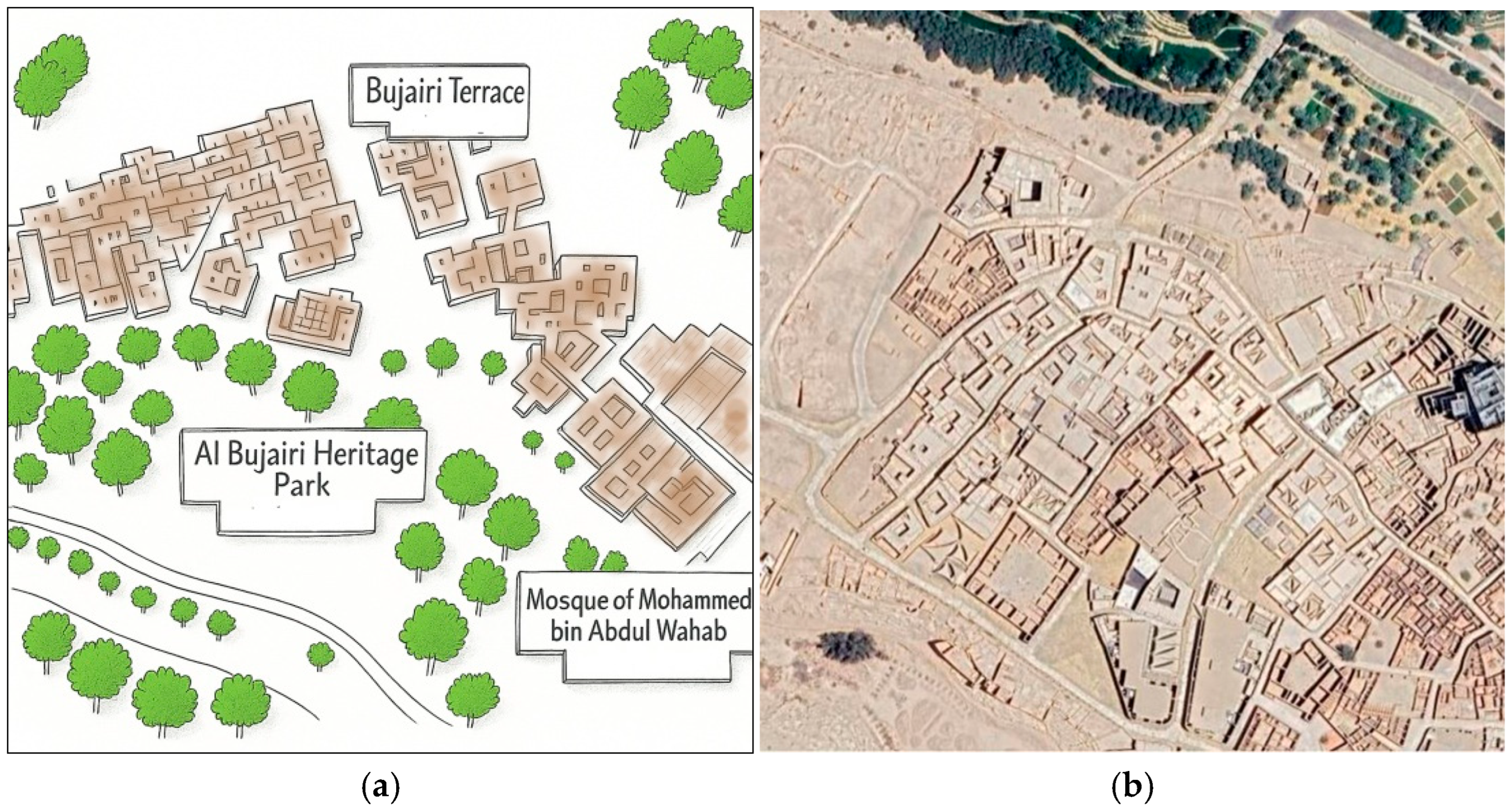
The idea for the Al-Bujairi Quarter is inspired by the simplicity and purity of Najdi traditional architecture. With its distinctive cuboid volumes, Najdi architecture emphasizes solidity and clarity of expression. The heavy masonry volumes, defined by their powerful and enduring presence, are a manifestation of the original character of this vernacular tradition. These factors adopt a philosophy of unadorned simplicity, aligned with the reformist ideas of Sheikh Mohammad bin Abdulwahhab, in which restraint and clarity govern form as much as function. The architectural arrangement relies on sturdy geometric forms and a well-practiced mass balance. The structures are divided into horizontal and vertical volumes, inviting a sense of responsiveness to human scale while simultaneously being part of the overall urban skyline. This balancing of massing and proportion yields an architectural language that is both historically rooted in Najdi tradition and adaptable to contemporary urban settings. The formal language features Cuboid masonry volumes (inspired by Najdi architecture) as its primary identity. Thus, the horizontal massing fosters harmony with the human scale while the vertical articulation breaks the monotonous rigidity of the cubes, creating variety in the skyline (See
Figure 6).
Local Heritage Vocabularies
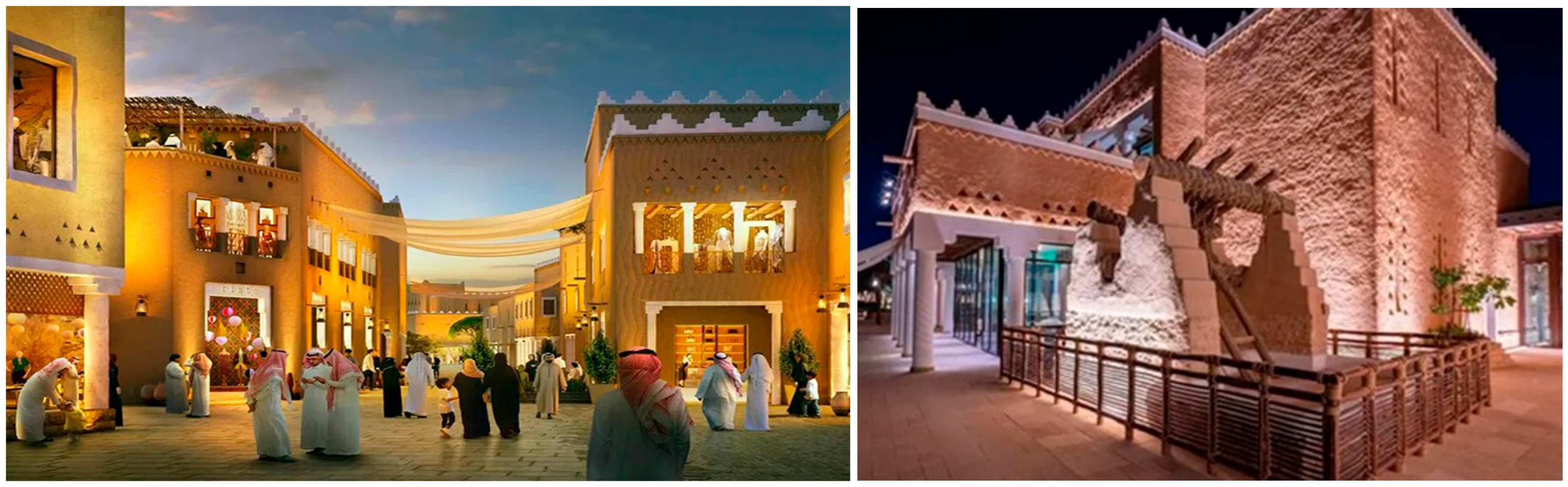
Al Bujairi Terrace is in immediate proximity to the UNESCO World Heritage site and birthplace of the Saudi state, the At-Turaif District. Thus, the architectural language of Bujairi Terrace aims to reinterpret traditional Najdi forms and materials within a contemporary framework. Key features include mud-brick style facades, intricately patterned parapets, and shaded courtyards and alleyways designed to mitigate the harsh climate and encourage pedestrian movement [
38]. The design emphasizes low-rise structures that respect the scale and visual integrity of the adjacent At-Turaif district (See
Figure 6). The use of traditional building techniques, albeit often simulated with modern materials, aims to evoke a sense of historical continuity and authenticity [
38]. Qasab (the traditional plastered mudbrick finish characteristic of Najdi architecture, which provides protection and decorative texture to mud walls) is used in the project to highlight sustainability and local construction traditions, while shurfa (ornamental decorative parapet or crenellations, which decorate and accentuate the skyline of traditional Saudi buildings) add Najdi character to the skyline (See
Figure 7).
Material Authenticity
The Al Bujairi Terrace represents material authenticity through the reintroduction of ancient Najdi construction traditions, most specifically the use of mud brick, which has stood the test of time for more than 300 years. Additionally, adobe plaster render is used for the finishing of the structural skeleton, and a rammed earth colonnade lines the frontage to the suq to highlight the imperishable strength and resilience of these finishes. The project establishes an experiential connection between the modern viewer and the native construction traditions of At-Turaif by applying ancient traditional crafts alongside modern use, while emphasizing their elegance, sustainability, and integration with nature. Therefore, using local traditional materials reflects the simplicity and original purpose of Najdi architecture.
Cultural Practices
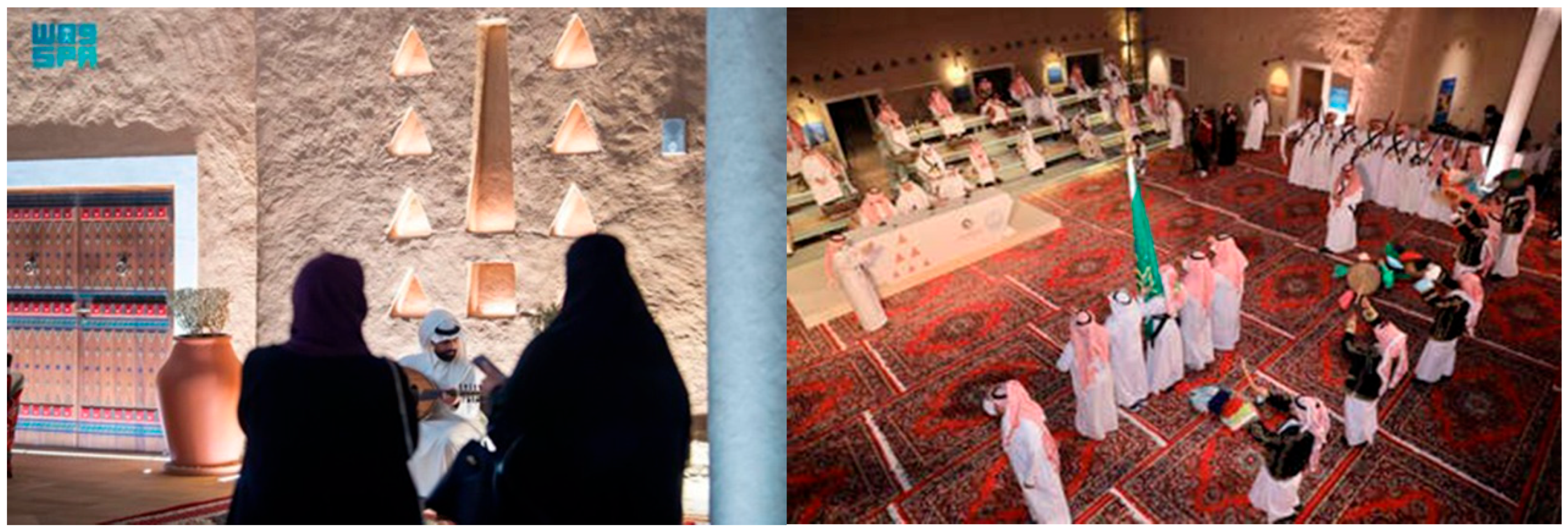
Al Bujairi Terrace is considered one of Riyadh’s most significant developed open urban spaces, with a significant historical context. Respecting the religious roots of the modern Saudi State was a main target of the project and was achieved by providing a calm environment that connects the Sheikh Mohammad bin Abdulwahhab Foundation to the natural scenery of Wadi Hanifah. The ancient Islamic city fabric is the main inspiration for the layout design and urban formation, in which the mosque, souq, and public events are integrated to form a vivacious hub for social, spiritual, and cultural life. The Bujairi Terrace project highlights cultural traditions through an array of practices that draw attention to Diriyah’s heritage. Arabic calligraphy adorns numerous signs and walls, often inscribing poetic utterances and references to Diriyah’s historical significance, while Najdi local proverbs express values of endurance, cohesion, and welcome, deeply embedded in the community’s customs. Filling out these visual and linguistic depictions are traditional folk songs unique to the locality, which commemorate Diriyah’s heritage and reassert its central role in establishing Saudi cultural identity. The integration of activities like fashion shows highlights the blend of modern entertainment with the historical setting (See
Figure 8), which can be seen as both an opportunity for cultural dynamism and a potential point of tension with traditional values [
39]. Cultural continuity is again reflected through classical performance, such as the ardha dance (a traditional Saudi group dance performed during national and cultural events), as well as through heritage festivals, while the broader Al Diriyah identity narrative references that of Imam Muhammad ibn Saud and Saudi unification. Overall, these all collectively contribute to a unifying design lexicon that is historically informed, environmentally responsive, and socially significant.
4.1.2. Social Cohesion and Engagement
Circulation and User Experience
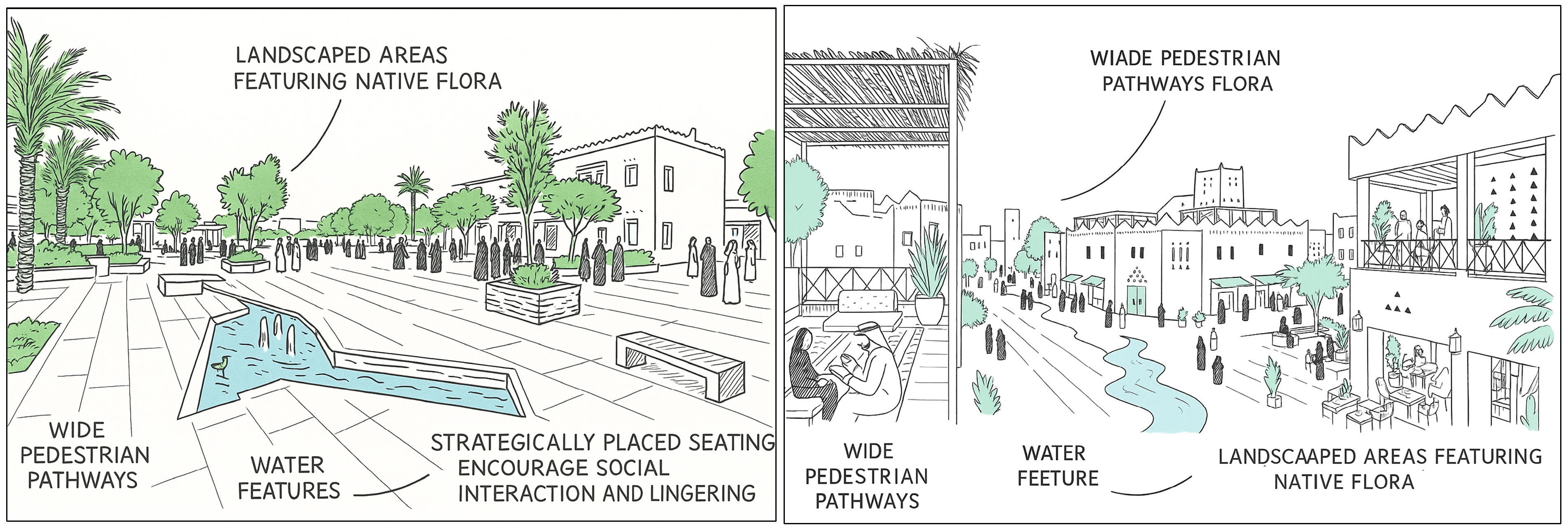
The project’s circulation map is clear and well-defined, providing effective wayfinding, clear access, and an engaging visitor experience. This development provides the key connection between the Al Diriyah residential area, the Sheikh Mohammad bin Abdulwahhab Mosque, and the ancient city district of At-Turaif through Wadi Hanifah, replicating the ancient Islamic urban typology by integrating commercial, social, and religious activities beneath one unified dynamic hub. Placed on a knoll overlooking the valley, the design includes terraces with vegetation and water features that reflect aesthetic principles such as unity, harmony, proportion, sequence, rhythm, and repetition, thereby ensuring both visual appeal and spatial organization. Pedestrianized configurations of gardens, plazas, walkways, and green spaces enhance usability while allowing for an unbroken flow of circulation across the site (See
Figure 10). One integral part of the experience is the Al Bujairi Plaza, which provides the hub for the city’s tourism and commercial activities, with the terraces providing unique viewpoints over Wadi Hanifah, thus strengthening the visitor’s connection with the site’s landscape as well as adding value to the site’s cultural and experiential value (See
Figure 11).
Connectivity and Accessibility
The design of the Al Bujairi Terrace emphasizes continuous connectivity and inclusion, reflecting both the historic context of Diriyah and the contemporary needs of diverse user bases. The sequence of entrances begins with a welcoming plaza that facilitates the transition between the urban fabric and the heritage area. The Boulevard is the primary axis of the restaurant area, providing distinct orientation and clear visual connections to the Event Plaza and the UNESCO World Heritage Site of at-Turaif. It has been designed to encourage pedestrian use, further aided by shaded pedestrian walkways, cycling tracks, and horse riding tracks, thus allowing visitors of every age and ability to move around the site comfortably and safely [
19]. The project serves as a cultural and physical link between tradition and modernity by emphasizing the pedestrian connection between Al Bujairi and the Al-Turaif site. The site is easily accessible, accommodating families and individuals with varying physical abilities, reflecting the long-standing tradition of hospitality. This balance between true tradition and modern access requirements makes the Al Bujairi terrace an essential extension of Diriyah’s heritage, allowing and encouraging the exchange among all members of society.
Traditional Social Practices
Bujairi Terrace represents a significant effort to blend appreciation of heritage with modern leisure and commercial activities. The development provides a platform for showcasing Saudi culture, both through its architectural references and the hosting of cultural events and performances [
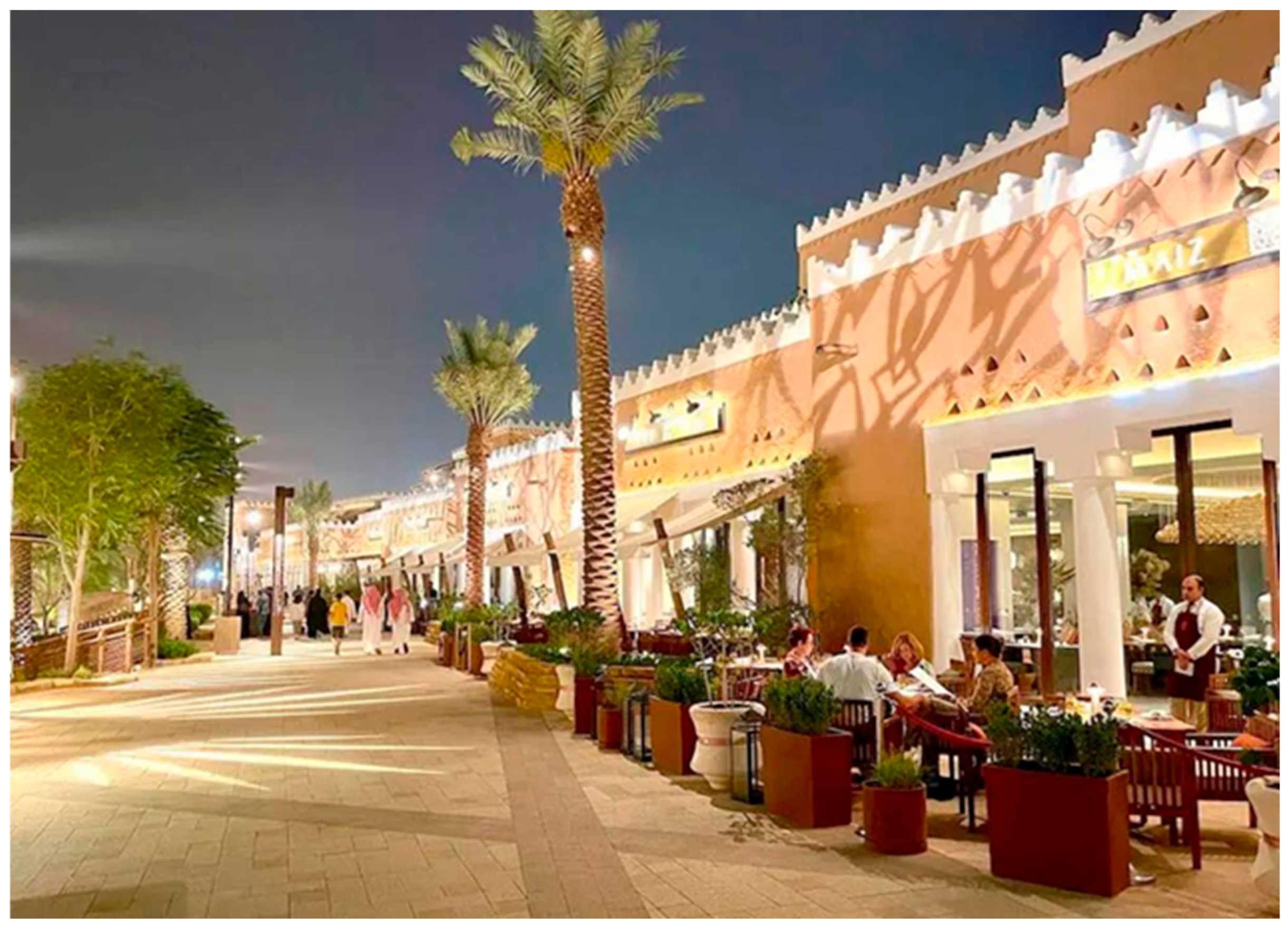
38]. The emphasis on high-quality public spaces promotes social interaction among diverse groups of visitors, including locals, expatriates, and international tourists. The fine-dining restaurants in Al Bujairi Terrace reflect traditional Saudi and Middle Eastern cuisine, maintaining tradition while appealing to local and international guests (See
Figure 12). The experience emphasizes the hospitality that lies at the heart of Najdi and Islamic tradition. Social principles are inscribed in the design of the majlis (public gathering places), in reference to the culture of hospitality, complemented by qahwa (Arabic coffee) and tamr (dates), which are emblems of generosity. The Diriyah palm groves that surround the site are evoked through nakheel (palm) as well as the historical falaj irrigation channels that historically supported them. Local commerce and artisanship are celebrated in the Bujairi Souq, where hanaya (handicrafts) and mabkhara (incense burners) reference both heritage and everyday life.
Small shops, restaurants, and kiosks surrounding the central plaza approximate a classical suq, central to Najdi life. Al Bujairi Plaza evokes the tradition in a way that captures the vibrancy of ancient commercial routes that attracted settlers and merchants to Diriyah and At-Turaif. Local products, handicrafts, and souvenir shops also highlight skills that are critical for Najdi people. Landscaped plazas and public spaces provide venues for family events and social occasions, fostering community values. Scenic views of Wadi Hanifah and At-Turaif link these events to a historical setting, so every get-together, dinner, and leisurely walk feels tied to the past. The central plaza and Amphitheatre are considered the focal point of Al Bujairi Terrace, serving as a collective identity and an active outdoor space for prominent performances and cultural festivals. Additionally, the amphitheatre enriches this experience by accommodating the cultural exhibitions, an outdoor film screening zone, and live artistic displays. All these activities in the central plaza attract the visitors within an inclusive and engaging atmosphere. The Wadi Walk, located adjacent to Wadi Hanifah, enhances wellness and provides a main view of the UNESCO World Heritage Site of At-Turaif, fostering an immersive experience that harmonizes leisure, culture, and nature. The Wadi Walk transforms into a reflective promenade where visitors can appreciate the landscape through shaded pathways, seating, and an emphasis on pedestrian comfort, facilitating engagement with the historical scene. The three elements, Event Plaza, Amphitheater, and Wadi Walk, together provide a harmonious equilibrium of vibrancy and peace within Al Bujairi by framing cultural heritage and engaging all members of society and locals (See
Figure 13).
4.1.3. Belonging to the Context
Visual Identity
The design of Al Bujairi Terrace has been thoughtfully developed to initiate a dialogue between the terrace and the history and natural environment that surround it. The landscape design draws on the attributes of Wadi Hanifah, which emulate the aesthetic principles of unity, harmony, rhythm, repetition, proportion, focus, and sequence. These ideals are translated into the planning of paths, terracing, and greenery that not only improve the visitor experience but also respond to the visual vernacular of the natural valley landscape. The architectural design reaffirms a sense of belonging through the use of traditional Najdi and Salmani elements, evident in the façade treatment and opening styles that capture the true essence of the surrounding built heritage. The use of Riyadh limestone, which has distinct horizontal fissures, repetitive texturing, and inherent color tones, ensures that the built landscape blurs seamlessly with the geologic identity of the site. Al Bujairi is strategically located to offer a bird’s-eye view of the historic World Heritage Site of At-Turaif and to align with it, serving as an adjunct neighborhood and a cultural gateway. The plan seeks to retain the historic landscape to the greatest extent possible and to integrate modern functionality, thus creating a dialogue between past and present. Furthermore, the infusion of Salmani architectural tenets reinforces the above connection, ensuring that the latest developments remain firmly rooted in Diriyah’s cultural and historical tradition. In this context, Al Bujairi Terrace emerges as not merely a space for leisure; rather, it signifies an extension of the local identity, wherein the interrelation of landscape, architecture, and historical narrative collaborates to cultivate a shared sense of community [
19].
Urban Fabric Fitting
The urban element of the Al Bujairi Terrace has been deliberately designed to complement the surrounding Najdi and Islamic architectural environment, thus maintaining cultural integrity and achieving functional coherence. As one enters, the design introduces a welcoming plaza that pays tribute to the historical importance of the old community spaces in Diriyah. This spatial intervention highlights the importance of hospitality and social cohesion and presents a welcoming entrance point into the development. Diriyah’s historic alleys are recast at Al Bujairi as pedestrian routes that maintain the cultural and religious ideals integral to the Islamic city. These pedestrian alleys emphasize the need for privacy, community unity, and spatial layout, and act as basic connectors that encourage foot activity, enhance social contact, and foster cultural engagement. With the addition of the alley-like routes, the design affirms the compatibility of past tradition and current mobility needs. Moreover, the central plaza of the scheme is aligned with the Makkah direction and the Qibla orientation, reflecting Islamic urban design values directly and enhancing spiritual cohesion within the built area. It not only highlights religious and cultural responsiveness but also clearly embeds the scheme within the regional context. Through these techniques, the urban fabric of Al Bujairi can be seen to mirror and complement the historic Najdi urban fabric rather than challenge it. It promotes a feeling of continuity with the cultural environment of Diriyah, combining old-fashioned values with modern urban planning to provide an environment that is simultaneously contextually thoughtful and socially inclusive (See
Figure 14).
Urban Style and Design
The urban layout of Al Bujairi Terrace is inspired by the Najdi tradition and imitates the inward-oriented approach as a protection technique from the extreme desert climate. The project maintains cultural integrity while integrating modern technologies to improve access, redefine the terrain, and revitalize the ecological character of Wadi Hanifah. Thus, the development improves the environment while transforming the area into a landmark public recreational area that permeates the historical fabric of Diriyah. The landscaping approach demonstrates a synthesis of heritage and modernity. The garden located to the south of the Sheikh Mohammad bin Abdulwahhab Mosque is crafted in a traditional Islamic aesthetic, organized according to a geometric layout characterized by water channels that represent the four rivers of Paradise. Enhanced by date palm trees and complemented by grass, this garden provides a reflective and inviting atmosphere at the core of the Quarter. Likewise, the walkway that overlooks Wadi Hanifah offers striking views of terraced landscapes that have historically underpinned agriculture for the communities of Al Bujairi and At-Turaif, fostering a reconnection for visitors with the site’s agricultural legacy. The western qibla wall of the mosque provides a visual and spiritual focus, looking down over the plaza, which reflects the historic link between the mosque, community, and public space typical of the city’s Islamic tradition. Its landscaped spaces not only define and shield majestic views of At-Turaif but also enhance greater enjoyment of the old mud-brick buildings and palace ruins on the other valley side.
Summary: The Al Bujairi Terrace project illustrates how a large-scale urban regeneration project can interpret Najdi heritage in new ways that reflect modern-day planning, material expression, and pedestrian-friendly public spaces. The project’s success lies in its reinterpretation of traditional Najdi morphology through narrow passageways, shaded courtyards, and stratified spatial sequences, all of which enhance cultural memory and provide for comfortable, human-scale design. Nonetheless, with its prominent location and resulting commercial function, the project also threatens authenticity, as this site becomes increasingly geared toward tourist activity rather than normal community use. Nevertheless, it can be seen how the Al Bujairi project’s focus on high-end dining and commerce generates a tension related to socio-economic sustainability values, insofar as such activities add to site attractiveness and vibrancy but potentially simultaneously exacerbate site accessibility costs, i.e., transform the site into one generally favoring tourism visitors to the detriment of community members. In this manner, it can be seen how Al Bujairi represents both the promise and problematic dynamics of heritage development in modern-day Saudi Arabia, and therefore recognizes calls for heritage development planning aimed at balancing site usability for community members with those favoring tourism. As such, Al Bujairi reveals how heritage design can effectively humanize space, but also illustrates its need for a more culturally grounded use.
4.2. Case Study 2: ALULA Design Space, AlUla, Saudi Arabia
AlUla Design Space is a cultural center and gallery located in AlJadidah Arts District in AlUla. It includes a gallery, a series of exhibitions, a workshop area, and an archive. The aim is to show AlUla’s unique design initiatives to encourage collaboration among design professionals, students, and artists, while reinforcing AlUla’s cultural heritage as a hub for creativity and a source of design inspiration. Giò Forma, along with Black Engineering, was chosen to develop the concept and support the design-build process. AlUla Design Space includes a multi-purpose space for exhibition, archiving, and interactive workshops related to various types of design located in the Arts District in Al Jadidah. This space aims to showcase various design practices from around the world in the AlUla region, which is rich in culture and stunning natural landscapes. It also seeks to promote creative and expressive thinking through a diverse program based on collaboration and the exchange of experiences between designers, thereby contributing to the signature of the creative arts in the northwest of the Arabian Peninsula on the global design map. This space showcases the design journey in AlUla, from master planning to graphic design, product design to architecture. This space is an ideal place for designers and design enthusiasts to learn, dream, discover, innovate together, collaborate, and share their work with everyone [
36,
40].
4.2.1. Cultural Values (Dimensions) Integration
Morphological Geometric Language
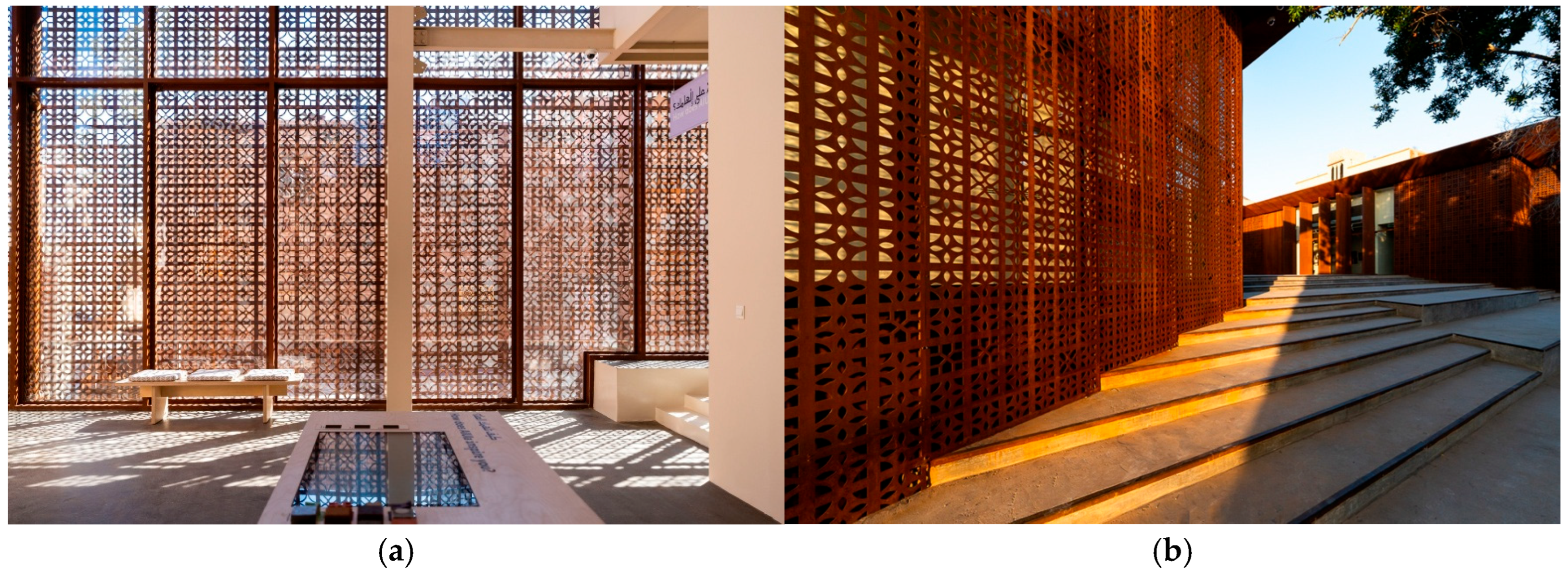
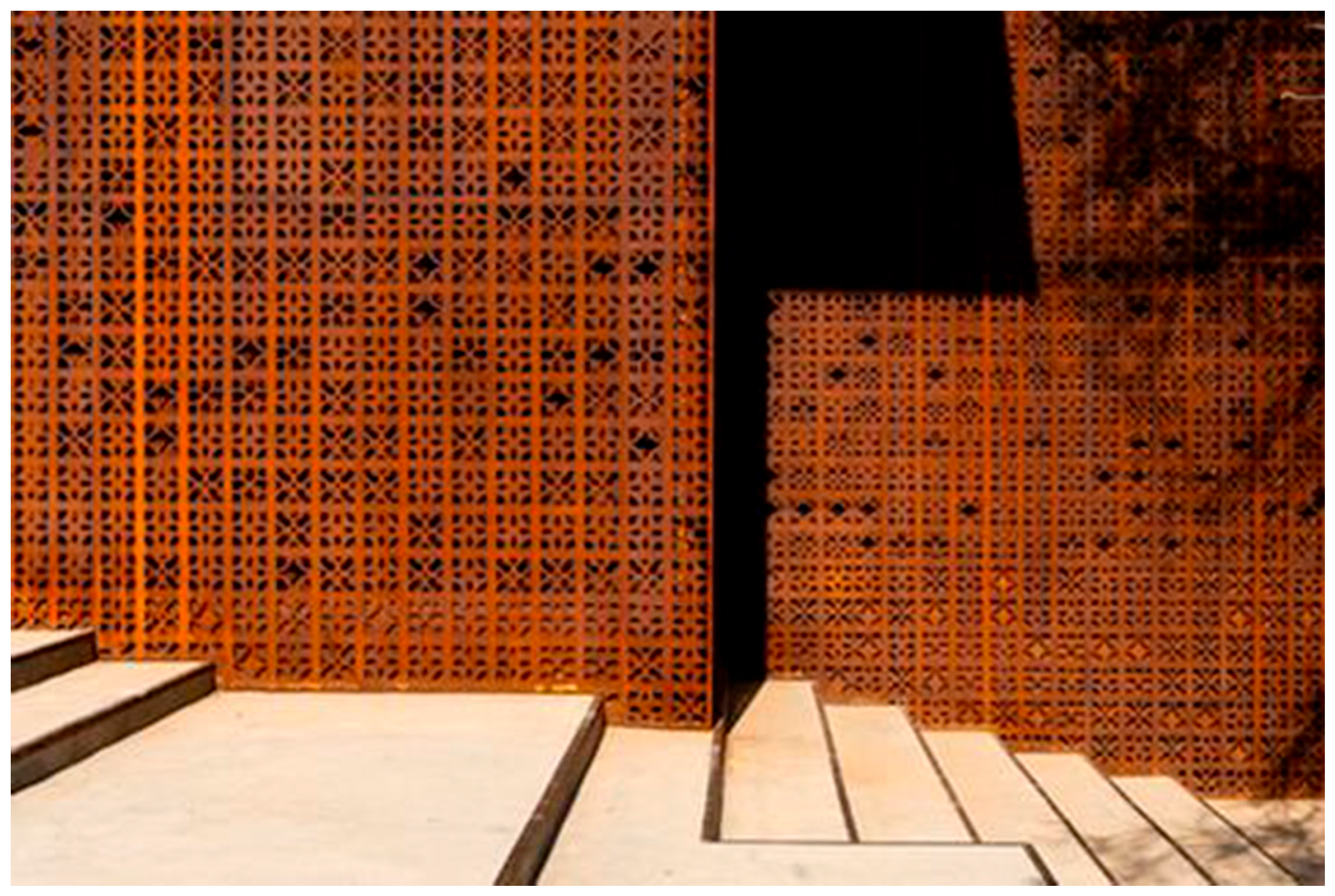
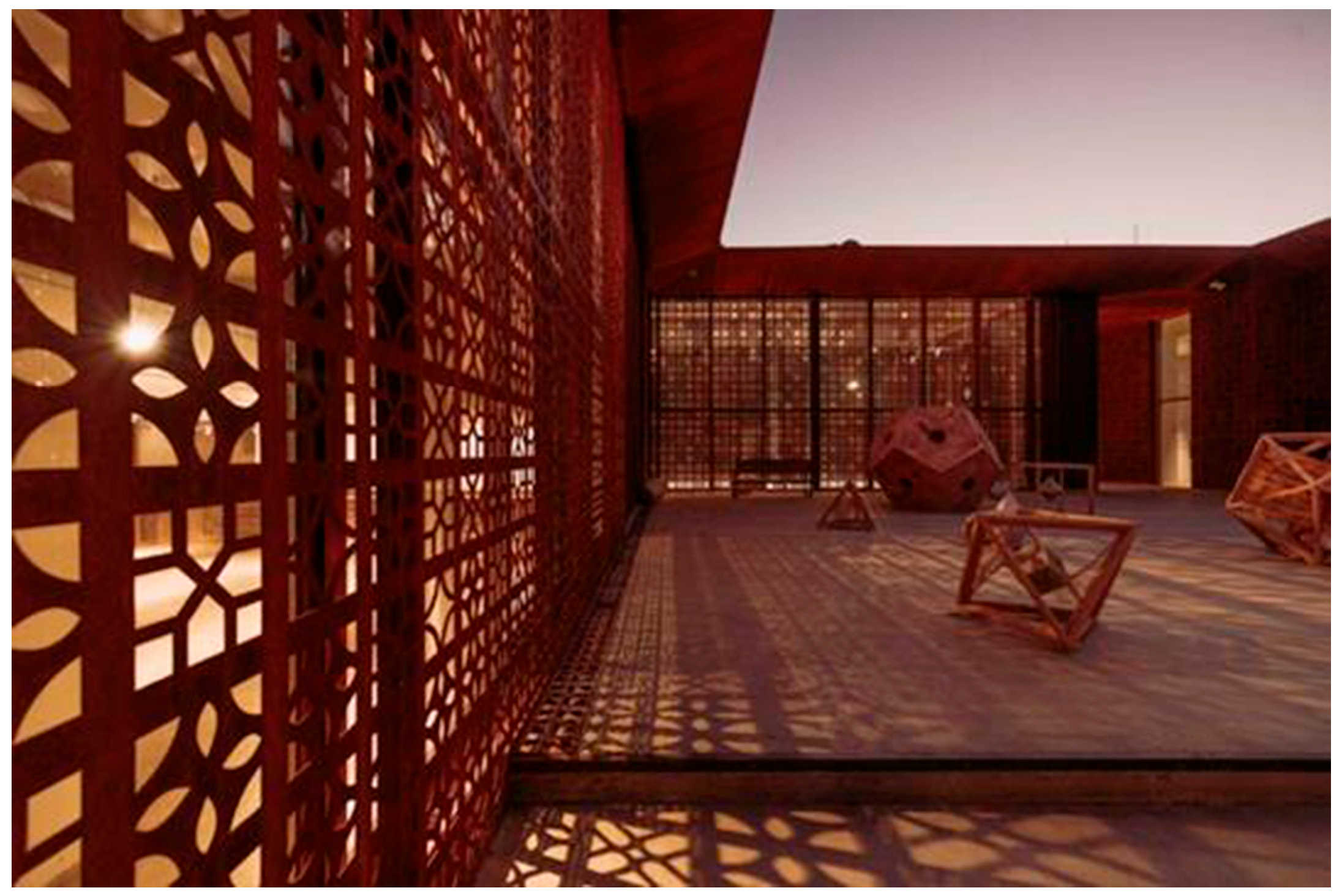
The main design concept of the building is to adopt a morphological language and geometric vernacular patterns that merge heritage and modern innovation through a distinctive steel façade, clearly recognizable as a signature element, derived from the highly decorative brick patterns of traditional AlUla houses. Traditionally, patterns were used to balance privacy with the distribution of light; here, steel is adopted to allow filtered natural light to penetrate the interior, providing enclosure and intimacy—a fundamental tenet of traditional Arabian residential design (See
Figure 15). The façade module design began by looking at Al Jadidah, a historic neighborhood with façades that convey a clear regional identity. From that study, the architect extracted four dominant traditional motifs that served as the cultural and aesthetic basis for design. These were abstracted and translated into algorithmic seeds, which were arranged in a grid to evolve a kinetic, contemporary screen. The eventual façade is more than a reproduction of tradition; it is a contemporary interpretation that conveys cultural memory in the urban language of buildings. The design module is inspired by conventional settlements and conveys a sense of hierarchy and order, whereas the facade’s pattern serves as a symbolic screen between the indoor and outdoor. The powerful geometric pattern is inspired by heritage while reflecting modern identity, appealing to both local inhabitants and visitors. In conclusion, the AlUla design space incorporates cultural heritage identity through the integration of geometry and materiality, producing a space that is both derived from heritage and expressive of contemporary design.
Local Heritage Vocabularies
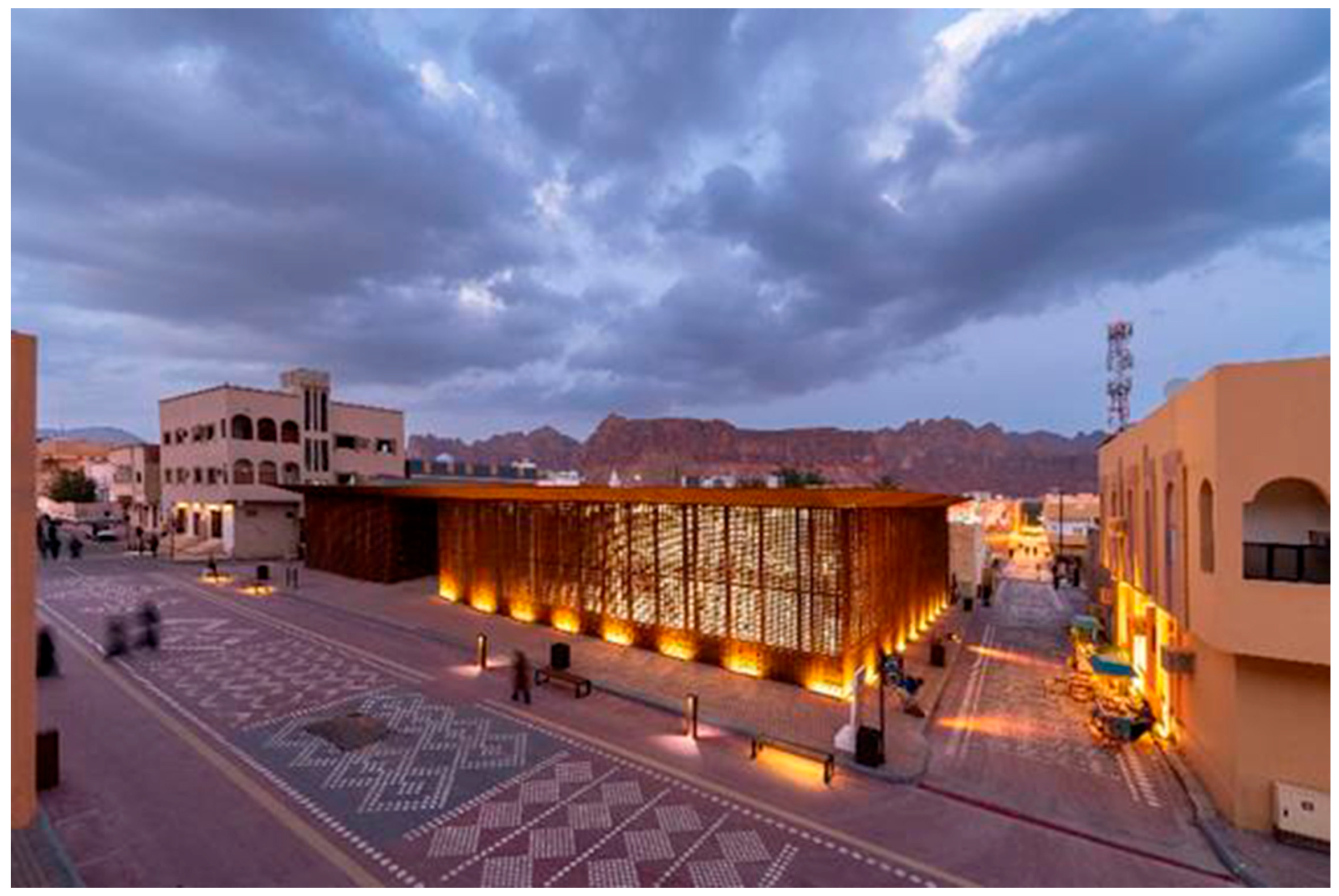
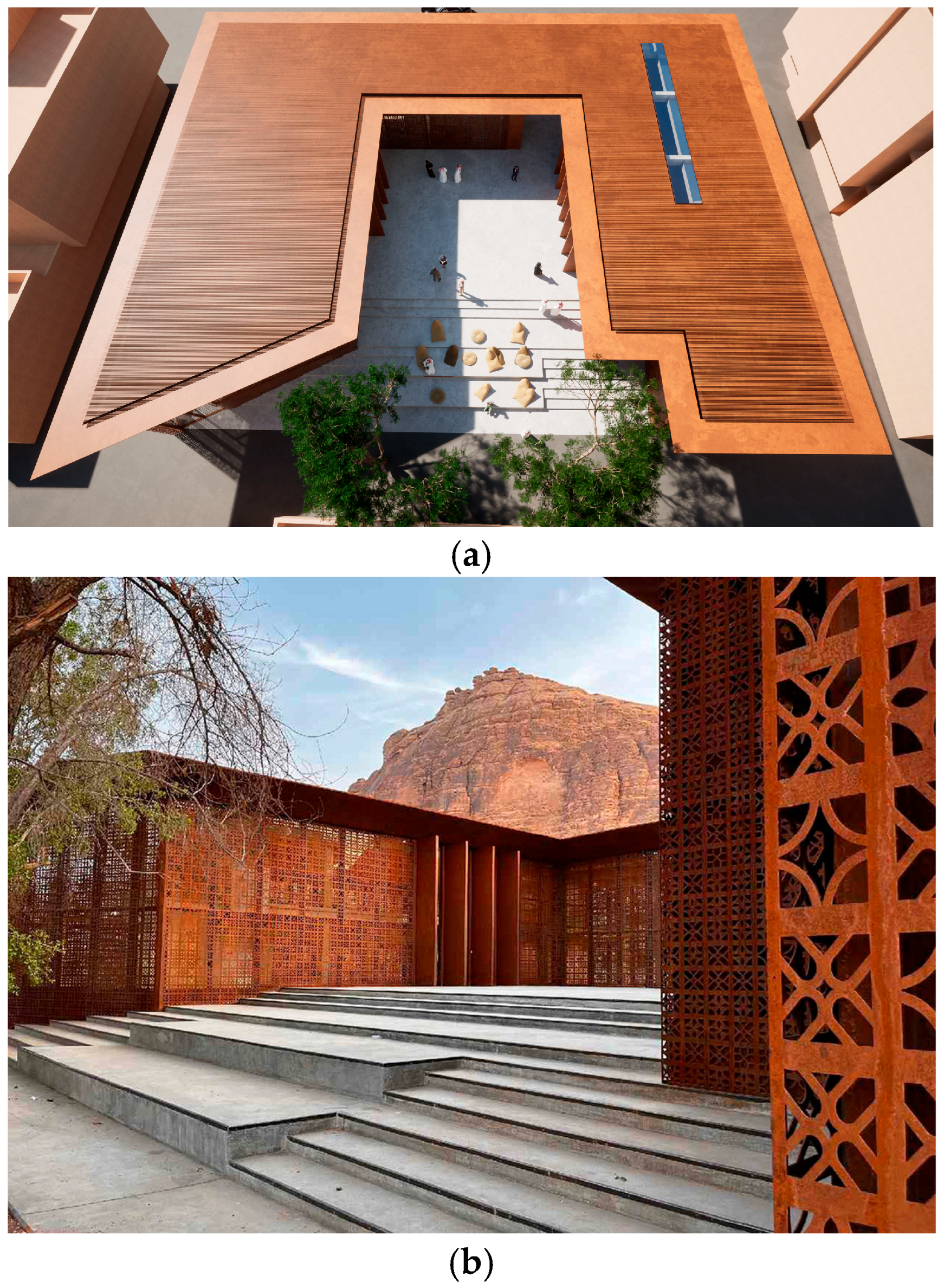
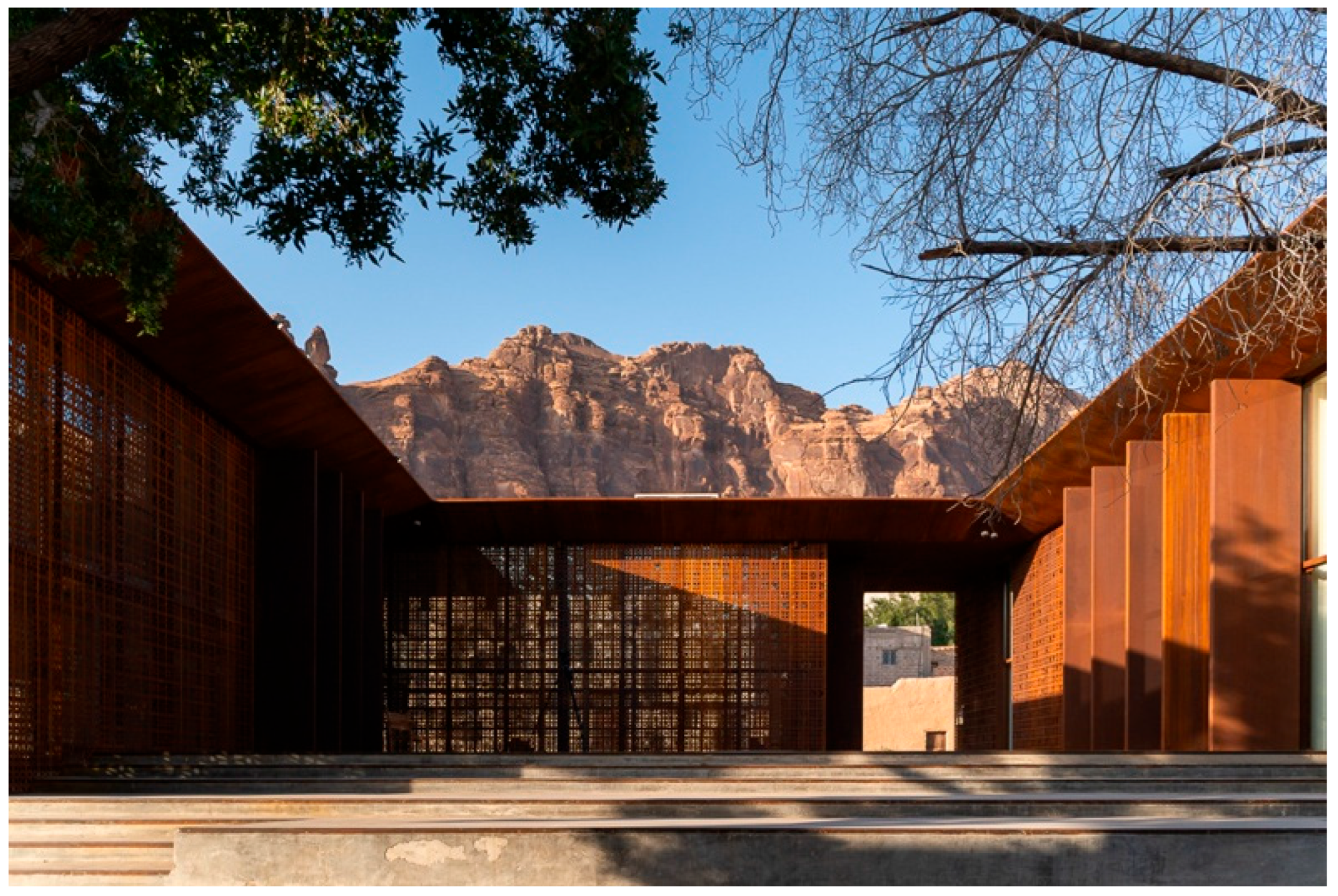
The design incorporates tow important local heritage vocabulary, the courtyard and the Mashrabiyah. The U-shaped plan provides a luminous central court that facilitates natural lighting and natural air ventilation (See
Figure 16). The courtyard encourages the group gathering and the social cohesion locally to express the importance of the cultural heritage of AlUla. The façades reinterpret traditional opening configurations and breeze-block layouts by means of an algorithmically computed design. The decorative steel screen offers the solar shading and natural ventilation that significantly reduce energy consumption. Additionally, the wooden Mashrabiyas provides privacy and raises the climate responsiveness requirements.
Material Authenticity
Drawing inspiration from the breezeblock ventilation methods prevalent in the AlJadidah Arts District, the designer reconfigures this regional characteristic through a contemporary façade composed of Corten steel, glass, and polished concrete. The structure is characterized by its use of Corten steel, forming large, perforated screens that create intricate patterns of light and shadow, reminiscent of traditional Mashrabiya screens while employing a contemporary industrial material [
38,
39] (See
Figure 17). This choice of material provides a striking contrast to the surrounding traditional mudbrick and stone buildings of AlUla Old Town and the newer structures in AlJadidah, yet its rusted patina aims to harmonize with the ochre tones of the natural landscape [
41]. This contemporary approach stands in contrast to the genuine brickwork used on the façades surrounding the central courtyard, where traditional textures and materials firmly root the design in its local heritage. This synthesis shows how traditional architectural elements—such as mashrabiyah, breezeblock, and courtyard—are reimagined through advanced computational design, creating a dialogue between heritage and innovation. The mashrabiyah, designed for privacy, airflow, and light, is recreated in AlUla Design Space through algorithmic modeling and parametric patterns, using materials such as Corten steel. Likewise, the courtyard, a symbol of social interaction and thermal comfort, is reintroduced as a climatic regulator with solar-responsive façades and modern shading systems. This blend of traditional knowledge and modern technology illustrates how digital design can revive vernacular principles while meeting sustainability goals, maintaining both cultural authenticity and environmental performance in architecture.
Cultural Practices
The complex focuses on a vibrant courtyard-plaza, reinventing Arabian houses’ shared gathering spaces. Courtyards were historically used for interaction and relaxation. The AlUla Design Space refines the tradition into a shared visitor space for interaction, turning a private value in culture into a shared experience. The algorithmic facade’s mashrabiyah influence balances openness and privacy. The facade embodies Islamic modesty and manages ventilation and light by blending tradition and modernism. The facade modules, derived from classic Al Jadidah patterns and breezeblock motifs, update AlUla’s heritage of crafts. The connection maintains an artisanal spirit while innovating through algorithmically driven design, making cultural values current. Its physical organisation adheres to Islamic urbanism, and mosques and plazas become community meeting spaces. The Design Space acts as a cultural hub—a place for ensembles of creativity and collaboration. This emphasizes hospitality, coherence, and common identity principles. AlUla, which was previously on caravan trade routes, prospered through cultural exchange. The Design Space symbolically carries on the tradition as a space for knowledge transfer among local and global designers, underscoring AlUla’s reputation as a crossroads of civilizations. The project incorporates environmental responsiveness as a cultural value. The traditional practices—such as shaded courtyards and earthy materials—are reinvented using solar façades and ventilation. The design evidences the evolution of heritage into sustainable structures.
4.2.2. Social Cohesion and Engagement
Circulation and User Experience
The circulation patterns of the project provide a smooth, engaging user experience that begins at the main street of Al Jadidah. As the visitor progresses along the street, he has the opportunity to view an outdoor gallery where the act of movement itself forms an element of the cultural and artistic experience that culminates at the building. This plan recasts arrival itself as a slow exploration, thereby increasing the feeling of anticipation. Upon entering the building, nearby walkways discreetly lead visitors into the central courtyard. These paths remain purposefully laid out in an unfamiliar, mysterious configuration, stimulating exploration while maintaining aesthetic and spatial connections to the galleries’ spaces. As a result, the layout serves both to facilitate movement and to spark curiosity, challenging visitors to explore, touch, and engage with the cultural and artistic histories of AlUla. Place-making around Design Space AlUla is integrated within the broader strategy for the AlJadidah Arts District. The district features pedestrianized streets adorned with murals, public art installations, outdoor seating, and numerous small cafes and artisan shops, creating a lively and engaging atmosphere [
28,
41]. Design Space AlUla acts as an anchor within this precinct, drawing visitors and serving as a venue for community interaction and cultural programming. Its prominent location and distinctive architecture make it a landmark and meeting point within the district.
Connectivity and Accessibility
The circulation plan and pattern has been conceived to provide a smooth and entertaining user journey which commences at the central thoroughfare of Al Jadidah. As one progresses along the street, one is given an outdoor exhibition wherein the act of movement itself is a component of the cultural and artistic experience that terminates at the building. This plan recasts arrival itself as a slow exploration process, therefore increasing the feeling of anticipation. These paths remain purposefully laid out in an unfamiliar and mysterious configuration, stimulating exploration while maintaining aesthetic and spatial connections to the spaces of the galleries. The building’s form is relatively simple—a large, open-plan pavilion—allowing flexibility for various exhibitions and events. The perforated facades provide shade and ventilation while maintaining visual connections to the bustling street life outside (See
Figure 18).
Traditional Social Practices
The central courtyard is the core of AlUla Design Space, which has been imagined as an active gathering place that evokes the regional architectural forms traditionally seen in the area. By engaging visitors to converse and explore, the central court becomes an active extension of the community life of the Al Jadidah area, therefore reaffirming the principles of social gathering and cultural unity. Designed by the Milan-based architectural practice as an exhibition venue and a catalyst of discussion, the structure becomes a hub of collaboration and creativity amidst the historic backdrop of AlUla. Its planned activities—consisting of exhibition zones, workshop zones, and an archive—all have the unique purpose of hosting a wide variety of users: from seasoned designers and students to enthusiastic design fans.
4.2.3. Belonging to the Context
Visual Identity
The AlUla Design Space embodies and honors the extensive heritage of the UNESCO World Heritage Site, marking its establishment as the inaugural permanent contemporary gallery in Saudi Arabia. The architectural design and shape are intended to act as a visual frame for the adjacent mountains, thereby enriching the visitor experience through meticulously curated vistas and cultivating a profound connection to the natural and cultural environment (See
Figure 19). Furthermore, this spatial arrangement serves a function by efficiently attracting and directing visitors from the Wadi walkway into the gallery’s central area. To engage more closely with the architectural spirit of the Al Jadidah area, the architect reinvents one of its most symbolic elements—the breeze-block design—into a contemporary façade system. By day, the sophisticated algorithm-based exterior creates dramatic shadows, whilst at night it transforms the structure into a glowing jewel box, symbolizing innovation and cultural dynamism. Inspired by the highly adorned brickwork of old houses, the façade links the past with modern design, whilst the rust-colored steel mirrors the tones of the Alfath Mountains, entering into a harmonious rapport with the surrounding environment. The coloration, based on natural tones of beige, brown, and light gray, places the building effectively within the dry landscape it inhabits. Choosing the shape, materials, and color consciously ensures that the AlUla Design Space functions as both a modern design icon and a considerate extension of its surroundings, demonstrating cultural respect, environmental harmony, and creative design.
Urban Fabric Fitting
The building design is allowing the extension of the surrounding urban landscape’s motifs, axes, and linear forms that encourage an on-going spatial discourse with the surroundings, favoring unity instead of disconnection. The structure’s main axis is carefully aligned with the surrounding forms, thus furthering a strong sense of integration with the contextual fabric of the Al Jadidah area (See
Figure 20). The focus of the design is the courtyard, which serves as the main organizing element, directly borrowed, of course, from the local dwellings of the region. Besides enhancing environmental effectiveness with the provision of natural light and ventilation, the design also reflects the cultural importance of the courtyard as a place of social gathering and community activity. Its architectural expression is based on orthogonal geometry and a rectangular structure, which emphasizes transparency and minimalism.
Urban Style and Design
AlUla Design Space exemplifies urban chic by being culturally and spatially connected to its environment. The U-plan layout of the Design Space focuses on a courtyard, similar to traditional houses in Al Jadidah, which value community and privacy. The courtyard acts as an environmental regulator, supports the cultural tradition of community interaction, and connects it to the historic urban fabric of AlUla. The organization of space is in harmony with the layout of the neighboring settlement. Extending the street axes of Al Jadidah into the building makes the scheme fit naturally into the city fabric and maintains its harmony with its setting. This harmony gives the visitors a sense of familiarity and reinforces the building’s link with the ancient district. The facades provide shading and dynamic appearances to the surroundings through integrating the ancient courtyard layout planning, urban rhythms, and vernacular patterns with modern architecture, and sustain Al Jadidah’s identity as a heritage-sensitive, modern cultural space.
Summary: Design Space AlUla embodies a micro-scale re-interpretation of cultural identity via material abstraction, sculptural form, and environmental sensitivity. Unlike Al Bujairi’s literal recreation of Najdi terms, Design Space AlUla embraces a minimalist approach inspired by geology, desert vernaculars, and regional craft practices. This enables a more refined and experimental expression of cultural heritage. However, its smaller scale, strategic engagement, and managed visitor flow tend to limit its broader societal reach. Therefore, Design Space AlUla provides an inspiring ‘model for innovation and re-interpretation of culture’, but needs to develop more dynamic strategies to enhance its societal engagement. While this development represents success in terms of architectural creativity and contextual appropriateness, it should be noted that its carefully curated development framework and controlled access pattern, combined with its strategic location in a high-end cultural district, ultimately pose challenges for inclusive community access. As with Al Bujairi, this form of agenda-driven cultural development may have limiting consequences for community accessibility from certain social segments, ultimately positioning the space not entirely as a community-serving environment but rather as a cultural representation space.
To consolidate the qualitative findings and clarify how the analytical criteria guided the interpretation of the two case studies, a summary synthesis table has been added at the end of the Results section.
Table 3 presents the derived themes for each analytical criterion, the corresponding qualitative evidence, and the specific contribution each theme makes to answer the central research question. This table provides a clear and structured overview of the results and directly responds to the reviewer’s request for greater analytical transparency.
5. Discussion
The study uses a cross-scale qualitative method grounded in the analysis of two case studies to examine the socio-cultural sustainability of contemporary architectural interventions within historical contexts in Saudi Arabia, Al Bujairi Terrace in Diriyah, Riyadh, and Design Space AlUla, which explain divergent strategies for incorporating current architectural principles in the culturally important contexts of Saudi Arabia, where each parameter produces varied results in terms of socio-cultural sustainability. Both projects demonstrate significant potential in using cultural heritage as a resource for promoting tourism and fostering Saudi national identity in line with Saudi Vision 2030 [
1]. Ultimately, Al Bujairi Terrace’s contribution to socio-cultural sustainability hinges on its ability to foster a genuine sense of place rooted in local identity, provide meaningful experiences beyond commercial transactions, and remain accessible and relevant to the broader community over the long term. Al Bujairi Terrace is a representative example of a contextual mimicry approach that uses current construction technology while prioritizing high-end commercial options. The architectural style openly borrows from traditional Najdi style aesthetic, and the intended visual harmony for the neighboring At-Turaif World Heritage site is evident [
42]. The approach thus effectively facilitates the desired leisure hub dependent upon Diriyah’s heritage appeal. The prioritization of high-quality public spaces and walking-based layouts supports placemaking efforts and enhances the environment’s vibrancy, especially on evenings and weekends. In spite of the approach, however, the consideration of its socio-cultural sustainability zeroes in on questions of inclusivity and authenticity.
The increase in luxury labels and high-end restaurants will likely exclude certain socio-economic groups, and such measures may create an enclave rather than an inclusive, integrated community space. Moreover, the reliance on historical style reproduction, rather than enabling modern interpretations grounded in local culture, raises critical questions about whether the project truly enhances heritage linkage or merely provides a themed environment for consumption. Since the project’s success in visitor appeal is undisputed, its long-term sustainability in preserving and promoting local cultural identity requires ongoing evaluation. The integration of Qibla orientation with Najdi alley patterns in Diriyah demonstrates how traditional urban logic inherently promotes sustainability. Alignment of the city fabric to religious orientation fosters spatial consistency and cultural consistency, and compact Najdi alley patterns are an exemplar of passive environmental regulation through shade, reduced heat absorption, and walkable routes. Such vernacular approaches are consistent with current precepts of climate-responsive and socially connected urban design, offering patterns that align with the objectives of UN Sustainable Development Goal 11 (Sustainable Cities and Communities), which promotes inclusive, resilient, and culturally appropriate city development despite the challenges of modernization. This measured approach highlights the timeless nature of the traditional Najdi structure, alongside its contemporary reinterpretation of the underlying tenets, allowing it to serve as a link between cultural tradition and contemporary design practice. One of particular significance concerns the assessment of high-end dining and commercial programming options and their role in promoting cultural sustainability. Though these options activate public spaces and play a role in shaping the heritage districts’ economic identity, they also tend to raise the bar for accessibility, creating spaces more aligned with tourism and up-market visitors than with community uses. The Al Bujairi Terrace’s overemphasis on high-end dining options increases visibility but may also limit the presence of diverse users. The challenge of cultural sustainability must therefore be addressed by finding a way to ensure these spaces combine the vibrancy associated with commercial success and community usability.
On the other hand, Design Space AlUla, set within the AlJadidah Arts District, utilizes a deliberate architectural juxtaposition. The use of Corten steel and a contemporary pavilion building system significantly distinguishes it from historic mud-brick construction at AlUla Old Town [
40]. This juxtaposition of old and new ensures the structure blends with the surroundings whilst also making a strong modern statement. Beyond its aesthetic appeal, the project serves as a platform for local designers to engage with cultural heritage and regional materials, and a research and display area for visitors to explore the design heritage and natural history of AlUla. This approach makes the building a modern cultural statement, intended to express AlUla’s progressive vision in the arts and design. The project’s location within the broader AlJadidah district, prioritizing pedestrian access and mobility, urban art and local artisanal spaces, provides a resilient framework for community participation and cultural programming [
36,
40,
41]. The Design Space AlUla and the surrounding AlJadidah Arts District embody RCU’s approach to integrating contemporary culture with heritage preservation and community development. Socio-culturally, the project aims to stimulate the local creative economy by providing spaces for artists and designers, hosting workshops, and showcasing local talent alongside international exhibitions [
28,
36]. The transformation of AlJadidah into a pedestrian-friendly arts hub encourages social interaction and provides new recreational and cultural amenities for residents and visitors alike. The socio-cultural sustainability of the initiative relies on its potential to serve as an organic stimulant to local creativity and cultural exchange rather than as a mere building mass or a tourist amenity. A challenge of the modern design approach is its ability to connect with local people on an emotional level and contribute positively to AlUla’s unique sense of place in the long term [
28]. The RCU’s community participation focus, as part of its overall AlUla development approach, foresees an understanding of the need, but its long-term success will have to be monitored. The use of Corten steel, while intended to resonate with the landscape, marks a significant departure from traditional building materials and techniques prevalent in AlUla. To assess the long-term socio-cultural sustainability of Design Space AlUla, it is necessary to examine how well the local community embraces the new architectural vernacular and how it affects the promotion or dilution of its unique sense of place. This composition presents ways in which heritage architectural components—such as the mashrabiyah, breezeblock, and courtyard—are reimagined through new design technologies, including algorithmic modeling and solar-responsive walls, seeking dialogue between heritage articulation and technological advancement in the service of socio-cultural sustainability. The sustainability of Design Space AlUla also relies on its programming and on how successfully it stays relevant and of interest to the local community, thereby enabling it to function as more than an amenity for tourists. A balance between international influence, through the architectural firm and the architects involved, and a voice for local expressions of culture is integral to its long-term socio-cultural integration.
The cross-scale qualitative analysis of the two projects identifies how to balance sensitivity to context and modern expression, while showing the principal challenge of the heritage-led approach. The design of Bujairi Terrace emphasizes visual coherence, underscoring the relationship between authenticity and inclusiveness. Design Space AlUla adopts a modernist approach to design that may contradict traditional context but seeks to create a vibrant cultural scene. Both projects demonstrate the necessity of place-making imperatives beyond architectural considerations alone, including the design of publicly accessible spaces, landscape design, and programming to generate lively spaces. Both projects exhibit innovations in integrating cultural heritage and modern design, but are marred by flaws that hinder long-term sustainability. Al Bujairi Terrace’s shift to a high-profile leisure destination is called into question for its commercial control and lack of local engagement, which undermines cultural authenticity. By the same token, Design Space AlUla, as revolutionary as it sounds, constrains general public access and inclusivity due to a controlled curatorship. Such flaws indicate a need to strike a balance among aesthetic value, functional use, and cultural accessibility in prospective heritage projects. Cultural affinity, concord, and coherence relate to attachment to place and socio-cultural identity. As conceptual models, they emerge, more than being subjective intuitions, with geographical coherence and contextual consistency. Although both case studies indicate remarkable progress in reframing Saudi heritage in modern architectural terms, deeper analysis reveals various critical sociocultural contradictions. One important issue concerns community engagement: though both projects appear to be visually and representationally successful, they are apparently delivered and implemented in Saudi society through top-down approaches by institutions, leaving relatively little opportunity for actual Saudi community involvement in programmatic content or subsequent long-term management. This immediately raises doubts about how effectively these projects can provide for actual sociocultural inclusivity, whether they effectively address Saudi needs, or whether they serve only to support very tourist-centric narratives instead. Moreover, the current focus on “authenticity” in material culture and form appears to lean towards aesthetic or commodified versions of heritage, where select elements of heritage cultures are copied for aesthetic purposes rather than for actual sociocultural use. Ultimately, in terms of general sociocultural needs, such projects may inadvertently promote notions of spatial exclusivity, in which major tourist areas serve tourists or cultural consumers rather than actual community needs. Therefore, for long-term sociocultural sustainability, new cultural frameworks or prescriptive needs must not only enable architectural reinterpretations but also necessitate improved sociocultural participatory engagement. Future empirical verification of these cultural reactions by utilizing community questionnaires and behavioral mapping can further extend the range of insights derived. Real socio-cultural sustainability, however, entails more than visual success or commercial success; it entails the realization of substantial community embedment, local identity enrichment, and equitable access to benefits deriving from development. Future projects in Saudi Arabia can draw valuable lessons from both the successes and potential shortcomings of these landmark developments, refining approaches to ensure that contemporary interventions not only respect the past but also enrich the present and future social and cultural fabric of these unique historical places.
A clearer connection to the Salmani Architecture paradigm further illuminates the shared conceptual ground between the two case studies. In Al Bujairi Terrace, for example, Salmani’s design ideals are articulated in terms of ‘the return to Najdi space stratification, locally derived materials, walkability, shading, and human scale—and so on, as per the Charter guidelines on authenticity and experiential environment.’ Conversely, Design Space AlUla translates Salmani’s ideals into ‘material authenticity, contextuality, and environmental sensitivity, coupled with cutting-edge manufacturing technology to resonate with AlUla’s geological and cultural topography.’ While their architectural languages are literal vs. abstract representations, both projects manifest the ultimate concern laid out within the Charter: to provide for environments strongly rooted in site and culture, and meaningfully engaged with human experience. This is to prove that ‘Salmani Architecture is not about design formulas but about design spirit.’
Despite their architectural merit and cultural significance, both projects are symptomatic of a critical disconnect regarding community integration and use. While projects such as Al Bujairi Terrace and Design Space AlUla are certainly representative of dynamic heritage reinterpretation strategies, their development rationales are predominantly institutional, failing to provide mechanisms for local community engagement to inform programmatic or long-term usage strategies for these projects. As such, it would appear that projects with significant cultural heritage reinterpretations are far more likely to promote visitor-oriented cultural experiences primarily to serve tourist needs than to focus on basic or affordable community space functions for existing or surrounding neighborhoods. Enhancing socio-cultural sustainability, therefore, necessitates ensuring that project strategies are no longer limited to aesthetic reinterpretations but rather focus on broader, community-driven approaches to ensure projects are representative or reflective of meaningful urban use rather than tourist or cultural pursuits.
5.1. Cross-Scale Synthesis
Examining both case studies together reveals patterns of how socio-cultural sustainability plays out at urban and building scales. Al Bujairi proves the viability and impact of large-scale heritage restoration for the creation of shared identity, while Design Space AlUla illustrates how abstract cultural elements can be reduced to subtle material studies at a smaller scale. Al Bujairi benefits from experiential space and symbolic recreation while Design Space AlUla is more innovative and abstract, but both projects struggles with authenticity, inclusivity, and community engagement. This data has been encapsulated within
Table 2 to identify both projects’ strengths and weaknesses, including their common cultural principles. Therefore, the study concludes with a table presenting the cross-scale Analysis and synthesis of the Two Case Studies, summarizing their findings, strengths, and weaknesses (see
Table 4).
5.2. Synthesis: Reinterpreting Tradition and Shaping Saudi City Identity
The cross-case analysis results show that the current Saudi architectural schemes resonate with traditional Saudi architectural vocabulary in the following two ways: (1) literal borrowing of the morphology of the traditional scheme, such as in Al Bujairi Terrace, and (2) abstract translation of cultural identity, such as in Design Space AlUla. These approaches not only express the achievement of socio-cultural sustainability through embedding cultural memory and familiarity in contemporary forms but also suggest that the identity of Saudi cities currently involves the dynamic interaction of tradition and modernity in which cultural continuities are obtained from traditional vocabulary while contemporary material and spatial solutions are developed in accordance with the requirements of a modern society in conformity with Vision 2030. This converges to the interpretation that socio-cultural sustainability in Saudi architecture cannot be obtained through simple return or replication but through substantial and meaningful reinterpretation.
This study clearly shows that, in modern Saudi architecture, the primary means through which socio-cultural sustainability can be achieved has a great deal to do with the conscious reintegration of the design concepts related to its rich cultural and architectural heritage, including the use of space, symbolism, authenticity, and social-oriented public spaces, in ways designed to meet the needs of the present. In the light of both case studies, rather than focusing on the construction and use of nostalgic buildings, socio-cultural sustainability in the architecture of Saudi Arabia has more to do with the interpretive design gesture that seeks, on the one hand, to establish a linkage and connection with the past and, on the other hand, strives to create a modern context that responds and corresponds to the present use and demands. Furthermore, the analysis demonstrates that contemporary Saudi city identity is being redefined through a dual process: the reaffirmation of regional architectural vocabularies (as seen in the Najdi-inspired fabric of Al Bujairi) and the abstraction of contextual narratives into modern architectural language (as seen in the geological and craft-based expressions of Design Space AlUla). Together, these cases illustrate how Saudi urban identity today is negotiated between tradition and innovation, heritage and modernization, producing a culturally grounded yet forward-looking architectural character aligned with Vision 2030 aspirations.
6. Conclusions
This study analyses the socio-cultural sustainability of contemporary architectural interventions in two significant Saudi Arabian heritage contexts: Al Bujairi Terrace in Diriyah and Design Space AlUla in the AlJadidah Arts District, AlUla. By employing a cross-scale analysis, the research examines how these developments navigate the complex relationship among heritage preservation, modern design aspirations, economic development, and community engagement. The results reflect instances of contextual mimicry at Al Bujairi Terrace and conscious contrast at Design Space AlUla. Both have distinct possibilities and constraints for creating a sustainable socio-cultural environment. Al Bujairi Terrace successfully leverages its location close to the At-Turaif World Heritage site, creating a commercially sustainable, frequently visited destination defined by architecture that pays tribute to traditional Najdi designs. The carefully designed open spaces yield great place-making benefits. Nevertheless, concerns related to social inclusiveness, its high-end orientation, and the authentic presentation of heritage elements are essential determinants of its future socio-cultural success. While the design of Al Bujairi Terrace references traditional aesthetics, the extent to which it fosters genuine engagement with local heritage versus providing a themed backdrop for consumption remains to be assessed. Furthermore, Heritage-influenced urban principles, such as Qibla orientation and Najdi patterns, encourage climate-responsiveness and social cohesion, supporting UN SDG 11 for Sustainable Cities. This is also aligned with Saudi Vision 2030’s vision of creating sustainable, liveable sites retaining national identity through renewed modernization. Thus, managing the high volume of visitors while preserving the site’s ambiance and minimizing environmental impact presents a continuous challenge for the DGDA. However, the Design Space AlUla, characterized by its striking contemporary aesthetics, is centrally located within the AlJadidah Arts District, which is designed to foster regional creativity and the exchange of world culture. Its success depends on how well it is woven into the community’s life and on its ability to communicate AlUla’s unique sense of place, balancing contemporary design trends with regional cultural heritage. Both studies illustrate the integration of local Saudi architectural vocabulary into the contemporary context, reflecting national identity and environmental and cultural determinants. The design draws on elements of local architectural heritage and contextualizes itself within the natural environment, thereby achieving sustainability.
Both cases demonstrate that socio-cultural sustainability at heritage sites requires more than an integrated architectural approach. It entails overall place-making practices, extensive community involvement, equitable accessibility, and projects that fruitfully engage and support indigenous cultural manifestations, and this aligns with findings from similar studies [
17,
27,
43]. The remarkable transformations underway in Diriyah and AlUla provide the world with pertinent, real-time insights into heritage-led development. Future studies could also combine community perspectives through surveys and interviews, longitudinal case studies to observe the progressive socio-cultural implications, and quantitative analyses of the economic dividends and their allocation among the host communities. The integration of socio-cultural sustainability among the latest architectural practices within Saudi Arabia is an interesting landmark within the preservation and projection of the national architecture identity. Through the sensitive integration of traditional and contemporary designs, the practices have created a developmental path in Saudi Arabia that is not only culturally sensitive but also reflective of its past. The study asserts that the augmentation of socio-cultural sustainability not only enriches architecture with greater depth but also creates a unique national identity that appeals not only within the regional context but also internationally. What emerges from the above analysis is that large- and small-scale interventions have their own role to play in securing socio-cultural sustainability for Al Bujairi and Design Space AlUla, respectively. This is where Saudi Arabia’s increasing focus on culturally responsive development manifests itself, so while efforts are to be applauded, certain deficits are to be recognized, partly in terms of community involvement, authenticity, and equity.
This research proves that modern Saudi architecture achieves socio-cultural sustainability through the interpretation of traditional architectural features in both direct and abstract forms. The Al Bujairi Terrace expresses its connection with the Najdi identity through morphological continuity, shaded alleys, and materiality, and the Design Space AlUla through abstractions based upon geology and regional landscape identity. Together, these examples support the point that Saudi architectural identity in urban settings is developed through the combination of both architectural innovation and continuity inspired by such national identity feature ideas.
Finally, this research makes its own contribution to the architectural literature by acknowledging that, in terms of socio-cultural sustainability, heritage development must achieve more than aesthetic success and must instead focus on notions of authenticity and cultural integration. An avenue for future research could involve exploring studies on models and practices for participation and post-occupancy studies to inform practices on heritage development. The results highlight the significance of recognizing that, despite their compelling models of cultural expression, these two projects reveal complex socio-cultural dynamics related to accessibility and community engagement. The development of ‘luxury-oriented programming, curated cultural experiences signifies that cultural representation in heritage development must look towards inclusive community engagement rather than mere representation. Specifically, efforts to sustain cultural authenticity must be concerned not only with architectural considerations but also with strategies for inclusive community engagement. The research adds to architectural discourse by highlighting that socio-cultural sustainability can be effectively promoted if it rests on aspects of living authenticity, usability, and balanced economic thresholds. Further research should explore ways in which approaches such as post-occupancy evaluations and participative approaches to design for heritage developments can be used to improve their role in shaping Islamic cultural ecosystems in changing cities in Saudi Arabia. The difficulty lies in converting such mega projects into attractions for locals and attractants for investment as much as vehicles that dramatically boost the culture and national identity of the region, and spaces that can communicate both on an international and national level at the same time. Bujairi Terrace and Design Space AlUla provide the aforementioned stakeholders with crucial lessons for achieving the balance between development and conservation of the past for Saudi Arabia and the world at large, ensuring the latter informs a sustainable and thriving future. Despite the diversity in these studied projects in expressing the cultural and social identity of Saudi society, but they all express the cultural origins and social customs rooted in society in different ways, they lead to a unified architectural language that shape the identity of the contemporary Saudi architecture. Salmani Architecture is a new Saudi architectural trend that aims to guide the interpretation of the traditional Saudi architecture into the contemporary style.
Findings from the two case studies reveal that the key factors in socio-cultural sustainability in Saudi architecture include the interpretation of traditional spatial values. The social sustainability of the Al Bujairi Terrace housing project emerges through the rediscovery of the Najdi typology of shaded alleyways, organically shaped buildings, internal courtyards, and earth-inspired color schemes. The Design Space AlUla project presents more conceptualized interpretations based on regional landscape features and cultural symbolism. Despite scale variations in both projects, greater social cohesion and walkability social values are promoted. Together, the observations point towards the existence of double identity regarding Saudi city identity: context-sensitive identity based upon local legacy (such as the Najdi tradition in Diriyah), and national cultural identity based upon modern interpretations of cultural legacy inherited in landscape and story (such as the identity developed in AlUla). This corresponds with the ambition behind Vision 2030’s cultural innovation strategy towards real, original cultural identity in Saudi Arabia through allowing this legacy-terminating design to grow in meaningful ways.
This study set out to answer the following central research question: How do contemporary architectural projects in Saudi Arabia reinterpret traditional design elements to promote socio-cultural sustainability and reinforce national identity? The comparative findings demonstrate that socio-cultural sustainability emerges through the reinterpretation—rather than replication—of heritage-based spatial strategies, material vocabularies, and cultural narratives. Al Bujairi Terrace achieves this through explicit use of Najdi morphological principles such as shaded circulation, compact urban massing, and material authenticity, strengthening collective memory and reinforcing a deeply rooted local identity. Design Space AlUla, in contrast, employs a more abstract reinterpretation of landscape, geometry, and cultural symbolism to create a contemporary architectural language that remains anchored in regional heritage while supporting new cultural programming. Across both cases, socio-cultural sustainability is found in design strategies that enhance social cohesion, support community engagement, and cultivate a sense of belonging through culturally meaningful spatial experiences. When positioned within broader theoretical discourse—including UNESCO cultural landscape principles, SDG 11, and identity-based environmental psychology—the findings suggest that Saudi Arabia’s emerging architectural identity operates along two interconnected dimensions: (1) context-specific identity, grounded in local architectural traditions, and (2) national cultural identity, expressed through innovative reinterpretations that translate heritage into contemporary form. By demonstrating how architectural projects can integrate cultural continuity with modern design, the study contributes a cross-scale analytical perspective that bridges international sustainability theory with the evolving Saudi context. This synthesis highlights that socio-cultural sustainability in contemporary Saudi architecture is not a fixed aesthetic, but a dynamic process of cultural translation, shaping a new architectural identity aligned with Vision 2030’s cultural aspirations.
6.1. Policy Implications for Contemporary Saudi Architectural Practice
Various implications for architectural and urban development policies in the Kingdom of Saudi Arabia emerge from the conclusions of the research. Firstly, emphasis on the requirement for the incorporation of socio-cultural sustainability values within the national framework for architectural design in Salmani Architecture guidelines and municipal architectural codes in Saudi Arabia is reinforced by the research. Requiring the balancing of commercial utilization with social accessibility for the proposed developments also holds positive implications. Second, both case studies also illustrate the significance of public engagement in the definition of public spaces in culturally respectful manners. This indicates the significance of having policy directives in favor of incorporating the active participation of the public in the initial stages to ensure that new developments align with the cultural practices on the ground. Third, the literature indicates the importance of social impact analysis over the long term, advising that frameworks for policy should involve post-occupancy analysis in terms of beneficial impact on the community, accessibility, and user satisfaction. Finally, given the continued Saudi effort to develop heritage-related large-scale projects within the framework of the Vision 2030 plan, future policies must ensure the implementation of varying design strategies in order to achieve various levels of expressing the heritage through different architectural scales—from the scale of the cities to small heritage buildings.
6.2. Limitations
The scope of this study is intentionally narrow, focusing on two contemporary Saudi architectural projects selected because they represent two distinct scales—urban district (macro-scale) and cultural building (micro-scale)—that together illustrate how socio-cultural sustainability principles are interpreted across different design levels. These case studies were chosen for their national relevance, their alignment with Vision 2030 cultural heritage goals, and their public accessibility, which enabled consistent observation-based analysis. However, the use of only two cases constitutes a limitation that affects the generalizability of the findings. Furthermore, the choice of a qualitative, observation-based methodology, although appropriate for examining spatial, cultural, and experiential qualities, also limits the extent to which broader conclusions can be drawn. While the findings provide important insights into how socio-cultural sustainability is framed across different architectural scales, a larger and more diverse sample of cases would be needed to validate these patterns and test their applicability across regions and typologies. Additionally, the limitations in the scope and the choice of the methodology, based on the qualitative analysis of the two cases, constitute the limitations in the generalizability of the findings. While the findings provide important insights into the ways in which the concept of socio-cultural sustainability is framed across different levels, broader samples need to be used in an appropriate manner in order to test the validity of the inferences. Thus, future research should include post-occupancy studies and statistical analysis and interpretative results. Quantitative data like user satisfaction surveys and environmental performance indicators will provide quantitative measures of architectural development success. The two will enrich socio-cultural sustainability analysis and support qualitative interpretation used by this research. Moreover, the paper highlights the importance of façade strategies both for passive design and cultural meaningfulness. Future research needs to integrate quantitative research—like daylight simulations and heat modeling—with the present methodology in order to assess real environmental performance. This dual methodology would more directly associate cultural identity with measurable sustainability, enhancing the multidisciplinary potential of heritage-inspired architecture.
6.3. Future Directions and Recommendations
The findings of this study indicate that future architectural developments in Saudi Arabia would benefit from increased attention to socio-cultural sustainability, particularly through community participation in the design process. Analyses in the case studies indicated some common issues of accessibility, programming, and social engagement in the long term, emphasizing the importance of having framework designs in architecture that focus on local identity, culture, and social equality in the use of public spaces. Future studies must explore how local people, youth, and students can participate in some stages of the implementation process in order for architectural designs to focus on local cultures instead of purely on local histories. In addition, future work is proposed to examine the feasible combination of digital and intelligent technology with traditional elements of design, enhancing the socio-cultural sustainability of architecture throughout Saudi Arabia. Further research is proposed on the possibilities of combining technologies such as digital fabrication, environmental simulation, and parametricism in heritage-inspired architectural languages. It is therefore recommended that follow-up studies increase scope and incorporate more case studies that represent diverse regions and typologies, utilizing mixed-method approaches that intermingle qualitative and quantitative data in broadening the validity and generalizability of conclusions.