Article

Experimental Study on the Evolution and Mechanism of Mechanical Properties of Chinese Fir Under Long-Term Service

1
College of Civil Engineering, Xiangtan University, Xiangtan 411105, China
2
College of Civil Engineering, Hunan University, Changsha 410082, China
3
China Construction Sixth Engineering Bureau Corp., Tianjin 300457, China
*
Author to whom correspondence should be addressed.
Buildings 2025, 15(24), 4500; https://doi.org/10.3390/buildings15244500
Submission received: 13 November 2025 / Revised: 2 December 2025 / Accepted: 3 December 2025 / Published: 12 December 2025
(This article belongs to the Section Building Materials, and Repair & Renovation)

Abstract

This study investigates the long-term service effects on Chinese fir (Cunninghamia lanceolata) components from ancient timber buildings in southern China. Anisotropic mechanical tests were performed to examine the evolution of mechanical properties from the perspectives of moisture absorption behavior, chemical composition, and microstructural characteristics. The results show that, after approximately 217 ± 12 years (Lvb specimens) and 481 ± 23 years (Xuc specimens) of service, the longitudinal compressive strength and corresponding elastic modulus of Chinese fir increased by about 11% and 15% and 33% and 71%, respectively, compared with fresh timber. The bending strength of the Lvb sample exhibited a slight reduction (approximately 6%), whereas the Xuc specimens showed the highest increase (33%). This difference is mainly attributed to long-term bending loads that caused structural damage in the Lvb beam specimens. In contrast, changes in lateral mechanical properties were negligible. Chemical composition analysis revealed an increase in extractive content and a reduction in cellulose and hemicellulose, leading to a notable rise in crystallinity. Scanning electron microscopy (SEM) observations further showed interlayer separation, wrinkling, and local collapse of the cell walls, suggesting significant cell wall densification. Overall, the evolution of mechanical properties is governed by the combined effects of increased crystallinity and microstructural densification, which together enhance the longitudinal and bending performance of aged timber with increasing service time. The findings provide a scientific basis for evaluating the performance and structural safety of aged timber components in the conservation of ancient timber buildings.

1. Introduction

Ancient buildings in southern Hunan, as a representative form of traditional Chinese architecture, have developed distinctive ethnic styles and artistic characteristics shaped by regional and cultural influences. Chinese fir (Cunninghamia lanceolata), the primary material used in these timber structures, undergoes changes in macroscopic physical properties and chemical composition during long-term exposure to environmental factors such as climatic variations, ultraviolet radiation, and sustained loading [1,2]. These changes manifest as variations in equilibrium moisture content (EMC), swelling coefficient (SW), organic extractives, cellulose, hemicellulose, and lignin, which subsequently influence mechanical properties—particularly those critical to finite element modeling [3,4,5], including compressive strength, elastic moduli in the longitudinal (L), radial (R), and tangential (T) directions, and principal Poisson’s ratios. The performance evolution of timber components during long-term service directly affects the safety and stability of ancient structures, making it a key consideration in non-destructive evaluation and finite element analysis.
Although many studies have examined aged timber in ancient architecture, research outcomes still vary because of differences in tree species and the limited sizes of available components. For instance, Sonderegger and Zhang [6,7] reported that the density of ancient timber components varies among different tree species. Xin et al. [8] investigated the mechanical properties of larch and nanmu with different service ages, and found that the properties of larch (Larix principisrupprechtii Mayr) tended to deteriorate with increasing service time, whereas some nanmu (Phoebe zhennan S. Lee) showed improved mechanical performance. Yorur and Witomski [9,10] tested Scottish pine (Pinus sylvestris Lipsky.) from ancient buildings. Yorur reported a significant reduction in longitudinal compressive strength of floor joists with aging. In contrast, Witomski found that aged timber exhibited better mechanical properties than fresh timber, although the service conditions of the components were unspecified. In a more comprehensive study, Yang et al. [11] evaluated the mechanical properties of Tibetan Populus cathayana (Populus cathayana Rehd. var. tibetica (Metcalf) C. Wang et Tung) used in traditional Tibetan buildings. They reported that its mechanical properties varied to different extents, a finding also supported by other studies on this species [12]. In 1952, Japanese scholar Kohara J. conducted a comprehensive study on timber from various tree species in many ancient buildings, beginning with his initial research on timber from Horyuji Temple [13]. His findings suggest that aged timber undergoes changes similar to those produced by long-term low-temperature heat treatment (50–80 °C), owing to extractives accumulation, reduced moisture absorption capacity, and increased cellulose crystallinity. He further reported that the mechanical strength of timber increases with aging, reaches a peak at approximately 350–530 years, and subsequently declines.
Changes in chemical composition and microstructure are key factors governing the mechanical properties of aged timber. Therefore, analyzing these changes is essential for understanding the mechanical behavior of aged timber. Previous studies also highlight this relationship. For example, Li [14] reported that wet–dry cyclic aging caused a continuous reduction in crystallinity accompanied by a decline in mechanical properties. Chemical composition is commonly examined by measuring cellulose, hemicellulose, and lignin using wet chemistry or Fourier transform infrared spectroscopy (FTIR). For instance, Xin et al. [8] used wet chemistry to quantify organic extractives, cellulose, hemicellulose, and lignin, and found that with increasing service time, extractive and lignin contents increased, whereas cellulose and hemicellulose decreased. Similarly, Chen [15] used FTIR analysis to show partial degradation of lignin and hemicellulose in aged timber, whereas cellulose remained relatively stable and crystallinity increased. Collectively, these analyses provide insight into the evolution of cell wall structure and mechanical performance under long-term service, thereby informing strategies for the conservation and restoration of ancient buildings.
In summary, the evolution of anisotropic mechanical properties in ancient timber after long-term service remains uncertain. This uncertainty primarily arises from variations in initial material characteristics, service environments, timber age, and tree species, all of which result in substantial differences in performance. Therefore, further research is required to investigate the mechanical properties of timber from different regions and species, particularly Chinese fir, which is extensively used in ancient buildings in southern Hunan.
In this study, three Chinese fir components were collected from two ancient buildings under restoration in China, which were used to investigate the effects of long-term service on their anisotropic mechanical properties, chemical composition, crystallinity, and microstructure. The mechanical performance parameters, chemical composition, and crystallinity of each timber component were measured, and the structural changes in the cell wall were observed by scanning electron microscopy (SEM) to reveal the evolution mechanism of mechanical properties. Meanwhile, fresh and aged timber were tested for comparison in each experiment.

2. Materials and Methods

2.1. Materials

The Chinese fir examined in this study is a commonly used species in timber structures of ancient buildings in southern Hunan, China. A replaced timber beam, designated Lvb, was obtained from Lv’s Courtyard, a municipal-level cultural relic protection unit currently under renovation in Yongzhou City, Hunan Province. Ground and short columns were collected from General Xu’s Mansion, part of the eighth batch of national key cultural relic protection units, and were designated Xuc1 and Xuc2, respectively. The identification of species for the timber components of the ancient architecture was only carried out by consulting local cultural relics bureau experts and referring to historical records, and it was determined that all timber components were Chinese fir, and the unique scent of Chinese fir was still retained during sawing. The components from General Xu’s Mansion are approximately 481 ± 23 years old (dating from the Jiajing period of the Ming Dynasty), whereas those from Lv’s Courtyard are approximately 217 ± 12 years old (dating from the Jiaqing period of the Qing Dynasty) [16,17]. The temperature and humidity history of the storage environment is not documented, but the timber is well preserved, showing no visible deformation or damage. Fresh Chinese fir was also collected from the timber market for comparative purposes. According to Chinese national standard GB/T 1927.3–2021 [18], the latewood proportions of Fresh, Lvb, Xuc1, and Xuc2 were calculated as 26.07, 25.05, 26.76, and 25.81%, respectively. Figure 1a–c illustrates the service positions of the aged specimens, and Figure 1d shows the sawing positions of the test specimens.
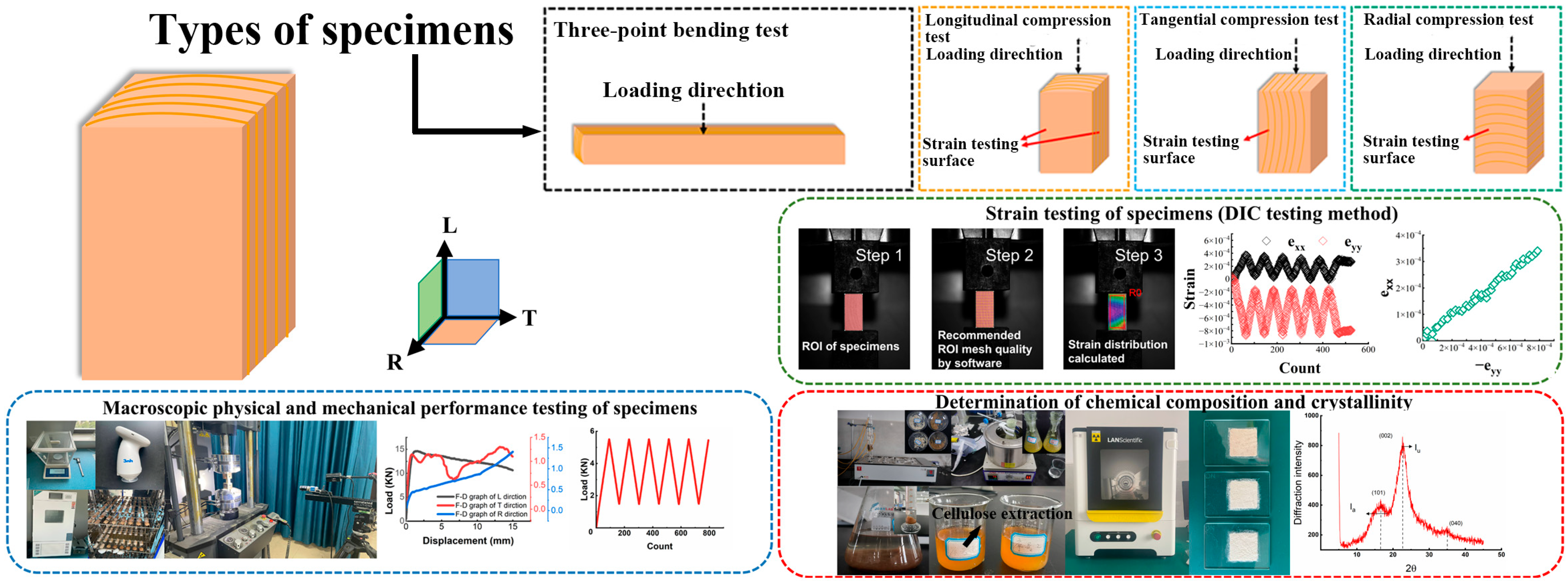
To minimize the influence of biological degradation on mechanical property measurements, standard defect-free specimens were obtained from the non-decayed sections of each timber component and aligned along different anatomical directions, following Chinese national standard GB/T 1927.2–2021 [19]. As shown in Figure 2, five specimen types were prepared: (1) 40 × 20 × 20 mm (L × R × T) specimens for evaluating longitudinal mechanical properties; (2) 20 × 20 × 40 mm specimens for assessing tangential mechanical properties; (3) 20 × 40 × 20 mm specimens for evaluating radial mechanical properties; (4) 300 × 20 × 20 mm specimens for measuring flexural properties; (5) 20 × 20 × 20 mm specimens for evaluating hygroscopic behavior. Notably, due to the limited cross-sectional dimensions of Lvb and Xuc2, only longitudinal compressive strength and flexural strength specimens could be prepared.

2.2. Hygroscopic Behavior Testing Method

Equilibrium moisture content (EMC) and swelling coefficient (SW) were measured to evaluate the hygroscopic behavior of aged timber. Specimens of 20 × 20 × 20 mm were placed in a constant temperature and humidity chamber (CW1150, S-ROCK, Shanghai, China). The temperature was maintained at 20 °C, and relative humidity (RH) levels were set at 40, 50, 60, 70, 80, and 90%. The mass of each specimen was recorded every 6 h. When the mass difference between two consecutive measurements was less than 0.01 g, the specimen was considered to have reached moisture equilibrium at that RH level. The mass of the specimens at equilibrium for each RH (mi), along with their dimensions in the radial and tangential directions at 90% RH (d90), was recorded. Finally, the specimens were oven-dried to a constant weight at 85 °C, and their equilibrium dimensions (d0) were recorded. The SW and EMC values were subsequently calculated according to Equations (1) and (2).
S W R / T = d 90 d 0 d 0
E M C = m i m 0 m 0

2.3. Mechanical Properties Testing Method

Static tests to determine stress in the timber specimens were conducted following Chinese standards and references GB/T 1927.11–2022, GB/T 1927.12–2021, GB/T 15777–2017, GB/T 1927.13–2022, and GB/T 1927.9–2021 [20,21,22,23,24]. Strain was measured using a digital image correlation (DIC) system (VIC-2D, Correlated Solutions, Columbia, SC, USA), which utilizes speckle patterns to evaluate the strain state of the specimens. Speckle patterns were generated as follows: a white matte paint layer was applied as the base, followed by a layer of black matte paint sprayed to form scattered spots. Strain measurements were recorded via an industrial camera at 125 ms sampling intervals, with the central point designated as R0 for horizontal and vertical strain calculations. The dimensions and location of R0 are illustrated in Figure 2. Based on the above, the stress and strain states of the specimens were obtained to evaluate the compressive strength, elastic modulus, Poisson’s ratio, and flexural strength of the specimens along different anatomical directions. To minimize the influence of moisture content on mechanical properties, all specimens were conditioned in a constant temperature and humidity chamber to achieve a target moisture content of approximately 12%, as required for testing. The tests were conducted in batches using a servo-controlled testing system under ambient conditions for approximately 2 h.
In accordance with Chinese standards, timber specimens for determining elastic modulus and Poisson’s ratio were subjected to cyclic loading. Prior to testing, three specimens were preloaded, with 10% and 40% of the ultimate yield stress assigned as the lower and upper cyclic load limits, respectively. The load ranges were 1.4–5.6 KN for longitudinal compression, 0.06–0.24 and 0.1–0.4 KN for transverse compression, and 0.18–0.72 KN for bending tests with a 250 mm support span. High-resolution speckle images were captured using an industrial camera, and strain distributions were analyzed using VIC-2D 7 software. Average deformations at the upper and lower load limits were calculated from the measurements of the last three cycles. The difference between these averages was taken as the compressive deformation corresponding to the upper and lower load limits. Elastic modulus and Poisson’s ratio were subsequently calculated according to Equations (3) and (4).
E l / t / r = P a × b × e y y
ν L R / L T / R T / T R = e x x e y y
where ΔP is the difference between the upper and lower limit loads at two points, a is the length of the compressed section, b is the width of the compressed section, eyy is the strain along the loading direction, and exx is the strain in the direction orthogonal to the loading direction.
In accordance with Chinese standards, compression and bending tests were conducted on timber specimens at a loading rate of 10 mm/min until failure. Compressive and bending strengths were subsequently calculated according to Equations (5) and (6), and the experimental setup is illustrated in Figure 2.
f l / t / r = P m a x a × b
f b = 2 × P m a x 2 × c × h 2
where Pmax is the failure load, c is the radial dimension of the specimen, and h is the tangential dimension of the specimen.
Experiments were conducted using an electro-hydraulic servo universal testing machine (Landmark® 370.25, MTS, Eden Prairie, MN, USA), with displacement control applied for compression and bending tests, and load control for elastic modulus and Poisson’s ratio measurements. To ensure proper contact between the testing apparatus and specimens, an initial preload of less than 20 N was applied. Finally, an independent two-sample t-test was performed in Microsoft Excel to evaluate the significance level (P) of the differences in mechanical properties among the specimens.

2.4. Chemical Composition and Microstructure

2.4.1. Measurement of Crystallinity

The crystallinity of specimens was determined using an X-ray diffractometer (FRINGE EV, LANScientific, Suzhou, China). Specimens were pulverized using a solid crusher and passed through a 100-mesh sieve to obtain uniformly sized timber powder. The diffractometer was operated over a scanning range of 5–45°, with a step size of 0.05° and a scanning rate of 0.5 s per step. The intensity–2θ relationship curve was smoothed using the Savitzky–Golay method in Origin 2024 software (window size = 21). The crystallinity testing setup and specimens are illustrated in Figure 2. Crystallinity was calculated using the Segal empirical method [25,26] according to Equation (7).
C r = I u I a I a
where Iu is the diffraction intensity of the crystalline peak at 2θ = 22°, and Ia is the minimum intensity between the (002) and (101) peaks.

2.4.2. Measurement of Chemical Components

The relative contents of organic solvent extractives, cellulose, hemicellulose, and lignin in timber powder were quantified using wet chemical methods in accordance with current Chinese national standards GB/T 2677.6–94, GB/T 2677.10–1995, GB/T 744–1989, and GB/T 2677.8–94 [27,28,29,30]. Triplicate to quintuplicate replicates were analyzed for each specimen group, and mean values were used to represent the relative contents of timber chemical components. The measured products are shown in Figure 2. In addition, the chemical composition of timber was analyzed using a Fourier transform infrared (FTIR) spectrometer (Nicolet iS20, Thermo Fisher Scientific, Waltham, MA, USA). Timber specimens were ground using a mechanical grinder and subsequently passed through a 200-mesh sieve. Specimens were prepared using the potassium bromide (KBr) pellet method, with a spectral resolution of 4 cm−1. Each specimen was analyzed at least five times to ensure reproducibility.

2.4.3. Observation of Microstructure

To investigate microstructural changes in fresh and aged timber, scanning electron microscopy (SEM; S4800, Hitachi, Tokyo, Japan) was employed. To ensure high-quality imaging, the compressed specimens were cut into 10 × 10 × 10 mm using a sliding microtome and gold-spraying treatment was performed before testing.

3. Measurement Results of Mechanical Properties

3.1. Hygroscopic Behavior Properties

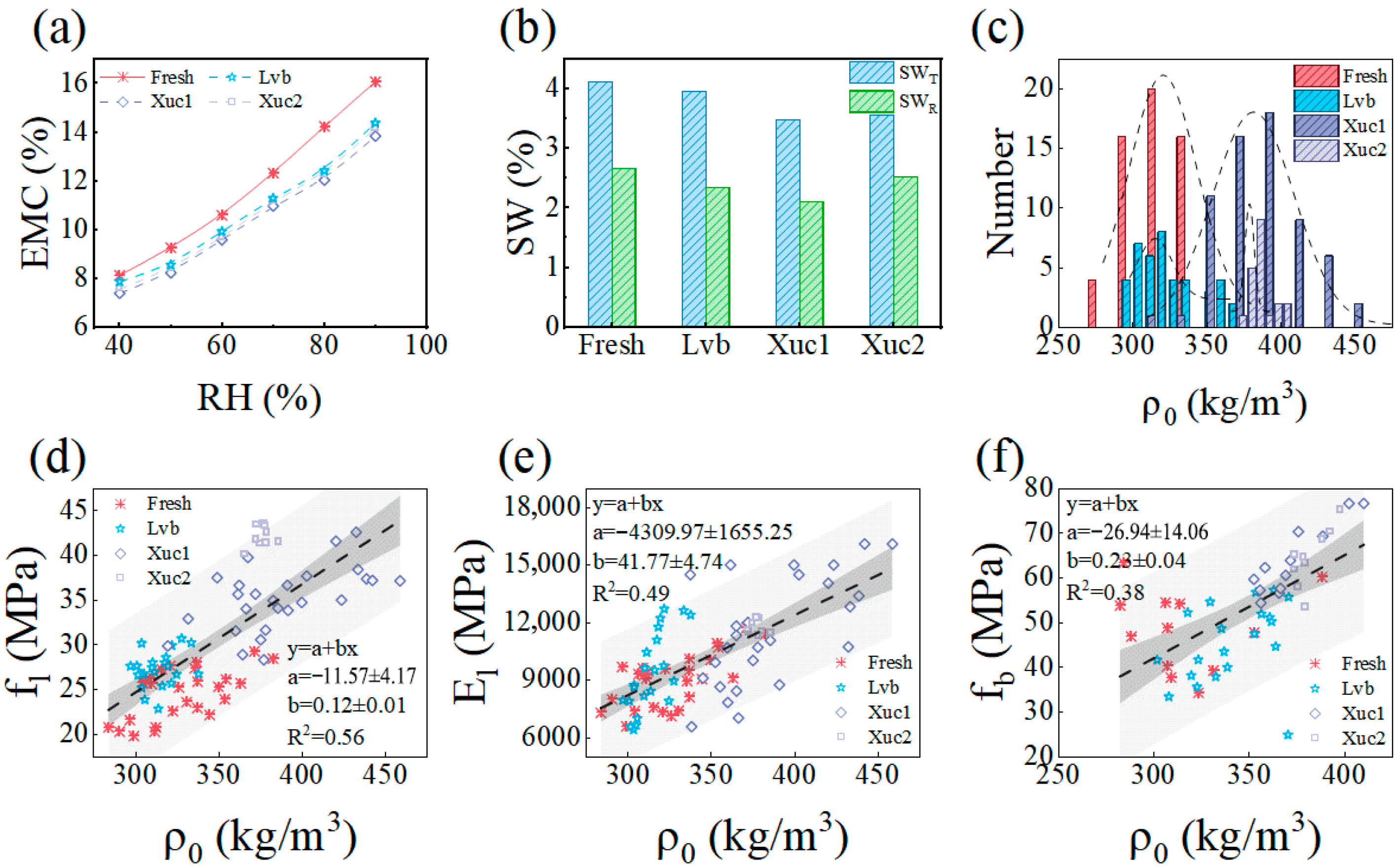
Figure 3a presents the EMC of timber at RH, while Figure 3b shows the transverse moisture swelling coefficient of timber at corresponding RH. EMC of timber at all service levels increases with rising RH, whereas fresh timber consistently exhibits higher EMC than aged timber. At 90% RH, the EMC of fresh timber is approximately 16%, while those of Lvb, Xuc1, and Xuc2 are about 14.4, 13.9, and 14.5%, respectively. The EMC of Lvb, with a shorter service life, is slightly higher than that of Xuc1 and Xuc2, which have longer service lives, indicating that the moisture absorption capacity of Chinese fir gradually decreases with increasing service duration. The difference between Xuc1 and Xuc2 is relatively small, suggesting a similar effect of the service environment on the ground and short columns. Figure 3b and Table 1 show that the tangential swelling coefficient (SWT) of all four timber types is higher than the radial swelling coefficient (SWR). For fresh timber, SWT is approximately 4.1% and SWR about 2.7%. The moisture swelling coefficients of the three aged timber types are generally lower than those of fresh timber; Xuc1 and Xuc2 have SWT and SWR values of approximately 3.5% and 2.1%, and 3.0% and 2.0%, respectively. The values for Lvb are intermediate between those of fresh timber and the specimens from General Xu’s Mansion. These results indicate that long-term service reduces the moisture swelling performance of Chinese fir, manifested as increased dimensional stability, consistent with the observed trend in EMC.
These reductions in EMC and SW are closely linked to the microstructural changes revealed in Section 4.3. Long-term service leads to the degradation of amorphous cellulose and hemicellulose, a decrease in hygroscopic functional groups, and partial densification of the cell wall. This reduces the number of accessible sorption sites and limits transverse cell wall expansion, resulting in uniformly lower SWT and SWR. Although anisotropy (SWT > SWR) is retained, its magnitude decreases slightly in aged timber, consistent with the microstructural evidence of reduced porosity and increased cell wall compactness.

3.2. Mechanical Properties

Figure 3c shows the dry density distribution of fresh and aged timber, whereas Figure 3d–f illustrate the relationships between the mechanical property parameters—longitudinal compressive strength, elastic modulus, and flexural strength—and the dry density (ρ0) of Chinese fir. The dry density of Chinese fir is mainly concentrated in the range of 300–400 kg/m3, with the average dry density of aged timber higher than that of fresh timber. Specifically, the dry density of Lvb increased by 0.94% relative to fresh timber, though the difference was not significant (p > 0.05). The dry densities of Xuc1 and Xuc2 increased by 18.72% and 17.47%, respectively, compared to fresh timber, which may be influenced by latewood proportion, service location, and duration of service [31]. Mechanical property parameters increase with increasing dry density, showing a clear positive correlation. The coefficient of determination (R2) between each mechanical property parameter and dry density ranges from 0.38 to 0.56, consistent with previous studies [32]. However, the fitting parameters in Figure 3d–f show significant uncertainty. This is primarily because the specimens were taken from aged timber components with different service ages and usage conditions, as well as from fresh timber with comparable latewood proportions. As a result, the mechanical properties varied considerably among components with different degrees of aging. In addition, the correlation between transverse mechanical properties and dry density was weak. This weak correlation is mainly attributed to the differing contributions of heartwood and sapwood to transverse mechanical behavior. Therefore, correlation analysis was not further pursued for these properties.
As shown in Table 2, the mechanical properties of different Chinese fir specimens were calculated, with averages and coefficients of variation (COV) determined from n specimens. The longitudinal compressive strengths (fl) of Fresh, Lvb, Xuc1, and Xuc2 specimens were 24.60, 27.29, 35.21, and 42.08 MPa, respectively. The corresponding longitudinal elastic moduli (El) were 9025.94, 9350.09, 11,595.86, and 12,053.38 MPa, respectively. With increasing service time, the longitudinal compressive strength and elastic modulus of Chinese fir exhibit a significant strengthening trend, particularly for Xuc2 collected from General Xu’s Mansion (481 ± 23 years), which shows the largest increase relative to fresh timber—71% in compressive strength and 34% in elastic modulus. The deformation characteristics of Chinese fir under longitudinal compression are reflected in changes in Poisson’s ratios (νLR and νLT). The Poisson’s ratios for Fresh are 0.38 and 0.46, and for Lvb are 0.49 and 0.58, respectively. However, the Poisson’s ratios of Xuc1 and Xuc2 under similar service conditions remain between 0.39 and 0.41 and 0.46 and 0.48, indicating that νLR and νLT have reached their peak and tend to stabilize after prolonged service. In summary, the mechanical properties of Chinese fir components along the grain direction in ancient buildings show significant enhancement.
According to Table 2, the chordal and radial compressive strengths (ft and fr) of Fresh are 2.49 and 1.84 MPa, respectively, with corresponding elastic moduli (Et and Er) of 231.21 and 483.04 MPa. For Xuc1, the chordal and radial compressive strengths are 2.83 and 1.66 MPa, with corresponding elastic moduli of 316.76 and 520.88 MPa. After long-term service, the transverse elastic modulus of Chinese fir is generally higher than that of fresh timber, particularly exhibiting a pronounced strengthening trend in the chordal direction. In contrast, the radial compressive strength of aged timber slightly decreases, indicating directional differences in mechanical property evolution during service aging. The Poisson’s ratios (νRT and νTR) of Fresh are 0.69 and 0.45, respectively, while those of Xuc1 are 0.73 and 0.50, indicating an upward trend. This suggests that long-term service may enhance deformation in the transverse direction of timber.
According to Table 2, the flexural strengths (fb) of Fresh, Lvb, Xuc1, and Xuc2 are 48.47, 45.43, 63.82, and 64.36 MPa, respectively. Differences in the trends of fb changes are evident. Lvb exhibits the lowest fb, decreased by 6% relative to Fresh, whereas Xuc1 and Xuc2 demonstrate strengthening effects, with Xuc2 showing an increase of approximately 33% compared to Fresh. This difference is mainly attributed to the service environment of the components. The Lvb specimen, as a beam component, suffered damage due to long-term bending loads, while Xuc1 and Xuc2, as timber columns, showed significant strengthening. Notably, this strengthening effect resembles the evolution of mechanical properties observed in artificially modified timber [33], although changes during long-term natural service occur more slowly and result in a more stable structure, reflecting the gradual and stable characteristics of natural aging.

4. Research on Mechanism

4.1. Comparison of Crystallinity

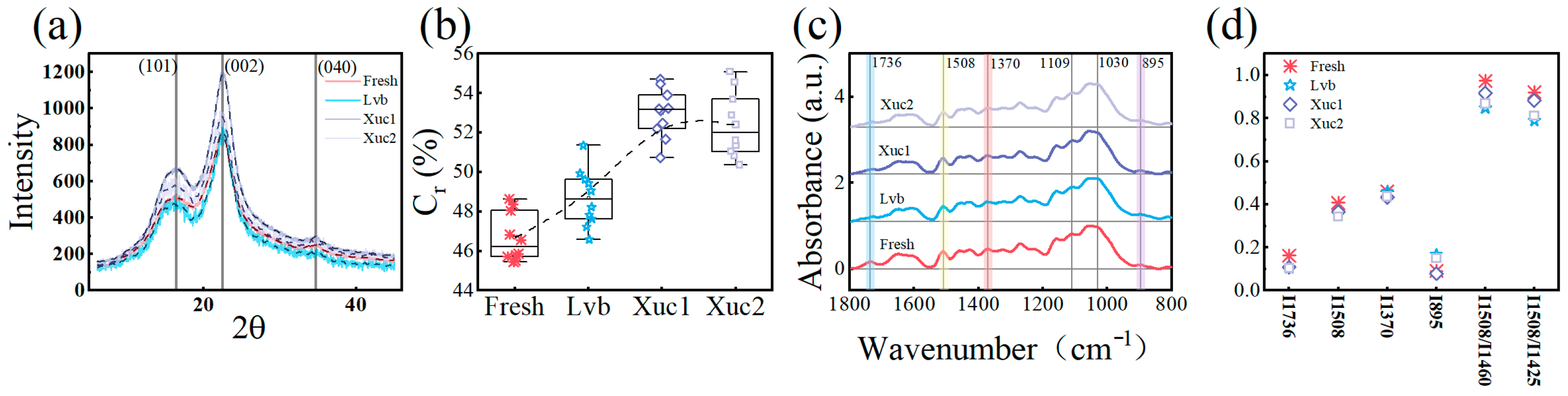
Figure 4a presents the average XRD diffraction intensity curves of four types of Chinese fir, while Figure 4b illustrates the corresponding differences in Cr. Within the scanning range of 5–45°, the timber powder exhibits characteristic diffraction peaks corresponding to the cellulose (101), (002), and (040) crystal planes at 2θ ≈ 16°, 22.5°, and 35°, respectively. This indicates that all specimens retain the typical cellulose crystalline structure. It should also be noted that, under the Meyer–Misch cellulose I convention, the diffraction peak near 22.5° is assigned to the (002) plane, which corresponds to the (200) reflection in modern cellulose Iβ cell descriptions. Comparison of the diffraction curves between fresh and aged specimens reveals no significant shift in peak positions, indicating consistency across specimens. However, the diffraction peak intensity of aged timber is markedly higher than that of fresh timber, suggesting that long-term service significantly enhances Cr. The Cr value, calculated using the Segal method, is presented in Figure 4b. The Cr of aged timber in ancient buildings is higher than that of fresh timber and exhibits an increasing trend with service time. This increase is primarily attributed to the degradation of amorphous regions and the rearrangement of cellulose molecular chains during long-term service, which elevates the proportion of crystalline regions and consequently enhances crystallinity [34].

4.2. Chemical Composition

Table 3 shows that the relative content of organic extractives in Fresh is 3.15%, which is significantly lower than that in aged timber. This difference is attributed to the degradation of polysaccharides during long-term service, which increases the relative proportion of organic extractives, exhibiting a “relative enrichment effect”. The accumulation of these extractives in cell cavities has been considered by Japanese researchers as a contributing factor to the enhanced mechanical strength of aged timber [35]. However, cellulose and hemicellulose in Chinese fir have undergone hydrolysis due to prolonged wet–dry cycles and elevated temperatures, as evidenced by the decreased relative contents in all aged Chinese fir specimens. Compared to Fresh, the acid-insoluble lignin content in Lvb, Xuc1, and Xuc2 decreased to 29.98, 28.02, and 29.34%, respectively, from 31.19%. This reduction is primarily attributed to exposure to ultraviolet radiation in sunlight, which promotes the degradation of acid-insoluble lignin under varying service conditions [36].
Figure 4c,d present the FTIR spectra and corresponding absorption peak intensities of different Chinese fir. The absorption peak at 1736 cm−1 corresponds to the C=O stretching vibration of acetyl and glucuronic acid groups in hemicellulose, serving as a characteristic peak for this component. In Fresh timber, this peak is prominent with relatively high intensity. After long-term service, the peak either disappears in Xuc1 or exhibits a positional shift in Lvb and Xuc2, indicating a reduced relative content of hemicellulose in aged timber compared to Fresh. This suggests that hemicellulose, being the most unstable chemical component in timber, undergoes substantial degradation during long-term service, consistent with the results from wet chemical analysis. Similar conclusions were reported in FTIR studies on aged timber components from various positions, including eaves columns, observation boards, and spine rafters. In the present study, no corresponding absorption peak was detected in aged timber, confirming hemicellulose degradation.
The peak at 1508 cm−1 corresponds to the skeletal vibration of lignin aromatic rings, representing the most stable characteristic peak of lignin. Although lignin undergoes slow degradation, its rate is considerably lower than that of polysaccharides, resulting in prominent absorption peaks in aged timber, consistent with FTIR observations. In previous studies comparing lignin content in Chinese fir [37], the ratios I1508/I1460 and I1508/I1452 were used to represent relative lignin content, as shown in Figure 4d. Comparison of these peak ratios indicates that the relative lignin content in aged timber is lower than in Fresh, suggesting partial degradation of lignin during long-term service. At cellulose-characteristic peaks at 1370 cm−1 and 895 cm−1, aged timber still exhibits prominent absorption peaks, with no notable difference compared to Fresh.

4.3. Microstructural

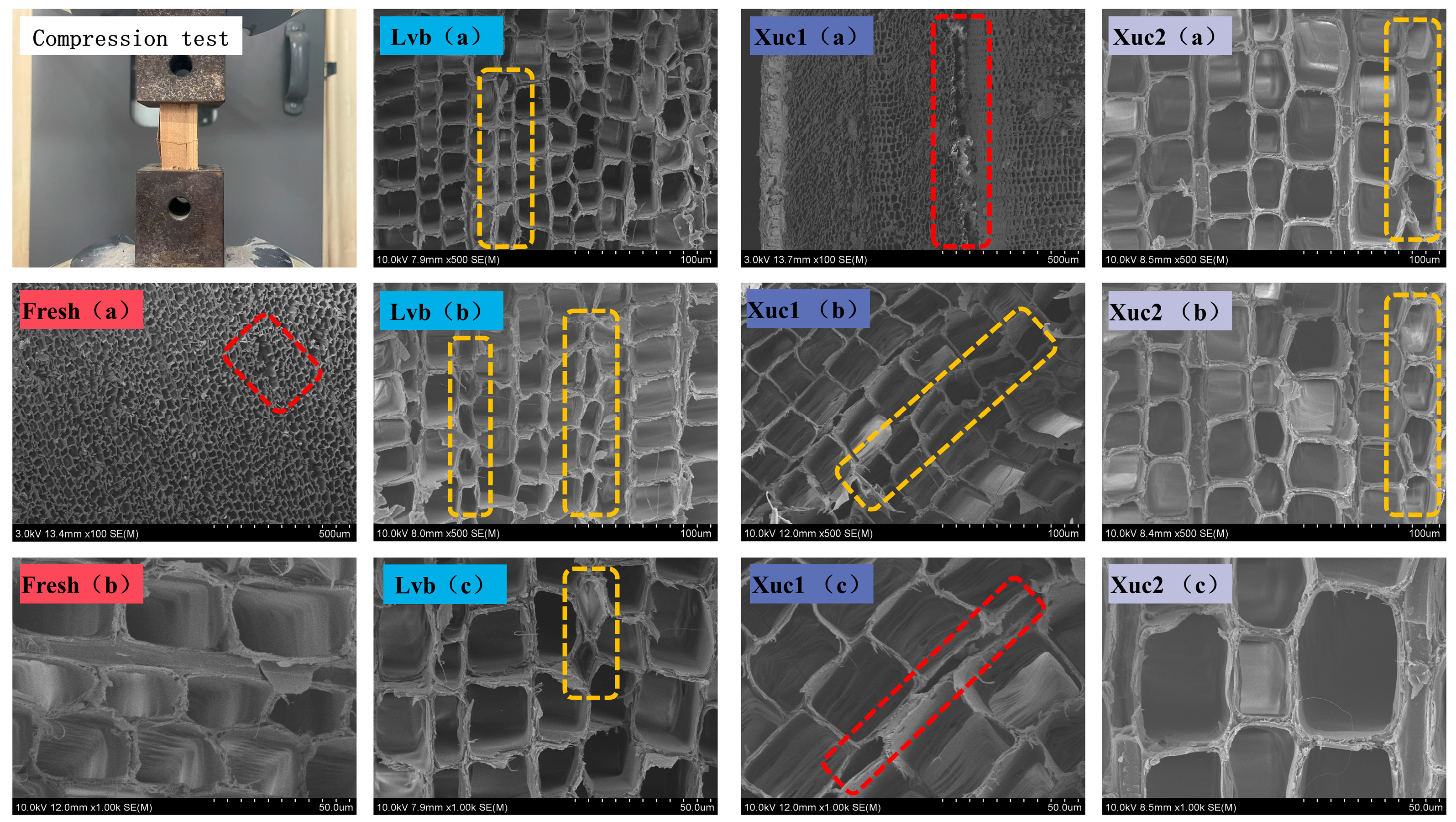
To investigate the changes in cell wall structure of Chinese fir during long-term service and their effects on mechanical properties, scanning electron microscopy (SEM) was employed to examine both untested and compressed specimens. Figure 5 illustrates the delamination observed in aged timber during the compression test. Fresh (a) and Xuc1 (a) in Figure 5 depict the condition of the compressed cell wall, while the remaining SEM images show the microstructure of the untested specimens. No evidence of fungal degradation was observed in the timber from the ancient buildings.
The cell structure and morphology of untested fresh timber (Fresh (b)) are regular, with distinct and continuous cell wall layer. After compression, Fresh (a) exhibited interlayer slippage and stratification of the cell wall, accompanied by localized rupture (highlighted in red), and the pits displayed rough, scraped features. In contrast, SEM images of untested Lvb (Lvb (a)–(c)) reveal continuous local collapses and folds in the cell wall, a phenomenon also observed in Xuc2 (Xuc2 (a)–(c)). These features are primarily attributed to the degradation of cellulose and hemicellulose, as well as the formation of wrinkles and irregular cell arrangements under long-term stress, consistent with observations in previous timber densification research [38,39]. Xuc1 (b)–(c) shows that the cell wall structure of aged timber exhibits fracture morphology, with smooth fracture surfaces and cracks penetrating the cell wall (red box in Xuc1 (c)). SEM image of Xuc1 (a) shows that cell wall cracks after compression are continuous, accompanied by local fragmentation and peeling. These observations indicate that aged timber is more prone to delamination along the annual rings during compression due to its reduced plastic energy absorption capacity.
It can be seen that long-term service has caused damage to the cellular structure of Chinese fir timber. For example, aged timber exhibits wrinkling and collapsing cell walls due to the degradation of cellulose and hemicellulose. In addition, the increased crystallinity of Chinese fir components and the densification of cell wall structure support the positive impact of long-term service on the mechanical properties of Chinese fir timber.

4.4. Discussion

In this study, the chemical composition, microstructure, and mechanical properties of Chinese fir components exhibited significant changes after long-term service. Although degradation of hemicellulose and cellulose was detected through wet-chemical analysis, several mechanical indicators, such as elastic modulus and strength, showed an increasing trend. This seemingly contradictory phenomenon can be explained by multiple underlying mechanisms.
From the chemical composition analysis, it is evident that during long-term service, hemicellulose, a relatively fragile and hydrophilic component of timber, undergoes rapid degradation. Meanwhile, the amorphous regions of cellulose gradually deteriorate, increasing the proportion of crystalline cellulose and thereby enhancing the crystallinity of aged timber. This observation aligns with the findings of Kohara and Okamoto (1955) on Japanese temple timber [40], suggesting that the increase in crystallinity with prolonged service time contributes to reduced moisture absorption, as well as enhanced compressive strength and brittleness.
In the SEM microstructural observations, the degradation of cellulose and hemicellulose led to delamination and wrinkling of the cell wall. These processes reduce the timber’s capacity for plastic deformation and its ability to inhibit crack propagation. This suggests that although the stiffness of aged timber increases, its toughness and deformability decrease. Similar findings were reported by Yokoyama [41], observing that aged timber exhibits higher stiffness and strength than fresh timber but fails more abruptly, showing a more brittle behavior. Furthermore, the combined effects of reduced moisture absorption and microstructural densification (such as cell wall collapse, decreased porosity), and the accumulation of filling materials within cell cavities, also contribute to the enhanced mechanical performance of aged timber.
Based on the experimental results, the observed increase in elastic modulus and the slight enhancement in strength of aged timber are primarily attributed to reduced moisture absorption, increased crystallinity, and microstructural densification in Chinese fir. In contrast, the increased brittleness of aged timber mainly results from the degradation of hemicellulose and cellulose. It is noteworthy that discrepancies among existing studies can partly be explained by differences in timber species, sampling locations (sapwood versus heartwood), moisture content control, and the presence or absence of biological decay or microcrack accumulation. Moreover, variations in testing conditions—such as moisture state (dry or wet), loading rate, and specimen size—can significantly influence the apparent “strengthening” or “degradation” trends. Therefore, when assessing the mechanical properties of timber components in ancient buildings, it is essential to simultaneously consider moisture content, density, chemical composition, and microstructure to accurately determine whether a component is in a phase of “increased strength but reduced toughness” or has entered a stage of “overall performance decline”.

5. Conclusions

This study aims to investigate changes in the anisotropic mechanical properties of Chinese fir used in ancient buildings in southern Hunan after long-term service. It also analyzes alterations in crystallinity and microstructure to elucidate the mechanisms underlying mechanical performance changes. The main findings are summarized as follows:
(1)
The moisture absorption behavior and the longitudinal and bending mechanical properties of Chinese fir undergo significant changes after long-term service. The anisotropic mechanical response shows a Chinese fir trend of directional dependence and non-uniformity, rather than a uniform strengthening trend. Longitudinal and bending strengths generally increase with service duration, whereas certain transverse properties, such as the radial compressive strength of Xuc1, show slight reductions. And the positive impact of long-term service on the mechanical properties of Chinese fir is supported by changes in chemical composition and microstructure.
(2)
Aging induces degradation of cellulose and hemicellulose and relative enrichment of extractives, resulting in an increase in cellulose crystallinity with increasing service time. SEM observation shows that microstructural changes, such as interlayer separation and cell wall collapse, contribute to the densification of the aged Chinese fir timber. The changes in crystallinity and microstructure support the trend of mechanical properties of aged Chinese fir, especially the positive impact on mechanical properties.
(3)
The comprehensive characterization of the anisotropic mechanical properties of long-term aged Chinese fir provides a robust basis for non-destructive evaluation and targeted reinforcement of historic timber structures, thereby enhancing their structural safety and preservation. Moreover, these findings offer critical guidance for the safe reuse of aged timber, facilitating sustainable restoration practices while preserving both the structural integrity and cultural heritage of historic buildings.

Author Contributions

Conceptualization, Q.Z. and F.Z.; validation, J.H. and F.Z.; formal analysis, S.W.; investigation, S.W.; resources, J.H.; data curation, S.W.; writing—original draft preparation, S.W.; writing—review and editing, Q.Z., J.H. and F.Z.; visualization, Q.Z.; supervision, J.H. and F.Z.; project administration, J.H. and F.Z.; funding acquisition, Q.Z. All authors have read and agreed to the published version of the manuscript.

Funding

This research was funded by Excellent Youth Program of Hunan Provincial Department of Education, grant number 22B0172, and Natural Youth Program of Hunan Provincial Department of Education, Grant number 22B0172, and National Natural Science Foundation of China, Grant number 51708478, and The Open Foundation of Hunan Provincial Key Laboratory of Intelligent Protection and Utilization Technology in Stone and Brick Cultural Relics, Grant number HUSE-2024-11.

Data Availability Statement

The authors declare that they have no known competing financial interests or personal relationships that could have appeared to influence the work reported in this paper.

Conflicts of Interest

Author Feng Zou was employed by the company China Construction Sixth Engineering Bureau Corp. The remaining authors declare that the research was conducted in the absence of any commercial or financial relationships that could be construed as a potential conflict of interest.

References

  1. Zhang, D.; Yu, Y.; Guan, C.; Wang, H.; Zhang, H.; Xin, Z. Nondestructive testing of defect condition of wall wood columnsin Yangxin Hall of the Palace Museum, Beijing. J. Beijing For. Univ. 2021, 43, 127–139. [Google Scholar] [CrossRef]
  2. Qin, S.; Yang, N. Strength degradation and service life prediction of timber in ancient Tibetan building. Eur. J. Wood Wood Prod. 2018, 76, 731–747. [Google Scholar] [CrossRef]
  3. Ma, L.; Xue, J.; Zhang, X. Seismic vulnerability analysis of damaged ancient timber structures. J. Vib. Eng. 2023, 36, 1390–1401. [Google Scholar] [CrossRef]
  4. Qin, S.; Yang, N.; Hu, H.; Zhang, L. Study on dynamic characteristics of a damaged ancient timber structure of Ming-Qing Dynasty. J. Build. Struct. 2018, 39, 130–137. [Google Scholar] [CrossRef]
  5. Pan, Y.; Yi, D.; Chen, J.; An, R. Analysis on dynamic characteristics and seismic response of Lingguan deity hall in Qingcheng Mountain by considering effects of wall. J. Build. Struct. 2022, 43, 95–104. [Google Scholar] [CrossRef]
  6. Sonderegger, W.; Kranitz, K.; Bues, C.-T.; Niemz, P. Aging effects on physical and mechanical properties of spruce, fir and oak wood. J. Cult. Herit. 2015, 16, 883–889. [Google Scholar] [CrossRef]
  7. Zhang, J.; Li, T.; Lu, W.; Wu, Q.; Huang, J.; Jia, C.; Wang, K.; Feng, Y.; Chen, X.; Song, F. Influence of wood species and natural aging on the mechanics properties and microstructure of wood. J. Build. Eng. 2024, 91, 109469. [Google Scholar] [CrossRef]
  8. Xin, Z.; Fu, R.; Zong, Y.; Ke, D.; Zhang, H.; Yu, Y.; Zhang, W. Effects of natural ageing on macroscopic physical and mechanical properties, chemical components and microscopic cell wall structure of ancient timber members. Constr. Build. Mater. 2022, 359, 129476. [Google Scholar] [CrossRef]
  9. Yorur, H.; Kurt, S.; Yumrutas, H.I. The Effect of Aging on Various Physical and Mechanical Properties of Scotch Pine Wood Used in Construction of Historical Safranbolu Houses. Drv. Ind. 2014, 65, 191–196. [Google Scholar] [CrossRef]
  10. Witomski, P.; Krajewski, A.; Kozakiewicz, P. Selected mechanical properties of Scots pine wood from antique churches of Central Poland. Eur. J. Wood Wood Prod. 2014, 72, 293–296. [Google Scholar] [CrossRef]
  11. Yang, N.; Wang, Z.; Chang, P. Experimental study on mechanical properties of small clear specimens of aged Tibetan populus cathayana. J. Build. Struct. 2022, 43, 168–176. [Google Scholar] [CrossRef]
  12. Yang, N.; Li, P.; Law, S.S.; Yang, Q. Experimental Research on Mechanical Properties of Timber in Ancient Tibetan Building. J. Mater. Civ. Eng. 2012, 24, 635–643. [Google Scholar] [CrossRef]
  13. Kohara, J. Studies on the durability of wood—I. Mechanical properties of old timbers. (Horyuji Temple construction timbers Chamaecyparis obtusa Endlicher). Sci. Rep. Kyoto Prefect. Univ. Agric. Jpn. 1952, 2, 116–131. [Google Scholar]
  14. Li, T.; Wu, Q.; Lu, W.; Zhang, J.; Yue, Z.; Jie, Y.; Zhang, J.; Cheng, Z.; Ji, W.; Wu, J. Effects of different accelerated aging modes on the mechanical properties, color and microstructure of wood. J. Build. Eng. 2024, 98, 111026. [Google Scholar] [CrossRef]
  15. Chen, K.; Long, K.; Chu, S.; Lin, L.; Chen, Y.; Zhang, T. Effects of Natural Aging on the Cell Wall Structure and Chemical Composition of Ancient Architectural Wood. Chin. J. Wood Sci. Technol. 2023, 37, 30–37. [Google Scholar] [CrossRef]
  16. Lingling Fanshendong Village Preserves an Ancient Courtyard from the Jiaqing Period. Available online: https://www.yzcity.gov.cn/cnyz/msgj/202011/e2d4c3fb4e494f169ed733dfb63300f7.shtml (accessed on 3 November 2020).
  17. The Xu’s Mansion in Lingling Has Been Identified as the Earliest Surviving General’s Mansion in Yongzhou. Available online: https://www.yzcity.gov.cn//cnyz/msgj/201901/d292749b463b41178d833d071bc6dca8.shtml (accessed on 10 January 2019).
  18. GB/T 1927.3-2021; Test Methods for Physical and Mechanical Properties of Small Clear Wood Specimens. Part 3: Determination of the Growth Rings Width Andatewood Rate of Wood. Standardization Administration of China: Beijing, China, 2021.
  19. GB/T 1927.2-2021; Test Methods for Physical and Mechanical Properties of Small Clear Wood Specimens. Part 2: Sampling Methods and General Requirements. Standardization Administration of China: Beijing, China, 2021.
  20. GB/T 1927.11-2022; Test Methods for Physical and Mechanical Properties of Small Clear Wood Specimens. Part 11: Determination of Ultimate Stress in Compression Parallel to Grain. Standardization Administration of China: Beijing, China, 2022.
  21. GB/T 1927.12-2021; Test Methods for Physical and Mechanical Properties of Small Clear Wood Specimens. Part 12: Determination of Strength in Compression Perpendicular to Grain. Standardization Administration of China: Beijing, China, 2021.
  22. GB/T 1927.13-2022; Test Methods for Physical and Mechanical Properties of Small Clear Wood Specimens. Part 13: Determination of the Modulus of Elasticity in Compression Perpendicular to Grain. Standardization Administration of China: Beijing, China, 2022.
  23. GB/T 15777-2017; Method for Determination of the Modulus of Elasticity in Compression Parallel to Grain of Wood. Standardization Administration of China: Beijing, China, 2017.
  24. GB/T 1927.9-2022; Test Methods for Physical and Mechanical Properties of Small Clear Wood Specimens. Part 9: Determination of Bending Strength. Standardization Administration of China: Beijing, China, 2021.
  25. Jia, R.; Sun, H.; Wang, Y.; Wang, R.; Zhao, R.; Ren, H. Relativity of Microstructures and Mechanical Properties of Juvenile Woods of 10-Year-Old New Chinese Fir Clones ‘Yang 020’ and ‘Yang 061’. Sci. Silvae Sin. 2021, 57, 165–175. [Google Scholar] [CrossRef]
  26. de Almeida, T.H.; Sardela, M.; Lahr, F.A.R. X-ray diffraction on aged Brazilian wood species. Mater. Sci. Eng. B-Adv. Funct. Solid-State Mater. 2019, 246, 96–103. [Google Scholar] [CrossRef]
  27. GB/T 2677.6-94; Fibrous Raw Material. Determination of Solvent Extractives. Standardization Administration of China: Beijing, China, 1994.
  28. GB/T 2677.10-1995; Fibrous Raw Material. Determination of Holocellulose. Standardization Administration of China: Beijing, China, 1995.
  29. GB/T 744-1989; Pulps. Determination of α-Cellulose. Standardization Administration of China: Beijing, China, 1989.
  30. GB/T 2677.8-94; Fibrous Raw Material. Determination of Acid-Insoluble Lignin. Standardization Administration of China: Beijing, China, 1994.
  31. Cavalli, A.; Cibecchini, D.; Togni, M.; Sousa, H.S. A review on the mechanical properties of aged wood and salvaged timber. Constr. Build. Mater. 2016, 114, 681–687. [Google Scholar] [CrossRef]
  32. Xin, Z.B.; Guan, C.; Zhang, H.J.; Yu, Y.Z.; Liu, F.L.; Zhou, L.J.; Shen, Y.L. Assessing the density and mechanical properties of ancient timber members based on the active infrared thermography. Constr. Build. Mater. 2021, 304, 124614. [Google Scholar] [CrossRef]
  33. Esteves, B.M.; Pereira, H.M. Wood modification by heat treatment: A review. BioResources 2009, 4, 370–404. [Google Scholar] [CrossRef]
  34. Reiniati, I.; Osman, N.B.; Mc Donald, A.G.; Laborie, M.-P. Linear viscoelasticity of hot-pressed hybrid poplar relates to densification and to the in situ molecular parameters of cellulose. Ann. For. Sci. 2015, 72, 693–703. [Google Scholar] [CrossRef]
  35. Kohara, J. Studies on the durability of wood—VI: The change of mechanical properties of old timbers (Chamaecyparis obtuse Endlicher). Sci. Rep. Kyoto Prefect. Univ. Agric. Jpn. 1954, 3, 164–174. [Google Scholar]
  36. Xin, Z.; Li, Y.; Qiu, X.; Zhang, H.; Zhou, J.; Yuan, J.; Zong, Y.; Zhang, T. Effects of environmental factors on natural aging of timber members of ancient buildings: Ultraviolet radiation, temperature and moisture. Constr. Build. Mater. 2024, 456, 139303. [Google Scholar] [CrossRef]
  37. Fu, R. Comparative Studies on Wooden Components of Ancient Building and Artificial Light Aging Wood. Master’s thesis, Beijing Forestry University, Beijing, China, 2022. [Google Scholar]
  38. Chen, C.; Fan, X.; Deng, Y.; Chen, M.; Wu, J.; Yang, Y.; Hou, T.; Wang, X. Densification of poplar veneer. J. Zhejiang AF Univ. 2013, 30, 536–542. [Google Scholar]
  39. Zhao, L.; Huang, R.; Wang, Y.; He, X.; Sun, L.; Chen, Z. Influence of density distribution on the compressive strength perpendicular to grain of sandwich-compressed Cunninghamia lanceolata wood. J. Zhejiang AF Univ. 2025, 42, 611–621. [Google Scholar]
  40. Kohara, J.; Okamoto, H. Studies of Japanese old timbers. Sci. Rep. Kyoto Prefect. Univ. Agric. Jpn. 1955, 6, 9–20. [Google Scholar]
  41. Yokoyama, M.; Gril, J.; Matsuo, M.; Yano, H.; Sugiyama, J.; Clair, B.; Kubodera, S.; Mistutani, T.; Sakamoto, M.; Ozaki, H. Mechanical characteristics of aged Hinoki wood from Japanese historical buildings. Comptes Rendus Phys. 2009, 10, 601–611. [Google Scholar] [CrossRef]
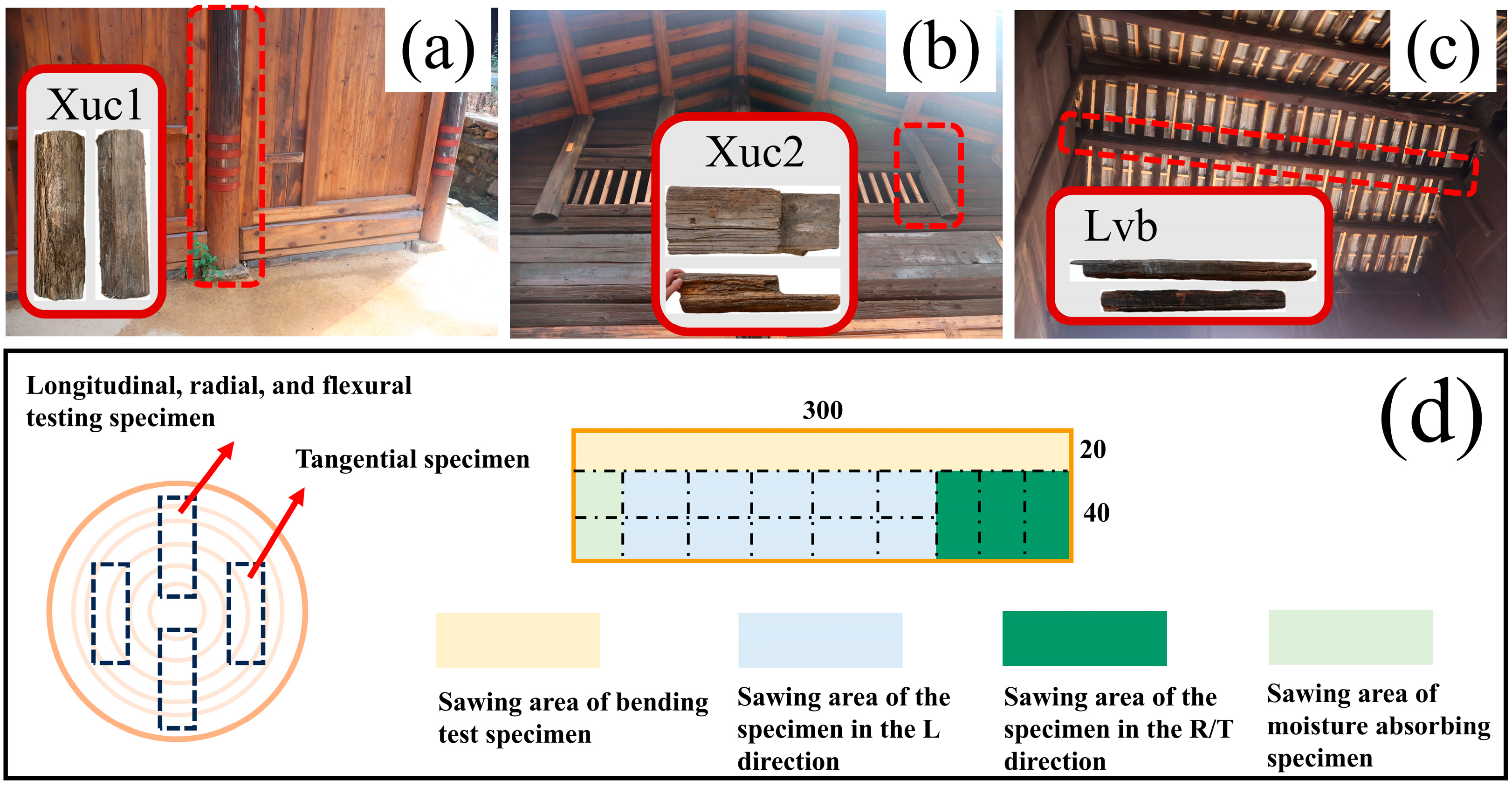
Figure 1. Service status and sawing position of aged Chinese fir components. (a) The service position of components Xuc1. (b) The service position of components Xuc2. (c) The service position of components Lvb. (d) Sawing position of the specimens.
Buildings 15 04500 g001
Figure 2. Specimen types and testing methods.
Buildings 15 04500 g002
Figure 3. Moisture absorption and mechanical properties of Chinese fir. (a) EMC of Chinese fir at different RH. (b) SW of Chinese fir. (c) Distribution of ρ0. (d) Relationship between fl and ρ0. (e) Relationship between El and ρ0. (f) Relationship between fb and ρ0.
Buildings 15 04500 g003
Figure 4. Crystallinity and Chemical Composition of Chinese Fir. (a) X-ray diffraction pattern of Chinese fir. (b) Cr of Chinese fir. (c) FTIR spectra of Chinese fir. (d) Intensity value of the absorption peak.
Buildings 15 04500 g004
Figure 5. SEM image of Chinese fir. Fresh (a): After loading the image of Fresh. Fresh (b): Image of unloaded Fresh. Lvb (a), (b), and (c): Images of unloaded Lvb. Xuc1 (a): After loading the image of Xuc1. Xuc1 (b) and (c): Image of unloaded Xuc1. Xuc2 (a), (b), and (c): Images of unloaded Xuc2.
Buildings 15 04500 g005
Table 1. Moisture absorption behavior parameters of Chinese fir.
Timber TypesNumberEMC (%)SW (%)
50%70%90%TR
Fresh69.2712.3316.074.122.67
Lvb68.5611.3014.383.962.65
Xuc168.2211.1814.472.971.96
Xuc268.2411.1013.843.482.11
Table 2. Mechanical properties of Chinese fir timber specimens.
Mechanical PropertiesFreshLvbXuc1Xuc2
AVCOVAVCOVAVCOVAVCOV
Compressive strength (MPa)fl24.60 (26)0.11427.29 (22)0.07335.21 (26)0.10342.08 * (9)0.028
ft2.49 (13)0.115 2.83 (13)0.211
fr1.84 (13)0.342 1.66 (13)0.303
Compression modulus (MPa)El9025.94 (26)0.1549350.09 (22)0.22011,595.86 (26)0.24712,053.38 (10)0.070
Et231.21 (13)0.311 316.76 (13)0.150
Er483.04 (13)0.285 520.88 (13)0.129
Poisson’s ratioνLR0.38 * (12)0.1290.49 (11)0.2370.41 (13)0.2130.39 * (4)0.098
νLT0.46 (13)0.2380.58 (11)0.2400.48 (13)0.0830.46 (5)0.229
νRT0.69 (13)0.132 0.73 (13)0.129
νTR0.45 (13)0.147 0.50 (13)0.103
Flexural strength (MPa)fb48.47 (12)0.18945.43 (20)0.19263.82 (12)0.12164.36 * (9)0.101
Note: The values in parentheses represent the quantity of each specimen. The significance level is 0.05. *—Removal of outliers using Grubbs’ method, And all data with “*” only exists and one outlier has been removed; AV—average value; and COV—coefficient of variation.
Table 3. Chemistry components of Chinese timber specimens.
TypesChemistry Components (%)
ExtractCelluloseHemicelluloseLignin
Fresh3.1536.5330.8831.19
Lvb5.9733.2727.2029.98
Xuc17.7926.9028.8628.02
Xuc26.7932.1129.9129.34
Disclaimer/Publisher’s Note: The statements, opinions and data contained in all publications are solely those of the individual author(s) and contributor(s) and not of MDPI and/or the editor(s). MDPI and/or the editor(s) disclaim responsibility for any injury to people or property resulting from any ideas, methods, instructions or products referred to in the content.