Morphological Multi-Objective Optimization of Traditional Dwellings in Southern Xinjiang Based on Genetic Algorithms: A Case Study of the Suohema House

Abstract
1. Introduction
2. Research Background and Literature Review
- (1)
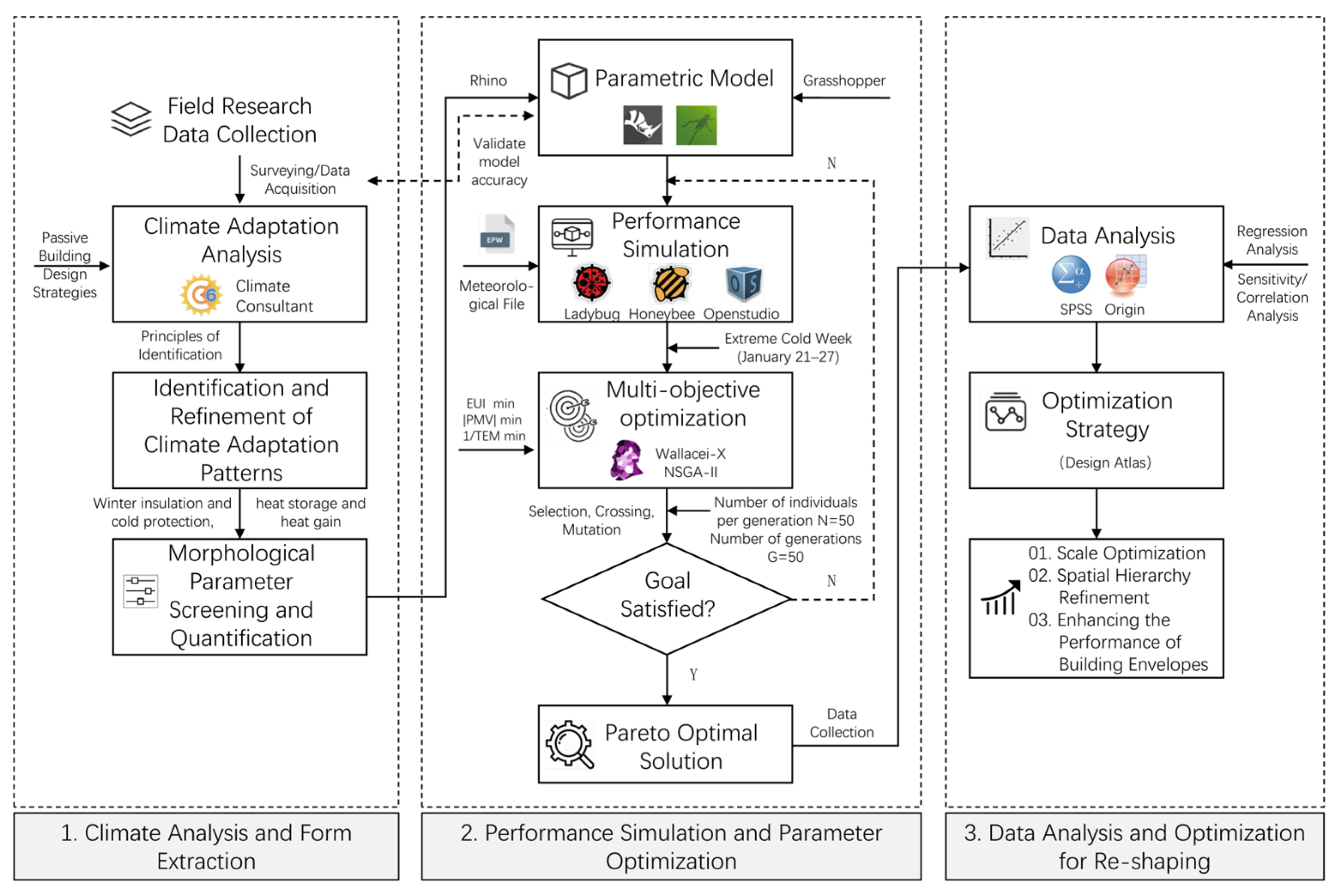
- A performance-driven multi-objective optimization framework for traditional dwellings is proposed, enabling feedback and adjustment between dwelling morphology and building performance.
- (2)
- Transforming the vague “regional characteristics” of traditional dwellings into a quantifiable set of climate-adaptive morphological features, the influence weights and prioritization of morphological parameters on energy consumption and indoor thermal environment are quantified, addressing the lack of quantitative analysis in previous research on vernacular morphology.
- (3)
- Hierarchical optimization strategies for the Suohema House morphology are developed, aiming to enhance its adaptability to cold and arid climates without compromising the traditional style.
3. Research Approach and Methodology
3.1. Research Methods Framework
3.2. Study Area Overview
3.3. Data Sources
3.4. Climate Adaptation Analysis
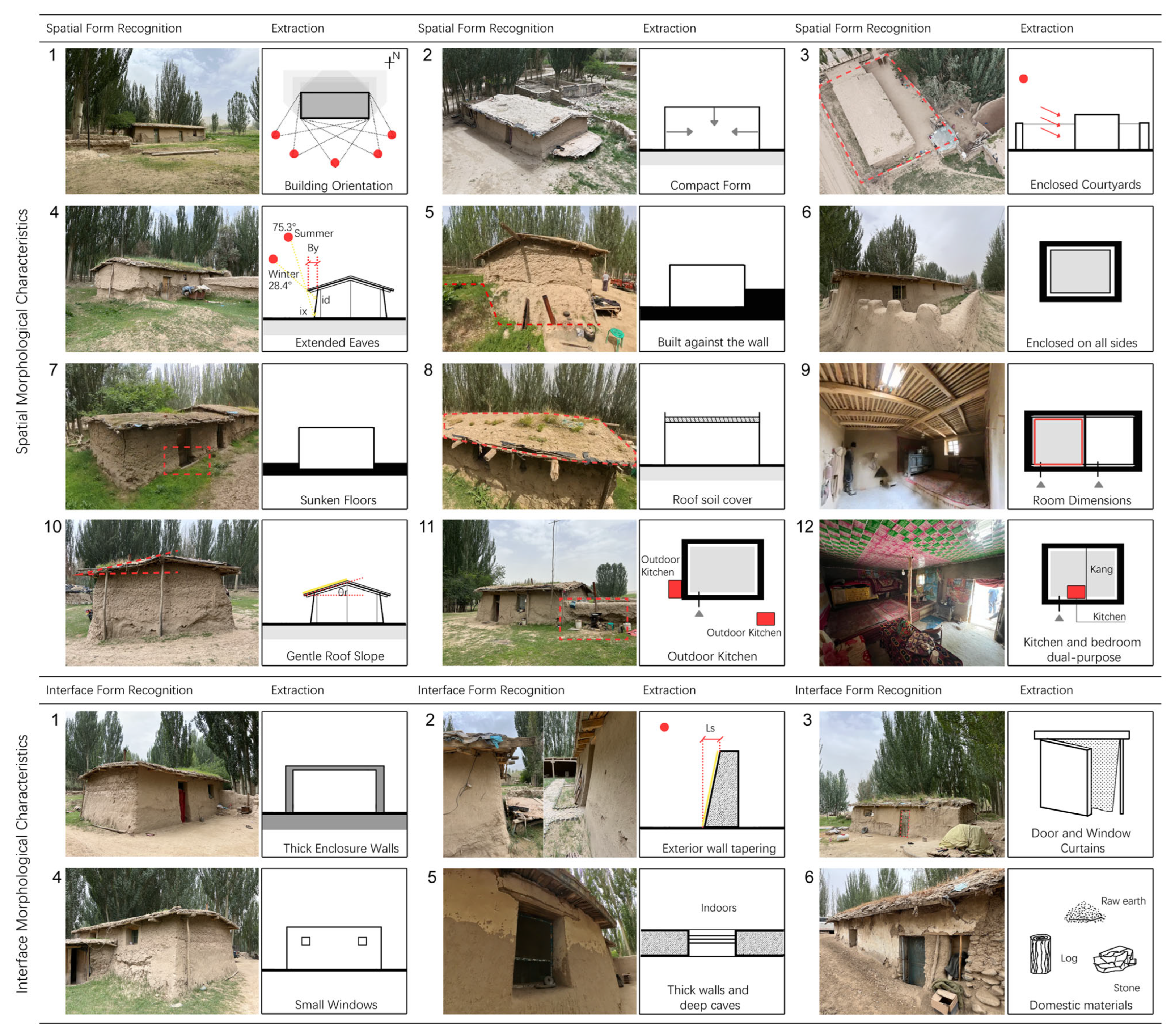
3.5. Morphological Feature Extraction
- (1)
- The “building orientation” design parameter refers to the main orientation of the building. An appropriate orientation maximizes solar gain, enhancing daylighting and passive heating, while avoiding the prevailing winter winds to reduce direct cold air impact and heat loss due to air infiltration.
- (2)
- The design parameters for “thick enclosure” and “exterior wall tapering” are the widths at the top and bottom of the wall. Rammed-earth walls store daytime heat, effectively suppressing external temperature fluctuations, stabilizing interior surface temperatures [39], and mitigating cold wind infiltration.
- (3)
- The design parameter of “extended eaves” is the depth of the eaves. Eaves shield exterior walls from winter winds, reducing heat exchange between indoors and outdoors, and preventing excessive solar heat gain in summer. The shaded area beneath the eaves also creates a transitional space that buffers indoor–outdoor temperature differences.
- (4)
- The design parameters of “small windows” and “thick walls and deep caves” are the window-to-wall ratio. Window size affects daylighting and heat transfer, while minimizing cold wind infiltration and convective heat loss.
- (5)
- The design parameter of “roof soil cover” is the thickness of the roof soil layer. The thermal inertia of the soil delays heat transfer through the roof, reducing indoor heat loss in winter and blocking external heat in summer.
- (6)
- The design parameters of a “gentle slope roof” are the roof slope. It increases the effective surface area for solar radiation while maintaining wind resistance.
- (7)
- The design parameters of “sunken floors” are the indoor–outdoor height difference. This utilizes the stable temperature of underground soil to moderate indoor floor temperatures.
- (8)
- The design parameter of “built against the wall” is the height against the wall. Utilizing the thermal mass of the ground or mountains enhances insulation and reduces convective heat loss on windward facades.
- (9)
- The design parameters of “enclosed courtyards” are the width and length of the courtyard. These affect solar exposure and natural ventilation, thereby influencing heat exchange between indoors and outdoors.
- (10)
- The design parameters of “room dimensions” and “compact form” are the room’s width, depth and clear height. These influence indoor ventilation and internal heat transfer and storage.
3.6. Design Conditions
3.7. Multivariate Statistical Analysis
4. Results and Analysis
4.1. Optimization Results Analysis
4.2. Validation of Optimization Results
4.3. Data Analysis
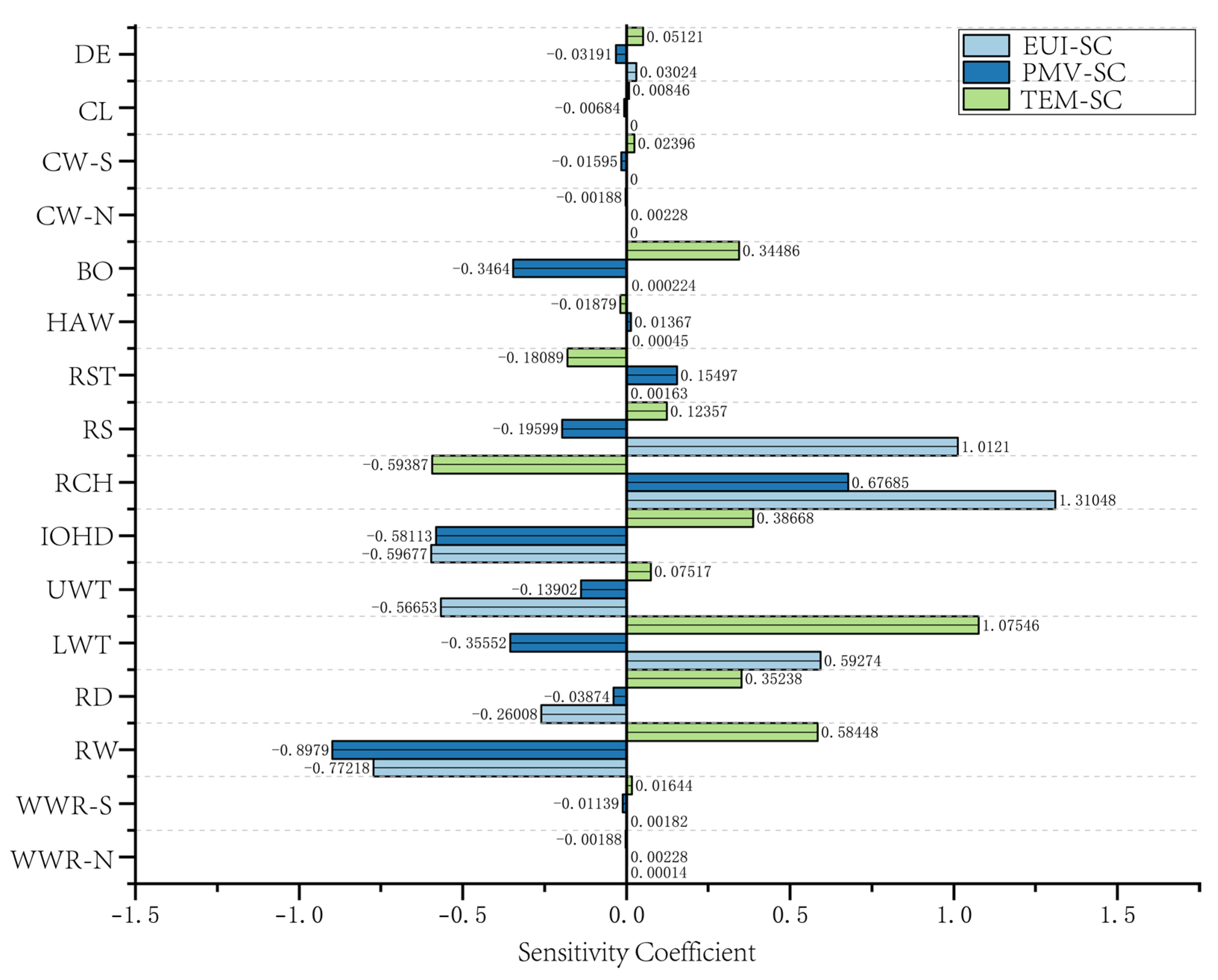
4.3.1. Sensitivity Analysis
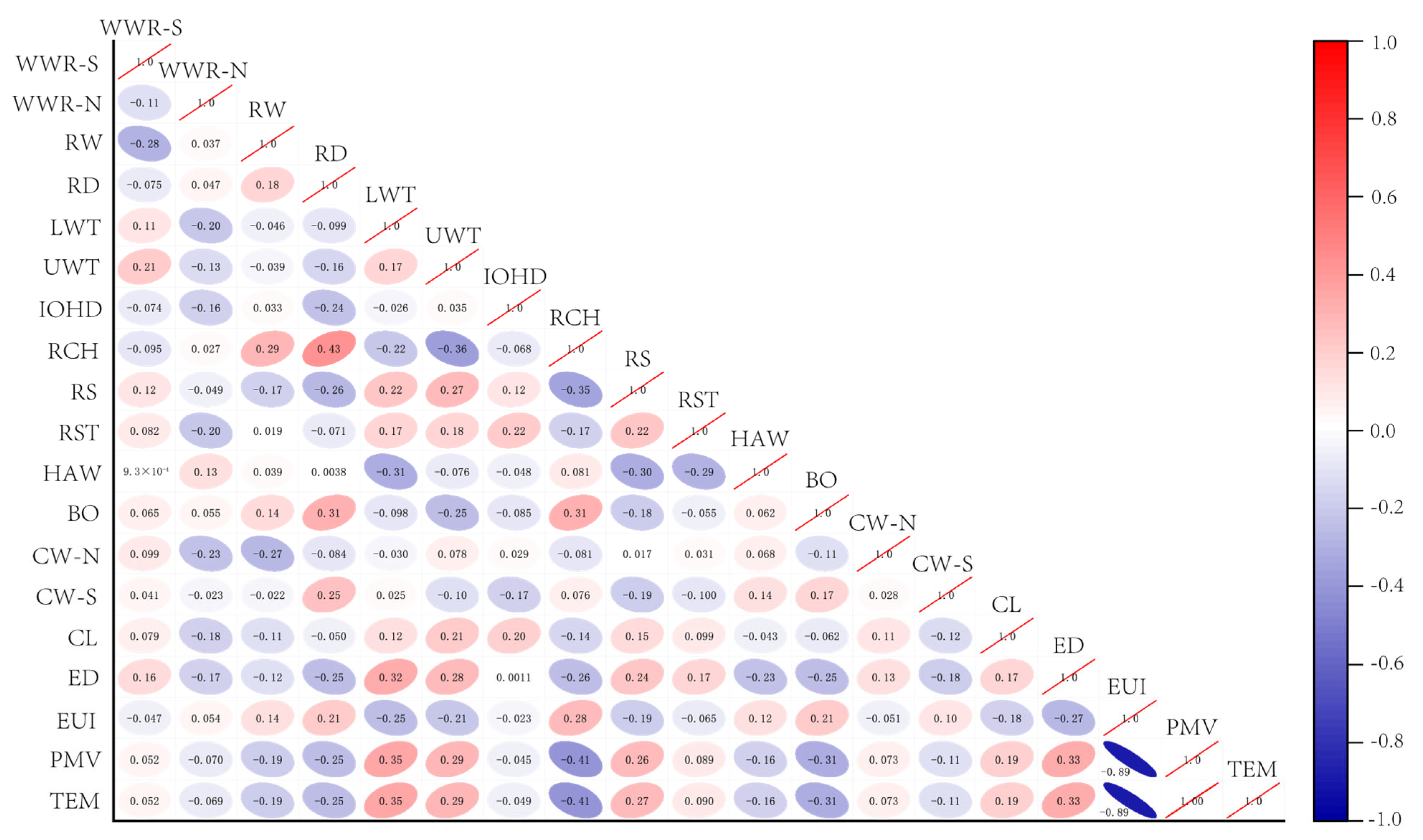
4.3.2. Correlation Analysis
4.3.3. Regression Analysis
5. Climate-Adaptive Morphological Optimization Strategies for Suoqema Fang Dwellings
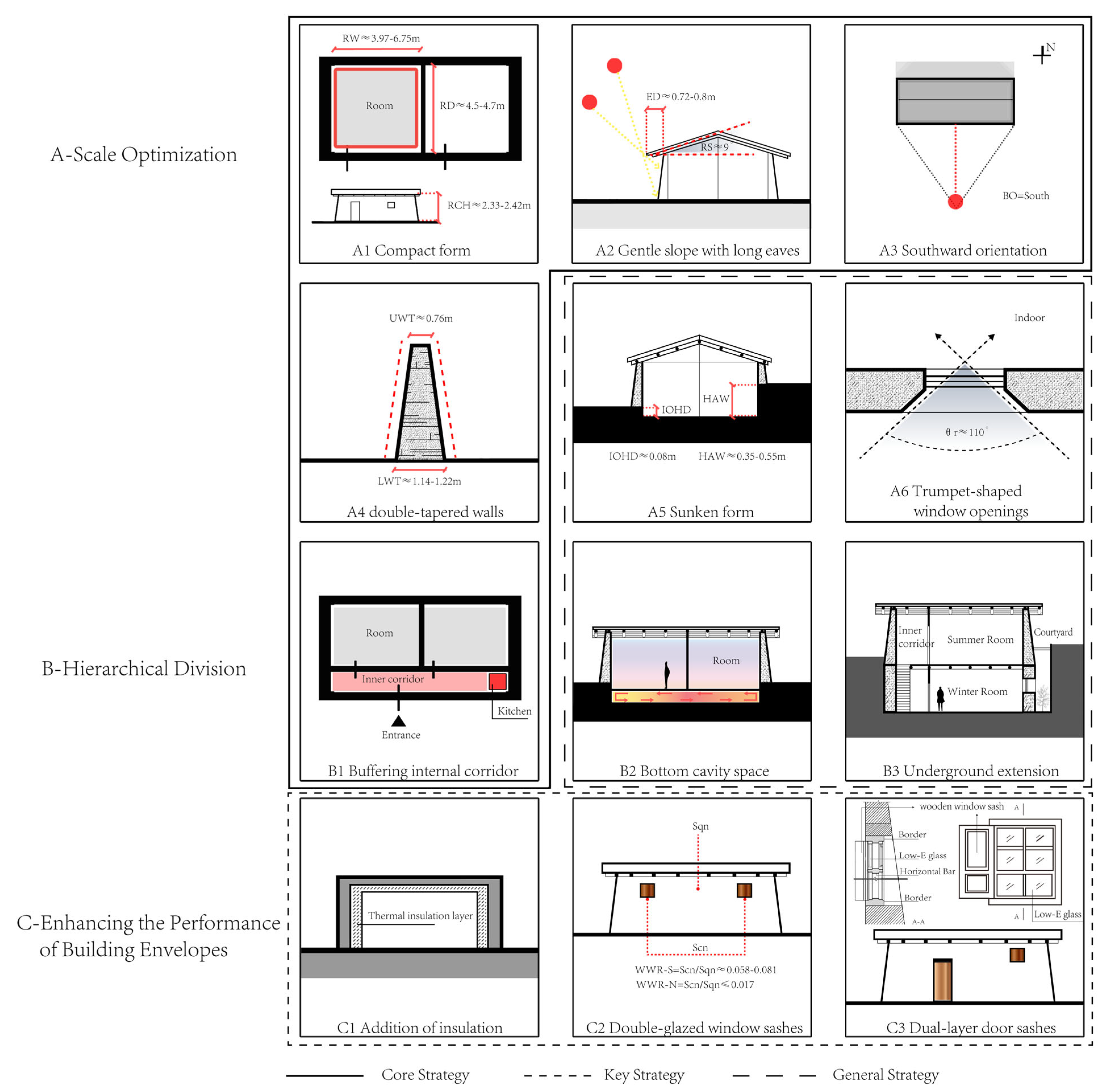
5.1. Scale Optimization
5.2. Hierarchical Division
5.3. Enhancing the Performance of Building Envelopes
6. Discussion
7. Conclusions and Implications
- (1)
- Climate Adaptation Focus: Based on local climate characteristics, the climate adaptation of Suhema House dwellings should focus on the core needs of “withstanding harsh climate environments” and “meeting basic comfort requirements.” The primary strategy is winter insulation and cold resistance, with an emphasis on reducing heat loss and increasing heat gain during construction.
- (2)
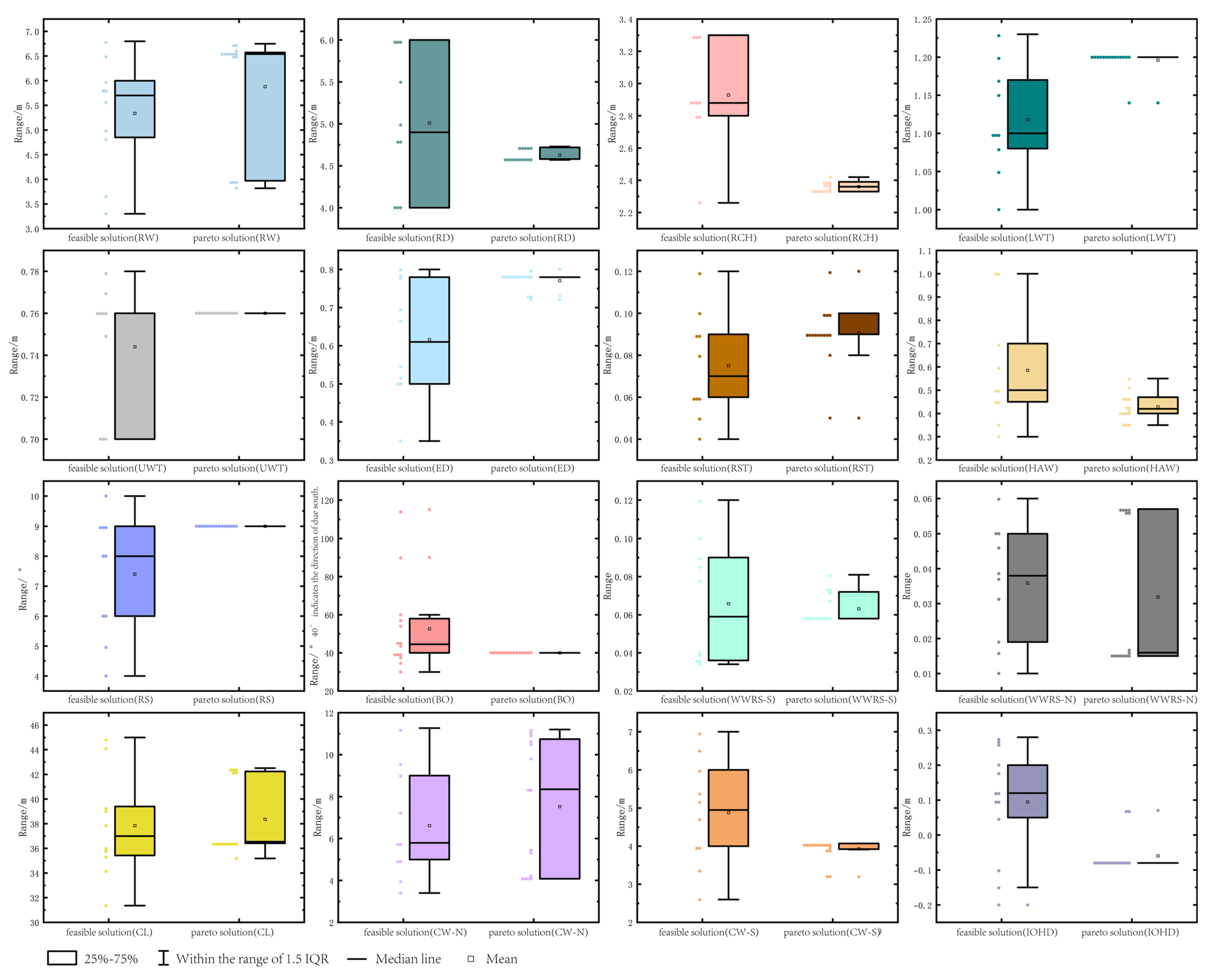
- Morphological Recommendations: The recommended morphological form for Suhema House dwellings is a low-rise, compact form with short depth and thick walls. Morphological parameters are classified into three levels of priority. The primary focus should be on controlling room depth (4.57–4.73 m), room width (3.97–6.75 m), room clear height (2.33–2.42 m), wall thickness (lower wall thickness set at 1.14–1.22 m, upper wall thickness at 0.76 m), and building orientation (true south direction). Secondary attention should be given to roof slope (9°) and eave depth (0.72–0.8 m). Finally, factors such as window-wall ratio (WWR South controlled at 0.058–0.081, WWR North ≤ 0.017), indoor–outdoor height difference (−0.08–0.07 m), and indoor-to-outdoor height differences (0.35–0.55 m) should also be considered.
- (3)
- Optimization Strategy: Based on multi-objective optimization results, an optimization strategy for Suoqema Fang dwellings is proposed, which includes:
Author Contributions
Funding
Data Availability Statement
Conflicts of Interest
References
- OECD. Transition to Sustainable Buildings: Strategies and Opportunities to 2050; Organisation for Economic Cooperation and Development: Paris, France, 2013; Available online: https://www.oecd-ilibrary.org/energy/transition-to-sustainable-buildings_9789264202955-en (accessed on 19 November 2025).
- Zhang, H.; Li, S. Carbon emissions’ spatial-temporal heterogeneity and identification from rural energy consumption in China. J. Environ. Manag. 2022, 304, 114286. [Google Scholar] [CrossRef]
- Zhu, Y.; Liu, L.; Qiu, Y.; Ma, Z. Design of the passive solar house in qinba mountain area based on sustainable building technology in winter. Energy Rep. 2022, 8, 1763–1777. [Google Scholar] [CrossRef]
- Nguyen, A.-T.; Tran, Q.-B.; Tran, D.-Q.; Reiter, S. An investigation on climate responsive design strategies of vernacular housing in Vietnam. Build. Environ. 2011, 46, 2088–2106. [Google Scholar] [CrossRef]
- Valinejadshoubi, M.; Heidari, S.; Zamani, P. The impact of temperature difference of the sunny and shady yards on the natural ventilation of the vernacular buildings. J. Build. Eng. 2019, 26, 100880. [Google Scholar] [CrossRef]
- Yang, L. Building Climatology; China Architecture & Building Press: Beijing, China, 2010; Volume 4, Available online: https://xueshu.baidu.com/ndscholar/browse/detail?paperid=a82e95a2abd612fb4616df5682b8d3a7&site=xueshu_se (accessed on 11 September 2025).
- Oh, J.; Hong, T.; Kim, H.; An, J.; Jeong, K.; Koo, C. Advanced Strategies for Net-Zero Energy Building: Focused on the Early Phase and Usage Phase of a Building’s Life, Cycle. Sustainability 2017, 9, 2272. [Google Scholar] [CrossRef]
- Rostami, E.; Nasrollahi, N.; Khodakarami, J. A comprehensive study of how urban morphological parameters impact the solar potential, energy consumption and daylight autonomy in canyons and buildings. Energy Build. 2024, 305, 113904. [Google Scholar] [CrossRef]
- Lu, Y. The Formation and Development of Vernacular Architecture Studies. South Archit. 2011, 6, 4–6. [Google Scholar]
- Lei, Z.; Gao, B.; Chen, J. Collective Design Drawings of Green Building in the Northwest of China Desert Regions; China Architecture & Building Press: Beijing, China, 2021; Available online: https://xueshu.baidu.com/ndscholar/browse/detail?paperid=1u2a0ve00v650ge0me240jq0fj164716&site=xueshu_se (accessed on 21 July 2025).
- Yang, Z.; Du, C.; Xiong, K. Collective Design Drawings of Green Building in the Southwest of China Multi-Rithnic Regions; China Architecture & Building Press: Beijing, China, 2021; Available online: https://xueshu.baidu.com/ndscholar/browse/detail?paperid=113k08m0xx1u0j40687702g0dd055399 (accessed on 30 August 2025).
- Liu, J. The Practice of Green Building in Western China; China Architecture & Building Press: Beijing, China, 2015; Available online: https://xueshu.baidu.com/ndscholar/browse/detail?paperid=ce0c58e2e75b15d488871329c1131c46&site=xueshu_se (accessed on 20 August 2025).
- Tang, Y.; Zhang, X.; Zhang, X. Breaking the Ground and Rebirth: Study on the Renewal Mode of Native Houses in the Oasis Area of Southern Xinjiang. Dev. Small Cities Towns 2021, 39, 108–116. [Google Scholar]
- Zheng, Y.; Qiu, Z.; Wang, Z. Research on Green Building Construction Strategy and Technical Path Based on Climate and Geomorphologic Characteristic in the South of the Yangtze River. Archit. J. 2022, S1, 11–17. [Google Scholar]
- Yan, S.; Wang, Y.; Li, X.; Liu, Y.; Yan, Q. Extraction, identification and translation of the green construction Experience of traditional residential buildings. J. Xi’an Univ. Archit. Technol. (Nat. Sci. Ed.) 2024, 56, 338–347. [Google Scholar] [CrossRef]
- Tuluxun, N.-R.-M.-M.-T.; Halike, S.-E.-J. Energy Conservation and Low Carbon Strategies for Oasis Residential Buildings in the Arid Area of Eastern Xinjiang Based on Climate Adaptability: Taking Bostan Village in Hami City as an Example. Build. Energy Effic. 2025, 53, 9–19. (In Chinese) [Google Scholar] [CrossRef]
- Yang, L.; Yuan, W.; Liu, Y.; Hao, T.; Liu, J. An Archetype Study on Climate Adaptation of Traditional Vernacular Dwellings in the Temperate Region. New Archit. 2022, 140–144. [Google Scholar] [CrossRef]
- Yang, L.; Hao, T.; Liu, Y.; Yuan, W.; Liu, J. Dry and Hot Climate Adaption Prototype of Traditional Dwellings. Build. Energy Effic. 2021, 49, 105–115. (In Chinese) [Google Scholar]
- Dai, Q.; Cheng, H.; Li, X. Performance-Oriented Extraction of Residential Forms in Lhasa. World Archit. 2024, 64–69. [Google Scholar] [CrossRef]
- Castrejon-Esparza, N.M.; González-Trevizo, M.E.; Martínez-Torres, K.E.; Santamouris, M. Optimizing urban morphology: Evolutionary design and multi-objective optimization of thermal comfort and energy performance-based city forms for microclimate adaptation. Energy Build. 2025, 342, 115750. [Google Scholar] [CrossRef]
- Liu, Y.; Cheng, H.; Li, X. A Performance-Oriented Study on the Archetype of Traditional Dwellings in Hehuang Area in Qinghai Province. Build. Energy Eff. 2024, 52, 58–66+130. (In Chinese) [Google Scholar] [CrossRef]
- Chen, X.; Li, J. Multi-Criteria Performance Interconnection Optimisation Deduction of Atrium Prototype Space Under the Influence of Environmental Factors. World Archit. 2021, 112–117+126. [Google Scholar] [CrossRef]
- Run, L.; Luo, L.; Li, X.; Wu, J.; Jiang, F.; Wang, W. Multi-objective optimization for generative morphological design using energy and comfort models with a practical design of new rural community in China. Energy Build. 2024, 313, 114282. [Google Scholar] [CrossRef]
- Lyu, Y.; Zhang, L.; Liu, X.; Ma, X. Microclimate-Adaptive Morphological Parametric Design of Streets and Alleys in Traditional Villages. Buildings 2024, 14, 152. [Google Scholar] [CrossRef]
- Zheng, Y.; Liang, F.; Hong, T.; Lin, Z. Climate-Adaptive Construction Strategies for Coastal Rural Street Spaces Based on Genetic Algorithm: A Case Study of the Coastal Plain Area of Fuzhou. World Archit. 2025, 20–26. [Google Scholar] [CrossRef]
- Li, T.; Chen, Z.; Wang, H.; Li, S. Research on spatial form optimization of traditional blocks based on genetic algorithm: A case of the old city of Kashgar. City Plan. Rev. 2023, 47, 67–77. [Google Scholar]
- Valiyappurakkal, V.K.; Shabarise, Y.; Natawadkar, K.; Misra, K. A methodology to assess the constructibility of free-form buildings using building and surface performance indicators: Application to a case study. Energy Build. 2022, 270, 112303. [Google Scholar] [CrossRef]
- Li, T.; Li, S.; Lei, Z. Research on the Dimensions Optimisation of Sunshade Components for Lhasa Dwellings from the Perspective of Photothermal Coupling. World Archit. 2024, 74–79. [Google Scholar] [CrossRef]
- Shao, T.; Zheng, W.; Li, X.; Yang, W.; Wang, R. Multi-objective optimization design for rural houses in western zones of China. Archit. Sci. Rev. 2022, 65, 260–277. [Google Scholar] [CrossRef]
- Gao, P.; Xiao, Y.; Yin, H. A Review of the Climate Responsive Characteristics Research on Thermal Environment Correlation of Domestic Traditional Dwellings. Dev. Small Cities Towns 2023, 41, 112–119. [Google Scholar] [CrossRef]
- He, Q.; Wang, W.; Liu, J.; Yang, L. Climatic Adaptation Analysis of Vernacular Houses of Lhasa by Climate Consultant. Build. Sci. 2017, 33, 94–100. [Google Scholar] [CrossRef]
- Zhong, W.Z.; Zhang, T. Four quadrants of the discourse on architectural environmental regulation. New Archit. 2024, 97–102. [Google Scholar] [CrossRef]
- Olgyay, V. Design with Climate: Bioclimatic Approach to Architectural Regionalism; Princeton University Press: Princeton, NJ, USA, 1963; Volume 161. [Google Scholar]
- Xiao, W.; Zhang, T. Performance Mechanism of Building Formation and Key Strategies of Adaptive Formation Design. Architect 2019, 6, 16–24. [Google Scholar]
- Zhong, W.; Zhang, T. Environmental Regulation Five: Paradigm Shift of Le Corbusier’s Theory and Practice in a View of Climatic Logic. Architect 2019, 6–15. [Google Scholar]
- Liu, P. The Gene Expression and the Sight Identification of the Ancient Villages ’Cultural Landscape. J. Hengyang Norm. Univ. 2003, 1–8. [Google Scholar] [CrossRef]
- Wei, Q.; Wang, Z.; Xu, Y. Recognition of theoretical foundation of “Regional Gene” conceptin regional building construction system. Huazhong Archit. 2012, 30, 8–11. [Google Scholar] [CrossRef]
- Kuang, Y.; Li, S. Research on gene identification and mapping of traditional dwellings in mountainous areas of Southern Hebei. World Archit. 2023, 94–105. [Google Scholar] [CrossRef]
- Liu, J.; Wang, L.; Yoshino, Y.; Liu, Y. The thermal mechanism of warm in winter and cool in summer in China traditional vernacular dwellings. Build. Environ. 2011, 46, 1709–1715. [Google Scholar] [CrossRef]
- Holland, J.H. Adaptation in Natural and Artificial Systems: An Introductory Analysis with Applications to Biology, Control, and Artificial Intelligence, Adapt; MIT Press: Cambridge, MA, USA, 1992. [Google Scholar] [CrossRef]
- Schwartz, Y.; Raslan, R.; Mumovic, D. Implementing multi objective genetic algorithm for life cycle carbon footprint and life cycle cost minimisation: A building refurbishment case study. Energy 2016, 97, 58–68. [Google Scholar] [CrossRef]
- Chen, Z.; Cui, Y.; Zheng, H.; Ning, Q. Optimization and prediction of energy consumption, light and thermal comfort in teaching building atriums using NSGA-II and machine learning. J. Build. Eng. 2024, 86, 108687. [Google Scholar] [CrossRef]
- Chen, Q.; Wang, W.; Ming, M.A. NSGA-II algorithm based multi -objective optimization design for rural residential buildings along the Yellow River, Inner Mongolia section. J. Arid Land Resour. Environ. 2023, 37, 75–83. [Google Scholar] [CrossRef]
- Tian, Y.; Huang, Q. Multi-objective Optimization Design Method of Building Performance and Its Application: The Issue of Genetic Algorithm. New Archit. 2021, 84–89. [Google Scholar] [CrossRef]
- Alexakis, K.; Benekis, V.; Kokkinakos, P.; Askounis, D. Genetic algorithm-based multi-objective optimisation for energy-efficient building retrofitting: A systematic review. Energy Build. 2025, 328, 115216. [Google Scholar] [CrossRef]
- Xu, J.; Fang, Y.; Yang, W.; Lu, Z.; Wang, X. Multi-objective optimal research on low-energy dwellings design based on genetic algorithm in Qinba mountain region, China. Sci. Rep. 2025, 15, 6504. [Google Scholar] [CrossRef]
- Yuan, F.; Soolyeon, C. Design Optimization of Building Geometry and Fenestration for Day lighting and Energy Performance. Solar Energy 2019, 191, 7–18. [Google Scholar]
- Ministry of Housing and Urban-Rural Development of the People’s Republic of China. Design Standard for Energy Efficiency of Residential Buildings in Severe Cold and Zones; China Architecture & Building Press: Beijing, China, 2018; Available online: https://xueshu.baidu.com/ndscholar/browse/detail?paperid=36114ca1ca2e4da5d79791d73c9cd62c&site=xueshu_se (accessed on 3 July 2025).
- Deb, K. Muti-Objective Optimization Using Evolutionary Algorithms; Wiley: Chichester, UK, 2001; Available online: https://xueshu.baidu.com/ndscholar/browse/detail?paperid=ea2b2550e96e3a4870870e4cdb638bb3&site=xueshu_se (accessed on 18 June 2025).
- Lam, J.C.; Hui, S.C.M. Sensitivity Analysis of Energy Performance of office Buildings. Build. Environ. 1996, 31, 27–39. [Google Scholar] [CrossRef]
- Brownlee, A.; Wright, J. Solution Analysis in Multi-objective Optimization. In Proceedings of the 2012 Building Simulation and Optimization Conference, Loughborough, UK, 10–11 September 2012; pp. 317–324. [Google Scholar]
- Zhang, T.; Xiao, W.; Pan, Y.; Lei, Z. Space structure optimization and energy efficiency improvement in low-carbon architectural renovation I: Prototypes and mechanisms. J. Southeast Univ. (Nat. Sci. Ed.) 2025, 1–15. [Google Scholar]
- Gou, W.; Saierjiang, H.; Shang, J.; Yang, M.; Zhang, T. Multi-Objective Optimization Design of Traditional Soil Dwelling Renovation Based on Analytic Hierarchy Process—Quality Function Deployment—Non-Dominated Sorting Genetic Algorithm II: Case Study in Tuyugou Village in Turpan, Xinjiang. Buildings 2024, 14, 3584. [Google Scholar] [CrossRef]
- He, W.; Zheng, H.; Liu, C.; Liu, J. Study on climate adaptation of vernacular building in extreme arid climate based on archetype. J. Xi’an Univ. Archit. Technol. (Nat. Sci. Ed.) 2022, 54, 838–846. [Google Scholar] [CrossRef]
- Tang, Y.; He, Y.; Zhang, X. Research on the spatial morphological characteristics of traditional villages in the Tarim Basin. J. Arid Land Resour. Environ. 2025, 39, 33–44. [Google Scholar] [CrossRef]
- Fan, J.; Saierjiang, H. Living in a comfortable space: Research on the residential periodic transfer pattern of oasis folk houses in Southern Xinjiang. South Archit. 2020, 57–63. [Google Scholar] [CrossRef]
- Zhong, W.; Pan, Y.; Xiao, W.; Zhang, T. Identifying bioclimatic techniques for sustainable low-rise high-density residential units: Comparative analysis on the ventilation performance of vernacular dwellings in China. J. Build. Eng. 2023, 80, 108008. [Google Scholar] [CrossRef]
- Zhang, P. “Genuine Constructing”: A framework of ideology, methodology, and technology for regional architecture in Western China. Contemp. Archit. 2025, 7–20. [Google Scholar] [CrossRef]
- Liu, J.; Saierjiang, H. Analysis on climate adaptability of dwellings in Arid Oasis Area by climate consultant—A case of kashi in xinjiang uygur autonomous region. Urban. Archit. 2021, 18, 112–116. [Google Scholar] [CrossRef]





| Identification Principle | Definitions and Criteria |
|---|---|
| Climate-driven dominance | The morphological characteristics of dwellings are mainly determined by specific climatic pressures (such as low temperatures, large temperature differences, etc.), and their existence is clearly related to climatic factors through a causal logic. |
| External Form Significance | The form of dwellings, in terms of space, volume, interface or key components, acquires distinctive regional characteristics due to adaptation to the climate, showing significant differences from buildings in other climatic zones. |
| Intrinsic inheritance stability | The architectural characteristics of local residences have been widely and repeatedly adopted in the area, demonstrating the stability of intergenerational transmission. |
| Overall effectiveness advantage | Through the optimized combination of one or more morphological characteristics, synergistic effects emerge within the local context, thereby achieving outstanding climate regulation capabilities as a whole. |
| NO. | Parameter Name | Parameter Variation Range | Diagram | NO. | Parameter Name | Parameter Variation Range | Diagram |
|---|---|---|---|---|---|---|---|
| 1 | Building Orientation (BO) | South by West 40°-South by East 75°,with 1° step |  | 9 | Roof Slope (RS) | 4–10°, with 1°step |  |
| 2 | Roof Soil Thickness (RST) | 0.04–0.12 m, with 0.01 m step | 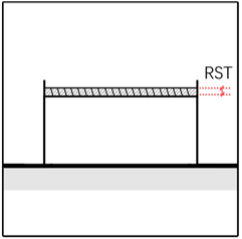 | 10 | Indoor–Outdoor Height Difference (IOHD) | −0.2–0.28 m, with 0.01 m step |  |
| 3 | Eave Depth (ED) | 0.35–0.8 m, with 0.01 m step |  | 11 | Height Against Wall(HAW) | 0.30–1 m, with 0.01 m step |  |
| 4 | Upper Wall Thickness(UWT) | 0.67–0.78 m, with 0.01 m step |  | 12 | WWR south (WWR-S) | 0.03–0.12, with 0.001 step |  |
| 5 | Lower Wall Thickness(LWT) | 1.00–1.22 m, with 0.01 m step | 13 | WWR north (WWR-N) | 0.01–0.06, with 0.001 step | ||
| 6 | North-facing Courtyard Width(CW-N) | 3.4–11.2 m, with 0.1 m step |  | 14 | Room Width(RW) | 3.7–6.8 m, with 0.01 m step |  |
| 7 | Courtyard Length (CL) | 30.0–45 m, with 0.1 m step | 15 | Room Depth(RD) | 4–6 m, with 0.01 m step | ||
| 8 | South-facing Courtyard Width(CW-S) | 2.60–7 m, with 0.1 m step | 16 | Room Clear Height(RCH) | 2.26–3.3 m, with 0.01 m step |
| Population | Generation Size | 50 |
| Generation Count | 50 | |
| Algorithm Parameters | Crossover Probability | 0.9 |
| Mutation Probability | 1/r | |
| Crossover Distribution Index | 20 | |
| Mutation Distribution Index | 20 | |
| Random Seed | 1 |
| Morphological Parameter | EUI Rank | PMV Rank | TEM Rank | Overall Rank |
|---|---|---|---|---|
| WWR North | 13 | 15 | 16 | 44 (15) |
| WWR South | 9 | 13 | 13 | 35 (11) |
| Room Width | 3 | 1 | 3 | 7 (2) |
| Room Depth | 7 | 9 | 5 | 21 (6) |
| Lower Wall Thickness | 5 | 4 | 1 | 10 (3) |
| Upper Wall Thickness | 6 | 8 | 9 | 23 (7) |
| Indoor–Outdoor Height Difference | 4 | 3 | 4 | 11 (4) |
| Room Clear Height | 1 | 2 | 2 | 5 (1) |
| Roof Slope | 2 | 6 | 8 | 16 (5) |
| Roof Soil Thickness | 10 | 7 | 7 | 24 (9) |
| Height Against Wall | 11 | 12 | 12 | 35 (11) |
| Building Orientation | 12 | 5 | 6 | 23 (7) |
| North-facing Courtyard Width | 14 | 15 | 15 | 44 (15) |
| South-facing Courtyard Width | 14 | 11 | 11 | 36 (13) |
| Courtyard Length | 14 | 14 | 14 | 42 (14) |
| Eave Depth | 8 | 10 | 10 | 28 (10) |
| Morphological Parameter | VIP | Standardized Coefficient | ||
|---|---|---|---|---|
| EUI | PMV | TEM | ||
| WWR South | 0.514 | 0.019 | −0.022 | −0.105 |
| WWR North | 0.309 | −0.005 | 0.001 | 0.003 |
| Room Width | 0.739 | 0.022 | −0.016 | −0.071 |
| Room Depth | 0.978 | 0.034 | −0.011 | −0.046 |
| Lower Wall Thickness | 1.415 | −0.095 | 0.088 | 0.409 |
| Upper Wall Thickness | 1.046 | −0.047 | 0.038 | 0.178 |
| Indoor–Outdoor Height Difference | 0.379 | −0.013 | −0.016 | −0.079 |
| Room Clear Height | 1.475 | 0.046 | −0.047 | −0.219 |
| Roof Slope | 0.997 | −0.015 | 0.017 | 0.082 |
| Roof Soil Thickness | 0.517 | 0.022 | −0.011 | −0.05 |
| Height Against Wall | 0.605 | 0.014 | −0.01 | −0.048 |
| Building Orientation | 1.134 | 0.05 | −0.053 | −0.247 |
| Eave Depth | 1.269 | −0.08 | 0.046 | 0.208 |
| Constant | 1.75 | −1.648 | 14.594 | |
| Change in Living Arrangements | Space/Building Name | Autumn and winter | Spring and Summer | Reason |
|---|---|---|---|---|
| Transfer of daily living activities between indoors and outdoors | Kitchen | Indoor kitchen | Outdoor kitchens, etc. | Reduce heat generated by indoor cooking in spring and summer; utilize residual heat for supplementary heating in autumn and winter. |
| Living room | Indoor living room | Courtyards, eaves, etc. | The spatial dimensions, size, positioning, and interface shall be configured according to the specific thermal requirements of each space and the degree of integration with the climatic environment. | |
| Transfer between different rooms | Bedroom | Winter Room | Summer Room |
Disclaimer/Publisher’s Note: The statements, opinions and data contained in all publications are solely those of the individual author(s) and contributor(s) and not of MDPI and/or the editor(s). MDPI and/or the editor(s) disclaim responsibility for any injury to people or property resulting from any ideas, methods, instructions or products referred to in the content. |
© 2025 by the authors. Licensee MDPI, Basel, Switzerland. This article is an open access article distributed under the terms and conditions of the Creative Commons Attribution (CC BY) license (https://creativecommons.org/licenses/by/4.0/).
Share and Cite
Tang, Y.; He, Y.; Zhang, X.; Zhang, X. Morphological Multi-Objective Optimization of Traditional Dwellings in Southern Xinjiang Based on Genetic Algorithms: A Case Study of the Suohema House. Buildings 2025, 15, 4497. https://doi.org/10.3390/buildings15244497
Tang Y, He Y, Zhang X, Zhang X. Morphological Multi-Objective Optimization of Traditional Dwellings in Southern Xinjiang Based on Genetic Algorithms: A Case Study of the Suohema House. Buildings. 2025; 15(24):4497. https://doi.org/10.3390/buildings15244497
Chicago/Turabian StyleTang, Yongjun, Yong He, Xiaoyu Zhang, and Xiaodong Zhang. 2025. "Morphological Multi-Objective Optimization of Traditional Dwellings in Southern Xinjiang Based on Genetic Algorithms: A Case Study of the Suohema House" Buildings 15, no. 24: 4497. https://doi.org/10.3390/buildings15244497
APA StyleTang, Y., He, Y., Zhang, X., & Zhang, X. (2025). Morphological Multi-Objective Optimization of Traditional Dwellings in Southern Xinjiang Based on Genetic Algorithms: A Case Study of the Suohema House. Buildings, 15(24), 4497. https://doi.org/10.3390/buildings15244497