Article

Enhancing Cement Hydration and Mechanical Strength via Co-Polymerization of Sodium Humate with Superplasticizer Monomers and Sequential Blending with Aluminum Sulfate and Carbon Fibers


1
Department of Applied Chemistry, School of Chemistry, Xi’an Jiaotong University, No. 28, Xianning West Road, Xi’an 710049, China
2
Shanxi Jiawei New Material Co., Ltd., Taijia Village, Jiedian Town, Wanrong County, Yuncheng 044200, China
3
Xi’an Biomass Green Catalysis and Advanced Valorization International Science and Technology Cooperation Base, No. 28, Xianning West Road, Xi’an 710049, China
*
Author to whom correspondence should be addressed.
Buildings 2025, 15(24), 4422; https://doi.org/10.3390/buildings15244422 (registering DOI)
Submission received: 24 October 2025 / Revised: 1 December 2025 / Accepted: 5 December 2025 / Published: 7 December 2025
(This article belongs to the Section Building Materials, and Repair & Renovation)

Abstract

This study presents a new ternary copolymer synthesized via aqueous free-radical polymerization from sodium humate, sodium 2-methylprop-2-ene-1-sulfonate (SMAS), and 2-acrylamido-2-methylpropane sulfonic acid (AMPS). The resulting highly water-soluble, three-dimensional porous copolymer is complexed with aluminum sulfate to form a composite admixture containing AlO(OH), which acts as a highly effective accelerator for cement hydration. This system significantly shortens the initial and final setting times to averages of 2.62 min and 4.53 min, respectively, and enhances early-age mechanical strength (1.7 MPa compressive, 1.4 MPa flexural at 6 h). These improvements are correlated with the formation of key crystalline phases, including Al2Si2O5(OH)4 and Ca3Al2O6·xH2O gel. Incorporation of 50-mesh carbon fibers further reduces setting times (2.21 min initial, 3.93 min final) and increases 24 h strength (5.2 MPa compressive, 2.7 MPa flexural), despite a slight reduction in early strength (at 6 h). In contrast, 200-mesh carbon fibers extend the initial setting time and diminish early strength, associated with the formation of less effective gel phases such as Ca3Al2O6·xH2O, (CaO)x(Al2O3)11, and Ca4Al2O7·xH2O. Among these, the Al2Si2O5(OH)4 phase demonstrates superior performance, while finer carbon fibers show limited effectiveness in bridging hydration products. Conventionally employed as retarders or reinforcing agents, humate-based polymers and carbon fibers are shown here to function as dual-functional admixtures—serving as efficient setting accelerators while enhancing mechanical properties through tailored material design. This strategy offers a promising pathway for developing advanced multifunctional cement admixtures.

1. Introduction

The invention and application of cement have significantly contributed to the urbanization and industrialization of human society. Among various types, Portland cement is the most widely used, not only due to its ease of manufacture but also because of its lower cost and greater market acceptance [1]. However, the production of Portland cement involves substantial consumption of limestone, a non-renewable natural resource. Moreover, the process of calcining limestone releases large amounts of carbon dioxide, along with various sulfur and nitrogen oxides, which not only exacerbate the greenhouse effect but also cause severe environmental pollution [2].
Given the continued dominance of Portland cement in the construction market and the global commitment to mitigating the greenhouse effect and strictly controlling pollutant emissions, scientists and engineers are increasingly focusing on reducing energy-intensive calcination processes by incorporating industrial by-products, waste materials, or abundant natural resources into cement [3,4]. These materials are known as supplementary cementitious materials (SCMs) and are now attracting significant academic and industrial interest [5].
For instance, fly ash is the most widely used SCM and has been proven to effectively enhance the strength of cement [6]. Similarly, micro- and nano-scale silica has also been identified as a highly effective strength-enhancing additive [7]. Beyond these, even materials such as dredged river sediment [8], industrial slag [9], and glass fibers [10] have been developed into SCMs, each offering distinct functional advantages. The concept of SCMs is highly forward-looking, and their successful application holds considerable scientific importance and broad market potential.
On the other hand, the setting time of cement must be precisely regulated in practical engineering to meet the requirements of specific construction projects. For instance, in oil and gas well construction, cement must not set too quickly; otherwise, it may harden before adequately filling the targeted zones, significantly impairing operational efficiency [11]. Conversely, during the construction of tunnels or culverts, concrete sprayed immediately after tunnel boring machine operation must set rapidly to achieve proper structural formation [12]. Agents that retard the setting of cement are known as retarders, which often function as superplasticizers and also provide water-reducing effects. And materials designed to accelerate the setting process are referred to as accelerators.
In the current market for cement accelerators, aluminum sulfate-based accelerators are highly favored by engineers and technicians due to their safety, non-toxicity, and effective coagulation enhancement [12]. However, several significant drawbacks of these accelerators warrant attention. First, the solubility of aluminum sulfate in water is limited, making it difficult to obtain aqueous solutions with high aluminum content, which consequently requires more water during application [13]. Second, pure aluminum sulfate does not perform well as an accelerator, primarily because its aqueous solution is unstable—aluminum ions tend to hydrolyze, forming aluminum hydroxide or oxide, which lack coagulation-promoting activity. Therefore, coordinating agents are often added to stabilize the aluminum ions and prevent rapid hydrolysis-induced deactivation [14]. Third, although composite aluminum sulfate accelerators effectively shorten the setting time of cement, the development of mechanical strength in cement is generally inferior to that without accelerators [15]. Consequently, there remains substantial need and potential for improving aluminum sulfate-based accelerators.
Humic acid is a macromolecular organic weak acid formed through geological evolution and microbial degradation of ancient plant and animal residues [16]. As a partially mineralized biomass, it is commonly associated with lignite (containing 30–50%) and is also widely distributed in soils, mountains, forests, marshes, lakes, and oceans [16]. It can also be produced on a large scale as artificial humic acid (AHA) from raw materials such as lignin and cellulose via hydrothermal treatment, oxidative cleavage (e.g., Fenton reaction), and composting [17]. Both natural and artificial humic acids share similar structures and properties, with the latter exhibiting higher redox activity [18]. Overall, humic acid represents a biomass resource characterized by wide availability, abundant reserves, facile production, robust functionality, renewability, and environmental friendliness—yet its application potential remains underexplored.
The role of humic acid in the cement hydration process has been preliminarily explored by researchers. Initial findings indicate that humic acid does not accelerate setting but rather acts as a retarder [19]. However, when utilized as a superplasticizer in the cement hydration process, it exerts significant dispersing and water-reducing effects, while also influencing the crystallization morphology and dimensions of hydration products (such as ettringite), resulting in a denser microstructure [19]. This can be attributed to the abundant presence of active coordinating groups in humic acid, such as fused rings, biphenyls, oxygen bridges, fatty acids, sugars, peptides, quinones, thiophenes, thioethers, thiols, sulfoxides, and sulfonates [20]. These groups form stable and strong coordination with Ca2+ ions during cement hydration, substantially promoting and deepening the transformation of C3S into C–S–H. Nevertheless, likely due to its micro/nano-scale structure, humic acid not only coordinates with Ca2+ but also adsorbs onto the surface of formed C–S–H, thereby delaying the hydration process. Clearly, to fully leverage the ability of humic acid’s multifunctional groups to stabilize Al3+ and plasticize Ca2+, while also accelerating cement hydration, structural modification of humic acid is necessary—offering promising potential for breakthrough advances.
Carbon fibers exhibit high specific strength, elastic modulus, heat resistance, and electrical conductivity, demonstrating considerable potential for applications such as cement reinforcement [21,22] and cement-based supercapacitors [23]. Initially developed as reinforcement for organic polymers, carbon fibers can be recovered and reused via pyrolytic or chemical processes after the polymer matrix reaches the end of its service life, offering significant advantages in terms of production cost [24]. In cementitious systems, carbon fibers perform effectively—for instance, the flexural strength of carbon fiber-reinforced cement mortar can exceed that of plain mortar by more than 20% [21]. Herein, the hydration process of ordinary Portland cement produces C–S–H and Ca(OH)2 clinkers. However, in most cases, the pH value during the hydration of ordinary Portland cement is approximately 12.5, which is insufficient to complete the entire hydration process, achieving only 65–70% completion. This results in the formation of a significant number of pores [23]. Meanwhile, existing studies have shown that the carboxyl and hydroxyl groups on the outer surface of carbon fibers form strong chemical bonds with the cement interface [22]. Therefore, the incorporation of carbon fibers in cement hydration can significantly enhance the mechanical strength of cement [22]. On the other hand, combining carbon fibers with aluminum sulfate accelerators is expected to not only accelerate setting but also enhance mechanical strength. However, due to the inherently hydrophobic nature of carbon fiber surfaces, hydrophilic modification may be necessary to improve their compatibility and integration within the cement hydration system.
The effectiveness of organic polymers in cement hydration is increasingly recognized. First, most organic polymers, such as sucrose and polycarboxylate ether (PCE), function as superplasticizers (retarders) in cement hydration [25]. Their incorporation significantly slows the hydration process, thereby enhancing workability and improving the precision of structural formation. Second, to effectively mitigate or prevent cracking in inorganic hydrogels like cement after hydration, polymers such as poly(ethylene-co-vinyl acetate) (EVA) are employed as highly active crack-bridging additives, demonstrating notable effectiveness [26]. Finally, monomers commonly used in synthesizing superplasticizers and widely applied as oil-displacing agents in the petroleum industry—such as 2-acrylamido-2-methylpropane sulfonic acid (AMPS) [27] and sodium 2-methylprop-2-ene-1-sulfonate (SMAS) [28]—also deserve attention. Copolymerizing these monomers, including AMPS and SMAS, with a humic acid backbone may yield products that do not merely exhibit retarding effects like their precursors. Given the fundamental structural modifications, such hybrid materials show potential for achieving breakthroughs in the development of cement accelerators.
To inhibit the rapid alkaline hydrolysis of aluminum ions from aluminum sulfate—a common setting accelerator—during cement hydration, while simultaneously accelerating cement setting and enhancing its mechanical strength, this study first employs ammonium persulfate-initiated free radical polymerization in an aqueous solution to graft sodium humate with SMAS and AMPS. This process forms a water-soluble polymer with a three-dimensional network structure. After blending with aluminum sulfate, this polymer is expected to yield a highly dispersed and stable Al3+-based setting accelerator.
Subsequently, the resulting accelerator is blended with carbon fibers of varying mesh sizes via ball milling. This step aims to enhance the water-soluble components on the carbon fiber surfaces, promote their dispersion within the cement matrix, and ultimately produce a novel reinforced cement hydration accelerator. This research contributes to the development of a new generation of cement setting accelerators, supporting advancements in efficient cement application, energy conservation, and carbon dioxide emission reduction.

2. Materials and Methods

2.1. Raw Materials

Sodium humate (SH, Figure 1d) is sourced from Ningxia Tianxinyuan Bio-Technology Co., Ltd. (Shizuishan, China). Sodium 2-methylprop-2-ene-1-sulfonate (SMAS, 98%, Figure 1b), 2-acrylamido-2-methylpropane sulfonic acid (AMPS, 98%, Figure 1c), ammonium persulfate ((NH4)2S2O8, 98%), aluminum sulfate octadecahydrate (Al2(SO4)3·18H2O, AS, 99%, Figure 1d), and deuterium oxide (D2O, 99.9 atom % D) are procured from Shanghai Aladdin Biochemical Technology Co., Ltd. (Shanghai, China).
Carbon fiber powders (50-mesh and 200-mesh), manufactured by TORAY and processed by Carbonene Technology (Shenzhen, China) Co., Ltd., are used. Both grades exhibit the following properties: tensile strength ≥4900 MPa, linear expansion coefficient −0.1 × 10⁻⁶ °C−1, electrical resistivity 103 Ω·cm, density 1.75 g cm−3, monofilament diameter 7 μm, carbon content ≥97%, and aspect ratio ranging from 2:1 to 8:1. The powders are characterized by easy dispersibility, reinforcement capability, and electrical conductivity.
Cement (P·O 42.5) is provided by China National Academy of Building Materials Science Co., Ltd. (Beijing, China). Chinese ISO standard sand, produced in compliance with GB/T 17671-2021 [29], is supplied by Xiamen ISO Standard Sand Co., Ltd. (Xiamen, China). Deionized water is prepared in our laboratory.

2.2. Instruments

Ball milling is conducted using a YJKS high-energy grinder (Foshan Tenghao Instrument Technology Co., Ltd., Foshan, China) equipped with dual jars and operated at 220 V and 370 W, with 18 mm zirconia (ZrO2) milling beads. X-ray photoelectron spectroscopy (XPS) analysis is performed on a Kratos Axis Ultra DLD system (Kratos Co., Ltd., Manchester, UK) using monochromatic Al-Kα X-rays (1486.6 eV) as the excitation source. The binding energy scale is calibrated by setting the C 1s peak (sp3 hybridized saturated carbon) to 284.8 eV. Peak fitting is carried out using a Gaussian–Lorentz (G/L) product function with a 30% Lorentzian ratio.
Wide-angle X-ray diffraction (XRD) patterns of powdered samples are acquired on a Philips X’Pert Pro diffractometer (PANalytical B.V. Co., Ltd., Almelo, The Netherlands) with Cu-Kα radiation (λ = 1.5418 Å) at a scan rate of 0.05° s−1. 1H NMR spectrum is recorded on a Bruker ADVANCE III 400 MHz spectrometer (Bruker Corporation, Billerica, MA, USA) using D2O as the solvent. Fourier transform infrared (FT-IR) spectra are collected in ATR mode on a Bruker VERTEX 70 spectrometer (Bruker Corporation, Billerica, MA, USA) over the range of 600–4000 cm−1.
Scanning electron microscopy (SEM) is conducted on a GeminiSEM 500 instrument (Carl Zeiss, Shanghai, China) at an accelerating voltage of 15 kV, providing resolutions of 0.6 nm (at 15 kV) and 0.9 nm (at 1 kV), with a magnification range from ×20 to ×2,000,000. Inductively coupled plasma optical emission spectrometry (ICP-OES) is performed on an Agilent 5110 spectrometer (Agilent Technologies, Santa Clara, CA, USA) under the following conditions: pump rate of 60 rpm, plasma gas flow of 12.0 L min−1, nebulizer flow of 0.70 L min−1, auxiliary gas flow of 1.0 L min−1, RF power of 1250 W, and a stabilization time of 20 s.
Thermogravimetric analysis (TGA/DTG) is carried out on a METTLER TOLEDO instrument (Mettler-Toledo International Inc., Greifensee, Zurich, Switzerland) under an air atmosphere from 35 to 800 °C, with a temperature accuracy of ±0.3 °C and a heating rate of 10 °C min−1. Differential scanning calorimetry (DSC) is performed using a METTLER TOLEDO DSC 3 instrument (Mettler-Toledo International Inc., Greifensee, Zurich, Switzerland), scanning from 30 to 300 °C at a heating rate of 10 °C min−1 with a temperature precision of ±0.1 °C.
The initial setting time (IST) and final setting time (FST) of cement paste are determined using a Vicat apparatus after mixing cement and admixtures in an NJ-160A cement paste mixer. Cement mortar is prepared using a JJ-5 cement mortar mixer. Both mixers and the Vicat apparatus are manufactured by Wuxi Xiyi Building Material Instrument Factory (Wuxi, China).
Compressive and flexural strengths of the mortar are measured with a fully automatic testing machine (WAY-300B) equipped with an EHC-2300 control system, featuring a maximum capacity of 300 kN and a loading rate of 48 N s−1. Mortar specimens are cured in an HBY-40B numerical control standard conservation box at 20 °C and 90% relative humidity. All mechanical testing and curing instruments are supplied by Wuxi Xiyi Building Material Instrument Factory (Wuxi, China).

2.3. Synthesis of Copolymer and Derivative Admixtures

As shown in Figure 1, the synthesis is conducted in a 1 L three-neck flask equipped with a reflux condenser, mechanical stirrer, and constant-pressure dropping funnel at room temperature. Sodium humate (SH, 10.0 g), SMAS (10 g, 0.063 mol), AMPS (10 g, 0.048 mol), n-butanol (100 mL), and deionized water (250 mL) are added to the flask. The mixture is gradually heated to 80 °C under mechanical stirring, followed by the slow dropwise addition of an aqueous (NH4)2S2O8 solution (prepared by dissolving 3.0 g, 0.013 mol of (NH4)2S2O8 in 50 mL of distilled water). The addition rate is carefully controlled to maintain reaction stability, with the complete addition achieved over 2 h.
After maintaining the reaction at 80 °C with continuous mechanical stirring for 2 h, the mixture is cooled to room temperature. The resulting solution is concentrated using a rotary evaporator (RE-52AA, Shanghai Yarong Biochemical Instrument Factory, Shanghai, China) to remove solvents, yielding the solid precursor of the setting accelerator, copolymer P1.
At room temperature, P1 (10.0 g) and Al2(SO4)3·18H2O (10.0 g, 0.015 mol) are placed in a ball mill jar along with zirconia milling beads. Distilled water (100 mL) is added, and the mixture is ball-milled at 25 °C for 1 h. The resulting mixture is then dried using a rotary evaporator to remove the solvent, yielding the final product P2.
At room temperature, P2 (10.0 g) and carbon fiber CF-50 (or CF-200, 10.0 g) are placed in a ball mill jar along with zirconia milling beads. Distilled water (100 mL) is added, and the mixture is ball-milled at 25 °C for 1 h. The resulting mixture is then dried using a rotary evaporator to remove the solvent, yielding the final product P2-50 (or P2-200).

2.4. Determination of Setting Times of Cement Pastes

Based on the Chinese standard JC 477-2005 [30], the initial setting time (IST) and final setting time (FST) of cement paste are determined using a Vicat apparatus (Wuxi Xiyi Building Material Instrument Factory, Wuxi, China) according to the following procedure. A mixture of 400 g cement and distilled water (148 g for an admixture dosage of 6 wt.% relative to cement) is first stirred at low speed for 30 s. The admixture is then added in the specified quantity—for example, 24 g for a 6 wt.% dosage. For the blank sample without admixture, only 172 g of distilled water is used. Water-to-cement ratios for paste formulations (J-series in Table 1) are as follows: 0.43 for J-non, and 0.37 for J-AS, J-P2, J-P2-50, and J-P2-200.
The resulting mixture is stirred at low speed for 5 s, followed by high-speed stirring for 15 s. The prepared cement paste is immediately transferred into a round mold, compacted, and lightly vibrated. The surface is smoothed with a scraper. Both IST and FST are recorded at 10 s intervals using the Vicat apparatus, which measures penetration of a needle with a fixed cross-section under constant load. The IST is defined as the time from the release of the needle in free fall until it reaches a depth of 4 ± 1 mm from the bottom of the paste. The FST is measured as the period from the end of the IST until the needle no longer penetrates the paste.

2.5. Measurement of Compressive and Flexural Strengths of Cement Mortars

The compressive and flexural strengths of cement mortar are measured in accordance with the Chinese standard JC 477-2005 [30]. In the procedure, 900 g of cement and distilled water (468 g for an admixture dosage of 6 wt.% relative to cement) are combined in a mixing bowl and stirred at low speed for 30 s using a JJ-5 cement mortar mixer (Wuxi Xiyi Building Material Instrument Factory, Wuxi, China). After an additional 30 s of low-speed stirring, 1350 g of Chinese ISO standard sand are gradually introduced. The mixture is then mechanically stirred at high speed for 30 s, allowed to rest for 90 s, and stirred again at high speed for an additional 30 s.
Immediately following this sequence, the admixture is added—for instance, 54 g for a 6 wt.% dosage. For the blank sample without admixture, only 522 g of distilled water is used. The mixture is stirred at low speed for 5 s and then at high speed for 15 s. The prepared cement mortar is promptly transferred into a 40 mm × 40 mm × 160 mm mold (trial mold for soft scouring) and cured in a cement conservation box (HBY-40B, Wuxi Xiyi Building Material Instrument Factory, Wuxi, China) at 20 °C and 90% relative humidity for designated periods of 6 h and 24 h. Water-to-cement ratios for mortar formulations (S-series in Table 1) are as follows: 0.58 for S-non, and 0.52 for S-AS, S-P2, S-P2-50, and S-P2-200.

3. Results and Discussion

3.1. Synthesis of Admixtures

A schematic of the synthesis route for the additives used in this work is shown in Figure 1. Ammonium persulfate ((NH4)2S2O8) hydrolyzes at 65 °C to form sulfate (SO42−) and peroxomonosulfate (SO52−). The SO52− then undergoes further hydrolysis at 65 °C, yielding additional sulfate (SO42−) and hydroperoxide (HO2). The HO2- subsequently reacts with S2O82− to produce sulfate (SO42−) and sulfate radicals (SO4·) (Figure 1a) [31].
The highly reactive SO4 radicals initiate the polymerization of SMAS and AMPS (Figure 1b,c). Concurrently, SO4·can also attack sodium humate (SH), generating alkoxy radicals (RO·) on the humate backbone. These RO species participate in graft copolymerization with the double bonds of SMAS and AMPS, resulting in the copolymer P1 (Figure 1d) [32]. Subsequently, aluminum sulfate (AS) and carbon fibers of varying mesh sizes are blended via ball milling to produce a series of cement hydration additives (Figure 1d).

3.2. Characterizations of Admixtures

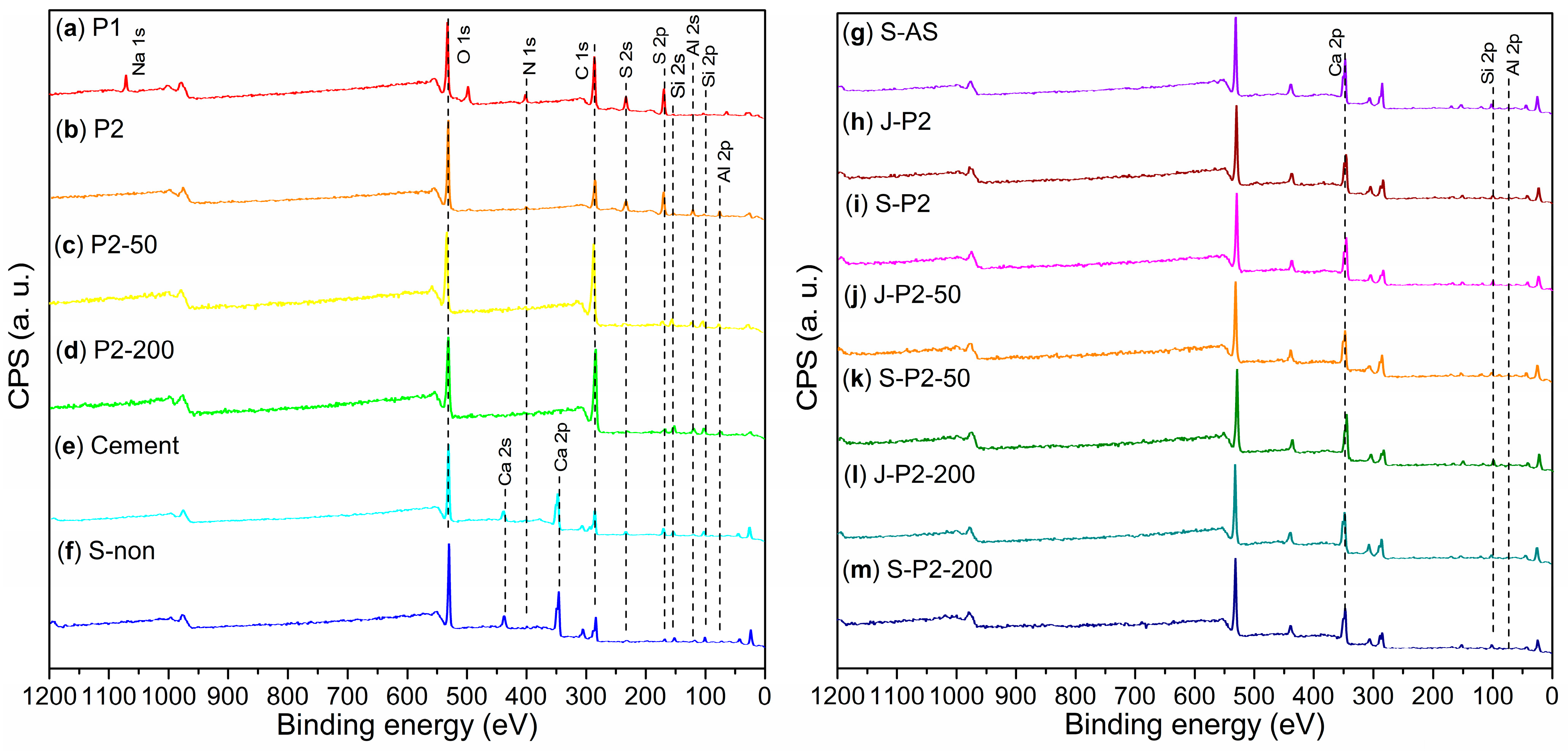
The XPS survey spectrum of the synthesized copolymer P1 is shown in Figure 2a, with the corresponding molar composition and binding energies of its surface elements provided in entry 1, Table S1 (Supplementary Materials). The trace amounts of Ca, Si, and Al detected in P1 originate from the sodium humate raw material (SH, Figure 1d), which is extracted from lignite (entry 1, Table 1).
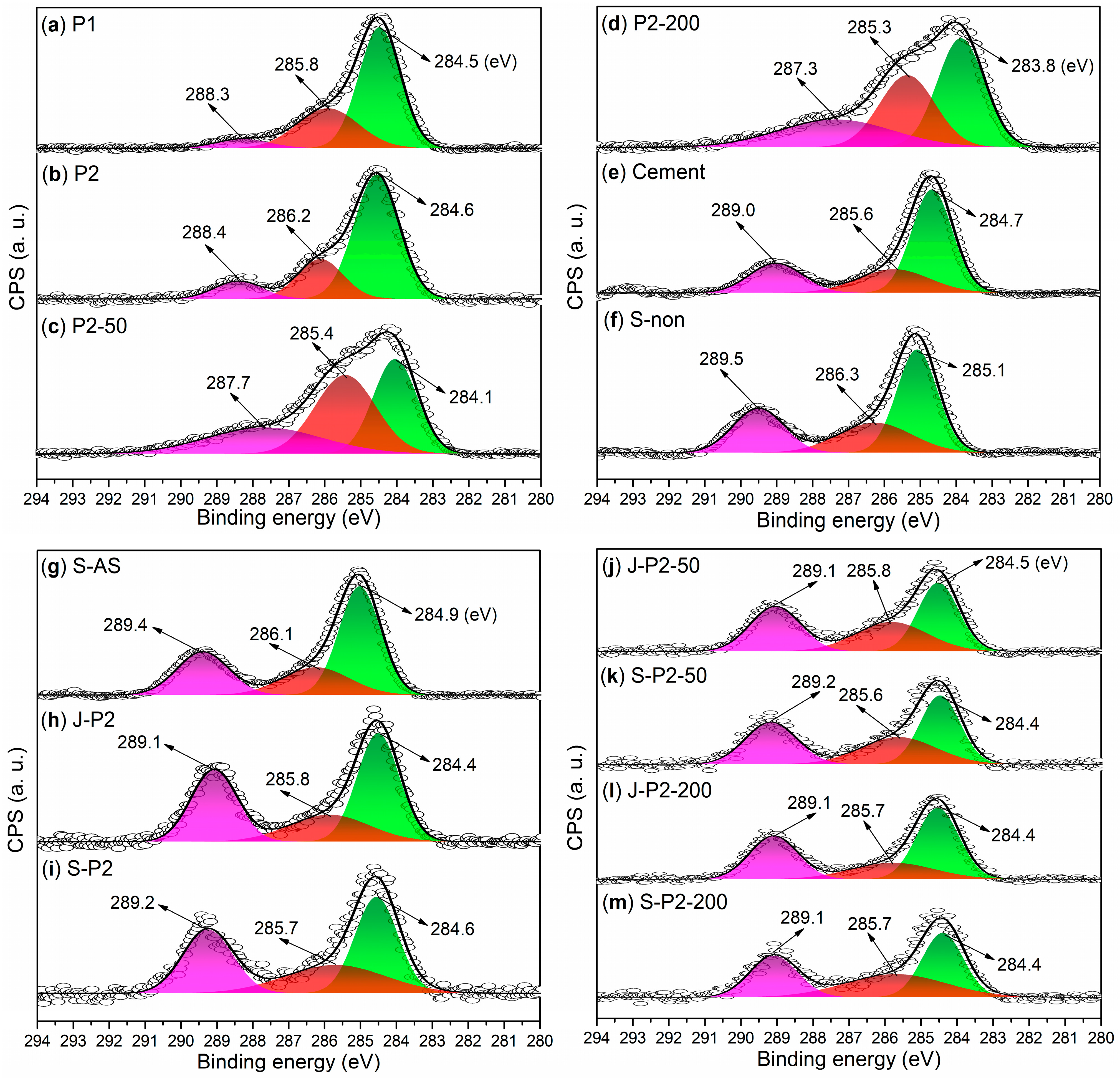
In the high-resolution C 1s XPS spectrum (Figure 3a), P1 exhibits three peaks at binding energies of 284.5 eV, 285.8 eV, and 288.3 eV, corresponding to saturated carbon (sp3 hybridized), carbon in C–O bonds, and carbon in carboxyl groups, respectively [33].
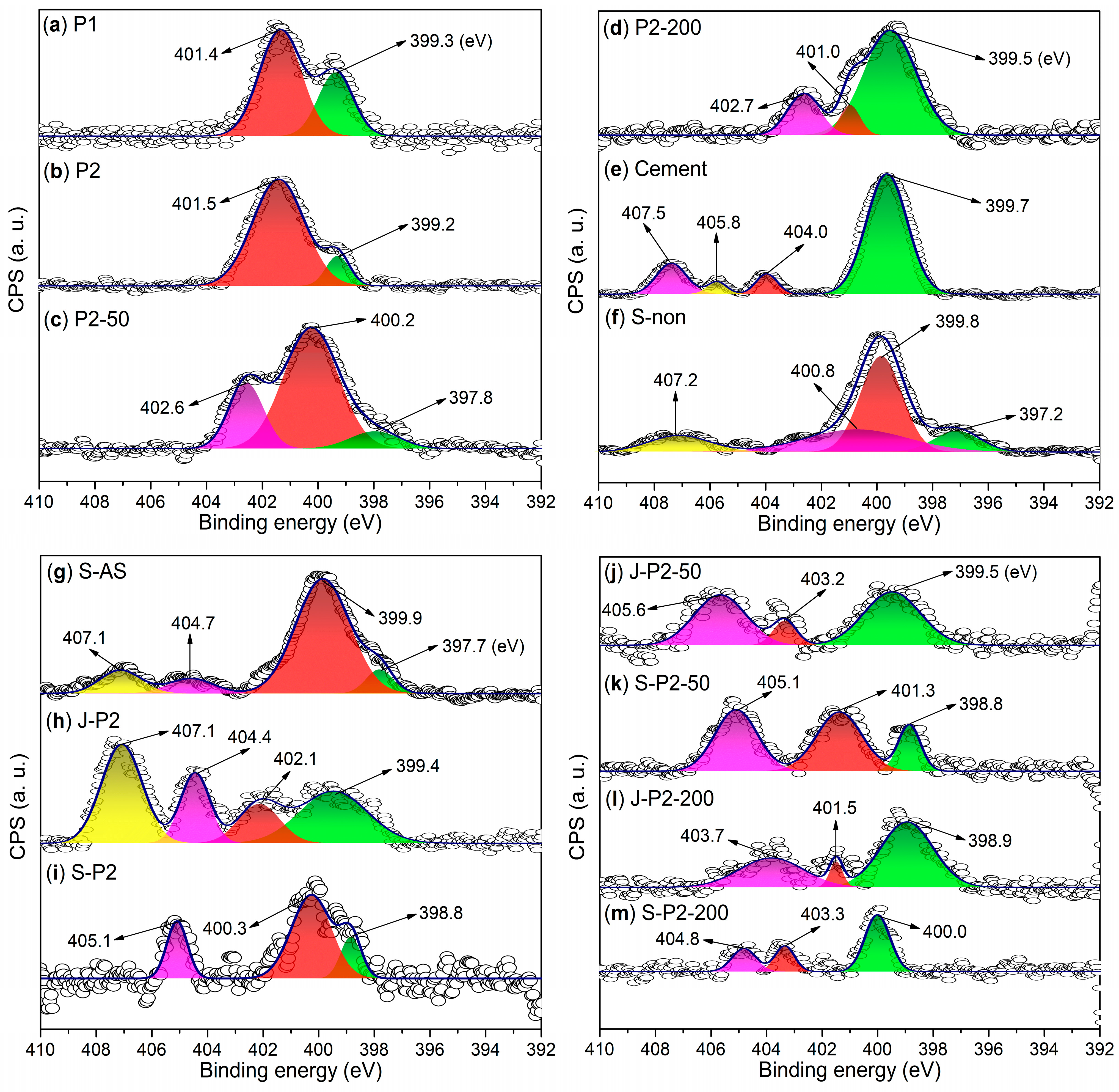
The high-resolution N 1s spectrum (Figure 4a) shows two peaks at 399.3 eV and 401.4 eV. The former is attributed to nitrogen in NH4+, introduced from the ammonium persulfate used in the copolymer synthesis (Figure 1a), while the latter corresponds to nitrogen in C–N bonds, derived from nitrogen present in the sodium humate raw material [34]. Finally, the O 1s spectrum (Figure S1a) displays two peaks at binding energies of 531.3 eV and 532.8 eV, assigned to oxygen in SO42− and oxygen in organic constituents, respectively [35].
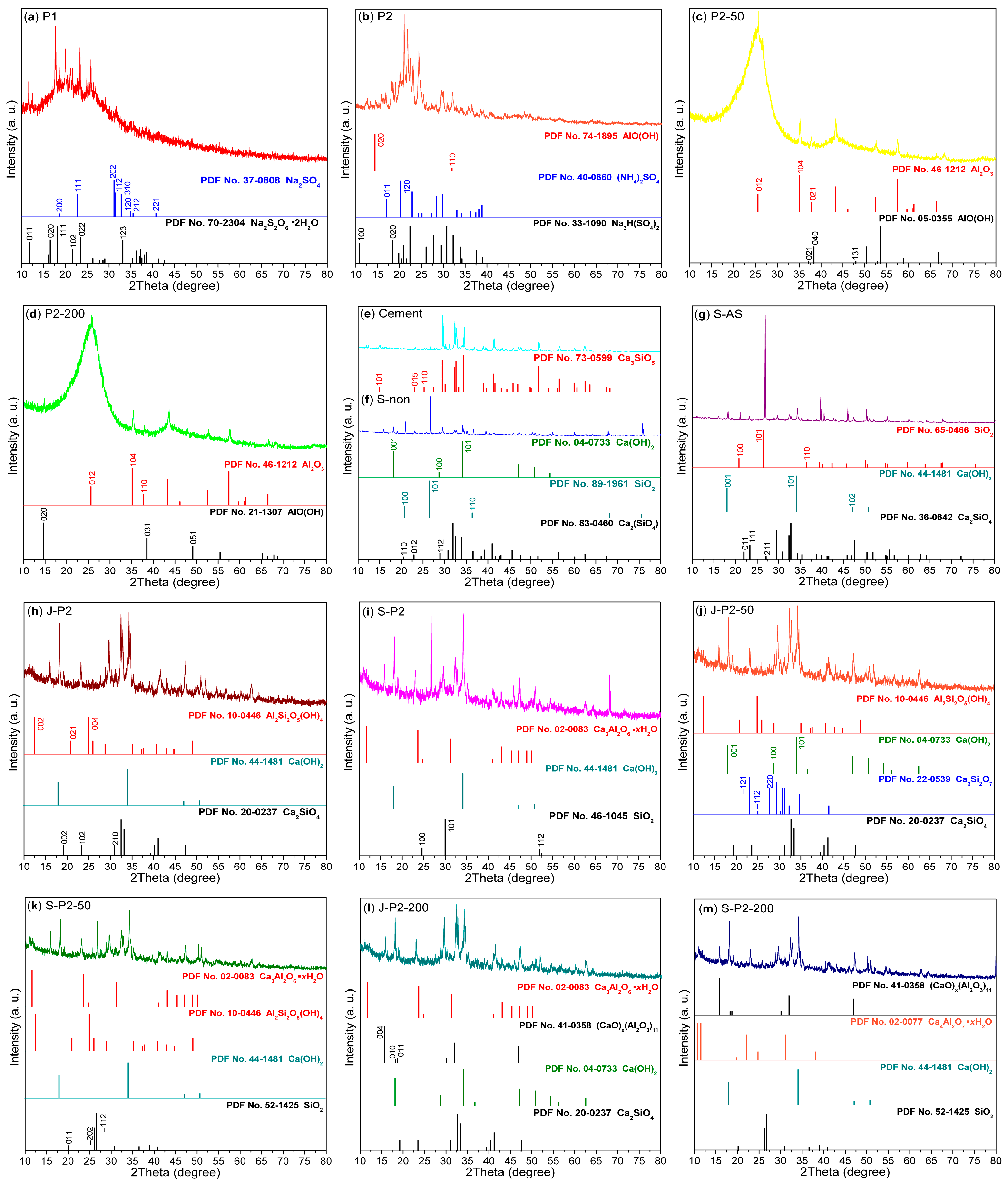
The wide-angle XRD pattern of P1 exhibits a broad hump at 2θ = 10–60° (Figure 5a), which corresponds to the backbone structure of humic acid [36]. In addition, two sets of distinct diffraction peaks are identified, matching the reference patterns of Na2SO4 (PDF No. 37-0808, Figure 5a) and Na2S2O6·2H2O (PDF No. 70-2304, Figure 5a). The Na+ ions originate from the SMAS monomer, while the SO42− and S2O62− species are derived from ammonium persulfate, as illustrated in Figure 1. These results indicate that P1 is a composite material comprising both organic and inorganic constituents.
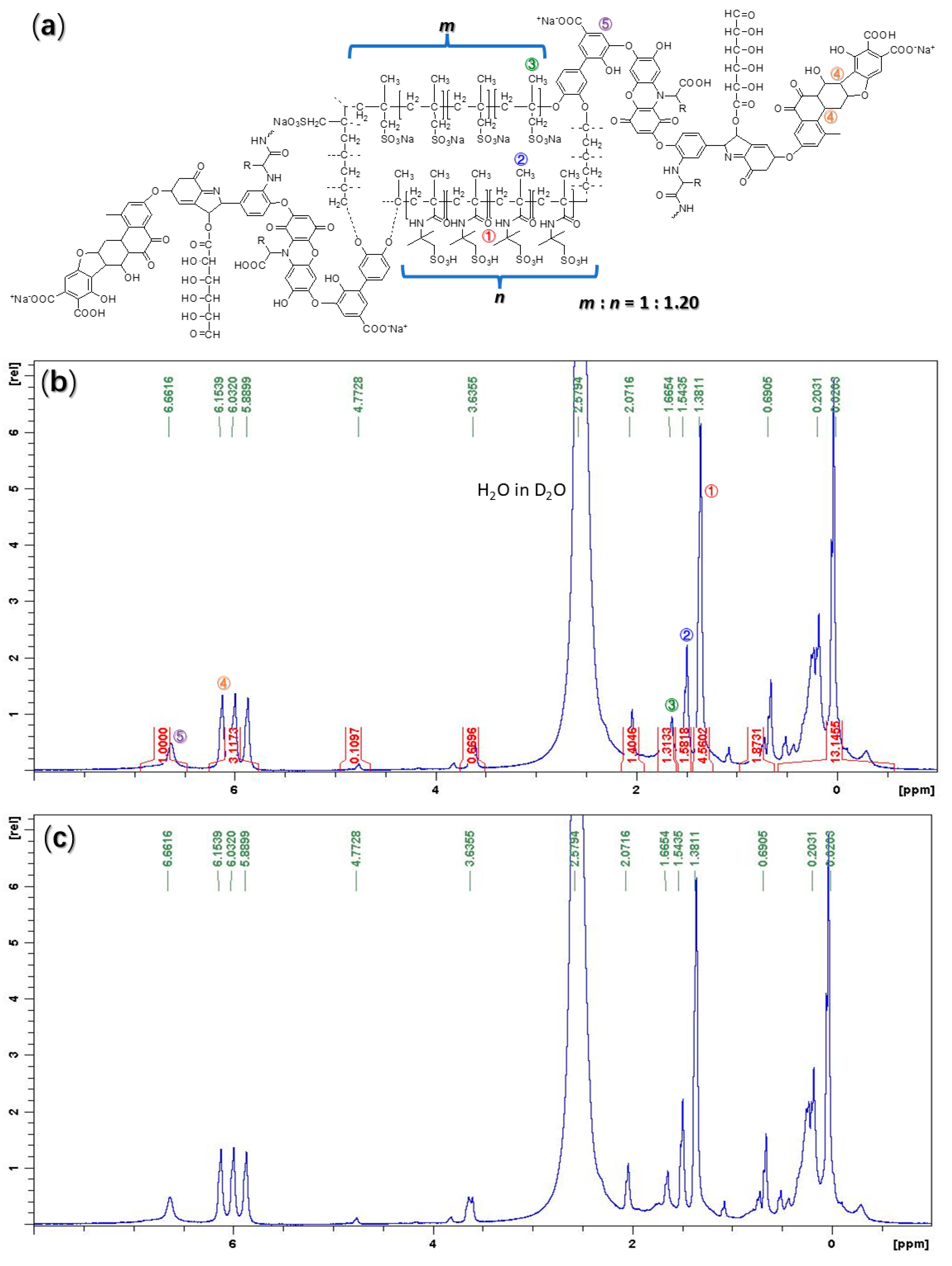
The 1H NMR spectrum of P1 (Figure 6) reveals signals corresponding to hydrogen atoms on tertiary carbons, aromatic rings, and aliphatic chains within the humic acid backbone [37]. Furthermore, by comparing the integrated signal areas of the methyl groups from SMAS and AMPS, the molar ratio of these two comonomers in copolymer P1 is determined to be 1:1.20 (Figure 6a).
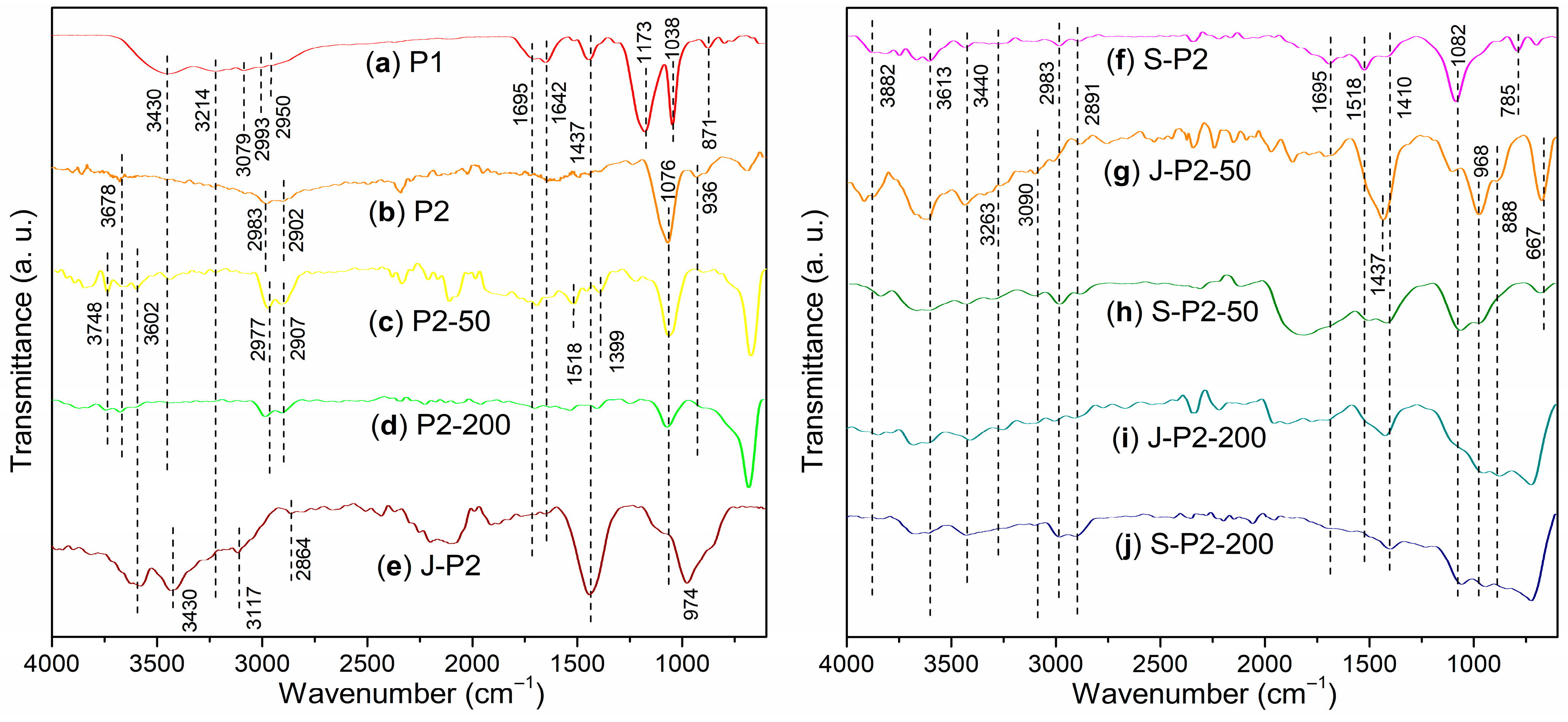
The FT-IR spectrum of P1 (Figure 7a) shows characteristic absorption bands at 3430 cm−1, 3214 cm−1, and 3079 cm−1, which are assigned to N–H stretching of amino groups, O–H stretching of hydroxyl groups, and aromatic C–H stretching, respectively, within the humic acid backbone [38]. The bands observed at 2993 cm−1 and 2950 cm−1 correspond to the asymmetric stretching vibrations of C–H bonds in methyl and methylene groups [38]. A distinct absorption at 1695 cm−1 is attributed to the C=O stretching of the amide group from the AMPS units. Meanwhile, the bands at 1642 cm−1 and 1437 cm−1 represent the asymmetric and symmetric stretching vibrations of carboxylate groups in the humic acid structure [39]. Additionally, absorptions at 1173 cm−1 and 1038 cm−1 are identified as the asymmetric and symmetric stretching vibrations of the sulfonate group (–SO3Na+), respectively (Figure 7a) [40].
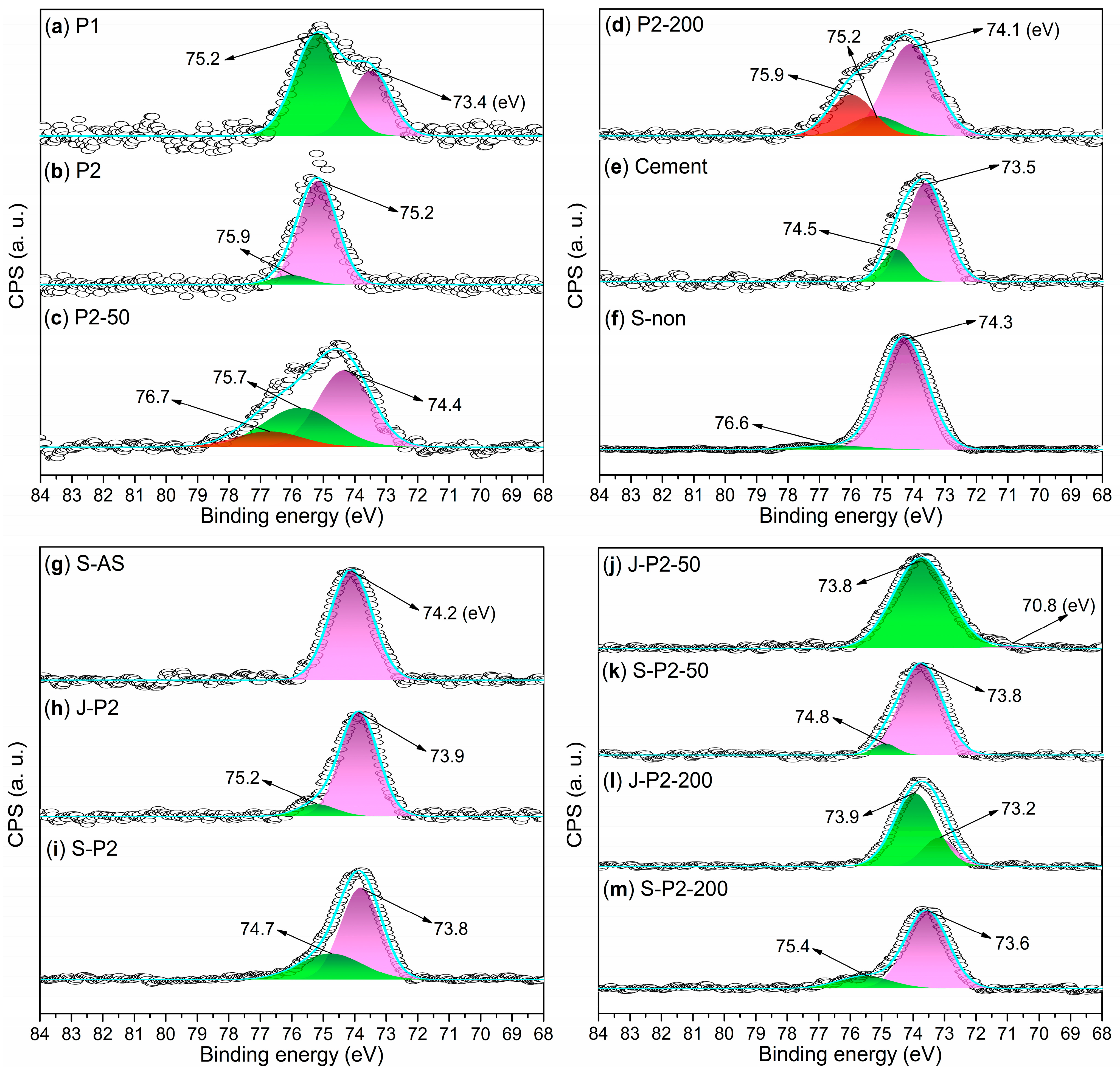
In the Al 2p spectrum of P1, two peaks are observed at binding energies of 75.2 eV and 73.4 eV (Figure 8a), indicating that trace Al3+ species associated with the humic acid framework may exist in the forms of Al2O3 and Al(OH)3, respectively [41]. After ball-milling with ammonium sulfate (AS), the Al 2p spectrum of P2 exhibits peaks at 75.9 eV and 75.2 eV (Figure 8b). This suggests that aluminum in P2 occupies two distinct chemical environments: Al2O3 (with a crystal structure different from that of the intrinsic Al2O3 in sodium humate) and AlO(OH) [41].
Following the ball-milling of P1 with aluminum sulfate (AS), the resulting product P2 exhibits a significant decrease in the surface molar percentages of carbon, nitrogen, calcium, and sodium, alongside a notable increase in oxygen, sulfur, and aluminum (entries 2 vs. 1, Table S1). This indicates the successful incorporation of AS into the P1 framework (Figure 1d).
The XRD pattern of P2 further confirms the presence of an AlO(OH) phase (PDF No. 74-1895, Figure 5b), in which Al3+ occupies a highly electronegative coordination environment corresponding to the Al 2p peak at 75.9 eV (Figure 8b).
Comparative FT-IR analysis between P1 and P2 reveals a new absorption at 3678 cm−1 in P2, attributed to the O–H stretching vibration of the AlO(OH) phase. Concurrently, the characteristic N–H and O–H stretching bands of P1 at 3430 cm−1 and 3214 cm−1 are significantly attenuated or absent in P2 (Figure 7b vs. Figure 7a), implying coordination between Al3+ ions and amino/hydroxyl groups on the humic acid backbone, thereby promoting aluminum dispersion.
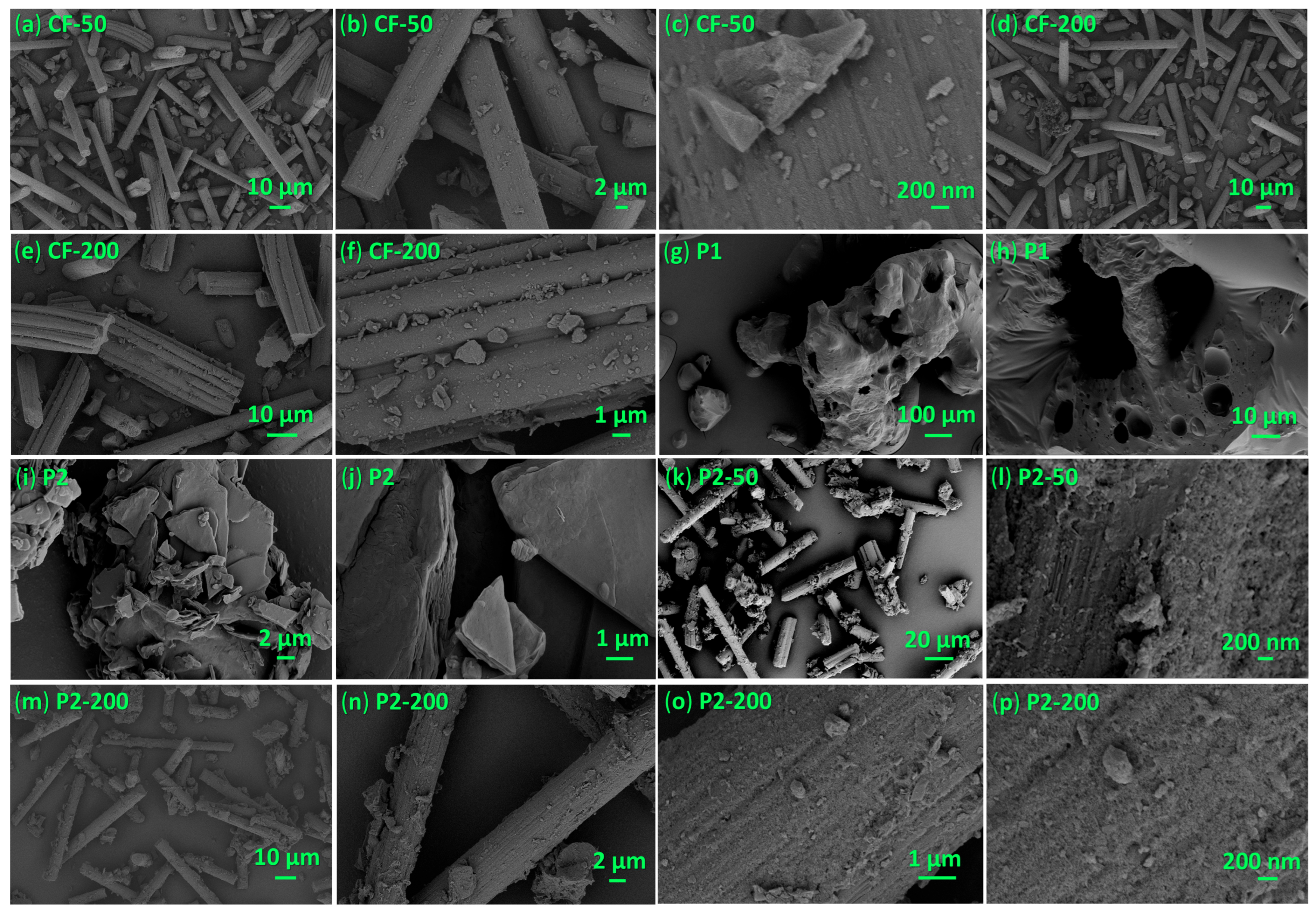
SEM imaging shows that P1 possesses a three-dimensional porous morphology (Figure 9g,h), resulting from the graft modification of originally particulate humic acid with SMAS and AMPS (Figure 1). This structure effectively serves as a stable carrier capable of loading a substantial amount of Al3+. In contrast, P2 exhibits a three-dimensional multilayered morphology (Figure 9i,j), consistent with the formation of new aluminum-containing phases (Figure 5b), which may contribute uniquely to the cement setting acceleration process.
After loading CF-50 onto P2 via ball milling, the resulting product P2-50 exhibits a substantial increase in the surface molar percentage of carbon, accompanied by a marked decrease in oxygen, nitrogen, sulfur, aluminum, and sodium (entries 3 vs. 2, Table S1). This indicates that the high carbon content of CF-50 effectively dilutes the non-carbon components present in P2.
Further comparison of the C 1s spectra reveals that P2-50 displays a peak at 284.1 eV, which is significantly lower than the lowest binding energy C 1s peaks observed in both P2 and P1 (Figure 3c vs. Figure 3a,b). This peak at 284.1 eV is assigned to carbon in C=C bonds (sp2 hybridized), suggesting that the carbon in carbon fiber CF-50 is likely present in the form of fused aromatic or naphthenic structures. A similar trend is observed for product P2-200, obtained by loading CF-200 onto P2 through ball milling. Its C 1s peak at 283.8 eV also corresponds to carbon in C=C bonds (sp2 hybridized, Figure 3d).
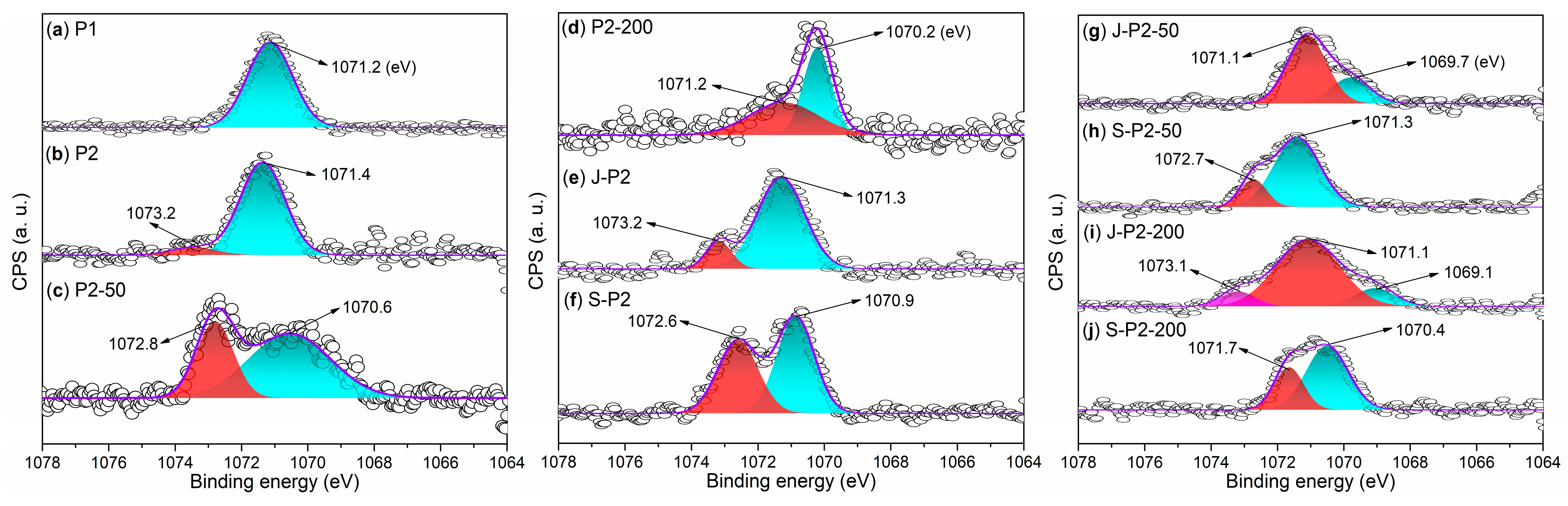
In the Al 2p XPS spectrum of P2-50, peaks are observed at binding energies of 76.7 eV, 75.7 eV, and 74.4 eV (Figure 8c), which are attributed to Al2O3, AlO(OH), and aluminum sulfate phases, respectively. This assignment is further supported by the XRD pattern of P2-50, in which diffraction peaks corresponding to Al2O3 (PDF No. 46-1212, Figure 5c) and AlO(OH) (PDF No. 05-0355, Figure 5c) are identified. A similar aluminum phase composition is observed for P2-200, as evidenced by its nearly identical Al 2p XPS profile (Figure 8d vs. Figure 8c) and XRD pattern (Figure 5d vs. Figure 5c).
The FT-IR spectrum of P2-50 shows a characteristic peak at 1518 cm−1, which is assigned to the C=C stretching vibration of aromatic rings. Another peak observed at 1399 cm−1 corresponds to the symmetric bending vibration of C–H bonds in methyl groups (Figure 7c) [38]. These IR results further confirm that the carbon in CF-50 primarily exists in the form of aromatic structures composed of unsaturated carbon.
SEM analysis reveals that carbon fiber CF-50 consists of cylindrical structures with lengths ranging from 10 to 100 μm and a cross-sectional diameter of approximately 6 μm (Figure 9a,b). Higher-magnification images further show that each of these fibers is composed of thinner constituent fibers, with diameters around 100 nm (Figure 9c).
After blending CF-50 with P2, the resulting composite P2-50 exhibits a porous coating of P2 uniformly covering the carbon fiber surfaces (Figure 9k,l). In comparison, carbon fiber CF-200 shows more pronounced agglomeration than CF-50 (Figure 9d–f). Nevertheless, a similar surface coverage by the P2 component is observed in the corresponding composite P2-200 (Figure 9m–p vs. Figure 9k,l).

3.3. Setting Effects of Admixtures

The setting acceleration effects of various setting accelerators (including the blank control) are presented in Table 1. Initially, the hydration process of cement without any admixtures is exceptionally slow, whereas the use of pure aluminum sulfate as an admixture significantly accelerates hydration (IST: 30.89 ± 0.79 min vs. 34.78 ± 0.33 min, p = 0.00642 < 0.05; FST: 36.08 ± 0.08 min vs. 46.23 ± 0.37 min, p = 2.40 × 10⁻⁴ < 0.05; entries 2 vs. 1, Table 1). In terms of mechanical strength, the 6 h cement mortar without admixtures exhibits the same average compressive strength as that with pure aluminum sulfate (0.8 ± 0.03 MPa vs. 0.8 ± 0.08 MPa, entries 2 vs. 1, Table 1). However, the flexural strength of the 6 h mortar with aluminum sulfate is significantly higher than that without any additives (0.7 ± 0.10 MPa vs. 0.4 ± 0.05 MPa, p = 0.03565 < 0.05, entries 2 vs. 1, Table 1). These results indicate that the addition of aluminum sulfate not only accelerates cement hydration but also enhances flexural strength without compromising compressive strength, which may be attributed to the effective filling of voids formed during hydration by aluminum-containing phases.
A truly significant setting-acceleration effect is observed when P2 replaces aluminum sulfate (AS) as the admixture. With P2, initial setting is achieved within 3 min and final setting within 5 min, markedly outperforming the results obtained with pure aluminum sulfate (entries 3 vs. 2, Table 1). Meanwhile, when P2 is used as the accelerator, it induces significantly faster setting of the paste compared to the magnesium salt/aluminum sulfate composite accelerator (Initial: 2.62 min vs. 4.50 min; Final: 4.53 min vs. 16.00 min) [42], and considerably faster than the high-SO3 fly ash-based accelerator (Initial: 2.62 min vs. 12 h; Final: 4.53 min vs. 14.5 h) [43]. Concurrently, the 6 h mortar exhibits substantially and significantly improved compressive strength (1.7 ± 0.16 MPa vs. 0.8 ± 0.08 MPa, p = 3.20 × 10⁻⁶ < 0.05, entries 3 vs. 2, Table 1) and flexural strength (1.4 ± 0.05 MPa vs. 0.7 ± 0.10 MPa, p = 0.00119 < 0.05). These findings indicate that the AlO(OH) phase present in P2 likely possesses superior setting acceleration and strengthening capabilities compared to aluminum sulfate.
The incorporation of carbon fiber CF-50 into P2 via ball milling yields a new accelerator, P2-50. Compared to P2, P2-50 further reduces the average initial setting time of cement paste (2.21 ± 0.17 min vs. 2.62 ± 0.25 min, p = 0.09328 > 0.05; entries 4 vs. 3, Table 1) and significantly shortens the final setting time (3.93 ± 0.13 min vs. 4.53 ± 0.07 min, p = 0.00541 < 0.05; entries 4 vs. 3, Table 1).
However, the 6 h mortar exhibits a slight decrease in average compressive strength (1.5 ± 0.10 MPa vs. 1.7 ± 0.16 MPa; entries 4 vs. 3, Table 1) and a reduction in average flexural strength (1.0 ± 0.05 MPa vs. 1.4 ± 0.05 MPa; entries 4 vs. 3, Table 1).
In contrast, by 24 h, the mortar with P2-50 demonstrates superior compressive and flexural strength compared to that with P2 (5.5 ± 0.17 MPa vs. 4.2 ± 0.17 MPa, p = 1.19 × 10⁻⁷ < 0.05; 2.7 ± 0.20 MPa vs. 2.2 ± 0.17 MPa, p = 0.02402 < 0.05; entries 4 vs. 3, Table 1).
This phenomenon suggests compositional differences between P2-50 and P2. The Al2O3 component in P2-50 may require time to transform into cement-hydration-active phases such as C3A [44], thereby contributing to the observed strength enhancement at later stages.
When carbon fiber CF-50 is replaced by CF-200 and ball-milled with P2, the resulting accelerator P2-200 exhibits a prolonged initial setting time compared to P2-50 (2.91 ± 0.02 min vs. 2.21 ± 0.17 min, p = 0.01975 < 0.05; entries 5 vs. 4, Table 1), while demonstrating equivalent final setting time, identical 6 h flexural strength, but reduced 6 h compressive strength (entries 5 vs. 4, Table 1). XRD analysis reveals that although both P2-50 and P2-200 contain the AlO(OH) phase, the crystal structures differ (PDF No. 21-1307 vs. PDF No. 05-0355; Figure 5d vs. Figure 5c), leading to variations in their reactivity.

3.4. Characterizations of Cement, Pastes and Mortars

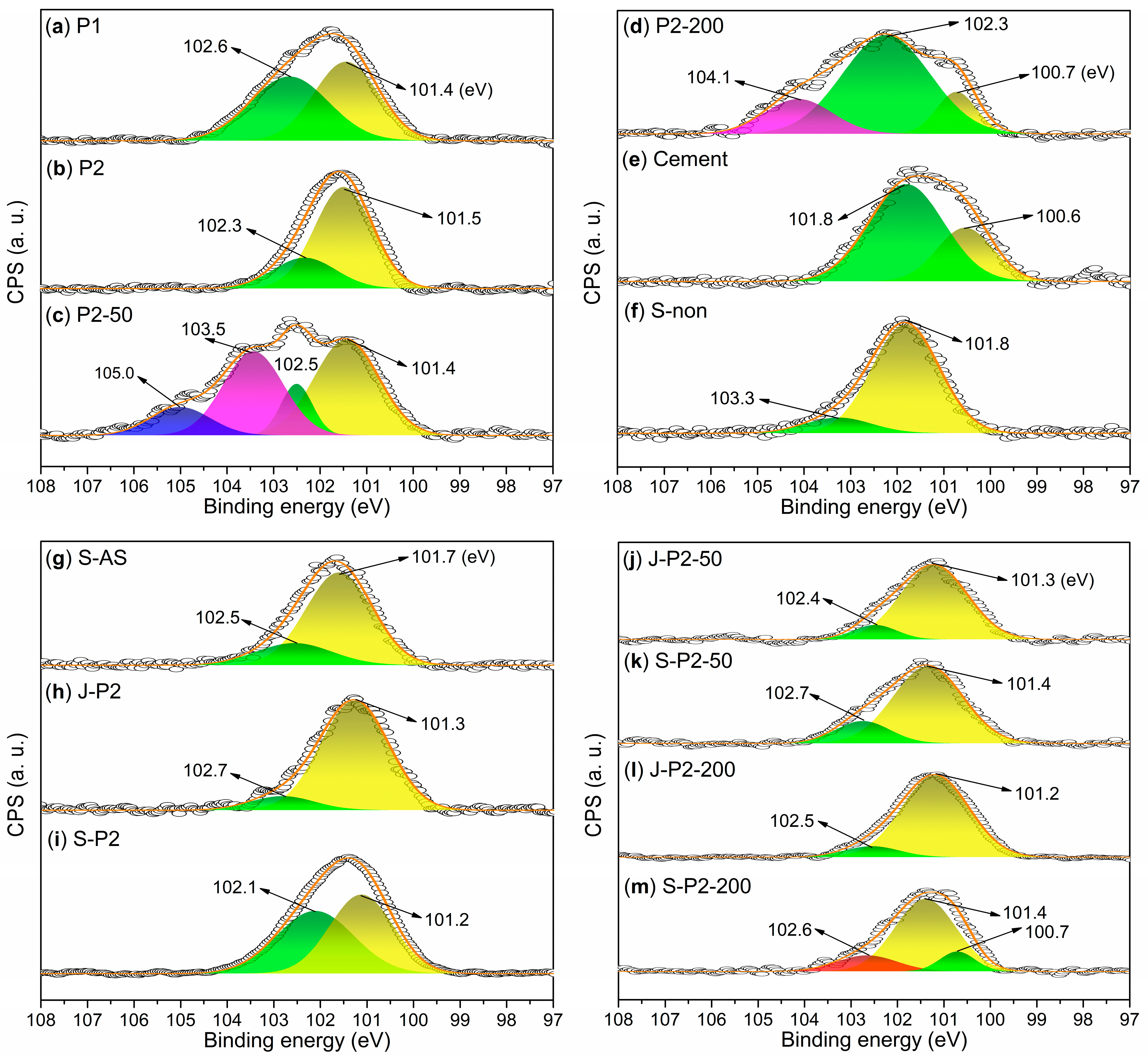
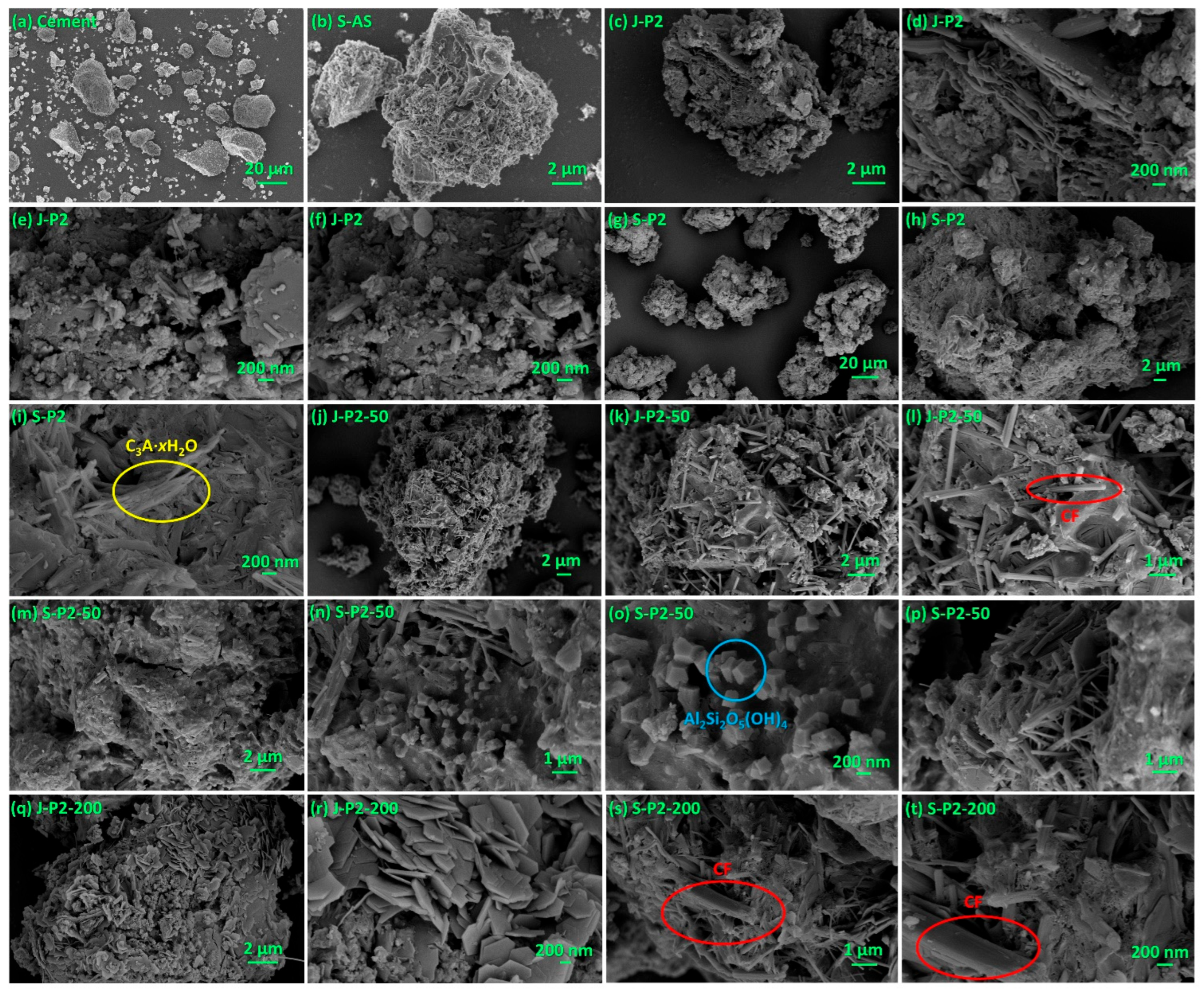
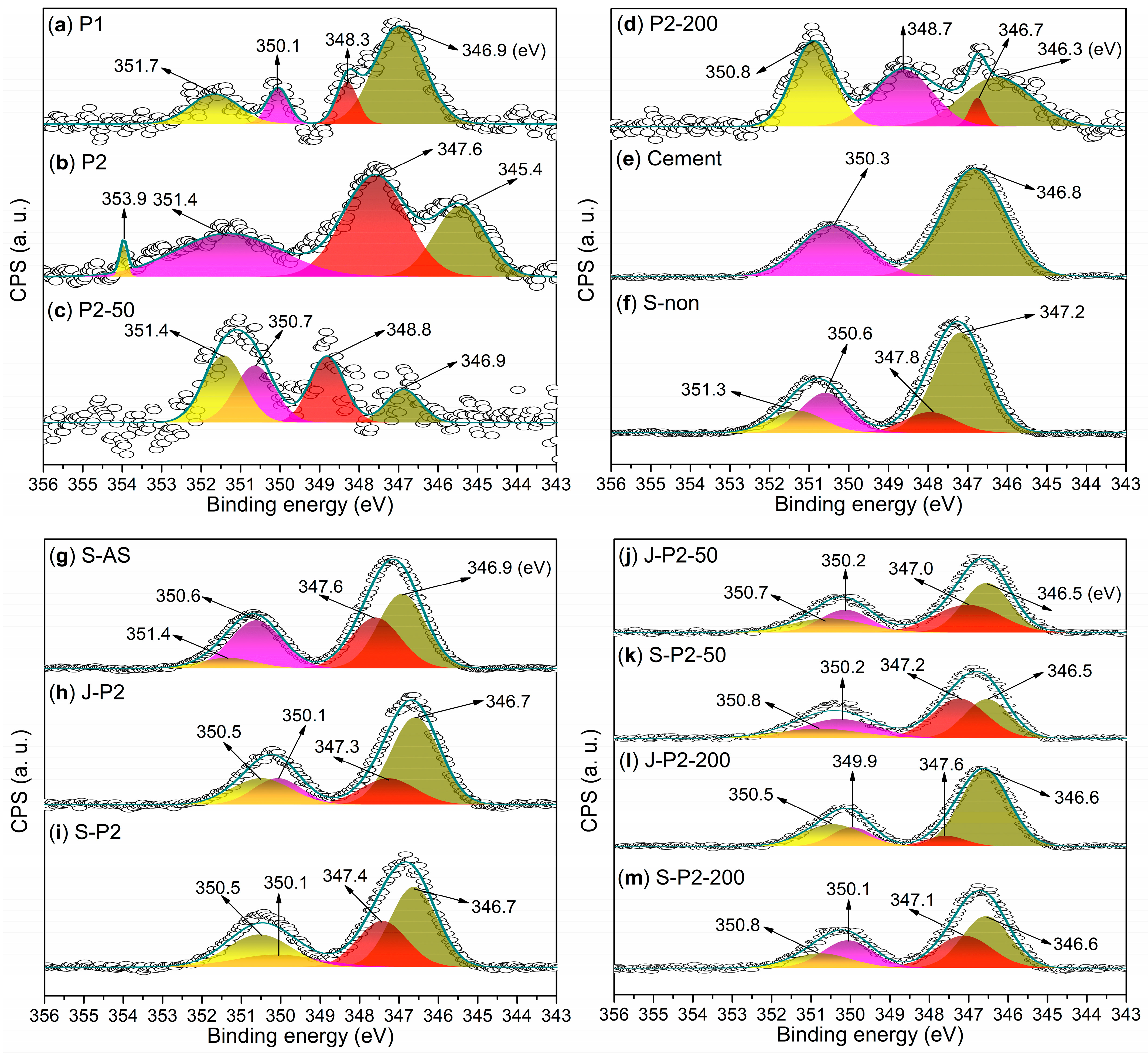
The molar percentages and binding energies of surface elements in the cement raw material used in this study are presented in entry 5, Table S1, while its chemical composition expressed as oxides is shown in Table S2 [45]. The Ca 2p spectrum of the cement exhibits two peaks at 350.3 eV and 346.8 eV (Figure 10e), corresponding to Ca 2p1/2 and Ca 2p3/2 photoelectrons in calcium oxide, respectively. Meanwhile, the Si 2p spectrum displays two peaks at binding energies of 101.8 eV and 100.6 eV (Figure 11e), which can be attributed to silicon in tricalcium silicate and dicalcium silicate, respectively. XRD analysis further confirms the dominance of tricalcium silicate peaks (PDF No. 73-0599) in the cement. SEM observations reveal that the cement raw material consists of irregular, angular particles at the micrometer scale (Figure 12a). These characteristics collectively demonstrate that the cement material used in this study conforms to the fundamental properties of Portland cement.
In the absence of any admixtures, the hydration products of cement (mortar S-non) include portlandite (Ca(OH)2, PDF No. 04-0733, Figure 5f), SiO2 (PDF No. 89-1961, Figure 5f), and dicalcium silicate (Ca2SiO4, Figure 5f). Among these, portlandite is one of the primary hydration products of Portland cement. It plays a critical role in cross-linking cement components and is essential for the development of cement strength [46]. The silica originates from the standard sand incorporated during mortar formation, while the dicalcium silicate may result from the transformation of tricalcium silicate present in the raw cement materials or may pre-exist as a component in the raw mix. Furthermore, the hydration product of tricalcium silicate, C–S–H (hydrated tricalcium silicate, 3CaO·SiO2·3H2O), exhibits very weak XRD peaks [47]. Therefore, the extent of cement hydration is primarily assessed by the disappearance of the tricalcium silicate diffraction peak.
Meanwhile, the XPS spectrum of S-non in the Ca 2p region exhibits two distinct doublets: one at 350.6 eV and 347.2 eV (Figure 10f), representing Ca2+ in C–S–H, and the other at 351.3 eV and 347.8 eV (Figure 10f), corresponding to Ca2+ in portlandite. In the Si 2p spectrum, the two peaks observed at 103.3 eV and 101.8 eV (Figure 11f) are attributed to SiO2 from the standard sand and SiO2 involved in the cement hydration process, respectively [48].
When pure aluminum sulfate is used as an admixture, the phases in the resulting mortar S-AS are largely consistent with those in S-non (Figure 5g vs. Figure 5f), and no distinct diffraction peaks corresponding to aluminum-containing phases are observed (Figure 5g). However, the presence of aluminum-containing phases with low crystallinity in S-AS cannot be ruled out, as indicated by the XPS spectrum of S-AS in the Al 2p region (Figure 8g). Furthermore, SEM observations reveal that the particles in S-AS have smoother and more rounded edges compared to those in the raw cement (Figure 12b vs. Figure 12a), which can be attributed to the effects of hydration. Additionally, no distinctly regular or geometrically shaped small particles are observed in S-AS (Figure 12b), suggesting that the aluminum-containing phases present are amorphous. This structural characteristic accounts for the only modest enhancement in the setting acceleration effect observed when pure aluminum sulfate is used as an additive, compared to the blank experiment (entries 2 vs. 1, Table 1).
The substantial enhancement in setting acceleration originates from the application of P2 as an additive, wherein the aluminum-containing phase Al2Si2O5(OH)4 (PDF No. 10-0446, Figure 5h) identified in paste J-P2 drastically accelerates cement hydration, while contrastingly, the phase Ca3Al2O6·xH2O (PDF No. 02-0083, Figure 5i) found in mortar S-P2 directly confers superior compressive and flexural strengths (entries 3 vs. 1 and 2, Table 1). These two phases are formed from the AlO(OH) in P2 according to the following Equations (1) and (2):
2 AlO ( OH ) + 2 SiO 2 + H 2 O Al 2 O 3 · 2 SiO 2 · 2 H 2 O Al 2 Si 2 O 5 ( OH ) 4
2 AlO ( OH ) + 3 CaO + ( x 1 ) H 2 O 3 CaO · Al 2 O 3 · x H 2 O Ca 3 Al 2 O 6 x H 2 O
It is particularly noteworthy that Al2Si2O5(OH)4 belongs to the A–S–H gel family in cement [49], while Ca3Al2O6·xH2O is a hydration product of tricalcium aluminate (C3A); both phases possess significant binding capabilities. Morphological observations by SEM reveal that paste J-P2 exhibits a platy morphology (Figure 12c–f), likely corresponding to Al2Si2O5(OH)4. In contrast, mortar S-P2 contains distinct rod-like crystals identified as Ca3Al2O6·xH2O (Figure 12g–i).
Furthermore, analysis of the Na 1s spectra for J-P2 and S-P2 reveals the presence of sodium in two distinct chemical states in both materials (Figure 13e,f). These states are attributed to sodium humate and the SMAS monomer, respectively (Figure 1).
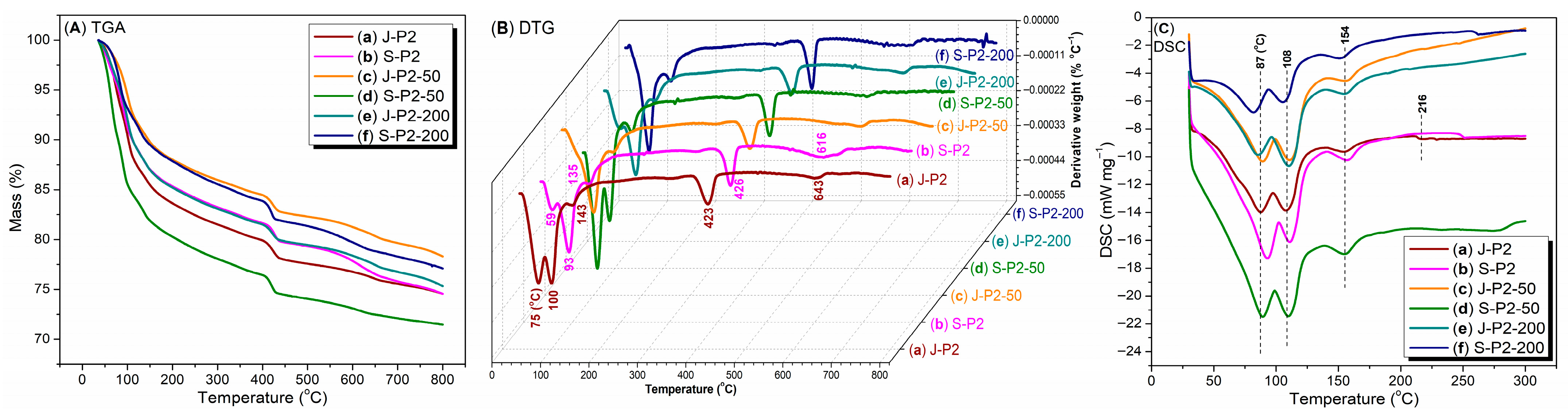
On the other hand, the TGA curves of both J-P2 and S-P2 display three distinct weight-loss steps (Figure 14A(a),(b)). The first step, occurring between 35 and 200 °C (16.35 wt.% for J-P2, Figure 14A(a); 14.66 wt.% for S-P2, Figure 14A(b)), is attributed to the loss of crystalline water or small organic molecules. Within this temperature range, the lower weight loss observed for S-P2 compared to J-P2 results from the incorporation of standard sand during the preparation of S-P2 (Section 2.5 vs. Section 2.4). The second step, between 200 and 600 °C (6.87 wt.% for J-P2, Figure 14A(a); 7.47 wt.% for S-P2, Figure 14A(b)), corresponds to the decomposition and removal of refractory organic matter. The third step, in the range of 600–800 °C (2.20 wt.% for J-P2, Figure 14A(a); 3.30 wt.% for S-P2, Figure 14A(b)), likely reflects weight changes due to phase transformations of inorganic oxides.
The corresponding DTG analysis identifies four characteristic temperatures at which the maximum rate of weight loss occurs for both samples (75, 100, 143, and 423 °C for J-P2, Figure 14B(a); 59, 93, 135, and 426 °C for S-P2, Figure 14B(b)). The first two peaks correspond to the initial TGA step (35–200 °C), the third peak to the second step (200–600 °C), and the fourth peak to the third step (600–800 °C). Furthermore, DSC analysis reveals that both J-P2 and S-P2 exhibit exothermic behavior in the 30–300 °C range (Figure 14C(a),(b)), indicating that the volatilization of readily decomposable organic components and the loss of crystalline water are accompanied by exothermic processes.
When the carbon fiber-containing admixture P2-50 is used in the cement setting reaction, the resulting paste J-P2-50 is found to contain the Al2Si2O5(OH)4 phase, consistent with J-P2 (Figure 5j vs. Figure 5h). This indicates that the formation of the Al2Si2O5(OH)4 phase is governed by the combined action of sodium humate, aluminum sulfate, and the superplasticizer monomer, but is independent of the subsequently introduced carbon fibers.
However, based on the faster setting time of J-P2-50 compared to J-P2 (entries 4 vs. 3, Table 1) and the unique morphology of the admixture P2-50 (Figure 9k,l), it can be concluded that the incorporation of carbon fibers promotes a more uniform dispersion of the active setting components, thereby enhancing the effectiveness of the accelerator. Furthermore, this carbon fiber-assisted setting strategy also significantly benefits the development of mechanical strength in cement (24 h mortar, entries 4 vs. 3, Table 1). Finally, in paste J-P2-50, the carbon fibers are observed to provide a supporting framework within the cement paste (Figure 12j–l). In mortar S-P2-50, extensive early-stage formation of the Al2Si2O5(OH)4 phase is evident (cubes, Figure 12m–p), both of which are indicators of a more advanced degree of hydration.
From the perspective of thermogravimetric analysis, within the heating range of 35–200 °C, the weight loss of paste J-P2 is 16.35 wt.%, and that of paste J-P2-50 is 11.98 wt.% (Figure 14A(a),(c)), while the weight loss of mortar S-P2 is 14.66 wt.%, and that of mortar S-P2-50 is 19.71 wt.% (Figure 14A(b),(d)). In the range of 200–600 °C, paste J-P2 exhibits a weight loss of 6.87 wt.%, and paste J-P2-50 shows 6.76 wt.% (Figure 14A(a),(c)), whereas mortar S-P2 loses 7.47 wt.%, and mortar S-P2-50 loses 7.18 wt.% (Figure 14A(b),(d)). Between 600 and 800 °C, the weight loss of paste J-P2 is 2.20 wt.%, and that of paste J-P2-50 is 2.95 wt.% (Figure 14A(a),(c)), while mortar S-P2 loses 3.30 wt.%, and mortar S-P2-50 loses 1.63 wt.% (Figure 14A(b),(d)).
On the other hand, over the entire heating range of 35–800 °C, the total weight loss of paste J-P2 is 25.43 wt.%, that of paste J-P2-50 is 21.69 wt.%, mortar S-P2 loses 25.44 wt.%, and mortar S-P2-50 loses 28.54 wt.% (Figure 14A(a)–(d)). These experimental results indicate that the incorporation of 50-mesh carbon fibers into the paste system enhances the thermal resistance of the paste, as the fibers form strong bonds with components such as tricalcium silicate, effectively serving a bridging and pore-filling function (Figure 12j–l). In contrast, when 50-mesh carbon fibers are introduced into the mortar system, the presence of standard sand inhibits the interaction between the carbon fibers and cement components such as tricalcium silicate (Figure 12m–p), thereby reducing the thermal stability of the mortar compared to the system without 50-mesh carbon fibers.
When the 50-mesh carbon fibers in the additive are replaced with 200-mesh fibers, the resulting accelerator P2-200 produces a paste, J-P2-200, which contains aluminum-containing setting-active components different from those in J-P2 and J-P2-50 (Figure 5l vs. Figure 5h,j). This compositional difference accounts for the distinct setting acceleration performance of P2-200 compared to P2 and P2-50 (entries 5 vs. 3, 4, Table 1). This phenomenon indicates that the surface properties and steric hindrance or filling effects of 200-mesh carbon fibers differ from those of 50-mesh fibers, leading to their distinct roles in the cement hydration process (Figure 9).
Within the heating range of 35–800 °C, the weight loss of paste J-P2-200 is 24.67 wt.%, which is greater than that of paste J-P2-50 (21.69 wt.%) (Figure 14A(e) vs. Figure 14A(c)). In contrast, the weight loss of mortar S-P2-200 is 22.90 wt.%, lower than that of mortar S-P2-50 (28.54 wt.%) (Figure 14A(f) vs. Figure 14A(d)). These experimental results indicate the following: First, the distinction between 50-mesh and 200-mesh carbon fibers lies not in their diameter but in their length (Figure 9a–c vs. Figure 9d–f). When incorporated into the paste system, 50-mesh carbon fibers are more likely to bond with tricalcium silicate or fill the paste matrix, thereby enhancing its structural integrity and heat resistance compared to 200-mesh fibers (Figure 12j–l vs. Figure 12q,r). Second, in the mortar system, the inclusion of standard sand competes with 50-mesh carbon fibers for interaction with cement components such as tricalcium silicate. This competition increases the likelihood of 50-mesh fibers detaching from tricalcium silicate or its interfaces (Figure 12m–p). In comparison, the shorter 200-mesh fibers are more readily embedded into the gaps between standard sand and tricalcium silicate (Figure 12s,t).
Based on the experimental observations, the following conclusions can be drawn: (1) Compared with 200-mesh carbon fibers, 50-mesh carbon fibers tend to form stronger and more effective bonds with the primary gel component in cement, namely hydrated tricalcium silicate. This is likely the main reason why 50-mesh carbon fibers exhibit superior performance in accelerating setting and enhancing the mechanical strength of cement (entries 4 vs. 5, Table 1). (2) Although 200-mesh carbon fibers are more readily incorporated into the mortar system, their shorter length may account for their inferior effectiveness in reinforcing the mechanical strength of cement compared to 50-mesh carbon fibers (entries 4 vs. 5, Table 1).

4. Conclusions

Based on the aforementioned research findings, this study draws the following conclusions:
  • Under the conditions of aqueous free radical polymerization initiated by ammonium persulfate, sodium humate can copolymerize with sodium 2-methylprop-2-ene-1-sulfonate (SMAS) and 2-acrylamido-2-methylpropane sulfonic acid (AMPS) to form a highly water-soluble three-dimensional porous copolymer. Using this copolymer as a ligand and complexing it with aluminum sulfate via ball milling, the resulting composite admixture contains active components such as AlO(OH). Compared to pure aluminum sulfate as a setting accelerator, this composite significantly enhances the hydration rate of cement (average initial setting time: 2.62 min; average final setting time: 4.53 min) while markedly improving the mechanical strength of the mortar at 6 h (average compressive strength: 1.7 MPa; average flexural strength: 1.4 MPa). The underlying reason is that, unlike pure aluminum sulfate, the composite additive promotes the formation of a new Al2Si2O5(OH)4 gel phase in the cement paste and a new Ca3Al2O6·xH2O gel phase in the cement mortar.
  • Incorporating 50-mesh carbon fibers into the aforementioned sodium humate copolymer-aluminum composite accelerator via ball milling produces an admixture containing two active setting-accelerating components: AlO(OH) and Al2O3. These aluminum-containing species are formed through the hydrolysis of Al3+, released from the aluminum sulfate precursor, to Al(OH)3 during ball milling, followed by its subsequent dehydration. This further accelerates the cement hydration rate (average initial setting time: 2.21 min; average final setting time: 3.93 min). However, compared to the aluminum–sodium humate copolymer accelerator, it slightly reduces the 6 h mechanical strength of the mortar (compressive: 1.5 MPa vs. 1.7 MPa; flexural: 1.0 MPa vs. 1.4 MPa) while significantly enhancing the 24 h mechanical strength (compressive: 5.2 MPa vs. 4.2 MPa; flexural: 2.7 MPa vs. 2.2 MPa). This is attributed to the formation of an Al2Si2O5(OH)4 gel phase in the paste and both Al2Si2O5(OH)4 and Ca3Al2O6·xH2O gel phases in the mortar when 50-mesh carbon fibers are incorporated.
  • When 50-mesh carbon fibers are replaced with 200-mesh carbon fibers, the initial setting time of the cement paste mediated by the 200-mesh carbon fiber-doped accelerator is prolonged, although the final setting time remains nearly identical. Additionally, the 6 h compressive and flexural strengths of the mortar decrease. This is because the 200-mesh carbon fiber-doped accelerator promotes the formation of Ca3Al2O6·xH2O and (CaO)X(Al2O3)11 phases in the cement paste, and Ca3Al2O6·xH2O and Ca4Al2O7·xH2O phases in the cement mortar. Evidently, the Al2Si2O5(OH)4 gel phase exhibits superior setting acceleration and reinforcement effects compared to the Ca3Al2O6·xH2O, (CaO)X(Al2O3)11, and Ca4Al2O7·xH2O phases. The mesh size of carbon fibers significantly influences the formation of gel phases. Moreover, excessively fine carbon fibers may hinder the development of early mechanical strength in cement mortar, possibly due to their inability to effectively bridge the larger gaps formed during cement hydration.
  • Traditionally, sodium humate, SMAS, and AMPS have been used as retarders in cement hydration, while also functioning as superplasticizers. Carbon fibers, on the other hand, have been reported as reinforcing agents. However, none of these materials have previously been recognized for their setting-accelerating properties. This project, through graft modification of sodium humate followed by blending with aluminum sulfate and carbon fibers, has developed an additive that simultaneously exhibits excellent setting acceleration and reinforcement effects, thereby contributing to the development of a new generation of cement accelerators.

Supplementary Materials

The following supporting information can be downloaded at: https://www.mdpi.com/article/10.3390/buildings15244422/s1, Figure S1: XPS measurements of the O 1s regions of synthesized copolymer (a), admixtures (b–d), cement (e), mortars (f,g,i,k,m), and pastes (h,j,l); Figure S2: Compressive strength report of S-P2 at 6h; Figure S3: Flexural strength report of S-P2 at 6h; Table S1: Binding energies and atomic compositions on surfaces of synthesized copolymer, admixtures, cement, pastes and mortars (depth, 0–10 nm); Table S2: The chemical composition of cement.

Author Contributions

Z.S.: Writing—original draft. S.C.: Formal analysis. Y.D.: Methodology. Y.Y.: Formal analysis. Q.J.: Methodology. Y.W.: Formal analysis. X.L.: Funding acquisition; Methodology. Y.S.: Supervision; Methodology. All authors have read and agreed to the published version of the manuscript.

Funding

This work was supported by the Natural Science Basic Research Program of Shaanxi Province (No. 2017JM2016). This work was also supported by Yuncheng City’s Unveiling and Commanding Project—Development of Admixtures and Auxiliary Technologies for High-efficiency Shotcrete Used in Complex and Harsh Tunnel Construction Environments.

Institutional Review Board Statement

Not applicable.

Informed Consent Statement

Not applicable.

Data Availability Statement

The raw data supporting the conclusions of this article will be made available by the authors on request.

Acknowledgments

We acknowledge the support by the Natural Science Basic Research Program of Shaanxi Province (No. 2017JM2016), and Yuncheng City’s Unveiling and Commanding Project—Development of Admixtures and Auxiliary Technologies for High-efficiency Shotcrete Used in Complex and Harsh Tunnel Construction Environments.

Conflicts of Interest

Author Zhiyuan Song was employed by the company Shanxi Jiawei New Material Co., Ltd. The remaining authors declare that the research was conducted in the absence of any commercial or financial relationships that could be construed as a potential conflict of interest.

References

  1. Chen, H.; Li, N.; Unluer, C.; Chen, P.; Zhang, Z. 200 years of Portland cement: Technological advancements and sustainability challenges. J. Clean. Prod. 2025, 486, 144500. [Google Scholar] [CrossRef]
  2. Berenguera, R.A.; Caprarob, A.P.B.; de Medeirosb, M.H.F.; Carneiroa, A.M.P.; De Oliveira, R.A. Sugar cane bagasse ash as a partial substitute of Portland cement: Effect on mechanical properties and emission of carbon dioxide. J. Environ. Chem. Eng. 2020, 8, 103655. [Google Scholar] [CrossRef]
  3. Tang, S.W.; Cai, R.J.; He, Z.; Cai, X.H.; Shao, H.Y.; Li, Z.J.; Yang, H.M.; Chen, E. Continuous microstructural correlation of slag/superplasticizer cement pastes by heat and impedance methods via fractal analysis. Fractals 2017, 25, 1740003. [Google Scholar] [CrossRef]
  4. Yang, H.M.; Zhang, S.M.; Wang, L.; Chen, P.; Shao, D.K.; Tang, S.W.; Li, J.Z. High-ferrite Portland cement with slag: Hydration, microstructure, and resistance to sulfate attack at elevated temperature. Cem. Concr. Comp. 2022, 130, 104560. [Google Scholar] [CrossRef]
  5. Balbi, E.P.; Comodi, P.; Cambi, C.; Fastelli, M.; Corradini, A.; Montanari, C.; Zucchini, A.; Cerni, G.; Farhat, H.B.; Bocci, C.; et al. Wood biomass ash, municipal solid waste ash, and recycled concrete from construction demolition waste as supplementary cementitious materials in fine graded granular mixtures. Constr. Build. Mater. 2025, 498, 144016. [Google Scholar] [CrossRef]
  6. Ho, L.S.; Quang, L.V.; Van-Pham, D.; Huynh, T. Strength development and microstructural characterization of eco-cement paste with high-volume fly ash. Results Eng. 2025, 26, 105013. [Google Scholar] [CrossRef]
  7. Ma, J.; Shu, X.; Zheng, S.; Qi, S.; Ran, Q. Effects of polyurethane–silica nanohybrids as additives on the mechanical performance enhancement of ordinary Portland cement paste. Constr. Build. Mater. 2022, 338, 127666. [Google Scholar] [CrossRef]
  8. Lang, L.; Xue, D.; Dong, M.; Zhang, W.; Li, J. Strength development of dredged sediment stabilized with nano-modified sulphoaluminate cement. Soils Found. 2025, 65, 101558. [Google Scholar] [CrossRef]
  9. Yong, C.L.; Tan, T.H.; Ghayeb, H.H.; Koting, S.; Mo, K.H. Role of sulphate-based additives on the early age properties of Portland cement incorporating alumina-rich ladle furnace slag. Case Stud. Constr. Mat. 2025, 22, e04336. [Google Scholar] [CrossRef]
  10. Yu, X.; Zhang, Z.; Han, B.; Dai, S.; Wang, H. The effect of glass fiber on mechanical behavior and microstructure of cement-based solidified soil for protecting foundations of offshore wind turbines. Constr. Build. Mater. 2025, 494, 143464. [Google Scholar] [CrossRef]
  11. Lu, H.; Zhang, T.; Tian, L.; Zhang, X.; Zou, J.; Li, Y.; Guo, Y. Effect of the presence or absence of curing agent on the properties of resin–Portland cement composite for oil and gas wells. Geoenergy Sci. Eng. 2025, 255, 214120. [Google Scholar] [CrossRef]
  12. Liu, X.; Li, D.; Xie, H.; Yao, J.; Shen, X.; Wang, H.; Qu, Z.; Zhang, Z.; Feng, P. How does aluminum sulfate-based alkali-free accelerator affect calcium silicate hydrate (C-S-H) formation in accelerated cement pastes? Cem. Concr. Res. 2026, 199, 108052. [Google Scholar] [CrossRef]
  13. Rincon, J.; Camarillo, R.; Martín, A. Solubility of aluminum sulfate in near-critical and supercritical water. J. Chem. Eng. Data 2012, 57, 2084–2094. [Google Scholar] [CrossRef]
  14. Yu, C.; Garba, M.J.; Tian, Y.; Zhou, X.; Chen, X.; Yang, J.; Yuan, Q. Optimization of alkali-free accelerators via chelating acid design: Dual enhancement of early setting and strength development in cement paste. Constr. Build. Mater. 2025, 495, 143700. [Google Scholar] [CrossRef]
  15. Wang, H.; Feng, P.; Liu, X.; Shi, J.; Wang, C.; Wang, W.; Li, H.; Hong, J. The role of ettringite seeds in enhancing the ultra-early age strength of Portland cement containing aluminum sulfate accelerator. Compos. B Eng. 2024, 287, 111856. [Google Scholar] [CrossRef]
  16. Jiang, F.; He, S.; Liu, B.; Fu, Y.; Sun, W.; Luo, Y.; Tang, H. Efficient activation of humic acid in lignite via Fenton oxidation−nitric acid leaching for sustainable resource utilization. J. Environ. Chem. Eng. 2025, 13, 118248. [Google Scholar] [CrossRef]
  17. Su, J.; Liu, Z.; Zhao, L.; Huo, L.; Yi, W.; Li, Z.; Wang, L.; Yao, Z. A sustainable approach to enhancing humic acid production from lignocellulose via green alum. J. Environ. Chem. Eng. 2025, 13, 115156. [Google Scholar] [CrossRef]
  18. Wang, S.; Gai, S.; Cheng, K.; Liu, Z.; Antonietti, M.; Yang, F. Artificial humic acid mediated Fe(II) regeneration to restart Fe(III)/PMS for the degradation of atrazine. Sep. Purif. Technol. 2025, 359, 130541. [Google Scholar] [CrossRef]
  19. Ozuzun, S.; Uzal, B. Performance of leonardite humic acid as a novel superplasticizer in Portland cement systems. J. Build. Eng. 2021, 42, 103070. [Google Scholar] [CrossRef]
  20. Sachs, S.; Bernhard, G. Influence of humic acids on the actinide migration in the environment: Suitable humic acid model substances and their application in studies with uranium-A review. J. Radioanal. Nucl. Chem. 2011, 290, 17–29. [Google Scholar] [CrossRef]
  21. Li, K.; Wang, X.; Wang, X.; Tu, S.; Song, Y.; Shi, T.; Wang, L.; Zhou, H. A comprehensive benefit evaluation of recycled carbon fiber reinforced cement mortar based on combined weighting. Constr. Build. Mater. 2025, 489, 142196. [Google Scholar] [CrossRef]
  22. Shi, T.; Li, K.; Wang, C.; Jin, Z.; Hao, X.; Sun, P.; Han, Y.; Pan, C.; Fu, N.; Wang, H. Fracture toughness of recycled carbon fibers reinforced cement mortar and its environmental impact assessment. Case Stud. Constr. Mat. 2025, 22, e04866. [Google Scholar] [CrossRef]
  23. Zhu, J.; Wang, X.; Yu, H.; Liu, S.; Pei, C.; Xing, F. Advanced industrial-grade carbon-fiber-reinforced geopolymer cement supercapacitors for building-integrated energy storage solutions. Cem. Concr. Comp. 2025, 161, 106106. [Google Scholar] [CrossRef]
  24. Li, H.; Zhang, N.; Yang, J.; Wang, L.; Köberle, T.; Mechtcherine, V. Synergistic reinforcement of recycled carbon fibers and biochar in high-performance, low-carbon cement composites: A sustainable pathway for construction materials. Cem. Concr. Comp. 2025, 162, 106148. [Google Scholar] [CrossRef]
  25. Qian, Y. Effect of polycarboxylate ether (PCE) superplasticizer on thixotropic structural build-up of fresh cement pastes over time. Constr. Build. Mater. 2021, 291, 123241. [Google Scholar] [CrossRef]
  26. Betioli, A.M.; Filho, J.H.; Cincotto, M.A.; Gleize, P.J.P.; Pileggi, R.G. Chemical interaction between EVA and Portland cement hydration at early-age. Constr. Build. Mater. 2009, 23, 3332–3336. [Google Scholar] [CrossRef]
  27. Lei, F.; Lei, L.; Kang, Y.; Shi, C. Effect of 2-acrylamide-2-methylpropane sulfonic acid on the early strength enhancement of calcium silicate hydrate seed. Cem. Concr. Comp. 2024, 149, 105527. [Google Scholar] [CrossRef]
  28. Zhang, D.; Ding, Y.; Sun, W.; Qian, W.; Liu, W.; Yang, Q. Utilization of plasma-induced graft polymerization to modify anion-exchanging membranes for enhanced selective separation of organic/inorganic salts. Polymer 2025, 335, 128805. [Google Scholar] [CrossRef]
  29. GB/T 17671-2021; Test Method of Cement Mortar Strength (ISO Method). China National Standardization Administration Committee: Beijing, China, 2021.
  30. JC 477-2005; Flash Setting Admixtures for Shotcrete. China National Standardization Administration Committee: Beijing, China, 2005.
  31. Liu, X.; Köpke, J.; Akay, C.; Kümmel, S.; Imfeld, G. Sulfamethoxazole transformation by heat-activated persulfate: Linking transformation products patterns with carbon and nitrogen isotope fractionation. Environ. Sci. Technol. 2025, 59, 5704–5714. [Google Scholar] [CrossRef] [PubMed]
  32. Maity, J.; Ray, S.K. Synthesis, characterization and column adsorption properties of gum ghatti and water hyacianth derived cellulose grafted poly(vinyl sulfonic acid-co-acrylamide) composites. Int. J. Biol. Macromol. 2024, 268, 131652. [Google Scholar] [CrossRef] [PubMed]
  33. Kumari, P.; Keshar, K.; Mehta, R.K.; Yadav, M. Synthesis of novel carbon dots as efficient green corrosion inhibitor for mild steel in an acidic environment: Electrochemical, gravimetric, and XPS analysis. Prog. Org. Coat. 2025, 209, 109561. [Google Scholar] [CrossRef]
  34. Kuntumalla, M.K.; Michaelson, S.; Hoffman, A. Nitrogen, oxygen, and hydrogen bonding and thermal stability of ambient exposed nitrogen-terminated H-diamond (111) surfaces studied by XPS and HREELS. Surf. Sci. 2024, 749, 122555. [Google Scholar] [CrossRef]
  35. Asifa, J.; Bhat, F.H.; Anjum, G.; Faisal, S.; Meena, R. Irradiation induced oxygen vacancy and strain effects in LaMn1-xCoxO3 thin films: Insights from XAS, XPS, and Raman spectroscopy. Phys. B Condens. Matter 2025, 716, 417709. [Google Scholar] [CrossRef]
  36. Wu, X.; Liu, J.; Wu, C.; Wu, W.; Wang, Y.; Zhao, Y.; Li, G.; Zhang, G. Green synthesis of nitrogen and oxygen enriched porous carbon from lignite humate for high-performance supercapacitors. J. Energy Storage 2024, 101, 113955. [Google Scholar] [CrossRef]
  37. Chaubey, B.; Narwal, P.; Khandelwal, A.; Pal, S. Aqueous photo-degradation of Flupyradifurone (FPD) in presence of a natural Humic Acid (HA): A quantitative solution state NMR analysis. J. Photochem. Photobiol. A Chem. 2021, 405, 112986. [Google Scholar] [CrossRef]
  38. Devipriya, C.P.; Deepa, S.; Udayaseelan, J.; Chandrasekaran, R.; Aravinthraj, M.; Sabari, V. Quantum chemical and MD investigations on molecular structure, vibrational (FT-IR and FT-Raman), electronic, thermal, topological, molecular docking analysis of 1-carboxy-4-ethoxybenzene. Chem. Phys. Impact 2024, 8, 100495. [Google Scholar] [CrossRef]
  39. Xie, J.; Yang, F.; Shi, H.; Yan, J.; Shen, H.; Yu, S.; Gan, N.; Feng, B.; Wang, L. Protein FT-IR amide bands are beneficial to bacterial typing. Int. J. Biol. Macromol. 2022, 207, 358–364. [Google Scholar] [CrossRef] [PubMed]
  40. Yang, J.C.; Jablonsky, M.J.; Mays, J.W. NMR and FT-IR studies of sulfonated styrene-based homopolymers and copolymers. Polymer 2002, 43, 5125–5132. [Google Scholar] [CrossRef]
  41. Chubar, N. XPS determined mechanism of selenite (HSeO3-) sorption in absence/presence of sulfate (SO42−) on Mg-Al-CO3 Layered double hydroxides (LDHs): Solid phase speciation focus. J. Environ. Chem. Eng. 2023, 11, 109669. [Google Scholar] [CrossRef]
  42. Liu, X.; Li, D.; Li, M.; Xie, H.; Yu, X.; Wang, H.; Wang, W.; Hong, J.; Zhang, Z.; Feng, P. Unraveling the role of magnesium salts in liquid alkali-free accelerators: Insights into setting and early-age properties of accelerated cement pastes. Cem. Concr. Res. 2025, 195, 107920. [Google Scholar] [CrossRef]
  43. Zunino, F.; Bentz, D.P.; Castro, J. Reducing setting time of blended cement paste containing high-SO3 fly ash (HSFA) using chemical/physical accelerators and by fly ash pre-washing. Cem. Concr. Comp. 2018, 90, 14–26. [Google Scholar] [CrossRef] [PubMed]
  44. Ji, Y.; Zhang, X.; Pel, L.; Sun, Z. NMR investigations on Cl and Na+ ion binding during the early hydration process of C3S, C3A and cement paste: A combined modelling and experimental study. Compos. B Eng. 2024, 283, 111624. [Google Scholar] [CrossRef]
  45. GB/T 34231-2017; Coal. Determination of Loss on Ignition for Coal Combustion Residues. National Standardization Administration of China: Beijing, China, 2017.
  46. Li, X.; Wanner, A.; Hesse, C.; Friesen, S.; Dengler, J. Clinker-free cement based on calcined clay, slag, portlandite, anhydrite, and C-S-H seeding: An SCM-based low-carbon cementitious binder approach. Constr. Build. Mater. 2024, 442, 137546. [Google Scholar] [CrossRef]
  47. Bergold, S.T.; Goetz-Neunhoeffer, F.; Neubauer, J. Quantitative analysis of C–S–H in hydrating alite pastes by in-situ XRD. Cem. Concr. Res. 2013, 53, 119–126. [Google Scholar] [CrossRef]
  48. Iatsunskyi, I.; Gottardi, G.; Micheli, V.; Canteri, R.; Coy, E.; Bechelany, M. Atomic layer deposition of palladium coated TiO2/Si nanopillars: ToF-SIMS, AES and XPS characterization study. Appl. Surf. Sci. 2021, 542, 148603. [Google Scholar] [CrossRef]
  49. Wang, T.; Zheng, Y.; Qian, H.; Shi, Z.; Medepalli, S.; Zhou, J.; He, F.; Ishida, T.; Hou, D.; Zhang, G.; et al. Effects of Al in C–A–S–H gel on the chloride binding capacity of blended cement paste. Cem. Concr. Res. 2025, 190, 107805. [Google Scholar] [CrossRef]
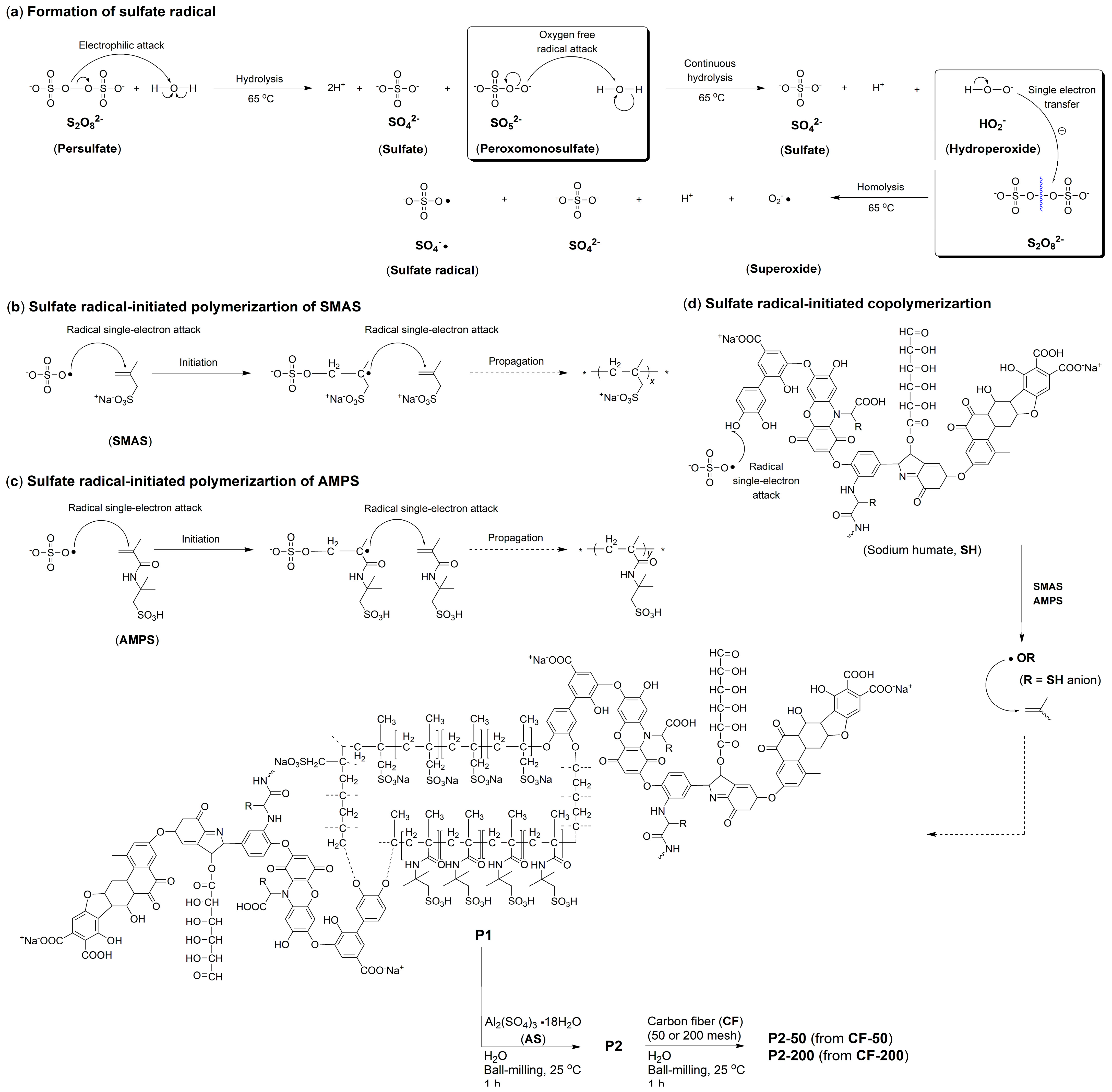
Figure 1. Synthetic process of copolymer and admixtures: (a) Formation of sulfate radical; (b) Sulfate radical-initiated polymerization of SMAS; (c) Sulfate radical-initiated polymerization of AMPS; (d) Sulfate radical-initiated copolymerization.
Buildings 15 04422 g001
Figure 2. XPS survey scans of synthesized copolymer (a), admixtures (bd), cement (e), mortars (f,g,i,k,m), and pastes (h,j,l).
Buildings 15 04422 g002
Figure 3. XPS measurements of the C 1s regions of synthesized copolymer (a), admixtures (bd), cement (e), mortars (f,g,i,k,m), and pastes (h,j,l).
Buildings 15 04422 g003
Figure 4. XPS measurements of the N 1s regions of synthesized copolymer (a), admixtures (bd), cement (e), mortars (f,g,i,k,m), and pastes (h,j,l).
Buildings 15 04422 g004
Figure 5. Wide-angle (2θ = 10–80°) XRD spectra of synthesized copolymer and admixtures (ad), cement (e), mortars (f,g,i,k,m), and pastes (h,j,l).
Buildings 15 04422 g005
Figure 6. 1H NMR (400 MHz, D2O) of P1: (a) structure of P1; (b) with integration for P1; (c) without integration for P1.
Buildings 15 04422 g006
Figure 7. FT-IR spectra of synthesized copolymer (a), admixtures (bd), pastes (e,g,i) and mortars (f,h,j).
Buildings 15 04422 g007
Figure 8. XPS measurements of the Al 2p regions of synthesized copolymer (a), admixtures (bd), cement (e), mortars (f,g,i,k,m), and pastes (h,j,l).
Buildings 15 04422 g008
Figure 9. SEM images of CF-50 (ac), CF-200 (df), P1 (g,h), P2 (i,j), P2-50 (k,l), and P2 (mp).
Buildings 15 04422 g009
Figure 10. XPS measurements of the Ca 2p regions of synthesized copolymer (a), admixtures (bd), cement (e), mortars (f,g,i,k,m), and pastes (h,j,l).
Buildings 15 04422 g010
Figure 11. XPS measurements of the Si 2p regions of synthesized copolymer (a), admixtures (bd), cement (e), mortars (f,g,i,k,m), and pastes (h,j,l).
Buildings 15 04422 g011
Figure 12. SEM images of cement (a), S-AS (b), J-P2 (cf), S-P2 (gi), J-P2-50 (jl), S-P2-50 (mp), J-P2-200 (q,r), and S-P2-200 (s,t).
Buildings 15 04422 g012
Figure 13. XPS measurements of the Na 1s regions of synthesized copolymer (a), admixtures (bd), pastes (e,g,i) and mortars (f,h,j).
Buildings 15 04422 g013
Figure 14. Thermal analysis of pastes and mortars: (A) TGA; (B) DTG; (C) DSC (exothermic direction: down).
Buildings 15 04422 g014
Table 1. Setting times of cement pastes and mechanical strengths of mortars over various admixtures (6 wt.% dosage over cement).
EntryPaste (J-Admixture-
CF Mesh)
Setting Time (ST, Min, Paste) aMortar (S-Admixture-CF Mesh)Compressive Strength (MPa, Mortar) b at:
6 h (24 h)
Flexural Strength (MPa, Mortar) b at:
6 h (24 h)
Initial (IST)FST (FST)
1J-non34.78 ± 0.3346.23 ± 0.37S-non0.8 ± 0.03 (3.4 ± 0.19)0.4 ± 0.05 (1.0 ± 0.17)
2J-AS30.89 ± 0.7936.08 ± 0.08S-AS0.8 ± 0.080.7 ± 0.10
3J-P22.62 ± 0.254.53 ± 0.07S-P21.7 ± 0.16 (4.2 ± 0.17)1.4 ± 0.05 (2.2 ± 0.17)
4J-P2-502.21 ± 0.173.93 ± 0.13S-P2-501.5 ± 0.10 (5.5 ± 0.17)1.0 ± 0.05 (2.7 ± 0.20)
5J-P2-2002.91 ± 0.023.93 ± 0.02S-P2-2001.3 ± 0.111.0 ± 0.05
a For each paste, the initial and final setting times measured three times, average value ± SD (standard deviation) reported. Student’s t-test is used to calculate the p-values for intergroup comparisons. b For each mortar, compressive strength measured six times, flexural strength three times, data format: average value ± SD (standard deviation); example of mechanical strength reports as in Figures S2 and S3, Supplementary Materials. Student’s t-test is used to calculate the p-values for intergroup comparisons.
Disclaimer/Publisher’s Note: The statements, opinions and data contained in all publications are solely those of the individual author(s) and contributor(s) and not of MDPI and/or the editor(s). MDPI and/or the editor(s) disclaim responsibility for any injury to people or property resulting from any ideas, methods, instructions or products referred to in the content.