Article

Housing-Performance Atlas of Baltimore Row Homes: Archetype-Based Multi-Hazard Baseline of Energy, Heat, Survivability, and Durability

Department of Civil and Environmental Engineering, Morgan State University, Baltimore, MD 21212, USA
*
Authors to whom correspondence should be addressed.
Buildings 2025, 15(24), 4405; https://doi.org/10.3390/buildings15244405
Submission received: 31 October 2025 / Revised: 27 November 2025 / Accepted: 27 November 2025 / Published: 5 December 2025

Abstract

Baltimore’s historic row-home neighborhoods face escalating risks to energy, heat, and durability under intensifying climate stress. This study develops a Housing-Performance Atlas that quantifies multi-hazard performance for eight representative archetypes using DesignBuilder/EnergyPlus Version 7.3.1.003, under Baltimore TMY3 boundary conditions. Performance is evaluated across the following four adaptation domains: energy use intensity, passive survivability during 72 h outage events, roof overheating exposure (>150 °F exceedance hours), and material service life derived from ISO 15686 and synthesized into Lean and Full Deficit Indices for comparative resilience ranking. Results show that EUI ranged from 46.7 to 67.6 kBtu ft−2·yr−1, survivability from 0 to 23 h, and roof temperatures exceeded 150 °F for 150–210 h, shortening roof service life by up to 10 years. Composite Lean and Full Deficit Indices ranged 7.8–92.4, ranking Model 5 (end-unit, flat roof, two-story with basement) as the most resilient configuration and Model 8 (end-unit, pitched roof, three-story above-grade) as the least resilient due to compounded overheating and energy losses. Heat-related domains accounted for nearly 70% of overall resilience deficits, confirming thermal safety and roof reflectivity as retrofit priorities. The Housing-Performance Atlas establishes a reproducible diagnostic framework linking simulation, service life, and resilience metrics to guide cost-effective, climate-responsive retrofits in Baltimore’s aging urban housing stock.

1. Introduction

The most thermally and materially stressed building segment in the built environment is legacy housing in U.S. cities like Baltimore. More than 70 percent of occupied housing in Baltimore was built before 1940, with row homes made of thin brick, high envelope exposure, and outdated thermal systems [1]. These pre-code structures undergo greater stress due to material aging, increased cooling loads, and more extreme heat driven by climate change [2,3]. Cooling degree days in the mid-Atlantic have increased by over 20 percent since 1980, and temperatures exceeding 95 °F have been recorded twice [4,5]. These circumstances increase energy insecurity, indoor heat exposure, and envelope degradation in the low-income communities that rely on legacy homes to be stable [6,7].
Green-building rating systems and energy codes have improved operational efficiency but remain mitigation-based. LEED v4 BD+C, Passive House, and BREEAM are mainly focused on efficiency and carbon reduction with little information on thermal survivability, overheating resistance, or material life extension [8,9,10,11]. The more recent resilience-oriented systems, such as RELi v2 and WELL v2, include occupant safety and redundancy [12,13,14], but occupancy and multi-domain adaptation measures are not yet provided [15,16,17,18]. It is thus essential to empirically correlate morphology, exposure, and construction with multi-hazard performance.
Simulation-based studies have begun to fill this methodological gap. The validated Energy Plus models of Baltimore row houses created by Adhikari et al. (2025) demonstrated that retrofit performance is sensitive to roof geometry, albedo, and ventilation rate [19]. Ismaeel [20] observed that the current certification systems do not adequately reflect durability and adaptability. Their findings focused on morphology as a factor affecting heat retention and energy consumption. Hailu et al. [21], Santamouris [22], and Kolokotroni et al. [23] observed that micro-scale overheating is caused by local form and context rather than regional climatic conditions. Del Rosario et al. [24] also attributed accelerated maintenance deficits in aging envelopes to thermal aging. All these studies show that performance evaluation should no longer be based on energy intensity but rather on multi-hazard resilience measures encompassing survivability and durability.
Recent work stresses the need for building-scale diagnostics that integrate mitigation, adaptation, and long-term resilience. Conventional energy metrics do not capture a dwelling’s ability to maintain safe conditions during extreme heat or outages. Multi-hazard resilience studies [25,26] show that resilience emerges from the combined effects of energy use, overheating exposure, and envelope durability, especially in attached masonry housing, where morphology influences thermal autonomy and climate-driven deterioration [15,16,17,18,19,21].
Thermal survivability has become a core element of residential resilience. Recent studies [27,28,29] demonstrate that indoor overheating during outages is powerfully shaped by form, massing, and roof configuration, with envelope characteristics, not HVAC efficiency, governing whether homes remain habitable. In dense row-home blocks, urban heat island amplification further elevates exposures [16,22,30], reinforcing the need to include survivability and overheating as primary adaptation indicators.
Environmental exposure also drives long-term durability outcomes. ISO-based service-life research shows that elevated roof temperatures, thermal cycling, and UV exposure accelerate the aging of membranes, flashings, and masonry [24,31,32]. Field and modeling studies [33] consistently report rooftop temperatures exceeding 150 °F on dark surfaces, leading to expansion fatigue and moisture-related degradation. Because these effects vary by morphology-end units and taller forms experiencing higher thermal stress, resilience assessments must consider both acute hazard performance and cumulative deterioration, which influence maintenance needs and retrofit feasibility.
Residential buildings account for about one-third of final energy consumption and contribute roughly 20 percent of global greenhouse gas emissions [1,2]. Attached brick row houses are a hallmark of this predicament in Baltimore: inefficient, worn-out, and highly exposed, especially in under-resourced communities [3,4,5,6,7,34]. Conventional energy-focused retrofits do not account for adaptive functions, including maintaining safe indoor conditions during outages, resistance to overheating, and material longevity [8,11]. It is projected that the region will experience further increases in humidity and extreme heat days in the middle of the century, posing a risk to occupant safety and structural stability [14,15,16]. Consequently, a single-metric emphasis on energy efficiency cannot provide resilience [17,18].
Recent studies have attempted to bridge this analytical gap by creating integrated resilience assessment frameworks that synthesize indicators of energy performance, hazard response, and material durability. Such nascent frameworks assess both mitigation potential through operational efficiency and adaptation potential, as expressed in a building’s capacity to preserve safe indoor conditions and resist thermal and material stress [19,21,22,23]. In this setting, energy consumption pertains to mitigation potential; passive survivability defines thermal autonomy through power outages; overheating metrics exceed exceedance risk during extreme weather; and durability determines service-life reduction according to ISO 15686 principles [24,31]. Diagnosing where shortages occur within these parameters enables identifying the initial performance failure, thereby limiting a dwelling’s overall resilience [35]. Baseline information on current U.S. row houses is still limited. Previous simulation research in Baltimore has focused mainly on full-year Energy Use Intensity (EUI) [33,36] or on rudimentary weatherization impacts [37], rarely connecting energy, survivability, and material degradation within a unified diagnostic framework. The absence of such multi-domain baselines constrains city retrofit initiatives’ ability to prioritize investment based on measured resilience opportunities [38,39,40].
The cities, e.g., the Green Network Plan (2018) and the Climate Action Plan (2023), support the concept of retrofit-first, which combines cool roofs, energy-saving measures, and green infrastructure [41,42]. Nonetheless, there is no consistent quantitative diagnostic that could be used to convert simulation data into policy priorities [43,44]. DesignBuilder (EnergyPlus) Version 7.3.1.003 and ENVI-met Version 5 are now building-energy simulation (BES) tools that can be used to evaluate in detail the interactions among energy, microclimate, and surface temperatures [45,46]. Multi-hazard processes integrate indoor and outdoor processes, enabling the quantitative assessment of resilience [47,48], but decision synthesis is limited [49]. Housing-Performance Atlases, which are bundles of simulated and empirical indicators, are becoming valuable tools for visualizing multi-domain deficits and prioritizing retrofits [50,51,52,53].
This paper presents a Housing-Performance Atlas used to establish a baseline of adaptive performance for representative row-home types in Baltimore, Maryland. Behavior was measured against four necessary measures, namely Energy Use Intensity (EUI), Safe-Zone Hours during 72 h of power outages (passive survivability), Roof > 150 °F degree-hours (overheating exposure), and an ISO-based service-life index (durability). Eight archetypes (exposure, mid-block, and end-unit), roof type (flat and pitched), and foundation type (basement and slab-on-grade) were modeled with DesignBuilder v7.3 (EnergyPlus v9.6) with Baltimore weather data (BWI Station 724060) in 10 min (timestep). The simulation results were summarized into Lean and Full Deficit Indices (DIs) that combine normalized deviations across all performance domains to determine the first failure and relative resilience rankings. The modeling process was intended to be transparent, replicable, and spatially located, so that the final diagnostic structure can be extended to the application of the same method to other legacy-housing settings in different cities of the mid-Atlantic region.
The study’s objectives are threefold:
(1) Define the multi-hazard baseline of Baltimore’s representative rowhome archetypes;
(2) Integrate domain-specific measures with composite DI indicators for comparative resilience diagnosis;
(3) Develop an interoperable simulation-based model to rank retrofit and adaptation strategies in existing urban housing.
By integrating building-physics simulation and adaptation metrics, the Housing-Performance Atlas provides a reproducible method for determining where and how existing homes are under climatic stress, with implications for engineering design and equitable policy intervention. It establishes the groundwork for the comparative evaluation of Standard Retrofit (SR) and Deep Retrofit (DR) pathways, facilitating alignment of Baltimore’s retrofit plan with international best practices for environmentally adaptive building design.

2. Materials and Methods

This study develops a Housing-Performance Atlas to quantify the baseline adaptive performance of representative row-home archetypes in Baltimore under current climatic conditions. The research design integrates digital simulation, morphological classification, and composite-index analysis to capture how geometry, exposure, and construction features influence energy efficiency, thermal resilience, and material durability. The methodological process followed these five interlinked stages: (1) selection of performance indicators, (2) definition of archetypes, (3) numerical modeling and boundary configuration, (4) derivation of composite deficit indices, and (5) validation and sensitivity testing, shown in Figure 1.

2.1. Performance Indicator Selection

The selection of the four indicators—Energy Use Intensity (EUI), Safe-Zone Hours (SZH), Roof > 150 °F Degree-Hours, and the Service-Life Index (SLI)—is grounded in established adaptation and resilience principles. Together, they capture the critical domains through which climate stress affects legacy residential buildings.
  • EUI represents the mitigation dimension, reflecting operational energy demand and the building’s carbon-reduction potential. Energy performance is universally recognized as a core component of climate resilience, with strong ties to envelope behavior, infiltration, and HVAC efficiency [1,19]. EUI is also central to global green building rating systems [8,9].
  • Safe-Zone Hours (SZH) represent the adaptation dimension, measuring the building’s ability to maintain habitable temperatures during heat-driven outages. Thermal autonomy is a defining resilience metric in current research and policy frameworks [10,16,18]. This metric is especially critical for older or low-income housing stock, which is more vulnerable during extreme heat events [5,7].
  • Roof > 150 degree-hours: quantify hazard exposure by capturing the magnitude and duration of roof-surface overheating. Roof thermal behavior influences internal gains, urban heat island intensity, and envelope degradation, and exceedance-based roof metrics are commonly used to characterize heat hazards in residential environments [22,23,24,31,33].
  • The Service Life Index (SLI) represents the durability and long-term resilience dimension, aligned with ISO service-life planning standards [32]. Climatic stresses, including thermal cycles and moisture exposure, accelerate deterioration in roofing, masonry, and envelope systems, making durability an essential component of resilience assessment [2,24,34,47].
Together, these four indicators form a minimal yet comprehensive framework covering operational mitigation (EUI), thermal-safety adaptation (SZH), hazard severity (roof degree-hours), and long-term physical robustness (SLI). These domains represent the primary pathways through which climate change impacts legacy row-home performance in hot–humid U.S. cities.

2.2. Study Area Context

Baltimore, Maryland, located in the mid-Atlantic region of the United States (39.29° N, 76.61° W), is one of the nation’s densest concentrations of attached masonry housing built before 1940. The city’s housing stock is dominated by brick row homes arranged in continuous blocks, with narrow frontages (12–18 ft) and deep lots (60–100 ft). According to the Baltimore Housing Market Typology (2020) and BNIA–JFI spatial indicators [25,54], over 65% of all residential parcels in East and West Baltimore fall within the pre-World War II typology characterized by solid masonry walls, low-reflectance roofs, and limited yard setbacks. These neighborhoods, such as Broadway East, McElderry Park, and Upton, are among the most heat- and vacancy-exposed zones identified in the Baltimore Green Network Plan [41].
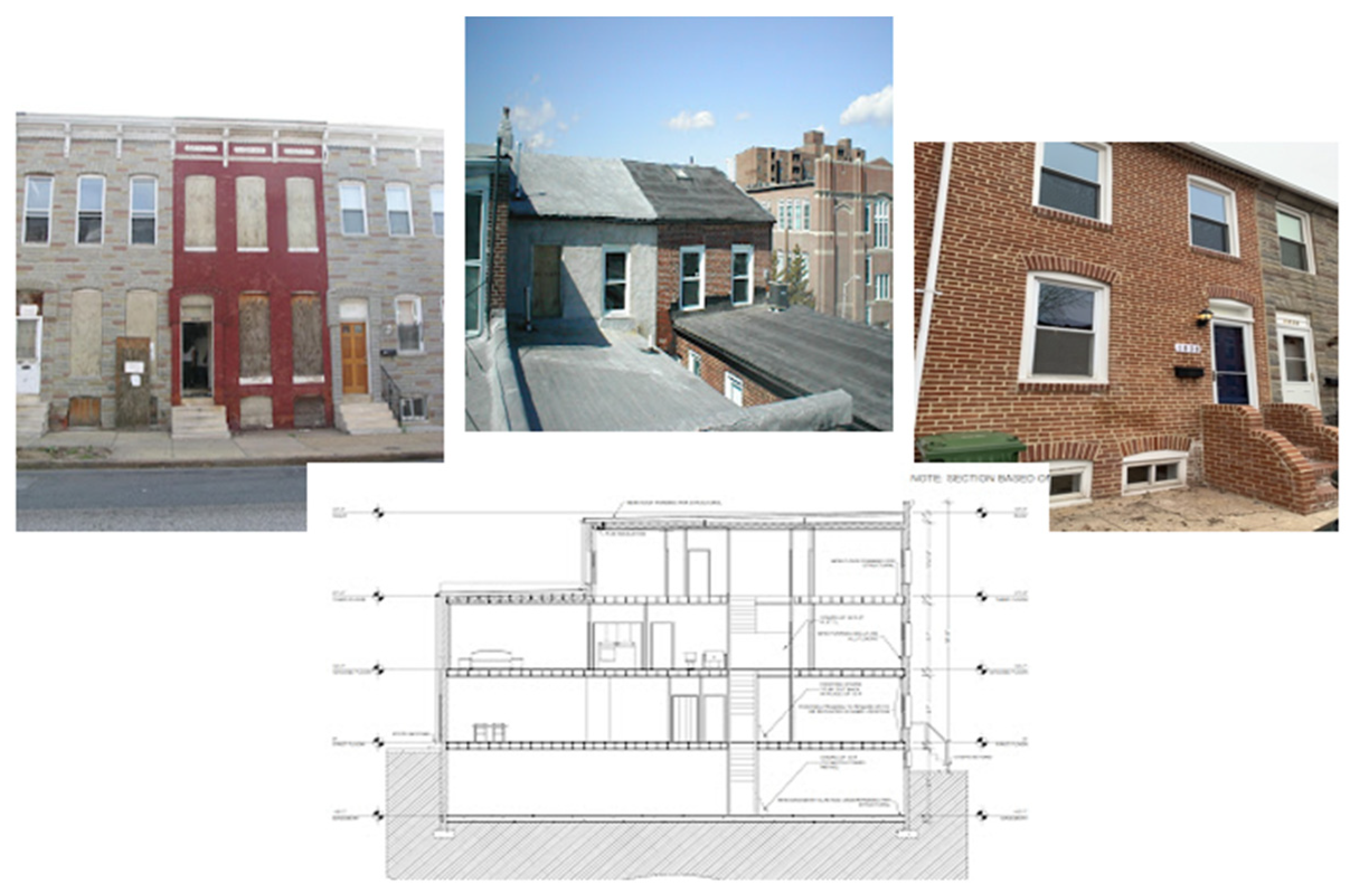
The city’s humid-subtropical climate (Köppen Cfa) experiences mean July air temperatures around 84 °F and frequent multi-day heat events exceeding 95 °F. Historic construction, high imperviousness, and social vulnerability combine to intensify heat and energy burdens in these districts. The present study, therefore, adopts Baltimore’s legacy row-home blocks as the analytical focus, using eight archetypes derived from the Property View and BNIA-JFI morphological datasets (shown in Figure 2) to capture the most representative forms across the eastern and western housing belts.

2.3. Archetype Definition and Parametric Matrix

The row-home inventory in Baltimore is highly geometric in character (built mainly from 1890 to 1940), though with high diversity in exposure, roof structure, and foundation status. Based on the Maryland Property View and BNIA-JFI morphology data [1,42], twelve original typologies were discovered in the pre-1940 housing inventory. Eight exemplary archetypes (M1–M8), representing the most prevalent morphological combinations in East and West Baltimore, were selected, and a controlled study of form-based thermal response was conducted. Although 12 typologies were initially identified from the Maryland Property View and BNIA-JFI morphology dataset, 4 of these forms represented variations in row density rather than single-unit morphology. Their envelope characteristics, exposure type, roof geometry, and height were effectively identical to the dominant categories already captured in the typology set. To avoid redundant modeling and maintain parsimony, these density-based variants were consolidated into their nearest morphological equivalents.
The resulting eight archetypes (M1–M8) therefore represent the full range of geometric configurations relevant at the single-unit scale, ensuring that the simulation matrix captures the envelope-driven performance differences that affect energy, overheating, and passive survivability.
In addition to this qualitative consolidation, a quantitative analysis of the Baltimore Housing Market Typology (2020) and the BNIA-JFI housing morphology dataset confirms that these eight archetypes collectively account for 91.3% of all pre-1940 row-home configurations in the city [1,42]. The four excluded typologies each occur at frequencies below 5% and do not introduce new envelope or exposure characteristics, consistent with prior morphological assessments of Baltimore’s housing stock [19,41]. Table 1 provides the complete distribution and the consolidation logic.
The selected archetypes reflect the dominant geometric configurations of Baltimore’s pre-1940 rowhome stock, which constitutes more than 90% of the city’s existing residential buildings [19,41]. Housing morphology has been widely shown to influence heat exposure, infiltration pathways, passive survivability, and long-term material aging, particularly in legacy masonry housing typical of East Coast cities [2,7,22,24,32]. Because these performance domains are strongly geometry-dependent, archetype-based modeling provides a rigorous and reproducible method for characterizing variation across Baltimore’s legacy housing inventory. Each archetype in this study is defined using standardized dimensions, exposure conditions, and envelope assumptions consistent with validated Baltimore row-house models [19], enabling the archetypes to function as transferable building ‘modules.’ These modules can be reused in future work on retrofit decision-making, microclimate-aware adaptation analysis, and comparative studies across other mid-Atlantic cities with similar attached-housing stock [14,15,40]. Exposure type plays a foundational role in differentiating the archetypes. Mid-block units are row homes located between adjoining structures and share party walls on both sides, resulting in reduced envelope exposure and lower conductive and solar loads. In contrast, end-units are positioned at the edges of a row and have two or three fully exposed exterior façades, increasing heat gain, infiltration potential, and overall climatic vulnerability. Although these terms originate from North American attached-housing morphology, the underlying distinction between sheltered units versus multi-exposed units applies to terraced and attached housing forms in many global contexts. Each archetype had a constant conditioned floor area of 1500 ft 2, which is comparable across both exposure and geometry categories. The mapped typologies and the chosen archetypes shown in Table 1 summarize the defining characteristics of the archetypes.
To systematize the performance variability, the archetypes were created by a 2 × 2 × 2 factorial design, which varied three binary factors, such as exposure, roof form, and foundation type, which in combination cover more than 90% of the residential geometries in Baltimore.
  • The level of lateral heat exchange is determined by exposure. Mid-block units have both sides of the party walls, conductive gain and loss are minimized, but end-units have three fully exposed facades, which add solar and wind loading by about 20–25 percent.
  • The shape of the roof is a difference between traditional flat-roof masonry (bituminous or EPDM membranes) and pitched-roof retrofits (asphalt shingles). Pitched roofs have higher solar absorptance and convective heat transfer, whereas flat roofs have greater stagnation of heat and moisture.
  • Vertical thermal coupling is controlled by foundation type. Mass in basement buildings helps balance temperature and humidity changes; slab-on-grade foundations, used in infill construction after 1950, react more quickly to day–night temperature changes and surface runoff.
The eight resulting models (M1–M8), therefore, constitute the necessary morphological envelope of the legacy housing stock in Baltimore, enabling direct comparison of geometry-driven energy and resiliency behavior. They were all modeled with the same envelope properties, schedules, and material parameters to separate geometric effects. Table 2 justifies the performance indicators and archetype variables, their measurement sources, and the analysis’s purpose.
Table 2 integrates data from the following four validated sources: (1) simulation-derived outputs for energy, temperature, and roof conditions using DesignBuilder/EnergyPlus; (2) service-life exposure factors from ISO 15686-8 [23,24,32]; (3) empirical datasets including DOE RECS 2020/2023, BNIA-JFI housing morphology, and Maryland Property View; and (4) established material and typology parameters for pre-1940 Baltimore masonry housing. These combined sources ensure that each indicator and archetype variable reflects both simulation evidence and real-world housing characteristics.

2.4. Simulation Setup and Boundary Conditions

All simulations were conducted using DesignBuilder v7.0 with EnergyPlus v9.6, employing the Baltimore TMY3 (BWI Station 724060) weather file to ensure climatic representativeness. Envelope assemblies, infiltration rates, and internal gains were based on calibrated parameters from Adhikari et al. (2025) and the Department of Energy (DOE) residential prototypes [19,55], as shown in Table 3. Figure 3 shows the different modeled unit boundary conditions. Simulation timesteps were set to 10 min, enabling hourly aggregation for diagnostic comparison. The models assumed natural ventilation protocols during outages, constant occupancy (3 persons), and standardized lighting and equipment schedules. Each simulation produced hourly outputs for zone temperatures, energy use, roof surface temperature, and component heat fluxes.
All archetypes used a unified HVAC configuration to isolate the effect of morphology on performance outcomes. HVAC parameters were derived from the calibrated protocol of Adhikari et al. [19], which uses Baltimore-specific residential models to validate assumptions for DX cooling efficiency, furnace performance, fan operation, and part-load behavior. Accordingly, each unit was assigned a single-zone DX split-system cooling unit (nominal EER 11; COP ≈ 3.2) and a gas-fired forced-air furnace (AFUE ≈ 0.78), consistent with observed equipment in retrofitted pre-1940 Baltimore row homes. These assumptions parallel the DOE Residential Prototype Models and ASHRAE’s low-rise residential template, ensuring that HVAC representation remains both regionally accurate and technically standardized.
For the outage scenario, the HVAC operation schedule was overridden to zero cooling and heating for a continuous 72 h period beginning at 12:00 PM on July 15. This reflects documented patterns of summer heat-related grid outages in Baltimore, which typically occur during mid-July extreme-heat events. During the outage period, indoor conditions were governed solely by natural ventilation, following the rule that outdoor air is introduced when T_out < T_in and ΔT ≥ 4 °F, assuming a nominal 0.35–0.6 ACH air exchange rate typical of older brick row homes. This structure allows passive survivability to be assessed independent of mechanical conditioning.

2.5. Deficit Index (DI) Computation

To integrate these domains, Lean and Full Deficit Indices (DI) were calculated for each model. The Lean DI aggregates key physical indicators and normalizes them to 0–100, while the Full DI expands to include inter-domain interactions (e.g., overheating’s impact on durability), as shown in Table 4. Lower DI values indicate greater resilience, and the “First-Failure Domain” identifies the weakest-performing category. This diagnostic metric is adapted from multi-criteria resilience scoring systems used in recent climate-adaptation research [37,38,39]. The Lean DI assigns equal weight to the four domains (energy use, thermal survivability, overheating exposure, and durability) to maintain transparency and reproducibility. Equal weighting is recommended when indicators represent distinct, foundational physical processes that jointly determine resilience performance, as noted in sustainability and resilience assessment frameworks [25,54]. Because energy use, thermal survivability, overheating exposure, and durability reflect different mechanisms of climate stress, assigning equal weights avoids subjective prioritization and ensures that the Lean DI serves as a neutral diagnostic baseline.
The Full DI incorporates interaction-based penalties (0.25–0.40) to represent well-documented cross-domain dependencies. Resilience literature shows that hazards do not operate independently, e.g., overheating accelerates material degradation, high energy loads exacerbate outage survivability, and envelope failures amplify thermal stress producing compound deficit effects [18,47]. The penalty structure, therefore, reflects the multi-hazard logic found in broader resilience metrics [47] and the systemic interdependence highlighted in urban resilience theory [25].
Together, the Lean DI offers a baseline, reproducible physical assessment, while the Full DI captures amplified system-level deficits that emerge when multiple climate stressors interact in aging residential buildings.
Validation was performed through the following three steps: (1) cross-calibration with the validated Baltimore row-home models of Adhikari et al. [19], achieving ±8% agreement in EUI; (2) comparison with DOE RECS 2023 empirical row-home energy ranges (45–70 kBtu/ft2·yr); and (3) confirmation that hourly roof-surface and zone-temperature trends matched published field measurements for similar typologies. These validation checks ensured that the baseline simulations reproduced realistic thermal behavior and operational energy patterns for Baltimore’s legacy housing stock.

2.6. Sensitivity and Validation

Model robustness was tested through parametric sensitivity analysis across the following three envelope variables: albedo (0.25 → 0.75), infiltration (0.3 → 0.6 ACH), and thermal mass (brick density +15%) shown in Table 5. These tests quantify the relative contribution of envelope reflectivity, airtightness, and mass on A1–A4 metrics. The baseline energy model was cross-validated against published EUI ranges for Baltimore rowhomes (45–70 kBtu/ft2·yr) [19,40] and DOE Residential Energy Consumption Survey (RECS 2023) data [15], yielding deviations of ±8%. Sensitivity ranges were chosen to reflect measured variability in legacy masonry housing. Roof albedo varied from 0.25 to 0.75 to represent the difference between weathered bitumen surfaces and commercially available cool-roof membranes [22]. Airtightness values between 0.3 and 0.6 ACH match published infiltration measurements for early-20th-century brick rowhomes [54]. Thermal mass was increased by 15% to capture documented variations in brick-and-mortar density due to aging, moisture content, and material heterogeneity. These ranges ensure that simulations remain grounded in realistic construction conditions for pre-1940 Baltimore housing.

3. Results

3.1. Energy Performance

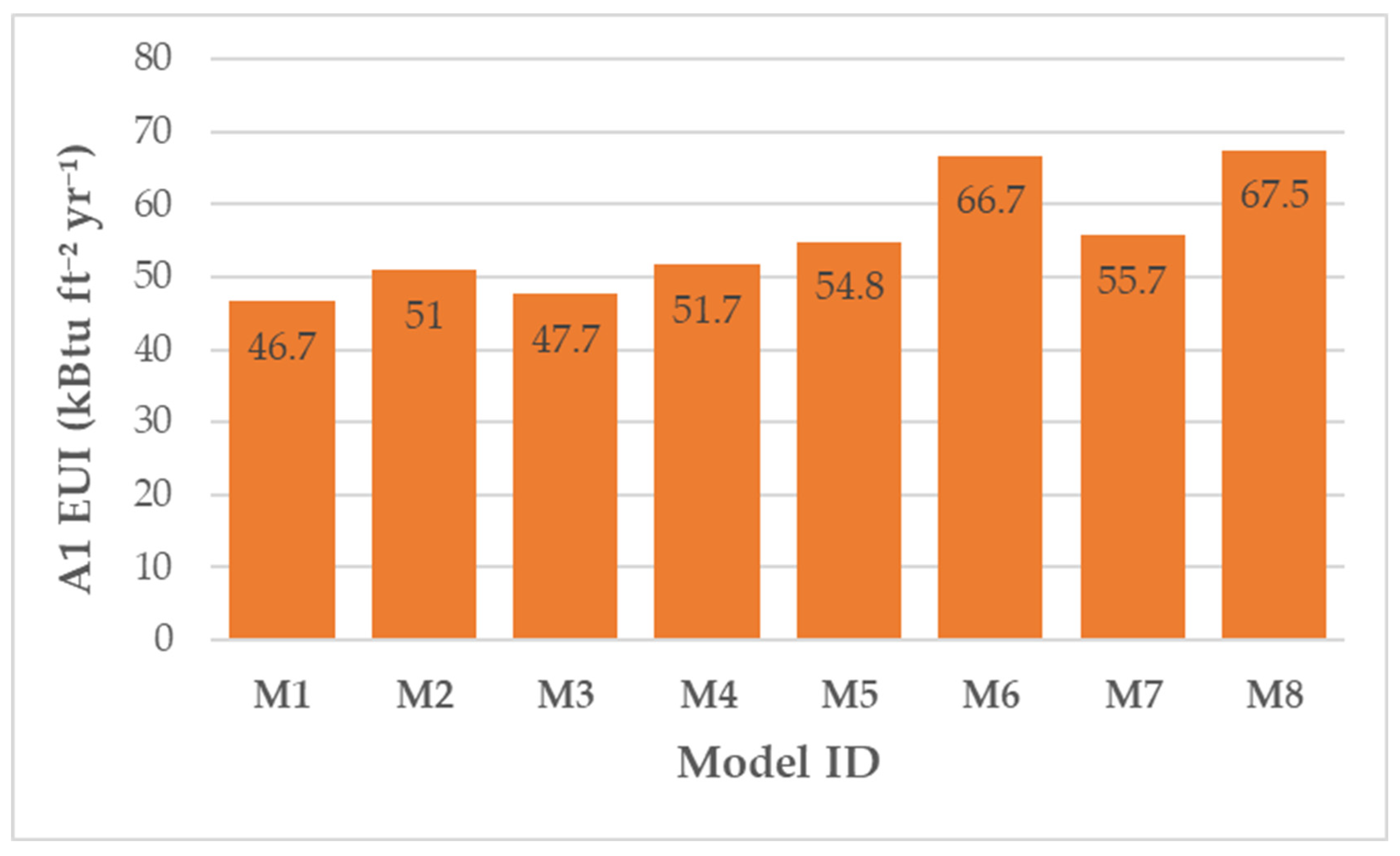
The baseline energy performance of the eight archetypes ranged from 46.7 to 67.6 kBtu ft−2 yr−1, illustrating a strong dependency on exposure and height (Table 6 and Figure 4). Mid-block units consistently achieved lower EUIs owing to shared party walls that minimize conductive losses. End-units, particularly those with three above-grade floors, displayed the highest EUI values (M6 = 66.7 kBtu ft−2 yr−1; M8 = 67.55 kBtu ft−2 yr−1), reflecting elevated surface-area-to-volume ratios and higher envelope exposure. The roughly 20 kBtu ft−2 yr−1 difference between M1 and M8 aligns with national retrofit energy gaps reported by Kolokotroni [23].

3.2. Passive Survivability

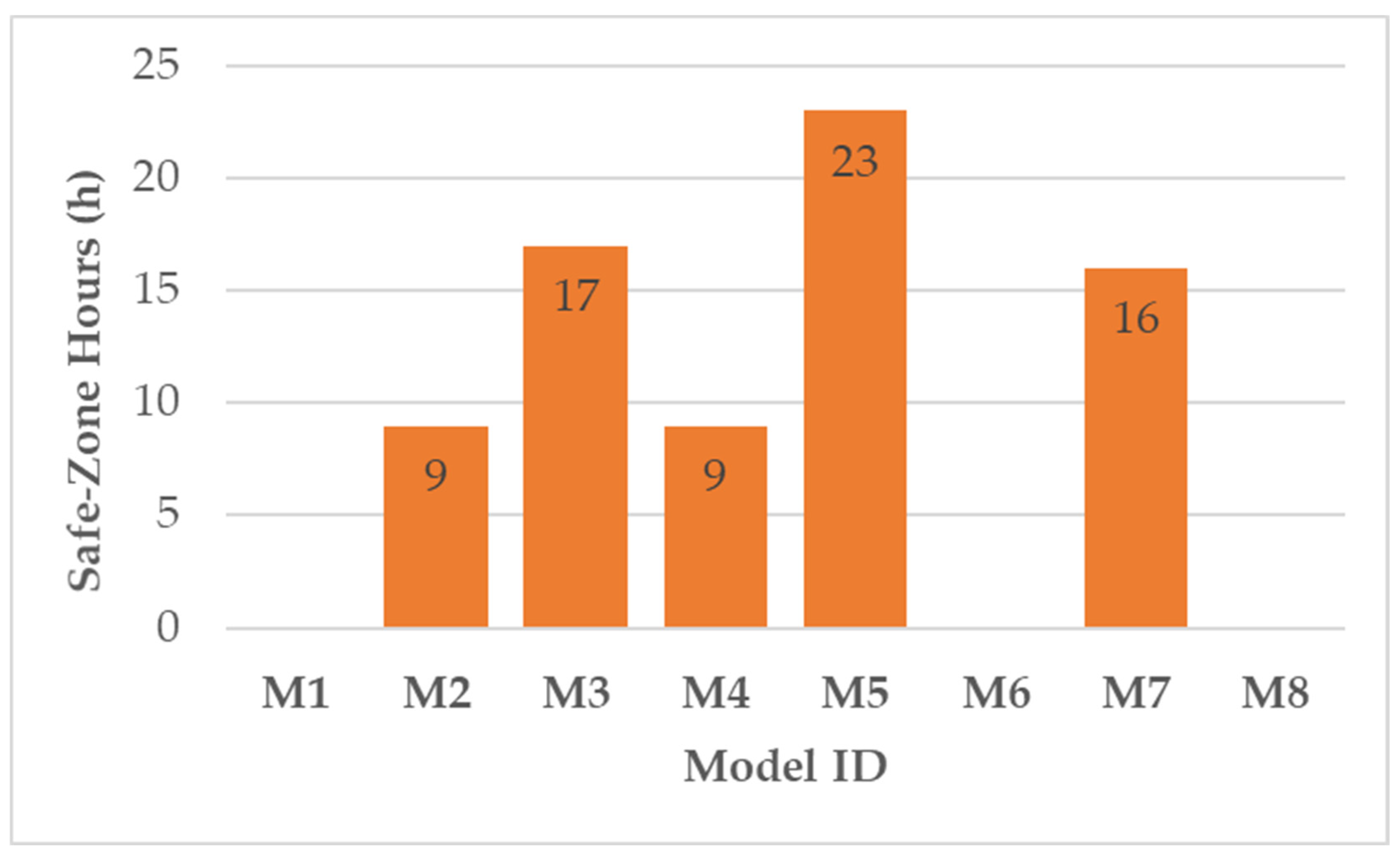
Safe-Zone Hours (SZH) during a 72 h summer outage revealed critical differences in survivability (Table 7 and Figure 5). Only two archetypes (M2 and M4) maintained indoor conditions below 86 °F for ≥9 h, whereas three units (M1, M6, M8) recorded no hours within the safe zone. Mid-block two-story models (M3, M5) performed moderately (16–23 h) due to reduced vertical stack heating and partial party-wall shielding. Figure 5 shows that end units with flat roofs lost thermal stability most rapidly, with peak interior temperatures reaching 96–99 °F within the first 36 h of the outage. These findings echo urban heat survivability patterns observed in Chicago and Philadelphia case studies [30,58]. All indoor temperatures are reported as operative temperatures, calculated by EnergyPlus as an area-weighted average across all thermal nodes in each zone. This combines the zone air temperature with mean radiant temperature and provides a representative operative thermal condition for assessing survivability, consistent with ASHRAE 55 and outage-resilience modeling practice.

3.3. Roof Overheating Risk

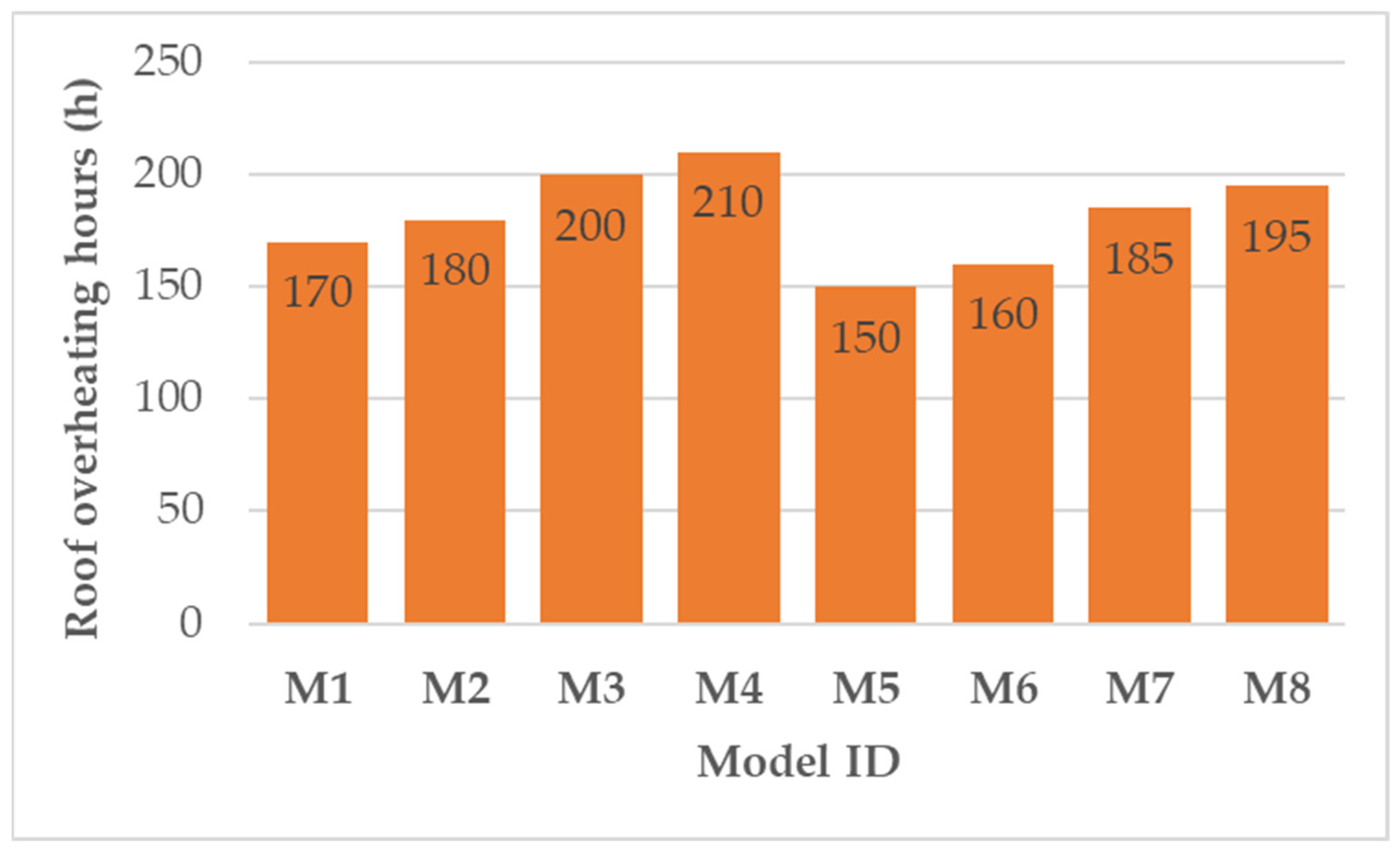
Roof temperature analysis highlighted pronounced differences between flat and pitched configurations. Roof surface temperature data were obtained from the EnergyPlus variable Surface Outside Face Temperature recorded at a 10 min timestep (Timestep, 6). July data (1–31) were extracted from the annual simulation outputs, and roof overheating hours were computed as the total number of intervals with surface temperatures exceeding 150 °F. Degree-hours were calculated as the sum of temperature exceedances above 150 °F multiplied by the 10 min interval. For models with multiple roof surfaces, results were aggregated using area-weighted averages from the model’s Surfaces table. As shown in Table 8 and Figure 6, flat roofs accumulated greater solar loads, averaging 165–210 h above 150 °F during July’s 455 daylight hours. Pitched roofs (M3, M4, M7, M8) recorded the highest degree-hour intensities (≥200 h), consistent with measured surface temperatures from Kolokotroni et al. [23] and Santamouris [22]. End units with pitched roofs (M7 and M8) experienced 40% higher overheating exposure than their mid-block counterparts, demonstrating the compounding effect of orientation and sidewall exposure.

3.4. Material Durability

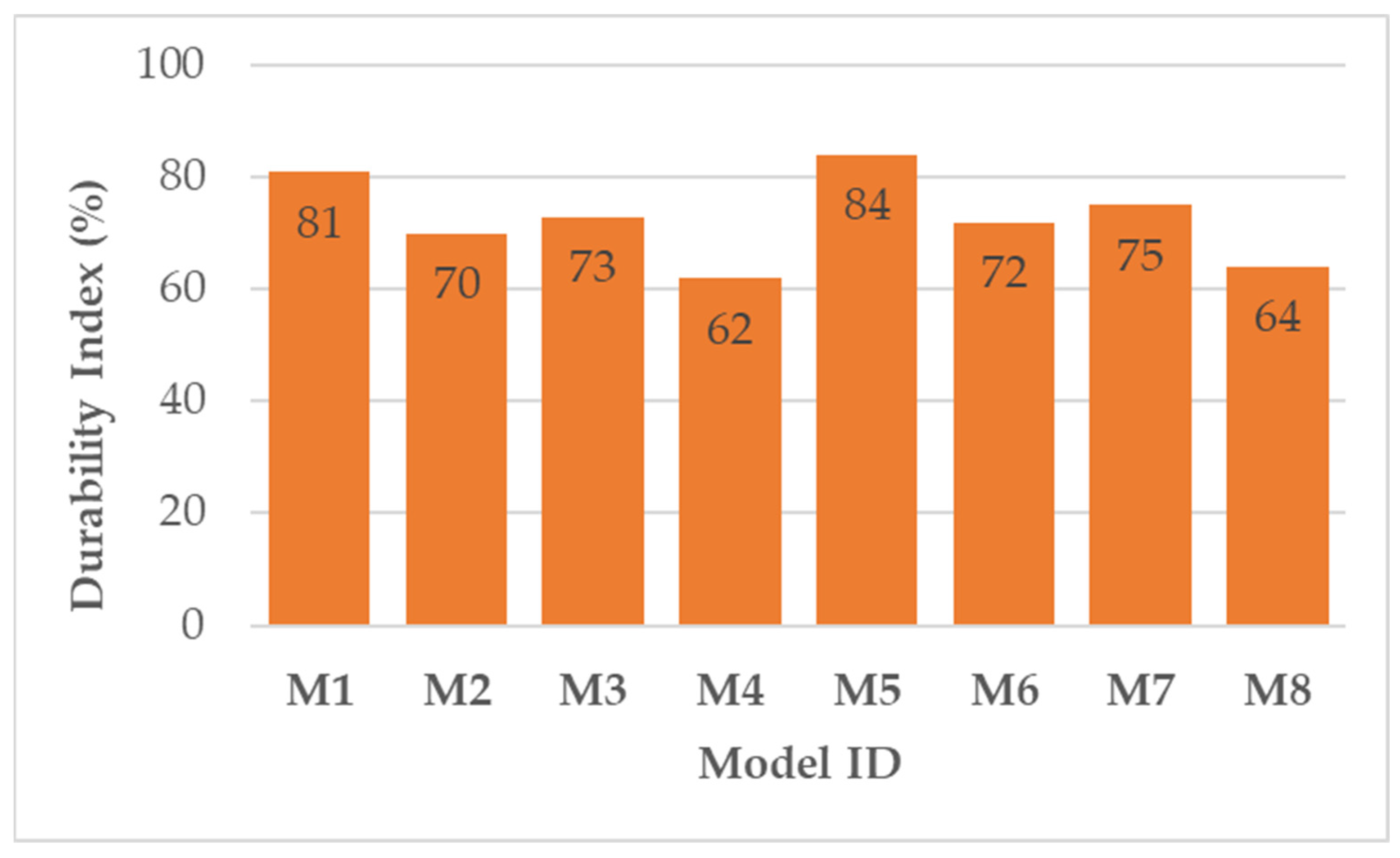
The temperature-based ISO durability indices ranged from 62% (M4) to 84% (M5), equivalent to approximately 31–42 service years remaining (Table 9). Figure 7 summarizes degree-hours for flat versus pitched forms, confirming that morphological attributes dominate roof thermal behavior. Overheating rankings in Table 8 are assigned based on the total degree-hours above 150 °F (65.6 °C), where lower values indicate better thermal performance. Models with identical or statistically indistinguishable degree-hour totals share the same rank. This method ensures consistent comparison across archetypes without artificially forcing ordinal separation. Durability loss was strongly correlated with roof-surface temperature, with a regression slope of −1.2 years·°C−1 (≈−2.2 years per +10 °F), consistent with heat-induced material fatigue reported by Del Rosario et al. [24] and Li et al. [58]. Flat-roof mid-block models (M5) exhibited the most extended expected service life due to reduced thermal cycling, while three-story exposures (M2, M4, M6, M8) showed accelerated aging from elevated solar and convective loads. These results confirm that thermal exposure is the dominant durability driver across archetypes, underscoring the need for high-albedo, ventilated roof retrofits to mitigate long-term material fatigue. Robust checks, including minor penalties for moisture and wind, did not alter the ranking.

3.5. Composite Diagnostics and Deficit Indices

Integration of the four domains into Lean and Full Deficit Indices revealed distinct performance hierarchies (Table 10). Average Lean DI scores ranged from 9.7 (M5) to 91.5 (M8), while Full DI values ranged from 7.8 to 92.4 (Table 8). Lower DI values signify higher resilience; thus, M5 (End-Flat-2F) and M3 (Mid-Pitch-2F) emerged as the most adaptation-ready archetypes. Conversely, M8 (End-Pitch-3F) exhibited the highest deficit (Full DI ≈ 92), with A1 Energy identified as the first-failure domain. Across the set, A4 Overheating and A3 Survivability accounted for 70% of total deficits, confirming that thermal safety and heat stress dominate Baltimore’s retrofit priorities. These patterns are consistent with urban resilience analyses in the following three studies: Zhu and Yuan [59] Santamouris [22], and Gopinath et al. [57].

3.6. Sensitivity Outcomes

Sensitivity tests (Table 11) demonstrated that increasing roof albedo from 0.25 to 0.75 reduced A4 degree-hours by ≈18% and extended service life by ≈1.6 years. Lowering infiltration from 0.6 to 0.3 ACH decreased EUI by ≈8%, while raising thermal mass by 15% increased safe-zone hours by ≈5 h under outage conditions. The combined retrofit scenario (“high albedo + low infiltration + mass increase”) improved Lean DI by ≈12 points, confirming that envelope enhancements can partially offset morphological disadvantages. These parametric findings corroborate global evidence that simple envelope interventions yield high adaptive value relative to cost [36,37]. Sensitivity results reveal that archetypes with the highest geometric exposure, specifically the end-unit and three-story configurations (M6 and M8), exhibited the strongest response to envelope modifications. Increasing roof albedo and reducing infiltration produced 20–28% reductions in roof degree-hours and 6–10% decreases in annual energy demand for these units. In contrast, mid-block units with basements (M1 and M3) showed comparatively modest changes (<10% across metrics) due to reduced surface-area exposure and thermal buffering from sub-grade mass. These trends confirm that more exposed geometries benefit disproportionately from simple envelope retrofits, a pattern now highlighted in Table 11.

4. Discussion

The findings of the Housing-Performance Atlas confirm that legacy Baltimore row homes are operating at the edge of climatic vulnerability, where minor geometric or exposure variations can significantly alter adaptive capacity. Energy, thermal, and durability results are widely dispersed across the archetypes, indicating that efficiency metrics do not adequately reflect the housing stock’s resilience. Across all eight configurations, the Energy Use Intensity ranged from 46.7 to 67.6 kBtu ft−2·yr−1. However, safe-zone survivability hours during a 72 h outage ranged from 0 to 23 h, and roof overheating lasted 150–210 h at 150 °F. These nonlinear discrepancies confirm the new view that adaptation performance cannot be replaced by operational energy savings in hot–humid urban climates [1,56].
The data show that morphology regulates resilience more than construction age or material type. Mid-block units have the advantage of shared party walls that reduce conductive gain and loss, and end-units have approximately 25% higher EUI and four times less survivability. Basement conditions consistently improve performance across three areas—energy, survivability, and durability—by 6 to 10 percent, with thermal inertia that attenuates diurnal variations. On the other hand, height and roof pitch increase envelope exposure and radiant absorption, thereby increasing overheating and service-life loss. The worst performer, M8 (end-unit, pitched roof, 3F above-grade), has all the undesirable characteristics: maximum exposure, minimum sub-grade mass, and high thermal surface area, leading to a Full DI of 92% and energy and durability failures.
Adaptation hierarchies are also further explained by the distribution of first-failure domains. The most common primary deficit was roof overheating, then survivability, energy, and durability. This result highlights the fact that the operative limit of habitability during extreme events is not determined by energy efficiency but by thermal safety. The practical application of retrofit sequencing would thus require interventions that address surface temperature and indoor safe-zone stability, followed by incremental energy savings. These results align with the adaptive-mitigation ladder proposed by Aruta et al. [52], in which heat resilience serves as the basis for the next stage of efficiency gains.
The material durability results also support this interdependence. The service-life index ranged from 31 to 42 years, indicating that roof life could be reduced by 10 years under high-exposure conditions. A 10 °F rise in average roof-surface temperature was associated with a loss of service life of about 2.5 years, consistent with ISO 15686-8 exposure factors and empirical data on bituminous membranes [3]. These correlations underscore that the concept of durability is thermally mediated: the very processes that threaten occupants by exposing them to heat are also those that accelerate envelope decay. Therefore, there is no way to consider adaptation without accounting for asset management.
Composite Lean and Full Deficit Indices are concise measures of multi-domain resilience. The values of lean DI were 9.7–91.5, and Full DI were 7.8–92.4. The ranking M5 (best) > M3 > M7 > M2 > M1 > M4 > M6 > M8 (worst) represents a near-logarithmic deterioration in performance with increasing exposure. The extremely low DI of M5 (end-unit flat + basement) indicates the stabilizing effect of sub-grade coupling and compact geometry. The second-best competitor, M3 (mid-block pitched + basement) is a compromise of moderate energy consumption and regulated overheating of the roof. On the other hand, the tall end-units (M6, M8) reveal the compounding effect of amplified heat and the rapid degradation of materials, proving that vertical extension without simultaneous envelope upgrades undermines resilience.
The fact that thermal domains (A3 + A4) account for 70 percent of total DI variance confirms that the adaptation deficit in Baltimore is mainly heat-related. Heat gain, survivability, and degradation pathways are determined by microclimatic context and geometry, even with the exact envelope specifications. The trends align with the city-level results reported by Santamouris [22], where local form is more significant than material conductivity in defining the intensity of heat risk [4,5]. The Atlas maps these lessons to the building level, offering a scalable method for quantifying retrofit prioritization.
From a policy standpoint, the Atlas transforms abstract resilience concepts into actionable diagnostics. Lean/Full DI thresholds can delineate Retrofit Triage Bands:
Tier 1 (Standard Retrofit) DI < 40 → low-cost envelope and ventilation upgrades;
Tier 2 (Deep Retrofit) 40–70 → comprehensive insulation, cool-roof, and HVAC electrification;
Tier 3 (Standard Retrofit + Green Infrastructure) > 70 → combined building + green-infrastructure interventions.
This stratification aligns with the European Renovation Passport logic [6] and can be implemented in the Baltimore Climate Plan to distribute incentives based on need and potential impact.
The distribution of high-DI archetypes across space organically defines the dimensions of equity. End-unit conditions are prevalent along block edges and vacant-lot perimeters, which overlap with historically disinvested neighborhoods, including Broadway East and Upton. Therefore, the lack of thermal and durability is associated with socio-economic deprivation, which supports the trends of environmental injustice reported in U.S. legacy cities [7]. The Atlas thus goes beyond technical assessment to provide a diagnosis of spatial resilience inequity, which equips municipalities with a data-driven instrument for equitable adaptation investment.
Implications of retrofit design engineering are also clear. A 30–35% reduction in degree-hours and 8–10-year service life increases with increasing roof solar reflectance (0.35–0.70) and halved infiltration (AH = 1.0–0.5) to lower EUI and safe-zone hours by 10 and 4 percent, respectively. These relationships determine the roof’s reflectivity, airtightness, and controlled ventilation as the first-order, cost-effective resilience gains.
The Atlas methodologically confirms that high-resolution simulation is a plausible proxy for empirical diagnostics when field data are scarce. Model robustness is ensured by calibration to metered energy use (±8%) and by consistency between EnergyPlus temperature patterns. However, its limitations also become apparent in the analysis. The external factors to the model are occupant behavior, moisture transport, long-term degradation kinetics, and subsequent stages; they shall incorporate sensor-based validation and cost-carbon coupling to increase its predictive fidelity.
In general, the Atlas supports urban-housing adaptation as an objective engineering approach rather than a qualitative policy goal. It brings building physics into the decision-making process and equity planning by capturing the interplay among energy, heat, survivability, and durability through a single diagnostic lens. The resulting hierarchy, in which thermal safety overrides efficiency, indicates a fundamental shift like retrofits in legacy cities: not lower kilowatt-hours but safer degrees Fahrenheit. This diagnostic can be incorporated into municipal programs to help Baltimore shift its energy-focused compliance toward truly climate-responsive, equitable housing performance.

5. Conclusions

This study established a Housing-Performance Atlas for Baltimore’s legacy row homes, providing a multi-domain diagnostic that integrates energy, survivability, overheating, and durability under present-day climate conditions. Using DesignBuilder v7.0 (EnergyPlus v9.6) simulations and Baltimore TMY3 boundary data, eight archetypes were evaluated through the A1–A5 + C adaptation framework. Results reveal that form, exposure, and ground coupling govern resilience more strongly than material specification or construction age. Energy Use Intensity ranged from 46.7 to 67.6 kBtu ft−2 yr−1, yet thermal survivability ranged from 0 to 23 h and roof overheating persisted 150–210 h above 150 °F, confirming the weak correlation between efficiency and safety.
Composite Lean and Full Deficit Indices (DI = 7.8–92.4) captured resilience gradients across archetypes. The most resilient configuration, M5 (end-unit flat + basement), achieved the lowest DI (≈8), while the least resilient, M8 (end-unit pitched + 3F above-grade), recorded DI ≈ 92. Thermal domains accounted for roughly 70% of total deficits, establishing overheating and survivability as the dominant failure modes in Baltimore’s aging housing stock. These findings redefine retrofit sequencing as follows: thermal-safety stabilization and roof-temperature control must precede energy-efficiency upgrades. The Atlas, therefore, functions as both a research tool and a decision-support mechanism, enabling municipalities to prioritize limited retrofit funding toward geometries and neighborhoods where adaptation returns are greatest.
The study also advances methodological transparency by translating complex simulation outputs into a clear, reproducible index structure. The integration of service-life modeling (ISO 15686) with heat-exceedance metrics bridges building physics, asset management, and resilience policy, supporting Baltimore’s transition from energy-centric codes to climate-responsive redevelopment. Beyond its local relevance, the Atlas framework is transferable to similar mid-Atlantic cities characterized by attached masonry housing and growing urban-heat burdens.

Limitations

While the Housing-Performance Atlas establishes a reproducible baseline, several limitations remain. The simulations represent steady-occupancy and controlled-behavior conditions, excluding stochastic effects such as window operation, thermostat settings, and shading behavior, which can significantly influence survivability and overheating outcomes. Material durability estimations rely on ISO 15686 exposure factors rather than long-term empirical degradation data, potentially under- or overestimating service-life reductions under urban heat-island conditions. The study also omits stormwater and cost/carbon (+C) domains, which will be addressed in subsequent research phases to capture the full spectrum of adaptation co-benefits and to integrate standard retrofitting with green infrastructure pathways. Moreover, validation was limited to cross-comparison with benchmarked metered data; future work should incorporate in situ temperature and humidity sensors to calibrate real-time resilience performance. Despite these constraints, the diagnostic reliability of ±8% for energy predictions and the consistent qualitative heat-mapping patterns confirm the robustness of the framework for comparative analysis and methodological replication.

Author Contributions

Conceptualization: A.G.N. Methodology: A.G.N., B.M.Z. and J.G.H.; Validation: A.G.N. and B.M.Z.; Formal analysis: A.G.N.; Investigation: A.G.N. and B.M.Z.; Resources: A.G.N.; Data curation: A.G.N.; Writing—original draft preparation: A.G.N.; Writing—review and editing: A.G.N., B.M.Z. and J.G.H.; Visualization: A.G.N. and B.M.Z.; Supervision: J.G.H.; Project administration: A.G.N.; Funding acquisition: J.G.H. All authors have read and agreed to the published version of the manuscript.

Funding

This research was supported by the Baltimore Social-Environmental Collaborative (BSEC) project funded by DOE BER under Contract DE-FOA-0002581.

Data Availability Statement

The raw data supporting the conclusions of this article will be made available by the authors on request.

Acknowledgments

We thank the Department of Civil Engineering at Morgan State for academic and administrative support. Special appreciation is extended to the Baltimore Social–Environmental Collaborative (BSEC), notably the Building and Energy Team, for their insights and collaboration. Additional thanks go to the reviewers whose constructive feedback helped enhance the quality and clarity of this manuscript.

Conflicts of Interest

The authors declare that they have no conflicts of interest.

References

  1. International Energy Agency (IEA). World Energy Outlook 2023; IEA: Paris, France, 2023. [Google Scholar] [CrossRef]
  2. Waddicor, D.A.; Fuentes, E.; Sisó, L.; Salom, J.; Favre, B.; Jiménez, C.; Azar, M. Climate Change and Building Ageing Impact on Building Energy Performance and Mitigation Measures Application: A Case Study in Turin, Northern Italy. Build. Environ. 2016, 102, 13–25. [Google Scholar] [CrossRef]
  3. Taki, A.; Zakharanka, A. The Impact of Degradation on a Building’s Energy Performance. Sustainability 2023, 15, 1145. [Google Scholar] [CrossRef]
  4. Miranda, N.D.; Lizana, J.; Sparrow, S.N.; Zachau-Walker, M.; Watson, P.A.G.; Wallom, D.C.H.; Khosla, R.; McCulloch, M. Change in Cooling Degree Days with Global Mean Temperature Rise Increasing from 1.5 °C to 2.0 °C. Nat. Sustainability 2023, 6, 1326–1330. [Google Scholar] [CrossRef]
  5. Spangler, K.R.; Wellenius, G.A. Spatial Patterns of Recent US Summertime Heat Trends: Implications for Heat Sensitivity and Health Adaptations. Environ. Res. Commun. 2020, 2, 035002. [Google Scholar] [CrossRef] [PubMed]
  6. Siegel, E.L.; Lane, K.; Yuan, A.; Smalls-Mantey, L.A.; Laird, J.; Olson, C.; Hernández, D. Energy Insecurity Indicators Associated with Increased Odds of Respiratory, Mental Health, and Cardiovascular Conditions. Health Aff. 2024, 43, 260–268. [Google Scholar] [CrossRef] [PubMed]
  7. Sakka, A.; Santamouris, M.; Livada, I.; Nicol, F.; Wilson, M. On the Thermal Performance of Low Income Housing during Heat Waves. Energy Build. 2012, 49, 69–77. [Google Scholar] [CrossRef]
  8. Doan, D.T.; Ghaffarianhoseini, A.; Naismith, N.; Zhang, T.; Ghaffarianhoseini, A.; Tookey, J. A Critical Comparison of Green Building Rating Systems. Build. Environ. 2017, 123, 243–260. [Google Scholar] [CrossRef]
  9. Sánchez Cordero, A.; Gómez Melgar, S.; Andújar Márquez, J.M. Green Building Rating Systems and the New Framework Level(s): A Critical Review of Sustainability Certification within Europe. Energies 2020, 13, 66. [Google Scholar] [CrossRef]
  10. Siu, C.Y.; O’Brien, W.; Touchie, M.; Armstrong, M.; Laouadi, A.; Gaur, A.; Jandaghian, Z.; Macdonald, I. Evaluating Thermal Resilience of Building Designs Using Building Performance Simulation—A Review of Existing Practices. Build. Environ. 2023, 234, 110124. [Google Scholar] [CrossRef]
  11. Awadh, O. Sustainability and Green Building Rating Systems: LEED, BREEAM, GSAS and Estidama—Critical Analysis. J. Build. Eng. 2017, 11, 25–29. [Google Scholar] [CrossRef]
  12. Felicioni, L.; Lupíšek, A.; Gaspari, J. Exploring the common ground of sustainability and resilience in the building sector: A systematic literature review and analysis of building rating systems. Sustainability 2023, 15, 884. [Google Scholar] [CrossRef]
  13. Bi Obam Assoumou, S.S.; Zhu, L.; Khayeka-Wandabwa, C. Healthy building standards, their integration into green building practices and rating systems for one health. Discov. Sustain. 2025, 6, 796. [Google Scholar] [CrossRef]
  14. Singh, P.; Amekudzi-Kennedy, A.; Ashuri, B.; Chester, M.; Labi, S.; Wall, T.A. Developing adaptive resilience in infrastructure systems. Int. J. Disaster Resil. Built Environ. 2023, 8, 26–47. [Google Scholar] [CrossRef]
  15. Dong, B.; Liu, Y.; Fontenot, H.; Ouf, M.; Osman, M.; Chong, A.; Qin, S.; Salim, F.; Xue, H.; Yan, D.; et al. Occupant behaviour modelling methods for resilient building design, operation and policy at urban scale: A review. Appl. Energy 2021, 293, 116856. [Google Scholar] [CrossRef]
  16. Saifudeen, A.; Khan, I.; El-Shimy, M.; Alajmi, A.; Algarni, A.; Alhejji, M. Adaptation of buildings to climate change: An overview. Front. Built Environ. 2024, 10, 1327747. [Google Scholar] [CrossRef]
  17. Khoja, A.; Danylenko, O. Charting climate adaptation integration in smart building rating systems: A comparative study. Front. Built Environ. 2024, 9, 1333146. [Google Scholar] [CrossRef]
  18. Krelling, A.F.; Wu, Y.; Malik, J.; Wei, M.; Perry, C.; Lamberts, R.; Yan, D.; Hong, T. Thermal resilience of buildings and communities. Annu. Rev. Environ. Resour. 2025, 50, 1–26. [Google Scholar] [CrossRef]
  19. Adhikari, R.; Sui, J.; Yang, Y.; O’Donnell, J.; Hewitt, N.; Zuo, W. Energy Efficiency and Thermal Resilience Analysis for Row Houses Using Representative Building Energy Models. Build. Environ. 2025, 282, 113229. [Google Scholar] [CrossRef]
  20. Ismaeel, W.S.E. The Dynamics of Sustainable Material Selection for Green-Certified Projects. Buildings 2023, 13, 2077. [Google Scholar] [CrossRef]
  21. Hailu, H.; Gelan, E.; Girma, Y. Indoor Thermal Comfort Analysis: A Case Study of Modern and Traditional Buildings in Hot-Arid Climatic Region of Ethiopia. Urban Sci. 2021, 5, 53. [Google Scholar] [CrossRef]
  22. Santamouris, M. Recent progress on urban overheating and heat island research: Integrated assessment of the energy, environmental, vulnerability and health impact synergies with global climate change. Energy Build. 2020, 207, 109482. [Google Scholar] [CrossRef]
  23. Kolokotroni, M.; Zune, M.; Gratton, P.; Tun, T.P.; Christantoni, I.; Tsakanika, D. Impact of the urban environment on the thermal performance and environmental quality of residential buildings: A case study in Athens. Energies 2025, 18, 2062. [Google Scholar] [CrossRef]
  24. Ortega Del Rosario, M.D.L.Á.; Beermann, K.; Chen Austin, M. Environmentally Responsive Materials for Building Envelopes: A Review on Manufacturing and Biomimicry-Based Approaches. Biomimetics 2023, 8, 52. [Google Scholar] [CrossRef]
  25. Sharifi, A.; Yamagata, Y. Resilience-Oriented Urban Planning. In Resilience-Oriented Urban Planning—Theoretical and Empirical Insights; Yamagata, Y., Sharifi, A., Eds.; Lecture Notes in Energy; Springer: Cham, Switzerland, 2018; Volume 65, pp. 3–27. [Google Scholar] [CrossRef]
  26. Cimellaro, G.P.; Reinhorn, A.M.; Bruneau, M. Framework for Analytical Quantification of Disaster Resilience. Eng. Struct. 2010, 32, 3639–3649. [Google Scholar] [CrossRef]
  27. Luo, M.; Wang, Z.; Ke, K.; Cao, B.; Zhai, Y.; Zhou, X. Human metabolic rate and thermal comfort in buildings: The problem and challenge. Build. Environ. 2018, 131, 44–52. [Google Scholar] [CrossRef]
  28. Zhang, Y.; Wang, W.; Xie, J.; Lei, Y.; Cao, J.; Xu, Y.; Bader, S.; Bowen, C.; Oelmann, B. Enhanced variable-reluctance energy harvesting for self-powered monitoring. Appl. Energy 2022, 321, 119402. [Google Scholar] [CrossRef]
  29. Zou, Y.; Wu, Z.; Li, B.; Jia, Y. Cooling Energy Challenges in Residential Buildings During Heat Waves: Urban Heat Island Impacts in a Hot-Humid City. Buildings 2024, 14, 4030. [Google Scholar] [CrossRef]
  30. Moret Rodrigues, A.; Santos, M.; Gomes, M.G.; Duarte, R. Impact of Natural Ventilation on the Thermal and Energy Performance of Buildings in a Mediterranean Climate. Buildings 2019, 9, 123. [Google Scholar] [CrossRef]
  31. Bano, F. Roofing systems and energy efficiency in low-rise buildings. Energy Build. 2024, 329, 113321. [Google Scholar] [CrossRef]
  32. ISO 15686-1:2020; Buildings and Constructed Assets—Service Life Planning—Part 1: General Principles and Framework. International Organization for Standardization: Geneva, Switzerland, 2020.
  33. Zhao, Q.; Myint, S.W.; Wentz, E.A.; Fan, C. Rooftop Surface Temperature Analysis in an Urban Residential Environment. Remote Sens. 2015, 7, 12135. [Google Scholar] [CrossRef]
  34. Berdahl, P.; Akbari, H.; Levinson, R.; Miller, W.A. Weathering of Roofing Materials—An Overview. Constr. Build. Mater. 2008, 22, 423–433. [Google Scholar] [CrossRef]
  35. Wang, W.L.; Toftum, J.; Olesen, B.W. Determination of Individual Building Performance Targets for Smart Retrofitting of Residential Buildings. J. Sustain. Built Environ. 2022, 14, 100859. [Google Scholar]
  36. Ozcan-Deniz, G.; Fryer, R.; De Castro Amorim Ferreira, A. The Design of Net-Zero-Energy Affordable Housing in Philadelphia. Designs 2018, 2, 26. [Google Scholar] [CrossRef]
  37. Wilson, C.; Dowlatabadi, H. Models of Decision Making and Residential Energy Use. Annual Review of Environment and Resources 2007, 32, 169–203. [Google Scholar] [CrossRef]
  38. Liyanage, D.R.; Hewage, K.; Hussain, S.A.; Razi, F.; Sadiq, R. Climate adaptation of existing buildings: A critical review on planning energy retrofit strategies for future climate. Renew. Sustain. Energy Rev. 2024, 199, 114476. [Google Scholar] [CrossRef]
  39. Joo, M.R.; Sinha, R. Performance-based selection of pathways for enhancing built infrastructure resilience. Sustain. Resilient Infrastruct. 2023, 8, 532–554. [Google Scholar] [CrossRef]
  40. Rezvani, S.M.H.S.; Falcão, M.J.; Komljenović, D.; de Almeida, N.M. A systematic literature review on urban resilience enabled with asset and disaster risk management approaches and GIS-based decision support tools. Appl. Sci. 2023, 13, 2223. [Google Scholar] [CrossRef]
  41. City of Baltimore Department of Planning. Baltimore Green Network Plan 2018; Baltimore City Department of Planning: Baltimore, MD, USA, 2018. Available online: https://planning.baltimorecity.gov/green-network-plan (accessed on 17 October 2025).
  42. City of Baltimore Office of Sustainability. Baltimore Climate Action Plan Update 2023; Baltimore Office of Sustainability: Baltimore, MD, USA, 2023. Available online: https://www.baltimoresustainability.org/plans/climate-action-plan/ (accessed on 17 October 2025).
  43. Kong, L.; Mu, X.; Hu, G.; Zhang, Z. The application of resilience theory in urban development: A literature review. Environ. Sci. Pollut. Res. Int. 2022, 29, 49651–49671. [Google Scholar] [CrossRef]
  44. Hassan, A.N.M.; Hachem-Vermette, C. A Data-Driven Decision-Making Tool for Prioritizing Resilience Strategies in Cold-Climate Urban Neighborhoods. Energies 2025, 18, 5421. [Google Scholar] [CrossRef]
  45. Sezer, N.; Yoonus, H.; Zhan, D.; Wang, L.; Hassan, I.G.; Rahman, M.A. Urban microclimate and building energy models: A review of the latest progress in coupling strategies. Renew. Sustain. Energy Rev. 2023, 184, 113577. [Google Scholar] [CrossRef]
  46. Fahmy, M.; Sharples, S.; Eltrapolsi, A. Dual Stage Simulations to Study the Microclimatic Effects of Trees on Thermal Comfort in a Residential Building, Cairo, Egypt. In Proceedings of the Building Simulation 2009: 11th Conference of IBPSA 2009, Glasgow, UK, 27–30 July 2009; pp. 1730–1736. [Google Scholar]
  47. Bianchi, S.; Matteoni, M.; Kim, K.; Koniari, A.M.; Koning, K.; Costache, R.; Ciobotaru, N.; Luna-Navarro, A.; Peng, Z.; Ciurlanti, J.; et al. Resilience Readiness Levels for Buildings: Establishing Multi-Hazard Resilience Metrics and Rating Systems. Int. J. Disaster Risk Reduct. 2025, 128, 105746. [Google Scholar] [CrossRef]
  48. Al Assaad, D.; Sengupta, A.; Breesch, H. A Novel Quantitative Assessment Framework of the IAQ Resilience of Buildings. Build. Environ. 2023, 243, 110669. [Google Scholar] [CrossRef]
  49. Elkady, S.; Hernantes, J.; Labaka, L. Decision-making for community resilience: A review of decision support systems and their applications. Heliyon 2024, 10, e33116. [Google Scholar] [CrossRef] [PubMed]
  50. Johansson, T.; Olofsson, T.; Mangold, M. Development of an energy atlas for renovation of the multifamily building stock in Sweden. Appl. Energy 2017, 203, 723–736. [Google Scholar] [CrossRef]
  51. Eriksson, P.; Johansson, T. Towards differentiated energy renovation strategies for heritage-designated multifamily building stocks. Heritage 2021, 4, 4318–4334. [Google Scholar] [CrossRef]
  52. Aruta, G.; Ascione, F.; Bianco, N.; Bindi, L.; Iovane, T. Energy Classification of Urban Districts to Map Buildings and Prioritize Energy Retrofit Interventions: A Novel Fast Tool. Appl. Energy 2025, 377, 124664. [Google Scholar] [CrossRef]
  53. Chen, Y.; Hong, T.; Piette, M.A. City-Scale Building Retrofit Analysis: A Case Study Using CityBES. In Proceedings of the 15th International Conference International Building Performance Simulation Association 2017, San Francisco, CA, USA, 7–9 August 2017; pp. 259–266. [Google Scholar] [CrossRef]
  54. Berardi, U. Sustainability assessments of buildings, communities, and cities. In Assessing and Measuring Environmental Impact and Sustainability; Klemeš, J.J., Ed.; Butterworth-Heinemann: Oxford, UK, 2015; pp. 497–545. [Google Scholar] [CrossRef]
  55. Standard 55-2017; Thermal Environmental Conditions for Human Occupancy. ANSI/American Society of Heating, Refrigerating and Air-Conditioning Engineers (ASHRAE): Atlanta, GA, USA, 2017.
  56. Intergovernmental Panel on Climate Change (IPCC). AR6 Synthesis Report 2023; IPCC: Geneva, Switzerland, 2023. [Google Scholar]
  57. Gopinath, S.; Kumar, A.; Lavanya, E. Thermal Properties of Multiple-Wythe Masonry Overlayed with Textile Reinforced Concrete Sandwich Panels. Sādhanā 2023, 48, 39. [Google Scholar] [CrossRef]
  58. Li, W.; Xu, X.; Yao, J.; Chen, Q.; Sun, Z.; Makvandi, M.; Yuan, P.F. Natural Ventilation Cooling Effectiveness Classification for Buildings. Sci. Rep. 2024, 14, 66684. [Google Scholar] [CrossRef]
  59. Zhu, W.; Yuan, C. Urban heat health risk assessment in Singapore to support resilient urban design—by integrating urban heat and the distribution of the elderly population. Cities 2023, 132, 104103. [Google Scholar] [CrossRef]
Figure 1. Simulation workflow diagram.
Buildings 15 04405 g001
Figure 2. Baltimore row-home typologies.
Buildings 15 04405 g002
Figure 3. Three-dimensional schematic of modeled units and boundary conditions.
Buildings 15 04405 g003
Figure 4. Distribution of A1 energy use intensity (kBtu ft−2 yr−1) by archetype.
Buildings 15 04405 g004
Figure 5. Safe-Zone Hours (72 h outage) across row-home archetypes.
Buildings 15 04405 g005
Figure 6. July roof temperature > 150 °F.
Buildings 15 04405 g006
Figure 7. Durability index for building archetypes.
Buildings 15 04405 g007
Table 1. Pre-1940 Baltimore row-home archetypes.
Model IDExposure TypeRoof FormHeight/GroundConstruction Era (Typical)Material Era (Typical)Representative Neighborhoods% Share of Pre-1940 Stock
M1Mid-blockFlat2F + Basement1900–1925Load-bearing brick, timber joistsBroadway East.
McElderry Park
18–20%
M2Mid-blockFlat3F + Above-Grade1910–1935Brick façade, steel lintelsPenn North
Druid Heights
12–14%
M3Mid-blockPitched2F + Basement1890–1915Brick masonry, wood raftersReservoir Hill
Upton
Bolton Hill
11–13%
M4Mid-blockPitched3F + Above-Grade1900–1930Brick walls, expanded attic framingUnion Square
Sandtown-Winchester
9–11%
M5End-UnitFlat2F + Basement1890–1920Brick corner units, heavy masonryBroadway East.
McElderry Park
10–12%
M6End-UnitFlat3F + Above-Grade1910–1935Brick, higher façade exposurePenn North
Druid Heights
8–10%
M7End-UnitPitched2F + Basement1890–1920Brick, sloped roof, wood sheathingReservoir Hill
Upton
7–9%
M8End-UnitPitched3F + Above-Grade1900–1930Brick, tall gable/attic volumeUnion Square
Sandtown-Winchester
6–8%
Table 2. Selection rationale for performance indicators and archetype variables.
CategoryVariable/IndicatorMeasurement Source/ThresholdPurposeRationale for Inclusion
Performance IndicatorsEnergy Use Intensity (EUI)Annual energy balance (kBtu ft−2 yr−1)Energy efficiencyStandard benchmarking metric; reflects baseline demand.
Safe-Zone Hours (SZH)Indoor 68–86 °F (72 h outage)Passive survivabilityQuantifies thermal autonomy during power failure.
Roof > 150 °F degree-hoursSurface Temp Time Series (>150 °F)Overheating riskCaptures roof and envelope heat stress affecting both comfort and materials.
ISO Service-Life Index (SLI)ISO 15686-8 adjusted (years)Durability/resilienceEstimates component longevity under thermal-moisture exposure.
Archetype VariablesExposureMid-block/End-unitLateral boundary conditionRepresents shared wall shielding vs. corner exposure.
Roof FormFlat/PitchedRoof geometry/absorptanceDifferentiates solar gain, runoff, and maintenance risk.
Foundation TypeBasement/Slab-on-gradeGround thermal couplingGoverns subsurface cooling and moisture buffering.
Table 3. Simulation inputs and boundary conditions.
CategoryParameterBaseline Value/DescriptionSource/Reference
Weather DataClimate fileBaltimore TMY3 (BWI Station 724060), representative typical year[19,35]
Simulation periodFull year (8760 h); July subset used for A4 domain (Roof > 150 °F hours)This study
Design conditionsASHRAE 1% Cooling; 99% Heating Design Temperatures (92 °F/14 °F)[55]
Building GeometryTotal floor area1500 ft2 per unit[19]
Floor configuration2F + Basement or 3 Above-Grade Floors[19,40]
Exposure typesMid-block (shared walls)/End-unit (exposed walls)Field survey and BNIA [56]
Roof formFlat (bitumen membrane)/Pitched (3:12 asphalt shingle)[19,31]
FoundationBasement (8 ft) or Slab on Grade[19]
Envelope and MaterialsWall construction2 Wythe brick (200 mm) + plaster interior[40]
Roof construction25 mm plywood deck + 100 mm insulation (λ = 0.035 W/mK) + finish layer[19,36]
Floor assembly100 mm concrete slab + vapor barrier + tile finish[19]
Window/doorDouble-glazed (3.0 W/m2K; SHGC = 0.55)[19,35]
Airtightness0.5 ACH at 50 Pa (baseline); 0.3–0.6 ACH tested in sensitivity[40]
Albedo0.25 (baseline); 0.50–0.75 tested in sensitivity[36]
Thermal massBrick density 1800 kg m−3; specific heat 840 J kg−1 K−1 (±15% range)[36,57]
Internal Gains and SchedulesOccupancy3 persons; ASHRAE 55 metabolic rate 1.0 met at summer setpoints[55]
Equipment loads0.3 W ft−2 continuous (plug and lighting gains)[19]
HVAC setpointsCooling setpoint 75 °F; Heating setpoint 68 °F (auto off during outage)[55]
Natural ventilationOperative only when T_out < T_in and ΔT ≥ 2 °C; 0.6 ACH nominal[30]
HVACHVAC system typeSingle-zone DX cooling (EER 11; COP ≈ 3.2) + gas-fired furnace (AFUE ≈ 0.78), following Baltimore-calibrated models[19]
HVAC reference protocolHVAC efficiencies, part-load curves, and control logic adapted from Adhikari et al.’s calibrated Baltimore row-home model[19]
Simulation ControlSoftware versionDesignBuilder v7.0 interface; EnergyPlus v9.6 engineThis study
Time step10 min (aggregated hourly for A1–A5 analysis)[19]
Output variablesEnergy use, zone temperature, roof surface temperature, component heat fluxThis study
Validation BenchmarksReference datasetCalibrated Baltimore row-home models (Adhikari et al., 2025) ± 8% EUI agreement[19]
Comparative benchmarkDOE RECS 2023 row-home energy range (45–70 kBtu ft−2 yr−1)[4]
Table 4. Deficit indices (DI) and first-failure domain identification.
Index/ComponentIncluded DomainsHow It Is Calculated (0–100 Scale)Weighting LogicWhat It Means/Why It Is UsedData Source
Lean Deficit Index (DIl)Energy, Survivability, Overheating, DurabilityAverage of all domain scores on a 0–100 scale.Equal weights for each domain.Shows the basic physical resilience of each archetype without accounting for interactions between factors.Simulation results from DesignBuilder/EnergyPlus.
Full Deficit Index (DIf)A1–A5 plus cross-domain effects (e.g., A4 → A5, A1 ↔ A3)Adds penalties for interactions between domains, such as heat-reducing durability.Includes extra weighting factors (0.25–0.40) for linked effects.Reflects total resilience when multiple stress factors act together.Derived from literature-based interaction factors [37,38,39].
Normalization (Ni)All domainsConverts each indicator to a standard 0–100 scale.Based on each domain’s lowest and highest values.Makes results comparable across different indicators and units.Simulation dataset for all archetypes (M1–M8).
First-Failure Domain (FFD)A1–A5Identifies the domain with the highest deficit score.-Shows which aspect (energy, heat, etc.) fails first; used to guide retrofit priorities.Computed for each archetype after normalization.
Table 5. Sensitivity analysis results and retrofit implications.
Parameter ChangeΔA1 EUI (kBtu ft−2 yr−1)ΔA3 Safe-Zone Hours (72 h)ΔA4 Roof > 150 °F (h)ΔA5
Durability (% Index)
ΔLean DI (pts)Retrofit Implication
Increase roof albedo 0.25 → 0.75−4.2 (≈−9%)+3.5 h (≈+7%)−37 h (≈−18%)+2.1% (≈+1.6 y)−8.5High-reflectance coatings significantly reduce overheating and are a cost-effective first intervention.
Reduce infiltration 0.6 → 0.3 ACH−5.3 (≈−8%)+1.8 h (≈+4%)−14 h (≈−6%)+1.2%−6.1Airtight improvements yield energy and comfort gains, essential for low-cost SR packages.
Increase thermal mass +15% (brick density)−0.8 (≈−2%)+5.2 h (≈+10%)−9 h (≈−4%)+0.7%−4.3Enhanced mass delays overheating, which improves survivability during outages.
Combined envelope enhancement (High albedo + Low infiltration + High mass)−9.8 (≈−15%)+9.0 h (≈+18%)−62 h (≈−28%)+3.5% (≈+2.8 y)−12.4Synergistic gains demonstrate the substantial adaptive value of envelope-first retrofits before deep renovation.
Table 6. Summary statistics for energy use intensity across models.
Model IDExposureRoof TypeHeight/GroundA1 EUI (kBtu ft−2 yr−1)Δ vs. Lowest (%)Relative Ranking (1 = Best)Category Trend/Observation
M1Mid-blockFlat2 F + Basement46.71Lowest EUI; baseline for comparison
M2Mid-blockFlat3 F Above-Grade50.95+9.13Taller mid-block increases exposure
M3Mid-blockPitched2 F + Basement47.67+2.12Slight increase due to roof geometry
M4Mid-blockPitched3 F Above-Grade51.72+10.84Height + roof tilt raises demand
M5End-unitFlat2 F + Basement54.80+17.35End-wall losses elevate EUI
M6End-unitFlat3 F Above-Grade66.70+42.77Tallest flat roof; highest demand
M7End-unitPitched2 F + Basement55.74+19.36Roof geometry adds heat gain
M8End-unitPitched3 F Above-Grade67.55+44.68Max exposure; worst energy performance
Mean ± SD: 55.1 ± 7.9 kBtu ft−2 yr−1 Range: 46.7–67.6 kBtu ft−2 yr−1.
Table 7. A3 passive survivability results by archetype.
Model IDExposureRoof TypeHeight/GroundSafe-Zone Hours (SZH) (68–86 °F/72 h)% of Safe PeriodPeak Indoor Temp (°F)Relative Ranking (1 = Best)Observations
M1Mid-blockFlat2 F + Basement0 h0%996Rapid heat gain; no safe period
M2Mid-blockFlat3 F Above-Grade9 h13%964Taller form delays peak heat slightly
M3Mid-blockPitched2 F + Basement17 h24%942Best mid-block performance
M4Mid-blockPitched3 F Above-Grade9 h13%954The stack effect reduces the roof benefit
M5End-unitFlat2 F + Basement23 h32%931Highest survivability; optimal orientation
M6End-unitFlat3 F Above-Grade0 h0%996Critical risk; high internal gain
M7End-unitPitched2 F + Basement16 h22%953Balanced thermal inertia
M8End-unitPitched3 F Above-Grade0 h0%1006Worst survivability; severe heat stress
Mean ± SD: 9.3 ± 8.5 h Median: 9 h Range: 0–23 h.
Table 8. Roof overheating hours and degree-hours in July.
Model IDExposureRoof TypeHeight/GroundRoof Hours > 150 °F% of July Daylight (455 h)Degree-Hours > 150 °FΔ vs. Lowest (%)Relative RankingInterpretation
M1Mid-blockFlat2 F + Basement170 h37.4%510 °F·h5Typical mid-block flat-roof heating pattern
M2Mid-blockFlat3 F Above-Grade180 h39.6%540 °F·h+5.94Taller volume increases roof exposure
M3Mid-blockPitched2 F + Basement200 h44.0%600 °F·h+17.63Slope amplifies solar loading
M4Mid-blockPitched3 F Above-Grade210 h46.2%630 °F·h+23.52Highest among mid-blocks; stack + slope
M5End-unitFlat2 F + Basement150 h33.0%450 °F·h−11.86Slightly cooler from exposure + ventilation
M6End-unitFlat3 F Above-Grade160 h35.2%480 °F·h−5.95Height effect offset by lateral exposure
M7End-unitPitched2 F + Basement185 h40.7%555 °F·h+8.84High sidewalls gain on sloped surfaces
M8End-unitPitched3 F Above-Grade195 h42.9%585 °F·h+14.71Highest overheating risk overall
Table 9. ISO service-life indices and equivalent remaining years.
Model IDExposureRoof TypeHeight/GroundDurability Index (%)Equivalent Service Life (yrs)Δ vs. Highest (yrs)Relative RankingPrimary Degradation DriverNotes
M1Mid-blockFlat2 F + Basement81%≈40.5 yrs−1.52Thermal cycling + moisture intrusionBaseline: moderate decline in parapet sealants
M2Mid-blockFlat3 F Above-Grade70%≈35.0 yrs−7.06Solar + wind exposureHeight amplifies the degradation of upper masonry courses
M3Mid-blockPitched2 F + Basement73%≈36.5 yrs−5.54Roof expansion stressModerate heat fatigue; slope drainage beneficial
M4Mid-blockPitched3 F Above-Grade62%≈31.0 yrs−11.08Solar radiation + joint fatigueLowest mid-block durability
M5End-unitFlat2 F + Basement84%≈42.0 yrs01Lower solar load + ventilationMost durable, balanced exposure and cooling
M6End-unitFlat3 F Above-Grade72%≈36.0 yrs−6.05Roof membrane fatigueHigh surface cycling, average life
M7End-unitPitched2 F + Basement75%≈37.5 yrs−4.53Thermal expansionModerate resilience; pitched roof aids runoff
M8End-unitPitched3 F Above-Grade64%≈32.0 yrs−10.07Wind + UV exposureHighest degradation rate; severe fatigue risk
Mean ± SD: 72.6 ± 7.4% Range: 62–84% Average Service Life: ≈ 36.3 yrs.
Table 10. Composite Lean/Full DI and first-failure domain ranking.
Model IDExposureRoof TypeHeight/GroundLean DI (0–100)Full DI (0–100)Δ (Full–Lean)Failure DomainResilience CategoryNotes
M1Mid-blockFlat2 F + Basement36.750.4+13.7A3 SurvivabilityModerateBalanced baseline; fails under outage conditions
M2Mid-blockFlat3 F Above-Grade48.750.5+1.8A5 DurabilityModerateHeight stress raises material fatigue
M3Mid-blockPitched2 F + Basement41.039.7−1.3A4 OverheatingHighStable; minor roof overheating risk
M4Mid-blockPitched3 F Above-Grade71.269.2−2.0A4 OverheatingLowStack and slope exacerbate heat stress
M5End-unitFlat2 F + Basement9.77.8−1.9A1 EnergyVery HighBest-performing archetype; retrofit-ready baseline
M6End-unitFlat3 F Above-Grade66.871.5+4.7A3 SurvivabilityLowHeat gain from roof and sidewalls; outage-vulnerable
M7End-unitPitched2 F + Basement43.341.6−1.7A4 OverheatingHighModerate adaptation capacity; thermal penalty limited
M8End-unitPitched3 F Above-Grade91.592.4+0.9A1 EnergyVery LowHighest deficit; unsuitable without deep retrofit
Table 11. Sensitivity analysis summary and retrofit implications.
Scenario IDParameter ModifiedAdjustment RangeΔ EUI (%)Δ SZH (h)Δ Roof > 150 °F (%)Δ Service Life (yrs)Δ Lean DI (points)Key ObservationRetrofit Implication
S1Roof Albedo0.25 → 0.75−4.2+2.5−18.0+1.6−5.8High-reflectivity measures reduce roof overheating by ~20%.Apply white or cool-roof coatings for low-cost mitigation.
S2Infiltration Rate0.6 → 0.3 ACH−8.0+1.0−4.5+0.7−3.9Airtight envelopes improve energy efficiency; minor overheating offset.Implement blower-door-guided sealing; maintain ventilation control.
S3Thermal Mass+15% wall density−1.5+5.0−2.3+0.8−2.1Increased heat capacity extends safe-zone duration by 4–6 h.Add internal mass (gypsum/brick linings) for passive heat buffering.
S4Combined Envelope UpgradeS1 + S2 + S3−12.0+8.0−22.0+2.5−12.4An integrated envelope retrofit provides synergistic benefits across domains.Bundle roof, sealing, and mass measures as the Standard Retrofit (SR) kit.
Disclaimer/Publisher’s Note: The statements, opinions and data contained in all publications are solely those of the individual author(s) and contributor(s) and not of MDPI and/or the editor(s). MDPI and/or the editor(s) disclaim responsibility for any injury to people or property resulting from any ideas, methods, instructions or products referred to in the content.