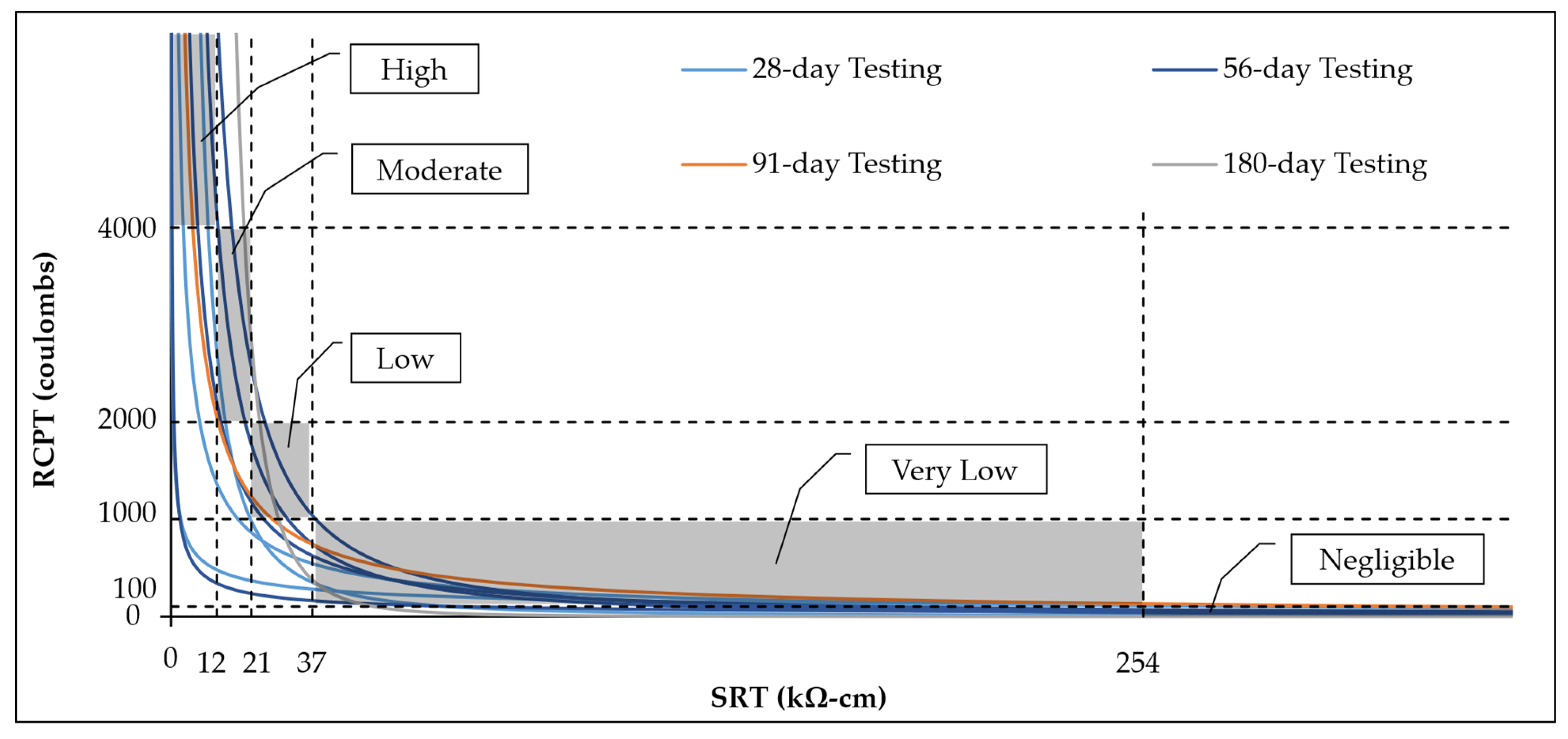
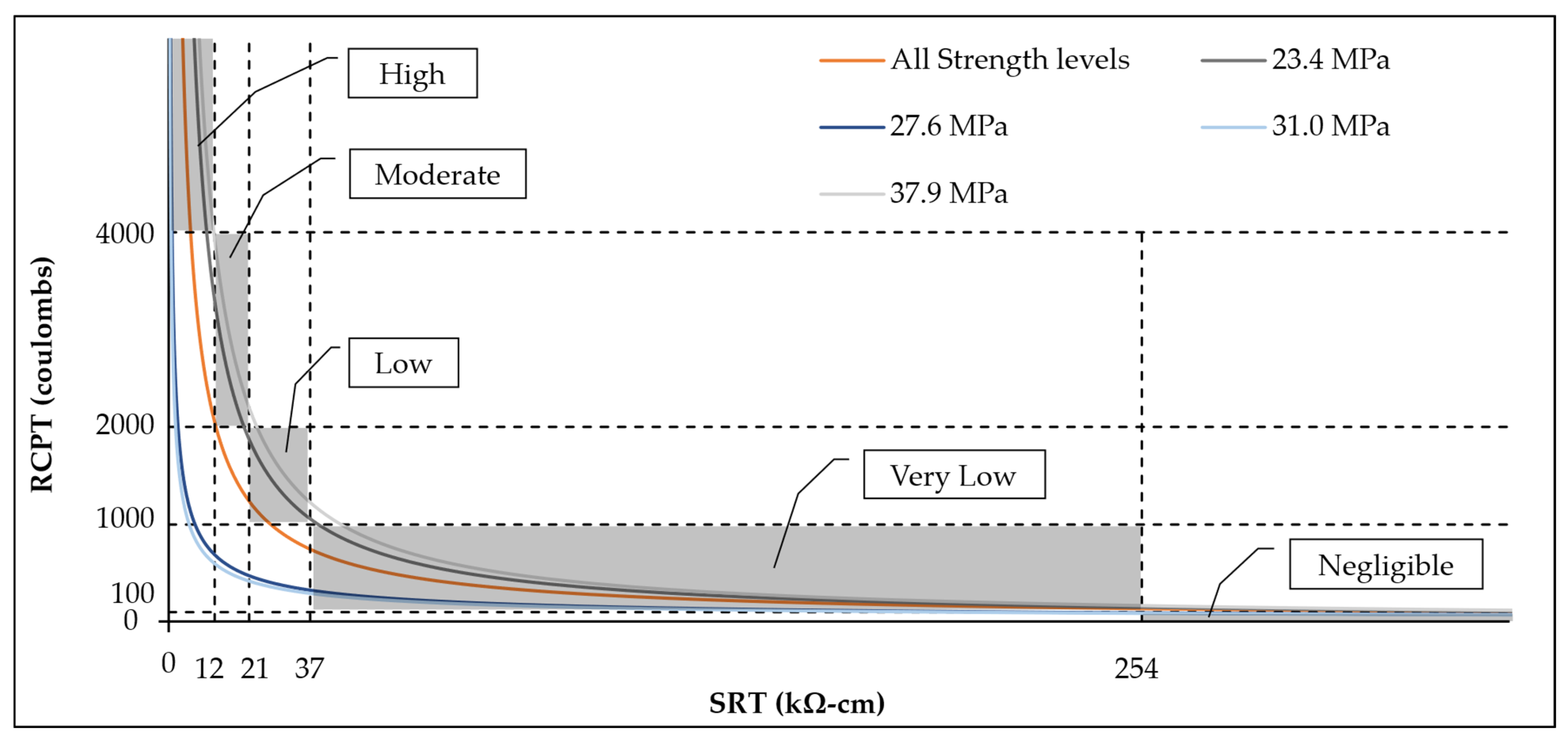
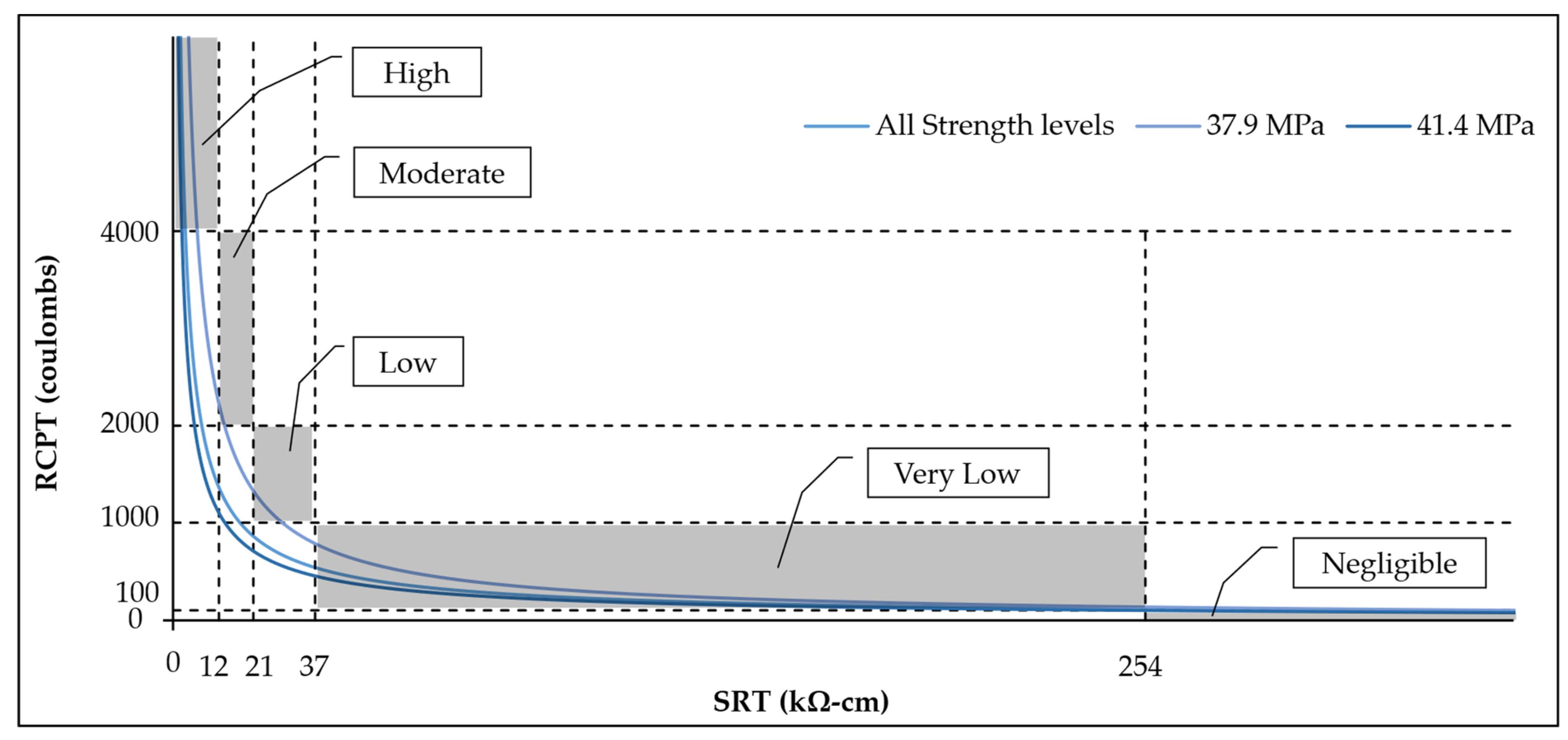
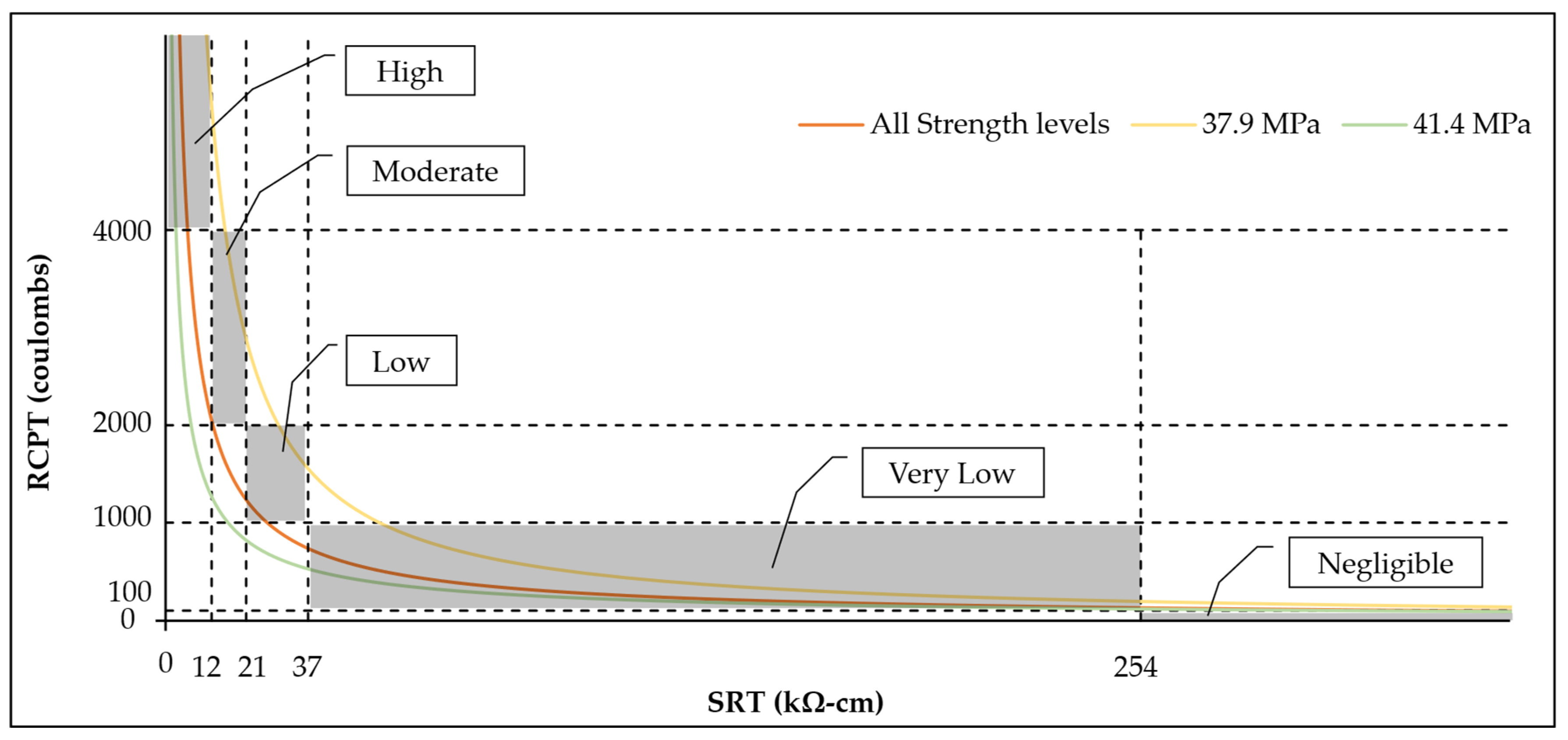
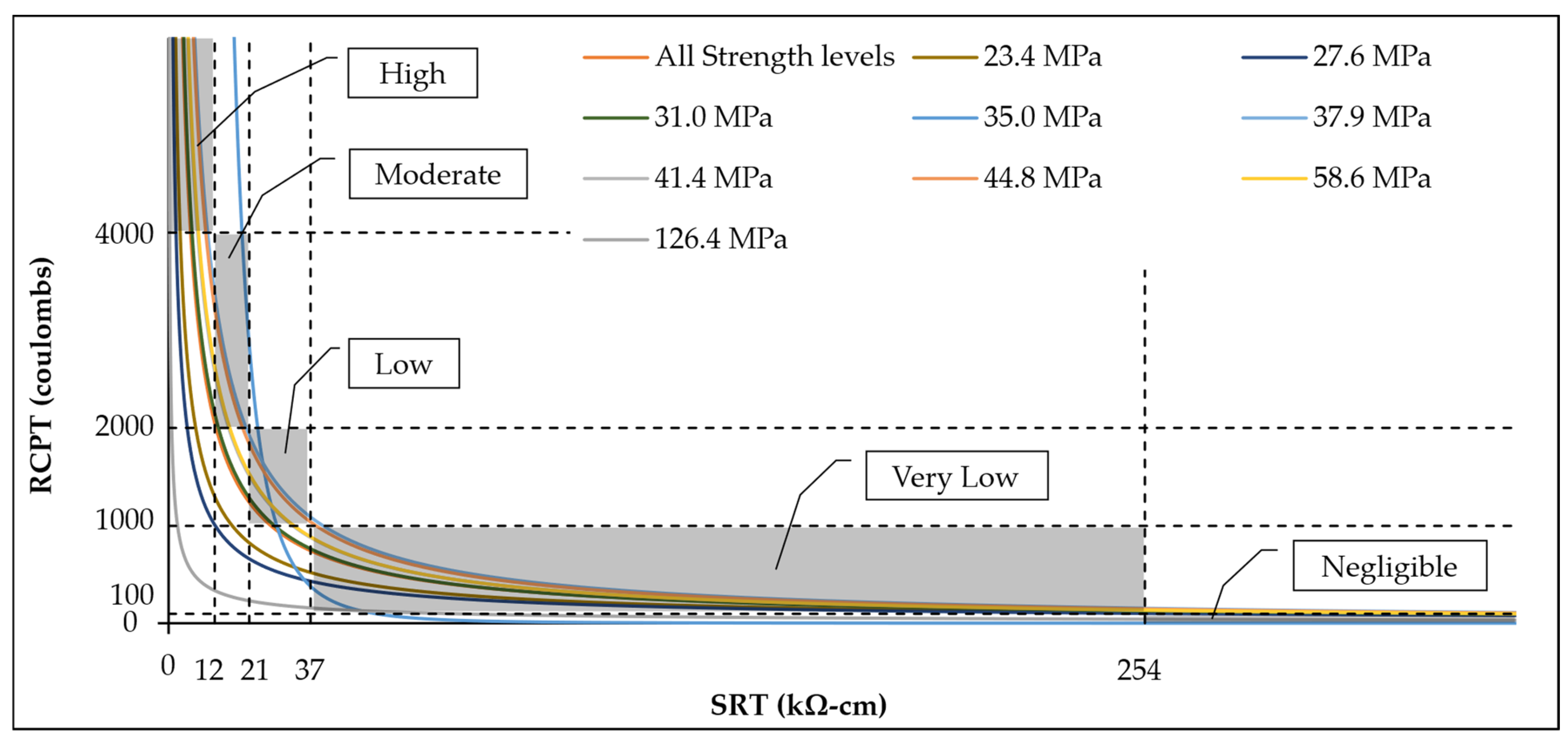
Classifying Concrete Permeability Using Rapid Chloride Permeability and Surface Resistivity Tests: Benefits, Limitations, and Predictive Models—A State-of-the-Art Review

Abstract
1. Introduction
2. Concrete Permeability
2.1. Direct Penetration Through Cracks
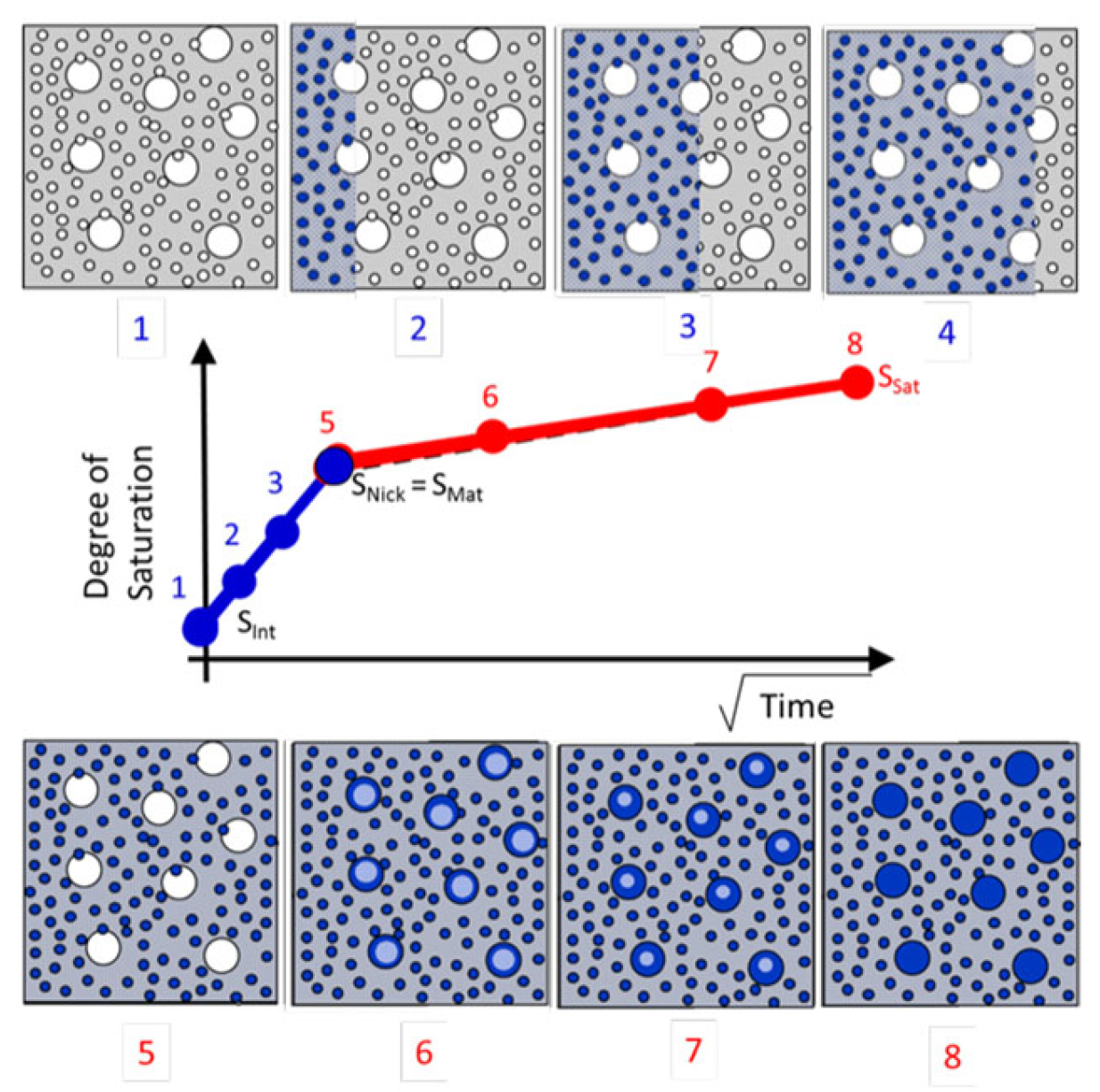
2.2. Absorption
2.3. Diffusion
- = apparent diffusion coefficient (m2/s);
- = ion concentration at a distance from the surface after time (g/m3);
- = distance (m);
- = time (s).
- = ion flux, representing the amount of substance flowing through a unit area per unit time (mol/m2.s);
- = effective diffusion coefficient (m2/s);
- = ion concentration (mol/m3);
- = position variable (m);
- = ion concentration gradient (g/m3/m).
3. Chloride Ion Permeability Testing Methods
3.1. Absorption-Based Tests
3.2. Diffusion-Based Tests
3.2.1. True Diffusion-Based Tests
3.2.2. Migration-Based Tests
- = total charge passed through a specimen with diameter of x (coulombs);
- = current immediately after voltage is applied (amperes);
- = current at time t after voltage is applied (amperes);
- = time (min);
- = adjusted total charge passed through a 95 mm diameter specimen (coulombs);
- = diameter of the actual specimen (mm).
3.3. Electrical Resistivity Tests
- = specimen measured resistivity (Ω-cm);
- = electrical resistance (Ω); and
- = geometric factor (cm), which is a numerical multiplier that depends on the electrode configuration used to measure the electrical resistivity.
- = voltage (V);
- = current (amperes).
3.3.1. Bulk Resistivity Test (BRT)
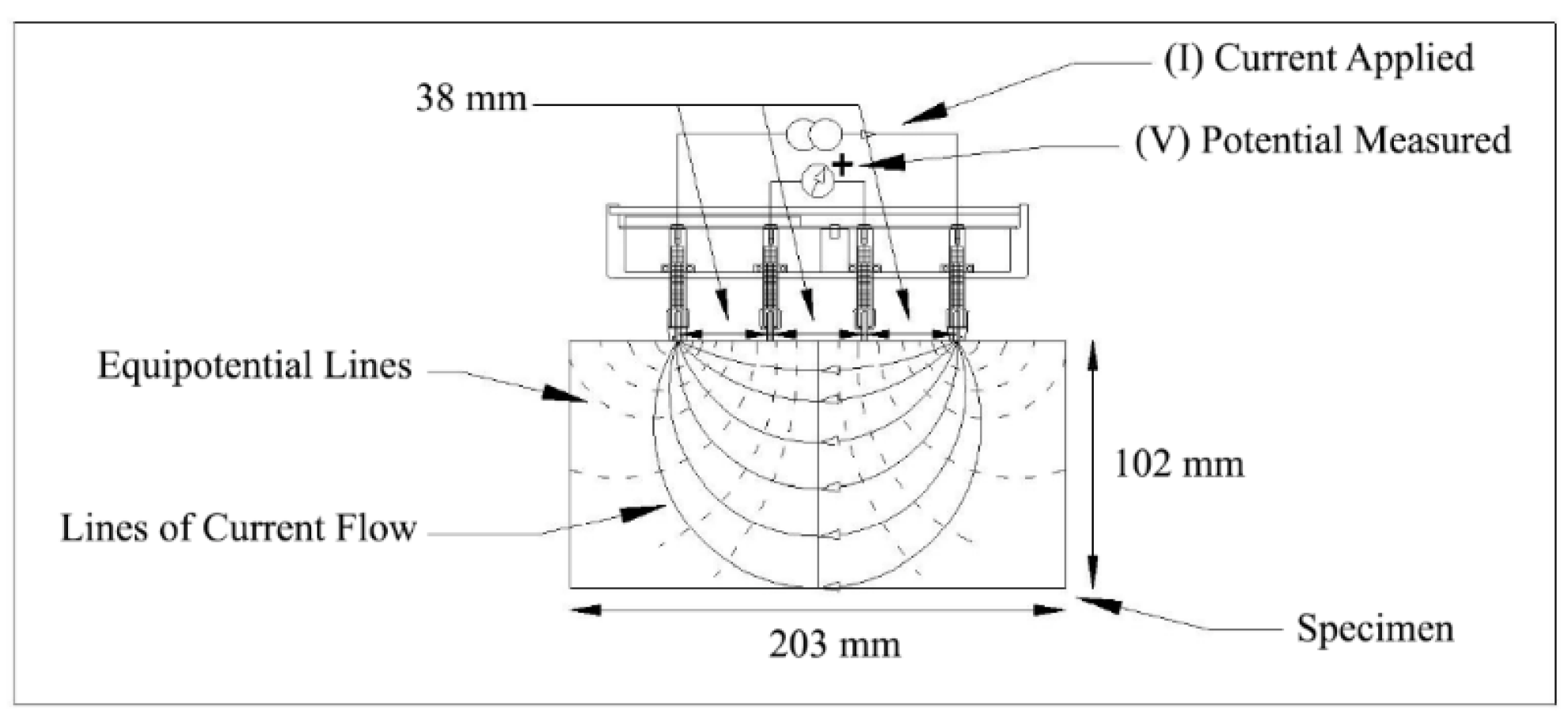
3.3.2. Surface Resistivity Test (SRT)
4. Relationship Between the RCPT and the SRT
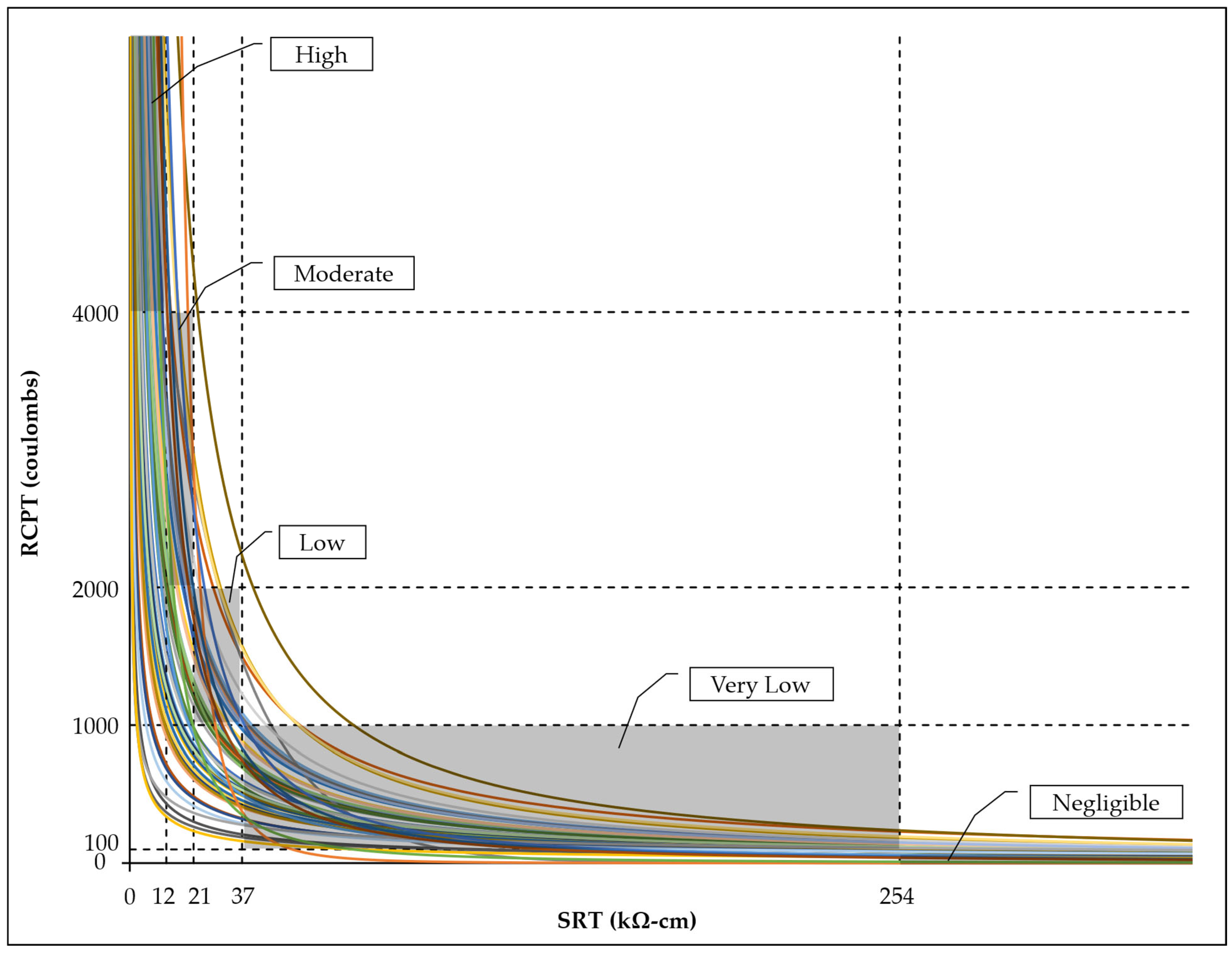
4.1. Overall Comparison
- = charge pass through the specimen using the RCPT (coulombs);
- = surface resistivity value using SRT (kΩ-cm);
- = a scaling factor based on material properties and test conditions.
- b = An exponent that defines the curvature of the relationship (negative and not equal to −1).
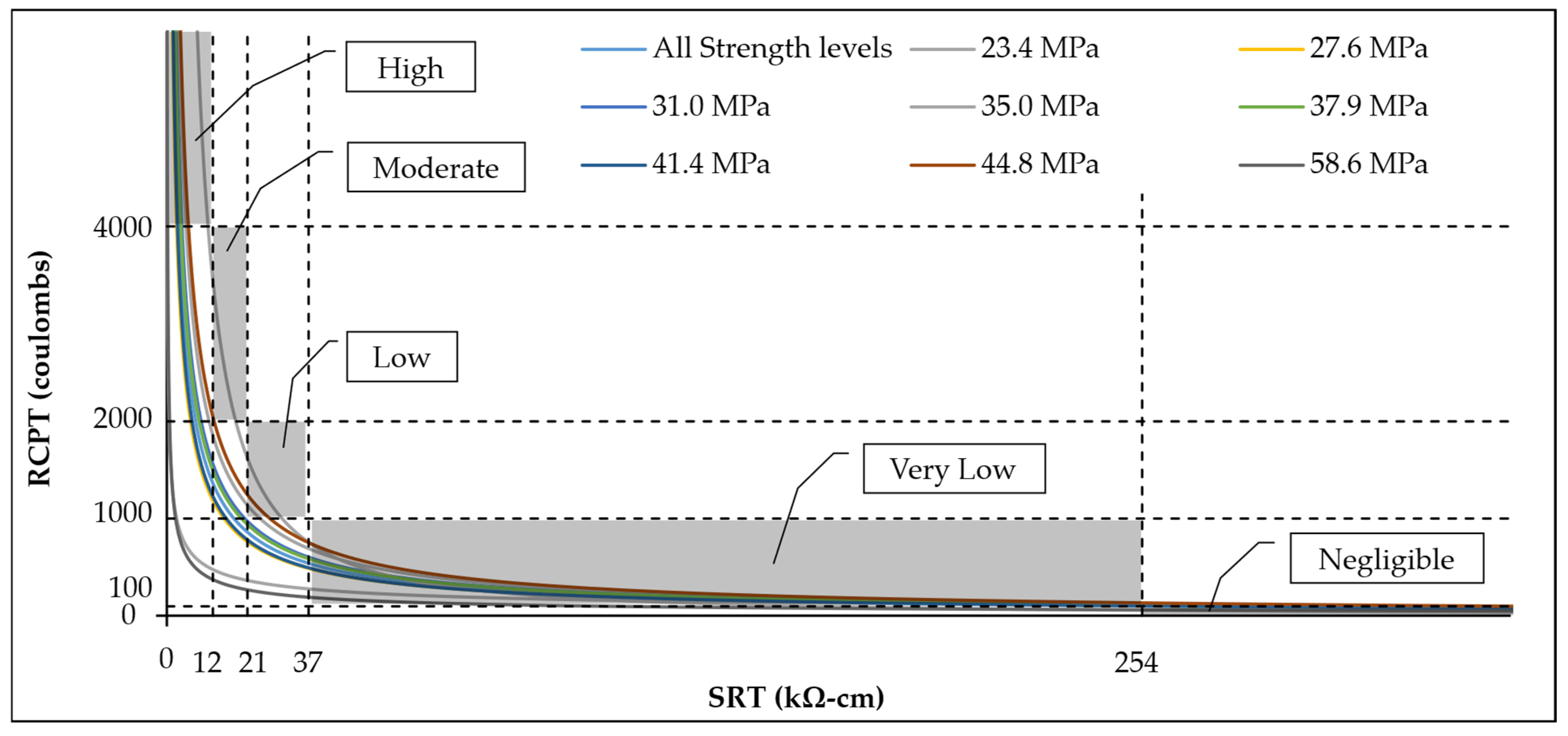
4.2. Effects of Compressive Strength
4.3. Effects of Age
4.4. Effects of w/cm Ratio
4.5. Effects of Fly Ash
4.6. Effects of GGBFS
4.7. Effects of Silica Fume
4.8. Effects of Metakaolin
4.9. Effects of Other Pozzolans
4.10. Critical Synthesis and Quantitative Evaluation of RCPT–SRT Relationships
4.10.1. Overall Correlation Strength
4.10.2. Model Exponent and Physical Interpretation
4.10.3. Statistical Variability and Repeatability
4.10.4. Influence of Age and Mixture Characteristics
4.10.5. Integrated Interpretation
5. Conclusions
- Developing broader binder-specific correlation models that consider unique hydration mechanisms and microstructural developments.
- Validating the SRT–RCPT relationships using diffusion-based tests such as salt ponding method for improved accuracy.
- Investigating alternative SCMs to broaden applicability, especially in regions where traditional SCMs are unavailable or unsustainable.
- Exploring composite SCM systems to better understand interactions between multiple binders and their cumulative effect on resistivity and ion transport.
- Incorporating additional variables such as cement type, curing conditions, aggregate properties, and broader concrete types (e.g., self-consolidating and ultra-high-performance concrete) to build more comprehensive predictive models.
- Conducting multi-institutional and meta-analytical studies to refine predictive correlations, reduce inter-laboratory variability, and support global standardization of SRT as a performance-based durability assessment tool.
Funding
Data Availability Statement
Conflicts of Interest
Abbreviations
| AASHTO | American Association of State Highway Transportation Officials |
| BRT | Bulk Resistivity Test |
| CH | Calcium Hydroxide |
| CSH | Calcium Silicate Hydrate |
| COV | Coefficients Of Variation |
| GGBFS | Ground Granulated Blast Furnace Slag |
| ISAT | Initial Surface Absorption Test |
| ITZ | Interfacial Transition Zone |
| NaCl | Sodium Chloride |
| NaOH | Sodium Hydroxide |
| OH- | Hydroxyl Ions |
| QC | Quality Control |
| QA | Quantity Assurance |
| RCPT | Rapid Chloride Permeability Test |
| RHA | Rice Husk Ash |
| SD | Standard Deviations |
| SiO2 | Silicon Dioxide |
| SCM | Supplementary Cementitious Material |
| SRT | Surface Resistivity Test |
| UHPC | Ultra-High-Performance Concrete |
| w/cm | Water-to-Cementitious Materials |
References
- Hornbostel, K.; Larsen, C.K.; Geiker, M.R. Relationship between concrete resistivity and corrosion rate—A literature review. Cem. Concr. Compos. 2013, 39, 60–72. [Google Scholar] [CrossRef]
- Ji, Y.; Hu, Y.; Zhang, L.; Bao, Z. Laboratory studies on influence of transverse cracking on chloride-induced corrosion rate in concrete. Cem. Concr. Compos. 2016, 69, 28–37. [Google Scholar] [CrossRef]
- Jones, S.; Martys, N.; Lu, Y.; Bentz, D. Simulation studies of methods to delay corrosion and increase service life for cracked concrete exposed to chlorides. Cem. Concr. Compos. 2015, 58, 59–69. [Google Scholar] [CrossRef]
- Angst, U.; Elsener, B.; Larsen, C.K.; Vennesland, Ø. Critical chloride content in reinforced concrete—A review. Cem. Concr. Res. 2009, 39, 1122–1138. [Google Scholar] [CrossRef]
- Rucker-Gramm, P.; Beddoe, R. Effect of moisture content of concrete on water uptake. Cem. Concr. Res. 2010, 40, 102–108. [Google Scholar] [CrossRef]
- Sahmaran, M.; Yaman, I.Ö. Influence of transverse crack width on reinforcement corrosion initiation and propagation in mortar beams. Can. J. Civ. Eng. 2008, 35, 236–245. [Google Scholar] [CrossRef]
- CSA/S413-94; Parking Structures-Structural Design. Canadian Standards Association: Rexdale, ON, Canada, 1994.
- Stanish, K.D.; Hooton, R.D.; Thomas, M.D.A. Testing the Chloride Penetration Resistance of Concrete: A Literature Review; University of Toronto: Toronto, ON, Canada, 2001. Available online: https://highways.dot.gov/media/2981 (accessed on 17 November 2025).
- Saito, M.; Ishimori, H. Chloride Permeability of Concrete Under Static and Repeated Compressive Loading. Cem. Concr. Res. 1995, 25, 803–808. [Google Scholar] [CrossRef]
- Samaha, H.R.; Hover, K.C. Influence of Microcracking on the Mass Transport Properties of Concrete. Mater. J. 1992, 89, 416–424. [Google Scholar]
- Thomas, M.D.A.; Jones, M.R. A Critical Review of Service Life Modelling of Concretes Exposed to Chlorides. In Concrete in the Service of Mankind: Radical Concrete Technology; Dhir, R.K., Hewlett, P.C., Eds.; E. & F.N. Spon: London, UK, 1996; pp. 723–736. [Google Scholar]
- Goodspeed, C.H.; Vanikar, S.; Cook, R.A. High Performance Concrete Defined for Highway Structures. ACI Concr. Int. 1996, 18, 62–67. [Google Scholar]
- Julio-Betancourt, G.A.; Hooton, R.D. Study of the Joule effect on rapid chloride permeability values and evaluation of related electrical properties of concretes. Cem. Concr. Res. 2004, 34, 1007–1015. [Google Scholar] [CrossRef]
- Nokken, M.; Boddy, A.; Wu, X.; Hooton, R.D. Effects of Temperature, Chemical, and Mineral Admixtures on the Electrical Conductivity of Concrete. J. ASTM Int. 2018, 5, 1–9. [Google Scholar] [CrossRef]
- Gardner, T.; Stanish, K.; Alexander, M. Critical review of rapid chloride test methods for concrete. Concr. Beton. Mag. 2006, 113, 11–17. [Google Scholar]
- Feldman, R.F.; Chan, G.W.; Brousseau, R.J.M.; Tumidajski, P.J. Investigation of rapid chloride permeability tests. ACI Mater. J. 1994, 91, 246–255. [Google Scholar] [CrossRef] [PubMed]
- Hooton, R.D.; Thomas, M.D.A.; Stanish, K. Prediction of Chloride Penetration in Concrete; FHWA-RD-00-142; United State Department of Transportation, Federal Highway Administration: McLean, VA, USA, 2001.
- Ozyildirim, C. Rapid Chloride Permeability Testing of Silica-Fume Concrete. Cem. Concr. Aggreg. 1994, 16, 53–56. [Google Scholar] [CrossRef]
- Al Martini, S.; Khartabil, A.; Sabouni, R. Evaluation of Thermal Conductivity of Sustainable Concrete Having Supplementary Cementitious Materials (SCMs) and Recycled Aggregate (RCA) Using Needle Probe Test. Sustainability 2023, 15, 109. [Google Scholar] [CrossRef]
- Bagheri, A.R.; Zanganeh, H. Comparison of Rapid Tests for Evaluation of Chloride Resistance of Concretes with Supplementary Cementitious Materials. J. Mater. Civ. Eng. 2012, 24, 1175–1182. [Google Scholar] [CrossRef]
- Andrade, C.; Alonso, C.; Goñi, S. Possibilities for Electrical Resistivity to Universally Characterise Mass Transport Processes in Concrete. In Proceedings of the Concrete 2000 Conference, Dundee, Scotland, 7–9 September 1993; Dhir, R.K., Jones, M.R., Eds.; E. & FN. Spon.: London, UK, 1993; Volume 2, pp. 1640–1652. [Google Scholar]
- Andrade, C. Calculation of Chloride Diffusion Coefficients in Concrete from Ionic Migration Measurements. Cem. Concr. Res. 1993, 23, 724–742. [Google Scholar] [CrossRef]
- Buenfeld, N.R.; Glass, G.K.; Hassanein, A.M.; Zhang, J.Z. Chloride transport in concrete subjected to electrical field. J. Mater. Civ. Eng. 1998, 10, 220–228. [Google Scholar] [CrossRef]
- Liu, Z.; Beaudoin, J.J. The Permeability of Cement Systems to Chloride Ingress and Related Test Methods. Cem. Concr. Aggreg. 2000, 22, 16–23. [Google Scholar] [CrossRef]
- Shi, C. Effect of mixing proportions of concrete on its electrical conductivity and the rapid chloride permeability test (ASTM C1202 or ASSHTO T277) results. Cem. Concr. Res. 2004, 34, 537–545. [Google Scholar] [CrossRef]
- Pfeifer, D.W.; McDonald, D.B.; Krauss, P.D. The rapid chloride permeability test and its correlation to the 90-day chloride ponding test. PCI J. 1994, 39, 38–47. [Google Scholar] [CrossRef]
- Plauto, P.; Bilodeau, A. Rapid chloride ion permeability test: Data on concretes incorporating supplementary cementing materials. In Proceedings of the 3rd International Conference on the Use of Fly Ash, Silica Fume, Slag, and Natural Pozzolan in Concrete, Trondheim, Norway, 18–23 June 1989; American Concrete Institute (ACI): Farmington Hills, MI, USA; Volume 114, pp. 625–644. [Google Scholar]
- Streicher, P.E.; Alexanderm, M.G. A Chloride Conduction Test for Concrete. Cem. Concr. Res. 1995, 25, 1284–1294. [Google Scholar] [CrossRef]
- Weiss, J. Relating Transport Properties to Performance in Concrete Pavements, CP Road Map; Shields-Cook, S., Ed.; Iowa State University: Ames, IA, USA, 2014. [Google Scholar]
- Mengel, L.; Krauss, H.W.; Lowke, D. Water transport through cracks in plain and reinforced concrete—Influencing factors and open questions. Constr. Build. Mater. 2020, 254, 118990. [Google Scholar] [CrossRef]
- Hearn, N.; Hooton, R.D.; Nokken, M.R. Pore Structure, Permeability, and Penetration Resistance Characteristics of Concrete. In Significance of Tests and Properties of Concrete and Concrete-Making Materials; Lamond, J., Pielert, J., Eds.; ASTM International, Bridgeport: West Conshohocken, PA, USA, 2006; pp. 238–252. [Google Scholar]
- Wang, K.; Igusa, T.; Shah, S.P. Permeability of concrete—Relationships to its mix proportion, microstructure and microcracks. In The Sidney Diamond Symposium; Cohen, M., Mindess, S., Skalny, J., Eds.; The American Ceramic Society: Westerville, OH, USA, 1998; pp. 45–54. [Google Scholar]
- FIB. Model Code, First Complete Draft; International Federation for Structural Concrete (fib): Lausanne, Switzerland, 2010. [Google Scholar]
- Šavija, B.; Lukovic, M.; Schlangen, E. Influence of Cracking on Moisture Uptake in Strain-Hardening Cementitious Composites. J. Nanomech. Micromech. 2017, 7, 4016010. [Google Scholar] [CrossRef]
- Zhang, P.; Zhao, T.J.; Zhang, L.S.; Wittmann, F.H.; Lehmann, E.; Vontobel, P. Application of Neutron Radiography to Observe Water Absorbtion of Concrete. In Proceedings of the 18th International Conference on Nuclear Engineering, Xi’an, China, 17–21 May 2010; Volume 3, pp. 29–36. [Google Scholar]
- Pease, B.; Couch, J.; Geikler, M.; Stang, H.; Weiss, J. Assessing the Portion of the Crack Length Contribution to Water Sorption in Concrete Using X-Ray Absorption. In Proceedings of the ConcreteLife’ 09: Second International RILEM Workshop on Concrete Durability and Service Life Planning, Haifa, Israel, 7–9 September 2009. [Google Scholar]
- Mousavinezhad, S.; Toledo, W.K.; Newtson, C.M.; Aguayo, F. Rapid Assessment of Sulfate Resistance in Mortar and Concrete. Materials 2024, 17, 4678. [Google Scholar] [CrossRef]
- Shaikh, F.U.A. Effect of Cracking on Corrosion of Steel in Concrete. Int. J. Concr. Struct. Mater. 2018, 12, 3. [Google Scholar] [CrossRef]
- Akhavan, A.; Shafaatian, S.M.H.; Rajabipour, F. Quantifying the effects of crack width, tortuosity, and roughness on water permeability of cracked mortars. Cem. Concr. Res. 2012, 42, 313–320. [Google Scholar] [CrossRef]
- Rastiello, G.; Boulay, C.; Dal Pont, S.; Tailhan, J.L.; Rossi, P. Real-time water permeability evolution of a localized crack in concrete under loading. Cem. Concr. Res. 2014, 56, 20–28. [Google Scholar] [CrossRef]
- Aldea, C.-M.; Surendra, P.S.; Karr, A. Effect of Cracking on Water and Chloride Permeability of Concrete. ASCE J. Mater. Civ. Eng. 1999, 11, 181–187. [Google Scholar] [CrossRef]
- Wang, K.; Jansen, D.C.; Shah, S.P.; Karr, A.F. Permeability study of cracked concrete. Cem. Concr. Res. 1997, 27, 381–393. [Google Scholar] [CrossRef]
- Todak, H.; Lucero, C.; Weiss, W.J. Why Is the Air There? Thinking about Freeze-Thaw in Terms of Saturation. Concr. Focus Spring 2015, 14, OC3–OC7. [Google Scholar]
- Ren, F.; Zhou, C.; Zeng, Q.; Wang, Z.; Wang, W. Numerical investigations into the physical significance of sorptivity for cement-based materials considering water sensitivity. J. Build. Eng. 2023, 66, 105952. [Google Scholar] [CrossRef]
- Wei, J.; Tao, B.; Weiss, W.J. Water Absorption in Cementitious Materials at Different Temperatures. Adv. Civ. Eng. Mater. 2017, 6, 280–295. [Google Scholar] [CrossRef]
- Gräf, H.; Setzer, M.J. Influence of Water Cement Ratio and Curing on the Permeability and Structure of Hardened Cement Paste and Concrete. MRS Online Proc. Libr. 1988, 137, 337–347. [Google Scholar] [CrossRef]
- Volkwein, A. Investigations on the penetration of water and chloride into concrete. Beton-Stahlbetonbau 1993, 88, 223–226. (In German) [Google Scholar] [CrossRef]
- Beddoe, R.; Springenschmid, R. Moisture transport through concrete structural components. Beton-Stahlbetonbau 1999, 94, 158–166. (In German) [Google Scholar] [CrossRef]
- Zaccardi, Y.V.; Alderete, N.; De Belie, N. Lucas-Washburn vs Richards equation for the modelling of water absorption in cementitious materials. MATEC Web Conf. 2018, 199, 02019. [Google Scholar] [CrossRef]
- Villagrán Zaccardi, Y.A.; Alderete, N.M.; de Belie, N. Improved model for capillary absorption in cementitious materials: Progress over the fourth root of time. Cem. Concr. Res. 2017, 100, 153–165. [Google Scholar] [CrossRef]
- Yuan, Q.; Shi, C.; De Schutter, G.; Audenaert, K.; Deng, D. Chloride binding of cement-based materials subjected to external chloride environment—A review. Constr. Build. Mater. 2009, 23, 1–13. [Google Scholar] [CrossRef]
- Mc Carter, W.J.; Emerson, M.; Ezirim, H. Properties of concrete in the cover zone: Developments in monitoring techniques. Mag. Concr. Res. 1995, 47, 243–251. [Google Scholar] [CrossRef]
- Suryavanshi, A.K.; Swamy, R.N.; Cardew, G.E. Estimation of diffusion coefficients for chloride ion penetration into structural concrete. ACI Mater. J. 2002, 99, 441–449. [Google Scholar] [CrossRef]
- Samson, E.; Marchand, J.; Snyder, K.A. Calculation of Ionic Diffusion Coefficients on the Basis of Migration Test Results. Mater. Struct. 2003, 36, 156–165. [Google Scholar] [CrossRef]
- Marchand, J.; Odler, I.; Skalny, J.P. Sulfate Attack on Concrete; CRC Press: London, UK, 2002. [Google Scholar]
- Taylor, H.F.W. Cement Chemistry; Thomas Telford: London, UK, 1997. [Google Scholar]
- Safiuddin, M.; Hearn, N. Comparison of ASTM Saturation Techniques for Measuring the Permeable Porosity of Concrete. Cem. Concr. Res. 2005, 35, 1008–1013. [Google Scholar] [CrossRef]
- Bazant, Z.P.; Najjar, L.J. Nonlinear water diffusion in nonsaturated concrete. Mater. Struct. 1972, 5, 3–20. [Google Scholar] [CrossRef]
- Lin, M.; Sasano, H.; Maruyama, I. Fundamental study on water diffusion coefficient of cement based material. In Proceedings of the JCI Annual Convention, Nagoya, Japan, 9–11 July 2013; pp. 595–600. [Google Scholar]
- Reinhardt, H.-W.; Jooss, M. Permeability, diffusion, and capillary absorption of concrete at elevated temperature in service range. Otto-Graf-J. 1998, 9, 34. [Google Scholar]
- Zhang, J.; Hou, D.; Gao, Y.; Wei, S. Determination of Moisture Diffusion Coefficient of Concrete at Early Age from Interior Humidity Measurements. Drying Technol. 2011, 29, 689–696. [Google Scholar] [CrossRef]
- ACI Committee. ACI 201.2R-16 Guide to Durable Concrete; American Concrete Institute: Farmington Hills, MI, USA, 2016. [Google Scholar]
- Pettersson, K. Olika Faktorers Inverkan på Kloriddiffusion i Betongkonstruktioner. In The Effect of Different Factors on the Chloride Diffusion in Concrete, CBI Rapport 4:94; Cement och Betong Institutet: Stockholm, Sweden, 1994. [Google Scholar]
- Bu, Y.; Luo, D.; Weiss, J. Using Fick’s Second Law and Nernst–Planck Approach in Prediction of Chloride Ingress in Concrete Materials. Adv. Civ. Eng. Mater. 2014, 3, 566–585. [Google Scholar] [CrossRef]
- Nokken, M.; Boddy, A.; Hooton, R.D.; Thomas, M.D.A. Time Dependent Diffusion in Concrete—Three Laboratory Studies. Cem. Concr. Res. 2006, 36, 200–207. [Google Scholar] [CrossRef]
- Martín-Pérez, B.; Zibara, H.; Hooton, R.D.; Thomas, M.D.A. A Study of the Effect of Chloride Binding on Service Life Predictions. Cem. Concr. Res. 2000, 30, 1215–1223. [Google Scholar] [CrossRef]
- Tumidajski, P.J. Application of Danckwerts’ Solution to Simultaneous Diffusion and Chemical Reaction in Concrete. Cem. Concr. Res. 1996, 26, 697–700. [Google Scholar] [CrossRef]
- Soutsos, M. Concrete Durability: A Practical Guide to the Design of Durable Concrete Structures; Thomas Telford: London, UK, 2010. [Google Scholar]
- BS 1881-208:1996; Testing Concrete, Recommendations for the Determination of the Initial Surface Absorption of Concrete. British Standards Institution: London, UK, 1996.
- ASTM C1585-20; Standard Test Method for Measurement of Rate of Absorption of Water by Hydraulic-Cement Concretes. ASTM International: West Conshohocken, PA, USA, 2020.
- Marchand, J.; Gerard, B.; Delagrave, A. Ion Transport Mechanisms in Cement-Based Materials. In Materials Science of Concrete; Skalny, J.P., Mindess, S., Eds.; American Ceramic Society: Westerville, OH, USA, 1998; pp. 307–400. [Google Scholar]
- Nilsson, L.O.; Poulsen, E.; Sandberg, P.; Sørensen, H.E.; Klinghoffer, O. HETEK, Chloride Penetration into Concrete, State-of-the-Art, Transport Processes, Corrosion Initiation, Test Methods and Prediction Models; Danish Road Directorate: Copenhagen, Denmark, 1996. [Google Scholar]
- Dhir, R.K.; Jones, M.R.; Ahmed, H.E.H.; Seneviratne, A.M.G. Rapid estimation of chloride diffusion coefficient in concrete. Mag. Concr. Res. 1990, 42, 177–185. [Google Scholar] [CrossRef]
- Streicher, P.E.; Alexander, M.G. A critical evaluation of chloride diffusion test methods for concrete. In Proceedings of the third CANMET/ACI International Conference on Concrete Durability, Nice, France, 22–28 May 1994; pp. 517–530. [Google Scholar]
- AASHTO T259; Standard method of test for resistance of concrete to chloride ion penetration. American Association of State and Highway Transportation Officials: Washington, DC, USA, 2002.
- ASTM C1556–11a(2016); Standard Test Method for Determining the Apparent Chloride Diffusion Coefficient of Cementitious Mixtures by Bulk Diffusion. ASTM International: West Conshohocken, PA, USA, 2016. [CrossRef]
- Nordtest, N.T. Concrete, Hardened: Accelerated Chloride Penetration, NT Build 443; Nordtest: Espoo, Finland, 1995. [Google Scholar]
- ASTM C1202-22; Standard Test Method for Electrical Indication of Concrete’s Ability to Resist Chloride Ion Penetration. ASTM International: West Conshohocken, PA, USA, 2022.
- NT Build 355; Concrete, Mortar and Cement-Based Repair Materials: Chloride Diffusion Coefficient from Migration Cell Experiments. Nordtest: Espoo, Finland, 1997.
- JSCE-G571-2003; Test Method for Effective Diffusion Coefficient of Chloride Ion in Concrete by Migration. Japan Society of Civil Engineers: Tokyo, Japan, 2003.
- NT Build 492; Concrete, Mortar and Cement-Based Repair Materials: Chloride Migration Coefficient from Non-Steady-State Migration Experiments. Nordtest: Espoo, Finland, 1999.
- Whiting, D. Rapid measurement of the chloride permeability of concrete. Public Roads 1981, 45, 101–112. [Google Scholar]
- Whiting, D. Rapid Determination of the Chloride Permeability of Concrete, in Final Report No. FHWA-RD-81/119; Portland Cement Association, Federal Highway Administration: Skokie, IL, USA, 1981. [Google Scholar]
- Whiting, D.; Mitchell, T.M. History of the rapid chloride permeability test. Transp. Res. Board 1992, 1335, 55–62. [Google Scholar]
- Thomas, R.J.; Ariyachandra, E.; Lezama, D.; Peethamparan, S. Comparison of chloride permeability methods for Alkali-Activated concrete. Constr. Build. Mater. 2018, 165, 104–111. [Google Scholar] [CrossRef]
- Sharfuddin, A.; Kayali, O.; Anderson, W. Chloride penetration in binary and ternary blended cement concretes as measured by two different rapid methods. Cem. Concr. Compos. 2008, 30, 576–582. [Google Scholar] [CrossRef]
- Gowripalan, N.; Mohamed, H.M. Chloride-ion induced corrosion of galvanized and ordinary steel reinforcement in high-performance concrete. Cem. Concr. Res. 1998, 28, 1119–1131. [Google Scholar] [CrossRef]
- Hale, M.; Russell, B.W.; Bush, T.D. An assessment of the rapid chloride ion penetrability test. In Proceedings of the International Conference on Concrete for Extreme Conditions, Dundee, Scotland, UK, 9–11 September 2002; pp. 447–456. [Google Scholar]
- Polder, R.B. Critical chloride content for reinforced concrete and its relationship to concrete resistivity. Mater. Corros. 2009, 60, 623–630. [Google Scholar] [CrossRef]
- Nadelman, E.I.; Kurtis, K.E.A. A Resistivity-Based Approach to Optimizing Concrete Performance. Concr. Int. 2014, 36, 50–54. [Google Scholar]
- Gulikers, J. Theoretical considerations on the supposed linear relationship between concrete resistivity and corrosion rate of steel reinforcement. Mater. Corros. 2005, 56, 393–403. [Google Scholar] [CrossRef]
- Andrade, C.; Sanjuan, M.A.; Alonso, M.C. Measurement of chloride diffusion coefficient from migration tests. In Proceedings of the NACE Corrosion’93, New Orleans, LA, USA, 7–12 March 1993; pp. 289–298. [Google Scholar]
- Polder, R.B. Chloride diffusion and resistivity testing of five concrete mixes for marine environment. In Proceedings of the RILEM International Workshop on Chloride Penetration into Concrete, St-Remy-les-Chevreuses, France, 15–18 October 1995. [Google Scholar]
- Polder, R.B.; Peelen Willy, H.A. Characterisation of chloride transport and reinforcement corrosion in concrete under cyclic wetting and drying by electrical resistivity. Cem. Concr. Compos. 2002, 24, 427–435. [Google Scholar] [CrossRef]
- Andrade, C.; d’Andrea, R. Electrical Resistivity as Microstructural Parameter for the Modelling of Service Life of Reinforced Concrete Structures. In Proceedings of the Second International Symposium on Service Life Design for Infrastructures, Delft, The Netherlands, 4–6 October 2010; Van, K., Breugel, G., Yuan, Y.Y., Eds.; RILEM: Paris, France, 2010; pp. 379–388. [Google Scholar]
- Andrade, C.; d’Andrea, R.; Rebolledo, N. Chloride Ion Penetration in Concrete: The Reaction Factor in the Electrical Resistivity Model. Cem. Concr. Comp. 2014, 47, 41–46. [Google Scholar] [CrossRef]
- Beushausen, H.; Fernandez Luco, L. Performance-Based Specifications and Control of Concrete Durability: State-of-the Art Report RILEM TC 230-PSC; Springer: Dordrecht, the Netherlands, 2016. [Google Scholar]
- AASHTO T 358; Standard Method of Test for Surface Resistivity Indication of Concrete’s Ability to Resist Chloride Ion Penetration. American Association of State Highway and Transportation Officials: Washington, DC, USA, 2019.
- ASTM C1876-23; Standard Test Method for Bulk Electrical Resistivity or Bulk Conductivity of Concrete. ASTM International: West Conshohocken, PA, USA, 2023.
- Horňáková, M.; Lehner, P. Relationship of Surface and Bulk Resistivity in the Case of Mechanically Damaged Fibre Reinforced Red Ceramic Waste Aggregate Concrete. Materials 2020, 13, 5501. [Google Scholar] [CrossRef] [PubMed]
- Kessler Richard, J.; Powers Rodney, G.; Viva, E.; Paredes Mario, A.; Virmani, Y.P. Surface resistivity as an indicator of concrete chloride penetration resistance. In Proceedings of the Concrete Bridge Conference, St. Louis, MO, USA, 4–7 May 2008. [Google Scholar]
- AASHTO TP 95–14; Standard Test Method for Surface Resistivity Indication of Concrete’s Ability to Resist Chloride Ion Penetration. American Association of State Highway Transportation Officials (AASHTO): Washington, DC, USA, 2014.
- Rupnow, T.D.; Icenogle, P. Evaluation of Surface Resistivity Measurements as an Alternative to the Rapid Chloride Permeability Test for Quality Assurance and Acceptance; Louisiana Department of Transportation and Development: Baton Rouge, LA, USA, 2011. [Google Scholar]
- Tanesi, J.; Ardani, A. Surface Resistivity Test Evaluation as an Indicator of the Chloride Permeability of Concrete (FHWA-HRT-13-024); FHWA: McLean, VA, USA, 2012. [Google Scholar]
- Spragg, R.P.; Castro, J.; Nantung, T.; Paredes, M.; Weiss, J. Variability analysis of the bulk resistivity measured using concrete cylinders. Adv. Civ. Eng. Mater. 2012, 1, ACEM104596. [Google Scholar] [CrossRef]
- Elkeyand, W.; Sellevold, E.J. Electrical Resistivity of Concrete; Directorate of Public Roads-Norwegian Road Research Laboratory: Oslo, Norway, 1995. [Google Scholar]
- Spragg, R.; Bu, Y.; Snyder, K.; Bentz, D.; Weiss, J. Electrical Testing of Cement-Based Materials: Role of Testing Techniques, Sample Conditioning, and Accelerated Curing; FHWA, Indiana Department of Transportation: Indianapolis, IN, USA, 2013. [Google Scholar]
- Spragg, R.; Villani, C.; Snyder, K.; Bentz, D.; Bullard, J.; Weiss, J. Electrical Resistivity Measurements in Cementitious Systems: Observations of Factors that Influence the Measurements; Transportation Research Board: Washington, DC, USA, 2013; pp. 90–98. [Google Scholar]
- Jhatial, A.A.; Nováková, I.; Gjerløw, E. A Review on Emerging Cementitious Materials, Reactivity Evaluation and Treatment Methods. Buildings 2023, 13, 526. [Google Scholar] [CrossRef]
- Mousavinezhad, S.; Gonzales, G.J.; Toledo, W.K.; Garcia, J.M.; Newtson, C.M.; Allena, S. A Comprehensive Study on Non-Proprietary Ultra-High-Performance Concrete Containing Supplementary Cementitious Materials. Materials 2023, 16, 2622. [Google Scholar] [CrossRef]
- Mousavinezhad, S.; Garcia, J.M.; Toledo, W.K.; Newtson, C.M. A Locally Available Natural Pozzolan as a Supplementary Cementitious Material in Portland Cement Concrete. Buildings 2023, 13, 2364. [Google Scholar] [CrossRef]
- Newtson, C.; Mousavinezhad, S.; Gonzales, G.J.; Toledo, W.K.; Garcia, J.M. Alternative Supplementary Cementitious Materials in Ultra-High Performance Concrete. 2022. Available online: https://repository.lsu.edu/transet_pubs/145 (accessed on 15 May 2025).
- Song, H.W.; Pack, S.W.; Nam, S.H.; Jang, J.C.; Saraswathy, V. Estimation of the permeability of silica fume cement concrete, Constr. Build. Mater. 2010, 24, 315–321. [Google Scholar] [CrossRef]
- Hamada, H.M.; Abed, F.; Katman, H.Y.B.; Humada, A.M.; Al Jawahery, M.S.; Majdi, A.; Yousif, S.T.; Thomas, B.S. Effect of silica fume on the properties of sustainable cement concrete. J. Mater. Res. Technol. 2023, 24, 8887–8908. [Google Scholar] [CrossRef]
- Saha, A.K. Effect of class F fly ash on the durability properties of concrete. Sustain. Environ. Res. 2018, 28, 25–31. [Google Scholar] [CrossRef]
- Ezziane, K.; Bougara, A.; Kadri, A.; Khelafi, H.; Kadri, E. Compressive strength of mortar containing natural pozzolan under various curing temperature. Cem. Concr. Comp. 2007, 29, 587–593. [Google Scholar] [CrossRef]
- Lam, L.; Wong, M.O.; Poon, C.S. Degree of hydration and gel/space ratio of high-volume fly ash/cement systems. Cem. Concr. Res. 2000, 30, 747–756. [Google Scholar] [CrossRef]
- Ramezanianpour, A.A.; Pilvar, A.; Mahdikhani, M.; Moodi, F. Practical evaluation of relationship between concrete resistivity, water penetration, rapid chloride penetration and compressive strength. Constr. Build. Mater. 2011, 25, 2472–2479. [Google Scholar] [CrossRef]
- McGrath, P.; Hooton, R.D. Re-Evaluation of the AASHTO T259 90-Day Salt Ponding Test. Cem. Concr. Res. 1999, 29, 1239–1248. [Google Scholar] [CrossRef]
- Lane, D.S. Supplanting the Rapid Chloride Permeability Test with a Quick Measurement of Concrete Conductivity; Report VTRC 05-R22; Virginia Department of Transportation: Richmond, VA, USA, 2005. [Google Scholar]
- Fukute, T.; Hamada, H.; Mashimo, M.; Watanabe, Y. Chloride Permeability of High Strength Concrete Containing Various Admixtures. In Proceedings of the 4th International Symposium on the Utilization of High Strength/High Performance Concrete, Ecole Nationale des Ponts et Chaussees, Paris, France, 29–31 May 1996; pp. 489–498. [Google Scholar]
- El Dieb, A.S. Evaluating Concrete Durability using Simple Non-Destructive Test Towards Performance-Based Specification. MOJ Civ. Eng. 2018, 4, 100–102. [Google Scholar] [CrossRef]
- Chini, A.R.; Muszynski, L.C.; Hicks, J. Determination of Acceptance Permeability Characteristics for Performance-Related Specifications for Portland Cement Concrete; Florida Department of Transportation Report: Tallahassee, FL, USA, 2003. [Google Scholar]
- Pilvar, A.; Ramezanianpour, A.A.; Rajaie, H. New method development for evaluation concrete chloride ion permeability. Constr. Build. Mater. 2015, 93, 790–797. [Google Scholar] [CrossRef]
- Dhanya, B.S.; Santhanam, M. Performance evaluation of rapid chloride permeability test in concretes with supplementary cementitious materials. Mater. Struct. 2017, 50, 67. [Google Scholar] [CrossRef]
- Bagheri, A.; Zanganeh, H.; Alizadeh, H.; Shakerinia, M.; Marian, M.A.S. Comparing the performance of fine fly ash and silica fume in enhancing the properties of concretes containing fly ash. Constr. Build. Mater. 2013, 47, 1402–1408. [Google Scholar] [CrossRef]
- Dhandapani, Y.; Sakthivel, T.; Santhanam, M.; Gettu, R.; Pillai, R.G. Mechanical properties and durability performance of concretes with Limestone Calcined Clay Cement (LC3). Cem. Concr. Res. 2018, 107, 136–151. [Google Scholar] [CrossRef]
- Gilan, S.S.; Jovein, H.B.; Ramezanianpour, A.A. Hybrid support vector regression—Particle swarm optimization for prediction of compressive strength and RCPT of concretes containing metakaolin. Constr. Build. Mater. 2012, 34, 321–329. [Google Scholar] [CrossRef]
- Ramezanianpour, A.A.; Jovein, H.B. Influence of metakaolin as supplementary cementing material on strength and durability of concretes. Constr. Build. Mater. 2012, 30, 470–479. [Google Scholar] [CrossRef]
- Ramezanianpour, A.A.; Karein, S.M.M.; Vosoughi, P.; Pilvar, A.; Isapour, S.; Moodi, F. Effects of calcined perlite powder as a SCM on the strength and permeability of concrete. Constr. Build. Mater. 2014, 66, 222–228. [Google Scholar] [CrossRef]
- Newtson, C.; Weldon, B.; Garcia, J.; Mousavinezhad, S.; Toledo, W. Durability of Concrete Produced with Alternative Supplementary Cementitious Material. 2021. Available online: https://repository.lsu.edu/transet_pubs/109 (accessed on 15 May 2025).
- Gudimettla, J.; Crawford, G. Resistivity Tests for Concrete—Recent Field Experience. ACI Mater. J. 2016, 113, 505–512. [Google Scholar] [CrossRef]
- Ryan, E.; Burdette, E.; Ankabrandt, R.; Nidiffer, R.; Buchanan, B. Comparison of Two Methods to Assess the Resistance of Concrete to Chloride Ion Penetration. J. Mater. Civ. Eng. (ASCE) 2013, 26, 698–704. [Google Scholar] [CrossRef]
- Jenkins, A. Surface Resistivity as an Alternative for Rapid Chloride Permeability Test of Hardened Concrete. 2015. Available online: https://rosap.ntl.bts.gov/view/dot/28687 (accessed on 10 October 2025).
- Han, F.; Wang, J.; Ji, X.; Chen, S.; Liu, J.; Wu, M.; Liu, J. Insights into the hydration kinetics and microstructural evolution of ultra-high performance cementitious composite at mid-to-low curing temperatures. Constr. Build. Mater. 2025, 468, 140403. [Google Scholar] [CrossRef]
- Wang, L.; Zhou, S.; Shi, Y.; Huang, Y.; Zhao, F.; Huo, T.; Tang, S. The Influence of Fly Ash Dosages on the Permeability, Pore Structure and Fractal Features of Face Slab Concrete. Fractal Fract. 2022, 6, 476. [Google Scholar] [CrossRef]
- Mohsen, M.O.; Aburumman, M.O.; Al Diseet, M.M.; Taha, R.; Abdel-Jaber, M.; Senouci, A.; Abu Taqa, A. Fly Ash and Natural Pozzolana Impacts on Sustainable Concrete Permeability and Mechanical Properties. Buildings 2023, 13, 1927. [Google Scholar] [CrossRef]
- Akid, A.S.M.; Hossain, S.; Munshi, M.I.U.; Elahi, M.M.A.; Sobuz, M.H.R.; Tam, V.W.Y.; Islam, M.S. Assessing the influence of fly ash and polypropylene fiber on fresh, mechanical and durability properties of concrete. J. King Saud Univ.-Eng. Sci. 2021, 35, 474–484. [Google Scholar] [CrossRef]
- Bogă, A.R.; Topçu, I.B. Influence of fly ash on corrosion resistance and chloride ion permeability of concrete. Constr. Build. Mater. 2012, 31, 258–264. [Google Scholar] [CrossRef]
- Liu, J.; Ou, G.; Qiu, Q.; Chen, X.; Hong, J.; Xing, F. Chloride transport and microstructure of concrete with/without fly ash under atmospheric chloride condition. Constr. Build. Mater. 2017, 146, 493–501. [Google Scholar] [CrossRef]
- Kizilkanat, A.B.; Oktay, D.; Kabay, N.; Tufekci, M.M. Comparative experimental study of mortars incorporating pumice powder or fly ash. J. Mater. Civ. Eng. 2016, 28, 04015119. [Google Scholar] [CrossRef]
- Zhao, Y.; Chen, X.; Wang, Z.; Zhang, Y.; Leng, Y. An experimental study on the influence of fly ash and crumb rubber on the mechanical property and permeability of Engineered Cementitious Composite (ECC). J. Build. Eng. 2023, 76, 106998. [Google Scholar] [CrossRef]
- Wu, K.; Shi, H.S.; Xu, L.L.; Ye, G.; De Schutter, G. Microstructural characterization of ITZ in blended cement concretes and its relation to transport properties. Cem. Concr. Res. 2016, 79, 243–256. [Google Scholar] [CrossRef]
- Tang, L. Guidelines for Practical Use of Methods for Testing the Resistance of Concrete to Chloride Ingress; Chlortest, Report D23; SP Swedish National Testing and Research Institute: Borås, Sweden, 2005. [Google Scholar]
- Yazıcı, H.; Yigiter, H.; Karabulut, A.S.; Baradan, B. Utilization of Fly Ash and Ground Granulated Blast Furnace Slag as an Alternative Silica Source in Reactive Powder Concrete. Fuel 2008, 87, 2401–2407. [Google Scholar] [CrossRef]
- Sutter, L.L. Supplementary Cementitious Materials—Best Practices for Concrete Pavements; FHWA, U.S. Department of Transportation: Washington, DC, USA, 2016.
- Chen, W.; Wu, M.; Liang, Y. Effect of SF and GGBS on Pore Structure and Transport Properties of Concrete. Materials 2024, 17, 1365. [Google Scholar] [CrossRef] [PubMed]
- Duan, P.; Shui, Z.; Chen, W.; Shen, C. Enhancing Microstructure and Durability of Concrete from Ground Granulated Blast Furnace Slag and Metakaolin as Cement Replacement Materials. J. Mater. Res. Technol. 2013, 2, 52–59. [Google Scholar] [CrossRef]
- Shen, D.; Jiao, Y.; Gao, Y.; Zhu, S.; Jiang, G. Influence of Ground Granulated Blast Furnace Slag on Cracking Potential of High Performance Concrete at Early Age. Constr. Build. Mater. 2020, 241, 117839. [Google Scholar] [CrossRef]
- Ozturk, M.; Karaaslan, M.; Akgol, O.; Sevim, U.K. Mechanical and Electromagnetic Performance of Cement Based Composites Containing Different Replacement Levels of Ground Granulated Blast Furnace Slag, Fly Ash, Silica Fume and Rice Husk Ash. Cem. Concr. Res. 2020, 136, 106177. [Google Scholar] [CrossRef]
- Öner, M.; Erdoğdu, K.; Günlü, A. Effect of Components Fineness on Strength of Blast Furnace Slag Cement. Cem. Concr. Res. 2003, 33, 463–469. [Google Scholar] [CrossRef]
- Ding, Q.; Yang, J.; Hou, D.; Zhang, G. Insight on the Mechanism of Sulfate Attacking on the Cement Paste with Granulated Blast Furnace Slag: An Experimental and Molecular Dynamics Study. Constr. Build. Mater. 2018, 169, 601–611. [Google Scholar] [CrossRef]
- Elahi, M.M.A.; Shearer, C.R.; Reza, A.N.R.; Saha, A.K.; Khan, M.N.N.; Hossain, M.M.; Sarker, P.K. Improving the Sulfate Attack Resistance of Concrete by Using Supplementary Cementitious Materials (SCMs): A Review. Constr. Build. Mater. 2021, 281, 122628. [Google Scholar] [CrossRef]
- Kosmatka, S.H.; Wilson, M.L. Design and Control of Concrete Mixtures, 15th ed.; Portland Cement Association: Washington, DC, USA, 2011. [Google Scholar]
- Richard, P.; Cheyrezy, M. Composition of Reactive Powder Concretes. Cem. Concr. Res. 1995, 25, 1501–1511. [Google Scholar] [CrossRef]
- Soliman, N.A.; Tagnit-Hamou, A. Partial substitution of silica fume with fine glass powder in UHPC: Filling the micro gap. Constr. Build. Mater. 2017, 139, 374–383. [Google Scholar] [CrossRef]
- American Coal Ash Association (ACAA). Fly Ash Use in Concrete Increases Slightly as Overall Coal Ash Recycling Rate Declines. Available online: https://acaa-usa.org (accessed on 10 July 2025).
- Bentz, D.P. Influence of silica fume on diffusivity in cement-based materials: II. Multi-scale modeling of concrete diffusivity. Cem. Concr. Res. 2000, 30, 1121–1129. [Google Scholar] [CrossRef]
- Wally, G.B.; Magalhães, F.C.; Sell Junior, F.K. Estimating service life of reinforced concrete structures with binders containing silica fume and metakaolin under chloride environment: Durability indicators and probabilistic assessment. Mater. Struct. 2021, 54, 98. [Google Scholar] [CrossRef]
- Sabir, B.B.; Wild, S.; Bai, J. Metakaolin and calcined clays as pozzolans for concrete: A review. Cem. Concr. Comp. 2001, 23, 441–454. [Google Scholar] [CrossRef]
- Rashad, A.M. Metakaolin as cementitious material: History, scours, production and composition—A comprehensive overview. Constr. Build. Mater. 2013, 41, 303–318. [Google Scholar] [CrossRef]
- Al-Hashem, M.N.; Amin, M.N.; Ajwad, A.; Afzal, M.; Khan, K.; Faraz, M.I.; Qadir, M.G.; Khan, H. Mechanical and Durability Evaluation of Metakaolin as Cement Replacement Material in Concrete. Materials 2022, 15, 7868. [Google Scholar] [CrossRef] [PubMed]




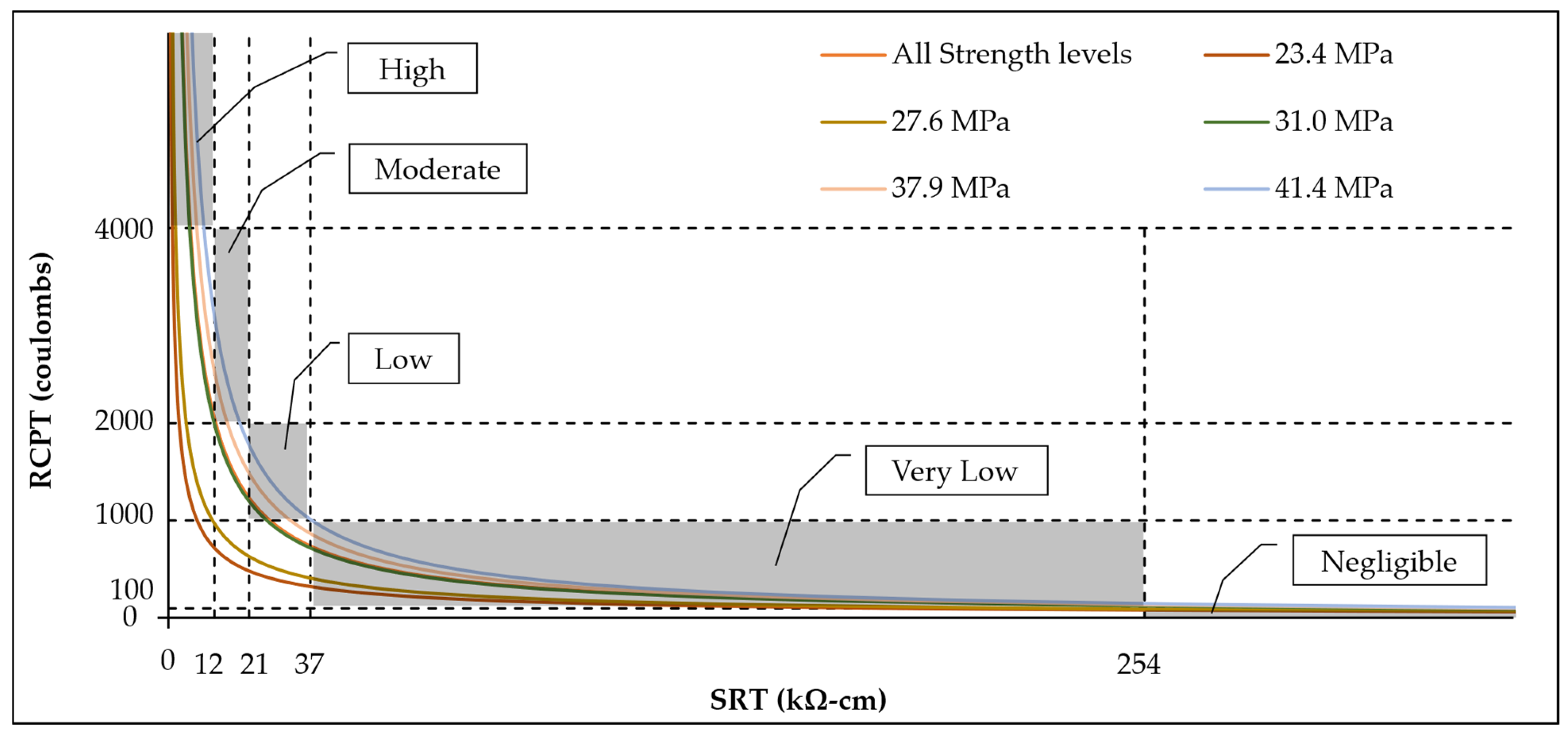



| Chloride Ion Penetrability | RCPT (Total Charge Passed) (Coulombs) |
|---|---|
| High | >4000 |
| Moderate | 2000–4000 |
| Low | 1000–2000 |
| Very Low | 100–1000 |
| Negligible | <100 |
| Chloride Ion Penetrability | Surface Resistivity Test kΩ-cm |
|---|---|
| High | >4000 |
| Moderate | 2000–4000 |
| Low | 1000–2000 |
| Very Low | 100–1000 |
| Negligible | <100 |
| Author(s) | Year | Equation | R2 | Compressive Strength (MPa) | Testing Age (Days) | w/c Raio | SCM Type (Where Applicable) |
|---|---|---|---|---|---|---|---|
| Mousavinezhad et al. | 2024 | 0.82 | 126.4 (average) | 56 | 0.14 (ultra-high-performance concrete) | Varying (FA, GGBFS, SF, and Metakaolin) | |
| Mousavinezhad et al. | 2023 | 0.80 | 35.0 (average) | 180 | 0.35 | Varying (NP and FA) | |
| Newtson et al. | 2021 | - | 35.0 (average) | 28 | 0.35 | Varying (NP and FA) | |
| El Dieb | 2018 | 0.9519 | 25–80 | 28 and 90 | 0.34–0.61 | Ceramic Waste Powder | |
| Gudimettla and Crawford | 2016 | 0.89 | - | 56 | 0.37–45 | Varying (FA and GGBFS) | |
| Gudimettla and Crawford | 2016 | 0.47 | - | 28 | 0.37–45 | Varying (FA and GGBFS) | |
| Ramezanianpour et al. | 2014 | 0.98 | 47.0 (average) | 7, 28, and 91 | 0.35 and 0.45 | Calcined Perlite | |
| Spragg et al. | 2013 | - | - | 7 and 91 | - | - | |
| Ryan et al. | 2013 | 0.882 | 36.9 | 28 and 56 | - | - | |
| Ryan et al. | 2013 | 0.841 | 36.9 | 56 | - | - | |
| Ramezanianpour et al. | 2012 | 0.92 | - | 7, 28, 90, and 180 | 0.35, 0.4, and 0.5 | Metakaolin | |
| Tanesi and Ardani | 2012 | 0.92 | 35.0 (average) | 28 | 0.37–0.47 | Varying (FA, GGBFS) | |
| Rupnow and Icenogle | 2011 | 0.8922 | - | 56 | 0.35, 0.50, and 0.65 | Varying (FA, GGBFS, SF) | |
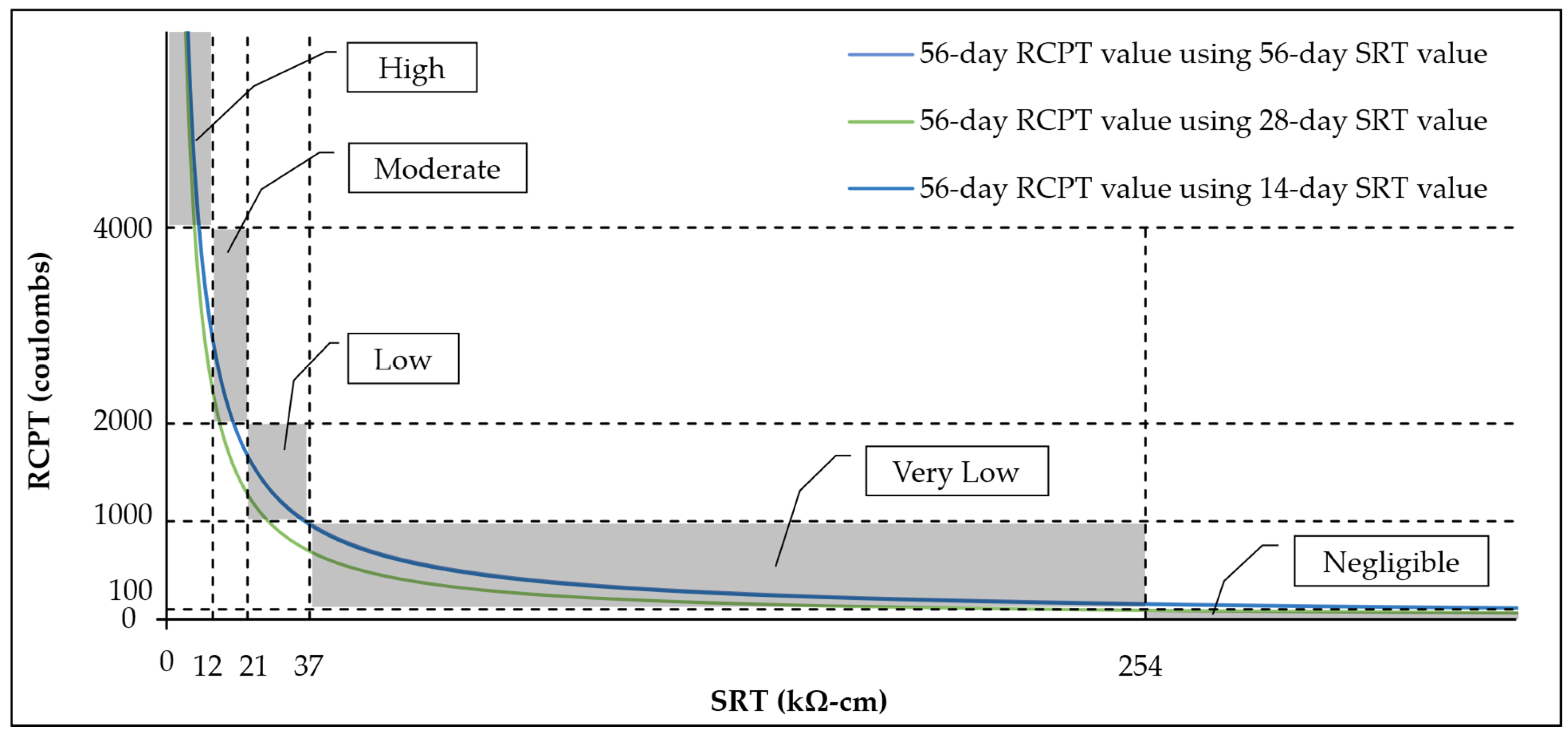
| Rupnow and Icenogle | 2011 | 0.87 | - | 56 (using 28 SRT results) | 0.35, 0.50, and 0.65 | Varying (FA, GGBFS, SF) | |
| Rupnow and Icenogle | 2011 | 0.8024 | - | 56 (using 14 SRT results) | 0.35, 0.50, and 0.65 | Varying (FA, GGBFS, SF) | |
| Ramezanianpour et al. | 2011 | 0.8977 | 47.0 (average) | 28–890 | 0.4, 0.45, 0.5, 0.55, and 0.6 | Varying (NPs, RHA, SF, …) | |
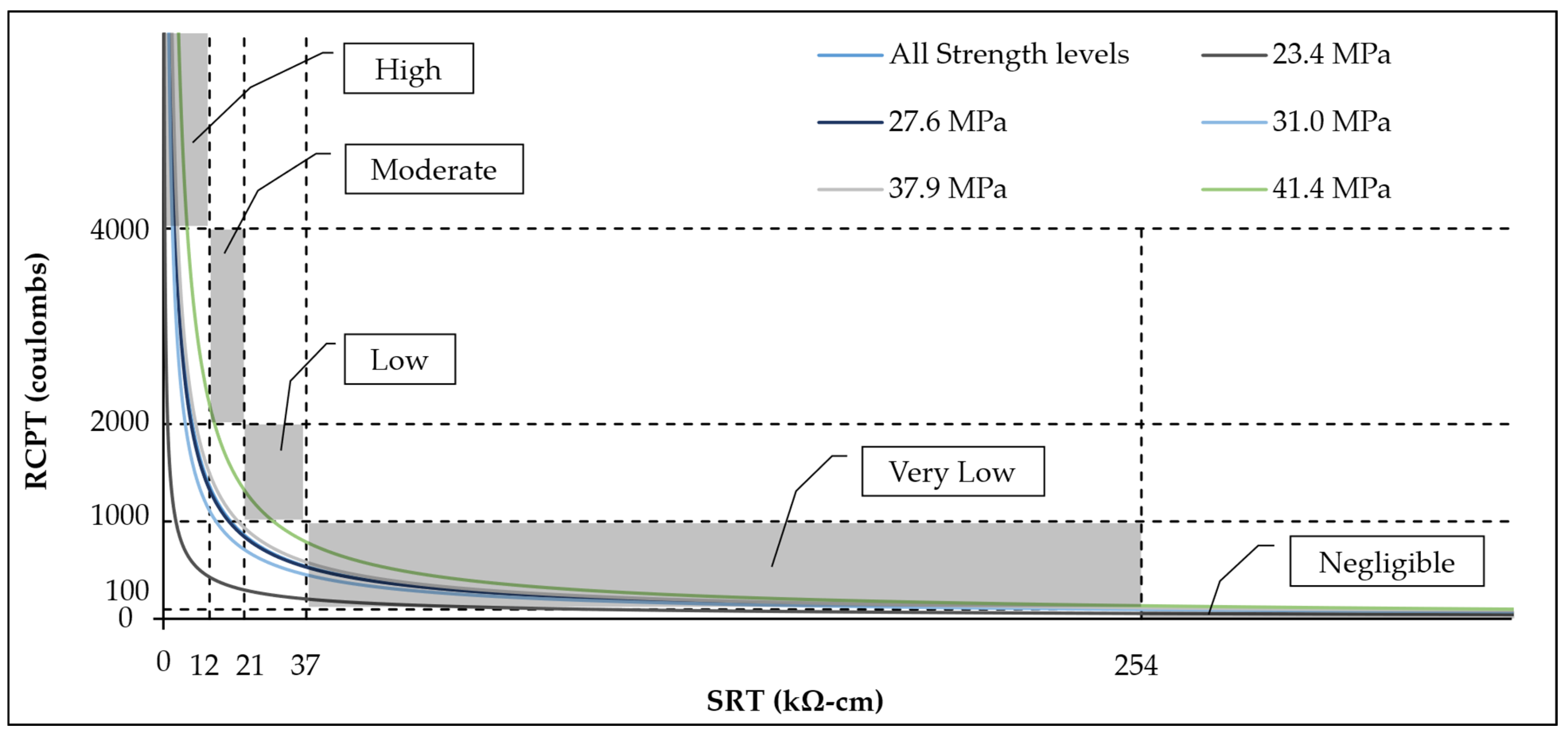
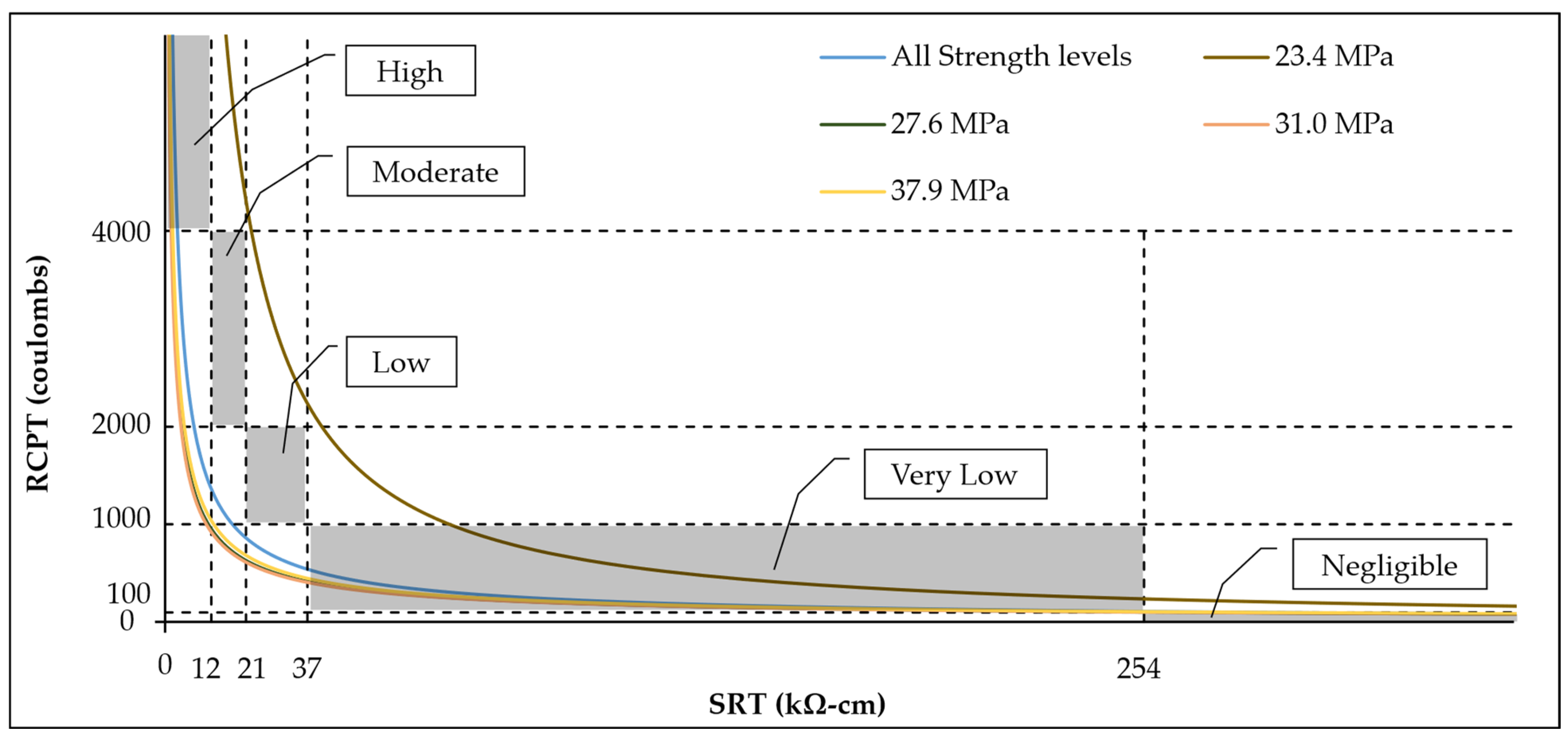
| Chini et al. | 2003 | 0.9481 | 23.4–58.6 | 28 | - | Varying (FA, GGBFS, SF) | |
| Chini et al. | 2003 | 0.9406 | 23.4 | 28 | - | Varying (FA, GGBFS) | |
| Chini et al. | 2003 | 0.7846 | 23.4 | 28 | - | FA | |
| Chini et al. | 2003 | 0.8653 | 23.4 | 28 | - | GGBFS | |
| Chini et al. | 2003 | 0.948 | 27.6 | 28 | - | Varying (FA, GGBFS) | |
| Chini et al. | 2003 | 0.788 | 27.6 | 28 | - | FA | |
| Chini et al. | 2003 | 0.8314 | 27.6 | 28 | - | GGBFS | |
| Chini et al. | 2003 | 0.9544 | 31.0 | 28 | - | Varying (FA, GGBFS) | |
| Chini et al. | 2003 | 0.8731 | 31.0 | 28 | - | FA | |
| Chini et al. | 2003 | 0.5458 | 31.0 | 28 | - | GGBFS | |
| Chini et al. | 2003 | 0.9306 | 37.9 | 28 | - | Varying (FA, GGBFS, SF) | |
| Chini et al. | 2003 | 0.9306 | 37.9 | 28 | - | FA | |
| Chini et al. | 2003 | 0.8603 | 37.9 | 28 | - | GGBFS | |
| Chini et al. | 2003 | 0.9674 | 37.9 | 28 | - | SF | |
| Chini et al. | 2003 | 0.9726 | 41.4 | 28 | - | Varying (FA, SF) | |
| Chini et al. | 2003 | 0.8318 | 41.4 | 28 | - | FA | |
| Chini et al. | 2003 | 0.9208 | 41.4 | 28 | - | SF | |
| Chini et al. | 2003 | 0.9591 | 44.8 | 28 | - | Varying (FA, GGBFS, SF) | |
| Chini et al. | 2003 | 0.6412 | 58.6 | 28 | - | Varying (FA, GGBFS, SF) | |
| Chini et al. | 2003 | 0.9321 | 23.4–58.6 | 91 | - | Varying (FA, GGBFS, SF) | |
| Chini et al. | 2003 | 0.8985 | 23.4 | 91 | - | Varying (FA, GGBFS) | |
| Chini et al. | 2003 | 0.8121 | 23.4 | 91 | - | FA | |
| Chini et al. | 2003 | 0.9193 | 23.4 | 91 | - | GGBFS | |
| Chini et al. | 2003 | 0.686 | 27.6 | 91 | - | Varying (FA, GGBFS) | |
| Chini et al. | 2003 | 0.7279 | 27.6 | 91 | - | FA | |
| Chini et al. | 2003 | 0.5837 | 27.6 | 91 | - | GGBFS | |
| Chini et al. | 2003 | 0.8749 | 31.0 | 91 | - | Varying (FA, GGBFS) | |
| Chini et al. | 2003 | 0.8479 | 31.0 | 91 | - | FA | |
| Chini et al. | 2003 | 0.4783 | 31.0 | 91 | - | GGBFS | |
| Chini et al. | 2003 | 0.8708 | 37.9 | 91 | - | Varying (FA, GGBFS, SF) | |
| Chini et al. | 2003 | 0.9115 | 37.9 | 91 | - | FA | |
| Chini et al. | 2003 | 0.8562 | 37.9 | 91 | - | GGBFS | |
| Chini et al. | 2003 | 0.9649 | 37.9 | 91 | - | SF | |
| Chini et al. | 2003 | 0.9583 | 41.4 | 91 | - | Varying (FA, SF) | |
| Chini et al. | 2003 | 0.824 | 41.4 | 91 | - | FA | |
| Chini et al. | 2003 | 0.8705 | 41.4 | 91 | - | SF | |
| Chini et al. | 2003 | 0.9787 | 44.8 | 91 | - | Varying (FA, GGBFS, SF) | |
| Chini et al. | 2003 | 0.888 | 58.6 | 91 | - | Varying (FA, GGBFS, SF) |
Disclaimer/Publisher’s Note: The statements, opinions and data contained in all publications are solely those of the individual author(s) and contributor(s) and not of MDPI and/or the editor(s). MDPI and/or the editor(s) disclaim responsibility for any injury to people or property resulting from any ideas, methods, instructions or products referred to in the content. |
© 2025 by the authors. Licensee MDPI, Basel, Switzerland. This article is an open access article distributed under the terms and conditions of the Creative Commons Attribution (CC BY) license (https://creativecommons.org/licenses/by/4.0/).
Share and Cite
Mousavinezhad, S.; Nozari, S.; Newtson, C.M. Classifying Concrete Permeability Using Rapid Chloride Permeability and Surface Resistivity Tests: Benefits, Limitations, and Predictive Models—A State-of-the-Art Review. Buildings 2025, 15, 4216. https://doi.org/10.3390/buildings15234216
Mousavinezhad S, Nozari S, Newtson CM. Classifying Concrete Permeability Using Rapid Chloride Permeability and Surface Resistivity Tests: Benefits, Limitations, and Predictive Models—A State-of-the-Art Review. Buildings. 2025; 15(23):4216. https://doi.org/10.3390/buildings15234216
Chicago/Turabian StyleMousavinezhad, Seyedsaleh, Shahin Nozari, and Craig M. Newtson. 2025. "Classifying Concrete Permeability Using Rapid Chloride Permeability and Surface Resistivity Tests: Benefits, Limitations, and Predictive Models—A State-of-the-Art Review" Buildings 15, no. 23: 4216. https://doi.org/10.3390/buildings15234216
APA StyleMousavinezhad, S., Nozari, S., & Newtson, C. M. (2025). Classifying Concrete Permeability Using Rapid Chloride Permeability and Surface Resistivity Tests: Benefits, Limitations, and Predictive Models—A State-of-the-Art Review. Buildings, 15(23), 4216. https://doi.org/10.3390/buildings15234216