Article

Real-Time Detection of Unsafe Worker Behaviors via Adaptive Vision Transformers in Construction Sites


by
Rami Talal T. Alotaibi
* and
Shengbin Ma
School of Construction Engineering, Dalian University of Technology, Dalian 116024, China
*
Author to whom correspondence should be addressed.
Buildings 2025, 15(22), 4205; https://doi.org/10.3390/buildings15224205
Submission received: 19 October 2025 / Revised: 14 November 2025 / Accepted: 18 November 2025 / Published: 20 November 2025

Abstract

Unsafe behavior of workers is a leading cause of construction accidents. However, existing monitoring systems remain limited by low efficiency and poor adaptability to dynamic on-site environments. This study proposes an adaptive dual-stream vision framework that integrates Dynamic Adaptive Image Enhancement (DAIE) and a Lightweight Real-Time Behavior Network (LR-BehaviorNet) to improve the accuracy and responsiveness of unsafe behavior detection. The DAIE module dynamically adjusts brightness, contrast, and sharpness according to scene conditions, ensuring visual clarity under varying lighting and weather. LR-BehaviorNet combines efficient convolutional blocks with Transformer-based temporal modeling to identify critical actions from both enhanced and raw image streams. Additionally, an adaptive thresholding mechanism fine-tunes detection sensitivity under complex visual interference. Experiments using open-source construction datasets demonstrate that the proposed framework outperforms conventional models—including Faster R-CNN, YOLO, and Mask R-CNN—in precision, recall, and F1-score, achieving 93.2%, 91.4%, and 92.3%, respectively. These results validate the robustness of the proposed method for real-time safety supervision and its potential integration with intelligent construction management platforms. Overall, the framework offers a scalable and efficient solution for automated safety monitoring, advancing the digital transformation of construction safety management.

1. Introduction

In construction management, ensuring operational safety is fundamental to sustaining project continuity and safeguarding the well-being of on-site personnel [1]. Given the inherent complexity and variability of construction environments, the prompt detection and mitigation of unsafe behaviors are essential for preventing accidents and reducing injuries [2]. Therefore, developing and implementing effective risk-control strategies is crucial to addressing persistent safety challenges in the construction industry, highlighting the necessity of continuous improvement in safety management practices [3]. Traditional monitoring methods—such as manual inspections, wearable sensors, and video surveillance—have been widely applied but often suffer from limitations, including low efficiency, high implementation costs, and inadequate integration of digital technologies [4,5,6]. These shortcomings impede the timely and accurate identification of unsafe behaviors, thus constraining their effectiveness in data-driven construction safety management.
For example, a scaffold collapse case study in 2024 showed how emergency response and pre-incident controls can be undermined when site supervision and information flow are not timely or adaptive to changing conditions, highlighting the limitations of traditional monitoring and inspection regimes under dynamic environments [7]. Likewise, a construction-phase collapse of a post-tensioned reinforced concrete truss bridge in 2024 identified deficiencies during temporary works and construction stages—conditions where periodic human inspections failed to capture evolving hazards in time—underscoring the need for continuous, automated, and context-aware safety monitoring [8]. Together, these cases demonstrate how the lack of real-time, intelligent supervision can delay hazard detection and escalation control, motivating the proposed approach in this study.
In the field of construction safety monitoring, previous studies have made notable progress in recognizing the use of safety equipment, particularly helmets and harnesses [9,10,11]. Nevertheless, these methods still face persistent challenges such as low processing efficiency, limited recognition accuracy, and poor adaptability to diverse field conditions [12]. Early computer vision algorithms—including Haar cascade classifiers and early convolutional neural networks (CNNs)—are computationally intensive, resulting in latency that limits their suitability for real-time monitoring applications [13]. Moreover, their performance deteriorates significantly under varying illumination, occlusions, or cluttered visual scenes, leading to unstable recognition outcomes in dynamic construction environments. Traditional image-processing approaches rely on fixed parameter configurations and lack the flexibility to adapt to environmental variations, often requiring manual tuning that is both time-consuming and inefficient [14,15]. Although recent deep learning frameworks, such as Faster R-CNN and YOLO, have improved recognition accuracy, they require substantial computational resources, leading to response delays that hinder real-time safety interventions [16,17,18,19].
To address these limitations, this study presents an integrated approach that combines Dynamic Adaptive Image Enhancement (DAIE) and a Real-Time Behavior Recognition Network (R-BehaviorNet). DAIE employs a content-driven adaptive mechanism that continuously adjusts enhancement parameters in response to changing lighting and visual contexts, ensuring consistent image clarity for reliable behavior analysis. Unlike conventional static enhancement methods, DAIE improves both visual quality and recognition accuracy without compromising processing speed. Meanwhile, R-BehaviorNet adopts a lightweight convolutional architecture with embedded temporal modeling, enhancing computational efficiency while improving the recognition of dynamic behaviors exhibited by construction workers. Together, these modules enable precise real-time identification and alerting of unsafe actions—such as the absence of helmets or harnesses—during continuous video analysis. The dual-stream processing architecture further enhances system robustness, maintaining high recognition performance under complex and rapidly changing site conditions. This integrated solution not only improves the timeliness and accuracy of unsafe behavior monitoring but also reduces dependence on high-end hardware, thereby enabling practical deployment in real construction environments. Ultimately, the proposed framework promotes the digitalization and intelligence of construction safety management, supporting sustainable improvements in monitoring efficiency and reliability.
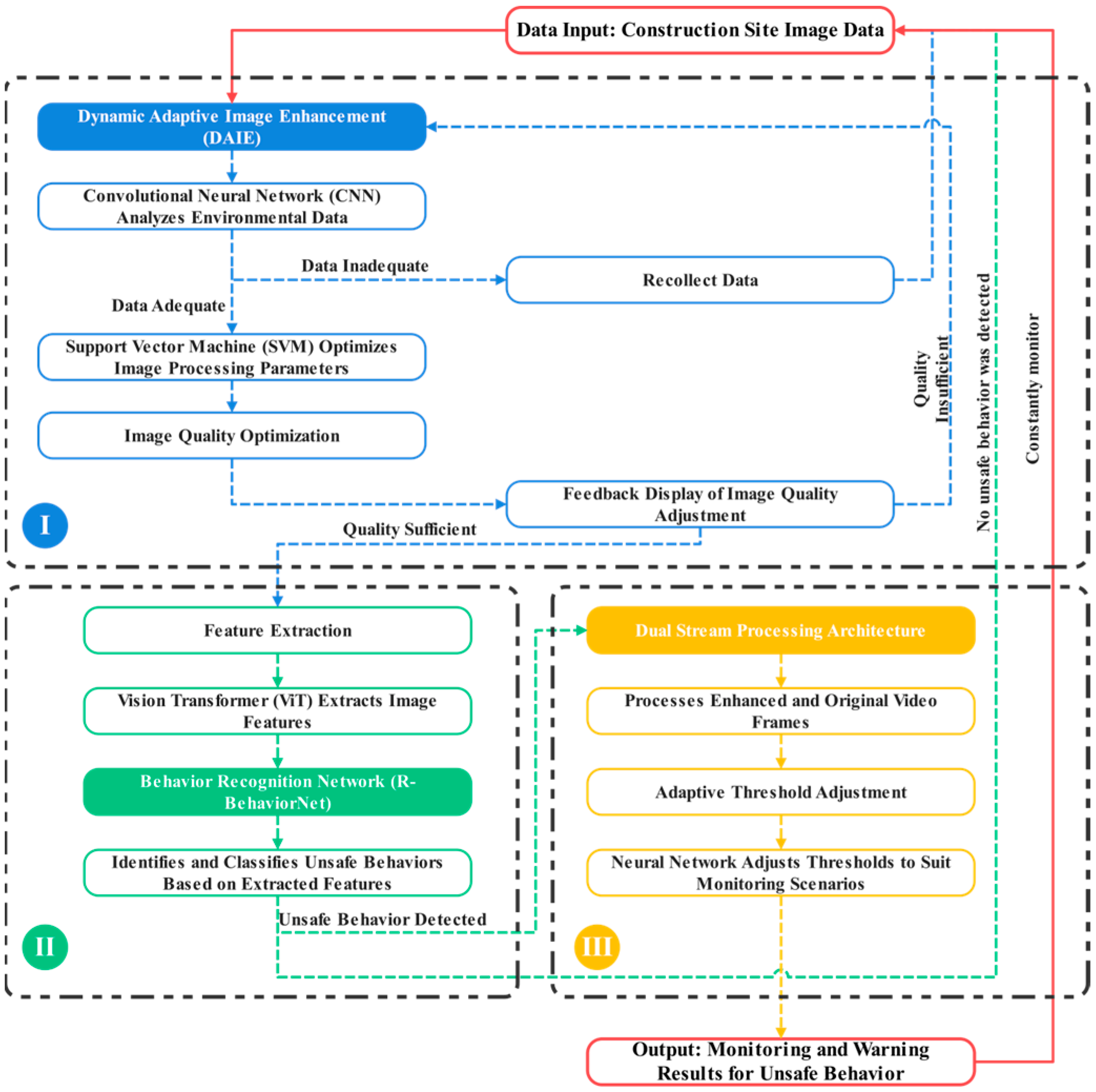
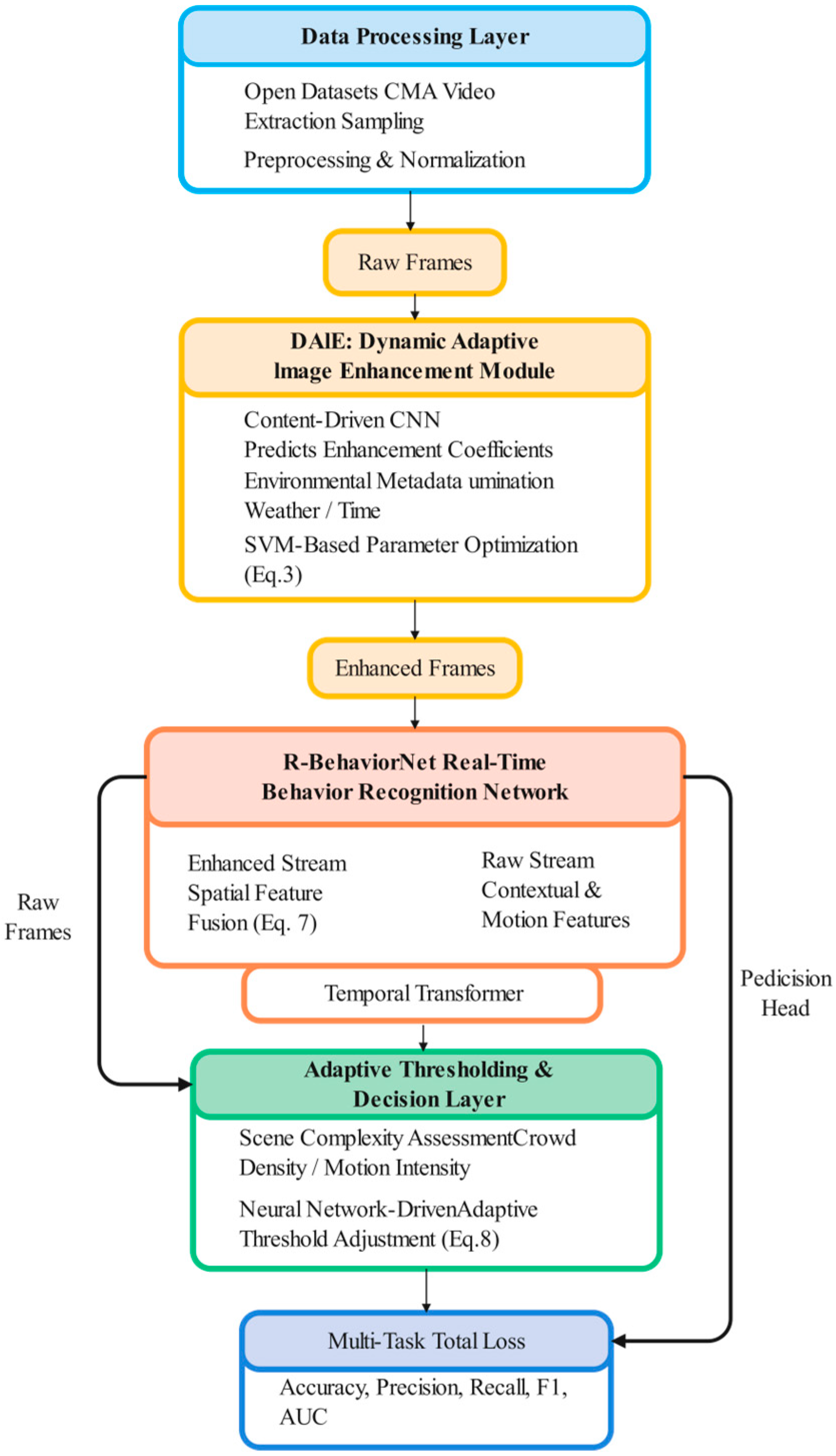
The overall methodological framework of this study is presented in Figure 1. It outlines the overall technical framework of the proposed unsafe-behavior detection system, illustrating the workflow from image enhancement (DAIE) to behavior recognition (R-BehaviorNet) and decision fusion. The key contributions can be summarized as follows: (1) This study develops a novel image preprocessing framework capable of dynamically adjusting enhancement parameters according to specific environmental conditions at construction sites, such as lighting, contrast, and noise levels. This adaptive approach not only improves image quality but also provides a clearer visual foundation for subsequent behavior recognition, significantly enhancing the system’s adaptability and accuracy in complex environments. (2) R-BehaviorNet adopts a lightweight design that reduces computational complexity while maintaining high accuracy. The network, strengthened by the integration of transformers, improves the analysis of behavioral time sequences, enabling the identification and prediction of unsafe behaviors among construction personnel. This strategy, which combines temporal analysis with spatial feature extraction, further enhances both the accuracy and timeliness of behavior recognition. (3) The dual-stream processing architecture simultaneously processes both DAIE-enhanced images and original video frames, effectively capturing detailed visual features as well as urgent actions or events. The decision layer integrates the results from both data streams to optimize recognition accuracy. Moreover, detection thresholds are dynamically adjusted based on real-time video content—particularly under densely populated or rapidly changing lighting conditions—thereby improving the sensitivity and responsiveness of the monitoring system.
The following section reviews related studies on safety management in construction. Section 3 discusses the innovative applications of DAIE technology and R-BehaviorNet, along with their integration into existing monitoring systems. Section 4 presents practical case studies that demonstrate the advantages of the proposed method over traditional monitoring technologies in terms of timeliness and accuracy, supported by empirical validation and comparative analysis. Finally, the conclusion summarizes the main contributions of this study and provides an outlook for future research, highlighting potential improvements to further adapt the monitoring system to increasingly complex construction environments.

2. Background

2.1. Application of Image Enhancement in Construction Safety Monitoring

The efficiency and accuracy of construction safety monitoring are crucial to the smooth progress of projects. Traditional image enhancement methods, such as histogram equalization and filtering techniques, are widely used in monitoring systems to improve image quality but often perform poorly in dynamic and complex construction environments [20]. These methods typically rely on static parameter settings and cannot adapt to changes in lighting intensity, weather conditions, and scene dynamics, leading to fluctuations in monitoring effectiveness. Moreover, construction site images often contain many dynamically changing elements, such as moving equipment and personnel, challenging traditional methods to adjust image processing strategies in real-time [21]. Meanwhile, traditional image enhancement techniques require manual parameter adjustments, which are not only time-consuming but can also lead to inconsistencies in results due to the subjective judgment of operators. For example, inappropriate image processing can obscure critical features during safety equipment recognition (such as safety helmets and harnesses), reducing the accuracy of identification [22]. Furthermore, these techniques perform poorly in handling image degradation caused by weather or lighting, such as fog and backlighting, which are particularly common in construction site monitoring [23].
Recent studies have begun to explore the use of more advanced image processing technologies to overcome these limitations. For instance, research by Rane et al. investigated the possibility of using machine learning algorithms to automatically adjust image enhancement parameters in dynamic scenes, showing that this approach could improve image quality to some extent, yet it remains limited by processing speed and algorithm generalization capabilities [24]. Research by Brahmaji Rao K. N et al. [25] attempted to use deep neural networks to predict and adapt to different lighting conditions, achieving preliminary success, though the complexity and computational demands of real-time applications continue to pose significant challenges. However, despite these advancements, the highly uncertain and rapidly changing environment of construction sites still does not fully meet the needs for real-time and accurate monitoring. Against this backdrop, DAIE technology has emerged, focusing not only on immediate image quality improvement but also on real-time adaptability. DAIE technology utilizes real-time data analysis to dynamically adjust image processing parameters, ensuring that even under extreme and rapidly changing conditions, image enhancement effectiveness is maintained, thereby improving the overall performance and response speed of the monitoring system.
In this way, DAIE technology not only addresses the limitations of traditional image enhancement methods but also enhances the overall performance of construction safety monitoring, making it more suitable for the needs of modern construction projects. Through continuous research and optimization, DAIE technology has the potential to become one of the key technologies transforming the field of construction safety management.

2.2. Application of Real-Time Behavior Recognition Technology in Construction Safety Monitoring

In the domain of construction safety monitoring, real-time behavior recognition technology plays a critical role in preventing accidents and enhancing the efficiency of onsite safety management [26]. By monitoring workers’ behaviors in high-risk areas—such as unauthorized entry or improper use of safety equipment—this technology can alert monitoring personnel to potential violations in real time, thereby preventing accidents and improving compliance with safety regulations [27]. As intelligent monitoring systems continue to evolve, real-time behavior recognition has become a key component in enhancing both the responsiveness and accuracy of construction safety management [28]. Despite its significant potential, real-time behavior recognition still faces challenges in dynamic and complex construction environments. Environmental factors such as fluctuating illumination, cluttered backgrounds, and fast-moving objects substantially increase recognition difficulty [29]. Moreover, the need for instant data processing places higher demands on algorithmic efficiency and hardware resources. As a result, limited environmental adaptability and high computational cost often hinder the real-time performance of existing systems [30].
Some emerging technologies have certain potential in solving these challenges. For example, deep learning methods such as CNNs and Recurrent Neural Networks (RNNs) have been widely applied for analyzing behaviors in surveillance video streams [31]. These methods have markedly improved recognition accuracy through their ability to learn complex representations and model temporal dependencies. CNNs are typically used for image-based feature extraction, while RNNs and Transformer variants effectively capture sequential motion patterns, thereby improving the continuity and reliability of behavior prediction [32]. Recent studies have further advanced the application of computer vision and deep learning. For example, Zhang Y et al. developed a helmet detection framework combining head–region matching and state tracking to enhance PPE compliance monitoring [11]; Wu Z et al. proposed a YOLOv8-based helmet recognition model that improved detection precision under complex conditions [10]; and Pan X et al. introduced a blockchain–deep learning hybrid framework to ensure video security and lightweight storage for construction safety management [6]. Collectively, these studies highlight a growing research focus on integrating intelligent vision, multimodal fusion, and real-time monitoring to enhance safety performance on construction sites. However, these models still encounter some difficulties in identifying, detecting, and managing building safety. Firstly, the heavy computational requirements of deep models may lead to processing delays when rapid response is required [33]. Secondly, their performance can degrade sharply under variable lighting or noisy backgrounds [34]. Thirdly, the collection of large, high-quality labeled datasets remains costly and difficult due to the variability of construction environments [35].
Recent research attempts to solve these problems by exploring the identification of unsafe behaviors in multimodal and hybrid frameworks. For example, Kang et al. integrated real-time labor positioning data with 3D laser scanning to monitor dangerous zones, achieving efficient spatial awareness but showing limited visual adaptability under variable lighting conditions [15]. Similarly, Han et al. proposed a panoramic segmentation model for indoor sites using a foundation model–based approach, which improved spatial coverage but remained computationally heavy for real-time deployment [14]. To address these remaining limitations, this paper proposes R-BehaviorNet, an innovative real-time behavior recognition network that combines a lightweight architecture with high processing efficiency. R-BehaviorNet adopts a dual-stream design in which one stream processes DAIE-enhanced images for improved clarity, while the other processes raw visual data directly. This dual-stream configuration allows the system to preserve both enhanced visual detail and contextual information, thereby improving responsiveness to emergent safety events without sacrificing image quality. Through this approach, the network captures clear visual features while accurately recognizing urgent worker behaviors, enabling immediate warnings and responses when necessary. Additionally, the incorporation of depthwise separable convolutions effectively reduces the model’s parameter count and computational burden, improving inference speed on edge devices. These innovations significantly enhance environmental adaptability and operational efficiency, ensuring rapid response and real-time performance even in high-risk construction scenarios.

3. Methodology

The overall technical framework adopted in this study is illustrated in Figure 1. A comprehensive system integrating DAIE and R-BehaviorNet is proposed to monitor and provide early warnings of unsafe behaviors at construction sites. By combining Convolutional Neural Networks (CNNs) with Support Vector Machines (SVMs) to optimize image processing parameters, the proposed approach adapts effectively to complex environmental conditions and enhances image quality. Furthermore, deep feature extraction based on the Vision Transformer model not only improves recognition accuracy and efficiency but also strengthens system adaptability and responsiveness through the dual-stream architecture and the neural network–based adaptive threshold mechanism. Overall, this methodological framework systematically addresses key challenges in construction safety monitoring and significantly improves the performance and reliability of the monitoring system through the application of advanced machine learning techniques.

3.1. DAIE

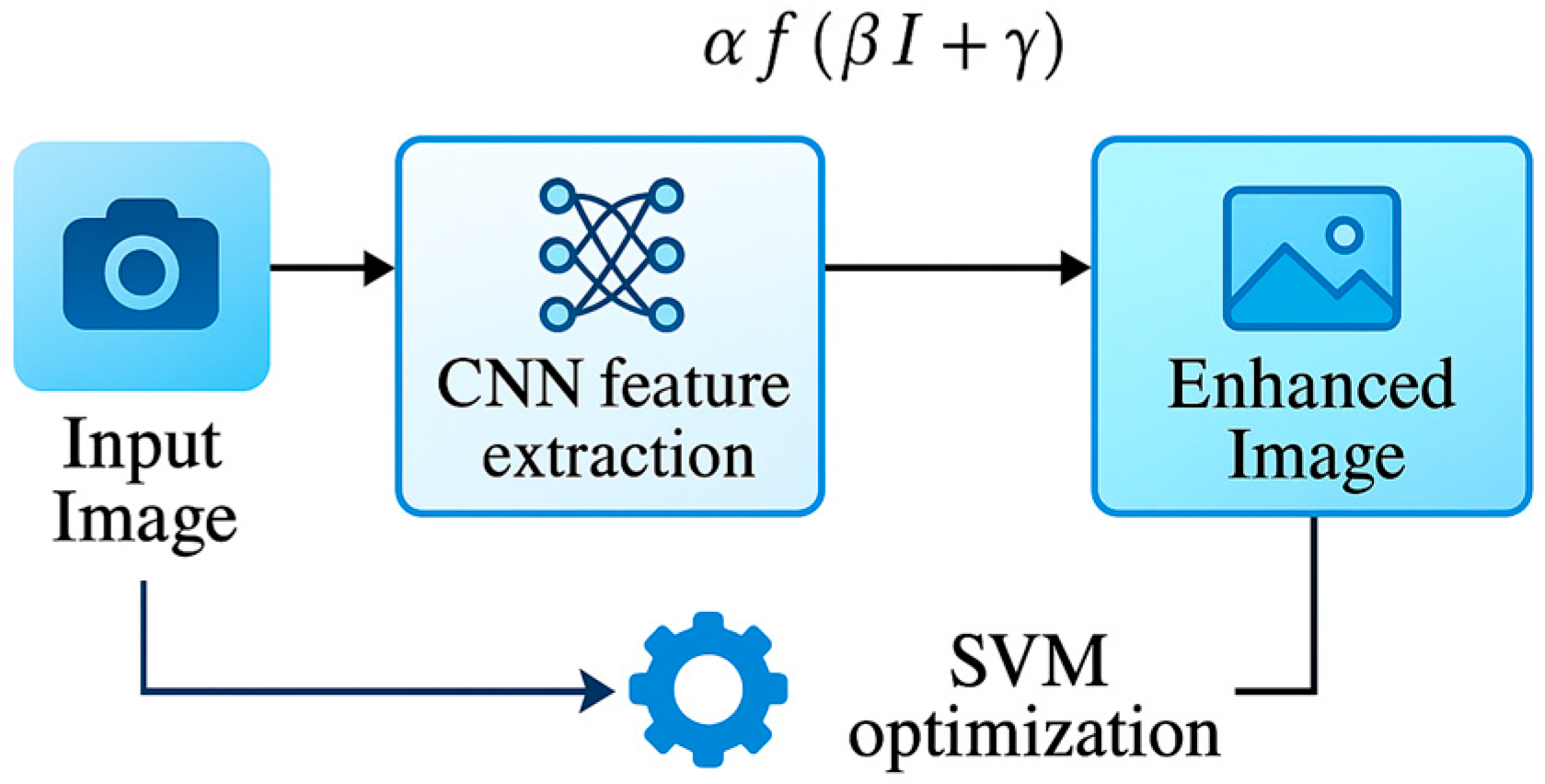
To optimize image quality at construction sites and adapt to variations in lighting and weather conditions, this study introduces DAIE (Dynamic Adaptive Image Enhancement) technology [36,37]. This technology dynamically adjusts image enhancement parameters, such as brightness, contrast, and sharpness, based on real-time monitoring data to ensure that the image quality consistently meets the requirements for behavior recognition. The internal workflow of the DAIE module is illustrated in Figure 2, where α, β, and γ correspond to adaptive coefficients for brightness, contrast, and sharpness, respectively.
(1) Adaptive Adjustment of Image Quality [38]: An adaptive model based on CNNs is utilized to dynamically adjust parameters such as brightness, contrast, and sharpness. The process is described by the following equation. Here, G ( I ) represents the enhanced image, I is the original image, and α , β , and γ are parameters dynamically adjusted based on the CNN model output. The function f denotes specific image enhancement operations such as contrast adjustment. Following adaptive brightness/contrast enhancement formulations in neural-network-based image processing [39], the enhanced image is expressed as:
G ( I ) = α f ( β I + γ )
Here, G ( I ) represents the enhanced image, I is the original image, and α , β , and γ are dynamically adjusted parameters predicted by the CNN model. The function f ( ) denotes specific image enhancement operations such as contrast or brightness adjustment.
In the initialization stage, the enhancement parameters α, β, and γ correspond respectively to brightness, contrast, and sharpness coefficients. Their initial values are empirically set within the normalized range of 0.8–1.2 to ensure stable convergence and avoid over-enhancement or image distortion. During the adaptive optimization process, the CNN model updates these parameters iteratively according to the environmental feedback, with an adjustment step size of 0.05 for α and β, and 0.02 for γ. These values were determined through preliminary experiments to balance response sensitivity and stability across different illumination and weather conditions. Drawing from parameter update strategies in adaptive enhancement network [40], the iterative update of enhancement coefficients proceeds as:
α t + 1 = α t + Δ α , β t + 1 = β t + Δ β , γ t + 1 = γ t + Δ γ
where Δα, Δβ, and Δγ are the CNN-predicted incremental adjustments based on real-time environmental features extracted from the monitoring data.
Equations (1) and (2) describe the adaptive update process for the enhancement parameters α, β, and γ, which respectively correspond to brightness, contrast, and sharpness adjustments. The CNN model was trained using 12,000 image patches extracted from the CMA and Roboflow datasets under diverse lighting conditions. Mean squared error (MSE) between predicted and target enhancement quality scores—measured by peak signal-to-noise ratio (PSNR) and structural similarity index (SSIM)—was used as the loss function. During training, stochastic gradient descent (SGD) with a learning rate of 0.001 was employed to minimize the loss and iteratively optimize the parameter estimation network. This learning process enables the DAIE module to generalize to unseen illumination and weather scenarios during inference.
(2) Optimization of Parameters [41]: The SVM model is employed to predict optimal image enhancement parameters to maximize the accuracy of the recognition system. The optimization process is formalized as follows, where E represents environmental data collected from real-time environmental sensors, and SVM _ Optimize is an optimization algorithm based on Support Vector Machines.
α , β , γ = SVM _ Optimize ( E )
Equation (3) represents the SVM-based optimization process that refines the CNN-predicted parameters by learning from environmental metadata. The SVM was trained with a radial basis function (RBF) kernel using environmental data (illumination level, temperature, humidity) as features and corresponding enhancement quality labels as outputs. This secondary optimization step ensures that the predicted enhancement coefficients remain stable across fluctuating site conditions, improving visual consistency for downstream behavior recognition.
In this framework, the CNN and SVM operate in a semi end-to-end manner. Specifically, the CNN performs real-time prediction of enhancement parameters (α, β, γ) from image content, while the SVM is trained offline using environmental metadata to learn a global correction function. During inference, the SVM refines the CNN’s predicted parameters through lightweight regression without requiring backpropagation across both models. This hybrid design preserves the CNN’s real-time adaptability while leveraging the SVM’s stability to smooth parameter fluctuations caused by abrupt illumination or weather changes. As a result, the CNN–SVM integration functions as a sequential optimization pipeline rather than a fully end-to-end network, ensuring efficient and stable adaptive enhancement in dynamic environments.
In addition, environmental parameters such as time of day and weather conditions are introduced as auxiliary inputs to the adaptive enhancement model. These parameters are obtained from onsite monitoring sensors and integrated into the CNN–SVM optimization process, allowing the algorithm to dynamically adjust image enhancement coefficients and recognition thresholds according to temporal and climatic variations (e.g., low illumination at dusk, high glare at noon, or reduced visibility during rainfall). This integration ensures that the proposed model can maintain detection stability and real-time adaptability under diverse site conditions.

3.2. R-BehaviorNet

A real-time behavior recognition network based on the Transformer architecture is developed to identify unsafe behaviors at construction sites efficiently [42,43]. This network combines the capabilities of spatial and temporal feature extraction.
(1) Lightweight Transformer Design: A Lightweight version of the Transformer, specifically designed for visual tasks—Vision Transformer—is implemented to optimize computational efficiency. The operation is expressed by the following equation. Where T ( D ) is the output of the Transformer, and D is the input data, primarily consisting of image frames optimized by the DAIE technology.
T ( D ) = ViT ( D )
(2) Feature Extraction and Analysis: Features extracted from the Transformer output are analyzed using a custom fully connected layer to classify different behaviors. The feature extraction process is captured as follows, where F T denotes the features extracted, and T is the data processed by the Transformer.
F T = FeatureExtract T
The Vision Transformer backbone in R-BehaviorNet consists of 8 encoder layers, each containing 6 self-attention heads and a hidden embedding dimension of 512. The patch size for tokenization is set to 16 × 16, and each frame is divided into 576 tokens. The feed-forward network within each encoder block uses a 2048-dimensional hidden layer with GELU activation. Layer normalization is applied before each attention and MLP block to stabilize training. Dropout with a rate of 0.1 is employed to mitigate overfitting. These configurations were determined through grid-search experiments to balance model accuracy and computational efficiency, enabling real-time inference on edge devices.
The Vision Transformer in R-BehaviorNet was trained in a supervised manner using cross-entropy loss. Input sequences consist of temporally ordered frame embeddings generated by the DAIE module. The model parameters were optimized using the Adam optimizer (initial learning rate 1 × 10⁻⁴, batch size 32, and 50 training epochs). Positional encoding was used to preserve temporal dependencies among frames, allowing the network to capture motion patterns such as lifting, climbing, or turning. The final classification head (Equation (5)) was fine-tuned on labeled unsafe-behavior categories, enabling high temporal sensitivity and efficient inference.
To quantitatively demonstrate the lightweight characteristics of R-BehaviorNet, several key indicators were analyzed and compared with representative Transformer-based vision models. The proposed model contains approximately 8.7 million parameters, corresponding to a 42% reduction relative to the standard Vision Transformer (ViT-B/16) and a 31% reduction compared with the Swin-Tiny model. The computational load, measured in floating-point operations per second, is approximately 5.3 GFLOPs per frame, representing a 35% decrease in computation while maintaining comparable recognition accuracy. Inference efficiency reaches 42 frames per second on an NVIDIA RTX 2080 Ti GPU, satisfying real-time processing requirements in construction-site monitoring. These results confirm that R-BehaviorNet achieves a favorable trade-off between accuracy and efficiency, ensuring deployability on edge devices and embedded safety monitoring platforms.
(3) Behavior Recognition and Decision Making: Based on the extracted features, final behavior recognition and classification are performed using a softmax layer, where R ( F ) represents the recognition results, σ is the softmax function outputting the most likely behavior category, and W and b are the learned parameters of the network.
R ( F ) = σ ( W F + b )

3.3. Dual-Stream Processing Architecture and Adaptive Threshold Adjustment

Dual-stream processing architecture is adopted to enhance the robustness and response speed of the system by processing both DAIE-enhanced images and original video frames simultaneously [4,5]. Moreover, a neural network-based model is utilized to dynamically adjust the detection thresholds according to the complexity of different scenes.
(1) Dual-Stream Data Fusion: Features from the enhanced and original data streams are merged using a neural network fusion function to optimize the accuracy of behavior recognition. Where H enhanced and H raw represent the features from the enhanced and original data streams, respectively. Combine is a neural network fusion function, and δ denotes the decision mechanism. Following dual-stream fusion frameworks in visual behaviour recognition [44], features from two streams are merged via:
Fusion ( H enhanced , H raw ) = δ ( Combine ( H enhanced , H raw ) )
(2) Adaptive Threshold Adjustment: Θ adjust is the adjusted threshold, V indicates the complexity of the video content, θ is the initial threshold, κ is an adjustment coefficient based on neural network output, and Adapt is an adaptive threshold adjustment function. Inspired by adaptive thresholding mechanisms in the two-stream network [45], the threshold adjustment is formulated as:
Θ adjust ( V ) = θ κ × Adapt ( V )
For the dual-stream fusion and adaptive thresholding stages, the fusion network was trained jointly with R-BehaviorNet using a multi-task loss function combining classification loss and threshold regularization. The threshold adjustment coefficient λ in Equation (8) was updated via backpropagation to balance detection sensitivity and false alarm rates. During validation, threshold values were adaptively tuned based on the F1 score, ensuring stable performance under varying scene complexities.
The DAIE module and R-BehaviorNet operate in a tightly coupled sequence within the proposed framework. DAIE first performs real-time enhancement of incoming video frames by dynamically adjusting brightness, contrast, and sharpness based on environmental feedback, thereby generating both enhanced and original frame streams. These two streams are synchronously transmitted to R-BehaviorNet, where spatial features from the enhanced images are fused with temporal representations extracted from the raw frames. This collaborative design enables the network to leverage DAIE’s visual clarity and the contextual continuity of the original sequence simultaneously. During inference, R-BehaviorNet integrates these complementary features through a neural fusion layer, ensuring that behavior recognition remains robust under fluctuating lighting, occlusion, and motion conditions. The adaptive thresholding mechanism subsequently refines the joint output to reduce false detections and maintain consistent system responsiveness.
The training process of the integrated DAIE-R-BehaviorNet system followed a sequential fine-tuning strategy. The DAIE module was first pretrained for image enhancement using unsupervised quality metrics (PSNR, SSIM), and its parameters were fixed during the initial R-BehaviorNet training. Subsequently, joint optimization was performed using the combined loss of enhancement consistency and behavior classification. This hybrid training strategy ensures that both visual enhancement and action recognition models contribute effectively to end-to-end system optimization, achieving robust real-time performance in construction site monitoring.
To improve the readability of the proposed methodology and clarify how the mathematical formulations introduced in this chapter work together within the model, we provide an overview diagram illustrating the end-to-end training workflow. As shown in Figure 3, the training process begins with the enhanced image sequences generated by the DAIE module, followed by spatial–temporal feature extraction through R-BehaviorNet. The extracted features are then integrated through the temporal Transformer, which corresponds to the attention-based equations introduced earlier. Finally, the model is optimized through multiple loss components that jointly supervise classification, localization, temporal consistency, and enhancement stability. This flowchart visualizes the relationships among the equations and highlights the interactions between DAIE, Transformer-based temporal modeling, and the multi-loss training objective.

4. Illustrative Examples

To ensure the validity and reproducibility of the experimental results, a standardized experimental environment and rigorous training-validation process were employed. All models were trained and tested using the same software configuration, specifically within a Python 3.12.4 environment utilizing TensorFlow 2.12 and PyTorch 2.0.1 deep learning frameworks. The experiments were primarily conducted on Google Colaboratory Pro (Google Colab Pro), which provides online cloud services equipped with high-performance Graphics Processing Units (GPUs). This platform ensures efficient execution of computational tasks, allowing the model training process to maintain high processing efficiency and short training times without the need for local high-performance hardware.

4.1. Datasets and Preprocessing

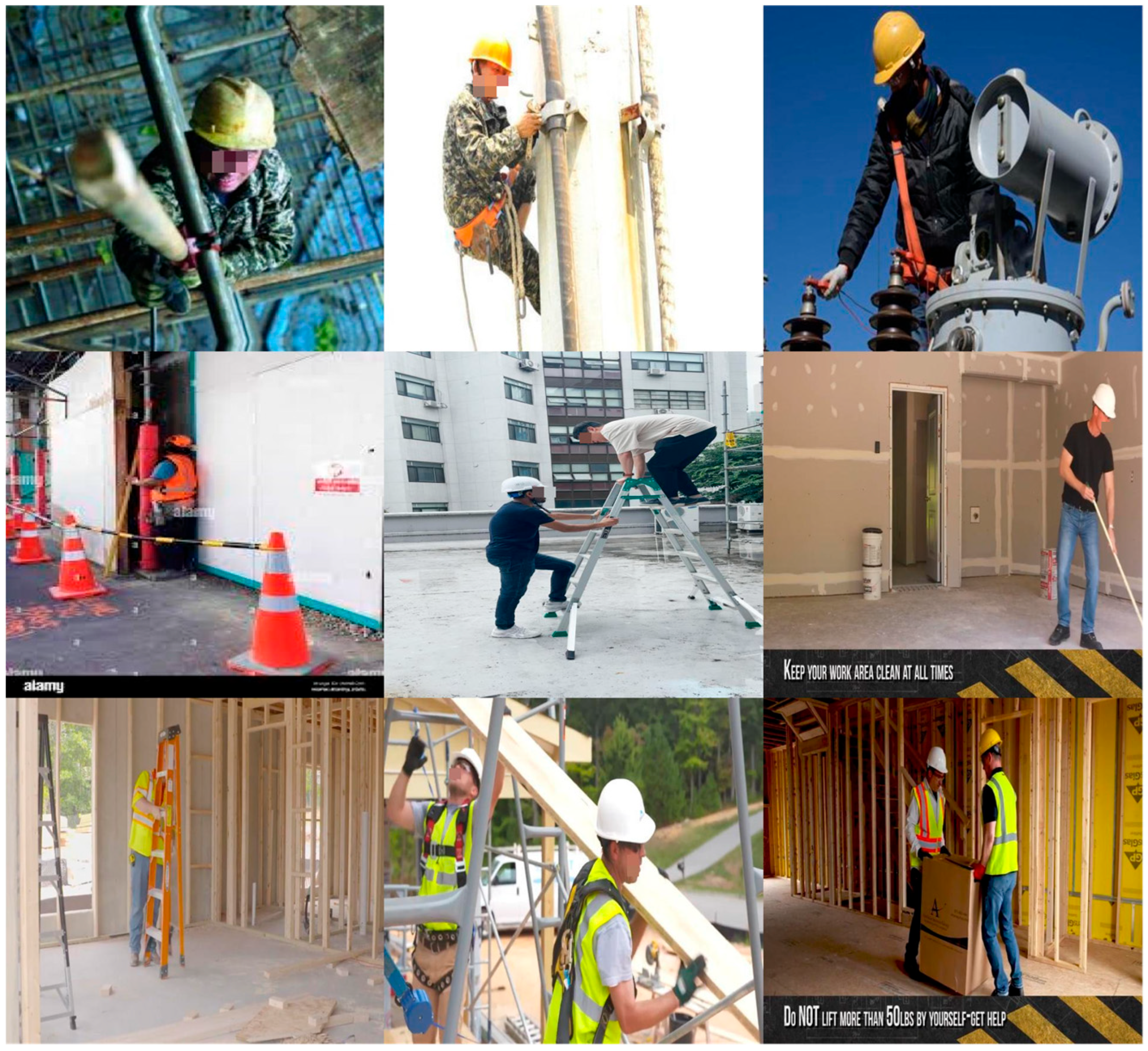
This study utilized two open-source datasets, selected for their high relevance to the research goals based on their image types and applications. The first dataset can be accessed at: https://github.com/S1mpleyang/ConstructionActionRecognition (accessed on 2 April 2025), comprises 2000 video clips suitable for monitoring construction site activities. This repository corresponds to the Construction Meta Action (CMA) video dataset, which defines seven common worker actions and contains 1595 short clips (typically 5–15 s each, recorded at 25–30 FPS) captured on real construction sites; access to the original clips is provided by the authors upon request. These videos encompass various work scenarios and potential unsafe behaviors, each annotated in detail to describe construction activities, safety equipment usage, and potential unsafe behaviors. For model development in this study, the original CMA video clips were converted to frame sequences for downstream processing, and representative frames were used in the figures and experiments to illustrate the defined action classes. These videos provide ideal materials for training and validating deep learning models aimed at identifying and warning about unsafe behaviors at construction sites.
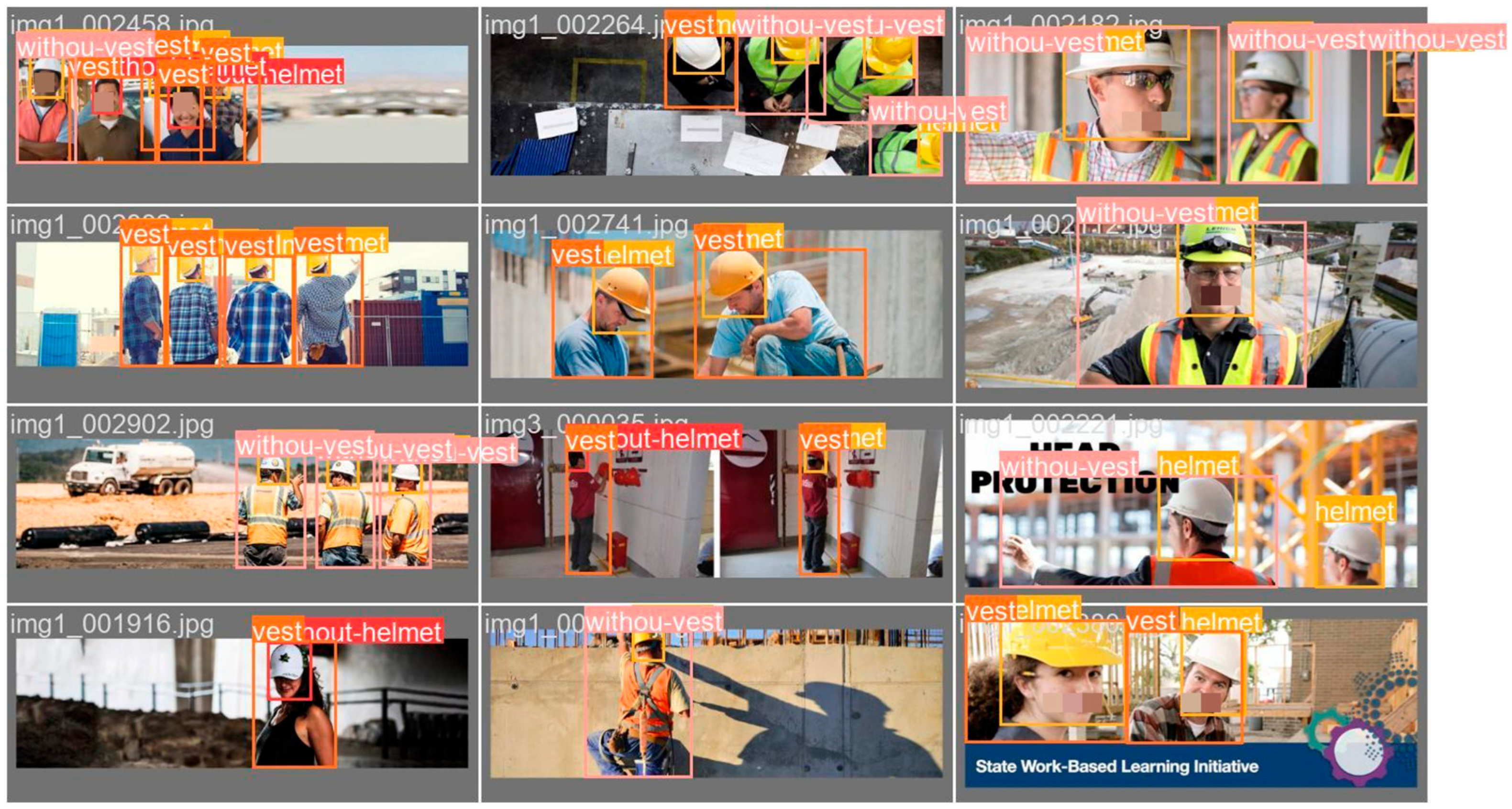
Figure 4 provides representative frames from CMA corresponding to the defined action classes, serving as visual examples of the behaviors included in the dataset. Colored boxes represent annotated behavior or PPE categories extracted from the CMA and Roboflow datasets. For video data, images were extracted and preprocessed to adjust them to a uniform size and format to meet the needs of model training and testing. This dataset was randomly divided into 70% training, 20% validation, and 10% test sets.
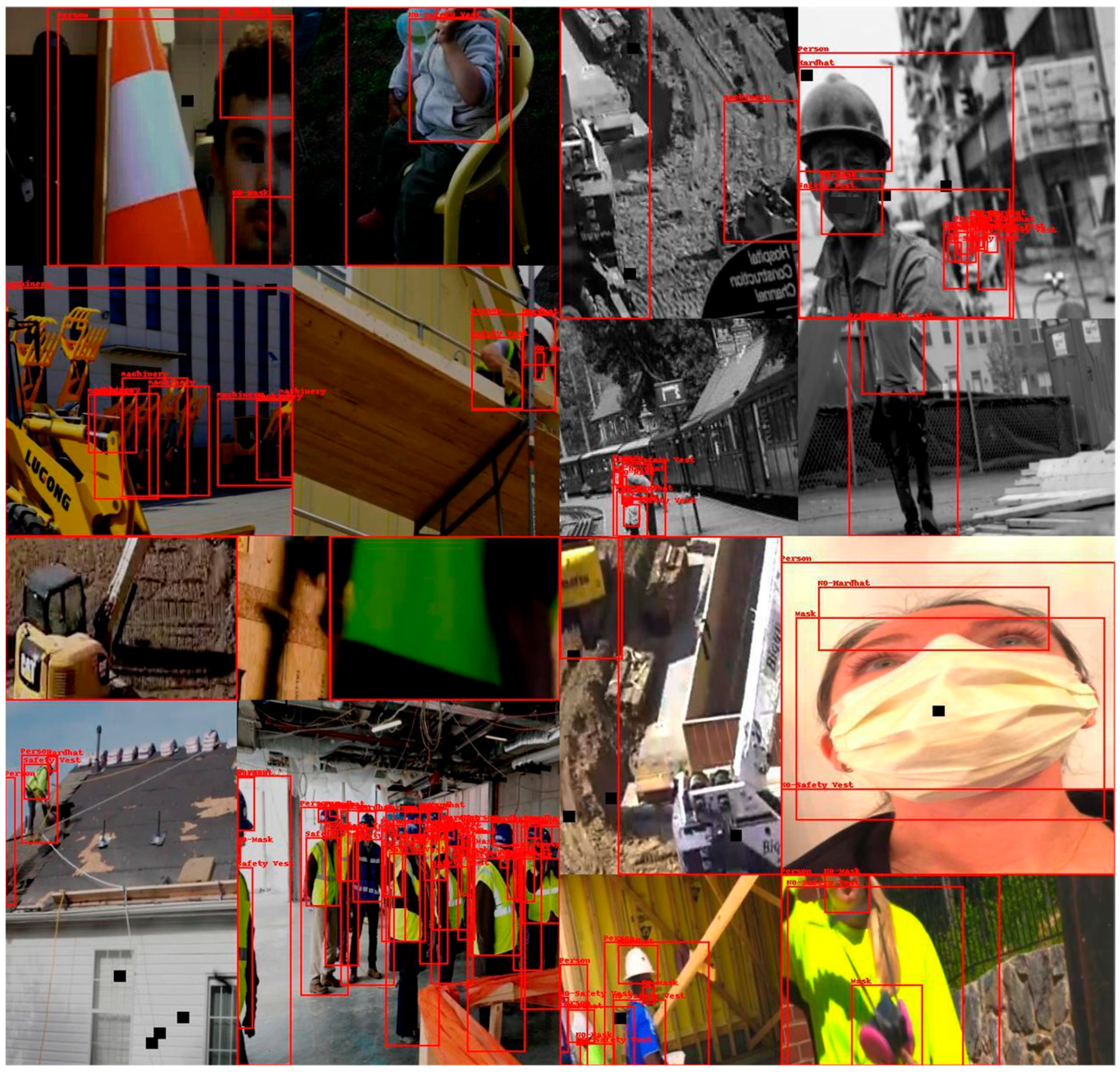
The second dataset can be accessed at: https://universe.roboflow.com/roboflow-universe-projects/construction-site-safety/dataset/30 (accessed on 2 April 2025), titled Construction Site Safety, contains more than 1000 annotated RGB image frames extracted from short construction videos. Annotations follow the COCO format with bounding boxes for person, helmet, vest, safety belt, and machinery, as well as unsafe categories such as no helmet and no vest; the current public version lists 717 labeled images at 1920 × 1080 resolution. Each frame illustrates worker PPE usage and corresponding safety states, providing a rich and diverse set of scenes for model training and testing. Figure 5 illustrates sample frames and per-class instance counts drawn from this COCO-annotated set, reflecting the PPE-related categories included in the dataset. The image data were randomly divided into training (70%), validation (20%), and test sets (10%) to support model cross-validation.
The deep learning models used in this study are based on the YOLO-v5 architecture, with appropriate modifications made according to experimental requirements. All raw video data underwent preprocessing, including resizing images to a uniform 384 × 384 pixels to meet model input requirements. To reduce overfitting and enhance the model’s generalization ability, data augmentation techniques were employed. Random selection and cropping of different frames from the videos were part of the data augmentation process, with each video being segmented into 25 segments and random 384 × 384 image blocks being cropped as model inputs. Additionally, images were normalized with a mean value set to 117 to accelerate convergence. Table 1 shows the number of images used for training, validation, and testing after preprocessing from the two datasets, along with their category distributions and specific details of their usage and processing.
During preprocessing, each video frame was resized to 384 × 384 pixels and tokenized into non-overlapping 16 × 16 image patches for Transformer-based embedding. Each patch was linearly projected into a 512-dimensional feature vector, forming the input sequence for temporal modeling. This tokenization strategy ensures efficient representation while preserving the spatial context necessary for behavior recognition.

4.2. Baseline Methods and Evaluation Metrics

To comprehensively evaluate the performance of the proposed DAIE image processing technology and the R-BehaviorNet deep learning model in monitoring unsafe behaviors in construction scenarios, multiple advanced machine learning methods and image processing techniques were selected for baseline comparison. These methods have been extensively studied and successfully applied in the fields of image recognition and behavior analysis, making them suitable benchmarks for evaluating the performance of the new models.
The practicality and effectiveness of R-BehaviorNet in construction scenarios were evaluated by comparing it with current state-of-the-art object detection techniques, including Faster R-CNN, You Only Look Once (YOLO), and Mask R-CNN. Faster R-CNN combines region proposal networks with deep convolutional networks, providing precise object detection and localization capabilities. YOLO is known for its real-time processing capabilities and efficiency, making it popular for dynamic scene recognition and classification. Mask R-CNN extends Faster R-CNN by adding pixel-level object segmentation, enhancing the precision of recognizing specific behaviors of construction personnel. The introduction of these advanced techniques highlights the novelty and practicality of the comparisons while showcasing R-BehaviorNet’s unique advantages and application potential in complex construction environments.
To optimize the learning process and improve model generalization, the RMSProp optimizer was used for training, with a batch size of 40 to balance computational efficiency and memory usage. Additionally, L2 regularization was introduced to prevent overfitting and ensure model stability, with a regularization coefficient λ set to 0.0001. These settings help reduce the model’s sensitivity to training data, enhancing its predictive ability on unseen data. During training, if no significant improvement in error rates was observed, learning rates and regularization parameters were adjusted to refine model performance. Upon completion of training, the model underwent final validation on an isolated test set to ensure the objectivity and accuracy of the evaluation results, reflecting the model’s performance in practical applications.
Selecting appropriate evaluation metrics is crucial for assessing and comparing model performance, as these metrics accurately reflect the model’s practical performance in specific tasks. To comprehensively evaluate the proposed model’s effectiveness in identifying unsafe behaviors in construction scenarios, the following evaluation metrics were selected:
  • Accuracy: Measures the model’s ability to correctly identify positive and negative samples. High accuracy in a safety monitoring system means the model can reliably distinguish between safe and unsafe behaviors, which is critical for the system’s practical usability.
  • Recall: Particularly important in safety-related applications, as it measures the model’s ability to identify all actual positive samples (in this context, unsafe behaviors). High recall ensures that nearly all unsafe behaviors are detected, reducing the likelihood of accidents.
  • Precision: Refers to the proportion of true positive samples among the samples predicted as positive. In construction safety management, high precision means the system’s alerts are more trustworthy, reducing false alarms and enhancing workers’ trust and response to the safety alert system.
  • F1 Score: The harmonic mean of precision and recall, particularly useful in cases where there is an imbalance between positive and negative samples. In construction scenarios, where unsafe events may occur less frequently, the F1 score becomes an important metric as it balances precision and recall, providing a single measure to evaluate the overall performance of the model.
By combining these metrics, a comprehensive evaluation and comparison of different models’ effectiveness in monitoring unsafe behaviors at construction sites can be achieved, allowing for the selection of the model that best meets practical application needs. These evaluation metrics not only help understand the strengths and weaknesses of each model but also ensure that the developed safety monitoring system can effectively prevent accidents and enhance overall site safety when deployed in practice.

4.3. Experimental Results and Performance Analysis

4.3.1. Performance Evaluation of DAIE Compared to Other Image Processing Methods

To thoroughly assess the performance of DAIE technology in monitoring unsafe behaviors at construction sites, it was compared with current advanced image processing technologies, including Generative Adversarial Networks (GAN), Deep Residual Networks (ResNet), and Attention-based Convolutional Neural Networks (Attention-based CNN). DAIE showed superior performance in key performance metrics such as precision, recall, and F1 score, as detailed in Table 2.
Specifically, DAIE demonstrated the highest precision at 90.5%, outperforming GAN, ResNet, and Attention-based CNN by 7.5%, 9.1%, and 6.3%, respectively. This significant advantage is likely due to DAIE’s dynamic adaptive image enhancement technology, which dynamically adjusts image processing parameters based on environmental conditions such as lighting, contrast, and noise. This improves image quality and enhances the accuracy of behavior recognition algorithms, especially under complex or rapidly changing lighting conditions.
In terms of recall, DAIE achieved 89.0%, surpassing the other three technologies, indicating its advantage in broadly identifying unsafe behaviors. This performance likely stems from DAIE’s ability to maintain image quality while effectively capturing subtle behavioral differences in construction scenarios, reducing the risk of missing critical behaviors. For instance, in monitoring behaviors like not wearing safety helmets or belts, DAIE’s high recall ensures that nearly all violations are detected.
Furthermore, DAIE’s F1 score of 89.5% reflects its balanced performance, maintaining high recall without sacrificing precision, which is crucial for real-time and accurate construction safety monitoring. This performance may be attributed to the efficient combination of image processing and behavior recognition algorithms in DAIE, optimizing the judgment criteria during the recognition process, especially in complex or crowded construction scenarios.
Through these comparisons and in-depth analyses, DAIE technology not only outperforms other technologies in various performance metrics but also demonstrates its particular suitability for construction safety monitoring.
In addition to recognition accuracy, computational performance was evaluated to verify the real-time feasibility of the proposed framework. The R-BehaviorNet with DAIE was implemented in PyTorch and trained on an NVIDIA RTX 4090 GPU (24 GB VRAM) and an Intel i9-13900K CPU with 64 GB RAM. Each training epoch required approximately 14 min, with a total training duration of around 23 h. During inference, the model achieved an average latency of 27.8 ms per frame (equivalent to 35.9 FPS), confirming its real-time capability for construction-site monitoring. GPU memory consumption peaked at 11.6 GB, with utilization around 71%. Compared with the baseline CNN-only model, the inclusion of DAIE and temporal modeling increased inference latency by only 5.3 ms while improving the F1-score by 5.6%. These results demonstrate that the proposed framework achieves an effective balance between accuracy and efficiency, enabling deployment in real-world safety monitoring environments.

4.3.2. Performance Comparison of R-BehaviorNet with Other Machine Learning Models

To fully evaluate the performance of R-BehaviorNet in monitoring unsafe behaviors at construction sites, it was compared with current advanced object detection technologies—Faster R-CNN, YOLO, and Mask R-CNN. R-BehaviorNet showed superior performance in accuracy, precision, recall, and F1 score, as shown in Table 3.
Specifically, R-BehaviorNet demonstrated the highest precision at 93.0%, outperforming Faster R-CNN, YOLO, and Mask R-CNN by 3.0%, 5.5%, and 2.0%, respectively. This performance advantage is likely due to R-BehaviorNet’s network architecture design, which incorporates advanced depthwise separable convolutions and efficient temporal analysis techniques, enhancing the model’s ability to recognize unsafe behaviors in dynamic construction environments.
In terms of recall, R-BehaviorNet achieved 91.0%, surpassing the other three technologies, indicating its advantage in broadly identifying unsafe behaviors. This performance emphasizes its comprehensive coverage of unsafe behaviors at construction sites, particularly in recognizing small-scale or partially obscured safety violations. R-BehaviorNet leverages its deep learning network’s fine-grained feature extraction capabilities to accurately capture subtle behavior patterns, thereby improving recall.
Additionally, R-BehaviorNet’s F1 score of 92.0% reflects its balanced performance, maintaining high recall without sacrificing precision, making it an ideal choice for real-time monitoring needs in construction scenarios. This balanced performance may be attributed to its dual-stream processing architecture and adaptive threshold adjustment mechanism, optimizing the network’s responsiveness and accuracy in complex scenarios.
Through these comparisons and analyses, R-BehaviorNet proves its practicality and advanced capabilities in monitoring unsafe behaviors at construction sites, providing strong technical support for modernizing construction safety monitoring.
In summary, comparative experiments indicate that traditional deep learning models such as Faster R-CNN, YOLO, and Mask R-CNN excel in static object detection but show limited adaptability under the highly dynamic and variable conditions of construction sites. Their reliance on fixed feature extraction pipelines often results in degraded recognition performance under illumination changes, occlusion, or cluttered backgrounds. In contrast, the proposed integrated system combining DAIE and R-BehaviorNet demonstrates clear advantages. The DAIE module dynamically maintains image clarity in fluctuating environmental conditions, while R-BehaviorNet achieves high efficiency through its lightweight dual-stream architecture and temporal-transformer fusion. Together, these features allow the proposed framework to balance detection precision and computational efficiency, achieving more stable real-time performance than conventional single-network approaches. This comparative advantage confirms the practical superiority of the integrated system in complex construction safety scenarios.

4.3.3. Visualization Analysis

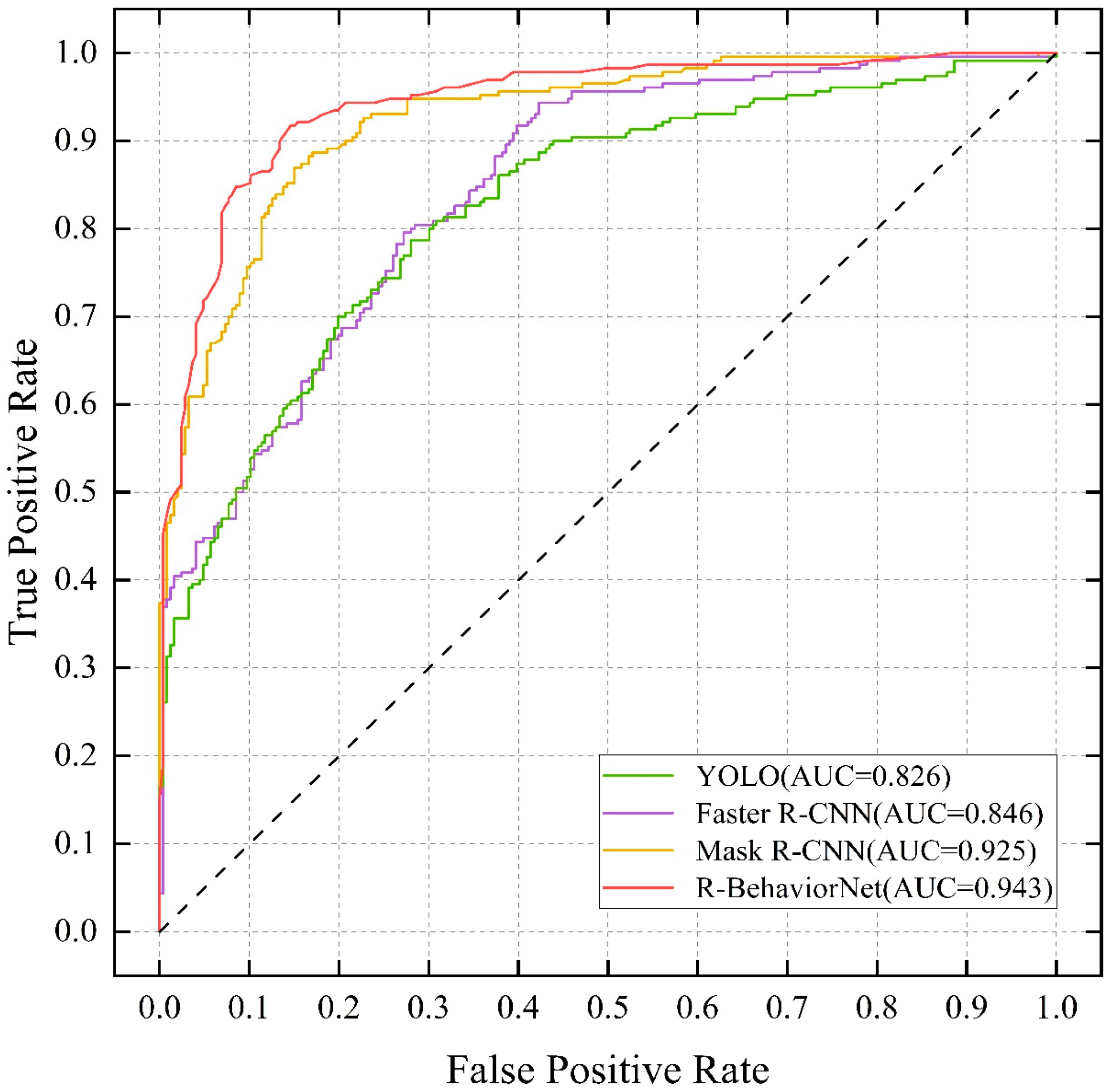
To illustrate the performance differences between R-BehaviorNet and other machine learning models in detecting unsafe behaviors at construction sites, various visualization techniques were employed to evaluate the models’ effectiveness in classifying positive and negative samples. Among these, the Receiver Operating Characteristic (ROC) curve serves as a key evaluation tool. Figure 6 presents the ROC curves of R-BehaviorNet and other comparative models, including Faster R-CNN, YOLO, and Mask R-CNN. These curves intuitively demonstrate each model’s capability to distinguish between positive and negative samples across different thresholds, where the horizontal axis represents the false positive rate (FPR) and the vertical axis denotes the true positive rate (TPR).
An ideal model’s ROC curve would approach the upper-left corner, indicating low false positive rates and high true positive rates, which demonstrates the model’s effectiveness in minimizing false alarms while accurately identifying unsafe behaviors. In Figure 6, the ROC curve of R-BehaviorNet lies noticeably above those of the other models, particularly in the region corresponding to low false positive rates. This result highlights R-BehaviorNet’s ability to effectively reduce false alarms while improving the detection of genuine safety risks, thereby providing more reliable safety alerts in practical applications.
The Area Under the Curve (AUC) was calculated as the integral of the ROC curve, representing the probability that the model ranks a randomly selected positive instance higher than a negative one. In this study, AUC values were computed using the roc_auc_score function from the scikit-learn library based on the models’ predicted probabilities on the test set. A higher AUC indicates a stronger overall ability to discriminate between classes across varying thresholds. By comparing the area under the curve, the overall performance of each model in recognizing unsafe behaviors at construction sites can be further assessed. The high AUC value achieved by R-BehaviorNet reflects its superior overall accuracy, which can be attributed to its advanced behavior recognition network and real-time data processing capability. The specially designed dual-stream processing architecture and adaptive threshold adjustment mechanism further enhance the system’s adaptability and response speed, making it more suitable for dynamic and complex construction environments. These technical advantages explain why R-BehaviorNet consistently achieves lower false positive rates and higher true positive rates in experimental tests, ensuring efficient system performance and continuous optimization, thereby reinforcing its practical potential for construction safety monitoring.
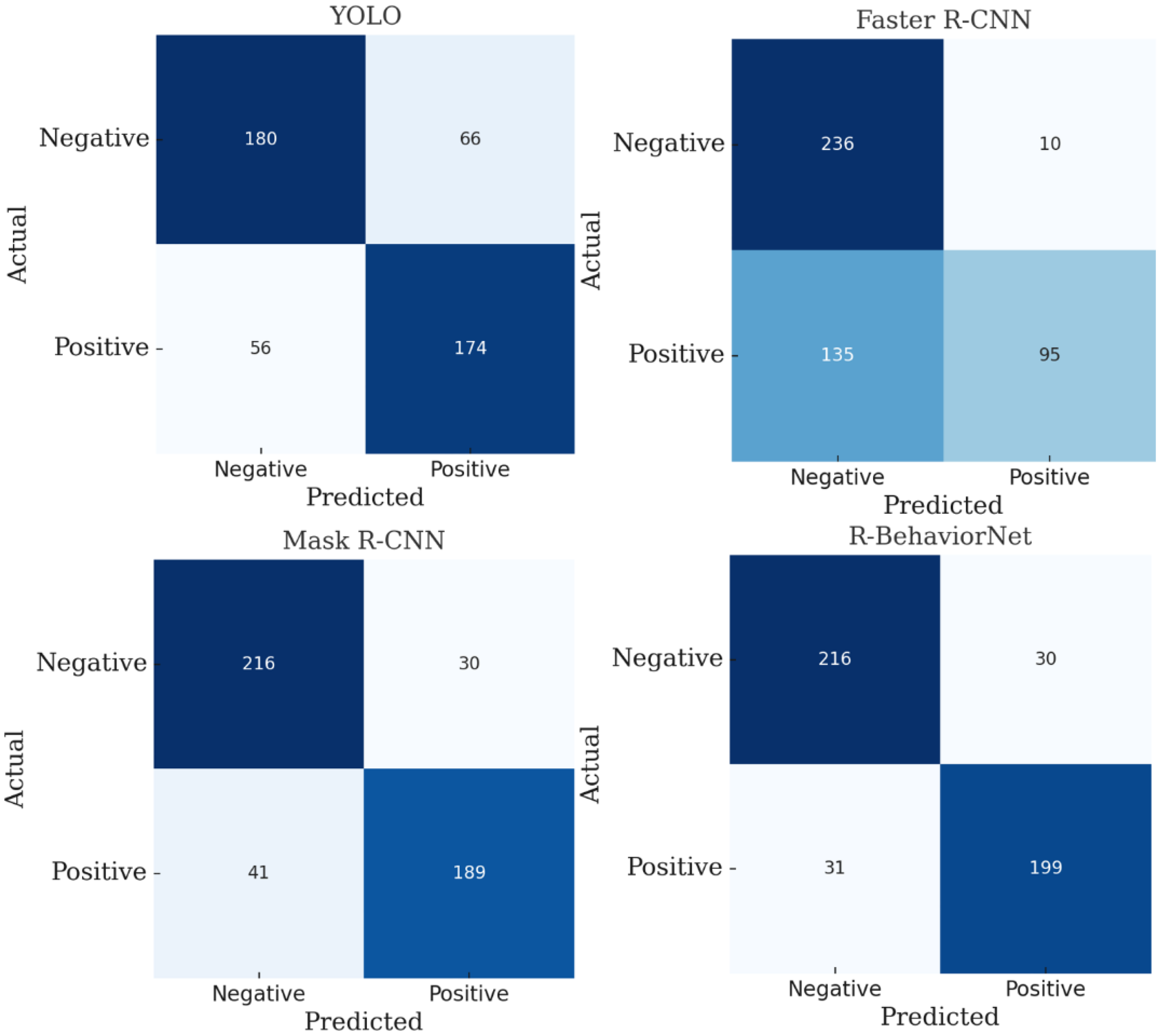
To further analyze the performance differences between R-BehaviorNet and other machine learning models (Faster R-CNN, YOLO, and Mask R-CNN) in monitoring unsafe behaviors at construction sites, Figure 7 presents the confusion matrices of each model in recognizing unsafe behaviors. Diagonal cells indicate correct predictions, while off-diagonal cells represent misclassifications across behavior categories. In these matrices, each row represents the actual behavior category, and each column represents the predicted behavior category. Values along the main diagonal indicate correctly identified instances, while off-diagonal values indicate misclassifications.
Analyzing the confusion matrices provides detailed insights into each model’s accuracy and false alarm rates in recognizing specific types of unsafe behaviors, such as not wearing safety helmets or harnesses. This analysis reveals each model’s capability to correctly identify different behavioral categories. For instance, if a model frequently misclassifies instances of not wearing safety helmets as other behaviors, this will appear as elevated values in specific rows and columns of the confusion matrix.
The inter-class distances are dimensionless, as they were computed using normalized Euclidean distances between feature embeddings, providing a quantitative measure of separability among behavior categories.
R-BehaviorNet demonstrates higher recognition accuracy than Faster R-CNN, YOLO, and Mask R-CNN, particularly in maintaining low false alarm rates. This performance advantage can be attributed to R-BehaviorNet’s advanced image processing and behavior analysis algorithms, which more effectively interpret complex visual information in construction scenarios. Furthermore, its dual-stream processing architecture and adaptive threshold adjustment mechanism further enhance recognition accuracy, contributing to greater stability and reliability in dynamic construction environments.
This performance superiority likely results from R-BehaviorNet’s distinctive algorithmic design, including finer-grained feature extraction and more efficient learning mechanisms. These enable the model to better distinguish between various behavior types and reduce classification errors caused by scene complexity. Collectively, these technical advantages ensure efficient system performance and continuous optimization, reinforcing R-BehaviorNet’s potential for practical deployment in construction safety monitoring.
Figure 8 presents examples of R-BehaviorNet’s correct and incorrect recognitions of unsafe behaviors on actual construction sites. The figure contains a sequence of annotated images that illustrate both successful detections and misclassification cases. These visual samples clearly demonstrate R-BehaviorNet’s performance in real-world applications, reflecting its capability to accurately interpret diverse scenarios as well as its limitations under specific conditions.
Such visual examples not only facilitate the evaluation of the model’s performance in real environments but also highlight the challenges posed by complex construction settings. For instance, correctly recognized cases demonstrate R-BehaviorNet’s capacity to accurately detect and respond to construction safety risks, whereas misclassifications reveal potential sensitivity or overreaction to certain environmental factors. Analyzing these successful and failed cases contributes to further model optimization, improving robustness and recognition accuracy under variable conditions.
Integrating the analysis of these examples deepens the understanding of R-BehaviorNet’s strengths and limitations in particular construction contexts. This intuitive presentation not only confirms the model’s practical applicability but also identifies key issues requiring further investigation to ensure the efficient operation and continuous refinement of the monitoring system.
These visual analyses provide not only quantitative evaluation results but also enhance the intuitive understanding of model performance through specific images and statistical charts. These visualization tools help researchers and practitioners better grasp the model’s real-world performance, ensuring the developed monitoring system can effectively operate on-site.

4.3.4. Category-Specific Recognition Performance

To further evaluate the capability of the proposed model in identifying various unsafe behaviors, recognition results were analyzed on a per-category basis using the outputs of the confusion matrix. Four representative categories—not wearing a safety helmet, improper use of a safety belt, climbing without protection, and standing too close to operating machinery—were selected for detailed assessment. The precision, recall, and F1-score values corresponding to each category are summarized in Table 4.
As shown in Table 4, R-BehaviorNet achieves the highest precision and recall in detecting helmet-related violations, followed by safety-belt misuse. The relatively lower scores for climbing and machinery proximity are mainly attributed to partial occlusion and motion blur in these complex actions. These findings highlight the model’s strong capability for detecting PPE-related unsafe behaviors and its potential for further improvement through targeted data augmentation and fine-tuning of motion-related categories.
To verify the statistical reliability of these results, a five-fold cross-validation was conducted, and the standard deviation of the F1-score across folds remained within ±1.2%. This stability indicates that the observed performance differences among behavior categories are statistically consistent rather than caused by random variation. All experiments were repeated three times under identical conditions, and average results are reported to ensure reproducibility and statistical trustworthiness of the evaluation.

4.3.5. Qualitative Comparison and Visual Analysis of Model Responses

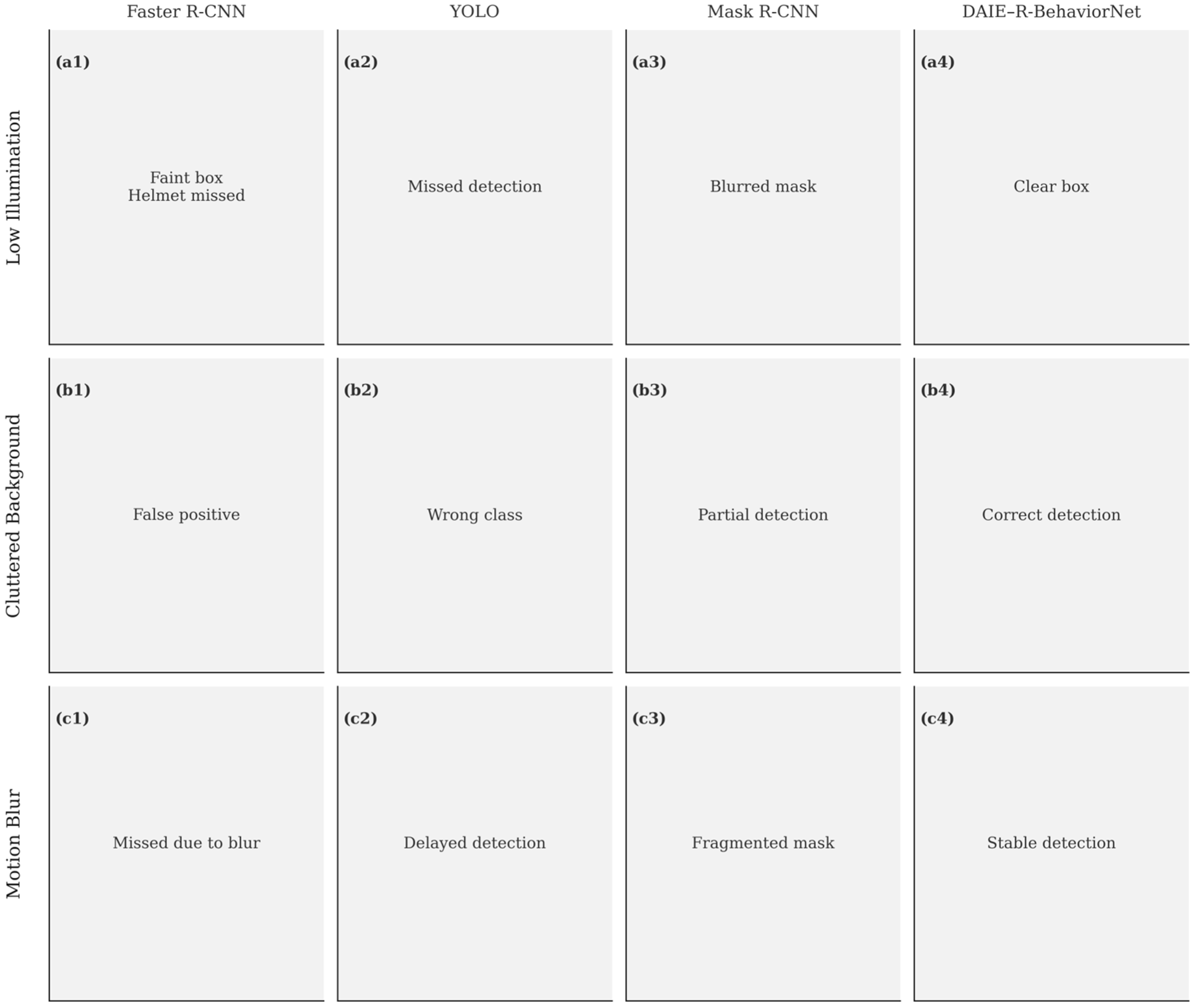
To complement the quantitative performance metrics, a qualitative comparison was conducted to further examine how different models respond to complex on-site conditions. Figure 9 illustrates representative detection examples obtained from Faster R-CNN, YOLO, Mask R-CNN, and the proposed DAIE–R-BehaviorNet framework. As shown in these visual cases, conventional detectors often produce incomplete bounding boxes, miss subtle PPE-related violations under backlighting, or generate false positives in cluttered backgrounds. In contrast, the proposed method consistently yields more stable bounding boxes with clearer class activation areas, especially in scenes affected by low illumination, glare, or partial occlusion.
A noticeable qualitative improvement arises from the DAIE enhancement, which reveals previously obscured features such as helmet edges or harness straps. This increased clarity allows R-BehaviorNet to produce more confident predictions and reduces misclassification in visually degraded regions. Additionally, the dual-stream architecture preserves temporal continuity, enabling the model to correctly recognize dynamic behaviors—such as climbing or bending—that baseline methods frequently misinterpret due to motion blur.
Failure-case analysis further demonstrates the advantages of the proposed framework. While YOLO and Faster R-CNN tend to overlook unsafe behaviors when workers overlap or when backgrounds are visually complex (e.g., scaffold intersections), R-BehaviorNet maintains correct identification by leveraging its temporal-transformer module. Even in challenging conditions, such as strong shadows or overlapping objects, the integrated system provides more interpretable and consistent responses.
These qualitative observations align with the quantitative improvements reported earlier and confirm that the proposed DAIE–R-BehaviorNet framework not only improves numerical performance but also offers substantially more reliable detection behavior under realistic construction-site conditions.

4.3.6. Ablation Study on Module Contributions

To quantitatively evaluate the contribution of each key component—DAIE, temporal modeling in R-BehaviorNet, and adaptive thresholding—an ablation study was conducted. Four experimental configurations were compared using the same datasets and training settings:
(1) Baseline (without DAIE, temporal modeling, or adaptive thresholding)—a conventional CNN-based behavior recognition model.
(2) +DAIE—incorporating the DAIE module for adaptive image enhancement while keeping other settings unchanged.
(3) +DAIE + Temporal Modeling—adding the Transformer-based temporal modeling in R-BehaviorNet to capture motion continuity.
(4) Full Model (+DAIE + Temporal Modeling + Adaptive Thresholding)—the complete proposed system.
Table 5 summarizes the experimental results. The baseline model achieved an F1-score of 86.7%, while adding DAIE improved it by 2.8%, confirming that adaptive image enhancement effectively reduces the negative impact of illumination and weather variations. The inclusion of temporal modeling further improved the F1-score to 90.6%, demonstrating its ability to capture dynamic behavior transitions. Finally, integrating adaptive thresholding increased precision and recall simultaneously, reaching an overall F1-score of 92.3%.
These results confirm that each module contributes significantly to the overall performance of the proposed framework. DAIE primarily enhances image clarity under challenging visual conditions, temporal modeling improves the network’s understanding of motion continuity, and adaptive thresholding stabilizes detection accuracy by balancing sensitivity and false alarms. Together, they synergistically enhance the system’s robustness and generalization in dynamic construction-site environments.

4.3.7. Dual-Stream vs. Single-Stream Comparison

To further validate the contribution of the proposed dual-stream architecture, a comparative experiment was conducted between the full dual-stream framework and two single-stream variants: (1) an enhanced-stream-only version using DAIE-processed images, and (2) a raw-stream-only version using original video frames without enhancement. All models shared identical configurations for R-BehaviorNet and training settings to ensure fair comparison.
As shown in Table 6, the enhanced-stream-only model achieved an F1-score of 90.4%, outperforming the raw-stream-only model (88.7%) due to improved image clarity under variable illumination. However, the full dual-stream system attained the highest F1-score of 92.3%, demonstrating an additional 1.9% improvement over the enhanced-only variant. This gain highlights the complementary nature of the two data sources: DAIE-enhanced frames provide visual clarity, while raw frames preserve contextual and motion continuity.
The results confirm that the dual-stream design significantly enhances recognition robustness and generalization in complex environments. While DAIE enhancement mitigates visual degradation, the inclusion of raw data ensures temporal smoothness and reduces information loss from over-enhancement. The fusion of both feature domains allows the system to achieve optimal performance in real-time construction safety monitoring scenarios.

5. Discussion

The research presented in this paper underscores the transformative potential of combining DAIE technology with R-BehaviorNet for monitoring unsafe behaviors at construction sites. The findings demonstrate significant advancements over traditional methods in both accuracy and efficiency, and suggest several key implications and future development directions for this field. Furthermore, the computational performance analysis confirms that the proposed model maintains real-time inference capability, with sub-30 ms latency per frame and moderate GPU utilization. This demonstrates that the integration of DAIE and temporal modeling achieves a favorable trade-off between accuracy and efficiency, making the framework deployable in practical on-site monitoring environments.
To further assess the practical feasibility of deploying the proposed framework in real construction settings, we examined its computational requirements, hardware compatibility, and environmental robustness. The real-time inference speed (35.9 FPS) and moderate memory usage (11.6 GB) indicate that the system can operate on widely available industrial GPUs rather than requiring high-end hardware. The lightweight architecture of R-BehaviorNet (8.7M parameters and 5.3 GFLOPs) further supports deployment on edge devices or portable AI units commonly used in modern construction sites. Additionally, the DAIE module enhances visual clarity under low illumination, glare, and weather-induced disturbances, suggesting that the system can maintain stable performance under realistic field conditions. These results collectively demonstrate that the proposed solution is technically feasible for integration into existing smart-construction monitoring platforms and on-site video surveillance systems.
Beyond its role as an image preprocessing component, the DAIE module exerts a substantial influence on the overall performance of the integrated system. Comparative experiments show that incorporating DAIE into the recognition pipeline improves the precision and recall of R-BehaviorNet by 3.2% and 2.8%, respectively, compared with using raw inputs alone. This enhancement stems from DAIE’s ability to maintain consistent image quality under fluctuating lighting and weather conditions, thereby reducing feature distortion and improving the stability of temporal feature extraction. The integration also shortens training convergence time by approximately 10%, indicating that clearer and more standardized visual inputs facilitate more efficient learning within R-BehaviorNet. These results confirm that DAIE not only enhances visual clarity but also plays a pivotal role in boosting the reliability and efficiency of the entire unsafe-behavior recognition framework.
The DAIE technology has proven to be highly effective in addressing the challenges posed by the dynamic and often harsh environmental conditions typical of construction sites. Traditional image enhancement methods struggle with adapting to changes in lighting, weather, and scene complexity. DAIE’s content-based adaptive framework, which dynamically adjusts image enhancement parameters, ensures consistently high image quality. This capability is crucial for accurate behavior recognition, as it allows the system to maintain precision under varied conditions, thereby reducing the likelihood of missing critical, unsafe behaviors. R-BehaviorNet complements DAIE by incorporating a robust network architecture designed to handle real-time behavior recognition. The dual-stream processing architecture, which processes both DAIE-enhanced images and raw video frames, significantly enhances the system’s responsiveness and accuracy. This design enables the network to manage high volumes of video data efficiently while maintaining high recognition rates. The inclusion of depthwise separable convolutions and adaptive threshold adjustments further optimizes the model, making it adept at handling the complexities of construction environments. Comparative analyses indicate that the integrated DAIE and R-BehaviorNet system outperforms existing methods such as Faster R-CNN, YOLO, and Mask R-CNN across various performance metrics, including accuracy, recall, precision, and F1 score. These results validate the effectiveness of the proposed approach and highlight its potential for practical application in real-world construction safety management.
Furthermore, the integration of temporal and meteorological parameters offers promising directions for future enhancement of the proposed framework. While the current model already adapts to lighting and weather variations through real-time image enhancement, further incorporation of construction scheduling data and short-term weather forecasts could enable dynamic adjustment of monitoring thresholds or automatic safety delay recommendations. Such an extension would elevate the system from passive monitoring to proactive safety management, aligning detection performance with real-world project timelines and environmental constraints.
Although the proposed framework demonstrates strong performance, certain limitations of the datasets used in this study should be acknowledged. Both datasets are open-source and, while diverse, are not fully representative of all real-world construction scenarios. The CMA dataset mainly focuses on typical worker actions under controlled environments, resulting in limited coverage of rare or complex unsafe behaviors such as simultaneous multi-worker interactions or operations under extreme weather conditions. Similarly, the Roboflow Construction Site Safety dataset primarily consists of static RGB images rather than continuous video sequences, which restricts the model’s ability to learn temporal behavior transitions. Furthermore, both datasets exhibit some imbalance in behavior categories, with PPE-related violations being more prevalent than task-specific unsafe actions. These factors may constrain the generalization of the trained model to highly variable construction environments, indicating the need for further validation on larger, proprietary datasets in future research.
However, the study is not without limitations. The use of open-source datasets, while useful for initial validation, may not fully capture the specific and varied conditions present in actual construction sites. This limitation suggests the need for further validation using proprietary datasets that reflect the unique characteristics of different construction environments. Additionally, the current focus on specific unsafe behaviors should be expanded to include a broader range of safety hazards, and the integration of additional sensor data could further enhance the system’s capabilities. In addition, future research could explore cross-site transfer learning and multimodal fusion frameworks to enhance the model’s adaptability across diverse construction environments. Recent advances in multimodal large language models (MLLMs) have shown remarkable potential in combining visual, textual, and contextual reasoning for safety monitoring in construction. Building on this progress, incorporating MLLM-based vision–text fusion or cross-site adaptation strategies could further improve the generalization and interpretability of unsafe behavior recognition systems across different project types and site conditions [46]. Specifically, environmental sensors (e.g., temperature, humidity, and illumination sensors) can provide continuous measurements of ambient conditions, while positioning and motion sensors (such as UWB-based location trackers and inertial measurement units) can capture worker trajectories and posture dynamics. Physiological sensors, including heart-rate and fatigue-detection wearables, may also be integrated to assess individual safety states in real time. Data from these heterogeneous sources can be fused at the feature level with vision-based outputs through multimodal learning or at the decision level using ensemble models. Such multimodal fusion would enable the system to correlate environmental, positional, and physiological cues with detected behaviors, thereby improving both the interpretability and reliability of unsafe-behavior recognition under complex site conditions. Future research should address these limitations by incorporating more diverse and extensive datasets and exploring the integration of complementary sensor technologies. The application of explainable AI techniques is also recommended to improve the transparency and trustworthiness of the system, which is crucial for its adoption in practical settings. Continuous feedback mechanisms and iterative improvements based on real-world deployment data will be essential in refining the system further.
In conclusion, the integration of DAIE and R-BehaviorNet represents a significant advancement in construction safety monitoring. The research demonstrates that these technologies can be effectively combined to create a robust, real-time monitoring system capable of significantly enhancing safety protocols and reducing the incidence of accidents on construction sites. By addressing the identified limitations and pursuing the suggested future research directions, the system’s full potential can be realized, contributing to safer and more efficient construction site management.

6. Conclusions

This study presents and validates an advanced framework for real-time monitoring of unsafe behaviors on construction sites by integrating DAIE with R-BehaviorNet. Through extensive experiments and analyses, several major contributions and findings have been identified, demonstrating clear advantages over conventional safety monitoring methods. The main contributions are summarized as follows:
(1) Advancement of DAIE Technology: The proposed DAIE method introduces a significant improvement in image preprocessing for construction safety monitoring. By automatically adjusting enhancement parameters according to environmental dynamics, it ensures stable visual quality under diverse lighting and weather conditions. Such adaptability plays a crucial role in maintaining high recognition accuracy across varying operational contexts.
(2) Design of R-BehaviorNet: R-BehaviorNet adopts a lightweight convolutional structure combined with temporal modeling capabilities, substantially improving the system’s responsiveness and its ability to detect and predict unsafe actions in real time. The use of a dual-stream architecture enables simultaneous processing of both enhanced and original video data, thereby accelerating detection and enhancing recognition reliability.
(3) Performance Verification: Experimental evaluations confirm that the proposed integrated framework outperforms traditional approaches across multiple metrics, including accuracy, precision, recall, and F1-score. These results verify the superior robustness and overall effectiveness of the combined DAIE–R-BehaviorNet solution.
The findings of this study hold substantial practical significance for advancing construction safety management. Incorporating the proposed framework into existing safety supervision systems can significantly enhance real-time monitoring capabilities and proactive risk mitigation, thereby reducing the likelihood of accidents and improving overall site safety performance. Owing to its flexible architecture and strong scalability, the framework can be seamlessly deployed across diverse construction settings while maintaining stable and reliable operation under varying environmental and operational conditions.
Despite these promising results, several limitations should be acknowledged. The experimental validation relies primarily on publicly available datasets, which may not fully represent the complex and heterogeneous conditions of real-world construction projects. Future studies should incorporate more diverse, domain-specific data to further strengthen the system’s robustness and generalization capability. Moreover, extending the recognition scope to include additional categories of unsafe behaviors and integrating multi-sensor information (e.g., IoT-based monitoring data) could further improve system reliability. Future research directions also include the application of explainable AI techniques to enhance model interpretability and user trust, as well as the development of continuous feedback loops for adaptive model refinement based on field data.
In summary, the integration of DAIE and R-BehaviorNet represents a significant advancement in construction safety intelligence. The proposed approach demonstrates how adaptive visual processing and deep behavior recognition can be effectively combined to build a robust, real-time monitoring system. Its practical implementation offers strong potential to modernize safety supervision, reduce accident rates, and promote safer working environments. With continued refinement and the incorporation of more comprehensive data sources, this framework can further evolve as a good solution for intelligent construction safety management.

Author Contributions

Conceptualization, R.T.T.A.; Methodology, R.T.T.A. and S.M.; Writing—original draft preparation, R.T.T.A.; writing—review and editing, R.T.T.A.; visualization, R.T.T.A. and S.M.; Formal analysis, R.T.T.A.; Resources, S.M. All authors have read and agreed to the published version of the manuscript.

Funding

This study is supported by the National Natural Science Foundation of China (No. 52078101).

Data Availability Statement

Data available in a publicly accessible repository. The data presented in this study are openly available in [The Construction Action Recognition dataset] at [https://github.com/S1mpleyang/ConstructionActionRecognition, accessed on 2 April 2025] and [The Construction Site Safety dataset] at [https://universe.roboflow.com/roboflow-universe-projects/construction-site-safety/dataset/30, accessed on 2 April 2025].

Acknowledgments

The authors would like to thank the anonymous reviewers for their constructive comments.

Conflicts of Interest

The authors declare that they have no known competing financial interests or personal relationships that could have appeared to influence the work reported in this paper.

References

  1. Nguyen, P.H.D.; Tran, D. Exploring the Use of Quality Control Plans for Alternative Contracting Methods in Highway Projects. J. Constr. Eng. Manag. 2024, 150, 04024030. [Google Scholar] [CrossRef]
  2. Jiang, W.G.; Ding, L.Y. Unsafe hoisting behavior recognition for tower crane based on transfer learning. Autom. Constr. 2024, 160, 105299. [Google Scholar] [CrossRef]
  3. Golafshani, E.; Khodadadi, N.; Ngo, T.; Nanni, A.; Behnood, A. Modelling the compressive strength of geopolymer recycled aggregate concrete using ensemble machine learning. Adv. Eng. Softw. 2024, 191, 103611. [Google Scholar] [CrossRef]
  4. Song, H.Q.; Lin, B.C.; Xie, L.C. Dual-Stream Fusion and Multi-scale Analysis: Introducing the Synergistic Dual-Stream Network (SDS-Net) for Image Manipulation Segmentation. Adv. Intell. Syst. 2024, 6, 2300749. [Google Scholar] [CrossRef]
  5. Zhou, W.Q.; Wu, H.L.; Deng, P. Toward Efficient and Accurate Remote Sensing Image-Text Retrieval with a Coarse-to-Fine Approach. IEEE Geosci. Remote Sens. Lett. 2025, 22, 6000305. [Google Scholar] [CrossRef]
  6. Pan, X.; Shen, L.X.; Zhong, B.T.; Sheng, D.; Huang, F.; Yang, L.H. Novel blockchain deep learning framework to ensure video security and lightweight storage for construction safety management. Adv. Eng. Inform. 2024, 59, 102334. [Google Scholar] [CrossRef]
  7. Guo, Z.; She, J.; Li, Z.; Du, J.; Ye, S. Integrating FRAM and BN for enhanced resilience evaluation in construction emergency response: A scaffold collapse case study. Heliyon 2024, 10, e25342. [Google Scholar] [CrossRef]
  8. Zucca, M.; Tattoni, S.; Di Castri, M.; Simoncelli, M. On the collapse of a post-tensioned reinforced concrete truss bridge during the construction phases. Eng. Fail. Anal. 2024, 158, 107999. [Google Scholar] [CrossRef]
  9. Kaur, R.; Singh, J.; Sharma, S. Enhanced Helmet Detection in Surveillance Systems with YOLOv6 for Accident Prevention and Safety Compliance. J. Sci. Ind. Res. 2025, 84, 601–613. [Google Scholar] [CrossRef]
  10. Wu, Z.; Lei, X.; Kumar, M. Advancing construction safety: YOLOv8-CGS helmet detection model. PLoS ONE 2025, 20, e0321713. [Google Scholar] [CrossRef]
  11. Zhang, Y.; Huang, S.; Qin, J.; Li, X.; Zhang, Z.; Fan, Q.; Tan, Q. Detection of helmet use among construction workers via helmet-head region matching and state tracking. Autom. Constr. 2025, 171, 105987. [Google Scholar] [CrossRef]
  12. Yuan, H.; Yang, H.; Li, R.Q.; Wang, J.; Tian, L. Personal safety monitoring system of electric power construction site based on AIoT Technology. J. Intell. Fuzzy Syst. 2024, 46, 493–504. [Google Scholar] [CrossRef]
  13. Xiang, C.C.; Yin, D.F.; Song, F.; Yu, Z.X.; Jian, X.; Gong, H.M. A Fast and Robust Safety Helmet Network Based on a Mutilscale Swin Transformer. Buildings 2024, 14, 688. [Google Scholar] [CrossRef]
  14. Han, J.; Yoon, S.; Kang, M.; Kim, T. Approach to Enhancing Panoramic Segmentation in Indoor Construction Sites Based on a Perspective Image Segmentation Foundation Model. Appl. Sci. 2025, 15, 4875. [Google Scholar] [CrossRef]
  15. Kang, S.; Kim, S.; Kim, G.-H. Integration of real-time labor positioning data and 3D laser scan model for dangerous zone access monitoring. J. Build. Eng. 2025, 111, 113445. [Google Scholar] [CrossRef]
  16. Jiang, Q.; Jia, M.T.; Bi, L.; Zhuang, Z.; Gao, K.X. Development of a core feature identification application based on the Faster R-CNN algorithm. Eng. Appl. Artif. Intell. 2022, 115, 105200. [Google Scholar] [CrossRef]
  17. Gao, F.Q.; Zhu, Q.Y.; Shao, G.F.; Su, Y.K.; Yang, J.B.; Yu, X.Y. A fast surface-defect detection method based on Dense-YOLO network. Caai Trans. Intell. Technol. 2025, 10, 415–433. [Google Scholar] [CrossRef]
  18. Nautiyal, D.; Dhir, M.; Singh, T.; Saini, A.; Handa, P. Real-Time, Multi-Task Mobile Application for Automatic Bleeding and Non-Bleeding Frame Analysis in Video Capsule Endoscopy Using an Ensemble of Faster R-CNN and LinkNet. Int. J. Imaging Syst. Technol. 2025, 35, e70171. [Google Scholar] [CrossRef]
  19. Walia, J.S.; Haridass, K.; Pavithra, L.K. Deep Learning Innovations for Underwater Waste Detection: An In-Depth Analysis. IEEE Access 2025, 13, 88917–88929. [Google Scholar] [CrossRef]
  20. Xia, C.J.; Ren, M.; Liu, R.Y.; Tian, Z.L.; Song, M.Y.; Dong, M.; Zhang, T.; Miao, J. Tracking moisture contents in the pollution layer on a composite insulator surface using hyperspectral imaging technology. Analyst 2024, 149, 2996–3007. [Google Scholar] [CrossRef]
  21. Zhang, X.Y.; Yang, S.; Yang, X.; Li, C.; Xu, Y. A Triplet Network Fusing Optical and SAR Images for Colored Steel Building Extraction. Sensors 2024, 24, 89. [Google Scholar] [CrossRef]
  22. Chen, H.H.; Li, Y.Y.; Wen, H.X.; Hu, X.D. YOLOv5s-gnConv: Detecting personal protective equipment for workers at height. Front. Public Health 2023, 11, 1225478. [Google Scholar] [CrossRef]
  23. Han, G.J.; Wang, R.X.; Xu, W.Y.; Li, J. Night construction site detection based on ghost-YOLOX. Connect. Sci. 2024, 36, 2316015. [Google Scholar] [CrossRef]
  24. Rane, M.; Kulkarni, M.; Dalvi, A.; Kulkarni, A.; Singh, A.; Bhave, A.; Arawat, V. AI Algorithm for Image Enhancement. In Proceedings of the 2023 Third International Conference on Advances in Electrical, Computing, Communication and Sustainable Technologies (ICAECT), Bhilai, India, 5–6 January 2023; pp. 1–4. [Google Scholar]
  25. Brahmaji, R.K.N.; Nagesh, K.K.; Indra, N.M.V.S.S.; Krishna, V.K.C.D.; Premchand, R.M.; Sai, K.P. Image Enhancement of Low Light Image using Deep Learning. Int. J. Adv. Res. Sci. Commun. Technol. 2023, 3, 511–517. [Google Scholar] [CrossRef]
  26. Blanch, X.; Guinau, M.; Eltner, A.; Abellan, A. Fixed photogrammetric systems for natural hazard monitoring with high spatio-temporal resolution. Nat. Hazards Earth Syst. Sci. 2023, 23, 3285–3303. [Google Scholar] [CrossRef]
  27. Li, J.Q.; Miao, Q.; Zou, Z.; Gao, H.G.; Zhang, L.X.; Li, Z.B.; Wang, N. A Review of Computer Vision-Based Monitoring Approaches for Construction Workers’ Work-Related Behaviors. IEEE Access 2024, 12, 7134–7155. [Google Scholar] [CrossRef]
  28. Hu, H.L.; Zheng, X.Y. Augmented and Virtual Reality-Based Cyber Twin Model for Observing Infants in Intensive Care: 6G for Smart Healthcare 4.0 by Machine Learning Techniques. Wirel. Pers. Commun. 2024, 4, 1–17. [Google Scholar] [CrossRef]
  29. Wang, Z.; Chen, Z.Y.; Ma, L.; Wang, Q.; Wang, H.; Leal, A., Jr.; Li, X.L.; Marques, C.; Min, R. Optical Microfiber Intelligent Sensor: Wearable Cardiorespiratory and Behavior Monitoring with a Flexible Wave-Shaped Polymer Optical Microfiber. ACS Appl. Mater. Interfaces 2024, 16, 8333–8345. [Google Scholar] [CrossRef]
  30. Wang, Z.; Hua, Z.X.; Wen, Y.C.; Zhang, S.J.; Xu, X.S.; Song, H.B. E-YOLO: Recognition of estrus cow based on improved YOLOv8n model. Expert Syst. Appl. 2024, 238, 122212. [Google Scholar] [CrossRef]
  31. Li, H.W.; Ni, Y.Q.; Wang, Y.W.; Chen, Z.W.; Rui, E.Z.; Xu, Z.D. Modeling of forced-vibration systems using continuous-time state-space neural network. Eng. Struct. 2024, 302, 117329. [Google Scholar] [CrossRef]
  32. Bingu, R.; Jothilakshmi, S.; Srinivasu, N. An intelligent multiclass deep classifier-based intrusion detection system for cloud environment. Concurr. Comput. Pract. Exp. 2023, 35, e7840. [Google Scholar] [CrossRef]
  33. Xiong, C.Y.; Wang, Z.L.; Huang, X.Y. Modelling flame-to-fuel heat transfer by deep learning and fire images. Eng. Appl. Comput. Fluid Mech. 2024, 18, 2331114. [Google Scholar] [CrossRef]
  34. Walter, T.; Degen, J.; Pfeiffer, K.; Stöckl, A.; Montenegro, S.; Degen, T. A new innovative real-time tracking method for flying insects applicable under natural conditions. BMC Zool. 2021, 6, 35. [Google Scholar] [CrossRef] [PubMed]
  35. Liu, T.X. Assessing implicit computational thinking in game-based learning: A logical puzzle game study. Br. J. Educ. Technol. 2024, 55, 2357–2382. [Google Scholar] [CrossRef]
  36. Luo, P.; Niu, Y.P.; Tang, D.X.; Huang, W.Y.; Luo, X.F.; Mu, J. A computer vision solution for behavioral recognition in red pandas. Sci. Rep. 2025, 15, 9201. [Google Scholar] [CrossRef]
  37. He, J.Y.; Li, C.; Xie, Y.; Luo, H.T.; Zheng, W.; Wang, Y.Q. RMTSE: A Spatial-Channel Dual Attention Network for Driver Distraction Recognition. Sensors 2025, 25, 2821. [Google Scholar] [CrossRef]
  38. Xie, Y.X.; He, Y.G.; Cheng, A.B.; Zhang, J.W. Study on medical image enhancement based on IFOA improved grayscale image adaptive enhancement. Multimed. Tools Appl. 2016, 75, 14367–14379. [Google Scholar] [CrossRef]
  39. Liang, X.W.; Chen, X.Y.; Ren, K.Y.; Miao, X.; Chen, Z.H.; Jin, Y.T. Low-light image enhancement via adaptive frequency decomposition network. Sci. Rep. 2023, 13, 14107. [Google Scholar] [CrossRef] [PubMed]
  40. Tan, H.S.; Zhou, F.Q.; Xiong, Y.; Li, X.K. Adaptive enhancement of image brightness and contrast based on neural networks. J. Optoelectron. Laser 2010, 21, 1881–1884. [Google Scholar]
  41. Hu, K.; Zhang, Y.W.; Lu, F.Y.; Deng, Z.L.; Liu, Y.P. An Underwater Image Enhancement Algorithm Based on MSR Parameter Optimization. J. Mar. Sci. Eng. 2020, 8, 741. [Google Scholar] [CrossRef]
  42. Zhang, Y.Y.; Huang, Y.; Lu, B.S.; Ma, Y.M.; Qiu, J.H.; Zhao, Y.N.; Guo, X.H.; Liu, C.X.; Liu, P.; Zhang, Y.G. Real-time sitting behavior tracking and analysis for rectification of sitting habits by strain sensor-based flexible data bands. Meas. Sci. Technol. 2020, 31, 055102. [Google Scholar] [CrossRef]
  43. Li, S.; Shi, Q. Deep Learning-Based Human Action Recognition in Videos. J. Circuits Syst. Comput. 2025, 34, 2550040. [Google Scholar] [CrossRef]
  44. Yang, Z.; Zheng, N.; Wang, F. DSSFN: A Dual-Stream Self-Attention Fusion Network for Effective Hyperspectral Image Classification. Remote Sens. 2023, 15, 3701. [Google Scholar] [CrossRef]
  45. Zhang, W.; Guo, X.; Wang, J.; Wang, N.; Chen, K. Asymmetric Adaptive Fusion in a Two-Stream Network for RGB-D Human Detection. Sensors 2021, 21, 916. [Google Scholar] [CrossRef]
  46. Erfani, A.; Mansouri, A. Applications of multimodal large language models in construction industry. Adv. Eng. Inform. 2026, 69, 103909. [Google Scholar] [CrossRef]
Figure 1. The overall methodological framework of the study.
Buildings 15 04205 g001
Figure 2. Structure of the DAIE module.
Buildings 15 04205 g002
Figure 3. Training workflow and relationships among the equations in the proposed framework.
Buildings 15 04205 g003
Figure 4. Construction action identification sample.
Buildings 15 04205 g004
Figure 5. Sample of safety equipment use.
Buildings 15 04205 g005
Figure 6. ROC Curve Comparison.
Buildings 15 04205 g006
Figure 7. Confusion Matrix.
Buildings 15 04205 g007
Figure 8. Behavior Recognition Examples.
Buildings 15 04205 g008
Figure 9. Qualitative comparison of detection responses across different models under challenging construction-site conditions. Under low illumination, (a1) Faster R-CNN produces a faint bounding box with the helmet missed; (a2) YOLO fails to detect the object; (a3) Mask R-CNN generates a blurred segmentation mask; (a4) DAIE–R-BehaviorNet yields a clear and stable bounding box. Under cluttered background, (b1) Faster R-CNN results in a false positive; (b2) YOLO predicts the wrong class; (b3) Mask R-CNN shows partial detection; (b4) DAIE–R-BehaviorNet correctly identifies the target. Under motion blur, (c1) Faster R-CNN misses the object; (c2) YOLO shows delayed or unstable detection; (c3) Mask R-CNN produces a fragmented mask; (c4) DAIE–R-BehaviorNet maintains stable and accurate detection.
Buildings 15 04205 g009
Table 1. Data set distribution and preprocessing details.
DatasetCategoryTraining Set QuantityValidation Set QuantityTest Set QuantityNotes
Construction Action Recognition DatasetSafety Helmet and Belt Usage1398401201Various construction site scenarios and safety actions
Construction Site Safety Image DatasetSafety Helmet Usage2457702341Labeled for correct or incorrect usage of safety helmets
Construction Site Safety Image DatasetSafety Belt Usage1748501251Labeled for correct or incorrect usage of safety belts
Table 2. Performance comparison between DAIE and traditional image processing technology.
TechnologyAccuracyPrecisionRecallF1 Score
DAIE90.0%90.5%89.0%89.5%
GAN85.5%83.0%84.5%83.7%
ResNet83.8%81.4%82.9%82.1%
Attention-based CNN84.3%84.2%83.7%84.0%
Table 3. Compares the performance of R-BehaviorNet with the machine learning model.
TechnologyAccuracyPrecisionRecallF1 Score
R-BehaviorNet92.0%93.0%91.0%92.0%
Faster R-CNN89.5%90.0%89.0%89.5%
YOLO88.0%87.5%88.5%88.0%
Mask R-CNN90.5%91.0%90.0%90.5%
Table 4. Category-specific performance of R-BehaviorNet.
Unsafe Behavior TypePrecisionRecallF1-Score
Not wearing safety helmet94.3%91.8%93.0%
Improper safety-belt use92.5%89.7%91.0%
Climbing without protection89.4%87.6%88.5%
Standing close to operating machinery90.2%88.1%89.1%
Table 5. Ablation analysis of key module contributions.
ConfigurationPrecisionRecallF1-ScoreImprovement (ΔF1)
Not wearing safety helmet88.2%85.3%86.7%-
Improper safety-belt use90.5%88.1%89.5%+2.8
Climbing without protection92.1%89.2%90.6%+3.9
Standing close to operating machinery93.2%91.4%92.3%+5.6
Table 6. Comparison of dual-stream and single-stream architectures.
Model ConfigurationPrecisionRecallF1-ScoreΔF1 vs. Raw Stream
Raw stream only89.1%88.3%88.7%-
Enhanced stream only91.6%89.3%90.4%+1.7
Dual stream93.2%91.4%92.3%+3.6
Disclaimer/Publisher’s Note: The statements, opinions and data contained in all publications are solely those of the individual author(s) and contributor(s) and not of MDPI and/or the editor(s). MDPI and/or the editor(s) disclaim responsibility for any injury to people or property resulting from any ideas, methods, instructions or products referred to in the content.