


Investigating the Factors Contributing to the Stakeholder Conflict in Urban Renewal Projects: A Case Study of China




Abstract
1. Introduction
- RO1: To identify stakeholder conflict factors in URPs.
- RO2: To group the conflict factors from the list obtained in RO1.
- RO3: To reveal their correlation and dynamic evolution of conflict factors, building on the findings from RO1 and RO2.
2. Literature Review
2.1. Stakeholder Conflict in UR
2.2. Conflict Factors of Stakeholders in UR
2.3. Gap in Knowledge
3. Research Methods
3.1. Research Design
- (1)
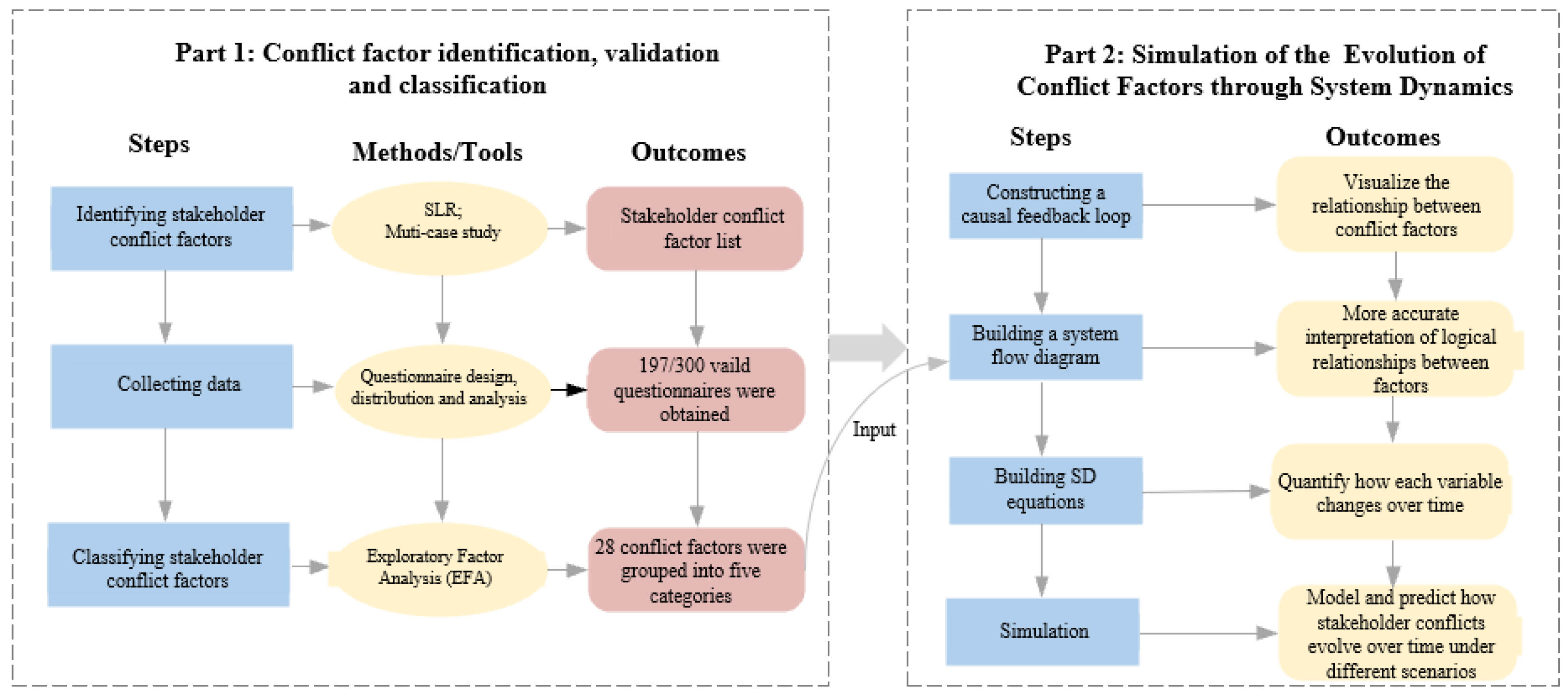
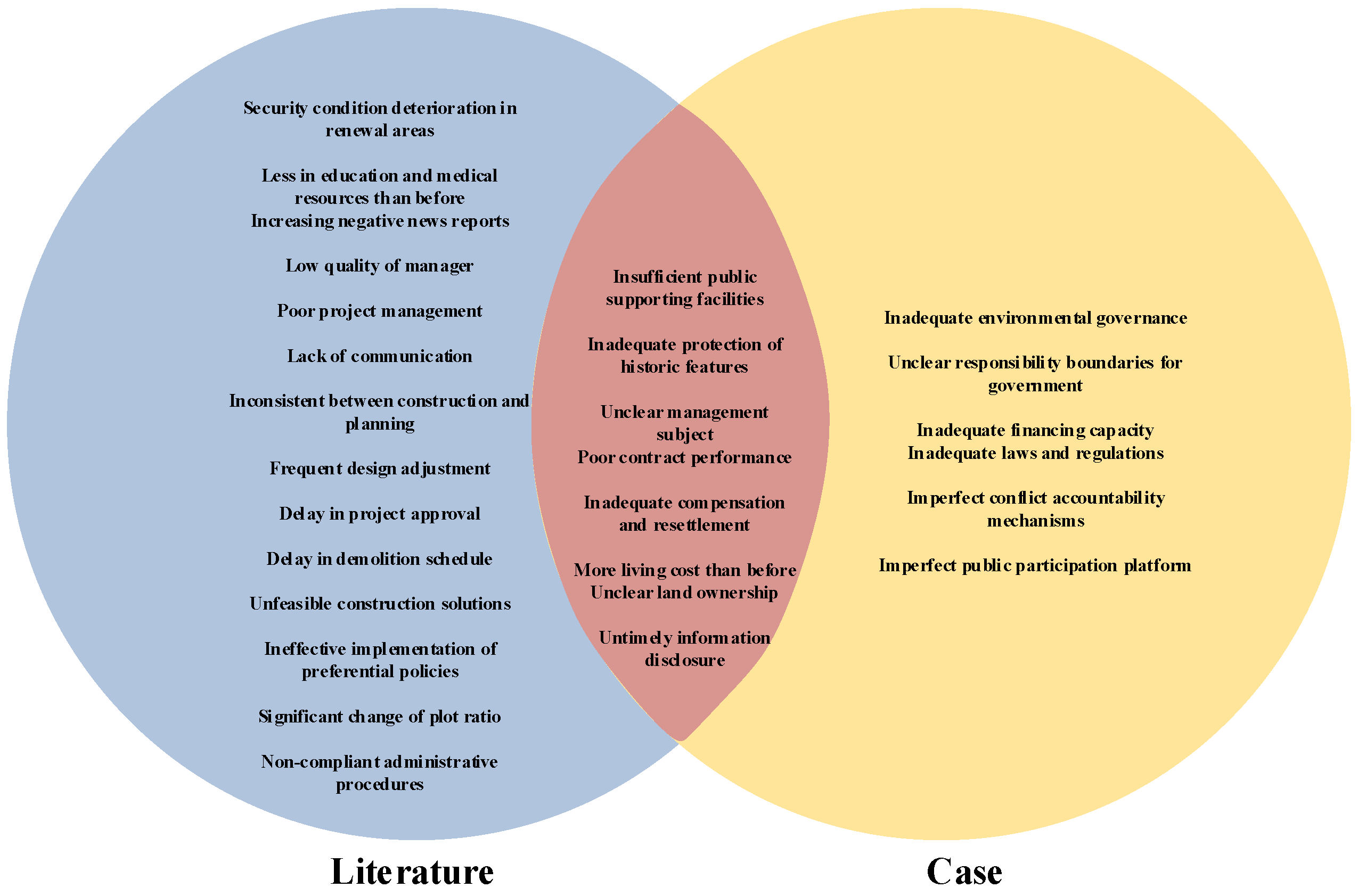
- Conflict Factor Identification (RO1): SLR and multi-case study are used to identify conflict factors in UR, integrating literature and empirical data to form a comprehensive factor list.
- (2)
- Conflict Factor Classification (RO2): EFA is applied to questionnaire data to classify conflict factors into distinct dimensions, revealing their underlying structure.
- (3)
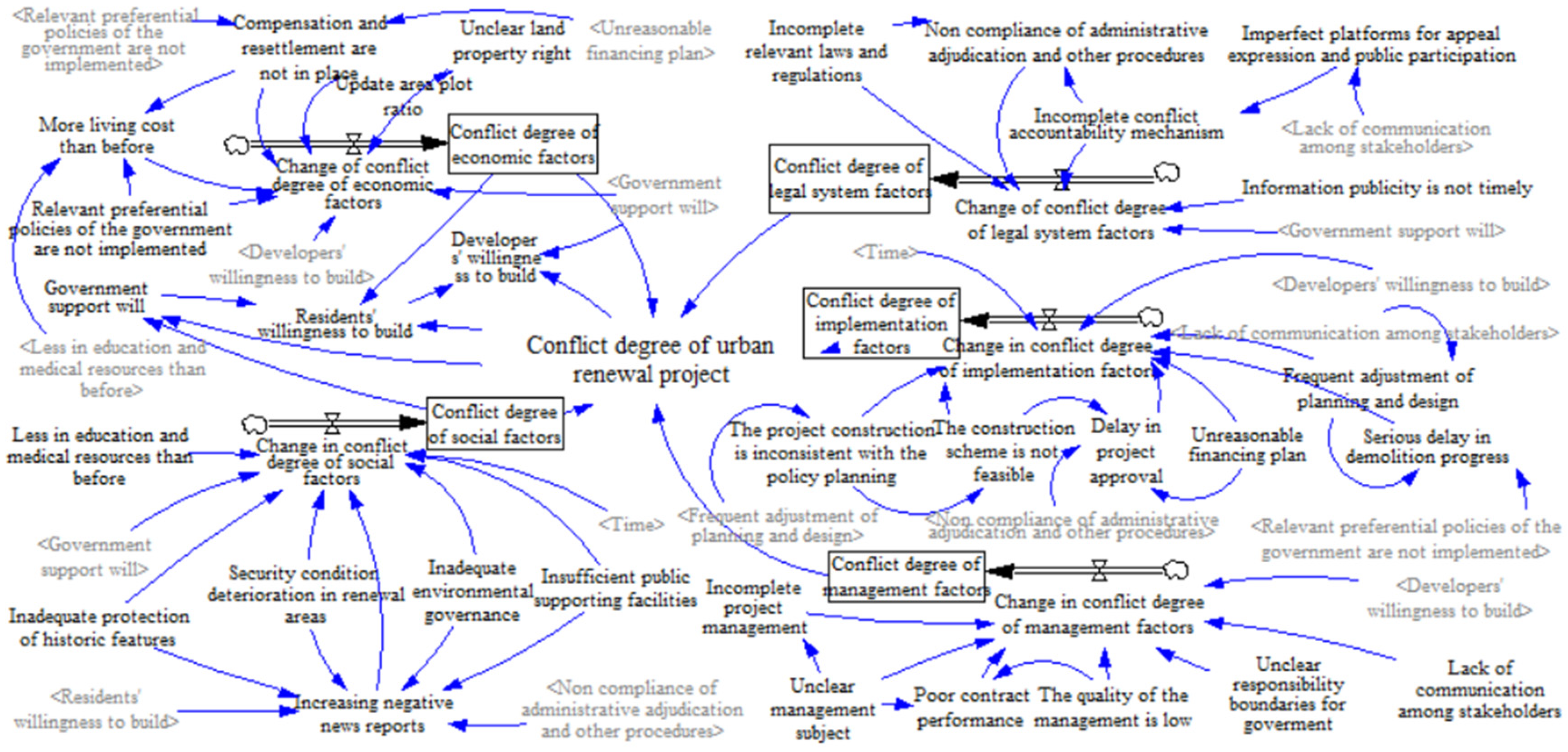
- Dynamic Evolution Modeling (RO3): SD is employed to construct causal feedback models and stock-flow diagrams, simulating the interactions and evolution of conflict factors, validated through a case study.
3.2. Measures
3.2.1. Literature Analysis
3.2.2. Multi-Case Study
3.3. Sample and Date Collection
4. Research Results
4.1. Identification of Stakeholder Conflict Factors
4.2. Classification of Stakeholder Conflict Factors
4.3. Construction of Conflict Factors Evolution Model Based on System Dynamics
4.3.1. Determination of Conflict Factor Weights Based on the Entropy Weight Method
4.3.2. Dynamic Evolution of Conflict Factors
- (1)
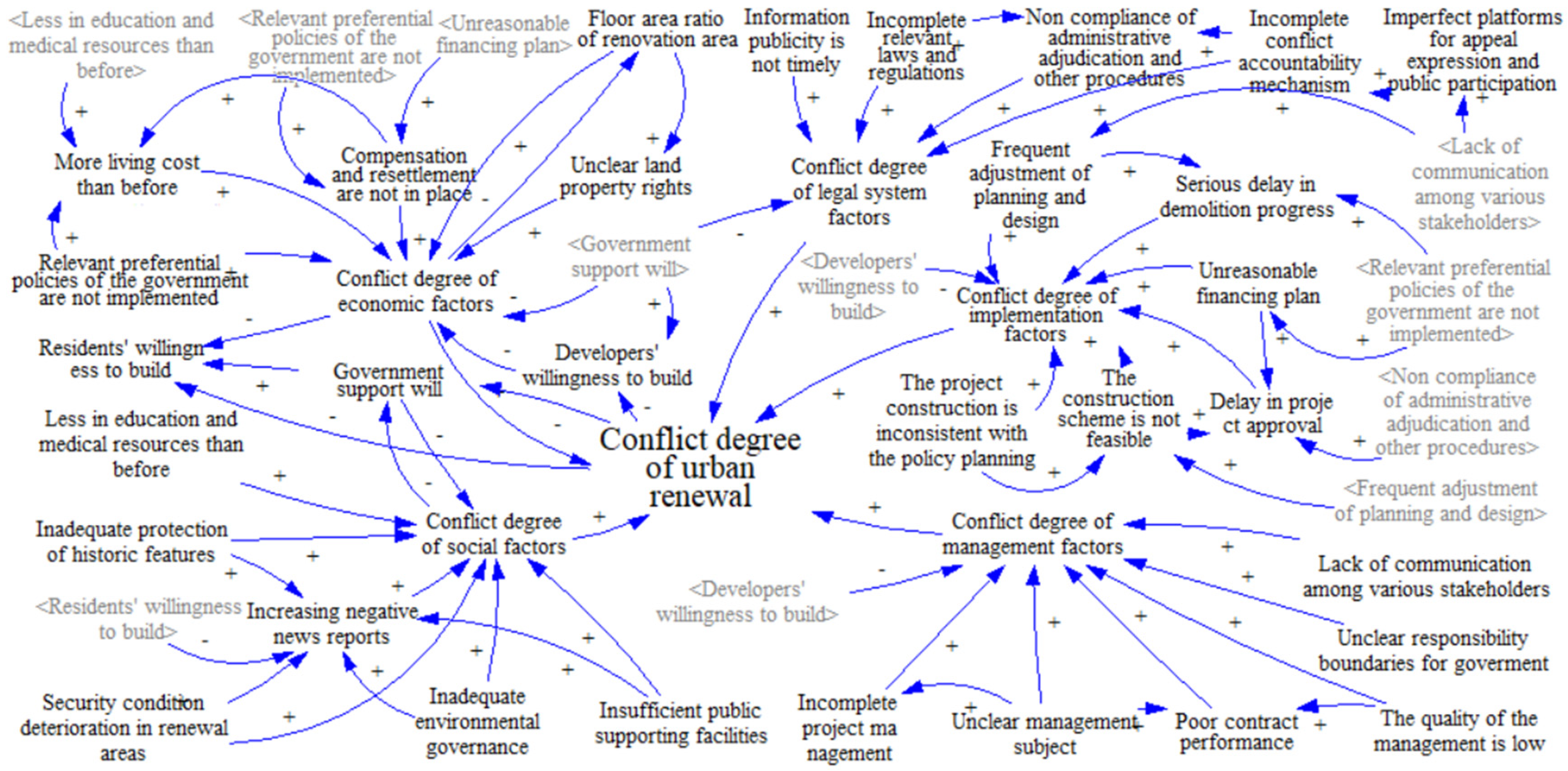
- Conflict degree of economic factors ↑→ Residents’ willingness to build ↓→ Developers’ willingness to build ↓→ Conflict degree of management factors ↑→ Conflict degree of urban renewal ↑→ Conflict degree of economic factors ↑.
- (2)
- Conflict degree of legal system factors ↑→ Conflict degree of urban renewal ↑→ Willingness of government support ↓→ Conflict degree of legal system factors ↑.
- (3)
- Conflict degree of implementation factors ↑→ Conflict degree of urban renewal ↑→ Willingness of government support ↓→ Conflict degree of economic factors ↑→ Willingness of residents to build ↓→ Willingness of developers to build ↓→ Conflict Degree of implementation factors ↑.
- (4)
- Conflict degree of management factors ↑→ Conflict degree of urban renewal ↑→ Willingness of government support ↓→ Conflict degree of economic factors ↑→ Willingness of residents to build ↓→ Willingness of developers to build ↓→ Conflict Degree of management factors ↑.
- (5)
- Conflict degree of social factors ↑→ Conflict degree of urban renewal ↑→ Willingness of government support ↓→ Conflict degree of social factors ↑.
5. Case Study
5.1. Case Overview
5.2. Simulation Data Input
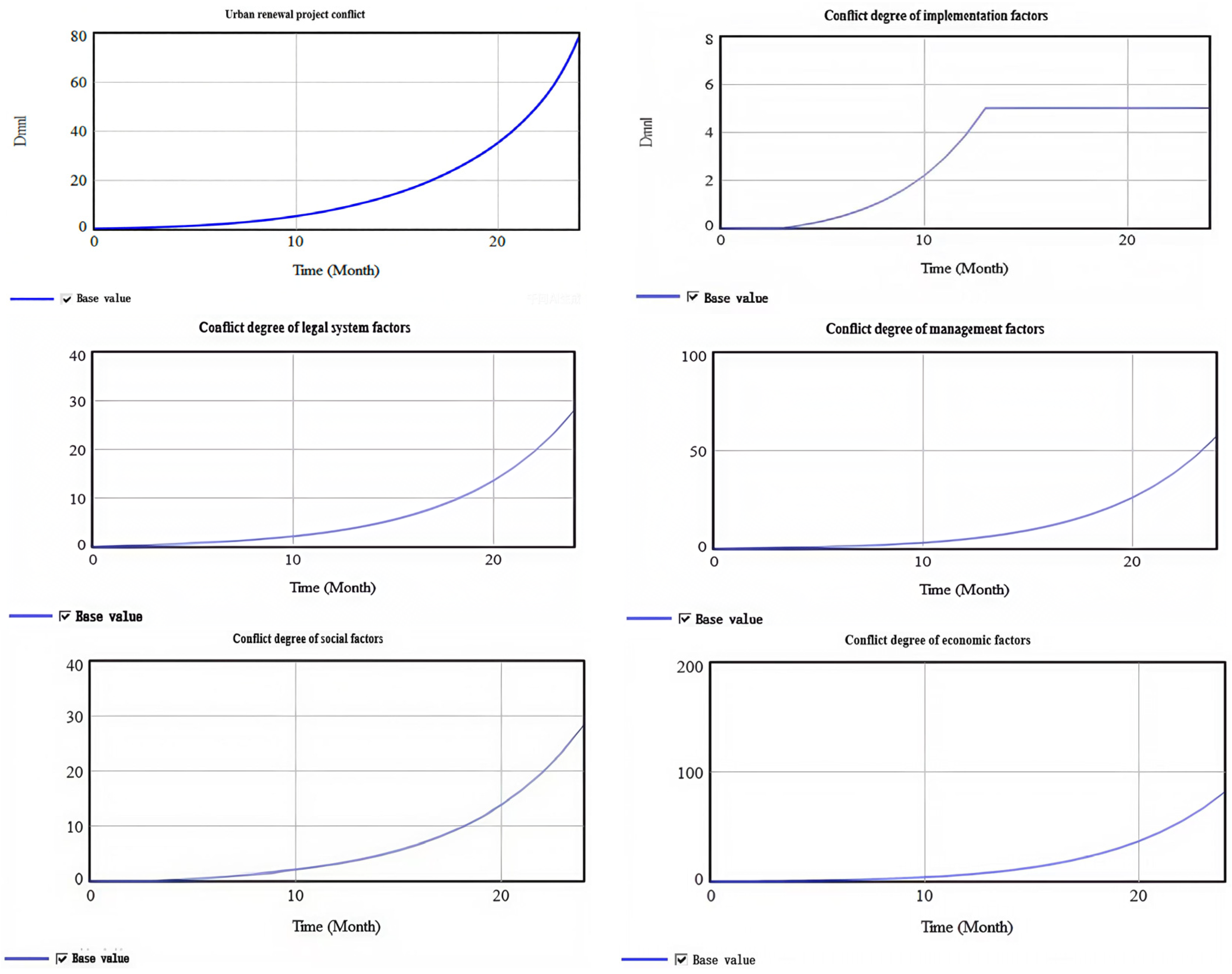
5.3. Analysis of Basic Simulation Results
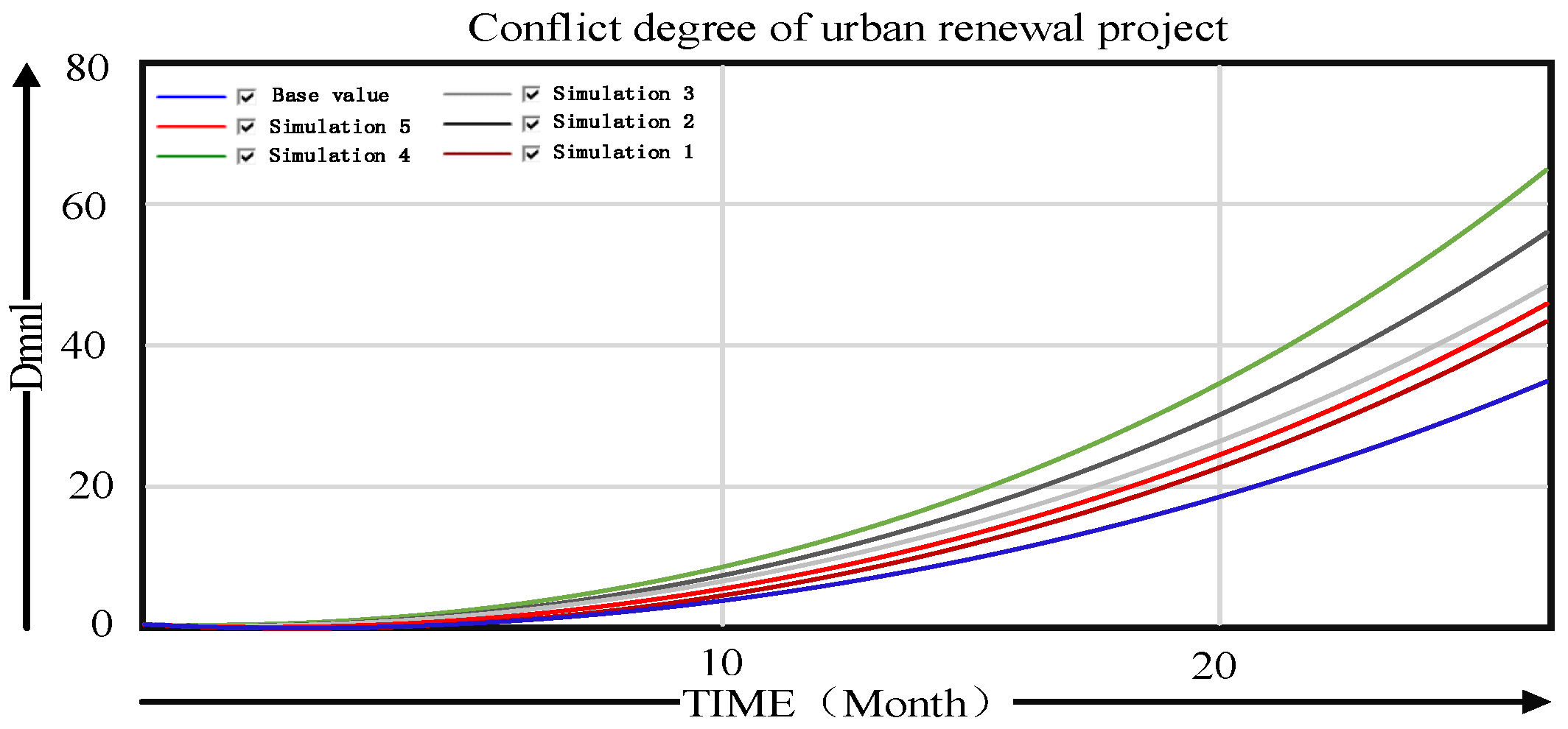
5.4. System Model Comparison and Analysis
- (1)
- In Simulation 1, the assignment of management factors was changed based on initial values, enhancing their role in conflict within URPs. The results indicate that while the degree of project conflict increased, the effect was less pronounced compared to the initial state in this scheme.
- (2)
- In Simulation 2, the assignment within the implementation factors was changed based on the initial value, aiming to enhance their conflict effect on the project. The results demonstrate an obvious increase in the project’s conflict degree compared to the initial state.
- (3)
- In Simulation 3, only the assignment of legal system factors was altered based on the initial value, thereby enhancing their role in project conflict. The results indicate a significant increase in project conflict degree compared to the initial state.
- (4)
- In Simulation 4, the assignment of economic factors was solely changed based on the initial value, aiming to improve their conflict effect on the project. The results reveal that this approach led to the most significant increase in project conflict degree compared to the initial state.
- (5)
- In Simulation 5, the assignment of social factors was modified based on the initial value, enhancing their impact on project conflict. The results demonstrate that although there is an increase in the project conflict degree compared to the initial state, the effect is the least noticeable.
6. Discussion
6.1. Key Findings
6.2. Theoretical Contribution
6.3. Practical Implication
- (1)
- Enhancing conflict anticipation
- (2)
- Informing policy design and governance structures
- (3)
- Facilitating sustainability and long-term urban development
7. Conclusions
Supplementary Materials
Author Contributions
Funding
Data Availability Statement
Acknowledgments
Conflicts of Interest
References
- Yildiz, S.; Kivrak, S.; Arslan, G. Factors affecting environmental sustainability of urban renewal projects. Civ. Eng. Environ. Syst. 2017, 34, 264–277. [Google Scholar] [CrossRef] [Scilit]
- Yung, E.H.K.; Zhang, Q.; Chan, E.H.W. Underlying social factors for evaluating heritage conservation in urban renewal districts. Habitat Int. 2017, 66, 135–148. [Google Scholar] [CrossRef] [Scilit]
- McCarthy, J. Partnership, Collaborative Planning and Urban Regeneration; Routledge: London, UK, 2016. [Google Scholar]
- Atkinson, R.; Tallon, A.; Williams, D. Governing urban regeneration in the UK: A case of ‘variegated neoliberalism’ in action? Eur. Plan. Stud. 2019, 27, 1083–1106. [Google Scholar] [CrossRef] [Scilit]
- Agbiboa, D.E. Conflict Analysis in ‘World Class’ Cities: Urban Renewal, Informal Transport Workers, and Legal Disputes in Lagos. In Urban Forum; Springer: Dordrecht, The Netherlands, 2018; Volume 29, pp. 1–18. [Google Scholar]
- Lees, L. The urban injustices of new Labour’s “New Urban Renewal”: The case of the Aylesbury Estate in London. Antipode 2014, 46, 921–947. [Google Scholar] [CrossRef] [Scilit]
- Freeman, R.E. Strategic Management: A Stakeholder Approach; Cambridge University Press: Cambridge, UK, 2010. [Google Scholar]
- Freeman, R.E.; Harrison, J.S.; Wicks, A.C. Managing for Stakeholders: Reputation, Survival and Success; Yale University Press: New Haven, CT, USA, 2007. [Google Scholar]
- Zhuang, T.; Qian, Q.K.; Visscher, H.J.; Elsinga, M.G. Stakeholders’ Expectations in Urban Renewal Projects in China: A Key Step towards Sustainability. Sustainability 2017, 9, 1640. [Google Scholar] [CrossRef] [Scilit]
- Wang, Y.; Li, J.; Zhang, G.; Li, Y.; Asare, M.H. Fuzzy evaluation of comprehensive benefit in urban renewal based on the perspective of core stakeholders. Habitat Int. 2017, 66, 163–170. [Google Scholar] [CrossRef] [Scilit]
- Li, L.; Zhu, J.; Duan, M.; Li, P.; Guo, X. Overcoming the Collaboration Barriers among Stakeholders in Urban Renewal Based on a Two-Mode Social Network Analysis. Land 2022, 11, 1865. [Google Scholar] [CrossRef] [Scilit]
- Jiang, Y.; Mohabir, N.; Ma, R.; Wu, L.; Chen, M. Whose village? Stakeholder interests in the urban renewal of Hubei old village in Shenzhen. Land Use Policy 2020, 91, 104411. [Google Scholar] [CrossRef] [Scilit]
- Ramirez, R. Stakeholder Analysis and Conflict Management; International Development Research Centre: Ottawa, ON, Canada, 1999. [Google Scholar]
- Hörisch, J.; Schaltegger, S.; Freeman, R.E. Integrating stakeholder theory and sustainability accounting: A conceptual synthesis. J. Clean. Prod. 2020, 275, 124097. [Google Scholar] [CrossRef] [Scilit]
- Pedrini, M.; Ferri, L.M. Stakeholder management: A systematic literature review. Corp. Gov. Int. J. Bus. Soc. 2019, 19, 44–59. [Google Scholar] [CrossRef] [Scilit]
- Bai, Y.; Wu, S.; Zhang, Y. Exploring the Key Factors Influencing Sustainable Urban Renewal from the Perspective of Multiple Stakeholders. Sustainability 2023, 15, 10596. [Google Scholar] [CrossRef] [Scilit]
- Novais, P.; Carneiro, D. (Eds.) Interdisciplinary Perspectives on Contemporary Conflict Resolution; IGI Global: Hershey, PA, USA, 2016. [Google Scholar]
- Allred, C.B. The anatomy of conflict: Some thoughts on managing staff Conflict. Law Libr. J. 1987, 79, 7. [Google Scholar]
- Yu, T.; Shen, G.Q.; Shi, Q.; Zheng, H.W.; Wang, G.; Xu, K. Evaluating social sustainability of urban housing demolition in Shanghai, China. J. Clean. Prod. 2017, 153, 26–40. [Google Scholar] [CrossRef] [Scilit]
- Yu, T.; Liang, X.; Shen, G.Q.; Shi, Q.; Wang, G. An optimization model for managing stakeholder conflicts in urban redevelopment projects in China. J. Clean. Prod. 2019, 212, 537–547. [Google Scholar] [CrossRef] [Scilit]
- Liao, Z.; Liu, M. Critical barriers and countermeasures to urban regeneration from the stakeholder perspective: A literature review. Front. Sustain. Cities 2023, 5, 1115648. [Google Scholar] [CrossRef] [Scilit]
- Zhuang, T.; Qian, Q.K.; Visscher, H.J.; Elsinga, M.G.; Wu, W. The role of stakeholders and their participation network in decision-making of urban renewal in China: The case of Chongqing. Cities 2019, 92, 47–58. [Google Scholar] [CrossRef] [Scilit]
- Li, Y.; Tao, Y.; Qian, Q.K.; Mlecnik, E.; Visscher, H.J. Critical factors for effective resident participation in neighborhood rehabilitation in Wuhan, China: From the perspectives of diverse stakeholders. Landsc. Urban Plan. 2024, 244, 105000. [Google Scholar] [CrossRef] [Scilit]
- Liu, X. The role and action of the government in Shenzhen’s urban renewal—From benefit sharing to responsibility sharing. Int. Urban Plan. 2011, 26, 41–45. [Google Scholar]
- Wang, C.L. Analysis of interest conflict and game in Shanghai urban renewal. City Obs. 2010, 6, 130–141. [Google Scholar]
- Seo, B.K.; Joo, Y.M. Innovation or episodes? Multi-scalar analysis of governance change in urban regeneration policy in South Korea. Cities 2019, 92, 27–35. [Google Scholar] [CrossRef] [Scilit]
- Yung, E.H.K.; Conejos, S.; Chan, E.H.W. Social needs of the elderly and active aging in public open spaces in urban renewal. Cities 2016, 52, 114–122. [Google Scholar] [CrossRef] [Scilit]
- Newman, P.; Davies-Slate, S.; Jones, E. The Entrepreneur Rail Model: Funding urban rail through majority private investment in urban regeneration. Res. Transp. Econ. 2018, 67, 19–28. [Google Scholar] [CrossRef] [Scilit]
- Kim, H.R.; Jang, Y. Lessons from good and bad practices in retail-led urban regeneration projects in the Republic of Korea. Cities 2017, 61, 36–47. [Google Scholar] [CrossRef] [Scilit]
- Ruming, K. Post-political planning and community opposition: Asserting and challenging consensus in planning urban regeneration in Newcastle, New South Wales. Geogr. Res. 2018, 56, 181–195. [Google Scholar] [CrossRef] [Scilit]
- Dogruyol, K.; Aziz, Z.; Arayici, Y. Eye of Sustainable Planning: A Conceptual Heritage-Led Urban Regeneration Planning Framework. Sustainability 2018, 10, 1343. [Google Scholar] [CrossRef] [Scilit]
- Huston, S.; Rahimzad, R.; Parsa, A. ‘Smart’sustainable urban regeneration: Institutions, quality and financial innovation. Cities 2015, 48, 66–75. [Google Scholar] [CrossRef] [Scilit]
- Frantal, B.; Josef, K.; Klusáček, P.; Martinat, S. Assessing success factors of brownfields regeneration: International and inter-stakeholder perspective. Transylv. Rev. Adm. Sci. 2015, 11, 91–107. [Google Scholar]
- Chen, J.Y.; Bian, W.H. Research on the theory and method of urban renewal in the new era. Urban Archit. Space 2023, 30, 73–75. [Google Scholar]
- Wang, Y. Transformation and development of local government financing platforms in the perspective of urban renewal. China Real Estate 2023, 7, 26–31. [Google Scholar]
- Yuan, D.; Yau, Y.; Bao, H.; Liu, Y.; Liu, T. Anatomizing the Institutional Arrangements of Urban Village Redevelopment: Case Studies in Guangzhou, China. Sustainability 2019, 11, 3376. [Google Scholar] [CrossRef] [Scilit]
- Arch, A.F. Sustainable Urban Renewal: The Tel Aviv Dilemma. Sustainability 2014, 6, 2527–2537. [Google Scholar] [CrossRef] [Scilit]
- Zhou, T.; Zhou, Y.; Liu, G. Key Variables for Decision-Making on Urban Renewal in China: A Case Study of Chongqing. Sustainability 2017, 9, 370. [Google Scholar] [CrossRef] [Scilit]
- Zhang, X.F.; Sun, X.M.; Liu, Z. Exploration of consultative planning for development implementation: The case of Shanghai Jiuxing market renewal and redevelopment. J. Urban Plan. 2017, s2, 59–68. [Google Scholar]
- Hidalgo, D.; Pai, M.; Carrigan, A.; Bhatt, A. Toward people’s cities through land use and transport integration: A review of India’s national urban investment program. Transp. Res. Rec. 2013, 2394, 10–18. [Google Scholar] [CrossRef] [Scilit]
- Zhou, T.; Zhou, Y. Fuzzy comprehensive evaluation of urban regeneration decision-making based on entropy weight method: Case study of yuzhong peninsula, China. J. Intell. Fuzzy Syst. 2015, 29, 2661–2668. [Google Scholar] [CrossRef] [Scilit]
- Lai, Y.; Tang, B. Institutional barriers to redevelopment of urban villages in China: A transaction cost perspective. Land Use Policy 2016, 58, 482–490. [Google Scholar] [CrossRef] [Scilit]
- Qu, B.; Leng, J.; Ma, J. Investigating the intensive redevelopment of urban central blocks using data envelopment analysis and deep learning: A case study of Nanjing, China. IEEE Access 2019, 7, 109884–109898. [Google Scholar] [CrossRef] [Scilit]
- Liu, G.; Yi, Z.; Zhang, X.; Shrestha, A.; Martek, I.; Wei, L. An Evaluation of Urban Renewal Policies of Shenzhen, China. Sustainability 2017, 9, 1001. [Google Scholar] [CrossRef] [Scilit]
- Zheng, H.W.; Shen, G.Q.; Wang, H. A review of recent studies on sustainable urban renewal. Habitat Int. 2014, 41, 272–279. [Google Scholar] [CrossRef] [Scilit]
- Hooimeijer, F.L.; Maring, L. The significance of the subsurface in urban renewal. J. Urban. Int. Res. Placemaking Urban Sustain. 2018, 11, 303–328. [Google Scholar] [CrossRef] [Scilit]
- Liu, G.W.; Liu, G.N.; Yang, Y. Land system problems in urban renewal. China Land. 2021, 4, 11–13. [Google Scholar]
- Ren, S.B. Conflict of interest and planning coordination in urban renewal. Mod. City Res. 2011, 26, 12–16. [Google Scholar]
- Lian, H.P.; Zhang, Y.; Zeng, Y. Land acquisition conflict and its resolution from the perspective of system adaptation theory-taking land acquisition and resettlement of Beijing New Airport as an example. China Adm. 2017, 12, 119–124. [Google Scholar]
- Hsieh, C.M.; Yu, C.Y.; Shao, L.Y. Improving the local wind environment through urban design strategies in an urban renewal process to mitigate urban heat island effects. J. Urban Plan. Dev. 2023, 149, 05023003. [Google Scholar] [CrossRef] [Scilit]
- Xu, K.; Shen, G.Q.; Liu, G.; Martek, I. Demolition of Existing Buildings in Urban Renewal Projects: A Decision Support System in the China Context. Sustainability 2019, 11, 491. [Google Scholar] [CrossRef] [Scilit]
- Yildiz, S.; Kivrak, S.; Arslan, G. Contribution of built environment design elements to the sustainability of urban renewal projects: Model proposal. J. Urban Plan. Dev. 2019, 145, 04018045. [Google Scholar] [CrossRef] [Scilit]
- Berta, M.; Bottero, M.; Ferretti, V. A mixed methods approach for the integration of urban design and economic evaluation: Industrial heritage and urban regeneration in China. Environ. Plan. B Urban Anal. City Sci. 2018, 45, 208–232. [Google Scholar] [CrossRef] [Scilit]
- Trillo, C. Urban Regeneration and New Partnerships Among Public Institutions, Local Entrepreneurs and Communities. In Advanced Engineering Forum; Trans Tech Publications Ltd.: Bäch, Switzerland, 2014; Volume 11, pp. 303–313. [Google Scholar]
- Ma, G.Q. Research on the transformation of dilapidated houses and social governance strategies in the context of urban renewal. Soc. Constr. 2022, 9, 36–47. [Google Scholar]
- Corbin, J.M.; Strauss, A. Grounded theory research: Procedures, canons, and evaluative criteria. Qual. Sociol. 1990, 13, 3–21. [Google Scholar] [CrossRef] [Scilit]
- Wu, L.; Sun, L.; Chang, Q.; Zhang, D.; Qi, P. How do digitalization capabilities enable open innovation in manufacturing enterprises? A multiple case study based on resource integration perspective. Technol. Forecast. Soc. Change 2022, 184, 122019. [Google Scholar] [CrossRef] [Scilit]
- Akintoye, A. Analysis of factors influencing project cost estimating practice. Constr. Manag. Econ. 2000, 18, 77–89. [Google Scholar] [CrossRef] [Scilit]
- Xu, J.; Kang, J. Comparison of ecological risk among different urban patterns based on system dynamics modeling of urban development. J. Urban Plan. Dev. 2017, 143, 04016034. [Google Scholar] [CrossRef] [Scilit]
- Yang, H.J. Spatio-Temporal Changes of Housing Features in Response to Urban Renewal Initiatives: The Case of Seoul. Sustainability 2020, 12, 7918. [Google Scholar] [CrossRef] [Scilit]
- Adler, M. Well-Being and Fair Distribution: Beyond Cost-Benefit Analysis; OUP USA: New York, NY, USA, 2012. [Google Scholar]
- Yang, D.Y.R.; Chang, J.C. Financialising space through transferable development rights: Urban renewal, Taipei style. Urban Stud. 2018, 55, 1943–1966. [Google Scholar] [CrossRef] [Scilit]
- Zeidemann, V.; Kainer, K.A.; Staudhammer, C.L. Heterogeneity in NTFP quality, access and management shape benefit distribution in an Amazonian extractive reserve. Environ. Conserv. 2014, 41, 242–252. [Google Scholar] [CrossRef] [Scilit]

| Conflict Factor | Literature in the Urban Renewal Sector |
|---|---|
| Low quality of manager | [40,41] |
| Poor project management | [2,35,42,43] |
| Ineffective implementation of preferential policies | [36,44] |
| Non-compliant administrative procedures | [41,45] |
| Inconsistent between construction and planning | [46,47] |
| Poor contract performance | [24,34,48] |
| More living cost than before | [16,40] |
| Untimely information disclosure | [39,45,47] |
| Inadequate compensation and resettlement | [36,45,49] |
| Unclear land ownership | [36,45,49] |
| Delay in project approval | [42] |
| Increasing negative news reports | [50,51] |
| Less in education and medical resources than before | [16] |
| Insufficient public supporting facilities | [25,36,42,45,52] |
| Inadequate protection of historic features | [2,35,42,51,53] |
| Unclear management subject | [24,54] |
| Unfeasible construction solutions | [42,50] |
| Security condition deterioration in renewal areas | [2] |
| Lack of communication | [39,44] |
| Frequent design adjustment | [44,55] |
| Delay in demolition schedule | [36,45,49] |
| Significant change in plot ratio | [55] |
| Project | Project A | Project B | Project C | Project D | Project E | Mean Value |
|---|---|---|---|---|---|---|
| Cohen’s Kappa | 0.829 | 0.795 | 0.814 | 0.817 | 0.773 | 0.806 |
| Variable | Category | Samples | Percent (100%) |
|---|---|---|---|
| Parties | Residents | 60 | 30.46% |
| Government officials | 36 | 18.27% | |
| Developers | 73 | 37.06% | |
| Scholars | 21 | 10.66% | |
| Others | 7 | 3.55% |
| Stakeholder | Government | Developer | Resident |
|---|---|---|---|
| Inadequate environmental governance | 1 | 0 | 0 |
| Insufficient public supporting facilities | 1 | 0 | 1 |
| Security condition deterioration in renewal areas | 1 | 0 | 1 |
| Less in education and medical resources than before | 0 | 0 | 1 |
| Inadequate protection of historic features | 1 | 0 | 1 |
| Increasing negative news reports | 0 | 0 | 1 |
| Unclear management subject | 1 | 0 | 0 |
| Poor contract performance | 0 | 1 | 0 |
| Low quality of manager | 0 | 1 | 0 |
| Poor project management | 1 | 1 | 0 |
| Unclear responsibility boundaries for government | 1 | 0 | 0 |
| Lack of communication | 1 | 1 | 1 |
| Inconsistent between construction and planning | 1 | 1 | 0 |
| Frequent design adjustment | 0 | 1 | 0 |
| Delay in project approval | 1 | 1 | 0 |
| Delay in demolition schedule | 0 | 1 | 0 |
| Inadequate financing capacity | 1 | 1 | 0 |
| Unfeasible construction solutions | 1 | 1 | 0 |
| Inadequate compensation and resettlement | 0 | 1 | 1 |
| More living cost than before | 0 | 0 | 1 |
| Unclear land ownership | 1 | 1 | 0 |
| Ineffective implementation of preferential policies | 1 | 1 | 0 |
| Significant change in plot ratio | 1 | 1 | 0 |
| Untimely information disclosure | 1 | 1 | 0 |
| Non-compliant administrative procedures | 1 | 1 | 0 |
| Inadequate laws and regulations | 1 | 0 | 0 |
| Imperfect conflict accountability mechanisms | 1 | 0 | 0 |
| Imperfect public participation platform | 1 | 0 | 1 |
| Groups | Factors | Component | ||||
|---|---|---|---|---|---|---|
| 1 | 2 | 3 | 4 | 5 | ||
| Social Factors | Inadequate environmental governance | 0.876 | ||||
| Insufficient public supporting facilities | 0.876 | |||||
| Security condition deterioration in renewal areas | 0.859 | |||||
| Less in education and medical resources than before | 0.858 | |||||
| Inadequate protection of historic features | 0.843 | |||||
| Increasing negative news reports | 0.832 | |||||
| Management Factors | Unclear management subject | 0.839 | ||||
| Poor contract performance | 0.821 | |||||
| Low quality of manager | 0.815 | |||||
| Poor project management | 0.814 | |||||
| Unclear responsibility boundaries for government | 0.812 | |||||
| Lack of communication | 0.808 | |||||
| Implementation Factors | Inconsistent between construction and planning | 0.811 | ||||
| Frequent design adjustment | 0.809 | |||||
| Delay in project approval | 0.803 | |||||
| Delay in demolition schedule | 0.787 | |||||
| Inadequate financing capacity | 0.747 | |||||
| Unfeasible construction solutions | 0.736 | |||||
| Economic Factors | Inadequate compensation and resettlement | 0.873 | ||||
| More living costs than before | 0.867 | |||||
| Unclear land ownership | 0.844 | |||||
| Ineffective implementation of preferential policies | 0.844 | |||||
| Significant change in plot ratio | 0.656 | |||||
| Legel System Factors | Untimely information disclosure | 0.852 | ||||
| Non-compliant administrative procedures | 0.835 | |||||
| Inadequate laws and regulations | 0.828 | |||||
| Imperfect conflict accountability mechanisms | 0.821 | |||||
| Imperfect public participation platform | 0.814 | |||||
| Primary Conflict Factors | Weight | Secondary Conflict Factors | Weight |
|---|---|---|---|
| Economic factors | 0.341 | More living costs than before | 0.190 |
| Inadequate compensation and resettlement | 0.321 | ||
| Significant change in plot ratio | 0.152 | ||
| Ineffective implementation of preferential policies | 0.184 | ||
| Unclear land ownership | 0.153 | ||
| Legal system factors | 0.222 | Imperfect public participation platform | 0.131 |
| Untimely information disclosure | 0.142 | ||
| Non-compliant administrative procedures | 0.153 | ||
| Imperfect conflict accountability mechanisms | 0.262 | ||
| Inadequate laws and regulations | 0.312 | ||
| Implementation factors | 0.133 | Frequent design adjustment | 0.214 |
| Delay in project approval | 0.110 | ||
| Inconsistency between project construction and planning | 0.161 | ||
| Delay in demolition schedule | 0.113 | ||
| Inadequate financing capacity | 0.221 | ||
| Unfeasible construction solutions | 0.181 | ||
| Management factor | 0.192 | Poor project management | 0.121 |
| Unclear management subject | 0.251 | ||
| Poor project management | 0.159 | ||
| Unclear responsibility boundaries for government | 0.124 | ||
| Poor contract performance | 0.134 | ||
| Lack of communication | 0.211 | ||
| Social factors | 0.112 | Inadequate protection of historic features | 0.241 |
| Security condition deterioration in renewal areas | 0.162 | ||
| Less in education and medical resources than before | 0.137 | ||
| Insufficient public supporting facilities | 0.116 | ||
| Inadequate environmental governance | 0.133 | ||
| Increasing negative news reports | 0.211 |
| Variable Name | SD Equation |
|---|---|
| SD equation urban renewal conflict degree C | |
| Conflict degree of economic factors C1 (Change in conflict degree of economic factors V1) | |
| Conflict degree of legal system factors C2 (Change in conflict degree of legal system factors V2) | |
| Conflict degree of implementation factors C3 (Change in conflict degree of implementation factors V3) | |
| Conflict degree of management factors C4 (Change in conflict degree of management factors V4) | |
| Conflict degree of social factors C5 (Change in conflict degree of social factors V5) | |
| Reference Value | Interpretation |
|---|---|
| 0 | This factor is highly stable and has no impact on the conflict intensity when it occurs |
| 0.2 | This factor is relatively stable and has minimal impact on the conflict intensity when it occurs |
| 0.4 | This factor is relatively stable but has considerable impact on the conflict intensity when it occurs |
| 0.6 | This factor is relatively unstable but has minimal impact on the conflict intensity when it occurs |
| 0.8 | This factor is relatively unstable and has significant impact on the conflict intensity when it occurs |
| 1 | This factor is extremely unstable and causes irreparable impact on the conflict intensity when it occurs |
| Values of 0.1, 0.3, 0.5, 0.7, and 0.9 represent intermediate values between the reference values listed above | |
| Conflict Factors | Initial Vale |
|---|---|
| Less in education and medical resources than before | 0.27 |
| Insufficient public supporting facilities | 0.32 |
| Unclear management subject | 0.25 |
| Low quality of manager | 0.16 |
| Unclear responsibility boundaries for government | 0.12 |
| Inconsistent between construction and planning | 0.16 |
| Unreasonable financing plan | 0.22 |
| Untimely information disclosure | 0.11 |
| Inadequate laws and regulations | 0.31 |
Disclaimer/Publisher’s Note: The statements, opinions and data contained in all publications are solely those of the individual author(s) and contributor(s) and not of MDPI and/or the editor(s). MDPI and/or the editor(s) disclaim responsibility for any injury to people or property resulting from any ideas, methods, instructions or products referred to in the content. |
© 2025 by the authors. Licensee MDPI, Basel, Switzerland. This article is an open access article distributed under the terms and conditions of the Creative Commons Attribution (CC BY) license (https://creativecommons.org/licenses/by/4.0/).
Share and Cite
Zhang, B.; Shen, X.; Lyu, S.; Liu, Y.; Cui, P.; Ding, G. Investigating the Factors Contributing to the Stakeholder Conflict in Urban Renewal Projects: A Case Study of China. Buildings 2025, 15, 4181. https://doi.org/10.3390/buildings15224181
Zhang B, Shen X, Lyu S, Liu Y, Cui P, Ding G. Investigating the Factors Contributing to the Stakeholder Conflict in Urban Renewal Projects: A Case Study of China. Buildings. 2025; 15(22):4181. https://doi.org/10.3390/buildings15224181
Chicago/Turabian StyleZhang, Beibei, Xuehong Shen, Sainan Lyu, Yan Liu, Peng Cui, and Guifen Ding. 2025. "Investigating the Factors Contributing to the Stakeholder Conflict in Urban Renewal Projects: A Case Study of China" Buildings 15, no. 22: 4181. https://doi.org/10.3390/buildings15224181
APA StyleZhang, B., Shen, X., Lyu, S., Liu, Y., Cui, P., & Ding, G. (2025). Investigating the Factors Contributing to the Stakeholder Conflict in Urban Renewal Projects: A Case Study of China. Buildings, 15(22), 4181. https://doi.org/10.3390/buildings15224181


