1. Introduction
The recycling of construction and industrial waste stands as a paramount concern for both environmental preservation and sustainable development. Every year, a significant volume of construction and industrial waste is generated worldwide, exerting profound impacts on the environment. Moreover, construction activities have led to a depletion of sand and gravel resources, consequently driving up the prices of construction raw materials. Hence, addressing the environmental pollution stemming from construction and industrial solid waste, along with mitigating the scarcity of sand and gravel aggregates for construction, has emerged as a focal point of research. This imperative underscores the prevailing trend towards the efficient utilization of construction and industrial solid waste resources [
1].
Transforming construction and industrial waste into recycled aggregates and integrating them into construction practices stands as a pivotal measure for their utilization. Scholars both domestically and internationally advocate for breaking down waste concrete into recycled fine aggregate (RFA) and recycled coarse aggregate, replacing natural river sand and stone in concrete, as a primary solution [
2,
3]. At present, more research is focused on applying recycled aggregate to recycled concrete. Extensive research exists on recycled aggregate concrete, encompassing mechanical properties [
1,
4], durability performance [
5], and structural member characteristics [
6,
7]. However, there is a scarcity of studies focusing on the application of recycled concrete fine aggregate in cement-based materials. Rene et al. [
8] emphasized that utilizing RFA in masonry mortar is preferable due to its lower strength requirements compared to concrete. The recycled concrete fine aggregate has been proved to be a substitute for natural sand [
9,
10]. Research confirms the feasibility of utilizing crushed waste clay brick as coarse/fine aggregates or a mineral admixture in concrete.
In summary, waste concrete, waste clay brick, and coal gangue present viable options for integration into cement-based materials, particularly in low-strength mortar formulations. Given the substantial demand for concrete and mortar in construction activities, utilizing construction and industrial wastes in low-strength mortar not only addresses sand and gravel shortages but also promotes environmental conservation. However, the diverse sources and complex compositions of these wastes pose challenges in ensuring consistent material quality for each batch. Consequently, estimating the strength of mortar derived from their crushed products becomes challenging, thus hindering practical engineering applications. Moreover, the mix proportion and curing duration emerge as critical factors influencing mortar strength. Therefore, developing efficient methods for accurately predicting mortar strength, mix ratios, and curing periods is essential for the widespread adoption of composite recycled mortar.
The conventional approach for measuring mortar compressive strength is time-intensive and inefficient. Artificial neural networks achieve rapid strength prediction through computational approaches. ANN is considered to be a powerful, applicable, and appropriate artificial intelligence system, which can solve almost all problems in the field of science and engineering [
11]. For example, in the study of structural vibration-based damage identification under varying temperature conditions, the connection between the field of damage identification and artificial intelligence technologies has become increasingly close. Compared to model-based methods, data-driven approaches do not require finite element models and offer strong capabilities in feature extraction, automatic and accurate pattern recognition, as well as excellent nonlinear fitting performance [
12].
Recent years have witnessed increasing attention directed toward utilizing ANN for predicting concrete performance [
13]. Meanwhile, many scholars [
11,
14,
15,
16,
17,
18] have introduced ANN into the prediction of mortar compressive strength, and their prediction accuracy is satisfactory. Some studies have compared the advantages and disadvantages of artificial neural networks (ANNs) with other existing models. Armaghani, D.J. and Asteris, P.G. systematically compared the performance of ANN and Adaptive Neuro-Fuzzy Inference System (ANFIS) in predicting mortar strength, concluding that ANN is the optimal prediction technique for mortar compressive strength [
11]. Azimi-Pour, M. and Eskandari-Naddaf, H. developed a predictive model considering the synergistic effect of nano/micro silica, finding that both the ANN and Gene Expression Programming (GEP) models predict the compressive strength of mortar with higher accuracy than existing models [
14]. Divyah Nagarajan et al. demonstrated that there are certain nonlinear dependencies in the data, and that neural networks outperform regression analysis in such cases [
19].
Recent studies have employed ANNs to estimate various mechanical properties of cementitious materials with different mineral additives [
16]. However, the composite recycled mortar studied in this paper is completely made of recycled materials. The uneven quality of raw materials often results in the variability in mortar strength under different mix proportions, making the pattern of change less obvious. In this case, is the ANN still applicable and how accurate is its prediction? At present, few people study this problem.
This paper primarily investigates the compressive strength of mortar with varying proportions of recycled materials. Employing three distinct ANN models, the study utilizes the content of each component and curing period as input parameters, with compressive strength as the output value. This study aims to evaluate the adaptability and accuracy of various ANN architectures in forecasting the compressive strength of recycled aggregate mortar. Comparative analysis of experimental versus predicted values demonstrates the GA-BP network model’s superior performance among the three models. Subsequently, utilizing extremum optimization via ANN’s genetic algorithm function, the paper predicts and validates the optimal compressive strength, mix proportion, and curing period through experimental verification.
2. Materials and Methods
2.1. Cement and Water
The tested Portland cement composite (P.C 42.5 grade) properties are presented in
Table 1. The water used is municipal water.
2.2. Recycled Concrete Sand (RCS) and Recycled Clay Brick Sand (RCBS)
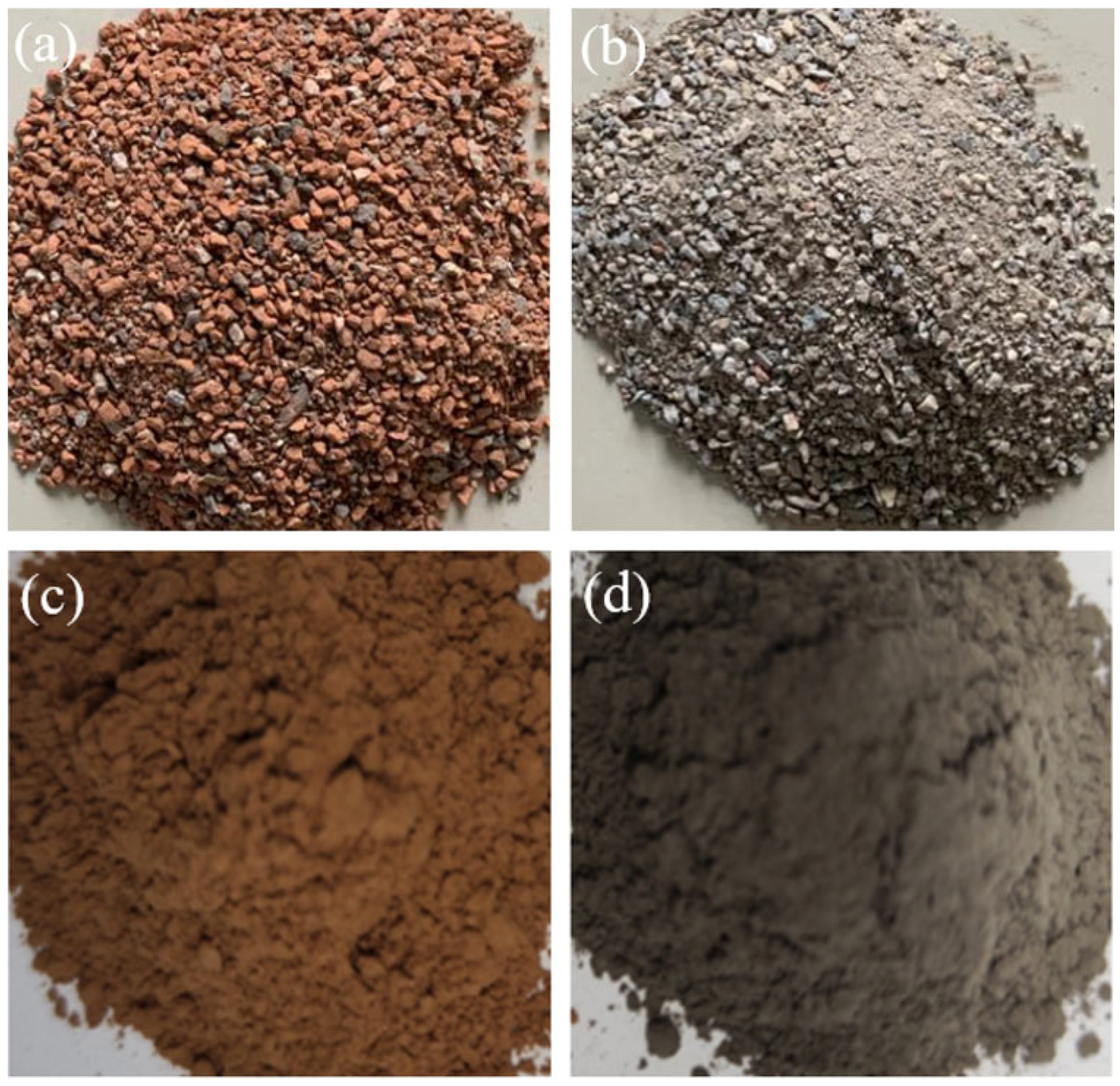
The RFA includes RCS and RCBS. RCS and RCBS are supplied from a recycling facility in Taian, China. RCS/RCBS are sourced from Lihan (Taian) Environmental Technology Co., Ltd., a company within the new building materials industry chain in Tai’an City. They are produced in continuous batches to ensure consistency in material composition and physical properties. Each batch undergoes XRF to verify its homogeneity. RCS and RCBS are obtained by crushing waste concrete and waste clay brick, respectively. Impurities are first removed from each waste material prior to crushing using a jaw crusher. Recycled concrete and clay bricks are initially crushed using a jaw crusher manufactured by Gongyi Zhanjie Hengtong Machinery Factory (Zhengzhou, China). The crushed materials are then subjected to vibratory screening to retain particles within the 0.75–4.75 mm range, which are used as recycled fine aggregates. The crushed material is sieved through 4.75 mm and 0.75 mm screens to remove coarse aggregate and fine powder, respectively. The resulting RFA (0.75–4.75 mm particle size) is obtained, as shown in
Figure 1.
Table 2 presents fundamental technical indicators of RCS and RCBS.
Recycled clay brick sand (RCBS) exhibits markedly distinct physical characteristics compared to recycled concrete sand (RCS): Despite RCBS having lower porosity (43.20% vs. RCS 47.93%), its open-pore structure results in significantly higher water absorption (7.8% vs. RCS 5.2%). This divergence necessitates dynamic adjustment of the water–binder ratio in mix design—each 10% increase in RCBS replacement rate requires a 0.5% elevation in mixing water content. Chemically, RCBS contains 2.49% CaO (versus only 0.8% in RCS), creating an alkaline environment that facilitates later-stage pozzolanic reactions. This chemical distinction directly correlates with the observed strength inflection point phenomenon at 20% RCBS substitution.
2.3. Recycled Powder (RP)
The RP includes recycled clay brick powder (RCBP) and recycled coal gangue powder (RCGP).RCBP is obtained by grinding waste clay bricks collected from Lihan (Taian) Environmental Technology Co., Ltd., part of the new building materials industry chain in Tai’an City, China. The RCGP is produced by grinding coal gangue sourced from the Suncun Coal Mine of Xinwen Mining Group in China. The same method (consistent with
Section 2.2) is used to obtain RFA of waste clay brick and coal gangue. Then, they are ground separately with a planetary ball mill for 30 min. The grinding product is sieved with a 0.75 mm sieve to obtain RP with a size below 0.75 mm. The RP used in this study is shown in
Figure 1.
Table 3 indicates that the chemical composition of RCBP and RCGP from X-ray fluorescence analysis (XRF) is similar to fly ash [
20]. This indicates that the volcanic ash characteristics of RCBP and RCGP have potential utility value in various civil engineering projects.
2.4. Prediction of UCS Using ANN
ANNs employ interconnected algorithms to model complex dataset relationships by emulating neuronal operational principles in the human brain [
21]. The ANN structure consists of layered neurons across input, hidden, and output layers, with hidden layers intermediating between input and output layers. Compared to traditional machine learning methods, ANN has the capacity to learn more intricate features [
22,
23].
There are many types of artificial neural network models. Huang et al. demonstrated that convolutional neural networks can be used to accurately reconstruct missing structural response data, showing great potential for practical applications in SHM systems and contributing to improved effectiveness in damage identification [
24]. DCNN-LSTM plays a certain role in nonlinear modeling of structures under the influence of temperature [
25]. This study employs three ANN models: a single-hidden-layer BP network, a dual-hidden-layer BP network, and a GA-optimized BP network (GA-BP). Compared to convolutional neural networks (CNNs) and deep convolutional neural network–long short-term memory (DCNN-LSTM) models, BP neural networks offer advantages in terms of simplicity and ease of implementation. However, they are generally less effective in handling complex pattern recognition tasks than CNNs and 1D-CNNs. LSTM networks exhibit significant advantages in processing time-series data, as they are capable of capturing temporal dependencies more effectively. The GA-BP neural network improves the convergence speed and global search ability of the standard BP model by optimizing its parameters using a genetic algorithm. Nonetheless, it may be less efficient than CNN and LSTM models when dealing with large-scale datasets. The three models are assessed for predicting composite recycled mortar UCS. The best-performing model identifies optimal UCS while specifying the corresponding mix proportion and curing period.
2.4.1. BP Neural Network
The BP neural network emulates brain synaptic connections as a computational model. Its advantages feature robust nonlinear fitting capability, well-defined learning rules, and straightforward implementation, enabling wide application across diverse fields [
26].
The BP algorithm operates in two key phases: First, input signals propagate forward from input to output layers, comparing outputs with targets. Neuron-specific errors are then computed based on prediction–target discrepancies, triggering backpropagation. Second, weights/thresholds undergo adjustments between predictions and targets to minimize error. This optimization follows the generalized delta rule, employing iterative gradient descent training until prediction–target error converges to its minimum.
A standard BP neural network comprises input/output layers, ≥1 hidden layers, weight/bias vectors, and transfer functions.
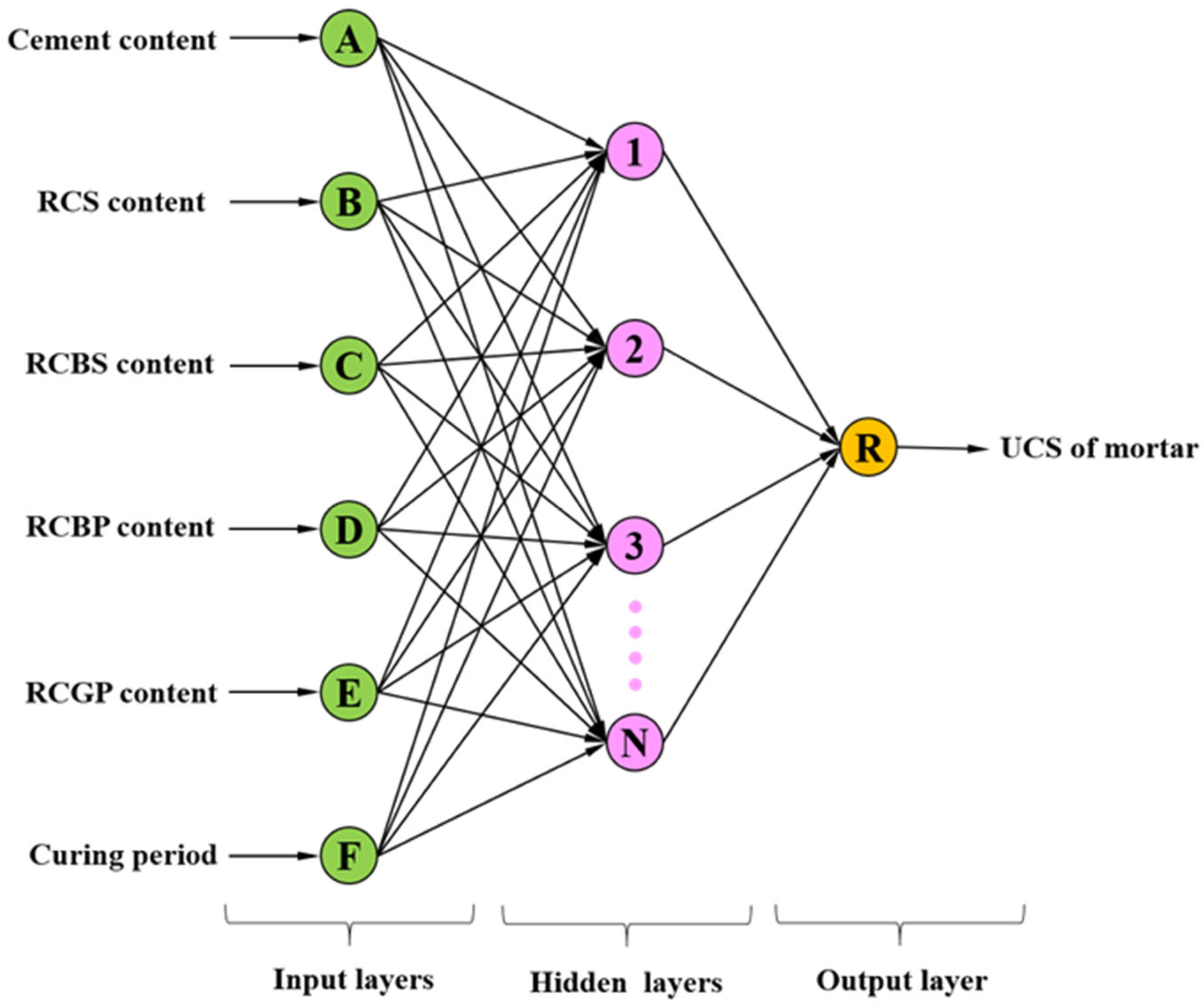
Figure 2 shows this study’s single-hidden-layer BP structure. Neuron counts vary per layer, with input/output neuron quantities being problem-dependent. As for the hidden layers, determining the optimal number of layers and neurons therein is crucial, and it varies depending on the problem and dataset [
27].
Figure 2 shows the input and output layers of this model contain 6 and 1 neurons, respectively.
First of all, we choose a BP neural network with a single hidden layer to study. The number of neurons in the hidden layer significantly influences the prediction performance of the neural network. Insufficient hidden-layer neurons prevent BP neural networks from establishing complex mappings required for accurate predictions. Conversely, excessive neurons cause prolonged training and overfitting. The Levenberg–Marquardt algorithm is utilized as the learning algorithm in training the developed network. This algorithm provides numerical solutions for nonlinear function approximation and is particularly suitable for small-to-medium-scale datasets [
14]. The Levenberg–Marquardt algorithm is used to train the ANN model in this paper.
The standardization process includes the following: (1) calculating the minimum and maximum values based solely on the training data; (2) clipping outliers in the test set to the [0, 1] range; and (3) performing inverse scaling for prediction results. Min-max normalization is preferred in building material prediction due to its physical interpretability (e.g., a dosage range of 0–100% naturally maps to the [0, 1] interval). If known outliers exist in the data, it is recommended to conduct preliminary experiments to compare the performance of the Robust Scaler and Z-score methods. Logarithmic transformation is only recommended for exponentially distributed parameters, such as porosity.
Standardizing data is a crucial step in the soft computing process, as it effectively reduces the influence of varying dimensions on data processing outcomes. In neural networks, input data are typically normalized to [0, 1] to standardize feature scales and reduce magnitude variations, thereby accelerating network training convergence. Furthermore, the paper employs a specific data standardization formula outlined below.
where
is the value after standardization,
is the maximum value of para
, and
is the minimum value of para
.
About 70% of the experimental data in
Section 3 is allocated for training the ANN model, while the remaining 30% is reserved for testing the accuracy of the model. The training and testing sets comprise 104 and 40 samples, respectively. Performance was evaluated using correlation coefficient (R), root mean squared error (RMSE), and mean squared error (MSE) [
22,
23].
where
is the predicted output value of the model;
is the mean experimental value;
is the target output (experimental value); and
is the total number of samples.
The coefficient of determination, R2, is a measure used during model testing to assess the linear correlation between variables. As R2 approaches 1, the correlation between the variables strengthens. Meanwhile, MSE (mean squared error) and RMSE (root mean squared error) serve as critical metrics in model validation for quantifying the disparity between predicted and target values. When evaluating model performance during testing, lower MSE or RMSE values indicate higher accuracy in using the prediction model to represent experimental data.
In this paper, the MSE is taken as the main evaluation basis. MATLAB R2021a 1.8.0_202 software was used to calculate the training MSE of BP neural network with the different number of neurons in the hidden layer. When the number of neurons in the hidden layer is 11, the MSE of the training set reaches its minimum. Therefore, the number of neurons in the input layer, hidden layer, and output layer are 6, 11, and 1, respectively. As
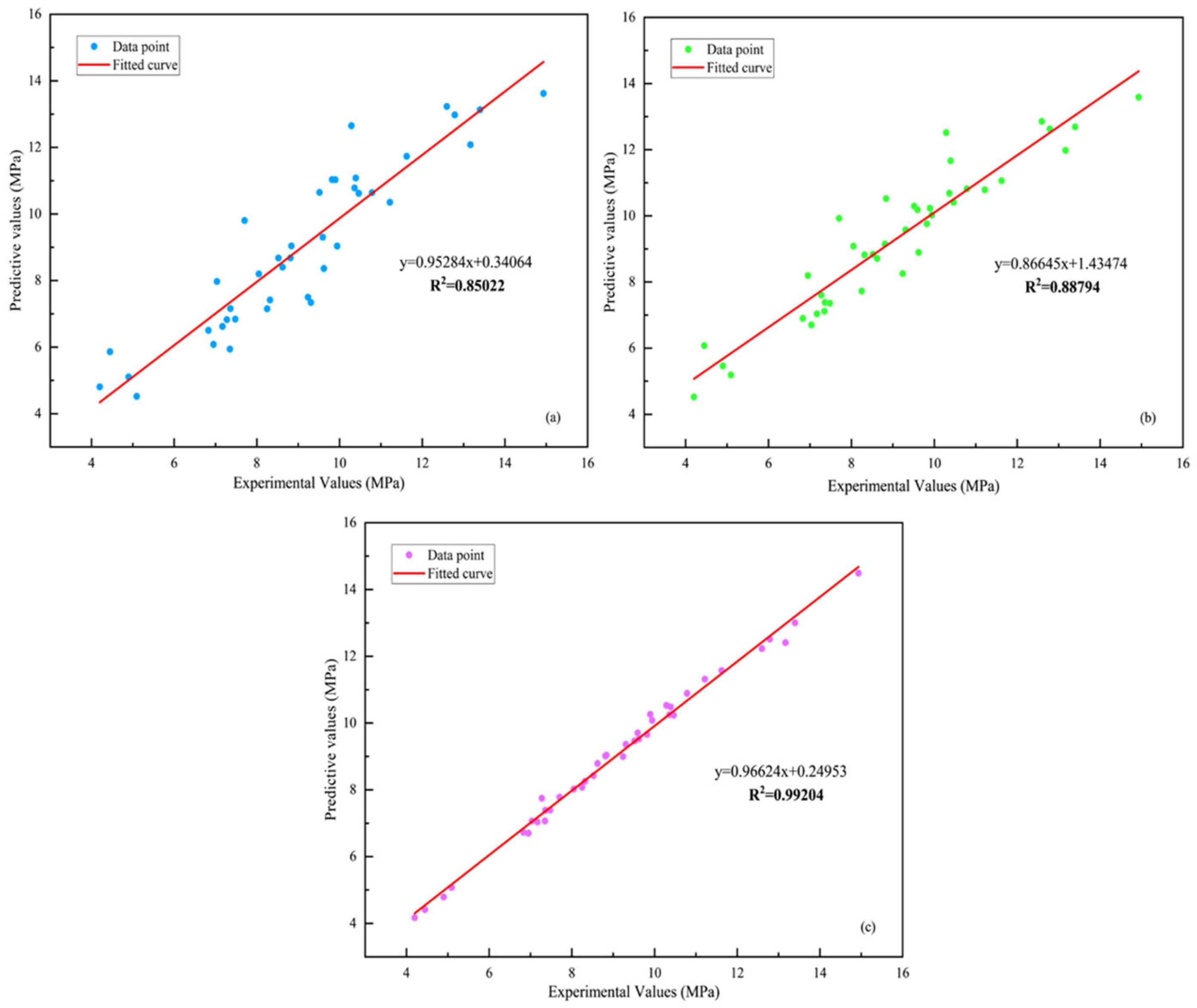
Table 4 shows, the single-hidden-layer ANN model achieves R
2 = 0.85022, with testing performance proving suboptimal.
Because the ANN model with a single hidden layer has low prediction accuracy, we use the ANN model with double hidden layers to predict the experimental data. Using the same method, the number of neurons in the first hidden layer and the second hidden layer are finally determined to be 14 and 9, respectively.
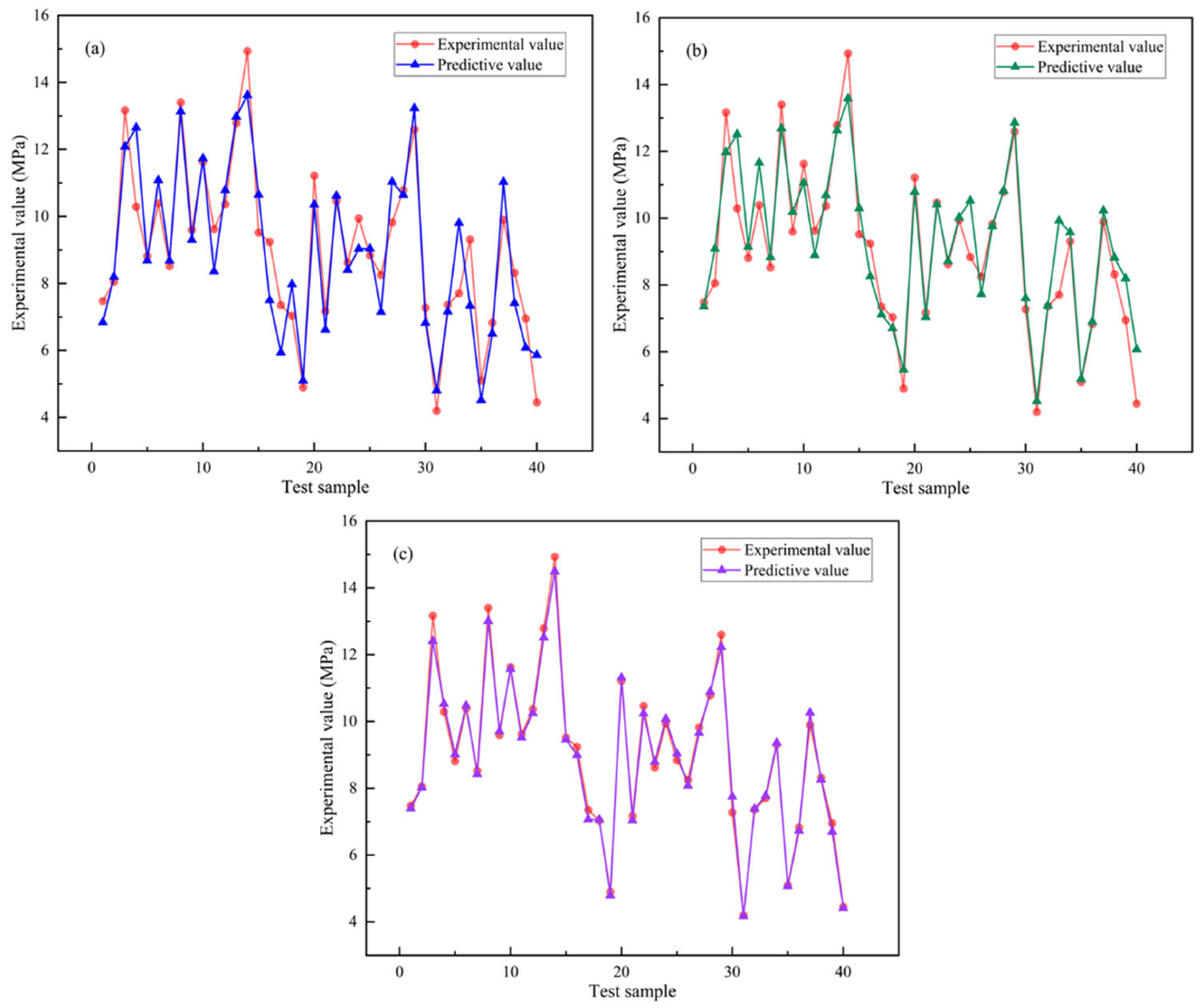
Table 4 indicates that dual-hidden-layer BPNN outperforms single-hidden-layer BPNN across all metrics, with visual comparisons presented in
Figure 3a,b and
Figure 4a,b.
2.4.2. GA-BP Neural Network
The BP algorithm is a gradient-based local-search method offering superior local optimization and enhanced computational speed. However, random initialization of weights and thresholds introduces optimization path uncertainty, often leading to local minima entrapment and compromised prediction accuracy [
28,
29].
Compared with BP optimization, genetic algorithms exhibit stronger robustness and global search capability through selection, crossover, and mutation operations. GAs demonstrate superior adaptive search and global optimization while probabilistically avoiding local minima [
30].
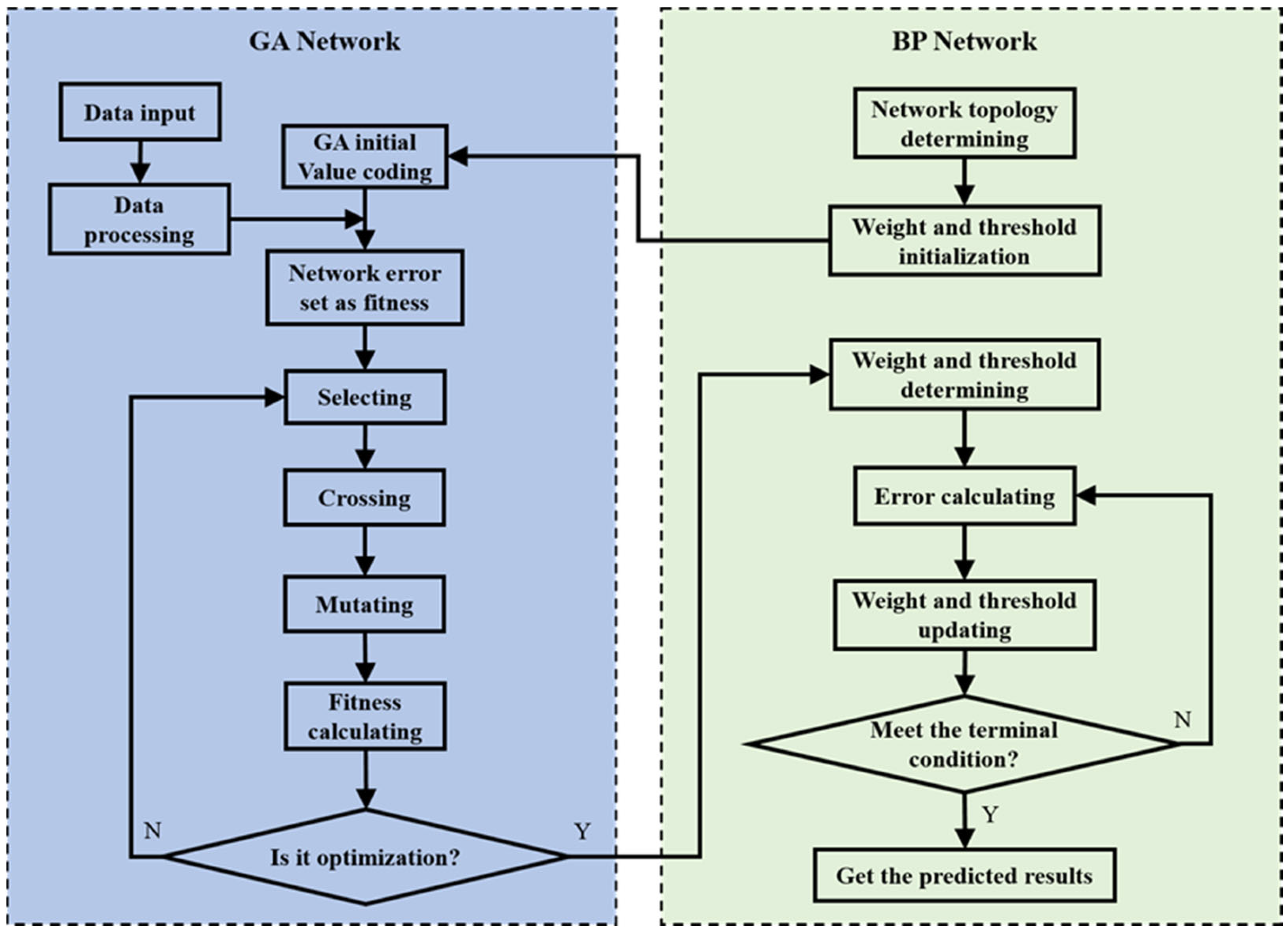
Figure 5 illustrates the GA-BP optimization process: determining BP architecture, initializing GA populations, and executing GA iterations. Within iterations, the BP network serves as the GA objective function, with its output representing sample prediction error (typically MSE). Selection, crossover, and mutation operate within the parameter space of BP weights/thresholds, evolving individual fitness values inversely proportional to error. Through iterations, GA-derived fitness increases as error decreases, progressively optimizing weights/thresholds. This evolutionary process retains optimal parameter combinations to optimize network training [
31]. In this way, the connection and the threshold of BP network can be optimized to make the network fitting effect more stable [
32].
Table 4,
Figure 3 and
Figure 4 show the comparison of prediction performance between GA-BP neural network and BP neural network. The GA-BP network demonstrates superior prediction accuracy over the standard BP network. The R
2 has reached 0.99204, which is very close to 1. This shows that GA-BP neural network has a broad application prospect in predicting the UCS of composite recycled mortar.
3. Unconfined Compressive Strength (UCS) Test
3.1. Mix Proportion Design
This paper examines the influence of RCBP and RCGP proportions on mortar UCS at varying RCBS replacement levels. The strength of mortar is designed as M10 grade mortar. Equation (5) gives the formula for calculating the replacement rate of RCBS.
where
is the replacement rate of RCBS,
is the mass of RCBS,
is the mass of RCS.
Equation (6) gives the formula for calculating the replacement rate of RP.
where
is the replacement rate of RP,
is the mass of RCBP,
is the mass of RCGP,
is the mass of cement when the replacement rate of RP is 0%. As shown in 3, the mass of cement in this paper is 355 g.
For practical engineering considerations, the replacement ratio of recycled aggregate should not be too high. Therefore, replacement levels of 10%, 20%, and 30% were selected for the study.
Table 5 shows the amount of each component when the replacement rate of RCBS is 10%. In addition, we also designed mix proportions where the replacement rates of RCBS are 20% and 30%, following the same design approach as for 10% replacement rate. The UCS of composite recycled mortar with different mix proportions was tested at day 7, 28, and 56.
3.2. Experimental Results
The shape of the sample is a cube with a side length of 70.7 mm. To minimize error margins and eliminate sample preparation discrepancies, three specimens per mix proportion were stored in a curing chamber (20 ± 2 °C, >95% RH) for 7, 28, and 56 days, respectively, for compressive strength testing. The compressive strength refers to UCS, the same as below. There are 144 groups of experimental results in total. Partial experimental results are given in this paper.
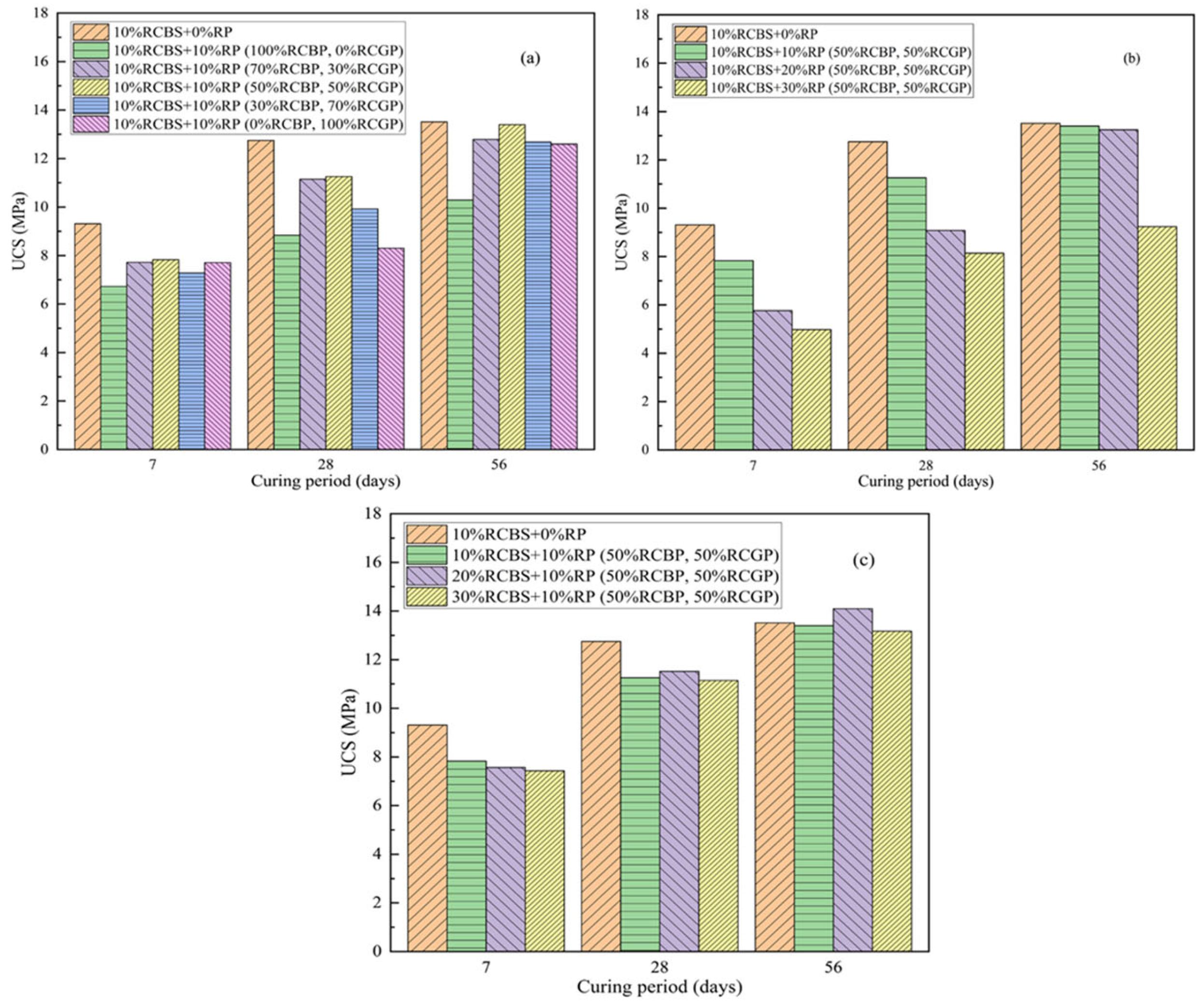
As shown in
Figure 6, on the whole, compared with the control group (10%RCBS + 0%RP), adding RP and RCBS will have adverse effects on the UCS of composite recycled mortar.
Figure 6a shows that composite recycled mortar achieves peak UCS at 10% RCBS replacement and 1:1 RP ratio. This maximum strength primarily results from full utilization of RCBP and RCGP pozzolanic effects at this mix proportion.
Cement-based materials derive strength primarily from cement hydration, requiring sufficient water. As
Figure 6b shows, composite recycled mortar’s UCS decreases with rising RP replacement rates. This occurs because RP’s fine particles and porous microstructure absorb mortar free water, suppressing cement hydration. In addition, the unreacted recycled powder will also lead to an increase in microcracks in the mortar [
33], which will also reduce the UCS of the mortar.
As shown in
Figure 6c, with the increase in the curing period, the adverse effect of the replacement rate of RCBS on the UCS of mortar gradually decreases. When the replacement rate of RCBS is 20% and the curing period is 56 days, the UCS of mortar even exceeds that of the control group (10%RCBS + 0%RP), reaching 14.1 MPa. This may be because, with the increase in the curing period, the free water absorbed by the RP is gradually released to participate in the hydration reaction of cement, which eventually leads to the increase in UCS of mortar.
4. Prediction of Optimal UCS and Mix Proportion by GA-BP Neural Network
At present, the research on mortar mix proportion adopts the traditional test method, which consumes a lot of time and resources. Due to many restrictions, it is difficult to obtain the ideal mix proportion, preventing the recycled materials from fully playing their role in recycled mortar. Recycled materials contain many impurities, have wide-ranging sources, and exhibit large variability in properties, which makes analyzing the internal relationship between recycled materials and the mechanical properties of composite recycled mortar more complex. This optimization challenge is addressed by harnessing neural networks’ robust fitting capacity and genetic algorithms’ powerful optimization capability to determine the mix proportion maximizing UCS in composite recycled mortar, enabling more intelligent and precise mortar design.
Function extremum optimization employs the trained GA-BP model to accurately predict composite recycled mortar UCS. This prediction model integrates with the compressive strength regression function as the fitness function. With mortar UCS as the optimization target, genetic algorithm execution achieves optimal mix proportion design for composite recycled mortar.
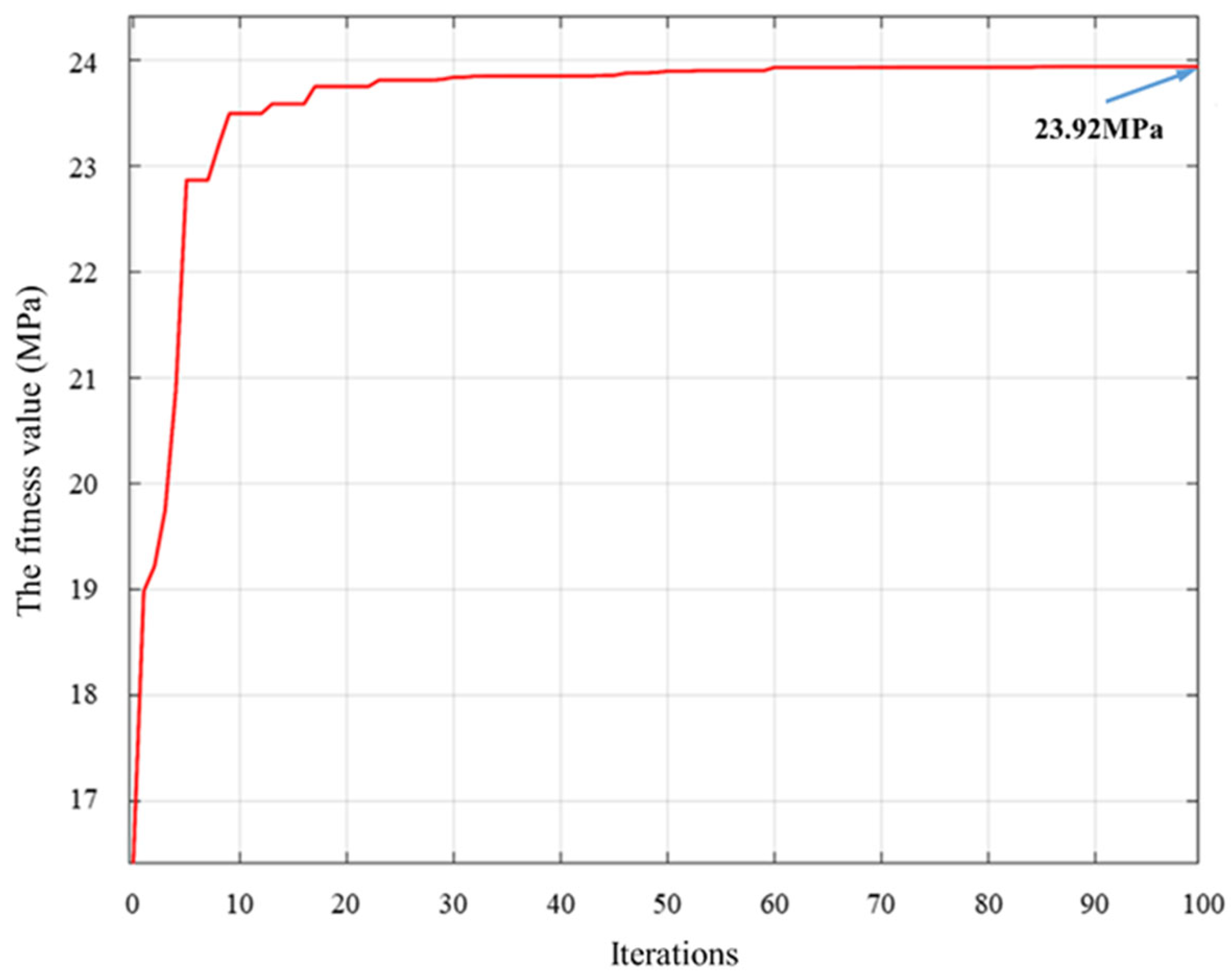
The structure of the prediction model is the same as before. The number of iterations is set to 100. The population size is 30. The standard range of crossover probabilities is 0.6~0.9, which cannot be too low or too high. A value that is too low will lead to slow convergence and may result in missing the optimal combination of ratios, and a value that is too high will easily decrease the high quality of coordination. In this paper, the crossover probability is set to 0.75, which can effectively retain high-quality genes while avoiding premature convergence. The mutation probability is usually between 0.1 and 0.3—a value that is too high will lead to excessive randomness, while a value that is too low easily causes the algorithm to fall into a local optimum, optimizing only short-term conserved data. In this paper, the mutation probabilities is 0.2. The individual length is set to 2. The trend of the fitness value of the test sample changing with iteration is shown in
Figure 7.
When proceeding to approximately the 60th iteration, the fitness curve converges around 24 MPa. After continuous iterative processing, when the program completes 100 iterations, the genetic algorithm stops selecting and obtains the individual with the highest fitness value. The predicted value of the optimal UCS of the composite recycled mortar is obtained, and the corresponding mix proportion is given. The predicted results are shown in
Table 6.
It can be seen that under the optimal UCS, the mix ratio of RP is about 6:5, and the best replacement rate of RCBS is about 22%, which is generally consistent with the conclusion in
Section 3.
We fabricated specimens for prediction validation following mix proportions shown in
Table 6. In order to facilitate the experimental operation, the mix proportion of recycled composite mortar was finally determined as follows: 83 days of curing period, 342 g of cement, 1212 g of RCS, 349 g of RCBS, 42 g of RCBP, and 33 g of RCGP. The experimental result shows that the UCS of the composite recycled mortar during the curing period of 83 days is 21.56 MPa. The relative error is 9.87%. This is mainly due to the discreteness of raw material properties of composite recycled mortar and experimental error.
We use the following methods to address the causes of these errors. We introduce a covariance-based synthetic sample generation method to simulate the variability of material compositions. For example, Mahalanobis distance sampling is used to generate synthetic samples with different compositional ratios, thereby enhancing the model’s robustness to material variations. A unified experimental protocol is established, including specimen preparation, curing conditions, and loading rates, to ensure consistency across all experiments and reduce the impact of human error.
The results show that the optimal UCS and corresponding mix proportion of composite recycled mortar obtained by function extremum optimization have certain reference significance. It shows the potential application value of the model in mortar mix design, and has a certain guiding role in engineering production.
In practical applications, a standardized data collection process (material proportioning, maintenance conditions, etc.) is first established to normalize the raw data. Then, the trained GA-BP model is used for prediction to obtain the optimal proportioning scheme, and experimental verification is carried out. Finally, a continuous optimization mechanism is set up to establish a closed loop of new data feedback and regularly update the model parameters.
5. Results and Discussion
This paper studies the UCS of composite recycled mortar with different replacement rates of RCBS, RCBP, and RCGP. Three kinds of ANN models are established to predict the UCS of composite recycled mortar. UCS prediction performance of single-hidden-layer BP, dual-hidden-layer BP, and GA-BP neural networks is evaluated. Finally, the optimal UCS, mix ratio, and curing period of composite recycled mortar are predicted by using the function extremum optimization of the ANN genetic algorithm. The prediction results are verified by experiments. Based on the analysis, the following conclusions are drawn:
- (1)
The highest UCS for the composite recycled mortar is achieved with a 1:1 mixing ratio of recycled powder (RP), specifically RCBP: RCGP. Moreover, the UCS increases with longer curing periods and peaks when the RCBS replacement rate is 20%.
- (2)
Among the three ANN models, GA-BP neural network model has the best prediction effect, and its RMSE and R2 are significantly better than in the other two models. Based on the comparative analysis, the single-hidden-layer BP neural network has a simple structure and fast computational speed, but the prediction accuracy is significantly reduced (R2 < 0.85) at high substitution rates of recycled materials (e.g., 20% RCBS) due to the limited characterization ability. Additionally, the results fluctuate due to random weight, which is only applicable to low substitution rates (<10%) and initial prediction of short-term maintenance. The double-hidden-layer BP network improves the accuracy slightly by increasing the complexity (R2 = 0.888), but the computational cost increases, there is a risk of gradient disappearance, and the prediction ability for long-term maintenance is still limited, which is only suitable for the scenarios with medium complexity and sufficient computational resources. In contrast, the GA-BP model uses genetic algorithm global optimization to significantly improve accuracy (RMSE = 1.1527, R2 = 0.99204), which effectively solves the problems of insufficient prediction accuracy and fluctuation of results, and becomes the preferred solution for high-precision engineering applications.
- (3)
The results of the function extremum optimization of the ANN genetic algorithm are verified by experiments. The prediction results are basically consistent with the conclusions in
Section 3. The result shows that the relative error is less than 10%.
In terms of model prediction accuracy, the GA-BP model in this study demonstrates a significant advantage. Compared to the test dataset R
2 value (0.9743) reported by Khan et al. using a double-hidden-layer BP network to predict ordinary mortar strength, this study improved the prediction accuracy to R
2 = 0.992 [
11].
This article proves that ANN can predict the UCS, mix proportion, and curing period of composite recycled mortar, which is helpful for the large-scale utilization of construction and industrial solid waste in engineering. Meanwhile, this will play a positive role in environmental protection. By intelligently optimizing the proportion of recycled materials, this not only improves the mechanical properties of mortar (UCS up to 21.56 MPa), but also brings significant environmental benefits: it improves the utilization of construction waste, reduces natural aggregates and CO2 emissions, and at the same time reduces the energy consumption by optimizing the experimental process. The results provide a scalable technical solution for construction waste resource utilization, which directly supports the national “double carbon” strategy and the development goal of circular economy.
In addition, this article initially applies the artificial neural network model to the optimization of the mix proportion of composite, and the stability analysis under different conditions (such as different substitution rates or curing times) will also be conducted in future work. This article focuses on the compressive strength of mortars with varying proportions of recycled materials. By using three different artificial neural network models, the study used the content of each ingredient and the curing period as input parameters and the compressive strength as the output value. In future work, the water–cement ratio and water absorption and slump should be considered as parameters.
6. Conclusions
This study optimized the mechanical properties and environmental benefits of composite recycled mortar using three artificial neural network models. Experimental results demonstrate that the mortar achieved peak unconfined compressive strength (UCS) of 21.56 MPa when incorporating 20% recycled clay brick sand (RCBS) and a 1:1 ratio of recycled powders (RCBP to RCGP). Among the prediction models, the GA-BP neural network optimized by genetic algorithm exhibited significant superiority (RMSE = 1.1527, R2 = 0.99204), substantially outperforming both the traditional single-hidden-layer BP network (R2 < 0.85 at high replacement rates) and the double-hidden-layer BP network (R2 = 0.888). The mixture proportion derived from ANN-GA function extremum optimization showed less than 10% error upon experimental validation, confirming the reliability of intelligent models in complex material systems. This achievement not only enhances construction waste utilization (reducing natural aggregate consumption and CO2 emissions) but also provides a high-precision predictive tool for large-scale engineering applications of recycled materials, directly supporting national “dual carbon” goals and circular economy development objectives.